
Articles | Volume 26, issue 8
https://doi.org/10.5194/acp-26-5249-2026
© Author(s) 2026. This work is distributed under
the Creative Commons Attribution 4.0 License.
the Creative Commons Attribution 4.0 License.
https://doi.org/10.5194/acp-26-5249-2026
© Author(s) 2026. This work is distributed under
the Creative Commons Attribution 4.0 License.
the Creative Commons Attribution 4.0 License.
Research article
| Highlight paper
| 
21 Apr 2026
Research article | Highlight paper |
| 21 Apr 2026
| 21 Apr 2026
Evaluation of stratospheric transport in three generations of Chemistry-Climate Models

Department of Earth Physics and Astrophysics, Universidad Complutense de Madrid, Spain
Thomas Birner
Ludwig-Maximilians-University, Munich, Germany
Andreas Chrysanthou
School of Earth and Environment, University of Leeds, Leeds, UK
Laboratory of Atmospheric Physics, Aristotle University of Thessaloniki, Greece
Institute of Geosciences, Spanish National Research Council (IGEO-CSIC), Madrid, Spain
Sean Davis
NOAA Chemical Sciences Laboratory, Boulder, CO USA
Alvaro de la Cámara
Department of Earth Physics and Astrophysics, Universidad Complutense de Madrid, Spain
Sandip Dhomse
School of Earth and Environment, University of Leeds, Leeds, UK
National Centre for Earth Observation, University of Leeds, Leeds, UK
Hella Garny
Deutsches Zentrum für Luft- und Raumfahrt, Institut für Physik der Atmosphäre, Oberpfaffenhofen, Germany
Michaela I. Hegglin
Institute of Climate and Energy Systems – Stratosphere (ICE-4), Forschungszentrum Juelich, Juelich, Germany
Department of Meteorology, University of Reading, Reading, UK
Institute for Atmospheric and Environmental Research, University of Wuppertal, Wuppertal, Germany
Daan Hubert
Royal Belgian Institute for Space Aeronomy (BIRA-IASB), Brussels, Belgium
Oksana Ivaniha
Department of Earth Physics and Astrophysics, Universidad Complutense de Madrid, Spain
James Keeble
Lancaster University, Lancaster, UK
Marianna Linz
Reflective, Emeriville, CA, USA
Daniele Minganti
Royal Belgian Institute for Space Aeronomy (BIRA-IASB), Brussels, Belgium
Jessica Neu
NASA Jet Propulsion Laboratory, Pasadena, CA, USA
David Plummer
Climate Research Division, Environment and Climate Change Canada, Montréal, Canada
Laura Saunders
Department of Physics, University of Toronto, Toronto, Ontario, Canada
Kasturi Shah
Department of Applied Mathematics and Theoretical Physics, University of Cambridge, Cambridge, UK
Gabriele Stiller
Karlsruhe Institute of Technology, Institute of Meteorology and Climate Research – Atmospheric Trace Gases and Remote Sensing, Karlsruhe, Germany
Kleareti Tourpali
Laboratory of Atmospheric Physics, Aristotle University of Thessaloniki, Greece
Darryn Waugh
Johns Hopkins University, Baltimore, MD, USA
Nathan Luke Abraham
National Centre for Atmospheric Science, Leeds, UK
Yusuf Hamied Department of Chemistry, University of Cambridge, Cambridge, UK
Hideharu Akiyoshi
National Institute for Environmental Studies, Tsukuba, Japan
Martyn P. Chipperfield
School of Earth and Environment, University of Leeds, Leeds, UK
National Centre for Earth Observation, University of Leeds, Leeds, UK
Patrick Jöckel
Deutsches Zentrum für Luft- und Raumfahrt, Institut für Physik der Atmosphäre, Oberpfaffenhofen, Germany
Béatrice Josse
Météo-France, CNRS, Univ. Toulouse, CNRM, Toulouse, France
Marion Marchand
LATMOS, Institut Pierre‐Simon Laplace, Sorbonne Université/CNRS/UVSQ, Paris, France
Patrick Martineau
Japan Agency for Marine-Earth Science and Technology (JAMSTEC), Yokohama, Japan
Olaf Morgenstern
National Institute for Water and Atmospheric Research (NIWA), Te Whanganui-a-Tara / Wellington, Aotearoa New Zealand
School of Physical and Chemical Sciences, University of Canterbury, Ōtautahi / Christchurch, Aotearoa New Zealand
now at: Deutscher Wetterdienst, Offenbach, Germany
Timofei Sukhodolov
Physikalisch-Meteorologisches Observatorium Davos/World Radiation Center, Davos, Switzerland
Shingo Watanabe
Japan Agency for Marine-Earth Science and Technology (JAMSTEC), Yokohama, Japan
Advanced Institute for Marine Ecosystem Change (WPI-AIMEC), Tohoku University, Sendai, Japan
Yousuke Yamashita
National Institute for Environmental Studies, Tsukuba, Japan
Related authors
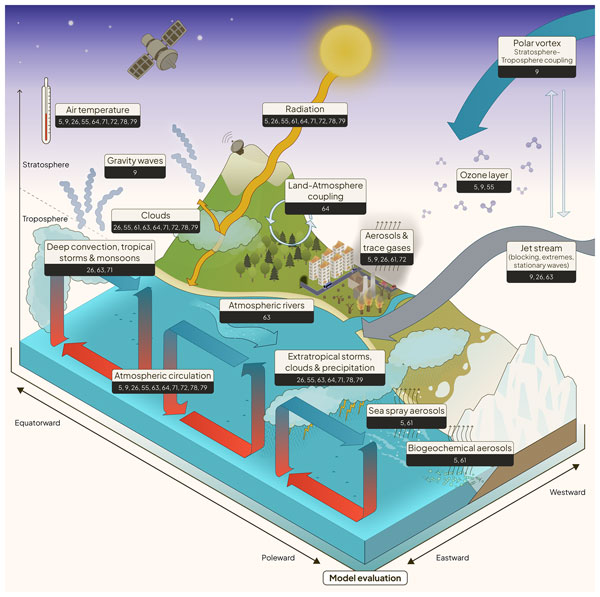
Beth Dingley, James A. Anstey, Marta Abalos, Carsten Abraham, Tommi Bergman, Lisa Bock, Sonya Fiddes, Birgit Hassler, Ryan J. Kramer, Fei Luo, Fiona M. O'Connor, Petr Šácha, Isla R. Simpson, Laura J. Wilcox, and Mark D. Zelinka
Geosci. Model Dev., 19, 2945–2984, https://doi.org/10.5194/gmd-19-2945-2026, https://doi.org/10.5194/gmd-19-2945-2026, 2026
Short summary
Short summary
This manuscript defines as a list of variables and scientific opportunities which are requested from the Coupled Model Intercomparison Project Phase 7 (CMIP7) Assessment Fast Track to address open atmospheric science questions. The list reflects the output of a large public community engagement effort, coordinated across autumn 2025 through to summer 2025.
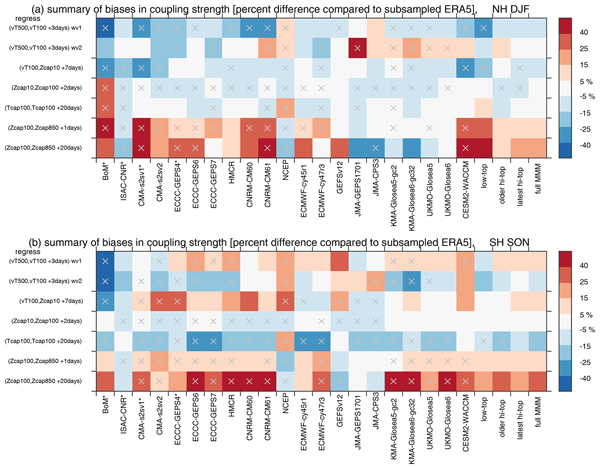
Chaim I. Garfinkel, Zachary D. Lawrence, Amy H. Butler, Etienne Dunn-Sigouin, Irene Erner, Alexey Y. Karpechko, Gerbrand Koren, Marta Abalos, Blanca Ayarzagüena, David Barriopedro, Natalia Calvo, Alvaro de la Cámara, Andrew Charlton-Perez, Judah Cohen, Daniela I. V. Domeisen, Javier García-Serrano, Neil P. Hindley, Martin Jucker, Hera Kim, Robert W. Lee, Simon H. Lee, Marisol Osman, Froila M. Palmeiro, Inna Polichtchouk, Jian Rao, Jadwiga H. Richter, Chen Schwartz, Seok-Woo Son, Masakazu Taguchi, Nicholas L. Tyrrell, Corwin J. Wright, and Rachel W.-Y. Wu
Weather Clim. Dynam., 6, 171–195, https://doi.org/10.5194/wcd-6-171-2025, https://doi.org/10.5194/wcd-6-171-2025, 2025
Short summary
Short summary
Variability in the extratropical stratosphere and troposphere is coupled, and because of the longer timescales characteristic of the stratosphere, this allows for a window of opportunity for surface prediction. This paper assesses whether models used for operational prediction capture these coupling processes accurately. We find that most processes are too weak; however downward coupling from the lower stratosphere to the near surface is too strong.
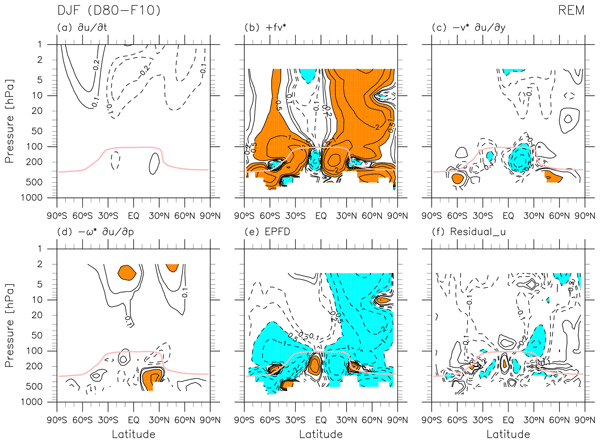
Masatomo Fujiwara, Patrick Martineau, Jonathon S. Wright, Marta Abalos, Petr Šácha, Yoshio Kawatani, Sean M. Davis, Thomas Birner, and Beatriz M. Monge-Sanz
Atmos. Chem. Phys., 24, 7873–7898, https://doi.org/10.5194/acp-24-7873-2024, https://doi.org/10.5194/acp-24-7873-2024, 2024
Short summary
Short summary
A climatology of the major variables and terms of the transformed Eulerian-mean (TEM) momentum and thermodynamic equations from four global atmospheric reanalyses is evaluated. The spread among reanalysis TEM momentum balance terms is around 10 % in Northern Hemisphere winter and up to 50 % in Southern Hemisphere winter. The largest uncertainties in the thermodynamic equation (about 50 %) are in the vertical advection, which does not show a structure consistent with the differences in heating.
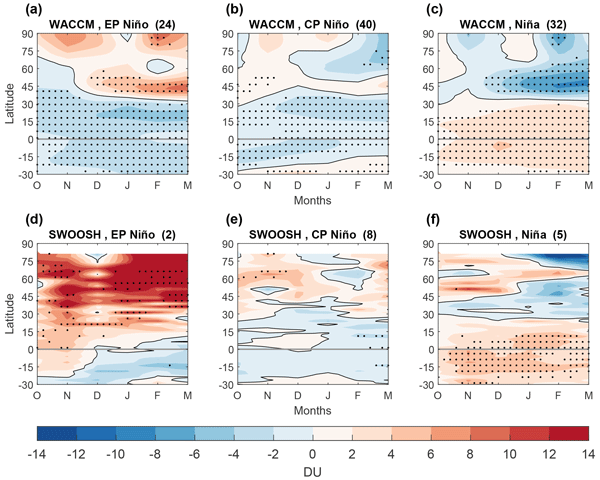
Samuel Benito-Barca, Natalia Calvo, and Marta Abalos
Atmos. Chem. Phys., 22, 15729–15745, https://doi.org/10.5194/acp-22-15729-2022, https://doi.org/10.5194/acp-22-15729-2022, 2022
Short summary
Short summary
The impact of different El Niño flavors (eastern (EP) and central (CP) Pacific El Niño) and La Niña on the stratospheric ozone is studied in a state-of-the-art chemistry–climate model. Ozone reduces in the tropics and increases in the extratropics when an EP El Niño event occurs, the opposite of La Niña. However, CP El Niño has no impact on extratropical ozone. These ozone variations are driven by changes in the stratospheric transport circulation, with an important contribution of mixing.
Zachary D. Lawrence, Marta Abalos, Blanca Ayarzagüena, David Barriopedro, Amy H. Butler, Natalia Calvo, Alvaro de la Cámara, Andrew Charlton-Perez, Daniela I. V. Domeisen, Etienne Dunn-Sigouin, Javier García-Serrano, Chaim I. Garfinkel, Neil P. Hindley, Liwei Jia, Martin Jucker, Alexey Y. Karpechko, Hera Kim, Andrea L. Lang, Simon H. Lee, Pu Lin, Marisol Osman, Froila M. Palmeiro, Judith Perlwitz, Inna Polichtchouk, Jadwiga H. Richter, Chen Schwartz, Seok-Woo Son, Irene Erner, Masakazu Taguchi, Nicholas L. Tyrrell, Corwin J. Wright, and Rachel W.-Y. Wu
Weather Clim. Dynam., 3, 977–1001, https://doi.org/10.5194/wcd-3-977-2022, https://doi.org/10.5194/wcd-3-977-2022, 2022
Short summary
Short summary
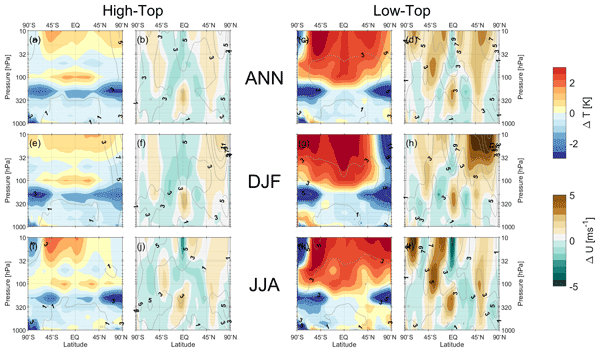
Forecast models that are used to predict weather often struggle to represent the Earth’s stratosphere. This may impact their ability to predict surface weather weeks in advance, on subseasonal-to-seasonal (S2S) timescales. We use data from many S2S forecast systems to characterize and compare the stratospheric biases present in such forecast models. These models have many similar stratospheric biases, but they tend to be worse in systems with low model tops located within the stratosphere.
Florentin Hiault, Emmanuel Mahieu, Pierre-Henri Lefebvre, Martyn P. Chipperfield, Zihao Wang, Martin K. Vollmer, Jeremy J. Harrison, and Diana Roos
EGUsphere, https://doi.org/10.5194/egusphere-2026-5290, https://doi.org/10.5194/egusphere-2026-5290, 2026
This preprint is open for discussion and under review for Atmospheric Chemistry and Physics (ACP).
Short summary
Short summary
We derived a multi-decadal record of a potent greenhouse gas that is unintentionally released during the production of another industrial chemical. Using infrared measurements collected in the Swiss Alps from 1986 to 2024, we found that the amount of this gas in the atmosphere continued to increase despite efforts to reduce emissions. Comparisons with independent measurements confirmed the reliability of the method and the need for continued long-term monitoring.
Sean M. Davis, William T. Ball, Yue Jia, Gabriel Chiodo, Justin A. Alsing, James Keeble, Hideharu Akiyoshi, Carlo Arosio, Ewa M. Bednarz, Andreas Chrysanthou, Melanie Coldewey-Egbers, Robert Damadeo, Sandip Dhomse, Mohamadou A. Diallo, Simone Dietmuller, Roland Eichinger, Stacey Frith, Birgit Hassler, Michaela I. Hegglin, Daan Hubert, Patrick Jöckel, Béatrice Josse, Natalya Kramarova, Diego Loyola, Eliane Maillard Barras, Marion Marchand, Olaf Morgenstern, David Plummer, Robert W. Portmann, Karen H. Rosenlof, Alexei Rozanov, Viktoria F. Sofieva, Johannes Staehelin, Timofei Sukhodolov, Kleareti Tourpali, Ronald J. Van der A, H. J. Ray Wang, Krzysztof Wargan, Shingo Watanabe, Mark Weber, Jeannette D. Wild, Yousuke Yamashita, and Jerry Ziemke
Atmos. Chem. Phys., 26, 13817–13843, https://doi.org/10.5194/acp-26-13817-2026, https://doi.org/10.5194/acp-26-13817-2026, 2026
Short summary
Short summary
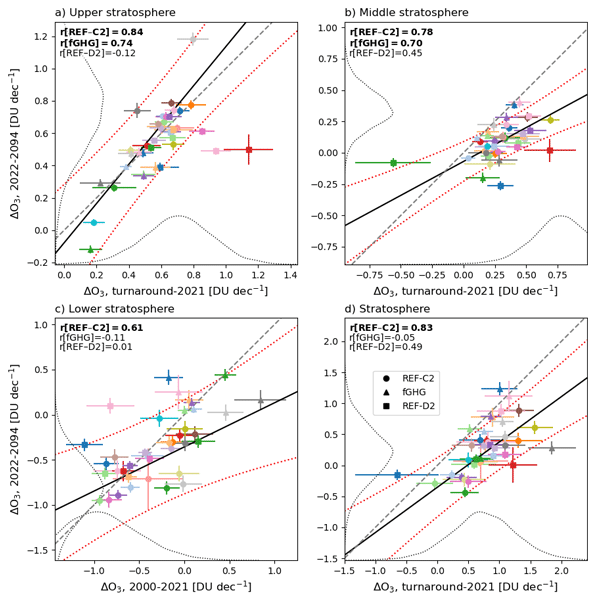
This study investigates tropical ozone changes in models and satellite observations to determine how well they agree and whether observations can constrain model projections. At some levels, satellite records disagree significantly on the magnitude of ozone changes. While early and late 21st century trends are correlated across models, suggesting a potential emergent constraint, the spread in observations means they are unable to provide guidance on the credibility of model projections.
Brian Auffarth, Mark Weber, Alexei Rozanov, Carlo Arosio, John P. Burrows, Melanie Coldewey-Egbers, Sean M. Davis, Doug Degenstein, Kimberlee Dubé, Stacey M. Frith, Lucien Froidevaux, Diego Loyola, Vitali E. Fioletov, Viktoria Sofieva, Ronald van der A, and Jeannette D. Wild
Atmos. Chem. Phys., 26, 13359–13386, https://doi.org/10.5194/acp-26-13359-2026, https://doi.org/10.5194/acp-26-13359-2026, 2026
Short summary
Short summary
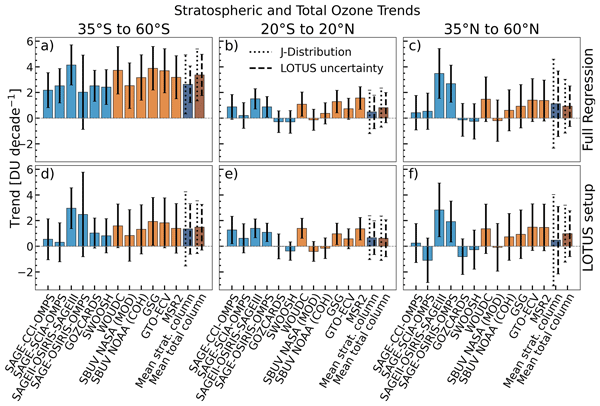
This study examines the trends of stratospheric and total ozone between 2000 and 2024, using long-term satellite datasets. Our results show positive trends in the upper stratosphere and a strong ozone recovery in the Southern Hemisphere, while changes in lower altitudes remain mostly small. The total and stratospheric trends show very similar results, indicating that tropospheric ozone contributes little to total column changes, while the stratospheric column is the dominant driver.
Martin B. Andrews, Neal Butchart, James A. Anstey, Ewa Bednarz, Dillon Elsbury, Jorge L. García-Franco, Vinay Kumar, Froila M. Palmeiro, Natasha E. Trencham, Kohei Yoshida, Zhaoyang Chai, Dong-Chan Hong, Kai Huang, Aleena M. Jaison, Yoshio Kawatani, Jeff R. Knight, Pu Lin, François Lott, Yixiong Lu, Hiroaki Naoe, Scott M. Osprey, Jadwiga H. Richter, Federico Serva, Seok-Woo Son, Qi Tang, Shingo Watanabe, and Jinbo Xie
Weather Clim. Dynam., 7, 1797–1820, https://doi.org/10.5194/wcd-7-1797-2026, https://doi.org/10.5194/wcd-7-1797-2026, 2026
Short summary
Short summary
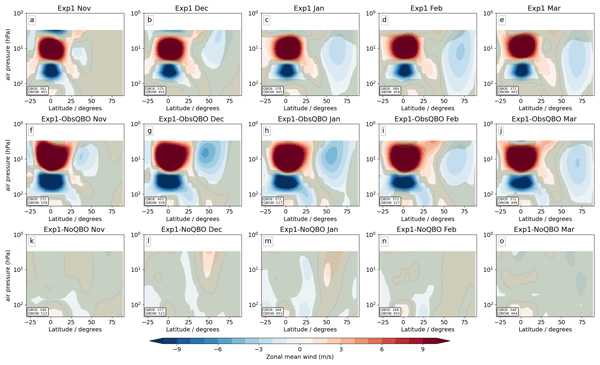
The observed winds in the upper atmosphere over the equator have alternating easterly and westerly regions that descend towards the lower atmosphere before dissipating, with a period of approximately 28 months. This is known as the Quasi-Biennial Oscillation (QBO). The QBO is known to influence remote regions of the atmosphere. This paper details the results of multi-model experiments where the QBO is nudged towards the observed QBO allowing the assessment of these remote connections.
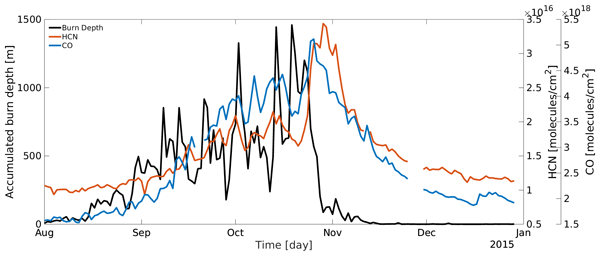
Antonio G. Bruno, David P. Moore, Jeremy J. Harrison, Ailish Graham, Martyn P. Chipperfield, and Corinne Vigouroux
Atmos. Chem. Phys., 26, 12925–12952, https://doi.org/10.5194/acp-26-12925-2026, https://doi.org/10.5194/acp-26-12925-2026, 2026
Short summary
Short summary
Indonesian peatlands store vast carbon reserves, but can release large quantities of greenhouse gases and other species with significant environmental impacts, including hydrogen cyanide (HCN), when fires occur. Analyzing three major El Niño years with satellites and models, we found that emissions depend on local hydrological conditions, not just El Niño strength. Including soil moisture and burn depth can improve emission estimates and climate strategies.

Daniele Visioni, Alan Robock, Alistair Duffey, Matthew Henry, Haruki Hirasawa, Walker Raymond Lee, Cindy Wang, Kelsey Roberts, Shingo Watanabe, Michelle Simões Reboita, Masahiro Sugiyama, Ben Kravitz, Jim Haywood, Simone Tilmes, Frédéric K. Bonou, Jack Chen, Timofei Sukhodolov, Sandro Vattioni, Andrin Jörimann, Diego Villanueva, Ryan Vella, Paul Farron, Ewa Bednarz, Ulrike Niemeier, Colleen Golja, and Juan A. Añel
Geosci. Model Dev., 19, 8469–8499, https://doi.org/10.5194/gmd-19-8469-2026, https://doi.org/10.5194/gmd-19-8469-2026, 2026
Short summary
Short summary
The Geoengineering Model Intercomparison Project is a coordinated international model intercomparison effort aiming to provide robust experimental protocols for simulations of various Solar Radiation Modification (SRM) methods. In this manuscript, we describe a list of novel experiments decided by the community, to be run by climate models to better understand sources of uncertainty in SRM. We also show and discuss some preliminary results from a few climate models.
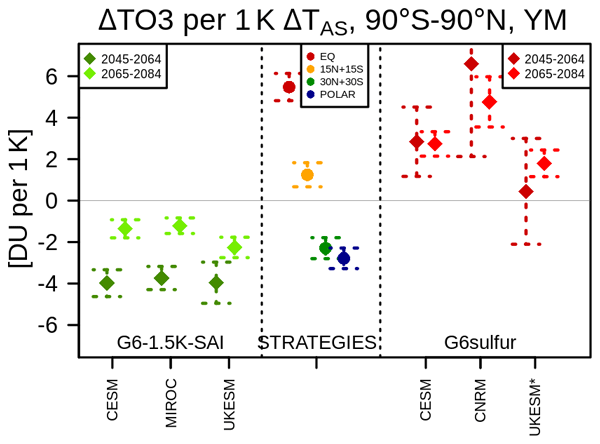
Ewa M. Bednarz, Amy H. Butler, James M. Haywood, Matthew Henry, Andy Jones, Ben Kravitz, Walker R. Lee, Douglas G. MacMartin, Amanda C. Maycock, Takashi Sekiya, Shingo Watanabe, and Daniele Visioni
Atmos. Chem. Phys., 26, 12751–12770, https://doi.org/10.5194/acp-26-12751-2026, https://doi.org/10.5194/acp-26-12751-2026, 2026
Short summary
Short summary
An assessment of the potential impacts of Stratospheric Aerosol Injection, a proposed method to offset global warming, on stratospheric ozone projections over the 21st century using the new multi-model GeoMIP (Geoengineering Model Intercomparison Project) G6-1.5K-SAI (Stratospheric Aerosol Injection) experiment. We discuss drivers of the responses, identify areas of model agreement and disagreement and sources of uncertainty. Our results highlight the need to assess any projected SAI impacts in wider strategy and scenario dimension using a multi-model framework.
Florian Voet, Felix Ploeger, Johannes C. Laube, Laura N. Saunders, Patrick E. Sheese, Attahir Mainika, Peter Preusse, Jens-Uwe Grooß, Kaley A. Walker, Susann Tegtmeier, and Michaela Imelda Hegglin
EGUsphere, https://doi.org/10.5194/egusphere-2026-4647, https://doi.org/10.5194/egusphere-2026-4647, 2026
This preprint is open for discussion and under review for Atmospheric Chemistry and Physics (ACP).
Short summary
Short summary
We developed a better way to estimate how long air remains in the upper atmosphere, because satellite estimates can be too noisy to show long-term changes. Using measurements of several gases from a satellite, we found that combining them cuts uncertainty by about half and gives estimates with about 0.3 years of average uncertainty. Results for 2004–2021 show older air in the Northern Hemisphere and younger air in the tropics and Southern Hemisphere, suggesting slower circulation in the north.
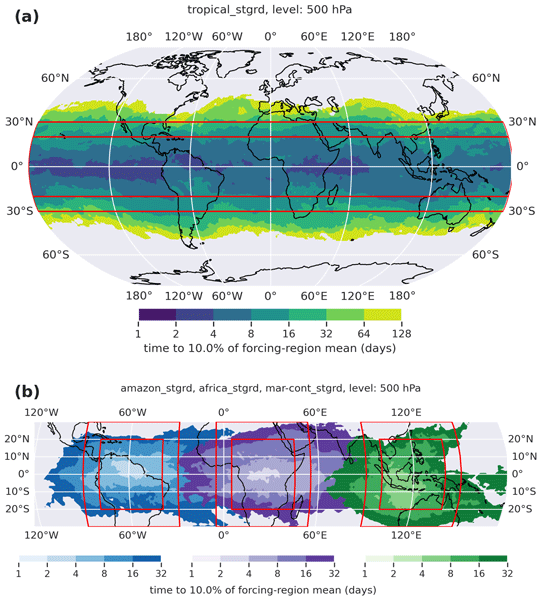
Lianet Hernández Pardo, Joachim Curtius, Patrick Jöckel, J. Moritz Menken, Christopher Pöhlker, Mira Pöhlker, and Anna Possner
Atmos. Chem. Phys., 26, 12275–12293, https://doi.org/10.5194/acp-26-12275-2026, https://doi.org/10.5194/acp-26-12275-2026, 2026
Short summary
Short summary
Many tiny particles are formed high in the tropical atmosphere, but their impact lower down is unclear. We studied how these particles move downward using long-term computer simulations. We found that particles can reach middle levels of the atmosphere within a week, carried by winds. These results help us understand how pollution and clouds might change as particles spread around the world.
Carly KleinStern, Benjamin Clouser, Thaopaul Bui, Jonathan Dean-Day, Adrien Desmoulin, James Franke, Hisashi Nakamura, Rei Ueyama, Shingo Watanabe, and Elisabeth Moyer
EGUsphere, https://doi.org/10.5194/egusphere-2026-4533, https://doi.org/10.5194/egusphere-2026-4533, 2026
This preprint is open for discussion and under review for Atmospheric Chemistry and Physics (ACP).
Short summary
Short summary
Tropical cyclones (TCs) create gravity waves that spread in near-concentric rings above the storm, creating temperature fluctuations that help dry the stratosphere via cirrus formation. Understanding the amplitudes of those waves has been difficult because few direct measurements exist. We show new measurements taken during a high-altitude overflight of TC Hinnamnor in 2022. The large wave observed suggests that TC gravity waves are underestimated in the commonly-used ERA5 reanalysis.
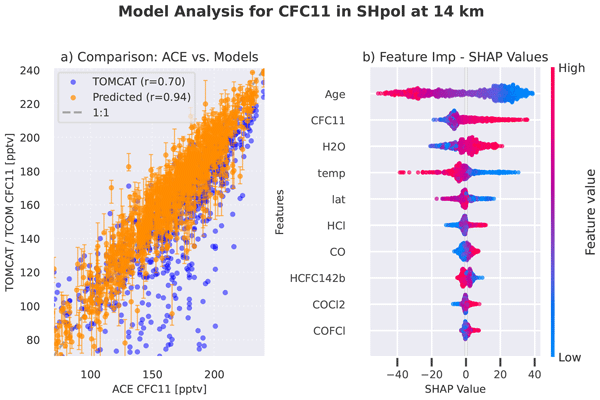
Sandip S. Dhomse and Martyn P. Chipperfield
Earth Syst. Sci. Data, 18, 6171–6189, https://doi.org/10.5194/essd-18-6171-2026, https://doi.org/10.5194/essd-18-6171-2026, 2026
Short summary
Short summary
We have developed an innovative methodology that uses machine learning to
correcterrors in chemical models by using satellite data as a guide. In this latest update, we detail improvements to our process for creating a gap-free data of two major ozone-depleting substances: CFC-11 and CFC-12. By combining the strengths of both chemical models and satellites, we have produced a reliable, global dataset that allows researchers to track long-term trends and better evaluate the chemical models.
Laura N. Saunders, Kaley A. Walker, Gabriele P. Stiller, Piera Raspollini, Luis F. Millán, Marco Gai, Chris D. Boone, John Gille, Norbert Glatthor, Armin Kleinboehl, Anne Kleinert, Alyn Lambert, Donal Murtaugh, Patrick E. Sheese, Geoffrey C. Toon, and Gerald Wetzel
EGUsphere, https://doi.org/10.5194/egusphere-2026-4651, https://doi.org/10.5194/egusphere-2026-4651, 2026
Short summary
Short summary
We present a comprehensive evaluation of nitrous oxide (N2O) measurements taken during the 2002–2024 period from five limb-viewing satellite instruments: ACE-FTS, HIRDLS, MIPAS, Aura-MLS, and SMR. Coincident measurements are compared between satellite instruments and with independent reference data from balloon-borne instruments. We show that ACE-FTS, MIPAS, and SMR constitute an excellent 23-year record of N2O measurements that could be used to create an ESA-funded merged dataset in future.
Ewa M. Bednarz, Valentina Aquila, Amy H. Butler, Peter Colarco, Eric Fleming, Freja F. Østerstrøm, David Plummer, Ilaria Quaglia, William Randel, Michelle L. Santee, Takashi Sekiya, Simone Tilmes, Xinyue Wang, Shingo Watanabe, Wandi Yu, Jun Zhang, Yunqian Zhu, and Zhihong Zhuo
Atmos. Chem. Phys., 26, 11355–11370, https://doi.org/10.5194/acp-26-11355-2026, https://doi.org/10.5194/acp-26-11355-2026, 2026
Short summary
Short summary
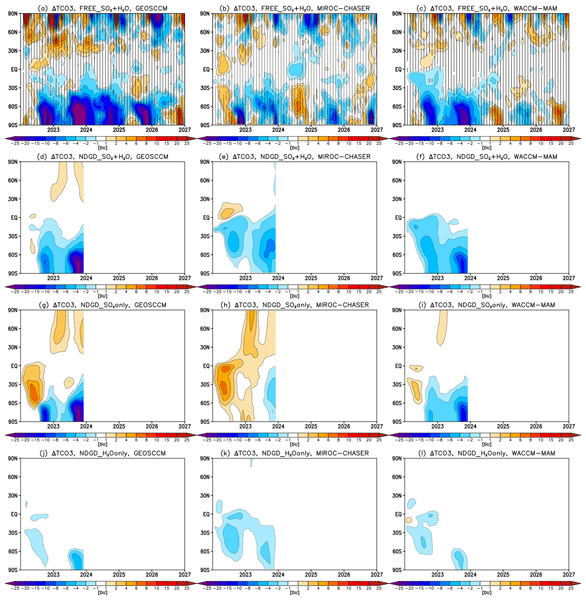
The 2022 Hunga eruption injected unprecedented quantities of water vapor into the stratosphere, alongside modest amounts of aerosol precursors. We assess its impacts on stratospheric ozone layer using a multi-model ensemble of chemistry-climate simulations. The results confirm the eruption's role in modulating SH (Southern Hemisphere) mid and high latitudes ozone abundances in the short term, and discuss the different chemical and dynamical processes driving those changes as well as the role of natural variability.
Andrin Jörimann, Timofei Sukhodolov, Simone Tilmes, David Plummer, Shingo Watanabe, Hideharu Akiyoshi, Gabriel Chiodo, Daniele Visioni, Sandro Vattioni, Eugene Rozanov, Ewa Monika Bednarz, Béatrice Josse, Yousuke Yamashita, and Thomas Peter
Atmos. Chem. Phys., 26, 11207–11234, https://doi.org/10.5194/acp-26-11207-2026, https://doi.org/10.5194/acp-26-11207-2026, 2026
Short summary
Short summary
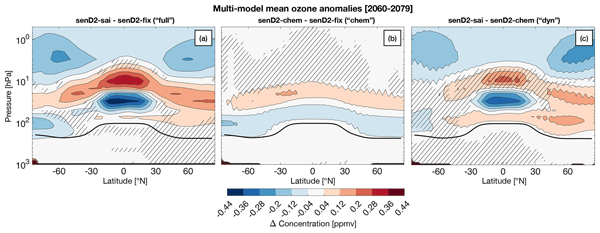
We study a future scenario where artificial stratospheric aerosol injections counter medium climate change, to understand possible negative side effects like ozone depletion. The injected aerosol layer is implemented uniformly in five climate models, which eliminates some uncertainty from model-specific aerosol evolution. The models agree well on where and how key thermodynamical (heating, circulation) and chemical processes change, however, the strength of the changes varies considerably.
Katharina Perny, Timofei Sukhodolov, Ales Kuchar, Pavle Arsenovic, Bernadette Rosati, Christoph Brühl, Sandip S. Dhomse, Andrin Jörimann, Anton Laakso, Graham Mann, Ulrike Niemeier, Giovanni Pitari, Ilaria Quaglia, Takashi Sekiya, Kengo Sudo, Claudia Timmreck, Simone Tilmes, Daniele Visioni, and Harald E. Rieder
Atmos. Chem. Phys., 26, 10997–11025, https://doi.org/10.5194/acp-26-10997-2026, https://doi.org/10.5194/acp-26-10997-2026, 2026
Short summary
Short summary
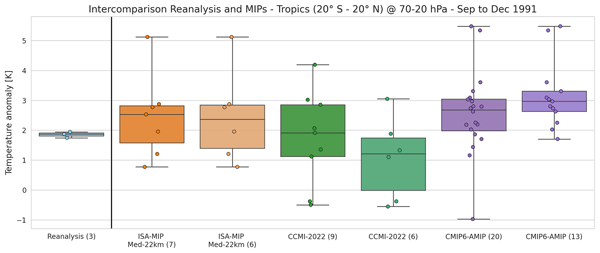
Major volcanic eruptions, such as the one of Mt. Pinatubo in 1991, can inject large amounts of sulfur dioxide into the stratosphere. The resulting aerosol cloud affects stratospheric temperature and thereby middle atmospheric dynamics and chemistry. Here we investigate similarities and differences across an ensemble of climate models in reproducing the stratospheric temperature signal following the Mt. Pinatubo eruption.
Patrick Martineau, Hidehiro Fujio, Ingo Richter, Ayako Yamamoto, and Masami Nonaka
Earth Syst. Sci. Data Discuss., https://doi.org/10.5194/essd-2026-434, https://doi.org/10.5194/essd-2026-434, 2026
Preprint under review for ESSD
Short summary
Short summary
The Weather Extremes Archive (WEXA) provides global data on persistent heat waves and cold spells from 1979 to the present. Events are defined using temperature thresholds that vary by season and location. The dataset tracks the movement, size, and intensity of these events over time and is publicly available for analysis.
Colleen Marie Golja, Marianna Linz, Ewa Monika Bednarz, Daniele Visioni, Ben Kravitz, John A. Dykema, Michelle E. Frazer, Anthony C. Jones, Isla R. Simpson, and Shingo Watanabe
EGUsphere, https://doi.org/10.5194/egusphere-2026-4200, https://doi.org/10.5194/egusphere-2026-4200, 2026
Short summary
Short summary
Adding reflective particles to the stratosphere has been proposed to cool the planet, but how the resulting lower-stratospheric heating affects the broader climate remains unclear. This study simulates idealized lower-stratospheric heating across five climate models finding large inter-model differences in the stratospheric and surface response. The results highlight ways in which these differences may be explained by biases in the stratospheric climatological mean state.
Jan Kaumanns, Florian Voet, Felix Ploeger, Peter Preuße, Jörn Ungermann, and Michaela Imelda Hegglin
EGUsphere, https://doi.org/10.5194/egusphere-2026-4183, https://doi.org/10.5194/egusphere-2026-4183, 2026
Short summary
Short summary
Age-of-Air (AoA) denotes the time an air parcel has spent inside the stratosphere and is an important diagnostic quantity for the Brewer Dobson Circulation (BDC). We present a novel approach using neural networks to accurately and robustly derive AoA from inert chemical species with considerable measurement noise even far beyond the training domain. We also present an alternative view of AoA by using autoencoders to derive a model-independent proxy quantity for it and validate its robustness.
Gabriele P. Stiller, Thomas von Clarmann, Stefan Bender, Bernd Funke, Maya García-Comas, Norbert Glatthor, Udo Grabowski, Sylvia Kellmann, Michael Kiefer, Alexandra Laeng, Andrea Linden, and Manuel López-Puertas
EGUsphere, https://doi.org/10.5194/egusphere-2026-4116, https://doi.org/10.5194/egusphere-2026-4116, 2026
Short summary
Short summary
We present the global distributions of the trace gases HNO3, ClONO2, HNO4, N2O5, and NOy, the total reactive nitrogen (constructed from [HNO3] + [ClONO2] + [HNO4] + 2x[N2O5] + [NO] + [NO2]), all derived from the latest spectral version, V8.03, of MIPAS/Envisat spectra. The data set covers the period of July 2002 to April 2012, with global day and night coverage from 6 to 60 km altitude. An additional data product, made for immediate comparison to atmospheric model simulations, is also presented.
Aleena M. Jaison, Lesley J. Gray, Scott M. Osprey, James A. Anstey, Martin B. Andrews, Neal Butchart, Zhaoyang Chai, Dong-Chan Hong, Kai Huang, Yoshio Kawatani, Jeff R. Knight, Pu Lin, Francois Lott, Yixiong Lu, Hiroaki Naoe, Jadwiga H. Richter, Nan Rosenbloom, Federico Serva, Anne K. Smith, Seok-Woo Son, Qi Tang, Shingo Watanabe, Jinbo Xie, and Kohei Yoshida
EGUsphere, https://doi.org/10.5194/egusphere-2026-4135, https://doi.org/10.5194/egusphere-2026-4135, 2026
Short summary
Short summary
The tropical upper stratosphere has winds that switch between westerly and easterly every six months known as the semi-annual oscillation (SAO). Climate models commonly show an easterly bias in the SAO. We analysed data from many models to test if correcting the biases in winds lower in the stratosphere could improve SAO. We find correcting the lower-level wind biases reduces the SAO easterly bias, though further improvements, such as better representation of atmospheric waves, are still needed.
Zhiting Wang, Yijie Zheng, Xinlong Hong, Plummer David, and Jun Zhang
EGUsphere, https://doi.org/10.5194/egusphere-2026-3817, https://doi.org/10.5194/egusphere-2026-3817, 2026
Short summary
Short summary
The tropospheric OH radical impacts air quality and greenhouse gas concentrations. Here it shown that stratospheric intrusion significantly influence tropospheric OH, particularly over subtropical oceans (20 %) and the Tibetan Plateau (12 %) in summer. This influence is expected to intensify in the future due to enhanced stratosphere-troposphere exchange and stratospheric ozone recovery, highlighting a growing coupling between upper-atmosphere processes and surface oxidation chemistry.
Kai Huang, Chang-Hyun Park, Seung-Yoon Back, Jorge L. García-Franco, Hera Kim, Pu Lin, Scott Osprey, Jadwiga Richter, Chih-Chieh Chen, Seok-Woo Son, Shigeo Yoden, Yuna Lim, Neal Butchart, James Anstey, Yoshio Kawatani, Martin B. Andrews, Francois Lott, Yixiong Lu, Zhaoyang Chai, Nan Rosenbloom, Qi Tang, Jinbo Xie, Federico Serva, Dong-Chan Hong, Shingo Watanabe, Aleena M. Jaison, Hiroaki Naoe, and Kohei Yoshida
EGUsphere, https://doi.org/10.5194/egusphere-2026-3744, https://doi.org/10.5194/egusphere-2026-3744, 2026
Short summary
Short summary
The tropical atmosphere has large-scale wind and rainfall patterns shaping weather worldwide. Winds high above the tropics are thought to influence a major tropical rainfall system, but climate models fail to reproduce this link. We tested 12 climate models after constraining their high-altitude winds to match observations. Although the winds then matched, the models failed to capture the tropical response, as they did not realistically simulate it. Improving this is key to better prediction.
Haotian He, Shujie Chang, Martyn P. Chipperfield, Sandip S. Dhomse, Wuhu Feng, Saffron G. Heddell, Yajuan Li, and Mark Weber
Atmos. Chem. Phys., 26, 9741–9756, https://doi.org/10.5194/acp-26-9741-2026, https://doi.org/10.5194/acp-26-9741-2026, 2026
Short summary
Short summary
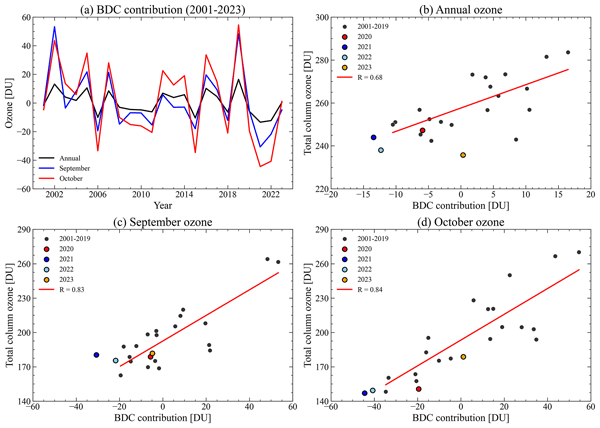
Overall, in the long-term, Antarctic ozone evolution reflects the interplay of multiple processes, with dynamical drivers holding a particularly strong influence on recovery patterns. The Brewer-Dobson circulation perturbations play a significant role in the long-term ozone trend, requiring more research and continued attention to the ozone hole and dynamic processes to improve our understanding of long-term ozone variability and predict future changes in the Antarctic ozone hole.
Matthias Kohl, Christoph Brühl, Holger Tost, Christos Xenofontos, Theodoros Christoudias, Sergey Gromov, Oliver Appel, Stephan Borrmann, Adam Bourassa, Pedro Campunzano-Jost, Yafang Cheng, Oliver Eppers, Karl D. Froyd, Bruna A. Holanda, Jose L. Jimenez, Patrick Jöckel, Philipp Joppe, Katharina Kaiser, Joseph M. Katich, Klaus Klingmüller, Franziska Köllner, Agnieszka Kupc, Anna Martin, Christopher Pöhlker, Mira L. Pöhlker, Ulrich Pöschl, Landon Rieger, Samuel Ruhl, Gregory P. Schill, Johannes Schneider, Christiane Schulz, Joshua P. Schwarz, Alexandra P. Tsimpidi, Ryan Vella, Christina J. Williamson, Yifan Yang, Daniel Zawada, Jos Lelieveld, and Andrea Pozzer
EGUsphere, https://doi.org/10.5194/egusphere-2026-3649, https://doi.org/10.5194/egusphere-2026-3649, 2026
Short summary
Short summary
Aerosols are crucial for Earth's climate, yet their vertical distribution remains poorly understood. We present first consistent global simulations of aerosol distributions and composition from the Earth's surface to the stratosphere, validated by extensive observations. Key findings include a global minimum in aerosol mass in the free troposphere, a significant contribution of organic aerosol in the lower stratosphere, and limited transport of primary particles to the stratosphere.
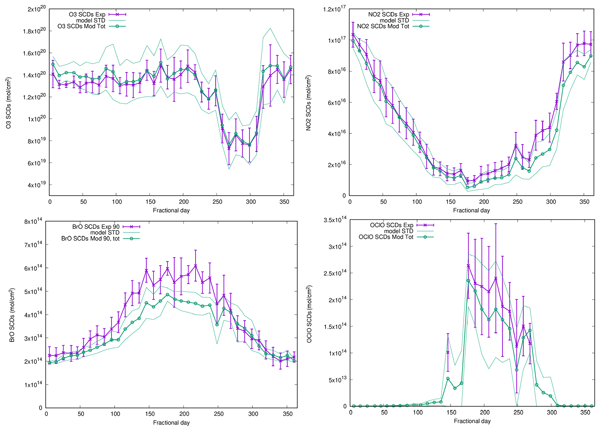
Laura Gómez-Martín, Cristina Prados-Roman, Martyn P. Chipperfield, Michel Van Roozendael, Olga Puentedura, Monica Navarro-Comas, Hector Ochoa, and Margarita Yela
Atmos. Meas. Tech., 19, 4393–4413, https://doi.org/10.5194/amt-19-4393-2026, https://doi.org/10.5194/amt-19-4393-2026, 2026
Short summary
Short summary
The Antarctic ozone hole remains a critical global challenge. Accurately measuring the gases that cause it during twilights is difficult due to rapid chemical changes. We used advanced computer simulations to reproduce observations at 2 Antarctic stations to account for these fluctuations and the Earth's curvature. Our results improve the accuracy of atmospheric monitoring, helping scientists better track the recovery of the ozone layer and understand the complex chemistry driving its depletion.
Saffron Genise Heddell, Martyn P. Chipperfield, Graham W. Mann, Sandip S. Dhomse, Wuhu Feng, Xin Zhou, Masaru Yoshioka, and Anthony Jones
EGUsphere, https://doi.org/10.5194/egusphere-2026-3619, https://doi.org/10.5194/egusphere-2026-3619, 2026
Short summary
Short summary
The 2022 Hunga eruption injected extraordinary amounts of water vapour into the stratosphere. Using a global model, we find a 7 % chemical increase in 2023 Antarctic ozone hole area, a modest increase limited by the cold Antarctic temperatures causing efficient removal of the Hunga water by polar stratospheric clouds. The impact on ozone was larger in the warmer, more sunlit vortex edge region. We highlight the value of natural events as test-cases for potential changes in the stratosphere.
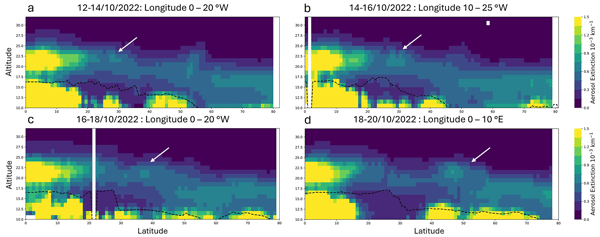
Corinna Kloss, Gwenaël Berthet, Pasquale Sellitto, Irene Bartolome Garcia, Emmanuel Briaud, Rubel Chandra Das, Stéphane Chevrier, Nicolas Dumelié, Lilian Joly, Thomas Lecas, Pauline Marbach, Felix Ploeger, Jean-Baptiste Renard, Jean-Paul Vernier, Frank G. Wienhold, and Michaela I. Hegglin
Atmos. Chem. Phys., 26, 8981–8997, https://doi.org/10.5194/acp-26-8981-2026, https://doi.org/10.5194/acp-26-8981-2026, 2026
Short summary
Short summary
In October 2022, we detected volcanic particles in the stratosphere over France, linked to the January 2022 Hunga eruption in the South Pacific. Found between 17 and 23 km altitude, they were traced back to the tropics using trajectory simulations and satellite data. Their optical properties matched those in the Southern Hemisphere. The particles spread across the Northern Hemisphere, reflecting sunlight and slightly cooling the surface – a small but non-negligible effect.
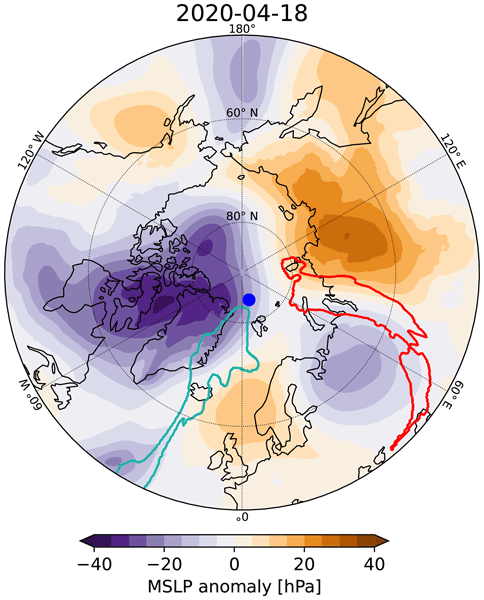
Luisa E. Avilés-Podgurski, Patrick Martineau, Hua Lu, Ayako Yamamoto, Amanda C. Maycock, Andrew Orr, Tony Phillips, Thomas J. Bracegirdle, Anna E. Hogg, Grzegorz Muszynski, and Andrew Fleming
Weather Clim. Dynam., 7, 1051–1071, https://doi.org/10.5194/wcd-7-1051-2026, https://doi.org/10.5194/wcd-7-1051-2026, 2026
Short summary
Short summary
Atmospheric rivers (ARs) are narrow filaments of intense poleward water vapour transport. On rare occasions, they reach the Arctic, driving strong warming and melt. In April 2020, two ARs intruded into the central Arctic within one week, raising near-surface temperatures by up to 30°C and leading to extreme precipitation. Their distinct paths and thermodynamic evolution reveal diverse AR impacts on Arctic sea ice and precipitation extremes.
Daniele Minganti, Simon Chabrillat, Sean Davis, Quentin Errera, Marc Op de beeck, Eric Ray, Sarah Vervalcke, Krzysztof Wargan, and Catherine Wespes
EGUsphere, https://doi.org/10.5194/egusphere-2026-3449, https://doi.org/10.5194/egusphere-2026-3449, 2026
Short summary
Short summary
In early 2019, an unusual increase of nitrous oxide concentrations occurred in the northern lower stratosphere (around 20 km). We show that unprecedented circulation pattern rapidly moved nitrous oxide from the tropical region to the northern mid-latitudes. This work reveals how stratospheric mid-latitudes can respond to special wind conditions in the Tropics and subtropics. Such extreme event helps improving our understanding of future changes of stratospheric transport in a warming climate.
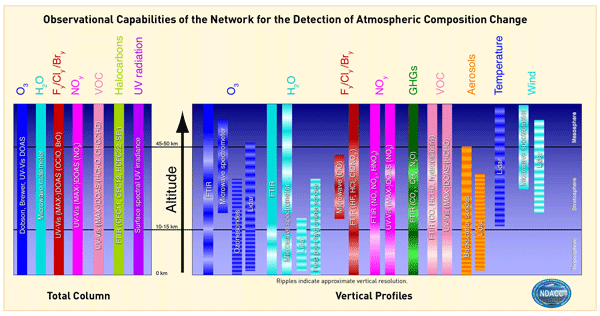
Irina Petropavlovskikh, Martine De Mazière, Anne M. Thompson, Jeannette D. Wild, James W. Hannigan, Henry B. Selkirk, Reem A. Hannun, Wolfgang Steinbrecht, Jean-Christopher Lambert, Roeland Van Malderen, Elizabeth Asher, Raul R. Cordero, Sophie Godin-Beekmann, Daan Hubert, Sergey Khaykin, Karin Kreher, Thierry Leblanc, Emmanuel Mahieu, Eliane Maillard Barras, Glen McConville, Gerald Nedoluha, Ivan Ortega, Alberto Redondas Marrero, Gunther Seckmeyer, Ryan M. Stauffer, Sarah A. Strode, Kim Strong, Takafumi Sugita, Michel Van Roozendael, Voltaire Velazco, Corinne Vigouroux, and Bärbel Vogel
Atmos. Chem. Phys., 26, 8637–8675, https://doi.org/10.5194/acp-26-8637-2026, https://doi.org/10.5194/acp-26-8637-2026, 2026
Short summary
Short summary
This introduction to the special issue "Achievements and perspectives of the Network for the Detection of Atmospheric Composition Change after 35 years of operation” provides an overview of important research findings achieved under the NDACC objectives. The future of NDACC is discussed in the light of the evolution of the scientific questions, evolving collaborations with partners and Cooperating Networks, and the current landscape of gaps in satellite and ground-based observations.
Evgenia Galytska, Birgit Hassler, Carlo Arosio, Martyn P. Chipperfield, Sandip S. Dhomse, Kimberlee Dubé, Wuhu Feng, Fernando Iglesias-Suarez, and Jakob Runge
Atmos. Chem. Phys., 26, 8185–8209, https://doi.org/10.5194/acp-26-8185-2026, https://doi.org/10.5194/acp-26-8185-2026, 2026
Short summary
Short summary
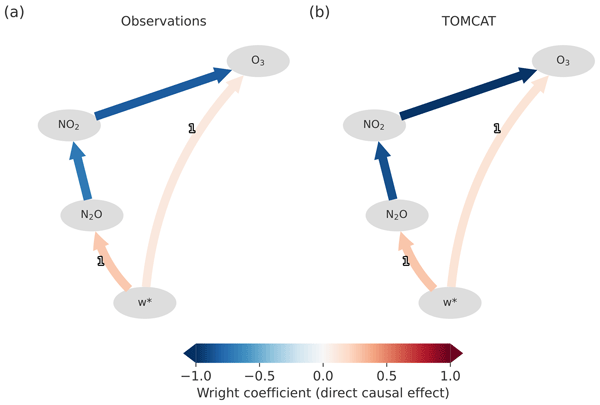
We explore how chemical and dynamical processes shape ozone in the tropical middle stratosphere using satellite data and a chemistry-transport model. We apply a framework to identify cause–effect relationships and estimate their strength. For 2004-2021 monthly data, we detect an indirect pathway controlling ozone variability, with effects increasing after two–three months. We further assess how different wind regimes influence this pathway.
Hyun-Kyu Lee, James A. Anstey, Hye-Yeong Chun, Shingo Watanabe, Francois Lott, Zhaoyang Chai, Yixiong Lu, Qi Tang, Jinbo Xie, Dong-Chan Hong, Seok-Woo Son, Federico Serva, Pu Lin, Martin B. Andrews, Neal Butchart, Aleena M. Jaison, Jeff R. Knight, Scott Osprey, Hiroaki Naoe, Kohei Yoshida, Yoshio Kawatani, and Jadwiga H. Richter
EGUsphere, https://doi.org/10.5194/egusphere-2026-2856, https://doi.org/10.5194/egusphere-2026-2856, 2026
Short summary
Short summary
This study investigates the systematic biases in equatorial wave forcing of the quasi-biennial oscillation (QBO) by comparing internally generated and bias-corrected experiments using a multi-model ensemble. Although nudging effectively mitigates QBO biases, systematic biases in wave forcing are not fully resolved. The equatorial wave forcing in the lower stratosphere remains weaker than that in reanalyses, while an eastward wave forcing bias is observed in the mid-to-upper stratosphere.
Sheena Loeffel, Philip Rupp, Selina Kiefer, Joaquim G. Pinto, Thomas Birner, and Hella Garny
Weather Clim. Dynam., 7, 895–913, https://doi.org/10.5194/wcd-7-895-2026, https://doi.org/10.5194/wcd-7-895-2026, 2026
Short summary
Short summary
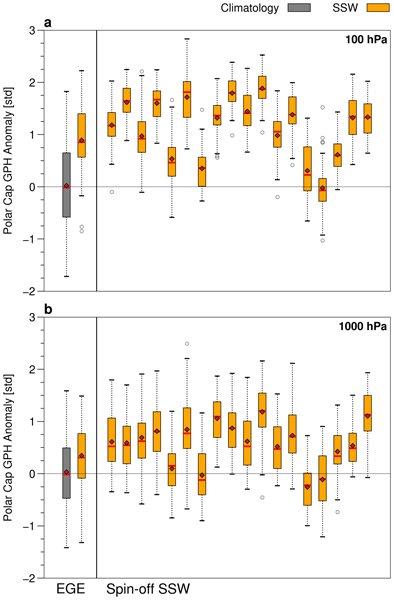
We use a dedicated simulation setup to shed light on the question whether, and why, some sudden stratospheric warming events are more likely than others to develop a surface response. We find that the propensity for downward coupling is unique to each event, and that from day one, the chance of a lower-stratospheric response can be predicted – a key step toward anticipating the surface response, moving beyond 'random' surface outcomes to quantified likelihoods of the ensuing surface response.
Michael D. Himes, Natalya A. Kramarova, Krzysztof Wargan, Sean M. Davis, and Glen Jaross
Atmos. Meas. Tech., 19, 3601–3624, https://doi.org/10.5194/amt-19-3601-2026, https://doi.org/10.5194/amt-19-3601-2026, 2026
Short summary
Short summary
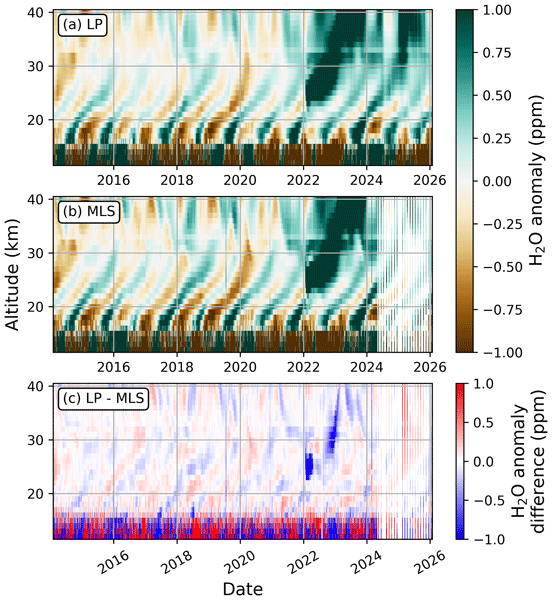
Stratospheric water vapor (SWV) influences various atmospheric processes. While the Ozone Mapping and Profiler Suite Limb Profiler (OMPS LP) was not designed to measure SWV, we utilized near-coincident measurements by the Aura Microwave Limb Sounder (MLS) and OMPS LP to develop a machine learning method to measure SWV between 11.5–40.5 km. The LP-derived SWV closely agrees with MLS. Our results suggest OMPS LP can continue the global water vapor record following the MLS mission.
Ilaria Quaglia, Daniele Visioni, Ewa M. Bednarz, Yunqian Zhu, Georgiy Stenchikov, Valentina Aquila, Cheng-Cheng Liu, Graham W. Mann, Yifeng Peng, Takashi Sekiya, Simone Tilmes, Xinyue Wang, Shingo Watanabe, Pengfei Yu, Jun Zhang, Wandi Yu, and Zhihong Zhuo
Atmos. Chem. Phys., 26, 7677–7704, https://doi.org/10.5194/acp-26-7677-2026, https://doi.org/10.5194/acp-26-7677-2026, 2026
Short summary
Short summary
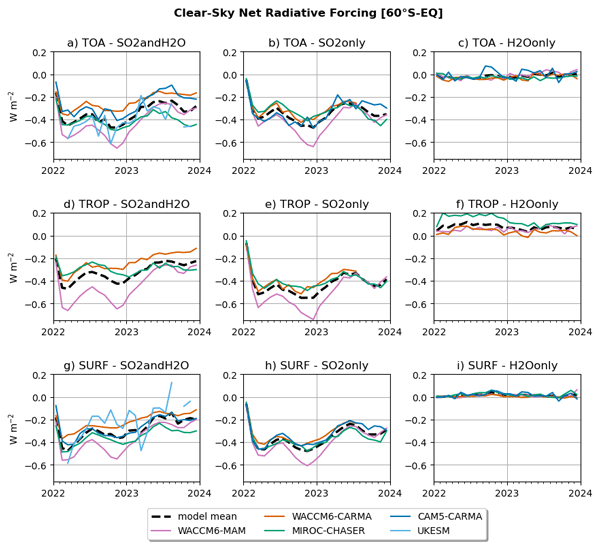
On January 15, 2022, the Hunga volcano eruption released unprecedented amounts of water vapor into the atmosphere alongside a modest amount of SO2. In this work we analyse results from multiple Earth system models. The models agree that the eruption led to small negative radiative forcing from sulfate aerosols and that the contribution from water vapor was minimal. Therefore, the Hunga eruption cannot explain the exceptional surface warming observed in 2023.
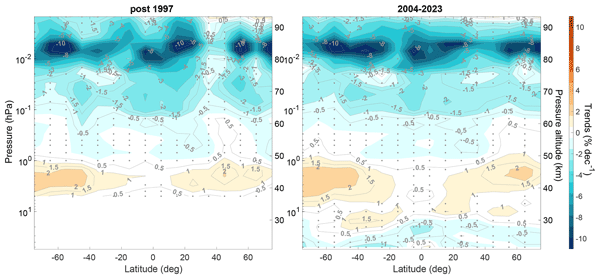
Monika E. Szelag, Viktoria F. Sofieva, Edward Malina, Pekka T. Verronen, Michelle L. Santee, Manuel López-Puertas, Bernd Funke, Gabriele Stiller, Alexandra Laeng, Kaley A. Walker, Patrick E. Sheese, Mark E. Hervig, and Benjamin T. Marshall
Atmos. Chem. Phys., 26, 7503–7522, https://doi.org/10.5194/acp-26-7503-2026, https://doi.org/10.5194/acp-26-7503-2026, 2026
Short summary
Short summary
We present a new global dataset of ozone profiles in the mesosphere and lower thermosphere, created by combining several satellite measurements covering more than three decades. Our results show that ozone is recovering in the stratosphere but decreasing in the mesosphere, with the strongest declines near the mesopause. This dataset provides a valuable resource for investigating long-term changes, improving model performance, and addressing an observational gap in the upper atmosphere.
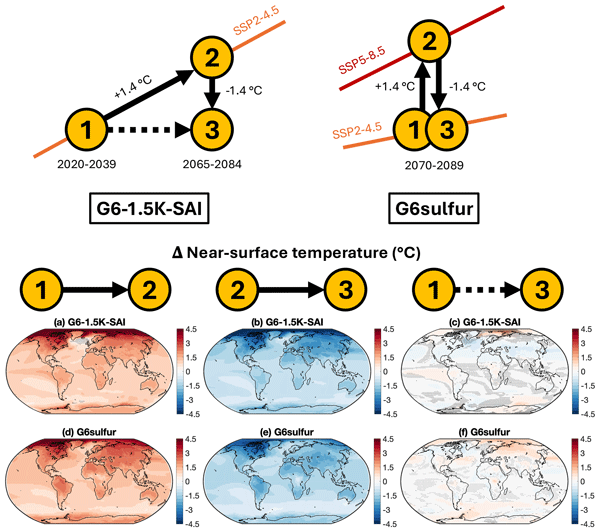
Walker Raymond Lee, Daniele Visioni, Benjamin Moore Wagman, Christopher Robert Wentland, Ben Kravitz, Shingo Watanabe, Takashi Sekiya, Andy Jones, Jim Haywood, Matthew Henry, and Ewa Monika Bednarz
Atmos. Chem. Phys., 26, 7463–7483, https://doi.org/10.5194/acp-26-7463-2026, https://doi.org/10.5194/acp-26-7463-2026, 2026
Short summary
Short summary
Stratospheric aerosol injection (SAI) is a proposed method of cooling the planet by introducing reflective particles called aerosols into the middle atmosphere to reflect sunlight back into space. We consider recent simulations of SAI from four different climate models. SAI cools the planet effectively in all four models; we examine the impacts on temperature and precipitation in each model and compare to previous experiments. Our simulations will help inform future research and policy.
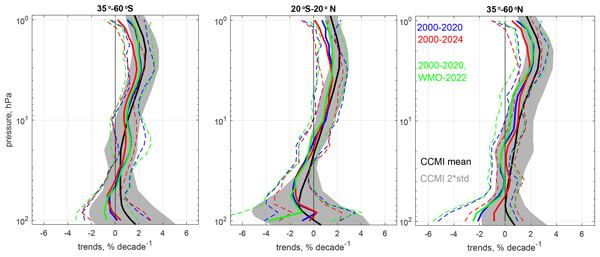
Viktoria F. Sofieva, Monika E. Szelag, Natalya A. Kramarova, Robert Damadeo, Wolfgang Steinbrecht, Irina Petropavlovskikh, Corinne Vigouroux, Eliane Maillard Barras, Daniel Zawada, Kleareti Tourpali, Stacey M. Frith, Jeannette D. Wild, Sean M. Davis, Carlo Arosio, Mark Weber, Alexei Rozanov, Brian Auffarth, Lucien Froidevaux, Ryan Fuller, Doug Degenstein, Kimberlee Dube, Peter Effertz, Thierry Leblanc, Gérard Ancellet, Sophie Godin-Beekmann, Glen McConville, Richard Querel, Dan Smale, Marie-Renee DeBacker, Emmanuel Mahieu, and Ralf Sussmann
Atmos. Chem. Phys., 26, 7387–7405, https://doi.org/10.5194/acp-26-7387-2026, https://doi.org/10.5194/acp-26-7387-2026, 2026
Short summary
Short summary
We present an updated evaluation of stratospheric ozone profile trends in the 60°S–60°N latitude range using long-term ground-based and satellite climate data records, as well as simulations by chemistry-climate models. Analyses confirm the statistically significant positive ozone trends in the upper stratosphere of ~1–3 % decade-1. The trends are close to zero in the middle stratosphere, and mostly negative in the lower stratosphere, but they are not statistically significant.
Martin R. Willett, Melissa E. Brooks, Andrew Bushell, Paul Earnshaw, Charline Marzin, Samantha Smith, Lorenzo Tomassini, Nathan Luke Abraham, Martin Best, John M. Edwards, Kalli Furtado, Catherine Hardacre, Alan J. Hewitt, Ben Johnson, Adrian Lock, Jane P. Mulcahy, James Manners, Alistair Sellar, Peter Sheridan, Warren Tennant, Kwinten Van Weverberg, Vidya Varma, and Michael Whitall
EGUsphere, https://doi.org/10.5194/egusphere-2026-2425, https://doi.org/10.5194/egusphere-2026-2425, 2026
Short summary
Short summary
Global Atmosphere and Land (GAL) configurations of the Unified Model (UM) and JULES are developed for use in any global atmospheric modelling application. We describe the latest version, GAL9. We compare GAL9 with its predecessor and show that it gives improved forecasts of weather and climate. GAL9 has been used for weather forecasts in the UK from early 2026 and it will be used to study the Earth's climate.
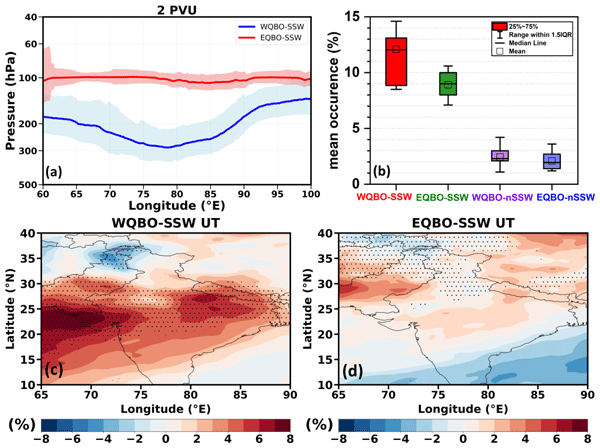
Shubhajyoti Roy, Satheesh P. R. Chandran, Suvarna Fadnavis, Vijay Sagar, Michaela I. Hegglin, Rolf Müller, and Prashant Chavan
Atmos. Chem. Phys., 26, 7047–7059, https://doi.org/10.5194/acp-26-7047-2026, https://doi.org/10.5194/acp-26-7047-2026, 2026
Short summary
Short summary
We show that stratospheric ozone intrusions associated with sudden stratospheric warming events occurring concurrent with the westerly phase of the Quasi-biennial oscillation enhance ozone in the upper troposphere and lower stratosphere over South Asia. The ozone enhancement increases ozone radiative forcing by 0.09±0.05 W m-2 over South Asia. This increase in ozone radiative forcing potentially exacerbates regional climate warming.
Benjamin Weyland, Simon Rosanka, Domenico Taraborrelli, Birger Bohn, Andreas Zahn, Florian Obersteiner, Eric Förster, Mariano Mertens, Patrick Jöckel, Helmut Ziereis, Katharina Kaiser, Horst Fischer, John N. Crowley, Nijing Wang, Achim Edtbauer, Jonathan Williams, Maria Dolores Andrés Hernández, John P. Burrows, Flora Kluge, Meike K. Rotermund, Andre Butz, and Klaus Pfeilsticker
Atmos. Chem. Phys., 26, 6825–6856, https://doi.org/10.5194/acp-26-6825-2026, https://doi.org/10.5194/acp-26-6825-2026, 2026
Short summary
Short summary
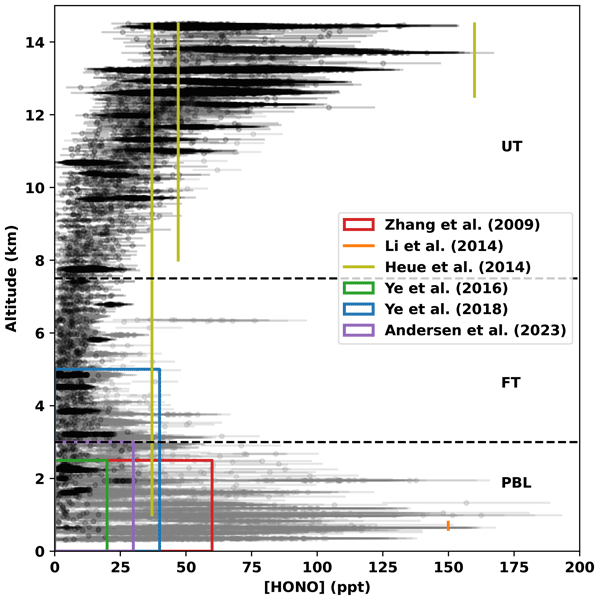
The destruction by sunlight of nitrous acid (HONO) produces the so-called detergent of the atmosphere. HONO has been measured in concentrations which exceed predictions based on known chemistry for decades. Several reactions have been proposed which may explain this excess HONO. This study reports on airborne measurements of HONO; the observations exceed predictions and form a C-shaped profile in the troposphere. Together with a host of other measurements, various reactions are investigated.
Man Mei Chim, Nathan Luke Abraham, Thomas J. Aubry, Ben Johnson, Hella Garny, Susan Solomon, and Anja Schmidt
Atmos. Chem. Phys., 26, 6781–6797, https://doi.org/10.5194/acp-26-6781-2026, https://doi.org/10.5194/acp-26-6781-2026, 2026
Short summary
Short summary
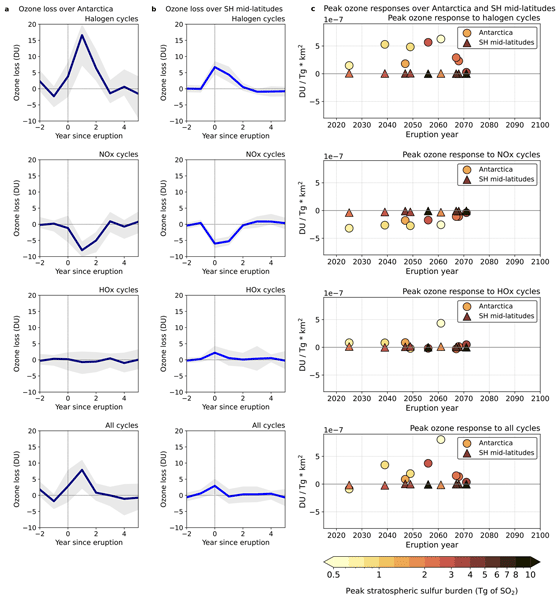
Sulfate aerosols from explosive eruptions can provide surfaces for chemical reactions destroying ozone. Assessing the effects of volcanic sulfate aerosols is crucial for understanding future ozone recovery. We find sporadic eruptions can induce a small delay in stratospheric ozone recovery by a few years over Antarctica and Southern Hemisphere mid-latitudes. Our results highlight the importance to continuously monitor atmospheric composition and processes to understand changes in ozone recovery.
Philip Rupp, Jonas Spaeth, and Thomas Birner
Weather Clim. Dynam., 7, 767–785, https://doi.org/10.5194/wcd-7-767-2026, https://doi.org/10.5194/wcd-7-767-2026, 2026
Short summary
Short summary
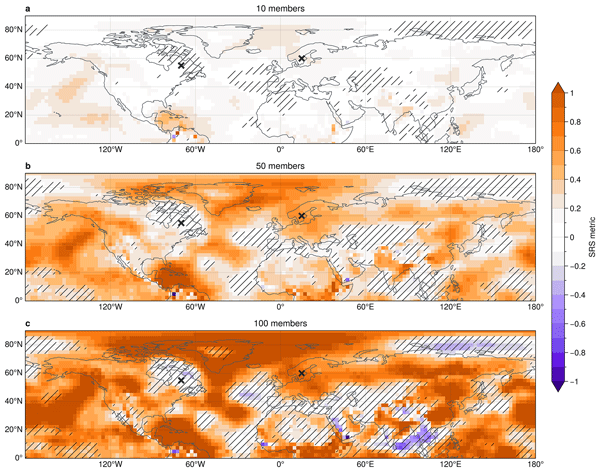
Weather forecasts several weeks ahead are uncertain, but this uncertainty itself can change depending on large-scale atmospheric conditions. We present a new way to measure how well forecasts capture these changes in uncertainty. Our results show that reliability of uncertainty varies strongly with region and is linked to slow, predictable patterns in the atmosphere. These findings help identify periods when forecasts are more trustworthy.
James A. Anstey, Neal Butchart, Scott Osprey, Yoshio Kawatani, Kevin Hamilton, Jadwiga H. Richter, Tim Stockdale, Martin B. Andrews, Zhaoyang Chai, Paolo Davini, Dong-Chan Hong, Kai Huang, Aleena M. Jaison, Tobias Kerzenmacher, Jeff R. Knight, Pu Lin, Francois Lott, Yixiong Lu, Hiroaki Naoe, Federico Serva, Isla Simpson, Seok-Woo Son, Qi Tang, Shingo Watanabe, Jinbo Xie, and Kohei Yoshida
EGUsphere, https://doi.org/10.5194/egusphere-2026-1165, https://doi.org/10.5194/egusphere-2026-1165, 2026
Short summary
Short summary
We describe experiments where modelled tropical stratosphere winds are adjusted by "nudging" them toward realistic time-evolving eastward and westward Quasi-Biennial Oscillation (QBO) winds. The effects of this bias correction on other atmospheric processes, such as the stratospheric polar vortex or tropical waves that force the QBO, can then be assessed. We describe details of the experiments, the multi-model ensemble that has performed them, and basic validation of the nudging response.
Christine Frömming, Volker Grewe, Sigrun Matthes, Simone Dietmüller, Patrick Peter, Katrin Dahlmann, and Patrick Jöckel
J. Env. Com. Air Transp. Sys. Discuss., https://doi.org/10.5194/jecats-2026-7, https://doi.org/10.5194/jecats-2026-7, 2026
Preprint under review for JECATS
Short summary
Short summary
Aviation non-CO2 climate effects could be reduced through rerouting using Climate Change Functions (CCFs) and its surrogate aCCFs. This study expands CCFs regionally and seasonally and enables a comparison with aCCFs. ACCFs simplify complex processes but reproduce magnitudes and most gradients, though they underestimate variability compared to detailed CCF simulations and limitations to certain altitudes were revealed. The present study promotes future development of refined and extended aCCFs.
Beth Dingley, James A. Anstey, Marta Abalos, Carsten Abraham, Tommi Bergman, Lisa Bock, Sonya Fiddes, Birgit Hassler, Ryan J. Kramer, Fei Luo, Fiona M. O'Connor, Petr Šácha, Isla R. Simpson, Laura J. Wilcox, and Mark D. Zelinka
Geosci. Model Dev., 19, 2945–2984, https://doi.org/10.5194/gmd-19-2945-2026, https://doi.org/10.5194/gmd-19-2945-2026, 2026
Short summary
Short summary
This manuscript defines as a list of variables and scientific opportunities which are requested from the Coupled Model Intercomparison Project Phase 7 (CMIP7) Assessment Fast Track to address open atmospheric science questions. The list reflects the output of a large public community engagement effort, coordinated across autumn 2025 through to summer 2025.
Zhen Yang, Bärbel Vogel, Felix Plöger, Zhixuan Bai, Dan Li, Sabine Griessbach, Lars Hoffmann, Frank G. Wienhold, Elizabeth Asher, Alexandre A. Baron, Katie R. Smith, Troy Thornberry, Jianchun Bian, and Michaela I. Hegglin
Atmos. Chem. Phys., 26, 4749–4769, https://doi.org/10.5194/acp-26-4749-2026, https://doi.org/10.5194/acp-26-4749-2026, 2026
Short summary
Short summary
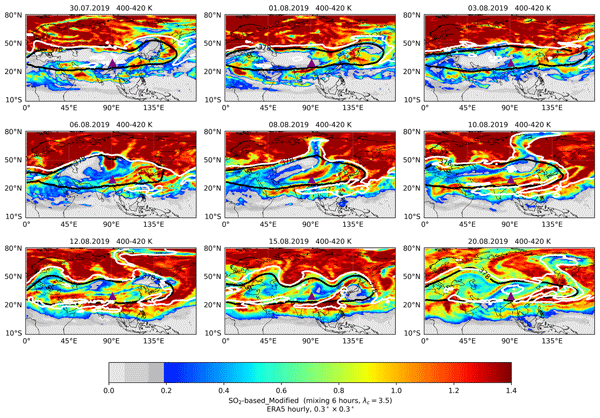
Balloon measurements over Lhasa, China, combined with satellite guided modelling, tracked aerosol from the 2019 Raikoke eruption through the Asian summer monsoon anticyclone. We find two altitude dependent routes into the anticyclone. It partly blocks transport but also allows entry and mixing, explaining the gradual weakening of the layers. Balloon measurements over Boulder, United States, outside the anticyclone, provide an independent check outside the region.
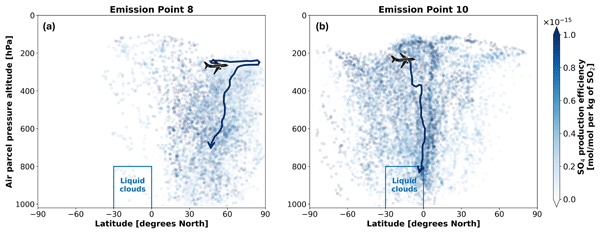
Jin Maruhashi, Mattia Righi, Monica Sharma, Johannes Hendricks, Patrick Jöckel, Volker Grewe, and Irene C. Dedoussi
Geosci. Model Dev., 19, 2747–2784, https://doi.org/10.5194/gmd-19-2747-2026, https://doi.org/10.5194/gmd-19-2747-2026, 2026
Short summary
Short summary
Aerosol-cloud interactions remain a major source of uncertainty in assessing aviation's net climate impact. We develop and evaluate a new Lagrangian tagging model that tracks aviation-emitted SO2 and H2SO4 as they are chemically transformed into SO4 aerosols and transported throughout the atmosphere. This development allows the identification of atmospheric regions with elevated potential for aerosol–cloud interactions driven by SO4 from aircraft.
Ariana Elena Castillo, Marianna Linz, Eric Ray, Laura N. Saunders, Kaley A. Walker, Gabriele P. Stiller, Todd A. Mooring, and Stephen Bourguet
EGUsphere, https://doi.org/10.5194/egusphere-2026-1236, https://doi.org/10.5194/egusphere-2026-1236, 2026
Short summary
Short summary
In the stratosphere, transport strongly impacts the distribution of long-lived trace gases, and age of air is a measure of transport times in the stratosphere. We present two datasets that capture the structure and seasonality of stratospheric transport in both hemispheres: (1) latitude-varying empirical relationships of tracers to calculate a (2) 7-year timeseries of age of air. We lay groundwork for a multidecade timeseries of age to understand long-term transport in a warming climate.
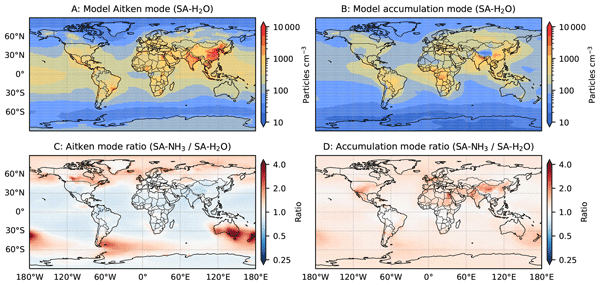
Xu-Cheng He, Nathan Luke Abraham, Han Ding, Maria R. Russo, Daniel P. Grosvenor, Yao Ge, Xuemei Wang, Anthony C. Jones, Pedro Campuzano-Jost, Benjamin Nault, Agnieszka Kupc, Donald Blake, Jose L. Jimenez, Christina J. Williamson, James Weber, Alexander T. Archibald, and Hamish Gordon
Atmos. Chem. Phys., 26, 3805–3851, https://doi.org/10.5194/acp-26-3805-2026, https://doi.org/10.5194/acp-26-3805-2026, 2026
Short summary
Short summary
Aerosols affect clouds and climate. However, current climate models still struggle to simulate them accurately. We used aircraft data from a global mission to evaluate how well the UK Earth System Model represents aerosols and their precursors. Our results show that the model misses key formation processes in clean ocean regions, suggesting that future improvements should focus on better representing how aerosols form naturally in the atmosphere.
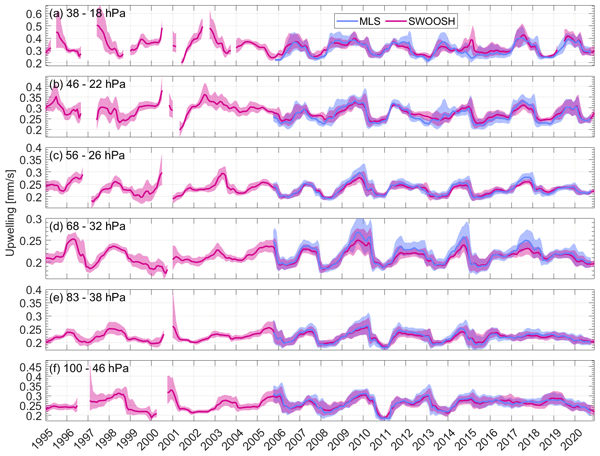
Meghan Brehon, Susann Tegtmeier, Adam Bourassa, Sean M. Davis, Udo Grabowski, Tobias Kerzenmacher, and Gabriele Stiller
Atmos. Chem. Phys., 26, 3743–3764, https://doi.org/10.5194/acp-26-3743-2026, https://doi.org/10.5194/acp-26-3743-2026, 2026
Short summary
Short summary
We used observations of water vapour to estimate vertical transport rates in the tropical stratosphere for 1995-2020 and analyze stratospheric variability. Our results find good agreement between our observation-based estimates and reanalysis upwelling and reveal that the variability is mainly driven by the Quasi-Biennial Oscillation (QBO) and El Niño Southern Oscillation (ENSO) with a clear signal in the upwelling time series coinciding with the recent QBO disruptions of 2015/16 and 2019/20.
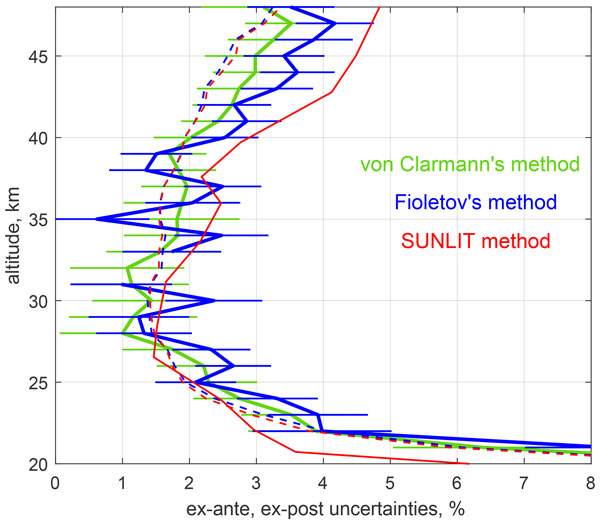
Viktoria F. Sofieva, Alexandra Laeng, Thomas von Clarmann, Gabriele Stiller, Michael Kiefer, Johanna Tamminen, Alexey Rozanov, Carlo Arosio, Nathaniel Livesey, Robert Damadeo, Patrick Sheese, Kaley A. Walker, Doug Degenstein, Daniel Zawada, Natalya A. Kramarova, and Arno Keppens
Atmos. Meas. Tech., 19, 1837–1852, https://doi.org/10.5194/amt-19-1837-2026, https://doi.org/10.5194/amt-19-1837-2026, 2026
Short summary
Short summary
For satellite measurements of atmospheric composition, the random uncertainty estimates provided by retrieval algorithms might be imperfect due to various approximations used in the retrievals or presence of unknown error sources. This paper presents an overview of the methods used for validation of random uncertainty estimates. All methods discussed in this study are categorized, and assumptions and limitations of each method are discussed.

Yuwen Li, Wuhu Feng, John M. C. Plane, Tijian Wang, and Martyn P. Chipperfield
Atmos. Chem. Phys., 26, 3621–3635, https://doi.org/10.5194/acp-26-3621-2026, https://doi.org/10.5194/acp-26-3621-2026, 2026
Short summary
Short summary
The space industry is growing rapidly, but its environmental effects remain uncertain. We used a global chemistry-climate model to study how chlorine released by rocket launches could affect the ozone layer and its recovery from past depletion. Even with large growth in launches, global ozone loss remains small but could locally slow the healing of the ozone layer. These findings highlight the need to consider rocket emissions in future environmental policies.
Anna Moustaka, Antonis Gkikas, Stavros-Andreas Logothetis, Johannes Flemming, Samuel Rémy, Melanie Ades, Angela Benedetti, Kleareti Tourpali, Vassilis Amiridis, and Stelios Kazadzis
EGUsphere, https://doi.org/10.5194/egusphere-2026-1107, https://doi.org/10.5194/egusphere-2026-1107, 2026
This preprint is open for discussion and under review for Atmospheric Chemistry and Physics (ACP).
Short summary
Short summary
We examined how atmospheric aerosols have changed worldwide over the past two decades using a global atmospheric reanalysis together with ground-based observations. We found strong regional differences, with clear declines in some industrialized areas and increases in parts of South Asia and the Middle East. These long-term records help improve understanding of changes in climate and air quality.
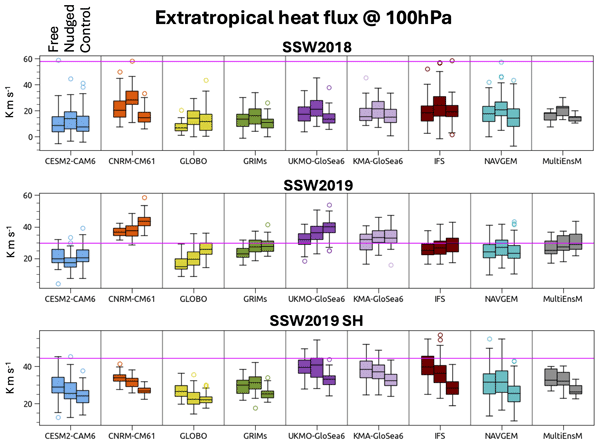
Blanca Ayarzagüena, Amy H. Butler, Peter Hitchcock, Chaim I. Garfinkel, Zac D. Lawrence, Wuhan Ning, Philip Rupp, Zheng Wu, Hilla Afargan-Gerstman, Natalia Calvo, Alvaro de la Cámara, Martin Jucker, Gerbrand Koren, Daniel De Maeseneire, Gloria L. Manney, Marisol Osman, Masakazu Taguchi, Cory Barton, Dong-Chan Hong, Yu-Kyung Hyun, Hera Kim, Jeff Knight, Piero Malguzzi, Daniele Mastrangelo, Jiyoung Oh, Inna Polichtchouk, Jadwiga H. Richter, Isla R. Simpson, Seok-Woo Son, Damien Specq, and Tim Stockdale
Weather Clim. Dynam., 7, 411–437, https://doi.org/10.5194/wcd-7-411-2026, https://doi.org/10.5194/wcd-7-411-2026, 2026
Short summary
Short summary
Sudden Stratospheric Warmings (SSWs) are known to follow a sustained wave dissipation in the stratosphere, which depends on both the tropospheric and stratospheric states. However, the relative role of each state is still unclear. Using a new set of subseasonal to seasonal forecasts, we show that the stratospheric state does not drastically affect the precursors of three recent SSWs, but modulates the stratospheric wave activity, with impacts depending on SSW features.
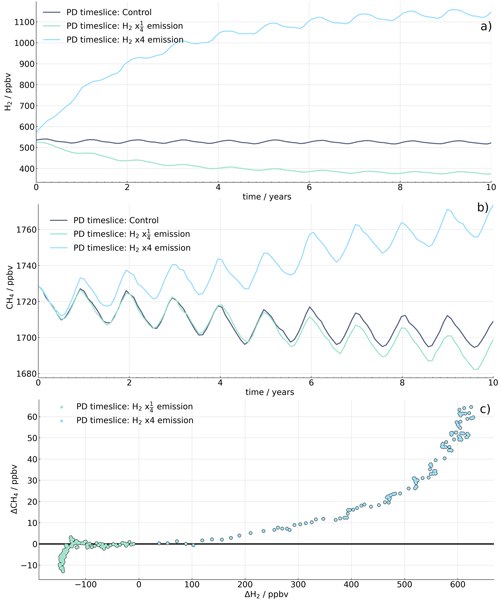
Megan A. J. Brown, Nicola J. Warwick, Nathan Luke Abraham, Paul T. Griffiths, Steve T. Rumbold, Gerd A. Folberth, Fiona M. O'Connor, Hannah Bryant, and Alex T. Archibald
Geosci. Model Dev., 19, 1537–1557, https://doi.org/10.5194/gmd-19-1537-2026, https://doi.org/10.5194/gmd-19-1537-2026, 2026
Short summary
Short summary
Hydrogen (H2) is an indirect greenhouse gas by increasing methane (CH4) lifetime. Interaction between H2 and CH4 is important for hydrogen’s global warming potential (GWP). Global models do not represent this interaction well; H2 or CH4 are prescribed at the surface. We implement an interactive H2 scheme into a global model coupled with interactive CH4. We simulate scenarios demonstrating its capability, improving model performance and more accurately representing H2-CH4 interaction.
Isabelle Sangha, Nathan Luke Abraham, Andrew Orr, Hua Lu, Michael C. Pitts, Lamont R. Poole, and Michael Weimer
EGUsphere, https://doi.org/10.5194/egusphere-2026-128, https://doi.org/10.5194/egusphere-2026-128, 2026
Short summary
Short summary
The UK Earth System Model is updated with an improved polar stratospheric cloud scheme. The performance of the scheme is evaluated against satellite data. While the observed wave ice still fails to form in the model, the scheme improves its ability to represent different polar stratospheric cloud types and their variations. This brings the model closer to satellite observations and highlights the need for further development to capture the polar stratospheric cloud formation in mountain waves.
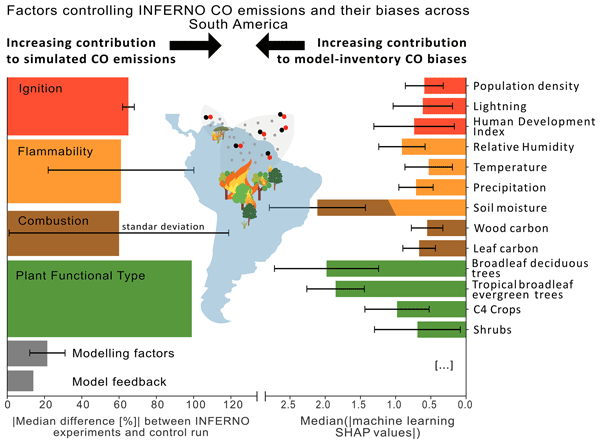
Maria P. Velásquez-García, Richard J. Pope, Steven T. Turnock, Chetan Deva, David P. Moore, Guilherme Mataveli, Steve R. Arnold, Ruth M. Doherty, and Martyn P. Chipperfield
Biogeosciences, 23, 1341–1364, https://doi.org/10.5194/bg-23-1341-2026, https://doi.org/10.5194/bg-23-1341-2026, 2026
Short summary
Short summary
Incorporating fire simulation into climate models is crucial for accurately representing interactions between fires, ecosystems, and climate, thereby enhancing climate projections. In South America, the INFERNO (Interactive Fires and Emissions algorithm for Natural Environments) fire model broadly captures CO emissions in active fire zones, e.g., the Amazon Arc of Deforestation. Still, it tends to overestimate emissions in tree-rich ecosystems, where INFERNO is too sensitive to low soil moisture, and to underestimate emissions in less tree-abundant ecosystems.
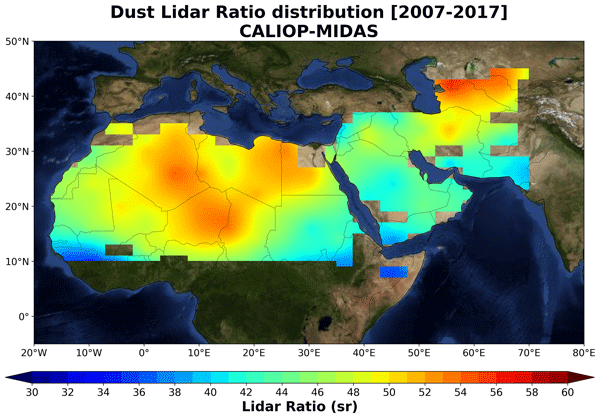
Anna Moustaka, Nikolaos Siomos, Stelios Kazadzis, Emmanouil Proestakis, Kalliopi Artemis Voudouri, Anton Lopatin, Oleg Dubovik, Kleareti Tourpali, Christos Zerefos, Vassilis Amiridis, and Antonis Gkikas
Atmos. Meas. Tech., 19, 1201–1225, https://doi.org/10.5194/amt-19-1201-2026, https://doi.org/10.5194/amt-19-1201-2026, 2026
Short summary
Short summary
North Africa and the Middle East are home to the world’s most active dust sources, but accurately monitoring airborne dust remains challenging. We combine active and passive satellite aerosol products to dynamically estimate dust lidar ratios over a 12-year period. The results reveal pronounced and physically meaningful regional variability, improving aerosol characterization and supporting climate and air-quality applications.
Ales Kuchar, Matthias Stocker, Alistair Bell, Bruno Lehner, Jessica Kult-Herdin, Gabriel Chiodo, Timofei Sukhodolov, Eugene Rozanov, Gunter Stober, and Harald E. Rieder
EGUsphere, https://doi.org/10.5194/egusphere-2026-406, https://doi.org/10.5194/egusphere-2026-406, 2026
Short summary
Short summary
We investigated why the Northern Hemisphere winter polar vortex became unusually strong in the winter of 2024/2025. Using satellite and reanalysis datasets, and model simulations, we found that extra water erupted high in the atmosphere by the 2022 Hunga Tonga eruption led to cooling of polar latitudes of the upper atmosphere, helping the winds aloft intensify. This link suggests such volcanic eruptions can shape winters in the upper atmosphere for several years.
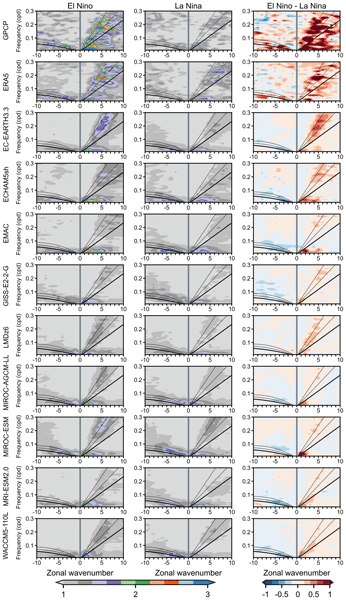
Dillon Elsbury, Federico Serva, Julie M. Caron, Seung-Yoon Back, Clara Orbe, Jadwiga H. Richter, James A. Anstey, Neal Butchart, Chih-Chieh Chen, Javier García-Serrano, Anne Glanville, Yoshio Kawatani, Tobias Kerzenmacher, Francois Lott, Hiroaki Naoe, Scott Osprey, Froila M. Palmeiro, Seok-Woo Son, Masakazu Taguchi, Stefan Versick, Shingo Watanabe, and Kohei Yoshida
Weather Clim. Dynam., 7, 317–339, https://doi.org/10.5194/wcd-7-317-2026, https://doi.org/10.5194/wcd-7-317-2026, 2026
Short summary
Short summary
We used climate models to test how constant El Niño and La Niña ocean conditions shape the Madden-Julian Oscillation during northern winter. El Niño made this weather pattern move faster, while La Niña slowed it down. The Quasi-Biennial Oscillation, a repeating wind pattern high in the atmosphere, had little effect. This shows that long-lasting ocean conditions mainly drive the changes we found.
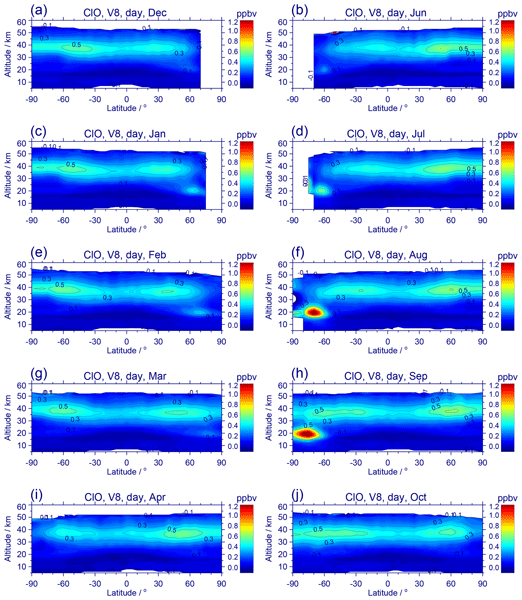
Norbert Glatthor, Thomas von Clarmann, Udo Grabowski, Sylvia Kellmann, Michael Kiefer, Alexandra Laeng, Andrea Linden, Gabriele P. Stiller, Bernd Funke, Maya García-Comas, Manuel López-Puertas, Oliver Kirner, and Michelle L. Santee
Atmos. Meas. Tech., 19, 629–657, https://doi.org/10.5194/amt-19-629-2026, https://doi.org/10.5194/amt-19-629-2026, 2026
Short summary
Short summary
We present a global climatology of Michelson Interferometer for Passive Atmospheric Sounding (MIPAS) version 8 chlorine monoxide (ClO), retrieved from spaceborne observations between 2002 and 2012. Due to an improved retrieval setup, the high bias and poor vertical resolution of upper stratospheric ClO, which had affected the previous V5 data set, has been removed. Comparisons with ClO observations of the Microwave Limb Sounder generally show good agreement. Differences can be explained by simulations with an atmospheric chemistry model.
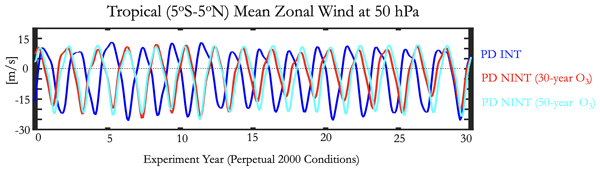
Clara Orbe, Alison Ming, Gabriel Chiodo, Michael Prather, Mohamadou Diallo, Qi Tang, Andreas Chrysanthou, Hiroaki Naoe, Xin Zhou, Irina Thaler, Dillon Elsbury, Ewa Bednarz, Jonathon S. Wright, Aaron Match, Shingo Watanabe, James Anstey, Tobias Kerzenmacher, Stefan Versick, Marion Marchand, Feng Li, and James Keeble
Geosci. Model Dev., 19, 773–794, https://doi.org/10.5194/gmd-19-773-2026, https://doi.org/10.5194/gmd-19-773-2026, 2026
Short summary
Short summary
The quasi-biennial oscillation (QBO) is the main source of wind fluctuations in the tropical stratosphere, which can couple to surface climate. However, models do a poor job of simulating the QBO in the lower stratosphere, for reasons that remain unclear. One possibility is that models do not completely represent how ozone influences the QBO-associated wind variations. Here we propose a multi-model framework for assessing how ozone influences the QBO in recent past and future climates.
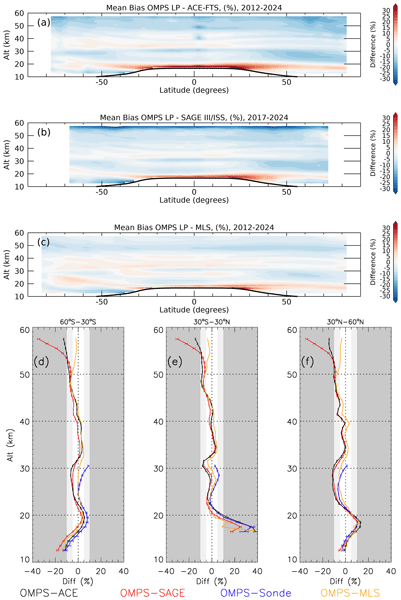
Nigel A. D. Richards, Natalya A. Kramarova, Stacey M. Frith, Sean M. Davis, and Yue Jia
Atmos. Meas. Tech., 19, 529–547, https://doi.org/10.5194/amt-19-529-2026, https://doi.org/10.5194/amt-19-529-2026, 2026
Short summary
Short summary
The Montreal Protocol has led to a slow recovery in the Earth's ozone layer. To detect such changes, and to monitor the health of the ozone layer, long term global observations are needed. The OMPS Limb Profiler (LP) series of satellite sensors are designed to meet this need. We validate the latest version OMPS LP ozone profiles against other satellite and ground based measurements. We find that OMPS LP ozone is consistent with other data sources and is suitable for use in ozone trend studies.
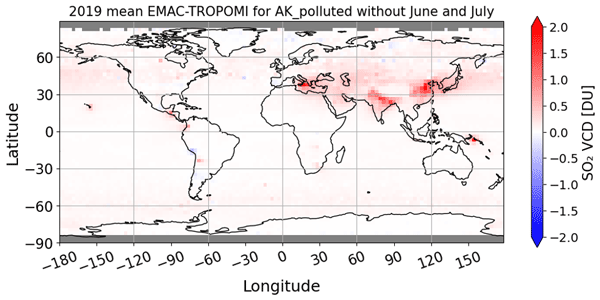
Ismail Makroum, Patrick Jöckel, Martin Dameris, Nicolas Theys, and Johannes De Leeuw
Geosci. Model Dev., 19, 447–476, https://doi.org/10.5194/gmd-19-447-2026, https://doi.org/10.5194/gmd-19-447-2026, 2026
Short summary
Short summary
We use a state-of-the-art numerical chemistry-climate model to study the atmospheric sulfur dioxide budget. We simulate the atmospheric concentration of sulfur dioxide (SO2) and corresponding sulfur deposition fluxes and compare the results with observational data from a satellite instrument and with ground-based in-situ measurements. For the evaluation of the simulated atmospheric lifetime of SO2, we also simulate the fate of SO2 emitted by two volcanic eruptions that happened in 2019.
William J. Collins, John S. Daniel, Martyn P. Chipperfield, Martin Cussac, Makoto Deushi, Gregory Faluvegi, Paul Griffiths, Øivind Hodnebrog, Larry W. Horowitz, James Keeble, Douglas Kinnison, Vaishali Naik, Fiona M. O'Connor, Drew Shindell, Simone Tilmes, Kostas Tsigaridis, Zihao Wang, and James Weber
EGUsphere, https://doi.org/10.5194/egusphere-2025-6033, https://doi.org/10.5194/egusphere-2025-6033, 2026
Short summary
Short summary
Ozone depleting substances (ODSs) are also greenhouse gases that cause global warming. However, their destruction of ozone contributes a global cooling. We have used results from climate models that include atmospheric chemistry and found that the cooling effect of the ozone depletion diagnosed in the models was larger than that calculated using a standard method. We find that some ODSs have a net cooling effect whereas for others the warming effect is significantly reduced.

Liliana Guidetti, Erika Brattich, Simone Ceccherini, Michaela I. Hegglin, Piera Raspollini, Cecilia Tirelli, Nicola Zoppetti, and Ugo Cortesi
Atmos. Meas. Tech., 19, 167–184, https://doi.org/10.5194/amt-19-167-2026, https://doi.org/10.5194/amt-19-167-2026, 2026
Short summary
Short summary
The Complete Data Fusion algorithm is applied to observations from the Michelson Interferometer for Passive Atmospheric Sounding and the Infrared Atmospheric Sounding Interferometer to generate and validate a new ozone dataset against ozone soundings across multiple latitudes. The fusion propagates stratospheric limb information into the troposphere. The dataset shows increased information content and lower uncertainty, improving the study of stratosphere–troposphere ozone intrusions.
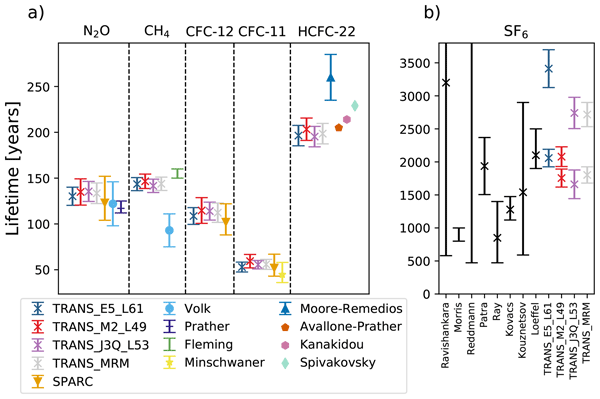
Sarah Vervalcke, Quentin Errera, Roland Eichinger, Thomas Reddmann, Simon Chabrillat, Marc Op de beeck, Gabriele Stiller, and Emmanuel Mahieu
Atmos. Chem. Phys., 26, 391–409, https://doi.org/10.5194/acp-26-391-2026, https://doi.org/10.5194/acp-26-391-2026, 2026
Short summary
Short summary
This study presents three simulations of atmospheric chemistry with the Belgian Assimilation System for Chemical Observations chemistry transport model, driven by different meteorological data sets. Newly implemented SF6 chemistry enables stratospheric transport studies. Results agree with satellite observations. The derived lifetimes of six trace gases agree with the literature, but SF6 shows larger sensitivity to the choice of meteorology. The lifetime of SF6 ranges from 1900 to 2600 years.
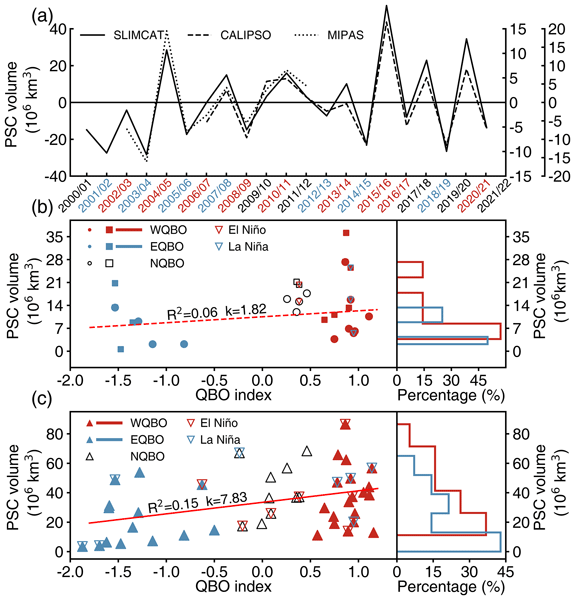
Douwang Li, Zhe Wang, Siyi Zhao, Jiankai Zhang, Wuhu Feng, and Martyn P. Chipperfield
Atmos. Chem. Phys., 26, 77–94, https://doi.org/10.5194/acp-26-77-2026, https://doi.org/10.5194/acp-26-77-2026, 2026
Short summary
Short summary
We find that wind variations at the equator (QBO) modulate the occurrence of Arctic polar stratospheric clouds (PSCs), which are key contributors to ozone depletion. During westerly QBO, the PSC occurrence is significantly greater than during easterly QBO. The QBO affects PSC mainly through temperature, while H2O and HNO3 have less effect. This suggests that future climate change may affect ozone recovery if it alters the QBO pattern. This study provides a new perspective on ozone prediction.

Paul Konopka, Felix Ploeger, Francesco D'Amato, Teresa Campos, Marc von Hobe, Shawn B. Honomichl, Peter Hoor, Laura L. Pan, Michelle L. Santee, Silvia Viciani, Kaley A. Walker, and Michaela I. Hegglin
Atmos. Chem. Phys., 25, 17973–17996, https://doi.org/10.5194/acp-25-17973-2025, https://doi.org/10.5194/acp-25-17973-2025, 2025
Short summary
Short summary
We present an improved version of the Chemical Lagrangian Model of the Stratosphere (CLaMS-3.0), which better represents transport from the lower atmosphere to the upper troposphere and lower stratosphere. By refining grid resolution and improving convection representation, the model more accurately simulates carbon monoxide transport. Comparisons with satellite and in situ observations highlight its ability to capture seasonal variations and improve our understanding of atmospheric transport.
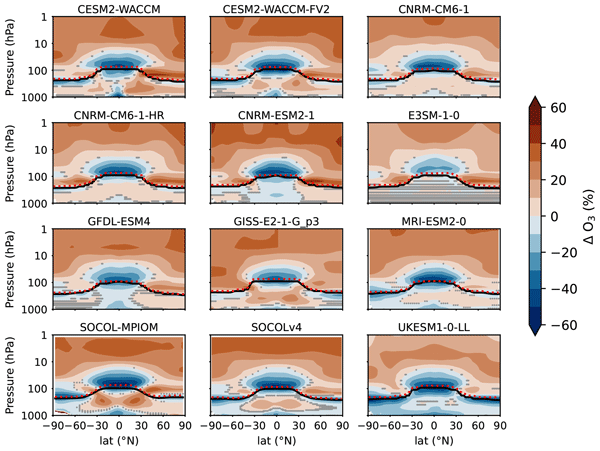
Jingyu Wang, Gabriel Chiodo, Blanca Ayarzagüena, William T. Ball, Mohamadou Diallo, Birgit Hassler, James Keeble, Peer Nowack, Clara Orbe, Sandro Vattioni, and Timofei Sukhodolov
Atmos. Chem. Phys., 25, 17819–17844, https://doi.org/10.5194/acp-25-17819-2025, https://doi.org/10.5194/acp-25-17819-2025, 2025
Short summary
Short summary
We analyzed the ozone response under elevated CO2 using the data from CMIP6 DECK experiments. We then examined the relations between ozone response and changes in temperature and circulation to identify the drivers of ozone change. The climate feedback of ozone is investigated through offline calculations and by comparing models with and without interactive chemistry. We find that ozone–climate interactions are important for Earth system models and thus should be considered in future model development.
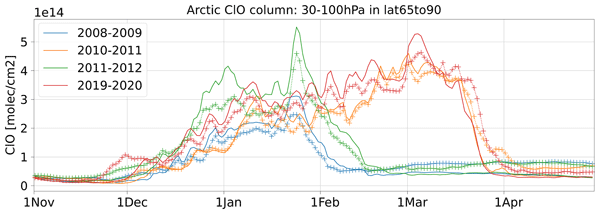
Simon Chabrillat, Samuel Rémy, Quentin Errera, Vincent Huijnen, Christine Bingen, Jonas Debosscher, François Hendrick, Swen Metzger, Adrien Mora, Daniele Minganti, Marc Op de beek, Léa Reisenfeld, Jason E. Williams, Henk Eskes, and Johannes Flemming
Geosci. Model Dev., 18, 8973–9014, https://doi.org/10.5194/gmd-18-8973-2025, https://doi.org/10.5194/gmd-18-8973-2025, 2025
Short summary
Short summary
We document the forecasts of the composition of the stratosphere by the Copernicus Atmosphere Monitoring Service. The model's predictions are compared with satellite measurements over a recent period, during polar ozone depletion events, and after the Mount Pinatubo volcanic eruption. The system performs well for sulfate aerosols, ozone and several other key gases but not as well for several nitrogen-containing gases. Chemical processes in aerosols and polar clouds should be improved.
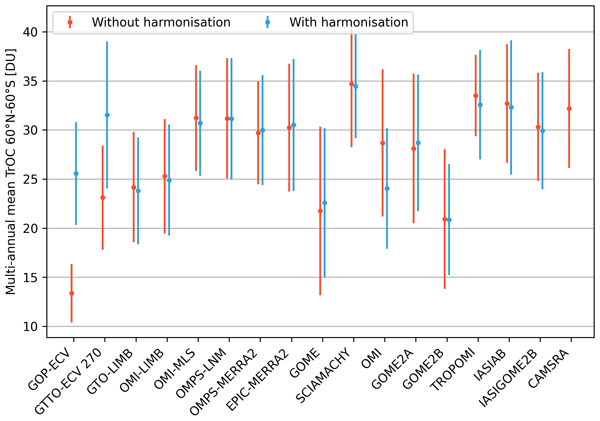
Arno Keppens, Daan Hubert, José Granville, Oindrila Nath, Jean-Christopher Lambert, Catherine Wespes, Pierre-François Coheur, Cathy Clerbaux, Anne Boynard, Richard Siddans, Barry Latter, Brian Kerridge, Serena Di Pede, Pepijn Veefkind, Juan Cuesta, Gaelle Dufour, Klaus-Peter Heue, Melanie Coldewey-Egbers, Diego Loyola, Andrea Orfanoz-Cheuquelaf, Swathi Maratt Satheesan, Kai-Uwe Eichmann, Alexei Rozanov, Viktoria F. Sofieva, Jerald R. Ziemke, Antje Inness, Roeland Van Malderen, and Lars Hoffmann
Atmos. Meas. Tech., 18, 6893–6916, https://doi.org/10.5194/amt-18-6893-2025, https://doi.org/10.5194/amt-18-6893-2025, 2025
Short summary
Short summary
The first Tropospheric Ozone Assessment Report (TOAR) encountered discrepancies between several satellite sensors’ estimates of the distribution and change of ozone in the free troposphere. Therefore, contributing to the second TOAR, we harmonise as much as possible the observational perspective of sixteen tropospheric ozone products from satellites. This only partially accounts for the observed discrepancies, with a reduction of 10–40 % of the inter-product dispersion upon harmonisation.
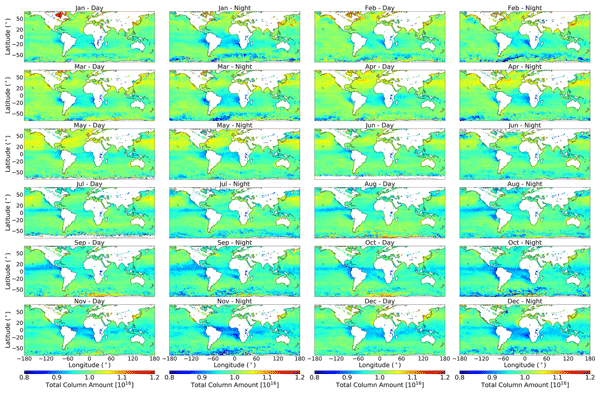
Michael P. Cartwright, Jeremy J. Harrison, David P. Moore, Richard J. Pope, Martyn P. Chipperfield, Chris Wilson, and Wuhu Feng
Atmos. Chem. Phys., 25, 15913–15934, https://doi.org/10.5194/acp-25-15913-2025, https://doi.org/10.5194/acp-25-15913-2025, 2025
Short summary
Short summary
We use satellite measurements to estimate quantities of a gas called carbonyl sulfide (OCS) in the atmosphere. OCS is consumed during photosynthesis, much like carbon dioxide (CO2). Our data is focused mostly over the global oceans for the year 2018, and we find it compares well with past satellite observations, ground-based measurements and modelled OCS. We hope to extend this measurement record and use it in data-driven tools in the future to better understand the carbon cycle globally.
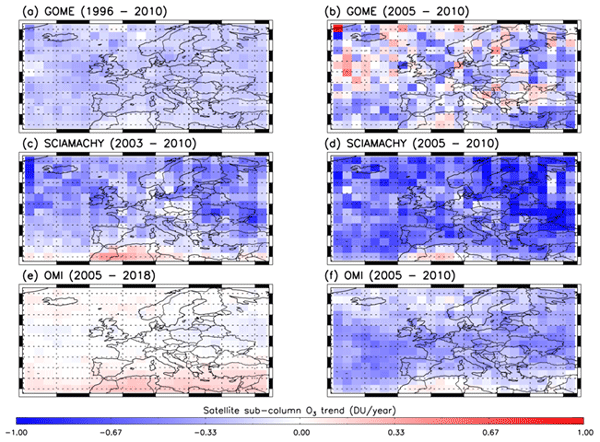
Matilda A. Pimlott, Richard J. Pope, Brian J. Kerridge, Richard Siddans, Barry G. Latter, Wuhu Feng, and Martyn P. Chipperfield
Atmos. Chem. Phys., 25, 15991–16007, https://doi.org/10.5194/acp-25-15991-2025, https://doi.org/10.5194/acp-25-15991-2025, 2025
Short summary
Short summary
Tropospheric ozone (O3) is a harmful secondary atmospheric pollutant and an important greenhouse gas. Here, we present an in-depth analysis of lower-tropospheric sub-column O3 (LTCO3, surface – 6 km) records from three satellite products produced by the Rutherford Appleton Laboratory (RAL) over Europe between 1996 and 2017. Overall, we detect moderate negative trends in the satellite records, but corresponding model simulations and ozonesonde measurements show negligible trends.
Hiroaki Naoe, Jorge L. García-Franco, Chang-Hyun Park, Mario Rodrigo, Froila M. Palmeiro, Federico Serva, Masakazu Taguchi, Kohei Yoshida, James A. Anstey, Javier García-Serrano, Seok-Woo Son, Yoshio Kawatani, Neal Butchart, Kevin Hamilton, Chih-Chieh Chen, Anne Glanville, Tobias Kerzenmacher, François Lott, Clara Orbe, Scott Osprey, Mijeong Park, Jadwiga H. Richter, Stefan Versick, and Shingo Watanabe
Weather Clim. Dynam., 6, 1419–1442, https://doi.org/10.5194/wcd-6-1419-2025, https://doi.org/10.5194/wcd-6-1419-2025, 2025
Short summary
Short summary
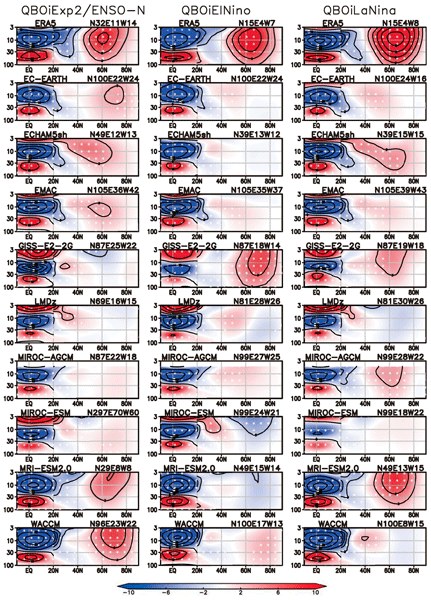
Links between the stratospheric Quasi-Biennial Oscillation (QBO) and atmospheric circulations in the tropics, subtropics, and polar regions, as well as their modulation by the El Nino–Southern Oscillation, are examined through model experiments. The QBO–polar vortex connection is reproduced by a multi-model ensemble at about half the observed amplitude. Weak performance of QBO signals in these regions is likely due to unrealistically weak QBO amplitudes in the lower stratosphere.
Johannes Degen, Bianca C. Baier, Patrick Jöckel, J. Moritz Menken, Tanja J. Schuck, Colm Sweeney, and Andreas Engel
Atmos. Chem. Phys., 25, 15741–15763, https://doi.org/10.5194/acp-25-15741-2025, https://doi.org/10.5194/acp-25-15741-2025, 2025
Short summary
Short summary
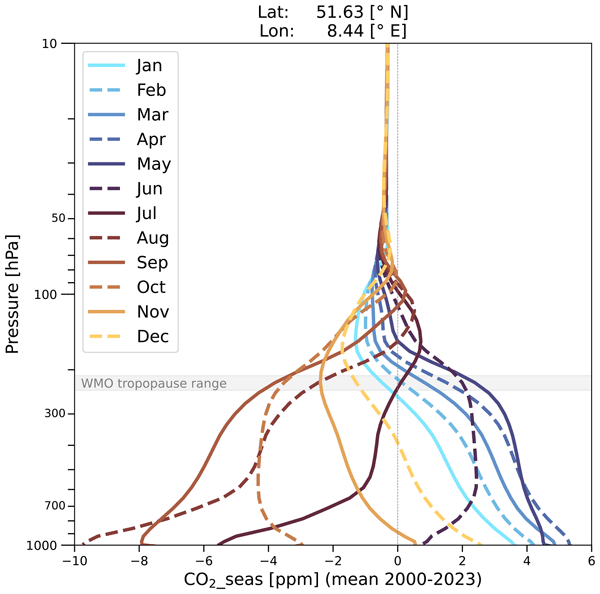
We investigate the distribution of CO2 in the upper troposphere and lower stratosphere using both, observations and an atmospheric model. Simulating an artificial tracer, we separate CO2 seasonality from long-term trend and transport variability. We found that patterns in the seasonal signal are attributable to large-scale transport features like the subtropical jet or the Brewer-Dobson circulation. Being a powerful diagnostic tool we recommend to use this tracer for model intercomparisons.
Philip Rupp, Liliana Vázquez Fernández, William J. M. Seviour, and Thomas Birner
EGUsphere, https://doi.org/10.5194/egusphere-2025-4587, https://doi.org/10.5194/egusphere-2025-4587, 2025
Short summary
Short summary
This study examines mortality impacts of sudden stratospheric warming events (SSWs). SSWs persistently increase the chance for cold spells in Northern Europe, but their direct socio-economic effects remain poorly quantified. Using ensemble simulations of the 2018 SSW and mortality records, we attribute ca. 750 deaths in the UK and 250 in the Nordics to this event. The strongest impacts emerge from the combination of post-SSW cold anomalies and heightened mortality sensitivity to these anomalies.
Frederik Harzer, Hella Garny, Felix Ploeger, J. Moritz Menken, and Thomas Birner
Atmos. Chem. Phys., 25, 14909–14921, https://doi.org/10.5194/acp-25-14909-2025, https://doi.org/10.5194/acp-25-14909-2025, 2025
Short summary
Short summary
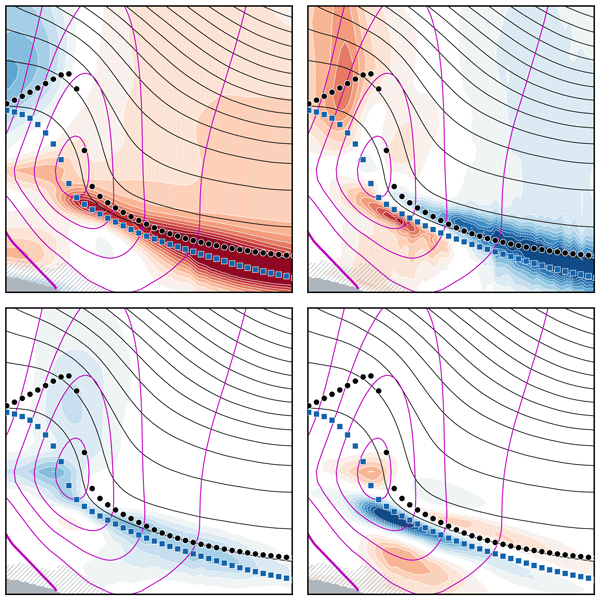
We study ozone transport in the extratropical lowermost stratosphere using potential temperature as vertical coordinate, thereby distinguishing adiabatic and diabatic processes. We find that on top of known dominant transport processes (quasi-horizontal mixing, slow diabatic descent) vertical mixing plays an important role near the tropopause. Our findings are relevant for understanding ozone's role in climate including its imprint on tropospheric ozone via stratosphere-troposphere air exchange.
Miriam Sinnhuber, Christina Arras, Stefan Bender, Bernd Funke, Hanli Liu, Daniel R. Marsh, Thomas Reddmann, Eugene Rozanov, Timofei Sukhodolov, Monika E. Szelag, and Jan Maik Wissing
Atmos. Chem. Phys., 25, 14719–14734, https://doi.org/10.5194/acp-25-14719-2025, https://doi.org/10.5194/acp-25-14719-2025, 2025
Short summary
Short summary
Nitric oxide in the upper atmosphere varies with solar activity. Observations show that this starts a chain of processes affecting the ozone layer and climate system. This is often underestimated in models. We compare five models which show large differences in simulated NO. Analysis of these discrepancies identify two processes which interact with each other: the balance between atomic and molecular oxygen in the thermosphere, and a poleward - downward transport in the winter thermosphere.
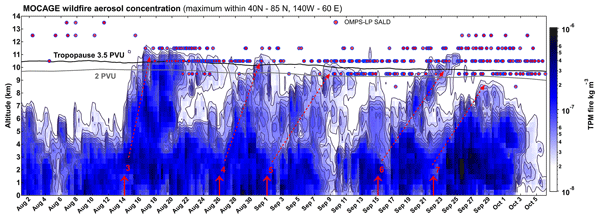
Sergey Khaykin, Slimane Bekki, Sophie Godin-Beekmann, Michael D. Fromm, Philippe Goloub, Qiaoyun Hu, Béatrice Josse, Alexandra Laeng, Mehdi Meziane, David A. Peterson, Sophie Pelletier, and Valérie Thouret
Atmos. Chem. Phys., 25, 14551–14571, https://doi.org/10.5194/acp-25-14551-2025, https://doi.org/10.5194/acp-25-14551-2025, 2025
Short summary
Short summary
In 2023, massive wildfires in Canada injected huge amounts of smoke into the atmosphere. Surprisingly, despite their intensity, the smoke did not rise very high but lingered at flight cruising altitudes, causing widespread pollution. This study shows how two different pathways lifted smoke into the lower stratosphere and reveals new insights into how wildfires affect air quality and climate, challenging what we thought we knew about fire and atmospheric impacts.
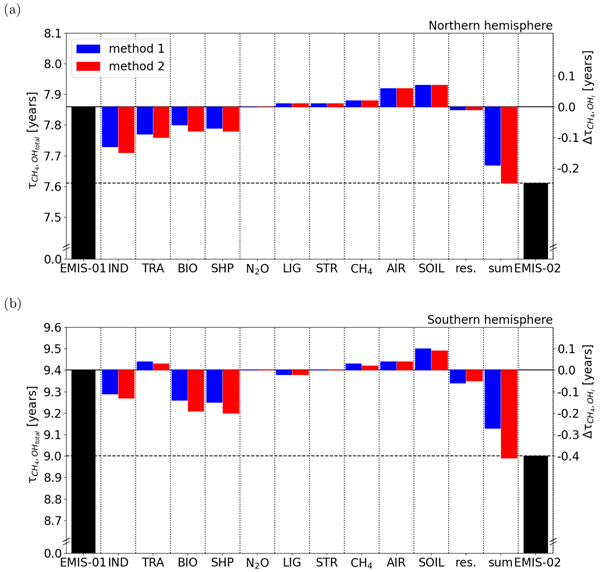
Catherine Acquah, Laura Stecher, Mariano Mertens, and Patrick Jöckel
Atmos. Chem. Phys., 25, 13665–13686, https://doi.org/10.5194/acp-25-13665-2025, https://doi.org/10.5194/acp-25-13665-2025, 2025
Short summary
Short summary
Short-lived ozone precursor species influence the formation of ozone and also the atmospheric lifetime of methane. Our study assesses the effect of two widely used emission inventories of these species on ozone and the methane lifetime. Our results indicate tropospheric ozone and methane lifetime differences of around 4 % even though both emission inventories aim at representing present-day conditions. We further attribute the differences to emissions of individual sectors, e.g. land traffic.
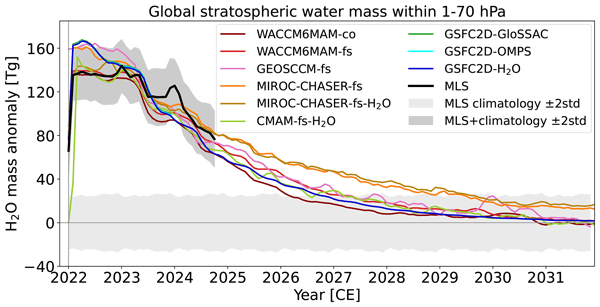
Zhihong Zhuo, Xinyue Wang, Yunqian Zhu, Wandi Yu, Ewa M. Bednarz, Eric Fleming, Peter R. Colarco, Shingo Watanabe, David Plummer, Georgiy Stenchikov, William Randel, Adam Bourassa, Valentina Aquila, Takashi Sekiya, Mark R. Schoeberl, Simone Tilmes, Jun Zhang, Paul J. Kushner, and Francesco S. R. Pausata
Atmos. Chem. Phys., 25, 13161–13176, https://doi.org/10.5194/acp-25-13161-2025, https://doi.org/10.5194/acp-25-13161-2025, 2025
Short summary
Short summary
The 2022 Hunga eruption caused unprecedented stratospheric water injection, triggering unique atmospheric impacts. This study combines observations and model simulations, projecting a stratospheric water vapor anomaly lasting 4–7 years, with significant temperature variations and ozone depletion in the upper atmosphere lasting 7–10 years. These findings offer critical insights into the role of stratospheric water vapor in shaping climate and atmospheric chemistry.
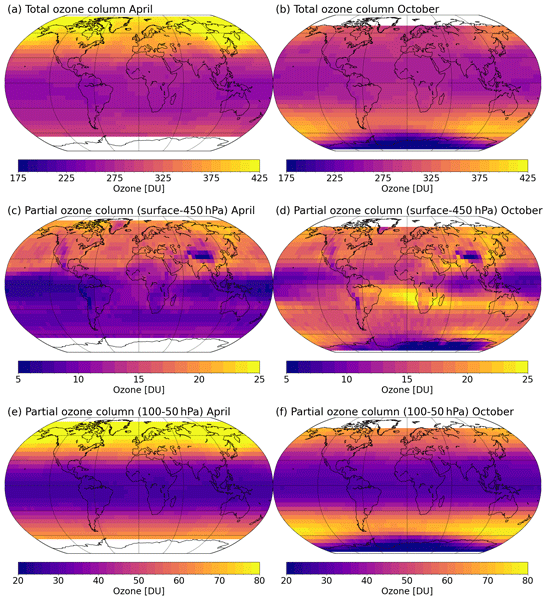
Melanie Coldewey-Egbers, Diego G. Loyola R., Barry Latter, Richard Siddans, Brian Kerridge, Daan Hubert, Michel van Roozendael, and Michael Eisinger
Atmos. Meas. Tech., 18, 5485–5505, https://doi.org/10.5194/amt-18-5485-2025, https://doi.org/10.5194/amt-18-5485-2025, 2025
Short summary
Short summary
The Global Ozone Monitoring Experiment (GOME)-type Ozone Profile Essential Climate Variable (GOP-ECV) data record provides monthly mean ozone profiles with global coverage from 1995 to 2021 at a spatial resolution of 5° × 5°. Measurements from five nadir-viewing satellite sensors are first harmonized and then merged into a coherent record. The long-term stability of the data record is further improved through scaling the profiles using the GOME-type Total Ozone Essential Climate Variable (GTO-ECV) data record as a reference.
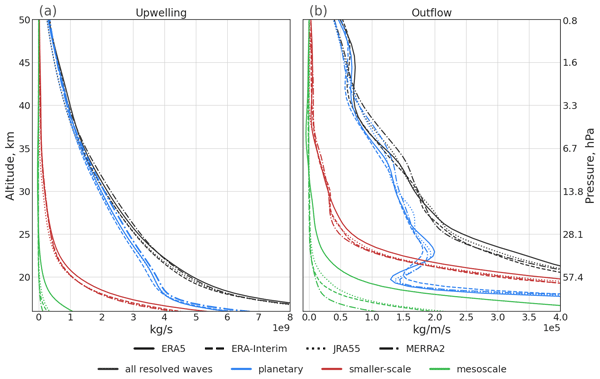
Rasul Baikhadzhaev, Felix Ploeger, Peter Preusse, Manfred Ern, and Thomas Birner
Atmos. Chem. Phys., 25, 12753–12777, https://doi.org/10.5194/acp-25-12753-2025, https://doi.org/10.5194/acp-25-12753-2025, 2025
Short summary
Short summary
Across four reanalyses, the shallow branch of the stratospheric overturning circulation was found to be driven by planetary waves 1 to 3, and the deep branch of the circulation was found to be driven by smaller-scale waves (wave 4 and higher). However, the height of the level separating the branches is dependent on the reanalysis considered. Thus, using the appropriate separation levels in model inter-comparisons could reduce the spread between models regarding climatology and trends in the circulation.
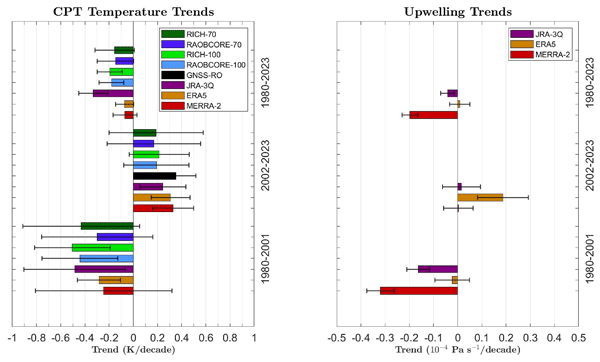
Mona Zolghadrshojaee, Susann Tegtmeier, Sean M. Davis, Robin Pilch Kedzierski, and Leopold Haimberger
Atmos. Chem. Phys., 25, 12213–12232, https://doi.org/10.5194/acp-25-12213-2025, https://doi.org/10.5194/acp-25-12213-2025, 2025
Short summary
Short summary
The tropical tropopause layer (TTL) is a crucial region where the troposphere transitions into the stratosphere, influencing air mass transport. This study examines temperature trends in the TTL and lower stratosphere using data from weather balloons, satellites and reanalysis datasets. We found cooling trends in the TTL from 1980 to 2001, followed by warming from 2002 to 2023. These shifts are linked to changes in atmospheric circulation and impact water vapour transport into the stratosphere.
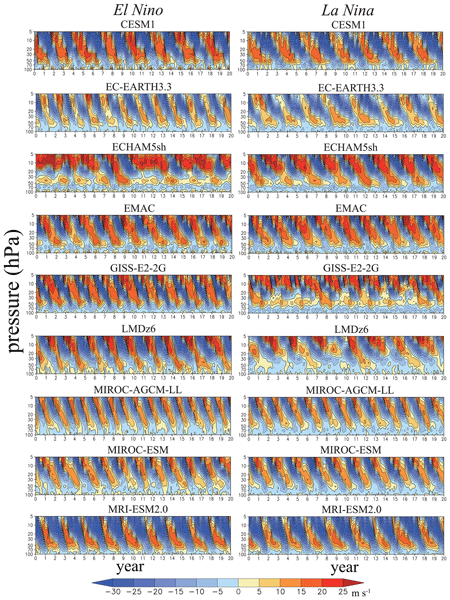
Yoshio Kawatani, Kevin Hamilton, Shingo Watanabe, Masakazu Taguchi, Federico Serva, James A. Anstey, Jadwiga H. Richter, Neal Butchart, Clara Orbe, Scott M. Osprey, Hiroaki Naoe, Dillon Elsbury, Chih-Chieh Chen, Javier García-Serrano, Anne Glanville, Tobias Kerzenmacher, François Lott, Froila M. Palmeiro, Mijeong Park, Stefan Versick, and Kohei Yoshida
Weather Clim. Dynam., 6, 1045–1073, https://doi.org/10.5194/wcd-6-1045-2025, https://doi.org/10.5194/wcd-6-1045-2025, 2025
Short summary
Short summary
The Quasi-Biennial Oscillation (QBO) of the tropical stratospheric mean winds has been relatively steady over the 7 decades it has been observed, but there are always cycle-to-cycle variations. This study used several global atmospheric models to investigate systematic modulation of the QBO by the El Niño/La Niña cycle. All models simulated shorter periods during El Niño, in agreement with observations. By contrast, the models disagreed even on the sign of the El Niño effect on QBO amplitude.

Andrin Jörimann, Timofei Sukhodolov, Beiping Luo, Gabriel Chiodo, Graham Mann, and Thomas Peter
Geosci. Model Dev., 18, 6023–6041, https://doi.org/10.5194/gmd-18-6023-2025, https://doi.org/10.5194/gmd-18-6023-2025, 2025
Short summary
Short summary
Aerosol particles in the stratosphere affect our climate. Climate models therefore need an accurate description of their properties and evolution. Satellites measure how strongly aerosol particles extinguish light passing through the stratosphere. We describe a method to use such aerosol extinction data to retrieve the number and sizes of the aerosol particles and calculate their optical effects. The resulting data sets for models are validated against ground-based and balloon observations.
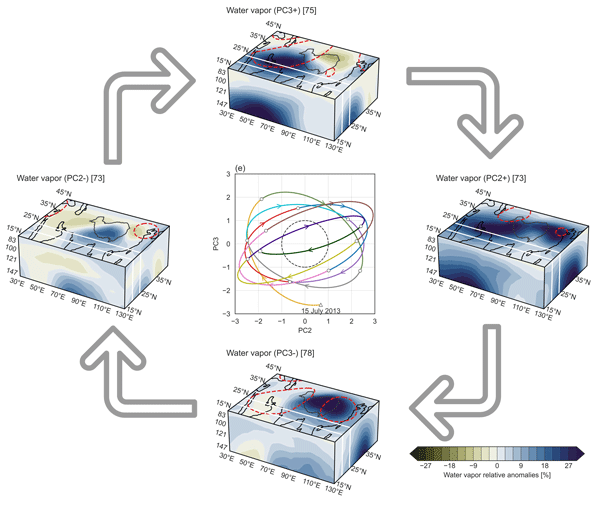
Shenglong Zhang, Jiao Chen, Jonathon S. Wright, Sean M. Davis, Jie Gao, Paul Konopka, Ninghui Li, Mengqian Lu, Susann Tegtmeier, Xiaolu Yan, Guang J. Zhang, and Nuanliang Zhu
Atmos. Chem. Phys., 25, 10109–10139, https://doi.org/10.5194/acp-25-10109-2025, https://doi.org/10.5194/acp-25-10109-2025, 2025
Short summary
Short summary
Swirling above summer storms, the Asian monsoon anticyclone functions as both gateway and gatekeeper to moisture entering the stratosphere. Although well monitored from space since 2005, many details of the anticyclone and the air that flows through it remain mysterious. Reanalyses, which combine model output and observations, may help to address how and why but only if they reliably capture the what and where of water vapor variations. Current reanalyses are beginning to meet these criteria.
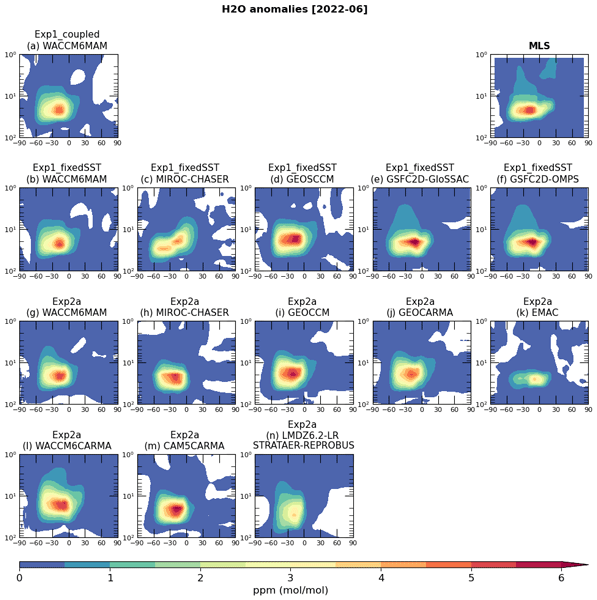
Yunqian Zhu, Hideharu Akiyoshi, Valentina Aquila, Elizabeth Asher, Ewa M. Bednarz, Slimane Bekki, Christoph Brühl, Amy H. Butler, Parker Case, Simon Chabrillat, Gabriel Chiodo, Margot Clyne, Peter R. Colarco, Sandip Dhomse, Lola Falletti, Eric Fleming, Ben Johnson, Andrin Jörimann, Mahesh Kovilakam, Gerbrand Koren, Ales Kuchar, Nicolas Lebas, Qing Liang, Cheng-Cheng Liu, Graham Mann, Michael Manyin, Marion Marchand, Olaf Morgenstern, Paul Newman, Luke D. Oman, Freja F. Østerstrøm, Yifeng Peng, David Plummer, Ilaria Quaglia, William Randel, Samuel Rémy, Takashi Sekiya, Stephen Steenrod, Timofei Sukhodolov, Simone Tilmes, Kostas Tsigaridis, Rei Ueyama, Daniele Visioni, Xinyue Wang, Shingo Watanabe, Yousuke Yamashita, Pengfei Yu, Wandi Yu, Jun Zhang, and Zhihong Zhuo
Geosci. Model Dev., 18, 5487–5512, https://doi.org/10.5194/gmd-18-5487-2025, https://doi.org/10.5194/gmd-18-5487-2025, 2025
Short summary
Short summary
To understand the climate impact of the 2022 Hunga volcanic eruption, we developed a climate model–observation comparison project. The paper describes the protocols and models that participate in the experiments. We designed several experiments to achieve our goals of this activity: (1) to evaluate the climate model performance and (2) to understand the Earth system responses to this eruption.
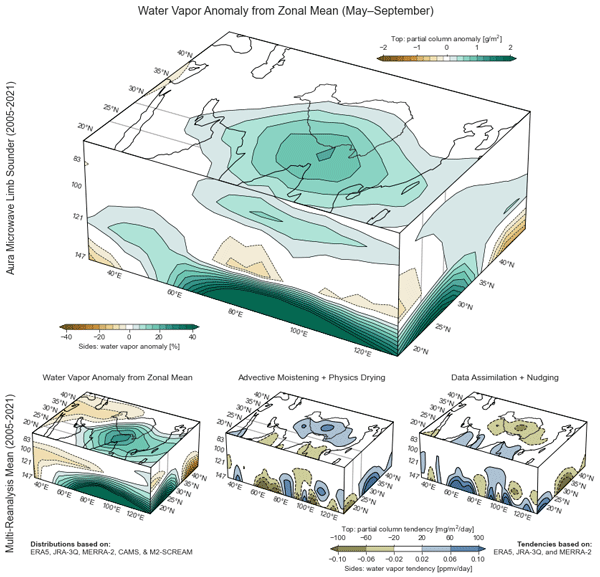
Jonathon S. Wright, Shenglong Zhang, Jiao Chen, Sean M. Davis, Paul Konopka, Mengqian Lu, Xiaolu Yan, and Guang J. Zhang
Atmos. Chem. Phys., 25, 9617–9643, https://doi.org/10.5194/acp-25-9617-2025, https://doi.org/10.5194/acp-25-9617-2025, 2025
Short summary
Short summary
Atmospheric reanalysis products reconstruct past states of the atmosphere. These products are often used to study winds and temperatures in the upper-level monsoon circulation, but their ability to reproduce composition fields like water vapor and ozone has been questionable at best. Here we report clear signs of improvement in both consistency across reanalyses and agreement with satellite observations, outline limitations, and suggest steps to further enhance the usefulness of these fields.
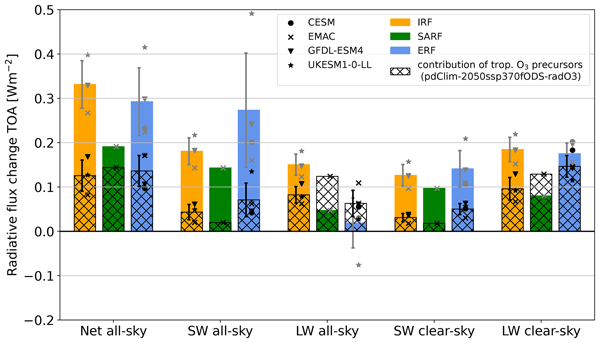
William J. Collins, Fiona M. O'Connor, Rachael E. Byrom, Øivind Hodnebrog, Patrick Jöckel, Mariano Mertens, Gunnar Myhre, Matthias Nützel, Dirk Olivié, Ragnhild Bieltvedt Skeie, Laura Stecher, Larry W. Horowitz, Vaishali Naik, Gregory Faluvegi, Ulas Im, Lee T. Murray, Drew Shindell, Kostas Tsigaridis, Nathan Luke Abraham, and James Keeble
Atmos. Chem. Phys., 25, 9031–9060, https://doi.org/10.5194/acp-25-9031-2025, https://doi.org/10.5194/acp-25-9031-2025, 2025
Short summary
Short summary
We used 7 climate models that include atmospheric chemistry and find that in a scenario with weak controls on air quality, the warming effects (over 2015 to 2050) of decreases in ozone-depleting substances and increases in air quality pollutants are approximately equal and would make ozone the second highest contributor to warming over this period. We find that for stratospheric ozone recovery, the standard measure of climate effects underestimates a more comprehensive measure.
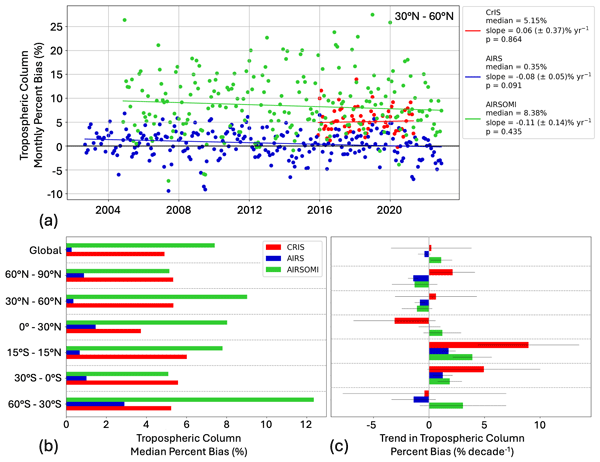
Elyse A. Pennington, Gregory B. Osterman, Vivienne H. Payne, Kazuyuki Miyazaki, Kevin W. Bowman, and Jessica L. Neu
Atmos. Chem. Phys., 25, 8533–8552, https://doi.org/10.5194/acp-25-8533-2025, https://doi.org/10.5194/acp-25-8533-2025, 2025
Short summary
Short summary
Tropospheric ozone is a harmful pollutant and powerful greenhouse gas. For satellite products to accurately quantify trends in tropospheric ozone, they must have a low bias compared to a reliable source of data. This study compares three NASA satellite products to ozonesonde data. They have low global measurement bias and thus can be used to detect global tropospheric ozone trends, but the measurement bias should be considered in certain regions and time periods.
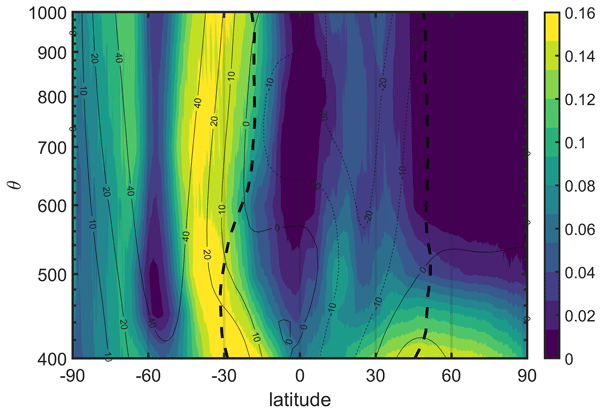
Jezabel Curbelo and Marianna Linz
Atmos. Chem. Phys., 25, 7941–7957, https://doi.org/10.5194/acp-25-7941-2025, https://doi.org/10.5194/acp-25-7941-2025, 2025
Short summary
Short summary
Studying stratospheric mixing is crucial for understanding atmospheric dynamics and chemical transport. We propose a new Lagrangian metric based on the density of transport barriers, attracting/repelling coherent structures, to analyze mixing in the Whole Atmosphere Community Climate Model. Our metric is a promising tool for stratospheric analysis, consistent with commonly used metrics to quantify mixing while also providing the advantage of reflecting Lagrangian transport in physical latitude.
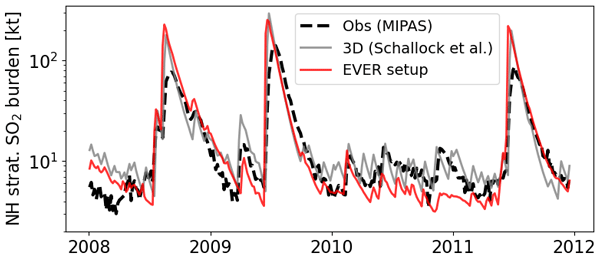
Matthias Kohl, Christoph Brühl, Jennifer Schallock, Holger Tost, Patrick Jöckel, Adrian Jost, Steffen Beirle, Michael Höpfner, and Andrea Pozzer
Geosci. Model Dev., 18, 3985–4007, https://doi.org/10.5194/gmd-18-3985-2025, https://doi.org/10.5194/gmd-18-3985-2025, 2025
Short summary
Short summary
SO2 from explosive volcanic eruptions reaching the stratosphere can oxidize and form sulfur aerosols, potentially persisting for several years. We developed a new submodel, Explosive Volcanic ERuptions (EVER), that seamlessly includes stratospheric volcanic SO2 emissions in global numerical simulations based on a novel standard historical model setup, successfully evaluated with satellite observations. Sensitivity studies on the Nabro eruption in 2011 evaluate different emission methods.
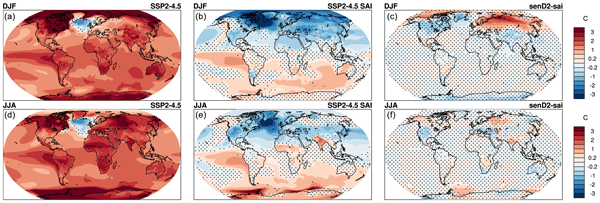
Simone Tilmes, Ewa M. Bednarz, Andrin Jörimann, Daniele Visioni, Douglas E. Kinnison, Gabriel Chiodo, and David Plummer
Atmos. Chem. Phys., 25, 6001–6023, https://doi.org/10.5194/acp-25-6001-2025, https://doi.org/10.5194/acp-25-6001-2025, 2025
Short summary
Short summary
In this paper, we describe the details of a new multi-model intercomparison experiment to assess the effects of Stratospheric Aerosol Intervention (SAI) on stratospheric chemistry and dynamics and, therefore, ozone. Second, we discuss the advantages and differences of the more constrained experiment compared to fully interactive model experiments. This way, we advance the process-level understanding of the drivers of SAI-induced atmospheric responses.
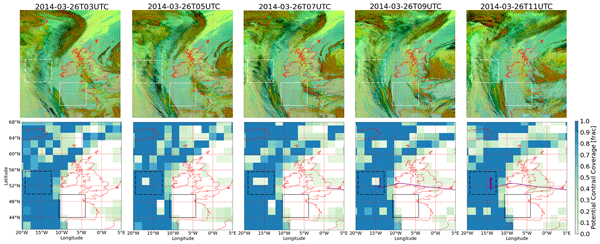
Patrick Peter, Sigrun Matthes, Christine Frömming, Patrick Jöckel, Luca Bugliaro, Andreas Giez, Martina Krämer, and Volker Grewe
Atmos. Chem. Phys., 25, 5911–5934, https://doi.org/10.5194/acp-25-5911-2025, https://doi.org/10.5194/acp-25-5911-2025, 2025
Short summary
Short summary
Our study examines how well the global climate model EMAC (ECHAM/MESSy Atmospheric Chemistry) predicts contrail formation by analysing temperature and humidity – two key factors for contrail development and persistence. The model underestimates temperature, leading to an overprediction of contrail formation and larger ice-supersaturated regions. Adjusting the model improves temperature accuracy but adds uncertainties. Better predictions of contrail formation areas can help optimise flight tracks to reduce aviation's climate effect.
Martin Cussac, Martine Michou, Pierre Nabat, Béatrice Josse, and Sophie Pelletier
EGUsphere, https://doi.org/10.5194/egusphere-2025-1933, https://doi.org/10.5194/egusphere-2025-1933, 2025
Preprint archived
Short summary
Short summary
This study evaluates three chemistry schemes of varying complexity, one mainly stratospheric and two tropospheric-stratospheric, in the latest version of the climate model ARPEGE-Climat. Stratospheric ozone and water vapour are better represented. Despite issues with carbon monoxide in one scheme and with winter nitrogen species in the other, tropospheric ozone is overall realistically simulated. These modelling evolutions strengthen future research on chemistry-climate interactions.
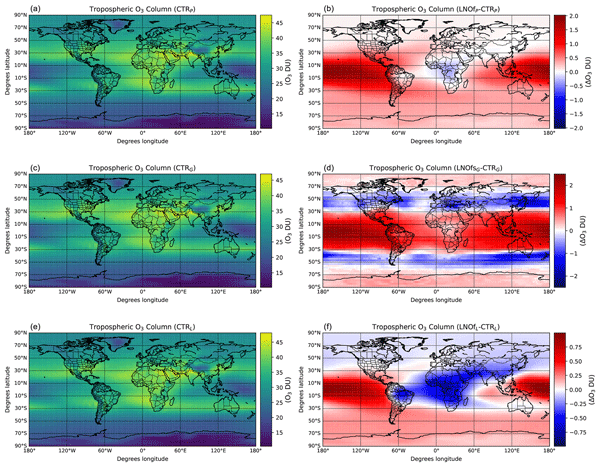
Francisco J. Pérez-Invernón, Francisco J. Gordillo-Vázquez, Heidi Huntrieser, Patrick Jöckel, and Eric J. Bucsela
Atmos. Chem. Phys., 25, 5557–5575, https://doi.org/10.5194/acp-25-5557-2025, https://doi.org/10.5194/acp-25-5557-2025, 2025
Short summary
Short summary
Lightning plays a significant role in tropospheric chemistry by producing substantial amounts of nitrogen oxides. According to recent estimates, thunderstorms that produce a higher lightning frequency rate also produce less nitrogen oxide per flash. We implemented the dependency of nitrogen oxide production per flash on lightning flash frequency in a chemical atmospheric model.
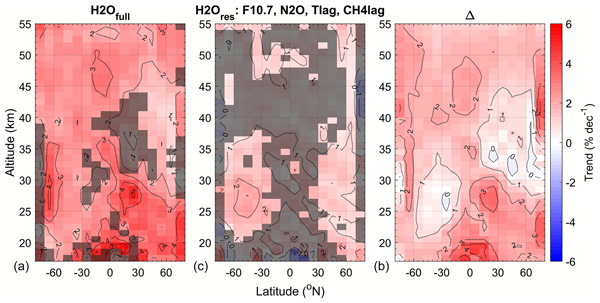
Patrick E. Sheese, Kaley A. Walker, Chris D. Boone, and David A. Plummer
Atmos. Chem. Phys., 25, 5199–5213, https://doi.org/10.5194/acp-25-5199-2025, https://doi.org/10.5194/acp-25-5199-2025, 2025
Short summary
Short summary
Observations from Atmospheric Chemistry Experiment–Fourier Transform Spectrometer (ACE-FTS) are used to examine global stratospheric water vapour trends for 2004–2021. The satellite measurements are used to quantify trend contributions arising from changes in tropical tropopause temperatures, general circulation patterns, and methane concentrations. While most of the observed trends can be explained by these changes, there remains an unaccounted-for and increasing source of water vapour in the lower mid-stratosphere at mid-latitudes, which is discussed.
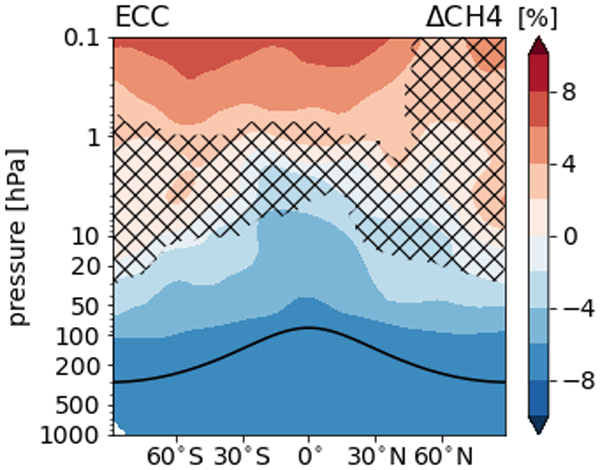
Laura Stecher, Franziska Winterstein, Patrick Jöckel, Michael Ponater, Mariano Mertens, and Martin Dameris
Atmos. Chem. Phys., 25, 5133–5158, https://doi.org/10.5194/acp-25-5133-2025, https://doi.org/10.5194/acp-25-5133-2025, 2025
Short summary
Short summary
Methane, the second most important anthropogenic greenhouse gas, is chemically decomposed in the atmosphere. The chemical sink of atmospheric methane is not constant but depends on the temperature and on the abundance of its reaction partners. In this study, we use a global chemistry–climate model to assess the feedback of atmospheric methane induced by changes in the chemical sink in a warming climate and its implications for the chemical composition and the surface air temperature change.
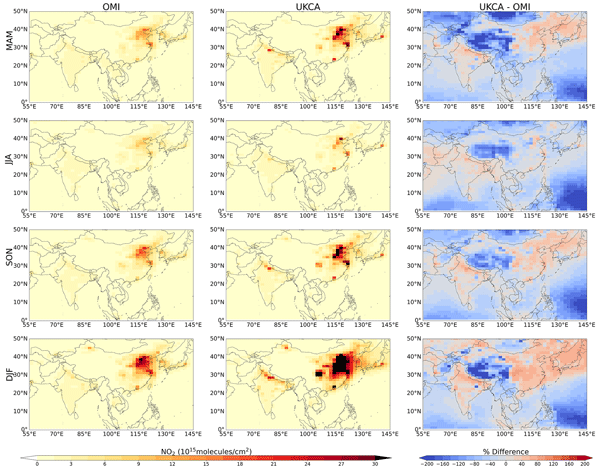
Alok K. Pandey, David S. Stevenson, Alcide Zhao, Richard J. Pope, Ryan Hossaini, Krishan Kumar, and Martyn P. Chipperfield
Atmos. Chem. Phys., 25, 4785–4802, https://doi.org/10.5194/acp-25-4785-2025, https://doi.org/10.5194/acp-25-4785-2025, 2025
Short summary
Short summary
Nitrogen dioxide is an air pollutant largely controlled by human activity that affects ozone, methane, and aerosols. Satellite instruments can quantify column NO2 and, by carefully matching the time and location of measurements, enable evaluation of model simulations. NO2 over south and east Asia is assessed, showing that the model captures not only many features of the measurements, but also important differences that suggest model deficiencies in representing several aspects of the atmospheric chemistry of NO2.
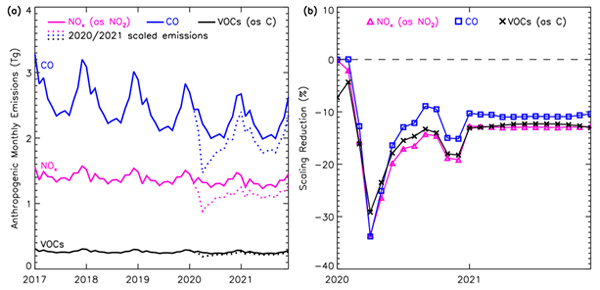
Matilda A. Pimlott, Richard J. Pope, Brian J. Kerridge, Richard Siddans, Barry G. Latter, Lucy J. Ventress, Wuhu Feng, and Martyn P. Chipperfield
Atmos. Chem. Phys., 25, 4391–4401, https://doi.org/10.5194/acp-25-4391-2025, https://doi.org/10.5194/acp-25-4391-2025, 2025
Short summary
Short summary
Globally, lockdowns were implemented to limit the spread of COVID-19, leading to a decrease in emissions of key air pollutants. Here, we use novel satellite data and a chemistry model to investigate the impact of the pandemic on tropospheric ozone (O3), a key pollutant, in 2020. Overall, we found substantial decreases of up to 20 %, two-thirds of which came from emission reductions, while one-third was due to a decrease in the stratospheric O3 flux into the troposphere.
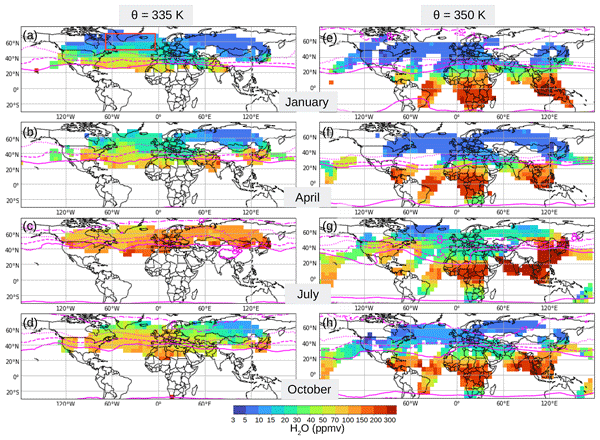
Patrick Konjari, Christian Rolf, Michaela I. Hegglin, Susanne Rohs, Yun Li, Andreas Zahn, Harald Bönisch, Philippe Nedelec, Martina Krämer, and Andreas Petzold
Atmos. Chem. Phys., 25, 4269–4289, https://doi.org/10.5194/acp-25-4269-2025, https://doi.org/10.5194/acp-25-4269-2025, 2025
Short summary
Short summary
This study introduces a new method to derive adjusted water vapor (H2O) climatologies for the upper tropopshere and lower statosphere (UT/LS) using data from 60 000 flights under the IAGOS program. Biases in the IAGOS water vapour dataset are adjusted, based on the more accurate IAGOS-CARIBIC data. The resulting highly resolved H2O climatologies will contribute to a better understanding of the H2O variability in the UT/LS and its connection to various transport and mixing processes.
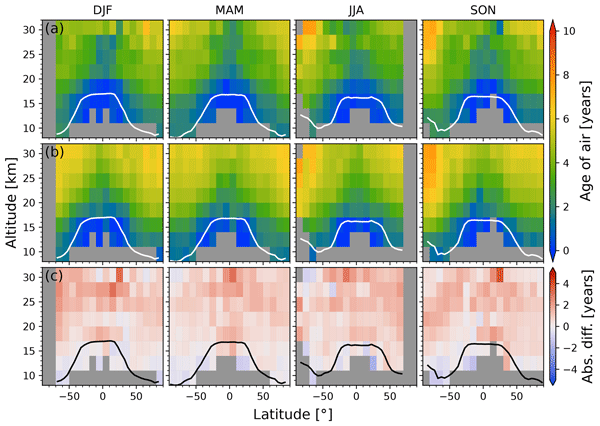
Laura N. Saunders, Kaley A. Walker, Gabriele P. Stiller, Thomas von Clarmann, Florian Haenel, Hella Garny, Harald Bönisch, Chris D. Boone, Ariana E. Castillo, Andreas Engel, Johannes C. Laube, Marianna Linz, Felix Ploeger, David A. Plummer, Eric A. Ray, and Patrick E. Sheese
Atmos. Chem. Phys., 25, 4185–4209, https://doi.org/10.5194/acp-25-4185-2025, https://doi.org/10.5194/acp-25-4185-2025, 2025
Short summary
Short summary
We present a 17-year stratospheric age-of-air dataset derived from ACE-FTS satellite measurements of sulfur hexafluoride. This is the longest continuous, global, and vertically resolved age of air time series available to date. In this paper, we show that this dataset agrees well with age-of-air datasets based on measurements from other instruments. We also present trends in the midlatitude lower stratosphere that indicate changes in the global circulation that are predicted by climate models.
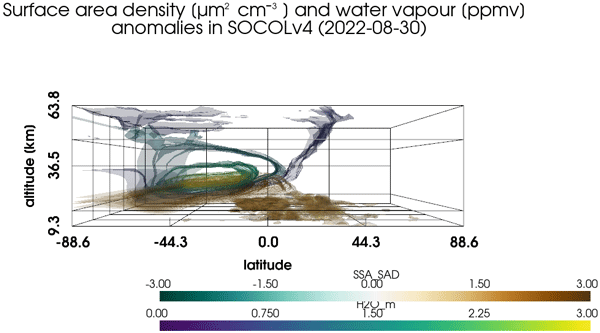
Ales Kuchar, Timofei Sukhodolov, Gabriel Chiodo, Andrin Jörimann, Jessica Kult-Herdin, Eugene Rozanov, and Harald H. Rieder
Atmos. Chem. Phys., 25, 3623–3634, https://doi.org/10.5194/acp-25-3623-2025, https://doi.org/10.5194/acp-25-3623-2025, 2025
Short summary
Short summary
In January 2022, the Hunga Tonga–Hunga Ha'apai (HTHH) volcano erupted, sending massive amounts of water vapour into the atmosphere. This event had a significant impact on stratospheric and lower-mesospheric chemical composition. Two years later, stratospheric conditions were disturbed during so-called sudden stratospheric warmings. Here we simulate a novel pathway by which this water-rich eruption may have contributed to conditions during these events and consequently impacted the surface climate.
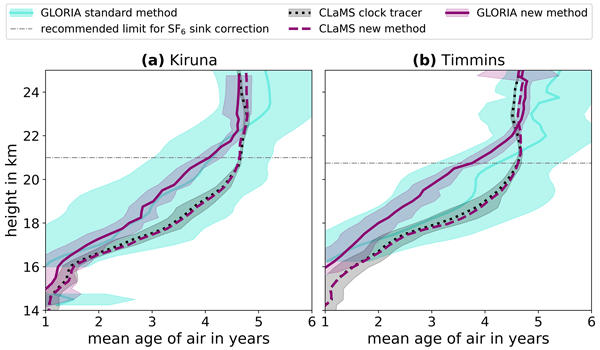
Florian Voet, Felix Ploeger, Johannes Laube, Peter Preusse, Paul Konopka, Jens-Uwe Grooß, Jörn Ungermann, Björn-Martin Sinnhuber, Michael Höpfner, Bernd Funke, Gerald Wetzel, Sören Johansson, Gabriele Stiller, Eric Ray, and Michaela I. Hegglin
Atmos. Chem. Phys., 25, 3541–3565, https://doi.org/10.5194/acp-25-3541-2025, https://doi.org/10.5194/acp-25-3541-2025, 2025
Short summary
Short summary
This study refines estimates of the stratospheric “age of air”, a measure of how long air circulates in the stratosphere. By analyzing correlations between trace gases measurable by satellites, the research introduces a method that reduces uncertainties and detects small-scale atmospheric features. This improved understanding of stratospheric circulation is crucial for better climate models and predictions, enhancing our ability to assess the impacts of climate change on the atmosphere.
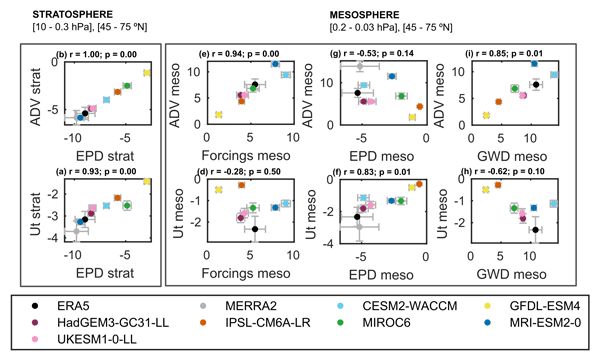
Verónica Martínez-Andradas, Alvaro de la Cámara, Pablo Zurita-Gotor, François Lott, and Federico Serva
Weather Clim. Dynam., 6, 329–343, https://doi.org/10.5194/wcd-6-329-2025, https://doi.org/10.5194/wcd-6-329-2025, 2025
Short summary
Short summary
Global circulation model biases are present when simulating sudden stratospheric warmings (SSWs). These are important extreme phenomena that occur in the wintertime stratosphere, driven by the breaking of atmospheric waves. The present work shows that there is a large spread of the wave forcing during the development of SSWs in different models. In the mesosphere, gravity waves are found to force advection of the residual circulation, while planetary waves tend to decelerate the wind.
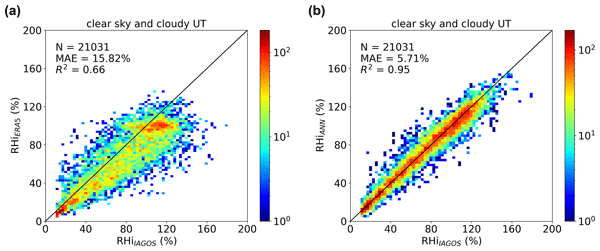
Ziming Wang, Luca Bugliaro, Klaus Gierens, Michaela I. Hegglin, Susanne Rohs, Andreas Petzold, Stefan Kaufmann, and Christiane Voigt
Atmos. Chem. Phys., 25, 2845–2861, https://doi.org/10.5194/acp-25-2845-2025, https://doi.org/10.5194/acp-25-2845-2025, 2025
Short summary
Short summary
Upper-tropospheric relative humidity bias in the ERA5 weather model is corrected by 10 % by an artificial neural network using aircraft in-service humidity data and thermodynamic and dynamical variables. The improved skills of the weather model will advance cirrus research, weather forecasts, and measures for contrail reduction.
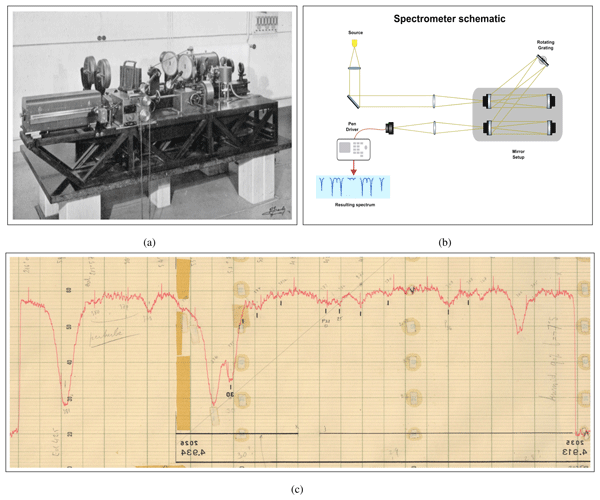
Jamal Makkor, Mathias Palm, Matthias Buschmann, Emmanuel Mahieu, Martyn P. Chipperfield, and Justus Notholt
Atmos. Meas. Tech., 18, 1105–1114, https://doi.org/10.5194/amt-18-1105-2025, https://doi.org/10.5194/amt-18-1105-2025, 2025
Short summary
Short summary
During the years 1950 and 1951, Marcel Migeotte took regular solar measurements in the form of paper rolls at the Jungfraujoch site. These historical spectra proved to be valuable for atmospheric research and needed to be saved for posterity. Therefore, a digitization method which used image-processing techniques was developed to extract them from the historical paper rolls. This allowed them to be saved in a machine-readable format that is easily accessible to the scientific community.
Dioumacor Faye, Felipe M. de Andrade, Roberto Suárez-Moreno, Dahirou Wane, Michaela I. Hegglin, Abdou L. Dieng, François Kaly, Redouane Lguensat, and Amadou T. Gaye
EGUsphere, https://doi.org/10.5194/egusphere-2024-4040, https://doi.org/10.5194/egusphere-2024-4040, 2025
Preprint archived
Short summary
Short summary
This study evaluates machine learning (ML) methods to improve subseasonal-to-seasonal (S2S) rainfall forecasts in Senegal during the West African monsoon. Using high-resolution precipitation data and atmospheric-oceanic reanalysis, we show that ML models like ridge regression outperform traditional climate models. These methods enhance prediction accuracy and efficiency, offering valuable tools for climate risk management and water resource planning.
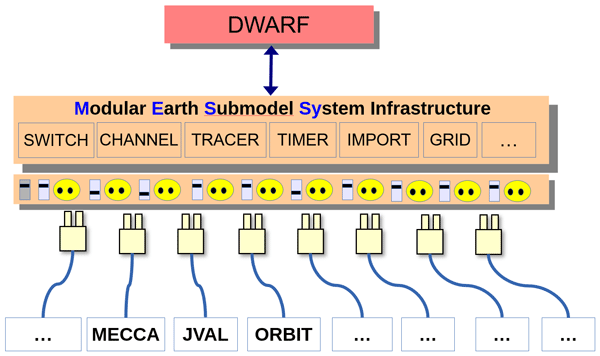
Astrid Kerkweg, Timo Kirfel, Duong H. Do, Sabine Griessbach, Patrick Jöckel, and Domenico Taraborrelli
Geosci. Model Dev., 18, 1265–1286, https://doi.org/10.5194/gmd-18-1265-2025, https://doi.org/10.5194/gmd-18-1265-2025, 2025
Short summary
Short summary
Normally, the Modular Earth Submodel System (MESSy) is linked to complete dynamic models to create chemical climate models. However, the modular concept of MESSy and the newly developed DWARF component presented here make it possible to create simplified models that contain only one or a few process descriptions. This is very useful for technical optimisation, such as porting to GPUs, and can be used to create less complex models, such as a chemical box model.
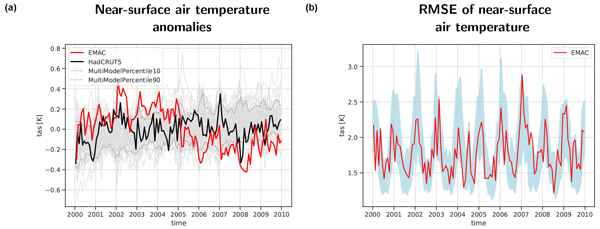
Axel Lauer, Lisa Bock, Birgit Hassler, Patrick Jöckel, Lukas Ruhe, and Manuel Schlund
Geosci. Model Dev., 18, 1169–1188, https://doi.org/10.5194/gmd-18-1169-2025, https://doi.org/10.5194/gmd-18-1169-2025, 2025
Short summary
Short summary
Earth system models are important tools to improve our understanding of current climate and to project climate change. Thus, it is crucial to understand possible shortcomings in the models. New features of the ESMValTool software package allow one to compare and visualize a model's performance with respect to reproducing observations in the context of other climate models in an easy and user-friendly way. We aim to help model developers assess and monitor climate simulations more efficiently.

Kerstin Hartung, Bastian Kern, Nils-Arne Dreier, Jörn Geisbüsch, Mahnoosh Haghighatnasab, Patrick Jöckel, Astrid Kerkweg, Wilton Jaciel Loch, Florian Prill, and Daniel Rieger
Geosci. Model Dev., 18, 1001–1015, https://doi.org/10.5194/gmd-18-1001-2025, https://doi.org/10.5194/gmd-18-1001-2025, 2025
Short summary
Short summary
The ICOsahedral Non-hydrostatic (ICON) model system Community Interface (ComIn) library supports connecting third-party modules to the ICON model. Third-party modules can range from simple diagnostic Python scripts to full chemistry models. ComIn offers a low barrier for code extensions to ICON, provides multi-language support (Fortran, C/C++, and Python), and reduces the migration effort in response to new ICON releases. This paper presents the ComIn design principles and a range of use cases.
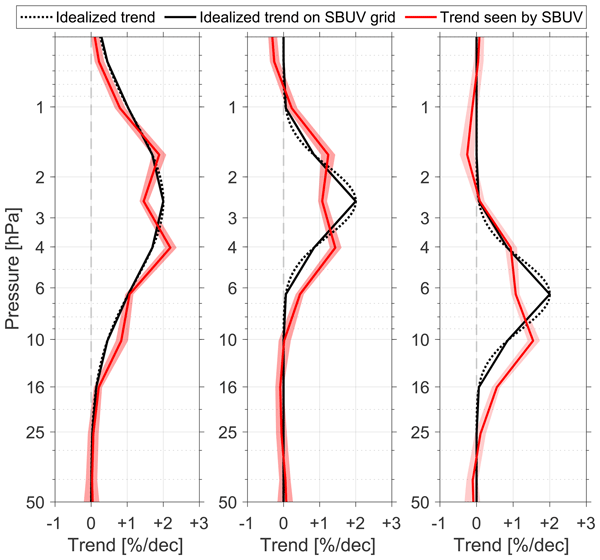
Louis Rivoire, Marianna Linz, Jessica L. Neu, Pu Lin, and Michelle L. Santee
Atmos. Chem. Phys., 25, 2269–2289, https://doi.org/10.5194/acp-25-2269-2025, https://doi.org/10.5194/acp-25-2269-2025, 2025
Short summary
Short summary
The recovery of the ozone hole since the 1987 Montreal Protocol has been observed in some regions but has yet to be seen globally. We ask how long it will take to witness a global recovery. Using a technique akin to flying a virtual satellite in a climate model, we find that the degree of confidence we place in the answer to this question is dramatically affected by errors in satellite observations.
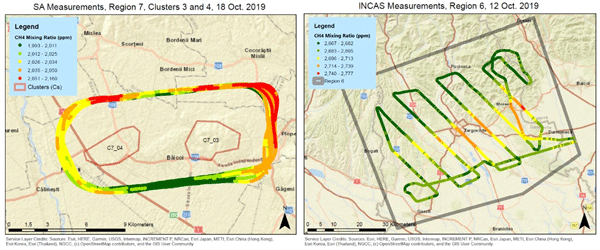
Hossein Maazallahi, Foteini Stavropoulou, Samuel Jonson Sutanto, Michael Steiner, Dominik Brunner, Mariano Mertens, Patrick Jöckel, Antoon Visschedijk, Hugo Denier van der Gon, Stijn Dellaert, Nataly Velandia Salinas, Stefan Schwietzke, Daniel Zavala-Araiza, Sorin Ghemulet, Alexandru Pana, Magdalena Ardelean, Marius Corbu, Andreea Calcan, Stephen A. Conley, Mackenzie L. Smith, and Thomas Röckmann
Atmos. Chem. Phys., 25, 1497–1511, https://doi.org/10.5194/acp-25-1497-2025, https://doi.org/10.5194/acp-25-1497-2025, 2025
Short summary
Short summary
This article presents insights from airborne in situ measurements collected during the ROmanian Methane Emissions from Oil and gas (ROMEO) campaign supported by two models. Results reveal Romania's oil and gas methane emissions were significantly under-reported to the United Nations Framework Convention on Climate Change (UNFCCC) in 2019. A large underestimation was also found in the Emissions Database for Global Atmospheric Research (EDGAR) v7.0 for the study domain in the same year.
Chaim I. Garfinkel, Zachary D. Lawrence, Amy H. Butler, Etienne Dunn-Sigouin, Irene Erner, Alexey Y. Karpechko, Gerbrand Koren, Marta Abalos, Blanca Ayarzagüena, David Barriopedro, Natalia Calvo, Alvaro de la Cámara, Andrew Charlton-Perez, Judah Cohen, Daniela I. V. Domeisen, Javier García-Serrano, Neil P. Hindley, Martin Jucker, Hera Kim, Robert W. Lee, Simon H. Lee, Marisol Osman, Froila M. Palmeiro, Inna Polichtchouk, Jian Rao, Jadwiga H. Richter, Chen Schwartz, Seok-Woo Son, Masakazu Taguchi, Nicholas L. Tyrrell, Corwin J. Wright, and Rachel W.-Y. Wu
Weather Clim. Dynam., 6, 171–195, https://doi.org/10.5194/wcd-6-171-2025, https://doi.org/10.5194/wcd-6-171-2025, 2025
Short summary
Short summary
Variability in the extratropical stratosphere and troposphere is coupled, and because of the longer timescales characteristic of the stratosphere, this allows for a window of opportunity for surface prediction. This paper assesses whether models used for operational prediction capture these coupling processes accurately. We find that most processes are too weak; however downward coupling from the lower stratosphere to the near surface is too strong.
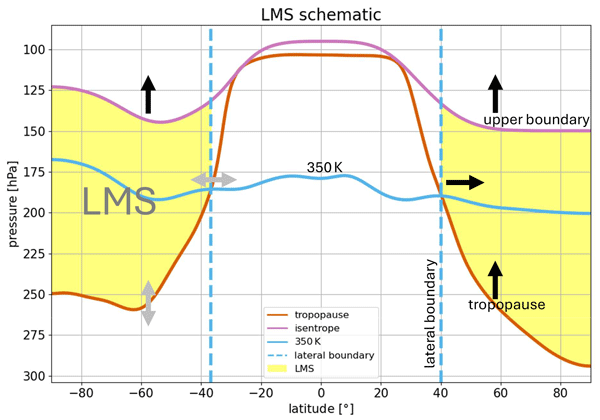
Franziska Weyland, Peter Hoor, Daniel Kunkel, Thomas Birner, Felix Plöger, and Katharina Turhal
Atmos. Chem. Phys., 25, 1227–1252, https://doi.org/10.5194/acp-25-1227-2025, https://doi.org/10.5194/acp-25-1227-2025, 2025
Short summary
Short summary
The lowermost stratosphere (LMS) plays an important role in the Earth's climate, containing strong gradients of ozone and water vapor. Our results indicate that the thermodynamic structure of the LMS was changing between 1979–2019 in response to anthropogenic climate change and the recovery of stratospheric ozone, also indicating large-scale circulation changes. We find that both the upper and the lower LMS boundaries show an (upward) trend, which has implications for the LMS mass.
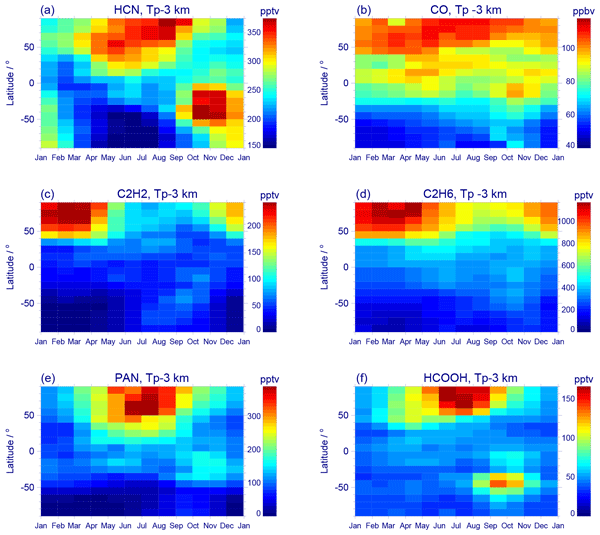
Norbert Glatthor, Gabriele P. Stiller, Thomas von Clarmann, Bernd Funke, Sylvia Kellmann, and Andrea Linden
Atmos. Chem. Phys., 25, 1175–1208, https://doi.org/10.5194/acp-25-1175-2025, https://doi.org/10.5194/acp-25-1175-2025, 2025
Short summary
Short summary
We present global upper-tropospheric distributions of the pollutants HCN, CO, C2H2, C2H6, PAN, and HCOOH, observed between 2002 and 2012 by the Michelson Interferometer for Passive Atmospheric Sounding (MIPAS) on the Environmental Satellite (Envisat). By comparing the spatial distributions of their volume mixing ratios and by global correlation and regression analyses, we draw conclusions on their sources, such as biomass burning, anthropogenic sources, and biogenic release.
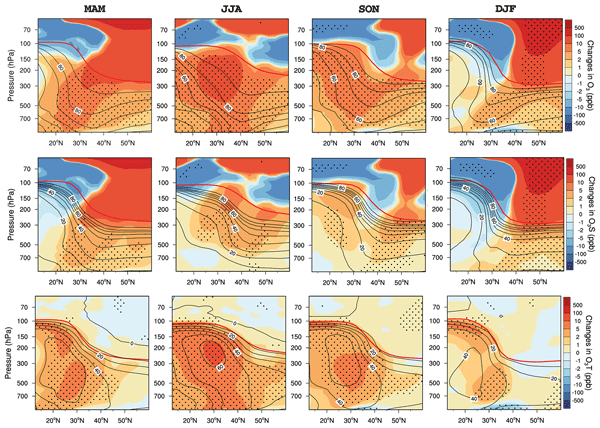
Xiaodan Ma, Jianping Huang, Michaela I. Hegglin, Patrick Jöckel, and Tianliang Zhao
Atmos. Chem. Phys., 25, 943–958, https://doi.org/10.5194/acp-25-943-2025, https://doi.org/10.5194/acp-25-943-2025, 2025
Short summary
Short summary
Our research explored changes in ozone levels in the northwest Pacific region over 30 years, revealing a significant increase in the middle-to-upper troposphere, especially during spring and summer. This rise is influenced by both stratospheric and tropospheric sources, which affect climate and air quality in East Asia. This work underscores the need for continued study to understand underlying mechanisms.

Lauren R. Marshall, Anja Schmidt, Andrew P. Schurer, Nathan Luke Abraham, Lucie J. Lücke, Rob Wilson, Kevin J. Anchukaitis, Gabriele C. Hegerl, Ben Johnson, Bette L. Otto-Bliesner, Esther C. Brady, Myriam Khodri, and Kohei Yoshida
Clim. Past, 21, 161–184, https://doi.org/10.5194/cp-21-161-2025, https://doi.org/10.5194/cp-21-161-2025, 2025
Short summary
Short summary
Large volcanic eruptions have caused temperature deviations over the past 1000 years; however, climate model results and reconstructions of surface cooling using tree rings do not match. We explore this mismatch using the latest models and find a better match to tree-ring reconstructions for some eruptions. Our results show that the way in which eruptions are simulated in models matters for the comparison to tree-rings, particularly regarding the spatial spread of volcanic aerosol.
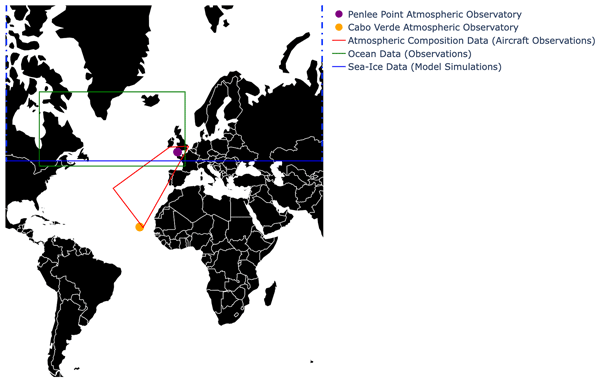
Alex T. Archibald, Bablu Sinha, Maria R. Russo, Emily Matthews, Freya A. Squires, N. Luke Abraham, Stephane J.-B. Bauguitte, Thomas J. Bannan, Thomas G. Bell, David Berry, Lucy J. Carpenter, Hugh Coe, Andrew Coward, Peter Edwards, Daniel Feltham, Dwayne Heard, Jim Hopkins, James Keeble, Elizabeth C. Kent, Brian A. King, Isobel R. Lawrence, James Lee, Claire R. Macintosh, Alex Megann, Bengamin I. Moat, Katie Read, Chris Reed, Malcolm J. Roberts, Reinhard Schiemann, David Schroeder, Timothy J. Smyth, Loren Temple, Navaneeth Thamban, Lisa Whalley, Simon Williams, Huihui Wu, and Mingxi Yang
Earth Syst. Sci. Data, 17, 135–164, https://doi.org/10.5194/essd-17-135-2025, https://doi.org/10.5194/essd-17-135-2025, 2025
Short summary
Short summary
Here, we present an overview of the data generated as part of the North Atlantic Climate System Integrated Study (ACSIS) programme that are available through dedicated repositories at the Centre for Environmental Data Analysis (CEDA; www.ceda.ac.uk) and the British Oceanographic Data Centre (BODC; bodc.ac.uk). The datasets described here cover the North Atlantic Ocean, the atmosphere above (it including its composition), and Arctic sea ice.
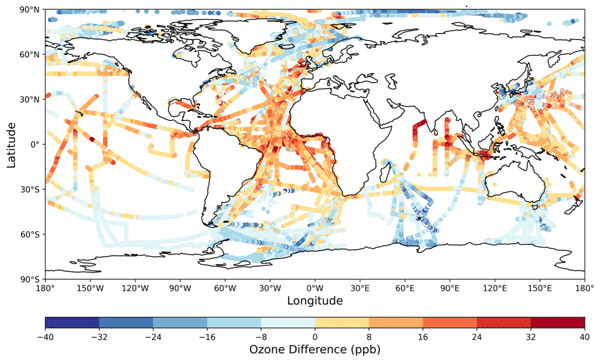
Maria R. Russo, Sadie L. Bartholomew, David Hassell, Alex M. Mason, Erica Neininger, A. James Perman, David A. J. Sproson, Duncan Watson-Parris, and Nathan Luke Abraham
Geosci. Model Dev., 18, 181–191, https://doi.org/10.5194/gmd-18-181-2025, https://doi.org/10.5194/gmd-18-181-2025, 2025
Short summary
Short summary
Observational data and modelling capabilities have expanded in recent years, but there are still barriers preventing these two data sources from being used in synergy. Proper comparison requires generating, storing, and handling a large amount of data. This work describes the first step in the development of a new set of software tools, the VISION toolkit, which can enable the easy and efficient integration of observational and model data required for model evaluation.
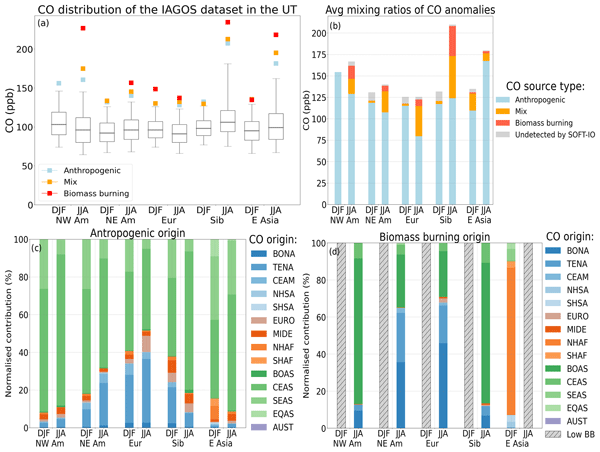
Thibaut Lebourgeois, Bastien Sauvage, Pawel Wolff, Béatrice Josse, Virginie Marécal, Yasmine Bennouna, Romain Blot, Damien Boulanger, Hannah Clark, Jean-Marc Cousin, Philippe Nedelec, and Valérie Thouret
Atmos. Chem. Phys., 24, 13975–14004, https://doi.org/10.5194/acp-24-13975-2024, https://doi.org/10.5194/acp-24-13975-2024, 2024
Short summary
Short summary
Our study examines intense-carbon-monoxide (CO) pollution events measured by commercial aircraft from the In-service Aircraft for a Global Observing System (IAGOS) research infrastructure. We combine these measurements with the SOFT-IO model to trace the origin of the observed CO. A comprehensive analysis of the geographical origin, source type, seasonal variation, and ozone levels of these pollution events is provided.

Katharina Turhal, Felix Plöger, Jan Clemens, Thomas Birner, Franziska Weyland, Paul Konopka, and Peter Hoor
Atmos. Chem. Phys., 24, 13653–13679, https://doi.org/10.5194/acp-24-13653-2024, https://doi.org/10.5194/acp-24-13653-2024, 2024
Short summary
Short summary
The tropopause separates the troposphere, where many greenhouse gases originate, from the stratosphere. This study examines a tropopause defined by potential vorticity – an analogue for angular momentum that changes sharply in the subtropics, creating a transport barrier. Between 1980 and 2017, this tropopause shifted poleward at lower altitudes and equatorward above, suggesting height-dependent changes in atmospheric circulation that may affect greenhouse gas distribution and global warming.
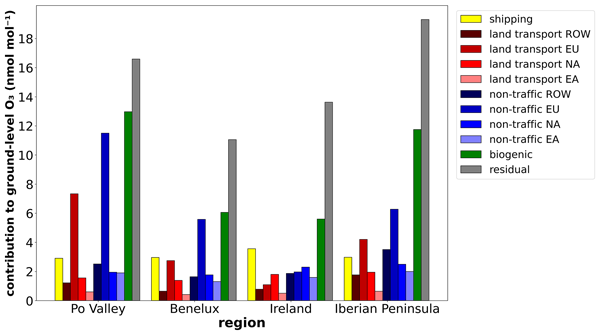
Markus Kilian, Volker Grewe, Patrick Jöckel, Astrid Kerkweg, Mariano Mertens, Andreas Zahn, and Helmut Ziereis
Atmos. Chem. Phys., 24, 13503–13523, https://doi.org/10.5194/acp-24-13503-2024, https://doi.org/10.5194/acp-24-13503-2024, 2024
Short summary
Short summary
Anthropogenic emissions are a major source of precursors of tropospheric ozone. As ozone formation is highly non-linear, we apply a global–regional chemistry–climate model with a source attribution method (tagging) to quantify the contribution of anthropogenic emissions to ozone. Our analysis shows that the contribution of European anthropogenic emissions largely increases during large ozone periods, indicating that emissions from these sectors drive ozone values.
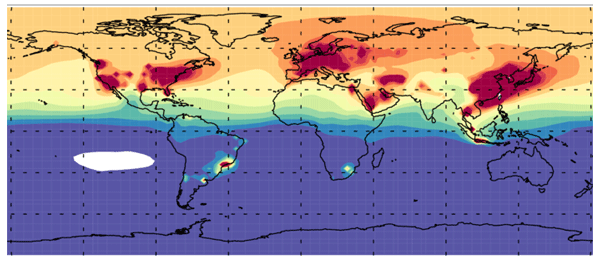
Ryan Hossaini, David Sherry, Zihao Wang, Martyn P. Chipperfield, Wuhu Feng, David E. Oram, Karina E. Adcock, Stephen A. Montzka, Isobel J. Simpson, Andrea Mazzeo, Amber A. Leeson, Elliot Atlas, and Charles C.-K. Chou
Atmos. Chem. Phys., 24, 13457–13475, https://doi.org/10.5194/acp-24-13457-2024, https://doi.org/10.5194/acp-24-13457-2024, 2024
Short summary
Short summary
DCE (1,2-dichloroethane) is an industrial chemical used to produce PVC (polyvinyl chloride). We analysed DCE production data to estimate global DCE emissions (2002–2020). The emissions were included in an atmospheric model and evaluated by comparing simulated DCE to DCE measurements in the troposphere. We show that DCE contributes ozone-depleting Cl to the stratosphere and that this has increased with increasing DCE emissions. DCE’s impact on stratospheric O3 is currently small but non-zero.
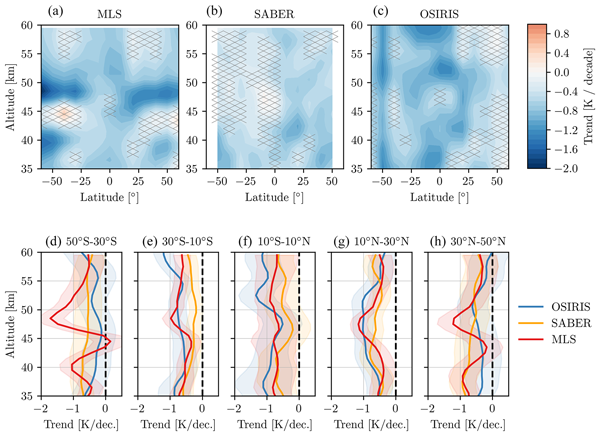
Kimberlee Dubé, Susann Tegtmeier, Adam Bourassa, Daniel Zawada, Douglas Degenstein, William Randel, Sean Davis, Michael Schwartz, Nathaniel Livesey, and Anne Smith
Atmos. Chem. Phys., 24, 12925–12941, https://doi.org/10.5194/acp-24-12925-2024, https://doi.org/10.5194/acp-24-12925-2024, 2024
Short summary
Short summary
Greenhouse gas emissions that warm the troposphere also result in stratospheric cooling. The cooling rate is difficult to quantify above 35 km due to a deficit of long-term observational data with high vertical resolution in this region. We use satellite observations from several instruments, including a new temperature product from OSIRIS, to show that the upper stratosphere, from 35–60 km, cooled by 0.5 to 1 K per decade over 2005–2021 and by 0.6 K per decade over 1979–2021.
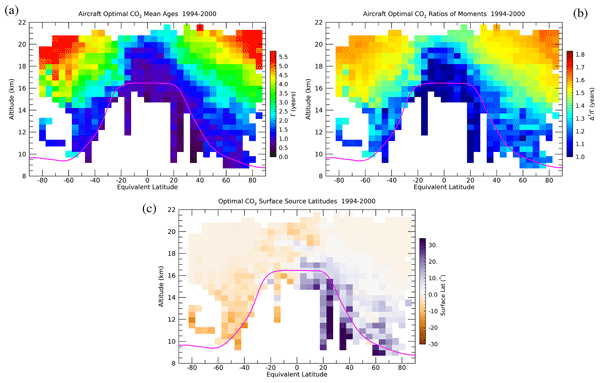
Eric A. Ray, Fred L. Moore, Hella Garny, Eric J. Hintsa, Bradley D. Hall, Geoff S. Dutton, David Nance, James W. Elkins, Steven C. Wofsy, Jasna Pittman, Bruce Daube, Bianca C. Baier, Jianghanyang Li, and Colm Sweeney
Atmos. Chem. Phys., 24, 12425–12445, https://doi.org/10.5194/acp-24-12425-2024, https://doi.org/10.5194/acp-24-12425-2024, 2024
Short summary
Short summary
In this study we describe new techniques to derive age of air from multiple simultaneous measurements of long-lived trace gases in order to improve the fidelity of the age-of-air estimates and to be able to compare age of air from measurements taken from different instruments, platforms and decades. This technique also allows new transport information to be obtained from the measurements such as the primary source latitude that can also be compared to models.
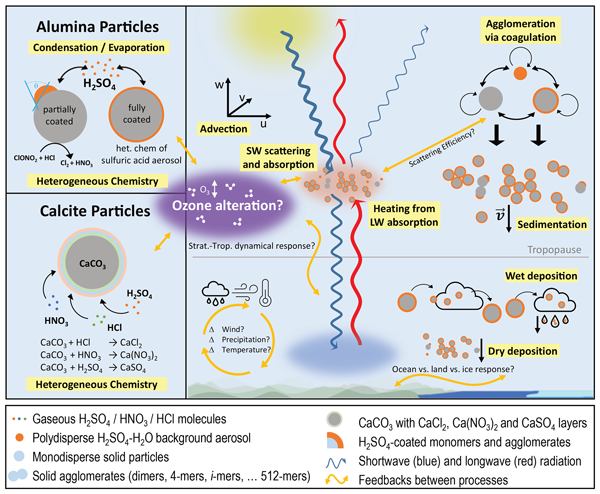
Sandro Vattioni, Rahel Weber, Aryeh Feinberg, Andrea Stenke, John A. Dykema, Beiping Luo, Georgios A. Kelesidis, Christian A. Bruun, Timofei Sukhodolov, Frank N. Keutsch, Thomas Peter, and Gabriel Chiodo
Geosci. Model Dev., 17, 7767–7793, https://doi.org/10.5194/gmd-17-7767-2024, https://doi.org/10.5194/gmd-17-7767-2024, 2024
Short summary
Short summary
We quantified impacts and efficiency of stratospheric solar climate intervention via solid particle injection. Microphysical interactions of solid particles with the sulfur cycle were interactively coupled to the heterogeneous chemistry scheme and the radiative transfer code of an aerosol–chemistry–climate model. Compared to injection of SO2 we only find a stronger cooling efficiency for solid particles when normalizing to the aerosol load but not when normalizing to the injection rate.
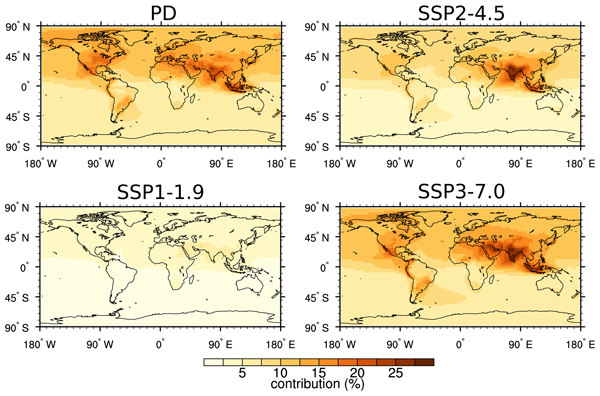
Mariano Mertens, Sabine Brinkop, Phoebe Graf, Volker Grewe, Johannes Hendricks, Patrick Jöckel, Anna Lanteri, Sigrun Matthes, Vanessa S. Rieger, Mattia Righi, and Robin N. Thor
Atmos. Chem. Phys., 24, 12079–12106, https://doi.org/10.5194/acp-24-12079-2024, https://doi.org/10.5194/acp-24-12079-2024, 2024
Short summary
Short summary
We quantified the contributions of land transport, shipping, and aviation emissions to tropospheric ozone; its radiative forcing; and the reductions of the methane lifetime using chemistry-climate model simulations. The contributions were analysed for the conditions of 2015 and for three projections for the year 2050. The results highlight the challenges of mitigating ozone formed by emissions of the transport sector, caused by the non-linearitiy of the ozone chemistry and the long lifetime.
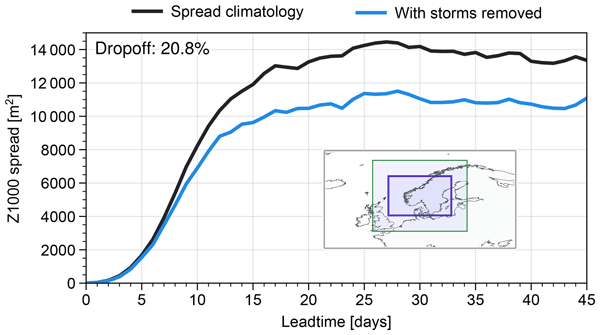
Philip Rupp, Jonas Spaeth, Hilla Afargan-Gerstman, Dominik Büeler, Michael Sprenger, and Thomas Birner
Weather Clim. Dynam., 5, 1287–1298, https://doi.org/10.5194/wcd-5-1287-2024, https://doi.org/10.5194/wcd-5-1287-2024, 2024
Short summary
Short summary
We quantify the occurrence of strong synoptic storms as contributing about 20 % to the uncertainty of subseasonal geopotential height forecasts over northern Europe. We further show that North Atlantic storms are less frequent, weaker and shifted southward following sudden stratospheric warming events, leading to a reduction in northern European forecast uncertainty.
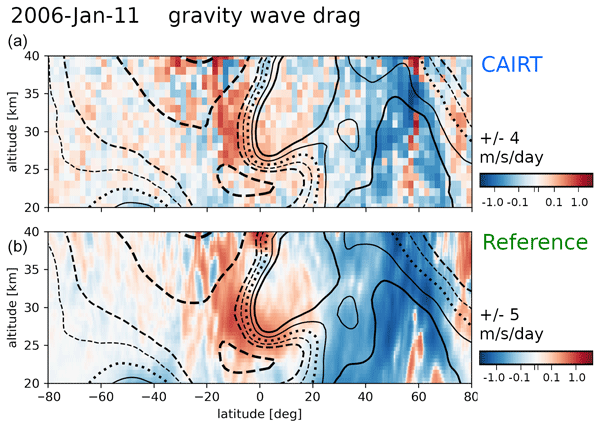
Sebastian Rhode, Peter Preusse, Jörn Ungermann, Inna Polichtchouk, Kaoru Sato, Shingo Watanabe, Manfred Ern, Karlheinz Nogai, Björn-Martin Sinnhuber, and Martin Riese
Atmos. Meas. Tech., 17, 5785–5819, https://doi.org/10.5194/amt-17-5785-2024, https://doi.org/10.5194/amt-17-5785-2024, 2024
Short summary
Short summary
We investigate the capabilities of a proposed satellite mission, CAIRT, for observing gravity waves throughout the middle atmosphere and present the necessary methodology for in-depth wave analysis. Our findings suggest that such a satellite mission is highly capable of resolving individual wave parameters and could give new insights into the role of gravity waves in general atmospheric circulation and atmospheric processes.
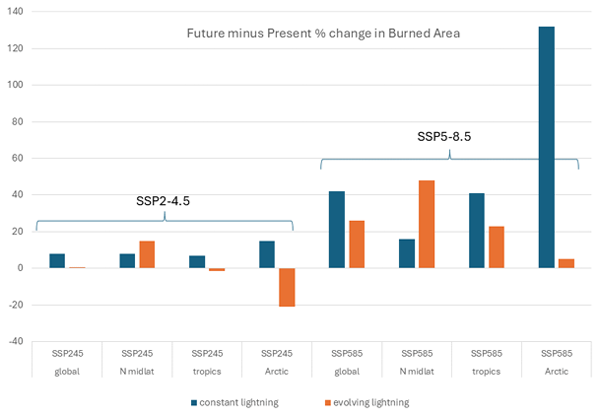
Cynthia Whaley, Montana Etten-Bohm, Courtney Schumacher, Ayodeji Akingunola, Vivek Arora, Jason Cole, Michael Lazare, David Plummer, Knut von Salzen, and Barbara Winter
Geosci. Model Dev., 17, 7141–7155, https://doi.org/10.5194/gmd-17-7141-2024, https://doi.org/10.5194/gmd-17-7141-2024, 2024
Short summary
Short summary
This paper describes how lightning was added as a process in the Canadian Earth System Model in order to interactively respond to climate changes. As lightning is an important cause of global wildfires, this new model development allows for more realistic projections of how wildfires may change in the future, responding to a changing climate.
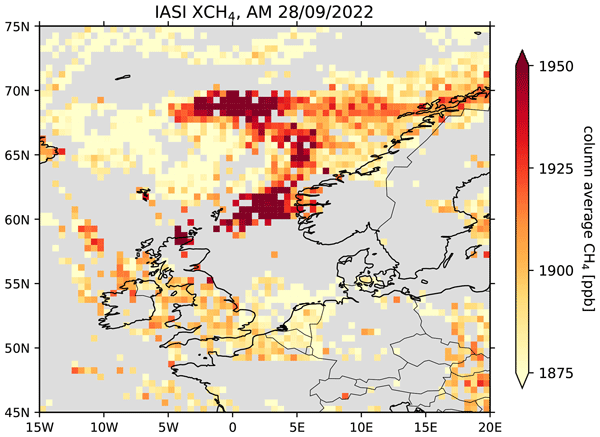
Chris Wilson, Brian J. Kerridge, Richard Siddans, David P. Moore, Lucy J. Ventress, Emily Dowd, Wuhu Feng, Martyn P. Chipperfield, and John J. Remedios
Atmos. Chem. Phys., 24, 10639–10653, https://doi.org/10.5194/acp-24-10639-2024, https://doi.org/10.5194/acp-24-10639-2024, 2024
Short summary
Short summary
The leaks from the Nord Stream gas pipelines in September 2022 released a large amount of methane (CH4) into the atmosphere. We provide observational data from a satellite instrument that shows a large CH4 plume over the North Sea off the coast of Scandinavia. We use this together with atmospheric models to quantify the CH4 leaked into the atmosphere from the pipelines. We find that 219–427 Gg CH4 was emitted, making this the largest individual fossil-fuel-related CH4 leak on record.
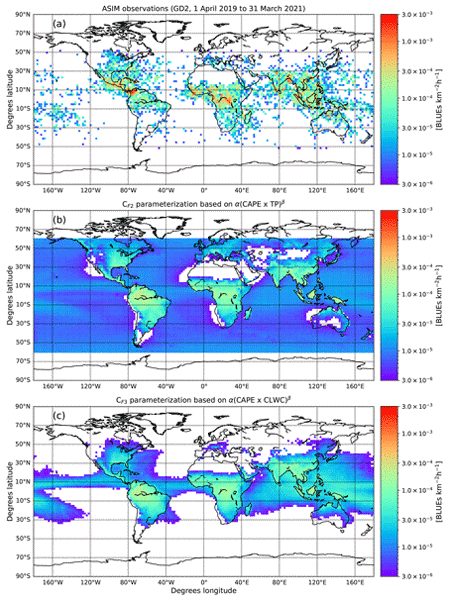
Sergio Soler, Francisco J. Gordillo-Vázquez, Francisco J. Pérez-Invernón, Patrick Jöckel, Torsten Neubert, Olivier Chanrion, Victor Reglero, and Nikolai Østgaard
Atmos. Chem. Phys., 24, 10225–10243, https://doi.org/10.5194/acp-24-10225-2024, https://doi.org/10.5194/acp-24-10225-2024, 2024
Short summary
Short summary
Sudden local ozone (O3) enhancements have been reported in different regions of the world since the 1970s. While the hot channel of lightning strokes directly produce significant amounts of nitrogen oxide, no direct emission of O3 is expected. Corona discharges in convective active regions could explain local O3 increases, which remains unexplained. We present the first mathematical functions that relate the global annual frequency of in-cloud coronas with four sets of meteorological variables.
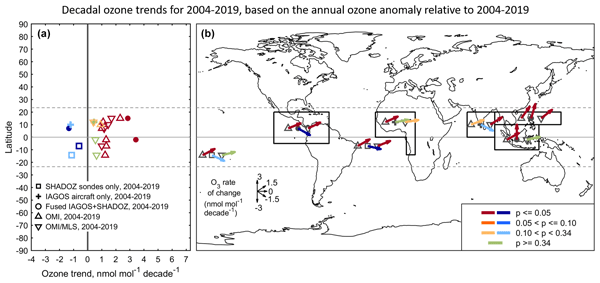
Audrey Gaudel, Ilann Bourgeois, Meng Li, Kai-Lan Chang, Jerald Ziemke, Bastien Sauvage, Ryan M. Stauffer, Anne M. Thompson, Debra E. Kollonige, Nadia Smith, Daan Hubert, Arno Keppens, Juan Cuesta, Klaus-Peter Heue, Pepijn Veefkind, Kenneth Aikin, Jeff Peischl, Chelsea R. Thompson, Thomas B. Ryerson, Gregory J. Frost, Brian C. McDonald, and Owen R. Cooper
Atmos. Chem. Phys., 24, 9975–10000, https://doi.org/10.5194/acp-24-9975-2024, https://doi.org/10.5194/acp-24-9975-2024, 2024
Short summary
Short summary
The study examines tropical tropospheric ozone changes. In situ data from 1994–2019 display increased ozone, notably over India, Southeast Asia, and Malaysia and Indonesia. Sparse in situ data limit trend detection for the 15-year period. In situ and satellite data, with limited sampling, struggle to consistently detect trends. Continuous observations are vital over the tropical Pacific Ocean, Indian Ocean, western Africa, and South Asia for accurate ozone trend estimation in these regions.
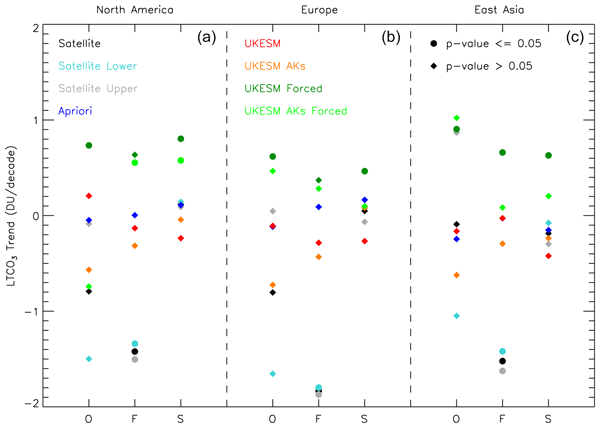
Richard J. Pope, Fiona M. O'Connor, Mohit Dalvi, Brian J. Kerridge, Richard Siddans, Barry G. Latter, Brice Barret, Eric Le Flochmoen, Anne Boynard, Martyn P. Chipperfield, Wuhu Feng, Matilda A. Pimlott, Sandip S. Dhomse, Christian Retscher, Catherine Wespes, and Richard Rigby
Atmos. Chem. Phys., 24, 9177–9195, https://doi.org/10.5194/acp-24-9177-2024, https://doi.org/10.5194/acp-24-9177-2024, 2024
Short summary
Short summary
Ozone is a potent air pollutant in the lower troposphere, with adverse impacts on human health. Satellite records of tropospheric ozone currently show large-scale inconsistencies in long-term trends. Our detailed study of the potential factors (e.g. satellite errors, where the satellite can observe ozone) potentially driving these inconsistencies found that, in North America, Europe, and East Asia, the underlying trends are typically small with large uncertainties.
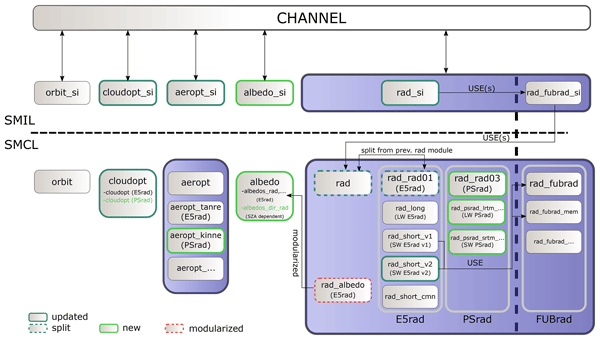
Matthias Nützel, Laura Stecher, Patrick Jöckel, Franziska Winterstein, Martin Dameris, Michael Ponater, Phoebe Graf, and Markus Kunze
Geosci. Model Dev., 17, 5821–5849, https://doi.org/10.5194/gmd-17-5821-2024, https://doi.org/10.5194/gmd-17-5821-2024, 2024
Short summary
Short summary
We extended the infrastructure of our modelling system to enable the use of an additional radiation scheme. After calibrating the model setups to the old and the new radiation scheme, we find that the simulation with the new scheme shows considerable improvements, e.g. concerning the cold-point temperature and stratospheric water vapour. Furthermore, perturbations of radiative fluxes associated with greenhouse gas changes, e.g. of methane, tend to be improved when the new scheme is employed.
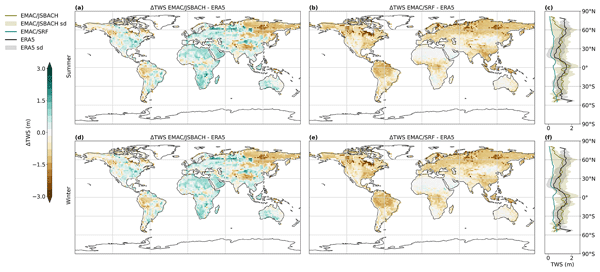
Anna Martin, Veronika Gayler, Benedikt Steil, Klaus Klingmüller, Patrick Jöckel, Holger Tost, Jos Lelieveld, and Andrea Pozzer
Geosci. Model Dev., 17, 5705–5732, https://doi.org/10.5194/gmd-17-5705-2024, https://doi.org/10.5194/gmd-17-5705-2024, 2024
Short summary
Short summary
The study evaluates the land surface and vegetation model JSBACHv4 as a replacement for the simplified submodel SURFACE in EMAC. JSBACH mitigates earlier problems of soil dryness, which are critical for vegetation modelling. When analysed using different datasets, the coupled model shows strong correlations of key variables, such as land surface temperature, surface albedo and radiation flux. The versatility of the model increases significantly, while the overall performance does not degrade.
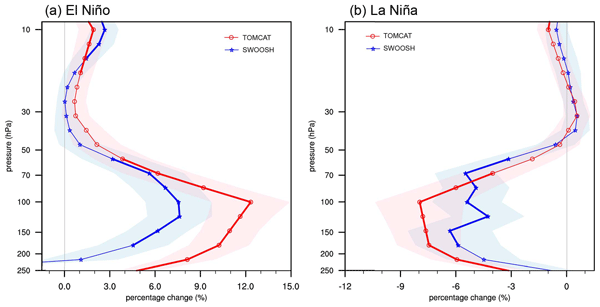
Yang Li, Wuhu Feng, Xin Zhou, Yajuan Li, and Martyn P. Chipperfield
Atmos. Chem. Phys., 24, 8277–8293, https://doi.org/10.5194/acp-24-8277-2024, https://doi.org/10.5194/acp-24-8277-2024, 2024
Short summary
Short summary
The Tibetan Plateau (TP), the highest and largest plateau, experiences strong surface solar UV radiation, whose excess can cause harmful influences on local biota. Hence, it is critical to study TP ozone. We find ENSO, the strongest interannual phenomenon, tends to induce tropospheric temperature change and thus modulate tropopause variability, which in turn favours ozone change over the TP. Our results have implications for a better understanding of the interannual variability of TP ozone.
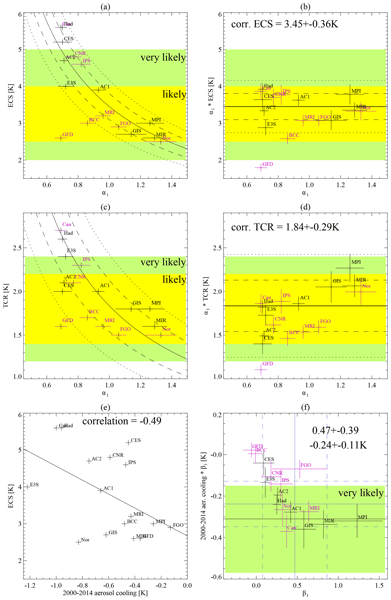
Olaf Morgenstern
Atmos. Chem. Phys., 24, 8105–8123, https://doi.org/10.5194/acp-24-8105-2024, https://doi.org/10.5194/acp-24-8105-2024, 2024
Short summary
Short summary
I use errors in climate model simulations to derive correction factors for the impacts of greenhouse gases and particles that bring these simulated temperature fields into agreement with an observational reconstruction of the Earth's temperature. On average across eight models, a reduction by about one-half of the particle-induced cooling would be required, causing only 0.24 K of cooling since 1850–1899. The greenhouse gas warming simulated by several highly sensitive models would also reduce.
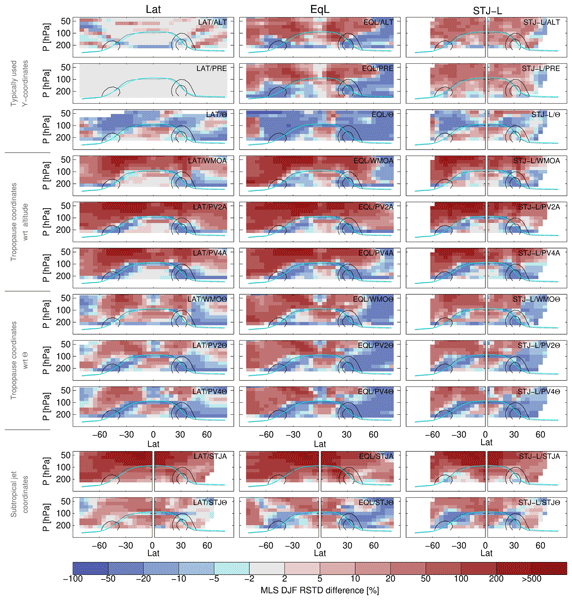
Luis F. Millán, Peter Hoor, Michaela I. Hegglin, Gloria L. Manney, Harald Boenisch, Paul Jeffery, Daniel Kunkel, Irina Petropavlovskikh, Hao Ye, Thierry Leblanc, and Kaley Walker
Atmos. Chem. Phys., 24, 7927–7959, https://doi.org/10.5194/acp-24-7927-2024, https://doi.org/10.5194/acp-24-7927-2024, 2024
Short summary
Short summary
In the Observed Composition Trends And Variability in the UTLS (OCTAV-UTLS) Stratosphere-troposphere Processes And their Role in Climate (SPARC) activity, we have mapped multiplatform ozone datasets into coordinate systems to systematically evaluate the influence of these coordinates on binned climatological variability. This effort unifies the work of studies that focused on individual coordinate system variability. Our goal was to create the most comprehensive assessment of this topic.
Masatomo Fujiwara, Patrick Martineau, Jonathon S. Wright, Marta Abalos, Petr Šácha, Yoshio Kawatani, Sean M. Davis, Thomas Birner, and Beatriz M. Monge-Sanz
Atmos. Chem. Phys., 24, 7873–7898, https://doi.org/10.5194/acp-24-7873-2024, https://doi.org/10.5194/acp-24-7873-2024, 2024
Short summary
Short summary
A climatology of the major variables and terms of the transformed Eulerian-mean (TEM) momentum and thermodynamic equations from four global atmospheric reanalyses is evaluated. The spread among reanalysis TEM momentum balance terms is around 10 % in Northern Hemisphere winter and up to 50 % in Southern Hemisphere winter. The largest uncertainties in the thermodynamic equation (about 50 %) are in the vertical advection, which does not show a structure consistent with the differences in heating.
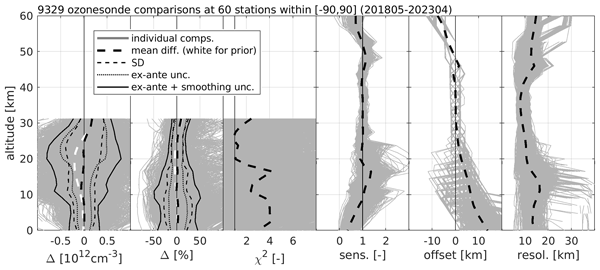
Arno Keppens, Serena Di Pede, Daan Hubert, Jean-Christopher Lambert, Pepijn Veefkind, Maarten Sneep, Johan De Haan, Mark ter Linden, Thierry Leblanc, Steven Compernolle, Tijl Verhoelst, José Granville, Oindrila Nath, Ann Mari Fjæraa, Ian Boyd, Sander Niemeijer, Roeland Van Malderen, Herman G. J. Smit, Valentin Duflot, Sophie Godin-Beekmann, Bryan J. Johnson, Wolfgang Steinbrecht, David W. Tarasick, Debra E. Kollonige, Ryan M. Stauffer, Anne M. Thompson, Angelika Dehn, and Claus Zehner
Atmos. Meas. Tech., 17, 3969–3993, https://doi.org/10.5194/amt-17-3969-2024, https://doi.org/10.5194/amt-17-3969-2024, 2024
Short summary
Short summary
The Sentinel-5P satellite operated by the European Space Agency has carried the TROPOspheric Monitoring Instrument (TROPOMI) around the Earth since October 2017. This mission also produces atmospheric ozone profile data which are described in detail for May 2018 to April 2023. Independent validation using ground-based reference measurements demonstrates that the operational ozone profile product mostly fully and at least partially complies with all mission requirements.
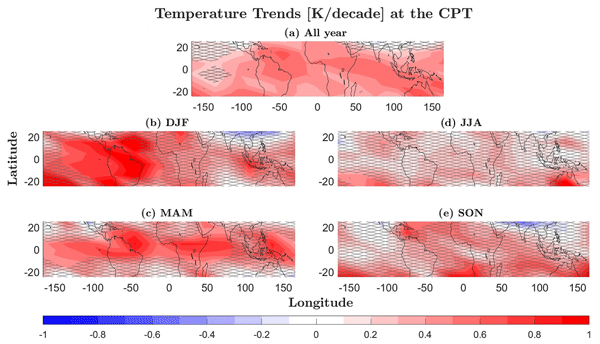
Mona Zolghadrshojaee, Susann Tegtmeier, Sean M. Davis, and Robin Pilch Kedzierski
Atmos. Chem. Phys., 24, 7405–7419, https://doi.org/10.5194/acp-24-7405-2024, https://doi.org/10.5194/acp-24-7405-2024, 2024
Short summary
Short summary
Satellite data challenge the idea of an overall cooling trend in the tropical tropopause layer. From 2002 to 2022, a warming trend was observed, diverging from earlier findings. Tropopause height changes indicate dynamic processes alongside radiative effects. Upper-tropospheric warming contrasts with lower-stratosphere temperatures. The study highlights the complex interplay of factors shaping temperature trends.
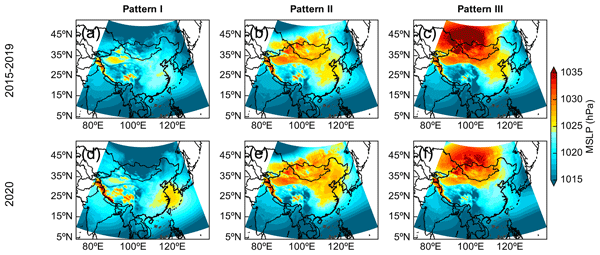
Fuzhen Shen, Michaela I. Hegglin, and Yue Yuan
Atmos. Chem. Phys., 24, 6539–6553, https://doi.org/10.5194/acp-24-6539-2024, https://doi.org/10.5194/acp-24-6539-2024, 2024
Short summary
Short summary
We attempt to use a novel structural self-organising map and machine learning models to identify a weather system and quantify the importance of each meteorological factor in driving the unexpected PM2.5 and O3 changes under the specific weather system during the COVID-19 lockdown in China. The result highlights that temperature under the double-centre high-pressure system plays the most crucial role in abnormal events.
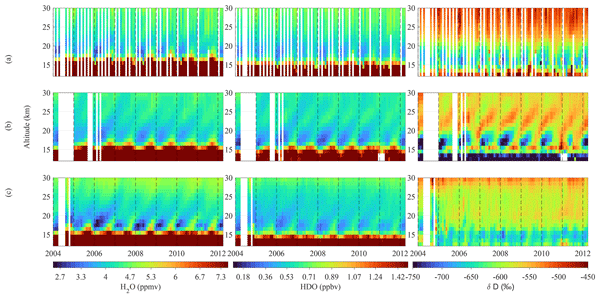
Karen De Los Ríos, Paulina Ordoñez, Gabriele P. Stiller, Piera Raspollini, Marco Gai, Kaley A. Walker, Cristina Peña-Ortiz, and Luis Acosta
Atmos. Meas. Tech., 17, 3401–3418, https://doi.org/10.5194/amt-17-3401-2024, https://doi.org/10.5194/amt-17-3401-2024, 2024
Short summary
Short summary
This study examines newer versions of H2O and HDO retrievals from Envisat/MIPAS and SCISAT/ACE-FTS. Results reveal a better agreement in stratospheric H2O profiles than in HDO profiles. The H2O tape recorder signal is consistent across databases, but δD tape recorder composites show differences that impact the interpretation of water vapour transport. These findings enhance the need for intercomparisons to refine our insights.
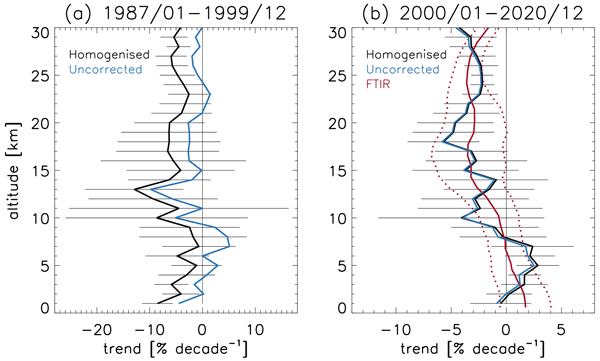
Guang Zeng, Richard Querel, Hisako Shiona, Deniz Poyraz, Roeland Van Malderen, Alex Geddes, Penny Smale, Dan Smale, John Robinson, and Olaf Morgenstern
Atmos. Chem. Phys., 24, 6413–6432, https://doi.org/10.5194/acp-24-6413-2024, https://doi.org/10.5194/acp-24-6413-2024, 2024
Short summary
Short summary
We present a homogenised ozonesonde record (1987–2020) for Lauder, a Southern Hemisphere mid-latitude site; identify factors driving ozone trends; and attribute them to anthropogenic forcings using statistical analysis and model simulations. We find that significant negative lower-stratospheric ozone trends identified at Lauder are associated with an increase in tropopause height and that CO2-driven dynamical changes have played an increasingly important role in driving ozone trends.
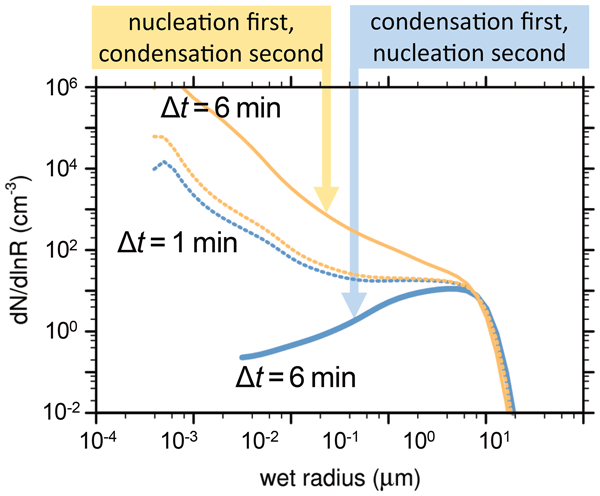
Sandro Vattioni, Andrea Stenke, Beiping Luo, Gabriel Chiodo, Timofei Sukhodolov, Elia Wunderlin, and Thomas Peter
Geosci. Model Dev., 17, 4181–4197, https://doi.org/10.5194/gmd-17-4181-2024, https://doi.org/10.5194/gmd-17-4181-2024, 2024
Short summary
Short summary
We investigate the sensitivity of aerosol size distributions in the presence of strong SO2 injections for climate interventions or after volcanic eruptions to the call sequence and frequency of the routines for nucleation and condensation in sectional aerosol models with operator splitting. Using the aerosol–chemistry–climate model SOCOL-AERv2, we show that the radiative and chemical outputs are sensitive to these settings at high H2SO4 supersaturations and how to obtain reliable results.

Christina V. Brodowsky, Timofei Sukhodolov, Gabriel Chiodo, Valentina Aquila, Slimane Bekki, Sandip S. Dhomse, Michael Höpfner, Anton Laakso, Graham W. Mann, Ulrike Niemeier, Giovanni Pitari, Ilaria Quaglia, Eugene Rozanov, Anja Schmidt, Takashi Sekiya, Simone Tilmes, Claudia Timmreck, Sandro Vattioni, Daniele Visioni, Pengfei Yu, Yunqian Zhu, and Thomas Peter
Atmos. Chem. Phys., 24, 5513–5548, https://doi.org/10.5194/acp-24-5513-2024, https://doi.org/10.5194/acp-24-5513-2024, 2024
Short summary
Short summary
The aerosol layer is an essential part of the climate system. We characterize the sulfur budget in a volcanically quiescent (background) setting, with a special focus on the sulfate aerosol layer using, for the first time, a multi-model approach. The aim is to identify weak points in the representation of the atmospheric sulfur budget in an intercomparison of nine state-of-the-art coupled global circulation models.

Norbert Glatthor, Thomas von Clarmann, Bernd Funke, Maya García-Comas, Udo Grabowski, Michael Höpfner, Sylvia Kellmann, Michael Kiefer, Alexandra Laeng, Andrea Linden, Manuel López-Puertas, and Gabriele P. Stiller
Atmos. Meas. Tech., 17, 2849–2871, https://doi.org/10.5194/amt-17-2849-2024, https://doi.org/10.5194/amt-17-2849-2024, 2024
Short summary
Short summary
We present global atmospheric methane (CH4) and nitrous oxide (N2O) distributions retrieved from measurements of the MIPAS instrument on board the Environmental Satellite (Envisat) during 2002 to 2012. Monitoring of these gases is of scientific interest because both of them are strong greenhouse gases. We analyze the latest, improved version of calibrated MIPAS measurements. Further, we apply a new retrieval scheme leading to an improved CH4 and N2O data product .
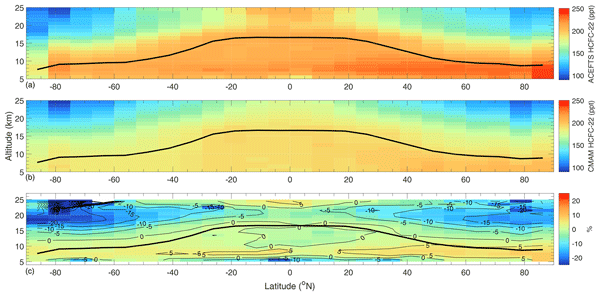
Felicia Kolonjari, Patrick E. Sheese, Kaley A. Walker, Chris D. Boone, David A. Plummer, Andreas Engel, Stephen A. Montzka, David E. Oram, Tanja Schuck, Gabriele P. Stiller, and Geoffrey C. Toon
Atmos. Meas. Tech., 17, 2429–2449, https://doi.org/10.5194/amt-17-2429-2024, https://doi.org/10.5194/amt-17-2429-2024, 2024
Short summary
Short summary
The Canadian Atmospheric Chemistry Experiment Fourier transform spectrometer (ACE-FTS) satellite instrument is currently providing the only vertically resolved chlorodifluoromethane (HCFC-22) measurements from space. This study assesses the most current ACE-FTS HCFC-22 data product in the upper troposphere and lower stratosphere, as well as modelled HCFC-22 from a 39-year run of the Canadian Middle Atmosphere Model (CMAM39) in the same region.
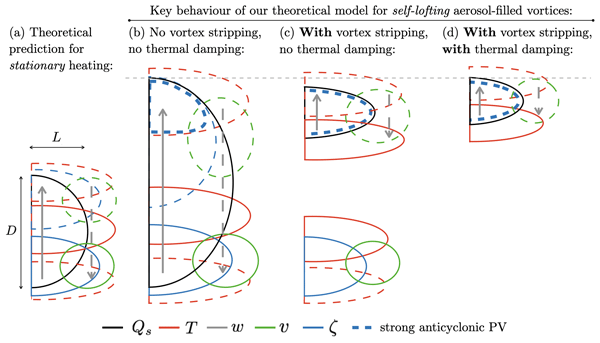
Kasturi Shah and Peter H. Haynes
Weather Clim. Dynam., 5, 559–585, https://doi.org/10.5194/wcd-5-559-2024, https://doi.org/10.5194/wcd-5-559-2024, 2024
Short summary
Short summary
Long-lived rising bubbles of wildfire smoke or volcanic aerosol contained within strong vortices have been observed in the stratosphere. Heating through absorption of solar radiation has been hypothesised as driving these structures. We present simple models incorporating two-way interaction between dynamics and aerosol combined with insight from vortex dynamics to explain aspects of observed behaviours, including ascent rate and vorticity magnitude, and to suggest criteria for formation.
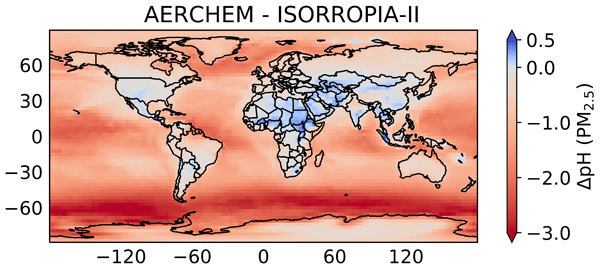
Simon Rosanka, Holger Tost, Rolf Sander, Patrick Jöckel, Astrid Kerkweg, and Domenico Taraborrelli
Geosci. Model Dev., 17, 2597–2615, https://doi.org/10.5194/gmd-17-2597-2024, https://doi.org/10.5194/gmd-17-2597-2024, 2024
Short summary
Short summary
The capabilities of the Modular Earth Submodel System (MESSy) are extended to account for non-equilibrium aqueous-phase chemistry in the representation of deliquescent aerosols. When applying the new development in a global simulation, we find that MESSy's bias in modelling routinely observed reduced inorganic aerosol mass concentrations, especially in the United States. Furthermore, the representation of fine-aerosol pH is particularly improved in the marine boundary layer.
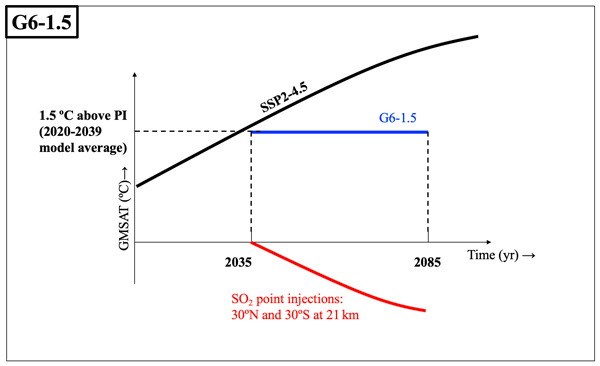
Daniele Visioni, Alan Robock, Jim Haywood, Matthew Henry, Simone Tilmes, Douglas G. MacMartin, Ben Kravitz, Sarah J. Doherty, John Moore, Chris Lennard, Shingo Watanabe, Helene Muri, Ulrike Niemeier, Olivier Boucher, Abu Syed, Temitope S. Egbebiyi, Roland Séférian, and Ilaria Quaglia
Geosci. Model Dev., 17, 2583–2596, https://doi.org/10.5194/gmd-17-2583-2024, https://doi.org/10.5194/gmd-17-2583-2024, 2024
Short summary
Short summary
This paper describes a new experimental protocol for the Geoengineering Model Intercomparison Project (GeoMIP). In it, we describe the details of a new simulation of sunlight reflection using the stratospheric aerosols that climate models are supposed to run, and we explain the reasons behind each choice we made when defining the protocol.
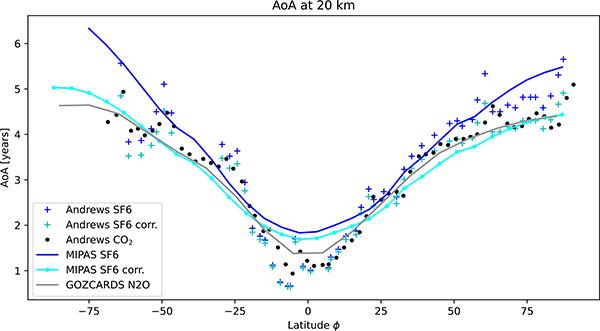
Hella Garny, Roland Eichinger, Johannes C. Laube, Eric A. Ray, Gabriele P. Stiller, Harald Bönisch, Laura Saunders, and Marianna Linz
Atmos. Chem. Phys., 24, 4193–4215, https://doi.org/10.5194/acp-24-4193-2024, https://doi.org/10.5194/acp-24-4193-2024, 2024
Short summary
Short summary
Transport circulation in the stratosphere is important for the distribution of tracers, but its strength is hard to measure. Mean transport times can be inferred from observations of trace gases with certain properties, such as sulfur hexafluoride (SF6). However, this gas has a chemical sink in the high atmosphere, which can lead to substantial biases in inferred transport times. In this paper we present a method to correct mean transport times derived from SF6 for the effects of chemical sinks.
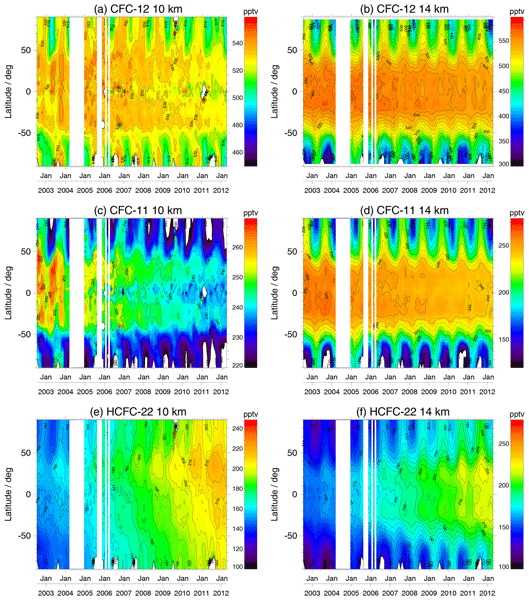
Gabriele P. Stiller, Thomas von Clarmann, Norbert Glatthor, Udo Grabowski, Sylvia Kellmann, Michael Kiefer, Alexandra Laeng, Andrea Linden, Bernd Funke, Maya García-Comas, and Manuel López-Puertas
Atmos. Meas. Tech., 17, 1759–1789, https://doi.org/10.5194/amt-17-1759-2024, https://doi.org/10.5194/amt-17-1759-2024, 2024
Short summary
Short summary
CFC-11, CFC-12, and HCFC-22 contribute to the depletion of ozone and are potent greenhouse gases. They have been banned by the Montreal protocol. With MIPAS on Envisat the atmospheric composition could be observed between 2002 and 2012. We present here the retrieval of their atmospheric distributions for the final data version 8. We characterise the derived data by their error budget and their spatial resolution. An additional representation for direct comparison to models is also provided.
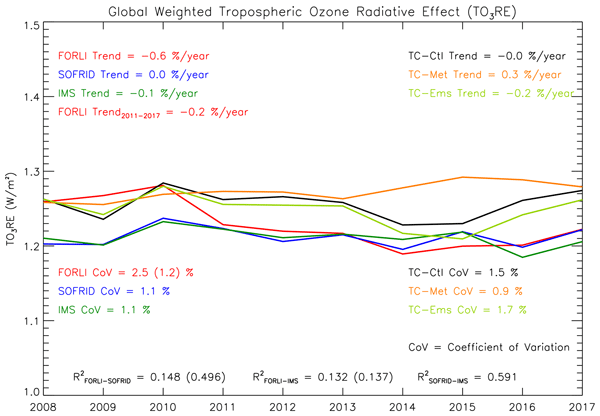
Richard J. Pope, Alexandru Rap, Matilda A. Pimlott, Brice Barret, Eric Le Flochmoen, Brian J. Kerridge, Richard Siddans, Barry G. Latter, Lucy J. Ventress, Anne Boynard, Christian Retscher, Wuhu Feng, Richard Rigby, Sandip S. Dhomse, Catherine Wespes, and Martyn P. Chipperfield
Atmos. Chem. Phys., 24, 3613–3626, https://doi.org/10.5194/acp-24-3613-2024, https://doi.org/10.5194/acp-24-3613-2024, 2024
Short summary
Short summary
Tropospheric ozone is an important short-lived climate forcer which influences the incoming solar short-wave radiation and the outgoing long-wave radiation in the atmosphere (8–15 km) where the balance between the two yields a net positive (i.e. warming) effect at the surface. Overall, we find that the tropospheric ozone radiative effect ranges between 1.21 and 1.26 W m−2 with a negligible trend (2008–2017), suggesting that tropospheric ozone influences on climate have remained stable with time.
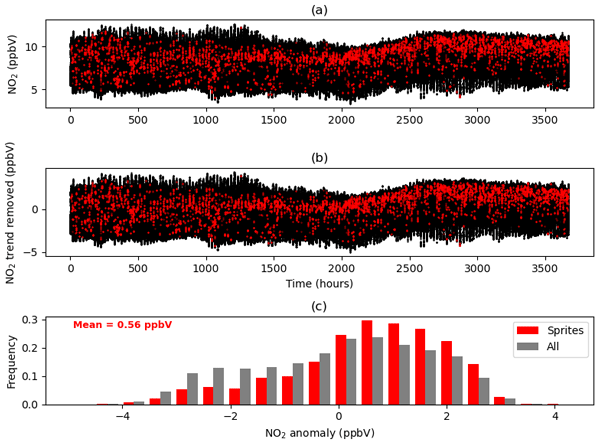
Francisco J. Pérez-Invernón, Francisco J. Gordillo-Vázquez, Alejandro Malagón-Romero, and Patrick Jöckel
Atmos. Chem. Phys., 24, 3577–3592, https://doi.org/10.5194/acp-24-3577-2024, https://doi.org/10.5194/acp-24-3577-2024, 2024
Short summary
Short summary
Sprites are electrical discharges that occur in the upper atmosphere. Recent modelling and observational data suggest that they may have a measurable impact on atmospheric chemistry. We incorporate both the occurrence rate of sprites and their production of chemical species into a chemistry–climate model. While our results indicate that sprites have a minimal global influence on atmospheric chemistry, they underscore their noteworthy importance at a regional scale.
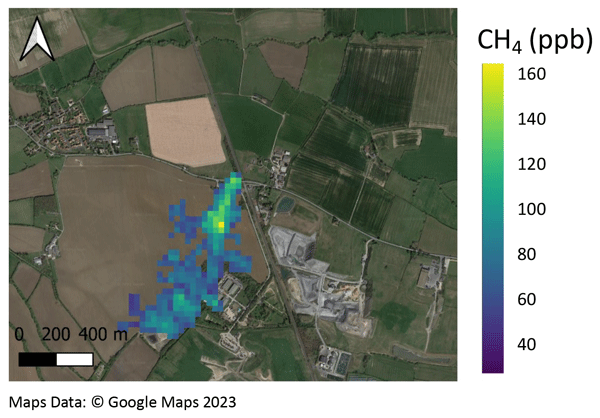
Emily Dowd, Alistair J. Manning, Bryn Orth-Lashley, Marianne Girard, James France, Rebecca E. Fisher, Dave Lowry, Mathias Lanoisellé, Joseph R. Pitt, Kieran M. Stanley, Simon O'Doherty, Dickon Young, Glen Thistlethwaite, Martyn P. Chipperfield, Emanuel Gloor, and Chris Wilson
Atmos. Meas. Tech., 17, 1599–1615, https://doi.org/10.5194/amt-17-1599-2024, https://doi.org/10.5194/amt-17-1599-2024, 2024
Short summary
Short summary
We provide the first validation of the satellite-derived emission estimates using surface-based mobile greenhouse gas surveys of an active gas leak detected near Cheltenham, UK. GHGSat’s emission estimates broadly agree with the surface-based mobile survey and steps were taken to fix the leak, highlighting the importance of satellite data in identifying emissions and helping to reduce our human impact on climate change.
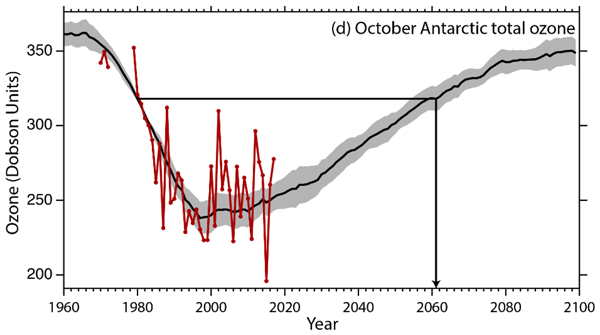
Martyn P. Chipperfield and Slimane Bekki
Atmos. Chem. Phys., 24, 2783–2802, https://doi.org/10.5194/acp-24-2783-2024, https://doi.org/10.5194/acp-24-2783-2024, 2024
Short summary
Short summary
We give a personal perspective on recent issues related to the depletion of stratospheric ozone and some newly emerging challenges. We first provide a brief review of historic work on understanding the ozone layer and review ozone recovery from the effects of halogenated source gases and the Montreal Protocol. We then discuss the recent observations of ozone depletion from Australian fires in early 2020 and the Hunga Tonga–Hunga Ha'apai volcano in January 2022.
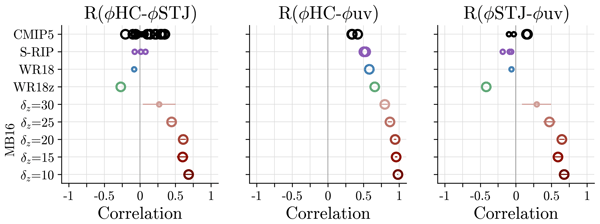
Molly E. Menzel, Darryn W. Waugh, Zheng Wu, and Thomas Reichler
Weather Clim. Dynam., 5, 251–261, https://doi.org/10.5194/wcd-5-251-2024, https://doi.org/10.5194/wcd-5-251-2024, 2024
Short summary
Short summary
Recent work exploring the tropical atmospheric circulation response to climate change has revealed a disconnect in the latitudinal location of two features, the subtropical jet and the Hadley cell edge. Here, we investigate if the surprising result from coupled climate model and meteorological reanalysis output is consistent across model complexity.
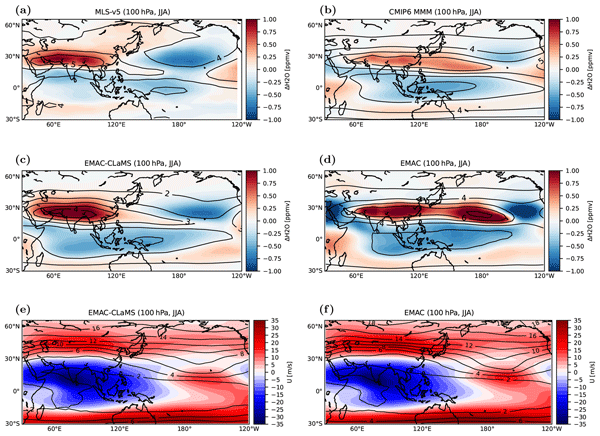
Felix Ploeger, Thomas Birner, Edward Charlesworth, Paul Konopka, and Rolf Müller
Atmos. Chem. Phys., 24, 2033–2043, https://doi.org/10.5194/acp-24-2033-2024, https://doi.org/10.5194/acp-24-2033-2024, 2024
Short summary
Short summary
We present a novel mechanism of how regional anomalies in water vapour concentrations in the upper troposphere and lower stratosphere impact regional atmospheric circulation systems. These impacts include a displaced upper-level Asian monsoon circulation and strengthened prevailing westerlies in the Pacific region. Current climate models have biases in simulating these regional water vapour anomalies and circulation impacts, but the biases can be avoided by improving the model transport.
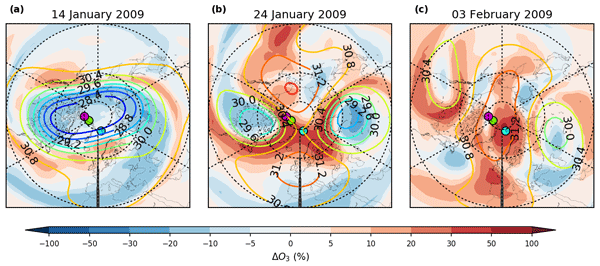
Ryan S. Williams, Michaela I. Hegglin, Patrick Jöckel, Hella Garny, and Keith P. Shine
Atmos. Chem. Phys., 24, 1389–1413, https://doi.org/10.5194/acp-24-1389-2024, https://doi.org/10.5194/acp-24-1389-2024, 2024
Short summary
Short summary
During winter, a brief but abrupt reversal of the mean stratospheric westerly flow (~30 km high) around the Arctic occurs ~6 times a decade. Using a chemistry–climate model, about half of these events are shown to induce large anomalies in Arctic ozone (>25 %) and water vapour (>±25 %) around ~8–12 km altitude for up to 2–3 months, important for weather forecasting. We also calculate a doubling to trebling of the risk in breaches of mid-latitude surface air quality (ozone) standards (~60 ppbv).
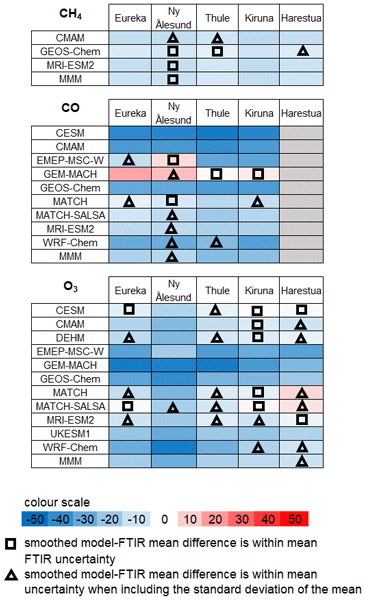
Victoria A. Flood, Kimberly Strong, Cynthia H. Whaley, Kaley A. Walker, Thomas Blumenstock, James W. Hannigan, Johan Mellqvist, Justus Notholt, Mathias Palm, Amelie N. Röhling, Stephen Arnold, Stephen Beagley, Rong-You Chien, Jesper Christensen, Makoto Deushi, Srdjan Dobricic, Xinyi Dong, Joshua S. Fu, Michael Gauss, Wanmin Gong, Joakim Langner, Kathy S. Law, Louis Marelle, Tatsuo Onishi, Naga Oshima, David A. Plummer, Luca Pozzoli, Jean-Christophe Raut, Manu A. Thomas, Svetlana Tsyro, and Steven Turnock
Atmos. Chem. Phys., 24, 1079–1118, https://doi.org/10.5194/acp-24-1079-2024, https://doi.org/10.5194/acp-24-1079-2024, 2024
Short summary
Short summary
It is important to understand the composition of the Arctic atmosphere and how it is changing. Atmospheric models provide simulations that can inform policy. This study examines simulations of CH4, CO, and O3 by 11 models. Model performance is assessed by comparing results matched in space and time to measurements from five high-latitude ground-based infrared spectrometers. This work finds that models generally underpredict the concentrations of these gases in the Arctic troposphere.
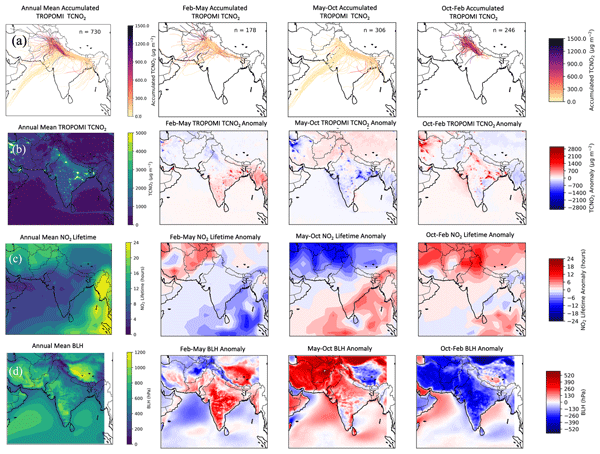
Ailish M. Graham, Richard J. Pope, Martyn P. Chipperfield, Sandip S. Dhomse, Matilda Pimlott, Wuhu Feng, Vikas Singh, Ying Chen, Oliver Wild, Ranjeet Sokhi, and Gufran Beig
Atmos. Chem. Phys., 24, 789–806, https://doi.org/10.5194/acp-24-789-2024, https://doi.org/10.5194/acp-24-789-2024, 2024
Short summary
Short summary
Our paper uses novel satellite datasets and high-resolution emissions datasets alongside a back-trajectory model to investigate the balance of local and external sources influencing NOx air pollution changes in Delhi. We find in the post-monsoon season that NOx from local and non-local transport emissions contributes most to poor air quality in Delhi. Therefore, air quality mitigation strategies in Delhi and surrounding regions are used to control this issue.
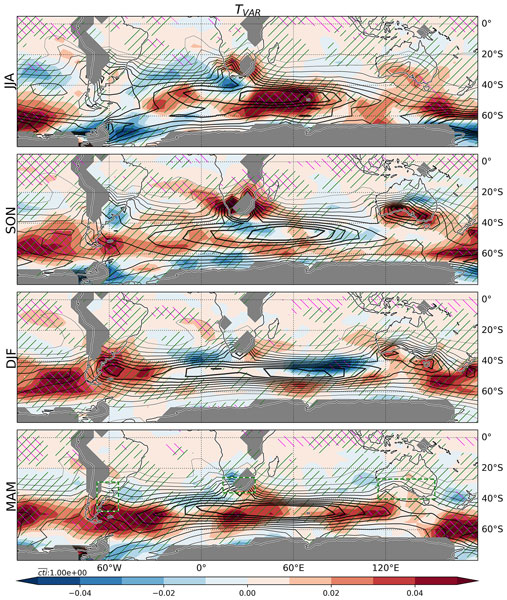
Patrick Martineau, Swadhin K. Behera, Masami Nonaka, Hisashi Nakamura, and Yu Kosaka
Weather Clim. Dynam., 5, 1–15, https://doi.org/10.5194/wcd-5-1-2024, https://doi.org/10.5194/wcd-5-1-2024, 2024
Short summary
Short summary
The representation of subweekly near-surface temperature variability trends over the Southern Hemisphere landmasses is compared across multiple atmospheric reanalyses. It is found that there is generally a good agreement concerning the positive trends affecting South Africa and Australia in the spring, and South America in the summer. A more efficient generation of subweekly temperature variance by horizontal temperature fluxes contributes to the observed rise.
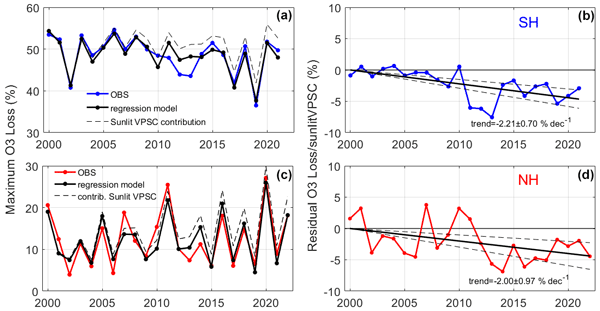
Andrea Pazmiño, Florence Goutail, Sophie Godin-Beekmann, Alain Hauchecorne, Jean-Pierre Pommereau, Martyn P. Chipperfield, Wuhu Feng, Franck Lefèvre, Audrey Lecouffe, Michel Van Roozendael, Nis Jepsen, Georg Hansen, Rigel Kivi, Kimberly Strong, and Kaley A. Walker
Atmos. Chem. Phys., 23, 15655–15670, https://doi.org/10.5194/acp-23-15655-2023, https://doi.org/10.5194/acp-23-15655-2023, 2023
Short summary
Short summary
The vortex-averaged ozone loss over the last 3 decades is evaluated for both polar regions using the passive ozone tracer of the chemical transport model TOMCAT/SLIMCAT and total ozone observations from the SAOZ network and MSR2 reanalysis. Three metrics were developed to compute ozone trends since 2000. The study confirms the ozone recovery in the Antarctic and shows a potential sign of quantitative detection of ozone recovery in the Arctic that needs to be robustly confirmed in the future.
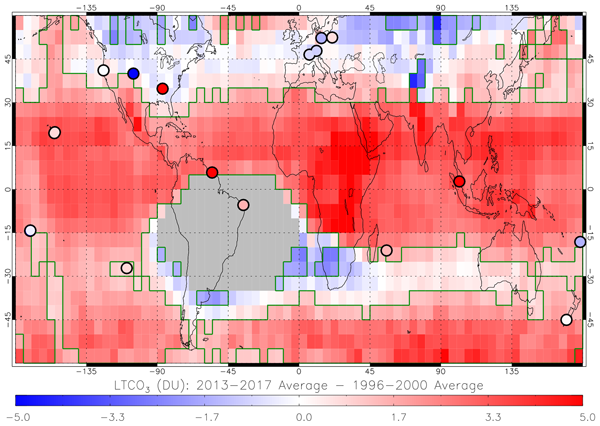
Richard J. Pope, Brian J. Kerridge, Richard Siddans, Barry G. Latter, Martyn P. Chipperfield, Wuhu Feng, Matilda A. Pimlott, Sandip S. Dhomse, Christian Retscher, and Richard Rigby
Atmos. Chem. Phys., 23, 14933–14947, https://doi.org/10.5194/acp-23-14933-2023, https://doi.org/10.5194/acp-23-14933-2023, 2023
Short summary
Short summary
Ozone is a potent air pollutant, and we present the first study to investigate long-term changes in lower tropospheric column ozone (LTCO3) from space. We have constructed a merged LTCO3 dataset from GOME-1, SCIAMACHY and OMI between 1996 and 2017. Comparing LTCO3 between the 1996–2000 and 2013–2017 5-year averages, we find significant positive increases in the tropics/sub-tropics, while in the northern mid-latitudes, we find small-scale differences.
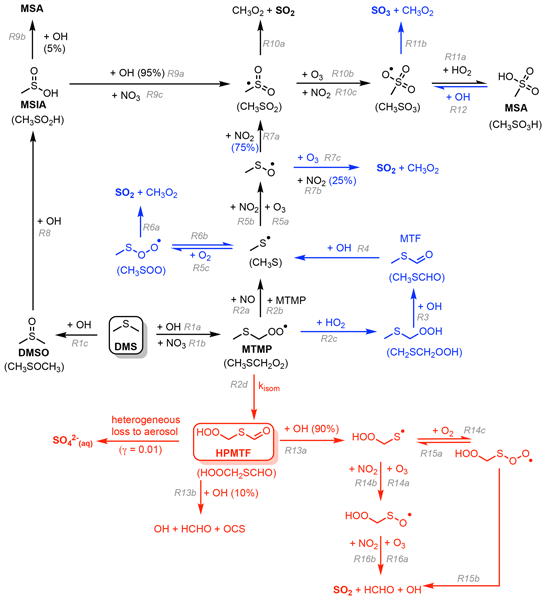
Ben A. Cala, Scott Archer-Nicholls, James Weber, N. Luke Abraham, Paul T. Griffiths, Lorrie Jacob, Y. Matthew Shin, Laura E. Revell, Matthew Woodhouse, and Alexander T. Archibald
Atmos. Chem. Phys., 23, 14735–14760, https://doi.org/10.5194/acp-23-14735-2023, https://doi.org/10.5194/acp-23-14735-2023, 2023
Short summary
Short summary
Dimethyl sulfide (DMS) is an important trace gas emitted from the ocean recognised as setting the sulfate aerosol background, but its oxidation is complex. As a result representation in chemistry-climate models is greatly simplified. We develop and compare a new mechanism to existing mechanisms via a series of global and box model experiments. Our studies show our updated DMS scheme is a significant improvement but significant variance exists between mechanisms.
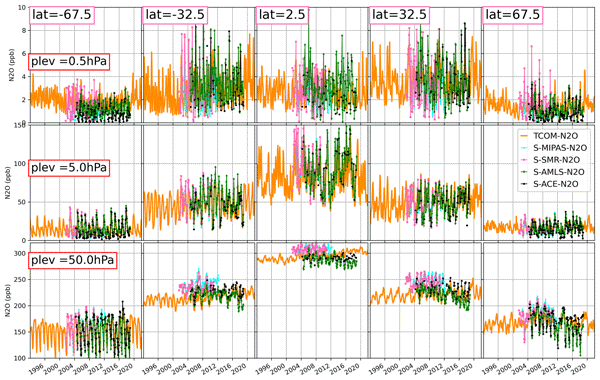
Sandip S. Dhomse and Martyn P. Chipperfield
Earth Syst. Sci. Data, 15, 5105–5120, https://doi.org/10.5194/essd-15-5105-2023, https://doi.org/10.5194/essd-15-5105-2023, 2023
Short summary
Short summary
There are no long-term stratospheric profile data sets for two very important greenhouse gases: methane (CH4) and nitrous oxide (N2O). Along with radiative feedback, these species play an important role in controlling ozone loss in the stratosphere. Here, we use machine learning to fuse satellite measurements with a chemical model to construct long-term gap-free profile data sets for CH4 and N2O. We aim to construct similar data sets for other important trace gases (e.g. O3, Cly, NOy species).
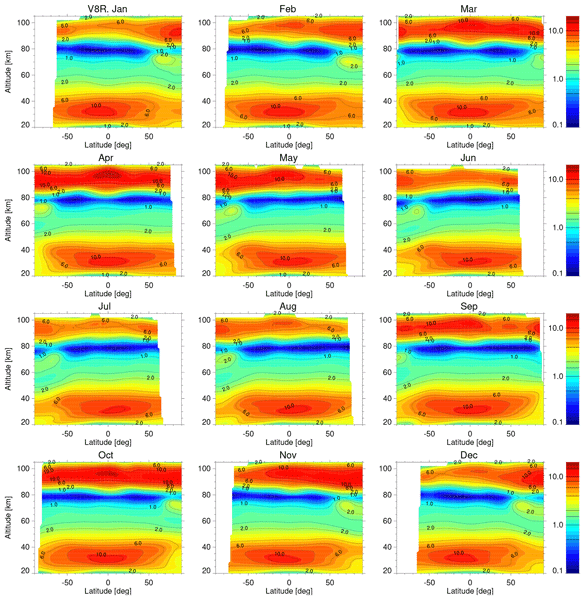
Manuel López-Puertas, Maya García-Comas, Bernd Funke, Thomas von Clarmann, Norbert Glatthor, Udo Grabowski, Sylvia Kellmann, Michael Kiefer, Alexandra Laeng, Andrea Linden, and Gabriele P. Stiller
Atmos. Meas. Tech., 16, 5609–5645, https://doi.org/10.5194/amt-16-5609-2023, https://doi.org/10.5194/amt-16-5609-2023, 2023
Short summary
Short summary
This paper describes a new version (V8) of ozone data from MIPAS middle-atmosphere spectra. The dataset comprises high-quality ozone profiles from 20 to 100 km, with pole-to-pole latitude coverage for the day- and nighttime, spanning 2005 until 2012. An exhaustive treatment of errors has been performed. Compared to other satellite instruments, MIPAS ozone shows a positive bias of 5 %–8 % below 70 km. In the upper mesosphere, this new version agrees much better than previous ones (within 10 %).
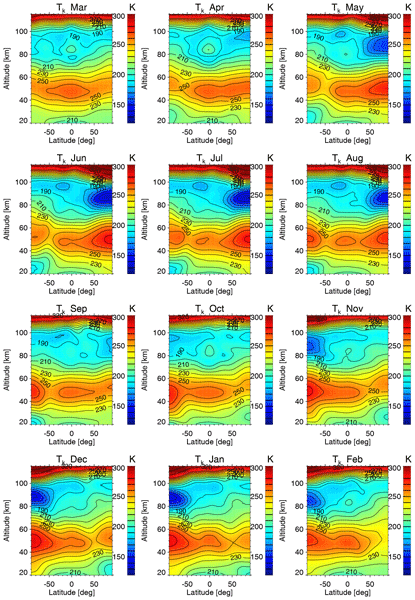
Maya García-Comas, Bernd Funke, Manuel López-Puertas, Norbert Glatthor, Udo Grabowski, Sylvia Kellmann, Michael Kiefer, Andrea Linden, Belén Martínez-Mondéjar, Gabriele P. Stiller, and Thomas von Clarmann
Atmos. Meas. Tech., 16, 5357–5386, https://doi.org/10.5194/amt-16-5357-2023, https://doi.org/10.5194/amt-16-5357-2023, 2023
Short summary
Short summary
We have released version 8 of MIPAS IMK–IAA temperatures and pointing information retrieved from MIPAS Middle and Upper Atmosphere mode version 8.03 calibrated spectra, covering 20–115 km altitude. We considered non-local thermodynamic equilibrium emission explicitly for each limb scan, essential to retrieve accurate temperatures above the mid-mesosphere. Comparisons of this temperature dataset with SABER measurements show excellent agreement, improving those of previous MIPAS versions.
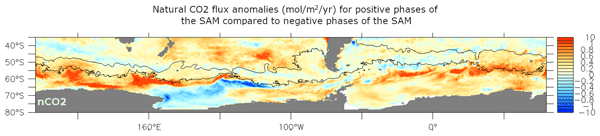
Laurie C. Menviel, Paul Spence, Andrew E. Kiss, Matthew A. Chamberlain, Hakase Hayashida, Matthew H. England, and Darryn Waugh
Biogeosciences, 20, 4413–4431, https://doi.org/10.5194/bg-20-4413-2023, https://doi.org/10.5194/bg-20-4413-2023, 2023
Short summary
Short summary
As the ocean absorbs 25% of the anthropogenic emissions of carbon, it is important to understand the impact of climate change on the flux of carbon between the ocean and the atmosphere. Here, we use a very high-resolution ocean, sea-ice, carbon cycle model to show that the capability of the Southern Ocean to uptake CO2 has decreased over the last 40 years due to a strengthening and poleward shift of the southern hemispheric westerlies. This trend is expected to continue over the coming century.
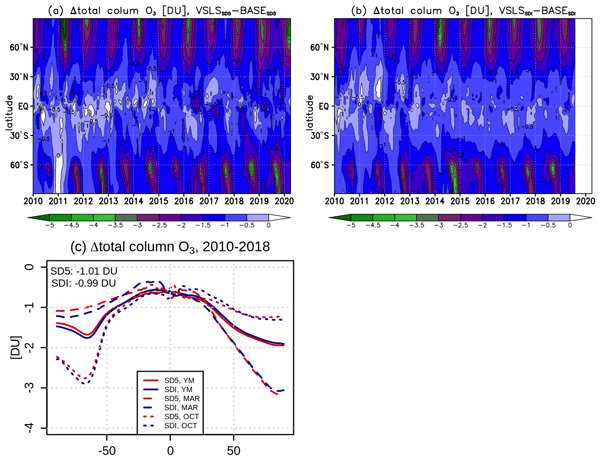
Ewa M. Bednarz, Ryan Hossaini, and Martyn P. Chipperfield
Atmos. Chem. Phys., 23, 13701–13711, https://doi.org/10.5194/acp-23-13701-2023, https://doi.org/10.5194/acp-23-13701-2023, 2023
Short summary
Short summary
We quantify, for the first time, the time-varying impact of uncontrolled emissions of chlorinated very short-lived substances (Cl-VSLSs) on stratospheric ozone using a state-of-the-art chemistry-climate model. We demonstrate that Cl-VSLSs already have a non-negligible impact on stratospheric ozone, including a local reduction of up to ~7 DU in Arctic ozone in the cold winter of 2019/20, and any so future growth in emissions will continue to offset some of the benefits of the Montreal Protocol.
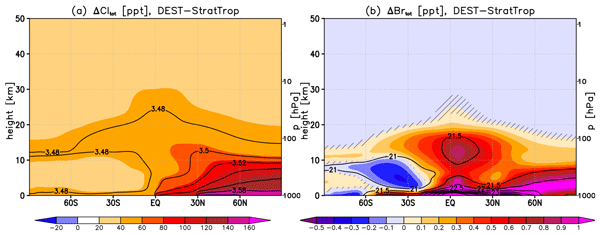
Ewa M. Bednarz, Ryan Hossaini, N. Luke Abraham, and Martyn P. Chipperfield
Geosci. Model Dev., 16, 6187–6209, https://doi.org/10.5194/gmd-16-6187-2023, https://doi.org/10.5194/gmd-16-6187-2023, 2023
Short summary
Short summary
Development and performance of the new DEST chemistry scheme of UM–UKCA is described. The scheme extends the standard StratTrop scheme by including important updates to the halogen chemistry, thus allowing process-oriented studies of stratospheric ozone depletion and recovery, including impacts from both controlled long-lived ozone-depleting substances and emerging issues around uncontrolled, very short-lived substances. It will thus aid studies in support of future ozone assessment reports.
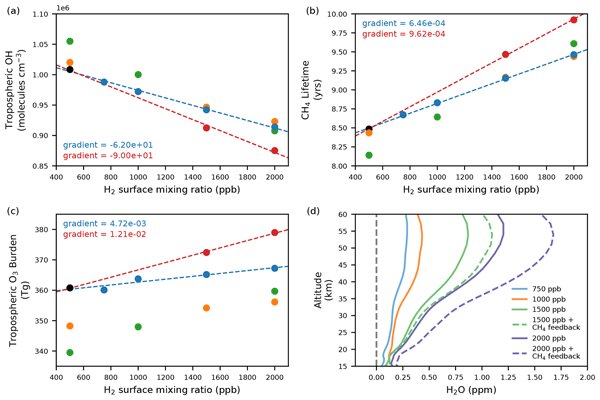
Nicola J. Warwick, Alex T. Archibald, Paul T. Griffiths, James Keeble, Fiona M. O'Connor, John A. Pyle, and Keith P. Shine
Atmos. Chem. Phys., 23, 13451–13467, https://doi.org/10.5194/acp-23-13451-2023, https://doi.org/10.5194/acp-23-13451-2023, 2023
Short summary
Short summary
A chemistry–climate model has been used to explore the atmospheric response to changes in emissions of hydrogen and other species associated with a shift from fossil fuel to hydrogen use. Leakage of hydrogen results in indirect global warming, offsetting greenhouse gas emission reductions from reduced fossil fuel use. To maximise the benefit of hydrogen as an energy source, hydrogen leakage and emissions of methane, carbon monoxide and nitrogen oxides should be minimised.
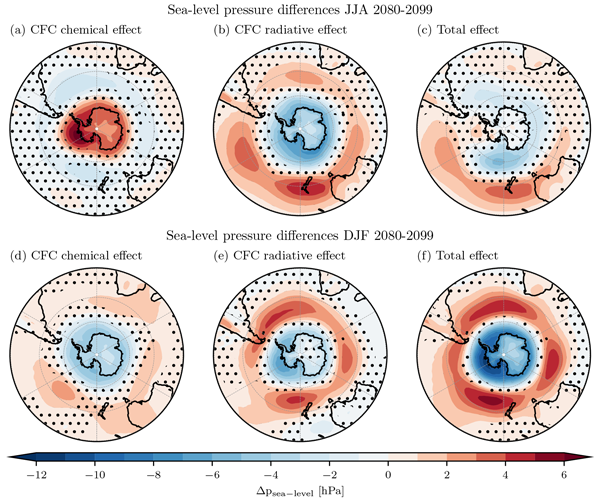
Franziska Zilker, Timofei Sukhodolov, Gabriel Chiodo, Marina Friedel, Tatiana Egorova, Eugene Rozanov, Jan Sedlacek, Svenja Seeber, and Thomas Peter
Atmos. Chem. Phys., 23, 13387–13411, https://doi.org/10.5194/acp-23-13387-2023, https://doi.org/10.5194/acp-23-13387-2023, 2023
Short summary
Short summary
The Montreal Protocol (MP) has successfully reduced the Antarctic ozone hole by banning chlorofluorocarbons (CFCs) that destroy the ozone layer. Moreover, CFCs are strong greenhouse gases (GHGs) that would have strengthened global warming. In this study, we investigate the surface weather and climate in a world without the MP at the end of the 21st century, disentangling ozone-mediated and GHG impacts of CFCs. Overall, we avoided 1.7 K global surface warming and a poleward shift in storm tracks.
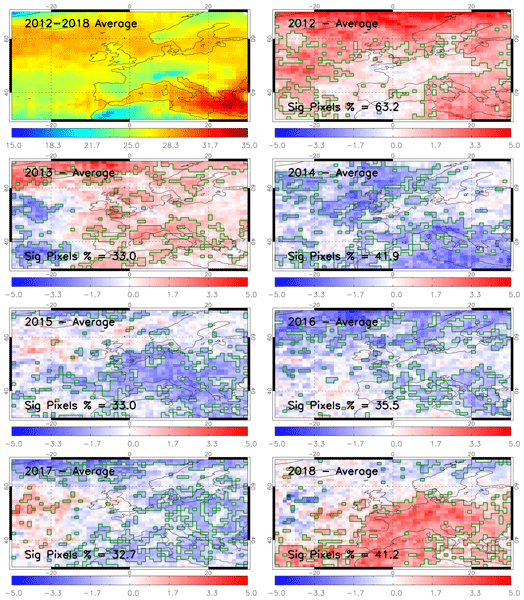
Richard J. Pope, Brian J. Kerridge, Martyn P. Chipperfield, Richard Siddans, Barry G. Latter, Lucy J. Ventress, Matilda A. Pimlott, Wuhu Feng, Edward Comyn-Platt, Garry D. Hayman, Stephen R. Arnold, and Ailish M. Graham
Atmos. Chem. Phys., 23, 13235–13253, https://doi.org/10.5194/acp-23-13235-2023, https://doi.org/10.5194/acp-23-13235-2023, 2023
Short summary
Short summary
In the summer of 2018, Europe experienced several persistent large-scale ozone (O3) pollution episodes. Satellite tropospheric O3 and surface O3 data recorded substantial enhancements in 2018 relative to other years. Targeted model simulations showed that meteorological processes and emissions controlled the elevated surface O3, while mid-tropospheric O3 enhancements were dominated by stratospheric O3 intrusion and advection of North Atlantic O3-rich air masses into Europe.
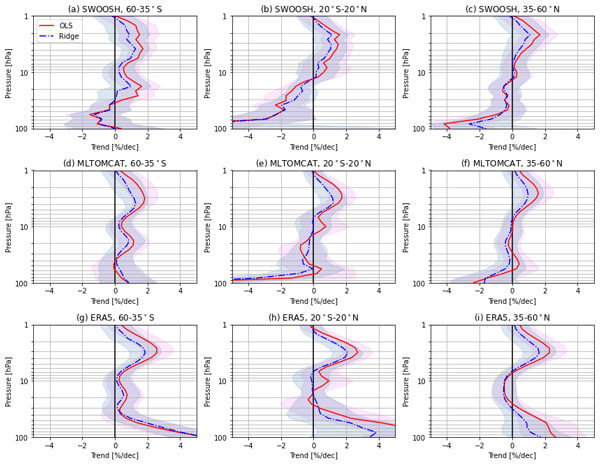
Yajuan Li, Sandip S. Dhomse, Martyn P. Chipperfield, Wuhu Feng, Jianchun Bian, Yuan Xia, and Dong Guo
Atmos. Chem. Phys., 23, 13029–13047, https://doi.org/10.5194/acp-23-13029-2023, https://doi.org/10.5194/acp-23-13029-2023, 2023
Short summary
Short summary
For the first time a regularized multivariate regression model is used to estimate stratospheric ozone trends. Regularized regression avoids the over-fitting issue due to correlation among explanatory variables. We demonstrate that there are considerable differences in satellite-based and chemical-model-based ozone trends, highlighting large uncertainties in our understanding about ozone variability. We argue that caution is needed when interpreting results with different methods and datasets.
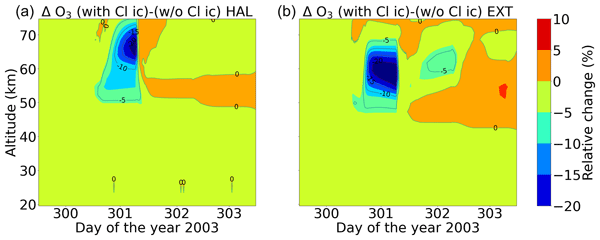
Monali Borthakur, Miriam Sinnhuber, Alexandra Laeng, Thomas Reddmann, Peter Braesicke, Gabriele Stiller, Thomas von Clarmann, Bernd Funke, Ilya Usoskin, Jan Maik Wissing, and Olesya Yakovchuk
Atmos. Chem. Phys., 23, 12985–13013, https://doi.org/10.5194/acp-23-12985-2023, https://doi.org/10.5194/acp-23-12985-2023, 2023
Short summary
Short summary
Reduced ozone levels resulting from ozone depletion mean more exposure to UV radiation, which has various effects on human health. We analysed solar events to see what influence it has on the chemistry of Earth's atmosphere and how this atmospheric chemistry change can affect the ozone. To do this, we used an atmospheric model considering only chemistry and compared it with satellite data. The focus was mainly on the contribution of chlorine, and we found about 10 %–20 % ozone loss due to that.
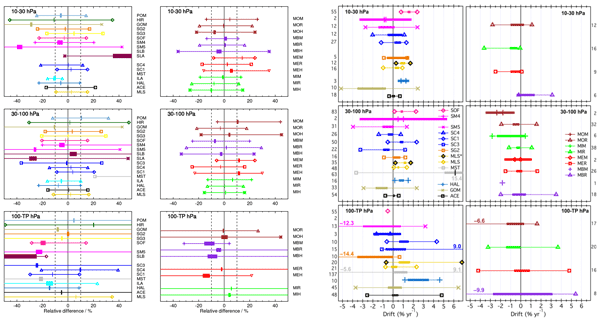
Michael Kiefer, Dale F. Hurst, Gabriele P. Stiller, Stefan Lossow, Holger Vömel, John Anderson, Faiza Azam, Jean-Loup Bertaux, Laurent Blanot, Klaus Bramstedt, John P. Burrows, Robert Damadeo, Bianca Maria Dinelli, Patrick Eriksson, Maya García-Comas, John C. Gille, Mark Hervig, Yasuko Kasai, Farahnaz Khosrawi, Donal Murtagh, Gerald E. Nedoluha, Stefan Noël, Piera Raspollini, William G. Read, Karen H. Rosenlof, Alexei Rozanov, Christopher E. Sioris, Takafumi Sugita, Thomas von Clarmann, Kaley A. Walker, and Katja Weigel
Atmos. Meas. Tech., 16, 4589–4642, https://doi.org/10.5194/amt-16-4589-2023, https://doi.org/10.5194/amt-16-4589-2023, 2023
Short summary
Short summary
We quantify biases and drifts (and their uncertainties) between the stratospheric water vapor measurement records of 15 satellite-based instruments (SATs, with 31 different retrievals) and balloon-borne frost point hygrometers (FPs) launched at 27 globally distributed stations. These comparisons of measurements during the period 2000–2016 are made using robust, consistent statistical methods. With some exceptions, the biases and drifts determined for most SAT–FP pairs are < 10 % and < 1 % yr−1.
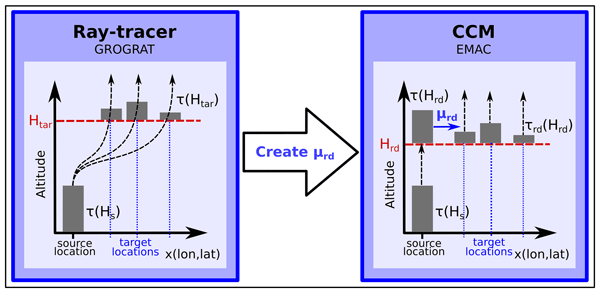
Roland Eichinger, Sebastian Rhode, Hella Garny, Peter Preusse, Petr Pisoft, Aleš Kuchař, Patrick Jöckel, Astrid Kerkweg, and Bastian Kern
Geosci. Model Dev., 16, 5561–5583, https://doi.org/10.5194/gmd-16-5561-2023, https://doi.org/10.5194/gmd-16-5561-2023, 2023
Short summary
Short summary
The columnar approach of gravity wave (GW) schemes results in dynamical model biases, but parallel decomposition makes horizontal GW propagation computationally unfeasible. In the global model EMAC, we approximate it by GW redistribution at one altitude using tailor-made redistribution maps generated with a ray tracer. More spread-out GW drag helps reconcile the model with observations and close the 60°S GW gap. Polar vortex dynamics are improved, enhancing climate model credibility.
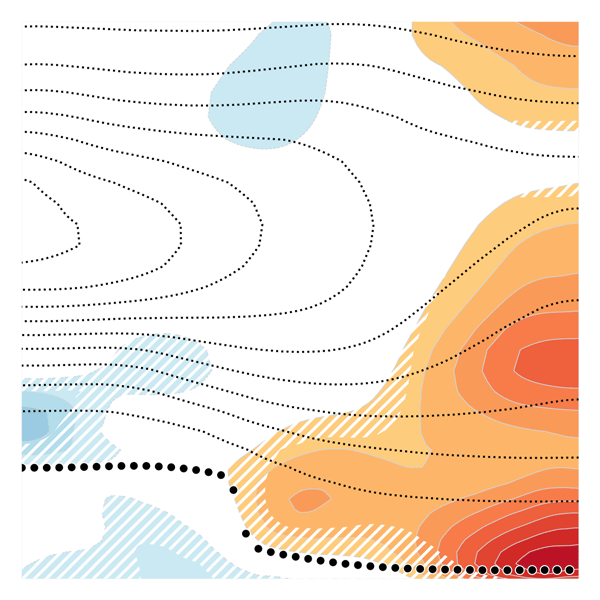
Frederik Harzer, Hella Garny, Felix Ploeger, Harald Bönisch, Peter Hoor, and Thomas Birner
Atmos. Chem. Phys., 23, 10661–10675, https://doi.org/10.5194/acp-23-10661-2023, https://doi.org/10.5194/acp-23-10661-2023, 2023
Short summary
Short summary
We study the statistical relation between year-by-year fluctuations in winter-mean ozone and the strength of the stratospheric polar vortex. In the latitude–pressure plane, regression analysis shows that anomalously weak polar vortex years are associated with three pronounced local ozone maxima over the polar cap relative to the winter climatology. These response maxima primarily reflect the non-trivial combination of different ozone transport processes with varying relative contributions.
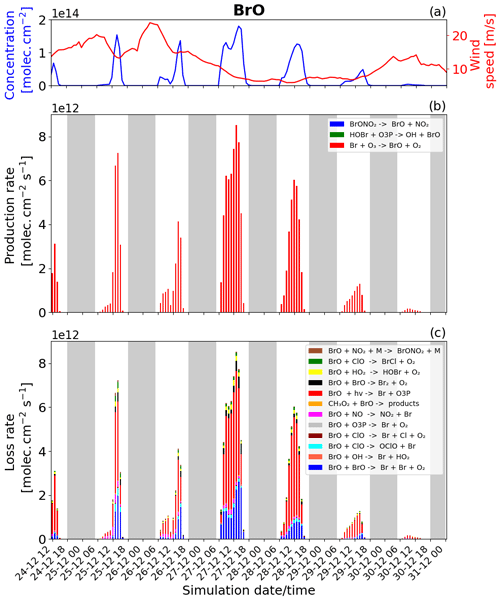
Herizo Narivelo, Paul David Hamer, Virginie Marécal, Luke Surl, Tjarda Roberts, Sophie Pelletier, Béatrice Josse, Jonathan Guth, Mickaël Bacles, Simon Warnach, Thomas Wagner, Stefano Corradini, Giuseppe Salerno, and Lorenzo Guerrieri
Atmos. Chem. Phys., 23, 10533–10561, https://doi.org/10.5194/acp-23-10533-2023, https://doi.org/10.5194/acp-23-10533-2023, 2023
Short summary
Short summary
Volcanic emissions emit large quantities of gases and primary aerosols that can play an important role in atmospheric chemistry. We present a study of the fate of volcanic bromine emissions from the eruption of Mount Etna around Christmas 2018. Using a numerical model and satellite observations, we analyse the impact of the volcanic plume and how it modifies the composition of the air over the whole Mediterranean basin, in particular on tropospheric ozone through the bromine-explosion cycle.
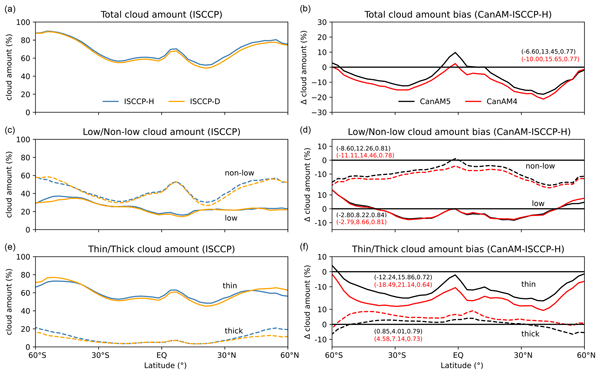
Jason Neil Steven Cole, Knut von Salzen, Jiangnan Li, John Scinocca, David Plummer, Vivek Arora, Norman McFarlane, Michael Lazare, Murray MacKay, and Diana Verseghy
Geosci. Model Dev., 16, 5427–5448, https://doi.org/10.5194/gmd-16-5427-2023, https://doi.org/10.5194/gmd-16-5427-2023, 2023
Short summary
Short summary
The Canadian Atmospheric Model version 5 (CanAM5) is used to simulate on a global scale the climate of Earth's atmosphere, land, and lakes. We document changes to the physics in CanAM5 since the last major version of the model (CanAM4) and evaluate the climate simulated relative to observations and CanAM4. The climate simulated by CanAM5 is similar to CanAM4, but there are improvements, including better simulation of temperature and precipitation over the Amazon and better simulation of cloud.
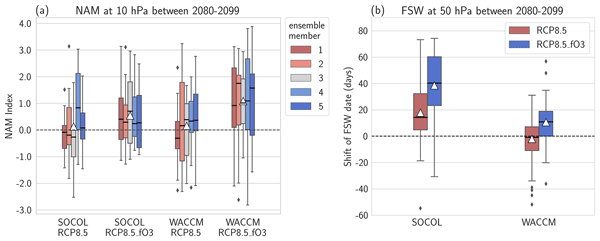
Gabriel Chiodo, Marina Friedel, Svenja Seeber, Daniela Domeisen, Andrea Stenke, Timofei Sukhodolov, and Franziska Zilker
Atmos. Chem. Phys., 23, 10451–10472, https://doi.org/10.5194/acp-23-10451-2023, https://doi.org/10.5194/acp-23-10451-2023, 2023
Short summary
Short summary
Stratospheric ozone protects the biosphere from harmful UV radiation. Anthropogenic activity has led to a reduction in the ozone layer in the recent past, but thanks to the implementation of the Montreal Protocol, the ozone layer is projected to recover. In this study, we show that projected future changes in Arctic ozone abundances during springtime will influence stratospheric climate and thereby actively modulate large-scale circulation changes in the Northern Hemisphere.
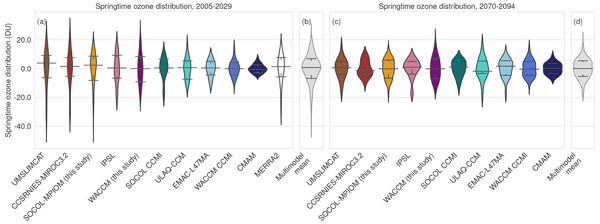
Marina Friedel, Gabriel Chiodo, Timofei Sukhodolov, James Keeble, Thomas Peter, Svenja Seeber, Andrea Stenke, Hideharu Akiyoshi, Eugene Rozanov, David Plummer, Patrick Jöckel, Guang Zeng, Olaf Morgenstern, and Béatrice Josse
Atmos. Chem. Phys., 23, 10235–10254, https://doi.org/10.5194/acp-23-10235-2023, https://doi.org/10.5194/acp-23-10235-2023, 2023
Short summary
Short summary
Previously, it has been suggested that springtime Arctic ozone depletion might worsen in the coming decades due to climate change, which might counteract the effect of reduced ozone-depleting substances. Here, we show with different chemistry–climate models that springtime Arctic ozone depletion will likely decrease in the future. Further, we explain why models show a large spread in the projected development of Arctic ozone depletion and use the model spread to constrain future projections.
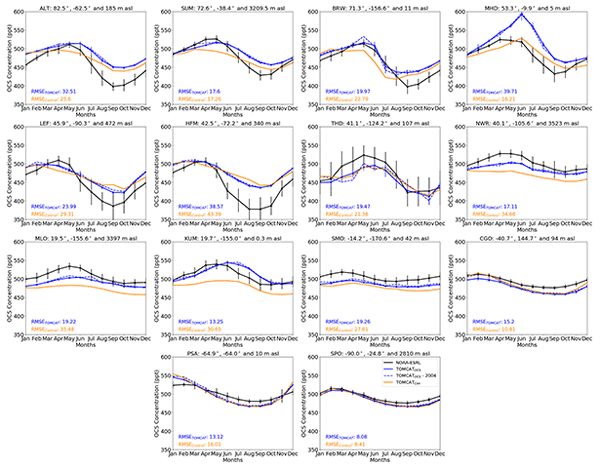
Michael P. Cartwright, Richard J. Pope, Jeremy J. Harrison, Martyn P. Chipperfield, Chris Wilson, Wuhu Feng, David P. Moore, and Parvadha Suntharalingam
Atmos. Chem. Phys., 23, 10035–10056, https://doi.org/10.5194/acp-23-10035-2023, https://doi.org/10.5194/acp-23-10035-2023, 2023
Short summary
Short summary
A 3-D chemical transport model, TOMCAT, is used to simulate global atmospheric carbonyl sulfide (OCS) distribution. Modelled OCS compares well with satellite observations of OCS from limb-sounding satellite observations. Model simulations also compare adequately with surface and atmospheric observations and suitably capture the seasonality of OCS and background concentrations.
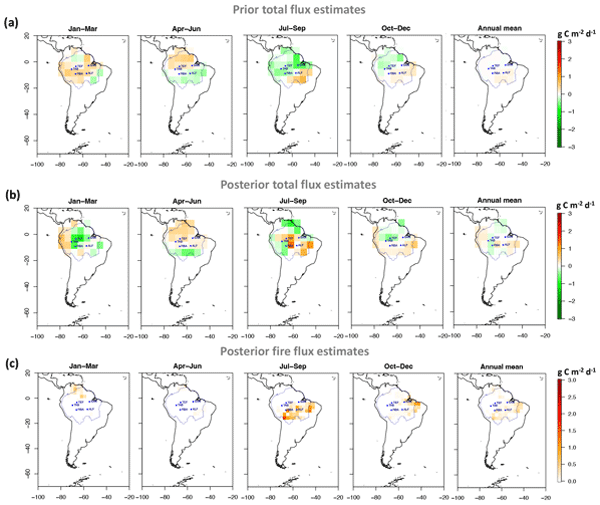
Luana S. Basso, Chris Wilson, Martyn P. Chipperfield, Graciela Tejada, Henrique L. G. Cassol, Egídio Arai, Mathew Williams, T. Luke Smallman, Wouter Peters, Stijn Naus, John B. Miller, and Manuel Gloor
Atmos. Chem. Phys., 23, 9685–9723, https://doi.org/10.5194/acp-23-9685-2023, https://doi.org/10.5194/acp-23-9685-2023, 2023
Short summary
Short summary
The Amazon’s carbon balance may have changed due to forest degradation, deforestation and warmer climate. We used an atmospheric model and atmospheric CO2 observations to quantify Amazonian carbon emissions (2010–2018). The region was a small carbon source to the atmosphere, mostly due to fire emissions. Forest uptake compensated for ~ 50 % of the fire emissions, meaning that the remaining forest is still a small carbon sink. We found no clear evidence of weakening carbon uptake over the period.
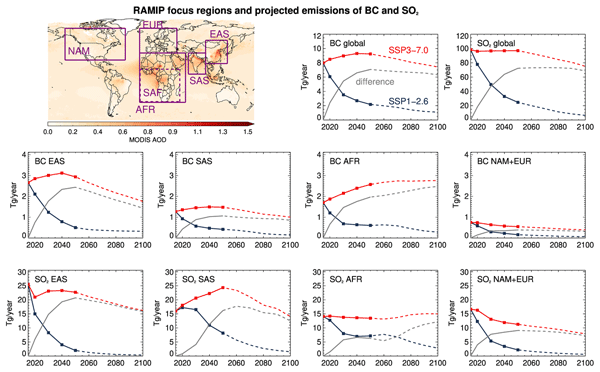
Laura J. Wilcox, Robert J. Allen, Bjørn H. Samset, Massimo A. Bollasina, Paul T. Griffiths, James Keeble, Marianne T. Lund, Risto Makkonen, Joonas Merikanto, Declan O'Donnell, David J. Paynter, Geeta G. Persad, Steven T. Rumbold, Toshihiko Takemura, Kostas Tsigaridis, Sabine Undorf, and Daniel M. Westervelt
Geosci. Model Dev., 16, 4451–4479, https://doi.org/10.5194/gmd-16-4451-2023, https://doi.org/10.5194/gmd-16-4451-2023, 2023
Short summary
Short summary
Changes in anthropogenic aerosol emissions have strongly contributed to global and regional climate change. However, the size of these regional impacts and the way they arise are still uncertain. With large changes in aerosol emissions a possibility over the next few decades, it is important to better quantify the potential role of aerosol in future regional climate change. The Regional Aerosol Model Intercomparison Project will deliver experiments designed to facilitate this.
Jonny Williams, Erik Behrens, Olaf Morgenstern, Peter Gibson, and Joao Teixeira
EGUsphere, https://doi.org/10.5194/egusphere-2023-1694, https://doi.org/10.5194/egusphere-2023-1694, 2023
Preprint withdrawn
Short summary
Short summary
We use open-source cyclone tracking software and state-of-the-art climate models to characterise present-day tropical cyclones – TCs – in the South Pacific before moving on to estimate how they may change in the future. A robust result of this work is the projection of future intensification of TCs. However, the question of their future occurrence frequency is less clear. Under extreme future warming scenarios, we postulate a possible increase in power dissipation per TC of up to 25 %.
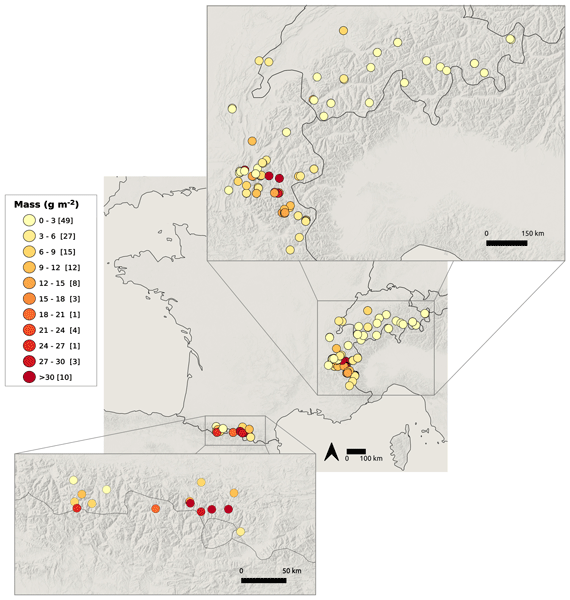
Marie Dumont, Simon Gascoin, Marion Réveillet, Didier Voisin, François Tuzet, Laurent Arnaud, Mylène Bonnefoy, Montse Bacardit Peñarroya, Carlo Carmagnola, Alexandre Deguine, Aurélie Diacre, Lukas Dürr, Olivier Evrard, Firmin Fontaine, Amaury Frankl, Mathieu Fructus, Laure Gandois, Isabelle Gouttevin, Abdelfateh Gherab, Pascal Hagenmuller, Sophia Hansson, Hervé Herbin, Béatrice Josse, Bruno Jourdain, Irene Lefevre, Gaël Le Roux, Quentin Libois, Lucie Liger, Samuel Morin, Denis Petitprez, Alvaro Robledano, Martin Schneebeli, Pascal Salze, Delphine Six, Emmanuel Thibert, Jürg Trachsel, Matthieu Vernay, Léo Viallon-Galinier, and Céline Voiron
Earth Syst. Sci. Data, 15, 3075–3094, https://doi.org/10.5194/essd-15-3075-2023, https://doi.org/10.5194/essd-15-3075-2023, 2023
Short summary
Short summary
Saharan dust outbreaks have profound effects on ecosystems, climate, health, and the cryosphere, but the spatial deposition pattern of Saharan dust is poorly known. Following the extreme dust deposition event of February 2021 across Europe, a citizen science campaign was launched to sample dust on snow over the Pyrenees and the European Alps. This campaign triggered wide interest and over 100 samples. The samples revealed the high variability of the dust properties within a single event.
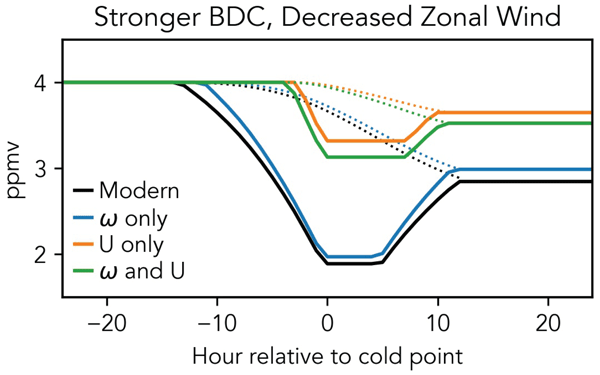
Stephen Bourguet and Marianna Linz
Atmos. Chem. Phys., 23, 7447–7460, https://doi.org/10.5194/acp-23-7447-2023, https://doi.org/10.5194/acp-23-7447-2023, 2023
Short summary
Short summary
Here, we show how projected changes to tropical circulation will impact the water vapor concentration in the lower stratosphere, which has implications for surface climate and stratospheric chemistry. In our transport scenarios with slower east–west winds, air parcels ascending into the stratosphere do not experience the same cold temperatures that they would today. This effect could act in concert with previously modeled changes to stratospheric water vapor to amplify surface warming.
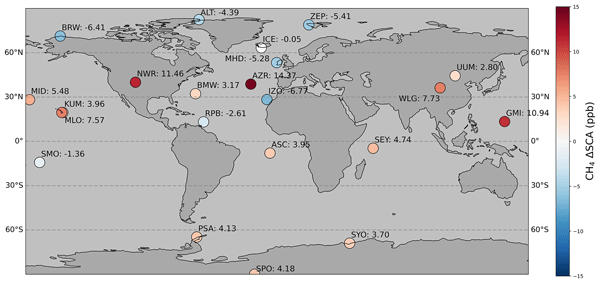
Emily Dowd, Chris Wilson, Martyn P. Chipperfield, Emanuel Gloor, Alistair Manning, and Ruth Doherty
Atmos. Chem. Phys., 23, 7363–7382, https://doi.org/10.5194/acp-23-7363-2023, https://doi.org/10.5194/acp-23-7363-2023, 2023
Short summary
Short summary
Surface observations of methane show that the seasonal cycle amplitude (SCA) of methane is decreasing in the northern high latitudes (NHLs) but increased globally (1995–2020). The NHL decrease is counterintuitive, as we expect the SCA to increase with increasing concentrations. We use a chemical transport model to investigate changes in SCA in the NHLs. We find well-mixed methane and changes in emissions from Canada, the Middle East, and Europe are the largest contributors to the SCA in NHLs.

Maria Rosa Russo, Brian John Kerridge, Nathan Luke Abraham, James Keeble, Barry Graham Latter, Richard Siddans, James Weber, Paul Thomas Griffiths, John Adrian Pyle, and Alexander Thomas Archibald
Atmos. Chem. Phys., 23, 6169–6196, https://doi.org/10.5194/acp-23-6169-2023, https://doi.org/10.5194/acp-23-6169-2023, 2023
Short summary
Short summary
Tropospheric ozone is an important component of the Earth system as it can affect both climate and air quality. In this work we use observed tropospheric ozone derived from satellite observations and compare it to tropospheric ozone from model simulations. Our aim is to investigate recent changes (2005–2018) in tropospheric ozone in the North Atlantic region and to understand what factors are driving such changes.
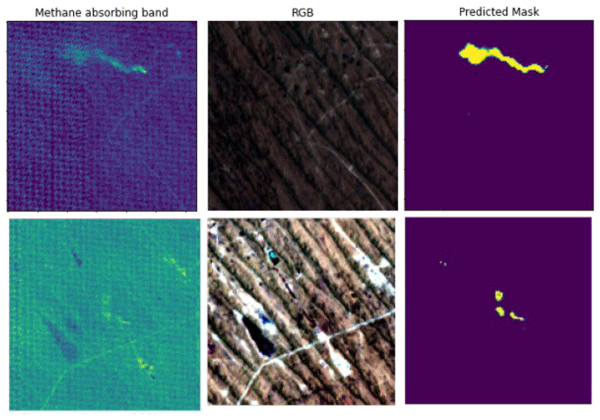
Peter Joyce, Cristina Ruiz Villena, Yahui Huang, Alex Webb, Manuel Gloor, Fabien H. Wagner, Martyn P. Chipperfield, Rocío Barrio Guilló, Chris Wilson, and Hartmut Boesch
Atmos. Meas. Tech., 16, 2627–2640, https://doi.org/10.5194/amt-16-2627-2023, https://doi.org/10.5194/amt-16-2627-2023, 2023
Short summary
Short summary
Methane emissions are responsible for a lot of the warming caused by the greenhouse effect, much of which comes from a small number of point sources. We can identify methane point sources by analysing satellite data, but it requires a lot of time invested by experts and is prone to very high errors. Here, we produce a neural network that can automatically identify methane point sources and estimate the mass of methane that is being released per hour and are able to do so with far smaller errors.
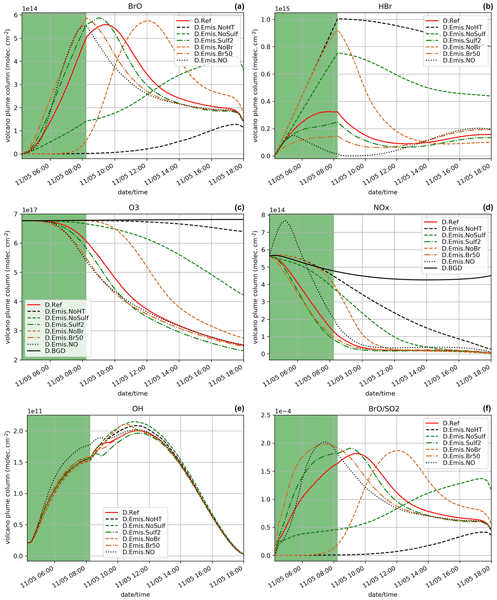
Virginie Marécal, Ronan Voisin-Plessis, Tjarda Jane Roberts, Alessandro Aiuppa, Herizo Narivelo, Paul David Hamer, Béatrice Josse, Jonathan Guth, Luke Surl, and Lisa Grellier
Geosci. Model Dev., 16, 2873–2898, https://doi.org/10.5194/gmd-16-2873-2023, https://doi.org/10.5194/gmd-16-2873-2023, 2023
Short summary
Short summary
We implemented a halogen volcanic chemistry scheme in a one-dimensional modelling framework preparing for further use in a three-dimensional global chemistry-transport model. The results of the simulations for an eruption of Mt Etna in 2008, including various sensitivity tests, show a good consistency with previous modelling studies.
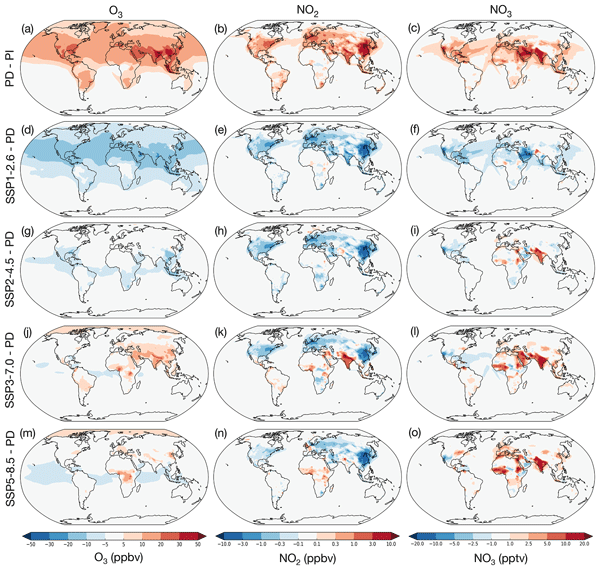
Scott Archer-Nicholls, Rachel Allen, Nathan L. Abraham, Paul T. Griffiths, and Alex T. Archibald
Atmos. Chem. Phys., 23, 5801–5813, https://doi.org/10.5194/acp-23-5801-2023, https://doi.org/10.5194/acp-23-5801-2023, 2023
Short summary
Short summary
The nitrate radical is a major oxidant at nighttime, but much less is known about it than about the other oxidants ozone and OH. We use Earth system model calculations to show how the nitrate radical has changed in abundance from 1850–2014 and to 2100 under a range of different climate and emission scenarios. Depending on the emissions and climate scenario, significant increases are projected with implications for the oxidation of volatile organic compounds and the formation of fine aerosol.

Flossie Brown, Lauren Marshall, Peter H. Haynes, Rolando R. Garcia, Thomas Birner, and Anja Schmidt
Atmos. Chem. Phys., 23, 5335–5353, https://doi.org/10.5194/acp-23-5335-2023, https://doi.org/10.5194/acp-23-5335-2023, 2023
Short summary
Short summary
Large-magnitude volcanic eruptions have the potential to alter large-scale circulation patterns, such as the quasi-biennial oscillation (QBO). The QBO is an oscillation of the tropical stratospheric zonal winds between easterly and westerly directions. Using a climate model, we show that large-magnitude eruptions can delay the progression of the QBO, with a much longer delay when the shear is easterly than when it is westerly. Such delays may affect weather and transport of atmospheric gases.
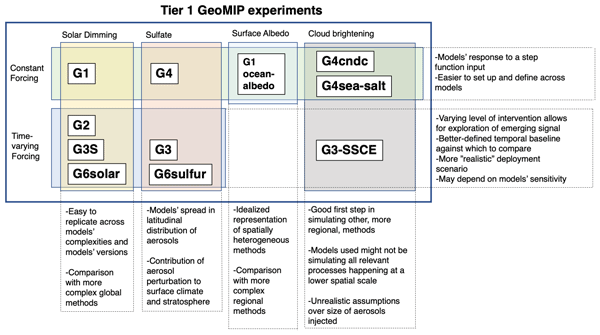
Daniele Visioni, Ben Kravitz, Alan Robock, Simone Tilmes, Jim Haywood, Olivier Boucher, Mark Lawrence, Peter Irvine, Ulrike Niemeier, Lili Xia, Gabriel Chiodo, Chris Lennard, Shingo Watanabe, John C. Moore, and Helene Muri
Atmos. Chem. Phys., 23, 5149–5176, https://doi.org/10.5194/acp-23-5149-2023, https://doi.org/10.5194/acp-23-5149-2023, 2023
Short summary
Short summary
Geoengineering indicates methods aiming to reduce the temperature of the planet by means of reflecting back a part of the incoming radiation before it reaches the surface or allowing more of the planetary radiation to escape into space. It aims to produce modelling experiments that are easy to reproduce and compare with different climate models, in order to understand the potential impacts of these techniques. Here we assess its past successes and failures and talk about its future.

Tatiana Egorova, Jan Sedlacek, Timofei Sukhodolov, Arseniy Karagodin-Doyennel, Franziska Zilker, and Eugene Rozanov
Atmos. Chem. Phys., 23, 5135–5147, https://doi.org/10.5194/acp-23-5135-2023, https://doi.org/10.5194/acp-23-5135-2023, 2023
Short summary
Short summary
This paper describes the climate and atmosphere benefits of the Montreal Protocol, simulated with the state-of-the-art Earth system model SOCOLv4.0. We have added to and confirmed the previous studies by showing that without the Montreal Protocol by the end of the 21st century there would be a dramatic reduction in the ozone layer as well as substantial perturbation of the essential climate variables in the troposphere caused by the warming from increasing ozone-depleting substances.
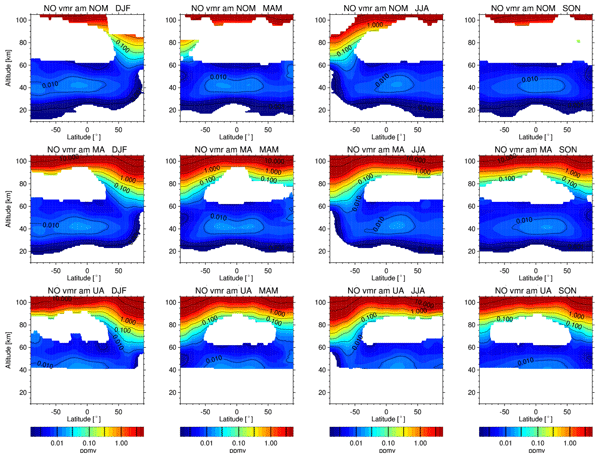
Bernd Funke, Maya García-Comas, Norbert Glatthor, Udo Grabowski, Sylvia Kellmann, Michael Kiefer, Andrea Linden, Manuel López-Puertas, Gabriele P. Stiller, and Thomas von Clarmann
Atmos. Meas. Tech., 16, 2167–2196, https://doi.org/10.5194/amt-16-2167-2023, https://doi.org/10.5194/amt-16-2167-2023, 2023
Short summary
Short summary
New global nitric oxide (NO) volume-mixing-ratio and lower-thermospheric temperature data products, retrieved from Michelson Interferometer for Passive Atmospheric Sounding (MIPAS) spectra with the IMK-IAA MIPAS data processor, have been released. The dataset covers the entire Envisat mission lifetime and includes retrieval results from all MIPAS observation modes. The data are based on ESA version 8 calibration and were processed using an improved retrieval approach.
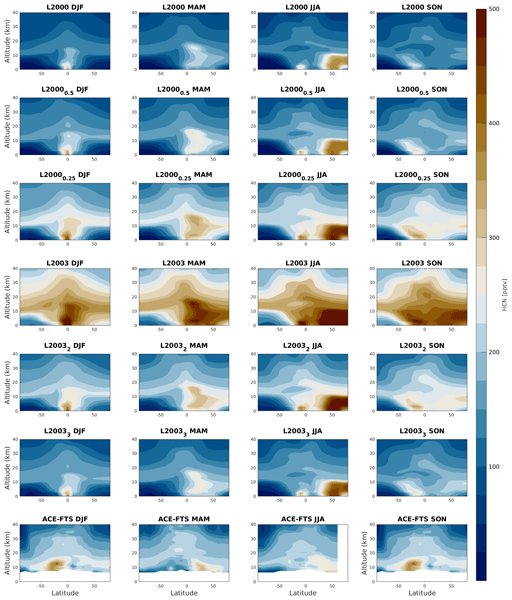
Antonio G. Bruno, Jeremy J. Harrison, Martyn P. Chipperfield, David P. Moore, Richard J. Pope, Christopher Wilson, Emmanuel Mahieu, and Justus Notholt
Atmos. Chem. Phys., 23, 4849–4861, https://doi.org/10.5194/acp-23-4849-2023, https://doi.org/10.5194/acp-23-4849-2023, 2023
Short summary
Short summary
A 3-D chemical transport model, TOMCAT; satellite data; and ground-based observations have been used to investigate hydrogen cyanide (HCN) variability. We found that the oxidation by O(1D) drives the HCN loss in the middle stratosphere and the currently JPL-recommended OH reaction rate overestimates HCN atmospheric loss. We also evaluated two different ocean uptake schemes. We found them to be unrealistic, and we need to scale these schemes to obtain good agreement with HCN observations.
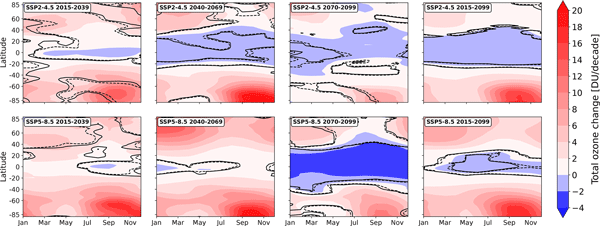
Arseniy Karagodin-Doyennel, Eugene Rozanov, Timofei Sukhodolov, Tatiana Egorova, Jan Sedlacek, and Thomas Peter
Atmos. Chem. Phys., 23, 4801–4817, https://doi.org/10.5194/acp-23-4801-2023, https://doi.org/10.5194/acp-23-4801-2023, 2023
Short summary
Short summary
The future ozone evolution in SOCOLv4 simulations under SSP2-4.5 and SSP5-8.5 scenarios has been assessed for the period 2015–2099 and subperiods using the DLM approach. The SOCOLv4 projects a decline in tropospheric ozone in the 2030s in SSP2-4.5 and in the 2060s in SSP5-8.5. The stratospheric ozone increase is ~3 times higher in SSP5-8.5, confirming the important role of GHGs in ozone evolution. We also showed that tropospheric ozone strongly impacts the total column in the tropics.
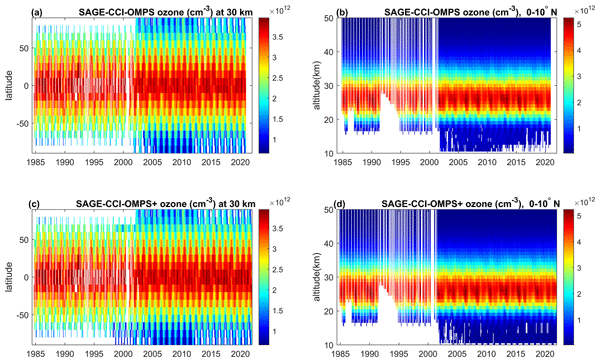
Viktoria F. Sofieva, Monika Szelag, Johanna Tamminen, Carlo Arosio, Alexei Rozanov, Mark Weber, Doug Degenstein, Adam Bourassa, Daniel Zawada, Michael Kiefer, Alexandra Laeng, Kaley A. Walker, Patrick Sheese, Daan Hubert, Michel van Roozendael, Christian Retscher, Robert Damadeo, and Jerry D. Lumpe
Atmos. Meas. Tech., 16, 1881–1899, https://doi.org/10.5194/amt-16-1881-2023, https://doi.org/10.5194/amt-16-1881-2023, 2023
Short summary
Short summary
The paper presents the updated SAGE-CCI-OMPS+ climate data record of monthly zonal mean ozone profiles. This dataset covers the stratosphere and combines measurements by nine limb and occultation satellite instruments (SAGE II, OSIRIS, MIPAS, SCIAMACHY, GOMOS, ACE-FTS, OMPS-LP, POAM III, and SAGE III/ISS). The update includes new versions of MIPAS, ACE-FTS, and OSIRIS datasets and introduces data from additional sensors (POAM III and SAGE III/ISS) and retrieval processors (OMPS-LP).
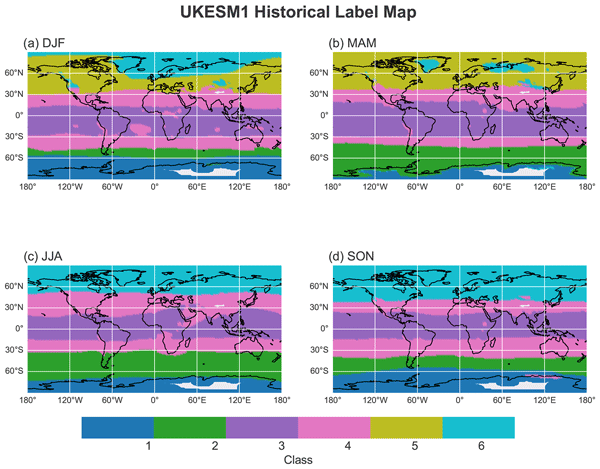
Fouzia Fahrin, Daniel C. Jones, Yan Wu, James Keeble, and Alexander T. Archibald
Atmos. Chem. Phys., 23, 3609–3627, https://doi.org/10.5194/acp-23-3609-2023, https://doi.org/10.5194/acp-23-3609-2023, 2023
Short summary
Short summary
We use a machine learning technique called Gaussian mixture modeling (GMM) to classify vertical ozone profiles into groups based on how the ozone concentration changes with pressure. Even though the GMM algorithm was not provided with spatial information, the classes are geographically coherent. We also detect signatures of tropical broadening in UKESM1 future climate scenarios. GMM may be useful for understanding ozone structures in modeled and observed datasets.
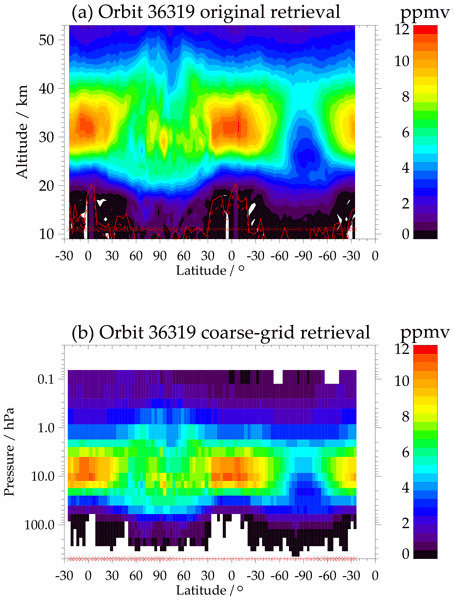
Michael Kiefer, Thomas von Clarmann, Bernd Funke, Maya García-Comas, Norbert Glatthor, Udo Grabowski, Michael Höpfner, Sylvia Kellmann, Alexandra Laeng, Andrea Linden, Manuel López-Puertas, and Gabriele P. Stiller
Atmos. Meas. Tech., 16, 1443–1460, https://doi.org/10.5194/amt-16-1443-2023, https://doi.org/10.5194/amt-16-1443-2023, 2023
Short summary
Short summary
A new ozone data set, derived from radiation measurements of the space-borne instrument MIPAS, is presented. It consists of more than 2 million single ozone profiles from 2002–2012, covering virtually all latitudes and altitudes between 5 and 70 km. Progress in data calibration and processing methods allowed for significant improvement of the data quality, compared to previous data versions. Hence, the data set will help to better understand e.g. the time evolution of ozone in the stratosphere.
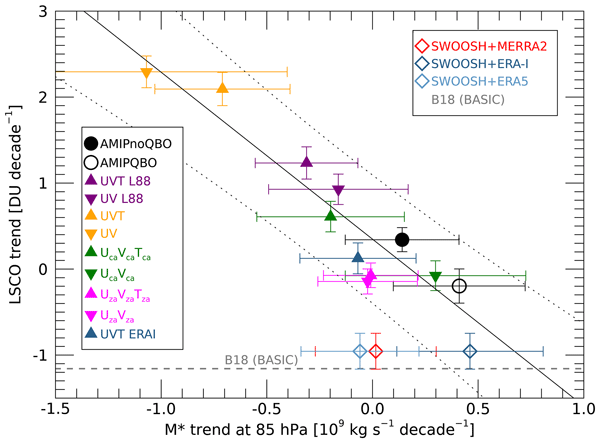
Sean M. Davis, Nicholas Davis, Robert W. Portmann, Eric Ray, and Karen Rosenlof
Atmos. Chem. Phys., 23, 3347–3361, https://doi.org/10.5194/acp-23-3347-2023, https://doi.org/10.5194/acp-23-3347-2023, 2023
Short summary
Short summary
Ozone in the lower part of the stratosphere has not increased and has perhaps even continued to decline in recent decades. This study demonstrates that the amount of ozone in this region is highly sensitive to the amount of air upwelling into the stratosphere in the tropics and that simulations from a climate model nudged to historical meteorological fields often fail to accurately capture the variations in tropical upwelling that control short-term trends in lower-stratospheric ozone.
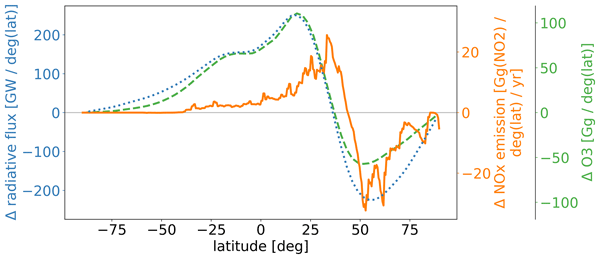
Robin N. Thor, Mariano Mertens, Sigrun Matthes, Mattia Righi, Johannes Hendricks, Sabine Brinkop, Phoebe Graf, Volker Grewe, Patrick Jöckel, and Steven Smith
Geosci. Model Dev., 16, 1459–1466, https://doi.org/10.5194/gmd-16-1459-2023, https://doi.org/10.5194/gmd-16-1459-2023, 2023
Short summary
Short summary
We report on an inconsistency in the latitudinal distribution of aviation emissions between two versions of a data product which is widely used by researchers. From the available documentation, we do not expect such an inconsistency. We run a chemistry–climate model to compute the effect of the inconsistency in emissions on atmospheric chemistry and radiation and find that the radiative forcing associated with aviation ozone is 7.6 % higher when using the less recent version of the data.
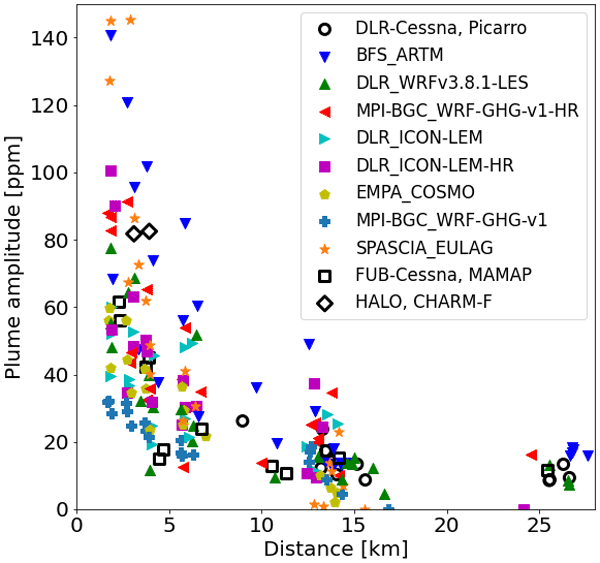
Dominik Brunner, Gerrit Kuhlmann, Stephan Henne, Erik Koene, Bastian Kern, Sebastian Wolff, Christiane Voigt, Patrick Jöckel, Christoph Kiemle, Anke Roiger, Alina Fiehn, Sven Krautwurst, Konstantin Gerilowski, Heinrich Bovensmann, Jakob Borchardt, Michal Galkowski, Christoph Gerbig, Julia Marshall, Andrzej Klonecki, Pascal Prunet, Robert Hanfland, Margit Pattantyús-Ábrahám, Andrzej Wyszogrodzki, and Andreas Fix
Atmos. Chem. Phys., 23, 2699–2728, https://doi.org/10.5194/acp-23-2699-2023, https://doi.org/10.5194/acp-23-2699-2023, 2023
Short summary
Short summary
We evaluated six atmospheric transport models for their capability to simulate the CO2 plumes from two of the largest power plants in Europe by comparing the models against aircraft observations collected during the CoMet (Carbon Dioxide and Methane Mission) campaign in 2018. The study analyzed how realistically such plumes can be simulated at different model resolutions and how well the planned European satellite mission CO2M will be able to quantify emissions from power plants.
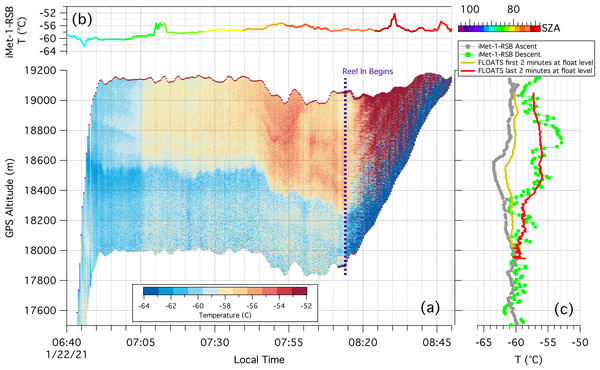
J. Douglas Goetz, Lars E. Kalnajs, Terry Deshler, Sean M. Davis, Martina Bramberger, and M. Joan Alexander
Atmos. Meas. Tech., 16, 791–807, https://doi.org/10.5194/amt-16-791-2023, https://doi.org/10.5194/amt-16-791-2023, 2023
Short summary
Short summary
An instrument for in situ continuous 2 km vertical profiles of temperature below high-altitude balloons was developed for high-temporal-resolution measurements within the upper troposphere and lower stratosphere using fiber-optic distributed temperature sensing. The mechanical, electrical, and temperature calibration systems were validated from a short mid-latitude constant-altitude balloon flight within the lower stratosphere. The instrument observed small-scale and inertial gravity waves.
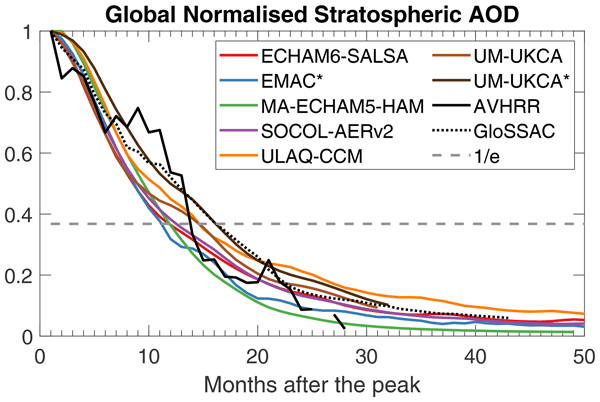
Ilaria Quaglia, Claudia Timmreck, Ulrike Niemeier, Daniele Visioni, Giovanni Pitari, Christina Brodowsky, Christoph Brühl, Sandip S. Dhomse, Henning Franke, Anton Laakso, Graham W. Mann, Eugene Rozanov, and Timofei Sukhodolov
Atmos. Chem. Phys., 23, 921–948, https://doi.org/10.5194/acp-23-921-2023, https://doi.org/10.5194/acp-23-921-2023, 2023
Short summary
Short summary
The last very large explosive volcanic eruption we have measurements for is the eruption of Mt. Pinatubo in 1991. It is therefore often used as a benchmark for climate models' ability to reproduce these kinds of events. Here, we compare available measurements with the results from multiple experiments conducted with climate models interactively simulating the aerosol cloud formation.
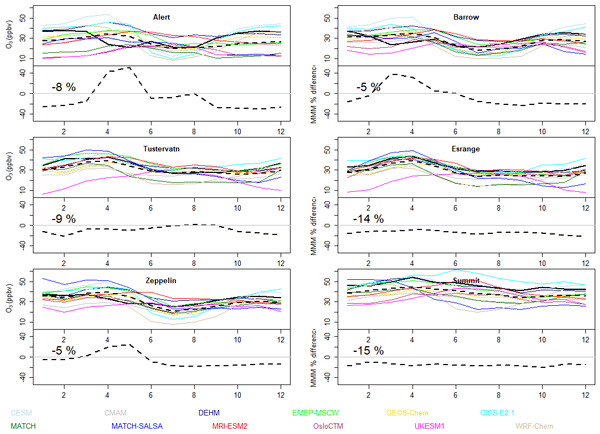
Cynthia H. Whaley, Kathy S. Law, Jens Liengaard Hjorth, Henrik Skov, Stephen R. Arnold, Joakim Langner, Jakob Boyd Pernov, Garance Bergeron, Ilann Bourgeois, Jesper H. Christensen, Rong-You Chien, Makoto Deushi, Xinyi Dong, Peter Effertz, Gregory Faluvegi, Mark Flanner, Joshua S. Fu, Michael Gauss, Greg Huey, Ulas Im, Rigel Kivi, Louis Marelle, Tatsuo Onishi, Naga Oshima, Irina Petropavlovskikh, Jeff Peischl, David A. Plummer, Luca Pozzoli, Jean-Christophe Raut, Tom Ryerson, Ragnhild Skeie, Sverre Solberg, Manu A. Thomas, Chelsea Thompson, Kostas Tsigaridis, Svetlana Tsyro, Steven T. Turnock, Knut von Salzen, and David W. Tarasick
Atmos. Chem. Phys., 23, 637–661, https://doi.org/10.5194/acp-23-637-2023, https://doi.org/10.5194/acp-23-637-2023, 2023
Short summary
Short summary
This study summarizes recent research on ozone in the Arctic, a sensitive and rapidly warming region. We find that the seasonal cycles of near-surface atmospheric ozone are variable depending on whether they are near the coast, inland, or at high altitude. Several global model simulations were evaluated, and we found that because models lack some of the ozone chemistry that is important for the coastal Arctic locations, they do not accurately simulate ozone there.
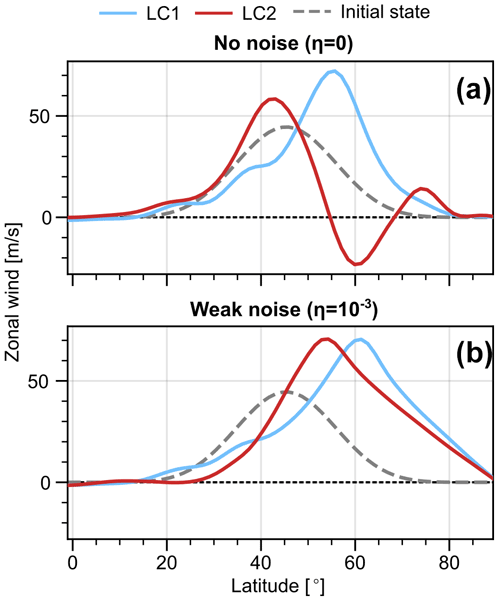
Felix Jäger, Philip Rupp, and Thomas Birner
Weather Clim. Dynam., 4, 49–60, https://doi.org/10.5194/wcd-4-49-2023, https://doi.org/10.5194/wcd-4-49-2023, 2023
Short summary
Short summary
Mid-latitude weather is dominated by the growth, breaking and decay of baroclinic waves and associated jet shifts. A way to study this process is via idealised life-cycle simulations, which are often classified as LC1 (anticyclonic breaking, poleward shift) or LC2 (cyclonic breaking, equatorward shift), depending on details of the initial state. We show that all systems exhibit predominantly anticyclonic character and poleward net shifts if multiple wave modes are allowed to grow simultaneously.
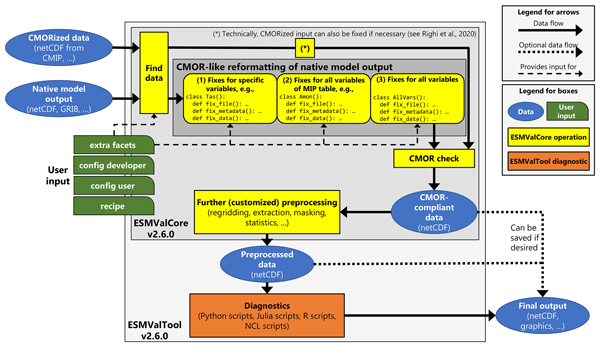
Manuel Schlund, Birgit Hassler, Axel Lauer, Bouwe Andela, Patrick Jöckel, Rémi Kazeroni, Saskia Loosveldt Tomas, Brian Medeiros, Valeriu Predoi, Stéphane Sénési, Jérôme Servonnat, Tobias Stacke, Javier Vegas-Regidor, Klaus Zimmermann, and Veronika Eyring
Geosci. Model Dev., 16, 315–333, https://doi.org/10.5194/gmd-16-315-2023, https://doi.org/10.5194/gmd-16-315-2023, 2023
Short summary
Short summary
The Earth System Model Evaluation Tool (ESMValTool) is a community diagnostics and performance metrics tool for routine evaluation of Earth system models. Originally, ESMValTool was designed to process reformatted output provided by large model intercomparison projects like the Coupled Model Intercomparison Project (CMIP). Here, we describe a new extension of ESMValTool that allows for reading and processing native climate model output, i.e., data that have not been reformatted before.
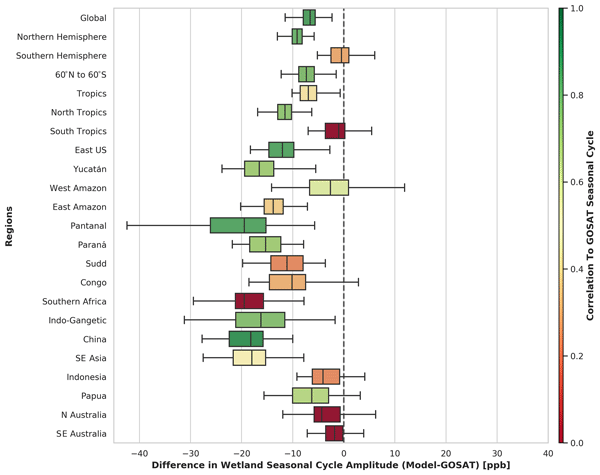
Robert J. Parker, Chris Wilson, Edward Comyn-Platt, Garry Hayman, Toby R. Marthews, A. Anthony Bloom, Mark F. Lunt, Nicola Gedney, Simon J. Dadson, Joe McNorton, Neil Humpage, Hartmut Boesch, Martyn P. Chipperfield, Paul I. Palmer, and Dai Yamazaki
Biogeosciences, 19, 5779–5805, https://doi.org/10.5194/bg-19-5779-2022, https://doi.org/10.5194/bg-19-5779-2022, 2022
Short summary
Short summary
Wetlands are the largest natural source of methane, one of the most important climate gases. The JULES land surface model simulates these emissions. We use satellite data to evaluate how well JULES reproduces the methane seasonal cycle over different tropical wetlands. It performs well for most regions; however, it struggles for some African wetlands influenced heavily by river flooding. We explain the reasons for these deficiencies and highlight how future development will improve these areas.
Samuel Benito-Barca, Natalia Calvo, and Marta Abalos
Atmos. Chem. Phys., 22, 15729–15745, https://doi.org/10.5194/acp-22-15729-2022, https://doi.org/10.5194/acp-22-15729-2022, 2022
Short summary
Short summary
The impact of different El Niño flavors (eastern (EP) and central (CP) Pacific El Niño) and La Niña on the stratospheric ozone is studied in a state-of-the-art chemistry–climate model. Ozone reduces in the tropics and increases in the extratropics when an EP El Niño event occurs, the opposite of La Niña. However, CP El Niño has no impact on extratropical ozone. These ozone variations are driven by changes in the stratospheric transport circulation, with an important contribution of mixing.
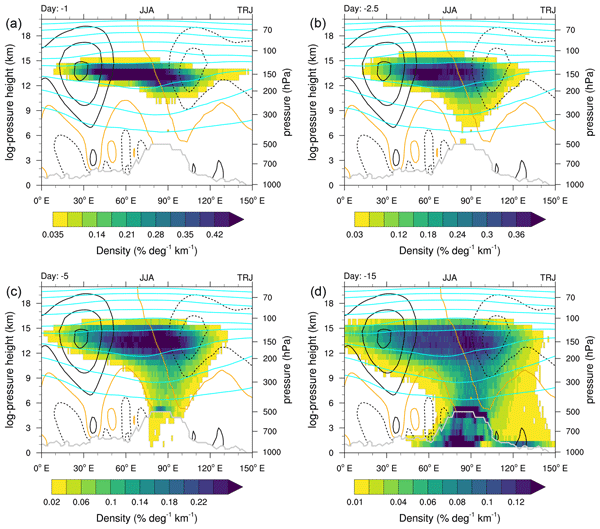
Matthias Nützel, Sabine Brinkop, Martin Dameris, Hella Garny, Patrick Jöckel, Laura L. Pan, and Mijeong Park
Atmos. Chem. Phys., 22, 15659–15683, https://doi.org/10.5194/acp-22-15659-2022, https://doi.org/10.5194/acp-22-15659-2022, 2022
Short summary
Short summary
During the Asian summer monsoon season, a large high-pressure system is present at levels close to the tropopause above Asia. We analyse how air masses are transported from surface levels to this high-pressure system, which shows distinct features from the surrounding air masses. To this end, we employ multiannual data from two complementary models that allow us to analyse the climatology as well as the interannual and intraseasonal variability of these transport pathways.
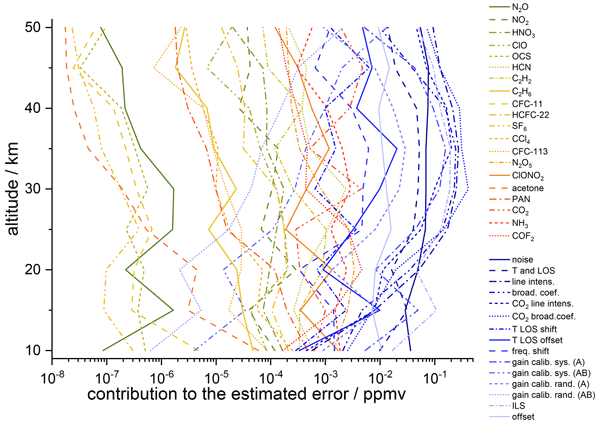
Thomas von Clarmann, Norbert Glatthor, Udo Grabowski, Bernd Funke, Michael Kiefer, Anne Kleinert, Gabriele P. Stiller, Andrea Linden, and Sylvia Kellmann
Atmos. Meas. Tech., 15, 6991–7018, https://doi.org/10.5194/amt-15-6991-2022, https://doi.org/10.5194/amt-15-6991-2022, 2022
Short summary
Short summary
Errors of profiles of temperature and mixing ratios retrieved from spectra recorded with the Michelson Interferometer for Passive Atmospheric Sounding are estimated. All known and quantified sources of uncertainty are considered. Some ongoing uncertaities contribute to both the random and to the systematic errors. In some cases, one source of uncertainty propagates onto the error budget via multiple pathways. Problems arise when the correlations of errors to be propagated are unknown.

Arseniy Karagodin-Doyennel, Eugene Rozanov, Timofei Sukhodolov, Tatiana Egorova, Jan Sedlacek, William Ball, and Thomas Peter
Atmos. Chem. Phys., 22, 15333–15350, https://doi.org/10.5194/acp-22-15333-2022, https://doi.org/10.5194/acp-22-15333-2022, 2022
Short summary
Short summary
Applying the dynamic linear model, we confirm near-global ozone recovery (55°N–55°S) in the mesosphere, upper and middle stratosphere, and a steady increase in the troposphere. We also show that modern chemistry–climate models (CCMs) like SOCOLv4 may reproduce the observed trend distribution of lower stratospheric ozone, despite exhibiting a lower magnitude and statistical significance. The obtained ozone trend pattern in SOCOLv4 is generally consistent with observations and reanalysis datasets.

Paul S. Jeffery, Kaley A. Walker, Chris E. Sioris, Chris D. Boone, Doug Degenstein, Gloria L. Manney, C. Thomas McElroy, Luis Millán, David A. Plummer, Niall J. Ryan, Patrick E. Sheese, and Jiansheng Zou
Atmos. Chem. Phys., 22, 14709–14734, https://doi.org/10.5194/acp-22-14709-2022, https://doi.org/10.5194/acp-22-14709-2022, 2022
Short summary
Short summary
The upper troposphere–lower stratosphere is one of the most variable regions in the atmosphere. To improve our understanding of water vapour and ozone concentrations in this region, climatologies have been developed from 14 years of measurements from three Canadian satellite instruments. Horizontal and vertical coordinates have been chosen to minimize the effects of variability. To aid in analysis, model simulations have been used to characterize differences between instrument climatologies.
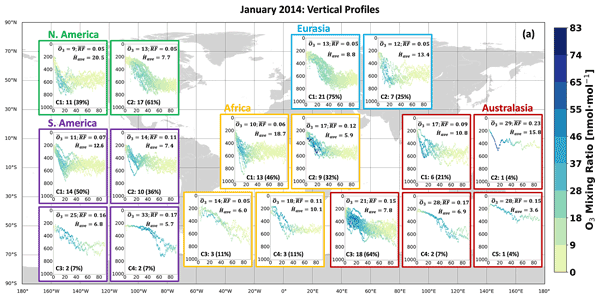
Jin Maruhashi, Volker Grewe, Christine Frömming, Patrick Jöckel, and Irene C. Dedoussi
Atmos. Chem. Phys., 22, 14253–14282, https://doi.org/10.5194/acp-22-14253-2022, https://doi.org/10.5194/acp-22-14253-2022, 2022
Short summary
Short summary
Aviation NOx emissions lead to the formation of ozone in the atmosphere in the short term, which has a climate warming effect. This study uses global-scale simulations to characterize the transport patterns between NOx emissions at an altitude of ~ 10.4 km and the resulting ozone. Results show a strong spatial and temporal dependence of NOx in disturbing atmospheric O3 concentrations, with the location that is most impacted in terms of warming not necessarily coinciding with the emission region.

Johannes Pletzer, Didier Hauglustaine, Yann Cohen, Patrick Jöckel, and Volker Grewe
Atmos. Chem. Phys., 22, 14323–14354, https://doi.org/10.5194/acp-22-14323-2022, https://doi.org/10.5194/acp-22-14323-2022, 2022
Short summary
Short summary
Very fast aircraft can travel long distances in extremely short times and can fly at high altitudes (15 to 35 km). These aircraft emit water vapour, nitrogen oxides, and hydrogen. Water vapour emissions remain for months to several years at these altitudes and have an important impact on temperature. We investigate two aircraft fleets flying at 26 and 35 km. Ozone is depleted more, and the water vapour perturbation and temperature change are larger for the aircraft flying at 35 km.
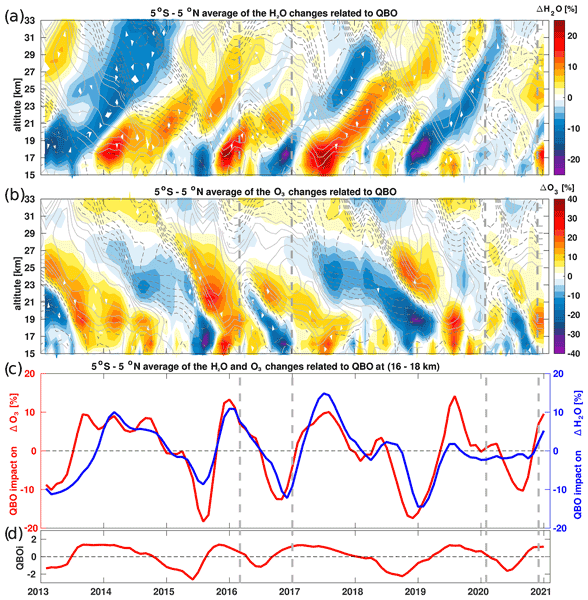
Mohamadou A. Diallo, Felix Ploeger, Michaela I. Hegglin, Manfred Ern, Jens-Uwe Grooß, Sergey Khaykin, and Martin Riese
Atmos. Chem. Phys., 22, 14303–14321, https://doi.org/10.5194/acp-22-14303-2022, https://doi.org/10.5194/acp-22-14303-2022, 2022
Short summary
Short summary
The quasi-biennial oacillation disruption events in both 2016 and 2020 decreased lower-stratospheric water vapour and ozone. Differences in the strength and depth of the anomalous lower-stratospheric circulation and ozone are due to differences in tropical upwelling and cold-point temperature induced by lower-stratospheric planetary and gravity wave breaking. The differences in water vapour are due to higher cold-point temperature in 2020 induced by Australian wildfire.
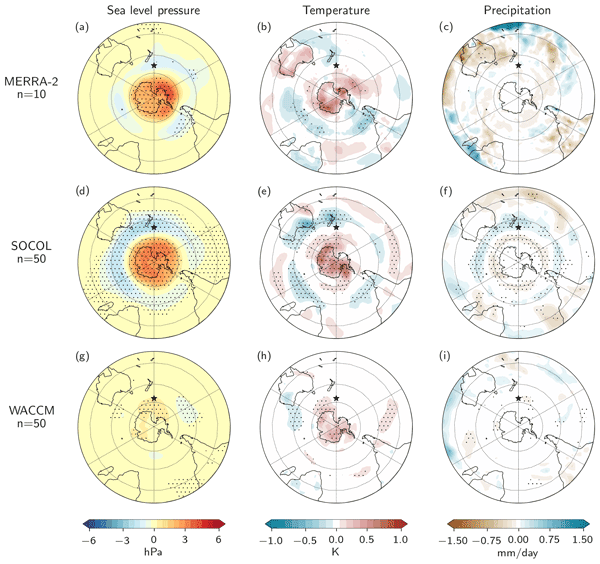
Nora Bergner, Marina Friedel, Daniela I. V. Domeisen, Darryn Waugh, and Gabriel Chiodo
Atmos. Chem. Phys., 22, 13915–13934, https://doi.org/10.5194/acp-22-13915-2022, https://doi.org/10.5194/acp-22-13915-2022, 2022
Short summary
Short summary
Polar vortex extremes, particularly situations with an unusually weak cyclonic circulation in the stratosphere, can influence the surface climate in the spring–summer time in the Southern Hemisphere. Using chemistry-climate models and observations, we evaluate the robustness of the surface impacts. While models capture the general surface response, they do not show the observed climate patterns in midlatitude regions, which we trace back to biases in the models' circulations.
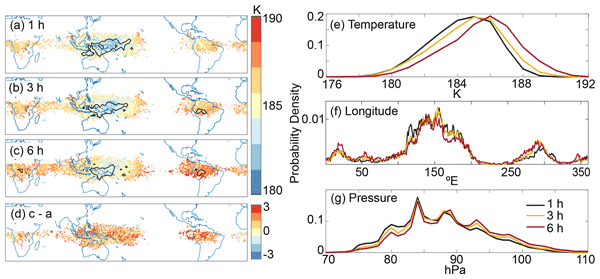
Stephen Bourguet and Marianna Linz
Atmos. Chem. Phys., 22, 13325–13339, https://doi.org/10.5194/acp-22-13325-2022, https://doi.org/10.5194/acp-22-13325-2022, 2022
Short summary
Short summary
Here, we tested the impact of spatial and temporal resolution on Lagrangian trajectory studies in a key region of interest for climate feedbacks and stratospheric chemistry. Our analysis shows that new higher-resolution input data provide an opportunity for a better understanding of physical processes that control how air moves from the troposphere to the stratosphere. Future studies of how these processes will change in a warming climate will benefit from these results.
Juan-Carlos Antuña-Marrero, Graham W. Mann, John Barnes, Abel Calle, Sandip S. Dhomse, Victoria E. Cachorro-Revilla, Terry Deshler, Li Zhengyao, Nimmi Sharma, and Louis Elterman
Earth Syst. Sci. Data Discuss., https://doi.org/10.5194/essd-2022-272, https://doi.org/10.5194/essd-2022-272, 2022
Revised manuscript not accepted
Short summary
Short summary
Tropospheric and stratospheric aerosol extinction profiles observations from a searchlight at New Mexico, US, were rescued and re-calibrated. Spanning between December 1963 and 1964, they measured the volcanic aerosols from the 1963 Agung eruption. Contemporary and state of the art information were used in the re-calibration. A unique and until the present forgotten/ignored dataset, it contributes current observational and modelling research on the impact of major volcanic eruptions on climate.
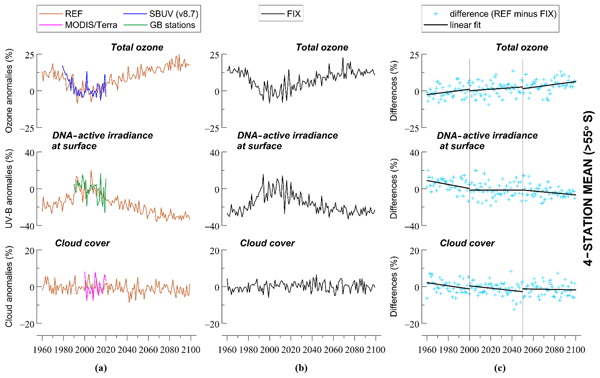
Kostas Eleftheratos, John Kapsomenakis, Ilias Fountoulakis, Christos S. Zerefos, Patrick Jöckel, Martin Dameris, Alkiviadis F. Bais, Germar Bernhard, Dimitra Kouklaki, Kleareti Tourpali, Scott Stierle, J. Ben Liley, Colette Brogniez, Frédérique Auriol, Henri Diémoz, Stana Simic, Irina Petropavlovskikh, Kaisa Lakkala, and Kostas Douvis
Atmos. Chem. Phys., 22, 12827–12855, https://doi.org/10.5194/acp-22-12827-2022, https://doi.org/10.5194/acp-22-12827-2022, 2022
Short summary
Short summary
We present the future evolution of DNA-active ultraviolet (UV) radiation in view of increasing greenhouse gases (GHGs) and decreasing ozone depleting substances (ODSs). It is shown that DNA-active UV radiation might increase after 2050 between 50° N–50° S due to GHG-induced reductions in clouds and ozone, something that is likely not to happen at high latitudes, where DNA-active UV radiation will continue its downward trend mainly due to stratospheric ozone recovery from the reduction in ODSs.
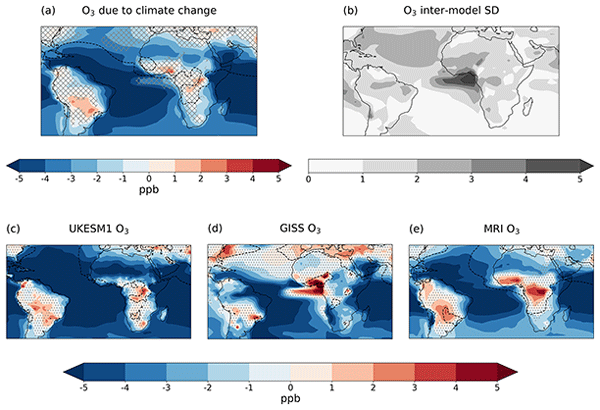
Flossie Brown, Gerd A. Folberth, Stephen Sitch, Susanne Bauer, Marijn Bauters, Pascal Boeckx, Alexander W. Cheesman, Makoto Deushi, Inês Dos Santos Vieira, Corinne Galy-Lacaux, James Haywood, James Keeble, Lina M. Mercado, Fiona M. O'Connor, Naga Oshima, Kostas Tsigaridis, and Hans Verbeeck
Atmos. Chem. Phys., 22, 12331–12352, https://doi.org/10.5194/acp-22-12331-2022, https://doi.org/10.5194/acp-22-12331-2022, 2022
Short summary
Short summary
Surface ozone can decrease plant productivity and impair human health. In this study, we evaluate the change in surface ozone due to climate change over South America and Africa using Earth system models. We find that if the climate were to change according to the worst-case scenario used here, models predict that forested areas in biomass burning locations and urban populations will be at increasing risk of ozone exposure, but other areas will experience a climate benefit.
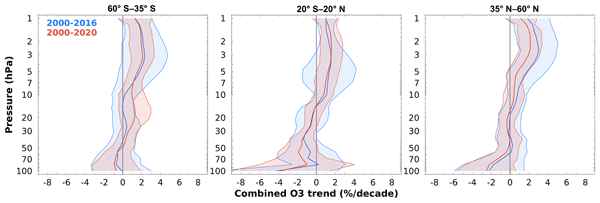
Sophie Godin-Beekmann, Niramson Azouz, Viktoria F. Sofieva, Daan Hubert, Irina Petropavlovskikh, Peter Effertz, Gérard Ancellet, Doug A. Degenstein, Daniel Zawada, Lucien Froidevaux, Stacey Frith, Jeannette Wild, Sean Davis, Wolfgang Steinbrecht, Thierry Leblanc, Richard Querel, Kleareti Tourpali, Robert Damadeo, Eliane Maillard Barras, René Stübi, Corinne Vigouroux, Carlo Arosio, Gerald Nedoluha, Ian Boyd, Roeland Van Malderen, Emmanuel Mahieu, Dan Smale, and Ralf Sussmann
Atmos. Chem. Phys., 22, 11657–11673, https://doi.org/10.5194/acp-22-11657-2022, https://doi.org/10.5194/acp-22-11657-2022, 2022
Short summary
Short summary
An updated evaluation up to 2020 of stratospheric ozone profile long-term trends at extrapolar latitudes based on satellite and ground-based records is presented. Ozone increase in the upper stratosphere is confirmed, with significant trends at most latitudes. In this altitude region, a very good agreement is found with trends derived from chemistry–climate model simulations. Observed and modelled trends diverge in the lower stratosphere, but the differences are non-significant.
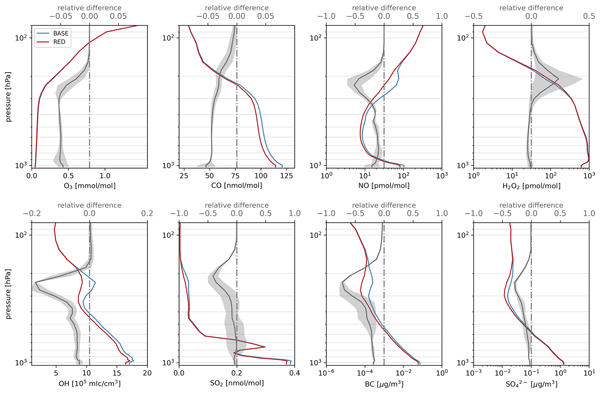
Simon F. Reifenberg, Anna Martin, Matthias Kohl, Sara Bacer, Zaneta Hamryszczak, Ivan Tadic, Lenard Röder, Daniel J. Crowley, Horst Fischer, Katharina Kaiser, Johannes Schneider, Raphael Dörich, John N. Crowley, Laura Tomsche, Andreas Marsing, Christiane Voigt, Andreas Zahn, Christopher Pöhlker, Bruna A. Holanda, Ovid Krüger, Ulrich Pöschl, Mira Pöhlker, Patrick Jöckel, Marcel Dorf, Ulrich Schumann, Jonathan Williams, Birger Bohn, Joachim Curtius, Hardwig Harder, Hans Schlager, Jos Lelieveld, and Andrea Pozzer
Atmos. Chem. Phys., 22, 10901–10917, https://doi.org/10.5194/acp-22-10901-2022, https://doi.org/10.5194/acp-22-10901-2022, 2022
Short summary
Short summary
In this work we use a combination of observational data from an aircraft campaign and model results to investigate the effect of the European lockdown due to COVID-19 in spring 2020. Using model results, we show that the largest relative changes to the atmospheric composition caused by the reduced emissions are located in the upper troposphere around aircraft cruise altitude, while the largest absolute changes are present at the surface.
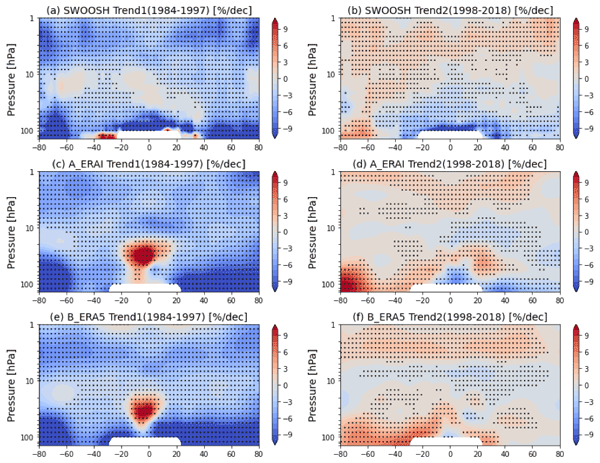
Yajuan Li, Sandip S. Dhomse, Martyn P. Chipperfield, Wuhu Feng, Andreas Chrysanthou, Yuan Xia, and Dong Guo
Atmos. Chem. Phys., 22, 10635–10656, https://doi.org/10.5194/acp-22-10635-2022, https://doi.org/10.5194/acp-22-10635-2022, 2022
Short summary
Short summary
Chemical transport models forced with (re)analysis meteorological fields are ideally suited for interpreting the influence of important physical processes on the ozone variability. We use TOMCAT forced by ECMWF ERA-Interim and ERA5 reanalysis data sets to investigate the effects of reanalysis forcing fields on ozone changes. Our results show that models forced by ERA5 reanalyses may not yet be capable of reproducing observed changes in stratospheric ozone, particularly in the lower stratosphere.
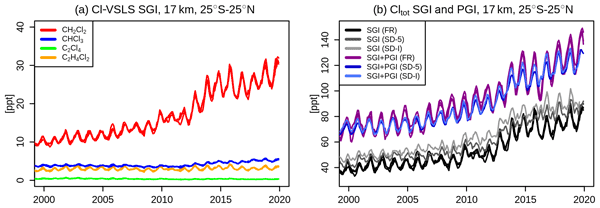
Ewa M. Bednarz, Ryan Hossaini, Martyn P. Chipperfield, N. Luke Abraham, and Peter Braesicke
Atmos. Chem. Phys., 22, 10657–10676, https://doi.org/10.5194/acp-22-10657-2022, https://doi.org/10.5194/acp-22-10657-2022, 2022
Short summary
Short summary
Atmospheric impacts of chlorinated very short-lived substances (Cl-VSLS) over the first two decades of the 21st century are assessed using the UM-UKCA chemistry–climate model. Stratospheric input of Cl from Cl-VSLS is estimated at ~130 ppt in 2019. The use of model set-up with constrained meteorology significantly increases the abundance of Cl-VSLS in the lower stratosphere relative to the free-running set-up. The growth in Cl-VSLS emissions significantly impacted recent HCl and COCl2 trends.
Zachary D. Lawrence, Marta Abalos, Blanca Ayarzagüena, David Barriopedro, Amy H. Butler, Natalia Calvo, Alvaro de la Cámara, Andrew Charlton-Perez, Daniela I. V. Domeisen, Etienne Dunn-Sigouin, Javier García-Serrano, Chaim I. Garfinkel, Neil P. Hindley, Liwei Jia, Martin Jucker, Alexey Y. Karpechko, Hera Kim, Andrea L. Lang, Simon H. Lee, Pu Lin, Marisol Osman, Froila M. Palmeiro, Judith Perlwitz, Inna Polichtchouk, Jadwiga H. Richter, Chen Schwartz, Seok-Woo Son, Irene Erner, Masakazu Taguchi, Nicholas L. Tyrrell, Corwin J. Wright, and Rachel W.-Y. Wu
Weather Clim. Dynam., 3, 977–1001, https://doi.org/10.5194/wcd-3-977-2022, https://doi.org/10.5194/wcd-3-977-2022, 2022
Short summary
Short summary
Forecast models that are used to predict weather often struggle to represent the Earth’s stratosphere. This may impact their ability to predict surface weather weeks in advance, on subseasonal-to-seasonal (S2S) timescales. We use data from many S2S forecast systems to characterize and compare the stratospheric biases present in such forecast models. These models have many similar stratospheric biases, but they tend to be worse in systems with low model tops located within the stratosphere.
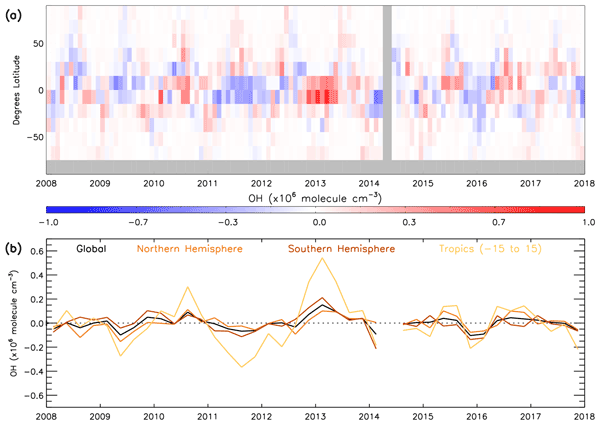
Matilda A. Pimlott, Richard J. Pope, Brian J. Kerridge, Barry G. Latter, Diane S. Knappett, Dwayne E. Heard, Lucy J. Ventress, Richard Siddans, Wuhu Feng, and Martyn P. Chipperfield
Atmos. Chem. Phys., 22, 10467–10488, https://doi.org/10.5194/acp-22-10467-2022, https://doi.org/10.5194/acp-22-10467-2022, 2022
Short summary
Short summary
We present a new method to derive global information of the hydroxyl radical (OH), an important atmospheric oxidant. OH controls the lifetime of trace gases important to air quality and climate. We use satellite observations of ozone, carbon monoxide, methane and water vapour in a simple expression to derive OH around 3–4 km altitude. The derived OH compares well to model and aircraft OH data. We then apply the method to 10 years of satellite data to study the inter-annual variability of OH.

Jonas Spaeth and Thomas Birner
Weather Clim. Dynam., 3, 883–903, https://doi.org/10.5194/wcd-3-883-2022, https://doi.org/10.5194/wcd-3-883-2022, 2022
Short summary
Short summary
Past research has demonstrated robust stratosphere–troposphere dynamical coupling following stratospheric circulation extremes. Here, we use a large set of extended-range ensemble forecasts to robustly quantify the increased risk for tropospheric circulation extremes following stratospheric extreme events. In particular, we provide estimates of the fraction of tropospheric extremes that may be attributable to preceding stratospheric extremes.
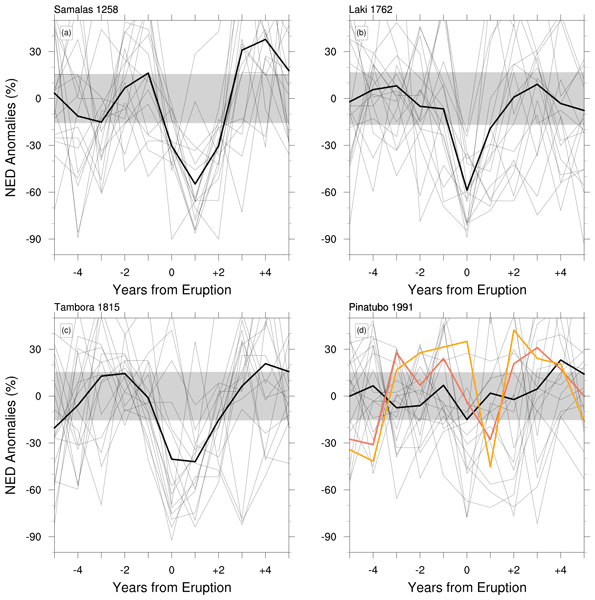
Stergios Misios, Ioannis Logothetis, Mads F. Knudsen, Christoffer Karoff, Vassilis Amiridis, and Kleareti Tourpali
Weather Clim. Dynam., 3, 811–823, https://doi.org/10.5194/wcd-3-811-2022, https://doi.org/10.5194/wcd-3-811-2022, 2022
Short summary
Short summary
We investigate the impact of strong volcanic eruptions on the northerly Etesian winds blowing in the eastern Mediterranean. Μodel simulations of the last millennium demonstrate a robust reduction in the total number of days with Etesian winds in the post-eruption summers. The decline in the Etesian winds is attributed to a weakened Indian summer monsoon in the post-eruption summer. These findings could improve seasonal predictions of the wind circulation in the eastern Mediterranean.
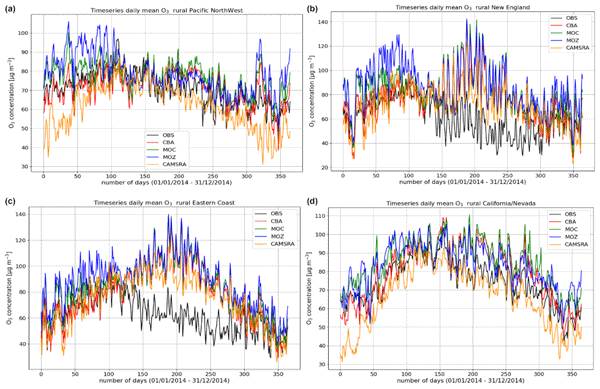
Jason E. Williams, Vincent Huijnen, Idir Bouarar, Mehdi Meziane, Timo Schreurs, Sophie Pelletier, Virginie Marécal, Beatrice Josse, and Johannes Flemming
Geosci. Model Dev., 15, 4657–4687, https://doi.org/10.5194/gmd-15-4657-2022, https://doi.org/10.5194/gmd-15-4657-2022, 2022
Short summary
Short summary
The global CAMS air quality model is used for providing tropospheric ozone information to end users. This paper updates the chemical mechanism employed (CBA) and compares it against two other mechanisms (MOCAGE, MOZART) and a multi-decadal dataset based on a previous version of CBA. We perform extensive validation for the US using multiple surface and aircraft datasets, providing an assessment of biases and the extent of correlation across different seasons during 2014.
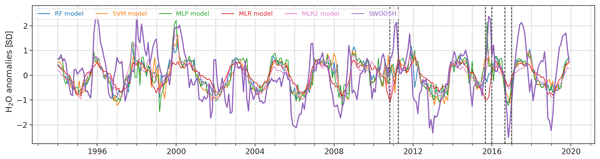
Shlomi Ziskin Ziv, Chaim I. Garfinkel, Sean Davis, and Antara Banerjee
Atmos. Chem. Phys., 22, 7523–7538, https://doi.org/10.5194/acp-22-7523-2022, https://doi.org/10.5194/acp-22-7523-2022, 2022
Short summary
Short summary
Stratospheric water vapor is important for Earth's overall greenhouse effect and for ozone chemistry; however the factors governing its variability on interannual timescales are not fully known, and previous modeling studies have indicated that models struggle to capture this interannual variability. We demonstrate that nonlinear interactions are important for determining overall water vapor concentrations and also that models have improved in their ability to capture these connections.
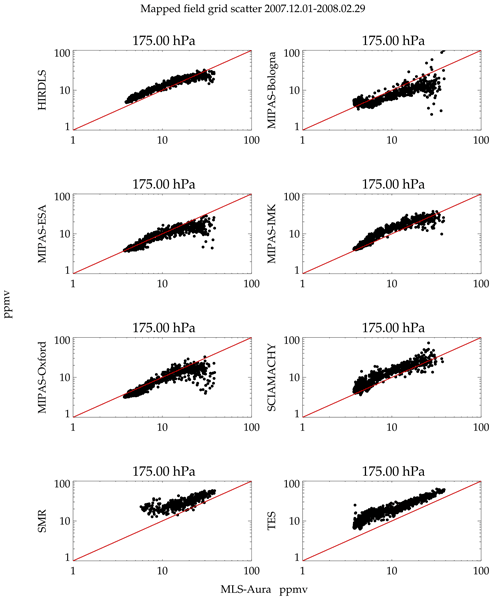
William G. Read, Gabriele Stiller, Stefan Lossow, Michael Kiefer, Farahnaz Khosrawi, Dale Hurst, Holger Vömel, Karen Rosenlof, Bianca M. Dinelli, Piera Raspollini, Gerald E. Nedoluha, John C. Gille, Yasuko Kasai, Patrick Eriksson, Christopher E. Sioris, Kaley A. Walker, Katja Weigel, John P. Burrows, and Alexei Rozanov
Atmos. Meas. Tech., 15, 3377–3400, https://doi.org/10.5194/amt-15-3377-2022, https://doi.org/10.5194/amt-15-3377-2022, 2022
Short summary
Short summary
This paper attempts to provide an assessment of the accuracy of 21 satellite-based instruments that remotely measure atmospheric humidity in the upper troposphere of the Earth's atmosphere. The instruments made their measurements from 1984 to the present time; however, most of these instruments began operations after 2000, and only a few are still operational. The objective of this study is to quantify the accuracy of each satellite humidity data set.
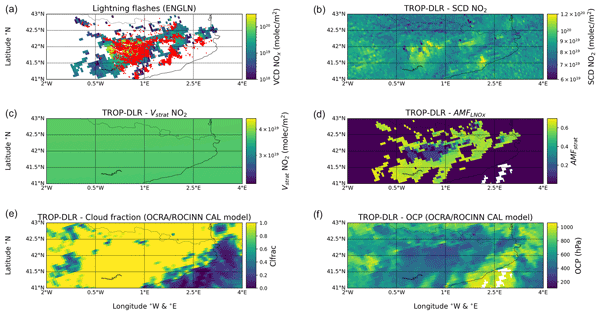
Francisco J. Pérez-Invernón, Heidi Huntrieser, Thilo Erbertseder, Diego Loyola, Pieter Valks, Song Liu, Dale J. Allen, Kenneth E. Pickering, Eric J. Bucsela, Patrick Jöckel, Jos van Geffen, Henk Eskes, Sergio Soler, Francisco J. Gordillo-Vázquez, and Jeff Lapierre
Atmos. Meas. Tech., 15, 3329–3351, https://doi.org/10.5194/amt-15-3329-2022, https://doi.org/10.5194/amt-15-3329-2022, 2022
Short summary
Short summary
Lightning, one of the major sources of nitrogen oxides in the atmosphere, contributes to the tropospheric concentration of ozone and to the oxidizing capacity of the atmosphere. In this work, we contribute to improving the estimation of lightning-produced nitrogen oxides in the Ebro Valley and the Pyrenees by using two different TROPOMI products and comparing the results.

Mark Weber, Carlo Arosio, Melanie Coldewey-Egbers, Vitali E. Fioletov, Stacey M. Frith, Jeannette D. Wild, Kleareti Tourpali, John P. Burrows, and Diego Loyola
Atmos. Chem. Phys., 22, 6843–6859, https://doi.org/10.5194/acp-22-6843-2022, https://doi.org/10.5194/acp-22-6843-2022, 2022
Short summary
Short summary
Long-term trends in column ozone have been determined from five merged total ozone datasets spanning the period 1978–2020. We show that ozone recovery due to the decline in stratospheric halogens after the 1990s (as regulated by the Montreal Protocol) is evident outside the tropical region and amounts to half a percent per decade. The ozone recovery in the Northern Hemisphere is however compensated for by the negative long-term trend contribution from atmospheric dynamics since the year 2000.
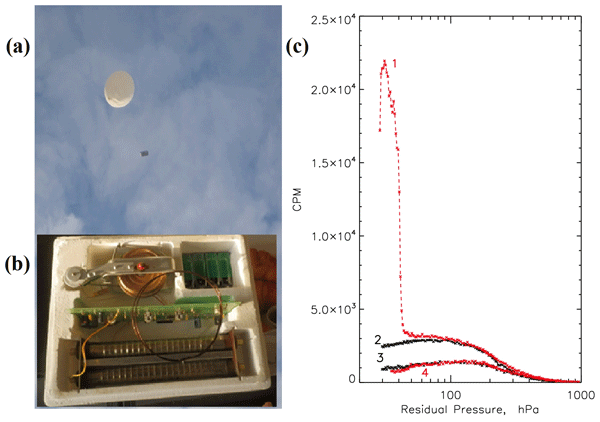
Irina Mironova, Miriam Sinnhuber, Galina Bazilevskaya, Mark Clilverd, Bernd Funke, Vladimir Makhmutov, Eugene Rozanov, Michelle L. Santee, Timofei Sukhodolov, and Thomas Ulich
Atmos. Chem. Phys., 22, 6703–6716, https://doi.org/10.5194/acp-22-6703-2022, https://doi.org/10.5194/acp-22-6703-2022, 2022
Short summary
Short summary
From balloon measurements, we detected unprecedented, extremely powerful, electron precipitation over the middle latitudes. The robustness of this event is confirmed by satellite observations of electron fluxes and chemical composition, as well as by ground-based observations of the radio signal propagation. The applied chemistry–climate model shows the almost complete destruction of ozone in the mesosphere over the region where high-energy electrons were observed.
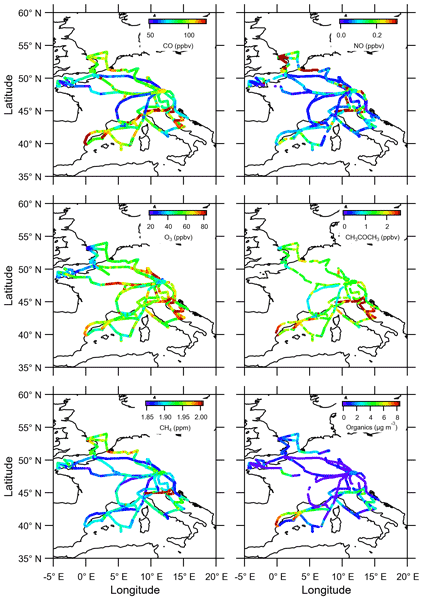
M. Dolores Andrés Hernández, Andreas Hilboll, Helmut Ziereis, Eric Förster, Ovid O. Krüger, Katharina Kaiser, Johannes Schneider, Francesca Barnaba, Mihalis Vrekoussis, Jörg Schmidt, Heidi Huntrieser, Anne-Marlene Blechschmidt, Midhun George, Vladyslav Nenakhov, Theresa Harlass, Bruna A. Holanda, Jennifer Wolf, Lisa Eirenschmalz, Marc Krebsbach, Mira L. Pöhlker, Anna B. Kalisz Hedegaard, Linlu Mei, Klaus Pfeilsticker, Yangzhuoran Liu, Ralf Koppmann, Hans Schlager, Birger Bohn, Ulrich Schumann, Andreas Richter, Benjamin Schreiner, Daniel Sauer, Robert Baumann, Mariano Mertens, Patrick Jöckel, Markus Kilian, Greta Stratmann, Christopher Pöhlker, Monica Campanelli, Marco Pandolfi, Michael Sicard, José L. Gómez-Amo, Manuel Pujadas, Katja Bigge, Flora Kluge, Anja Schwarz, Nikos Daskalakis, David Walter, Andreas Zahn, Ulrich Pöschl, Harald Bönisch, Stephan Borrmann, Ulrich Platt, and John P. Burrows
Atmos. Chem. Phys., 22, 5877–5924, https://doi.org/10.5194/acp-22-5877-2022, https://doi.org/10.5194/acp-22-5877-2022, 2022
Short summary
Short summary
EMeRGe provides a unique set of in situ and remote sensing airborne measurements of trace gases and aerosol particles along selected flight routes in the lower troposphere over Europe. The interpretation uses also complementary collocated ground-based and satellite measurements. The collected data help to improve the current understanding of the complex spatial distribution of trace gases and aerosol particles resulting from mixing, transport, and transformation of pollution plumes over Europe.
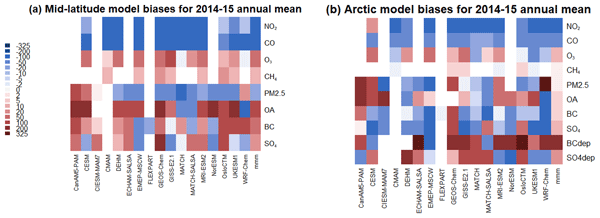
Cynthia H. Whaley, Rashed Mahmood, Knut von Salzen, Barbara Winter, Sabine Eckhardt, Stephen Arnold, Stephen Beagley, Silvia Becagli, Rong-You Chien, Jesper Christensen, Sujay Manish Damani, Xinyi Dong, Konstantinos Eleftheriadis, Nikolaos Evangeliou, Gregory Faluvegi, Mark Flanner, Joshua S. Fu, Michael Gauss, Fabio Giardi, Wanmin Gong, Jens Liengaard Hjorth, Lin Huang, Ulas Im, Yugo Kanaya, Srinath Krishnan, Zbigniew Klimont, Thomas Kühn, Joakim Langner, Kathy S. Law, Louis Marelle, Andreas Massling, Dirk Olivié, Tatsuo Onishi, Naga Oshima, Yiran Peng, David A. Plummer, Olga Popovicheva, Luca Pozzoli, Jean-Christophe Raut, Maria Sand, Laura N. Saunders, Julia Schmale, Sangeeta Sharma, Ragnhild Bieltvedt Skeie, Henrik Skov, Fumikazu Taketani, Manu A. Thomas, Rita Traversi, Kostas Tsigaridis, Svetlana Tsyro, Steven Turnock, Vito Vitale, Kaley A. Walker, Minqi Wang, Duncan Watson-Parris, and Tahya Weiss-Gibbons
Atmos. Chem. Phys., 22, 5775–5828, https://doi.org/10.5194/acp-22-5775-2022, https://doi.org/10.5194/acp-22-5775-2022, 2022
Short summary
Short summary
Air pollutants, like ozone and soot, play a role in both global warming and air quality. Atmospheric models are often used to provide information to policy makers about current and future conditions under different emissions scenarios. In order to have confidence in those simulations, in this study we compare simulated air pollution from 18 state-of-the-art atmospheric models to measured air pollution in order to assess how well the models perform.
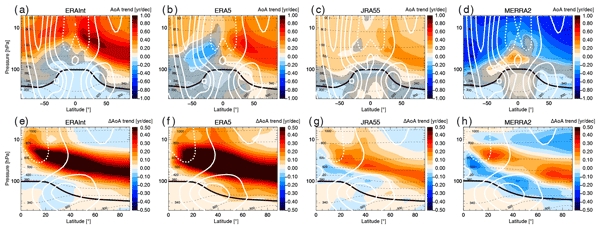
Felix Ploeger and Hella Garny
Atmos. Chem. Phys., 22, 5559–5576, https://doi.org/10.5194/acp-22-5559-2022, https://doi.org/10.5194/acp-22-5559-2022, 2022
Short summary
Short summary
We investigate hemispheric asymmetries in stratospheric circulation changes in the last 2 decades in model simulations and atmospheric observations. We find that observed trace gas changes can be explained by a structural circulation change related to a deepening circulation in the Northern Hemisphere relative to the Southern Hemisphere. As this asymmetric signal is small compared to internal variability observed circulation trends over the recent past are not in contradiction to climate models.
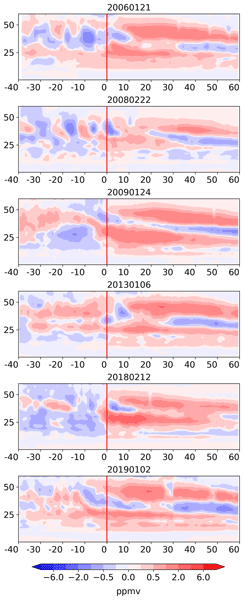
Shima Bahramvash Shams, Von P. Walden, James W. Hannigan, William J. Randel, Irina V. Petropavlovskikh, Amy H. Butler, and Alvaro de la Cámara
Atmos. Chem. Phys., 22, 5435–5458, https://doi.org/10.5194/acp-22-5435-2022, https://doi.org/10.5194/acp-22-5435-2022, 2022
Short summary
Short summary
Large-scale atmospheric circulation has a strong influence on ozone in the Arctic, and certain anomalous dynamical events, such as sudden stratospheric warmings, cause dramatic alterations of the large-scale circulation. A reanalysis model is evaluated and then used to investigate the impact of sudden stratospheric warmings on mid-atmospheric ozone. Results show that the position of the cold jet stream over the Arctic before these events influences the variability of ozone.
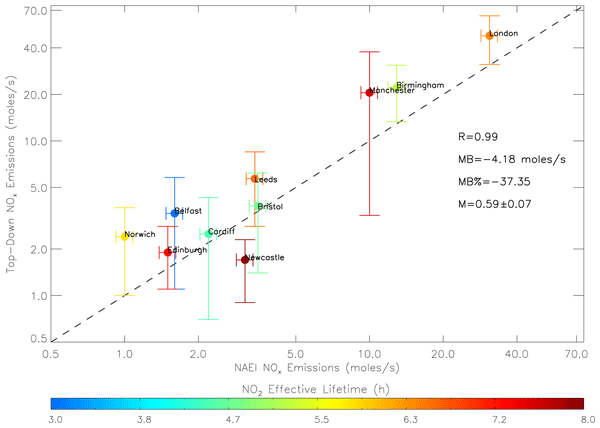
Richard J. Pope, Rebecca Kelly, Eloise A. Marais, Ailish M. Graham, Chris Wilson, Jeremy J. Harrison, Savio J. A. Moniz, Mohamed Ghalaieny, Steve R. Arnold, and Martyn P. Chipperfield
Atmos. Chem. Phys., 22, 4323–4338, https://doi.org/10.5194/acp-22-4323-2022, https://doi.org/10.5194/acp-22-4323-2022, 2022
Short summary
Short summary
Nitrogen oxides (NOx) are potent air pollutants which directly impact on human health. In this study, we use satellite nitrogen dioxide (NO2) data to evaluate the spatial distribution and temporal evolution of the UK official NOx emissions inventory, with reasonable agreement. We also derived satellite-based NOx emissions for several UK cities. In the case of London and Birmingham, the NAEI NOx emissions are potentially too low by >50%.

Beatriz M. Monge-Sanz, Alessio Bozzo, Nicholas Byrne, Martyn P. Chipperfield, Michail Diamantakis, Johannes Flemming, Lesley J. Gray, Robin J. Hogan, Luke Jones, Linus Magnusson, Inna Polichtchouk, Theodore G. Shepherd, Nils Wedi, and Antje Weisheimer
Atmos. Chem. Phys., 22, 4277–4302, https://doi.org/10.5194/acp-22-4277-2022, https://doi.org/10.5194/acp-22-4277-2022, 2022
Short summary
Short summary
The stratosphere is emerging as one of the keys to improve tropospheric weather and climate predictions. This study provides evidence of the role the stratospheric ozone layer plays in improving weather predictions at different timescales. Using a new ozone modelling approach suitable for high-resolution global models that provide operational forecasts from days to seasons, we find significant improvements in stratospheric meteorological fields and stratosphere–troposphere coupling.
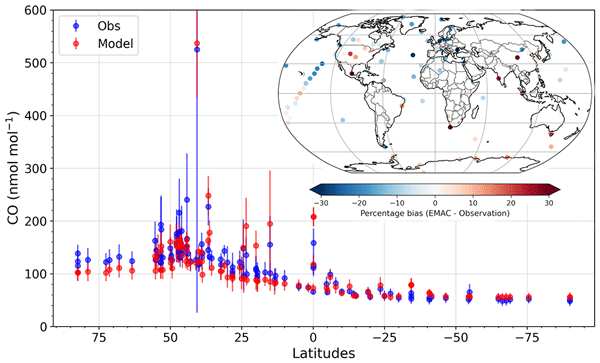
Andrea Pozzer, Simon F. Reifenberg, Vinod Kumar, Bruno Franco, Matthias Kohl, Domenico Taraborrelli, Sergey Gromov, Sebastian Ehrhart, Patrick Jöckel, Rolf Sander, Veronica Fall, Simon Rosanka, Vlassis Karydis, Dimitris Akritidis, Tamara Emmerichs, Monica Crippa, Diego Guizzardi, Johannes W. Kaiser, Lieven Clarisse, Astrid Kiendler-Scharr, Holger Tost, and Alexandra Tsimpidi
Geosci. Model Dev., 15, 2673–2710, https://doi.org/10.5194/gmd-15-2673-2022, https://doi.org/10.5194/gmd-15-2673-2022, 2022
Short summary
Short summary
A newly developed setup of the chemistry general circulation model EMAC (ECHAM5/MESSy for Atmospheric Chemistry) is evaluated here. A comprehensive organic degradation mechanism is used and coupled with a volatility base model.
The results show that the model reproduces most of the tracers and aerosols satisfactorily but shows discrepancies for oxygenated organic gases. It is also shown that this model configuration can be used for further research in atmospheric chemistry.
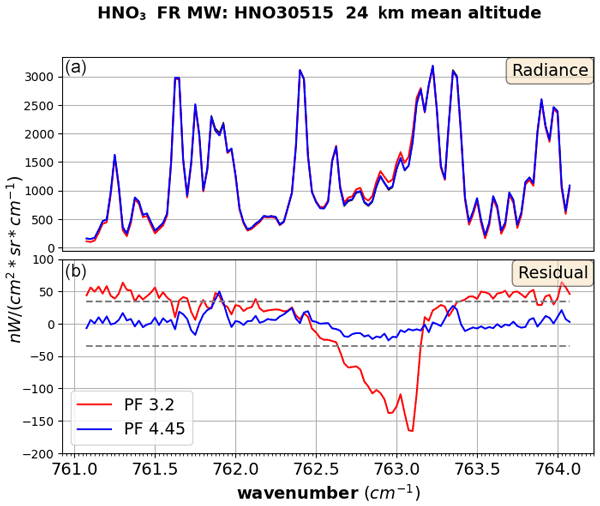
Piera Raspollini, Enrico Arnone, Flavio Barbara, Massimo Bianchini, Bruno Carli, Simone Ceccherini, Martyn P. Chipperfield, Angelika Dehn, Stefano Della Fera, Bianca Maria Dinelli, Anu Dudhia, Jean-Marie Flaud, Marco Gai, Michael Kiefer, Manuel López-Puertas, David P. Moore, Alessandro Piro, John J. Remedios, Marco Ridolfi, Harjinder Sembhi, Luca Sgheri, and Nicola Zoppetti
Atmos. Meas. Tech., 15, 1871–1901, https://doi.org/10.5194/amt-15-1871-2022, https://doi.org/10.5194/amt-15-1871-2022, 2022
Short summary
Short summary
The MIPAS instrument onboard the ENVISAT satellite provided 10 years of measurements of the atmospheric emission al limb that allow for the retrieval of latitude- and altitude-resolved atmospheric composition. We describe the improvements implemented in the retrieval algorithm used for the full mission reanalysis, which allows for the generation of the global distributions of 21 atmospheric constituents plus temperature with increased accuracy with respect to previously generated data.

Dai Koshin, Kaoru Sato, Masashi Kohma, and Shingo Watanabe
Geosci. Model Dev., 15, 2293–2307, https://doi.org/10.5194/gmd-15-2293-2022, https://doi.org/10.5194/gmd-15-2293-2022, 2022
Short summary
Short summary
The 4D ensemble Kalman filter data assimilation system for the whole neutral atmosphere has been updated. The update includes the introduction of a filter to reduce the generation of spurious waves, change in the order of horizontal diffusion of the forecast model to reproduce more realistic tidal amplitudes, and use of additional satellite observations. As a result, the analysis performance has been greatly improved, even for disturbances with periods of less than 1 d.
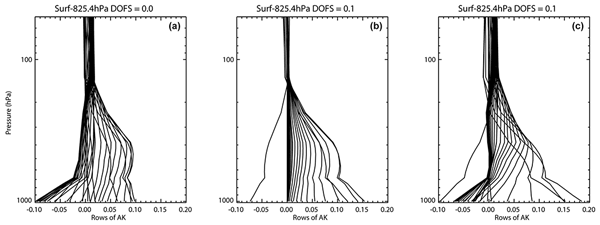
Vijay Natraj, Ming Luo, Jean-Francois Blavier, Vivienne H. Payne, Derek J. Posselt, Stanley P. Sander, Zhao-Cheng Zeng, Jessica L. Neu, Denis Tremblay, Longtao Wu, Jacola A. Roman, Yen-Hung Wu, and Leonard I. Dorsky
Atmos. Meas. Tech., 15, 1251–1267, https://doi.org/10.5194/amt-15-1251-2022, https://doi.org/10.5194/amt-15-1251-2022, 2022
Short summary
Short summary
High-fidelity monitoring and forecast of air quality and the hydrological cycle require understanding the vertical distribution of temperature, humidity, and trace gases at high spatiotemporal resolution. We describe a new instrument concept, called the JPL GEO-IR Sounder, that would provide this information for the first time from a single instrument platform. Simulations demonstrate the benefits of combining measurements from multiple wavelengths for this purpose from geostationary orbit.
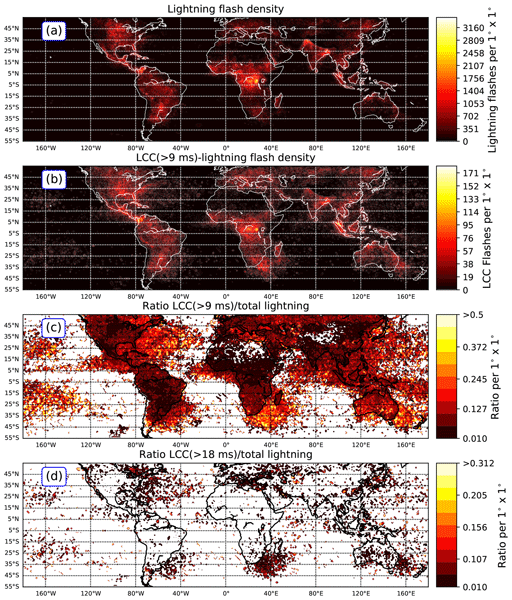
Francisco J. Pérez-Invernón, Heidi Huntrieser, Patrick Jöckel, and Francisco J. Gordillo-Vázquez
Geosci. Model Dev., 15, 1545–1565, https://doi.org/10.5194/gmd-15-1545-2022, https://doi.org/10.5194/gmd-15-1545-2022, 2022
Short summary
Short summary
This study reports the first parameterization of long-continuing-current lightning in a climate model. Long-continuing-current lightning is proposed to be the main precursor of lightning-ignited wildfires and sprites, a type of transient luminous event taking place in the mesosphere. This parameterization can significantly contribute to improving the implementation of wildfires in climate models.

Sheena Loeffel, Roland Eichinger, Hella Garny, Thomas Reddmann, Frauke Fritsch, Stefan Versick, Gabriele Stiller, and Florian Haenel
Atmos. Chem. Phys., 22, 1175–1193, https://doi.org/10.5194/acp-22-1175-2022, https://doi.org/10.5194/acp-22-1175-2022, 2022
Short summary
Short summary
SF6-derived trends of stratospheric AoA from observations and model simulations disagree in sign. SF6 experiences chemical degradation, which we explicitly integrate in a global climate model. In our simulations, the AoA trend changes sign when SF6 sinks are considered; thus, the process has the potential to reconcile simulated with observed AoA trends. We show that the positive AoA trend is due to the SF6 sinks themselves and provide a first approach for a correction to account for SF6 loss.
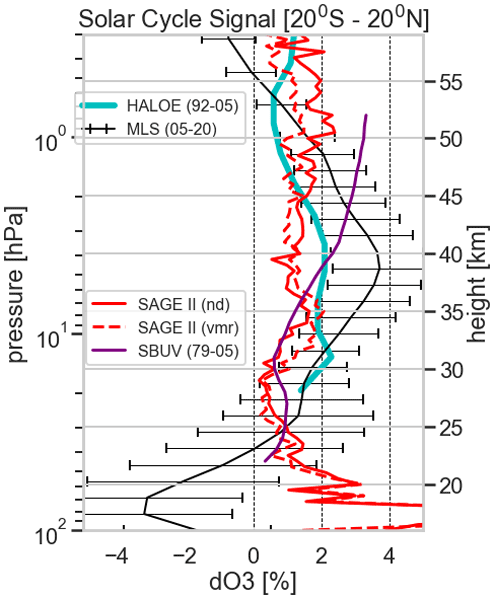
Sandip S. Dhomse, Martyn P. Chipperfield, Wuhu Feng, Ryan Hossaini, Graham W. Mann, Michelle L. Santee, and Mark Weber
Atmos. Chem. Phys., 22, 903–916, https://doi.org/10.5194/acp-22-903-2022, https://doi.org/10.5194/acp-22-903-2022, 2022
Short summary
Short summary
Solar flux variations associated with 11-year sunspot cycle is believed to exert important external climate forcing. As largest variations occur at shorter wavelengths such as ultra-violet part of the solar spectrum, associated changes in stratospheric ozone are thought to provide direct evidence for solar climate interaction. Until now, most of the studies reported double-peak structured solar cycle signal (SCS), but relatively new satellite data suggest only single-peak-structured SCS.
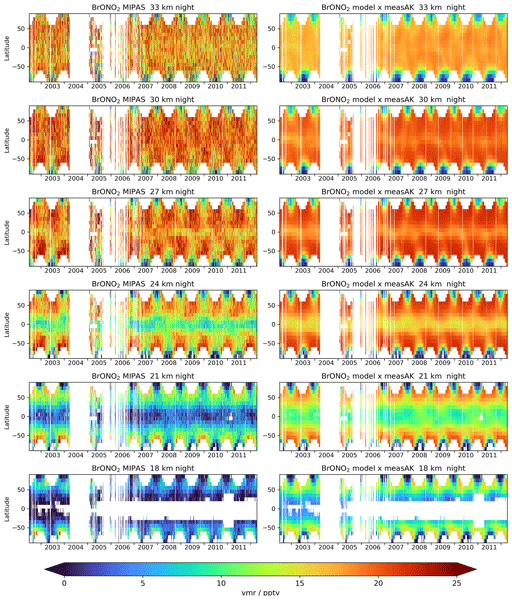
Michael Höpfner, Oliver Kirner, Gerald Wetzel, Björn-Martin Sinnhuber, Florian Haenel, Sören Johansson, Johannes Orphal, Roland Ruhnke, Gabriele Stiller, and Thomas von Clarmann
Atmos. Chem. Phys., 21, 18433–18464, https://doi.org/10.5194/acp-21-18433-2021, https://doi.org/10.5194/acp-21-18433-2021, 2021
Short summary
Short summary
BrONO2 is an important reservoir gas for inorganic stratospheric bromine linked to the chemical cycles of stratospheric ozone depletion. Presently infrared limb sounding is the only way to measure BrONO2 in the atmosphere. We provide global distributions of BrONO2 derived from MIPAS observations 2002–2012. Comparisons with EMAC atmospheric modelling show an overall agreement and enable us to derive an independent estimate of stratospheric bromine of 21.2±1.4pptv based on the BrONO2 measurements.
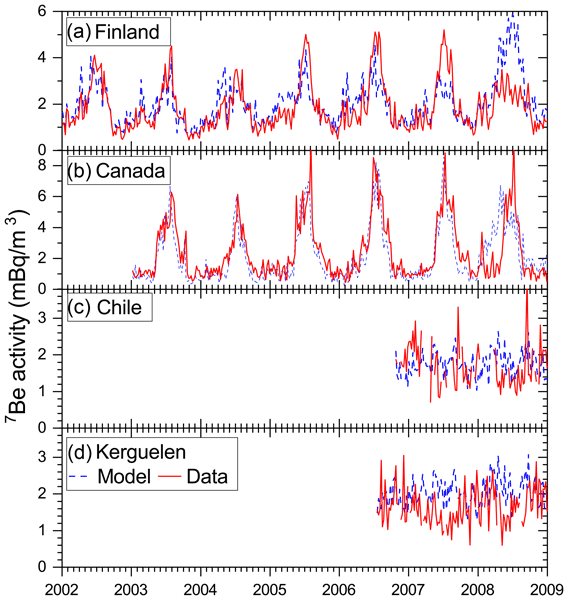
Kseniia Golubenko, Eugene Rozanov, Gennady Kovaltsov, Ari-Pekka Leppänen, Timofei Sukhodolov, and Ilya Usoskin
Geosci. Model Dev., 14, 7605–7620, https://doi.org/10.5194/gmd-14-7605-2021, https://doi.org/10.5194/gmd-14-7605-2021, 2021
Short summary
Short summary
A new full 3-D time-dependent model, based on SOCOL-AERv2, of beryllium atmospheric production, transport, and deposition has been developed and validated using directly measured data. The model is recommended to be used in studies related to, e.g., atmospheric dynamical patterns, extreme solar particle storms, long-term solar activity reconstruction from cosmogenic proxy data, and solar–terrestrial relations.
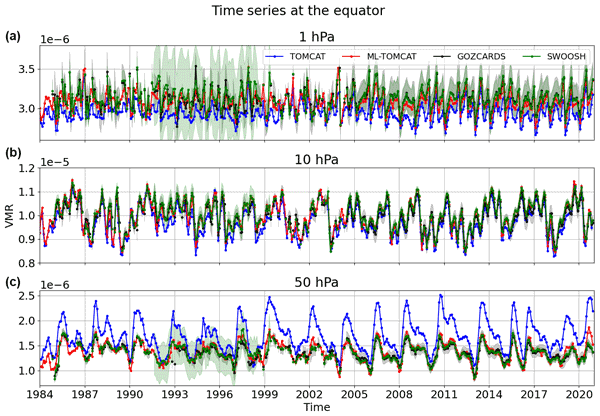
Sandip S. Dhomse, Carlo Arosio, Wuhu Feng, Alexei Rozanov, Mark Weber, and Martyn P. Chipperfield
Earth Syst. Sci. Data, 13, 5711–5729, https://doi.org/10.5194/essd-13-5711-2021, https://doi.org/10.5194/essd-13-5711-2021, 2021
Short summary
Short summary
High-quality long-term ozone profile data sets are key to estimating short- and long-term ozone variability. Almost all the satellite (and chemical model) data sets show some kind of bias with respect to each other. This is because of differences in measurement methodologies as well as simplified processes in the models. We use satellite data sets and chemical model output to generate 42 years of ozone profile data sets using a random-forest machine-learning algorithm that is named ML-TOMCAT.
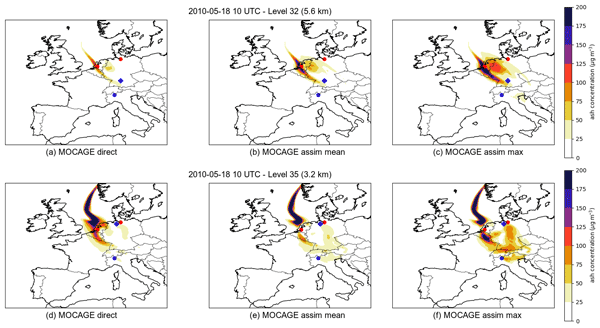
Matthieu Plu, Guillaume Bigeard, Bojan Sič, Emanuele Emili, Luca Bugliaro, Laaziz El Amraoui, Jonathan Guth, Beatrice Josse, Lucia Mona, and Dennis Piontek
Nat. Hazards Earth Syst. Sci., 21, 3731–3747, https://doi.org/10.5194/nhess-21-3731-2021, https://doi.org/10.5194/nhess-21-3731-2021, 2021
Short summary
Short summary
Volcanic eruptions that spread out ash over large areas, like Eyjafjallajökull in 2010, may have huge economic consequences due to flight cancellations. In this article, we demonstrate the benefits of source term improvement and of data assimilation for quantifying volcanic ash concentrations. The work, which was supported by the EUNADICS-AV project, is the first one, to our knowledge, that demonstrates the benefit of the assimilation of ground-based lidar data over Europe during an eruption.
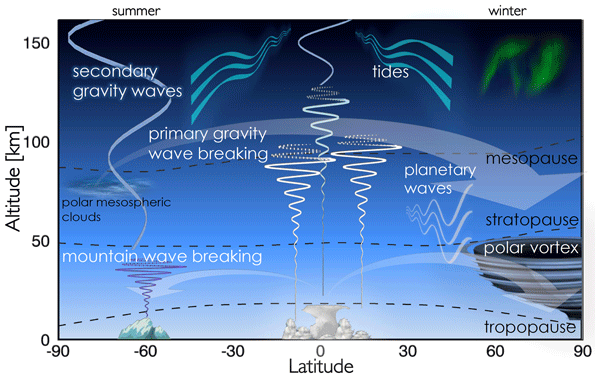
John P. McCormack, V. Lynn Harvey, Cora E. Randall, Nicholas Pedatella, Dai Koshin, Kaoru Sato, Lawrence Coy, Shingo Watanabe, Fabrizio Sassi, and Laura A. Holt
Atmos. Chem. Phys., 21, 17577–17605, https://doi.org/10.5194/acp-21-17577-2021, https://doi.org/10.5194/acp-21-17577-2021, 2021
Short summary
Short summary
In order to have confidence in atmospheric predictions, it is important to know how well different numerical model simulations of the Earth’s atmosphere agree with one another. This work compares four different data assimilation models that extend to or beyond the mesosphere. Results shown here demonstrate that while the models are in close agreement below ~50 km, large differences arise at higher altitudes in the mesosphere and lower thermosphere that will need to be reconciled in the future.
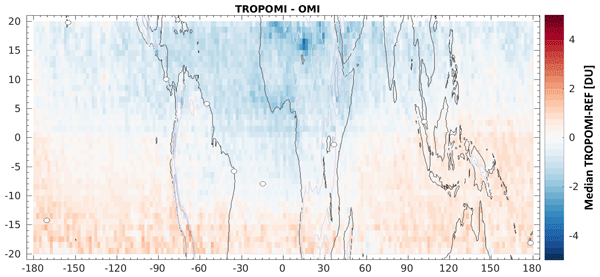
Daan Hubert, Klaus-Peter Heue, Jean-Christopher Lambert, Tijl Verhoelst, Marc Allaart, Steven Compernolle, Patrick D. Cullis, Angelika Dehn, Christian Félix, Bryan J. Johnson, Arno Keppens, Debra E. Kollonige, Christophe Lerot, Diego Loyola, Matakite Maata, Sukarni Mitro, Maznorizan Mohamad, Ankie Piters, Fabian Romahn, Henry B. Selkirk, Francisco R. da Silva, Ryan M. Stauffer, Anne M. Thompson, J. Pepijn Veefkind, Holger Vömel, Jacquelyn C. Witte, and Claus Zehner
Atmos. Meas. Tech., 14, 7405–7433, https://doi.org/10.5194/amt-14-7405-2021, https://doi.org/10.5194/amt-14-7405-2021, 2021
Short summary
Short summary
We assess the first 2 years of TROPOMI tropical tropospheric ozone column data. Comparisons to reference measurements by ozonesonde and satellite sensors show that TROPOMI bias (−0.1 to +2.3 DU) and precision (1.5 to 2.5 DU) meet mission requirements. Potential causes of bias and its spatio-temporal structure are discussed, as well as ways to identify sampling errors. Our analysis of known geophysical patterns demonstrates the improved performance of TROPOMI with respect to its predecessors.
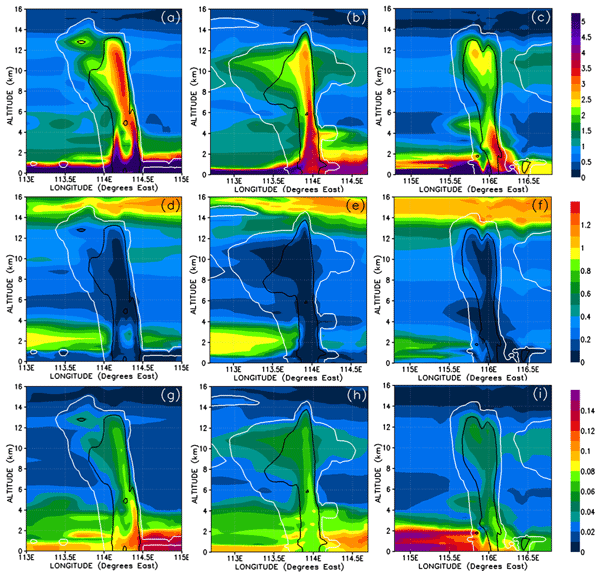
Paul D. Hamer, Virginie Marécal, Ryan Hossaini, Michel Pirre, Gisèle Krysztofiak, Franziska Ziska, Andreas Engel, Stephan Sala, Timo Keber, Harald Bönisch, Elliot Atlas, Kirstin Krüger, Martyn Chipperfield, Valery Catoire, Azizan A. Samah, Marcel Dorf, Phang Siew Moi, Hans Schlager, and Klaus Pfeilsticker
Atmos. Chem. Phys., 21, 16955–16984, https://doi.org/10.5194/acp-21-16955-2021, https://doi.org/10.5194/acp-21-16955-2021, 2021
Short summary
Short summary
Bromoform is a stratospheric ozone-depleting gas released by seaweed and plankton transported to the stratosphere via convection in the tropics. We study the chemical interactions of bromoform and its derivatives within convective clouds using a cloud-scale model and observations. Our findings are that soluble bromine gases are efficiently washed out and removed within the convective clouds and that most bromine is transported vertically to the upper troposphere in the form of bromoform.
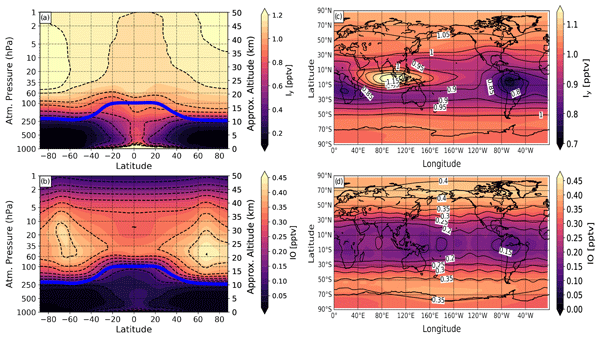
Arseniy Karagodin-Doyennel, Eugene Rozanov, Timofei Sukhodolov, Tatiana Egorova, Alfonso Saiz-Lopez, Carlos A. Cuevas, Rafael P. Fernandez, Tomás Sherwen, Rainer Volkamer, Theodore K. Koenig, Tanguy Giroud, and Thomas Peter
Geosci. Model Dev., 14, 6623–6645, https://doi.org/10.5194/gmd-14-6623-2021, https://doi.org/10.5194/gmd-14-6623-2021, 2021
Short summary
Short summary
Here, we present the iodine chemistry module in the SOCOL-AERv2 model. The obtained iodine distribution demonstrated a good agreement when validated against other simulations and available observations. We also estimated the iodine influence on ozone in the case of present-day iodine emissions, the sensitivity of ozone to doubled iodine emissions, and when considering only organic or inorganic iodine sources. The new model can be used as a tool for further studies of iodine effects on ozone.
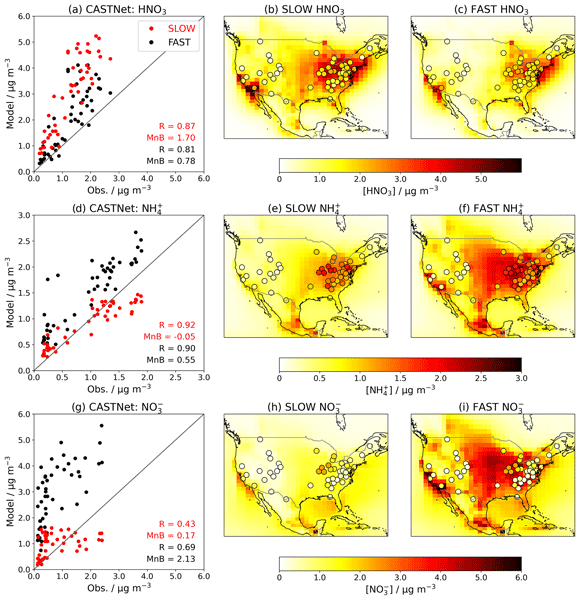
Anthony C. Jones, Adrian Hill, Samuel Remy, N. Luke Abraham, Mohit Dalvi, Catherine Hardacre, Alan J. Hewitt, Ben Johnson, Jane P. Mulcahy, and Steven T. Turnock
Atmos. Chem. Phys., 21, 15901–15927, https://doi.org/10.5194/acp-21-15901-2021, https://doi.org/10.5194/acp-21-15901-2021, 2021
Short summary
Short summary
Ammonium nitrate is hard to model because it forms and evaporates rapidly. One approach is to relate its equilibrium concentration to temperature, humidity, and the amount of nitric acid and ammonia gases. Using this approach, we limit the rate at which equilibrium is reached using various condensation rates in a climate model. We show that ammonium nitrate concentrations are highly sensitive to the condensation rate. Our results will help improve the representation of nitrate in climate models.
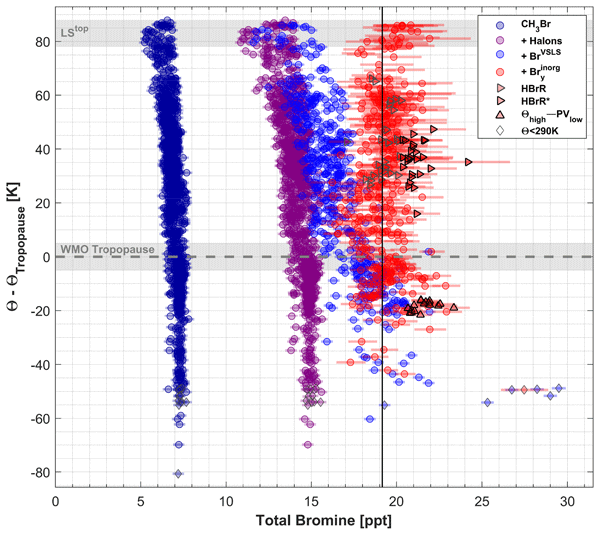
Meike K. Rotermund, Vera Bense, Martyn P. Chipperfield, Andreas Engel, Jens-Uwe Grooß, Peter Hoor, Tilman Hüneke, Timo Keber, Flora Kluge, Benjamin Schreiner, Tanja Schuck, Bärbel Vogel, Andreas Zahn, and Klaus Pfeilsticker
Atmos. Chem. Phys., 21, 15375–15407, https://doi.org/10.5194/acp-21-15375-2021, https://doi.org/10.5194/acp-21-15375-2021, 2021
Short summary
Short summary
Airborne total bromine (Brtot) and tracer measurements suggest Brtot-rich air masses persistently protruded into the lower stratosphere (LS), creating a high Brtot region over the North Atlantic in fall 2017. The main source is via isentropic transport by the Asian monsoon and to a lesser extent transport across the extratropical tropopause as quantified by a Lagrange model. The transport of Brtot via Central American hurricanes is also observed. Lastly, the impact of Brtot on LS O3 is assessed.
Cited articles
Abalos, M., Legras, B., Ploeger, F., and Randel, W. J.: Evaluating the advective Brewer-Dobson circulation in three reanalyses for the period 1979–2012, J. Geophys. Res.-Atmos., 120, 7534–7554, https://doi.org/10.1002/2015JD023182, 2015. a
Abalos, M., Polvani, L., Calvo, N., Kinnison, D., Ploeger, F., Randel, W., and Solomon, S.: New Insights on the Impact of Ozone-Depleting Substances on the Brewer-Dobson Circulation, J. Geophys. Res.-Atmos., 124, 2435–2451, https://doi.org/10.1029/2018JD029301, 2019. a
Abalos, M., Orbe, C., Kinnison, D. E., Plummer, D., Oman, L. D., Jöckel, P., Morgenstern, O., Garcia, R. R., Zeng, G., Stone, K. A., and Dameris, M.: Future trends in stratosphere-to-troposphere transport in CCMI models, Atmos. Chem. Phys., 20, 6883–6901, https://doi.org/10.5194/acp-20-6883-2020, 2020. a
Abalos, M., Calvo, N., Benito-Barca, S., Garny, H., Hardiman, S. C., Lin, P., Andrews, M. B., Butchart, N., Garcia, R., Orbe, C., Saint-Martin, D., Watanabe, S., and Yoshida, K.: The Brewer–Dobson circulation in CMIP6, Atmos. Chem. Phys., 21, 13571–13591, https://doi.org/10.5194/acp-21-13571-2021, 2021. a, b, c
Acquah, C., Stecher, L., Mertens, M., and Jöckel, P.: Effects of different emission inventories on tropospheric ozone and methane lifetime, Atmos. Chem. Phys., 25, 13665–13686, https://doi.org/10.5194/acp-25-13665-2025, 2025. a
Akinshin, A.: Trimmed Harrell-Davis quantile estimator based on the highest density interval of the given width, Commun. Stat., 53, 1565–1575, https://doi.org/10.1080/03610918.2022.2050396, 2024. a
Akiyoshi, H., Zhou, L. B., Yamashita, Y., Sakamoto, K., Yoshiki, M., Nagashima, T., Takahashi, M., Kurokawa, J., Takigawa, M., and Imamura, T.: A CCM simulation of the breakup of the Antarctic polar vortex in the years 1980–2004 under the CCMVal scenarios, J. Geophys. Res.-Atmos., 114, https://doi.org/10.1029/2007JD009261, 2009. a
Akiyoshi, H., Nakamura, T., Miyasaka, T., Shiotani, M., and Suzuki, M.: A nudged chemistry-climate model simulation of chemical constituent distribution at northern high-latitude stratosphere observed by SMILES and MLS during the 2009/2010 stratospheric sudden warming, J. Geophys. Res.-Atmos., 121, 1361–1380, https://doi.org/10.1002/2015JD023334, 2016. a
Akiyoshi, H., Kadowaki, M., Yamashita, Y., and Nagatomo, T.: Dependence of column ozone on future ODSs and GHGs in the variability of 500-ensemble members, Sci. Rep., 13, 320, https://doi.org/10.1038/s41598-023-27635-y, 2023. a
Archibald, A. T., O'Connor, F. M., Abraham, N. L., Archer-Nicholls, S., Chipperfield, M. P., Dalvi, M., Folberth, G. A., Dennison, F., Dhomse, S. S., Griffiths, P. T., Hardacre, C., Hewitt, A. J., Hill, R. S., Johnson, C. E., Keeble, J., Köhler, M. O., Morgenstern, O., Mulcahy, J. P., Ordóñez, C., Pope, R. J., Rumbold, S. T., Russo, M. R., Savage, N. H., Sellar, A., Stringer, M., Turnock, S. T., Wild, O., and Zeng, G.: Description and evaluation of the UKCA stratosphere–troposphere chemistry scheme (StratTrop vn 1.0) implemented in UKESM1, Geosci. Model Dev., 13, 1223–1266, https://doi.org/10.5194/gmd-13-1223-2020, 2020. a
Austin, J. and Wilson, R. J.: Ensemble simulations of the decline and recovery of stratospheric ozone, J. Geophys. Res.-Atmos., 111, https://doi.org/10.1029/2005JD006907, 2006. a
Austin, J., Shindell, D., Beagley, S. R., Brühl, C., Dameris, M., Manzini, E., Nagashima, T., Newman, P., Pawson, S., Pitari, G., Rozanov, E., Schnadt, C., and Shepherd, T. G.: Uncertainties and assessments of chemistry-climate models of the stratosphere, Atmos. Chem. Phys., 3, 1–27, https://doi.org/10.5194/acp-3-1-2003, 2003. a
Bednarz, E. M., Maycock, A. C., Abraham, N. L., Braesicke, P., Dessens, O., and Pyle, J. A.: Future Arctic ozone recovery: the importance of chemistry and dynamics, Atmos. Chem. Phys., 16, 12159–12176, https://doi.org/10.5194/acp-16-12159-2016, 2016. a
Bernath, P. F., McElroy, C. T., Abrams, M. C., Boone, C. D., Butler, M., Camy-Peyret, C., Carleer, M., Clerbaux, C., Coheur, P.-F., Colin, R., DeCola, P., DeMazière, M., Drummond, J. R., Dufour, D., Evans, W. F. J., Fast, H., Fussen, D., Gilbert, K., Jennings, D. E., Llewellyn, E. J., Lowe, R. P., Mahieu, E., McConnell, J. C., McHugh, M., McLeod, S. D., Michaud, R., Midwinter, C., Nassar, R., Nichitiu, F., Nowlan, C., Rinsland, C. P., Rochon, Y. J., Rowlands, N., Semeniuk, K., Simon, P., Skelton, R., Sloan, J. J., Soucy, M.-A., Strong, K., Tremblay, P., Turnbull, D., Walker, K. A., Walkty, I., Wardle, D. A., Wehrle, V., Zander, R., and Zou, J.: Atmospheric Chemistry Experiment (ACE): Mission overview, Geophys. Res. Lett., 32, https://doi.org/10.1029/2005GL022386, 2005. a
Boone, C. D.: Version 3 Retrievals for the Atmospheric Chemistry Experiment Fourier Transform Spectrometer (ACE-FTS), https://api.semanticscholar.org/CorpusID:221710947 (last access: 18 April 2026), 2020. a
Boone, C. D., Walker, K. A., and Bernath, P. F.: Version 3 retrievals for the Atmospheric Chemistry Experiment Fourier Transform Spectrometer (ACE-FTS), in: ACE at 10: A Solar Occultation Anthology, Deepak Publishing, ISBN 978-0-937194-54-9, 2013. a
Boucher, O., Servonnat, J., Albright, A. L., Aumont, O., Balkanski, Y., Bastrikov, V., Bekki, S., Bonnet, R., Bony, S., Bopp, L., Braconnot, P., Brockmann, P., Cadule, P., Caubel, A., Cheruy, F., Codron, F., Cozic, A., Cugnet, D., D'Andrea, F., Davini, P., de Lavergne, C., Denvil, S., Deshayes, J., Devilliers, M., Ducharne, A., Dufresne, J.-L., Dupont, E., Éthé, C., Fairhead, L., Falletti, L., Flavoni, S., Foujols, M.-A., Gardoll, S., Gastineau, G., Ghattas, J., Grandpeix, J.-Y., Guenet, B., Guez, Lionel, E., Guilyardi, E., Guimberteau, M., Hauglustaine, D., Hourdin, F., Idelkadi, A., Joussaume, S., Kageyama, M., Khodri, M., Krinner, G., Lebas, N., Levavasseur, G., Lévy, C., Li, L., Lott, F., Lurton, T., Luyssaert, S., Madec, G., Madeleine, J.-B., Maignan, F., Marchand, M., Marti, O., Mellul, L., Meurdesoif, Y., Mignot, J., Musat, I., Ottlé, C., Peylin, P., Planton, Y., Polcher, J., Rio, C., Rochetin, N., Rousset, C., Sepulchre, P., Sima, A., Swingedouw, D., Thiéblemont, R., Traore, A. K., Vancoppenolle, M., Vial, J., Vialard, J., Viovy, N., and Vuichard, N.: Presentation and Evaluation of the IPSL-CM6A-LR Climate Model, J. Adv. Model. Earth Sy., 12, e2019MS002010, https://doi.org/10.1029/2019MS002010, 2020. a
Brewer, A. W.: Evidence for a world circulation provided by the measurements of helium and water vapour distribution in the stratosphere, Q. J. Roy. Meteor. Soc., 75, 351–363, https://doi.org/10.1002/qj.49707532603, 1949. a
Chipperfield, M. P.: New version of the TOMCAT/SLIMCAT off-line chemical transport model: Intercomparison of stratospheric tracer experiments, Q. J. Roy. Meteor. Soc., 132, 1179–1203, https://doi.org/10.1256/qj.05.51, 2006. a
Chipperfield, M. P., Dhomse, S., Hossaini, R., Feng, W., Santee, M. L., Weber, M., Burrows, J. P., Wild, J. D., Loyola, D., and Coldewey-Egbers, M.: On the Cause of Recent Variations in Lower Stratospheric Ozone, Geophys. Res. Lett., 45, 5718–5726, https://doi.org/10.1029/2018GL078071, 2018. a
Chipperfield, M. P., Santee, M. L. (lead authors), Alexander, S. P., de Laat, A. T. J., Kinnison, D. E., Kuttippurath, J., Langematz, U., and Wargan, K.: Polar Stratospheric Ozone: Past, Present, and Future, in: Scientific Assessment of Ozone Depletion: 2022, chap. 4, World Meteorological Organization, Geneva, ISBN 978-9914-733-97-6, 2022. a
Coddington, O., Lean, J., Pilewskie, P., Snow, M., Richard, E., Kopp, G., Lindholm, C., DeLand, M., Marchenko, S., Haberreiter, M., and Baranyi, T.: Solar Irradiance Variability: Comparisons of Models and Measurements, Earth Space Sci., 6, 2525–2555, https://doi.org/10.1029/2019EA000693, 2019. a
Copernicus Climate Change Service: Ozone monthly gridded data from 1970 to present derived from satellite observations, Copernicus Climate Change Service (C3S) Climate Data Store (CDS) [dadta set], https://doi.org/10.24381/cds.4ebfe4eb, 2020. a
Davis, S. M., Rosenlof, K. H., Hassler, B., Hurst, D. F., Read, W. G., Vömel, H., Selkirk, H., Fujiwara, M., and Damadeo, R.: The Stratospheric Water and Ozone Satellite Homogenized (SWOOSH) database: a long-term database for climate studies, Earth Syst. Sci. Data, 8, 461–490, https://doi.org/10.5194/essd-8-461-2016, 2016. a
de la Cámara, A., Lott, F., and Abalos, M.: Climatology of the middle atmosphere in LMDz: Impact of source-related parameterizations of gravity wave drag, J. Adv. Model. Earth Sy., 8, 1507–1525, https://doi.org/10.1002/2016MS000753, 2016. a
Dennison, F. and Woodhouse, M. T.: ACCESS-CM2-Chem: evaluation of southern hemisphere ozone and its effect on the Southern Annular Mode, Journal of Southern Hemisphere Earth Systems Science, 73, 17–29, https://doi.org/10.1071/ES22015, 2023. a
Deushi, M. and Shibata, K.: Development of a Meteorological Research Institute Chemistry-Climate Model version 2 for the Study of Tropospheric and Stratospheric Chemistry, Pap. Meteorol. Geophys., 62, 1–46, https://doi.org/10.2467/mripapers.62.1, 2011. a
Dhomse, S. S., Feng, W., Montzka, S. A., Hossaini, R., Keeble, J., Pyle, J. A., Daniel, J. S., and Chipperfield, M. P.: Delay in recovery of the Antarctic ozone hole from unexpected CFC-11 emissions, Nat. Commun., 10, 5781, https://doi.org/10.1038/s41467-019-13717-x, 2019. a
Diallo, M., Ern, M., and Ploeger, F.: The advective Brewer–Dobson circulation in the ERA5 reanalysis: climatology, variability, and trends, Atmos. Chem. Phys., 21, 7515–7544, https://doi.org/10.5194/acp-21-7515-2021, 2021. a
Dietmüller, S., Eichinger, R., Garny, H., Birner, T., Boenisch, H., Pitari, G., Mancini, E., Visioni, D., Stenke, A., Revell, L., Rozanov, E., Plummer, D. A., Scinocca, J., Jöckel, P., Oman, L., Deushi, M., Kiyotaka, S., Kinnison, D. E., Garcia, R., Morgenstern, O., Zeng, G., Stone, K. A., and Schofield, R.: Quantifying the effect of mixing on the mean age of air in CCMVal-2 and CCMI-1 models, Atmos. Chem. Phys., 18, 6699–6720, https://doi.org/10.5194/acp-18-6699-2018, 2018. a, b, c, d, e, f, g, h, i
Dobson, G. M. B.: Origin and distribution of the polyatomic molecules in the atmosphere, P. Roy. Soc. A.-Math. Phy., 236, 187–193, https://doi.org/10.1098/rspa.1956.0127, 1956. a
Donner, L. J., Wyman, B. L., Hemler, R. S., Horowitz, L. W., Ming, Y., Zhao, M., Golaz, J.-C., Ginoux, P., Lin, S.-J., Schwarzkopf, M. D., Austin, J., Alaka, G., Cooke, W. F., Delworth, T. L., Freidenreich, S. M., Gordon, C. T., Griffies, S. M., Held, I. M., Hurlin, W. J., Klein, S. A., Knutson, T. R., Langenhorst, A. R., Lee, H.-C., Lin, Y., Magi, B. I., Malyshev, S. L., Milly, P. C. D., Naik, V., Nath, M. J., Pincus, R., Ploshay, J. J., Ramaswamy, V., Seman, C. J., Shevliakova, E., Sirutis, J. J., Stern, W. F., Stouffer, R. J., Wilson, R. J., Winton, M., Wittenberg, A. T., and Zeng, F.: The Dynamical Core, Physical Parameterizations, and Basic Simulation Characteristics of the Atmospheric Component AM3 of the GFDL Global Coupled Model CM3, J. Climate, 24, 3484–3519, https://doi.org/10.1175/2011JCLI3955.1, 2011. a
Douglass, A. R., Stolarski, R. S., Schoeberl, M. R., Jackman, C. H., Gupta, M. L., Newman, P. A., Nielsen, J. E., and Fleming, E. L.: Relationship of loss, mean age of air and the distribution of CFCs to stratospheric circulation and implications for atmospheric lifetimes, J. Geophys. Res.-Atmos., 113, https://doi.org/10.1029/2007JD009575, 2008. a
Douglass, A. R., Prather, M. J., Hall, T. M., Strahan, S. E., Rasch, P. J., Sparling, L. C., Coy, L., and Rodriguez, J. M.: Choosing meteorological input for the global modeling initiative assessment of high-speed aircraft, J. Geophys. Res.-Atmos., 104, 27545–27564, https://doi.org/10.1029/1999JD900827, 1999. a
Dubé, K., Tegtmeier, S., Bourassa, A., Zawada, D., Degenstein, D., Sheese, P. E., Walker, K. A., and Randel, W.: N2O as a regression proxy for dynamical variability in stratospheric trace gas trends, Atmos. Chem. Phys., 23, 13283–13300, https://doi.org/10.5194/acp-23-13283-2023, 2023. a
Egorova, T., Rozanov, E., Zubov, V., Manzini, E., Schmutz, W., and Peter, T.: Chemistry-climate model SOCOL: a validation of the present-day climatology, Atmos. Chem. Phys., 5, 1557–1576, https://doi.org/10.5194/acp-5-1557-2005, 2005. a
Eichinger, R., Dietmüller, S., Garny, H., Šácha, P., Birner, T., Bönisch, H., Pitari, G., Visioni, D., Stenke, A., Rozanov, E., Revell, L., Plummer, D. A., Jöckel, P., Oman, L., Deushi, M., Kinnison, D. E., Garcia, R., Morgenstern, O., Zeng, G., Stone, K. A., and Schofield, R.: The influence of mixing on the stratospheric age of air changes in the 21st century, Atmos. Chem. Phys., 19, 921–940, https://doi.org/10.5194/acp-19-921-2019, 2019. a, b
Engel, A., Bönisch, H., Ostermöller, J., Chipperfield, M. P., Dhomse, S., and Jöckel, P.: A refined method for calculating equivalent effective stratospheric chlorine, Atmos. Chem. Phys., 18, 601–619, https://doi.org/10.5194/acp-18-601-2018, 2018. a
Eyring, V., Butchart, N., Waugh, D. W., Akiyoshi, H., Austin, J., Bekki, S., Bodeker, G. E., Boville, B. A., Brühl, C., Chipperfield, M. P., Cordero, E., Dameris, M., Deushi, M., Fioletov, V. E., Frith, S. M., Garcia, R. R., Gettelman, A., Giorgetta, M. A., Grewe, V., Jourdain, L., Kinnison, D. E., Mancini, E., Manzini, E., Marchand, M., Marsh, D. R., Nagashima, T., Newman, P. A., Nielsen, J. E., Pawson, S., Pitari, G., Plummer, D. A., Rozanov, E., Schraner, M., Shepherd, T. G., Shibata, K., Stolarski, R. S., Struthers, H., Tian, W., and Yoshiki, M.: Assessment of temperature, trace species, and ozone in chemistry-climate model simulations of the recent past, J. Geophys. Res.-Atmos., 111, https://doi.org/10.1029/2006JD007327, 2006. a, b, c, d
Eyring, V., Lamarque, J.-F., Hess, P., Arfeuille, F., Bowman, K., Chipperfield, M. P., Duncan, B., Fiore, A., Gettelman, A., Giorgetta, M. A., Granier, C., Hegglin, M., Kinnison, D., Kunze, M., Langematz, U., Luo, B., Martin, R., Matthes, K., Newman, P. A., Peter, T., Robock, A., Ryerson, T., Saiz-Lopez, A., Salawitch, R., Schultz, M., Shepherd, T. G., Shindell, D., Stahelin, J., Tegtmeier, S., Thomason, L., Tilmes, S., Vernier, J.-P., Waugh, D. W., and Young, P. J.: Overview of IGAC/SPARC Chemistry–Climate Model Initiative (CCMI) Community Simulations in Support of Upcoming Ozone and Climate Assessments, SPARC Newsletter, 40, 48–66, 2013. a, b
Feng, W., Dhomse, S. S., Arosio, C., Weber, M., Burrows, J. P., Santee, M. L., and Chipperfield, M. P.: Arctic Ozone Depletion in 2019/20: Roles of Chemistry, Dynamics and the Montreal Protocol, Geophys. Res. Lett., 48, e2020GL091911, https://doi.org/10.1029/2020GL091911, 2021. a
Fischer, H., Birk, M., Blom, C., Carli, B., Carlotti, M., von Clarmann, T., Delbouille, L., Dudhia, A., Ehhalt, D., Endemann, M., Flaud, J. M., Gessner, R., Kleinert, A., Koopman, R., Langen, J., López-Puertas, M., Mosner, P., Nett, H., Oelhaf, H., Perron, G., Remedios, J., Ridolfi, M., Stiller, G., and Zander, R.: MIPAS: an instrument for atmospheric and climate research, Atmos. Chem. Phys., 8, 2151–2188, https://doi.org/10.5194/acp-8-2151-2008, 2008. a
Fujiwara, M., Martineau, P., Wright, J. S., Abalos, M., Šácha, P., Kawatani, Y., Davis, S. M., Birner, T., and Monge-Sanz, B. M.: Climatology of the terms and variables of transformed Eulerian-mean (TEM) equations from multiple reanalyses: MERRA-2, JRA-55, ERA-Interim, and CFSR, Atmos. Chem. Phys., 24, 7873–7898, https://doi.org/10.5194/acp-24-7873-2024, 2024. a
Garcia, R. R., Marsh, D. R., Kinnison, D. E., Boville, B. A., and Sassi, F.: Simulation of secular trends in the middle atmosphere, 1950–2003, J. Geophys. Res.-Atmos., 112, https://doi.org/10.1029/2006JD007485, 2007. a
Garny, H., Birner, T., Bönisch, H., and Bunzel, F.: The effects of mixing on age of air, J. Geophys. Res.-Atmos., 119, 7015–7034, https://doi.org/10.1002/2013JD021417, 2014. a, b, c, d
Garny, H., Eichinger, R., Laube, J. C., Ray, E. A., Stiller, G. P., Bönisch, H., Saunders, L., and Linz, M.: Correction of stratospheric age of air (AoA) derived from sulfur hexafluoride (SF6) for the effect of chemical sinks, Atmos. Chem. Phys., 24, 4193–4215, https://doi.org/10.5194/acp-24-4193-2024, 2024a. a
Garny, H., Ploeger, F., Abalos, M., Bönisch, H., Castillo, A. E., von Clarmann, T., Diallo, M., Engel, A., Laube, J. C., Linz, M., Neu, J. L., Podglajen, A., Ray, E., Rivoire, L., Saunders, L. N., Stiller, G., Voet, F., Wagenhäuser, T., and Walker, K. A.: Age of Stratospheric Air: Progress on Processes, Observations, and Long-Term Trends, Rev. Geophys., 62, e2023RG000832, https://doi.org/10.1029/2023RG000832, 2024b. a, b, c, d, e, f, g, h, i
Gelaro, R., McCarty, W., Suárez, M. J., Todling, R., Molod, A., Takacs, L., Randles, C. A., Darmenov, A., Bosilovich, M. G., Reichle, R., Wargan, K., Coy, L., Cullather, R., Draper, C., Akella, S., Buchard, V., Conaty, A., da Silva, A. M., Gu, W., Kim, G.-K., Koster, R., Lucchesi, R., Merkova, D., Nielsen, J. E., Partyka, G., Pawson, S., Putman, W., Rienecker, M., Schubert, S. D., Sienkiewicz, M., and Zhao, B.: The Modern-Era Retrospective Analysis for Research and Applications, Version 2 (MERRA-2), J. Climate, 30, 5419–5454, https://doi.org/10.1175/JCLI-D-16-0758.1, 2017. a
Gettelman, A., Hegglin, M. I., Son, S.-W., Kim, J., Fujiwara, M., Birner, T., Kremser, S., Rex, M., Añel, J. A., Akiyoshi, H., Austin, J., Bekki, S., Braesike, P., Brühl, C., Butchart, N., Chipperfield, M., Dameris, M., Dhomse, S., Garny, H., Hardiman, S. C., Jöckel, P., Kinnison, D. E., Lamarque, J. F., Mancini, E., Marchand, M., Michou, M., Morgenstern, O., Pawson, S., Pitari, G., Plummer, D., Pyle, J. A., Rozanov, E., Scinocca, J., Shepherd, T. G., Shibata, K., Smale, D., Teyssèdre, H., and Tian, W.: Multimodel assessment of the upper troposphere and lower stratosphere: Tropics and global trends, J. Geophys. Res.-Atmos., 115, https://doi.org/10.1029/2009JD013638, 2010. a, b, c, d
Gettelman, A., Mills, M. J., Kinnison, D. E., Garcia, R. R., Smith, A. K., Marsh, D. R., Tilmes, S., Vitt, F., Bardeen, C. G., McInerny, J., Liu, H.-L., Solomon, S. C., Polvani, L. M., Emmons, L. K., Lamarque, J.-F., Richter, J. H., Glanville, A. S., Bacmeister, J. T., Phillips, A. S., Neale, R. B., Simpson, I. R., DuVivier, A. K., Hodzic, A., and Randel, W. J.: The Whole Atmosphere Community Climate Model Version 6 (WACCM6), J. Geophys. Res.-Atmos/, 124, 12380–12403, https://doi.org/10.1029/2019JD030943, 2019. a
Glanville, A. A. and Birner, T.: Role of vertical and horizontal mixing in the tape recorder signal near the tropical tropopause, Atmos. Chem. Phys., 17, 4337–4353, https://doi.org/10.5194/acp-17-4337-2017, 2017. a
Glatthor, N., von Clarmann, T., Funke, B., García-Comas, M., Grabowski, U., Höpfner, M., Kellmann, S., Kiefer, M., Laeng, A., Linden, A., López-Puertas, M., and Stiller, G. P.: IMK–IAA MIPAS retrieval version 8: CH4 and N2O, Atmos. Meas. Tech., 17, 2849–2871, https://doi.org/10.5194/amt-17-2849-2024, 2024. a
GloSSAC: Global Space-based Stratospheric Aerosol Climatology Version 2.0, NASA Langley Atmospheric Science Data Center DAAC [data set], https://doi.org/10.5067/GLOSSAC-L3-V2.0, 2018. a
Godin-Beekmann, S., Azouz, N., Sofieva, V. F., Hubert, D., Petropavlovskikh, I., Effertz, P., Ancellet, G., Degenstein, D. A., Zawada, D., Froidevaux, L., Frith, S., Wild, J., Davis, S., Steinbrecht, W., Leblanc, T., Querel, R., Tourpali, K., Damadeo, R., Maillard Barras, E., Stübi, R., Vigouroux, C., Arosio, C., Nedoluha, G., Boyd, I., Van Malderen, R., Mahieu, E., Smale, D., and Sussmann, R.: Updated trends of the stratospheric ozone vertical distribution in the 60° S–60° N latitude range based on the LOTUS regression model , Atmos. Chem. Phys., 22, 11657–11673, https://doi.org/10.5194/acp-22-11657-2022, 2022. a, b
Guth, J., Josse, B., Marécal, V., Joly, M., and Hamer, P.: First implementation of secondary inorganic aerosols in the MOCAGE version R2.15.0 chemistry transport model, Geosci. Model Dev., 9, 137–160, https://doi.org/10.5194/gmd-9-137-2016, 2016. a
Haenel, F. J., Stiller, G. P., von Clarmann, T., Funke, B., Eckert, E., Glatthor, N., Grabowski, U., Kellmann, S., Kiefer, M., Linden, A., and Reddmann, T.: Reassessment of MIPAS age of air trends and variability, Atmos. Chem. Phys., 15, 13161–13176, https://doi.org/10.5194/acp-15-13161-2015, 2015. a
Hall, T. M. and Plumb, R. A.: Age as a diagnostic of stratospheric transport, J. Geophys. Res.-Atmos., 99, 1059–1070, https://doi.org/10.1029/93JD03192, 1994. a
Hall, T. M., Waugh, D. W., Boering, K. A., and Plumb, R. A.: Evaluation of transport in stratospheric models, J. Geophys. Res.-Atmos., 104, 18815–18839, https://doi.org/10.1029/1999JD900226, 1999. a, b
Hardiman, S. C., Butchart, N., and Calvo, N.: The morphology of the Brewer–Dobson circulation and its response to climate change in CMIP5 simulations, Q. J. Roy. Meteor. Soc., 140, 1958–1965, https://doi.org/10.1002/qj.2258, 2014. a, b
Hardiman, S. C., Butchart, N., O'Connor, F. M., and Rumbold, S. T.: The Met Office HadGEM3-ES chemistry–climate model: evaluation of stratospheric dynamics and its impact on ozone, Geosci. Model Dev., 10, 1209–1232, https://doi.org/10.5194/gmd-10-1209-2017, 2017. a
Harrison, J. J.: New infrared absorption cross sections for the infrared limb sounding of sulfur hexafluoride (SF6), J. Quant. Spectrosc. Ra., 254, 107202, https://doi.org/10.1016/j.jqsrt.2020.107202, 2020. a
Hegglin, M. I., Gettelman, A., Hoor, P., Krichevsky, R., Manney, G. L., Pan, L. L., Son, S.-W., Stiller, G., Tilmes, S., Walker, K. A., Eyring, V., Shepherd, T. G., Waugh, D., Akiyoshi, H., Añel, J. A., Austin, J., Baumgaertner, A., Bekki, S., Braesicke, P., Brühl, C., Butchart, N., Chipperfield, M., Dameris, M., Dhomse, S., Frith, S., Garny, H., Hardiman, S. C., Jöckel, P., Kinnison, D. E., Lamarque, J. F., Mancini, E., Michou, M., Morgenstern, O., Nakamura, T., Olivié, D., Pawson, S., Pitari, G., Plummer, D. A., Pyle, J. A., Rozanov, E., Scinocca, J. F., Shibata, K., Smale, D., Teyssèdre, H., Tian, W., and Yamashita, Y.: Multimodel assessment of the upper troposphere and lower stratosphere: Extratropics, J. Geophys. Res.-Atmos., 115, https://doi.org/10.1029/2010JD013884, 2010. a
Hersbach, H., Bell, B., Berrisford, P., Hirahara, S., Horányi, A., Muñoz-Sabater, J., Nicolas, J., Peubey, C., Radu, R., Schepers, D., Simmons, A., Soci, C., Abdalla, S., Abellan, X., Balsamo, G., Bechtold, P., Biavati, G., Bidlot, J., Bonavita, M., De Chiara, G., Dahlgren, P., Dee, D., Diamantakis, M., Dragani, R., Flemming, J., Forbes, R., Fuentes, M., Geer, A., Haimberger, L., Healy, S., Hogan, R. J., Hólm, E., Janisková, M., Keeley, S., Laloyaux, P., Lopez, P., Lupu, C., Radnoti, G., de Rosnay, P., Rozum, I., Vamborg, F., Villaume, S., and Thépaut, J.-N.: The ERA5 global reanalysis, Q. J. Roy. Meteor. Soc., 146, 1999–2049, https://doi.org/10.1002/qj.3803, 2020. a, b
Hoffmann, L. and Spang, R.: Reanalysis Tropopause Data Repository, Juelich DATA [data set], https://doi.org/10.26165/JUELICH-DATA/UBNGI2, 2021. a
Hoffmann, L. and Spang, R.: An assessment of tropopause characteristics of the ERA5 and ERA-Interim meteorological reanalyses, Atmos. Chem. Phys., 22, 4019–4046, https://doi.org/10.5194/acp-22-4019-2022, 2022. a
Hubert, D., Lambert, J.-C., Verhoelst, T., Granville, J., Keppens, A., Baray, J.-L., Bourassa, A. E., Cortesi, U., Degenstein, D. A., Froidevaux, L., Godin-Beekmann, S., Hoppel, K. W., Johnson, B. J., Kyrölä, E., Leblanc, T., Lichtenberg, G., Marchand, M., McElroy, C. T., Murtagh, D., Nakane, H., Portafaix, T., Querel, R., Russell III, J. M., Salvador, J., Smit, H. G. J., Stebel, K., Steinbrecht, W., Strawbridge, K. B., Stübi, R., Swart, D. P. J., Taha, G., Tarasick, D. W., Thompson, A. M., Urban, J., van Gijsel, J. A. E., Van Malderen, R., von der Gathen, P., Walker, K. A., Wolfram, E., and Zawodny, J. M.: Ground-based assessment of the bias and long-term stability of 14 limb and occultation ozone profile data records, Atmos. Meas. Tech., 9, 2497–2534, https://doi.org/10.5194/amt-9-2497-2016, 2016. a
Hurst, D. F., Read, W. G., Vömel, H., Selkirk, H. B., Rosenlof, K. H., Davis, S. M., Hall, E. G., Jordan, A. F., and Oltmans, S. J.: Recent divergences in stratospheric water vapor measurements by frost point hygrometers and the Aura Microwave Limb Sounder, Atmos. Meas. Tech., 9, 4447–4457, https://doi.org/10.5194/amt-9-4447-2016, 2016. a
Jeong, Y.-C., Yeh, S.-W., Lee, S., and Park, R. J.: A Global/Regional Integrated Model System-Chemistry Climate Model: 1. Simulation Characteristics, Earth Space Sci., 6, 2016–2030, https://doi.org/10.1029/2019EA000727, 2019. a
Jöckel, P., Tost, H., Pozzer, A., Brühl, C., Buchholz, J., Ganzeveld, L., Hoor, P., Kerkweg, A., Lawrence, M. G., Sander, R., Steil, B., Stiller, G., Tanarhte, M., Taraborrelli, D., van Aardenne, J., and Lelieveld, J.: The atmospheric chemistry general circulation model ECHAM5/MESSy1: consistent simulation of ozone from the surface to the mesosphere, Atmos. Chem. Phys., 6, 5067–5104, https://doi.org/10.5194/acp-6-5067-2006, 2006. a, b
Jöckel, P., Tost, H., Pozzer, A., Kunze, M., Kirner, O., Brenninkmeijer, C. A. M., Brinkop, S., Cai, D. S., Dyroff, C., Eckstein, J., Frank, F., Garny, H., Gottschaldt, K.-D., Graf, P., Grewe, V., Kerkweg, A., Kern, B., Matthes, S., Mertens, M., Meul, S., Neumaier, M., Nützel, M., Oberländer-Hayn, S., Ruhnke, R., Runde, T., Sander, R., Scharffe, D., and Zahn, A.: Earth System Chemistry integrated Modelling (ESCiMo) with the Modular Earth Submodel System (MESSy) version 2.51, Geosci. Model Dev., 9, 1153–1200, https://doi.org/10.5194/gmd-9-1153-2016, 2016. a, b, c
Jöckel, P., Brinkop, S., Graf, P., Eichinger, R., Garny, H., Mertens, M., Nützel, M., Pozzer, A., Tost, H., and Consortium, T. M.: RD1: EMAC CCMI-2022 free running hindcast simulation 1950–2019, World Data Center for Climate [data set], https://doi.org/10.26050/WDCC/ESCiMo2_RD1, 2024a. a
Jöckel, P., Brinkop, S., Graf, P., Eichinger, R., Garny, H., Mertens, M., Nützel, M., Pozzer, A., Tost, H., and MESSy Consortium, T.: RD1: EMAC CCMI-2022 free running hindcast simulation 1950-2019 (additional data), https://www.wdc-climate.de/ui/entry?acronym=DKRZ_LTA_853_dsg0001 (last access: 18 April 2026), 2024b. a
Josse, B., Simon, P., and Peuch, V.-H.: Radon global simulations with the multiscale chemistry and transport model MOCAGE, Tellus B, 56, 339–356, https://doi.org/10.1111/j.1600-0889.2004.00112.x, 2004. a
Jourdain, L., Bekki, S., Lott, F., and Lefèvre, F.: The coupled chemistry-climate model LMDz-REPROBUS: description and evaluation of a transient simulation of the period 1980–1999, Ann. Geophys., 26, 1391–1413, https://doi.org/10.5194/angeo-26-1391-2008, 2008. a, b
Kawamiya, M., Hajima, T., Tachiiri, K., Watanabe, S., and Yokohata, T.: Two decades of Earth system modeling with an emphasis on Model for Interdisciplinary Research on Climate (MIROC), Prog. Earth Planet. Sci., 7, 64, https://doi.org/10.1186/s40645-020-00369-5, 2020. a
Ko, M. K. W., Jackman, C. H., Plumb, R. A., Kaye, J. A., and Sage, K. H.: The atmosphere effects of stratospheric aircraft: Reports of the 1998 Models and Measurements II Workshop, Tech. Rep. NASA Technical Memorandum 1991–209554, edited by: Park, J., National Aeronautics and Space Administration, NASA/TM—1999-209554, 1999. a
Kobayashi, C. and Iwasaki, T.: The Brewer–Dobson circulation in the JRA-3Q reanalysis and the impact of changes in model physical processes, Q. J. Roy. Meteor. Soc., 150, 5605–5620, https://doi.org/10.1002/qj.4896, 2024. a
Kosaka, Y., Kobayashi, S., Harada, Y., Kobayashi, C., Naoe, H., Yoshimoto, K., Harada, M., Goto, N., Chiba, J., Miyaoka, K., Sekiguchi, R., Deushi, M., Kamahori, H., Nakaegawa, T., Tanaka, T. Y., Tokuhiro, T., Sato, Y., Matsushita, Y., and Onogi, K.: The JRA-3Q Reanalysis, J. Meteorol. Soc. Jpn. Ser. II, 102, 49–109, https://doi.org/10.2151/jmsj.2024-004, 2024. a
Lamarque, J.-F., Kinnison, D. E., Hess, P. G., and Vitt, F. M.: Simulated lower stratospheric trends between 1970 and 2005: Identifying the role of climate and composition changes, J. Geophys. Res.-Atmos., 113, https://doi.org/10.1029/2007JD009277, 2008. a
Lickley, M. J., Daniel, J. S., McBride, L. A., Salawitch, R. J., and Velders, G. J. M.: The return to 1980 stratospheric halogen levels: a moving target in ozone assessments from 2006 to 2022, Atmos. Chem. Phys., 24, 13081–13099, https://doi.org/10.5194/acp-24-13081-2024, 2024. a, b, c
Linz, M., Plumb, R. A., Gerber, E. P., and Sheshadri, A.: The Relationship between Age of Air and the Diabatic Circulation of the Stratosphere, J. Atmos. Sci., 73, 4507–4518, https://doi.org/10.1175/JAS-D-16-0125.1, 2016. a, b, c
Linz, M., Abalos, M., Glanville, A. S., Kinnison, D. E., Ming, A., and Neu, J. L.: The global diabatic circulation of the stratosphere as a metric for the Brewer–Dobson circulation, Atmos. Chem. Phys., 19, 5069–5090, https://doi.org/10.5194/acp-19-5069-2019, 2019. a
Liu, J., Strode, S. A., Liang, Q., Oman, L. D., Colarco, P. R., Fleming, E. L., Manyin, M. E., Douglass, A. R., Ziemke, J. R., Lamsal, L. N., and Li, C.: Change in Tropospheric Ozone in the Recent Decades and Its Contribution to Global Total Ozone, J. Geophys. Res.-Atmos., 127, e2022JD037170, https://doi.org/10.1029/2022JD037170, 2022. a
Livesey, N. J., Read, W. G., Froidevaux, L., Lambert, A., Santee, M. L., Schwartz, M. J., Millán, L. F., Jarnot, R. F., Wagner, P. A., Hurst, D. F., Walker, K. A., Sheese, P. E., and Nedoluha, G. E.: Investigation and amelioration of long-term instrumental drifts in water vapor and nitrous oxide measurements from the Aura Microwave Limb Sounder (MLS) and their implications for studies of variability and trends, Atmos. Chem. Phys., 21, 15409–15430, https://doi.org/10.5194/acp-21-15409-2021, 2021. a
Livesey, N. J., Read, W. G., Wagner, P. A., Froidevaux, L., Santee, M. L., Schwartz, M. J., Lambert, A., Millan Valle, L. F., Pumphrey, H. C., Manney, G. L., Fuller, R. A., Jarnot, R. F., Knosp, B. W., and Lay, R. R.: Earth Observing System (EOS) Microwave Limb Sounder (MLS) Version 5.0x Level 2 and 3 data quality and description document, https://doi.org/10.5067/AURA/MLS/DOC/V5_DATAQUALITYDOCUMENT, 2022. a, b
Loeffel, S., Eichinger, R., Garny, H., Reddmann, T., Fritsch, F., Versick, S., Stiller, G., and Haenel, F.: The impact of sulfur hexafluoride (SF6) sinks on age of air climatologies and trends, Atmos. Chem. Phys., 22, 1175–1193, https://doi.org/10.5194/acp-22-1175-2022, 2022. a
Luo, B.: Stratospheric aerosol data for use in CMIP6 models, dataset documentation, ftp://iacftp.ethz.ch/pub_read/luo/CMIP6/Readme_Data_Description.pdf (last access: 1 April 2020), 2016. a
Marchand, M., Keckhut, P., Lefebvre, S., Claud, C., Cugnet, D., Hauchecorne, A., Lefèvre, F., Lefebvre, M.-P., Jumelet, J., Lott, F., Hourdin, F., Thuillier, G., Poulain, V., Bossay, S., Lemennais, P., David, C., and Bekki, S.: Dynamical amplification of the stratospheric solar response simulated with the Chemistry-Climate Model LMDz-Reprobus, J. Atmos. Sol.-Terr. Phys., 75–76, 147–160, https://doi.org/10.1016/j.jastp.2011.11.008, 2012. a, b
Marsh, D. R., Mills, M. J., Kinnison, D. E., Lamarque, J.-F., Calvo, N., and Polvani, L. M.: Climate Change from 1850 to 2005 Simulated in CESM1(WACCM), J. Climate, 26, 7372–7391, https://doi.org/10.1175/JCLI-D-12-00558.1, 2013. a
Martineau, P., Wright, J. S., Zhu, N., and Fujiwara, M.: Zonal-mean data set of global atmospheric reanalyses on pressure levels, Earth Syst. Sci. Data, 10, 1925–1941, https://doi.org/10.5194/essd-10-1925-2018, 2018. a
McIntyre, M. and Palmer, T.: The “surf zone” in the stratosphere, J. Atmos. Terr. Phys., 46, 825–849, https://doi.org/10.1016/0021-9169(84)90063-1, 1984. a
McLandress, C., Jonsson, A. I., Plummer, D. A., Reader, M. C., Scinocca, J. F., and Shepherd, T. G.: Separating the Dynamical Effects of Climate Change and Ozone Depletion. Part I: Southern Hemisphere Stratosphere, J. Climate, 23, 5002–5020, https://doi.org/10.1175/2010JCLI3586.1, 2010. a, b
McLandress, C., Shepherd, T. G., Polavarapu, S., and Beagley, S. R.: Is Missing Orographic Gravity Wave Drag near 60°S the Cause of the Stratospheric Zonal Wind Biases in Chemistry–Climate Models?, J. Atmos. Sci., 69, 802–818, https://doi.org/10.1175/JAS-D-11-0159.1, 2012. a
Michou, M., Saint-Martin, D., Teyssèdre, H., Alias, A., Karcher, F., Olivié, D., Voldoire, A., Josse, B., Peuch, V.-H., Clark, H., Lee, J. N., and Chéroux, F.: A new version of the CNRM Chemistry-Climate Model, CNRM-CCM: description and improvements from the CCMVal-2 simulations, Geosci. Model Dev., 4, 873–900, https://doi.org/10.5194/gmd-4-873-2011, 2011. a
Minganti, D., Chabrillat, S., Christophe, Y., Errera, Q., Abalos, M., Prignon, M., Kinnison, D. E., and Mahieu, E.: Climatological impact of the Brewer–Dobson circulation on the N2O budget in WACCM, a chemical reanalysis and a CTM driven by four dynamical reanalyses, Atmos. Chem. Phys., 20, 12609–12631, https://doi.org/10.5194/acp-20-12609-2020, 2020. a
Minganti, D., Chabrillat, S., Errera, Q., Prignon, M., Kinnison, D. E., Garcia, R. R., Abalos, M., Alsing, J., Schneider, M., Smale, D., Jones, N., and Mahieu, E.: Evaluation of the N2O Rate of Change to Understand the Stratospheric Brewer-Dobson Circulation in a Chemistry-Climate Model, J. Geophys. Res.-Atmos., 127, e2021JD036390, https://doi.org/10.1029/2021JD036390, 2022. a
Monge-Sanz, B. M. and Birner, T.: Brewer–Dobson Circulation, in: SPARC Reanalysis Intercomparison Project (S-RIP) Final Report, edited by: Fujiwara, M., Manney, G. L., Gray, L. J., and Wright, J. S., SPARC Report No. 10, WCRP-6/2021, Chap. 5, SPARC, https://doi.org/10.17874/800dee57d13, 2022. a
Morgenstern, O., Braesicke, P., Hurwitz, M. M., O'Connor, F. M., Bushell, A. C., Johnson, C. E., and Pyle, J. A.: The World Avoided by the Montreal Protocol, Geophys. Res. Lett., 35, https://doi.org/10.1029/2008GL034590, 2008. a
Morgenstern, O., Hegglin, M. I., Rozanov, E., O'Connor, F. M., Abraham, N. L., Akiyoshi, H., Archibald, A. T., Bekki, S., Butchart, N., Chipperfield, M. P., Deushi, M., Dhomse, S. S., Garcia, R. R., Hardiman, S. C., Horowitz, L. W., Jöckel, P., Josse, B., Kinnison, D., Lin, M., Mancini, E., Manyin, M. E., Marchand, M., Marécal, V., Michou, M., Oman, L. D., Pitari, G., Plummer, D. A., Revell, L. E., Saint-Martin, D., Schofield, R., Stenke, A., Stone, K., Sudo, K., Tanaka, T. Y., Tilmes, S., Yamashita, Y., Yoshida, K., and Zeng, G.: Review of the global models used within phase 1 of the Chemistry–Climate Model Initiative (CCMI), Geosci. Model Dev., 10, 639–671, https://doi.org/10.5194/gmd-10-639-2017, 2017. a, b
Mote, P. W., Dunkerton, T. J., and Pumphrey, H. C.: Sub-seasonal variations in lower stratospheric water vapor, Geophys. Res. Lett., 25, 2445–2448, https://doi.org/10.1029/98GL51847, 1998. a, b, c
Neu, J. L. and Plumb, R. A.: Age of air in a “leaky pipe” model of stratospheric transport, J. Geophys. Res.-Atmos., 104, 19243–19255, https://doi.org/10.1029/1999JD900251, 1999. a, b, c
Neu, J. L., Sparling, L. C., and Plumb, R. A.: Variability of the subtropical “edges” in the stratosphere, J. Geophys. Res.-Atmos., 108, https://doi.org/10.1029/2002JD002706, 2003. a
Nissen, K. M., Matthes, K., Langematz, U., and Mayer, B.: Towards a better representation of the solar cycle in general circulation models, Atmos. Chem. Phys., 7, 5391–5400, https://doi.org/10.5194/acp-7-5391-2007, 2007. a
Oberländer, S., Langematz, U., and Meul, S.: Unraveling impact factors for future changes in the Brewer-Dobson circulation, J. Geophys. Res.-Atmos., 118, 10296–10312, https://doi.org/10.1002/jgrd.50775, 2013. a
Oberländer-Hayn, S., Gerber, E. P., Abalichin, J., Akiyoshi, H., Kerschbaumer, A., Kubin, A., Kunze, M., Langematz, U., Meul, S., Michou, M., Morgenstern, O., and Oman, L. D.: Is the Brewer-Dobson circulation increasing or moving upward?, Geophys. Res. Lett., 43, 1772–1779, https://doi.org/10.1002/2015GL067545, 2016. a
Oman, L., Waugh, D. W., Pawson, S., Stolarski, R. S., and Newman, P. A.: On the influence of anthropogenic forcings on changes in the stratospheric mean age, J. Geophys. Res.-Atmos., 114, https://doi.org/10.1029/2008JD010378, 2009. a
Oman, L. D., Douglass, A. R., Ziemke, J. R., Rodriguez, J. M., Waugh, D. W., and Nielsen, J. E.: The ozone response to ENSO in Aura satellite measurements and a chemistry-climate simulation, J. Geophys. Res.-Atmos., 118, 965–976, https://doi.org/10.1029/2012JD018546, 2013. a
Orbe, C., Plummer, D. A., Waugh, D. W., Yang, H., Jöckel, P., Kinnison, D. E., Josse, B., Marecal, V., Deushi, M., Abraham, N. L., Archibald, A. T., Chipperfield, M. P., Dhomse, S., Feng, W., and Bekki, S.: Description and Evaluation of the specified-dynamics experiment in the Chemistry-Climate Model Initiative , Atmos. Chem. Phys., 20, 3809–3840, https://doi.org/10.5194/acp-20-3809-2020, 2020. a, b
Orbe, C., Takacs, L. L., El Akkraoui, A., Wargan, K., Molod, A., and Pawson, S.: Changes in Stratospheric Climate and Age-Of-Air in Recent GEOS Systems Since MERRA-2, J. Adv. Model Earth Sy., 17, e2024MS004442, https://doi.org/10.1029/2024MS004442, 2025. a, b, c
Pawson, S., Kodera, K., Hamilton, K., Shepherd, T. G., Beagley, S. R., Boville, B. A., Farrara, J. D., Fairlie, T. D. A., Kitoh, A., Lahoz, W. A., Langematz, U., Manzini, E., Rind, D. H., Scaife, A. A., Shibata, K., Simon, P., Swinbank, R., Takacs, L., Wilson, R. J., Al-Saadi, J. A., Amodei, H., Chiba, M., Coy, L., de Grandpré, J., Eckman, R. S., Fiorino, M., Grose, W. L., Koide, H., Koshyk, J. N., Li, D., Lerner, J., Mahlman, J. D., McFarlane, N. A., Mechoso, C. R., Molod, A., O'Neill, A., Pierce, R. B., Randel, W. J., Rood, R. B., and Wuh, F.: The GCM-Reality Intercomparison Project for SPARC (GRIPS): Scientific issues and initial results, B. Am. Meteorol. Soc., 81, 781–796, https://doi.org/10.1175/1520-0477(2000)081<0781:TGIPFS>2.3.CO;2, 2000. a
Pawson, S., Stolarski, R. S., Douglass, A. R., Newman, P. A., Nielsen, J. E., Frith, S. M., and Gupta, M. L.: Goddard Earth Observing System chemistry-climate model simulations of stratospheric ozone-temperature coupling between 1950 and 2005, J. Geophys. Res.-Atmos., 113, https://doi.org/10.1029/2007JD009511, 2008. a
Pitari, G., Mancini, E., Rizi, V., and Shindell, D. T.: Impact of Future Climate and Emission Changes on Stratospheric Aerosols and Ozone, J. Atmos. Sci., 59, 414–440, https://doi.org/10.1175/1520-0469(2002)059<0414:IOFCAE>2.0.CO;2, 2002. a, b
Pitari, G., Aquila, V., Kravitz, B., Robock, A., Watanabe, S., Cionni, I., Luca, N. D., Genova, G. D., Mancini, E., and Tilmes, S.: Stratospheric ozone response to sulfate geoengineering: Results from the Geoengineering Model Intercomparison Project (GeoMIP), J. Geophys. Res.-Atmos., 119, 2629–2653, https://doi.org/10.1002/2013JD020566, 2014. a
Ploeger, F. and Garny, H.: Hemispheric asymmetries in recent changes in the stratospheric circulation, Atmos. Chem. Phys., 22, 5559–5576, https://doi.org/10.5194/acp-22-5559-2022, 2022. a
Ploeger, F., Abalos, M., Birner, T., Konopka, P., Legras, B., Müller, R., and Riese, M.: Quantifying the effects of mixing and residual circulation on trends of stratospheric mean age of air, Geophys. Res. Lett., 42, 2047–2054, https://doi.org/10.1002/2014GL062927, 2015. a
Plumb, R. A.: Stratospheric Transport, J. Meteorol. Soc. Jpn. Ser. II, 80, 793–809, https://doi.org/10.2151/jmsj.80.793, 2002. a
Plummer, D., Nagashima, T., Tilmes, S., Archibald, A. Chiodo, G., Fadnavis, S., Garny, H., Josse, B., Kim, J., Lamarque, J.-F., Morgenstern, O., Murray, L., Orbe, C., Tai, A., Chipperfield, C., Funke, B., Juckes, M., Kinnison, D., Kunze, M., Luo, B., Matthes, K., Newman, P. A., Pascoe, C., and Peter, T.: CCMI-2022: A new set of Chemistry–Climate Model Initiative (CCMI) community simulations to update the assessment of models and support upcoming Ozone Assessment activities, SPARC Newsletter, 57, 22–30, 2021. a, b
Polvani, L. M., Abalos, M., Garcia, R., Kinnison, D., and Randel, W. J.: Significant Weakening of Brewer-Dobson Circulation Trends Over the 21st Century as a Consequence of the Montreal Protocol, Geophys. Res. Lett., 45, 401–409, https://doi.org/10.1002/2017GL075345, 2018. a
Prather, M. J., Froidevaux, L., and Livesey, N. J.: Observed changes in stratospheric circulation: decreasing lifetime of N2O, 2005–2021, Atmos. Chem. Phys., 23, 843–849, https://doi.org/10.5194/acp-23-843-2023, 2023. a
Rosenlof, K. H.: Seasonal cycle of the residual mean meridional circulation in the stratosphere, J. Geophys. Res.-Atmos., 100, 5173–5191, https://doi.org/10.1029/94JD03122, 1995. a
Šácha, P., Eichinger, R., Garny, H., Pišoft, P., Dietmüller, S., de la Torre, L., Plummer, D. A., Jöckel, P., Morgenstern, O., Zeng, G., Butchart, N., and Añel, J. A.: Extratropical age of air trends and causative factors in climate projection simulations, Atmos. Chem. Phys., 19, 7627–7647, https://doi.org/10.5194/acp-19-7627-2019, 2019. a
Šácha, P., Zajíček, R., Kuchař, A., Eichinger, R., Pišoft, P., and Rieder, H. E.: Disentangling the Advective Brewer-Dobson Circulation Change, Geophys. Res. Lett., 51, e2023GL105919, https://doi.org/10.1029/2023GL105919, 2024. a
Salawitch, R. J., Smith, J. B., Selkirk, H., Wargan, K., Chipperfield, M. P., Hossaini, R., Levelt, P. F., Livesey, N. J., McBride, L. A., Millán, L. F., Moyer, E., Santee, M. L., Schoeberl, M. R., Solomon, S., Stone, K., and Worden, H. M.: The Imminent Data Desert: The Future of Stratospheric Monitoring in a Rapidly Changing World, B. Am. Meteorol. Soc., 106, E540–E563, https://doi.org/10.1175/BAMS-D-23-0281.1, 2025. a
Santee, M. L., Lambert, A., Manney, G. L., Livesey, N. J., Froidevaux, L., Neu, J. L., Schwartz, M. J., Millán, L. F., Werner, F., Read, W. G., Park, M., Fuller, R. A., and Ward, B. M.: Prolonged and Pervasive Perturbations in the Composition of the Southern Hemisphere Midlatitude Lower Stratosphere From the Australian New Year's Fires, Geophys. Res. Lett., 49, e2021GL096270, https://doi.org/10.1029/2021GL096270, 2022. a
Saunders, L. N., Walker, K. A., Stiller, G. P., von Clarmann, T., Haenel, F., Garny, H., Bönisch, H., Boone, C. D., Castillo, A. E., Engel, A., Laube, J. C., Linz, M., Ploeger, F., Plummer, D. A., Ray, E. A., and Sheese, P. E.: Age of air from ACE-FTS measurements of sulfur hexafluoride, Atmos. Chem. Phys., 25, 4185–4209, https://doi.org/10.5194/acp-25-4185-2025, 2025. a, b, c, d, e, f, g
Saunders, L., Walker, K., and Stiller, G.: Stratospheric Age of Air Derived from ACE-FTS and MIPAS SF6, Borealis V1 [data set], https://doi.org/10.5683/SP3/5AC1F0, 2025. a
Schauffler, S. M., Atlas, E. L., Donnelly, S. G., Andrews, A., Montzka, S. A., Elkins, J. W., Hurst, D. F., Romashkin, P. A., Dutton, G. S., and Stroud, V.: Chlorine budget and partitioning during the Stratospheric Aerosol and Gas Experiment (SAGE) III Ozone Loss and Validation Experiment (SOLVE), J. Geophys. Res.-Atmos., 108, https://doi.org/10.1029/2001JD002040, 2003. a
Schraner, M., Rozanov, E., Schnadt Poberaj, C., Kenzelmann, P., Fischer, A. M., Zubov, V., Luo, B. P., Hoyle, C. R., Egorova, T., Fueglistaler, S., Brönnimann, S., Schmutz, W., and Peter, T.: Technical Note: Chemistry-climate model SOCOL: version 2.0 with improved transport and chemistry/microphysics schemes, Atmos. Chem. Phys., 8, 5957–5974, https://doi.org/10.5194/acp-8-5957-2008, 2008. a, b
Scinocca, J. F., McFarlane, N. A., Lazare, M., Li, J., and Plummer, D.: Technical Note: The CCCma third generation AGCM and its extension into the middle atmosphere, Atmos. Chem. Phys., 8, 7055–7074, https://doi.org/10.5194/acp-8-7055-2008, 2008. a, b, c
Sekiya, T. and Sudo, K.: Role of meteorological variability in global tropospheric ozone during 1970–2008, J. Geophys. Res.-Atmos., 117, https://doi.org/10.1029/2012JD018054, 2012. a
Sekiya, T. and Sudo, K.: Roles of transport and chemistry processes in global ozone change on interannual and multidecadal time scales, J. Geophys. Res.-Atmos., 119, 4903–4921, https://doi.org/10.1002/2013JD020838, 2014. a
Sellar, A. A., Jones, C. G., Mulcahy, J. P., Tang, Y., Yool, A., Wiltshire, A., O'Connor, F. M., Stringer, M., Hill, R., Palmieri, J., Woodward, S., de Mora, L., Kuhlbrodt, T., Rumbold, S. T., Kelley, D. I., Ellis, R., Johnson, C. E., Walton, J., Abraham, N. L., Andrews, M. B., Andrews, T., Archibald, A. T., Berthou, S., Burke, E., Blockley, E., Carslaw, K., Dalvi, M., Edwards, J., Folberth, G. A., Gedney, N., Griffiths, P. T., Harper, A. B., Hendry, M. A., Hewitt, A. J., Johnson, B., Jones, A., Jones, C. D., Keeble, J., Liddicoat, S., Morgenstern, O., Parker, R. J., Predoi, V., Robertson, E., Siahaan, A., Smith, R. S., Swaminathan, R., Woodhouse, M. T., Zeng, G., and Zerroukat, M.: UKESM1: Description and Evaluation of the U.K. Earth System Model, J. Adv. Model. Earth Sy., 11, 4513–4558, https://doi.org/10.1029/2019MS001739, 2019. a
Sheese, P. and Walker, K.: Data Quality Flags for ACE-FTS Level 2 Version 4.1/4.2 Data Set, Borealis [data set], https://doi.org/10.5683/SP2/BC4ATC, 2020. a
Sheese, P. E., Boone, C. D., and Walker, K. A.: Detecting physically unrealistic outliers in ACE-FTS atmospheric measurements, Atmos. Meas. Tech., 8, 741–750, https://doi.org/10.5194/amt-8-741-2015, 2015. a
Shibata, K. and Deushi, M.: Long-term variations and trends in the simulation of the middle atmosphere 1980–2004 by the chemistry-climate model of the Meteorological Research Institute, Ann. Geophys., 26, 1299–1326, https://doi.org/10.5194/angeo-26-1299-2008, 2008. a
Simmons, A. J., Soci, C., Nicolas, J., Bell, W., Berrisford, P., Dragani, R., Flemming, J., Haimberger, L., Healy, S., Hersbach, H., Horányi, A., Inness, A., Muñoz-Sabater, J., Radu, R., and Schepers, D.: Global stratospheric temperature bias and other stratospheric aspects of ERA5 and ERA5.1, Tech. Rep. ECMWF Technical Memorandum No. 859, European Centre for Medium-Range Weather Forecasts, https://doi.org/10.21957/rcxqfmg0, 2020. a
Sofieva, V. F., Kyrölä, E., Laine, M., Tamminen, J., Degenstein, D., Bourassa, A., Roth, C., Zawada, D., Weber, M., Rozanov, A., Rahpoe, N., Stiller, G., Laeng, A., von Clarmann, T., Walker, K. A., Sheese, P., Hubert, D., van Roozendael, M., Zehner, C., Damadeo, R., Zawodny, J., Kramarova, N., and Bhartia, P. K.: Merged SAGE II, Ozone_cci and OMPS ozone profile dataset and evaluation of ozone trends in the stratosphere, Atmos. Chem. Phys., 17, 12533–12552, https://doi.org/10.5194/acp-17-12533-2017, 2017. a
Sofieva, V. F., Szelag, M., Tamminen, J., Arosio, C., Rozanov, A., Weber, M., Degenstein, D., Bourassa, A., Zawada, D., Kiefer, M., Laeng, A., Walker, K. A., Sheese, P., Hubert, D., van Roozendael, M., Retscher, C., Damadeo, R., and Lumpe, J. D.: Updated merged SAGE-CCI-OMPS+ dataset for the evaluation of ozone trends in the stratosphere, Atmos. Meas. Tech., 16, 1881–1899, https://doi.org/10.5194/amt-16-1881-2023, 2023. a
Sofieva, V. F., Szelag, M. E., Kramarova, N., Damadeo, R., Steinbrecht, W., Petropavlovskikh, I., Vigouroux, C., Maillard Barras, E., Zawada, D., Tourpali, K., Frith, S. M., Wild, J. D., Davis, S. M., Arosio, C., Weber, M., Rozanov, A., Auffarth, B., Froidevaux, L., Fuller, R., Degenstein, D., Dube, K., Effertz, P., Leblanc, T., Ancellet, G., Godin-Beekmann, S., McConville, G., Querel, R., Smale, D., DeBacker, M.-R., Mahieu, E., and Sussmann, R.: Updated global and regional trends of stratospheric ozone profiles, EGUsphere [preprint], https://doi.org/10.5194/egusphere-2025-5963, 2025. a, b
Solomon, S., Stone, K., Yu, P., Murphy, D. M., Kinnison, D., Ravishankara, A. R., and Wang, P.: Chlorine activation and enhanced ozone depletion induced by wildfire aerosol, Nature, 615, 259–264, https://doi.org/10.1038/s41586-022-05683-0, 2023. a
Sparling, L. C.: Statistical perspectives on stratospheric transport, Rev. Geophys., 38, 417–436, https://doi.org/10.1029/1999RG000070, 2000. a
Stenke, A., Grewe, V., and Ponater, M.: Lagrangian transport of water vapor and cloud water in the ECHAM4 GCM and its impact on the cold bias, Clim. Dynam., 31, 491–506, https://doi.org/10.1007/s00382-007-0347-5, 2008. a
Stenke, A., Schraner, M., Rozanov, E., Egorova, T., Luo, B., and Peter, T.: The SOCOL version 3.0 chemistry–climate model: description, evaluation, and implications from an advanced transport algorithm, Geosci. Model Dev., 6, 1407–1427, https://doi.org/10.5194/gmd-6-1407-2013, 2013. a
Stone, K. A., Morgenstern, O., Karoly, D. J., Klekociuk, A. R., French, W. J., Abraham, N. L., and Schofield, R.: Evaluation of the ACCESS – chemistry–climate model for the Southern Hemisphere, Atmos. Chem. Phys., 16, 2401–2415, https://doi.org/10.5194/acp-16-2401-2016, 2016. a, b, c
Strahan, S. E., Douglass, A. R., Stolarski, R. S., Akiyoshi, H., Bekki, S., Braesicke, P., Butchart, N., Chipperfield, M. P., Cugnet, D., Dhomse, S., Frith, S. M., Gettelman, A., Hardiman, S. C., Kinnison, D. E., Lamarque, J.-F., Mancini, E., Marchand, M., Michou, M., Morgenstern, O., Nakamura, T., Olivié, D., Pawson, S., Pitari, G., Plummer, D. A., Pyle, J. A., Scinocca, J. F., Shepherd, T. G., Shibata, K., Smale, D., Teyssèdre, H., Tian, W., and Yamashita, Y.: Using transport diagnostics to understand chemistry climate model ozone simulations, J. Geophys. Res.-Atmos., 116, https://doi.org/10.1029/2010JD015360, 2011. a
Strong, K., Wolff, M. A., Kerzenmacher, T. E., Walker, K. A., Bernath, P. F., Blumenstock, T., Boone, C., Catoire, V., Coffey, M., De Mazière, M., Demoulin, P., Duchatelet, P., Dupuy, E., Hannigan, J., Höpfner, M., Glatthor, N., Griffith, D. W. T., Jin, J. J., Jones, N., Jucks, K., Kuellmann, H., Kuttippurath, J., Lambert, A., Mahieu, E., McConnell, J. C., Mellqvist, J., Mikuteit, S., Murtagh, D. P., Notholt, J., Piccolo, C., Raspollini, P., Ridolfi, M., Robert, C., Schneider, M., Schrems, O., Semeniuk, K., Senten, C., Stiller, G. P., Strandberg, A., Taylor, J., Tétard, C., Toohey, M., Urban, J., Warneke, T., and Wood, S.: Validation of ACE-FTS N2O measurements, Atmos. Chem. Phys., 8, 4759–4786, https://doi.org/10.5194/acp-8-4759-2008, 2008. a
Sudo, K., Takahashi, M., Kurokawa, J.-i., and Akimoto, H.: CHASER: A global chemical model of the troposphere 1. Model description, J. Geophys. Res.-Atmos., 107, ACH 7–1–ACH 7–20, https://doi.org/10.1029/2001JD001113, 2002. a
Sukhodolov, T., Egorova, T., Stenke, A., Ball, W. T., Brodowsky, C., Chiodo, G., Feinberg, A., Friedel, M., Karagodin-Doyennel, A., Peter, T., Sedlacek, J., Vattioni, S., and Rozanov, E.: Atmosphere–ocean–aerosol–chemistry–climate model SOCOLv4.0: description and evaluation, Geosci. Model Dev., 14, 5525–5560, https://doi.org/10.5194/gmd-14-5525-2021, 2021. a
Teyssèdre, H., Michou, M., Clark, H. L., Josse, B., Karcher, F., Olivié, D., Peuch, V.-H., Saint-Martin, D., Cariolle, D., Attié, J.-L., Nédélec, P., Ricaud, P., Thouret, V., van der A, R. J., Volz-Thomas, A., and Chéroux, F.: A new tropospheric and stratospheric Chemistry and Transport Model MOCAGE-Climat for multi-year studies: evaluation of the present-day climatology and sensitivity to surface processes, Atmos. Chem. Phys., 7, 5815–5860, https://doi.org/10.5194/acp-7-5815-2007, 2007. a
Tian, W. and Chipperfield, M. P.: A new coupled chemistry–climate model for the stratosphere: The importance of coupling for future O3-climate predictions, Q. J. Roy. Meteor. Soc., 131, 281–303, https://doi.org/10.1256/qj.04.05, 2005. a, b
Tilmes, S., Lamarque, J.-F., Emmons, L. K., Kinnison, D. E., Ma, P.-L., Liu, X., Ghan, S., Bardeen, C., Arnold, S., Deeter, M., Vitt, F., Ryerson, T., Elkins, J. W., Moore, F., Spackman, J. R., and Val Martin, M.: Description and evaluation of tropospheric chemistry and aerosols in the Community Earth System Model (CESM1.2), Geosci. Model Dev., 8, 1395–1426, https://doi.org/10.5194/gmd-8-1395-2015, 2015. a
Voldoire, A., Sanchez-Gomez, E., Salas y Melia, D., Decharme, B., Cassou, C., Sensi, S., Valcke, S., Beau, I., Alias, A., Chevallier, M., Deque, M., Deshayes, J., Douville, H., Fernandez, E., Madec, G., Maisonnave, E., Moine, M.-P., Planton, S., Saint-Martin, D., Szopa, S., Tyteca, S., Alkama, R., Belamari, S., Braun, A., Coquart, L., and Chauvin, F.: The CNRM-CM5.1 global climate model: description and basic evaluation, Clim. Dynam., 40, 2091–2121, https://doi.org/10.1007/s00382-011-1259-y, 2013. a
Wallace, J. M., Panetta, R. L., and Estberg, J.: Representation of the Equatorial Stratospheric Quasi-Biennial Oscillation in EOF Phase Space, J. Atmos. Sci., 50, 1751–1762, https://doi.org/10.1175/1520-0469(1993)050<1751:ROTESQ>2.0.CO;2, 1993. a
Watanabe, S., Hajima, T., Sudo, K., Nagashima, T., Takemura, T., Okajima, H., Nozawa, T., Kawase, H., Abe, M., Yokohata, T., Ise, T., Sato, H., Kato, E., Takata, K., Emori, S., and Kawamiya, M.: MIROC-ESM 2010: model description and basic results of CMIP5-20c3m experiments, Geosci. Model Dev., 4, 845–872, https://doi.org/10.5194/gmd-4-845-2011, 2011. a
Waugh, D. and Hall, T.: Age of stratospheric air: theory, observations, and models, Rev. Geophys., 40, 1–1–1–26, https://doi.org/10.1029/2000RG000101, 2002. a, b, c
Waugh, D. W. and Eyring, V.: Quantitative performance metrics for stratospheric-resolving chemistry-climate models, Atmos. Chem. Phys., 8, 5699–5713, https://doi.org/10.5194/acp-8-5699-2008, 2008. a
WMO (World Meteorological Organization): Scientific Assessment of Ozone Depletion: 2014, ISBN 978-9966-076-01-4, 2014. a
WMO (World Meteorological Organization): Scientific Assessment of Ozone Depletion: 2018, ISBN 978-1-7329317-1-8, 2018. a
Yukimoto, S., Yoshimura, H., Hosaka, M., Sakami, T., Tsujino, H., Hirabara, M., Tanaka, T. Y., Deushi, M., Obata, A., Nakano, H., Adachi, Y., Shindo, E., Yabu, S., Ose, T., and Kitoh, A.: Meteorological Research Institute Earth System Model Version 1 (MRI-ESM1) – Model Description, Tech. Rep. 64, Meteorological Research Institute, https://doi.org/10.2151/jmsj.2019-051, 2011. a
Yukimoto, S., Adachi, Y., Hosaka, M., Sakami, T., Yoshimura, H., Hirabara, M., Tanaka, T. Y., Shindo, E., Tsujino, H., Deushi, M., Mizuta, R., Yabu, S., Obata, A., Nakano, H., Koshiro, T., Ose, T., and Kitoh, A.: A New Global Climate Model of the Meteorological Research Institute: MRI-CGCM3– Model Description and Basic Performance, J. Meteorol. Soc. Jpn. Ser. II, 90A, 23–64, https://doi.org/10.2151/jmsj.2012-A02, 2012. a
Zhu, Y., Akiyoshi, H., Aquila, V., Asher, E., Bednarz, E. M., Bekki, S., Brühl, C., Butler, A. H., Case, P., Chabrillat, S., Chiodo, G., Clyne, M., Colarco, P. R., Dhomse, S., Falletti, L., Fleming, E., Johnson, B., Jörimann, A., Kovilakam, M., Koren, G., Kuchar, A., Lebas, N., Liang, Q., Liu, C.-C., Mann, G., Manyin, M., Marchand, M., Morgenstern, O., Newman, P., Oman, L. D., Østerstrøm, F. F., Peng, Y., Plummer, D., Quaglia, I., Randel, W., Rémy, S., Sekiya, T., Steenrod, S., Sukhodolov, T., Tilmes, S., Tsigaridis, K., Ueyama, R., Visioni, D., Wang, X., Watanabe, S., Yamashita, Y., Yu, P., Yu, W., Zhang, J., and Zhuo, Z.: Hunga Tonga–Hunga Ha′apai Volcano Impact Model Observation Comparison (HTHH-MOC) project: experiment protocol and model descriptions, Geosci. Model Dev., 18, 5487–5512, https://doi.org/10.5194/gmd-18-5487-2025, 2025a. a
Zhu, Y., Mann, G., Newman, P. A., and Randel, W.: The Hunga Volcanic Eruption Atmospheric Impacts Report, https://doi.org/10.34734/FZJ-2025-05237, 2025b. a
Zolghadrshojaee, M., Tegtmeier, S., Davis, S. M., and Pilch Kedzierski, R.: Variability and long-term changes in tropical cold-point temperature and water vapor, Atmos. Chem. Phys., 24, 7405–7419, https://doi.org/10.5194/acp-24-7405-2024, 2024. a
Zou, L., Hoffmann, L., Müller, R., and Spang, R.: Variability and trends of the tropical tropopause derived from a 1980–2021 multi-reanalysis assessment, Front. Earth Sci., 11, https://doi.org/10.3389/feart.2023.1177502, 2023. a
Editorial statement
Correct simulation of stratospheric transport in Chemistry-Climate Models is a key requirement for their usefulness for future climate prediction. This study reports a comprehensive intercomparison of the simulation of the recent history of stratospheric transport in three generations of Chemistry-Climate Models, validating them against state-of-the-art observational datasets, clearly identifying major biases and discussing potential causes and impacts. The biases persist over model generations and, by some measures, increase for the most recent generation. These results have important implications for the climate science community, including model builders and those seeking to strengthen the underpinning science through process studies and new observations.
Correct simulation of stratospheric transport in Chemistry-Climate Models is a key requirement...
Short summary
Accurate representation of stratospheric transport in Chemistry-Climate Models is essential for reliable climate projections. This study evaluates three generations of models using observational data and reanalyses, identifying persistent biases and their potential causes. Some biases persist or even worsen in newer models. These findings highlight key limitations and inform efforts to improve models and advance understanding through process-based studies and enhanced observations.
Accurate representation of stratospheric transport in Chemistry-Climate Models is essential for...


Altmetrics
Final-revised paper
Preprint