
the Creative Commons Attribution 4.0 License.
the Creative Commons Attribution 4.0 License.
 | 13 Apr 2023
The impact of using assimilated Aeolus wind data on regional WRF-Chem dust simulations
Pantelis Kiriakidis
Antonis Gkikas
Georgios Papangelis
Theodoros Christoudias
Jonilda Kushta
Emmanouil Proestakis
Anna Kampouri
Eleni Marinou
Eleni Drakaki
Angela Benedetti
Michael Rennie
Christian Retscher
Anne Grete Straume
Alexandru Dandocsi
Jean Sciare
Vasilis Amiridis
Related authors
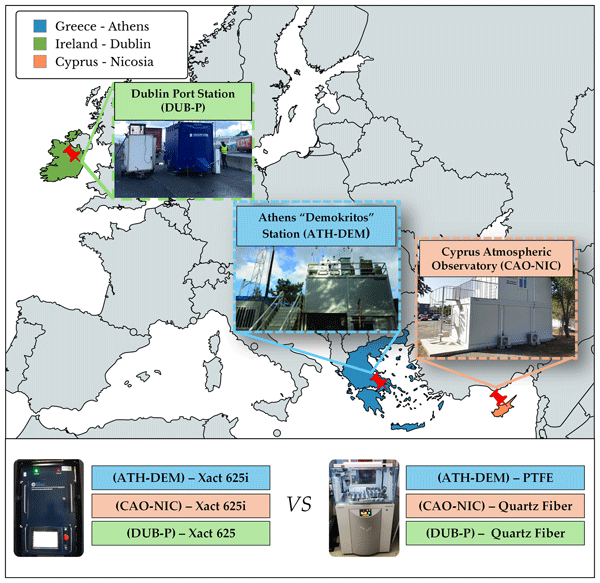
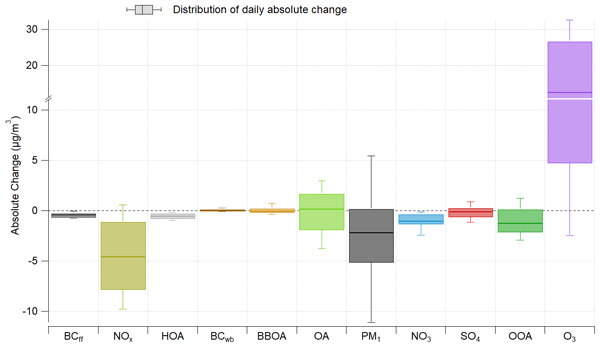
We compared near real-time and benchtop XRF spectrometers measuring trace elements in airborne particles across three European cities. Results show filter material dictates accuracy: Teflon yielded strong inter-instrument agreement, while quartz caused systematic attenuation errors for light elements. Because empirical corrections left residual biases, using optimal substrates—preferably Teflon—is essential for accurately tracking pollution sources.


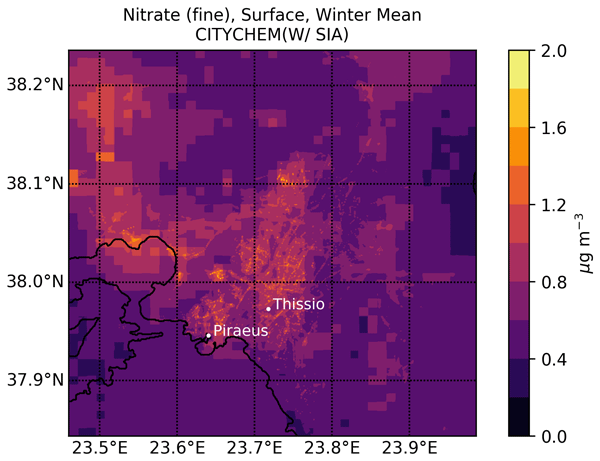
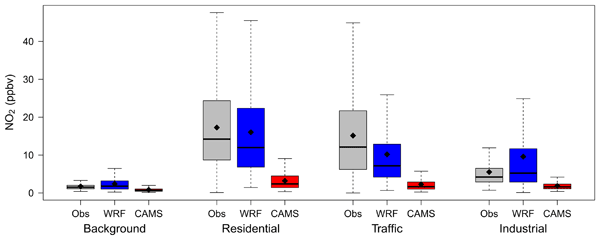
A state-of-the-art thermodynamic model has been coupled with the city-scale chemistry transport model EPISODE–CityChem to investigate the equilibrium between the inorganic gas and aerosol phases over the greater Athens area, Greece. The simulations indicate that the formation of nitrates in an urban environment is significantly affected by local nitrogen oxide emissions, as well as ambient temperature, relative humidity, photochemical activity, and the presence of non-volatile cations.





Cited articles
The requested paper has a corresponding corrigendum published. Please read the corrigendum first before downloading the article.
- Article
(13551 KB) - Full-text XML


