Articles | Volume 26, issue 3
https://doi.org/10.5194/acp-26-1967-2026
Research article
 | 
06 Feb 2026
Research article |  | 06 Feb 2026

Modelling the impact of anthropogenic aerosols on CCN concentrations over a rural boreal forest environment

Petri Clusius, Metin Baykara, Carlton Xavier, Putian Zhou, Juniper Tyree, Benjamin Foreback, Mikko Äijälä, Frans Graeffe, Tuukka Petäjä, Markku Kulmala, Pauli Paasonen, Paul I. Palmer, and Michael Boy

Related authors
Towards a mechanistic description of autoxidation chemistry: from precursors to atmospheric implications
Lukas Pichelstorfer, Pontus Roldin, Matti Rissanen, Noora Hyttinen, Olga Garmash, Carlton Xavier, Putian Zhou, Petri Clusius, Benjamin Foreback, Thomas Golin Almeida, Chenjuan Deng, Metin Baykara, Theo Kurten, and Michael Boy
EGUsphere, https://doi.org/10.5194/egusphere-2023-1415,https://doi.org/10.5194/egusphere-2023-1415, 2023
Preprint archived
Short summary
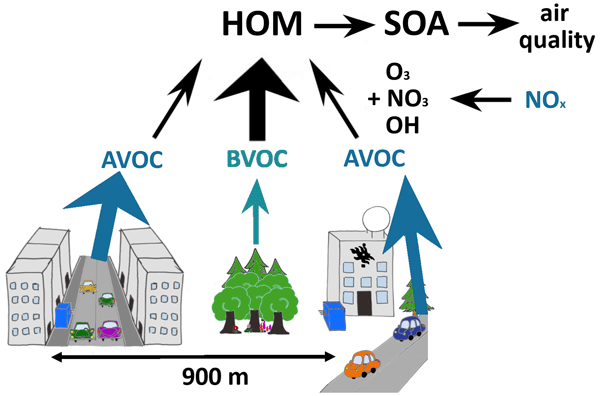
Characterization of volatile organic compounds and submicron organic aerosol in a traffic environment
Sanna Saarikoski, Heidi Hellén, Arnaud P. Praplan, Simon Schallhart, Petri Clusius, Jarkko V. Niemi, Anu Kousa, Toni Tykkä, Rostislav Kouznetsov, Minna Aurela, Laura Salo, Topi Rönkkö, Luis M. F. Barreira, Liisa Pirjola, and Hilkka Timonen
Atmos. Chem. Phys., 23, 2963–2982, https://doi.org/10.5194/acp-23-2963-2023,https://doi.org/10.5194/acp-23-2963-2023, 2023
Short summary
Atmospherically Relevant Chemistry and Aerosol box model – ARCA box (version 1.2)
Petri Clusius, Carlton Xavier, Lukas Pichelstorfer, Putian Zhou, Tinja Olenius, Pontus Roldin, and Michael Boy
Geosci. Model Dev., 15, 7257–7286, https://doi.org/10.5194/gmd-15-7257-2022,https://doi.org/10.5194/gmd-15-7257-2022, 2022
Short summary
Secondary aerosol formation in marine Arctic environments: a model measurement comparison at Ny-Ålesund
Carlton Xavier, Metin Baykara, Robin Wollesen de Jonge, Barbara Altstädter, Petri Clusius, Ville Vakkari, Roseline Thakur, Lisa Beck, Silvia Becagli, Mirko Severi, Rita Traversi, Radovan Krejci, Peter Tunved, Mauro Mazzola, Birgit Wehner, Mikko Sipilä, Markku Kulmala, Michael Boy, and Pontus Roldin
Atmos. Chem. Phys., 22, 10023–10043, https://doi.org/10.5194/acp-22-10023-2022,https://doi.org/10.5194/acp-22-10023-2022, 2022
Short summary

Cited articles

Aalto, P., Hämeri, K., Becker, E., Weber, R., Salm, J., Mäkelä, J. M., Hoell, C., O'Dowd, C. D., Karlsson, H., Hansson, H.-C., Väkevä, M., Koponen, I. K., Buzorius, G., and Kulmala, M.: Physical characterization of aerosol particles during nucleation events, Tellus B, 53, 344–358, https://doi.org/10.1034/j.1600-0889.2001.530403.x, 2001. 
Äijälä, M., Daellenbach, K. R., Canonaco, F., Heikkinen, L., Junninen, H., Petäjä, T., Kulmala, M., Prévôt, A. S. H., and Ehn, M.: Constructing a data-driven receptor model for organic and inorganic aerosol – a synthesis analysis of eight mass spectrometric data sets from a boreal forest site, Atmos. Chem. Phys., 19, 3645–3672, https://doi.org/10.5194/acp-19-3645-2019, 2019. 
Allan, J. D., Alfarra, M. R., Bower, K. N., Coe, H., Jayne, J. T., Worsnop, D. R., Aalto, P. P., Kulmala, M., Hyötyläinen, T., Cavalli, F., and Laaksonen, A.: Size and composition measurements of background aerosol and new particle growth in a Finnish forest during QUEST 2 using an Aerodyne Aerosol Mass Spectrometer, Atmos. Chem. Phys., 6, 315–327, https://doi.org/10.5194/acp-6-315-2006, 2006. 
Amann, M., Bertok, I., Borken-Kleefeld, J., Cofala, J., Heyes, C., Höglund-Isaksson, L., Klimont, Z., Nguyen, B., Posch, M., Rafaj, P., Sandler, R., Schöpp, W., Wagner, F., and Winiwarter, W.: Cost-effective control of air quality and greenhouse gases in Europe: Modeling and policy applications, Environ. Model. Softw., 26, 1489–1501, https://doi.org/10.1016/j.envsoft.2011.07.012, 2011. 
Download
Short summary
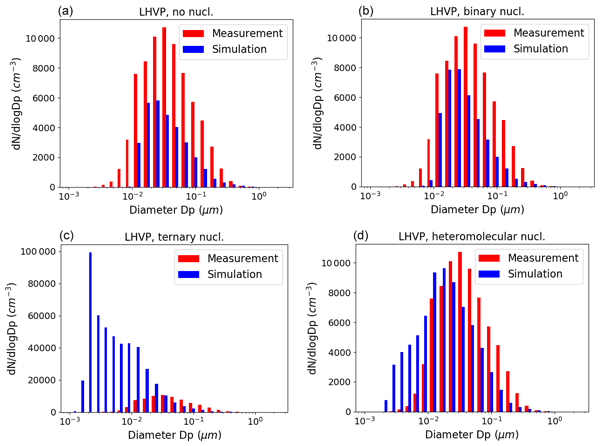
Cloud condensation nuclei are necessary to form clouds, and their size distribution affects cloud properties and therefore Earth’s energy budget. This study modelled the origins of cloud condensation nuclei at SMEAR II, Hyytiälä, Finland, and found that primary emissions and new particle formation separately contribute to more than half of the condensation nuclei, but they suppress each other, leading to current concentrations. Largest condensation nuclei originated mostly from emissions.
Share
Altmetrics
Final-revised paper
Preprint