
Articles | Volume 26, issue 19
https://doi.org/10.5194/acp-26-13767-2026
© Author(s) 2026. This work is distributed under
the Creative Commons Attribution 4.0 License.
the Creative Commons Attribution 4.0 License.
https://doi.org/10.5194/acp-26-13767-2026
© Author(s) 2026. This work is distributed under
the Creative Commons Attribution 4.0 License.
the Creative Commons Attribution 4.0 License.
Research article
| 
01 Oct 2026
Research article |
| 01 Oct 2026
| 01 Oct 2026
Tropospheric OH and its trends: new insight into atmospheric processes and implications for methane lifetime

Lancaster Environment Centre, Lancaster University, Lancaster, LA1 4YW, UK
Collaborative Innovation Center on Forecast and Evaluation of Meteorological Disasters, School of Atmospheric Physics, Nanjing University of Information Science and Technology, Nanjing, 210044, China
Lancaster Environment Centre, Lancaster University, Lancaster, LA1 4YW, UK
Oliver Wild
Lancaster Environment Centre, Lancaster University, Lancaster, LA1 4YW, UK
Andrea Mazzeo
Lancaster Environment Centre, Lancaster University, Lancaster, LA1 4YW, UK
Richard J. Pope
School of Earth and Environment, University of Leeds, Leeds, LS2 9JT, UK
National Centre for Earth Observation, University of Leeds, Leeds, LS2 9JT, UK
Lancaster Environment Centre, Lancaster University, Lancaster, LA1 4YW, UK
Siyuan Wang
Department of Atmospheric Sciences, University of Miami, Florida, FL 33124, USA
Yuanhong Zhao
State Key Laboratory of Physical Oceanography, Ocean University of China, Qingdao, 266100, China
James Lee
Department of Chemistry, University of York, York, YO10 5DD, UK
National Centre for Atmospheric Science, University of York, York, YO10 5DD, UK
Bin Zhu
Collaborative Innovation Center on Forecast and Evaluation of Meteorological Disasters, School of Atmospheric Physics, Nanjing University of Information Science and Technology, Nanjing, 210044, China
Tianliang Zhao
Collaborative Innovation Center on Forecast and Evaluation of Meteorological Disasters, School of Atmospheric Physics, Nanjing University of Information Science and Technology, Nanjing, 210044, China
Alok K. Pandey
Department of Environmental Sciences, Deshbandhu College, University of Delhi, New Delhi, 110019, India
Related authors
Xuewei Hou, Ryan Hossaini, Oliver Wild, James Lee, and Ye Wang
EGUsphere, https://doi.org/10.5194/egusphere-2026-5718, https://doi.org/10.5194/egusphere-2026-5718, 2026
This preprint is open for discussion and under review for Geoscientific Model Development (GMD).
Short summary
Short summary
Methane affects both climate and atmospheric chemistry. We compared different ways of representing methane in a global model and found that simulating methane from its emissions better reproduces observed patterns and regional trends. More importantly, it captures the long-term response of methane and atmospheric oxidants to emission changes, which cannot be fully represented when methane concentrations are prescribed.
Ye Wang, Oliver Wild, Xuewei Hou, and Ryan Hossaini
EGUsphere, https://doi.org/10.5194/egusphere-2026-5371, https://doi.org/10.5194/egusphere-2026-5371, 2026
This preprint is open for discussion and under review for Atmospheric Chemistry and Physics (ACP).
Short summary
Short summary
This study provides an assessment of the overall uncertainty in H2 soil deposition velocity from major soil parameters, quantifies the contribution of the soil sink to interannual variation in tropospheric H2 abundance, and projects the future H2 soil uptake from 2015 to 2100. This study demonstrated the major contribution of the soil sink to the interannual variability in H2 abundance, highlighted the importance of soil moisture in governing current and future soil sink.
Kai Meng, Tianliang Zhao, Yongqing Bai, Ming Wu, Le Cao, Xuewei Hou, Yuehan Luo, and Yongcheng Jiang
Atmos. Chem. Phys., 24, 12623–12642, https://doi.org/10.5194/acp-24-12623-2024, https://doi.org/10.5194/acp-24-12623-2024, 2024
Short summary
Short summary
We studied the impact of stratospheric intrusions (SIs) on tropospheric and near-surface ozone in Central and Eastern China from a stratospheric source tracing perspective. SIs contribute the most in the eastern plains, with a contribution exceeding 15 %, and have a small contribution to the west and south. Western Siberia and Mongolia are the most critical source areas for indirect and direct SIs, with the Rossby wave and northeast cold vortex being important driving circulation systems.
Xuewei Hou, Oliver Wild, Bin Zhu, and James Lee
Atmos. Chem. Phys., 23, 15395–15411, https://doi.org/10.5194/acp-23-15395-2023, https://doi.org/10.5194/acp-23-15395-2023, 2023
Short summary
Short summary
In response to the climate crisis, many countries have committed to net zero in a certain future year. The impacts of net-zero scenarios on tropospheric O3 are less well studied and remain unclear. In this study, we quantified the changes of tropospheric O3 budgets, spatiotemporal distributions of future surface O3 in east Asia and regional O3 source contributions for 2060 under a net-zero scenario using the NCAR Community Earth System Model (CESM) and online O3-tagging methods.
Qidi Li, Yuhan Luo, Yuanyuan Qian, Chen Pan, Ke Dou, Xuewei Hou, Fuqi Si, and Wenqing Liu
Atmos. Chem. Phys. Discuss., https://doi.org/10.5194/acp-2022-859, https://doi.org/10.5194/acp-2022-859, 2023
Revised manuscript not accepted
Short summary
Short summary
We found that all instruments recorded severe ozone depletion from March 18 to April 18, 2020. The effect of the polar vortex on ozone depletion in the stratosphere was clear. Additionally, the SD-WACCM model results indicated that both ClO and BrO concentrations peaked in late March. Before chlorine activation began, bromine mainly existed as HOBr; however, after chlorine activation, bromine mainly existed in the form of BrCl.
Tim Butler, Tabish Ansari, Claudio A. Belis, Elisa Bergas-Masso, Willem van Caspel, Hilde Fagerli, Johannes Flemming, Marta Garcia Vivanco, Paul Griffiths, Douglas S. Hamilton, Coralina Hernandez Trujillo, Lena Höglund-Isaksson, Vincent Huijnen, Johannes W. Kaiser, Gerbrand Koren, Zbigniew Klimont, Florian Lindl, Aura Lupascu, Mariano Mertens, Martijn Schaap, Steven T. Turnock, Oliver Wild, Philipp Weiss, Jacek Kaminski, Rosa Wu, and Terry Keating
Geosci. Model Dev., 19, 10023–10049, https://doi.org/10.5194/gmd-19-10023-2026, https://doi.org/10.5194/gmd-19-10023-2026, 2026
Short summary
Short summary
Air pollution travels across continents, meaning emissions in one region can affect air quality far away. To better understand this, scientists from many groups are planning to run coordinated computer simulations of the atmosphere. By comparing results across models and emission scenarios, the planned study will show how pollution moves between regions and which sources matter most, helping governments design more effective air quality policies.
Xuewei Hou, Ryan Hossaini, Oliver Wild, James Lee, and Ye Wang
EGUsphere, https://doi.org/10.5194/egusphere-2026-5718, https://doi.org/10.5194/egusphere-2026-5718, 2026
This preprint is open for discussion and under review for Geoscientific Model Development (GMD).
Short summary
Short summary
Methane affects both climate and atmospheric chemistry. We compared different ways of representing methane in a global model and found that simulating methane from its emissions better reproduces observed patterns and regional trends. More importantly, it captures the long-term response of methane and atmospheric oxidants to emission changes, which cannot be fully represented when methane concentrations are prescribed.
Guicai Ning, Jiayi Xing, Tianliang Zhao, Shigong Wang, Yuanjian Yang, and Xiangde Xu
EGUsphere, https://doi.org/10.5194/egusphere-2026-5585, https://doi.org/10.5194/egusphere-2026-5585, 2026
This preprint is open for discussion and under review for Atmospheric Chemistry and Physics (ACP).
Short summary
Short summary
Local atmospheric circulations are frequent and diverse over plateau-basin regions, yet their vertical structures remain unclear. Here, we develop and apply a physical-constrained framework to identify terrain-driven circulations over the Tibetan Plateau-Sichuan Basin and quantify their intensity, spatial extent, and central height. Three typical local circulations including one-cell, two-cell, and three-cell circulations are detected, which become more frequent while spatial extent shrinks.
Yongqing Bai, Wen Lu, Tian Zhan, Xiao Yun Sun, Tianliang Zhao, Lijuan Shen, Guicai Ning, Zewen Lin, Kai Meng, and Wuke Wang
EGUsphere, https://doi.org/10.5194/egusphere-2026-4625, https://doi.org/10.5194/egusphere-2026-4625, 2026
This preprint is open for discussion and under review for Atmospheric Chemistry and Physics (ACP).
Short summary
Short summary
The Twain-Hu Basin in central China has extreme heat and severe ozone, yet few combined events. We show that basin O₃ is driven by synoptic transport from upwind sources rather than local heat, with the O₃ peak shifting to September, decoupling ozone from temperature. This pattern may be common in multi-source receptor basins.
Xiangde Xu, Wenyue Cai, Tianliang Zhao, Changjun Yang, Kai Meng, Chong Wu, Na Dong, Yueqing Li, Shunjiu Wang, Wenqing Liu, Tianshu Zhang, Ga Zhuo, Shengjun Zhang, Bin Chen, Chunsong Lu, Jinghua Chen, Kai Yang, and Jianming Xu
Atmos. Chem. Phys., 26, 13581–13593, https://doi.org/10.5194/acp-26-13581-2026, https://doi.org/10.5194/acp-26-13581-2026, 2026
Short summary
Short summary
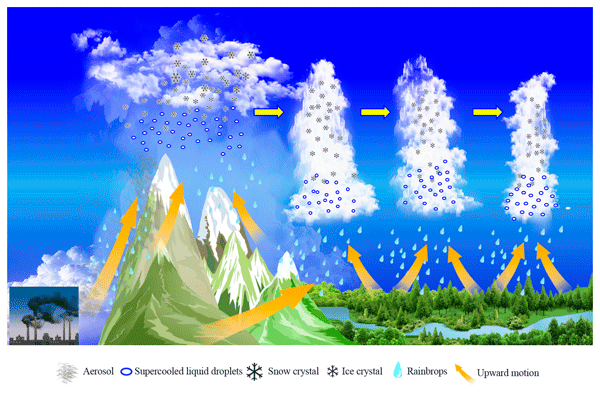
Using satellite and comprehensive ground-based observations, we identify pronounced ice-cloud activation associated with transported exogenous aerosols. Under different large-scale atmospheric circulation regimes, ice-phase cloud activated over Mount Qomolangma (MQ) can be efficiently transported downstream through distinct pathways, exerting a pronounced ice crystal seeding effect on cloud–precipitation conversion.
Ye Wang, Oliver Wild, Xuewei Hou, and Ryan Hossaini
EGUsphere, https://doi.org/10.5194/egusphere-2026-5371, https://doi.org/10.5194/egusphere-2026-5371, 2026
This preprint is open for discussion and under review for Atmospheric Chemistry and Physics (ACP).
Short summary
Short summary
This study provides an assessment of the overall uncertainty in H2 soil deposition velocity from major soil parameters, quantifies the contribution of the soil sink to interannual variation in tropospheric H2 abundance, and projects the future H2 soil uptake from 2015 to 2100. This study demonstrated the major contribution of the soil sink to the interannual variability in H2 abundance, highlighted the importance of soil moisture in governing current and future soil sink.
Lingze Meng, Ni Lu, Yixin Guo, Ziru Lan, Zhao-Cheng Zeng, Zichong Chen, Yuanhong Zhao, Zhuangmin Zhong, Tao Zhang, Duohong Chen, Xuejun Liu, Lin Zhang, and Junyu Zheng
EGUsphere, https://doi.org/10.5194/egusphere-2026-4773, https://doi.org/10.5194/egusphere-2026-4773, 2026
This preprint is open for discussion and under review for Atmospheric Chemistry and Physics (ACP).
Short summary
Short summary
Ammonia contributes to formation of health-damaging PM2.5 air pollution, but its emission estimations involve substantial uncertainties. Combining ground and satellite observations, a local inventory, and atmospheric modeling, we improved ammonia emissions in Guangdong, China. We found that current inventories overestimated agricultural emissions but underestimated non-agricultural emissions, especially in urban areas during the cool season, informing effective PM2.5 mitigation policy design.
Yiqi Chen, Le Cao, Xiaochun Zhu, Yan Xia, Tianqi Zhang, Xiuli Lei, Mengke Wang, Liqiang Xu, and Tianliang Zhao
EGUsphere, https://doi.org/10.5194/egusphere-2026-3196, https://doi.org/10.5194/egusphere-2026-3196, 2026
This preprint is open for discussion and under review for Atmospheric Chemistry and Physics (ACP).
Short summary
Short summary
We investigate the spatiotemporal distribution of springtime tropopause folds over the Arctic during 2000–2023 using ERA5 reanalysis data and a three-dimensional tropopause fold labeling algorithm. The study combines pan-Arctic spatial statistics with station-based analyses at Alert, Barrow, Villum, and Zeppelin, providing a climatological characterization of Arctic tropopause fold occurrence, depth dependence, seasonal evolution, and associated upper-tropospheric dynamical background.
Lucy Hart, Ryan Hossaini, Oliver Wild, Crispin Halsall, Martin K. Vollmer, and David Sherry
EGUsphere, https://doi.org/10.5194/egusphere-2026-4613, https://doi.org/10.5194/egusphere-2026-4613, 2026
Short summary
Short summary
HFO-1234yf is increasingly used in cars because of its low climate impact but once emitted to the atmosphere it forms trifluoroacetic acid (TFA), a chemical that remains on Earth permanently. We present the first global emission inventory of HFO-1234yf from cars and compare our results to atmospheric measurements. Using an atmospheric chemistry model, we found that TFA produced from this source is rapidly growing and most TFA is deposited outside of the region HFO-1234yf was emitted.
Ruth M. Doherty, Zhenze Liu, Massimo Vieno, Oliver Wild, Fiona M. O'Connor, Steven T. Turnock, Christina M. Hood, Jenny R. Stocker, Mathew R. Heal, Dwayne E. Heard, Emma G. Sands, David J. Carruthers, and Lisa K. Whalley
Atmos. Chem. Phys., 26, 10115–10147, https://doi.org/10.5194/acp-26-10115-2026, https://doi.org/10.5194/acp-26-10115-2026, 2026
Short summary
Short summary
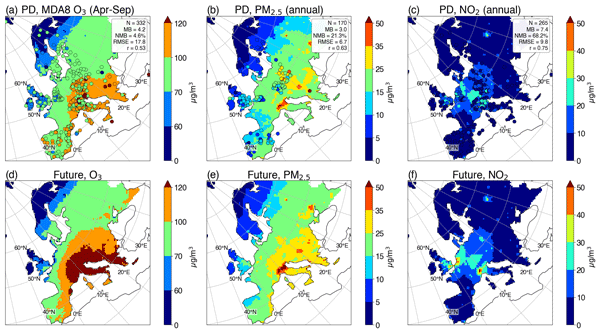
We use innovative coupled modelling to quantify how natural emissions, chemistry, deposition and transport influence climate change responses of air pollutants from continental to urban scales across Europe. We highlight uncertainties in climate-sensitive biogenic emissions as key to future projections of ozone and fine particulate matter. High resolution modelling is essential for evaluating the benefits and trade-offs of climate change for achieving WHO air quality targets and guidelines.
Thomas C. Moore, James R. Hopkins, Will S. Drysdale, Stuart Young, Sri Hapsari Budisulistiorini, Marvin D. Shaw, Mackenzie LeVernois, James L. France, David Lowry, and James D. Lee
Atmos. Meas. Tech., 19, 4459–4475, https://doi.org/10.5194/amt-19-4459-2026, https://doi.org/10.5194/amt-19-4459-2026, 2026
Short summary
Short summary
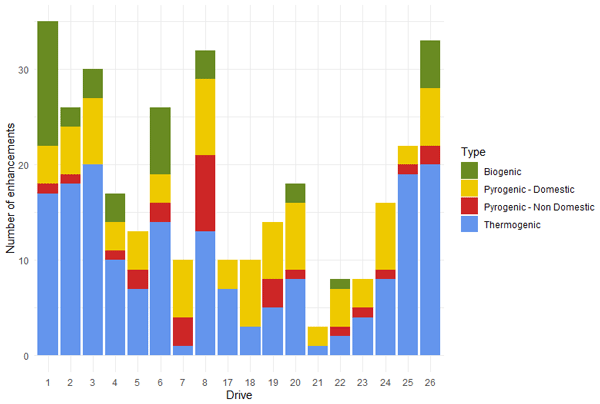
The Global Methane Pledge has led to increased effort to reduce methane emissions globally. One sector under increased scrutiny is the oil and gas industry, a major source of methane in this industry is from fugitive emissions (gas leaks). Locating these from pipework in cities requires mobile measurements. This work adapts previous methodologies to detect smaller leaks and suggests previous methods may detect 53.5 % less gas leaks.
Ailish M. Graham, Dominick V. Spracklen, James B. McQuaid, Richard Rigby, Hanun Nurrahmawati, Devina Ayona, Resti Salmayenti, Kitso Kusin, Adi Jaya, Thomas E. L. Smith, Annisa Alifindira, Shofwan Al Banna Choiruzzad, and Richard Pope
EGUsphere, https://doi.org/10.5194/egusphere-2026-2746, https://doi.org/10.5194/egusphere-2026-2746, 2026
Short summary
Short summary
Indonesia peatlands have been extensively drained for agriculture, but this makes them very flammable in periods of drought, causing widespread air pollution. We measured fine particulate pollution across Central Kalimantan from 2023 to 2025 using >40 sensors. Pollution was highest during dry El Niño conditions but still degraded air pollution in wetter years. Thus, showing that climate strongly controls fires and air quality, and that reducing fires could improve air quality every year.
Emma Sands, Fiona M. O'Connor, James Weber, Ruth M. Doherty, and Richard J. Pope
Atmos. Chem. Phys., 26, 8553–8573, https://doi.org/10.5194/acp-26-8553-2026, https://doi.org/10.5194/acp-26-8553-2026, 2026
Short summary
Short summary
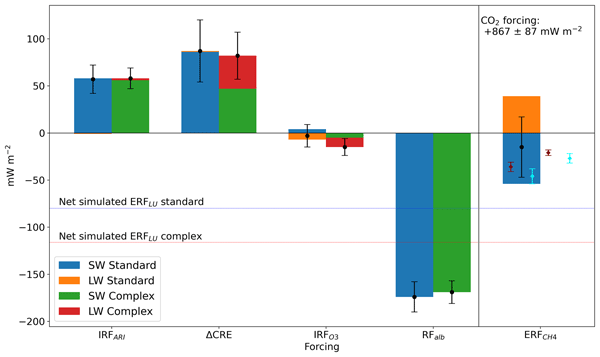
Land use impacts climate through changes in atmospheric composition but the relative importance of various pathways is uncertain. We use a model to separate the forcing from pre-industrial to present-day land use change into contributions from various greenhouse gases, aerosol effects, and surface albedo change. The inclusion of updated processes highlights the role of changes in cloud properties. The carbon dioxide forcing dominates, but other processes have substantial regional impacts.
Zihan Wang, Yishu Bian, Fuwang Zhang, Honglei Wang, Wen Lin, Jun Hu, Tianliang Zhao, Lijian Shen, and Zuxin Xie
Atmos. Chem. Phys., 26, 7539–7554, https://doi.org/10.5194/acp-26-7539-2026, https://doi.org/10.5194/acp-26-7539-2026, 2026
Short summary
Short summary
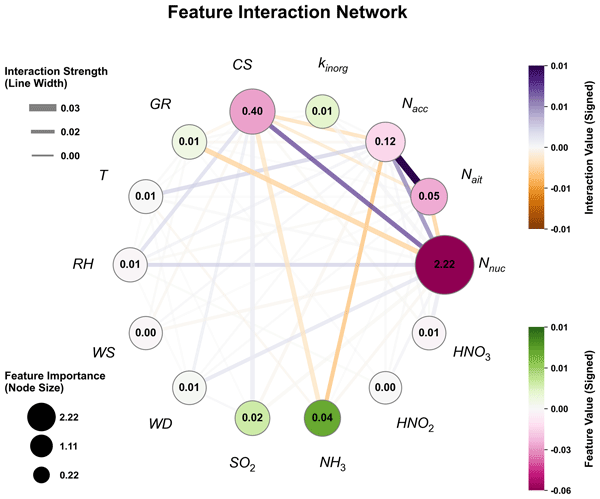
We investigated how new air particles form in cities and affect clouds. Our year-long study revealed a key seasonal pattern: while particle formation events are most frequent in spring, they are surprisingly inefficient at creating the seeds for clouds due to high pollution. In contrast, the cleaner summer air, despite having fewer events, allows the new particles to grow larger and much more effectively enhance potential cloud formation.
Deyu Liu, Yue Chen, Sihan Liu, Honglei Wang, Jingyi Chen, Yang Yang, Zihan Wang, Kun Cui, and Tianliang Zhao
Atmos. Chem. Phys., 26, 5781–5797, https://doi.org/10.5194/acp-26-5781-2026, https://doi.org/10.5194/acp-26-5781-2026, 2026
Short summary
Short summary
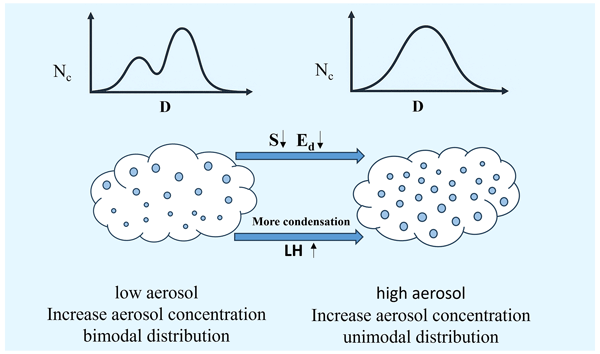
Cloud droplets are vital for rainfall and climate, and tiny airborne particles called aerosols can change their size and number. Using airplane observations over Hebei and simulations, we found that aerosols strongly affect droplet vertical distribution. Under high aerosols, lower droplets are larger and more numerous; under low aerosols, upper droplets are larger. These changes affect cloud development, precipitation, and atmospheric energy.
Yujia Yang, Le Cao, Liqiang Xu, Mengke Wang, Qingjian Yang, Yuqing Zhang, Tianqi Zhang, Xiuli Lei, Jiangpeng Miao, and Tianliang Zhao
Earth Syst. Sci. Data, 18, 2689–2702, https://doi.org/10.5194/essd-18-2689-2026, https://doi.org/10.5194/essd-18-2689-2026, 2026
Short summary
Short summary
This study provides a high-resolution (0.25°, hourly) tropopause folding dataset for China (2014–2023) using ERA5 (ECMWF Reanalysis version 5) reanalysis data and a three-dimensional labeling method. It fills a critical data gap, enabling detailed spatiotemporal analysis of tropopause folding events. This validated resource provides a solid foundation for investigating stratosphere-troposphere transport and its impacts on near-surface air quality and extreme weather.
Kai Yang, Jinghua Chen, Tianliang Zhao, Xiangde Xu, Chunsong Lu, Shizuo Fu, Yuehan Luo, Qingjian Yang, Ziqian Liu, Zhikuan Li, Lin Wu, and Yuxiang Jin
EGUsphere, https://doi.org/10.5194/egusphere-2026-869, https://doi.org/10.5194/egusphere-2026-869, 2026
Short summary
Short summary
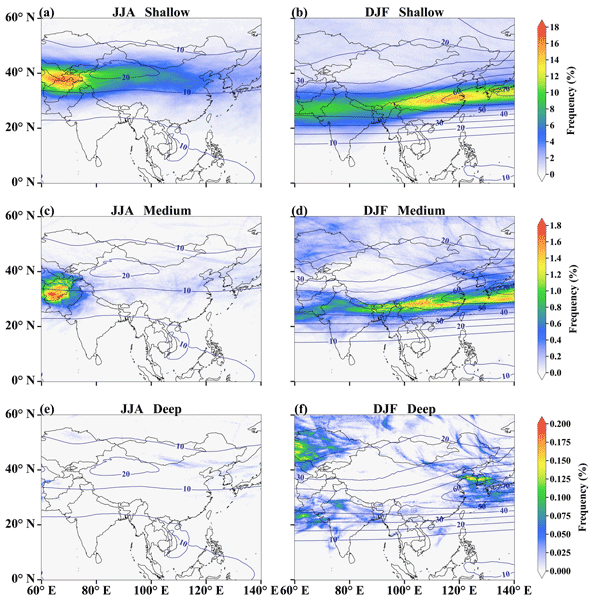
The Tibetan Plateau has little available moisture and energy, so convection is hard to develop. Large-eddy simulations indicates the lake promotes low-level moistening and lowers the barrier to convective initiation, produces shallow clouds and week rain. Mountain alone force lifting, yet the lack of moisture limits terrain-driven precipitation. Lake-mountain coupling is key: the mountain lifts lake-supplied moisture but can also block moisture transport, reshaping precipitation patterns.
Ken S. Carslaw, Leighton A. Regayre, Ulrike Proske, Andrew Gettelman, David M. H. Sexton, Yun Qian, Lauren R. Marshall, Oliver Wild, Marcus van Lier-Walqui, Annika Oertel, Saloua Peatier, Ben Yang, Jill S. Johnson, Sihan Li, Daniel T. McCoy, Benjamin M. Sanderson, Christina J. Williamson, Gregory S. Elsaesser, Kuniko Yamazaki, and Ben B. B. Booth
Atmos. Chem. Phys., 26, 4651–4667, https://doi.org/10.5194/acp-26-4651-2026, https://doi.org/10.5194/acp-26-4651-2026, 2026
Short summary
Short summary
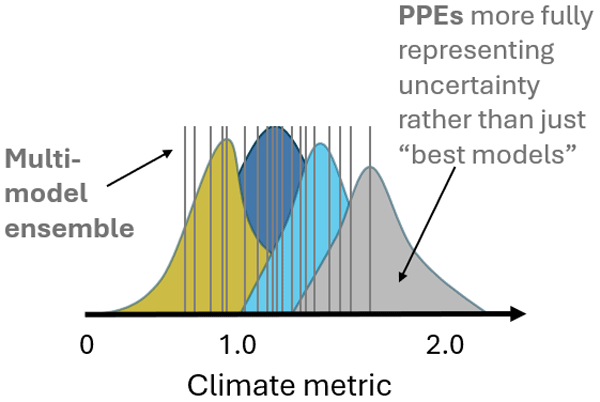
A major challenge in climate science is reducing projection uncertainty despite advances in models and observational constraints. Perturbed parameter ensembles (PPEs) offer a powerful tool to explore and reduce uncertainty by revealing model weaknesses and guiding development. PPEs are now widely applied across climate systems and scales. We argue they should be prioritized alongside complexity and resolution in model resource planning.
Gunnar Myhre, Øivind Hodnebrog, Srinath Krishnan, Maria Sand, Marit Sandstad, Ragnhild B. Skeie, Lieven Clarisse, Bruno Franco, Dylan B. Millet, Kelley C. Wells, Alexander Archibald, Hannah N. Bryant, Alex T. Chaudhri, David S. Stevenson, Didier Hauglustaine, Michael Prather, J. Christopher Kaiser, Dirk J. L. Olivie, Michael Schulz, Oliver Wild, Ye Wang, Thérèse Salameh, Jason E. Williams, Philippe Le Sager, Fabien Paulot, Kostas Tsigaridis, and Haley E. Plaas
Geosci. Model Dev., 19, 2577–2591, https://doi.org/10.5194/gmd-19-2577-2026, https://doi.org/10.5194/gmd-19-2577-2026, 2026
Short summary
Short summary
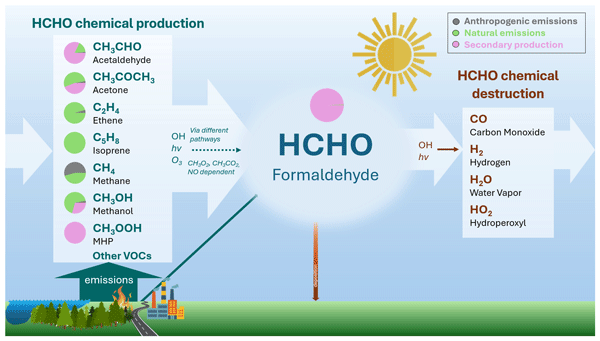
Volatile organic compounds (VOCs) affect air quality and climate, but their behavior in the atmosphere is still uncertain. We launched a global research effort to compare how different models represent these compounds and to improve their accuracy. By analyzing model results alongside observations and satellite data, we aim to better understand the atmospheric composition of these compounds.
Xiaofeng Xu, Zixu Xiong, Jianming Gong, Huilin Zhang, Tianliang Zhao, and Qing He
Atmos. Chem. Phys., 26, 2721–2740, https://doi.org/10.5194/acp-26-2721-2026, https://doi.org/10.5194/acp-26-2721-2026, 2026
Short summary
Short summary
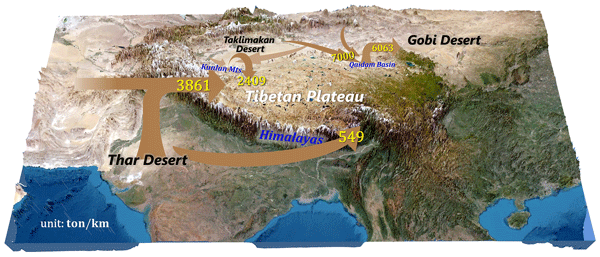
Dust has an important impact on the climate in East Asia. This study comprehensively utilized ground-based and satellite observation data to analyze the spatio-temporal variations of dust in the Tibetan Plateau and its surrounding areas, as well as the diurnal variation characteristics of regional dust transport. This study has deepened the understanding of the variation patterns of dust around the Tibetan Plateau.
Maria P. Velásquez-García, Richard J. Pope, Steven T. Turnock, Chetan Deva, David P. Moore, Guilherme Mataveli, Steve R. Arnold, Ruth M. Doherty, and Martyn P. Chipperfield
Biogeosciences, 23, 1341–1364, https://doi.org/10.5194/bg-23-1341-2026, https://doi.org/10.5194/bg-23-1341-2026, 2026
Short summary
Short summary
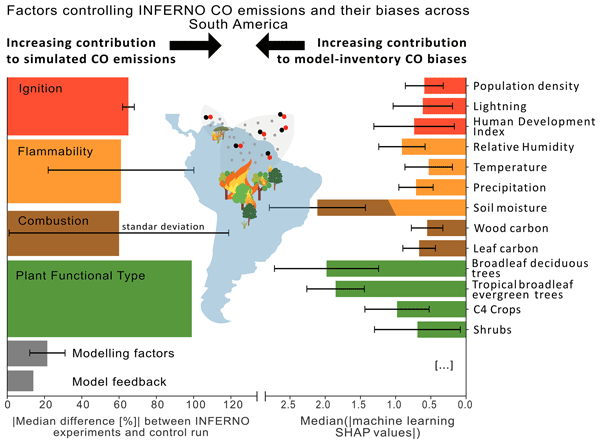
Incorporating fire simulation into climate models is crucial for accurately representing interactions between fires, ecosystems, and climate, thereby enhancing climate projections. In South America, the INFERNO (Interactive Fires and Emissions algorithm for Natural Environments) fire model broadly captures CO emissions in active fire zones, e.g., the Amazon Arc of Deforestation. Still, it tends to overestimate emissions in tree-rich ecosystems, where INFERNO is too sensitive to low soil moisture, and to underestimate emissions in less tree-abundant ecosystems.

Loren G. Temple, Stuart Young, Thomas Bannan, Stephanie E. Batten, Stéphane Bauguitte, Hugh Coe, Eve Grant, Stuart E. Lacy, James D. Lee, Emily Matthews, Dominika Pasternak, Samuel D. A. Rogers, Andrew W. Rollins, Jake Vallow, Mingxi Yang, and Pete M. Edwards
Atmos. Meas. Tech., 19, 1165–1178, https://doi.org/10.5194/amt-19-1165-2026, https://doi.org/10.5194/amt-19-1165-2026, 2026
Short summary
Short summary
Sulfur dioxide (SO2) is a key precursor to aerosol formation, particularly in remote marine environments, ultimately affecting cloud properties and climate. Accurate quantification of atmospheric SO2 is therefore crucial. This work compares a custom-built laser-based instrument to two commercial SO2 analysers during measurements from a large research aircraft. Our results show that this custom-built system offers greater sensitivity at time resolutions required for aircraft measurements.
Oliver Wild and Edmund M. Ryan
Atmos. Chem. Phys., 26, 2255–2273, https://doi.org/10.5194/acp-26-2255-2026, https://doi.org/10.5194/acp-26-2255-2026, 2026
Short summary
Short summary
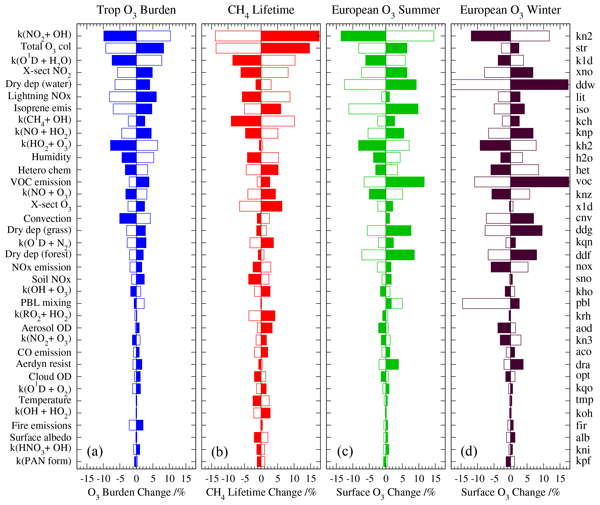
This study provides a self-consistent quantitative analysis of how a wide range of physical, chemical and meteorological processes influence tropospheric ozone and oxidation as represented in global chemistry transport models. It identifies the largest sources of uncertainty in our current understanding and demonstrates the use of observations for formally constraining models and providing information on uncertainty at a process level.
Jialu Xu, Yingjie Zhang, Yuying Wang, Xing Yan, Bin Zhu, Chunsong Lu, Yuanjian Yang, Yele Sun, Junhui Zhang, Xiaofan Zuo, Zhanghanshu Han, and Rui Zhang
Atmos. Chem. Phys., 25, 18599–18616, https://doi.org/10.5194/acp-25-18599-2025, https://doi.org/10.5194/acp-25-18599-2025, 2025
Short summary
Short summary
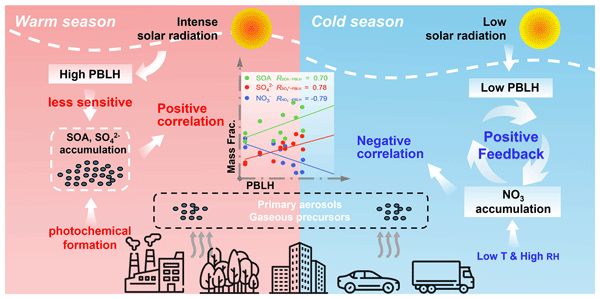
We conducted a year-long study in Nanjing to explore how the height of the atmospheric boundary layer affects fine particle pollution. We found that low boundary layers in winter trap pollutants like nitrate and primary particles, while higher layers in summer help form secondary pollutants like sulfate and organic aerosols. These findings show that boundary layer dynamics are key to understanding and managing seasonal air pollution.
Laura A. Mansfield, Peer J. Nowack, Edmund M. Ryan, Oliver Wild, and Apostolos Voulgarakis
EGUsphere, https://doi.org/10.5194/egusphere-2025-6046, https://doi.org/10.5194/egusphere-2025-6046, 2025
Short summary
Short summary
We present a fast machine learning emulator that predicts how Earth’s surface temperature reacts within the first five years to changes in greenhouse gases and aerosol pollutants. It is trained on carefully designed simulations from a complex climate model, but can be run much faster. Our emulator can be used to show where the climate is most sensitive to different emissions and can help explore many possible future paths, making it easier to assess the climate effects of policy choices.
Junhui Zhang, Yuying Wang, Jialu Xu, Xiaofan Zuo, Chunsong Lu, Bin Zhu, Yuanjian Yang, Xing Yan, and Yele Sun
Atmos. Chem. Phys., 25, 17413–17428, https://doi.org/10.5194/acp-25-17413-2025, https://doi.org/10.5194/acp-25-17413-2025, 2025
Short summary
Short summary
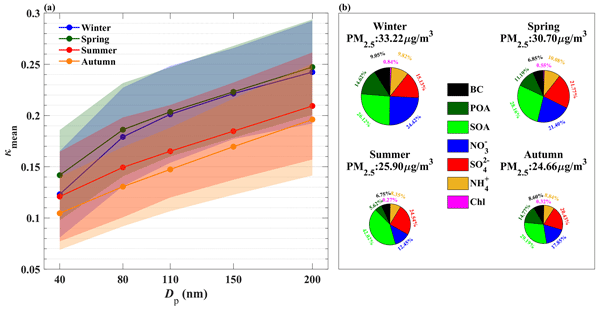
We conducted a year-long study in Nanjing to understand how tiny airborne particles take up water, which affects air quality and climate. We found that particle water uptake varies by season and size, with lower values in summer due to more organic materials. Local pollution mainly influences smaller particles, while larger ones are shaped by air mass transport. These findings help improve climate models and support better air pollution control in fast-growing cities.
Zhenze Liu, Ke Li, Oliver Wild, Ruth M. Doherty, Fiona M. O’Connor, and Steven T. Turnock
Atmos. Chem. Phys., 25, 16969–16981, https://doi.org/10.5194/acp-25-16969-2025, https://doi.org/10.5194/acp-25-16969-2025, 2025
Short summary
Short summary
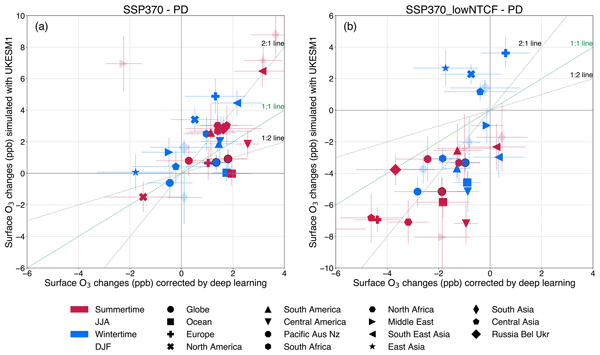
Chemistry-climate models have advanced substantially over the decades, yet they still exhibit substantial systematic biases in simulating atmospheric composition due to gaps in our understanding of underlying processes. We improve the predictions of an Earth system model using deep learning, and evaluate the performance of difference types of statistical models. We find that simulations of future surface ozone are likely to become less accurate under a warmer climate.
Matthew J. Rowlinson, Lucy J. Carpenter, Mat J. Evans, James D. Lee, Simone T. Andersen, Tomas Sherwen, Anna B. Callaghan, Roberto Sommariva, William Bloss, Siqi Hou, Leigh R. Crilley, Klaus Pfeilsticker, Benjamin Weyland, Thomas B. Ryerson, Patrick R. Veres, Pedro Campuzano-Jost, Hongyu Guo, Benjamin A. Nault, Jose L. Jimenez, and Khanneh Wadinga Fomba
Atmos. Chem. Phys., 25, 16945–16968, https://doi.org/10.5194/acp-25-16945-2025, https://doi.org/10.5194/acp-25-16945-2025, 2025
Short summary
Short summary
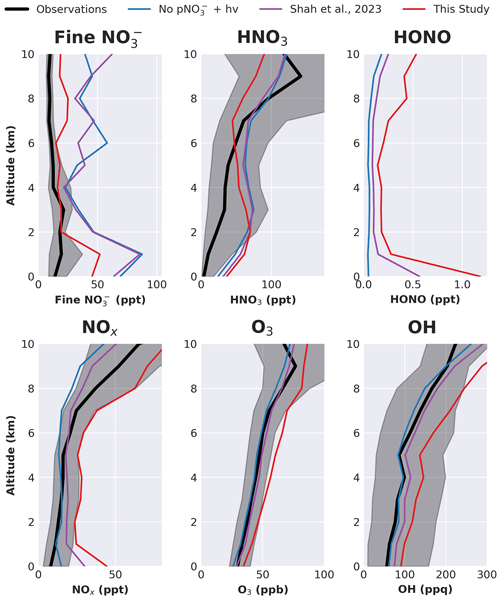
HONO is key to tropospheric chemistry. Observations show high HONO concentrations in remote air, possibly explained by nitrate aerosol photolysis. We use observations to parameterize nitrate photolysis, evaluating simulated HONO against observations from multiple sources. We show improved agreement with observed HONO, but overestimates in NOx and O3, beyond observational constraints. This implies uncertainties in the NOx budget and our understanding of atmospheric chemistry.
Matilda A. Pimlott, Richard J. Pope, Brian J. Kerridge, Richard Siddans, Barry G. Latter, Wuhu Feng, and Martyn P. Chipperfield
Atmos. Chem. Phys., 25, 15991–16007, https://doi.org/10.5194/acp-25-15991-2025, https://doi.org/10.5194/acp-25-15991-2025, 2025
Short summary
Short summary
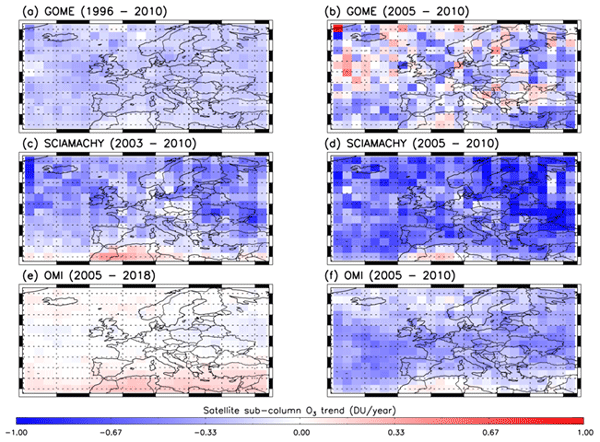
Tropospheric ozone (O3) is a harmful secondary atmospheric pollutant and an important greenhouse gas. Here, we present an in-depth analysis of lower-tropospheric sub-column O3 (LTCO3, surface – 6 km) records from three satellite products produced by the Rutherford Appleton Laboratory (RAL) over Europe between 1996 and 2017. Overall, we detect moderate negative trends in the satellite records, but corresponding model simulations and ozonesonde measurements show negligible trends.
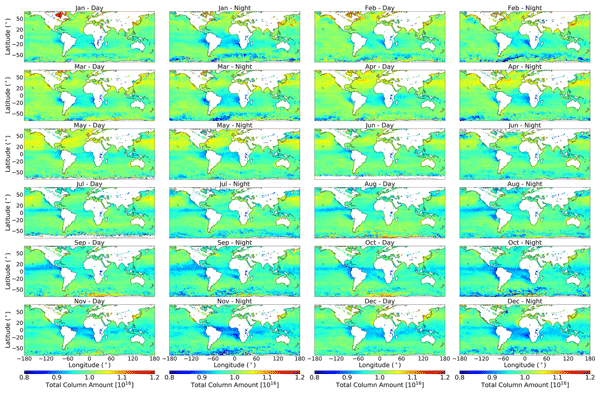
Michael P. Cartwright, Jeremy J. Harrison, David P. Moore, Richard J. Pope, Martyn P. Chipperfield, Chris Wilson, and Wuhu Feng
Atmos. Chem. Phys., 25, 15913–15934, https://doi.org/10.5194/acp-25-15913-2025, https://doi.org/10.5194/acp-25-15913-2025, 2025
Short summary
Short summary
We use satellite measurements to estimate quantities of a gas called carbonyl sulfide (OCS) in the atmosphere. OCS is consumed during photosynthesis, much like carbon dioxide (CO2). Our data is focused mostly over the global oceans for the year 2018, and we find it compares well with past satellite observations, ground-based measurements and modelled OCS. We hope to extend this measurement record and use it in data-driven tools in the future to better understand the carbon cycle globally.
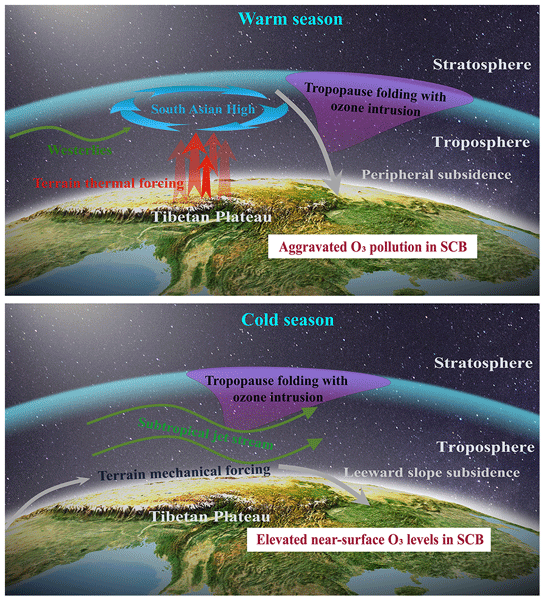
Zhuozhi Shu, Fumo Yang, Guangming Shi, Yuqing Zhang, Yongjie Huang, Xinning Yu, Baiwan Pan, and Tianliang Zhao
Atmos. Chem. Phys., 25, 15437–15451, https://doi.org/10.5194/acp-25-15437-2025, https://doi.org/10.5194/acp-25-15437-2025, 2025
Short summary
Short summary
We targeted four stratospheric intrusion episodes to investigate the impacts of cross-layer transport of stratospheric O3 on the near-surface environmental atmosphere over Sichuan Basin and uncover multi-scale atmospheric circulation coupling mechanisms with the seasonally discrepant terrain effects of Tibetan Plateau. Results provided the critical insights into understanding of regional O3 pollution genesis with the exceptional natural sources contribution derived from the stratosphere.
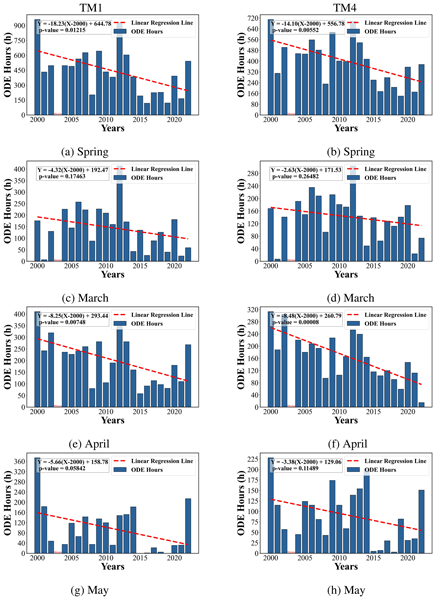
Xiaochun Zhu, Le Cao, Xin Yang, Simeng Li, Jiandong Wang, and Tianliang Zhao
Atmos. Chem. Phys., 25, 12159–12176, https://doi.org/10.5194/acp-25-12159-2025, https://doi.org/10.5194/acp-25-12159-2025, 2025
Short summary
Short summary
We applied various criteria to identify springtime ozone depletion events (ODEs) at Utqiaġvik, Arctic, and investigated the influence of using different criteria on conclusions regarding the characteristics of ODEs. We found that criteria using fixed thresholds or monthly average-based thresholds were more suitable for identifying ODEs than the others. Applying a threshold that varies with the monthly average or stricter fixed thresholds also indicated a more significant reduction in ODE occurrences.
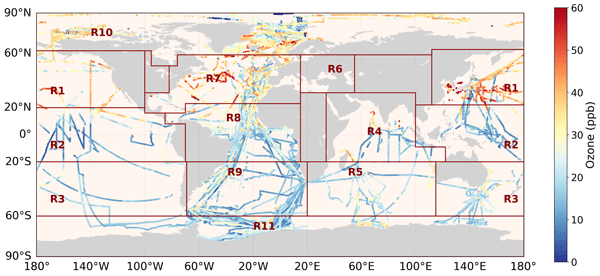
Yugo Kanaya, Roberto Sommariva, Alfonso Saiz-Lopez, Andrea Mazzeo, Theodore K. Koenig, Kaori Kawana, James E. Johnson, Aurélie Colomb, Pierre Tulet, Suzie Molloy, Ian E. Galbally, Rainer Volkamer, Anoop Mahajan, John W. Halfacre, Paul B. Shepson, Julia Schmale, Hélène Angot, Byron Blomquist, Matthew D. Shupe, Detlev Helmig, Junsu Gil, Meehye Lee, Sean C. Coburn, Ivan Ortega, Gao Chen, James Lee, Kenneth C. Aikin, David D. Parrish, John S. Holloway, Thomas B. Ryerson, Ilana B. Pollack, Eric J. Williams, Brian M. Lerner, Andrew J. Weinheimer, Teresa Campos, Frank M. Flocke, J. Ryan Spackman, Ilann Bourgeois, Jeff Peischl, Chelsea R. Thompson, Ralf M. Staebler, Amir A. Aliabadi, Wanmin Gong, Roeland Van Malderen, Anne M. Thompson, Ryan M. Stauffer, Debra E. Kollonige, Juan Carlos Gómez Martin, Masatomo Fujiwara, Katie Read, Matthew Rowlinson, Keiichi Sato, Junichi Kurokawa, Yoko Iwamoto, Fumikazu Taketani, Hisahiro Takashima, Mónica Navarro-Comas, Marios Panagi, and Martin G. Schultz
Earth Syst. Sci. Data, 17, 4901–4932, https://doi.org/10.5194/essd-17-4901-2025, https://doi.org/10.5194/essd-17-4901-2025, 2025
Short summary
Short summary
The first comprehensive dataset of tropospheric ozone over oceans/polar regions is presented, including 77 ship/buoy and 48 aircraft campaign observations (1977–2022, 0–5000 m altitude), supplemented by ozonesonde and surface data. Air masses isolated from land for 72+ hours are systematically selected as essentially oceanic. Among the 11 global regions, they show daytime decreases of 11–16 % in the tropics, while near-zero depletions are rare, unlike in the Arctic, implying different mechanisms.
Xi Chen, Ke Li, Ting Yang, Xipeng Jin, Lei Chen, Yang Yang, Shuman Zhao, Bo Hu, Bin Zhu, Zifa Wang, and Hong Liao
Atmos. Chem. Phys., 25, 9151–9168, https://doi.org/10.5194/acp-25-9151-2025, https://doi.org/10.5194/acp-25-9151-2025, 2025
Short summary
Short summary
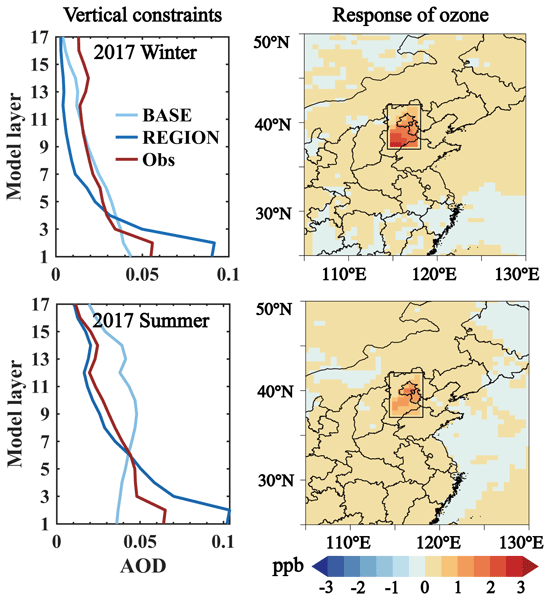
Aerosol vertical distribution that plays a crucial role in aerosol–photolysis interaction (API) remains underrepresented in chemical models. We integrated lidar and radiosonde observations to constrain the simulated aerosol profiles over North China and quantified the photochemical responses. The increased photolysis rates in the lower layers led to increased ozone and accounted for a 36 %–56 % reduction in API effects, resulting in enhanced atmospheric oxidizing capacity and aerosol formation.
Suvarna Fadnavis, Yasin Elshorbany, Jerald Ziemke, Brice Barret, Alexandru Rap, P. R. Satheesh Chandran, Richard J. Pope, Vijay Sagar, Domenico Taraborrelli, Eric Le Flochmoen, Juan Cuesta, Catherine Wespes, Folkert Boersma, Isolde Glissenaar, Isabelle De Smedt, Michel Van Roozendael, Hervé Petetin, and Isidora Anglou
Atmos. Chem. Phys., 25, 8229–8254, https://doi.org/10.5194/acp-25-8229-2025, https://doi.org/10.5194/acp-25-8229-2025, 2025
Short summary
Short summary
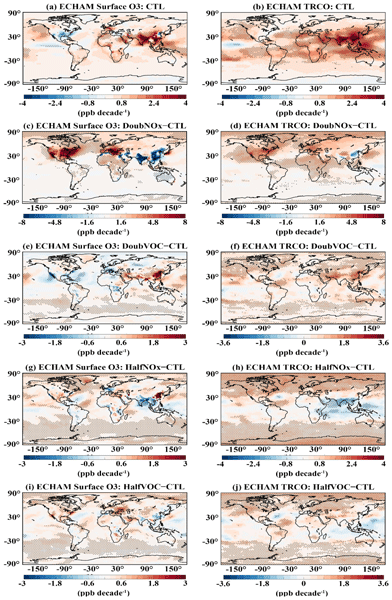
Satellites and model simulations show enhancement in tropospheric ozone, which is highly impacted by human-produced nitrous oxides compared to volatile organic compounds. The increased amount of ozone enhances ozone radiative forcing. The ozone enhancement and associated radiative forcing are the highest over South and East Asia. The emissions of nitrous oxides show a higher influence on shifting ozone photochemical regimes than volatile organic compounds.
Qingjian Yang, Tianliang Zhao, Yongqing Bai, Kai Meng, Yuehan Luo, Zhijie Tian, Xiaoyun Sun, Weikang Fu, Kai Yang, and Jun Hu
Atmos. Chem. Phys., 25, 8029–8042, https://doi.org/10.5194/acp-25-8029-2025, https://doi.org/10.5194/acp-25-8029-2025, 2025
Short summary
Short summary
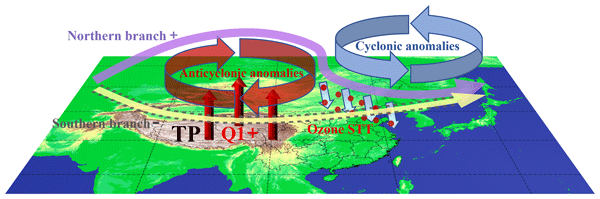
This study reveals a unique driver of the Tibetan Plateau (TP) thermal forcing of the interannual variations in stratosphere-to-troposphere transport (STT) of ozone with diverse structures. Anomalous strong TP thermal forcing induces anticyclonic anomalies in the upper troposphere over the TP, which strengthens and attenuates the northern and southern branches of the westerly jet, intensifying (weakening) the westerly trough for more (fewer) tropopause folds of ozone STT over the East Asian region.
Emma Sands, Ruth M. Doherty, Fiona M. O'Connor, Richard J. Pope, James Weber, and Daniel P. Grosvenor
Atmos. Chem. Phys., 25, 7269–7297, https://doi.org/10.5194/acp-25-7269-2025, https://doi.org/10.5194/acp-25-7269-2025, 2025
Short summary
Short summary
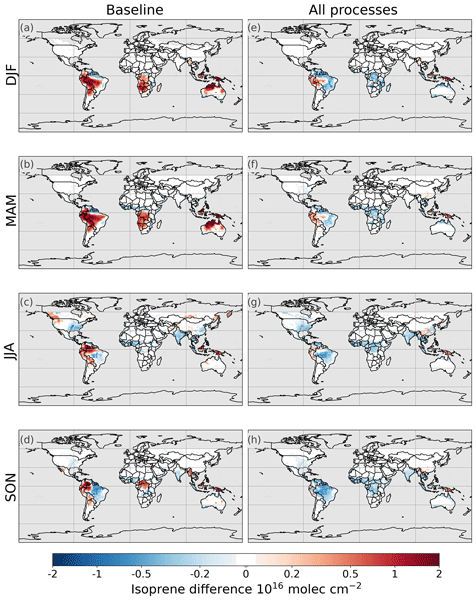
We perform a detailed satellite–model comparison for isoprene, formaldehyde and aerosol optical depth in an Earth system model. We quantify the impacts of several processes that affect how biosphere–atmosphere interactions influence atmospheric chemistry and aerosols. Our findings highlight that the aerosol direct effect is sensitive to the processes studied. These results can inform future investigations of how the biosphere can affect atmospheric composition and climate.
Andrea Mazzeo, Christian Pfrang, and Zaheer Ahmad Nasir
EGUsphere, https://doi.org/10.5194/egusphere-2025-783, https://doi.org/10.5194/egusphere-2025-783, 2025
Preprint archived
Short summary
Short summary
Indoor air pollution is a serious public health risk. There is an urgent need to understand how various sources contribute to air pollution over time in homes, workplaces, vehicles, and recreational areas. The InAPI tool is built on a database of indoor air pollutants in the UK. It organizes information about pollutants, environments, and activities, and provides data on indoor pollutant levels and their emission rates. This is crucial to guide future research in managing indoor air quality.
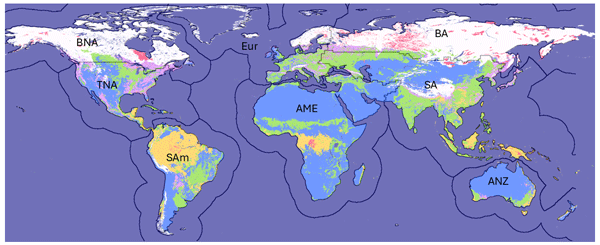
Cynthia H. Whaley, Tim Butler, Jose A. Adame, Rupal Ambulkar, Steve R. Arnold, Rebecca R. Buchholz, Benjamin Gaubert, Douglas S. Hamilton, Min Huang, Hayley Hung, Johannes W. Kaiser, Jacek W. Kaminski, Christoph Knote, Gerbrand Koren, Jean-Luc Kouassi, Meiyun Lin, Tianjia Liu, Jianmin Ma, Kasemsan Manomaiphiboon, Elisa Bergas Masso, Jessica L. McCarty, Mariano Mertens, Mark Parrington, Helene Peiro, Pallavi Saxena, Saurabh Sonwani, Vanisa Surapipith, Damaris Y. T. Tan, Wenfu Tang, Veerachai Tanpipat, Kostas Tsigaridis, Christine Wiedinmyer, Oliver Wild, Yuanyu Xie, and Paquita Zuidema
Geosci. Model Dev., 18, 3265–3309, https://doi.org/10.5194/gmd-18-3265-2025, https://doi.org/10.5194/gmd-18-3265-2025, 2025
Short summary
Short summary
The multi-model experiment design of the HTAP3 Fires project takes a multi-pollutant approach to improving our understanding of transboundary transport of wildland fire and agricultural burning emissions and their impacts. The experiments are designed with the goal of answering science policy questions related to fires. The options for the multi-model approach, including inputs, outputs, and model setup, are discussed, and the official recommendations for the project are presented.
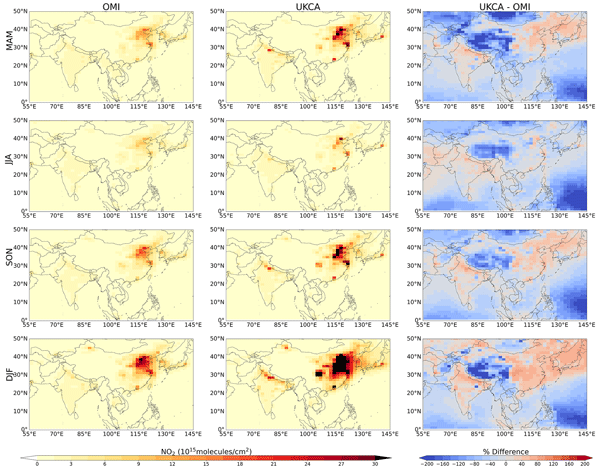
Alok K. Pandey, David S. Stevenson, Alcide Zhao, Richard J. Pope, Ryan Hossaini, Krishan Kumar, and Martyn P. Chipperfield
Atmos. Chem. Phys., 25, 4785–4802, https://doi.org/10.5194/acp-25-4785-2025, https://doi.org/10.5194/acp-25-4785-2025, 2025
Short summary
Short summary
Nitrogen dioxide is an air pollutant largely controlled by human activity that affects ozone, methane, and aerosols. Satellite instruments can quantify column NO2 and, by carefully matching the time and location of measurements, enable evaluation of model simulations. NO2 over south and east Asia is assessed, showing that the model captures not only many features of the measurements, but also important differences that suggest model deficiencies in representing several aspects of the atmospheric chemistry of NO2.
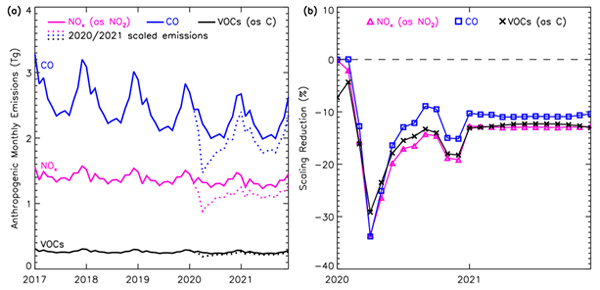
Matilda A. Pimlott, Richard J. Pope, Brian J. Kerridge, Richard Siddans, Barry G. Latter, Lucy J. Ventress, Wuhu Feng, and Martyn P. Chipperfield
Atmos. Chem. Phys., 25, 4391–4401, https://doi.org/10.5194/acp-25-4391-2025, https://doi.org/10.5194/acp-25-4391-2025, 2025
Short summary
Short summary
Globally, lockdowns were implemented to limit the spread of COVID-19, leading to a decrease in emissions of key air pollutants. Here, we use novel satellite data and a chemistry model to investigate the impact of the pandemic on tropospheric ozone (O3), a key pollutant, in 2020. Overall, we found substantial decreases of up to 20 %, two-thirds of which came from emission reductions, while one-third was due to a decrease in the stratospheric O3 flux into the troposphere.
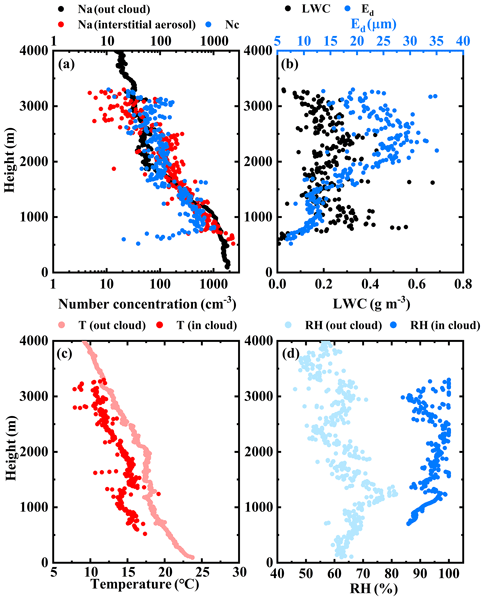
Sihan Liu, Honglei Wang, Delong Zhao, Wei Zhou, Yuanmou Du, Zhengguo Zhang, Peng Cheng, Tianliang Zhao, Yue Ke, Zihao Wu, and Mengyu Huang
Atmos. Chem. Phys., 25, 4151–4165, https://doi.org/10.5194/acp-25-4151-2025, https://doi.org/10.5194/acp-25-4151-2025, 2025
Short summary
Short summary
To understand the effect of aerosols on the vertical distribution of stratocumulus microphysical quantities in southwest China, the daily variation characteristics and formation mechanism of the vertical profiles of stratocumulus microphysical characteristics in this region were described using the data of nine cloud-crossing aircraft observations over Guangxi from 10 October to 3 November 2020.
Ruiyu Song, Bin Zhu, Lina Sha, Peng Qian, Fei Wang, Chunsong Lu, Yan Yin, and Yuying Wang
EGUsphere, https://doi.org/10.5194/egusphere-2025-43, https://doi.org/10.5194/egusphere-2025-43, 2025
Preprint withdrawn
Short summary
Short summary
This study examines how anthropogenic aerosols affect rainfall during the early summer in China’s Yangtze River Delta. Using the WRF-Chem model, we found that moderate emissions increase rainfall by boosting cloud formation. However, high emissions reduce rainfall due to smaller cloud droplets, which hinder their growth. These findings highlight the complex impact of aerosol concentrations on precipitation and provide valuable data for future research on aerosol-cloud-precipitation interactions.
Aishah I. Shittu, Kirsty J. Pringle, Stephen R. Arnold, Richard J. Pope, Ailish M. Graham, Carly Reddington, Richard Rigby, and James B. McQuaid
Atmos. Meas. Tech., 18, 817–828, https://doi.org/10.5194/amt-18-817-2025, https://doi.org/10.5194/amt-18-817-2025, 2025
Short summary
Short summary
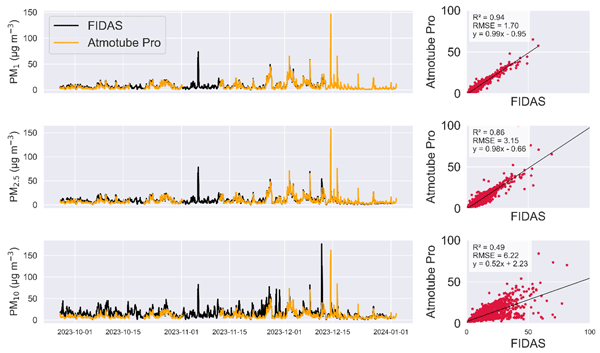
The study highlighted the performance of Atmotube PRO sensor particulate matter (PM) data. The result showed inter-sensor variability among the Atmotube PRO sensor data. This study showed 62.5 % of the sensors used for the study exhibited greater precision in their PM2.5 measurements. The overall performance showed that sensors passed the base testing using 1 h averaged data and that a multiple linear regression model using relative humidity values improved the performance of the PM2.5 data.
Yongqing Bai, Tianliang Zhao, Kai Meng, Yue Zhou, Jie Xiong, Xiaoyun Sun, Lijuan Shen, Yanyu Yue, Yan Zhu, Weiyang Hu, and Jingyan Yao
Atmos. Chem. Phys., 25, 1273–1287, https://doi.org/10.5194/acp-25-1273-2025, https://doi.org/10.5194/acp-25-1273-2025, 2025
Short summary
Short summary
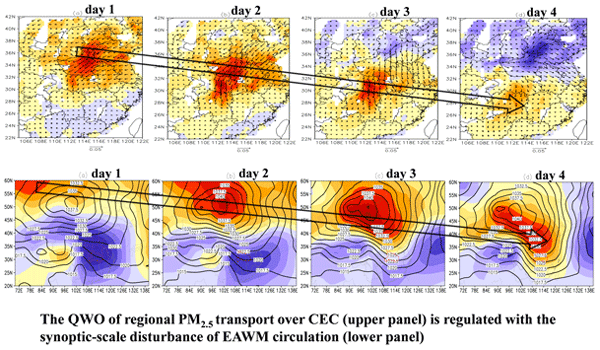
We proposed a composite statistical method to identify the quasi-weekly oscillation (QWO) of regional PM2.5 transport over China in winter from 2015 to 2019. The QWO of regional PM2.5 transport is constrained by synoptic-scale disturbances of the East Asian winter monsoon circulation with the periodic activities of the Siberian high, providing a new insight into the understanding of regional pollutant transport with meteorological drivers in atmospheric environment changes.
Xiaodan Ma, Jianping Huang, Michaela I. Hegglin, Patrick Jöckel, and Tianliang Zhao
Atmos. Chem. Phys., 25, 943–958, https://doi.org/10.5194/acp-25-943-2025, https://doi.org/10.5194/acp-25-943-2025, 2025
Short summary
Short summary
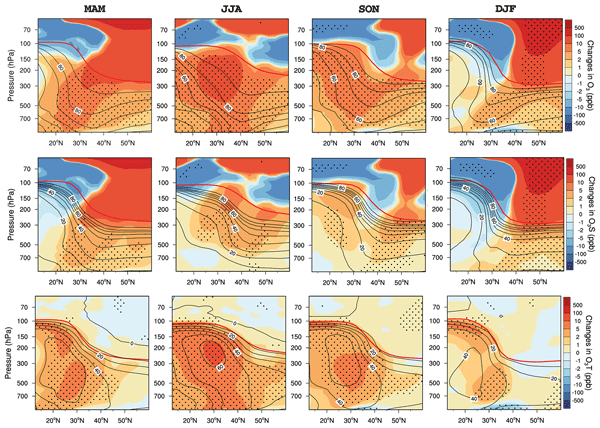
Our research explored changes in ozone levels in the northwest Pacific region over 30 years, revealing a significant increase in the middle-to-upper troposphere, especially during spring and summer. This rise is influenced by both stratospheric and tropospheric sources, which affect climate and air quality in East Asia. This work underscores the need for continued study to understand underlying mechanisms.
Alex T. Archibald, Bablu Sinha, Maria R. Russo, Emily Matthews, Freya A. Squires, N. Luke Abraham, Stephane J.-B. Bauguitte, Thomas J. Bannan, Thomas G. Bell, David Berry, Lucy J. Carpenter, Hugh Coe, Andrew Coward, Peter Edwards, Daniel Feltham, Dwayne Heard, Jim Hopkins, James Keeble, Elizabeth C. Kent, Brian A. King, Isobel R. Lawrence, James Lee, Claire R. Macintosh, Alex Megann, Bengamin I. Moat, Katie Read, Chris Reed, Malcolm J. Roberts, Reinhard Schiemann, David Schroeder, Timothy J. Smyth, Loren Temple, Navaneeth Thamban, Lisa Whalley, Simon Williams, Huihui Wu, and Mingxi Yang
Earth Syst. Sci. Data, 17, 135–164, https://doi.org/10.5194/essd-17-135-2025, https://doi.org/10.5194/essd-17-135-2025, 2025
Short summary
Short summary
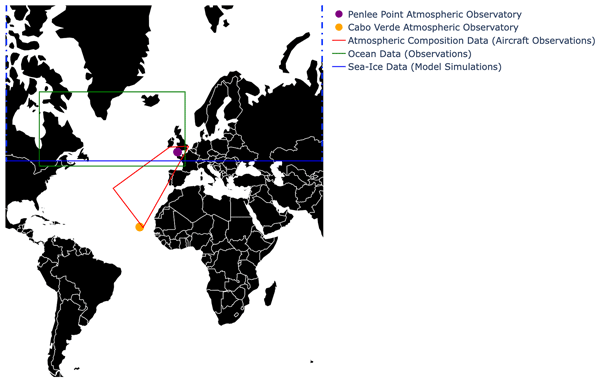
Here, we present an overview of the data generated as part of the North Atlantic Climate System Integrated Study (ACSIS) programme that are available through dedicated repositories at the Centre for Environmental Data Analysis (CEDA; www.ceda.ac.uk) and the British Oceanographic Data Centre (BODC; bodc.ac.uk). The datasets described here cover the North Atlantic Ocean, the atmosphere above (it including its composition), and Arctic sea ice.
Ryan Hossaini, David Sherry, Zihao Wang, Martyn P. Chipperfield, Wuhu Feng, David E. Oram, Karina E. Adcock, Stephen A. Montzka, Isobel J. Simpson, Andrea Mazzeo, Amber A. Leeson, Elliot Atlas, and Charles C.-K. Chou
Atmos. Chem. Phys., 24, 13457–13475, https://doi.org/10.5194/acp-24-13457-2024, https://doi.org/10.5194/acp-24-13457-2024, 2024
Short summary
Short summary
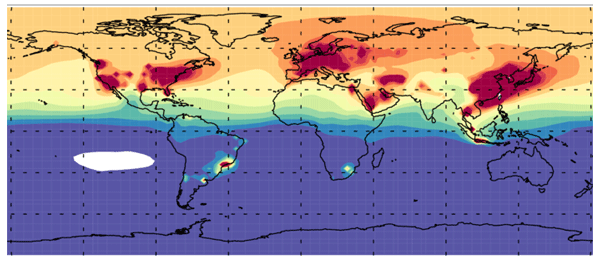
DCE (1,2-dichloroethane) is an industrial chemical used to produce PVC (polyvinyl chloride). We analysed DCE production data to estimate global DCE emissions (2002–2020). The emissions were included in an atmospheric model and evaluated by comparing simulated DCE to DCE measurements in the troposphere. We show that DCE contributes ozone-depleting Cl to the stratosphere and that this has increased with increasing DCE emissions. DCE’s impact on stratospheric O3 is currently small but non-zero.
Kai Meng, Tianliang Zhao, Yongqing Bai, Ming Wu, Le Cao, Xuewei Hou, Yuehan Luo, and Yongcheng Jiang
Atmos. Chem. Phys., 24, 12623–12642, https://doi.org/10.5194/acp-24-12623-2024, https://doi.org/10.5194/acp-24-12623-2024, 2024
Short summary
Short summary
We studied the impact of stratospheric intrusions (SIs) on tropospheric and near-surface ozone in Central and Eastern China from a stratospheric source tracing perspective. SIs contribute the most in the eastern plains, with a contribution exceeding 15 %, and have a small contribution to the west and south. Western Siberia and Mongolia are the most critical source areas for indirect and direct SIs, with the Rossby wave and northeast cold vortex being important driving circulation systems.
Maria P. Velásquez-García, K. Santiago Hernández, James A. Vergara-Correa, Richard J. Pope, Miriam Gómez-Marín, and Angela M. Rendón
Atmos. Chem. Phys., 24, 11497–11520, https://doi.org/10.5194/acp-24-11497-2024, https://doi.org/10.5194/acp-24-11497-2024, 2024
Short summary
Short summary
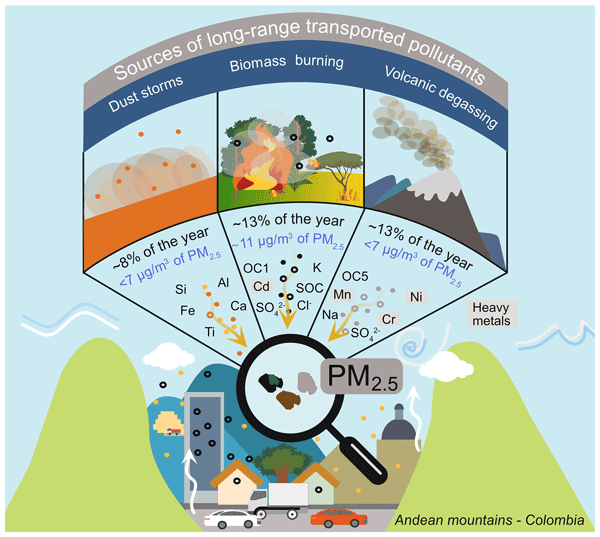
In the Aburrá Valley, northern South America, local emissions determine air quality conditions. However, we found that external sources, such as regional fires, Saharan dust, and volcanic emissions, increase particulate concentrations and worsen chemical composition by introducing elements like heavy metals. Dry winds and source variability contribute to seasonal influences on these events. This study assesses the air quality risks posed by such events, which can affect broad regions worldwide.
Emma Sands, Richard J. Pope, Ruth M. Doherty, Fiona M. O'Connor, Chris Wilson, and Hugh Pumphrey
Atmos. Chem. Phys., 24, 11081–11102, https://doi.org/10.5194/acp-24-11081-2024, https://doi.org/10.5194/acp-24-11081-2024, 2024
Short summary
Short summary
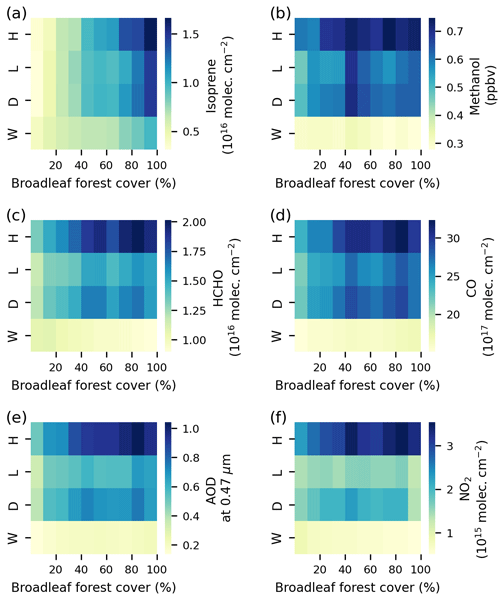
Changes in vegetation alongside biomass burning impact regional atmospheric composition and air quality. Using satellite remote sensing, we find a clear linear relationship between forest cover and isoprene and a pronounced non-linear relationship between burned area and nitrogen dioxide in the southern Amazon, a region of substantial deforestation. These quantified relationships can be used for model evaluation and further exploration of biosphere-atmosphere interactions in Earth System Models.
Pierluigi Renan Guaita, Riccardo Marzuoli, Leiming Zhang, Steven Turnock, Gerbrand Koren, Oliver Wild, Paola Crippa, and Giacomo Alessandro Gerosa
EGUsphere, https://doi.org/10.5194/egusphere-2024-2573, https://doi.org/10.5194/egusphere-2024-2573, 2024
Preprint archived
Short summary
Short summary
This study assesses the global impact of tropospheric ozone on wheat crops in the 21st century under various climate scenarios. The research highlights that ozone damage to wheat varies by region and depends on both ozone levels and climate. Vulnerable regions include East Asia, Northern Europe, and the Southern and Eastern edges of the Tibetan Plateau. Our results emphasize the need of policies to reduce ozone levels and mitigate climate change to protect global food security.
Richard J. Pope, Fiona M. O'Connor, Mohit Dalvi, Brian J. Kerridge, Richard Siddans, Barry G. Latter, Brice Barret, Eric Le Flochmoen, Anne Boynard, Martyn P. Chipperfield, Wuhu Feng, Matilda A. Pimlott, Sandip S. Dhomse, Christian Retscher, Catherine Wespes, and Richard Rigby
Atmos. Chem. Phys., 24, 9177–9195, https://doi.org/10.5194/acp-24-9177-2024, https://doi.org/10.5194/acp-24-9177-2024, 2024
Short summary
Short summary
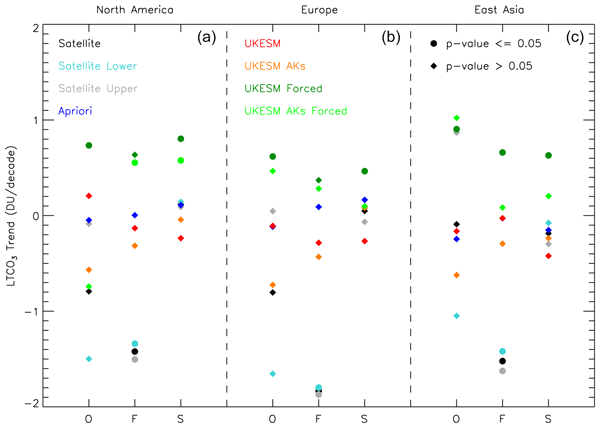
Ozone is a potent air pollutant in the lower troposphere, with adverse impacts on human health. Satellite records of tropospheric ozone currently show large-scale inconsistencies in long-term trends. Our detailed study of the potential factors (e.g. satellite errors, where the satellite can observe ozone) potentially driving these inconsistencies found that, in North America, Europe, and East Asia, the underlying trends are typically small with large uncertainties.
Beth S. Nelson, Zhenze Liu, Freya A. Squires, Marvin Shaw, James R. Hopkins, Jacqueline F. Hamilton, Andrew R. Rickard, Alastair C. Lewis, Zongbo Shi, and James D. Lee
Atmos. Chem. Phys., 24, 9031–9044, https://doi.org/10.5194/acp-24-9031-2024, https://doi.org/10.5194/acp-24-9031-2024, 2024
Short summary
Short summary
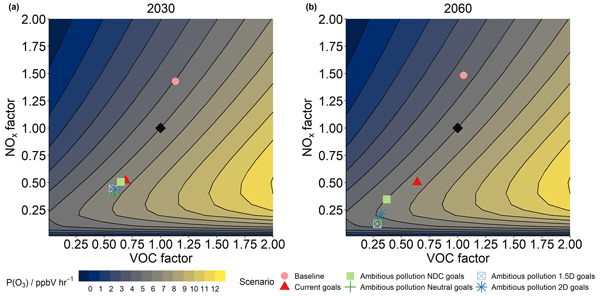
The impact of combined air quality and carbon neutrality policies on O3 formation in Beijing was investigated. Emissions inventory data were used to estimate future pollutant mixing ratios relative to ground-level observations. O3 production was found to be most sensitive to changes in alkenes, but large reductions in less reactive compounds led to larger reductions in future O3 production. This study highlights the importance of understanding the emissions of organic pollutants.
Yuehan Luo, Tianliang Zhao, Kai Meng, Jun Hu, Qingjian Yang, Yongqing Bai, Kai Yang, Weikang Fu, Chenghao Tan, Yifan Zhang, Yanzhe Zhang, and Zhikuan Li
Atmos. Chem. Phys., 24, 7013–7026, https://doi.org/10.5194/acp-24-7013-2024, https://doi.org/10.5194/acp-24-7013-2024, 2024
Short summary
Short summary
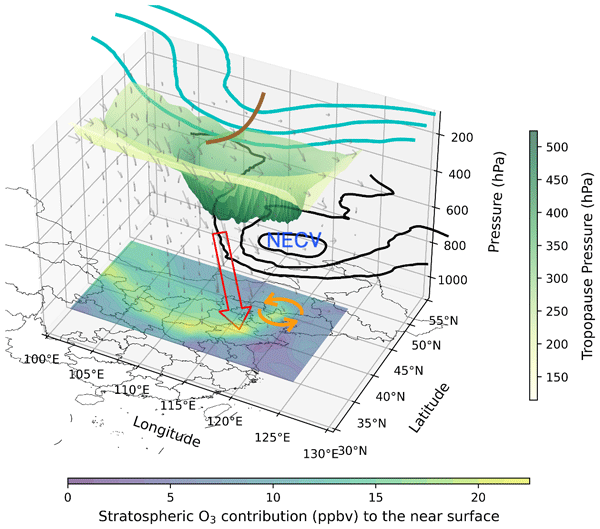
We reveal a significant mechanism of stratospheric O3 intrusion (SI) into the atmospheric environment induced by an extratropical cyclone system. This system facilitates the downward transport of stratospheric O3 to the near-surface layer by vertical coupling, involving the upper westerly trough, the middle northeast cold vortex, and the lower extratropical cyclone in the troposphere. On average, stratospheric O3 contributed 26.77 % to near-surface O3 levels over the North China Plain.
Richard J. Pope, Alexandru Rap, Matilda A. Pimlott, Brice Barret, Eric Le Flochmoen, Brian J. Kerridge, Richard Siddans, Barry G. Latter, Lucy J. Ventress, Anne Boynard, Christian Retscher, Wuhu Feng, Richard Rigby, Sandip S. Dhomse, Catherine Wespes, and Martyn P. Chipperfield
Atmos. Chem. Phys., 24, 3613–3626, https://doi.org/10.5194/acp-24-3613-2024, https://doi.org/10.5194/acp-24-3613-2024, 2024
Short summary
Short summary
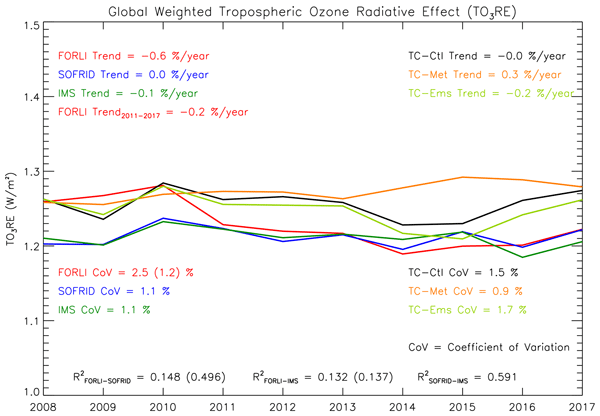
Tropospheric ozone is an important short-lived climate forcer which influences the incoming solar short-wave radiation and the outgoing long-wave radiation in the atmosphere (8–15 km) where the balance between the two yields a net positive (i.e. warming) effect at the surface. Overall, we find that the tropospheric ozone radiative effect ranges between 1.21 and 1.26 W m−2 with a negligible trend (2008–2017), suggesting that tropospheric ozone influences on climate have remained stable with time.
Lily Gouldsbrough, Ryan Hossaini, Emma Eastoe, Paul J. Young, and Massimo Vieno
Atmos. Chem. Phys., 24, 3163–3196, https://doi.org/10.5194/acp-24-3163-2024, https://doi.org/10.5194/acp-24-3163-2024, 2024
Short summary
Short summary
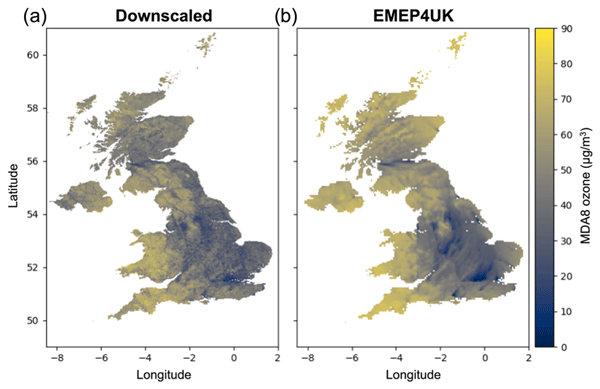
High-resolution spatial fields of surface ozone are used to understand spikes in ozone concentration and predict their impact on public health. Such fields are routinely output from complex mathematical models for atmospheric conditions. These outputs are on a coarse spatial resolution and the highest concentrations tend to be biased. Using a novel data-driven machine learning methodology, we show how such output can be corrected to produce fields with both lower bias and higher resolution.
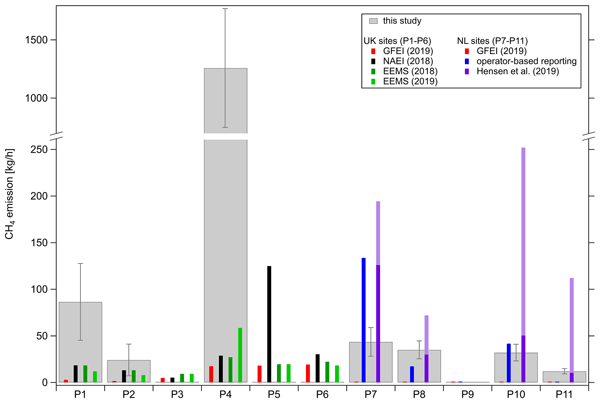
Magdalena Pühl, Anke Roiger, Alina Fiehn, Alan M. Gorchov Negron, Eric A. Kort, Stefan Schwietzke, Ignacio Pisso, Amy Foulds, James Lee, James L. France, Anna E. Jones, Dave Lowry, Rebecca E. Fisher, Langwen Huang, Jacob Shaw, Prudence Bateson, Stephen Andrews, Stuart Young, Pamela Dominutti, Tom Lachlan-Cope, Alexandra Weiss, and Grant Allen
Atmos. Chem. Phys., 24, 1005–1024, https://doi.org/10.5194/acp-24-1005-2024, https://doi.org/10.5194/acp-24-1005-2024, 2024
Short summary
Short summary
In April–May 2019 we carried out an airborne field campaign in the southern North Sea with the aim of studying methane emissions of offshore gas installations. We determined methane emissions from elevated methane measured downstream of the sampled installations. We compare our measured methane emissions with estimated methane emissions from national and global annual inventories. As a result, we find inconsistencies of inventories and large discrepancies between measurements and inventories.
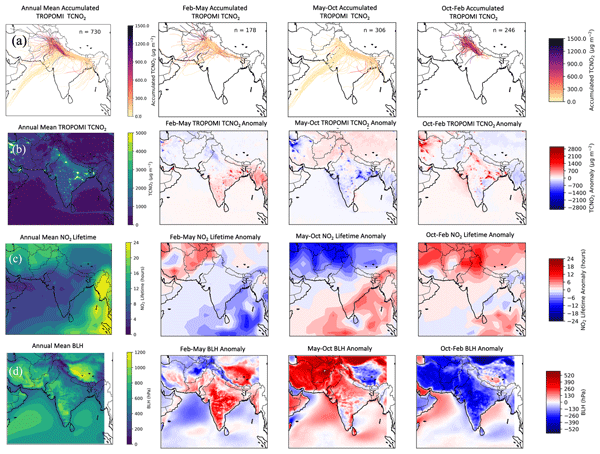
Ailish M. Graham, Richard J. Pope, Martyn P. Chipperfield, Sandip S. Dhomse, Matilda Pimlott, Wuhu Feng, Vikas Singh, Ying Chen, Oliver Wild, Ranjeet Sokhi, and Gufran Beig
Atmos. Chem. Phys., 24, 789–806, https://doi.org/10.5194/acp-24-789-2024, https://doi.org/10.5194/acp-24-789-2024, 2024
Short summary
Short summary
Our paper uses novel satellite datasets and high-resolution emissions datasets alongside a back-trajectory model to investigate the balance of local and external sources influencing NOx air pollution changes in Delhi. We find in the post-monsoon season that NOx from local and non-local transport emissions contributes most to poor air quality in Delhi. Therefore, air quality mitigation strategies in Delhi and surrounding regions are used to control this issue.
Xuewei Hou, Oliver Wild, Bin Zhu, and James Lee
Atmos. Chem. Phys., 23, 15395–15411, https://doi.org/10.5194/acp-23-15395-2023, https://doi.org/10.5194/acp-23-15395-2023, 2023
Short summary
Short summary
In response to the climate crisis, many countries have committed to net zero in a certain future year. The impacts of net-zero scenarios on tropospheric O3 are less well studied and remain unclear. In this study, we quantified the changes of tropospheric O3 budgets, spatiotemporal distributions of future surface O3 in east Asia and regional O3 source contributions for 2060 under a net-zero scenario using the NCAR Community Earth System Model (CESM) and online O3-tagging methods.
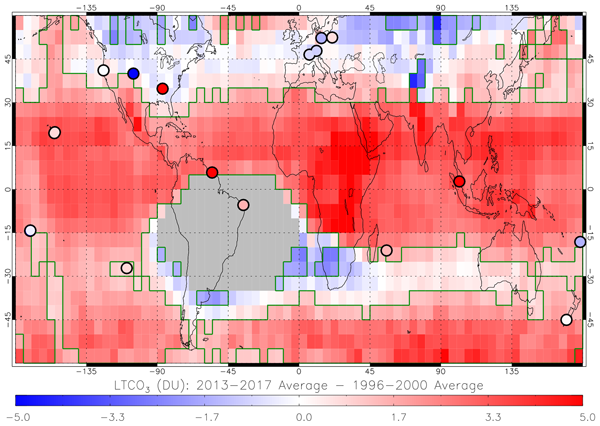
Richard J. Pope, Brian J. Kerridge, Richard Siddans, Barry G. Latter, Martyn P. Chipperfield, Wuhu Feng, Matilda A. Pimlott, Sandip S. Dhomse, Christian Retscher, and Richard Rigby
Atmos. Chem. Phys., 23, 14933–14947, https://doi.org/10.5194/acp-23-14933-2023, https://doi.org/10.5194/acp-23-14933-2023, 2023
Short summary
Short summary
Ozone is a potent air pollutant, and we present the first study to investigate long-term changes in lower tropospheric column ozone (LTCO3) from space. We have constructed a merged LTCO3 dataset from GOME-1, SCIAMACHY and OMI between 1996 and 2017. Comparing LTCO3 between the 1996–2000 and 2013–2017 5-year averages, we find significant positive increases in the tropics/sub-tropics, while in the northern mid-latitudes, we find small-scale differences.
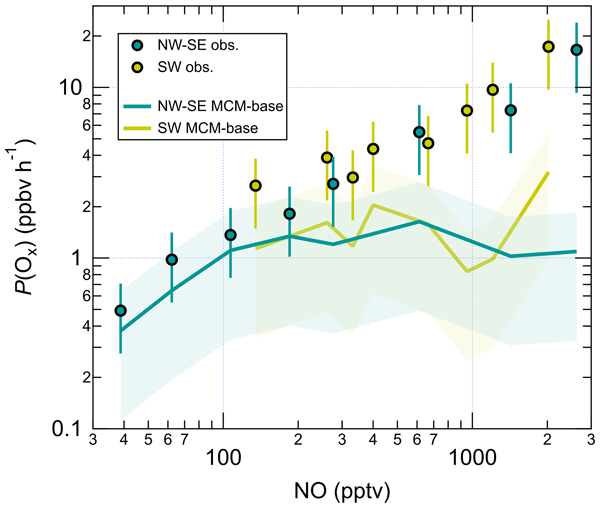
Robert Woodward-Massey, Roberto Sommariva, Lisa K. Whalley, Danny R. Cryer, Trevor Ingham, William J. Bloss, Stephen M. Ball, Sam Cox, James D. Lee, Chris P. Reed, Leigh R. Crilley, Louisa J. Kramer, Brian J. Bandy, Grant L. Forster, Claire E. Reeves, Paul S. Monks, and Dwayne E. Heard
Atmos. Chem. Phys., 23, 14393–14424, https://doi.org/10.5194/acp-23-14393-2023, https://doi.org/10.5194/acp-23-14393-2023, 2023
Short summary
Short summary
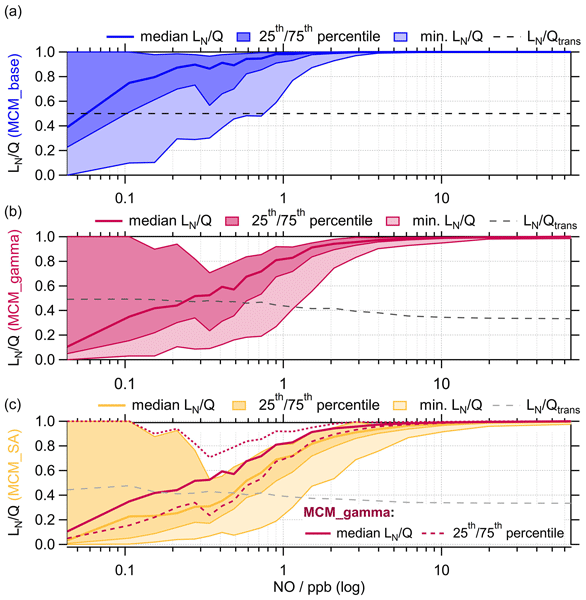
Measurements of OH, HO2 and RO2 radicals and also OH reactivity were made at a UK coastal site and compared to calculations from a constrained box model utilising the Master Chemical Mechanism. The model agreement displayed a strong dependence on the NO concentration. An experimental budget analysis for OH, HO2, RO2 and total ROx demonstrated significant imbalances between HO2 and RO2 production rates. Ozone production rates were calculated from measured radicals and compared to modelled values.
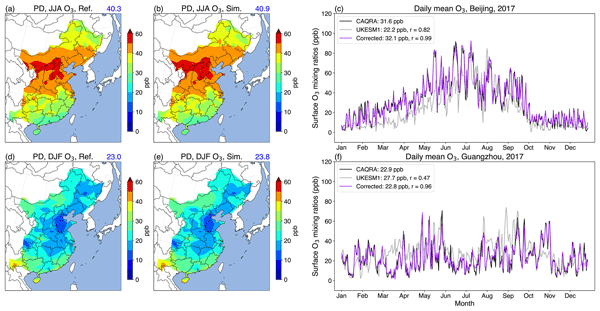
Zhenze Liu, Oliver Wild, Ruth M. Doherty, Fiona M. O'Connor, and Steven T. Turnock
Atmos. Chem. Phys., 23, 13755–13768, https://doi.org/10.5194/acp-23-13755-2023, https://doi.org/10.5194/acp-23-13755-2023, 2023
Short summary
Short summary
We investigate the impact of net-zero policies on surface ozone pollution in China. A chemistry–climate model is used to simulate ozone changes driven by local and external emissions, methane, and warmer climates. A deep learning model is applied to generate more robust ozone projection, and we find that the benefits of net-zero policies may be overestimated with the chemistry–climate model. Nevertheless, it is clear that the policies can still substantially reduce ozone pollution in future.
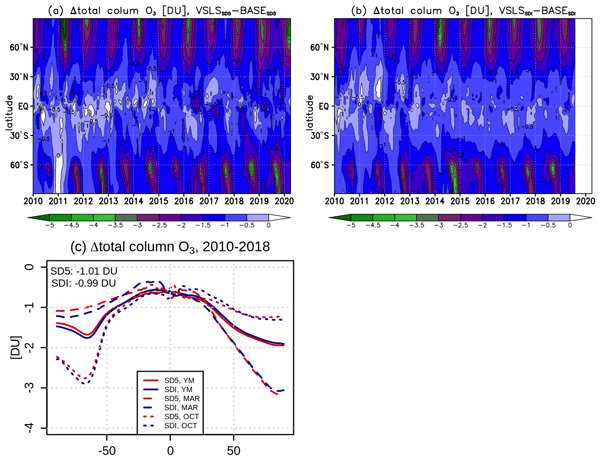
Ewa M. Bednarz, Ryan Hossaini, and Martyn P. Chipperfield
Atmos. Chem. Phys., 23, 13701–13711, https://doi.org/10.5194/acp-23-13701-2023, https://doi.org/10.5194/acp-23-13701-2023, 2023
Short summary
Short summary
We quantify, for the first time, the time-varying impact of uncontrolled emissions of chlorinated very short-lived substances (Cl-VSLSs) on stratospheric ozone using a state-of-the-art chemistry-climate model. We demonstrate that Cl-VSLSs already have a non-negligible impact on stratospheric ozone, including a local reduction of up to ~7 DU in Arctic ozone in the cold winter of 2019/20, and any so future growth in emissions will continue to offset some of the benefits of the Montreal Protocol.
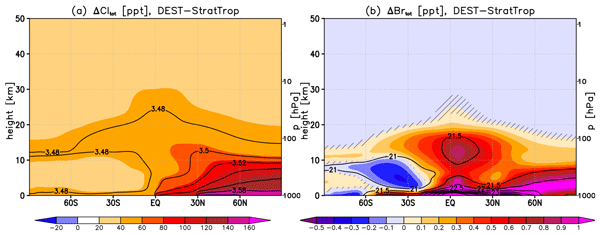
Ewa M. Bednarz, Ryan Hossaini, N. Luke Abraham, and Martyn P. Chipperfield
Geosci. Model Dev., 16, 6187–6209, https://doi.org/10.5194/gmd-16-6187-2023, https://doi.org/10.5194/gmd-16-6187-2023, 2023
Short summary
Short summary
Development and performance of the new DEST chemistry scheme of UM–UKCA is described. The scheme extends the standard StratTrop scheme by including important updates to the halogen chemistry, thus allowing process-oriented studies of stratospheric ozone depletion and recovery, including impacts from both controlled long-lived ozone-depleting substances and emerging issues around uncontrolled, very short-lived substances. It will thus aid studies in support of future ozone assessment reports.
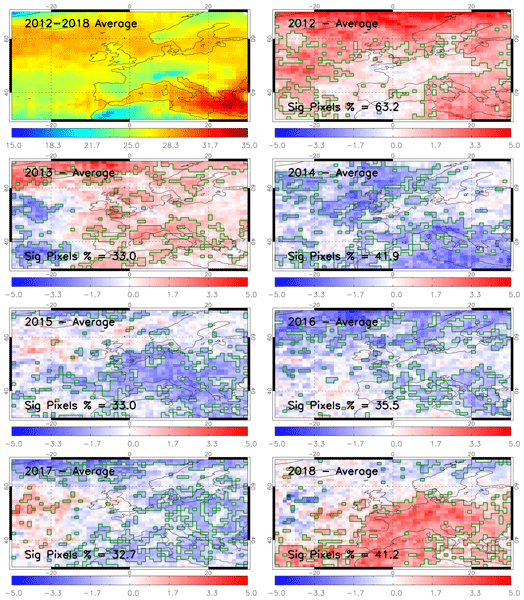
Richard J. Pope, Brian J. Kerridge, Martyn P. Chipperfield, Richard Siddans, Barry G. Latter, Lucy J. Ventress, Matilda A. Pimlott, Wuhu Feng, Edward Comyn-Platt, Garry D. Hayman, Stephen R. Arnold, and Ailish M. Graham
Atmos. Chem. Phys., 23, 13235–13253, https://doi.org/10.5194/acp-23-13235-2023, https://doi.org/10.5194/acp-23-13235-2023, 2023
Short summary
Short summary
In the summer of 2018, Europe experienced several persistent large-scale ozone (O3) pollution episodes. Satellite tropospheric O3 and surface O3 data recorded substantial enhancements in 2018 relative to other years. Targeted model simulations showed that meteorological processes and emissions controlled the elevated surface O3, while mid-tropospheric O3 enhancements were dominated by stratospheric O3 intrusion and advection of North Atlantic O3-rich air masses into Europe.
Michael P. Cartwright, Richard J. Pope, Jeremy J. Harrison, Martyn P. Chipperfield, Chris Wilson, Wuhu Feng, David P. Moore, and Parvadha Suntharalingam
Atmos. Chem. Phys., 23, 10035–10056, https://doi.org/10.5194/acp-23-10035-2023, https://doi.org/10.5194/acp-23-10035-2023, 2023
Short summary
Short summary
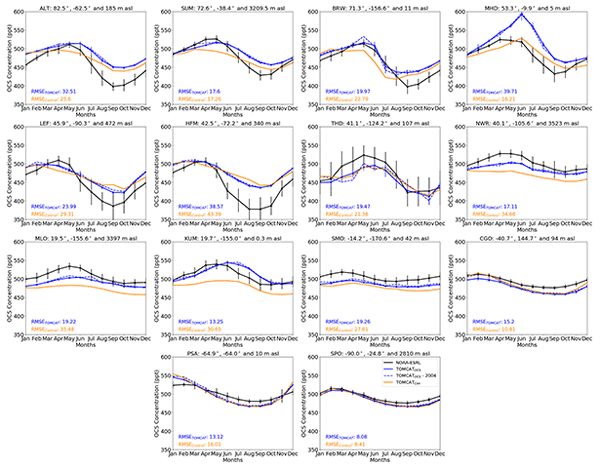
A 3-D chemical transport model, TOMCAT, is used to simulate global atmospheric carbonyl sulfide (OCS) distribution. Modelled OCS compares well with satellite observations of OCS from limb-sounding satellite observations. Model simulations also compare adequately with surface and atmospheric observations and suitably capture the seasonality of OCS and background concentrations.
Naifu Shao, Chunsong Lu, Xingcan Jia, Yuan Wang, Yubin Li, Yan Yin, Bin Zhu, Tianliang Zhao, Duanyang Liu, Shengjie Niu, Shuxian Fan, Shuqi Yan, and Jingjing Lv
Atmos. Chem. Phys., 23, 9873–9890, https://doi.org/10.5194/acp-23-9873-2023, https://doi.org/10.5194/acp-23-9873-2023, 2023
Short summary
Short summary
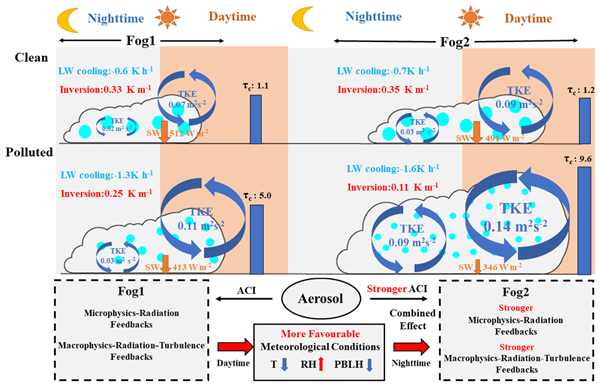
Fog is an important meteorological phenomenon that affects visibility. Aerosols and the planetary boundary layer (PBL) play critical roles in the fog life cycle. In this study, aerosol-induced changes in fog properties become more remarkable in the second fog (Fog2) than in the first fog (Fog1). The reason is that aerosol–cloud interaction (ACI) delays Fog1 dissipation, leading to the PBL meteorological conditions being more conducive to Fog2 formation and to stronger ACI in Fog2.
Chenwei Fang, Jim M. Haywood, Ju Liang, Ben T. Johnson, Ying Chen, and Bin Zhu
Atmos. Chem. Phys., 23, 8341–8368, https://doi.org/10.5194/acp-23-8341-2023, https://doi.org/10.5194/acp-23-8341-2023, 2023
Short summary
Short summary
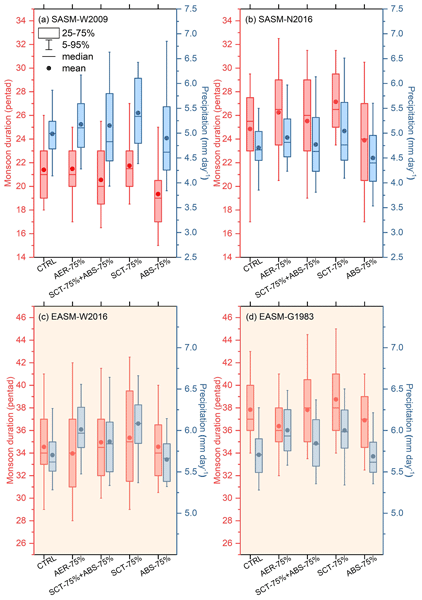
The responses of Asian summer monsoon duration and intensity to air pollution mitigation are identified given the net-zero future. We show that reducing scattering aerosols makes the rainy season longer and stronger across South Asia and East Asia but that absorbing aerosol reduction has the opposite effect. Our results hint at distinct monsoon responses to emission controls that target different aerosols.
Wen Lu, Bin Zhu, Shuqi Yan, Jie Li, and Zifa Wang
EGUsphere, https://doi.org/10.5194/egusphere-2023-1089, https://doi.org/10.5194/egusphere-2023-1089, 2023
Preprint archived
Short summary
Short summary
Parameterized the minimum turbulent diffusivity (Kzmin) by sensible heat flux and latent heat flux and embedded it into the WRF-Chem model. New scheme improved the underestimation of turbulence diffusion underestimation and overestimation of surface PM2.5 under stable boundary layer simulation over eastern China. The physical relationship between Kzmin and two factors was discussed. Process analysis showed that vertical mixing is the key process to improve surface PM2.5 simulations.
Ernesto Reyes-Villegas, Douglas Lowe, Jill S. Johnson, Kenneth S. Carslaw, Eoghan Darbyshire, Michael Flynn, James D. Allan, Hugh Coe, Ying Chen, Oliver Wild, Scott Archer-Nicholls, Alex Archibald, Siddhartha Singh, Manish Shrivastava, Rahul A. Zaveri, Vikas Singh, Gufran Beig, Ranjeet Sokhi, and Gordon McFiggans
Atmos. Chem. Phys., 23, 5763–5782, https://doi.org/10.5194/acp-23-5763-2023, https://doi.org/10.5194/acp-23-5763-2023, 2023
Short summary
Short summary
Organic aerosols (OAs), their sources and their processes remain poorly understood. The volatility basis set (VBS) approach, implemented in air quality models such as WRF-Chem, can be a useful tool to describe primary OA (POA) production and aging. However, the main disadvantage is its complexity. We used a Gaussian process simulator to reproduce model results and to estimate the sources of model uncertainty. We do this by comparing the outputs with OA observations made at Delhi, India, in 2018.
Joanna E. Dyson, Lisa K. Whalley, Eloise J. Slater, Robert Woodward-Massey, Chunxiang Ye, James D. Lee, Freya Squires, James R. Hopkins, Rachel E. Dunmore, Marvin Shaw, Jacqueline F. Hamilton, Alastair C. Lewis, Stephen D. Worrall, Asan Bacak, Archit Mehra, Thomas J. Bannan, Hugh Coe, Carl J. Percival, Bin Ouyang, C. Nicholas Hewitt, Roderic L. Jones, Leigh R. Crilley, Louisa J. Kramer, W. Joe F. Acton, William J. Bloss, Supattarachai Saksakulkrai, Jingsha Xu, Zongbo Shi, Roy M. Harrison, Simone Kotthaus, Sue Grimmond, Yele Sun, Weiqi Xu, Siyao Yue, Lianfang Wei, Pingqing Fu, Xinming Wang, Stephen R. Arnold, and Dwayne E. Heard
Atmos. Chem. Phys., 23, 5679–5697, https://doi.org/10.5194/acp-23-5679-2023, https://doi.org/10.5194/acp-23-5679-2023, 2023
Short summary
Short summary
The hydroxyl (OH) and closely coupled hydroperoxyl (HO2) radicals are vital for their role in the removal of atmospheric pollutants. In less polluted regions, atmospheric models over-predict HO2 concentrations. In this modelling study, the impact of heterogeneous uptake of HO2 onto aerosol surfaces on radical concentrations and the ozone production regime in Beijing in the summertime is investigated, and the implications for emissions policies across China are considered.
Shuqi Yan, Bin Zhu, Shuangshuang Shi, Wen Lu, Jinhui Gao, Hanqing Kang, and Duanyang Liu
Atmos. Chem. Phys., 23, 5177–5190, https://doi.org/10.5194/acp-23-5177-2023, https://doi.org/10.5194/acp-23-5177-2023, 2023
Short summary
Short summary
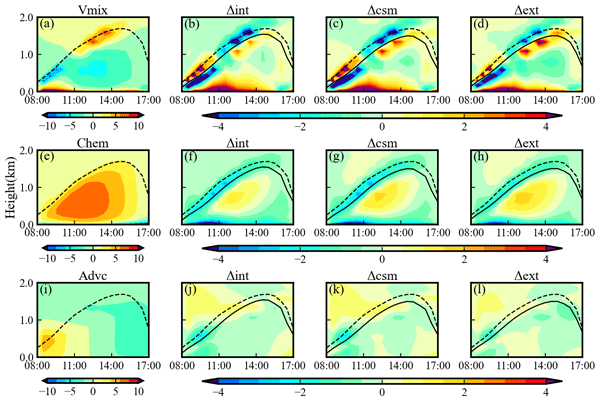
We analyze ozone response to aerosol mixing states in the vertical direction by WRF-Chem simulations. Aerosols generally lead to turbulent suppression, precursor accumulation, low-level photolysis reduction, and upper-level photolysis enhancement under different underlying surface and pollution conditions. Thus, ozone decreases within the entire boundary layer during the daytime, and the decrease is the least in aerosol external mixing states compared to internal and core shell mixing states.
Antonio G. Bruno, Jeremy J. Harrison, Martyn P. Chipperfield, David P. Moore, Richard J. Pope, Christopher Wilson, Emmanuel Mahieu, and Justus Notholt
Atmos. Chem. Phys., 23, 4849–4861, https://doi.org/10.5194/acp-23-4849-2023, https://doi.org/10.5194/acp-23-4849-2023, 2023
Short summary
Short summary
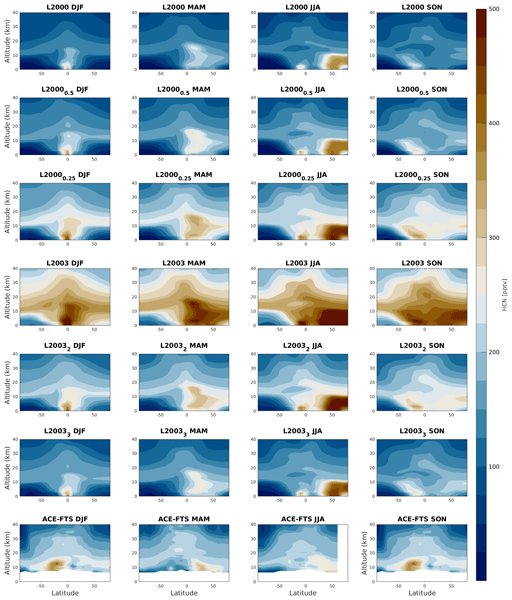
A 3-D chemical transport model, TOMCAT; satellite data; and ground-based observations have been used to investigate hydrogen cyanide (HCN) variability. We found that the oxidation by O(1D) drives the HCN loss in the middle stratosphere and the currently JPL-recommended OH reaction rate overestimates HCN atmospheric loss. We also evaluated two different ocean uptake schemes. We found them to be unrealistic, and we need to scale these schemes to obtain good agreement with HCN observations.
Zixuan Jia, Carlos Ordóñez, Ruth M. Doherty, Oliver Wild, Steven T. Turnock, and Fiona M. O'Connor
Atmos. Chem. Phys., 23, 2829–2842, https://doi.org/10.5194/acp-23-2829-2023, https://doi.org/10.5194/acp-23-2829-2023, 2023
Short summary
Short summary
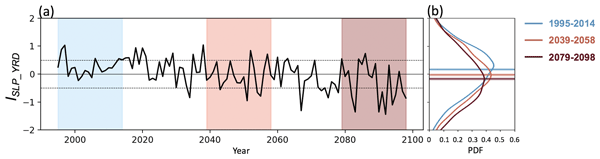
This study investigates the influence of the winter large-scale circulation on daily concentrations of PM2.5 and their sensitivity to emissions. The new proposed circulation index can effectively distinguish different levels of air pollution and explain changes in PM2.5 sensitivity to emissions from local and surrounding regions. We then project future changes in PM2.5 concentrations using this index and find an increase in PM2.5 concentrations over the region due to climate change.
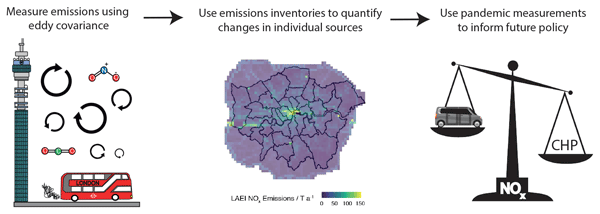
Samuel J. Cliff, Will Drysdale, James D. Lee, Carole Helfter, Eiko Nemitz, Stefan Metzger, and Janet F. Barlow
Atmos. Chem. Phys., 23, 2315–2330, https://doi.org/10.5194/acp-23-2315-2023, https://doi.org/10.5194/acp-23-2315-2023, 2023
Short summary
Short summary
Emissions of nitrogen oxides (NOx) to the atmosphere are an ongoing air quality issue. This study directly measures emissions of NOx and carbon dioxide from a tall tower in central London during the coronavirus pandemic. It was found that transport NOx emissions had reduced by >73 % since 2017 as a result of air quality policy and reduced congestion during coronavirus restrictions. During this period, central London was thought to be dominated by point-source heat and power generation emissions.

Jacob T. Shaw, Amy Foulds, Shona Wilde, Patrick Barker, Freya A. Squires, James Lee, Ruth Purvis, Ralph Burton, Ioana Colfescu, Stephen Mobbs, Samuel Cliff, Stéphane J.-B. Bauguitte, Stuart Young, Stefan Schwietzke, and Grant Allen
Atmos. Chem. Phys., 23, 1491–1509, https://doi.org/10.5194/acp-23-1491-2023, https://doi.org/10.5194/acp-23-1491-2023, 2023
Short summary
Short summary
Flaring is used by the oil and gas sector to dispose of unwanted natural gas or for safety. However, few studies have assessed the efficiency with which the gas is combusted. We sampled flaring emissions from offshore facilities in the North Sea. Average measured flaring efficiencies were ~ 98 % but with a skewed distribution, including many flares of lower efficiency. NOx and ethane emissions were also measured. Inefficient flaring practices could be a target for mitigating carbon emissions.
Qidi Li, Yuhan Luo, Yuanyuan Qian, Chen Pan, Ke Dou, Xuewei Hou, Fuqi Si, and Wenqing Liu
Atmos. Chem. Phys. Discuss., https://doi.org/10.5194/acp-2022-859, https://doi.org/10.5194/acp-2022-859, 2023
Revised manuscript not accepted
Short summary
Short summary
We found that all instruments recorded severe ozone depletion from March 18 to April 18, 2020. The effect of the polar vortex on ozone depletion in the stratosphere was clear. Additionally, the SD-WACCM model results indicated that both ClO and BrO concentrations peaked in late March. Before chlorine activation began, bromine mainly existed as HOBr; however, after chlorine activation, bromine mainly existed in the form of BrCl.

Yuanhong Zhao, Marielle Saunois, Philippe Bousquet, Xin Lin, Michaela I. Hegglin, Josep G. Canadell, Robert B. Jackson, and Bo Zheng
Atmos. Chem. Phys., 23, 789–807, https://doi.org/10.5194/acp-23-789-2023, https://doi.org/10.5194/acp-23-789-2023, 2023
Short summary
Short summary
The large uncertainties in OH simulated by atmospheric chemistry models hinder accurate estimates of CH4 chemical loss through the bottom-up method. This study presents a new approach based on OH precursor observations and a chemical box model to improve the tropospheric OH distributions simulated by atmospheric chemistry models. Through this approach, both the global OH burden and the corresponding methane chemical loss reach consistency with the top-down method based on MCF inversions.
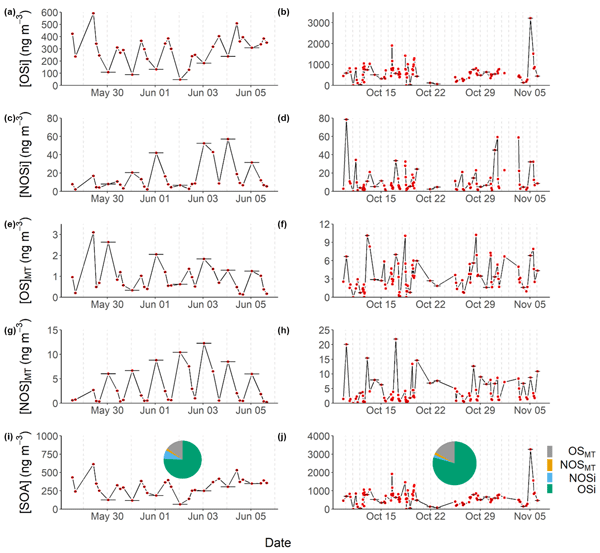
Daniel J. Bryant, Beth S. Nelson, Stefan J. Swift, Sri Hapsari Budisulistiorini, Will S. Drysdale, Adam R. Vaughan, Mike J. Newland, James R. Hopkins, James M. Cash, Ben Langford, Eiko Nemitz, W. Joe F. Acton, C. Nicholas Hewitt, Tuhin Mandal, Bhola R. Gurjar, Shivani, Ranu Gadi, James D. Lee, Andrew R. Rickard, and Jacqueline F. Hamilton
Atmos. Chem. Phys., 23, 61–83, https://doi.org/10.5194/acp-23-61-2023, https://doi.org/10.5194/acp-23-61-2023, 2023
Short summary
Short summary
This paper investigates the sources of isoprene and monoterpene compounds and their particulate-phase oxidation products in Delhi, India. This was done to improve our understanding of the sources, concentrations, and fate of volatile emissions in megacities. By studying the chemical composition of offline filter samples, we report that a significant share of the oxidised organic aerosol in Delhi is from isoprene and monoterpenes. This has implications for human health and policy development.

Zefeng Zhang, Hengnan Guo, Hanqing Kang, Jing Wang, Junlin An, Xingna Yu, Jingjing Lv, and Bin Zhu
Atmos. Meas. Tech., 15, 7259–7264, https://doi.org/10.5194/amt-15-7259-2022, https://doi.org/10.5194/amt-15-7259-2022, 2022
Short summary
Short summary
In this study, we first analyze the relationship between the visibility, the extinction coefficient, and atmospheric compositions. Then we propose to use the harmonic average of visibility data as the average visibility, which can better reflect changes in atmospheric extinction coefficients and aerosol concentrations. It is recommended to use the harmonic average visibility in the studies of climate change, atmospheric radiation, air pollution, environmental health, etc.
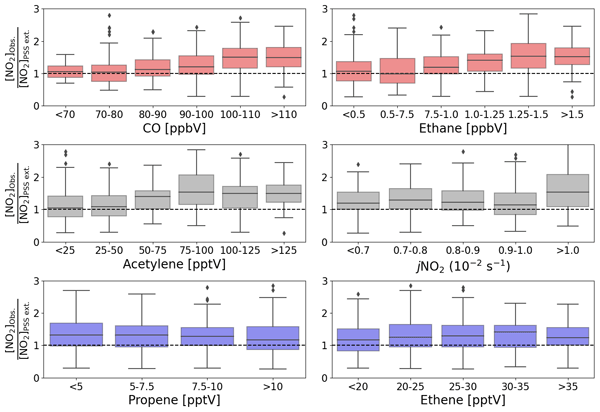
Simone T. Andersen, Beth S. Nelson, Katie A. Read, Shalini Punjabi, Luis Neves, Matthew J. Rowlinson, James Hopkins, Tomás Sherwen, Lisa K. Whalley, James D. Lee, and Lucy J. Carpenter
Atmos. Chem. Phys., 22, 15747–15765, https://doi.org/10.5194/acp-22-15747-2022, https://doi.org/10.5194/acp-22-15747-2022, 2022
Short summary
Short summary
The cycling of NO and NO2 is important to understand to be able to predict O3 concentrations in the atmosphere. We have used long-term measurements from the Cape Verde Atmospheric Observatory together with model outputs to investigate the cycling of nitrogen oxide (NO) and nitrogen dioxide (NO2) in very clean marine air. This study shows that we understand the processes occurring in very clean air, but with small amounts of pollution in the air, known chemistry cannot explain what is observed.
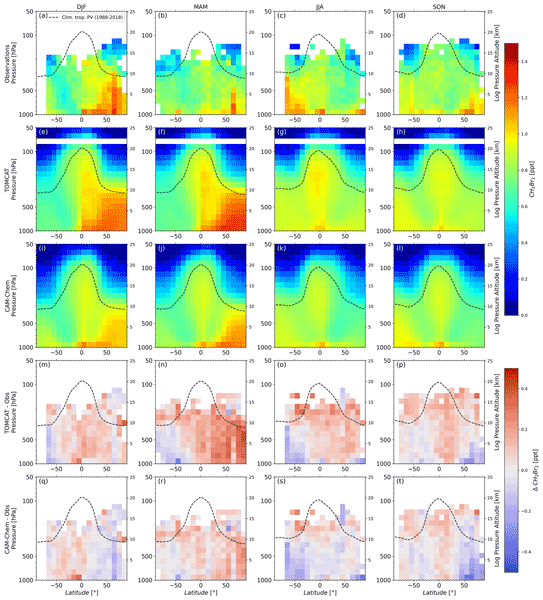
Markus Jesswein, Rafael P. Fernandez, Lucas Berná, Alfonso Saiz-Lopez, Jens-Uwe Grooß, Ryan Hossaini, Eric C. Apel, Rebecca S. Hornbrook, Elliot L. Atlas, Donald R. Blake, Stephen Montzka, Timo Keber, Tanja Schuck, Thomas Wagenhäuser, and Andreas Engel
Atmos. Chem. Phys., 22, 15049–15070, https://doi.org/10.5194/acp-22-15049-2022, https://doi.org/10.5194/acp-22-15049-2022, 2022
Short summary
Short summary
This study presents the global and seasonal distribution of the two major brominated short-lived substances CH2Br2 and CHBr3 in the upper troposphere and lower stratosphere based on observations from several aircraft campaigns. They show similar seasonality for both hemispheres, except in the respective hemispheric autumn lower stratosphere. A comparison with the TOMCAT and CAM-Chem models shows good agreement in the annual mean but larger differences in the seasonal consideration.
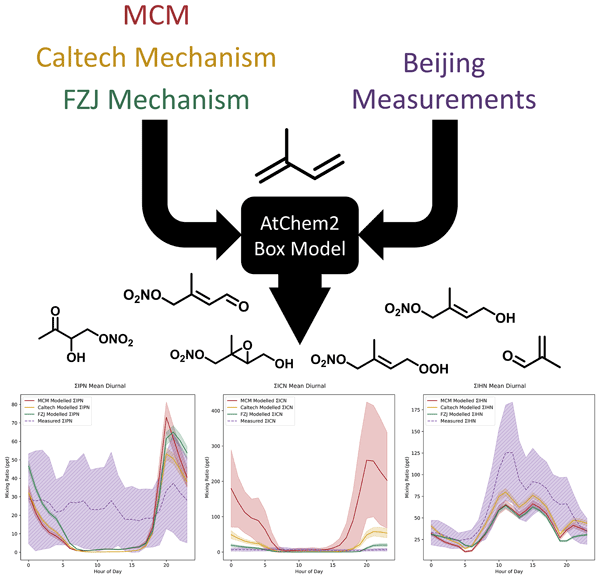
Alfred W. Mayhew, Ben H. Lee, Joel A. Thornton, Thomas J. Bannan, James Brean, James R. Hopkins, James D. Lee, Beth S. Nelson, Carl Percival, Andrew R. Rickard, Marvin D. Shaw, Peter M. Edwards, and Jaqueline F. Hamilton
Atmos. Chem. Phys., 22, 14783–14798, https://doi.org/10.5194/acp-22-14783-2022, https://doi.org/10.5194/acp-22-14783-2022, 2022
Short summary
Short summary
Isoprene nitrates are chemical species commonly found in the atmosphere that are important for their impacts on air quality and climate. This paper compares 3 different representations of the chemistry of isoprene nitrates in computational models highlighting cases where the choice of chemistry included has significant impacts on the concentration and composition of the modelled nitrates. Calibration of mass spectrometers is also shown to be an important factor when analysing isoprene nitrates.
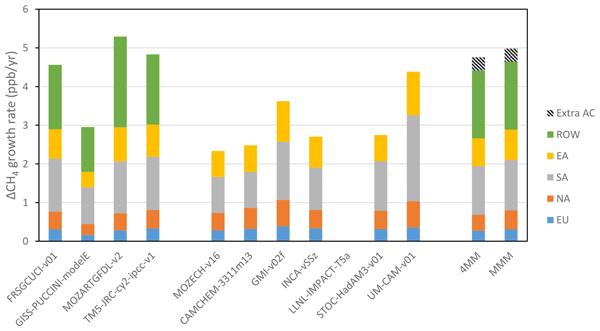
David S. Stevenson, Richard G. Derwent, Oliver Wild, and William J. Collins
Atmos. Chem. Phys., 22, 14243–14252, https://doi.org/10.5194/acp-22-14243-2022, https://doi.org/10.5194/acp-22-14243-2022, 2022
Short summary
Short summary
Atmospheric methane’s growth rate rose by 50 % in 2020 relative to 2019. Lower nitrogen oxide (NOx) emissions tend to increase methane’s atmospheric residence time; lower carbon monoxide (CO) and non-methane volatile organic compound (NMVOC) emissions decrease its lifetime. Combining model sensitivities with emission changes, we find that COVID-19 lockdown emission reductions can explain over half the observed increases in methane in 2020.
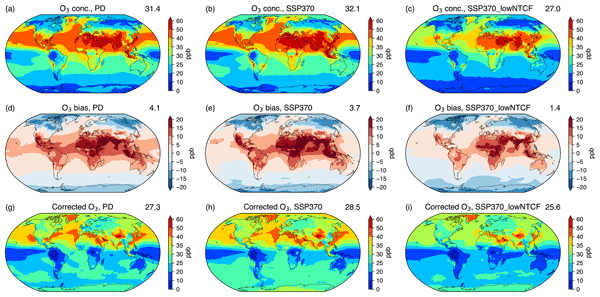
Zhenze Liu, Ruth M. Doherty, Oliver Wild, Fiona M. O'Connor, and Steven T. Turnock
Atmos. Chem. Phys., 22, 12543–12557, https://doi.org/10.5194/acp-22-12543-2022, https://doi.org/10.5194/acp-22-12543-2022, 2022
Short summary
Short summary
Weaknesses in process representation in chemistry–climate models lead to biases in simulating surface ozone and to uncertainty in projections of future ozone change. We develop a deep learning model to demonstrate the feasibility of ozone bias correction and show its capability in providing improved assessments of the impacts of climate and emission changes on future air quality, along with valuable information to guide future model development.
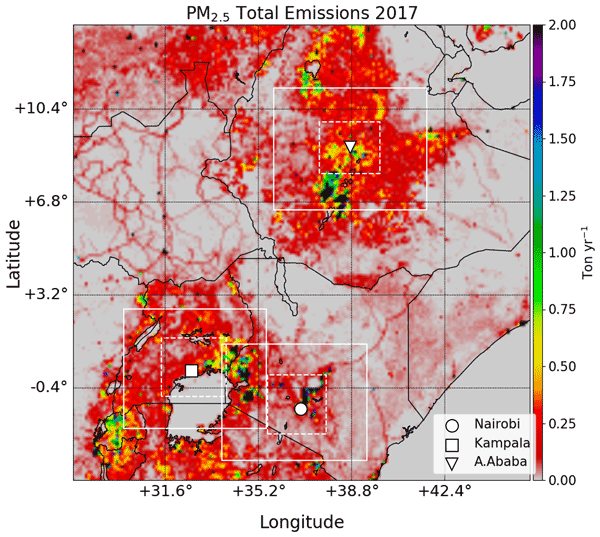
Andrea Mazzeo, Michael Burrow, Andrew Quinn, Eloise A. Marais, Ajit Singh, David Ng'ang'a, Michael J. Gatari, and Francis D. Pope
Atmos. Chem. Phys., 22, 10677–10701, https://doi.org/10.5194/acp-22-10677-2022, https://doi.org/10.5194/acp-22-10677-2022, 2022
Short summary
Short summary
A modelling system for meteorology and chemistry transport processes, WRF–CHIMERE, has been tested and validated for three East African conurbations using the most up-to-date anthropogenic emissions available. Results show that the model is able to reproduce hourly and daily temporal variabilities in aerosol concentrations that are close to observations in both urban and rural environments, encouraging the adoption of numerical modelling as a tool for air quality management in East Africa.
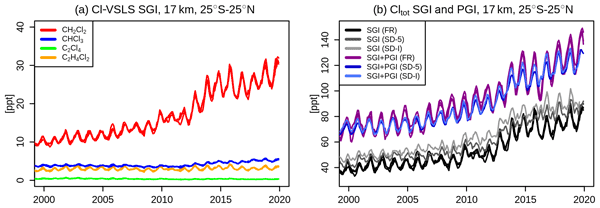
Ewa M. Bednarz, Ryan Hossaini, Martyn P. Chipperfield, N. Luke Abraham, and Peter Braesicke
Atmos. Chem. Phys., 22, 10657–10676, https://doi.org/10.5194/acp-22-10657-2022, https://doi.org/10.5194/acp-22-10657-2022, 2022
Short summary
Short summary
Atmospheric impacts of chlorinated very short-lived substances (Cl-VSLS) over the first two decades of the 21st century are assessed using the UM-UKCA chemistry–climate model. Stratospheric input of Cl from Cl-VSLS is estimated at ~130 ppt in 2019. The use of model set-up with constrained meteorology significantly increases the abundance of Cl-VSLS in the lower stratosphere relative to the free-running set-up. The growth in Cl-VSLS emissions significantly impacted recent HCl and COCl2 trends.
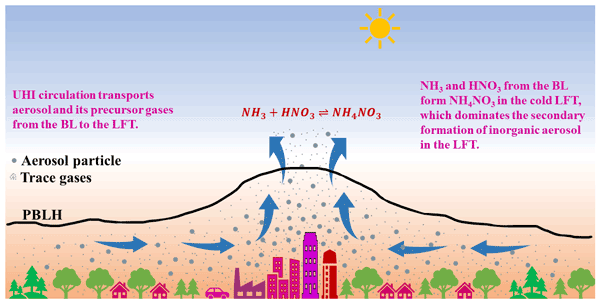
Hanqing Kang, Bin Zhu, Gerrit de Leeuw, Bu Yu, Ronald J. van der A, and Wen Lu
Atmos. Chem. Phys., 22, 10623–10634, https://doi.org/10.5194/acp-22-10623-2022, https://doi.org/10.5194/acp-22-10623-2022, 2022
Short summary
Short summary
This study quantified the contribution of each urban-induced meteorological effect (temperature, humidity, and circulation) to aerosol concentration. We found that the urban heat island (UHI) circulation dominates the UHI effects on aerosol. The UHI circulation transports aerosol and its precursor gases from the warmer lower boundary layer to the colder lower free troposphere and promotes the secondary formation of ammonium nitrate aerosol in the cold atmosphere.
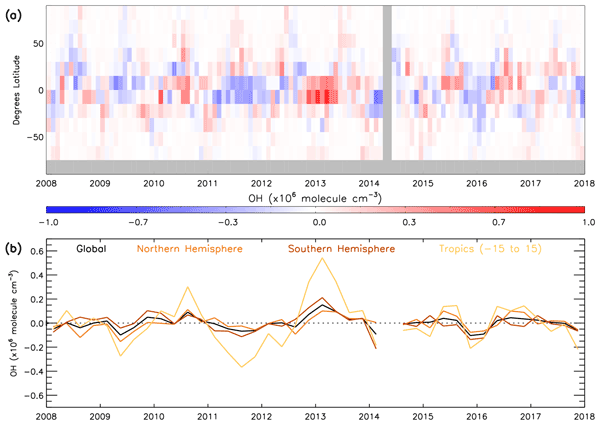
Matilda A. Pimlott, Richard J. Pope, Brian J. Kerridge, Barry G. Latter, Diane S. Knappett, Dwayne E. Heard, Lucy J. Ventress, Richard Siddans, Wuhu Feng, and Martyn P. Chipperfield
Atmos. Chem. Phys., 22, 10467–10488, https://doi.org/10.5194/acp-22-10467-2022, https://doi.org/10.5194/acp-22-10467-2022, 2022
Short summary
Short summary
We present a new method to derive global information of the hydroxyl radical (OH), an important atmospheric oxidant. OH controls the lifetime of trace gases important to air quality and climate. We use satellite observations of ozone, carbon monoxide, methane and water vapour in a simple expression to derive OH around 3–4 km altitude. The derived OH compares well to model and aircraft OH data. We then apply the method to 10 years of satellite data to study the inter-annual variability of OH.

Will S. Drysdale, Adam R. Vaughan, Freya A. Squires, Sam J. Cliff, Stefan Metzger, David Durden, Natchaya Pingintha-Durden, Carole Helfter, Eiko Nemitz, C. Sue B. Grimmond, Janet Barlow, Sean Beevers, Gregor Stewart, David Dajnak, Ruth M. Purvis, and James D. Lee
Atmos. Chem. Phys., 22, 9413–9433, https://doi.org/10.5194/acp-22-9413-2022, https://doi.org/10.5194/acp-22-9413-2022, 2022
Short summary
Short summary
Measurements of NOx emissions are important for a good understanding of air quality. While there are many direct measurements of NOx concentration, there are very few measurements of its emission. Measurements of emissions provide constraints on emissions inventories and air quality models. This article presents measurements of NOx emission from the BT Tower in central London in 2017 and compares them with inventories, finding that they underestimate by a factor of ∼1.48.
Marios Panagi, Roberto Sommariva, Zoë L. Fleming, Paul S. Monks, Gongda Lu, Eloise A. Marais, James R. Hopkins, Alastair C. Lewis, Qiang Zhang, James D. Lee, Freya A. Squires, Lisa K. Whalley, Eloise J. Slater, Dwayne E. Heard, Robert Woodward-Massey, Chunxiang Ye, and Joshua D. Vande Hey
Atmos. Chem. Phys. Discuss., https://doi.org/10.5194/acp-2022-379, https://doi.org/10.5194/acp-2022-379, 2022
Revised manuscript not accepted
Short summary
Short summary
A dispersion model and a box model were combined to investigate the evolution of VOCs in Beijing once they are emitted from anthropogenic sources. It was determined that during the winter time the VOC concentrations in Beijing are driven predominantly by sources within Beijing and by a combination of transport and chemistry during the summer. Furthermore, the results in the paper highlight the need for a season specific policy.
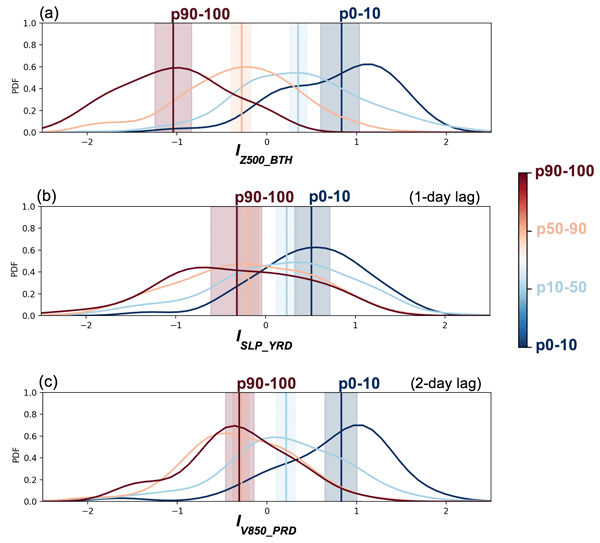
Zixuan Jia, Ruth M. Doherty, Carlos Ordóñez, Chaofan Li, Oliver Wild, Shipra Jain, and Xiao Tang
Atmos. Chem. Phys., 22, 6471–6487, https://doi.org/10.5194/acp-22-6471-2022, https://doi.org/10.5194/acp-22-6471-2022, 2022
Short summary
Short summary
This study investigates the modulation of daily PM2.5 over three major populated regions in China by regional meteorology and large-scale circulation during winter. These results demonstrate the benefits of considering the large-scale circulation for air quality studies. The novel circulation indices proposed here can explain a considerable fraction of the day-to-day variability of PM2.5 and can be combined with regional meteorology to improve our capability to predict the variability of PM2.5.
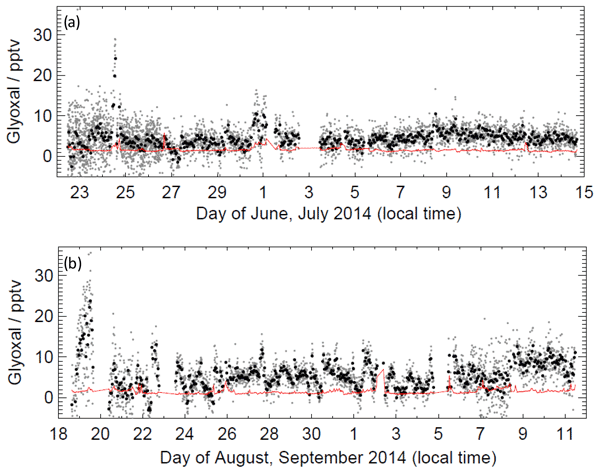
Hannah Walker, Daniel Stone, Trevor Ingham, Sina Hackenberg, Danny Cryer, Shalini Punjabi, Katie Read, James Lee, Lisa Whalley, Dominick V. Spracklen, Lucy J. Carpenter, Steve R. Arnold, and Dwayne E. Heard
Atmos. Chem. Phys., 22, 5535–5557, https://doi.org/10.5194/acp-22-5535-2022, https://doi.org/10.5194/acp-22-5535-2022, 2022
Short summary
Short summary
Glyoxal is a ubiquitous reactive organic compound in the atmosphere, which may form organic aerosol and impact the atmosphere's oxidising capacity. There are limited measurements of glyoxal's abundance in the remote marine atmosphere. We made new measurements of glyoxal using a highly sensitive technique over two 4-week periods in the tropical Atlantic atmosphere. We show that daytime measurements are mostly consistent with our chemical understanding but a potential missing source at night.
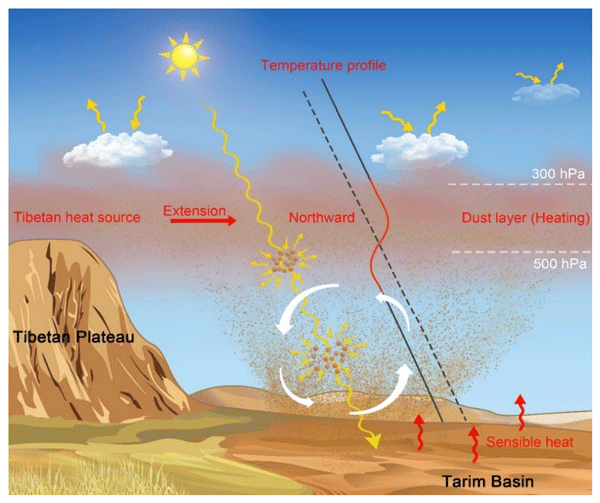
Chenglong Zhou, Yuzhi Liu, Qingzhe Zhu, Qing He, Tianliang Zhao, Fan Yang, Wen Huo, Xinghua Yang, and Ali Mamtimin
Atmos. Chem. Phys., 22, 5195–5207, https://doi.org/10.5194/acp-22-5195-2022, https://doi.org/10.5194/acp-22-5195-2022, 2022
Short summary
Short summary
Based on the radiosonde observations, an anomalously warm layer is measured at altitudes between 500 and 300 hPa over the Tarim Basin (TB) with an average intensity of 2.53 and 1.39 K in the spring and summer, respectively. The heat contributions of dust to this anomalously warm atmospheric layer in spring and summer were 13.77 and 10.25 %, respectively. Topographically, the TB is adjacent to the Tibetan Plateau; we propose the concept of the Tibetan heat source’s northward extension.
Robert Woodward-Massey, Roberto Sommariva, Lisa K. Whalley, Danny R. Cryer, Trevor Ingham, William J1 Bloss, Sam Cox, James D. Lee, Chris P. Reed, Leigh R. Crilley, Louisa J. Kramer, Brian J. Bandy, Grant L. Forster, Claire E. Reeves, Paul S. Monks, and Dwayne E. Heard
Atmos. Chem. Phys. Discuss., https://doi.org/10.5194/acp-2022-207, https://doi.org/10.5194/acp-2022-207, 2022
Preprint withdrawn
Short summary
Short summary
We measured radicals (OH, HO2, RO2) and OH reactivity at a UK coastal site and compared our observations to the predictions of an MCMv3.3.1 box model. We find variable agreement between measured and modelled radical concentrations and OH reactivity, where the levels of agreement for individual species display strong dependences on NO concentrations. The most substantial disagreement is found for RO2 at high NO (> 1 ppbv), when RO2 levels are underpredicted by a factor of ~10–30.
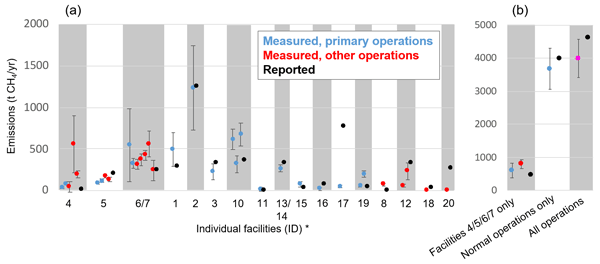
Amy Foulds, Grant Allen, Jacob T. Shaw, Prudence Bateson, Patrick A. Barker, Langwen Huang, Joseph R. Pitt, James D. Lee, Shona E. Wilde, Pamela Dominutti, Ruth M. Purvis, David Lowry, James L. France, Rebecca E. Fisher, Alina Fiehn, Magdalena Pühl, Stéphane J. B. Bauguitte, Stephen A. Conley, Mackenzie L. Smith, Tom Lachlan-Cope, Ignacio Pisso, and Stefan Schwietzke
Atmos. Chem. Phys., 22, 4303–4322, https://doi.org/10.5194/acp-22-4303-2022, https://doi.org/10.5194/acp-22-4303-2022, 2022
Short summary
Short summary
We measured CH4 emissions from 21 offshore oil and gas facilities in the Norwegian Sea in 2019. Measurements compared well with operator-reported emissions but were greatly underestimated when compared with a 2016 global fossil fuel inventory. This study demonstrates the need for up-to-date and accurate inventories for use in research and policy and the important benefits of best-practice reporting methods by operators. Airborne measurements are an effective tool to validate such inventories.
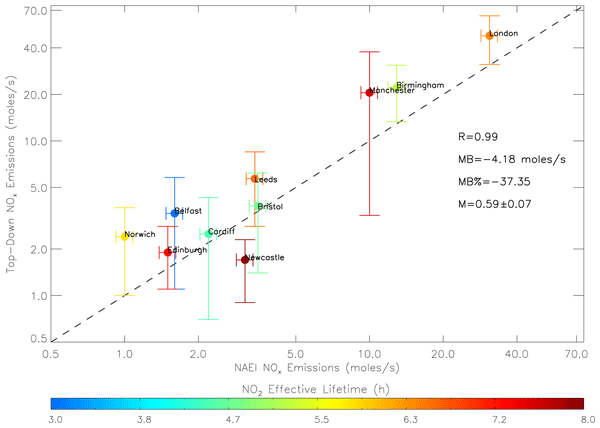
Richard J. Pope, Rebecca Kelly, Eloise A. Marais, Ailish M. Graham, Chris Wilson, Jeremy J. Harrison, Savio J. A. Moniz, Mohamed Ghalaieny, Steve R. Arnold, and Martyn P. Chipperfield
Atmos. Chem. Phys., 22, 4323–4338, https://doi.org/10.5194/acp-22-4323-2022, https://doi.org/10.5194/acp-22-4323-2022, 2022
Short summary
Short summary
Nitrogen oxides (NOx) are potent air pollutants which directly impact on human health. In this study, we use satellite nitrogen dioxide (NO2) data to evaluate the spatial distribution and temporal evolution of the UK official NOx emissions inventory, with reasonable agreement. We also derived satellite-based NOx emissions for several UK cities. In the case of London and Birmingham, the NAEI NOx emissions are potentially too low by >50%.
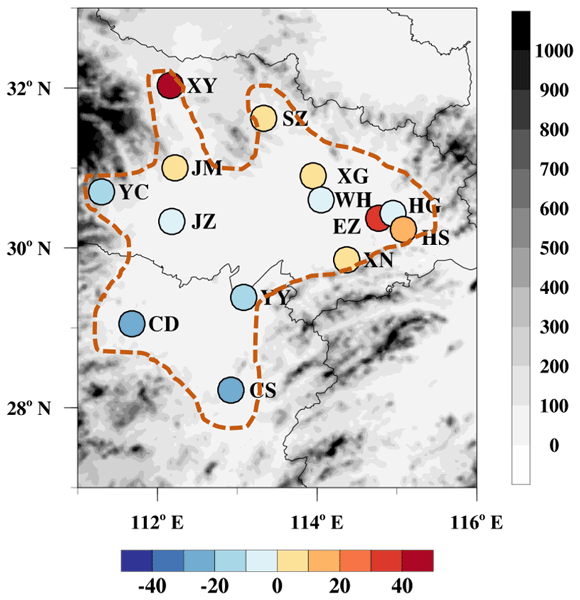
Xiaoyun Sun, Tianliang Zhao, Yongqing Bai, Shaofei Kong, Huang Zheng, Weiyang Hu, Xiaodan Ma, and Jie Xiong
Atmos. Chem. Phys., 22, 3579–3593, https://doi.org/10.5194/acp-22-3579-2022, https://doi.org/10.5194/acp-22-3579-2022, 2022
Short summary
Short summary
This study revealed the impact of anthropogenic emissions and meteorological conditions on PM2.5 decline in the regional transport of air pollutants over a receptor region in central China. The meteorological drivers led to upwind accelerating and downward offsetting of the effects of emission reductions over the receptor region in regional PM2.5 transport, and the contribution of gaseous precursor emissions to PM2.5 pollution was enhanced with reduced anthropogenic emissions in recent years.

Zhenze Liu, Ruth M. Doherty, Oliver Wild, Fiona M. O'Connor, and Steven T. Turnock
Atmos. Chem. Phys., 22, 1209–1227, https://doi.org/10.5194/acp-22-1209-2022, https://doi.org/10.5194/acp-22-1209-2022, 2022
Short summary
Short summary
Tropospheric ozone is important to future air quality and climate, and changing emissions and climate influence ozone. We investigate the evolution of ozone and ozone sensitivity from the present day (2004–2014) to the future (2045–2055) and explore the main drivers of ozone changes from global and regional perspectives. This helps guide suitable emission control strategies to mitigate ozone pollution.
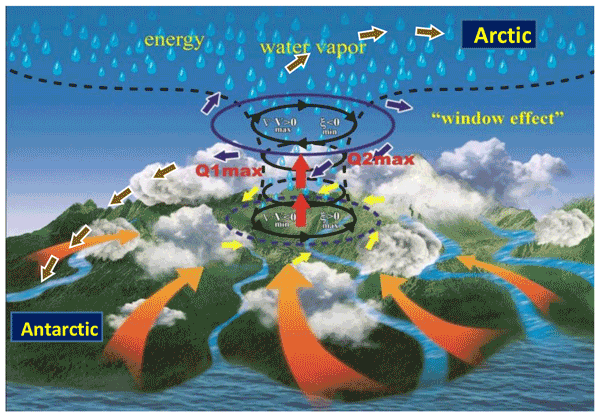
Xiangde Xu, Chan Sun, Deliang Chen, Tianliang Zhao, Jianjun Xu, Shengjun Zhang, Juan Li, Bin Chen, Yang Zhao, Hongxiong Xu, Lili Dong, Xiaoyun Sun, and Yan Zhu
Atmos. Chem. Phys., 22, 1149–1157, https://doi.org/10.5194/acp-22-1149-2022, https://doi.org/10.5194/acp-22-1149-2022, 2022
Short summary
Short summary
A vertical transport window of tropospheric vapor exists on the Tibetan Plateau (TP). The TP's thermal forcing drives the vertical transport
windowof vapor in the troposphere. The effects of the TP's vertical transport window of vapor are of importance in global climate change.
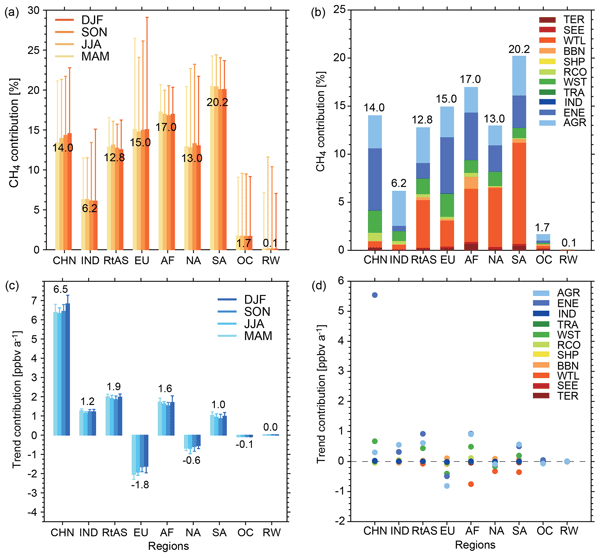
Haiyue Tan, Lin Zhang, Xiao Lu, Yuanhong Zhao, Bo Yao, Robert J. Parker, and Hartmut Boesch
Atmos. Chem. Phys., 22, 1229–1249, https://doi.org/10.5194/acp-22-1229-2022, https://doi.org/10.5194/acp-22-1229-2022, 2022
Short summary
Short summary
Methane is the second most important anthropogenic greenhouse gas. Understanding methane emissions and concentration growth over China in the past decade is important to support its mitigation. This study analyzes the contributions of methane emissions from different regions and sources over the globe to methane changes over China in 2007–2018. Our results show strong international transport influences and emphasize the need of intensive methane measurements covering eastern China.
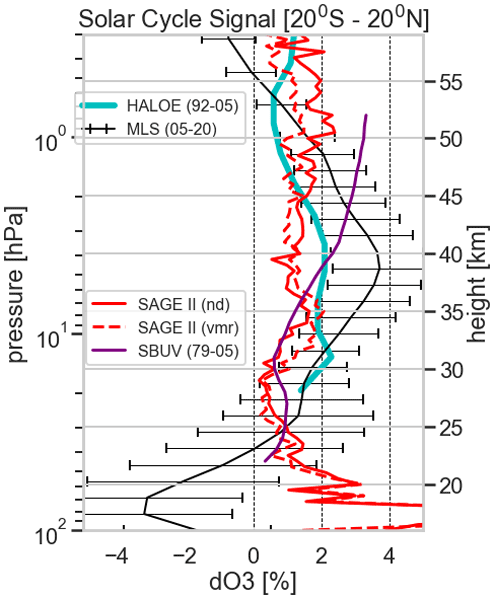
Sandip S. Dhomse, Martyn P. Chipperfield, Wuhu Feng, Ryan Hossaini, Graham W. Mann, Michelle L. Santee, and Mark Weber
Atmos. Chem. Phys., 22, 903–916, https://doi.org/10.5194/acp-22-903-2022, https://doi.org/10.5194/acp-22-903-2022, 2022
Short summary
Short summary
Solar flux variations associated with 11-year sunspot cycle is believed to exert important external climate forcing. As largest variations occur at shorter wavelengths such as ultra-violet part of the solar spectrum, associated changes in stratospheric ozone are thought to provide direct evidence for solar climate interaction. Until now, most of the studies reported double-peak structured solar cycle signal (SCS), but relatively new satellite data suggest only single-peak-structured SCS.
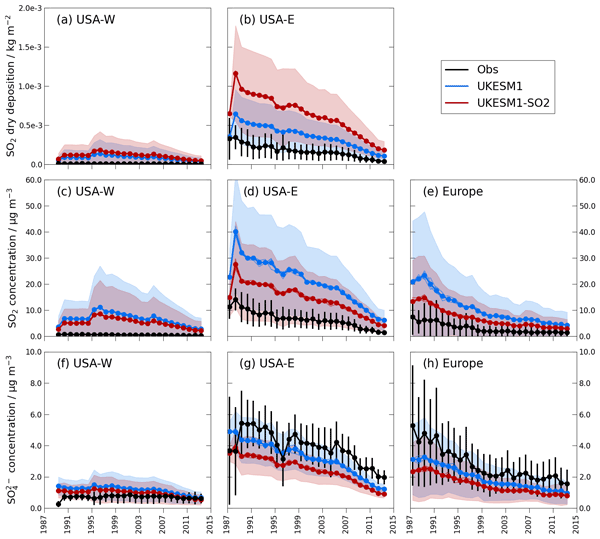
Catherine Hardacre, Jane P. Mulcahy, Richard J. Pope, Colin G. Jones, Steven T. Rumbold, Can Li, Colin Johnson, and Steven T. Turnock
Atmos. Chem. Phys., 21, 18465–18497, https://doi.org/10.5194/acp-21-18465-2021, https://doi.org/10.5194/acp-21-18465-2021, 2021
Short summary
Short summary
We investigate UKESM1's ability to represent the sulfur (S) cycle in the recent historical period. The S cycle is a key driver of historical radiative forcing. Earth system models such as UKESM1 should represent the S cycle well so that we can have confidence in their projections of future climate. We compare UKESM1 to observations of sulfur compounds, finding that the model generally performs well. We also identify areas for UKESM1’s development, focussing on how SO2 is removed from the air.

Leigh R. Crilley, Louisa J. Kramer, Francis D. Pope, Chris Reed, James D. Lee, Lucy J. Carpenter, Lloyd D. J. Hollis, Stephen M. Ball, and William J. Bloss
Atmos. Chem. Phys., 21, 18213–18225, https://doi.org/10.5194/acp-21-18213-2021, https://doi.org/10.5194/acp-21-18213-2021, 2021
Short summary
Short summary
Nitrous acid (HONO) is a key source of atmospheric oxidants. We evaluate if the ocean surface is a source of HONO for the marine boundary layer, using measurements from two contrasting coastal locations. We observed no evidence for a night-time ocean surface source, in contrast to previous work. This points to significant geographical variation in the predominant HONO formation mechanisms in marine environments, reflecting possible variability in the sea-surface microlayer composition.
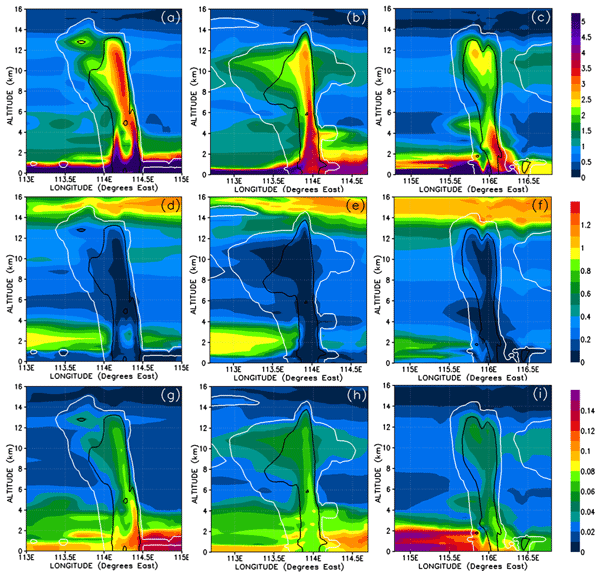
Paul D. Hamer, Virginie Marécal, Ryan Hossaini, Michel Pirre, Gisèle Krysztofiak, Franziska Ziska, Andreas Engel, Stephan Sala, Timo Keber, Harald Bönisch, Elliot Atlas, Kirstin Krüger, Martyn Chipperfield, Valery Catoire, Azizan A. Samah, Marcel Dorf, Phang Siew Moi, Hans Schlager, and Klaus Pfeilsticker
Atmos. Chem. Phys., 21, 16955–16984, https://doi.org/10.5194/acp-21-16955-2021, https://doi.org/10.5194/acp-21-16955-2021, 2021
Short summary
Short summary
Bromoform is a stratospheric ozone-depleting gas released by seaweed and plankton transported to the stratosphere via convection in the tropics. We study the chemical interactions of bromoform and its derivatives within convective clouds using a cloud-scale model and observations. Our findings are that soluble bromine gases are efficiently washed out and removed within the convective clouds and that most bromine is transported vertically to the upper troposphere in the form of bromoform.
Cited articles
Allen, D. J. and Pickering, K. E.: Evaluation of lightning flash rate parameterizations for use in a global chemical transport model, J. Geophys. Res., 107, 4711, https://doi.org/10.1029/2002JD002066, 2002.
Amedro, D., Bunkan, A. J. C., Berasategui, M., and Crowley, J. N.: Kinetics of the OH+NO2 reaction: rate coefficients (217–333 K, 16–1200 mbar) and fall-off parameters for N2 and O2 bath gases, Atmos. Chem. Phys., 19, 10643–10657, https://doi.org/10.5194/acp-19-10643-2019, 2019.
Amedro, D., Berasategui, M., Bunkan, A. J. C., Pozzer, A., Lelieveld, J., and Crowley, J. N.: Kinetics of the OH+NO2 reaction: effect of water vapour and new parameterization for global modelling, Atmos. Chem. Phys., 20, 3091–3105, https://doi.org/10.5194/acp-20-3091-2020, 2020.
Anderson, D. C., Duncan, B. N., Fiore, A. M., Baublitz, C. B., Follette-Cook, M. B., Nicely, J. M., and Wolfe, G. M.: Spatial and temporal variability in the hydroxyl (OH) radical: understanding the role of large-scale climate features and their influence on OH through its dynamical and photochemical drivers, Atmos. Chem. Phys., 21, 6481–6508, https://doi.org/10.5194/acp-21-6481-2021, 2021.
Anderson, D. C., Duncan, B. N., Liu, J., Nicely, J. M., Strode, S. A., Follette-Cook, M. B., Souri, A. H., Ziemke, J. R., González-Abad, G., and Ayazpour, Z.: Trends and interannual variability of the hydroxyl radical in the remote tropics during boreal autumn inferred from satellite proxy data, Geophys. Res. Lett., 51, e2024GL108531, https://doi.org/10.1029/2024GL108531, 2024.
Archibald, A. T., O'Connor, F. M., Abraham, N. L., Archer-Nicholls, S., Chipperfield, M. P., Dalvi, M., Folberth, G. A., Dennison, F., Dhomse, S. S., Griffiths, P. T., Hardacre, C., Hewitt, A. J., Hill, R. S., Johnson, C. E., Keeble, J., Köhler, M. O., Morgenstern, O., Mulcahy, J. P., Ordóñez, C., Pope, R. J., Rumbold, S. T., Russo, M. R., Savage, N. H., Sellar, A., Stringer, M., Turnock, S. T., Wild, O., and Zeng, G.: Description and evaluation of the UKCA stratosphere–troposphere chemistry scheme (StratTrop vn 1.0) implemented in UKESM1, Geosci. Model Dev., 13, 1223–1266, https://doi.org/10.5194/gmd-13-1223-2020, 2020.
Boersma, K. F., Eskes, H. J., Richter, A., De Smedt, I., Lorente, A., Beirle, S., van Geffen, J. H. G. M., Zara, M., Peters, E., Van Roozendael, M., Wagner, T., Maasakkers, J. D., van der A, R. J., Nightingale, J., De Rudder, A., Irie, H., Pinardi, G., Lambert, J.-C., and Compernolle, S. C.: Improving algorithms and uncertainty estimates for satellite NO2 retrievals: results from the quality assurance for the essential climate variables (QA4ECV) project, Atmos. Meas. Tech., 11, 6651–6678, https://doi.org/10.5194/amt-11-6651-2018, 2018.
Bossolasco, A., Fernandez, R. P., Li, Q., Mahajan, A. S., Villamayor, J., Barrera, J. A., Heard, D. E., Cuevas, C. A., Caram, C., Szopaj, S., and Saiz-Lopez, A.: Key role of short-lived halogens on global atmospheric oxidation during historical periods, Environ. Sci.: Atmos., 5, 547, https://doi.org/10.1039/d4ea00141a, 2025.
Bozzo, A., Benedetti, A., Flemming, J., Kipling, Z., and Rémy, S.: An aerosol climatology for global models based on the tropospheric aerosol scheme in the Integrated Forecasting System of ECMWF, Geosci. Model Dev., 13, 1007–1034, https://doi.org/10.5194/gmd-13-1007-2020, 2020.
Brasseur, G. P. and Solomon, S.: Aeronomy of the Middle Atmosphere, Springer Netherlands, https://doi.org/10.1007/1-4020-3824-0, 2005.
Brune, W. H., Miller, D. O., Thames, A. B., Allen, H. M., Apel, E. C., Blake, D. R., Bui, T. P., Commane, R., Crounse, J. D., Daube, B. C., Diskin, G. S., DiGangi, J. P., Elkins, J. W., Hall, S. R., Hanisco, T. F., Hannun, R. A., Hintsa, E. J., Hornbrook, R. S., Kim, M. J., McKain, K., Moore, F. L., Neuman, J. A., Nicely, J. M., Peischl, J., Ryerson, T. B., St. Clair, J. M., Sweeney, C., Teng, A. P., Thompson, C., Ullmann, K., Veres, P. R., Wennberg, P. O., and Wolfe, G. M.: Exploring Oxidation in the Remote Free Troposphere: Insights From Atmospheric Tomography (ATom), J. Geophys. Res.-Atmos., 125, e2019JD031685, https://doi.org/10.1029/2019JD031685, 2020.
Burkholder, J. B., Sander, S. P., Abbatt, J., Barker, J. R., Cappa, C., Crounse, J. D., Dibble, T. S., Huie, R. E., Kolb, C. E., Kurylo, M. J., Orkin, V. L., Percival, C. J., Wilmouth, D. M., and Wine, P. H.: Chemical Kinetics and Photochemical Data for Use in Atmospheric Studies, Evaluation No. 19, JPL Publication 19-5, Jet Propulsion Laboratory, Pasadena, https://dataverse.jpl.nasa.gov/dataset.xhtml?persistentId=hdl:2014/49199&version=2.1 (last access: 25 September 2026), 1 May 2020.
Cantrell, C. A., Shetter, R. E., Gilpin, T. M., Calvert, J. G., Eisele, F. L., and Tanner, D. J.: Peroxy radical concentrations measured and calculated from trace gas measurements in the Mauna Loa observatory photochemistry experiment 2, J. Geophys. Res.-Atmos., 101, 14653–14664, https://doi.org/10.1029/95JD03613, 1996.
Christian, K. E., Brune, W. H., Mao, J., and Ren, X.: Global sensitivity analysis of GEOS-Chem modeled ozone and hydrogen oxides during the INTEX campaigns, Atmos. Chem. Phys., 18, 2443–2460, https://doi.org/10.5194/acp-18-2443-2018, 2018.
Chua, G., Naik, V., and Horowitz, L. W.: Exploring the drivers of tropospheric hydroxyl radical trends in the Geophysical Fluid Dynamics Laboratory AM4.1 atmospheric chemistry–climate model, Atmos. Chem. Phys., 23, 4955–4975, https://doi.org/10.5194/acp-23-4955-2023, 2023.
Chua, G., Naik, V., and Horowitz, L. W.: Role of future climate change, air pollution control and methane mitigation in driving hydroxyl radical (OH) and methane lifetime, Geophys. Res. Lett., 53, e2025GL120136, 2026.
Compernolle, S., Verhoelst, T., Pinardi, G., Granville, J., Hubert, D., Keppens, A., Niemeijer, S., Rino, B., Bais, A., Beirle, S., Boersma, F., Burrows, J. P., De Smedt, I., Eskes, H., Goutail, F., Hendrick, F., Lorente, A., Pazmino, A., Piters, A., Peters, E., Pommereau, J.-P., Remmers, J., Richter, A., van Geffen, J., Van Roozendael, M., Wagner, T., and Lambert, J.-C.: Validation of Aura-OMI QA4ECV NO2 climate data records with ground-based DOAS networks: the role of measurement and comparison uncertainties, Atmos. Chem. Phys., 20, 8017–8045, https://doi.org/10.5194/acp-20-8017-2020, 2020.
Crutzen, P. J.: The Role of NO and NO2 in the Chemistry of the Troposphere and Stratosphere, Annu. Rev. Earth Pl. Sc., 7, 443–472, 1979.
Deeter, M., Francis, G., Gille, J., Mao, D., Martínez-Alonso, S., Worden, H., Ziskin, D., Drummond, J., Commane, R., Diskin, G., and McKain, K.: The MOPITT Version 9 CO product: sampling enhancements and validation, Atmos. Meas. Tech., 15, 2325–2344, https://doi.org/10.5194/amt-15-2325-2022, 2022.
Duncan, B. N., Lamsal, L. N., Thompson, A. M., Yoshida, Y., Lu, Z. F., Streets, D. G., Hurwitz, M. M., and Pickering, K. E.: A space-based, high-resolution view of notable changes in urban NOx pollution around the world (2005–2014), J. Geophys. Res., 121, 976–996, https://doi.org/10.1002/2015jd024121, 2016.
Elshorbany, Y., Ziemke, J. R., Strode, S., Petetin, H., Miyazaki, K., De Smedt, I., Pickering, K., Seguel, R. J., Worden, H., Emmerichs, T., Taraborrelli, D., Cazorla, M., Fadnavis, S., Buchholz, R. R., Gaubert, B., Rojas, N. Y., Nogueira, T., Salameh, T., and Huang, M.: Tropospheric ozone precursors: global and regional distributions, trends, and variability, Atmos. Chem. Phys., 24, 12225–12257, https://doi.org/10.5194/acp-24-12225-2024, 2024.
Emmons, L. K., Schwantes, R. H., Orlando, J. J., Tyndall, G., Kinnison, D., Lamarque, J., Marsh, D., Mills, M. J., Tilmes, S., Bardeen, C., Buchholz, R. R., Conley, A., Gettelman, A., Garcia, R., Simpson, I., Blake, D. R., Meinardi, S., and Pétron, G.: The Chemistry Mechanism in the Community Earth System Model Version 2 (CESM2), J. Adv. Model. Earth Sy., 12, e2019MS001882, https://doi.org/10.1029/2019MS001882, 2020.
Fei, D. D., Hou, X. W., and Wei, L.: Quantitative sources of global surface ozone and spatial and temporal distribution characteristics, China Environmental Science, 41, 3004–3016, https://link.oversea.cnki.net/doi/10.19674/j.cnki.issn1000-6923.2021.0302 (last access: 25 September 2026), 2021.
Fiore, A. M., Dentener, F. J., Wild, O., Cuvelier, C., Schultz, M. G., Hess, P., Textor, C., Schulz, M., Doherty, R. M., Horowitz, L. W., MacKenzie, A., Sanderson, M. G., Shindell, D. T., Stevenson, D. S., Szopa, S., Van Dingenen, R., Zeng, G., Atherton, C., Bergmann, D., Bey, I., Carmichael, G., Collins, W. J., Duncan, B. N., Faluvegi, G., Folberth, G., Gauss, M., Gong, S., Hauglustaine, D., Holloway, T., Isaksen, I. S. A., Jacob, D. J., Jonson, J. E., Kaminski, J. W., Keating, T. J., Lupu, A., Marmer, E., Montanaro, V., Park, R. J., Pitari, G., Pringle, K. J., Pyle, J. A., Schroeder, S., Vivanco, M. G., Wind, P., Wojcik, G., Wu, S., and Zuber, A.: Multimodel estimates of intercontinental source-receptor relationships for ozone pollution, J. Geophys. Res.-Atmos., 114, D04301, https://doi.org/10.1029/2008JD010816, 2009.
Fiore, A. M., Mickley, L. J., Zhu, Q., and Baublitz, C. B.: Climate and Tropospheric Oxidizing Capacity, Annu. Rev. Earth Pl. Sc., 52, 11.1–11.29, https://doi.org/10.1146/annurev-earth-032320-090307, 2024.
Gaubert, B., Emmons, L. K., Raeder, K., Tilmes, S., Miyazaki, K., Arellano Jr., A. F., Elguindi, N., Granier, C., Tang, W., Barré, J., Worden, H. M., Buchholz, R. R., Edwards, D. P., Franke, P., Anderson, J. L., Saunois, M., Schroeder, J., Woo, J.-H., Simpson, I. J., Blake, D. R., Meinardi, S., Wennberg, P. O., Crounse, J., Teng, A., Kim, M., Dickerson, R. R., He, H., Ren, X., Pusede, S. E., and Diskin, G. S.: Correcting model biases of CO in East Asia: impact on oxidant distributions during KORUS-AQ, Atmos. Chem. Phys., 20, 14617–14647, https://doi.org/10.5194/acp-20-14617-2020, 2020.
Granier, C., Guether, A., Lamarque, J. F., Mieville, A., Muller, J. F., Olivier, J., Orlando, J., Peters, J., Petron, G., Tyndall, G., and Wallens, S.: POET, a database of surface emissions of ozone precursors, https://eccad.aeris-data.fr (last access: 19 September 2026), 2005.
Granier, C., Darras, S., Denier van der Gon, H., Doubalova, J., Elguindi, N., Galle, B., Gauss, M., Guevara, M., Jalkanen, J.-P., Kuenen, J., Liousse, C., Quack, B., Simpson, D., and Sindelarova, K.: The Copernicus Atmosphere Monitoring Service global and regional emissions (April 2019 version), Report April 2019 version, https://doi.org/10.24380/d0bn-kx16, 2019.
Griffiths, P. T., Murray, L. T., Zeng, G., Shin, Y. M., Abraham, N. L., Archibald, A. T., Deushi, M., Emmons, L. K., Galbally, I. E., Hassler, B., Horowitz, L. W., Keeble, J., Liu, J., Moeini, O., Naik, V., O'Connor, F. M., Oshima, N., Tarasick, D., Tilmes, S., Turnock, S. T., Wild, O., Young, P. J., and Zanis, P.: Tropospheric ozone in CMIP6 simulations, Atmos. Chem. Phys., 21, 4187–4218, https://doi.org/10.5194/acp-21-4187-2021, 2021.
Ha, P. T. M., Matsuda, R., Kanaya, Y., Taketani, F., and Sudo, K.: Effects of heterogeneous reactions on tropospheric chemistry: a global simulation with the chemistry–climate model CHASER V4.0, Geosci. Model Dev., 14, 3813–3841, https://doi.org/10.5194/gmd-14-3813-2021, 2021.
Heymsfield, A., Winker D., Avery, M., Vaughan, M., Diskin, G., Deng, M., Mitev, V., and Matthey R.: Relationships between Ice Water Content and Volume Extinction Coefficient from In Situ Observations for Temperatures from 0° to −86 °C: Implications for Spaceborne Lidar Retrievals, J. Appl. Meteorol. Clim., 53, 479–505, https://doi.org/10.1175/JAMC-D-13-087.1, 2014.
Holmes, C. D., Prather, M. J., Søvde, O. A., and Myhre, G.: Future methane, hydroxyl, and their uncertainties: key climate and emission parameters for future predictions, Atmos. Chem. Phys., 13, 285–302, https://doi.org/10.5194/acp-13-285-2013, 2013.
Holmes, C. D., Bertram, T. H., Confer, K. L., Graham, K. A., Ronan, A. C., Wirks, C. K., and Shah, V.: The role of clouds in the tropospheric NOx cycle: A new modelling approach for cloud chemistry and its global implications, Geophys. Res. Lett., 46, 4980–4990, https://doi.org/10.1029/2019GL081990, 2019.
Hou, X., Wild, O., Zhu, B., and Lee, J.: Future tropospheric ozone budget and distribution over east Asia under a net-zero scenario, Atmos. Chem. Phys., 23, 15395–15411, https://doi.org/10.5194/acp-23-15395-2023, 2023a.
Hou, X., Zhang, Y., Lv, X., and Lee, J.: The Impact of Meteorological Conditions and Emissions on Tropospheric Column Ozone Trends in Recent Years, Remote Sens.-Basel, 15, 5293, https://doi.org/10.3390/rs15225293, 2023b.
Hou, X.: Model outputs for “Tropospheric OH and Its Trends: New Insight into Atmospheric Processes and Implications for Methane Lifetime”, Version v1, Zenodo [data set], https://doi.org/10.5281/zenodo.19112214, 2026.
Jacob, D. J.: Heterogeneous chemistry and tropospheric ozone, Atmos. Environ., 34, 2131–2159, 2000.
Jiang, Z., Zhu, R., Miyazaki, K., McDonald, B. C., Klimont, Z., Zheng, B., Boersma, K. F., Zhang, Q., Worden, H., Worden, J. R., Henze, D. K., Jones, D. B. A., van der Gon, H. A. C. D., and Eskes, H.: Decadal variabilities in tropospheric nitrogen oxides over United States, Europe, and China, J. Geophys. Res.-Atmos., 127, e2021JD035872, https://doi.org/10.1029/2021JD035872, 2022.
Kendall, M. G.: Rank Correlation Methods, 4th edn., Charles Griffin, London, ISBN 9780852641996, 1975.
Lawrence, M. G., Jöckel, P., and von Kuhlmann, R.: What does the global mean OH concentration tell us?, Atmos. Chem. Phys., 1, 37–49, https://doi.org/10.5194/acp-1-37-2001, 2001.
Lelieveld, J., Gromov, S., Pozzer, A., and Taraborrelli, D.: Global tropospheric hydroxyl distribution, budget and reactivity, Atmos. Chem. Phys., 16, 12477–12493, https://doi.org/10.5194/acp-16-12477-2016, 2016.
Liu, J., Strode, S. A., Liang, Q., Oman, L. D., Colarco, P. R., Fleming, E. L., Manyin, M. E., Douglass, A. R., Ziemke, J. R., Lamsal, L. N., and Li, C.: Change in tropospheric ozone in the recent decades and its contribution to global total ozone, J. Geophys. Res., 127, e2022JD037170, https://doi.org/10.1029/2022JD037170, 2022.
Liu, M., Song, Y., Matsui, H., Shang, F., Kang, L., Cai, X., Zhang, H., and Zhu, T.: Enhanced atmospheric oxidation toward carbon neutrality reduces methane's climate forcing, Nat. Commun., 15, 3148, https://doi.org/10.1038/s41467-024-47436-9, 2024.
Logan, J. A., Prather, M. J., Wofsy, S. C., and McElroy, M. B.: Tropospheric chemistry: A global perspective, J. Geophys. Res., 86, 7210–7254, https://doi.org/10.1029/JC086iC08p07210, 1981.
Macintyre, H. L. and Evans, M. J.: Sensitivity of a global model to the uptake of N2O5 by tropospheric aerosol, Atmos. Chem. Phys., 10, 7409–7414, https://doi.org/10.5194/acp-10-7409-2010, 2010.
McNorton, J., Chipperfield, M. P., Gloor, M., Wilson, C., Feng, W., Hayman, G. D., Rigby, M., Krummel, P. B., O'Doherty, S., Prinn, R. G., Weiss, R. F., Young, D., Dlugokencky, E., and Montzka, S. A.: Role of OH variability in the stalling of the global atmospheric CH4 growth rate from 1999 to 2006, Atmos. Chem. Phys., 16, 7943–7956, https://doi.org/10.5194/acp-16-7943-2016, 2016.
Mann, H. B.: Nonparametric tests against trend, Econometrica, 13, 245–259, https://doi.org/10.2307/1907187, 1945.
Meinshausen, M., Vogel, E., Nauels, A., Lorbacher, K., Meinshausen, N., Etheridge, D. M., Fraser, P. J., Montzka, S. A., Rayner, P. J., Trudinger, C. M., Krummel, P. B., Beyerle, U., Canadell, J. G., Daniel, J. S., Enting, I. G., Law, R. M., Lunder, C. R., O'Doherty, S., Prinn, R. G., Reimann, S., Rubino, M., Velders, G. J. M., Vollmer, M. K., Wang, R. H. J., and Weiss, R.: Historical greenhouse gas concentrations for climate modelling (CMIP6), Geosci. Model Dev., 10, 2057–2116, https://doi.org/10.5194/gmd-10-2057-2017, 2017.
Millet, D. B., Guenther, A., Siegel, D. A., Nelson, N. B., Singh, H. B., de Gouw, J. A., Warneke, C., Williams, J., Eerdekens, G., Sinha, V., Karl, T., Flocke, F., Apel, E., Riemer, D. D., Palmer, P. I., and Barkley, M.: Global atmospheric budget of acetaldehyde: 3-D model analysis and constraints from in-situ and satellite observations, Atmos. Chem. Phys., 10, 3405–3425, https://doi.org/10.5194/acp-10-3405-2010, 2010.
Miyazaki, K., Eskes, H., Sudo, K., Boersma, K. F., Bowman, K., and Kanaya, Y.: Decadal changes in global surface NOx emissions from multi-constituent satellite data assimilation, Atmos. Chem. Phys., 17, 807–837, https://doi.org/10.5194/acp-17-807-2017, 2017.
Monks, S. A., Arnold, S. R., Hollaway, M. J., Pope, R. J., Wilson, C., Feng, W., Emmerson, K. M., Kerridge, B. J., Latter, B. L., Miles, G. M., Siddans, R., and Chipperfield, M. P.: The TOMCAT global chemical transport model v1.6: description of chemical mechanism and model evaluation, Geosci. Model Dev., 10, 3025–3057, https://doi.org/10.5194/gmd-10-3025-2017, 2017.
Montzka, S. A., Krol, M., Dlugokencky, E., Hall, B., Jöckel, P., and Lelieveld, J.: Small interannual variability of global atmospheric hydroxyl, Science, 331, 67–69, https://doi.org/10.1126/science.1197640, 2011.
Naik, V., Voulgarakis, A., Fiore, A. M., Horowitz, L. W., Lamarque, J.-F., Lin, M., Prather, M. J., Young, P. J., Bergmann, D., Cameron-Smith, P. J., Cionni, I., Collins, W. J., Dalsøren, S. B., Doherty, R., Eyring, V., Faluvegi, G., Folberth, G. A., Josse, B., Lee, Y. H., MacKenzie, I. A., Nagashima, T., van Noije, T. P. C., Plummer, D. A., Righi, M., Rumbold, S. T., Skeie, R., Shindell, D. T., Stevenson, D. S., Strode, S., Sudo, K., Szopa, S., and Zeng, G.: Preindustrial to present-day changes in tropospheric hydroxyl radical and methane lifetime from the Atmospheric Chemistry and Climate Model Intercomparison Project (ACCMIP), Atmos. Chem. Phys., 13, 5277–5298, https://doi.org/10.5194/acp-13-5277-2013, 2013.
Naus, S., Montzka, S. A., Pandey, S., Basu, S., Dlugokencky, E. J., and Krol, M.: Constraints and biases in a tropospheric two-box model of OH, Atmos. Chem. Phys., 19, 407–424, https://doi.org/10.5194/acp-19-407-2019, 2019.
Newsome, B. and Evans, M.: Impact of uncertainties in inorganic chemical rate constants on tropospheric composition and ozone radiative forcing, Atmos. Chem. Phys., 17, 14333–14352, https://doi.org/10.5194/acp-17-14333-2017, 2017.
Nicely, J. M., Salawitch, R. J., Canty, T., Anderson, D. C., Arnold, S. R., Chipperfield, M. P., Emmons, L. K., Flemming, J., Huijnen, V., Kinnison, D. E., Lamarque, J.-F., Mao, J., Monks, S. A., Steenrod, S. D., Tilmes, S., and Turquety, S.: Quantifying the causes of differences in tropospheric OH within global models, J. Geophys. Res.-Atmos., 122, 1983–2007, https://doi.org/10.1002/2016JD026239, 2017.
Nicely, J. M., Duncan, B. N., Hanisco, T. F., Wolfe, G. M., Salawitch, R. J., Deushi, M., Haslerud, A. S., Jöckel, P., Josse, B., Kinnison, D. E., Klekociuk, A., Manyin, M. E., Marécal, V., Morgenstern, O., Murray, L. T., Myhre, G., Oman, L. D., Pitari, G., Pozzer, A., Quaglia, I., Revell, L. E., Rozanov, E., Stenke, A., Stone, K., Strahan, S., Tilmes, S., Tost, H., Westervelt, D. M., and Zeng, G.: A machine learning examination of hydroxyl radical differences among model simulations for CCMI-1, Atmos. Chem. Phys., 20, 1341–1361, https://doi.org/10.5194/acp-20-1341-2020, 2020.
Patra, P. K., Krol, M. C., Montzka, S. A., Arnold, T., Atlas, E. L., Lintner, B. R., Stephens, B. B., Xiang, B., Elkins, J. W., Fraser, P. J., Ghosh, A., Hintsa, E. J., Hurst, D. F., Ishijima, K., Krummel, P. B., Miller, B. R., Miyazaki, K., Moore, F. L., Mühle, J., O'Doherty, S., Prinn, R. G., Steele, L. P., Takigawa, M., Wang, H. J., Weiss, R. F., Wofsy, S. C., and Young, D.: Observational evidence for interhemispheric hydroxyl-radical parity, Nature, 513, 219–223, https://doi.org/10.1038/nature13721, 2014.
Patra, P. K., Krol, M. C., Prinn, R. G., Takigawa, M., Mühle, J., Montzka, S. A., Lal, S., Yamashita, Y., Naus, S., Chandra, N., Weiss, R. F., Krummel, P. B., Fraser, P. J., O'Doherty, S., and Elkins, J. W.: Methyl Chloroform Continues to Constrain the Hydroxyl (OH) Variability in the Troposphere, J. Geophys. Res.-Atmos., 126, e2020JD033862, https://doi.org/10.1029/2020JD033862, 2021.
Phillips, D. P., Hopkins, F. E., Bell, T. G., Liss, P. S., Nightingale, P. D., Reeves, C. E., Wohl, C., and Yang, M.: Air–sea exchange of acetone, acetaldehyde, DMS and isoprene at a UK coastal site, Atmos. Chem. Phys., 21, 10111–10132, https://doi.org/10.5194/acp-21-10111-2021, 2021.
Pickering, K. E., Wang, Y., Tao, W.-K., Price, C., and Müller, J.-F.: Vertical distributions of lightning NOx for use in regional and global chemical transport models, J. Geophys. Res., 103, 31203–31216, https://doi.org/10.1029/98JD02651, 1998.
Pimlott, M. A., Pope, R. J., Kerridge, B. J., Latter, B. G., Knappett, D. S., Heard, D. E., Ventress, L. J., Siddans, R., Feng, W., and Chipperfield, M. P.: Investigating the global OH radical distribution using steady-state approximations and satellite data, Atmos. Chem. Phys., 22, 10467–10488, https://doi.org/10.5194/acp-22-10467-2022, 2022.
Prather, M. J. and Zhu, L.: Resetting tropospheric OH and CH4 lifetime with ultraviolet H2O absorption, Science, 385, 201–204, https://doi.org/10.1126/science.adn0415, 2024.
Prather, M. J., Holmes, C. D., and Hsu, J.: Reactive greenhouse gas scenarios: Systematic exploration of uncertainties and the role of atmospheric chemistry, Geophys. Res. Lett., 39, L09803, https://doi.org/10.1029/2012GL051440, 2012.
Prinn, R. G., Weiss, R. F., Fraser, P. J., Simmonds, P. G., Cunnold, D. M., Alyea, F. N., O'Doherty, S., Salameh, P., Miller, B. R., Huang, J., Wang, R. H. J., Hartley, D. E., Harth, C., Steele, L. P., Sturrock, G., Midgley, P. M., and McCulloch, A.: A history of chemically and radiatively important gases in air deduced from ALE/GAGE/AGAGE, J. Geophys. Res., 105, 17751–17792, https://doi.org/10.1029/2000JD900141, 2000.
Prinn, R. G., Huang, J., Weiss, R. F., Cunnold, D. M., Fraser, P. J., Simmonds, P. G., McCulloch, A., Harth, C., Reimann, S., Salameh, P., O'Doherty, S., Wang, R. H. J., Porter, L. W., Miller, B. R., and Krummel, P. B.: Evidence for variability of atmospheric hydroxyl radicals over the past quarter century, Geophys. Res. Lett., 07809, https://doi.org/10.1029/2004GL022228, 2005.
Read, K. A., Carpenter, L. J., Arnold, S. R., Beale, R., Nightingale, P. D., Hopkins, J. R., Lewis, A. C., Lee, J. D., Mendes, L., and Pickering, S. J.: Multiannual observations of acetone, methanol, and acetaldehyde in remote Tropical Atlantic air: Implications for atmospheric OVOC budgets and oxidative capacity, Environ. Sci. Technol., 46, 11028–11039, https://doi.org/10.1021/es302082p, 2012.
Richter, A., Eyring, V., Burrows, J. P., Bovensmann, H., Lauer, A., Sierk, B., and Crutzen, P. J.: Satellite measurements of NO2 from international shipping emissions, Geophys. Res. Lett., 31, L23110, https://doi.org/10.1029/2004gl020822, 2004.
Rigby, M., Montzka, S. A., Prinn, R. G., White, J. W. C., Young, D., O'Doherty, S., Lunt, M. F., Ganesan, A. L., Manning, A. J., Simmonds, P. G., Salameh, P. K., Harth, C. M., Mühle, J., Weiss, R. F., Fraser, P. J., Steele, L. P., Krummel, P. B., McCulloch, A., and Park, S.: Role of atmospheric oxidation in recent methane growth, Proc. Natl. Acad. Sci. USA, 114, 5373–5377, https://doi.org/10.1073/pnas.1616426114, 2017.
Rolletter, M., Hofzumahaus, A., Novelli, A., Wahner, A., and Fuchs, H.: Kinetics of the reactions of OH with CO, NO, and NO2 and of HO2 with NO2 in air at 1 atm pressure, room temperature, and tropospheric water vapour concentrations, Atmos. Chem. Phys., 25, 3481–3502, https://doi.org/10.5194/acp-25-3481-2025, 2025.
Schultz, M. G., Schröder, S., Lyapina, O., and Cooper, O. R.: Pre-compiled metrics data sets, links to gridded files in NetCDF format, PANGAEA [data set], https://doi.org/10.1594/PANGAEA.880506, 2017a.
Schultz, M. G., Schröder, S., Lyapina, O., Cooper, O. R., Galbally, I., Petropavlovskikh, I., von Schneidemesser, E., Tanimoto, H., Elshorbany, Y., Naja, M., Seguel, R. J., Dauert, U., Eckhardt, P., Feigenspahn, S., Fiebig, M., Hjellbrekke, A.-G., Hong, Y.-D., Kjeld, P. C., Koide, H., Lear, G., Tarasick, D., Ueno, M., Wallasch, M., Baumgardner, D., Chuang, M.-T., Gillett, R., Lee, M., Molloy, S., Moolla, R., Wang, T., Sharps, K., Adame, J. A., Ancellet, G., Apadula, F., Artaxo, P., Barlasina, M. E., Bogucka, M., Bonasoni, P., Chang, L., Colomb, A., Cuevas-Agulló, E., Cupeiro, M., Degórska, A., Ding, A., Fröhlich, M., Frolova, M., Gadhavi, H., Gheusi, F., Gilge, S., Gonzalez, M. Y., Gros, V., Hamad, S. H., Helmig, D., Henriques, D., Hermansen, O., Holla, R., Huber, J., Im, U., Jaffe, D. A., Komala, N., Kubistin, D., Lam, K.-S., Laurila, T., Lee, H., Levy, I., Mazzoleni, C., Mazzoleni, L. R., McClure-Begley, A., Mohamad, M., Murovec, M., Navarro-Comas, M., Nicodim, F., Parrish, D., Read, K. A., Reid, N., Ries, L., Saxena, P., Schwab, J. J., Scorgie, Y., Senik, I., Simmonds, P., Sinha, V., Skorokhod, A. I., Spain, G., Spangl, W., Spoor, R., Springston, S. R., Steer, K., Steinbacher, M., Suharguniyawan, E., Torre, P., Trickl, T., Weili, L., Weller, R., Xu, X., Xue, L., and Ma, Z.: The Tropospheric Ozone Assessment Report: database and metrics data of global surface ozone observations, Elem. Sci. Anthr., 5, 58, https://doi.org/10.1525/elementa.244, 2017b.
Sen, P. K.: Estimates of the regression coefficient based on Kendall's tau, J. Am. Stat. Assoc., 63, 1379–1389, https://doi.org/10.1080/01621459.1968.10480934, 1968.
Shindell, D. T., Faluvegi, G., Stevenson, D. S., Krol, M. C., Emmons, L. K., Lamarque, J.-F., Pétron, G., Dentener, F. J., Ellingsen, K., Schultz, M. G., Wild, O., Amann, M., Atherton, C. S., Bergmann, D. J., Bey, I., Butler, T., Cofala, J., Collins, W. J., Derwent, R. G., Doherty, R. M., Drevet, J., Eskes, H. J., Fiore, A. M., Gauss, M., Hauglustaine, D. A., Horowitz, L. W., Isaksen, I. S. A., Lawrence, M. G., Montanaro, V., Müller, J.-F., Pitari, G., Prather, M. J., Pyle, J. A., Rast, S., Rodriguez, J. M., Sanderson, M. G., Savage, N. H., Strahan, S. E., Sudo, K., Szopa, S., Unger, N., van Noije, T. P. C., and Zeng, G.: Multimodel simulations of carbon monoxide: Comparison with observations and projected near-future changes, J. Geophys. Res., 111, D19306, https://doi.org/10.1029/2006JD007100, 2006.
Simpson, D. and Darras, S.: Global soil NO emissions for Atmospheric Chemical Transport Modelling: CAMS-GLOB-SOIL v2.2, Earth Syst. Sci. Data Discuss. [preprint], https://doi.org/10.5194/essd-2021-221, 2021.
Sindelarova, K., Markova, J., Simpson, D., Huszar, P., Karlicky, J., Darras, S., and Granier, C.: High-resolution biogenic global emission inventory for the time period 2000–2019 for air quality modelling, Earth Syst. Sci. Data, 14, 251–270, https://doi.org/10.5194/essd-14-251-2022, 2022.
Soulie, A., Granier, C., Darras, S., Zilbermann, N., Doumbia, T., Guevara, M., Jalkanen, J.-P., Keita, S., Liousse, C., Crippa, M., Guizzardi, D., Hoesly, R., and Smith, S. J.: Global anthropogenic emissions (CAMS-GLOB-ANT) for the Copernicus Atmosphere Monitoring Service simulations of air quality forecasts and reanalyses, Earth Syst. Sci. Data, 16, 2261–2279, https://doi.org/10.5194/essd-16-2261-2024, 2024.
Souri, A. H., Duncan, B. N., Strode, S. A., Anderson, D. C., Manyin, M. E., Liu, J., Oman, L. D., Zhang, Z., and Weir, B.: Enhancing long-term trend simulation of the global tropospheric hydroxyl (TOH) and its drivers from 2005 to 2019: a synergistic integration of model simulations and satellite observations, Atmos. Chem. Phys., 24, 8677–8701, https://doi.org/10.5194/acp-24-8677-2024, 2024.
Spivakovsky, C. M., Logan, J. A., Montzka, S. A., Balkanski, Y., Foreman-Fowler, M. S., Jones, D. B., Horowitz, L. W., Fusco, A. C., Brenninkmeijer, C. A., Prather, M. J., Wofsy, S. C., and McElroy, M. B.: Three-dimensional climatological distribution of tropospheric OH: Update and evaluation, J. Geophys. Res., 105, 8931–8980, 2000.
Stevenson, D. S., Zhao, A., Naik, V., O'Connor, F. M., Tilmes, S., Zeng, G., Murray, L. T., Collins, W. J., Griffiths, P. T., Shim, S., Horowitz, L. W., Sentman, L. T., and Emmons, L.: Trends in global tropospheric hydroxyl radical and methane lifetime since 1850 from AerChemMIP, Atmos. Chem. Phys., 20, 12905–12920, https://doi.org/10.5194/acp-20-12905-2020, 2020.
Stewart, D. J., Griffiths, P. T., and Cox, R. A.: Reactive uptake coefficients for heterogeneous reaction of N2O5 with submicron aerosols of NaCl and natural sea salt, Atmos. Chem. Phys., 4, 1381–1388, https://doi.org/10.5194/acp-4-1381-2004, 2004.
Strode, S. A., Liu, J., Lait, L., Commane, R., Daube, B., Wofsy, S., Conaty, A., Newman, P., and Prather, M.: Forecasting carbon monoxide on a global scale for the ATom-1 aircraft mission: insights from airborne and satellite observations and modeling, Atmos. Chem. Phys., 18, 10955–10971, https://doi.org/10.5194/acp-18-10955-2018, 2018.
Tabazadeh, A., Yokelson, R. J., Singh, H. B., Hobbs, P. V., Crawford, J. H., and Iraci, L. T.: Heterogeneous chemistry involving methanol in tropospheric clouds, Geophys. Res. Lett., 31, L06114, https://doi.org/10.1029/2003GL018775, 2004.
Talukdar, R. K., Longfellow, C. A., Gilles, M. K., and Ravishankara, A. R.: Quantum yields of O(1D) in the photolysis of ozone between 289 and 329 nm as a function of temperature, Geophys. Res. Lett., 25, 143–146, https://doi.org/10.1029/97GL03354, 1998.
Tan, D., Faloona, I., Simpas, J. B., Brune, W., Olson, J., Crawford, J., Avery, M., Sachse, G., Vay, S., Sandholm, S., Guan, H.-W., Vaughn, T., Mastromarino, J., Heikes, B., Snow, J., Podolske, J., and Singh, H.: OH and HO2 in the tropical Pacific: Results from PEM-Tropics B, J. Geophys. Res.-Atmos., 106, 32667–32681, https://doi.org/10.1029/2001JD900002, 2001.
Theil, H.: A rank-invariant method of linear and polynomial regression analysis, P. K. Ned. Akad. Wetensc., 53, 386–392, https://doi.org/10.1007/978-94-011-2546-8_20, 1950.
Thompson, C. R., Wofsy, S. C., Prather, M. J., Newman, P. A., Hanisco, T. F., Ryerson, T. B., Fahey, D. W., Apel, E. C., Brock, C. A., Brune, W. H., Froyd, K., Katich, J. M., Nicely, J. M., Peischl, J., Ray, E., Veres, P. R., Wang, S., Allen, H. M., Asher, E., Bian, H., Blake, D., Bourgeois, I., Budney, J., Bui, T. P., Butler, A., Campuzano-Jost, P., Chang, C., Chin, M., Commane, R., Correa, G., Crounse, J. D., Daube, B., Dibb, J. E., DiGangi, J. P., Diskin, G. S., Döllner, M., Elkins, J. W., Fiore, A. M., Flynn, C. M., Guo, H., Hall, S. R., Hannun, R. A., Hills, A., Hintsa, E. J., Hodzic, A., Hornbrook, R. S., Huey, L. G., Jiménez-Palacios, J. L., Keeling, R. F., Kim, M. J., Kupc, A., Lacey, F., Lait, L. R., Lamarque, J.-F., Liu, J., McKain, K., Meinardi, S., Miller, D. O., Montzka, S. A., Moore, F. L., Morgan, E. J., Murphy, D. M., Murray, L. T., Nault, B. A., Neuman, J. A., Nguyen, L., Gonzalez, Y., Rollins, A., Rosenlof, K., Sargent, M., Schill, G., Schwarz, J. P., St. Clair, J. M., Steenrod, S. D., Stephens, B. B., Strahan, S. E., Strode, S. A., Sweeney, C., Thames, A. B., Ullmann, K., Wagner, N., Weber, R., Weinzierl, B., Wennberg, P. O., Williamson, C. J., Wolfe, G. M., and Zeng, L.: The NASA Atmospheric Tomography (ATom) Mission: Imaging the Chemistry of the Global Atmosphere, B. Am. Meteorol. Soc., 103, E761–E790, https://doi.org/10.1175/BAMS-D-20-0315.1, 2022.
Thompson, R. L., Montzka, S. A., Vollmer, M. K., Arduini, J., Crotwell, M., Krummel, P. B., Lunder, C., Mühle, J., O'Doherty, S., Prinn, R. G., Reimann, S., Vimont, I., Wang, H., Weiss, R. F., and Young, D.: Estimation of the atmospheric hydroxyl radical oxidative capacity using multiple hydrofluorocarbons (HFCs), Atmos. Chem. Phys., 24, 1415–1427, https://doi.org/10.5194/acp-24-1415-2024, 2024.
Thornton, J. A., Braban, C. F., and Abbatt, J. P. D.: N2O5 hydrolysis on sub-micron organic aerosols: The effect of relative humidity, particle phase, and particle size, Phys. Chem. Chem. Phys., 5, 4593–4603, https://doi.org/10.1039/B307498F, 2003.
Tie, X., Emmons, L., Horowitz, L., Brasseur, G., Ridley, B., Atlas, E., Hess, P., Klonecki, A., Madronich, S., Talbot, R., Dibb, J., Marbouty, D., and Hennessy, J.: Effect of sulfate aerosol on tropospheric NOx and ozone budgets model simulations and TOPSE evidence, J. Geophys. Res., 108, 8364, https://doi.org/10.1029/2001JD001508, 2003.
Travis, K. R., Heald, C. L., Allen, H. M., Apel, E. C., Arnold, S. R., Blake, D. R., Brune, W. H., Chen, X., Commane, R., Crounse, J. D., Daube, B. C., Diskin, G. S., Elkins, J. W., Evans, M. J., Hall, S. R., Hintsa, E. J., Hornbrook, R. S., Kasibhatla, P. S., Kim, M. J., Luo, G., McKain, K., Millet, D. B., Moore, F. L., Peischl, J., Ryerson, T. B., Sherwen, T., Thames, A. B., Ullmann, K., Wang, X., Wennberg, P. O., Wolfe, G. M., and Yu, F.: Constraining remote oxidation capacity with ATom observations, Atmos. Chem. Phys., 20, 7753–7781, https://doi.org/10.5194/acp-20-7753-2020, 2020.
Turner, A. J., Frankenberg, C., Wennberg, P. O., and Jacob, D. J.: Ambiguity in the causes for decadal trends in atmospheric methane and hydroxyl, P. Natl. Acad. Sci. USA, 114, 5367–5372, https://doi.org/10.1073/pnas.1616020114, 2017.
Turner, A. J., Frankenberg, C., and Kort, E. A.: Interpreting contemporary trends in atmospheric methane, P. Natl. Acad. Sci. USA, 116, 2805–2813, https://doi.org/10.1073/pnas.1814297116, 2019.
van der Werf, G. R., Randerson, J. T., Giglio, L., van Leeuwen, T. T., Chen, Y., Rogers, B. M., Mu, M., van Marle, M. J. E., Morton, D. C., Collatz, G. J., Yokelson, R. J., and Kasibhatla, P. S.: Global fire emissions estimates during 1997–2016, Earth Syst. Sci. Data, 9, 697–720, https://doi.org/10.5194/essd-9-697-2017, 2017.
Voulgarakis, A., Naik, V., Lamarque, J.-F., Shindell, D. T., Young, P. J., Prather, M. J., Wild, O., Field, R. D., Bergmann, D., Cameron-Smith, P., Cionni, I., Collins, W. J., Dalsøren, S. B., Doherty, R. M., Eyring, V., Faluvegi, G., Folberth, G. A., Horowitz, L. W., Josse, B., MacKenzie, I. A., Nagashima, T., Plummer, D. A., Righi, M., Rumbold, S. T., Stevenson, D. S., Strode, S. A., Sudo, K., Szopa, S., and Zeng, G.: Analysis of present day and future OH and methane lifetime in the ACCMIP simulations, Atmos. Chem. Phys., 13, 2563–2587, https://doi.org/10.5194/acp-13-2563-2013, 2013.
Wang, H., Lu, X., Jacob, D. J., Cooper, O. R., Chang, K.-L., Li, K., Gao, M., Liu, Y., Sheng, B., Wu, K., Wu, T., Zhang, J., Sauvage, B., Nédélec, P., Blot, R., and Fan, S.: Global tropospheric ozone trends, attributions, and radiative impacts in 1995–2017: an integrated analysis using aircraft (IAGOS) observations, ozonesonde, and multi-decadal chemical model simulations, Atmos. Chem. Phys., 22, 13753–13782, https://doi.org/10.5194/acp-22-13753-2022, 2022.
Wang, S., Hornbrook, R. S., Hills, A., Emmons, L. K., Tilmes, S., Lamarque, J.-F., Jimenez, J. L., Campuzano-Jost, P., Nault, B. A., Crounse, J. D., Wennberg, P. O., Kim, M., Allen, H., Ryerson, T. B., Thompson, C. R., Peischl, J., Moore, F., Nance, D., Hall, B., Elkins, J., Tanner, D., Huey, L. G., Hall, S. R., Ullmann, K., Orlando, J. J., Tyndall, G. S., Flocke, F. M., Ray, E., Hanisco, T. F., Wolfe, G. M., St. Clair, J., Commane, R., Daube, B., Barletta, B., Blake, D. R., Weinzierl, B., Dollner, M., Conley, A., Vitt, F., Wofsy, S. C., Riemer, D. D., and Apel, E. C.: Atmospheric acetaldehyde: Importance of air-sea exchange and a missing source in the remote troposphere, Geophys. Res. Lett., 46, 5601–5613, https://doi.org/10.1029/2019GL082034, 2019.
Wild, O.: Modelling the global tropospheric ozone budget: exploring the variability in current models, Atmos. Chem. Phys., 7, 2643–2660, https://doi.org/10.5194/acp-7-2643-2007, 2007.
Wild, O. and Prather, M. J.: Excitation of the primary tropospheric chemical mode in a global 3-D model, J. Geophys. Res., 105, 24647–24660, 2000.
Wild, O., Voulgarakis, A., O'Connor, F., Lamarque, J.-F., Ryan, E. M., and Lee, L.: Global sensitivity analysis of chemistry–climate model budgets of tropospheric ozone and OH: exploring model diversity, Atmos. Chem. Phys., 20, 4047–4058, https://doi.org/10.5194/acp-20-4047-2020, 2020.
Wofsy, S., Afshar, S., Allen, H., Apel, E., Asher, E., Barletta, B., Bent, J., Bian, H., Biggs, B., Blake, D., Blake, N., Bourgeois, I., Brock, C., Brune, W., Budney, J., Bui, T., Butler, A., Campuzano-Jost, P., Chang, C., Chin, M., Commane, R., Correa, G., Crounse, J., Cullis, P., Daube, B., Day, D., Dean-Day, J., Dibb, J., DiGangi, J., Diskin, G., Dollner, M., Elkins, J., Erdesz, F., Fiore, A., Flynn, C., Froyd, K., Gesler, D., Hall, S., Hanisco, T., Hannun, R., Hills, A., Hintsa, E., Hoffman, A., Hornbrook, R., Huey, L., Hughes, S., Jimenez, J., Johnson, B., Katich, J., Keeling, R., Kim, M., Kupc, A., Lait, L., McKain, K., Mclaughlin, R., Meinardi, S., Miller, D., Montzka, S., Moore, F., Morgan, E., Murphy, D., Murray, L., Nault, B., Neuman, J., Newman, P., Nicely, J., Pan, X., Paplawsky, W., Peischl, J., Prather, M., Price, D., Ray, E., Reeves, J., Richardson, M., Rollins, A., Rosenlof, K., Ryerson, T., Scheuer, E., Schill, G., Schroder, J., Schwarz, J., St.Clair, J., Steenrod, S., Stephens, B., Strode, S., Sweeney, C., Tanner, D., Teng, A., Thames, A., Thompson, C., Ullmann, K., Veres, P., Wagner, N., Watt, A., Weber, R., Weinzierl, B., Wennberg, P., Williamson, C., Wilson, J., Wolfe, G., Woods, C., Zeng, L., and Vieznor, N.: ATom: Merged Atmospheric Chemistry, Trace Gases, and Aerosols, Version 2 (Version 2.0), ORNL Distributed Active Archive Center [data set], https://doi.org/10.3334/ORNLDAAC/1925, 2021.
Yang, M., Beale, R., Liss, P., Johnson, M., Blomquist, B., and Nightingale, P.: Air–sea fluxes of oxygenated volatile organic compounds across the Atlantic Ocean, Atmos. Chem. Phys., 14, 7499–7517, https://doi.org/10.5194/acp-14-7499-2014, 2014.
Yin, Y., Chevallier, F., Ciais, P., Broquet, G., Fortems-Cheiney, A., Pison, I., and Saunois, M.: Decadal trends in global CO emissions as seen by MOPITT, Atmos. Chem. Phys., 15, 13433–13451, https://doi.org/10.5194/acp-15-13433-2015, 2015.
Young, P. J., Naik, V., Fiore, A. M., Gaudel, A., Guo, J., Lin, M. Y., Neu, J. L., Parrish, D. D., Rieder, H. E., Schnell, J. L., Tilmes, S., Wild, O., Zhang, L., Ziemke, J., Brandt, J., Delcloo, A., Doherty, R. M., Geels, C., Hegglin, M. I., Hu, L., Im, U., Kumar, R., Luhar, A., Murray, L., Plummer, D., Rodriguez, J., Saiz-Lopez, A., Schultz, M. G., Woodhouse, M. T., and Zeng, G.: Tropospheric Ozone Assessment Report: Assessment of global-scale model performance for global and regional ozone distributions, variability, and trends, Elem. Sci. Anthr., 6, 10, https://doi.org/10.1525/elementa.265, 2018.
Zara, M., Boersma, K. F., De Smedt, I., Richter, A., Peters, E., van Geffen, J. H. G. M., Beirle, S., Wagner, T., Van Roozendael, M., Marchenko, S., Lamsal, L. N., and Eskes, H. J.: Improved slant column density retrieval of nitrogen dioxide and formaldehyde for OMI and GOME-2A from QA4ECV: intercomparison, uncertainty characterisation, and trends, Atmos. Meas. Tech., 11, 4033–4058, https://doi.org/10.5194/amt-11-4033-2018, 2018.
Zhao, Y., Saunois, M., Bousquet, P., Lin, X., Berchet, A., Hegglin, M. I., Canadell, J. G., Jackson, R. B., Hauglustaine, D. A., Szopa, S., Stavert, A. R., Abraham, N. L., Archibald, A. T., Bekki, S., Deushi, M., Jöckel, P., Josse, B., Kinnison, D., Kirner, O., Marécal, V., O'Connor, F. M., Plummer, D. A., Revell, L. E., Rozanov, E., Stenke, A., Strode, S., Tilmes, S., Dlugokencky, E. J., and Zheng, B.: Inter-model comparison of global hydroxyl radical (OH) distributions and their impact on atmospheric methane over the 2000–2016 period, Atmos. Chem. Phys., 19, 13701–13723, https://doi.org/10.5194/acp-19-13701-2019, 2019.
Zhao, Y., Saunois, M., Bousquet, P., Lin, X., Berchet, A., Hegglin, M. I., Canadell, J. G., Jackson, R. B., Deushi, M., Jöckel, P., Kinnison, D., Kirner, O., Strode, S., Tilmes, S., Dlugokencky, E. J., and Zheng, B.: On the role of trend and variability in the hydroxyl radical (OH) in the global methane budget, Atmos. Chem. Phys., 20, 13011–13022, https://doi.org/10.5194/acp-20-13011-2020, 2020.
Zhao, Y. H., Zheng, B., Saunois, M., Ciais, P., Michaela I. Hegglin, M. I., Lu, S. M., Li, Y. F., and Bousquet, P.: Air pollution modulates trends and variability of the global methane budget, Nature, 642, 369–375, https://doi.org/10.1038/s41586-025-09004-z, 2025.
Zheng, B., Chevallier, F., Ciais, P., Yin, Y., Deeter, M. N., Worden, H. M., Wang, Y., Zhang, Q., and He, K.: Rapid decline in carbon monoxide emissions and export from East Asia between years 2005 and 2016, Environ. Res. Lett., 13, 044007, https://doi.org/10.1088/1748-9326/aab2b3, 2018.
Ziemke, J. R., Chandra, S., Duncan, B. N., Froidevaux, L., Bhartia, P. K., Levelt, P. F., and Waters, J. W.: Tropospheric ozone determined from Aura OMI and MLS: Evaluation of measurements and comparison with the Global Modeling Initiative's Chemical Transport Model, J. Geophys. Res., 111, D19303, https://doi.org/10.1029/2006JD007089, 2006.
Ziemke, J. R., Oman, L. D., Strode, S. A., Douglass, A. R., Olsen, M. A., McPeters, R. D., Bhartia, P. K., Froidevaux, L., Labow, G. J., Witte, J. C., Thompson, A. M., Haffner, D. P., Kramarova, N. A., Frith, S. M., Huang, L.-K., Jaross, G. R., Seftor, C. J., Deland, M. T., and Taylor, S. L.: Trends in global tropospheric ozone inferred from a composite record of TOMS/OMI/MLS/OMPS satellite measurements and the MERRA-2 GMI simulation, Atmos. Chem. Phys., 19, 3257–3269, https://doi.org/10.5194/acp-19-3257-2019, 2019.
Short summary
The atmosphere’s ability to remove pollutants and greenhouse gases is largely controlled by the hydroxyl radical, but the causes of its long-term changes remain uncertain. Using a global atmospheric model, we quantified the effects of emissions, weather, and key chemical processes on hydroxyl radical levels between 2000 and 2017. Our findings improve understanding of atmospheric self-cleansing and help reduce uncertainties in future climate assessments.
The atmosphere’s ability to remove pollutants and greenhouse gases is largely controlled by the...


Altmetrics
Final-revised paper
Preprint