
Articles | Volume 25, issue 23
https://doi.org/10.5194/acp-25-17275-2025
© Author(s) 2025. This work is distributed under
the Creative Commons Attribution 4.0 License.
the Creative Commons Attribution 4.0 License.
https://doi.org/10.5194/acp-25-17275-2025
© Author(s) 2025. This work is distributed under
the Creative Commons Attribution 4.0 License.
the Creative Commons Attribution 4.0 License.
Research article
| 
02 Dec 2025
Research article |
| 02 Dec 2025
| 02 Dec 2025
Optimizing CCN predictions through inferred modal aerosol composition – a boreal forest case study

Department of Environmental Science (ACES), Stockholm University, 10691, Stockholm, Sweden
Bolin Centre for Climate Research, Stockholm University, 10691, Stockholm, Sweden
Maura Dewey
Department of Meteorology, Stockholm University, Stockholm, Sweden
Bolin Centre for Climate Research, Stockholm University, 10691, Stockholm, Sweden
Liine Heikkinen
Department of Environmental Science (ACES), Stockholm University, 10691, Stockholm, Sweden
Bolin Centre for Climate Research, Stockholm University, 10691, Stockholm, Sweden
Lauri R. Ahonen
Institute for Atmospheric and Earth System Research/Physics, University of Helsinki, 00014, Helsinki, Finland
Krista Luoma
Institute for Atmospheric and Earth System Research/Physics, University of Helsinki, 00014, Helsinki, Finland
Atmospheric Composition Research, Finnish Meteorological Institute, Helsinki, 00560, Finland
Paul Bowen
Department of Mathematics and Statistics, Faculty of Environment, Science and Economy, University of Exeter, EX4 4QF, Exeter, United Kingdom
Tuukka Petäjä
Institute for Atmospheric and Earth System Research/Physics, University of Helsinki, 00014, Helsinki, Finland
Annica M. L. Ekman
Department of Meteorology, Stockholm University, Stockholm, Sweden
Bolin Centre for Climate Research, Stockholm University, 10691, Stockholm, Sweden
Daniel G. Partridge
Department of Mathematics and Statistics, Faculty of Environment, Science and Economy, University of Exeter, EX4 4QF, Exeter, United Kingdom
Ilona Riipinen
CORRESPONDING AUTHOR
Department of Environmental Science (ACES), Stockholm University, 10691, Stockholm, Sweden
Bolin Centre for Climate Research, Stockholm University, 10691, Stockholm, Sweden
Related authors
Liine Heikkinen, Rahul Ranjan, Sini Talvinen, Niels Behr, Sara M. Blichner, Maura Dewey, Lauri R. Ahonen, Mikael Ehn, Annica M. L. Ekman, Radovan Krejci, Tuukka Petäjä, Peter Tunved, and Ilona Riipinen
EGUsphere, https://doi.org/10.5194/egusphere-2026-5082, https://doi.org/10.5194/egusphere-2026-5082, 2026
This preprint is open for discussion and under review for Atmospheric Chemistry and Physics (ACP).
Short summary
Short summary
The impacts of clouds on atmospheric particulate matter (PM) composition are not well understood. Here, we use a new method to infer these interactions as particle number size distributions with bimodal shapes serve as markers of chemical cloud processing. Using concurrent PM composition data from a boreal forest in Finland, we find cloud chemistry to enrich PM in sulfate, but no enhanced formation of organics was observed, despite the abundance of precursors emitted by the forest.
Almuth Neuberger, Rahul Ranjan, Hao Ding, Fredrik Mattsson, Lea Haberstock, Darrel Baumgardner, Stefano Decesari, Annica M. L. Ekman, Dagen D. Hughes, Claudia Mohr, Marco Paglione, Ilona Riipinen, Matteo Rinaldi, and Paul Zieger
Atmos. Chem. Phys., 26, 11991–12017, https://doi.org/10.5194/acp-26-11991-2026, https://doi.org/10.5194/acp-26-11991-2026, 2026
Short summary
Short summary
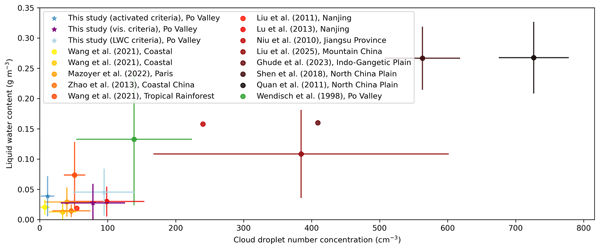
We studied how particles from air pollution that absorb water but do not yet form fog droplets influence fog and visibility in northern Italy’s Po Valley. Using detailed field observations and computer modeling, we found that these “hydrated” particles can explain many low-visibility events. Recognizing their role helps improve forecasts of fog, air quality, and climate effects in polluted regions.
Hao Ding, Almuth Neuberger, Rahul Ranjan, Fredrik Mattsson, Liine Heikkinen, Karam Mansour, Stefano Decesari, Claudia Mohr, Alejandro Baró Pérez, Nazario Mastroianni, Paul Zieger, Ilona Riipinen, and Annica M. L. Ekman
Atmos. Chem. Phys., 26, 9721–9739, https://doi.org/10.5194/acp-26-9721-2026, https://doi.org/10.5194/acp-26-9721-2026, 2026
Short summary
Short summary
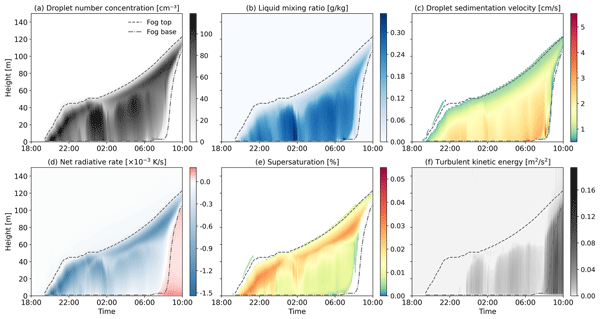
Fog poses numerous risks to society, yet it remains challenging to forecast. We use detailed numerical simulations based on fog observations in the Po Valley, Italy, to demonstrate that high concentrations of aerosol particles, as in polluted air, lead to an increase in droplet number, prolonged fog duration, and reduced visibility. The simulations also show the importance of accurately representing haze particles and the shape of the droplet size distribution for improved fog prediction.
Liine Heikkinen, Daniel G. Partridge, Sara Blichner, Wei Huang, Rahul Ranjan, Paul Bowen, Emanuele Tovazzi, Tuukka Petäjä, Claudia Mohr, and Ilona Riipinen
Atmos. Chem. Phys., 24, 5117–5147, https://doi.org/10.5194/acp-24-5117-2024, https://doi.org/10.5194/acp-24-5117-2024, 2024
Short summary
Short summary
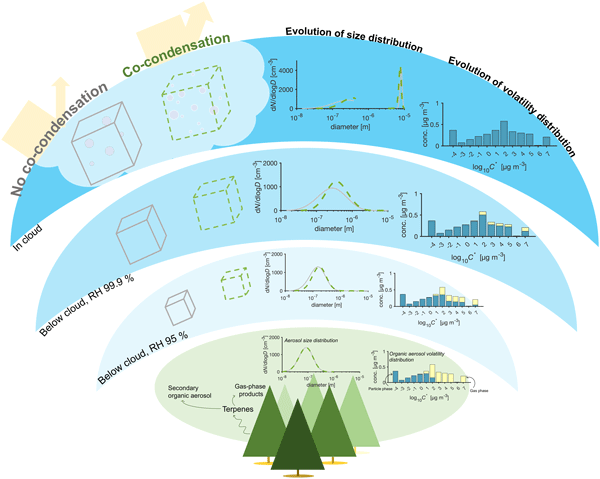
The organic vapor condensation with water vapor (co-condensation) in rising air below clouds is modeled in this work over the boreal forest because the forest air is rich in organic vapors. We show that the number of cloud droplets can increase by 20 % if considering co-condensation. The enhancements are even larger if the air contains many small, naturally produced aerosol particles. Such conditions are most frequently met in spring in the boreal forest.
Anna Bengs, Mrisha Koirala, Chengfeng Liu, Henning Finkenzeller, Cecilia Righi, Sebastian Holm, Lauri Ahonen, Veli Kolhinen, Rima Baalbaki, Fabian Schmidt-Ott, Yiliang Liu, Jianfei Peng, Tuukka Petäjä, Markku Kulmala, Nina Sarnela, Runlong Cai, and Juha Kangasluoma
EGUsphere, https://doi.org/10.5194/egusphere-2026-5681, https://doi.org/10.5194/egusphere-2026-5681, 2026
This preprint is open for discussion and under review for Atmospheric Measurement Techniques (AMT).
Short summary
Short summary
Forests emit trace gases that react to form compounds relevant to air quality and climate. Identifying them is difficult because common instruments cannot fully separate molecules of similar mass. We compared three mass spectrometers with different resolving power in a Finnish forest. The highest-resolution instrument identified far more molecules, and using its results to reanalyze the others' data nearly tripled the number identified, improving identification in widely used equipment.
Michael S. Diamond, Andrew S. Ackerman, Alejandro Baró Pérez, Ann M. Fridlind, Ehsan Erfani, Caspar Jungbacker, Hyunho Lee, David Painemal, Frida A.-M. Bender, Annica M. L. Ekman, Franziska Glassmeier, Graham Feingold, Fredrik Jansson, David A. Johnson, Matthias Schwarz, Robert Wood, Takanobu Yamaguchi, Jianhao Zhang, Xiaoli Zhou, and Paquita Zuidema
EGUsphere, https://doi.org/10.5194/egusphere-2026-5350, https://doi.org/10.5194/egusphere-2026-5350, 2026
This preprint is open for discussion and under review for Atmospheric Chemistry and Physics (ACP).
Short summary
Short summary
We compare how cloud resolving models represent an important cloud transition over the subtropical oceans. Clouds can either break up by deepening and drying out or by raining and forming an open cell pattern. Compared to observations, the clouds deepen a bit too much and get too polluted when smoke is present. In clean conditions, some models drizzle and break up into open cells while others barely rain; the model spread stems from different rain amounts for similar clouds.
Dominic Heslin-Rees, Peter Tunved, Diego Aliaga, Janne Lampilahti, Ilona Riipinen, Annica M. L. Ekman, Ki-Tae Park, Martina Mazzini, Stefania Gilardoni, Roseline Thakur, Kihong Park, Young Jun Yoon, Kitack Lee, Mikko Sipilä, Mauro Mazzola, and Radovan Krejci
Aerosol Research, 4, 457–483, https://doi.org/10.5194/ar-4-457-2026, https://doi.org/10.5194/ar-4-457-2026, 2026
Short summary
Short summary
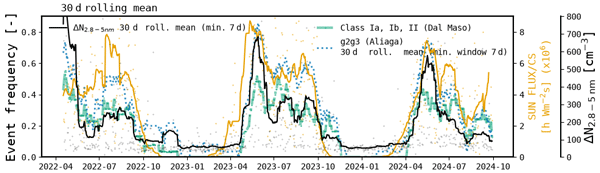
New particles form in the atmosphere and can influence the climate. We studied Arctic new particle formation (NPF) from 2022 to 2024 at the Zeppelin Observatory, on Svalbard. NPF occurs from April to November, peaking in late spring as sunlight increases. Some particles measured on-site grow large enough to seed clouds. Sunlight and existing aerosol particles strongly impact the likelihood of NPF, which mainly originates from marine regions, particularly the Greenland Sea.
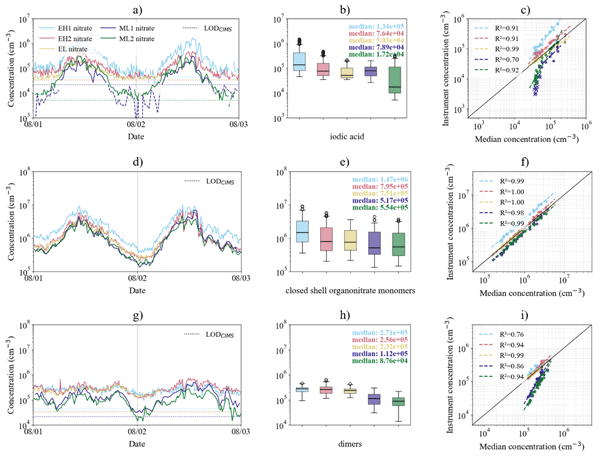
Cecilia Righi, Mihai Ciobanu, Neha Deot, Tuija Jokinen, Chengfeng Liu, Qi Yuan, Lauriane L. J. Quéléver, Spiro Jorga, Veronika Pospisilova, Lisa J. Beck, Mario Simon, Marcel Zauner-Wieczorek, Andreas Kürten, Ruben Soler, Teresa Vera, Amalia Muñoz, Lauri R. Ahonen, Chao Yan, Tuukka Petäjä, and Nina Sarnela
Atmos. Meas. Tech., 19, 6357–6378, https://doi.org/10.5194/amt-19-6357-2026, https://doi.org/10.5194/amt-19-6357-2026, 2026
Short summary
Short summary
Chemical ionization mass spectrometry is widely used to detect condensable vapors as sulfuric acid and highly oxygenated organic molecules, but results across studies are not always comparable. In summer 2024, an intercomparison campaign involving six instruments was conducted at a boreal forest site. Comparable measurements were achievable when all calibration and correction factors were applied. Instrument behavior depended more on inlet design and operating conditions than reagent ion choice.
Kanika Taneja, Silvia M. Calderón, Harri Kokkola, Juha Tonttila, Sami Romakkaniemi, Seethala Chellappan, Antti Arola, Antti Lipponen, Taina Yli-Juuti, Snehitha M. Kommula, Tuukka Petäjä, Markku Kulmala, and Tero Mielonen
EGUsphere, https://doi.org/10.5194/egusphere-2026-4750, https://doi.org/10.5194/egusphere-2026-4750, 2026
This preprint is open for discussion and under review for Atmospheric Chemistry and Physics (ACP).
Short summary
Short summary
Vegetation can cool the climate by releasing gases that form aerosols, which scatter sunlight and brighten clouds. To quantify this feedback in Finland and the United States, we combine field measurements of aerosols and satellite observations of clouds. It is essential to select near-ideal clouds; otherwise, cloud-related cooling is underestimated. Cloud cooling matched aerosol cooling at the clean site in Finland and was nearly three times stronger at the rural site in the United States.
Aasif Ahmad Wagay, Pauli Paasonen, Tuukka Petäjä, Victoria Sinclair, Sarath Guttikunda, and Shahzad Gani
EGUsphere, https://doi.org/10.5194/egusphere-2026-4950, https://doi.org/10.5194/egusphere-2026-4950, 2026
This preprint is open for discussion and under review for Earth System Dynamics (ESD).
Short summary
Short summary
Urbanization changes temperature, winds, and boundary layer height, affecting heat exposure and air quality. We develop a framework to quantify these changes across 20 global megacities using WRF simulations. Urban effects are generally stronger inland, while terrain and ocean can influence the apparent signal. Because these variables control atmospheric mixing and pollutant dispersion, understanding urban changes is essential for assessing air quality and exposure.
Tinghan Zhang, Wei Du, Xinran Zhang, Janne Lampilahti, Chengfeng Liu, Zehao Zou, Men Xia, Qi Yuan, Qiaozhi Zha, Jing Cai, Yiyang Wang, Tom Kokkonen, Katrianne Lehtipalo, Tuukka Petäjä, Veli-Matti Kerminen, Chao Yan, Jingkun Jiang, Yongchun Liu, and Markku Kulmala
EGUsphere, https://doi.org/10.5194/egusphere-2026-5379, https://doi.org/10.5194/egusphere-2026-5379, 2026
This preprint is open for discussion and under review for Atmospheric Chemistry and Physics (ACP).
Short summary
Short summary
New particle formation (NPF) is an important source of atmospheric aerosols, but weak events are often overlooked by traditional classification. We applied continuous nanoparticle ranking and particle size distribution normalization to four-year observations from a Finnish boreal forest and the megacity of Beijing. The results show that NPF intensity is governed by source–sink competition and that particle formation and growth are not necessarily controlled by the same atmospheric conditions.
Liine Heikkinen, Rahul Ranjan, Sini Talvinen, Niels Behr, Sara M. Blichner, Maura Dewey, Lauri R. Ahonen, Mikael Ehn, Annica M. L. Ekman, Radovan Krejci, Tuukka Petäjä, Peter Tunved, and Ilona Riipinen
EGUsphere, https://doi.org/10.5194/egusphere-2026-5082, https://doi.org/10.5194/egusphere-2026-5082, 2026
This preprint is open for discussion and under review for Atmospheric Chemistry and Physics (ACP).
Short summary
Short summary
The impacts of clouds on atmospheric particulate matter (PM) composition are not well understood. Here, we use a new method to infer these interactions as particle number size distributions with bimodal shapes serve as markers of chemical cloud processing. Using concurrent PM composition data from a boreal forest in Finland, we find cloud chemistry to enrich PM in sulfate, but no enhanced formation of organics was observed, despite the abundance of precursors emitted by the forest.
Jenna DeVivo, Alexandria Stinchfield, Nirvan Bhattacharyya, Mitch Alton, Mingyi Wang, Siegfried Schobesberger, Liqing Hao, Mitchell Rogers, Alexander Vogel, Imad Zgheib, Natalie Burton, Clara Lietzke, Douglas M. Russell, Eva Sommer, Drew Gentner, Liine Heikkinen, Rainer Volkamer, Jasper Kirkby, Felipe Lopez-Hilfiker, Douglas Worsnop, Manjula Canagaratna, and Neil M. Donahue
EGUsphere, https://doi.org/10.5194/egusphere-2026-4542, https://doi.org/10.5194/egusphere-2026-4542, 2026
This preprint is open for discussion and under review for Atmospheric Chemistry and Physics (ACP).
Short summary
Short summary
The vapors driving atmospheric new particle formation are uncertain, in part because of instrumental limitations at small particle sizes. This study presents a novel coupling of a temperature-programmed desorption inlet with a bipolar mass spectrometer that has multiple types of chemical ionization used to study acid-base reactions controlling particulate evaporation.This method measures more components in atmospheric aerosol and separates reactive pathways contributing to early particle growth.

Qianzhe Sun, Ruichen Zhou, Sho Ohata, Chiaki Shirota, Tuukka Petäjä, Ilona Jaakkola, Lauri Ahonen, Markku Kulmala, and Michihiro Mochida
Atmos. Chem. Phys., 26, 12813–12836, https://doi.org/10.5194/acp-26-12813-2026, https://doi.org/10.5194/acp-26-12813-2026, 2026
Short summary
Short summary
Source identification of atmospheric aerosols is crucial for understanding their properties and resulting environmental impacts. By mass spectrometry for aerosol samples, organic aerosols in a European boreal forest were apportioned to five source-related types based on chemical structure, highlighting the importance of biomass-originated organics. Polarity-based fractionation advanced source apportionment, which is expected to improve the capability of property analysis for organic aerosols.
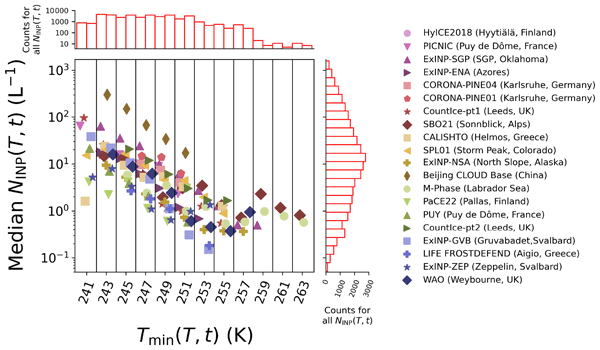
Ross J. Herbert, Larissa Lacher, Alexander Böhmländer, Mark D. Tarn, Antoine Canzi, Aidan Pantoya, Evelyn Freney, Kristina Höhler, Pia Bogert, Céline Planche, Ping Tian, Michael Adams, Sarah Barr, David Brus, Nicole Büttner, Martin Daily, Konstantinos Doulgeris, Konstantinos Eleftheriadis, Grant Forster, Romy Fösig, Dimitrios G. Georgakopoulos, Maria I. Gini, A. Gannet Hallar, Radovan Krejci, Elke Ludewig, Mauro Mazzola, Ian B. McCubbin, Athanasios Nenes, Tuukka Petäjä, Joseph Robinson, Franziska Vogel, Paul Zieger, Stephen Arnold, Kenneth S. Carslaw, Naruki Hiranuma, Ottmar Möhler, and Benjamin J. Murray
Earth Syst. Sci. Data, 18, 6465–6483, https://doi.org/10.5194/essd-18-6465-2026, https://doi.org/10.5194/essd-18-6465-2026, 2026
Short summary
Short summary
Ice formation in sub-zero clouds is influenced by airborne particles called ice-nucleating particles (INPs), whose concentrations vary substantially over short time and spatial scales. To assess the role of INPs in our climate, a comprehensive and consistent global dataset is essential. Our GloPINE model-ready dataset is a major step in this direction, comprising 36,000 measurements made using a single instrument design (PINE) over 70,000 hours of operation at 20 Northern Hemisphere sites.
Almuth Neuberger, Rahul Ranjan, Hao Ding, Fredrik Mattsson, Lea Haberstock, Darrel Baumgardner, Stefano Decesari, Annica M. L. Ekman, Dagen D. Hughes, Claudia Mohr, Marco Paglione, Ilona Riipinen, Matteo Rinaldi, and Paul Zieger
Atmos. Chem. Phys., 26, 11991–12017, https://doi.org/10.5194/acp-26-11991-2026, https://doi.org/10.5194/acp-26-11991-2026, 2026
Short summary
Short summary
We studied how particles from air pollution that absorb water but do not yet form fog droplets influence fog and visibility in northern Italy’s Po Valley. Using detailed field observations and computer modeling, we found that these “hydrated” particles can explain many low-visibility events. Recognizing their role helps improve forecasts of fog, air quality, and climate effects in polluted regions.
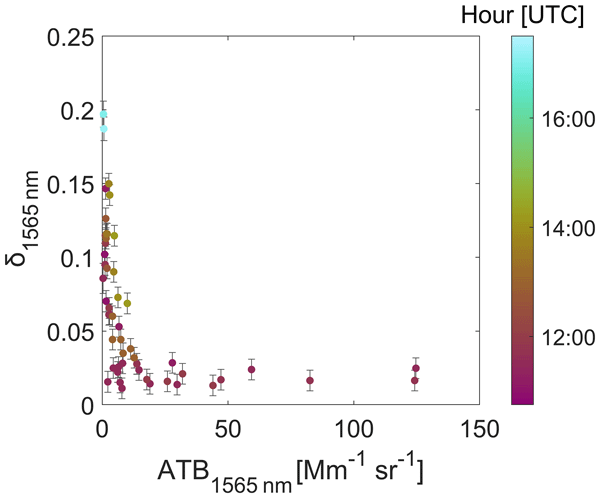
Maria Filioglou, Krista Luoma, Eija Asmi, Viet Le, Klaus Haikarainen, David Brus, Tero Mielonen, Mika Komppula, Annele Virtanen, Olli Sippula, Iida Pullinen, Angela Buchholz, Pasi Miettinen, Snehitha Kommula, Saara Peltokorpi, Liqing Hao, Kajar Köster, Annika Saarto, Sanna Pätsi, Pieter G. van Zyl, Liezl Bredenkamp, and Ville Vakkari
Atmos. Chem. Phys., 26, 11525–11542, https://doi.org/10.5194/acp-26-11525-2026, https://doi.org/10.5194/acp-26-11525-2026, 2026
Short summary
Short summary
This study explores how smoke and volcanic ash particles, alter the way light is scattered in the atmosphere. By using a ground‑based HALO Doppler lidar system, we observed clear differences in the depolarization ratio, a shape-relevant optical parameter, between fresh smoke, aged smoke, and volcanic ash. These findings show that HALO Doppler lidars can help identify particle types in the air and even provide estimates of smoke mass concentrations, improving assessments of air quality.
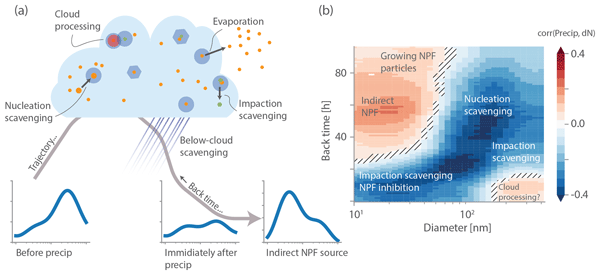
Sara M. Blichner, Theodore Khadir, Sini Talvinen, Paulo Artaxo, Liine Heikkinen, Harri Kokkola, Radovan Krejci, Muhammed Irfan, Twan van Noije, Tuukka Petäjä, Christopher Pöhlker, Øyvind Seland, Carl Svenhag, Antti Vartiainen, and Ilona Riipinen
Atmos. Chem. Phys., 26, 11281–11307, https://doi.org/10.5194/acp-26-11281-2026, https://doi.org/10.5194/acp-26-11281-2026, 2026
Short summary
Short summary
This study looks at how well climate models capture the impact of rain on particles that help form cloud droplets. Using data from three measurement stations and applying both a correlation analysis and a machine learning approach, we found that models often miss how new particles form after rain and struggle in cold environments. This matters because these particles influence cloud formation and climate.
Lea Haberstock, Darrel Baumgardner, Dagen D. Hughes, Julie Legrand, Almuth Neuberger, Cuiqi Zhang, Zamin A. Kanji, Christian Maier, Ilona Riipinen, Radovan Krejci, and Paul Zieger
EGUsphere, https://doi.org/10.5194/egusphere-2026-3790, https://doi.org/10.5194/egusphere-2026-3790, 2026
This preprint is open for discussion and under review for Atmospheric Measurement Techniques (AMT).
Short summary
Short summary
Here, we present the characterization and first application of a new cloud spectrometer, the Ground-based Fog and Aerosol Spectrometer (GFAS). Besides particle number concentration and size, the GFAS also provides an indicator of particle morphology and composition. We present a new calibration routine and first laboratory and field measurements. Using the GFAS, we can show that cloud droplets are optically different compared to pure water droplets.
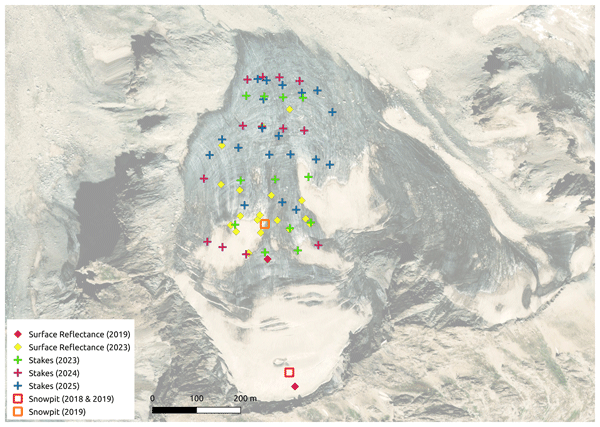
Jonas Svensson, Ramazon Rakhmonov, Kamoliddin Nazirzoda, Abdusamad Hojiev, Tamlikho Jurabekov, Amirsho Hiyoev, Davlatjon Rahimzoda, Hizbullo Kholzoda, Muzaffar Shodmonov, David Brus, Viet Le, Krista Luoma, Adriano Lemos, Germán Perez Fogwill, Meri M. Ruppel, Outi Meinander, Johan Ström, Eija Asmi, and Antti Hyvärinen
Earth Syst. Sci. Data, 18, 5697–5712, https://doi.org/10.5194/essd-18-5697-2026, https://doi.org/10.5194/essd-18-5697-2026, 2026
Short summary
Short summary
This paper presents data collected at the Zarafshon River Basin and the Hydrographic Party Glacier (GGP), Tajikistan. In annual field expeditions from 2018–2025, data has been collected on the glacier, as well as including meteorological measurements and aerosols. Presented results highlight the environmental conditions that are driving environmental change in Central Asia.
Anouk Marsal, Fabrizia Cavalli, Elise Di Antonio, Stephan Houdier, Pamela Dominutti, Sophie Darfeuil, Jean-Luc Jaffrezo, Stéphane Sauvage, Jean-Philippe Putaud, Ian S. Mudway, Athanasios Nenes, Aikaterini Bougiatioti, Nikolaos Mihalopoulos, André S. H. Prévôt, Despina Paraskevopoulou, Ana Cvitešić Kušan, Sanja Frka, Ana Kroflič, Ajda Delić, Blanka Tariba Lovaković, Andreja Jurič, Carolina Molina, Daniele Contini, Maria Rachele Guascito, Mathilde Lintz, Davy Rousset, Hartmut Herrmann, Eduardo J. d. S. Souza, Frédéric Ledoux, Marc Fadel, Haoran Yu, Jianzhen Yu, Maria Teresa Baeza Romero, Maria Cerrato-Alvarez, Marloes F. van Os, Mathilde N. Delaval, Yamaris Mercedes Mena Cabrera, Nicole Trieu, Greg Evans, Nuria Galindo, Noelia Gómez-Sanchez, Hana Hlaváčková, Pavel Mikuška, Shrutika Kadam, Pourya Shahpoury, Purificación López-Mahía, Jorge Moreda-Piñeiro, Rico K. Y. Cheung, Markus Kalberer, Micol Introna, Sarah S. Steimer, Zhuoying Lin, Suzanne E. Paulson, Saima Iram, Svetlana Stevanovic, Thomas Audoux, Laurent Y. Alleman, Jianing Liu, Ting Fang, P. S. Ganesh Subramanian, Vishal Verma, Tuukka Petäjä, Xavier Querol, Gerard Hoek, Roy M. Harrison, and Gaëlle Uzu
EGUsphere, https://doi.org/10.5194/egusphere-2026-3918, https://doi.org/10.5194/egusphere-2026-3918, 2026
Short summary
Short summary
This collaborative work from 26 worldwide laboratories assessed the measurement of atmospheric particles' oxidative potential (OP) using a common protocol. OP is a metric designed to inform on particles’ harmful effects. Over half of the laboratories obtained satisfactory results, and some critical steps such as liquid handling and OP mathematical determination were identified. Recommendations for future measurements and interlaboratory comparisons are also provided.
Samuel Ruhl, Matthias Kohl, Rima Baalbaki, Christos Xenofontos, Ryan Vella, Sergey Gromov, Xu-Cheng He, Jiali Shen, Dina Alfaouri, Samira Atabakhsh, Lubna Dada, Jenna DeVivo, Jonathan Duplissy, Imad El Haddad, Hartwig Harder, Tuija Jokinen, Heikki Junninen, Vijay P. Kanawade, Milin K. Sebastian, Hannah Klebach, Markku Kulmala, Felix Kunkler, Jos Lelieveld, Katrianne Lehtipalo, Clara J. Lietzke, Lu Liu, Roy Mauldin, Bernhard Mentler, Ottmar Möhler, Tuukka Petäjä, Douglas M. Russell, Mario Simon, Roseline C. Thakur, Wenjuan Yu, Jiangyi Zhang, Zhensen Zheng, Jasper Kirkby, Holger Tost, Theodoros Christoudias, Rolf Sander, and Andrea Pozzer
EGUsphere, https://doi.org/10.5194/egusphere-2026-4020, https://doi.org/10.5194/egusphere-2026-4020, 2026
This preprint is open for discussion and under review for Atmospheric Chemistry and Physics (ACP).
Short summary
Short summary
Marine microbes release sulfur gases that form tiny particles able to seed clouds. Using a global chemistry-climate model, we compare four schemes for how these gases oxidise and test them against ship and ground measurements. We find that methanesulfonic acid can drive new particle formation as strongly as sulfuric acid over the cold Southern Ocean, supplying around 25 % of the cloud-forming particles there, a natural, climate-relevant source that models often overlook.
Fobang Liu, Yun Zhang, Siyao Yue, Helmi-Marja K. Keskinen, Tuukka Petäjä, Markku Kulmala, Pingqing Fu, Thorsten Hoffmann, Kai Wang, and Haijie Tong
EGUsphere, https://doi.org/10.5194/egusphere-2026-3897, https://doi.org/10.5194/egusphere-2026-3897, 2026
Short summary
Short summary
Reactive oxygen species (ROS) produced by airborne particles are linked to adverse health effects, but the organic compounds responsible remain unclear. We developed a new molecular framework to classify complex organic compounds using advanced mass spectrometry. The framework shows that particles rich in oxidized organic compounds produce more ROS per unit mass, while polluted urban air produces more total ROS mainly because of higher particle concentrations.
Sylwester Arabas, Agnieszka Żaba, Daria Klimaszewska, Emma C. Ware, Clare E. Singer, Manhal Alhilali, Jason Barr, Daniel G. Partridge, Shin-ichiro Shima, and Robert Wood
EGUsphere, https://doi.org/10.5194/egusphere-2026-3906, https://doi.org/10.5194/egusphere-2026-3906, 2026
This preprint is open for discussion and under review for Geoscientific Model Development (GMD).
Short summary
Short summary
The paper focuses on the use of Python and its package ecosystem for modeling the dynamics of atmospheric aerosol and cloud droplets. We highlight that concise code and high-level abstractions (incl. programmatic expression of physical units) can be used without performance tradeoffs. The paper features two cloud-microphysics classics: an adiabatic parcel model and a Monte-Carlo coagulation solver. The presented code constitutes a single Jupyter notebook that can be executed "in the cloud".
Aino Ovaska, Daniel Holmberg, Elio Rauth, Mansour Alghamdi, Paulo Artaxo, Eija Asmi, John Backman, Benjamin Bergmans, Matthew Boyer, Liezl Bredenkamp, Maurizio Busetto, Delano Campos De Oliveira, Juan Andrés Casquero-Vera, Darius Ceburnis, Tak Chan, Tommy Chan, Sebastien Conil, Daniele Contini, Suzanne Crumeyrolle, Valentin Duflot, Kostas Eleftheriadis, Johan Esveld, Ekaterina Ezhova, Markus Fiebig, Shahzad Gani, Olga Garmash, Francisco Gómez-Moreno, Roy M. Harrison, Andras Hoffer, Rakesh Hooda, Antti Hyvärinen, Tareq Hussein, Jorma Joutsensaari, Nikos Kalivitis, Heinz Kaminski, Jutta Kesti, Radovan Krejci, Adam Kristensson, Chongai Kuang, Markku Kulmala, Lauri Laakso, Ari Leskinen, Heikki Lihavainen, Andreas Massling, Maik Merkel, Steffen Noe, Jakub Ondracek, Noemí Perez, Jean-Eudes Petit, Tuukka Petäjä, Michael Pikridas, Christopher Pöhlker, Mira Pöhlker, Jean-Philippe Putaud, Ximeng Qi, Cristina Reche, Sergio Rodríguez, Petr Roztocil, Jean Sciare, Karine Sellegri, Dongjie Shang, Ashish Singh, Mikko Sipilä, Henrik Skov, Mar Sorribas, Tamanna Subba, Junying Sun, Peter Tunved, Ville Vakkari, Pieter G. Van Zyl, Aki Virkkula, Jens Voigtländer, Kay Weinhold, Alfred Wiedensohler, Hee-Jung Yoo, Putian Zhou, Kai Puolamäki, Tuomo Nieminen, Veli-Matti Kerminen, Victoria A. Sinclair, and Pauli Paasonen
Earth Syst. Sci. Data Discuss., https://doi.org/10.5194/essd-2026-415, https://doi.org/10.5194/essd-2026-415, 2026
Preprint under review for ESSD
Short summary
Short summary
All clouds form around aerosol particles, and their abundance influences cloud properties. In turn, clouds affect climate by changing how energy moves through the atmosphere, making them important for climate change. To better understand these interactions, we need accurate information on how many aerosol particles are in the atmosphere. Therefore, we have developed a new 21-year global dataset of particle concentrations relevant for cloud formation.
Rebecca L. Jackson, Matthew T. Woodhouse, Mark Baird, Clothilde Langlais, Mathieu Mongin, Anthony Jones, Daniel Partridge, Luke Harrison, Johanna Horchler, Joel Alroe, Luke Cravigan, Zoran Ristovski, and Daniel P. Harrison
EGUsphere, https://doi.org/10.5194/egusphere-2026-2761, https://doi.org/10.5194/egusphere-2026-2761, 2026
Short summary
Short summary
ACCESS-EMS-GBR is a regional coupled atmosphere-ocean model of the Great Barrier Reef. It simulates aerosol and cloud processes in the atmosphere, plus hydrodynamics, biogeochemistry and ecological processes in the marine environment. Developed to assess the effects of Marine Cloud Brightening on coral bleaching, it is the first regional model able to simulate how aerosol emissions affect clouds, radiation and the underlying reef ecosystem and is ideal for a range of atmosphere-ocean studies.
Chengfeng Liu, Otso Peräkylä, Lauri Ahonen, Ilona Ylivinkka, Petri Keronen, Douglas R. Worsnop, Tuukka Petäjä, Markku Kulmala, Mikael Ehn, and Nina Sarnela
EGUsphere, https://doi.org/10.5194/egusphere-2026-2773, https://doi.org/10.5194/egusphere-2026-2773, 2026
This preprint is open for discussion and under review for Atmospheric Chemistry and Physics (ACP).
Short summary
Short summary
Forests emit invisible vapors that form climate-regulating atmospheric particles. To track these seasonal changes, we continuously analyzed forest air for four years. We discovered that heavier plant emissions (sesquiterpenes and diterpenes)—rather than the lighter ones (monoterpenes) previously assumed—may drive particle creation in spring and summer. This insight is crucial for predicting how forests will influence the global climate as temperatures rise.
Hailing Jia, David Neubauer, Yusuf Bhatti, Duncan Watson-Parris, Philip Stier, Johannes Quaas, Daniel Partridge, Ardit Arifi, Anne Kubin, Athanasios Nenes, Muhammed Irfan, Ulas Im, Carl Svenhag, Nick Schutgens, Bastiaan van Diedenhoven, Sylvaine Ferrachat, Ulrike Lohmann, Ina Tegen, Alice Henkes, Guangliang Fu, and Otto Hasekamp
EGUsphere, https://doi.org/10.5194/egusphere-2026-3275, https://doi.org/10.5194/egusphere-2026-3275, 2026
Short summary
Short summary
Tiny aerosol particles affect Earth’s climate by interacting with clouds and sunlight, but their impact remains uncertain. Combining climate model simulations and emulators, we explored millions of model variants across different aerosol and cloud settings to identify the causes of the uncertainty. We found that aerosol emissions and cloud convection are key contributors. Our work suggests that better integration of existing observations could help reduce these uncertainties in the future.
Hao Ding, Almuth Neuberger, Rahul Ranjan, Fredrik Mattsson, Liine Heikkinen, Karam Mansour, Stefano Decesari, Claudia Mohr, Alejandro Baró Pérez, Nazario Mastroianni, Paul Zieger, Ilona Riipinen, and Annica M. L. Ekman
Atmos. Chem. Phys., 26, 9721–9739, https://doi.org/10.5194/acp-26-9721-2026, https://doi.org/10.5194/acp-26-9721-2026, 2026
Short summary
Short summary
Fog poses numerous risks to society, yet it remains challenging to forecast. We use detailed numerical simulations based on fog observations in the Po Valley, Italy, to demonstrate that high concentrations of aerosol particles, as in polluted air, lead to an increase in droplet number, prolonged fog duration, and reduced visibility. The simulations also show the importance of accurately representing haze particles and the shape of the droplet size distribution for improved fog prediction.
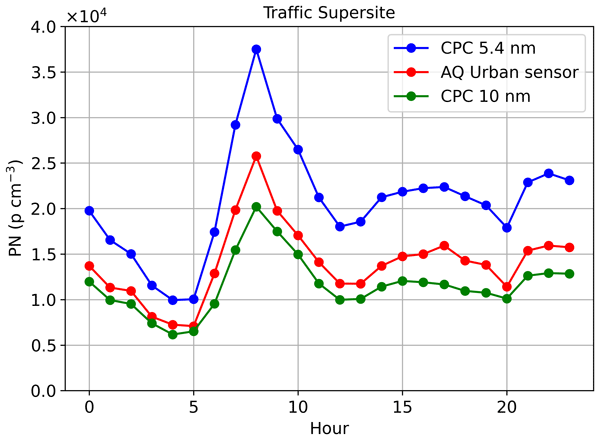
Kimmo Teinilä, Teemu Lepistö, Jarkko V. Niemi, Harri Portin, Anssi Julkunen, Anu Kousa, Joel Kuula, Hanna E. Manninen, Pasi Aalto, Tuukka Petäjä, Topi Rönkkö, Erkka Saukko, and Hilkka Timonen
Atmos. Meas. Tech., 19, 4505–4516, https://doi.org/10.5194/amt-19-4505-2026, https://doi.org/10.5194/amt-19-4505-2026, 2026
Short summary
Short summary
Particle number concentrations were measured with condensation particle counters and diffusion-based sensors at two different urban environments in Helsinki in 2022. The measurement sites were traffic related and background urban sites. The aim of the study was to investigate suitability of using diffusion-based sensors in urban air quality monitoring to obtain particle number concentrations and challenges related to this.
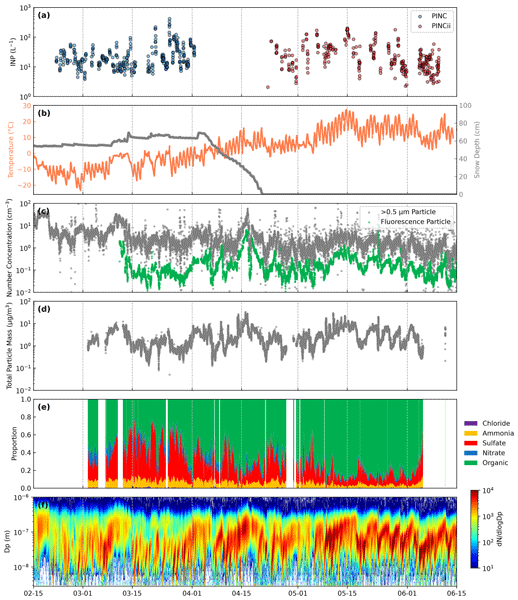
Yusheng Wu, Zoé Brasseur, Dimitri Castarède, Paavo Heikkilä, Jorma Keskinen, Ottmar Möhler, Markku Kulmala, Tuukka Petäjä, Erik S. Thomson, and Jonathan Duplissy
Aerosol Research, 4, 293–309, https://doi.org/10.5194/ar-4-293-2026, https://doi.org/10.5194/ar-4-293-2026, 2026
Short summary
Short summary
Clouds in cold regions affect climate and precipitation, but their behavior depends on rare airborne particles that help ice form. We measured these particles over several months in a Finnish forest and compared them with many environmental observations. We found that ice formation in winter was largely unpredictable, while in spring and summer it was more strongly linked to particle amount and composition. This shows that local conditions are needed to better represent clouds in climate models.
Sujai Banerji, Touqeer Gill, Veli-Matti Kerminen, and Tuukka Petäjä
EGUsphere, https://doi.org/10.5194/egusphere-2026-3400, https://doi.org/10.5194/egusphere-2026-3400, 2026
Short summary
Short summary
We studied how dust and pollen episodes change airborne particles at a forest research site in southern Finland. Using long-term measurements of particle light, mass, and size, we found that both episodes can look similar in light-based records, but they affect particle sizes differently. This means light measurements alone can misidentify the cause of a particle episode. The work helps improve interpretation of atmospheric monitoring records and avoid overconfident source claims in future work.
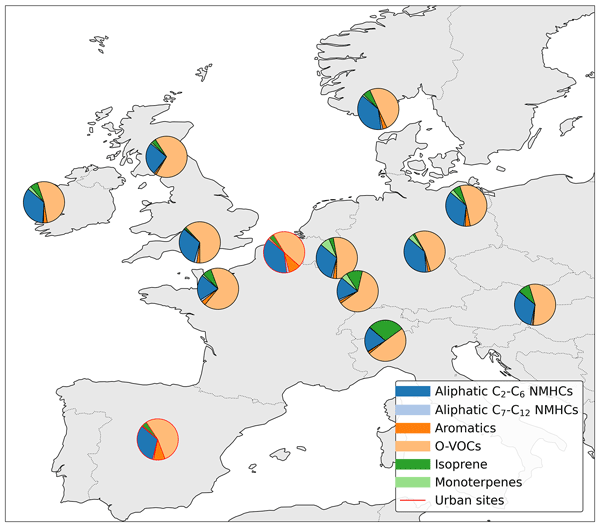
Wenche Aas, Thérèse Salameh, Robert Wegener, Heidi Hellén, Jean-Luc Jaffrezo, Pontus Roldin, Elisabeth Alonso-Blanco, Andres Alastuey, Crist Amelynck, Jgor Arduini, Benjamin Bergmans, Marie Bertrand, Agnes Borbon, Efstratios Bourtsoukidis, Laetitia Bouvier, David Butterfield, Iris Buxbaum, Darius Ceburnis, Anja Claude, Augustin Colette, Aurélie Colomb, Sophie Darfeuil, James Dernie, Maximilien Desservettaz, Elías Díaz-Ramiro, Marvin Dufresne, René Dubus, Mario Duval, Marie Dury, Anna Font, Kirsten N. Fossum, Evelyn Freney, Gotzon Gangoiti, Yao Ge, Maria Carmen Gomez, Francisco J. Gómez-Moreno, Marie Gohy, Valérie Gros, Paul Hamer, Bryan Hellack, Hartmut Herrmann, Robert Holla, Adéla Holubová, Niels R. Jensen, Tuija Jokinen, Matthew Jones, Uwe Käfer, Lukas Kesper, Dieter Klemp, Dagmar Kubistin, Angela Marinoni, Martina Mazzini, Vy Ngoc Thuy Dinh, Jurgita Ovadnevaite, Tuukka Petäjä, Miguel Portillo-Estrada, Jitka Přívozníková, Jean-Philippe Putaud, Stefan Reimann, Laura Renzi, Veronique Riffault, Stuart Ritchie, Chris Robins, Begoña Artíñano Rodríguez de Torres, Laurent Poulain, Julian Rüdiger, Agnieszka Sanocka, Estibaliz Saez de Camara Oleaga, Niels Schoon, Roger Seco, Ivan Simmons, Leïla Simon, David Simpson, Sverre Solberg, Emmanuel Tison, August Thomasson, Svetlana Tsyro, Marsailidh Twigg, Toni Tykkä, Bert Verreyken, Ågot Watne, Katie Williams, Ana Maria Yáñez-Serrano, Karen Yeung, Ilona Ylivinkka, and Karl Espen Yttri
Atmos. Chem. Phys., 26, 8717–8751, https://doi.org/10.5194/acp-26-8717-2026, https://doi.org/10.5194/acp-26-8717-2026, 2026
Short summary
Short summary
A one-week intensive measurement campaign during the 2022 European heatwave included monitoring of ozone, volatile organic compounds, aerosol chemical composition, and organic tracers to investigate air pollution sources. Results showed that emissions from vegetation and human activities contributed to peaks in ozone and secondary organic aerosol particles. Differences between measurements and model simulations underline the need for better characterization of sources and formation pathways.
Gaurav K. Srivastav, Aasif A. Wagay, Janne Lampilahti, Jaswant Rathore, Ravi K. Kunchala, Dilip Ganguly, Markku Kulmala, Tuukka Petäjä, Pauli Paasonen, Roseline C. Thakur, and Shahzad Gani
EGUsphere, https://doi.org/10.5194/egusphere-2026-2212, https://doi.org/10.5194/egusphere-2026-2212, 2026
Short summary
Short summary
Particle formation events affect climate and air quality. Using measurements of particle number concentrations down to very small particles (~3 nm) in polluted northern India, we show that these events occur frequently in summer under reduced background particle load. However, in this environment, emissions and changing air masses can mask or distort these events, making them difficult to detect. Such environments require adaptation of standard analytical methods used in cleaner regions.
Manuel Bettineschi, Arineh Cholakian, Victoria Sinclair, Katerina Sindelarova, Arnaud P. Praplan, Steven J. Thomas, Tuukka Petäjä, Federico Bianchi, and Giancarlo Ciarelli
Atmos. Chem. Phys., 26, 8067–8088, https://doi.org/10.5194/acp-26-8067-2026, https://doi.org/10.5194/acp-26-8067-2026, 2026
Short summary
Short summary
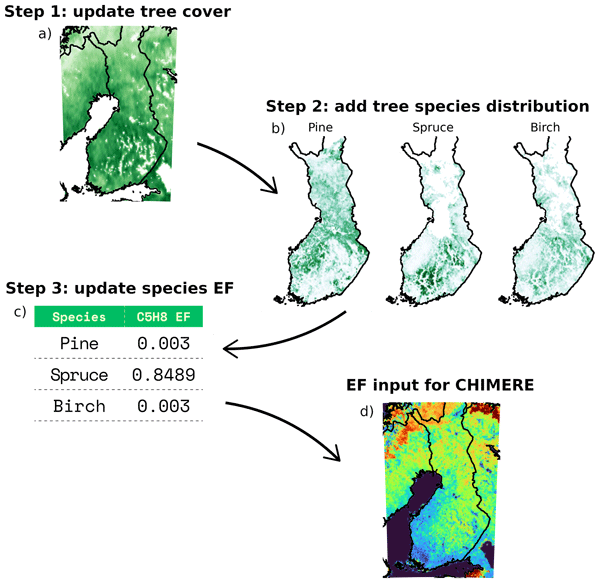
We studied how forests in Finland release natural gases that affect air quality and climate. Existing models strongly overestimated these emissions because they used overly simple forest descriptions. By adding detailed information on tree species, we greatly improved agreement with real measurements. This means more realistic estimates of particle formation in the air. Our results show that accurate forest data are essential for reliable climate and air quality predictions.
Neil M. Donahue, Victoria Hofbauer, Henning Finkenzeller, Dominik Stolzenburg, Paulus S. Bauer, Randall Chiu, Lubna Dada, Jonathan Duplissy, Xu-Cheng He, Martin Heinritzi, Christopher R. Hoyle, Andreas Kürten, Aleksandr Kvashnin, Katrianne Lehtipalo, Naser Mahfouz, Vladimir Makhmutov, Roy L. Mauldin III, Ugo Molteni, Lauriane L. J. Quéléver, Matti Rissanen, Siegfried Schobesberger, Mario Simon, Andrea C. Wagner, Mingyi Wang, Chao Yan, Penglin Ye, Ilona Riipinen, Hamish Gordon, Joachim Curtius, Armin Hansel, Imad El Haddad, Markku Kulmala, Douglas R. Worsnop, Rainer Volkamer, Paul M. Winkler, Jasper Kirkby, and Richard Flagan
Atmos. Meas. Tech., 19, 3363–3396, https://doi.org/10.5194/amt-19-3363-2026, https://doi.org/10.5194/amt-19-3363-2026, 2026
Short summary
Short summary
We describe accurate measurement of particle formation and growth in the CERN CLOUD (European Council for Nuclear Research Cosmics Leaving OUtdoor Droplets) chamber, using a suite of gas- and particle-phase instruments. The interconnected measurements establish high accuracy in key particle properties and critically important gas-phase sulfuric acid. This is a template for accurate calibration of similar experiments and thus accurate determination of aerosol nucleation and growth rates, which are an important source of uncertainty in climate science.
Lauri K. Savolainen, Teemu Lepistö, Heidi Hellén, Henna Lintusaari, Milja Jäppi, Jarkko V. Niemi, Kimmo Teinilä, Minna Aurela, Markus Lampimäki, Anu Kousa, Janne Lampilahti, Katrianne Lehtipalo, Tuukka Petäjä, Miikka Dal Maso, Hanna E. Manninen, Hilkka Timonen, and Topi Rönkkö
EGUsphere, https://doi.org/10.5194/egusphere-2026-1692, https://doi.org/10.5194/egusphere-2026-1692, 2026
Short summary
Short summary
The study investigates vehicle fleet emissions of road traffic. Despite technological advances, road traffic is still an important pollution source in urban areas, especially when considering unregulated, but health-relevant, emerging pollutants. We report fuel consumption normalized vehicle fleet emission factors for various regulated and unregulated air pollutants. Also, we show that road traffic has inverse and indirect effects on urban aerosol which are not generally well understood.
Myriam Agrò, Manuel Bettineschi, Silvia Melina, Diego Aliaga, Andrea Bergomi, Beatrice Biffi, Alessandro Bigi, Giancarlo Ciarelli, Cristina Colombi, Paola Fermo, Ivan Grigioni, Veli-Matti Kerminen, Markku Kulmala, Janne Lampilahti, Angela Marinoni, Celestine Oliewo, Juha Sulo, Gianluigi Valli, Roberta Vecchi, Tuukka Petäjä, Katrianne Lehtipalo, and Federico Bianchi
Atmos. Chem. Phys., 26, 6521–6539, https://doi.org/10.5194/acp-26-6521-2026, https://doi.org/10.5194/acp-26-6521-2026, 2026
Short summary
Short summary
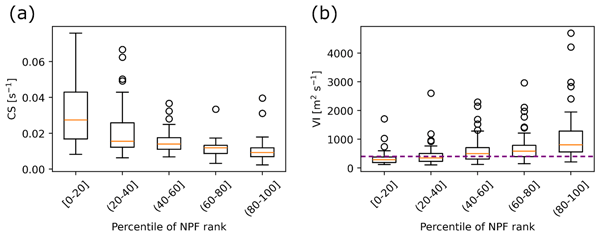
This study investigates new particle formation (NPF) in Milan, the most populated city in the Po Valley (Italy), using one year of particle number size distribution data (1.2–480 nm). NPF is enhanced under cleaner air conditions with lower pollution, reduced condensation sink, stronger ventilation, and stronger northwesterly winds (e.g., Foehn events). In contrast, longer air mass residence time in the Po Valley and higher air mass exposure to anthropogenic emissions suppress it.
Eliza K. Duncan, George Jordan, Paul Kim, James M. Haywood, Duncan Watson-Parris, Ben Johnson, Alistair Sellar, Zak Kipling, João Teixeira, Florent Malavelle, and Daniel G. Partridge
EGUsphere, https://doi.org/10.5194/egusphere-2026-1043, https://doi.org/10.5194/egusphere-2026-1043, 2026
Short summary
Short summary
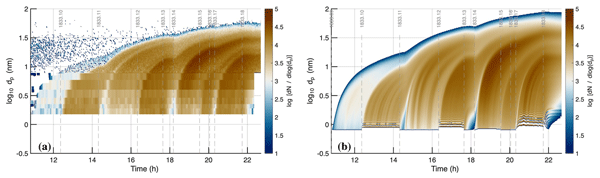
The 2014–15 Holuhraun eruption offers a natural experiment to assess how well climate models can capture the changes in aerosol associated with the plume. We investigate the aerosol lifecycle during transport to identify key differences in climate models' representation of aerosol processes, which could affect the models’ ability to capture changes in cloud properties. Our study highlights the importance of the representation of boundary layer nucleation processes in climate models.
Herbert G. Hartl, Janne Lampilahti, Rima Baalbaki, Lauri Ahonen, Tommy Chan, Tinghang Zhang, Joonas Vanhanen, Joonas Purén, Gerhard Steiner, Sebastian Schmitt, Torsten Tritscher, Amine Koched, Manuel Granzin, Petr Roztocil, Silja Häme, Tuukka Petäjä, and Katrianne Lehtipalo
Aerosol Research, 4, 133–152, https://doi.org/10.5194/ar-4-133-2026, https://doi.org/10.5194/ar-4-133-2026, 2026
Short summary
Short summary
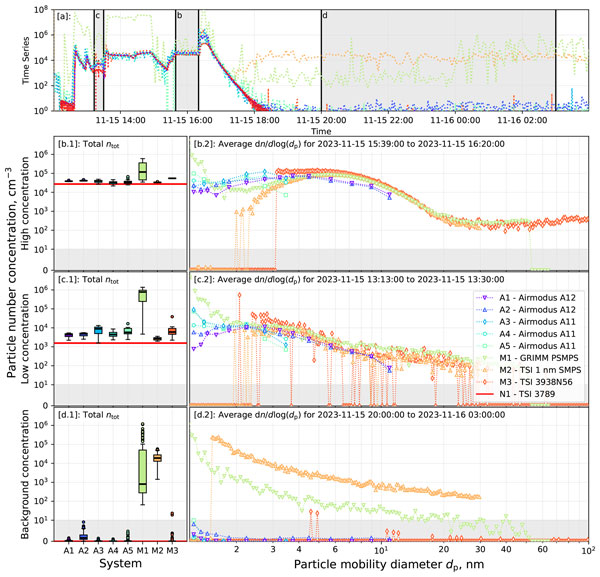
Small airborne particles influence how clouds form and how they affect the climate. Our study compared eight different instruments that measure the size distributions of these particles to understand the instruments' strengths and weaknesses. We found that some systems are more accurate, whereas others are more sensitive at tiny sizes. These results will help to improve future monitoring of air quality and climate processes.
Karin Stegelius, Pauline Thompson, Pia Karbiener, Piotr Markuszewski, Andre S. H. Prevot, Sachchida N. Tripathi, Claudia Mohr, Liine Heikkinen, Krishnakant Budhavant, and Sophie L. Haslett
EGUsphere, https://doi.org/10.5194/egusphere-2026-914, https://doi.org/10.5194/egusphere-2026-914, 2026
Short summary
Short summary
High-time-resolution observations in the Maldives indicate that submicron aerosol over the northern Indian Ocean is primarily composed of inorganic sulfate and highly oxidised organic matter, indicative of aged continental outflow. The consistent composition across various air mass origins, alongside identification of sulfur-containing organics, underscores the influence of long-range transport and sulfate-driven secondary chemistry on regional aerosol characteristics and their climate impacts.
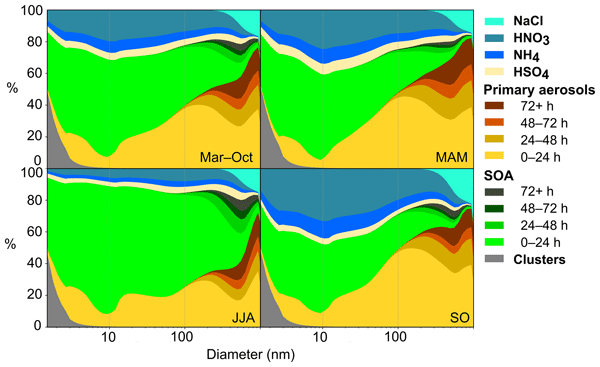
Petri Clusius, Metin Baykara, Carlton Xavier, Putian Zhou, Juniper Tyree, Benjamin Foreback, Mikko Äijälä, Frans Graeffe, Tuukka Petäjä, Markku Kulmala, Pauli Paasonen, Paul I. Palmer, and Michael Boy
Atmos. Chem. Phys., 26, 1967–1992, https://doi.org/10.5194/acp-26-1967-2026, https://doi.org/10.5194/acp-26-1967-2026, 2026
Short summary
Short summary
Cloud condensation nuclei are necessary to form clouds, and their size distribution affects cloud properties and therefore Earth’s energy budget. This study modelled the origins of cloud condensation nuclei at SMEAR II, Hyytiälä, Finland, and found that primary emissions and new particle formation separately contribute to more than half of the condensation nuclei, but they suppress each other, leading to current concentrations. Largest condensation nuclei originated mostly from emissions.
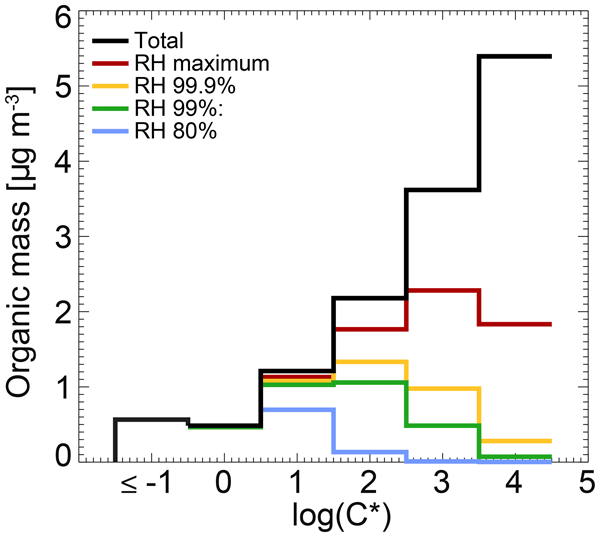
Yu Wang, Beiping Luo, Judith Kleinheins, Gang I. Chen, Liine Heikkinen, and Claudia Marcolli
Atmos. Chem. Phys., 26, 1735–1749, https://doi.org/10.5194/acp-26-1735-2026, https://doi.org/10.5194/acp-26-1735-2026, 2026
Short summary
Short summary
Ubiquitous semi-volatile compounds can co-condense on aerosol particles with water vapour when relative humidity increases. Simulations of cloud formation at a boreal forest site with a cloud parcel model that accounts for non-ideal organic–inorganic interactions yield an enhancement of cloud droplet number concentration from co-condensing NH3, HNO3, and organics up to 44%, with strong sensitivities to volatility distributions, aerosol size distribution, and updraft velocity.
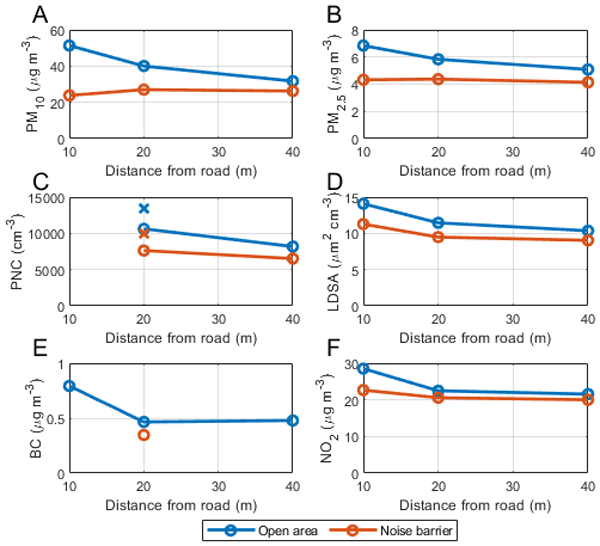
Sami D. Harni, Lasse Johansson, Jarkko V. Niemi, Ville Silvonen, Juan Andrés Casquero-Vera, Anu Kousa, Krista Luoma, Viet Le, David Brus, Konstantinos Doulgeris, Topi Rönkkö, Hanna E. Manninen, Tuukka Petäjä, and Hilkka Timonen
Atmos. Chem. Phys., 25, 18719–18738, https://doi.org/10.5194/acp-25-18719-2025, https://doi.org/10.5194/acp-25-18719-2025, 2025
Short summary
Short summary
A three-month-long measurement campaign was conducted at Espoo, Finland, in spring 2023. The measurement campaign studied the effect of the noise barrier on pollutant concentration gradients on the side of a major highway. The studied pollutants included PM10, PM2.5, lung deposited surface area (LDSA), particle number concentration (PNC), NO2, and black carbon (BC). The noise barrier was found to be effective in reducing, especially the concentration of particulate pollutants.
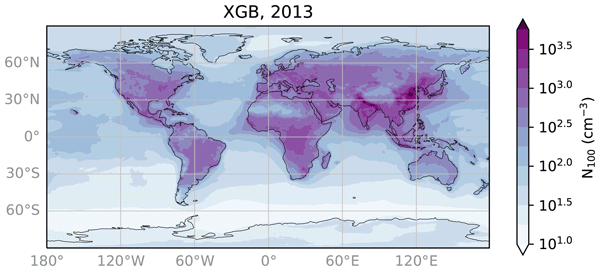
Aino Ovaska, Elio Rauth, Daniel Holmberg, Paulo Artaxo, John Backman, Benjamin Bergmans, Don Collins, Marco Aurélio Franco, Shahzad Gani, Roy M. Harrison, Rakesh K. Hooda, Tareq Hussein, Antti-Pekka Hyvärinen, Kerneels Jaars, Adam Kristensson, Markku Kulmala, Lauri Laakso, Ari Laaksonen, Nikolaos Mihalopoulos, Colin O'Dowd, Jakub Ondracek, Tuukka Petäjä, Kristina Plauškaitė, Mira Pöhlker, Ximeng Qi, Peter Tunved, Ville Vakkari, Alfred Wiedensohler, Kai Puolamäki, Tuomo Nieminen, Veli-Matti Kerminen, Victoria A. Sinclair, and Pauli Paasonen
Aerosol Research, 3, 589–618, https://doi.org/10.5194/ar-3-589-2025, https://doi.org/10.5194/ar-3-589-2025, 2025
Short summary
Short summary
We trained machine learning models to estimate the number of aerosol particles large enough to form clouds and generated daily estimates for the entire globe. The models performed well in many continental regions but struggled in remote and marine areas. Still, this approach offers a way to quantify these particles in areas that lack direct measurements, helping us understand their influence on clouds and climate on a global scale.
Sujai Banerji, Krista Luoma, Ilona Ylivinkka, Lauri Ahonen, Veli-Matti Kerminen, and Tuukka Petäjä
Atmos. Chem. Phys., 25, 16895–16914, https://doi.org/10.5194/acp-25-16895-2025, https://doi.org/10.5194/acp-25-16895-2025, 2025
Short summary
Short summary
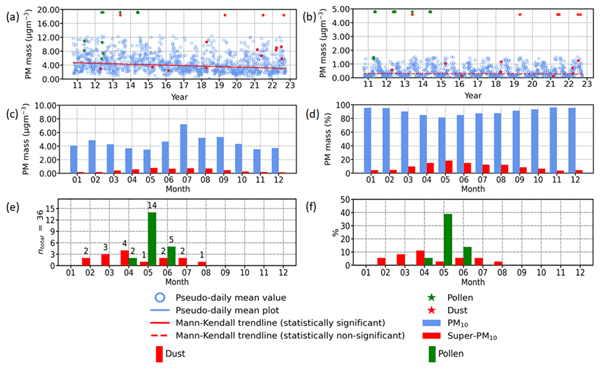
We studied supermicron aerosol particles (PM1–10) for 12 years at a Finnish boreal forest by subtracting PM1 from total measurements. This allowed us to examine their optical and mass properties, seasonal patterns and events like pollen and dust. We also measured particles >10 µm using filters, which are missed by optical instruments. These large particles significantly influence light scattering.
Ilona Ylivinkka, Helmi-Marja Keskinen, Lauri R. Ahonen, Liine Heikkinen, Pasi P. Aalto, Tuomo Nieminen, Katrianne Lehtipalo, Krista Luoma, Sujai Banerji, Juho Aalto, Janne Levula, Jutta Kesti, Ekaterina Ezhova, Markku Kulmala, and Tuukka Petäjä
Aerosol Research, 3, 503–520, https://doi.org/10.5194/ar-3-503-2025, https://doi.org/10.5194/ar-3-503-2025, 2025
Short summary
Short summary
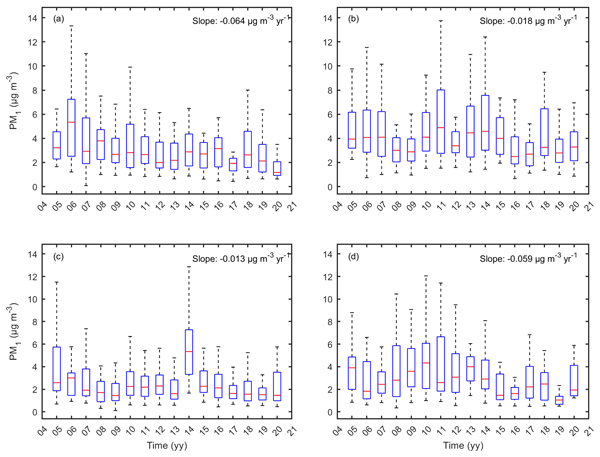
Three different particulate matter (PM) measurement techniques were compared in Finland, showing good correlation (R about 0.8). Although the measured PM concentrations were low, decreasing trends were observed in all seasons. The decrease followed the trends observed in concentrations of anthropogenic pollutants, resulting from the EU legislation to improve air quality. The highest PM concentrations were measured in summer, indicating the dominance of organic compounds to the PM mass.
Eliza K. Duncan, Jonathan E. Fieldsend, Alistair Sellar, Emanuele Tovazzi, Paul Kim, James M. Haywood, and Daniel G. Partridge
EGUsphere, https://doi.org/10.5194/egusphere-2025-4298, https://doi.org/10.5194/egusphere-2025-4298, 2025
Short summary
Short summary
Atmospheric aerosol particles are a major confounding factor in accurately representing climate change. We build a novel generic framework to untangle the role of complex processes focusing on a remote site in Antarctica as a case study in near-pristine conditions. Our machine-learning model predicts aerosol concentrations from an airmass history, considering the meteorology and potential sources and removal processes, enabling improved representation in climate models.
Sini Talvinen, Paul Kim, Emanuele Tovazzi, Eemeli Holopainen, Roxana Cremer, Thomas Kühn, Harri Kokkola, Zak Kipling, David Neubauer, João C. Teixeira, Alistair Sellar, Duncan Watson-Parris, Yang Yang, Jialei Zhu, Srinath Krishnan, Annele Virtanen, and Daniel G. Partridge
Atmos. Chem. Phys., 25, 14449–14478, https://doi.org/10.5194/acp-25-14449-2025, https://doi.org/10.5194/acp-25-14449-2025, 2025
Short summary
Short summary
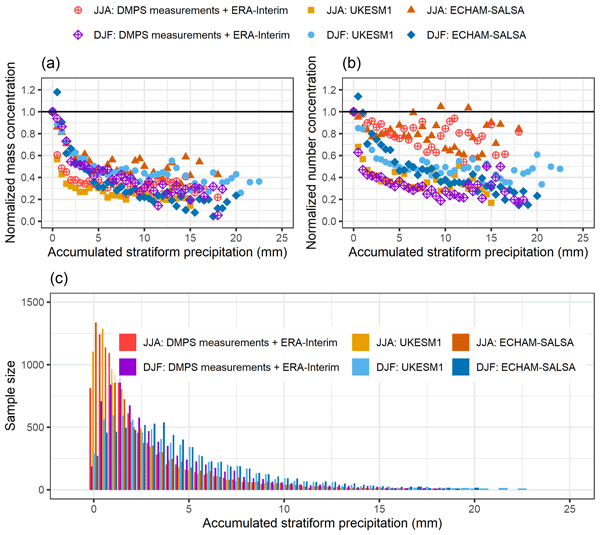
Climate models struggle to predict how clouds and aerosols interact, affecting Earth’s energy balance. This study compares models to observations to see how they describe effects of clouds and rain on aerosols. While both models show similar overall trends, seasonal differences emerged. These, however, align with differences in key variables participating in cloud formation. The study provides insights on how to improve the representation of aerosol-cloud interactions in climate models.
Antti Vartiainen, Santtu Mikkonen, Ville Leinonen, Tuukka Petäjä, Alfred Wiedensohler, Thomas Kühn, and Tuuli Miinalainen
Atmos. Meas. Tech., 18, 5763–5782, https://doi.org/10.5194/amt-18-5763-2025, https://doi.org/10.5194/amt-18-5763-2025, 2025
Short summary
Short summary
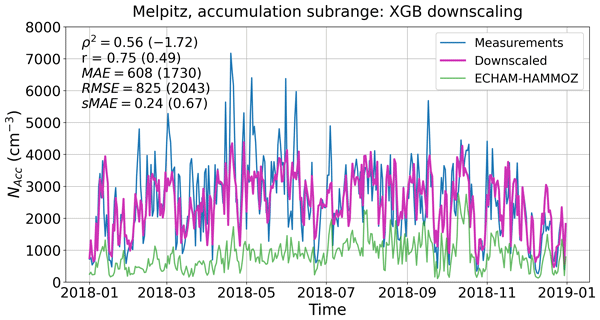
Global climate models, commonly used for climate predictions, struggle at capturing local-scale variations in air quality. We have used measurements of ultrafine particles (UFPs), a less understood air pollutant with potentially significant health implications, for training machine learning models that can substantially reduce the inaccuracy in UFP concentrations predicted by a climate model. This approach could aid epidemiological studies of ultrafine particles by extending exposure records.
George Jordan, Florent Malavelle, Jim Haywood, Ying Chen, Ben Johnson, Daniel Partridge, Amy Peace, Eliza Duncan, Duncan Watson-Parris, David Neubauer, Anton Laakso, Martine Michou, and Pierre Nabat
Atmos. Chem. Phys., 25, 13393–13428, https://doi.org/10.5194/acp-25-13393-2025, https://doi.org/10.5194/acp-25-13393-2025, 2025
Short summary
Short summary
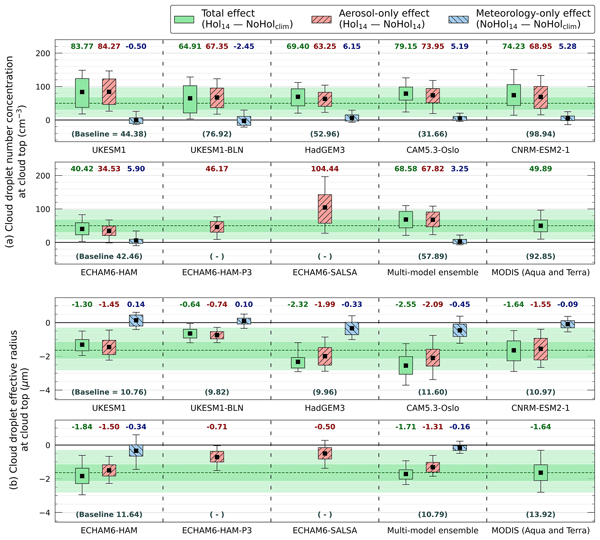
The 2014–15 Holuhraun eruption created a vast aerosol plume that acted as a natural experiment to assess how well climate models capture changes in cloud properties due to increased aerosol. We find that climate models represent the observed shift to smaller, more numerous cloud droplets well. However, climate models diverge in their aerosol-induced changes to large-scale cloud properties, particularly cloud liquid water content. Our study shows that Holuhraun had a cooling effect on the Earth.
Anastasia Lampilahti, Olga Garmash, Diego Aliaga, Mikhail Arshinov, Denis Davydov, Boris Belan, Janne Lampilahti, Veli-Matti Kerminen, Tuukka Petäjä, Markku Kulmala, and Ekaterina Ezhova
Aerosol Research, 3, 441–459, https://doi.org/10.5194/ar-3-441-2025, https://doi.org/10.5194/ar-3-441-2025, 2025
Short summary
Short summary
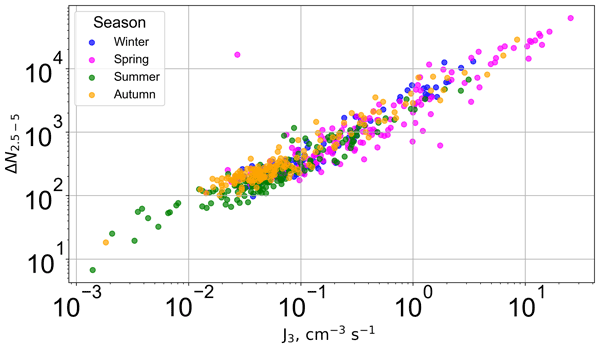
New particle formation (NPF) is a process of forming new aerosol particles in the atmosphere. It was widely studied in boreal forest areas in Finland and Estonia, but its features and precursors in a Siberian boreal forest remained unclear. We did a comprehensive analysis using data from state-of-the-art instruments and implement both traditional and new methods of data analysis. Understanding these processes helps us grasp how Siberia’s atmosphere evolves and contributes to global climate dynamics.
Tinghan Zhang, Ximeng Qi, Janne Lampilahti, Liangduo Chen, Xuguang Chi, Wei Nie, Xin Huang, Zehao Zou, Wei Du, Tom Kokkonen, Tuukka Petäjä, Katrianne Lehtipalo, Veli-Matti Kerminen, Aijun Ding, and Markku Kulmala
Atmos. Chem. Phys., 25, 10027–10048, https://doi.org/10.5194/acp-25-10027-2025, https://doi.org/10.5194/acp-25-10027-2025, 2025
Short summary
Short summary
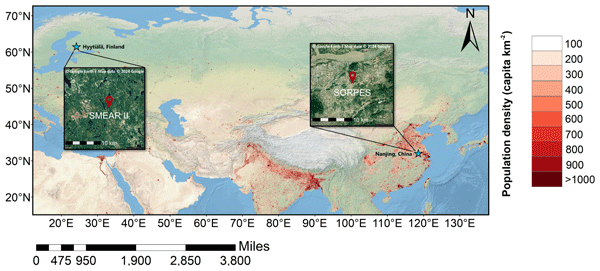
By comparing air ions at two flagship sites – a boreal forest site in Finland and a megacity site in eastern China – we characterized ion concentrations and their roles in new particle formation (NPF) across contrasting environments. The ion-induced fraction was much higher in the clean boreal forest. However, earlier activation of charged particles and high ion-induced fraction during quiet NPF in the megacity site imply a non-negligible role for ion-induced NPF in polluted urban areas.
Anni Hartikainen, Mika Ihalainen, Deeksha Shukla, Marius Rohkamp, Arya Mukherjee, Quanfu He, Sandra Piel, Aki Virkkula, Delun Li, Tuukka Kokkola, Seongho Jeong, Hanna Koponen, Uwe Etzien, Anusmita Das, Krista Luoma, Lukas Schwalb, Thomas Gröger, Alexandre Barth, Martin Sklorz, Thorsten Streibel, Hendryk Czech, Benedikt Gündling, Markus Kalberer, Bert Buchholz, Andreas Hupfer, Thomas Adam, Thorsten Hohaus, Johan Øvrevik, Ralf Zimmermann, and Olli Sippula
Atmos. Chem. Phys., 25, 9275–9294, https://doi.org/10.5194/acp-25-9275-2025, https://doi.org/10.5194/acp-25-9275-2025, 2025
Short summary
Short summary
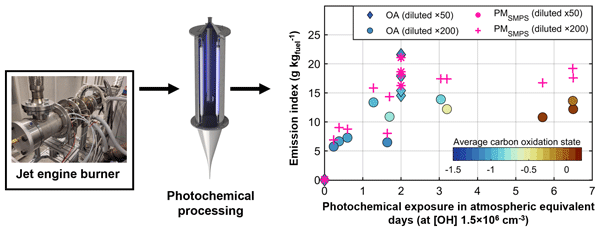
Photochemical reactions altered the properties of kerosene-operated jet engine burner exhaust emissions, which were studied in a laboratory using an oxidation flow reactor. Particle mass increased 300-fold as particles and gases became more oxidized. Light absorption increased, but the total direct radiative forcing efficiency was estimated to have shifted from positive to negative. The results highlight the importance of considering secondary aerosol formation when assessing the impacts of aviation.
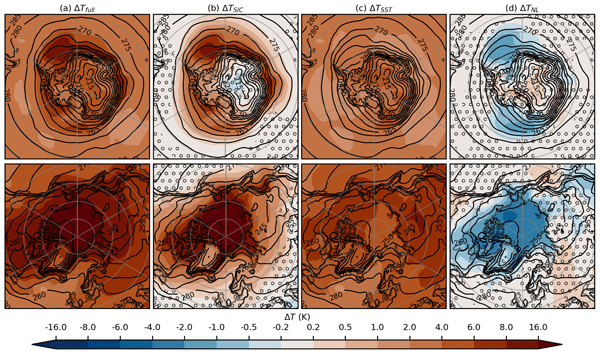
Tuomas Naakka, Daniel Köhler, Kalle Nordling, Petri Räisänen, Marianne Tronstad Lund, Risto Makkonen, Joonas Merikanto, Bjørn H. Samset, Victoria A. Sinclair, Jennie L. Thomas, and Annica M. L. Ekman
Atmos. Chem. Phys., 25, 8127–8145, https://doi.org/10.5194/acp-25-8127-2025, https://doi.org/10.5194/acp-25-8127-2025, 2025
Short summary
Short summary
The effects of warmer sea surface temperatures and decreasing sea ice cover on polar climates have been studied using four climate models with identical prescribed changes in sea surface temperatures and sea ice cover. The models predict similar changes in air temperature and precipitation in the polar regions in a warmer climate with less sea ice. However, the models disagree on how the atmospheric circulation, i.e. the large-scale winds, will change with warmer temperatures and less sea ice.
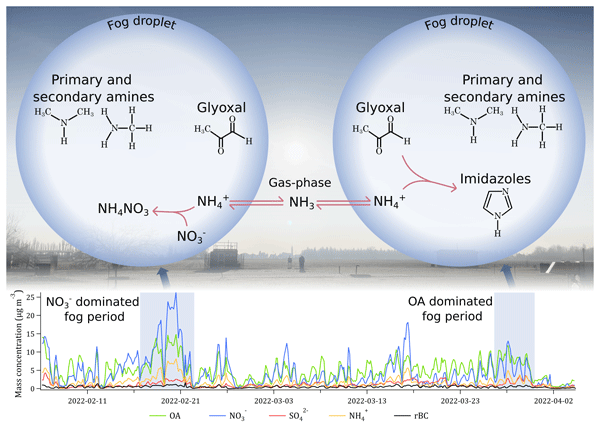
Fredrik Mattsson, Almuth Neuberger, Liine Heikkinen, Yvette Gramlich, Marco Paglione, Matteo Rinaldi, Stefano Decesari, Paul Zieger, Ilona Riipinen, and Claudia Mohr
Atmos. Chem. Phys., 25, 7973–7989, https://doi.org/10.5194/acp-25-7973-2025, https://doi.org/10.5194/acp-25-7973-2025, 2025
Short summary
Short summary
This study investigated aerosol–cloud interactions, focusing on organic nitrogen (ON) formation in the aqueous phase. Measurements were conducted in wintertime in the Po Valley, Italy, using aerosol mass spectrometry. The fog was enriched in more hygroscopic inorganic compounds and ON, containing, e.g., imidazoles. The formation of imidazole by aerosol–fog interactions could be confirmed for the first time in atmospheric observations. Findings highlight the role of fog in nitrogen aerosol formation.
John Backman, Krista Luoma, Henri Servomaa, Ville Vakkari, and David Brus
Earth Syst. Sci. Data Discuss., https://doi.org/10.5194/essd-2025-284, https://doi.org/10.5194/essd-2025-284, 2025
Preprint under review for ESSD
Short summary
Short summary
This work describes the in-situ aerosol measurements at the Arctic Sammaltunturi measurement station in Pallas in northern Finland. This data paper describes the instruments and the data post processing of key aerosol particle measurements that are relevant for cloud properties. Data reported here are part of the Pallas Cloud Experiment in 2022 (PaCE2022).
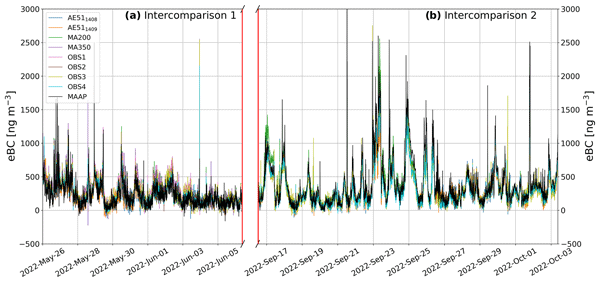
J. Tapio Elomaa, Krista Luoma, Sami D. Harni, Aki Virkkula, Hilkka Timonen, and Tuukka Petäjä
Aerosol Research, 3, 293–314, https://doi.org/10.5194/ar-3-293-2025, https://doi.org/10.5194/ar-3-293-2025, 2025
Short summary
Short summary
Black carbon (BC) is a pollutant from combustion that affects the climate and is harmful to health. We tested four different small BC sensors with a reference in Helsinki. The sensors compared well with the reference. As a sensor network they were able to capture differences in BC. Changes in temperature (T) and relative humidity (RH) caused error in the measurements. To reduce the effects of T and RH on BC sensors, more robust boxes should be developed, or corrections should be applied.
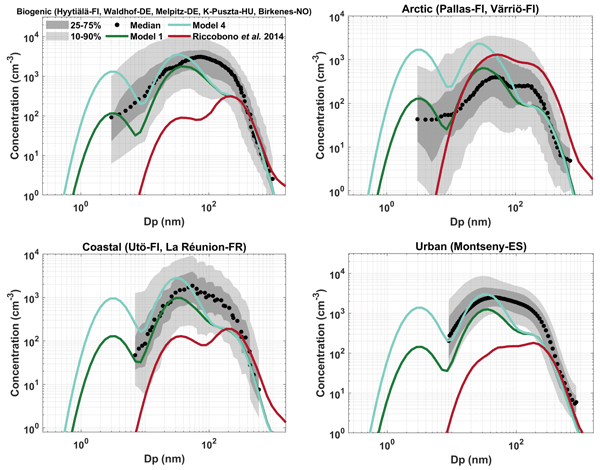
Xinyang Li, Tuomo Nieminen, Rima Baalbaki, Putian Zhou, Pauli Paasonen, Risto Makkonen, Martha Arbayani Zaidan, Nina Sarnela, Chao Yan, Tuija Jokinen, Imre Salma, Máté Vörösmarty, Tuukka Petäjä, Veli-Matti Kerminen, Markku Kulmala, and Lubna Dada
Aerosol Research, 3, 271–291, https://doi.org/10.5194/ar-3-271-2025, https://doi.org/10.5194/ar-3-271-2025, 2025
Short summary
Short summary
Particle formation rate is one of the key factors in studying the physical properties of aerosols. By developing powerful and simple semi-empirical particle formation rate models, we can predict particle formation rates and compare them with real-time measurements to aid in discovering hidden particle formation mechanisms as well as global simulations of particle population to fill the knowledge gap caused by the uncertainty in aerosol cooling effects on Earth's atmosphere.
Kimmo Teinilä, Sanna Saarikoski, Henna Lintusaari, Teemu Lepistö, Petteri Marjanen, Minna Aurela, Heidi Hellén, Toni Tykkä, Markus Lampimäki, Janne Lampilahti, Luis Barreira, Timo Mäkelä, Leena Kangas, Juha Hatakka, Sami Harni, Joel Kuula, Jarkko V. Niemi, Harri Portin, Jaakko Yli-Ojanperä, Ville Niemelä, Milja Jäppi, Katrianne Lehtipalo, Joonas Vanhanen, Liisa Pirjola, Hanna E. Manninen, Tuukka Petäjä, Topi Rönkkö, and Hilkka Timonen
Atmos. Chem. Phys., 25, 4907–4928, https://doi.org/10.5194/acp-25-4907-2025, https://doi.org/10.5194/acp-25-4907-2025, 2025
Short summary
Short summary
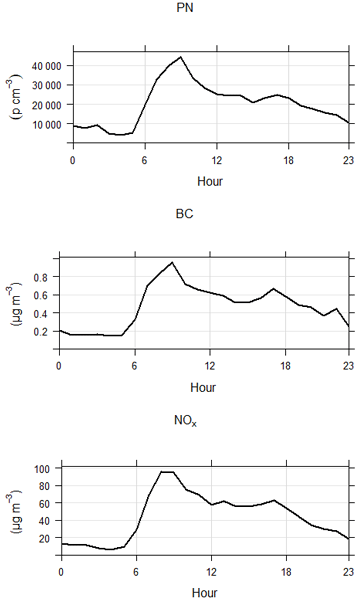
Physical and chemical properties of particulate matter and concentrations of trace gases were measured in a street canyon in Helsinki, Finland, and an urban background site in January–February 2022 to investigate the effect of wintertime conditions on pollutants. State-of-the-art instruments and a mobile laboratory were used, and the measurement data were analysed further with modelling tools like positive matrix factorization and the Pollution Detection Algorithm.
Duncan Watson-Parris, Laura J. Wilcox, Camilla W. Stjern, Robert J. Allen, Geeta Persad, Massimo A. Bollasina, Annica M. L. Ekman, Carley E. Iles, Manoj Joshi, Marianne T. Lund, Daniel McCoy, Daniel M. Westervelt, Andrew I. L. Williams, and Bjørn H. Samset
Atmos. Chem. Phys., 25, 4443–4454, https://doi.org/10.5194/acp-25-4443-2025, https://doi.org/10.5194/acp-25-4443-2025, 2025
Short summary
Short summary
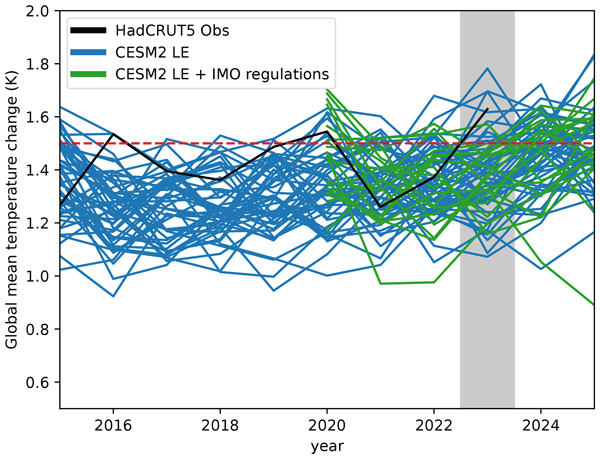
In 2020, regulations by the International Maritime Organization aimed to reduce aerosol emissions from ships. These aerosols previously had a cooling effect, which the regulations might reduce, revealing more greenhouse gas warming. Here we find that, while there is regional warming, the global 2020–2040 temperature rise is only +0.03 °C. This small change is difficult to distinguish from natural climate variability, indicating the regulations have had a limited effect on observed warming to date.
Fidel Pankratov, Alexander Mahura, Oleg Katz, Tuukka Petäjä, Valentin Popov, and Vladimir Masloboev
EGUsphere, https://doi.org/10.5194/egusphere-2025-393, https://doi.org/10.5194/egusphere-2025-393, 2025
Preprint archived
Short summary
Short summary
During polar springs low concentrations of atmospheric mercury (Hg) in the atmospheric surface layer are frequently observed. Presence of elevated Hg (in springs of 2010–2011) is not typical, and such increases are determined by the atmospheric transport at regional scales. Atmospheric trajectories showed that the source elevated Hg in the Arctic (at Amderma station) is linked with active phases of the volcanic eruptions in Iceland. It is an anomaly in terms of the global Hg pollution dynamics.
Hector Navarro-Barboza, Jordi Rovira, Vincenzo Obiso, Andrea Pozzer, Marta Via, Andres Alastuey, Xavier Querol, Noemi Perez, Marjan Savadkoohi, Gang Chen, Jesus Yus-Díez, Matic Ivancic, Martin Rigler, Konstantinos Eleftheriadis, Stergios Vratolis, Olga Zografou, Maria Gini, Benjamin Chazeau, Nicolas Marchand, Andre S. H. Prevot, Kaspar Dallenbach, Mikael Ehn, Krista Luoma, Tuukka Petäjä, Anna Tobler, Jaroslaw Necki, Minna Aurela, Hilkka Timonen, Jarkko Niemi, Olivier Favez, Jean-Eudes Petit, Jean-Philippe Putaud, Christoph Hueglin, Nicolas Pascal, Aurélien Chauvigné, Sébastien Conil, Marco Pandolfi, and Oriol Jorba
Atmos. Chem. Phys., 25, 2667–2694, https://doi.org/10.5194/acp-25-2667-2025, https://doi.org/10.5194/acp-25-2667-2025, 2025
Short summary
Short summary
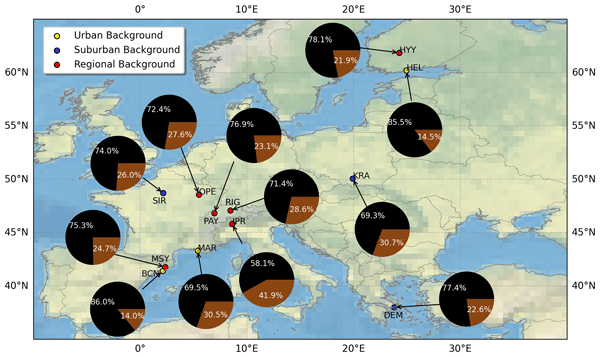
Brown carbon (BrC) absorbs ultraviolet (UV) and visible light, influencing climate. This study explores BrC's imaginary refractive index (k) using data from 12 European sites. Residential emissions are a major organic aerosol (OA) source in winter, while secondary organic aerosol (SOA) dominates in summer. Source-specific k values were derived, improving model accuracy. The findings highlight BrC's climate impact and emphasize source-specific constraints in atmospheric models.
Benjamin Heutte, Nora Bergner, Hélène Angot, Jakob B. Pernov, Lubna Dada, Jessica A. Mirrielees, Ivo Beck, Andrea Baccarini, Matthew Boyer, Jessie M. Creamean, Kaspar R. Daellenbach, Imad El Haddad, Markus M. Frey, Silvia Henning, Tiia Laurila, Vaios Moschos, Tuukka Petäjä, Kerri A. Pratt, Lauriane L. J. Quéléver, Matthew D. Shupe, Paul Zieger, Tuija Jokinen, and Julia Schmale
Atmos. Chem. Phys., 25, 2207–2241, https://doi.org/10.5194/acp-25-2207-2025, https://doi.org/10.5194/acp-25-2207-2025, 2025
Short summary
Short summary
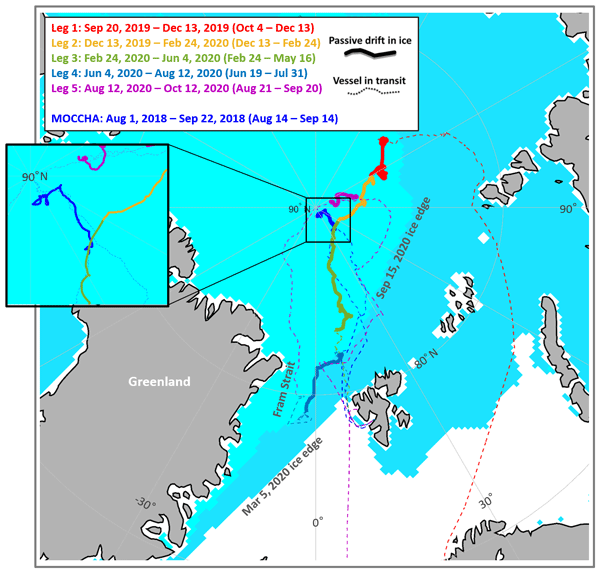
Limited aerosol measurements in the central Arctic hinder our understanding of aerosol–climate interactions in the region. Our year-long observations of aerosol physicochemical properties during the MOSAiC expedition reveal strong seasonal variations in aerosol chemical composition, where the short-term variability is heavily affected by storms in the Arctic. Local wind-generated particles are shown to be an important source of cloud seeds, especially in autumn.

Yiliang Liu, Arttu Yli-Kujala, Fabian Schmidt-Ott, Sebastian Holm, Lauri Ahonen, Tommy Chan, Joonas Enroth, Joonas Vanhanen, Runlong Cai, Tuukka Petäjä, Markku Kulmala, Yang Chen, and Juha Kangasluoma
Atmos. Meas. Tech., 18, 431–442, https://doi.org/10.5194/amt-18-431-2025, https://doi.org/10.5194/amt-18-431-2025, 2025
Short summary
Short summary
Accurate measurement of nanoparticles is crucial for understanding their impact on new particle formation and climate change. In this study, we calibrated the Particle Size Magnifier version 2.0 (PSM 2.0), using both laboratory-generated and atmospheric particles. Some differences were observed in the calibration results, with direct calibration using atmospheric particles enhancing measurement accuracy.
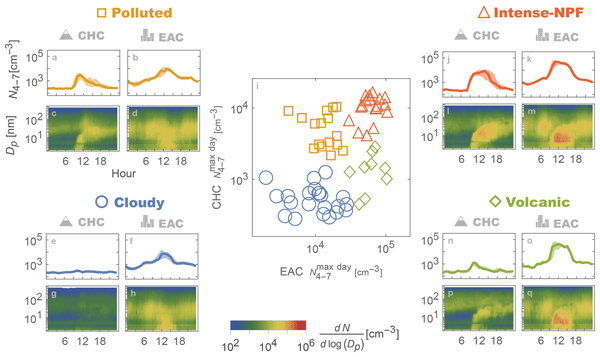
Diego Aliaga, Victoria A. Sinclair, Radovan Krejci, Marcos Andrade, Paulo Artaxo, Luis Blacutt, Runlong Cai, Samara Carbone, Yvette Gramlich, Liine Heikkinen, Dominic Heslin-Rees, Wei Huang, Veli-Matti Kerminen, Alkuin Maximilian Koenig, Markku Kulmala, Paolo Laj, Valeria Mardoñez-Balderrama, Claudia Mohr, Isabel Moreno, Pauli Paasonen, Wiebke Scholz, Karine Sellegri, Laura Ticona, Gaëlle Uzu, Fernando Velarde, Alfred Wiedensohler, Doug Worsnop, Cheng Wu, Chen Xuemeng, Qiaozhi Zha, and Federico Bianchi
Aerosol Research, 3, 15–44, https://doi.org/10.5194/ar-3-15-2025, https://doi.org/10.5194/ar-3-15-2025, 2025
Short summary
Short summary
This study examines new particle formation (NPF) in the Bolivian Andes at Chacaltaya mountain (CHC) and the urban El Alto–La Paz area (EAC). Days are clustered into four categories based on NPF intensity. Differences in particle size, precursor gases, and pollution levels are found. High NPF intensities increased Aitken mode particle concentrations at both sites, while volcanic influence selectively diminished NPF intensity at CHC but not EAC. This study highlights NPF dynamics in the Andes.
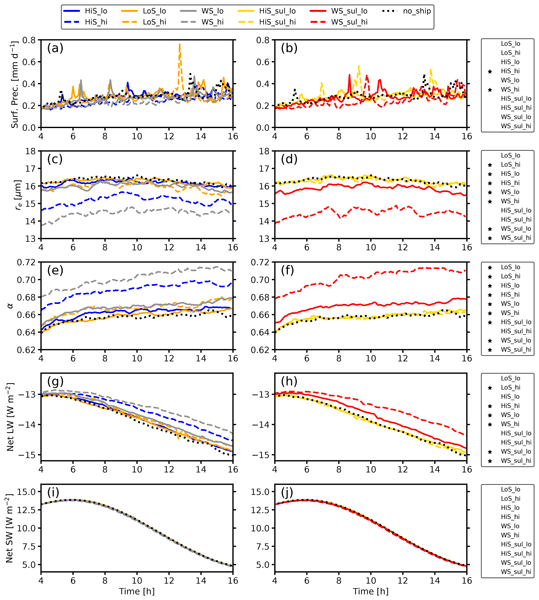
Luís Filipe Escusa dos Santos, Hannah C. Frostenberg, Alejandro Baró Pérez, Annica M. L. Ekman, Luisa Ickes, and Erik S. Thomson
Atmos. Chem. Phys., 25, 119–142, https://doi.org/10.5194/acp-25-119-2025, https://doi.org/10.5194/acp-25-119-2025, 2025
Short summary
Short summary
The Arctic is experiencing enhanced surface warming. The observed decline in Arctic sea-ice extent is projected to lead to an increase in Arctic shipping activity, which may lead to further climatic feedbacks. Using an atmospheric model and results from marine engine experiments that focused on fuel sulfur content reduction and exhaust wet scrubbing, we investigate how ship exhaust particles influence the properties of Arctic clouds. Implications for radiative surface processes are discussed.
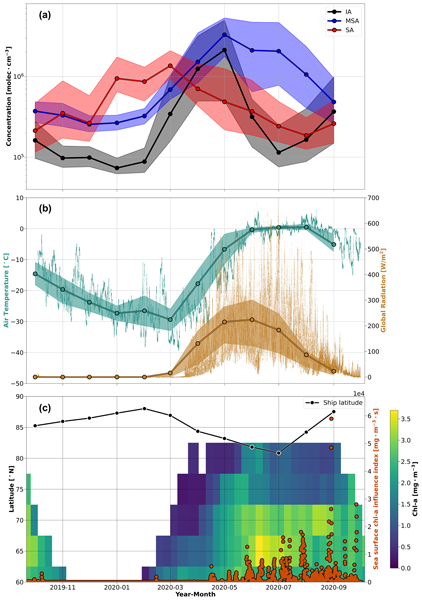
Matthew Boyer, Diego Aliaga, Lauriane L. J. Quéléver, Silvia Bucci, Hélène Angot, Lubna Dada, Benjamin Heutte, Lisa Beck, Marina Duetsch, Andreas Stohl, Ivo Beck, Tiia Laurila, Nina Sarnela, Roseline C. Thakur, Branka Miljevic, Markku Kulmala, Tuukka Petäjä, Mikko Sipilä, Julia Schmale, and Tuija Jokinen
Atmos. Chem. Phys., 24, 12595–12621, https://doi.org/10.5194/acp-24-12595-2024, https://doi.org/10.5194/acp-24-12595-2024, 2024
Short summary
Short summary
We analyze the seasonal cycle and sources of gases that are relevant for the formation of aerosol particles in the central Arctic. Since theses gases can form new particles, they can influence Arctic climate. We show that the sources of these gases are associated with changes in the Arctic environment during the year, especially with respect to sea ice. Therefore, the concentration of these gases will likely change in the future as the Arctic continues to warm.
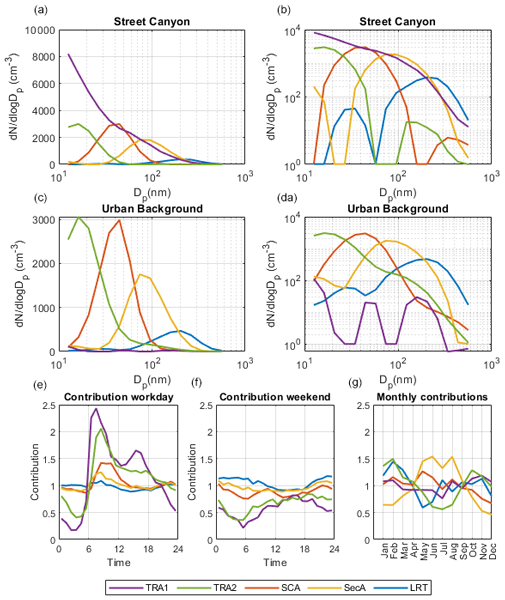
Sami D. Harni, Minna Aurela, Sanna Saarikoski, Jarkko V. Niemi, Harri Portin, Hanna Manninen, Ville Leinonen, Pasi Aalto, Phil K. Hopke, Tuukka Petäjä, Topi Rönkkö, and Hilkka Timonen
Atmos. Chem. Phys., 24, 12143–12160, https://doi.org/10.5194/acp-24-12143-2024, https://doi.org/10.5194/acp-24-12143-2024, 2024
Short summary
Short summary
In this study, particle number size distribution data were used in a novel way in positive matrix factorization analysis to find aerosol source profiles in the area. Measurements were made in Helsinki at a street canyon and urban background sites between February 2015 and June 2019. Five different aerosol sources were identified. These sources underline the significance of traffic-related emissions in urban environments despite recent improvements in emission reduction technologies.
Franziska Vogel, Michael P. Adams, Larissa Lacher, Polly B. Foster, Grace C. E. Porter, Barbara Bertozzi, Kristina Höhler, Julia Schneider, Tobias Schorr, Nsikanabasi S. Umo, Jens Nadolny, Zoé Brasseur, Paavo Heikkilä, Erik S. Thomson, Nicole Büttner, Martin I. Daily, Romy Fösig, Alexander D. Harrison, Jorma Keskinen, Ulrike Proske, Jonathan Duplissy, Markku Kulmala, Tuukka Petäjä, Ottmar Möhler, and Benjamin J. Murray
Atmos. Chem. Phys., 24, 11737–11757, https://doi.org/10.5194/acp-24-11737-2024, https://doi.org/10.5194/acp-24-11737-2024, 2024
Short summary
Short summary
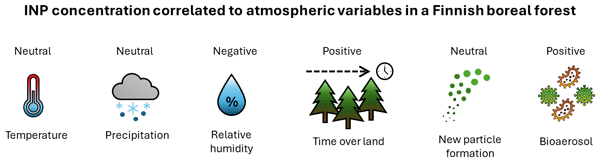
Primary ice formation in clouds strongly influences their properties; hence, it is important to understand the sources of ice-nucleating particles (INPs) and their variability. We present 2 months of INP measurements in a Finnish boreal forest using a new semi-autonomous INP counting device based on gas expansion. These results show strong variability in INP concentrations, and we present a case that the INPs we observe are, at least some of the time, of biological origin.
Markku Kulmala, Santeri Tuovinen, Sander Mirme, Paap Koemets, Lauri Ahonen, Yongchun Liu, Heikki Junninen, Tuukka Petäjä, and Veli-Matti Kerminen
Aerosol Research, 2, 291–301, https://doi.org/10.5194/ar-2-291-2024, https://doi.org/10.5194/ar-2-291-2024, 2024
Short summary
Short summary
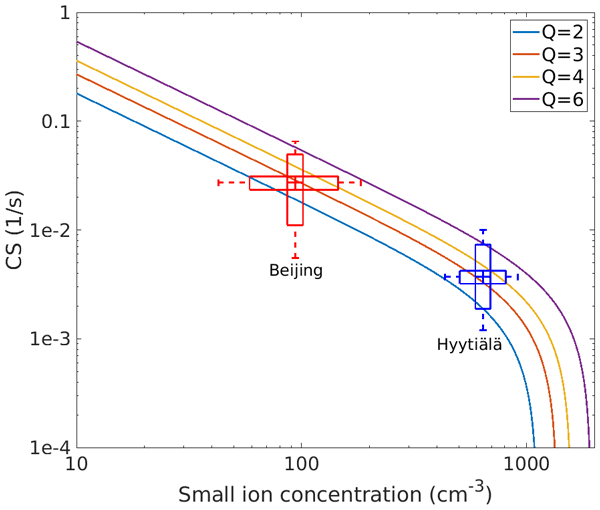
With the recently developed CIC (Cluster Ion Counter) instrument, we can observe dynamics of small air ions and intermediate air ions. Furthermore, we can observe condensation sink and formation and growth rates for intermediated ions.
Zoé Brasseur, Julia Schneider, Janne Lampilahti, Ville Vakkari, Victoria A. Sinclair, Christina J. Williamson, Carlton Xavier, Dmitri Moisseev, Markus Hartmann, Pyry Poutanen, Markus Lampimäki, Markku Kulmala, Tuukka Petäjä, Katrianne Lehtipalo, Erik S. Thomson, Kristina Höhler, Ottmar Möhler, and Jonathan Duplissy
Atmos. Chem. Phys., 24, 11305–11332, https://doi.org/10.5194/acp-24-11305-2024, https://doi.org/10.5194/acp-24-11305-2024, 2024
Short summary
Short summary
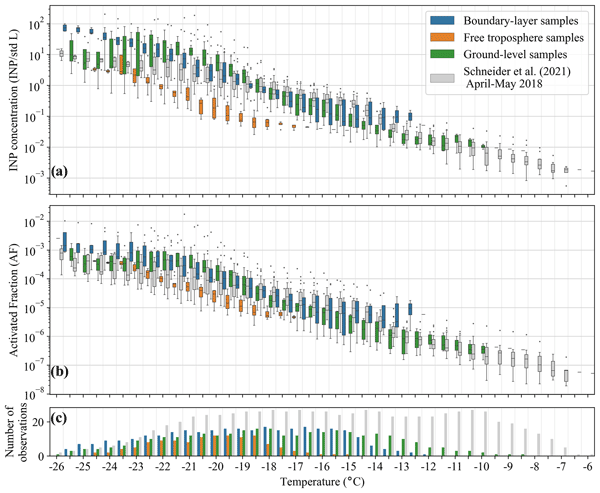
Ice-nucleating particles (INPs) strongly influence the formation of clouds by initiating the formation of ice crystals. However, very little is known about the vertical distribution of INPs in the atmosphere. Here, we present aircraft measurements of INP concentrations above the Finnish boreal forest. Results show that near-surface INPs are efficiently transported and mixed within the boundary layer and occasionally reach the free troposphere.
Amy H. Peace, Ying Chen, George Jordan, Daniel G. Partridge, Florent Malavelle, Eliza Duncan, and Jim M. Haywood
Atmos. Chem. Phys., 24, 9533–9553, https://doi.org/10.5194/acp-24-9533-2024, https://doi.org/10.5194/acp-24-9533-2024, 2024
Short summary
Short summary
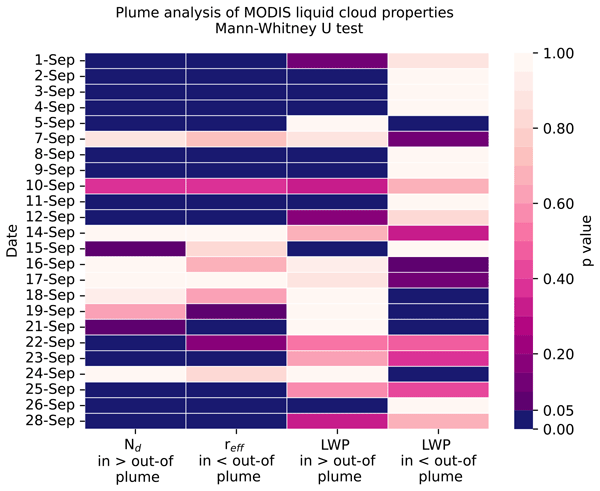
Natural aerosols from volcanic eruptions can help us understand how anthropogenic aerosols modify climate. We use observations and model simulations of the 2014–2015 Holuhraun eruption plume to examine aerosol–cloud interactions in September 2014. We find a shift to clouds with smaller, more numerous cloud droplets in the first 2 weeks of the eruption. In the third week, the background meteorology and previous conditions experienced by air masses modulate the aerosol perturbation to clouds.
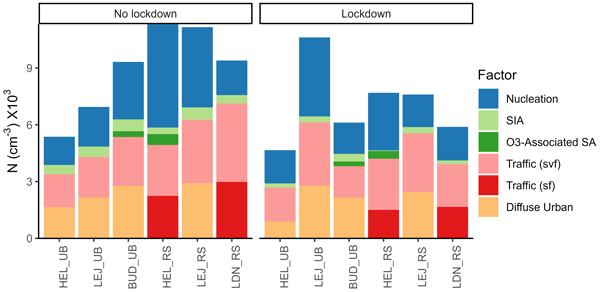
Alex Rowell, James Brean, David C. S. Beddows, Tuukka Petäjä, Máté Vörösmarty, Imre Salma, Jarkko V. Niemi, Hanna E. Manninen, Dominik van Pinxteren, Thomas Tuch, Kay Weinhold, Zongbo Shi, and Roy M. Harrison
Atmos. Chem. Phys., 24, 9515–9531, https://doi.org/10.5194/acp-24-9515-2024, https://doi.org/10.5194/acp-24-9515-2024, 2024
Short summary
Short summary
Different sources of airborne particles in the atmospheres of four European cities were distinguished by recognising their particle size distributions using a statistical procedure, positive matrix factorisation. The various sources responded differently to the changes in emissions associated with COVID-19 lockdowns, and the reasons are investigated. While traffic emissions generally decreased, particles formed from reactions of atmospheric gases decreased in some cities but increased in others.
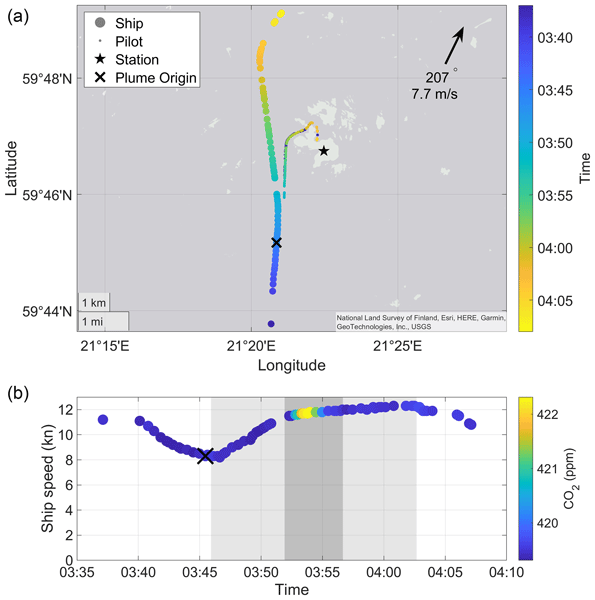
Mikko Heikkilä, Krista Luoma, Timo Mäkelä, and Tiia Grönholm
Atmos. Chem. Phys., 24, 8927–8941, https://doi.org/10.5194/acp-24-8927-2024, https://doi.org/10.5194/acp-24-8927-2024, 2024
Short summary
Short summary
Black carbon (BC) concentration was measured from 211 ship exhaust gas plumes at a remote marine station. Emission factors of BC were calculated in grams per kilogram of fuel. Ships with an exhaust gas cleaning system (EGCS) were found to have median BC emissions per fuel consumed 5 times lower than ships without an EGCS. However, this might be because of non-EGCS ships running at low engine loads rather than the EGCS itself. A local speed restriction would increase BC emissions of ships.
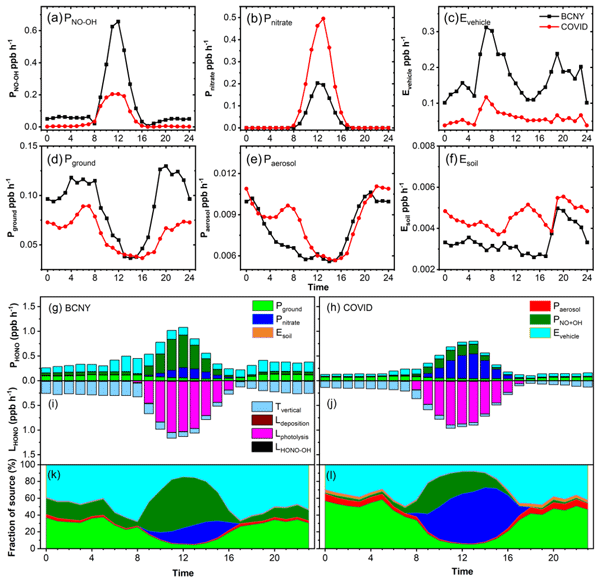
Yusheng Zhang, Feixue Zheng, Zemin Feng, Chaofan Lian, Weigang Wang, Xiaolong Fan, Wei Ma, Zhuohui Lin, Chang Li, Gen Zhang, Chao Yan, Ying Zhang, Veli-Matti Kerminen, Federico Bianch, Tuukka Petäjä, Juha Kangasluoma, Markku Kulmala, and Yongchun Liu
Atmos. Chem. Phys., 24, 8569–8587, https://doi.org/10.5194/acp-24-8569-2024, https://doi.org/10.5194/acp-24-8569-2024, 2024
Short summary
Short summary
The nitrous acid (HONO) budget was validated during a COVID-19 lockdown event. The main conclusions are (1) HONO concentrations showed a significant decrease from 0.97 to 0.53 ppb during lockdown; (2) vehicle emissions accounted for 53 % of nighttime sources, with the heterogeneous conversion of NO2 on ground surfaces more important than aerosol; and (3) the dominant daytime source shifted from the homogenous reaction between NO and OH (51 %) to nitrate photolysis (53 %) during lockdown.
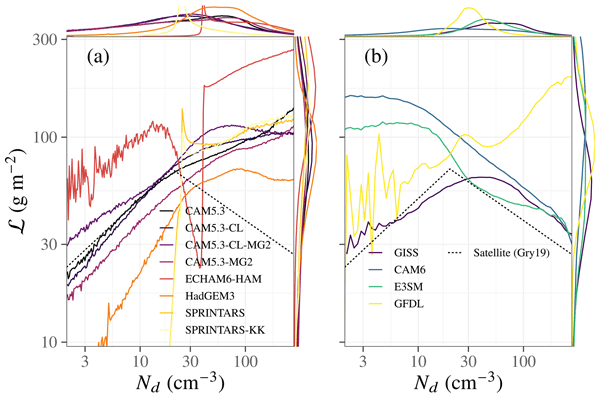
Johannes Mülmenstädt, Edward Gryspeerdt, Sudhakar Dipu, Johannes Quaas, Andrew S. Ackerman, Ann M. Fridlind, Florian Tornow, Susanne E. Bauer, Andrew Gettelman, Yi Ming, Youtong Zheng, Po-Lun Ma, Hailong Wang, Kai Zhang, Matthew W. Christensen, Adam C. Varble, L. Ruby Leung, Xiaohong Liu, David Neubauer, Daniel G. Partridge, Philip Stier, and Toshihiko Takemura
Atmos. Chem. Phys., 24, 7331–7345, https://doi.org/10.5194/acp-24-7331-2024, https://doi.org/10.5194/acp-24-7331-2024, 2024
Short summary
Short summary
Human activities release copious amounts of small particles called aerosols into the atmosphere. These particles change how much sunlight clouds reflect to space, an important human perturbation of the climate, whose magnitude is highly uncertain. We found that the latest climate models show a negative correlation but a positive causal relationship between aerosols and cloud water. This means we need to be very careful when we interpret observational studies that can only see correlation.
Liine Heikkinen, Daniel G. Partridge, Sara Blichner, Wei Huang, Rahul Ranjan, Paul Bowen, Emanuele Tovazzi, Tuukka Petäjä, Claudia Mohr, and Ilona Riipinen
Atmos. Chem. Phys., 24, 5117–5147, https://doi.org/10.5194/acp-24-5117-2024, https://doi.org/10.5194/acp-24-5117-2024, 2024
Short summary
Short summary
The organic vapor condensation with water vapor (co-condensation) in rising air below clouds is modeled in this work over the boreal forest because the forest air is rich in organic vapors. We show that the number of cloud droplets can increase by 20 % if considering co-condensation. The enhancements are even larger if the air contains many small, naturally produced aerosol particles. Such conditions are most frequently met in spring in the boreal forest.
Alejandro Baró Pérez, Michael S. Diamond, Frida A.-M. Bender, Abhay Devasthale, Matthias Schwarz, Julien Savre, Juha Tonttila, Harri Kokkola, Hyunho Lee, David Painemal, and Annica M. L. Ekman
Atmos. Chem. Phys., 24, 4591–4610, https://doi.org/10.5194/acp-24-4591-2024, https://doi.org/10.5194/acp-24-4591-2024, 2024
Short summary
Short summary
We use a numerical model to study interactions between humid light-absorbing aerosol plumes, clouds, and radiation over the southeast Atlantic. We find that the warming produced by the aerosols reduces cloud cover, especially in highly polluted situations. Aerosol impacts on drizzle play a minor role. However, aerosol effects on cloud reflectivity and moisture-induced changes in cloud cover dominate the climatic response and lead to an overall cooling by the biomass burning plumes.
Markku Kulmala, Diego Aliaga, Santeri Tuovinen, Runlong Cai, Heikki Junninen, Chao Yan, Federico Bianchi, Yafang Cheng, Aijun Ding, Douglas R. Worsnop, Tuukka Petäjä, Katrianne Lehtipalo, Pauli Paasonen, and Veli-Matti Kerminen
Aerosol Research, 2, 49–58, https://doi.org/10.5194/ar-2-49-2024, https://doi.org/10.5194/ar-2-49-2024, 2024
Short summary
Short summary
Atmospheric new particle formation (NPF), together with secondary production of particulate matter in the atmosphere, dominates aerosol particle number concentrations and submicron particle mass loads in many environments globally. In this opinion paper, we describe the paradigm shift to understand NPF in a continuous way instead of using traditional binary event–non-event analysis.
Shiyi Lai, Ximeng Qi, Xin Huang, Sijia Lou, Xuguang Chi, Liangduo Chen, Chong Liu, Yuliang Liu, Chao Yan, Mengmeng Li, Tengyu Liu, Wei Nie, Veli-Matti Kerminen, Tuukka Petäjä, Markku Kulmala, and Aijun Ding
Atmos. Chem. Phys., 24, 2535–2553, https://doi.org/10.5194/acp-24-2535-2024, https://doi.org/10.5194/acp-24-2535-2024, 2024
Short summary
Short summary
By combining in situ measurements and chemical transport modeling, this study investigates new particle formation (NPF) on the southeastern Tibetan Plateau. We found that the NPF was driven by the presence of biogenic gases and the transport of anthropogenic precursors. The NPF was vertically heterogeneous and shaped by the vertical mixing. This study highlights the importance of anthropogenic–biogenic interactions and meteorological dynamics in NPF in this climate-sensitive region.
Juha Sulo, Joonas Enroth, Aki Pajunoja, Joonas Vanhanen, Katrianne Lehtipalo, Tuukka Petäjä, and Markku Kulmala
Aerosol Research, 2, 13–20, https://doi.org/10.5194/ar-2-13-2024, https://doi.org/10.5194/ar-2-13-2024, 2024
Short summary
Short summary
We present a novel version of an aerosol number size distribution instrument, showcasing its capability to measure particle number concentration and particle number size distribution between 1 and 12 nm. Our results show that the instrument agrees well with existing instrumentation and allows for both the accurate measurement of the smallest particles and overlap with more conventional aerosol number size distribution instruments.
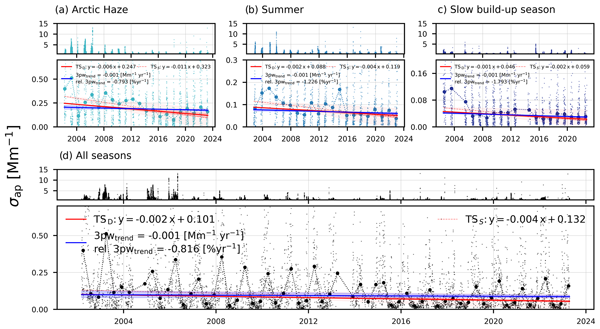
Dominic Heslin-Rees, Peter Tunved, Johan Ström, Roxana Cremer, Paul Zieger, Ilona Riipinen, Annica M. L. Ekman, Konstantinos Eleftheriadis, and Radovan Krejci
Atmos. Chem. Phys., 24, 2059–2075, https://doi.org/10.5194/acp-24-2059-2024, https://doi.org/10.5194/acp-24-2059-2024, 2024
Short summary
Short summary
Light-absorbing atmospheric particles (e.g. black carbon – BC) exert a warming effect on the Arctic climate. We show that the amount of particle light absorption decreased from 2002 to 2023. We conclude that in addition to reductions in emissions of BC, wet removal plays a role in the long-term reduction of BC in the Arctic, given the increase in surface precipitation experienced by air masses arriving at the site. The potential impact of biomass burning events is shown to have increased.
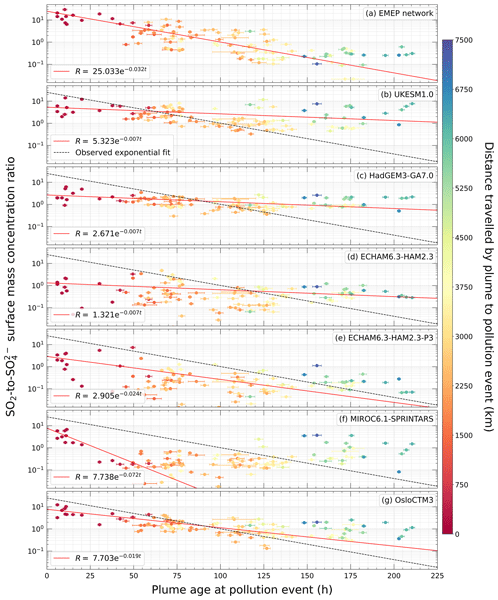
George Jordan, Florent Malavelle, Ying Chen, Amy Peace, Eliza Duncan, Daniel G. Partridge, Paul Kim, Duncan Watson-Parris, Toshihiko Takemura, David Neubauer, Gunnar Myhre, Ragnhild Skeie, Anton Laakso, and James Haywood
Atmos. Chem. Phys., 24, 1939–1960, https://doi.org/10.5194/acp-24-1939-2024, https://doi.org/10.5194/acp-24-1939-2024, 2024
Short summary
Short summary
The 2014–15 Holuhraun eruption caused a huge aerosol plume in an otherwise unpolluted region, providing a chance to study how aerosol alters cloud properties. This two-part study uses observations and models to quantify this relationship’s impact on the Earth’s energy budget. Part 1 suggests the models capture the observed spatial and chemical evolution of the plume, yet no model plume is exact. Understanding these differences is key for Part 2, where changes to cloud properties are explored.
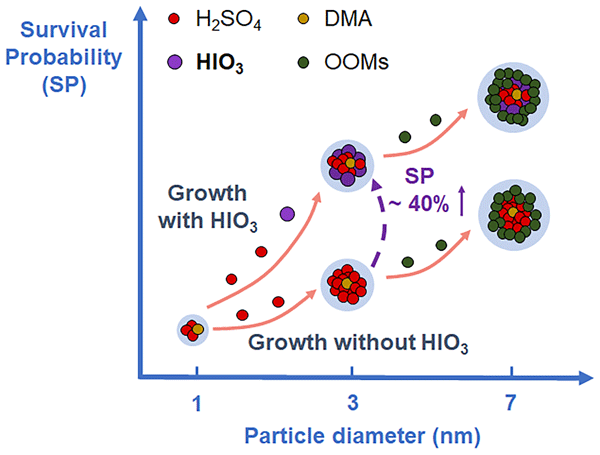
Ying Zhang, Duzitian Li, Xu-Cheng He, Wei Nie, Chenjuan Deng, Runlong Cai, Yuliang Liu, Yishuo Guo, Chong Liu, Yiran Li, Liangduo Chen, Yuanyuan Li, Chenjie Hua, Tingyu Liu, Zongcheng Wang, Jiali Xie, Lei Wang, Tuukka Petäjä, Federico Bianchi, Ximeng Qi, Xuguang Chi, Pauli Paasonen, Yongchun Liu, Chao Yan, Jingkun Jiang, Aijun Ding, and Markku Kulmala
Atmos. Chem. Phys., 24, 1873–1893, https://doi.org/10.5194/acp-24-1873-2024, https://doi.org/10.5194/acp-24-1873-2024, 2024
Short summary
Short summary
This study conducts a long-term observation of gaseous iodine oxoacids in two Chinese megacities, revealing their ubiquitous presence with peak concentrations (up to 0.1 pptv) in summer. Our analysis suggests a mix of terrestrial and marine sources for iodine. Additionally, iodic acid is identified as a notable contributor to sub-3 nm particle growth and particle survival probability.
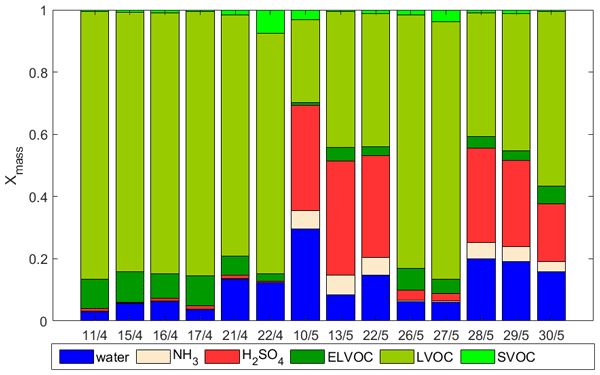
Arto Heitto, Cheng Wu, Diego Aliaga, Luis Blacutt, Xuemeng Chen, Yvette Gramlich, Liine Heikkinen, Wei Huang, Radovan Krejci, Paolo Laj, Isabel Moreno, Karine Sellegri, Fernando Velarde, Kay Weinhold, Alfred Wiedensohler, Qiaozhi Zha, Federico Bianchi, Marcos Andrade, Kari E. J. Lehtinen, Claudia Mohr, and Taina Yli-Juuti
Atmos. Chem. Phys., 24, 1315–1328, https://doi.org/10.5194/acp-24-1315-2024, https://doi.org/10.5194/acp-24-1315-2024, 2024
Short summary
Short summary
Particle growth at the Chacaltaya station in Bolivia was simulated based on measured vapor concentrations and ambient conditions. Major contributors to the simulated growth were low-volatility organic compounds (LVOCs). Also, sulfuric acid had major role when volcanic activity was occurring in the area. This study provides insight on nanoparticle growth at this high-altitude Southern Hemispheric site and hence contributes to building knowledge of early growth of atmospheric particles.
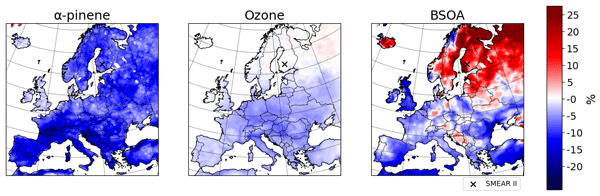
Giancarlo Ciarelli, Sara Tahvonen, Arineh Cholakian, Manuel Bettineschi, Bruno Vitali, Tuukka Petäjä, and Federico Bianchi
Geosci. Model Dev., 17, 545–565, https://doi.org/10.5194/gmd-17-545-2024, https://doi.org/10.5194/gmd-17-545-2024, 2024
Short summary
Short summary
The terrestrial ecosystem releases large quantities of biogenic gases in the Earth's Atmosphere. These gases can effectively be converted into so-called biogenic aerosol particles and, eventually, affect the Earth's climate. Climate prediction varies greatly depending on how these processes are represented in model simulations. In this study, we present a detailed model evaluation analysis aimed at understanding the main source of uncertainty in predicting the formation of biogenic aerosols.
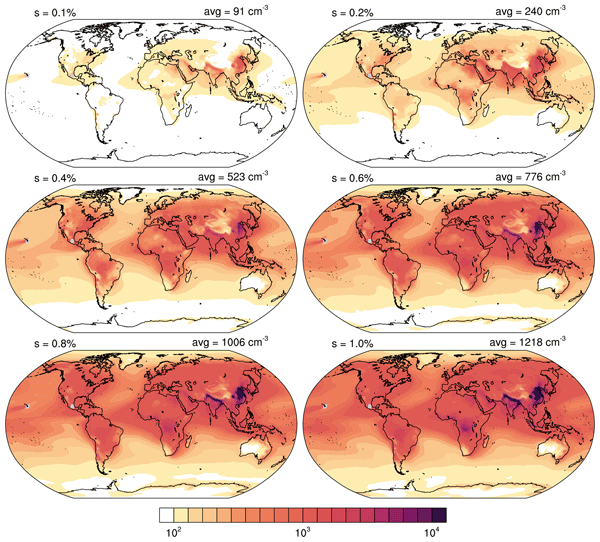
Karoline Block, Mahnoosh Haghighatnasab, Daniel G. Partridge, Philip Stier, and Johannes Quaas
Earth Syst. Sci. Data, 16, 443–470, https://doi.org/10.5194/essd-16-443-2024, https://doi.org/10.5194/essd-16-443-2024, 2024
Short summary
Short summary
Aerosols being able to act as condensation nuclei for cloud droplets (CCNs) are a key element in cloud formation but very difficult to determine. In this study we present a new global vertically resolved CCN dataset for various humidity conditions and aerosols. It is obtained using an atmospheric model (CAMS reanalysis) that is fed by satellite observations of light extinction (AOD). We investigate and evaluate the abundance of CCNs in the atmosphere and their temporal and spatial occurrence.
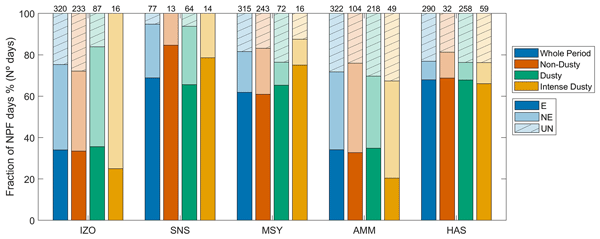
Juan Andrés Casquero-Vera, Daniel Pérez-Ramírez, Hassan Lyamani, Fernando Rejano, Andrea Casans, Gloria Titos, Francisco José Olmo, Lubna Dada, Simo Hakala, Tareq Hussein, Katrianne Lehtipalo, Pauli Paasonen, Antti Hyvärinen, Noemí Pérez, Xavier Querol, Sergio Rodríguez, Nikos Kalivitis, Yenny González, Mansour A. Alghamdi, Veli-Matti Kerminen, Andrés Alastuey, Tuukka Petäjä, and Lucas Alados-Arboledas
Atmos. Chem. Phys., 23, 15795–15814, https://doi.org/10.5194/acp-23-15795-2023, https://doi.org/10.5194/acp-23-15795-2023, 2023
Short summary
Short summary
Here we present the first study of the effect of mineral dust on the inhibition/promotion of new particle formation (NPF) events in different dust-influenced areas. Unexpectedly, we show that the occurrence of NPF events is highly frequent during mineral dust outbreaks, occurring even during extreme dust outbreaks. We also show that the occurrence of NPF events during mineral dust outbreaks significantly affects the potential cloud condensation nuclei budget.
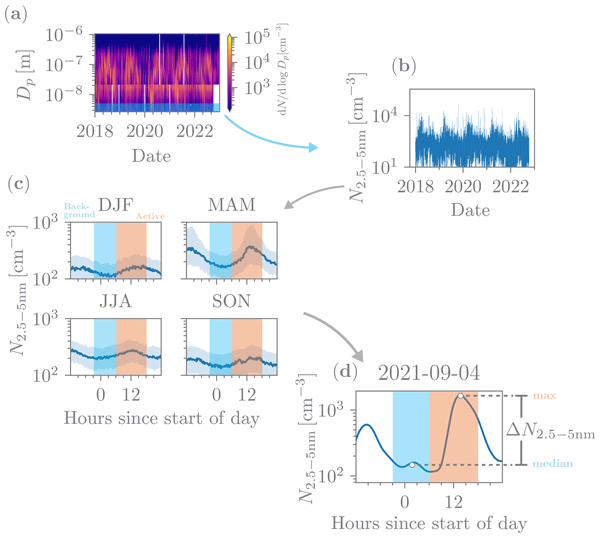
Diego Aliaga, Santeri Tuovinen, Tinghan Zhang, Janne Lampilahti, Xinyang Li, Lauri Ahonen, Tom Kokkonen, Tuomo Nieminen, Simo Hakala, Pauli Paasonen, Federico Bianchi, Doug Worsnop, Veli-Matti Kerminen, and Markku Kulmala
Aerosol Research, 1, 81–92, https://doi.org/10.5194/ar-1-81-2023, https://doi.org/10.5194/ar-1-81-2023, 2023
Short summary
Short summary
We introduce a novel method for evaluating days when small particles are formed in the atmosphere. Instead of the traditional binary division between event and non-event days, our method, known as "nano ranking analysis", provides a continuous, non-categorical metric for each day. By utilizing data from Hyytiälä, Finland, we show that our approach effectively quantifies these events. This innovative method paves the way for a deeper understanding of the factors influencing particle formation.
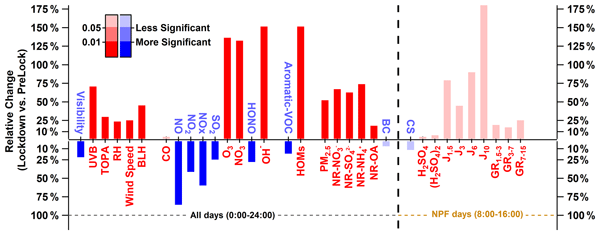
Markku Kulmala, Anna Lintunen, Hanna Lappalainen, Annele Virtanen, Chao Yan, Ekaterina Ezhova, Tuomo Nieminen, Ilona Riipinen, Risto Makkonen, Johanna Tamminen, Anu-Maija Sundström, Antti Arola, Armin Hansel, Kari Lehtinen, Timo Vesala, Tuukka Petäjä, Jaana Bäck, Tom Kokkonen, and Veli-Matti Kerminen
Atmos. Chem. Phys., 23, 14949–14971, https://doi.org/10.5194/acp-23-14949-2023, https://doi.org/10.5194/acp-23-14949-2023, 2023
Short summary
Short summary
To be able to meet global grand challenges, we need comprehensive open data with proper metadata. In this opinion paper, we describe the SMEAR (Station for Measuring Earth surface – Atmosphere Relations) concept and include several examples (cases), such as new particle formation and growth, feedback loops and the effect of COVID-19, and what has been learned from these investigations. The future needs and the potential of comprehensive observations of the environment are summarized.
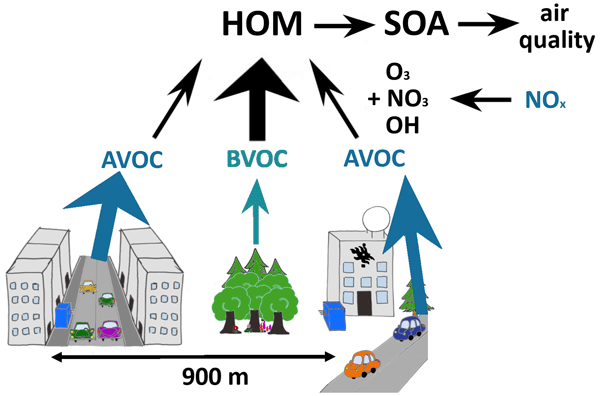
Magdalena Okuljar, Olga Garmash, Miska Olin, Joni Kalliokoski, Hilkka Timonen, Jarkko V. Niemi, Pauli Paasonen, Jenni Kontkanen, Yanjun Zhang, Heidi Hellén, Heino Kuuluvainen, Minna Aurela, Hanna E. Manninen, Mikko Sipilä, Topi Rönkkö, Tuukka Petäjä, Markku Kulmala, Miikka Dal Maso, and Mikael Ehn
Atmos. Chem. Phys., 23, 12965–12983, https://doi.org/10.5194/acp-23-12965-2023, https://doi.org/10.5194/acp-23-12965-2023, 2023
Short summary
Short summary
Highly oxygenated organic molecules (HOMs) form secondary organic aerosol that affects air quality and health. In this study, we demonstrate that in a moderately polluted city with abundant vegetation, the composition of HOMs is largely controlled by the effect of NOx on the biogenic volatile organic compound oxidation. Comparing the results from two nearby stations, we show that HOM composition and formation pathways can change considerably within small distances in urban environments.
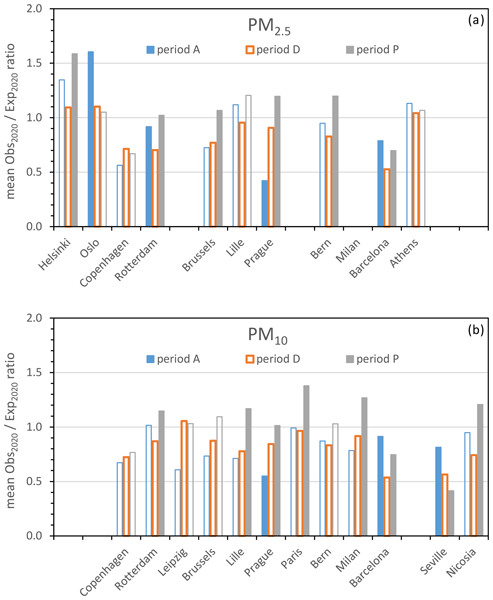
Jean-Philippe Putaud, Enrico Pisoni, Alexander Mangold, Christoph Hueglin, Jean Sciare, Michael Pikridas, Chrysanthos Savvides, Jakub Ondracek, Saliou Mbengue, Alfred Wiedensohler, Kay Weinhold, Maik Merkel, Laurent Poulain, Dominik van Pinxteren, Hartmut Herrmann, Andreas Massling, Claus Nordstroem, Andrés Alastuey, Cristina Reche, Noemí Pérez, Sonia Castillo, Mar Sorribas, Jose Antonio Adame, Tuukka Petaja, Katrianne Lehtipalo, Jarkko Niemi, Véronique Riffault, Joel F. de Brito, Augustin Colette, Olivier Favez, Jean-Eudes Petit, Valérie Gros, Maria I. Gini, Stergios Vratolis, Konstantinos Eleftheriadis, Evangelia Diapouli, Hugo Denier van der Gon, Karl Espen Yttri, and Wenche Aas
Atmos. Chem. Phys., 23, 10145–10161, https://doi.org/10.5194/acp-23-10145-2023, https://doi.org/10.5194/acp-23-10145-2023, 2023
Short summary
Short summary
Many European people are still exposed to levels of air pollution that can affect their health. COVID-19 lockdowns in 2020 were used to assess the impact of the reduction in human mobility on air pollution across Europe by comparing measurement data with values that would be expected if no lockdown had occurred. We show that lockdown measures did not lead to consistent decreases in the concentrations of fine particulate matter suspended in the air, and we investigate why.
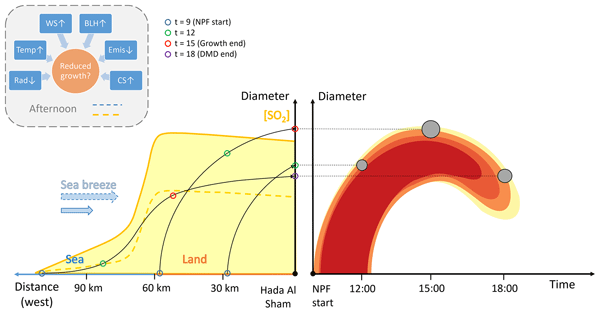
Simo Hakala, Ville Vakkari, Heikki Lihavainen, Antti-Pekka Hyvärinen, Kimmo Neitola, Jenni Kontkanen, Veli-Matti Kerminen, Markku Kulmala, Tuukka Petäjä, Tareq Hussein, Mamdouh I. Khoder, Mansour A. Alghamdi, and Pauli Paasonen
Atmos. Chem. Phys., 23, 9287–9321, https://doi.org/10.5194/acp-23-9287-2023, https://doi.org/10.5194/acp-23-9287-2023, 2023
Short summary
Short summary
Things are not always as they first seem in ambient aerosol measurements. Observations of decreasing particle sizes are often interpreted as resulting from particle evaporation. We show that such observations can counterintuitively be explained by particles that are constantly growing in size. This requires one to account for the previous movements of the observed air. Our explanation implies a larger number of larger particles, meaning more significant effects of aerosols on climate and health.
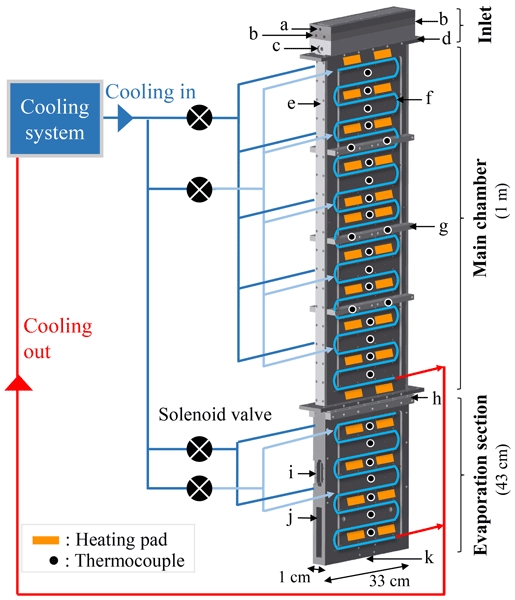
Dimitri Castarède, Zoé Brasseur, Yusheng Wu, Zamin A. Kanji, Markus Hartmann, Lauri Ahonen, Merete Bilde, Markku Kulmala, Tuukka Petäjä, Jan B. C. Pettersson, Berko Sierau, Olaf Stetzer, Frank Stratmann, Birgitta Svenningsson, Erik Swietlicki, Quynh Thu Nguyen, Jonathan Duplissy, and Erik S. Thomson
Atmos. Meas. Tech., 16, 3881–3899, https://doi.org/10.5194/amt-16-3881-2023, https://doi.org/10.5194/amt-16-3881-2023, 2023
Short summary
Short summary
Clouds play a key role in Earth’s climate by influencing the surface energy budget. Certain types of atmospheric aerosols, called ice-nucleating particles (INPs), induce the formation of ice in clouds and, thus, often initiate precipitation formation. The Portable Ice Nucleation Chamber 2 (PINCii) is a new instrument developed to study ice formation and to conduct ambient measurements of INPs, allowing us to investigate the sources and properties of the atmospheric aerosols that can act as INPs.
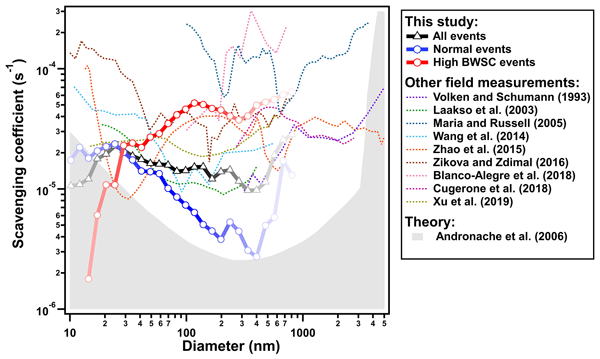
Guangdong Niu, Ximeng Qi, Liangduo Chen, Lian Xue, Shiyi Lai, Xin Huang, Jiaping Wang, Xuguang Chi, Wei Nie, Veli-Matti Kerminen, Tuukka Petäjä, Markku Kulmala, and Aijun Ding
Atmos. Chem. Phys., 23, 7521–7534, https://doi.org/10.5194/acp-23-7521-2023, https://doi.org/10.5194/acp-23-7521-2023, 2023
Short summary
Short summary
The reported below-cloud wet-scavenging coefficients (BWSCs) are much higher than theoretical data, but the reason remains unclear. Based on long-term observation, we find that air mass changing during rainfall events causes the overestimation of BWSCs. Thus, the discrepancy in BWSCs between observation and theory is not as large as currently believed. To obtain reasonable BWSCs and parameterizations from field observations, the effect of air mass changes needs to be considered.
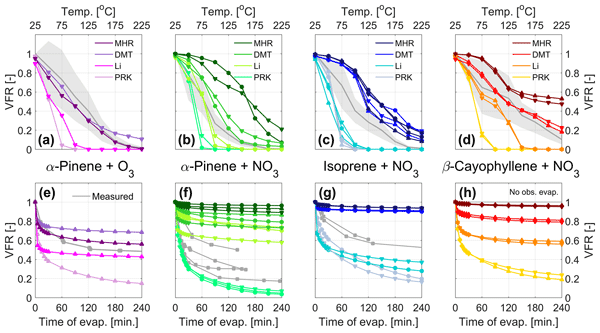
Emelie L. Graham, Cheng Wu, David M. Bell, Amelie Bertrand, Sophie L. Haslett, Urs Baltensperger, Imad El Haddad, Radovan Krejci, Ilona Riipinen, and Claudia Mohr
Atmos. Chem. Phys., 23, 7347–7362, https://doi.org/10.5194/acp-23-7347-2023, https://doi.org/10.5194/acp-23-7347-2023, 2023
Short summary
Short summary
The volatility of an aerosol particle is an important parameter for describing its atmospheric lifetime. We studied the volatility of secondary organic aerosols from nitrate-initiated oxidation of three biogenic precursors with experimental methods and model simulations. We saw higher volatility than for the corresponding ozone system, and our simulations produced variable results with different parameterizations which warrant a re-evaluation of the treatment of the nitrate functional group.
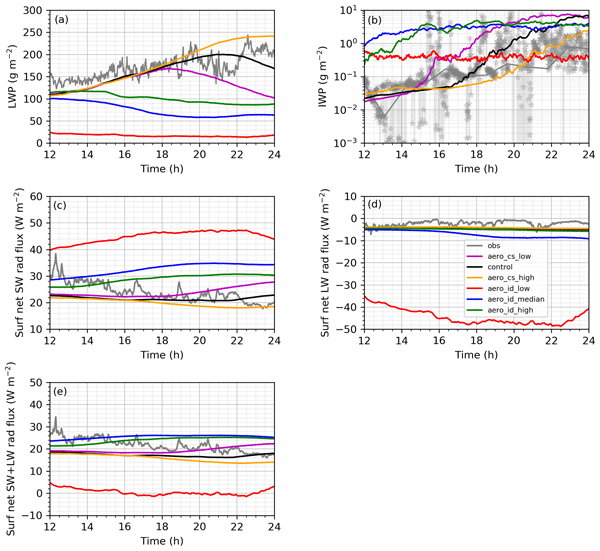
Ines Bulatovic, Julien Savre, Michael Tjernström, Caroline Leck, and Annica M. L. Ekman
Atmos. Chem. Phys., 23, 7033–7055, https://doi.org/10.5194/acp-23-7033-2023, https://doi.org/10.5194/acp-23-7033-2023, 2023
Short summary
Short summary
We use numerical modeling with detailed cloud microphysics to investigate a low-altitude cloud system consisting of two cloud layers – a type of cloud situation which was commonly observed during the summer of 2018 in the central Arctic (north of 80° N). The model generally reproduces the observed cloud layers and the thermodynamic structure of the lower atmosphere well. The cloud system is maintained unless there are low aerosol number concentrations or high large-scale wind speeds.
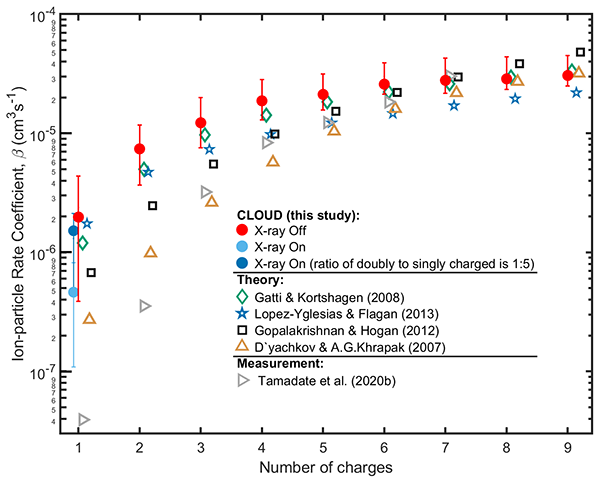
Joschka Pfeifer, Naser G. A. Mahfouz, Benjamin C. Schulze, Serge Mathot, Dominik Stolzenburg, Rima Baalbaki, Zoé Brasseur, Lucia Caudillo, Lubna Dada, Manuel Granzin, Xu-Cheng He, Houssni Lamkaddam, Brandon Lopez, Vladimir Makhmutov, Ruby Marten, Bernhard Mentler, Tatjana Müller, Antti Onnela, Maxim Philippov, Ana A. Piedehierro, Birte Rörup, Meredith Schervish, Ping Tian, Nsikanabasi S. Umo, Dongyu S. Wang, Mingyi Wang, Stefan K. Weber, André Welti, Yusheng Wu, Marcel Zauner-Wieczorek, Antonio Amorim, Imad El Haddad, Markku Kulmala, Katrianne Lehtipalo, Tuukka Petäjä, António Tomé, Sander Mirme, Hanna E. Manninen, Neil M. Donahue, Richard C. Flagan, Andreas Kürten, Joachim Curtius, and Jasper Kirkby
Atmos. Chem. Phys., 23, 6703–6718, https://doi.org/10.5194/acp-23-6703-2023, https://doi.org/10.5194/acp-23-6703-2023, 2023
Short summary
Short summary
Attachment rate coefficients between ions and charged aerosol particles determine their lifetimes and may also influence cloud dynamics and aerosol processing. Here we present novel experiments that measure ion–aerosol attachment rate coefficients for multiply charged aerosol particles under atmospheric conditions in the CERN CLOUD chamber. Our results provide experimental discrimination between various theoretical models.
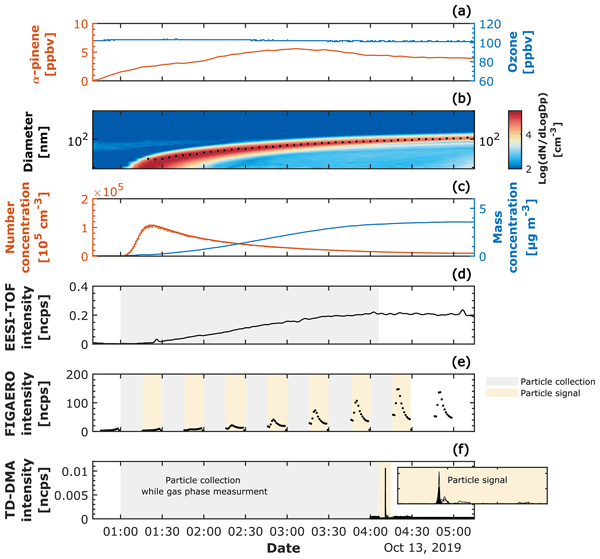
Lucía Caudillo, Mihnea Surdu, Brandon Lopez, Mingyi Wang, Markus Thoma, Steffen Bräkling, Angela Buchholz, Mario Simon, Andrea C. Wagner, Tatjana Müller, Manuel Granzin, Martin Heinritzi, Antonio Amorim, David M. Bell, Zoé Brasseur, Lubna Dada, Jonathan Duplissy, Henning Finkenzeller, Xu-Cheng He, Houssni Lamkaddam, Naser G. A. Mahfouz, Vladimir Makhmutov, Hanna E. Manninen, Guillaume Marie, Ruby Marten, Roy L. Mauldin, Bernhard Mentler, Antti Onnela, Tuukka Petäjä, Joschka Pfeifer, Maxim Philippov, Ana A. Piedehierro, Birte Rörup, Wiebke Scholz, Jiali Shen, Dominik Stolzenburg, Christian Tauber, Ping Tian, António Tomé, Nsikanabasi Silas Umo, Dongyu S. Wang, Yonghong Wang, Stefan K. Weber, André Welti, Marcel Zauner-Wieczorek, Urs Baltensperger, Richard C. Flagan, Armin Hansel, Jasper Kirkby, Markku Kulmala, Katrianne Lehtipalo, Douglas R. Worsnop, Imad El Haddad, Neil M. Donahue, Alexander L. Vogel, Andreas Kürten, and Joachim Curtius
Atmos. Chem. Phys., 23, 6613–6631, https://doi.org/10.5194/acp-23-6613-2023, https://doi.org/10.5194/acp-23-6613-2023, 2023
Short summary
Short summary
In this study, we present an intercomparison of four different techniques for measuring the chemical composition of nanoparticles. The intercomparison was performed based on the observed chemical composition, calculated volatility, and analysis of the thermograms. We found that the methods generally agree on the most important compounds that are found in the nanoparticles. However, they do see different parts of the organic spectrum. We suggest potential explanations for these differences.
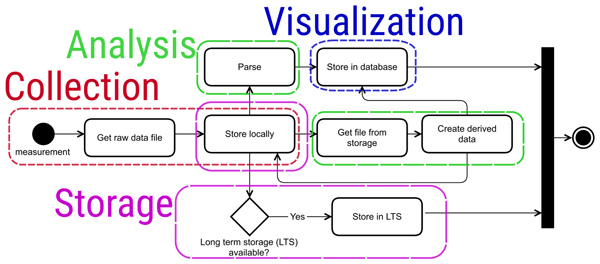
Anton Rusanen, Kristo Hõrrak, Lauri R. Ahonen, Tuomo Nieminen, Pasi P. Aalto, Pasi Kolari, Markku Kulmala, Tuukka Petäjä, and Heikki Junninen
Atmos. Meas. Tech., 16, 2781–2793, https://doi.org/10.5194/amt-16-2781-2023, https://doi.org/10.5194/amt-16-2781-2023, 2023
Short summary
Short summary
We present a framework for setting up SMEAR (Station for Measuring Ecosystem–Atmosphere Relations) type measurement station data flows. This framework, called SMEARcore, consists of modular open-source software components that can be chosen to suit various station configurations. The benefits of using this framework are automation of routine operations and real-time monitoring of measurement results.
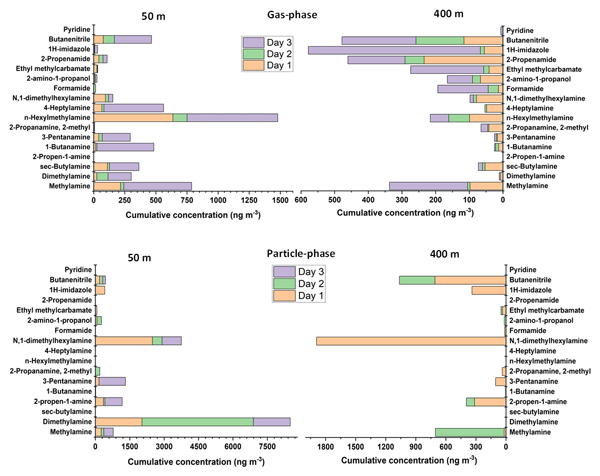
Eka Dian Pusfitasari, Jose Ruiz-Jimenez, Aleksi Tiusanen, Markus Suuronen, Jesse Haataja, Yusheng Wu, Juha Kangasluoma, Krista Luoma, Tuukka Petäjä, Matti Jussila, Kari Hartonen, and Marja-Liisa Riekkola
Atmos. Chem. Phys., 23, 5885–5904, https://doi.org/10.5194/acp-23-5885-2023, https://doi.org/10.5194/acp-23-5885-2023, 2023
Short summary
Short summary
A miniaturized air-sampling drone system was successfully applied for the collection of volatile organic compounds (VOCs) and for the measurement of black carbon (BC) and total particle number concentrations in atmospheric air. Here we report, for the first time, the vertical profiles of BC and aerosol number concentrations above the boreal forest in Hyytiälä (Finland) at high altitudes close to the boundary layer in autumn 2021. VOC composition with its distribution was studied as well.
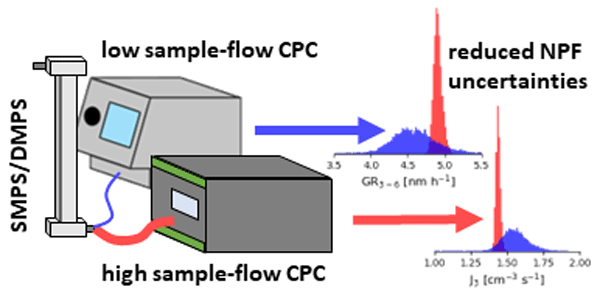
Dominik Stolzenburg, Tiia Laurila, Pasi Aalto, Joonas Vanhanen, Tuukka Petäjä, and Juha Kangasluoma
Atmos. Meas. Tech., 16, 2471–2483, https://doi.org/10.5194/amt-16-2471-2023, https://doi.org/10.5194/amt-16-2471-2023, 2023
Short summary
Short summary
Size-distribution measurements of ultrafine particles are of special interest as they can be used to estimate the atmospheric significance of new particle formation, a process which is thought to influence the global climate. Here we show that improved counting statistics in size-distribution measurements through the usage of higher sampling flows can significantly reduce the uncertainties in such calculations.
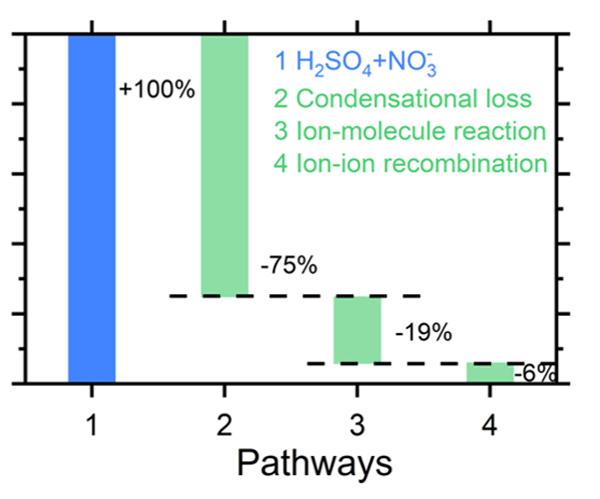
Rujing Yin, Xiaoxiao Li, Chao Yan, Runlong Cai, Ying Zhou, Juha Kangasluoma, Nina Sarnela, Janne Lampilahti, Tuukka Petäjä, Veli-Matti Kerminen, Federico Bianchi, Markku Kulmala, and Jingkun Jiang
Atmos. Chem. Phys., 23, 5279–5296, https://doi.org/10.5194/acp-23-5279-2023, https://doi.org/10.5194/acp-23-5279-2023, 2023
Short summary
Short summary
Atmospheric cluster ions are important constituents in the atmosphere. However, the quantitative research on their compositions is still limited, especially in urban environments. Here we demonstrate the feasibility of an in situ quantification method of cluster ions measured by a high-resolution mass spectrometer and reveal their governing factors, sources, and sinks in urban Beijing through quantitative analysis of cluster ions, reagent ions, neutral molecules, and condensation sink.

Qiaozhi Zha, Wei Huang, Diego Aliaga, Otso Peräkylä, Liine Heikkinen, Alkuin Maximilian Koenig, Cheng Wu, Joonas Enroth, Yvette Gramlich, Jing Cai, Samara Carbone, Armin Hansel, Tuukka Petäjä, Markku Kulmala, Douglas Worsnop, Victoria Sinclair, Radovan Krejci, Marcos Andrade, Claudia Mohr, and Federico Bianchi
Atmos. Chem. Phys., 23, 4559–4576, https://doi.org/10.5194/acp-23-4559-2023, https://doi.org/10.5194/acp-23-4559-2023, 2023
Short summary
Short summary
We investigate the chemical composition of atmospheric cluster ions from January to May 2018 at the high-altitude research station Chacaltaya (5240 m a.s.l.) in the Bolivian Andes. With state-of-the-art mass spectrometers and air mass history analysis, the measured cluster ions exhibited distinct diurnal and seasonal patterns, some of which contributed to new particle formation. Our study will improve the understanding of atmospheric ions and their role in high-altitude new particle formation.
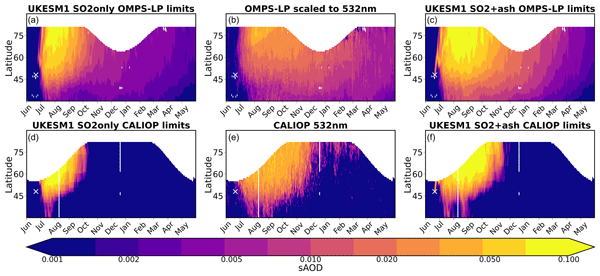
Alice F. Wells, Andy Jones, Martin Osborne, Lilly Damany-Pearce, Daniel G. Partridge, and James M. Haywood
Atmos. Chem. Phys., 23, 3985–4007, https://doi.org/10.5194/acp-23-3985-2023, https://doi.org/10.5194/acp-23-3985-2023, 2023
Short summary
Short summary
In 2019 the Raikoke volcano erupted explosively, emitting the largest injection of SO2 into the stratosphere since 2011. Observations indicated that a large amount of volcanic ash was also injected. Previous studies have identified that volcanic ash can prolong the lifetime of stratospheric aerosol optical depth, which we explore in UKESM1. Comparisons to observations suggest that including ash in model emission schemes can improve the representation of volcanic plumes in global climate models.

Meri Räty, Larisa Sogacheva, Helmi-Marja Keskinen, Veli-Matti Kerminen, Tuomo Nieminen, Tuukka Petäjä, Ekaterina Ezhova, and Markku Kulmala
Atmos. Chem. Phys., 23, 3779–3798, https://doi.org/10.5194/acp-23-3779-2023, https://doi.org/10.5194/acp-23-3779-2023, 2023
Short summary
Short summary
We utilised back trajectories to identify the source region of air masses arriving in Hyytiälä, Finland, and their travel time over forests. Combined with atmospheric observations, they revealed how air mass transport over the Fennoscandian boreal forest during the growing season produced an accumulation of cloud condensation nuclei and humidity, promoting cloudiness and precipitation. By 55 h of transport, air masses appeared to reach a balanced state with the forest environment.
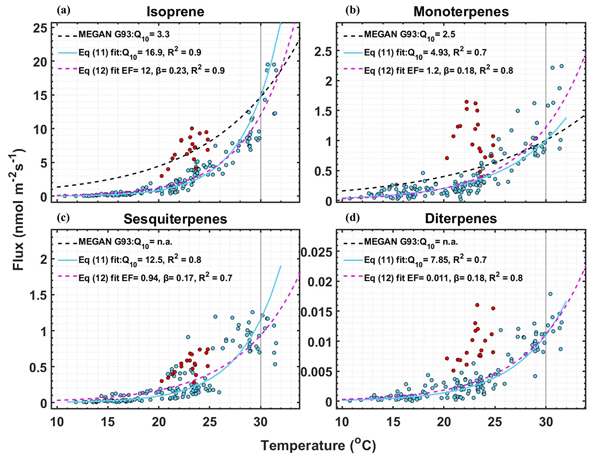
Lejish Vettikkat, Pasi Miettinen, Angela Buchholz, Pekka Rantala, Hao Yu, Simon Schallhart, Tuukka Petäjä, Roger Seco, Elisa Männistö, Markku Kulmala, Eeva-Stiina Tuittila, Alex B. Guenther, and Siegfried Schobesberger
Atmos. Chem. Phys., 23, 2683–2698, https://doi.org/10.5194/acp-23-2683-2023, https://doi.org/10.5194/acp-23-2683-2023, 2023
Short summary
Short summary
Wetlands cover a substantial fraction of the land mass in the northern latitudes, from northern Europe to Siberia and Canada. Yet, their isoprene and terpene emissions remain understudied. Here, we used a state-of-the-art measurement technique to quantify ecosystem-scale emissions from a boreal wetland during an unusually warm spring/summer. We found that the emissions from this wetland were (a) higher and (b) even more strongly dependent on temperature than commonly thought.
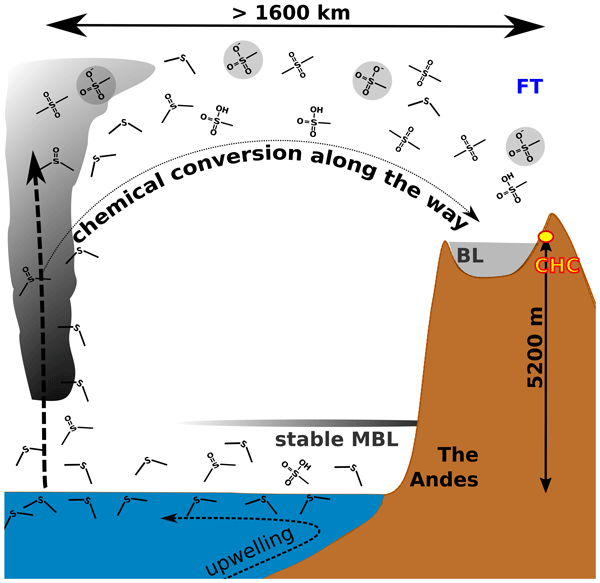
Wiebke Scholz, Jiali Shen, Diego Aliaga, Cheng Wu, Samara Carbone, Isabel Moreno, Qiaozhi Zha, Wei Huang, Liine Heikkinen, Jean Luc Jaffrezo, Gaelle Uzu, Eva Partoll, Markus Leiminger, Fernando Velarde, Paolo Laj, Patrick Ginot, Paolo Artaxo, Alfred Wiedensohler, Markku Kulmala, Claudia Mohr, Marcos Andrade, Victoria Sinclair, Federico Bianchi, and Armin Hansel
Atmos. Chem. Phys., 23, 895–920, https://doi.org/10.5194/acp-23-895-2023, https://doi.org/10.5194/acp-23-895-2023, 2023
Short summary
Short summary
Dimethyl sulfide (DMS), emitted from the ocean, is the most abundant biogenic sulfur emission into the atmosphere. OH radicals, among others, can oxidize DMS to sulfuric and methanesulfonic acid, which are relevant for aerosol formation. We quantified DMS and nearly all DMS oxidation products with novel mass spectrometric instruments for gas and particle phase at the high mountain station Chacaltaya (5240 m a.s.l.) in the Bolivian Andes in free tropospheric air after long-range transport.
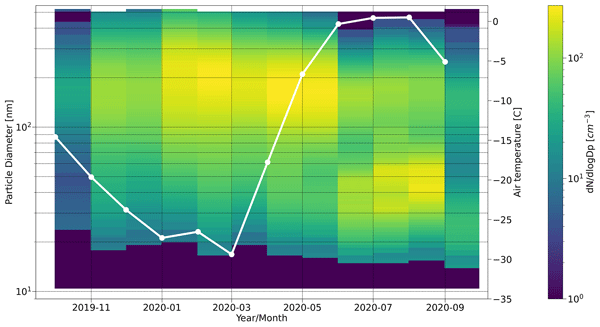
Matthew Boyer, Diego Aliaga, Jakob Boyd Pernov, Hélène Angot, Lauriane L. J. Quéléver, Lubna Dada, Benjamin Heutte, Manuel Dall'Osto, David C. S. Beddows, Zoé Brasseur, Ivo Beck, Silvia Bucci, Marina Duetsch, Andreas Stohl, Tiia Laurila, Eija Asmi, Andreas Massling, Daniel Charles Thomas, Jakob Klenø Nøjgaard, Tak Chan, Sangeeta Sharma, Peter Tunved, Radovan Krejci, Hans Christen Hansson, Federico Bianchi, Katrianne Lehtipalo, Alfred Wiedensohler, Kay Weinhold, Markku Kulmala, Tuukka Petäjä, Mikko Sipilä, Julia Schmale, and Tuija Jokinen
Atmos. Chem. Phys., 23, 389–415, https://doi.org/10.5194/acp-23-389-2023, https://doi.org/10.5194/acp-23-389-2023, 2023
Short summary
Short summary
The Arctic is a unique environment that is warming faster than other locations on Earth. We evaluate measurements of aerosol particles, which can influence climate, over the central Arctic Ocean for a full year and compare the data to land-based measurement stations across the Arctic. Our measurements show that the central Arctic has similarities to but also distinct differences from the stations further south. We note that this may change as the Arctic warms and sea ice continues to decline.
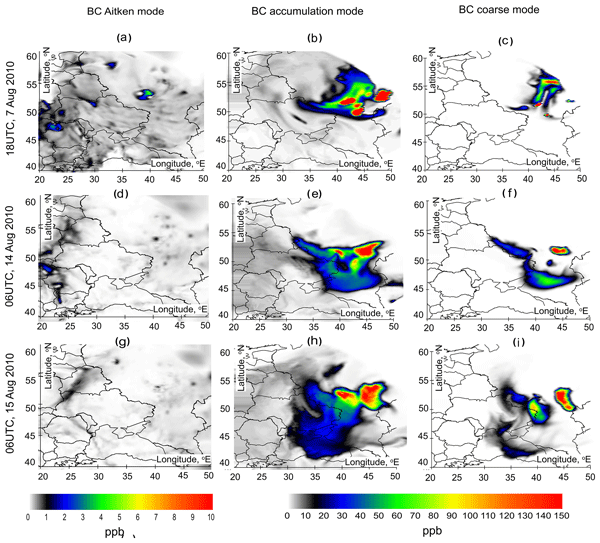
Mykhailo Savenets, Larysa Pysarenko, Svitlana Krakovska, Alexander Mahura, and Tuukka Petäjä
Atmos. Chem. Phys., 22, 15777–15791, https://doi.org/10.5194/acp-22-15777-2022, https://doi.org/10.5194/acp-22-15777-2022, 2022
Short summary
Short summary
The paper explores the spatio-temporal variability of black carbon during a wildfire in August 2010, with a focus on Ukraine. As a research tool, the seamless Enviro-HIRLAM modelling system is used for investigating the atmospheric transport of aerosol particles emitted by wildfires from remote and local sources. The results of this study improve our understanding of the physical and chemical processes and the interactions of aerosols in the atmosphere.
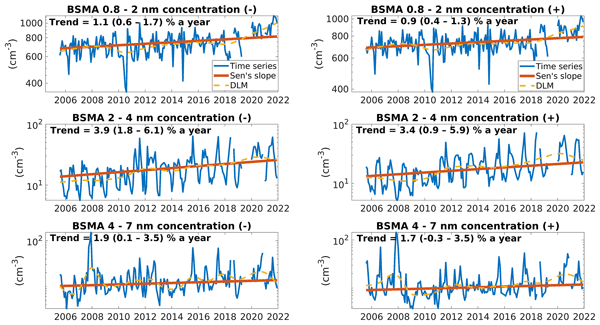
Juha Sulo, Janne Lampilahti, Xuemeng Chen, Jenni Kontkanen, Tuomo Nieminen, Veli-Matti Kerminen, Tuukka Petäjä, Markku Kulmala, and Katrianne Lehtipalo
Atmos. Chem. Phys., 22, 15223–15242, https://doi.org/10.5194/acp-22-15223-2022, https://doi.org/10.5194/acp-22-15223-2022, 2022
Short summary
Short summary
We measured atmospheric ion concentrations continuously in a boreal forest between 2005 and 2021 and observed an increasing interannual trend. The increase in cluster ion concentrations can be largely explained by an overall decreasing level of anthropogenic aerosols in the boreal forest. This suggests that the role of ions in atmospheric new particle formation may be more important in the future.
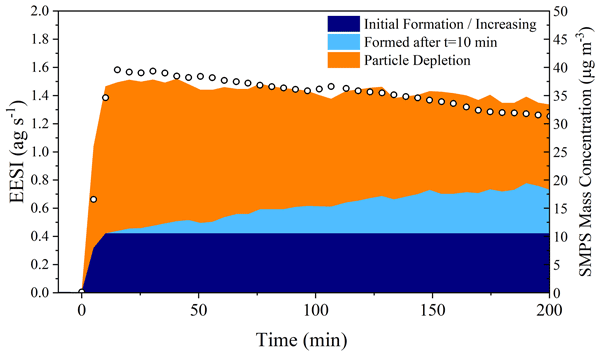
David M. Bell, Cheng Wu, Amelie Bertrand, Emelie Graham, Janne Schoonbaert, Stamatios Giannoukos, Urs Baltensperger, Andre S. H. Prevot, Ilona Riipinen, Imad El Haddad, and Claudia Mohr
Atmos. Chem. Phys., 22, 13167–13182, https://doi.org/10.5194/acp-22-13167-2022, https://doi.org/10.5194/acp-22-13167-2022, 2022
Short summary
Short summary
A series of studies designed to investigate the evolution of organic aerosol were performed in an atmospheric simulation chamber, using a common oxidant found at night (NO3). The chemical composition steadily changed from its initial composition via different chemical reactions that were taking place inside of the aerosol particle. These results show that the composition of organic aerosol steadily changes during its lifetime in the atmosphere.
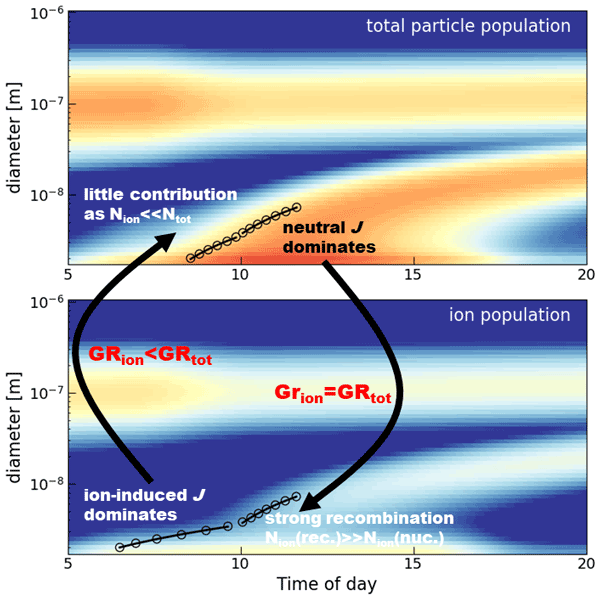
Loïc Gonzalez Carracedo, Katrianne Lehtipalo, Lauri R. Ahonen, Nina Sarnela, Sebastian Holm, Juha Kangasluoma, Markku Kulmala, Paul M. Winkler, and Dominik Stolzenburg
Atmos. Chem. Phys., 22, 13153–13166, https://doi.org/10.5194/acp-22-13153-2022, https://doi.org/10.5194/acp-22-13153-2022, 2022
Short summary
Short summary
Fast nanoparticle growth is essential for the survival of new aerosol particles in the atmosphere and hence their contribution to the climate. We show that using naturally charged ions for growth calculations can cause a significant error. During the diurnal cycle, the importance of ion-induced and neutral nucleation varies, causing the ion population to have a slower measurable apparent growth. Results suggest that data from ion spectrometers need to be considered with great care below 3 nm.
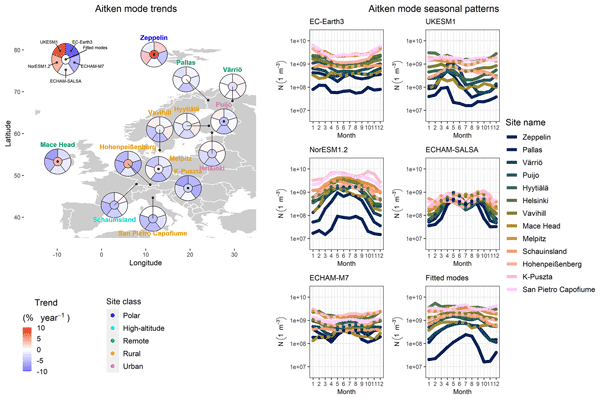
Ville Leinonen, Harri Kokkola, Taina Yli-Juuti, Tero Mielonen, Thomas Kühn, Tuomo Nieminen, Simo Heikkinen, Tuuli Miinalainen, Tommi Bergman, Ken Carslaw, Stefano Decesari, Markus Fiebig, Tareq Hussein, Niku Kivekäs, Radovan Krejci, Markku Kulmala, Ari Leskinen, Andreas Massling, Nikos Mihalopoulos, Jane P. Mulcahy, Steffen M. Noe, Twan van Noije, Fiona M. O'Connor, Colin O'Dowd, Dirk Olivie, Jakob B. Pernov, Tuukka Petäjä, Øyvind Seland, Michael Schulz, Catherine E. Scott, Henrik Skov, Erik Swietlicki, Thomas Tuch, Alfred Wiedensohler, Annele Virtanen, and Santtu Mikkonen
Atmos. Chem. Phys., 22, 12873–12905, https://doi.org/10.5194/acp-22-12873-2022, https://doi.org/10.5194/acp-22-12873-2022, 2022
Short summary
Short summary
We provide the first extensive comparison of detailed aerosol size distribution trends between in situ observations from Europe and five different earth system models. We investigated aerosol modes (nucleation, Aitken, and accumulation) separately and were able to show the differences between measured and modeled trends and especially their seasonal patterns. The differences in model results are likely due to complex effects of several processes instead of certain specific model features.
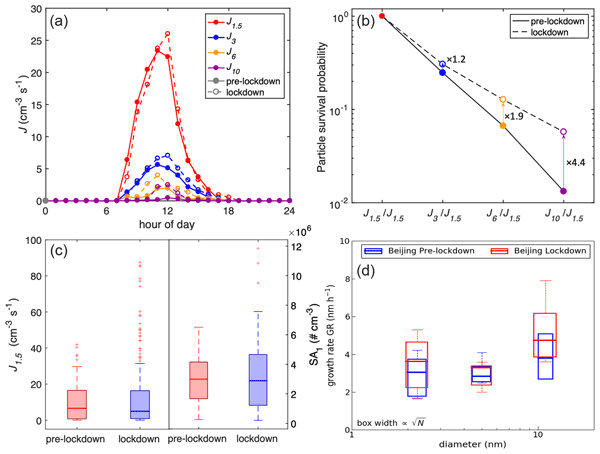
Chao Yan, Yicheng Shen, Dominik Stolzenburg, Lubna Dada, Ximeng Qi, Simo Hakala, Anu-Maija Sundström, Yishuo Guo, Antti Lipponen, Tom V. Kokkonen, Jenni Kontkanen, Runlong Cai, Jing Cai, Tommy Chan, Liangduo Chen, Biwu Chu, Chenjuan Deng, Wei Du, Xiaolong Fan, Xu-Cheng He, Juha Kangasluoma, Joni Kujansuu, Mona Kurppa, Chang Li, Yiran Li, Zhuohui Lin, Yiliang Liu, Yuliang Liu, Yiqun Lu, Wei Nie, Jouni Pulliainen, Xiaohui Qiao, Yonghong Wang, Yifan Wen, Ye Wu, Gan Yang, Lei Yao, Rujing Yin, Gen Zhang, Shaojun Zhang, Feixue Zheng, Ying Zhou, Antti Arola, Johanna Tamminen, Pauli Paasonen, Yele Sun, Lin Wang, Neil M. Donahue, Yongchun Liu, Federico Bianchi, Kaspar R. Daellenbach, Douglas R. Worsnop, Veli-Matti Kerminen, Tuukka Petäjä, Aijun Ding, Jingkun Jiang, and Markku Kulmala
Atmos. Chem. Phys., 22, 12207–12220, https://doi.org/10.5194/acp-22-12207-2022, https://doi.org/10.5194/acp-22-12207-2022, 2022
Short summary
Short summary
Atmospheric new particle formation (NPF) is a dominant source of atmospheric ultrafine particles. In urban environments, traffic emissions are a major source of primary pollutants, but their contribution to NPF remains under debate. During the COVID-19 lockdown, traffic emissions were significantly reduced, providing a unique chance to examine their relevance to NPF. Based on our comprehensive measurements, we demonstrate that traffic emissions alone are not able to explain the NPF in Beijing.
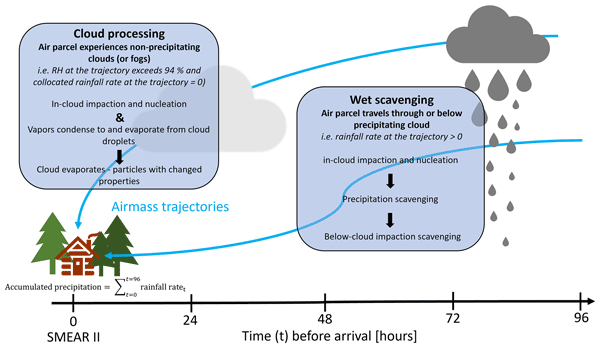
Sini Isokääntä, Paul Kim, Santtu Mikkonen, Thomas Kühn, Harri Kokkola, Taina Yli-Juuti, Liine Heikkinen, Krista Luoma, Tuukka Petäjä, Zak Kipling, Daniel Partridge, and Annele Virtanen
Atmos. Chem. Phys., 22, 11823–11843, https://doi.org/10.5194/acp-22-11823-2022, https://doi.org/10.5194/acp-22-11823-2022, 2022
Short summary
Short summary
This research employs air mass history analysis and observations to study how clouds and precipitation affect atmospheric aerosols during transport to a boreal forest site. The mass concentrations of studied chemical species showed exponential decrease as a function of accumulated rain along the air mass route. Our analysis revealed in-cloud sulfate formation, while no major changes in organic mass were seen. Most of the in-cloud-formed sulfate could be assigned to particle sizes above 200 nm.
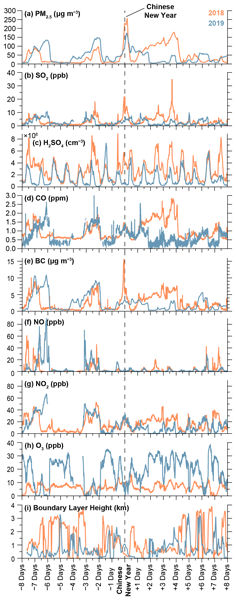
Benjamin Foreback, Lubna Dada, Kaspar R. Daellenbach, Chao Yan, Lili Wang, Biwu Chu, Ying Zhou, Tom V. Kokkonen, Mona Kurppa, Rosaria E. Pileci, Yonghong Wang, Tommy Chan, Juha Kangasluoma, Lin Zhuohui, Yishou Guo, Chang Li, Rima Baalbaki, Joni Kujansuu, Xiaolong Fan, Zemin Feng, Pekka Rantala, Shahzad Gani, Federico Bianchi, Veli-Matti Kerminen, Tuukka Petäjä, Markku Kulmala, Yongchun Liu, and Pauli Paasonen
Atmos. Chem. Phys., 22, 11089–11104, https://doi.org/10.5194/acp-22-11089-2022, https://doi.org/10.5194/acp-22-11089-2022, 2022
Short summary
Short summary
This study analyzed air quality in Beijing during the Chinese New Year over 7 years, including data from a new in-depth measurement station. This is one of few studies to look at long-term impacts, including the outcome of firework restrictions starting in 2018. Results show that firework pollution has gone down since 2016, indicating a positive result from the restrictions. Results of this study may be useful in making future decisions about the use of fireworks to improve air quality.
Ivo Beck, Hélène Angot, Andrea Baccarini, Lubna Dada, Lauriane Quéléver, Tuija Jokinen, Tiia Laurila, Markus Lampimäki, Nicolas Bukowiecki, Matthew Boyer, Xianda Gong, Martin Gysel-Beer, Tuukka Petäjä, Jian Wang, and Julia Schmale
Atmos. Meas. Tech., 15, 4195–4224, https://doi.org/10.5194/amt-15-4195-2022, https://doi.org/10.5194/amt-15-4195-2022, 2022
Short summary
Short summary
We present the pollution detection algorithm (PDA), a new method to identify local primary pollution in remote atmospheric aerosol and trace gas time series. The PDA identifies periods of contaminated data and relies only on the target dataset itself; i.e., it is independent of ancillary data such as meteorological variables. The parameters of all pollution identification steps are adjustable so that the PDA can be tuned to different locations and situations. It is available as open-access code.
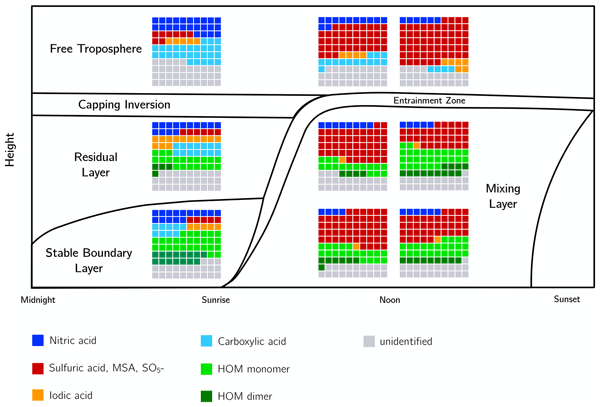
Lisa J. Beck, Siegfried Schobesberger, Heikki Junninen, Janne Lampilahti, Antti Manninen, Lubna Dada, Katri Leino, Xu-Cheng He, Iida Pullinen, Lauriane L. J. Quéléver, Anna Franck, Pyry Poutanen, Daniela Wimmer, Frans Korhonen, Mikko Sipilä, Mikael Ehn, Douglas R. Worsnop, Veli-Matti Kerminen, Tuukka Petäjä, Markku Kulmala, and Jonathan Duplissy
Atmos. Chem. Phys., 22, 8547–8577, https://doi.org/10.5194/acp-22-8547-2022, https://doi.org/10.5194/acp-22-8547-2022, 2022
Short summary
Short summary
The presented article introduces an overview of atmospheric ions and their composition above the boreal forest. We provide the results of an extensive airborne measurement campaign with an air ion mass spectrometer and particle measurements, showing their diurnal evolution within the boundary layer and free troposphere. In addition, we compare the airborne dataset with the co-located data from the ground at SMEAR II station, Finland.
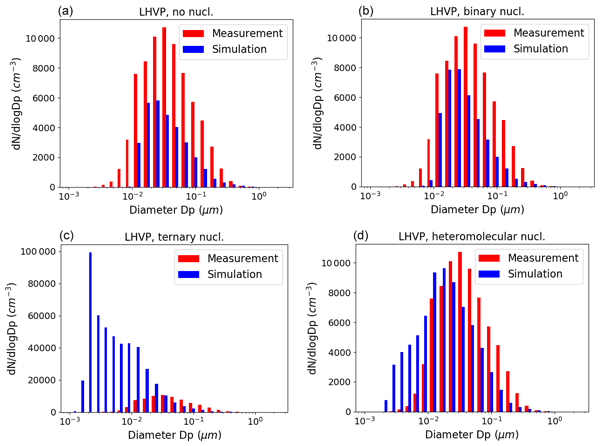
Karine Sartelet, Youngseob Kim, Florian Couvidat, Maik Merkel, Tuukka Petäjä, Jean Sciare, and Alfred Wiedensohler
Atmos. Chem. Phys., 22, 8579–8596, https://doi.org/10.5194/acp-22-8579-2022, https://doi.org/10.5194/acp-22-8579-2022, 2022
Short summary
Short summary
A methodology is defined to estimate number emissions from an inventory providing mass emissions. Number concentrations are simulated over Greater Paris using different nucleation parameterisations (binary, ternary involving sulfuric acid and ammonia, and heteromolecular involving sulfuric acid and extremely low-volatility organics, ELVOCs). The comparisons show that ternary nucleation may not be a dominant process for new particle formation in cities, but they stress the role of ELVOCs.
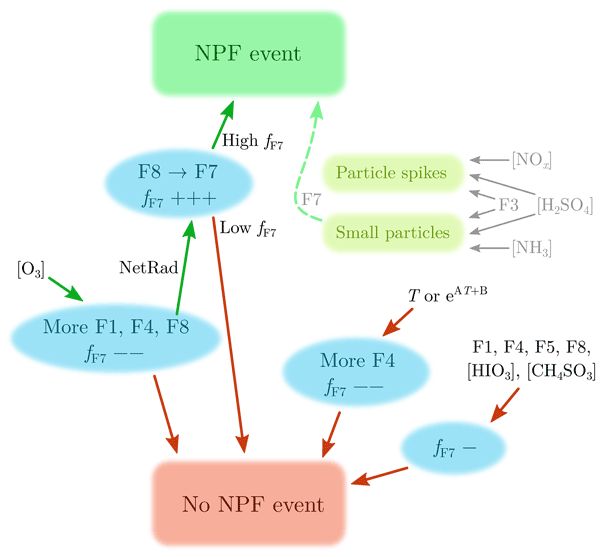
Miska Olin, Magdalena Okuljar, Matti P. Rissanen, Joni Kalliokoski, Jiali Shen, Lubna Dada, Markus Lampimäki, Yusheng Wu, Annalea Lohila, Jonathan Duplissy, Mikko Sipilä, Tuukka Petäjä, Markku Kulmala, and Miikka Dal Maso
Atmos. Chem. Phys., 22, 8097–8115, https://doi.org/10.5194/acp-22-8097-2022, https://doi.org/10.5194/acp-22-8097-2022, 2022
Short summary
Short summary
Atmospheric new particle formation is an important source of the total particle number concentration in the atmosphere. Several parameters for predicting new particle formation events have been suggested before, but the results have been inconclusive. This study proposes an another predicting parameter, related to a specific type of highly oxidized organic molecules, especially for similar locations to the measurement site in this study, which was a coastal agricultural site in Finland.

Ruochong Xu, Joel A. Thornton, Ben H. Lee, Yanxu Zhang, Lyatt Jaeglé, Felipe D. Lopez-Hilfiker, Pekka Rantala, and Tuukka Petäjä
Atmos. Chem. Phys., 22, 5477–5494, https://doi.org/10.5194/acp-22-5477-2022, https://doi.org/10.5194/acp-22-5477-2022, 2022
Short summary
Short summary
Monoterpenes are emitted into the atmosphere by vegetation and by the use of certain consumer products. Reactions of monoterpenes in the atmosphere lead to low-volatility products that condense to grow particulate matter or participate in new particle formation and, thus, affect air quality and climate. We use a model of atmospheric chemistry and transport to evaluate the global-scale importance of recent updates to our understanding of monoterpene chemistry in particle formation and growth.
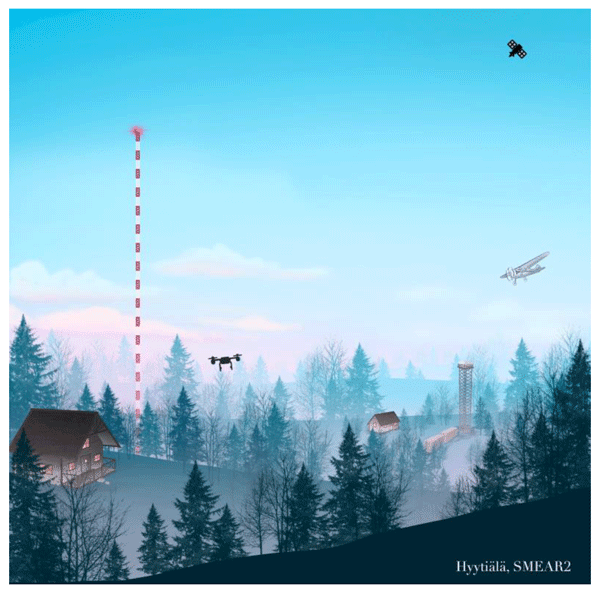
Zoé Brasseur, Dimitri Castarède, Erik S. Thomson, Michael P. Adams, Saskia Drossaart van Dusseldorp, Paavo Heikkilä, Kimmo Korhonen, Janne Lampilahti, Mikhail Paramonov, Julia Schneider, Franziska Vogel, Yusheng Wu, Jonathan P. D. Abbatt, Nina S. Atanasova, Dennis H. Bamford, Barbara Bertozzi, Matthew Boyer, David Brus, Martin I. Daily, Romy Fösig, Ellen Gute, Alexander D. Harrison, Paula Hietala, Kristina Höhler, Zamin A. Kanji, Jorma Keskinen, Larissa Lacher, Markus Lampimäki, Janne Levula, Antti Manninen, Jens Nadolny, Maija Peltola, Grace C. E. Porter, Pyry Poutanen, Ulrike Proske, Tobias Schorr, Nsikanabasi Silas Umo, János Stenszky, Annele Virtanen, Dmitri Moisseev, Markku Kulmala, Benjamin J. Murray, Tuukka Petäjä, Ottmar Möhler, and Jonathan Duplissy
Atmos. Chem. Phys., 22, 5117–5145, https://doi.org/10.5194/acp-22-5117-2022, https://doi.org/10.5194/acp-22-5117-2022, 2022
Short summary
Short summary
The present measurement report introduces the ice nucleation campaign organized in Hyytiälä, Finland, in 2018 (HyICE-2018). We provide an overview of the campaign settings, and we describe the measurement infrastructure and operating procedures used. In addition, we use results from ice nucleation instrument inter-comparison to show that the suite of these instruments deployed during the campaign reports consistent results.
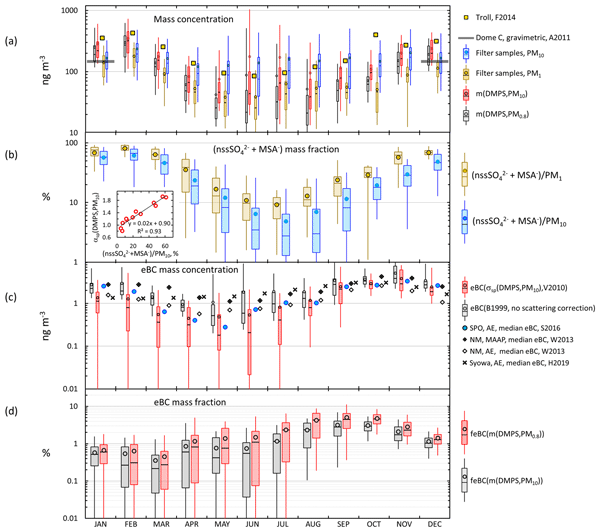
Aki Virkkula, Henrik Grythe, John Backman, Tuukka Petäjä, Maurizio Busetto, Christian Lanconelli, Angelo Lupi, Silvia Becagli, Rita Traversi, Mirko Severi, Vito Vitale, Patrick Sheridan, and Elisabeth Andrews
Atmos. Chem. Phys., 22, 5033–5069, https://doi.org/10.5194/acp-22-5033-2022, https://doi.org/10.5194/acp-22-5033-2022, 2022
Short summary
Short summary
Optical properties of surface aerosols at Dome C, Antarctica, in 2007–2013 and their potential source areas are presented. The equivalent black carbon (eBC) mass concentrations were compared with eBC measured at three other Antarctic sites: the South Pole (SPO) and two coastal sites, Neumayer and Syowa. Transport analysis suggests that South American BC emissions are the largest contributor to eBC at Dome C.
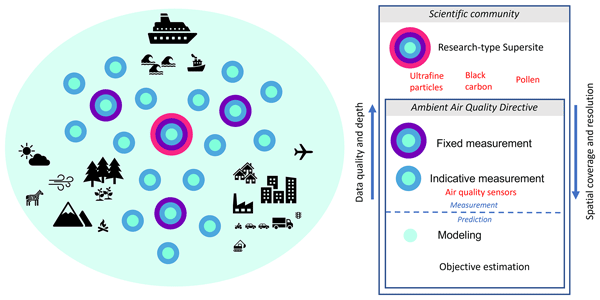
Joel Kuula, Hilkka Timonen, Jarkko V. Niemi, Hanna E. Manninen, Topi Rönkkö, Tareq Hussein, Pak Lun Fung, Sasu Tarkoma, Mikko Laakso, Erkka Saukko, Aino Ovaska, Markku Kulmala, Ari Karppinen, Lasse Johansson, and Tuukka Petäjä
Atmos. Chem. Phys., 22, 4801–4808, https://doi.org/10.5194/acp-22-4801-2022, https://doi.org/10.5194/acp-22-4801-2022, 2022
Short summary
Short summary
Modern and up-to-date policies and air quality management strategies are instrumental in tackling global air pollution. As the European Union is preparing to revise Ambient Air Quality Directive 2008/50/EC, this paper initiates discussion on selected features of the directive that we believe would benefit from a reassessment. The scientific community has the most recent and deepest understanding of air pollution; thus, its contribution is essential.
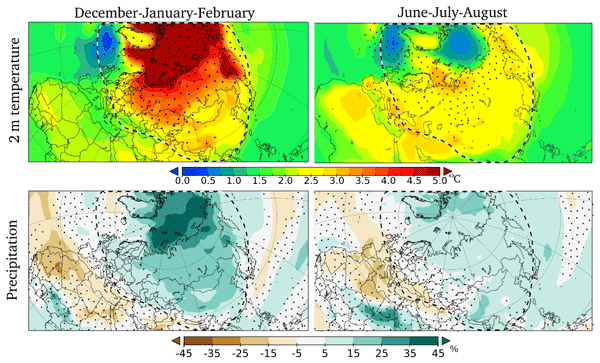
Hanna K. Lappalainen, Tuukka Petäjä, Timo Vihma, Jouni Räisänen, Alexander Baklanov, Sergey Chalov, Igor Esau, Ekaterina Ezhova, Matti Leppäranta, Dmitry Pozdnyakov, Jukka Pumpanen, Meinrat O. Andreae, Mikhail Arshinov, Eija Asmi, Jianhui Bai, Igor Bashmachnikov, Boris Belan, Federico Bianchi, Boris Biskaborn, Michael Boy, Jaana Bäck, Bin Cheng, Natalia Chubarova, Jonathan Duplissy, Egor Dyukarev, Konstantinos Eleftheriadis, Martin Forsius, Martin Heimann, Sirkku Juhola, Vladimir Konovalov, Igor Konovalov, Pavel Konstantinov, Kajar Köster, Elena Lapshina, Anna Lintunen, Alexander Mahura, Risto Makkonen, Svetlana Malkhazova, Ivan Mammarella, Stefano Mammola, Stephany Buenrostro Mazon, Outi Meinander, Eugene Mikhailov, Victoria Miles, Stanislav Myslenkov, Dmitry Orlov, Jean-Daniel Paris, Roberta Pirazzini, Olga Popovicheva, Jouni Pulliainen, Kimmo Rautiainen, Torsten Sachs, Vladimir Shevchenko, Andrey Skorokhod, Andreas Stohl, Elli Suhonen, Erik S. Thomson, Marina Tsidilina, Veli-Pekka Tynkkynen, Petteri Uotila, Aki Virkkula, Nadezhda Voropay, Tobias Wolf, Sayaka Yasunaka, Jiahua Zhang, Yubao Qiu, Aijun Ding, Huadong Guo, Valery Bondur, Nikolay Kasimov, Sergej Zilitinkevich, Veli-Matti Kerminen, and Markku Kulmala
Atmos. Chem. Phys., 22, 4413–4469, https://doi.org/10.5194/acp-22-4413-2022, https://doi.org/10.5194/acp-22-4413-2022, 2022
Short summary
Short summary
We summarize results during the last 5 years in the northern Eurasian region, especially from Russia, and introduce recent observations of the air quality in the urban environments in China. Although the scientific knowledge in these regions has increased, there are still gaps in our understanding of large-scale climate–Earth surface interactions and feedbacks. This arises from limitations in research infrastructures and integrative data analyses, hindering a comprehensive system analysis.
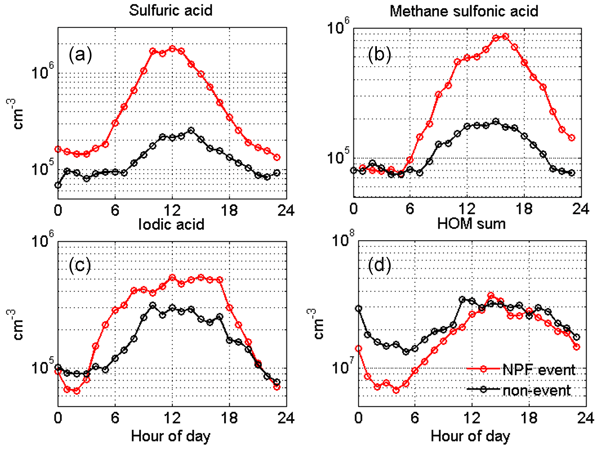
Tuija Jokinen, Katrianne Lehtipalo, Roseline Cutting Thakur, Ilona Ylivinkka, Kimmo Neitola, Nina Sarnela, Totti Laitinen, Markku Kulmala, Tuukka Petäjä, and Mikko Sipilä
Atmos. Chem. Phys., 22, 2237–2254, https://doi.org/10.5194/acp-22-2237-2022, https://doi.org/10.5194/acp-22-2237-2022, 2022
Short summary
Short summary
New particle formation is an important source of cloud condensation nuclei; however, long-term measurements of aerosol-forming vapors are close to nonexistent in the Arctic. Here, we report 7 months of CI-APi-TOF measurements of sulfuric acid, iodic acid, methane sulfonic acid and the sum of highly oxygenated organic molecules from the SMEAR I station in the Finnish subarctic. The results help us to understand atmospheric chemical processes and aerosol formation in this rapidly changing area.
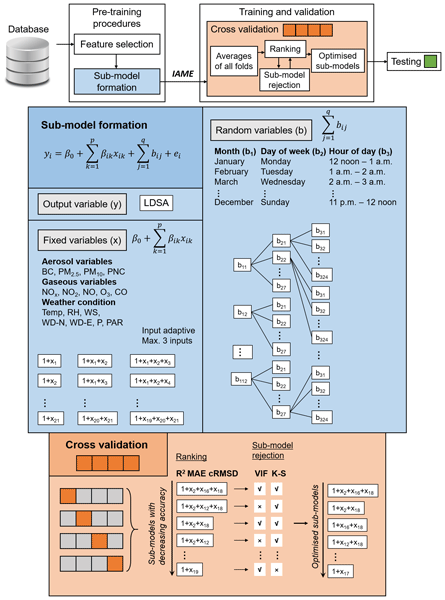
Pak Lun Fung, Martha A. Zaidan, Jarkko V. Niemi, Erkka Saukko, Hilkka Timonen, Anu Kousa, Joel Kuula, Topi Rönkkö, Ari Karppinen, Sasu Tarkoma, Markku Kulmala, Tuukka Petäjä, and Tareq Hussein
Atmos. Chem. Phys., 22, 1861–1882, https://doi.org/10.5194/acp-22-1861-2022, https://doi.org/10.5194/acp-22-1861-2022, 2022
Short summary
Short summary
We developed an input-adaptive mixed-effects model, which was automatised to select the best combination of input variables, including up to three fixed effect variables and three time indictors as random effect variables. We tested the model to estimate lung-deposited surface area (LDSA), which correlates well with human health. The results show the inclusion of time indicators improved the sensitivity and the accuracy of the model so that it could serve as a network of virtual sensors.
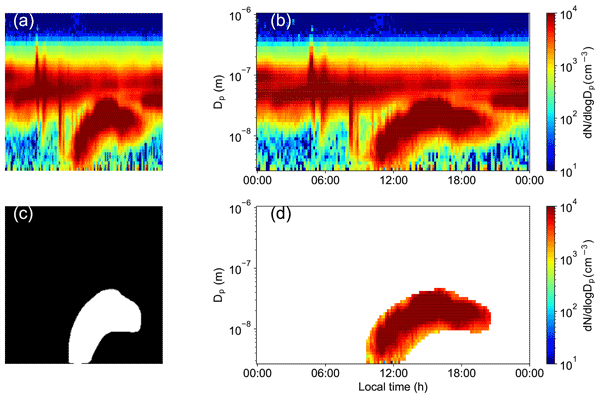
Peifeng Su, Jorma Joutsensaari, Lubna Dada, Martha Arbayani Zaidan, Tuomo Nieminen, Xinyang Li, Yusheng Wu, Stefano Decesari, Sasu Tarkoma, Tuukka Petäjä, Markku Kulmala, and Petri Pellikka
Atmos. Chem. Phys., 22, 1293–1309, https://doi.org/10.5194/acp-22-1293-2022, https://doi.org/10.5194/acp-22-1293-2022, 2022
Short summary
Short summary
We regarded the banana shapes in the surface plots as a special kind of object (similar to cats) and applied an instance segmentation technique to automatically identify the new particle formation (NPF) events (especially the strongest ones), in addition to their growth rates, start times, and end times. The automatic method generalized well on datasets collected in different sites, which is useful for long-term data series analysis and obtaining statistical properties of NPF events.
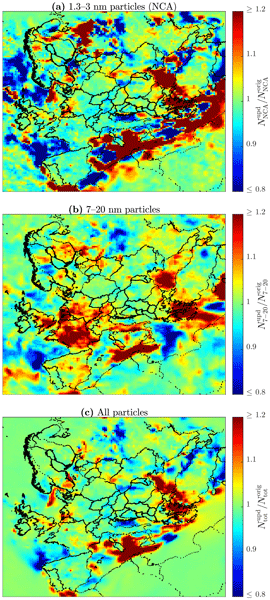
Miska Olin, David Patoulias, Heino Kuuluvainen, Jarkko V. Niemi, Topi Rönkkö, Spyros N. Pandis, Ilona Riipinen, and Miikka Dal Maso
Atmos. Chem. Phys., 22, 1131–1148, https://doi.org/10.5194/acp-22-1131-2022, https://doi.org/10.5194/acp-22-1131-2022, 2022
Short summary
Short summary
An emission factor particle size distribution was determined from the measurements at an urban traffic site. It was used in updating a pre-existing emission inventory, and regional modeling was performed after the update. Emission inventories typically underestimate nanoparticle emissions due to challenges in determining them with high certainty. This update reveals that the simulated aerosol levels have previously been underestimated especially for urban areas and for sub-50 nm particles.
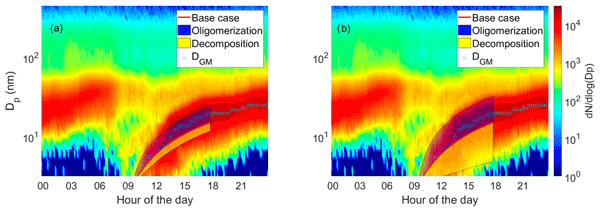
Arto Heitto, Kari Lehtinen, Tuukka Petäjä, Felipe Lopez-Hilfiker, Joel A. Thornton, Markku Kulmala, and Taina Yli-Juuti
Atmos. Chem. Phys., 22, 155–171, https://doi.org/10.5194/acp-22-155-2022, https://doi.org/10.5194/acp-22-155-2022, 2022
Short summary
Short summary
For atmospheric aerosol particles to take part in cloud formation, they need to be at least a few tens of nanometers in diameter. By using a particle condensation model, we investigated how two types of chemical reactions, oligomerization and decomposition, of organic molecules inside the particle may affect the growth of secondary aerosol particles to these sizes. We show that the effect is potentially significant, which highlights the importance of increasing understanding of these processes.
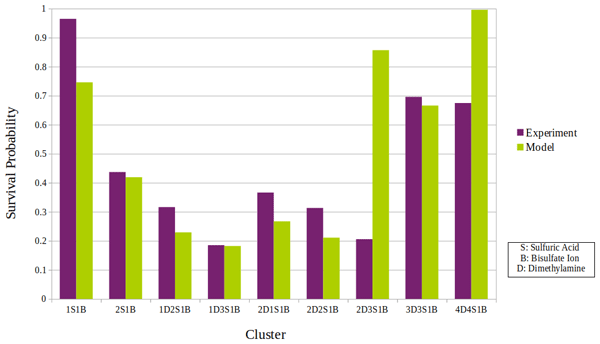
Dina Alfaouri, Monica Passananti, Tommaso Zanca, Lauri Ahonen, Juha Kangasluoma, Jakub Kubečka, Nanna Myllys, and Hanna Vehkamäki
Atmos. Meas. Tech., 15, 11–19, https://doi.org/10.5194/amt-15-11-2022, https://doi.org/10.5194/amt-15-11-2022, 2022
Short summary
Short summary
To study what is happening in the atmosphere, it is important to be able to measure the molecules and clusters present in it. In our work, we studied an artifact that happens inside a mass spectrometer, in particular the fragmentation of clusters. We were able to quantify the fragmentation and retrieve the correct concentration and composition of the clusters using our dual (experimental and theoretical) approach.
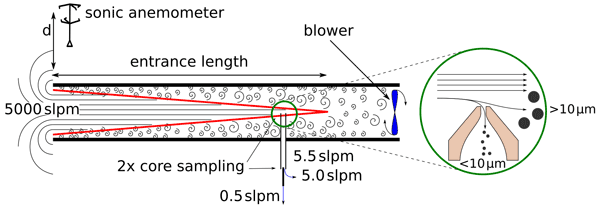
Lukas Fischer, Martin Breitenlechner, Eva Canaval, Wiebke Scholz, Marcus Striednig, Martin Graus, Thomas G. Karl, Tuukka Petäjä, Markku Kulmala, and Armin Hansel
Atmos. Meas. Tech., 14, 8019–8039, https://doi.org/10.5194/amt-14-8019-2021, https://doi.org/10.5194/amt-14-8019-2021, 2021
Short summary
Short summary
Ecosystems emit biogenic volatile organic compounds (BVOCs), which are then oxidized in the atmosphere, contributing to ozone and secondary aerosol formation. While flux measurements of BVOCs are state of the art, flux measurements of the less volatile oxidation products are difficult to achieve due to inlet losses. Here we present first flux measurements, utilizing a novel PTR3 instrument in combination with a specially designed wall-less inlet we put on top of the Hyytiälä tower in Finland.
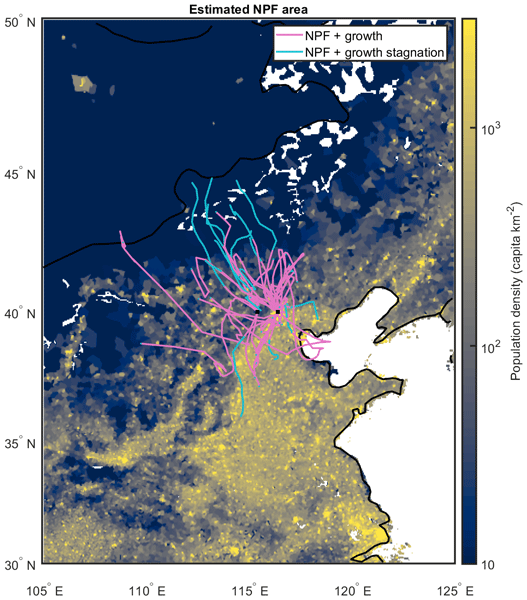
Ying Zhou, Simo Hakala, Chao Yan, Yang Gao, Xiaohong Yao, Biwu Chu, Tommy Chan, Juha Kangasluoma, Shahzad Gani, Jenni Kontkanen, Pauli Paasonen, Yongchun Liu, Tuukka Petäjä, Markku Kulmala, and Lubna Dada
Atmos. Chem. Phys., 21, 17885–17906, https://doi.org/10.5194/acp-21-17885-2021, https://doi.org/10.5194/acp-21-17885-2021, 2021
Short summary
Short summary
We characterized the connection between new particle formation (NPF) events in terms of frequency, intensity and growth at a near-highway location in central Beijing and at a background mountain site 80 km away. Due to the substantial contribution of NPF to the global aerosol budget, identifying the conditions that promote the occurrence of regional NPF events could help understand their contribution on a large scale and would improve their implementation in global models.
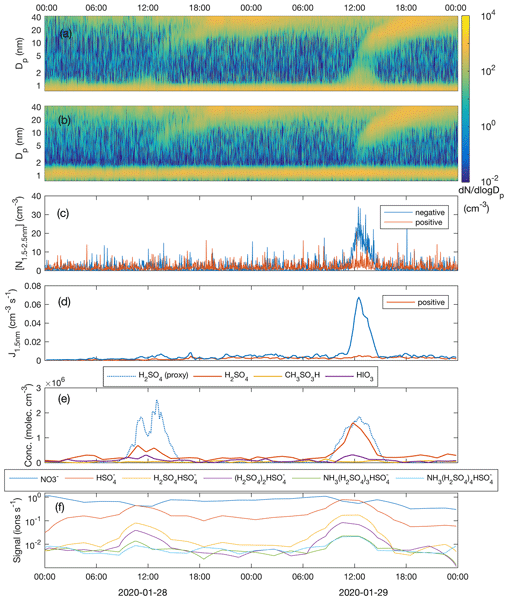
Mikko Sipilä, Nina Sarnela, Kimmo Neitola, Totti Laitinen, Deniz Kemppainen, Lisa Beck, Ella-Maria Duplissy, Salla Kuittinen, Tuuli Lehmusjärvi, Janne Lampilahti, Veli-Matti Kerminen, Katrianne Lehtipalo, Pasi P. Aalto, Petri Keronen, Erkki Siivola, Pekka A. Rantala, Douglas R. Worsnop, Markku Kulmala, Tuija Jokinen, and Tuukka Petäjä
Atmos. Chem. Phys., 21, 17559–17576, https://doi.org/10.5194/acp-21-17559-2021, https://doi.org/10.5194/acp-21-17559-2021, 2021
Short summary
Short summary
Metallurgical industry in Kola peninsula is a large source of air pollution in the (sub-)Arctic domain. Sulfur dioxide emissions from the ore smelters are transported across large areas. We investigated sulfur dioxide and its transformation to sulfuric acid aerosol particles during winter months in Finnish Lapland, close to Kola industrial areas. We observed intense formation of new aerosol particles despite the low solar radiation intensity, often required for new particle formation elsewhere.
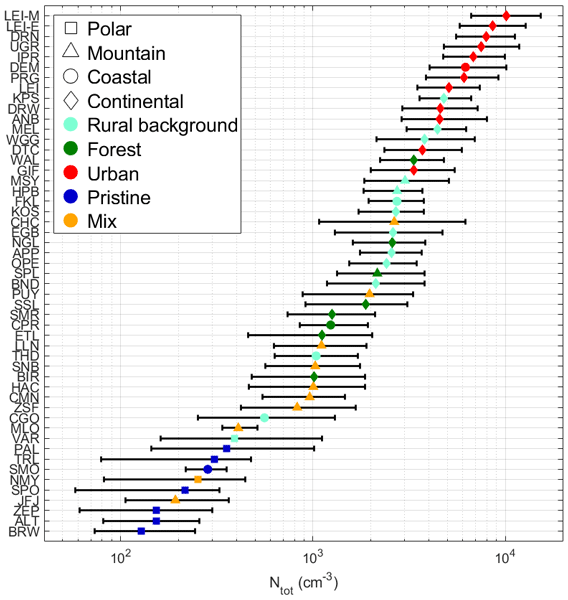
Clémence Rose, Martine Collaud Coen, Elisabeth Andrews, Yong Lin, Isaline Bossert, Cathrine Lund Myhre, Thomas Tuch, Alfred Wiedensohler, Markus Fiebig, Pasi Aalto, Andrés Alastuey, Elisabeth Alonso-Blanco, Marcos Andrade, Begoña Artíñano, Todor Arsov, Urs Baltensperger, Susanne Bastian, Olaf Bath, Johan Paul Beukes, Benjamin T. Brem, Nicolas Bukowiecki, Juan Andrés Casquero-Vera, Sébastien Conil, Konstantinos Eleftheriadis, Olivier Favez, Harald Flentje, Maria I. Gini, Francisco Javier Gómez-Moreno, Martin Gysel-Beer, Anna Gannet Hallar, Ivo Kalapov, Nikos Kalivitis, Anne Kasper-Giebl, Melita Keywood, Jeong Eun Kim, Sang-Woo Kim, Adam Kristensson, Markku Kulmala, Heikki Lihavainen, Neng-Huei Lin, Hassan Lyamani, Angela Marinoni, Sebastiao Martins Dos Santos, Olga L. Mayol-Bracero, Frank Meinhardt, Maik Merkel, Jean-Marc Metzger, Nikolaos Mihalopoulos, Jakub Ondracek, Marco Pandolfi, Noemi Pérez, Tuukka Petäjä, Jean-Eudes Petit, David Picard, Jean-Marc Pichon, Veronique Pont, Jean-Philippe Putaud, Fabienne Reisen, Karine Sellegri, Sangeeta Sharma, Gerhard Schauer, Patrick Sheridan, James Patrick Sherman, Andreas Schwerin, Ralf Sohmer, Mar Sorribas, Junying Sun, Pierre Tulet, Ville Vakkari, Pieter Gideon van Zyl, Fernando Velarde, Paolo Villani, Stergios Vratolis, Zdenek Wagner, Sheng-Hsiang Wang, Kay Weinhold, Rolf Weller, Margarita Yela, Vladimir Zdimal, and Paolo Laj
Atmos. Chem. Phys., 21, 17185–17223, https://doi.org/10.5194/acp-21-17185-2021, https://doi.org/10.5194/acp-21-17185-2021, 2021
Short summary
Short summary
Aerosol particles are a complex component of the atmospheric system the effects of which are among the most uncertain in climate change projections. Using data collected at 62 stations, this study provides the most up-to-date picture of the spatial distribution of particle number concentration and size distribution worldwide, with the aim of contributing to better representation of aerosols and their interactions with clouds in models and, therefore, better evaluation of their impact on climate.
Cited articles
Aalto, P., Hämeri, K., Becker, E. D. O., Weber, R., Salm, J., Mäkelä, J., Hoell, C., O'Dowd, C., Karlsson, H., Hansson, H.-C., Väkevä, M., Koponen, I. K., Buzorius, G., and Kulmala, M.: Physical characterization of aerosol particles during nucleation events, Tellus, Series B: Chemical and Physical Meteorology, 53, 344–358, https://doi.org/10.1034/j.1600-0889.2001.530403.x, 2001.
Aas, W., Mortier, A., Bowersox, V., Cherian, R., Faluvegi, G., Fagerli, H., Hand, J., Klimont, Z., Galy-Lacaux, C., Lehmann, C. M. B., Myhre, C. L., Myhre, G., Olivié, D., Sato, K., Quaas, J., Rao, P. S. P., Schulz, M., Shindell, D., Skeie, R. B., Stein, A., Takemura, T., Tsyro, S., Vet, R., and Xu, X.: Global and regional trends of atmospheric sulfur, Sci. Rep., 9, 953, https://doi.org/10.1038/s41598-018-37304-0, 2019.
Abdul-Razzak, H. and Ghan, S. J.: A parameterization of aerosol activation: 2. Multiple aerosol types, Journal of Geophysical Research: Atmospheres, 105, 6837–6844, https://doi.org/10.1029/1999JD901161, 2000.
Abdul-Razzak, H. and Ghan, S. J.: A parameterization of aerosol activation 3. Sectional representation, Journal of Geophysical Research: Atmospheres, 107, AAC 1-1–AAC 1-6, https://doi.org/10.1029/2001JD000483, 2002.
Ahonen, L., Petäjä, T., Heikkinen, L., Luoma, K., ranjan, rahul, and Aalto, P.: Cloud Condensation Nuclei observation data (2016–2020) for the study 'Optimizing CCN predictions through inferred modal aerosol composition – a boreal forest case study', Zenodo [data set], https://doi.org/10.5281/zenodo.17277646, 2025.
Albrecht, B. A.: Aerosols, Cloud Microphysics, and Fractional Cloudiness, Science, 245, 1227–1230, https://doi.org/10.1126/science.245.4923.1227, 1989.
Allan, J. D., Alfarra, M. R., Bower, K. N., Coe, H., Jayne, J. T., Worsnop, D. R., Aalto, P. P., Kulmala, M., Hyötyläinen, T., Cavalli, F., and Laaksonen, A.: Size and composition measurements of background aerosol and new particle growth in a Finnish forest during QUEST 2 using an Aerodyne Aerosol Mass Spectrometer, Atmos. Chem. Phys., 6, 315–327, https://doi.org/10.5194/acp-6-315-2006, 2006.
Anttila, T., Brus, D., Jaatinen, A., Hyvärinen, A.-P., Kivekäs, N., Romakkaniemi, S., Komppula, M., and Lihavainen, H.: Relationships between particles, cloud condensation nuclei and cloud droplet activation during the third Pallas Cloud Experiment, Atmos. Chem. Phys., 12, 11435–11450, https://doi.org/10.5194/acp-12-11435-2012, 2012.
Barahona, D., West, R. E. L., Stier, P., Romakkaniemi, S., Kokkola, H., and Nenes, A.: Comprehensively accounting for the effect of giant CCN in cloud activation parameterizations, Atmos. Chem. Phys., 10, 2467–2473, https://doi.org/10.5194/acp-10-2467-2010, 2010.
Bigg, E. K.: Discrepancy between observation and prediction of concentrations of cloud condensation nuclei, Atmospheric Research, 20, 81–86, https://doi.org/10.1016/0169-8095(86)90010-4, 1986.
Blichner, S. M., Yli-Juuti, T., Mielonen, T., Pöhlker, C., Holopainen, E., Heikkinen, L., Mohr, C., Artaxo, P., Carbone, S., Meller, B. B., Quaresma Dias-Júnior, C., Kulmala, M., Petäjä, T., Scott, C. E., Svenhag, C., Nieradzik, L., Sporre, M., Partridge, D. G., Tovazzi, E., Virtanen, A., Kokkola, H., and Riipinen, I.: Process-evaluation of forest aerosol-cloud-climate feedback shows clear evidence from observations and large uncertainty in models, Nat. Commun., 15, 969, https://doi.org/10.1038/s41467-024-45001-y, 2024.
Bougiatioti, A., Fountoukis, C., Kalivitis, N., Pandis, S. N., Nenes, A., and Mihalopoulos, N.: Cloud condensation nuclei measurements in the marine boundary layer of the Eastern Mediterranean: CCN closure and droplet growth kinetics, Atmos. Chem. Phys., 9, 7053–7066, https://doi.org/10.5194/acp-9-7053-2009, 2009.
Broekhuizen, K., Chang, R. Y.-W., Leaitch, W. R., Li, S.-M., and Abbatt, J. P. D.: Closure between measured and modeled cloud condensation nuclei (CCN) using size-resolved aerosol compositions in downtown Toronto, Atmos. Chem. Phys., 6, 2513–2524, https://doi.org/10.5194/acp-6-2513-2006, 2006.
Bulatovic, I., Igel, A. L., Leck, C., Heintzenberg, J., Riipinen, I., and Ekman, A. M. L.: The importance of Aitken mode aerosol particles for cloud sustenance in the summertime high Arctic – a simulation study supported by observational data, Atmos. Chem. Phys., 21, 3871–3897, https://doi.org/10.5194/acp-21-3871-2021, 2021.
Cai, M., Tan, H., Chan, C. K., Qin, Y., Xu, H., Li, F., Schurman, M. I., Liu, L., and Zhao, J.: The size-resolved cloud condensation nuclei (CCN) activity and its prediction based on aerosol hygroscopicity and composition in the Pearl Delta River (PRD) region during wintertime 2014, Atmos. Chem. Phys., 18, 16419–16437, https://doi.org/10.5194/acp-18-16419-2018, 2018.
Cerully, K. M., Raatikainen, T., Lance, S., Tkacik, D., Tiitta, P., Petäjä, T., Ehn, M., Kulmala, M., Worsnop, D. R., Laaksonen, A., Smith, J. N., and Nenes, A.: Aerosol hygroscopicity and CCN activation kinetics in a boreal forest environment during the 2007 EUCAARI campaign, Atmos. Chem. Phys., 11, 12369–12386, https://doi.org/10.5194/acp-11-12369-2011, 2011.
Chuang, P. Y., Collins, D. R., Pawlowska, H., Snider, J. R., Jonsson, H. H., Brenguier, J. L., Flagan, R. C., and Seinfeld, J. H.: CCN measurements during ACE-2 and their relationship to cloud microphysical properties, Tellus B, 52, 843–867, https://doi.org/10.1034/j.1600-0889.2000.00018.x, 2000.
Claflin, M. S. and Ziemann, P. J.: Identification and Quantitation of Aerosol Products of the Reaction of β-Pinene with NO3 Radicals and Implications for Gas- and Particle-Phase Reaction Mechanisms, J. Phys. Chem. A, 122, 3640–3652, https://doi.org/10.1021/acs.jpca.8b00692, 2018.
Clerx, M., Robinson, M., Lambert, B., Lei, C. L., Ghosh, S., Mirams, G. R., and Gavaghan, D. J.: Probabilistic Inference on Noisy Time Series (PINTS), Journal of Open Research Software, 7, https://doi.org/10.5334/jors.252, 2019.
Covert, D. S., Gras, J. L., Wiedensohler, A., and Stratmann, F.: Comparison of directly measured CCN with CCN modeled from the number-size distribution in the marine boundary layer during ACE 1 at Cape Grim, Tasmania, Journal of Geophysical Research: Atmospheres, 103, 16597–16608, https://doi.org/10.1029/98JD01093, 1998.
Croft, B., Martin, R. V., Leaitch, W. R., Burkart, J., Chang, R. Y.-W., Collins, D. B., Hayes, P. L., Hodshire, A. L., Huang, L., Kodros, J. K., Moravek, A., Mungall, E. L., Murphy, J. G., Sharma, S., Tremblay, S., Wentworth, G. R., Willis, M. D., Abbatt, J. P. D., and Pierce, J. R.: Arctic marine secondary organic aerosol contributes significantly to summertime particle size distributions in the Canadian Arctic Archipelago, Atmos. Chem. Phys., 19, 2787–2812, https://doi.org/10.5194/acp-19-2787-2019, 2019.
Cubison, M. J., Ervens, B., Feingold, G., Docherty, K. S., Ulbrich, I. M., Shields, L., Prather, K., Hering, S., and Jimenez, J. L.: The influence of chemical composition and mixing state of Los Angeles urban aerosol on CCN number and cloud properties, Atmos. Chem. Phys., 8, 5649–5667, https://doi.org/10.5194/acp-8-5649-2008, 2008.
Dewey, M.: rahulranjanaces/DREAM-MCMC: Inverse-closure using DREAM-MCMC (DREAM-MCMC), Zenodo [data set] and [code], https://doi.org/10.5281/zenodo.17243685, 2025.
Ditto, J. C., Barnes, E. B., Khare, P., Takeuchi, M., Joo, T., Bui, A. A. T., Lee-Taylor, J., Eris, G., Chen, Y., Aumont, B., Jimenez, J. L., Ng, N. L., Griffin, R. J., and Gentner, D. R.: An omnipresent diversity and variability in the chemical composition of atmospheric functionalized organic aerosol, Commun. Chem., 1, 1–13, https://doi.org/10.1038/s42004-018-0074-3, 2018.
Drinovec, L., Močnik, G., Zotter, P., Prévôt, A. S. H., Ruckstuhl, C., Coz, E., Rupakheti, M., Sciare, J., Müller, T., Wiedensohler, A., and Hansen, A. D. A.: The ”dual-spot” Aethalometer: an improved measurement of aerosol black carbon with real-time loading compensation, Atmos. Meas. Tech., 8, 1965–1979, https://doi.org/10.5194/amt-8-1965-2015, 2015.
Duplessis, P., Karlsson, L., Baccarini, A., Wheeler, M., Leaitch, W. R., Svenningsson, B., Leck, C., Schmale, J., Zieger, P., and Chang, R. Y.-W.: Highly Hygroscopic Aerosols Facilitate Summer and Early-Autumn Cloud Formation at Extremely Low Concentrations Over the Central Arctic Ocean, Journal of Geophysical Research: Atmospheres, 129, e2023JD039159, https://doi.org/10.1029/2023JD039159, 2024.
El Haber, M., Gérard, V., Kleinheins, J., Ferronato, C., and Nozière, B.: Measuring the Surface Tension of Atmospheric Particles and Relevant Mixtures to Better Understand Key Atmospheric Processes, Chem. Rev., 124, 10924–10963, https://doi.org/10.1021/acs.chemrev.4c00173, 2024.
Ervens, B., Cubison, M., Andrews, E., Feingold, G., Ogren, J. A., Jimenez, J. L., DeCarlo, P., and Nenes, A.: Prediction of cloud condensation nucleus number concentration using measurements of aerosol size distributions and composition and light scattering enhancement due to humidity, Journal of Geophysical Research: Atmospheres, 112, https://doi.org/10.1029/2006JD007426, 2007.
Ervens, B., Cubison, M. J., Andrews, E., Feingold, G., Ogren, J. A., Jimenez, J. L., Quinn, P. K., Bates, T. S., Wang, J., Zhang, Q., Coe, H., Flynn, M., and Allan, J. D.: CCN predictions using simplified assumptions of organic aerosol composition and mixing state: a synthesis from six different locations, Atmos. Chem. Phys., 10, 4795–4807, https://doi.org/10.5194/acp-10-4795-2010, 2010.
Ervens, B., Sorooshian, A., Aldhaif, A. M., Shingler, T., Crosbie, E., Ziemba, L., Campuzano-Jost, P., Jimenez, J. L., and Wisthaler, A.: Is there an aerosol signature of chemical cloud processing?, Atmos. Chem. Phys., 18, 16099–16119, https://doi.org/10.5194/acp-18-16099-2018, 2018.
Farmer, D. K., Matsunaga, A., Docherty, K. S., Surratt, J. D., Seinfeld, J. H., Ziemann, P. J., and Jimenez, J. L.: Response of an aerosol mass spectrometer to organonitrates and organosulfates and implications for atmospheric chemistry, Proceedings of the National Academy of Sciences, 107, 6670–6675, https://doi.org/10.1073/pnas.0912340107, 2010.
Feijó Barreira, L. M., Duporté, G., Rönkkö, T., Parshintsev, J., Hartonen, K., Hyrsky, L., Heikkinen, E., Jussila, M., Kulmala, M., and Riekkola, M.-L.: Field measurements of biogenic volatile organic compounds in the atmosphere using solid-phase microextraction Arrow, Atmos. Meas. Tech., 11, 881–893, https://doi.org/10.5194/amt-11-881-2018, 2018.
Fountoukis, C. and Nenes, A.: Continued development of a cloud droplet formation parameterization for global climate models, Journal of Geophysical Research: Atmospheres, 110, https://doi.org/10.1029/2004JD005591, 2005.
Furutani, H., Dall'osto, M., Roberts, G. C., and Prather, K. A.: Assessment of the relative importance of atmospheric aging on CCN activity derived from field observations, Atmospheric Environment, 42, 3130–3142, https://doi.org/10.1016/j.atmosenv.2007.09.024, 2008.
Gao, F. and Han, L.: Implementing the Nelder-Mead simplex algorithm with adaptive parameters, Comput. Optim. Appl., 51, 259–277, https://doi.org/10.1007/s10589-010-9329-3, 2012.
Gelfand, A. E. and Smith, A. F. M.: Sampling-Based Approaches to Calculating Marginal Densities, Journal of the American Statistical Association, 85, 398–409, https://doi.org/10.1080/01621459.1990.10476213, 1990.
Gelman, A. and Rubin, D. B.: Inference from Iterative Simulation Using Multiple Sequences, Statistical Science, 7, 457–472, https://doi.org/10.1214/ss/1177011136, 1992.
Gunthe, S. S., King, S. M., Rose, D., Chen, Q., Roldin, P., Farmer, D. K., Jimenez, J. L., Artaxo, P., Andreae, M. O., Martin, S. T., and Pöschl, U.: Cloud condensation nuclei in pristine tropical rainforest air of Amazonia: size-resolved measurements and modeling of atmospheric aerosol composition and CCN activity, Atmos. Chem. Phys., 9, 7551–7575, https://doi.org/10.5194/acp-9-7551-2009, 2009.
Hakola, H., Hellén, H., Hemmilä, M., Rinne, J., and Kulmala, M.: In situ measurements of volatile organic compounds in a boreal forest, Atmos. Chem. Phys., 12, 11665–11678, https://doi.org/10.5194/acp-12-11665-2012, 2012.
Hallquist, M., Wenger, J. C., Baltensperger, U., Rudich, Y., Simpson, D., Claeys, M., Dommen, J., Donahue, N. M., George, C., Goldstein, A. H., Hamilton, J. F., Herrmann, H., Hoffmann, T., Iinuma, Y., Jang, M., Jenkin, M. E., Jimenez, J. L., Kiendler-Scharr, A., Maenhaut, W., McFiggans, G., Mentel, Th. F., Monod, A., Prévôt, A. S. H., Seinfeld, J. H., Surratt, J. D., Szmigielski, R., and Wildt, J.: The formation, properties and impact of secondary organic aerosol: current and emerging issues, Atmos. Chem. Phys., 9, 5155–5236, https://doi.org/10.5194/acp-9-5155-2009, 2009.
Hämeri, K., Väkevä, M., Aalto, P. P., Kulmala, M., Swietlicki, E., Zhou, J., Seidl, W., Becker, E., and O'dowd, C. D.: Hygroscopic and CCN properties of aerosol particles in boreal forests, Tellus B, 53, 359–379, https://doi.org/10.1034/j.1600-0889.2001.530404.x, 2001.
Hao, L., Romakkaniemi, S., Kortelainen, A., Jaatinen, A., Portin, H., Miettinen, P., Komppula, M., Leskinen, A., Virtanen, A., Smith, J. N., Sueper, D., Worsnop, D. R., Lehtinen, K. E. J., and Laaksonen, A.: Aerosol Chemical Composition in Cloud Events by High Resolution Time-of-Flight Aerosol Mass Spectrometry, Environ. Sci. Technol., 47, 2645–2653, https://doi.org/10.1021/es302889w, 2013.
Hegg, D. A., Covert, D. S., Jonsson, H. H., and Woods, R.: Differentiating natural and anthropogenic cloud condensation nuclei in the California coastal zone, Tellus B, 61, 669–676, https://doi.org/10.1111/j.1600-0889.2009.00435.x, 2009.
Heikkinen, L., Äijälä, M., Riva, M., Luoma, K., Dällenbach, K., Aalto, J., Aalto, P., Aliaga, D., Aurela, M., Keskinen, H., Makkonen, U., Rantala, P., Kulmala, M., Petäjä, T., Worsnop, D., and Ehn, M.: Long-term sub-micrometer aerosol chemical composition in the boreal forest: inter- and intra-annual variability, Atmos. Chem. Phys., 20, 3151–3180, https://doi.org/10.5194/acp-20-3151-2020, 2020.
Heikkinen, L., Äijälä, M., Daellenbach, K. R., Chen, G., Garmash, O., Aliaga, D., Graeffe, F., Räty, M., Luoma, K., Aalto, P., Kulmala, M., Petäjä, T., Worsnop, D., and Ehn, M.: Eight years of sub-micrometre organic aerosol composition data from the boreal forest characterized using a machine-learning approach, Atmos. Chem. Phys., 21, 10081–10109, https://doi.org/10.5194/acp-21-10081-2021, 2021.
Heikkinen, L., Partridge, D. G., Blichner, S., Huang, W., Ranjan, R., Bowen, P., Tovazzi, E., Petäjä, T., Mohr, C., and Riipinen, I.: Cloud response to co-condensation of water and organic vapors over the boreal forest, Atmos. Chem. Phys., 24, 5117–5147, https://doi.org/10.5194/acp-24-5117-2024, 2024.
Hodzic, A., Aumont, B., Knote, C., Lee-Taylor, J., Madronich, S., and Tyndall, G.: Volatility dependence of Henry's law constants of condensable organics: Application to estimate depositional loss of secondary organic aerosols, Geophysical Research Letters, 41, 4795–4804, https://doi.org/10.1002/2014GL060649, 2014.
Hoppel, W. A., Frick, G. M., and Larson, R. E.: Effect of nonprecipitating clouds on the aerosol size distribution in the marine boundary layer, Geophysical Research Letters, 13, 125–128, https://doi.org/10.1029/GL013i002p00125, 1986.
Huang, W., Wu, C., Gao, L., Gramlich, Y., Haslett, S. L., Thornton, J., Lopez-Hilfiker, F. D., Lee, B. H., Song, J., Saathoff, H., Shen, X., Ramisetty, R., Tripathi, S. N., Ganguly, D., Jiang, F., Vallon, M., Schobesberger, S., Yli-Juuti, T., and Mohr, C.: Variation in chemical composition and volatility of oxygenated organic aerosol in different rural, urban, and mountain environments, Atmos. Chem. Phys., 24, 2607–2624, https://doi.org/10.5194/acp-24-2607-2024, 2024.
Hussein, T., Dal Maso, M., Petäjä, T., Koponen, I. K., Paatero, P., Aalto, P. P., Hämeri, K., and Kulmala, M.: Evaluation of an automatic algorithm for fitting the particle number size distributions, Boreal Environment Research, 10, 337–355, 2005.
Intergovernmental Panel on Climate Change (IPCC): Climate Change 2021 – The Physical Science Basis: Working Group I Contribution to the Sixth Assessment Report of the Intergovernmental Panel on Climate Change, Cambridge University Press, Cambridge, https://doi.org/10.1017/9781009157896, 2023.
Isokääntä, S., Kim, P., Mikkonen, S., Kühn, T., Kokkola, H., Yli-Juuti, T., Heikkinen, L., Luoma, K., Petäjä, T., Kipling, Z., Partridge, D., and Virtanen, A.: The effect of clouds and precipitation on the aerosol concentrations and composition in a boreal forest environment, Atmos. Chem. Phys., 22, 11823–11843, https://doi.org/10.5194/acp-22-11823-2022, 2022.
Jimenez, J. L., Canagaratna, M. R., Donahue, N. M., Prevot, A. S. H., Zhang, Q., Kroll, J. H., DeCarlo, P. F., Allan, J. D., Coe, H., Ng, N. L., Aiken, A. C., Docherty, K. S., Ulbrich, I. M., Grieshop, A. P., Robinson, A. L., Duplissy, J., Smith, J. D., Wilson, K. R., Lanz, V. A., Hueglin, C., Sun, Y. L., Tian, J., Laaksonen, A., Raatikainen, T., Rautiainen, J., Vaattovaara, P., Ehn, M., Kulmala, M., Tomlinson, J. M., Collins, D. R., Cubison, M. J., E., Dunlea, J., Huffman, J. A., Onasch, T. B., Alfarra, M. R., Williams, P. I., Bower, K., Kondo, Y., Schneider, J., Drewnick, F., Borrmann, S., Weimer, S., Demerjian, K., Salcedo, D., Cottrell, L., Griffin, R., Takami, A., Miyoshi, T., Hatakeyama, S., Shimono, A., Sun, J. Y., Zhang, Y. M., Dzepina, K., Kimmel, J. R., Sueper, D., Jayne, J. T., Herndon, S. C., Trimborn, A. M., Williams, L. R., Wood, E. C., Middlebrook, A. M., Kolb, C. E., Baltensperger, U., and Worsnop, D. R.: Evolution of Organic Aerosols in the Atmosphere, Science, 326, 1525–1529, https://doi.org/10.1126/science.1180353, 2009.
Jurányi, Z., Gysel, M., Weingartner, E., DeCarlo, P. F., Kammermann, L., and Baltensperger, U.: Measured and modelled cloud condensation nuclei number concentration at the high alpine site Jungfraujoch, Atmos. Chem. Phys., 10, 7891–7906, https://doi.org/10.5194/acp-10-7891-2010, 2010.
Khadir, T.: theodorekhadir/Particle_Size_Distribution_Log_Fit_Python: Particle_Size_Distribution_Log_Fit_Python v0.1.0 – Initial Release, Zenodo [code], https://doi.org/10.5281/zenodo.8017043, 2023.
Köhler, H.: The nucleus in and the growth of hygroscopic droplets, Trans. Faraday Soc., 32, 1152–1161, https://doi.org/10.1039/TF9363201152, 1936.
Kostenidou, E., Pathak, R. K., and Pandis, S. N.: An Algorithm for the Calculation of Secondary Organic Aerosol Density Combining AMS and SMPS Data, Aerosol Science and Technology, 41, 1002–1010, https://doi.org/10.1080/02786820701666270, 2007.
Kreidenweis, S. M., Walcek, C. J., Feingold, G., Gong, W., Jacobson, M. Z., Kim, C.-H., Liu, X., Penner, J. E., Nenes, A., and Seinfeld, J. H.: Modification of aerosol mass and size distribution due to aqueous-phase SO2 oxidation in clouds: Comparisons of several models, Journal of Geophysical Research: Atmospheres, 108, https://doi.org/10.1029/2002JD002697, 2003.
Kulmala, M. T.: Build a global Earth observatory, Nature, 553, 21–23, https://doi.org/10.1038/d41586-017-08967-y, 2018.
Kulmala, M., Nieminen, T., Nikandrova, A., Lehtipalo, K., Manninen, H. E., Kajos, M. K., Kolari, P., Lauri, A., Petaja, T., Krejci, R., Hansson, H.-C., Swietlicki, E., Lindroth, A., Christensen, T., Arneth, A., Hari, P., Back, J., Vesala, T., and Kerminen, V.-M.: CO2-induced terrestrial climate feedback mechanism: From carbon sink to aerosol source and back, Boreal Environment Research: An International Interdisciplinary Journal, 19, 122–131, 2014.
Lance, S., Nenes, A., Medina, J., and Smith, J. N.: Mapping the Operation of the DMT Continuous Flow CCN Counter, Aerosol Science and Technology, 40, 242–254, https://doi.org/10.1080/02786820500543290, 2006.
Lance, S., Raatikainen, T., Onasch, T. B., Worsnop, D. R., Yu, X.-Y., Alexander, M. L., Stolzenburg, M. R., McMurry, P. H., Smith, J. N., and Nenes, A.: Aerosol mixing state, hygroscopic growth and cloud activation efficiency during MIRAGE 2006, Atmos. Chem. Phys., 13, 5049–5062, https://doi.org/10.5194/acp-13-5049-2013, 2013.
Leaitch, W. R.: Observations Pertaining to the Effect of Chemical Transformation in Cloud on the Anthropogenic Aerosol Size Distribution, Aerosol Science and Technology, 25, 157–173, https://doi.org/10.1080/02786829608965388, 1996.
Lehtipalo, K., Yan, C., Dada, L., Bianchi, F., Xiao, M., Wagner, R., Stolzenburg, D., Ahonen, L. R., Amorim, A., Baccarini, A., Bauer, P. S., Baumgartner, B., Bergen, A., Bernhammer, A.-K., Breitenlechner, M., Brilke, S., Buchholz, A., Mazon, S. B., Chen, D., Chen, X., Dias, A., Dommen, J., Draper, D. C., Duplissy, J., Ehn, M., Finkenzeller, H., Fischer, L., Frege, C., Fuchs, C., Garmash, O., Gordon, H., Hakala, J., He, X., Heikkinen, L., Heinritzi, M., Helm, J. C., Hofbauer, V., Hoyle, C. R., Jokinen, T., Kangasluoma, J., Kerminen, V.-M., Kim, C., Kirkby, J., Kontkanen, J., Kürten, A., Lawler, M. J., Mai, H., Mathot, S., Mauldin, R. L., Molteni, U., Nichman, L., Nie, W., Nieminen, T., Ojdanic, A., Onnela, A., Passananti, M., Petäjä, T., Piel, F., Pospisilova, V., Quéléver, L. L. J., Rissanen, M. P., Rose, C., Sarnela, N., Schallhart, S., Schuchmann, S., Sengupta, K., Simon, M., Sipilä, M., Tauber, C., Tomé, A., Tröstl, J., Väisänen, O., Vogel, A. L., Volkamer, R., Wagner, A. C., Wang, M., Weitz, L., Wimmer, D., Ye, P., Ylisirniö, A., Zha, Q., Carslaw, K. S., Curtius, J., Donahue, N. M., Flagan, R. C., Hansel, A., Riipinen, I., Virtanen, A., Winkler, P. M., Baltensperger, U., Kulmala, M., and Worsnop, D. R.: Multicomponent new particle formation from sulfuric acid, ammonia, and biogenic vapors, Science Advances, 4, eaau5363, https://doi.org/10.1126/sciadv.aau5363, 2018.
Levin, E. J. T., Prenni, A. J., Palm, B. B., Day, D. A., Campuzano-Jost, P., Winkler, P. M., Kreidenweis, S. M., DeMott, P. J., Jimenez, J. L., and Smith, J. N.: Size-resolved aerosol composition and its link to hygroscopicity at a forested site in Colorado, Atmos. Chem. Phys., 14, 2657–2667, https://doi.org/10.5194/acp-14-2657-2014, 2014.
Li, Z., Buchholz, A., and Hyttinen, N.: Predicting hygroscopic growth of organosulfur aerosol particles using COSMOtherm, Atmos. Chem. Phys., 24, 11717–11725, https://doi.org/10.5194/acp-24-11717-2024, 2024.
Liu, P., Ziemann, P. J., Kittelson, D. B., and McMurry, P. H.: Generating Particle Beams of Controlled Dimensions and Divergence: I. Theory of Particle Motion in Aerodynamic Lenses and Nozzle Expansions, Aerosol Science and Technology, 22, 293–313, https://doi.org/10.1080/02786829408959748, 1995a.
Liu, P., Ziemann, P. J., Kittelson, D. B., and McMurry, P. H.: Generating Particle Beams of Controlled Dimensions and Divergence: II. Experimental Evaluation of Particle Motion in Aerodynamic Lenses and Nozzle Expansions, Aerosol Science and Technology, 22, 314–324, https://doi.org/10.1080/02786829408959749, 1995b.
Liwendahl, M.: The seasonality and inter-annual variation of aerosol particle size distributions in boreal forest, Bachelor thesis, Institutionen för Miljövetenskap (Department of Environmental Science), Stockholm University, Degree project in Environmental Science, Bachelor Programme in Physics, Sweden, 2021.
Lowe, S., Partridge, D. G., Topping, D., and Stier, P.: Inverse modelling of Köhler theory – Part 1: A response surface analysis of CCN spectra with respect to surface-active organic species, Atmos. Chem. Phys., 16, 10941–10963, https://doi.org/10.5194/acp-16-10941-2016, 2016.
Lowe, S. J., Partridge, D. G., Davies, J. F., Wilson, K. R., Topping, D., and Riipinen, I.: Key drivers of cloud response to surface-active organics, Nat. Commun., 10, 5214, https://doi.org/10.1038/s41467-019-12982-0, 2019.
Luoma, K., Niemi, J. V., Aurela, M., Fung, P. L., Helin, A., Hussein, T., Kangas, L., Kousa, A., Rönkkö, T., Timonen, H., Virkkula, A., and Petäjä, T.: Spatiotemporal variation and trends in equivalent black carbon in the Helsinki metropolitan area in Finland, Atmospheric Chemistry and Physics, 21, 1173–1189, https://doi.org/10.5194/acp-21-1173-2021, 2021.
Martin, M., Chang, R. Y.-W., Sierau, B., Sjogren, S., Swietlicki, E., Abbatt, J. P. D., Leck, C., and Lohmann, U.: Cloud condensation nuclei closure study on summer arctic aerosol, Atmos. Chem. Phys., 11, 11335–11350, https://doi.org/10.5194/acp-11-11335-2011, 2011.
Massling, A., Lange, R., Pernov, J. B., Gosewinkel, U., Sørensen, L.-L., and Skov, H.: Measurement report: High Arctic aerosol hygroscopicity at sub- and supersaturated conditions during spring and summer, Atmos. Chem. Phys., 23, 4931–4953, https://doi.org/10.5194/acp-23-4931-2023, 2023.
Meng, J. W., Yeung, M. C., Li, Y. J., Lee, B. Y. L., and Chan, C. K.: Size-resolved cloud condensation nuclei (CCN) activity and closure analysis at the HKUST Supersite in Hong Kong, Atmos. Chem. Phys., 14, 10267–10282, https://doi.org/10.5194/acp-14-10267-2014, 2014.
Merikanto, J., Spracklen, D. V., Mann, G. W., Pickering, S. J., and Carslaw, K. S.: Impact of nucleation on global CCN, Atmos. Chem. Phys., 9, 8601–8616, https://doi.org/10.5194/acp-9-8601-2009, 2009.
Metropolis, N., Rosenbluth, A. W., Rosenbluth, M. N., Teller, A. H., and Teller, E.: Equation of State Calculations by Fast Computing Machines, J. Chem. Phys., 21, 1087–1092, https://doi.org/10.1063/1.1699114, 1953.
Mohr, C., Thornton, J. A., Heitto, A., Lopez-Hilfiker, F. D., Lutz, A., Riipinen, I., Hong, J., Donahue, N. M., Hallquist, M., Petäjä, T., Kulmala, M., and Yli-Juuti, T.: Molecular identification of organic vapors driving atmospheric nanoparticle growth, Nat. Commun., 10, 4442, https://doi.org/10.1038/s41467-019-12473-2, 2019.
Morales Betancourt, R. and Nenes, A.: Droplet activation parameterization: the population-splitting concept revisited, Geosci. Model Dev., 7, 2345–2357, https://doi.org/10.5194/gmd-7-2345-2014, 2014.
Nenes, A. and Seinfeld, J. H.: Parameterization of cloud droplet formation in global climate models, Journal of Geophysical Research: Atmospheres, 108, https://doi.org/10.1029/2002JD002911, 2003.
Nenes, A., Pandis, S. N., and Pilinis, C.: ISORROPIA: A new thermodynamic equilibrium model for multiphase multicomponent inorganic aerosols, Aquatic Geochemistry, 4, 123–152, https://doi.org/10.1023/A:1009604003981, 1998.
Nenes, A., Pandis, S. N., and Pilinis, C.: Continued development and testing of a new thermodynamic aerosol module for urban and regional air quality models, Atmospheric Environment, 33, 1553–1560, https://doi.org/10.1016/S1352-2310(98)00352-5, 1999.
Ng, N. L., Herndon, S. C., Trimborn, A., Canagaratna, M. R., Croteau, P. L., Onasch, T. B., Sueper, D., Worsnop, D. R., Zhang, Q., Sun, Y. L., and Jayne, J. T.: An Aerosol Chemical Speciation Monitor (ACSM) for Routine Monitoring of the Composition and Mass Concentrations of Ambient Aerosol, Aerosol Science and Technology, 45, 780–794, https://doi.org/10.1080/02786826.2011.560211, 2011.
Nieminen, T., Asmi, A., Dal Maso, M., Aalto, P., Keronen, P., Petäjä, T., Kulmala, M., and Kerminen, V.-M.: Trends in atmospheric new-particle formation: 16 years of observations in a boreal-forest environment, Boreal Environment Research, 19, 191–214, 2014.
Nozière, B., Kalberer, M., Claeys, M., Allan, J., D'Anna, B., Decesari, S., Finessi, E., Glasius, M., Grgić, I., Hamilton, J. F., Hoffmann, T., Iinuma, Y., Jaoui, M., Kahnt, A., Kampf, C. J., Kourtchev, I., Maenhaut, W., Marsden, N., Saarikoski, S., Schnelle-Kreis, J., Surratt, J. D., Szidat, S., Szmigielski, R., and Wisthaler, A.: The Molecular Identification of Organic Compounds in the Atmosphere: State of the Art and Challenges, Chem. Rev., 115, 3919–3983, https://doi.org/10.1021/cr5003485, 2015.
Paasonen, P., Asmi, A., Petäjä, T., Kajos, M. K., Äijälä, M., Junninen, H., Holst, T., Abbatt, J. P. D., Arneth, A., Birmili, W., van der Gon, H. D., Hamed, A., Hoffer, A., Laakso, L., Laaksonen, A., Richard Leaitch, W., Plass-Dülmer, C., Pryor, S. C., Räisänen, P., Swietlicki, E., Wiedensohler, A., Worsnop, D. R., Kerminen, V.-M., and Kulmala, M.: Warming-induced increase in aerosol number concentration likely to moderate climate change, Nature Geosci., 6, 438–442, https://doi.org/10.1038/ngeo1800, 2013.
Paramonov, M., Aalto, P. P., Asmi, A., Prisle, N., Kerminen, V.-M., Kulmala, M., and Petäjä, T.: The analysis of size-segregated cloud condensation nuclei counter (CCNC) data and its implications for cloud droplet activation, Atmos. Chem. Phys., 13, 10285–10301, https://doi.org/10.5194/acp-13-10285-2013, 2013.
Paramonov, M., Kerminen, V.-M., Gysel, M., Aalto, P. P., Andreae, M. O., Asmi, E., Baltensperger, U., Bougiatioti, A., Brus, D., Frank, G. P., Good, N., Gunthe, S. S., Hao, L., Irwin, M., Jaatinen, A., Jurányi, Z., King, S. M., Kortelainen, A., Kristensson, A., Lihavainen, H., Kulmala, M., Lohmann, U., Martin, S. T., McFiggans, G., Mihalopoulos, N., Nenes, A., O'Dowd, C. D., Ovadnevaite, J., Petäjä, T., Pöschl, U., Roberts, G. C., Rose, D., Svenningsson, B., Swietlicki, E., Weingartner, E., Whitehead, J., Wiedensohler, A., Wittbom, C., and Sierau, B.: A synthesis of cloud condensation nuclei counter (CCNC) measurements within the EUCAARI network, Atmos. Chem. Phys., 15, 12211–12229, https://doi.org/10.5194/acp-15-12211-2015, 2015.
Park, K., Kittelson, D. B., and McMurry, P. H.: Structural Properties of Diesel Exhaust Particles Measured by Transmission Electron Microscopy (TEM): Relationships to Particle Mass and Mobility, Aerosol Science and Technology, 38, 881–889, https://doi.org/10.1080/027868290505189, 2004.
Partridge, D. G., Vrugt, J. A., Tunved, P., Ekman, A. M. L., Gorea, D., and Sorooshian, A.: Inverse modeling of cloud-aerosol interactions – Part 1: Detailed response surface analysis, Atmos. Chem. Phys., 11, 7269–7287, https://doi.org/10.5194/acp-11-7269-2011, 2011.
Partridge, D. G., Vrugt, J. A., Tunved, P., Ekman, A. M. L., Struthers, H., and Sorooshian, A.: Inverse modelling of cloud-aerosol interactions – Part 2: Sensitivity tests on liquid phase clouds using a Markov chain Monte Carlo based simulation approach, Atmos. Chem. Phys., 12, 2823–2847, https://doi.org/10.5194/acp-12-2823-2012, 2012.
Patokoski, J., Ruuskanen, T. M., Kajos, M. K., Taipale, R., Rantala, P., Aalto, J., Ryyppö, T., Nieminen, T., Hakola, H., and Rinne, J.: Sources of long-lived atmospheric VOCs at the rural boreal forest site, SMEAR II, Atmos. Chem. Phys., 15, 13413–13432, https://doi.org/10.5194/acp-15-13413-2015, 2015.
Petters, M. D. and Kreidenweis, S. M.: A single parameter representation of hygroscopic growth and cloud condensation nucleus activity, Atmos. Chem. Phys., 7, 1961–1971, https://doi.org/10.5194/acp-7-1961-2007, 2007.
Pierce, J. R., Leaitch, W. R., Liggio, J., Westervelt, D. M., Wainwright, C. D., Abbatt, J. P. D., Ahlm, L., Al-Basheer, W., Cziczo, D. J., Hayden, K. L., Lee, A. K. Y., Li, S.-M., Russell, L. M., Sjostedt, S. J., Strawbridge, K. B., Travis, M., Vlasenko, A., Wentzell, J. J. B., Wiebe, H. A., Wong, J. P. S., and Macdonald, A. M.: Nucleation and condensational growth to CCN sizes during a sustained pristine biogenic SOA event in a forested mountain valley, Atmos. Chem. Phys., 12, 3147–3163, https://doi.org/10.5194/acp-12-3147-2012, 2012.
Pöhlker, M. L., Zhang, M., Campos Braga, R., Krüger, O. O., Pöschl, U., and Ervens, B.: Aitken mode particles as CCN in aerosol- and updraft-sensitive regimes of cloud droplet formation, Atmos. Chem. Phys., 21, 11723–11740, https://doi.org/10.5194/acp-21-11723-2021, 2021.
Pöhlker, M. L., Pöhlker, C., Quaas, J., Mülmenstädt, J., Pozzer, A., Andreae, M. O., Artaxo, P., Block, K., Coe, H., Ervens, B., Gallimore, P., Gaston, C. J., Gunthe, S. S., Henning, S., Herrmann, H., Krüger, O. O., McFiggans, G., Poulain, L., Raj, S. S., Reyes-Villegas, E., Royer, H. M., Walter, D., Wang, Y., and Pöschl, U.: Global organic and inorganic aerosol hygroscopicity and its effect on radiative forcing, Nat. Commun., 14, 6139, https://doi.org/10.1038/s41467-023-41695-8, 2023.
Pruppacher, H. R. and Klett, J. D.: Microphysics of Clouds and Precipitation, Springer Netherlands, Dordrecht, https://doi.org/10.1007/978-0-306-48100-0, 2010.
Qiao, X., Yan, C., Li, X., Guo, Y., Yin, R., Deng, C., Li, C., Nie, W., Wang, M., Cai, R., Huang, D., Wang, Z., Yao, L., Worsnop, D. R., Bianchi, F., Liu, Y., Donahue, N. M., Kulmala, M., and Jiang, J.: Contribution of Atmospheric Oxygenated Organic Compounds to Particle Growth in an Urban Environment, Environ. Sci. Technol., 55, 13646–13656, https://doi.org/10.1021/acs.est.1c02095, 2021.
Quinn, P. K., Bates, T. S., Coffman, D. J., and Covert, D. S.: Influence of particle size and chemistry on the cloud nucleating properties of aerosols, Atmos. Chem. Phys., 8, 1029–1042, https://doi.org/10.5194/acp-8-1029-2008, 2008.
Ranjan, R.: rahulranjanaces/Inverse-closure: inverse-closure (version 0), Zenodo [data set and code] https://doi.org/10.5281/zenodo.17243563, 2025.
Rastak, N., Pajunoja, A., Acosta Navarro, J. C., Ma, J., Song, M., Partridge, D. G., Kirkevåg, A., Leong, Y., Hu, W. W., Taylor, N. F., Lambe, A., Cerully, K., Bougiatioti, A., Liu, P., Krejci, R., Petäjä, T., Percival, C., Davidovits, P., Worsnop, D. R., Ekman, A. M. L., Nenes, A., Martin, S., Jimenez, J. L., Collins, D. R., Topping, D. o., Bertram, A. K., Zuend, A., Virtanen, A., and Riipinen, I.: Microphysical explanation of the RH-dependent water affinity of biogenic organic aerosol and its importance for climate, Geophysical Research Letters, 44, 5167–5177, https://doi.org/10.1002/2017GL073056, 2017.
Ray, A., Pandithurai, G., Mukherjee, S., Kumar, V. A., Hazra, A., Patil, R. D., and Waghmare, V.: Seasonal variability in size-resolved hygroscopicity of sub-micron aerosols over the Western Ghats, India: Closure and parameterization, Science of The Total Environment, 869, 161753, https://doi.org/10.1016/j.scitotenv.2023.161753, 2023.
Rejano, F., Casans, A., Via, M., Casquero-Vera, J. A., Castillo, S., Lyamani, H., Cazorla, A., Andrews, E., Pérez-Ramírez, D., Alastuey, A., Gómez-Moreno, F. J., Alados-Arboledas, L., Olmo, F. J., and Titos, G.: CCN estimations at a high-altitude remote site: role of organic aerosol variability and hygroscopicity, Atmos. Chem. Phys., 24, 13865–13888, https://doi.org/10.5194/acp-24-13865-2024, 2024.
Reutter, P., Su, H., Trentmann, J., Simmel, M., Rose, D., Gunthe, S. S., Wernli, H., Andreae, M. O., and Pöschl, U.: Aerosol- and updraft-limited regimes of cloud droplet formation: influence of particle number, size and hygroscopicity on the activation of cloud condensation nuclei (CCN), Atmos. Chem. Phys., 9, 7067–7080, https://doi.org/10.5194/acp-9-7067-2009, 2009.
Riipinen, I., Pierce, J. R., Yli-Juuti, T., Nieminen, T., Häkkinen, S., Ehn, M., Junninen, H., Lehtipalo, K., Petäjä, T., Slowik, J., Chang, R., Shantz, N. C., Abbatt, J., Leaitch, W. R., Kerminen, V.-M., Worsnop, D. R., Pandis, S. N., Donahue, N. M., and Kulmala, M.: Organic condensation: a vital link connecting aerosol formation to cloud condensation nuclei (CCN) concentrations, Atmos. Chem. Phys., 11, 3865–3878, https://doi.org/10.5194/acp-11-3865-2011, 2011.
Rissman, T. A., VanReken, T. M., Wang, J., Gasparini, R., Collins, D. R., Jonsson, H. H., Brechtel, F. J., Flagan, R. C., and Seinfeld, J. H.: Characterization of ambient aerosol from measurements of cloud condensation nuclei during the 2003 Atmospheric Radiation Measurement Aerosol Intensive Observational Period at the Southern Great Plains site in Oklahoma, Journal of Geophysical Research: Atmospheres, 111, https://doi.org/10.1029/2004JD005695, 2006.
Riuttanen, L., Hulkkonen, M., Dal Maso, M., Junninen, H., and Kulmala, M.: Trajectory analysis of atmospheric transport of fine particles, SO2, NOx and O3 to the SMEAR II station in Finland in 1996–2008, Atmos. Chem. Phys., 13, 2153–2164, https://doi.org/10.5194/acp-13-2153-2013, 2013.
Riva, M., Chen, Y., Zhang, Y., Lei, Z., Olson, N. E., Boyer, H. C., Narayan, S., Yee, L. D., Green, H. S., Cui, T., Zhang, Z., Baumann, K., Fort, M., Edgerton, E., Budisulistiorini, S. H., Rose, C. A., Ribeiro, I. O., e Oliveira, R. L., dos Santos, E. O., Machado, C. M. D., Szopa, S., Zhao, Y., Alves, E. G., de Sá, S. S., Hu, W., Knipping, E. M., Shaw, S. L., Duvoisin Junior, S., de Souza, R. A. F., Palm, B. B., Jimenez, J.-L., Glasius, M., Goldstein, A. H., Pye, H. O. T., Gold, A., Turpin, B. J., Vizuete, W., Martin, S. T., Thornton, J. A., Dutcher, C. S., Ault, A. P., and Surratt, J. D.: Increasing Isoprene Epoxydiol-to-Inorganic Sulfate Aerosol Ratio Results in Extensive Conversion of Inorganic Sulfate to Organosulfur Forms: Implications for Aerosol Physicochemical Properties, Environ. Sci. Technol., 53, 8682–8694, https://doi.org/10.1021/acs.est.9b01019, 2019.
Roberts, G., Mauger, G., Hadley, O., and Ramanathan, V.: North American and Asian aerosols over the eastern Pacific Ocean and their role in regulating cloud condensation nuclei, Journal of Geophysical Research: Atmospheres, 111, https://doi.org/10.1029/2005JD006661, 2006.
Roberts, G. C. and Nenes, A.: A Continuous-Flow Streamwise Thermal-Gradient CCN Chamber for Atmospheric Measurements, Aerosol Science and Technology, 39, 206–221, https://doi.org/10.1080/027868290913988, 2005.
Robinson, A. L., Donahue, N. M., Shrivastava, M. K., Weitkamp, E. A., Sage, A. M., Grieshop, A. P., Lane, T. E., Pierce, J. R., and Pandis, S. N.: Rethinking Organic Aerosols: Semivolatile Emissions and Photochemical Aging, Science, 315, 1259–1262, https://doi.org/10.1126/science.1133061, 2007.
Roelofs, G.-J. a N., Lelieveld, J., and Ganzeveld, L.: Simulation of global sulfate distribution and the influence on effective cloud drop radii with a coupled photochemistry sulfur cycle model, Tellus B, 50, 224–242, https://doi.org/10.1034/j.1600-0889.1998.t01-2-00002.x, 1998.
Rogers, R. R. and Yau, M. K.: A Short Course in Cloud Physics, 3rd edn., Butterworth–Heinemann, ISBN 978-0-7506-3215-7, 1989.
Rose, D., Gunthe, S. S., Mikhailov, E., Frank, G. P., Dusek, U., Andreae, M. O., and Pöschl, U.: Calibration and measurement uncertainties of a continuous-flow cloud condensation nuclei counter (DMT-CCNC): CCN activation of ammonium sulfate and sodium chloride aerosol particles in theory and experiment, Atmos. Chem. Phys., 8, 1153–1179, https://doi.org/10.5194/acp-8-1153-2008, 2008.
Saliba, G., Sanchez, K. J., Russell, L. M., Twohy, C. H., Roberts, G. C., Lewis, S., Dedrick, J., McCluskey, C. S., Moore, K., DeMott, P. J., and Toohey, D. W.: Organic composition of three different size ranges of aerosol particles over the Southern Ocean, Aerosol Science and Technology, 55, 268–288, https://doi.org/10.1080/02786826.2020.1845296, 2020.
Schmale, J., Henning, S., Decesari, S., Henzing, B., Keskinen, H., Sellegri, K., Ovadnevaite, J., Pöhlker, M. L., Brito, J., Bougiatioti, A., Kristensson, A., Kalivitis, N., Stavroulas, I., Carbone, S., Jefferson, A., Park, M., Schlag, P., Iwamoto, Y., Aalto, P., Äijälä, M., Bukowiecki, N., Ehn, M., Frank, G., Fröhlich, R., Frumau, A., Herrmann, E., Herrmann, H., Holzinger, R., Kos, G., Kulmala, M., Mihalopoulos, N., Nenes, A., O'Dowd, C., Petäjä, T., Picard, D., Pöhlker, C., Pöschl, U., Poulain, L., Prévôt, A. S. H., Swietlicki, E., Andreae, M. O., Artaxo, P., Wiedensohler, A., Ogren, J., Matsuki, A., Yum, S. S., Stratmann, F., Baltensperger, U., and Gysel, M.: Long-term cloud condensation nuclei number concentration, particle number size distribution and chemical composition measurements at regionally representative observatories, Atmos. Chem. Phys., 18, 2853–2881, https://doi.org/10.5194/acp-18-2853-2018, 2018.
Seinfeld, J. H., Bretherton, C., Carslaw, K. S., Coe, H., DeMott, P. J., Dunlea, E. J., Feingold, G., Ghan, S., Guenther, A. B., Kahn, R., Kraucunas, I., Kreidenweis, S. M., Molina, M. J., Nenes, A., Penner, J. E., Prather, K. A., Ramanathan, V., Ramaswamy, V., Rasch, P. J., Ravishankara, A. R., Rosenfeld, D., Stephens, G., and Wood, R.: Improving our fundamental understanding of the role of aerosol-cloud interactions in the climate system, Proceedings of the National Academy of Sciences, 113, 5781–5790, https://doi.org/10.1073/pnas.1514043113, 2016.
Siegel, K., Neuberger, A., Karlsson, L., Zieger, P., Mattsson, F., Duplessis, P., Dada, L., Daellenbach, K., Schmale, J., Baccarini, A., Krejci, R., Svenningsson, B., Chang, R., Ekman, A. M. L., Riipinen, I., and Mohr, C.: Using Novel Molecular-Level Chemical Composition Observations of High Arctic Organic Aerosol for Predictions of Cloud Condensation Nuclei, Environ. Sci. Technol., 56, 13888–13899, https://doi.org/10.1021/acs.est.2c02162, 2022.
Sihto, S.-L., Mikkilä, J., Vanhanen, J., Ehn, M., Liao, L., Lehtipalo, K., Aalto, P. P., Duplissy, J., Petäjä, T., Kerminen, V.-M., Boy, M., and Kulmala, M.: Seasonal variation of CCN concentrations and aerosol activation properties in boreal forest, Atmos. Chem. Phys., 11, 13269–13285, https://doi.org/10.5194/acp-11-13269-2011, 2011.
Simpson, E., Connolly, P., and McFiggans, G.: An investigation into the performance of four cloud droplet activation parameterisations, Geosci. Model Dev., 7, 1535–1542, https://doi.org/10.5194/gmd-7-1535-2014, 2014.
Spitieri, C., Gini, M., Gysel-Beer, M., and Eleftheriadis, K.: Annual cycle of hygroscopic properties and mixing state of the suburban aerosol in Athens, Greece, Atmos. Chem. Phys., 23, 235–249, https://doi.org/10.5194/acp-23-235-2023, 2023.
Stokes, R. H. and Robinson, R. A.: Interactions in aqueous nonelectrolyte solutions. I. Solute-solvent equilibria, J. Phys. Chem., 70, 2126–2130, 1966.
Stroud, C. A., Nenes, A., Jimenez, J. L., DeCarlo, P. F., Huffman, J. A., Bruintjes, R., Nemitz, E., Delia, A. E., Toohey, D. W., Guenther, A. B., and Nandi, S.: Cloud Activating Properties of Aerosol Observed during CELTIC, Journal of the Atmospheric Sciences, 64, 441–459, https://doi.org/10.1175/JAS3843.1, 2007.
Timonen, H., Saarikoski, S., Tolonen-Kivimäki, O., Aurela, M., Saarnio, K., Petäjä, T., Aalto, P. P., Kulmala, M., Pakkanen, T., and Hillamo, R.: Size distributions, sources and source areas of water-soluble organic carbon in urban background air, Atmos. Chem. Phys., 8, 5635–5647, https://doi.org/10.5194/acp-8-5635-2008, 2008.
Topping, D. O., McFiggans, G. B., and Coe, H.: A curved multi-component aerosol hygroscopicity model framework: Part 1 – Inorganic compounds, Atmos. Chem. Phys., 5, 1205–1222, https://doi.org/10.5194/acp-5-1205-2005, 2005.
Tunved, P., Hansson, H.-C., Kerminen, V.-M., Ström, J., Maso, M. D., Lihavainen, H., Viisanen, Y., Aalto, P. P., Komppula, M., and Kulmala, M.: High Natural Aerosol Loading over Boreal Forests, Science, 312, 261–263, https://doi.org/10.1126/science.1123052, 2006.
Twomey, S.: Pollution and the planetary albedo, Atmospheric Environment, 8, 1251–1256, https://doi.org/10.1016/0004-6981(74)90004-3, 1974.
Virkkula, A., Mäkelä, T., Hillamo, R., Yli-Tuomi, T., Hirsikko, A., Hämeri, K., and Koponen, I. K.: A Simple Procedure for Correcting Loading Effects of Aethalometer Data, Journal of the Air & Waste Management Association, 57, 1214–1222, https://doi.org/10.3155/1047-3289.57.10.1214, 2007.
Vrugt, J. A., ter Braak, C. J. F., Diks, C. G. H., Robinson, B. A., Hyman, J. M., and Higdon, D.: Accelerating Markov Chain Monte Carlo Simulation by Differential Evolution with Self-Adaptive Randomized Subspace Sampling, International Journal of Nonlinear Sciences and Numerical Simulation, 10, 273–290, https://doi.org/10.1515/IJNSNS.2009.10.3.273, 2009.
Wang, J., Cubison, M. J., Aiken, A. C., Jimenez, J. L., and Collins, D. R.: The importance of aerosol mixing state and size-resolved composition on CCN concentration and the variation of the importance with atmospheric aging of aerosols, Atmos. Chem. Phys., 10, 7267–7283, https://doi.org/10.5194/acp-10-7267-2010, 2010.
Weingartner, E., Burtscher, H., and Baltensperger, U.: Hygroscopic properties of carbon and diesel soot particles, Atmospheric Environment, 31, 2311–2327, https://doi.org/10.1016/S1352-2310(97)00023-X, 1997.
Williams, J., Crowley, J., Fischer, H., Harder, H., Martinez, M., Petäjä, T., Rinne, J., Bäck, J., Boy, M., Dal Maso, M., Hakala, J., Kajos, M., Keronen, P., Rantala, P., Aalto, J., Aaltonen, H., Paatero, J., Vesala, T., Hakola, H., Levula, J., Pohja, T., Herrmann, F., Auld, J., Mesarchaki, E., Song, W., Yassaa, N., Nölscher, A., Johnson, A. M., Custer, T., Sinha, V., Thieser, J., Pouvesle, N., Taraborrelli, D., Tang, M. J., Bozem, H., Hosaynali-Beygi, Z., Axinte, R., Oswald, R., Novelli, A., Kubistin, D., Hens, K., Javed, U., Trawny, K., Breitenberger, C., Hidalgo, P. J., Ebben, C. J., Geiger, F. M., Corrigan, A. L., Russell, L. M., Ouwersloot, H. G., Vilà-Guerau de Arellano, J., Ganzeveld, L., Vogel, A., Beck, M., Bayerle, A., Kampf, C. J., Bertelmann, M., Köllner, F., Hoffmann, T., Valverde, J., González, D., Riekkola, M.-L., Kulmala, M., and Lelieveld, J.: The summertime Boreal forest field measurement intensive (HUMPPA-COPEC-2010): an overview of meteorological and chemical influences, Atmos. Chem. Phys., 11, 10599–10618, https://doi.org/10.5194/acp-11-10599-2011, 2011.
Wonaschuetz, A., Sorooshian, A., Ervens, B., Chuang, P. Y., Feingold, G., Murphy, S. M., de Gouw, J., Warneke, C., and Jonsson, H. H.: Aerosol and gas re-distribution by shallow cumulus clouds: An investigation using airborne measurements, Journal of Geophysical Research: Atmospheres, 117, https://doi.org/10.1029/2012JD018089, 2012.
Wu, Z. J., Zheng, J., Shang, D. J., Du, Z. F., Wu, Y. S., Zeng, L. M., Wiedensohler, A., and Hu, M.: Particle hygroscopicity and its link to chemical composition in the urban atmosphere of Beijing, China, during summertime, Atmos. Chem. Phys., 16, 1123–1138, https://doi.org/10.5194/acp-16-1123-2016, 2016.
Yan, C., Dada, L., Rose, C., Jokinen, T., Nie, W., Schobesberger, S., Junninen, H., Lehtipalo, K., Sarnela, N., Makkonen, U., Garmash, O., Wang, Y., Zha, Q., Paasonen, P., Bianchi, F., Sipilä, M., Ehn, M., Petäjä, T., Kerminen, V.-M., Worsnop, D. R., and Kulmala, M.: The role of H2SO4-NH3 anion clusters in ion-induced aerosol nucleation mechanisms in the boreal forest, Atmos. Chem. Phys., 18, 13231–13243, https://doi.org/10.5194/acp-18-13231-2018, 2018.
Ye, J., Gordon, C. A., and Chan, A. W. H.: Enhancement in Secondary Organic Aerosol Formation in the Presence of Preexisting Organic Particle, Environ. Sci. Technol., 50, 3572–3579, https://doi.org/10.1021/acs.est.5b05512, 2016.
Yli-Juuti, T., Mielonen, T., Heikkinen, L., Arola, A., Ehn, M., Isokääntä, S., Keskinen, H.-M., Kulmala, M., Laakso, A., Lipponen, A., Luoma, K., Mikkonen, S., Nieminen, T., Paasonen, P., Petäjä, T., Romakkaniemi, S., Tonttila, J., Kokkola, H., and Virtanen, A.: Significance of the organic aerosol driven climate feedback in the boreal area, Nat. Commun., 12, 5637, https://doi.org/10.1038/s41467-021-25850-7, 2021.
Yttri, K. E., Simpson, D., Nøjgaard, J. K., Kristensen, K., Genberg, J., Stenström, K., Swietlicki, E., Hillamo, R., Aurela, M., Bauer, H., Offenberg, J. H., Jaoui, M., Dye, C., Eckhardt, S., Burkhart, J. F., Stohl, A., and Glasius, M.: Source apportionment of the summer time carbonaceous aerosol at Nordic rural background sites, Atmos. Chem. Phys., 11, 13339–13357, https://doi.org/10.5194/acp-11-13339-2011, 2011.
Zhang, Q., Jimenez, J. L., Canagaratna, M. R., Allan, J. D., Coe, H., Ulbrich, I., Alfarra, M. R., Takami, A., Middlebrook, A. M., Sun, Y. L., Dzepina, K., Dunlea, E., Docherty, K., DeCarlo, P. F., Salcedo, D., Onasch, T., Jayne, J. T., Miyoshi, T., Shimono, A., Hatakeyama, S., Takegawa, N., Kondo, Y., Schneider, J., Drewnick, F., Borrmann, S., Weimer, S., Demerjian, K., Williams, P., Bower, K., Bahreini, R., Cottrell, L., Griffin, R. J., Rautiainen, J., Sun, J. Y., Zhang, Y. M., and Worsnop, D. R.: Ubiquity and dominance of oxygenated species in organic aerosols in anthropogenically-influenced Northern Hemisphere midlatitudes, Geophysical Research Letters, 34, https://doi.org/10.1029/2007GL029979, 2007.
Zhang, Y., Seigneur, C., Seinfeld, J. H., Jacobson, M., Clegg, S. L., and Binkowski, F. S.: A comparative review of inorganic aerosol thermodynamic equilibrium modules: similarities, differences, and their likely causes, Atmospheric Environment, 34, 117–137, https://doi.org/10.1016/S1352-2310(99)00236-8, 2000.
Zheng, G., Kuang, C., Uin, J., Watson, T., and Wang, J.: Large contribution of organics to condensational growth and formation of cloud condensation nuclei (CCN) in the remote marine boundary layer, Atmos. Chem. Phys., 20, 12515–12525, https://doi.org/10.5194/acp-20-12515-2020, 2020.
Short summary
We use multi-year measurements of cloud condensation nuclei (CCN) at a boreal forest site to inversely infer size-resolved aerosol chemical composition. We find that inorganic species are more enriched in the larger end (accumulation mode) of the sub-micron aerosol population while organics often dominate the smaller end (Aitken mode). Our approach demonstrates the potential of long-term CCN measurements to infer size-resolved chemical composition of sub-micron aerosol.
We use multi-year measurements of cloud condensation nuclei (CCN) at a boreal forest site to...


Altmetrics
Final-revised paper
Preprint