Articles | Volume 22, issue 9
https://doi.org/10.5194/acp-22-6115-2022
© Author(s) 2022. This work is distributed under
the Creative Commons Attribution 4.0 License.
https://doi.org/10.5194/acp-22-6115-2022
© Author(s) 2022. This work is distributed under
the Creative Commons Attribution 4.0 License.
Refining an ensemble of volcanic ash forecasts using satellite retrievals: Raikoke 2019
Antonio Capponi
CORRESPONDING AUTHOR
Lancaster Environment Centre, Lancaster University, Lancaster, LA1
4AQ, UK
Natalie J. Harvey
Department of Meteorology, University of Reading, Earley Gate,
Reading, RG6 6ET, UK
Helen F. Dacre
Department of Meteorology, University of Reading, Earley Gate,
Reading, RG6 6ET, UK
Keith Beven
Lancaster Environment Centre, Lancaster University, Lancaster, LA1
4AQ, UK
Cameron Saint
Met Office, Fitzroy Road, Exeter EX1 3PB, UK
Cathie Wells
Department of Meteorology, University of Reading, Earley Gate,
Reading, RG6 6ET, UK
Mike R. James
Lancaster Environment Centre, Lancaster University, Lancaster, LA1
4AQ, UK
Related authors
No articles found.
Claire L. Ryder, Clément Bézier, Helen F. Dacre, Rory Clarkson, Vassilis Amiridis, Eleni Marinou, Emmanouil Proestakis, Zak Kipling, Angela Benedetti, Mark Parrington, Samuel Rémy, and Mark Vaughan
Nat. Hazards Earth Syst. Sci., 24, 2263–2284, https://doi.org/10.5194/nhess-24-2263-2024, https://doi.org/10.5194/nhess-24-2263-2024, 2024
Short summary
Short summary
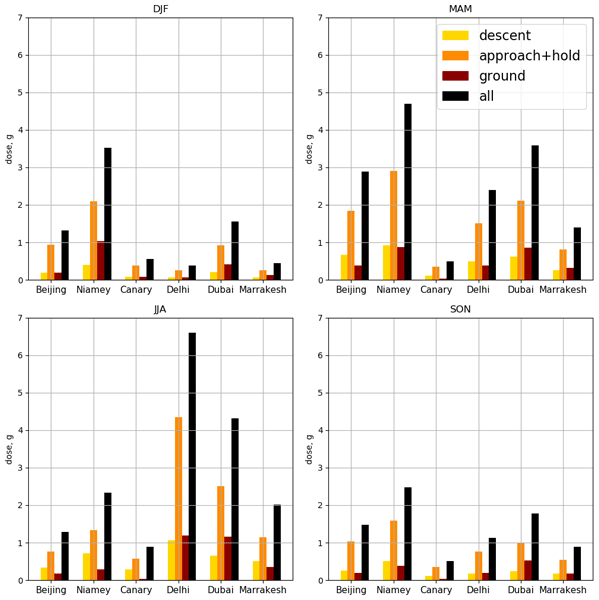
Desert dust poses a hazard to aircraft via degradation of engine components. This has financial implications for the aviation industry and results in increased fuel burn with climate impacts. Here we quantify dust ingestion by aircraft engines at airports worldwide. We find Dubai and Delhi in summer are among the dustiest airports, where substantial engine degradation would occur after 1000 flights. Dust ingestion can be reduced by changing take-off times and the altitude of holding patterns.
James M. Salter, Helen N. Webster, and Cameron Saint
Atmos. Chem. Phys., 24, 6251–6274, https://doi.org/10.5194/acp-24-6251-2024, https://doi.org/10.5194/acp-24-6251-2024, 2024
Short summary
Short summary
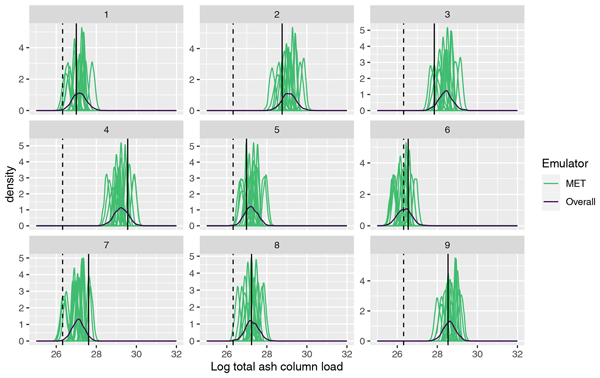
Models are used to make forecasts of volcanic ash dispersion during eruptions. These models have unknown inputs relating to the eruption itself, physical processes, and meteorological conditions. We use statistical models to predict the output of the expensive physical model and show we can account for the effects of the different inputs. We compare the model to real-world observations and show that accounting for all sources of uncertainty may lead to different conclusions about the inputs.
Elizabeth Follett, Keith Beven, Barry Hankin, David Mindham, and Nick Chappell
Proc. IAHS, 385, 197–201, https://doi.org/10.5194/piahs-385-197-2024, https://doi.org/10.5194/piahs-385-197-2024, 2024
Short summary
Short summary
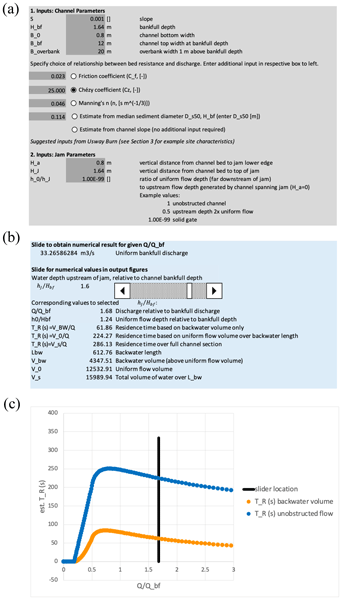
This paper presents a spreadsheet design tool for barriers in streams used for natural flood management. Retention times in such barriers should neither be too short (they fill and empty too quickly) or too long (they might already be full when a flood occurs). Previous work has shown the order of 10 h to be effective. The tool is freely available for download at https://www.jbatrust.org/how-we-help/publications-resources/rivers-and-coasts/nfm-leaky-barrier-retention-times.
Keith Beven, Trevor Page, Paul Smith, Ann Kretzschmar, Barry Hankin, and Nick Chappell
Proc. IAHS, 385, 129–134, https://doi.org/10.5194/piahs-385-129-2024, https://doi.org/10.5194/piahs-385-129-2024, 2024
Short summary
Short summary
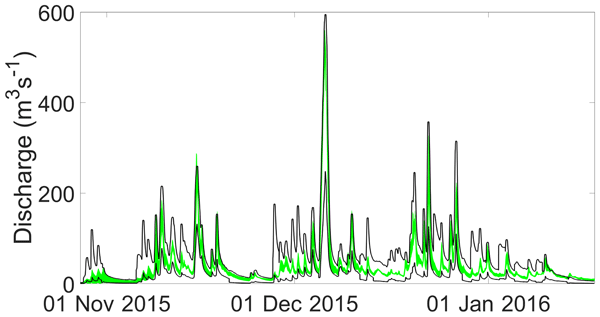
This paper presents a method of deciding when a hydrological model might be fit for purpose given the limitations of the data that are available for model evaluation. In this case the purpose is to reproduce the peak flows for an application that is concerned with evaluating the effect of natural flood management measures on flood peaks. It is shown that while all the models fail to pass the test at all time steps, there is an ensemble of models that pass for the hydrograph peaks.
Trevor Page, Paul Smith, Keith Beven, Francesca Pianosi, Fanny Sarrazin, Susana Almeida, Liz Holcombe, Jim Freer, Nick Chappell, and Thorsten Wagener
Hydrol. Earth Syst. Sci., 27, 2523–2534, https://doi.org/10.5194/hess-27-2523-2023, https://doi.org/10.5194/hess-27-2523-2023, 2023
Short summary
Short summary
This publication provides an introduction to the CREDIBLE Uncertainty Estimation (CURE) toolbox. CURE offers workflows for a variety of uncertainty estimation methods. One of its most important features is the requirement that all of the assumptions on which a workflow analysis depends be defined. This facilitates communication with potential users of an analysis. An audit trail log is produced automatically from a workflow for future reference.
Natalie J. Harvey, Helen F. Dacre, Cameron Saint, Andrew T. Prata, Helen N. Webster, and Roy G. Grainger
Atmos. Chem. Phys., 22, 8529–8545, https://doi.org/10.5194/acp-22-8529-2022, https://doi.org/10.5194/acp-22-8529-2022, 2022
Short summary
Short summary
In the event of a volcanic eruption, airlines need to make decisions about which routes are safe to operate and ensure that airborne aircraft land safely. The aim of this paper is to demonstrate the application of a statistical technique that best combines ash information from satellites and a suite of computer forecasts of ash concentration to provide a range of plausible estimates of how much volcanic ash emitted from a volcano is available to undergo long-range transport.
Martin J. Osborne, Johannes de Leeuw, Claire Witham, Anja Schmidt, Frances Beckett, Nina Kristiansen, Joelle Buxmann, Cameron Saint, Ellsworth J. Welton, Javier Fochesatto, Ana R. Gomes, Ulrich Bundke, Andreas Petzold, Franco Marenco, and Jim Haywood
Atmos. Chem. Phys., 22, 2975–2997, https://doi.org/10.5194/acp-22-2975-2022, https://doi.org/10.5194/acp-22-2975-2022, 2022
Short summary
Short summary
Using the Met Office NAME dispersion model, supported by satellite- and ground-based remote-sensing observations, we describe the dispersion of aerosols from the 2019 Raikoke eruption and the concurrent wildfires in Alberta Canada. We show how the synergy of dispersion modelling and multiple observation sources allowed observers in the London VAAC to arrive at a more complete picture of the aerosol loading at altitudes commonly used by aviation.
Cited articles
Beckett, F. M., Witham, C. S., Leadbetter, S. J., Crocker, R., Webster, H.
N., Hort, M. C., Jones, A. R., Devenish, B. J., and Thomson, D. J.:
Atmospheric Dispersion Modelling at the London VAAC: A Review of
Developments since the 2010 Eyjafjallajökull Volcano Ash Cloud,
Atmosphere, 11, 352, https://doi.org/10.3390/atmos11040352, 2020.
Bessho, K., Date, K., Hayashi, M., Ikeda, A., Imai, T., Inoue, H., Kumagai,
Y., Miyakawa, T., Murata, H., Ohno, T., Okuyama, A., Oyama, R.,Sasaki, Y.,
Shimazu, Y., Shimoji, K., Sumida, Y., Suzuki, M., Taniguchi, H., Tsuchiyama,
H., Uesawa, D., Yokota, H., and Yoshida, R.: An Introduction to
Himawari-8/9; Japan's New-Generation Geostationary Meteorological
Satellites, J. Meteorol. Soc. Jpn. Ser. II, 94,
151–183, https://doi.org/10.2151/jmsj.2016-009, 2016.
Beven, K. and Binley, A.: The future of distributed models: Model
calibration and uncertainty prediction, Hydrol. Process., 6, 279–298,
https://doi.org/10.1002/hyp.3360060305, 1992.
Bowler, N. E., Arribas, A., Mylne, K. R., Robertson, K. B., and Beare, S.
E.: The MOGREPS short-range ensemble prediction system, Q. J.
Roy. Meteor. Soc., 134, 703–722,
https://doi.org/10.1002/qj.234, 2008.
Capponi, A., Harvey, N. J., Dacre, H. F., Beven, K., Saint, C., James, M. R., and Wells, C. A.: Ensembles of volcanic ash NAME simulations (01, 03, 08), Lancaster University [data set], https://doi.org/10.17635/lancaster/researchdata/491, 2022.
Casadevall, T. J.: The 1989–1990 eruption of Redoubt Volcano, Alaska:
impacts on aircraft operations, J. Volcanol. Geoth.
Res., 62, 301–316, 1994.
Cashman, K. V. and Rust, A. C.: Far‐travelled ash in past and future eruptions: combining tephrochronology with volcanic studies, J. Quaternary Sci., 35, 11–22, 2020.
Chai, T., Crawford, A., Stunder, B., Pavolonis, M. J., Draxler, R., and Stein, A.: Improving volcanic ash predictions with the HYSPLIT dispersion model by assimilating MODIS satellite retrievals, Atmos. Chem. Phys., 17, 2865–2879, https://doi.org/10.5194/acp-17-2865-2017, 2017.
Clarkson, R. J. and Simpson, H.: Maximising airspace use during volcanic
eruptions: matching engine durability against ash cloud occurrence. Science
and Technology Organization (STO) – Meeting Proceedings Paper MP-AVT-272-17,
15–17 May 2017, Vilnius, Lithuania, 1–20, 2017.
Dacre, H. F., Grant, A. L., Hogan, R. J., Belcher, S. E., Thomson, D. J.,
Devenish, B. J., Marenco, F., Hort, M. C., Haywood, J. M., Ansmann, A., and
Mattis, I.: Evaluating the structure and magnitude of the ash plume
during the initial phase of the 2010 Eyjafjallajökull eruption using
lidar observations and NAME simulations, J. Geophys. Res.-Atmos., 116, D00U03, https://doi.org/10.1029/2011JD015608, 2011.
Dacre, H. F., Grant, A. L. M., Harvey, N. J., Thomson, D. J., Webster, H. N., and Marenco F.: Volcanic ash layer depth: Processes and mechanisms, Geophys. Res. Lett., 42, 637–645, https://doi.org/10.1002/2014GL062454, 2015.
Dacre, H. F., Harvey, N. J., Webley, P. W., and Morton, D.: How accurate are
volcanic ash simulations of the 2010 Eyjafjallajökull eruption?, J. Geophys. Res.-Atmos., 121, 3534–3547,
https://doi.org/10.1002/2015JD024265, 2016.
Denlinger, R. P., Pavolonis, M., and Sieglaff, J.: A robust method to
forecast volcanic ash clouds, J. Geophys. Res., 117, D13208,
https://doi.org/10.1029/2012JD017732, 2012.
Flowerdew, J. and Bowler, N. E.: Improving the use of observations to
calibrate ensemble spread, Q. J. Roy. Meteor.
Soc., 137, 467–482, https://doi.org/10.1002/qj.744,
2011.
Flowerdew, J. and Bowler, N. E.: On-line calibration of the vertical
distribution of ensemble spread, Q. J. Roy.
Meteor. Soc., 139, 1863–1874,
https://doi.org/10.1002/qj.2072, 2013.
Francis, P. N., Cooke, M. C., and Saunders, R. W.: Retrieval of physical
properties of volcanic ash using Meteosat: A case study from the 2010
Eyjafjallajökull eruption, J. Geophys. Res., 117, D00U09,
https://doi.org/10.1029/2011JD016788, 2012.
Fu, G., Lin, H., Heemink, A., Segers, A., Lu, S., and Palsson, T.:
Assimilating aircraft-based measurements to improve forecast accuracy of
volcanic ash transport, Atmos. Environ., 115, 170–184,
https://doi.org/10.1016/j.atmosenv.2015.05.061, 2015.
Fu, G., Prata, F., Lin, H. X., Heemink, A., Segers, A., and Lu, S.: Data assimilation for volcanic ash plumes using a satellite observational operator: a case study on the 2010 Eyjafjallajökull volcanic eruption, Atmos. Chem. Phys., 17, 1187–1205, https://doi.org/10.5194/acp-17-1187-2017, 2017.
Global Volcanism Program: Report on Raikoke (Russia), edited by: Crafford, A. E. and
Venzke, E., Bulletin of the Global Volcanism Network, 44, Smithsonian
Institution, https://doi.org/10.5479/si.GVP.BGVN201908-290250, 2019.
Grant, A. L. M., Dacre, H. F., Thomson, D. J., and Marenco, F.: Horizontal and vertical structure of the Eyjafjallajökull ash cloud over the UK: a comparison of airborne lidar observations and simulations, Atmos. Chem. Phys., 12, 10145–10159, https://doi.org/10.5194/acp-12-10145-2012, 2012.
Gouhier, M., Eychenne, J., Azzaoui, N., Guillin, A., Deslandes, M., Poret, M., Costa, A., and Husson, P.: Low efficiency of large volcanic eruptions in transporting very fine ash into the atmosphere, Sci. Rep.-UK, 9, 1449, https://doi.org/10.1038/s41598-019-38595-7, 2019.
Harvey, N. J. and Dacre, H. F.: Spatial evaluation of volcanic ash forecasts using satellite observations, Atmos. Chem. Phys., 16, 861–872, https://doi.org/10.5194/acp-16-861-2016, 2016.
Harvey, N. J., Huntley, N., Dacre, H. F., Goldstein, M., Thomson, D., and Webster, H.: Multi-level emulation of a volcanic ash transport and dispersion model to quantify sensitivity to uncertain parameters, Nat. Hazards Earth Syst. Sci., 18, 41–63, https://doi.org/10.5194/nhess-18-41-2018, 2018.
Harvey, N. J., Dacre, H. F., Webster, H. N., Taylor, I. A., Khanal, S.,
Grainger, R. G., and Cooke, M. C.: The Impact of Ensemble Meteorology on
Inverse Modeling Estimates of Volcano Emissions and Ash Dispersion
Forecasts: Grímsvötn 2011, Atmosphere, 11,
1022, https://doi.org/10.3390/atmos11101022, 2020.
Hedelt, P., Efremenko, D. S., Loyola, D. G., Spurr, R., and Clarisse, L.: Sulfur dioxide layer height retrieval from Sentinel-5 Precursor/TROPOMI using FP_ILM, Atmos. Meas. Tech., 12, 5503–5517, https://doi.org/10.5194/amt-12-5503-2019, 2019.
Hobbs, P. V., Radke, L. F., Lyons, J. H., Ferek, R. J., Coffman, D. J., and
Casadevall, T. J.: Airborne measurements of particle and gas emissions from
the 1990 volcanic eruptions of Mount Redoubt, J. Geophys.
Res., 96, 18735–18752, 1991.
Jolliffe, I. T. and Stephenson, D. B.: Forecast Verification A
Practitioner's Guide in Atmosphere Science, Wiley-Blackwell, Chichester,
2012.
Jones, A., Thomson, D., Hort, M., and Devenish, B.: The U.K. Met Office's Next-Generation Atmospheric Dispersion Model, NAME III, in: Air Pollution Modeling and Its Application XVII, edited by: Borrego, C. and Norman, A. L., Springer, Boston, MA, https://doi.org/10.1007/978-0-387-68854-1_62, 2007.
Kalnay, E., Kanamitsu, M.,Kistler, R., Collins, W., Deaven, D., Gandin, L., Iredell M., Saha, S., White, G., Woollen, J., Zhu, Y., Chelliah, M., Ebisuzaki, W., Higgins, W., Janowiak, J., Mo, K.C., Ropelewski, C., Wang, J., Leetmaa, A., Reynolds, R., Jenne, R., and Joseph, D.: The NCEP/NCAR 40-year
reanalysis project, B. Am. Meteorol. Soc., 77,
437–472, 1996.
Kristiansen, N. I., Stohl, A., Prata, A. J., Bukowiecki, N., Dacre, H.,
Eckhardt, S., Henne, S., Hort, M. C., Johnson, B. T., Marenco, F.,Neininger,
B., Reitebuch, O., Seibert, P., Thomson, D. J., Webster, H. N., and
Weinzierl, B.: Performance assessment of a volcanic ash transport model
mini-ensemble used for inverse modeling of the 2010 Eyjafjallajökull
eruption, J. Geophys. Res., 117, D00U11, https://doi.org/10.1029/2011JD016844, 2012.
Krotkov, N. A., Flittner, D., Krueger, A., Kostinski, A., Riley, C., Rose,
W., and Torres, O.: Effect of particle non-sphericity on satellite
monitoring of drifting volcanic ash clouds, J. Quant.
Spectrosc. Ra., 63, 613–630, 1999.
Lawrence, B. N., Bennett, V., Churchill, J., Juckes, M., Kershaw, P.,
Oliver, P., Pritchard, M., and Stephens, A.: The JASMIN super-data-cluster,
arXiv [preprint], arXiv:1204.3553, 2012.
Marti, A. and Folch, A.: Volcanic ash modeling with the NMMB-MONARCH-ASH model: quantification of offline modeling errors, Atmos. Chem. Phys., 18, 4019–4038, https://doi.org/10.5194/acp-18-4019-2018, 2018.
Mastin, L. G., Guffanti, M., Servranckx, R., Webley, P., Barsotti, S., Dean, K., Durant, A., Ewert, J. W., Neri, A., Rose, W. I., Schneider, D., Siebert, L., Stunder, B., Swanson, G., Tupper, A., Volentik, A., and Waythomas, C. F.: A multidisciplinary effort to assign realistic source parameters to models of volcanic ash-cloud transport and dispersion during eruptions, J. Volcanol. Geoth. Res., 186, 10–21, 2009.
Met Office: Iris: A Python package for analysing and visualising
meteorological and oceanographic data sets, v3.1,
http://scitools.org.uk/ (last access: 30 March 2022), 2021.
Mingari, L., Folch, A., Prata, A. T., Pardini, F., Macedonio, G., and Costa, A.: Data assimilation of volcanic aerosol observations using FALL3D+PDAF, Atmos. Chem. Phys., 22, 1773–1792, https://doi.org/10.5194/acp-22-1773-2022, 2022.
Osores, S., Ruiz, J., Folch, A., and Collini, E.: Volcanic ash forecast using ensemble-based data assimilation: an ensemble transform Kalman filter coupled with the FALL3D-7.2 model (ETKF–FALL3D version 1.0), Geosci. Model Dev., 13, 1–22, https://doi.org/10.5194/gmd-13-1-2020, 2020.
Pardini, F., Corradini, S., Costa, A., Esposti Ongaro, T., Merucci, L., Neri, A., Stelitano, D., and de'Michieli Vitturi, M.: Ensemble-Based Data Assimilation of
Volcanic Ash Clouds from Satellite Observations: Application to the 24
December 2018 Mt. Etna Explosive Eruption, Atmosphere, 11, 80359, https://doi.org/10.3390/atmos11040359, 2020.
Pavolonis, M. J.: Advances in extracting cloud composition
information from spaceborne infrared radiances: A robust alternative to
brightness temperatures. Part I: Theory, J. Appl. Meteorol. Clim., 49,
1992–2012, https://doi.org/10.1175/2010JAMC2433.1, 2010.
Pelley, R. E., Cooke, M. C., Manning, A. J., Thomson, D. J., Witham, C. S.,
and Hort, M. C.: Initial implementation of an inversion techniques for
estimating volcanic ash source parameters in near real time using satellite
retrievals, Forecasting Research Technical Report No. 644,
https://www.metoffice.gov.uk/research/library-and-archive/publications/science/weather-science-technical-reports (last access: 30 March 2022),
2015.
Prata, A. and Prata, A.: Eyjafjallajökull volcanic ash concentrations
determined using Spin Enhanced Visible and Infrared Imager measurements,
J. Geophys. Res.-Atmos., 117, D00U23, https://doi.org/10.1029/2011JD016800, 2012.
Prata, A. T., Dacre, H. F., Irvine, E. A., Mathieu, E., Shine, K. P., and Clarkson, R. J.: Calculating and communicating ensemble‐based volcanic ash dosage and concentration risk for aviation, Meteorol. Appl., 26, 253–266, https://doi.org/10.1002/met.1759, 2019.
Stefanescu, E., Patra, A., Bursik, M., Madankan, R., Pouget, S., Jones, M.,
Singla, P., Singh, T., Pitman, E., Pavolonis, M., et al.: Temporal,
probabilistic mapping of ash clouds using wind field stochastic variability
and uncertain eruption source parameters: Example of the 14 April 2010
Eyjafjallajökull eruption, J. Adv. Model. Earth Sy., 6, 1173–1184, https://doi.org/10.1002/2014MS000332, 2014.
Stohl, A., Prata, A. J., Eckhardt, S., Clarisse, L., Durant, A., Henne, S., Kristiansen, N. I., Minikin, A., Schumann, U., Seibert, P., Stebel, K., Thomas, H. E., Thorsteinsson, T., Tørseth, K., and Weinzierl, B.: Determination of time- and height-resolved volcanic ash emissions and their use for quantitative ash dispersion modeling: the 2010 Eyjafjallajökull eruption, Atmos. Chem. Phys., 11, 4333–4351, https://doi.org/10.5194/acp-11-4333-2011, 2011.
Wang, R., Chen, B., Qiu, S., Zhu, Z., and Qiu, X.: Data assimilation in air
contaminant dispersion using a particle filter and expectation-maximization
algorithm, Atmosphere, 8, 170, https://doi.org/10.3390/atmos8090170, 2017.
Wells, C. A., Williams, P. D., Nichols, N. K., Kalise, D., and Poll, I.:
Reducing transatlantic flight emissions by fuel-optimised routing,
Environ. Res. Lett., 16, 025002, https://doi.org/10.1088/1748-9326/abce82, 2021.
Wilkins, K., Mackie, S., Watson, M., Webster, H., Thomson, D., and Dacre,
H.: Data insertion in volcanic ash cloud forecasting, Ann. Geophys.,
57, 6 pp., https://doi.org/10.4401/ag-6624, 2015.
Witham, C., Hort, M., Thomson, D., Leadbetter, S., Devenish, B., Webster,
H., Beckett, F., and Kristiansen, N.: The current volcanic ash mod-elling
setup at the London VAAC,
https://www.metoffice.gov.uk/binaries/content/assets/metofficegovuk/pdf/services/transport/aviation/vaac/london_vaac_current_modelling_setup.pdf (last access: 23 June 2021), 2019.
Woodhouse, M. J., Hogg, A. J., Phillips, J. C., and Sparks, R. S. J.:
Interaction between volcanic plumes and wind during the 2010
Eyjafjallajökull eruption, Iceland, J. Geophys. Res.,
118, 92–109, https://doi.org/10.1029/2012JB009592, 2013.
Zidikheri, M. J. and Lucas, C.: A computationally efficient ensemble
filtering scheme for quantitative volcanic ash forecasts, J.
Geophys. Res.-Atmos., 126, e2020JD033094, https://doi.org/10.1029/2020JD033094,
2021.
Zidikheri, M. J., Lucas, C., and Potts, R. J.: Toward quantitative forecasts
of volcanic ash dispersal: Using satellite retrievals for optimal estimation
of source terms, J. Geophys. Res.-Atmos., 122,
8187–8206, 2017.
Short summary
Forecasts of the dispersal of volcanic ash in the atmosphere are hampered by uncertainties in parameters describing the characteristics of volcanic plumes. Uncertainty quantification is vital for making robust flight-planning decisions. We present a method using satellite data to refine a series of volcanic ash dispersion forecasts and quantify these uncertainties. We show how we can improve forecast accuracy and potentially reduce the regions of high risk of volcanic ash relevant to aviation.
Forecasts of the dispersal of volcanic ash in the atmosphere are hampered by uncertainties in...
Altmetrics
Final-revised paper
Preprint