
Articles | Volume 26, issue 13
https://doi.org/10.5194/acp-26-9827-2026
© Author(s) 2026. This work is distributed under
the Creative Commons Attribution 4.0 License.
the Creative Commons Attribution 4.0 License.
https://doi.org/10.5194/acp-26-9827-2026
© Author(s) 2026. This work is distributed under
the Creative Commons Attribution 4.0 License.
the Creative Commons Attribution 4.0 License.
Research article
| 
14 Jul 2026
Research article |
| 14 Jul 2026
| 14 Jul 2026
Pollution transport and transformation over the Po Plain as revealed by airborne and ground-based measurements in July 2017 during EMeRGe
Costanza Civale
Institute of Environmental Physics, University of Bremen, Bremen, Germany
Maria Dolores Andrés Hernández
CORRESPONDING AUTHOR

Institute of Environmental Physics, University of Bremen, Bremen, Germany
Jean-Philippe Putaud
European Commission, Joint Research Centre, Ispra, Italy
Francesca Barnaba
National Research Council, Institute of Atmospheric Sciences and Climate (CNR-ISAC), Roma, Italy
Henri Diémoz
Regional Environmental Protection Agency (ARPA) of the Aosta Valley, Saint-Christophe, Italy
Johannes Schneider
Particle Chemistry Department, Max Planck Institute for Chemistry, Mainz, Germany
Helmut Ziereis
Deutsches Zentrum für Luft- und Raumfahrt (DLR), Institut für Physik der Atmosphäre, Oberpfaffenhofen, Germany
Katharina Kaiser
Particle Chemistry Department, Max Planck Institute for Chemistry, Mainz, Germany
Institute for Atmospheric Physics, Johannes Gutenberg University, Mainz, Germany
Jörg Schmidt
Leipzig Institute for Meteorology, Leipzig University, Leipzig, Germany
Ovid Oktavian Krüger
Institute for Atmospheric Physics, Johannes Gutenberg University, Mainz, Germany
Bruna Holanda
Institute for Atmospheric Physics, Johannes Gutenberg University, Mainz, Germany
Robert Baumann
Deutsches Zentrum für Luft- und Raumfahrt (DLR), Institut für Physik der Atmosphäre, Oberpfaffenhofen, Germany
Benjamin Weyland
Institute for Environmental Physics, University of Heidelberg, Heidelberg, Germany
Eric Förster
Karlsruhe Institute of Technology, Institute of Meteorology and Climate Research, Karlsruhe, Germany
Deutsches Zentrum für Luft- und Raumfahrt (DLR), Institut für Physik der Atmosphäre, Oberpfaffenhofen, Germany
Midhun George
Institute of Environmental Physics, University of Bremen, Bremen, Germany
now at: the School of Chemistry, University of Leeds, Leeds, LS2 9JT, UK
Yangzhuoran Liu
Institute of Environmental Physics, University of Bremen, Bremen, Germany
Daniel Sauer
Deutsches Zentrum für Luft- und Raumfahrt (DLR), Institut für Physik der Atmosphäre, Oberpfaffenhofen, Germany
Jennifer Wolf
Deutsches Zentrum für Luft- und Raumfahrt (DLR), Institut für Physik der Atmosphäre, Oberpfaffenhofen, Germany
Annachiara Bellini
National Research Council, Institute of Atmospheric Sciences and Climate (CNR-ISAC), Roma, Italy
Regional Environmental Protection Agency (ARPA) of the Aosta Valley, Saint-Christophe, Italy
Birger Bohn
Institute of Climate and Energy Systems, ICE-3, Forschungszentrum Jülich GmbH, 52428, Jülich, Germany
Klaus Pfeilsticker
Institute for Environmental Physics, University of Heidelberg, Heidelberg, Germany
John Philip Burrows
Institute of Environmental Physics, University of Bremen, Bremen, Germany
Related authors
No articles found.
Margaux Vals, Nicolas Bonne, Katharina Seeliger, Charles Renard, Raphael Märkl, Rebecca Dischl, Christiane Voigt, Ismael Ortega, Etienne Terrenoire, Daniel Sauer, Stefan Kaufmann, Andreas Marsing, Anke Roiger, and Amandine Roche
EGUsphere, https://doi.org/10.5194/egusphere-2026-4583, https://doi.org/10.5194/egusphere-2026-4583, 2026
This preprint is open for discussion and under review for Atmospheric Chemistry and Physics (ACP).
Short summary
Short summary
Contrails contribute significantly to the climate impact of aviation. Their formation depends on fuel composition, engine type and combustion regime, as well as on meteorological conditions. A microphysics code is used and confronted to recent aerosols and contrails measurements. In particular, the first comparison of data of total number of particles measured in the near-field are compared to model simulations. The model results are also compared to far-field measurement data of ice crystals.
Ulrich Löhnert, Maike Ahlgrimm, Felix Ament, Jens Bange, Kjell zum Berge, Birger Bohn, Yann Büchau, Leonie Esters, Lars van Gelder, Yohanes R. S. Ginting, Luise Helmstreit, Tobias Marke, Marcus G. Müller, Patrizia Ney, Anika Obermann-Hellhund, Andreas Platis, Bernhard Pospichal, Alexander Pschera, Anja Rapmund, Mirjana Sakradzija, Martin Schön, Jan H. Schween, Maria Toporov, and Andreas Wieser
Earth Syst. Sci. Data Discuss., https://doi.org/10.5194/essd-2026-784, https://doi.org/10.5194/essd-2026-784, 2026
Preprint under review for ESSD
Short summary
Short summary
Accurate weather forecasts require detailed measurements of temperature, humidity and wind. During a two-week campaign in Germany, we tested innovative instruments against established measurement techniques and satellite observations. Most ground-based instruments met international performance requirements and successfully captured daily atmospheric changes. The publicly available dataset supports improved weather forecasting and the development of future weather observation networks.
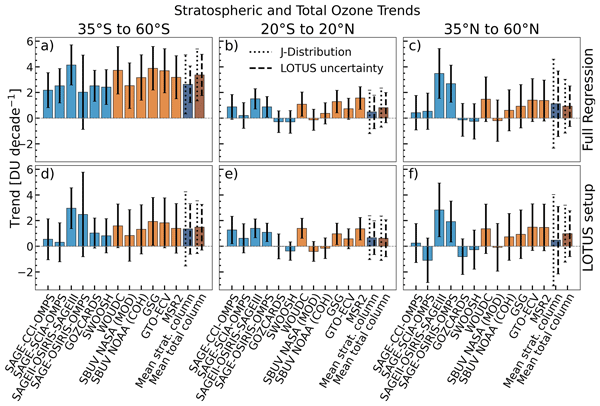
Brian Auffarth, Mark Weber, Alexei Rozanov, Carlo Arosio, John P. Burrows, Melanie Coldewey-Egbers, Sean M. Davis, Doug Degenstein, Kimberlee Dubé, Stacey M. Frith, Lucien Froidevaux, Diego Loyola, Vitali E. Fioletov, Viktoria Sofieva, Ronald van der A, and Jeannette D. Wild
Atmos. Chem. Phys., 26, 13359–13386, https://doi.org/10.5194/acp-26-13359-2026, https://doi.org/10.5194/acp-26-13359-2026, 2026
Short summary
Short summary
This study examines the trends of stratospheric and total ozone between 2000 and 2024, using long-term satellite datasets. Our results show positive trends in the upper stratosphere and a strong ozone recovery in the Southern Hemisphere, while changes in lower altitudes remain mostly small. The total and stratospheric trends show very similar results, indicating that tropospheric ozone contributes little to total column changes, while the stratospheric column is the dominant driver.
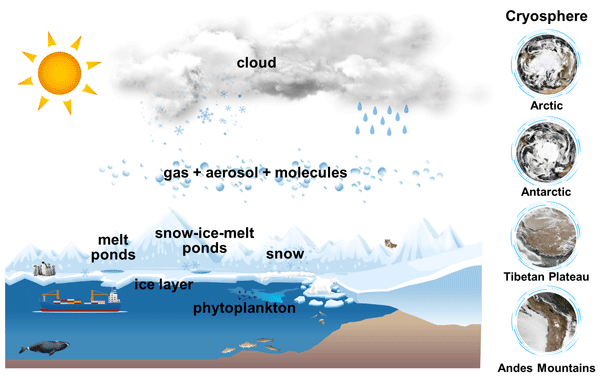
Linlu Mei, Vladimir Rozanov, Alexei Rozanov, and John P. Burrows
Geosci. Model Dev., 19, 8779–8800, https://doi.org/10.5194/gmd-19-8779-2026, https://doi.org/10.5194/gmd-19-8779-2026, 2026
Short summary
Short summary
The cryosphere, including snow, ice, and melt ponds, strongly influences how sunlight is reflected and absorbed, affecting climate change. We developed a new version of radiative transfer model SCIATRAN, to better represent these complex surfaces and their interaction with the atmosphere. The model was validated using real measurements and showed good accuracy. These advances help scientists better understand climate processes in polar regions and improve satellite observations.
Carlo Arosio, Alexei Rozanov, Vladimir Rozanov, Andrea Orfanoz-Cheuquelaf, John P. Burrows, Edward Malina, and Hartmut Boesch
EGUsphere, https://doi.org/10.5194/egusphere-2026-5113, https://doi.org/10.5194/egusphere-2026-5113, 2026
Short summary
Short summary
We present an improved method for retrieving ozone profiles from OMPS satellite limb observations. The aim is to mitigate an artifact related to the variation of surface reflectivity along the satellite line of sight. We prescribe surface reflectivity from VIIRS to mitigate the artifact, particularly in regions with sharp changes in reflectivity, such as coastlines and transitions between clouds and ocean. Updated stratospheric ozone profiles and tropospheric ozone column products are presented.
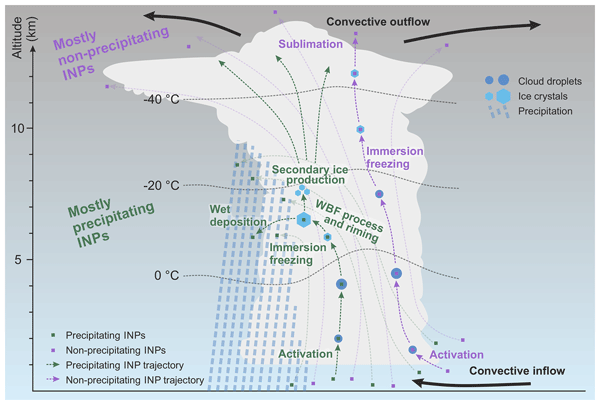
Jonas Schaefer, Sarah Grawe, Hans-Christian Clemen, Stephan Mertes, Johannes Schneider, Bruno Wetzel, Daniel Sauer, Jennifer Wolf, Laura Tomsche, Johanna Mayer, Roland Schrödner, Silvia Henning, Tina Jurkat-Witschas, Christiane Voigt, Helmut Ziereis, Theresa Harlaß, Mira Pöhlker, and Frank Stratmann
Atmos. Chem. Phys., 26, 12505–12520, https://doi.org/10.5194/acp-26-12505-2026, https://doi.org/10.5194/acp-26-12505-2026, 2026
Short summary
Short summary
Ice-nucleating particles (INP) are aerosol particles important for ice formation in clouds droplets and thereby influence climate. This study uses airborne measurements over Europe to show how INP are transported through thunderstorms. We show which particles are washed out and which are are transported into the higher troposphere, where they can again affect cloud ice formation. The findings improve understanding of atmospheric particle distribution and help refine climate models.
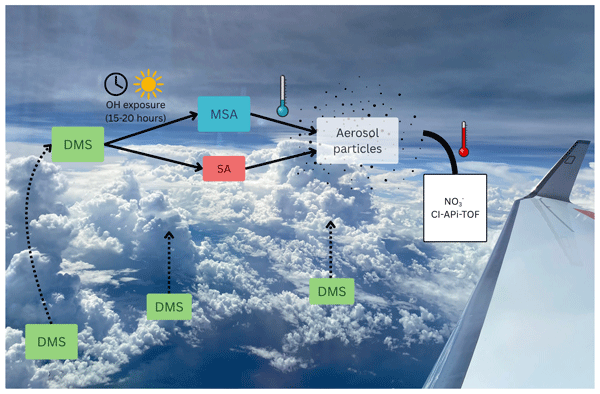
Hannah Klebach, Martin Heinritzi, Katharina Kaiser, Lisa Beck, Samuel Ruhl, Samira Atabakhsh, Nirvan Bhattacharyya, Lucía Caudillo-Plath, Philipp Joppe, Thomas Klimach, Peter Lloyd, Mira Pöhlker, Ulrich Pöschl, Sarah Richter, Douglas M. Russell, Johannes Schneider, Marcel Zauner-Wieczorek, and Joachim Curtius
Atmos. Chem. Phys., 26, 12355–12393, https://doi.org/10.5194/acp-26-12355-2026, https://doi.org/10.5194/acp-26-12355-2026, 2026
Short summary
Short summary
Marine atmospheric aerosols remain a major uncertainty in climate models. We report gas and particle phase measurements of two important aerosol forming vapours, sulfuric acid and methanesulfonic acid in the Indo-Pacific. We find that the latter typically dominates over sulfuric acid and contributes significantly to free tropospheric aerosol. Deep convection transports the precursor of both acids to the upper troposphere, providing a key aerosol source in the pristine remote Pacific Ocean.
Linda Smoydzin, Vera Bense, Heiko Bozem, Philipp Joppe, Daniel Kunkel, Hans-Christoph Lachnitt, Holger Tost, Andreas Zahn, Helmut Ziereis, Martin Riese, and Peter Hoor
Atmos. Chem. Phys., 26, 11857–11874, https://doi.org/10.5194/acp-26-11857-2026, https://doi.org/10.5194/acp-26-11857-2026, 2026
Short summary
Short summary
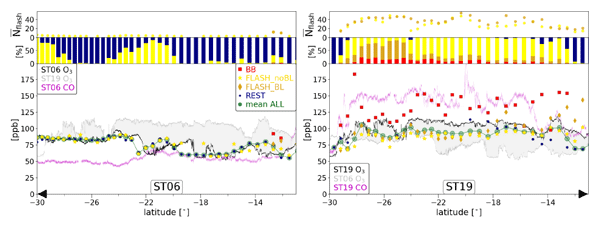
During a research flight in early October elevated upper tropospheric mixing ratios of CO, NO, NOy and O3 were observed over a distance of more than 1000 km east of the Brasilian coast. Ozone mixing ratios are 20–40 ppbv higher than during a flight in early September. By combining aircraft observations with model simulations we find that ozone production from biomass burning over Amazonia caused predominantly the ozone enhancements which have a local effect on the radiative forcing of 50 mW m−2.
Michael Weimer, Maximilian Reuter, Michael Hilker, Stefan Noël, Michael Buchwitz, Yasjka Meijer, Rüdiger Lang, Julia Marshall, Heinrich Bovensmann, John P. Burrows, and Hartmut Bösch
Atmos. Meas. Tech., 19, 5425–5455, https://doi.org/10.5194/amt-19-5425-2026, https://doi.org/10.5194/amt-19-5425-2026, 2026
Short summary
Short summary
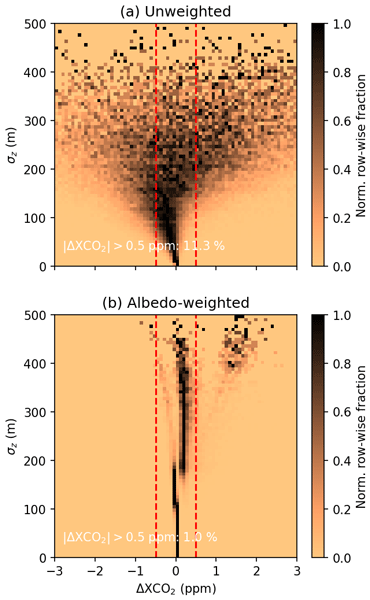
Greenhouse gas column measurements from space using reflected sunlight have to make assumptions about the Earth's surface elevation. Usually, it assumed that the elevation representing the satellite's spatial sample is the unweighted average of high-resolution surface elevation data. We find and show with many examples that the surface elevation should be weighted by the surface reflectance in the respective wavelength bands. This improves errors in the retrieval of trace gases.
Christian Fruck, Sebastian Wolff, Sven Krautwurst, Christoph Kiemle, Mathieu Quatrevalet, Martin Wirth, Jakob Borchardt, Oke Huhs, Konstantin Gerilowski, Michał Gałkowski, Christoph Gerbig, John P. Burrows, Heinrich Bovensmann, and Andreas Fix
EGUsphere, https://doi.org/10.5194/egusphere-2026-4578, https://doi.org/10.5194/egusphere-2026-4578, 2026
Short summary
Short summary
Waste sites near Madrid, Spain, release large amounts of methane, a powerful greenhouse gas. Using passive, active, and in situ instruments aboard the HALO aircraft, we measured methane concentrations near these sites. By combining these complementary measurements with an atmospheric transport simulation, we account for shifting winds that complicated earlier emission estimates, yielding a more accurate and robust method. We find a combined emission rate of 8.7 ± 1.5 t h-1.
Duong H. Do, Astrid Kerkweg, Yarê Baker, Birger Bohn, Hendrik Fuchs, Quanfu He, Thorsten Hohaus, Sungah Kang, Timo Kirfel, Finja Löher, Niklas Diepenthal, Anke C. Nölscher, Anna Novelli, Alexander Pschera, Felix Wieser, Sören R. Zorn, Andreas Wahner, and Domenico Taraborrelli
EGUsphere, https://doi.org/10.5194/egusphere-2026-4522, https://doi.org/10.5194/egusphere-2026-4522, 2026
Short summary
Short summary
This work builds a chamber simulation tool that mimics how air chemistry changes inside laboratory reactors, including injected gases, changing light, gas and liquid reactions, wall effects, and dilution. Tests in several chambers reproduced measured changes in reactive species, nitrogen compounds, and ozone, and helped capture how organic particles form. The same chemistry can be reused in larger, global air simulations to assess real-world impact.
Paolo Andreozzi, Mark D. Fielding, Robin J. Hogan, Richard M. Forbes, Adrian A. Hill, Samuel Rémy, Birger Bohn, and Ulrich Löhnert
Atmos. Chem. Phys., 26, 11309–11338, https://doi.org/10.5194/acp-26-11309-2026, https://doi.org/10.5194/acp-26-11309-2026, 2026
Short summary
Short summary
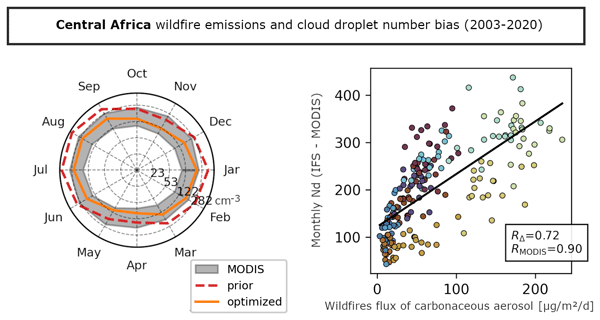
Aerosols significantly contribute to the Earth’s climate, but models still struggle to represent them. Here we use satellite observations of clouds to constrain aerosol processes in a weather and air-quality model. We show that African wildfires lead to overly bright simulated clouds and that the model removes too much aerosol in mixed-phase clouds. This demonstrates how cloud observations can target weakly constrained aerosol processes, with potential benefits for weather and climate modelling.
Stefania Gilardoni, Annachiara Bellini, Paolo Bonasoni, Henri Diémoz, Christian Gencarelli, Angela Marinoni, Eros Mariani, Luigi Mazari Villanova, Bruno Neininger, Mattia Perilli, Michael Sprenger, and Francesco Petracchini
Atmos. Chem. Phys., 26, 11135–11152, https://doi.org/10.5194/acp-26-11135-2026, https://doi.org/10.5194/acp-26-11135-2026, 2026
Short summary
Short summary
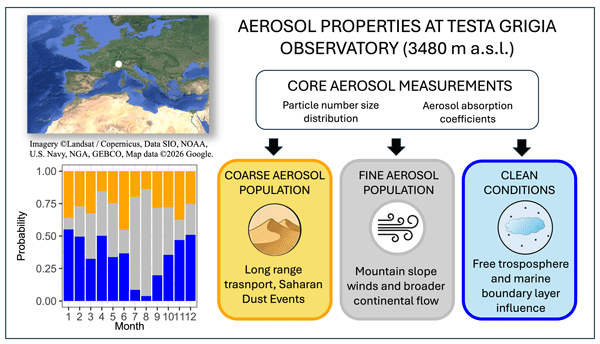
This study presents the first high-time-resolution aerosol data collected from the Testa Grigia Observatory (3,480 m) in the Italian Alps, from 2021 to 2023. We identified three transport pathways: Saharan Dust Events (SDE), which occurred with a frequency of 6 %, regional and long-range transported pollution (28 %), and clean air from the free troposphere. The timing of SDE, observed mainly in spring, and the mixing of dust particles with black carbon, enhance SDE impact on snow melting.
Anouk Marsal, Fabrizia Cavalli, Elise Di Antonio, Stephan Houdier, Pamela Dominutti, Sophie Darfeuil, Jean-Luc Jaffrezo, Stéphane Sauvage, Jean-Philippe Putaud, Ian S. Mudway, Athanasios Nenes, Aikaterini Bougiatioti, Nikolaos Mihalopoulos, André S. H. Prévôt, Despina Paraskevopoulou, Ana Cvitešić Kušan, Sanja Frka, Ana Kroflič, Ajda Delić, Blanka Tariba Lovaković, Andreja Jurič, Carolina Molina, Daniele Contini, Maria Rachele Guascito, Mathilde Lintz, Davy Rousset, Hartmut Herrmann, Eduardo J. d. S. Souza, Frédéric Ledoux, Marc Fadel, Haoran Yu, Jianzhen Yu, Maria Teresa Baeza Romero, Maria Cerrato-Alvarez, Marloes F. van Os, Mathilde N. Delaval, Yamaris Mercedes Mena Cabrera, Nicole Trieu, Greg Evans, Nuria Galindo, Noelia Gómez-Sanchez, Hana Hlaváčková, Pavel Mikuška, Shrutika Kadam, Pourya Shahpoury, Purificación López-Mahía, Jorge Moreda-Piñeiro, Rico K. Y. Cheung, Markus Kalberer, Micol Introna, Sarah S. Steimer, Zhuoying Lin, Suzanne E. Paulson, Saima Iram, Svetlana Stevanovic, Thomas Audoux, Laurent Y. Alleman, Jianing Liu, Ting Fang, P. S. Ganesh Subramanian, Vishal Verma, Tuukka Petäjä, Xavier Querol, Gerard Hoek, Roy M. Harrison, and Gaëlle Uzu
EGUsphere, https://doi.org/10.5194/egusphere-2026-3918, https://doi.org/10.5194/egusphere-2026-3918, 2026
Short summary
Short summary
This collaborative work from 26 worldwide laboratories assessed the measurement of atmospheric particles' oxidative potential (OP) using a common protocol. OP is a metric designed to inform on particles’ harmful effects. Over half of the laboratories obtained satisfactory results, and some critical steps such as liquid handling and OP mathematical determination were identified. Recommendations for future measurements and interlaboratory comparisons are also provided.
Simon Braun, Magdalena Pühl, Andreas Marsing, Daniel Sauer, Gregor Neumann, Elena de la Torre Castro, Valerian Hahn, Michael Lichtenstern, Paul Stock, Christopher Heckl, Dennis Hillenbrand, Anke Roiger, Christiane Voigt, Simon Unterstraßer, Arne Vasenden, Roberta Vasenden, Jean Cammas, Florian Thorey, Catherine Mackay, Charles Renard, and Tina Jurkat-Witschas
EGUsphere, https://doi.org/10.5194/egusphere-2026-2887, https://doi.org/10.5194/egusphere-2026-2887, 2026
Short summary
Short summary
In this work, we share the results of first in-flight emission and contrail measurements behind a fuel cell exhaust emulator, with the goal of quantifying the contrail properties for this new aviation propulsion concept. An artificial dilution tracer system was used to assess plume dilution and derive emission indices. At ambient temperatures close to the homogeneous freezing threshold, a strong temperature-dependence of the number of contrail ice crystals, due to droplet freezing, was observed.
Fatih Ekinci, Oliver Eppers, Oliver Appel, Felix Ploeger, Antonis Dragoneas, Sergej Molleker, Philipp Brauner, Hans-Christoph Lachnitt, Franziska Weyland, Linda Ort, Nicolas Emig, Hans-Christian Clemen, Laura Tomsche, Martin Ebert, Peter Hoor, Bärbel Vogel, Yafang Cheng, Johannes Schneider, Stephan Borrmann, and Franziska Köllner
Atmos. Chem. Phys., 26, 10399–10421, https://doi.org/10.5194/acp-26-10399-2026, https://doi.org/10.5194/acp-26-10399-2026, 2026
Short summary
Short summary
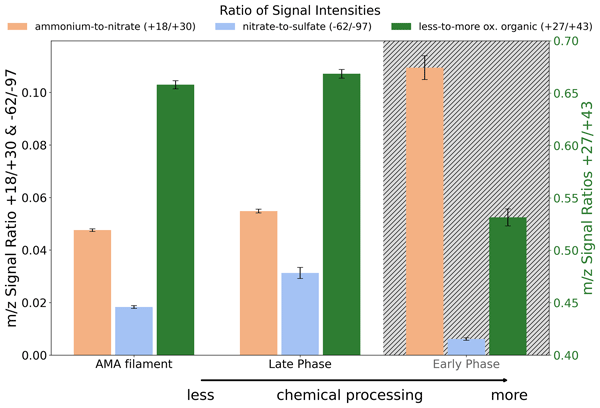
This study shows that aerosol transported from the Asian summer monsoon region can substantially alter the background composition of the extratropical lower stratosphere. Aircraft-based measurements and model simulations reveal a strong increase of ammonium nitrate aerosol from summer to autumn 2023 caused by transport of young air masses from South and East Asia. These particles can persist for months and undergo chemical aging.
Aino Ovaska, Daniel Holmberg, Elio Rauth, Mansour Alghamdi, Paulo Artaxo, Eija Asmi, John Backman, Benjamin Bergmans, Matthew Boyer, Liezl Bredenkamp, Maurizio Busetto, Delano Campos De Oliveira, Juan Andrés Casquero-Vera, Darius Ceburnis, Tak Chan, Tommy Chan, Sebastien Conil, Daniele Contini, Suzanne Crumeyrolle, Valentin Duflot, Kostas Eleftheriadis, Johan Esveld, Ekaterina Ezhova, Markus Fiebig, Shahzad Gani, Olga Garmash, Francisco Gómez-Moreno, Roy M. Harrison, Andras Hoffer, Rakesh Hooda, Antti Hyvärinen, Tareq Hussein, Jorma Joutsensaari, Nikos Kalivitis, Heinz Kaminski, Jutta Kesti, Radovan Krejci, Adam Kristensson, Chongai Kuang, Markku Kulmala, Lauri Laakso, Ari Leskinen, Heikki Lihavainen, Andreas Massling, Maik Merkel, Steffen Noe, Jakub Ondracek, Noemí Perez, Jean-Eudes Petit, Tuukka Petäjä, Michael Pikridas, Christopher Pöhlker, Mira Pöhlker, Jean-Philippe Putaud, Ximeng Qi, Cristina Reche, Sergio Rodríguez, Petr Roztocil, Jean Sciare, Karine Sellegri, Dongjie Shang, Ashish Singh, Mikko Sipilä, Henrik Skov, Mar Sorribas, Tamanna Subba, Junying Sun, Peter Tunved, Ville Vakkari, Pieter G. Van Zyl, Aki Virkkula, Jens Voigtländer, Kay Weinhold, Alfred Wiedensohler, Hee-Jung Yoo, Putian Zhou, Kai Puolamäki, Tuomo Nieminen, Veli-Matti Kerminen, Victoria A. Sinclair, and Pauli Paasonen
Earth Syst. Sci. Data Discuss., https://doi.org/10.5194/essd-2026-415, https://doi.org/10.5194/essd-2026-415, 2026
Preprint under review for ESSD
Short summary
Short summary
All clouds form around aerosol particles, and their abundance influences cloud properties. In turn, clouds affect climate by changing how energy moves through the atmosphere, making them important for climate change. To better understand these interactions, we need accurate information on how many aerosol particles are in the atmosphere. Therefore, we have developed a new 21-year global dataset of particle concentrations relevant for cloud formation.
Stephen J. Harris, Sven Krautwurst, Jorg Hacker, Mark Lunt, Jakob Borchardt, Mei Bai, Hartmut Boesch, Tarra Brain, John Philip Burrows, Shakti Chakravarty, Robert A. Field, Rebecca E. Fisher, James L. France, Konstantin Gerilowski, Oke Huhs, Wolfgang Junkermann, Bryce F. J. Kelly, Martin Kumm, Mathias Lanoisellé, Wolfgang Lieff, Andrew McGrath, Adrian Murphy, Thomas Röckmann, Zoe Salmon, Josua Schindewolf, Jakob Thoböll, Carina van der Veen, and Heinrich Bovensmann
Atmos. Chem. Phys., 26, 10043–10069, https://doi.org/10.5194/acp-26-10043-2026, https://doi.org/10.5194/acp-26-10043-2026, 2026
Short summary
Short summary
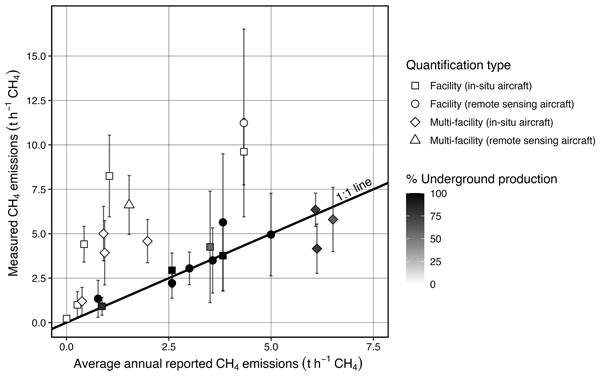
The accuracy of methods used to estimate and report fugitive methane emissions from Australian coal mines remains unclear. This study compares airborne emission rate estimates with reported estimates from 17 coal mines in the Bowen Basin, a region accounting for 45 % of national coal production. Results show good agreement for underground coal mines, but poor agreement for surface coal mines, suggesting improvements to surface coal mine reporting methods is needed to improve inventory reporting.
Matthias Kohl, Christoph Brühl, Holger Tost, Christos Xenofontos, Theodoros Christoudias, Sergey Gromov, Oliver Appel, Stephan Borrmann, Adam Bourassa, Pedro Campunzano-Jost, Yafang Cheng, Oliver Eppers, Karl D. Froyd, Bruna A. Holanda, Jose L. Jimenez, Patrick Jöckel, Philipp Joppe, Katharina Kaiser, Joseph M. Katich, Klaus Klingmüller, Franziska Köllner, Agnieszka Kupc, Anna Martin, Christopher Pöhlker, Mira L. Pöhlker, Ulrich Pöschl, Landon Rieger, Samuel Ruhl, Gregory P. Schill, Johannes Schneider, Christiane Schulz, Joshua P. Schwarz, Alexandra P. Tsimpidi, Ryan Vella, Christina J. Williamson, Yifan Yang, Daniel Zawada, Jos Lelieveld, and Andrea Pozzer
EGUsphere, https://doi.org/10.5194/egusphere-2026-3649, https://doi.org/10.5194/egusphere-2026-3649, 2026
Short summary
Short summary
Aerosols are crucial for Earth's climate, yet their vertical distribution remains poorly understood. We present first consistent global simulations of aerosol distributions and composition from the Earth's surface to the stratosphere, validated by extensive observations. Key findings include a global minimum in aerosol mass in the free troposphere, a significant contribution of organic aerosol in the lower stratosphere, and limited transport of primary particles to the stratosphere.
Wenche Aas, Thérèse Salameh, Robert Wegener, Heidi Hellén, Jean-Luc Jaffrezo, Pontus Roldin, Elisabeth Alonso-Blanco, Andres Alastuey, Crist Amelynck, Jgor Arduini, Benjamin Bergmans, Marie Bertrand, Agnes Borbon, Efstratios Bourtsoukidis, Laetitia Bouvier, David Butterfield, Iris Buxbaum, Darius Ceburnis, Anja Claude, Augustin Colette, Aurélie Colomb, Sophie Darfeuil, James Dernie, Maximilien Desservettaz, Elías Díaz-Ramiro, Marvin Dufresne, René Dubus, Mario Duval, Marie Dury, Anna Font, Kirsten N. Fossum, Evelyn Freney, Gotzon Gangoiti, Yao Ge, Maria Carmen Gomez, Francisco J. Gómez-Moreno, Marie Gohy, Valérie Gros, Paul Hamer, Bryan Hellack, Hartmut Herrmann, Robert Holla, Adéla Holubová, Niels R. Jensen, Tuija Jokinen, Matthew Jones, Uwe Käfer, Lukas Kesper, Dieter Klemp, Dagmar Kubistin, Angela Marinoni, Martina Mazzini, Vy Ngoc Thuy Dinh, Jurgita Ovadnevaite, Tuukka Petäjä, Miguel Portillo-Estrada, Jitka Přívozníková, Jean-Philippe Putaud, Stefan Reimann, Laura Renzi, Veronique Riffault, Stuart Ritchie, Chris Robins, Begoña Artíñano Rodríguez de Torres, Laurent Poulain, Julian Rüdiger, Agnieszka Sanocka, Estibaliz Saez de Camara Oleaga, Niels Schoon, Roger Seco, Ivan Simmons, Leïla Simon, David Simpson, Sverre Solberg, Emmanuel Tison, August Thomasson, Svetlana Tsyro, Marsailidh Twigg, Toni Tykkä, Bert Verreyken, Ågot Watne, Katie Williams, Ana Maria Yáñez-Serrano, Karen Yeung, Ilona Ylivinkka, and Karl Espen Yttri
Atmos. Chem. Phys., 26, 8717–8751, https://doi.org/10.5194/acp-26-8717-2026, https://doi.org/10.5194/acp-26-8717-2026, 2026
Short summary
Short summary
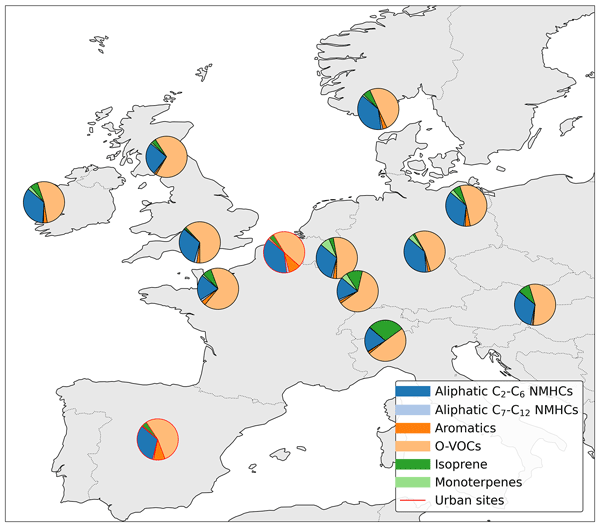
A one-week intensive measurement campaign during the 2022 European heatwave included monitoring of ozone, volatile organic compounds, aerosol chemical composition, and organic tracers to investigate air pollution sources. Results showed that emissions from vegetation and human activities contributed to peaks in ozone and secondary organic aerosol particles. Differences between measurements and model simulations underline the need for better characterization of sources and formation pathways.
Henri Diémoz, Francesca Barnaba, Luca Ferrero, Ivan K. F. Tombolato, Caterina Mapelli, Annachiara Bellini, Claudia Desandré, Tiziana Magri, and Manuela Zublena
Atmos. Meas. Tech., 19, 3625–3665, https://doi.org/10.5194/amt-19-3625-2026, https://doi.org/10.5194/amt-19-3625-2026, 2026
Short summary
Short summary
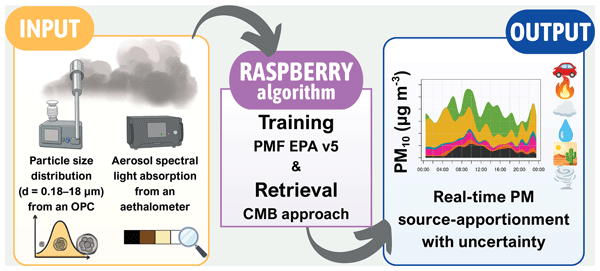
RASPBERRY is a new method to identify aerosol emission sources using physical properties (particle size and light absorption) measured at high time resolution by cost-effective optical instruments, instead of labour-intensive chemical analyses. Applied over five years in Aosta, Italy, it identified six main sources – traffic, biomass burning, two types of secondary particles, desert dust, and local resuspension. Validation against chemical apportionment and real-time applications are presented.
Benjamin Weyland, Simon Rosanka, Domenico Taraborrelli, Birger Bohn, Andreas Zahn, Florian Obersteiner, Eric Förster, Mariano Mertens, Patrick Jöckel, Helmut Ziereis, Katharina Kaiser, Horst Fischer, John N. Crowley, Nijing Wang, Achim Edtbauer, Jonathan Williams, Maria Dolores Andrés Hernández, John P. Burrows, Flora Kluge, Meike K. Rotermund, Andre Butz, and Klaus Pfeilsticker
Atmos. Chem. Phys., 26, 6825–6856, https://doi.org/10.5194/acp-26-6825-2026, https://doi.org/10.5194/acp-26-6825-2026, 2026
Short summary
Short summary
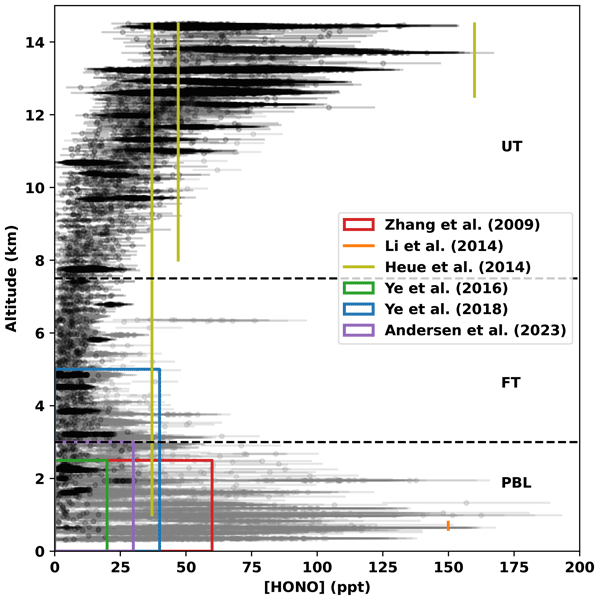
The destruction by sunlight of nitrous acid (HONO) produces the so-called detergent of the atmosphere. HONO has been measured in concentrations which exceed predictions based on known chemistry for decades. Several reactions have been proposed which may explain this excess HONO. This study reports on airborne measurements of HONO; the observations exceed predictions and form a C-shaped profile in the troposphere. Together with a host of other measurements, various reactions are investigated.
Marcus G. Müller, Birger Bohn, and Ulrich Löhnert
Atmos. Meas. Tech., 19, 3031–3048, https://doi.org/10.5194/amt-19-3031-2026, https://doi.org/10.5194/amt-19-3031-2026, 2026
Short summary
Short summary
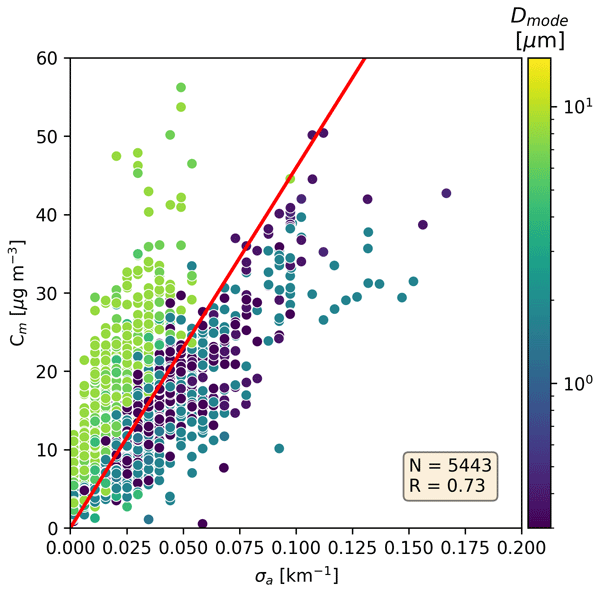
We present an uncertainty estimation for the retrieval of aerosol properties from a Vaisala CT25k ceilometer at JOYCE (Jülich Observatory for Cloud Evolution) with a forward inversion method. Ceilometer aerosol mass concentrations and extinction coefficients were compared to in situ observations (optical particle sizer) from a close-by tower at 120 m, showing a mean absolute percentage error of 39 % when deriving aerosol mass concentrations from ceilometer aerosol extinction coefficients.
Mian Chin, Jonathon S. Wright, Huisheng Bian, Qian Tan, Xiaohua Pan, Toshihiko Takemura, Hitoshi Matsui, Kostas Tsigaridis, Susanne Bauer, Paul Ginoux, Yiran Peng, Zengyuan Guo, Suvarna Fadnavis, Anton Laakso, John P. Burrows, Ghassan Taha, Jayanta Kar, Alexei Rozanov, Carlo Arosio, Landon Rieger, and Adam Bourassa
Atmos. Chem. Phys., 26, 6035–6059, https://doi.org/10.5194/acp-26-6035-2026, https://doi.org/10.5194/acp-26-6035-2026, 2026
Short summary
Short summary
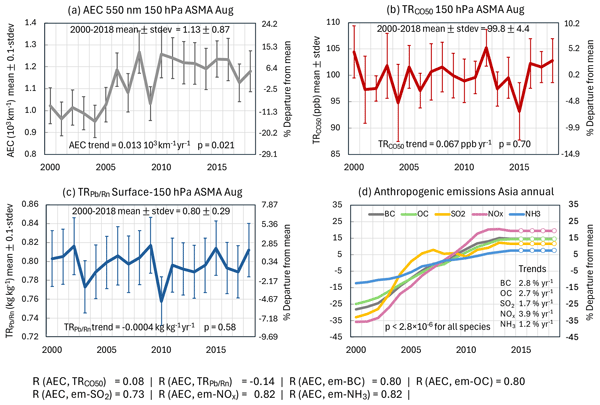
Aerosols in the upper troposphere influence weather and climate. The Asian summer monsoon efficiently transports surface pollutants upward, shaping aerosol amounts and variability in the upper troposphere. Using multiple global models, this study finds a summertime increase in upper-tropospheric aerosols at 1.2 % per year from 2000 to 2018 over Asia, consistent with rising pollutant emissions in Asia, while year-to-year changes are mainly driven by climate variability affecting monsoon dynamics.
Elena De La Torre Castro, Christof G. Beer, Tina Jurkat-Witschas, Daniel Sauer, Mattia Righi, Johannes Hendricks, and Christiane Voigt
Atmos. Chem. Phys., 26, 5879–5899, https://doi.org/10.5194/acp-26-5879-2026, https://doi.org/10.5194/acp-26-5879-2026, 2026
Short summary
Short summary
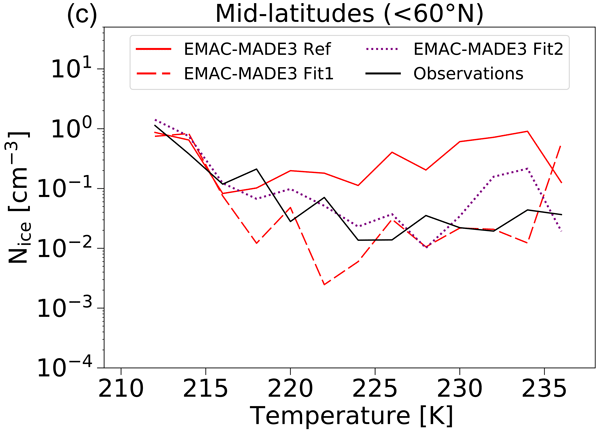
Ice nucleating particles strongly influence cirrus cloud properties but remain difficult to measure at cirrus temperatures. By combining EMAC (ECHAM/MESSy Atmospheric Chemistry) model simulations with in situ observations from the CIRRUS-HL (Cirrus in High-Latitudes) campaign, we investigate aerosol-cirrus interactions across latitudes. While the model generally agrees with observations, it overestimates ice crystal number concentrations detrained from convection, which we correct applying a new radius-temperature parametrization from the observations.
Philipp Brauner, Oliver Appel, Oliver Eppers, Franziska Köllner, Hans-Christian Clemen, Tiziana Bräuer, Hans-Christoph Lachnitt, Katharina Kaiser, Johannes Schneider, Antonis Dragoneas, Andreas Hünig, Sergej Molleker, Bruce E. Anderson, Yafang Cheng, Hans Schlager, Christiane Voigt, and Stephan Borrmann
EGUsphere, https://doi.org/10.5194/egusphere-2026-2161, https://doi.org/10.5194/egusphere-2026-2161, 2026
Preprint archived
Short summary
Short summary
Airborne measurements of the aerosol chemical composition were conducted in the 2018 wintertime tropopause region over Germany using a hybrid aerosol mass spectrometer, regarding the atmospheric background and aircraft exhaust plumes. Biomass burning aerosol of North American wildfires contributes to the aerosol population. Soot and engine oil were attributed to aircraft exhaust, and were detected in contrail residuals, implying their impact on chemical processes and properties of contrails.

Chun Hang Chau, Peter Hoor, Katharina Kaiser, and Holger Tost
Atmos. Chem. Phys., 26, 3637–3652, https://doi.org/10.5194/acp-26-3637-2026, https://doi.org/10.5194/acp-26-3637-2026, 2026
Short summary
Short summary
This study examines the potential impact of different greenhouse gases to vertical mixing by clear air turbulence in the upper troposphere and lower stratosphere . We found that ozone is most sensitive to vertical mixing and could lead to cooling at the top of the atmosphere by -0.2 W/m2. We also found that the vertical mixing by clear air turbulence could lead to changes in atmospheric chemistry including changing the methane lifetime and the ozone sensitivity.

Oke Huhs, Jakob Borchardt, Sven Krautwurst, Konstantin Gerilowski, Heinrich Bovensmann, Hartmut Bösch, and John Philip Burrows
Atmos. Meas. Tech., 19, 871–898, https://doi.org/10.5194/amt-19-871-2026, https://doi.org/10.5194/amt-19-871-2026, 2026
Short summary
Short summary
Stray light is an error source in all optical instruments. In passive remote sensing observations of greenhouse gases, it creates false patterns in gas concentration maps. In this work, the impact of stray light in the full processing chain from measured spectra, retrieved concentration maps, to emission rate estimates using measured and simulated data is analysed for MAMAP2D-Light. Additionally, a hardware improvement mitigates stray light for onward missions.
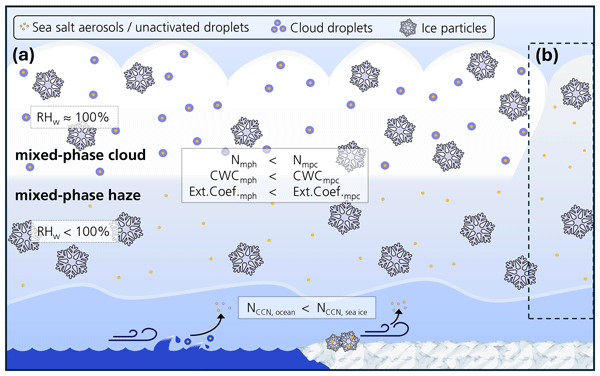
Manuel Moser, Christiane Voigt, Oliver Eppers, Johannes Lucke, Elena De La Torre Castro, Johanna Mayer, Regis Dupuy, Guillaume Mioche, Olivier Jourdan, Hans-Christian Clemen, Johannes Schneider, Philipp Joppe, Stephan Mertes, Bruno Wetzel, Stephan Borrmann, Marcus Klingebiel, Mario Mech, Christof Lüpkes, Susanne Crewell, André Ehrlich, Andreas Herber, and Manfred Wendisch
Atmos. Chem. Phys., 26, 1867–1887, https://doi.org/10.5194/acp-26-1867-2026, https://doi.org/10.5194/acp-26-1867-2026, 2026
Short summary
Short summary
In this study we analyzed Arctic mixed-phase clouds using airborne in-situ measurements in spring 2022. Based on microphysical properties, we show that within these clouds a distinction must be made between classic mixed-phase clouds and a mixed-phase haze regime. Instead of supercooled droplets, the haze regime contains large wet sea salt aerosols. These findings improve our understanding of Arctic low-level cloud processes.
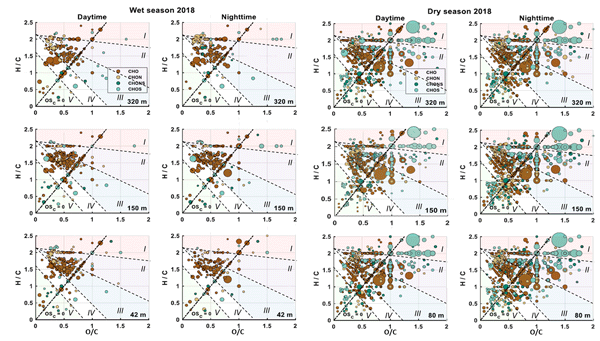
Denis Leppla, Stefanie Hildmann, Nora Zannoni, Leslie A. Kremper, Bruna A. Holanda, Jonathan Williams, Christopher Pöhlker, Stefan Wolff, Marta Sà, Maria Christina Solci, Ulrich Pöschl, and Thorsten Hoffmann
Atmos. Chem. Phys., 26, 365–390, https://doi.org/10.5194/acp-26-365-2026, https://doi.org/10.5194/acp-26-365-2026, 2026
Short summary
Short summary
The chemical composition of organic particles in the Amazon rainforest was investigated to understand how biogenic and human emissions influence the atmosphere in this unique ecosystem. Seasonal patterns were found where wet seasons were dominated by biogenic compounds from natural sources while dry seasons showed increased fire-related pollutants. These findings reveal how emissions, fires and long-range transport affect atmospheric chemistry, with implications for climate models.

Patrick Konjari, Christian Rolf, Martina Krämer, Armin Afchine, Nicole Spelten, Irene Bartolome Garcia, Annette Miltenberger, Nicolas Emig, Philipp Joppe, Johannes Schneider, Yun Li, Andreas Petzold, Heiko Bozem, and Peter Hoor
Atmos. Chem. Phys., 25, 18031–18050, https://doi.org/10.5194/acp-25-18031-2025, https://doi.org/10.5194/acp-25-18031-2025, 2025
Short summary
Short summary
We investigated how a powerful storm over southern Sweden in June 2024 transported ice particles and moist air into the normally dry stratosphere. We observed unusually high water vapor and ice levels up to 1.5 kilometers above the tropopause. Although the extra water vapor lasted only a few days to weeks, it shows how such storms can temporarily alter the upper atmosphere’s composition.
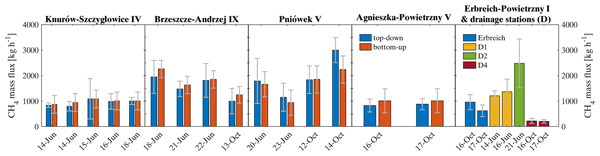
Eric Förster, Heidi Huntrieser, Michael Lichtenstern, Falk Pätzold, Lutz Bretschneider, Andreas Schlerf, Sven Bollmann, Astrid Lampert, Jarosław Nęcki, Paweł Jagoda, Justyna Swolkień, Dominika Pasternak, Robert A. Field, and Anke Roiger
Atmos. Meas. Tech., 18, 7153–7176, https://doi.org/10.5194/amt-18-7153-2025, https://doi.org/10.5194/amt-18-7153-2025, 2025
Short summary
Short summary
We introduce a helicopter-borne mass balance approach, utilizing the HELiPOD platform, to accurately quantify methane (CH4) emissions from coal mining activities. The comparison of our top-down mass flux estimates (up to 3000 kg h−1) against those from bottom-up in-mine CH4 safety sensors revealed very good agreement. This approach also has a great potential in quantifying emission source strengths (down to 20 kg h−1) from a wide range of other CH4 emitters (e.g. landfills, oil & gas industry).
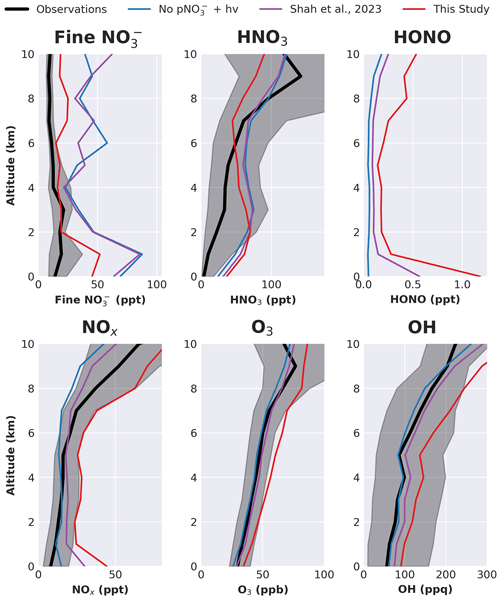
Matthew J. Rowlinson, Lucy J. Carpenter, Mat J. Evans, James D. Lee, Simone T. Andersen, Tomas Sherwen, Anna B. Callaghan, Roberto Sommariva, William Bloss, Siqi Hou, Leigh R. Crilley, Klaus Pfeilsticker, Benjamin Weyland, Thomas B. Ryerson, Patrick R. Veres, Pedro Campuzano-Jost, Hongyu Guo, Benjamin A. Nault, Jose L. Jimenez, and Khanneh Wadinga Fomba
Atmos. Chem. Phys., 25, 16945–16968, https://doi.org/10.5194/acp-25-16945-2025, https://doi.org/10.5194/acp-25-16945-2025, 2025
Short summary
Short summary
HONO is key to tropospheric chemistry. Observations show high HONO concentrations in remote air, possibly explained by nitrate aerosol photolysis. We use observations to parameterize nitrate photolysis, evaluating simulated HONO against observations from multiple sources. We show improved agreement with observed HONO, but overestimates in NOx and O3, beyond observational constraints. This implies uncertainties in the NOx budget and our understanding of atmospheric chemistry.
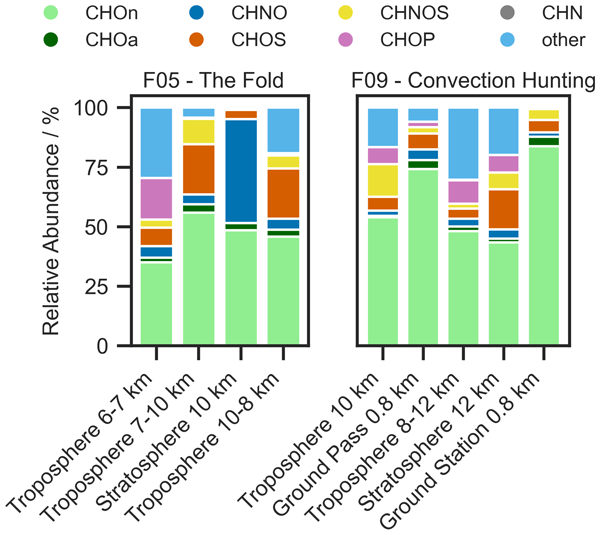
Anna Breuninger, Philipp Joppe, Jonas Wilsch, Cornelis Schwenk, Heiko Bozem, Nicolas Emig, Laurin Merkel, Rainer Rossberg, Timo Keber, Arthur Kutschka, Philipp Waleska, Stefan Hofmann, Sarah Richter, Florian Ungeheuer, Konstantin Dörholt, Thorsten Hoffmann, Annette Miltenberger, Johannes Schneider, Peter Hoor, and Alexander L. Vogel
Atmos. Chem. Phys., 25, 16533–16551, https://doi.org/10.5194/acp-25-16533-2025, https://doi.org/10.5194/acp-25-16533-2025, 2025
Short summary
Short summary
This study investigates molecular organic aerosol composition in the upper troposphere and lower stratosphere from an airborne campaign over Central Europe in summer 2024. Via ultra-high-performance liquid chromatography and high-resolution mass spectrometry of tropospheric and stratospheric filter samples, we identified various organic compounds. Our findings underscore the significant cross-tropopause transport of biogenic secondary organic aerosol and anthropogenic pollutants.
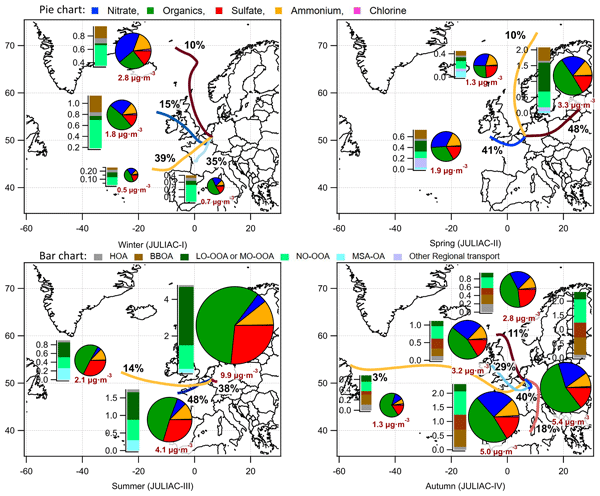
Lu Liu, Thorsten Hohaus, Andreas Hofzumahaus, Frank Holland, Hendrik Fuchs, Ralf Tillmann, Birger Bohn, Stefanie Andres, Zhaofeng Tan, Franz Rohrer, Vlassis A. Karydis, Vaishali Vardhan, Philipp Franke, Anne C. Lange, Anna Novelli, Benjamin Winter, Changmin Cho, Iulia Gensch, Sergej Wedel, Andreas Wahner, and Astrid Kiendler-Scharr
Atmos. Chem. Phys., 25, 16189–16213, https://doi.org/10.5194/acp-25-16189-2025, https://doi.org/10.5194/acp-25-16189-2025, 2025
Short summary
Short summary
We measured air particles at a rural site in Germany over a year to understand how their sources and properties change with the seasons. Particles from natural sources peaked in summer, especially during heatwaves, while those from burning activities like residential heating and wildfires dominated in colder months. Winds carrying air from other regions also influenced particle levels. These findings link air quality to climate change and energy transitions.
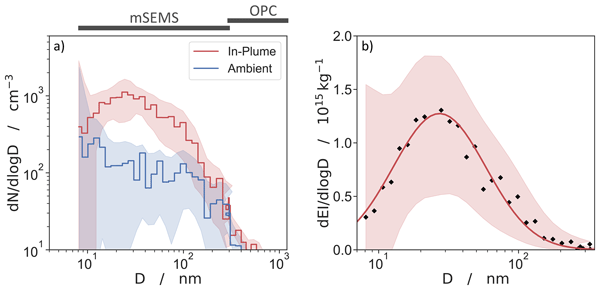
Gregor Neumann, Andreas Marsing, Theresa Harlass, Daniel Sauer, Simon Braun, Magdalena Pühl, Christopher Heckl, Paul Stock, Elena De La Torre Castro, Valerian Hahn, Anke Roiger, Christiane Voigt, Simon Unterstraßer, Jean Cammas, Charles Renard, Roberta Vasenden, Arnold Vasenden, and Tina Jurkat-Witschas
Atmos. Meas. Tech., 18, 6795–6816, https://doi.org/10.5194/amt-18-6795-2025, https://doi.org/10.5194/amt-18-6795-2025, 2025
Short summary
Short summary
This study presents the first successful in-flight emission characterization of a turboprop engine using a fully autonomous airborne measurement platform, offering new insights into the atmospheric impacts of regional aviation. By equipping the high-altitude Grob G 520 Egrett with a suite of custom and modified commercial instruments, we demonstrate precise, high-resolution measurements of aerosol particles, trace gases, and contrail ice in the engine exhaust plume at cruise altitudes.
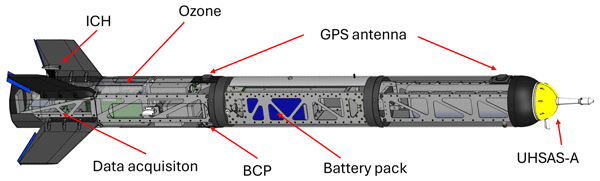
Heiko Bozem, Philipp Joppe, Yun Li, Nicolas Emig, Armin Afchine, Anna Breuninger, Joachim Curtius, Stefan Hofmann, Sadath Ismayil, Konrad Kandler, Daniel Kunkel, Arthur Kutschka, Hans-Christoph Lachnitt, Andreas Petzold, Sarah Richter, Timo Röschenthaler, Christian Rolf, Lisa Schneider, Johannes Schneider, Alexander Vogel, and Peter Hoor
Atmos. Meas. Tech., 18, 6545–6568, https://doi.org/10.5194/amt-18-6545-2025, https://doi.org/10.5194/amt-18-6545-2025, 2025
Short summary
Short summary
Deployed on a Learjet as a tandem measurement platform during the TPEx I (TropoPause composition gradients and mixing Experiment) campaign in June 2024, the new TPC-TOSS (TropoPause Composition Towed Sensor Shuttle) system delivers high-resolution in situ data on ozone, aerosol, and key meteorological parameters. Laboratory and in-flight tests confirmed its precision and stability. Observed gradients near the tropopause reveal active mixing and transport processes in the tropopause region.
Monica Sharma, Mattia Righi, Johannes Hendricks, Anja Schmidt, Daniel Sauer, and Volker Grewe
Geosci. Model Dev., 18, 8485–8510, https://doi.org/10.5194/gmd-18-8485-2025, https://doi.org/10.5194/gmd-18-8485-2025, 2025
Short summary
Short summary
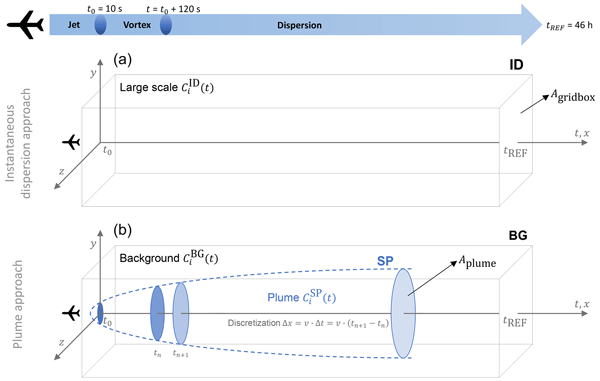
A plume model is developed to simulate aerosol microphysics in a dispersing aircraft plume, including interactions between ice crystals and aerosols in vortex regime. Compared to an instantaneous dispersion approach, the plume approach estimates 15 % lower aviation aerosol number concentrations, due to more efficient coagulation at plume scale. The model is sensitive to background conditions and initialization parameters, such as ice crystal number concentration and fuel sulfur content.
Alina Fiehn, Maximilian Eckl, Magdalena Pühl, Tiziana Bräuer, Klaus-Dirk Gottschaldt, Heinfried Aufmhoff, Lisa Eirenschmalz, Gregor Neumann, Felicitas Sakellariou, Daniel Sauer, Robert Baumann, Guilherme De Aguiar Ventura, Winne Nayole Cadete, Dário Luciano Zua, Manuel Xavier, Paulo Correia, and Anke Roiger
Atmos. Chem. Phys., 25, 15009–15031, https://doi.org/10.5194/acp-25-15009-2025, https://doi.org/10.5194/acp-25-15009-2025, 2025
Short summary
Short summary
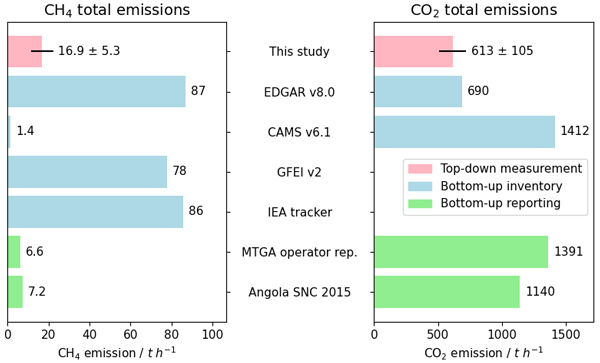
In September 2022, an aircraft campaign measured methane emissions from all 57 Angolan offshore oil and gas facilities. Total CH₄ emissions were 16.9 ± 5.3 t h−1, dominated by older, shallow-water platforms. Emissions were lower than inventories but 2 times larger than operator reports. Trace gas data suggest venting and fugitives as main CH₄ sources. The carbon intensity was 3.4 ± 0.8 g CO₂ eq MJ−1, with older platforms CH₄-dominated and newer deep-water sites CO₂-dominated.
Philipp Joppe, Johannes Schneider, Jonas Wilsch, Heiko Bozem, Anna Breuninger, Joachim Curtius, Martin Ebert, Nicolas Emig, Peter Hoor, Sadath Ismayil, Konrad Kandler, Daniel Kunkel, Isabel Kurth, Hans-Christoph Lachnitt, Yun Li, Annette Miltenberger, Sarah Richter, Christian Rolf, Lisa Schneider, Cornelis Schwenk, Nicole Spelten, Alexander L. Vogel, Yafang Cheng, and Stephan Borrmann
Atmos. Chem. Phys., 25, 15077–15103, https://doi.org/10.5194/acp-25-15077-2025, https://doi.org/10.5194/acp-25-15077-2025, 2025
Short summary
Short summary
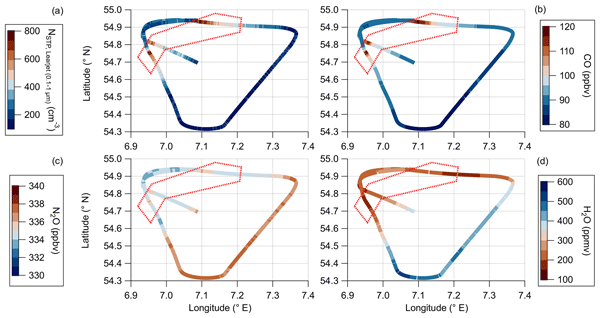
We show measurements of a filament with biomass burning influence transported by a warm conveyor belt (WCB) into the tropopause region over Europe. The pollution originates from Canadian forest fires and is transported in the lower troposphere towards Europe. The WCB transport is followed by mixing with air masses of stratospheric chemical signatures. We hypothesize that this mixing leads to a change in the vertical gradient of the potential temperature.
Sven Krautwurst, Christian Fruck, Sebastian Wolff, Jakob Borchardt, Oke Huhs, Konstantin Gerilowski, Michał Gałkowski, Christoph Kiemle, Mathieu Quatrevalet, Martin Wirth, Christian Mallaun, John P. Burrows, Christoph Gerbig, Andreas Fix, Hartmut Bösch, and Heinrich Bovensmann
Atmos. Chem. Phys., 25, 14669–14702, https://doi.org/10.5194/acp-25-14669-2025, https://doi.org/10.5194/acp-25-14669-2025, 2025
Short summary
Short summary
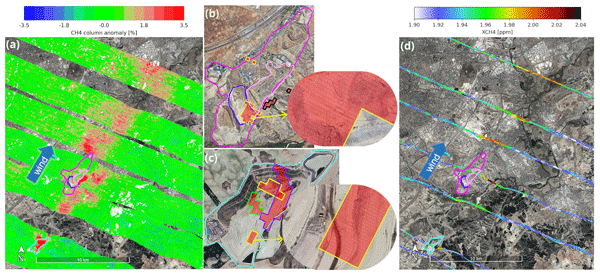
Anomalously high CH4 emissions from landfills in Madrid, Spain, have been observed by satellite measurements in recent years. Our investigations of these waste facilities, using passive and active airborne remote sensing measurements, confirm these high emission rates with values of up to 13 th−1 during the overflight and show excellent agreement between the two techniques. A large fraction of the emissions is attributed to active landfill sites.
Phuc Thi Minh Ha, Yugo Kanaya, Kazuyo Yamaji, Syuichi Itahashi, Satoru Chatani, Takashi Sekiya, Maria Dolores Andrés Hernández, John Philip Burrows, Hans Schlager, Michael Lichtenstern, Mira Poehlker, and Bruna Holanda
Atmos. Chem. Phys., 25, 13429–13452, https://doi.org/10.5194/acp-25-13429-2025, https://doi.org/10.5194/acp-25-13429-2025, 2025
Short summary
Short summary
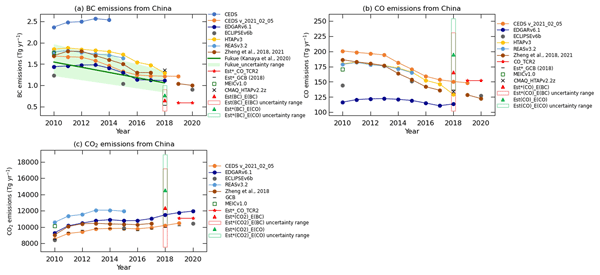
Black carbon and CO are important to climate change. EMeRGe airborne observation can identify the suitability of emission inventories used in the CMAQv5.0.2 model for Asian polluted regions. GFEDv4.1s is suitable for fire emissions. Anthropogenic BC and CO emissions from the Philippines (REASv2.1) are insufficient. The estimated Chinese emissions in 2018 are 0.65±0.25 TgBC, 166±65 TgCO, and 12.4±4.8 PgCO2, suggesting a reduction and increment for China's BC and CO emissions in the HTAPv2.2z inventory.
Rolf Müller, Lennart Bengtsson, John Birks, John Burrows, Ruprecht Jaenicke, and Richard S. Stolarski
Hist. Geo Space. Sci., 16, 31–40, https://doi.org/10.5194/hgss-16-31-2025, https://doi.org/10.5194/hgss-16-31-2025, 2025
Short summary
Short summary
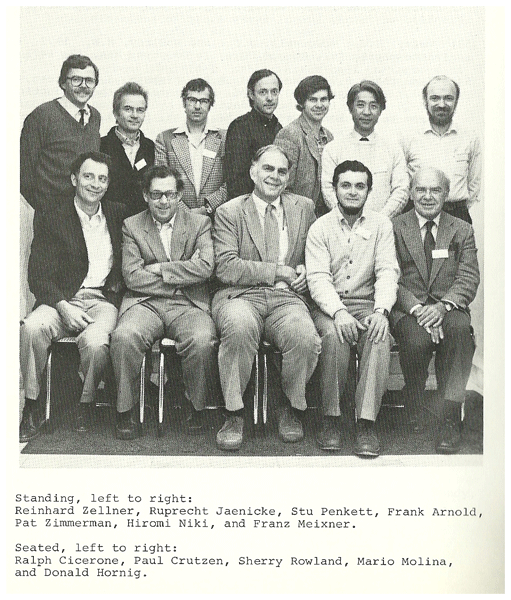
This paper reports a few anecdotes from the life of Paul J. Crutzen that were contributed by friends and colleagues. Taken together, these anecdotes should shed some light on the person that Paul was, as this is perhaps sometimes obscured when focusing solely on his many scientific achievements.
Johannes Schneider, Christiane Schulz, Florian Rubach, Anna Ludwig, Jonas Wilsch, Philipp Joppe, Christian Gurk, Sergej Molleker, Laurent Poulain, Florian Obersteiner, Torsten Gehrlein, Harald Bönisch, Andreas Zahn, Peter Hoor, Nicolas Emig, Heiko Bozem, Stephan Borrmann, and Markus Hermann
Atmos. Meas. Tech., 18, 5103–5128, https://doi.org/10.5194/amt-18-5103-2025, https://doi.org/10.5194/amt-18-5103-2025, 2025
Short summary
Short summary
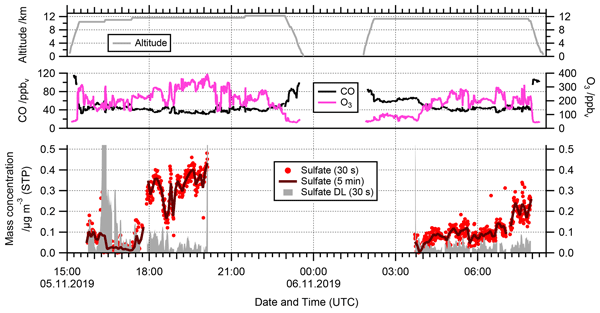
An instrumented container laboratory is operated on regular commercial passenger flights to obtain a long-term representative dataset on the composition of the upper troposphere and lower stratosphere. Here we report on the development of a fully automated aerosol mass spectrometer for this project. We present technical specifications, necessary modifications for the automation, instrument calibration and comparisons, detection limits, and the first in-flight data.
Miriam Latsch, Andreas Richter, John P. Burrows, and Hartmut Bösch
Atmos. Meas. Tech., 18, 4373–4395, https://doi.org/10.5194/amt-18-4373-2025, https://doi.org/10.5194/amt-18-4373-2025, 2025
Short summary
Short summary
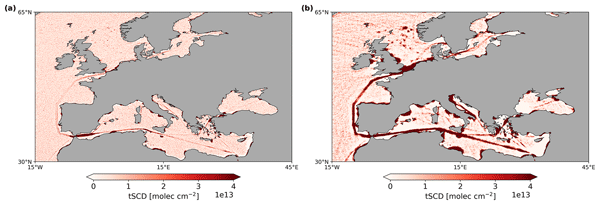
This study presents our advanced methods to qualitatively detect ship-related nitrogen dioxide (NO2) signals in TROPOMI satellite data. By applying filtering techniques, we identify numerous global shipping routes, including previously undetected ones, as well as emissions from offshore platforms. Additionally, we compare the filtered satellite data with high-pass-filtered CAMS global model data to estimate the differences between observed and modeled NO2 emissions.
Michael Weimer, Michael Hilker, Stefan Noël, Max Reuter, Michael Buchwitz, Blanca Fuentes Andrade, Rüdiger Lang, Bernd Sierk, Yasjka Meijer, Heinrich Bovensmann, John P. Burrows, and Hartmut Bösch
Atmos. Meas. Tech., 18, 3321–3340, https://doi.org/10.5194/amt-18-3321-2025, https://doi.org/10.5194/amt-18-3321-2025, 2025
Short summary
Short summary
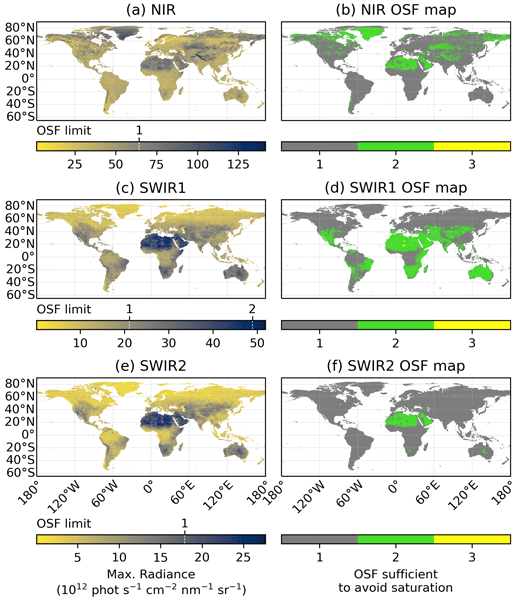
Optical detectors have a maximum signal (saturation). Exceedance means that the measurement has to be discarded. We investigate where saturation will occur for the future European satellite mission dedicated to CO2 monitoring (CO2M) and strategies to avoid saturation. Saturation impacts coverage and precision, both of which are important for estimation of local CO2 emissions. We find that taking two pictures per sampling should be sufficient to avoid saturation for CO2M, with some impact on CO2 precision.
Yann Cohen, Didier Hauglustaine, Nicolas Bellouin, Marianne Tronstad Lund, Sigrun Matthes, Agnieszka Skowron, Robin Thor, Ulrich Bundke, Andreas Petzold, Susanne Rohs, Valérie Thouret, Andreas Zahn, and Helmut Ziereis
Atmos. Chem. Phys., 25, 5793–5836, https://doi.org/10.5194/acp-25-5793-2025, https://doi.org/10.5194/acp-25-5793-2025, 2025
Short summary
Short summary
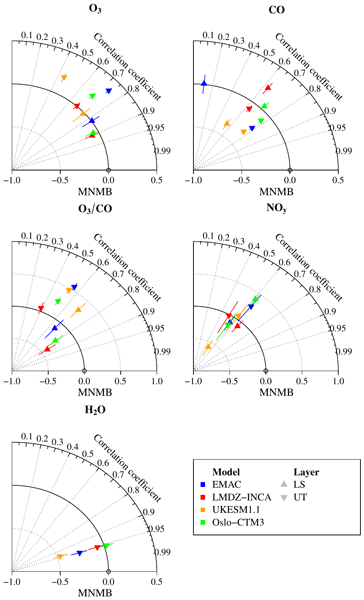
The chemical composition of the atmosphere near the tropopause is a key parameter for evaluating the climate impact of subsonic aviation pollutants. This study uses in situ data collected aboard passenger aircraft to assess the ability of four chemistry–climate models to reproduce (bi-)decadal climatologies of ozone, carbon monoxide, water vapour, and reactive nitrogen in this region. The models reproduce the very distinct ozone seasonality in the upper troposphere and in the lower stratosphere well.

André Ehrlich, Susanne Crewell, Andreas Herber, Marcus Klingebiel, Christof Lüpkes, Mario Mech, Sebastian Becker, Stephan Borrmann, Heiko Bozem, Matthias Buschmann, Hans-Christian Clemen, Elena De La Torre Castro, Henning Dorff, Regis Dupuy, Oliver Eppers, Florian Ewald, Geet George, Andreas Giez, Sarah Grawe, Christophe Gourbeyre, Jörg Hartmann, Evelyn Jäkel, Philipp Joppe, Olivier Jourdan, Zsófia Jurányi, Benjamin Kirbus, Johannes Lucke, Anna E. Luebke, Maximilian Maahn, Nina Maherndl, Christian Mallaun, Johanna Mayer, Stephan Mertes, Guillaume Mioche, Manuel Moser, Hanno Müller, Veronika Pörtge, Nils Risse, Greg Roberts, Sophie Rosenburg, Johannes Röttenbacher, Michael Schäfer, Jonas Schaefer, Andreas Schäfler, Imke Schirmacher, Johannes Schneider, Sabrina Schnitt, Frank Stratmann, Christian Tatzelt, Christiane Voigt, Andreas Walbröl, Anna Weber, Bruno Wetzel, Martin Wirth, and Manfred Wendisch
Earth Syst. Sci. Data, 17, 1295–1328, https://doi.org/10.5194/essd-17-1295-2025, https://doi.org/10.5194/essd-17-1295-2025, 2025
Short summary
Short summary
This paper provides an overview of the HALO–(AC)3 aircraft campaign data sets, the campaign-specific instrument operation, data processing, and data quality. The data set comprises in situ and remote sensing observations from three research aircraft: HALO, Polar 5, and Polar 6. All data are published in the PANGAEA database by instrument-separated data subsets. It is highlighted how the scientific analysis of the HALO–(AC)3 data benefits from the coordinated operation of three aircraft.
Hector Navarro-Barboza, Jordi Rovira, Vincenzo Obiso, Andrea Pozzer, Marta Via, Andres Alastuey, Xavier Querol, Noemi Perez, Marjan Savadkoohi, Gang Chen, Jesus Yus-Díez, Matic Ivancic, Martin Rigler, Konstantinos Eleftheriadis, Stergios Vratolis, Olga Zografou, Maria Gini, Benjamin Chazeau, Nicolas Marchand, Andre S. H. Prevot, Kaspar Dallenbach, Mikael Ehn, Krista Luoma, Tuukka Petäjä, Anna Tobler, Jaroslaw Necki, Minna Aurela, Hilkka Timonen, Jarkko Niemi, Olivier Favez, Jean-Eudes Petit, Jean-Philippe Putaud, Christoph Hueglin, Nicolas Pascal, Aurélien Chauvigné, Sébastien Conil, Marco Pandolfi, and Oriol Jorba
Atmos. Chem. Phys., 25, 2667–2694, https://doi.org/10.5194/acp-25-2667-2025, https://doi.org/10.5194/acp-25-2667-2025, 2025
Short summary
Short summary
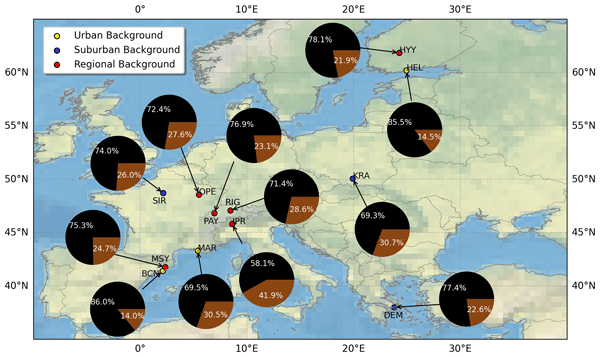
Brown carbon (BrC) absorbs ultraviolet (UV) and visible light, influencing climate. This study explores BrC's imaginary refractive index (k) using data from 12 European sites. Residential emissions are a major organic aerosol (OA) source in winter, while secondary organic aerosol (SOA) dominates in summer. Source-specific k values were derived, improving model accuracy. The findings highlight BrC's climate impact and emphasize source-specific constraints in atmospheric models.
Olivia G. Norman, Colette L. Heald, Solomon Bililign, Pedro Campuzano-Jost, Hugh Coe, Marc N. Fiddler, Jaime R. Green, Jose L. Jimenez, Katharina Kaiser, Jin Liao, Ann M. Middlebrook, Benjamin A. Nault, John B. Nowak, Johannes Schneider, and André Welti
Atmos. Chem. Phys., 25, 771–795, https://doi.org/10.5194/acp-25-771-2025, https://doi.org/10.5194/acp-25-771-2025, 2025
Short summary
Short summary
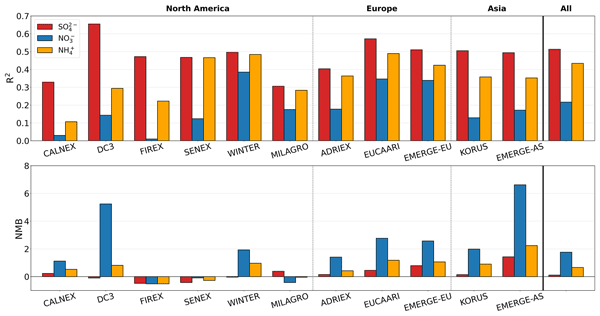
This study finds that one component of secondary inorganic aerosols, nitrate, is greatly overestimated by a global atmospheric chemistry model compared to observations from 11 flight campaigns. None of the loss and production pathways explored can explain the nitrate bias alone. The model’s inability to capture the variability in the observations remains and requires future investigation to avoid biases in policy-related studies (i.e., air quality, health, climate impacts of these aerosols).
Maximilian Reuter, Michael Hilker, Stefan Noël, Antonio Di Noia, Michael Weimer, Oliver Schneising, Michael Buchwitz, Heinrich Bovensmann, John P. Burrows, Hartmut Bösch, and Ruediger Lang
Atmos. Meas. Tech., 18, 241–264, https://doi.org/10.5194/amt-18-241-2025, https://doi.org/10.5194/amt-18-241-2025, 2025
Short summary
Short summary
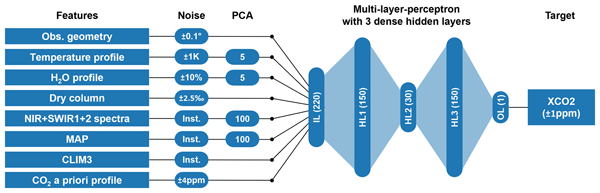
Carbon dioxide (CO2) and methane (CH4) are the main anthropogenic greenhouse gases. The European Copernicus CO2 monitoring satellite mission CO2M will provide measurements of their atmospheric concentrations, but the accuracy requirements are demanding and conventional retrieval methods computationally expensive. We present a new retrieval algorithm based on artificial neural networks that has the potential to meet the stringent requirements of the CO2M mission with minimal computational effort.
Pamela A. Dominutti, Jean-Luc Jaffrezo, Anouk Marsal, Takoua Mhadhbi, Rhabira Elazzouzi, Camille Rak, Fabrizia Cavalli, Jean-Philippe Putaud, Aikaterini Bougiatioti, Nikolaos Mihalopoulos, Despina Paraskevopoulou, Ian Mudway, Athanasios Nenes, Kaspar R. Daellenbach, Catherine Banach, Steven J. Campbell, Hana Cigánková, Daniele Contini, Greg Evans, Maria Georgopoulou, Manuella Ghanem, Drew A. Glencross, Maria Rachele Guascito, Hartmut Herrmann, Saima Iram, Maja Jovanović, Milena Jovašević-Stojanović, Markus Kalberer, Ingeborg M. Kooter, Suzanne E. Paulson, Anil Patel, Esperanza Perdrix, Maria Chiara Pietrogrande, Pavel Mikuška, Jean-Jacques Sauvain, Katerina Seitanidi, Pourya Shahpoury, Eduardo J. d. S. Souza, Sarah Steimer, Svetlana Stevanovic, Guillaume Suarez, P. S. Ganesh Subramanian, Battist Utinger, Marloes F. van Os, Vishal Verma, Xing Wang, Rodney J. Weber, Yuhan Yang, Xavier Querol, Gerard Hoek, Roy M. Harrison, and Gaëlle Uzu
Atmos. Meas. Tech., 18, 177–195, https://doi.org/10.5194/amt-18-177-2025, https://doi.org/10.5194/amt-18-177-2025, 2025
Short summary
Short summary
In this work, 20 labs worldwide collaborated to evaluate the measurement of air pollution's oxidative potential (OP), a key indicator of its harmful effects. The study aimed to identify disparities in the widely used OP dithiothreitol assay and assess the consistency of OP among labs using the same protocol. The results showed that half of the labs achieved acceptable results. However, variability was also found, highlighting the need for standardisation in OP procedures.
Seunghwan Seo, Si-Wan Kim, Kyoung-Min Kim, Andreas Richter, Kezia Lange, John P. Burrows, Junsung Park, Hyunkee Hong, Hanlim Lee, Ukkyo Jeong, Jung-Hun Woo, and Jhoon Kim
Atmos. Meas. Tech., 18, 115–128, https://doi.org/10.5194/amt-18-115-2025, https://doi.org/10.5194/amt-18-115-2025, 2025
Short summary
Short summary
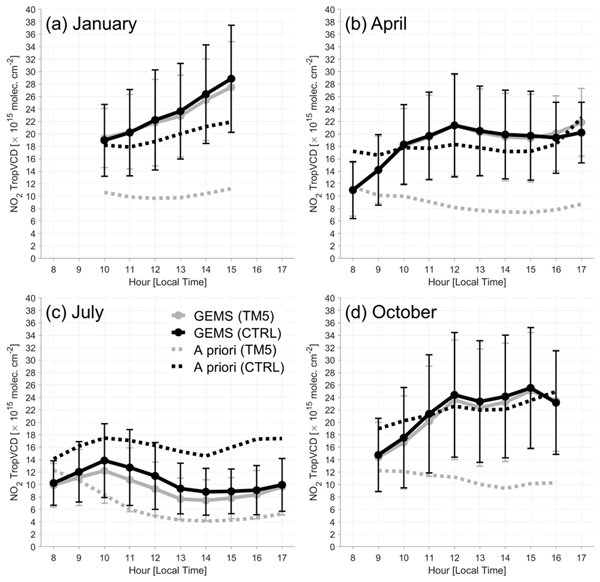
Over the Seoul metropolitan area, tropospheric NO2 vertical column densities from the Geostationary Environment Monitoring Spectrometer show distinct seasonal features. Also, varying a priori data have substantial impacts on the observed NO2 columns. The a priori data from different chemical transport models resulted in differences of up to −18.3 %. Notably, diurnal patterns of observed NO2 columns are similar for all datasets, although their a priori data exhibit contrasting diurnal patterns.
Markus Kilian, Volker Grewe, Patrick Jöckel, Astrid Kerkweg, Mariano Mertens, Andreas Zahn, and Helmut Ziereis
Atmos. Chem. Phys., 24, 13503–13523, https://doi.org/10.5194/acp-24-13503-2024, https://doi.org/10.5194/acp-24-13503-2024, 2024
Short summary
Short summary
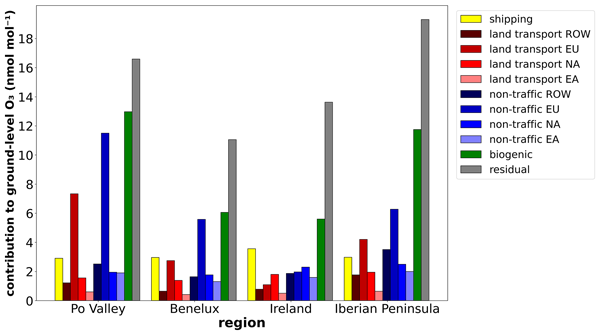
Anthropogenic emissions are a major source of precursors of tropospheric ozone. As ozone formation is highly non-linear, we apply a global–regional chemistry–climate model with a source attribution method (tagging) to quantify the contribution of anthropogenic emissions to ozone. Our analysis shows that the contribution of European anthropogenic emissions largely increases during large ozone periods, indicating that emissions from these sectors drive ozone values.
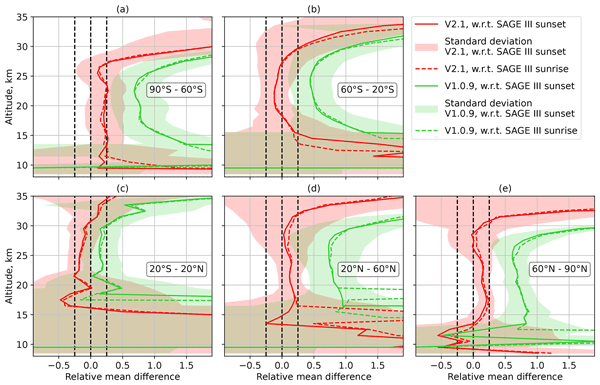
Alexei Rozanov, Christine Pohl, Carlo Arosio, Adam Bourassa, Klaus Bramstedt, Elizaveta Malinina, Landon Rieger, and John P. Burrows
Atmos. Meas. Tech., 17, 6677–6695, https://doi.org/10.5194/amt-17-6677-2024, https://doi.org/10.5194/amt-17-6677-2024, 2024
Short summary
Short summary
We developed a new algorithm to retrieve vertical distributions of aerosol extinction coefficients in the stratosphere. The algorithm is applied to measurements of scattered solar light from the spaceborne OMPS-LP (Ozone Mapper and Profiler Suite Limb Profiler) instrument. The retrieval results are compared to data from other spaceborne instruments and used to investigate the evolution of the aerosol plume following the eruption of the Hunga Tonga–Hunga Ha'apai volcano in January 2022.
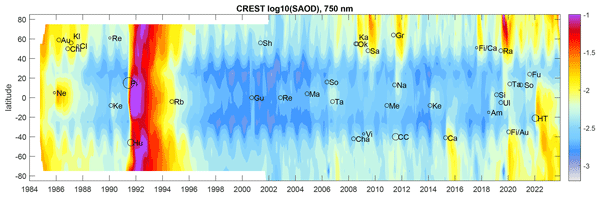
Viktoria F. Sofieva, Alexei Rozanov, Monika Szelag, John P. Burrows, Christian Retscher, Robert Damadeo, Doug Degenstein, Landon A. Rieger, and Adam Bourassa
Earth Syst. Sci. Data, 16, 5227–5241, https://doi.org/10.5194/essd-16-5227-2024, https://doi.org/10.5194/essd-16-5227-2024, 2024
Short summary
Short summary
Climate-related studies need information about the distribution of stratospheric aerosols, which influence the energy balance of the Earth’s atmosphere. In this work, we present a merged dataset of vertically resolved stratospheric aerosol extinction coefficients, which is derived from data of six limb and occultation satellite instruments. The created aerosol climate record covers the period from October 1984 to December 2023. It can be used in various climate-related studies.
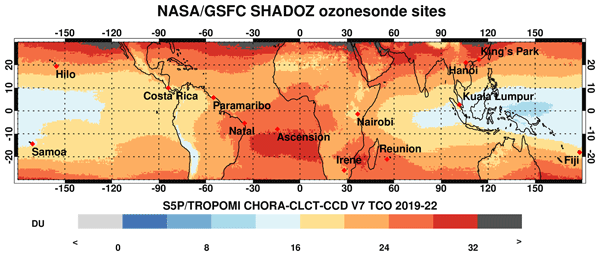
Swathi Maratt Satheesan, Kai-Uwe Eichmann, John P. Burrows, Mark Weber, Ryan Stauffer, Anne M. Thompson, and Debra Kollonige
Atmos. Meas. Tech., 17, 6459–6484, https://doi.org/10.5194/amt-17-6459-2024, https://doi.org/10.5194/amt-17-6459-2024, 2024
Short summary
Short summary
CHORA, an advanced cloud convective differential technique, enhances the accuracy of tropospheric-ozone retrievals. Unlike the traditional Pacific cloud reference sector scheme, CHORA introduces a local-cloud reference sector and an alternative approach (CLCT) for precision. Analysing monthly averaged TROPOMI data from 2018 to 2022 and validating with SHADOZ ozonesonde data, CLCT outperforms other methods and so is the preferred choice, especially in future geostationary satellite missions.
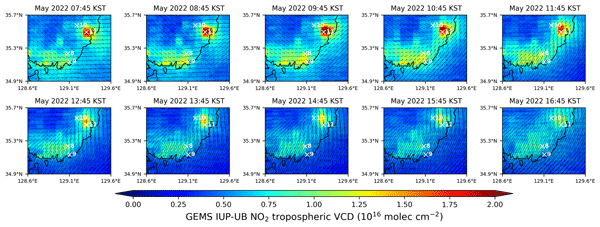
Kezia Lange, Andreas Richter, Tim Bösch, Bianca Zilker, Miriam Latsch, Lisa K. Behrens, Chisom M. Okafor, Hartmut Bösch, John P. Burrows, Alexis Merlaud, Gaia Pinardi, Caroline Fayt, Martina M. Friedrich, Ermioni Dimitropoulou, Michel Van Roozendael, Steffen Ziegler, Simona Ripperger-Lukosiunaite, Leon Kuhn, Bianca Lauster, Thomas Wagner, Hyunkee Hong, Donghee Kim, Lim-Seok Chang, Kangho Bae, Chang-Keun Song, Jong-Uk Park, and Hanlim Lee
Atmos. Meas. Tech., 17, 6315–6344, https://doi.org/10.5194/amt-17-6315-2024, https://doi.org/10.5194/amt-17-6315-2024, 2024
Short summary
Short summary
Instruments for air quality observations on geostationary satellites provide multiple observations per day and allow for the analysis of the diurnal variation of important air pollutants such as nitrogen dioxide (NO2) over large areas. The South Korean instrument GEMS, launched in February 2020, is the first instrument in geostationary orbit and covers a large part of Asia. Our investigations show the observed diurnal evolution of NO2 at different measurement sites.
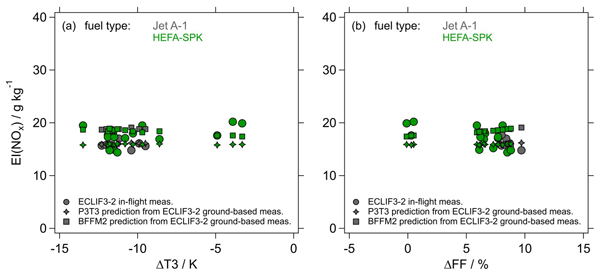
Theresa Harlass, Rebecca Dischl, Stefan Kaufmann, Raphael Märkl, Daniel Sauer, Monika Scheibe, Paul Stock, Tiziana Bräuer, Andreas Dörnbrack, Anke Roiger, Hans Schlager, Ulrich Schumann, Magdalena Pühl, Tobias Schripp, Tobias Grein, Linda Bondorf, Charles Renard, Maxime Gauthier, Mark Johnson, Darren Luff, Paul Madden, Peter Swann, Denise Ahrens, Reetu Sallinen, and Christiane Voigt
Atmos. Chem. Phys., 24, 11807–11822, https://doi.org/10.5194/acp-24-11807-2024, https://doi.org/10.5194/acp-24-11807-2024, 2024
Short summary
Short summary
Emissions from aircraft have a direct impact on our climate. Here, we present airborne and ground-based measurement data of nitrogen oxides that were collected in the exhaust of an Airbus aircraft. We study the impact of burning fossil and sustainable aviation fuel on nitrogen oxide emissions at different engine settings related to combustor temperature, pressure and fuel flow. Further, we compare observations with engine emission models.

Annachiara Bellini, Henri Diémoz, Luca Di Liberto, Gian Paolo Gobbi, Alessandro Bracci, Ferdinando Pasqualini, and Francesca Barnaba
Atmos. Meas. Tech., 17, 6119–6144, https://doi.org/10.5194/amt-17-6119-2024, https://doi.org/10.5194/amt-17-6119-2024, 2024
Short summary
Short summary
We provide a comprehensive overview of the Italian Automated LIdar-CEilometer network, ALICENET, describing its infrastructure, aerosol retrievals, and main applications. The supplement covers data-processing details. We include examples of output products, comparisons with independent data, and examples of the network capability to provide near-real-time aerosol fields over Italy. ALICENET is expected to benefit the sectors of air quality, radiative budget/solar energy, and aviation safety.
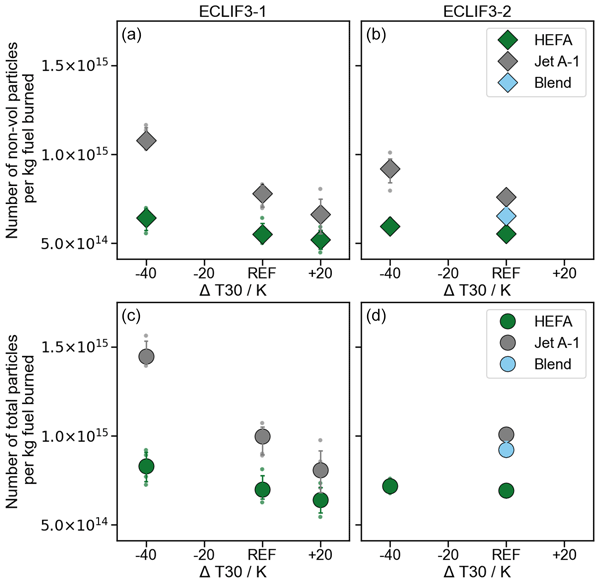
Rebecca Dischl, Daniel Sauer, Christiane Voigt, Theresa Harlaß, Felicitas Sakellariou, Raphael Märkl, Ulrich Schumann, Monika Scheibe, Stefan Kaufmann, Anke Roiger, Andreas Dörnbrack, Charles Renard, Maxime Gauthier, Peter Swann, Paul Madden, Darren Luff, Mark Johnson, Denise Ahrens, Reetu Sallinen, Tobias Schripp, Georg Eckel, Uwe Bauder, and Patrick Le Clercq
Atmos. Chem. Phys., 24, 11255–11273, https://doi.org/10.5194/acp-24-11255-2024, https://doi.org/10.5194/acp-24-11255-2024, 2024
Short summary
Short summary
In-flight measurements of aircraft emissions burning 100 % sustainable aviation fuel (SAF) show reduced particle number concentrations up to 41 % compared to conventional jet fuel. Particle emissions are dependent on engine power setting, flight altitude, and fuel composition. Engine models show a good correlation with measurement results. Future increased prevalence of SAF can positively influence the climate impact of aviation.
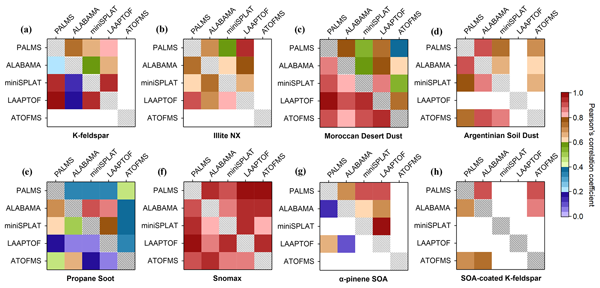
Xiaoli Shen, David M. Bell, Hugh Coe, Naruki Hiranuma, Fabian Mahrt, Nicholas A. Marsden, Claudia Mohr, Daniel M. Murphy, Harald Saathoff, Johannes Schneider, Jacqueline Wilson, Maria A. Zawadowicz, Alla Zelenyuk, Paul J. DeMott, Ottmar Möhler, and Daniel J. Cziczo
Atmos. Chem. Phys., 24, 10869–10891, https://doi.org/10.5194/acp-24-10869-2024, https://doi.org/10.5194/acp-24-10869-2024, 2024
Short summary
Short summary
Single-particle mass spectrometry (SPMS) is commonly used to measure the chemical composition and mixing state of aerosol particles. Intercomparison of SPMS instruments was conducted. All instruments reported similar size ranges and common spectral features. The instrument-specific detection efficiency was found to be more dependent on particle size than type. All differentiated secondary organic aerosol, soot, and soil dust but had difficulties differentiating among minerals and dusts.
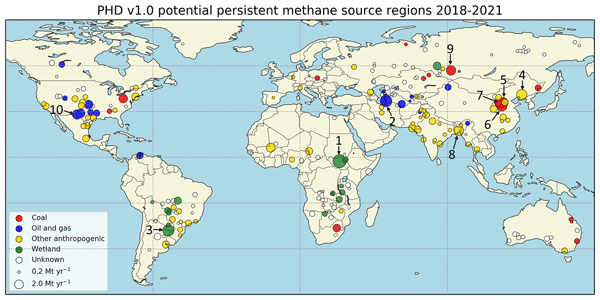
Steffen Vanselow, Oliver Schneising, Michael Buchwitz, Maximilian Reuter, Heinrich Bovensmann, Hartmut Boesch, and John P. Burrows
Atmos. Chem. Phys., 24, 10441–10473, https://doi.org/10.5194/acp-24-10441-2024, https://doi.org/10.5194/acp-24-10441-2024, 2024
Short summary
Short summary
We developed an algorithm to automatically detect persistent methane source regions, to quantify their emissions and to determine their source types, by analyzing TROPOMI data from 2018–2021. The over 200 globally detected natural and anthropogenic source regions include small-scale point sources such as individual coal mines and larger-scale source regions such as wetlands and large oil and gas fields.
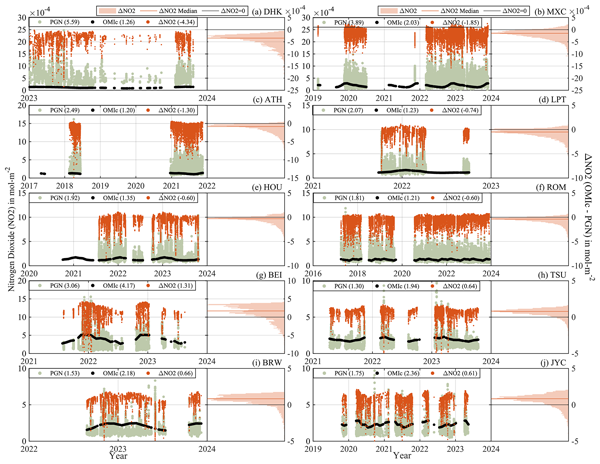
Akriti Masoom, Stelios Kazadzis, Masimo Valeri, Ioannis-Panagiotis Raptis, Gabrielle Brizzi, Kyriakoula Papachristopoulou, Francesca Barnaba, Stefano Casadio, Axel Kreuter, and Fabrizio Niro
Atmos. Meas. Tech., 17, 5525–5549, https://doi.org/10.5194/amt-17-5525-2024, https://doi.org/10.5194/amt-17-5525-2024, 2024
Short summary
Short summary
Aerosols, which have a wide impact on climate, radiative forcing, and human health, are widely represented by aerosol optical depth (AOD). AOD retrievals require Rayleigh scattering and atmospheric absorption (ozone, NO2, etc.) corrections. We analysed the NO2 (which has a high spatiotemporal variation) uncertainty impact on AOD retrievals using the synergy of co-located ground-based instruments with a long-term dataset at worldwide sites and found significant AOD over- or underestimations.
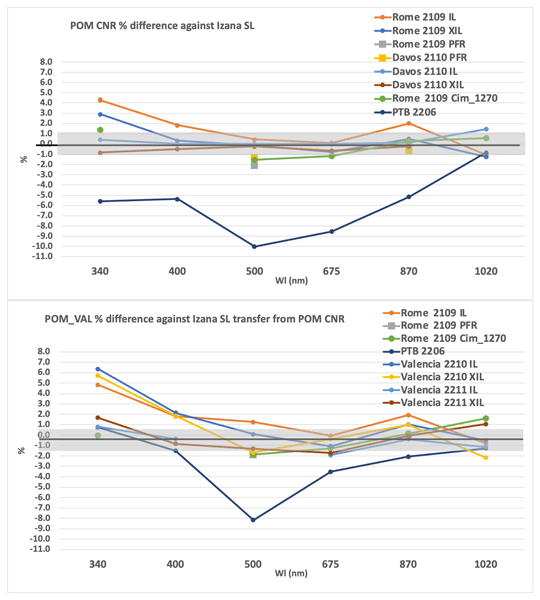
Monica Campanelli, Victor Estellés, Gaurav Kumar, Teruyuki Nakajima, Masahiro Momoi, Julian Gröbner, Stelios Kazadzis, Natalia Kouremeti, Angelos Karanikolas, Africa Barreto, Saulius Nevas, Kerstin Schwind, Philipp Schneider, Iiro Harju, Petri Kärhä, Henri Diémoz, Rei Kudo, Akihiro Uchiyama, Akihiro Yamazaki, Anna Maria Iannarelli, Gabriele Mevi, Annalisa Di Bernardino, and Stefano Casadio
Atmos. Meas. Tech., 17, 5029–5050, https://doi.org/10.5194/amt-17-5029-2024, https://doi.org/10.5194/amt-17-5029-2024, 2024
Short summary
Short summary
To retrieve columnar aerosol properties from sun photometers, some calibration factors are needed. The on-site calibrations, performed as frequently as possible to monitor changes in the machine conditions, allow operators to track and evaluate the calibration status on a continuous basis, reducing the data gaps incurred by the periodic shipments for performing centralized calibrations. The performance of the on-site calibration procedures was evaluated, providing very good results.
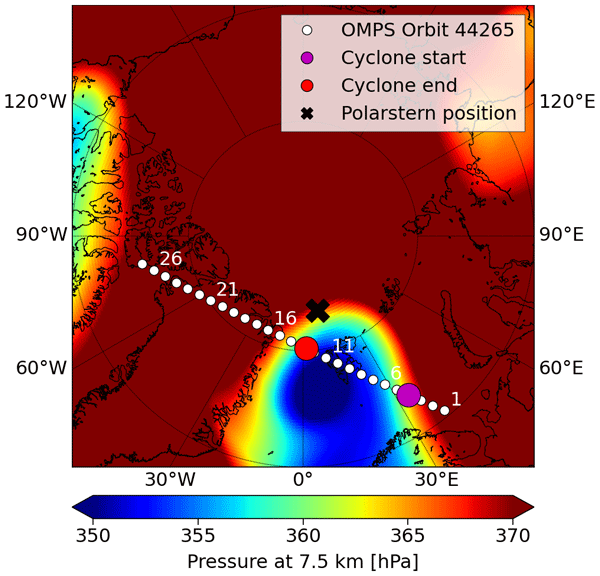
Falco Monsees, Alexei Rozanov, John P. Burrows, Mark Weber, Annette Rinke, Ralf Jaiser, and Peter von der Gathen
Atmos. Chem. Phys., 24, 9085–9099, https://doi.org/10.5194/acp-24-9085-2024, https://doi.org/10.5194/acp-24-9085-2024, 2024
Short summary
Short summary
Cyclones strongly influence weather predictability but still cannot be fully characterised in the Arctic because of the sparse coverage of meteorological measurements. A potential approach to compensate for this is the use of satellite measurements of ozone, because cyclones impact the tropopause and therefore also ozone. In this study we used this connection to investigate the correlation between ozone and the tropopause in the Arctic and to identify cyclones with satellite ozone observations.
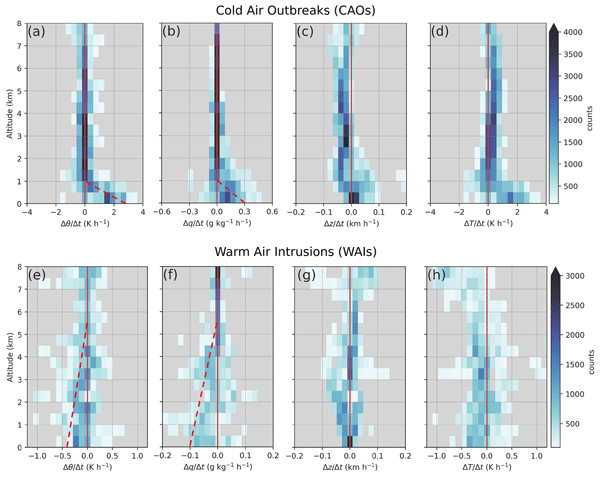
Manfred Wendisch, Susanne Crewell, André Ehrlich, Andreas Herber, Benjamin Kirbus, Christof Lüpkes, Mario Mech, Steven J. Abel, Elisa F. Akansu, Felix Ament, Clémantyne Aubry, Sebastian Becker, Stephan Borrmann, Heiko Bozem, Marlen Brückner, Hans-Christian Clemen, Sandro Dahlke, Georgios Dekoutsidis, Julien Delanoë, Elena De La Torre Castro, Henning Dorff, Regis Dupuy, Oliver Eppers, Florian Ewald, Geet George, Irina V. Gorodetskaya, Sarah Grawe, Silke Groß, Jörg Hartmann, Silvia Henning, Lutz Hirsch, Evelyn Jäkel, Philipp Joppe, Olivier Jourdan, Zsofia Jurányi, Michail Karalis, Mona Kellermann, Marcus Klingebiel, Michael Lonardi, Johannes Lucke, Anna E. Luebke, Maximilian Maahn, Nina Maherndl, Marion Maturilli, Bernhard Mayer, Johanna Mayer, Stephan Mertes, Janosch Michaelis, Michel Michalkov, Guillaume Mioche, Manuel Moser, Hanno Müller, Roel Neggers, Davide Ori, Daria Paul, Fiona M. Paulus, Christian Pilz, Felix Pithan, Mira Pöhlker, Veronika Pörtge, Maximilian Ringel, Nils Risse, Gregory C. Roberts, Sophie Rosenburg, Johannes Röttenbacher, Janna Rückert, Michael Schäfer, Jonas Schaefer, Vera Schemann, Imke Schirmacher, Jörg Schmidt, Sebastian Schmidt, Johannes Schneider, Sabrina Schnitt, Anja Schwarz, Holger Siebert, Harald Sodemann, Tim Sperzel, Gunnar Spreen, Bjorn Stevens, Frank Stratmann, Gunilla Svensson, Christian Tatzelt, Thomas Tuch, Timo Vihma, Christiane Voigt, Lea Volkmer, Andreas Walbröl, Anna Weber, Birgit Wehner, Bruno Wetzel, Martin Wirth, and Tobias Zinner
Atmos. Chem. Phys., 24, 8865–8892, https://doi.org/10.5194/acp-24-8865-2024, https://doi.org/10.5194/acp-24-8865-2024, 2024
Short summary
Short summary
The Arctic is warming faster than the rest of the globe. Warm-air intrusions (WAIs) into the Arctic may play an important role in explaining this phenomenon. Cold-air outbreaks (CAOs) out of the Arctic may link the Arctic climate changes to mid-latitude weather. In our article, we describe how to observe air mass transformations during CAOs and WAIs using three research aircraft instrumented with state-of-the-art remote-sensing and in situ measurement devices.
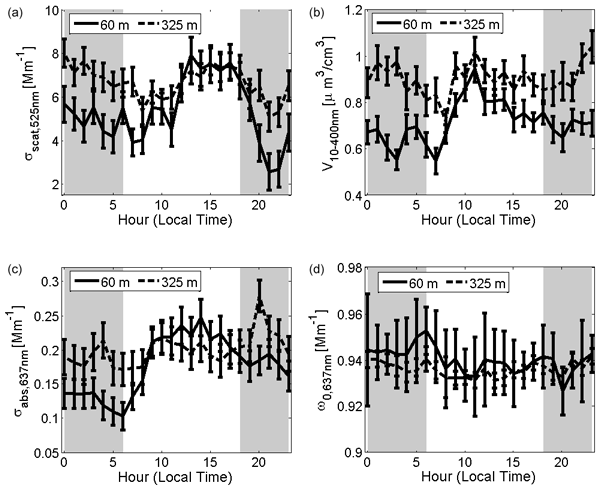
Marco A. Franco, Rafael Valiati, Bruna A. Holanda, Bruno B. Meller, Leslie A. Kremper, Luciana V. Rizzo, Samara Carbone, Fernando G. Morais, Janaína P. Nascimento, Meinrat O. Andreae, Micael A. Cecchini, Luiz A. T. Machado, Milena Ponczek, Ulrich Pöschl, David Walter, Christopher Pöhlker, and Paulo Artaxo
Atmos. Chem. Phys., 24, 8751–8770, https://doi.org/10.5194/acp-24-8751-2024, https://doi.org/10.5194/acp-24-8751-2024, 2024
Short summary
Short summary
The Amazon wet-season atmosphere was studied at the Amazon Tall Tower Observatory site, revealing vertical variations (between 60 and 325 m) in natural aerosols. Daytime mixing contrasted with nighttime stratification, with distinct rain-induced changes in aerosol populations. Notably, optical property recovery at higher levels was faster, while near-canopy aerosols showed higher scattering efficiency. These findings enhance our understanding of aerosol impacts on climate dynamics.
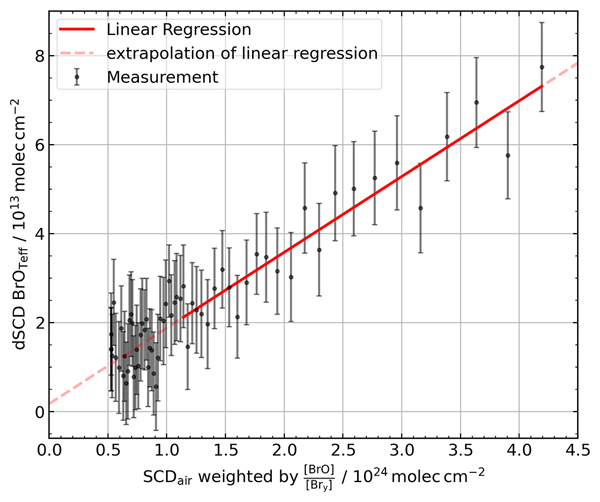
Karolin Voss, Philip Holzbeck, Klaus Pfeilsticker, Ralph Kleinschek, Gerald Wetzel, Blanca Fuentes Andrade, Michael Höpfner, Jörn Ungermann, Björn-Martin Sinnhuber, and André Butz
Atmos. Meas. Tech., 17, 4507–4528, https://doi.org/10.5194/amt-17-4507-2024, https://doi.org/10.5194/amt-17-4507-2024, 2024
Short summary
Short summary
A novel balloon-borne instrument for direct sun and solar occultation measurements of several UV–Vis absorbing gases (e.g. O3, NO2, BrO, IO, and HONO) is described. Its major design features and performance during two stratospheric deployments are discussed. From the measured overhead BrO concentration and a suitable photochemical correction, total stratospheric bromine is inferred to (17.5 ± 2.2) ppt in air masses which entered the stratosphere around early 2017 ± 1 year.
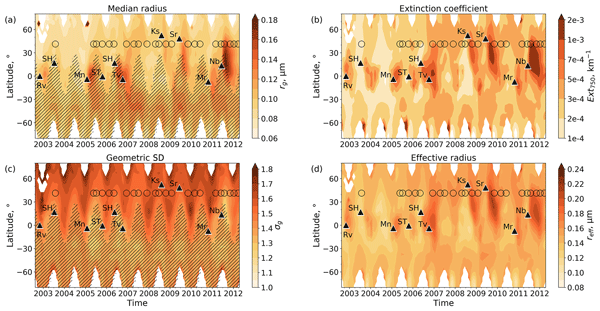
Christine Pohl, Felix Wrana, Alexei Rozanov, Terry Deshler, Elizaveta Malinina, Christian von Savigny, Landon A. Rieger, Adam E. Bourassa, and John P. Burrows
Atmos. Meas. Tech., 17, 4153–4181, https://doi.org/10.5194/amt-17-4153-2024, https://doi.org/10.5194/amt-17-4153-2024, 2024
Short summary
Short summary
Knowledge of stratospheric aerosol characteristics is important for understanding chemical and climate aerosol feedbacks. Two particle size distribution parameters, the aerosol extinction coefficient and the effective radius, are obtained from SCIAMACHY limb observations. The aerosol characteristics show good agreement with independent data sets from balloon-borne and satellite observations. This data set expands the limited knowledge of stratospheric aerosol characteristics.
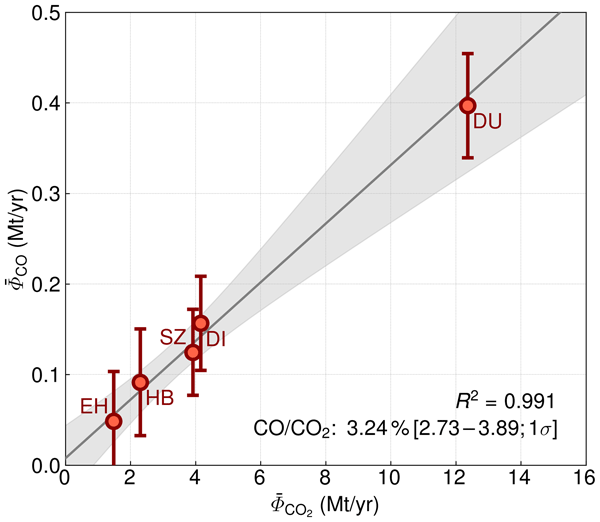
Oliver Schneising, Michael Buchwitz, Maximilian Reuter, Michael Weimer, Heinrich Bovensmann, John P. Burrows, and Hartmut Bösch
Atmos. Chem. Phys., 24, 7609–7621, https://doi.org/10.5194/acp-24-7609-2024, https://doi.org/10.5194/acp-24-7609-2024, 2024
Short summary
Short summary
Large quantities of CO and CO2 are emitted during conventional steel production. As satellite-based estimates of CO2 emissions at the facility level are challenging, co-emitted CO can indicate the carbon footprint of steel plants. We estimate CO emissions for German steelworks and use CO2 emissions from emissions trading data to derive a sector-specific CO/CO2 emission ratio for the steel industry; it is a prerequisite to use CO as a proxy for CO2 emissions from similar steel production sites.
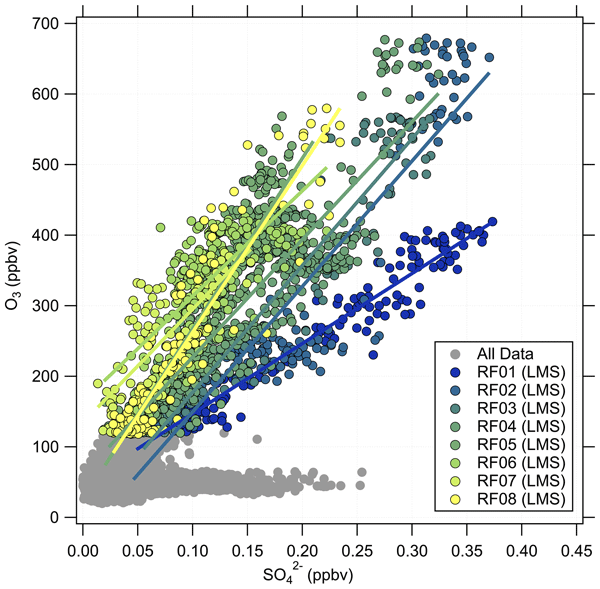
Philipp Joppe, Johannes Schneider, Katharina Kaiser, Horst Fischer, Peter Hoor, Daniel Kunkel, Hans-Christoph Lachnitt, Andreas Marsing, Lenard Röder, Hans Schlager, Laura Tomsche, Christiane Voigt, Andreas Zahn, and Stephan Borrmann
Atmos. Chem. Phys., 24, 7499–7522, https://doi.org/10.5194/acp-24-7499-2024, https://doi.org/10.5194/acp-24-7499-2024, 2024
Short summary
Short summary
From aircraft measurements in the upper troposphere/lower stratosphere, we find a correlation between the ozone and particulate sulfate in the lower stratosphere. The correlation exhibits some variability over the measurement period exceeding the background sulfate-to-ozone correlation. From our analysis, we conclude that gas-to-particle conversion of volcanic sulfur dioxide leads to observed enhanced sulfate aerosol mixing ratios.
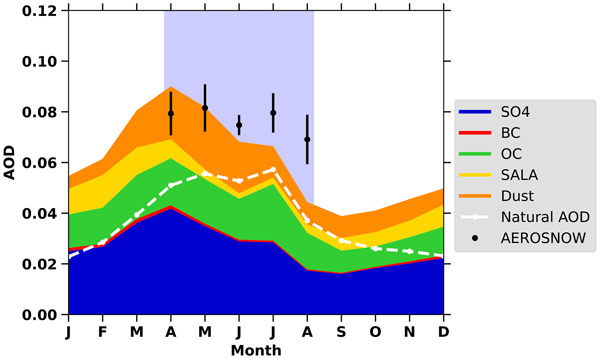
Basudev Swain, Marco Vountas, Aishwarya Singh, Nidhi L. Anchan, Adrien Deroubaix, Luca Lelli, Yanick Ziegler, Sachin S. Gunthe, Hartmut Bösch, and John P. Burrows
Atmos. Chem. Phys., 24, 5671–5693, https://doi.org/10.5194/acp-24-5671-2024, https://doi.org/10.5194/acp-24-5671-2024, 2024
Short summary
Short summary
Arctic amplification (AA) accelerates the warming of the central Arctic cryosphere and affects aerosol dynamics. Limited observations hinder a comprehensive analysis. This study uses AEROSNOW aerosol optical density (AOD) data and GEOS-Chem simulations to assess AOD variability. Discrepancies highlight the need for improved observational integration into models to refine our understanding of aerosol effects on cloud microphysics, ice nucleation, and radiative forcing under evolving AA.
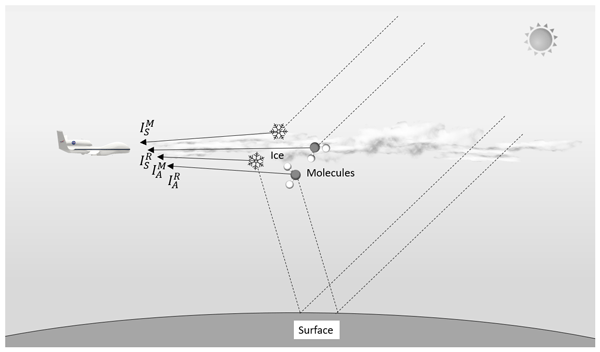
Santo Fedele Colosimo, Nathaniel Brockway, Vijay Natraj, Robert Spurr, Klaus Pfeilsticker, Lisa Scalone, Max Spolaor, Sarah Woods, and Jochen Stutz
Atmos. Meas. Tech., 17, 2367–2385, https://doi.org/10.5194/amt-17-2367-2024, https://doi.org/10.5194/amt-17-2367-2024, 2024
Short summary
Short summary
Cirrus clouds are poorly understood components of the climate system, in part due to the challenge of observing thin, sub-visible ice clouds. We address this issue with a new observational approach that uses the remote sensing of near-infrared ice water absorption features from a high-altitude aircraft. We describe the underlying principle of this approach and present a new procedure to retrieve ice concentration in cirrus clouds. Our retrievals compare well with in situ observations.
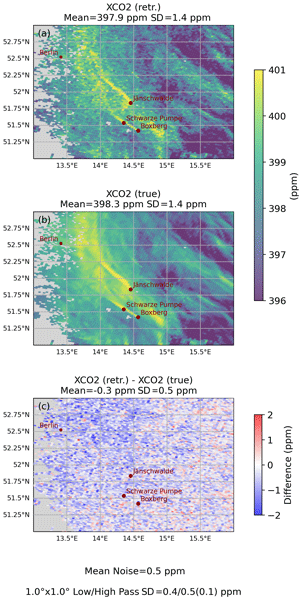
Stefan Noël, Michael Buchwitz, Michael Hilker, Maximilian Reuter, Michael Weimer, Heinrich Bovensmann, John P. Burrows, Hartmut Bösch, and Ruediger Lang
Atmos. Meas. Tech., 17, 2317–2334, https://doi.org/10.5194/amt-17-2317-2024, https://doi.org/10.5194/amt-17-2317-2024, 2024
Short summary
Short summary
FOCAL-CO2M is one of the three operational retrieval algorithms which will be used to derive XCO2 and XCH4 from measurements of the forthcoming European CO2M mission. We present results of applications of FOCAL-CO2M to simulated spectra, from which confidence is gained that the algorithm is able to fulfil the challenging requirements on systematic errors for the CO2M mission (spatio-temporal bias ≤ 0.5 ppm for XCO2 and ≤ 5 ppb for XCH4).
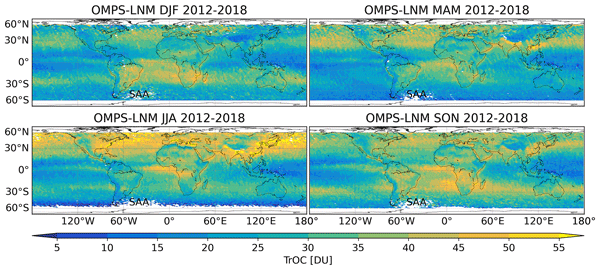
Andrea Orfanoz-Cheuquelaf, Carlo Arosio, Alexei Rozanov, Mark Weber, Annette Ladstätter-Weißenmayer, John P. Burrows, Anne M. Thompson, Ryan M. Stauffer, and Debra E. Kollonige
Atmos. Meas. Tech., 17, 1791–1809, https://doi.org/10.5194/amt-17-1791-2024, https://doi.org/10.5194/amt-17-1791-2024, 2024
Short summary
Short summary
Valuable information on the tropospheric ozone column (TrOC) can be obtained globally by combining space-borne limb and nadir measurements (limb–nadir matching, LNM). This study describes the retrieval of TrOC from the OMPS instrument (since 2012) using the LNM technique. The OMPS-LNM TrOC was compared with ozonesondes and other satellite measurements, showing a good agreement with a negative bias within 1 to 4 DU. This new dataset is suitable for pollution studies.
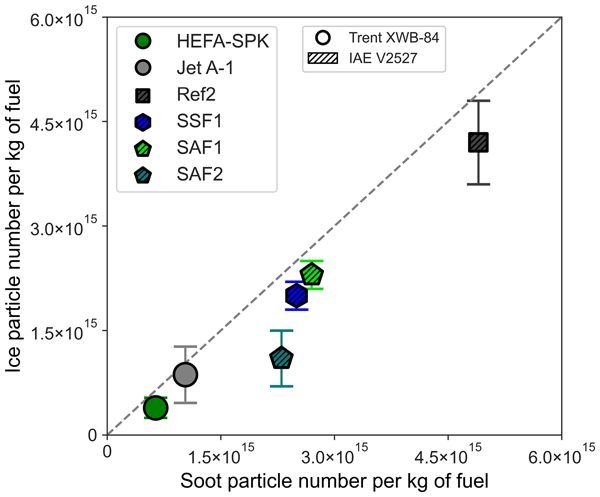
Raphael Satoru Märkl, Christiane Voigt, Daniel Sauer, Rebecca Katharina Dischl, Stefan Kaufmann, Theresa Harlaß, Valerian Hahn, Anke Roiger, Cornelius Weiß-Rehm, Ulrike Burkhardt, Ulrich Schumann, Andreas Marsing, Monika Scheibe, Andreas Dörnbrack, Charles Renard, Maxime Gauthier, Peter Swann, Paul Madden, Darren Luff, Reetu Sallinen, Tobias Schripp, and Patrick Le Clercq
Atmos. Chem. Phys., 24, 3813–3837, https://doi.org/10.5194/acp-24-3813-2024, https://doi.org/10.5194/acp-24-3813-2024, 2024
Short summary
Short summary
In situ measurements of contrails from a large passenger aircraft burning 100 % sustainable aviation fuel (SAF) show a 56 % reduction in contrail ice crystal numbers compared to conventional Jet A-1. Results from a climate model initialized with the observations suggest a significant decrease in radiative forcing from contrails. Our study confirms that future increased use of low aromatic SAF can reduce the climate impact from aviation.
Adrien Deroubaix, Marco Vountas, Benjamin Gaubert, Maria Dolores Andrés Hernández, Stephan Borrmann, Guy Brasseur, Bruna Holanda, Yugo Kanaya, Katharina Kaiser, Flora Kluge, Ovid Oktavian Krüger, Inga Labuhn, Michael Lichtenstern, Klaus Pfeilsticker, Mira Pöhlker, Hans Schlager, Johannes Schneider, Guillaume Siour, Basudev Swain, Paolo Tuccella, Kameswara S. Vinjamuri, Mihalis Vrekoussis, Benjamin Weyland, and John P. Burrows
EGUsphere, https://doi.org/10.5194/egusphere-2024-516, https://doi.org/10.5194/egusphere-2024-516, 2024
Preprint archived
Short summary
Short summary
This study assesses atmospheric composition using air quality models during aircraft campaigns in Europe and Asia, focusing on carbonaceous aerosols and trace gases. While carbon monoxide is well modeled, other pollutants have moderate to weak agreement with observations. Wind speed modeling is reliable for identifying pollution plumes, where models tend to overestimate concentrations. This highlights challenges in accurately modeling aerosol and trace gas composition, particularly in cities.
Adrien Deroubaix, Marco Vountas, Benjamin Gaubert, Maria Dolores Andrés Hernández, Stephan Borrmann, Guy Brasseur, Bruna Holanda, Yugo Kanaya, Katharina Kaiser, Flora Kluge, Ovid Oktavian Krüger, Inga Labuhn, Michael Lichtenstern, Klaus Pfeilsticker, Mira Pöhlker, Hans Schlager, Johannes Schneider, Guillaume Siour, Basudev Swain, Paolo Tuccella, Kameswara S. Vinjamuri, Mihalis Vrekoussis, Benjamin Weyland, and John P. Burrows
EGUsphere, https://doi.org/10.5194/egusphere-2024-521, https://doi.org/10.5194/egusphere-2024-521, 2024
Preprint archived
Short summary
Short summary
This study explores the proportional relationships between carbonaceous aerosols (black and organic carbon) and trace gases using airborne measurements from two campaigns in Europe and East Asia. Differences between regions were found, but air quality models struggled to reproduce them accurately. We show that these proportional relationships can help to constrain models and can be used to infer aerosol concentrations from satellite observations of trace gases, especially in urban areas.
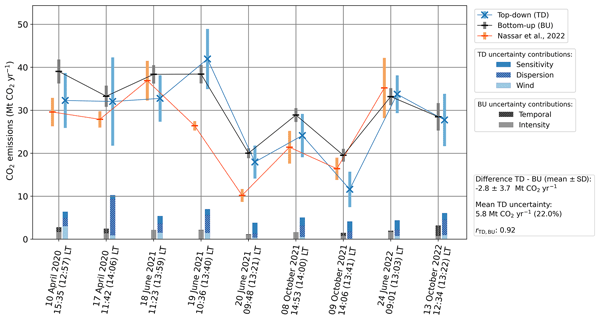
Blanca Fuentes Andrade, Michael Buchwitz, Maximilian Reuter, Heinrich Bovensmann, Andreas Richter, Hartmut Boesch, and John P. Burrows
Atmos. Meas. Tech., 17, 1145–1173, https://doi.org/10.5194/amt-17-1145-2024, https://doi.org/10.5194/amt-17-1145-2024, 2024
Short summary
Short summary
We developed a method to estimate CO2 emissions from localized sources, such as power plants, using satellite data and applied it to estimate CO2 emissions from the Bełchatów Power Station (Poland). As the detection of CO2 emission plumes from satellite data is difficult, we used observations of co-emitted NO2 to constrain the emission plume region. Our results agree with CO2 emission estimations based on the power-plant-generated power and emission factors.
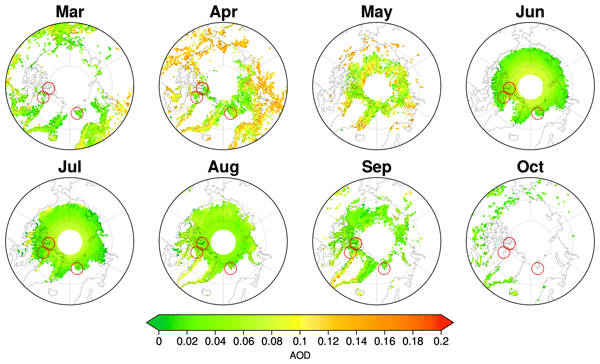
Basudev Swain, Marco Vountas, Adrien Deroubaix, Luca Lelli, Yanick Ziegler, Soheila Jafariserajehlou, Sachin S. Gunthe, Andreas Herber, Christoph Ritter, Hartmut Bösch, and John P. Burrows
Atmos. Meas. Tech., 17, 359–375, https://doi.org/10.5194/amt-17-359-2024, https://doi.org/10.5194/amt-17-359-2024, 2024
Short summary
Short summary
Aerosols are suspensions of particles dispersed in the air. In this study, we use a novel retrieval of satellite data to investigate an optical property of aerosols, the aerosol optical depth, in the high Arctic to assess their direct and indirect roles in climate change. This study demonstrates that the presented approach shows good quality and very promising potential.
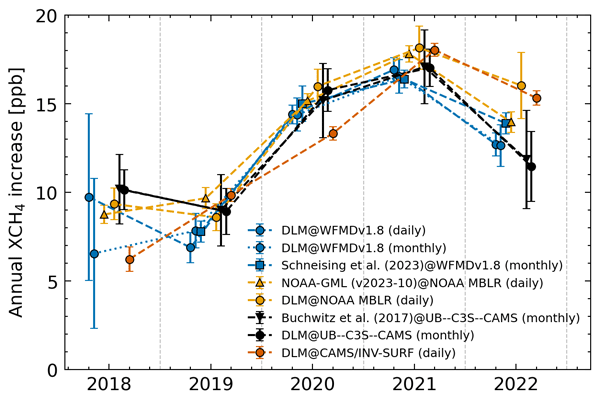
Jonas Hachmeister, Oliver Schneising, Michael Buchwitz, John P. Burrows, Justus Notholt, and Matthias Buschmann
Atmos. Chem. Phys., 24, 577–595, https://doi.org/10.5194/acp-24-577-2024, https://doi.org/10.5194/acp-24-577-2024, 2024
Short summary
Short summary
We quantified changes in atmospheric methane concentrations using satellite data and a dynamic linear model approach. We calculated global annual methane increases for the years 2019–2022, which are in good agreement with other sources. For zonal methane growth rates, we identified strong inter-hemispheric differences in 2019 and 2022. For 2022, we could attribute decreases in the global growth rate to the Northern Hemisphere, possibly related to a reduction in anthropogenic emissions.
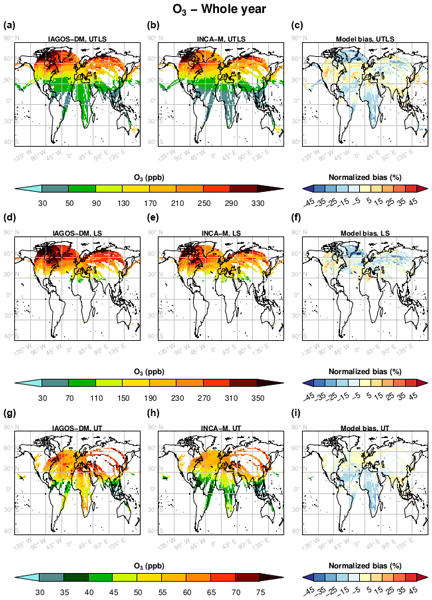
Yann Cohen, Didier Hauglustaine, Bastien Sauvage, Susanne Rohs, Patrick Konjari, Ulrich Bundke, Andreas Petzold, Valérie Thouret, Andreas Zahn, and Helmut Ziereis
Atmos. Chem. Phys., 23, 14973–15009, https://doi.org/10.5194/acp-23-14973-2023, https://doi.org/10.5194/acp-23-14973-2023, 2023
Short summary
Short summary
The upper troposphere–lower stratosphere (UTLS) is a key region regarding the lower atmospheric composition. This study consists of a comprehensive evaluation of an up-to-date chemistry–climate model in this layer, using regular in situ measurements based on passenger aircraft. For this purpose, a specific software (Interpol-IAGOS) has been updated and made publicly available. The model reproduces the carbon monoxide peaks due to biomass burning over the continental tropics particularly well.
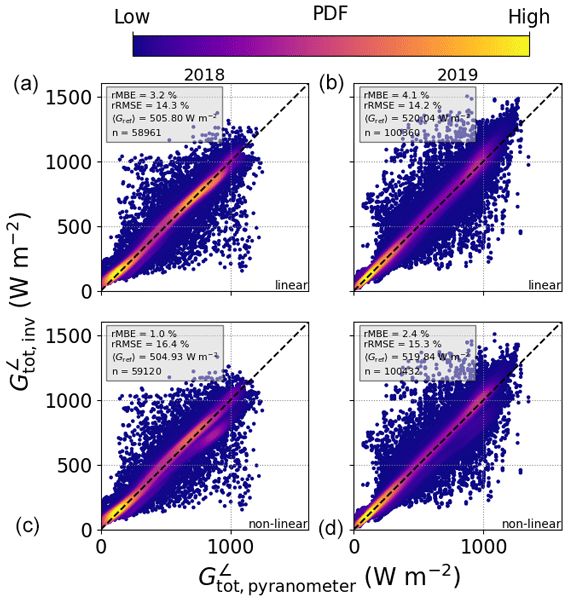
James Barry, Stefanie Meilinger, Klaus Pfeilsticker, Anna Herman-Czezuch, Nicola Kimiaie, Christopher Schirrmeister, Rone Yousif, Tina Buchmann, Johannes Grabenstein, Hartwig Deneke, Jonas Witthuhn, Claudia Emde, Felix Gödde, Bernhard Mayer, Leonhard Scheck, Marion Schroedter-Homscheidt, Philipp Hofbauer, and Matthias Struck
Atmos. Meas. Tech., 16, 4975–5007, https://doi.org/10.5194/amt-16-4975-2023, https://doi.org/10.5194/amt-16-4975-2023, 2023
Short summary
Short summary
Measured power data from solar photovoltaic (PV) systems contain information about the state of the atmosphere. In this work, power data from PV systems in the Allgäu region in Germany were used to determine the solar irradiance at each location, using state-of-the-art simulation and modelling. The results were validated using concurrent measurements of the incoming solar radiation in each case. If applied on a wider scale, this algorithm could help improve weather and climate models.
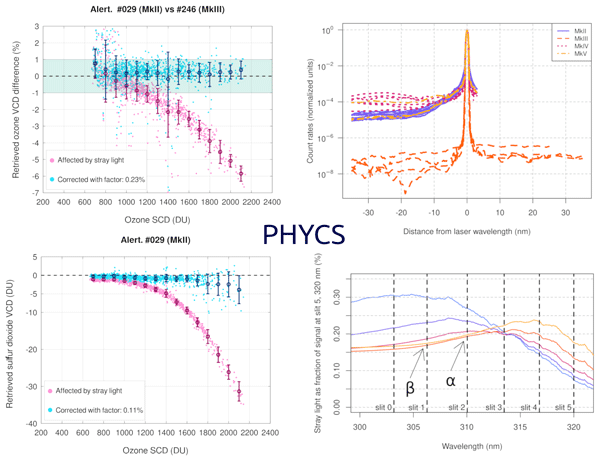
Vladimir Savastiouk, Henri Diémoz, and C. Thomas McElroy
Atmos. Meas. Tech., 16, 4785–4806, https://doi.org/10.5194/amt-16-4785-2023, https://doi.org/10.5194/amt-16-4785-2023, 2023
Short summary
Short summary
This paper describes a way to significantly improve ozone measurements at low sun elevations and large ozone amounts when using the Brewer ozone spectrophotometer. The proposed algorithm will allow more uniform ozone measurements across the monitoring network. This will contribute to more reliable trend analysis and support the satellite validation. This research contributes to better understanding the physics of the instrument, and the new algorithm is based on this new knowledge.
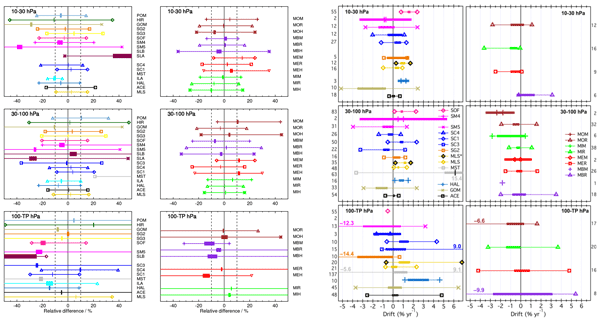
Michael Kiefer, Dale F. Hurst, Gabriele P. Stiller, Stefan Lossow, Holger Vömel, John Anderson, Faiza Azam, Jean-Loup Bertaux, Laurent Blanot, Klaus Bramstedt, John P. Burrows, Robert Damadeo, Bianca Maria Dinelli, Patrick Eriksson, Maya García-Comas, John C. Gille, Mark Hervig, Yasuko Kasai, Farahnaz Khosrawi, Donal Murtagh, Gerald E. Nedoluha, Stefan Noël, Piera Raspollini, William G. Read, Karen H. Rosenlof, Alexei Rozanov, Christopher E. Sioris, Takafumi Sugita, Thomas von Clarmann, Kaley A. Walker, and Katja Weigel
Atmos. Meas. Tech., 16, 4589–4642, https://doi.org/10.5194/amt-16-4589-2023, https://doi.org/10.5194/amt-16-4589-2023, 2023
Short summary
Short summary
We quantify biases and drifts (and their uncertainties) between the stratospheric water vapor measurement records of 15 satellite-based instruments (SATs, with 31 different retrievals) and balloon-borne frost point hygrometers (FPs) launched at 27 globally distributed stations. These comparisons of measurements during the period 2000–2016 are made using robust, consistent statistical methods. With some exceptions, the biases and drifts determined for most SAT–FP pairs are < 10 % and < 1 % yr−1.
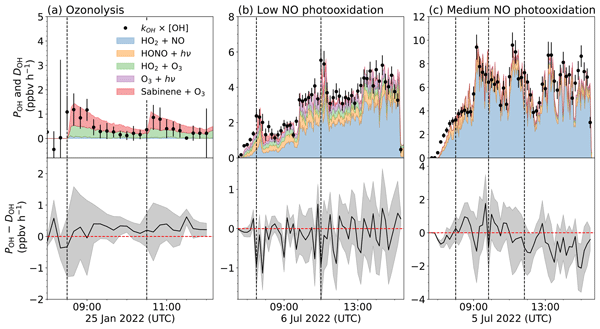
Jacky Y. S. Pang, Florian Berg, Anna Novelli, Birger Bohn, Michelle Färber, Philip T. M. Carlsson, René Dubus, Georgios I. Gkatzelis, Franz Rohrer, Sergej Wedel, Andreas Wahner, and Hendrik Fuchs
Atmos. Chem. Phys., 23, 12631–12649, https://doi.org/10.5194/acp-23-12631-2023, https://doi.org/10.5194/acp-23-12631-2023, 2023
Short summary
Short summary
In this study, the oxidations of sabinene by OH radicals and ozone were investigated with an atmospheric simulation chamber. Reaction rate coefficients of the OH-oxidation reaction at temperatures between 284 to 340 K were determined for the first time in the laboratory by measuring the OH reactivity. Product yields determined in chamber experiments had good agreement with literature values, but discrepancies were found between experimental yields and expected yields from oxidation mechanisms.
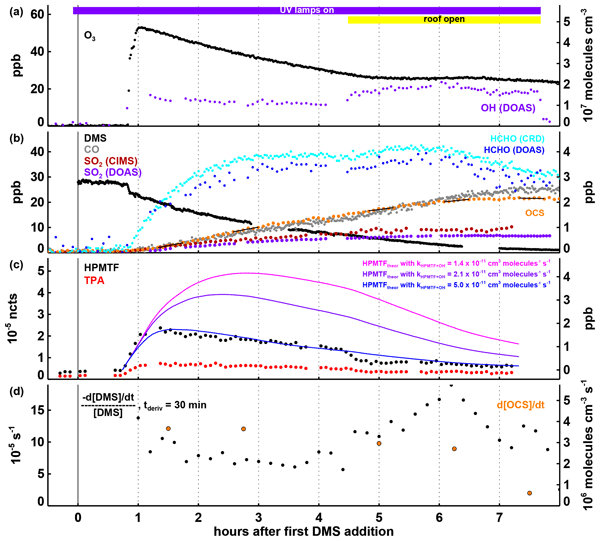
Marc von Hobe, Domenico Taraborrelli, Sascha Alber, Birger Bohn, Hans-Peter Dorn, Hendrik Fuchs, Yun Li, Chenxi Qiu, Franz Rohrer, Roberto Sommariva, Fred Stroh, Zhaofeng Tan, Sergej Wedel, and Anna Novelli
Atmos. Chem. Phys., 23, 10609–10623, https://doi.org/10.5194/acp-23-10609-2023, https://doi.org/10.5194/acp-23-10609-2023, 2023
Short summary
Short summary
The trace gas carbonyl sulfide (OCS) transports sulfur from the troposphere to the stratosphere, where sulfate aerosols are formed that influence climate and stratospheric chemistry. An uncertain OCS source in the troposphere is chemical production form dimethyl sulfide (DMS), a gas released in large quantities from the oceans. We carried out experiments in a large atmospheric simulation chamber to further elucidate the chemical mechanism of OCS production from DMS.
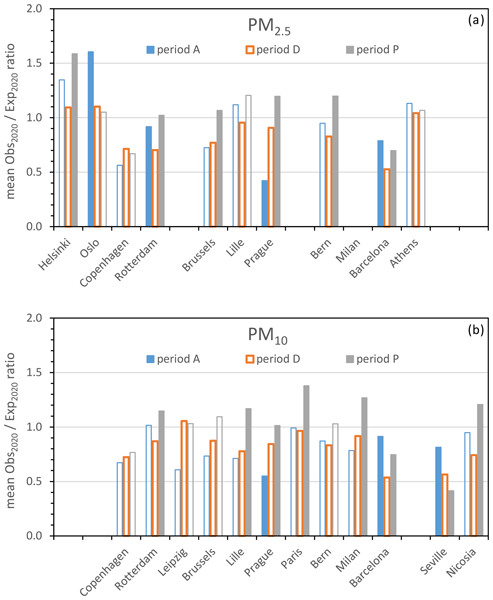
Jean-Philippe Putaud, Enrico Pisoni, Alexander Mangold, Christoph Hueglin, Jean Sciare, Michael Pikridas, Chrysanthos Savvides, Jakub Ondracek, Saliou Mbengue, Alfred Wiedensohler, Kay Weinhold, Maik Merkel, Laurent Poulain, Dominik van Pinxteren, Hartmut Herrmann, Andreas Massling, Claus Nordstroem, Andrés Alastuey, Cristina Reche, Noemí Pérez, Sonia Castillo, Mar Sorribas, Jose Antonio Adame, Tuukka Petaja, Katrianne Lehtipalo, Jarkko Niemi, Véronique Riffault, Joel F. de Brito, Augustin Colette, Olivier Favez, Jean-Eudes Petit, Valérie Gros, Maria I. Gini, Stergios Vratolis, Konstantinos Eleftheriadis, Evangelia Diapouli, Hugo Denier van der Gon, Karl Espen Yttri, and Wenche Aas
Atmos. Chem. Phys., 23, 10145–10161, https://doi.org/10.5194/acp-23-10145-2023, https://doi.org/10.5194/acp-23-10145-2023, 2023
Short summary
Short summary
Many European people are still exposed to levels of air pollution that can affect their health. COVID-19 lockdowns in 2020 were used to assess the impact of the reduction in human mobility on air pollution across Europe by comparing measurement data with values that would be expected if no lockdown had occurred. We show that lockdown measures did not lead to consistent decreases in the concentrations of fine particulate matter suspended in the air, and we investigate why.
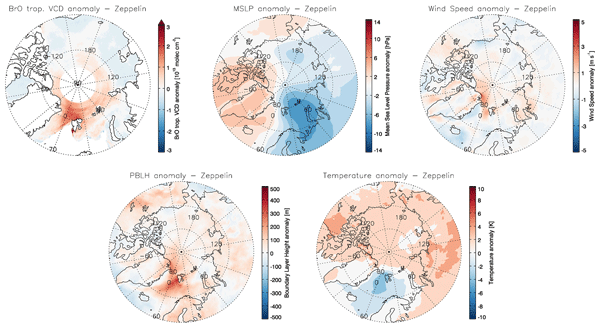
Bianca Zilker, Andreas Richter, Anne-Marlene Blechschmidt, Peter von der Gathen, Ilias Bougoudis, Sora Seo, Tim Bösch, and John Philip Burrows
Atmos. Chem. Phys., 23, 9787–9814, https://doi.org/10.5194/acp-23-9787-2023, https://doi.org/10.5194/acp-23-9787-2023, 2023
Short summary
Short summary
During Arctic spring, near-surface ozone is depleted by bromine released from salty sea ice and/or snow-covered areas under certain meteorological conditions. To study this ozone depletion and the prevailing meteorological conditions, two ozone data sets from Ny-Ålesund, Svalbard, have been evaluated. We found that during ozone depletion events lower pressure over the Barents Sea and higher pressure in the Icelandic Low area led to a transport of cold polar air from the north to Ny-Ålesund.
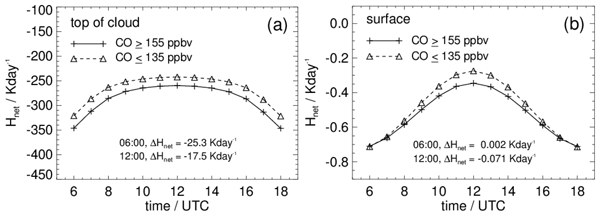
Valerian Hahn, Ralf Meerkötter, Christiane Voigt, Sonja Gisinger, Daniel Sauer, Valéry Catoire, Volker Dreiling, Hugh Coe, Cyrille Flamant, Stefan Kaufmann, Jonas Kleine, Peter Knippertz, Manuel Moser, Philip Rosenberg, Hans Schlager, Alfons Schwarzenboeck, and Jonathan Taylor
Atmos. Chem. Phys., 23, 8515–8530, https://doi.org/10.5194/acp-23-8515-2023, https://doi.org/10.5194/acp-23-8515-2023, 2023
Short summary
Short summary
During the DACCIWA campaign in West Africa, we found a 35 % increase in the cloud droplet concentration that formed in a polluted compared with a less polluted environment and a decrease of 17 % in effective droplet diameter. Radiative transfer simulations, based on the measured cloud properties, reveal that these low-level polluted clouds radiate only 2.6 % more energy back to space, compared with a less polluted cloud. The corresponding additional decrease in temperature is rather small.
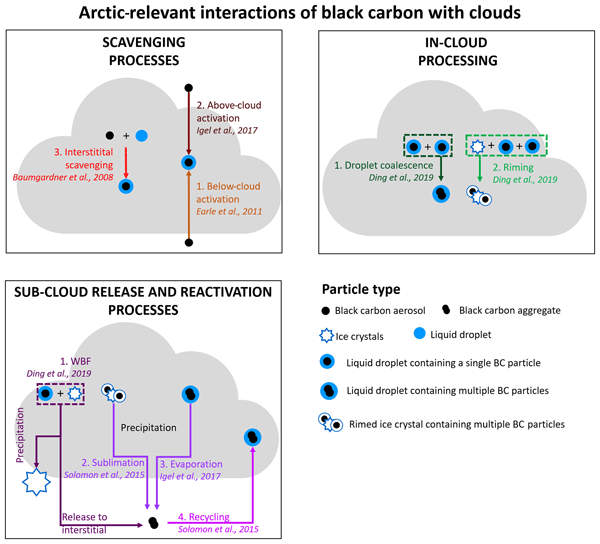
Marco Zanatta, Stephan Mertes, Olivier Jourdan, Regis Dupuy, Emma Järvinen, Martin Schnaiter, Oliver Eppers, Johannes Schneider, Zsófia Jurányi, and Andreas Herber
Atmos. Chem. Phys., 23, 7955–7973, https://doi.org/10.5194/acp-23-7955-2023, https://doi.org/10.5194/acp-23-7955-2023, 2023
Short summary
Short summary
Black carbon (BC) particles influence the Arctic radiative balance. Vertical measurements of black carbon were conducted during the ACLOUD campaign in the European Arctic to study the interaction of BC with clouds. This study shows that clouds influence the vertical variability of BC properties across the inversion layer and that multiple activation and transformation mechanisms of BC may occur in the presence of low-level, persistent, mixed-phase clouds.
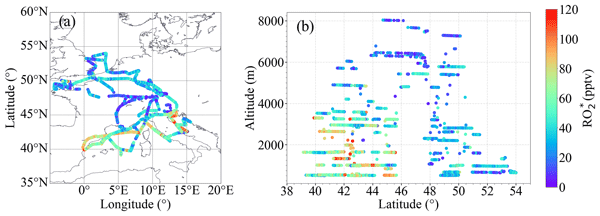
Midhun George, Maria Dolores Andrés Hernández, Vladyslav Nenakhov, Yangzhuoran Liu, John Philip Burrows, Birger Bohn, Eric Förster, Florian Obersteiner, Andreas Zahn, Theresa Harlaß, Helmut Ziereis, Hans Schlager, Benjamin Schreiner, Flora Kluge, Katja Bigge, and Klaus Pfeilsticker
Atmos. Chem. Phys., 23, 7799–7822, https://doi.org/10.5194/acp-23-7799-2023, https://doi.org/10.5194/acp-23-7799-2023, 2023
Short summary
Short summary
The applicability of photostationary steady-state (PSS) assumptions to estimate the amount of the sum of peroxy radicals (RO2*) during the EMeRGe airborne observations from the known radical chemistry and onboard measurements of RO2* precursors, photolysis frequencies, and other trace gases such as NOx and O3 was investigated. The comparison of the calculated RO2* with the actual measurements provides an insight into the main processes controlling their concentration in the air masses measured.
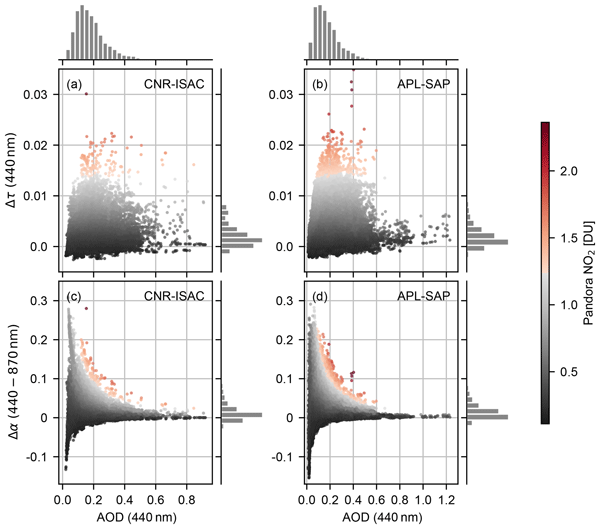
Theano Drosoglou, Ioannis-Panagiotis Raptis, Massimo Valeri, Stefano Casadio, Francesca Barnaba, Marcos Herreras-Giralda, Anton Lopatin, Oleg Dubovik, Gabriele Brizzi, Fabrizio Niro, Monica Campanelli, and Stelios Kazadzis
Atmos. Meas. Tech., 16, 2989–3014, https://doi.org/10.5194/amt-16-2989-2023, https://doi.org/10.5194/amt-16-2989-2023, 2023
Short summary
Short summary
Aerosol optical properties derived from sun photometers depend on the optical depth of trace gases absorbing solar radiation at specific spectral ranges. Various networks use satellite-based climatologies to account for this or neglect their effect. In this work, we evaluate the effect of NO2 absorption in aerosol retrievals from AERONET and SKYNET over two stations in Rome, Italy, with relatively high NO2 spatiotemporal variations, using NO2 data from the Pandora network and the TROPOMI sensor.
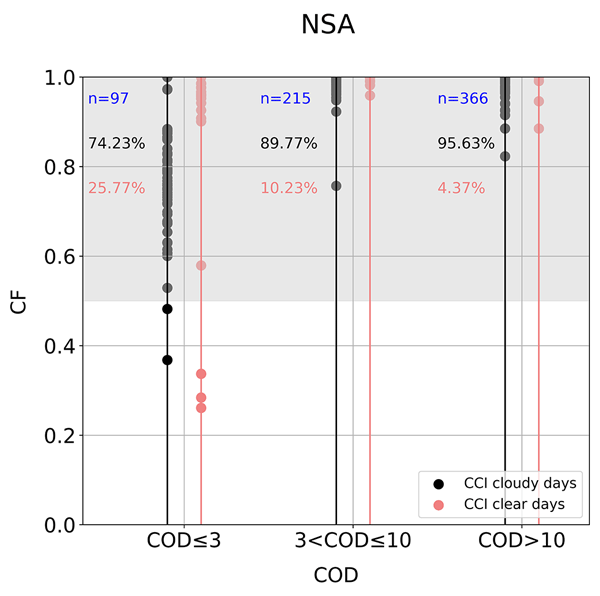
Kameswara S. Vinjamuri, Marco Vountas, Luca Lelli, Martin Stengel, Matthew D. Shupe, Kerstin Ebell, and John P. Burrows
Atmos. Meas. Tech., 16, 2903–2918, https://doi.org/10.5194/amt-16-2903-2023, https://doi.org/10.5194/amt-16-2903-2023, 2023
Short summary
Short summary
Clouds play an important role in Arctic amplification. Cloud data from ground-based sites are valuable but cannot represent the whole Arctic. Therefore the use of satellite products is a measure to cover the entire Arctic. However, the quality of such cloud measurements from space is not well known. The paper discusses the differences and commonalities between satellite and ground-based measurements. We conclude that the satellite dataset, with a few exceptions, can be used in the Arctic.
Basudev Swain, Marco Vountas, Adrien Deroubaix, Luca Lelli, Aishwarya Singh, Yanick Ziegler, Sachin S. Gunthe, and John P. Burrows
EGUsphere, https://doi.org/10.5194/egusphere-2023-730, https://doi.org/10.5194/egusphere-2023-730, 2023
Preprint archived
Short summary
Short summary
Aerosols are suspensions of particles distributed in the air. Depending on their chemical composition, they scatter and/or absorb sunlight and thus cool or warm the earth's atmosphere and its surface. They also provide as a surface in the atmosphere upon which ice or liquid clouds droplets nucleate and grow. In this study, we use satellite observations and model simulations to investigate the properties of aerosols with the goal of assessing their direct and indirect role in climate change.
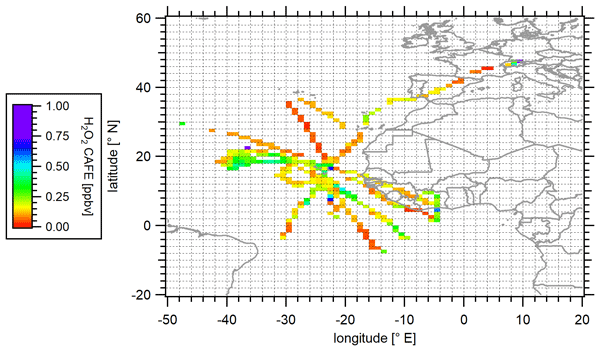
Zaneta Hamryszczak, Dirk Dienhart, Bettina Brendel, Roland Rohloff, Daniel Marno, Monica Martinez, Hartwig Harder, Andrea Pozzer, Birger Bohn, Martin Zöger, Jos Lelieveld, and Horst Fischer
Atmos. Chem. Phys., 23, 5929–5943, https://doi.org/10.5194/acp-23-5929-2023, https://doi.org/10.5194/acp-23-5929-2023, 2023
Short summary
Short summary
Hydrogen peroxide is a key contributor to the oxidative chemistry of the atmosphere through its link to the most prominent oxidants controlling its self-cleansing capacity, HOx. During the CAFE-Africa campaign, H2O2 was measured over the Atlantic Ocean and western Africa in August/September 2018. The study gives an overview of the distribution of H2O2 in the upper tropical troposphere and investigates the impact of convective processes in the Intertropical Convergence Zone on the budget of H2O2.
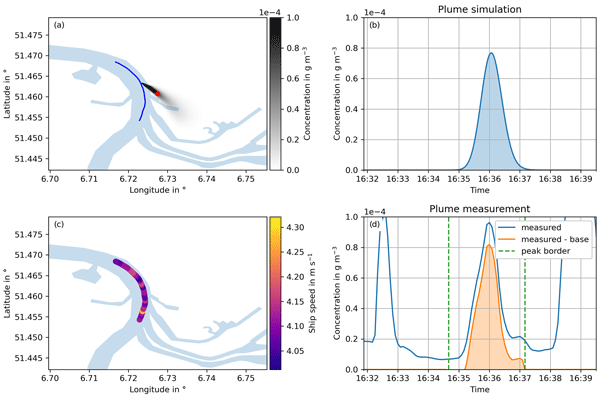
Kai Krause, Folkard Wittrock, Andreas Richter, Dieter Busch, Anton Bergen, John P. Burrows, Steffen Freitag, and Olesia Halbherr
Atmos. Meas. Tech., 16, 1767–1787, https://doi.org/10.5194/amt-16-1767-2023, https://doi.org/10.5194/amt-16-1767-2023, 2023
Short summary
Short summary
Inland shipping is an important source of nitrogen oxides (NOx). The amount of emitted NOx depends on the characteristics of the individual vessels and the traffic density. Ship emissions are often characterised by the amount of emitted NOx per unit of burnt fuel, and further knowledge about fuel consumption is needed to quantify the total emissions caused by ship traffic. In this study, a new approach to derive absolute emission rates (in g s−1) from onshore measurements is presented.
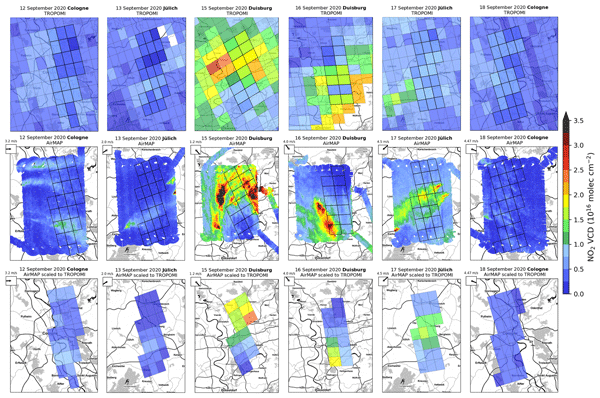
Kezia Lange, Andreas Richter, Anja Schönhardt, Andreas C. Meier, Tim Bösch, André Seyler, Kai Krause, Lisa K. Behrens, Folkard Wittrock, Alexis Merlaud, Frederik Tack, Caroline Fayt, Martina M. Friedrich, Ermioni Dimitropoulou, Michel Van Roozendael, Vinod Kumar, Sebastian Donner, Steffen Dörner, Bianca Lauster, Maria Razi, Christian Borger, Katharina Uhlmannsiek, Thomas Wagner, Thomas Ruhtz, Henk Eskes, Birger Bohn, Daniel Santana Diaz, Nader Abuhassan, Dirk Schüttemeyer, and John P. Burrows
Atmos. Meas. Tech., 16, 1357–1389, https://doi.org/10.5194/amt-16-1357-2023, https://doi.org/10.5194/amt-16-1357-2023, 2023
Short summary
Short summary
We present airborne imaging DOAS and ground-based stationary and car DOAS measurements conducted during the S5P-VAL-DE-Ruhr campaign in the Rhine-Ruhr region. The measurements are used to validate spaceborne NO2 data products from the Sentinel-5 Precursor TROPOspheric Monitoring Instrument (TROPOMI). Auxiliary data of the TROPOMI NO2 retrieval, such as spatially higher resolved a priori NO2 vertical profiles, surface reflectivity, and cloud treatment are investigated to evaluate their impact.
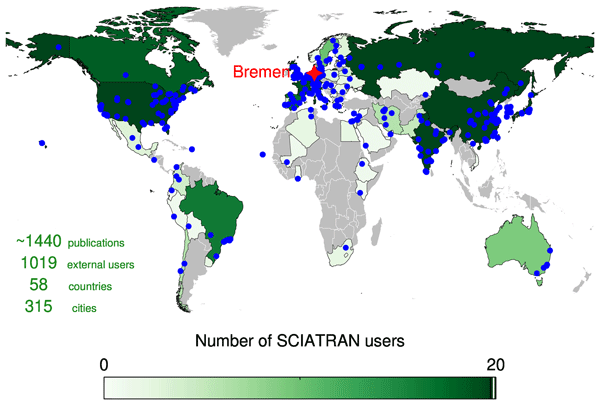
Linlu Mei, Vladimir Rozanov, Alexei Rozanov, and John P. Burrows
Geosci. Model Dev., 16, 1511–1536, https://doi.org/10.5194/gmd-16-1511-2023, https://doi.org/10.5194/gmd-16-1511-2023, 2023
Short summary
Short summary
This paper summarizes recent developments of aerosol, cloud and surface reflectance databases and models in the framework of the software package SCIATRAN. These updates and developments extend the capabilities of the radiative transfer modeling, especially by accounting for different kinds of vertical inhomogeneties. Vertically inhomogeneous clouds and different aerosol types can be easily accounted for within SCIATRAN (V4.6). The widely used surface models and databases are now available.
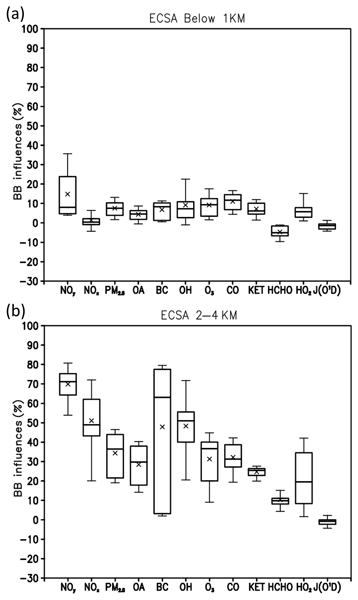
Chuan-Yao Lin, Wan-Chin Chen, Yi-Yun Chien, Charles C. K. Chou, Chian-Yi Liu, Helmut Ziereis, Hans Schlager, Eric Förster, Florian Obersteiner, Ovid O. Krüger, Bruna A. Holanda, Mira L. Pöhlker, Katharina Kaiser, Johannes Schneider, Birger Bohn, Klaus Pfeilsticker, Benjamin Weyland, Maria Dolores Andrés Hernández, and John P. Burrows
Atmos. Chem. Phys., 23, 2627–2647, https://doi.org/10.5194/acp-23-2627-2023, https://doi.org/10.5194/acp-23-2627-2023, 2023
Short summary
Short summary
During the EMeRGe campaign in Asia, atmospheric pollutants were measured on board the HALO aircraft. The WRF-Chem model was employed to evaluate the biomass burning (BB) plume transported from Indochina and its impact on the downstream areas. The combination of BB aerosol enhancement with cloud water resulted in a reduction in incoming shortwave radiation at the surface in southern China and the East China Sea, which potentially has significant regional climate implications.

Luca Lelli, Marco Vountas, Narges Khosravi, and John Philipp Burrows
Atmos. Chem. Phys., 23, 2579–2611, https://doi.org/10.5194/acp-23-2579-2023, https://doi.org/10.5194/acp-23-2579-2023, 2023
Short summary
Short summary
Arctic amplification describes the recent period in which temperatures have been rising twice as fast as or more than the global average and sea ice and the Greenland ice shelf are approaching a tipping point. Hence, the Arctic ability to reflect solar energy decreases and absorption by the surface increases. Using 2 decades of complementary satellite data, we discover that clouds unexpectedly increase the pan-Arctic reflectance by increasing their liquid water content, thus cooling the Arctic.
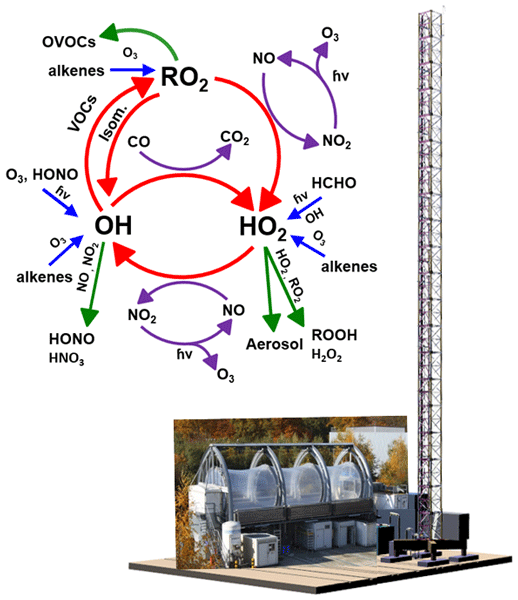
Changmin Cho, Hendrik Fuchs, Andreas Hofzumahaus, Frank Holland, William J. Bloss, Birger Bohn, Hans-Peter Dorn, Marvin Glowania, Thorsten Hohaus, Lu Liu, Paul S. Monks, Doreen Niether, Franz Rohrer, Roberto Sommariva, Zhaofeng Tan, Ralf Tillmann, Astrid Kiendler-Scharr, Andreas Wahner, and Anna Novelli
Atmos. Chem. Phys., 23, 2003–2033, https://doi.org/10.5194/acp-23-2003-2023, https://doi.org/10.5194/acp-23-2003-2023, 2023
Short summary
Short summary
With this study, we investigated the processes leading to the formation, destruction, and recycling of radicals for four seasons in a rural environment. Complete knowledge of their chemistry is needed if we are to predict the formation of secondary pollutants from primary emissions. The results highlight a still incomplete understanding of the paths leading to the formation of the OH radical, which has been observed in several other environments as well and needs to be further investigated.
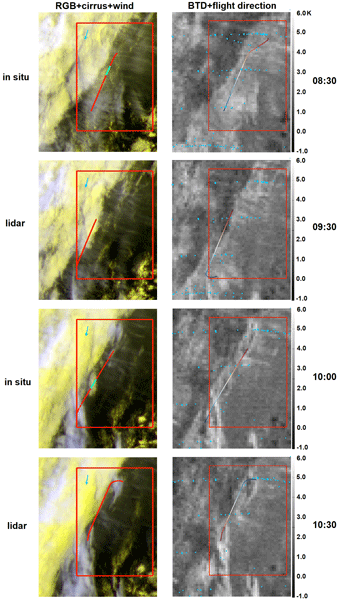
Ziming Wang, Luca Bugliaro, Tina Jurkat-Witschas, Romy Heller, Ulrike Burkhardt, Helmut Ziereis, Georgios Dekoutsidis, Martin Wirth, Silke Groß, Simon Kirschler, Stefan Kaufmann, and Christiane Voigt
Atmos. Chem. Phys., 23, 1941–1961, https://doi.org/10.5194/acp-23-1941-2023, https://doi.org/10.5194/acp-23-1941-2023, 2023
Short summary
Short summary
Differences in the microphysical properties of contrail cirrus and natural cirrus in a contrail outbreak situation during the ML-CIRRUS campaign over the North Atlantic flight corridor can be observed from in situ measurements. The cirrus radiative effect in the area of the outbreak, derived from satellite observation-based radiative transfer modeling, is warming in the early morning and cooling during the day.

Phuc Thi Minh Ha, Yugo Kanaya, Fumikazu Taketani, Maria Dolores Andrés Hernández, Benjamin Schreiner, Klaus Pfeilsticker, and Kengo Sudo
Geosci. Model Dev., 16, 927–960, https://doi.org/10.5194/gmd-16-927-2023, https://doi.org/10.5194/gmd-16-927-2023, 2023
Short summary
Short summary
HONO affects tropospheric oxidizing capacity; thus, it is implemented into the chemistry–climate model CHASER. The model substantially underpredicts daytime HONO, while nitrate photolysis on surfaces can supplement the daytime HONO budget. Current HONO chemistry predicts reductions of 20.4 % for global tropospheric NOx, 40–67 % for OH, and 30–45 % for O3 in the summer North Pacific. In contrast, OH and O3 winter levels in China are greatly enhanced.
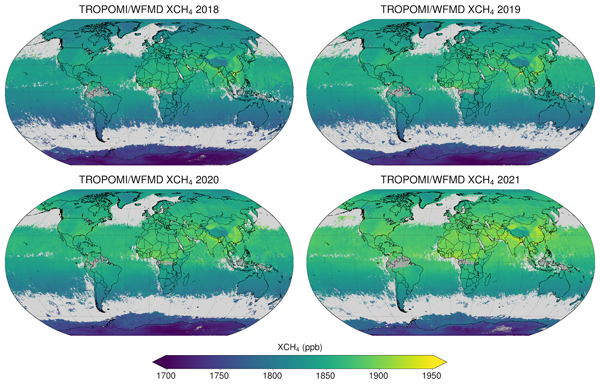
Oliver Schneising, Michael Buchwitz, Jonas Hachmeister, Steffen Vanselow, Maximilian Reuter, Matthias Buschmann, Heinrich Bovensmann, and John P. Burrows
Atmos. Meas. Tech., 16, 669–694, https://doi.org/10.5194/amt-16-669-2023, https://doi.org/10.5194/amt-16-669-2023, 2023
Short summary
Short summary
Methane and carbon monoxide are important constituents of the atmosphere in the context of climate change and air pollution. We present the latest advances in the TROPOMI/WFMD algorithm to simultaneously retrieve atmospheric methane and carbon monoxide abundances from space. The changes in the latest product version are described in detail, and the resulting improvements are demonstrated. An overview of the products is provided including a discussion of annual increases and validation results.
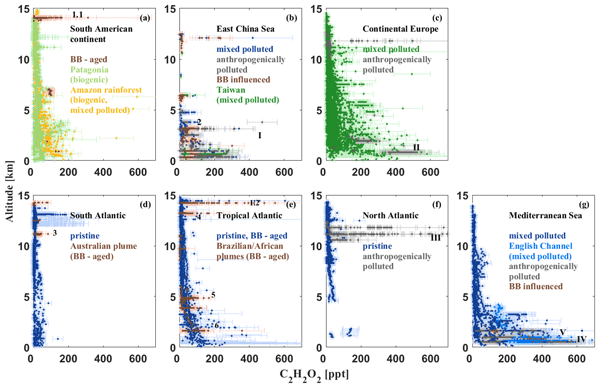
Flora Kluge, Tilman Hüneke, Christophe Lerot, Simon Rosanka, Meike K. Rotermund, Domenico Taraborrelli, Benjamin Weyland, and Klaus Pfeilsticker
Atmos. Chem. Phys., 23, 1369–1401, https://doi.org/10.5194/acp-23-1369-2023, https://doi.org/10.5194/acp-23-1369-2023, 2023
Short summary
Short summary
Using airborne glyoxal concentration and vertical column density measurements, vertical profiles are inferred for eight global regions in aged biomass burning plumes and the tropical marine boundary layer. Using TROPOMI observations, an analysis of space- and airborne measurements is performed. A comparison to EMAC simulations shows a general glyoxal underprediction, which points to various missing sources and precursors from anthropogenic activities, biomass burning, and the sea surface.
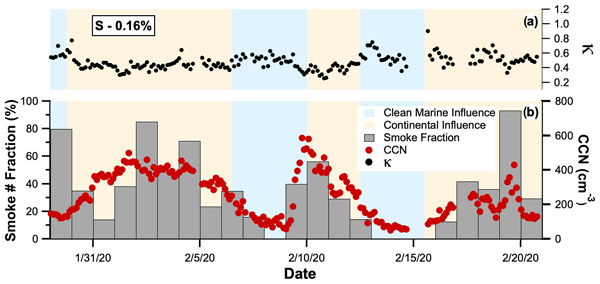
Haley M. Royer, Mira L. Pöhlker, Ovid Krüger, Edmund Blades, Peter Sealy, Nurun Nahar Lata, Zezhen Cheng, Swarup China, Andrew P. Ault, Patricia K. Quinn, Paquita Zuidema, Christopher Pöhlker, Ulrich Pöschl, Meinrat Andreae, and Cassandra J. Gaston
Atmos. Chem. Phys., 23, 981–998, https://doi.org/10.5194/acp-23-981-2023, https://doi.org/10.5194/acp-23-981-2023, 2023
Short summary
Short summary
This paper presents atmospheric particle chemical composition and measurements of aerosol water uptake properties collected at Ragged Point, Barbados, during the winter of 2020. The result of this study indicates the importance of small African smoke particles for cloud droplet formation in the tropical North Atlantic and highlights the large spatial and temporal pervasiveness of smoke over the Atlantic Ocean.
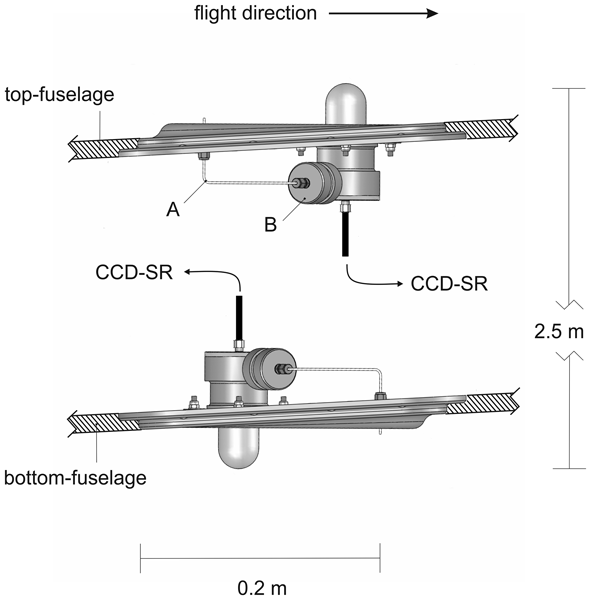
Birger Bohn and Insa Lohse
Atmos. Meas. Tech., 16, 209–233, https://doi.org/10.5194/amt-16-209-2023, https://doi.org/10.5194/amt-16-209-2023, 2023
Short summary
Short summary
Optical receivers for solar spectral actinic radiation are designed for angle-independent sensitivities within a hemisphere. Remaining imperfections can be compensated for by receiver-specific corrections based on laboratory characterizations and radiative transfer calculations of spectral radiance distributions. The corrections cover a wide range of realistic atmospheric conditions and were applied to ground-based and airborne measurements in a wavelength range 280–660 nm.
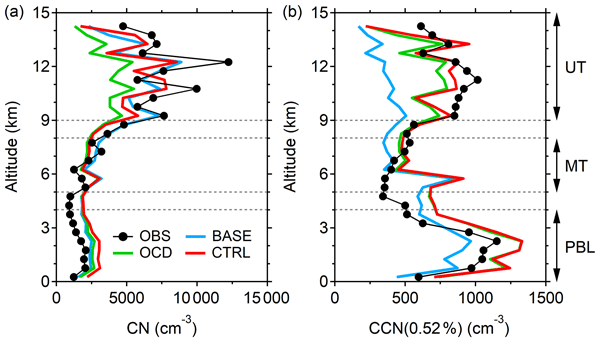
Yunfan Liu, Hang Su, Siwen Wang, Chao Wei, Wei Tao, Mira L. Pöhlker, Christopher Pöhlker, Bruna A. Holanda, Ovid O. Krüger, Thorsten Hoffmann, Manfred Wendisch, Paulo Artaxo, Ulrich Pöschl, Meinrat O. Andreae, and Yafang Cheng
Atmos. Chem. Phys., 23, 251–272, https://doi.org/10.5194/acp-23-251-2023, https://doi.org/10.5194/acp-23-251-2023, 2023
Short summary
Short summary
The origins of the abundant cloud condensation nuclei (CCN) in the upper troposphere (UT) of the Amazon remain unclear. With model developments of new secondary organic aerosol schemes and constrained by observation, we show that strong aerosol nucleation and condensation in the UT is triggered by biogenic organics, and organic condensation is key for UT CCN production. This UT CCN-producing mechanism may prevail over broader vegetation canopies and deserves emphasis in aerosol–climate feedback.
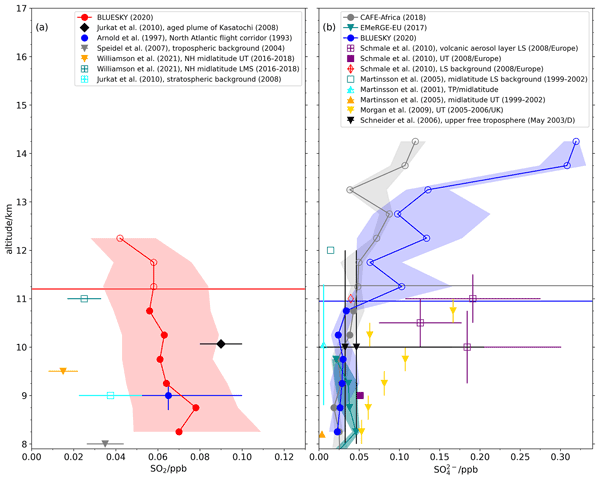
Laura Tomsche, Andreas Marsing, Tina Jurkat-Witschas, Johannes Lucke, Stefan Kaufmann, Katharina Kaiser, Johannes Schneider, Monika Scheibe, Hans Schlager, Lenard Röder, Horst Fischer, Florian Obersteiner, Andreas Zahn, Martin Zöger, Jos Lelieveld, and Christiane Voigt
Atmos. Chem. Phys., 22, 15135–15151, https://doi.org/10.5194/acp-22-15135-2022, https://doi.org/10.5194/acp-22-15135-2022, 2022
Short summary
Short summary
The detection of sulfur compounds in the upper troposphere (UT) and lower stratosphere (LS) is a challenge. In-flight measurements of SO2 and sulfate aerosol were performed during the BLUESKY mission in spring 2020 under exceptional atmospheric conditions. Reduced sinks in the dry UTLS and lower but still significant air traffic influenced the enhanced SO2 in the UT, and aged volcanic plumes enhanced the LS sulfate aerosol impacting the atmospheric radiation budget and global climate.
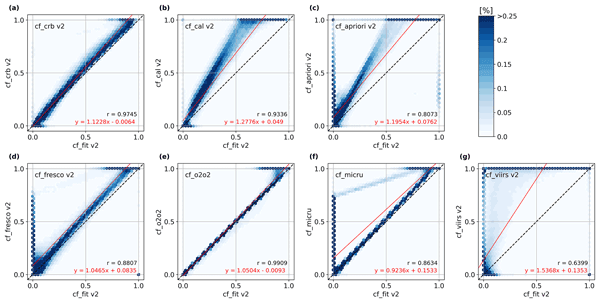
Miriam Latsch, Andreas Richter, Henk Eskes, Maarten Sneep, Ping Wang, Pepijn Veefkind, Ronny Lutz, Diego Loyola, Athina Argyrouli, Pieter Valks, Thomas Wagner, Holger Sihler, Michel van Roozendael, Nicolas Theys, Huan Yu, Richard Siddans, and John P. Burrows
Atmos. Meas. Tech., 15, 6257–6283, https://doi.org/10.5194/amt-15-6257-2022, https://doi.org/10.5194/amt-15-6257-2022, 2022
Short summary
Short summary
The article investigates different S5P TROPOMI cloud retrieval algorithms for tropospheric trace gas retrievals. The cloud products show differences primarily over snow and ice and for scenes under sun glint. Some issues regarding across-track dependence are found for the cloud fractions as well as for the cloud heights.
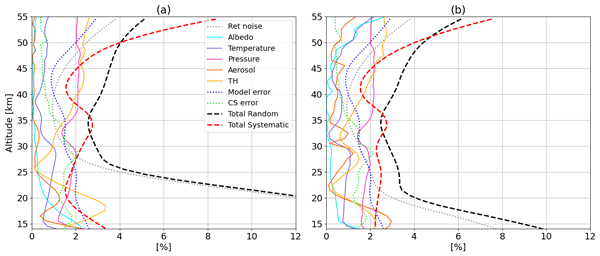
Carlo Arosio, Alexei Rozanov, Victor Gorshelev, Alexandra Laeng, and John P. Burrows
Atmos. Meas. Tech., 15, 5949–5967, https://doi.org/10.5194/amt-15-5949-2022, https://doi.org/10.5194/amt-15-5949-2022, 2022
Short summary
Short summary
This paper characterizes the uncertainties affecting the ozone profiles retrieved at the University of Bremen through OMPS limb satellite observations. An accurate knowledge of the uncertainties is relevant for the validation of the product and to correctly interpret the retrieval results. We investigate several sources of uncertainties, estimate a total random and systematic component, and verify the consistency of the combined OMPS-MLS total uncertainty.

Zhaofeng Tan, Hendrik Fuchs, Andreas Hofzumahaus, William J. Bloss, Birger Bohn, Changmin Cho, Thorsten Hohaus, Frank Holland, Chandrakiran Lakshmisha, Lu Liu, Paul S. Monks, Anna Novelli, Doreen Niether, Franz Rohrer, Ralf Tillmann, Thalassa S. E. Valkenburg, Vaishali Vardhan, Astrid Kiendler-Scharr, Andreas Wahner, and Roberto Sommariva
Atmos. Chem. Phys., 22, 13137–13152, https://doi.org/10.5194/acp-22-13137-2022, https://doi.org/10.5194/acp-22-13137-2022, 2022
Short summary
Short summary
During the 2019 JULIAC campaign, ClNO2 was measured at a rural site in Germany in different seasons. The highest ClNO2 level was 1.6 ppbv in September. ClNO2 production was more sensitive to the availability of NO2 than O3. The average ClNO2 production efficiency was up to 18 % in February and September and down to 3 % in December. These numbers are at the high end of the values reported in the literature, indicating the importance of ClNO2 chemistry in rural environments in midwestern Europe.
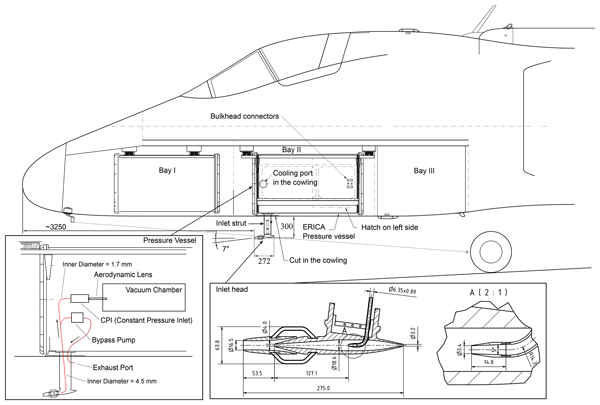
Antonis Dragoneas, Sergej Molleker, Oliver Appel, Andreas Hünig, Thomas Böttger, Markus Hermann, Frank Drewnick, Johannes Schneider, Ralf Weigel, and Stephan Borrmann
Atmos. Meas. Tech., 15, 5719–5742, https://doi.org/10.5194/amt-15-5719-2022, https://doi.org/10.5194/amt-15-5719-2022, 2022
Short summary
Short summary
The ERICA is a specially designed aerosol particle mass spectrometer for in situ, real-time chemical composition analysis of aerosols. It can operate completely autonomously, in the absence of an instrument operator. Its design has enabled its operation under harsh conditions, like those experienced in the upper troposphere and lower stratosphere, aboard unpressurized high-altitude research aircraft. The instrument has successfully participated in several aircraft operations around the world.
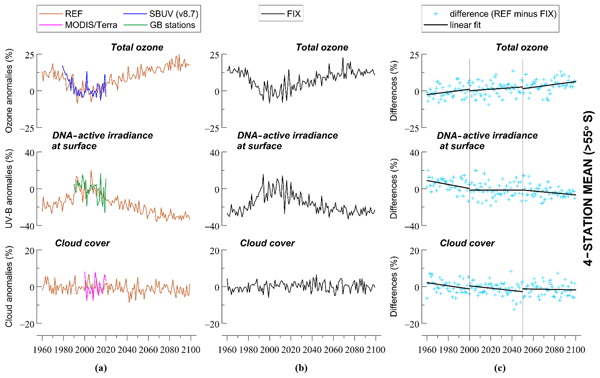
Kostas Eleftheratos, John Kapsomenakis, Ilias Fountoulakis, Christos S. Zerefos, Patrick Jöckel, Martin Dameris, Alkiviadis F. Bais, Germar Bernhard, Dimitra Kouklaki, Kleareti Tourpali, Scott Stierle, J. Ben Liley, Colette Brogniez, Frédérique Auriol, Henri Diémoz, Stana Simic, Irina Petropavlovskikh, Kaisa Lakkala, and Kostas Douvis
Atmos. Chem. Phys., 22, 12827–12855, https://doi.org/10.5194/acp-22-12827-2022, https://doi.org/10.5194/acp-22-12827-2022, 2022
Short summary
Short summary
We present the future evolution of DNA-active ultraviolet (UV) radiation in view of increasing greenhouse gases (GHGs) and decreasing ozone depleting substances (ODSs). It is shown that DNA-active UV radiation might increase after 2050 between 50° N–50° S due to GHG-induced reductions in clouds and ozone, something that is likely not to happen at high latitudes, where DNA-active UV radiation will continue its downward trend mainly due to stratospheric ozone recovery from the reduction in ODSs.
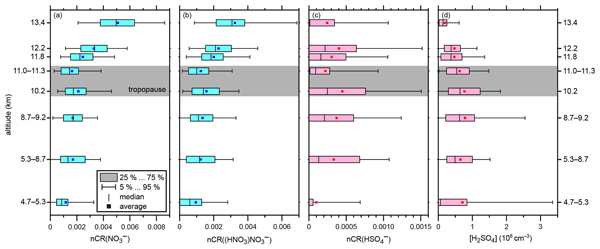
Marcel Zauner-Wieczorek, Martin Heinritzi, Manuel Granzin, Timo Keber, Andreas Kürten, Katharina Kaiser, Johannes Schneider, and Joachim Curtius
Atmos. Chem. Phys., 22, 11781–11794, https://doi.org/10.5194/acp-22-11781-2022, https://doi.org/10.5194/acp-22-11781-2022, 2022
Short summary
Short summary
We present measurements of ambient ions in the free troposphere and lower stratosphere over Europe in spring 2020. We observed nitrate and hydrogen sulfate, amongst others. From their ratio, the number concentrations of gaseous sulfuric acid were inferred. Nitrate increased towards the stratosphere, whilst sulfuric acid was slightly decreased there. The average values for sulfuric acid were 1.9 to 7.8 × 105 cm-3. Protonated pyridine was identified in an altitude range of 4.6 to 8.5 km.
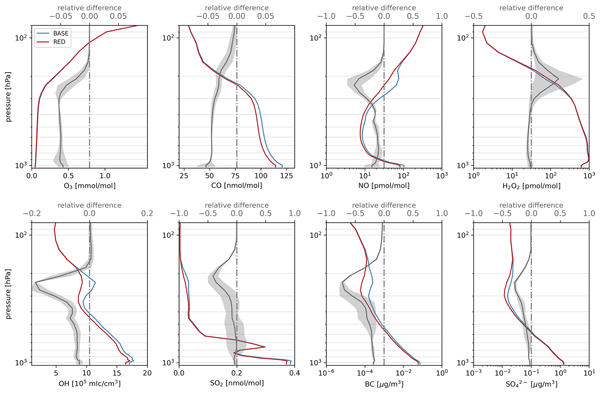
Simon F. Reifenberg, Anna Martin, Matthias Kohl, Sara Bacer, Zaneta Hamryszczak, Ivan Tadic, Lenard Röder, Daniel J. Crowley, Horst Fischer, Katharina Kaiser, Johannes Schneider, Raphael Dörich, John N. Crowley, Laura Tomsche, Andreas Marsing, Christiane Voigt, Andreas Zahn, Christopher Pöhlker, Bruna A. Holanda, Ovid Krüger, Ulrich Pöschl, Mira Pöhlker, Patrick Jöckel, Marcel Dorf, Ulrich Schumann, Jonathan Williams, Birger Bohn, Joachim Curtius, Hardwig Harder, Hans Schlager, Jos Lelieveld, and Andrea Pozzer
Atmos. Chem. Phys., 22, 10901–10917, https://doi.org/10.5194/acp-22-10901-2022, https://doi.org/10.5194/acp-22-10901-2022, 2022
Short summary
Short summary
In this work we use a combination of observational data from an aircraft campaign and model results to investigate the effect of the European lockdown due to COVID-19 in spring 2020. Using model results, we show that the largest relative changes to the atmospheric composition caused by the reduced emissions are located in the upper troposphere around aircraft cruise altitude, while the largest absolute changes are present at the surface.
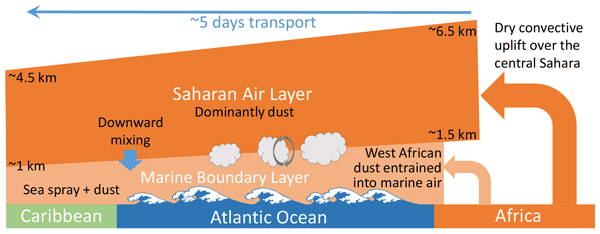
Alexander D. Harrison, Daniel O'Sullivan, Michael P. Adams, Grace C. E. Porter, Edmund Blades, Cherise Brathwaite, Rebecca Chewitt-Lucas, Cassandra Gaston, Rachel Hawker, Ovid O. Krüger, Leslie Neve, Mira L. Pöhlker, Christopher Pöhlker, Ulrich Pöschl, Alberto Sanchez-Marroquin, Andrea Sealy, Peter Sealy, Mark D. Tarn, Shanice Whitehall, James B. McQuaid, Kenneth S. Carslaw, Joseph M. Prospero, and Benjamin J. Murray
Atmos. Chem. Phys., 22, 9663–9680, https://doi.org/10.5194/acp-22-9663-2022, https://doi.org/10.5194/acp-22-9663-2022, 2022
Short summary
Short summary
The formation of ice in clouds fundamentally alters cloud properties; hence it is important we understand the special aerosol particles that can nucleate ice when immersed in supercooled cloud droplets. In this paper we show that African desert dust that has travelled across the Atlantic to the Caribbean nucleates ice much less well than we might have expected.
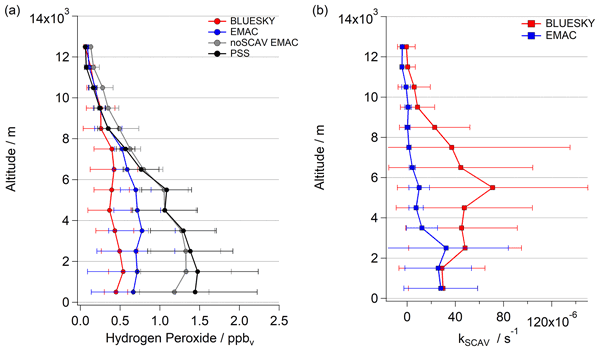
Zaneta T. Hamryszczak, Andrea Pozzer, Florian Obersteiner, Birger Bohn, Benedikt Steil, Jos Lelieveld, and Horst Fischer
Atmos. Chem. Phys., 22, 9483–9497, https://doi.org/10.5194/acp-22-9483-2022, https://doi.org/10.5194/acp-22-9483-2022, 2022
Short summary
Short summary
Hydrogen peroxide plays a pivotal role in the chemistry of the atmosphere. Together with organic hydroperoxides, it forms a reservoir for peroxy radicals, which are known to be the key contributors to the self-cleaning processes of the atmosphere. Hydroperoxides were measured over Europe during the BLUESKY campaign in May–June 2020. The paper gives an overview of the distribution of the species in the troposphere and investigates the impact of wet scavenging and deposition on the budget of H2O2.
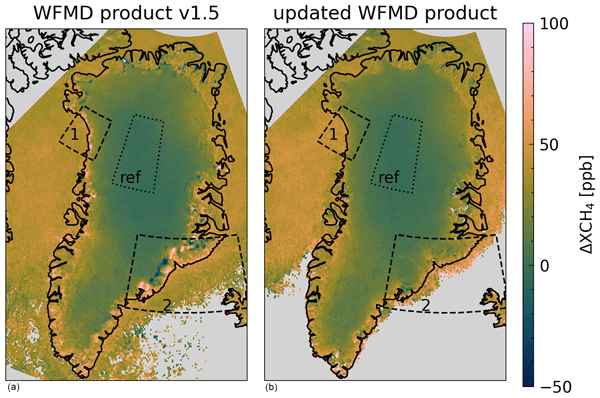
Jonas Hachmeister, Oliver Schneising, Michael Buchwitz, Alba Lorente, Tobias Borsdorff, John P. Burrows, Justus Notholt, and Matthias Buschmann
Atmos. Meas. Tech., 15, 4063–4074, https://doi.org/10.5194/amt-15-4063-2022, https://doi.org/10.5194/amt-15-4063-2022, 2022
Short summary
Short summary
Sentinel-5P trace gas retrievals rely on elevation data in their calculations. Outdated or inaccurate data can lead to significant errors in e.g. dry-air mole fractions of methane (XCH4). We show that the use of inadequate elevation data leads to strong XCH4 anomalies in Greenland. Similar problems can be expected for other regions with inaccurate elevation data. However, we expect these to be more localized. We show that updating elevation data used in the retrieval solves this issue.
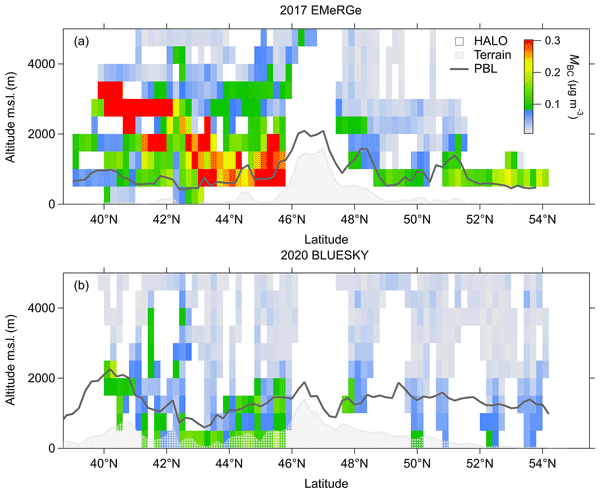
Ovid O. Krüger, Bruna A. Holanda, Sourangsu Chowdhury, Andrea Pozzer, David Walter, Christopher Pöhlker, Maria Dolores Andrés Hernández, John P. Burrows, Christiane Voigt, Jos Lelieveld, Johannes Quaas, Ulrich Pöschl, and Mira L. Pöhlker
Atmos. Chem. Phys., 22, 8683–8699, https://doi.org/10.5194/acp-22-8683-2022, https://doi.org/10.5194/acp-22-8683-2022, 2022
Short summary
Short summary
The abrupt reduction in human activities during the first COVID-19 lockdown created unprecedented atmospheric conditions. We took the opportunity to quantify changes in black carbon (BC) as a major anthropogenic air pollutant. Therefore, we measured BC on board a research aircraft over Europe during the lockdown and compared the results to measurements from 2017. With model simulations we account for different weather conditions and find a lockdown-related decrease in BC of 41 %.
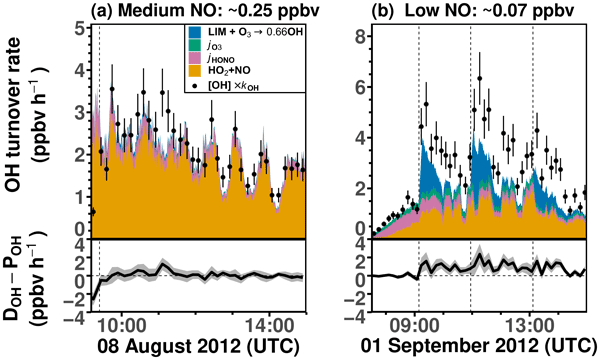
Jacky Yat Sing Pang, Anna Novelli, Martin Kaminski, Ismail-Hakki Acir, Birger Bohn, Philip T. M. Carlsson, Changmin Cho, Hans-Peter Dorn, Andreas Hofzumahaus, Xin Li, Anna Lutz, Sascha Nehr, David Reimer, Franz Rohrer, Ralf Tillmann, Robert Wegener, Astrid Kiendler-Scharr, Andreas Wahner, and Hendrik Fuchs
Atmos. Chem. Phys., 22, 8497–8527, https://doi.org/10.5194/acp-22-8497-2022, https://doi.org/10.5194/acp-22-8497-2022, 2022
Short summary
Short summary
This study investigates the radical chemical budget during the limonene oxidation at different atmospheric-relevant NO concentrations in chamber experiments under atmospheric conditions. It is found that the model–measurement discrepancies of HO2 and RO2 are very large at low NO concentrations that are typical for forested environments. Possible additional processes impacting HO2 and RO2 concentrations are discussed.
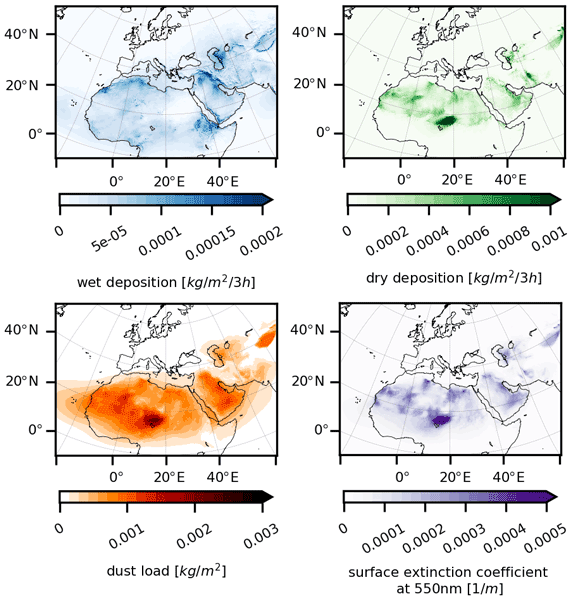
Enza Di Tomaso, Jerónimo Escribano, Sara Basart, Paul Ginoux, Francesca Macchia, Francesca Barnaba, Francesco Benincasa, Pierre-Antoine Bretonnière, Arnau Buñuel, Miguel Castrillo, Emilio Cuevas, Paola Formenti, María Gonçalves, Oriol Jorba, Martina Klose, Lucia Mona, Gilbert Montané Pinto, Michail Mytilinaios, Vincenzo Obiso, Miriam Olid, Nick Schutgens, Athanasios Votsis, Ernest Werner, and Carlos Pérez García-Pando
Earth Syst. Sci. Data, 14, 2785–2816, https://doi.org/10.5194/essd-14-2785-2022, https://doi.org/10.5194/essd-14-2785-2022, 2022
Short summary
Short summary
MONARCH reanalysis of desert dust aerosols extends the existing observation-based information for mineral dust monitoring by providing 3-hourly upper-air, surface and total column key geophysical variables of the dust cycle over Northern Africa, the Middle East and Europe, at a 0.1° horizontal resolution in a rotated grid, from 2007 to 2016. This work provides evidence of the high accuracy of this data set and its suitability for air quality and health and climate service applications.
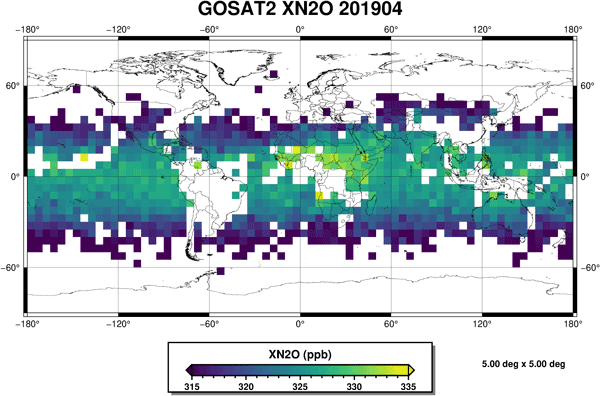
Stefan Noël, Maximilian Reuter, Michael Buchwitz, Jakob Borchardt, Michael Hilker, Oliver Schneising, Heinrich Bovensmann, John P. Burrows, Antonio Di Noia, Robert J. Parker, Hiroshi Suto, Yukio Yoshida, Matthias Buschmann, Nicholas M. Deutscher, Dietrich G. Feist, David W. T. Griffith, Frank Hase, Rigel Kivi, Cheng Liu, Isamu Morino, Justus Notholt, Young-Suk Oh, Hirofumi Ohyama, Christof Petri, David F. Pollard, Markus Rettinger, Coleen Roehl, Constantina Rousogenous, Mahesh Kumar Sha, Kei Shiomi, Kimberly Strong, Ralf Sussmann, Yao Té, Voltaire A. Velazco, Mihalis Vrekoussis, and Thorsten Warneke
Atmos. Meas. Tech., 15, 3401–3437, https://doi.org/10.5194/amt-15-3401-2022, https://doi.org/10.5194/amt-15-3401-2022, 2022
Short summary
Short summary
We present a new version (v3) of the GOSAT and GOSAT-2 FOCAL products.
In addition to an increased number of XCO2 data, v3 also includes products for XCH4 (full-physics and proxy), XH2O and the relative ratio of HDO to H2O (δD). For GOSAT-2, we also present first XCO and XN2O results. All FOCAL data products show reasonable spatial distribution and temporal variations and agree well with TCCON. Global XN2O maps show a gradient from the tropics to higher latitudes on the order of 15 ppb.
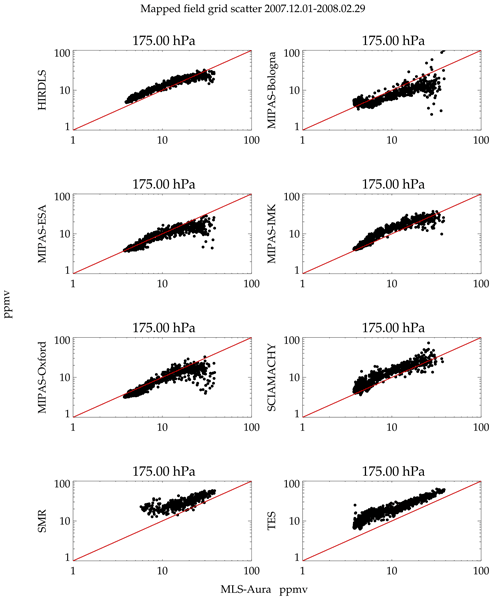
William G. Read, Gabriele Stiller, Stefan Lossow, Michael Kiefer, Farahnaz Khosrawi, Dale Hurst, Holger Vömel, Karen Rosenlof, Bianca M. Dinelli, Piera Raspollini, Gerald E. Nedoluha, John C. Gille, Yasuko Kasai, Patrick Eriksson, Christopher E. Sioris, Kaley A. Walker, Katja Weigel, John P. Burrows, and Alexei Rozanov
Atmos. Meas. Tech., 15, 3377–3400, https://doi.org/10.5194/amt-15-3377-2022, https://doi.org/10.5194/amt-15-3377-2022, 2022
Short summary
Short summary
This paper attempts to provide an assessment of the accuracy of 21 satellite-based instruments that remotely measure atmospheric humidity in the upper troposphere of the Earth's atmosphere. The instruments made their measurements from 1984 to the present time; however, most of these instruments began operations after 2000, and only a few are still operational. The objective of this study is to quantify the accuracy of each satellite humidity data set.

Mark Weber, Carlo Arosio, Melanie Coldewey-Egbers, Vitali E. Fioletov, Stacey M. Frith, Jeannette D. Wild, Kleareti Tourpali, John P. Burrows, and Diego Loyola
Atmos. Chem. Phys., 22, 6843–6859, https://doi.org/10.5194/acp-22-6843-2022, https://doi.org/10.5194/acp-22-6843-2022, 2022
Short summary
Short summary
Long-term trends in column ozone have been determined from five merged total ozone datasets spanning the period 1978–2020. We show that ozone recovery due to the decline in stratospheric halogens after the 1990s (as regulated by the Montreal Protocol) is evident outside the tropical region and amounts to half a percent per decade. The ozone recovery in the Northern Hemisphere is however compensated for by the negative long-term trend contribution from atmospheric dynamics since the year 2000.

Nora Mettig, Mark Weber, Alexei Rozanov, John P. Burrows, Pepijn Veefkind, Anne M. Thompson, Ryan M. Stauffer, Thierry Leblanc, Gerard Ancellet, Michael J. Newchurch, Shi Kuang, Rigel Kivi, Matthew B. Tully, Roeland Van Malderen, Ankie Piters, Bogumil Kois, René Stübi, and Pavla Skrivankova
Atmos. Meas. Tech., 15, 2955–2978, https://doi.org/10.5194/amt-15-2955-2022, https://doi.org/10.5194/amt-15-2955-2022, 2022
Short summary
Short summary
Vertical ozone profiles from combined spectral measurements in the UV and IR spectral ranges were retrieved by using data from TROPOMI/S5P and CrIS/Suomi-NPP. The vertical resolution and accuracy of the ozone profiles are improved by combining both wavelength ranges compared to retrievals limited to UV or IR spectral data only. The advancement of our TOPAS algorithm for combined measurements is required because in the UV-only retrieval the vertical resolution in the troposphere is very limited.
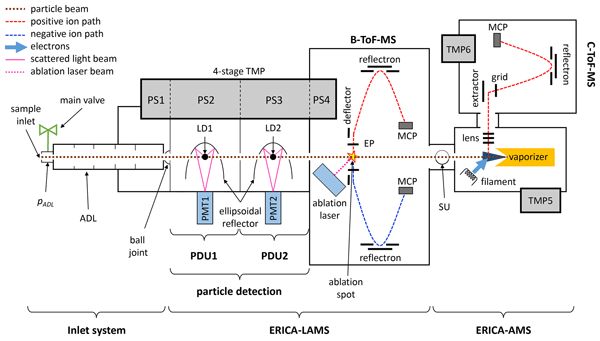
Andreas Hünig, Oliver Appel, Antonis Dragoneas, Sergej Molleker, Hans-Christian Clemen, Frank Helleis, Thomas Klimach, Franziska Köllner, Thomas Böttger, Frank Drewnick, Johannes Schneider, and Stephan Borrmann
Atmos. Meas. Tech., 15, 2889–2921, https://doi.org/10.5194/amt-15-2889-2022, https://doi.org/10.5194/amt-15-2889-2022, 2022
Short summary
Short summary
We have serially combined the two well-established methods for in situ real-time measurement of fine particle chemical composition, the single-particle laser ablation method and the flash evaporation with electron impact ionization method, into a novel instrument. Here we present the design; instrument characteristics, as derived from laboratory and field measurements; and results from the first field deployment during the 2017 StratoClim aircraft campaign.
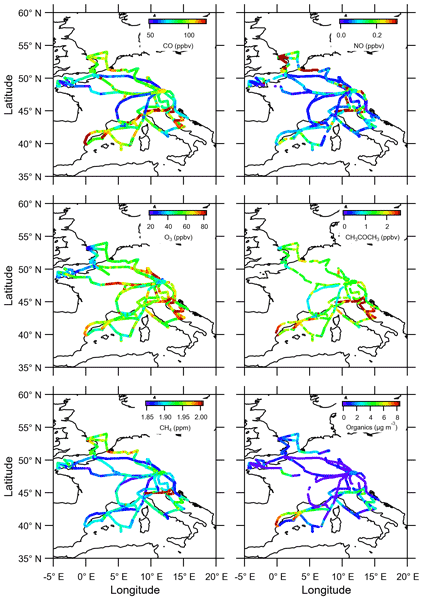
M. Dolores Andrés Hernández, Andreas Hilboll, Helmut Ziereis, Eric Förster, Ovid O. Krüger, Katharina Kaiser, Johannes Schneider, Francesca Barnaba, Mihalis Vrekoussis, Jörg Schmidt, Heidi Huntrieser, Anne-Marlene Blechschmidt, Midhun George, Vladyslav Nenakhov, Theresa Harlass, Bruna A. Holanda, Jennifer Wolf, Lisa Eirenschmalz, Marc Krebsbach, Mira L. Pöhlker, Anna B. Kalisz Hedegaard, Linlu Mei, Klaus Pfeilsticker, Yangzhuoran Liu, Ralf Koppmann, Hans Schlager, Birger Bohn, Ulrich Schumann, Andreas Richter, Benjamin Schreiner, Daniel Sauer, Robert Baumann, Mariano Mertens, Patrick Jöckel, Markus Kilian, Greta Stratmann, Christopher Pöhlker, Monica Campanelli, Marco Pandolfi, Michael Sicard, José L. Gómez-Amo, Manuel Pujadas, Katja Bigge, Flora Kluge, Anja Schwarz, Nikos Daskalakis, David Walter, Andreas Zahn, Ulrich Pöschl, Harald Bönisch, Stephan Borrmann, Ulrich Platt, and John P. Burrows
Atmos. Chem. Phys., 22, 5877–5924, https://doi.org/10.5194/acp-22-5877-2022, https://doi.org/10.5194/acp-22-5877-2022, 2022
Short summary
Short summary
EMeRGe provides a unique set of in situ and remote sensing airborne measurements of trace gases and aerosol particles along selected flight routes in the lower troposphere over Europe. The interpretation uses also complementary collocated ground-based and satellite measurements. The collected data help to improve the current understanding of the complex spatial distribution of trace gases and aerosol particles resulting from mixing, transport, and transformation of pollution plumes over Europe.
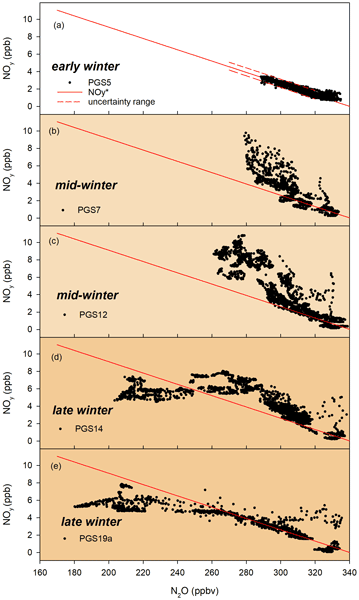
Helmut Ziereis, Peter Hoor, Jens-Uwe Grooß, Andreas Zahn, Greta Stratmann, Paul Stock, Michael Lichtenstern, Jens Krause, Vera Bense, Armin Afchine, Christian Rolf, Wolfgang Woiwode, Marleen Braun, Jörn Ungermann, Andreas Marsing, Christiane Voigt, Andreas Engel, Björn-Martin Sinnhuber, and Hermann Oelhaf
Atmos. Chem. Phys., 22, 3631–3654, https://doi.org/10.5194/acp-22-3631-2022, https://doi.org/10.5194/acp-22-3631-2022, 2022
Short summary
Short summary
Airborne observations were conducted in the lowermost Arctic stratosphere during the winter of 2015/2016. The observed distribution of reactive nitrogen shows clear indications of nitrification in mid-winter and denitrification in late winter. This was caused by the formation of polar stratospheric cloud particles, which were observed during several flights. The sedimentation and evaporation of these particles and the descent of air masses cause a redistribution of reactive nitrogen.
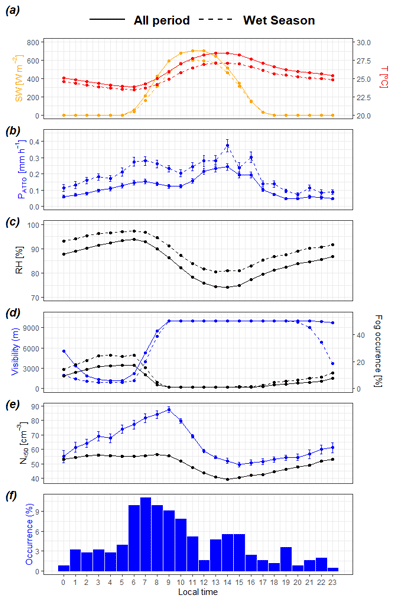
Marco A. Franco, Florian Ditas, Leslie A. Kremper, Luiz A. T. Machado, Meinrat O. Andreae, Alessandro Araújo, Henrique M. J. Barbosa, Joel F. de Brito, Samara Carbone, Bruna A. Holanda, Fernando G. Morais, Janaína P. Nascimento, Mira L. Pöhlker, Luciana V. Rizzo, Marta Sá, Jorge Saturno, David Walter, Stefan Wolff, Ulrich Pöschl, Paulo Artaxo, and Christopher Pöhlker
Atmos. Chem. Phys., 22, 3469–3492, https://doi.org/10.5194/acp-22-3469-2022, https://doi.org/10.5194/acp-22-3469-2022, 2022
Short summary
Short summary
In Central Amazonia, new particle formation in the planetary boundary layer is rare. Instead, there is the appearance of sub-50 nm aerosols with diameters larger than about 20 nm that eventually grow to cloud condensation nuclei size range. Here, 254 growth events were characterized which have higher predominance in the wet season. About 70 % of them showed direct relation to convective downdrafts, while 30 % occurred partly under clear-sky conditions, evidencing still unknown particle sources.

Monica Campanelli, Henri Diémoz, Anna Maria Siani, Alcide di Sarra, Anna Maria Iannarelli, Rei Kudo, Gabriele Fasano, Giampietro Casasanta, Luca Tofful, Marco Cacciani, Paolo Sanò, and Stefano Dietrich
Atmos. Meas. Tech., 15, 1171–1183, https://doi.org/10.5194/amt-15-1171-2022, https://doi.org/10.5194/amt-15-1171-2022, 2022
Short summary
Short summary
The aerosol optical depth (AOD) characteristics in an urban area of Rome were retrieved over a period of 11 years (2010–2020) to determine, for the first time, their effect on the incoming ultraviolet (UV) solar radiation. The surface forcing efficiency shows that the AOD is the primary parameter affecting the surface irradiance in Rome, and it is found to be greater for smaller zenith angles and for larger and more absorbing particles in the UV range (such as, e.g., mineral dust).

Kezia Lange, Andreas Richter, and John P. Burrows
Atmos. Chem. Phys., 22, 2745–2767, https://doi.org/10.5194/acp-22-2745-2022, https://doi.org/10.5194/acp-22-2745-2022, 2022
Short summary
Short summary
In this study, we investigated short time variability of NOx emissions and lifetimes on a global scale. We combined 2 years of satellite Sentinel-5P TROPOMI tropospheric NO2 column data with wind data. Fifty NOx sources distributed around the world are analyzed. The retrieved emissions show a clear seasonal dependence. NOx lifetime shows a latitudinal dependence but only a week seasonal dependence. NOx emissions show a clear weekly pattern which in contrast is not visible for NOx lifetimes.
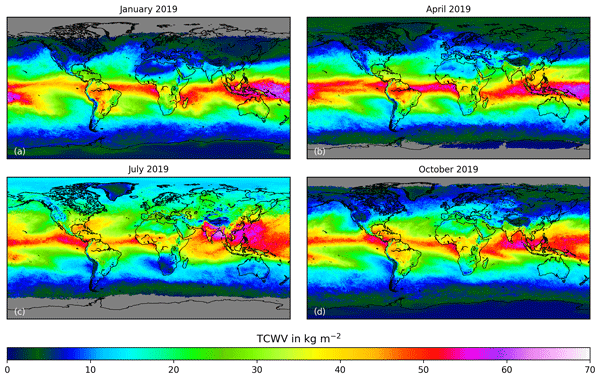
Tobias Küchler, Stefan Noël, Heinrich Bovensmann, John Philip Burrows, Thomas Wagner, Christian Borger, Tobias Borsdorff, and Andreas Schneider
Atmos. Meas. Tech., 15, 297–320, https://doi.org/10.5194/amt-15-297-2022, https://doi.org/10.5194/amt-15-297-2022, 2022
Short summary
Short summary
We applied the air-mass-corrected differential optical absorption spectroscopy (AMC-DOAS) method to derive total column water vapour (TCWV) from Sentinel-5P measurements and compared it to independent data sets. The correlation coefficients of typically more than 0.9 and the small deviations up to 2.5 kg m−2 reveal good agreement between our data product and other TCWV data sets. In particular for the different Sentinel-5P water vapour products, the deviations are around 1 kg m−2.
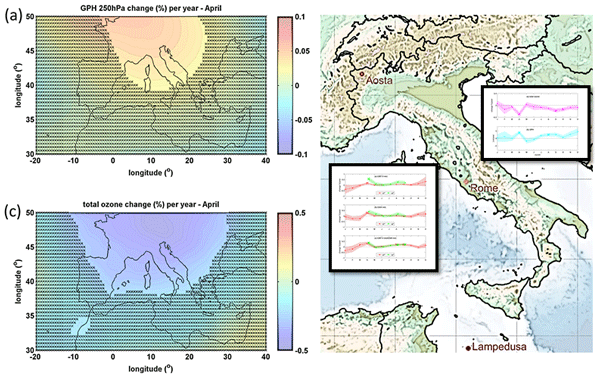
Ilias Fountoulakis, Henri Diémoz, Anna Maria Siani, Alcide di Sarra, Daniela Meloni, and Damiano M. Sferlazzo
Atmos. Chem. Phys., 21, 18689–18705, https://doi.org/10.5194/acp-21-18689-2021, https://doi.org/10.5194/acp-21-18689-2021, 2021
Short summary
Short summary
The variability and trends of solar spectral UV irradiance have been studied for the periods 1996–2020 (for Rome) and 2006–2020 (for Lampedusa, Rome, and Aosta) with respect to the variability and trends of total ozone and geopotential height. Analyses revealed increasing UV in particular months at all sites, possibly due to decreasing lower-stratospheric ozone (at Rome in 1996–2020) and decreasing attenuation by aerosols and/or clouds (at all stations in 2006–2020).

Clara M. Nussbaumer, John N. Crowley, Jan Schuladen, Jonathan Williams, Sascha Hafermann, Andreas Reiffs, Raoul Axinte, Hartwig Harder, Cheryl Ernest, Anna Novelli, Katrin Sala, Monica Martinez, Chinmay Mallik, Laura Tomsche, Christian Plass-Dülmer, Birger Bohn, Jos Lelieveld, and Horst Fischer
Atmos. Chem. Phys., 21, 18413–18432, https://doi.org/10.5194/acp-21-18413-2021, https://doi.org/10.5194/acp-21-18413-2021, 2021
Short summary
Short summary
HCHO is an important atmospheric trace gas influencing the photochemical processes in the Earth’s atmosphere, including the budget of HOx and the abundance of tropospheric O3. This research presents the photochemical calculations of HCHO and O3 based on three field campaigns across Europe. We show that HCHO production via the oxidation of only four volatile organic compound precursors, i.e., CH4, CH3CHO, C5H8 and CH3OH, can balance the observed loss at all sites well.
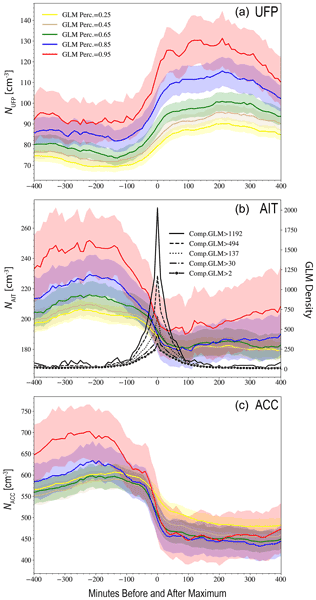
Luiz A. T. Machado, Marco A. Franco, Leslie A. Kremper, Florian Ditas, Meinrat O. Andreae, Paulo Artaxo, Micael A. Cecchini, Bruna A. Holanda, Mira L. Pöhlker, Ivan Saraiva, Stefan Wolff, Ulrich Pöschl, and Christopher Pöhlker
Atmos. Chem. Phys., 21, 18065–18086, https://doi.org/10.5194/acp-21-18065-2021, https://doi.org/10.5194/acp-21-18065-2021, 2021
Short summary
Short summary
Several studies evaluate aerosol–cloud interactions, but only a few attempted to describe how clouds modify aerosol properties. This study evaluates the effect of weather events on the particle size distribution at the ATTO, combining remote sensing and in situ data. Ultrafine, Aitken and accumulation particles modes have different behaviors for the diurnal cycle and for rainfall events. This study opens up new scientific questions that need to be pursued in detail in new field campaigns.
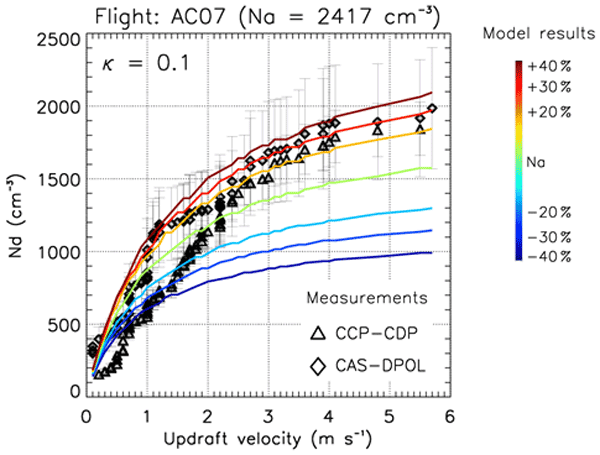
Ramon Campos Braga, Barbara Ervens, Daniel Rosenfeld, Meinrat O. Andreae, Jan-David Förster, Daniel Fütterer, Lianet Hernández Pardo, Bruna A. Holanda, Tina Jurkat-Witschas, Ovid O. Krüger, Oliver Lauer, Luiz A. T. Machado, Christopher Pöhlker, Daniel Sauer, Christiane Voigt, Adrian Walser, Manfred Wendisch, Ulrich Pöschl, and Mira L. Pöhlker
Atmos. Chem. Phys., 21, 17513–17528, https://doi.org/10.5194/acp-21-17513-2021, https://doi.org/10.5194/acp-21-17513-2021, 2021
Short summary
Short summary
Interactions of aerosol particles with clouds represent a large uncertainty in estimates of climate change. Properties of aerosol particles control their ability to act as cloud condensation nuclei. Using aerosol measurements in the Amazon, we performed model studies to compare predicted and measured cloud droplet number concentrations at cloud bases. Our results confirm previous estimates of particle hygroscopicity in this region.
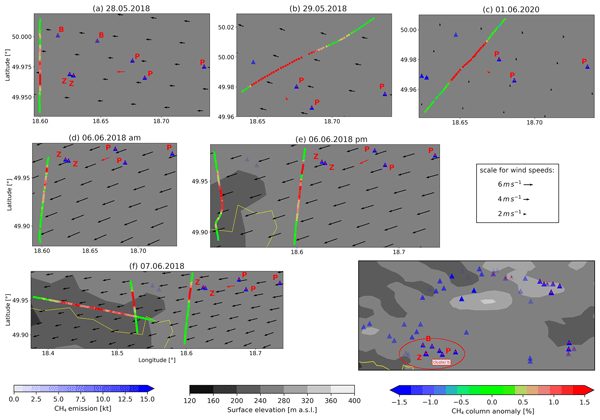
Sven Krautwurst, Konstantin Gerilowski, Jakob Borchardt, Norman Wildmann, Michał Gałkowski, Justyna Swolkień, Julia Marshall, Alina Fiehn, Anke Roiger, Thomas Ruhtz, Christoph Gerbig, Jaroslaw Necki, John P. Burrows, Andreas Fix, and Heinrich Bovensmann
Atmos. Chem. Phys., 21, 17345–17371, https://doi.org/10.5194/acp-21-17345-2021, https://doi.org/10.5194/acp-21-17345-2021, 2021
Short summary
Short summary
Quantification of anthropogenic CH4 emissions remains challenging, but it is essential for near-term climate mitigation strategies. We use airborne remote sensing observations to assess bottom-up estimates of coal mining emissions from one of Europe's largest CH4 emission hot spots located in Poland. The analysis reveals that emissions from small groups of shafts can be disentangled, but caution is advised when comparing observations to commonly reported annual emissions.
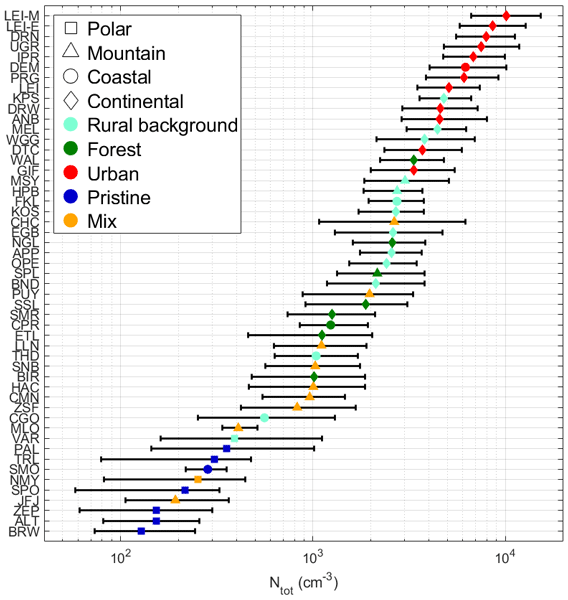
Clémence Rose, Martine Collaud Coen, Elisabeth Andrews, Yong Lin, Isaline Bossert, Cathrine Lund Myhre, Thomas Tuch, Alfred Wiedensohler, Markus Fiebig, Pasi Aalto, Andrés Alastuey, Elisabeth Alonso-Blanco, Marcos Andrade, Begoña Artíñano, Todor Arsov, Urs Baltensperger, Susanne Bastian, Olaf Bath, Johan Paul Beukes, Benjamin T. Brem, Nicolas Bukowiecki, Juan Andrés Casquero-Vera, Sébastien Conil, Konstantinos Eleftheriadis, Olivier Favez, Harald Flentje, Maria I. Gini, Francisco Javier Gómez-Moreno, Martin Gysel-Beer, Anna Gannet Hallar, Ivo Kalapov, Nikos Kalivitis, Anne Kasper-Giebl, Melita Keywood, Jeong Eun Kim, Sang-Woo Kim, Adam Kristensson, Markku Kulmala, Heikki Lihavainen, Neng-Huei Lin, Hassan Lyamani, Angela Marinoni, Sebastiao Martins Dos Santos, Olga L. Mayol-Bracero, Frank Meinhardt, Maik Merkel, Jean-Marc Metzger, Nikolaos Mihalopoulos, Jakub Ondracek, Marco Pandolfi, Noemi Pérez, Tuukka Petäjä, Jean-Eudes Petit, David Picard, Jean-Marc Pichon, Veronique Pont, Jean-Philippe Putaud, Fabienne Reisen, Karine Sellegri, Sangeeta Sharma, Gerhard Schauer, Patrick Sheridan, James Patrick Sherman, Andreas Schwerin, Ralf Sohmer, Mar Sorribas, Junying Sun, Pierre Tulet, Ville Vakkari, Pieter Gideon van Zyl, Fernando Velarde, Paolo Villani, Stergios Vratolis, Zdenek Wagner, Sheng-Hsiang Wang, Kay Weinhold, Rolf Weller, Margarita Yela, Vladimir Zdimal, and Paolo Laj
Atmos. Chem. Phys., 21, 17185–17223, https://doi.org/10.5194/acp-21-17185-2021, https://doi.org/10.5194/acp-21-17185-2021, 2021
Short summary
Short summary
Aerosol particles are a complex component of the atmospheric system the effects of which are among the most uncertain in climate change projections. Using data collected at 62 stations, this study provides the most up-to-date picture of the spatial distribution of particle number concentration and size distribution worldwide, with the aim of contributing to better representation of aerosols and their interactions with clouds in models and, therefore, better evaluation of their impact on climate.
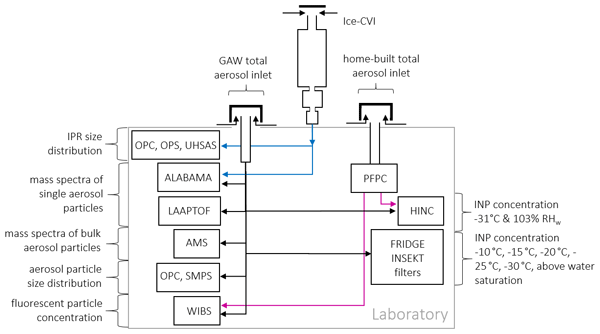
Larissa Lacher, Hans-Christian Clemen, Xiaoli Shen, Stephan Mertes, Martin Gysel-Beer, Alireza Moallemi, Martin Steinbacher, Stephan Henne, Harald Saathoff, Ottmar Möhler, Kristina Höhler, Thea Schiebel, Daniel Weber, Jann Schrod, Johannes Schneider, and Zamin A. Kanji
Atmos. Chem. Phys., 21, 16925–16953, https://doi.org/10.5194/acp-21-16925-2021, https://doi.org/10.5194/acp-21-16925-2021, 2021
Short summary
Short summary
We investigate ice-nucleating particle properties at Jungfraujoch during the 2017 joint INUIT/CLACE field campaign, to improve the knowledge about those rare particles in a cloud-relevant environment. By quantifying ice-nucleating particles in parallel to single-particle mass spectrometry measurements, we find that mineral dust and aged sea spray particles are potential candidates for ice-nucleating particles. Our findings are supported by ice residual analysis and source region modeling.
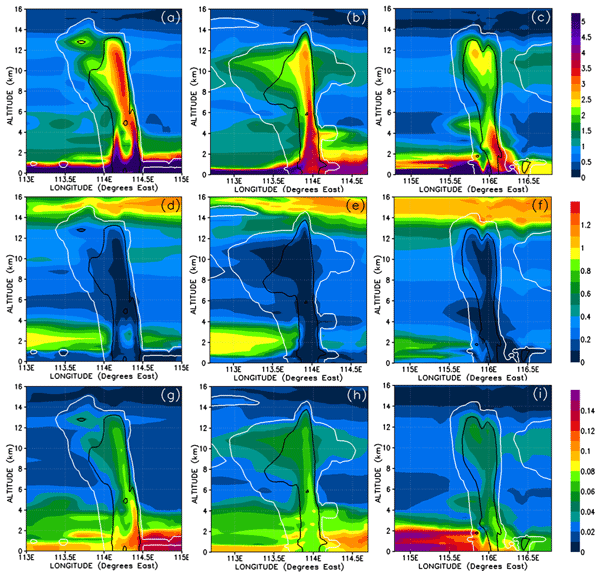
Paul D. Hamer, Virginie Marécal, Ryan Hossaini, Michel Pirre, Gisèle Krysztofiak, Franziska Ziska, Andreas Engel, Stephan Sala, Timo Keber, Harald Bönisch, Elliot Atlas, Kirstin Krüger, Martyn Chipperfield, Valery Catoire, Azizan A. Samah, Marcel Dorf, Phang Siew Moi, Hans Schlager, and Klaus Pfeilsticker
Atmos. Chem. Phys., 21, 16955–16984, https://doi.org/10.5194/acp-21-16955-2021, https://doi.org/10.5194/acp-21-16955-2021, 2021
Short summary
Short summary
Bromoform is a stratospheric ozone-depleting gas released by seaweed and plankton transported to the stratosphere via convection in the tropics. We study the chemical interactions of bromoform and its derivatives within convective clouds using a cloud-scale model and observations. Our findings are that soluble bromine gases are efficiently washed out and removed within the convective clouds and that most bromine is transported vertically to the upper troposphere in the form of bromoform.

Tiziana Bräuer, Christiane Voigt, Daniel Sauer, Stefan Kaufmann, Valerian Hahn, Monika Scheibe, Hans Schlager, Felix Huber, Patrick Le Clercq, Richard H. Moore, and Bruce E. Anderson
Atmos. Chem. Phys., 21, 16817–16826, https://doi.org/10.5194/acp-21-16817-2021, https://doi.org/10.5194/acp-21-16817-2021, 2021
Short summary
Short summary
Over half of aviation climate impact is caused by contrails. Biofuels can reduce the ice crystal numbers in contrails and mitigate the climate impact. The experiment ECLIF II/NDMAX in 2018 assessed the effects of biofuels on contrails and aviation emissions. The NASA DC-8 aircraft performed measurements inside the contrail of the DLR A320. One reference fuel and two blends of the biofuel HEFA and kerosene are analysed. We find a max reduction of contrail ice numbers through biofuel use of 40 %.

Najin Kim, Yafang Cheng, Nan Ma, Mira L. Pöhlker, Thomas Klimach, Thomas F. Mentel, Ovid O. Krüger, Ulrich Pöschl, and Hang Su
Atmos. Meas. Tech., 14, 6991–7005, https://doi.org/10.5194/amt-14-6991-2021, https://doi.org/10.5194/amt-14-6991-2021, 2021
Short summary
Short summary
A broad supersaturation scanning CCN (BS2-CCN) system, in which particles are exposed to a range of supersaturation simultaneously, can measure a broad range of CCN activity distribution with a high time resolution. We describe how the BS2-CCN system can be effectively calibrated and which factors can affect the calibration curve. Intercomparison experiments between typical DMA-CCN and BS2-CCN measurements to evaluate the BS2-CCN system showed high correlation and good agreement.
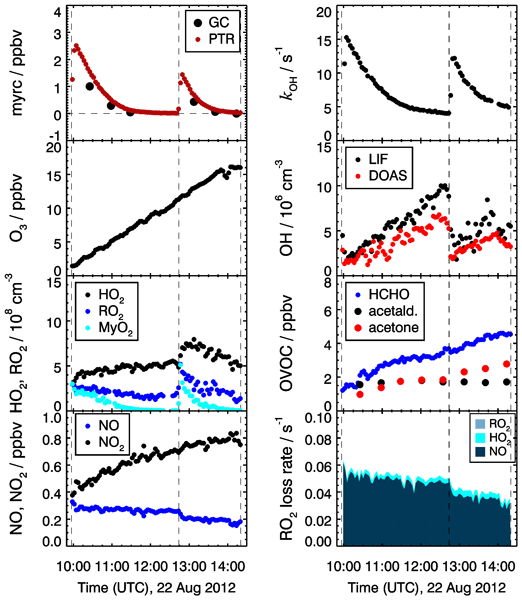
Zhaofeng Tan, Luisa Hantschke, Martin Kaminski, Ismail-Hakki Acir, Birger Bohn, Changmin Cho, Hans-Peter Dorn, Xin Li, Anna Novelli, Sascha Nehr, Franz Rohrer, Ralf Tillmann, Robert Wegener, Andreas Hofzumahaus, Astrid Kiendler-Scharr, Andreas Wahner, and Hendrik Fuchs
Atmos. Chem. Phys., 21, 16067–16091, https://doi.org/10.5194/acp-21-16067-2021, https://doi.org/10.5194/acp-21-16067-2021, 2021
Short summary
Short summary
The photo-oxidation of myrcene, a monoterpene species emitted by plants, was investigated at atmospheric conditions in the outdoor simulation chamber SAPHIR. The chemical structure of myrcene is partly similar to isoprene. Therefore, it can be expected that hydrogen shift reactions could play a role as observed for isoprene. In this work, their potential impact on the regeneration efficiency of hydroxyl radicals is investigated.
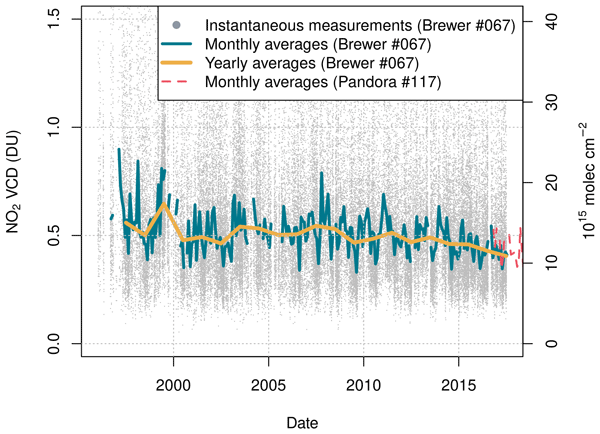
Henri Diémoz, Anna Maria Siani, Stefano Casadio, Anna Maria Iannarelli, Giuseppe Rocco Casale, Vladimir Savastiouk, Alexander Cede, Martin Tiefengraber, and Moritz Müller
Earth Syst. Sci. Data, 13, 4929–4950, https://doi.org/10.5194/essd-13-4929-2021, https://doi.org/10.5194/essd-13-4929-2021, 2021
Short summary
Short summary
A 20-year (1996–2017) record of nitrogen dioxide column densities collected in Rome by a Brewer spectrophotometer is presented, together with the novel algorithm employed to re-evaluate the series. The high quality of the data is demonstrated by comparison with reference instrumentation, including a co-located Pandora spectrometer. The data can be used for satellite validation and identification of NO2 trends. The method can be replicated on other instruments of the international Brewer network.
Yu-Wen Chen, Yi-Chun Chen, Charles C.-K. Chou, Hui-Ming Hung, Shih-Yu Chang, Lisa Eirenschmalz, Michael Lichtenstern, Helmut Ziereis, Hans Schlager, Greta Stratmann, Katharina Kaiser, Johannes Schneider, Stephan Borrmann, Florian Obersteiner, Eric Förster, Andreas Zahn, Wei-Nai Chen, Po-Hsiung Lin, Shuenn-Chin Chang, Maria Dolores Andrés Hernández, Pao-Kuan Wang, and John P. Burrows
Atmos. Chem. Phys. Discuss., https://doi.org/10.5194/acp-2021-788, https://doi.org/10.5194/acp-2021-788, 2021
Preprint withdrawn
Short summary
Short summary
By presenting an approach using EMeRGe-Asia airborne field measurements and surface observations, this study shows that the fraction of OH reactivity due to SO2-OH reaction has a significant correlation with the sulfate concentration. Approximately 30 % of sulfate is produced by SO2-OH reaction. Our results underline the importance of SO2-OH gas-phase oxidation in sulfate formation, and demonstrate that the method can be applied to other regions and under different meteorological conditions.
Cited articles
Ambrosetti, P., Anfossi, D., Cieslik, S., Graziani, G., Lamprecht, R., Marzorati, A., Nodop, K., Sandroni, S., Stingele, A., and Zimmermann, H.: Mesoscale transport of atmospheric trace constituents across the central Alps: TRANSALP tracer experiments, Atmos. Environ., 32, 1257–1272, https://doi.org/10.1016/S1352-2310(97)00185-4, 1998.
Andrés Hernández, M. D., Hilboll, A., Ziereis, H., Förster, E., Krüger, O. O., Kaiser, K., Schneider, J., Barnaba, F., Vrekoussis, M., Schmidt, J., Huntrieser, H., Blechschmidt, A.-M., George, M., Nenakhov, V., Harlass, T., Holanda, B. A., Wolf, J., Eirenschmalz, L., Krebsbach, M., Pöhlker, M. L., Kalisz Hedegaard, A. B., Mei, L., Pfeilsticker, K., Liu, Y., Koppmann, R., Schlager, H., Bohn, B., Schumann, U., Richter, A., Schreiner, B., Sauer, D., Baumann, R., Mertens, M., Jöckel, P., Kilian, M., Stratmann, G., Pöhlker, C., Campanelli, M., Pandolfi, M., Sicard, M., Gómez-Amo, J. L., Pujadas, M., Bigge, K., Kluge, F., Schwarz, A., Daskalakis, N., Walter, D., Zahn, A., Pöschl, U., Bönisch, H., Borrmann, S., Platt, U., and Burrows, J. P.: Overview: On the transport and transformation of pollutants in the outflow of major population centres – observational data from the EMeRGe European intensive operational period in summer 2017, Atmos. Chem. Phys., 22, 5877–5924, https://doi.org/10.5194/acp-22-5877-2022, 2022.
Athanasopoulou, E., Protonotariou, A., Papangelis, G., Tombrou, M., Mihalopoulos, N., and Gerasopoulos, E.: Long-range transport of Saharan dust and chemical transformations over the Eastern Mediterranean, Atmos. Environ., 140, 592–604, https://doi.org/10.1016/j.atmosenv.2016.06.041, 2016.
Baklanov, A., Lawrence, M., Pandis, S., Mahura, A., Finardi, S., Moussiopoulos, N., Beekmann, M., Laj, P., Gomes, L., Jaffrezo, J.-L., Borbon, A., Coll, I., Gros, V., Sciare, J., Kukkonen, J., Galmarini, S., Giorgi, F., Grimmond, S., Esau, I., Stohl, A., Denby, B., Wagner, T., Butler, T., Baltensperger, U., Builtjes, P., van den Hout, D., van der Gon, H. D., Collins, B., Schluenzen, H., Kulmala, M., Zilitinkevich, S., Sokhi, R., Friedrich, R., Theloke, J., Kummer, U., Jalkinen, L., Halenka, T., Wiedensholer, A., Pyle, J., and Rossow, W. B.: MEGAPOLI: concept of multi-scale modelling of megacity impact on air quality and climate, Adv. Sci. Res., 4, 115–120, https://doi.org/10.5194/asr-4-115-2010, 2010.
Barnaba, F. and Gobbi, G. P.: Aerosol seasonal variability over the Mediterranean region and relative impact of maritime, continental and Saharan dust particles over the basin from MODIS data in the year 2001, Atmos. Chem. Phys., 4, 2367–2391, https://doi.org/10.5194/acp-4-2367-2004, 2004.
Barnaba, F., Gobbi, G. P., and de Leeuw, G.: Aerosol stratification, optical properties and radiative forcing in Venice (Italy) during ADRIEX, Q. J. Roy. Meteor. Soc., 133, 47–60, https://doi.org/10.1002/qj.91, 2007.
Barnaba, F., Putaud, J. P., Gruening, C., dell'Acqua, A., and Dos Santos, S.: Annual cycle in co-located in situ, total-column, and height resolved aerosol observations in the Po Valley (Italy): Implications for ground-level particulate matter mass concentration estimation from remote sensing. J. Geophys. Res., 115, https://doi.org/10.1029/2009JD013002, 2010.
Barnaba, F., Romero, N. A., Bolignano, A., Basart, S., Renzi, M., and Stafoggia, M.: Multiannual assessment of the desert dust impact on air quality in Italy combining PM10 data with physics-based and geostatistical models, Environ. Int., 163, 107204, https://doi.org/10.1016/j.envint.2022.107204, 2022.
Basart, S., Nickovic, S., Terradellas, E., Cuevas, E., Pérez García-Pando, C., García-Castrillo, G., Werner, E., and Benincasa, F.: The WMO SDS-WAS Regional Center for Northern Africa, Middle East and Europe, E3S Web Conf., 99, 04008, https://doi.org/10.1051/e3sconf/20199904008, 2019.
Bellini, A., Diémoz, H., Di Liberto, L., Gobbi, G. P., Bracci, A., Pasqualini, F., and Barnaba, F.: ALICENET – an Italian network of automated lidar ceilometers for four-dimensional aerosol monitoring: infrastructure, data processing, and applications, Atmos. Meas. Tech., 17, 6119–6144, https://doi.org/10.5194/amt-17-6119-2024, 2024.
Birmili, W., Heinke, K., Pitz, M., Matschullat, J., Wiedensohler, A., Cyrys, J., Wichmann, H.-E., and Peters, A.: Particle number size distributions in urban air before and after volatilisation, Atmos. Chem. Phys., 10, 4643–4660, https://doi.org/10.5194/acp-10-4643-2010, 2010.
Butler, T. M., Stock, Z. S., Russo, M. R., Denier van der Gon, H. A. C., and Lawrence, M. G.: Megacity ozone air quality under four alternative future scenarios, Atmos. Chem. Phys., 12, 4413–4428, https://doi.org/10.5194/acp-12-4413-2012, 2012.
Castaldini, D., Marchetti, M., Norini, G., Vandelli, V., and Zuluaga Vélez, M. C.: Geomorphology of the central Po Plain, Northern Italy, J. Maps, 15, 780–787, https://doi.org/10.1080/17445647.2019.1673222, 2019.
CityZen: megaCITY – Zoom for the ENvironment (THEME FP7-ENV-2007.1.1.2.1: Megacities and Regional Hot-spots Air Quality and Climate), European Commission CORDIS Portal, https://cordis.europa.eu/project/id/212095 (last access: 1 July 2026), 2011.
Collaud Coen, M., Praz, C., Haefele, A., Ruffieux, D., Kaufmann, P., and Calpini, B.: Determination and climatology of the planetary boundary layer height above the Swiss plateau by in situ and remote sensing measurements as well as by the COSMO-2 model, Atmos. Chem. Phys., 14, 13205–13221, https://doi.org/10.5194/acp-14-13205-2014, 2014.
Contini, D., Gambaro, A., Belosi, F., De Pieri, S., Cairns, W. R. L., Donateo, A., Zanotto, E., and Citron, M.: The direct influence of ship traffic on atmospheric PM2.5, PM10 and PAH in Venice, J. Environ. Manage., 92, 2119–2129, 2011.
Curci, G., Ferrero, L., Tuccella, P., Barnaba, F., Angelini, F., Bolzacchini, E., Carbone, C., Denier van der Gon, H. A. C., Facchini, M. C., Gobbi, G. P., Kuenen, J. P. P., Landi, T. C., Perrino, C., Perrone, M. G., Sangiorgi, G., and Stocchi, P.: How much is particulate matter near the ground influenced by upper-level processes within and above the PBL? A summertime case study in Milan (Italy) evidences the distinctive role of nitrate, Atmos. Chem. Phys., 15, 2629–2649, https://doi.org/10.5194/acp-15-2629-2015, 2015.
DeMott, P. J., Prenni, A. J., Liu, X., Kreidenweis, S. M., Petters, M. D., Twohy, C. H., Richardson, M. S., Eidhammer, T., and Rogers, D. C.: Predicting global atmospheric ice nuclei distributions and their impacts on climate, P. Natl. Acad. Sci., 107, 11217–11222, 2010.
De Wekker, S. F. and Kossmann, M.: Convective boundary layer heights over mountainous terrain – a review of concepts, Front. Earth Sci., 3, 77, https://doi.org/10.3389/feart.2015.00077, 2015.
De Wekker, S. F. J., Kossmann, M., Knievel, J. C., Giovannini, L., Gutmann, E. D., and Zardi, D.: Meteorological Applications Benefiting from an Improved Understanding of Atmospheric Exchange Processes over Mountains, Atmosphere, 9, 371, https://doi.org/10.3390/atmos9100371, 2018.
Diémoz, H., Barnaba, F., Magri, T., Pession, G., Dionisi, D., Pittavino, S., Tombolato, I. K. F., Campanelli, M., Della Ceca, L. S., Hervo, M., Di Liberto, L., Ferrero, L., and Gobbi, G. P.: Transport of Po Valley aerosol pollution to the northwestern Alps – Part 1: Phenomenology, Atmos. Chem. Phys., 19, 3065–3095, https://doi.org/10.5194/acp-19-3065-2019, 2019a.
Diémoz, H., Gobbi, G. P., Magri, T., Pession, G., Pittavino, S., Tombolato, I. K. F., Campanelli, M., and Barnaba, F.: Transport of Po Valley aerosol pollution to the northwestern Alps – Part 2: Long-term impact on air quality, Atmos. Chem. Phys., 19, 10129–10160, https://doi.org/10.5194/acp-19-10129-2019, 2019b.
Draxler, R. and Hess, G.: Description of the HYSPLIT4 modeling system, NOAA Technical Memorandum, ERL, ARL-224, 1997, revised September 2014, https://repository.library.noaa.gov/view/noaa/31133/noaa_31133_DS1.pdf (last access: 5 October 2024), 1997.
Ferrero, L., Riccio, A., Ferrini, B. S., D'Angelo, L., Rovelli, G., Casati, M., Angelini, F., Barnaba, F., Gobbi, G. P., Cataldi, M., and Bolzacchini, E.: Satellite AOD conversion into ground PM10, PM2.5 and PM1 over the Po valley (Milan, Italy) exploiting information on aerosol vertical profiles, chemistry, hygroscopicity and meteorology, Atmos. Pollut. Res., 10, 1895–1912, 2019.
Finardi, S. and Pellegrini, U.: Systematic analysis of meteorological conditions causing severe urban air pollution episodes in the central Po Valley, in: Proceedings of the 9th Int. Conf. on Harmonisation within Atmospheric Dispersion Modelling for Regulatory Purposes, June 2004, Garmish-Partenkirchen, Germany, 250–254, http://www.harmo.org/conference.php?id=9 (last access: 5 October 2025), 2004.
Finardi, S., Silibello, C., D'Allura, A., and Radice, P.: Analysis of pollutants exchange between the Po Valley and the surrounding European region, Urban Clim., 10, 682–702, https://doi.org/10.1016/j.uclim.2014.02.002, 2014.
Finardi, S., Agrillo, G., Baraldi, R., Calori, G., Carlucci, P., Ciccioli, P., D'Allura, A., Gasbarra, D., Gioli, B., Magliulo, V., Radice, P., Toscano, P., and Zaldei, A.: Atmospheric dynamics and ozone cycle during sea breeze in a Mediterranean complex urbanized coastal site, J. Appl. Meteorol. Clim., 57, 1083–1099, https://doi.org/10.1175/JAMC-D-17-0117.1, 2018.
Flamant, C., Deroubaix, A., Chazette, P., Brito, J., Gaetani, M., Knippertz, P., Fink, A. H., de Coetlogon, G., Menut, L., Colomb, A., Denjean, C., Meynadier, R., Rosenberg, P., Dupuy, R., Dominutti, P., Duplissy, J., Bourrianne, T., Schwarzenboeck, A., Ramonet, M., and Totems, J.: Aerosol distribution in the northern Gulf of Guinea: local anthropogenic sources, long-range transport, and the role of coastal shallow circulations, Atmos. Chem. Phys., 18, 12363–12389, https://doi.org/10.5194/acp-18-12363-2018, 2018.
Folberth, G. A., Rumbold, S. T., Collins, W. J., and Butler, T. M.: Global radiative forcing and megacities, Urban Clim., 1, 4–19, https://doi.org/10.1016/j.uclim.2012.08.001, 2012.
Förster, E., Bönisch, H., Neumaier, M., Obersteiner, F., Zahn, A., Hilboll, A., Kalisz Hedegaard, A. B., Daskalakis, N., Poulidis, A. P., Vrekoussis, M., Lichtenstern, M., and Braesicke, P.: Chemical and dynamical identification of emission outflows during the HALO campaign EMeRGe in Europe and Asia, Atmos. Chem. Phys., 23, 1893–1918, https://doi.org/10.5194/acp-23-1893-2023, 2023.
Gaetani, M., Pasqui, M., Crisci, A., and Guarnieri, F.: A synoptic characterization of the dust transport and associated thermal anomalies in the Mediterranean basin, Int. J. Climatol., 36, 2779–2791, https://doi.org/10.1002/joc.3615, 2016.
Georgiadis, T., Giovanelli, G., and Fortezza, F.: Vertical layering of photochemical ozone during land-sea breeze transport, Il Nuovo Cimento C, 17, 371–375, https://doi.org/10.1007/BF02509176, 1994.
Gobbi, G. P., Barnaba, F., Van Dingenen, R., Putaud, J. P., Mircea, M., and Facchini, M. C.: Lidar and in situ observations of continental and Saharan aerosol: closure analysis of particles optical and physical properties, Atmos. Chem. Phys., 3, 2161–2172, https://doi.org/10.5194/acp-3-2161-2003, 2003.
Gobbi, G. P., Di Liberto, L., and Barnaba, F.: Impact of port emissions on EU-regulated and non-regulated air quality indicators: The case of Civitavecchia (Italy), Sci. Total Environ., 719, https://doi.org/10.1016/j.scitotenv.2019.134984, 2020.
Gohm, A., Harnisch, F., Vergeiner, J., Obleitner, F., Schnitzhofer, R., Hansel, A., Fix, A., Neininger, B., Emeis, S., and Schäfer, K.: Air Pollution Transport in an Alpine Valley: Results From Airborne and Ground-Based Observations, Bound.-Lay. Meteorol., 131, 441–463, https://doi.org/10.1007/s10546-009-9371-9, 2009.
Gonzalez Ortiz, A., Guerreiro, C., and Soares J. (EEA): Air quality in Europe – 2019 report, EEA Report No. 10/2019, European Environment Agency, Copenhagen, Denmark, https://www.eea.europa.eu/en/analysis/publications/air-quality-in-europe-2019 (last access: 24 June 2026), 2019.
Gonzalez Ortiz, A., Guerreiro, C., and Soares, J.: Air Quality in Europe – EEA: 2020 Report, Tech. rep. N09/2020, https://doi.org/10.2800/786656, 2020.
Guimbaud, C., Arens, F., Gutzwiller, L., Gäggeler, H. W., and Ammann, M.: Uptake of HNO3 to deliquescent sea-salt particles: a study using the short-lived radioactive isotope tracer 13N, Atmos. Chem. Phys., 2, 249–257, https://doi.org/10.5194/acp-2-249-2002, 2002.
Gurjar, B. R. and Lelieveld, J.: New directions: megacities and global change, Atmos. Environ., 39, 391–393, https://doi.org/10.1016/j.atmosenv.2004.11.002, 2005.
Helbig, M., Gerken, T., Beamesderfer, E. R., Baldocchi, D. D., Banerjee, T., Biraud, S. C., Brown, W. O. J., Brunsell, N. A., Burakowski, E. A., Burns, S. P., Butterworth, B. J., Chan, S., Davis, K. J., Desai, A. R., Fuentes, J. D., Hollinger, D. Y., Kljun, N., Mauder, M., Novick, K. A., Perkins, J. M., Rahn, D. A., Sanchez, C.-R., Santanello, J. A., Scott, R. L., Seyednasrollah, B., Stoy, P. C., Sullivan, R. C., Vilà-Guerau de Arellano, J., Wharton, S., Yi, C., and Richardson, A. D.: Integrating continuous atmospheric boundary layer and tower-based flux measurements to advance understanding of land-atmosphere interactions, Agr. Forest Meteorol., 307, https://doi.org/10.1016/j.agrformet.2021.108509, 2021.
Henne, S., Furger, M., Nyeki, S., Steinbacher, M., Neininger, B., de Wekker, S. F. J., Dommen, J., Spichtinger, N., Stohl, A., and Prévôt, A. S. H.: Quantification of topographic venting of boundary layer air to the free troposphere, Atmos. Chem. Phys., 4, 497–509, https://doi.org/10.5194/acp-4-497-2004, 2004.
Henne, S., Dommen, J., Neininger, B., Reimann, S., Staehelin, J., and Prévôt, A. S. H.: Influence of mountain venting in the Alps on the ozone chemistry of the lower free troposphere and the European pollution export, J. Geophys. Res., 110, D22307 https://doi.org/10.1029/2005JD005936, 2005.
Hennemuth, B. and Lammert-Stockschlaeder, A.: Determination of the Atmospheric Boundary Layer Height from Radiosonde and Lidar Backscatter, Bound.-Lay. Meteorol., 120, 181-0200, https://doi.org/10.1007/s10546-005-9035-3, 2006.
Hersbach, H., Bell, B., Berrisford, P., et al.: The ERA5 global reanalysis, Q. J. Roy. Meteor. Soc., https://doi.org/10.1002/qj.3803, 2020.
Highwood, E. J., Haywood, J. M., Coe, H., Cook, J., Osborne, S., Williams, P., Crosier, J., Bower, K., Formenti, P., McQuaid, J., Brooks, B., Thomas, G., Grainger, R., Barnaba, F., Gobbi, G. P., and De Leeuw, G.: Aerosol direct radiative impact experiment (ADRIEX) overview, Q. J. Roy. Meteor. Soc., 133, 3–15, 2007.
Hong, Q., Liu, C., Hu, Q., Zhang, Y., Xing, C., Su, W., Ji, X., and Xiao, S.: Evaluating the feasibility of formaldehyde derived from hyperspectral remote sensing as a proxy for volatile organic compounds, Atmos. Res., 264, https://doi.org/10.1016/j.atmosres.2021.105777, 2021.
Hüneke, T., Aderhold, O.-A., Bounin, J., Dorf, M., Gentry, E., Grossmann, K., Grooß, J.-U., Hoor, P., Jöckel, P., Kenntner, M., Knapp, M., Knecht, M., Lörks, D., Ludmann, S., Matthes, S., Raecke, R., Reichert, M., Weimar, J., Werner, B., Zahn, A., Ziereis, H., and Pfeilsticker, K.: The novel HALO mini-DOAS instrument: inferring trace gas concentrations from airborne UV/visible limb spectroscopy under all skies using the scaling method, Atmos. Meas. Tech., 10, 4209–4234, https://doi.org/10.5194/amt-10-4209-2017, 2017.
Hůnová, I., Brabec, M., and Malý, M.: Ambient ozone at a rural Central European site and its vertical concentration gradient close to the ground, Environ. Sci. Pollut. R., 30, 80014–80028, https://doi.org/10.1007/s11356-023-28016-8, 2023.
ISTAT: Annuario statistico Italiano, https://www.istat.it/?s=annuario+statistico+Italiano+2022 (last access: 5 May 2024), 2022.
Itahashi, S., Hattori, S., Ito, A., Sadanaga, Y., Yoshida, N., and Matsuki, A.: Role of Dust and Iron Solubility in Sulfate Formation during the Long-Range Transport in East Asia Evidenced by 17O-Excess Signatures, Environ. Sci. Technol., 56, 13634–13643, https://doi.org/10.1021/acs.est.2c03574, 2022.
Kaiser, J., Wolfe, G. M., Bohn, B., Broch, S., Fuchs, H., Ganzeveld, L. N., Gomm, S., Häseler, R., Hofzumahaus, A., Holland, F., Jäger, J., Li, X., Lohse, I., Lu, K., Prévôt, A. S. H., Rohrer, F., Wegener, R., Wolf, R., Mentel, T. F., Kiendler-Scharr, A., Wahner, A., and Keutsch, F. N.: Evidence for an unidentified non-photochemical ground-level source of formaldehyde in the Po Valley with potential implications for ozone production, Atmos. Chem. Phys., 15, 1289–1298, https://doi.org/10.5194/acp-15-1289-2015, 2015.
Karydis, V. A., Tsimpidi, A. P., Pozzer, A., Astitha, M., and Lelieveld, J.: Effects of mineral dust on global atmospheric nitrate concentrations, Atmos. Chem. Phys., 16, 1491–1509, https://doi.org/10.5194/acp-16-1491-2016, 2016.
Kluge, F., Hüneke, T., Knecht, M., Lichtenstern, M., Rotermund, M., Schlager, H., Schreiner, B., and Pfeilsticker, K.: Profiling of formaldehyde, glyoxal, methylglyoxal, and CO over the Amazon: normalized excess mixing ratios and related emission factors in biomass burning plumes, Atmos. Chem. Phys., 20, 12363–12389, https://doi.org/10.5194/acp-20-12363-2020, 2020.
Liguori, F. and Zannetti, M. (Eds.): Reducing atmospheric pollution in the Mediterranean port cities: The results of APICE project, APICE project final publication, 2013.
Marenco, F., Bonasoni, P., Calzolari, F., Ceriani, M., Chiari, M., Cristofanelli, P., D'Alessandro, A., Fermo, P., Lucarelli, F., Mazzei, F. and Nava, S.: Characterization of atmospheric aerosols at Monte Cimone, Italy, during summer 2004: source apportionment and transport mechanisms, J. Geophys. Res.-Atmos., 111, https://doi.org/10.1029/2006JD007145, 2006.
Marmer, E. and Langmann, B.: Impact of ship emissions on the Mediterranean summertime pollution and climate: A regional model study, Atmos. Environ., 39, 4659–4669, 2005.
McKendry, I. G. and Lundgren, J.: Tropospheric layering of ozone in regions of urbanized complex and/or coastal terrain: a review, Prog. Phys. Geogr., 24, 329–354, 2000.
Merico, E., Conte, M., Grasso, F. M., Cesari, D., Gambaro, A., Morabito, E., Gregoris, E., and Contini, D.: Trends of Shipping Impact to Particulate Matter in Two Adriatic Port-Cities, Environmental Sciences Proceedings, 8, 10, https://doi.org/10.3390/ecas2021-10343, 2021.
Millán, M. M., Salvador, R., Mantilla, E., and Kallos, G.: Photooxidant dynamics in the Mediterranean basin in summer: Results from European research projects, J. Geophys. Res., 102, 8811–8823, https://doi.org/10.1029/96JD03610, 1997.
Millán, M. M., Mantilla, E., Salvador, R., Carratalá, A., Sanz, M. J., Alonso, L., Gangoiti, G., and Navazo, M.: Ozone Cycles in the Western Mediterranean Basin: Interpretation of Monitoring Data in Complex Coastal Terrain, J. Appl. Meteorol., 39, 487–508, https://doi.org/10.1175/1520-0450(2000)039<0487:OCITWM>2.0.CO;2, 2000.
Millán, M. M., Sanz, M. J., Salvador, R., and Mantilla, E.: Atmospheric dynamics and ozone cycles related to nitrogen deposition in the western Mediterranean, Environ Pollut., 118, 167–186, https://doi.org/10.1016/s0269-7491(01)00311-6, 2002.
Millán, M. M., Estrela, M. J., Sanz, M. J., Mantilla, E., Martín, M., Pastor, F., Salvador, R., Vallejo, R., Alonso, L., Gangoiti, G., Ilardia, J. L., Navazo, M., Albizuri, A., Artíñano, B., Ciccioli, P., Kallos, G., Carvalho, R. A., Andrés, M. D., Hoff, A., Werhahn, J., Seufert, G., and Versino, B.: “Climatic feedbacks and desertification: The Mediterranean model”, J. Climate, 18, 684–701, https://doi.org/10.1175/JCLI-3283.1, 2004.
Molina, M. J. and Molina, L. T.: Megacities and Atmospheric Pollution, J. Air Waste Ma., 54, 644–680, https://doi.org/10.1080/10473289.2004.10470936, 2004.
Nyeki, S., Eleftheriadis, K., Baltensperger, U., Colbeck, I., Fiebig, M., Fix, A., Kiemle, C., Lazaridis, M., and Petzold, A.: Airborne Lidar and in-situ Aerosol Observations of an Elevated Layer, Leeward of the European Alps and Apennines, Geophys. Res. Lett., 29, 33-1–33-4, https://doi.org/10.1029/2002GL014897, 2002.
Pederzoli, A., Mircea, M., Finardi, S., di Sarra, A., and Zanini, G.: Quantification of Saharan dust contribution to PM10 concentrations over Italy during 2003–2005, Atmos. Environ., 44, 4181–4190, https//doi.org/10.1016/j.atmosenv.2010.07.031, 2010.
Putaud, J. P., Cavalli, F., Martins dos Santos, S., and Dell'Acqua, A.: Long-term trends in aerosol optical characteristics in the Po Valley, Italy, Atmos. Chem. Phys., 14, 9129–9136, https://doi.org/10.5194/acp-14-9129-2014, 2014.
Raffaelli, K., Deserti, M., Stortini, M., Amorati, R., Vasconi, M., and Giovannini, G.: Improving Air Quality in the Po Valley, Italy: Some Results by the LIFE-IP-PREPAIR Project, Atmosphere, 11, 429, https://doi.org/10.3390/atmos11040429, 2020.
re3data.org: HALO database, re3data.org – Registry of Research Data Repositories [data set], https://doi.org/10.17616/R39Q0T, 2025.
Rotach, M. W., Calanca, P., Graziani, G., Gurtz, J., Steyn, D. G., Vogt, R., Andretta, M., Christen, A., Cieslik, S., Connolly, R., De Wekker, S. F. J., Galmarini, S., Kadygrov, E. N., Kadygrov, V., Miller, E., Neininger, B., Rucker, M., Van Gorsel, E., Weber, H., Weiss, A., and Zappa, M.: Turbulence Structure and Exchange Processes in an Alpine Valley: The Riviera Project, B. Am. Meteorol. Soc., 85, 1367–1386, https://doi.org/10.1175/BAMS-85-9-1367, 2004.
Schroeder, J. R., Crawford, J. H., Fried, A., Walega, J., Weinheimer, A., and Wisthaler, A.: New insights into the column CH2O/NO2 ratio as an indicator of near-surface ozone sensitivity, J. Geophys. Res.-Atmos., 122, 8885–8907, https://doi.org/10.1002/2017jd026781, 2017.
Seibert, P., Beyrich, F., Gryning, S.-E., Joffre, S., Rasmussen, A., and Tercier, P.: Review and intercomparison of operational methods for the determination of the mixing height, Atmos. Environ., 34, 1001–1027, https://doi.org/10.1016/S1352-2310(99)00349-0, 2000.
Sillman, S.: The use of NOy, H2O2, and HNO3 as indicators for ozone-NOx hydrocarbon sensitivity in urban locations, J. Geophys. Res.-Atmos., 100, 14175–14188, https://doi.org/10.1029/94jd02953, 1995.
Souri, A. H., Nowlan, C. R., Wolfe, G. M., Lamsal, L. N., Miller, C. E. C., Gonzalez Abad, G., Janz, S. J., Fried, A., Blake, D. R., Weinheimer, A. J., Diskin, G. S., Liu, X., and Chance, K.: Revisiting the effectiveness of HCHO/NO2 ratios for inferring ozone sensitivity to its precursors using high resolution airborne remote sensing observations in a high ozone episode during the KORUS-AQ campaign, Atmos. Environ., 224, 117341, https://doi.org/10.1016/j.atmosenv.2020.117341, 2020.
Sprenger, M. and Wernli, H.: The LAGRANTO Lagrangian analysis tool – version 2.0, Geosci. Model Dev., 8, 2569–2586, https://doi.org/10.5194/gmd-8-2569-2015, 2015.
Stein, A., Draxler, R. R., Rolph, G. D., Stunder, B. J. B., Cohen, M., and Ngan, F.: NOAA's HYSPLIT Atmospheric Transport and Dispersion Modeling System, B. Am. Meteorol. Soc., 96, 2059–2077, https://doi.org/10.1175/BAMS-D-14-00110.1, 2016.
Stohl, A. and Wotawa, G.: A method for computing single trajectories representing boundary layer transport, Atmos. Environ., 29, 3235–3238, https://doi.org/10.1016/1352-2310(95)00259-2, 1995.
Stohl, A., Wotawa, G., Seibert, P., and Kromp-Kolb, H.: Interpolation errors in wind fields as a function of spatial and temporal resolution and their impact on different types of kinematic trajectories, J. Appl. Meteorol. Clim., 34, 2149–2165, https://doi.org/10.1175/1520-0450(1995)034<2149:IEIWFA>2.0.CO;2, 1995.
Stortini, M., Deserti, M., Bonafè, G., and Minguzzi, E.: Long-term simulation and validation of ozone and aerosol in the Po Valley, in: Developments in environmental sciences, edited by: Borrego C. and Renner, E., Elsevier, 6, 768–770, https://doi.org/10.1016/S1474-8177(07)06813-1, 2007.
Talbot, N., Kubelova, L., Makes, O., Cusack, M., Ondracek, J., Vodička, P., Schwarz, J., and Zdimal, V.: Outdoor and indoor aerosol size, number, mass and compositional dynamics at an urban background site during warm season, Atmos. Environ., 131, 171–184, https://doi.org/10.1016/j.atmosenv.2016.01.055, 2016.
Tampieri, F., Trombetti, F., and Scarani, C.: Summer daily circulation in the Po Valley, Italy, Geophys. Astro. Fluid, 17, 97–112, https://doi.org/10.1080/03091928108243675, 1981.
Targa, J., Colina, M., Banyuls, L., González Ortiz, A., and Soares, J.: Status report of air quality in Europe for year 2023, using validated and up-to-date data (ETC-HE Report 2024/5), European Topic Centre on Human Health and the Environment, Zenodo, https://doi.org/10.5281/zenodo.15172752, 2024.
Toscano, D.: The Impact of Shipping on Air Quality in the Port Cities of the Mediterranean Area: A Review, Atmosphere, 14, 1180, https://doi.org/10.3390/atmos14071180, 2023.
Van Dingenen, R., Putaud, J.-P., Martins-Dos Santos, S., and Raes, F.: Physical aerosol properties and their relation to air mass origin at Monte Cimone (Italy) during the first MINATROC campaign, Atmos. Chem. Phys., 5, 2203–2226, https://doi.org/10.5194/acp-5-2203-2005, 2005.
Wandinger, U.: Introduction to lidar, in: Lidar: range-resolved optical remote sensing of the atmosphere, 1–18, New York, NY, Springer New York, https://doi.org/10.1007/0-387-25101-4_1, 2005.
Wang, X. Y. and Wang, K. C.: Estimation of atmospheric mixing layer height from radiosonde data, Atmos. Meas. Tech., 7, 1701–1709, https://doi.org/10.5194/amt-7-1701-2014, 2014.
Wang, Z., Pan, X., Uno, I., Li, J., Wang, Z., Chen, X., Fu, P., Yang, T., Kobayashi, H., Shimizu, A., Sugimoto, N., and Yamamoto, S.: Significant impacts of heterogeneous reactions on the chemical composition and mixing state of dust particles: A case study during dust events over northern China, Atmos. Environ., 159, 83–91, https://doi.org/10.1016/j.atmosenv.2017.03.044, 2017.
Wang, Y., Ma, Y.-F., Muñoz-Esparza, D., Li, C. W. Y., Barth, M., Wang, T., and Brasseur, G. P.: The impact of inhomogeneous emissions and topography on ozone photochemistry in the vicinity of Hong Kong Island, Atmos. Chem. Phys., 21, 3531–3553, https://doi.org/10.5194/acp-21-3531-2021, 2021.
Wang, Y., Brasseur, G. P., and Wang, T.: Segregation of atmospheric oxidants in turbulent urban environments, Atmosphere, 13, 315, https://doi.org/10.3390/atmos13020315, 2022.
Wallace, J. M. and Hobbs, P. V.: Atmospheric Science, An Introductory Survey, 2006 Elsevier, https://doi.org/10.1016/C2009-0-00034-8, 2006.
Weger, M., Heinold, B., Engler, C., Schumann, U., Seifert, A., Fößig, R., Voigt, C., Baars, H., Blahak, U., Borrmann, S., Hoose, C., Kaufmann, S., Krämer, M., Seifert, P., Senf, F., Schneider, J., and Tegen, I.: The impact of mineral dust on cloud formation during the Saharan dust event in April 2014 over Europe, Atmos. Chem. Phys., 18, 17545–17572, https://doi.org/10.5194/acp-18-17545-2018, 2018.
Weissmann, M., Braun, F. J., Gantner, L., Mayr, G. J., Rahm, S., and Reitebuch, O.: The Alpine Mountain–Plain Circulation: Airborne Doppler Lidar Measurements and Numerical Simulations, Mon. Weather Rev., 133, 3095–3109, 2005.
Wotawa, G., Kröger, H., and Stohl, A.: Transport of ozone towards the Alps – results from trajectory analyses and photochemical model studies, Atmos. Environ., 34, 1367–1377, https://doi.org/10.1016/S1352-2310(99)00363-5, 2000.
Yus-Díez, J., Ealo, M., Pandolfi, M., Perez, N., Titos, G., Močnik, G., Querol, X., and Alastuey, A.: Aircraft vertical profiles during summertime regional and Saharan dust scenarios over the north-western Mediterranean basin: aerosol optical and physical properties, Atmos. Chem. Phys., 21, 431–455, https://doi.org/10.5194/acp-21-431-2021, 2021.
Zhang, Y., Luo, G., and Yu, F.: Seasonal variations and long-term trend of dust particle number concentration over the northeastern United States. J. Geophys. Res.-Atmos., 124, 13140–13155, https://doi.org/10.1029/2019JD031388, 2019.
Zhu, S., Butler, T., Sander, R., Ma, J., and Lawrence, M. G.: Impact of dust on tropospheric chemistry over polluted regions: a case study of the Beijing megacity, Atmos. Chem. Phys., 10, 3855–3873, https://doi.org/10.5194/acp-10-3855-2010, 2010.
Short summary
This study combines measurements of gases and particles at the ground and on-board an instrumented aircraft to investigate pollution transport over the Po Valley, a major atmospheric pollution hotspot in Europe. Overall, the extensive data set obtained at different altitudes provides insight into the mixing of pollution plumes and their export towards the Adriatic coast as well as with naturally occurring dust and its impact on air quality over the Po Plain.
This study combines measurements of gases and particles at the ground and on-board an...


Altmetrics
Final-revised paper
Preprint