
Articles | Volume 26, issue 16
https://doi.org/10.5194/acp-26-11667-2026
© Author(s) 2026. This work is distributed under
the Creative Commons Attribution 4.0 License.
the Creative Commons Attribution 4.0 License.
https://doi.org/10.5194/acp-26-11667-2026
© Author(s) 2026. This work is distributed under
the Creative Commons Attribution 4.0 License.
the Creative Commons Attribution 4.0 License.
Research article
| 
19 Aug 2026
Research article |
| 19 Aug 2026
| 19 Aug 2026
Advancing isotope-enabled model for comprehensive understanding of atmospheric sulfur isotope effects: demonstrating the overlooked isotopic fractionation during combustion and flue gas desulfurization
Lianfang Wei
State Key Laboratory of Atmospheric Environment and Extreme Meteorology, Institute of Atmospheric Physics, Chinese Academy of Sciences, Beijing 100029, China
Chinese Research Academy of Environmental Sciences, Beijing 100012, China
Aerosol Chemistry Department, Max Planck Institute for Chemistry, Mainz 55128, Germany
Xueshun Chen
State Key Laboratory of Atmospheric Environment and Extreme Meteorology, Institute of Atmospheric Physics, Chinese Academy of Sciences, Beijing 100029, China
Wenyi Yang
Key Laboratory of Environmental Pollution and Greenhouse Gases Co-control, Ministry of Ecology and Environment, Chinese Academy of Environmental Planning, Beijing 100041, China
State Key Laboratory of Atmospheric Environment and Extreme Meteorology, Institute of Atmospheric Physics, Chinese Academy of Sciences, Beijing 100029, China
Jie Li
State Key Laboratory of Atmospheric Environment and Extreme Meteorology, Institute of Atmospheric Physics, Chinese Academy of Sciences, Beijing 100029, China
School of Environment, Beijing Normal University, Beijing 100875, China
Huiyun Du
State Key Laboratory of Atmospheric Environment and Extreme Meteorology, Institute of Atmospheric Physics, Chinese Academy of Sciences, Beijing 100029, China
Xiaole Pan
State Key Laboratory of Atmospheric Environment and Extreme Meteorology, Institute of Atmospheric Physics, Chinese Academy of Sciences, Beijing 100029, China
Yafang Cheng
Aerosol Chemistry Department, Max Planck Institute for Chemistry, Mainz 55128, Germany

Institute of Surface-Earth System Science, School of Earth System Science, Tianjin University, Tianjin 300072, China
Zifa Wang
CORRESPONDING AUTHOR
State Key Laboratory of Atmospheric Environment and Extreme Meteorology, Institute of Atmospheric Physics, Chinese Academy of Sciences, Beijing 100029, China
College of Earth and Planetary Sciences, University of Chinese Academy of Sciences, Beijing, 100049, China
Related authors
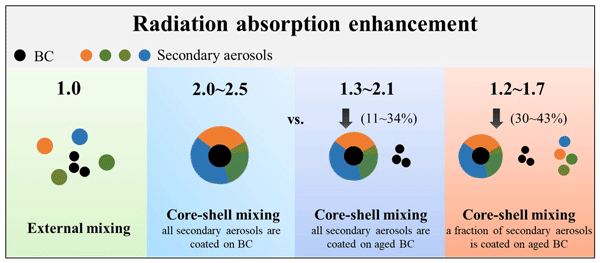
Huiyun Du, Jie Li, Xueshun Chen, Gabriele Curci, Fangqun Yu, Yele Sun, Xu Dao, Song Guo, Zhe Wang, Wenyi Yang, Lianfang Wei, and Zifa Wang
Atmos. Chem. Phys., 25, 5665–5681, https://doi.org/10.5194/acp-25-5665-2025, https://doi.org/10.5194/acp-25-5665-2025, 2025
Short summary
Short summary
Inadequate consideration of mixing states and coatings on black carbon (BC) hinders aerosol radiation forcing quantification. Core–shell mixing aligns well with observations, but partial internal mixing is a more realistic representation. We used a microphysics module to determine the fraction of embedded BC and coating aerosols, constraining the mixing state. This reduced absorption enhancement by 30 %–43 % in northern China, offering insights into BC's radiative effects.
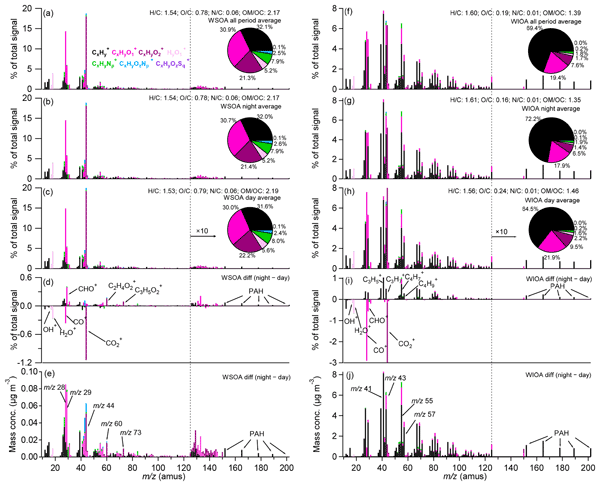
Zhiqiang Zhang, Yele Sun, Chun Chen, Bo You, Aodong Du, Weiqi Xu, Yan Li, Zhijie Li, Lu Lei, Wei Zhou, Jiaxing Sun, Yanmei Qiu, Lianfang Wei, Pingqing Fu, and Zifa Wang
Atmos. Chem. Phys., 22, 10409–10423, https://doi.org/10.5194/acp-22-10409-2022, https://doi.org/10.5194/acp-22-10409-2022, 2022
Short summary
Short summary
We present a comprehensive characterization of water-soluble organic aerosol and the first mass spectral characterization of water-insoluble organic aerosol in the cold season in Beijing by integrating online and offline aerosol mass spectrometer measurements. WSOA comprised dominantly secondary OA and showed large changes during the transition season from autumn to winter. WIOA was characterized by prominent hydrocarbon ions series, low oxidation states, and significant day–night differences.
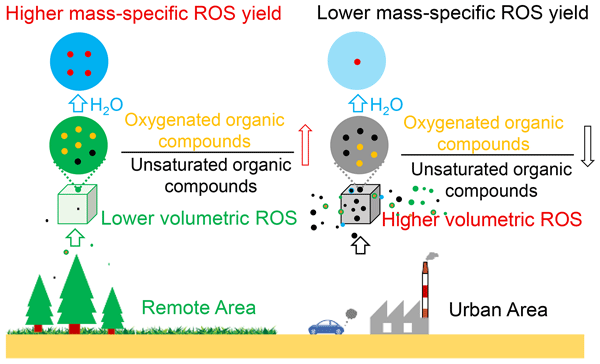
Fobang Liu, Yun Zhang, Siyao Yue, Helmi-Marja K. Keskinen, Tuukka Petäjä, Markku Kulmala, Pingqing Fu, Thorsten Hoffmann, Kai Wang, and Haijie Tong
Atmos. Chem. Phys., 26, 14655–14669, https://doi.org/10.5194/acp-26-14655-2026, https://doi.org/10.5194/acp-26-14655-2026, 2026
Short summary
Short summary
Reactive oxygen species (ROS) produced by airborne particles are linked to adverse health effects, but the organic compounds responsible remain unclear. We developed a new molecular framework to classify complex organic compounds using advanced mass spectrometry. The framework shows that particles rich in oxidized organic compounds produce more ROS per unit mass, while polluted urban air produces more total ROS mainly because of higher particle concentrations.
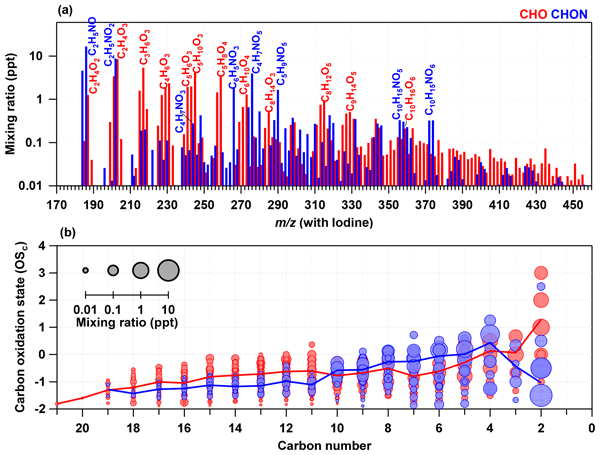
Yi Zhang, Wei Zhou, Weiqi Xu, Yan Li, Yu Zhang, Zijun Zhang, Bojiang Su, Ning Zhang, Eleonora Aruffo, Junfeng Wang, Piero Di Carlo, Lanzhong Liu, Xiaole Pan, Zifa Wang, Douglas R. Worsnop, and Yele Sun
Atmos. Chem. Phys., 26, 14637–14653, https://doi.org/10.5194/acp-26-14637-2026, https://doi.org/10.5194/acp-26-14637-2026, 2026
Short summary
Short summary
We investigated how plants, pollution and weather shape air quality at a forested mountain in southeastern China, with frequent clouds. We measured compounds formed as plant and human emissions react in the atmosphere. Warm conditions favored plant emissions, while cooler periods increased the influence of pollution transported from other regions. Clouds both removed some compounds and changed others through chemical reactions, showing how weather and clouds shape air quality in mountains.
Kai Cao, Qizhong Wu, Xiao Tang, Jinxi Li, Xueshun Chen, Huansheng Chen, Wending Wang, Huangjian Wu, Lei Kong, Jie Li, Jiang Zhu, and Zifa Wang
Geosci. Model Dev., 19, 9807–9829, https://doi.org/10.5194/gmd-19-9807-2026, https://doi.org/10.5194/gmd-19-9807-2026, 2026
Short summary
Short summary
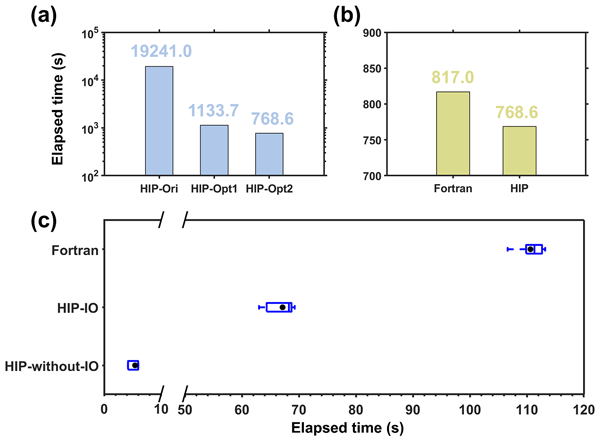
This study achieves significant acceleration by developing an optimized advection module for Emission and atmospheric Processes Integrated and Coupled Community Model on Graphics Processing Unit. Through implementing thread-block indexing, minimizing Central Processing Unit and Graphics Processing Unit communication, and an parallel framework, we demonstrate speedups: 556.5× faster offline performance for the Heterogeneous Interface advection solver and 20.5× acceleration in coupled simulations.
Mengjie Lou, Qizhong Wu, Wending Wang, Huansheng Chen, Kai Cao, Xiaohan Fan, Dingyue Liang, Fenfen Yu, Jiating Zhang, Wei Wang, and Zifa Wang
Geosci. Model Dev., 19, 9651–9676, https://doi.org/10.5194/gmd-19-9651-2026, https://doi.org/10.5194/gmd-19-9651-2026, 2026
Short summary
Short summary
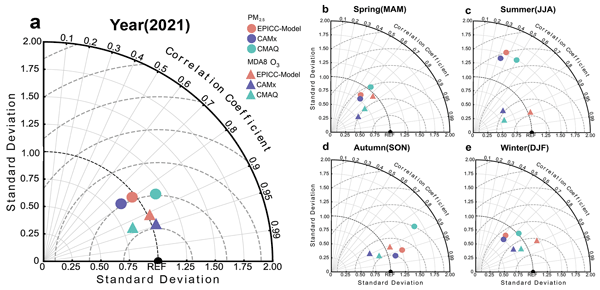
This study compares the model performance of the Emission and atmospheric Processes Integrated and Coupled Community Model with the two air quality models in China. The EPICC-Model excels in simulating summer ozone peaks, accurately captures pollution characteristics in highly polluted areas, and better reproduces persistent compound pollution processes. The study reveals common issues among the models and directions for improvement, providing a basis for optimizing global air quality models.
Zhaojun Tang, Zhe Jiang, Panpan Yang, Jiaqi Chen, Pingqing Fu, and Yanan Shen
EGUsphere, https://doi.org/10.5194/egusphere-2026-4938, https://doi.org/10.5194/egusphere-2026-4938, 2026
This preprint is open for discussion and under review for Atmospheric Chemistry and Physics (ACP).
Short summary
Short summary
This study identifies a systematic divergence between satellite and surface CO observations across China, North America, and Europe (2015–2024). We show that this discrepancy originates from different sensitivities to local emissions vs. large-scale transport. These findings reveal that relying on a single observation platform can misrepresent the true state of atmospheric CO, highlighting the need for multi-platform approaches to robustly constrain CO emission changes.
Ning Yang, Qiaoqiao Wang, Nan Ma, Guangjin Liu, Zheng Yang, Yuanwei Zhong, Zechao Hu, Yaqing Zhou, Jiangchuan Tao, Juan Hong, Yafang Cheng, and Hang Su
EGUsphere, https://doi.org/10.5194/egusphere-2026-4328, https://doi.org/10.5194/egusphere-2026-4328, 2026
Short summary
Short summary
Summer ozone pollution is becoming a growing challenge in China. Using air quality observations and computer simulations, we found that differences between cities and surrounding areas depend strongly on how they are defined and how well monitoring sites represent local conditions. Weather and emission changes also influence ozone differently across regions. These findings support more reliable assessments of ozone pollution and more targeted control strategies.
Nuohang Liu, Baozhu Ge, Danhui Xu, Nan Yang, Xueshun Chen, Qixin Tan, and Zifa Wang
EGUsphere, https://doi.org/10.5194/egusphere-2026-4057, https://doi.org/10.5194/egusphere-2026-4057, 2026
This preprint is open for discussion and under review for Atmospheric Chemistry and Physics (ACP).
Short summary
Short summary
A physically-based below-cloud wet scavenging parameterization was developed and incorporated in the Nested Air Quality Prediction Model System. The scheme substantially improves simulations of nitrogen wet deposition across East Asia, particularly in polluted regions of China, by better capturing below-cloud scavenging coefficients and separating in-cloud and below-cloud processes, supporting more reliable assessments of pollutant transport and deposition.
Jiaze Zhang, Ling Liu, An Ning, Haotian Zu, Jing Li, Fengyang Bai, Jie Yang, Xueshun Chen, and Xiuhui Zhang
Atmos. Chem. Phys., 26, 11627–11643, https://doi.org/10.5194/acp-26-11627-2026, https://doi.org/10.5194/acp-26-11627-2026, 2026
Short summary
Short summary
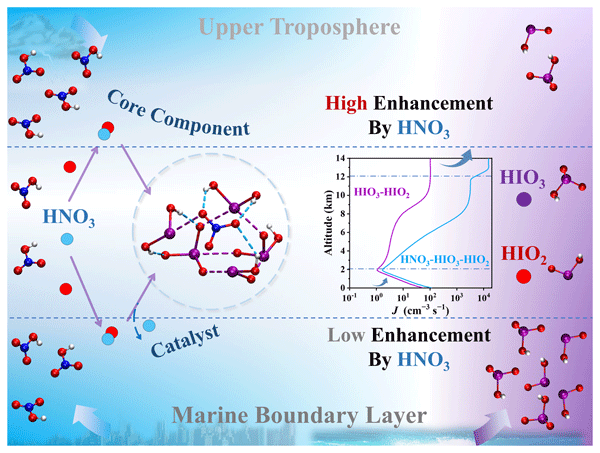
Sulfuric acid (SA)-dominated nucleation cannot explain observed tropospheric particulate matter and cloud condensation nuclei. Via quantum chemical calculations and atmospheric cluster dynamics simulations, we find the role of nitric acid shifts from a marine boundary layer catalyst to an upper troposphere cluster core in HIO3–HIO2 nucleation, with particle formation rates surpassing established SA pathways, explaining unaccounted-for new particle formation (NPF) amid falling sulfur and rising marine iodine emissions.
Fatih Ekinci, Oliver Eppers, Oliver Appel, Felix Ploeger, Antonis Dragoneas, Sergej Molleker, Philipp Brauner, Hans-Christoph Lachnitt, Franziska Weyland, Linda Ort, Nicolas Emig, Hans-Christian Clemen, Laura Tomsche, Martin Ebert, Peter Hoor, Bärbel Vogel, Yafang Cheng, Johannes Schneider, Stephan Borrmann, and Franziska Köllner
Atmos. Chem. Phys., 26, 10399–10421, https://doi.org/10.5194/acp-26-10399-2026, https://doi.org/10.5194/acp-26-10399-2026, 2026
Short summary
Short summary
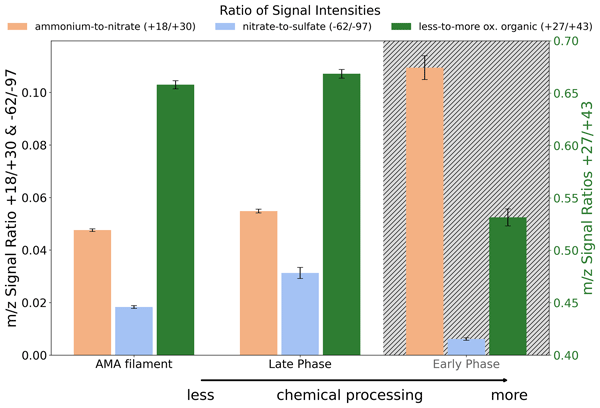
This study shows that aerosol transported from the Asian summer monsoon region can substantially alter the background composition of the extratropical lower stratosphere. Aircraft-based measurements and model simulations reveal a strong increase of ammonium nitrate aerosol from summer to autumn 2023 caused by transport of young air masses from South and East Asia. These particles can persist for months and undergo chemical aging.
Hao Liu, Hao Xu, Yixin Huang, Wei Zhou, Yunting Xiao, Qinghao Guo, Xi Zhao, Junjun Deng, Yele Sun, Pingqing Fu, and Jialei Zhu
EGUsphere, https://doi.org/10.5194/egusphere-2026-3708, https://doi.org/10.5194/egusphere-2026-3708, 2026
Short summary
Short summary
To better track natural emissions from forests, we built a detailed model covering 234 tree species across China—far more precise than past methods that lumped all trees into broad categories. The study found that planting different tree species in the same location can produce very different emission patterns, affecting haze and ozone formation in distinct ways. These findings suggest that thoughtful species selection can help balance carbon goals with cleaner air.
Matthias Kohl, Christoph Brühl, Holger Tost, Christos Xenofontos, Theodoros Christoudias, Sergey Gromov, Oliver Appel, Stephan Borrmann, Adam Bourassa, Pedro Campunzano-Jost, Yafang Cheng, Oliver Eppers, Karl D. Froyd, Bruna A. Holanda, Jose L. Jimenez, Patrick Jöckel, Philipp Joppe, Katharina Kaiser, Joseph M. Katich, Klaus Klingmüller, Franziska Köllner, Agnieszka Kupc, Anna Martin, Christopher Pöhlker, Mira L. Pöhlker, Ulrich Pöschl, Landon Rieger, Samuel Ruhl, Gregory P. Schill, Johannes Schneider, Christiane Schulz, Joshua P. Schwarz, Alexandra P. Tsimpidi, Ryan Vella, Christina J. Williamson, Yifan Yang, Daniel Zawada, Jos Lelieveld, and Andrea Pozzer
EGUsphere, https://doi.org/10.5194/egusphere-2026-3649, https://doi.org/10.5194/egusphere-2026-3649, 2026
Short summary
Short summary
Aerosols are crucial for Earth's climate, yet their vertical distribution remains poorly understood. We present first consistent global simulations of aerosol distributions and composition from the Earth's surface to the stratosphere, validated by extensive observations. Key findings include a global minimum in aerosol mass in the free troposphere, a significant contribution of organic aerosol in the lower stratosphere, and limited transport of primary particles to the stratosphere.
Fei Zhang, Xingcai Li, Zifa Wang, Yunyun Wen, Xuyang Zhou, Zichen Wu, Zhuoran Wang, Huansheng Chen, Zhe Wang, and Xueshun Chen
Geosci. Model Dev., 19, 4999–5017, https://doi.org/10.5194/gmd-19-4999-2026, https://doi.org/10.5194/gmd-19-4999-2026, 2026
Short summary
Short summary
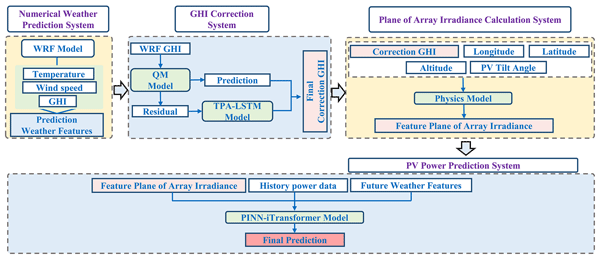
Solar power generation depends on weather conditions and photovoltaic modules, making accurate forecasts crucial for reliable grid operation. We combined weather prediction and artificial intelligence to improve the solar power prediction at different time scales for a plant. By improving sunlight predictions and incorporating physical constraints into the model, our approach reduced errors significantly. This can help integrate clean energy into power grids safely and efficiently.
Hongyi Li, Ting Yang, Lei Kong, Di Zhang, Guigang Tang, Xiao Tang, and Zifa Wang
Geosci. Model Dev., 19, 4835–4856, https://doi.org/10.5194/gmd-19-4835-2026, https://doi.org/10.5194/gmd-19-4835-2026, 2026
Short summary
Short summary
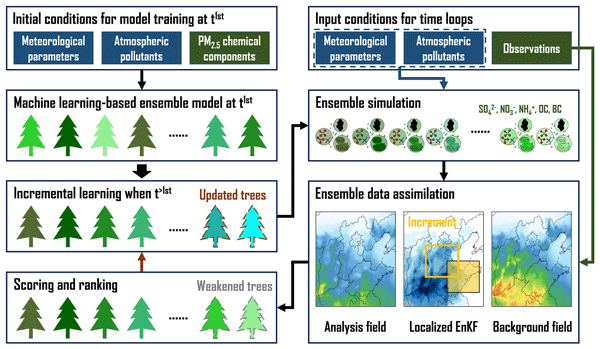
We develop a novel data assimilation system by integrating incremental machine learning with a localized ensemble Kalman filter to enhance the simulation and reanalysis of particulate matter < 2.5 µm chemical components. Compared to traditional chemical transport model-based data assimilation, our assimilation system has superior computational efficiency and simulation improvements. Comparisons with independent observations and reanalysis datasets validate the robust performance of our system.
Xiaofei Wu, Siyang Chen, Jinxi Li, Yu Zhang, Zifa Wang, Pu Gan, Jie Zheng, and Fangxin Fang
EGUsphere, https://doi.org/10.5194/egusphere-2026-1685, https://doi.org/10.5194/egusphere-2026-1685, 2026
Short summary
Short summary
Cities face a major challenge in tracking how wind and air pollution move through complex building clusters. Common numerical models often struggle to balance accuracy with calculating speed. We developed a new simulation system that automatically adjusts its focus to where the air is moving rapidly. By testing this against observations, it significantly improves predictions of wind and pollution. This tool helps urban planners design healthier cities by better identifying how pollutants travel.
Yutong Tian, Ting Yang, Zifa Wang, Linghan Zeng, Yining Tan, Weichun Liang, Qingqing Xia, Tong Wang, and Shitian Kou
EGUsphere, https://doi.org/10.5194/egusphere-2026-2017, https://doi.org/10.5194/egusphere-2026-2017, 2026
Preprint archived
Short summary
Short summary
This study introduces a novel algorithm using multiwavelength lidar to classify and quantify tropospheric aerosols at a mountain observatory. Using seven optical parameters, it separates smoke, pollution, pollen, and dust in complex mixtures. Validated across multiple platforms, the method decouples meteorologically driven optical enhancement from actual mass fluctuations, enabling high-precision aerosol typing and mass retrieval in high-altitude environments.
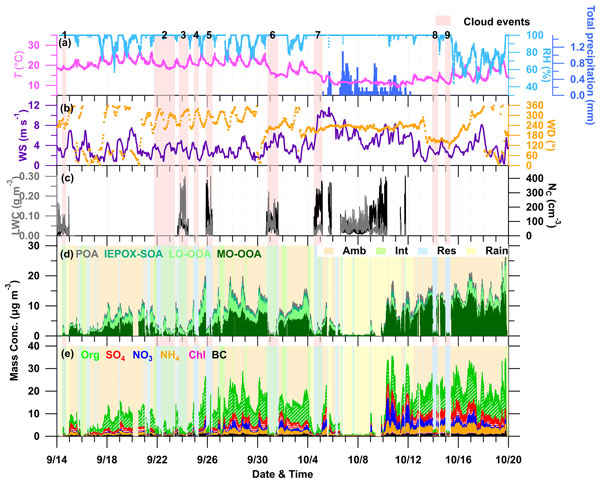
Yi Zhang, Weiqi Xu, Yan Li, Guohua Zhang, Dantong Liu, Ye Kuang, Yu Zhang, Wei Zhou, Xiaocong Peng, Bojiang Su, Weihong Huang, Zijun Zhang, Liu Yang, Yangzhou Wu, Siyuan Li, Shitong Zhao, Lanzhong Liu, Xiaole Pan, Zifa Wang, Xinhui Bi, Mikael Ehn, Douglas R. Worsnop, and Yele Sun
Atmos. Chem. Phys., 26, 5617–5634, https://doi.org/10.5194/acp-26-5617-2026, https://doi.org/10.5194/acp-26-5617-2026, 2026
Short summary
Short summary
This study explores how clouds influence the chemical composition of air particles through field research at a high-altitude station in southeastern China across different seasons. We found that different cloud types cause varying degrees of chemical changes in these particles. These findings enhance our understanding of the impact of clouds on air quality and contribute to improving climate models.
Philipp Brauner, Oliver Appel, Oliver Eppers, Franziska Köllner, Hans-Christian Clemen, Tiziana Bräuer, Hans-Christoph Lachnitt, Katharina Kaiser, Johannes Schneider, Antonis Dragoneas, Andreas Hünig, Sergej Molleker, Bruce E. Anderson, Yafang Cheng, Hans Schlager, Christiane Voigt, and Stephan Borrmann
EGUsphere, https://doi.org/10.5194/egusphere-2026-2161, https://doi.org/10.5194/egusphere-2026-2161, 2026
Preprint archived
Short summary
Short summary
Airborne measurements of the aerosol chemical composition were conducted in the 2018 wintertime tropopause region over Germany using a hybrid aerosol mass spectrometer, regarding the atmospheric background and aircraft exhaust plumes. Biomass burning aerosol of North American wildfires contributes to the aerosol population. Soot and engine oil were attributed to aircraft exhaust, and were detected in contrail residuals, implying their impact on chemical processes and properties of contrails.
Hongyi Li, Ting Yang, Yele Sun, and Zifa Wang
Atmos. Meas. Tech., 19, 2225–2244, https://doi.org/10.5194/amt-19-2225-2026, https://doi.org/10.5194/amt-19-2225-2026, 2026
Short summary
Short summary
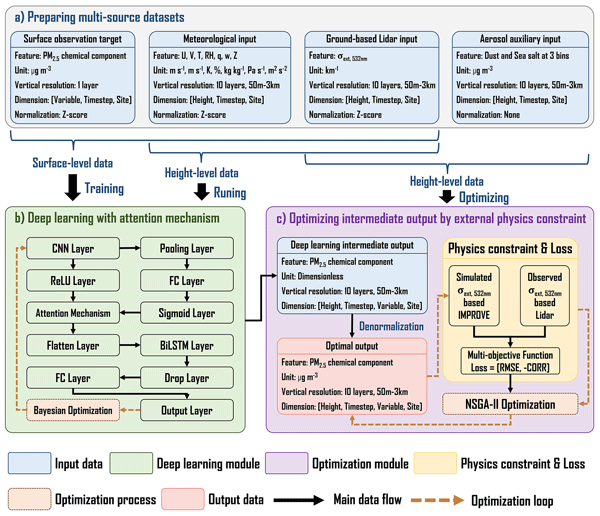
We develop a physics-constrained deep-learning framework to retrieve vertical profiles of particulate matter <2.5 µm chemical components from lidar measurements. Comparisons with surface, tower, and aircraft measurements validate the performance of the framework. A six-year vertical profile dataset generated for Beijing reveals that organic matter and nitrate are dominant chemical components. This work offers a new perspective on the lidar inversion of chemical component profiles.
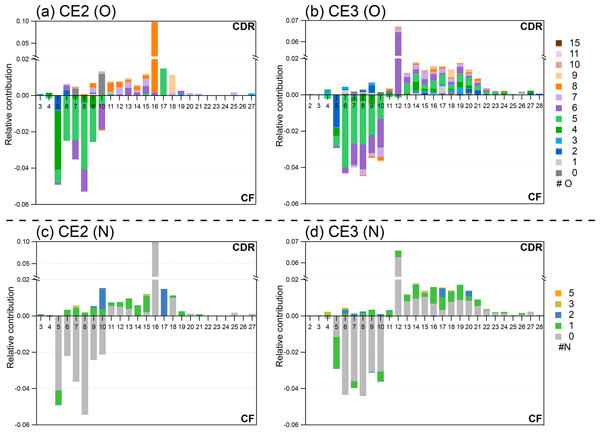
Yali Jin, Hao Luo, Siqi Tang, Shuhui Xue, Chengyu Nie, Xiaocong Peng, Yan Zheng, Weiqi Xu, Guohua Zhang, Xiaole Pan, Yele Sun, Qi Chen, Lanzhong Liu, and Defeng Zhao
Atmos. Chem. Phys., 26, 2813–2830, https://doi.org/10.5194/acp-26-2813-2026, https://doi.org/10.5194/acp-26-2813-2026, 2026
Short summary
Short summary
Cloud substantially changes the compositions organic aerosol. How cloud processing of organics occur on molecular level remains unclear. We found that compared with cloud free particles, organics in cloud contains more large molecules likely due to accretion reactions and has more nitrogen-containing compounds. We identify some new compounds formed in cloud. Such modifications of the organics in cloud can further change its physicochemical properties, and impact on climate and human health.

Wei Zhou, Liu Yang, Siqi Zeng, Yunping Kan, Lirong Yang, Weihong Zhang, Weijie Wang, Zijun Zhang, Yan Li, Weiqi Xu, Yucheng Gu, Yaozong Wang, Zhengyan Zuo, Jie Li, Zifa Wang, and Yele Sun
Atmos. Chem. Phys., 26, 2425–2441, https://doi.org/10.5194/acp-26-2425-2026, https://doi.org/10.5194/acp-26-2425-2026, 2026
Short summary
Short summary
Northwest China, situated in an arid and semi-arid climate region; air quality issues in this area have received less attention compared to other Chinese metropolitan clusters. This research identify a significant shift towards the coupling PM2.5 and O3 relationships over the past decade in northwest China, highlighting the great importance of urban terpenes and aromatic oxidation in secondary organic aerosol formation.
Weibin Zhu, Sai Shang, Jieqi Wang, Yunfei Wu, Zhaoze Deng, Liang Ran, Ye Kuang, Guiqian Tang, Xiangpeng Huang, Xiaole Pan, Lanzhong Liu, Weiqi Xu, Yele Sun, Bo Hu, Zifa Wang, and Zirui Liu
Atmos. Chem. Phys., 26, 1947–1965, https://doi.org/10.5194/acp-26-1947-2026, https://doi.org/10.5194/acp-26-1947-2026, 2026
Short summary
Short summary
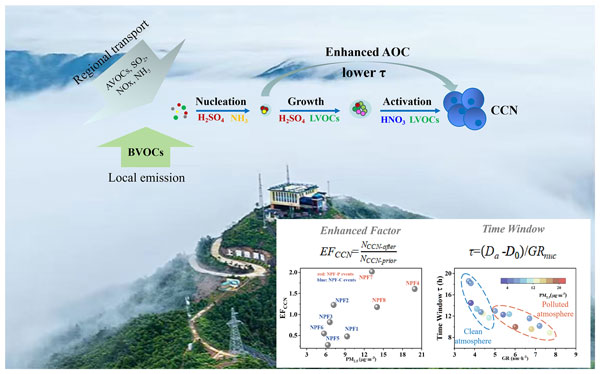
NPF (new particle formation) is a key global CCN (cloud condensation nuclei) source, but its contribution at the polluted boundary-layer top remains unclear. Based on mountaintop observations in the Yangtze River Delta, we show that under polluted conditions, NPF at the boundary-layer top is enhanced and accelerates its conversion to CCN. Ammonia plays a key role, and a newly defined "Time Window" metric highlights the importance of oxidation-driven growth and regional transport in this process.
Jianqiang Zhu, Guo Li, Uwe Kuhn, Bruno Backes Meller, Christopher Pöhlker, Paulo Artaxo, Ulrich Pöschl, Yafang Cheng, and Hang Su
Atmos. Chem. Phys., 25, 17667–17684, https://doi.org/10.5194/acp-25-17667-2025, https://doi.org/10.5194/acp-25-17667-2025, 2025
Short summary
Short summary
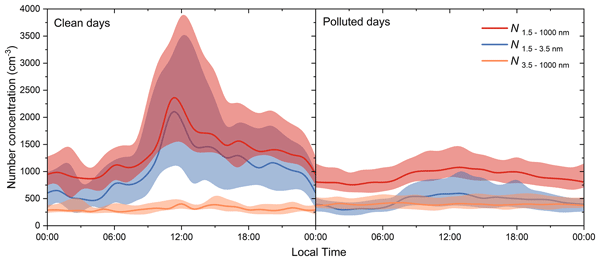
The manuscript reports unique measurements of sub-40 nm particles and ions, especially those smaller than 10 nm, in the Amazon from December 2022 to January 2023. A large number of sub-3 nm particles and naturally charged ions were present in the Amazonia boundary layer, and they showed a clear diurnal variation. The research will contribute to a better understanding of atmospheric processes in the pristine environment.
Yutong Tian, Ting Yang, Hongyi Li, Ping Tian, Yifan Song, Jiancun He, Yining Tan, Yele Sun, and Zifa Wang
Atmos. Chem. Phys., 25, 17581–17594, https://doi.org/10.5194/acp-25-17581-2025, https://doi.org/10.5194/acp-25-17581-2025, 2025
Short summary
Short summary
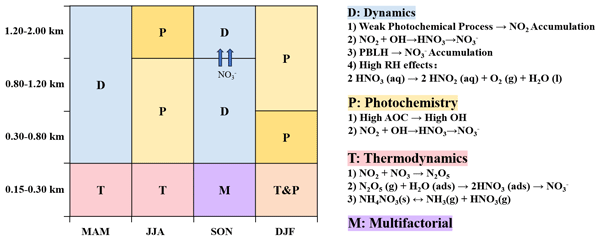
This study examines how nitrate pollution varies with height and season to combat urban haze. Nitrate levels peak near the ground in spring/winter due to humidity and temperature, while wind and sunlight drive high-altitude pollution in late autumn. Winter shows unique daytime peaks linked to sunlight and nighttime chemistry. Findings help cities design targeted strategies, like timing emissions cuts, to improve air quality by addressing pollution at specific heights and times.
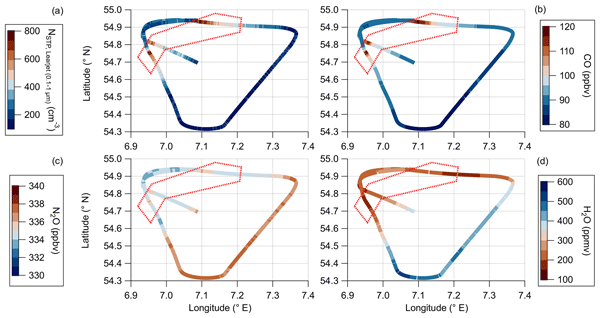
Philipp Joppe, Johannes Schneider, Jonas Wilsch, Heiko Bozem, Anna Breuninger, Joachim Curtius, Martin Ebert, Nicolas Emig, Peter Hoor, Sadath Ismayil, Konrad Kandler, Daniel Kunkel, Isabel Kurth, Hans-Christoph Lachnitt, Yun Li, Annette Miltenberger, Sarah Richter, Christian Rolf, Lisa Schneider, Cornelis Schwenk, Nicole Spelten, Alexander L. Vogel, Yafang Cheng, and Stephan Borrmann
Atmos. Chem. Phys., 25, 15077–15103, https://doi.org/10.5194/acp-25-15077-2025, https://doi.org/10.5194/acp-25-15077-2025, 2025
Short summary
Short summary
We show measurements of a filament with biomass burning influence transported by a warm conveyor belt (WCB) into the tropopause region over Europe. The pollution originates from Canadian forest fires and is transported in the lower troposphere towards Europe. The WCB transport is followed by mixing with air masses of stratospheric chemical signatures. We hypothesize that this mixing leads to a change in the vertical gradient of the potential temperature.
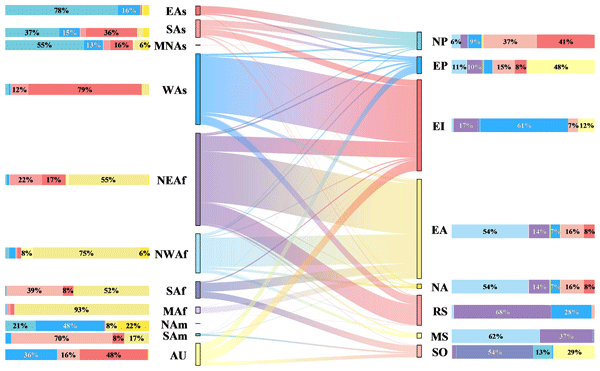
Yaxin Liu, Yunting Xiao, Lehui Cui, Qinghao Guo, Yiyang Sun, Pingqing Fu, Cong-Qiang Liu, and Jialei Zhu
Biogeosciences, 22, 6445–6464, https://doi.org/10.5194/bg-22-6445-2025, https://doi.org/10.5194/bg-22-6445-2025, 2025
Short summary
Short summary
Dust carries iron deposits into the ocean, providing essential nutrients for the growth of marine phytoplankton, influencing their carbon uptake capacity. A model constrained by global datasets on dust iron content, ocean iron solubility, and dissolved iron concentrations was used to assess the contributions of 11 major dust sources to carbon uptake in 8 marine areas, enhancing understanding of the impact of global dust emissions on marine deposition and carbon cycle with decreased uncertainty.
Mengjie Lou, Qizhong Wu, Wending Wang, Huansheng Chen, Kai Cao, Xiaohan Fan, Dingyue Liang, Fenfen Yu, Jiating Zhang, Wei Wang, and Zifa Wang
EGUsphere, https://doi.org/10.5194/egusphere-2025-4441, https://doi.org/10.5194/egusphere-2025-4441, 2025
Preprint archived
Short summary
Short summary
This study compares the performance of the independently developed EPICC-Model with CAMx and CMAQ in simulating PM2.5 and O3 in China. It finds that EPICC-Model excels in simulating summer ozone peaks, accurately captures pollution characteristics in highly polluted areas, and better reproduces persistent compound pollution processes. Furthermore, this study reveals common issues among the models and directions for improvement, providing a basis for optimizing global air quality models.
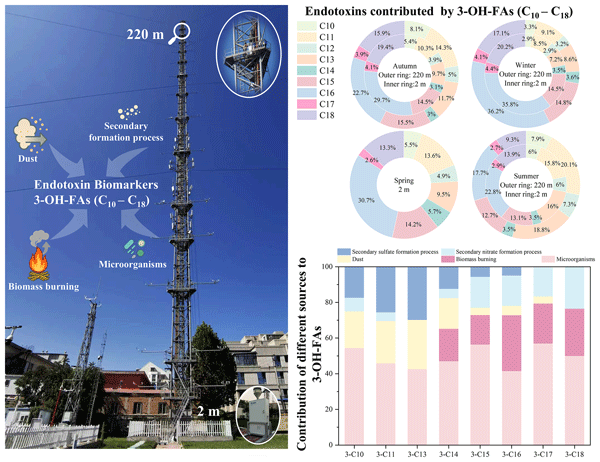
Wenxin Zhang, Wei Hu, Mutong Niu, Quanfei Zhu, Na An, Qiang Zhang, Rui Jin, Xiaoli Fu, Jian Hao, Jianbo Yang, Jingle Liu, Jing Shi, Suqin Han, Junjun Deng, Libin Wu, Yuqi Feng, Kimitaka Kawamura, and Pingqing Fu
Atmos. Chem. Phys., 25, 14513–14533, https://doi.org/10.5194/acp-25-14513-2025, https://doi.org/10.5194/acp-25-14513-2025, 2025
Short summary
Short summary
We quantified 3-hydroxy fatty acids (3-OH-FAs) in PM10 from urban Tianjin to assess airborne endotoxins, which showed clear seasonal and vertical variations. Mid-chain 3-OH-FAs were linked to microorganisms and regional secondary processes, while long-chain species were more associated with biomass burning and local secondary formation. These findings highlight distinct source pathways of 3-OH-FAs and provide insights into airborne endotoxins in urban environments.
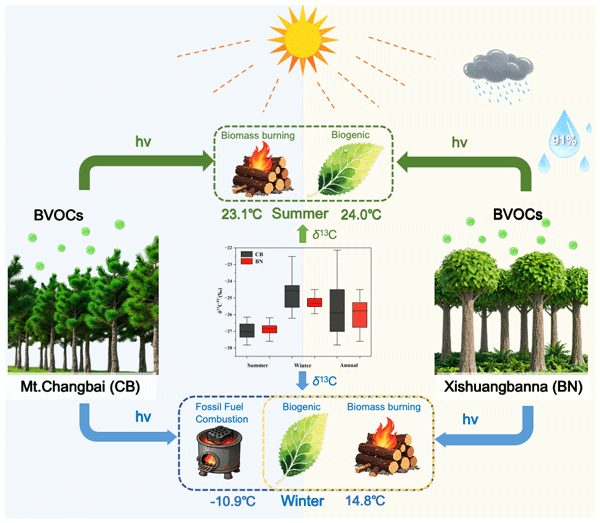
Mingyu Li, Zhanjie Xu, Zhichao Dong, Junjun Deng, Pingqing Fu, and Chandra Mouli Pavuluri
Biogeosciences, 22, 5329–5347, https://doi.org/10.5194/bg-22-5329-2025, https://doi.org/10.5194/bg-22-5329-2025, 2025
Short summary
Short summary
This study investigated the seasonal and diurnal variability of fine aerosol composition in two forest ecosystems in North and South China. Carbonaceous/nitrogenous compound concentrations were higher in winter than summer at both sites. The forest fine aerosols in high latitude exhibited significantly greater influence from fossil fuel combustion compared to that in low latitude.
Zheng Yang, Qiaoqiao Wang, Qiyuan Wang, Nan Ma, Jie Tian, Yaqing Zhou, Ge Xu, Miao Gao, Xiaoxian Zhou, Yang Zhang, Weikang Ran, Ning Yang, Jiangchuan Tao, Juan Hong, Yunfei Wu, Junji Cao, Hang Su, and Yafang Cheng
Atmos. Chem. Phys., 25, 11051–11065, https://doi.org/10.5194/acp-25-11051-2025, https://doi.org/10.5194/acp-25-11051-2025, 2025
Short summary
Short summary
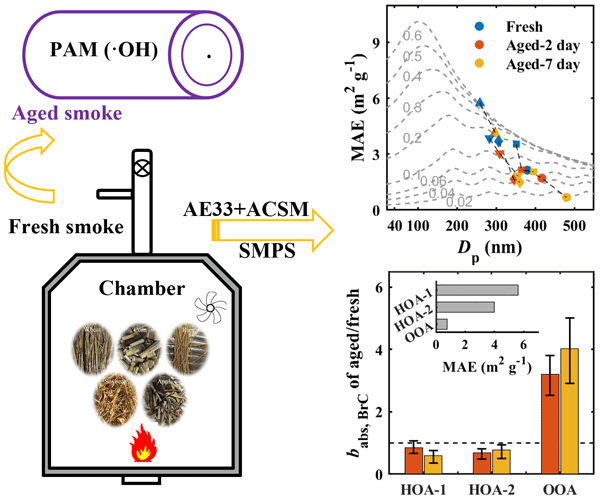
Our results demonstrate that the reduction in mass absorption efficiency from biomass burning is mainly driven by the decline in the imaginary part, with particle size playing a minor role. And light absorption of oxygenated brown carbon (BrC) increases significantly with aging, but hydrocarbon-like BrC decreases over time. These results emphasize the necessity to classify BrC into different groups based on their mass absorption efficiency and atmospheric behavior in climate models.
Kai Cao, Qizhong Wu, Xiao Tang, Jinxi Li, Xueshun Chen, Huansheng Chen, Wending Wang, Huangjian Wu, Lei Kong, Jie Li, Jiang Zhu, and Zifa Wang
EGUsphere, https://doi.org/10.5194/egusphere-2025-2918, https://doi.org/10.5194/egusphere-2025-2918, 2025
Preprint archived
Short summary
Short summary
This study achieves significant acceleration by developing an optimized advection module for Emission and atmospheric Processes Integrated and Coupled Community Model on GPU-like accelerators. Through implementing thread-block coordinated indexing, minimizing CPU-GPU communication, and an hybrid parallelization framework, we demonstrate prominent speedups: 556.5× faster offline performance for the Heterogeneous Interface PPM solver and 20.5× acceleration in coupled simulations.
Qinghao Guo, Haofei Zhang, Bo Long, Lehui Cui, Yiyang Sun, Hao Liu, Yaxin Liu, Yunting Xiao, Pingqing Fu, and Jialei Zhu
Atmos. Chem. Phys., 25, 9249–9262, https://doi.org/10.5194/acp-25-9249-2025, https://doi.org/10.5194/acp-25-9249-2025, 2025
Short summary
Short summary
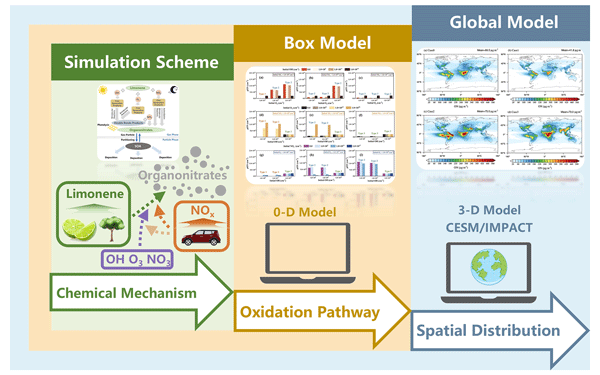
Limonene, a natural compound from plants, reacts with pollutants to form airborne particles that influence air quality and climate. Using advanced models with explicit chemical mechanisms, we show how different reaction pathways shape organonitrate formation, with some increasing and others decreasing particle levels. This approach enhances predictions of pollution and climate impacts while deepening our understanding of how natural and human-made emissions interact in the atmosphere.
Xi Chen, Ke Li, Ting Yang, Xipeng Jin, Lei Chen, Yang Yang, Shuman Zhao, Bo Hu, Bin Zhu, Zifa Wang, and Hong Liao
Atmos. Chem. Phys., 25, 9151–9168, https://doi.org/10.5194/acp-25-9151-2025, https://doi.org/10.5194/acp-25-9151-2025, 2025
Short summary
Short summary
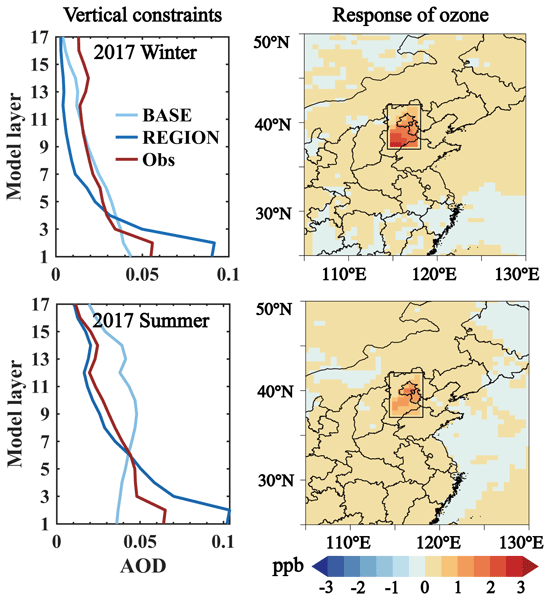
Aerosol vertical distribution that plays a crucial role in aerosol–photolysis interaction (API) remains underrepresented in chemical models. We integrated lidar and radiosonde observations to constrain the simulated aerosol profiles over North China and quantified the photochemical responses. The increased photolysis rates in the lower layers led to increased ozone and accounted for a 36 %–56 % reduction in API effects, resulting in enhanced atmospheric oxidizing capacity and aerosol formation.
Huiyun Du, Jie Li, Xueshun Chen, Gabriele Curci, Fangqun Yu, Yele Sun, Xu Dao, Song Guo, Zhe Wang, Wenyi Yang, Lianfang Wei, and Zifa Wang
Atmos. Chem. Phys., 25, 5665–5681, https://doi.org/10.5194/acp-25-5665-2025, https://doi.org/10.5194/acp-25-5665-2025, 2025
Short summary
Short summary
Inadequate consideration of mixing states and coatings on black carbon (BC) hinders aerosol radiation forcing quantification. Core–shell mixing aligns well with observations, but partial internal mixing is a more realistic representation. We used a microphysics module to determine the fraction of embedded BC and coating aerosols, constraining the mixing state. This reduced absorption enhancement by 30 %–43 % in northern China, offering insights into BC's radiative effects.
Hanzheng Zhu, Yaman Liu, Man Yue, Shihui Feng, Pingqing Fu, Kan Huang, Xinyi Dong, and Minghuai Wang
Atmos. Chem. Phys., 25, 5175–5197, https://doi.org/10.5194/acp-25-5175-2025, https://doi.org/10.5194/acp-25-5175-2025, 2025
Short summary
Short summary
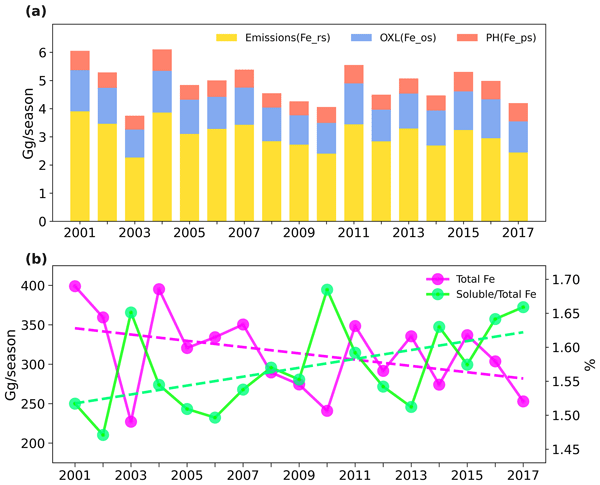
Dust-soluble iron deposition from East Asia plays an important role in the marine ecology of the Northwest Pacific. Using the developed model, our findings highlight a dual trend: a decrease in the overall deposition of soluble iron from dust but an increase in the solubility of the iron itself due to the enhanced atmospheric processing. The study underscores the critical roles of both dust emission and atmospheric processing in soluble iron deposition and marine ecology.
Zhichao Dong, Subba Rao Devineni, Xiaoli Fu, Zhanjie Xu, Mingyu Li, Pingqing Fu, Cong-Qiang Liu, and Chandra Mouli Pavuluri
EGUsphere, https://doi.org/10.5194/egusphere-2025-899, https://doi.org/10.5194/egusphere-2025-899, 2025
Preprint archived
Short summary
Short summary
We developed new method to detect and measure organosulfates in PM2.5. By synthesizing organosulfates and combining them with commercial standards, we improved detection accuracy. Testing air samples from Tianjin, China, we found wintertime levels of organosulfates were much higher than in other regions. Our results show how human actions directly impact air quality and provide a tool to track pollution sources. This work helps scientists understand and address harmful aerosols in environments.
Rui Jin, Wei Hu, Peimin Duan, Ming Sheng, Dandan Liu, Ziye Huang, Mutong Niu, Libin Wu, Junjun Deng, and Pingqing Fu
Atmos. Chem. Phys., 25, 1805–1829, https://doi.org/10.5194/acp-25-1805-2025, https://doi.org/10.5194/acp-25-1805-2025, 2025
Short summary
Short summary
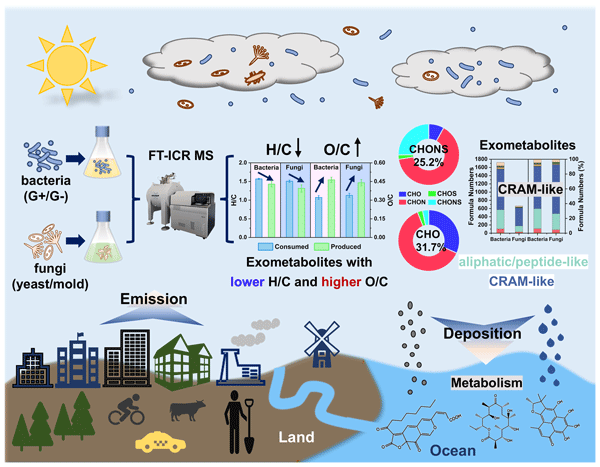
The metabolic capacity of atmospheric microorganisms after settling into habitats is poorly understood. We studied the molecular composition of exometabolites for cultured typical airborne microbes and traced their metabolic processes. Bacteria and fungi produce highly oxidized exometabolites and have significant variations in metabolism among different strains. These insights are pivotal for assessing the biogeochemical impacts of atmospheric microorganisms following their deposition.
Mega Octaviani, Benjamin A. Musa Bandowe, Qing Mu, Jake Wilson, Holger Tost, Hang Su, Yafang Cheng, Manabu Shiraiwa, Ulrich Pöschl, Thomas Berkemeier, and Gerhard Lammel
EGUsphere, https://doi.org/10.5194/egusphere-2025-186, https://doi.org/10.5194/egusphere-2025-186, 2025
This preprint is open for discussion and under review for Geoscientific Model Development (GMD).
Short summary
Short summary
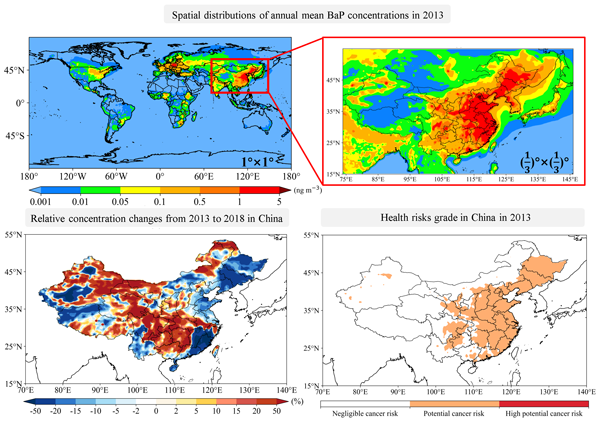
This research explores the atmospheric concentration of benzo(a)pyrene (BaP), a harmful air pollutant linked to lung cancer. Using advanced Earth system modeling, the study examines how BaP's degradation varies with temperature and humidity, affecting its global distribution and associated lung cancer risks. The findings reveal that BaP persists longer in colder, less humid regions, leading to higher lung cancer risks in parts of Europe and Asia.
Zichen Wu, Xueshun Chen, Zifa Wang, Huansheng Chen, Zhe Wang, Qing Mu, Lin Wu, Wending Wang, Xiao Tang, Jie Li, Ying Li, Qizhong Wu, Yang Wang, Zhiyin Zou, and Zijian Jiang
Geosci. Model Dev., 17, 8885–8907, https://doi.org/10.5194/gmd-17-8885-2024, https://doi.org/10.5194/gmd-17-8885-2024, 2024
Short summary
Short summary
We developed a model to simulate polycyclic aromatic hydrocarbons (PAHs) from global to regional scales. The model can reproduce PAH distribution well. The concentration of BaP (indicator species for PAHs) could exceed the target values of 1 ng m-3 over some areas (e.g., in central Europe, India, and eastern China). The change in BaP is lower than that in PM2.5 from 2013 to 2018. China still faces significant potential health risks posed by BaP although the Action Plan has been implemented.
Hongyi Li, Ting Yang, Lars Nerger, Dawei Zhang, Di Zhang, Guigang Tang, Haibo Wang, Yele Sun, Pingqing Fu, Hang Su, and Zifa Wang
Geosci. Model Dev., 17, 8495–8519, https://doi.org/10.5194/gmd-17-8495-2024, https://doi.org/10.5194/gmd-17-8495-2024, 2024
Short summary
Short summary
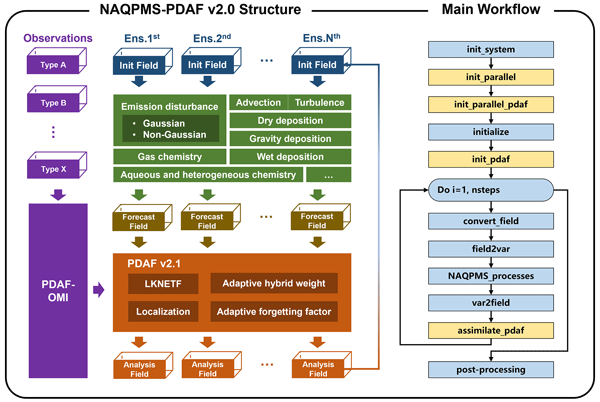
To accurately characterize the spatiotemporal distribution of particulate matter <2.5 µm chemical components, we developed the Nested Air Quality Prediction Model System with the Parallel Data Assimilation Framework (NAQPMS-PDAF) v2.0 for chemical components with non-Gaussian and nonlinear properties. NAQPMS-PDAF v2.0 has better computing efficiency, excels when used with a small ensemble size, and can significantly improve the simulation performance of chemical components.
Lei Kong, Xiao Tang, Zifa Wang, Jiang Zhu, Jianjun Li, Huangjian Wu, Qizhong Wu, Huansheng Chen, Lili Zhu, Wei Wang, Bing Liu, Qian Wang, Duohong Chen, Yuepeng Pan, Jie Li, Lin Wu, and Gregory R. Carmichael
Earth Syst. Sci. Data, 16, 4351–4387, https://doi.org/10.5194/essd-16-4351-2024, https://doi.org/10.5194/essd-16-4351-2024, 2024
Short summary
Short summary
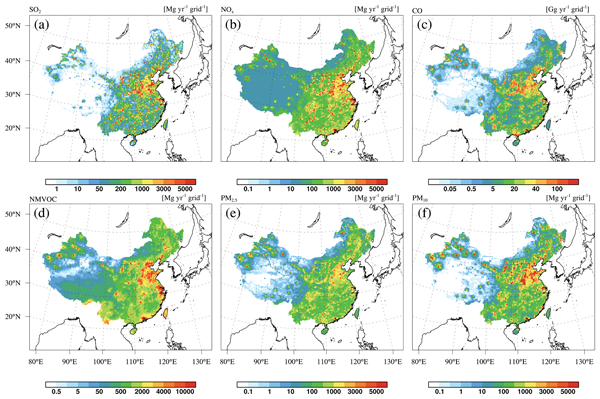
A new long-term inversed emission inventory for Chinese air quality (CAQIEI) is developed in this study, which contains constrained monthly emissions of NOx, SO2, CO, PM2.5, PM10, and NMVOCs in China from 2013 to 2020 with a horizontal resolution of 15 km. Emissions of different air pollutants and their changes during 2013–2020 were investigated and compared with previous emission inventories, which sheds new light on the complex variations of air pollutant emissions in China.
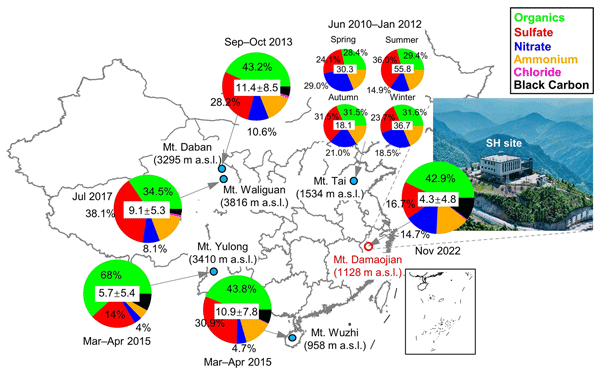
Zijun Zhang, Weiqi Xu, Yi Zhang, Wei Zhou, Xiangyu Xu, Aodong Du, Yinzhou Zhang, Hongqin Qiao, Ye Kuang, Xiaole Pan, Zifa Wang, Xueling Cheng, Lanzhong Liu, Qingyan Fu, Douglas R. Worsnop, Jie Li, and Yele Sun
Atmos. Chem. Phys., 24, 8473–8488, https://doi.org/10.5194/acp-24-8473-2024, https://doi.org/10.5194/acp-24-8473-2024, 2024
Short summary
Short summary
We investigated aerosol composition and sources and the interaction between secondary organic aerosol (SOA) and clouds at a regional mountain site in southeastern China. Clouds efficiently scavenge more oxidized SOA; however, cloud evaporation leads to the production of less oxidized SOA. The unexpectedly high presence of nitrate in aerosol particles indicates that nitrate formed in polluted areas has undergone interactions with clouds, significantly influencing the regional background site.
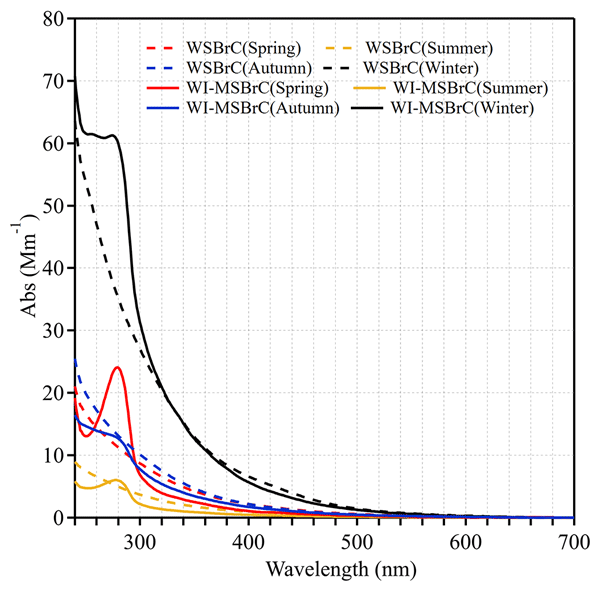
Zhichao Dong, Chandra Mouli Pavuluri, Peisen Li, Zhanjie Xu, Junjun Deng, Xueyan Zhao, Xiaomai Zhao, Pingqing Fu, and Cong-Qiang Liu
Atmos. Chem. Phys., 24, 5887–5905, https://doi.org/10.5194/acp-24-5887-2024, https://doi.org/10.5194/acp-24-5887-2024, 2024
Short summary
Short summary
Comprehensive study of optical properties of brown carbon (BrC) in fine aerosols from Tianjin, China, implied that biological emissions are major sources of BrC in summer, whereas fossil fuel combustion and biomass burning emissions are in cold periods. The direct radiation absorption caused by BrC in short wavelengths contributed about 40 % to that caused by BrC in 300–700 nm. Water-insoluble but methanol-soluble BrC contains more protein-like chromophores (PLOM) than that of water-soluble BrC.
Bjorn Stevens, Stefan Adami, Tariq Ali, Hartwig Anzt, Zafer Aslan, Sabine Attinger, Jaana Bäck, Johanna Baehr, Peter Bauer, Natacha Bernier, Bob Bishop, Hendryk Bockelmann, Sandrine Bony, Guy Brasseur, David N. Bresch, Sean Breyer, Gilbert Brunet, Pier Luigi Buttigieg, Junji Cao, Christelle Castet, Yafang Cheng, Ayantika Dey Choudhury, Deborah Coen, Susanne Crewell, Atish Dabholkar, Qing Dai, Francisco Doblas-Reyes, Dale Durran, Ayoub El Gaidi, Charlie Ewen, Eleftheria Exarchou, Veronika Eyring, Florencia Falkinhoff, David Farrell, Piers M. Forster, Ariane Frassoni, Claudia Frauen, Oliver Fuhrer, Shahzad Gani, Edwin Gerber, Debra Goldfarb, Jens Grieger, Nicolas Gruber, Wilco Hazeleger, Rolf Herken, Chris Hewitt, Torsten Hoefler, Huang-Hsiung Hsu, Daniela Jacob, Alexandra Jahn, Christian Jakob, Thomas Jung, Christopher Kadow, In-Sik Kang, Sarah Kang, Karthik Kashinath, Katharina Kleinen-von Königslöw, Daniel Klocke, Uta Kloenne, Milan Klöwer, Chihiro Kodama, Stefan Kollet, Tobias Kölling, Jenni Kontkanen, Steve Kopp, Michal Koran, Markku Kulmala, Hanna Lappalainen, Fakhria Latifi, Bryan Lawrence, June Yi Lee, Quentin Lejeun, Christian Lessig, Chao Li, Thomas Lippert, Jürg Luterbacher, Pekka Manninen, Jochem Marotzke, Satoshi Matsouoka, Charlotte Merchant, Peter Messmer, Gero Michel, Kristel Michielsen, Tomoki Miyakawa, Jens Müller, Ramsha Munir, Sandeep Narayanasetti, Ousmane Ndiaye, Carlos Nobre, Achim Oberg, Riko Oki, Tuba Özkan-Haller, Tim Palmer, Stan Posey, Andreas Prein, Odessa Primus, Mike Pritchard, Julie Pullen, Dian Putrasahan, Johannes Quaas, Krishnan Raghavan, Venkatachalam Ramaswamy, Markus Rapp, Florian Rauser, Markus Reichstein, Aromar Revi, Sonakshi Saluja, Masaki Satoh, Vera Schemann, Sebastian Schemm, Christina Schnadt Poberaj, Thomas Schulthess, Cath Senior, Jagadish Shukla, Manmeet Singh, Julia Slingo, Adam Sobel, Silvina Solman, Jenna Spitzer, Philip Stier, Thomas Stocker, Sarah Strock, Hang Su, Petteri Taalas, John Taylor, Susann Tegtmeier, Georg Teutsch, Adrian Tompkins, Uwe Ulbrich, Pier-Luigi Vidale, Chien-Ming Wu, Hao Xu, Najibullah Zaki, Laure Zanna, Tianjun Zhou, and Florian Ziemen
Earth Syst. Sci. Data, 16, 2113–2122, https://doi.org/10.5194/essd-16-2113-2024, https://doi.org/10.5194/essd-16-2113-2024, 2024
Short summary
Short summary
To manage Earth in the Anthropocene, new tools, new institutions, and new forms of international cooperation will be required. Earth Virtualization Engines is proposed as an international federation of centers of excellence to empower all people to respond to the immense and urgent challenges posed by climate change.
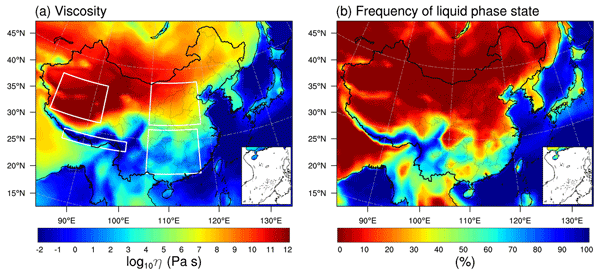
Zhiqiang Zhang, Ying Li, Haiyan Ran, Junling An, Yu Qu, Wei Zhou, Weiqi Xu, Weiwei Hu, Hongbin Xie, Zifa Wang, Yele Sun, and Manabu Shiraiwa
Atmos. Chem. Phys., 24, 4809–4826, https://doi.org/10.5194/acp-24-4809-2024, https://doi.org/10.5194/acp-24-4809-2024, 2024
Short summary
Short summary
Secondary organic aerosols (SOAs) can exist in liquid, semi-solid, or amorphous solid states, which are rarely accounted for in current chemical transport models. We predict the phase state of SOA particles over China and find that in northwestern China SOA particles are mostly highly viscous or glassy solid. Our results indicate that the particle phase state should be considered in SOA formation in chemical transport models for more accurate prediction of SOA mass concentrations.
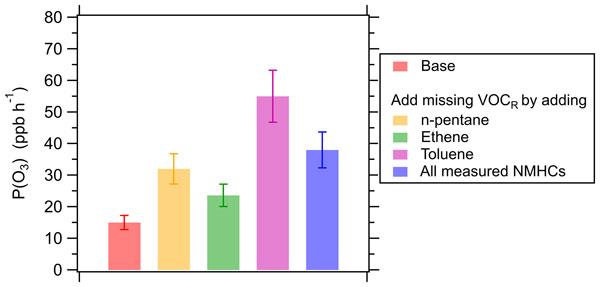
Wenjie Wang, Bin Yuan, Hang Su, Yafang Cheng, Jipeng Qi, Sihang Wang, Wei Song, Xinming Wang, Chaoyang Xue, Chaoqun Ma, Fengxia Bao, Hongli Wang, Shengrong Lou, and Min Shao
Atmos. Chem. Phys., 24, 4017–4027, https://doi.org/10.5194/acp-24-4017-2024, https://doi.org/10.5194/acp-24-4017-2024, 2024
Short summary
Short summary
This study investigates the important role of unmeasured volatile organic compounds (VOCs) in ozone formation. Based on results in a megacity of China, we show that unmeasured VOCs can contribute significantly to ozone fomation and also influence the determination of ozone control strategy. Our results show that these unmeasured VOCs are mainly from human sources.
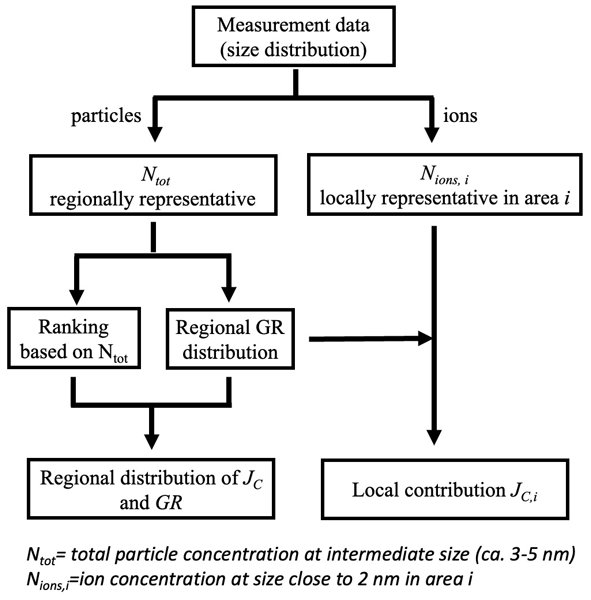
Markku Kulmala, Diego Aliaga, Santeri Tuovinen, Runlong Cai, Heikki Junninen, Chao Yan, Federico Bianchi, Yafang Cheng, Aijun Ding, Douglas R. Worsnop, Tuukka Petäjä, Katrianne Lehtipalo, Pauli Paasonen, and Veli-Matti Kerminen
Aerosol Research, 2, 49–58, https://doi.org/10.5194/ar-2-49-2024, https://doi.org/10.5194/ar-2-49-2024, 2024
Short summary
Short summary
Atmospheric new particle formation (NPF), together with secondary production of particulate matter in the atmosphere, dominates aerosol particle number concentrations and submicron particle mass loads in many environments globally. In this opinion paper, we describe the paradigm shift to understand NPF in a continuous way instead of using traditional binary event–non-event analysis.
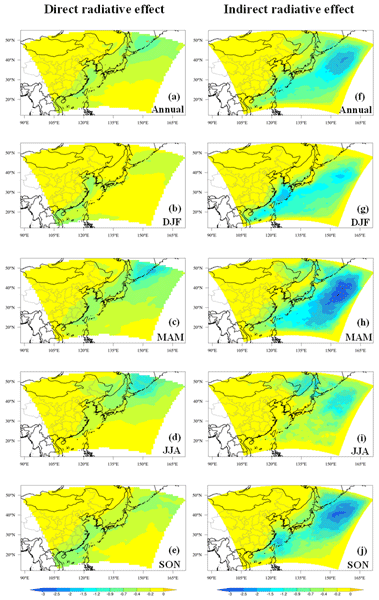
Jiawei Li, Zhiwei Han, Pingqing Fu, Xiaohong Yao, and Mingjie Liang
Atmos. Chem. Phys., 24, 3129–3161, https://doi.org/10.5194/acp-24-3129-2024, https://doi.org/10.5194/acp-24-3129-2024, 2024
Short summary
Short summary
Organic aerosols of marine origin are important for aerosol climatic effects but are poorly understood. For the first time, an online coupled regional chemistry–climate model is applied to explore the characteristics of emission, distribution, and direct and indirect radiative effects of marine organic aerosols over the western Pacific, which reveals an important role of marine organic aerosols in perturbing cloud and radiation and promotes understanding of global aerosol climatic impact.
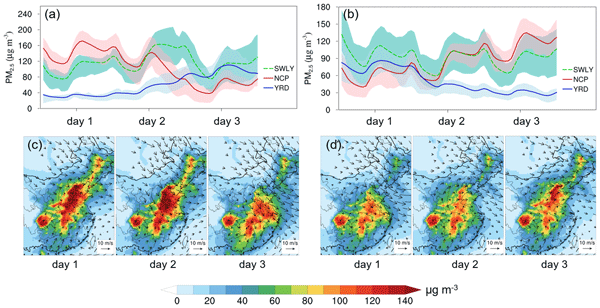
Feifan Yan, Hang Su, Yafang Cheng, Rujin Huang, Hong Liao, Ting Yang, Yuanyuan Zhu, Shaoqing Zhang, Lifang Sheng, Wenbin Kou, Xinran Zeng, Shengnan Xiang, Xiaohong Yao, Huiwang Gao, and Yang Gao
Atmos. Chem. Phys., 24, 2365–2376, https://doi.org/10.5194/acp-24-2365-2024, https://doi.org/10.5194/acp-24-2365-2024, 2024
Short summary
Short summary
PM2.5 pollution is a major air quality issue deteriorating human health, and previous studies mostly focus on regions like the North China Plain and Yangtze River Delta. However, the characteristics of PM2.5 concentrations between these two regions are studied less often. Focusing on the transport corridor region, we identify an interesting seesaw transport phenomenon with stagnant weather conditions, conducive to PM2.5 accumulation over this region, resulting in large health effects.
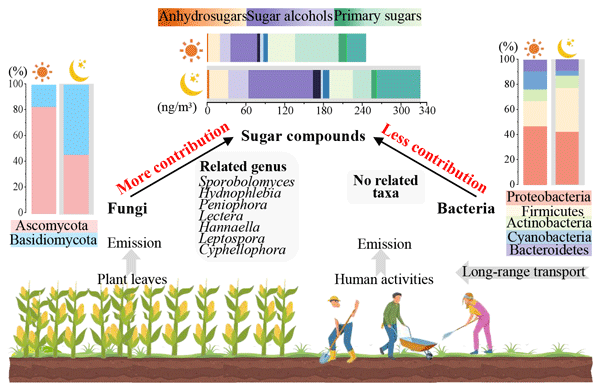
Mutong Niu, Shu Huang, Wei Hu, Yajie Wang, Wanyun Xu, Wan Wei, Qiang Zhang, Zihan Wang, Donghuan Zhang, Rui Jin, Libin Wu, Junjun Deng, Fangxia Shen, and Pingqing Fu
Biogeosciences, 20, 4915–4930, https://doi.org/10.5194/bg-20-4915-2023, https://doi.org/10.5194/bg-20-4915-2023, 2023
Short summary
Short summary
Sugar compounds in air can trace the source of bioaerosols that affect public health and climate. In rural north China, we observed increased fungal activity at night and less variable bacterial community diversity. Certain night-increasing sugar compounds were more closely related to fungi than bacteria. The fungal community greatly influenced sugar compounds, while bacteria played a limited role. Caution is advised when using sugar compounds to trace airborne microbes, particularly bacteria.
Lehui Cui, Yunting Xiao, Wei Hu, Lei Song, Yujue Wang, Chao Zhang, Pingqing Fu, and Jialei Zhu
Earth Syst. Sci. Data, 15, 5403–5425, https://doi.org/10.5194/essd-15-5403-2023, https://doi.org/10.5194/essd-15-5403-2023, 2023
Short summary
Short summary
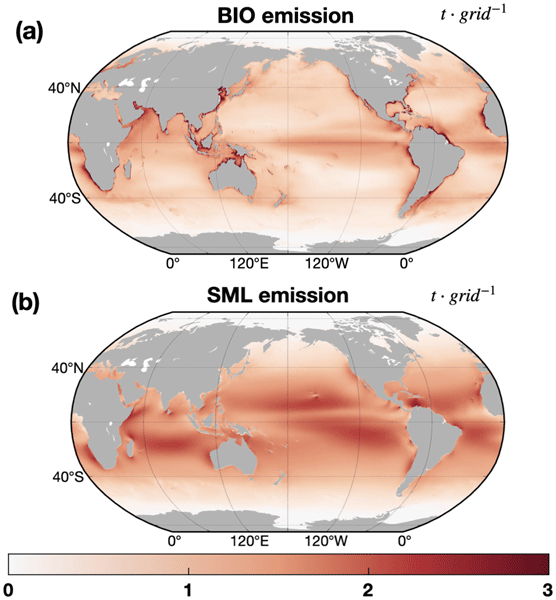
Isoprene is a crucial non-methane biogenic volatile organic compound with the largest global emissions, which has high chemical reactivity and serves as the primary source of natural secondary organic aerosols. This study built a module to present a 20-year global hourly dataset of marine phytoplankton-generated biological and photochemistry-generated isoprene emissions in the sea microlayers based on the latest advancements in biological, physical, and chemical processes.
Jingjing Meng, Yachen Wang, Yuanyuan Li, Tonglin Huang, Zhifei Wang, Yiqiu Wang, Min Chen, Zhanfang Hou, Houhua Zhou, Keding Lu, Kimitaka Kawamura, and Pingqing Fu
Atmos. Chem. Phys., 23, 14481–14503, https://doi.org/10.5194/acp-23-14481-2023, https://doi.org/10.5194/acp-23-14481-2023, 2023
Short summary
Short summary
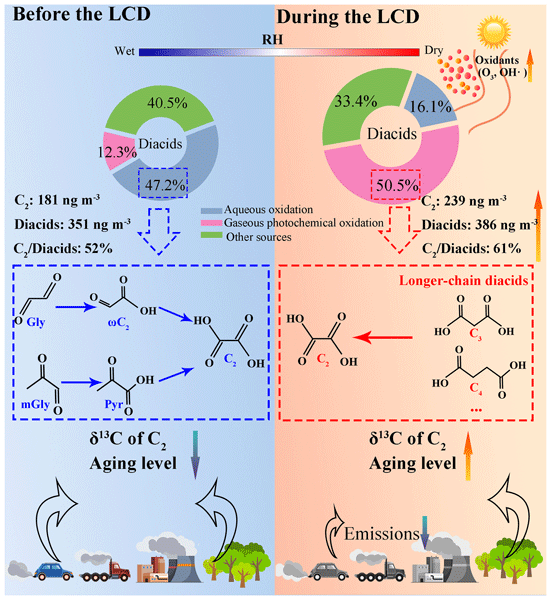
This study investigated the effect of COVID-19 lockdown (LCD) measures on the formation and evolutionary process of diacids and related compounds from field observations. Results demonstrate that more aged organic aerosols are observed during the LCD due to the enhanced photochemical oxidation. Our study also found that the reactivity of 13C was higher than that of 12C in the gaseous photochemical oxidation, leading to higher δ13C values of C2 during the LCD than before the LCD.
Aodong Du, Jiaxing Sun, Hang Liu, Weiqi Xu, Wei Zhou, Yuting Zhang, Lei Li, Xubing Du, Yan Li, Xiaole Pan, Zifa Wang, and Yele Sun
Atmos. Chem. Phys., 23, 13597–13611, https://doi.org/10.5194/acp-23-13597-2023, https://doi.org/10.5194/acp-23-13597-2023, 2023
Short summary
Short summary
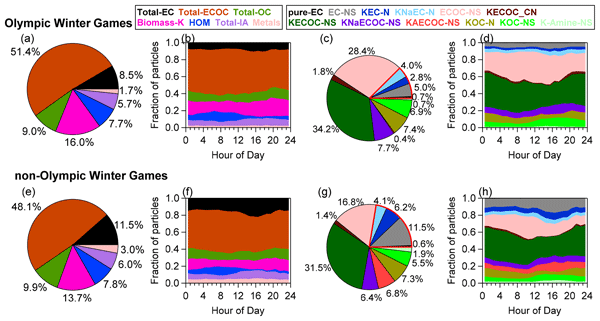
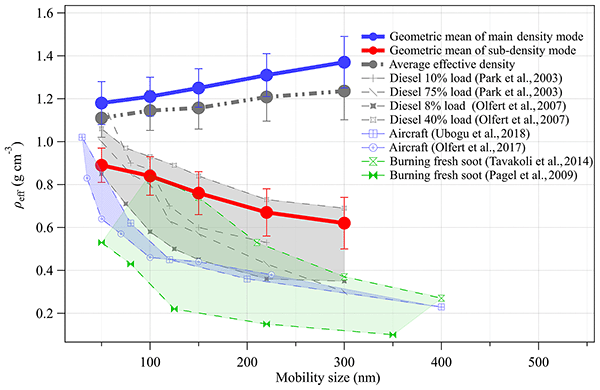
We characterized the impacts of emission controls on particle mixing state and density during the Beijing Olympic Winter Games using a SPAMS in tandem with a DMA and an AAC. OC and sulfate-containing particles increased, while those from primary emissions decreased. The effective particle densities increased and varied largely for different particles, highlighting the impacts of aging and formation processes on the changes of particle density and mixing state.
Matthias Kohl, Jos Lelieveld, Sourangsu Chowdhury, Sebastian Ehrhart, Disha Sharma, Yafang Cheng, Sachchida Nand Tripathi, Mathew Sebastian, Govindan Pandithurai, Hongli Wang, and Andrea Pozzer
Atmos. Chem. Phys., 23, 13191–13215, https://doi.org/10.5194/acp-23-13191-2023, https://doi.org/10.5194/acp-23-13191-2023, 2023
Short summary
Short summary
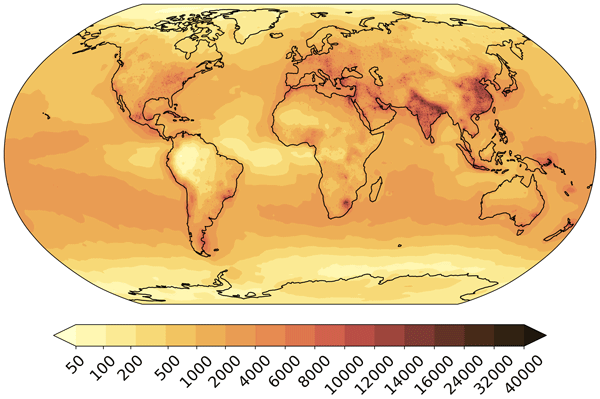
Knowledge on atmospheric ultrafine particles (UFPs) with a diameter smaller than 100 nm is crucial for public health and the hydrological cycle. We present a new global dataset of UFP concentrations at the Earth's surface derived with a comprehensive chemistry–climate model and evaluated with ground-based observations. The evaluation results are combined with high-resolution primary emissions to downscale UFP concentrations to an unprecedented horizontal resolution of 0.1° × 0.1°.
Tao Wang, Hang Liu, Jie Li, Shuai Wang, Youngseob Kim, Yele Sun, Wenyi Yang, Huiyun Du, Zhe Wang, and Zifa Wang
Geosci. Model Dev., 16, 5585–5599, https://doi.org/10.5194/gmd-16-5585-2023, https://doi.org/10.5194/gmd-16-5585-2023, 2023
Short summary
Short summary
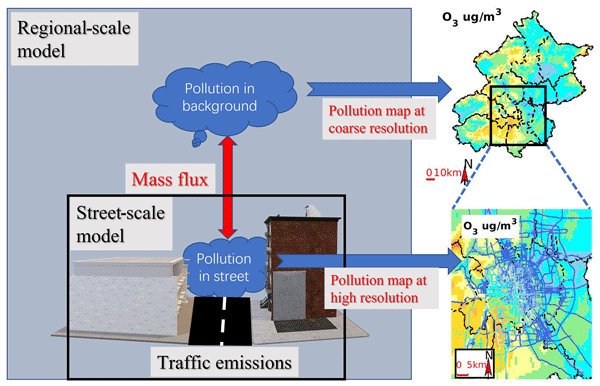
This paper developed a two-way coupled module in a new version of a regional urban–street network model, IAQMS-street v2.0, in which the mass flux from streets to background is considered. Test cases are defined to evaluate the performance of IAQMS-street v2.0 in Beijing by comparing it with that simulated by IAQMS-street v1.0 and a regional model. The contribution of local emissions and the influence of on-road vehicle control measures on air quality are evaluated by using IAQMS-street v2.0.
Li Wu, Hyo-Jin Eom, Hanjin Yoo, Dhrubajyoti Gupta, Hye-Rin Cho, Pingqing Fu, and Chul-Un Ro
Atmos. Chem. Phys., 23, 12571–12588, https://doi.org/10.5194/acp-23-12571-2023, https://doi.org/10.5194/acp-23-12571-2023, 2023
Short summary
Short summary
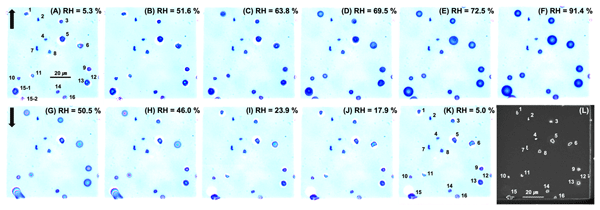
Hygroscopicity of ambient marine aerosols is of critical relevance to investigate their atmospheric impacts, which, however, remain uncertain due to their complex compositions and mixing states. Therefore, a study on the hygroscopic behavior of ambient marine aerosols for understanding the phase states when interacting with water vapor at different RH levels and their subsequent impacts on the heterogeneous chemical reactions, atmospheric environment, and human health is of vital importance.
Xi Chen, Ting Yang, Zifa Wang, Futing Wang, and Haibo Wang
Atmos. Meas. Tech., 16, 4289–4302, https://doi.org/10.5194/amt-16-4289-2023, https://doi.org/10.5194/amt-16-4289-2023, 2023
Short summary
Short summary
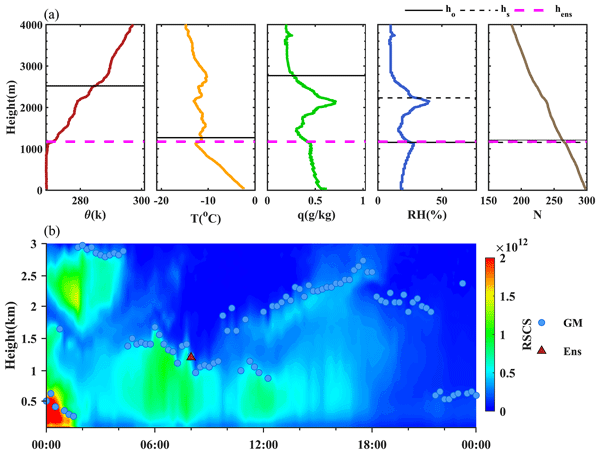
Uncertainties remain great in the planetary boundary layer height (PBLH) determination from radiosonde, especially during the transition period of different PBL regimes. We combine seven existing methods along with statistical modification on gradient-based methods. We find that the ensemble method can eliminate the overestimation of PBLH and reduce the inconsistency between individual methods. The ensemble method improves the effectiveness of PBLH determination to 62.6 %.
Xurong Wang, Qiaoqiao Wang, Maria Prass, Christopher Pöhlker, Daniel Moran-Zuloaga, Paulo Artaxo, Jianwei Gu, Ning Yang, Xiajie Yang, Jiangchuan Tao, Juan Hong, Nan Ma, Yafang Cheng, Hang Su, and Meinrat O. Andreae
Atmos. Chem. Phys., 23, 9993–10014, https://doi.org/10.5194/acp-23-9993-2023, https://doi.org/10.5194/acp-23-9993-2023, 2023
Short summary
Short summary
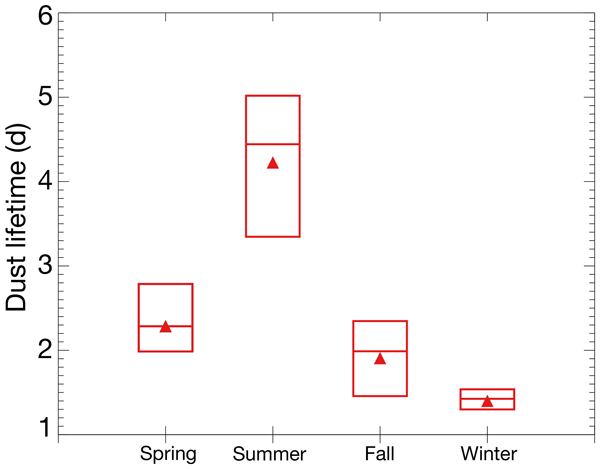
In this work, with an optimized particle mass size distribution, we captured observed aerosol optical depth (AOD) and coarse aerosol concentrations over source and/or receptor regions well, demonstrating good performance in simulating export of African dust toward the Amazon Basin. In addition to factors controlling the transatlantic transport of African dust, the study investigated the impact of African dust over the Amazon Basin, including the nutrient inputs associated with dust deposition.
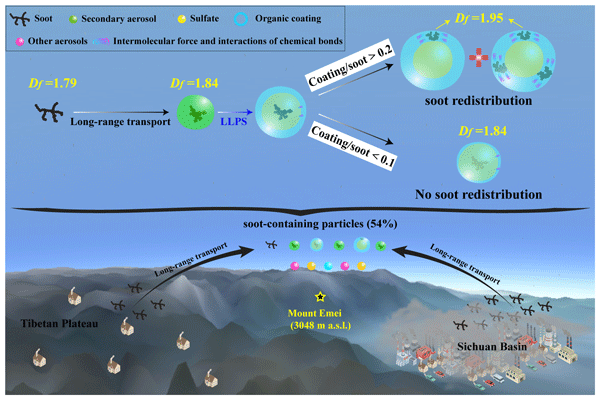
Qi Yuan, Yuanyuan Wang, Yixin Chen, Siyao Yue, Jian Zhang, Yinxiao Zhang, Liang Xu, Wei Hu, Dantong Liu, Pingqing Fu, Huiwang Gao, and Weijun Li
Atmos. Chem. Phys., 23, 9385–9399, https://doi.org/10.5194/acp-23-9385-2023, https://doi.org/10.5194/acp-23-9385-2023, 2023
Short summary
Short summary
This study for the first time found large amounts of liquid–liquid phase separation particles with soot redistributing in organic coatings instead of sulfate cores in the eastern Tibetan Plateau atmosphere. The particle size and the ratio of the organic matter coating thickness to soot size are two of the major possible factors that likely affect the soot redistribution process. The soot redistribution process promoted the morphological compaction of soot particles.
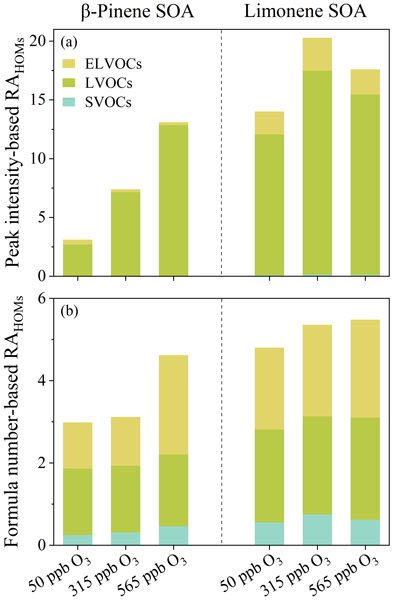
Dandan Liu, Yun Zhang, Shujun Zhong, Shuang Chen, Qiaorong Xie, Donghuan Zhang, Qiang Zhang, Wei Hu, Junjun Deng, Libin Wu, Chao Ma, Haijie Tong, and Pingqing Fu
Atmos. Chem. Phys., 23, 8383–8402, https://doi.org/10.5194/acp-23-8383-2023, https://doi.org/10.5194/acp-23-8383-2023, 2023
Short summary
Short summary
Based on ultra-high-resolution mass spectrometry analysis, we found that β-pinene oxidation-derived highly oxygenated organic molecules (HOMs) exhibit higher yield at high ozone concentration, while limonene oxidation-derived HOMs exhibit higher yield at moderate ozone concentration. The distinct molecular response of HOMs and low-volatile species in different biogenic secondary organic aerosols to ozone concentrations provides a new clue for more accurate air quality prediction and management.
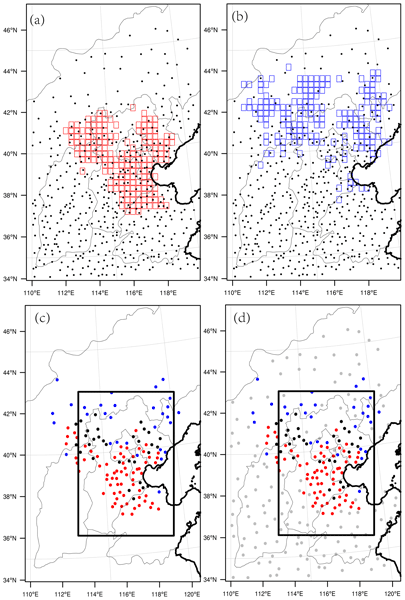
Lichao Yang, Wansuo Duan, and Zifa Wang
Geosci. Model Dev., 16, 3827–3848, https://doi.org/10.5194/gmd-16-3827-2023, https://doi.org/10.5194/gmd-16-3827-2023, 2023
Short summary
Short summary
An approach is proposed to refine a ground meteorological observation network to improve the PM2.5 forecasts in the Beijing–Tianjin–Hebei region. A cost-effective observation network is obtained and makes the relevant PM2.5 forecasts assimilate fewer observations but achieve the forecasting skill comparable to or higher than that obtained by assimilating all ground station observations, suggesting that many of the current ground stations can be greatly scattered to avoid much unnecessary work.
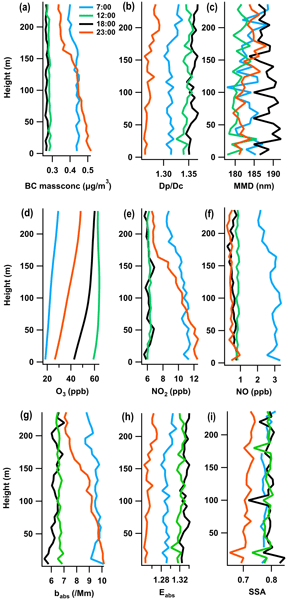
Hang Liu, Xiaole Pan, Shandong Lei, Yuting Zhang, Aodong Du, Weijie Yao, Guiqian Tang, Tao Wang, Jinyuan Xin, Jie Li, Yele Sun, Junji Cao, and Zifa Wang
Atmos. Chem. Phys., 23, 7225–7239, https://doi.org/10.5194/acp-23-7225-2023, https://doi.org/10.5194/acp-23-7225-2023, 2023
Short summary
Short summary
We provide the average vertical profiles of black carbon (BC) concentration, size distribution and coating thickness at different times of the day in an urban area based on 112 vertical profiles. In addition, it is found that BC in the residual layer generally has a thicker coating, higher absorption enhancement and hygroscopicity than on the surface. Such aged BC could enter into the boundary layer and influence the BC properties in the early morning.
Wen Lu, Bin Zhu, Shuqi Yan, Jie Li, and Zifa Wang
EGUsphere, https://doi.org/10.5194/egusphere-2023-1089, https://doi.org/10.5194/egusphere-2023-1089, 2023
Preprint archived
Short summary
Short summary
Parameterized the minimum turbulent diffusivity (Kzmin) by sensible heat flux and latent heat flux and embedded it into the WRF-Chem model. New scheme improved the underestimation of turbulence diffusion underestimation and overestimation of surface PM2.5 under stable boundary layer simulation over eastern China. The physical relationship between Kzmin and two factors was discussed. Process analysis showed that vertical mixing is the key process to improve surface PM2.5 simulations.
Lei Kong, Xiao Tang, Jiang Zhu, Zifa Wang, Yele Sun, Pingqing Fu, Meng Gao, Huangjian Wu, Miaomiao Lu, Qian Wu, Shuyuan Huang, Wenxuan Sui, Jie Li, Xiaole Pan, Lin Wu, Hajime Akimoto, and Gregory R. Carmichael
Atmos. Chem. Phys., 23, 6217–6240, https://doi.org/10.5194/acp-23-6217-2023, https://doi.org/10.5194/acp-23-6217-2023, 2023
Short summary
Short summary
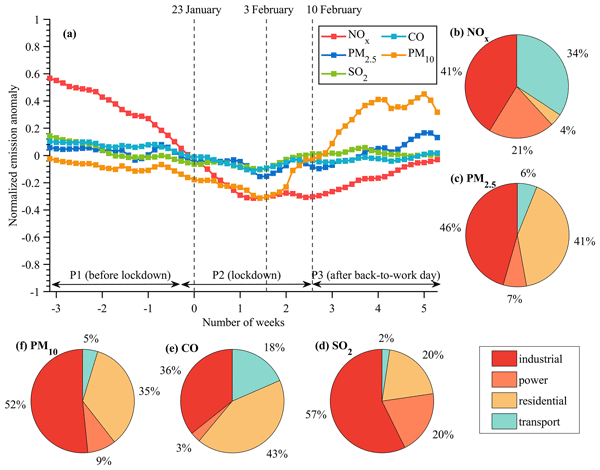
A multi-air-pollutant inversion system has been developed in this study to estimate emission changes in China during COVID-19 lockdown. The results demonstrate that the lockdown is largely a nationwide road traffic control measure with NOx emissions decreasing by ~40 %. Emissions of other species only decreased by ~10 % due to smaller effects of lockdown on other sectors. Assessment results further indicate that the lockdown only had limited effects on the control of PM2.5 and O3 in China.
Najin Kim, Hang Su, Nan Ma, Ulrich Pöschl, and Yafang Cheng
Atmos. Meas. Tech., 16, 2771–2780, https://doi.org/10.5194/amt-16-2771-2023, https://doi.org/10.5194/amt-16-2771-2023, 2023
Short summary
Short summary
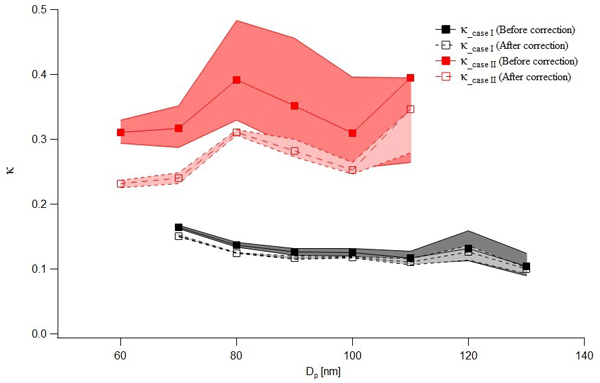
We propose a multiple-charging correction algorithm for a broad-supersaturation scanning cloud condensation nuclei (BS2-CCN) system which can obtain high time-resolution aerosol hygroscopicity and CCN activity. The correction algorithm aims at deriving the activation fraction's true value for each particle size. The meaningful differences between corrected and original κ values (single hygroscopicity parameter) emphasize the correction algorithm's importance for ambient aerosol measurement.
Joanna E. Dyson, Lisa K. Whalley, Eloise J. Slater, Robert Woodward-Massey, Chunxiang Ye, James D. Lee, Freya Squires, James R. Hopkins, Rachel E. Dunmore, Marvin Shaw, Jacqueline F. Hamilton, Alastair C. Lewis, Stephen D. Worrall, Asan Bacak, Archit Mehra, Thomas J. Bannan, Hugh Coe, Carl J. Percival, Bin Ouyang, C. Nicholas Hewitt, Roderic L. Jones, Leigh R. Crilley, Louisa J. Kramer, W. Joe F. Acton, William J. Bloss, Supattarachai Saksakulkrai, Jingsha Xu, Zongbo Shi, Roy M. Harrison, Simone Kotthaus, Sue Grimmond, Yele Sun, Weiqi Xu, Siyao Yue, Lianfang Wei, Pingqing Fu, Xinming Wang, Stephen R. Arnold, and Dwayne E. Heard
Atmos. Chem. Phys., 23, 5679–5697, https://doi.org/10.5194/acp-23-5679-2023, https://doi.org/10.5194/acp-23-5679-2023, 2023
Short summary
Short summary
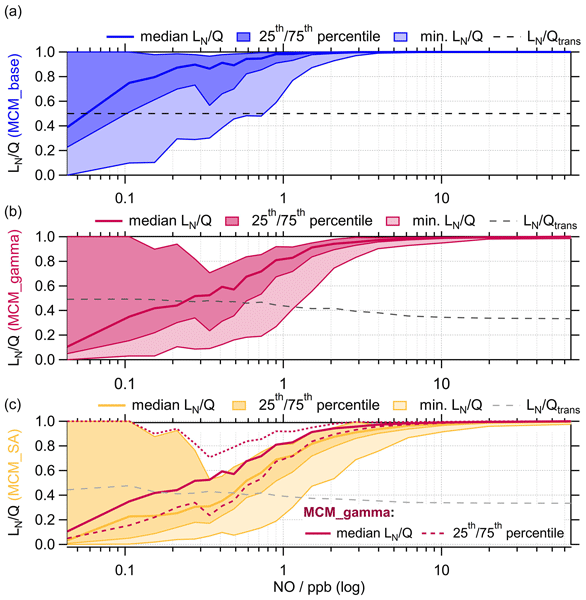
The hydroxyl (OH) and closely coupled hydroperoxyl (HO2) radicals are vital for their role in the removal of atmospheric pollutants. In less polluted regions, atmospheric models over-predict HO2 concentrations. In this modelling study, the impact of heterogeneous uptake of HO2 onto aerosol surfaces on radical concentrations and the ozone production regime in Beijing in the summertime is investigated, and the implications for emissions policies across China are considered.
Juan Hong, Min Tang, Qiaoqiao Wang, Nan Ma, Shaowen Zhu, Shaobin Zhang, Xihao Pan, Linhong Xie, Guo Li, Uwe Kuhn, Chao Yan, Jiangchuan Tao, Ye Kuang, Yao He, Wanyun Xu, Runlong Cai, Yaqing Zhou, Zhibin Wang, Guangsheng Zhou, Bin Yuan, Yafang Cheng, and Hang Su
Atmos. Chem. Phys., 23, 5699–5713, https://doi.org/10.5194/acp-23-5699-2023, https://doi.org/10.5194/acp-23-5699-2023, 2023
Short summary
Short summary
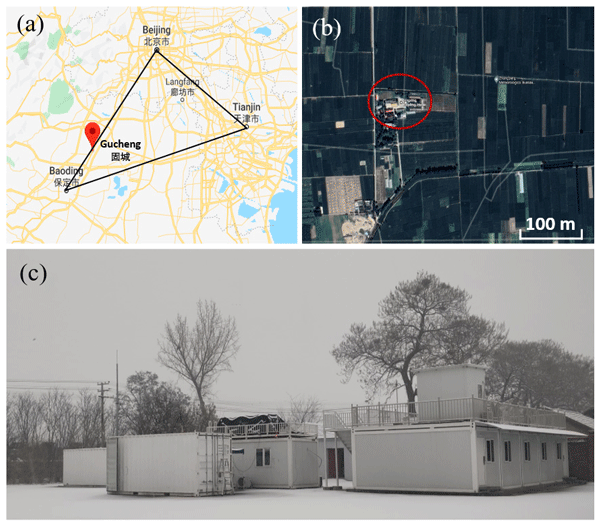
A comprehensive investigation of the characteristics of new particle formation (NPF) events was conducted at a rural site on the North China Plain (NCP), China, during the wintertime of 2018 by covering the particle number size distribution down to sub–3 nm. Potential mechanisms for NPF under the current environment were explored, followed by a further discussion on the factors governing the occurrence of NPF at this rural site compared with other regions (e.g., urban areas) in the NCP region.
Junhua Wang, Baozhu Ge, Xueshun Chen, Jie Li, Keding Lu, Yayuan Dong, Lei Kong, Zifa Wang, and Yuanhang Zhang
Geosci. Model Dev. Discuss., https://doi.org/10.5194/gmd-2023-22, https://doi.org/10.5194/gmd-2023-22, 2023
Revised manuscript not accepted
Short summary
Short summary
We developed a quantitative decoupling analysis (QDA) method to quantify the contributions of emissions, meteorology, chemical reactions, and their nonlinear interactions on PM2.5. We found the effects of adverse meteorological conditions and the importance of nonlinear interactions. This method can provide valuable information for understanding of key factors to heavy pollution, but also help the modelers to find out the sources of uncertainties in numerical models.
Ting Lei, Hang Su, Nan Ma, Ulrich Pöschl, Alfred Wiedensohler, and Yafang Cheng
Atmos. Chem. Phys., 23, 4763–4774, https://doi.org/10.5194/acp-23-4763-2023, https://doi.org/10.5194/acp-23-4763-2023, 2023
Short summary
Short summary
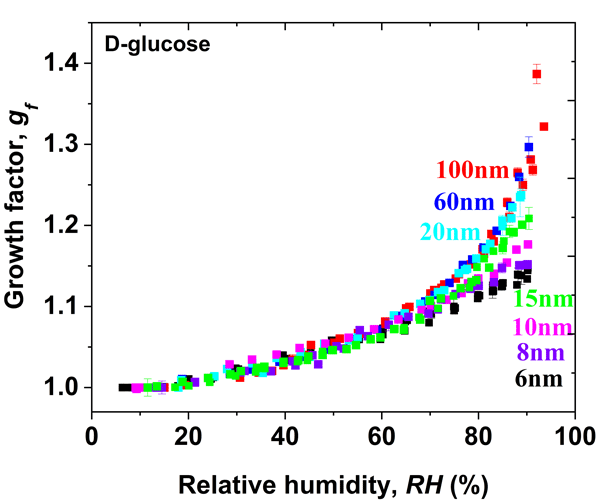
We investigate the hygroscopic behavior of levoglucosan and D-glucose nanoparticles using a nano-HTDMA. There is a weak size dependence of the hygroscopic growth factor of levoglucosan and D-glucose with diameters down to 20 nm, while a strong size dependence of the hygroscopic growth factor of D-glucose has been clearly observed in the size range 6 to 20 nm. The use of the DKA method leads to good agreement with the hygroscopic growth factor of glucose nanoparticles with diameters down to 6 nm.
Ian Chang, Lan Gao, Connor J. Flynn, Yohei Shinozuka, Sarah J. Doherty, Michael S. Diamond, Karla M. Longo, Gonzalo A. Ferrada, Gregory R. Carmichael, Patricia Castellanos, Arlindo M. da Silva, Pablo E. Saide, Calvin Howes, Zhixin Xue, Marc Mallet, Ravi Govindaraju, Qiaoqiao Wang, Yafang Cheng, Yan Feng, Sharon P. Burton, Richard A. Ferrare, Samuel E. LeBlanc, Meloë S. Kacenelenbogen, Kristina Pistone, Michal Segal-Rozenhaimer, Kerry G. Meyer, Ju-Mee Ryoo, Leonhard Pfister, Adeyemi A. Adebiyi, Robert Wood, Paquita Zuidema, Sundar A. Christopher, and Jens Redemann
Atmos. Chem. Phys., 23, 4283–4309, https://doi.org/10.5194/acp-23-4283-2023, https://doi.org/10.5194/acp-23-4283-2023, 2023
Short summary
Short summary
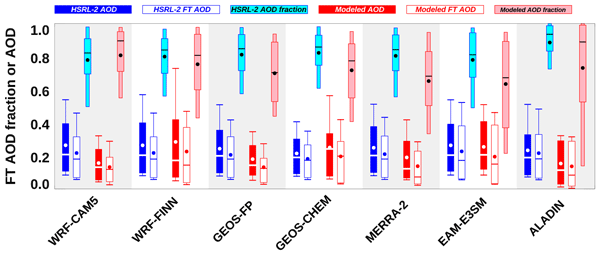
Abundant aerosols are present above low-level liquid clouds over the southeastern Atlantic during late austral spring. The model simulation differences in the proportion of aerosol residing in the planetary boundary layer and in the free troposphere can greatly affect the regional aerosol radiative effects. This study examines the aerosol loading and fractional aerosol loading in the free troposphere among various models and evaluates them against measurements from the NASA ORACLES campaign.
Zhichao Dong, Chandra Mouli Pavuluri, Zhanjie Xu, Yu Wang, Peisen Li, Pingqing Fu, and Cong-Qiang Liu
Atmos. Chem. Phys., 23, 2119–2143, https://doi.org/10.5194/acp-23-2119-2023, https://doi.org/10.5194/acp-23-2119-2023, 2023
Short summary
Short summary
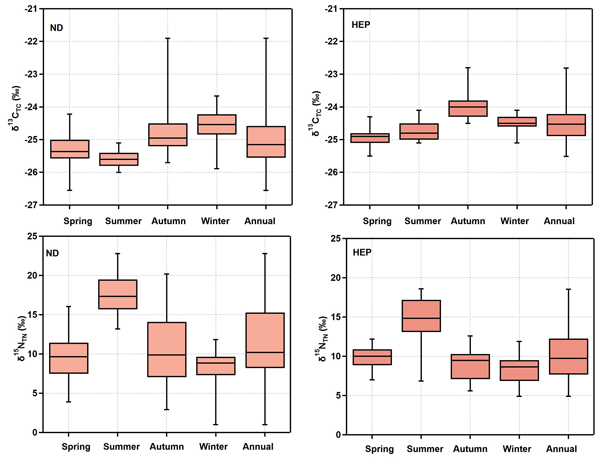
This study has provided comprehensive baseline data of carbonaceous and inorganic aerosols as well as their isotope ratios in the Tianjin region, North China, found that Tianjin aerosols were derived from coal combustion, biomass burning and photochemical reactions of VOCs, and also implied that the Tianjin aerosols were more aged during long-range atmospheric transport in summer via carbonaceous and isotope data analysis.

Shujun Zhong, Shuang Chen, Junjun Deng, Yanbing Fan, Qiang Zhang, Qiaorong Xie, Yulin Qi, Wei Hu, Libin Wu, Xiaodong Li, Chandra Mouli Pavuluri, Jialei Zhu, Xin Wang, Di Liu, Xiaole Pan, Yele Sun, Zifa Wang, Yisheng Xu, Haijie Tong, Hang Su, Yafang Cheng, Kimitaka Kawamura, and Pingqing Fu
Atmos. Chem. Phys., 23, 2061–2077, https://doi.org/10.5194/acp-23-2061-2023, https://doi.org/10.5194/acp-23-2061-2023, 2023
Short summary
Short summary
This study investigated the role of the secondary organic aerosol (SOA) loading on the molecular composition of wintertime urban aerosols by ultrahigh-resolution mass spectrometry. Results demonstrate that the SOA loading is an important factor associated with the oxidation degree, nitrate group content, and chemodiversity of nitrooxy–organosulfates. Our study also found that the hydrolysis of nitrooxy–organosulfates is a possible pathway for the formation of organosulfates.
Yunfan Liu, Hang Su, Siwen Wang, Chao Wei, Wei Tao, Mira L. Pöhlker, Christopher Pöhlker, Bruna A. Holanda, Ovid O. Krüger, Thorsten Hoffmann, Manfred Wendisch, Paulo Artaxo, Ulrich Pöschl, Meinrat O. Andreae, and Yafang Cheng
Atmos. Chem. Phys., 23, 251–272, https://doi.org/10.5194/acp-23-251-2023, https://doi.org/10.5194/acp-23-251-2023, 2023
Short summary
Short summary
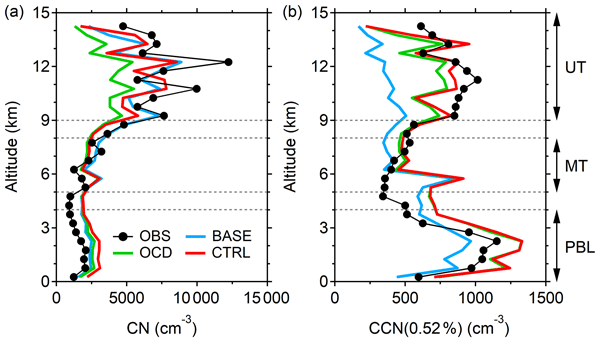
The origins of the abundant cloud condensation nuclei (CCN) in the upper troposphere (UT) of the Amazon remain unclear. With model developments of new secondary organic aerosol schemes and constrained by observation, we show that strong aerosol nucleation and condensation in the UT is triggered by biogenic organics, and organic condensation is key for UT CCN production. This UT CCN-producing mechanism may prevail over broader vegetation canopies and deserves emphasis in aerosol–climate feedback.
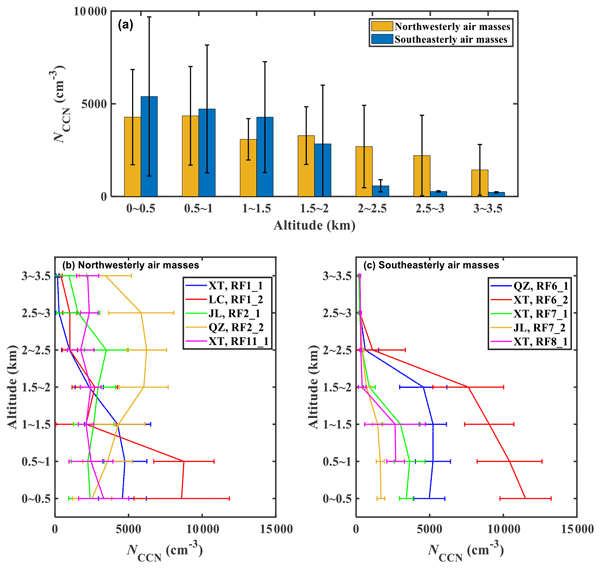
Rui Zhang, Yuying Wang, Zhanqing Li, Zhibin Wang, Russell R. Dickerson, Xinrong Ren, Hao He, Fei Wang, Ying Gao, Xi Chen, Jialu Xu, Yafang Cheng, and Hang Su
Atmos. Chem. Phys., 22, 14879–14891, https://doi.org/10.5194/acp-22-14879-2022, https://doi.org/10.5194/acp-22-14879-2022, 2022
Short summary
Short summary
Factors of cloud condensation nuclei number concentration (NCCN) profiles determined in the North China Plain include air mass sources, temperature structure, anthropogenic emissions, and terrain distribution. Cloud condensation nuclei (CCN) spectra suggest that the ability of aerosol activation into CCN is stronger in southeasterly than in northwesterly air masses and stronger in the free atmosphere than near the surface. A good method to parameterize NCCN from aerosol optical data is found.
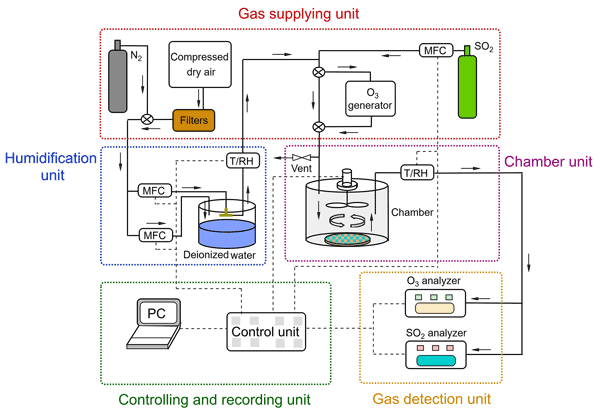
Guo Li, Hang Su, Meng Li, Uwe Kuhn, Guangjie Zheng, Lei Han, Fengxia Bao, Ulrich Pöschl, and Yafang Cheng
Atmos. Meas. Tech., 15, 6433–6446, https://doi.org/10.5194/amt-15-6433-2022, https://doi.org/10.5194/amt-15-6433-2022, 2022
Short summary
Short summary
A large fraction of previous work using dynamic flow chambers was to quantify gas exchange in terms of flux or deposition/emission rate. Here, we extended the usage of this technique to examine uptake kinetics on sample surfaces. The good performance of the chamber system was validated. This technique can be further used for liquid samples and real atmospheric aerosol samples without complicated coating procedures, which complements the existing techniques in atmospheric kinetic studies.
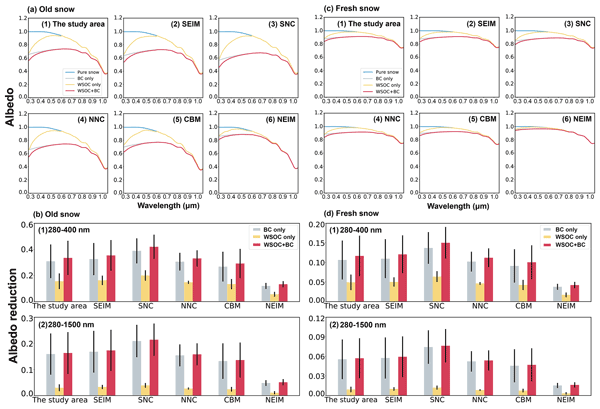
Xiaoying Niu, Wei Pu, Pingqing Fu, Yang Chen, Yuxuan Xing, Dongyou Wu, Ziqi Chen, Tenglong Shi, Yue Zhou, Hui Wen, and Xin Wang
Atmos. Chem. Phys., 22, 14075–14094, https://doi.org/10.5194/acp-22-14075-2022, https://doi.org/10.5194/acp-22-14075-2022, 2022
Short summary
Short summary
In this study, we do the first investigation of WSOC in seasonal snow of northeastern China. The results revealed the regional-specific compositions and sources of WSOC due to different natural environments and anthropogenic activities. The abundant concentrations of WSOC and its absorption properties contributed to a crucial impact on the snow albedo and radiative effect. We established that our study could raise awareness of carbon cycling processes, hydrological processes, and climate change.
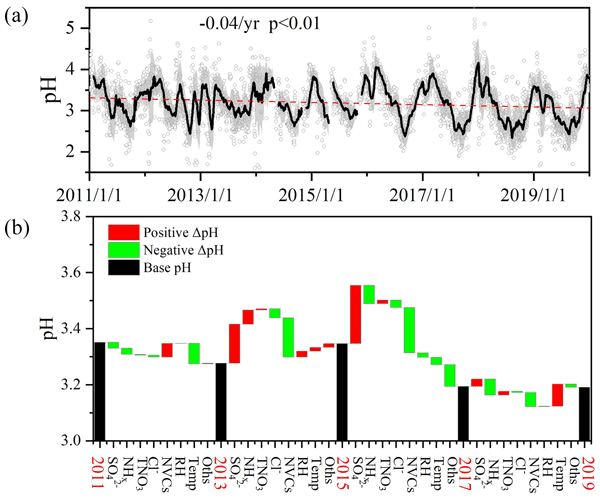
Min Zhou, Guangjie Zheng, Hongli Wang, Liping Qiao, Shuhui Zhu, DanDan Huang, Jingyu An, Shengrong Lou, Shikang Tao, Qian Wang, Rusha Yan, Yingge Ma, Changhong Chen, Yafang Cheng, Hang Su, and Cheng Huang
Atmos. Chem. Phys., 22, 13833–13844, https://doi.org/10.5194/acp-22-13833-2022, https://doi.org/10.5194/acp-22-13833-2022, 2022
Short summary
Short summary
The trend of aerosol pH and its drivers is crucial in understanding the multiphase formation pathways of aerosols. We reported the first trend analysis of aerosol pH from 2011 to 2019 in eastern China. Although significant variations of aerosol compositions were observed from 2011 to 2019, the aerosol pH estimated by model only slightly declined by 0.24. Our work shows that the opposite effects of SO42− and non-volatile cation changes play key roles in determining the moderate pH trend.
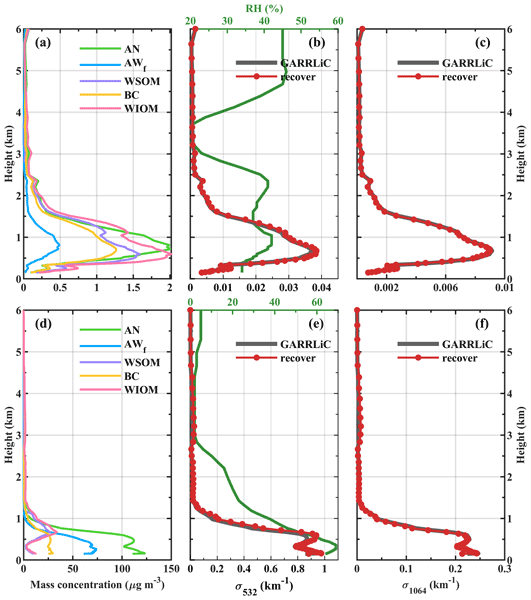
Futing Wang, Ting Yang, Zifa Wang, Haibo Wang, Xi Chen, Yele Sun, Jianjun Li, Guigang Tang, and Wenxuan Chai
Atmos. Meas. Tech., 15, 6127–6144, https://doi.org/10.5194/amt-15-6127-2022, https://doi.org/10.5194/amt-15-6127-2022, 2022
Short summary
Short summary
We develop a new algorithm to get the vertical mass concentration profiles of fine aerosol components based on the synergy of ground-based remote sensing for the first time. The comparisons with in situ observations and chemistry transport models validate the performance of the algorithm. Uncertainties caused by input parameters are also assessed in this paper. We expected that the algorithm can provide a new idea for lidar inversion and promote the development of aerosol component profiles.
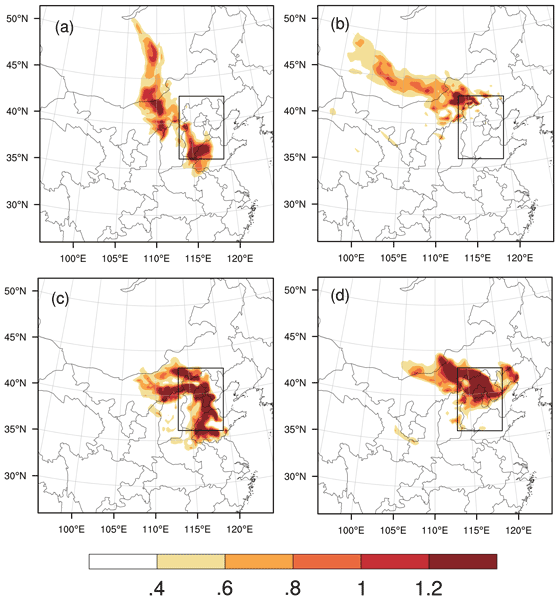
Lichao Yang, Wansuo Duan, Zifa Wang, and Wenyi Yang
Atmos. Chem. Phys., 22, 11429–11453, https://doi.org/10.5194/acp-22-11429-2022, https://doi.org/10.5194/acp-22-11429-2022, 2022
Short summary
Short summary
The initial meteorological state has a great impact on PM2.5 forecasts. Assimilating additional observations is an effective way to improve the accuracy of the initial meteorological state. Here we used an advanced optimization approach to identify where we should preferentially place the meteorological observations associated with PM2.5 forecasts in the Beijing–Tianjin–Hebei region of China. We provide evidence that the target observation strategy is effective for improving PM2.5 forecasts.
Zhiqiang Zhang, Yele Sun, Chun Chen, Bo You, Aodong Du, Weiqi Xu, Yan Li, Zhijie Li, Lu Lei, Wei Zhou, Jiaxing Sun, Yanmei Qiu, Lianfang Wei, Pingqing Fu, and Zifa Wang
Atmos. Chem. Phys., 22, 10409–10423, https://doi.org/10.5194/acp-22-10409-2022, https://doi.org/10.5194/acp-22-10409-2022, 2022
Short summary
Short summary
We present a comprehensive characterization of water-soluble organic aerosol and the first mass spectral characterization of water-insoluble organic aerosol in the cold season in Beijing by integrating online and offline aerosol mass spectrometer measurements. WSOA comprised dominantly secondary OA and showed large changes during the transition season from autumn to winter. WIOA was characterized by prominent hydrocarbon ions series, low oxidation states, and significant day–night differences.
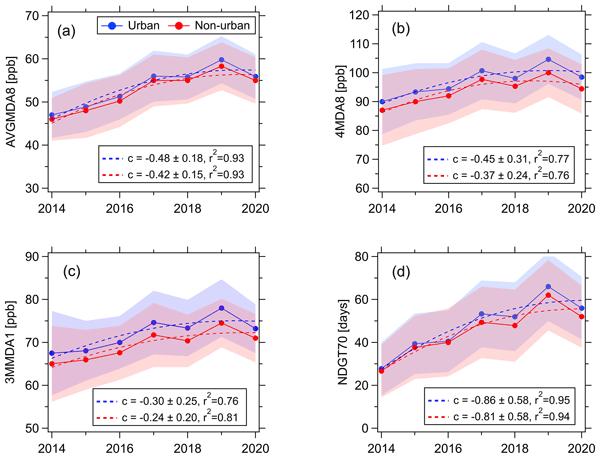
Wenjie Wang, David D. Parrish, Siwen Wang, Fengxia Bao, Ruijing Ni, Xin Li, Suding Yang, Hongli Wang, Yafang Cheng, and Hang Su
Atmos. Chem. Phys., 22, 8935–8949, https://doi.org/10.5194/acp-22-8935-2022, https://doi.org/10.5194/acp-22-8935-2022, 2022
Short summary
Short summary
Tropospheric ozone is an air pollutant that is detrimental to human health, vegetation and ecosystem productivity. A comprehensive characterisation of the spatial and temporal distribution of tropospheric ozone is critical to our understanding of these issues. Here we summarise this distribution over China from the available observational records to the extent possible. This study provides insights into efficient future ozone control strategies in China.
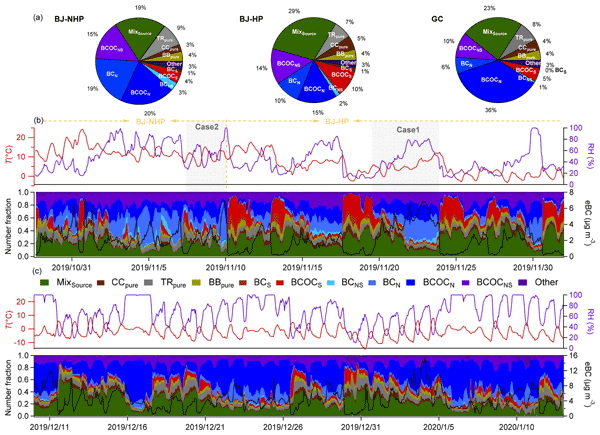
Jiaxing Sun, Yele Sun, Conghui Xie, Weiqi Xu, Chun Chen, Zhe Wang, Lei Li, Xubing Du, Fugui Huang, Yan Li, Zhijie Li, Xiaole Pan, Nan Ma, Wanyun Xu, Pingqing Fu, and Zifa Wang
Atmos. Chem. Phys., 22, 7619–7630, https://doi.org/10.5194/acp-22-7619-2022, https://doi.org/10.5194/acp-22-7619-2022, 2022
Short summary
Short summary
We analyzed the chemical composition and mixing state of BC-containing particles at urban and rural sites in winter in the North China Plain and evaluated their impact on light absorption enhancement. BC was dominantly mixed with organic carbon, nitrate, and sulfate, and the mixing state evolved significantly as a function of relative humidity (RH) at both sites. The absorption enhancement depended strongly on coated secondary inorganic aerosol and was up to ~1.3–1.4 during aging processes.
Junjun Deng, Hao Ma, Xinfeng Wang, Shujun Zhong, Zhimin Zhang, Jialei Zhu, Yanbing Fan, Wei Hu, Libin Wu, Xiaodong Li, Lujie Ren, Chandra Mouli Pavuluri, Xiaole Pan, Yele Sun, Zifa Wang, Kimitaka Kawamura, and Pingqing Fu
Atmos. Chem. Phys., 22, 6449–6470, https://doi.org/10.5194/acp-22-6449-2022, https://doi.org/10.5194/acp-22-6449-2022, 2022
Short summary
Short summary
Light-absorbing brown carbon (BrC) plays an important role in climate change and atmospheric chemistry. Here we investigated the seasonal and diurnal variations in water-soluble BrC in PM2.5 in the megacity Tianjin in coastal China. Results of the source apportionments from the combination with organic molecular compositions and optical properties of water-soluble BrC reveal a large contribution from primary bioaerosol particles to BrC in the urban atmosphere.
Haibo Wang, Ting Yang, Zifa Wang, Jianjun Li, Wenxuan Chai, Guigang Tang, Lei Kong, and Xueshun Chen
Geosci. Model Dev., 15, 3555–3585, https://doi.org/10.5194/gmd-15-3555-2022, https://doi.org/10.5194/gmd-15-3555-2022, 2022
Short summary
Short summary
In this paper, we develop an online data coupled assimilation system (NAQPMS-PDAF) with the Eulerian atmospheric chemistry-transport model. NAQPMS-PDAF allows efficient use of large computational resources. The application and performance of the system are investigated by assimilating 1 month of vertical aerosol observations. The results show that NAQPMS-PDAF can significantly improve the performance of aerosol vertical structure simulation and reduce the uncertainty to a large extent.
Jingnan Shi, Juan Hong, Nan Ma, Qingwei Luo, Yao He, Hanbing Xu, Haobo Tan, Qiaoqiao Wang, Jiangchuan Tao, Yaqing Zhou, Shuang Han, Long Peng, Linhong Xie, Guangsheng Zhou, Wanyun Xu, Yele Sun, Yafang Cheng, and Hang Su
Atmos. Chem. Phys., 22, 4599–4613, https://doi.org/10.5194/acp-22-4599-2022, https://doi.org/10.5194/acp-22-4599-2022, 2022
Short summary
Short summary
In this study, we investigated the hygroscopicity of submicron aerosols at a rural site in the North China Plain during the winter of 2018, using a HTDMA and a CV-ToF-ACSM. We observed differences in aerosol hygroscopicity during two distinct episodes with different primary emissions and secondary aerosol formation processes. These results provide an improved understanding of the complex influence of sources and aerosol evolution processes on their hygroscopicity.
Wenjie Wang, Bin Yuan, Yuwen Peng, Hang Su, Yafang Cheng, Suxia Yang, Caihong Wu, Jipeng Qi, Fengxia Bao, Yibo Huangfu, Chaomin Wang, Chenshuo Ye, Zelong Wang, Baolin Wang, Xinming Wang, Wei Song, Weiwei Hu, Peng Cheng, Manni Zhu, Junyu Zheng, and Min Shao
Atmos. Chem. Phys., 22, 4117–4128, https://doi.org/10.5194/acp-22-4117-2022, https://doi.org/10.5194/acp-22-4117-2022, 2022
Short summary
Short summary
From thorough measurements of numerous oxygenated volatile organic compounds, we show that their photodissociation can be important for radical production and ozone formation in the atmosphere. This effect was underestimated in previous studies, as measurements of them were lacking.
Shuang Han, Juan Hong, Qingwei Luo, Hanbing Xu, Haobo Tan, Qiaoqiao Wang, Jiangchuan Tao, Yaqing Zhou, Long Peng, Yao He, Jingnan Shi, Nan Ma, Yafang Cheng, and Hang Su
Atmos. Chem. Phys., 22, 3985–4004, https://doi.org/10.5194/acp-22-3985-2022, https://doi.org/10.5194/acp-22-3985-2022, 2022
Short summary
Short summary
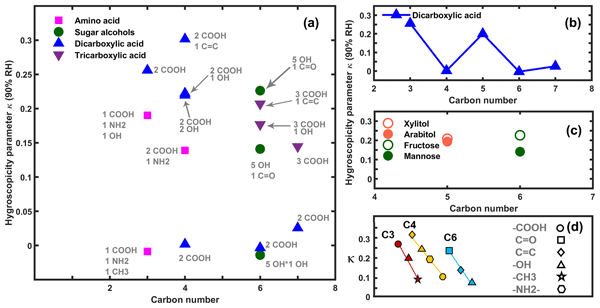
We present the hygroscopicity of 23 organic species with different physicochemical properties using a hygroscopicity tandem differential mobility analyzer (HTDMA) and compare the results with previous studies. Based on the hygroscopicity parameter κ, the influence of different physicochemical properties that potentially drive hygroscopicity, such as the functionality, water solubility, molar volume, and O : C ratio of organics, are examined separately.
Xiajie Yang, Qiaoqiao Wang, Nan Ma, Weiwei Hu, Yang Gao, Zhijiong Huang, Junyu Zheng, Bin Yuan, Ning Yang, Jiangchuan Tao, Juan Hong, Yafang Cheng, and Hang Su
Atmos. Chem. Phys., 22, 3743–3762, https://doi.org/10.5194/acp-22-3743-2022, https://doi.org/10.5194/acp-22-3743-2022, 2022
Short summary
Short summary
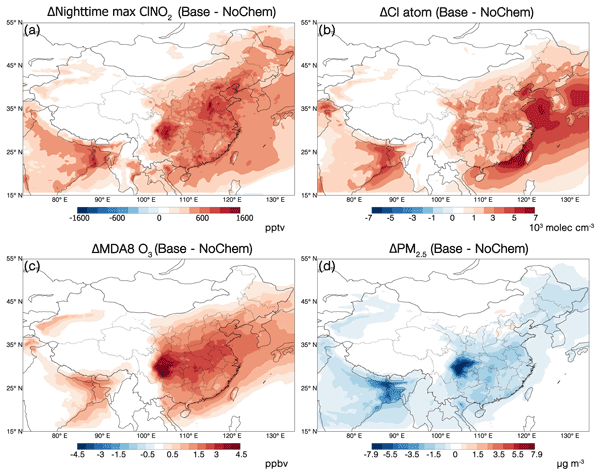
We use the GEOS-Chem model with additional anthropogenic and biomass burning chlorine emissions combined with updated parameterizations for N2O5 + Cl chemistry to investigate the impacts of chlorine chemistry on air quality in China. Our study not only significantly improves the model's performance but also demonstrates the importance of non-sea-salt chlorine sources as well as an appropriate parameterization for N2O5 + Cl chemistry to the impact of chlorine chemistry in China.
Yanhong Zhu, Weijun Li, Yue Wang, Jian Zhang, Lei Liu, Liang Xu, Jingsha Xu, Jinhui Shi, Longyi Shao, Pingqing Fu, Daizhou Zhang, and Zongbo Shi
Atmos. Chem. Phys., 22, 2191–2202, https://doi.org/10.5194/acp-22-2191-2022, https://doi.org/10.5194/acp-22-2191-2022, 2022
Short summary
Short summary
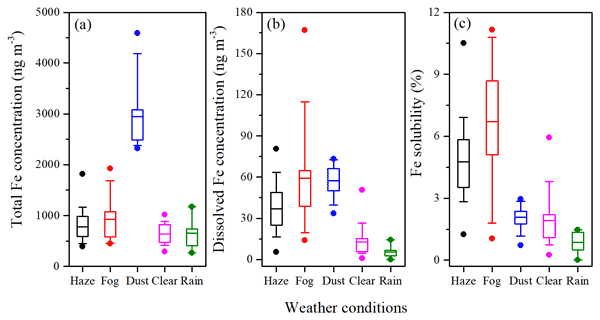
The solubilities of iron in fine particles in a megacity in Eastern China were studied under haze, fog, dust, clear, and rain weather conditions. For the first time, a receptor model was used to quantify the sources of dissolved and total iron aerosol. Microscopic analysis further confirmed the aging of iron aerosol during haze and fog conditions that facilitated dissolution of insoluble iron.
Yaqing Zhou, Nan Ma, Qiaoqiao Wang, Zhibin Wang, Chunrong Chen, Jiangchuan Tao, Juan Hong, Long Peng, Yao He, Linhong Xie, Shaowen Zhu, Yuxuan Zhang, Guo Li, Wanyun Xu, Peng Cheng, Uwe Kuhn, Guangsheng Zhou, Pingqing Fu, Qiang Zhang, Hang Su, and Yafang Cheng
Atmos. Chem. Phys., 22, 2029–2047, https://doi.org/10.5194/acp-22-2029-2022, https://doi.org/10.5194/acp-22-2029-2022, 2022
Short summary
Short summary
This study characterizes size-resolved particle effective densities and their evolution associated with emissions and aging processes in a rural area of the North China Plain. Particle effective density exhibits a high-frequency bimodal distribution, and two density modes exhibit opposite trends with increasing particle size. SIA and BC mass fractions are key factors of particle effective density, and a value of 0.6 g cm−3 is appropriate to represent BC effective density in bulk particles.
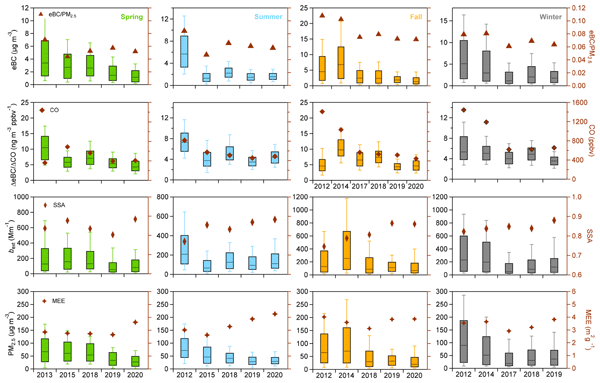
Jiaxing Sun, Zhe Wang, Wei Zhou, Conghui Xie, Cheng Wu, Chun Chen, Tingting Han, Qingqing Wang, Zhijie Li, Jie Li, Pingqing Fu, Zifa Wang, and Yele Sun
Atmos. Chem. Phys., 22, 561–575, https://doi.org/10.5194/acp-22-561-2022, https://doi.org/10.5194/acp-22-561-2022, 2022
Short summary
Short summary
We analyzed 9-year measurements of BC and aerosol optical properties from 2012 to 2020 in Beijing, China. Our results showed large reductions in BC and light extinction coefficient due to the Clean Air Action Plan. As a response, both SSA and mass extinction efficiency (MEE) showed considerable increases, demonstrating a future challenge in visibility improvement. The primary and secondary BrC was also separated and quantified, and the changes in radiative forcing of BC and BrC were estimated.
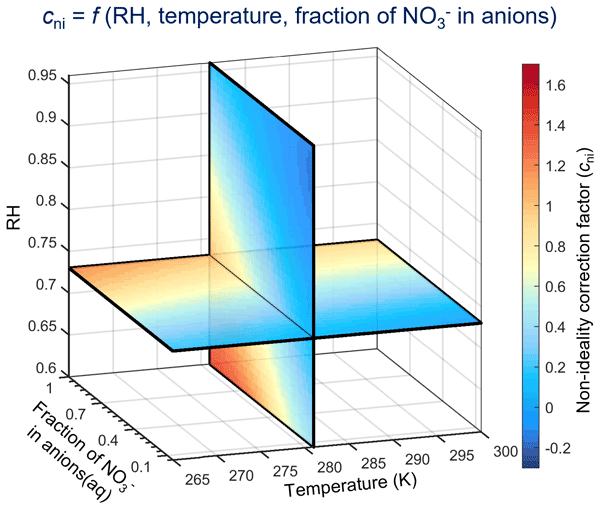
Guangjie Zheng, Hang Su, Siwen Wang, Andrea Pozzer, and Yafang Cheng
Atmos. Chem. Phys., 22, 47–63, https://doi.org/10.5194/acp-22-47-2022, https://doi.org/10.5194/acp-22-47-2022, 2022
Short summary
Short summary
The recently proposed multiphase buffer theory provides a framework to reconstruct long-term trends and spatial variations in aerosol pH, while non-ideality is a major limitation for its broad applications. Here we proposed a parameterization method to estimate the impact of non-ideality and validated it against long-term observations and global simulations. With this method, the multiphase buffer theory can reproduce well aerosol pH variations estimated by comprehensive thermodynamic models.
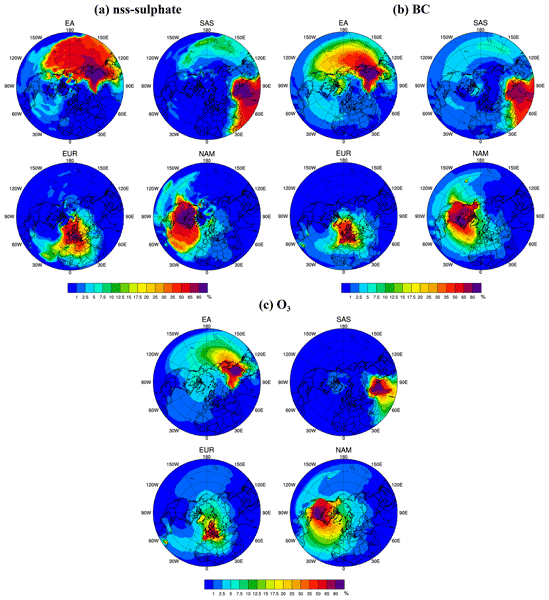
Qian Ye, Jie Li, Xueshun Chen, Huansheng Chen, Wenyi Yang, Huiyun Du, Xiaole Pan, Xiao Tang, Wei Wang, Lili Zhu, Jianjun Li, Zhe Wang, and Zifa Wang
Geosci. Model Dev., 14, 7573–7604, https://doi.org/10.5194/gmd-14-7573-2021, https://doi.org/10.5194/gmd-14-7573-2021, 2021
Short summary
Short summary
We developed a global tropospheric atmospheric chemistry source–receptor model. This model can quantify the contributions of multiple air pollutants from various source regions in one simulation without introducing the nonlinear error of atmospheric chemistry. The S-R relationships of PM2.5 and O3 from a global high-resolution (0.5° × 0.5°) simulation were given and compared with previous studies. This model will be useful for creating a link between the scientific community and policymakers.
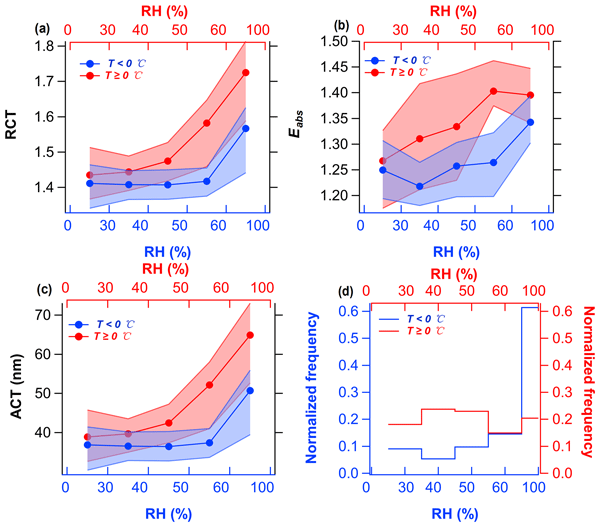
Yuting Zhang, Hang Liu, Shandong Lei, Wanyun Xu, Yu Tian, Weijie Yao, Xiaoyong Liu, Qi Liao, Jie Li, Chun Chen, Yele Sun, Pingqing Fu, Jinyuan Xin, Junji Cao, Xiaole Pan, and Zifa Wang
Atmos. Chem. Phys., 21, 17631–17648, https://doi.org/10.5194/acp-21-17631-2021, https://doi.org/10.5194/acp-21-17631-2021, 2021
Short summary
Short summary
In this study, the authors used a single-particle soot photometer (SP2) to characterize the particle size, mixing state, and optical properties of black carbon aerosols in rural areas of the North China Plain in winter. Relatively warm and high-RH environments (RH > 50 %, −4° < T < 4 °) were more favorable to rBC aging than dry and cold environments (RH < 60 %, T < −8°). The paper emphasizes the importance of meteorological parameters in the mixing state of black carbon.

Najin Kim, Yafang Cheng, Nan Ma, Mira L. Pöhlker, Thomas Klimach, Thomas F. Mentel, Ovid O. Krüger, Ulrich Pöschl, and Hang Su
Atmos. Meas. Tech., 14, 6991–7005, https://doi.org/10.5194/amt-14-6991-2021, https://doi.org/10.5194/amt-14-6991-2021, 2021
Short summary
Short summary
A broad supersaturation scanning CCN (BS2-CCN) system, in which particles are exposed to a range of supersaturation simultaneously, can measure a broad range of CCN activity distribution with a high time resolution. We describe how the BS2-CCN system can be effectively calibrated and which factors can affect the calibration curve. Intercomparison experiments between typical DMA-CCN and BS2-CCN measurements to evaluate the BS2-CCN system showed high correlation and good agreement.
Cited articles
Alexander, B., Park, R. J., Jacob, D. J., and Gong, S.: Transition metal-catalyzed oxidation of atmospheric sulfur: Global implications for the sulfur budget, J. Geophys. Res.-Atmos., 114, D010486, https://doi.org/10.1029/2008JD010486, 2009.
Berglen, T. F., Berntsen, T. K., Isaksen, I. S., and Sundet, J. K.: A global model of the coupled sulfur/oxidant chemistry in the troposphere: The sulfur cycle, J. Geophys. Res.-Atmos., 109, D003948, https://doi.org/10.1029/2003JD003948, 2004.
Chen, H. S., Wang, Z. F., Li, J., Tang, X., Ge, B. Z., Wu, X. L., Wild, O., and Carmichael, G. R.: GNAQPMS-Hg v1.0, a global nested atmospheric mercury transport model: model description, evaluation and application to trans-boundary transport of Chinese anthropogenic emissions, Geosci. Model Dev., 8, 2857–2876, https://doi.org/10.5194/gmd-8-2857-2015, 2015.
Chen, S. L., Guo, Z. Y., Guo, Z. B., Guo, Q. J., Zhang, Y. L., Zhu, B., and Zhang, H. X.: Sulfur isotopic fractionation and its implication: Sulfate formation in PM2.5 and coal combustion under different conditions, Atmos. Res., 194, 142–149, https://doi.org/10.1016/j.atmosres.2017.04.034, 2017.
Chen, X., Wang, Z., Li, J., and Yu, F.: Development of a regional chemical transport model with size-resolved aerosol microphysics and its application on aerosol number concentration simulation over China, SOLA, 10, 83–87, https://doi.org/10.2151/sola.2014-017, 2014.
Chen, X., Yang, W., Wang, Z., Li, J., Hu, M., An, J., Wu, Q., Wang, Z., Chen, H., and Wei, Y.: Improving new particle formation simulation by coupling a volatility-basis set (VBS) organic aerosol module in NAQPMS+ APM, Atmos. Environ., 204, 1–11, https://doi.org/10.1016/j.atmosenv.2019.01.053, 2019.
Chen, X., Yu, F., Yang, W., Sun, Y., Chen, H., Du, W., Zhao, J., Wei, Y., Wei, L., Du, H., Wang, Z., Wu, Q., Li, J., An, J., and Wang, Z.: Global–regional nested simulation of particle number concentration by combing microphysical processes with an evolving organic aerosol module, Atmos. Chem. Phys., 21, 9343–9366, https://doi.org/10.5194/acp-21-9343-2021, 2021.
Cheng, Y., Zheng, G., Wei, C., Mu, Q., Zheng, B., Wang, Z., Gao, M., Zhang, Q., He, K., and Carmichael, G.: Reactive nitrogen chemistry in aerosol water as a source of sulfate during haze events in China, Sci. Adv., 2, e1601530, https://doi.org/10.1126/sciadv.1601530, 2016.
Crippa, M., Guizzardi, D., Butler, T., Keating, T., Wu, R., Kaminski, J., Kuenen, J., Kurokawa, J., Chatani, S., Morikawa, T., Pouliot, G., Racine, J., Moran, M. D., Klimont, Z., Manseau, P. M., Mashayekhi, R., Henderson, B. H., Smith, S. J., Suchyta, H., Muntean, M., Solazzo, E., Banja, M., Schaaf, E., Pagani, F., Woo, J.-H., Kim, J., Monforti-Ferrario, F., Pisoni, E., Zhang, J., Niemi, D., Sassi, M., Ansari, T., and Foley, K.: The HTAP_v3 emission mosaic: merging regional and global monthly emissions (2000–2018) to support air quality modelling and policies, Earth Syst. Sci. Data, 15, 2667–2694, https://doi.org/10.5194/essd-15-2667-2023, 2023.
De Laeter, J. R., Böhlke, J. K., De Bièvre, P., Hidaka, H., Peiser, H. S., Rosman, K. J. R., and Taylor, P. D. P.: Atomic weights of the elements, Review 2000 (IUPAC Technical Report), Pure Appl. Chem., 75, 683–900, https://doi.org/10.1351/pac200375060683, 2003.
Derda, M., Grzegorz Chmielewski, A., and Janusz, L.: Sulphur isotope compositions of components of coal and S-isotope fractionation during its combustion and flue gas desulphurization, Isot. Environ. Health Stud., 43, 57–63, https://doi.org/10.1080/10256010601153827, 2007.
Ding, S., Chen, Y., Li, Q., and Li, X.-D.: Using Stable Sulfur Isotope to Trace Sulfur Oxidation Pathways during the Winter of 2017–2019 in Tianjin, North China, Int. J. Environ. Res. Public Health, 19, 10966, https://doi.org/10.3390/ijerph191710966, 2022.
Ding, T., Valkiers, S., Kipphardt, H., De Bièvre, P., Taylor, P. D. P., Gonfiantini, R., and Krouse, R.: Calibrated sulfur isotope abundance ratios of three IAEA sulfur isotope reference materials and V-CDT with a reassessment of the atomic weight of sulfur, Geochim. Cosmochim. Acta, 65, 2433–2437, https://doi.org/10.1016/S0016-7037(01)00611-1, 2001.
Ding, X., Li, Q., Wu, D., Wang, X., Li, M., Wang, T., Wang, L., and Chen, J.: Direct observation of sulfate explosive growth in wet plumes emitted from typical coal‐fired stationary sources, Geophys. Res. Lett., 48, e2020GL092071, https://doi.org/10.1029/2020GL092071, 2021.
Fan, M.-Y., Zhang, Y.-L., Lin, Y.-C., Li, J., Cheng, H., An, N., Sun, Y., Qiu, Y., Cao, F., and Fu, P.: Roles of sulfur oxidation pathways in the variability in stable sulfur isotopic composition of sulfate aerosols at an urban site in Beijing, China, Environ. Sci. Technol. Lett, 7, 883–888, https://doi.org/10.1021/acs.estlett.0c00623, 2020.
Fang, H. and Michalski, G.: Assessing the roles emission sources and atmospheric processes play in simulating δ15N of atmospheric NOx and NO3− using CMAQ (version 5.2.1) and SMOKE (version 4.6), Geosci. Model Dev., 15, 4239–4258, https://doi.org/10.5194/gmd-15-4239-2022, 2022.
Feng, X., Chen, Y., Liu, Z., Feng, Y., Du, H., Mu, Y., and Chen, J.: Exploring the influence of 34S fractionation from emission sources and SO2 atmospheric oxidation on sulfate source apportionment based on hourly resolution δ34S‐SO2
Fountoukis, C. and Nenes, A.: ISORROPIA II: a computationally efficient thermodynamic equilibrium model for K+–Ca2+–Mg2+–NH
Gromov, S., Jöckel, P., Sander, R., and Brenninkmeijer, C. A. M.: A kinetic chemistry tagging technique and its application to modelling the stable isotopic composition of atmospheric trace gases, Geosci. Model Dev., 3, 337–364, https://doi.org/10.5194/gmd-3-337-2010, 2010.
Guan, Z. X. and Liu, Y.: How to estimate isotope fractionations of a Rayleigh-like but diffusion-limited disequilibrium process?, Acta Geochimica, 42, 24–37, https://doi.org/10.1007/s11631-022-00587-2, 2023.
Guo, Z., Shi, L., Chen, S., Jiang, W., Wei, Y., Rui, M., and Zeng, G.: Sulfur isotopic fractionation and source appointment of PM2.5 in Nanjing region around the second session of the Youth Olympic Games, Atmos. Res., 174–175, 9–17, https://doi.org/10.1016/j.atmosres.2016.01.011, 2016.
Han, X., Guo, Q., Liu, C., Fu, P., Strauss, H., Yang, J., Hu, J., Wei, L., Ren, H., and Peters, M.: Using stable isotopes to trace sources and formation processes of sulfate aerosols from Beijing, China, Sci. Rep., 6, 29958, https://doi.org/10.1038/srep29958, 2016a.
Han, X., Guo, Q., Liu, C., Strauss, H., Yang, J., Hu, J., Wei, R., Tian, L., Kong, J., and Peters, M.: Effect of the pollution control measures on PM2.5 during the 2015 China Victory Day Parade: Implication from water-soluble ions and sulfur isotope, Environ. Pollut., 218, 230–241, https://doi.org/10.1016/j.envpol.2016.06.038, 2016b.
Han, X., Guo, Q., Strauss, H., Liu, C., Hu, J., Guo, Z., Wei, R., Peters, M., Tian, L., and Kong, J.: Multiple sulfur isotope constraints on sources and formation processes of sulfate in Beijing PM2.5 aerosol, ES&T, 51, 7794–7803, https://doi.org/10.1021/acs.est.7b00280, 2017.
Han, X., Lang, Y., Guo, Q., Li, X., Ding, H., and Li, S.: Enhanced Oxidation of SO2 by H2O2 During Haze Events: Constraints From Sulfur Isotopes, J. Geophys. Res.-Atmos., 127, e2022JD036960, https://doi.org/10.1029/2022JD036960, 2022.
Harris, E., Sinha, B., Hoppe, P., Crowley, J. N., Ono, S., and Foley, S.: Sulfur isotope fractionation during oxidation of sulfur dioxide: gas-phase oxidation by OH radicals and aqueous oxidation by H2O2, O3 and iron catalysis, Atmos. Chem. Phys., 12, 407–423, https://doi.org/10.5194/acp-12-407-2012, 2012a.
Harris, E., Sinha, B., Foley, S., Crowley, J. N., Borrmann, S., and Hoppe, P.: Sulfur isotope fractionation during heterogeneous oxidation of SO2 on mineral dust, Atmos. Chem. Phys., 12, 4867–4884, https://doi.org/10.5194/acp-12-4867-2012, 2012b.
Harris, E., Sinha, B., Hoppe, P., Foley, S., and Borrmann, S.: Fractionation of sulfur isotopes during heterogeneous oxidation of SO2 on sea salt aerosol: a new tool to investigate non-sea salt sulfate production in the marine boundary layer, Atmos. Chem. Phys., 12, 4619–4631, https://doi.org/10.5194/acp-12-4619-2012, 2012c.
Harris, E., Sinha, B., Hoppe, P., and Ono, S.: High-Precision Measurements of 33S and 34S Fractionation during SO2 Oxidation Reveal Causes of Seasonality in SO2 and Sulfate Isotopic Composition, ES&T, 47, 12174–12183, https://doi.org/10.1021/es402824c, 2013.
Hoefs, J.: Stable isotope geochemistry, 8th, Springer International Publishing, Switzerland, 389 pp., ISBN 9783319197159, 2018.
Hoefs, J. and Harmon, R.: The Earth's atmosphere–A stable isotope perspective and review, Appl. Geochem., 143, 105355, https://doi.org/10.1016/j.apgeochem.2022.105355, 2022.
Hong, Y., Zhang, H., and Zhu, Y.: Sulfur isotopic characteristics of coal in China and sulfur isotopic fractionation during coal-burning process, Chin. J. Geochem., 12, 51–59, https://doi.org/10.1007/BF02869045, 1993.
Itahashi, S., Hattori, S., Ito, A., Sadanaga, Y., Yoshida, N., and Matsuki, A.: Role of Dust and Iron Solubility in Sulfate Formation during the Long-Range Transport in East Asia Evidenced by 17O-Excess Signatures, ES&T, 56, 13634–13643, https://doi.org/10.1021/acs.est.2c03574, 2022.
Li, J., Chen, X., Wang, Z., Du, H., Yang, W., Sun, Y., Hu, B., Li, J., Wang, W., and Wang, T.: Radiative and heterogeneous chemical effects of aerosols on ozone and inorganic aerosols over East Asia, Sci. Total Environ., 622, 1327–1342, https://doi.org/10.1016/j.scitotenv.2017.12.041, 2018.
Lin, Y.-C., Yu, M., Xie, F., and Zhang, Y.: Anthropogenic emission sources of sulfate aerosols in Hangzhou, East China: insights from isotope techniques with consideration of fractionation effects between gas-to-particle transformations, ES&T, 56, 3905–3914, https://doi.org/10.1021/acs.est.1c05823, 2022.
Liu, T. and Abbatt, J. P.: Oxidation of sulfur dioxide by nitrogen dioxide accelerated at the interface of deliquesced aerosol particles, Nat. Chem., 13, 1173–1177, https://doi.org/10.1038/s41557-021-00777-0, 2021.
Liu, X.: Progress of desulfurization and denitration technology of flue gas in China, IOP Conf. Ser.: Earth Environ. Sci., 242, 042010, https://doi.org/10.1088/1755-1315/242/4/042010, 2019.
Mariotti, A., Germon, J., Hubert, P., Kaiser, P., Letolle, R., Tardieux, A., and Tardieux, P.: Experimental determination of nitrogen kinetic isotope fractionation: some principles; illustration for the denitrification and nitrification processes, Plant Soil, 62, 413–430, https://doi.org/10.1007/BF02374138, 1981.
Oduro, H., Van Alstyne, K. L., and Farquhar, J.: Sulfur isotope variability of oceanic DMSP generation and its contributions to marine biogenic sulfur emissions, Proc. Natl. Acad. Sci. USA, 109, 9012–9016, https://doi.org/10.1073/pnas.1117691109, 2012.
Seinfeld, J. H. and Pandis, S. N.: Atmospheric Chemistry and Physics: From Air Pollution to Climate Change, Third, John Wiley & Sons, Inc., Hoboken, New Jersey, 1120 pp., ISBN 9781118947402, 2016.
Shao, J., Chen, Q., Wang, Y., Lu, X., He, P., Sun, Y., Shah, V., Martin, R. V., Philip, S., Song, S., Zhao, Y., Xie, Z., Zhang, L., and Alexander, B.: Heterogeneous sulfate aerosol formation mechanisms during wintertime Chinese haze events: air quality model assessment using observations of sulfate oxygen isotopes in Beijing, Atmos. Chem. Phys., 19, 6107–6123, https://doi.org/10.5194/acp-19-6107-2019, 2019.
Song, S., Gao, M., Xu, W., Shao, J., Shi, G., Wang, S., Wang, Y., Sun, Y., and McElroy, M. B.: Fine-particle pH for Beijing winter haze as inferred from different thermodynamic equilibrium models, Atmos. Chem. Phys., 18, 7423–7438, https://doi.org/10.5194/acp-18-7423-2018, 2018.
Song, Z., Sun, R., and Zhang, Y.: Modeling mercury isotopic fractionation in the atmosphere, Environ. Pollut., 307, 119588, https://doi.org/10.1016/j.envpol.2022.119588, 2022.
Stockwell, W. R., Kirchner, F., Kuhn, M., and Seefeld, S.: A new mechanism for regional atmospheric chemistry modeling, J. Geophys. Res.-Atmos., 102, 25847–25879, https://doi.org/10.1029/97JD00849, 1997.
Sun, X., Jiang, H., and Bao, H.: Triple oxygen isotope composition of combustion sulfate, Atmos. Environ., 314, 120095, https://doi.org/10.1016/j.atmosenv.2023.120095, 2023.
Van Breukelen, B. M.: Extending the Rayleigh equation to allow competing isotope fractionating pathways to improve quantification of biodegradation, ES&T, 41, 4004–4010, https://doi.org/10.1021/es0628452, 2007.
Wang, G., Zhang, R., Gomez, M. E., Yang, L., Zamora, M. L., Hu, M., Lin, Y., Peng, J., Guo, S., and Meng, J.: Persistent sulfate formation from London Fog to Chinese haze, Proc. Natl. Acad. Sci. USA, 113, 13630–13635, https://doi.org/10.1073/pnas.1616540113, 2016.
Wang, W., Liu, M., Wang, T., Song, Y., Zhou, L., Cao, J., Hu, J., Tang, G., Chen, Z., Li, Z., Xu, Z., Peng, C., Lian, C., Chen, Y., Pan, Y., Zhang, Y., Sun, Y., Li, W., Zhu, T., Tian, H., and Ge, M.: Sulfate formation is dominated by manganese-catalyzed oxidation of SO2 on aerosol surfaces during haze events, Nat. Commun., 12, 1993–1993, https://doi.org/10.1038/s41467-021-22091-6, 2021.
Wang, Z., Maeda, T., Hayashi, M., Hsiao, L.-F., and Liu, K.-Y.: A nested air quality prediction modeling system for urban and regional scales: Application for high-ozone episode in Taiwan, Water Air Soil Pollut., 130, 391–396, https://doi.org/10.1023/A:1013833217916, 2001.
Wei, L.: The dataset of compiled observed and simulated sulfur isotopic composition (δ34S_SO2, δ34S_SO42−) across Eastern China's cities, Zenodo [data set], https://doi.org/10.5281/zenodo.14357423, 2024.
Wei, L.: Isotopic Chemistry Module Developed and Coupled with NAQPMS Model, Zenodo [code], https://doi.org/10.5281/zenodo.14724954, 2025.
Wei, L., Yue, S., Zhao, W., Yang, W., Zhang, Y., Ren, L., Han, X., Guo, Q., Sun, Y., Wang, Z., and Fu, P.: Stable sulfur isotope ratios and chemical compositions of fine aerosols (PM2.5) in Beijing, China, Sci. Total Environ., 633, 1156–1164, https://doi.org/10.1016/j.scitotenv.2018.03.153, 2018.
Wei, Y., Chen, X., Chen, H., Li, J., Wang, Z., Yang, W., Ge, B., Du, H., Hao, J., Wang, W., Li, J., Sun, Y., and Huang, H.: IAP-AACM v1.0: a global to regional evaluation of the atmospheric chemistry model in CAS-ESM, Atmos. Chem. Phys., 19, 8269–8296, https://doi.org/10.5194/acp-19-8269-2019, 2019.
Yang, D. A., Bardoux, G., Assayag, N., Laskar, C., Widory, D., and Cartigny, P.: Atmospheric SO2 oxidation by NO2 plays no role in the mass independent sulfur isotope fractionation of urban aerosols, Atmos. Environ., 193, 109–117, https://doi.org/10.1016/j.atmosenv.2018.09.007, 2018.
Yang, W., Li, J., Wang, W., Li, J., Ge, M., Sun, Y., Chen, X., Ge, B., Tong, S., and Wang, Q.: Investigating secondary organic aerosol formation pathways in China during 2014, Atmos. Environ., 213, 133–147, https://doi.org/10.1016/j.atmosenv.2019.05.057, 2019.
Zaveri, R. A. and Peters, L. K.: A new lumped structure photochemical mechanism for large‐scale applications, J. Geophys. Res.-Atmos., 104, 30387–30415, https://doi.org/10.1029/1999JD900876, 1999.
Zhang, Z., Wang, W., Cheng, M., Liu, S., Xu, J., He, Y., and Meng, F.: The contribution of residential coal combustion to PM2.5 pollution over China's Beijing-Tianjin-Hebei region in winter, Atmos. Environ., 159, 147–161, https://doi.org/10.1016/j.atmosenv.2017.03.054, 2017.
Zheng, M., Song, D., Zhang, D., and Zhao, Z.: Variability of sulfur and oxygen isotope values within wet precipitation and its correlation with diminished anthropogenic sulfur dioxide (SO2) emission, Atmos. Environ., 317, 120185, https://doi.org/10.1016/j.atmosenv.2023.120185, 2024.
Short summary
Current models cannot track sulfur isotope changes during atmospheric transformations. We developed a new model that simulates these processes. It reproduces the isotope fractionation patterns, capturing both spatial and seasonal variations. This validation shows sulfate isotope signatures often resemble those of fuels despite chemical processing. Our results suggest combustion alters sulfur isotope ratios, counterbalancing chemical effects.
Current models cannot track sulfur isotope changes during atmospheric transformations. We...


Altmetrics
Final-revised paper
Preprint