
Articles | Volume 26, issue 2
https://doi.org/10.5194/acp-26-1079-2026
© Author(s) 2026. This work is distributed under
the Creative Commons Attribution 4.0 License.
the Creative Commons Attribution 4.0 License.
https://doi.org/10.5194/acp-26-1079-2026
© Author(s) 2026. This work is distributed under
the Creative Commons Attribution 4.0 License.
the Creative Commons Attribution 4.0 License.
Research article
| 
22 Jan 2026
Research article |
| 22 Jan 2026
| 22 Jan 2026
Mid- and far-infrared spectral signatures of mineral dust from low- to high-latitude regions: significance and implications
Claudia Di Biagio
CORRESPONDING AUTHOR

Université Paris Cité and Univ Paris Est Creteil, CNRS, LISA, 75013 Paris, France
Elisa Bru
Univ Paris Est Creteil and Université Paris Cité, CNRS, LISA, 94010 Créteil, France
Avila Orta
Univ Paris Est Creteil and Université Paris Cité, CNRS, LISA, 94010 Créteil, France
Servanne Chevaillier
Univ Paris Est Creteil and Université Paris Cité, CNRS, LISA, 94010 Créteil, France
Clarissa Baldo
Université Paris Cité and Univ Paris Est Creteil, CNRS, LISA, 75013 Paris, France
Univ Paris Est Creteil and Université Paris Cité, CNRS, LISA, 94010 Créteil, France
Antonin Bergé
Université Paris Cité and Univ Paris Est Creteil, CNRS, LISA, 75013 Paris, France
now at: Laboratoire des Sciences du Climat et de l'Environnement, CEA–CNRS–UVSQ, IPSL, Université Paris-Saclay, 91191 Gif-sur-Yvette, France
Mathieu Cazaunau
Univ Paris Est Creteil and Université Paris Cité, CNRS, LISA, 94010 Créteil, France
Sandra Lafon
Université Paris Cité and Univ Paris Est Creteil, CNRS, LISA, 75013 Paris, France
Sophie Nowak
Université Paris Cité, CNRS, ITODYS, Paris 75013, France
Edouard Pangui
Univ Paris Est Creteil and Université Paris Cité, CNRS, LISA, 94010 Créteil, France
Meinrat O. Andreae
Max Planck Institute for Chemistry, 55128 Mainz, Germany
Department of Geology and Geophysics, King Saud University, Riyadh, Saudi Arabia
Scripps Institution of Oceanography, University of California San Diego, La Jolla, CA, USA
Pavla Dagsson-Waldhauserova
Faculty of Environmental and Forest Sciences, Agricultural University of Iceland, 311 Hvanneyri, Iceland
Faculty of Environmental Sciences, Department of Water Resources and Environmental Modeling, Czech University of Life Sciences Prague, 165 00 Prague, Czech Republic
Kebonyethata Dintwe
Department of Environmental Science, University of Botswana, Gaborone, Botswana
Konrad Kandler
Institute of Applied Geosciences, Technical University of Darmstadt, 64287 Darmstadt, Germany
James S. King
Université de Montréal, Québec, Canada
Amelie Chaput
Université de Montréal, Québec, Canada
now at: Department of Civil and Environmental Engineering, National University of Singapore, 117576, Singapore
Gregory S. Okin
Department of Geography, University of California – Los Angeles, Los Angeles, California, USA
Stuart Piketh
NorthWest University, Potchefstroom, South Africa
Thuraya Saeed
Department of Physics, Lakehead University, Thunder Bay, Ontario, Canada
David Seibert
Walden University, Minneapolis, Minnesota, USA
Zongbo Shi
School of Geography, Earth and Environmental Science, University of Birmingham, Birmingham, B15 2TT, UK
Earle Williams
Parsons Laboratory, Massachusetts Institute of Technology, Cambridge, Massachusetts, USA
Pasquale Sellitto
Univ Paris Est Creteil and Université Paris Cité, CNRS, LISA, 94010 Créteil, France
Istituto Nazionale di Geofisica e Vulcanologia, Osservatorio Etneo, Catania, Italy
Paola Formenti
Université Paris Cité and Univ Paris Est Creteil, CNRS, LISA, 75013 Paris, France
Related authors
Johannes Heuser, Claudia Di Biagio, Jérôme Yon, Mathieu Cazaunau, Antonin Bergé, Edouard Pangui, Marco Zanatta, Laura Renzi, Angela Marinoni, Chenjie Yu, Servanne Chevaillier, Daniel Ferry, Michel Maillé, Paola Formenti, Benedicte Picquet-Varrault, and Jean-François Doussin
Aerosol Research Discuss., https://doi.org/10.5194/ar-2026-31, https://doi.org/10.5194/ar-2026-31, 2026
Preprint under review for AR
Short summary
Short summary
We retrieve refractive indices of laboratory-generated soot from measured particle properties using Mie and RDG-FA optical calculations, and quantify uncertainties via Monte Carlo simulations. The inferred refractive indices strongly depend on the theory employed, highlighting the need for consistency between optical theory and refractive index. Mie retrievals are sensitive to coagulation and size growth, while RDG-FA retrievals depend strongly on the uncertainty of assumed particle morphology.
Paola Formenti and Claudia Di Biagio
Aerosol Research, 4, 429–440, https://doi.org/10.5194/ar-4-429-2026, https://doi.org/10.5194/ar-4-429-2026, 2026
Short summary
Short summary
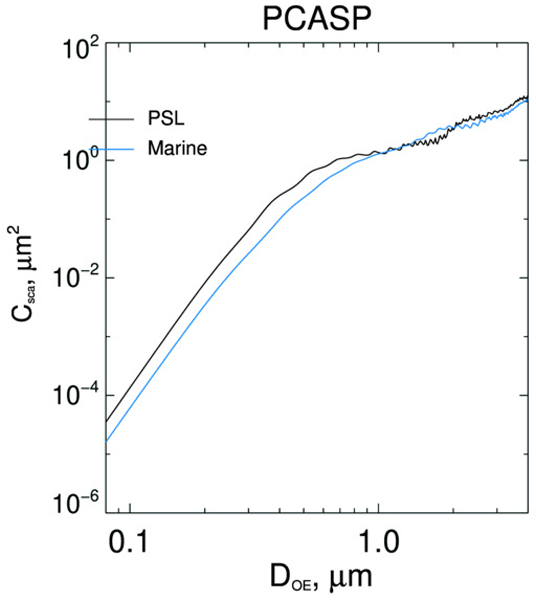
This study improves the accuracy of optical particle counters (OPCs), instruments used to measure airborne particles important for air quality and climate research. Because OPC measurements depend not only on particle size but also on composition and shape, results can be uncertain. The paper provides a standardized database of correction factors for five commercial OPCs, helping researchers produce more reliable and consistent aerosol measurements across a wide range of atmospheric conditions.
Clarissa Baldo, Servanne Chevaillier, Sophie Nowak, Gael Noyalet, Sandra Lafon, Claudia Di Biagio, Amelie Chaput, James King, Mathieu Cazaunau, Edouard Pangui, Jean-Francois Doussin, Remi Stanus, Nadine Mattielli, Heleen C. Vos, Gregory S. Okin, Brigitte Language, Tjaart Van Der Walt, Stuart Piketh, Karine Desboeufs, Akinori Ito, Silvia Becagli, Eugene Marais, Laurie Barrier, Stéphane Jacquemoud, and Paola Formenti
Atmos. Chem. Phys., 26, 10727–10749, https://doi.org/10.5194/acp-26-10727-2026, https://doi.org/10.5194/acp-26-10727-2026, 2026
Short summary
Short summary
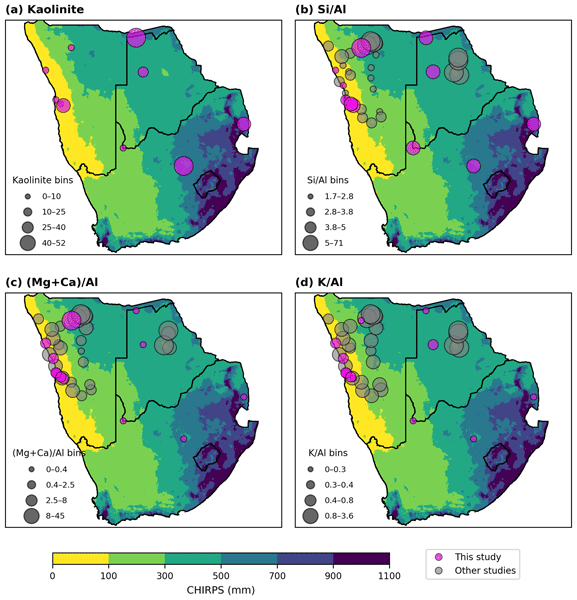
Our results show that crustal element ratios and clay contents distinguish dust aerosols from arid western coastal areas and humid eastern inland regions in Southern Africa. This dust contains key micronutrients that can become bioaccessible during atmospheric transport to nearby and remote marine ecosystems. It is also enriched in carbonates and K-feldspar, serving as a source of cloud condensation and ice nuclei, with potential implications ranging from regional to sub-hemispheric scales.
Chenjie Yu, Ludovico Di Antonio, Peter F. DeCarlo, Benjamin A. Nault, Alejandra Velazquez-Garcia, Eleonora Aruffo, Piero Di Carlo, Cyrielle Denjean, Sarah Tinorua, Thierry Bourrianne, Diana L. Pereira, Kevin Tu, Edouard Pangui, Mathieu Cazaunau, Astrid Bauville, Noël Grand, Antonin Bergé, Claudia Di Biagio, Aline Gratien, Matthias Beekmann, Guillaume Siour, Gilles Foret, Barbara D'Anna, Julien Kammer, Huihui Wu, Christopher Cantrell, Paola Formenti, and Vincent Michoud
EGUsphere, https://doi.org/10.5194/egusphere-2026-3147, https://doi.org/10.5194/egusphere-2026-3147, 2026
Short summary
Short summary
This study used coordinated airborne and ground-based measurements in Paris and its downwind regions to quantify the effects of 2–6 h of urban plume aging on aerosol properties. Aging enhanced secondary organic aerosol production and PM1 mass and shifted optical properties toward higher SSA, higher real and lower imaginary refractive indices, and stronger brown carbon absorption. These results highlight the need to account for aerosol aging in atmospheric models and remote-sensing retrievals.
Hendrik Fuchs, Niklas Illmann, Amalia Muñoz, Mila Ródenas, Bénédicte Picquet-Varrault, M. Rami Alfarra, Cecilia Arsene, Iustinian G. Bejan, David M. Bell, Merete Bilde, Alexander Böhmländer, Mixtli Campos-Pineda, Mathieu Cazaunau, Patrice Coll, Véronique Daële, Claudia Di Biagio, Michael Flynn, Paola Formenti, Hartmut Herrmann, Kristina Höhler, Thorsten Hohaus, Matthew S. Johnson, Eija Juurola, Niku Kivekäs, Jan Kaiser, Christos Kaltsonoudis, Paolo Laj, Dario Massabò, Federico Mazzei, Gordon McFiggans, Max R. McGillen, Abdelwahid Mellouki, Peter Mettke, Ottmar Möhler, Falk Mothes, Dennis Niedermeier, Anna Novelli, Romeo I. Olariu, Spyros N. Pandis, Iulia Patroescu-Klotz, Rosa Maria Petracca Altieri, Paolo Prati, Claudiu Roman, Albert A. Ruth, Harald Saathoff, Silvio Schmalfuß, Frank Stratmann, Virginia Vernocchi, Aristeidis Voliotis, Jens Voigtländer, Annele Virtanen, Andreas Wahner, Robert Wagner, John Wenger, Sören Zorn, Peter Wiesen, and Jean-Francois Doussin
Atmos. Meas. Tech., 19, 4165–4199, https://doi.org/10.5194/amt-19-4165-2026, https://doi.org/10.5194/amt-19-4165-2026, 2026
Short summary
Short summary
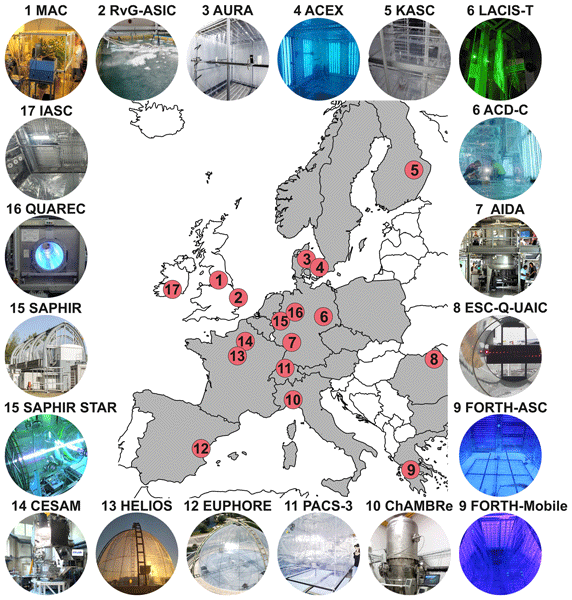
Atmospheric simulation chambers enable experiments to be conducted under controlled conditions, improving our understanding of, and ability to predict, changes in the composition of the atmosphere. This is important for assessing air quality and its effects on human health, climate, the environment, and the economy. This paper describes the chambers of the European ACTRIS research infrastructure and discusses topics and directions that can be addressed in future chamber experiments.
Paola Formenti, Danitza Klopper, Anais Feron, Mathieu Cazaunau, Servanne Chevaillier, Karine Desboeufs, Claudia Di Biagio, Clarissa Baldo, Cécile Gaimoz, Vincent Michoud, Cécile Mirande-Bret, Sylvain Triquet, François Hemeret, Richard Valorso, Stephen Broccardo, Andreas Namwoonde, Mattheus Hanghome, Chiara Giorio, and Stuart J. Piketh
Earth Syst. Sci. Data Discuss., https://doi.org/10.5194/essd-2026-95, https://doi.org/10.5194/essd-2026-95, 2026
Revised manuscript under review for ESSD
Short summary
Short summary
The southern African west coast is highly impacted by climate change and aerosols from natural and human sources, yet observations are scarce. We present measurements (2014–2019) from the Henties Bay Aerosol Observatory in Namibia, including aerosol properties, ozone and meteorology. This unique dataset will support process studies and improve regional climate modelling.
Johannes Heuser, Claudia Di Biagio, Jérôme Yon, Mathieu Cazaunau, Antonin Bergé, Edouard Pangui, Marco Zanatta, Laura Renzi, Angela Marinoni, Chenjie Yu, Servanne Chevaillier, Daniel Ferry, Paolo Laj, Michel Maillé, Paola Formenti, Benedicte Picquet-Varrault, and Jean-Francois Doussin
EGUsphere, https://doi.org/10.5194/egusphere-2026-1867, https://doi.org/10.5194/egusphere-2026-1867, 2026
Short summary
Short summary
Large simulation chamber experiments were performed to investigate the impact of non-absorbing coating on the absorption of fractal BC-containing soot. Results show the strong and combined effect of morphological modifications and mixing state heterogeneity on BC absorption, both depending on the reaction dynamics of coating formation and ageing of the coated soot. The range of measured absorption cannot be captured by common model approximations, highlighting the need for new formalisms.
Pasquale Sellitto, Maxim Eremenko, Paola Formenti, Perla Alalam, Michael Höpfner, and Claudia Di Biagio
Atmos. Meas. Tech., 19, 2751–2762, https://doi.org/10.5194/amt-19-2751-2026, https://doi.org/10.5194/amt-19-2751-2026, 2026
Short summary
Short summary
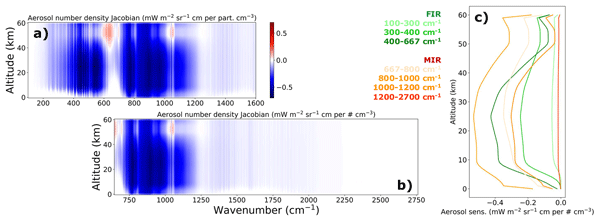
The Far-infrared Outgoing Radiation Understanding and Monitoring (FORUM) mission will bring the first satellite instrument capable of observing the Earth's far infrared (FIR) spectra with a high spectral resolution. FORUM will crucially contribute to water vapour, clouds and surface observations. We found that FORUM will provide also a significant sensitivity to dust aerosol, especially in cases of large burdens of mid-to-long-range transported plumes of dust in the free and upper troposphere.
Chenjie Yu, Paola Formenti, Joel F. de Brito, Astrid Bauville, Antonin Bergé, Hichem Bouzidi, Mathieu Cazaunau, Manuela Cirtog, Claudia Di Biagio, Ludovico Di Antonio, Cécile Gaimoz, Franck Maisonneuve, Pascal Zapf, Tobias Seubert, Simone T. Andersen, Patrick Dewald, Gunther N. T. E. Türk, John N. Crowley, Alexandre Kukui, Chaoyang Xue, Cyrielle Denjean, Olivier Garrouste, Jean-Claude Etienne, Huihui Wu, James D. Allan, Dantong Liu, Yangzhou Wu, Christopher Cantrell, and Vincent Michoud
Atmos. Chem. Phys., 26, 5313–5332, https://doi.org/10.5194/acp-26-5313-2026, https://doi.org/10.5194/acp-26-5313-2026, 2026
Short summary
Short summary
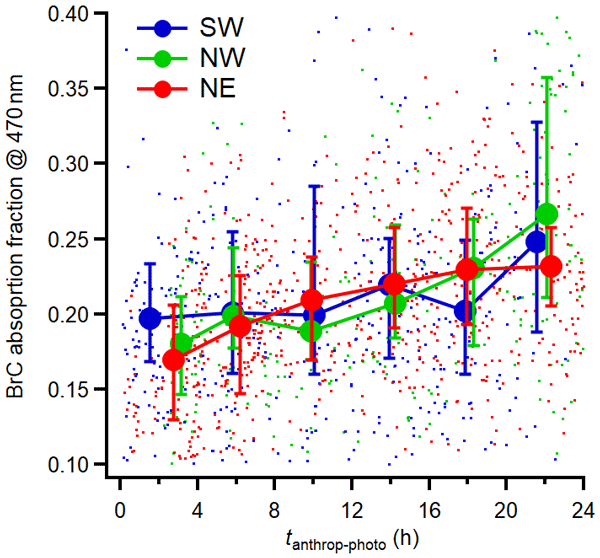
We presented a field measurement in a Paris suburban forest region to characterise the impacts of photochemical aging process on aerosol physical chemical properties. Photochemical production of organic aerosols increased forest fine particle mass and significantly enhanced absorption of short-wavelength sunlight. This study highlights the critical need to incorporate light absorbing carbonaceous particles formation mechanisms into models to accurately simulate their direct radiative impacts.
Laura Renzi, Claudia Di Biagio, Johannes Heuser, Marco Zanatta, Mathieu Cazaunau, Antonin Bergé, Edouard Pangui, Jérôme Yon, Tommaso Isolabella, Dario Massabò, Virginia Vernocchi, Martina Mazzini, Franziska Vogel, Chenjie Yu, Paola Formenti, Benedicte Picquet-Varrault, Jean-Francois Doussin, and Angela Marinoni
Atmos. Meas. Tech., 19, 1365–1383, https://doi.org/10.5194/amt-19-1365-2026, https://doi.org/10.5194/amt-19-1365-2026, 2026
Short summary
Short summary
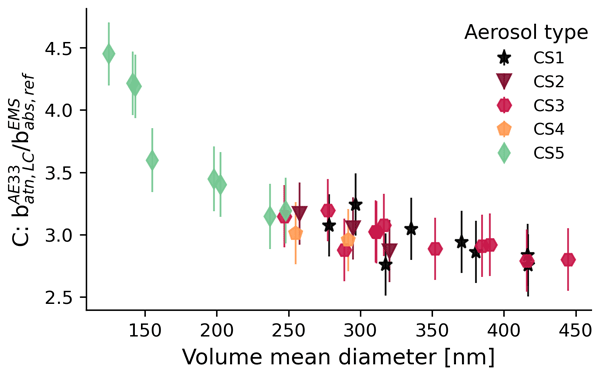
This study investigates how particle properties affect the accuracy of a common air pollution instrument, the dual-spot aethalometer. By combining lab experiments with real-world data from a mountain site in Italy, we found that the correction factor for this instrument varies mainly due to particle size and measurement conditions. Understanding these influences helps improve air quality monitoring, which is important for assessing pollution impacts on health and climate.
Paola Formenti, Chiara Giorio, Karine Desboeufs, Alexander Zherebker, Marco Gaetani, Clarissa Baldo, Gautier Landrot, Simona Montebello, Servanne Chevaillier, Sylvain Triquet, Guillaume Siour, Claudia Di Biagio, Francesco Battaglia, Jean-François Doussin, Anais Feron, Andreas Namwoonde, and Stuart John Piketh
Atmos. Chem. Phys., 25, 16127–16145, https://doi.org/10.5194/acp-25-16127-2025, https://doi.org/10.5194/acp-25-16127-2025, 2025
Short summary
Short summary
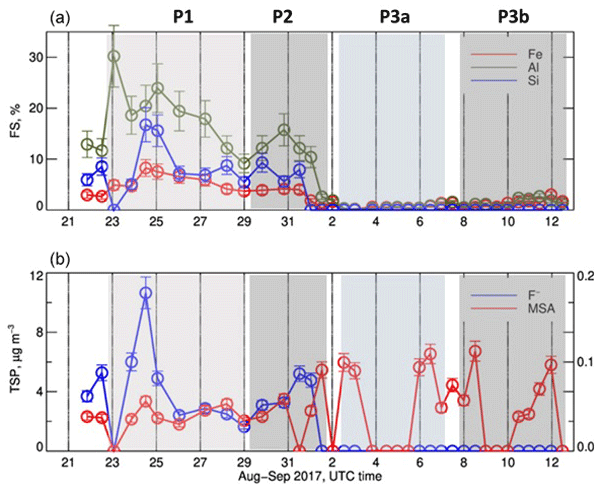
The elemental composition and solubility of several metals, including iron, at a coastal site in Namibia in August–September 2017, indicate that natural and anthropogenic dust had different solubility depending on mineralogy but mostly on the processing by fluoride ions from marine emissions, pointing to the complexity of atmospheric--oceanic interactions in this region of the world influenced by the Benguela current and significant aerosol load.
Chiara Giorio, Anne Monod, Valerio Di Marco, Pierre Herckes, Denise Napolitano, Amy Sullivan, Gautier Landrot, Daniel Warnes, Marika Nasti, Sara D'Aronco, Agathe Gérardin, Nicolas Brun, Karine Desboeufs, Sylvain Triquet, Servanne Chevaillier, Claudia Di Biagio, Francesco Battaglia, Frédéric Burnet, Stuart J. Piketh, Andreas Namwoonde, Jean-François Doussin, and Paola Formenti
Atmos. Chem. Phys., 25, 16107–16125, https://doi.org/10.5194/acp-25-16107-2025, https://doi.org/10.5194/acp-25-16107-2025, 2025
Short summary
Short summary
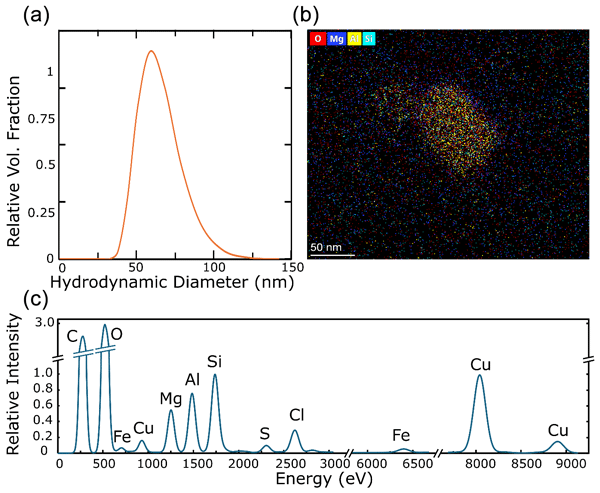
We present a comparison between concentrations of dissolved trace metals in pairs of total suspended particulate (TSP) and fog samples collected in Henties Bay, Namibia, during the AErosols, Radiation and CLOuds in southern Africa (AEROCLO-sA) field campaign. We found enhanced concentrations of dissolved metals in fog samples, which we attributed to metal–ligand complex formation in the early stages of particle activation into droplets that can then remain in a kinetically stable form in fog or lead to the formation of colloidal nanoparticles.
Johannes Heuser, Claudia Di Biagio, Jérôme Yon, Mathieu Cazaunau, Antonin Bergé, Edouard Pangui, Marco Zanatta, Laura Renzi, Angela Marinoni, Satoshi Inomata, Chenjie Yu, Vera Bernardoni, Servanne Chevaillier, Daniel Ferry, Paolo Laj, Michel Maillé, Dario Massabò, Federico Mazzei, Gael Noyalet, Hiroshi Tanimoto, Brice Temime-Roussel, Roberta Vecchi, Virginia Vernocchi, Paola Formenti, Bénédicte Picquet-Varrault, and Jean-François Doussin
Atmos. Chem. Phys., 25, 6407–6428, https://doi.org/10.5194/acp-25-6407-2025, https://doi.org/10.5194/acp-25-6407-2025, 2025
Short summary
Short summary
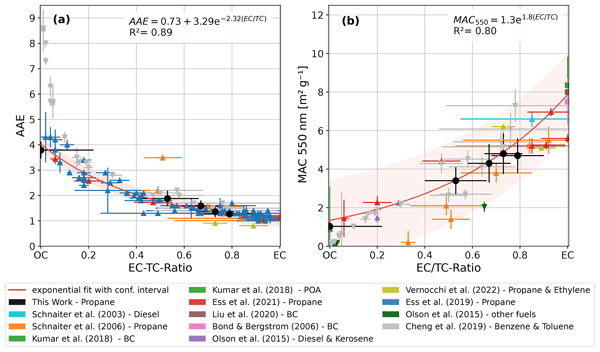
The spectral optical properties of combustion soot aerosols with varying black (BC) and brown carbon (BrC) content were studied in an atmospheric simulation chamber. Measurements of the mass spectral absorption cross section (MAC), supplemented by literature data, allowed us to establish a generalised exponential relationship between the spectral absorption and the elemental-to-total-carbon ratio (EC / TC) in soot. This relationship can provide a useful tool for modelling the properties of soot.
Diana L. Pereira, Chiara Giorio, Aline Gratien, Alexander Zherebker, Gael Noyalet, Servanne Chevaillier, Stéphanie Alage, Elie Almarj, Antonin Bergé, Thomas Bertin, Mathieu Cazaunau, Patrice Coll, Ludovico Di Antonio, Sergio Harb, Johannes Heuser, Cécile Gaimoz, Oscar Guillemant, Brigitte Language, Olivier Lauret, Camilo Macias, Franck Maisonneuve, Bénédicte Picquet-Varrault, Raquel Torres, Sylvain Triquet, Pascal Zapf, Lelia Hawkins, Drew Pronovost, Sydney Riley, Pierre-Marie Flaud, Emilie Perraudin, Pauline Pouyes, Eric Villenave, Alexandre Albinet, Olivier Favez, Robin Aujay-Plouzeau, Vincent Michoud, Christopher Cantrell, Manuela Cirtog, Claudia Di Biagio, Jean-François Doussin, and Paola Formenti
Atmos. Chem. Phys., 25, 4885–4905, https://doi.org/10.5194/acp-25-4885-2025, https://doi.org/10.5194/acp-25-4885-2025, 2025
Short summary
Short summary
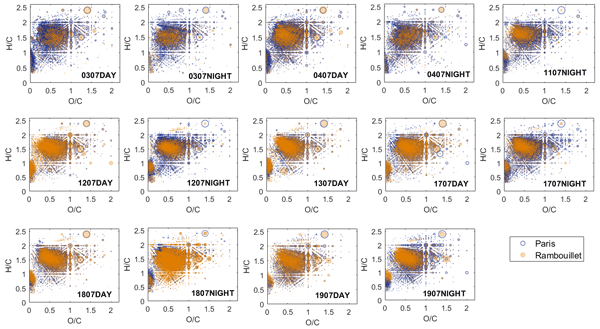
In order to study aerosols in environments influenced by anthropogenic and biogenic emissions, we performed analyses of samples collected during the ACROSS (Atmospheric Chemistry Of the Suburban Forest) campaign in summer 2022 in the greater Paris area. After analysis of the chemical composition by means of total carbon determination and high-resolution mass spectrometry, this work highlights the influence of anthropogenic inputs on the chemical composition of both urban and forested areas.
Ludovico Di Antonio, Matthias Beekmann, Guillaume Siour, Vincent Michoud, Christopher Cantrell, Astrid Bauville, Antonin Bergé, Mathieu Cazaunau, Servanne Chevaillier, Manuela Cirtog, Joel F. de Brito, Paola Formenti, Cecile Gaimoz, Olivier Garret, Aline Gratien, Valérie Gros, Martial Haeffelin, Lelia N. Hawkins, Simone Kotthaus, Gael Noyalet, Diana L. Pereira, Jean-Eudes Petit, Eva Drew Pronovost, Véronique Riffault, Chenjie Yu, Gilles Foret, Jean-François Doussin, and Claudia Di Biagio
Atmos. Chem. Phys., 25, 4803–4831, https://doi.org/10.5194/acp-25-4803-2025, https://doi.org/10.5194/acp-25-4803-2025, 2025
Short summary
Short summary
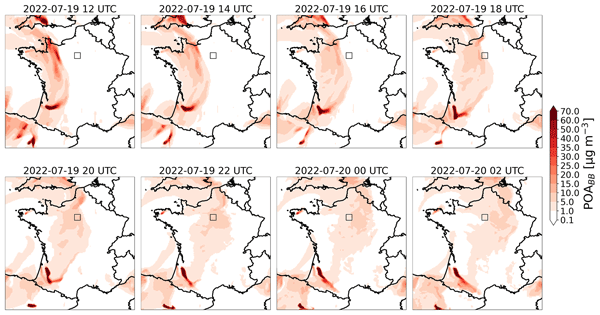
The summer of 2022 has been considered a proxy for future climate scenarios due to its hot and dry conditions. In this paper, we use the measurements from the Atmospheric Chemistry of the Suburban Forest (ACROSS) campaign, conducted in the Paris area in June–July 2022, along with observations from existing networks, to evaluate a 3D chemistry transport model (WRF–CHIMERE) simulation. Results are shown to be satisfactory, allowing us to explain the gas and aerosol variability at the campaign sites.
Soo-Jin Park, Lya Lugon, Oscar Jacquot, Youngseob Kim, Alexia Baudic, Barbara D'Anna, Ludovico Di Antonio, Claudia Di Biagio, Fabrice Dugay, Olivier Favez, Véronique Ghersi, Aline Gratien, Julien Kammer, Jean-Eudes Petit, Olivier Sanchez, Myrto Valari, Jérémy Vigneron, and Karine Sartelet
Atmos. Chem. Phys., 25, 3363–3387, https://doi.org/10.5194/acp-25-3363-2025, https://doi.org/10.5194/acp-25-3363-2025, 2025
Short summary
Short summary
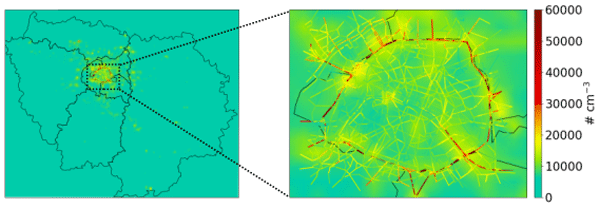
To accurately represent the population exposure to outdoor concentrations of pollutants of interest to health (NO2, PM2.5, black carbon, and ultrafine particles), multi-scale modelling down to the street scale is set up and evaluated using measurements from field campaigns. An exposure scaling factor is defined, allowing regional-scale simulations to be corrected to evaluate population exposure. Urban heterogeneities strongly influence NO2, black carbon, and ultrafine particles but less strongly PM2.5.
Ludovico Di Antonio, Claudia Di Biagio, Paola Formenti, Aline Gratien, Vincent Michoud, Christopher Cantrell, Astrid Bauville, Antonin Bergé, Mathieu Cazaunau, Servanne Chevaillier, Manuela Cirtog, Patrice Coll, Barbara D'Anna, Joel F. de Brito, David O. De Haan, Juliette R. Dignum, Shravan Deshmukh, Olivier Favez, Pierre-Marie Flaud, Cecile Gaimoz, Lelia N. Hawkins, Julien Kammer, Brigitte Language, Franck Maisonneuve, Griša Močnik, Emilie Perraudin, Jean-Eudes Petit, Prodip Acharja, Laurent Poulain, Pauline Pouyes, Eva Drew Pronovost, Véronique Riffault, Kanuri I. Roundtree, Marwa Shahin, Guillaume Siour, Eric Villenave, Pascal Zapf, Gilles Foret, Jean-François Doussin, and Matthias Beekmann
Atmos. Chem. Phys., 25, 3161–3189, https://doi.org/10.5194/acp-25-3161-2025, https://doi.org/10.5194/acp-25-3161-2025, 2025
Short summary
Short summary
The spectral complex refractive index (CRI) and single scattering albedo were retrieved from submicron aerosol measurements at three sites within the greater Paris area during the ACROSS field campaign (June–July 2022). Measurements revealed urban emission impact on surrounding areas. CRI full period averages at 520 nm were 1.41 – 0.037i (urban), 1.52 – 0.038i (peri-urban), and 1.50 – 0.025i (rural). Organic aerosols dominated the aerosol mass and contributed up to 22 % of absorption at 370 nm.
Paola Formenti and Claudia Di Biagio
Earth Syst. Sci. Data, 16, 4995–5007, https://doi.org/10.5194/essd-16-4995-2024, https://doi.org/10.5194/essd-16-4995-2024, 2024
Short summary
Short summary
Particles from deserts and semi-vegetated areas (mineral dust) are important for Earth's climate and human health, notably depending on their size. In this paper we collect and make a synthesis of a body of these observations since 1972 in order to provide researchers modeling Earth's climate and developing satellite observations from space with a simple way of confronting their results and understanding their validity.
Alice Maison, Lya Lugon, Soo-Jin Park, Alexia Baudic, Christopher Cantrell, Florian Couvidat, Barbara D'Anna, Claudia Di Biagio, Aline Gratien, Valérie Gros, Carmen Kalalian, Julien Kammer, Vincent Michoud, Jean-Eudes Petit, Marwa Shahin, Leila Simon, Myrto Valari, Jérémy Vigneron, Andrée Tuzet, and Karine Sartelet
Atmos. Chem. Phys., 24, 6011–6046, https://doi.org/10.5194/acp-24-6011-2024, https://doi.org/10.5194/acp-24-6011-2024, 2024
Short summary
Short summary
This study presents the development of a bottom-up inventory of urban tree biogenic emissions. Emissions are computed for each tree based on their location and characteristics and are integrated in the regional air quality model WRF-CHIMERE. The impact of these biogenic emissions on air quality is quantified for June–July 2022. Over Paris city, urban trees increase the concentrations of particulate organic matter by 4.6 %, of PM2.5 by 0.6 %, and of ozone by 1.0 % on average over 2 months.
Vincenzo Obiso, María Gonçalves Ageitos, Carlos Pérez García-Pando, Jan P. Perlwitz, Gregory L. Schuster, Susanne E. Bauer, Claudia Di Biagio, Paola Formenti, Kostas Tsigaridis, and Ron L. Miller
Atmos. Chem. Phys., 24, 5337–5367, https://doi.org/10.5194/acp-24-5337-2024, https://doi.org/10.5194/acp-24-5337-2024, 2024
Short summary
Short summary
We calculate the dust direct radiative effect (DRE) in an Earth system model accounting for regionally varying soil mineralogy through a new observationally constrained method. Linking dust absorption at solar wavelengths to the varying amount of specific minerals (i.e., iron oxides) improves the modeled range of dust single scattering albedo compared to observations and increases the global cooling by dust. Our results may contribute to improved estimates of the dust DRE and its climate impact.
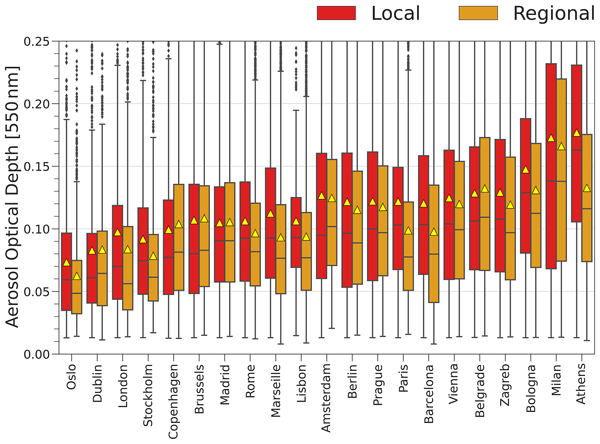
Ludovico Di Antonio, Claudia Di Biagio, Gilles Foret, Paola Formenti, Guillaume Siour, Jean-François Doussin, and Matthias Beekmann
Atmos. Chem. Phys., 23, 12455–12475, https://doi.org/10.5194/acp-23-12455-2023, https://doi.org/10.5194/acp-23-12455-2023, 2023
Short summary
Short summary
Long-term (2000–2021) 1 km resolution satellite data have been used to investigate the climatological aerosol optical depth (AOD) variability and trends at different scales in Europe. Average enhancements of the local-to-regional AOD ratio at 550 nm of 57 %, 55 %, 39 % and 32 % are found for large metropolitan areas such as Barcelona, Lisbon, Paris and Athens, respectively, suggesting a non-negligible enhancement of the aerosol burden through local emissions.
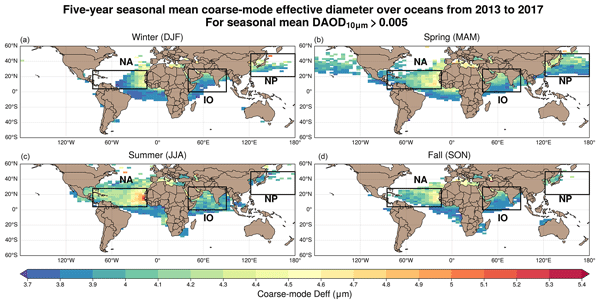
Jianyu Zheng, Zhibo Zhang, Hongbin Yu, Anne Garnier, Qianqian Song, Chenxi Wang, Claudia Di Biagio, Jasper F. Kok, Yevgeny Derimian, and Claire Ryder
Atmos. Chem. Phys., 23, 8271–8304, https://doi.org/10.5194/acp-23-8271-2023, https://doi.org/10.5194/acp-23-8271-2023, 2023
Short summary
Short summary
We developed a multi-year satellite-based retrieval of dust optical depth at 10 µm and the coarse-mode dust effective diameter over global oceans. It reveals climatological coarse-mode dust transport patterns and regional differences over the North Atlantic, the Indian Ocean and the North Pacific.
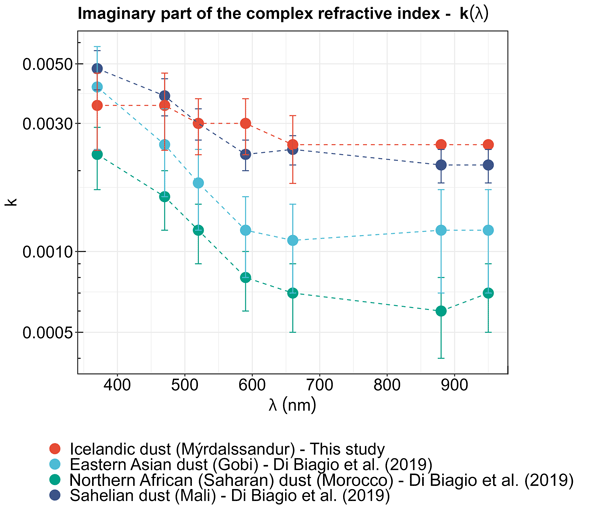
Clarissa Baldo, Paola Formenti, Claudia Di Biagio, Gongda Lu, Congbo Song, Mathieu Cazaunau, Edouard Pangui, Jean-Francois Doussin, Pavla Dagsson-Waldhauserova, Olafur Arnalds, David Beddows, A. Robert MacKenzie, and Zongbo Shi
Atmos. Chem. Phys., 23, 7975–8000, https://doi.org/10.5194/acp-23-7975-2023, https://doi.org/10.5194/acp-23-7975-2023, 2023
Short summary
Short summary
This paper presents new shortwave spectral complex refractive index and single scattering albedo data for Icelandic dust. Our results show that the imaginary part of the complex refractive index of Icelandic dust is at the upper end of the range of low-latitude dust. Furthermore, we observed that Icelandic dust is more absorbing towards the near-infrared, which we attribute to its high magnetite content. These findings are important for modeling dust aerosol radiative effects in the Arctic.
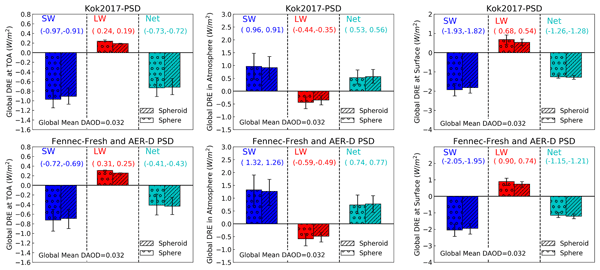
Qianqian Song, Zhibo Zhang, Hongbin Yu, Jasper F. Kok, Claudia Di Biagio, Samuel Albani, Jianyu Zheng, and Jiachen Ding
Atmos. Chem. Phys., 22, 13115–13135, https://doi.org/10.5194/acp-22-13115-2022, https://doi.org/10.5194/acp-22-13115-2022, 2022
Short summary
Short summary
This study developed a dataset that enables us to efficiently calculate dust direct radiative effect (DRE, i.e., cooling or warming our planet) for any given dust size distribution in addition to three sets of dust mineral components and two dust shapes. We demonstrate and validate the method of using this dataset to calculate dust DRE. Moreover, using this dataset we found that dust mineral composition is a more important factor in determining dust DRE than dust size and shape.
Paola Formenti, Claudia Di Biagio, Yue Huang, Jasper Kok, Marc Daniel Mallet, Damien Boulanger, and Mathieu Cazaunau
Atmos. Meas. Tech. Discuss., https://doi.org/10.5194/amt-2021-403, https://doi.org/10.5194/amt-2021-403, 2021
Publication in AMT not foreseen
Short summary
Short summary
This paper provides with standardized correction factors for the measurements of the most common instruments used in the atmosphere to measure the concentration per size of aerosol particles. These correction factors are provided to users with supplementary information for their use.
Lilian Loyer, Jean-Christophe Raut, Claudia Di Biagio, Julia Maillard, Vincent Mariage, and Jacques Pelon
Atmos. Meas. Tech. Discuss., https://doi.org/10.5194/amt-2021-326, https://doi.org/10.5194/amt-2021-326, 2021
Revised manuscript not accepted
Short summary
Short summary
The Arctic is facing drastic climate changes, and more observations are needed to better understand what is happening. Unfortunately observations are limited in the High Arctic. To obtain more observations, multiples buoys equipped with lidar, have been deployed in this region. This paper presents an approach to estimate the optical properties of clouds, and solar plus terrestrial energies from lidar measurements in the Arctic.
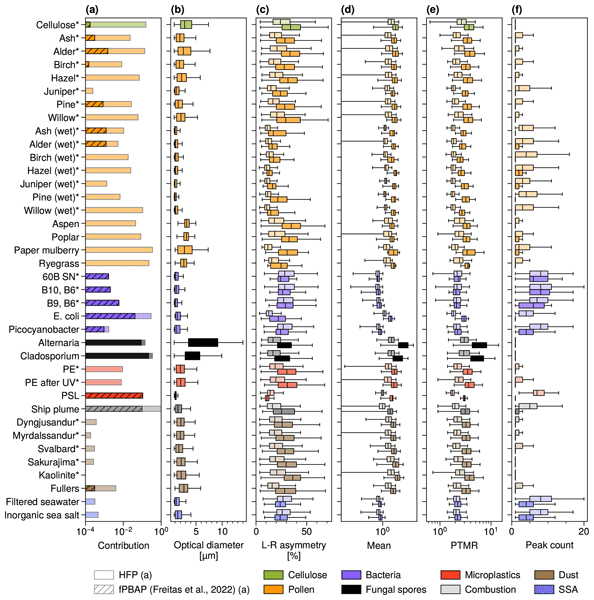
Aiden Jönsson, Jinglan Fu, Gabriel Pereira Freitas, Ian Crawford, Pavla Dagsson-Waldhauserová, Radovan Krejci, Yutaka Tobo, Karl Espen Yttri, and Paul Zieger
Atmos. Chem. Phys., 26, 13617–13643, https://doi.org/10.5194/acp-26-13617-2026, https://doi.org/10.5194/acp-26-13617-2026, 2026
Short summary
Short summary
Coarse-mode aerosols, like dust and bioaerosols, play important roles in environmental and climate processes. We measured fluorescence and morphological properties of key coarse-mode particle types, compared them with previous characterizations, and trained machine learning models with these data to classify unknown particles. This algorithm improves bioaerosol identification and successfully reproduces the annual bioaerosol cycle previously identified in a year of observations from Svalbard.
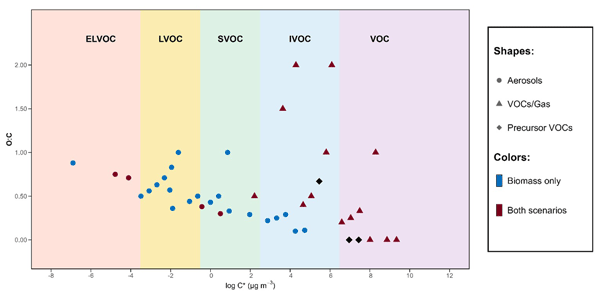
Elie Al Marj, Ambre Delater, Aline Gratien, Marie Line Torrijos, Juan Camilo Macias Rodriguez, Mathieu Cazaunau, Edouard Pangui, Antonin Bergé, Cécile Gaimoz, Thomas Bertin, Emmanuelle Mebold, Bénédicte Picquet-Varrault, Jean-François Doussin, Clément Buissot, Sophie Lanone, and Patrice Coll
Atmos. Chem. Phys., 26, 13645–13660, https://doi.org/10.5194/acp-26-13645-2026, https://doi.org/10.5194/acp-26-13645-2026, 2026
Short summary
Short summary
The "PolluRisk" platform simulated two urban scenarios: standard traffic and biomass burning. Using a smog chamber, the study showed that wood heating significantly modified aerosol chemistry, with organic fractions reaching 40 % of PM1 mass. Advanced mass spectrometry identified specific tracers of oxidation and combustion. These results provide a chemical framework for separate biological exposure experiments.
Jenine McCutcheon, James B. McQuaid, Helen Freeman, Jeffrey Paulo H. Perez, Jon Hawkings, Stefanie Lutz, Lou-Anne Chevrollier, Paola Formenti, Servanne Chevaillier, Martyn Tranter, and Liane G. Benning
EGUsphere, https://doi.org/10.5194/egusphere-2026-5031, https://doi.org/10.5194/egusphere-2026-5031, 2026
This preprint is open for discussion and under review for The Cryosphere (TC).
Short summary
Short summary
Soot can travel long distances and settle on snow and ice, where it absorbs light and promotes melting. We examined the size and shape of soot particles deposited on the Greenland Ice Sheet. By combining aerosol and geochemical methods, we show that the soot particles accumulate on the ice sheet surface, especially alongside dense glacier ice algal blooms. Soot accounts for ~15% of the combined darkening effect of algae and soot, highlighting the role of soot in ice albedo reduction and melting.
Paola Formenti and Claudia Di Biagio
Aerosol Research, 4, 429–440, https://doi.org/10.5194/ar-4-429-2026, https://doi.org/10.5194/ar-4-429-2026, 2026
Short summary
Short summary
This study improves the accuracy of optical particle counters (OPCs), instruments used to measure airborne particles important for air quality and climate research. Because OPC measurements depend not only on particle size but also on composition and shape, results can be uncertain. The paper provides a standardized database of correction factors for five commercial OPCs, helping researchers produce more reliable and consistent aerosol measurements across a wide range of atmospheric conditions.
Johannes Heuser, Claudia Di Biagio, Jérôme Yon, Mathieu Cazaunau, Antonin Bergé, Edouard Pangui, Marco Zanatta, Laura Renzi, Angela Marinoni, Chenjie Yu, Servanne Chevaillier, Daniel Ferry, Michel Maillé, Paola Formenti, Benedicte Picquet-Varrault, and Jean-François Doussin
Aerosol Research Discuss., https://doi.org/10.5194/ar-2026-31, https://doi.org/10.5194/ar-2026-31, 2026
Preprint under review for AR
Short summary
Short summary
We retrieve refractive indices of laboratory-generated soot from measured particle properties using Mie and RDG-FA optical calculations, and quantify uncertainties via Monte Carlo simulations. The inferred refractive indices strongly depend on the theory employed, highlighting the need for consistency between optical theory and refractive index. Mie retrievals are sensitive to coagulation and size growth, while RDG-FA retrievals depend strongly on the uncertainty of assumed particle morphology.
Marcos Morán, Kilian Schneiders, Melanie Eknayan, Ferdinando De Tomasi, Pierina Ielpo, Mark Scerri, Michael Nolle, and Konrad Kandler
EGUsphere, https://doi.org/10.5194/egusphere-2026-5232, https://doi.org/10.5194/egusphere-2026-5232, 2026
This preprint is open for discussion and under review for Atmospheric Chemistry and Physics (ACP).
Short summary
Short summary
Dust, sea spray and pollution particles settle out of the air, but few measurements exist for the central Mediterranean. Over two years we collected what settled at two sites, in southern Italy and on Malta, and examined the particles one by one under an electron microscope. Although the sites lie only about 600 kilometres apart, what settled differed strongly between them, changing with the season and with the type of particle, showing that a single site cannot represent the whole region.
Patrick Dewald, Sergio Harb, Bénédicte Picquet-Varrault, Mathieu Cazaunau, Maxime Feingesicht, Lucas Beltran, Vincent Michoud, Xavier Landsheere, Edouard Pangui, Antonin Bergé, Christopher Cantrell, and Manuela Cirtog
EGUsphere, https://doi.org/10.5194/egusphere-2026-5307, https://doi.org/10.5194/egusphere-2026-5307, 2026
This preprint is open for discussion and under review for Atmospheric Measurement Techniques (AMT).
Short summary
Short summary
We built an instrument to measure reactive nitrogen compounds in the atmosphere with a focus on the detection of nitrate radicals. They are formed by pollutants such as ozone and nitrogen oxides and are an important nocturnal oxidant of trace gases, thereby indirectly impacting the interconversion of reactive nitrogen and air quality. The instrument’s characterization, performance assessment and the first field deployment are presented.
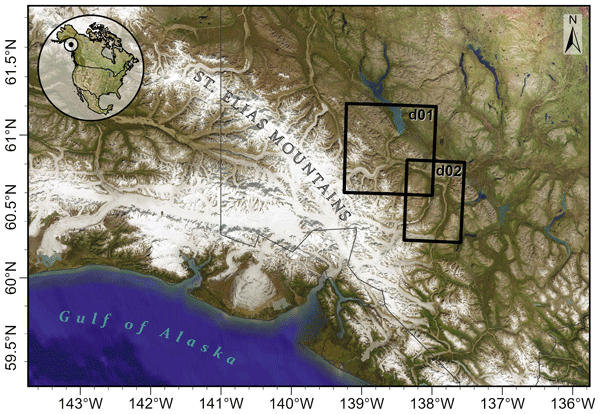
Daniel Bellamy, Martina Klose, Daniel F. Nadeau, Sebastian Engelstaedter, Richard Washington, and James King
Atmos. Chem. Phys., 26, 12613–12639, https://doi.org/10.5194/acp-26-12613-2026, https://doi.org/10.5194/acp-26-12613-2026, 2026
Short summary
Short summary
Mineral dust emissions are simulated for the first time from proglacial valleys of the St. Elias Mountains (western Canada/Alaska) to elucidate their contributions to regional climate forcing and global mineral dust loading. We implement a regional-scale dust emission model and evaluate simulated meteorology, dust emissions, and boundary layer processes for a holistic evaluation of how well aerosol dispersion can be simulated within this remote, mountainous landscape.
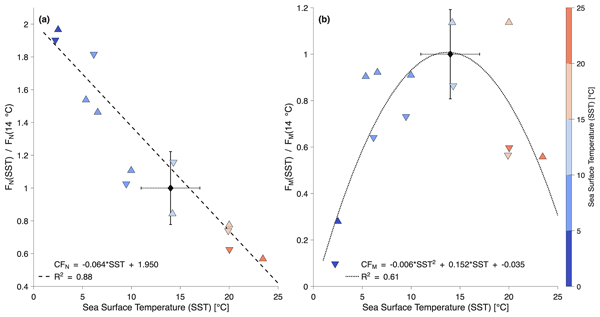
Raymond J. Leibensperger III, Justin D. Hamlin, Jena K. Herbst, Charbel Harb, Ke'La A. Kimble, Meinrat O. Andreae, Christopher Lee, Greg Sandstrom, M. Dale Stokes, Grant B. Deane, and Kimberly A. Prather
Atmos. Chem. Phys., 26, 12211–12229, https://doi.org/10.5194/acp-26-12211-2026, https://doi.org/10.5194/acp-26-12211-2026, 2026
Short summary
Short summary
This study presents a systematic investigation of how sea surface temperature (SST) influences sea spray aerosol (SSA) production under controlled wind-wave interactions. Using the Scripps Ocean-Atmosphere Research Simulator (SOARS), we characterize how SSA emissions decrease as SST increases from 2 to 23 °C, quantifying bubble populations, steady-state SSA concentrations, and SSA emission fluxes. We derive correction factors to improve the representation of SSA emissions in climate models.
Mona Kosary, Pasquale Sellitto, Michael Höpfner, Bernd Funke, Alex Hoffmann, Jörn Ungermann, Quentin Errera, Simone Tilmes, and Björn-Martin Sinnhuber
EGUsphere, https://doi.org/10.5194/egusphere-2026-4654, https://doi.org/10.5194/egusphere-2026-4654, 2026
Short summary
Short summary
We investigated whether future satellites could track changes in the ozone layer if reflective particles were deliberately added high in the atmosphere to cool the planet. Using climate model simulations, we created virtual satellite measurements and compared them with the original data. The method captured the key changes, especially stronger ozone loss and delayed recovery over Antarctica, while showing low artificial distortion. This suggests such satellites could provide important oversight.
Juliette Brochet, Hasna Chebaicheb, Olivier Favez, Laura Cadeo, Tanguy Amodeo, Yunjiang Zhang, Antonin Bergé, Philip Croteau, Vincent Crenn, Valérie Gros, and Jean-Eudes Petit
Earth Syst. Sci. Data Discuss., https://doi.org/10.5194/essd-2026-490, https://doi.org/10.5194/essd-2026-490, 2026
Preprint under review for ESSD
Short summary
Short summary
This work proposes a new methodology for robust, homogeneous processing of long-term datasets of aerosol mass spectrometer measurements to remedy the challenges posed by the emergence of juxtaposed data processing periods over the years. The results showed a global decrease in PM1 at a semi-urban site in the Paris region between 2011 and 2024, along with a decrease in the frequency of persistent pollution episodes. Finally, it highlights the need for Sulfate source apportionment analysis.
Clarissa Baldo, Servanne Chevaillier, Sophie Nowak, Gael Noyalet, Sandra Lafon, Claudia Di Biagio, Amelie Chaput, James King, Mathieu Cazaunau, Edouard Pangui, Jean-Francois Doussin, Remi Stanus, Nadine Mattielli, Heleen C. Vos, Gregory S. Okin, Brigitte Language, Tjaart Van Der Walt, Stuart Piketh, Karine Desboeufs, Akinori Ito, Silvia Becagli, Eugene Marais, Laurie Barrier, Stéphane Jacquemoud, and Paola Formenti
Atmos. Chem. Phys., 26, 10727–10749, https://doi.org/10.5194/acp-26-10727-2026, https://doi.org/10.5194/acp-26-10727-2026, 2026
Short summary
Short summary
Our results show that crustal element ratios and clay contents distinguish dust aerosols from arid western coastal areas and humid eastern inland regions in Southern Africa. This dust contains key micronutrients that can become bioaccessible during atmospheric transport to nearby and remote marine ecosystems. It is also enriched in carbonates and K-feldspar, serving as a source of cloud condensation and ice nuclei, with potential implications ranging from regional to sub-hemispheric scales.
Chantelle Burton, Francesca Di Giuseppe, Matthew W. Jones, Douglas I. Kelley, Maria L. F. Barbosa, Joe McNorton, Robert Potts, Carlota Segura-Garcia, John T. Abatzoglou, Iulian Alin Rosu, Niels Andela, Liana O. Anderson, Sally Archibald, Esther Brambleby, Emilio Chuvieco, Andy Ciavarella, Hamish Clarke, Francisco de la Barrera, Carlos M. Di Bella, Enza Di Tomaso, Kebonye Dintwe, Tim S. Doherty, Victoria M. Donovan, Jonathan M. Eden, Paulo M. Fernandes, Lukas Fiedler, Louis Giglio, Olivia Haas, Douglas Hamilton, Stijn Hantson, Sarah Harris, Andrew J. Hartley, Theodore R. Keeping, Crystal A. Kolden, Jean-Luc Kouassi, Elena Kukavskaya, Seppe Lampe, Zhongwei Liu, Guilherme Mataveli, Sarah Meier, Duarte Oom, Mark Parrington, Yuquan Qu, Victor Resco de Dios, Julien Ruffault, Mojtaba Sadegh, Cristina Santín, Fernando Sedano, Jacquelyn K. Shuman, Patrícia S. Silva, Fiona R. Spuler, Carmen B. Steinmann, Veerachai Tanpipat, Miguel Ángel Torres-Vazquez, Marco Turco, Guido R. van der Werf, Dave van Wees, Sander Veraverbeke, Jakob B. Wessel, and Bo Zheng
Earth Syst. Sci. Data Discuss., https://doi.org/10.5194/essd-2026-587, https://doi.org/10.5194/essd-2026-587, 2026
Preprint under review for ESSD
Short summary
Short summary
The third State of Wildfires report examines extreme wildfire events from 2025 to early 2026. It analyses key regional events in Midwestern Canadian Shield Forests, Northwest Iberia, and Chilean Temperate Forests and Matorral, assessing their impacts, drivers, and attributing them to climate change. Climate change greatly increased the likelihood of these fires, and without strong mitigation, such events will become more frequent.
Thomas Audoux, Ambre Delater, Manuella Ghanem, Jean-Baptiste Lily, Mathieu Cazaunau, Edouard Pangui, Benedicte Picquet-Varrault, Patrice Coll, Esperanza Perdrix, Laurent Alleman, and Davy Rousset
EGUsphere, https://doi.org/10.5194/egusphere-2026-4293, https://doi.org/10.5194/egusphere-2026-4293, 2026
This preprint is open for discussion and under review for Atmospheric Measurement Techniques (AMT).
Short summary
Short summary
Air pollution can affect human health, but not all particles are equally harmful. We developed a new instrument that measure the oxidative properties of the atmosphere continuously. Laboratory experiments showed that pollutants formed through sunlight-driven chemical reactions have a greater oxidative potential than particles containing higher levels of metals under night-time conditions. This will help us to better understand how rapid changes in air pollution may affect health.
Alejandra Velazquez-Garcia, Chenjie Yu, Sarah Tinorua, Hichem Bouzidi, Eleonora Aruffo, Piero Di Carlo, Peter DeCarlo, Benjamin A. Nault, Thierry Bourrianne, Kevin Tu, Edouard Pangui, Diana L. Pereira, Mathieu Cazaunau, Ludovico Di Antonio, Guillaume Siour, Matthias Beekmann, Astrid Bauville, Christopher Cantrell, Paola Formenti, Vincent Michoud, and Cyrielle Denjean
EGUsphere, https://doi.org/10.5194/egusphere-2026-4423, https://doi.org/10.5194/egusphere-2026-4423, 2026
Short summary
Short summary
As city air pollution travels downwind, its climate impact evolves. Using a research aircraft, we tracked the Paris pollution plume and found that sunlight rapidly transforms urban emissions, forming secondary organic particles that absorb more sunlight within six hours. These findings show that urban pollution changes chemically during transport, providing key constraints to improve future climate models.
Sofía Gómez Maqueo Anaya, Sudharaj Aryasree, Konrad Kandler, Eduardo José dos Santos Souza, Khanneh Wadinga Fomba, Dietrich Althausen, Maria Kezoudi, Matthias Faust, Bernd Heinold, Ina Tegen, Moritz Haarig, Holger Baars, and Kerstin Schepanski
Atmos. Chem. Phys., 26, 9929–9966, https://doi.org/10.5194/acp-26-9929-2026, https://doi.org/10.5194/acp-26-9929-2026, 2026
Short summary
Short summary
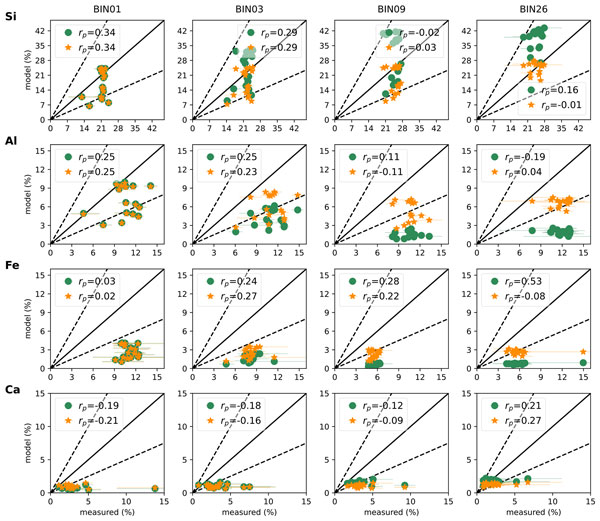
During two 2022 measurement campaigns in Cape Verde, Saharan dust aerosols were collected and analyzed for mineral composition. Mineralogy is crucial for dust–radiation and dust–cloud interactions. We improve dust representation in an atmospheric model by refining the translation of soil into aerosol particle size distributions. Validation with mineral and elemental measurements shows improved representation of some minerals and reveals biases missed by mineral-only comparisons.
Seyed Ali Sayedain, Norman T. O'Neill, Keyvan Ranjbar, Phillipe Gauvin-Bourdon, Rachel Chang, Patrick L. Hayes, and James King
Atmos. Meas. Tech., 19, 4553–4581, https://doi.org/10.5194/amt-19-4553-2026, https://doi.org/10.5194/amt-19-4553-2026, 2026
Short summary
Short summary
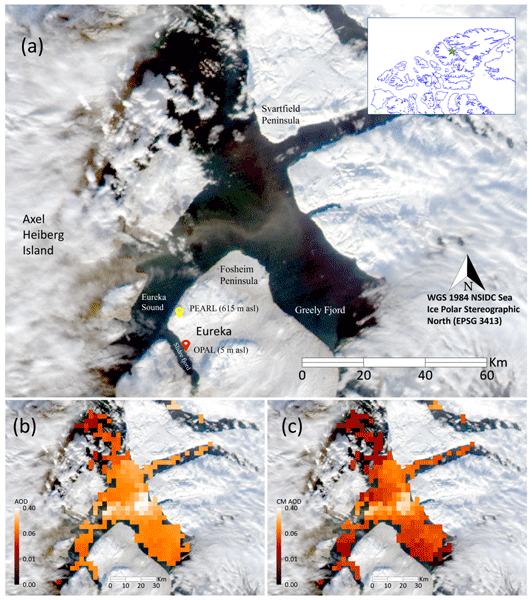
Dust plumes in the Canadian Arctic have important climatic change (CC) impacts on (i) snow and ice (darkening and thus premature melting) and (ii) as nuclei for cloud formation (cloud reflectivity is a poorly characterized but key CC parameter). Ground measurements of dust in that region are rare. We characterized plumes close to their drainage basin sources using ground- and satellite-based remote sensing (RS) estimates of such key parameters as plume height, speed, and opacity (concentration).
Sebastian Vergara-Palacio, Alexei Kiselev, Franziska Vogel, Adolfo González-Romero, Romy Fösig, Xavier Querol, Corinna Hoose, Nsikanabasi Silas Umo, Ottmar Möhler, Konrad Kandler, Carlos Pérez García-Pando, and Martina Klose
Atmos. Chem. Phys., 26, 9113–9147, https://doi.org/10.5194/acp-26-9113-2026, https://doi.org/10.5194/acp-26-9113-2026, 2026
Short summary
Short summary
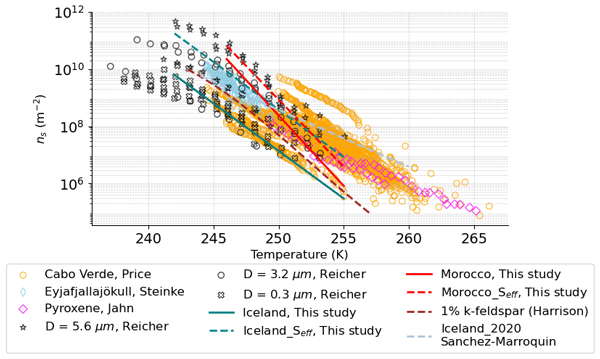
Atmospheric mineral dust can help clouds form ice, changing cloud properties and affecting weather and climate. We tested dust from Morocco and Iceland in more than 300 controlled laboratory experiments. Icelandic samples were up to 100 times less able to promote ice formation than Moroccan samples, and showed mineral-composition dependence. The results show the role of larger dust particles in ice nucleation and their relationship with mineralogy and size for low- and high-latitude sources.
Chenjie Yu, Ludovico Di Antonio, Peter F. DeCarlo, Benjamin A. Nault, Alejandra Velazquez-Garcia, Eleonora Aruffo, Piero Di Carlo, Cyrielle Denjean, Sarah Tinorua, Thierry Bourrianne, Diana L. Pereira, Kevin Tu, Edouard Pangui, Mathieu Cazaunau, Astrid Bauville, Noël Grand, Antonin Bergé, Claudia Di Biagio, Aline Gratien, Matthias Beekmann, Guillaume Siour, Gilles Foret, Barbara D'Anna, Julien Kammer, Huihui Wu, Christopher Cantrell, Paola Formenti, and Vincent Michoud
EGUsphere, https://doi.org/10.5194/egusphere-2026-3147, https://doi.org/10.5194/egusphere-2026-3147, 2026
Short summary
Short summary
This study used coordinated airborne and ground-based measurements in Paris and its downwind regions to quantify the effects of 2–6 h of urban plume aging on aerosol properties. Aging enhanced secondary organic aerosol production and PM1 mass and shifted optical properties toward higher SSA, higher real and lower imaginary refractive indices, and stronger brown carbon absorption. These results highlight the need to account for aerosol aging in atmospheric models and remote-sensing retrievals.
Corinna Kloss, Gwenaël Berthet, Pasquale Sellitto, Irene Bartolome Garcia, Emmanuel Briaud, Rubel Chandra Das, Stéphane Chevrier, Nicolas Dumelié, Lilian Joly, Thomas Lecas, Pauline Marbach, Felix Ploeger, Jean-Baptiste Renard, Jean-Paul Vernier, Frank G. Wienhold, and Michaela I. Hegglin
Atmos. Chem. Phys., 26, 8981–8997, https://doi.org/10.5194/acp-26-8981-2026, https://doi.org/10.5194/acp-26-8981-2026, 2026
Short summary
Short summary
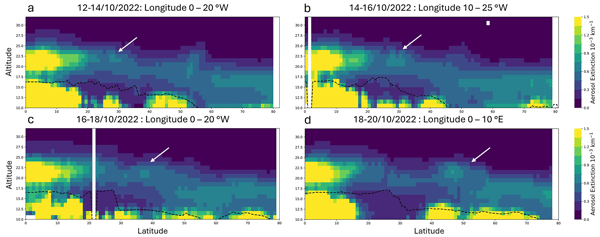
In October 2022, we detected volcanic particles in the stratosphere over France, linked to the January 2022 Hunga eruption in the South Pacific. Found between 17 and 23 km altitude, they were traced back to the tropics using trajectory simulations and satellite data. Their optical properties matched those in the Southern Hemisphere. The particles spread across the Northern Hemisphere, reflecting sunlight and slightly cooling the surface – a small but non-negligible effect.
Hendrik Fuchs, Niklas Illmann, Amalia Muñoz, Mila Ródenas, Bénédicte Picquet-Varrault, M. Rami Alfarra, Cecilia Arsene, Iustinian G. Bejan, David M. Bell, Merete Bilde, Alexander Böhmländer, Mixtli Campos-Pineda, Mathieu Cazaunau, Patrice Coll, Véronique Daële, Claudia Di Biagio, Michael Flynn, Paola Formenti, Hartmut Herrmann, Kristina Höhler, Thorsten Hohaus, Matthew S. Johnson, Eija Juurola, Niku Kivekäs, Jan Kaiser, Christos Kaltsonoudis, Paolo Laj, Dario Massabò, Federico Mazzei, Gordon McFiggans, Max R. McGillen, Abdelwahid Mellouki, Peter Mettke, Ottmar Möhler, Falk Mothes, Dennis Niedermeier, Anna Novelli, Romeo I. Olariu, Spyros N. Pandis, Iulia Patroescu-Klotz, Rosa Maria Petracca Altieri, Paolo Prati, Claudiu Roman, Albert A. Ruth, Harald Saathoff, Silvio Schmalfuß, Frank Stratmann, Virginia Vernocchi, Aristeidis Voliotis, Jens Voigtländer, Annele Virtanen, Andreas Wahner, Robert Wagner, John Wenger, Sören Zorn, Peter Wiesen, and Jean-Francois Doussin
Atmos. Meas. Tech., 19, 4165–4199, https://doi.org/10.5194/amt-19-4165-2026, https://doi.org/10.5194/amt-19-4165-2026, 2026
Short summary
Short summary
Atmospheric simulation chambers enable experiments to be conducted under controlled conditions, improving our understanding of, and ability to predict, changes in the composition of the atmosphere. This is important for assessing air quality and its effects on human health, climate, the environment, and the economy. This paper describes the chambers of the European ACTRIS research infrastructure and discusses topics and directions that can be addressed in future chamber experiments.
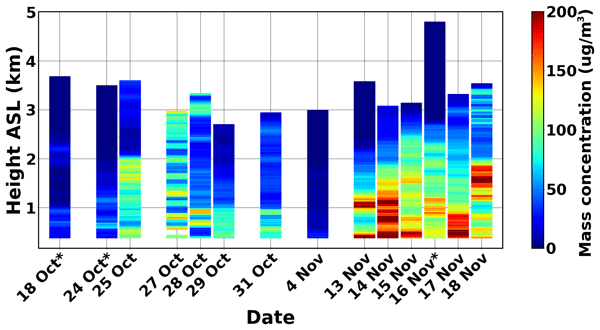
Maria Kezoudi, Alkistis Papetta, Konrad Kandler, Claire L. Ryder, Andreas Leonidou, Christos Keleshis, Chris Stopford, Troy Thornberry, Rodanthi-Elisavet Mamouri, Jean Sciare, and Franco Marenco
Atmos. Chem. Phys., 26, 7361–7385, https://doi.org/10.5194/acp-26-7361-2026, https://doi.org/10.5194/acp-26-7361-2026, 2026
Short summary
Short summary
This study demonstrates a cost-efficient methodology using Uncrewed Aerial Systems for quantitative characterization of airborne dust. It enables high-resolution vertical profiling of microphysical properties of dust layers from the Middle East and North Africa over Cyprus, improving understanding of regional dust transport, source-dependent variability, and impacts on air quality, radiation, and climate.
Maria Tsichla, Konrad Kandler, Sudharaj Aryasree, Stavros Solomos, Christos Spyrou, Alexandra Tsekeri, Anna Kampouri, Anna Gialitaki, Eleni Drakaki, Thanasis Natsis, Maria Kezoudi, Alkistis Papetta, Franco Marenco, Jean Sciare, Eleni Marinou, Kalliopi Artemis Voudouri, Nikos Mihalopoulos, and Vassilis Amiridis
EGUsphere, https://doi.org/10.5194/egusphere-2026-921, https://doi.org/10.5194/egusphere-2026-921, 2026
Short summary
Short summary
Desert dust plays an important role in the Earth–atmosphere system by affecting clouds, radiation, and ocean processes. Here, we determine the composition of desert dust over Cabo Verde using drones and microscopy analysis, and compare the measurements with model simulations. We find that the main dust mineral is illite, while the dominant element is silicon. Our results highlight the value of airborne in-situ observations for improving dust models and understanding dust–climate interactions.
Jian Xu, Junteng Wu, Mayur Gajanan Sapkal, Jim Grisillon, Shravan Deshmukh, Brice Temime Roussel, Julien Kammer, Nicolas Brun, Fabien Robert-Peillard, Beiping Luo, Judith Kleinheins, Silvia Henning, Bénédicte Picquet-Varrault, Edouard Pangui, Mathieu Cazaunau, Zamin A. Kanji, Claudia Marcolli, and Anne Monod
Aerosol Research Discuss., https://doi.org/10.5194/ar-2026-14, https://doi.org/10.5194/ar-2026-14, 2026
Preprint under review for AR
Short summary
Short summary
The study aimed to mimic the atmospheric behaviour of a semi-volatile organic compound in the presence of fine particles and at various relative humidities. The objective was to determine the influence of organic matter on humid particle growth. These results are essential for improving our understanding of cloud formation.
Paola Formenti, Danitza Klopper, Anais Feron, Mathieu Cazaunau, Servanne Chevaillier, Karine Desboeufs, Claudia Di Biagio, Clarissa Baldo, Cécile Gaimoz, Vincent Michoud, Cécile Mirande-Bret, Sylvain Triquet, François Hemeret, Richard Valorso, Stephen Broccardo, Andreas Namwoonde, Mattheus Hanghome, Chiara Giorio, and Stuart J. Piketh
Earth Syst. Sci. Data Discuss., https://doi.org/10.5194/essd-2026-95, https://doi.org/10.5194/essd-2026-95, 2026
Revised manuscript under review for ESSD
Short summary
Short summary
The southern African west coast is highly impacted by climate change and aerosols from natural and human sources, yet observations are scarce. We present measurements (2014–2019) from the Henties Bay Aerosol Observatory in Namibia, including aerosol properties, ozone and meteorology. This unique dataset will support process studies and improve regional climate modelling.
Johannes Heuser, Claudia Di Biagio, Jérôme Yon, Mathieu Cazaunau, Antonin Bergé, Edouard Pangui, Marco Zanatta, Laura Renzi, Angela Marinoni, Chenjie Yu, Servanne Chevaillier, Daniel Ferry, Paolo Laj, Michel Maillé, Paola Formenti, Benedicte Picquet-Varrault, and Jean-Francois Doussin
EGUsphere, https://doi.org/10.5194/egusphere-2026-1867, https://doi.org/10.5194/egusphere-2026-1867, 2026
Short summary
Short summary
Large simulation chamber experiments were performed to investigate the impact of non-absorbing coating on the absorption of fractal BC-containing soot. Results show the strong and combined effect of morphological modifications and mixing state heterogeneity on BC absorption, both depending on the reaction dynamics of coating formation and ageing of the coated soot. The range of measured absorption cannot be captured by common model approximations, highlighting the need for new formalisms.
Pasquale Sellitto, Maxim Eremenko, Paola Formenti, Perla Alalam, Michael Höpfner, and Claudia Di Biagio
Atmos. Meas. Tech., 19, 2751–2762, https://doi.org/10.5194/amt-19-2751-2026, https://doi.org/10.5194/amt-19-2751-2026, 2026
Short summary
Short summary
The Far-infrared Outgoing Radiation Understanding and Monitoring (FORUM) mission will bring the first satellite instrument capable of observing the Earth's far infrared (FIR) spectra with a high spectral resolution. FORUM will crucially contribute to water vapour, clouds and surface observations. We found that FORUM will provide also a significant sensitivity to dust aerosol, especially in cases of large burdens of mid-to-long-range transported plumes of dust in the free and upper troposphere.
Pasquale Sellitto, Mona Kosary, Michael Höpfner, Bernd Funke, Alex Hoffmann, Jörn Ungermann, Quentin Errera, Simone Tilmes, and Björn-Martin Sinnhuber
EGUsphere, https://doi.org/10.5194/egusphere-2026-919, https://doi.org/10.5194/egusphere-2026-919, 2026
Short summary
Short summary
To counterbalance human-caused global warming, highly controversial geoengineering techniques, based on stratospheric aerosol injection (SAI), have been proposed as a complement to climate change mitigation. Unilateral or illegal SAI deployments or tests are a risk. We show that existing satellite instruments do not have the capability to detect possible illegal SAI experiments and we propose a future satellite technique, infrared limb emission sounding, that can provide this missing capability.
Chenjie Yu, Paola Formenti, Joel F. de Brito, Astrid Bauville, Antonin Bergé, Hichem Bouzidi, Mathieu Cazaunau, Manuela Cirtog, Claudia Di Biagio, Ludovico Di Antonio, Cécile Gaimoz, Franck Maisonneuve, Pascal Zapf, Tobias Seubert, Simone T. Andersen, Patrick Dewald, Gunther N. T. E. Türk, John N. Crowley, Alexandre Kukui, Chaoyang Xue, Cyrielle Denjean, Olivier Garrouste, Jean-Claude Etienne, Huihui Wu, James D. Allan, Dantong Liu, Yangzhou Wu, Christopher Cantrell, and Vincent Michoud
Atmos. Chem. Phys., 26, 5313–5332, https://doi.org/10.5194/acp-26-5313-2026, https://doi.org/10.5194/acp-26-5313-2026, 2026
Short summary
Short summary
We presented a field measurement in a Paris suburban forest region to characterise the impacts of photochemical aging process on aerosol physical chemical properties. Photochemical production of organic aerosols increased forest fine particle mass and significantly enhanced absorption of short-wavelength sunlight. This study highlights the critical need to incorporate light absorbing carbonaceous particles formation mechanisms into models to accurately simulate their direct radiative impacts.
Maximilian Dollner, Josef Gasteiger, Konrad Kandler, Manuel Schöberl, Sudharaj Aryasree, Benjamin Witschas, and Bernadett Weinzierl
EGUsphere, https://doi.org/10.5194/egusphere-2026-531, https://doi.org/10.5194/egusphere-2026-531, 2026
Short summary
Short summary
During the A-LIFE campaign in the Eastern Mediterranean, a research aircraft observed clouds in a Saharan dust layer using in situ and remote sensing measurements. With new analysis tools for improved particle sizing and liquid water content measurements, this study assesses two different aerosol-cloud interaction processes: heterogeneous ice nucleation on super-micron dust particles at the cloud top, and small-scale activation of mineral dust particles to liquid droplets within the cloud.

Clair Duchamp, Bernard Legras, Aurélien Podglajen, Pasquale Sellitto, Adam E. Bourassa, Alexei Rozanov, Ghassan Taha, and Daniel J. Zawada
Atmos. Meas. Tech., 19, 1675–1696, https://doi.org/10.5194/amt-19-1675-2026, https://doi.org/10.5194/amt-19-1675-2026, 2026
Short summary
Short summary
We analyzed the stratospheric aerosol plume from the 2022 Hunga eruption using satellite lidar data. We implemented a method to retrieve some aerosol properties, as standard products failed in this case. We found very high optical depth values in the days following the eruption, which decreased rapidly but remained elevated for months. Our results are broadly validated, though some satellite products underestimate the values due, in part, to the unusual aerosol size distribution in the plume.
Laura Renzi, Claudia Di Biagio, Johannes Heuser, Marco Zanatta, Mathieu Cazaunau, Antonin Bergé, Edouard Pangui, Jérôme Yon, Tommaso Isolabella, Dario Massabò, Virginia Vernocchi, Martina Mazzini, Franziska Vogel, Chenjie Yu, Paola Formenti, Benedicte Picquet-Varrault, Jean-Francois Doussin, and Angela Marinoni
Atmos. Meas. Tech., 19, 1365–1383, https://doi.org/10.5194/amt-19-1365-2026, https://doi.org/10.5194/amt-19-1365-2026, 2026
Short summary
Short summary
This study investigates how particle properties affect the accuracy of a common air pollution instrument, the dual-spot aethalometer. By combining lab experiments with real-world data from a mountain site in Italy, we found that the correction factor for this instrument varies mainly due to particle size and measurement conditions. Understanding these influences helps improve air quality monitoring, which is important for assessing pollution impacts on health and climate.
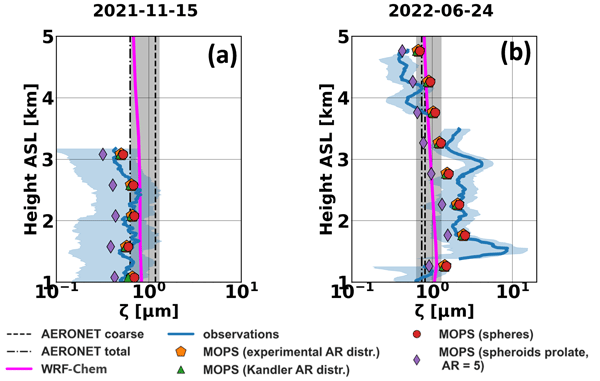
Alkistis Papetta, Maria Kezoudi, Holger Baars, Athina Floutsi, Eleni Drakaki, Konrad Kandler, Sudharaj Aryasree, Elena Louca, Theodoros Christoudias, Eleni Marinou, Chris Stopford, Troy Thornberry, Vassilis Amiridis, Jean Sciare, and Franco Marenco
Atmos. Chem. Phys., 26, 2055–2082, https://doi.org/10.5194/acp-26-2055-2026, https://doi.org/10.5194/acp-26-2055-2026, 2026
Short summary
Short summary
Dust in the atmosphere affects air quality, weather, and climate, but measuring it is challenging. We used drones and ground-based instruments to study how dust particles interact with light and relate this to their mass. Current methods often underestimate large dust particles, leading to errors in dust quantity. Our results show that regional differences in dust must be considered to improve climate models and satellite observations.
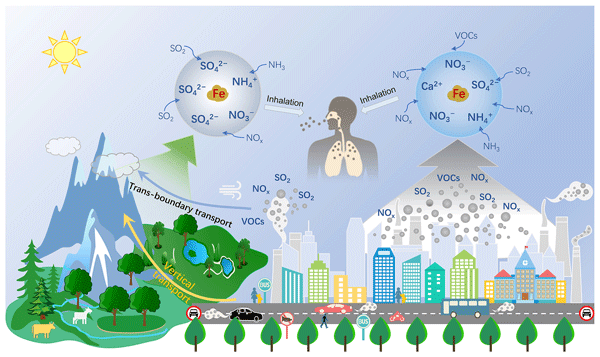
Guochen Wang, Xuedong Cui, Bingye Xu, Can Wu, Minkang Zhi, Keliang Li, Liang Xu, Qi Yuan, Yuntao Wang, Yele Sun, Zongbo Shi, Akinori Ito, Shixian Zhai, and Weijun Li
Atmos. Chem. Phys., 26, 1483–1496, https://doi.org/10.5194/acp-26-1483-2026, https://doi.org/10.5194/acp-26-1483-2026, 2026
Short summary
Short summary
Iron acidification process is primarily driven by sulphuric acid in the upper mixing layer different from nitric acid at the ground-level. Enhanced atmospheric aging process contributes to high iron solubility in the upper mixing layer. Numerical models should consider vertical variations in iron dissolution to improve simulation accuracy.
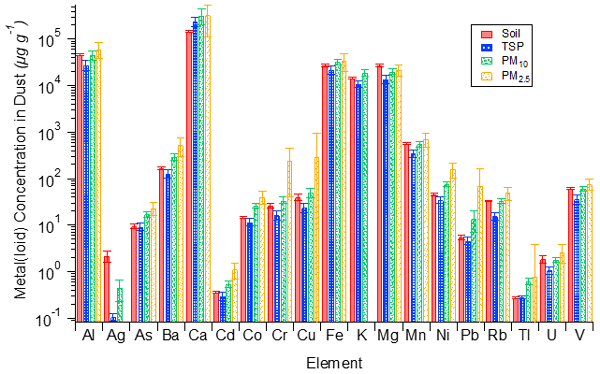
Arnold R. Downey, Alisée Dourlent, Daniel Bellamy, James King, and Patrick L. Hayes
Atmos. Chem. Phys., 26, 1321–1337, https://doi.org/10.5194/acp-26-1321-2026, https://doi.org/10.5194/acp-26-1321-2026, 2026
Short summary
Short summary
Glacial sediment of the ’A’ą̈y Chù’ Valley in Yukon, Canada is exposed to strong winds, and consequently, has become a significant mineral dust source. Mineral dust is known to have an impact on human health, partly due to various metals it contains, with the size of the particles also being an important factor. The goal of this study was to determine the concentration of various metals in the dust, how this relates to dust size, and whether air quality standards were surpassed.
Juncheng Qian, Thomas Wynn, Bowen Liu, Yuli Shan, Suzanne E. Bartington, Francis D. Pope, Yuqing Dai, and Zongbo Shi
Atmos. Meas. Tech., 19, 603–615, https://doi.org/10.5194/amt-19-603-2026, https://doi.org/10.5194/amt-19-603-2026, 2026
Short summary
Short summary
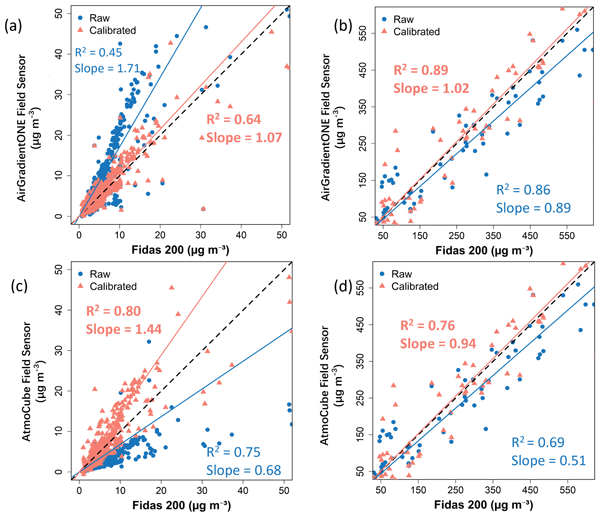
We developed a multi-stage AutoML (Automated Machine Learning) calibration framework to improve low-cost indoor PM2.5 sensor accuracy. Using chamber tests with varied emission sources, the method corrected drift, humidity effects, and non-linear responses, raising R2 above 0.9 and halving RMSE (Root Mean Square Error). The approach enables reliable, scalable indoor air quality monitoring for research and public health applications.
Song Liu, Xiaopu Lyu, Fumo Yang, Zongbo Shi, Xin Huang, Tengyu Liu, Hongli Wang, Mei Li, Jian Gao, Nan Chen, Guoliang Shi, Yu Zou, Chenglei Pei, Chengxu Tong, Xinyi Liu, Li Zhou, Alex B. Guenther, and Nan Wang
Atmos. Chem. Phys., 26, 635–646, https://doi.org/10.5194/acp-26-635-2026, https://doi.org/10.5194/acp-26-635-2026, 2026
Short summary
Short summary
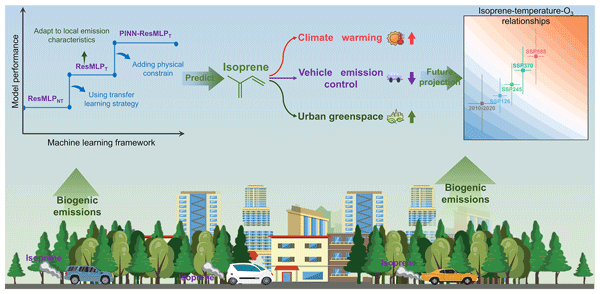
We studied the invisible gas isoprene, which trees and vehicles release into the air and which can worsen urban smog. Using advanced computer learning trained on measurements from many cities, we uncovered how temperature, sunlight, and city greening shape isoprene levels. Comparing Hong Kong and London, we found climate warming boosts isoprene and future ozone pollution, but strong cuts in anthropogenic emission could limit this impact.
Viola Hipler, Hendrik Andersen, Robert Spirig, Roland Vogt, Stuart Piketh, Bianca Adler, and Jan Cermak
EGUsphere, https://doi.org/10.5194/egusphere-2025-5816, https://doi.org/10.5194/egusphere-2025-5816, 2026
Short summary
Short summary
Fog is a key component of the Namib Desert ecosystem, and is mostly associated with the advection of marine stratus clouds. Here, we use local measurements near the coast to distinguish fog situations from lifted low-cloud situations. Using reanalysis data, we find synoptic and regional-scale processes over the ocean and over the continent that are connected to stratus altitude and therefore fog occurrence patterns. The results lead to a better understanding of the coastal desert fog system.
Hannah Meyer, Konrad Kandler, Sylvain Dupont, Jerónimo Escribano, Jessica Girdwood, George Nikolich, Andrés Alastuey, Vicken Etyemezian, Cristina González-Flórez, Adolfo González-Romero, Tareq Hussein, Mark Irvine, Peter Knippertz, Ottmar Möhler, Xavier Querol, Chris Stopford, Franziska Vogel, Frederik Weis, Andreas Wieser, Carlos Pérez García-Pando, and Martina Klose
Atmos. Meas. Tech., 19, 21–61, https://doi.org/10.5194/amt-19-21-2026, https://doi.org/10.5194/amt-19-21-2026, 2026
Short summary
Short summary
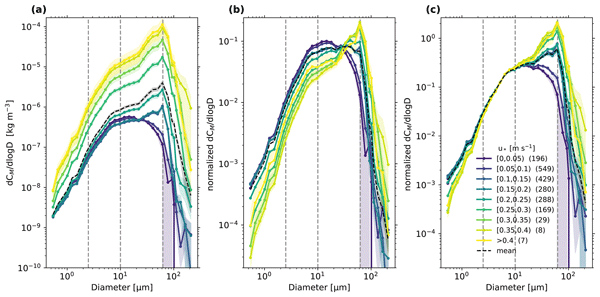
Mineral dust particles emitted from dry soils are of various sizes, yet the abundance of very large particles is not well understood. Here we measured the dust size distribution from fine to giant particles at an emission source during a field campaign in Jordan (J-WADI) using multiple instruments. Our findings show that large particles make up a significant part of the total dust mass. This knowledge is essential to improve climate models and to predict dust impacts on climate and environment.
Diana L. Pereira, Aline Gratien, Chiara Giorio, Emmanuelle Mebold, Thomas Bertin, Cécile Gaimoz, Jean-François Doussin, and Paola Formenti
Atmos. Meas. Tech., 19, 1–19, https://doi.org/10.5194/amt-19-1-2026, https://doi.org/10.5194/amt-19-1-2026, 2026
Short summary
Short summary
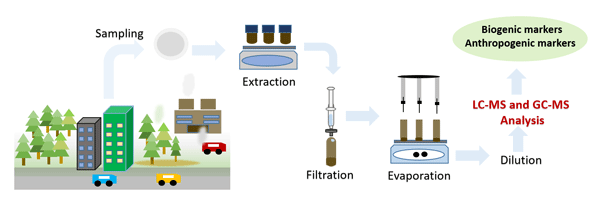
This study provides two methods for the quantification of molecular markers to improve the description of secondary organic aerosols using chromatographic techniques coupled with mass spectrometry. Compounds from various chemical functionalities (alcohols, acids, aldehydes), from biogenic and anthropogenic origin, were identified. Improved method performance was observed for nitro compounds, which have been associated with anthropogenic activities.
Luis Valero, Konrad Kandler, Sina Jost, Holger Tost, Luca Katarina Eichhorn, Christian von Glahn, Harald Rott, Marilena Flory, Alexandre Baron, Kathie Smith, Troy Thornberry, and Ralf Weigel
EGUsphere, https://doi.org/10.5194/egusphere-2025-5568, https://doi.org/10.5194/egusphere-2025-5568, 2025
Preprint archived
Short summary
Short summary
We developed a low-cost, balloon-lifted platform with lightweight instruments to measure particles and collect samples. We tested this platform during two field campaigns in Germany. A case study showed its ability to observe the vertical distribution of particles and how they form cloud droplets. Electronic microscope analysis of the samples identified their chemical composition. This work shows the platform is a capable tool for studying atmospheric processes.
Redha Belhadji, Pasquale Sellitto, Maxim Eremenko, Silvia Bucci, Tran M. Nguyet, Martin Schwell, and Bernard Legras
Atmos. Meas. Tech., 18, 7465–7476, https://doi.org/10.5194/amt-18-7465-2025, https://doi.org/10.5194/amt-18-7465-2025, 2025
Short summary
Short summary
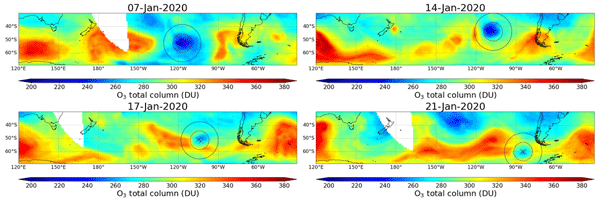
The 2019–2020 Australian wildfires triggered massive Pyro-cumulonimbus clouds, injecting smoke aerosols into the stratosphere and forming a self-sustaining vortex that reached 35 km altitude. This vortex created a transient ozone mini-hole. Using satellite and ground-based observations, we tracked a 30–40 % initial ozone depletion, which decayed to ~7 % within a month. These findings highlight the impact of extreme wildfires on stratospheric dynamics and ozone composition.
Chiara Giorio, Anne Monod, Valerio Di Marco, Pierre Herckes, Denise Napolitano, Amy Sullivan, Gautier Landrot, Daniel Warnes, Marika Nasti, Sara D'Aronco, Agathe Gérardin, Nicolas Brun, Karine Desboeufs, Sylvain Triquet, Servanne Chevaillier, Claudia Di Biagio, Francesco Battaglia, Frédéric Burnet, Stuart J. Piketh, Andreas Namwoonde, Jean-François Doussin, and Paola Formenti
Atmos. Chem. Phys., 25, 16107–16125, https://doi.org/10.5194/acp-25-16107-2025, https://doi.org/10.5194/acp-25-16107-2025, 2025
Short summary
Short summary
We present a comparison between concentrations of dissolved trace metals in pairs of total suspended particulate (TSP) and fog samples collected in Henties Bay, Namibia, during the AErosols, Radiation and CLOuds in southern Africa (AEROCLO-sA) field campaign. We found enhanced concentrations of dissolved metals in fog samples, which we attributed to metal–ligand complex formation in the early stages of particle activation into droplets that can then remain in a kinetically stable form in fog or lead to the formation of colloidal nanoparticles.
Paola Formenti, Chiara Giorio, Karine Desboeufs, Alexander Zherebker, Marco Gaetani, Clarissa Baldo, Gautier Landrot, Simona Montebello, Servanne Chevaillier, Sylvain Triquet, Guillaume Siour, Claudia Di Biagio, Francesco Battaglia, Jean-François Doussin, Anais Feron, Andreas Namwoonde, and Stuart John Piketh
Atmos. Chem. Phys., 25, 16127–16145, https://doi.org/10.5194/acp-25-16127-2025, https://doi.org/10.5194/acp-25-16127-2025, 2025
Short summary
Short summary
The elemental composition and solubility of several metals, including iron, at a coastal site in Namibia in August–September 2017, indicate that natural and anthropogenic dust had different solubility depending on mineralogy but mostly on the processing by fluoride ions from marine emissions, pointing to the complexity of atmospheric--oceanic interactions in this region of the world influenced by the Benguela current and significant aerosol load.
Heiko Bozem, Philipp Joppe, Yun Li, Nicolas Emig, Armin Afchine, Anna Breuninger, Joachim Curtius, Stefan Hofmann, Sadath Ismayil, Konrad Kandler, Daniel Kunkel, Arthur Kutschka, Hans-Christoph Lachnitt, Andreas Petzold, Sarah Richter, Timo Röschenthaler, Christian Rolf, Lisa Schneider, Johannes Schneider, Alexander Vogel, and Peter Hoor
Atmos. Meas. Tech., 18, 6545–6568, https://doi.org/10.5194/amt-18-6545-2025, https://doi.org/10.5194/amt-18-6545-2025, 2025
Short summary
Short summary
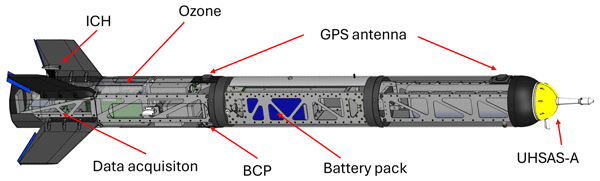
Deployed on a Learjet as a tandem measurement platform during the TPEx I (TropoPause composition gradients and mixing Experiment) campaign in June 2024, the new TPC-TOSS (TropoPause Composition Towed Sensor Shuttle) system delivers high-resolution in situ data on ozone, aerosol, and key meteorological parameters. Laboratory and in-flight tests confirmed its precision and stability. Observed gradients near the tropopause reveal active mixing and transport processes in the tropopause region.
Philipp Joppe, Johannes Schneider, Jonas Wilsch, Heiko Bozem, Anna Breuninger, Joachim Curtius, Martin Ebert, Nicolas Emig, Peter Hoor, Sadath Ismayil, Konrad Kandler, Daniel Kunkel, Isabel Kurth, Hans-Christoph Lachnitt, Yun Li, Annette Miltenberger, Sarah Richter, Christian Rolf, Lisa Schneider, Cornelis Schwenk, Nicole Spelten, Alexander L. Vogel, Yafang Cheng, and Stephan Borrmann
Atmos. Chem. Phys., 25, 15077–15103, https://doi.org/10.5194/acp-25-15077-2025, https://doi.org/10.5194/acp-25-15077-2025, 2025
Short summary
Short summary
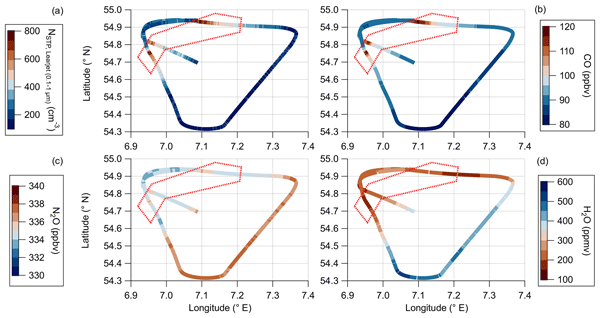
We show measurements of a filament with biomass burning influence transported by a warm conveyor belt (WCB) into the tropopause region over Europe. The pollution originates from Canadian forest fires and is transported in the lower troposphere towards Europe. The WCB transport is followed by mixing with air masses of stratospheric chemical signatures. We hypothesize that this mixing leads to a change in the vertical gradient of the potential temperature.
Rafael Valiati, Bruno B. Meller, Marco A. Franco, Luciana V. Rizzo, Luiz A. T. Machado, Sebastian Brill, Bruna A. Holanda, Leslie A. Kremper, Subha S. Raj, Samara Carbone, Cléo Q. Dias-Júnior, Fernando G. Morais, Meinrat O. Andreae, Ulrich Pöschl, Christopher Pöhlker, and Paulo Artaxo
Atmos. Chem. Phys., 25, 14923–14944, https://doi.org/10.5194/acp-25-14923-2025, https://doi.org/10.5194/acp-25-14923-2025, 2025
Short summary
Short summary
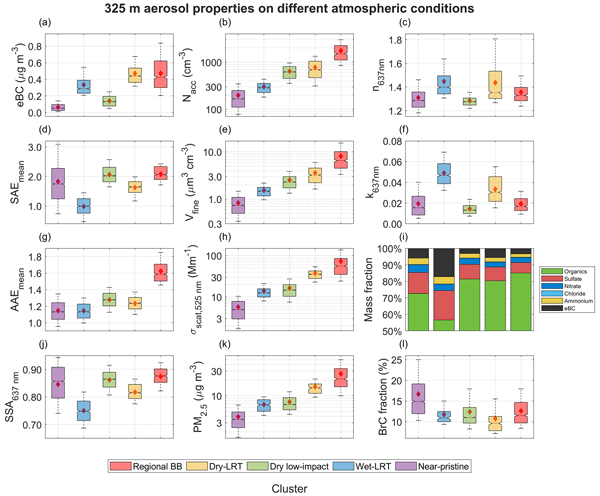
This study highlights the different aerosol populations that are commonly observed in the central Amazon. Vertical gradients of aerosol optical and chemical properties were evaluated on different atmospheric conditions, and showed distinct characteristics of these particles. Intercontinental transport events bring to the region particles with a contrasting chemical composition, while vertical transport processes influence the aerosol properties by promoting the development of coating and aging.
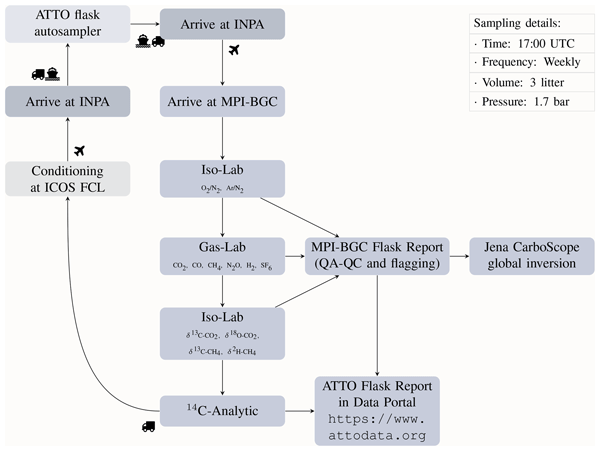
Carlos A. Sierra, Ingrid Chanca, Meinrat O. Andreae, Alessandro Carioca de Araújo, Hella van Asperen, Lars Borchardt, Santiago Botía, Luiz Antonio Candido, Caio S. C. Correa, Cléo Quaresma Dias-Junior, Markus Eritt, Annica Fröhlich, Luciana V. Gatti, Marcus Guderle, Samuel Hammer, Martin Heimann, Viviana Horna, Armin Jordan, Steffen Knabe, Richard Kneißl, Jost Valentin Lavric, Ingeborg Levin, Kita Macario, Juliana Menger, Heiko Moossen, Carlos Alberto Quesada, Michael Rothe, Christian Rödenbeck, Yago Santos, Axel Steinhof, Bruno Takeshi, Susan Trumbore, and Sönke Zaehle
Earth Syst. Sci. Data, 17, 5871–5884, https://doi.org/10.5194/essd-17-5871-2025, https://doi.org/10.5194/essd-17-5871-2025, 2025
Short summary
Short summary
We present here a unique dataset of atmospheric observations of greenhouse gases and isotopes that provide key information on land-atmosphere interactions for the Amazon forests of central Brazil. The data show a relatively large level of variability, but also important trends in greenhouse gases, and signals from fires as well as seasonal biological activity.
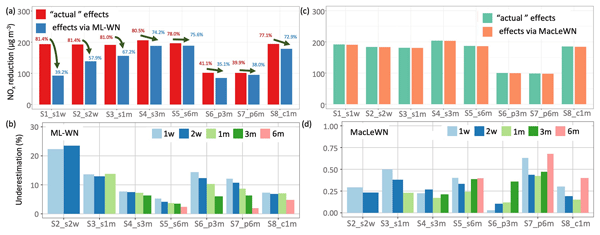
Yuqing Dai, Bowen Liu, Chengxu Tong, David C. Carslaw, A. Robert MacKenzie, and Zongbo Shi
Atmos. Chem. Phys., 25, 13585–13596, https://doi.org/10.5194/acp-25-13585-2025, https://doi.org/10.5194/acp-25-13585-2025, 2025
Short summary
Short summary
Air pollution causes millions of deaths annually, driving policies to improve air quality. However, assessing these policies is challenging because weather changes can hide their true impact. We created a logical evaluation framework and found that a widely applied machine learning approach that adjusts for weather effects could underestimate the effectiveness of short-term policies, like emergency traffic controls. We proposed a refined approach that could largely reduce such underestimation.
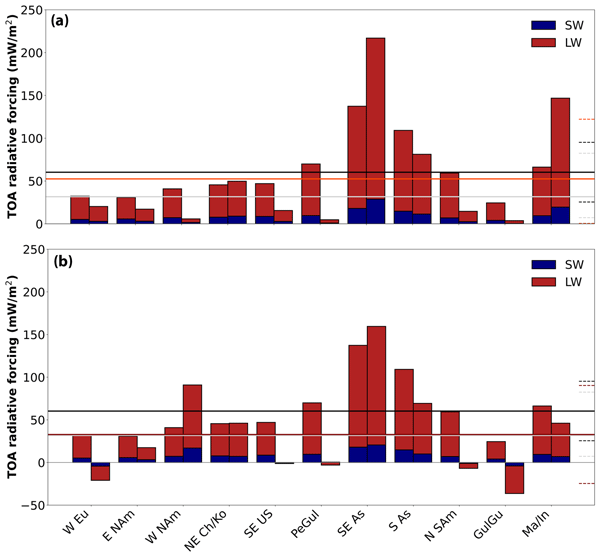
Pasquale Sellitto, Audrey Gaudel, and Bastien Sauvage
Atmos. Chem. Phys., 25, 13299–13309, https://doi.org/10.5194/acp-25-13299-2025, https://doi.org/10.5194/acp-25-13299-2025, 2025
Short summary
Short summary
Tropospheric ozone is a potent greenhouse gas: its anthropogenic levels rise contributes to climate change. We evaluate tropospheric ozone trends and climate impacts with aircraft data and a radiative model, comparing a baseline period (1994–2004) to different recent time periods (2011–2016 to 2020-2023). Tropospheric ozone levels increasing trends progressively stopped and even decreased in the upper troposphere. Correspondingly, the decadal ozone radiative forcing is progressively decreasing.
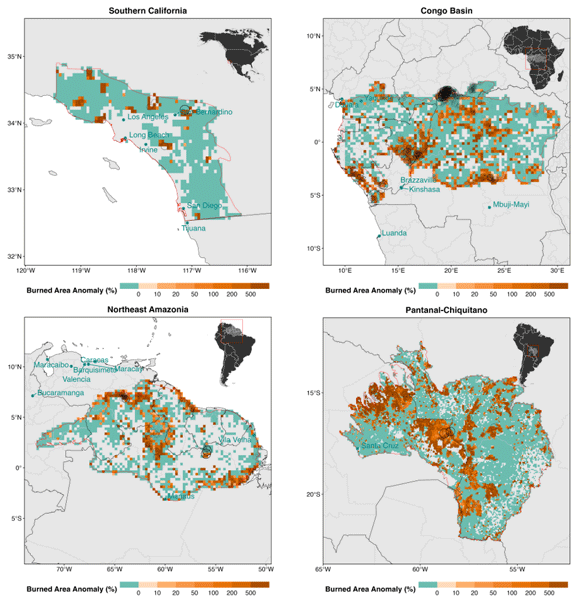
Douglas I. Kelley, Chantelle Burton, Francesca Di Giuseppe, Matthew W. Jones, Maria L. F. Barbosa, Esther Brambleby, Joe R. McNorton, Zhongwei Liu, Anna S. I. Bradley, Katie Blackford, Eleanor Burke, Andrew Ciavarella, Enza Di Tomaso, Jonathan Eden, Igor José M. Ferreira, Lukas Fiedler, Andrew J. Hartley, Theodore R. Keeping, Seppe Lampe, Anna Lombardi, Guilherme Mataveli, Yuquan Qu, Patrícia S. Silva, Fiona R. Spuler, Carmen B. Steinmann, Miguel Ángel Torres-Vázquez, Renata Veiga, Dave van Wees, Jakob B. Wessel, Emily Wright, Bibiana Bilbao, Mathieu Bourbonnais, Cong Gao, Carlos M. Di Bella, Kebonye Dintwe, Victoria M. Donovan, Sarah Harris, Elena A. Kukavskaya, Aya Brigitte N'Dri, Cristina Santín, Galia Selaya, Johan Sjöström, John T. Abatzoglou, Niels Andela, Rachel Carmenta, Emilio Chuvieco, Louis Giglio, Douglas S. Hamilton, Stijn Hantson, Sarah Meier, Mark Parrington, Mojtaba Sadegh, Jesus San-Miguel-Ayanz, Fernando Sedano, Marco Turco, Guido R. van der Werf, Sander Veraverbeke, Liana O. Anderson, Hamish Clarke, Paulo M. Fernandes, and Crystal A. Kolden
Earth Syst. Sci. Data, 17, 5377–5488, https://doi.org/10.5194/essd-17-5377-2025, https://doi.org/10.5194/essd-17-5377-2025, 2025
Short summary
Short summary
The second State of Wildfires report examines extreme wildfire events from 2024 to early 2025. It analyses key regional events in Southern California, Northeast Amazonia, Pantanal–Chiquitano, and the Congo Basin, assessing their drivers and predictability and attributing them to climate change and land use. Seasonal outlooks and decadal projections are provided. Climate change greatly increased the likelihood of these fires, and without strong mitigation, such events will become more frequent.
Lisa Schneider, Jann Schrod, Daniel Weber, Heinz Bingemer, Konrad Kandler, Joachim Curtius, and Martin Ebert
Atmos. Meas. Tech., 18, 5223–5245, https://doi.org/10.5194/amt-18-5223-2025, https://doi.org/10.5194/amt-18-5223-2025, 2025
Short summary
Short summary
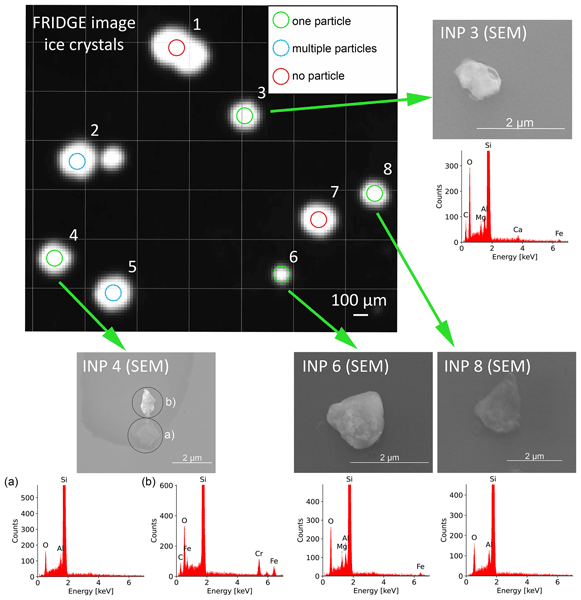
Ice-nucleating particles (INPs) are important for cloud formation and properties affecting weather and climate. This article presents a method coupling an offline ice nucleus counter to an electron microscope to obtain information, not only about INP number concentrations but also about physico-chemical properties (e.g., size and chemical composition) relevant to ice nucleation on single particles. The method was evaluated on the basis of a case study at the high-altitude research station Jungfraujoch.
Francesco Battaglia, Paola Formenti, Chiara Giorio, Mathieu Cazaunau, Edouard Pangui, Antonin Bergé, Aline Gratien, Diana L. Pereira, Thomas Bertin, Joel F. de Brito, Manolis N. Romanias, Vincent Michoud, Clarissa Baldo, Servanne Chevaillier, Gael Noyalet, Philippe Decorse, Bénédicte Picquet-Varrault, and Jean-François Doussin
Atmos. Chem. Phys., 25, 12409–12431, https://doi.org/10.5194/acp-25-12409-2025, https://doi.org/10.5194/acp-25-12409-2025, 2025
Short summary
Short summary
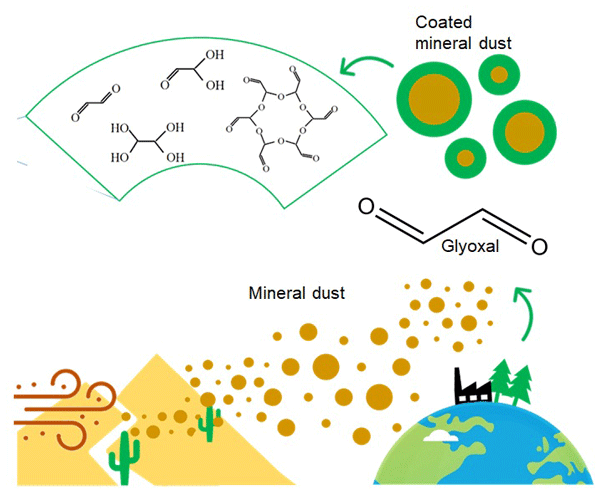
This paper presents an experimental investigation of the interactions between glyoxal, an important volatile organic compound, and mineral dust particles of size and composition typical of natural conditions. We show that their interactions modify, in a definitive way, the concentrations of the gas phase and the surface properties of the dust, which could have important implications for the atmospheric composition and the Earth's climate.
Sergio Harb, Manuela Cirtog, Stéphanie Alage, Christopher Cantrell, Mathieu Cazaunau, Vincent Michoud, Edouard Pangui, Antonin Bergé, Chiara Giorio, Francesco Battaglia, and Bénédicte Picquet-Varrault
Atmos. Chem. Phys., 25, 11003–11024, https://doi.org/10.5194/acp-25-11003-2025, https://doi.org/10.5194/acp-25-11003-2025, 2025
Short summary
Short summary
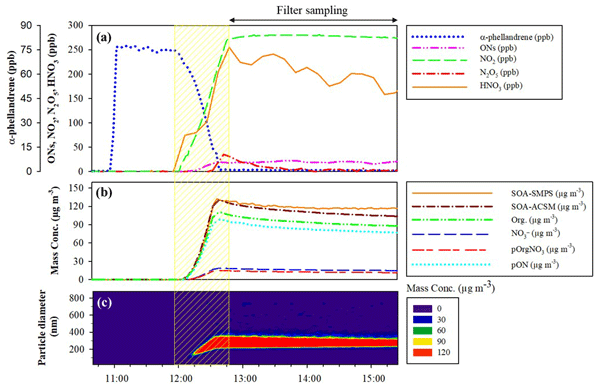
We investigated the reactions of α- and β-phellandrenes (from vegetation emissions) with NO3 radicals, a major nighttime oxidant from human activities. Using lab-based simulations, we examined these reactions and measured particle formation and by-products. Our findings reveal that α- and β-phellandrenes are efficient particle sources and enhance our understanding of biogenic–anthropogenic interactions and their contributions to atmospheric changes affecting climate and health.
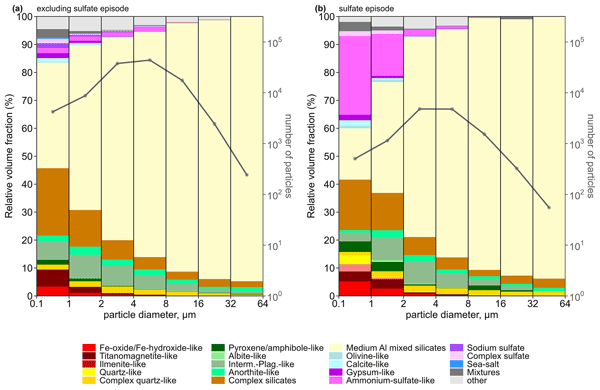
Agnesh Panta, Konrad Kandler, Kerstin Schepanski, Andres Alastuey, Pavla Dagsson Waldhauserova, Sylvain Dupont, Melanie Eknayan, Cristina González-Flórez, Adolfo González-Romero, Martina Klose, Mara Montag, Xavier Querol, Jesús Yus-Díez, and Carlos Pérez García-Pando
Atmos. Chem. Phys., 25, 10457–10478, https://doi.org/10.5194/acp-25-10457-2025, https://doi.org/10.5194/acp-25-10457-2025, 2025
Short summary
Short summary
Iceland is among the most active dust source areas in the world. Dust properties are influenced by particle size, mineralogy, shape, and mixing state. This work characterizes freshly emitted individual aerosol particles of Icelandic dust using electron microscopy. Our study provides insights into critical particle-specific information and will contribute to better constraining climate models that consider mineralogical variations in their representation of the dust cycle.
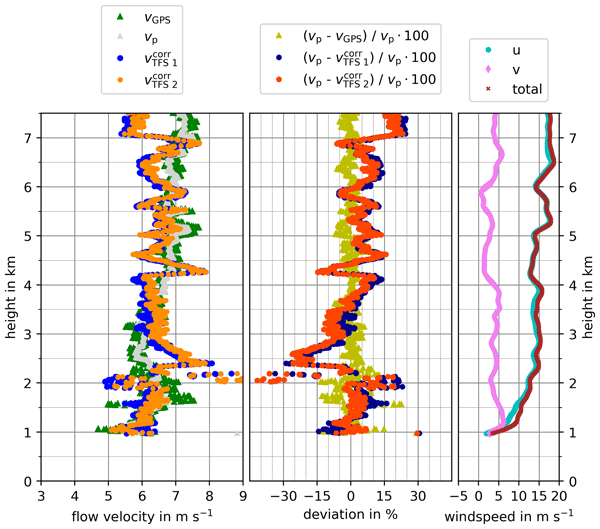
Sina Jost, Ralf Weigel, Konrad Kandler, Luis Valero, Jessica Girdwood, Chris Stopford, Warren Stanley, Luca K. Eichhorn, Christian von Glahn, and Holger Tost
Atmos. Meas. Tech., 18, 4397–4412, https://doi.org/10.5194/amt-18-4397-2025, https://doi.org/10.5194/amt-18-4397-2025, 2025
Short summary
Short summary
For the balloon-borne detection of particles (diameter 0.4 < Dp < 40 µm), the Universal Cloud and Aerosol Sounding System (UCASS) was used, whose sample flow is determined by GPS-measured ascent rates. In flights, actual UCASS sample flows rarely match the ascent rates. Errors are minimised by real-time detection of the UCASS flows, e.g. by implementing a thermal flow sensor (TFS) within the UCASS. The TFSs were tested in flight and calibrated at up to 10 m s−1 and at variable angles of attack.
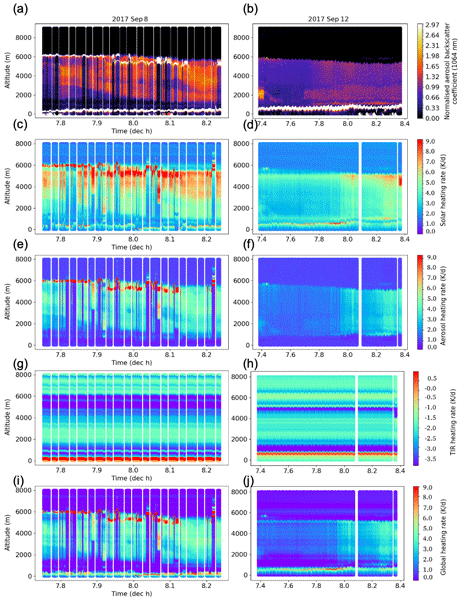
Mégane Ventura, Fabien Waquet, Isabelle Chiapello, Gérard Brogniez, Frédéric Parol, Frédérique Auriol, Rodrigue Loisil, Cyril Delegove, Luc Blarel, Oleg Dubovik, Marc Mallet, Cyrille Flamant, and Paola Formenti
Atmos. Meas. Tech., 18, 4005–4024, https://doi.org/10.5194/amt-18-4005-2025, https://doi.org/10.5194/amt-18-4005-2025, 2025
Short summary
Short summary
Biomass-burning aerosols (BBAs) from Central Africa are transported above stratocumulus clouds. The absorption of solar energy by aerosols induces warming, altering the cloud dynamics. We developed an approach that combines polarimeter and lidar to quantify this. This methodology is assessed during the AEROCLO-sA (AErosol RadiatiOn and CLOud in Southern Africa) campaign. To validate it, we used irradiance measurements acquired during aircraft spiral descents. A major perspective is the generalization of this method to the global level.
Abdulaziz T. Yakubu, Danitza Klopper, Henno Havenga, Roelof Burger, Paola Formenti, and Stuart J. Piketh
EGUsphere, https://doi.org/10.5194/egusphere-2025-1827, https://doi.org/10.5194/egusphere-2025-1827, 2025
Preprint archived
Short summary
Short summary
Low-level inversions experienced along the Namibia coast and adjacent ocean have implications for air pollutant dispersion and low clouds. These affect air quality, human health, radiative forcing and climate change. We used reanalysis and satellite datasets to understand inversion properties over the region. The result shows inversion prominence at night and in winter, seasonally influences pollutant trapping and initiates stratocumulus clouds formation, but is not liable for their extent.
Jesús Yus-Díez, Jeronimo Escribano, Marco Pandolfi, Andres Alastuey, Cristina González-Flórez, Adolfo Gonzalez-Romero, Maria Gonçalves Ageitos, Matic Ivančič, Martina Klose, Konrad Kandler, Vicenzo Obiso, Agnesh Panta, Cristina Reche, Martin Rigler, Xavier Querol, and Carlos Perez Garćia-Pando
EGUsphere, https://doi.org/10.5194/egusphere-2025-2571, https://doi.org/10.5194/egusphere-2025-2571, 2025
Short summary
Short summary
Here we present measurements of dust optical properties during active emissions at a source region in the Moroccan Sahara. We present results on its single scattering albedo, absorption and scattering wavelength dependence and mass efficiency. Furthermore, we have performed imaginary refractive index (k) retrieval under varying assumptions of the refractive index real part, and particle sphericity. We also provide a comparison between the k retrievals and estimations on dust k from AERONET.
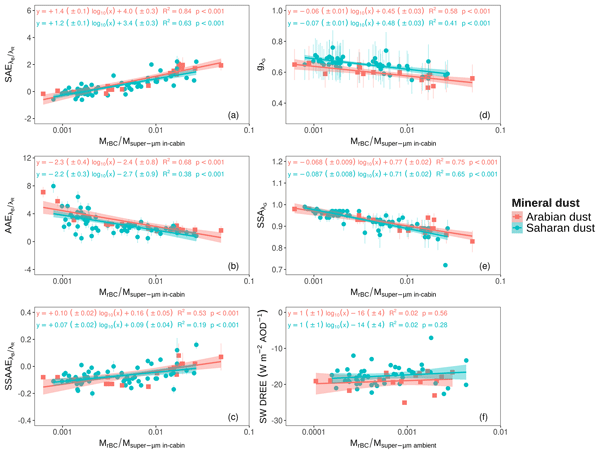
Marilena Teri, Josef Gasteiger, Katharina Heimerl, Maximilian Dollner, Manuel Schöberl, Petra Seibert, Anne Tipka, Thomas Müller, Sudharaj Aryasree, Konrad Kandler, and Bernadett Weinzierl
Atmos. Chem. Phys., 25, 6633–6662, https://doi.org/10.5194/acp-25-6633-2025, https://doi.org/10.5194/acp-25-6633-2025, 2025
Short summary
Short summary
The A-LIFE aircraft field experiment was carried out in the eastern Mediterranean in 2017. Using A-LIFE data, we studied the change in mineral dust optical properties due to mixing with anthropogenic aerosols. We found that increasing pollution affects dust optical properties, which has implications for identifying dust events and understanding their climate effects. We also show that optical properties of Saharan and Arabian dust are similar when comparing cases with equal pollution content.
Johannes Heuser, Claudia Di Biagio, Jérôme Yon, Mathieu Cazaunau, Antonin Bergé, Edouard Pangui, Marco Zanatta, Laura Renzi, Angela Marinoni, Satoshi Inomata, Chenjie Yu, Vera Bernardoni, Servanne Chevaillier, Daniel Ferry, Paolo Laj, Michel Maillé, Dario Massabò, Federico Mazzei, Gael Noyalet, Hiroshi Tanimoto, Brice Temime-Roussel, Roberta Vecchi, Virginia Vernocchi, Paola Formenti, Bénédicte Picquet-Varrault, and Jean-François Doussin
Atmos. Chem. Phys., 25, 6407–6428, https://doi.org/10.5194/acp-25-6407-2025, https://doi.org/10.5194/acp-25-6407-2025, 2025
Short summary
Short summary
The spectral optical properties of combustion soot aerosols with varying black (BC) and brown carbon (BrC) content were studied in an atmospheric simulation chamber. Measurements of the mass spectral absorption cross section (MAC), supplemented by literature data, allowed us to establish a generalised exponential relationship between the spectral absorption and the elemental-to-total-carbon ratio (EC / TC) in soot. This relationship can provide a useful tool for modelling the properties of soot.
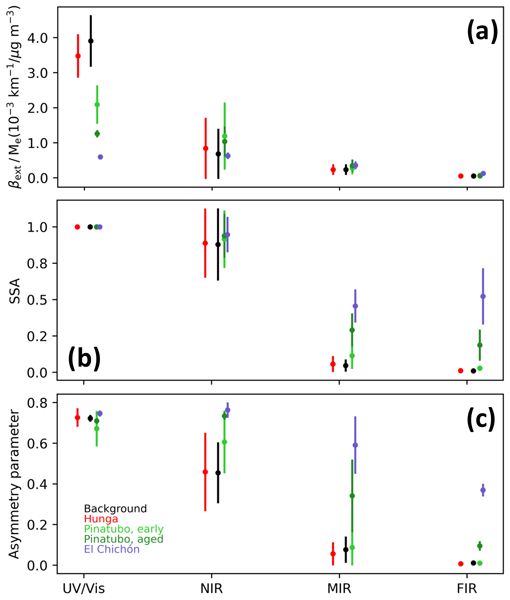
Pasquale Sellitto, Redha Belhadji, Bernard Legras, Aurélien Podglajen, and Clair Duchamp
Atmos. Chem. Phys., 25, 6353–6364, https://doi.org/10.5194/acp-25-6353-2025, https://doi.org/10.5194/acp-25-6353-2025, 2025
Short summary
Short summary
The Hunga Tonga–Hunga Ha’apai volcano erupted on 15 January 2022, producing the largest stratospheric aerosol perturbation of the last 30 years. Stratospheric volcanic aerosols usually produce a transient climate cooling; these impacts depend on volcanic aerosol composition/size, due to size-dependent interactions with solar/terrestrial radiation. We demonstrate that the Hunga Tonga–Hunga Ha’apai stratospheric aerosols have a larger cooling potential per unit mass than the past climate-relevant El Chichón (1984) and Pinatubo (1991) eruptions.
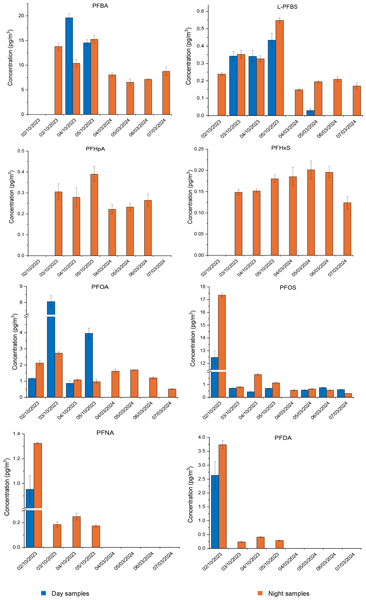
Jishnu Pandamkulangara Kizhakkethil, Zongbo Shi, Anna Bogush, and Ivan Kourtchev
Atmos. Chem. Phys., 25, 5947–5958, https://doi.org/10.5194/acp-25-5947-2025, https://doi.org/10.5194/acp-25-5947-2025, 2025
Short summary
Short summary
Pollution with per- and polyfluoroalkyl substances (PFAS) has received attention due to their environmental persistence and bioaccumulation, but their sources remain poorly understood. PM10 (particulate matter) collected above a scaled-down activated sludge tank treating domestic sewage in the UK was analysed for a range of short-, medium-, and long-chain PFAS. Eight PFAS were detected in the PM10. Our results suggest that wastewater treatment processes, i.e. activated sludge aeration, could aerosolise PFAS into airborne PM.
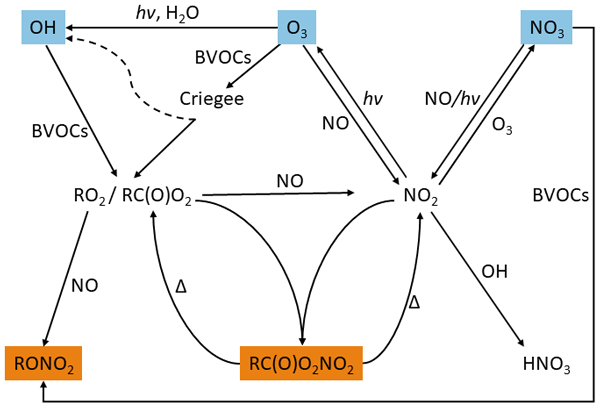
Simone T. Andersen, Rolf Sander, Patrick Dewald, Laura Wüst, Tobias Seubert, Gunther N. T. E. Türk, Jan Schuladen, Max R. McGillen, Chaoyang Xue, Abdelwahid Mellouki, Alexandre Kukui, Vincent Michoud, Manuela Cirtog, Mathieu Cazaunau, Astrid Bauville, Hichem Bouzidi, Paola Formenti, Cyrielle Denjean, Jean-Claude Etienne, Olivier Garrouste, Christopher Cantrell, Jos Lelieveld, and John N. Crowley
Atmos. Chem. Phys., 25, 5893–5909, https://doi.org/10.5194/acp-25-5893-2025, https://doi.org/10.5194/acp-25-5893-2025, 2025
Short summary
Short summary
Measurements and modelling of reactive nitrogen gases observed in a suburban temperate forest in Rambouillet, France, circa 50 km southwest of Paris in 2022 indicate that the biosphere rapidly scavenges organic nitrates of mixed biogenic and anthropogenic origin, resulting in short lifetimes for, for example, alkyl nitrates and peroxy nitrates.
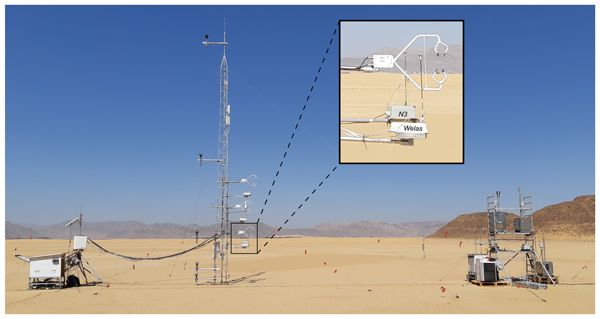
Sylvain Dupont, Eric Lamaud, Mark R. Irvine, Jean-Marc Bonnefond, Adolfo González-Romero, Andrés Alastuey, Cristina González-Flórez, Xavier Querol, Konrad Kandler, Martina Klose, and Carlos Pérez García-Pando
Atmos. Meas. Tech., 18, 2183–2200, https://doi.org/10.5194/amt-18-2183-2025, https://doi.org/10.5194/amt-18-2183-2025, 2025
Short summary
Short summary
Low-cost optical particle counters (OPCs) offer new opportunities to monitor dust particles from wind soil erosion. Their price, size, and power consumption are lower than those of traditional OPCs. We tested the ability of the low-cost OPC-N3 from Alphasense to estimate dust emission flux during erosion events in Jordan. N3 estimated the dust flux well, with differences of less than 30 % compared to a traditional OPC. Our results confirm the potential of low-cost OPCs for dust erosion research.
Diana L. Pereira, Chiara Giorio, Aline Gratien, Alexander Zherebker, Gael Noyalet, Servanne Chevaillier, Stéphanie Alage, Elie Almarj, Antonin Bergé, Thomas Bertin, Mathieu Cazaunau, Patrice Coll, Ludovico Di Antonio, Sergio Harb, Johannes Heuser, Cécile Gaimoz, Oscar Guillemant, Brigitte Language, Olivier Lauret, Camilo Macias, Franck Maisonneuve, Bénédicte Picquet-Varrault, Raquel Torres, Sylvain Triquet, Pascal Zapf, Lelia Hawkins, Drew Pronovost, Sydney Riley, Pierre-Marie Flaud, Emilie Perraudin, Pauline Pouyes, Eric Villenave, Alexandre Albinet, Olivier Favez, Robin Aujay-Plouzeau, Vincent Michoud, Christopher Cantrell, Manuela Cirtog, Claudia Di Biagio, Jean-François Doussin, and Paola Formenti
Atmos. Chem. Phys., 25, 4885–4905, https://doi.org/10.5194/acp-25-4885-2025, https://doi.org/10.5194/acp-25-4885-2025, 2025
Short summary
Short summary
In order to study aerosols in environments influenced by anthropogenic and biogenic emissions, we performed analyses of samples collected during the ACROSS (Atmospheric Chemistry Of the Suburban Forest) campaign in summer 2022 in the greater Paris area. After analysis of the chemical composition by means of total carbon determination and high-resolution mass spectrometry, this work highlights the influence of anthropogenic inputs on the chemical composition of both urban and forested areas.
Ludovico Di Antonio, Matthias Beekmann, Guillaume Siour, Vincent Michoud, Christopher Cantrell, Astrid Bauville, Antonin Bergé, Mathieu Cazaunau, Servanne Chevaillier, Manuela Cirtog, Joel F. de Brito, Paola Formenti, Cecile Gaimoz, Olivier Garret, Aline Gratien, Valérie Gros, Martial Haeffelin, Lelia N. Hawkins, Simone Kotthaus, Gael Noyalet, Diana L. Pereira, Jean-Eudes Petit, Eva Drew Pronovost, Véronique Riffault, Chenjie Yu, Gilles Foret, Jean-François Doussin, and Claudia Di Biagio
Atmos. Chem. Phys., 25, 4803–4831, https://doi.org/10.5194/acp-25-4803-2025, https://doi.org/10.5194/acp-25-4803-2025, 2025
Short summary
Short summary
The summer of 2022 has been considered a proxy for future climate scenarios due to its hot and dry conditions. In this paper, we use the measurements from the Atmospheric Chemistry of the Suburban Forest (ACROSS) campaign, conducted in the Paris area in June–July 2022, along with observations from existing networks, to evaluate a 3D chemistry transport model (WRF–CHIMERE) simulation. Results are shown to be satisfactory, allowing us to explain the gas and aerosol variability at the campaign sites.
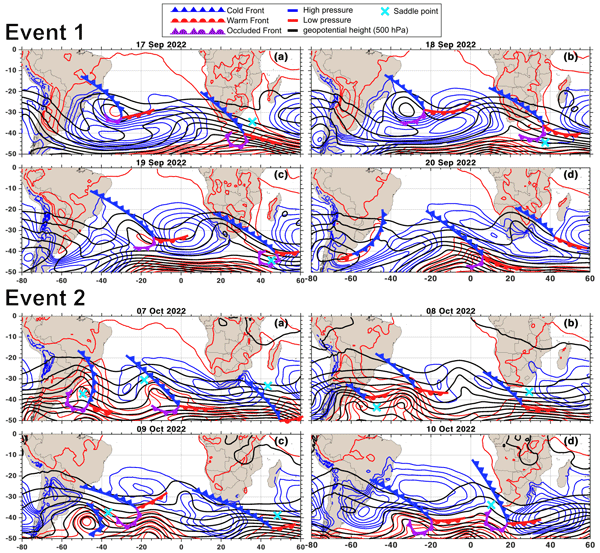
Marion Ranaivombola, Nelson Bègue, Lucas Vaz Peres, Farahnaz Fazel-Rastgar, Venkataraman Sivakumar, Gisèle Krysztofiak, Gwenaël Berthet, Fabrice Jegou, Stuart Piketh, and Hassan Bencherif
Atmos. Chem. Phys., 25, 3519–3540, https://doi.org/10.5194/acp-25-3519-2025, https://doi.org/10.5194/acp-25-3519-2025, 2025
Short summary
Short summary
From September to October 2022, the Biomass Burning Aerosol Campaign (BiBAC) in Kruger National Park revealed a significant aerosol loading linked to biomass burning activity, with southeastward transport over southern Africa and the southwestern Indian Ocean (SWIO) basin. The study revealed a predominance of biomass burning aerosols and two distinct transport mechanisms of aerosol plumes and CO, underscoring the importance of east-coast observations in understanding atmospheric dynamics.
Soo-Jin Park, Lya Lugon, Oscar Jacquot, Youngseob Kim, Alexia Baudic, Barbara D'Anna, Ludovico Di Antonio, Claudia Di Biagio, Fabrice Dugay, Olivier Favez, Véronique Ghersi, Aline Gratien, Julien Kammer, Jean-Eudes Petit, Olivier Sanchez, Myrto Valari, Jérémy Vigneron, and Karine Sartelet
Atmos. Chem. Phys., 25, 3363–3387, https://doi.org/10.5194/acp-25-3363-2025, https://doi.org/10.5194/acp-25-3363-2025, 2025
Short summary
Short summary
To accurately represent the population exposure to outdoor concentrations of pollutants of interest to health (NO2, PM2.5, black carbon, and ultrafine particles), multi-scale modelling down to the street scale is set up and evaluated using measurements from field campaigns. An exposure scaling factor is defined, allowing regional-scale simulations to be corrected to evaluate population exposure. Urban heterogeneities strongly influence NO2, black carbon, and ultrafine particles but less strongly PM2.5.
Ludovico Di Antonio, Claudia Di Biagio, Paola Formenti, Aline Gratien, Vincent Michoud, Christopher Cantrell, Astrid Bauville, Antonin Bergé, Mathieu Cazaunau, Servanne Chevaillier, Manuela Cirtog, Patrice Coll, Barbara D'Anna, Joel F. de Brito, David O. De Haan, Juliette R. Dignum, Shravan Deshmukh, Olivier Favez, Pierre-Marie Flaud, Cecile Gaimoz, Lelia N. Hawkins, Julien Kammer, Brigitte Language, Franck Maisonneuve, Griša Močnik, Emilie Perraudin, Jean-Eudes Petit, Prodip Acharja, Laurent Poulain, Pauline Pouyes, Eva Drew Pronovost, Véronique Riffault, Kanuri I. Roundtree, Marwa Shahin, Guillaume Siour, Eric Villenave, Pascal Zapf, Gilles Foret, Jean-François Doussin, and Matthias Beekmann
Atmos. Chem. Phys., 25, 3161–3189, https://doi.org/10.5194/acp-25-3161-2025, https://doi.org/10.5194/acp-25-3161-2025, 2025
Short summary
Short summary
The spectral complex refractive index (CRI) and single scattering albedo were retrieved from submicron aerosol measurements at three sites within the greater Paris area during the ACROSS field campaign (June–July 2022). Measurements revealed urban emission impact on surrounding areas. CRI full period averages at 520 nm were 1.41 – 0.037i (urban), 1.52 – 0.038i (peri-urban), and 1.50 – 0.025i (rural). Organic aerosols dominated the aerosol mass and contributed up to 22 % of absorption at 370 nm.
Birte Klug, Ralf Weigel, Konrad Kandler, Markus Rapp, Manuel Baumgartner, Thomas Böttger, Klaus Dieter Wilhelm, Harald Rott, Thomas Kenntner, Oliver Drescher, and Anna Hundertmark
EGUsphere, https://doi.org/10.5194/egusphere-2025-510, https://doi.org/10.5194/egusphere-2025-510, 2025
Short summary
Short summary
The nuclei onto which noctilucent clouds (NLC) form are largely unknown. We investigated the development of an inertia-based particle collector allowing for sampling NLC particles during a sounding rocket flight for off-line single particle physico-chemical analyzes. Computational fluid dynamics simulations (for Mach numbers 1.31 and 1.75) support the design and development process in reference to a basic mechanical concept of particle sampling and sample storage, which is also presented here.
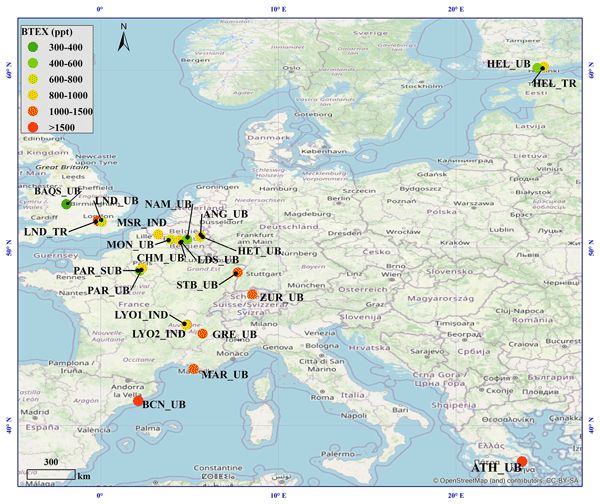
Xiansheng Liu, Xun Zhang, Marvin Dufresne, Tao Wang, Lijie Wu, Rosa Lara, Roger Seco, Marta Monge, Ana Maria Yáñez-Serrano, Marie Gohy, Paul Petit, Audrey Chevalier, Marie-Pierre Vagnot, Yann Fortier, Alexia Baudic, Véronique Ghersi, Grégory Gille, Ludovic Lanzi, Valérie Gros, Leïla Simon, Heidi Héllen, Stefan Reimann, Zoé Le Bras, Michelle Jessy Müller, David Beddows, Siqi Hou, Zongbo Shi, Roy M. Harrison, William Bloss, James Dernie, Stéphane Sauvage, Philip K. Hopke, Xiaoli Duan, Taicheng An, Alastair C. Lewis, James R. Hopkins, Eleni Liakakou, Nikolaos Mihalopoulos, Xiaohu Zhang, Andrés Alastuey, Xavier Querol, and Thérèse Salameh
Atmos. Chem. Phys., 25, 625–638, https://doi.org/10.5194/acp-25-625-2025, https://doi.org/10.5194/acp-25-625-2025, 2025
Short summary
Short summary
This study examines BTEX (benzene, toluene, ethylbenzene, xylenes) pollution in urban areas across seven European countries. Analyzing data from 22 monitoring sites, we found traffic and industrial activities significantly impact BTEX levels, with peaks during rush hours. The risk from BTEX exposure remains moderate, especially in high-traffic and industrial zones, highlighting the need for targeted air quality management to protect public health and improve urban air quality.
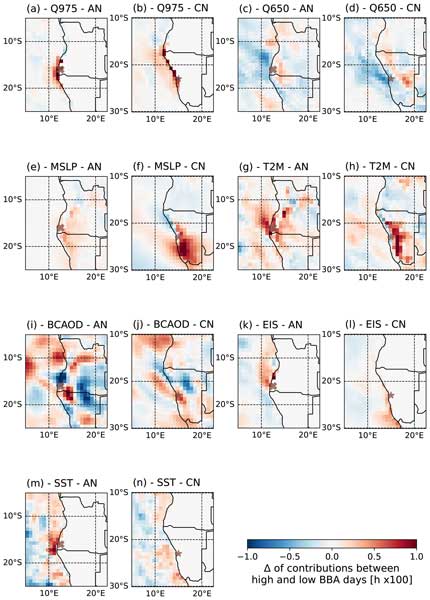
Alexandre Mass, Hendrik Andersen, Jan Cermak, Paola Formenti, Eva Pauli, and Julian Quinting
Atmos. Chem. Phys., 25, 491–510, https://doi.org/10.5194/acp-25-491-2025, https://doi.org/10.5194/acp-25-491-2025, 2025
Short summary
Short summary
This study investigates the interaction between smoke aerosols and fog and low clouds (FLCs) in the Namib Desert between June and October. Here, a satellite-based dataset of FLCs, reanalysis data and machine learning are used to systematically analyze FLC persistence under different aerosol loadings. Aerosol plumes are shown to modify local thermodynamics, which increase FLC persistence. But fully disentangling aerosol effects from meteorological ones remains a challenge.
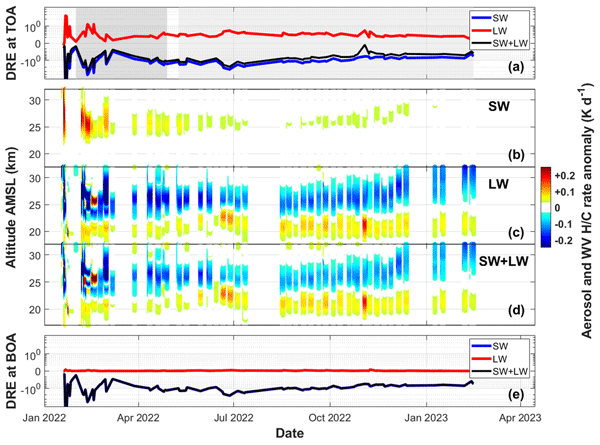
Michaël Sicard, Alexandre Baron, Marion Ranaivombola, Dominique Gantois, Tristan Millet, Pasquale Sellitto, Nelson Bègue, Hassan Bencherif, Guillaume Payen, Nicolas Marquestaut, and Valentin Duflot
Atmos. Chem. Phys., 25, 367–381, https://doi.org/10.5194/acp-25-367-2025, https://doi.org/10.5194/acp-25-367-2025, 2025
Short summary
Short summary
This study quantifies the radiative impact over Réunion Island (21° S, 55° E) of the aerosols and water vapor injected into the stratosphere by the Hunga volcano in the South Pacific. The overall aerosol and water vapor impact on the Earth’s radiation budget for the whole period is negative (cooling, -0.82 ± 0.35 W m-2) and dominated by the aerosols. At the Earth’s surface, aerosols are the main drivers and produce a negative (cooling, -1.04 ± 0.36 W m-2) radiative impact.
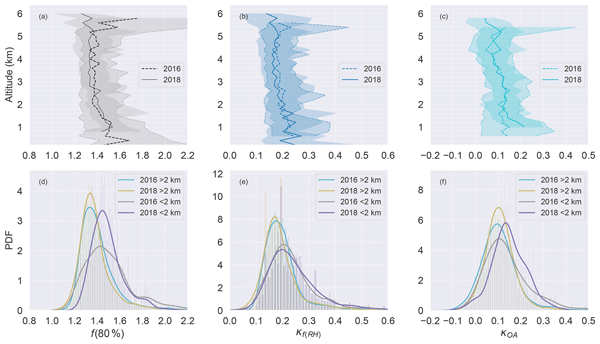
Lu Zhang, Michal Segal-Rozenhaimer, Haochi Che, Caroline Dang, Junying Sun, Ye Kuang, Paola Formenti, and Steven G. Howell
Atmos. Chem. Phys., 24, 13849–13864, https://doi.org/10.5194/acp-24-13849-2024, https://doi.org/10.5194/acp-24-13849-2024, 2024
Short summary
Short summary
Using airborne measurements over the southeast Atlantic Ocean, we examined how much moisture aerosols take up during Africa’s biomass burning season. Our study revealed the important role of organic aerosols and introduced a predictive model for moisture uptake, accounting for organics, sulfate, and black carbon, summarizing results from various campaigns. These findings improve our understanding of aerosol–moisture interactions and their radiative effects in this climatically critical region.
Paola Formenti and Claudia Di Biagio
Earth Syst. Sci. Data, 16, 4995–5007, https://doi.org/10.5194/essd-16-4995-2024, https://doi.org/10.5194/essd-16-4995-2024, 2024
Short summary
Short summary
Particles from deserts and semi-vegetated areas (mineral dust) are important for Earth's climate and human health, notably depending on their size. In this paper we collect and make a synthesis of a body of these observations since 1972 in order to provide researchers modeling Earth's climate and developing satellite observations from space with a simple way of confronting their results and understanding their validity.
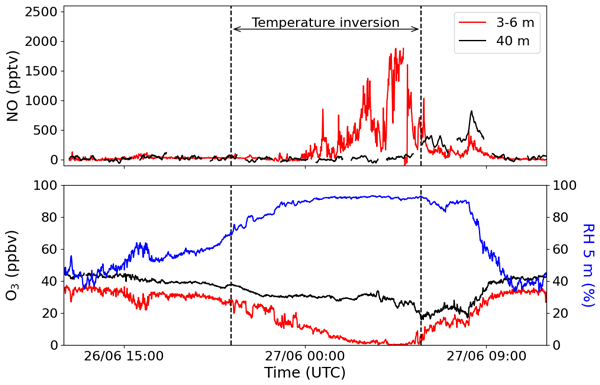
Simone T. Andersen, Max R. McGillen, Chaoyang Xue, Tobias Seubert, Patrick Dewald, Gunther N. T. E. Türk, Jan Schuladen, Cyrielle Denjean, Jean-Claude Etienne, Olivier Garrouste, Marina Jamar, Sergio Harb, Manuela Cirtog, Vincent Michoud, Mathieu Cazaunau, Antonin Bergé, Christopher Cantrell, Sebastien Dusanter, Bénédicte Picquet-Varrault, Alexandre Kukui, Abdelwahid Mellouki, Lucy J. Carpenter, Jos Lelieveld, and John N. Crowley
Atmos. Chem. Phys., 24, 11603–11618, https://doi.org/10.5194/acp-24-11603-2024, https://doi.org/10.5194/acp-24-11603-2024, 2024
Short summary
Short summary
Using measurements of various trace gases in a suburban forest near Paris in the summer of 2022, we were able to gain insight into the sources and sinks of NOx (NO+NO2) with a special focus on their nighttime chemical and physical loss processes. NO was observed as a result of nighttime soil emissions when O3 levels were strongly depleted by deposition. NO oxidation products were not observed at night, indicating that soil and/or foliar surfaces are an efficient sink of reactive N.
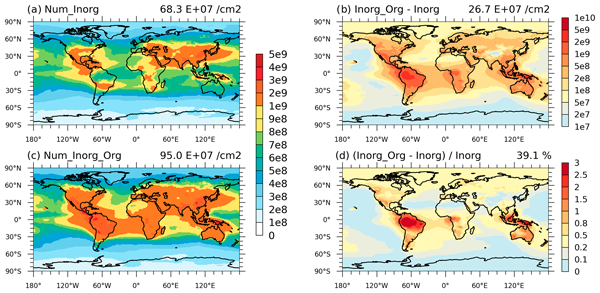
Xinyue Shao, Minghuai Wang, Xinyi Dong, Yaman Liu, Wenxiang Shen, Stephen R. Arnold, Leighton A. Regayre, Meinrat O. Andreae, Mira L. Pöhlker, Duseong S. Jo, Man Yue, and Ken S. Carslaw
Atmos. Chem. Phys., 24, 11365–11389, https://doi.org/10.5194/acp-24-11365-2024, https://doi.org/10.5194/acp-24-11365-2024, 2024
Short summary
Short summary
Highly oxygenated organic molecules (HOMs) play an important role in atmospheric new particle formation (NPF). By semi-explicitly coupling the chemical mechanism of HOMs and a comprehensive nucleation scheme in a global climate model, the updated model shows better agreement with measurements of nucleation rate, growth rate, and NPF event frequency. Our results reveal that HOM-driven NPF leads to a considerable increase in particle and cloud condensation nuclei burden globally.
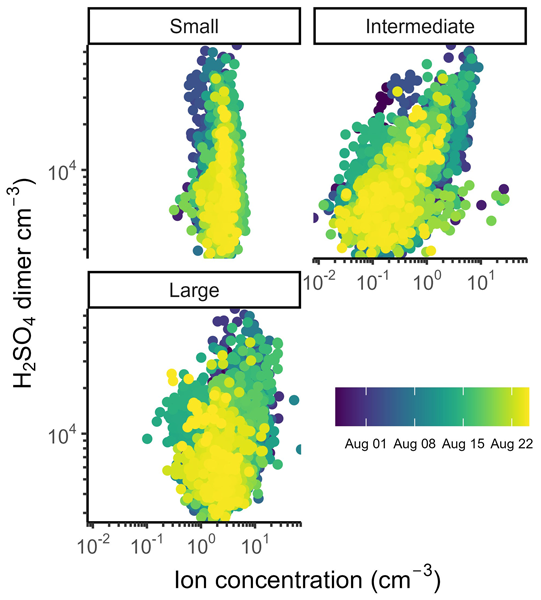
Alex Rowell, James Brean, David C. S. Beddows, Zongbo Shi, Avinash Kumar, Matti Rissanen, Miikka Dal Maso, Peter Mettke, Kay Weinhold, Maik Merkel, and Roy M. Harrison
Atmos. Chem. Phys., 24, 10349–10361, https://doi.org/10.5194/acp-24-10349-2024, https://doi.org/10.5194/acp-24-10349-2024, 2024
Short summary
Short summary
Ions enhance the formation and growth rates of new particles, affecting the Earth's radiation budget. Despite these effects, there is little published data exploring the sources of ions in the urban environment and their role in new particle formation (NPF). Here we show that natural ion sources dominate in urban environments, while traffic is a secondary source. Ions contribute up to 12.7 % of the formation rate of particles, indicating that they are important for forming urban PM.
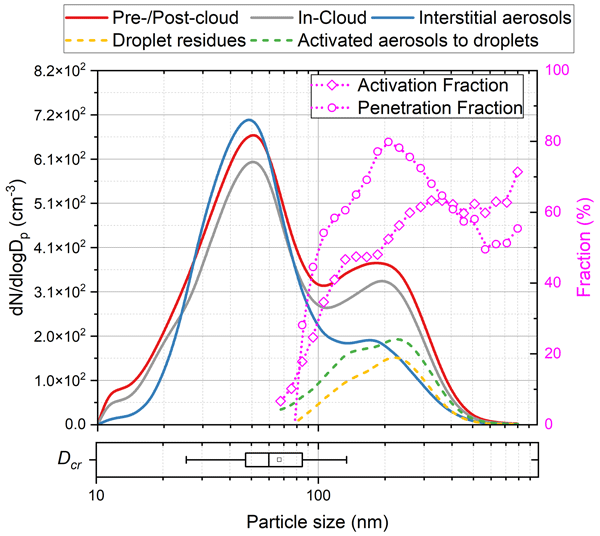
Romanos Foskinis, Ghislain Motos, Maria I. Gini, Olga Zografou, Kunfeng Gao, Stergios Vratolis, Konstantinos Granakis, Ville Vakkari, Kalliopi Violaki, Andreas Aktypis, Christos Kaltsonoudis, Zongbo Shi, Mika Komppula, Spyros N. Pandis, Konstantinos Eleftheriadis, Alexandros Papayannis, and Athanasios Nenes
Atmos. Chem. Phys., 24, 9827–9842, https://doi.org/10.5194/acp-24-9827-2024, https://doi.org/10.5194/acp-24-9827-2024, 2024
Short summary
Short summary
Analysis of modeling, in situ, and remote sensing measurements reveals the microphysical state of orographic clouds and their response to aerosol from the boundary layer and free troposphere. We show that cloud response to aerosol is robust, as predicted supersaturation and cloud droplet number levels agree with those determined from in-cloud measurements. The ability to determine if clouds are velocity- or aerosol-limited allows for novel model constraints and remote sensing products.
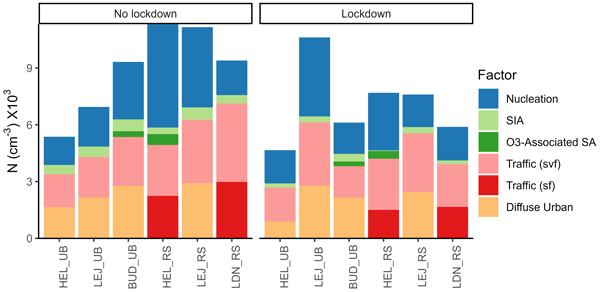
Alex Rowell, James Brean, David C. S. Beddows, Tuukka Petäjä, Máté Vörösmarty, Imre Salma, Jarkko V. Niemi, Hanna E. Manninen, Dominik van Pinxteren, Thomas Tuch, Kay Weinhold, Zongbo Shi, and Roy M. Harrison
Atmos. Chem. Phys., 24, 9515–9531, https://doi.org/10.5194/acp-24-9515-2024, https://doi.org/10.5194/acp-24-9515-2024, 2024
Short summary
Short summary
Different sources of airborne particles in the atmospheres of four European cities were distinguished by recognising their particle size distributions using a statistical procedure, positive matrix factorisation. The various sources responded differently to the changes in emissions associated with COVID-19 lockdowns, and the reasons are investigated. While traffic emissions generally decreased, particles formed from reactions of atmospheric gases decreased in some cities but increased in others.
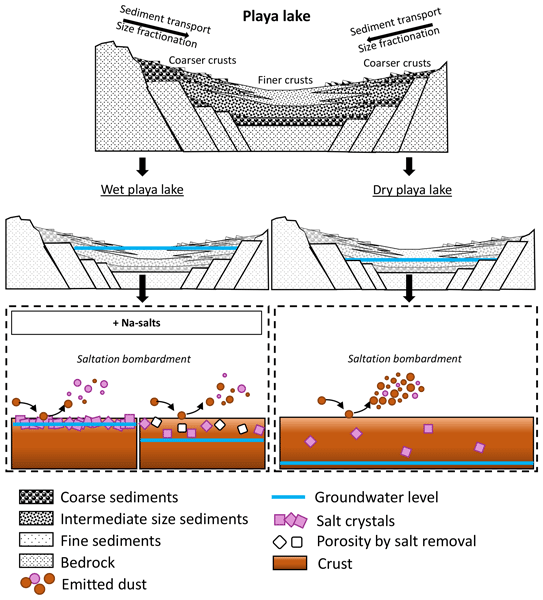
Adolfo González-Romero, Cristina González-Flórez, Agnesh Panta, Jesús Yus-Díez, Patricia Córdoba, Andres Alastuey, Natalia Moreno, Melani Hernández-Chiriboga, Konrad Kandler, Martina Klose, Roger N. Clark, Bethany L. Ehlmann, Rebecca N. Greenberger, Abigail M. Keebler, Phil Brodrick, Robert Green, Paul Ginoux, Xavier Querol, and Carlos Pérez García-Pando
Atmos. Chem. Phys., 24, 9155–9176, https://doi.org/10.5194/acp-24-9155-2024, https://doi.org/10.5194/acp-24-9155-2024, 2024
Short summary
Short summary
In this research, we studied the dust-emitting properties of crusts and aeolian ripples from the Mojave Desert. These properties are key to understanding the effect of dust upon climate. We found two different playa lakes according to the groundwater regime, which implies differences in crusts' cohesion state and mineralogy, which can affect the dust emission potential and properties. We also compare them with Moroccan Sahara crusts and Icelandic top sediments.
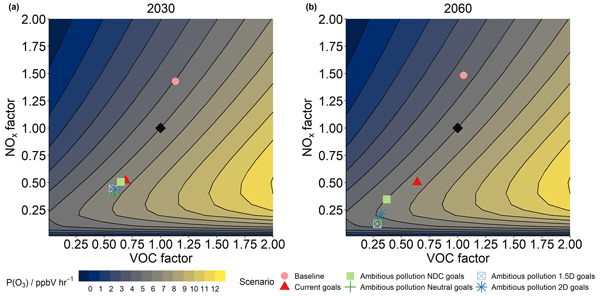
Beth S. Nelson, Zhenze Liu, Freya A. Squires, Marvin Shaw, James R. Hopkins, Jacqueline F. Hamilton, Andrew R. Rickard, Alastair C. Lewis, Zongbo Shi, and James D. Lee
Atmos. Chem. Phys., 24, 9031–9044, https://doi.org/10.5194/acp-24-9031-2024, https://doi.org/10.5194/acp-24-9031-2024, 2024
Short summary
Short summary
The impact of combined air quality and carbon neutrality policies on O3 formation in Beijing was investigated. Emissions inventory data were used to estimate future pollutant mixing ratios relative to ground-level observations. O3 production was found to be most sensitive to changes in alkenes, but large reductions in less reactive compounds led to larger reductions in future O3 production. This study highlights the importance of understanding the emissions of organic pollutants.
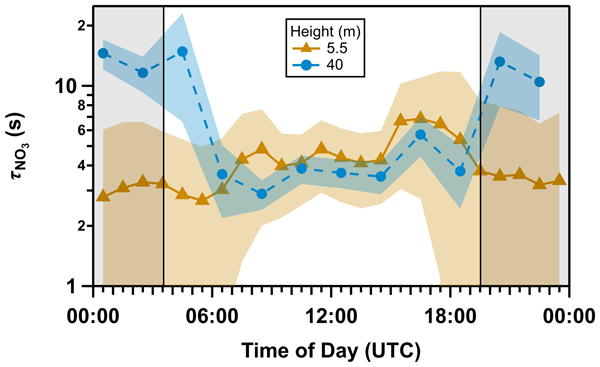
Patrick Dewald, Tobias Seubert, Simone T. Andersen, Gunther N. T. E. Türk, Jan Schuladen, Max R. McGillen, Cyrielle Denjean, Jean-Claude Etienne, Olivier Garrouste, Marina Jamar, Sergio Harb, Manuela Cirtog, Vincent Michoud, Mathieu Cazaunau, Antonin Bergé, Christopher Cantrell, Sebastien Dusanter, Bénédicte Picquet-Varrault, Alexandre Kukui, Chaoyang Xue, Abdelwahid Mellouki, Jos Lelieveld, and John N. Crowley
Atmos. Chem. Phys., 24, 8983–8997, https://doi.org/10.5194/acp-24-8983-2024, https://doi.org/10.5194/acp-24-8983-2024, 2024
Short summary
Short summary
In the scope of a field campaign in a suburban forest near Paris in the summer of 2022, we measured the reactivity of the nitrate radical NO3 towards biogenic volatile organic compounds (BVOCs; e.g. monoterpenes) mainly below but also above the canopy. NO3 reactivity was the highest during nights with strong temperature inversions and decreased strongly with height. Reactions with BVOCs were the main removal process of NO3 throughout the diel cycle below the canopy.
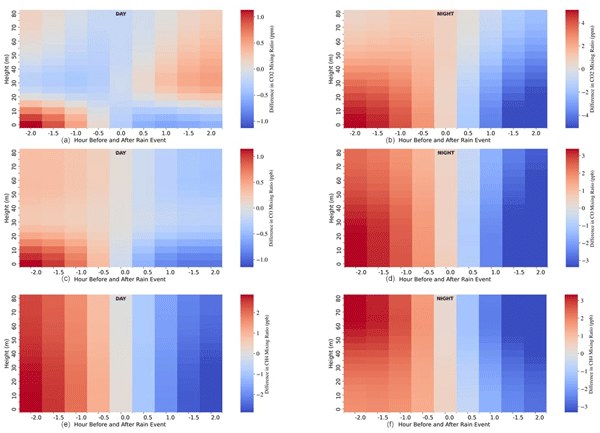
Luiz A. T. Machado, Jürgen Kesselmeier, Santiago Botía, Hella van Asperen, Meinrat O. Andreae, Alessandro C. de Araújo, Paulo Artaxo, Achim Edtbauer, Rosaria R. Ferreira, Marco A. Franco, Hartwig Harder, Sam P. Jones, Cléo Q. Dias-Júnior, Guido G. Haytzmann, Carlos A. Quesada, Shujiro Komiya, Jost Lavric, Jos Lelieveld, Ingeborg Levin, Anke Nölscher, Eva Pfannerstill, Mira L. Pöhlker, Ulrich Pöschl, Akima Ringsdorf, Luciana Rizzo, Ana M. Yáñez-Serrano, Susan Trumbore, Wanda I. D. Valenti, Jordi Vila-Guerau de Arellano, David Walter, Jonathan Williams, Stefan Wolff, and Christopher Pöhlker
Atmos. Chem. Phys., 24, 8893–8910, https://doi.org/10.5194/acp-24-8893-2024, https://doi.org/10.5194/acp-24-8893-2024, 2024
Short summary
Short summary
Composite analysis of gas concentration before and after rainfall, during the day and night, gives insight into the complex relationship between trace gas variability and precipitation. The analysis helps us to understand the sources and sinks of trace gases within a forest ecosystem. It elucidates processes that are not discernible under undisturbed conditions and contributes to a deeper understanding of the trace gas life cycle and its intricate interactions with cloud dynamics in the Amazon.
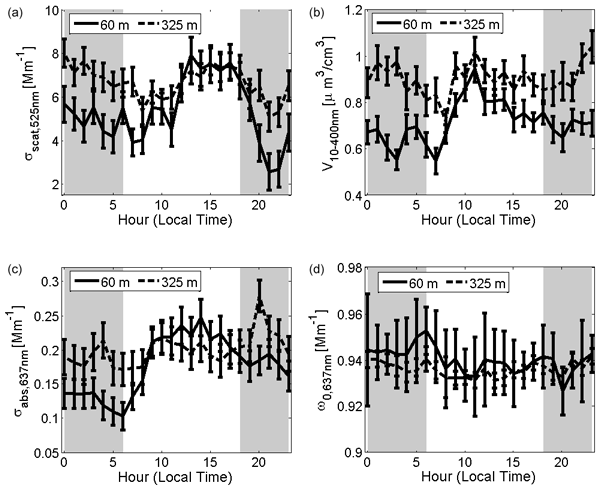
Marco A. Franco, Rafael Valiati, Bruna A. Holanda, Bruno B. Meller, Leslie A. Kremper, Luciana V. Rizzo, Samara Carbone, Fernando G. Morais, Janaína P. Nascimento, Meinrat O. Andreae, Micael A. Cecchini, Luiz A. T. Machado, Milena Ponczek, Ulrich Pöschl, David Walter, Christopher Pöhlker, and Paulo Artaxo
Atmos. Chem. Phys., 24, 8751–8770, https://doi.org/10.5194/acp-24-8751-2024, https://doi.org/10.5194/acp-24-8751-2024, 2024
Short summary
Short summary
The Amazon wet-season atmosphere was studied at the Amazon Tall Tower Observatory site, revealing vertical variations (between 60 and 325 m) in natural aerosols. Daytime mixing contrasted with nighttime stratification, with distinct rain-induced changes in aerosol populations. Notably, optical property recovery at higher levels was faster, while near-canopy aerosols showed higher scattering efficiency. These findings enhance our understanding of aerosol impacts on climate dynamics.
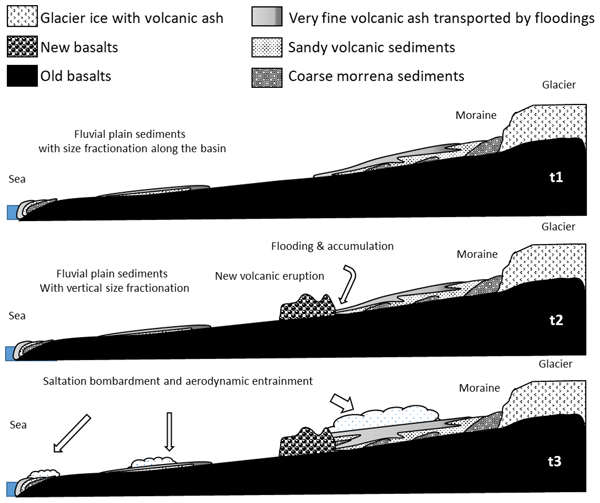
Adolfo González-Romero, Cristina González-Flórez, Agnesh Panta, Jesús Yus-Díez, Patricia Córdoba, Andres Alastuey, Natalia Moreno, Konrad Kandler, Martina Klose, Roger N. Clark, Bethany L. Ehlmann, Rebecca N. Greenberger, Abigail M. Keebler, Phil Brodrick, Robert O. Green, Xavier Querol, and Carlos Pérez García-Pando
Atmos. Chem. Phys., 24, 6883–6910, https://doi.org/10.5194/acp-24-6883-2024, https://doi.org/10.5194/acp-24-6883-2024, 2024
Short summary
Short summary
The knowledge of properties from dust emitted in high latitudes such as in Iceland is scarce. This study focuses on the particle size, mineralogy, cohesion, and iron mode of occurrence and reflectance spectra of dust-emitting sediments. Icelandic top sediments have lower cohesion state, coarser particle size, distinctive mineralogy, and 3-fold bulk Fe content, with a large presence of magnetite compared to Saharan crusts.
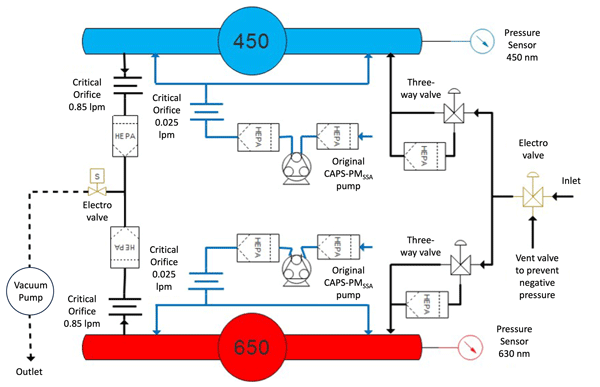
Chenjie Yu, Edouard Pangui, Kevin Tu, Mathieu Cazaunau, Maxime Feingesicht, Landsheere Xavier, Thierry Bourrianne, Vincent Michoud, Christopher Cantrell, Timothy B. Onasch, Andrew Freedman, and Paola Formenti
Atmos. Meas. Tech., 17, 3419–3437, https://doi.org/10.5194/amt-17-3419-2024, https://doi.org/10.5194/amt-17-3419-2024, 2024
Short summary
Short summary
To meet the requirements for measuring aerosol optical properties on airborne platforms and conducting dual-wavelength measurements, we introduced A2S2, an airborne dual-wavelength cavity-attenuated phase-shift single monitor. This study reports the results in the laboratory and an aircraft campaign over Paris and its surrounding regions. The results demonstrate A2S2's reliability in measuring aerosol optical properties at both wavelengths and its suitability for future aircraft campaigns.
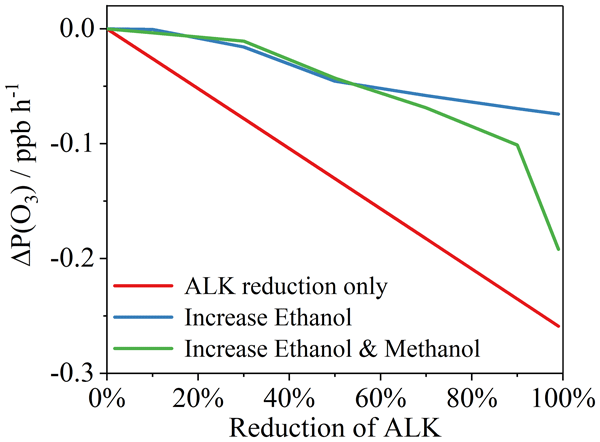
Jianghao Li, Alastair C. Lewis, Jim R. Hopkins, Stephen J. Andrews, Tim Murrells, Neil Passant, Ben Richmond, Siqi Hou, William J. Bloss, Roy M. Harrison, and Zongbo Shi
Atmos. Chem. Phys., 24, 6219–6231, https://doi.org/10.5194/acp-24-6219-2024, https://doi.org/10.5194/acp-24-6219-2024, 2024
Short summary
Short summary
A summertime ozone event at an urban site in Birmingham is sensitive to volatile organic compounds (VOCs) – particularly those of oxygenated VOCs. The roles of anthropogenic VOC sources in urban ozone chemistry are examined by integrating the 1990–2019 national atmospheric emission inventory into model scenarios. Road transport remains the most powerful means of further reducing ozone in this case study, but the benefits may be offset if solvent emissions of VOCs continue to increase.
Alice Maison, Lya Lugon, Soo-Jin Park, Alexia Baudic, Christopher Cantrell, Florian Couvidat, Barbara D'Anna, Claudia Di Biagio, Aline Gratien, Valérie Gros, Carmen Kalalian, Julien Kammer, Vincent Michoud, Jean-Eudes Petit, Marwa Shahin, Leila Simon, Myrto Valari, Jérémy Vigneron, Andrée Tuzet, and Karine Sartelet
Atmos. Chem. Phys., 24, 6011–6046, https://doi.org/10.5194/acp-24-6011-2024, https://doi.org/10.5194/acp-24-6011-2024, 2024
Short summary
Short summary
This study presents the development of a bottom-up inventory of urban tree biogenic emissions. Emissions are computed for each tree based on their location and characteristics and are integrated in the regional air quality model WRF-CHIMERE. The impact of these biogenic emissions on air quality is quantified for June–July 2022. Over Paris city, urban trees increase the concentrations of particulate organic matter by 4.6 %, of PM2.5 by 0.6 %, and of ozone by 1.0 % on average over 2 months.
Vincenzo Obiso, María Gonçalves Ageitos, Carlos Pérez García-Pando, Jan P. Perlwitz, Gregory L. Schuster, Susanne E. Bauer, Claudia Di Biagio, Paola Formenti, Kostas Tsigaridis, and Ron L. Miller
Atmos. Chem. Phys., 24, 5337–5367, https://doi.org/10.5194/acp-24-5337-2024, https://doi.org/10.5194/acp-24-5337-2024, 2024
Short summary
Short summary
We calculate the dust direct radiative effect (DRE) in an Earth system model accounting for regionally varying soil mineralogy through a new observationally constrained method. Linking dust absorption at solar wavelengths to the varying amount of specific minerals (i.e., iron oxides) improves the modeled range of dust single scattering albedo compared to observations and increases the global cooling by dust. Our results may contribute to improved estimates of the dust DRE and its climate impact.
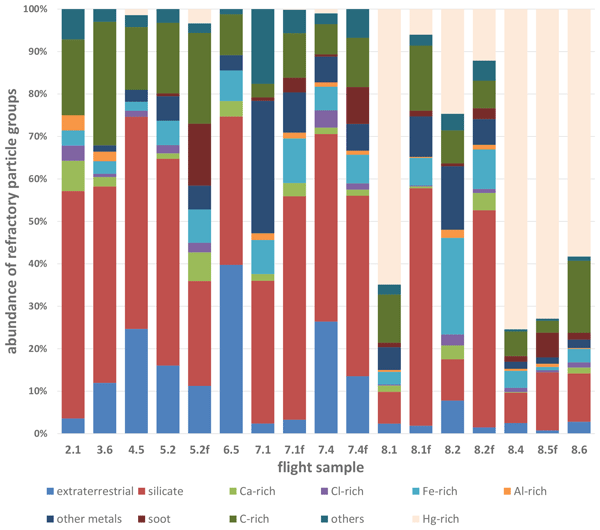
Martin Ebert, Ralf Weigel, Stephan Weinbruch, Lisa Schneider, Konrad Kandler, Stefan Lauterbach, Franziska Köllner, Felix Plöger, Gebhard Günther, Bärbel Vogel, and Stephan Borrmann
Atmos. Chem. Phys., 24, 4771–4788, https://doi.org/10.5194/acp-24-4771-2024, https://doi.org/10.5194/acp-24-4771-2024, 2024
Short summary
Short summary
Particles were collected during the flight campaign StratoClim 2017 within the Asian tropopause aerosol layer (ATAL). Refractory particles from seven different flights were characterized by scanning and transmission electron microscopy (SEM, TEM). The most abundant refractory particles are silicates and non-volatile organics. The most important sources are combustion processes at the ground and the agitation of soil material. During one flight, small cinnabar particles (HgS) were also detected.
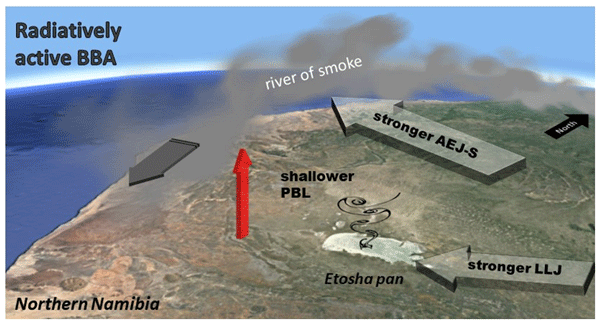
Cyrille Flamant, Jean-Pierre Chaboureau, Marco Gaetani, Kerstin Schepanski, and Paola Formenti
Atmos. Chem. Phys., 24, 4265–4288, https://doi.org/10.5194/acp-24-4265-2024, https://doi.org/10.5194/acp-24-4265-2024, 2024
Short summary
Short summary
In the austral dry season, the atmospheric composition over southern Africa is dominated by biomass burning aerosols and terrigenous aerosols (so-called mineral dust). This study suggests that the radiative effect of biomass burning aerosols needs to be taken into account to properly forecast dust emissions in Namibia.
Anil Kumar Mandariya, Junteng Wu, Anne Monod, Paola Formenti, Bénédicte Picquet-Varrault, Mathieu Cazaunau, Stephan Mertes, Laurent Poulain, Antonin Berge, Edouard Pangui, Andreas Tilgner, Thomas Schaefer, Liang Wen, Hartmut Herrmann, and Jean-François Doussin
Atmos. Meas. Tech. Discuss., https://doi.org/10.5194/amt-2023-206, https://doi.org/10.5194/amt-2023-206, 2024
Publication in AMT not foreseen
Short summary
Short summary
An optimized and controlled protocol for generating quasi-adiabatic expansion clouds under simulated dark and light conditions was presented. The irradiated clouds clearly showed a gradual activation of seed particles into droplets. In contrast, non-irradiated clouds faced a flash activation. This paper will lay the foundation for multiphase photochemical studies implying water-soluble volatile organic compounds and particulate matter formation during cloud formation-evaporation cycles.
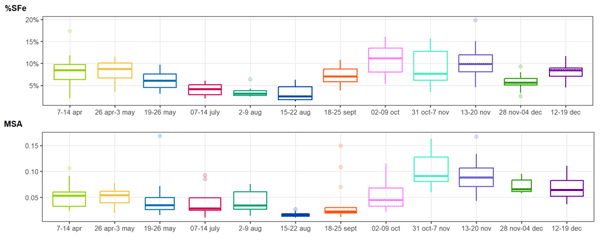
Karine Desboeufs, Paola Formenti, Raquel Torres-Sánchez, Kerstin Schepanski, Jean-Pierre Chaboureau, Hendrik Andersen, Jan Cermak, Stefanie Feuerstein, Benoit Laurent, Danitza Klopper, Andreas Namwoonde, Mathieu Cazaunau, Servanne Chevaillier, Anaïs Feron, Cécile Mirande-Bret, Sylvain Triquet, and Stuart J. Piketh
Atmos. Chem. Phys., 24, 1525–1541, https://doi.org/10.5194/acp-24-1525-2024, https://doi.org/10.5194/acp-24-1525-2024, 2024
Short summary
Short summary
This study investigates the fractional solubility of iron (Fe) in dust particles along the coast of Namibia, a critical region for the atmospheric Fe supply of the South Atlantic Ocean. Our results suggest a possible two-way interplay whereby marine biogenic emissions from the coastal marine ecosystems into the atmosphere would increase the solubility of Fe-bearing dust by photo-reduction processes. The subsequent deposition of soluble Fe could act to further enhance marine biogenic emissions.
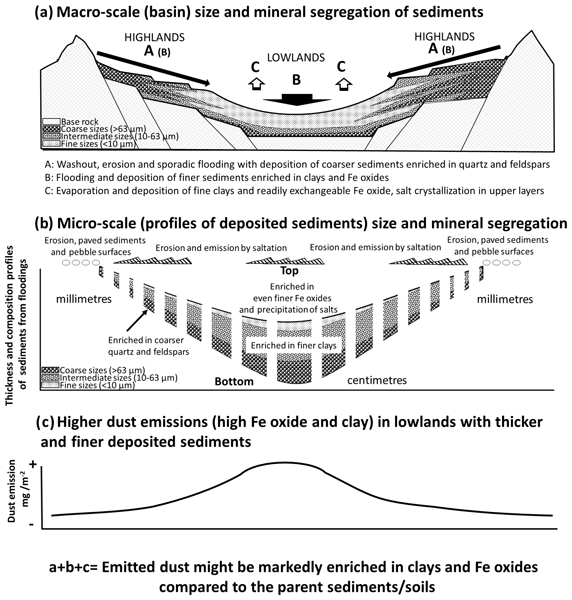
Adolfo González-Romero, Cristina González-Flórez, Agnesh Panta, Jesús Yus-Díez, Cristina Reche, Patricia Córdoba, Natalia Moreno, Andres Alastuey, Konrad Kandler, Martina Klose, Clarissa Baldo, Roger N. Clark, Zongbo Shi, Xavier Querol, and Carlos Pérez García-Pando
Atmos. Chem. Phys., 23, 15815–15834, https://doi.org/10.5194/acp-23-15815-2023, https://doi.org/10.5194/acp-23-15815-2023, 2023
Short summary
Short summary
The effect of dust emitted from desertic surfaces upon climate and ecosystems depends on size and mineralogy, but data from soil mineral atlases of desert soils are scarce. We performed particle-size distribution, mineralogy, and Fe speciation in southern Morocco. Results show coarser particles with high quartz proportion are near the elevated areas, while in depressed areas, sizes are finer, and proportions of clays and nano-Fe oxides are higher. This difference is important for dust modelling.
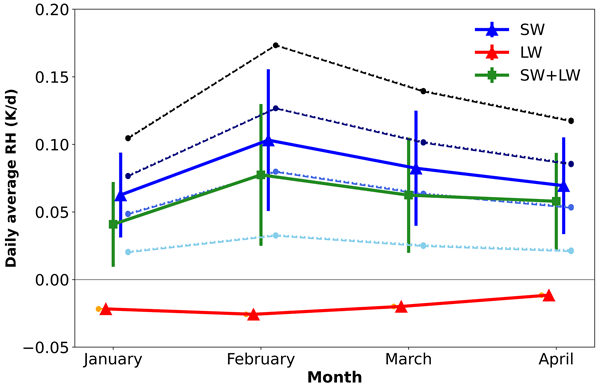
Pasquale Sellitto, Redha Belhadji, Juan Cuesta, Aurélien Podglajen, and Bernard Legras
Atmos. Chem. Phys., 23, 15523–15535, https://doi.org/10.5194/acp-23-15523-2023, https://doi.org/10.5194/acp-23-15523-2023, 2023
Short summary
Short summary
Record-breaking wildfires ravaged south-eastern Australia during the fire season 2019–2020. These fires injected a smoke plume in the stratosphere, which dispersed over the whole Southern Hemisphere and interacted with solar and terrestrial radiation. A number of detached smoke bubbles were also observed emanating from this plume and ascending quickly to over 35 km altitude. Here we study how absorption of radiation generated ascending motion of both the the hemispheric plume and the vortices.
Lu Zhang, Michal Segal-Rozenhaimer, Haochi Che, Caroline Dang, Junying Sun, Ye Kuang, and Paola Formenti
EGUsphere, https://doi.org/10.5194/egusphere-2023-2319, https://doi.org/10.5194/egusphere-2023-2319, 2023
Preprint archived
Short summary
Short summary
Our study examined the interaction between atmospheric particles and moisture over the south-eastern Atlantic Ocean during the biomass burning seasons in Africa. We found that organic components of these particles play a more important role in aerosol-moisture interactions than previously expected. This discovery is important as such interactions impact radiation and climate. Current climate models might need better representations of the moisture-absorbing properties of organic aerosols.
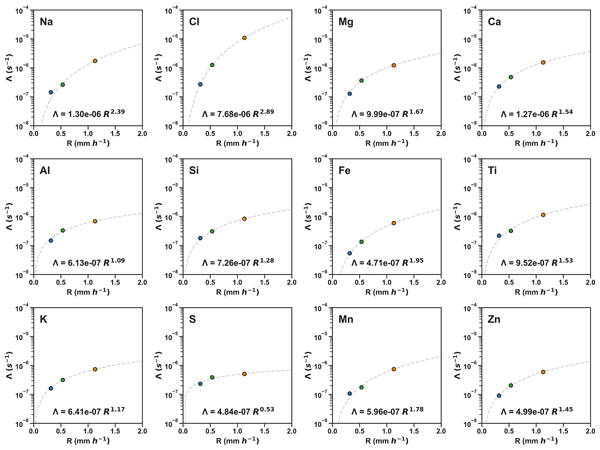
Thomas Audoux, Benoit Laurent, Karine Desboeufs, Gael Noyalet, Franck Maisonneuve, Olivier Lauret, and Servanne Chevaillier
Atmos. Chem. Phys., 23, 13485–13503, https://doi.org/10.5194/acp-23-13485-2023, https://doi.org/10.5194/acp-23-13485-2023, 2023
Short summary
Short summary
In the Paris region, a campaign was conducted to study wet deposition of aerosol particles during rainfall events. Simultaneous measurements of aerosol and wet deposition allowed us to discuss their transfer from the atmosphere to rain. Chemical evolution within events revealed meteorology, atmospheric conditions and local vs. long range sources as key factors. This study highlights the variability of wet deposition and the need to consider event-specific factors to understand its mechanisms.
Ludovico Di Antonio, Claudia Di Biagio, Gilles Foret, Paola Formenti, Guillaume Siour, Jean-François Doussin, and Matthias Beekmann
Atmos. Chem. Phys., 23, 12455–12475, https://doi.org/10.5194/acp-23-12455-2023, https://doi.org/10.5194/acp-23-12455-2023, 2023
Short summary
Short summary
Long-term (2000–2021) 1 km resolution satellite data have been used to investigate the climatological aerosol optical depth (AOD) variability and trends at different scales in Europe. Average enhancements of the local-to-regional AOD ratio at 550 nm of 57 %, 55 %, 39 % and 32 % are found for large metropolitan areas such as Barcelona, Lisbon, Paris and Athens, respectively, suggesting a non-negligible enhancement of the aerosol burden through local emissions.
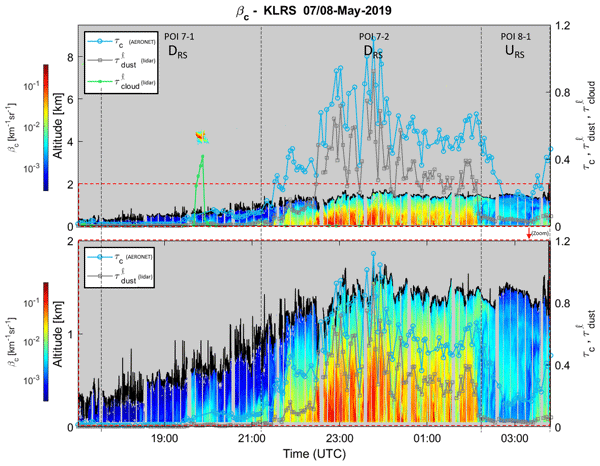
Seyed Ali Sayedain, Norman T. O'Neill, James King, Patrick L. Hayes, Daniel Bellamy, Richard Washington, Sebastian Engelstaedter, Andy Vicente-Luis, Jill Bachelder, and Malo Bernhard
Atmos. Meas. Tech., 16, 4115–4135, https://doi.org/10.5194/amt-16-4115-2023, https://doi.org/10.5194/amt-16-4115-2023, 2023
Short summary
Short summary
We used (columnar) ground-based remote sensing (RS) tools and surface measurements to characterize local (drainage-basin) dust plumes at a site in the Yukon. Plume height, particle size, and column-to-surface ratios enabled insights into how satellite RS could be used to analyze Arctic-wide dust transport. This helps modelers refine dust impacts in their climate change simulations. It is an important step since local dust is a key source of dust deposition on snow in the sensitive Arctic region.
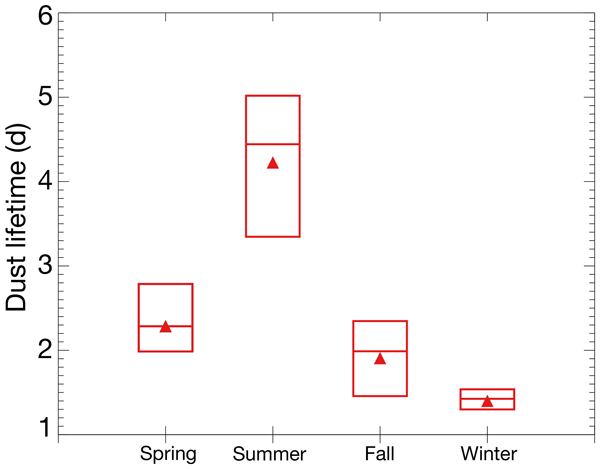
Xurong Wang, Qiaoqiao Wang, Maria Prass, Christopher Pöhlker, Daniel Moran-Zuloaga, Paulo Artaxo, Jianwei Gu, Ning Yang, Xiajie Yang, Jiangchuan Tao, Juan Hong, Nan Ma, Yafang Cheng, Hang Su, and Meinrat O. Andreae
Atmos. Chem. Phys., 23, 9993–10014, https://doi.org/10.5194/acp-23-9993-2023, https://doi.org/10.5194/acp-23-9993-2023, 2023
Short summary
Short summary
In this work, with an optimized particle mass size distribution, we captured observed aerosol optical depth (AOD) and coarse aerosol concentrations over source and/or receptor regions well, demonstrating good performance in simulating export of African dust toward the Amazon Basin. In addition to factors controlling the transatlantic transport of African dust, the study investigated the impact of African dust over the Amazon Basin, including the nutrient inputs associated with dust deposition.
Jianyu Zheng, Zhibo Zhang, Hongbin Yu, Anne Garnier, Qianqian Song, Chenxi Wang, Claudia Di Biagio, Jasper F. Kok, Yevgeny Derimian, and Claire Ryder
Atmos. Chem. Phys., 23, 8271–8304, https://doi.org/10.5194/acp-23-8271-2023, https://doi.org/10.5194/acp-23-8271-2023, 2023
Short summary
Short summary
We developed a multi-year satellite-based retrieval of dust optical depth at 10 µm and the coarse-mode dust effective diameter over global oceans. It reveals climatological coarse-mode dust transport patterns and regional differences over the North Atlantic, the Indian Ocean and the North Pacific.
Clarissa Baldo, Paola Formenti, Claudia Di Biagio, Gongda Lu, Congbo Song, Mathieu Cazaunau, Edouard Pangui, Jean-Francois Doussin, Pavla Dagsson-Waldhauserova, Olafur Arnalds, David Beddows, A. Robert MacKenzie, and Zongbo Shi
Atmos. Chem. Phys., 23, 7975–8000, https://doi.org/10.5194/acp-23-7975-2023, https://doi.org/10.5194/acp-23-7975-2023, 2023
Short summary
Short summary
This paper presents new shortwave spectral complex refractive index and single scattering albedo data for Icelandic dust. Our results show that the imaginary part of the complex refractive index of Icelandic dust is at the upper end of the range of low-latitude dust. Furthermore, we observed that Icelandic dust is more absorbing towards the near-infrared, which we attribute to its high magnetite content. These findings are important for modeling dust aerosol radiative effects in the Arctic.
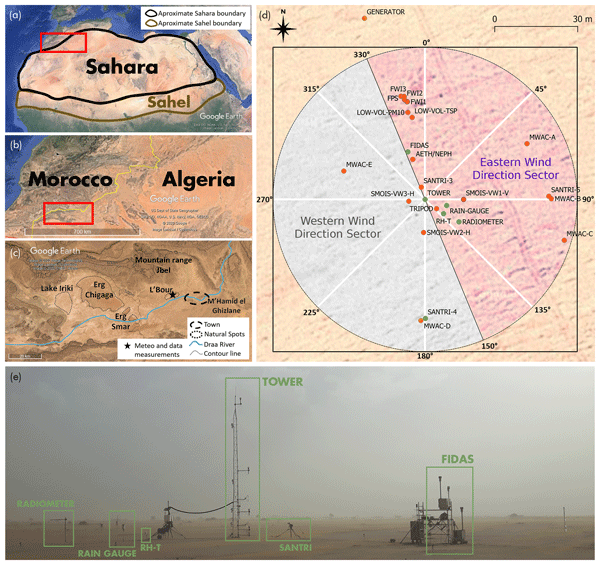
Cristina González-Flórez, Martina Klose, Andrés Alastuey, Sylvain Dupont, Jerónimo Escribano, Vicken Etyemezian, Adolfo Gonzalez-Romero, Yue Huang, Konrad Kandler, George Nikolich, Agnesh Panta, Xavier Querol, Cristina Reche, Jesús Yus-Díez, and Carlos Pérez García-Pando
Atmos. Chem. Phys., 23, 7177–7212, https://doi.org/10.5194/acp-23-7177-2023, https://doi.org/10.5194/acp-23-7177-2023, 2023
Short summary
Short summary
Atmospheric mineral dust consists of tiny mineral particles that are emitted by wind erosion from arid regions. Its particle size distribution (PSD) affects its impact on the Earth's system. Nowadays, there is an incomplete understanding of the emitted dust PSD and a lot of debate about its variability. Here, we try to address these issues based on the measurements performed during a wind erosion and dust emission field campaign in the Moroccan Sahara within the framework of FRAGMENT project.
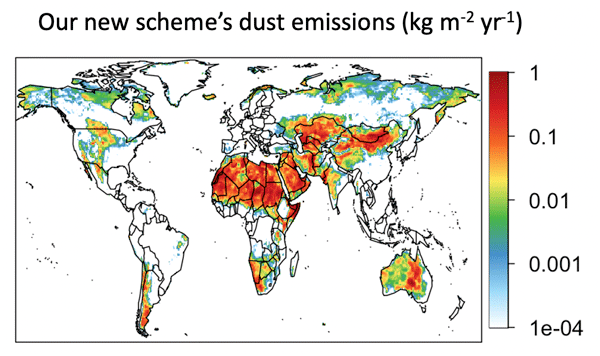
Danny M. Leung, Jasper F. Kok, Longlei Li, Gregory S. Okin, Catherine Prigent, Martina Klose, Carlos Pérez García-Pando, Laurent Menut, Natalie M. Mahowald, David M. Lawrence, and Marcelo Chamecki
Atmos. Chem. Phys., 23, 6487–6523, https://doi.org/10.5194/acp-23-6487-2023, https://doi.org/10.5194/acp-23-6487-2023, 2023
Short summary
Short summary
Desert dust modeling is important for understanding climate change, as dust regulates the atmosphere's greenhouse effect and radiation. This study formulates and proposes a more physical and realistic desert dust emission scheme for global and regional climate models. By considering more aeolian processes in our emission scheme, our simulations match better against dust observations than existing schemes. We believe this work is vital in improving dust representation in climate models.
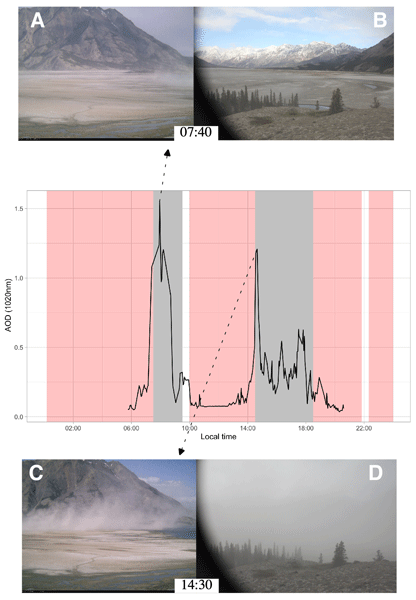
Rosemary Huck, Robert G. Bryant, and James King
Atmos. Chem. Phys., 23, 6299–6318, https://doi.org/10.5194/acp-23-6299-2023, https://doi.org/10.5194/acp-23-6299-2023, 2023
Short summary
Short summary
This study shows that mineral aerosol (dust) emission events in high-latitude areas are under-represented in both ground- and space-based detecting methods. This is done through a suite of ground-based data to prove that dust emissions from the proglacial area, Lhù’ààn Mân, occur almost daily but are not always recorded at different timescales. Dust has multiple effects on atmospheric processes; therefore, accurate quantification is important in the calibration and validation of climate models.
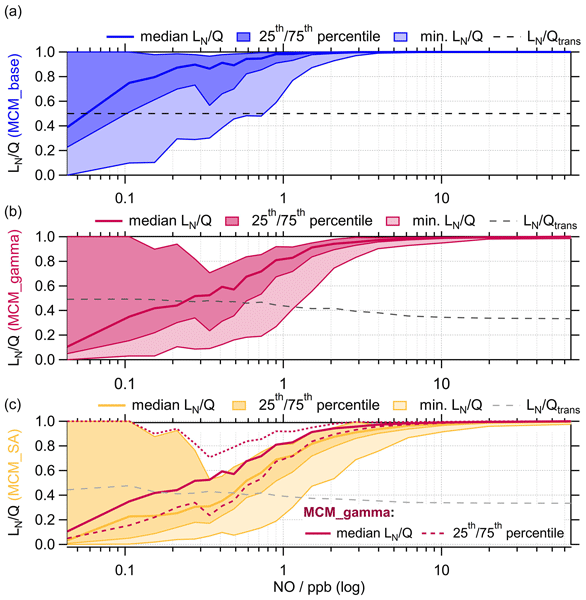
Joanna E. Dyson, Lisa K. Whalley, Eloise J. Slater, Robert Woodward-Massey, Chunxiang Ye, James D. Lee, Freya Squires, James R. Hopkins, Rachel E. Dunmore, Marvin Shaw, Jacqueline F. Hamilton, Alastair C. Lewis, Stephen D. Worrall, Asan Bacak, Archit Mehra, Thomas J. Bannan, Hugh Coe, Carl J. Percival, Bin Ouyang, C. Nicholas Hewitt, Roderic L. Jones, Leigh R. Crilley, Louisa J. Kramer, W. Joe F. Acton, William J. Bloss, Supattarachai Saksakulkrai, Jingsha Xu, Zongbo Shi, Roy M. Harrison, Simone Kotthaus, Sue Grimmond, Yele Sun, Weiqi Xu, Siyao Yue, Lianfang Wei, Pingqing Fu, Xinming Wang, Stephen R. Arnold, and Dwayne E. Heard
Atmos. Chem. Phys., 23, 5679–5697, https://doi.org/10.5194/acp-23-5679-2023, https://doi.org/10.5194/acp-23-5679-2023, 2023
Short summary
Short summary
The hydroxyl (OH) and closely coupled hydroperoxyl (HO2) radicals are vital for their role in the removal of atmospheric pollutants. In less polluted regions, atmospheric models over-predict HO2 concentrations. In this modelling study, the impact of heterogeneous uptake of HO2 onto aerosol surfaces on radical concentrations and the ozone production regime in Beijing in the summertime is investigated, and the implications for emissions policies across China are considered.
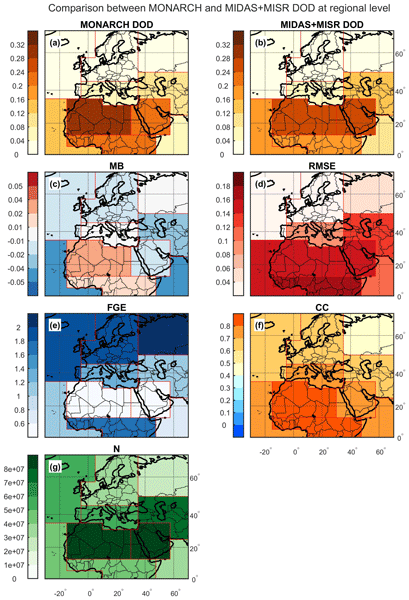
Michail Mytilinaios, Sara Basart, Sergio Ciamprone, Juan Cuesta, Claudio Dema, Enza Di Tomaso, Paola Formenti, Antonis Gkikas, Oriol Jorba, Ralph Kahn, Carlos Pérez García-Pando, Serena Trippetta, and Lucia Mona
Atmos. Chem. Phys., 23, 5487–5516, https://doi.org/10.5194/acp-23-5487-2023, https://doi.org/10.5194/acp-23-5487-2023, 2023
Short summary
Short summary
Multiscale Online Non-hydrostatic AtmospheRe CHemistry model (MONARCH) dust reanalysis provides a high-resolution 3D reconstruction of past dust conditions, allowing better quantification of climate and socioeconomic dust impacts. We assess the performance of the reanalysis needed to reproduce dust optical depth using dust-related products retrieved from satellite and ground-based observations and show that it reproduces the spatial distribution and seasonal variability of atmospheric dust well.
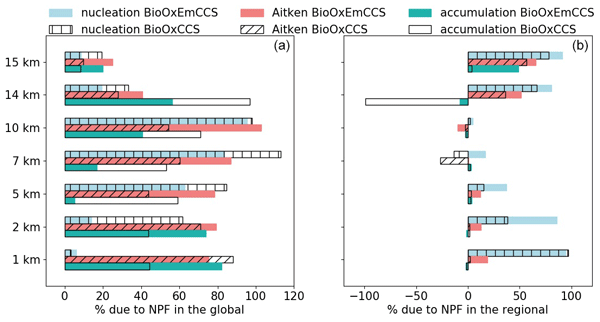
Xuemei Wang, Hamish Gordon, Daniel P. Grosvenor, Meinrat O. Andreae, and Ken S. Carslaw
Atmos. Chem. Phys., 23, 4431–4461, https://doi.org/10.5194/acp-23-4431-2023, https://doi.org/10.5194/acp-23-4431-2023, 2023
Short summary
Short summary
New particle formation in the upper troposphere is important for the global boundary layer aerosol population, and they can be transported downward in Amazonia. We use a global and a regional model to quantify the number of aerosols that are formed at high altitude and transported downward in a 1000 km region. We find that the majority of the aerosols are from outside the region. This suggests that the 1000 km region is unlikely to be a
closed loopfor aerosol formation, transport and growth.
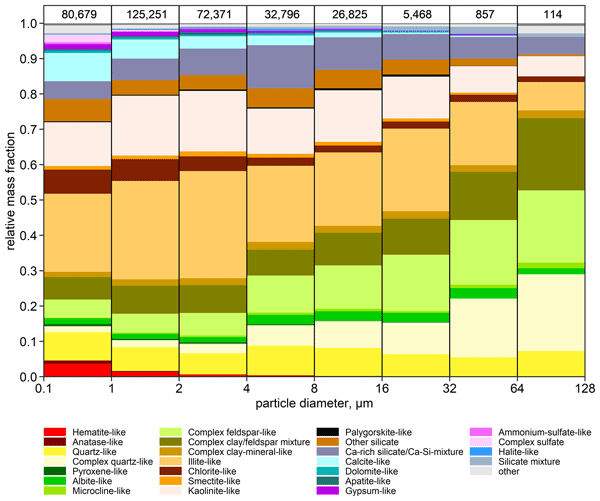
Agnesh Panta, Konrad Kandler, Andres Alastuey, Cristina González-Flórez, Adolfo González-Romero, Martina Klose, Xavier Querol, Cristina Reche, Jesús Yus-Díez, and Carlos Pérez García-Pando
Atmos. Chem. Phys., 23, 3861–3885, https://doi.org/10.5194/acp-23-3861-2023, https://doi.org/10.5194/acp-23-3861-2023, 2023
Short summary
Short summary
Desert dust is a major aerosol component of the Earth system and affects the climate. Dust properties are influenced by particle size, mineralogy, shape, and mixing state. This work characterizes freshly emitted individual mineral dust particles from a major source region using electron microscopy. Our new insights into critical particle-specific information will contribute to better constraining climate models that consider mineralogical variations in their representation of the dust cycle.
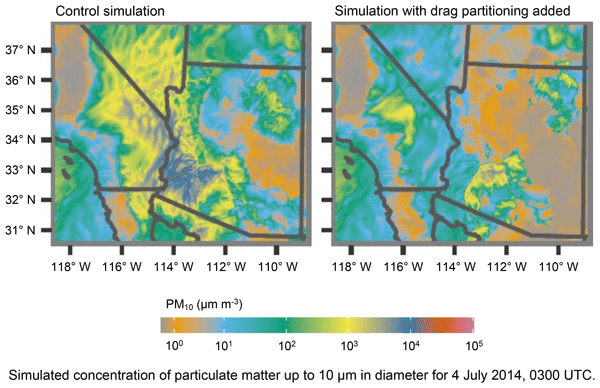
Sandra L. LeGrand, Theodore W. Letcher, Gregory S. Okin, Nicholas P. Webb, Alex R. Gallagher, Saroj Dhital, Taylor S. Hodgdon, Nancy P. Ziegler, and Michelle L. Michaels
Geosci. Model Dev., 16, 1009–1038, https://doi.org/10.5194/gmd-16-1009-2023, https://doi.org/10.5194/gmd-16-1009-2023, 2023
Short summary
Short summary
Ground cover affects dust emissions by reducing wind flow over the immediate soil surface. This study reviews a method for estimating ground cover effects on wind erosion from satellite-detected terrain shadows. We conducted a case study for a US dust event using the Weather Research and Forecasting with Chemistry (WRF-Chem) model. Adding the shadow-based method for ground cover effects markedly improved simulated results and may lead to better dust modeling outcomes in vegetated drylands.
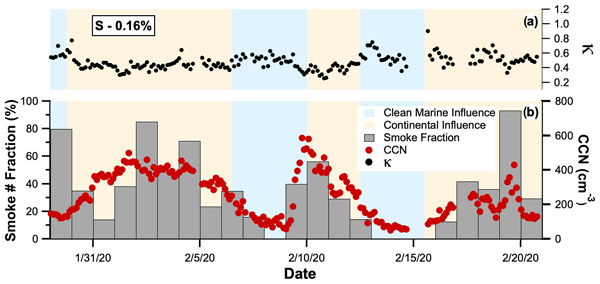
Haley M. Royer, Mira L. Pöhlker, Ovid Krüger, Edmund Blades, Peter Sealy, Nurun Nahar Lata, Zezhen Cheng, Swarup China, Andrew P. Ault, Patricia K. Quinn, Paquita Zuidema, Christopher Pöhlker, Ulrich Pöschl, Meinrat Andreae, and Cassandra J. Gaston
Atmos. Chem. Phys., 23, 981–998, https://doi.org/10.5194/acp-23-981-2023, https://doi.org/10.5194/acp-23-981-2023, 2023
Short summary
Short summary
This paper presents atmospheric particle chemical composition and measurements of aerosol water uptake properties collected at Ragged Point, Barbados, during the winter of 2020. The result of this study indicates the importance of small African smoke particles for cloud droplet formation in the tropical North Atlantic and highlights the large spatial and temporal pervasiveness of smoke over the Atlantic Ocean.
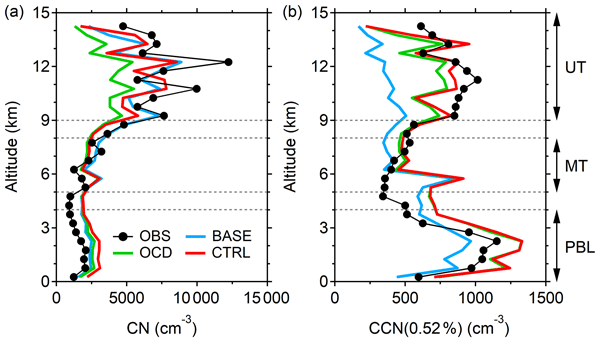
Yunfan Liu, Hang Su, Siwen Wang, Chao Wei, Wei Tao, Mira L. Pöhlker, Christopher Pöhlker, Bruna A. Holanda, Ovid O. Krüger, Thorsten Hoffmann, Manfred Wendisch, Paulo Artaxo, Ulrich Pöschl, Meinrat O. Andreae, and Yafang Cheng
Atmos. Chem. Phys., 23, 251–272, https://doi.org/10.5194/acp-23-251-2023, https://doi.org/10.5194/acp-23-251-2023, 2023
Short summary
Short summary
The origins of the abundant cloud condensation nuclei (CCN) in the upper troposphere (UT) of the Amazon remain unclear. With model developments of new secondary organic aerosol schemes and constrained by observation, we show that strong aerosol nucleation and condensation in the UT is triggered by biogenic organics, and organic condensation is key for UT CCN production. This UT CCN-producing mechanism may prevail over broader vegetation canopies and deserves emphasis in aerosol–climate feedback.
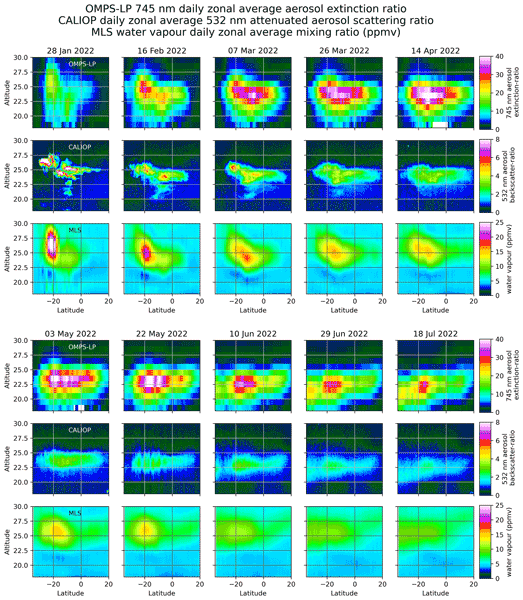
Bernard Legras, Clair Duchamp, Pasquale Sellitto, Aurélien Podglajen, Elisa Carboni, Richard Siddans, Jens-Uwe Grooß, Sergey Khaykin, and Felix Ploeger
Atmos. Chem. Phys., 22, 14957–14970, https://doi.org/10.5194/acp-22-14957-2022, https://doi.org/10.5194/acp-22-14957-2022, 2022
Short summary
Short summary
The long-duration atmospheric impact of the Tonga eruption in January 2022 is a plume of water and sulfate aerosols in the stratosphere that persisted for more than 6 months. We study this evolution using several satellite instruments and analyse the unusual behaviour of this plume as sulfates and water first moved down rapidly and then separated into two layers. We also report the self-organization in compact and long-lived patches.

Mathieu Lachatre, Sylvain Mailler, Laurent Menut, Arineh Cholakian, Pasquale Sellitto, Guillaume Siour, Henda Guermazi, Giuseppe Salerno, and Salvatore Giammanco
Atmos. Chem. Phys., 22, 13861–13879, https://doi.org/10.5194/acp-22-13861-2022, https://doi.org/10.5194/acp-22-13861-2022, 2022
Short summary
Short summary
In this study, we have evaluated the predominance of various pathways of volcanic SO2 conversion to sulfates in the upper troposphere. We show that the main conversion pathway was gaseous oxidation by OH, although the liquid pathways were expected to be predominant. These results are interesting with respect to a better understanding of sulfate formation in the middle and upper troposphere and are an important component to help evaluate particulate matter radiative forcing.
Qianqian Song, Zhibo Zhang, Hongbin Yu, Jasper F. Kok, Claudia Di Biagio, Samuel Albani, Jianyu Zheng, and Jiachen Ding
Atmos. Chem. Phys., 22, 13115–13135, https://doi.org/10.5194/acp-22-13115-2022, https://doi.org/10.5194/acp-22-13115-2022, 2022
Short summary
Short summary
This study developed a dataset that enables us to efficiently calculate dust direct radiative effect (DRE, i.e., cooling or warming our planet) for any given dust size distribution in addition to three sets of dust mineral components and two dust shapes. We demonstrate and validate the method of using this dataset to calculate dust DRE. Moreover, using this dataset we found that dust mineral composition is a more important factor in determining dust DRE than dust size and shape.
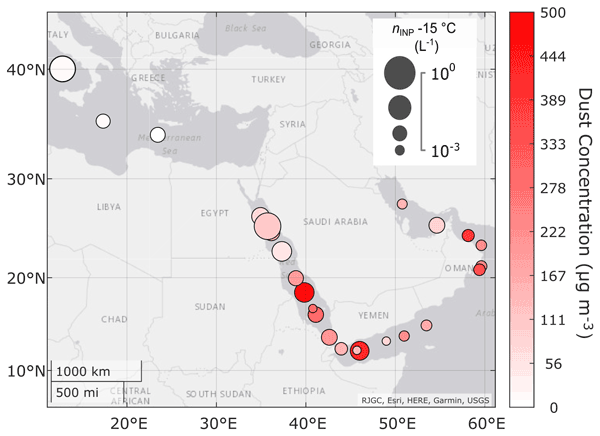
Charlotte M. Beall, Thomas C. J. Hill, Paul J. DeMott, Tobias Köneman, Michael Pikridas, Frank Drewnick, Hartwig Harder, Christopher Pöhlker, Jos Lelieveld, Bettina Weber, Minas Iakovides, Roman Prokeš, Jean Sciare, Meinrat O. Andreae, M. Dale Stokes, and Kimberly A. Prather
Atmos. Chem. Phys., 22, 12607–12627, https://doi.org/10.5194/acp-22-12607-2022, https://doi.org/10.5194/acp-22-12607-2022, 2022
Short summary
Short summary
Ice-nucleating particles (INPs) are rare aerosols that can trigger ice formation in clouds and affect climate-relevant cloud properties such as phase, reflectivity and lifetime. Dust is the dominant INP source, yet few measurements have been reported near major dust sources. We report INP observations within hundreds of kilometers of the biggest dust source regions globally: the Sahara and the Arabian Peninsula. Results show that at temperatures > −15 °C, INPs are dominated by organics.
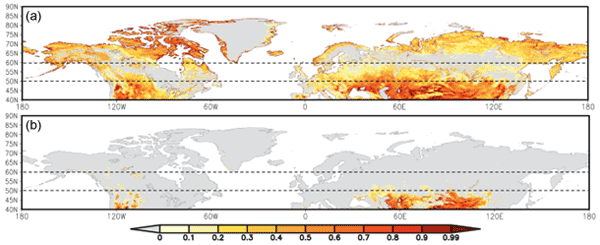
Outi Meinander, Pavla Dagsson-Waldhauserova, Pavel Amosov, Elena Aseyeva, Cliff Atkins, Alexander Baklanov, Clarissa Baldo, Sarah L. Barr, Barbara Barzycka, Liane G. Benning, Bojan Cvetkovic, Polina Enchilik, Denis Frolov, Santiago Gassó, Konrad Kandler, Nikolay Kasimov, Jan Kavan, James King, Tatyana Koroleva, Viktoria Krupskaya, Markku Kulmala, Monika Kusiak, Hanna K. Lappalainen, Michał Laska, Jerome Lasne, Marek Lewandowski, Bartłomiej Luks, James B. McQuaid, Beatrice Moroni, Benjamin Murray, Ottmar Möhler, Adam Nawrot, Slobodan Nickovic, Norman T. O’Neill, Goran Pejanovic, Olga Popovicheva, Keyvan Ranjbar, Manolis Romanias, Olga Samonova, Alberto Sanchez-Marroquin, Kerstin Schepanski, Ivan Semenkov, Anna Sharapova, Elena Shevnina, Zongbo Shi, Mikhail Sofiev, Frédéric Thevenet, Throstur Thorsteinsson, Mikhail Timofeev, Nsikanabasi Silas Umo, Andreas Uppstu, Darya Urupina, György Varga, Tomasz Werner, Olafur Arnalds, and Ana Vukovic Vimic
Atmos. Chem. Phys., 22, 11889–11930, https://doi.org/10.5194/acp-22-11889-2022, https://doi.org/10.5194/acp-22-11889-2022, 2022
Short summary
Short summary
High-latitude dust (HLD) is a short-lived climate forcer, air pollutant, and nutrient source. Our results suggest a northern HLD belt at 50–58° N in Eurasia and 50–55° N in Canada and at >60° N in Eurasia and >58° N in Canada. Our addition to the previously identified global dust belt (GDB) provides crucially needed information on the extent of active HLD sources with both direct and indirect impacts on climate and environment in remote regions, which are often poorly understood and predicted.
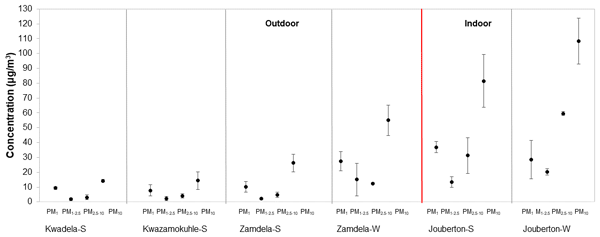
Constance K. Segakweng, Pieter G. van Zyl, Cathy Liousse, Johan P. Beukes, Jan-Stefan Swartz, Eric Gardrat, Maria Dias-Alves, Brigitte Language, Roelof P. Burger, and Stuart J. Piketh
Atmos. Chem. Phys., 22, 10291–10317, https://doi.org/10.5194/acp-22-10291-2022, https://doi.org/10.5194/acp-22-10291-2022, 2022
Short summary
Short summary
A detailed size-resolved assessment of the chemical characteristics of outdoor and indoor aerosols collected in low-income urban settlements in South Africa indicated the significance of household combustion for cooking and space heating – an important source of pollutants in the developing world – to atmospheric chemical composition. The regional impact of industrial sources in the highly industrialised and densely populated north-eastern interior of South Africa was also evident.
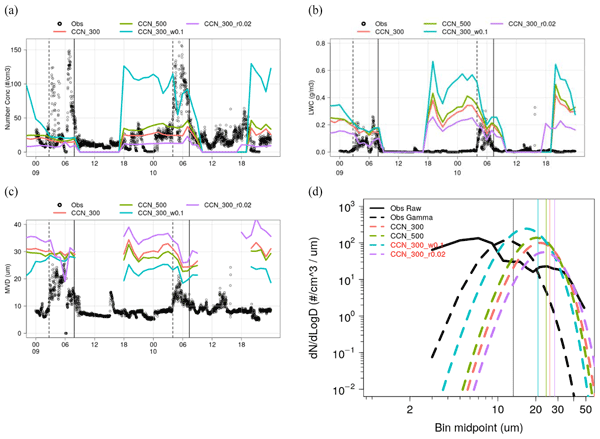
Michael John Weston, Stuart John Piketh, Frédéric Burnet, Stephen Broccardo, Cyrielle Denjean, Thierry Bourrianne, and Paola Formenti
Atmos. Chem. Phys., 22, 10221–10245, https://doi.org/10.5194/acp-22-10221-2022, https://doi.org/10.5194/acp-22-10221-2022, 2022
Short summary
Short summary
An aerosol-aware microphysics scheme is evaluated for fog cases in Namibia. AEROCLO-sA campaign observations are used to access and parameterise the model. The model cloud condensation nuclei activation is lower than the observations. The scheme is designed for clouds with updrafts, while fog typically forms in stable conditions. A pseudo updraft speed assigned to the lowest model levels helps achieve more realistic cloud droplet number concentration and size distribution in the model.
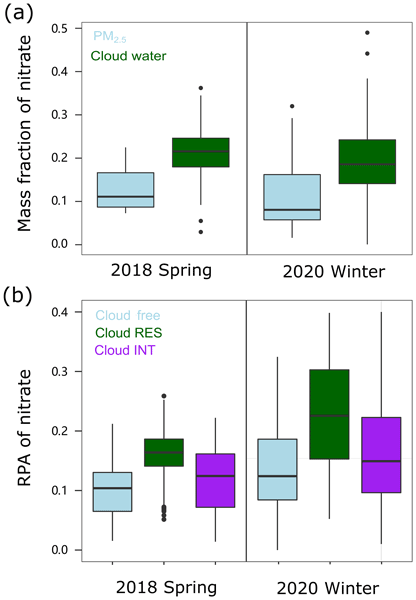
Guohua Zhang, Xiaodong Hu, Wei Sun, Yuxiang Yang, Ziyong Guo, Yuzhen Fu, Haichao Wang, Shengzhen Zhou, Lei Li, Mingjin Tang, Zongbo Shi, Duohong Chen, Xinhui Bi, and Xinming Wang
Atmos. Chem. Phys., 22, 9571–9582, https://doi.org/10.5194/acp-22-9571-2022, https://doi.org/10.5194/acp-22-9571-2022, 2022
Short summary
Short summary
We show a significant enhancement of nitrate mass fraction in cloud water and relative intensity of nitrate in the cloud residual particles and highlight that hydrolysis of N2O5 serves as the critical route for the in-cloud formation of nitrate, even during the daytime. Given that N2O5 hydrolysis acts as a major sink of NOx in the atmosphere, further model updates may improve our understanding about the processes contributing to nitrate production in cloud and the cycling of odd nitrogen.
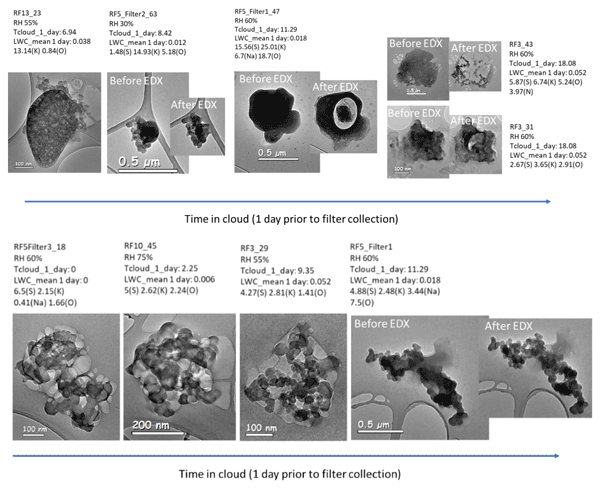
Caroline Dang, Michal Segal-Rozenhaimer, Haochi Che, Lu Zhang, Paola Formenti, Jonathan Taylor, Amie Dobracki, Sara Purdue, Pui-Shan Wong, Athanasios Nenes, Arthur Sedlacek III, Hugh Coe, Jens Redemann, Paquita Zuidema, Steven Howell, and James Haywood
Atmos. Chem. Phys., 22, 9389–9412, https://doi.org/10.5194/acp-22-9389-2022, https://doi.org/10.5194/acp-22-9389-2022, 2022
Short summary
Short summary
Transmission electron microscopy was used to analyze aged African smoke particles and how the smoke interacts with the marine atmosphere. We found that the volatility of organic aerosol increases with biomass burning plume age, that black carbon is often mixed with potassium salts and that the marine atmosphere can incorporate Na and Cl into smoke particles. Marine salts are more processed when mixed with smoke plumes, and there are interesting Cl-rich yet Na-absent marine particles.
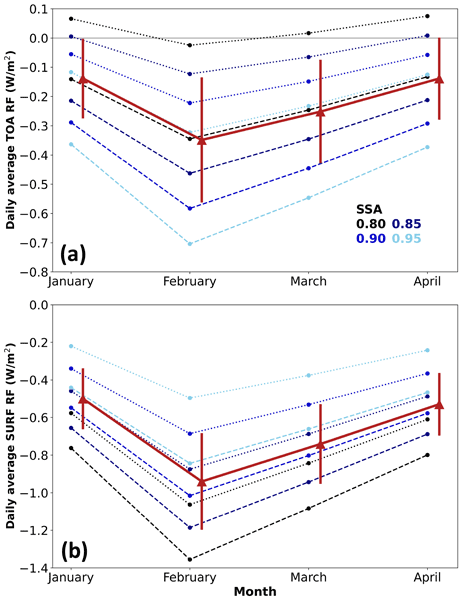
Pasquale Sellitto, Redha Belhadji, Corinna Kloss, and Bernard Legras
Atmos. Chem. Phys., 22, 9299–9311, https://doi.org/10.5194/acp-22-9299-2022, https://doi.org/10.5194/acp-22-9299-2022, 2022
Short summary
Short summary
As a consequence of extreme heat and drought, record-breaking wildfires ravaged south-eastern Australia during the fire season in 2019–2020. Fires injected a smoke plume very high up to the stratosphere, which dispersed quite quickly to the whole Southern Hemisphere and interacted with solar radiation, reflecting and absorbing part of it – thus producing impacts on the climate system. Here we estimate this impact on radiation and we study how it depends on the properties and ageing of the plume.
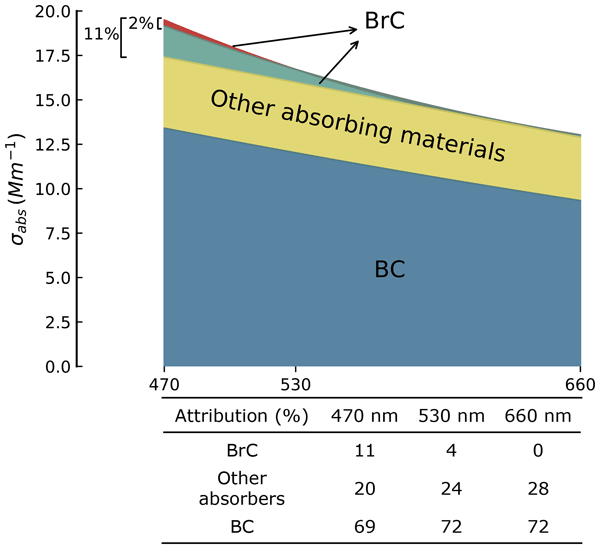
Lu Zhang, Michal Segal-Rozenhaimer, Haochi Che, Caroline Dang, Arthur J. Sedlacek III, Ernie R. Lewis, Amie Dobracki, Jenny P. S. Wong, Paola Formenti, Steven G. Howell, and Athanasios Nenes
Atmos. Chem. Phys., 22, 9199–9213, https://doi.org/10.5194/acp-22-9199-2022, https://doi.org/10.5194/acp-22-9199-2022, 2022
Short summary
Short summary
Widespread biomass burning (BB) events occur annually in Africa and contribute ~ 1 / 3 of global BB emissions, which contain a large family of light-absorbing organics, known as brown carbon (BrC), whose absorption of incident radiation is difficult to estimate, leading to large uncertainties in the global radiative forcing estimation. This study quantifies the BrC absorption of aged BB particles and highlights the potential presence of absorbing iron oxides in this climatically important region.
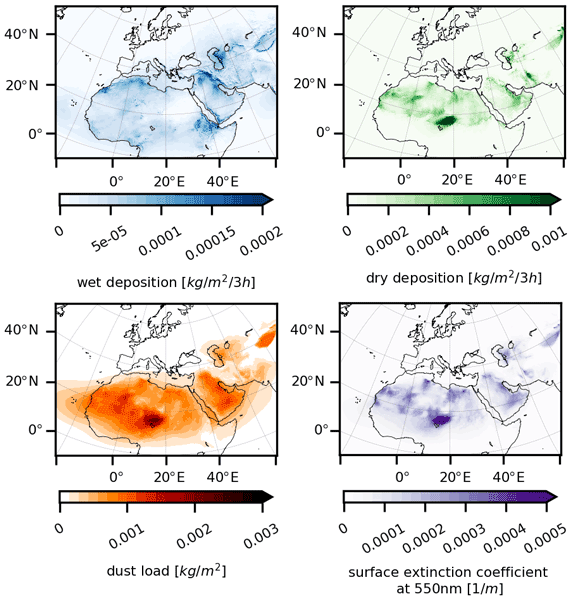
Enza Di Tomaso, Jerónimo Escribano, Sara Basart, Paul Ginoux, Francesca Macchia, Francesca Barnaba, Francesco Benincasa, Pierre-Antoine Bretonnière, Arnau Buñuel, Miguel Castrillo, Emilio Cuevas, Paola Formenti, María Gonçalves, Oriol Jorba, Martina Klose, Lucia Mona, Gilbert Montané Pinto, Michail Mytilinaios, Vincenzo Obiso, Miriam Olid, Nick Schutgens, Athanasios Votsis, Ernest Werner, and Carlos Pérez García-Pando
Earth Syst. Sci. Data, 14, 2785–2816, https://doi.org/10.5194/essd-14-2785-2022, https://doi.org/10.5194/essd-14-2785-2022, 2022
Short summary
Short summary
MONARCH reanalysis of desert dust aerosols extends the existing observation-based information for mineral dust monitoring by providing 3-hourly upper-air, surface and total column key geophysical variables of the dust cycle over Northern Africa, the Middle East and Europe, at a 0.1° horizontal resolution in a rotated grid, from 2007 to 2016. This work provides evidence of the high accuracy of this data set and its suitability for air quality and health and climate service applications.
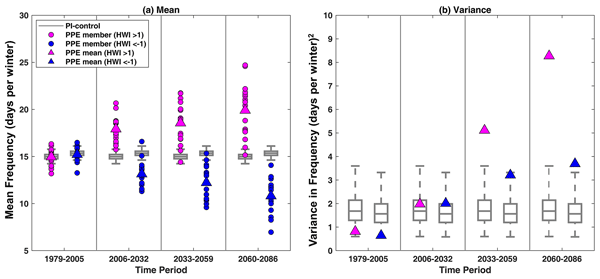
Shipra Jain, Ruth M. Doherty, David Sexton, Steven Turnock, Chaofan Li, Zixuan Jia, Zongbo Shi, and Lin Pei
Atmos. Chem. Phys., 22, 7443–7460, https://doi.org/10.5194/acp-22-7443-2022, https://doi.org/10.5194/acp-22-7443-2022, 2022
Short summary
Short summary
We provide a range of future projections of winter haze and clear conditions over the North China Plain (NCP) using multiple simulations from a climate model for the high-emission scenario (RCP8.5). The frequency of haze conducive weather is likely to increase whereas the frequency of clear weather is likely to decrease in future. The total number of hazy days for a given winter can be as much as ˜3.5 times higher than the number of clear days over the NCP.
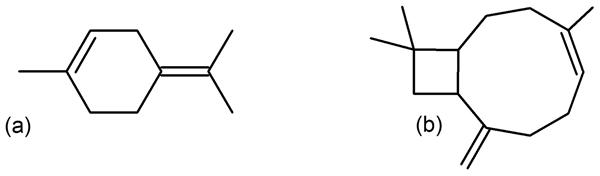
Axel Fouqueau, Manuela Cirtog, Mathieu Cazaunau, Edouard Pangui, Jean-François Doussin, and Bénédicte Picquet-Varrault
Atmos. Chem. Phys., 22, 6411–6434, https://doi.org/10.5194/acp-22-6411-2022, https://doi.org/10.5194/acp-22-6411-2022, 2022
Short summary
Short summary
Biogenic volatile organic compounds are intensely emitted by forests and crops and react with the nitrate radical during the nighttime to form functionalized products. The purpose of this study is to furnish kinetic and mechanistic data for terpinolene and β-caryophyllene, using simulation chamber experiments. Rate constants have been measured using both relative and absolute methods, and mechanistic studies have been conducted in order to identify and quantify the main reaction products.
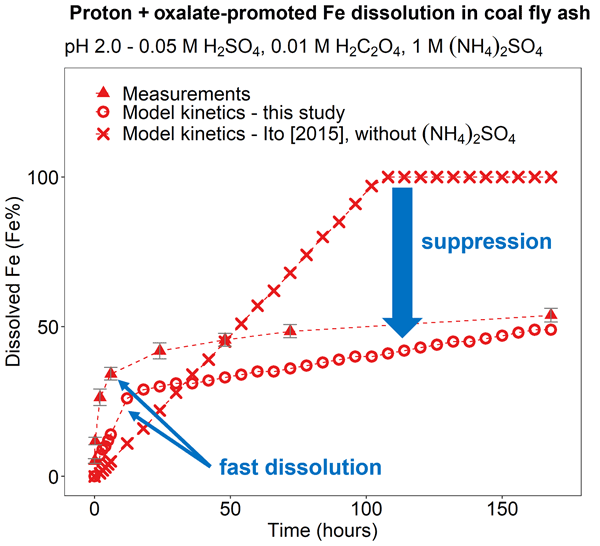
Clarissa Baldo, Akinori Ito, Michael D. Krom, Weijun Li, Tim Jones, Nick Drake, Konstantin Ignatyev, Nicholas Davidson, and Zongbo Shi
Atmos. Chem. Phys., 22, 6045–6066, https://doi.org/10.5194/acp-22-6045-2022, https://doi.org/10.5194/acp-22-6045-2022, 2022
Short summary
Short summary
High ionic strength relevant to the aerosol-water enhanced proton-promoted dissolution of iron in coal fly ash (up to 7 times) but suppressed oxalate-promoted dissolution at low pH (< 3). Fe in coal fly ash dissolved up to 7 times faster than in Saharan dust at low pH. A global model with the updated dissolution rates of iron in coal fly ash suggested a larger contribution of pyrogenic dissolved Fe over regions with a strong impact from fossil fuel combustions.
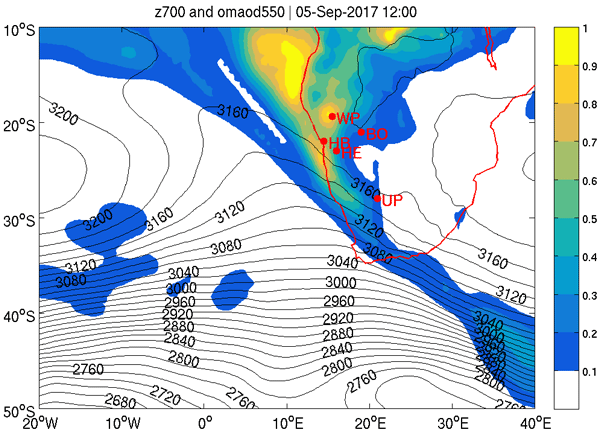
Cyrille Flamant, Marco Gaetani, Jean-Pierre Chaboureau, Patrick Chazette, Juan Cuesta, Stuart John Piketh, and Paola Formenti
Atmos. Chem. Phys., 22, 5701–5724, https://doi.org/10.5194/acp-22-5701-2022, https://doi.org/10.5194/acp-22-5701-2022, 2022
Short summary
Short summary
Rivers of smoke extend from tropical southern Africa towards the Indian Ocean during the winter fire season, controlled by the interaction of tropical easterly waves, and westerly waves at mid latitudes. During the AEROCLO-sA field campaign in 2017, a river of smoke was directly observed over Namibia. In this paper, the evolution and atmospheric drivers of the river of smoke are described, and the role of a mid-latitude cut-off low in lifting the smoke to the upper troposphere is highlighted.
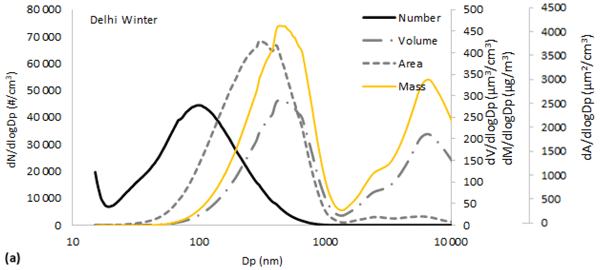
Ülkü Alver Şahin, Roy M. Harrison, Mohammed S. Alam, David C. S. Beddows, Dimitrios Bousiotis, Zongbo Shi, Leigh R. Crilley, William Bloss, James Brean, Isha Khanna, and Rulan Verma
Atmos. Chem. Phys., 22, 5415–5433, https://doi.org/10.5194/acp-22-5415-2022, https://doi.org/10.5194/acp-22-5415-2022, 2022
Short summary
Short summary
Wide-range particle size spectra have been measured in three seasons in Delhi and are interpreted in terms of sources and processes. Condensational growth is a major feature of the fine fraction, and a coarse fraction contributes substantially – but only in summer.
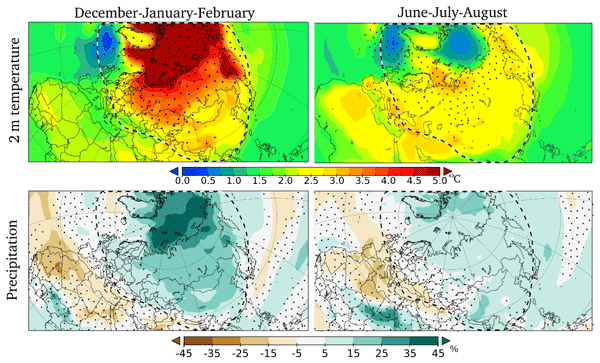
Hanna K. Lappalainen, Tuukka Petäjä, Timo Vihma, Jouni Räisänen, Alexander Baklanov, Sergey Chalov, Igor Esau, Ekaterina Ezhova, Matti Leppäranta, Dmitry Pozdnyakov, Jukka Pumpanen, Meinrat O. Andreae, Mikhail Arshinov, Eija Asmi, Jianhui Bai, Igor Bashmachnikov, Boris Belan, Federico Bianchi, Boris Biskaborn, Michael Boy, Jaana Bäck, Bin Cheng, Natalia Chubarova, Jonathan Duplissy, Egor Dyukarev, Konstantinos Eleftheriadis, Martin Forsius, Martin Heimann, Sirkku Juhola, Vladimir Konovalov, Igor Konovalov, Pavel Konstantinov, Kajar Köster, Elena Lapshina, Anna Lintunen, Alexander Mahura, Risto Makkonen, Svetlana Malkhazova, Ivan Mammarella, Stefano Mammola, Stephany Buenrostro Mazon, Outi Meinander, Eugene Mikhailov, Victoria Miles, Stanislav Myslenkov, Dmitry Orlov, Jean-Daniel Paris, Roberta Pirazzini, Olga Popovicheva, Jouni Pulliainen, Kimmo Rautiainen, Torsten Sachs, Vladimir Shevchenko, Andrey Skorokhod, Andreas Stohl, Elli Suhonen, Erik S. Thomson, Marina Tsidilina, Veli-Pekka Tynkkynen, Petteri Uotila, Aki Virkkula, Nadezhda Voropay, Tobias Wolf, Sayaka Yasunaka, Jiahua Zhang, Yubao Qiu, Aijun Ding, Huadong Guo, Valery Bondur, Nikolay Kasimov, Sergej Zilitinkevich, Veli-Matti Kerminen, and Markku Kulmala
Atmos. Chem. Phys., 22, 4413–4469, https://doi.org/10.5194/acp-22-4413-2022, https://doi.org/10.5194/acp-22-4413-2022, 2022
Short summary
Short summary
We summarize results during the last 5 years in the northern Eurasian region, especially from Russia, and introduce recent observations of the air quality in the urban environments in China. Although the scientific knowledge in these regions has increased, there are still gaps in our understanding of large-scale climate–Earth surface interactions and feedbacks. This arises from limitations in research infrastructures and integrative data analyses, hindering a comprehensive system analysis.
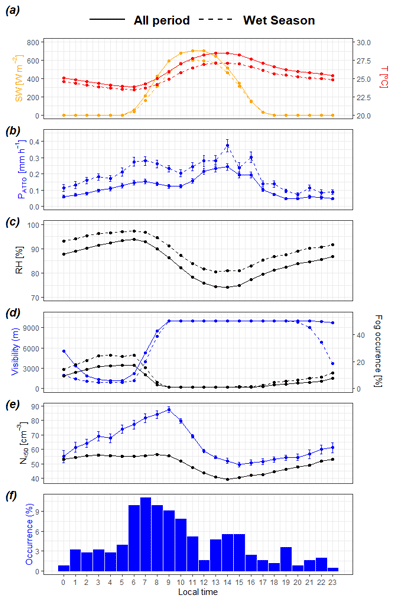
Marco A. Franco, Florian Ditas, Leslie A. Kremper, Luiz A. T. Machado, Meinrat O. Andreae, Alessandro Araújo, Henrique M. J. Barbosa, Joel F. de Brito, Samara Carbone, Bruna A. Holanda, Fernando G. Morais, Janaína P. Nascimento, Mira L. Pöhlker, Luciana V. Rizzo, Marta Sá, Jorge Saturno, David Walter, Stefan Wolff, Ulrich Pöschl, Paulo Artaxo, and Christopher Pöhlker
Atmos. Chem. Phys., 22, 3469–3492, https://doi.org/10.5194/acp-22-3469-2022, https://doi.org/10.5194/acp-22-3469-2022, 2022
Short summary
Short summary
In Central Amazonia, new particle formation in the planetary boundary layer is rare. Instead, there is the appearance of sub-50 nm aerosols with diameters larger than about 20 nm that eventually grow to cloud condensation nuclei size range. Here, 254 growth events were characterized which have higher predominance in the wet season. About 70 % of them showed direct relation to convective downdrafts, while 30 % occurred partly under clear-sky conditions, evidencing still unknown particle sources.
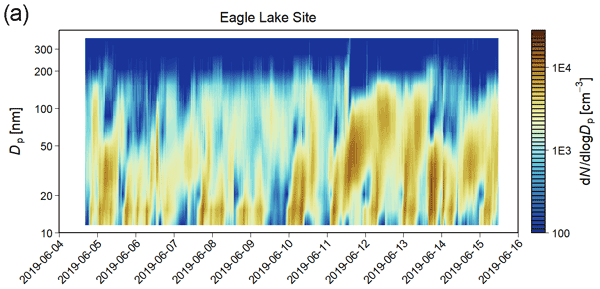
Meinrat O. Andreae, Tracey W. Andreae, Florian Ditas, and Christopher Pöhlker
Atmos. Chem. Phys., 22, 2487–2505, https://doi.org/10.5194/acp-22-2487-2022, https://doi.org/10.5194/acp-22-2487-2022, 2022
Short summary
Short summary
Atmospheric aerosol particles are key players in the Earth’s climate system, but there is still considerable uncertainty about where and how these particles are initially formed. We present the first study of new particle formation (NPF) at a pristine site in a subboreal forest region of North America. Our data suggest that, in this environment, there is frequent NPF from biogenic organic precursor compounds, which was likely the predominant source of particles in the preindustrial environment.
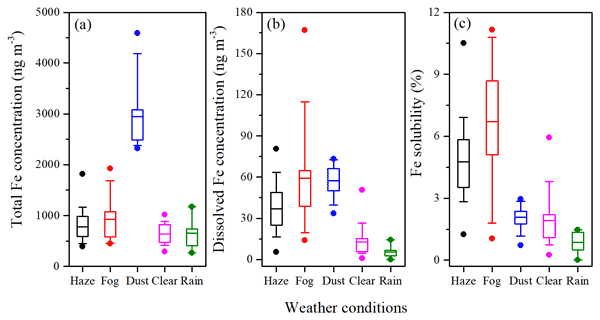
Yanhong Zhu, Weijun Li, Yue Wang, Jian Zhang, Lei Liu, Liang Xu, Jingsha Xu, Jinhui Shi, Longyi Shao, Pingqing Fu, Daizhou Zhang, and Zongbo Shi
Atmos. Chem. Phys., 22, 2191–2202, https://doi.org/10.5194/acp-22-2191-2022, https://doi.org/10.5194/acp-22-2191-2022, 2022
Short summary
Short summary
The solubilities of iron in fine particles in a megacity in Eastern China were studied under haze, fog, dust, clear, and rain weather conditions. For the first time, a receptor model was used to quantify the sources of dissolved and total iron aerosol. Microscopic analysis further confirmed the aging of iron aerosol during haze and fog conditions that facilitated dissolution of insoluble iron.
Yingze Tian, Xiaoning Wang, Peng Zhao, Zongbo Shi, and Roy M. Harrison
Atmos. Chem. Phys. Discuss., https://doi.org/10.5194/acp-2021-1007, https://doi.org/10.5194/acp-2021-1007, 2022
Revised manuscript not accepted
Short summary
Short summary
Chemical mass balance (CMB) is a widely used method to apportion the sources of PM2.5. We explore the sensitivity of CMB results to input data of organic markers only (OM-CMB) with a combination of organic and inorganic markers (IOM-CMB), as well as using different chemical profiles for sources. Our results indicate the superiority of combining inorganic and organic tracers and using locally-relevant source profiles in source apportionment of PM.
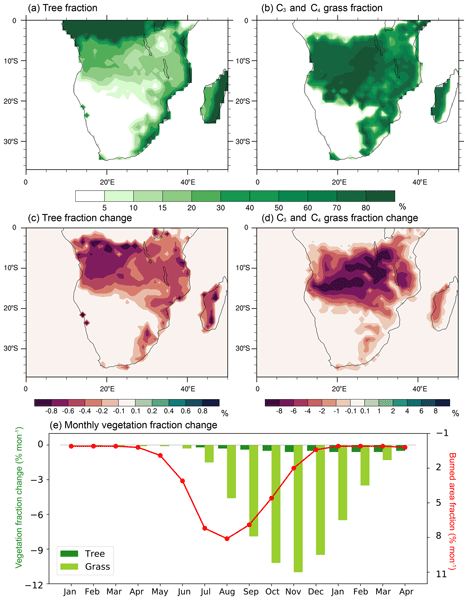
Huilin Huang, Yongkang Xue, Ye Liu, Fang Li, and Gregory S. Okin
Geosci. Model Dev., 14, 7639–7657, https://doi.org/10.5194/gmd-14-7639-2021, https://doi.org/10.5194/gmd-14-7639-2021, 2021
Short summary
Short summary
This study applies a fire-coupled dynamic vegetation model to quantify fire impact at monthly to annual scales. We find fire reduces grass cover by 4–8 % annually for widespread areas in south African savanna and reduces tree cover by 1 % at the periphery of tropical Congolese rainforest. The grass cover reduction peaks at the beginning of the rainy season, which quickly diminishes before the next fire season. In contrast, the reduction of tree cover is irreversible within one growing season.
Paola Formenti, Claudia Di Biagio, Yue Huang, Jasper Kok, Marc Daniel Mallet, Damien Boulanger, and Mathieu Cazaunau
Atmos. Meas. Tech. Discuss., https://doi.org/10.5194/amt-2021-403, https://doi.org/10.5194/amt-2021-403, 2021
Publication in AMT not foreseen
Short summary
Short summary
This paper provides with standardized correction factors for the measurements of the most common instruments used in the atmosphere to measure the concentration per size of aerosol particles. These correction factors are provided to users with supplementary information for their use.
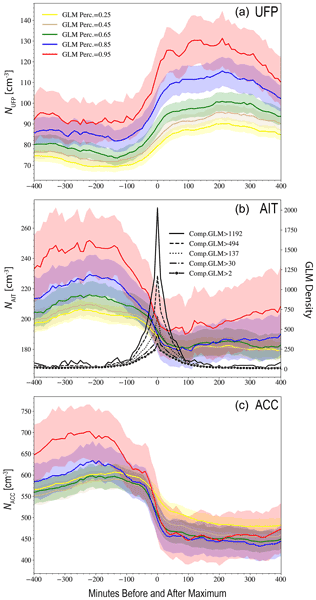
Luiz A. T. Machado, Marco A. Franco, Leslie A. Kremper, Florian Ditas, Meinrat O. Andreae, Paulo Artaxo, Micael A. Cecchini, Bruna A. Holanda, Mira L. Pöhlker, Ivan Saraiva, Stefan Wolff, Ulrich Pöschl, and Christopher Pöhlker
Atmos. Chem. Phys., 21, 18065–18086, https://doi.org/10.5194/acp-21-18065-2021, https://doi.org/10.5194/acp-21-18065-2021, 2021
Short summary
Short summary
Several studies evaluate aerosol–cloud interactions, but only a few attempted to describe how clouds modify aerosol properties. This study evaluates the effect of weather events on the particle size distribution at the ATTO, combining remote sensing and in situ data. Ultrafine, Aitken and accumulation particles modes have different behaviors for the diurnal cycle and for rainfall events. This study opens up new scientific questions that need to be pursued in detail in new field campaigns.
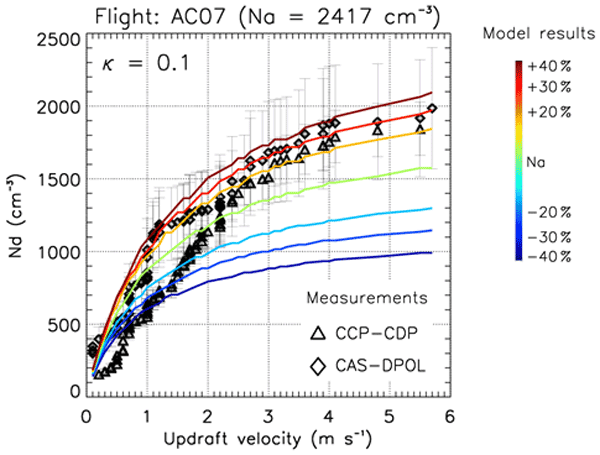
Ramon Campos Braga, Barbara Ervens, Daniel Rosenfeld, Meinrat O. Andreae, Jan-David Förster, Daniel Fütterer, Lianet Hernández Pardo, Bruna A. Holanda, Tina Jurkat-Witschas, Ovid O. Krüger, Oliver Lauer, Luiz A. T. Machado, Christopher Pöhlker, Daniel Sauer, Christiane Voigt, Adrian Walser, Manfred Wendisch, Ulrich Pöschl, and Mira L. Pöhlker
Atmos. Chem. Phys., 21, 17513–17528, https://doi.org/10.5194/acp-21-17513-2021, https://doi.org/10.5194/acp-21-17513-2021, 2021
Short summary
Short summary
Interactions of aerosol particles with clouds represent a large uncertainty in estimates of climate change. Properties of aerosol particles control their ability to act as cloud condensation nuclei. Using aerosol measurements in the Amazon, we performed model studies to compare predicted and measured cloud droplet number concentrations at cloud bases. Our results confirm previous estimates of particle hygroscopicity in this region.

Marco Gaetani, Benjamin Pohl, Maria del Carmen Alvarez Castro, Cyrille Flamant, and Paola Formenti
Atmos. Chem. Phys., 21, 16575–16591, https://doi.org/10.5194/acp-21-16575-2021, https://doi.org/10.5194/acp-21-16575-2021, 2021
Short summary
Short summary
During the dry austral winter, biomass fires in tropical Africa emit large amounts of smoke in the atmosphere, with large impacts on climate and air quality. The study of the relationship between atmospheric circulation and smoke transport shows that midlatitude atmospheric disturbances may deflect the smoke from tropical Africa towards southern Africa. Understanding the distribution of the smoke in the region is crucial for climate modelling and air quality monitoring.
Lilian Loyer, Jean-Christophe Raut, Claudia Di Biagio, Julia Maillard, Vincent Mariage, and Jacques Pelon
Atmos. Meas. Tech. Discuss., https://doi.org/10.5194/amt-2021-326, https://doi.org/10.5194/amt-2021-326, 2021
Revised manuscript not accepted
Short summary
Short summary
The Arctic is facing drastic climate changes, and more observations are needed to better understand what is happening. Unfortunately observations are limited in the High Arctic. To obtain more observations, multiples buoys equipped with lidar, have been deployed in this region. This paper presents an approach to estimate the optical properties of clouds, and solar plus terrestrial energies from lidar measurements in the Arctic.
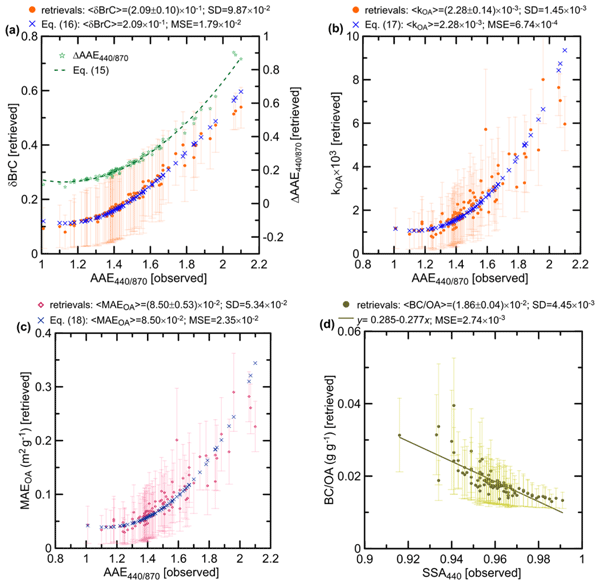
Igor B. Konovalov, Nikolai A. Golovushkin, Matthias Beekmann, Mikhail V. Panchenko, and Meinrat O. Andreae
Atmos. Meas. Tech., 14, 6647–6673, https://doi.org/10.5194/amt-14-6647-2021, https://doi.org/10.5194/amt-14-6647-2021, 2021
Short summary
Short summary
The absorption of solar light by organic matter, known as brown carbon (BrC), contributes significantly to the radiative budget of the Earth’s atmosphere, but its representation in atmospheric models is uncertain. This paper advances a methodology to constrain model parameters characterizing BrC absorption of atmospheric aerosol originating from biomass burning with the available remote ground-based observations of atmospheric aerosol.
Cited articles
Adebiyi, A., Kok, J. F., Murray, B. J., Ryder, C. L., Stuut, J.-B. W., Kahn, R. A., Knippertz, P., Formenti, P., Mahowald, N. M., Pérez García-Pando, C., Klose, M., Ansmann, A., Samset, B. H., Ito, A., Balkanski, Y., Di Biagio, C., Romanias, M. N., Huang, Y., and Meng, J.: A review of coarse mineral dust in the Earth system, Aeolian Res., 60, 100849, https://doi.org/10.1016/j.aeolia.2022.100849, 2023.
Amino, T., Iizuka, Y., Matoba, S., Shimada, R., Oshima, N., Suzuki, T., Ando, T., Aoki, T., and Fujita, K.: Increasing dust emission from ice free terrain in southeastern Greenland since 2000, Polar Sci., 27, 100599, https://doi.org/10.1016/j.polar.2020.100599, 2021.
Arnalds, O., Dagsson-Waldhauserova, P., and Olafsson, H.: The Icelandic volcanic aeolian environment: Processes and impacts – A review, Aeolian Res., 20, 176–195, https://doi.org/10.1016/j.aeolia.2016.01.004, 2016.
Baldo, C., Formenti, P., Nowak, S., Chevaillier, S., Cazaunau, M., Pangui, E., Di Biagio, C., Doussin, J.-F., Ignatyev, K., Dagsson-Waldhauserova, P., Arnalds, O., MacKenzie, A. R., and Shi, Z.: Distinct chemical and mineralogical composition of Icelandic dust compared to northern African and Asian dust, Atmos. Chem. Phys., 20, 13521–13539, https://doi.org/10.5194/acp-20-13521-2020, 2020.
Baldo, C., Formenti, P., Di Biagio, C., Lu, G., Song, C., Cazaunau, M., Pangui, E., Doussin, J.-F., Dagsson-Waldhauserova, P., Arnalds, O., Beddows, D., MacKenzie, A. R., and Shi, Z.: Complex refractive index and single scattering albedo of Icelandic dust in the shortwave spectrum, EGUsphere [preprint], https://doi.org/10.5194/egusphere-2023-276, 2023.
Bhattachan, A., D'Odorico, P., Okin, G. S., and Dintwe, K.: Potential dust emissions from the southern Kalahari's dunelands, J. Geophys. Res. Earth Surf., 118, 307–314, 2013.
Bhattachan, A., D'Odorico, P., and Okin, G. S.: Biogeochemistry of dust sources in Southern Africa, J. Arid Environ., 117, 18–27, https://doi.org/10.1016/j.jaridenv.2015.02.013, 2015.
Bullard, J. E., Baddock, M., Bradwell, T., Crusius, J., Darlington, E., Gaiero, D., Gassó, S., Gisladottir, G., Hodgkins, R., McCulloch, R., McKenna-Neuman, C., Mockford, T., Stewart, H., and Thorsteinsson, T.: High-latitude dust in the Earth system, Rev. Geophys., 54, 447–485, https://doi.org/10.1002/2016RG000518, 2016.
Capelle, V., Chédin, A., Siméon, M., Tsamalis, C., Pierangelo, C., Pondrom, M., Crevoisier, C., Crepeau, L., and Scott, N. A.: Evaluation of IASI-derived dust aerosol characteristics over the tropical belt, Atmos. Chem. Phys., 14, 9343–9362, https://doi.org/10.5194/acp-14-9343-2014, 2014.
Caponi, L., Formenti, P., Massabó, D., Di Biagio, C., Cazaunau, M., Pangui, E., Chevaillier, S., Landrot, G., Andreae, M. O., Kandler, K., Piketh, S., Saeed, T., Seibert, D., Williams, E., Balkanski, Y., Prati, P., and Doussin, J.-F.: Spectral- and size-resolved mass absorption efficiency of mineral dust aerosols in the shortwave spectrum: a simulation chamber study, Atmos. Chem. Phys., 17, 7175–7191, https://doi.org/10.5194/acp-17-7175-2017, 2017.
Christopher, S. A. and Jones, T.: Satellite-based assessment of cloud-free net radiative effect of dust aerosols over the Atlantic Ocean, Geophys. Res. Lett., 34, https://doi.org/10.1029/2006GL027783, 2007.
Crevoisier, C., Clerbaux, C., Guidard, V., Phulpin, T., Armante, R., Barret, B., Camy-Peyret, C., Chaboureau, J.-P., Coheur, P.-F., Crépeau, L., Dufour, G., Labonnote, L., Lavanant, L., Hadji-Lazaro, J., Herbin, H., Jacquinet-Husson, N., Payan, S., Péquignot, E., Pierangelo, C., Sellitto, P., and Stubenrauch, C.: Towards IASI-New Generation (IASI-NG): impact of improved spectral resolution and radiometric noise on the retrieval of thermodynamic, chemistry and climate variables, Atmos. Meas. Tech., 7, 4367–4385, https://doi.org/10.5194/amt-7-4367-2014, 2014.
Cuesta, J., Eremenko, M., Flamant, C., Dufour, G., Laurent, B., Bergametti, G., Höpfner, M., Orphal, J., and Zhou, D.: Three-dimensional distribution of a major desert dust outbreak over East Asia in March 2008 derived from IASI satellite observations, J. Geophys. Res. Atmospheres, 120, 7099–7127, https://doi.org/10.1002/2014JD022406, 2015.
Cuesta, J., Flamant, C., Gaetani, M., Knippertz, P., Fink, A. H., Chazette, P., Eremenko, M., Dufour, G., Di Biagio, C., and Formenti, P.: Three-dimensional pathways of dust over the Sahara during summer 2011 as revealed by new Infrared Atmospheric Sounding Interferometer observations, Q. J. R. Meteorol. Soc., 146, 2731–2755, https://doi.org/10.1002/qj.3814, 2020.
Dagsson-Waldhauserova, P., Arnalds, O., and Olafsson, H.: Long-term dust aerosol production from natural sources in Iceland, J. Air Waste Manag. Assoc., 67, 173–181, https://doi.org/10.1080/10962247.2013.805703, 2017.
Di Biagio, C., Formenti, P., Styler, S. A., Pangui, E., and Doussin, J.-F.: Laboratory chamber measurements of the longwave extinction spectra and complex refractive indices of African and Asian mineral dusts, Geophys. Res. Lett., 41, 6289–6297, https://doi.org/10.1002/2014GL060213, 2014a.
Di Biagio, C., Boucher, H., Caquineau, S., Chevaillier, S., Cuesta, J., and Formenti, P.: Variability of the infrared complex refractive index of African mineral dust: experimental estimation and implications for radiative transfer and satellite remote sensing, Atmos. Chem. Phys., 14, 11093–11116, https://doi.org/10.5194/acp-14-11093-2014, 2014b.
Di Biagio, C., Formenti, P., Balkanski, Y., Caponi, L., Cazaunau, M., Pangui, E., Journet, E., Nowak, S., Caquineau, S., Andreae, M. O., Kandler, K., Saeed, T., Piketh, S., Seibert, D., Williams, E., and Doussin, J.-F.: Global scale variability of the mineral dust long-wave refractive index: a new dataset of in situ measurements for climate modeling and remote sensing, Atmos. Chem. Phys., 17, 1901–1929, https://doi.org/10.5194/acp-17-1901-2017, 2017.
Di Biagio, C., Formenti, P., Balkanski, Y., Caponi, L., Cazaunau, M., Pangui, E., Journet, E., Nowak, S., Andreae, M. O., Kandler, K., Saeed, T., Piketh, S., Seibert, D., Williams, E., and Doussin, J.-F.: Complex refractive indices and single-scattering albedo of global dust aerosols in the shortwave spectrum and relationship to size and iron content, Atmos. Chem. Phys., 19, 15503–15531, https://doi.org/10.5194/acp-19-15503-2019, 2019.
Di Biagio, C., Balkanski, Y., Albani, S., Boucher, O., and Formenti, P.: Direct Radiative Effect by Mineral Dust Aerosols Constrained by New Microphysical and Spectral Optical Data, Geophys. Res. Lett., 47, e2019GL086186, https://doi.org/10.1029/2019GL086186, 2020.
Di Biagio, C., Doussin, J.-F., Cazaunau, M., Pangui, E., Cuesta, J., Sellitto, P., Ródenas, M., and Formenti, P.: Infrared optical signature reveals the source-dependency and along-transport evolution of dust mineralogy as shown by laboratory study, Sci. Rep., 13, 13252, https://doi.org/10.1038/s41598-023-39336-7, 2023.
Di Biagio, C., Bru, E., Orta, A.,, Chevaillier, S., Bergé, A., Cazaunau, M., Pangui, E., Sellitto, P., and Formenti, P.: Absorbance spectra of Mineral Dust from Low- to High-Latitude Regions in the Mid- and Far-Infrared spectral range (2.5–25 µm), EaSy Data [data set], https://doi.org/10.57932/905eff0b-d508-4aad-a422-5708e3132790, 2025.
di Sarra, A., Di Biagio, C., Meloni, D., Monteleone, F., Pace, G., Pugnaghi, S., and Sferlazzo, D.: Shortwave and longwave radiative effects of the intense Saharan dust event of 25–26 March 2010 at Lampedusa (Mediterranean Sea), J. Geophys. Res. Atmospheres, 116, https://doi.org/10.1029/2011JD016238, 2011.
Formenti, P. and Di Biagio, C.: Large synthesis of in situ field measurements of the size distribution of mineral dust aerosols across their life cycles, Earth Syst. Sci. Data, 16, 4995–5007, https://doi.org/10.5194/essd-16-4995-2024, 2024.
Formenti, P., Rajot, J. L., Desboeufs, K., Saïd, F., Grand, N., Chevaillier, S., and Schmechtig, C.: Airborne observations of mineral dust over western Africa in the summer Monsoon season: spatial and vertical variability of physico-chemical and optical properties, Atmos. Chem. Phys., 11, 6387–6410, https://doi.org/10.5194/acp-11-6387-2011, 2011.
Formenti, P., Caquineau, S., Chevaillier, S., Klaver, A., Desboeufs, K., Rajot, J. L., Belin, S., and Briois, V.: Dominance of goethite over hematite in iron oxides of mineral dust from Western Africa: Quantitative partitioning by X-ray absorption spectroscopy, J. Geophys. Res. Atmospheres, 119, 12,740–12,754, https://doi.org/10.1002/2014JD021668, 2014a.
Formenti, P., Caquineau, S., Desboeufs, K., Klaver, A., Chevaillier, S., Journet, E., and Rajot, J. L.: Mapping the physico-chemical properties of mineral dust in western Africa: mineralogical composition, Atmos. Chem. Phys., 14, 10663–10686, https://doi.org/10.5194/acp-14-10663-2014, 2014b.
Fouquart, Y., Bonnel, B., Brogniez, G., Buriez, J. C., Smith, L., Morcrette, J. J., and Cerf, A.: Observations of Saharan Aerosols: Results of ECLATS Field Experiment. Part II: Broadband Radiative Characteristics of the Aerosols and Vertical Radiative Flux Divergence, J. Appl. Meteorol. Climatol., 26, 38–52, https://doi.org/10.1175/1520-0450(1987)026<0038:OOSARO>2.0.CO;2, 1987.
Ginoux, P., Prospero, J. M., Gill, T. E., Hsu, N. C., and Zhao, M.: Global-scale attribution of anthropogenic and natural dust sources and their emission rates based on MODIS Deep Blue aerosol products, Rev. Geophys., 50, https://doi.org/10.1029/2012RG000388, 2012.
Gliß, J., Mortier, A., Schulz, M., Andrews, E., Balkanski, Y., Bauer, S. E., Benedictow, A. M. K., Bian, H., Checa-Garcia, R., Chin, M., Ginoux, P., Griesfeller, J. J., Heckel, A., Kipling, Z., Kirkevåg, A., Kokkola, H., Laj, P., Le Sager, P., Lund, M. T., Lund Myhre, C., Matsui, H., Myhre, G., Neubauer, D., van Noije, T., North, P., Olivié, D. J. L., Rémy, S., Sogacheva, L., Takemura, T., Tsigaridis, K., and Tsyro, S. G.: AeroCom phase III multi-model evaluation of the aerosol life cycle and optical properties using ground- and space-based remote sensing as well as surface in situ observations, Atmos. Chem. Phys., 21, 87–128, https://doi.org/10.5194/acp-21-87-2021, 2021.
Gómez Maqueo Anaya, S., Althausen, D., Faust, M., Baars, H., Heinold, B., Hofer, J., Tegen, I., Ansmann, A., Engelmann, R., Skupin, A., Heese, B., and Schepanski, K.: The implementation of dust mineralogy in COSMO5.05-MUSCAT, Geosci. Model Dev., 17, 1271–1295, https://doi.org/10.5194/gmd-17-1271-2024, 2024.
Gonçalves Ageitos, M., Obiso, V., Miller, R. L., Jorba, O., Klose, M., Dawson, M., Balkanski, Y., Perlwitz, J., Basart, S., Di Tomaso, E., Escribano, J., Macchia, F., Montané, G., Mahowald, N. M., Green, R. O., Thompson, D. R., and Pérez García-Pando, C.: Modeling dust mineralogical composition: sensitivity to soil mineralogy atlases and their expected climate impacts, Atmos. Chem. Phys., 23, 8623–8657, https://doi.org/10.5194/acp-23-8623-2023, 2023.
González-Romero, A., González-Flórez, C., Panta, A., Yus-Díez, J., Córdoba, P., Alastuey, A., Moreno, N., Kandler, K., Klose, M., Clark, R. N., Ehlmann, B. L., Greenberger, R. N., Keebler, A. M., Brodrick, P., Green, R. O., Querol, X., and Pérez García-Pando, C.: Probing Iceland's dust-emitting sediments: particle size distribution, mineralogy, cohesion, Fe mode of occurrence, and reflectance spectra signatures, Atmos. Chem. Phys., 24, 6883–6910, https://doi.org/10.5194/acp-24-6883-2024, 2024.
Goudie, A. S. and Middleton, N. J.: Saharan dust storms: Nature and consequences, Earth-Sci. Rev., 56, 179–204, 2001.
Harries, J., Carli, B., Rizzi, R., Serio, C., Mlynczak, M., Palchetti, L., Maestri, T., Brindley, H., and Masiello, G.: The Far-infrared Earth, Rev. Geophys., 46, https://doi.org/10.1029/2007RG000233, 2008.
Hudson, P. K., Gibson, E. R., Young, M. A., Kleiber, P. D., and Grassian, V. H.: Coupled infrared extinction and size distribution measurements for several clay components of mineral dust aerosol, J. Geophys. Res. Atmospheres, 113, https://doi.org/10.1029/2007JD008791, 2008a.
Hudson, P. K., Young, M. A., Kleiber, P. D., and Grassian, V. H.: Coupled infrared extinction spectra and size distribution measurements for several non-clay components of mineral dust aerosol (quartz, calcite, and dolomite), Atmos. Environ., 42, 5991–5999, https://doi.org/10.1016/j.atmosenv.2008.03.046, 2008b.
Israelevich, P. L., Levin, Z., Joseph, J. H., and Ganor, E.: Desert aerosol transport in the Mediterranean region as inferred from the TOMS aerosol index, J. Geophys. Res., 107, 4572, https://doi.org/10.1029/2001JD002011, 2002.
Jeong, G. Y.: Bulk and single-particle mineralogy of Asian dust and a comparison with its source soils, J. Geophys. Res. Atmospheres, 113, https://doi.org/10.1029/2007JD008606, 2008.
Knippertz, P. and Stuut, J. B. W.: Mineral dust: A key player in the earth system, https://doi.org/10.1007/978-94-017-8978-3, 2014.
Kok, J. F., Ridley, D. A., Zhou, Q., Miller, R. L., Zhao, C., Heald, C. L., Ward, D. S., Albani, S., and Haustein, K.: Smaller desert dust cooling effect estimated from analysis of dust size and abundance, Nat. Geosci., 10, 274–278, https://doi.org/10.1038/ngeo2912, 2017.
Kok, J. F., Adebiyi, A. A., Albani, S., Balkanski, Y., Checa-Garcia, R., Chin, M., Colarco, P. R., Hamilton, D. S., Huang, Y., Ito, A., Klose, M., Li, L., Mahowald, N. M., Miller, R. L., Obiso, V., Pérez García-Pando, C., Rocha-Lima, A., and Wan, J. S.: Contribution of the world's main dust source regions to the global cycle of desert dust, Atmos. Chem. Phys., 21, 8169–8193, https://doi.org/10.5194/acp-21-8169-2021, 2021.
Kok, J. F., Storelvmo, T., Karydis, V. A., Adebiyi, A. A., Mahowald, N. M., Evan, A. T., He, C., and Leung, D. M.: Mineral dust aerosol impacts on global climate and climate change, Nat. Rev. Earth Environ., 4, 71–86, https://doi.org/10.1038/s43017-022-00379-5, 2023.
Leon, J.-F. and Legrand, M.: Mineral dust sources in the surroundings of the north Indian Ocean, Geophys. Res. Lett., 30, https://doi.org/10.1029/2002GL016690, 2003.
Li, F., Vogelmann, A. M., and Ramanathan, V.: Saharan Dust Aerosol Radiative Forcing Measured from Space, J. Clim., 17, 2558–2571, https://doi.org/10.1175/1520-0442(2004)017<2558:SDARFM>2.0.CO;2, 2004.
Li, L., Mahowald, N. M., Gonçalves Ageitos, M., Obiso, V., Miller, R. L., Pérez García-Pando, C., Di Biagio, C., Formenti, P., Brodrick, P. G., Clark, R. N., Green, R. O., Kokaly, R., Swayze, G., and Thompson, D. R.: Improved constraints on hematite refractive index for estimating climatic effects of dust aerosols, Commun. Earth Environ., 5, 1–12, https://doi.org/10.1038/s43247-024-01441-4, 2024.
Luo, B., Minnett, P. J., Gentemann, C., and Szczodrak, G.: Improving satellite retrieved night-time infrared sea surface temperatures in aerosol contaminated regions, Remote Sens. Environ., 223, 8–20, https://doi.org/10.1016/j.rse.2019.01.009, 2019.
Maddy, E. S., DeSouza-Machado, S. G., Nalli, N. R., Barnet, C. D., Strow, L. L., Wolf, W. W., Xie, H., Gambacorta, A., King, T. S., Joseph, E., Morris, V., Hannon, S. E., and Schou, P.: On the effect of dust aerosols on AIRS and IASI operational level 2 products, Geophys. Res. Lett., 39, https://doi.org/10.1029/2012GL052070, 2012.
Meinander, O., Dagsson-Waldhauserova, P., Amosov, P., Aseyeva, E., Atkins, C., Baklanov, A., Baldo, C., Barr, S. L., Barzycka, B., Benning, L. G., Cvetkovic, B., Enchilik, P., Frolov, D., Gassó, S., Kandler, K., Kasimov, N., Kavan, J., King, J., Koroleva, T., Krupskaya, V., Kulmala, M., Kusiak, M., Lappalainen, H. K., Laska, M., Lasne, J., Lewandowski, M., Luks, B., McQuaid, J. B., Moroni, B., Murray, B., Möhler, O., Nawrot, A., Nickovic, S., O'Neill, N. T., Pejanovic, G., Popovicheva, O., Ranjbar, K., Romanias, M., Samonova, O., Sanchez-Marroquin, A., Schepanski, K., Semenkov, I., Sharapova, A., Shevnina, E., Shi, Z., Sofiev, M., Thevenet, F., Thorsteinsson, T., Timofeev, M., Umo, N. S., Uppstu, A., Urupina, D., Varga, G., Werner, T., Arnalds, O., and Vukovic Vimic, A.: Newly identified climatically and environmentally significant high-latitude dust sources, Atmos. Chem. Phys., 22, 11889–11930, https://doi.org/10.5194/acp-22-11889-2022, 2022.
Meinander, O., Uppstu, A., Dagsson-Waldhauserova, P., Groot Zwaaftink, C., Juncher Jørgensen, C., Baklanov, A., Kristensson, A., Massling, A., and Sofiev, M.: Dust in the arctic: a brief review of feedbacks and interactions between climate change, aeolian dust and ecosystems, Front. Environ. Sci., 13, https://doi.org/10.3389/fenvs.2025.1536395, 2025.
Obiso, V., Gonçalves Ageitos, M., Pérez García-Pando, C., Perlwitz, J. P., Schuster, G. L., Bauer, S. E., Di Biagio, C., Formenti, P., Tsigaridis, K., and Miller, R. L.: Observationally constrained regional variations of shortwave absorption by iron oxides emphasize the cooling effect of dust, Atmos. Chem. Phys., 24, 5337–5367, https://doi.org/10.5194/acp-24-5337-2024, 2024.
Palchetti, L., Brindley, H., Bantges, R., Buehler, S. A., Camy-Peyret, C., Carli, B., Cortesi, U., Del Bianco, S., Di Natale, G., Dinelli, B. M., Feldman, D., Huang, X. L., Labonnote, L. C., Libois, Q., Maestri, T., Mlynczak, M. G., Murray, J. E., Oetjen, H., Ridolfi, M., Riese, M., Russell, J., Saunders, R., and Serio, C.: FORUM: Unique Far-Infrared Satellite Observations to Better Understand How Earth Radiates Energy to Space, Bull. Am. Meteorol. Soc., 101, E2030–E2046, https://doi.org/10.1175/BAMS-D-19-0322.1, 2020.
Prospero, J. M., Ginoux, P., Torres, O., Nicholson, S. E., and Gill, T. E.: Environmental characterization of global sources of atmospheric soil dust identified with the Nimbus 7 Total Ozone Mapping Spectrometer (TOMS) absorbing aerosol product, Rev. Geophys., 40, 1002, https://doi.org/10.1029/2000RG000095, 2002.
Rajot, J. L., Formenti, P., Alfaro, S., Desboeufs, K., Chevaillier, S., Chatenet, B., Gaudichet, A., Journet, E., Marticorena, B., Triquet, S., Maman, A., Mouget, N., and Zakou, A.: AMMA dust experiment: An overview of measurements performed during the dry season special observation period (SOP0) at the Banizoumbou (Niger) supersite, J. Geophys. Res. Atmospheres, 113, https://doi.org/10.1029/2008JD009906, 2008.
Reid, E. A., Reid, J. S., Meier, M. M., Dunlap, M. R., Cliff, S. S., Broumas, A., Perry, K., and Maring, H.: Characterization of African dust transported to Puerto Rico by individual particle and size segregated bulk analysis, J. Geophys. Res., 108, 8591, https://doi.org/10.1029/2002jd002935, 2003.
Ryder, C. L., Highwood, E. J., Rosenberg, P. D., Trembath, J., Brooke, J. K., Bart, M., Dean, A., Crosier, J., Dorsey, J., Brindley, H., Banks, J., Marsham, J. H., McQuaid, J. B., Sodemann, H., and Washington, R.: Optical properties of Saharan dust aerosol and contribution from the coarse mode as measured during the Fennec 2011 aircraft campaign, Atmos. Chem. Phys., 13, 303–325, https://doi.org/10.5194/acp-13-303-2013, 2013.
Sadrian, M. R., Calvin, W. M., Engelbrecht, J. P., and Moosmüller, H.: Spectral Characterization of Parent Soils from Globally Important Dust Aerosol Entrainment Regions, J. Geophys. Res. Atmospheres, e2022JD037666, https://doi.org/10.1029/2022JD037666, 2023.
Salisbury, J. W., Walter, L. S., and Vergo, N.: Mid-infrared (2.1–25 µm) spectra of minerals; first edition, Open-File Report, U. S. Geological Survey, https://doi.org/10.3133/ofr87263, 1987.
Salisbury, J. W., Walter, L. S., Vergo, N., and D'Aria, D. M.: Infrared (2.1–25 µm) spectra of minerals, John Hopkins University Press, Baltimore, xxvi, 267 pp., 1991.
Scanza, R. A., Mahowald, N., Ghan, S., Zender, C. S., Kok, J. F., Liu, X., Zhang, Y., and Albani, S.: Modeling dust as component minerals in the Community Atmosphere Model: development of framework and impact on radiative forcing, Atmos. Chem. Phys., 15, 537–561, https://doi.org/10.5194/acp-15-537-2015, 2015.
Sellitto, P., Eremenko, M., Formenti, P., Alalam, P., Höpfner, M., and Di Biagio, C.: The sensitivity of the Far-infrared Outgoing Radiation Understanding and Monitoring (FORUM) mission to dust aerosols: a pseudo-observations analysis, EGUsphere [preprint], https://doi.org/10.5194/egusphere-2025-5858, 2025.
Slingo, A., Ackerman, T. P., Allan, R. P., Kassianov, E. I., McFarlane, S. A., Robinson, G. J., Barnard, J. C., Miller, M. A., Harries, J. E., Russell, J. E., and Dewitte, S.: Observations of the impact of a major Saharan dust storm on the atmospheric radiation balance, Geophys. Res. Lett., 33, https://doi.org/10.1029/2006GL027869, 2006.
Sokolik, I. N. and Toon, O. B.: Incorporation of mineralogical composition into models of the radiative properties of mineral aerosol from UV to IR wavelengths, J. Geophys. Res. Atmospheres, 104, 9423–9444, https://doi.org/10.1029/1998JD200048, 1999.
Song, Q., Zhang, Z., Yu, H., Kok, J. F., Di Biagio, C., Albani, S., Zheng, J., and Ding, J.: Size-resolved dust direct radiative effect efficiency derived from satellite observations, Atmos. Chem. Phys., 22, 13115–13135, https://doi.org/10.5194/acp-22-13115-2022, 2022.
Thaarup, S., Djurhuus Poulsen, M., Thorsøe, K., and Keiding, J.: Study on Arctic Mining in Greenland, https://doi.org/10.13140/RG.2.2.36378.21448, 2020.
Vandenbussche, S., Callewaert, S., Schepanski, K., and De Mazière, M.: North African mineral dust sources: new insights from a combined analysis based on 3D dust aerosol distributions, surface winds and ancillary soil parameters, Atmos. Chem. Phys., 20, 15127–15146, https://doi.org/10.5194/acp-20-15127-2020, 2020.
Vickery, K. J., Eckardt, F. D., and Bryant, R. G.: A sub-basin scale dust plume source frequency inventory for southern Africa, 2005–2008, Geophys. Res. Lett., 40, 5274–5279, https://doi.org/10.1002/grl.50968, 2013.
Volz, F. E.: Infrared Refractive Index of Atmospheric Aerosol Substances, Appl Opt, 11, 755–759, https://doi.org/10.1364/AO.11.000755, 1972.
Volz, F. E.: Infrared Optical Constants of Ammonium Sulfate, Sahara Dust, Volcanic Pumice, and Flyash, Appl Opt, 12, 564–568, https://doi.org/10.1364/AO.12.000564, 1973.
Wang, H., Liu, X., Wu, C., Lin, G., Dai, T., Goto, D., Bao, Q., Takemura, T., and Shi, G.: Larger Dust Cooling Effect Estimated From Regionally Dependent Refractive Indices, Geophys. Res. Lett., 51, e2023GL107647, https://doi.org/10.1029/2023GL107647, 2024.
Washington, R., Todd, M. C., Middleton, N., and Goudie, A. S.: Dust-storm source areas determined by the Total Ozone Monitoring Spectrometer and surface observations, Ann. Assoc. Am. Geogr., 93, 297–313, 2003.
Yang, E.-S., Gupta, P., and Christopher, S. A.: Net radiative effect of dust aerosols from satellite measurements over Sahara, Geophys. Res. Lett., 36, https://doi.org/10.1029/2009GL039801, 2009.
Zheng, J., Zhang, Z., Garnier, A., Yu, H., Song, Q., Wang, C., Dubuisson, P., and Di Biagio, C.: The thermal infrared optical depth of mineral dust retrieved from integrated CALIOP and IIR observations, Remote Sens. Environ., 270, 112841, https://doi.org/10.1016/j.rse.2021.112841, 2022.
Zheng, J., Zhang, Z., Yu, H., Garnier, A., Song, Q., Wang, C., Di Biagio, C., Kok, J. F., Derimian, Y., and Ryder, C.: Thermal infrared dust optical depth and coarse-mode effective diameter over oceans retrieved from collocated MODIS and CALIOP observations, Atmos. Chem. Phys., 23, 8271–8304, https://doi.org/10.5194/acp-23-8271-2023, 2023.
Zheng, J., Zhang, Z., DeSouza-Machado, S., Ryder, C. L., Garnier, A., Di Biagio, C., Yang, P., Welton, E. J., Yu, H., Barreto, A., and Gonzalez, M. Y.: Assessment of Dust Size Retrievals Based on AERONET: A Case Study of Radiative Closure From Visible-Near-Infrared to Thermal Infrared, Geophys. Res. Lett., 51, e2023GL106808, https://doi.org/10.1029/2023GL106808, 2024.
Short summary
Spectroscopy measurements show that the absorbance of dust in the far-infrared up to 25 µm is comparable in intensity to that in the mid-infrared (3–15 µm) suggesting possible relevance for its direct radiative effect. Absorption signatures differ between Icelandic and low/mid-latitude dust due to differences in mineralogical composition. Spectral differences could be used to characterise the mineralogy and trace the origin of airborne dust based on infrared remote sensing observations.
Spectroscopy measurements show that the absorbance of dust in the far-infrared up to 25 µm is...


Altmetrics
Final-revised paper
Preprint