
Articles | Volume 26, issue 14
https://doi.org/10.5194/acp-26-10303-2026
© Author(s) 2026. This work is distributed under
the Creative Commons Attribution 4.0 License.
the Creative Commons Attribution 4.0 License.
https://doi.org/10.5194/acp-26-10303-2026
© Author(s) 2026. This work is distributed under
the Creative Commons Attribution 4.0 License.
the Creative Commons Attribution 4.0 License.
Research article
| 
23 Jul 2026
Research article |
| 23 Jul 2026
| 23 Jul 2026
Ozone stratospheric trends from regional Bayesian composite of ground-based partial columns
Louis Mirallie
CORRESPONDING AUTHOR

Federal Office of Meteorology and Climatology, MeteoSwiss, Payerne, Switzerland
Institute of Applied Physics, University of Bern, Bern, Switzerland
Oeschger Center for Climate Change Research, Microwave Physics, University of Bern, Bern, Switzerland
Eliane Maillard Barras
Federal Office of Meteorology and Climatology, MeteoSwiss, Payerne, Switzerland
Caroline Jonas
Royal Belgian Institute for Space Aeronomy (BIRA-IASB), Uccle, Belgium
Corinne Vigouroux
Royal Belgian Institute for Space Aeronomy (BIRA-IASB), Uccle, Belgium
Roeland Van Malderen
Royal Meteorological Institute, Uccle, Belgium
Irina Petropavlovskikh
Cooperative Institute for Research in Environmental Sciences, University of Colorado, Boulder, CO, USA
NOAA Global Monitoring Laboratory, Boulder, CO, USA
Sophie Godin-Beekmann
LATMOS/IPSL, Sorbonne Université, UVSQ, CNRS, Paris, France
Thierry Leblanc
Jet Propulsion Laboratory, California Institute of Technology, Wrightwood, California, USA
Wolfgang Steinbrecht
Deutscher Wetterdienst, Hohenpeißenberg, Germany
Antoine Vadès
independent researcher
formerly at: Federal Office of Meteorology and Climatology, MeteoSwiss, Payerne, Switzerland
Rolf Ruefenacht
Federal Office of Meteorology and Climatology, MeteoSwiss, Payerne, Switzerland
Alexander Haefele
Federal Office of Meteorology and Climatology, MeteoSwiss, Payerne, Switzerland
Gunter Stober
Institute of Applied Physics, University of Bern, Bern, Switzerland
Oeschger Center for Climate Change Research, Microwave Physics, University of Bern, Bern, Switzerland
Peter Effertz
Cooperative Institute for Research in Environmental Sciences, University of Colorado, Boulder, CO, USA
NOAA Global Monitoring Laboratory, Boulder, CO, USA
Julian Gröbner
Physikalisch-Meteorologisches Observatorium Davos World Radiation Centre, Dorfstrasse 33, 7260 Davos Dorf, Switzerland
Gerard Ancellet
LATMOS/IPSL, Sorbonne Université, UVSQ, CNRS, Paris, France
María Cazorla
Instituto de Investigaciones Atmosféricas, Universidad San Francisco de Quito USFQ, Quito, Ecuador
Petra Duff
Department of Physics, University of Toronto, Toronto, ON, Canada
Matthias M. Frey
Institute for Meteorology and Climate Research Atmospheric Trace Gases and Remote Sensing (IMKASF), Karlsruhe Institute of Technology (KIT), Karlsruhe, Germany
Michael Gill
Met Éireann Valentia Observatory, Cahersiveen, Co. Kerry, Ireland
James W. Hannigan
National Center for Atmospheric Research, Boulder, CO, USA
Nicholas Jones
University of Wollongong, Wollongong NSW, Australia
Rigel Kivi
Space and Earth Observation Centre, Finnish Meteorological Institute, Sodankylä, Finland
Raphael Köhler
Alfred Wegener Institute, Helmholtz Centre for Polar and Marine Research, Potsdam, Germany
Bogumil Kois
Institute of Meteorology and Water Management – National Research Institute (IMGW-PIB), Poland
Debra E. Kollonige
Earth Sciences Division, NASA Goddard Space Flight Center, Greenbelt, Maryland, USA
ADNET Systems, Inc., Bethesda, Maryland, USA
Emmanuel Mahieu
Department of Astrophysics, Geophysics and Oceanography, UR SPHERES, University of Liège, Liège, Belgium
Glen McConville
NOAA Global Monitoring Laboratory, Boulder, CO, USA
Johan Mellqvist
Space Earth and Environment, Chalmers University of technology, 41296 Göteborg, Sweden
Gary Morris
NOAA Global Monitoring Laboratory, Boulder, CO, USA
Isao Murata
Graduate School of Environmental Studies, Tohoku University, Sendai, Japan
Tomoo Nagahama
Institute for Space-Earth Environmental Research, Nagoya University, Nagoya, Japan
Gerald E. Nedoluha
Naval Research Laboratory, 4555 Overlook Avenue, SW, Washington, D.C. 20375, USA
Shin-Ya Ogino
Japan Agency for Marine-Earth Science and Technology (JAMSTEC), Research Institute for Global Change, Yokosuka, Japan
Richard Querel
Earth Sciences New Zealand (ESNZ), Lauder, New Zealand
Ryan M. Stauffer
Earth Sciences Division, NASA Goddard Space Flight Center, Greenbelt, Maryland, USA
Wolfgang Stremme
Instituto de Ciencias de la Atmósfera y Cambio Climático, Universidad Nacional Autonoma de Mexico (UNAM), Mexico City, Mexico
Kimberly Strong
Department of Physics, University of Toronto, Toronto, ON, Canada
Ralf Sussmann
Karlsruhe Institute of Technology (KIT), IMKIFU, Garmisch-Partenkirchen, Germany
Anne M. Thompson
Earth Sciences Division, NASA Goddard Space Flight Center, Greenbelt, Maryland, USA
University of Maryland – Baltimore County, Baltimore, Maryland, USA
Yana Virolainen
St.Petersburg State University, St.Petersburg, Russia
Related authors
No articles found.
Guochun Shi, V. Lynn Harvey, Hanli Liu, Nicholas Pedatella, and Gunter Stober
EGUsphere, https://doi.org/10.5194/egusphere-2026-5705, https://doi.org/10.5194/egusphere-2026-5705, 2026
This preprint is open for discussion and under review for Atmospheric Chemistry and Physics (ACP).
Short summary
Short summary
We examined how major wintertime disruptions of the Arctic atmosphere affect the downward transport of nitric oxide. Using satellite observations and a whole-atmosphere model, we found that large-scale waves repeatedly organize nitric oxide into distinct regions and that this transport differs between split and displaced polar vortices. The results improve understanding of how atmospheric dynamics control chemical transport between the upper atmosphere and stratosphere.
Florentin Hiault, Emmanuel Mahieu, Pierre-Henri Lefebvre, Martyn P. Chipperfield, Zihao Wang, Martin K. Vollmer, Jeremy J. Harrison, and Diana Roos
EGUsphere, https://doi.org/10.5194/egusphere-2026-5290, https://doi.org/10.5194/egusphere-2026-5290, 2026
This preprint is open for discussion and under review for Atmospheric Chemistry and Physics (ACP).
Short summary
Short summary
We derived a multi-decadal record of a potent greenhouse gas that is unintentionally released during the production of another industrial chemical. Using infrared measurements collected in the Swiss Alps from 1986 to 2024, we found that the amount of this gas in the atmosphere continued to increase despite efforts to reduce emissions. Comparisons with independent measurements confirmed the reliability of the method and the need for continued long-term monitoring.
Alessandro Zanchetta, Steven van Heuven, Rigel Kivi, Michel Ramonet, Andreas Engel, Maarten Krol, and Huilin Chen
Atmos. Chem. Phys., 26, 13909–13927, https://doi.org/10.5194/acp-26-13909-2026, https://doi.org/10.5194/acp-26-13909-2026, 2026
Short summary
Short summary
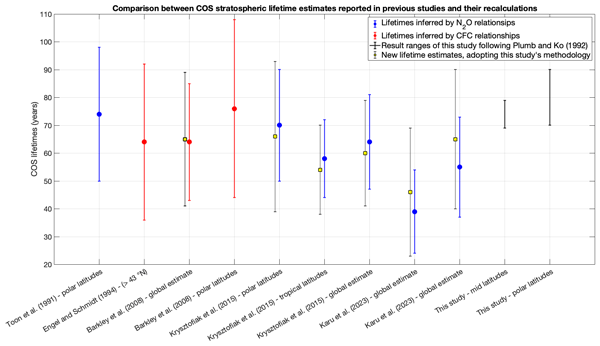
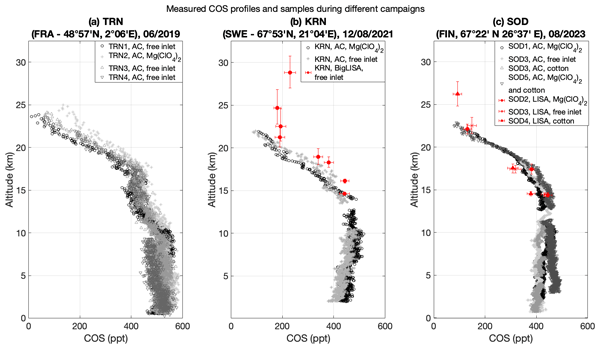
In this study, we calculate the mean lifetime of carbonyl sulfide (COS) and methane (CH4) in the stratosphere from continuous vertical profiles sampled with balloon-borne instruments. We used two methods based on the stratospheric relationship of these gas species with N2O. The estimated stratospheric lifetime range is 69–90 years for COS and 146–172 years for CH4. These results are consistent with other studies and suggest no long-term trends in the stratospheric lifetime of these gas species.
Sean M. Davis, William T. Ball, Yue Jia, Gabriel Chiodo, Justin A. Alsing, James Keeble, Hideharu Akiyoshi, Carlo Arosio, Ewa M. Bednarz, Andreas Chrysanthou, Melanie Coldewey-Egbers, Robert Damadeo, Sandip Dhomse, Mohamadou A. Diallo, Simone Dietmuller, Roland Eichinger, Stacey Frith, Birgit Hassler, Michaela I. Hegglin, Daan Hubert, Patrick Jöckel, Béatrice Josse, Natalya Kramarova, Diego Loyola, Eliane Maillard Barras, Marion Marchand, Olaf Morgenstern, David Plummer, Robert W. Portmann, Karen H. Rosenlof, Alexei Rozanov, Viktoria F. Sofieva, Johannes Staehelin, Timofei Sukhodolov, Kleareti Tourpali, Ronald J. Van der A, H. J. Ray Wang, Krzysztof Wargan, Shingo Watanabe, Mark Weber, Jeannette D. Wild, Yousuke Yamashita, and Jerry Ziemke
Atmos. Chem. Phys., 26, 13817–13843, https://doi.org/10.5194/acp-26-13817-2026, https://doi.org/10.5194/acp-26-13817-2026, 2026
Short summary
Short summary
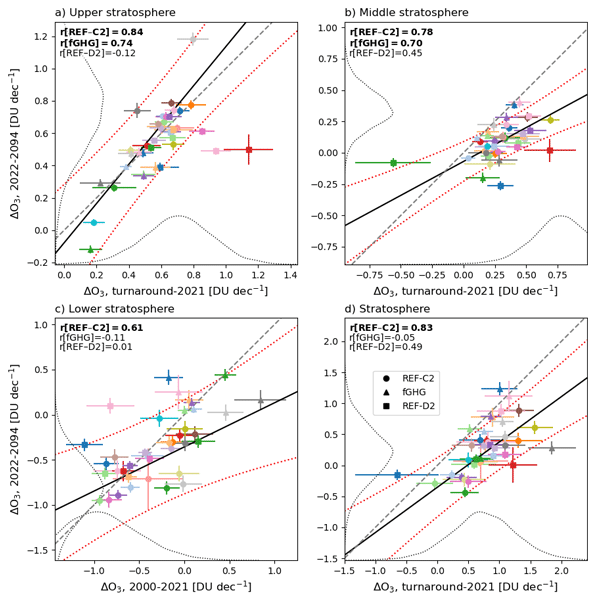
This study investigates tropical ozone changes in models and satellite observations to determine how well they agree and whether observations can constrain model projections. At some levels, satellite records disagree significantly on the magnitude of ozone changes. While early and late 21st century trends are correlated across models, suggesting a potential emergent constraint, the spread in observations means they are unable to provide guidance on the credibility of model projections.
Xiaoyi Zhao, Vitali Fioletov, Irina Petropavlovskikh, Voltaire Velazco, Alberto Redondas, Anna Solomatnikova, Corinne Vigouroux, Kimberly Strong, Michel Van Roozendael, Andrea Pazmino, Thomas F. Hanisco, Alexander Cede, Martin Tiefengraber, Gordon Labow, Masatomo Fujiwara, Ronald van der A, Debora Griffin, Chris McLinden, Tom Kralidis, Wolfgang Steinbrecht, and Sum Chi Lee
Atmos. Chem. Phys., 26, 13693–13720, https://doi.org/10.5194/acp-26-13693-2026, https://doi.org/10.5194/acp-26-13693-2026, 2026
Short summary
Short summary
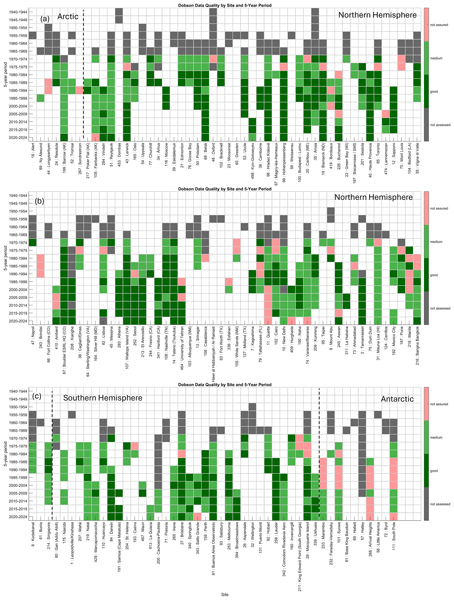
Total column ozone (TCO) records from six ground-based networks are compiled and evaluated using multiple satellites and reanalysis data. Station performance (1940–2024) is assessed using harmonized metrics. Ground-based annual means agree within ±2 %, while pre-satellite reanalyses show larger biases (up to −5 %). The resulting quality-assessed dataset supports trend analysis and satellite validation.
Shrutika Wagh, Luana S. Basso, Ayan F. Fleischmann, João Henrique Fernandes Amaral, John Melack, Jost Larvic, David Walter, Stijn Hantson, Julia Marshall, Chris Wilson, Youmi Oh, Lori Bruhwiler, John B. Miller, Corinne Vigouroux, Christian Rödenbeck, and Santiago Botía
EGUsphere, https://doi.org/10.5194/egusphere-2026-5245, https://doi.org/10.5194/egusphere-2026-5245, 2026
This preprint is open for discussion and under review for Atmospheric Chemistry and Physics (ACP).
Short summary
Short summary
We estimated methane emissions from the Amazon, Orinoco, and Paraná river basins using the Jena CarboScope global inversion system. We included Amazon measurements to evaluate their effect on the results. Adding them led to a large adjustment in estimated wetland emissions and strongly influenced the Amazon estimate. Without these measurements, the Amazon estimate increased by about 75 %. Our findings highlight the need to maintain and expand measurements across tropical South America.
Lise Seland Graff, Dörthe Handorf, Raphael Köhler, Xavier Levine, René R. Wijngaard, Ryan S. Williams, Gareth J. Marshall, and Priscilla A. Mooney
EGUsphere, https://doi.org/10.5194/egusphere-2026-5525, https://doi.org/10.5194/egusphere-2026-5525, 2026
This preprint is open for discussion and under review for Weather and Climate Dynamics (WCD).
Short summary
Short summary
This work documents and explores the first storyline-based multi-model experiment sets with polar refinement, where the low-level boundary conditions represent contrasting storylines of future Arctic and Antarctic climate change. Using novel summary metrics, we quantify the influence of the storyline, model, and resolution on large-scale atmospheric fields and find that generally, the storyline forcing and model have a greater influence on the future responses than local changes in resolution.
Antonio G. Bruno, David P. Moore, Jeremy J. Harrison, Ailish Graham, Martyn P. Chipperfield, and Corinne Vigouroux
Atmos. Chem. Phys., 26, 12925–12952, https://doi.org/10.5194/acp-26-12925-2026, https://doi.org/10.5194/acp-26-12925-2026, 2026
Short summary
Short summary
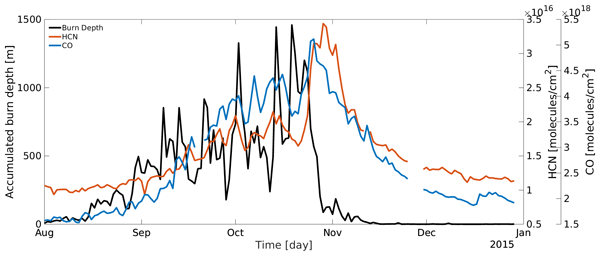
Indonesian peatlands store vast carbon reserves, but can release large quantities of greenhouse gases and other species with significant environmental impacts, including hydrogen cyanide (HCN), when fires occur. Analyzing three major El Niño years with satellites and models, we found that emissions depend on local hydrological conditions, not just El Niño strength. Including soil moisture and burn depth can improve emission estimates and climate strategies.
Hayoung Park, Sujong Jeong, Jaewon Joo, Dong Yeong Chang, Yu-Ri Lee, Hyuckjae Lee, Jueun Kim, Jaewon Shin, Jonghyuk Lee, Jaemin Hong, Jae Hyun Lim, Donghee Kim, Isamu Morino, Matthias M. Frey, Gwangju Moon, Hyojin Eom, Sumin Kim, Sunran Lee, Jungho Yu, and Kyucheol Shin
EGUsphere, https://doi.org/10.5194/egusphere-2026-3755, https://doi.org/10.5194/egusphere-2026-3755, 2026
This preprint is open for discussion and under review for Atmospheric Chemistry and Physics (ACP).
Short summary
Short summary
This study analyzed greenhouse gas emissions from one of South Korea’s largest petrochemical complexes using ground, mobile, aircraft, and satellite measurements. The results revealed higher emissions, including methane leaks, than what was reported in existing inventory estimates. By integrating different types of observations, this study shows a more accurate way to measure industrial emissions and provides information that can support better emissions reporting and climate action.
Robert J. Parker, Michael P. Cartwright, Dan Orr, Lakshmi N. Bharathan, Neil Humpage, Alex J. Webb, Peter Somkuti, Hartmut Boesch, Antonio Di Noia, Hiroshi Suto, Matthias Buschmann, Nicholas M. Deutscher, David W. T. Griffith, Frank Hase, Rigel Kivi, Erin McGee, Isamu Morino, Hirofumi Ohyama, Christof Petri, John Robinson, Coleen M. Roehl, Mahesh Kumar Sha, Kei Shiomi, Kimberly Strong, Ralf Sussmann, Yao Té, Voltaire A. Velazco, Mihalis Vrekoussis, Wei Wang, Thorsten Warneke, Damien Weidmann, Debra Wunch, and Minqiang Zhou
Earth Syst. Sci. Data Discuss., https://doi.org/10.5194/essd-2026-625, https://doi.org/10.5194/essd-2026-625, 2026
Preprint under review for ESSD
Short summary
Short summary
Methane is a powerful greenhouse gas and its concentration in the atmosphere is rising rapidly. We present a new record of atmospheric methane measured from space by the Japanese GOSAT-2 satellite, covering 2019 to 2025. The measurements are processed identically to those from its predecessor GOSAT and checked against ground-based instruments around the world. Together the two satellites provide a continuous 17-year record that helps track where methane comes from and how quickly it is changing.
Kate Smith, Alexandre Baron, Joshua Schwarz, Elizabeth Asher, Emrys Hall, Patrick Cullis, Alex Fritz, Hagen Telg, Ross Burgener, Bryan Thomas, Matthew Martinsen, David Nardini, Darryl Kuniyuki, Penny Smale, Ben Liley, Richard Querel, Krystian Kopka, Ian Crocker, Skyler Jordan, Michael Doneghey, Luke Longren, Stephanie Evan, Jerome Brioude, Jean-Marc Metzger, David Combemale, Cor Becker, Dwight Samuel, Cheryll Tjon A Ten, Mohammed Amierali, Christopher Wongsowidjojo, Dennis Rodrigues, George Paiman, Ankie Piters, Katrin Müller, and Troy Thornberry
Earth Syst. Sci. Data Discuss., https://doi.org/10.5194/essd-2026-644, https://doi.org/10.5194/essd-2026-644, 2026
Preprint under review for ESSD
Short summary
Short summary
Direct measurements of stratospheric aerosol are sparse, yet it plays an important role in Earth’s climate by scattering incoming solar radiation. The B2SAP network addresses this gap by regularly launching balloons carrying Portable Optical Particle Spectrometers (POPS) from 8 latitudinally diverse sites. The dataset provides vertical profiles of aerosol abundance and size distributions from the ground to 28 km, helping characterize global stratospheric aerosol abundance and variability.
Simone Brunamonti, Yann Poltera, Gonzague Romanens, Alex Weitnauer, Philipp Scheidegger, Adrianos Filinis, Alistair Bell, Giovanni Martucci, Frank Gunther Wienhold, Thomas Peter, Peter Oelsner, Ruud Dirksen, Alexander Haefele, Lukas Emmenegger, Gunter Stober, and Béla Tuzson
EGUsphere, https://doi.org/10.5194/egusphere-2026-4762, https://doi.org/10.5194/egusphere-2026-4762, 2026
Short summary
Short summary
Accurate measurements of the concentration of water vapor in the upper atmosphere are essential for reliable climate predictions. We investigated the performance of a new lightweight (less than 4 kg) hygrometer, based on laser absorption spectroscopy, in a series of atmospheric test flights using weather balloons, reaching up to 35 km altitude. The results demonstrate the high accuracy and suitability of this technique for applications in long-term climate monitoring and atmospheric research.
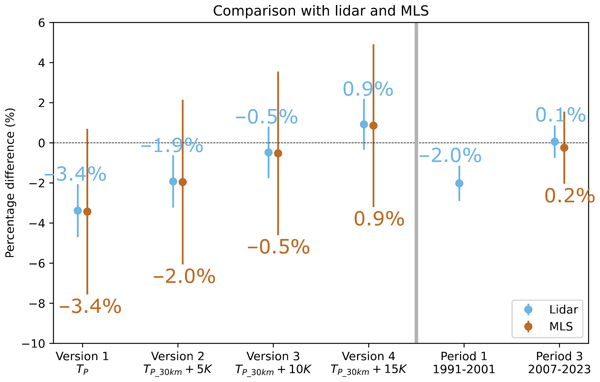
Sachiko Okamoto, Gérard Ancellet, Sophie Godin-Beekmann, and Renaud Bodichon
Earth Syst. Sci. Data, 18, 5939–5950, https://doi.org/10.5194/essd-18-5939-2026, https://doi.org/10.5194/essd-18-5939-2026, 2026
Short summary
Short summary
The ozone sounding data from the electrochemical concentration cell (ECC) at the Haute Provence Observatory (OHP) for the period 1991–2020 were homogenized in 2022 using the recommendations of the ECC data quality assessment committee. Comparisons with lidar and satellite observations show that the ECC pump temperature measurements for the period 2002–2007 need to be corrected in addition to the 2022 homogenization. This correction improves the consistency of the ECC ozone dataset at the OHP.
Gonzague Romanens, Giovanni Martucci, Marco Rosoldi, Yann Poltera, Cristina Cardós, Natalia Prats, Sunji Ambe, Gessica Cosimato, Antoine Farah, Christian Félix, Ilaria Gandolfi, Alexander Haefele, Miguel Hernández, Masami Iwabuchi, Patrick Jann, Jason Ming Chun Lam, Fabrizio Marra, José María Rodríguez, Yves-Alain Roulet, Yuta Tanaka, Ruud Dirksen, and Fabio Madonna
EGUsphere, https://doi.org/10.5194/egusphere-2026-3215, https://doi.org/10.5194/egusphere-2026-3215, 2026
This preprint is open for discussion and under review for Atmospheric Measurement Techniques (AMT).
Short summary
Short summary
Automatic systems are increasingly used to launch weather balloons, raising questions about the long-term consistency of reference humidity measurements within the Global Climate Observing System Reference Upper-Air Network. We tested how storing balloon instruments inside automatic launch systems for up to two weeks affects humidity measurements under controlled conditions at six international sites. Results show that the impact strongly depends on the instrument type and storage environment.
Arlett Díaz-Zurita, Simone Brunamonti, Alexander Haefele, Martine Collaud Coen, Giovanni Martucci, Benjamin Tobias Brem, Martin Gysel-Beer, Hassan Lyamani, Gloria Titos, Daniel Pérez-Ramírez, Christoph Hüglin, Lucas Alados-Arboledas, Alejandro Keller, Frank Gunther Wienhold, Maxime Hervo, and Francisco Navas-Guzmán
EGUsphere, https://doi.org/10.5194/egusphere-2026-4361, https://doi.org/10.5194/egusphere-2026-4361, 2026
Short summary
Short summary
This study provides a unique framework for assessing aerosol hygroscopicity by combining Raman lidar observations with vertically resolved in situ measurements from the balloon-borne Compact Backscatter Aerosol Detector coupled with Vaisala RS41 radiosondes and ground-based tandem nephelometers. The three approaches showed good agreement. Raman lidar identified more than 200 hygroscopic aerosol layers, constituting one of the largest datasets available for statistical investigations.
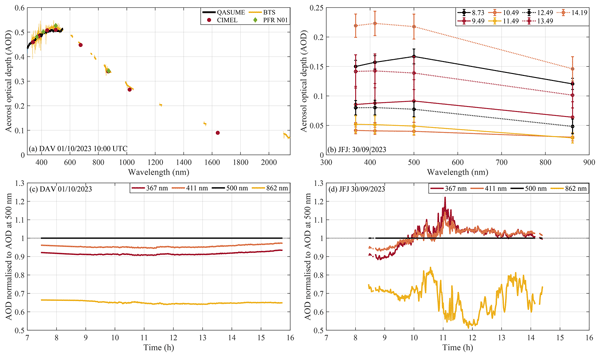
Akriti Masoom, Stelios Kazadzis, Robin Lewis Modini, Martin Gysel-Beer, Julian Gröbner, Martine Collaud Coen, Francisco Navas-Guzman, Natalia Kouremeti, Benjamin Tobias Brem, Nora Kristina Nowak, Giovanni Martucci, and Maxime Hervo
Atmos. Chem. Phys., 26, 10801–10834, https://doi.org/10.5194/acp-26-10801-2026, https://doi.org/10.5194/acp-26-10801-2026, 2026
Short summary
Short summary
This article aims at providing details on the spectral aerosol properties observed during 2023 Canadian wildfire plume transport and exploring the synergism between remote sensing and in situ measurements for investigating the cause of the occurrence of the observations of spectral aerosol properties.
Eddy Poncet, Sergey Khaykin, Sophie Godin-Beekmann, and Thierry Leblanc
EGUsphere, https://doi.org/10.5194/egusphere-2026-4358, https://doi.org/10.5194/egusphere-2026-4358, 2026
Short summary
Short summary
High particles in the atmosphere affect climate and the ozone layer, so measurements from a new European-Japanese satellite, EarthCARE (launched 2024), need checking. We compared its laser data with a trusted instrument on the International Space Station and two ground stations, in clear, volcanic and wildfire conditions. A method using the satellite's raw signal stayed accurate even when particles were scarce, unlike the standard product, so we recommend it for reliable long-term monitoring.
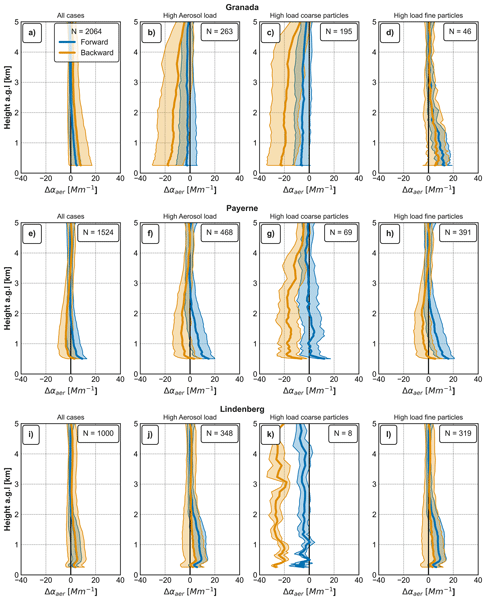
Jorge Muñiz-Rosado, Alberto Cazorla, Eric Sauvageat, Alexander Haefele, Celia Herrero del Barrio, Ramiro González, Roberto Román, Pedro Luis Molina-Molero, Arlett Díaz-Zurita, Víctor Manuel Naval-Hernández, Onel Rodríguez-Navarro, María José Granados-Muñoz, Juan Antonio Bravo-Aranda, Milagros Herrera, Daniel Pérez-Ramírez, Lionel Doppler, Lucas Alados-Arboledas, and Francisco Navas-Guzmán
Atmos. Chem. Phys., 26, 10255–10285, https://doi.org/10.5194/acp-26-10255-2026, https://doi.org/10.5194/acp-26-10255-2026, 2026
Short summary
Short summary
Ceilometers can track dust and pollution particles in the atmosphere, but their measurements need validation. This study statistically compared two processing methods against thousands of measurements from sun-tracking instruments and balloon soundings at three European sites over two years. One method, using an independent calibration procedure, proved more accurate across all conditions, cutting uncertainties by around half. This supports its wider use for air quality monitoring.
Loretta Pearl Poku, Gunter Stober, Diego Janches, Brian Fuller, Daniel O’Connor, Leandro Maslov, Eric Marderwald, Jose Luis Hormaechea, and Marcelo Colazo
EGUsphere, https://doi.org/10.5194/egusphere-2026-2287, https://doi.org/10.5194/egusphere-2026-2287, 2026
This preprint is open for discussion and under review for Atmospheric Measurement Techniques (AMT).
Short summary
Short summary
SAAMER-NOVA is the first imaging meteor radar network at high southern latitudes, located in the southern tip of the Andes. We present 3D tomographic wind retrievals at the MLT, altitude-time wind plots, and keogram plots revealing large-scale dynamics and multiple atmospheric waves. Its strategic location, rectangular-triangle arrangement, and angular diversity provide robust, continuous measurements. Performance is demonstrated by capturing Q2DW spatial characteristics and GW residuals.
Dominique Gantois, Alexandre Baron, Michaël Sicard, Valentin Duflot, Niels Groenen, Nelson Bègue, Sabine Eckhardt, Nikolaos Evangeliou, Martine De Mazière, Corinne Vigouroux, Guillaume Payen, Nicolas Marquestaut, Jean-Marc Metzger, Patrick Chazette, and Cyrille Flamant
EGUsphere, https://doi.org/10.5194/egusphere-2026-3070, https://doi.org/10.5194/egusphere-2026-3070, 2026
Short summary
Short summary
Smoke from Southern African and South American wildfires can travel for thousands of kilometers before reaching the Indian Ocean and Reunion Island. In this study, we use instruments measuring from the ground, from satellites, as well as atmospheric models, to track these smoke plumes and identify their origins and properties. Our findings should help future research focusing on the impact of these plumes on the atmospheric temperature.
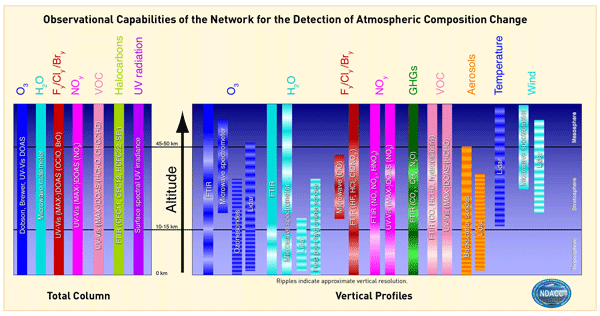
Irina Petropavlovskikh, Martine De Mazière, Anne M. Thompson, Jeannette D. Wild, James W. Hannigan, Henry B. Selkirk, Reem A. Hannun, Wolfgang Steinbrecht, Jean-Christopher Lambert, Roeland Van Malderen, Elizabeth Asher, Raul R. Cordero, Sophie Godin-Beekmann, Daan Hubert, Sergey Khaykin, Karin Kreher, Thierry Leblanc, Emmanuel Mahieu, Eliane Maillard Barras, Glen McConville, Gerald Nedoluha, Ivan Ortega, Alberto Redondas Marrero, Gunther Seckmeyer, Ryan M. Stauffer, Sarah A. Strode, Kim Strong, Takafumi Sugita, Michel Van Roozendael, Voltaire Velazco, Corinne Vigouroux, and Bärbel Vogel
Atmos. Chem. Phys., 26, 8637–8675, https://doi.org/10.5194/acp-26-8637-2026, https://doi.org/10.5194/acp-26-8637-2026, 2026
Short summary
Short summary
This introduction to the special issue "Achievements and perspectives of the Network for the Detection of Atmospheric Composition Change after 35 years of operation” provides an overview of important research findings achieved under the NDACC objectives. The future of NDACC is discussed in the light of the evolution of the scientific questions, evolving collaborations with partners and Cooperating Networks, and the current landscape of gaps in satellite and ground-based observations.
Vasura Jayaweera, Robert J. Sica, Giovanni Martucci, and Alexander Haefele
EGUsphere, https://doi.org/10.5194/egusphere-2026-2823, https://doi.org/10.5194/egusphere-2026-2823, 2026
Short summary
Short summary
Water vapor is the most important greenhouse gas, but how it behaves as the climate warms remains uncertain. Using 15 years of surface based remote sensing measurements over Switzerland, we established a climatology and trends of atmospheric temperature and relative humidity between 3 and 10 km above the ground. We found the atmosphere has warmed by about 1 to 3 degrees per decade, yet relative humidity has stayed roughly constant.
Beatriz Herrera, Enrico Dammers, Martine De Maziere, Omaira Garcia, Michel Grutter, James W. Hannigan, Dylan B. A. Jones, Nicholas Jones, Emmanuel Mahieu, Maria Makarova, Kazuyuki Miyazaki, Isamu Morino, Isao Murata, Ivan Ortega, Mathias Palm, Anatoly Poverovskii, Takashi Sekiya, Dan Smale, Hannah Sill, Wolfgang Stremme, Ralf Sussmann, Geoffrey Toon, Corinne Vigouroux, Wei Wang, Tyler Wizenberg, and Kimberly Strong
EGUsphere, https://doi.org/10.5194/egusphere-2026-3138, https://doi.org/10.5194/egusphere-2026-3138, 2026
Short summary
Short summary
This work investigates how atmospheric ammonia changes over time using long-term observations and simulations at locations around the world. While its main sources are related to agriculture, wildfires, vehicles, and volcanoes also contribute. The results show that ammonia levels vary strongly during the day and across seasons, and are rising at most locations. These findings improve our understanding of air pollution and its impacts.
Gunter Stober, Hanli Liu, Zishun Qiao, Kaoru Sato, Loretta Pearl Poku, Witali Krochin, Alan Liu, Alexander Kozlovsky, Diego Janches, Jie Zeng, Wen Yi, Masaki Tsutsumi, Njål Gulbrandsen, Satonori Nozawa, Mark Lester, Johan Kero, and Nicholas Mitchell
EGUsphere, https://doi.org/10.5194/egusphere-2026-3156, https://doi.org/10.5194/egusphere-2026-3156, 2026
This preprint is open for discussion and under review for Atmospheric Measurement Techniques (AMT).
Short summary
Short summary
Vertical winds are a crucial atmospheric parameter in the mesosphere/lower thermosphere and are connected to adiabatic heating and cooling of the atmosphere. Mesospheric temperatures are affected by the vertical transport driven by a pole-to-pole circulation with upwelling in the summer hemisphere and downwelling in the winter hemisphere. We present results based on a new retrieval technique for the seasonal climatological vertical winds and an intercomparison to current state-of-the-art models.
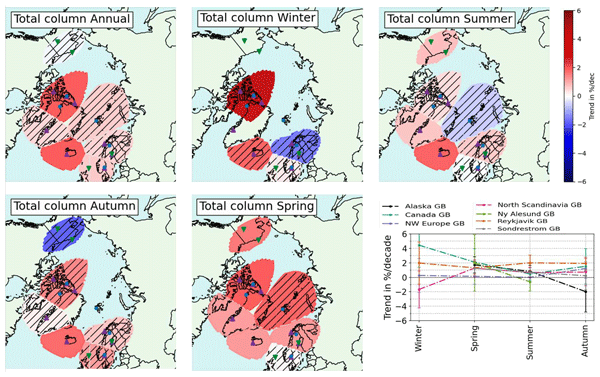
Caroline Jonas, Corinne Vigouroux, Bavo Langerock, Robin Björklund, Anne Boynard, Thomas Carlund, Martine De Mazière, Peter Effertz, Quentin Errera, Matthias M. Frey, José Granville, James W. Hannigan, Arno Keppens, Nis Jepsen, Rigel Kivi, Norrie Lyall, Mathias Palm, Maxime Prignon, Viktoria F. Sofieva, Kimberly Strong, Tove Svendby, David Tarasick, Laura Thölix, Roeland Van Malderen, Yana Virolainen, Sibylle von Löwis, and Xiaoyi Zhao
Atmos. Chem. Phys., 26, 8089–8124, https://doi.org/10.5194/acp-26-8089-2026, https://doi.org/10.5194/acp-26-8089-2026, 2026
Short summary
Short summary
We study the evolution of ozone in the Arctic over the 2000–2024 period in the stratosphere (about 10 to 50 km) to assess the expected recovery of the ozone layer following the diminution of ozone-depleting substances. We merge ground-based data sets within spatially coherent regions to reduce uncertainties and we obtain positive trends for the total column everywhere in the Arctic and for the middle and upper stratosphere over Canada, but no significant trends in the lower stratosphere.
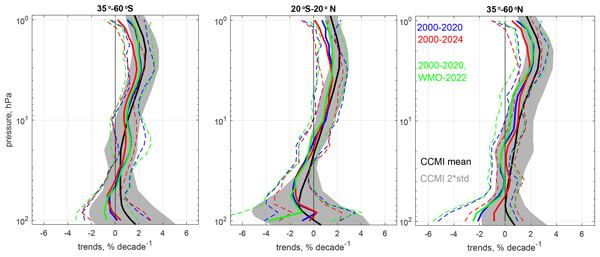
Viktoria F. Sofieva, Monika E. Szelag, Natalya A. Kramarova, Robert Damadeo, Wolfgang Steinbrecht, Irina Petropavlovskikh, Corinne Vigouroux, Eliane Maillard Barras, Daniel Zawada, Kleareti Tourpali, Stacey M. Frith, Jeannette D. Wild, Sean M. Davis, Carlo Arosio, Mark Weber, Alexei Rozanov, Brian Auffarth, Lucien Froidevaux, Ryan Fuller, Doug Degenstein, Kimberlee Dube, Peter Effertz, Thierry Leblanc, Gérard Ancellet, Sophie Godin-Beekmann, Glen McConville, Richard Querel, Dan Smale, Marie-Renee DeBacker, Emmanuel Mahieu, and Ralf Sussmann
Atmos. Chem. Phys., 26, 7387–7405, https://doi.org/10.5194/acp-26-7387-2026, https://doi.org/10.5194/acp-26-7387-2026, 2026
Short summary
Short summary
We present an updated evaluation of stratospheric ozone profile trends in the 60°S–60°N latitude range using long-term ground-based and satellite climate data records, as well as simulations by chemistry-climate models. Analyses confirm the statistically significant positive ozone trends in the upper stratosphere of ~1–3 % decade-1. The trends are close to zero in the middle stratosphere, and mostly negative in the lower stratosphere, but they are not statistically significant.
Witali Krochin, Axel Murk, and Gunter Stober
EGUsphere, https://doi.org/10.5194/egusphere-2026-2364, https://doi.org/10.5194/egusphere-2026-2364, 2026
This preprint is open for discussion and under review for Annales Geophysicae (ANGEO).
Short summary
Short summary
This manuscript presents measurements of the microwave emission spectra of oxygen. These spectra depend strongly on the geomagnetic field, since oxygen's magnetic dipole couples to it what produces measurable spectral shifts. The interaction is analyzed in detail, including observation geometry and polarization. Using the relation between magnetic field and spectral characteristics, a method is proposed for remote monitoring of geomagnetic variations.
Jinkyul Choi, Kazuyuki Miyazaki, Takashi Sekiya, Jinhyeok Yu, Shin-Ya Ogino, Henk Eskes, Pieter Rijdijk, Ryan Bennett, Anke Roiger, Leon Knez, Glenn S. Diskin, Jason A. Miech, Joshua P. DiGangi, Yonghoon Choi, Alessandro Franchin, Changmin Cho, Eric C. Apel, Louisa K. Emmons, Nattamon Maneenoi, Jason M. St. Clair, Reem A. Hannun, Glenn M. Wolfe, Erin Delaria, Abby Sebol, Donald R. Blake, Monica Crippa, Rachel M. Hoesly, Steven J. Smith, Jung-Hun Woo, Le Kuai, and Ronald Macatangay
EGUsphere, https://doi.org/10.5194/egusphere-2026-2380, https://doi.org/10.5194/egusphere-2026-2380, 2026
Short summary
Short summary
Asia produces half of the world's air pollution, yet emission estimates from different sources disagree widely. We assimilated satellite observations of six pollutant species to correct both concentrations and emissions. Aircraft measurements from a 2024 NASA campaign across four Asian countries confirmed the improvements. Our results reveal underreported emissions in some countries, overestimated vegetation emissions, unresolved fire estimates, and weather control on cross-border pollution.
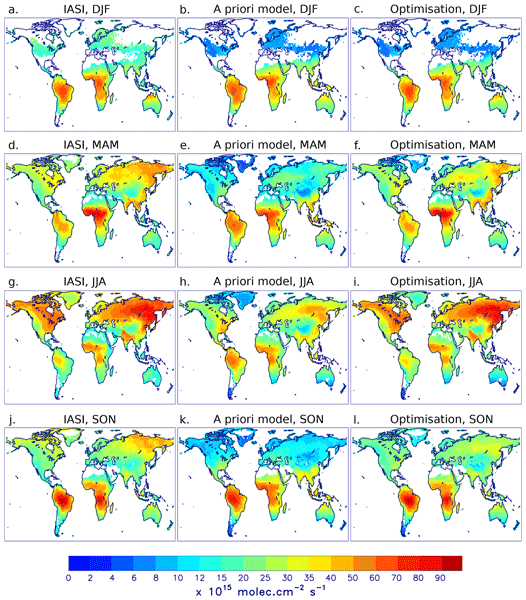
Jean-François Müller, Trissevgeni Stavrakou, Bruno Franco, Lieven Clarisse, Crist Amelynck, Niels Schoon, Bert W. D. Verreyken, Beata Opacka, Corinne Vigouroux, Alex B. Guenther, Emmanuel Mahieu, Maria Makarova, and Kimberly Strong
Atmos. Chem. Phys., 26, 5375–5406, https://doi.org/10.5194/acp-26-5375-2026, https://doi.org/10.5194/acp-26-5375-2026, 2026
Short summary
Short summary
We use an atmospheric model and aircraft measurements to evaluate methanol measurements from satellite sensors. The spaceborne data are found to be too low over source regions. Next, we use the model and the bias-corrected satellite data to derive improved terrestrial emissions of methanol between 2008 and 2019, and we evaluate the results against aircraft and ground-based measurements. This work shows that biogenic emissions of methanol might be ~ 60 % larger than previously estimated.
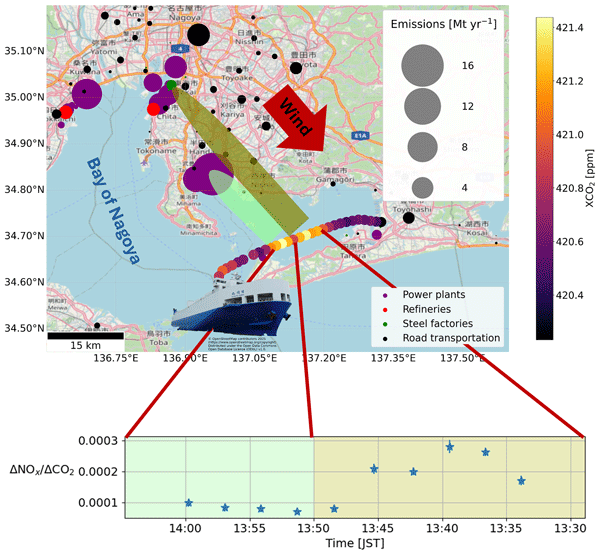
Vincent Enders, Astrid Müller, Matthias Max Frey, Frank Hase, Ralph Kleinschek, Marvin Knapp, Benedikt Löw, Isamu Morino, Shin-Ichiro Nakaoka, Hideki Nara, Hiroshi Tanimoto, Sanam N. Vardag, Karolin Voss, and André Butz
Atmos. Meas. Tech., 19, 2633–2655, https://doi.org/10.5194/amt-19-2633-2026, https://doi.org/10.5194/amt-19-2633-2026, 2026
Short summary
Short summary
We have deployed two spectrometers on a ship traveling along the coast of Japan. By that, we were able to repeatedly measure the greenhouse gas and air pollutant emissions of power plants, large industrial facilities, and cities. Using the ratios between the different gases, we are able to identify sources based on their unique signature. In addition, we are able to show that spectrometers can be operated on a ship, while still fulfilling the high standards of land-based observation networks.
Loretta Pearl Poku, Gunter Stober, Witali Krochin, Alan Liu, Alexander Kozlovsky, Diego Janches, Jie Zeng, Wen Yi, Masaki Tsutsumi, Njål Gulbrandsen, Satonori Nozawa, Mark Lester, Johan Kero, and Nicholas Mitchell
EGUsphere, https://doi.org/10.5194/egusphere-2025-6377, https://doi.org/10.5194/egusphere-2025-6377, 2026
Short summary
Short summary
This study presents 3D spatially resolved wind fields in the MLT using advanced retrieval techniques. Specifically, a novel SVVP method in spherical coordinates to enhance the physical consistency of wind retrievals compared to the conventional VVP method in plane geometry and the 3DVAR+DIV method. The SVVP provides a robust framework for future MLT dynamics studies, and the 3DVAR+DIV retrieval is beneficial for high-resolution case studies due to its ability to capture small-scale variability.
Bavo Langerock, Minqiang Zhou, Martine De Mazière, Mahesh Kumar Sha, Filip Desmet, Bart Dils, Corinne Vigouroux, Rigel Kivi, Isamu Morino, Mathias Palm, Gopala Krishna Darbha, Soumik Banerjee, Sujata Ray, and Mohmmed Talib
EGUsphere, https://doi.org/10.5194/egusphere-2026-1890, https://doi.org/10.5194/egusphere-2026-1890, 2026
This preprint is open for discussion and under review for Atmospheric Measurement Techniques (AMT).
Short summary
Short summary
This work describes an algorithm to correct measurements obtained from Fourier-Transform Infrared spectrometers (FTIR) for nonlinear detector response. The method is demonstrated for remote sensing observational networks for atmospheric gas products (NDACC, TCCON and COCCON). Diagnostic metrics are introduced and have the potential to characterize the cause of the underlying nonlinearity (saturation or optical misalignment). The algorithm is made available in python.
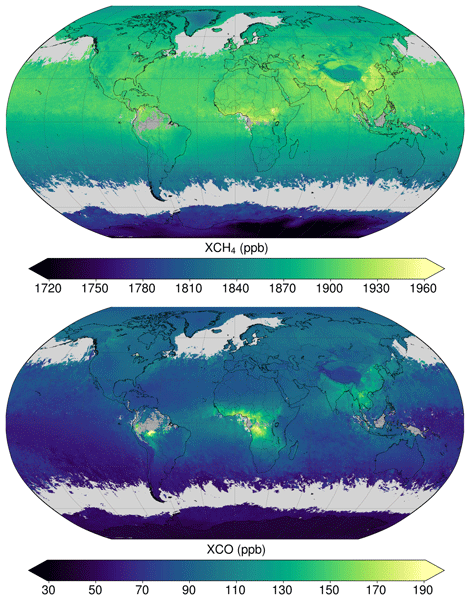
Oliver Schneising, Heinrich Bovensmann, Michael Buchwitz, Matthias Buschmann, Nicholas M. Deutscher, David W. T. Griffith, Jonas Hachmeister, Frank Hase, Laura T. Iraci, Rigel Kivi, Isamu Morino, Hirofumi Ohyama, Christof Petri, Maximilian Reuter, John Robinson, Coleen Roehl, Mahesh Kumar Sha, Kei Shiomi, Kimberly Strong, Ralf Sussmann, Yao Té, Voltaire A. Velazco, Mihalis Vrekoussis, Wei Wang, Thorsten Warneke, Damien Weidmann, Debra Wunch, Minqiang Zhou, and Hartmut Bösch
Atmos. Meas. Tech., 19, 2407–2435, https://doi.org/10.5194/amt-19-2407-2026, https://doi.org/10.5194/amt-19-2407-2026, 2026
Short summary
Short summary
We present an improved version of the TROPOMI/WFMD (TROPOspheric Monitoring Instrument/Weighting Function Modified Differential) algorithm for the simultaneous retrieval of atmospheric methane and carbon monoxide from satellite observations. The updated data product combines higher data yield with better precision and accuracy, expanding its suitability for a wider range of scientific applications. These substantial advances are mainly due to refined quality filtering, enabling more reliable identification of cloudy scenes and mitigating specific aerosol-related issues.
Witali Krochin, Axel Murk, Andres Luder, and Gunter Stober
Atmos. Meas. Tech., 19, 2103–2123, https://doi.org/10.5194/amt-19-2103-2026, https://doi.org/10.5194/amt-19-2103-2026, 2026
Short summary
Short summary
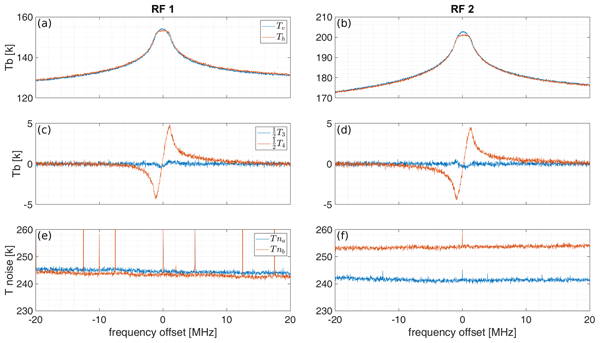
In this manuscript a new fully polarimetric radiometer for ground-based temperature sounding, TEMPERA-C (Campaign Temperature Radiometer), is presented. The advantages of the fully polarimetric approach are discussed, and a fully polarimetric calibration method is described in detail. The final measurements and the continuous series of temperature retrievals from the high altitude research station on the Jungfraujoch are also shown in this manuscript.
Adrianos Filinis, Alistair Bell, Axel Murk, and Gunter Stober
Atmos. Meas. Tech., 19, 1783–1799, https://doi.org/10.5194/amt-19-1783-2026, https://doi.org/10.5194/amt-19-1783-2026, 2026
Short summary
Short summary
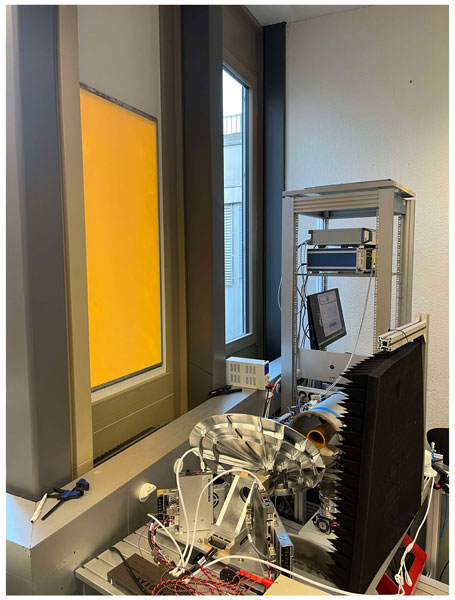
Water vapor is an essential climate variable in the Earth's atmosphere and plays an important role in the radiative balance, serving as the most significant greenhouse gas in the upper troposphere. Hence, high-quality and continuous measurements are required. In this paper, we present the breadboard design of a newly developed radiometer, which will retrieve vertical profiles of middle atmospheric water vapor.
Michael Kahnert, Melanie Ades, Mickaël Bacles, Johannes Flemming, Vincent Guidard, Alexander Haefele, Robin J. Hogan, Samuel Rémy, and Eric Sauvageat
EGUsphere, https://doi.org/10.5194/egusphere-2025-6077, https://doi.org/10.5194/egusphere-2025-6077, 2026
Short summary
Short summary
The Copernicus Atmosphere Monitoring Service (CAMS) provides quality-controlled information related to air quality and health. We explore the possibility to constrain the CAMS global forecasting model by use of ground-based observations of laser light backscattered by particulate matter. We find that the vertical distribution of particulate matter can be predicted more faithfully with this approach, which can have implications for air quality forecasts provided by CAMS to end users.
Chao Ban, Xin Fang, Wen Yi, Jie Zeng, Gunter Stober, Weilin Pan, Tao Li, and Xianghui Xue
Atmos. Meas. Tech., 19, 1697–1709, https://doi.org/10.5194/amt-19-1697-2026, https://doi.org/10.5194/amt-19-1697-2026, 2026
Short summary
Short summary
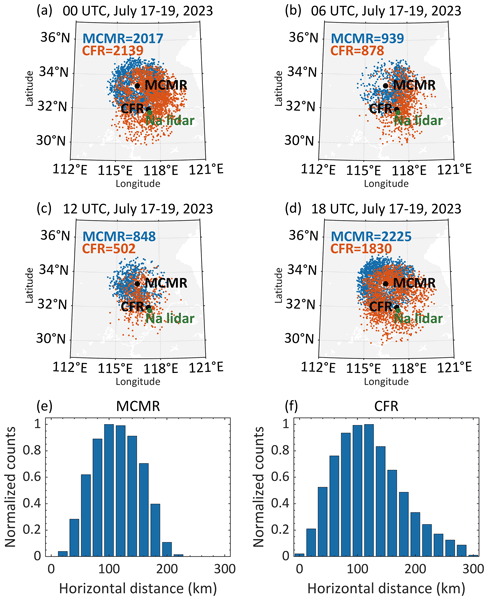
This paper presents an intercomparison of zonal winds observed by a sodium fluorescence lidar and three types of meteor radars – a multistatic meteor radar, a conventional monostatic radar, and a forward remote receiver – located near Hefei, China. The multistatic meteor radar shows the best agreement with the lidar measurements, confirming the reliability of its wind retrievals in the mesosphere and lower thermosphere and highlighting its potential for future atmospheric dynamics studies.
Alessandro Zanchetta, Steven van Heuven, Joram Hooghiem, Rigel Kivi, Thomas Laemmel, Michel Ramonet, Markus Leuenberger, Peter Nyfeler, Sophie L. Baartman, Maarten Krol, and Huilin Chen
Atmos. Meas. Tech., 19, 1465–1486, https://doi.org/10.5194/amt-19-1465-2026, https://doi.org/10.5194/amt-19-1465-2026, 2026
Short summary
Short summary
Continuous vertical profiles and discrete stratospheric samples of carbonyl sulfide (COS) were collected deploying the balloon-borne AirCore, LIghtweight Stratospheric Air (LISA) and BigLISA samplers and measured on a Quantum Cascade Laser Spectrometer (QCLS). Our measurements show good accordance with previous COS observations. Moreover, laboratory tests of ozone (O3) scrubbers proved squalene to remove O3 very efficiently without biasing the measurements of other trace gases.
Florian Günzkofer, Anders Tjulin, Gang Lu, Hanli Liu, and Gunter Stober
EGUsphere, https://doi.org/10.5194/egusphere-2026-823, https://doi.org/10.5194/egusphere-2026-823, 2026
Short summary
Short summary
Incoherent scatter radars (ISRs) are an important measurement tool for space weather research. However, ISR measurements require previous knowledge of the state of the ionosphere, especially the ratio of atomic oxygen ions (O+) to electrons. We present ISR measurements during the May 2024 "Mothers' Day Storm" and apply data assimilation-based O+ ratios, which should result in more accurate ISR measurements. The advantages and disadvantages of our method are compared to those of other approaches.
Nasrin Mostafavi Pak, Jonas Hachmeister, Markus Rettinger, Matthias Buschmann, Nicholas M. Deutscher, David W. T. Griffith, Laura T. Iraci, Xin Lan, Erin McGee, Isamu Morino, Dave Pollard, Coleen M. Roehl, Kimberly Strong, Rigel Kivi, and Paul Wennberg
Biogeosciences, 23, 1477–1495, https://doi.org/10.5194/bg-23-1477-2026, https://doi.org/10.5194/bg-23-1477-2026, 2026
Short summary
Short summary
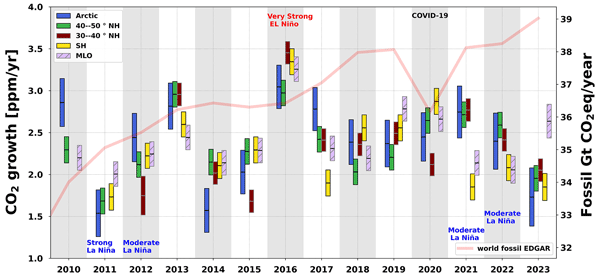
We studied how carbon dioxide (CO2) levels change each year using long-term measurements from twelve sites worldwide. Average growth rates from 2010 to 2024 were about 2.4 ppm/year, with notable year-to-year and regional differences. Natural climate patterns influenced these changes, while temporary shifts in human emissions, such as during COVID‑19, had modest local effects. Monitoring CO2 growth across regions helps track emissions and assess mitigation efforts.
Gaia Pinardi, Martina M. Friedrich, Corinne Vigouroux, Bavo Langerock, Isabelle De Smedt, Caroline Fayt, Christian Hermans, Steffen Beirle, Thomas Wagner, Minqiang Zhou, Ting Wang, Pucai Wang, Martine De Mazière, and Michel Van Roozendael
Atmos. Meas. Tech., 19, 1259–1291, https://doi.org/10.5194/amt-19-1259-2026, https://doi.org/10.5194/amt-19-1259-2026, 2026
Short summary
Short summary
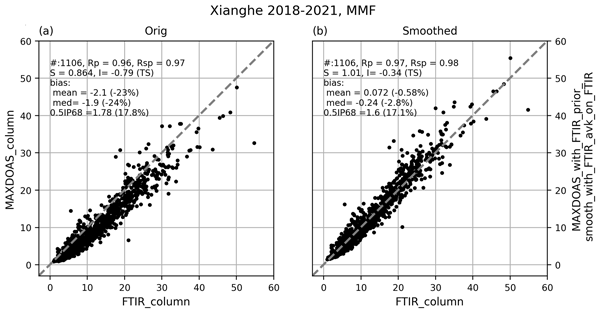
We evaluate ground-based remote-sensing measurements of formaldehyde from three techniques at a suburban site in China. A systematic −20 % bias in Multi-AXis Differential Optical Absorption Spectroscopy compared to direct-sun ultraviolet and infrared data is linked to limited sensitivity above a few kilometers and simplified vertical profiles assumptions. Using model-based priors and accounting for vertical sensitivity removes these differences, improving consistency for satellite validation.
Kathrin Naegeli, Jennifer Susan Adams, Gabriele Bramati, Isabelle Gärtner-Roer, Julian Gröbner, and Nils Rietze
EGUsphere, https://doi.org/10.5194/egusphere-2026-787, https://doi.org/10.5194/egusphere-2026-787, 2026
Short summary
Short summary
We investigate the potential of drone-based thermal cameras in the Swiss Alps and found they can misread surface temperatures when the camera warms or cools. Lab and field checks showed some correction methods exaggerate extremes. Calibrating on site with ground sensors gave the best results as well as the implementation of a site-specific validation. This improves temperature maps needed to track melting snow and ice, and unstable ground in rapidly changing mountains.
Ales Kuchar, Matthias Stocker, Alistair Bell, Bruno Lehner, Jessica Kult-Herdin, Gabriel Chiodo, Timofei Sukhodolov, Eugene Rozanov, Gunter Stober, and Harald E. Rieder
EGUsphere, https://doi.org/10.5194/egusphere-2026-406, https://doi.org/10.5194/egusphere-2026-406, 2026
Short summary
Short summary
We investigated why the Northern Hemisphere winter polar vortex became unusually strong in the winter of 2024/2025. Using satellite and reanalysis datasets, and model simulations, we found that extra water erupted high in the atmosphere by the 2022 Hunga Tonga eruption led to cooling of polar latitudes of the upper atmosphere, helping the winds aloft intensify. This link suggests such volcanic eruptions can shape winters in the upper atmosphere for several years.
Simone Pulimeno, Angelo Lupi, Vito Vitale, Claudia Frangipani, Carlos Toledano, Stelios Kazadzis, Natalia Kouremeti, Christoph Ritter, Sandra Graßl, Kerstin Stebel, Vitali Fioletov, Ihab Abboud, Sandra Blindheim, Lynn Ma, Norm O'Neill, Piotr Sobolewski, Pawan Gupta, Elena Lind, Thomas F. Eck, Antti Hyvärinen, Veijo Aaltonen, Rigel Kivi, Janae Csavina, Dmitry Kabanov, Sergey M. Sakerin, Olga R. Sidorova, Robert S. Stone, Hagen Telg, Laura Riihimaki, Raul R. Cordero, Martin Radenz, Ronny Engelmann, Michel Van Roozendal, Anatoli Chaikovsky, Philippe Goloub, Junji Hisamitsu, and Mauro Mazzola
Atmos. Chem. Phys., 26, 1809–1846, https://doi.org/10.5194/acp-26-1809-2026, https://doi.org/10.5194/acp-26-1809-2026, 2026
Short summary
Short summary
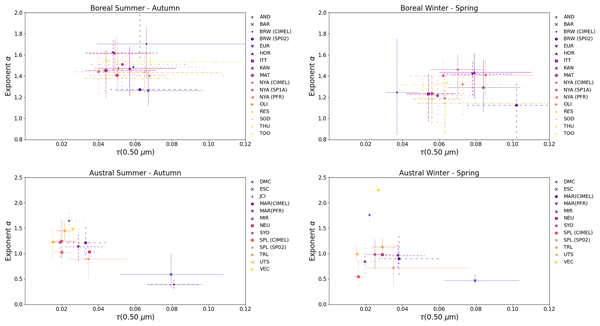
This study analyzed aerosols optical properties over the Arctic and Antarctic to measure them even during long periods of darkness. It found that pollution in the Arctic is decreasing, likely due to European emission regulations, while wildfires are becoming a more important source of particles. In Antarctica, particle levels are higher near the coast than inland, and vary by season. These results help us better understand how air pollution and climate are changing at the Earth’s poles.
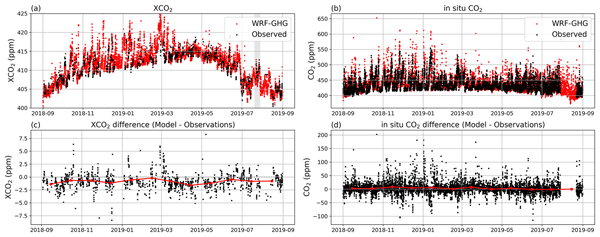
Sieglinde Callewaert, Minqiang Zhou, Bavo Langerock, Pucai Wang, Ting Wang, Emmanuel Mahieu, and Martine De Mazière
Atmos. Chem. Phys., 26, 899–921, https://doi.org/10.5194/acp-26-899-2026, https://doi.org/10.5194/acp-26-899-2026, 2026
Short summary
Short summary
We investigated changes in carbon dioxide levels at a suburban site in China using ground-based measurements, remote sensing, and an atmospheric model. The model matched many observed patterns but showed nighttime and background errors. We identified the main human and natural sources and sinks, offering insights to improve future greenhouse gas monitoring and climate modelling.
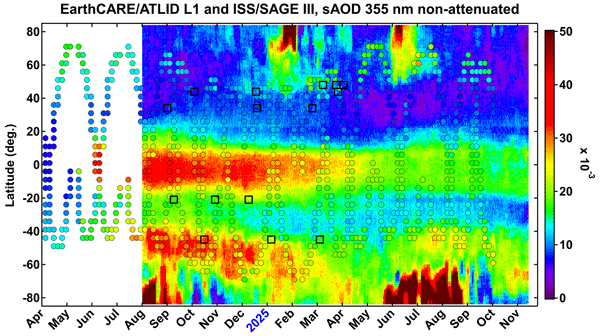
Sergey Khaykin, Michaël Sicard, Thierry Leblanc, Tetsu Sakai, Nickolay Balugin, Gwenaël Berthet, Stëphane Chevrier, Fernando Chouza, Artem Feofilov, Dominique Gantois, Sophie Godin-Beekmann, Arezki Haddouche, Yoshitaka Jin, Isamu Morino, Nicolas Kadygrov, Thomas Lecas, Ben Liley, Richard Querel, Ghasssan Taha, and Vladimir Yushkov
Atmos. Chem. Phys., 26, 607–622, https://doi.org/10.5194/acp-26-607-2026, https://doi.org/10.5194/acp-26-607-2026, 2026
Short summary
Short summary
In April 2024, the Ruang volcano in Indonesia sent large amounts of gas and particles high into the atmosphere, which then spread worldwide. Using the new European EarthCARE satellite and its advanced laser instrument ATLID (Atmospheric LIDar), together with ground and balloon observations, we tracked how these particles doubled levels in the tropics and spread into both hemispheres. The study shows ATLID’s power to reveal how eruptions can affect climate, clouds, and ozone for more than a year.
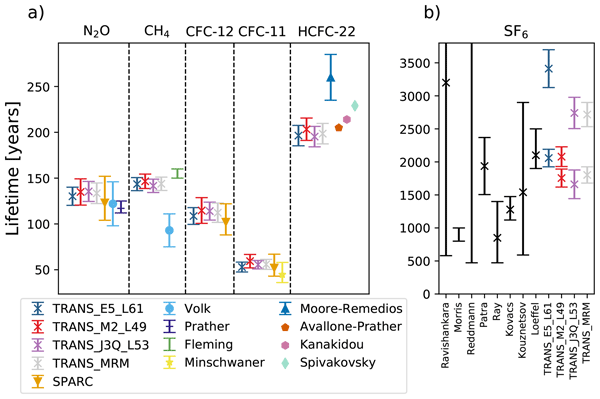
Sarah Vervalcke, Quentin Errera, Roland Eichinger, Thomas Reddmann, Simon Chabrillat, Marc Op de beeck, Gabriele Stiller, and Emmanuel Mahieu
Atmos. Chem. Phys., 26, 391–409, https://doi.org/10.5194/acp-26-391-2026, https://doi.org/10.5194/acp-26-391-2026, 2026
Short summary
Short summary
This study presents three simulations of atmospheric chemistry with the Belgian Assimilation System for Chemical Observations chemistry transport model, driven by different meteorological data sets. Newly implemented SF6 chemistry enables stratospheric transport studies. Results agree with satellite observations. The derived lifetimes of six trace gases agree with the literature, but SF6 shows larger sensitivity to the choice of meteorology. The lifetime of SF6 ranges from 1900 to 2600 years.
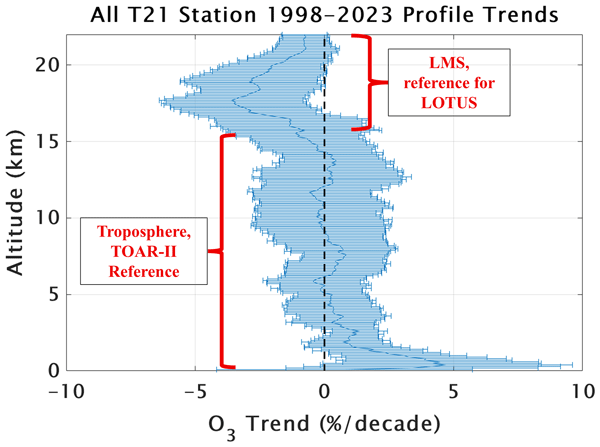
Anne M. Thompson, Ryan M. Stauffer, Debra E. Kollonige, Jerald R. Ziemke, Bryan J. Johnson, Gary A. Morris, Patrick Cullis, María Cazorla, Jorge Andres Diaz, Ankie Piters, Igor Nedeljkovic, Truus Warsodikromo, Francisco Raimundo Silva, E. Thomas Northam, Patrick Benjamin, Thumeka Mkololo, Tshidi Machinini, Christian Félix, Gonzague Romanens, Syprose Nyadida, Jérôme Brioude, Stéphanie Evan, Jean-Marc Metzger, Ambun Dindang, Yuzaimi B. Mahat, Mohan Kumar Sammathuria, Norazura Binti Zakaria, Ninong Komala, Shin-Ya Ogino, Nguyen Thi Quyen, Francis S. Mani, Miriama Vuiyasawa, David Nardini, Matthew Martinsen, Darryl T. Kuniyuki, Katrin Müller, Pawel Wolff, and Bastien Sauvage
Atmos. Chem. Phys., 25, 18475–18507, https://doi.org/10.5194/acp-25-18475-2025, https://doi.org/10.5194/acp-25-18475-2025, 2025
Short summary
Short summary
Ozone profile trends from SHADOZ sondes and IAGOS aircraft show that ozone in the tropical free troposphere (FT) is not growing fast except over equatorial SE Asia. This agrees with HEGIFTOM (Van Malderen et al., 2025), Stauffer et al. (2024) and Gaudel et al. (2024) TOAR-II papers. Other findings are as follows: (1) our trends are independent of method (QR, MLR) and (2) sample number (SN) (i.e., SHADOZ sampling is sufficient), and (3) all ground-based trends constitute the gold standard for satellite-derived trends.
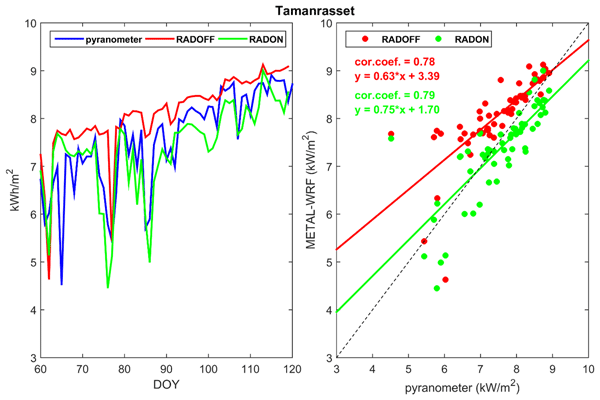
Christos Spyrou, Ilias Fountoulakis, Stavros Solomos, Nikolaos Papadimitriou, Alkiviadis Bais, Julian Gröbner, Daniela Meloni, and Christos Zerefos
Atmos. Meas. Tech., 18, 7717–7734, https://doi.org/10.5194/amt-18-7717-2025, https://doi.org/10.5194/amt-18-7717-2025, 2025
Short summary
Short summary
Dust particles originating from desert areas of the planet have significant radiative impacts on the ground and atmospheric column. The magnitude of the dust radiative effect is dependent on their optical properties and mineralogical content. Therefore, we upgrade the METAL-WRF model to incorporate the direct radiative impact of the minerals in dust. The capabilities of the model to simulate the chemical composition and associated impacts is significantly improved.

Angelos Karanikolas, Benjamin Torres, Masahiro Momoi, Marcos Herreras Giralda, Natalia Kouremeti, Julian Gröbner, Lionel Doppler, and Stelios Kazadzis
Atmos. Meas. Tech., 18, 7651–7677, https://doi.org/10.5194/amt-18-7651-2025, https://doi.org/10.5194/amt-18-7651-2025, 2025
Short summary
Short summary
Several techniques retrieve of the aerosol size distribution. The Generalized Retrieval of Atmosphere and Surface Properties algorithm can retrieve aerosol size distribution parameters using only aerosol optical depth (AOD) as input that is continuously observed by sun photometers worldwide. In this study, we apply the algorithm to AOD measured by sun photometers and spectroradiometers to assess the performance and limitations of such retrievals and investigate the effect of the spectral range.
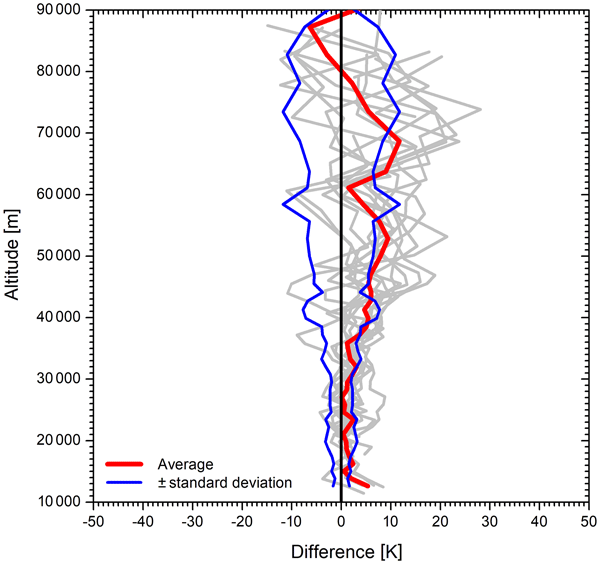
Thomas Trickl, Hannes Vogelmann, Michael Bittner, Gerald Nedoluha, Carsten Schmidt, Wolfgang Steinbrecht, and Sabine Wüst
Atmos. Meas. Tech., 18, 7477–7496, https://doi.org/10.5194/amt-18-7477-2025, https://doi.org/10.5194/amt-18-7477-2025, 2025
Short summary
Short summary
A powerful lidar system has been installed at the high-altitude observatory Schneefernerhaus (2575 m) to allow for atmospheric temperature measurements up to more than 80 km within just one hour. The temperature profiles are calibrated by values obtained from chemiluminscence of the hydroxyl radical around 86 km. The temperature profiles are successfully compared with satellite and lidar data.
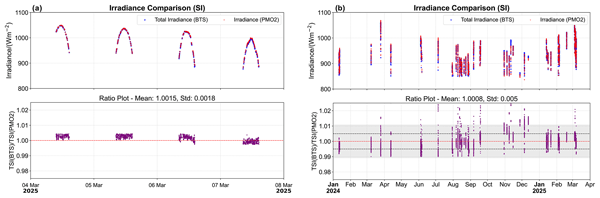
Dhrona Jaine, Julian Gröbner, and Wolfgang Finsterle
Atmos. Meas. Tech., 18, 7177–7186, https://doi.org/10.5194/amt-18-7177-2025, https://doi.org/10.5194/amt-18-7177-2025, 2025
Short summary
Short summary
Solar irradiance monitoring is an integral part of climate research. But the major drawback was the larger uncertainties associated with the measurements. To minimize the uncertainties, improved calibration standards, measurement techniques and sensors were developed. In this study we are validating the a newly developed Bi-Tec sensor spectroradiometer with an average uncertainty of 0.53 % with world radiometric reference (WRR) and international system of units (SI).
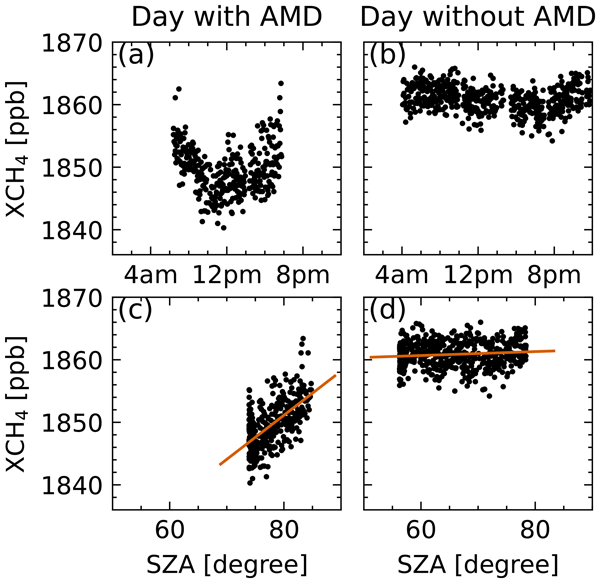
Jonas Hachmeister, Debra Wunch, Erin McGee, Kimberly Strong, Rigel Kivi, Justus Notholt, Thorsten Warneke, and Matthias Buschmann
Atmos. Meas. Tech., 18, 7105–7128, https://doi.org/10.5194/amt-18-7105-2025, https://doi.org/10.5194/amt-18-7105-2025, 2025
Short summary
Short summary
Methane measurements from the Total Carbon Column Observing Network (TCCON) are important for climate research, especially in the Arctic, where few measurements are available. We show that during early spring systematic errors are present in these data that are correlated to the presence of the polar vortex. These errors occur due to the usage of wrong methane prior shapes in the retrieval and can be alleviated by modifying the prior shape accordingly.
Arno Keppens, Daan Hubert, José Granville, Oindrila Nath, Jean-Christopher Lambert, Catherine Wespes, Pierre-François Coheur, Cathy Clerbaux, Anne Boynard, Richard Siddans, Barry Latter, Brian Kerridge, Serena Di Pede, Pepijn Veefkind, Juan Cuesta, Gaelle Dufour, Klaus-Peter Heue, Melanie Coldewey-Egbers, Diego Loyola, Andrea Orfanoz-Cheuquelaf, Swathi Maratt Satheesan, Kai-Uwe Eichmann, Alexei Rozanov, Viktoria F. Sofieva, Jerald R. Ziemke, Antje Inness, Roeland Van Malderen, and Lars Hoffmann
Atmos. Meas. Tech., 18, 6893–6916, https://doi.org/10.5194/amt-18-6893-2025, https://doi.org/10.5194/amt-18-6893-2025, 2025
Short summary
Short summary
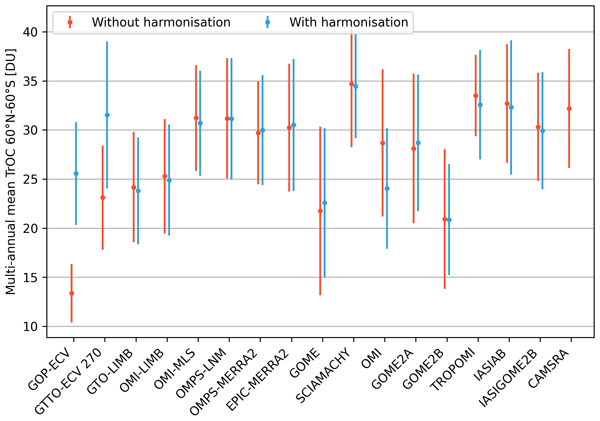
The first Tropospheric Ozone Assessment Report (TOAR) encountered discrepancies between several satellite sensors’ estimates of the distribution and change of ozone in the free troposphere. Therefore, contributing to the second TOAR, we harmonise as much as possible the observational perspective of sixteen tropospheric ozone products from satellites. This only partially accounts for the observed discrepancies, with a reduction of 10–40 % of the inter-product dispersion upon harmonisation.
Sina Voshtani, Dylan B. A. Jones, Debra Wunch, Drew C. Pendergrass, Paul O. Wennberg, David F. Pollard, Isamu Morino, Hirofumi Ohyama, Nicholas M. Deutscher, Frank Hase, Ralf Sussmann, Damien Weidmann, Rigel Kivi, Omaira García, Yao Té, Jack Chen, Kerry Anderson, Robin Stevens, Shobha Kondragunta, Aihua Zhu, Douglas Worthy, Senen Racki, Kathryn McKain, Maria V. Makarova, Nicholas Jones, Emmanuel Mahieu, Andrea Cadena-Caicedo, Paolo Cristofanelli, Casper Labuschagne, Elena Kozlova, Thomas Seitz, Martin Steinbacher, Reza Mahdi, and Isao Murata
Atmos. Chem. Phys., 25, 15527–15565, https://doi.org/10.5194/acp-25-15527-2025, https://doi.org/10.5194/acp-25-15527-2025, 2025
Short summary
Short summary
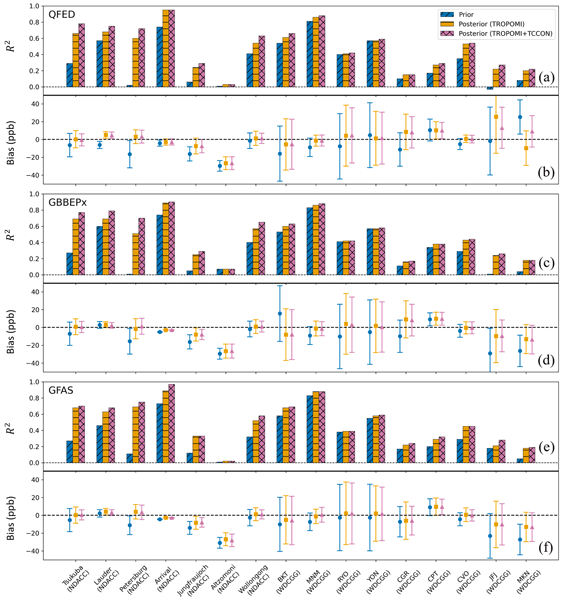
We assess the complementarity of the greater temporal coverage provided by ground-based remote sensing data with the spatial coverage of satellite observations when these data are used together to quantify CO emissions from extreme wildfires in 2023. Our results reveal that the commonly used biomass burning emission inventories significantly underestimate the fire emissions and emphasize the importance of the ground-based remote sensing data in reducing uncertainties in the estimated emissions.
Sergey Khaykin, Slimane Bekki, Sophie Godin-Beekmann, Michael D. Fromm, Philippe Goloub, Qiaoyun Hu, Béatrice Josse, Alexandra Laeng, Mehdi Meziane, David A. Peterson, Sophie Pelletier, and Valérie Thouret
Atmos. Chem. Phys., 25, 14551–14571, https://doi.org/10.5194/acp-25-14551-2025, https://doi.org/10.5194/acp-25-14551-2025, 2025
Short summary
Short summary
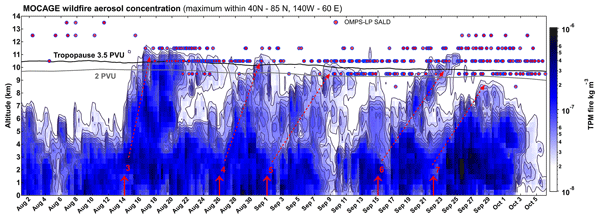
In 2023, massive wildfires in Canada injected huge amounts of smoke into the atmosphere. Surprisingly, despite their intensity, the smoke did not rise very high but lingered at flight cruising altitudes, causing widespread pollution. This study shows how two different pathways lifted smoke into the lower stratosphere and reveals new insights into how wildfires affect air quality and climate, challenging what we thought we knew about fire and atmospheric impacts.
Noémie Taquet, Thomas Boulesteix, Omaira García, Robin Campion, Wolfgang Stremme, Sergio Rodríguez, Jessica López-Darias, Carlos Marrero, Diego González-García, Andreas Klügel, Frank Hase, M. Isabel García, Ramón Ramos, Pedro Rivas-Soriano, Sergio Léon-Luis, Virgilio Carreño, Antonio Alcántara, Eliezer Sépulveda, Celia Milford, Pablo González-Sicilia, and Carlos Torres
Atmos. Chem. Phys., 25, 14591–14628, https://doi.org/10.5194/acp-25-14591-2025, https://doi.org/10.5194/acp-25-14591-2025, 2025
Short summary
Short summary
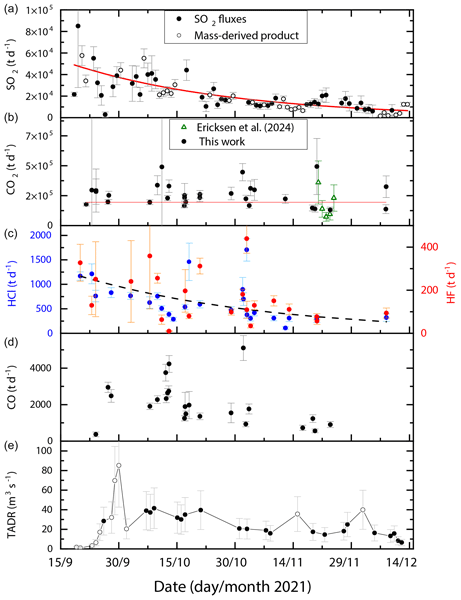
Volcanic gas emissions were quantified during the 2021 La Palma eruption using ground-based direct-sun Fourier transform infrared spectroscopy and differential optical absorption spectroscopy up to 140 km from the vent. New petrological estimations are consistent with our emission budgets. These findings highlight the feasibility of using existing atmospheric monitoring networks to study the atmospheric impact of volcanic degassing and support monitoring during eruptive crises.
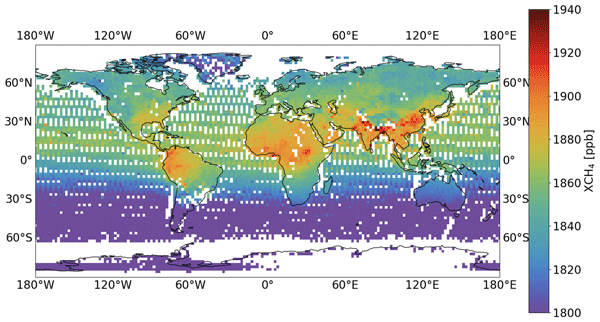
Andrew Gerald Barr, Jochen Landgraf, Mari Martinez-Velarte, Mihalis Vrekoussis, Ralf Sussmann, Isamu Morino, Kimberly Strong, Minqiang Zhou, Voltaire A. Velazco, Hirofumi Ohyama, Thorsten Warneke, Frank Hase, and Tobias Borsdorff
Atmos. Meas. Tech., 18, 6093–6123, https://doi.org/10.5194/amt-18-6093-2025, https://doi.org/10.5194/amt-18-6093-2025, 2025
Short summary
Short summary
The Greenhouse Gases Observing Satellite-2 (GOSAT-2) is a satellite dedicated to measuring concentrations of greenhouse gases from space. Since its launch, the increase of CH4 and CO2 concentrations in the atmosphere is clear. The datasets obtained from GOSAT-2 are used in the Copernicus atmospheric services to monitor the climate, in light of the Paris Agreement. Here we present robust datasets of these gases from GOSAT-2, including a novel machine learning approach to data quality filtering.
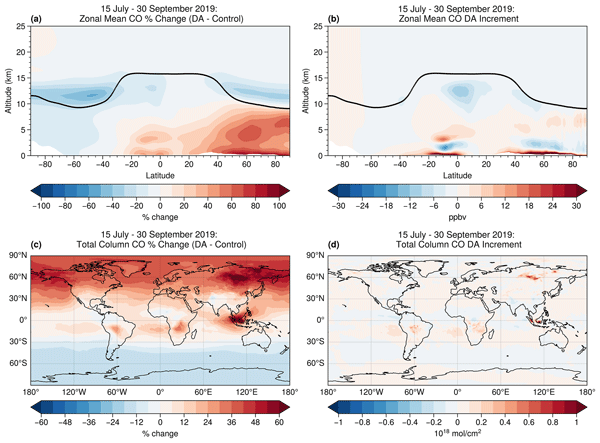
Maggie Bruckner, R. Bradley Pierce, Allen Lenzen, Glenn Diskin, Joshua P. DiGangi, Martine De Maziere, Nicholas Jones, and Maria Makarova
Geosci. Model Dev., 18, 8109–8127, https://doi.org/10.5194/gmd-18-8109-2025, https://doi.org/10.5194/gmd-18-8109-2025, 2025
Short summary
Short summary
UFS-RAQMS incorporates the Real-time Air Quality Modeling System (RAQMS) stratosphere/troposphere chemistry into the existing NOAA Global Ensemble Forecast System (GEFS-Aerosols) version of NOAA's Unified Forecast System (UFS). Chemical data assimilation using TROPOMI CO column observations is conducted during the July–August–September 2019 period. Comparison of the CO column with independent measurements shows a systematic low bias in biomass burning CO emissions without assimilation.

Ilias Fountoulakis, Kyriaki Papachristopoulou, Stelios Kazadzis, Gregor Hülsen, Julian Gröbner, Ioannis-Panagiotis Raptis, Dimitra Kouklaki, Akriti Masoom, Natalia Kouremeti, Charalampos Kontoes, and Christos S. Zerefos
Geosci. Model Dev., 18, 7451–7473, https://doi.org/10.5194/gmd-18-7451-2025, https://doi.org/10.5194/gmd-18-7451-2025, 2025
Short summary
Short summary
The UVIOS2 model has been evaluated at Davos, Switzerland during the UVCIII campaign. The accuracy in the modelled UV indices has been assessed for different combinations of model inputs. A good overall agreement between UVIOS2 and the world reference spectroradiometer QASUME was found (average ratio of ~ 1 between the modelled and measured UV index), although the variability in the ratio can be large under cloudy conditions.
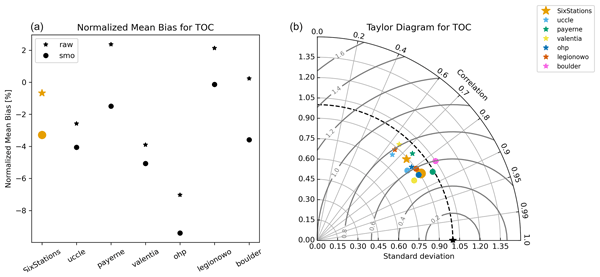
Gaëlle Dufour, Maxim Eremenko, Juan Cuesta, Gérard Ancellet, Michael Gill, Eliane Maillard Barras, and Roeland Van Malderen
Atmos. Meas. Tech., 18, 5049–5070, https://doi.org/10.5194/amt-18-5049-2025, https://doi.org/10.5194/amt-18-5049-2025, 2025
Short summary
Short summary
Tropospheric ozone from the three Infrared Atmospheric Sounding Interferometer (IASI) instruments is very consistent (<1 %). The validation against homogenized ozone sondes reveals an overall good agreement with slight biases (3 %–6 %) in tropospheric ozone and a possible temporal drift, but this is difficult to assess due to the limited number of sites. No specific trends are estimated for the tropospheric ozone column for the period 2008–2022, but persistent negative trends are observed in the lower troposphere.
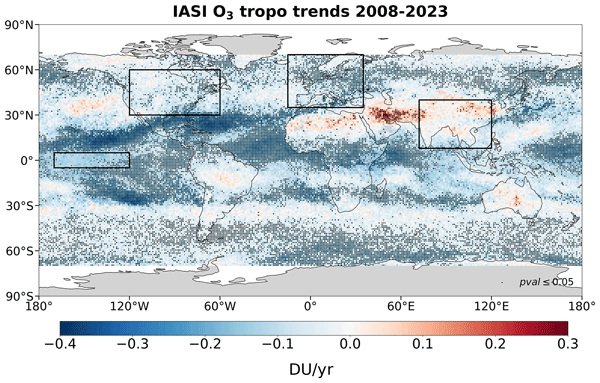
Anne Boynard, Catherine Wespes, Juliette Hadji-Lazaro, Selviga Sinnathamby, Daniel Hurtmans, Pierre-François Coheur, Marie Doutriaux-Boucher, Jacobus Onderwaater, Wolfgang Steinbrecht, Elyse A. Pennington, Kevin Bowman, and Cathy Clerbaux
Atmos. Chem. Phys., 25, 11719–11755, https://doi.org/10.5194/acp-25-11719-2025, https://doi.org/10.5194/acp-25-11719-2025, 2025
Short summary
Short summary
This study analyzes 16 years of global ozone data to assess its impact on air quality and climate. Using satellite measurements, we observed a global decrease in tropospheric ozone, particularly in tropical and European regions. The drop became more noticeable around 2020, partly due to reduced emissions during the pandemic. The study highlights the need for better data processing and integration to more accurately monitor ozone changes over time.
Pekka T. Verronen, Akira Mizuno, Yoshizumi Miyoshi, Sandeep Kumar, Taku Nakajima, Shin-Ichiro Oyama, Tomoo Nagahama, Satonori Nozawa, Monika E. Szeląg, Tuomas Häkkilä, Niilo Kalakoski, Antti Kero, Esa Turunen, Satoshi Kasahara, Shoichiro Yokota, Kunihiro Keika, Tomoaki Hori, Takefumi Mitani, Takeshi Takashima, and Iku Shinohara
Ann. Geophys., 43, 561–578, https://doi.org/10.5194/angeo-43-561-2025, https://doi.org/10.5194/angeo-43-561-2025, 2025
Short summary
Short summary
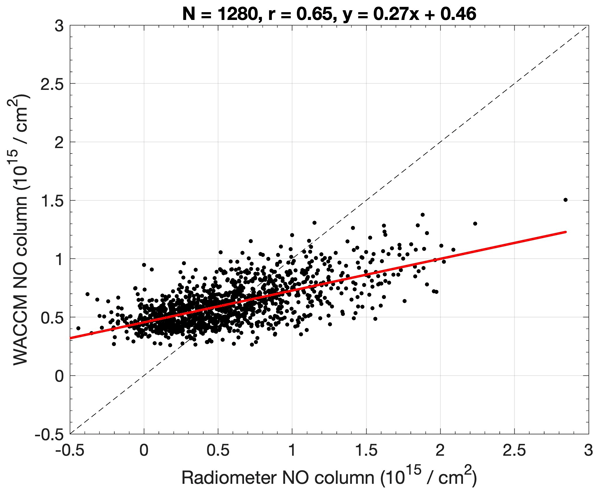
We use NO column density data from the Syowa station in Antarctica from 2012–2017. We compare these ground-based radiometer observations with results from a global atmosphere model to understand the year-to-year and day-to-day variability, shortcomings of current electron forcing, and how geomagnetic storms are driving the variability of NO. Our results demonstrate an underestimation in the magnitude of day-to-day variability in simulations, which calls for improved electron forcing in models.
Yugo Kanaya, Roberto Sommariva, Alfonso Saiz-Lopez, Andrea Mazzeo, Theodore K. Koenig, Kaori Kawana, James E. Johnson, Aurélie Colomb, Pierre Tulet, Suzie Molloy, Ian E. Galbally, Rainer Volkamer, Anoop Mahajan, John W. Halfacre, Paul B. Shepson, Julia Schmale, Hélène Angot, Byron Blomquist, Matthew D. Shupe, Detlev Helmig, Junsu Gil, Meehye Lee, Sean C. Coburn, Ivan Ortega, Gao Chen, James Lee, Kenneth C. Aikin, David D. Parrish, John S. Holloway, Thomas B. Ryerson, Ilana B. Pollack, Eric J. Williams, Brian M. Lerner, Andrew J. Weinheimer, Teresa Campos, Frank M. Flocke, J. Ryan Spackman, Ilann Bourgeois, Jeff Peischl, Chelsea R. Thompson, Ralf M. Staebler, Amir A. Aliabadi, Wanmin Gong, Roeland Van Malderen, Anne M. Thompson, Ryan M. Stauffer, Debra E. Kollonige, Juan Carlos Gómez Martin, Masatomo Fujiwara, Katie Read, Matthew Rowlinson, Keiichi Sato, Junichi Kurokawa, Yoko Iwamoto, Fumikazu Taketani, Hisahiro Takashima, Mónica Navarro-Comas, Marios Panagi, and Martin G. Schultz
Earth Syst. Sci. Data, 17, 4901–4932, https://doi.org/10.5194/essd-17-4901-2025, https://doi.org/10.5194/essd-17-4901-2025, 2025
Short summary
Short summary
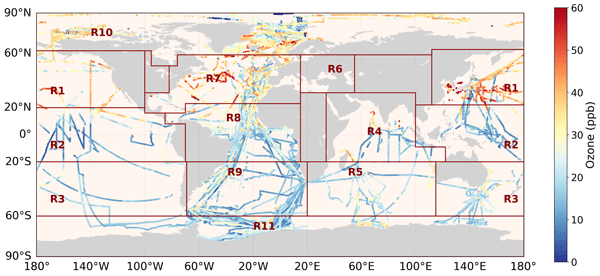
The first comprehensive dataset of tropospheric ozone over oceans/polar regions is presented, including 77 ship/buoy and 48 aircraft campaign observations (1977–2022, 0–5000 m altitude), supplemented by ozonesonde and surface data. Air masses isolated from land for 72+ hours are systematically selected as essentially oceanic. Among the 11 global regions, they show daytime decreases of 11–16 % in the tropics, while near-zero depletions are rare, unlike in the Arctic, implying different mechanisms.
Tristan Millet, Hassan Bencherif, Thierry Portafaix, Nelson Bègue, Alexandre Baron, Valentin Duflot, Cathy Clerbaux, Pierre-François Coheur, Andrea Pazmiño, Michaël Sicard, Anne Boynard, Jean-Marc Metzger, Guillaume Payen, Nicolas Marquestaut, and Sophie Godin-Beekmann
Atmos. Chem. Phys., 25, 10887–10905, https://doi.org/10.5194/acp-25-10887-2025, https://doi.org/10.5194/acp-25-10887-2025, 2025
Short summary
Short summary
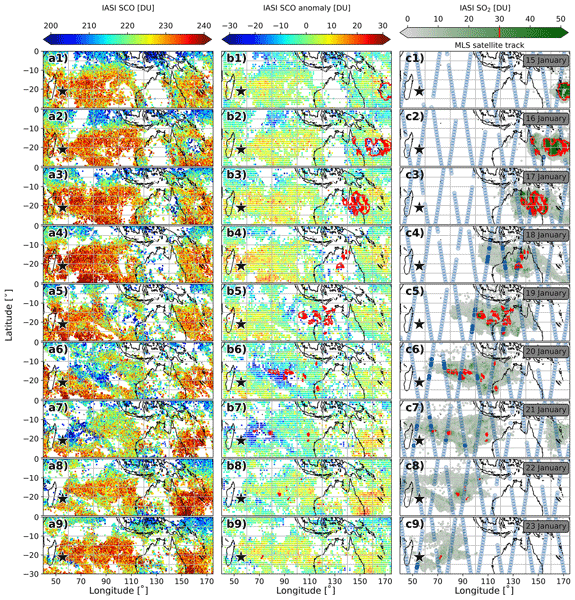
On 15 January 2022, the Hunga volcano erupted, releasing sulfur dioxide and water vapor into the stratosphere, impacting ozone levels over the Indian Ocean. Satellite data show the presence of a transient ozone depletion event related to the water vapor anomalies and sulfate aerosol clouds. Ozone reduction was confined to two distinct layers. On 21 January, the fifth percentile of total and stratospheric column ozone anomalies reached −18.6 and −14.5 DU, respectively.
Roeland Van Malderen, Zhou Zang, Kai-Lan Chang, Robin Björklund, Owen R. Cooper, Jane Liu, Eliane Maillard Barras, Corinne Vigouroux, Irina Petropavlovskikh, Thierry Leblanc, Valérie Thouret, Pawel Wolff, Peter Effertz, Audrey Gaudel, David W. Tarasick, Herman G. J. Smit, Anne M. Thompson, Ryan M. Stauffer, Debra E. Kollonige, Deniz Poyraz, Gérard Ancellet, Marie-Renée De Backer, Matthias M. Frey, James W. Hannigan, José L. Hernandez, Bryan J. Johnson, Nicholas Jones, Rigel Kivi, Emmanuel Mahieu, Isamu Morino, Glen McConville, Katrin Müller, Isao Murata, Justus Notholt, Ankie Piters, Maxime Prignon, Richard Querel, Vincenzo Rizi, Dan Smale, Wolfgang Steinbrecht, Kimberly Strong, and Ralf Sussmann
Atmos. Chem. Phys., 25, 9905–9935, https://doi.org/10.5194/acp-25-9905-2025, https://doi.org/10.5194/acp-25-9905-2025, 2025
Short summary
Short summary
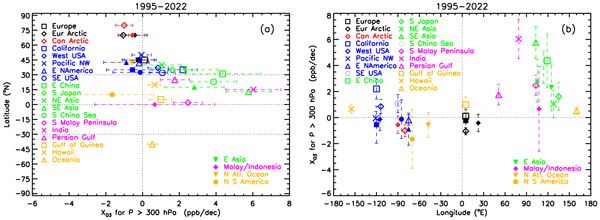
Tropospheric ozone is an important greenhouse gas and an air pollutant whose distribution and time variability are mainly governed by anthropogenic emissions and dynamics. In this paper, we assess regional trends of tropospheric ozone column amounts, based on two different approaches of merging or synthesizing ground-based observations and their trends within specific regions. Our findings clearly demonstrate regional trend differences but also consistently higher pre-COVID than post-COVID trends.
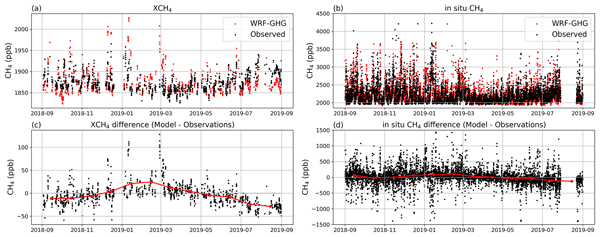
Sieglinde Callewaert, Minqiang Zhou, Bavo Langerock, Pucai Wang, Ting Wang, Emmanuel Mahieu, and Martine De Mazière
Atmos. Chem. Phys., 25, 9519–9544, https://doi.org/10.5194/acp-25-9519-2025, https://doi.org/10.5194/acp-25-9519-2025, 2025
Short summary
Short summary
We used an atmospheric transport model and satellite data to study CH4 observations in Xianghe, China. Our study shows the key source sectors that influence the concentrations and their respective importance. Furthermore, meteorological factors such as wind direction are discussed. This research highlights the challenges in accurately simulating these kinds of measurements and helps us to better understand CH4 variability in the region.
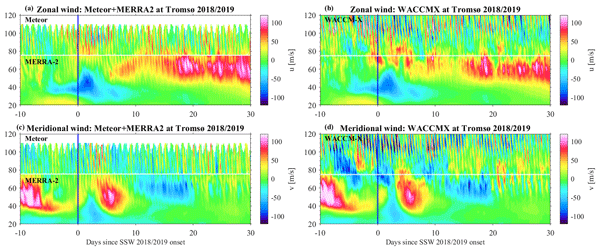
Guochun Shi, Hanli Liu, Masaki Tsutsumi, Njål Gulbrandsen, Alexander Kozlovsky, Dimitry Pokhotelov, Mark Lester, Christoph Jacobi, Kun Wu, and Gunter Stober
Atmos. Chem. Phys., 25, 9403–9430, https://doi.org/10.5194/acp-25-9403-2025, https://doi.org/10.5194/acp-25-9403-2025, 2025
Short summary
Short summary
Concerns about climate change are growing due to its widespread impacts, including rising temperatures, extreme weather events, and disruptions to ecosystems. To address these challenges, urgent global action is needed to monitor the distribution of trace gases and understand their effects on the atmosphere.
Ales Kuchar, Gunter Stober, Dimitry Pokhotelov, Huixin Liu, Han-Li Liu, Manfred Ern, Damian Murphy, Diego Janches, Tracy Moffat-Griffin, Nicholas Mitchell, and Christoph Jacobi
EGUsphere, https://doi.org/10.5194/egusphere-2025-2827, https://doi.org/10.5194/egusphere-2025-2827, 2025
Short summary
Short summary
We studied how the healing of the Antarctic ozone layer is affecting winds high above the South Pole. Using ground-based radar, satellite data, and computer models, we found that winds in the upper atmosphere have become stronger over the past two decades. These changes appear to be linked to shifts in the lower atmosphere caused by ozone recovery. Our results show that human efforts to repair the ozone layer are also influencing climate patterns far above Earth’s surface.
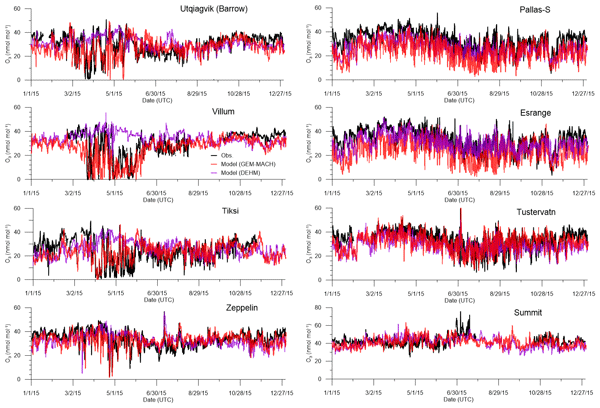
Wanmin Gong, Stephen R. Beagley, Kenjiro Toyota, Henrik Skov, Jesper Heile Christensen, Alex Lupu, Diane Pendlebury, Junhua Zhang, Ulas Im, Yugo Kanaya, Alfonso Saiz-Lopez, Roberto Sommariva, Peter Effertz, John W. Halfacre, Nis Jepsen, Rigel Kivi, Theodore K. Koenig, Katrin Müller, Claus Nordstrøm, Irina Petropavlovskikh, Paul B. Shepson, William R. Simpson, Sverre Solberg, Ralf M. Staebler, David W. Tarasick, Roeland Van Malderen, and Mika Vestenius
Atmos. Chem. Phys., 25, 8355–8405, https://doi.org/10.5194/acp-25-8355-2025, https://doi.org/10.5194/acp-25-8355-2025, 2025
Short summary
Short summary
This study showed that the springtime O3 depletion plays a critical role in driving the surface O3 seasonal cycle in the central Arctic. The O3 depletion events, while occurring most notably within the lowest few hundred metres above the Arctic Ocean, can induce a 5–7 % loss in the pan-Arctic tropospheric O3 burden during springtime. The study also found enhancements in O3 and NOy (mostly peroxyacetyl nitrate) concentrations in the Arctic due to northern boreal wildfires, particularly at higher altitudes.
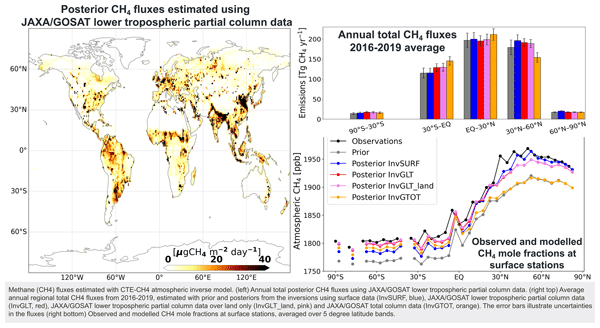
Aki Tsuruta, Akihiko Kuze, Kei Shiomi, Fumie Kataoka, Nobuhiro Kikuchi, Tuula Aalto, Leif Backman, Ella Kivimäki, Maria K. Tenkanen, Kathryn McKain, Omaira E. García, Frank Hase, Rigel Kivi, Isamu Morino, Hirofumi Ohyama, David F. Pollard, Mahesh K. Sha, Kimberly Strong, Ralf Sussmann, Yao Te, Voltaire A. Velazco, Mihalis Vrekoussis, Thorsten Warneke, Minqiang Zhou, and Hiroshi Suto
Atmos. Chem. Phys., 25, 7829–7862, https://doi.org/10.5194/acp-25-7829-2025, https://doi.org/10.5194/acp-25-7829-2025, 2025
Short summary
Short summary
Satellite data bring invaluable information about greenhouse gas emissions globally. We found that a new type of data from the Greenhouse Gas Observing Satellite (GOSAT), which contains information about methane in the lowest layer of Earth's atmosphere, could provide reliable estimates of recent methane emissions when combined with atmospheric modelling. Therefore, the use of such data is encouraged to improve emission quantification methods and advance our understanding of methane cycles.
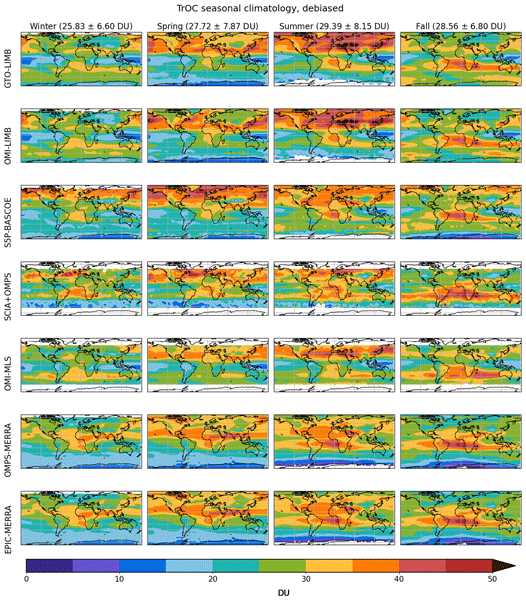
Carlo Arosio, Viktoria Sofieva, Andrea Orfanoz-Cheuquelaf, Alexei Rozanov, Klaus-Peter Heue, Diego Loyola, Edward Malina, Ryan M. Stauffer, David Tarasick, Roeland Van Malderen, Jerry R. Ziemke, and Mark Weber
Atmos. Meas. Tech., 18, 3247–3265, https://doi.org/10.5194/amt-18-3247-2025, https://doi.org/10.5194/amt-18-3247-2025, 2025
Short summary
Short summary
Tropospheric ozone affects air quality and climate, being a pollutant and a greenhouse gas. We analyze satellite data of tropospheric ozone columns obtained by combining two types of observations: one providing stratospheric and the other total ozone. We compare common climatological features and study the influence of the tropopause (troposphere to stratosphere boundary) on the results. We also examine trends over the last 20 years and compare satellite data with ozonesondes to identify drifts.
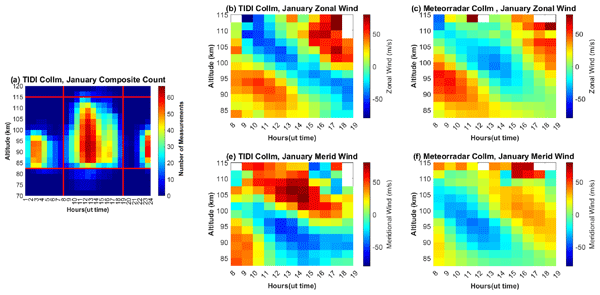
Arthur Gauthier, Claudia Borries, Alexander Kozlovsky, Diego Janches, Peter Brown, Denis Vida, Christoph Jacobi, Damian Murphy, Masaki Tsutsumi, Njål Gulbrandsen, Satonori Nozawa, Mark Lester, Johan Kero, Nicholas Mitchell, Tracy Moffat-Griffin, and Gunter Stober
Ann. Geophys., 43, 427–440, https://doi.org/10.5194/angeo-43-427-2025, https://doi.org/10.5194/angeo-43-427-2025, 2025
Short summary
Short summary
This study focuses on a TIMED Doppler Interferometer (TIDI)–meteor radar (MR) comparison of zonal and meridional winds and their dependence on local time and latitude. The correlation calculation between TIDI wind measurements and MR winds shows good agreement. A TIDI–MR seasonal comparison and analysis of the altitude–latitude dependence for winds are performed. TIDI reproduces the mean circulation well when compared with MRs and may be a useful lower boundary for general circulation models.
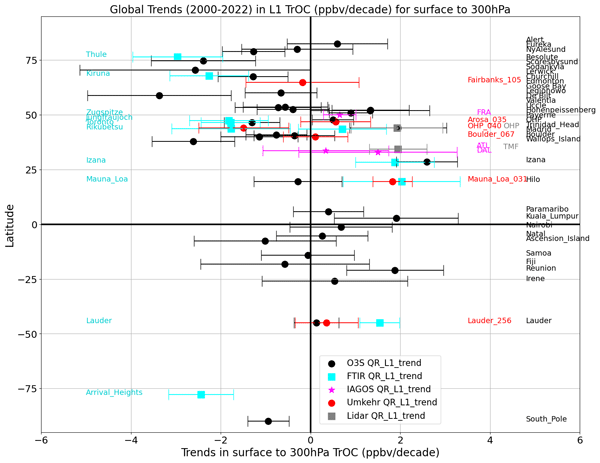
Roeland Van Malderen, Anne M. Thompson, Debra E. Kollonige, Ryan M. Stauffer, Herman G. J. Smit, Eliane Maillard Barras, Corinne Vigouroux, Irina Petropavlovskikh, Thierry Leblanc, Valérie Thouret, Pawel Wolff, Peter Effertz, David W. Tarasick, Deniz Poyraz, Gérard Ancellet, Marie-Renée De Backer, Stéphanie Evan, Victoria Flood, Matthias M. Frey, James W. Hannigan, José L. Hernandez, Marco Iarlori, Bryan J. Johnson, Nicholas Jones, Rigel Kivi, Emmanuel Mahieu, Glen McConville, Katrin Müller, Tomoo Nagahama, Justus Notholt, Ankie Piters, Natalia Prats, Richard Querel, Dan Smale, Wolfgang Steinbrecht, Kimberly Strong, and Ralf Sussmann
Atmos. Chem. Phys., 25, 7187–7225, https://doi.org/10.5194/acp-25-7187-2025, https://doi.org/10.5194/acp-25-7187-2025, 2025
Short summary
Short summary
Tropospheric ozone is an important greenhouse gas and is an air pollutant. The time variability of tropospheric ozone is mainly driven by anthropogenic emissions. In this paper, we study the distribution and time variability of ozone from harmonized ground-based observations from five different measurement techniques. Our findings provide clear standard references for atmospheric models and evolving tropospheric ozone satellite data for the 2000–2022 period.
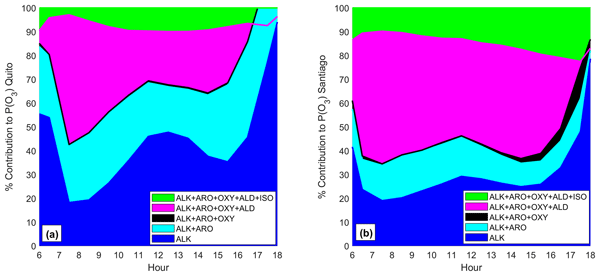
María Cazorla, Melissa Trujillo, Rodrigo Seguel, and Laura Gallardo
Atmos. Chem. Phys., 25, 7087–7109, https://doi.org/10.5194/acp-25-7087-2025, https://doi.org/10.5194/acp-25-7087-2025, 2025
Short summary
Short summary
The current climate and environmental crises impose the need to take actions in cities to curb ozone as a pollutant and a climate forcer. This endeavor is challenging in understudied regions. In this work we analyze how reducing levels of precursor chemicals would affect ozone formation in Quito, Ecuador, and Santiago, Chile.
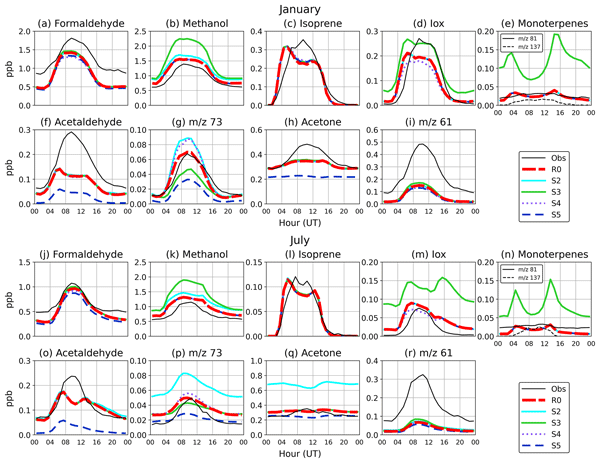
Catalina Poraicu, Jean-François Müller, Trissevgeni Stavrakou, Crist Amelynck, Bert W. D. Verreyken, Niels Schoon, Corinne Vigouroux, Nicolas Kumps, Jérôme Brioude, Pierre Tulet, and Camille Mouchel-Vallon
Atmos. Chem. Phys., 25, 6903–6941, https://doi.org/10.5194/acp-25-6903-2025, https://doi.org/10.5194/acp-25-6903-2025, 2025
Short summary
Short summary
We investigated the sources and impacts of nitrogen oxides and organic compounds over a remote tropical island. Simulations of the high-resolution Weather Research and Forecasting model coupled with chemistry (WRF-Chem) were evaluated using in situ Fourier transform infrared spectroscopy (FTIR) and satellite measurements. This work highlights gaps in current models, like missing sources of key organic compounds and inaccuracies in emission inventories, emphasizing the importance of improving chemical and dynamical processes in atmospheric modelling for budget estimates in tropical regions.
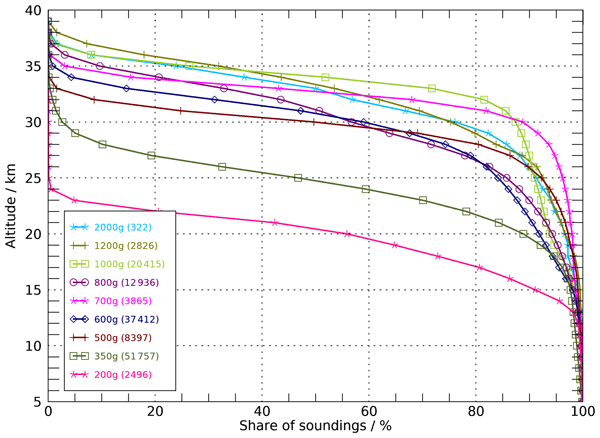
Masatomo Fujiwara, Bomin Sun, Anthony Reale, Domenico Cimini, Salvatore Larosa, Lori Borg, Christoph von Rohden, Michael Sommer, Ruud Dirksen, Marion Maturilli, Holger Vömel, Rigel Kivi, Bruce Ingleby, Ryan J. Kramer, Belay Demoz, Fabio Madonna, Fabien Carminati, Owen Lewis, Brett Candy, Christopher Thomas, David Edwards, Noersomadi, Kensaku Shimizu, and Peter Thorne
Atmos. Meas. Tech., 18, 2919–2955, https://doi.org/10.5194/amt-18-2919-2025, https://doi.org/10.5194/amt-18-2919-2025, 2025
Short summary
Short summary
We assess and illustrate the benefits of high-altitude attainment of balloon-borne radiosonde soundings up to and beyond 10 hPa level from various aspects. We show that the extra costs and technical challenges involved in consistent attainment of high ascents are more than outweighed by the benefits for a broad variety of real-time and delayed-mode applications. Consistent attainment of high ascents should therefore be pursued across the balloon observational network.
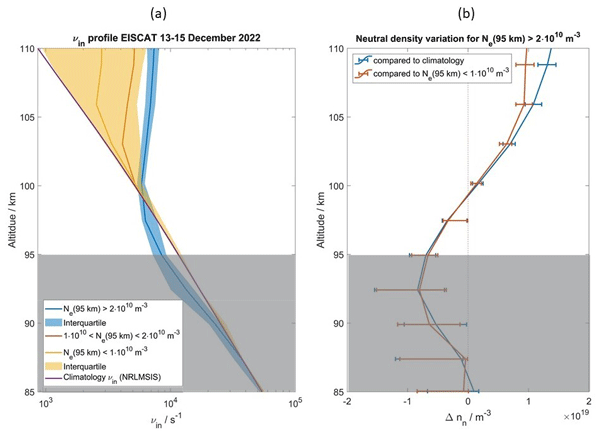
Florian Günzkofer, Gunter Stober, Johan Kero, David R. Themens, Anders Tjulin, Njål Gulbrandsen, Masaki Tsutsumi, and Claudia Borries
Ann. Geophys., 43, 331–348, https://doi.org/10.5194/angeo-43-331-2025, https://doi.org/10.5194/angeo-43-331-2025, 2025
Short summary
Short summary
The Earth’s magnetic field is not closed at high latitudes. Electrically charged particles can penetrate the Earth’s atmosphere, deposit their energy, and heat the local atmosphere–ionosphere. This presumably causes an upwelling of the neutral atmosphere, which affects the atmosphere–ionosphere coupling. We apply a new analysis technique to infer the atmospheric density from incoherent scatter radar measurements. We identify signs of particle precipitation impact on the neutral atmosphere.
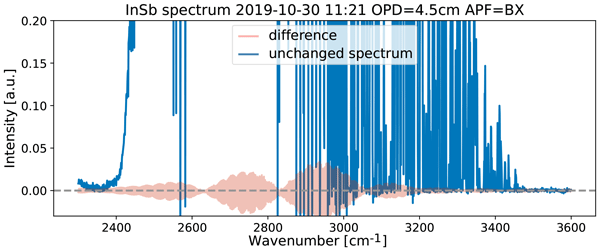
Bavo Langerock, Martine De Mazière, Filip Desmet, Pauli Heikkinen, Rigel Kivi, Mahesh Kumar Sha, Corinne Vigouroux, Minqiang Zhou, Gopala Krishna Darbha, and Mohmmed Talib
Atmos. Meas. Tech., 18, 2439–2446, https://doi.org/10.5194/amt-18-2439-2025, https://doi.org/10.5194/amt-18-2439-2025, 2025
Short summary
Short summary
Ground-based Fourier transform interferometer instruments have been used for many decades to measure direct solar light in the infrared to obtain high-resolution spectra from which atmospheric gas profile concentrations can be derived. It is shown that the typical processing chain used to derive atmospheric gas columns can be sensitive to relatively small shortenings of the recorded interferograms. Low-resolution recordings, used in more recent years, are more sensitive to such adaptations.
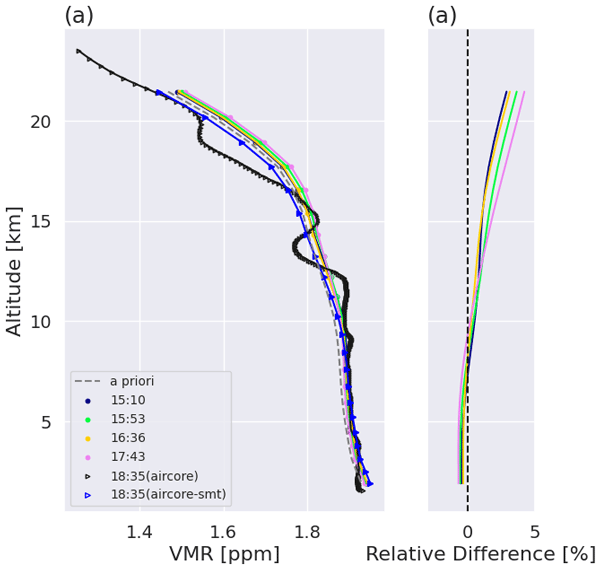
Ivan Ortega, James W. Hannigan, Bianca C. Baier, Kathryn McKain, and Dan Smale
Atmos. Meas. Tech., 18, 2353–2371, https://doi.org/10.5194/amt-18-2353-2025, https://doi.org/10.5194/amt-18-2353-2025, 2025
Short summary
Short summary
This study evaluates retrieval strategies for CH4 and N2O using high-resolution FTIR observations from Boulder, Colorado. By comparing results with independent AirCore and aircraft in situ measurements, the analysis validates retrieval accuracy and quantifies uncertainties. The findings highlight the benefits of updated spectroscopy and improved a priori profiles and highlight consistent agreement with in situ data.
Alistair Bell, Axel Murk, and Gunter Stober
EGUsphere, https://doi.org/10.5194/egusphere-2025-1396, https://doi.org/10.5194/egusphere-2025-1396, 2025
Short summary
Short summary
Increases in middle atmospheric water vapour from the 2022 Hunga eruption have been measured worldwide. This study uses remote sensing measurements at two latitudes and accurate radiative transfer modeling to show significant long-wave heating effects. Though minimal at the surface, the water vapour enhancement can alter middle-atmospheric dynamics, potentially affecting ozone chemistry and weather patterns.
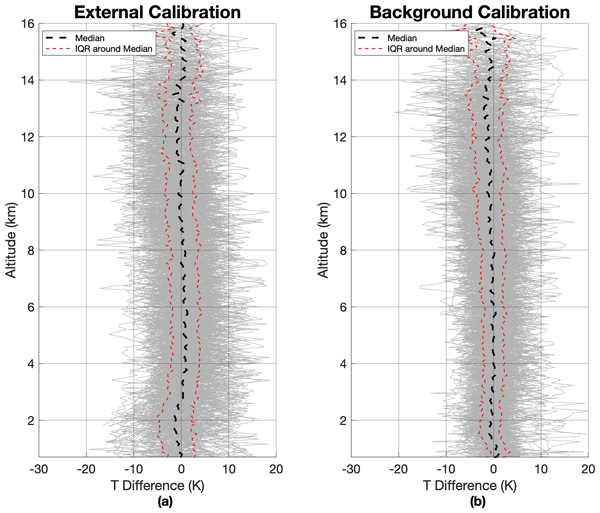
Vasura Jayaweera, Robert J. Sica, Giovanni Martucci, and Alexander Haefele
Atmos. Meas. Tech., 18, 1461–1469, https://doi.org/10.5194/amt-18-1461-2025, https://doi.org/10.5194/amt-18-1461-2025, 2025
Short summary
Short summary
Our study presents a new method, the solar background calibration method, which improves temperature determinations in rotational Raman lidar systems. By utilizing background solar radiation, this technique offers more continuous and reliable temperatures independent of external measuring instruments. This new method enhances our ability to monitor and understand atmospheric trends and their association with climate change with greater accuracy.

Frank Hase, Paolo Castracane, Angelika Dehn, Omaira Elena García, David W. T. Griffith, Lukas Heizmann, Nicholas B. Jones, Tomi Karppinen, Rigel Kivi, Martine de Mazière, Justus Notholt, and Mahesh Kumar Sha
Atmos. Meas. Tech., 18, 1257–1267, https://doi.org/10.5194/amt-18-1257-2025, https://doi.org/10.5194/amt-18-1257-2025, 2025
Short summary
Short summary
The primary measurement result delivered by a Fourier transform spectrometer is an interferogram, and the spectrum required for further analysis needs to be calculated from the interferogram by Fourier analysis. The paper deals with technical aspects of this process and shows how the reconstruction of the spectrum can be optimized.
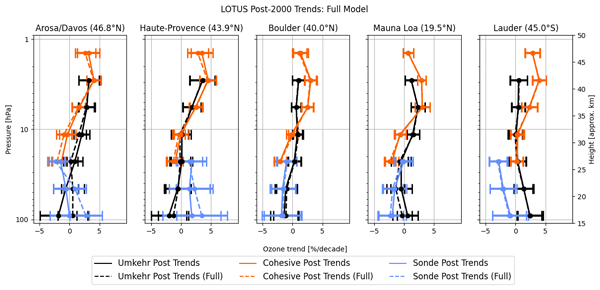
Irina Petropavlovskikh, Jeannette D. Wild, Kari Abromitis, Peter Effertz, Koji Miyagawa, Lawrence E. Flynn, Eliane Maillard Barras, Robert Damadeo, Glen McConville, Bryan Johnson, Patrick Cullis, Sophie Godin-Beekmann, Gerard Ancellet, Richard Querel, Roeland Van Malderen, and Daniel Zawada
Atmos. Chem. Phys., 25, 2895–2936, https://doi.org/10.5194/acp-25-2895-2025, https://doi.org/10.5194/acp-25-2895-2025, 2025
Short summary
Short summary
Observational records show that stratospheric ozone is recovering in accordance with the implementation of the Montreal Protocol and its amendments. Natural ozone variability complicates the detection of small trends. This study optimizes a statistical model fit in ground-station-based observational records by adding parameters that interpret seasonal and long-term changes in atmospheric circulation and airmass mixing, which reduces uncertainties in detecting the stratospheric ozone recovery.
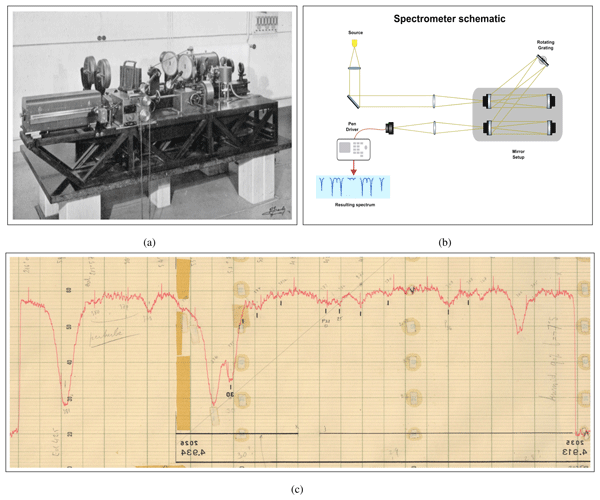
Jamal Makkor, Mathias Palm, Matthias Buschmann, Emmanuel Mahieu, Martyn P. Chipperfield, and Justus Notholt
Atmos. Meas. Tech., 18, 1105–1114, https://doi.org/10.5194/amt-18-1105-2025, https://doi.org/10.5194/amt-18-1105-2025, 2025
Short summary
Short summary
During the years 1950 and 1951, Marcel Migeotte took regular solar measurements in the form of paper rolls at the Jungfraujoch site. These historical spectra proved to be valuable for atmospheric research and needed to be saved for posterity. Therefore, a digitization method which used image-processing techniques was developed to extract them from the historical paper rolls. This allowed them to be saved in a machine-readable format that is easily accessible to the scientific community.
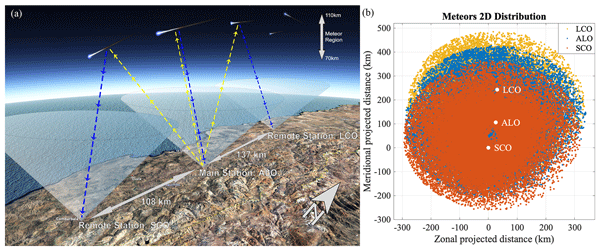
Zishun Qiao, Alan Z. Liu, Gunter Stober, Javier Fuentes, Fabio Vargas, Christian L. Adami, and Iain M. Reid
Atmos. Meas. Tech., 18, 1091–1104, https://doi.org/10.5194/amt-18-1091-2025, https://doi.org/10.5194/amt-18-1091-2025, 2025
Short summary
Short summary
This paper describes the installation of the Chilean Observation Network De Meteor Radars (CONDOR) and its initial results. The routine winds are point-to-point comparable to the co-located lidar winds. The retrievals of spatially resolved horizontal wind fields and vertical winds are also facilitated, benefiting from the extensive meteor detections. The successful deployment and maintenance of CONDOR provide 24/7 and state-of-the-art wind measurements to the research community.
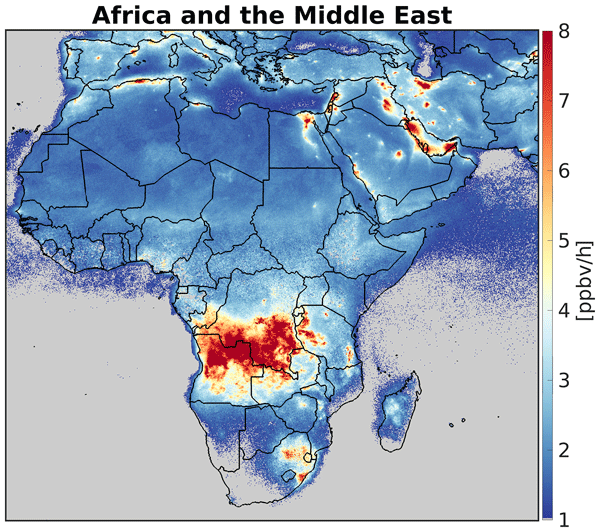
Amir H. Souri, Gonzalo González Abad, Glenn M. Wolfe, Tijl Verhoelst, Corinne Vigouroux, Gaia Pinardi, Steven Compernolle, Bavo Langerock, Bryan N. Duncan, and Matthew S. Johnson
Atmos. Chem. Phys., 25, 2061–2086, https://doi.org/10.5194/acp-25-2061-2025, https://doi.org/10.5194/acp-25-2061-2025, 2025
Short summary
Short summary
We establish a simple yet robust relationship between ozone production rates and geophysical parameters obtained from several intensive atmospheric composition campaigns. We show that satellite remote sensing data can effectively constrain these parameters, enabling us to produce the first global maps of ozone production rates with unprecedented resolution.
Swathi Maratt Satheesan, Kai-Uwe Eichmann, Mark Weber, Roeland Van Malderen, Ryan Stauffer, and David Tarasick
EGUsphere, https://doi.org/10.5194/egusphere-2025-306, https://doi.org/10.5194/egusphere-2025-306, 2025
Short summary
Short summary
This study presents the CLCD (CHORA Local Cloud Decision) algorithm for retrieving near-global tropospheric ozone using TROPOMI data. The approach refines the Convective Cloud Differential method by using a local cloud reference sector to minimize errors from stratospheric ozone variability, particularly in mid-latitudes. Validation against ground-based data shows good accuracy, highlighting its potential for improving air quality monitoring and supporting current and future satellite missions.
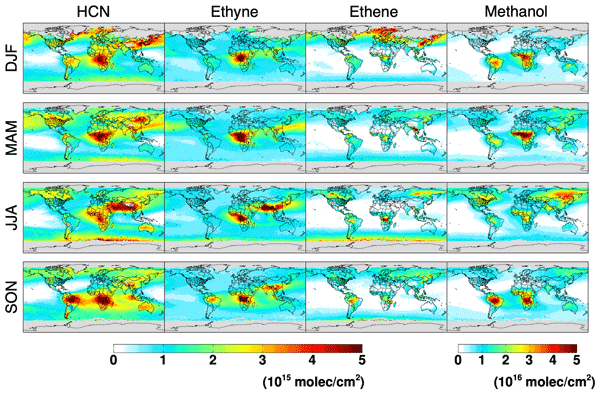
Kelley C. Wells, Dylan B. Millet, Jared F. Brewer, Vivienne H. Payne, Karen E. Cady-Pereira, Rick Pernak, Susan Kulawik, Corinne Vigouroux, Nicholas Jones, Emmanuel Mahieu, Maria Makarova, Tomoo Nagahama, Ivan Ortega, Mathias Palm, Kimberly Strong, Matthias Schneider, Dan Smale, Ralf Sussmann, and Minqiang Zhou
Atmos. Meas. Tech., 18, 695–716, https://doi.org/10.5194/amt-18-695-2025, https://doi.org/10.5194/amt-18-695-2025, 2025
Short summary
Short summary
Atmospheric volatile organic compounds (VOCs) affect both air quality and climate. Satellite measurements can help us to assess and predict their global impacts. We present new decadal (2012–2023) measurements of four key VOCs – methanol, ethene, ethyne, and hydrogen cyanide (HCN) – from the Cross-track Infrared Sounder. The measurements reflect emissions from major forests, wildfires, and industry and provide new information to advance understanding of these sources and their changes over time.
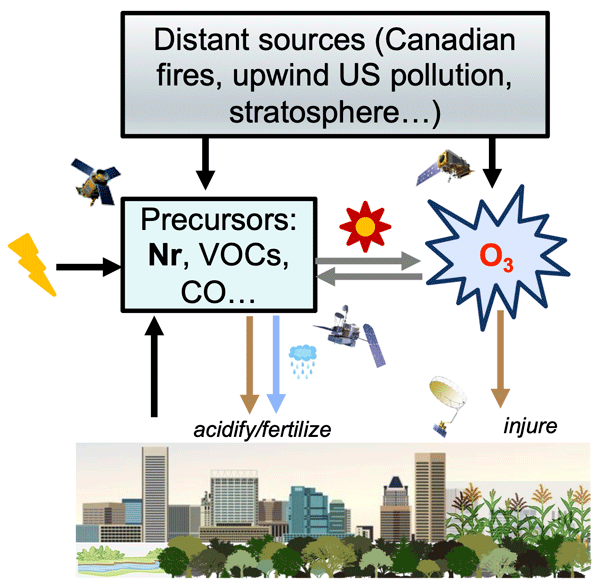
Min Huang, Gregory R. Carmichael, Kevin W. Bowman, Isabelle De Smedt, Andreas Colliander, Michael H. Cosh, Sujay V. Kumar, Alex B. Guenther, Scott J. Janz, Ryan M. Stauffer, Anne M. Thompson, Niko M. Fedkin, Robert J. Swap, John D. Bolten, and Alicia T. Joseph
Atmos. Chem. Phys., 25, 1449–1476, https://doi.org/10.5194/acp-25-1449-2025, https://doi.org/10.5194/acp-25-1449-2025, 2025
Short summary
Short summary
We use model simulations along with multiplatform, multidisciplinary observations and a range of analysis methods to estimate and understand the distributions, temporal changes, and impacts of reactive nitrogen and ozone over the most populous US region that has undergone significant environmental changes. Deposition, biogenic emissions, and extra-regional sources have been playing increasingly important roles in controlling pollutant budgets in this area as local anthropogenic emissions drop.
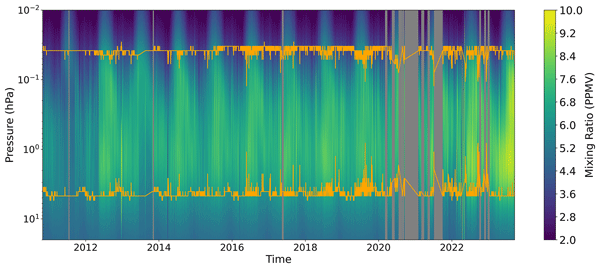
Alistair Bell, Eric Sauvageat, Gunter Stober, Klemens Hocke, and Axel Murk
Atmos. Meas. Tech., 18, 555–567, https://doi.org/10.5194/amt-18-555-2025, https://doi.org/10.5194/amt-18-555-2025, 2025
Short summary
Short summary
Hardware and software developments have been made on a 22 GHz microwave radiometer for the measurement of middle-atmospheric water vapour near Bern, Switzerland. Previous measurements dating back to 2010 have been re-calibrated and an improved optimal estimation retrieval performed on these measurements, giving a 13-year dataset. Measurements made with new and improved instrumental hardware are used to correct previous measurements, which show better agreement than the non-corrected dataset.
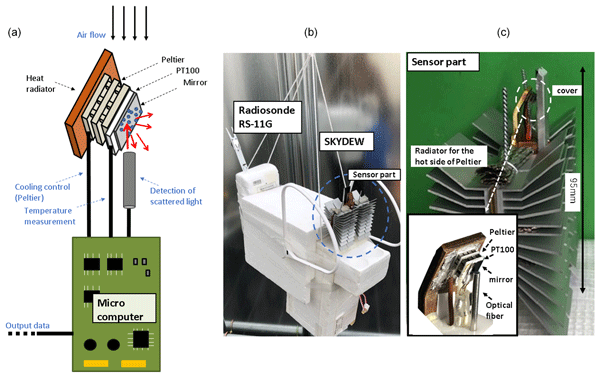
Takuji Sugidachi, Masatomo Fujiwara, Kensaku Shimizu, Shin-Ya Ogino, Junko Suzuki, and Ruud J. Dirksen
Atmos. Meas. Tech., 18, 509–531, https://doi.org/10.5194/amt-18-509-2025, https://doi.org/10.5194/amt-18-509-2025, 2025
Short summary
Short summary
A Peltier-based chilled-mirror hygrometer, SKYDEW, has been developed to measure tropospheric and stratospheric water vapor. Continuous accurate measurements of water vapor are essential for climate monitoring. More than 40 soundings with SKYDEW have been conducted since 2011 to evaluate the performance. The result of soundings at tropical and midlatitudes demonstrated that SKYDEW is able to measure up to an altitude of 20–25 km for daytime soundings and above 25 km for nighttime soundings.
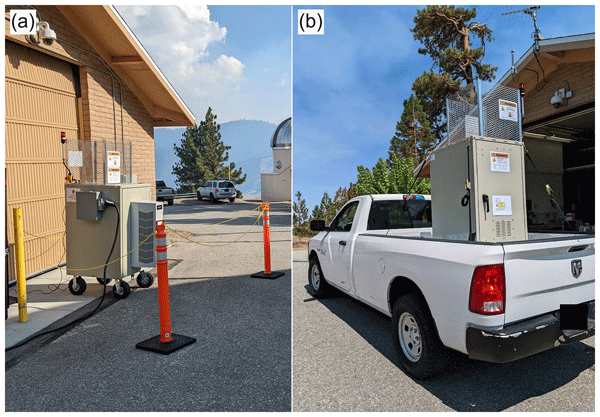
Fernando Chouza, Thierry Leblanc, Patrick Wang, Steven S. Brown, Kristen Zuraski, Wyndom Chace, Caroline C. Womack, Jeff Peischl, John Hair, Taylor Shingler, and John Sullivan
Atmos. Meas. Tech., 18, 405–419, https://doi.org/10.5194/amt-18-405-2025, https://doi.org/10.5194/amt-18-405-2025, 2025
Short summary
Short summary
The JPL lidar group developed the SMOL (Small Mobile Ozone Lidar), an affordable ozone differential absorption lidar (DIAL) system covering all altitudes from 200 m to 10 km a.g.l. The comparison with airborne in situ and lidar measurements shows very good agreement. An additional comparison with nearby surface ozone measuring instruments indicates unbiased measurements by the SMOL lidars down to 200 m a.g.l.
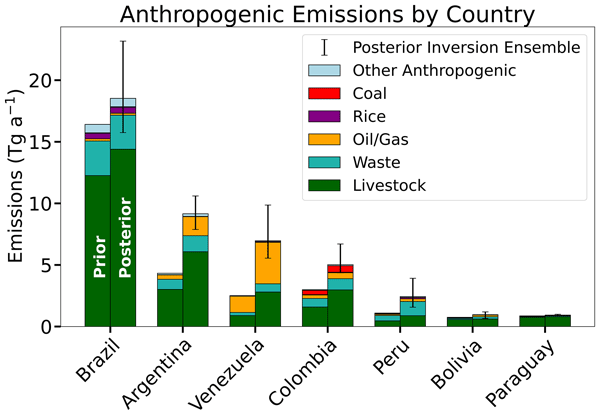
Sarah E. Hancock, Daniel J. Jacob, Zichong Chen, Hannah Nesser, Aaron Davitt, Daniel J. Varon, Melissa P. Sulprizio, Nicholas Balasus, Lucas A. Estrada, María Cazorla, Laura Dawidowski, Sebastián Diez, James D. East, Elise Penn, Cynthia A. Randles, John Worden, Ilse Aben, Robert J. Parker, and Joannes D. Maasakkers
Atmos. Chem. Phys., 25, 797–817, https://doi.org/10.5194/acp-25-797-2025, https://doi.org/10.5194/acp-25-797-2025, 2025
Short summary
Short summary
We quantify 2021 methane emissions in South America at up to 25 km × 25 km resolution using satellite methane observations. We find a 55 % upward adjustment to anthropogenic emission inventories, including those reported to the UN Framework Convention on Climate Change under the Paris Agreement. Our estimates match inventories for Brazil, Bolivia, and Paraguay but are much higher for other countries. Livestock emissions (65 % of anthropogenic emissions) show the largest discrepancies.
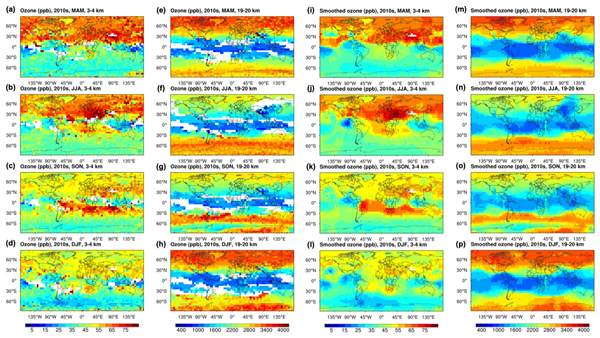
Zhou Zang, Jane Liu, David Tarasick, Omid Moeini, Jianchun Bian, Jinqiang Zhang, Anne M. Thompson, Roeland Van Malderen, Herman G. J. Smit, Ryan M. Stauffer, Bryan J. Johnson, and Debra E. Kollonige
Atmos. Chem. Phys., 24, 13889–13912, https://doi.org/10.5194/acp-24-13889-2024, https://doi.org/10.5194/acp-24-13889-2024, 2024
Short summary
Short summary
The Trajectory-mapped Ozonesonde dataset for the Stratosphere and Troposphere (TOST) provides a global-scale, long-term ozone climatology that is horizontally and vertically resolved. In this study, we improved, updated and validated TOST from 1970 to 2021. Based on this TOST dataset, we characterized global ozone variations spatially in both the troposphere and stratosphere and temporally by season and decade. We also showed a stagnant lower stratospheric ozone variation since the late 1990s.
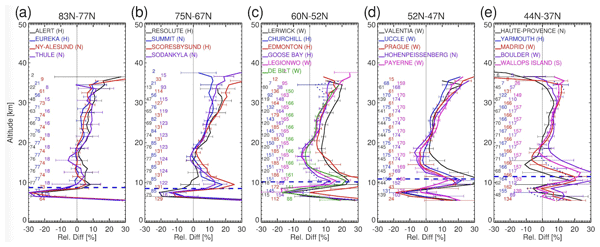
Jiansheng Zou, Kaley A. Walker, Patrick E. Sheese, Chris D. Boone, Ryan M. Stauffer, Anne M. Thompson, and David W. Tarasick
Atmos. Meas. Tech., 17, 6983–7005, https://doi.org/10.5194/amt-17-6983-2024, https://doi.org/10.5194/amt-17-6983-2024, 2024
Short summary
Short summary
Ozone measurements from the ACE-FTS satellite instrument have been compared to worldwide balloon-borne ozonesonde profiles using pairs of closely spaced profiles and monthly averaged profiles. ACE-FTS typically measures more ozone in the stratosphere by up to 10 %. The long-term stability of the ACE-FTS ozone data is good, exhibiting small (but non-significant) drifts of less than 3 % per decade in the stratosphere. Lower in the profiles, the calculated drifts are larger (up to 10 % per decade).
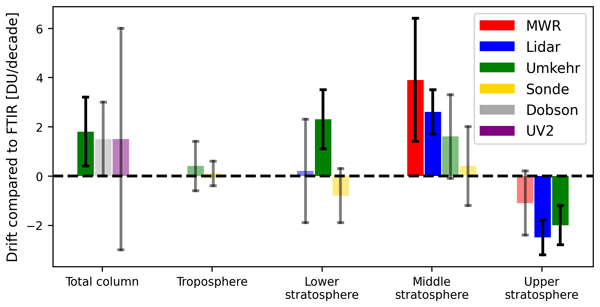
Robin Björklund, Corinne Vigouroux, Peter Effertz, Omaira E. García, Alex Geddes, James Hannigan, Koji Miyagawa, Michael Kotkamp, Bavo Langerock, Gerald Nedoluha, Ivan Ortega, Irina Petropavlovskikh, Deniz Poyraz, Richard Querel, John Robinson, Hisako Shiona, Dan Smale, Penny Smale, Roeland Van Malderen, and Martine De Mazière
Atmos. Meas. Tech., 17, 6819–6849, https://doi.org/10.5194/amt-17-6819-2024, https://doi.org/10.5194/amt-17-6819-2024, 2024
Short summary
Short summary
Different ground-based ozone measurements from the last 2 decades at Lauder are compared to each other. We want to know why different trends have been observed in the stratosphere. Also, the quality and relevance of tropospheric datasets need to be evaluated. While remaining drifts are still present, our study explains roughly half of the differences in observed trends in previous studies and shows the necessity for continuous review and improvement of the measurements.
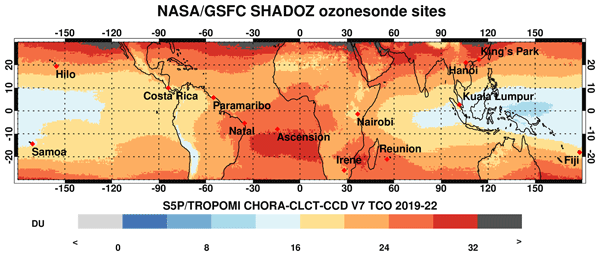
Swathi Maratt Satheesan, Kai-Uwe Eichmann, John P. Burrows, Mark Weber, Ryan Stauffer, Anne M. Thompson, and Debra Kollonige
Atmos. Meas. Tech., 17, 6459–6484, https://doi.org/10.5194/amt-17-6459-2024, https://doi.org/10.5194/amt-17-6459-2024, 2024
Short summary
Short summary
CHORA, an advanced cloud convective differential technique, enhances the accuracy of tropospheric-ozone retrievals. Unlike the traditional Pacific cloud reference sector scheme, CHORA introduces a local-cloud reference sector and an alternative approach (CLCT) for precision. Analysing monthly averaged TROPOMI data from 2018 to 2022 and validating with SHADOZ ozonesonde data, CLCT outperforms other methods and so is the preferred choice, especially in future geostationary satellite missions.
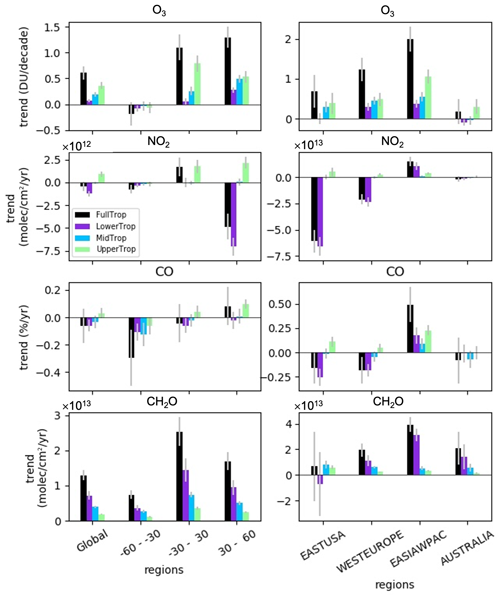
Yasin Elshorbany, Jerald R. Ziemke, Sarah Strode, Hervé Petetin, Kazuyuki Miyazaki, Isabelle De Smedt, Kenneth Pickering, Rodrigo J. Seguel, Helen Worden, Tamara Emmerichs, Domenico Taraborrelli, Maria Cazorla, Suvarna Fadnavis, Rebecca R. Buchholz, Benjamin Gaubert, Néstor Y. Rojas, Thiago Nogueira, Thérèse Salameh, and Min Huang
Atmos. Chem. Phys., 24, 12225–12257, https://doi.org/10.5194/acp-24-12225-2024, https://doi.org/10.5194/acp-24-12225-2024, 2024
Short summary
Short summary
We investigated tropospheric ozone spatial variability and trends from 2005 to 2019 and related those to ozone precursors on global and regional scales. We also investigate the spatiotemporal characteristics of the ozone formation regime in relation to ozone chemical sources and sinks. Our analysis is based on remote sensing products of the tropospheric column of ozone and its precursors, nitrogen dioxide, formaldehyde, and total column CO, as well as ozonesonde data and model simulations.
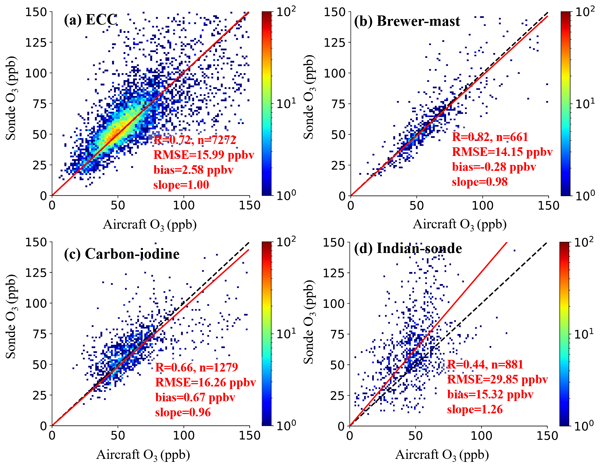
Honglei Wang, David W. Tarasick, Jane Liu, Herman G. J. Smit, Roeland Van Malderen, Lijuan Shen, Romain Blot, and Tianliang Zhao
Atmos. Chem. Phys., 24, 11927–11942, https://doi.org/10.5194/acp-24-11927-2024, https://doi.org/10.5194/acp-24-11927-2024, 2024
Short summary
Short summary
In this study, we identify 23 suitable pairs of sites from World Ozone and Ultraviolet Radiation Data Centre (WOUDC) and In-service Aircraft for a Global Observing System (IAGOS) datasets (1995 to 2021), compare the average vertical distributions of tropospheric O3 from ozonesonde and aircraft measurements, and analyze the differences based on ozonesonde type and station–airport distance.
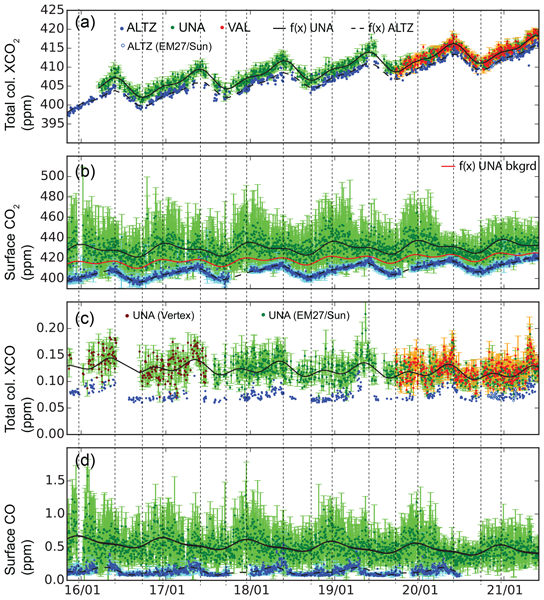
Noémie Taquet, Wolfgang Stremme, María Eugenia González del Castillo, Victor Almanza, Alejandro Bezanilla, Olivier Laurent, Carlos Alberti, Frank Hase, Michel Ramonet, Thomas Lauvaux, Ke Che, and Michel Grutter
Atmos. Chem. Phys., 24, 11823–11848, https://doi.org/10.5194/acp-24-11823-2024, https://doi.org/10.5194/acp-24-11823-2024, 2024
Short summary
Short summary
We characterize the variability in CO and CO2 emissions over Mexico City from long-term time-resolved Fourier transform infrared spectroscopy solar absorption and surface measurements from 2013 to 2021. Using the average intraday CO growth rate from total columns, the average CO / CO2 ratio and TROPOMI data, we estimate the interannual variability in the CO and CO2 anthropogenic emissions of Mexico City, highlighting the effect of an unprecedented drop in activity due to the COVID-19 lockdown.
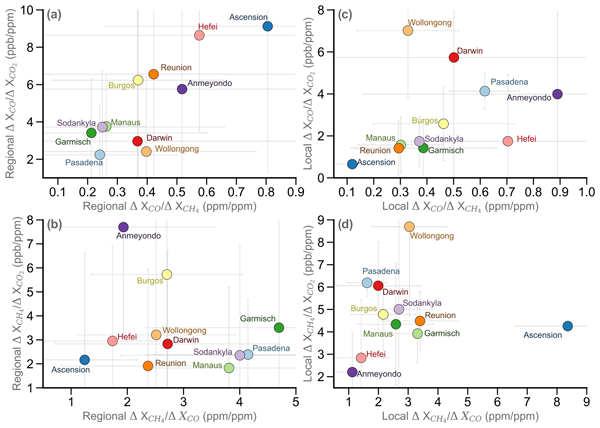
Kavitha Mottungan, Chayan Roychoudhury, Vanessa Brocchi, Benjamin Gaubert, Wenfu Tang, Mohammad Amin Mirrezaei, John McKinnon, Yafang Guo, David W. T. Griffith, Dietrich G. Feist, Isamu Morino, Mahesh K. Sha, Manvendra K. Dubey, Martine De Mazière, Nicholas M. Deutscher, Paul O. Wennberg, Ralf Sussmann, Rigel Kivi, Tae-Young Goo, Voltaire A. Velazco, Wei Wang, and Avelino F. Arellano Jr.
Atmos. Meas. Tech., 17, 5861–5885, https://doi.org/10.5194/amt-17-5861-2024, https://doi.org/10.5194/amt-17-5861-2024, 2024
Short summary
Short summary
A combination of data analysis techniques is introduced to separate local and regional influences on observed levels of carbon dioxide, carbon monoxide, and methane from an established ground-based remote sensing network. We take advantage of the covariations in these trace gases to identify the dominant type of sources driving these levels. Applying these methods in conjunction with existing approaches to other datasets can better address uncertainties in identifying sources and sinks.
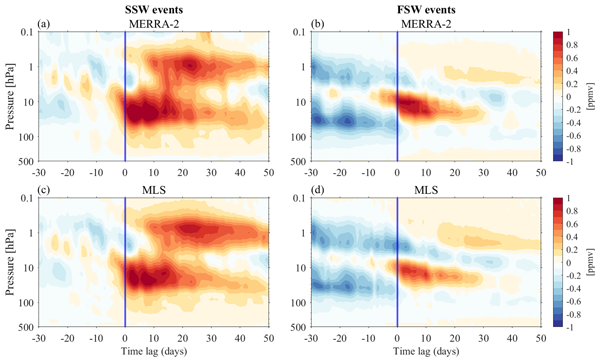
Guochun Shi, Witali Krochin, Eric Sauvageat, and Gunter Stober
Atmos. Chem. Phys., 24, 10187–10207, https://doi.org/10.5194/acp-24-10187-2024, https://doi.org/10.5194/acp-24-10187-2024, 2024
Short summary
Short summary
Here we investigated ozone anomalies over polar regions during sudden stratospheric and final stratospheric warming with ground-based microwave radiometers at polar latitudes compared with reanalysis and satellite data. The underlying dynamical and chemical mechanisms are responsible for the observed ozone anomalies in both events. Our research sheds light on these processes, emphasizing the need for a deeper understanding of these processes for more accurate climate modeling and forecasting.
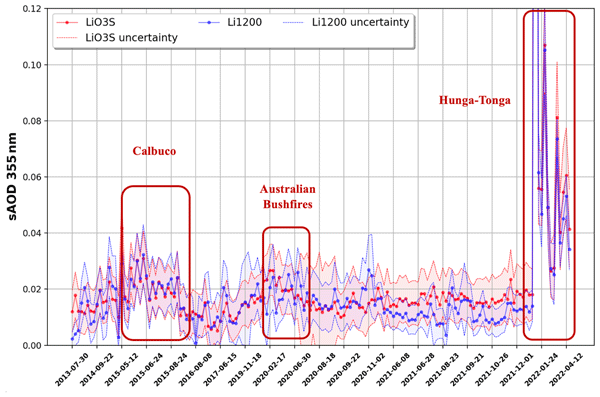
Dominique Gantois, Guillaume Payen, Michaël Sicard, Valentin Duflot, Nelson Bègue, Nicolas Marquestaut, Thierry Portafaix, Sophie Godin-Beekmann, Patrick Hernandez, and Eric Golubic
Earth Syst. Sci. Data, 16, 4137–4159, https://doi.org/10.5194/essd-16-4137-2024, https://doi.org/10.5194/essd-16-4137-2024, 2024
Short summary
Short summary
We describe three instruments that have been measuring interactions between aerosols (particles of various origin) and light over Réunion Island since 2012. Aerosols directly or indirectly influence the temperature in the atmosphere and can interact with clouds. Details are given on how we derived aerosol properties from our measurements and how we assessed the quality of our data before sharing them with the scientific community. A good correlation was found between the three instruments.
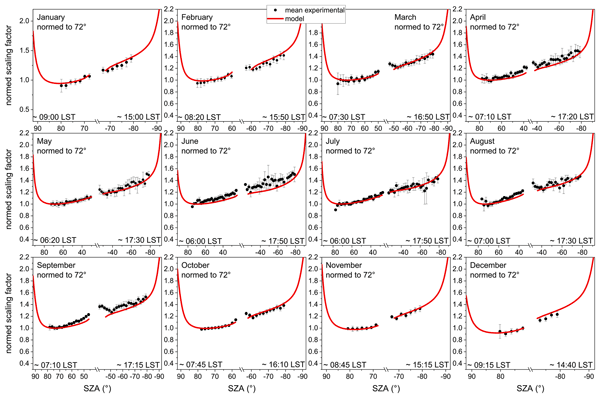
Pinchas Nürnberg, Sarah A. Strode, and Ralf Sussmann
Atmos. Chem. Phys., 24, 10001–10012, https://doi.org/10.5194/acp-24-10001-2024, https://doi.org/10.5194/acp-24-10001-2024, 2024
Short summary
Short summary
We created a set of scaling factors describing the diurnal increase in stratospheric nitrogen oxides above Zugspitze, Germany. We used these factors to validate recently published model simulation data. On the one hand, this validation enables the use of the validated data to better understand the stratospheric photochemistry. On the other hand, it can improve satellite validation, which has implications for the understanding of urban smog events and other pollution events in the troposphere.
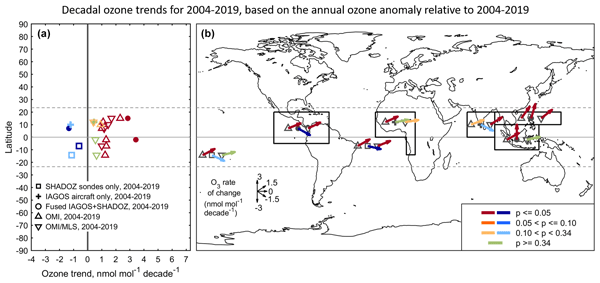
Audrey Gaudel, Ilann Bourgeois, Meng Li, Kai-Lan Chang, Jerald Ziemke, Bastien Sauvage, Ryan M. Stauffer, Anne M. Thompson, Debra E. Kollonige, Nadia Smith, Daan Hubert, Arno Keppens, Juan Cuesta, Klaus-Peter Heue, Pepijn Veefkind, Kenneth Aikin, Jeff Peischl, Chelsea R. Thompson, Thomas B. Ryerson, Gregory J. Frost, Brian C. McDonald, and Owen R. Cooper
Atmos. Chem. Phys., 24, 9975–10000, https://doi.org/10.5194/acp-24-9975-2024, https://doi.org/10.5194/acp-24-9975-2024, 2024
Short summary
Short summary
The study examines tropical tropospheric ozone changes. In situ data from 1994–2019 display increased ozone, notably over India, Southeast Asia, and Malaysia and Indonesia. Sparse in situ data limit trend detection for the 15-year period. In situ and satellite data, with limited sampling, struggle to consistently detect trends. Continuous observations are vital over the tropical Pacific Ocean, Indian Ocean, western Africa, and South Asia for accurate ozone trend estimation in these regions.
Andrew O. Langford, Raul J. Alvarez II, Kenneth C. Aikin, Sunil Baidar, W. Alan Brewer, Steven S. Brown, Matthew M. Coggan, Patrick D. Cullis, Jessica Gilman, Georgios I. Gkatzelis, Detlev Helmig, Bryan J. Johnson, K. Emma Knowland, Rajesh Kumar, Aaron D. Lamplugh, Audra McClure-Begley, Brandi J. McCarty, Ann M. Middlebrook, Gabriele Pfister, Jeff Peischl, Irina Petropavlovskikh, Pamela S. Rickley, Andrew W. Rollins, Scott P. Sandberg, Christoph J. Senff, and Carsten Warneke
EGUsphere, https://doi.org/10.5194/egusphere-2024-1938, https://doi.org/10.5194/egusphere-2024-1938, 2024
Preprint withdrawn
Short summary
Short summary
High ozone (O3) formed by reactions of nitrogen oxides (NOx) and volatile organic compounds (VOCs) can harm human health and welfare. High O3 is usually associated with hot summer days, but under certain conditions, high O3 can also form under winter conditions. In this study, we describe a high O3 event that occurred in Colorado during the COVID-19 quarantine that was caused in part by the decrease in traffic, and in part by a shallow inversion created by descent of stratospheric air.
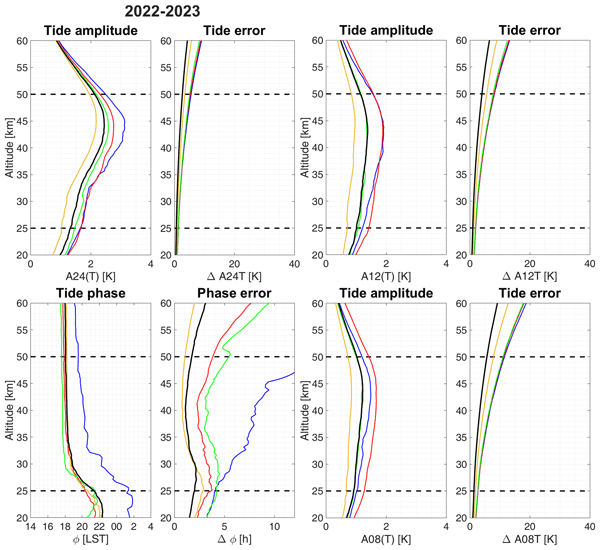
Witali Krochin, Axel Murk, and Gunter Stober
Atmos. Meas. Tech., 17, 5015–5028, https://doi.org/10.5194/amt-17-5015-2024, https://doi.org/10.5194/amt-17-5015-2024, 2024
Short summary
Short summary
Atmospheric tides are global-scale oscillations with periods of a fraction of a day. Their observation in the middle atmosphere is challenging and rare, as it requires continuous measurements with a high temporal resolution. In this paper, temperature time series of a ground-based microwave radiometer were analyzed with a spectral filter to derive thermal tide amplitudes and phases in an altitude range of 25–50 km at the geographical locations of Payerne and Bern (Switzerland).
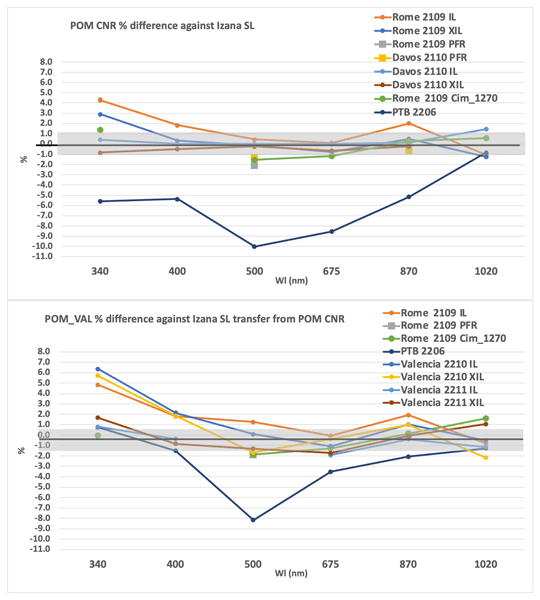
Monica Campanelli, Victor Estellés, Gaurav Kumar, Teruyuki Nakajima, Masahiro Momoi, Julian Gröbner, Stelios Kazadzis, Natalia Kouremeti, Angelos Karanikolas, Africa Barreto, Saulius Nevas, Kerstin Schwind, Philipp Schneider, Iiro Harju, Petri Kärhä, Henri Diémoz, Rei Kudo, Akihiro Uchiyama, Akihiro Yamazaki, Anna Maria Iannarelli, Gabriele Mevi, Annalisa Di Bernardino, and Stefano Casadio
Atmos. Meas. Tech., 17, 5029–5050, https://doi.org/10.5194/amt-17-5029-2024, https://doi.org/10.5194/amt-17-5029-2024, 2024
Short summary
Short summary
To retrieve columnar aerosol properties from sun photometers, some calibration factors are needed. The on-site calibrations, performed as frequently as possible to monitor changes in the machine conditions, allow operators to track and evaluate the calibration status on a continuous basis, reducing the data gaps incurred by the periodic shipments for performing centralized calibrations. The performance of the on-site calibration procedures was evaluated, providing very good results.
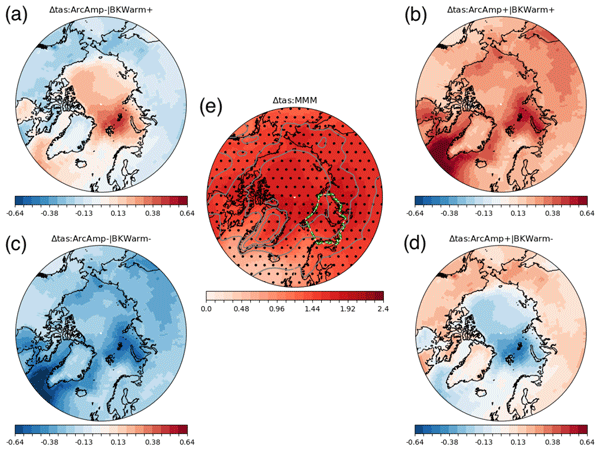
Xavier J. Levine, Ryan S. Williams, Gareth Marshall, Andrew Orr, Lise Seland Graff, Dörthe Handorf, Alexey Karpechko, Raphael Köhler, René R. Wijngaard, Nadine Johnston, Hanna Lee, Lars Nieradzik, and Priscilla A. Mooney
Earth Syst. Dynam., 15, 1161–1177, https://doi.org/10.5194/esd-15-1161-2024, https://doi.org/10.5194/esd-15-1161-2024, 2024
Short summary
Short summary
While the most recent climate projections agree that the Arctic is warming, differences remain in how much and in other climate variables such as precipitation. This presents a challenge for stakeholders who need to develop mitigation and adaptation strategies. We tackle this problem by using the storyline approach to generate four plausible and actionable realisations of end-of-century climate change for the Arctic, spanning its most likely range of variability.
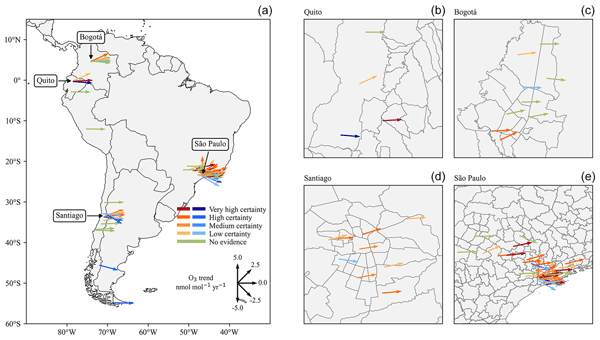
Rodrigo J. Seguel, Lucas Castillo, Charlie Opazo, Néstor Y. Rojas, Thiago Nogueira, María Cazorla, Mario Gavidia-Calderón, Laura Gallardo, René Garreaud, Tomás Carrasco-Escaff, and Yasin Elshorbany
Atmos. Chem. Phys., 24, 8225–8242, https://doi.org/10.5194/acp-24-8225-2024, https://doi.org/10.5194/acp-24-8225-2024, 2024
Short summary
Short summary
Trends of surface ozone were examined across South America. Our findings indicate that ozone trends in major South American cities either increase or remain steady, with no signs of decline. The upward trends can be attributed to chemical regimes that efficiently convert nitric oxide into nitrogen dioxide. Additionally, our results suggest a climate penalty for ozone driven by meteorological conditions that favor wildfire propagation in Chile and extensive heat waves in southern Brazil.
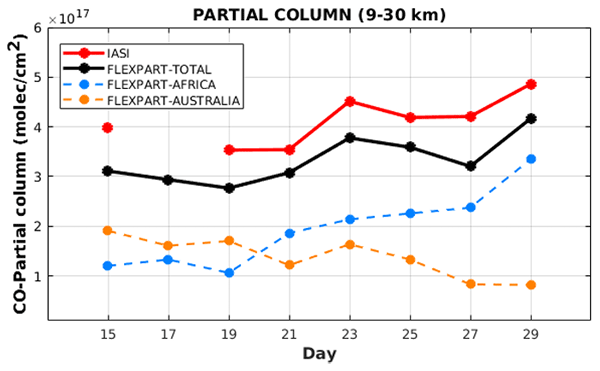
Nelson Bègue, Alexandre Baron, Gisèle Krysztofiak, Gwenaël Berthet, Corinna Kloss, Fabrice Jégou, Sergey Khaykin, Marion Ranaivombola, Tristan Millet, Thierry Portafaix, Valentin Duflot, Philippe Keckhut, Hélène Vérèmes, Guillaume Payen, Mahesh Kumar Sha, Pierre-François Coheur, Cathy Clerbaux, Michaël Sicard, Tetsu Sakai, Richard Querel, Ben Liley, Dan Smale, Isamu Morino, Osamu Uchino, Tomohiro Nagai, Penny Smale, John Robinson, and Hassan Bencherif
Atmos. Chem. Phys., 24, 8031–8048, https://doi.org/10.5194/acp-24-8031-2024, https://doi.org/10.5194/acp-24-8031-2024, 2024
Short summary
Short summary
During the 2020 austral summer, the pristine atmosphere of the southwest Indian Ocean basin experienced significant perturbations. Numerical models indicated that the lower-stratospheric aerosol content was influenced by the intense and persistent stratospheric aerosol layer generated during the 2019–2020 extreme Australian bushfire events. Ground-based observations at Réunion confirmed the simultaneous presence of African and Australian aerosol layers.
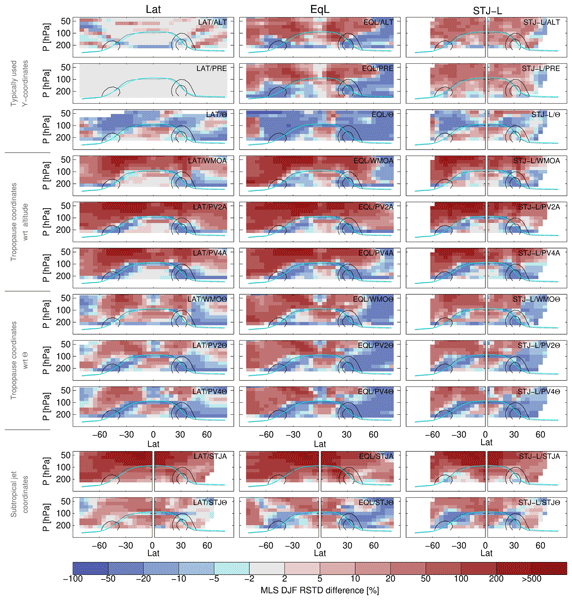
Luis F. Millán, Peter Hoor, Michaela I. Hegglin, Gloria L. Manney, Harald Boenisch, Paul Jeffery, Daniel Kunkel, Irina Petropavlovskikh, Hao Ye, Thierry Leblanc, and Kaley Walker
Atmos. Chem. Phys., 24, 7927–7959, https://doi.org/10.5194/acp-24-7927-2024, https://doi.org/10.5194/acp-24-7927-2024, 2024
Short summary
Short summary
In the Observed Composition Trends And Variability in the UTLS (OCTAV-UTLS) Stratosphere-troposphere Processes And their Role in Climate (SPARC) activity, we have mapped multiplatform ozone datasets into coordinate systems to systematically evaluate the influence of these coordinates on binned climatological variability. This effort unifies the work of studies that focused on individual coordinate system variability. Our goal was to create the most comprehensive assessment of this topic.
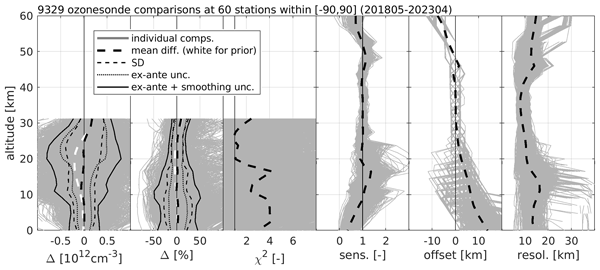
Arno Keppens, Serena Di Pede, Daan Hubert, Jean-Christopher Lambert, Pepijn Veefkind, Maarten Sneep, Johan De Haan, Mark ter Linden, Thierry Leblanc, Steven Compernolle, Tijl Verhoelst, José Granville, Oindrila Nath, Ann Mari Fjæraa, Ian Boyd, Sander Niemeijer, Roeland Van Malderen, Herman G. J. Smit, Valentin Duflot, Sophie Godin-Beekmann, Bryan J. Johnson, Wolfgang Steinbrecht, David W. Tarasick, Debra E. Kollonige, Ryan M. Stauffer, Anne M. Thompson, Angelika Dehn, and Claus Zehner
Atmos. Meas. Tech., 17, 3969–3993, https://doi.org/10.5194/amt-17-3969-2024, https://doi.org/10.5194/amt-17-3969-2024, 2024
Short summary
Short summary
The Sentinel-5P satellite operated by the European Space Agency has carried the TROPOspheric Monitoring Instrument (TROPOMI) around the Earth since October 2017. This mission also produces atmospheric ozone profile data which are described in detail for May 2018 to April 2023. Independent validation using ground-based reference measurements demonstrates that the operational ozone profile product mostly fully and at least partially complies with all mission requirements.
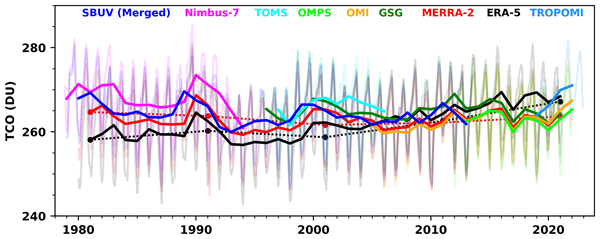
Jayanarayanan Kuttippurath, Gopalakrishna Pillai Gopikrishnan, Rolf Müller, Sophie Godin-Beekmann, and Jerome Brioude
Atmos. Chem. Phys., 24, 6743–6756, https://doi.org/10.5194/acp-24-6743-2024, https://doi.org/10.5194/acp-24-6743-2024, 2024
Short summary
Short summary
The current understanding and observational evidence do not provide any support for the possibility of an ozone hole occurring outside Antarctica today with respect to the present-day stratospheric halogen levels.
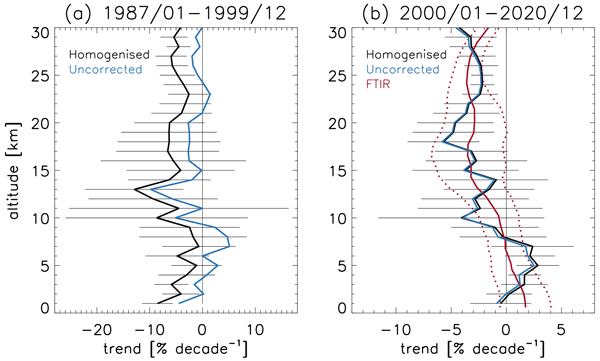
Guang Zeng, Richard Querel, Hisako Shiona, Deniz Poyraz, Roeland Van Malderen, Alex Geddes, Penny Smale, Dan Smale, John Robinson, and Olaf Morgenstern
Atmos. Chem. Phys., 24, 6413–6432, https://doi.org/10.5194/acp-24-6413-2024, https://doi.org/10.5194/acp-24-6413-2024, 2024
Short summary
Short summary
We present a homogenised ozonesonde record (1987–2020) for Lauder, a Southern Hemisphere mid-latitude site; identify factors driving ozone trends; and attribute them to anthropogenic forcings using statistical analysis and model simulations. We find that significant negative lower-stratospheric ozone trends identified at Lauder are associated with an increase in tropopause height and that CO2-driven dynamical changes have played an increasingly important role in driving ozone trends.
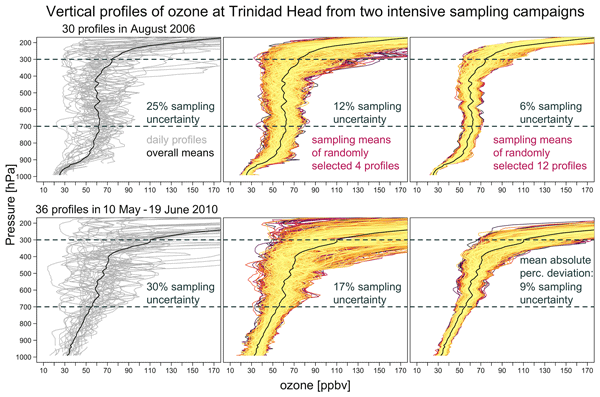
Kai-Lan Chang, Owen R. Cooper, Audrey Gaudel, Irina Petropavlovskikh, Peter Effertz, Gary Morris, and Brian C. McDonald
Atmos. Chem. Phys., 24, 6197–6218, https://doi.org/10.5194/acp-24-6197-2024, https://doi.org/10.5194/acp-24-6197-2024, 2024
Short summary
Short summary
A great majority of observational trend studies of free tropospheric ozone use sparsely sampled ozonesonde and aircraft measurements as reference data sets. A ubiquitous assumption is that trends are accurate and reliable so long as long-term records are available. We show that sampling bias due to sparse samples can persistently reduce the trend accuracy, and we highlight the importance of maintaining adequate frequency and continuity of observations.
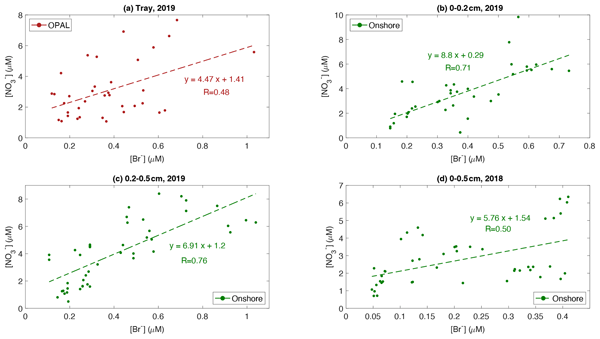
Xin Yang, Kimberly Strong, Alison S. Criscitiello, Marta Santos-Garcia, Kristof Bognar, Xiaoyi Zhao, Pierre Fogal, Kaley A. Walker, Sara M. Morris, and Peter Effertz
Atmos. Chem. Phys., 24, 5863–5886, https://doi.org/10.5194/acp-24-5863-2024, https://doi.org/10.5194/acp-24-5863-2024, 2024
Short summary
Short summary
This study uses snow samples collected from a Canadian high Arctic site, Eureka, to demonstrate that surface snow in early spring is a net sink of atmospheric bromine and nitrogen. Surface snow bromide and nitrate are significantly correlated, indicating the oxidation of reactive nitrogen is accelerated by reactive bromine. In addition, we show evidence that snow photochemical release of reactive bromine is very weak, and its emission flux is much smaller than the deposition flux of bromide.

Heesung Chong, Gonzalo González Abad, Caroline R. Nowlan, Christopher Chan Miller, Alfonso Saiz-Lopez, Rafael P. Fernandez, Hyeong-Ahn Kwon, Zolal Ayazpour, Huiqun Wang, Amir H. Souri, Xiong Liu, Kelly Chance, Ewan O'Sullivan, Jhoon Kim, Ja-Ho Koo, William R. Simpson, François Hendrick, Richard Querel, Glen Jaross, Colin Seftor, and Raid M. Suleiman
Atmos. Meas. Tech., 17, 2873–2916, https://doi.org/10.5194/amt-17-2873-2024, https://doi.org/10.5194/amt-17-2873-2024, 2024
Short summary
Short summary
We present a new bromine monoxide (BrO) product derived using radiances measured from OMPS-NM on board the Suomi-NPP satellite. This product provides nearly a decade of global stratospheric and tropospheric column retrievals, a feature that is currently rare in publicly accessible datasets. Both stratospheric and tropospheric columns from OMPS-NM demonstrate robust performance, exhibiting good agreement with ground-based observations collected at three stations (Lauder, Utqiagvik, and Harestua).
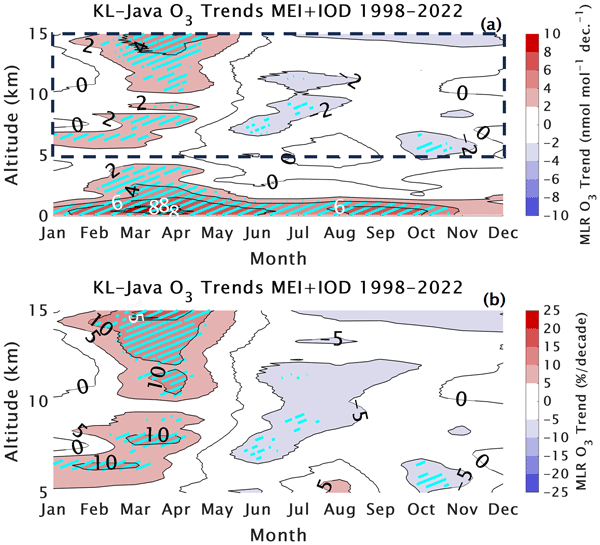
Ryan M. Stauffer, Anne M. Thompson, Debra E. Kollonige, Ninong Komala, Habib Khirzin Al-Ghazali, Dian Yudha Risdianto, Ambun Dindang, Ahmad Fairudz bin Jamaluddin, Mohan Kumar Sammathuria, Norazura Binti Zakaria, Bryan J. Johnson, and Patrick D. Cullis
Atmos. Chem. Phys., 24, 5221–5234, https://doi.org/10.5194/acp-24-5221-2024, https://doi.org/10.5194/acp-24-5221-2024, 2024
Short summary
Short summary
SHADOZ balloon-borne ozone measurements over equatorial Southeast Asia from 1998–2022 reveal that ozone increases during the early months of the year are linked to reduced convective storm activity, which typically redistributes and cleans the atmosphere of ozone. These findings challenge models to replicate the trends produced by the SHADOZ and meteorological observations and emphasize the importance of studying monthly or seasonal instead of annual changes for understanding ozone trends.
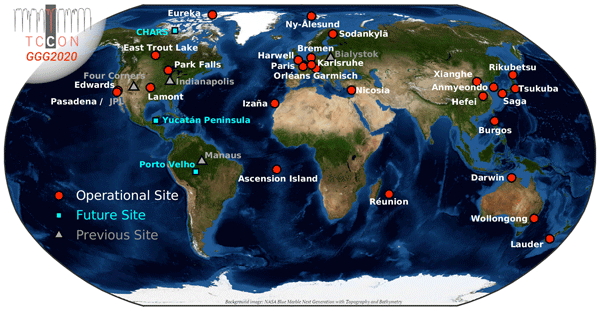
Joshua L. Laughner, Geoffrey C. Toon, Joseph Mendonca, Christof Petri, Sébastien Roche, Debra Wunch, Jean-Francois Blavier, David W. T. Griffith, Pauli Heikkinen, Ralph F. Keeling, Matthäus Kiel, Rigel Kivi, Coleen M. Roehl, Britton B. Stephens, Bianca C. Baier, Huilin Chen, Yonghoon Choi, Nicholas M. Deutscher, Joshua P. DiGangi, Jochen Gross, Benedikt Herkommer, Pascal Jeseck, Thomas Laemmel, Xin Lan, Erin McGee, Kathryn McKain, John Miller, Isamu Morino, Justus Notholt, Hirofumi Ohyama, David F. Pollard, Markus Rettinger, Haris Riris, Constantina Rousogenous, Mahesh Kumar Sha, Kei Shiomi, Kimberly Strong, Ralf Sussmann, Yao Té, Voltaire A. Velazco, Steven C. Wofsy, Minqiang Zhou, and Paul O. Wennberg
Earth Syst. Sci. Data, 16, 2197–2260, https://doi.org/10.5194/essd-16-2197-2024, https://doi.org/10.5194/essd-16-2197-2024, 2024
Short summary
Short summary
This paper describes a new version, called GGG2020, of a data set containing column-integrated observations of greenhouse and related gases (including CO2, CH4, CO, and N2O) made by ground stations located around the world. Compared to the previous version (GGG2014), improvements have been made toward site-to-site consistency. This data set plays a key role in validating space-based greenhouse gas observations and in understanding the carbon cycle.

Matthew S. Johnson, Alexei Rozanov, Mark Weber, Nora Mettig, John Sullivan, Michael J. Newchurch, Shi Kuang, Thierry Leblanc, Fernando Chouza, Timothy A. Berkoff, Guillaume Gronoff, Kevin B. Strawbridge, Raul J. Alvarez, Andrew O. Langford, Christoph J. Senff, Guillaume Kirgis, Brandi McCarty, and Larry Twigg
Atmos. Meas. Tech., 17, 2559–2582, https://doi.org/10.5194/amt-17-2559-2024, https://doi.org/10.5194/amt-17-2559-2024, 2024
Short summary
Short summary
Monitoring tropospheric ozone (O3), a harmful pollutant negatively impacting human health, is primarily done using ground-based measurements and ozonesondes. However, these observation types lack the coverage to fully understand tropospheric O3. Satellites can retrieve tropospheric ozone with near-daily global coverage; however, they are known to have biases and errors. This study uses ground-based lidars to validate multiple satellites' ability to observe tropospheric O3.
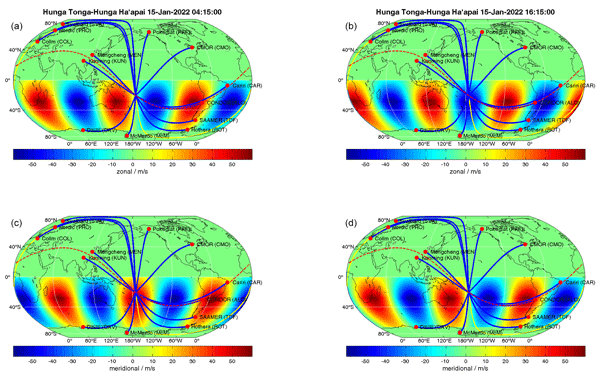
Gunter Stober, Sharon L. Vadas, Erich Becker, Alan Liu, Alexander Kozlovsky, Diego Janches, Zishun Qiao, Witali Krochin, Guochun Shi, Wen Yi, Jie Zeng, Peter Brown, Denis Vida, Neil Hindley, Christoph Jacobi, Damian Murphy, Ricardo Buriti, Vania Andrioli, Paulo Batista, John Marino, Scott Palo, Denise Thorsen, Masaki Tsutsumi, Njål Gulbrandsen, Satonori Nozawa, Mark Lester, Kathrin Baumgarten, Johan Kero, Evgenia Belova, Nicholas Mitchell, Tracy Moffat-Griffin, and Na Li
Atmos. Chem. Phys., 24, 4851–4873, https://doi.org/10.5194/acp-24-4851-2024, https://doi.org/10.5194/acp-24-4851-2024, 2024
Short summary
Short summary
On 15 January 2022, the Hunga Tonga-Hunga Ha‘apai volcano exploded in a vigorous eruption, causing many atmospheric phenomena reaching from the surface up to space. In this study, we investigate how the mesospheric winds were affected by the volcanogenic gravity waves and estimated their propagation direction and speed. The interplay between model and observations permits us to gain new insights into the vertical coupling through atmospheric gravity waves.
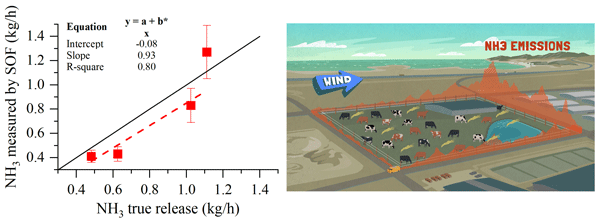
Johan Mellqvist, Nathalia T. Vechi, Charlotte Scheutz, Marc Durif, Francois Gautier, John Johansson, Jerker Samuelsson, Brian Offerle, and Samuel Brohede
Atmos. Meas. Tech., 17, 2465–2479, https://doi.org/10.5194/amt-17-2465-2024, https://doi.org/10.5194/amt-17-2465-2024, 2024
Short summary
Short summary
The solar occultation flux method retrieves ammonia gas columns from the solar spectrum. Emissions are obtained by multiplying the integrated plume concentration by the wind speed profile. The methodology for uncertainty estimation was established considering an error budget with systematic and random components, resulting in an expanded uncertainty in the range of 20 % to 30 %. The method was validated in a controlled release, and its application was demonstrated in different farms.
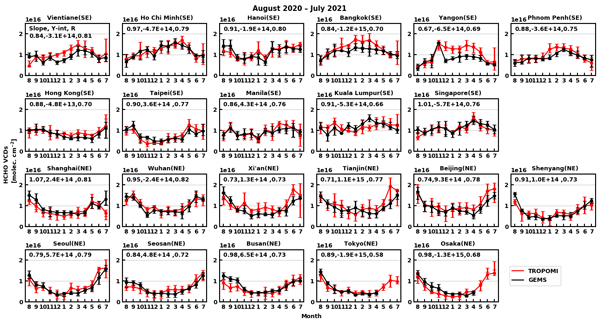
Gitaek T. Lee, Rokjin J. Park, Hyeong-Ahn Kwon, Eunjo S. Ha, Sieun D. Lee, Seunga Shin, Myoung-Hwan Ahn, Mina Kang, Yong-Sang Choi, Gyuyeon Kim, Dong-Won Lee, Deok-Rae Kim, Hyunkee Hong, Bavo Langerock, Corinne Vigouroux, Christophe Lerot, Francois Hendrick, Gaia Pinardi, Isabelle De Smedt, Michel Van Roozendael, Pucai Wang, Heesung Chong, Yeseul Cho, and Jhoon Kim
Atmos. Chem. Phys., 24, 4733–4749, https://doi.org/10.5194/acp-24-4733-2024, https://doi.org/10.5194/acp-24-4733-2024, 2024
Short summary
Short summary
This study evaluates the Geostationary Environment Monitoring Spectrometer (GEMS) HCHO product by comparing its vertical column densities (VCDs) with those of TROPOMI and ground-based observations. Based on some sensitivity tests, obtaining radiance references under clear-sky conditions significantly improves HCHO retrieval quality. GEMS HCHO VCDs captured seasonal and diurnal variations well during the first year of observation, showing consistency with TROPOMI and ground-based observations.
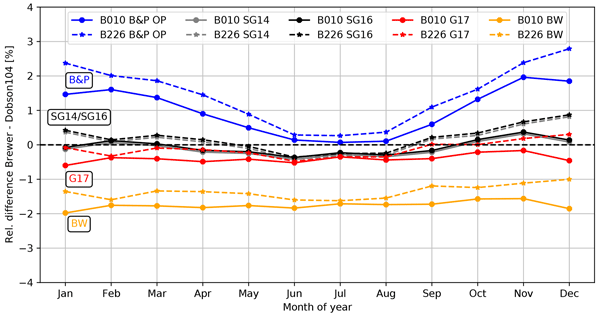
Karl Voglmeier, Voltaire A. Velazco, Luca Egli, Julian Gröbner, Alberto Redondas, and Wolfgang Steinbrecht
Atmos. Meas. Tech., 17, 2277–2294, https://doi.org/10.5194/amt-17-2277-2024, https://doi.org/10.5194/amt-17-2277-2024, 2024
Short summary
Short summary
Comparison between total ozone column (TOC) measurements from ground-based Dobson and Brewer spectrophotometers generally reveals seasonally varying differences of a few percent. This study recommends a new TOC retrieval approach, which effectively eliminates these seasonally varying differences by applying new ozone absorption cross sections, appropriate slit functions for the Dobson instrument, and climatological values for the effective ozone temperature.
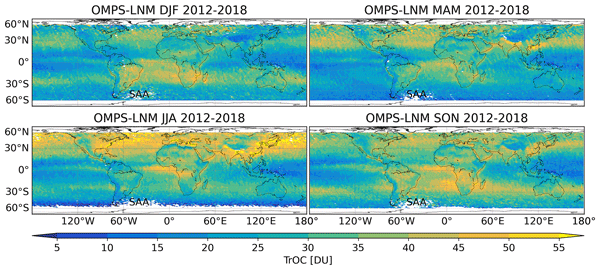
Andrea Orfanoz-Cheuquelaf, Carlo Arosio, Alexei Rozanov, Mark Weber, Annette Ladstätter-Weißenmayer, John P. Burrows, Anne M. Thompson, Ryan M. Stauffer, and Debra E. Kollonige
Atmos. Meas. Tech., 17, 1791–1809, https://doi.org/10.5194/amt-17-1791-2024, https://doi.org/10.5194/amt-17-1791-2024, 2024
Short summary
Short summary
Valuable information on the tropospheric ozone column (TrOC) can be obtained globally by combining space-borne limb and nadir measurements (limb–nadir matching, LNM). This study describes the retrieval of TrOC from the OMPS instrument (since 2012) using the LNM technique. The OMPS-LNM TrOC was compared with ozonesondes and other satellite measurements, showing a good agreement with a negative bias within 1 to 4 DU. This new dataset is suitable for pollution studies.
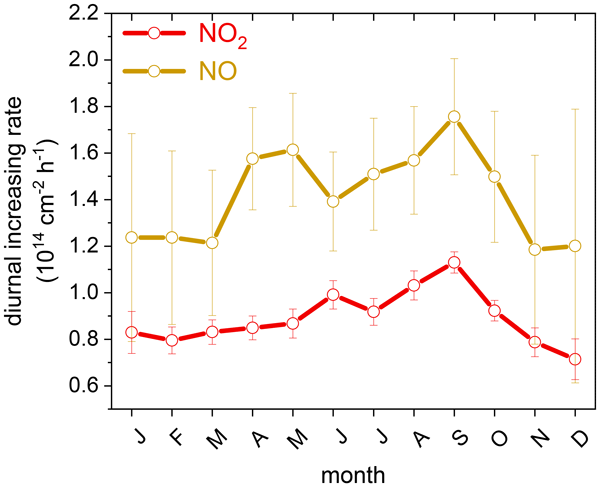
Pinchas Nürnberg, Markus Rettinger, and Ralf Sussmann
Atmos. Chem. Phys., 24, 3743–3757, https://doi.org/10.5194/acp-24-3743-2024, https://doi.org/10.5194/acp-24-3743-2024, 2024
Short summary
Short summary
For a better understanding of stratospheric photochemistry, we analyzed long-term data from spectroscopic measurements at Zugspitze and Garmisch, Germany. We provide information about the seasonal cycle of diurnal nitrogen oxide variation in the stratosphere. For the first time we create an experimental data set to validate stratospheric model simulation that can improve satellite validation to gain further insights into ozone depletion and smog prevention.
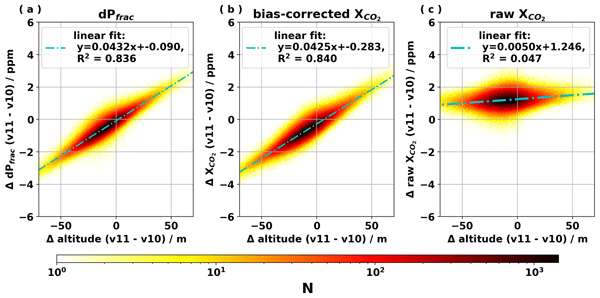
Nicole Jacobs, Christopher W. O'Dell, Thomas E. Taylor, Thomas L. Logan, Brendan Byrne, Matthäus Kiel, Rigel Kivi, Pauli Heikkinen, Aronne Merrelli, Vivienne H. Payne, and Abhishek Chatterjee
Atmos. Meas. Tech., 17, 1375–1401, https://doi.org/10.5194/amt-17-1375-2024, https://doi.org/10.5194/amt-17-1375-2024, 2024
Short summary
Short summary
The accuracy of trace gas retrievals from spaceborne observations, like those from the Orbiting Carbon Observatory 2 (OCO-2), are sensitive to the referenced digital elevation model (DEM). Therefore, we evaluate several global DEMs, used in versions 10 and 11 of the OCO-2 retrieval along with the Copernicus DEM. We explore the impacts of changing the DEM on biases in OCO-2-retrieved XCO2 and inferred CO2 fluxes. Our findings led to an update to OCO-2 v11.1 using the Copernicus DEM globally.
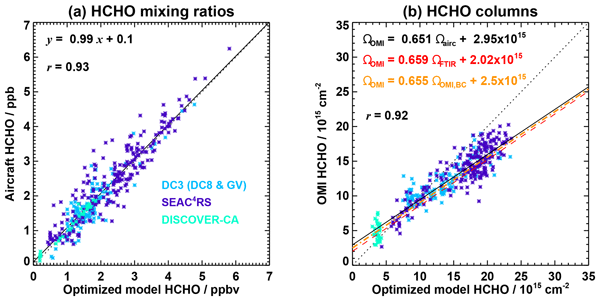
Jean-François Müller, Trissevgeni Stavrakou, Glenn-Michael Oomen, Beata Opacka, Isabelle De Smedt, Alex Guenther, Corinne Vigouroux, Bavo Langerock, Carlos Augusto Bauer Aquino, Michel Grutter, James Hannigan, Frank Hase, Rigel Kivi, Erik Lutsch, Emmanuel Mahieu, Maria Makarova, Jean-Marc Metzger, Isamu Morino, Isao Murata, Tomoo Nagahama, Justus Notholt, Ivan Ortega, Mathias Palm, Amelie Röhling, Wolfgang Stremme, Kimberly Strong, Ralf Sussmann, Yao Té, and Alan Fried
Atmos. Chem. Phys., 24, 2207–2237, https://doi.org/10.5194/acp-24-2207-2024, https://doi.org/10.5194/acp-24-2207-2024, 2024
Short summary
Short summary
Formaldehyde observations from satellites can be used to constrain the emissions of volatile organic compounds, but those observations have biases. Using an atmospheric model, aircraft and ground-based remote sensing data, we quantify these biases, propose a correction to the data, and assess the consequence of this correction for the evaluation of emissions.
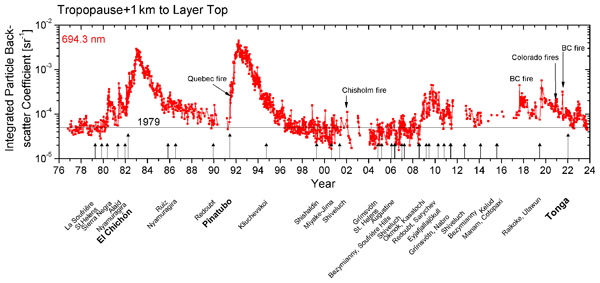
Thomas Trickl, Hannes Vogelmann, Michael D. Fromm, Horst Jäger, Matthias Perfahl, and Wolfgang Steinbrecht
Atmos. Chem. Phys., 24, 1997–2021, https://doi.org/10.5194/acp-24-1997-2024, https://doi.org/10.5194/acp-24-1997-2024, 2024
Short summary
Short summary
In 2023, the lidar team at Garmisch-Partenkirchen (Germany) celebrated its 50th year of aerosol profiling. The highlight of these activities has been the lidar measurements of stratospheric aerosol carried out since 1976. The observations since 2017 are characterized by severe smoke from several big fires in North America and Siberia and three volcanic eruptions. The sudden increase in the frequency of such strong fire events is difficult to understand.
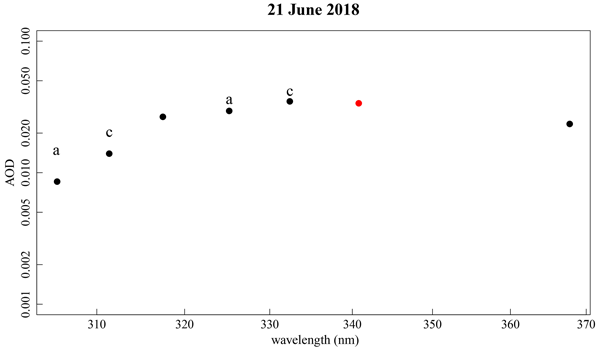
Joseph Michalsky and Glen McConville
Atmos. Meas. Tech., 17, 1017–1022, https://doi.org/10.5194/amt-17-1017-2024, https://doi.org/10.5194/amt-17-1017-2024, 2024
Short summary
Short summary
The ozone in the atmosphere is measured by looking at the sun and measuring how diminished the light in the ultraviolet is relative to how bright it is above the Earth's atmosphere. This typically uses spectral instruments that are either costly or no longer manufactured. This paper uses a relatively inexpensive interference filter instrument to perform the same task. Daily ozone measurements with the latter and this filter instrument are compared. Aerosols are calculated as a by-product.
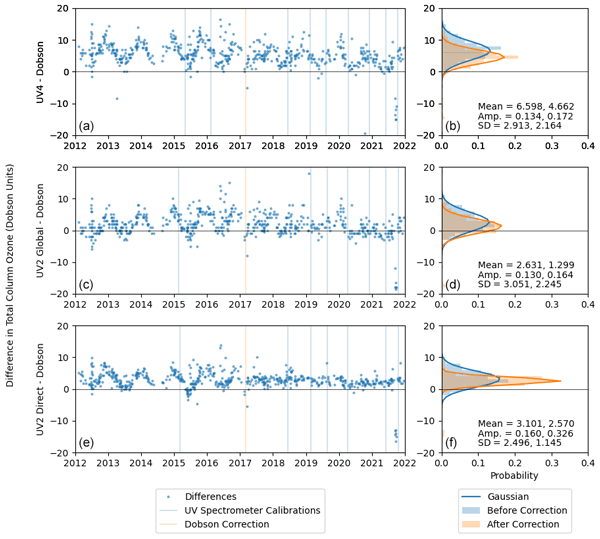
Alexander Geddes, Ben Liley, Richard McKenzie, Michael Kotkamp, and Richard Querel
Atmos. Meas. Tech., 17, 827–838, https://doi.org/10.5194/amt-17-827-2024, https://doi.org/10.5194/amt-17-827-2024, 2024
Short summary
Short summary
In this paper we describe a unique spectrometer that has been developed and tested over 10 years at Lauder, New Zealand. The spectrometer in question, UV2, makes alternating measurements of global UV and direct sun UV irradiance. After an assessment of the instrument performance, we compare the ozone and aerosol optical depth derived from UV2 to other independent measurements, finding excellent agreement suggesting that UV2 could supersede these measurements, particularly for ozone.
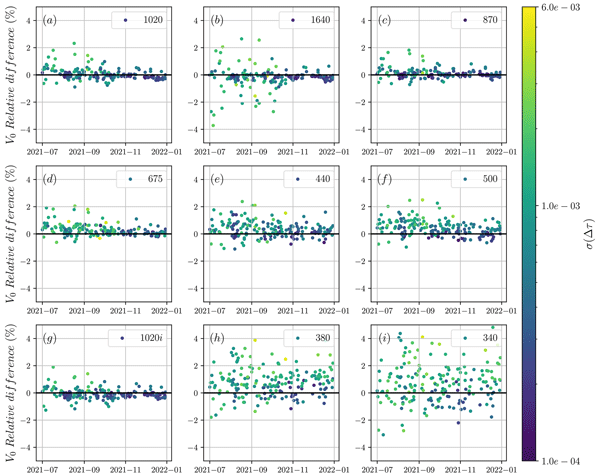
Antonio Fernando Almansa, África Barreto, Natalia Kouremeti, Ramiro González, Akriti Masoom, Carlos Toledano, Julian Gröbner, Rosa Delia García, Yenny González, Stelios Kazadzis, Stéphane Victori, Óscar Álvarez, Fabrice Maupin, Virgilio Carreño, Victoria Eugenia Cachorro, and Emilio Cuevas
Atmos. Meas. Tech., 17, 659–675, https://doi.org/10.5194/amt-17-659-2024, https://doi.org/10.5194/amt-17-659-2024, 2024
Short summary
Short summary
This paper applies sun photometer synergies to improve calibration transference between different sun photometers and also enhance their quality assurance and quality control. We have validated this technique using different instrumentation, the WMO-GAW and NASA-AERONET references, under different aerosol regimes using the standard Langley calibration method as a reference.
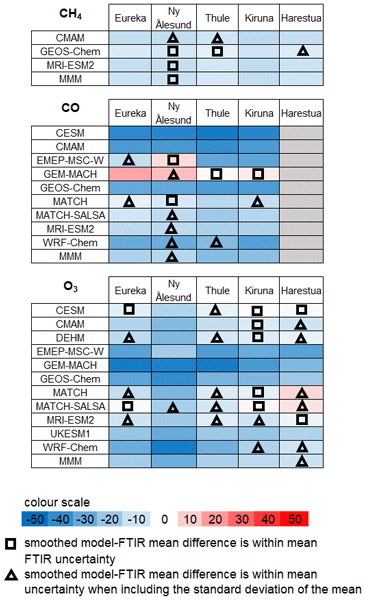
Victoria A. Flood, Kimberly Strong, Cynthia H. Whaley, Kaley A. Walker, Thomas Blumenstock, James W. Hannigan, Johan Mellqvist, Justus Notholt, Mathias Palm, Amelie N. Röhling, Stephen Arnold, Stephen Beagley, Rong-You Chien, Jesper Christensen, Makoto Deushi, Srdjan Dobricic, Xinyi Dong, Joshua S. Fu, Michael Gauss, Wanmin Gong, Joakim Langner, Kathy S. Law, Louis Marelle, Tatsuo Onishi, Naga Oshima, David A. Plummer, Luca Pozzoli, Jean-Christophe Raut, Manu A. Thomas, Svetlana Tsyro, and Steven Turnock
Atmos. Chem. Phys., 24, 1079–1118, https://doi.org/10.5194/acp-24-1079-2024, https://doi.org/10.5194/acp-24-1079-2024, 2024
Short summary
Short summary
It is important to understand the composition of the Arctic atmosphere and how it is changing. Atmospheric models provide simulations that can inform policy. This study examines simulations of CH4, CO, and O3 by 11 models. Model performance is assessed by comparing results matched in space and time to measurements from five high-latitude ground-based infrared spectrometers. This work finds that models generally underpredict the concentrations of these gases in the Arctic troposphere.
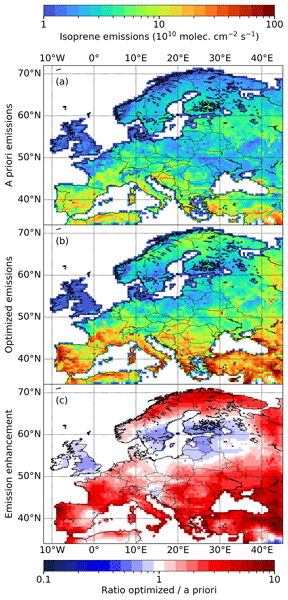
Glenn-Michael Oomen, Jean-François Müller, Trissevgeni Stavrakou, Isabelle De Smedt, Thomas Blumenstock, Rigel Kivi, Maria Makarova, Mathias Palm, Amelie Röhling, Yao Té, Corinne Vigouroux, Martina M. Friedrich, Udo Frieß, François Hendrick, Alexis Merlaud, Ankie Piters, Andreas Richter, Michel Van Roozendael, and Thomas Wagner
Atmos. Chem. Phys., 24, 449–474, https://doi.org/10.5194/acp-24-449-2024, https://doi.org/10.5194/acp-24-449-2024, 2024
Short summary
Short summary
Natural emissions from vegetation have a profound impact on air quality for their role in the formation of harmful tropospheric ozone and organic aerosols, yet these emissions are highly uncertain. In this study, we quantify emissions of organic gases over Europe using high-quality satellite measurements of formaldehyde. These satellite observations suggest that emissions from vegetation are much higher than predicted by models, especially in southern Europe.
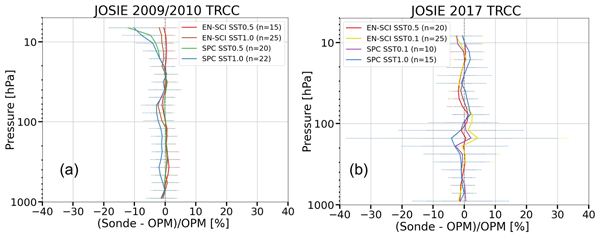
Herman G. J. Smit, Deniz Poyraz, Roeland Van Malderen, Anne M. Thompson, David W. Tarasick, Ryan M. Stauffer, Bryan J. Johnson, and Debra E. Kollonige
Atmos. Meas. Tech., 17, 73–112, https://doi.org/10.5194/amt-17-73-2024, https://doi.org/10.5194/amt-17-73-2024, 2024
Short summary
Short summary
This paper revisits fundamentals of ECC ozonesonde measurements to develop and characterize a methodology to correct for the fast and slow time responses using the JOSIE (Jülich Ozone Sonde Intercomparison Experiment) simulation chamber data. Comparing the new corrected ozonesonde profiles to an accurate ozone UV photometer (OPM) as reference allows us to evaluate the time response correction (TRC) method and to determine calibration functions traceable to one reference with 5 % uncertainty.
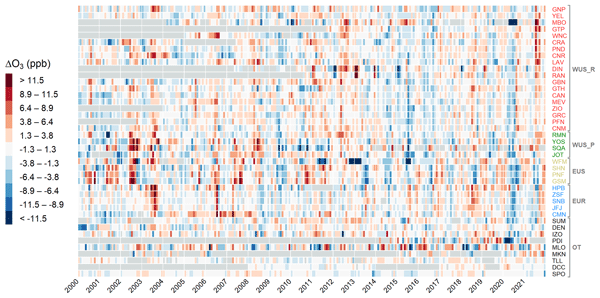
Davide Putero, Paolo Cristofanelli, Kai-Lan Chang, Gaëlle Dufour, Gregory Beachley, Cédric Couret, Peter Effertz, Daniel A. Jaffe, Dagmar Kubistin, Jason Lynch, Irina Petropavlovskikh, Melissa Puchalski, Timothy Sharac, Barkley C. Sive, Martin Steinbacher, Carlos Torres, and Owen R. Cooper
Atmos. Chem. Phys., 23, 15693–15709, https://doi.org/10.5194/acp-23-15693-2023, https://doi.org/10.5194/acp-23-15693-2023, 2023
Short summary
Short summary
We investigated the impact of societal restriction measures during the COVID-19 pandemic on surface ozone at 41 high-elevation sites worldwide. Negative ozone anomalies were observed for spring and summer 2020 for all of the regions considered. In 2021, negative anomalies continued for Europe and partially for the eastern US, while western US sites showed positive anomalies due to wildfires. IASI satellite data and the Carbon Monitor supported emission reductions as a cause of the anomalies.
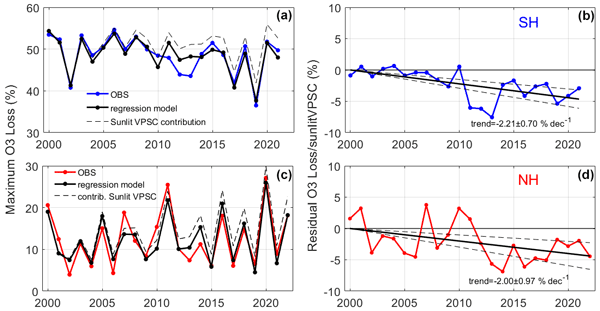
Andrea Pazmiño, Florence Goutail, Sophie Godin-Beekmann, Alain Hauchecorne, Jean-Pierre Pommereau, Martyn P. Chipperfield, Wuhu Feng, Franck Lefèvre, Audrey Lecouffe, Michel Van Roozendael, Nis Jepsen, Georg Hansen, Rigel Kivi, Kimberly Strong, and Kaley A. Walker
Atmos. Chem. Phys., 23, 15655–15670, https://doi.org/10.5194/acp-23-15655-2023, https://doi.org/10.5194/acp-23-15655-2023, 2023
Short summary
Short summary
The vortex-averaged ozone loss over the last 3 decades is evaluated for both polar regions using the passive ozone tracer of the chemical transport model TOMCAT/SLIMCAT and total ozone observations from the SAOZ network and MSR2 reanalysis. Three metrics were developed to compute ozone trends since 2000. The study confirms the ozone recovery in the Antarctic and shows a potential sign of quantitative detection of ozone recovery in the Arctic that needs to be robustly confirmed in the future.
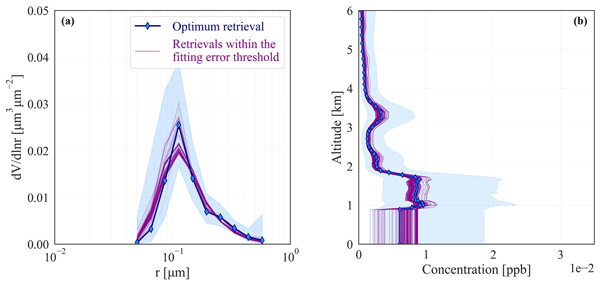
Alexandra Tsekeri, Anna Gialitaki, Marco Di Paolantonio, Davide Dionisi, Gian Luigi Liberti, Alnilam Fernandes, Artur Szkop, Aleksander Pietruczuk, Daniel Pérez-Ramírez, Maria J. Granados Muñoz, Juan Luis Guerrero-Rascado, Lucas Alados-Arboledas, Diego Bermejo Pantaleón, Juan Antonio Bravo-Aranda, Anna Kampouri, Eleni Marinou, Vassilis Amiridis, Michael Sicard, Adolfo Comerón, Constantino Muñoz-Porcar, Alejandro Rodríguez-Gómez, Salvatore Romano, Maria Rita Perrone, Xiaoxia Shang, Mika Komppula, Rodanthi-Elisavet Mamouri, Argyro Nisantzi, Diofantos Hadjimitsis, Francisco Navas-Guzmán, Alexander Haefele, Dominika Szczepanik, Artur Tomczak, Iwona S. Stachlewska, Livio Belegante, Doina Nicolae, Kalliopi Artemis Voudouri, Dimitris Balis, Athena A. Floutsi, Holger Baars, Linda Miladi, Nicolas Pascal, Oleg Dubovik, and Anton Lopatin
Atmos. Meas. Tech., 16, 6025–6050, https://doi.org/10.5194/amt-16-6025-2023, https://doi.org/10.5194/amt-16-6025-2023, 2023
Short summary
Short summary
EARLINET/ACTRIS organized an intensive observational campaign in May 2020, with the objective of monitoring the atmospheric state over Europe during the COVID-19 lockdown and relaxation period. The work presented herein focuses on deriving a common methodology for applying a synergistic retrieval that utilizes the network's ground-based passive and active remote sensing measurements and deriving the aerosols from anthropogenic activities over Europe.
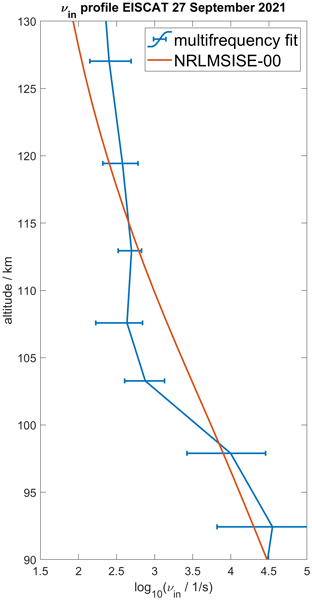
Florian Günzkofer, Gunter Stober, Dimitry Pokhotelov, Yasunobu Miyoshi, and Claudia Borries
Atmos. Meas. Tech., 16, 5897–5907, https://doi.org/10.5194/amt-16-5897-2023, https://doi.org/10.5194/amt-16-5897-2023, 2023
Short summary
Short summary
Electric currents in the ionosphere can impact both satellite and ground-based infrastructure. These currents depend strongly on the collisions of ions and neutral particles. Measuring ion–neutral collisions is often only possible via certain assumptions. The direct measurement of ion–neutral collision frequencies is possible with multifrequency incoherent scatter radar measurements. This paper presents one analysis method of such measurements and discusses its advantages and disadvantages.
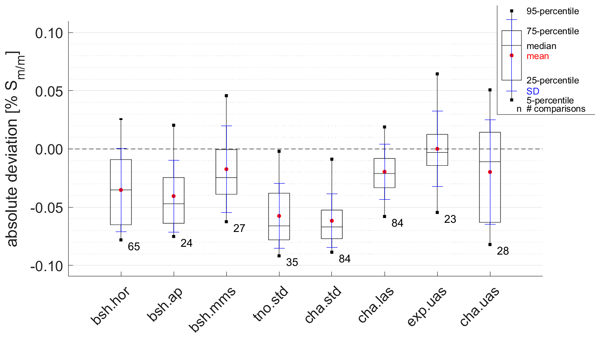
Jörg Beecken, Andreas Weigelt, Simone Griesel, Johan Mellqvist, Alexander V. Conde Jacobo, Daniëlle van Dinther, Jan Duyzer, Jon Knudsen, Bettina Knudsen, and Leonidas Ntziachristos
Atmos. Meas. Tech., 16, 5883–5895, https://doi.org/10.5194/amt-16-5883-2023, https://doi.org/10.5194/amt-16-5883-2023, 2023
Short summary
Short summary
Air pollution from shipping is a debated topic in science and politics. We compare different monitoring systems currently used in different European countries for the enforcement of emission limits regarding air pollution from ships according to regulation. The system performances were individually assessed in the field by comparison with true values. Non-compliant vessels with actual fuel sulfur contents > 0.15–0.19 % Sm/m can be detected by the compared systems with 95 % confidence.
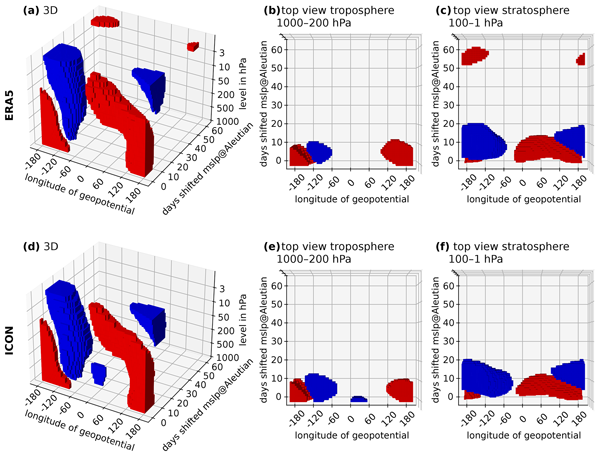
Raphael Harry Köhler, Ralf Jaiser, and Dörthe Handorf
Weather Clim. Dynam., 4, 1071–1086, https://doi.org/10.5194/wcd-4-1071-2023, https://doi.org/10.5194/wcd-4-1071-2023, 2023
Short summary
Short summary
This study explores the local mechanisms of troposphere–stratosphere coupling on seasonal timescales during extended winter in the Northern Hemisphere. The detected tropospheric precursor regions exhibit very distinct mechanisms of coupling to the stratosphere, thus highlighting the importance of the time- and zonally resolved picture. Moreover, this study demonstrates that the ICOsahedral Non-hydrostatic atmosphere model (ICON) can realistically reproduce troposphere–stratosphere coupling.
Tristan Millet, Hassan Bencherif, Thierry Portafaix, Nelson Bègue, Alexandre Baron, Valentin Duflot, Michaël Sicard, Jean-Marc Metzger, Guillaume Payen, Nicolas Marquestaut, and Sophie Godin-Beekmann
EGUsphere, https://doi.org/10.5194/egusphere-2023-2645, https://doi.org/10.5194/egusphere-2023-2645, 2023
Preprint withdrawn
Short summary
Short summary
The eruption of the Hunga Tonga volcano in January 2022 released substantial amounts of aerosols, sulfur dioxide, and water vapor into the stratosphere. Satellite and ground instruments followed the displacement of the volcanic aerosol plume and its impact on ozone levels over the Indian Ocean. Ozone data reveal the presence of a persistent ozone mini-hole structure from 17 January to 22 January, with most ozone depletion occurring within the ozone layer at the location of the aerosol plume.
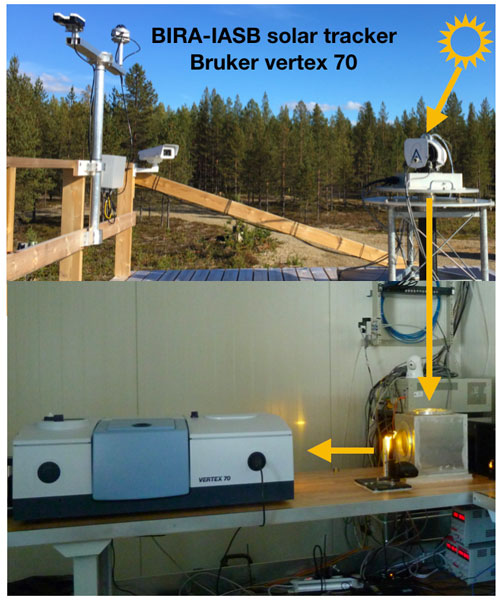
Minqiang Zhou, Bavo Langerock, Mahesh Kumar Sha, Christian Hermans, Nicolas Kumps, Rigel Kivi, Pauli Heikkinen, Christof Petri, Justus Notholt, Huilin Chen, and Martine De Mazière
Atmos. Meas. Tech., 16, 5593–5608, https://doi.org/10.5194/amt-16-5593-2023, https://doi.org/10.5194/amt-16-5593-2023, 2023
Short summary
Short summary
Atmospheric N2O and CH4 columns are successfully retrieved from low-resolution FTIR spectra recorded by a Bruker VERTEX 70. The 1-year measurements at Sodankylä show that the N2O total columns retrieved from 125HR and VERTEX 70 spectra are −0.3 ± 0.7 % with an R value of 0.93. The relative differences between the CH4 total columns retrieved from the 125HR and VERTEX spectra are 0.0 ± 0.8 % with an R value of 0.87. Such a technique can help to fill the gap in NDACC N2O and CH4 measurements.
Sieglinde Callewaert, Minqiang Zhou, Bavo Langerock, Pucai Wang, Ting Wang, Emmanuel Mahieu, and Martine De Mazière
EGUsphere, https://doi.org/10.5194/egusphere-2023-2103, https://doi.org/10.5194/egusphere-2023-2103, 2023
Preprint archived
Short summary
Short summary
We used an atmospheric transport model and satellite data to study greenhouse gas observations at Xianghe, China. Our study shows the key source sectors that influence the concentrations and their respective importance. Furthermore, meteorological factors such as wind direction are discussed. This research highlights the challenges in accurately simulating these kind of measurements and helps us to better understand greenhouse gas variability in the region.
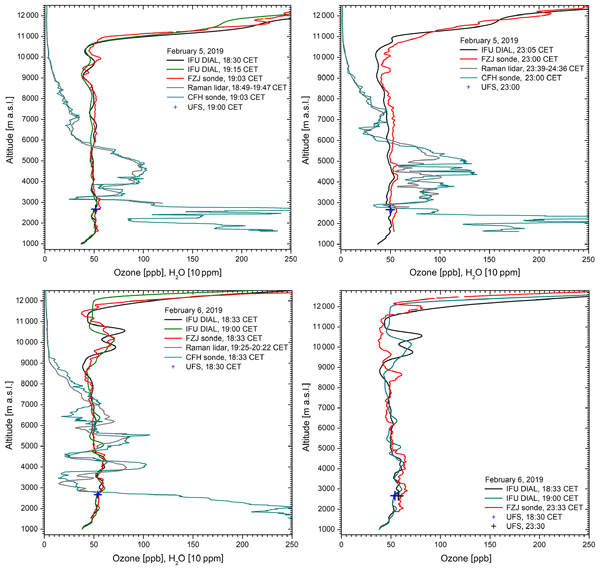
Thomas Trickl, Martin Adelwart, Dina Khordakova, Ludwig Ries, Christian Rolf, Michael Sprenger, Wolfgang Steinbrecht, and Hannes Vogelmann
Atmos. Meas. Tech., 16, 5145–5165, https://doi.org/10.5194/amt-16-5145-2023, https://doi.org/10.5194/amt-16-5145-2023, 2023
Short summary
Short summary
Tropospheric ozone have been measured for more than a century. Highly quantitative ozone measurements have been made at monitoring stations. However, deficits have been reported for vertical sounding systems. Here, we report a thorough intercomparison effort between a differential-absorption lidar system and two types of balloon-borne ozone sondes, also using ozone sensors at nearby mountain sites as references. The sondes agree very well with the lidar after offset corrections.
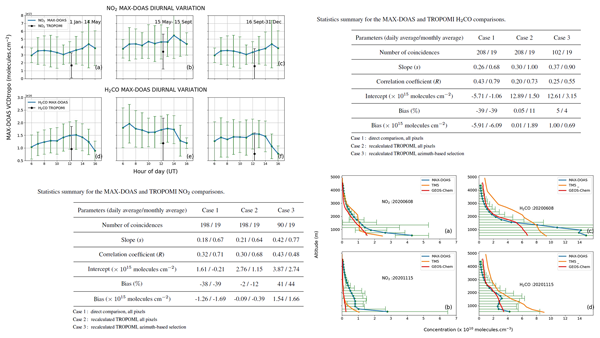
Rodriguez Yombo Phaka, Alexis Merlaud, Gaia Pinardi, Martina M. Friedrich, Michel Van Roozendael, Jean-François Müller, Trissevgeni Stavrakou, Isabelle De Smedt, François Hendrick, Ermioni Dimitropoulou, Richard Bopili Mbotia Lepiba, Edmond Phuku Phuati, Buenimio Lomami Djibi, Lars Jacobs, Caroline Fayt, Jean-Pierre Mbungu Tsumbu, and Emmanuel Mahieu
Atmos. Meas. Tech., 16, 5029–5050, https://doi.org/10.5194/amt-16-5029-2023, https://doi.org/10.5194/amt-16-5029-2023, 2023
Short summary
Short summary
We present air quality measurements in Kinshasa, Democratic Republic of the Congo, performed with a newly developed instrument which was installed on a roof of the University of Kinshasa in November 2019. The instrument records spectra of the scattered sunlight, from which we derive the abundances of nitrogen dioxide and formaldehyde, two important pollutants. We compare our ground-based measurements with those of the TROPOspheric Monitoring Instrument (TROPOMI).
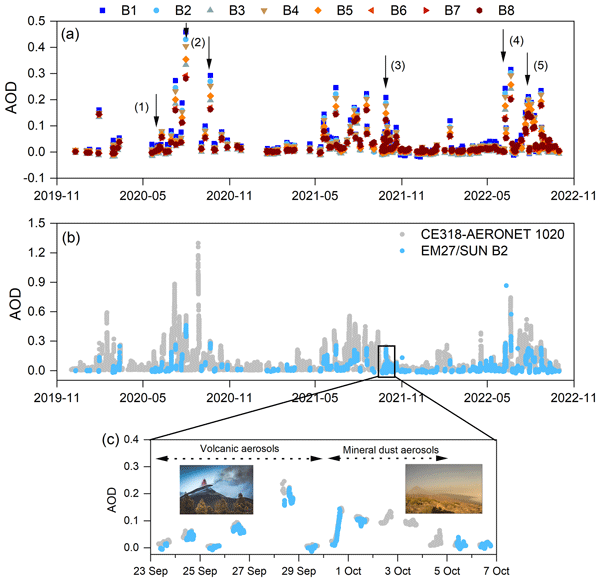
Óscar Alvárez, África Barreto, Omaira E. García, Frank Hase, Rosa D. García, Julian Gröbner, Sergio F. León-Luis, Eliezer Sepúlveda, Virgilio Carreño, Antonio Alcántara, Ramón Ramos, A. Fernando Almansa, Stelios Kazadzis, Noémie Taquet, Carlos Toledano, and Emilio Cuevas
Atmos. Meas. Tech., 16, 4861–4884, https://doi.org/10.5194/amt-16-4861-2023, https://doi.org/10.5194/amt-16-4861-2023, 2023
Short summary
Short summary
In this work, we have extended the capabilities of a portable Fourier transform infrared (FTIR) instrument, which was originally designed to provide high-quality greenhouse gas monitoring within COCCON (COllaborative Carbon Column Observing Network). The extension allows the spectrometer to now also provide coincidentally column-integrated aerosol information. This addition of a reference instrument to a global network will be utilised to enhance our understanding of atmospheric chemistry.
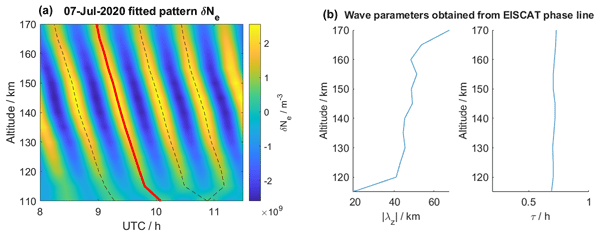
Florian Günzkofer, Dimitry Pokhotelov, Gunter Stober, Ingrid Mann, Sharon L. Vadas, Erich Becker, Anders Tjulin, Alexander Kozlovsky, Masaki Tsutsumi, Njål Gulbrandsen, Satonori Nozawa, Mark Lester, Evgenia Belova, Johan Kero, Nicholas J. Mitchell, and Claudia Borries
Ann. Geophys., 41, 409–428, https://doi.org/10.5194/angeo-41-409-2023, https://doi.org/10.5194/angeo-41-409-2023, 2023
Short summary
Short summary
Gravity waves (GWs) are waves in Earth's atmosphere and can be observed as cloud ripples. Under certain conditions, these waves can propagate up into the ionosphere. Here, they can cause ripples in the ionosphere plasma, observable as oscillations of the plasma density. Therefore, GWs contribute to the ionospheric variability, making them relevant for space weather prediction. Additionally, the behavior of these waves allows us to draw conclusions about the atmosphere at these altitudes.
Verena Schenzinger, Axel Kreuter, Barbara Klotz, Michael Schwarzmann, and Julian Gröbner
Atmos. Meas. Tech. Discuss., https://doi.org/10.5194/amt-2023-188, https://doi.org/10.5194/amt-2023-188, 2023
Revised manuscript not accepted
Short summary
Short summary
We present a fast an easy method to incorporate clouds from satellite imagery into a model for calculating surface UV index maps in near-real time. To judge the quality of the model, we compare our results to measurements from ground based detectors. We discuss in detail where variations in either of the values come from and why satellite and ground values might not necessarily be comparable in every situation.
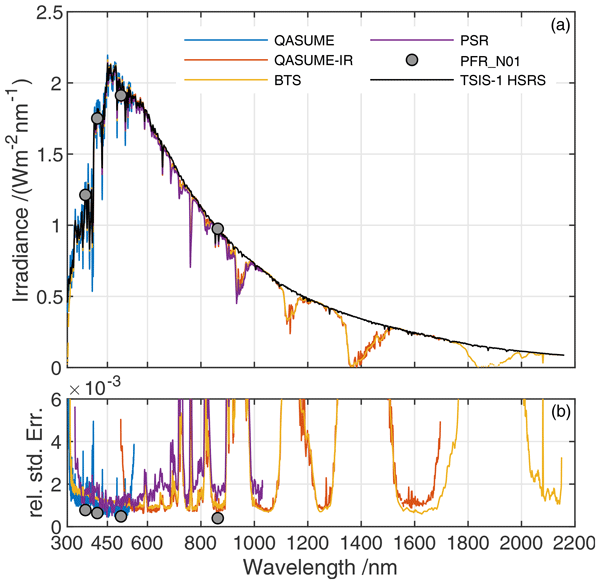
Julian Gröbner, Natalia Kouremeti, Gregor Hülsen, Ralf Zuber, Mario Ribnitzky, Saulius Nevas, Peter Sperfeld, Kerstin Schwind, Philipp Schneider, Stelios Kazadzis, África Barreto, Tom Gardiner, Kavitha Mottungan, David Medland, and Marc Coleman
Atmos. Meas. Tech., 16, 4667–4680, https://doi.org/10.5194/amt-16-4667-2023, https://doi.org/10.5194/amt-16-4667-2023, 2023
Short summary
Short summary
Spectral solar irradiance measurements traceable to the International System of Units (SI) allow for intercomparability between instruments and for their validation according to metrological standards. Here we also validate and reduce the uncertainties of the top-of-atmosphere TSIS-1 Hybrid Solar Reference Spectrum (HSRS). The management of large networks, e.g. AERONET or GAW-PFR, will benefit from reducing logistical overhead, improving their resilience and achieving metrological traceability.
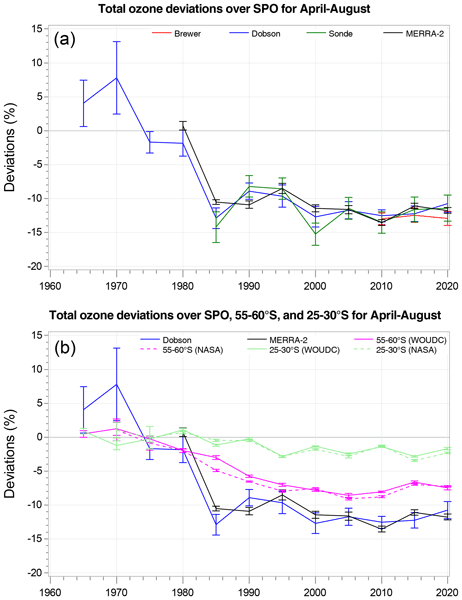
Vitali Fioletov, Xiaoyi Zhao, Ihab Abboud, Michael Brohart, Akira Ogyu, Reno Sit, Sum Chi Lee, Irina Petropavlovskikh, Koji Miyagawa, Bryan J. Johnson, Patrick Cullis, John Booth, Glen McConville, and C. Thomas McElroy
Atmos. Chem. Phys., 23, 12731–12751, https://doi.org/10.5194/acp-23-12731-2023, https://doi.org/10.5194/acp-23-12731-2023, 2023
Short summary
Short summary
Stratospheric ozone within the Southern Hemisphere springtime polar vortex has been a subject of intense research since the discovery of the Antarctic ozone hole. The wintertime ozone in the vortex is less studied. We show that the recent wintertime ozone values over the South Pole were about 12 % below the pre-1980s level; i.e., the decline there was nearly twice as large as that over southern midlatitudes. Thus, wintertime ozone there can be used as an indicator of the ozone layer state.
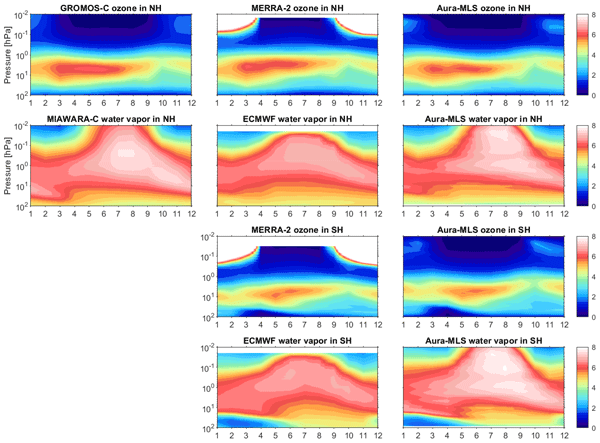
Guochun Shi, Witali Krochin, Eric Sauvageat, and Gunter Stober
Atmos. Chem. Phys., 23, 9137–9159, https://doi.org/10.5194/acp-23-9137-2023, https://doi.org/10.5194/acp-23-9137-2023, 2023
Short summary
Short summary
We present the interannual and climatological behavior of ozone and water vapor from microwave radiometers in the Arctic.
By defining a virtual conjugate latitude station in the Southern Hemisphere, we investigate altitude-dependent interhemispheric differences and estimate the ascent and descent rates of water vapor in both hemispheres. Ozone and water vapor measurements will create a deeper understanding of the evolution of middle atmospheric ozone and water vapor.
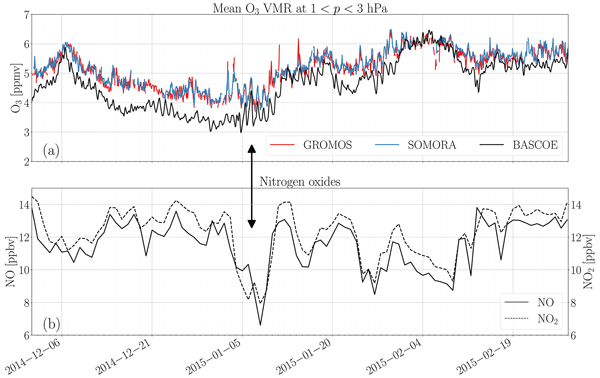
Eric Sauvageat, Klemens Hocke, Eliane Maillard Barras, Shengyi Hou, Quentin Errera, Alexander Haefele, and Axel Murk
Atmos. Chem. Phys., 23, 7321–7345, https://doi.org/10.5194/acp-23-7321-2023, https://doi.org/10.5194/acp-23-7321-2023, 2023
Short summary
Short summary
In Switzerland, two microwave radiometers can measure continuous ozone profiles in the middle atmosphere. From these instruments, we can study the diurnal variation of ozone, which is difficult to observe otherwise. It is valuable to validate the model simulations of diurnal variations in this region. We present results obtained during the last decade and compare them against various models. For the first time, we also show that the winter diurnal variations have some short-term fluctuations.
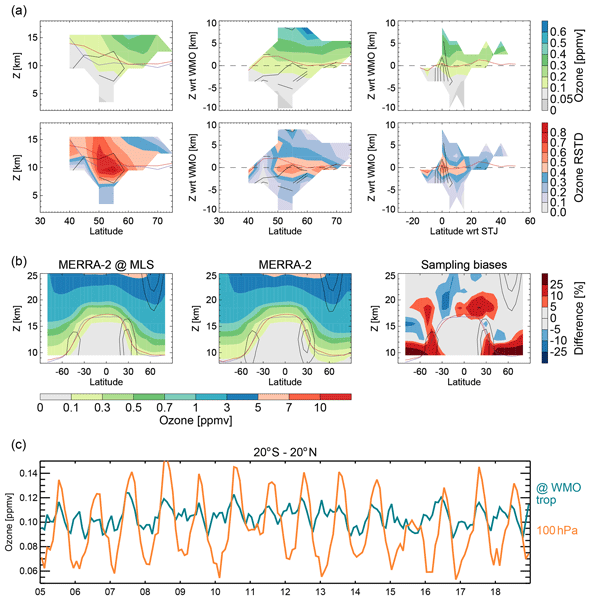
Luis F. Millán, Gloria L. Manney, Harald Boenisch, Michaela I. Hegglin, Peter Hoor, Daniel Kunkel, Thierry Leblanc, Irina Petropavlovskikh, Kaley Walker, Krzysztof Wargan, and Andreas Zahn
Atmos. Meas. Tech., 16, 2957–2988, https://doi.org/10.5194/amt-16-2957-2023, https://doi.org/10.5194/amt-16-2957-2023, 2023
Short summary
Short summary
The determination of atmospheric composition trends in the upper troposphere and lower stratosphere (UTLS) is still highly uncertain. We present the creation of dynamical diagnostics to map several ozone datasets (ozonesondes, lidars, aircraft, and satellite measurements) in geophysically based coordinate systems. The diagnostics can also be used to analyze other greenhouse gases relevant to surface climate and UTLS chemistry.
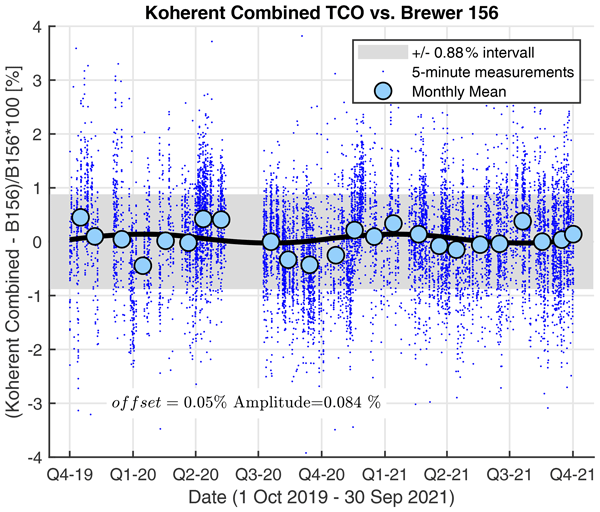
Luca Egli, Julian Gröbner, Herbert Schill, and Eliane Maillard Barras
Atmos. Meas. Tech., 16, 2889–2902, https://doi.org/10.5194/amt-16-2889-2023, https://doi.org/10.5194/amt-16-2889-2023, 2023
Short summary
Short summary
This paper introduces a new method to retrieve total column ozone with spectral ground-based measurements from a novel array spectroradiometer. Total column ozone estimates using the small, cost-effective, and robust instrument and the new retrieval method are compared with other co-located total column ozone instruments. The comparison shows that the new system performs similarly to other well-established instruments, which require substantially more maintenance than the system introduced here.
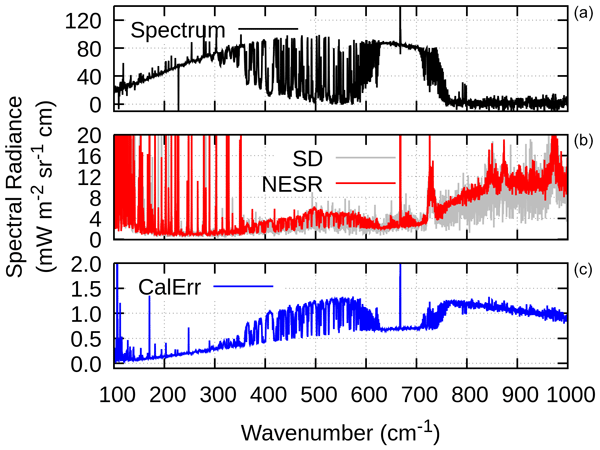
Claudio Belotti, Flavio Barbara, Marco Barucci, Giovanni Bianchini, Francesco D'Amato, Samuele Del Bianco, Gianluca Di Natale, Marco Gai, Alessio Montori, Filippo Pratesi, Markus Rettinger, Christian Rolf, Ralf Sussmann, Thomas Trickl, Silvia Viciani, Hannes Vogelmann, and Luca Palchetti
Atmos. Meas. Tech., 16, 2511–2529, https://doi.org/10.5194/amt-16-2511-2023, https://doi.org/10.5194/amt-16-2511-2023, 2023
Short summary
Short summary
FIRMOS (Far-Infrared Radiation Mobile Observation System) is a spectroradiometer measuring in the far-infrared, developed to support the preparation of the FORUM (Far-infrared Outgoing Radiation Understanding and Monitoring) satellite mission. In this paper, we describe the instrument, its data products, and the results of the comparison with a suite of observations made from a high-altitude site during a field campaign, in winter 2018–2019.
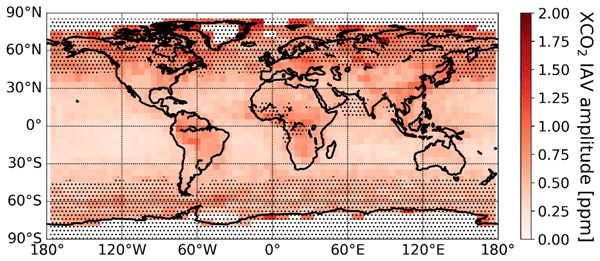
Yifan Guan, Gretchen Keppel-Aleks, Scott C. Doney, Christof Petri, Dave Pollard, Debra Wunch, Frank Hase, Hirofumi Ohyama, Isamu Morino, Justus Notholt, Kei Shiomi, Kim Strong, Rigel Kivi, Matthias Buschmann, Nicholas Deutscher, Paul Wennberg, Ralf Sussmann, Voltaire A. Velazco, and Yao Té
Atmos. Chem. Phys., 23, 5355–5372, https://doi.org/10.5194/acp-23-5355-2023, https://doi.org/10.5194/acp-23-5355-2023, 2023
Short summary
Short summary
We characterize spatial–temporal patterns of interannual variability (IAV) in atmospheric CO2 based on NASA’s Orbiting Carbon Observatory-2 (OCO-2). CO2 variation is strongly impacted by climate events, with higher anomalies during El Nino years. We show high correlation in IAV between space-based and ground-based CO2 from long-term sites. Because OCO-2 has near-global coverage, our paper provides a roadmap to study IAV where in situ observation is sparse, such as open oceans and remote lands.
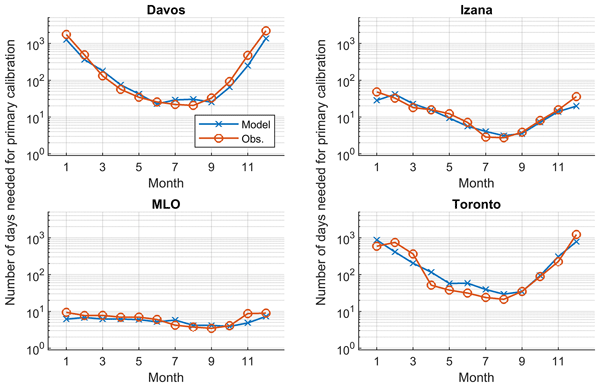
Xiaoyi Zhao, Vitali Fioletov, Alberto Redondas, Julian Gröbner, Luca Egli, Franz Zeilinger, Javier López-Solano, Alberto Berjón Arroyo, James Kerr, Eliane Maillard Barras, Herman Smit, Michael Brohart, Reno Sit, Akira Ogyu, Ihab Abboud, and Sum Chi Lee
Atmos. Meas. Tech., 16, 2273–2295, https://doi.org/10.5194/amt-16-2273-2023, https://doi.org/10.5194/amt-16-2273-2023, 2023
Short summary
Short summary
The Brewer ozone spectrophotometer is one of the World Meteorological Organization (WMO) Global Atmosphere Watch (GAW)'s standard ozone monitoring instruments since the 1980s. This work is aimed at obtaining answers to (1) why Brewer primary calibration work can only be performed at certain sites (e.g., Izaña and MLO) and (2) what is needed to assure the equivalence of calibration quality from different sites.
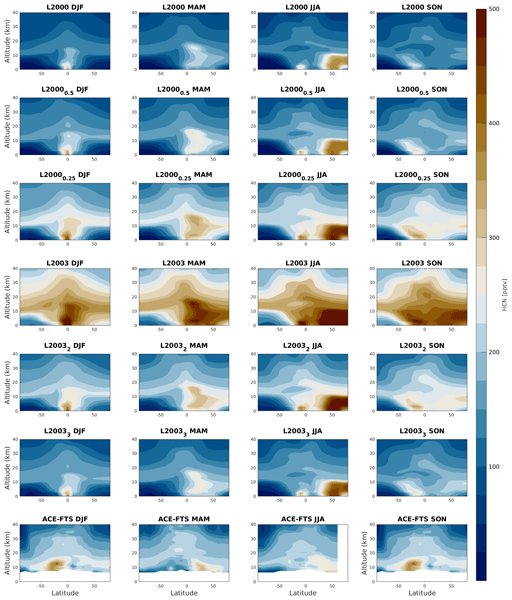
Antonio G. Bruno, Jeremy J. Harrison, Martyn P. Chipperfield, David P. Moore, Richard J. Pope, Christopher Wilson, Emmanuel Mahieu, and Justus Notholt
Atmos. Chem. Phys., 23, 4849–4861, https://doi.org/10.5194/acp-23-4849-2023, https://doi.org/10.5194/acp-23-4849-2023, 2023
Short summary
Short summary
A 3-D chemical transport model, TOMCAT; satellite data; and ground-based observations have been used to investigate hydrogen cyanide (HCN) variability. We found that the oxidation by O(1D) drives the HCN loss in the middle stratosphere and the currently JPL-recommended OH reaction rate overestimates HCN atmospheric loss. We also evaluated two different ocean uptake schemes. We found them to be unrealistic, and we need to scale these schemes to obtain good agreement with HCN observations.
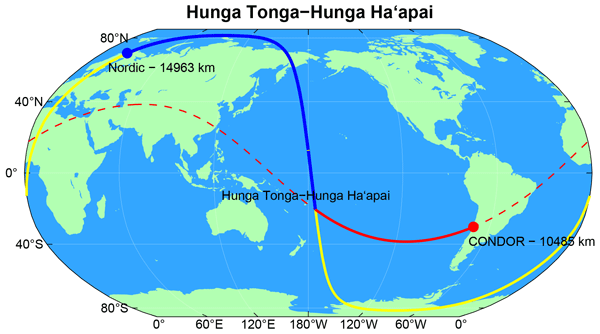
Gunter Stober, Alan Liu, Alexander Kozlovsky, Zishun Qiao, Witali Krochin, Guochun Shi, Johan Kero, Masaki Tsutsumi, Njål Gulbrandsen, Satonori Nozawa, Mark Lester, Kathrin Baumgarten, Evgenia Belova, and Nicholas Mitchell
Ann. Geophys., 41, 197–208, https://doi.org/10.5194/angeo-41-197-2023, https://doi.org/10.5194/angeo-41-197-2023, 2023
Short summary
Short summary
The Hunga Tonga–Hunga Ha‘apai volcanic eruption was one of the most vigorous volcanic explosions in the last centuries. The eruption launched many atmospheric waves traveling around the Earth. In this study, we identify these volcanic waves at the edge of space in the mesosphere/lower-thermosphere, leveraging wind observations conducted with multi-static meteor radars in northern Europe and with the Chilean Observation Network De Meteor Radars (CONDOR).
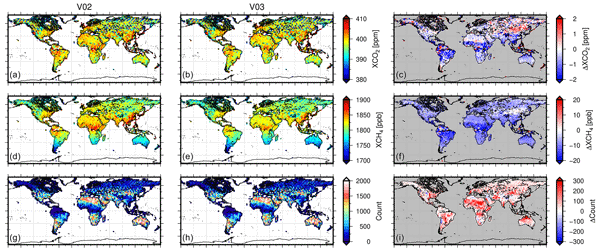
Yu Someya, Yukio Yoshida, Hirofumi Ohyama, Shohei Nomura, Akihide Kamei, Isamu Morino, Hitoshi Mukai, Tsuneo Matsunaga, Joshua L. Laughner, Voltaire A. Velazco, Benedikt Herkommer, Yao Té, Mahesh Kumar Sha, Rigel Kivi, Minqiang Zhou, Young Suk Oh, Nicholas M. Deutscher, and David W. T. Griffith
Atmos. Meas. Tech., 16, 1477–1501, https://doi.org/10.5194/amt-16-1477-2023, https://doi.org/10.5194/amt-16-1477-2023, 2023
Short summary
Short summary
The updated retrieval algorithm for the Greenhouse gases Observing SATellite level 2 product is presented. The main changes in the algorithm from the previous one are the treatment of cirrus clouds, the degradation model of the sensor, solar irradiance, and gas absorption coefficient tables. The retrieval results showed improvements in fitting accuracy and an increase in the data amount over land. On the other hand, there are still large biases of XCO2 which should be corrected over the ocean.
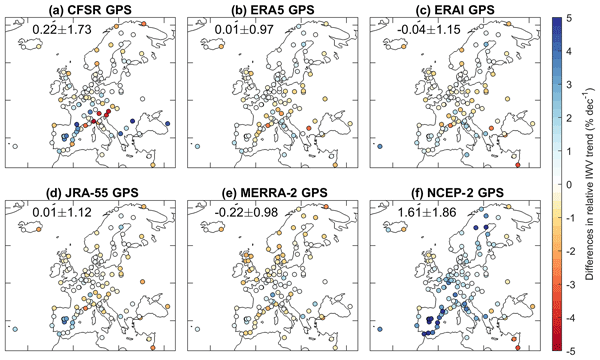
Peng Yuan, Roeland Van Malderen, Xungang Yin, Hannes Vogelmann, Weiping Jiang, Joseph Awange, Bernhard Heck, and Hansjörg Kutterer
Atmos. Chem. Phys., 23, 3517–3541, https://doi.org/10.5194/acp-23-3517-2023, https://doi.org/10.5194/acp-23-3517-2023, 2023
Short summary
Short summary
Water vapour plays an important role in various weather and climate processes. However, due to its large spatiotemporal variability, its high-accuracy quantification remains a challenge. In this study, 20+ years of GPS-derived integrated water vapour (IWV) retrievals in Europe were obtained. They were then used to characterise the temporal features of Europe's IWV and assess six atmospheric reanalyses. Results show that ERA5 outperforms the other reanalyses at most temporal scales.

Udo Frieß, Karin Kreher, Richard Querel, Holger Schmithüsen, Dan Smale, Rolf Weller, and Ulrich Platt
Atmos. Chem. Phys., 23, 3207–3232, https://doi.org/10.5194/acp-23-3207-2023, https://doi.org/10.5194/acp-23-3207-2023, 2023
Short summary
Short summary
Reactive bromine compounds, emitted by the sea ice during polar spring, play an important role in the atmospheric chemistry of the coastal regions of Antarctica. We investigate the sources and impacts of reactive bromine in detail using many years of measurements at two Antarctic sites located at opposite sides of the Antarctic continent. Using a multitude of meteorological observations, we were able to identify the main triggers and source regions for reactive bromine in Antarctica.
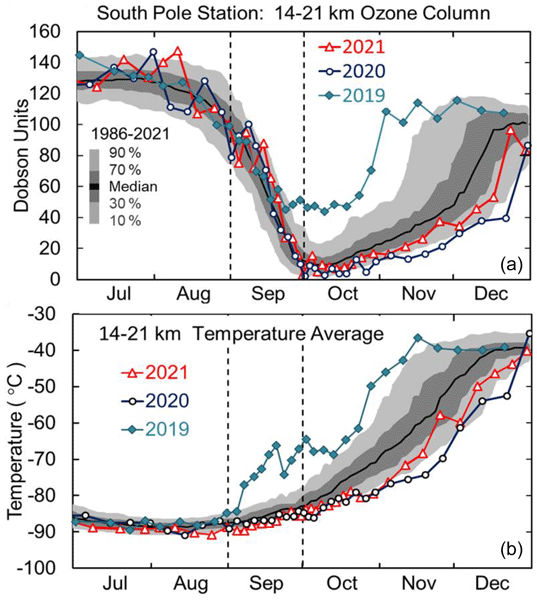
Bryan J. Johnson, Patrick Cullis, John Booth, Irina Petropavlovskikh, Glen McConville, Birgit Hassler, Gary A. Morris, Chance Sterling, and Samuel Oltmans
Atmos. Chem. Phys., 23, 3133–3146, https://doi.org/10.5194/acp-23-3133-2023, https://doi.org/10.5194/acp-23-3133-2023, 2023
Short summary
Short summary
In 1986, soon after the discovery of the Antarctic ozone hole, NOAA began year-round ozonesonde observations at South Pole Station to measure vertical profiles of ozone and temperature from the surface to 35 km. Balloon-borne ozonesondes launched at this unique site allow for tracking all phases of the yearly springtime ozone hole beginning in late winter and after sunrise, when rapid ozone depletion begins over the South Pole throughout the month of September.
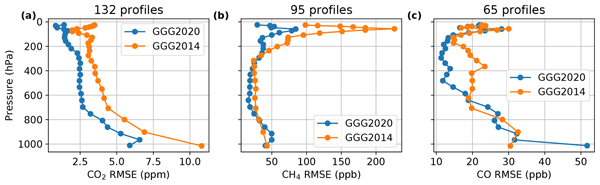
Joshua L. Laughner, Sébastien Roche, Matthäus Kiel, Geoffrey C. Toon, Debra Wunch, Bianca C. Baier, Sébastien Biraud, Huilin Chen, Rigel Kivi, Thomas Laemmel, Kathryn McKain, Pierre-Yves Quéhé, Constantina Rousogenous, Britton B. Stephens, Kaley Walker, and Paul O. Wennberg
Atmos. Meas. Tech., 16, 1121–1146, https://doi.org/10.5194/amt-16-1121-2023, https://doi.org/10.5194/amt-16-1121-2023, 2023
Short summary
Short summary
Observations using sunlight to measure surface-to-space total column of greenhouse gases in the atmosphere need an initial guess of the vertical distribution of those gases to start from. We have developed an approach to provide those initial guess profiles that uses readily available meteorological data as input. This lets us make these guesses without simulating them with a global model. The profiles generated this way match independent observations well.
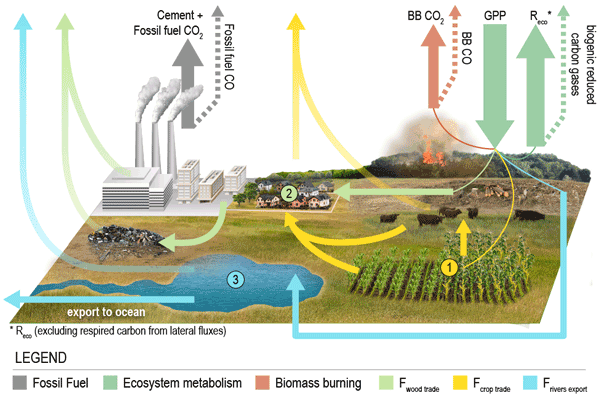
Brendan Byrne, David F. Baker, Sourish Basu, Michael Bertolacci, Kevin W. Bowman, Dustin Carroll, Abhishek Chatterjee, Frédéric Chevallier, Philippe Ciais, Noel Cressie, David Crisp, Sean Crowell, Feng Deng, Zhu Deng, Nicholas M. Deutscher, Manvendra K. Dubey, Sha Feng, Omaira E. García, David W. T. Griffith, Benedikt Herkommer, Lei Hu, Andrew R. Jacobson, Rajesh Janardanan, Sujong Jeong, Matthew S. Johnson, Dylan B. A. Jones, Rigel Kivi, Junjie Liu, Zhiqiang Liu, Shamil Maksyutov, John B. Miller, Scot M. Miller, Isamu Morino, Justus Notholt, Tomohiro Oda, Christopher W. O'Dell, Young-Suk Oh, Hirofumi Ohyama, Prabir K. Patra, Hélène Peiro, Christof Petri, Sajeev Philip, David F. Pollard, Benjamin Poulter, Marine Remaud, Andrew Schuh, Mahesh K. Sha, Kei Shiomi, Kimberly Strong, Colm Sweeney, Yao Té, Hanqin Tian, Voltaire A. Velazco, Mihalis Vrekoussis, Thorsten Warneke, John R. Worden, Debra Wunch, Yuanzhi Yao, Jeongmin Yun, Andrew Zammit-Mangion, and Ning Zeng
Earth Syst. Sci. Data, 15, 963–1004, https://doi.org/10.5194/essd-15-963-2023, https://doi.org/10.5194/essd-15-963-2023, 2023
Short summary
Short summary
Changes in the carbon stocks of terrestrial ecosystems result in emissions and removals of CO2. These can be driven by anthropogenic activities (e.g., deforestation), natural processes (e.g., fires) or in response to rising CO2 (e.g., CO2 fertilization). This paper describes a dataset of CO2 emissions and removals derived from atmospheric CO2 observations. This pilot dataset informs current capabilities and future developments towards top-down monitoring and verification systems.
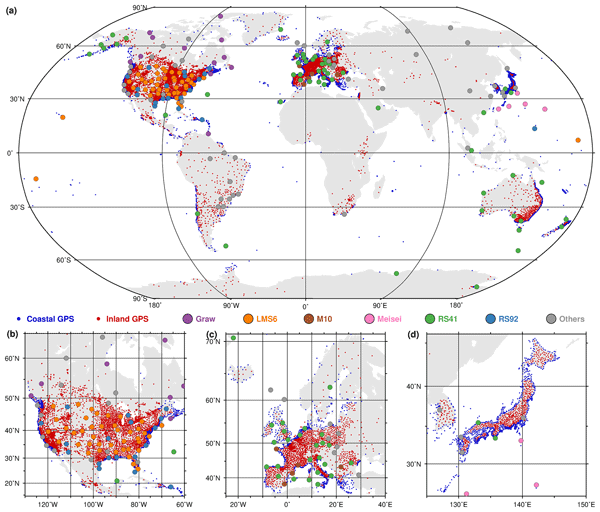
Peng Yuan, Geoffrey Blewitt, Corné Kreemer, William C. Hammond, Donald Argus, Xungang Yin, Roeland Van Malderen, Michael Mayer, Weiping Jiang, Joseph Awange, and Hansjörg Kutterer
Earth Syst. Sci. Data, 15, 723–743, https://doi.org/10.5194/essd-15-723-2023, https://doi.org/10.5194/essd-15-723-2023, 2023
Short summary
Short summary
We developed a 5 min global integrated water vapour (IWV) product from 12 552 ground-based GPS stations in 2020. It contains more than 1 billion IWV estimates. The dataset is an enhanced version of the existing operational GPS IWV dataset from the Nevada Geodetic Laboratory. The enhancement is reached by using accurate meteorological information from ERA5 for the GPS IWV retrieval with a significantly higher spatiotemporal resolution. The dataset is recommended for high-accuracy applications.
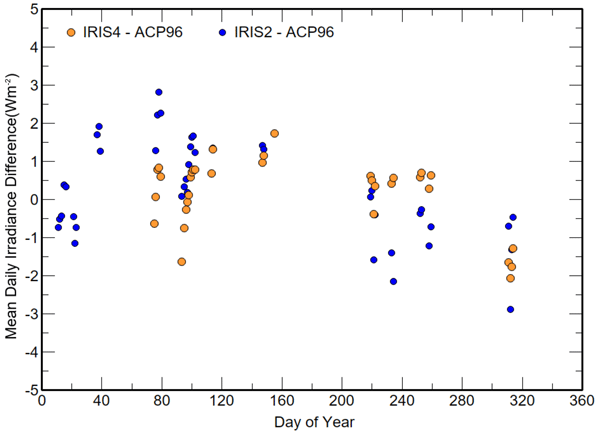
Bruce W. Forgan, Julian Gröbner, and Ibrahim Reda
Atmos. Meas. Tech., 16, 727–743, https://doi.org/10.5194/amt-16-727-2023, https://doi.org/10.5194/amt-16-727-2023, 2023
Short summary
Short summary
This paper investigates the Absolute Cavity Pyrgeometer (ACP) and its use in measuring atmospheric terrestrial irradiances traceable to the standard system of units (SI). This work fits into the objective of the Expert Team on Radiation References, established by the World Meteorological Organization (WMO), to develop and validate instrumentation that can be used as reference instruments for terrestrial radiation measurements.
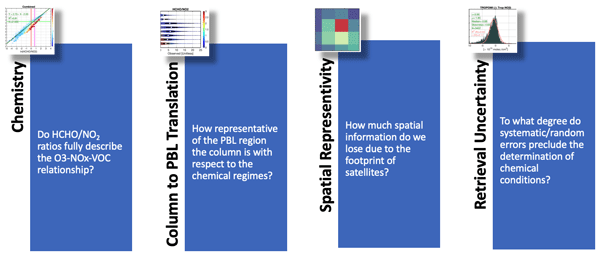
Amir H. Souri, Matthew S. Johnson, Glenn M. Wolfe, James H. Crawford, Alan Fried, Armin Wisthaler, William H. Brune, Donald R. Blake, Andrew J. Weinheimer, Tijl Verhoelst, Steven Compernolle, Gaia Pinardi, Corinne Vigouroux, Bavo Langerock, Sungyeon Choi, Lok Lamsal, Lei Zhu, Shuai Sun, Ronald C. Cohen, Kyung-Eun Min, Changmin Cho, Sajeev Philip, Xiong Liu, and Kelly Chance
Atmos. Chem. Phys., 23, 1963–1986, https://doi.org/10.5194/acp-23-1963-2023, https://doi.org/10.5194/acp-23-1963-2023, 2023
Short summary
Short summary
We have rigorously characterized different sources of error in satellite-based HCHO / NO2 tropospheric columns, a widely used metric for diagnosing near-surface ozone sensitivity. Specifically, the errors were categorized/quantified into (i) an inherent chemistry error, (ii) the decoupled relationship between columns and the near-surface concentration, (iii) the spatial representativeness error of ground satellite pixels, and (iv) the satellite retrieval errors.
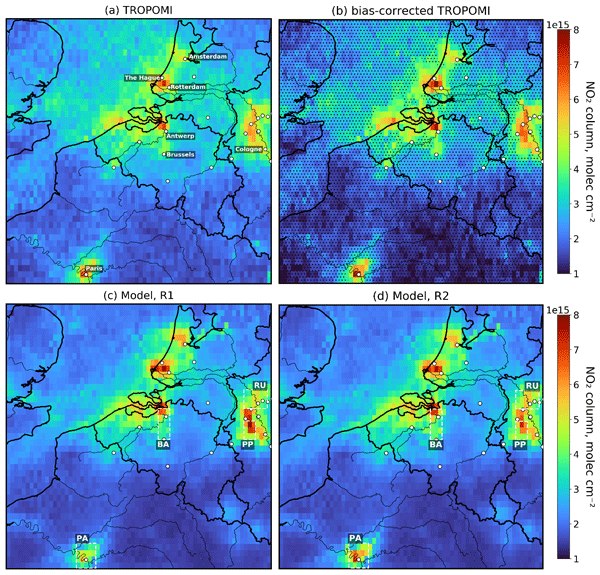
Catalina Poraicu, Jean-François Müller, Trissevgeni Stavrakou, Dominique Fonteyn, Frederik Tack, Felix Deutsch, Quentin Laffineur, Roeland Van Malderen, and Nele Veldeman
Geosci. Model Dev., 16, 479–508, https://doi.org/10.5194/gmd-16-479-2023, https://doi.org/10.5194/gmd-16-479-2023, 2023
Short summary
Short summary
High-resolution WRF-Chem simulations are conducted over Antwerp, Belgium, in June 2019 and evaluated using meteorological data and in situ, airborne, and spaceborne NO2 measurements. An intercomparison of model, aircraft, and TROPOMI NO2 columns is conducted to characterize biases in versions 1.3.1 and 2.3.1 of the satellite product. A mass balance method is implemented to provide improved emissions for simulating NO2 distribution over the study area.
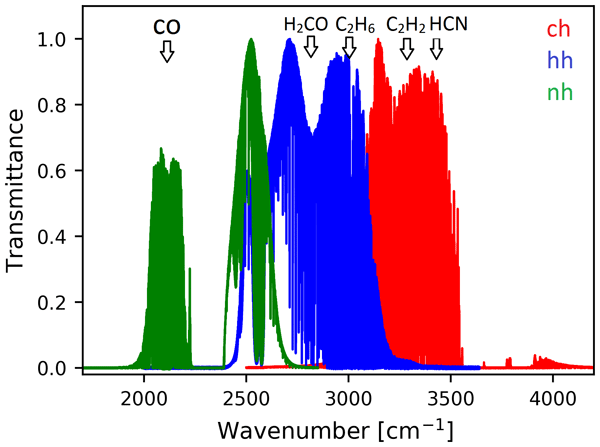
Minqiang Zhou, Bavo Langerock, Pucai Wang, Corinne Vigouroux, Qichen Ni, Christian Hermans, Bart Dils, Nicolas Kumps, Weidong Nan, and Martine De Mazière
Atmos. Meas. Tech., 16, 273–293, https://doi.org/10.5194/amt-16-273-2023, https://doi.org/10.5194/amt-16-273-2023, 2023
Short summary
Short summary
The ground-based FTIR measurements at Xianghe provide carbon monoxide (CO), acetylene (C2H2), ethane (C2H6), formaldehyde (H2CO), and hydrogen cyanide (HCN) total columns between June 2018 and November 2021. The retrieval strategies, information, and uncertainties of these five important trace gases are presented and discussed. This study provides insight into the time series, variations, and correlations of these five species in northern China.
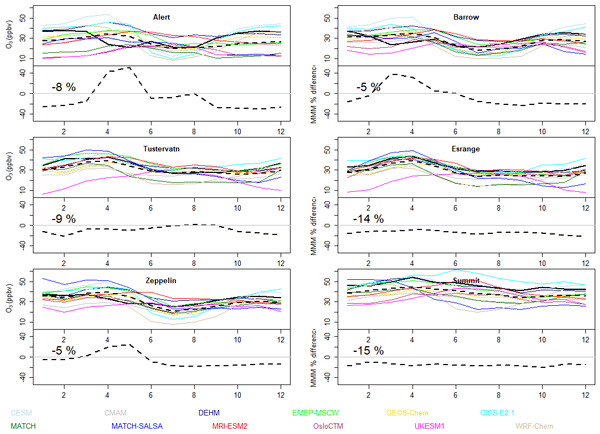
Cynthia H. Whaley, Kathy S. Law, Jens Liengaard Hjorth, Henrik Skov, Stephen R. Arnold, Joakim Langner, Jakob Boyd Pernov, Garance Bergeron, Ilann Bourgeois, Jesper H. Christensen, Rong-You Chien, Makoto Deushi, Xinyi Dong, Peter Effertz, Gregory Faluvegi, Mark Flanner, Joshua S. Fu, Michael Gauss, Greg Huey, Ulas Im, Rigel Kivi, Louis Marelle, Tatsuo Onishi, Naga Oshima, Irina Petropavlovskikh, Jeff Peischl, David A. Plummer, Luca Pozzoli, Jean-Christophe Raut, Tom Ryerson, Ragnhild Skeie, Sverre Solberg, Manu A. Thomas, Chelsea Thompson, Kostas Tsigaridis, Svetlana Tsyro, Steven T. Turnock, Knut von Salzen, and David W. Tarasick
Atmos. Chem. Phys., 23, 637–661, https://doi.org/10.5194/acp-23-637-2023, https://doi.org/10.5194/acp-23-637-2023, 2023
Short summary
Short summary
This study summarizes recent research on ozone in the Arctic, a sensitive and rapidly warming region. We find that the seasonal cycles of near-surface atmospheric ozone are variable depending on whether they are near the coast, inland, or at high altitude. Several global model simulations were evaluated, and we found that because models lack some of the ozone chemistry that is important for the coastal Arctic locations, they do not accurately simulate ozone there.
Andreas Plach, Rolf Rüfenacht, Simone Kotthaus, and Markus Leuenberger
EGUsphere, https://doi.org/10.5194/egusphere-2022-1019, https://doi.org/10.5194/egusphere-2022-1019, 2022
Preprint archived
Short summary
Short summary
Greenhouse gases emissions are contributing to global warming and it is essential to better understand where they originate from and how they are transported. In this study we analyze greenhouse gas observations at a Swiss tall tower where measurements are taken more than 200 m above ground and investigate their origin by looking at the condition of the atmosphere at the time of the observations. We find that most pollution at this site is caused from emissions transported from further away.
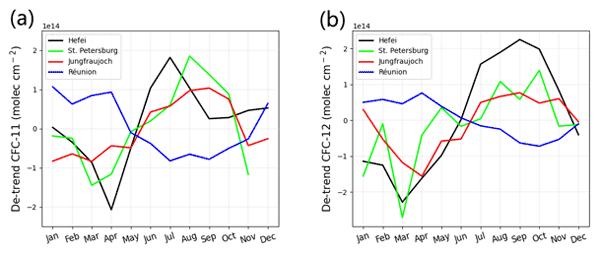
Xiangyu Zeng, Wei Wang, Cheng Liu, Changgong Shan, Yu Xie, Peng Wu, Qianqian Zhu, Minqiang Zhou, Martine De Mazière, Emmanuel Mahieu, Irene Pardo Cantos, Jamal Makkor, and Alexander Polyakov
Atmos. Meas. Tech., 15, 6739–6754, https://doi.org/10.5194/amt-15-6739-2022, https://doi.org/10.5194/amt-15-6739-2022, 2022
Short summary
Short summary
CFC-11 and CFC-12, which are classified as ozone-depleting substances, also have high global warming potentials. This paper describes obtaining the CFC-11 and CFC-12 total columns from the solar spectra based on ground-based Fourier transform infrared spectroscopy at Hefei, China. The seasonal variation and annual trend of the two gases are analyzed, and then the data are compared with other independent datasets.

Eric Sauvageat, Eliane Maillard Barras, Klemens Hocke, Alexander Haefele, and Axel Murk
Atmos. Meas. Tech., 15, 6395–6417, https://doi.org/10.5194/amt-15-6395-2022, https://doi.org/10.5194/amt-15-6395-2022, 2022
Short summary
Short summary
We present new harmonized ozone time series from two ground-based microwave radiometers in Switzerland. The new series consist of hourly ozone profiles in the middle atmosphere (~ 20–70 km) from 2009 until 2021. Cross-validation of the new data series shows the benefit of the harmonization process compared to the previous versions. Comparisons with collocated satellite observations is used to further validate these time series for long-term ozone monitoring over central Europe.
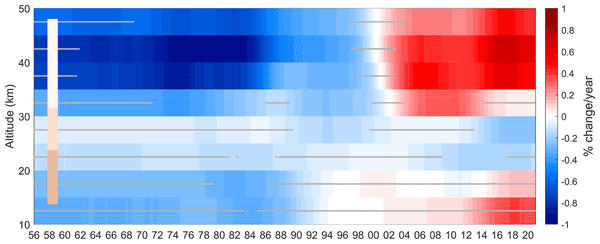
Eliane Maillard Barras, Alexander Haefele, René Stübi, Achille Jouberton, Herbert Schill, Irina Petropavlovskikh, Koji Miyagawa, Martin Stanek, and Lucien Froidevaux
Atmos. Chem. Phys., 22, 14283–14302, https://doi.org/10.5194/acp-22-14283-2022, https://doi.org/10.5194/acp-22-14283-2022, 2022
Short summary
Short summary
Intercomparisons of three Dobson and three Brewer spectrophotometers at Arosa/Davos, Switzerland, are used for the homogenization of the longest Umkehr ozone profiles time series worldwide. Dynamic linear modeling (DLM) reveals a significant positive trend after 2004 in the upper stratosphere, a persistent negative trend between 25 and 30 km in the middle stratosphere, and a negative trend at 20 km in the lower stratosphere, with different levels of significance depending on the dataset.
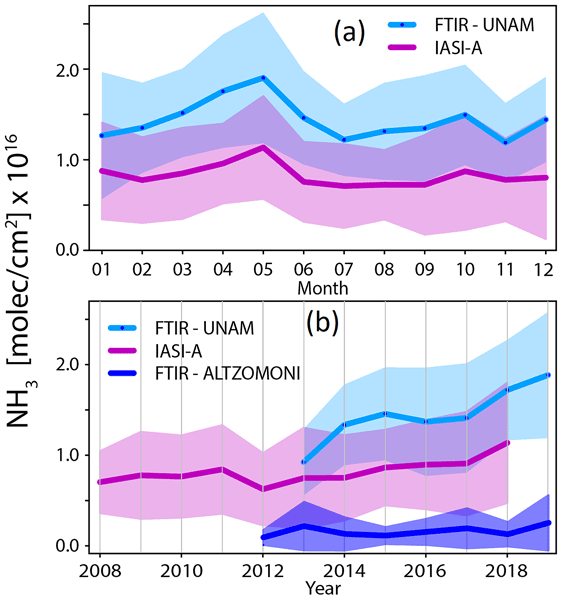
Beatriz Herrera, Alejandro Bezanilla, Thomas Blumenstock, Enrico Dammers, Frank Hase, Lieven Clarisse, Adolfo Magaldi, Claudia Rivera, Wolfgang Stremme, Kimberly Strong, Camille Viatte, Martin Van Damme, and Michel Grutter
Atmos. Chem. Phys., 22, 14119–14132, https://doi.org/10.5194/acp-22-14119-2022, https://doi.org/10.5194/acp-22-14119-2022, 2022
Short summary
Short summary
This work investigates atmospheric ammonia (NH3), a key trace gas with consequences for the environment and human health, in Mexico City. The results from the ground-based and satellite instruments show the variability and spatial distribution of NH3 over this region. NH3 in Mexico City has been increasing for the past 10 years and most of its sources are urban. This work contributes to a better understanding of NH3 sources and variability in urban and remote areas.
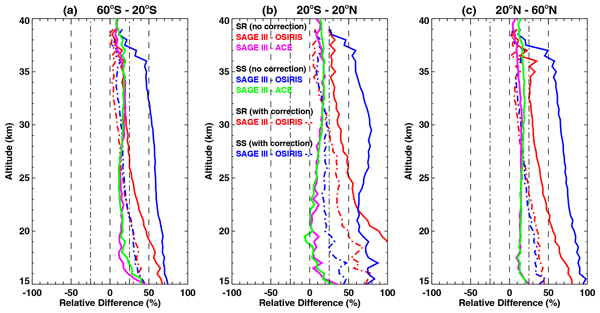
Sarah A. Strode, Ghassan Taha, Luke D. Oman, Robert Damadeo, David Flittner, Mark Schoeberl, Christopher E. Sioris, and Ryan Stauffer
Atmos. Meas. Tech., 15, 6145–6161, https://doi.org/10.5194/amt-15-6145-2022, https://doi.org/10.5194/amt-15-6145-2022, 2022
Short summary
Short summary
We use a global atmospheric chemistry model simulation to generate scaling factors that account for the daily cycle of NO2 and ozone. These factors facilitate comparisons between sunrise and sunset observations from SAGE III/ISS and observations from other instruments. We provide the scaling factors as monthly zonal means for different latitudes and altitudes. We find that applying these factors yields more consistent comparisons between observations from SAGE III/ISS and other instruments.
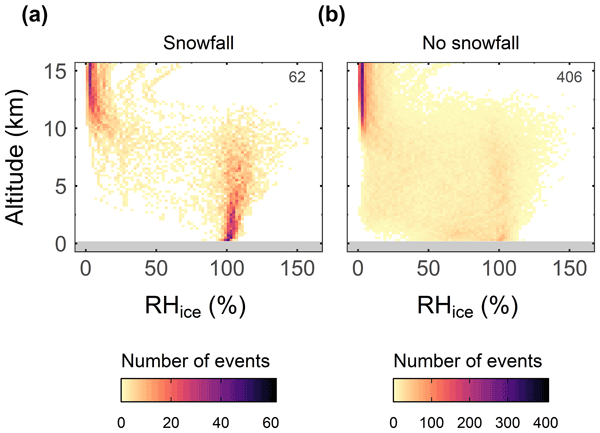
Claudia Mignani, Lukas Zimmermann, Rigel Kivi, Alexis Berne, and Franz Conen
Atmos. Chem. Phys., 22, 13551–13568, https://doi.org/10.5194/acp-22-13551-2022, https://doi.org/10.5194/acp-22-13551-2022, 2022
Short summary
Short summary
We determined over the course of 8 winter months the phase of clouds associated with snowfall in Northern Finland using radiosondes and observations of ice particle habits at ground level. We found that precipitating clouds were extending from near ground to at least 2.7 km altitude and approximately three-quarters of them were likely glaciated. Possible moisture sources and ice formation processes are discussed.
Xin Yang, Kimberly Strong, Alison S. Criscitiello, Marta Santos-Garcia, Kristof Bognar, Xiaoyi Zhao, Pierre Fogal, Kaley A. Walker, Sara M. Morris, and Peter Effertz
EGUsphere, https://doi.org/10.5194/egusphere-2022-696, https://doi.org/10.5194/egusphere-2022-696, 2022
Preprint archived
Short summary
Short summary
Snow pack in high Arctic plays a key role in polar atmospheric chemistry, especially in spring when photochemistry becomes active. By sampling surface snow from a Canadian high Arctic location at Eureka, Nunavut (80° N, 86° W), we demonstrate that surface snow is a net sink rather than a source of atmospheric reactive bromine and nitrate. This finding is new and opposite to previous conclusions that snowpack is a large and direct source of reactive bromine in polar spring.
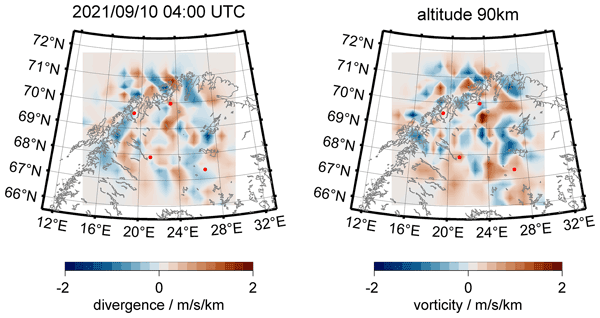
Gunter Stober, Alan Liu, Alexander Kozlovsky, Zishun Qiao, Ales Kuchar, Christoph Jacobi, Chris Meek, Diego Janches, Guiping Liu, Masaki Tsutsumi, Njål Gulbrandsen, Satonori Nozawa, Mark Lester, Evgenia Belova, Johan Kero, and Nicholas Mitchell
Atmos. Meas. Tech., 15, 5769–5792, https://doi.org/10.5194/amt-15-5769-2022, https://doi.org/10.5194/amt-15-5769-2022, 2022
Short summary
Short summary
Precise and accurate measurements of vertical winds at the mesosphere and lower thermosphere are rare. Although meteor radars have been used for decades to observe horizontal winds, their ability to derive reliable vertical wind measurements was always questioned. In this article, we provide mathematical concepts to retrieve mathematically and physically consistent solutions, which are compared to the state-of-the-art non-hydrostatic model UA-ICON.
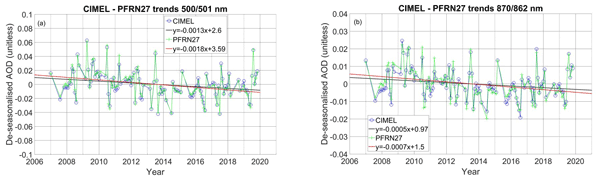
Angelos Karanikolas, Natalia Kouremeti, Julian Gröbner, Luca Egli, and Stelios Kazadzis
Atmos. Meas. Tech., 15, 5667–5680, https://doi.org/10.5194/amt-15-5667-2022, https://doi.org/10.5194/amt-15-5667-2022, 2022
Short summary
Short summary
The aim of this work is to investigate the limitations of calculating long-term trends of a parameter that quantifies the overall effect of atmospheric aerosols on the solar radiation. A main finding is that even instruments with good agreement between their observations can show significantly different linear trends. By calculating time-varying trends, the trend agreement is shown to improve. We also show that different methods of trend estimation can result in significant trend differences.
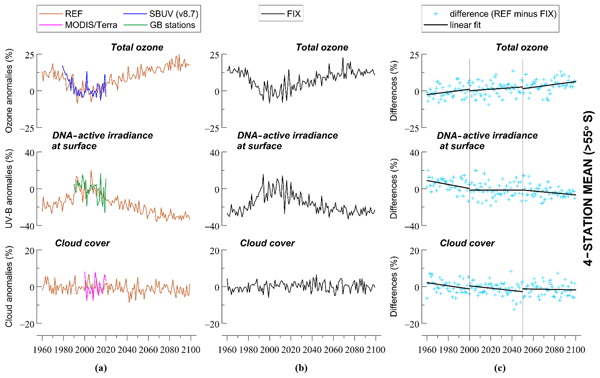
Kostas Eleftheratos, John Kapsomenakis, Ilias Fountoulakis, Christos S. Zerefos, Patrick Jöckel, Martin Dameris, Alkiviadis F. Bais, Germar Bernhard, Dimitra Kouklaki, Kleareti Tourpali, Scott Stierle, J. Ben Liley, Colette Brogniez, Frédérique Auriol, Henri Diémoz, Stana Simic, Irina Petropavlovskikh, Kaisa Lakkala, and Kostas Douvis
Atmos. Chem. Phys., 22, 12827–12855, https://doi.org/10.5194/acp-22-12827-2022, https://doi.org/10.5194/acp-22-12827-2022, 2022
Short summary
Short summary
We present the future evolution of DNA-active ultraviolet (UV) radiation in view of increasing greenhouse gases (GHGs) and decreasing ozone depleting substances (ODSs). It is shown that DNA-active UV radiation might increase after 2050 between 50° N–50° S due to GHG-induced reductions in clouds and ozone, something that is likely not to happen at high latitudes, where DNA-active UV radiation will continue its downward trend mainly due to stratospheric ozone recovery from the reduction in ODSs.
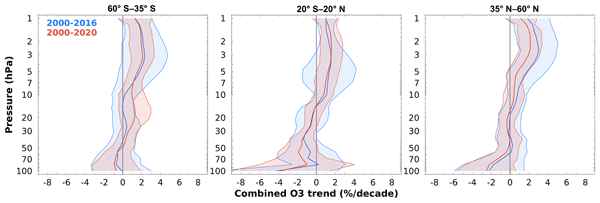
Sophie Godin-Beekmann, Niramson Azouz, Viktoria F. Sofieva, Daan Hubert, Irina Petropavlovskikh, Peter Effertz, Gérard Ancellet, Doug A. Degenstein, Daniel Zawada, Lucien Froidevaux, Stacey Frith, Jeannette Wild, Sean Davis, Wolfgang Steinbrecht, Thierry Leblanc, Richard Querel, Kleareti Tourpali, Robert Damadeo, Eliane Maillard Barras, René Stübi, Corinne Vigouroux, Carlo Arosio, Gerald Nedoluha, Ian Boyd, Roeland Van Malderen, Emmanuel Mahieu, Dan Smale, and Ralf Sussmann
Atmos. Chem. Phys., 22, 11657–11673, https://doi.org/10.5194/acp-22-11657-2022, https://doi.org/10.5194/acp-22-11657-2022, 2022
Short summary
Short summary
An updated evaluation up to 2020 of stratospheric ozone profile long-term trends at extrapolar latitudes based on satellite and ground-based records is presented. Ozone increase in the upper stratosphere is confirmed, with significant trends at most latitudes. In this altitude region, a very good agreement is found with trends derived from chemistry–climate model simulations. Observed and modelled trends diverge in the lower stratosphere, but the differences are non-significant.
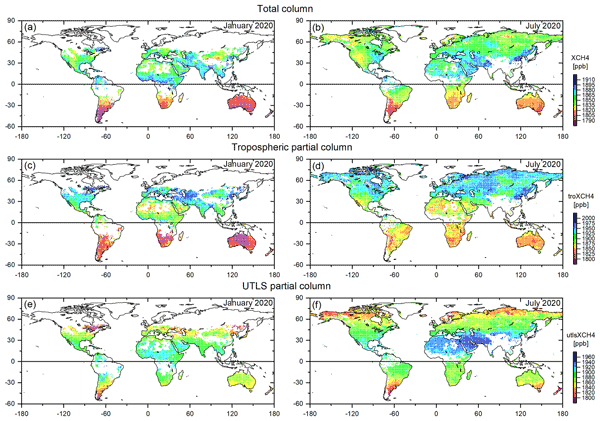
Matthias Schneider, Benjamin Ertl, Qiansi Tu, Christopher J. Diekmann, Farahnaz Khosrawi, Amelie N. Röhling, Frank Hase, Darko Dubravica, Omaira E. García, Eliezer Sepúlveda, Tobias Borsdorff, Jochen Landgraf, Alba Lorente, André Butz, Huilin Chen, Rigel Kivi, Thomas Laemmel, Michel Ramonet, Cyril Crevoisier, Jérome Pernin, Martin Steinbacher, Frank Meinhardt, Kimberly Strong, Debra Wunch, Thorsten Warneke, Coleen Roehl, Paul O. Wennberg, Isamu Morino, Laura T. Iraci, Kei Shiomi, Nicholas M. Deutscher, David W. T. Griffith, Voltaire A. Velazco, and David F. Pollard
Atmos. Meas. Tech., 15, 4339–4371, https://doi.org/10.5194/amt-15-4339-2022, https://doi.org/10.5194/amt-15-4339-2022, 2022
Short summary
Short summary
We present a computationally very efficient method for the synergetic use of level 2 remote-sensing data products. We apply the method to IASI vertical profile and TROPOMI total column space-borne methane observations and thus gain sensitivity for the tropospheric methane partial columns, which is not achievable by the individual use of TROPOMI and IASI. These synergetic effects are evaluated theoretically and empirically by inter-comparisons to independent references of TCCON, AirCore, and GAW.
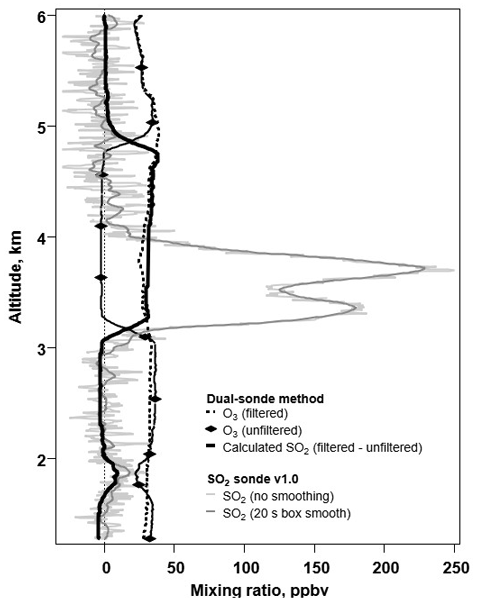
Subin Yoon, Alexander Kotsakis, Sergio L. Alvarez, Mark G. Spychala, Elizabeth Klovenski, Paul Walter, Gary Morris, Ernesto Corrales, Alfredo Alan, Jorge A. Diaz, and James H. Flynn
Atmos. Meas. Tech., 15, 4373–4384, https://doi.org/10.5194/amt-15-4373-2022, https://doi.org/10.5194/amt-15-4373-2022, 2022
Short summary
Short summary
SO2 is adverse to human health and the environment. A single SO2 sonde was developed to provide direct SO2 measurement with a greater vertical extent, a lower limit of detection, and less uncertainty relative to the previous dual-sonde method. The single sonde was tested in the field near volcanoes and anthropogenic sources where the sonde measured SO2 ranging from 0.5 to 940 ppb. This lighter-weight payload can be a great candidate to attach to small drones and unmanned aerial vehicles.
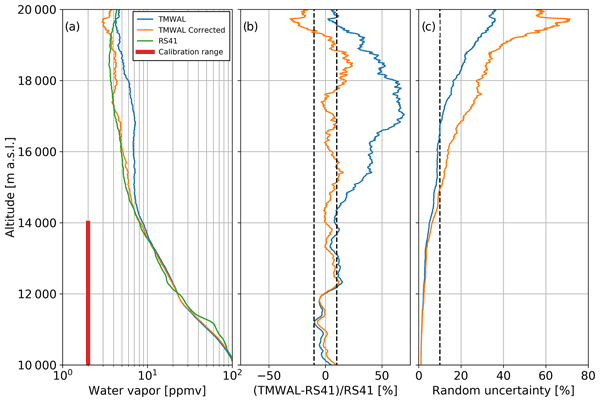
Fernando Chouza, Thierry Leblanc, Mark Brewer, Patrick Wang, Giovanni Martucci, Alexander Haefele, Hélène Vérèmes, Valentin Duflot, Guillaume Payen, and Philippe Keckhut
Atmos. Meas. Tech., 15, 4241–4256, https://doi.org/10.5194/amt-15-4241-2022, https://doi.org/10.5194/amt-15-4241-2022, 2022
Short summary
Short summary
The comparison of water vapor lidar measurements with co-located radiosondes and aerosol backscatter profiles indicates that laser-induced aerosol fluorescence in smoke layers injected into the stratosphere can introduce very large and chronic wet biases above 15 km, thus impacting the ability of these systems to accurately estimate long-term water vapor trends. The proposed correction method presented in this work is able to reduce this fluorescence-induced bias from 75 % to under 5 %.
Minqiang Zhou, Bavo Langerock, Pucai Wang, Corinne Vigouroux, Qichen Ni, Christian Hermans, Bart Dils, Nicolas Kumps, Weidong Nan, and Martine De Mazière
Atmos. Chem. Phys. Discuss., https://doi.org/10.5194/acp-2022-354, https://doi.org/10.5194/acp-2022-354, 2022
Revised manuscript not accepted
Short summary
Short summary
The ground-based FTIR measurements at Xianghe provide carbon monoxide (CO), acetylene (C2H2), ethane (C2H6), formaldehyde (H2CO), and hydrogen cyanide (HCN) total columns between June 2018 and November 2021. The retrieval strategies, retrieval information, and uncertainties of these five important trace gases are presented and discussed. This study provides an insight into the time series, variations, and correlations of these five species in North China.
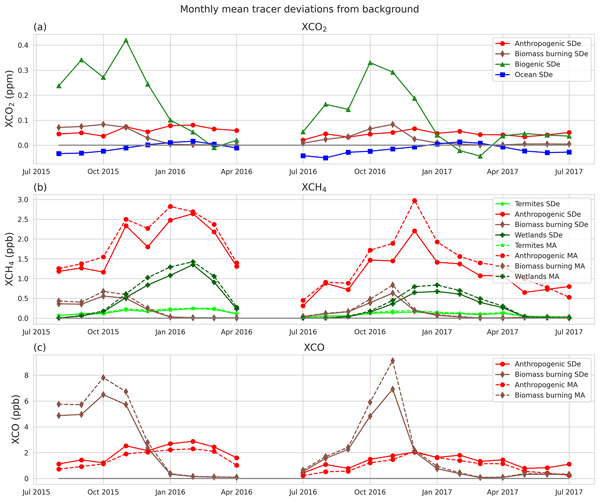
Sieglinde Callewaert, Jérôme Brioude, Bavo Langerock, Valentin Duflot, Dominique Fonteyn, Jean-François Müller, Jean-Marc Metzger, Christian Hermans, Nicolas Kumps, Michel Ramonet, Morgan Lopez, Emmanuel Mahieu, and Martine De Mazière
Atmos. Chem. Phys., 22, 7763–7792, https://doi.org/10.5194/acp-22-7763-2022, https://doi.org/10.5194/acp-22-7763-2022, 2022
Short summary
Short summary
A regional atmospheric transport model is used to analyze the factors contributing to CO2, CH4, and CO observations at Réunion Island. We show that the surface observations are dominated by local fluxes and dynamical processes, while the column data are influenced by larger-scale mechanisms such as biomass burning plumes. The model is able to capture the measured time series well; however, the results are highly dependent on accurate boundary conditions and high-resolution emission inventories.
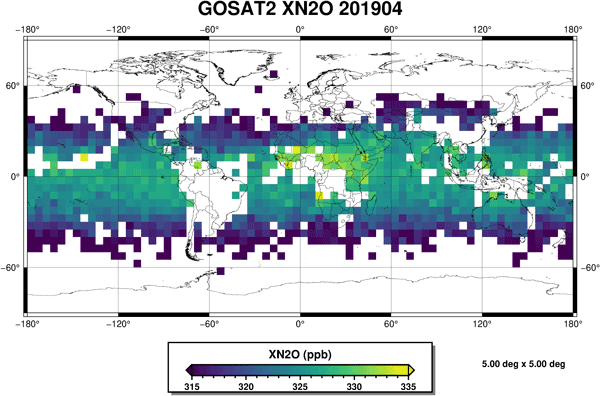
Stefan Noël, Maximilian Reuter, Michael Buchwitz, Jakob Borchardt, Michael Hilker, Oliver Schneising, Heinrich Bovensmann, John P. Burrows, Antonio Di Noia, Robert J. Parker, Hiroshi Suto, Yukio Yoshida, Matthias Buschmann, Nicholas M. Deutscher, Dietrich G. Feist, David W. T. Griffith, Frank Hase, Rigel Kivi, Cheng Liu, Isamu Morino, Justus Notholt, Young-Suk Oh, Hirofumi Ohyama, Christof Petri, David F. Pollard, Markus Rettinger, Coleen Roehl, Constantina Rousogenous, Mahesh Kumar Sha, Kei Shiomi, Kimberly Strong, Ralf Sussmann, Yao Té, Voltaire A. Velazco, Mihalis Vrekoussis, and Thorsten Warneke
Atmos. Meas. Tech., 15, 3401–3437, https://doi.org/10.5194/amt-15-3401-2022, https://doi.org/10.5194/amt-15-3401-2022, 2022
Short summary
Short summary
We present a new version (v3) of the GOSAT and GOSAT-2 FOCAL products.
In addition to an increased number of XCO2 data, v3 also includes products for XCH4 (full-physics and proxy), XH2O and the relative ratio of HDO to H2O (δD). For GOSAT-2, we also present first XCO and XN2O results. All FOCAL data products show reasonable spatial distribution and temporal variations and agree well with TCCON. Global XN2O maps show a gradient from the tropics to higher latitudes on the order of 15 ppb.
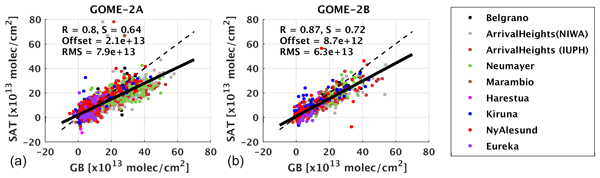
Gaia Pinardi, Michel Van Roozendael, François Hendrick, Andreas Richter, Pieter Valks, Ramina Alwarda, Kristof Bognar, Udo Frieß, José Granville, Myojeong Gu, Paul Johnston, Cristina Prados-Roman, Richard Querel, Kimberly Strong, Thomas Wagner, Folkard Wittrock, and Margarita Yela Gonzalez
Atmos. Meas. Tech., 15, 3439–3463, https://doi.org/10.5194/amt-15-3439-2022, https://doi.org/10.5194/amt-15-3439-2022, 2022
Short summary
Short summary
We report on the GOME-2A and GOME-2B OClO dataset (2007 to 2016, from the EUMETSAT's AC SAF) validation using data from nine NDACC zenith-scattered-light DOAS (ZSL-DOAS) instruments distributed in both the Arctic and Antarctic. Specific sensitivity tests are performed on the ground-based data to estimate the impact of the different OClO DOAS analysis settings and their typical errors. Good agreement is found for both the inter-annual variability and the overall OClO seasonal behavior.
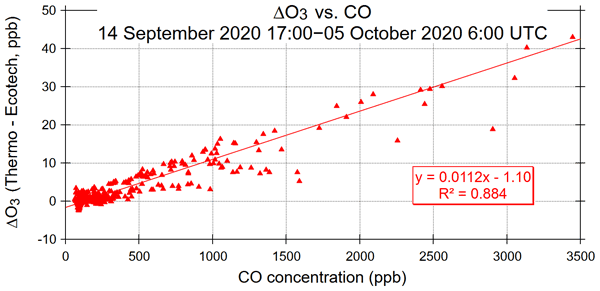
Noah Bernays, Daniel A. Jaffe, Irina Petropavlovskikh, and Peter Effertz
Atmos. Meas. Tech., 15, 3189–3192, https://doi.org/10.5194/amt-15-3189-2022, https://doi.org/10.5194/amt-15-3189-2022, 2022
Short summary
Short summary
Ozone is an important pollutant that impacts millions of people worldwide. It is therefore important to ensure accurate measurements. A recent surge in wildfire activity in the USA has resulted in significant enhancements in ozone concentration. However given the nature of wildfire smoke, there are questions about our ability to accurately measure ozone. In this comment, we discuss possible biases in the UV measurements of ozone in the presence of smoke.
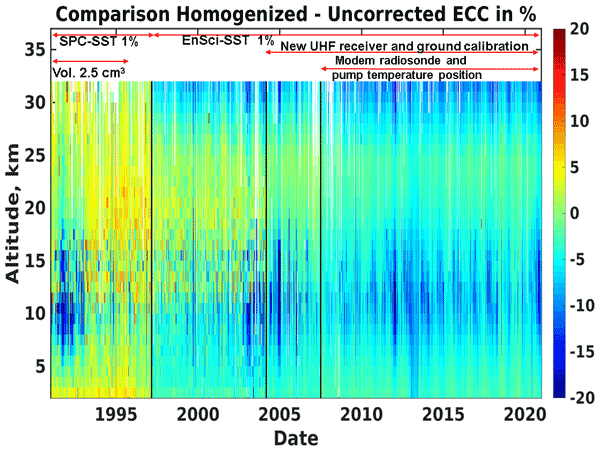
Gérard Ancellet, Sophie Godin-Beekmann, Herman G. J. Smit, Ryan M. Stauffer, Roeland Van Malderen, Renaud Bodichon, and Andrea Pazmiño
Atmos. Meas. Tech., 15, 3105–3120, https://doi.org/10.5194/amt-15-3105-2022, https://doi.org/10.5194/amt-15-3105-2022, 2022
Short summary
Short summary
The 1991–2021 Observatoire de Haute Provence electrochemical concentration cell (ECC) ozonesonde data have been homogenized according to the recommendations of the Ozonesonde Data Quality Assessment panel. Comparisons with ground-based instruments also measuring ozone at the same station (lidar, surface measurements) and with colocated satellite observations show the benefits of this homogenization. Remaining differences between ECC and other observations in the stratosphere are also discussed.

Nora Mettig, Mark Weber, Alexei Rozanov, John P. Burrows, Pepijn Veefkind, Anne M. Thompson, Ryan M. Stauffer, Thierry Leblanc, Gerard Ancellet, Michael J. Newchurch, Shi Kuang, Rigel Kivi, Matthew B. Tully, Roeland Van Malderen, Ankie Piters, Bogumil Kois, René Stübi, and Pavla Skrivankova
Atmos. Meas. Tech., 15, 2955–2978, https://doi.org/10.5194/amt-15-2955-2022, https://doi.org/10.5194/amt-15-2955-2022, 2022
Short summary
Short summary
Vertical ozone profiles from combined spectral measurements in the UV and IR spectral ranges were retrieved by using data from TROPOMI/S5P and CrIS/Suomi-NPP. The vertical resolution and accuracy of the ozone profiles are improved by combining both wavelength ranges compared to retrievals limited to UV or IR spectral data only. The advancement of our TOPAS algorithm for combined measurements is required because in the UV-only retrieval the vertical resolution in the troposphere is very limited.
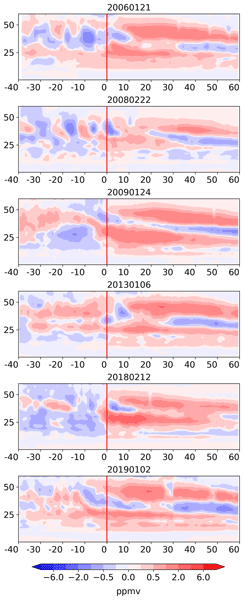
Shima Bahramvash Shams, Von P. Walden, James W. Hannigan, William J. Randel, Irina V. Petropavlovskikh, Amy H. Butler, and Alvaro de la Cámara
Atmos. Chem. Phys., 22, 5435–5458, https://doi.org/10.5194/acp-22-5435-2022, https://doi.org/10.5194/acp-22-5435-2022, 2022
Short summary
Short summary
Large-scale atmospheric circulation has a strong influence on ozone in the Arctic, and certain anomalous dynamical events, such as sudden stratospheric warmings, cause dramatic alterations of the large-scale circulation. A reanalysis model is evaluated and then used to investigate the impact of sudden stratospheric warmings on mid-atmospheric ozone. Results show that the position of the cold jet stream over the Arctic before these events influences the variability of ozone.
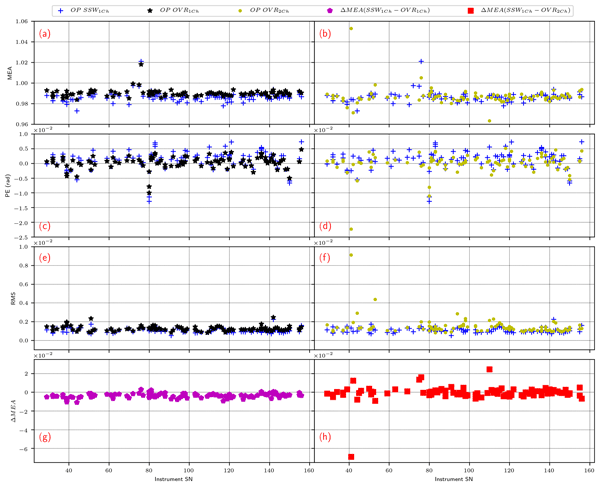
Carlos Alberti, Frank Hase, Matthias Frey, Darko Dubravica, Thomas Blumenstock, Angelika Dehn, Paolo Castracane, Gregor Surawicz, Roland Harig, Bianca C. Baier, Caroline Bès, Jianrong Bi, Hartmut Boesch, André Butz, Zhaonan Cai, Jia Chen, Sean M. Crowell, Nicholas M. Deutscher, Dragos Ene, Jonathan E. Franklin, Omaira García, David Griffith, Bruno Grouiez, Michel Grutter, Abdelhamid Hamdouni, Sander Houweling, Neil Humpage, Nicole Jacobs, Sujong Jeong, Lilian Joly, Nicholas B. Jones, Denis Jouglet, Rigel Kivi, Ralph Kleinschek, Morgan Lopez, Diogo J. Medeiros, Isamu Morino, Nasrin Mostafavipak, Astrid Müller, Hirofumi Ohyama, Paul I. Palmer, Mahesh Pathakoti, David F. Pollard, Uwe Raffalski, Michel Ramonet, Robbie Ramsay, Mahesh Kumar Sha, Kei Shiomi, William Simpson, Wolfgang Stremme, Youwen Sun, Hiroshi Tanimoto, Yao Té, Gizaw Mengistu Tsidu, Voltaire A. Velazco, Felix Vogel, Masataka Watanabe, Chong Wei, Debra Wunch, Marcia Yamasoe, Lu Zhang, and Johannes Orphal
Atmos. Meas. Tech., 15, 2433–2463, https://doi.org/10.5194/amt-15-2433-2022, https://doi.org/10.5194/amt-15-2433-2022, 2022
Short summary
Short summary
Space-borne greenhouse gas missions require ground-based validation networks capable of providing fiducial reference measurements. Here, considerable refinements of the calibration procedures for the COllaborative Carbon Column Observing Network (COCCON) are presented. Laboratory and solar side-by-side procedures for the characterization of the spectrometers have been refined and extended. Revised calibration factors for XCO2, XCO and XCH4 are provided, incorporating 47 new spectrometers.
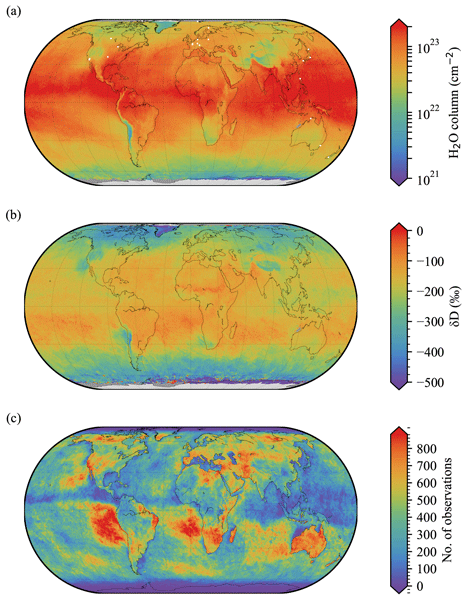
Andreas Schneider, Tobias Borsdorff, Joost aan de Brugh, Alba Lorente, Franziska Aemisegger, David Noone, Dean Henze, Rigel Kivi, and Jochen Landgraf
Atmos. Meas. Tech., 15, 2251–2275, https://doi.org/10.5194/amt-15-2251-2022, https://doi.org/10.5194/amt-15-2251-2022, 2022
Short summary
Short summary
This paper presents an extended H₂O/HDO total column dataset from short-wave infrared measurements by TROPOMI including cloudy and clear-sky scenes. Coverage is tremendously increased compared to previous TROPOMI HDO datasets. The new dataset is validated against recent ground-based FTIR measurements from TCCON and against aircraft measurements over the ocean. The use of the new dataset is demonstrated with a case study of a cold air outbreak in January 2020.
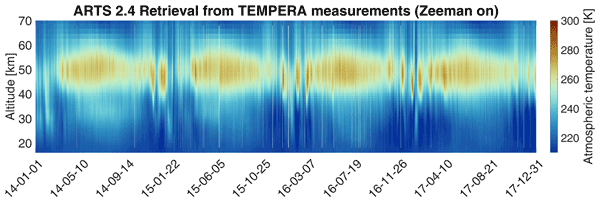
Witali Krochin, Francisco Navas-Guzmán, David Kuhl, Axel Murk, and Gunter Stober
Atmos. Meas. Tech., 15, 2231–2249, https://doi.org/10.5194/amt-15-2231-2022, https://doi.org/10.5194/amt-15-2231-2022, 2022
Short summary
Short summary
This study leverages atmospheric temperature measurements performed with a ground-based radiometer making use of data that was collected during a 4-year observational campaign applying a new retrieval algorithm that improves the maximal altitude range from 45 to 55 km. The measurements are validated against two independent data sets, MERRA2 reanalysis data and the meteorological analysis of NAVGEM-HA.
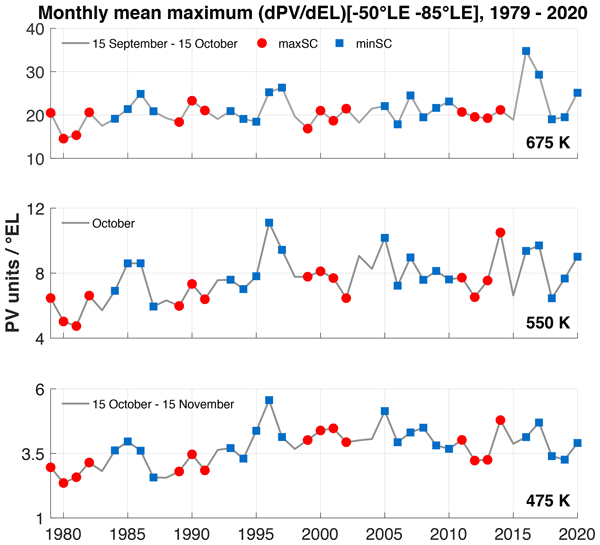
Audrey Lecouffe, Sophie Godin-Beekmann, Andrea Pazmiño, and Alain Hauchecorne
Atmos. Chem. Phys., 22, 4187–4200, https://doi.org/10.5194/acp-22-4187-2022, https://doi.org/10.5194/acp-22-4187-2022, 2022
Short summary
Short summary
This study uses a model developped at LATMOS (France) to analyze the behavior of the Antarctic polar vortex from 1979 to 2020 at 675 K, 550 K, and 475 K isentropic levels. We found that the vortex edge intensity is stronger during the September–October–November period, while its edge position is less extended during this period. The polar vortex is stronger and lasts longer during solar minimum years. Breakup dates of the polar vortex are linked to the ozone hole and maximum wind speed.
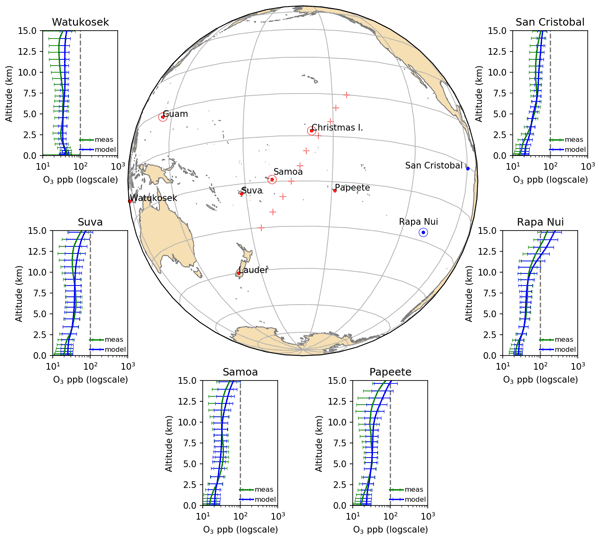
Nikos Daskalakis, Laura Gallardo, Maria Kanakidou, Johann Rasmus Nüß, Camilo Menares, Roberto Rondanelli, Anne M. Thompson, and Mihalis Vrekoussis
Atmos. Chem. Phys., 22, 4075–4099, https://doi.org/10.5194/acp-22-4075-2022, https://doi.org/10.5194/acp-22-4075-2022, 2022
Short summary
Short summary
Forest fires emit carbon monoxide (CO) that can be transported into the atmosphere far from the sources and reacts to produce ozone (O3) that affects climate, ecosystems and health. O3 is also produced in the stratosphere and can be transported downwards. Using a global numerical model, we found that forest fires can affect CO and O3 even in the South Pacific, the most pristine region of the global ocean, but transport from the stratosphere is a more important O3 source than fires in the region.
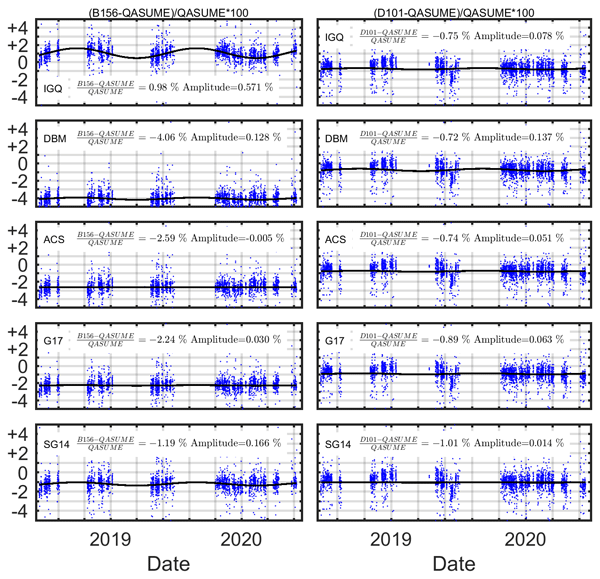
Luca Egli, Julian Gröbner, Gregor Hülsen, Herbert Schill, and René Stübi
Atmos. Meas. Tech., 15, 1917–1930, https://doi.org/10.5194/amt-15-1917-2022, https://doi.org/10.5194/amt-15-1917-2022, 2022
Short summary
Short summary
This study presents traceable total column ozone retrievals from direct solar spectral irradiance measurements. The retrieved ozone does not require any field calibration with a reference instrument as it is required for other operational network instruments such as Brewer or Dobson. Total column ozone can be retrieved with a traceable overall standard uncertainty of less than 0.8 % indicating a benchmark uncertainty for total column ozone measurements.
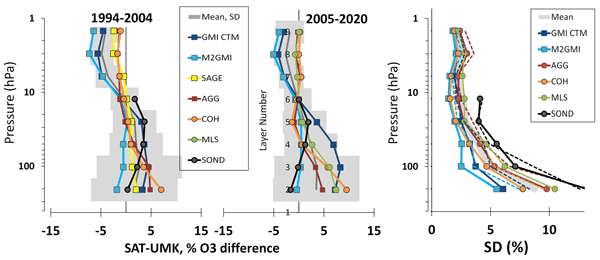
Irina Petropavlovskikh, Koji Miyagawa, Audra McClure-Beegle, Bryan Johnson, Jeannette Wild, Susan Strahan, Krzysztof Wargan, Richard Querel, Lawrence Flynn, Eric Beach, Gerard Ancellet, and Sophie Godin-Beekmann
Atmos. Meas. Tech., 15, 1849–1870, https://doi.org/10.5194/amt-15-1849-2022, https://doi.org/10.5194/amt-15-1849-2022, 2022
Short summary
Short summary
The Montreal Protocol and its amendments assure the recovery of the stratospheric ozone layer that protects the Earth from harmful ultraviolet radiation. To monitor ozone recovery, multiple satellites and ground-based observational platforms collect ozone data. The changes in instruments can influence the continuation of the ozone data. We discuss a method to remove instrumental artifacts from ozone records to improve the internal consistency among multiple observational records.
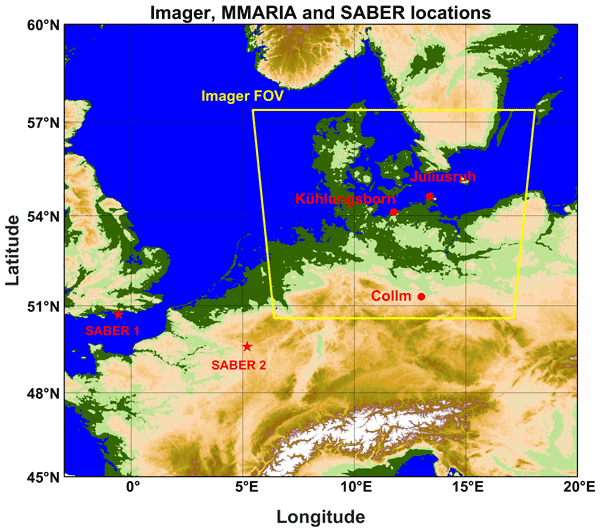
Sumanta Sarkhel, Gunter Stober, Jorge L. Chau, Steven M. Smith, Christoph Jacobi, Subarna Mondal, Martin G. Mlynczak, and James M. Russell III
Ann. Geophys., 40, 179–190, https://doi.org/10.5194/angeo-40-179-2022, https://doi.org/10.5194/angeo-40-179-2022, 2022
Short summary
Short summary
A rare gravity wave event was observed on the night of 25 April 2017 over northern Germany. An all-sky airglow imager recorded an upward-propagating wave at different altitudes in mesosphere with a prominent wave front above 91 km and faintly observed below. Based on wind and satellite-borne temperature profiles close to the event location, we have found the presence of a leaky thermal duct layer in 85–91 km. The appearance of this duct layer caused the wave amplitudes to diminish below 91 km.
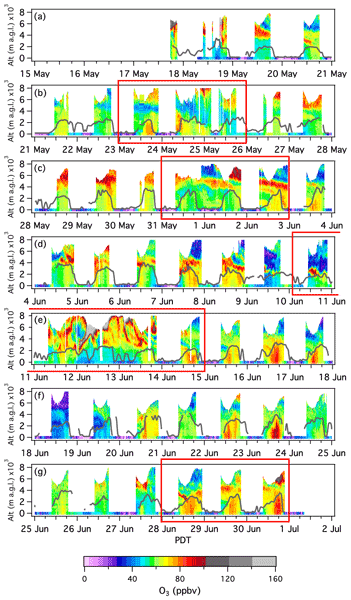
Andrew O. Langford, Christoph J. Senff, Raul J. Alvarez II, Ken C. Aikin, Sunil Baidar, Timothy A. Bonin, W. Alan Brewer, Jerome Brioude, Steven S. Brown, Joel D. Burley, Dani J. Caputi, Stephen A. Conley, Patrick D. Cullis, Zachary C. J. Decker, Stéphanie Evan, Guillaume Kirgis, Meiyun Lin, Mariusz Pagowski, Jeff Peischl, Irina Petropavlovskikh, R. Bradley Pierce, Thomas B. Ryerson, Scott P. Sandberg, Chance W. Sterling, Ann M. Weickmann, and Li Zhang
Atmos. Chem. Phys., 22, 1707–1737, https://doi.org/10.5194/acp-22-1707-2022, https://doi.org/10.5194/acp-22-1707-2022, 2022
Short summary
Short summary
The Fires, Asian, and Stratospheric Transport–Las Vegas Ozone Study (FAST-LVOS) combined lidar, aircraft, and in situ measurements with global models to investigate the contributions of stratospheric intrusions, regional and Asian pollution, and wildfires to background ozone in the southwestern US during May and June 2017 and demonstrated that these processes contributed to background ozone levels that exceeded 70 % of the US National Ambient Air Quality Standard during the 6-week campaign.
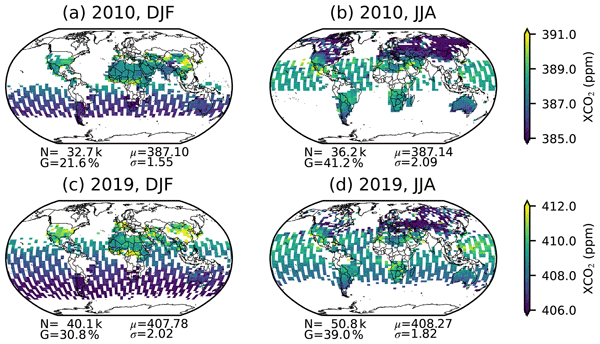
Thomas E. Taylor, Christopher W. O'Dell, David Crisp, Akhiko Kuze, Hannakaisa Lindqvist, Paul O. Wennberg, Abhishek Chatterjee, Michael Gunson, Annmarie Eldering, Brendan Fisher, Matthäus Kiel, Robert R. Nelson, Aronne Merrelli, Greg Osterman, Frédéric Chevallier, Paul I. Palmer, Liang Feng, Nicholas M. Deutscher, Manvendra K. Dubey, Dietrich G. Feist, Omaira E. García, David W. T. Griffith, Frank Hase, Laura T. Iraci, Rigel Kivi, Cheng Liu, Martine De Mazière, Isamu Morino, Justus Notholt, Young-Suk Oh, Hirofumi Ohyama, David F. Pollard, Markus Rettinger, Matthias Schneider, Coleen M. Roehl, Mahesh Kumar Sha, Kei Shiomi, Kimberly Strong, Ralf Sussmann, Yao Té, Voltaire A. Velazco, Mihalis Vrekoussis, Thorsten Warneke, and Debra Wunch
Earth Syst. Sci. Data, 14, 325–360, https://doi.org/10.5194/essd-14-325-2022, https://doi.org/10.5194/essd-14-325-2022, 2022
Short summary
Short summary
We provide an analysis of an 11-year record of atmospheric carbon dioxide (CO2) concentrations derived using an optimal estimation retrieval algorithm on measurements made by the GOSAT satellite. The new product (version 9) shows improvement over the previous version (v7.3) as evaluated against independent estimates of CO2 from ground-based sensors and atmospheric inversion systems. We also compare the new GOSAT CO2 values to collocated estimates from NASA's Orbiting Carbon Observatory-2.
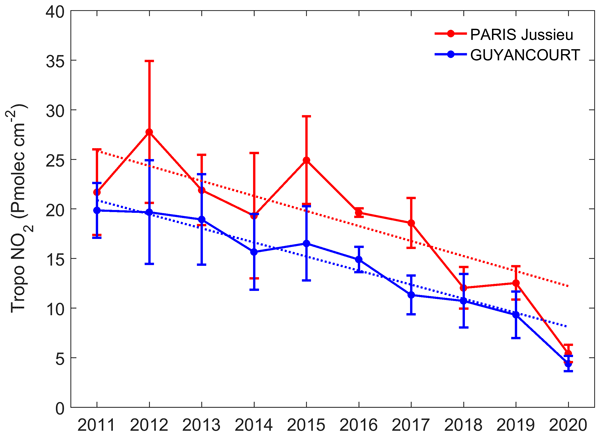
Andrea Pazmiño, Matthias Beekmann, Florence Goutail, Dmitry Ionov, Ariane Bazureau, Manuel Nunes-Pinharanda, Alain Hauchecorne, and Sophie Godin-Beekmann
Atmos. Chem. Phys., 21, 18303–18317, https://doi.org/10.5194/acp-21-18303-2021, https://doi.org/10.5194/acp-21-18303-2021, 2021
Short summary
Short summary
UV-Visible Système d'Analyse par Observations Zénithales (SAOZ) NO2 tropospheric columns were evaluated to quantify the impact of the lockdown in limiting the COVID-19 propagation. Meteorological conditions and NO2 trends were considered. The negative anomaly in tropospheric columns in 2020, attributed to the lockdown (17 March–10 May and related emissions reductions), was 56 % at Paris and 46 % at a suburban site. A similar anomaly was found in the Airparif data of surface concentrations.

Christoph Jacobi, Friederike Lilienthal, Dmitry Korotyshkin, Evgeny Merzlyakov, and Gunter Stober
Adv. Radio Sci., 19, 185–193, https://doi.org/10.5194/ars-19-185-2021, https://doi.org/10.5194/ars-19-185-2021, 2021
Short summary
Short summary
We compare winds and tidal amplitudes in the upper mesosphere/lower thermosphere region for cases with disturbed and undisturbed geomagnetic conditions. The zonal winds in both the mesosphere and lower thermosphere tend to be weaker during disturbed conditions. The summer equatorward meridional wind jet is weaker for disturbed geomagnetic conditions. The effect of geomagnetic variability on tidal amplitudes, except for the semidiurnal tide, is relatively small.
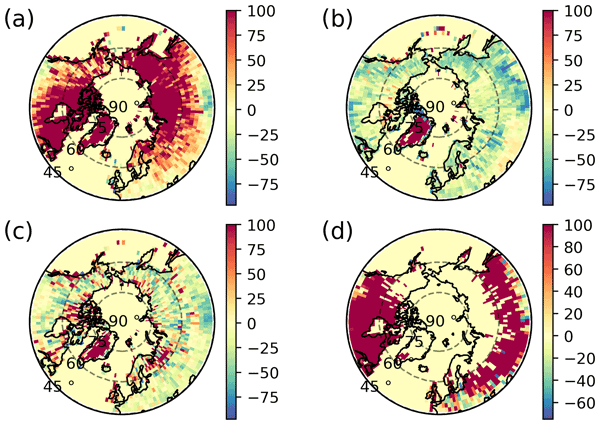
Joseph Mendonca, Ray Nassar, Christopher W. O'Dell, Rigel Kivi, Isamu Morino, Justus Notholt, Christof Petri, Kimberly Strong, and Debra Wunch
Atmos. Meas. Tech., 14, 7511–7524, https://doi.org/10.5194/amt-14-7511-2021, https://doi.org/10.5194/amt-14-7511-2021, 2021
Short summary
Short summary
Machine learning has become an important tool for pattern recognition in many applications. In this study, we used a neural network to improve the data quality of OCO-2 measurements made at northern high latitudes. The neural network was trained and used as a binary classifier to filter out bad OCO-2 measurements in order to increase the accuracy and precision of OCO-2 XCO2 measurements in the Boreal and Arctic regions.
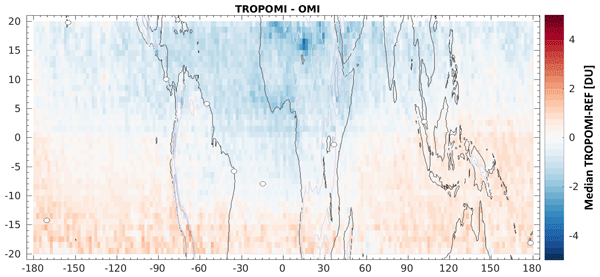
Daan Hubert, Klaus-Peter Heue, Jean-Christopher Lambert, Tijl Verhoelst, Marc Allaart, Steven Compernolle, Patrick D. Cullis, Angelika Dehn, Christian Félix, Bryan J. Johnson, Arno Keppens, Debra E. Kollonige, Christophe Lerot, Diego Loyola, Matakite Maata, Sukarni Mitro, Maznorizan Mohamad, Ankie Piters, Fabian Romahn, Henry B. Selkirk, Francisco R. da Silva, Ryan M. Stauffer, Anne M. Thompson, J. Pepijn Veefkind, Holger Vömel, Jacquelyn C. Witte, and Claus Zehner
Atmos. Meas. Tech., 14, 7405–7433, https://doi.org/10.5194/amt-14-7405-2021, https://doi.org/10.5194/amt-14-7405-2021, 2021
Short summary
Short summary
We assess the first 2 years of TROPOMI tropical tropospheric ozone column data. Comparisons to reference measurements by ozonesonde and satellite sensors show that TROPOMI bias (−0.1 to +2.3 DU) and precision (1.5 to 2.5 DU) meet mission requirements. Potential causes of bias and its spatio-temporal structure are discussed, as well as ways to identify sampling errors. Our analysis of known geophysical patterns demonstrates the improved performance of TROPOMI with respect to its predecessors.
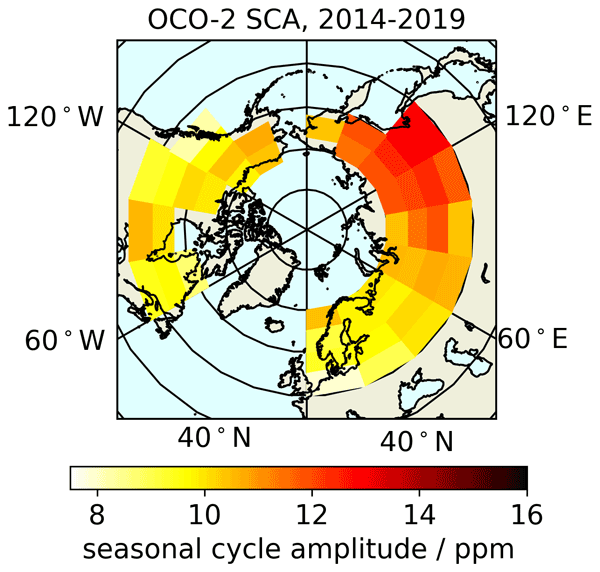
Nicole Jacobs, William R. Simpson, Kelly A. Graham, Christopher Holmes, Frank Hase, Thomas Blumenstock, Qiansi Tu, Matthias Frey, Manvendra K. Dubey, Harrison A. Parker, Debra Wunch, Rigel Kivi, Pauli Heikkinen, Justus Notholt, Christof Petri, and Thorsten Warneke
Atmos. Chem. Phys., 21, 16661–16687, https://doi.org/10.5194/acp-21-16661-2021, https://doi.org/10.5194/acp-21-16661-2021, 2021
Short summary
Short summary
Spatial patterns of carbon dioxide seasonal cycle amplitude and summer drawdown timing derived from the OCO-2 satellite over northern high latitudes agree well with corresponding estimates from two models. The Asian boreal forest is anomalous with the largest amplitude and earliest seasonal drawdown. Modeled land contact tracers suggest that accumulated CO2 exchanges during atmospheric transport play a major role in shaping carbon dioxide seasonality in northern high-latitude regions.
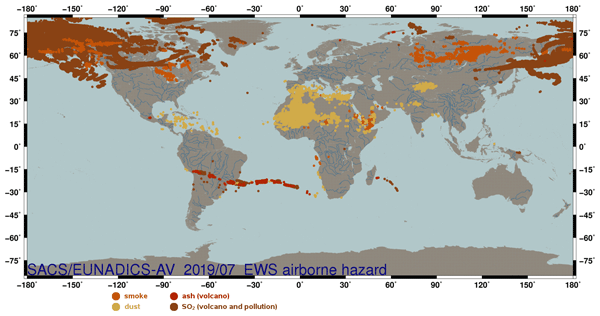
Hugues Brenot, Nicolas Theys, Lieven Clarisse, Jeroen van Gent, Daniel R. Hurtmans, Sophie Vandenbussche, Nikolaos Papagiannopoulos, Lucia Mona, Timo Virtanen, Andreas Uppstu, Mikhail Sofiev, Luca Bugliaro, Margarita Vázquez-Navarro, Pascal Hedelt, Michelle Maree Parks, Sara Barsotti, Mauro Coltelli, William Moreland, Simona Scollo, Giuseppe Salerno, Delia Arnold-Arias, Marcus Hirtl, Tuomas Peltonen, Juhani Lahtinen, Klaus Sievers, Florian Lipok, Rolf Rüfenacht, Alexander Haefele, Maxime Hervo, Saskia Wagenaar, Wim Som de Cerff, Jos de Laat, Arnoud Apituley, Piet Stammes, Quentin Laffineur, Andy Delcloo, Robertson Lennart, Carl-Herbert Rokitansky, Arturo Vargas, Markus Kerschbaum, Christian Resch, Raimund Zopp, Matthieu Plu, Vincent-Henri Peuch, Michel Van Roozendael, and Gerhard Wotawa
Nat. Hazards Earth Syst. Sci., 21, 3367–3405, https://doi.org/10.5194/nhess-21-3367-2021, https://doi.org/10.5194/nhess-21-3367-2021, 2021
Short summary
Short summary
The purpose of the EUNADICS-AV (European Natural Airborne Disaster Information and Coordination System for Aviation) prototype early warning system (EWS) is to develop the combined use of harmonised data products from satellite, ground-based and in situ instruments to produce alerts of airborne hazards (volcanic, dust, smoke and radionuclide clouds), satisfying the requirement of aviation air traffic management (ATM) stakeholders (https://cordis.europa.eu/project/id/723986).
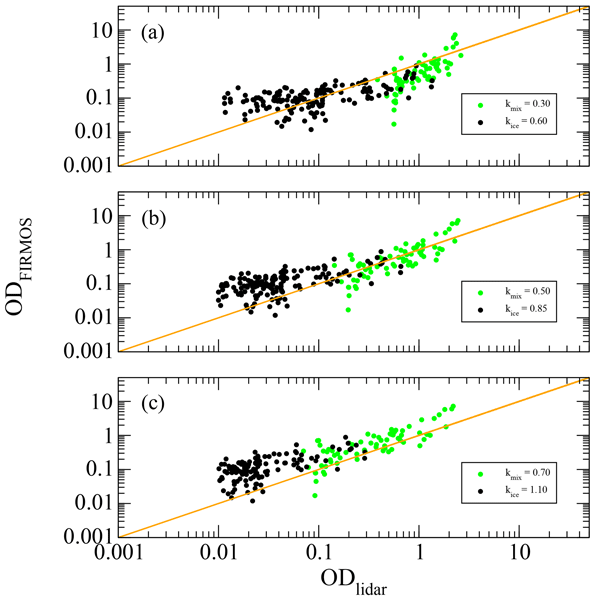
Gianluca Di Natale, Marco Barucci, Claudio Belotti, Giovanni Bianchini, Francesco D'Amato, Samuele Del Bianco, Marco Gai, Alessio Montori, Ralf Sussmann, Silvia Viciani, Hannes Vogelmann, and Luca Palchetti
Atmos. Meas. Tech., 14, 6749–6758, https://doi.org/10.5194/amt-14-6749-2021, https://doi.org/10.5194/amt-14-6749-2021, 2021
Short summary
Short summary
The importance of cirrus and mixed-phase clouds in the Earth radiation budget has been proven by many studies. In this paper the properties that characterize these clouds are retrieved from lidar and far-infrared spectral measurements performed in winter 2018/19 on the Zugspitze (Germany). The synergy of lidar and spectrometer measurements allowed us to assess the exponent k of the power-law relationship between the backscattering and the extinction coefficients.
Cited articles
Arosio, C., Rozanov, A., Malinina, E., Weber, M., and Burrows, J. P.: Merging of ozone profiles from SCIAMACHY, OMPS and SAGE II observations to study stratospheric ozone changes, Atmos. Meas. Tech., 12, 2423–2444, https://doi.org/10.5194/amt-12-2423-2019, 2019.
Ball, W. T., Alsing, J., Mortlock, D. J., Rozanov, E. V., Tummon, F., and Haigh, J. D.: Reconciling differences in stratospheric ozone composites, Atmos. Chem. Phys., 17, 12269–12302, https://doi.org/10.5194/acp-17-12269-2017, 2017.
Ball, W. T., Alsing, J., Mortlock, D. J., Staehelin, J., Haigh, J. D., Peter, T., Tummon, F., Stübi, R., Stenke, A., Anderson, J., Bourassa, A., Davis, S. M., Degenstein, D., Frith, S., Froidevaux, L., Roth, C., Sofieva, V., Wang, R., Wild, J., Yu, P., Ziemke, J. R., and Rozanov, E. V.: Evidence for a continuous decline in lower stratospheric ozone offsetting ozone layer recovery, Atmos. Chem. Phys., 18, 1379–1394, https://doi.org/10.5194/acp-18-1379-2018, 2018.
Betancourt, M.: A conceptual introduction to Hamiltonian Monte Carlo, arXiv [preprint], https://doi.org/10.48550/arXiv.1701.02434, 2017.
Björklund, R., Vigouroux, C., Effertz, P., García, O. E., Geddes, A., Hannigan, J., Miyagawa, K., Kotkamp, M., Langerock, B., Nedoluha, G., Ortega, I., Petropavlovskikh, I., Poyraz, D., Querel, R., Robinson, J., Shiona, H., Smale, D., Smale, P., Van Malderen, R., and De Mazière, M.: Intercomparison of long-term ground-based measurements of total, tropospheric, and stratospheric ozone at Lauder, New Zealand, Atmos. Meas. Tech., 17, 6819–6849, https://doi.org/10.5194/amt-17-6819-2024, 2024.
Box, G. E. P. and Tiao, G. C.: A Bayesian approach to some outlier problems, Biometrika, 55, 119–129, https://doi.org/10.1093/biomet/55.1.119, 1968.
Cochrane, D. and Orcutt, G. H.: Application of least squares regression to relationships containing auto-correlated error terms, J. Am. Stat. Assoc., 44, 32–61, https://doi.org/10.1080/01621459.1949.10483290, 1949.
Davis, S. M., Rosenlof, K. H., Hassler, B., Hurst, D. F., Read, W. G., Vömel, H., Selkirk, H., Fujiwara, M., and Damadeo, R.: The Stratospheric Water and Ozone Satellite Homogenized (SWOOSH) database: a long-term database for climate studies, Earth Syst. Sci. Data, 8, 461–490, https://doi.org/10.5194/essd-8-461-2016, 2016.
Dietmüller, S., Garny, H., Eichinger, R., and Ball, W. T.: Analysis of recent lower-stratospheric ozone trends in chemistry climate models, Atmos. Chem. Phys., 21, 6811–6837, https://doi.org/10.5194/acp-21-6811-2021, 2021.
Emili, E., Barret, B., Massart, S., Le Flochmoen, E., Piacentini, A., El Amraoui, L., Pannekoucke, O., and Cariolle, D.: Combined assimilation of IASI and MLS observations to constrain tropospheric and stratospheric ozone in a global chemical transport model, Atmos. Chem. Phys., 14, 177–198, https://doi.org/10.5194/acp-14-177-2014, 2014.
Frith, S. M., Bhartia, P. K., Oman, L. D., Kramarova, N. A., McPeters, R. D., and Labow, G. J.: Model-based climatology of diurnal variability in stratospheric ozone as a data analysis tool, Atmos. Meas. Tech., 13, 2733–2749, https://doi.org/10.5194/amt-13-2733-2020, 2020.
Froidevaux, L., Anderson, J., Wang, H.-J., Fuller, R. A., Schwartz, M. J., Santee, M. L., Livesey, N. J., Pumphrey, H. C., Bernath, P. F., Russell III, J. M., and McCormick, M. P.: Global OZone Chemistry And Related trace gas Data records for the Stratosphere (GOZCARDS): methodology and sample results with a focus on HCl, H2O, and O3, Atmos. Chem. Phys., 15, 10471–10507, https://doi.org/10.5194/acp-15-10471-2015, 2015.
García, O. E., Schneider, M., Redondas, A., González, Y., Hase, F., Blumenstock, T., and Sepúlveda, E.: Investigating the long-term evolution of subtropical ozone profiles resolved by ground-based FTIR spectrometry, Atmos. Chem. Phys., 12, 5137–5151,https://doi.org/10.5194/acp-12-5137-2012, 2012.
Godin-Beekmann, S., Porteneuve, J., and Garnier, A.: Systematic DIAL ozone measurements at Observatoire de Haute-Provence, J. Env. Monitor., 5, 57–67, 2003.
Godin-Beekmann, S., Azouz, N., Sofieva, V. F., Hubert, D., Petropavlovskikh, I., Effertz, P., Ancellet, G., Degenstein, D. A., Zawada, D., Froidevaux, L., Frith, S., Wild, J., Davis, S., Steinbrecht, W., Leblanc, T., Querel, R., Tourpali, K., Damadeo, R., Maillard Barras, E., Stübi, R., Vigouroux, C., Arosio, C., Nedoluha, G., Boyd, I., Van Malderen, R., Mahieu, E., Smale, D., and Sussmann, R.: Updated trends of the stratospheric ozone vertical distribution in the 60° S–60° N latitude range based on the LOTUS regression model, Atmos. Chem. Phys., 22, 11657–11673, https://doi.org/10.5194/acp-22-11657-2022, 2022.
Gordon, I., Rothman, L., Hargreaves, R., Hashemi, R., Karlovets, E., Skinner, F., Conway, E., Hill, C., Kochanov, R., Tan, Y., Wcisło, P., Finenko, A., Nelson, K., Bernath, P., Birk, M., Boudon, V., Campargue, A., Chance, K., Coustenis, A., Drouin, B., Flaud, J., Gamache, R., Hodges, J., Jacquemart, D., Mlawer, E., Nikitin, A., Perevalov, V., Rotger, M., Tennyson, J., Toon, G., Tran, H., Tyuterev, V., Adkins, E., Baker, A., Barbe, A., Canè, E., Császár, A., Dudaryonok, A., Egorov, O., Fleisher, A., Fleurbaey, H., Foltynowicz, A., Furtenbacher, T., Harrison, J., Hartmann, J., Horneman, V., Huang, X., Karman, T., Karns, J., Kassi, S., Kleiner, I., Kofman, V., Kwabia-Tchana, F., Lavrentieva, N., Lee, T., Long, D., Lukashevskaya, A., Lyulin, O., Makhnev, V., Matt, W., Massie, S., Melosso, M., Mikhailenko, S., Mondelain, D., Müller, H., Naumenko, O., Perrin, A., Polyansky, O., Raddaoui, E., Raston, P., Reed, Z., Rey, M., Richard, C., Tóbiás, R., Sadiek, I., Schwenke, D., Starikova, E., Sung, K., Tamassia, F., Tashkun, S., Vander Auwera, J., Vasilenko, I., Vigasin, A., Villanueva, G., Vispoel, B., Wagner, G., Yachmenev, A., and Yurchenko, S.: The HITRAN2020 molecular spectroscopic database, J. Quant. Spectrosc. Ra., 277, 107949, https://doi.org/10.1016/j.jqsrt.2021.107949, 2022.
Hubert, D., Lambert, J.-C., Verhoelst, T., Granville, J., Keppens, A., Baray, J.-L., Bourassa, A. E., Cortesi, U., Degenstein, D. A., Froidevaux, L., Godin-Beekmann, S., Hoppel, K. W., Johnson, B. J., Kyrölä, E., Leblanc, T., Lichtenberg, G., Marchand, M., McElroy, C. T., Murtagh, D., Nakane, H., Portafaix, T., Querel, R., Russell III, J. M., Salvador, J., Smit, H. G. J., Stebel, K., Steinbrecht, W., Strawbridge, K. B., Stübi, R., Swart, D. P. J., Taha, G., Tarasick, D. W., Thompson, A. M., Urban, J., van Gijsel, J. A. E., Van Malderen, R., von der Gathen, P., Walker, K. A., Wolfram, E., and Zawodny, J. M.: Ground-based assessment of the bias and long-term stability of 14 limb and occultation ozone profile data records, Atmos. Meas. Tech., 9, 2497–2534, https://doi.org/10.5194/amt-9-2497-2016, 2016.
Inness, A., Ades, M., Agustí-Panareda, A., Barré, J., Benedictow, A., Blechschmidt, A.-M., Dominguez, J. J., Engelen, R., Eskes, H., Flemming, J., Huijnen, V., Jones, L., Kipling, Z., Massart, S., Parrington, M., Peuch, V.-H., Razinger, M., Remy, S., Schulz, M., and Suttie, M.: The CAMS reanalysis of atmospheric composition, Atmos. Chem. Phys., 19, 3515–3556, https://doi.org/10.5194/acp-19-3515-2019, 2019.
Jonas, C., Vigouroux, C., Langerock, B., Björklund, R., Boynard, A., Carlund, T., De Mazière, M., Effertz, P., Errera, Q., Frey, M. M., Granville, J., Hannigan, J. W., Keppens, A., Jepsen, N., Kivi, R., Lyall, N., Palm, M., Prignon, M., Sofieva, V. F., Strong, K., Svendby, T., Tarasick, D., Thölix, L., Van Malderen, R., Virolainen, Y., von Löwis, S., and Zhao, X.: Detection of ozone recovery in the Arctic from ground-based measurements, Atmos. Chem. Phys., 26, 8089–8124, https://doi.org/10.5194/acp-26-8089-2026, 2026.
Keppens, A., Hubert, D., Granville, J., Nath, O., Lambert, J.-C., Wespes, C., Coheur, P.-F., Clerbaux, C., Boynard, A., Siddans, R., Latter, B., Kerridge, B., Di Pede, S., Veefkind, P., Cuesta, J., Dufour, G., Heue, K.-P., Coldewey-Egbers, M., Loyola, D., Orfanoz-Cheuquelaf, A., Maratt Satheesan, S., Eichmann, K.-U., Rozanov, A., Sofieva, V. F., Ziemke, J. R., Inness, A., Van Malderen, R., and Hoffmann, L.: Harmonisation of sixteen tropospheric ozone satellite data records, Atmos. Meas. Tech., 18, 6893–6916, https://doi.org/10.5194/amt-18-6893-2025, 2025.
Kovilakam, M., Thomason, L., and Knepp, T.: SAGE III/ISS aerosol/cloud categorization and its impact on GloSSAC, Atmos. Meas. Tech., 16, 2709–2731, https://doi.org/10.5194/amt-16-2709-2023, 2023.
Kramarova, N. A., Frith, S. M., Bhartia, P. K., McPeters, R. D., Taylor, S. L., Fisher, B. L., Labow, G. J., and DeLand, M. T.: Validation of ozone monthly zonal mean profiles obtained from the version 8.6 Solar Backscatter Ultraviolet algorithm, Atmos. Chem. Phys., 13, 6887–6905, https://doi.org/10.5194/acp-13-6887-2013, 2013.
Leblanc, T., Sica, R. J., van Gijsel, J. A. E., Godin-Beekmann, S., Haefele, A., Trickl, T., Payen, G., and Gabarrot, F.: Proposed standardized definitions for vertical resolution and uncertainty in the NDACC lidar ozone and temperature algorithms – Part 1: Vertical resolution, Atmos. Meas. Tech., 9, 4029–4049, https://doi.org/10.5194/amt-9-4029-2016, 2016a.
Leblanc, T., Sica, R. J., van Gijsel, J. A. E., Godin-Beekmann, S., Haefele, A., Trickl, T., Payen, G., and Gabarrot, F.: Proposed standardized definitions for vertical resolution and uncertainty in the NDACC lidar ozone and temperature algorithms – Part 2: Ozone DIAL uncertainty budget, Atmos. Meas. Tech., 9, 4051–4078, https://doi.org/10.5194/amt-9-4051-2016, 2016b.
Maillard Barras, E., Haefele, A., Nguyen, L., Tummon, F., Ball, W. T., Rozanov, E. V., Rüfenacht, R., Hocke, K., Bernet, L., Kämpfer, N., Nedoluha, G., and Boyd, I.: Study of the dependence of long-term stratospheric ozone trends on local solar time, Atmos. Chem. Phys., 20, 8453–8471, https://doi.org/10.5194/acp-20-8453-2020, 2020.
Maillard Barras, E., Haefele, A., Stübi, R., Jouberton, A., Schill, H., Petropavlovskikh, I., Miyagawa, K., Stanek, M., and Froidevaux, L.: Dynamical linear modeling estimates of long-term ozone trends from homogenized Dobson Umkehr profiles at Arosa/Davos, Switzerland, Atmos. Chem. Phys., 22, 14283–14302, https://doi.org/10.5194/acp-22-14283-2022, 2022.
McPeters, R. D. and Labow, G. J.: Climatology 2011: An MLS and sonde derived ozone climatology for satellite retrieval algorithms, J. Geophys. Res., 117, D10303, https://doi.org/10.1029/2011JD017006, 2012.
Millán, L. F., Hoor, P., Hegglin, M. I., Manney, G. L., Boenisch, H., Jeffery, P. S., Kunkel, D., Petropavlovskikh, I., Ye, H., Leblanc, T., and Walker, K. A.: Ozone trends in the upper troposphere-lower stratosphere using equivalent latitude-potential temperature coordinates, Geophys. Res. Lett., 52, e2025GL118651, https://doi.org/10.1029/2025GL118651, 2025.
Mirallie, L. and Maillard Barras, E.: Microwave Radiometer ozone monthly mean profiles, Earth System Data Repository [data set], https://doi.org/10.57932/5d03aeb4-afbf-4e4b-8e34-39716222c7c4, 2026.
Mirallie, L. and Van Malderen, R.: Ozonesondes monthly means, Earth System Data Repository [data set], https://doi.org/10.57932/e37548b3-4153-4a4f-8100-1667a34cebfb, 2026.
Mirallie, L. and Jonas, C.: FTIR data monthly means, Earth System Data Repository [data set], https://doi.org/10.57932/05fd9510-360d-4a6d-ad92-7de679333ecb, 2026.
Mirallie, L., Steinbrecht, W., Godin-Beekmann, S., and Leblanc, T.: Lidar data monthly means, Earth System Data Repository [data set], https://doi.org/10.57932/d50c216e-65f5-4baa-b4b6-139ca9cfc0b4, 2026a.
Mirallie, L., Petropavlovskikh, I., and Maillard Barras, E.: Dobson Umkehr monthly means, Earth System Data Repository [data set], https://doi.org/10.57932/2eb1b6de-cfb2-43ba-86d1-c34add0a89bc, 2026b.
NDACC: NDACC observation capabilities, https://ndacc.larc.nasa.gov/data/observational-capabilities (last access: 19 June 2026), 2020.
Petropavlovskikh, I., Bhartia, P. K., and DeLuisi, J.: New Umkehr ozone profile retrieval algorithm optimized for climatological studies, Geophys. Res. Lett., 32, L16808, https://doi.org/10.1029/2005GL023323, 2005.
Petropavlovskikh, I., Evans, R. D., Carbaugh, G. L., Maillard, E., and Stübi, R.: Towards a better knowledge of Umkehr measurements: A detailed study of data from thirteen Dobson intercomparisons, World Meteorological Organization Global Atmosphere Watch, GAW No. 180, https://library.wmo.int/idurl/4/47514 (last access: 9 July 2026), 2008.
Petropavlovskikh, I., Evans, R., McConville, G., Miyagawa, K., and Oltmans, S.: Effect of the out-of-band stray light on the retrieval of the Umkehr Dobson ozone profiles, Int. J. Remote Sens., 30, 6461–6482, https://doi.org/10.1080/01431160902865806, 2009.
Petropavlovskikh, I., Evans, R., McConville, G., Oltmans, S., Quincy, D., Lantz, K., Disterhoft, P., Stanek, M., and Flynn, L.: Sensitivity of Dobson and Brewer Umkehr ozone profile retrievals to ozone cross-sections and stray light effects, Atmos. Meas. Tech., 4, 1841–1853, https://doi.org/10.5194/amt-4-1841-2011, 2011.
Petropavlovskikh, I., Godin-Beekmann, S., Hubert, D., Damadeo, R., Hassler, B., and Sofieva, V. (Eds.): SPARC/IO3C/GAW Report on Long-term Ozone Trends and Uncertainties in the Stratosphere, GAW Report No. 241, SPARC Report No. 9, WMO, Geneva, https://doi.org/10.17874/f899e15b258, 2019.
Petropavlovskikh, I., Miyagawa, K., McClure-Beegle, A., Johnson, B., Wild, J., Strahan, S., Wargan, K., Querel, R., Flynn, L., Beach, E., Ancellet, G., and Godin-Beekmann, S.: Optimized Umkehr profile algorithm for ozone trend analyses, Atmos. Meas. Tech., 15, 1849–1870, https://doi.org/10.5194/amt-15-1849-2022, 2022.
Petropavlovskikh, I., Wild, J. D., Abromitis, K., Effertz, P., Miyagawa, K., Flynn, L. E., Maillard Barras, E., Damadeo, R., McConville, G., Johnson, B., Cullis, P., Godin-Beekmann, S., Ancellet, G., Querel, R., Van Malderen, R., and Zawada, D.: Ozone trends in homogenized Umkehr, ozonesonde, and COH overpass records, Atmos. Chem. Phys., 25, 2895–2936, https://doi.org/10.5194/acp-25-2895-2025, 2025.
Randel, W. J., Garcia, R. R., Calvo, N., and Marsh, D.: ENSO influence on zonal mean temperature and ozone in the tropical lower stratosphere, Geophys. Res. Lett., 36, L15822, https://doi.org/10.1029/2009GL039343, 2009.
Rodgers, C. D.: Inverse Methods for Atmospheric Sounding – Theory and Practice, vol. 2 of Series on Atmospheric Oceanic and Planetary Physics, World Scientific Publishing Co. Pte. Ltd., Singapore, https://doi.org/10.1142/9789812813718, 2000.
Rigby, M., Park, S., Saito, T., Western, L. M., Redington, A. L., Fang, X., Henne, S., Manning, A. J., Prinn, R. G., Dutton, G. S., Fraser, P. J., Ganesan, A. L., Hall, B. D., Harth, C. M., Kim, J., Kim, K.-R., Krummel, P. B., Lee, T., Li, S., Liang, Q., Lunt, M. F., Montzka, S. A., Mühle, J., O'Doherty, S., Park, M.-K., Reimann, S., Salameh, P. K., Simmonds, P., Tunnicliffe, R. L., Weiss, R. F., Yokouchi, Y., and Young, D.: Increase in CFC-11 emissions from eastern China based on atmospheric observations, Nature, 569, 546–550, https://doi.org/10.1038/s41586-019-1193-4, 2019.
Salawitch, R. J., Smith, J. B., Selkirk, H., Wargan, K., Chipperfield, M. P., Hossaini, R., Levelt, P. F., Livesey, N. J., McBride, L. A., Millán, L. F., Moyer, E., Santee, M. L., Schoeberl, M. R., Solomon, S., Stone, K., and Worden, H. M.: The Imminent Data Desert: The Future of Stratospheric Monitoring in a Rapidly Changing World, B. Am. Meteorol. Soc., 106, E540–E563, https://doi.org/10.1175/BAMS-D-23-0281.1, 2025.
Sauvageat, E., Albers, R., Kotiranta, M., Hocke, K., Gómez, M., Nedoluha, G., and Murk, A.: Comparison of Three High Resolution Real-Time Spectrometers for Microwave Ozone Profiling Instruments, IEEE J. Sel. Top. Appl. Earth Obs., 14, https://doi.org/10.1109/JSTARS.2021.3114446, 2021.
Sauvageat, E., Maillard Barras, E., Hocke, K., Haefele, A., and Murk, A.: Harmonized retrieval of middle atmospheric ozone from two microwave radiometers in Switzerland, Atmos. Meas. Tech., 15, 6395–6417, https://doi.org/10.5194/amt-15-6395-2022, 2022.
Sauvageat, E., Hocke, K., Maillard Barras, E., Hou, S., Errera, Q., Haefele, A., and Murk, A.: Microwave radiometer observations of the ozone diurnal cycle and its short-term variability over Switzerland, Atmos. Chem. Phys., 23, 7321–7345, https://doi.org/10.5194/acp-23-7321-2023, 2023.
Schranz, F., Fernandez, S., Kämpfer, N., and Palm, M.: Diurnal variation in middle-atmospheric ozone observed by ground-based microwave radiometry at Ny-Ålesund over 1 year, Atmos. Chem. Phys., 18, 4113–4130, https://doi.org/10.5194/acp-18-4113-2018, 2018.
Smit, H. G. J. and Thompson, A. M. (Eds.): ASOPOS (Assessment of Standard Operating Procedures for Ozone Sondes) 2.0, GAW Report No. 268, WMO, Geneva, 2021.
Smit, H. G. J., Thompson, A. M., and the ASOPOS 2.0 Panel: Ozonesonde Measurement Principles and Best Operational Practices, WMO Global Atmosphere Watch Report Series, No. 268, World Meteorological Organization, Geneva, https://library.wmo.int/idurl/4/57720 (last access: 19 November 2025), 2021.
Smit, H. G. J., Poyraz, D., Van Malderen, R., Thompson, A. M., Tarasick, D. W., Stauffer, R. M., Johnson, B. J., and Kollonige, D. E.: New insights from the Jülich Ozone Sonde Intercomparison Experiment: calibration functions traceable to one ozone reference instrument, Atmos. Meas. Tech., 17, 73–112, https://doi.org/10.5194/amt-17-73-2024, 2024.
Sofieva, V. F., Szeląg, M., Tamminen, J., Kyrölä, E., Degenstein, D., Roth, C., Zawada, D., Rozanov, A., Arosio, C., Burrows, J. P., Weber, M., Laeng, A., Stiller, G. P., von Clarmann, T., Froidevaux, L., Livesey, N., van Roozendael, M., and Retscher, C.: Measurement report: regional trends of stratospheric ozone evaluated using the MErged GRIdded Dataset of Ozone Profiles (MEGRIDOP), Atmos. Chem. Phys., 21, 6707–6720, https://doi.org/10.5194/acp-21-6707-2021, 2021.
Sofieva, V. F., Szelag, M. E., Kramarova, N. A., Damadeo, R., Steinbrecht, W., Petropavlovskikh, I., Vigouroux, C., Maillard Barras, E., Zawada, D., Tourpali, K., Frith, S. M., Wild, J. D., Davis, S. M., Arosio, C., Weber, M., Rozanov, A., Auffarth, B., Froidevaux, L., Fuller, R., Degenstein, D., Dube, K., Effertz, P., Leblanc, T., Ancellet, G., Godin-Beekmann, S., McConville, G., Querel, R., Smale, D., DeBacker, M.-R., Mahieu, E., and Sussmann, R.: Updated global and regional trends of stratospheric ozone profiles, Atmos. Chem. Phys., 26, 7387–7405, https://doi.org/10.5194/acp-26-7387-2026, 2026.
Stan Development Team: CmdStanPy: A Python interface to CmdStan (Version 1.3.0), https://mc-stan.org/cmdstanpy/ (last access: 15 April 2026), 2024.
Stauffer, R. M., Thompson, A. M., Kollonige, D. E., Witte, J. C., Tarasick, D. W., Davies, J., Vömel, H., Morris, G. A., Van Malderen, R., Johnson, B. J., Querel, R. R., Selkirk, H. B., Stübi, R., and Schmidlin, F. J.: A post-2013 drop-off in total ozone at a third of global ozonesonde stations, Geophys. Res. Lett., 47, e2019GL086791, https://doi.org/10.1029/2019GL086791, 2020.
Stauffer, R. M., Thompson, A. M., Kollonige, D. E., Tarasick, D. W., Van Malderen, R., Smit, H. G., Vömel, H., Morris, G. A., Johnson, B. J., Cullis, P. D., Stübi, R., Davies, J., and Yan, M. M.: An examination of the recent stability of ozonesonde global network data, Earth Space Sci., 9, e2022EA002459, https://doi.org/10.1029/2022EA002459, 2022.
Stübi, R., Schill, H., Klausen, J., Vuilleumier, L., Gröbner, J., Egli, L., and Ruffieux, D.: On the compatibility of Brewer total column ozone measurements in two adjacent valleys (Arosa and Davos) in the Swiss Alps, Atmos. Meas. Tech., 10, 4479–4490, https://doi.org/10.5194/amt-10-4479-2017, 2017.
Szeląg, M. E., Sofieva, V. F., Degenstein, D., Roth, C., Davis, S., and Froidevaux, L.: Seasonal stratospheric ozone trends over 2000–2018 derived from several merged data sets, Atmos. Chem. Phys., 20, 7035–7047, https://doi.org/10.5194/acp-20-7035-2020, 2020.
Thomason, L. W., Ernest, N., Millán, L., Rieger, L., Bourassa, A., Vernier, J.-P., Manney, G., Luo, B., Arfeuille, F., and Peter, T.: A global space-based stratospheric aerosol climatology: 1979–2016, Earth Syst. Sci. Data, 10, 469–492, https://doi.org/10.5194/essd-10-469-2018, 2018.
Thompson, A. M., Stauffer, R. M., Kollonige, D. E., Ziemke, J. R., Johnson, B. J., Morris, G. A., Cullis, P., Cazorla, M., Diaz, J. A., Piters, A., Nedeljkovic, I., Warsodikromo, T., Raimundo Silva, F., Northam, E. T., Benjamin, P., Mkololo, T., Machinini, T., Félix, C., Romanens, G., Nyadida, S., Brioude, J., Evan, S., Metzger, J.-M., Dindang, A., Mahat, Y. B., Sammathuria, M. K., Zakaria, N. B., Komala, N., Ogino, S.-Y., Quyen, N. T., Mani, F. S., Vuiyasawa, M., Nardini, D., Martinsen, M., Kuniyuki, D. T., Müller, K., Wolff, P., and Sauvage, B.: Tropical tropospheric ozone trends (1998 to 2023): new perspectives from SHADOZ, IAGOS and OMI/MLS observations, Atmos. Chem. Phys., 25, 18475–18507, https://doi.org/10.5194/acp-25-18475-2025, 2025.
Van Malderen, R., Thompson, A. M., Kollonige, D. E., Stauffer, R. M., Smit, H. G. J., Maillard Barras, E., Vigouroux, C., Petropavlovskikh, I., Leblanc, T., Thouret, V., Wolff, P., Effertz, P., Tarasick, D. W., Poyraz, D., Ancellet, G., De Backer, M.-R., Evan, S., Flood, V., Frey, M. M., Hannigan, J. W., Hernandez, J. L., Iarlori, M., Johnson, B. J., Jones, N., Kivi, R., Mahieu, E., McConville, G., Müller, K., Nagahama, T., Notholt, J., Piters, A., Prats, N., Querel, R., Smale, D., Steinbrecht, W., Strong, K., and Sussmann, R.: Global ground-based tropospheric ozone measurements: reference data and individual site trends (2000–2022) from the TOAR-II/HEGIFTOM project, Atmos. Chem. Phys., 25, 7187–7225, https://doi.org/10.5194/acp-25-7187-2025, 2025a.
Van Malderen, R., Zang, Z., Chang, K.-L., Björklund, R., Cooper, O. R., Liu, J., Maillard Barras, E., Vigouroux, C., Petropavlovskikh, I., Leblanc, T., Thouret, V., Wolff, P., Effertz, P., Gaudel, A., Tarasick, D. W., Smit, H. G. J., Thompson, A. M., Stauffer, R. M., Kollonige, D. E., Poyraz, D., Ancellet, G., De Backer, M.-R., Frey, M. M., Hannigan, J. W., Hernandez, J. L., Johnson, B. J., Jones, N., Kivi, R., Mahieu, E., Morino, I., McConville, G., Müller, K., Murata, I., Notholt, J., Piters, A., Prignon, M., Querel, R., Rizi, V., Smale, D., Steinbrecht, W., Strong, K., and Sussmann, R.: Ground-based tropospheric ozone measurements: regional tropospheric ozone column trends from the TOAR-II/HEGIFTOM homogenized datasets, Atmos. Chem. Phys., 25, 9905–9935, https://doi.org/10.5194/acp-25-9905-2025, 2025b.
Vehtari, A., Gelman, A., Simpson, D., Carpenter, B., and Bürkner, P.-C.: Rank-Normalization, Folding, and Localization: An Improved R for Assessing Convergence of MCMC (with Discussion), Bayesian Anal., 16, 667–718, https://doi.org/10.1214/20-BA1221, 2021.
Vigouroux, C., Blumenstock, T., Coffey, M., Errera, Q., García, O., Jones, N. B., Hannigan, J. W., Hase, F., Liley, B., Mahieu, E., Mellqvist, J., Notholt, J., Palm, M., Persson, G., Schneider, M., Servais, C., Smale, D., Thölix, L., and De Mazière, M.: Trends of ozone total columns and vertical distribution from FTIR observations at eight NDACC stations around the globe, Atmos. Chem. Phys., 15, 2915–2933, https://doi.org/10.5194/acp-15-2915-2015, 2015.
Wang, J., Chiodo, G., Ayarzagüena, B., Ball, W. T., Diallo, M., Hassler, B., Keeble, J., Nowack, P., Orbe, C., Vattioni, S., and Sukhodolov, T.: Exploring ozone–climate interactions in idealized CMIP6 DECK experiments, Atmos. Chem. Phys., 25, 17819–17844, https://doi.org/10.5194/acp-25-17819-2025, 2025.
Weatherhead, E. C., Bodeker, G. E., Fassò, A., Chang, K.-L., Lazo, J. K., Clack, C. T. M., Hurst, D. F., Hassler, B., English, J. M., and Yorgun, S.: Spatial coverage of monitoring networks: A climate observing system simulation experiment, J. Appl. Meteorol. Clim., 56, 3211–3228, https://doi.org/10.1175/JAMC-D-17-0040.1, 2017.
Wilks, D. S.: Statistical Methods in the Atmospheric Sciences, 4th Edn., Elsevier, ISBN 978-0-12-815823-4, 2019.
WMO (World Meteorological Organization): Scientific Assessment of Ozone Depletion: 2018, Global Ozone Research and Monitoring Project – Report No. 58, WMO, Geneva, Switzerland, https://library.wmo.int/idurl/4/56362 (last access: 9 July 2026), 2018.
WMO (World Meteorological Organization): Scientific Assessment of Ozone Depletion: 2022, GAW Report No. 278, WMO, Geneva, ISBN 978-9914-733-97-6, 2022.
Zeng, G., Querel, R., Shiona, H., Poyraz, D., Van Malderen, R., Geddes, A., Smale, P., Smale, D., Robinson, J., and Morgenstern, O.: Analysis of a newly homogenised ozonesonde dataset from Lauder, New Zealand, Atmos. Chem. Phys., 24, 6413–6432, https://doi.org/10.5194/acp-24-6413-2024, 2024.
Short summary
We present regional Bayesian composites of ground-based ozone partial column records. Defining coherent regions using a CAMS (Copernicus Atmosphere Monitoring Service) representativeness study, we merge five instrument types using the BASIC (Ball et al., 2017) algorithm, reducing trend uncertainties by 9.4 % compared to a weighted mean. Results confirm upper stratospheric recovery, predominantly negative middle stratospheric trends, while lower stratospheric trends remain mostly non-significant.
We present regional Bayesian composites of ground-based ozone partial column records. Defining...


Altmetrics
Final-revised paper
Preprint