
the Creative Commons Attribution 4.0 License.
the Creative Commons Attribution 4.0 License.
 | 22 Jun 2026
Overview: The Network for the Detection of Atmospheric Composition Change at 35 years: achievements and future strategy
Irina Petropavlovskikh
Martine De Mazière
Jeannette D. Wild
James W. Hannigan
Henry B. Selkirk
Reem A. Hannun
Wolfgang Steinbrecht
Jean-Christopher Lambert
Roeland Van Malderen
Elizabeth Asher
Raul R. Cordero
Sophie Godin-Beekmann
Daan Hubert
Sergey Khaykin
Karin Kreher
Thierry Leblanc
Emmanuel Mahieu
Eliane Maillard Barras
Glen McConville
Gerald Nedoluha
Ivan Ortega
Alberto Redondas Marrero
Gunther Seckmeyer
Ryan M. Stauffer
Sarah A. Strode
Kim Strong
Takafumi Sugita
Michel Van Roozendael
Voltaire Velazco
Corinne Vigouroux
Bärbel Vogel
Since 1991, continuous, consistently calibrated and openly archived ground-based measurements from the Network for the Detection of Atmospheric Composition Change (NDACC) have been collected to investigate processes responsible for decadal-scale changes, anomalies in atmospheric composition, and to validate satellite observations and model simulations. These measurements, from nearly 120 stations, support fundamental research in the area of stratospheric and tropospheric processes impacting ozone chemistry, greenhouse gases, atmospheric radiative forcing, air quality, and interactions with solar radiation and the entire Earth system. NDACC data are supplemented by observations from eleven global Cooperating Networks. The operational principles of Cooperating Networks are well aligned with NDACC objectives and protocols, focusing on data that (a) are high-quality, uniformly processed and traceable to reference standards; and (b) capture short-term (daily to interannual) anomalies and long-term trends. This paper summarizes the NDACC organizational structure. We also review the major accomplishments of NDACC since De Mazière et al. (2018), collaborative research with Cooperating Networks, and interactions with the satellite and modeling communities. Ground-based atmospheric composition monitoring is at a crossroads. Challenges include sustainability of human and financial resources required for complex and intensive data collection, technical issues including aging instrumentation, requirements for FAIR (findable, accessible, interoperable, reusable) data, and lack of data over large parts of Asia, Africa and South America. NDACC is well-positioned to adopt a three-pronged strategy going forward: protecting and modernizing existing stations; promoting the growing use of NDACC data; expanding the number of measured species and network coverage in under-sampled or under-reporting regions.
- Article
(9337 KB) - Full-text XML
- BibTeX
- EndNote


As an integral part of the global observing system, the overriding goal of the Network for Detection of Atmospheric Composition Change (NDACC) has been to collect and maintain high-quality ground-based data – both remote-sensing and in situ – in order to detect changes and trends in atmospheric composition and to understand the impacts of these changes on the mesosphere, stratosphere, and troposphere. NDACC first emerged as the Network for Detection of Stratospheric Change (NDSC) in the late 1980s and became operational in 1991 (Kurylo et al., 2016). The network was given its present title in 2006, reflecting research support beyond the stratosphere. The network extended selected measurements into the mesosphere to understand its chemical and physical state as well as into the troposphere to study processes impacting air quality and the climate.
As the network extended its vertical domain, NDACC's objectives expanded and are currently:
-
Establish long-term databases to detect changes and trends in atmospheric composition and to understand their impacts on mesosphere, stratosphere and troposphere;
-
Establish scientific links and feedbacks among changes in atmospheric composition, climate, and air quality;
-
Validate and merge atmospheric measurements from other platforms (i.e., satellites, aircraft and ground-based platforms);
-
Provide critical data sets to help fill gaps in satellite observations;
-
Provide collaborative support to scientific field campaigns and to other chemistry and climate-observing networks;
-
Provide validation and development support for atmospheric models;
-
Contribute to assessments of the state of the atmosphere (WMO/UNEP, IGAC, IPCC, etc.).
The last objective was added in 2024, following the recognition of its importance as a fundamental contribution to the NDACC since its establishment.
De Mazière et al. (2018) provided a brief history of the network, reviewed major accomplishments during its first 25 years of operation, and discussed recent developments and challenges. Their paper emphasized that NDACC must update its capabilities as new data needs arise. They highlighted developments that could enable NDACC to meet its objectives going forward. In the eight years since De Mazière et al. (2018) the need for the network enhancements has become urgent. Salawitch et al. (2025) described a train of unexpected geophysical events, both natural and human-induced, that have led to substantial anomalies in stratospheric composition.They point out that our understanding of the scale, extent, and timing of these disturbances was made possible by robust, comprehensive global-scale observations by the Microwave Limb Sounder (MLS) on the Aura satellite and the Atmospheric Chemistry Experiment-Fourier Transform Spectrometer (ACE-FTS) on SCISAT since the early 2000s. However, our global scale capability to observe upper atmospheric composition will be drastically reduced when the NASA Aura satellite ceases operations in the next year or two. It will take five years or more before new satellites are launched to recover some of that lost capability. Meanwhile the climate system will evolve apace with impacts on ozone recovery and air quality. Significant human-induced changes in atmospheric composition may emerge from experiments referred to as Solar Radiation Management (SRM) and from a projected increase in low-Earth orbit (LEO) satellite and re-entry debris.
The following science questions provide a focus for the work of NDACC in the coming years:
-
Which ozone-depleting substances, regulated by the Montreal Protocol or otherwise, will most influence the ongoing stratospheric ozone recovery?
-
What are the processes driving atmospheric composition changes in the “Global South”?
-
What new stratospheric species require monitoring following atmospheric injections from volcanic eruptions (e.g., Hunga Tonga) and strong wildfires?
-
For which atmospheric species and in which regions are enhanced measurement capabilities and precision required for better trend detection and reference data?
-
What are the most important factors driving changes in air quality?
-
What are the impacts of climate change and extremes on atmospheric composition and vice versa?
NDACC has succeeded for more than three decades because it has leveraged the scarce resources that support its member stations as well as its archival facilities. It is exemplary in channeling technological improvements to meet changing measurement and data requirements. As we enter a period of substantially reduced satellite monitoring of the upper atmosphere – the “data desert” of Salawitch et al. (2025) – the scientific community will increasingly rely on the ground-based measurements of NDACC and its Cooperating Networks to bridge data gaps or replace observational methods for some atmospheric species. This challenge is compounded by the prospect of new modalities of atmospheric composition change that require innovative measurement strategies.
This paper reviews NDACC achievements since the publication of De Mazière et al. (2018) and serves as an introduction to the special issue “Achievements and perspectives of the Network for the Detection of Atmospheric Composition Change after 35 years of operation”. These are discussed in the light of the seven NDACC cardinal objectives and optimization of its strategy to best address the science questions above. The paper is organized into six sections. Section 2 describes the organization of the network. Section 3 describes NDACC's partnerships and stakeholders. Section 4 summarizes NDACC's achievements in recent years. Section 5 describes technical and scientific challenges facing NDACC. Section 6 looks ahead to prospects for the coming decade and beyond.
NDACC collects atmospheric composition data at 118 globally distributed stations with over 170 active instruments. For an interactive map of NDACC stations see https://ndacc.org (last access: 28 May 2026). Figure 1 shows NDACC's portfolio of long-term and campaign-based measured species and parameters. These include aerosol, BrO, C2H2, C2H4, C2H6, CCl2F2, CCl3F, CH3OH, CH4, CHF2Cl, chlorine, ClONO2, CO, CO2, COF2, H2CO, H2O and isotopologues, HCHO, HCl, HCN, HCOOH, HF, HNO3, HONO, N2O, NH3, NO, NO2, OClO, OCS, O3, PAN, SF6, temperature, spectral UV irradiance, and wind. NDACC refocuses its objectives as measurement priorities evolve, maintaining high data quality, quick archiving and rapid open data access in compliance with FAIR (Findable, Accessible, Interoperable, and Reusable) data principles. More information about FAIR can be found at e.g. GOFAIR (https://www.go-fair.org/, last access: 28 May 2026).
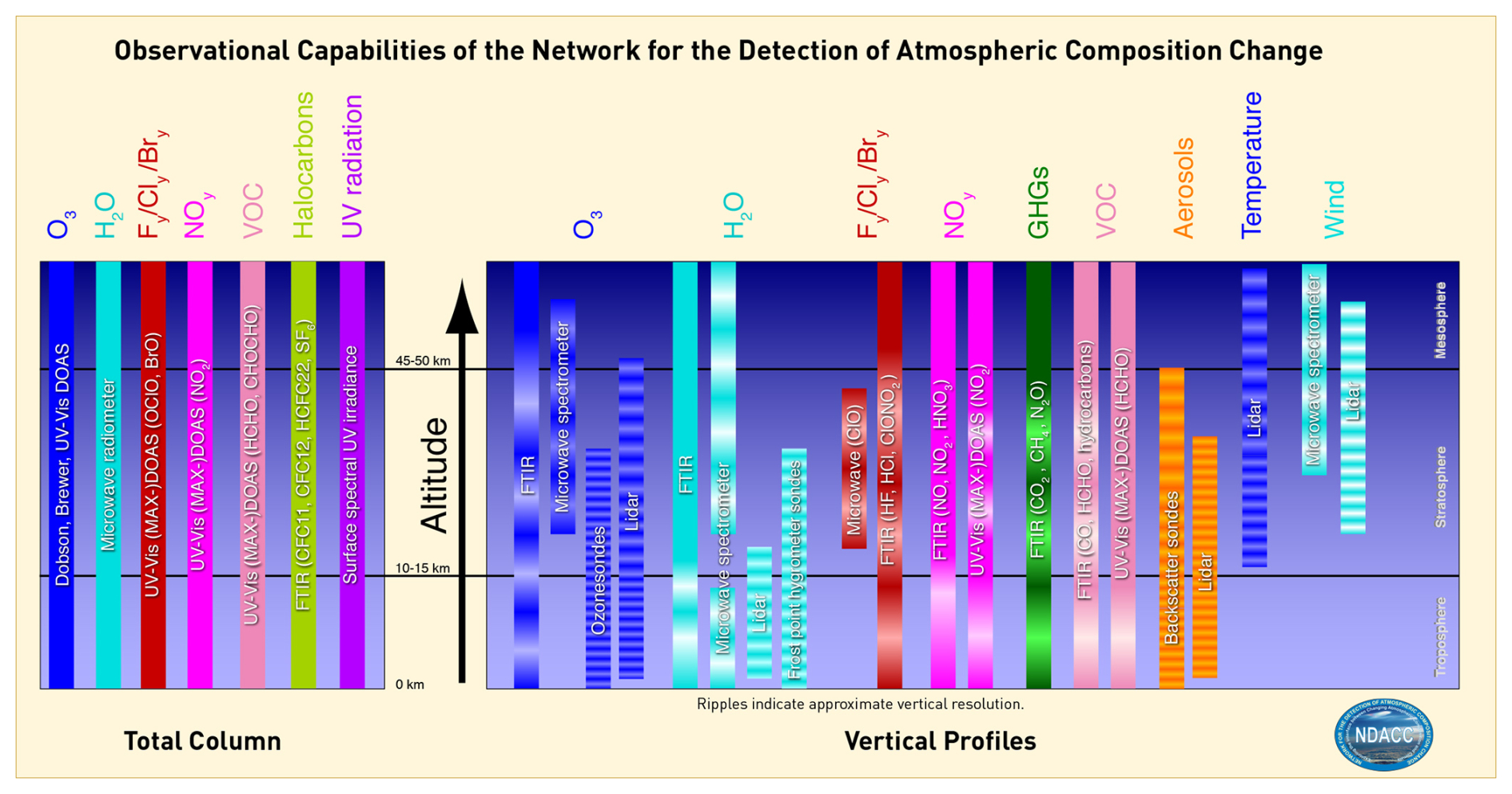
Figure 1Chart of NDACC observational capabilities is color-coded by observed atmospheric species and parameters with chemical formulas listed at the top. The altitude range of profiles illustrates approximate vertical resolution associated with each measurement technique (light horizontal stripes on vertical columns). Two horizontal dashed lines define approximate levels of tropopause and stratopause. The figure was taken from NDACC (https://www.ndacc.org (last access: 28 May 2026) > ABOUT > Organizational Structure) and modified by the authors.
Instrument Working Groups (Dobson, Brewer, FTIR, Lidar, Microwave, Sonde, UV/Vis, Spectral UV) oversee instrument and algorithm quality, providing expertise and resources for teams developing new instruments interested in NDACC affiliation. The Satellite Working Group fosters collaboration between NDACC and satellite missions and provides meteorological data to the NDACC database via NOAA/NCEP. The Theory and Analysis Working Group promotes NDACC data use and supplies model output to aid interpretation of observations.
NDACC recognizes the value of collaboration with external measurement and analysis networks that operate independently. To foster this partnership, the NDACC offers a “Cooperating Network” (CN) designation. This allows for mutual data access and network representation in the annual meetings while maintaining each network's integrity. Further details on agreements with Cooperating Networks appear in Sect. 3.
The NDACC Steering Committee is the organizational backbone of the network (see Fig. A1 in Appendix A, and the most up-to-date version in https://www.ndacc.org (last access: 28 May 2026) > ABOUT > Organizational Structure). Established in 1989, the Steering Committee (SC) includes all NDACC components. In addition to the Co-Chairs, it is composed of representatives from each Instrument Working Group (IWG), the Theory and Analysis Working Group, and the Satellite Working Group. Each CN has representatives on the NDACC SC. The IWGs promote exchange of expertise among NDACC members and the CN and support for establishing new measurement sites or new instrumentation at existing sites. Functional and Ex-Officio SC positions are used for tasking and/or reviewing of specific science matters and for addressing special NDACC-related issues; they ensure that international organizational interests are represented. Emeritus SC Representatives also provide expertise on measurements and science, including historical perspectives on evolving NDACC needs. SC member terms are finite but renewable. The list of current SC members is available on the NDACC webpage (https://www.ndacc.org, last access: 28 May 2026, > ABOUT > About NDACC > Steering Committee).
NDACC organizational structure includes the Data Host Facility (DHF) where the observational and support datasets are archived and made publicly available. The NDACC website provides an easy interface to the DHF and promotes news and information about the network.
The procedures and data quality requirements for affiliating instruments with NDACC are defined in dedicated NDACC Protocols that specify expectations for existing NDACC instrument types and for proposing new techniques. Other protocols stipulate NDACC structure and operating procedures. All protocols are regularly updated to maintain best practices.
Since its inception, NDACC has been endorsed by international agencies and other stakeholders, including United Nations Environment Program (UNEP), the International Ozone Commission (IO3C) of International Association of Meteorology and Atmospheric Sciences (IAMAS) and the Global Atmosphere Watch (GAW) Program of the World Meteorological Organization (WMO). The current landscape of NDACC stakeholders is presented in Fig. 2, grouped in categories: global watch programs, scientific assessments and research programs, cooperating networks, satellite programs, research partners and infrastructures, and operational services. Exchanges with the stakeholders occur through their SC delegates and reciprocally through the participation of NDACC delegates in stakeholder committees or creation of formal agreements.
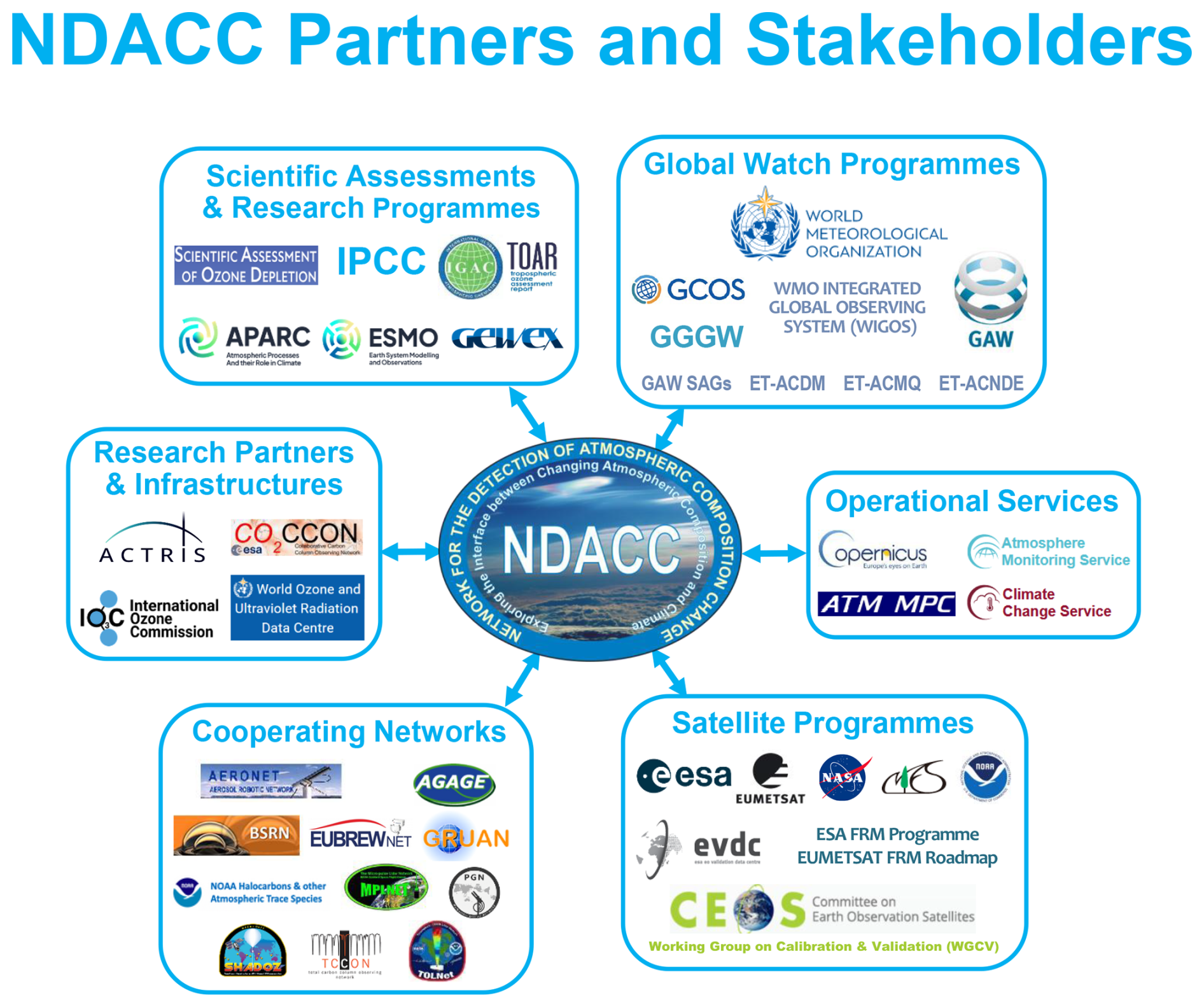
Figure 2Overview of NDACC stakeholders. Logo(s) are courtesy of UNEP Scientific Assessment of Ozone Depletion, IGAC TOAR, APARC, ESMO, GEWEX, GCOS, IO3C, ESA, ATM MPC, EUMETSAT, NASA, NOAA, EVDC, CEOS, NDACC Active Partners under the Formal Agreements (ACTRIS, Copernicus Atmospheric Monitoring Services and Climate Change Services, WMO/GAW, WOUDC), and NDACC Cooperating networks (AERONET, AGAGE, BSRN, EuBrewNet, GRUAN, HATS, MPLNET, PGN, SHADOZ, TCCON, and TOLNet). Used with permission.
3.1 Engagement with international environmental programs
NDACC data are essential to the global atmosphere watch program data centers operated under the auspices of the WMO, UNEP and the UN Framework Convention on Climate Change (UNFCCC). NDACC contributes most of the atmospheric composition Essential Climate Variables (ECVs) required by GCOS (Global Climate Observing System) and plays an essential role in WMO's Global Greenhouse Gas Watch (GGGW) approved in May 2023. NDACC delegates serve on several GAW Expert Teams and participate in WMO's Rolling Review of Requirements process in support of the WMO Integrated Global Observing System (WIGOS). Its responsibilities as a Contributing Network to GAW were laid out in a formal agreement between both Parties in 2022.
3.2 Engagement with scientific assessments and research programs
NDACC is a major contributor to the following assessments: the quadrennial WMO/UNEP Scientific Assessment of Ozone Depletion; the Tropospheric Ozone Assessment Reports (TOAR) under the umbrella of International Global Atmospheric Chemistry (IGAC); Intergovernmental Panel on Climate Change (IPCC) assessments. NDACC also contributes to research programs aimed at understanding links among changes in atmospheric composition, dynamics and transport, and the evolution of air quality and climate. Joint activities include the Atmospheric Processes And their Role in Climate (APARC, formerly known as Stratospheric Processes And their Role in Climate, SPARC) and Global Energy and Water Exchanges (GEWEX) projects sponsored by the World Climate Research Program. The Long-term Ozone Trends and Uncertainties in the Stratosphere (LOTUS-1 and -2) and Observed Composition Trends And Variability in the Upper Troposphere and Lower Stratosphere (OCTAV-UTLS) projects rely on NDACC observations to assess ozone and atmospheric composition trends and their uncertainties. NDACC data serve as a reference for climate model development and evaluation in the WCRP core project Earth System Modelling and Observations (ESMO).
3.3 Engagement with Cooperating Networks, research partners and infrastructures and operational services
To widen its scope and foster collaboration on complementary measurements, NDACC has long had agreements with Cooperating Networks (CN, see Fig. 2). A list showing colocation of NDACC long-term measurement stations with those of Cooperating Networks (referenced in the table) is available in the “Site List” of the “Measurements and Analyses Directory” in the DATA Tab of the NDACC website (https://www.ndacc.org). CN agreements since 2018 have been established with the European Brewer Network (EUBREWNET), the Pandonia Global Network (PGN), and the Tropospheric Ozone Lidar Network (TOLNet). The European Research Infrastructure for Aerosols, Clouds and Trace Gases (ACTRIS), established as a European Research Infrastructure Consortium in 2023 (Laj et al., 2024) supports and shares scientific objectives and user communities with NDACC. To avoid discrepancies among instrument, measurement, and data protocols related to common products, a Memorandum of Understanding between NDACC and ACTRIS defines how the Parties operate to maximize benefits to users through exchange of data and expertise. For example, the ACTRIS Centre for Reactive Trace Gases Remote Sensing (CREGARS) will serve the NDACC community through the maintenance of central data processing units (Sect. 4.4.2), and the provision of training and consultancy for compliance with ACTRIS/NDACC requirements; the ACTRIS Data Portal (formerly GEOmon data portal) is a gateway to complementary data and services.
Agreements with the Copernicus Atmosphere Monitoring Service (CAMS) facilitate the use of NDACC reference data for independent evaluation of CAMS global and regional data products and reanalysis, and with the Copernicus Climate Change Service to deliver NDACC Climate Data Records of ECVs to the Climate Data Store (CDS). Whereas the NDACC Protocol for Data Providers requires consolidated data archiving in the DHF for public availability within one year after acquisition, a majority of NDACC PIs have moved to faster delivery of controlled quality data, for example, meeting timeliness and quality requirements specific to CAMS Rapid Delivery.
3.4 Engagement with satellite observations
A primary objective of NDACC remains the provision of high-quality reference measurements to support geophysical validation and evolution of satellite atmospheric composition products. The network helps validate various data reprocessing phases for a vast array of atmospheric composition satellite missions ranging from limb solar occultation and emission sensors (see Fig. 3) to nadir-viewing platforms (see Fig. 4) across the UV-VIS and infrared spectrum.
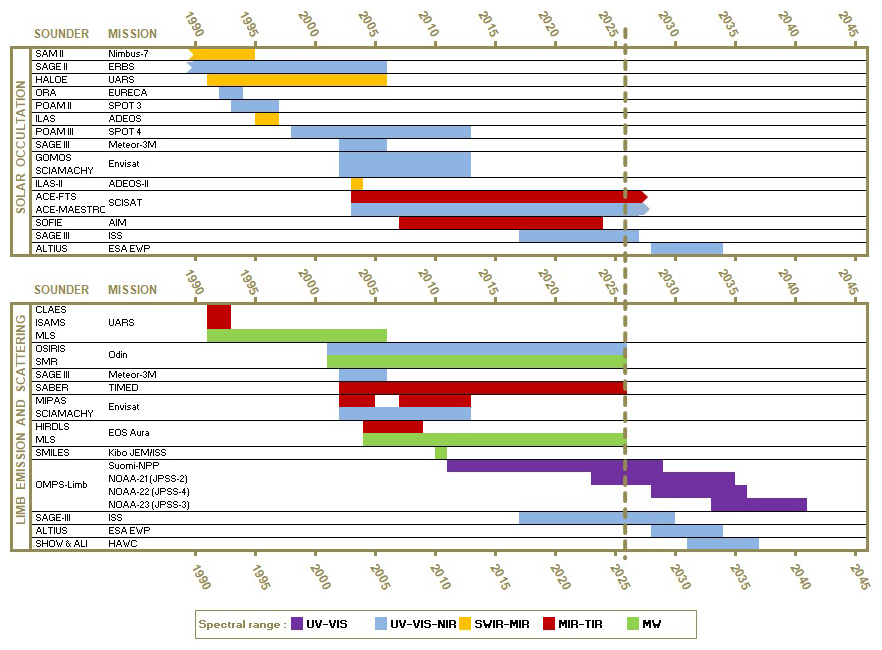
Figure 3Timelines for limb solar occultation (upper panel) and limb emission (lower panel) satellite sensors that have been, are, or will be supported by NDACC observations.
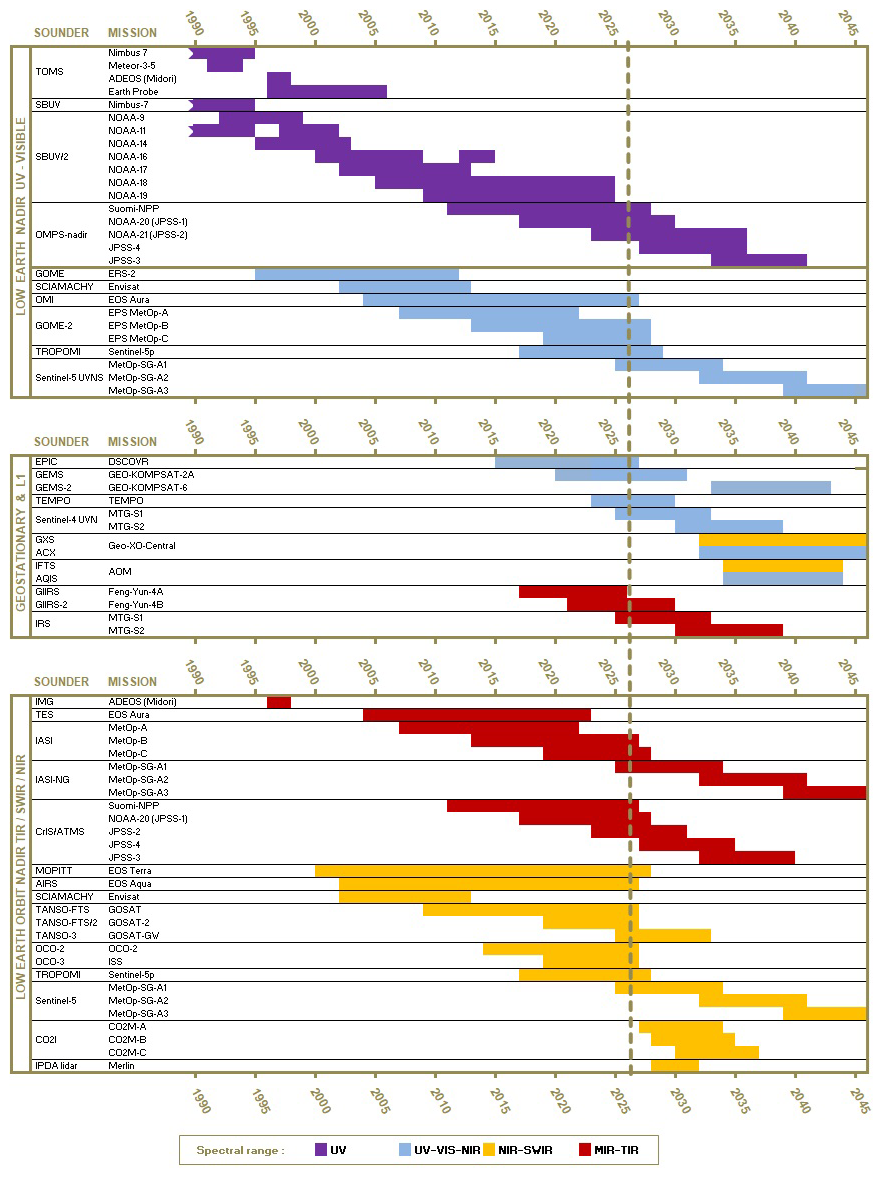
Figure 4As in Fig. 3 but for nadir-viewing satellite sensors: LEO UV-VIS (upper panel), GEO (geostationary) and L1 (middle panel), and LEO SWIR (Sort Wavelength InfraRed), NIR (near InfraRed) or TIR (Thermal Infrared) (lower panel).
NDACC collaborative efforts are formalized through the representation of several space agencies on the NDACC Steering Committee and Satellite Working Group (WG). Enhanced cooperation with space agencies in support of a Fiducial Reference Measurements (FRM) framework has allowed NDACC to meet increasingly stringent satellite validation requirements for data quality, traceability, uncertainty assessment, cross-network harmonization and timeliness of data access (Goryl et al., 2023). Close links exist with the European Satellite Agency (ESA) Validation Data Centre (EVDC) hosted at the Norwegian Institute for Air Research (NILU) and with NASA's Aura Validation Data Center (AVDC) which both mirror NDACC data to facilitate seamless access for the satellite community.
At the inter-agency level, NDACC promotes exchange of data by contributing to the Committee on Earth Observation Satellites (CEOS) through the Atmospheric Composition Subgroup of the Working Group on Calibration and Validation (WGCV). By advancing the FAIRness of its data, NDACC serves as a reference for the mutual consistency of the satellites, such as CEOS Atmospheric Composition Virtual Constellation (AC-VC) for air quality, for greenhouse gases and for ozone. NDACC up-to-date involvement in developing satellite validation protocols and strategic planning documents, ensures that validation frameworks, such as the Quality Assurance Framework for Earth Observation (QA4EO) and FRM principles and maturity matrix, remain fit-for-purpose for evolving global constellations.
Operational satellites feeding numerical weather prediction and environmental services require a fast response to validation needs. NDACC currently supports several operational systems, including NOAA's Products Validation System (NPROVS) and the ESA/Copernicus Validation Data Analysis Facility (VDAF). As new operational missions (e.g. Copernicus Sentinel-4 and -5 or the upcoming Anthropogenic Carbon Dioxide Monitoring constellation), come online, NDACC is evolving its data delivery mechanisms to provide near-real-time (NRT) data on a contractual basis. This evolution is essential for informed international efforts to control emissions of atmospheric pollutants, thus positioning NDACC for an important role to play in support of modern satellite remote sensing operations.
Selected recent achievements are described in this section. These include discoveries related to both stratosphere and troposphere, synergistic collaboration with satellite observations, and advances in network infrastructure. In all endeavors, NDACC's temporal coverage and adherence to standardized instruments, data-processing methods and protocols, have been essential in creating the high-quality data required for quantifying chemical composition changes and achieving network science goals. Nearly 500 publications since 2018 attest to NDACC's scientific contribution, (https://ndacc.org, last access: 28 May 2026, > ABOUT > Publications). Highlights of stratospheric and tropospheric research appear in Sect. 4.1 and 4.2 respectively. Section 4.3 discusses satellite collaborations. Section 4.4 illustrates NDACC's advances in instrumentation, technology and archiving infrastructure.
4.1 NDACC stratospheric composition observations
As a remote sensing network, the NDACC (NDSC) began with a primary focus on stratospheric composition: ozone, ozone-depleting substances, and water vapor, and that commitment remains to the present.
4.1.1 Stratospheric Ozone Trends
Section 3.2 described how NDACC is an integral component in SPARC/APARC research focus areas and the quadrennial WMO/UNEP Scientific Assessments of Ozone Depletion. Within APARC/LOTUS, statistical multi-linear regression models were used to detect linear decadal trends in the ground-based (i.e., NDACC, WMO GAW, SHADOZ) and satellite ozone records (Godin-Beekmann et al., 2022) over the 2000–2020 period. The study confirmed significant ozone increase in the upper stratosphere using satellite records averaged in three broad latitude bands, varying from 1.6 % per decade to 2.2 % per decade (Godin-Beekmann et al., 2022; 2022 WMO Ozone assessment). Figure 5 shows longitudinally resolved merged satellite records compared to ground-based data, i.e., from lidars, ozonesondes, Dobson Umkehr, microwave radiometers and FTIR, that confirm the satellite trends. Non-linear behavior in the decline of lower stratospheric ozone (60° S–60° N, below 24 km) during the post-2000 period was first reported by Ball et al. (2018). By applying dynamical linear modeling (DLM) to the Arosa/Davos homogenized Dobson Umkehr record, Maillard Barras et al. (2022) showed that upper stratospheric trends only became significantly positive after 2004, at 0.2 % yr−1–0.5 % yr−1; negative trends persist in the middle stratosphere and were more significant in the lower stratosphere from 2008 to 2018.
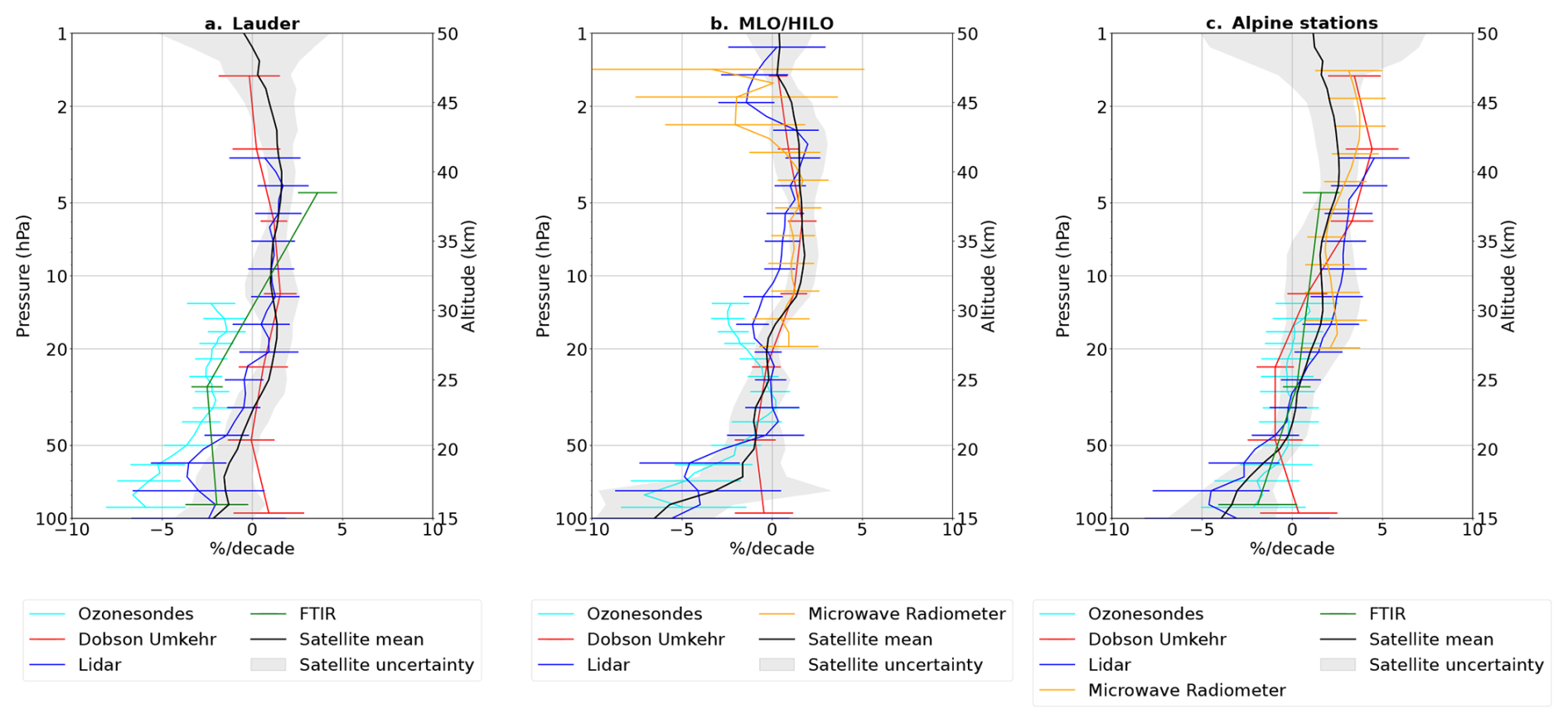
Figure 5Ozone profile trends post-2000 from selected ground-based NDACC stations: (a) Lauder, Southern Hemisphere station, (b) tropical Mauna Loa and Hilo (ozonesonde) stations, (c) combined Alpine North Hemisphere stations. From Sofieva et al. (2026).
APARC OCTAV-UTLS utilizes a dynamical coordinate system (i.e. tropopause, equivalent latitude, etc. derived from MERRA-2 reanalyses) for binning the high-resolution ozone records to separate transport, chemical, and mixing processes in the UTLS region. The method was implemented using several NDACC ozonesonde and lidar high-resolution profiles, aircraft (Civil Aircraft for the Regular Investigation of the atmosphere Based on an Instrument Container) and satellite (Aura/MLS and ACE-FTS) observing systems (Millán et al., 2023). The result is reduced sampling bias among records, with ground-based and satellite data both revealing patterns of changing atmospheric dynamics (Millán et al., 2024) and a reduction of uncertainties in fitted trends (Millán et al., 2025).
Investigation of the Arctic stratospheric ozone depletion during an unusually strong and stable polar vortex in 2019/2020 winter (Bognar et al., 2021) relied on long-term observations by NDACC UV-VIS, FTIR, ozonesondes and Brewer instruments located at the Polar Environment Atmospheric Research Laboratory in Eureka, Canada (80° N, 86° W). Cooperating network observations (PGN, Système D'Analyse par Observations Zénithales or SAOZ), non-NDACC lidar and the SLIMCAT model simulations were used to quantify ozone loss. The paper highlighted the importance of combining NDACC measurements with models for attribution of ozone loss processes for predicting ozone recovery.
4.1.2 Ozone-depleting substances, halogenated stratospheric reservoir species and stratospheric circulation
NDACC data were crucial in detecting the unexpected slow decrease of CCl4, forcing a re-evaluation of missing sources, sinks and atmospheric lifetime (Liang et al., 2016; Chipperfield et al., 2016). NDACC data confirmed the unexpected emissions of CFC-11 (CCl3F) after 2012 (Montzka et al., 2018; Chipperfield et al., 2021; Pardo Campos et al., 2022), which resulted in a slowing of its atmospheric decay, potentially delaying ozone recovery.
In the 2022 Ozone Assessment, trends in the Jungfraujoch FTIR time series of CFC-11, CFC-12, HCFC-22, HCFC-142b, CCl4, CF4 and SF6 support and bridge the trends observed in the high precision in situ data and upper troposphere observations from satellites where available (Laube et al., 2022; Chapt. 1 in WMO 2022). Work continues with CFC-11, CFC-12, HCFC-22 (Polyakov et al., 2021) and HFC-23 (Takeda et al., 2021) using innovative retrieval approaches and water vapor continuum models. A study using data from 16 NDACC FTIR stations quantified decreases in the growth rate of atmospheric HCFC-22 columns derived from harmonized retrievals (Zhou et al., 2024).
Transport of source ODSs to the stratosphere maintains halogen reservoir species. The most abundant chlorine- and fluorine-bearing reservoirs, HCl, ClONO2, HF, and COF2, are standard NDACC data products. Figure 6 shows the evolution of total column HCl from several NDACC stations and the evolution of 60° S–60° N lower stratospheric HCl from Global OZone Chemistry And Related trace gas Data records for the Stratosphere (GOZCARDS) and ACE-FTS observations. Because only second-order reservoirs are missing, the weighted combination of the respective time series represent budgets of stratospheric inorganic chlorine and fluorine.
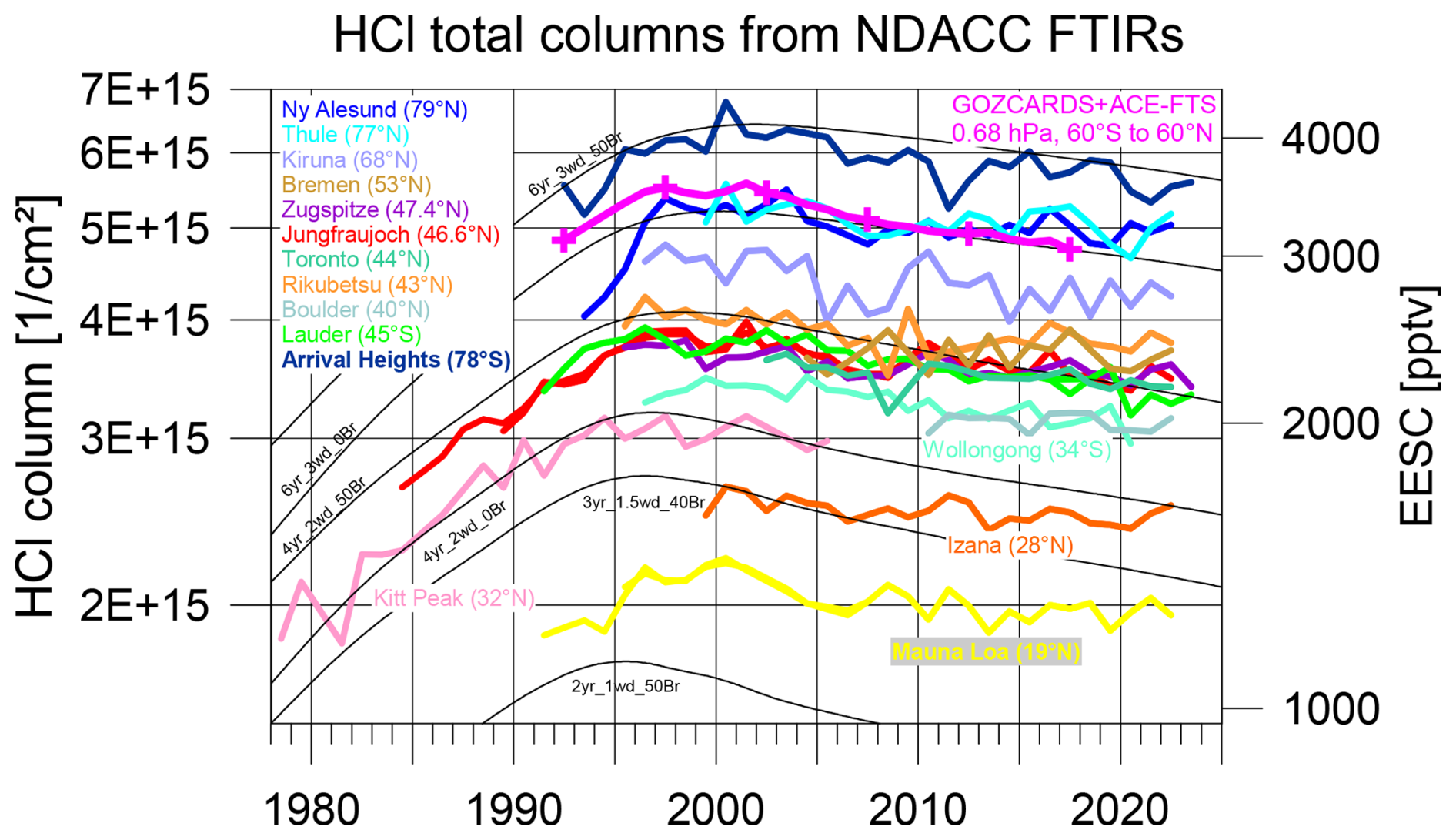
Figure 6Total column HCl, the predominant reservoir of Cl, time series from a subset of the NDACC stations representing latitudes from 78° S to 79° N, Included is the aggregate satellite time series for 60° S–60° N GOZCARDS, augmented with ACE-FTS HCl and Equivalent effective stratospheric chlorine (EESC) model (solid curves represent ODS lifetime and Br efficiency, https://ozonewatch.gsfc.nasa.gov/facts/eesc_SH.html, last access: 28 May 2026).
NDACC data answer questions about atmospheric change that would otherwise remain speculative. Minganti et al. (2022) used multi-decade satellite and NDACC data to evaluate WACCM modeled N2O trends to better understand changes in the Brewer-Dobson circulation. Strahan et al. (2020) used MLS HCl and HNO3 data, model output from GMI (NASA's Global Modeling Initiative) and measurements from 9 globally dispersed NDACC stations to find (i) a decrease in the age of air of the southern hemisphere lower stratosphere relative to the north by about 1 month per decade and (ii) a 5–7 year variability in both HCl and HNO3 total columns. The 1994–2018 NDACC record provided more conclusive evidence as it spans 3-plus Solar cycles (11+ years) not available in a single satellite record. The analysis generally supports the finding that the Solar cycle confounds statistical trend regression on the QBO (quasi-biennial oscillation) if not accounted for. Alternatively, N2O records from the NDACC FTIR stations helped validate the ACE-FTS satellite hemispheric data and global model simulated changes in Brewer Dobson global circulation (Minganti et al., 2022).
4.1.3 Water vapor observations
Detection of small water vapor trends in the upper troposphere, stratosphere and mesosphere is hampered by differences among instruments and sites, as well as natural variability in the troposphere and the large 2022 volcanic water vapor injection into the middle stratosphere. The APARC Water Vapor Assessment II intercomparison of satellite and ground-based microwave measurements, thoroughly investigated trends in water vapor between pressures of 3 and 0.03 hPa (Nedoluha et al., 2017). Agreement between satellite retrievals and ground-based microwave instruments was generally within ±10 %. This assessment also included an intercomparison of relative humidity from 19 limb-viewing satellites and the Vaisala RS92 radiosonde coincident with frost point instruments from NDACC (and other) sites between pressures of 300–100 hPa (Read et al., 2022). Agreement of relative humidity in the upper troposphere measured by space-based and frost-point instruments was on average within ±30 %, with an additional 30 % variability; the Vaisala R92 radiosonde was not recommended for use at pressures below 200 hPa.
4.1.4 Hunga volcanic eruption
On 15 January 2022 the eruption of the Hunga undersea volcano at 20° S injected ∼ 140–150 Tg of water vapor (H2O) into the atmosphere (Millán et al., 2022; Nedoluha et al., 2024). The bulk of the injection was in the lower stratosphere where it was measured by balloon-borne sondes (Vömel et al., 2022). Not only was the plume injection observed from NDACC stations, a rapid-response team deployed to Réunion Island within one week to make sonde observations (Evan et al., 2023; Asher et al., 2023; Baron et al., 2023). Water vapor from the Hunga plume moved equatorward from its original injection site, where it was first measured in the mid-stratosphere by ground-based microwave instruments at the NDACC station at Mauna Loa, Hawaii (19.5° N) in April 2022 (Nedoluha et al., 2023a). Figure 7 shows water vapor anomalies at 54 km (just above the stratopause) measured by ground-based microwave instruments at Mauna Loa; Lauder, New Zealand (45.0° S); and Table Mountain, California (34.4° N). In 2022, water vapor mixing ratios at all three sites were unusually large, partly due to dynamical conditions (Nedoluha et al., 2023b). In 2023 water vapor at Table Mountain and Mauna Loa was significantly higher than ever observed in 30+ years of measurements at these (Nedoluha et al., 2024). Lauder showed record-breaking mixing ratios, but short-term weekly anomalies of similar magnitudes can occur during certain seasons due to dynamical variations. Finally, in late 2023/early 2024, ∼ 2 years after the eruption, maximum water vapor anomalies were observed at all three sites at 54 km. These findings are described in more detail in the APARC “The Hunga Volcanic Eruption Atmospheric Impacts Report” (Zhu et al., 2025).
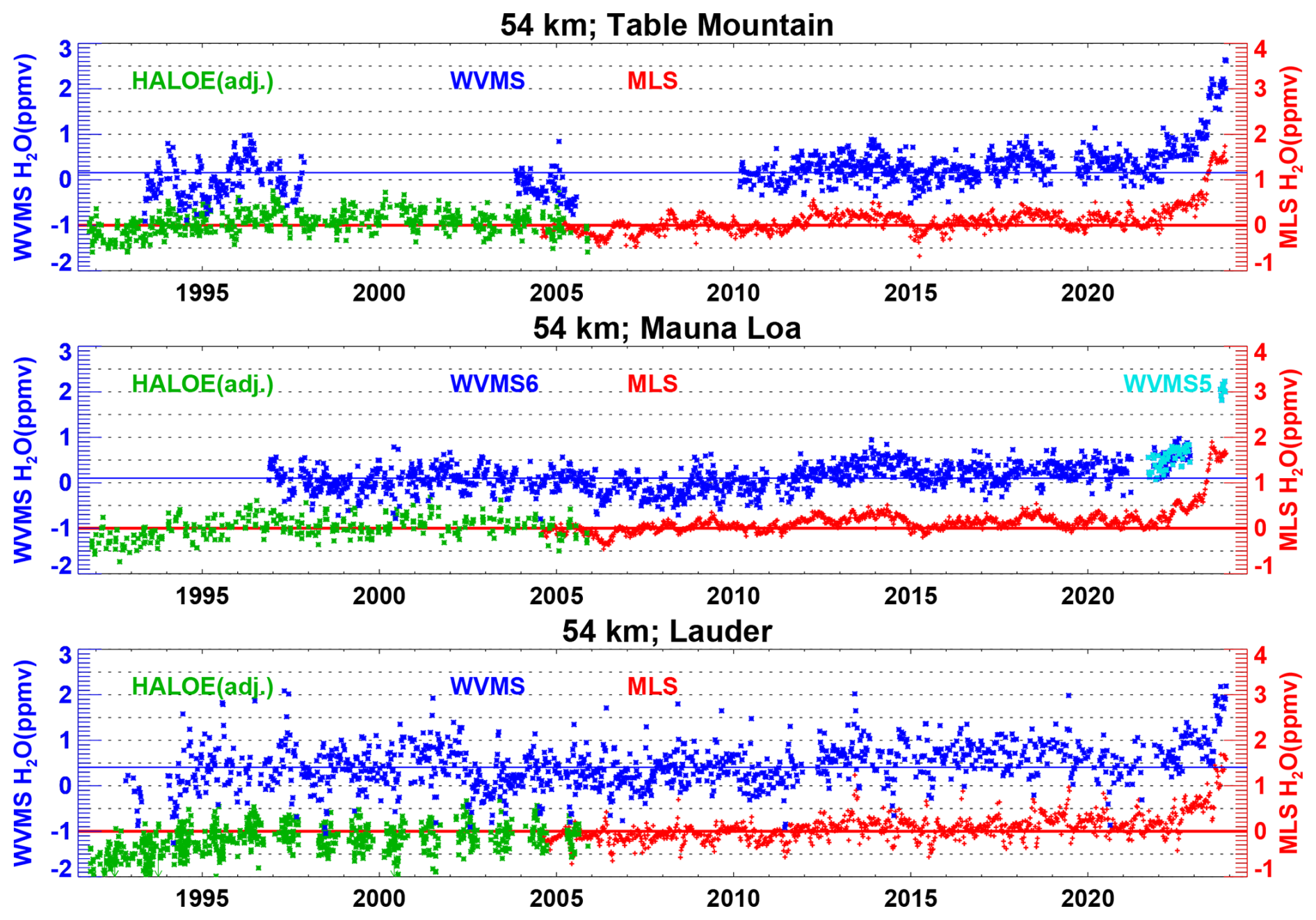
Figure 7Water vapor volume mixing ratio anomalies at 54 km from ∼ weekly ground-based microwave measurements at Table Mountain, California (34.4° N, 242.3° E), Mauna Loa, Hawaii (19.5° N, 204.4° E) and Lauder, New Zealand (45.04° S, 169.68° E). The anomaly is calculated relative to a climatology based on Aura MLS measurements from 2004-2021. From Nedoluha et al. (2024).
4.1.5 Extreme Australian wildfires and stratospheric chemistry
In late December 2019 and early January 2020, Australian New Year wildfires injected record-breaking amounts of smoke and aerosol into the southern hemisphere stratosphere. Aerosols were injected up to 32 km, resulting in a bimodal size distribution as was observed in sonde flights launched at Lauder, New Zealand (Asher et al., 2024). Although heterogeneous reactions on stratospheric aerosol surfaces have been known since early analyses of the Antarctic ozone hole, less was known about reactions on black or brown carbon from biomass burning smoke. What NDACC and satellite observations revealed in the post-fire months was unprecedented stratospheric chlorine partitioning (Fig. 8; Strahan et al., 2022) which has important implications for predicting stratospheric ozone in a more wild-fire prone world. Satellite observations of fire-perturbed HCl, ClONO2, HF, O3, N2O and NO2 by NDACC and H2O, ClO and aerosol extinction were reported by Santee et al. (2022) and Boone et al. (2020). Chemical simulations by Solomon et al. (2023) proposed that chlorine partitioning was caused by oxidized organics and sulfates increasing hydrochloric acid solubility (and associated heterogeneous reaction rates). This is supported by the observed enhanced ClONO2 and decreased HCl, although Strahan et al. (2022) pointed out that definitive ozone loss is not confirmed due to entangled chemistry/transport effects. Ozone losses appear to peak in May–June.
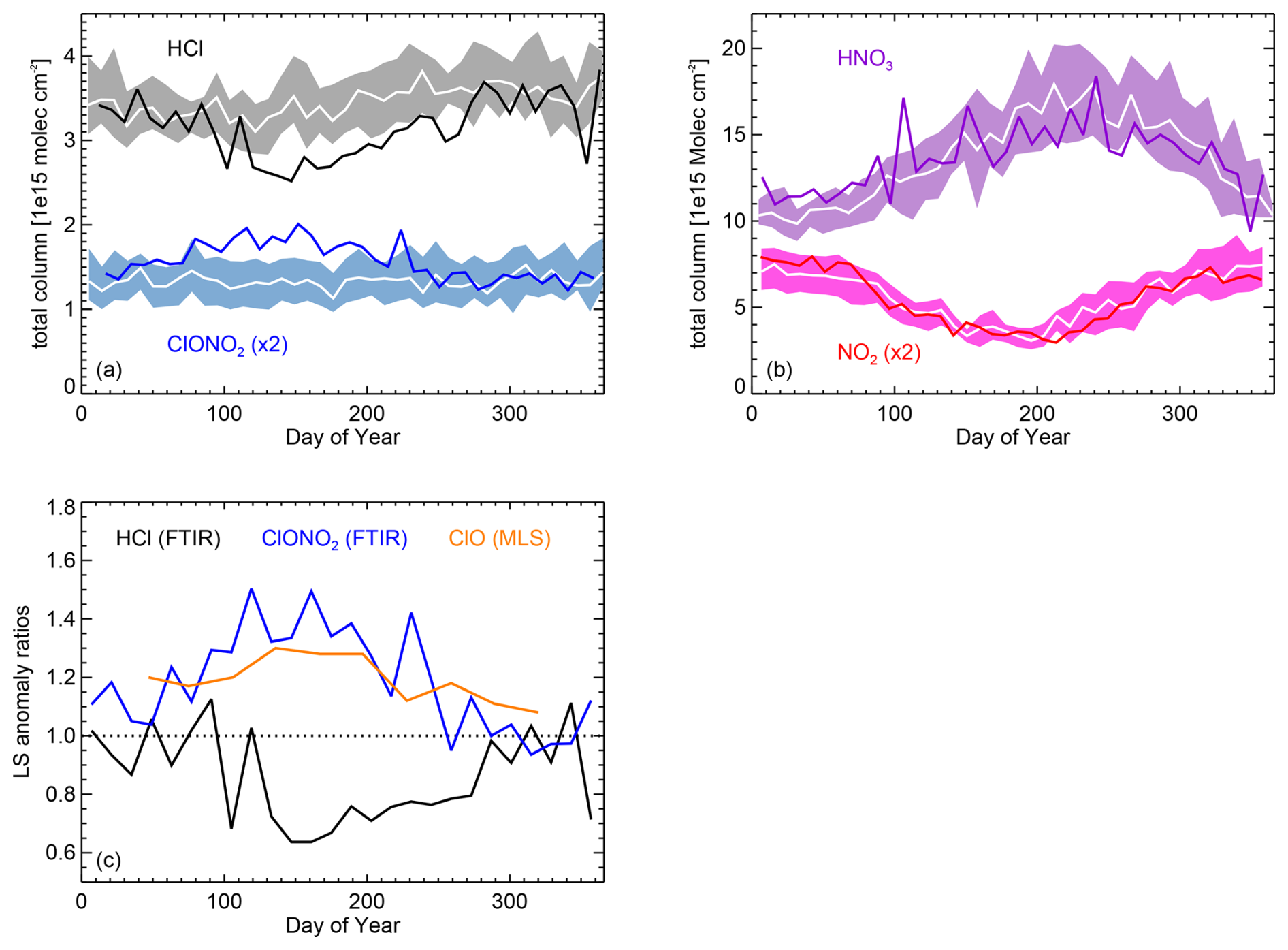
Figure 8(a) 2020 9 d average of Lauder FTIR total column HCl and ClONO2 (scaled for clarity) along with associated 2010–2019 mean (white) and 1 standard deviation (shaded). (b) Same as (a) but for HNO3 and NO2 (scaled for clarity). (c) Lower stratosphere column (LS, ∼ 150–50 hPa, ∼ 12–21 km) 2020 anomalies (9 d average, ratioed to 10-year means, 2009–2019) for HCl and ClO. Total column ClONO2 anomalies are displayed because there is insufficient signal for a ClONO2 LS column. Aura-MLS ClO observations are averaged over 40–50° S (after Strahan et al., 2022).
4.2 NDACC tropospheric composition observations
NDACC research in the 2000's has focused increasingly on tropospheric composition and radiation as described below.
4.2.1 NDACC and the Tropospheric Ozone Assessment Report (TOAR)
NDACC played a major role in analyzing global tropospheric ozone trends in the second phase of IGAC's Tropospheric Ozone Assessment Report (TOAR II; see TOAR I reports by Gaudel et al., 2018 and Tarasick et al., 2019). Within the HEGIFTOM working group (Harmonization and Evaluation of Ground-based Instruments for Free-Tropospheric Ozone Measurements), records from NDACC and other atmospheric measurement networks for four instruments – FTIR, Lidar, Brewer/Dobson Umkehr, ozonesonde – were reprocessed with absolute reference standards and archived to produce ozone column data with uniform formats with uncertainty estimates and quality flags (Van Malderen et al., 2025a). Figure 9 shows an intercomparison study at the multi-instrumented Lauder supersite (Björklund et al., 2024) for both stratospheric and tropospheric columns based on time-series for 2000–2022. More than 50 articles from TOAR II analyses, including those based on HEGIFTOM and other ground-based data, with satellite products, have been published in a TOAR II special collection (see https://bg.copernicus.org/articles/special_issue10_1256.html, last access: 28 May 2026).
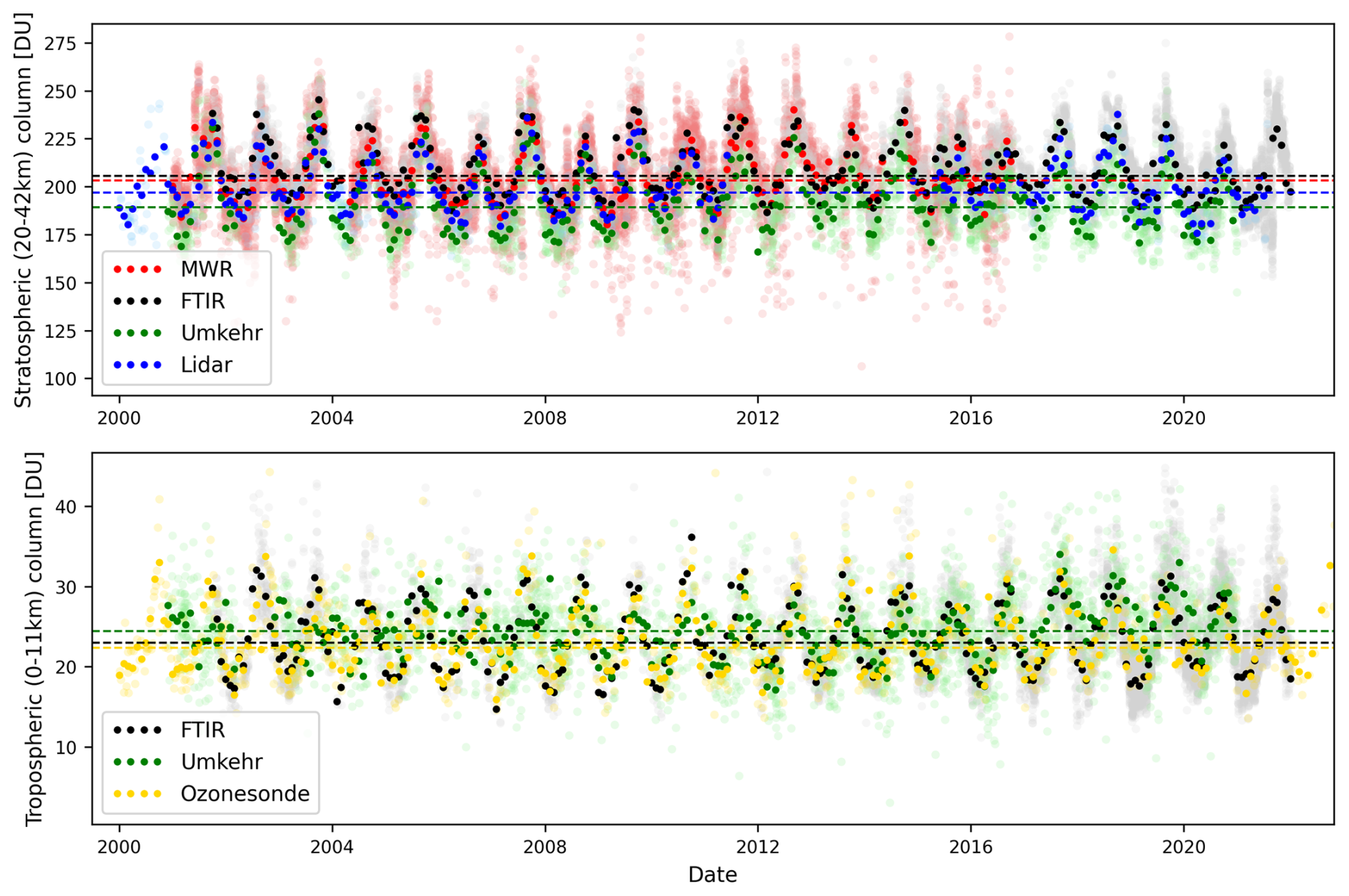
Figure 9Upper: Time series (2000–2022) ozone columns (22–42 km) in Dobson Units (DU) from four remote sensing techniques at Lauder, New Zealand. Shaded points are all data, highlighted points are monthly means, dashed lines are median of all data by technique (see legend). Lower panel shows the tropospheric ozone column (defined as surface to 11 km). After Björklund et al. (2024).
Trends for individual station HEGIFTOM/NDACC ozone columns, augmented by landing/take-off profiles from the In-service Aircraft for a Global Observing System (IAGOS) airports, were calculated following TOAR-II guidelines on metrics, units, time range, and statistical trend model in a series of studies (e.g., Van Malderen et al., 2025a, b; Gaudel et al., 2024; Thompson et al., 2025). A summary of median trends for a tropospheric total column (TrOC, specified as surface to 300 hPa, for 2000 to 2022, based on the HEGIFTOM data, appears in Fig. 10. Trends are illustrated with 2σ uncertainties for 55 sites (Van Malderen et al., 2025a) as a function of latitude (Fig. 10, left) and longitude (Fig. 10, right). The HEGIFTOM-derived trends mark a turning point for the tropospheric ozone community because it is the first time that a global picture of changes based on consistently processed observations from multiple ground-based instruments is available. The outcome is a definitive reference dataset for evaluating still-evolving satellite products, some of which cover fewer than 10 years (Gaudel et al., 2024). For ozone profile trends in the troposphere, there is no substitute for ozonesondes and aircraft data (Thompson et al., 2025; Van Malderen et al., 2025b).
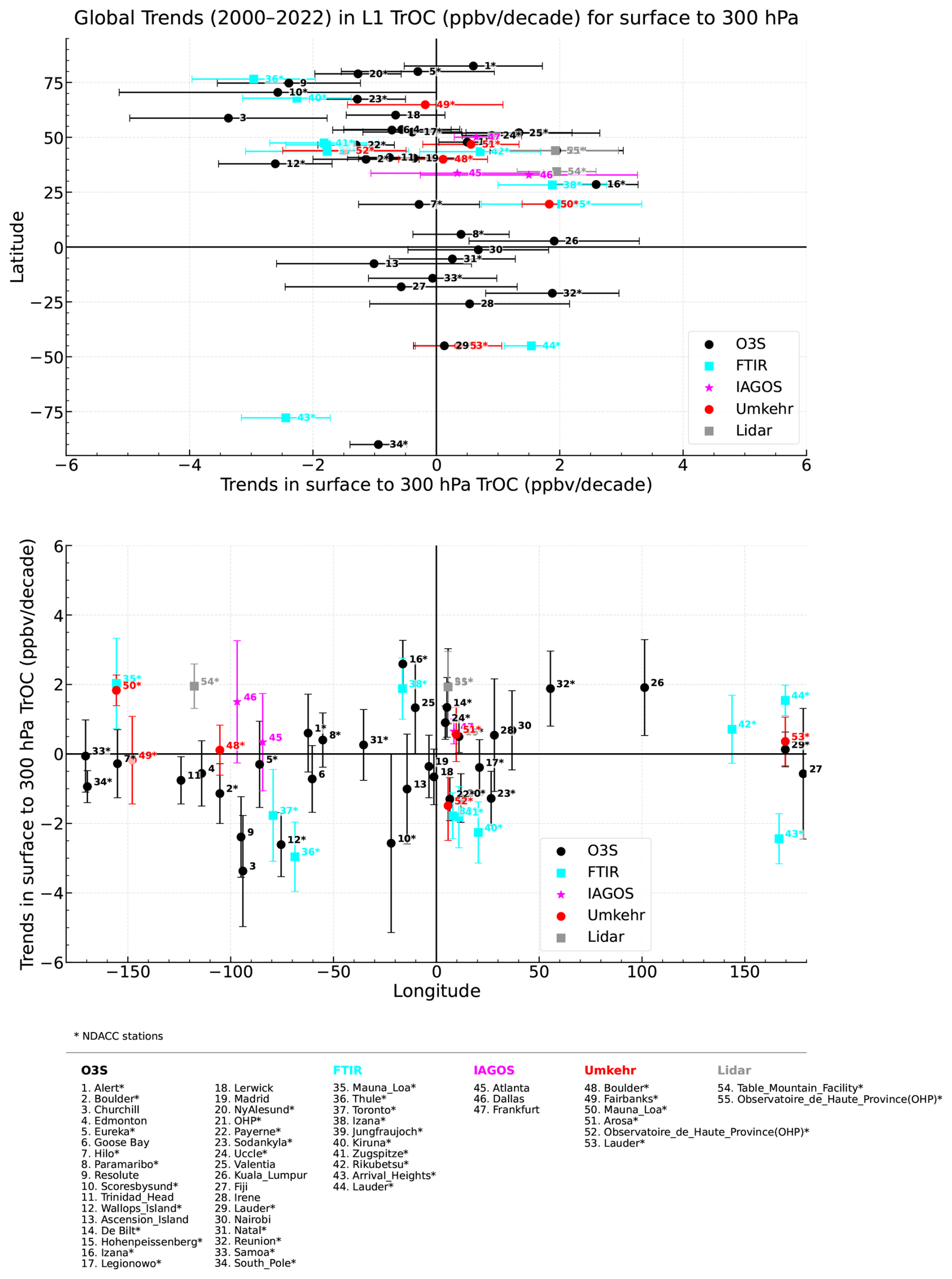
Figure 10Tropospheric column ozone (TrOC, surface to 300 hPa) trends in ppbv/decade, determined at three IAGOS airports and for four NDACC instruments: ozonesondes, FTIR, Umkehr, and Lidar. Calculation was made using all data (L1, 2000 to 2022) by Quantile Regression. Uncertainties at ±2σ. Most stations exhibit median trends within ± 3 ppbv per decade (after Van Malderen et al., 2025a). (top) trends as function of latitude, middle) trends as function of longitude, (bottom) list of stations.
4.2.2 Long-term trends in whole atmosphere carbonyl sulfide
Carbonyl sulfide (OCS), the reservoir sulfur species in the free troposphere, is a product of anthropogenic, biogenic and oceanic emissions, a tracer for CO2 uptake by the biosphere and the largest source of sulfur transported to the stratosphere during periods of low volcanic emissions, helping maintain the lower stratospheric sulfate aerosol layer. Despite these important roles, it remains under-observed. NDACC FTIR OCS measurements are unique in having near-global coverage for 3+ decades. Hannigan et al. (2022) derived trends in the lower free troposphere and the lower stratosphere, showing distinct trends over discrete time periods since 1986. They showed that regression models using available geophysical proxies of varying time periods could not adequately explain the multi-decadal OCS variability. For the longest time series through to 2012 the highest correlations to the free tropospheric NDACC time series was with the gridded, bottom up anthropogenic emissions from Zumkehr et al. (2018). Shown in Fig. 11, between 46 % to 77 % of the variability can be attributed to anthropogenic sources at stations between 76° N and 80° S.
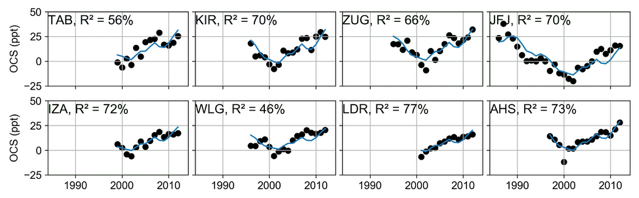
Figure 11Fit of the annual anthropogenic emissions inventory from Zumkehr et al. (2018) (blue line) to annually averaged FTIR OCS data (black dot) from stations with the longest running data records. The emissions inventory is interpolated to the station location. From Hannigan et al. (2022). TAB: Thule Air Base 76° N, KIR: Kiruna 67° N, ZUG: Zugspitze 47° N, JFJ: Jungfraujoch 46° N, IZA: Izana 28° N, WLG: Wollongong 34° S, LDR: Lauder 45° S, AHS: Arrival Heights 79° S.
4.2.3 Surface UV radiation: Monitoring, impacts, and research
Surface UV radiation is a crucial indicator of atmospheric change, capturing the combined effects of aerosols, clouds, ozone, and other atmospheric composition changes driven by natural and anthropogenic sources, transport and atmospheric mixing. Its reach extends to public health, impacts on terrestrial and aquatic ecosystems and the degradation of materials like plastics into microplastics. Regular high-precision NDACC spectral UV observations are conducted at 12 globally distributed stations, strategically located to cover diverse environments (polar, mid-latitude, tropical) to ensure data collection across Earth's UV regimes. In Antarctica, continuous monitoring since 1990 has shown a slight decline in overall UV exposure since the early 2000s (Bernhard and Stierle, 2020), consistent with ozone layer recovery. However, ground-based measurements still record extremely high UV levels like persistent ozone holes (Cordero et al., 2022). These observations have greatly advanced our knowledge of public health impacts from spatial and temporal variability in UV doses (Brogniez et al., 2021). Cumulative, low-dose UV exposure has significant health implications, leading to advocacy for a more nuanced understanding of UV benefits and risks (McKenzie and Lucas, 2018; McKenzie et al., 2022).
4.3 Satellite validation and collaboration
There is considerable synergy between NDACC, with its focus on remote sensing measurements, and the satellite observations community for initial validation of new space-based instrumentation, detection of long-term drifts, and collaborative research. Selected highlights follow. More examples with publications appear in Table C1 in Appendix C.
4.3.1 Detection and quantification of long-term satellite drifts
Without long-term ground-based observations, detection of drifts or steps in satellite data record is difficult. The MOPITT instrument aboard NASA's EOS-Terra satellite launched in 2000 measuring near-global CO has exceeded initial specifications. Buchholz et al. (2017) used data from 14 latitudinally distributed NDACC FTIR stations to determine drifts over the first 17 years. Co-located data carefully matched using the vertical sensitivity (averaging kernels) to account for the respective response of each FTIR examined three MOPITT retrieval schemes. Mean bias for all sites was determined to be 2.4 % for TIR-only, 5.1 % for TIR–NIR, and 6.5 % for NIR-only. The MOPITT long-term bias drift is calculated to be within ±0.5 % yr−1. Aura MLS has also operated past its programmed lifetime. NDACC water vapor sonde data at Lauder, Hilo and Boulder were used to evaluate, determine and correct for drifts over 15 years, 2005 to 2020 (Livesey et al., 2021).
Stability of ground-based records themselves can be compromised by instrumental artifacts, e.g. “drop-off” in ozonesonde records due to manufacturing changes (Stauffer et al., 2020), which are often detected through calibration and multi-instrument intercomparison activities (Thompson et al., 2019) and by adherence to NDACC observational protocols. Processing satellite and ground-based (GB) data by identical statistical methods minimizes biases in trend detection while illustrating potential inconsistencies among records (Petropavlovskikh et al., 2025).
Over the past 25 years, members of the NDACC ozonesonde community have been part of the WMO/GAW ASOPOS (Assessment of Standard Operating Procedures for Ozonesondes) activity to optimize sonde data quality through specification of standard operating procedures (SOP) including data processing (Smit et al., 2024). Roughly 2/3th of the 60 global sonde stations have reprocessed their records. For ozonesonde data since mid-2004, satellite measurements are used to evaluate the sonde profiles as shown in Fig. 12. Total column and stratospheric ozone from the sondes were compared to overpass readings from satellites (Aura OMI and MLS, S-NPP OMPS, GOME-2A and -2B) from mid-2004 through 2021 to determine stability in the sonde measurements. Overall, the ozonesonde data show remarkable agreement compared to satellite instruments. Total column ozone derived from the sondes is on average within ±2 % of the Aura OMI over the last 18+ years (Fig. 12), and the ozone profiles match Aura MLS to within ±5 % in the mid-stratosphere up to 10 hPa (Stauffer et al., 2022). The excellent agreement is achieved even with a known instrumental bias at several stations (Stauffer et al., 2020). These comparisons underscore the success of the ozonesonde data reprocessing and homogenization effort (Smit et al., 2021). In the 1990s, ozonesonde data uncertainty was on the order of 20 %, and biases near 10 % in total column ozone were common. Today, data uncertainties approach 5 %, with total column ozone biases < 2 %.
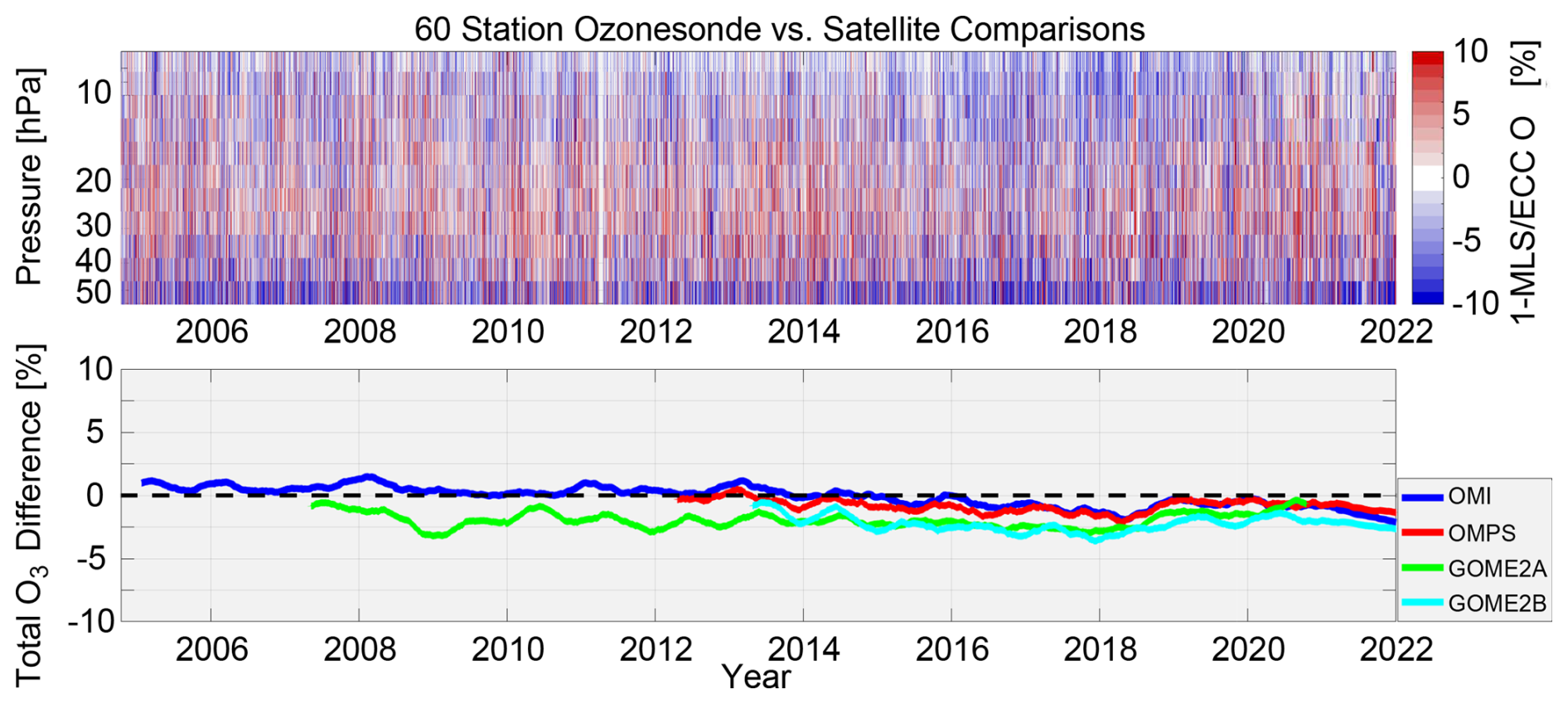
Figure 12Coincident ozonesonde and satellite comparisons (% difference) for 60 global ozonesonde stations. (Top) Time series comparisons among all ozonesonde and Aura Microwave Limb Sounder (MLS) ozone profiles ([ECC-MLS/ECC]) where ECC signifies the sonde value. Red (blue) colors indicate where the sonde ozone is greater (less) than MLS. (Bottom) Ozonesonde and satellite total ozone comparisons in % difference ([ECC-satellite]/ECC) for OMI (blue), S-NPP OMPS (red), GOME-2A (green), GOME-2B (cyan).
4.3.2 Operational validation of HCHO and NO2 for Sentinel-5P
The operational validation service of Sentinel-5P TROPOMI relies on the fast delivery of correlative measurements acquired by most of the NDACC sub-networks and several cooperating networks. Total and tropospheric ozone column and profile data products are quality assessed by an operational validation server (https://mpc-vdaf.tropomi.eu, last access: 8 May 2026) using Brewer, Dobson, FTIR, lidar, ozonesonde and Zenith-Sky DOAS measurements acquired from pole to pole and under a variety of measurement conditions and influencing parameters (Garane et al., 2019; Hubert et al., 2021; Keppens et al., 2024).
The quality assessment of NO2 total and partial columns relies on a holistic approach combining validation of TROPOMI stratospheric NO2 with respect to NDACC Zenith-Sky DOAS columns, tropospheric NO2 with respect to MAX-DOAS columns, total NO2 with respect to PGN total columns (Verhoelst et al., 2021) and cloud parameters validation using the ACTRIS-Cloudnet network of lidars and radars (Compernolle et al., 2021). Harmonization of NDACC FTIR NO2 (Vigouroux et al., 2025), provides a new global dataset for TROPOMI validation (see S5P Quarterly Validation Reports at https://mpc-vdaf.tropomi.eu). Stratospheric NO2 columns measured by NDACC FTIR, Zenith-Sky DOAS and PGN at pristine stations (i.e., without tropospheric NO2 pollution) give mutually consistent validation results, showing e.g. a similar station-to-station 1σ scatter of the bias with TROPOMI of ∼ 5 %.
Although not a standard NDACC product, harmonized HCHO FTIR data were produced by the network (Vigouroux et al., 2018) and used for the first TROPOMI HCHO validation (Vigouroux et al., 2020). TROPOMI HCHO products were shown to be biased high over clean regions by ∼ 26 % but underestimated by ∼ 31 % in polluted conditions. The robust linear relationship between TROPOMI and NDACC data is shown in Fig. 13 across a range of HCHO concentrations. These data are used in inverse modeling studies to correct TROPOMI and OMI products before inverting them (Oomen et al., 2024; Müller et al., 2024). The high internal consistency of FTIR-based HCHO is illustrated; HCHO is now archived as a standard NDACC species. The HCHO FTIR data set has been employed in other satellite validations (Lee et al., 2024; Kwon et al., 2023; Ayazpour et al., 2025; Müller et al., 2024) and for characterizing errors in satellite-based HCHO/NO2 ratios (Souri et al., 2023) and for TEMPO validation over North America.
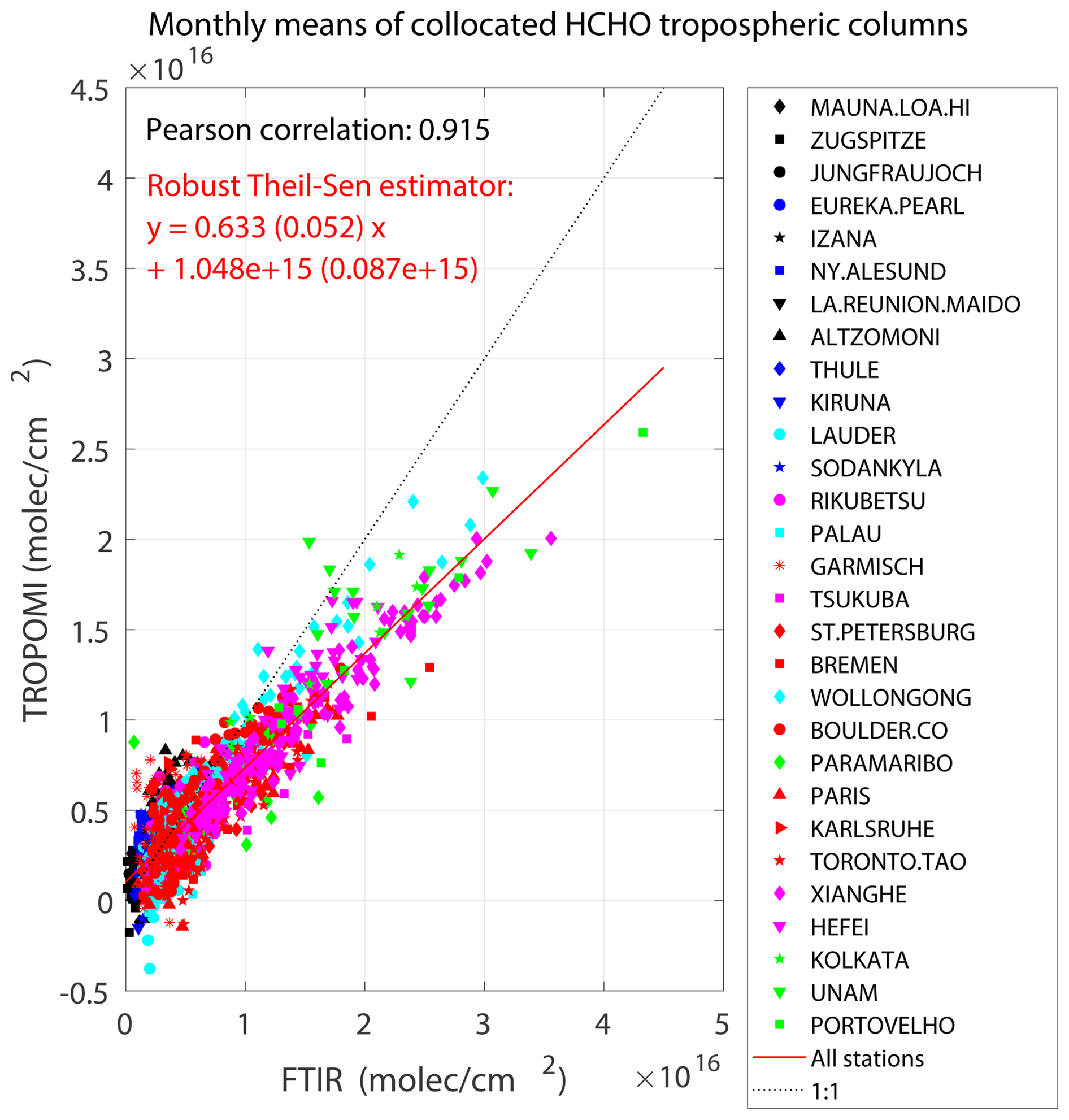
Figure 13Scatter plot of NDACC FTIR and TROPOMI HCHO data, after Vigouroux et al. (2020).
Similarly, harmonization of NDACC FTIR NO2 (Vigouroux et al., 2025), provides a global network dataset for TROPOMI validation (Quarterly Reports at https://mpc-vdaf.tropomi.eu). The NDACC FTIR and Zenith-Sky DOAS NO2 columns are characterized by excellent internal consistency, showing a similar station-to-station 1σ scatter of biases with TROPOMI of ∼ 5 % (Verhoelst et al., 2021).
4.3.3 Correlative observations of new species
Some of the most exciting advances in satellite observations are due to advances in retrieval algorithms providing data products for new species. Species like methanol, ethane, ethene, ethyne and isoprene (CH3OH, C2H6, C2H2, C2H4, C5H8 respectively) have been observed with the Cross-track Infrared Sounder (CrIS) (Wells et al., 2022, 2025; Brewer et al., 2024). These species, primarily originating from biogenic and anthropogenic sources, are important as ozone precursors, traceable to emissions sources. NDACC has developed new retrievals for these species, in some cases providing the only validation data. The Infrared Atmospheric Sounding Interferometer (IASI) has produced a formic acid (HCOOH) data product that Franco et al. (2020) validated with global NDACC FTIR data. Other new species observed by NDACC are PAN (CH3C(O)O2NO2) (Mahieu et al., 2021; Wizenberg et al., 2022) and ammonia (NH3) (Dammers et al., 2015; Lutsch et al., 2019; Yamanouchi et al., 2021; Herrera et al., 2022). See Table A1 (Appendix B) for the list of species validated by NDACC observations.
4.4 Advances in instrumentation, data processing and archiving infrastructure
Since its inception, the NDACC mission has been to observe the atmosphere with the precision and accuracy required to answer the key science questions of the day, hence the focus on state-of-the-art, calibrated, certified instrumentation. Instrumentation techniques, data acquisition, and signal-to-noise specifications have greatly improved over the last three decades while data processing and analysis techniques have evolved to deliver larger, better characterized, versioned datasets with improved uncertainty budgets. These complex and versatile datasets are used by a more diverse research community. Simultaneously, the geographical, temporal, representativeness, precision requirements of the research and monitoring communities have increased. Some examples of how NDACC has responded to this new environment follow.
4.4.1 Instrumental: Automation, compactness, mobility
The Jet Propulsion Laboratory (JPL) Atmospheric Lidar Team has developed a compact, more affordable class of tropospheric ozone differential absorption lidar (DIAL) systems. The Small Mobile Ozone Lidar (SMOL) is compact enough to be readily deployed for rapid air quality measurement campaigns at 10 % to 50 % the cost of most existing tropospheric ozone lidars (Chouza et al., 2025). In June–August 2023 JPL deployed two SMOL instruments in the Los Angeles Basin to participate in the NOAA-led AEROMMA-2023 campaign and in the NASA-led STAQS Mission for the validation of TEMPO. By June 2024, two more SMOL instruments had been built, enabling unprecedented deployment configurations for field campaigns, e.g., within a tight spatial grid for air quality studies, or at a larger, synoptic scale to study long-range transport and stratospheric intrusions.
In 2024, a version optimized for stratospheric ozone (SMOL-X) was designed and successfully tested. SMOL-X can measure vertical profiles of ozone between 5 and 35 km altitude with a precision better than 10 % for a 3 h averaging time. Because of its affordability and ease of deployment, this new class of stratospheric ozone DIAL provides opportunities for NDACC deployment in remote areas, such as Antarctica, the Arctic, Asian or Africa, providing the opportunity to fill critical measurement gaps. NDACC continues to evaluate new measurement techniques and target variables. For example, in 2020, the UV-VIS Working Group updated the instrument and validation protocols for including MAX-DOAS-type instruments, several of which have been NDACC-certified since then. Wind lidar joins microwave wind instruments to extend NDACC's meteorological observational capability. The Steering Committee is also evaluating the addition of temperature data measured by microwave instruments.
4.4.2 Migration towards central processing
NDACC ensures a high standard of data quality as well as a high degree of homogenization and consistency across instruments and platforms. Centralized data processing with network-wide scrutiny is a powerful tool to achieve quality, consistency, and homogenization.
Several NDACC Instrument Working Groups made significant efforts towards the development of centralized data processing. The Global Lidar Analysis Software Suite (GLASS) was initially developed to retrieve stratospheric ozone, temperature, aerosol, tropospheric ozone, and water vapor for the four NASA/JPL lidars. It was then expanded to process the raw data of more than a dozen lidar instruments contributing to NDACC, TOLNet and GRUAN (GCOS reference Upper Air Network). GLASS is used to support several NDACC-contributing stations on a routine basis and has served as a transfer standard during campaigns (e.g., the SCOOP and STOIC campaigns in 2016 and 2024 respectively). A second centralized lidar data processor named LIDAR Ozone ACTRIS was also installed at ACTRIS for the analysis of several European NDACC lidars. It has been integrated in the ACTRIS Centre for Reactive Trace Remote Sensing Central (CREGARS).
Within the ESA FRM4DOAS consortium, a Centralised Data Processing System (CDPS) dedicated to the retrieval of tropospheric and stratospheric trace gas data products from MAX-DOAS and zenith-sky light DOAS instruments has been developed In BIRA-IASB (Van Roozendael et al., 2024). In its current demonstration, the FRM4DOAS system generates total ozone, stratospheric NO2 profiles, and tropospheric columns and profiles of NO2 and HCHO from approximately 20 stations. Retrieval algorithms are selected through community consensus, resulting in quality-controlled data products being delivered daily to the NDACC rapid delivery (RD) repository and mirrored at the ESA Validation Data Centre (EVDC) to serve as an FRM for satellite validation.
An FTIR CDPS has also been developed to ingest infrared spectral data from standard NDACC high-resolution, moderate and low-resolution instruments to accommodate rapid delivery for Sentinel 5P and CAMS validation systems. Key features are the easy integration of additional instruments and open source. For more than a dozen FTIR instruments, the system provides NDACC retrievals for selected species and the capacity for both instruments and species is increasing.
The above systems for Lidar, DOAS and FTIR instruments demonstrate the advantages of the CDPS:
-
High level of harmonization of retrieval results e.g. uncertainty budgets, regularization
-
Traceability of processing: e.g. registration of retrieval strategy, spectroscopy data, ensures FAIR adherence
-
Responsiveness to changes, e.g. prior data, spectroscopy, algorithm, reporting and guidelines (GEOMS or NDACC DOI generation),
-
Automated rapid delivery data to NDACC DHF or other destinations,
-
Decreased operational workload for instrument PI, and
-
Uniform quality assurance across all instruments and all data levels (L0–L2).
The CDPS has created advanced visualization tools for L0, L1 and L2 data accessible to the public at (https://actris-ftir.aeronomie.be/actrisvisualizer?view=visualize, last access: 28 May 2026). The FRM4DOAS and FTIR CDPS are integrated into the ACTRIS CREGARS FTIR facility (https://actris-ftir.aeronomie.be/, last access: 28 May 2026) and used by ACTRIS National Facilities. The ACTRIS CDPS are aligned with NDACC retrieval procedures to maintain consistency with NDACC.
4.4.3 Data Handling Facility: GEOMS, versioning, licensing, DOIs
The NDACC maintains a leading-edge Data Host Facility (DHF) designed to address the complex challenges of managing large scale geophysical archives. Central to its mission is assurance of long-term measurement traceability and stability via change management. The GEOMS metadata standard is used to enhance interoperability with partner networks. Recent enhancements to GEOMS have improved data versioning capabilities allowing the identification of data processed with distinct algorithms, with varying integration times, or linked to specific publications.
NDACC supports the FAIR principles: Findability, Accessibility, Interoperability, and Reusability through its use of GEOMS metadata; the use of data protocols guiding public archive and general rules for use of data; and the incorporation of Data Object Identifiers (DOI). Creation of DOIs, offered to NDACC data providers by EVDC, allows direct citation of data records in scientific literature, a frequent requirement for many peer-review journals. The data protocols stipulate details on the public accessibility of NDACC data. As well, GEOMS and NDACC recommend Creative Commons licensing (https://www.creativecommons.org, last access: 28 May 2026) which dictates how data can be used and reused. This transparency ensures that the legal and technical requirements for data reuse are clearly communicated to the global research community.
Beyond primary observational data, the DHF archives high-resolution atmospheric model output to provide broader auxiliary context at the location of NDACC measurements. These include the Global Modeling Initiative (GMI). chemical transport model (CTM) dating back to 1985 and GEOS-GMI replay simulations (Orbe et al., 2017) that constrain the meteorology to the MERRA-2 reanalysis through 2023 (Gelaro et al., 2017; Duncan et al., 2007; Strahan et al., 2013; Nielsen et al., 2017; Molod et al., 2015). The GEOS-GMI simulation, described in Fisher et al. (2024), has higher horizontal resolution than the GMI CTM simulation. Additionally, Chemical Lagrangian Model of the Stratosphere (ClaMS; e.g. Pommrich et al., 2014 and references therein) products, such as regional model tracers of surface origin and age-of-air simulations (e.g. Ploeger et al., 2021; Graßl et al., 2024; Vogel et al., 2026), are available to NDACC researchers for joint project studies.
Physical locations of the NDACC DHF and website are at NASA Langley Research Center (LaRC), ensuring continuity of infrastructure central to the network's functioning. In addition, NILU provides a mirror of the NDACC DHF and a backup of the website content (https://secondary-data-archive.nilu.no/ndacc/, last access: 28 May 2026). The recent move of the DHF from its NOAA (Maryland) home at NASA LaRC (Virginia) provided an opportunity for a full redesign of the interface for both data providers and users. While preserving the integrity of data quality and interfaces with partnering organizations, the data ingestion now allows for interactive and programmatic upload. The query of data using the database tables is available to the public via an intuitive interface, allowing for data access with identification of statistics on the data, e.g., number of files, submission dates and more.
The structure of NDACC and how it meets the principal goal of providing the highest quality atmospheric composition data were detailed in Sects. 2 and 3. Section 4 illustrates major discoveries and accomplishments focusing on NDACC observations since 2018. The network is not without challenges (Sect. 5.1). At the same time, NDACC seeks to expand measurements to address emerging areas that require high-quality ground-based observations (Sect. 5.2).
5.1 Challenges
5.1.1 Technical challenges
There are two general types of challenges facing NDACC. First, there are technical challenges (Sect. “Instrument and IT issues”), i.e., incorporating new instruments, maintaining reference standards and consistent calibrations, and adapting to every-changing archives and formats. Second, infrastructure challenges (Sect. 5.1.2) include sustained funding, adapting to new scientific priorities while maintaining long-term measurements, changing expectations on data availability and re-posting on an ever-growing population of secondary and tertiary data platforms.
Instrument and IT issues
NDACC researchers often push instruments to their limits, dedicated to collecting consistently high-quality data as instruments age, spare parts dwindle, the cost of maintenance increases, and some instruments are replaced with newer technology.
Total column ozone instruments, a mainstay of satellite calibration and cross calibration, have been deployed globally for 6–7 decades. Many of the Dobson spectrophotometers used in NDACC are more than 50 years old. There are no dedicated suppliers for replacement parts. Mechanical and optical properties are not well documented. Furthermore, the manufacturer of the NDACC Brewer instruments has recently discontinued production.
Simpler, automated and less expensive instruments have been developed, e.g., Pandora or BTS array spectrometers for total ozone and UV measurements (Herman et al., 2015; Zuber et al., 2021) or moderate spectral resolution mid-IR interferometers (e.g., Sha et al., 2020). Some newer instruments are still being evaluated for accuracy and multi-decade stability. An example (Fig. 14) compares total ozone columns measured by a new BTS spectrometer and an NDACC Brewer. When slant ozone columns are large and the sun is lower in the sky, the BTS instrument reports lower values, presumably due to straylight effects that will need to be corrected.
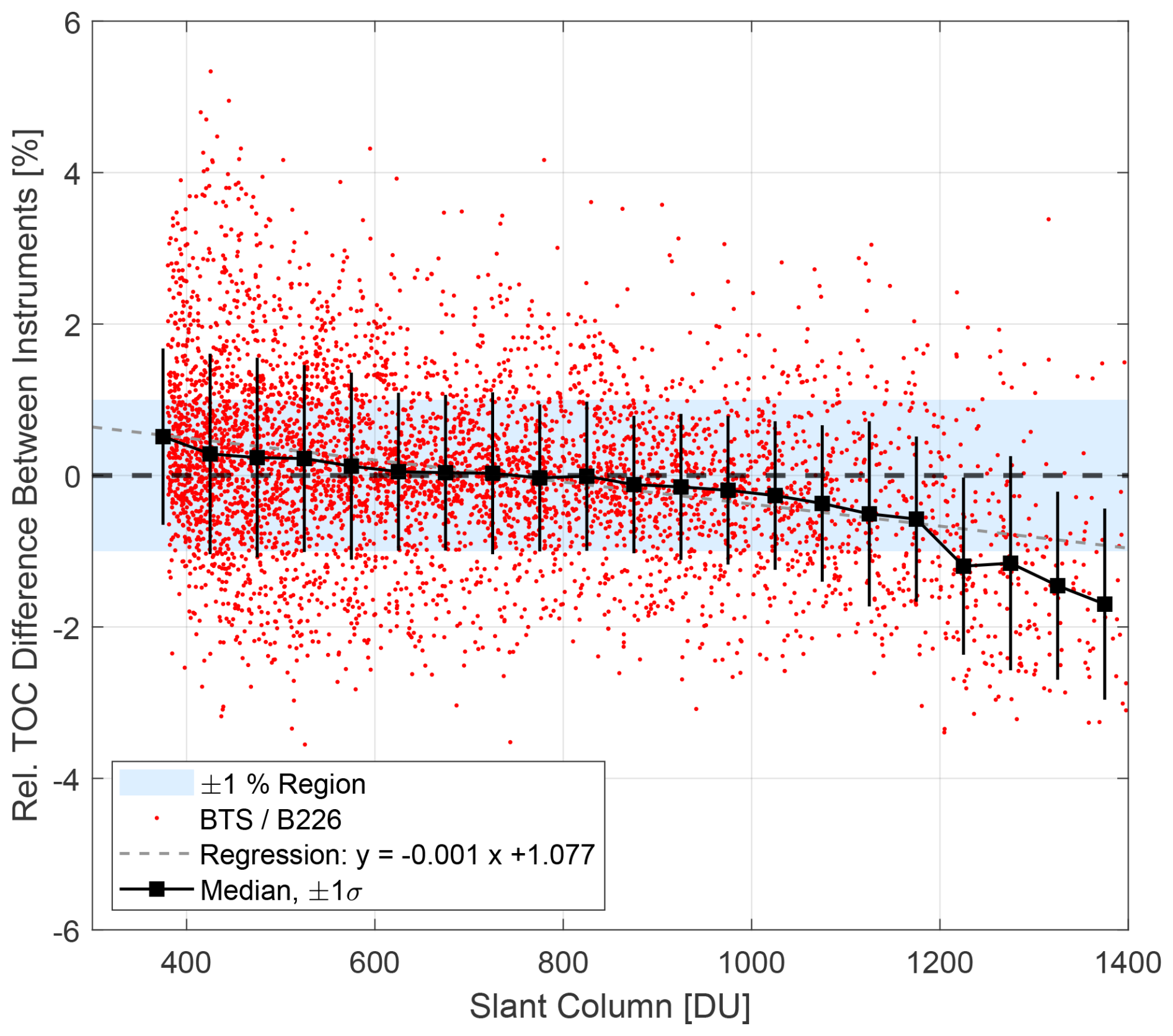
Figure 14Relative difference between total ozone columns (TOC) measured by a modern CCD-based spectrometer (Gigahertz BTS) and the NDACC Brewer double-monochromator #226, shown as a function of slant TOC for observations at Hohenpeißenberg from November 2021 to December 2025.
Other challenges include the scarcity and/or cost of supplies, e.g., helium for launching sondes, gases used in lasers, and the phase-out of certain technologies. The latter case is illustrated by the need to replace the HFC coolant (R23) in frostpoint water vapor sondes. R23, a powerful greenhouse gas, is banned in accordance with the Montreal Protocol Kigali Amendment.
Figure 15 shows profiles of water vapor from paired launches of NOAA frost point hygrometers (FPHs) using (1) dry ice and ethanol (DIA) and (2) liquid nitrogen (LN2). Although significant progress has been made transitioning away from R23, further intercomparisons with alternative cryogens are ongoing.
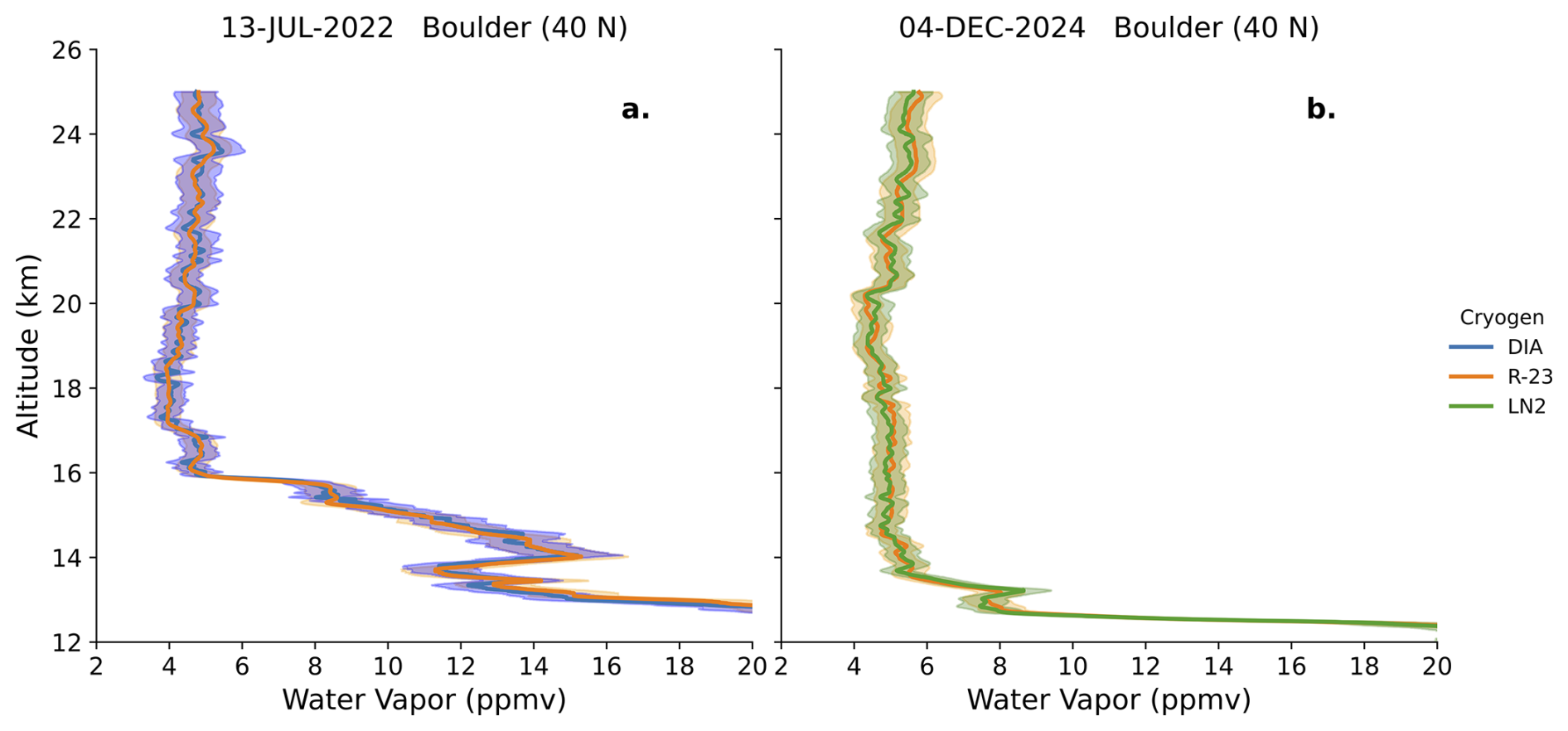
Figure 15Near simultaneous launches from Boulder with (a) NOAA R-23 and NOAA DIA FPHs on 13 July 2022 and (b) with NOAA R-23 and NOAA LN2 FPHs on 4 December 2024. Shown are the 1 s gaussian filtered water vapor data products and total calculated uncertainties of each, derived using sources of error in the frost point temperature measurements and the reported uncertainty of the iMet-54 radiosonde pressure.
Many NDACC instruments come from small manufacturers with limited staff. This limitation makes it difficult to track unintentional manufacturing changes in ozonesonde production, for example, that have contributed to inconsistencies in ozone profile time series (Stauffer et al., 2022). The NDACC and WMO-sponsored Assessment of Standard Operating Procedures for Ozonesondes (ASOPOS) activity is standardizing procedures for ozonesonde operations and data processing (WMO Report 268; Smit et al., 2024) with the idea of homogenizing long-term records using an absolute ozone standard.
Recent problems with Raman lidar water vapor measurements illustrate an unusual challenge. Their data in regions affected by UT/LS biogenic aerosols from extreme wildfires (Khaykin et al., 2020a) are contaminated by aerosol fluorescence (Chouza et al., 2022). The measurements can be corrected, but with reduced signal-to-noise ratio, compromising reliable trend detection. Raman lidar observations performed at 532 nm are an alternative.
Ongoing changes in IT, lasers, spectrometric systems, components, etc., across 40 years or more is a challenge that requires expertise and costly efforts to digitize historic data and to upgrade to new systems. To guarantee trend-worthy data, parallel operation of old and new systems, sometimes over years, is essential and required by NDACC protocols. Remote access to and/or automatic operation of instruments is increasingly available. This reduces staffing requirements and cost, although in some cases internet security limits remote access.
Traceability, fiducial reference measurements, changing calibration
Validating satellite observations and numerical models has been a primary objective of NDACC since its inception. Over the past 35 years, the fleet of satellites and their validation needs have evolved significantly. NDACC data meet many of the requirements but not always all.
Challenges to the FRM process include outdated standards for uncertainty budgets, e.g., Basher (1982) for Dobsons. For Brewers, calibration relies on several entities: International Ozone Services (IOS), the RBCC-E (Regional Brewer Calibration Center – Europe), and Environment and Climate Change Canada. All three organizations participate in calibration campaigns, publishing results in WMO/GAW reports. There is a high level of agreement, typically 0.5 % to 1 % or better (Zhao et al., 2023), but it is time-consuming to specify data and metadata to ensure reproducible calibrations and efficient reprocessing. The methods developed for more reliable uncertainties (Redondas et al., 2020) are difficult to implement but they represent an opportunity for data format transition, e.g., from NASA Ames to GEOMS-HDF.
Spectroscopic reference databases (e.g., HITRAN used in IRWG) are typically updated every 4 years. Instrument Working Groups track the effect of changes on NDACC data records to decide on whether to reprocess historical records. An example of ensuring accurate data comes from ozone absorption cross sections used to derive traceable ozone values that have changed several times over ∼ 60 years, i.e., over the lifetime of the Dobson network. NDACC and the larger community have yet to complete the transition to new temperature-dependent cross sections (Serdyuchenko et al., 2014; Weber et al., 2016), approved a decade ago by the International Ozone Commission (Orphal et al., 2016) because implementation requires reprocessing of large archives (Voglmeier et al., 2024). NDACC and WMO/GAW are coordinating the update at the World Ozone and UV Data Center (https://www.woudc.org, last access: 28 May 2026).
5.1.2 Programmatic and infrastructure challenge
Funding challenges
Long-term consistency and continuity are emblematic of NDACC. However, “continue to do for the next five years what was done over the last five years” is not attractive for funding organizations that are oriented toward innovation. NDACC research is heavily driven by instrument PIs and staff who need to diversify their work while also maintaining and expanding their NDACC activities. This is a challenge when funding decreases or when staff move on or retire. Institutional priorities may change and a research group is disbanded. NDACC is proactive in overcoming obstacles. NDACC engagement with WMO scientific advisory groups, expert teams and technical conferences, with satellite groups, and with evolving observation strategies, provides support for projects that leverage NDACC measurements as well as for helping individual stations. NDACC's letters to sponsors have prevented station closures. Instrument working group meetings promote visibility of PIs and staff to program managers. NDACC's advances in creating and promulgating standard operating procedures and processing and reprocessing software helps maintain operations as personnel and instruments change.
Enhancing network efficiency and expanding NDACC
The focus of NDACC has been on general coordination, and scientific and technical support. Central processing, or very rigid or intrusive requirements, have not been part of NDACC's strategy, although they might make some things more efficient. Over the years, instruments and operating procedures have, however, become more standardized and simpler to operate. NDACCs FTIR stations, for example, use nearly all the same instrument, as well as common traveling calibration standards and operation procedures, which allows processing and species retrieval with a common software and in a central facility for PIs interested in this option. Benefits are more cohesive network-wide data products (e.g., Hannigan et al., 2022), more timely deposits to data centers, more rapid data reprocessing, retrieval of an increased number of species with greater efficiency, and a reduced burden on station PIs.
Another aspect, also from FTIR, is extension of the very high quality but sparse NDACC network to lower quality stations to give better coverage. The standard NDACC high-resolution FTIR interferometers are expensive and require substantial expertise. As a consequence, important portions of the globe are not monitored. Lower cost, moderate spectral resolution (e.g., 2 to 4.5 cm OPD) mid-IR interferometers (Sha et al., 2020), that require little maintenance can provide a solution, especially for tropospheric species or total column abundances (e.g., Zhou et al., 2023). Hardware and software that enable autonomous operation are used. In Kolkata, India, a lower-resolution FTIR instrument provides good quality data for species like HCHO.
A “tiered system” might be considered within the NDACC once the recently developed (and future) mobile observational systems will be incorporated in the NDACC (i.e. SMOL, and compact FTIRs). The new set of requirements will be designed for the short and long-term data obtained with these instruments. Depending on the outcomes of the ongoing assessments of these mobile, more cost-effective instruments, they will be fully integrated into NDACC or integrated along the concept of tiered system. NDACC is open to partner with other networks to discuss the needs for further harmonization, integration and cost-effectiveness. Such efforts are initiated in the European CARGO-ACT project (https://www.cargo-act.eu/, last access: 28 May 2026) in which NDACC is represented.
A world-wide homogeneity among similar instruments within, but also outside NDACC, should be a high priority, e.g., for global satellite validation and long-term variability analyses. NDACC's ozonesonde community, for example, seeks to increase collaboration with China (e.g., Beijing and Hong Kong) and India (e.g., Pune and Trivandrum), stations that collect a significant number of profiles. However, they use ozonesonde models for which instrumental errors are not fully characterized, e.g. at the World Calibration Centre for Ozone Sondes in Jülich, Germany.
More challenging is a lack of homogeneity among different instrument types or networks, e.g., for column NO2, O3 and HCHO data from NDACC DOAS UV-visible instruments, NDACC FTIRs, and the PGN (Pinardi et al., 2026) or for CH4, N2O and CO column data from NDACC FTIR and TCCON (e.g., Zhou et al., 2018, 2019a, b).
Easy access to data remains a challenge. The NDACC Data Handling Facility provides access to all NDACC measurements, but formats and versions change over time, and the granularity of data packaging is not always user-friendly. Data archived in multiple centers, in various formats, and with various overlaps among the centers are difficult to use. Examples include ozonesonde data, archived in eight archives (NDACC, WOUDC, SHADOZ, NOAA, EVDC, AVDC, HEGIFTOM, CDS) in different data formats. This leads not only to inconsistencies in data and metadata stored across archives, but also between stations in one archive, and even in the data record of one given site. It is expected that transition to unified metadata and data formats, e.g., GEOMS-HDF, will facilitate better coordination among archives. The goal is always to provide simple, friendly access to users, incorporating FAIR principles.
5.2 Scientific opportunities and technical challenges
Challenges and unexpected findings represent new opportunities for NDACC as the following examples illustrate.
5.2.1 Ozone recovery and climate change
Mandates based on the Vienna Convention for the Protection of the Ozone Layer and the associated Montreal Protocol provided the scientific motivation for NDSC in the early 1990s. Following the success of the Montreal Protocol and its subsequent amendments (WMO, 2014), there is a common perception that stratospheric ozone depletion is a “solved problem”. However, ozone depletion is still substantial and ozone layer recovery is more complex than a decade ago (WMO, 2022), partially due to unexpected increases in very short-lived ODSs injected into the UT/LS from Asian emissions (e.g., Adcock et al., 2021; Lauther et al., 2022; Pan et al., 2024). These species are only tracked from NDACC ground-based instruments. The need for these data is greater than ever.
Related to the need to maintain ODS monitoring for ozone recovery is the impending loss of the MLS water vapor and ClO coverage as well as reduced viewing of Arctic ozone depletion events, volcanic and/or wildfire injections of material into the stratosphere. Springtime stratospheric ozone depletion in polar regions continues to be highly variable year to year (e.g., Manney et al., 2020; Bognar et al., 2021; Pazmiño et al., 2023; Shi et al., 2023), making long-term NDACC measurements of ozone-related species important for tracking future changes.
5.2.2 Unexpected events
Unexpected events, such as recent extreme wildfires (Khaykin et al., 2020a; John et al., 2021; Wizenberg et al., 2023; Tickl et al., 2024; Flood et al., 2025; Khaykin et al., 2025) and or the Hunga volcanic eruption (Nedoluha et al., 2023a) sharply modified stratospheric composition and perturbed predictions of future stratospheric composition (Strahan et al., 2022; Solomon et al., 2023). Modeling is required to assess impacts of potential injected sulfate particles to the stratosphere, an action designed to counteract global warming. Ongoing climate change has modified the trajectory of ozone recovery (WMO, 2022). Whereas anthropogenic ODS defined NDACC's original measurement portfolio, increasing emissions of GHGs like CO2, CH4 and N2O are re-defining some NDACC priorities. Also relevant are changes in air quality, atmospheric aerosol loading, and cloud cover, for example, affecting surface UV (Cordero et al., 2013, 2023). Extreme UV events still occur from Antarctic ozone loss, e.g. over Patagonia and the Antarctic peninsula (De Laat et al., 2010; Cordero et al., 2022).
5.2.3 Candidates for expanding NDACC measurements
Generally, as some satellite capabilities decrease and others emerge, NDACC's ground-based measurements remain vital. Examples of expansion opportunities follow.
More species from FTIR
NDACC FTIRs at nearly two dozen stations provide clear-sky high-resolution solar absorption measurements for 13 key air quality, ozone, ozone precursors, and greenhouse gases. A strategic aim is to expand this list to more constituents important in climate change, global pollution, and ozone depletion. Potential molecules, already retrieved and archived on the DHF for some FTIR sites, include ammonia (NH3), ethylene (C2H4), methanol (CH3OH), peroxy-acetyl nitrate (PAN), and hydrofluorocarbons (HFCs) that are regulated by the 2016 Kigali Amendment of the Montreal Protocol. Retrieval of the two most abundant HFCs, HFC-134a and HFC-23, has been demonstrated at a few NDACC stations (Pardo Campos et al., 2024).
Wind
Wind data are vital for weather forecasting and for understanding global circulation, but upper air wind data are scarce. For a short period, the space-based AEOLUS lidar provided global upper atmospheric wind data, greatly improving weather forecasts (Rennie et al., 2021; Garrett et al., 2022). Ground-based wind-lidars, a recent NDACC addition (Khaykin et al., 2020b), were instrumental in validating AEOLUS (Ratynski et al., 2023). Microwave radiometers also measure upper atmospheric winds (Hagen et al., 2018). A network of ground-based wind instruments could also validate a space-based wind lidar.
Water vapor
Water vapor, the most important greenhouse gas, affects radiation and dynamics, cloud formation and atmospheric chemistry. Climate models show a substantial moist bias in the lowermost stratosphere (Stenke et al., 2008; Charlesworth et al., 2023), a sensitive climate-feedback region. NDACC profiles of water vapor are essential for improving models. NDACC measures high resolution water vapor profiles with balloon-borne FPH and water vapor Raman lidars in the troposphere and (lower) stratosphere (Vömel et al., 2016; Hall et al., 2016; Leblanc et al., 2012; Hicks-Jalali et al., 2020), as well as coarse resolution profiles in the (upper) stratosphere and mesosphere with microwave radiometers (Nedoluha et al., 2022, 2023b). Water vapor measurements for stratospheric needs are usually adequate with monthly or bi-weekly observations.
Natural stratospheric water vapor sources, i.e., CH4 and H2 oxidation, may be augmented by overshooting convection and subtropical monsoonal circulations. Looking ahead, NDACC has created a water vapor strategy: (https://ndacc.larc.nasa.gov/sites/default/files/2024-01/NDACC_WaterVaporStrategy_20220119.pdf, last access: 28 May 2026).
Aerosols and climate interventions
The stratospheric aerosol layer impacts radiation and chemistry, but stratospheric aerosol is variable, routinely perturbed by small and moderate volcanic eruptions and increasingly by large wildfires (Solomon et al., 2022; Solomon et al., 2023; Peterson et al., 2022). Typical stratospheric aerosol, concentrated between the tropopause and 25 km, is composed of sulfuric acid particles from SO2 and OCS oxidation, mixed organic sulfate particles that enter from the troposphere, and meteoric particles (Murphy et al., 1998, 2014). Particles from rocket emissions (Maloney et al., 2022) and satellite re-entry (Murphy et al., 2023) are likely to increase in the coming decades. The Asian Tropopause Aerosol Layer (Vernier et al., 2011), occurring during boreal summer, contributes up to 15 % of Northern Hemisphere aerosol (Yu et al., 2017). Recent NDACC aerosol measurements show that the Asian summer monsoon is a weak but a measurable source of stratospheric aerosol even in the Arctic from late summer to early autumn (Graßl et al., 2024). Routine measurements of stratospheric aerosol, a key capability of NDACC, are essential, particularly if climate intervention leads to enhanced particle injections (Asher et al., 2023) and large wildfires (Asher et al., 2024). Because size distributions are not directly observable from space, measurements of particle composition are frequently carried out during aircraft campaigns. NDACC proposes to add routine balloon-borne measurements of aerosol size distributions with optical particle spectrometers, e.g., the Portable Optical Particle Spectrometer (POPS; Todt et al., 2023) in the next 3–5 years.
This article has reviewed the fundamentals of NDACC, its rationale, mission and the success of the highest quality instruments in monitoring atmospheric composition and contributing to major assessments. NDACC's Working Groups have been exemplary in promulgating standards and best practices. Similar approaches have been employed by NDACC's 10 Cooperating Networks. NDACC has been active in research and scientific service programs, especially within the European Union and North America, and within international satellite projects where its data are essential to algorithm and model development and validation. NDACC is operating within the framework of the latest developments in data distribution and management practices.
NDACC's impact on solving major problems in atmospheric composition and climate has been highlighted. For example, long-term monitoring has been foundational in tracking the health of the stratospheric ozone layer and more recently, the evolution of air quality and climate pollutants. Exceptional events, such as volcanic eruptions, are captured with NDACC observations, which can measure impacts on a scale too small for satellites. With a decreasing satellite constellation for stratospheric composition, the need for NDACC observations could not be greater. NDACC is at a crossroads as resource pressures on ground-based monitoring programs increase. With data archiving and distribution activities diverting resources from data collection in some networks, strategic planning is essential to strengthen NDACC and its Cooperating Networks.
Based on specific recommendations in prior sections, NDACC is well-positioned to adopt a three-pronged strategy: protect existing stations and data streams; promote greater usage of NDACC data; and expand NDACC's coverage geographically and in species-parameter space.
-
Protect Existing Stations and Data streams. As described above, current NDACC observing infrastructure and resources (instruments, data, and people) must be sustained. With many stations operating for three to four decades, their records are increasingly indispensable as the value of a dataset increases with its longevity. NDACC and cooperating partners are actively engaging a younger generation of scientists and technical professionals, with a specific focus on expanding representations from underrepresented areas. The goal is to evolve infrastructure so that expertise and projects are transferred, that capacity is built, and that innovative ideas and insights emerge. An important element of this effort is the ongoing development of more cost-effective and automated instruments, with centralized data acquisition and processing. Adding new observations at existing stations, leveraging infrastructure and personnel, is another approach to strengthening the networks.
-
Promote Greater Usage of NDACC Data. It is important to advertise and promote the usage of the NDACC data with network stakeholders and throughout the global scientific community. Due to its roots in stratospheric ozone research, including development and validation of satellite products, there is a dedicated data user group worldwide that extends to atmospheric dynamics and air quality. NDACC is currently extending data impact through cross-disciplinary initiatives in climate and carbon cycle research, climate intervention, etc. The efforts of NDACC and cooperating networks to distribute data more rapidly and more accessible, conforming to the latest data practices (e.g., FAIR), are widening impact even more, as are data sharing initiatives with WMO and other organizations. The CAMS assimilation system that relies on NDACC observations as an independent reference is another sign of network impact. The TOAR II HEGIFTOM activity, with data reprocessing from four NDACC instrument types, marks a major milestone. The HEGIFTOM homogenized dataset had moved to the NDACC DHF and other historical archives, and is now a gold standard, supplying reference data for evaluation of satellite products and global model output. More active collaboration with satellite and modeling communities will further promote applications of NDACC data.
-
Expand NDACC's coverage in two ways.
- –
Geographical Coverage. NDACC's coverage is still poor in Africa, Asia, South America and the Mediterranean region, partly due to shortage of resources for equipment and of skilled personnel or expertise. In other cases, high-quality data are collected but they are not shared. The latter situation is expected to improve over time as more journals publish links to data archives. NDACC needs to engage with organizations that have infrastructure and expertise. An NDACC affiliation is a path to greater visibility and access to unique expertise and support. Collaborations within Cooperating Networks, WMO/GAW, and other agencies can be leveraged to augment NDACC stations. Finding a means of incorporating data from environmental and air quality agencies is an approach to consider. A compelling rationale for expanding NDACC to more urban stations is that researchers evaluating satellite products for air quality and emissions estimates are a growing user community for our data.
- –
Coverage of Species and Parameters (Variables Space). NDACC needs to add measurements of species that are coming to greater prominence or that may not have existed or been measurable decades ago. Selection criteria must include the added-value and complementarity with existing observations at a given station. NDACC instrument working groups, laboratory spectroscopists, and instrument developers can support this work. With the advent of constellations of nadir-looking satellites focusing on air quality pollutants and greenhouse gas observations, including those from geostationary platforms, and the NRT assimilation of their data in forecast systems, we must ensure that observations are carried out and assimilated as continuously as possible. The increasing automation and rapid distribution capacity of NDACC observations is a must for these operations. NDACC is ready to face its future evolution and is confident that the network will maintain and even strengthen its relevance provided that the required resources can be leveraged.
NDACC has faced, and will continue to face, challenges. However, the combined experience and substantial know-how of NDACC's PIs, instrument working groups, and its associated networks should overcome these challenges, develop new opportunities, and secure the continuation of the 35+ years of high-quality, long-term measurements that NDACC is known for. Ground-based data remain irreplaceable for documenting key aspects of atmospheric composition in a warming troposphere and a cooling stratosphere.
- –
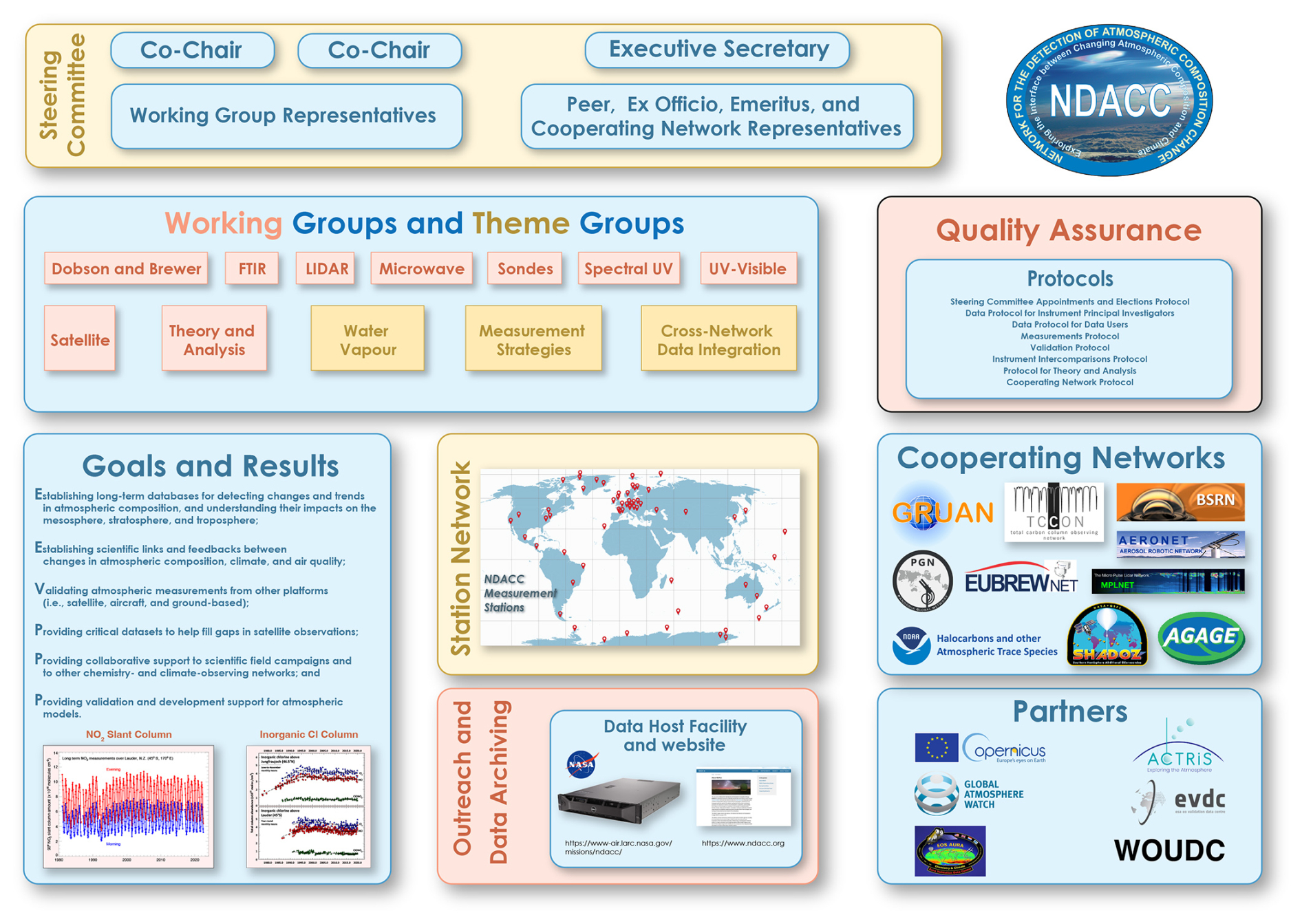
Figure A1Organizational structure of NDACC. Logos are courtesy of the NDACC Cooperating networks (AERONET, AGAGE, BSRN, EuBrewNet, GRUAN, HATS, MPLNET, PGN, SHADOZ, TCCON, and TOLNet) and Partners (Copernicus/ESA/CAMS-27, WMO GAW, WOUDC, ACTRIS/GREGARS, ECMWF/C3S, DCIO/EVDC). Used with permission. The figure was taken from NDACC (https://ndacc.org (last access: 28 May 2026) > ABOUT > Organizational System) and modified by the authors.
Table B1Definition of Solar spectral range used in the NDACC observations. See full instrument description at https://ndacc.larc.nasa.gov/instruments (last access: 28 May 2026).
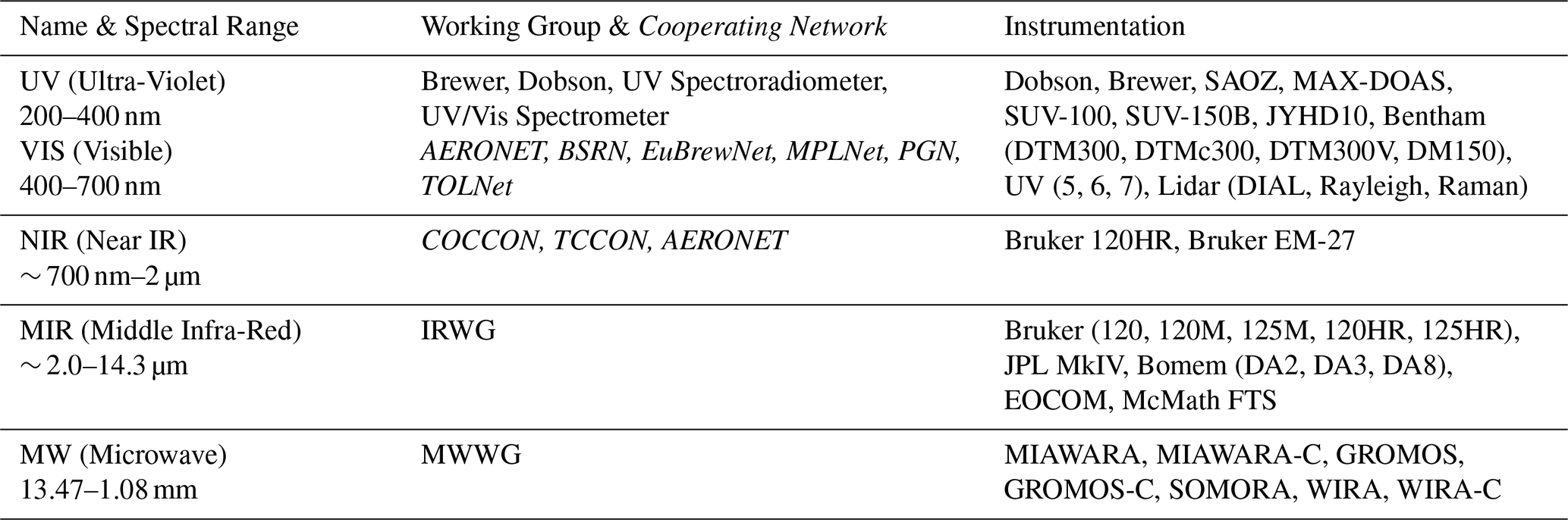
Table C1Recent and current satellite missions for which NDACC provides validation data and/or collaboration effort. Section 3.4 gives more details on present and upcoming missions.
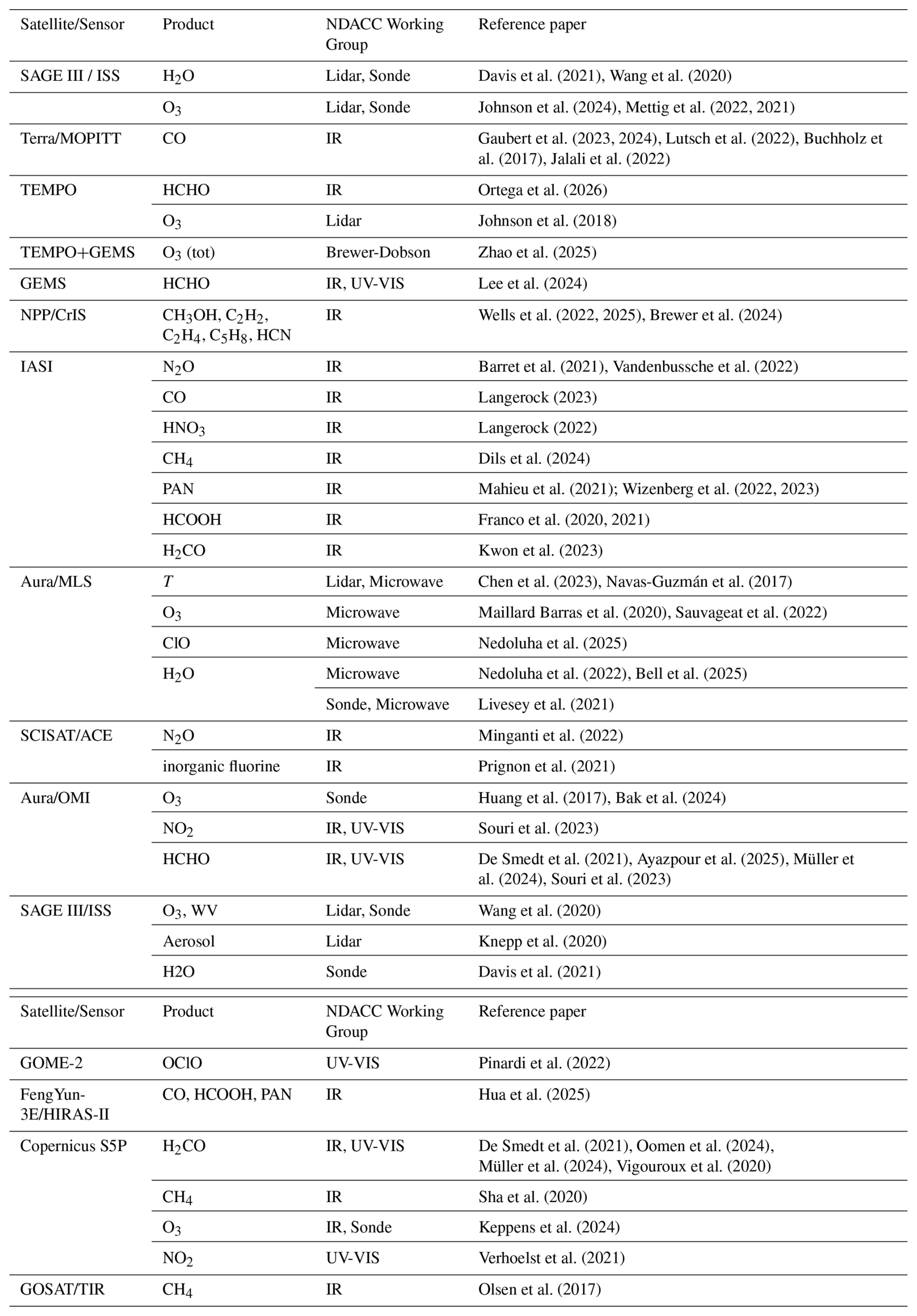
The NDACC data used in this paper are archived at the Data Host Facility (DHF) that is hosted at NASA Langley Research Center (LaRC). DHF is serving as a central archive and access point for atmospheric data, offering tools for scientists to query and download datasets related to ozone, aerosols, and other atmospheric components: https://www-air.larc.nasa.gov/missions/ndacc/ (last access: 28 May 2026).
MD, JCL, IP and JW conceptualized the paper. IP, MD, JW, AT, HS, JWH, RH, WS and JCL led the paper preparation. All authors contributed to the writing of the paper and/or provided figures either from their published papers or updated published figures.
At least one of the (co-)authors is a member of the editorial board of Atmospheric Chemistry and Physics. The peer-review process was guided by an independent editor, and the authors also have no other competing interests to declare.
The statements, findings, conclusions, and recommendations are those of the author(s) and do not necessarily reflect the views of NOAA or the U.S. Department of Commerce.
Publisher's note: Copernicus Publications remains neutral with regard to jurisdictional claims made in the text, published maps, institutional affiliations, or any other geographical representation in this paper. The authors bear the ultimate responsibility for providing appropriate place names. Views expressed in the text are those of the authors and do not necessarily reflect the views of the publisher.
This article is part of the special issue “Achievements and perspectives of the Network for the Detection of Atmospheric Composition Change (NDACC) after 35 years of operation (ACP/AMT inter-journal SI)”. It is not associated with a conference.
This work has been supported in part by NOAA (Cooperative Institute for Satellite Earth System Studies – CISESS) at the University of Maryland/ESSIC and NOAA for the Cooperative Institute for Earth System Research and Data Science (CIESRDS). Emmanuel Mahieu is a research director with F.R.S.-FNRS (Brussels, Belgium). Cloud and radiation measurements within NDACC are supported by DFG, which funds the project “Cloud 3D Structure and Radiation (C3SAR)”. JWH & IO at the National Center for Atmospheric Research are sponsored by the National Science Foundation. The NCAR NDACC program is supported under contract by the National Aeronautics and Space Administration (NASA). Part of this research was carried out at the Jet Propulsion Laboratory, California Institute of Technology, under a contract with the National Aeronautics and Space Administration. GMI and the GEOS CCM were supported by the NASA Modeling, Analysis, and Prediction program and the GEOS-GMI MINDS simulation was supported by the NASA MEaSUREs program and computational resources from the NASA Center for Climate Simulation.
This research has been supported in part by NOAA (grant no. NA19NES4320002; Cooperative Institute for Satellite Earth System Studies – CISESS) at the University of Mary-land/ESSIC and NOAA (grant no. NA22OAR4320151) for the Cooperative Institute for Earth System Research and Data Science (CIESRDS). Part of the research has been supported by NASA grant number 80NSSC23K0398 at the University of Maryland/ESSIC. The NCAR NDACC program was supported under contract by the National Aeronautics and Space Administration (NASA) grant number 80NSSC23K0398. This research has been supported in part by the NASA Upper Atmospheric Composition Program 80NSSC21K0892.
This paper was edited by Tanja Schuck and reviewed by two anonymous referees.
Adcock, K. E., Fraser, P. J., Hall, B. D., Langenfelds, R. L., Lee, G., Montzka, S. A., Oram, D. E., Röckmann, T., Stroh, F., Sturges, W. T., Vogel, B., and Laube, J. C.: Aircraft-Based Observations of Ozone-Depleting Substances in the Upper Troposphere and Lower Stratosphere in and Above the Asian Summer Monsoon, J. Geophys. Res.-Atmos., 126, e2020JD033137, https://doi.org/10.1029/2020JD033137, 2021.
Asher, E., Todt, M., Rosenlof, K., Thornberry, T., Gao, R.-S., Taha, G., Walter, P., Alvarez, S., Flynn, J., Davis, S. M., Evan, S., Brioude, J., Metzger, J.-M., Hurst, D. F., Hall, E., and Xiong, K.: Unexpectedly rapid aerosol formation in the Hunga Tonga plume, P. Natl. Acad. Sci. USA, 120, e2219547120, https://doi.org/10.1073/pnas.2219547120, 2023.
Asher, E., Baron, A., Yu, P., Todt, M., Smale, P., Liley, B., Querel, R., Sakai, T., Morino, I., Jin, Y., Nagai, T., Uchino, O., Hall, E., Cullis, P., Johnson, B., and Thornberry, T. D.: Balloon Baseline Stratospheric Aerosol Profiles (B2 SAP) – Perturbations in the Southern Hemisphere, 2019–2022, J. Geophys. Res.-Atmos., 129, e2024JD041581, https://doi.org/10.1029/2024JD041581, 2024.
Ayazpour, Z., González Abad, G., Nowlan, C. R., Sun, K., Kwon, H., Chan Miller, C., Chong, H., Wang, H., Liu, X., Chance, K., O'Sullivan, E., Zhu, L., Vigouroux, C., De Smedt, I., Stremme, W., Hannigan, J. W., Notholt, J., Sun, X., Palm, M., Petri, C., Strong, K., Röhling, A. N., Mahieu, E., Smale, D., Té, Y., Morino, I., Murata, I., Nagahama, T., Kivi, R., Makarova, M., Jones, N., Sussmann, R., and Zhou, M.: Aura Ozone Monitoring Instrument (OMI) Collection 4 Formaldehyde Products, Earth Space Sci., 12, e2024EA003792, https://doi.org/10.1029/2024EA003792, 2025.
Bak, J., Liu, X., Yang, K., Gonzalez Abad, G., O'Sullivan, E., Chance, K., and Kim, C.-H.: An improved OMI ozone profile research product version 2.0 with collection 4 L1b data and algorithm updates, Atmos. Meas. Tech., 17, 1891–1911, https://doi.org/10.5194/amt-17-1891-2024, 2024.
Ball, W. T., Alsing, J., Mortlock, D. J., Staehelin, J., Haigh, J. D., Peter, T., Tummon, F., Stübi, R., Stenke, A., Anderson, J., Bourassa, A., Davis, S. M., Degenstein, D., Frith, S., Froidevaux, L., Roth, C., Sofieva, V., Wang, R., Wild, J., Yu, P., Ziemke, J. R., and Rozanov, E. V.: Evidence for a continuous decline in lower stratospheric ozone offsetting ozone layer recovery, Atmos. Chem. Phys., 18, 1379–1394, https://doi.org/10.5194/acp-18-1379-2018, 2018.
Baron, A., Chazette, P., Khaykin, S., Payen, G., Marquestaut, N., Bègue, N., and Duflot, V.: Early Evolution of the Stratospheric Aerosol Plume Following the 2022 Hunga Tonga-Hunga Ha'apai Eruption: Lidar Observations From Reunion (21° S, 55° E), Geophys. Res. Lett., 50, e2022GL101751, https://doi.org/10.1029/2022GL101751, 2023.
Barret, B., Gouzenes, Y., Le Flochmoen, E., and Ferrant, S.: Retrieval of Metop-A/IASI N2O Profiles and Validation with NDACC FTIR Data, Atmosphere, 12, 219, https://doi.org/10.3390/atmos12020219, 2021.
Basher, R. E.: Review of the dobson spectrophotometer and its accuracy, Geneva, 1982.
Bell, A., Sauvageat, E., Stober, G., Hocke, K., and Murk, A.: Developments on a 22 GHz microwave radiometer and reprocessing of 13-year time series for water vapour studies, Atmos. Meas. Tech., 18, 555–567, https://doi.org/10.5194/amt-18-555-2025, 2025.
Bernhard, G. and Stierle, S.: Trends of UV Radiation in Antarctica, Atmosphere, 11, 795, https://doi.org/10.3390/atmos11080795, 2020.
Björklund, R., Vigouroux, C., Effertz, P., García, O. E., Geddes, A., Hannigan, J., Miyagawa, K., Kotkamp, M., Langerock, B., Nedoluha, G., Ortega, I., Petropavlovskikh, I., Poyraz, D., Querel, R., Robinson, J., Shiona, H., Smale, D., Smale, P., Van Malderen, R., and De Mazière, M.: Intercomparison of long-term ground-based measurements of total, tropospheric, and stratospheric ozone at Lauder, New Zealand, Atmos. Meas. Tech., 17, 6819–6849, https://doi.org/10.5194/amt-17-6819-2024, 2024.
Bognar, K., Alwarda, R., Strong, K., Chipperfield, M. P., Dhomse, S. S., Drummond, J. R., Feng, W., Fioletov, V., Goutail, F., Herrera, B., Manney, G. L., McCullough, E. M., Millán, L. F., Pazmino, A., Walker, K. A., Wizenberg, T., and Zhao, X.: Unprecedented Spring 2020 Ozone Depletion in the Context of 20 Years of Measurements at Eureka, Canada, J. Geophys. Res.-Atmos., 126, e2020JD034365, https://doi.org/10.1029/2020JD034365, 2021.
Boone, C. D., Bernath, P. F., and Fromm, M. D.: Pyrocumulonimbus Stratospheric Plume Injections Measured by the ACE-FTS, Geophys. Res. Lett., 47, e2020GL088442, https://doi.org/10.1029/2020GL088442, 2020.
Brewer, J. F., Millet, D. B., Wells, K. C., Payne, V. H., Kulawik, S., Vigouroux, C., Cady-Pereira, K. E., Pernak, R., and Zhou, M.: Space-based observations of tropospheric ethane map emissions from fossil fuel extraction, Nat. Commun., 15, 7829, https://doi.org/10.1038/s41467-024-52247-z, 2024.
Brogniez, C., Doré, J.-F., Auriol, F., Cesarini, P., Minvielle, F., Deroo, C., Catalfamo, M., Metzger, J.-M., and Da Conceicao, P.: Erythemal and vitamin D weighted solar UV dose-rates and doses estimated from measurements in mainland France and on Réunion Island, J. Photoch. Photobio. B, 225, 112330, https://doi.org/10.1016/j.jphotobiol.2021.112330, 2021.
Buchholz, J., Querner, P., Paredes, D., Bauer, T., Strauss, P., Guernion, M., Scimia, J., Cluzeau, D., Burel, F., Kratschmer, S., Winter, S., Potthoff, M., and Zaller, J. G.: Soil biota in vineyards are more influenced by plants and soil quality than by tillage intensity or the surrounding landscape, Sci. Rep., 7, 17445, https://doi.org/10.1038/s41598-017-17601-w, 2017.
Charlesworth, E., Plöger, F., Birner, T., Baikhadzhaev, R., Abalos, M., Abraham, N. L., Akiyoshi, H., Bekki, S., Dennison, F., Jöckel, P., Keeble, J., Kinnison, D., Morgenstern, O., Plummer, D., Rozanov, E., Strode, S., Zeng, G., Egorova, T., and Riese, M.: Stratospheric water vapor affecting atmospheric circulation, Nat. Commun., 14, 3925, https://doi.org/10.1038/s41467-023-39559-2, 2023.
Chen, Z., Schwartz, M. J., Bhartia, P. K., Schoeberl, M., Kramarova, N., Jaross, G., and DeLand, M.: Mesospheric and Upper Stratospheric Temperatures From OMPS-LP, Earth and Space Science, 10, e2022EA002763, https://doi.org/10.1029/2022EA002763, 2023.
Chipperfield, M. P., Liang, Q., Rigby, M., Hossaini, R., Montzka, S. A., Dhomse, S., Feng, W., Prinn, R. G., Weiss, R. F., Harth, C. M., Salameh, P. K., Mühle, J., O'Doherty, S., Young, D., Simmonds, P. G., Krummel, P. B., Fraser, P. J., Steele, L. P., Happell, J. D., Rhew, R. C., Butler, J., Yvon-Lewis, S. A., Hall, B., Nance, D., Moore, F., Miller, B. R., Elkins, J. W., Harrison, J. J., Boone, C. D., Atlas, E. L., and Mahieu, E.: Model sensitivity studies of the decrease in atmospheric carbon tetrachloride, Atmos. Chem. Phys., 16, 15741–15754, https://doi.org/10.5194/acp-16-15741-2016, 2016.
Chipperfield, M. P., Hegglin, M. I., Newman, P. A., Park, S., Reimann, S., Rigby, M., Stohl, A., Velders, G. J. M., Walter-Terrinoni, H., and Yao, B.: Report on the Unexpected Emissions of CFC-11, WMO, ISBN/EAN 978-92-63-11268-2, 2021.
Chouza, F., Leblanc, T., Brewer, M., Wang, P., Martucci, G., Haefele, A., Vérèmes, H., Duflot, V., Payen, G., and Keckhut, P.: The impact of aerosol fluorescence on long-term water vapor monitoring by Raman lidar and evaluation of a potential correction method, Atmos. Meas. Tech., 15, 4241–4256, https://doi.org/10.5194/amt-15-4241-2022, 2022.
Chouza, F., Leblanc, T., Wang, P., Brown, S. S., Zuraski, K., Chace, W., Womack, C. C., Peischl, J., Hair, J., Shingler, T., and Sullivan, J.: The Small Mobile Ozone Lidar (SMOL): instrument description and first results, Atmos. Meas. Tech., 18, 405–419, https://doi.org/10.5194/amt-18-405-2025, 2025.
Compernolle, S., Argyrouli, A., Lutz, R., Sneep, M., Lambert, J.-C., Fjæraa, A. M., Hubert, D., Keppens, A., Loyola, D., O'Connor, E., Romahn, F., Stammes, P., Verhoelst, T., and Wang, P.: Validation of the Sentinel-5 Precursor TROPOMI cloud data with Cloudnet, Aura OMI O2–O2, MODIS, and Suomi-NPP VIIRS, Atmos. Meas. Tech., 14, 2451–2476, https://doi.org/10.5194/amt-14-2451-2021, 2021.
Cordero, R. R., Seckmeyer, G., Damiani, A., Riechelmann, S., Rayas, J., Labbe, F., and Laroze, D.: The world's highest levels of surface UV, Photochem. Photobiol. Sci., 13, 70–81, https://doi.org/10.1039/c3pp50221j, 2013.
Cordero, R. R., Feron, S., Damiani, A., Redondas, A., Carrasco, J., Sepúlveda, E., Jorquera, J., Fernandoy, F., Llanillo, P., Rowe, P. M., and Seckmeyer, G.: Persistent extreme ultraviolet irradiance in Antarctica despite the ozone recovery onset, Sci. Rep., 12, 1266, https://doi.org/10.1038/s41598-022-05449-8, 2022.
Cordero, R. R., Feron, S., Damiani, A., Sepúlveda, E., Jorquera, J., Redondas, A., Seckmeyer, G., Carrasco, J., Rowe, P., and Ouyang, Z.: Surface Solar Extremes in the Most Irradiated Region on Earth, Altiplano, B. Am. Meteorol. Soc., 104, E1206–E1221, https://doi.org/10.1175/BAMS-D-22-0215.1, 2023.
Dammers, E., Vigouroux, C., Palm, M., Mahieu, E., Warneke, T., Smale, D., Langerock, B., Franco, B., Van Damme, M., Schaap, M., Notholt, J., and Erisman, J. W.: Retrieval of ammonia from ground-based FTIR solar spectra, Atmos. Chem. Phys., 15, 12789–12803, https://doi.org/10.5194/acp-15-12789-2015, 2015.
Davis, S. M., Damadeo, R., Flittner, D., Rosenlof, K. H., Park, M., Randel, W. J., Hall, E. G., Huber, D., Hurst, D. F., Jordan, A. F., Kizer, S., Millan, L. F., Selkirk, H., Taha, G., Walker, K. A., and Vömel, H.: Validation of SAGE III/ISS Solar Water Vapor Data With Correlative Satellite and Balloon-Borne Measurements, J. Geophys. Res.-Atmos., 126, e2020JD033803, https://doi.org/10.1029/2020JD033803, 2021.
De Laat, A. T. J., Van Der A, R. J., Allaart, M. A. F., Van Weele, M., Benitez, G. C., Casiccia, C., Paes Leme, N. M., Quel, E., Salvador, J., and Wolfram, E.: Extreme sunbathing: Three weeks of small total O3 columns and high UV radiation over the southern tip of South America during the 2009 Antarctic O3 hole season, Geophys. Res. Lett., 37, 2010GL043699, https://doi.org/10.1029/2010GL043699, 2010.
De Mazière, M., Thompson, A. M., Kurylo, M. J., Wild, J. D., Bernhard, G., Blumenstock, T., Braathen, G. O., Hannigan, J. W., Lambert, J.-C., Leblanc, T., McGee, T. J., Nedoluha, G., Petropavlovskikh, I., Seckmeyer, G., Simon, P. C., Steinbrecht, W., and Strahan, S. E.: The Network for the Detection of Atmospheric Composition Change (NDACC): history, status and perspectives, Atmos. Chem. Phys., 18, 4935–4964, https://doi.org/10.5194/acp-18-4935-2018, 2018.
De Smedt, I., Pinardi, G., Vigouroux, C., Compernolle, S., Bais, A., Benavent, N., Boersma, F., Chan, K.-L., Donner, S., Eichmann, K.-U., Hedelt, P., Hendrick, F., Irie, H., Kumar, V., Lambert, J.-C., Langerock, B., Lerot, C., Liu, C., Loyola, D., Piters, A., Richter, A., Rivera Cárdenas, C., Romahn, F., Ryan, R. G., Sinha, V., Theys, N., Vlietinck, J., Wagner, T., Wang, T., Yu, H., and Van Roozendael, M.: Comparative assessment of TROPOMI and OMI formaldehyde observations and validation against MAX-DOAS network column measurements, Atmos. Chem. Phys., 21, 12561–12593, https://doi.org/10.5194/acp-21-12561-2021, 2021.
Dils, B., Zhou, M., Camy-Peyret, C., De Mazière, M., Kangah, Y., Langerock, B., Prunet, P., Serio, C., Siddans, R., and Kerridge, B.: Independent validation of IASI/MetOp-A LMD and RAL CH4 products using CAMS model, in situ profiles, and ground-based FTIR measurements, Atmos. Meas. Tech., 17, 5491–5524, https://doi.org/10.5194/amt-17-5491-2024, 2024.
Duncan, B. N., Strahan, S. E., Yoshida, Y., Steenrod, S. D., and Livesey, N.: Model study of the cross-tropopause transport of biomass burning pollution, Atmos. Chem. Phys., 7, 3713–3736, https://doi.org/10.5194/acp-7-3713-2007, 2007.
Evan, S., Brioude, J., Rosenlof, K. H., Gao, R.-S., Portmann, R. W., Zhu, Y., Volkamer, R., Lee, C. F., Metzger, J.-M., Lamy, K., Walter, P., Alvarez, S. L., Flynn, J. H., Asher, E., Todt, M., Davis, S. M., Thornberry, T., Vömel, H., Wienhold, F. G., Stauffer, R. M., Millán, L., Santee, M. L., Froidevaux, L., and Read, W. G.: Rapid ozone depletion after humidification of the stratosphere by the Hunga Tonga Eruption, Science, 382, eadg2551, https://doi.org/10.1126/science.adg2551, 2023.
Fisher, B. L., Lamsal, L. N., Fasnacht, Z., Oman, L. D., Joiner, J., Krotkov, N. A., Choi, S., Qin, W., and Yang, E.-S.: Revised estimates of NO2 reductions during the COVID-19 lockdowns using updated TROPOMI NO2 retrievals and model simulations, Atmos. Environ., 326, 120459, https://doi.org/10.1016/j.atmosenv.2024.120459, 2024.
Flood, V. A., Strong, K., Whaley, C. H., Chen, J., Wunch, D., Drummond, J. R., Colebatch, O., Gillespie, L., and Mostafavi Pak, N.: The Impact of the 2023 Canadian Forest Fires on Air Quality in Southern Ontario, J. Geophys. Res.-Atmos., 130, e2024JD042254, https://doi.org/10.1029/2024JD042254, 2025.
Franco, B., Clarisse, L., Stavrakou, T., Müller, J. -F., Taraborrelli, D., Hadji-Lazaro, J., Hannigan, J. W., Hase, F., Hurtmans, D., Jones, N., Lutsch, E., Mahieu, E., Ortega, I., Schneider, M., Strong, K., Vigouroux, C., Clerbaux, C., and Coheur, P.-F.: Spaceborne Measurements of Formic and Acetic Acids: A Global View of the Regional Sources, Geophys. Res. Lett., 47, e2019GL086239, https://doi.org/10.1029/2019GL086239, 2020.
Franco, B., Blumenstock, T., Cho, C., Clarisse, L., Clerbaux, C., Coheur, P.-F., De Mazière, M., De Smedt, I., Dorn, H.-P., Emmerichs, T., Fuchs, H., Gkatzelis, G., Griffith, D. W. T., Gromov, S., Hannigan, J. W., Hase, F., Hohaus, T., Jones, N., Kerkweg, A., Kiendler-Scharr, A., Lutsch, E., Mahieu, E., Novelli, A., Ortega, I., Paton-Walsh, C., Pommier, M., Pozzer, A., Reimer, D., Rosanka, S., Sander, R., Schneider, M., Strong, K., Tillmann, R., Van Roozendael, M., Vereecken, L., Vigouroux, C., Wahner, A., and Taraborrelli, D.: Ubiquitous atmospheric production of organic acids mediated by cloud droplets, Nature, 593, 233–237, https://doi.org/10.1038/s41586-021-03462-x, 2021.
Garane, K., Koukouli, M.-E., Verhoelst, T., Lerot, C., Heue, K.-P., Fioletov, V., Balis, D., Bais, A., Bazureau, A., Dehn, A., Goutail, F., Granville, J., Griffin, D., Hubert, D., Keppens, A., Lambert, J.-C., Loyola, D., McLinden, C., Pazmino, A., Pommereau, J.-P., Redondas, A., Romahn, F., Valks, P., Van Roozendael, M., Xu, J., Zehner, C., Zerefos, C., and Zimmer, W.: TROPOMI/S5P total ozone column data: global ground-based validation and consistency with other satellite missions, Atmos. Meas. Tech., 12, 5263–5287, https://doi.org/10.5194/amt-12-5263-2019, 2019.
Garrett, K., Liu, H., Ide, K., Hoffman, R. N., and Lukens, K. E.: Optimization and impact assessment of Aeolus HLOS wind assimilation in NOAA's global forecast system, Q. J. Roy. Meteor. Soc., 148, 2703–2716, https://doi.org/10.1002/qj.4331, 2022.
Gaubert, B., Edwards, D. P., Anderson, J. L., Arellano, A. F., Barré, J., Buchholz, R. R., Darras, S., Emmons, L. K., Fillmore, D., Granier, C., Hannigan, J. W., Ortega, I., Raeder, K., Soulié, A., Tang, W., Worden, H. M., and Ziskin, D.: Global Scale Inversions from MOPITT CO and MODIS AOD, Remote Sensing, 15, 4813, https://doi.org/10.3390/rs15194813, 2023.
Gaubert, B., Anderson, J. L., Trudeau, M., Smith, N., McKain, K., Pétron, G., Raeder, K., Arellano, A. F., Granier, C., Emmons, L. K., Ortega, I., Hannigan, J. W., Tang, W., Worden, H. M., Ziskin, D., and Edwards, D. P.: Nonlinear and Non‐Gaussian Ensemble Assimilation of MOPITT CO, J. Geophys. Res.-Atmos., 129, e2023JD040647, https://doi.org/10.1029/2023JD040647, 2024.
Gaudel, A., Cooper, O. R., Ancellet, G., Barret, B., Boynard, A., Burrows, J. P., Clerbaux, C., Coheur, P.-F., Cuesta, J., Cuevas, E., Doniki, S., Dufour, G., Ebojie, F., Foret, G., Garcia, O., Granados-Muñoz, M. J., Hannigan, J. W., Hase, F., Hassler, B., Huang, G., Hurtmans, D., Jaffe, D., Jones, N., Kalabokas, P., Kerridge, B., Kulawik, S., Latter, B., Leblanc, T., Le Flochmoën, E., Lin, W., Liu, J., Liu, X., Mahieu, E., McClure-Begley, A., Neu, J. L., Osman, M., Palm, M., Petetin, H., Petropavlovskikh, I., Querel, R., Rahpoe, N., Rozanov, A., Schultz, M. G., Schwab, J., Siddans, R., Smale, D., Steinbacher, M., Tanimoto, H., Tarasick, D. W., Thouret, V., Thompson, A. M., Trickl, T., Weatherhead, E., Wespes, C., Worden, H. M., Vigouroux, C., Xu, X., Zeng, G., and Ziemke, J.: Tropospheric Ozone Assessment Report: Present-day distribution and trends of tropospheric ozone relevant to climate and global atmospheric chemistry model evaluation, Elementa, 6, 39, https://doi.org/10.1525/elementa.291, 2018.
Gaudel, A., Bourgeois, I., Li, M., Chang, K.-L., Ziemke, J., Sauvage, B., Stauffer, R. M., Thompson, A. M., Kollonige, D. E., Smith, N., Hubert, D., Keppens, A., Cuesta, J., Heue, K.-P., Veefkind, P., Aikin, K., Peischl, J., Thompson, C. R., Ryerson, T. B., Frost, G. J., McDonald, B. C., and Cooper, O. R.: Tropical tropospheric ozone distribution and trends from in situ and satellite data, Atmos. Chem. Phys., 24, 9975–10000, https://doi.org/10.5194/acp-24-9975-2024, 2024.
Gelaro, R., McCarty, W., Suárez, M. J., Todling, R., Molod, A., Takacs, L., Randles, C. A., Darmenov, A., Bosilovich, M. G., Reichle, R., Wargan, K., Coy, L., Cullather, R., Draper, C., Akella, S., Buchard, V., Conaty, A., Da Silva, A. M., Gu, W., Kim, G.-K., Koster, R., Lucchesi, R., Merkova, D., Nielsen, J. E., Partyka, G., Pawson, S., Putman, W., Rienecker, M., Schubert, S. D., Sienkiewicz, M., and Zhao, B.: The Modern-Era Retrospective Analysis for Research and Applications, Version 2 (MERRA-2), J. Climate, 30, 5419–5454, https://doi.org/10.1175/JCLI-D-16-0758.1, 2017.
Godin-Beekmann, S., Azouz, N., Sofieva, V. F., Hubert, D., Petropavlovskikh, I., Effertz, P., Ancellet, G., Degenstein, D. A., Zawada, D., Froidevaux, L., Frith, S., Wild, J., Davis, S., Steinbrecht, W., Leblanc, T., Querel, R., Tourpali, K., Damadeo, R., Maillard Barras, E., Stübi, R., Vigouroux, C., Arosio, C., Nedoluha, G., Boyd, I., Van Malderen, R., Mahieu, E., Smale, D., and Sussmann, R.: Updated trends of the stratospheric ozone vertical distribution in the 60° S–60° N latitude range based on the LOTUS regression model, Atmos. Chem. Phys., 22, 11657–11673, https://doi.org/10.5194/acp-22-11657-2022, 2022.
Goryl, P., Fox, N., Donlon, C., and Castracane, P.: Fiducial Reference Measurements (FRMs): What Are They?, Remote Sens.-Basel, 15, 5017, https://doi.org/10.3390/rs15205017, 2023.
Graßl, S., Ritter, C., Tritscher, I., and Vogel, B.: Does the Asian summer monsoon play a role in the stratospheric aerosol budget of the Arctic?, Atmos. Chem. Phys., 24, 7535–7557, https://doi.org/10.5194/acp-24-7535-2024, 2024.
Hagen, J., Murk, A., Rüfenacht, R., Khaykin, S., Hauchecorne, A., and Kämpfer, N.: WIRA-C: a compact 142-GHz-radiometer for continuous middle-atmospheric wind measurements, Atmos. Meas. Tech., 11, 5007–5024, https://doi.org/10.5194/amt-11-5007-2018, 2018.
Hall, E. G., Jordan, A. F., Hurst, D. F., Oltmans, S. J., Vömel, H., Kühnreich, B., and Ebert, V.: Advancements, measurement uncertainties, and recent comparisons of the NOAA frost point hygrometer, Atmos. Meas. Tech., 9, 4295–4310, https://doi.org/10.5194/amt-9-4295-2016, 2016.
Hannigan, J. W., Ortega, I., Shams, S. B., Blumenstock, T., Campbell, J. E., Conway, S., Flood, V., Garcia, O., Griffith, D., Grutter, M., Hase, F., Jeseck, P., Jones, N., Mahieu, E., Makarova, M., De Mazière, M., Morino, I., Murata, I., Nagahama, T., Nakijima, H., Notholt, J., Palm, M., Poberovskii, A., Rettinger, M., Robinson, J., Röhling, A. N., Schneider, M., Servais, C., Smale, D., Stremme, W., Strong, K., Sussmann, R., Te, Y., Vigouroux, C., and Wizenberg, T.: Global Atmospheric OCS Trend Analysis From 22 NDACC Stations, J. Geophys. Res.-Atmos., 127, e2021JD035764, https://doi.org/10.1029/2021JD035764, 2022.
Herman, J., Evans, R., Cede, A., Abuhassan, N., Petropavlovskikh, I., and McConville, G.: Comparison of ozone retrievals from the Pandora spectrometer system and Dobson spectrophotometer in Boulder, Colorado, Atmos. Meas. Tech., 8, 3407–3418, https://doi.org/10.5194/amt-8-3407-2015, 2015.
Herrera, B., Bezanilla, A., Blumenstock, T., Dammers, E., Hase, F., Clarisse, L., Magaldi, A., Rivera, C., Stremme, W., Strong, K., Viatte, C., Van Damme, M., and Grutter, M.: Measurement report: Evolution and distribution of NH3 over Mexico City from ground-based and satellite infrared spectroscopic measurements, Atmos. Chem. Phys., 22, 14119–14132, https://doi.org/10.5194/acp-22-14119-2022, 2022.
Hicks-Jalali, S., Sica, R. J., Martucci, G., Maillard Barras, E., Voirin, J., and Haefele, A.: A Raman lidar tropospheric water vapour climatology and height-resolved trend analysis over Payerne, Switzerland, Atmos. Chem. Phys., 20, 9619–9640, https://doi.org/10.5194/acp-20-9619-2020, 2020.
Hua, J., Liu, S., Qi, C., Wu, S., Lee, L., Hu, X., Zhao, X., Strong, K., Flood, V., Franco, B., Clarisse, L., Clerbaux, C., Wunch, D., Roehl, C., Wennberg, P., and Zeng, Z.-C.: Observing carbon monoxide and volatile organic compounds from Canadian wildfires in 2023 from FengYun-3E/HIRAS-II in a dawn-dusk sun-synchronous orbit, Remote Sens. Environ., 327, 114829, https://doi.org/10.1016/j.rse.2025.114829, 2025.
Huang, G., Liu, X., Chance, K., Yang, K., Bhartia, P. K., Cai, Z., Allaart, M., Ancellet, G., Calpini, B., Coetzee, G. J. R., Cuevas-Agulló, E., Cupeiro, M., De Backer, H., Dubey, M. K., Fuelberg, H. E., Fujiwara, M., Godin-Beekmann, S., Hall, T. J., Johnson, B., Joseph, E., Kivi, R., Kois, B., Komala, N., König-Langlo, G., Laneve, G., Leblanc, T., Marchand, M., Minschwaner, K. R., Morris, G., Newchurch, M. J., Ogino, S.-Y., Ohkawara, N., Piters, A. J. M., Posny, F., Querel, R., Scheele, R., Schmidlin, F. J., Schnell, R. C., Schrems, O., Selkirk, H., Shiotani, M., Skrivánková, P., Stübi, R., Taha, G., Tarasick, D. W., Thompson, A. M., Thouret, V., Tully, M. B., Van Malderen, R., Vömel, H., von der Gathen, P., Witte, J. C., and Yela, M.: Validation of 10-year SAO OMI Ozone Profile (PROFOZ) product using ozonesonde observations, Atmos. Meas. Tech., 10, 2455–2475, https://doi.org/10.5194/amt-10-2455-2017, 2017.
Hubert, D., Heue, K.-P., Lambert, J.-C., Verhoelst, T., Allaart, M., Compernolle, S., Cullis, P. D., Dehn, A., Félix, C., Johnson, B. J., Keppens, A., Kollonige, D. E., Lerot, C., Loyola, D., Maata, M., Mitro, S., Mohamad, M., Piters, A., Romahn, F., Selkirk, H. B., da Silva, F. R., Stauffer, R. M., Thompson, A. M., Veefkind, J. P., Vömel, H., Witte, J. C., and Zehner, C.: TROPOMI tropospheric ozone column data: geophysical assessment and comparison to ozonesondes, GOME-2B and OMI, Atmos. Meas. Tech., 14, 7405–7433, https://doi.org/10.5194/amt-14-7405-2021, 2021.
Jalali, A., Walker, K. A., Strong, K., Buchholz, R. R., Deeter, M. N., Wunch, D., Roche, S., Wizenberg, T., Lutsch, E., McGee, E., Worden, H. M., Fogal, P., and Drummond, J. R.: A comparison of carbon monoxide retrievals between the MOPITT satellite and Canadian high-Arctic ground-based NDACC and TCCON FTIR measurements, Atmos. Meas. Tech., 15, 6837–6863, https://doi.org/10.5194/amt-15-6837-2022, 2022.
John, S. S., Deutscher, N. M., Paton-Walsh, C., Velazco, V. A., Jones, N. B., and Griffith, D. W. T.: 2019–20 Australian Bushfires and Anomalies in Carbon Monoxide Surface and Column Measurements, Atmosphere, 12, 755, https://doi.org/10.3390/atmos12060755, 2021.
Johnson, M. S., Liu, X., Zoogman, P., Sullivan, J., Newchurch, M. J., Kuang, S., Leblanc, T., and McGee, T.: Evaluation of potential sources of a priori ozone profiles for TEMPO tropospheric ozone retrievals, Atmos. Meas. Tech., 11, 3457–3477, https://doi.org/10.5194/amt-11-3457-2018, 2018.
Johnson, M. S., Philip, S., Meech, S., Kumar, R., Sorek-Hamer, M., Shiga, Y. P., and Jung, J.: Insights into the long-term (2005–2021) spatiotemporal evolution of summer ozone production sensitivity in the Northern Hemisphere derived with the Ozone Monitoring Instrument (OMI), Atmos. Chem. Phys., 24, 10363–10384, https://doi.org/10.5194/acp-24-10363-2024, 2024.
Keppens, A., Di Pede, S., Hubert, D., Lambert, J.-C., Veefkind, P., Sneep, M., De Haan, J., ter Linden, M., Leblanc, T., Compernolle, S., Verhoelst, T., Granville, J., Nath, O., Fjæraa, A. M., Boyd, I., Niemeijer, S., Van Malderen, R., Smit, H. G. J., Duflot, V., Godin-Beekmann, S., Johnson, B. J., Steinbrecht, W., Tarasick, D. W., Kollonige, D. E., Stauffer, R. M., Thompson, A. M., Dehn, A., and Zehner, C.: 5 years of Sentinel-5P TROPOMI operational ozone profiling and geophysical validation using ozonesonde and lidar ground-based networks, Atmos. Meas. Tech., 17, 3969–3993, https://doi.org/10.5194/amt-17-3969-2024, 2024.
Khaykin, S., Legras, B., Bucci, S., Sellitto, P., Isaksen, L., Tencé, F., Bekki, S., Bourassa, A., Rieger, L., Zawada, D., Jumelet, J., and Godin-Beekmann, S.: The 2019/20 Australian wildfires generated a persistent smoke-charged vortex rising up to 35 km altitude, Commun. Earth Environ., 1, 22, https://doi.org/10.1038/s43247-020-00022-5, 2020a.
Khaykin, S., Bekki, S., Godin-Beekmann, S., Fromm, M. D., Goloub, P., Hu, Q., Josse, B., Laeng, A., Meziane, M., Peterson, D. A., Pelletier, S., and Thouret, V.: Stratospheric impact of the anomalous 2023 Canadian wildfires: the two vertical pathways of smoke, Atmos. Chem. Phys., 25, 14551–14571, https://doi.org/10.5194/acp-25-14551-2025, 2025.
Khaykin, S. M., Hauchecorne, A., Wing, R., Keckhut, P., Godin-Beekmann, S., Porteneuve, J., Mariscal, J.-F., and Schmitt, J.: Doppler lidar at Observatoire de Haute-Provence for wind profiling up to 75 km altitude: performance evaluation and observations, Atmos. Meas. Tech., 13, 1501–1516, https://doi.org/10.5194/amt-13-1501-2020, 2020b.
Knepp, T. N., Thomason, L., Roell, M., Damadeo, R., Leavor, K., Leblanc, T., Chouza, F., Khaykin, S., Godin-Beekmann, S., and Flittner, D.: Evaluation of a method for converting Stratospheric Aerosol and Gas Experiment (SAGE) extinction coefficients to backscatter coefficients for intercomparison with lidar observations, Atmos. Meas. Tech., 13, 4261–4276, https://doi.org/10.5194/amt-13-4261-2020, 2020.
Kurylo, M. J., Thompson, A. M., and De Mazière, M.: The Network for the Detection of Atmospheric Composition Change: 25 Years Old and Going Strong, The Earth Observer, 28, 4–16, 2016.
Kwon, H.-A., Abad, G. G., Nowlan, C. R., Chong, H., Souri, A. H., Vigouroux, C., Röhling, A., Kivi, R., Makarova, M., Notholt, J., Palm, M., Winkler, H., Té, Y., Sussmann, R., Rettinger, M., Mahieu, E., Strong, K., Lutsch, E., Yamanouchi, S., Nagahama, T., Hannigan, J. W., Zhou, M., Murata, I., Grutter, M., Stremme, W., De Mazière, M., Jones, N., Smale, D., and Morino, I.: Validation of OMPS Suomi NPP and OMPS NOAA-20 Formaldehyde Total Columns With NDACC FTIR Observations, Earth and Space Science, 10, e2022EA002778, https://doi.org/10.1029/2022EA002778, 2023.
Laj, P., Lund Myhre, C., Riffault, V., Amiridis, V., Fuchs, H., Eleftheriadis, K., Petäjä, T., Salameh, T., Kivekäs, N., Juurola, E., Saponaro, G., Philippin, S., Cornacchia, C., Alados Arboledas, L., Baars, H., Claude, A., De Mazière, M., Dils, B., Dufresne, M., Evangeliou, N., Favez, O., Fiebig, M., Haeffelin, M., Herrmann, H., Höhler, K., Illmann, N., Kreuter, A., Ludewig, E., Marinou, E., Möhler, O., Mona, L., Eder Murberg, L., Nicolae, D., Novelli, A., O'Connor, E., Ohneiser, K., Petracca Altieri, R. M., Picquet-Varrault, B., Van Pinxteren, D., Pospichal, B., Putaud, J.-P., Reimann, S., Siomos, N., Stachlewska, I., Tillmann, R., Voudouri, K. A., Wandinger, U., Wiedensohler, A., Apituley, A., Comerón, A., Gysel-Beer, M., Mihalopoulos, N., Nikolova, N., Pietruczuk, A., Sauvage, S., Sciare, J., Skov, H., Svendby, T., Swietlicki, E., Tonev, D., Vaughan, G., Zdimal, V., Baltensperger, U., Doussin, J.-F., Kulmala, M., Pappalardo, G., Sorvari Sundet, S., and Vana, M.: Aerosol, Clouds and Trace Gases Research Infrastructure (ACTRIS): The European Research Infrastructure Supporting Atmospheric Science, B. Am. Meteorol. Soc., 105, E1098–E1136, https://doi.org/10.1175/BAMS-D-23-0064.1, 2024.
Langerock, B.: IASI NRT HNO3 Validation Report, https://acsaf.org/docs/vr/Validation_Report_IASI_HNO3_Apr_2022.pdf (last access: 28 May 2026), 2022.
Langerock, B.: Validation report of reprocessed IASI L2 CO CDR for Metop-A and B, https://acsaf.org/docs/vr/Validation_Report_IASI_CO_CDR_Nov_2023.pdf (last access: 28 May 2026), 2023.
Laube, J. C., Tegtmeier, S., Fernandez, R. P., Harrison, J., Hu, L., Krummel, P., Mahieu, E., Park, S., and Western, L.: Update on Ozone-Depleting Substances (ODSs) and Other Gases of Interest to the Montreal Protocol, in: Scientific Assessment of Ozone Depletion: 2022, World Meteorological Organization, ISBN 978-9914-733-97-6, 2022.
Lauther, V., Vogel, B., Wintel, J., Rau, A., Hoor, P., Bense, V., Müller, R., and Volk, C. M.: In situ observations of CH2Cl2 and CHCl3 show efficient transport pathways for very short-lived species into the lower stratosphere via the Asian and the North American summer monsoon, Atmos. Chem. Phys., 22, 2049–2077, https://doi.org/10.5194/acp-22-2049-2022, 2022.
Leblanc, T., McDermid, I. S., and Walsh, T. D.: Ground-based water vapor raman lidar measurements up to the upper troposphere and lower stratosphere for long-term monitoring, Atmos. Meas. Tech., 5, 17–36, https://doi.org/10.5194/amt-5-17-2012, 2012.
Lee, G. T., Park, R. J., Kwon, H.-A., Ha, E. S., Lee, S. D., Shin, S., Ahn, M.-H., Kang, M., Choi, Y.-S., Kim, G., Lee, D.-W., Kim, D.-R., Hong, H., Langerock, B., Vigouroux, C., Lerot, C., Hendrick, F., Pinardi, G., De Smedt, I., Van Roozendael, M., Wang, P., Chong, H., Cho, Y., and Kim, J.: First evaluation of the GEMS formaldehyde product against TROPOMI and ground-based column measurements during the in-orbit test period, Atmos. Chem. Phys., 24, 4733–4749, https://doi.org/10.5194/acp-24-4733-2024, 2024.
Liang, Q., Newman, P. A., and Reimann, S.: SPARC Report on the Mystery of Carbon Tetrachloride, ETH Zurich, https://doi.org/10.3929/ETHZ-A-010690647, 2016.
Livesey, N. J., Read, W. G., Froidevaux, L., Lambert, A., Santee, M. L., Schwartz, M. J., Millán, L. F., Jarnot, R. F., Wagner, P. A., Hurst, D. F., Walker, K. A., Sheese, P. E., and Nedoluha, G. E.: Investigation and amelioration of long-term instrumental drifts in water vapor and nitrous oxide measurements from the Aura Microwave Limb Sounder (MLS) and their implications for studies of variability and trends, Atmos. Chem. Phys., 21, 15409–15430, https://doi.org/10.5194/acp-21-15409-2021, 2021.
Lutsch, E., Strong, K., Jones, D. B. A., Ortega, I., Hannigan, J. W., Dammers, E., Shephard, M. W., Morris, E., Murphy, K., Evans, M. J., Parrington, M., Whitburn, S., Van Damme, M., Clarisse, L., Coheur, P., Clerbaux, C., Croft, B., Martin, R. V., Pierce, J. R., and Fisher, J. A.: Unprecedented Atmospheric Ammonia Concentrations Detected in the High Arctic From the 2017 Canadian Wildfires, J. Geophys. Res.-Atmos., 124, 8178–8202, https://doi.org/10.1029/2019JD030419, 2019.
Lutsch, E., Wunch, D., Jones, D. B. A., Clerbaux, C., Hannigan, J. W., He, T.-L., Ortega, I., Roche, S., Strong, K., and Worden, H. M.: Can the data assimilation of CO from MOPITT or IASI constrain high-latitude wildfire emissions? A Case Study of the 2017 Canadian Wildfires, ESS Open Archive [data set], https://doi.org/10.1002/essoar.10510875.1, 2022.
Mahieu, E., Fischer, E. V., Franco, B., Palm, M., Wizenberg, T., Smale, D., Clarisse, L., Clerbaux, C., Coheur, P.-F., Hannigan, J. W., Lutsch, E., Notholt, J., Cantos, I. P., Prignon, M., Servais, C., and Strong, K.: First retrievals of peroxyacetyl nitrate (PAN) from ground-based FTIR solar spectra recorded at remote sites, comparison with model and satellite data, Elementa, 9, 00027, https://doi.org/10.1525/elementa.2021.00027, 2021.
Maillard Barras, E., Haefele, A., Nguyen, L., Tummon, F., Ball, W. T., Rozanov, E. V., Rüfenacht, R., Hocke, K., Bernet, L., Kämpfer, N., Nedoluha, G., and Boyd, I.: Study of the dependence of long-term stratospheric ozone trends on local solar time, Atmos. Chem. Phys., 20, 8453–8471, https://doi.org/10.5194/acp-20-8453-2020, 2020.
Maillard Barras, E., Haefele, A., Stübi, R., Jouberton, A., Schill, H., Petropavlovskikh, I., Miyagawa, K., Stanek, M., and Froidevaux, L.: Dynamical linear modeling estimates of long-term ozone trends from homogenized Dobson Umkehr profiles at Arosa/Davos, Switzerland, Atmos. Chem. Phys., 22, 14283–14302, https://doi.org/10.5194/acp-22-14283-2022, 2022.
Maloney, C. M., Portmann, R. W., Ross, M. N., and Rosenlof, K. H.: The Climate and Ozone Impacts of Black Carbon Emissions From Global Rocket Launches, J. Geophys. Res.-Atmos., 127, e2021JD036373, https://doi.org/10.1029/2021JD036373, 2022.
Manney, G. L., Livesey, N. J., Santee, M. L., Froidevaux, L., Lambert, A., Lawrence, Z. D., Millán, L. F., Neu, J. L., Read, W. G., Schwartz, M. J., and Fuller, R. A.: Record-Low Arctic Stratospheric Ozone in 2020: MLS Observations of Chemical Processes and Comparisons With Previous Extreme Winters, Geophys. Res. Lett., 47, e2020GL089063, https://doi.org/10.1029/2020GL089063, 2020.
McKenzie, R., Liley, B., Kotkamp, M., Geddes, A., Querel, R., Stierle, S., Lantz, K., Rhodes, S., and Madronich, S.: Relationship between ozone and biologically relevant UV at 4 NDACC sites, Photochem. Photobiol. Sci., 21, 2095–2114, https://doi.org/10.1007/s43630-022-00281-5, 2022.
McKenzie, R. L. and Lucas, R. M.: Reassessing Impacts of Extended Daily Exposure to Low Level Solar UV Radiation, Sci. Rep., 8, 13805, https://doi.org/10.1038/s41598-018-32056-3, 2018.
Mettig, N., Weber, M., Rozanov, A., Arosio, C., Burrows, J. P., Veefkind, P., Thompson, A. M., Querel, R., Leblanc, T., Godin-Beekmann, S., Kivi, R., and Tully, M. B.: Ozone profile retrieval from nadir TROPOMI measurements in the UV range, Atmos. Meas. Tech., 14, 6057–6082, https://doi.org/10.5194/amt-14-6057-2021, 2021.
Mettig, N., Weber, M., Rozanov, A., Burrows, J. P., Veefkind, P., Thompson, A. M., Stauffer, R. M., Leblanc, T., Ancellet, G., Newchurch, M. J., Kuang, S., Kivi, R., Tully, M. B., Van Malderen, R., Piters, A., Kois, B., Stübi, R., and Skrivankova, P.: Combined UV and IR ozone profile retrieval from TROPOMI and CrIS measurements, Atmos. Meas. Tech., 15, 2955–2978, https://doi.org/10.5194/amt-15-2955-2022, 2022.
Millán, L., Santee, M. L., Lambert, A., Livesey, N. J., Werner, F., Schwartz, M. J., Pumphrey, H. C., Manney, G. L., Wang, Y., Su, H., Wu, L., Read, W. G., and Froidevaux, L.: The Hunga Tonga-Hunga Ha'apai Hydration of the Stratosphere, Geophys. Res. Lett., 49, e2022GL099381, https://doi.org/10.1029/2022GL099381, 2022.
Millán, L. F., Hoor, P., Hegglin, M. I., Manney, G. L., Boenisch, H., Jeffery, P., Kunkel, D., Petropavlovskikh, I., Ye, H., Leblanc, T., and Walker, K.: Exploring ozone variability in the upper troposphere and lower stratosphere using dynamical coordinates, Atmos. Chem. Phys., 24, 7927–7959, https://doi.org/10.5194/acp-24-7927-2024, 2024.
Millán, L., Hoor, P., Hegglin, M. I., Manney, G. L., Jeffery, P. S., Weyland, F. M., Leblanc, T., Walker, K. A., Boenisch, H., Kunkel, D., Petropavlovskikh, I., and Ye, H.: Ozone Trends in the Upper Troposphere-Lower Stratosphere Using Equivalent Latitude-Potential Temperature Coordinates, Geophys. Res. Lett., 52, e2025GL118651, https://doi.org/10.1029/2025GL118651, 2025.
Millán, L. F., Manney, G. L., Boenisch, H., Hegglin, M. I., Hoor, P., Kunkel, D., Leblanc, T., Petropavlovskikh, I., Walker, K., Wargan, K., and Zahn, A.: Multi-parameter dynamical diagnostics for upper tropospheric and lower stratospheric studies, Atmos. Meas. Tech., 16, 2957–2988, https://doi.org/10.5194/amt-16-2957-2023, 2023.
Minganti, D., Chabrillat, S., Errera, Q., Prignon, M., Kinnison, D. E., Garcia, R. R., Abalos, M., Alsing, J., Schneider, M., Smale, D., Jones, N., and Mahieu, E.: Evaluation of the N2O Rate of Change to Understand the Stratospheric Brewer-Dobson Circulation in a Chemistry-Climate Model, J. Geophys. Res.-Atmos., 127, e2021JD036390, https://doi.org/10.1029/2021JD036390, 2022.
Molod, A., Takacs, L., Suarez, M., and Bacmeister, J.: Development of the GEOS-5 atmospheric general circulation model: evolution from MERRA to MERRA2, Geosci. Model Dev., 8, 1339–1356, https://doi.org/10.5194/gmd-8-1339-2015, 2015.
Montzka, S. A., Dutton, G. S., Yu, P., Ray, E., Portmann, R. W., Daniel, J. S., Kuijpers, L., Hall, B. D., Mondeel, D., Siso, C., Nance, J. D., Rigby, M., Manning, A. J., Hu, L., Moore, F., Miller, B. R., and Elkins, J. W.: An unexpected and persistent increase in global emissions of ozone-depleting CFC-11, Nature, 557, 413–417, https://doi.org/10.1038/s41586-018-0106-2, 2018.
Müller, J.-F., Stavrakou, T., Oomen, G.-M., Opacka, B., De Smedt, I., Guenther, A., Vigouroux, C., Langerock, B., Aquino, C. A. B., Grutter, M., Hannigan, J., Hase, F., Kivi, R., Lutsch, E., Mahieu, E., Makarova, M., Metzger, J.-M., Morino, I., Murata, I., Nagahama, T., Notholt, J., Ortega, I., Palm, M., Röhling, A., Stremme, W., Strong, K., Sussmann, R., Té, Y., and Fried, A.: Bias correction of OMI HCHO columns based on FTIR and aircraft measurements and impact on top-down emission estimates, Atmos. Chem. Phys., 24, 2207–2237, https://doi.org/10.5194/acp-24-2207-2024, 2024.
Murphy, D. M., Thomson, D. S., and Mahoney, M. J.: In Situ Measurements of Organics, Meteoritic Material, Mercury, and Other Elements in Aerosols at 5 to 19 Kilometers, Science, 282, 1664–1669, https://doi.org/10.1126/science.282.5394.1664, 1998.
Murphy, D. M., Froyd, K. D., Schwarz, J. P., and Wilson, J. C.: Observations of the chemical composition of stratospheric aerosol particles, Q. J. Roy. Meteor. Soc., 140, 1269–1278, https://doi.org/10.1002/qj.2213, 2014.
Murphy, D. M., Abou-Ghanem, M., Cziczo, D. J., Froyd, K. D., Jacquot, J., Lawler, M. J., Maloney, C., Plane, J. M. C., Ross, M. N., Schill, G. P., and Shen, X.: Metals from spacecraft reentry in stratospheric aerosol particles, P. Natl. Acad. Sci. USA, 120, e2313374120, https://doi.org/10.1073/pnas.2313374120, 2023.
Navas-Guzmán, F., Kämpfer, N., Schranz, F., Steinbrecht, W., and Haefele, A.: Intercomparison of stratospheric temperature profiles from a ground-based microwave radiometer with other techniques, Atmos. Chem. Phys., 17, 14085–14104, https://doi.org/10.5194/acp-17-14085-2017, 2017.
Nedoluha, G. E., Kiefer, M., Lossow, S., Gomez, R. M., Kämpfer, N., Lainer, M., Forkman, P., Christensen, O. M., Oh, J. J., Hartogh, P., Anderson, J., Bramstedt, K., Dinelli, B. M., Garcia-Comas, M., Hervig, M., Murtagh, D., Raspollini, P., Read, W. G., Rosenlof, K., Stiller, G. P., and Walker, K. A.: The SPARC water vapor assessment II: intercomparison of satellite and ground-based microwave measurements, Atmos. Chem. Phys., 17, 14543–14558, https://doi.org/10.5194/acp-17-14543-2017, 2017.
Nedoluha, G. E., Gomez, R. M., Boyd, I., Neal, H., Allen, D. R., Siskind, D. E., Lambert, A., and Livesey, N. J.: Measurements of Mesospheric Water Vapor From 1992 to 2021 at Three Stations From the Network for the Detection of Atmospheric Composition Change, J. Geophys. Res.-Atmos., 127, e2022JD037227, https://doi.org/10.1029/2022JD037227, 2022.
Nedoluha, G. E., Gomez, R. M., Boyd, I., Neal, H., Allen, D. R., Lambert, A., and Livesey, N. J.: Measurements of Stratospheric Water Vapor at Mauna Loa and the Effect of the Hunga Tonga Eruption, J. Geophys. Res.-Atmos., 128, e2022JD038100, https://doi.org/10.1029/2022JD038100, 2023a.
Nedoluha, G. E., Gomez, R. M., Boyd, I., Neal, H., Allen, D. R., Lambert, A., and Livesey, N. J.: Mesospheric Water Vapor in 2022, J. Geophys. Res.-Atmos., 128, e2023JD039196, https://doi.org/10.1029/2023JD039196, 2023b.
Nedoluha, G. E., Gomez, R. M., Boyd, I., Neal, H., Allen, D. R., and Lambert, A.: The Spread of the Hunga Tonga H2O Plume in the Middle Atmosphere Over the First Two Years Since Eruption, J. Geophys. Res.-Atmos., 129, e2024JD040907, https://doi.org/10.1029/2024JD040907, 2024.
Nedoluha, G. E., Gomez, R. M., Boyd, I., Neal, H., Allen, D. R., Parrish, A., Connor, B. J., and Siskind, D. E.: Measurements of Stratospheric ClO From Mauna Kea: 1992–2023, J. Geophys. Res.-Atmos., 130, e2024JD041848, https://doi.org/10.1029/2024JD041848, 2025.
Nielsen, J. E., Pawson, S., Molod, A., Auer, B., Da Silva, A. M., Douglass, A. R., Duncan, B., Liang, Q., Manyin, M., Oman, L. D., Putman, W., Strahan, S. E., and Wargan, K.: Chemical Mechanisms and Their Applications in the Goddard Earth Observing System (GEOS) Earth System Model, J. Adv. Model. Earth Sy., 9, 3019–3044, https://doi.org/10.1002/2017MS001011, 2017.
Oomen, G.-M., Müller, J.-F., Stavrakou, T., De Smedt, I., Blumenstock, T., Kivi, R., Makarova, M., Palm, M., Röhling, A., Té, Y., Vigouroux, C., Friedrich, M. M., Frieß, U., Hendrick, F., Merlaud, A., Piters, A., Richter, A., Van Roozendael, M., and Wagner, T.: Weekly derived top-down volatile-organic-compound fluxes over Europe from TROPOMI HCHO data from 2018 to 2021, Atmos. Chem. Phys., 24, 449–474, https://doi.org/10.5194/acp-24-449-2024, 2024.
Orbe, C., Oman, L. D., Strahan, S. E., Waugh, D. W., Pawson, S., Takacs, L. L., and Molod, A. M.: Large-Scale Atmospheric Transport in GEOS Replay Simulations, J. Adv. Model. Earth Sy., 9, 2545–2560, https://doi.org/10.1002/2017MS001053, 2017.
Orphal, J., Staehelin, J., Tamminen, J., Braathen, G., De Backer, M.-R., Bais, A., Balis, D., Barbe, A., Bhartia, P. K., Birk, M., Burkholder, J. B., Chance, K., Von Clarmann, T., Cox, A., Degenstein, D., Evans, R., Flaud, J.-M., Flittner, D., Godin-Beekmann, S., Gorshelev, V., Gratien, A., Hare, E., Janssen, C., Kyrölä, E., McElroy, T., McPeters, R., Pastel, M., Petersen, M., Petropavlovskikh, I., Picquet-Varrault, B., Pitts, M., Labow, G., Rotger-Languereau, M., Leblanc, T., Lerot, C., Liu, X., Moussay, P., Redondas, A., Van Roozendael, M., Sander, S. P., Schneider, M., Serdyuchenko, A., Veefkind, P., Viallon, J., Viatte, C., Wagner, G., Weber, M., Wielgosz, R. I., and Zehner, C.: Absorption cross-sections of ozone in the ultraviolet and visible spectral regions: Status report 2015, J. Mol. Spectrosc., 327, 105–121, https://doi.org/10.1016/j.jms.2016.07.007, 2016.
Ortega, I., Hannigan, J. W., Edwards, D., Stremme, W., Grutter, M., Strong, K., Flood, V. A., Zhao, X., Abad, G. G., Nowlan, C. R., and Cadena-Caicedo, A.: Evaluating TEMPO formaldehyde retrievals with co-located ground-based FTIR and Pandora observations, ESS Open Archive [preprint], https://doi.org/10.22541/essoar.177038422.25114803/v1, 2026.
Pan, L. L., Atlas, E. L., Honomichl, S. B., Smith, W. P., Kinnison, D. E., Solomon, S., Santee, M. L., Saiz-Lopez, A., Laube, J. C., Wang, B., Ueyama, R., Bresch, J. F., Hornbrook, R. S., Apel, E. C., Hills, A. J., Treadaway, V., Smith, K., Schauffler, S., Donnelly, S., Hendershot, R., Lueb, R., Campos, T., Viciani, S., D'Amato, F., Bianchini, G., Barucci, M., Podolske, J. R., Iraci, L. T., Gurganus, C., Bui, P., Dean-Day, J. M., Millán, L., Ryoo, J.-M., Barletta, B., Koo, J.-H., Kim, J., Liang, Q., Randel, W. J., Thornberry, T., and Newman, P. A.: East Asian summer monsoon delivers large abundances of very short-lived organic chlorine substances to the lower stratosphere, Proc. Natl. Acad. Sci. USA, 121, e2318716121, https://doi.org/10.1073/pnas.2318716121, 2024.
Pardo Cantos, I., Mahieu, E., Chipperfield, M. P., Smale, D., Hannigan, J. W., Friedrich, M., Fraser, P., Krummel, P., Prignon, M., Makkor, J., Servais, C., and Robinson, J.: Determination and analysis of time series of CFC-11 (CCl3 F) from FTIR solar spectra, in situ observations, and model data in the past 20 years above Jungfraujoch (46° N), Lauder (45° S), and Cape Grim (40° S) stations, Environ. Sci.-Atmos., 2, 1487–1501, https://doi.org/10.1039/D2EA00060A, 2022.
Pardo Cantos, I., Mahieu, E., Chipperfield, M. P., Servais, C., Reimann, S., and Vollmer, M. K.: First HFC-134a retrievals from ground-based FTIR solar absorption spectra, comparison with TOMCAT model simulations, in-situ AGAGE observations, and ACE-FTS satellite data for the Jungfraujoch station, J. Quant. Spectrosc. Ra., 318, 108938, https://doi.org/10.1016/j.jqsrt.2024.108938, 2024.
Pazmiño, A., Goutail, F., Godin-Beekmann, S., Hauchecorne, A., Pommereau, J.-P., Chipperfield, M. P., Feng, W., Lefèvre, F., Lecouffe, A., Van Roozendael, M., Jepsen, N., Hansen, G., Kivi, R., Strong, K., and Walker, K. A.: Trends in polar ozone loss since 1989: potential sign of recovery in the Arctic ozone column, Atmos. Chem. Phys., 23, 15655–15670, https://doi.org/10.5194/acp-23-15655-2023, 2023.
Peterson, D. A., Thapa, L. H., Saide, P. E., Soja, A. J., Gargulinski, E. M., Hyer, E. J., Weinzierl, B., Dollner, M., Schöberl, M., Papin, P. P., Kondragunta, S., Camacho, C. P., Ichoku, C., Moore, R. H., Hair, J. W., Crawford, J. H., Dennison, P. E., Kalashnikova, O. V., Bennese, C. E., Bui, T. P., DiGangi, J. P., Diskin, G. S., Fenn, M. A., Halliday, H. S., Jimenez, J., Nowak, J. B., Robinson, C., Sanchez, K., Shingler, T. J., Thornhill, L., Wiggins, E. B., Winstead, E., and Xu, C.: Measurements from inside a Thunderstorm Driven by Wildfire: The 2019 FIREX-AQ Field Experiment, B. Am. Meteorol. Soc., 103, E2140–E2167, https://doi.org/10.1175/BAMS-D-21-0049.1, 2022.
Petropavlovskikh, I., Wild, J. D., Abromitis, K., Effertz, P., Miyagawa, K., Flynn, L. E., Maillard Barras, E., Damadeo, R., McConville, G., Johnson, B., Cullis, P., Godin-Beekmann, S., Ancellet, G., Querel, R., Van Malderen, R., and Zawada, D.: Ozone trends in homogenized Umkehr, ozonesonde, and COH overpass records, Atmos. Chem. Phys., 25, 2895–2936, https://doi.org/10.5194/acp-25-2895-2025, 2025.
Pinardi, G., Van Roozendael, M., Hendrick, F., Richter, A., Valks, P., Alwarda, R., Bognar, K., Frieß, U., Granville, J., Gu, M., Johnston, P., Prados-Roman, C., Querel, R., Strong, K., Wagner, T., Wittrock, F., and Yela Gonzalez, M.: Ground-based validation of the MetOp-A and MetOp-B GOME-2 OClO measurements, Atmos. Meas. Tech., 15, 3439–3463, https://doi.org/10.5194/amt-15-3439-2022, 2022.
Pinardi, G., Friedrich, M. M., Vigouroux, C., Langerock, B., De Smedt, I., Fayt, C., Hermans, C., Beirle, S., Wagner, T., Zhou, M., Wang, T., Wang, P., De Mazière, M., and Van Roozendael, M.: Intercomparison of MAX-DOAS, FTIR and direct sun HCHO vertical columns at Xianghe, China, Atmos. Meas. Tech., 19, 1259–1291, https://doi.org/10.5194/amt-19-1259-2026, 2026.
Ploeger, F., Diallo, M., Charlesworth, E., Konopka, P., Legras, B., Laube, J. C., Grooß, J.-U., Günther, G., Engel, A., and Riese, M.: The stratospheric Brewer–Dobson circulation inferred from age of air in the ERA5 reanalysis, Atmos. Chem. Phys., 21, 8393–8412, https://doi.org/10.5194/acp-21-8393-2021, 2021.
Polyakov, A., Poberovsky, A., Makarova, M., Virolainen, Y., Timofeyev, Y., and Nikulina, A.: Measurements of CFC-11, CFC-12, and HCFC-22 total columns in the atmosphere at the St. Petersburg site in 2009–2019, Atmos. Meas. Tech., 14, 5349–5368, https://doi.org/10.5194/amt-14-5349-2021, 2021.
Pommrich, R., Müller, R., Grooß, J.-U., Konopka, P., Ploeger, F., Vogel, B., Tao, M., Hoppe, C. M., Günther, G., Spelten, N., Hoffmann, L., Pumphrey, H.-C., Viciani, S., D'Amato, F., Volk, C. M., Hoor, P., Schlager, H., and Riese, M.: Tropical troposphere to stratosphere transport of carbon monoxide and long-lived trace species in the Chemical Lagrangian Model of the Stratosphere (CLaMS), Geosci. Model Dev., 7, 2895–2916, https://doi.org/10.5194/gmd-7-2895-2014, 2014.
Prignon, M., Chabrillat, S., Friedrich, M., Smale, D., Strahan, S. E., Bernath, P. F., Chipperfield, M. P., Dhomse, S. S., Feng, W., Minganti, D., Servais, C., and Mahieu, E.: Stratospheric Fluorine as a Tracer of Circulation Changes: Comparison Between Infrared Remote-Sensing Observations and Simulations With Five Modern Reanalyses, J. Geophys. Res.-Atmos., 126, e2021JD034995, https://doi.org/10.1029/2021JD034995, 2021.
Ratynski, M., Khaykin, S., Hauchecorne, A., Wing, R., Cammas, J.-P., Hello, Y., and Keckhut, P.: Validation of Aeolus wind profiles using ground-based lidar and radiosonde observations at Réunion island and the Observatoire de Haute-Provence, Atmos. Meas. Tech., 16, 997–1016, https://doi.org/10.5194/amt-16-997-2023, 2023.
Read, W. G., Stiller, G., Lossow, S., Kiefer, M., Khosrawi, F., Hurst, D., Vömel, H., Rosenlof, K., Dinelli, B. M., Raspollini, P., Nedoluha, G. E., Gille, J. C., Kasai, Y., Eriksson, P., Sioris, C. E., Walker, K. A., Weigel, K., Burrows, J. P., and Rozanov, A.: The SPARC Water Vapor Assessment II: assessment of satellite measurements of upper tropospheric humidity, Atmos. Meas. Tech., 15, 3377–3400, https://doi.org/10.5194/amt-15-3377-2022, 2022.
Redondas, A., León-Luis, S. F., Berjón, A., López-Solano, J., and Carreño-Corbella, V.: Thirteenth Intercomparison Campaign of the Regional Brewer Calibration Center Europe (Lichtklimatisches Observatorium, Arosa, Switzerland, 30 July to 10 August 2018), Agencia Estatal de Meteorología, https://doi.org/10.31978/666-20-018-3, 2020.
Rennie, M. P., Isaksen, L., Weiler, F., De Kloe, J., Kanitz, T., and Reitebuch, O.: The impact of AEOLUS wind retrievals on ECMWF global weather forecasts, Q. J. Roy. Meteor. Soc., 147, 3555–3586, https://doi.org/10.1002/qj.4142, 2021.
Salawitch, R. J., Smith, J. B., Selkirk, H., Wargan, K., Chipperfield, M. P., Hossaini, R., Levelt, P. F., Livesey, N. J., McBride, L. A., Millán, L. F., Moyer, E., Santee, M. L., Schoeberl, M. R., Solomon, S., Stone, K., and Worden, H. M.: The Imminent Data Desert: The Future of Stratospheric Monitoring in a Rapidly Changing World, B. Am. Meteor. Soc., 106, E540–E563, https://doi.org/10.1175/BAMS-D-23-0281.1, 2025.
Santee, M. L., Lambert, A., Manney, G. L., Livesey, N. J., Froidevaux, L., Neu, J. L., Schwartz, M. J., Millán, L. F., Werner, F., Read, W. G., Park, M., Fuller, R. A., and Ward, B. M.: Prolonged and Pervasive Perturbations in the Composition of the Southern Hemisphere Midlatitude Lower Stratosphere From the Australian New Year's Fires, Geophys. Res. Lett., 49, e2021GL096270, https://doi.org/10.1029/2021GL096270, 2022.
Sauvageat, E., Maillard Barras, E., Hocke, K., Haefele, A., and Murk, A.: Harmonized retrieval of middle atmospheric ozone from two microwave radiometers in Switzerland, Atmos. Meas. Tech., 15, 6395–6417, https://doi.org/10.5194/amt-15-6395-2022, 2022.
Serdyuchenko, A., Gorshelev, V., Weber, M., Chehade, W., and Burrows, J. P.: High spectral resolution ozone absorption cross-sections – Part 2: Temperature dependence, Atmos. Meas. Tech., 7, 625–636, https://doi.org/10.5194/amt-7-625-2014, 2014.
Sha, M. K., De Mazière, M., Notholt, J., Blumenstock, T., Chen, H., Dehn, A., Griffith, D. W. T., Hase, F., Heikkinen, P., Hermans, C., Hoffmann, A., Huebner, M., Jones, N., Kivi, R., Langerock, B., Petri, C., Scolas, F., Tu, Q., and Weidmann, D.: Intercomparison of low- and high-resolution infrared spectrometers for ground-based solar remote sensing measurements of total column concentrations of CO2, CH4, and CO, Atmos. Meas. Tech., 13, 4791–4839, https://doi.org/10.5194/amt-13-4791-2020, 2020.
Shi, G., Krochin, W., Sauvageat, E., and Stober, G.: Ozone and water vapor variability in the polar middle atmosphere observed with ground-based microwave radiometers, Atmos. Chem. Phys., 23, 9137–9159, https://doi.org/10.5194/acp-23-9137-2023, 2023.
Smit, H. G. J., Poyraz, D., Van Malderen, R., Thompson, A. M., Tarasick, D. W., Stauffer, R. M., Johnson, B. J., and Kollonige, D. E.: New insights from the Jülich Ozone Sonde Intercomparison Experiment: calibration functions traceable to one ozone reference instrument, Atmos. Meas. Tech., 17, 73–112, https://doi.org/10.5194/amt-17-73-2024, 2024.
Smit, H. J., Thompson, A., and ASOPOS Panel: Ozonesonde Measurement Principles and Best Operational Practices ASOPOS 2.0 (Assessment of Standard Operating Procedures for OzoneSondes), WMO, Geneva, https://library.wmo.int/idurl/4/57720 (last access: 28 May 2026), 2021.
Sofieva, V. F., Szelag, M. E., Kramarova, N. A., Damadeo, R., Steinbrecht, W., Petropavlovskikh, I., Vigouroux, C., Maillard Barras, E., Zawada, D., Tourpali, K., Frith, S. M., Wild, J. D., Davis, S. M., Arosio, C., Weber, M., Rozanov, A., Auffarth, B., Froidevaux, L., Fuller, R., Degenstein, D., Dube, K., Effertz, P., Leblanc, T., Ancellet, G., Godin-Beekmann, S., McConville, G., Querel, R., Smale, D., DeBacker, M.-R., Mahieu, E., and Sussmann, R.: Updated global and regional trends of stratospheric ozone profiles, Atmos. Chem. Phys., 26, 7387–7405, https://doi.org/10.5194/acp-26-7387-2026, 2026.
Solomon, S., Dube, K., Stone, K., Yu, P., Kinnison, D., Toon, O. B., Strahan, S. E., Rosenlof, K. H., Portmann, R., Davis, S., Randel, W., Bernath, P., Boone, C., Bardeen, C. G., Bourassa, A., Zawada, D., and Degenstein, D.: On the stratospheric chemistry of midlatitude wildfire smoke, Proc. Natl. Acad. Sci. USA, 119, e2117325119, https://doi.org/10.1073/pnas.2117325119, 2022.
Solomon, S., Stone, K., Yu, P., Murphy, D. M., Kinnison, D., Ravishankara, A. R., and Wang, P.: Chlorine activation and enhanced ozone depletion induced by wildfire aerosol, Nature, 615, 259–264, https://doi.org/10.1038/s41586-022-05683-0, 2023.
Souri, A. H., Johnson, M. S., Wolfe, G. M., Crawford, J. H., Fried, A., Wisthaler, A., Brune, W. H., Blake, D. R., Weinheimer, A. J., Verhoelst, T., Compernolle, S., Pinardi, G., Vigouroux, C., Langerock, B., Choi, S., Lamsal, L., Zhu, L., Sun, S., Cohen, R. C., Min, K.-E., Cho, C., Philip, S., Liu, X., and Chance, K.: Characterization of errors in satellite-based HCHO/NO2 tropospheric column ratios with respect to chemistry, column-to-PBL translation, spatial representation, and retrieval uncertainties, Atmos. Chem. Phys., 23, 1963–1986, https://doi.org/10.5194/acp-23-1963-2023, 2023.
Stauffer, R. M., Thompson, A. M., Kollonige, D. E., Witte, J. C., Tarasick, D. W., Davies, J., Vömel, H., Morris, G. A., Van Malderen, R., Johnson, B. J., Querel, R. R., Selkirk, H. B., Stübi, R., and Smit, H. G. J.: A Post-2013 Dropoff in Total Ozone at a Third of Global Ozonesonde Stations: Electrochemical Concentration Cell Instrument Artifacts?, Geophys. Res. Lett., 47, e2019GL086791, https://doi.org/10.1029/2019GL086791, 2020.
Stauffer, R. M., Thompson, A. M., Kollonige, D. E., Tarasick, D. W., Van Malderen, R., Smit, H. G. J., Vömel, H., Morris, G. A., Johnson, B. J., Cullis, P. D., Stübi, R., Davies, J., and Yan, M. M.: An Examination of the Recent Stability of Ozonesonde Global Network Data, Earth and Space Science, 9, e2022EA002459, https://doi.org/10.1029/2022EA002459, 2022.
Stenke, A., Grewe, V., and Ponater, M.: Lagrangian transport of water vapor and cloud water in the ECHAM4 GCM and its impact on the cold bias, Clim. Dynam., 31, 491–506, https://doi.org/10.1007/s00382-007-0347-5, 2008.
Strahan, S. E., Douglass, A. R., and Newman, P. A.: The contributions of chemistry and transport to low arctic ozone in March 2011 derived from Aura MLS observations, J. Geophys. Res.-Atmos., 118, 1563–1576, https://doi.org/10.1002/jgrd.50181, 2013.
Strahan, S. E., Smale, D., Douglass, A. R., Blumenstock, T., Hannigan, J. W., Hase, F., Jones, N. B., Mahieu, E., Notholt, J., Oman, L. D., Ortega, I., Palm, M., Prignon, M., Robinson, J., Schneider, M., Sussmann, R., and Velazco, V. A.: Observed Hemispheric Asymmetry in Stratospheric Transport Trends From 1994 to 2018, Geophys. Res. Lett., 47, e2020GL088567, https://doi.org/10.1029/2020GL088567, 2020.
Strahan, S. E., Smale, D., Solomon, S., Taha, G., Damon, M. R., Steenrod, S. D., Jones, N., Liley, B., Querel, R., and Robinson, J.: Unexpected Repartitioning of Stratospheric Inorganic Chlorine After the 2020 Australian Wildfires, Geophys. Res. Lett., 49, e2022GL098290, https://doi.org/10.1029/2022GL098290, 2022.
Takeda, M., Nakajima, H., Murata, I., Nagahama, T., Morino, I., Toon, G. C., Weiss, R. F., Mühle, J., Krummel, P. B., Fraser, P. J., and Wang, H.-J.: First ground-based Fourier transform infrared (FTIR) spectrometer observations of HFC-23 at Rikubetsu, Japan, and Syowa Station, Antarctica, Atmos. Meas. Tech., 14, 5955–5976, https://doi.org/10.5194/amt-14-5955-2021, 2021.
Tarasick, D., Galbally, I. E., Cooper, O. R., Schultz, M. G., Ancellet, G., Leblanc, T., Wallington, T. J., Ziemke, J., Liu, X., Steinbacher, M., Staehelin, J., Vigouroux, C., Hannigan, J. W., García, O., Foret, G., Zanis, P., Weatherhead, E., Petropavlovskikh, I., Worden, H., Osman, M., Liu, J., Chang, K.-L., Gaudel, A., Lin, M., Granados-Muñoz, M., Thompson, A. M., Oltmans, S. J., Cuesta, J., Dufour, G., Thouret, V., Hassler, B., Trickl, T., and Neu, J. L.: Tropospheric Ozone Assessment Report: Tropospheric ozone from 1877 to 2016, observed levels, trends and uncertainties, Elementa, 7, 39, https://doi.org/10.1525/elementa.376, 2019.
Thompson, A. M., Smit, H. G. J., Witte, J. C., Stauffer, R. M., Johnson, B. J., Morris, G., Gathen, P., von der, Malderen, R. V., Davies, J., Piters, A., Allaart, M., Posny, F., Kivi, R., Cullis, P., Anh, N. T. H., Corrales, E., Machinini, T., Silva, F. R. da, Paiman, G., Thiong'o, K., Zainal, Z., Brothers, G. B., Wolff, K. R., Nakano, T., Stübi, R., Romanens, G., Coetzee, G. J. R., Diaz, J. A., Mitro, S., Mohamad, M., and Ogino, S.-Y.: Ozonesonde Quality Assurance: The JOSIE–SHADOZ (2017) Experience, B. Am. Meteorol. Soc., 100, 155–171, https://doi.org/10.1175/BAMS-D-17-0311.1, 2019.
Thompson, A. M., Stauffer, R. M., Kollonige, D. E., Ziemke, J. R., Johnson, B. J., Morris, G. A., Cullis, P., Cazorla, M., Diaz, J. A., Piters, A., Nedeljkovic, I., Warsodikromo, T., Raimundo Silva, F., Northam, E. T., Benjamin, P., Mkololo, T., Machinini, T., Félix, C., Romanens, G., Nyadida, S., Brioude, J., Evan, S., Metzger, J.-M., Dindang, A., Mahat, Y. B., Sammathuria, M. K., Zakaria, N. B., Komala, N., Ogino, S.-Y., Quyen, N. T., Mani, F. S., Vuiyasawa, M., Nardini, D., Martinsen, M., Kuniyuki, D. T., Müller, K., Wolff, P., and Sauvage, B.: Tropical tropospheric ozone trends (1998 to 2023): new perspectives from SHADOZ, IAGOS and OMI/MLS observations, Atmos. Chem. Phys., 25, 18475–18507, https://doi.org/10.5194/acp-25-18475-2025, 2025.
Todt, M. A., Asher, E., Hall, E., Cullis, P., Jordan, A., Xiong, K., Hurst, D. F., and Thornberry, T.: Baseline Balloon Stratospheric Aerosol Profiles (B2 SAP) – Systematic Measurements of Aerosol Number Density and Size, J. Geophys. Res.-Atmos., 128, e2022JD038041, https://doi.org/10.1029/2022JD038041, 2023.
Trickl, T., Vogelmann, H., Fromm, M. D., Jäger, H., Perfahl, M., and Steinbrecht, W.: Measurement report: Violent biomass burning and volcanic eruptions – a new period of elevated stratospheric aerosol over central Europe (2017 to 2023) in a long series of observations, Atmos. Chem. Phys., 24, 1997–2021, https://doi.org/10.5194/acp-24-1997-2024, 2024.
Van Malderen, R., Thompson, A. M., Kollonige, D. E., Stauffer, R. M., Smit, H. G. J., Maillard Barras, E., Vigouroux, C., Petropavlovskikh, I., Leblanc, T., Thouret, V., Wolff, P., Effertz, P., Tarasick, D. W., Poyraz, D., Ancellet, G., De Backer, M.-R., Evan, S., Flood, V., Frey, M. M., Hannigan, J. W., Hernandez, J. L., Iarlori, M., Johnson, B. J., Jones, N., Kivi, R., Mahieu, E., McConville, G., Müller, K., Nagahama, T., Notholt, J., Piters, A., Prats, N., Querel, R., Smale, D., Steinbrecht, W., Strong, K., and Sussmann, R.: Global ground-based tropospheric ozone measurements: reference data and individual site trends (2000–2022) from the TOAR-II/HEGIFTOM project, Atmos. Chem. Phys., 25, 7187–7225, https://doi.org/10.5194/acp-25-7187-2025, 2025a.
Van Malderen, R., Zang, Z., Chang, K.-L., Björklund, R., Cooper, O. R., Liu, J., Maillard Barras, E., Vigouroux, C., Petropavlovskikh, I., Leblanc, T., Thouret, V., Wolff, P., Effertz, P., Gaudel, A., Tarasick, D. W., Smit, H. G. J., Thompson, A. M., Stauffer, R. M., Kollonige, D. E., Poyraz, D., Ancellet, G., De Backer, M.-R., Frey, M. M., Hannigan, J. W., Hernandez, J. L., Johnson, B. J., Jones, N., Kivi, R., Mahieu, E., Morino, I., McConville, G., Müller, K., Murata, I., Notholt, J., Piters, A., Prignon, M., Querel, R., Rizi, V., Smale, D., Steinbrecht, W., Strong, K., and Sussmann, R.: Ground-based tropospheric ozone measurements: regional tropospheric ozone column trends from the TOAR-II/HEGIFTOM homogenized datasets, Atmos. Chem. Phys., 25, 9905–9935, https://doi.org/10.5194/acp-25-9905-2025, 2025b.
Van Roozendael, M., Hendrick, F., Friedrich, M. M., Fayt, C., Bais, A., Beirle, S., Bösch, T., Navarro Comas, M., Friess, U., Karagkiozidis, D., Kreher, K., Merlaud, A., Pinardi, G., Piters, A., Prados-Roman, C., Puentedura, O., Reischmann, L., Richter, A., Tirpitz, J.-L., Wagner, T., Yela, M., and Ziegler, S.: Fiducial Reference Measurements for Air Quality Monitoring Using Ground-Based MAX-DOAS Instruments (FRM4DOAS), Remote Sens.-Basel, 16, 4523, https://doi.org/10.3390/rs16234523, 2024.
Vandenbussche, S., Langerock, B., Vigouroux, C., Buschmann, M., Deutscher, N. M., Feist, D. G., García, O., Hannigan, J. W., Hase, F., Kivi, R., Kumps, N., Makarova, M., Millet, D. B., Morino, I., Nagahama, T., Notholt, J., Ohyama, H., Ortega, I., Petri, C., Rettinger, M., Schneider, M., Servais, C. P., Sha, M. K., Shiomi, K., Smale, D., Strong, K., Sussmann, R., Té, Y., Velazco, V. A., Vrekoussis, M., Warneke, T., Wells, K. C., Wunch, D., Zhou, M., and De Mazière, M.: Nitrous Oxide Profiling from Infrared Radiances (NOPIR): Algorithm Description, Application to 10 Years of IASI Observations and Quality Assessment, Remote Sens.-Basel, 14, 1810, https://doi.org/10.3390/rs14081810, 2022.
Verhoelst, T., Compernolle, S., Pinardi, G., Lambert, J.-C., Eskes, H. J., Eichmann, K.-U., Fjæraa, A. M., Granville, J., Niemeijer, S., Cede, A., Tiefengraber, M., Hendrick, F., Pazmiño, A., Bais, A., Bazureau, A., Boersma, K. F., Bognar, K., Dehn, A., Donner, S., Elokhov, A., Gebetsberger, M., Goutail, F., Grutter de la Mora, M., Gruzdev, A., Gratsea, M., Hansen, G. H., Irie, H., Jepsen, N., Kanaya, Y., Karagkiozidis, D., Kivi, R., Kreher, K., Levelt, P. F., Liu, C., Müller, M., Navarro Comas, M., Piters, A. J. M., Pommereau, J.-P., Portafaix, T., Prados-Roman, C., Puentedura, O., Querel, R., Remmers, J., Richter, A., Rimmer, J., Rivera Cárdenas, C., Saavedra de Miguel, L., Sinyakov, V. P., Stremme, W., Strong, K., Van Roozendael, M., Veefkind, J. P., Wagner, T., Wittrock, F., Yela González, M., and Zehner, C.: Ground-based validation of the Copernicus Sentinel-5P TROPOMI NO2 measurements with the NDACC ZSL-DOAS, MAX-DOAS and Pandonia global networks, Atmos. Meas. Tech., 14, 481–510, https://doi.org/10.5194/amt-14-481-2021, 2021.
Vernier, J.-P., Thomason, L. W., and Kar, J.: CALIPSO detection of an Asian tropopause aerosol layer, Geophys. Res. Lett., 38, https://doi.org/10.1029/2010GL046614, 2011.
Vigouroux, C., Bauer Aquino, C. A., Bauwens, M., Becker, C., Blumenstock, T., De Mazière, M., García, O., Grutter, M., Guarin, C., Hannigan, J., Hase, F., Jones, N., Kivi, R., Koshelev, D., Langerock, B., Lutsch, E., Makarova, M., Metzger, J.-M., Müller, J.-F., Notholt, J., Ortega, I., Palm, M., Paton-Walsh, C., Poberovskii, A., Rettinger, M., Robinson, J., Smale, D., Stavrakou, T., Stremme, W., Strong, K., Sussmann, R., Té, Y., and Toon, G.: NDACC harmonized formaldehyde time series from 21 FTIR stations covering a wide range of column abundances, Atmos. Meas. Tech., 11, 5049–5073, https://doi.org/10.5194/amt-11-5049-2018, 2018.
Vigouroux, C., Langerock, B., Bauer Aquino, C. A., Blumenstock, T., Cheng, Z., De Mazière, M., De Smedt, I., Grutter, M., Hannigan, J. W., Jones, N., Kivi, R., Loyola, D., Lutsch, E., Mahieu, E., Makarova, M., Metzger, J.-M., Morino, I., Murata, I., Nagahama, T., Notholt, J., Ortega, I., Palm, M., Pinardi, G., Röhling, A., Smale, D., Stremme, W., Strong, K., Sussmann, R., Té, Y., Van Roozendael, M., Wang, P., and Winkler, H.: TROPOMI–Sentinel-5 Precursor formaldehyde validation using an extensive network of ground-based Fourier-transform infrared stations, Atmos. Meas. Tech., 13, 3751–3767, https://doi.org/10.5194/amt-13-3751-2020, 2020.
Vigouroux, C., Langerock, B., and De Mazière, M. and the FTIR observation Team: Validation of all S5P ozone products (total columns, tropospheric columns and profiles) with a single reference network, EGU General Assembly 2025, Vienna, Austria, 27 Apr–2 May 2025, EGU25-20500, https://doi.org/10.5194/egusphere-egu25-20500, 2025.
Vogel, B., Lauther, V., Köllner, F., Ekinci, F., Rolf, C., Strobel, J., van Luijt, R., Volk, C. M., Borrmann, S., Dragoneas, A., Eppers, O., Molleker, S., Hoor, P., Ort, L., Weyland, F., Zahn, A., Clemens, J., Günther, G., Kachula, O., Müller, R., Ploeger, F., and Riese, M.: Continental and marine source regions contributing to the outflow of the Asian summer monsoon anticyclone during the PHILEAS campaign in summer 2023, Atmos. Chem. Phys., 26, 6283–6319, https://doi.org/10.5194/acp-26-6283-2026, 2026.
Voglmeier, K., Velazco, V. A., Egli, L., Gröbner, J., Redondas, A., and Steinbrecht, W.: The transition to new ozone absorption cross sections for Dobson and Brewer total ozone measurements, Atmos. Meas. Tech., 17, 2277–2294, https://doi.org/10.5194/amt-17-2277-2024, 2024.
Vömel, H., Naebert, T., Dirksen, R., and Sommer, M.: An update on the uncertainties of water vapor measurements using cryogenic frost point hygrometers, Atmos. Meas. Tech., 9, 3755–3768, https://doi.org/10.5194/amt-9-3755-2016, 2016.
Vömel, H., Evan, S., and Tully, M.: Water vapor injection into the stratosphere by Hunga Tonga-Hunga Ha'apai, Science, 377, 1444–1447, https://doi.org/10.1126/science.abq2299, 2022.
Wang, H. J. R., Damadeo, R., Flittner, D., Kramarova, N., Taha, G., Davis, S., Thompson, A. M., Strahan, S., Wang, Y., Froidevaux, L., Degenstein, D., Bourassa, A., Steinbrecht, W., Walker, K. A., Querel, R., Leblanc, T., Godin-Beekmann, S., Hurst, D., and Hall, E.: Validation of SAGE III/ISS Solar Occultation Ozone Products With Correlative Satellite and Ground-Based Measurements, J. Geophys. Res.-Atmos., 125, e2020JD032430, https://doi.org/10.1029/2020JD032430, 2020.
Weber, M., Gorshelev, V., and Serdyuchenko, A.: Uncertainty budgets of major ozone absorption cross sections used in UV remote sensing applications, Atmos. Meas. Tech., 9, 4459–4470, https://doi.org/10.5194/amt-9-4459-2016, 2016.
Wells, K. C., Millet, D. B., Payne, V. H., Vigouroux, C., Aquino, C. A. B., De Mazière, M., De Gouw, J. A., Graus, M., Kurosu, T., Warneke, C., and Wisthaler, A.: Next-Generation Isoprene Measurements From Space: Detecting Daily Variability at High Resolution, J. Geophys. Res.-Atmos., 127, e2021JD036181, https://doi.org/10.1029/2021JD036181, 2022.
Wells, K. C., Millet, D. B., Brewer, J. F., Payne, V. H., Cady-Pereira, K. E., Pernak, R., Kulawik, S., Vigouroux, C., Jones, N., Mahieu, E., Makarova, M., Nagahama, T., Ortega, I., Palm, M., Strong, K., Schneider, M., Smale, D., Sussmann, R., and Zhou, M.: Global decadal measurements of methanol, ethene, ethyne, and HCN from the Cross-track Infrared Sounder, Atmos. Meas. Tech., 18, 695–716, https://doi.org/10.5194/amt-18-695-2025, 2025.
Wizenberg, T., Strong, K., Jones, D., Lutsch, E., Mahieu, E., Franco, B., and Clarisse, L.: Replication Data for: Exceptional Wildfire Enhancements of PAN, C2H4, CH3OH, and HCOOH Over the Canadian High Arctic During August 2017, Borealis, V1 [data set], https://doi.org/10.5683/SP3/6PBAHK, 2022.
Wizenberg, T., Strong, K., Jones, D. B. A., Lutsch, E., Mahieu, E., Franco, B., and Clarisse, L.: Exceptional Wildfire Enhancements of PAN, C2H4, CH3OH, and HCOOH Over the Canadian High Arctic During August 2017, J. Geophys. Res.-Atmos., 128, e2022JD038052, https://doi.org/10.1029/2022JD038052, 2023.
World Meteorological Organization (WMO): Scientific assessment of ozone depletion: 2014, WMO, Geneva, ISBN 978-9966-076-01-4, 2014.
World Meteorological Organization (WMO): Report on the Unexpected Emissions of CFC-11, WMO, Geneva, ISBN 978-92-63-11268-2, 2021.
World Meteorological Organization (WMO): Scientific Assessment of Ozone Depletion: 2022, WMO, Geneva, ISBN 978-9914-733-97-6, 2022.
Yamanouchi, S., Viatte, C., Strong, K., Lutsch, E., Jones, D. B. A., Clerbaux, C., Van Damme, M., Clarisse, L., and Coheur, P.-F.: Multiscale observations of NH3 around Toronto, Canada, Atmos. Meas. Tech., 14, 905–921, https://doi.org/10.5194/amt-14-905-2021, 2021.
Yu, P., Rosenlof, K. H., Liu, S., Telg, H., Thornberry, T. D., Rollins, A. W., Portmann, R. W., Bai, Z., Ray, E. A., Duan, Y., Pan, L. L., Toon, O. B., Bian, J., and Gao, R.-S.: Efficient transport of tropospheric aerosol into the stratosphere via the Asian summer monsoon anticyclone, P. Natl. Acad. Sci. USA, 114, 6972–6977, https://doi.org/10.1073/pnas.1701170114, 2017.
Zhao, X., Fioletov, V., Redondas, A., Gröbner, J., Egli, L., Zeilinger, F., López-Solano, J., Arroyo, A. B., Kerr, J., Maillard Barras, E., Smit, H., Brohart, M., Sit, R., Ogyu, A., Abboud, I., and Lee, S. C.: The site-specific primary calibration conditions for the Brewer spectrophotometer, Atmos. Meas. Tech., 16, 2273–2295, https://doi.org/10.5194/amt-16-2273-2023, 2023.
Zhao, X., Griffin, D., Fioletov, V., McLinden, C., Liu, X., Park, J., Petropavlovskikh, I., Hanisco, T. F., Szykman, J., Valin, L., Baumann, E., Cede, A., Tiefengraber, M., Gebetsberger, M., Uesato, I., Zheng, X., Ahn, S., Chang, L., Lee, W., Kim, J. H., Lee, H., Baek, K., Redondas, A., Fujiwara, M., Wang, T., Grutter, M., Houck, J. C., Haffner, D., and Lee, S. C.: Geostationary Satellites Total Ozone Observations: First Results on Ground‐Based Networks Validation Efforts for TEMPO and GEMS, Geophys. Res. Lett., 52, e2025GL114768, https://doi.org/10.1029/2025GL114768, 2025.
Zhou, M., Langerock, B., Vigouroux, C., Sha, M. K., Ramonet, M., Delmotte, M., Mahieu, E., Bader, W., Hermans, C., Kumps, N., Metzger, J.-M., Duflot, V., Wang, Z., Palm, M., and De Mazière, M.: Atmospheric CO and CH4 time series and seasonal variations on Reunion Island from ground-based in situ and FTIR (NDACC and TCCON) measurements, Atmos. Chem. Phys., 18, 13881–13901, https://doi.org/10.5194/acp-18-13881-2018, 2018.
Zhou, M., Langerock, B., Wells, K. C., Millet, D. B., Vigouroux, C., Sha, M. K., Hermans, C., Metzger, J.-M., Kivi, R., Heikkinen, P., Smale, D., Pollard, D. F., Jones, N., Deutscher, N. M., Blumenstock, T., Schneider, M., Palm, M., Notholt, J., Hannigan, J. W., and De Mazière, M.: An intercomparison of total column-averaged nitrous oxide between ground-based FTIR TCCON and NDACC measurements at seven sites and comparisons with the GEOS-Chem model, Atmos. Meas. Tech., 12, 1393–1408, https://doi.org/10.5194/amt-12-1393-2019, 2019a.
Zhou, M., Langerock, B., Vigouroux, C., Sha, M. K., Hermans, C., Metzger, J.-M., Chen, H., Ramonet, M., Kivi, R., Heikkinen, P., Smale, D., Pollard, D. F., Jones, N., Velazco, V. A., García, O. E., Schneider, M., Palm, M., Warneke, T., and De Mazière, M.: TCCON and NDACC XCO measurements: difference, discussion and application, Atmos. Meas. Tech., 12, 5979–5995, https://doi.org/10.5194/amt-12-5979-2019, 2019b.
Zhou, M., Langerock, B., Sha, M. K., Hermans, C., Kumps, N., Kivi, R., Heikkinen, P., Petri, C., Notholt, J., Chen, H., and De Mazière, M.: Atmospheric N2O and CH4 total columns retrieved from low-resolution Fourier transform infrared (FTIR) spectra (Bruker VERTEX 70) in the mid-infrared region, Atmos. Meas. Tech., 16, 5593–5608, https://doi.org/10.5194/amt-16-5593-2023, 2023.
Zhou, M., Langerock, B., Vigouroux, C., Smale, D., Toon, G., Polyakov, A., Hannigan, J. W., Mellqvist, J., Robinson, J., Notholt, J., Strong, K., Mahieu, E., Palm, M., Prignon, M., Jones, N., García, O., Morino, I., Murata, I., Ortega, I., Nagahama, T., Wizenberg, T., Flood, V., Walker, K., and De Mazière, M.: Recent Decreases in the Growth Rate of Atmospheric HCFC-22 Column Derived From the Ground-Based FTIR Harmonized Retrievals at 16 NDACC Sites, Geophys. Res. Lett., 51, e2024GL112470, https://doi.org/10.1029/2024GL112470, 2024.
Zhu, Y., Mann, G., Newman, P. A., and Randel, W.: The Hunga Volcanic Eruption Atmospheric Impacts Report, Forschungzentrum Jülich [data set], https://doi.org/10.34734/FZJ-2025-05237, 2025.
Zuber, R., Köhler, U., Egli, L., Ribnitzky, M., Steinbrecht, W., and Gröbner, J.: Total ozone column intercomparison of Brewers, Dobsons, and BTS-Solar at Hohenpeißenberg and Davos in 2019/2020, Atmos. Meas. Tech., 14, 4915–4928, https://doi.org/10.5194/amt-14-4915-2021, 2021.
Zumkehr, A., Hilton, T. W., Whelan, M., Smith, S., Kuai, L., Worden, J., and Campbell, J. E.: Global gridded anthropogenic emissions inventory of carbonyl sulfide, Atmos. Environ., 183, 11–19, https://doi.org/10.1016/j.atmosenv.2018.03.063, 2018.
- Abstract
- Introduction
- The organization of NDACC
- NDACC partners and stakeholders
- Highlights of NDACC scientific achievements
- NDACC Challenges and opportunities
- Outlook
- Appendix A: NDACC Organizational structure
- Appendix B: Spectral Range of NDACC observations
- Appendix C: List of satellite validation work and collaborative effort
- Data availability
- Author contributions
- Competing interests
- Disclaimer
- Special issue statement
- Acknowledgements
- Financial support
- Review statement
- References
- Abstract
- Introduction
- The organization of NDACC
- NDACC partners and stakeholders
- Highlights of NDACC scientific achievements
- NDACC Challenges and opportunities
- Outlook
- Appendix A: NDACC Organizational structure
- Appendix B: Spectral Range of NDACC observations
- Appendix C: List of satellite validation work and collaborative effort
- Data availability
- Author contributions
- Competing interests
- Disclaimer
- Special issue statement
- Acknowledgements
- Financial support
- Review statement
- References