
Achievements and perspectives of the Network for the Detection of Atmospheric Composition Change (NDACC) after 35 years of operation (ACP/AMT inter-journal SI)(ACP/AMT inter-journal SI)
Editor(s): ACP editors | Coordinators: Tuukka Petäjä (University of Helsinki, Finland) and Geraint Vaughan (University of Manchester, United Kingdom) | Co-organizers: Irina Petropavlovskikh (NOAA, United States of America), Martine De Mazière (Royal Belgian Institute for Space Aeronomy, Belgium), and Wolfgang Steinbrecht (DWD, Germany) Special issue jointly organized between Atmospheric Chemistry and Physics and Atmospheric Measurement Techniques
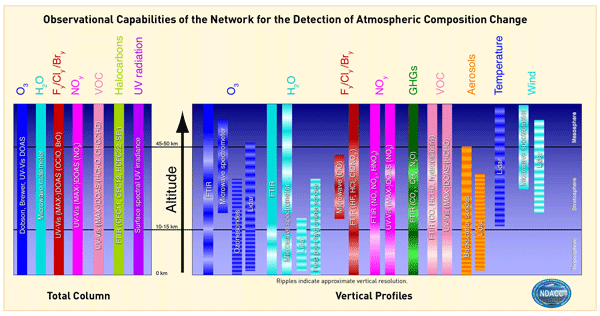
The international Network for the Detection of Atmospheric Composition Change (NDACC) began official network operations in January 1991. Today it is composed of more than 110 globally distributed, ground-based, remote-sensing stations with more than 160 currently active instruments. The overriding goal of NDACC is to collect and maintain high-quality data for achieving the following scientific objectives:

  • establishing long-term databases for the characterization of the state and behaviour of the atmosphere
  • establishing links and feedbacks between changes in atmospheric composition, climate, and air quality
  • validating atmospheric measurements from other platforms
  • providing critical datasets to fill gaps in satellite observations
  • collaboratively supporting field campaigns and other observing networks
  • providing validation and development support for atmospheric models
  • contributing to assessments of the state of the atmosphere (WMO, IPCC, etc.)

To achieve its objectives, NDACC collaborates with 10 cooperating networks, satellite teams, and model developers.

This special Issue marks the 35th anniversary of NDACC (https://ndacc.org). Its purpose is to present past scientific achievements and to inform readers about the updated strategy of the network in light of the evolution of the scientific questions regarding the state and behaviour of the atmosphere by taking advantage of the current landscape of observations. We also welcome papers that focus on related studies with important implications for our understanding of the state and behaviour of the atmosphere.

The introductory paper to the special issue provides an overview of NDACC's revised strategy for the next decade.

Download citations of all papers

30 Jan 2026
The Network for the Detection of Atmospheric Composition Change at 35 Years: Achievements and Future Strategy
Irina Petropavlovskikh, Martine De Mazière, Anne M. Thompson, Jeannette D. Wild, James W. Hannigan, Henry B. Selkirk, Reem A. Hannum, Wolfgang Steinbrecht, Jean-Christopher Lambert, Roeland Van Malderen, Elizabeth Asher, Raul R. Cordero, Sophie Godin-Beekmann, Daan Hubert, Sergey Khaykin, Karin Kreher, Thierry Leblanc, Emmanuel Mahieu, Eliane Maillard Barras, Glen McConville, Gerald Nedoluha, Ivan Ortega, Alberto Redondas Marrero, Gunther Seckmeyer, Ryan M. Stauffer, Sarah A. Strode, Kim Strong, Takafumi Sugita, Michel Van Roozendael, Voltaire Velazco, Corinne Vigouroux, and Baerbel Vogel
EGUsphere, https://doi.org/10.5194/egusphere-2025-6557,https://doi.org/10.5194/egusphere-2025-6557, 2026
Preprint under review for ACP (discussion: open, 0 comments)
Short summary
CC BY 4.0