Articles | Volume 26, issue 3
https://doi.org/10.5194/acp-26-1947-2026
Research article
 | 
06 Feb 2026
Research article |  | 06 Feb 2026

Oxidation-driven acceleration of NPF-to-CCN conversion under polluted atmosphere: evidence from mountain-top observations in Yangtze River Delta

Weibin Zhu, Sai Shang, Jieqi Wang, Yunfei Wu, Zhaoze Deng, Liang Ran, Ye Kuang, Guiqian Tang, Xiangpeng Huang, Xiaole Pan, Lanzhong Liu, Weiqi Xu, Yele Sun, Bo Hu, Zifa Wang, and Zirui Liu

Related authors

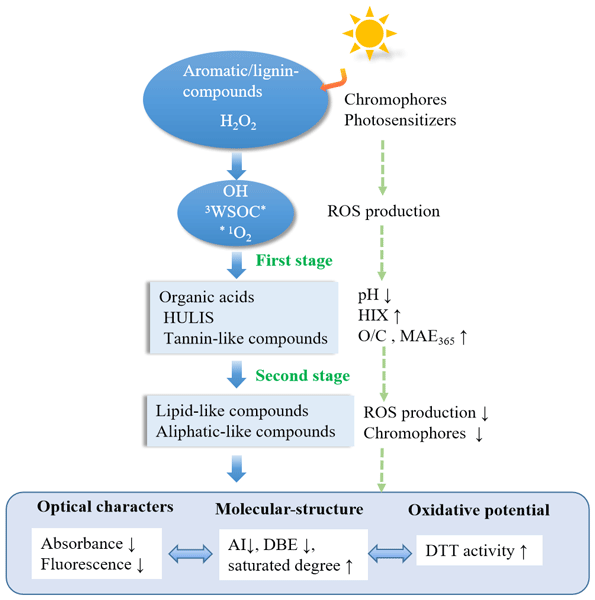
OH-initiated aqueous photooxidation of smoke extracts from maize straw and coal combustion: optical properties and molecular composition
Zhaolian Ye, Dandan Hu, Qiuyan Chen, Xiangpeng Huang, and Xinlei Ge
Atmos. Chem. Phys., 26, 8255–8274, https://doi.org/10.5194/acp-26-8255-2026,https://doi.org/10.5194/acp-26-8255-2026, 2026
Short summary
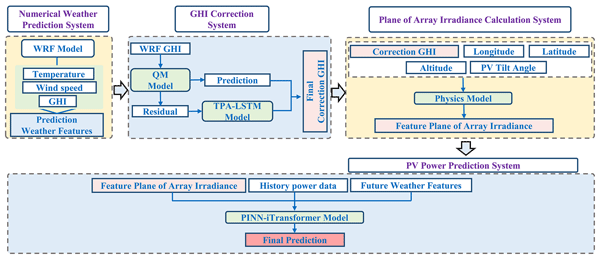
MIPV-NWP-PINNs V1.0: development of a multi-scale photovoltaic power forecasting framework integrating numerical weather prediction with physics-informed neural networks
Fei Zhang, Xingcai Li, Zifa Wang, Yunyun Wen, Xuyang Zhou, Zichen Wu, Zhuoran Wang, Huansheng Chen, Zhe Wang, and Xueshun Chen
Geosci. Model Dev., 19, 4999–5017, https://doi.org/10.5194/gmd-19-4999-2026,https://doi.org/10.5194/gmd-19-4999-2026, 2026
Short summary
OIRF-LEnKF v1.0: a novel data assimilation system by integrating incremental machine learning with a localized EnKF for enhanced PM2.5 chemical component simulation and reanalysis
Hongyi Li, Ting Yang, Lei Kong, Di Zhang, Guigang Tang, Xiao Tang, and Zifa Wang
Geosci. Model Dev., 19, 4835–4856, https://doi.org/10.5194/gmd-19-4835-2026,https://doi.org/10.5194/gmd-19-4835-2026, 2026
Short summary
Synchronization of source and sink by boundary layer evolution: a key to new particle formation under varying ozone pollution
Yulin Wang, Deyu Liu, Honglei Wang, Shuangshuang Shi, Qun Hu, Zihan Wang, Zirui Liu, Tianliang Zhao, and Lijuan Shen
Atmos. Chem. Phys., 26, 7827–7842, https://doi.org/10.5194/acp-26-7827-2026,https://doi.org/10.5194/acp-26-7827-2026, 2026
Short summary
Interpretable machine learning quantifies composition and size influences on aerosol spectral absorption
Wenfang Wang, Pengfei Tian, Shuhua Zeng, Yifei Zhang, Zeren Yu, Chen Cui, Yunfei Wu, Min Chen, and Lei Zhang
Atmos. Chem. Phys., 26, 6471–6487, https://doi.org/10.5194/acp-26-6471-2026,https://doi.org/10.5194/acp-26-6471-2026, 2026
Short summary

Cited articles

Baron, P. A. and Willeke, K.: Aerosol measurement: Principles, techniques and applications, 2nd edn., John Wiley and Sons, New York, ISBN: 9781591247739, 2001. 
Beddows, D. C. S., Dall'osto, M., and Harrison, R. M.: An Enhanced Procedure for the Merging of Atmospheric Particle Size Distribution Data Measured Using Electrical Mobility and Time-of-Flight Analysers, Aerosol Sci. Tech., 44, 930–938, https://doi.org/10.1080/02786826.2010.502159, 2010. 
Bougiatioti, A., Nenes, A., Fountoukis, C., Kalivitis, N., Pandis, S. N., and Mihalopoulos, N.: Size-resolved CCN distributions and activation kinetics of aged continental and marine aerosol, Atmos. Chem. Phys., 11, 8791–8808, https://doi.org/10.5194/acp-11-8791-2011, 2011. 
Download
Short summary
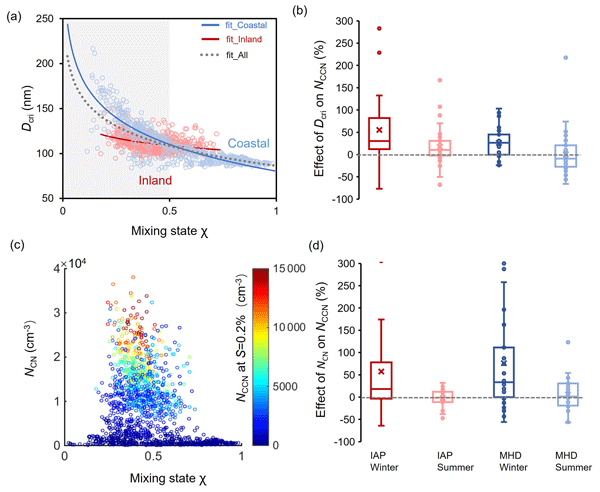
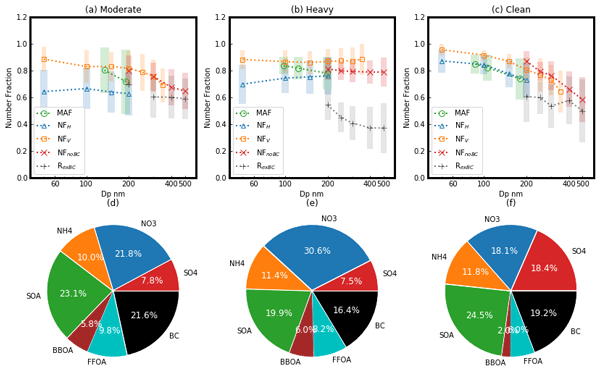
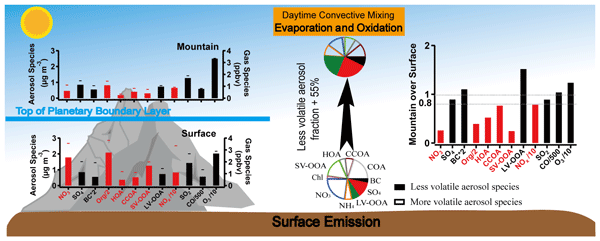
NPF (new particle formation) is a key global CCN (cloud condensation nuclei) source, but its contribution at the polluted boundary-layer top remains unclear. Based on mountaintop observations in the Yangtze River Delta, we show that under polluted conditions, NPF at the boundary-layer top is enhanced and accelerates its conversion to CCN. Ammonia plays a key role, and a newly defined "Time Window" metric highlights the importance of oxidation-driven growth and regional transport in this process.
Share
Altmetrics
Final-revised paper
Preprint