
Articles | Volume 15, issue 3
https://doi.org/10.5194/acp-15-1175-2015
© Author(s) 2015. This work is distributed under
the Creative Commons Attribution 3.0 License.
the Creative Commons Attribution 3.0 License.
https://doi.org/10.5194/acp-15-1175-2015
© Author(s) 2015. This work is distributed under
the Creative Commons Attribution 3.0 License.
the Creative Commons Attribution 3.0 License.
Research article
| 
02 Feb 2015
Research article |
| 02 Feb 2015
On the use of radon for quantifying the effects of atmospheric stability on urban emissions
Australian Nuclear Science and Technology Organisation, Locked Bag 2001, Kirrawee DC, NSW 2232, Australia
A. G. Williams
Australian Nuclear Science and Technology Organisation, Locked Bag 2001, Kirrawee DC, NSW 2232, Australia
J. Crawford
Australian Nuclear Science and Technology Organisation, Locked Bag 2001, Kirrawee DC, NSW 2232, Australia
A. D. Griffiths
Australian Nuclear Science and Technology Organisation, Locked Bag 2001, Kirrawee DC, NSW 2232, Australia
Related authors
Scott D. Chambers, Ute Karstens, Alan D. Griffiths, Stefan Röttger, Arnoud Frumau, Christopher T. Roulston, Peter Sperlich, Felix Vogel, Agnieszka Podstawczyńska, Dafina Kikaj, Maksym Gachkivskyi, Michel Ramonet, Blagoj Mitrevski, Janja Vaupotič, Xuemeng Chen, and Annette Röttger
EGUsphere, https://doi.org/10.5194/egusphere-2025-5042, https://doi.org/10.5194/egusphere-2025-5042, 2025
Short summary
Short summary
The Radon Tracer Method (RTM) is a top-down approach to estimate greenhouse gas emissions. While simple in principle, incorrect use can complicate interpretation of results. Based on observations from a range of contrasting sites, this article reviews the underlying assumptions and key considerations for applying the RTM. It also introduces the concept of coupling RTM analyses with nocturnal stability classification, to reduce uncertainty of fetch estimates and improve interpretation of results.
Dafina Kikaj, Edward Chung, Alan D. Griffiths, Scott D. Chambers, Grant Forster, Angelina Wenger, Penelope Pickers, Chris Rennick, Simon O'Doherty, Joseph Pitt, Kieran Stanley, Dickon Young, Leigh S. Fleming, Karina Adcock, Emmal Safi, and Tim Arnold
Atmos. Meas. Tech., 18, 151–175, https://doi.org/10.5194/amt-18-151-2025, https://doi.org/10.5194/amt-18-151-2025, 2025
Short summary
Short summary
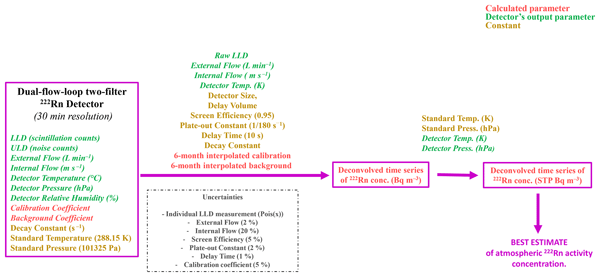
We present a protocol to improve confidence in atmospheric radon measurements, enabling site comparisons and integration with greenhouse gas data. As a natural tracer, radon provides an independent check of transport model performance. This standardized method enhances radon’s use as a metric for model evaluation. Beyond UK observatories, it can support broader networks like ICOS and WMO/GAW, advancing global atmospheric research.

Claudia Grossi, Daniel Rabago, Scott Chambers, Carlos Sáinz, Roger Curcoll, Peter P. S. Otáhal, Eliška Fialová, Luis Quindos, and Arturo Vargas
Atmos. Meas. Tech., 16, 2655–2672, https://doi.org/10.5194/amt-16-2655-2023, https://doi.org/10.5194/amt-16-2655-2023, 2023
Short summary
Short summary
The automatic and low-maintenance radon flux system Autoflux, completed with environmental soil and atmosphere sensors, has been theoretically and experimentally characterized and calibrated under laboratory conditions to be used as transfer standard for in situ measurements. It will offer for the first time long-term measurements to validate radon flux maps used by the climate and the radiation protection communities for assessing the radon gas emissions in the atmosphere.
Ruhi S. Humphries, Melita D. Keywood, Jason P. Ward, James Harnwell, Simon P. Alexander, Andrew R. Klekociuk, Keiichiro Hara, Ian M. McRobert, Alain Protat, Joel Alroe, Luke T. Cravigan, Branka Miljevic, Zoran D. Ristovski, Robyn Schofield, Stephen R. Wilson, Connor J. Flynn, Gourihar R. Kulkarni, Gerald G. Mace, Greg M. McFarquhar, Scott D. Chambers, Alastair G. Williams, and Alan D. Griffiths
Atmos. Chem. Phys., 23, 3749–3777, https://doi.org/10.5194/acp-23-3749-2023, https://doi.org/10.5194/acp-23-3749-2023, 2023
Short summary
Short summary
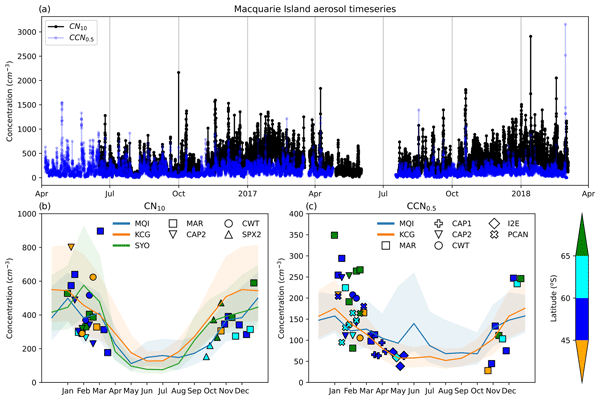
Observations of aerosols in pristine regions are rare but are vital to constraining the natural baseline from which climate simulations are calculated. Here we present recent seasonal observations of aerosols from the Southern Ocean and contrast them with measurements from Antarctica, Australia and regionally relevant voyages. Strong seasonal cycles persist, but striking differences occur at different latitudes. This study highlights the need for more long-term observations in remote regions.

Scott D. Chambers, Alan D. Griffiths, Alastair G. Williams, Ot Sisoutham, Viacheslav Morosh, Stefan Röttger, Florian Mertes, and Annette Röttger
Adv. Geosci., 57, 63–80, https://doi.org/10.5194/adgeo-57-63-2022, https://doi.org/10.5194/adgeo-57-63-2022, 2022
Short summary
Short summary
There is a growing need in health and climate research for high-quality radon observations. A variety of radon monitors, with different uncertainties, operate across global networks. Better compatibility between the measurements is required. Here we describe a novel, portable two-filter radon monitor with a calibration traceable to the International System of Units, and demonstrate the transfer of a traceable calibration from this instrument to a separate monitor under field conditions.
Sonya L. Fiddes, Matthew T. Woodhouse, Steve Utembe, Robyn Schofield, Simon P. Alexander, Joel Alroe, Scott D. Chambers, Zhenyi Chen, Luke Cravigan, Erin Dunne, Ruhi S. Humphries, Graham Johnson, Melita D. Keywood, Todd P. Lane, Branka Miljevic, Yuko Omori, Alain Protat, Zoran Ristovski, Paul Selleck, Hilton B. Swan, Hiroshi Tanimoto, Jason P. Ward, and Alastair G. Williams
Atmos. Chem. Phys., 22, 2419–2445, https://doi.org/10.5194/acp-22-2419-2022, https://doi.org/10.5194/acp-22-2419-2022, 2022
Short summary
Short summary
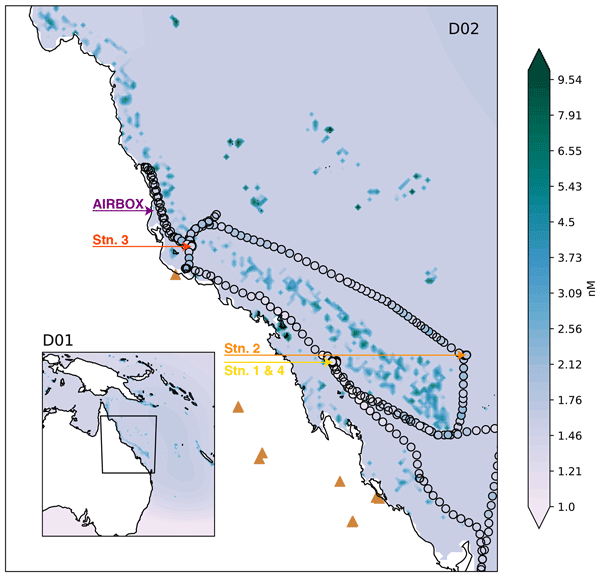
Coral reefs have been found to produce the climatically relevant chemical compound dimethyl sulfide (DMS). It has been suggested that corals can modify their environment via the production of DMS. We use an atmospheric chemistry model to test this theory at a regional scale for the first time. We find that it is unlikely that coral-reef-derived DMS has an influence over local climate, in part due to the proximity to terrestrial and anthropogenic aerosol sources.
Caleb Mynard, Emily B. Franklin, Joel Alroe, Karen Westwood, Brandon J. McNabb, Robert Strzepek, Philippe D. Tortell, Steven T. Siems, Antonio Patti, Suzie Molloy, Alan Griffiths, Branka Miljevic, Marc D. Mallet, Ruhi Humphries, and Erin Dunne
Atmos. Chem. Phys., 26, 11583–11604, https://doi.org/10.5194/acp-26-11583-2026, https://doi.org/10.5194/acp-26-11583-2026, 2026
Short summary
Short summary
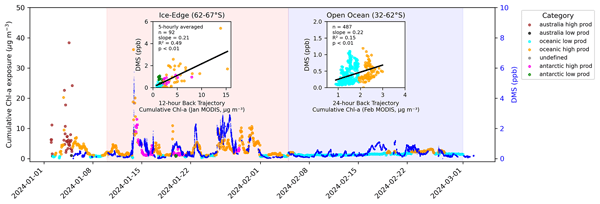
Marine sulfur gases help form climate-cooling particles, but their controls over the Southern Ocean are unclear. During a summer research voyage we measured these gases and linked them to ocean and atmospheric conditions. Near Antarctica, coastal blooms drove sharp rises in dimethyl sulfide while methanethiol remained low. Over the open ocean, both gases varied together, mainly influenced by ocean mixing and temperature, suggesting models should treat coastal and open ocean regions separately.
Scott D. Chambers, Ute Karstens, Alan D. Griffiths, Stefan Röttger, Arnoud Frumau, Christopher T. Roulston, Peter Sperlich, Felix Vogel, Agnieszka Podstawczyńska, Dafina Kikaj, Maksym Gachkivskyi, Michel Ramonet, Blagoj Mitrevski, Janja Vaupotič, Xuemeng Chen, and Annette Röttger
EGUsphere, https://doi.org/10.5194/egusphere-2025-5042, https://doi.org/10.5194/egusphere-2025-5042, 2025
Short summary
Short summary
The Radon Tracer Method (RTM) is a top-down approach to estimate greenhouse gas emissions. While simple in principle, incorrect use can complicate interpretation of results. Based on observations from a range of contrasting sites, this article reviews the underlying assumptions and key considerations for applying the RTM. It also introduces the concept of coupling RTM analyses with nocturnal stability classification, to reduce uncertainty of fetch estimates and improve interpretation of results.
Dafina Kikaj, Edward Chung, Alan D. Griffiths, Scott D. Chambers, Grant Forster, Angelina Wenger, Penelope Pickers, Chris Rennick, Simon O'Doherty, Joseph Pitt, Kieran Stanley, Dickon Young, Leigh S. Fleming, Karina Adcock, Emmal Safi, and Tim Arnold
Atmos. Meas. Tech., 18, 151–175, https://doi.org/10.5194/amt-18-151-2025, https://doi.org/10.5194/amt-18-151-2025, 2025
Short summary
Short summary
We present a protocol to improve confidence in atmospheric radon measurements, enabling site comparisons and integration with greenhouse gas data. As a natural tracer, radon provides an independent check of transport model performance. This standardized method enhances radon’s use as a metric for model evaluation. Beyond UK observatories, it can support broader networks like ICOS and WMO/GAW, advancing global atmospheric research.
Claudia Grossi, Daniel Rabago, Scott Chambers, Carlos Sáinz, Roger Curcoll, Peter P. S. Otáhal, Eliška Fialová, Luis Quindos, and Arturo Vargas
Atmos. Meas. Tech., 16, 2655–2672, https://doi.org/10.5194/amt-16-2655-2023, https://doi.org/10.5194/amt-16-2655-2023, 2023
Short summary
Short summary
The automatic and low-maintenance radon flux system Autoflux, completed with environmental soil and atmosphere sensors, has been theoretically and experimentally characterized and calibrated under laboratory conditions to be used as transfer standard for in situ measurements. It will offer for the first time long-term measurements to validate radon flux maps used by the climate and the radiation protection communities for assessing the radon gas emissions in the atmosphere.
Ruhi S. Humphries, Melita D. Keywood, Jason P. Ward, James Harnwell, Simon P. Alexander, Andrew R. Klekociuk, Keiichiro Hara, Ian M. McRobert, Alain Protat, Joel Alroe, Luke T. Cravigan, Branka Miljevic, Zoran D. Ristovski, Robyn Schofield, Stephen R. Wilson, Connor J. Flynn, Gourihar R. Kulkarni, Gerald G. Mace, Greg M. McFarquhar, Scott D. Chambers, Alastair G. Williams, and Alan D. Griffiths
Atmos. Chem. Phys., 23, 3749–3777, https://doi.org/10.5194/acp-23-3749-2023, https://doi.org/10.5194/acp-23-3749-2023, 2023
Short summary
Short summary
Observations of aerosols in pristine regions are rare but are vital to constraining the natural baseline from which climate simulations are calculated. Here we present recent seasonal observations of aerosols from the Southern Ocean and contrast them with measurements from Antarctica, Australia and regionally relevant voyages. Strong seasonal cycles persist, but striking differences occur at different latitudes. This study highlights the need for more long-term observations in remote regions.
Scott D. Chambers, Alan D. Griffiths, Alastair G. Williams, Ot Sisoutham, Viacheslav Morosh, Stefan Röttger, Florian Mertes, and Annette Röttger
Adv. Geosci., 57, 63–80, https://doi.org/10.5194/adgeo-57-63-2022, https://doi.org/10.5194/adgeo-57-63-2022, 2022
Short summary
Short summary
There is a growing need in health and climate research for high-quality radon observations. A variety of radon monitors, with different uncertainties, operate across global networks. Better compatibility between the measurements is required. Here we describe a novel, portable two-filter radon monitor with a calibration traceable to the International System of Units, and demonstrate the transfer of a traceable calibration from this instrument to a separate monitor under field conditions.
Peter Sperlich, Gordon W. Brailsford, Rowena C. Moss, John McGregor, Ross J. Martin, Sylvia Nichol, Sara Mikaloff-Fletcher, Beata Bukosa, Magda Mandic, C. Ian Schipper, Paul Krummel, and Alan D. Griffiths
Atmos. Meas. Tech., 15, 1631–1656, https://doi.org/10.5194/amt-15-1631-2022, https://doi.org/10.5194/amt-15-1631-2022, 2022
Short summary
Short summary
We tested an in situ analyser for carbon and oxygen isotopes in atmospheric CO2 at Baring Head, New Zealand’s observatory for Southern Ocean baseline air. The analyser was able to resolve regional signals of the terrestrial carbon cycle, although the analysis of small events was limited by analytical uncertainty. Further improvement of the instrument performance would be desirable for the robust analysis of distant signals and to resolve the small variability in Southern Ocean baseline air.
Zhenyi Chen, Robyn Schofield, Melita Keywood, Sam Cleland, Alastair G. Williams, Alan Griffiths, Stephen Wilson, Peter Rayner, and Xiaowen Shu
Atmos. Chem. Phys. Discuss., https://doi.org/10.5194/acp-2022-104, https://doi.org/10.5194/acp-2022-104, 2022
Revised manuscript not accepted
Short summary
Short summary
This study studied the marine boundary layer (MBL) process and aerosol properties in the Southern Ocean using miniMPL, ceilometer and sodar. Compared to the gradient method, the Image Edge Detection Algorithm provides more reliable boundary layer height estimations, especially when a convective MBL with stratification existed. The diurnal characteristic of BLH with the veering of the wind vector was also observed. Under the continental sources, the MBL maintained a well-mixed layer of 0.3 km.
Sonya L. Fiddes, Matthew T. Woodhouse, Steve Utembe, Robyn Schofield, Simon P. Alexander, Joel Alroe, Scott D. Chambers, Zhenyi Chen, Luke Cravigan, Erin Dunne, Ruhi S. Humphries, Graham Johnson, Melita D. Keywood, Todd P. Lane, Branka Miljevic, Yuko Omori, Alain Protat, Zoran Ristovski, Paul Selleck, Hilton B. Swan, Hiroshi Tanimoto, Jason P. Ward, and Alastair G. Williams
Atmos. Chem. Phys., 22, 2419–2445, https://doi.org/10.5194/acp-22-2419-2022, https://doi.org/10.5194/acp-22-2419-2022, 2022
Short summary
Short summary
Coral reefs have been found to produce the climatically relevant chemical compound dimethyl sulfide (DMS). It has been suggested that corals can modify their environment via the production of DMS. We use an atmospheric chemistry model to test this theory at a regional scale for the first time. We find that it is unlikely that coral-reef-derived DMS has an influence over local climate, in part due to the proximity to terrestrial and anthropogenic aerosol sources.
Cited articles
Acker, K., Febo, A., Trick, S., Perrino, C., Bruno, P., Wiesen, P., Moller, D., Wieprecht, W., Auel, R., Giusto, M., Geyer, A., Platt, U., and Allegrini, I.: Nitrous acid in the urban area of Rome, Atmos. Environ., 40, 3123–3133, 2006.
Allegrini, I., Febo, A., Pasini, A., and Schiarini, S.: Monitoring of the nocturnal mixed layer by means of particulate radon progeny measurement, J. Geophys. Res., 99, 18765–18777, https://doi.org/10.1029/94JD00783, 1994.
Avino, P., Brocco, D., Lepore, L., and Pareti, S.: Interpretation of atmospheric pollution phenomena in relationship with the vertical atmospheric remixing by means of natural radioactivity measurements (radon) of particulate matter, Annali di Chimica, 93, 589–594, 2003.
Azzi, M. and Johnson, G.: Photochemical smog assessment for NOx emissions, using an IER-reactive plume technique, in: Proceedings of Clean Air 1994, 12th International Conference of the Clean Air Society of Australia and New Zealand, 1994.
Chambers, S., Williams, A. G., Zahorowski, W., Griffiths, A., and Crawford, J.: Separating remote fetch and local mixing influences on vertical radon measurements in the lower atmosphere, Tellus B, 63, 843–859, https://doi.org/10.1111/j.1600-0889.2011.00565.x, 2011.
Chambers, S. D., Hong, S.-B., Williams, A. G., Crawford, J., Griffiths, A. D., and Park, S.-J.: Characterising terrestrial influences on Antarctic air masses using Radon-222 measurements at King George Island, Atmos. Chem. Phys., 14, 9903–9916, https://doi.org/10.5194/acp-14-9903-2014, 2014.
Collaud Coen, M., Praz, C., Haefele, A., Ruffieux, D., Kaufmann, P., and Calpini, B.: Determination and climatology of the planetary boundary layer height above the Swiss plateau by in situ and remote sensing measurements as well as by the COSMO-2 model, Atmos. Chem. Phys., 14, 13205–13221, https://doi.org/10.5194/acp-14-13205-2014, 2014.
Cohen, D. D., Crawford, J., Stelcer, E., and Atanacio, A. J.: Application of positive matrix factorization, multi-linear engine and back trajectory techniques to the quantification of coal-fired power station pollution in metropolitan Sydney, Atmos. Environ., 61, 204–211, 2012.
Corbyn, L.: Future direction of air quality management in NSW, in: "Action for Air", Proceedings of NSW Clean Air Forum, Powerhouse Museum, Sydney, 17 November 2004, 44–48, Department of Environment and Conservation, Sydney, March 2005, ISBN:1741372615, 2005.
Crawford, J., Cohen, D. D., Chambers, S., Williams, A., and Stelcer, E.: Incorporation of Radon-222 as a parameter in ME-2 to improve apportionment of PM2.5 sources in the Sydney region, Atmos. Environ., 80, 378–388, 2013.
Desideri, D., Roselli, C., Feduzi, L., and Assunta Meli, M.: Monitoring the atmospheric stability by using radon concentration measurements: A study in a Central Italy site, J. Radioanal. Nucl. Ch., 270, 523–530, 2006.
Di Carlo, P., Pitari, G., Mancini, E., Gentile, S., and Pichelli, E.: Evolution of surface ozone in central Italy based on observations and statistical model, J. Geophys. Res., 112, D10316, https://doi.org/10.1029/2006JD007900, 2007.
Draxler, R. R. and Hess, G. D.: An overview of the HYSPLIT-4 modelling system for trajectories, dispersion and deposition, Aust. Meteorol. Mag., 47, 295–308, 1998.
Duc, H., Shannon, I., and Azzi, M.: Spatial distribution characteristics of some air pollutants in Sydney, Math. Comput. Simulat., 54, 1–21, 2000.
Duenas, C., Perez, M., Fernandez, M. C., and Carretero, J.: Radon concentrations in surface air and vertical atmospheric stability of the lower atmosphere, J. Env. Rad., 31, 87–102, 1996.
Febo, A., Perrino, C., and Allegrini, I.: Measurement of nitrous acid in Milan, Italy, by DOAS and diffusion denuders, Atmos. Environ., 30, 3599–3609, 1996.
Foken, T.: 50 years of the Monin-Obukhov similarity theory, Bound.-Layer Meteor., 119, 431–437, 2006.
Fontan, J., Guedalia, D., Druilhet, A., and Lopez, A.: Une method de mesure de la stabilite verticale de l'atmosphere pres du sol, Bound.-Lay. Meteorol., 17, 3–14, https://doi.org/10.1007/BF00121933, 1979.
Fujinami, N. and Esaka, S.: Variations in radon 222 daughter concentrations in surface air with atmospheric stability, J. Geophys. Res., 92, 1041–1043, 1987.
Fujinami, N. and Esaka, S.: A simple model for estimating the mixing depth from the diurnal variation of atmospheric 222Rn concentration, Radiat. Prot. Dosim., 24, 89–91, 1988.
Galmarini, S.: One year of 222Rn concentration in the atmospheric surface layer, Atmos. Chem. Phys., 6, 2865–2886, https://doi.org/10.5194/acp-6-2865-2006, 2006.
Gogolak, C. V. and Beck, H. L.: Diurnal variations of radon daughter concentrations in the lower atmosphere, Natural Radiation Environment III, 1, 259–280, 1980.
Grange, S. K., Salmond, J. A., Trompetter, W. J., Davy, P. K., and Ancelet, T.: Effect of atmospheric stability on the impact of domestic wood combustion to air quality of a small urban township in winter, Atmos. Environ., 70, 28–38, https://doi.org/10.1016/j.atmosenv.2012.12.047, 2013.
Griffiths, A. D., Zahorowski, W., Element, A., and Werczynski, S.: A map of radon flux at the Australian land surface, Atmos. Chem. Phys., 10, 8969–8982, https://doi.org/10.5194/acp-10-8969-2010, 2010.
Griffiths, A. D., Parkes, S. D., Chambers, S. D., McCabe, M. F., and Williams, A. G.: Improved mixing height monitoring through a combination of lidar and radon measurements, Atmos. Meas. Tech., 6, 207–218, https://doi.org/10.5194/amt-6-207-2013, 2013.
Grossi, C., Arnold, D., Adame, J., López-Coto, I., Bolívar, J., de la Morena, B., and Vargas, A.: Atmospheric 222Rn concentration and source term at El Arenosillo 100 m meteorological tower in Southwest Spain, Radiat. Meas., 47, 149–162, https://doi.org/10.1016/j.radmeas.2011.11.006, 2012.
Guedalia, D., Ntsila, A., Druilhet, A., and Fontan, J.: Monitoring of the atmospheric stability above an urban and suburban site using sodar and radon measurements. J. Appl. Meteorol., 19, 839–848, https://doi.org/10.1175/1520-0450(1980)019<0839:MOTASA>2.0.CO;2, 1980.
Gupta, P., Christopher, S. A., Box, M. A., and Box, G. P.: Multi year satellite remote sensing of particulate matter air quality over Sydney, Australia, Int. J. Remote Sens., 28, 4483–4498, 2007.
Hart, M., De Dear, R., and Hyde, R.: A synoptic climatology of tropospheric ozone episodes in Sydney, Australia, Int. J. Climatol., 26, 1635–1649, 2006.
Hawke, G. S. and Iverach, D.: A study of high photochemical pollution days in Sydney, N.S.W., Atmos. Environ., 8, 597–608, 1974.
Hinkley, J. T., Bridgman, H. A., Buhre, B. J. P.; Gupta, R. P., Nelson, P. F., and Wall, T. F.: Semi-quantitative characterisation of ambient ultrafine aerosols resulting from emissions of coal fired power stations, Sci. Total Environ., 391, 104–113, 2008.
Jacob, D. J., Prather, M. J., Rasch, P. J., Shia, R.-L., Balkanski, Y. J., Beagley, S. R., Bergmann, D. J., Blackshear, W. T., Brown, M., Chiba, M., Chipperfield, M. P., de Grandpré, J., Dignon, J. E., Feichter, J., Genthon, C., Grose, W. L., Kasibhatla, P. S., Köhler, I., Kritz, M. A., Law, K., Penner, J. E., Ramonet, M., Reeves, C. E., Rotman, D. A., Stockwell, D. Z., van Velthoven, P. F. J., Verver, G., Wild, O., Yang, H., and Zimmermann, P.: Evaluation and intercomparison of global atmospheric transport models using 222Rn and other short-lived tracers, J. Geophys. Res., 102, 5953–5970, 1997.
Jacobi, W. and André, K.: The vertical distribution of radon 222, radon 220 and their decay products in the atmosphere, J. Geophys. Res., 68, 3799–3814, 1963.
Jenner, S. L. and Abiodun, B. J.: The transport of atmospheric sulfur over Cape Town, Atmos. Environ., 79, 248–260, 2013.
Ji, D., Wang, Y., Wang, L., Chen, L., Hub, B., Tang, G., Xin, J., Song, T., Wen, T., Sun, Y., Pan, Y., and Liu, Z.: Analysis of heavy pollution episodes in selected cities of northern China, Atmos. Environ., 50, 338–348, 2012.
Kataoka, T., Yunoki, E., Shimizu, M., Mori, T., Tsukamoto, O., Ohhashi, Y., Sahashi, K., Maitani, T., Miyashita, K., Fujikawa, Y., and Kudo, A.: Diurnal Variation in Radon Concentration and Mixing-Layer Depth, Bound.-Lay. Meteorol., 89, 225–250, 1998.
Kondo, H., Murayama, S., Sawa, Y., Ishijima, K., Matsueda, H., Wada, A., Sugawara, H., and Onogi, S.: Vertical Diffusion Coefficient under Stable Conditions Estimated from Variations in the Near-Surface Radon Concentration, J. Meteorol. Soc. Jpn., 92, 95–106, https://doi.org/10.2151/jmsj.2014-106, 2014.
Lambert, G., Polian, G., Sanak, J., Ardouin, B., Buisson, A., Jegou, A., and le Roulley, J. C.: Cycle du radon et de ses descentants: application à l'étude des échanges troposphère-stratosphère, Ann. Géophys., 38, 497–531, 1982.
Leach, V. A. and Chandler, W. P.: Atmospheric dispersion of radon gas and its decay products under stable conditions in arid regions of Australia, Environ. Monit. Assess., 20, 1–17, 1992.
Leighton R. M. and Spark E.: Relationship between synoptic climatology and pollution events in Sydney, Int. J. Biometeorol., 41, 76–89, 1997.
Leslie, L. M. and M. S. Speer: Preliminary modelling results of an urban air quality model verifying the prediction of nitrogen dioxide, sulphur dioxide and ozone over the Sydney basin, Meteorol. Atmos. Phys., 87, 89–92, https://doi.org/10.1007/s00703-003-0062-7, 2004.
Liu, X., Gao, N., Hopke, P. K., Cohen, D. D., Bailey, G., and Crisp, P.: Evaluation of spatial patterns of fine particle sulphur and lead concentrations in New South Wales, Australia, Atmos. Environ., 30, 9–24, 1996.
Mahrt, L.: Stratified atmospheric boundary layers, Bound.-Lay. Meteorol, 90, 375–396, 1999.
Malakhov, S. G., Bakulin, V. N., Dmitrieva, G. V., Kirichenko, T. V., Sisigina, T. I., and Starikov, B. G.: Diurnal variation of radon and thoron decay product concentrations in the surface layer of the atmosphere and their washout by precipitation, Tellus, 18, 643–654, 1966.
Moses, H., Stehney, A. F., and Lucas, H. F.: The effect of meteorological variables upon the vertical and temporal distribution of atmospheric radon, J. Geophys. Res., 65, 1223–1238, 1960.
Pasini, A. and Ameli, F.: Radon short range forecasting through time series preprocessing and neural network modelling, Geophys. Res. Lett., 30, 1386, https://doi.org/10.1029/2002GL016726, 2003.
Pasquil, D.: The estimation of the dispersion of windborne material, The Meteorological Magazine, 90, 33–49, 1961.
Pasquill, F. and Smith, F. B.: Atmospheric Diffusion, 3rd edition, Ellis Horwood Ltd., Chichester , 437 pp., 1983.
Perrino, C., Pietrodangelo, A., and Febo, A.: An atmospheric stability index based on radon progeny measurements for the evaluation of primary urban pollution, Atmos. Environ., 35, 5235–5244, 2001.
Perrino, C., Catrambone, M., and Pietrodangelo, A.: Influence of atmospheric stability on the mass concentration and chemical composition of atmospheric particles: a case study in Rome, Italy, Environ Int., 34, 621–628, https://doi.org/10.1016/j.envint.2007.12.006, 2008.
Pitari, G., Coppari, E., De Luca, N., and Di Carlo, P.,: Observations and box model analysis of radon-222 in the atmospheric surface layer at L'Aquila, Italy: March 2009 case study, Environ. Earth Sci., 71, 2353–2359, 2014.
Porstendörfer, J., Butterweck, G., and Reineking, A.: Diurnal variation of the concentrations of radon and its short-lived daughters in the atmosphere near ground, Atmos. Environ., 3, 709–713, 1991.
Schery, S. D. and Huang, S.: An estimate of the global distribution of radon emissions from the ocean, Geophys. Res. Lett., 31, L19104, https://doi.org/10.1029/2004GL021051, 2004.
Sesana, L., Caprioli, E., and Marcazzan, G. M.: Long period study of outdoor radon concentration in Milan and correlation between its temporal variations and dispersion properties of atmosphere, J. Environ. Radioactiv., 65, 147–160, https://doi.org/10.1016/S0265-931X(02)00093-0, 2003.
Sesana, L., Ottobrini, B., Polla, G., and Facchini, U.: 222Rn as indicator of atmospheric turbulence: measurements at Lake Maggiore and on the pre-Alps, J. Environ. Radioactiv., 86, 271–288, https://doi.org/10.1016/j.jenvrad.2005.09.005, 2006.
Stull, R. B.: An Introduction to Boundary Layer Meteorology, Springer, New York, 666 pp., 1988.
Turekian, K. K., Nozaki, Y., and Benninger, L. K.: Geochemistry of atmospheric radon and radon products, Ann. Rev. Earth Planet. Sci., 5, 227–255, 1977.
Turner, B.: A diffusion model for an urban area, J. Appl. Meteorol., 3, 83–91, 1964.
USEPA: Guidance on the Use of Models and Other Analyses for Demonstrating Attainment of Air Quality Goals for Ozone, PM2.5, and Regional Haze, United States Environmental Protection Agency, EPA-454/B-07-002, Research Triangle Park, North Carolina, 2007.
Veleva, B., Valkov, N., Batchvarova, E., and Kolarova, M.: Variation of short-lived beta radionuclide (radon progeny) concentrations and the mixing processes in the atmospheric boundary layer, J. Environ. Radioactiv., 101, 538–543, 2010.
Venkatram, A.: An examination of the Pasquill–Gifford-Turner dispersion scheme, Atmos. Environ., 30, 1283–1290, 1996.
Wang, F., Zhang, Z., Ancora, M. P., Deng, X., and Zhang, H.: Radon natural radioactivity measurements for evaluation of primary pollutants, The Scientific World Journal, 5, 626989, https://doi.org/10.1155/2013/626989, 2013.
Whittlestone, S. and Zahorowski, W.: Baseline radon detectors for shipboard use: development and deployment in the First Aerosol Characterization Experiment (ACE 1), J. Geophys. Res., 103, 16743–16751, https://doi.org/10.1029/98JD00687, 1998.
Wilkening, M. H. and Clements, W. E.: Radon-222 from the ocean surface, J. Geophys. Res., 80, 3829–3830, 1975.
Williams, A. G., Chambers, S. D., and Griffiths, A.: Bulk Mixing and Decoupling of the Nocturnal Stable Boundary Layer Characterized Using a Ubiquitous Natural Tracer, Bound.-Lay. Meteorol., 149, 381–402, https://doi.org/10.1007/s10546-013-9849-3, 2013.
Xia, Y., Conen, F., Haszpra, L., Ferenczi, Z., and Zahorowski, W.: Evidence for nearly complete decoupling of very stable nocturnal boundary layer overland, Bound.-Lay. Meteorol., 138, 163–170, 2011.
Zhang, Z., Wang, F., Costabile, F., Allegrini, I., Liu, F., and Hong, W.: Interpretation of ground-level ozone episodes with atmospheric stability index measurement, Environ. Sci. Pollut. Res., 19, 3421–3429, https://doi.org/10.1007/s11356-012-0867-3, 2012.


Altmetrics
Final-revised paper
Preprint