
Articles | Volume 26, issue 12
https://doi.org/10.5194/acp-26-8601-2026
© Author(s) 2026. This work is distributed under
the Creative Commons Attribution 4.0 License.
the Creative Commons Attribution 4.0 License.
https://doi.org/10.5194/acp-26-8601-2026
© Author(s) 2026. This work is distributed under
the Creative Commons Attribution 4.0 License.
the Creative Commons Attribution 4.0 License.
Research article
| 
19 Jun 2026
Research article |
| 19 Jun 2026
| 19 Jun 2026
Global methane emission estimates from a dual-isotope inversion: new constraints from δD-CH4
Bibhasvata Dasgupta
CORRESPONDING AUTHOR

Institute for Marine and Atmospheric research Utrecht (IMAU), Utrecht University, Utrecht, the Netherlands
Sudhanshu Pandey
Jet Propulsion Laboratory, California Institute of Technology, Pasadena, CA, USA
Sander Houweling
Department of Earth Sciences, Vrije Universiteit Amsterdam, Amsterdam, the Netherlands
Malika Menoud
Institute for Marine and Atmospheric research Utrecht (IMAU), Utrecht University, Utrecht, the Netherlands
Carina van der Veen
Institute for Marine and Atmospheric research Utrecht (IMAU), Utrecht University, Utrecht, the Netherlands
John Miller
Global Monitoring Laboratory, National Oceanic and Atmospheric Administration, Boulder, CO, 80205, USA
Ben Riddell-Young
Global Monitoring Laboratory, National Oceanic and Atmospheric Administration, Boulder, CO, 80205, USA
Cooperative Institute for Research in Environmental Sciences, University of Colorado, Boulder, CO, 80309, USA
Sylvia Englund Michel
Institute of Arctic and Alpine Research (INSTAAR), University of Colorado, Boulder, CO, USA
Peter Sperlich
New Zealand Institute for Earth Science Ltd., 301 Evans Bay Parade, Wellington 6023, Aotearoa New Zealand
Shinji Morimoto
Center for Atmospheric and Oceanic Studies, Graduate School of Science, Tohoku University, Sendai, Japan
Ryo Fujita
Institute of Arctic and Alpine Research (INSTAAR), University of Colorado, Boulder, CO, USA
New Zealand Institute for Earth Science Ltd., 301 Evans Bay Parade, Wellington 6023, Aotearoa New Zealand
Stephen Platt
Meteorological Research Institute, Japan Meteorological Agency, Tsukuba, Japan
Christine Groot Zwaaftink
Meteorological Research Institute, Japan Meteorological Agency, Tsukuba, Japan
Ingeborg Levin
Institut für Umweltphysik, Heidelberg University, INF 229, 69120 Heidelberg, Germany
deceased
Cordelia Veidt
Institut für Umweltphysik, Heidelberg University, INF 229, 69120 Heidelberg, Germany
Cathrine Lund Myhre
NILU, P.O. Box 100, 2027 Kjeller, Norway
Ceres Woolley Maisch
Institute for Marine and Atmospheric research Utrecht (IMAU), Utrecht University, Utrecht, the Netherlands
Centre of Climate, Ocean and Atmosphere, Department of Earth Sciences, Royal Holloway, University of London, Egham, UK
Rebecca Fisher
Centre of Climate, Ocean and Atmosphere, Department of Earth Sciences, Royal Holloway, University of London, Egham, UK
Euan G. Nisbet
Centre of Climate, Ocean and Atmosphere, Department of Earth Sciences, Royal Holloway, University of London, Egham, UK
James France
Centre of Climate, Ocean and Atmosphere, Department of Earth Sciences, Royal Holloway, University of London, Egham, UK
Rowena Moss
New Zealand Institute for Earth Science Ltd., 301 Evans Bay Parade, Wellington 6023, Aotearoa New Zealand
Nicola Warwick
Department of Chemistry, University of Cambridge, Cambridge, CB2 1EW, UK
Thomas Röckmann
Institute for Marine and Atmospheric research Utrecht (IMAU), Utrecht University, Utrecht, the Netherlands
Related authors
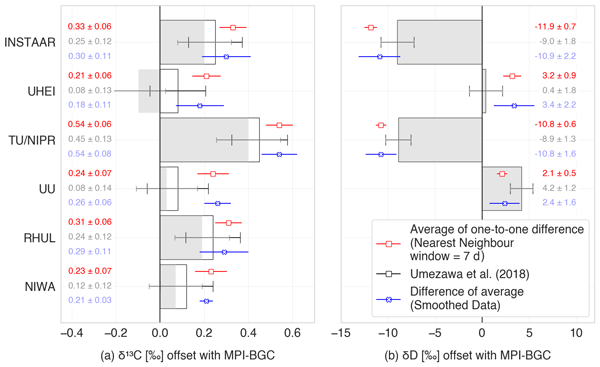
Bibhasvata Dasgupta, Malika Menoud, Carina van der Veen, Ingeborg Levin, Cordelia Veidt, Heiko Moossen, Sylvia Englund Michel, Peter Sperlich, Shinji Morimoto, Ryo Fujita, Taku Umezawa, Stephen Platt, Christine Groot Zwaaftink, Cathrine Lund Myhre, Rebecca Fisher, David Lowry, Euan G. Nisbet, James France, Ceres Woolley Maisch, Gordon Brailsford, Rowena Moss, Daisuke Goto, Sudhanshu Pandey, Sander Houweling, Nicola Warwick, and Thomas Röckmann
Atmos. Meas. Tech., 18, 6591–6607, https://doi.org/10.5194/amt-18-6591-2025, https://doi.org/10.5194/amt-18-6591-2025, 2025
Short summary
Short summary
We combined long-term methane mole fraction and isotope measurements from eight laboratories that sample high-latitude stations to compare, offset correct and harmonise the datasets into a hemisphere merged timeseries. Because each laboratory uses slightly different methods, we adjusted the data to make it directly comparable. This allowed us to create a consistent record of atmospheric methane concentration and its isotopes from 1988 to 2023.
Bibhasvata Dasgupta and Prasanta Sanyal
EGUsphere, https://doi.org/10.5194/egusphere-2025-3687, https://doi.org/10.5194/egusphere-2025-3687, 2025
Preprint archived
Short summary
Short summary
Mountain forests cover a fifth of Earth’s woodlands but are fragile because of topography and climate sensitivity. To understand how temperature and rainfall affect plant nutrition, we studied 141 plant samples from 14 species along 3 Himalayan elevation gradients. We measured leaf carbon and nitrogen amounts and their natural markers tied to water use and soil. We found nitrogen varies more with heat and moisture than carbon, highlighting areas most at risk from shifting climate.
Daniel Cusworth, Daniel Varon, Dylan Jervis, Jason McKeever, Alexander Turner, Christian Frankenberg, John Worden, Andrew Thorpe, Jay Fahlen, Sudhanshu Pandey, Joannes Maasakkers, Ilse Aben, Annmarie Eldering, Riley Duren, Bradley Conrad, Tia Scarpelli, Daniel Bon, Mackenzie Huffman, Itziar Irakulis-Loitxate, Luis Guanter, Jason Schroeder, Benjamin Hmiel, Evan Sherwin, Sean Crowell, Eric Kort, Adam Brandt, Frances Reuland, Maryann Sargent, James East, and Daniel Jacob
EGUsphere, https://doi.org/10.5194/egusphere-2026-6060, https://doi.org/10.5194/egusphere-2026-6060, 2026
This preprint is open for discussion and under review for Atmospheric Chemistry and Physics (ACP).
Short summary
Short summary
In this review, we summarize the current and anticipated state of satellite remote sensing for point sources. In particular, we are provide and update to the fleet of point source imaging satellites, summarize the nuance around data availability and revisit, detail data processing pipelines and validation procedures, describe how to benchmark detection performance, and finally, describe demonstrated use-cases for satellite point source observations.
Chloe A. Brashear, Maarten M. J. W. van Herpen, Sergey Gromov, Berend van de Kraats, Carina van der Veen, Xietiancheng Yu, Matthew S. Johnson, Helder Timas, Sönke Zaehle, Armin Jordan, Heiko Moossen, Africa Barreto, Natalia Pratts, Isabel Baños, Jesús Arrieta, Dickon Young, Peter Sealy, Hella van Asperen, Simonetta Montaguti, Peter Sperlich, Rowena Moss, Sylvia Nichol, Stephen Matthew Platt, Ove Hermansen, Cathrine Lund Myhre, Gabrielle Petron, Andy Crotwell, Isaac Vimont, and Thomas Röckmann
EGUsphere, https://doi.org/10.5194/egusphere-2026-5618, https://doi.org/10.5194/egusphere-2026-5618, 2026
This preprint is open for discussion and under review for Atmospheric Chemistry and Physics (ACP).
Short summary
Short summary
This study evaluates trends in atmospheric CO between 1995–2025 and uses the isotopic composition of CO to constrain emission shifts during this time. We find that CO from fossil fuel combustion has reduced dramatically in the Northern Hemisphere during winter, linked to global air quality regulations. Conversely, a small background rise in CO is driven by increasing atmospheric CH4 and recent extreme wildfire seasons have caused large peaks in CO, counteracting reductions from fossil emissions.
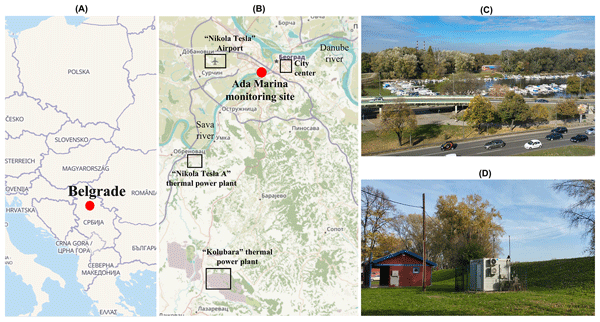
Bojana Petrović, Andres Alastuey, Karl Espen Yttri, Marco Pandolfi, Maja Jovanović, Bojan Radović, Renata Kovačević, Danka B. Stojanović, Miloš Davidović, Stephen M. Platt, Alena Bartonova, and Milena Jovašević-Stojanović
Atmos. Chem. Phys., 26, 14165–14184, https://doi.org/10.5194/acp-26-14165-2026, https://doi.org/10.5194/acp-26-14165-2026, 2026
Short summary
Short summary
Source apportionment based on daily levels of organic and elemental carbon, metals, ions, and organic tracers identified 7 factors, interpreted as anthropogenic and natural sources at both regional and local scales. Mitigation measures would reduce the biomass burning factor, which contributes 21 % to airborne particulate matter annually, primarily during the heating season. Two biogenic factors account for 20 %, the remaining 4 factors are influenced by both anthropogenic and natural sources.
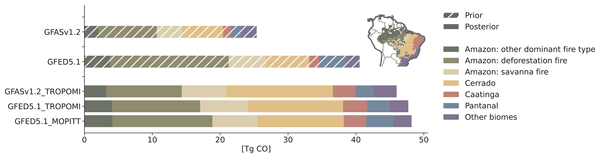
Anne-Wil van den Berg, Joram J. D. Hooghiem, Auke M. van der Woude, Pieter Rijsdijk, Roland Vernooij, Santiago Botía, Guido R. van der Werf, John B. Miller, Ingrid T. Luijkx, Maarten C. Krol, and Wouter Peters
Atmos. Chem. Phys., 26, 13929–13958, https://doi.org/10.5194/acp-26-13929-2026, https://doi.org/10.5194/acp-26-13929-2026, 2026
Short summary
Short summary
We estimate 2019 Brazilian fire carbon monoxide (CO) emissions using CO retrievals from multiple satellites in a new top-down inversion framework. The retrievals strongly constrain fire emissions and complement existing inventories. National-scale posterior emissions align well with the new Global Fire Emissions Database v5.1, supporting progress in fire emission models. Yet, posterior emissions in the Cerrado and Caatinga are systematically higher than inventories; we discuss potential drivers.
Shrutika Wagh, Luana S. Basso, Ayan F. Fleischmann, João Henrique Fernandes Amaral, John Melack, Jost Larvic, David Walter, Stijn Hantson, Julia Marshall, Chris Wilson, Youmi Oh, Lori Bruhwiler, John B. Miller, Corinne Vigouroux, Christian Rödenbeck, and Santiago Botía
EGUsphere, https://doi.org/10.5194/egusphere-2026-5245, https://doi.org/10.5194/egusphere-2026-5245, 2026
This preprint is open for discussion and under review for Atmospheric Chemistry and Physics (ACP).
Short summary
Short summary
We estimated methane emissions from the Amazon, Orinoco, and Paraná river basins using the Jena CarboScope global inversion system. We included Amazon measurements to evaluate their effect on the results. Adding them led to a large adjustment in estimated wetland emissions and strongly influenced the Amazon estimate. Without these measurements, the Amazon estimate increased by about 75 %. Our findings highlight the need to maintain and expand measurements across tropical South America.
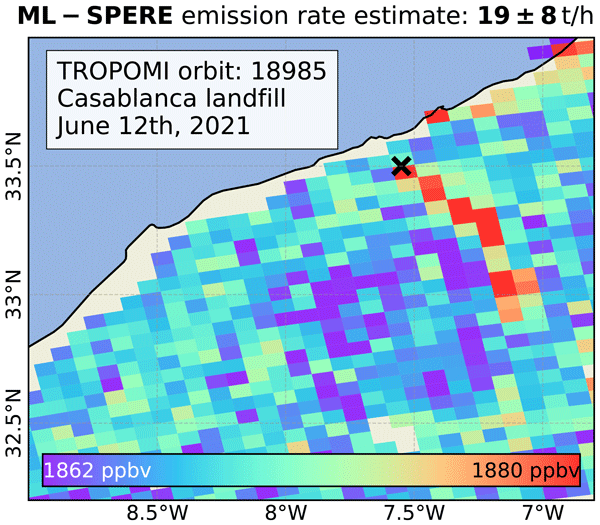
Clayton Roberts, Joannes D. Maasakkers, Tobias A. de Jong, Berend J. Schuit, Shubham Sharma, Theo Huegens, Anne-Wil van den Berg, Sander Houweling, and Ilse Aben
Atmos. Meas. Tech., 19, 5659–5682, https://doi.org/10.5194/amt-19-5659-2026, https://doi.org/10.5194/amt-19-5659-2026, 2026
Short summary
Short summary
Methane is a powerful greenhouse gas, and cutting its emissions can slow climate change in the near term. We have created ML-SPERE, a new machine-learning based method that uses TROPOMI observations and weather data to better estimate emission rates for large methane plumes. It has proved more accurate than the Integrated Mass Enhancement (IME) method when tested on simulated satellite observations. When applied to real TROPOMI plumes, ML-SPERE produces estimates that agree with other methods.
Thomas Laemmel, Dylan Geissbühler, Stephan Henne, Ryo Fujita, Heather Graven, Christophe Espic, Matthias Bantle, Negar Haghipour, Franz Conen, Dominik Brunner, Martin Steinbacher, Giulia Zazzeri, Samuel Hammer, Markus Leuenberger, and Sönke Szidat
Atmos. Chem. Phys., 26, 12019–12036, https://doi.org/10.5194/acp-26-12019-2026, https://doi.org/10.5194/acp-26-12019-2026, 2026
Short summary
Short summary
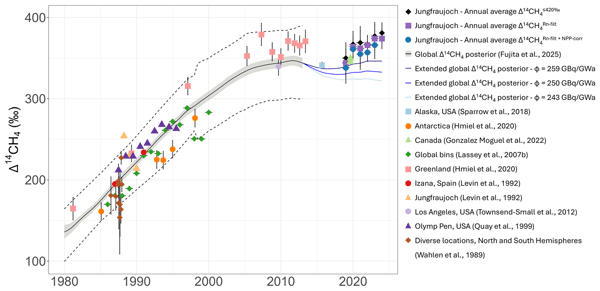
Carbon dioxide and methane are the two main anthropogenic greenhouse gases responsible for current climate change. Beside the measurement of their atmospheric concentration, the analysis of the abundance of their isotope carbon-14 (14C) gives hints about their origin, either biogenic or fossil. Here we present six years of atmospheric 14CH4 and 14CO2 measurements at a high-elevation alpine site in Switzerland (Jungfraujoch) and discuss the observed trends in both local and global views.
Stephen M. Platt, Milos Davidović, Alena Bartonova, Željko Ćirović, Sabine Eckhardt, Nikolaos Evangeliou, Hans Gundersen, Maja Jovanović, Milena Jovašević-Stojanović, Griša Močnik, Bojana Petrović, Philipp Schneider, and Karl Espen Yttri
EGUsphere, https://doi.org/10.5194/egusphere-2026-1708, https://doi.org/10.5194/egusphere-2026-1708, 2026
This preprint is open for discussion and under review for Atmospheric Chemistry and Physics (ACP).
Short summary
Short summary
We present year-round (2023 to 2025) carbonaceous aerosol measurements from Ada Marina, Belgrade, combining tracers, the aethalometer model, a new NNMF application, and FLEXPART. All methods show residential wood combustion is important, driving winter increases in eBC and OC, enhanced secondary OC, and brown carbon absorption. FLEXPART highlights regional transport within Serbia and the Pannonian Basin, with good model–observation agreement, underscoring the need to reduce RWC emissions.
Robbert P. J. Moonen, Getachew A. Adnew, Jordi Vilà-Guerau de Arellano, David J. Bonell Fontas, and Thomas Röckmann
Biogeosciences, 23, 5163–5184, https://doi.org/10.5194/bg-23-5163-2026, https://doi.org/10.5194/bg-23-5163-2026, 2026
Short summary
Short summary
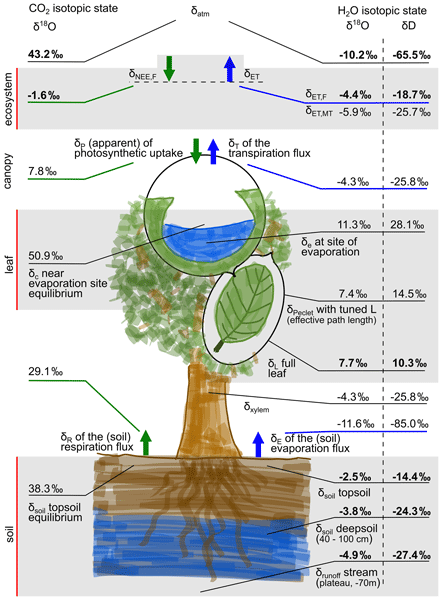
We used high-frequency H₂O and CO₂ isotope measurements taken in the Amazon Tall Tower Observatory (ATTO) to separate water vapour and carbon dioxide fluxes into their component processes. During midday, ~95 % of evapotranspiration came from plant transpiration. Isotopes also revealed the balance between photosynthesis and respiration, showing strong sensitivity to leaf CO₂ ratios. These results improve understanding of Amazon ecosystem function.
Mengrong Lu, Huilin Chen, Xun Zhang, Xuguang Chi, Chong Wei, Shuangxi Fang, Fenjuan Wang, Eleftherios Ioannidis, Friedemann Reum, Xinlu Wang, Prajal Pradhan, Wouter Peters, Klaus Hubacek, and Sander Houweling
EGUsphere, https://doi.org/10.5194/egusphere-2026-3879, https://doi.org/10.5194/egusphere-2026-3879, 2026
Short summary
Short summary
Effective methane mitigation requires accurate knowledge of the spatial and temporal distribution of sources and sinks. Using high-resolution atmospheric modeling and ground-based observations, we estimated methane emissions in East Asia, focusing on the Yangtze River Delta. Emissions are lower than most inventories suggest, but show a clear seasonal cycle, with summer peaks driven by rice cultivation and natural sources. This seasonality is critical for emission tracking and mitigation design.
Sarah E. Hancock, Daniel J. Jacob, Rodrigo Jimenez, Andrés Ardila, Luis Morales-Rincon, Néstor Rojas, Lucas A. Estrada, Nicholas Balasus, James D. East, Melissa P. Sulprizio, Xiaolin Wang, James L. France, Lauren Potyk, Elise Penn, Zichong Chen, Daniel J. Varon, Christian Frankenberg, Marci Baranski, Andreea Calcan, and Robert J. Parker
Atmos. Chem. Phys., 26, 10455–10476, https://doi.org/10.5194/acp-26-10455-2026, https://doi.org/10.5194/acp-26-10455-2026, 2026
Short summary
Short summary
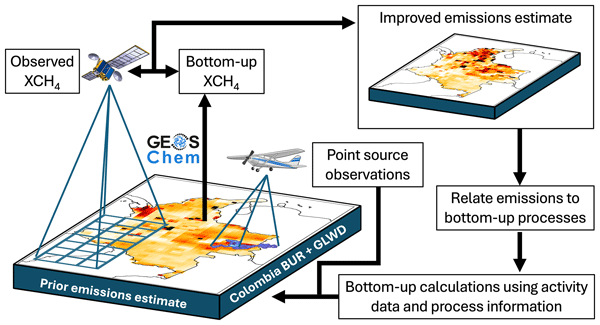
We combined satellite observations with detailed national data to improve estimates of Colombia’s methane emissions. Our results show that total methane emissions are higher than reported, with the biggest differences from fossil fuels. This approach demonstrates how satellite data can make national greenhouse gas reporting more accurate and transparent under the Paris Agreement.
Patrick C. Taylor, Armin Sorooshian, Rei Ueyama, Sebastian Schmidt, Ihab Abboud, Quincy Allison, Kevin Barry, Sebastian Becker, Holly A. Bender, Joseph R. Bennett, James B. Blair, Niklas Bohn, Linette Boisvert, Matthew D. Brown, Roelof Bruintjes, Anthony Bucholtz, Megan Buzanowicz, Brian Cairns, Filippo Calì Quaglia, Eduard Chemyakin, Bo Chen, Gao Chen, Hong Chen, Yu-Wen Chen, Zezhen Cheng, Swarup China, Dan Chirica, Yonghoon Choi, Peter Colarco, Brian Collister, Ewan Crosbie, Maurice J. Cross, Janet Daniels, Paul DeMott, Joshua P. DiGangi, Alcide Giorgio di Sarra, Glenn S. Diskin, Erica K. Dolinar, Eva-Lou Edwards, Samuel Ephraim, Nikolaos Evangeliou, Romanos Foskinis, Francesca Gallo, Lan Gao, José Luis Gómez-Amo, Daisy Gonzalez, Christine Groot Zwaaftink, Pawan Gupta, Ivan Heckman, Michael Hendrickson, Miguel Ricardo A. Hilario, Ken Hirata, Michelle Hofton, Andrew L. Holen, Ulas Im, Alia L. Khan, Ralph Kahn, Alexei V. Korolev, Sonia Kreidenweis, Thomas Krumpen, Nathan Kurtz, Leslie Lait, Bradley Lamkin, Jack Landy, Nurun Nahar Lata, Paul Lawson, Samuel LeBlanc, Sean Leavor, Jing Li, Thorsten Markus, Hal Maring, Andreas H. Massling, Camille Mavis, Flynn McGinnity, Kerry Meyer, Gabriel Mojica, Richard H. Moore, Parker Morris, Giovanni Muscari, Vikas Nataraja, Amin R. Nehrir, Athanasios Nenes, Edward P. Nowottnick, Matteo Ottaviani, Chelsea Parker, Ryan Patnaude, Michael Perez, Russell J. Perkins, Colten Peterson, Alek Petty, Stevie Phothisane, Chris Polashenski, Kerri A. Pratt, Kayla M. Preisler, John Prytherch, David Rabine, Jens Redemann, Ju-Mee Ryoo, Joseph S. Schlosser, Vanessa Selimovic, Michael A. Shook, Morgan Silverman, Henrik Skov, Alexander Smirnov, Cassidy Soloff, Amy Solomon, Snorre Stamnes, Azusa Takeishi, David R. Thompson, K. Lee Thornhill, Rachel Tilling, Michael Tjernström, Monica Tosco, Pedro C. Valdelomar, David Van Gilst, Jian Wang, Zhien Wang, Andrzej Wasilewski, Manfred Wendisch, Brent Wilder, Edward L. Winstead, Albert Wu, Peng Xian, Lauren M. Zamora, Jiaoshi Zhang, Lei Zhang, Lu Zhang, Luke Ziemba, and Paquita Zuidema
Earth Syst. Sci. Data Discuss., https://doi.org/10.5194/essd-2026-241, https://doi.org/10.5194/essd-2026-241, 2026
Preprint under review for ESSD
Short summary
Short summary
This article summarizes the data sets collected during the Arctic Radiation Cloud aerosol Sea ice Interaction eXperiment (ARCSIX), NASA's most comprehensive Arctic field campaign to date. The overarching goal was to quantify the contributions of surface, clouds, aerosol particles, and precipitation to summer sea ice melt. This paper describes the ARCSIX implementation including the flight strategy, instruments, complementary data sets, access, and usage details.
Stephen J. Harris, Sven Krautwurst, Jorg Hacker, Mark Lunt, Jakob Borchardt, Mei Bai, Hartmut Boesch, Tarra Brain, John Philip Burrows, Shakti Chakravarty, Robert A. Field, Rebecca E. Fisher, James L. France, Konstantin Gerilowski, Oke Huhs, Wolfgang Junkermann, Bryce F. J. Kelly, Martin Kumm, Mathias Lanoisellé, Wolfgang Lieff, Andrew McGrath, Adrian Murphy, Thomas Röckmann, Zoe Salmon, Josua Schindewolf, Jakob Thoböll, Carina van der Veen, and Heinrich Bovensmann
Atmos. Chem. Phys., 26, 10043–10069, https://doi.org/10.5194/acp-26-10043-2026, https://doi.org/10.5194/acp-26-10043-2026, 2026
Short summary
Short summary
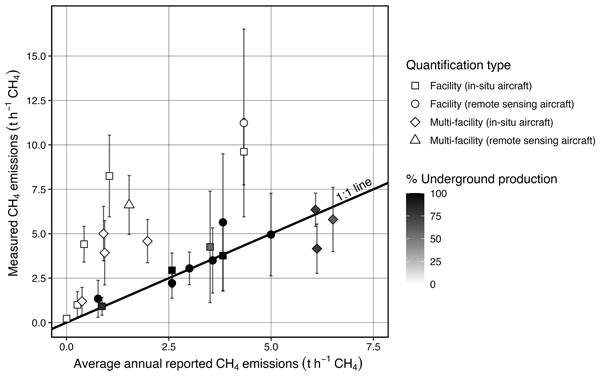
The accuracy of methods used to estimate and report fugitive methane emissions from Australian coal mines remains unclear. This study compares airborne emission rate estimates with reported estimates from 17 coal mines in the Bowen Basin, a region accounting for 45 % of national coal production. Results show good agreement for underground coal mines, but poor agreement for surface coal mines, suggesting improvements to surface coal mine reporting methods is needed to improve inventory reporting.
Audrey McManemin, Catherine Juéry, Vincent Blandin, Matthew Baker, Stéphane Bauguitte, Dominik Brunner, Philippine Burdeau, James Lawrence France, Anders M. Fredenslund, Andreas Hueni, Gerrit Kuhlmann, Patryk Łakomiec, Sando Meier, Roberto Paglini, Roubina Papaconstantinou, Jean-Daniel Paris, Pierre-Yves Quehe, Thomas Röckmann, Charlotte Scheutz, Martina Schmidt, Marius Vögtli, Julia B. Wietzel, and Adam R. Brandt
EGUsphere, https://doi.org/10.5194/egusphere-2026-1744, https://doi.org/10.5194/egusphere-2026-1744, 2026
Short summary
Short summary
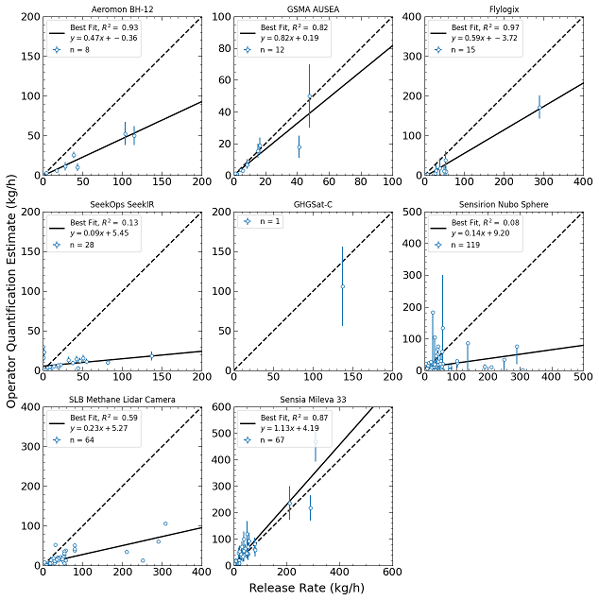
Researchers tested five university-led systems to measure methane leaks at a facility in France. By releasing known amounts of gas, researchers checked if mobile tools on vehicles and planes could accurately detect and quantify emissions. Most sensors were excellent at finding leaks, but their accuracy in measuring the exact emission rate varied. Weather, especially low wind, significantly impacted results. These findings help improve how we track greenhouse gases to meet climate goals.
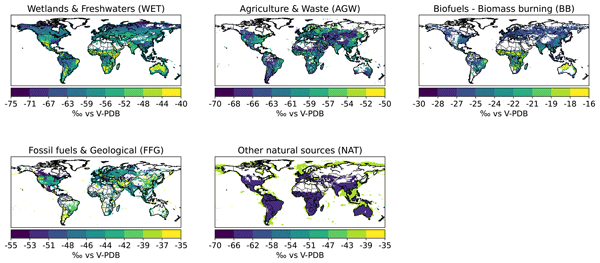
Emeline Tapin, Antoine Berchet, Adrien Martinez, Malika Menoud, Joël Thanwerdas, Xin Lan, Edward Malina, Daniele Gasbarra, and Marielle Saunois
Earth Syst. Sci. Data, 18, 4793–4832, https://doi.org/10.5194/essd-18-4793-2026, https://doi.org/10.5194/essd-18-4793-2026, 2026
Short summary
Short summary
We present global δ¹³C-CH₄ source signature maps (1998–2022) at 1°×1° resolution for five emission sectors and 11 sub-sectors, with quantified uncertainties. Sensitivity experiments with an atmospheric transport model assess how uncertainties in emissions, isotopic signatures, OH sinks, and kinetic isotope effects influence atmospheric δ¹³C-CH₄ and CH₄, providing guidance for isotopic inversions.
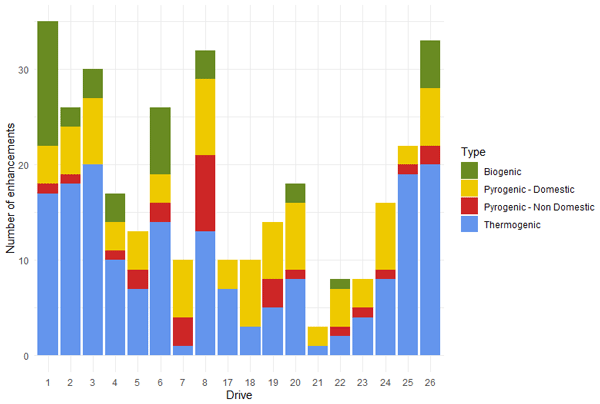
Thomas C. Moore, James R. Hopkins, Will S. Drysdale, Stuart Young, Sri Hapsari Budisulistiorini, Marvin D. Shaw, Mackenzie LeVernois, James L. France, David Lowry, and James D. Lee
Atmos. Meas. Tech., 19, 4459–4475, https://doi.org/10.5194/amt-19-4459-2026, https://doi.org/10.5194/amt-19-4459-2026, 2026
Short summary
Short summary
The Global Methane Pledge has led to increased effort to reduce methane emissions globally. One sector under increased scrutiny is the oil and gas industry, a major source of methane in this industry is from fugitive emissions (gas leaks). Locating these from pipework in cities requires mobile measurements. This work adapts previous methodologies to detect smaller leaks and suggests previous methods may detect 53.5 % less gas leaks.
S. M. Nazrul Islam, Scott J. Lehman, Sourish Basu, Arlyn E. Andrews, Kathryn McKain, Colm Sweeney, Xiaomei Xu, Chad Wolak, Stephen P. Morgan, Patrick Cappa, John R. Southon, Pieter P. Tans, and John B. Miller
EGUsphere, https://doi.org/10.5194/egusphere-2026-2896, https://doi.org/10.5194/egusphere-2026-2896, 2026
Short summary
Short summary
This study uses carbon dioxide and atmospheric radiocarbon observations to estimate U.S. fossil fuel CO₂ emissions for 2010 and 2015. The results provide an independent atmospheric verification of national emission trends, showing a decline in FFCO₂ emissions and agreement with bottom-up inventories such as EPA and other estimates. The work highlights the value of atmospheric observations for greenhouse gas monitoring, emissions verification, and climate policy applications.
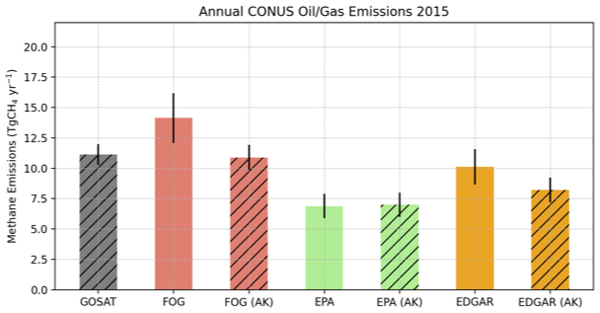
John Worden, Sudhanshu Pandey, Hannah Nesser, Kevin Bowman, Colin Harkins, Congmeng Lyu, Joannes D. Maasakkers, Deborah Gordon, Daniel Jacob, Lucas Estrada, Daniel J. Varon, James D. East, Lauren Schmeisser, and Zhen Qu
Atmos. Chem. Phys., 26, 8855–8873, https://doi.org/10.5194/acp-26-8855-2026, https://doi.org/10.5194/acp-26-8855-2026, 2026
Short summary
Short summary
To support methane reduction, we compared three widely used maps of methane emissions in the United States with estimates derived from a methane-measuring satellite from 2012 to 2020. The satellite indicates higher emissions from oil and gas production and from livestock in several regions, while other sources were harder to pin down. Neither approach shows a clear change over time. The results point to where better measurements can most improve emissions reporting and guide mitigation.
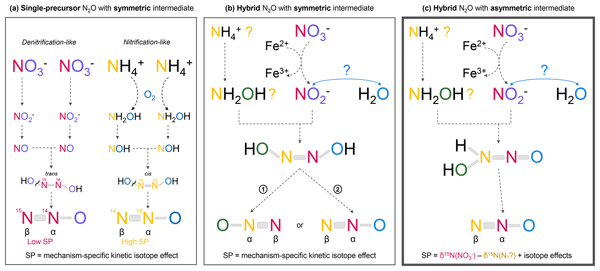
Lison Soussaintjean, Jochen Schmitt, Joël Savarino, J. Andy Menking, Edward J. Brook, Barbara Seth, Vladimir Lipenkov, Thomas Röckmann, and Hubertus Fischer
Biogeosciences, 23, 3939–3963, https://doi.org/10.5194/bg-23-3939-2026, https://doi.org/10.5194/bg-23-3939-2026, 2026
Short summary
Short summary
Nitrous oxide (N2O) produced in dust-rich Antarctic ice complicates the reconstruction of past atmospheric levels from ice core records. Using isotope analysis, we show that N2O forms from two nitrogen precursors, one being nitrate. For the first time, we demonstrate that the site preference (SP) of N2O reflects the isotopic difference between these precursors, not the production pathway, which challenges the common interpretation of SP.
Shuai Sun, Yuzhong Zhang, Wei Chen, Shaomin Pan, Dongchuan Pu, Xin Tong, Huilin Chen, and Sander Houweling
EGUsphere, https://doi.org/10.5194/egusphere-2026-2165, https://doi.org/10.5194/egusphere-2026-2165, 2026
Short summary
Short summary
This study estimates methane emissions across Europe from 2019 to 2023 using atmospheric methane measurements from satellites and ground stations to improve understanding of emission sources. We find that total emissions are slightly higher than official reports, mainly due to livestock and waste, while emissions from fossil fuel production are lower in some regions. These results show that atmospheric measurements can improve independent verification of emissions and support climate policy.
Liang Feng, Paul I. Palmer, Haolin Wang, Robert Parker, Hartmut Boesch, Sébastien C. Biraud, Łukasz Chmura, Emanuel Gloor, László Haszpra, Elena Kozlova, Euan G. Nisbet, Steffen M. Noe, Thomas Röckmann, Rodrigo Augusto Ferreira de Souza, and Martin Steinbacher
EGUsphere, https://doi.org/10.5194/egusphere-2026-2662, https://doi.org/10.5194/egusphere-2026-2662, 2026
Short summary
Short summary
This study examines the relative roles of emissions and oxidation in recent rapid methane growth. Using an ensemble Kalman filter, we quantify global methane sources and sinks for 2018–2024. Emission changes dominate the increase, except in 2020 when a COVID‑19‑related OH decline strongly affected sinks. Atmospheric photochemistry—including OH and CH₄ variability and temperature‑dependent oxidation—also significantly shapes the methane budget.
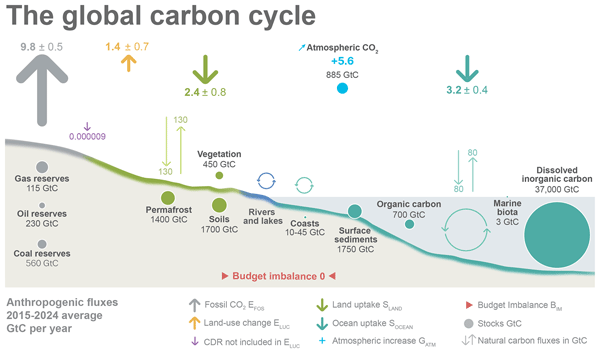
Pierre Friedlingstein, Michael O'Sullivan, Matthew W. Jones, Robbie M. Andrew, Dorothee C. E. Bakker, Judith Hauck, Peter Landschützer, Corinne Le Quéré, Hongmei Li, Ingrid T. Luijkx, Glen P. Peters, Wouter Peters, Julia Pongratz, Clemens Schwingshackl, Stephen Sitch, Josep G. Canadell, Philippe Ciais, Kjetil Aas, Simone R. Alin, Peter Anthoni, Leticia Barbero, Nicholas R. Bates, Nicolas Bellouin, Alice Benoit-Cattin, Carla F. Berghoff, Raffaele Bernardello, Laurent Bopp, Ida Bagus Mandhara Brasika, Matthew A. Chamberlain, Naveen Chandra, Frédéric Chevallier, Louise P. Chini, Nathan O. Collier, Thomas H. Colligan, Margot Cronin, Laique M. Djeutchouang, Xinyu Dou, Matt P. Enright, Kazutaka Enyo, Michael Erb, Wiley Evans, Richard A. Feely, Liang Feng, Daniel J. Ford, Adrianna Foster, Filippa Fransner, Thomas Gasser, Marion Gehlen, Thanos Gkritzalis, Jefferson Goncalves De Souza, Giacomo Grassi, Luke Gregor, Nicolas Gruber, Bertrand Guenet, Özgür Gürses, Kirsty Harrington, Ian Harris, Jens Heinke, George C. Hurtt, Yosuke Iida, Tatiana Ilyina, Akihiko Ito, Andrew R. Jacobson, Atul K. Jain, Tereza Jarníková, Annika Jersild, Fei Jiang, Steve D. Jones, Etsushi Kato, Ralph F. Keeling, Kees Klein Goldewijk, Jürgen Knauer, Yawen Kong, Jan Ivar Korsbakken, Charles Koven, Taro Kunimitsu, Xin Lan, Junjie Liu, Zhiqiang Liu, Zhu Liu, Claire Lo Monaco, Lei Ma, Gregg Marland, Patrick C. McGuire, Galen A. McKinley, Joe R. Melton, Natalie Monacci, Erwan Monier, Eric J. Morgan, David R. Munro, Jens D. Müller, Shin-Ichiro Nakaoka, Lorna R. Nayagam, Yosuke Niwa, Tobias Nutzel, Are Olsen, Abdirahman M. Omar, Naiqing Pan, Sudhanshu Pandey, Denis Pierrot, Zhangcai Qin, Pierre Regnier, Gregor Rehder, Laure Resplandy, Alizée Roobaert, Thais M. Rosan, Christian Rödenbeck, Jörg Schwinger, Ingunn Skjelvan, T. Luke Smallman, Victoria Spada, Mohanan G. Sreeush, Qing Sun, Adrienne J. Sutton, Colm Sweeney, Didier Swingedouw, Roland Séférian, Shintaro Takao, Hiroaki Tatebe, Hanqin Tian, Xiangjun Tian, Bronte Tilbrook, Hiroyuki Tsujino, Francesco Tubiello, Erik van Ooijen, Guido R. van der Werf, Sebastiaan J. van de Velde, Anthony P. Walker, Rik Wanninkhof, Xiaojuan Yang, Wenping Yuan, Xu Yue, and Jiye Zeng
Earth Syst. Sci. Data, 18, 3211–3288, https://doi.org/10.5194/essd-18-3211-2026, https://doi.org/10.5194/essd-18-3211-2026, 2026
Short summary
Short summary
The Global Carbon Budget 2025 describes the methodology, main results, and datasets used to quantify the anthropogenic emissions of carbon dioxide (CO2) and their partitioning among the atmosphere, land ecosystems, and the ocean over the historical period (1750–2025). These living datasets are updated every year to provide the highest transparency and traceability in the reporting of CO2, the key driver of climate change.
Jacoline van Es, Juan Bettinelli, Jia Chen, Carina van der Veen, Stephan Henne, and Thomas Röckmann
EGUsphere, https://doi.org/10.5194/egusphere-2026-1813, https://doi.org/10.5194/egusphere-2026-1813, 2026
Short summary
Short summary
The increase in atmospheric methane needs to be reversed to mitigate ongoing global warming. To design effective mitigation strategies at the local/regional level, we need to know what the main sources in different regions. We show that in Hamburg, Germany, biogenic sources are the main contributor to local emissions, with additional contributions from waste and fossil CH4 sources. An unexpected source is the Elbe River, with spiking emissions at low tide when the river banks are exposed.
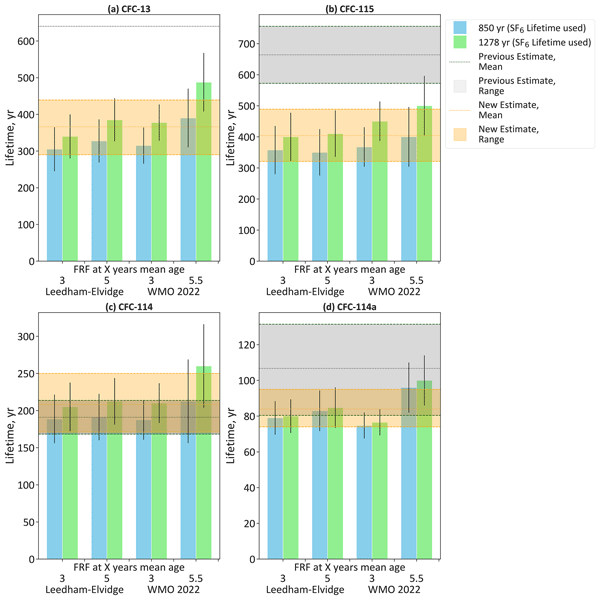
Elinor C. Tuffnell, Emma Leedham-Elvidge, William T. Sturges, Harald Bönisch, Karina E. Adcock, Paul J. Fraser, Paul B. Krummel, David E. Oram, Ray L. Langenfelds, Thomas Röckmann, Luke M. Western, Jens Mühle, and Johannes C. Laube
Atmos. Chem. Phys., 26, 4583–4599, https://doi.org/10.5194/acp-26-4583-2026, https://doi.org/10.5194/acp-26-4583-2026, 2026
Short summary
Short summary
The greater the stratospheric lifetime of chlorofluorocarbons (CFCs), the longer they will deplete ozone. This paper investigates four longer-lived CFCs, and discovers two of them have much shorter lifetimes than previously believed. Demonstrating emissions of these compounds are higher than assumed, to account for their abundance. Unusually this paper uses stratospheric whole-air samples, rather than models or lab-based experiments, to derive policy-relevant metrics for these compounds.
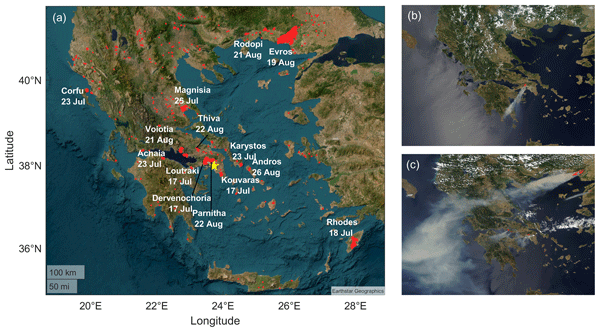
Marilena Gidarakou, Alexandros Papayannis, Maria Mylonaki, Eleni Kralli, Kostas Eleftheratos, Ilias Fountoulakis, Olga Zografou, Evangelia Diapouli, Maria I. Gini, Stergios Vratolis, Konstantinos Granakis, Konstantinos Eleftheriadis, Nikolaos Evangeliou, Christine Groot Zwaaftink, Eugenia Giagka, Marios-Andreas Zagklis, and Igor Veselovskii
Atmos. Chem. Phys., 26, 4313–4339, https://doi.org/10.5194/acp-26-4313-2026, https://doi.org/10.5194/acp-26-4313-2026, 2026
Short summary
Short summary
In summer 2023, Greece experienced one of its most intense wildfire seasons, with major fires across several regions. This study examines how smoke from two major fire events affected air quality and ultraviolet radiation in Athens using satellite images, modelling, and ground-based measurements to understand the optical and microphysical behavior of airborne particles.
Annalisa Delre, Thomas Röckmann, David J. Bonell Fontas, Julia C. Engelmann, and Helge Niemann
EGUsphere, https://doi.org/10.5194/egusphere-2026-1582, https://doi.org/10.5194/egusphere-2026-1582, 2026
Preprint archived
Short summary
Short summary
Estuaries are important natural sources of methane, a greenhouse gas that affects climate. We studied how methane changes along the Scheldt estuary by measuring gas concentrations, carbon isotopes and identification and quantification of methane oxidizing bacteria. We found that methane levels varied strongly and were not mainly controlled by salinity. Most methane escaped to the atmosphere, showing that estuaries may contribute more to climate change than previously thought.
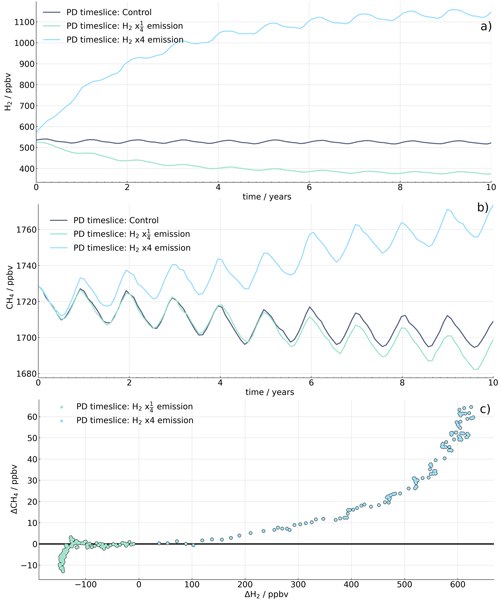
Megan A. J. Brown, Nicola J. Warwick, Nathan Luke Abraham, Paul T. Griffiths, Steve T. Rumbold, Gerd A. Folberth, Fiona M. O'Connor, Hannah Bryant, and Alex T. Archibald
Geosci. Model Dev., 19, 1537–1557, https://doi.org/10.5194/gmd-19-1537-2026, https://doi.org/10.5194/gmd-19-1537-2026, 2026
Short summary
Short summary
Hydrogen (H2) is an indirect greenhouse gas by increasing methane (CH4) lifetime. Interaction between H2 and CH4 is important for hydrogen’s global warming potential (GWP). Global models do not represent this interaction well; H2 or CH4 are prescribed at the surface. We implement an interactive H2 scheme into a global model coupled with interactive CH4. We simulate scenarios demonstrating its capability, improving model performance and more accurately representing H2-CH4 interaction.
Audrey McManemin, Catherine Juéry, Vincent Blandin, James L. France, Philippine Burdeau, and Adam R. Brandt
Atmos. Meas. Tech., 19, 923–934, https://doi.org/10.5194/amt-19-923-2026, https://doi.org/10.5194/amt-19-923-2026, 2026
Short summary
Short summary
This experiment tested the ability of different technologies to detect and measure methane emissions. Participating teams used satellites, drones, and other systems to estimate methane leak rates without knowing the true rate. Some systems were more accurate than others, and wind and other environmental conditions made measurements harder. Our findings help improve these tools and support efforts to track and reduce methane emissions as new environmental rules take shape in Europe and beyond.
Satoshi Sugawara, Ikumi Oyabu, Kenji Kawamura, Shigeyuki Ishidoya, Shinji Morimoto, Shuji Aoki, Takakiyo Nakazawa, Sakae Toyoda, and Hideyuki Honda
Atmos. Chem. Phys., 26, 1537–1563, https://doi.org/10.5194/acp-26-1537-2026, https://doi.org/10.5194/acp-26-1537-2026, 2026
Short summary
Short summary
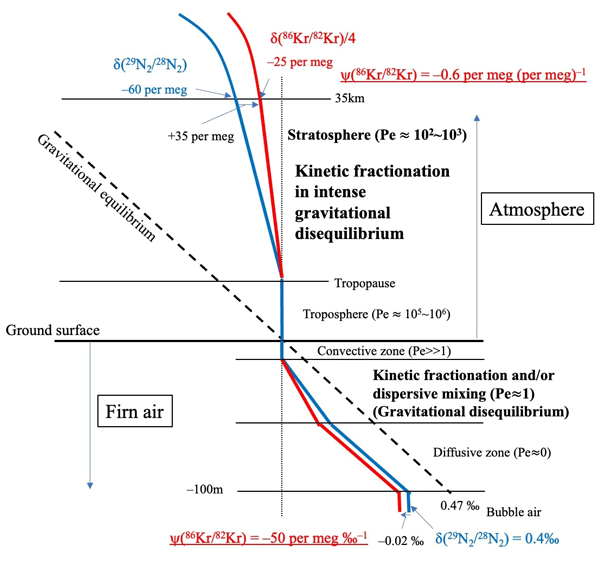
Stratospheric air samples have been collected using balloon-borne cryogenic samplers over Japan and analyzed for the isotopic and elemental ratios of noble gases. We report the results of the first study of the kinetic fractionations of Kr, Xe, and Ne in the stratosphere. It was suggested that changes in the stratospheric circulation during glacial and interglacial cycles may have affected the noble gas elemental ratios in ice core samples.
Maxence Plouviez, Peter Sperlich, Benoit Guieysse, Tim Clough, Rahul Peethambaran, and Naomi Wells
Biogeosciences, 23, 497–508, https://doi.org/10.5194/bg-23-497-2026, https://doi.org/10.5194/bg-23-497-2026, 2026
Short summary
Short summary
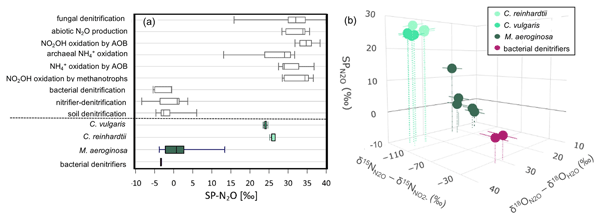
We present a new method for the accurate laser-based analysis of N2O isotopes. For the first time, we measured the Site Preference-N2O signatures of pure cultures of microalgae and cyanobacteria. Our study is a first step to ultimately develop process-specific N2O monitoring from aquatic ecosystems. Further research is now needed to determine the occurrence and significance of N2O emissions from microalgae and cyanobacteria from aquatic ecosystems.
Thomas Röckmann, Malika Menoud, Jacoline van Es, Carina van der Veen, Hossein Maazallahi, Pawel Jagoda, Jaroslav M. Necki, Jakub Bartyzel, Piotr Korben, Sara Defratyka, Martina Schmidt, Marius Corbu, Sebastian Iancu, Andreea Calcan, Magdalena Ardelean, Sorin Ghemulet, Cristian Pop, Andrei Radovici, Alexandru Mereuta, Horatiu Stefanie, and Calin Baciu
Atmos. Chem. Phys., 26, 723–731, https://doi.org/10.5194/acp-26-723-2026, https://doi.org/10.5194/acp-26-723-2026, 2026
Short summary
Short summary
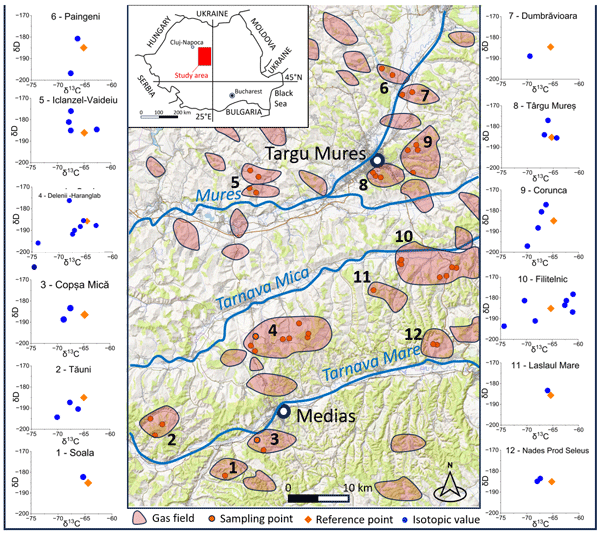
We report the isotopic composition of CH4 emitted from 48 installations in the gas production region of Transylvania, Romania which confirm the biogenic origin of the Transylvanian gas, produced by hydrogenotrophic CO2 reduction. This is similar to values reported previously from natural seeps and natural gas in a major city in the region. However, is more depleted in heavy isotopes than the oil-associated gas emitted in the Southern Romanian Plain, and gas leakages in the city of Bucharest.
Lisa Ardoin, Catherine Larose, Jean-Louis Tison, Christoph Keuschnig, Vasileios Gkinis, Saïda El Amri, Pierre-Henry Blard, Paul Bierman, Thomas Blunier, Dorthe Dahl-Jensen, Charlotte Maistriau, Jørgen-Peder Steffensen, Thomas Röckmann, and François Fripiat
EGUsphere, https://doi.org/10.5194/egusphere-2025-6204, https://doi.org/10.5194/egusphere-2025-6204, 2026
Short summary
Short summary
We investigated gas dynamics at the ice–bed interface of two Greenland ice cores to assess methane and carbon dioxide behaviour beneath ice sheets. At Camp Century, methane diffuses into the ice and is partly oxidized. At GRIP, methane remains preserved despite oxygen. These contrasts suggest that methane oxidation is controlled by local basal conditions, including ice thickness and substrate availability.
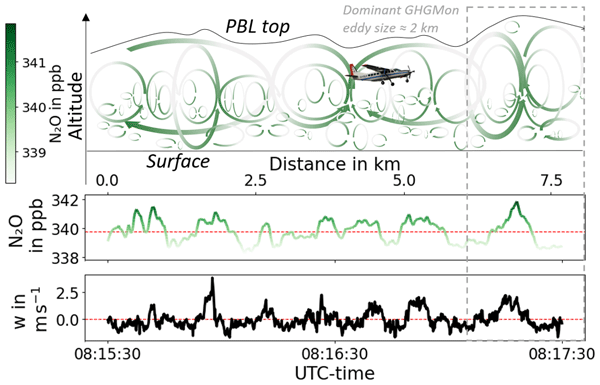
Paul Waldmann, Max Eckl, Leon Knez, Klaus-Dirk Gottschaldt, Alina Fiehn, Christian Mallaun, Michał Gałkowski, Christoph Kiemle, Ronald Hutjes, Thomas Röckmann, Huilin Chen, and Anke Roiger
Atmos. Meas. Tech., 19, 185–210, https://doi.org/10.5194/amt-19-185-2026, https://doi.org/10.5194/amt-19-185-2026, 2026
Short summary
Short summary
Nitrous oxide and methane emissions from agriculture need to be reduced, therefore emissions must be understood to effectively mitigate them. This is the first approach to measure those emissions aircraft-based, to assess their magnitude and drivers. We identified emission hotspots and temporal changes in agricultural emissions in the Netherlands. Our approach is applicable to further greenhouse gas emitters, therefore it builds a step towards more comprehensive emission quantification.
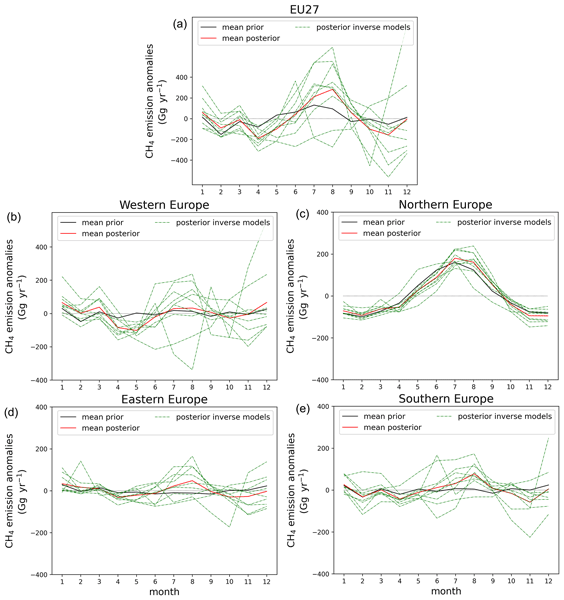
Eleftherios Ioannidis, Antoon Meesters, Michael Steiner, Dominik Brunner, Friedemann Reum, Isabelle Pison, Antoine Berchet, Rona Thompson, Espen Sollum, Frank-Thomas Koch, Christoph Gerbig, Fenjuan Wang, Shamil Maksyutov, Aki Tsuruta, Maria Tenkanen, Tuula Aalto, Guillaume Monteil, Hong Lin, Ge Ren, Marko Scholze, and Sander Houweling
Earth Syst. Sci. Data, 18, 167–198, https://doi.org/10.5194/essd-18-167-2026, https://doi.org/10.5194/essd-18-167-2026, 2026
Short summary
Short summary
This paper describes a detailed study on CH4 European emissions, using different methodologies (9 total inverse models). The study spans over 15 years and provides detailed information on European CH4 emission trends and seasonality, using in-situ data, including Integrated Carbon Observation System (ICOS) network. Our results highlight the importance of improving details in the inversion setup, such as the treatment of lateral boundary conditions to narrow the uncertainty ranges further.
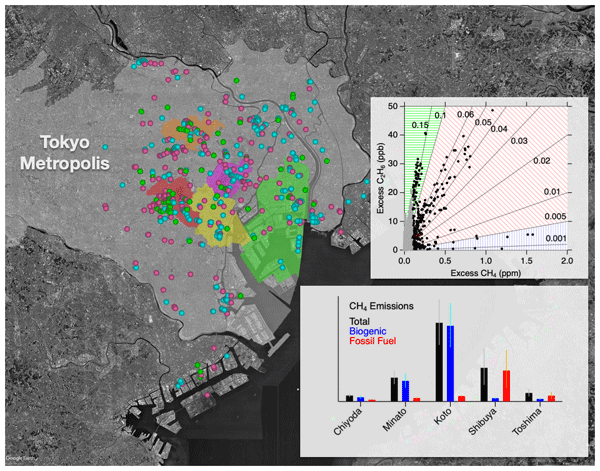
Taku Umezawa, Yukio Terao, Masahito Ueyama, Satoshi Kameyama, Mark Lunt, and James Lawrence France
Atmos. Chem. Phys., 25, 18015–18029, https://doi.org/10.5194/acp-25-18015-2025, https://doi.org/10.5194/acp-25-18015-2025, 2025
Short summary
Short summary
Effective mitigation actions require accurate understanding of methane emission characteristics in cities. We conducted atmospheric methane and ethane measurements using a vehicle in the world’s largest megacity, Tokyo, to identify locations and types of emissions and to examine preliminary estimates of their magnitudes. Waste sectors and fugitive natural gas emissions were found to be the major urban sources, and our data suggested need of improved accounting of natural gas related emissions.
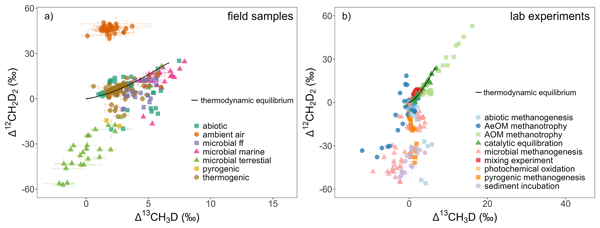
Sara M. Defratyka, Julianne M. Fernandez, Getachew A. Adnew, Guannan Dong, Peter M. J. Douglas, Daniel L. Eldridge, Giuseppe Etiope, Thomas Giunta, Mojhgan A. Haghnegahdar, Alexander N. Hristov, Nicole Hultquist, Iñaki Vadillo, Josue Jautzy, Ji-Hyun Kim, Jabrane Labidi, Ellen Lalk, Wil Leavitt, Jiawen Li, Li-Hung Lin, Jiarui Liu, Lucía Ojeda, Shuhei Ono, Jeemin H. Rhim, Thomas Röckmann, Barbara Sherwood Lollar, Malavika Sivan, Jiayang Sun, Gregory T. Ventura, David T. Wang, Edward D. Young, Naizhong Zhang, and Tim Arnold
Earth Syst. Sci. Data, 17, 6889–6910, https://doi.org/10.5194/essd-17-6889-2025, https://doi.org/10.5194/essd-17-6889-2025, 2025
Short summary
Short summary
Measurement of methane’s doubly substituted isotopologues at natural abundances holds promise for better constraining the Earth’s atmospheric CH4 budget. We compiled 1475 measurements from field samples and laboratory experiments, conducted since 2014, to facilitate the differentiation of CH4 formation pathways and processes, to identify existing gaps limiting application of Δ13CH3D and Δ12CH2D2, and to develop isotope ratio source signature inputs for global CH4 flux modelling.
Bibhasvata Dasgupta, Malika Menoud, Carina van der Veen, Ingeborg Levin, Cordelia Veidt, Heiko Moossen, Sylvia Englund Michel, Peter Sperlich, Shinji Morimoto, Ryo Fujita, Taku Umezawa, Stephen Platt, Christine Groot Zwaaftink, Cathrine Lund Myhre, Rebecca Fisher, David Lowry, Euan G. Nisbet, James France, Ceres Woolley Maisch, Gordon Brailsford, Rowena Moss, Daisuke Goto, Sudhanshu Pandey, Sander Houweling, Nicola Warwick, and Thomas Röckmann
Atmos. Meas. Tech., 18, 6591–6607, https://doi.org/10.5194/amt-18-6591-2025, https://doi.org/10.5194/amt-18-6591-2025, 2025
Short summary
Short summary
We combined long-term methane mole fraction and isotope measurements from eight laboratories that sample high-latitude stations to compare, offset correct and harmonise the datasets into a hemisphere merged timeseries. Because each laboratory uses slightly different methods, we adjusted the data to make it directly comparable. This allowed us to create a consistent record of atmospheric methane concentration and its isotopes from 1988 to 2023.
Scott D. Chambers, Ute Karstens, Alan D. Griffiths, Stefan Röttger, Arnoud Frumau, Christopher T. Roulston, Peter Sperlich, Felix Vogel, Agnieszka Podstawczyńska, Dafina Kikaj, Maksym Gachkivskyi, Michel Ramonet, Blagoj Mitrevski, Janja Vaupotič, Xuemeng Chen, and Annette Röttger
EGUsphere, https://doi.org/10.5194/egusphere-2025-5042, https://doi.org/10.5194/egusphere-2025-5042, 2025
Short summary
Short summary
The Radon Tracer Method (RTM) is a top-down approach to estimate greenhouse gas emissions. While simple in principle, incorrect use can complicate interpretation of results. Based on observations from a range of contrasting sites, this article reviews the underlying assumptions and key considerations for applying the RTM. It also introduces the concept of coupling RTM analyses with nocturnal stability classification, to reduce uncertainty of fetch estimates and improve interpretation of results.
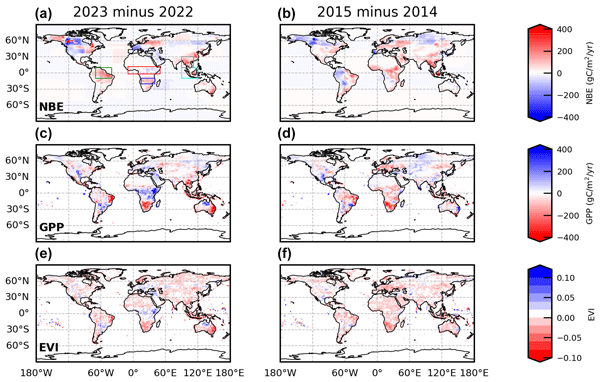
Liang Feng, Paul I. Palmer, Luke Smallman, Jingfeng Xiao, Paolo Cristofanelli, Ove Hermansen, John Lee, Casper Labuschagne, Simonetta Montaguti, Steffen M. Noe, Stephen M. Platt, Xinrong Ren, Martin Steinbacher, and Irène Xueref-Remy
Atmos. Chem. Phys., 25, 13053–13076, https://doi.org/10.5194/acp-25-13053-2025, https://doi.org/10.5194/acp-25-13053-2025, 2025
Short summary
Short summary
The year 2023 saw unexpectedly large global atmospheric CO2 growth. Satellite data reveal a role for increased tropical emissions. Larger emissions over eastern Brazil can be explained by warmer temperatures, which has led to exceptional drought, while hydrological changes play more of a role in emission increases elsewhere in the tropics. Broadly, we find that this situation continues into 2024.
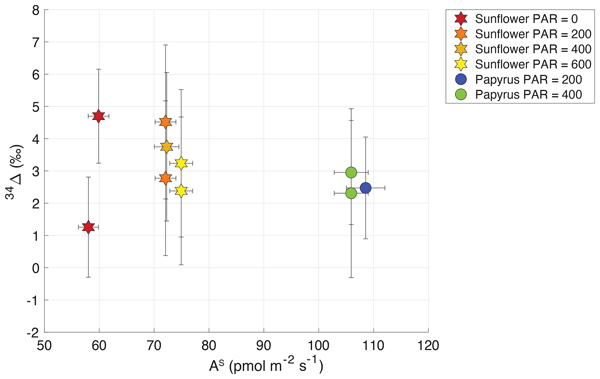
Sophie L. Baartman, Steven M. Driever, Maarten L. J. Wassenaar, Linda M. J. Kooijmans, Nerea Ubierna, Leon Mossink, Maria E. Popa, Ara Cho, Lisa Wingate, Thomas Röckmann, Steven M. A. C. van Heuven, and Maarten C. Krol
Biogeosciences, 22, 5683–5703, https://doi.org/10.5194/bg-22-5683-2025, https://doi.org/10.5194/bg-22-5683-2025, 2025
Short summary
Short summary
Carbonyl sulfide (COS) is a proposed tracer for gross primary production. For the first time, COS and carbon dioxide (CO2) uptake fluxes and isotope discrimination were jointly measured in sunflower and papyrus plants, using a flow-through plant chamber approach and varying light availability. COS isotope discrimination did not differ significantly between the species, nor with changes in light. CO2 fluxes and isotope values provided additional valuable information for data interpretation.
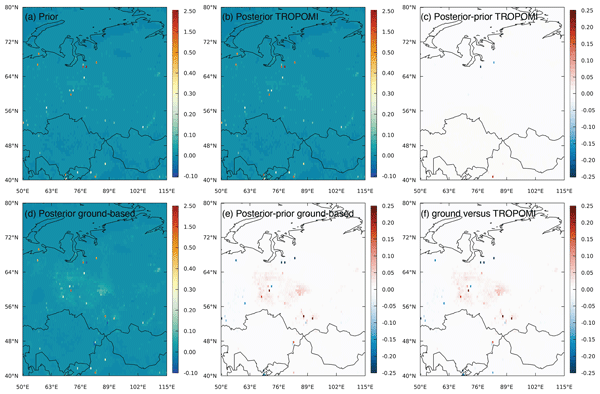
Rona L. Thompson, Nalini Krishnankutty, Ignacio Pisso, Philipp Schneider, Kerstin Stebel, Motoki Sasakawa, Andreas Stohl, and Stephen M. Platt
Atmos. Chem. Phys., 25, 12737–12751, https://doi.org/10.5194/acp-25-12737-2025, https://doi.org/10.5194/acp-25-12737-2025, 2025
Short summary
Short summary
Satellite remote sensing of atmospheric mixing ratios of greenhouse gases (GHGs) can provide information on their emissions. This study presents a novel method to use atmospheric mixing ratios observed by satellites with a Lagrangian model of atmospheric transport to estimate GHG emissions. This method can reduce model errors resulting from how an observation is represented by an atmospheric model, thereby helping to reduce the errors in the GHG emissions derived.
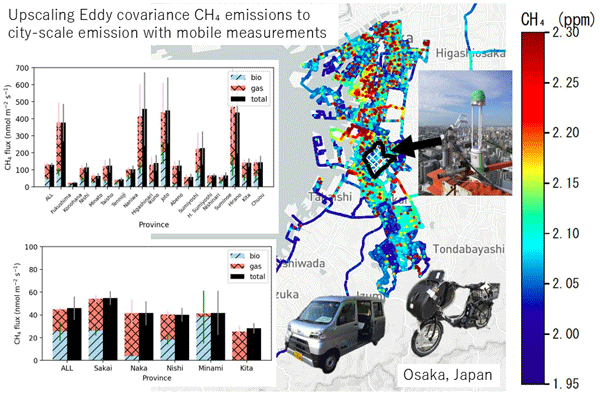
Masahito Ueyama, Taku Umezawa, Yukio Terao, Mark Lunt, and James Lawrence France
Atmos. Chem. Phys., 25, 12513–12534, https://doi.org/10.5194/acp-25-12513-2025, https://doi.org/10.5194/acp-25-12513-2025, 2025
Short summary
Short summary
Methane (CH4) emissions were measured in the megacity of Osaka, Japan, using mobile and eddy covariance methods. The CH4 emissions were much higher than those reported in local inventories, with natural gas contributing up to 74 % of the emissions. Several CH4 sources not accounted for in current inventories were identified. These results emphasize the need for more comprehensive emissions tracking in urban areas to enhance climate change mitigation efforts.
Robbert P. J. Moonen, Getachew A. Adnew, Jordi Vilà-Guerau de Arellano, Oscar K. Hartogensis, David J. Bonell Fontas, Shujiro Komiya, Sam P. Jones, and Thomas Röckmann
Atmos. Chem. Phys., 25, 12197–12212, https://doi.org/10.5194/acp-25-12197-2025, https://doi.org/10.5194/acp-25-12197-2025, 2025
Short summary
Short summary
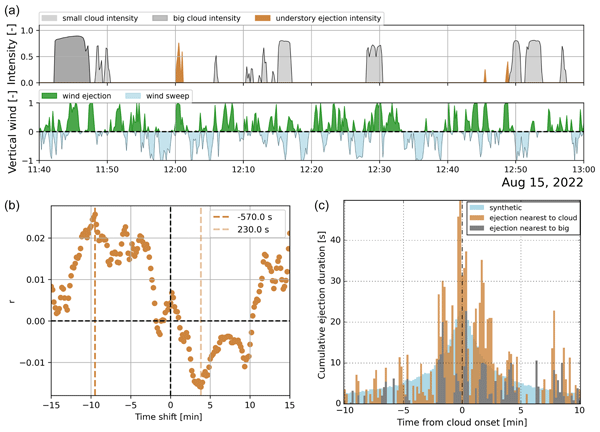
Understory ejections are distinct turbulent features emerging in prime tall-forest ecosystems. We share a method to isolate understory ejections based on H2O–CO2 anomaly quadrants. From these, we calculate the flux contributions of understory ejections and all flux quadrants. In addition, we show that a distinctly depleted isotopic composition can be found in the ejected water vapour. Finally, we explored the role of clouds as a potential trigger for understory ejections.
Satoshi Sugawara, Shinji Morimoto, Shigeyuki Ishidoya, Taku Umezawa, Shuji Aoki, Takakiyo Nakazawa, Sakae Toyoda, Kentaro Ishijima, Daisuke Goto, and Hideyuki Honda
Atmos. Chem. Phys., 25, 11895–11917, https://doi.org/10.5194/acp-25-11895-2025, https://doi.org/10.5194/acp-25-11895-2025, 2025
Short summary
Short summary
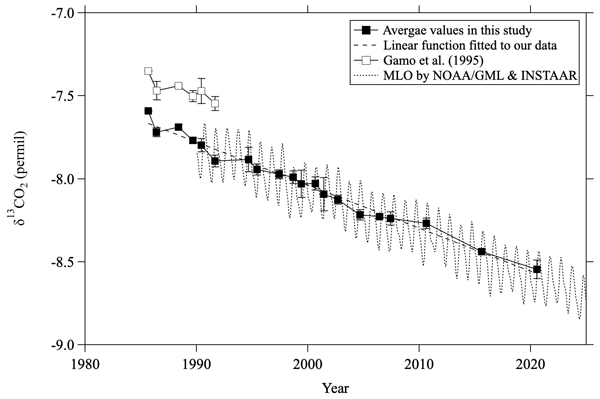
We have collected stratospheric air samples using balloon-borne cryogenic samplers over Japan since 1985 and analyzed them for δ13CO2. δ13CO2 has decreased through time in the mid-stratosphere with an average rate of change of −0.026 ± 0.001 ‰ yr−1. We found that stratospheric δ13CO2 variations are governed by airborne production of 13C-depleted CO2 by CH4 oxidation, gravitational separation, and propagation of the decreasing tropospheric δ13CO2 trend into the stratosphere.
Bianca C. Baier, John B. Miller, Colm Sweeney, Scott J. Lehman, Chad Wolak, Joshua P. DiGangi, Yonghoon Choi, Kenneth Davis, Sha Feng, and Thomas Lauvaux
Atmos. Chem. Phys., 25, 10479–10497, https://doi.org/10.5194/acp-25-10479-2025, https://doi.org/10.5194/acp-25-10479-2025, 2025
Short summary
Short summary
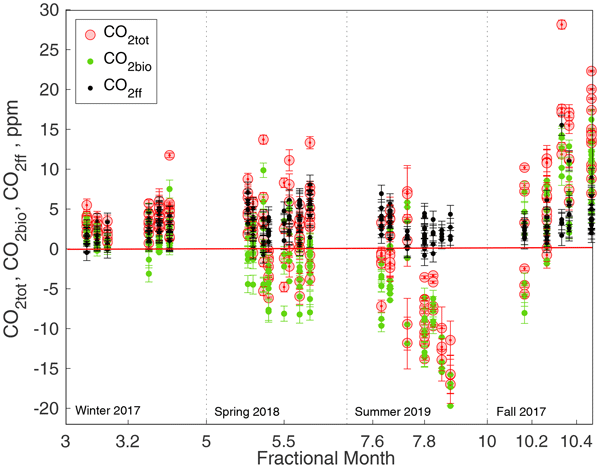
CO2 radiocarbon content (Δ14CO2) is a unique tracer that helps to accurately quantify anthropogenic CO2 emitted into the atmosphere. Δ14CO2 measured in airborne flask samples is used to distinguish fossil versus biogenic CO2 sources. Mid-Atlantic US CO2 variability is found to be driven by the biosphere. Errors in modeled fossil fuel CO2 are evaluated using Δ14CO2 airborne data as an avenue to improving future regional models of atmospheric CO2 transport.
Mark F. Lunt, Stephen J. Harris, Jorg Hacker, Ian Joynes, Tim Robertson, Simon Thompson, and James L. France
Atmos. Meas. Tech., 18, 4413–4431, https://doi.org/10.5194/amt-18-4413-2025, https://doi.org/10.5194/amt-18-4413-2025, 2025
Short summary
Short summary
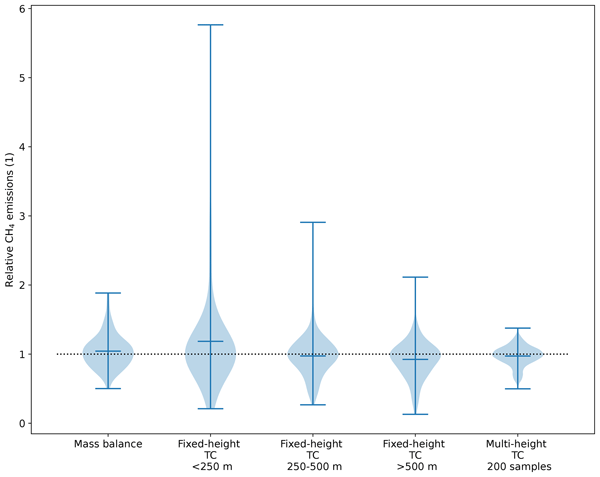
To ensure robust use of measurement-based approaches to estimate methane emissions from individual sites, it is important to validate the accuracy of the methods used in the field. By using co-emitted carbon dioxide, we evaluate the performance of one such quantification method at liquefied natural gas terminals. We further demonstrate the potential for a more efficient quantification approach via tracer correlation by considering the ratio of methane to carbon dioxide concentrations.
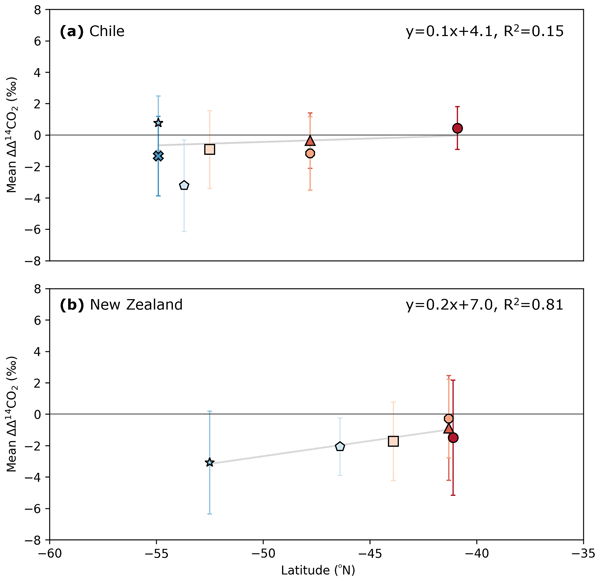
Christian Lewis, Rachel Corran, Sara E. Mikaloff-Fletcher, Erik Behrens, Rowena Moss, Gordon Brailsford, Andrew Lorrey, Margaret Norris, and Jocelyn Turnbull
Biogeosciences, 22, 4187–4201, https://doi.org/10.5194/bg-22-4187-2025, https://doi.org/10.5194/bg-22-4187-2025, 2025
Short summary
Short summary
The Southern Ocean carbon sink is a balance between two opposing forces: CO2 absorption at mid-latitudes and CO2 outgassing at high latitudes. Radiocarbon analysis can be used to constrain the latter, as upwelling waters outgas old CO2, diluting atmospheric radiocarbon content. We present tree-ring radiocarbon measurements from Aotearoa / New Zealand and Chile. We show that low radiocarbon in Aotearoa / New Zealand’s Motu Ihupuku / Campbell Island is linked to outgassing in the critical Antarctic Southern Zone.
Bibhasvata Dasgupta and Prasanta Sanyal
EGUsphere, https://doi.org/10.5194/egusphere-2025-3687, https://doi.org/10.5194/egusphere-2025-3687, 2025
Preprint archived
Short summary
Short summary
Mountain forests cover a fifth of Earth’s woodlands but are fragile because of topography and climate sensitivity. To understand how temperature and rainfall affect plant nutrition, we studied 141 plant samples from 14 species along 3 Himalayan elevation gradients. We measured leaf carbon and nitrogen amounts and their natural markers tied to water use and soil. We found nitrogen varies more with heat and moisture than carbon, highlighting areas most at risk from shifting climate.
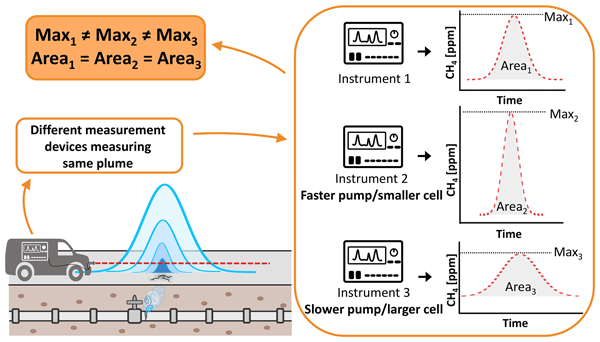
Judith Tettenborn, Daniel Zavala-Araiza, Daan Stroeken, Hossein Maazallahi, Carina van der Veen, Arjan Hensen, Ilona Velzeboer, Pim van den Bulk, Felix Vogel, Lawson Gillespie, Sebastien Ars, James France, David Lowry, Rebecca Fisher, and Thomas Röckmann
Atmos. Meas. Tech., 18, 3569–3584, https://doi.org/10.5194/amt-18-3569-2025, https://doi.org/10.5194/amt-18-3569-2025, 2025
Short summary
Short summary
Measurements of methane with vehicle-based sensors are an effective method to identify and quantify leaks from urban gas distribution systems. We deliberately released methane in different environments and calibrated the response of different methane analysers when they transected the plumes in a vehicle. We derived an improved statistical function for consistent emission estimations using different instruments. Repeated transects reduce the uncertainty in emission rate estimates.
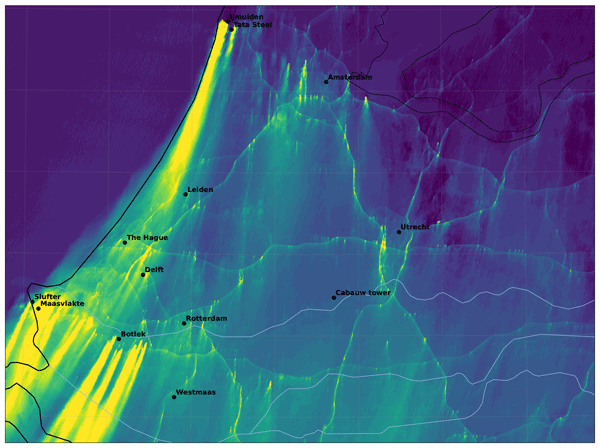
Arseniy Karagodin-Doyennel, Fredrik Jansson, Bart J. H. van Stratum, Hugo Denier van der Gon, Jordi Vilà-Guerau de Arellano, and Sander Houweling
Geosci. Model Dev., 18, 4571–4599, https://doi.org/10.5194/gmd-18-4571-2025, https://doi.org/10.5194/gmd-18-4571-2025, 2025
Short summary
Short summary
We introduce a new simulation platform based on the Dutch Atmospheric Large-Eddy Simulation (DALES) to simulate carbon dioxide (CO2) emissions and their dispersion in turbulent environments at a hectometer resolution. This model incorporates both anthropogenic emission inventories and online ecosystem fluxes. Simulation results for the main urban area in the Netherlands demonstrate the strong potential of DALES to improve CO2 emission modeling and to support mitigation strategies.
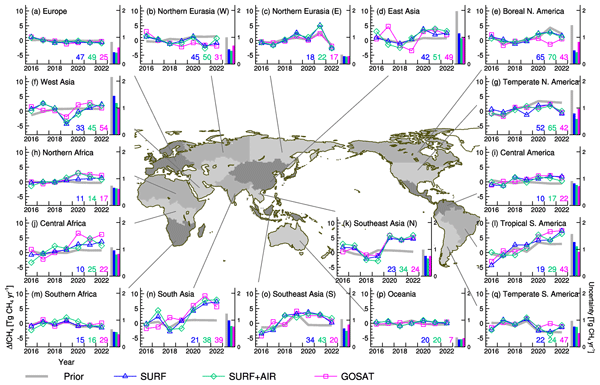
Yosuke Niwa, Yasunori Tohjima, Yukio Terao, Tazu Saeki, Akihiko Ito, Taku Umezawa, Kyohei Yamada, Motoki Sasakawa, Toshinobu Machida, Shin-Ichiro Nakaoka, Hideki Nara, Hiroshi Tanimoto, Hitoshi Mukai, Yukio Yoshida, Shinji Morimoto, Shinya Takatsuji, Kazuhiro Tsuboi, Yousuke Sawa, Hidekazu Matsueda, Kentaro Ishijima, Ryo Fujita, Daisuke Goto, Xin Lan, Kenneth Schuldt, Michal Heliasz, Tobias Biermann, Lukasz Chmura, Jarsolaw Necki, Irène Xueref-Remy, and Damiano Sferlazzo
Atmos. Chem. Phys., 25, 6757–6785, https://doi.org/10.5194/acp-25-6757-2025, https://doi.org/10.5194/acp-25-6757-2025, 2025
Short summary
Short summary
This study estimated regional and sectoral emission contributions to the unprecedented surge of atmospheric methane for 2020–2022. The methane is the second most important greenhouse gas, and its emissions reduction is urgently required to mitigate global warming. Numerical modeling-based estimates with three different sets of atmospheric observations consistently suggested large contributions of biogenic emissions from South Asia and Southeast Asia to the surge of atmospheric methane.
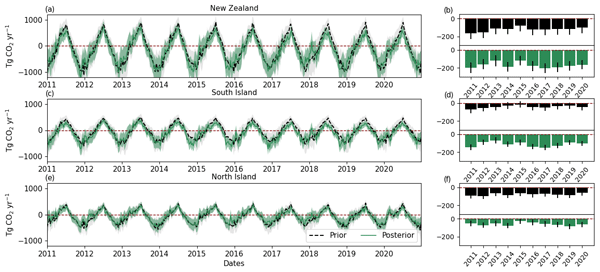
Beata Bukosa, Sara Mikaloff-Fletcher, Gordon Brailsford, Dan Smale, Elizabeth D. Keller, W. Troy Baisden, Miko U. F. Kirschbaum, Donna L. Giltrap, Lìyǐn Liáng, Stuart Moore, Rowena Moss, Sylvia Nichol, Jocelyn Turnbull, Alex Geddes, Daemon Kennett, Dóra Hidy, Zoltán Barcza, Louis A. Schipper, Aaron M. Wall, Shin-Ichiro Nakaoka, Hitoshi Mukai, and Andrea Brandon
Atmos. Chem. Phys., 25, 6445–6473, https://doi.org/10.5194/acp-25-6445-2025, https://doi.org/10.5194/acp-25-6445-2025, 2025
Short summary
Short summary
We used atmospheric measurements and inverse modelling to estimate New Zealand's carbon dioxide (CO2) emissions and removals from 2011 to 2020. Our study reveals that New Zealand's land absorbs more CO2 than previously estimated, particularly in areas dominated by indigenous forests. Our results highlight gaps in current national CO2 estimates and methods, suggesting a need for further research to improve emissions reports and refine approaches to track progress toward climate mitigation goals.
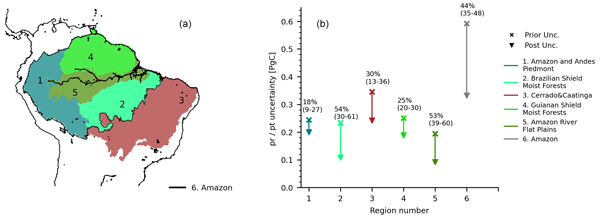
Santiago Botía, Saqr Munassar, Thomas Koch, Danilo Custodio, Luana S. Basso, Shujiro Komiya, Jost V. Lavric, David Walter, Manuel Gloor, Giordane Martins, Stijn Naus, Gerbrand Koren, Ingrid T. Luijkx, Stijn Hantson, John B. Miller, Wouter Peters, Christian Rödenbeck, and Christoph Gerbig
Atmos. Chem. Phys., 25, 6219–6255, https://doi.org/10.5194/acp-25-6219-2025, https://doi.org/10.5194/acp-25-6219-2025, 2025
Short summary
Short summary
This study uses dry CO2 mole fractions from the Amazon Tall Tower Observatory together with airborne profiles to estimate net carbon exchange in tropical South America. We found that the biogeographic Amazon is a net carbon sink, while the Cerrado and Caatinga biomes are net carbon sources, resulting in an overall neutral balance. Finally, to further reduce the uncertainty in our estimates we call for an expansion of the monitoring capacity, especially in the Amazon–Andes foothills.
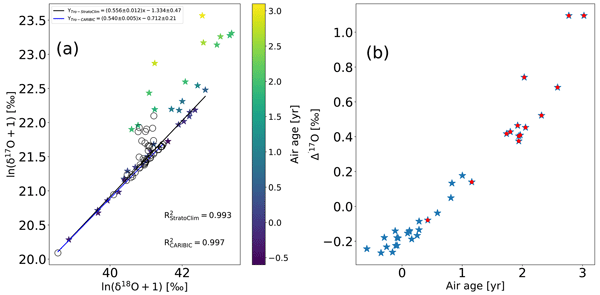
Getachew Agmuas Adnew, Gerbrand Koren, Neha Mehendale, Sergey Gromov, Maarten Krol, and Thomas Röckmann
Atmos. Meas. Tech., 18, 2701–2719, https://doi.org/10.5194/amt-18-2701-2025, https://doi.org/10.5194/amt-18-2701-2025, 2025
Short summary
Short summary
This study presents high-precision measurements of ∆′17O(CO2). Key findings include the extension of the N2O–∆′17O correlation to the upper troposphere and the identification of significant differences in the N2O–∆′17O slope in StratoClim samples. Additionally, the ∆′17O measurements are used to estimate global stratospheric production and surface removal of ∆′17O, providing an independent estimate of global vegetation CO2 exchange.
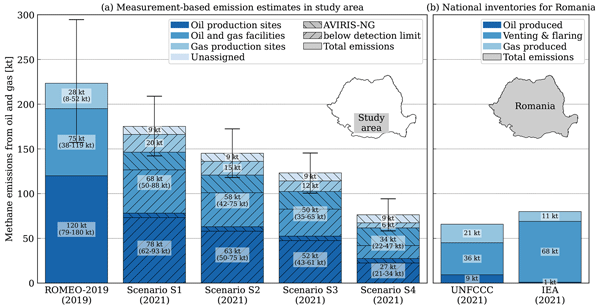
Gerrit Kuhlmann, Foteini Stavropoulou, Stefan Schwietzke, Daniel Zavala-Araiza, Andrew Thorpe, Andreas Hueni, Lukas Emmenegger, Andreea Calcan, Thomas Röckmann, and Dominik Brunner
Atmos. Chem. Phys., 25, 5371–5385, https://doi.org/10.5194/acp-25-5371-2025, https://doi.org/10.5194/acp-25-5371-2025, 2025
Short summary
Short summary
A measurement campaign in 2019 found that methane emissions from oil and gas in Romania were significantly higher than reported. In 2021, our follow-up campaign using airborne remote sensing showed a marked decreases in emissions by 20 %–60 % due to improved infrastructure. The study highlights the importance of measurement-based emission monitoring and illustrates the value of a multi-scale assessment integrating ground-based observations with large-scale airborne remote sensing campaigns.
Tanja J. Schuck, Johannes Degen, Timo Keber, Katharina Meixner, Thomas Wagenhäuser, Mélanie Ghysels, Georges Durry, Nadir Amarouche, Alessandro Zanchetta, Steven van Heuven, Huilin Chen, Johannes C. Laube, Sophie L. Baartman, Carina van der Veen, Maria Elena Popa, and Andreas Engel
Atmos. Chem. Phys., 25, 4333–4348, https://doi.org/10.5194/acp-25-4333-2025, https://doi.org/10.5194/acp-25-4333-2025, 2025
Short summary
Short summary
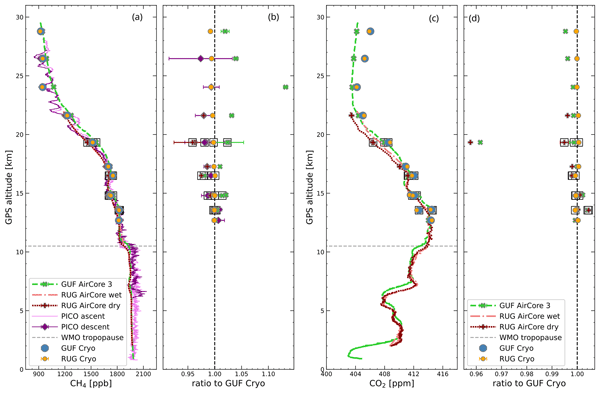
A balloon was launched in 2021 in the Arctic to carry instruments for trace gas measurements up to 32 km. One purpose was to compare measurement techniques. We focus on the major greenhouse gases. To measure these, air was sampled with the AirCore technique and with flask sampling, and samples were analysed after the flight. In flight, observations were done with an optical method. In a companion paper, we report on observations of chlorine and bromine containing trace gases.
Archana Dayalu, Marikate Mountain, Bharat Rastogi, John B. Miller, and Luciana Gatti
Biogeosciences, 22, 1509–1528, https://doi.org/10.5194/bg-22-1509-2025, https://doi.org/10.5194/bg-22-1509-2025, 2025
Short summary
Short summary
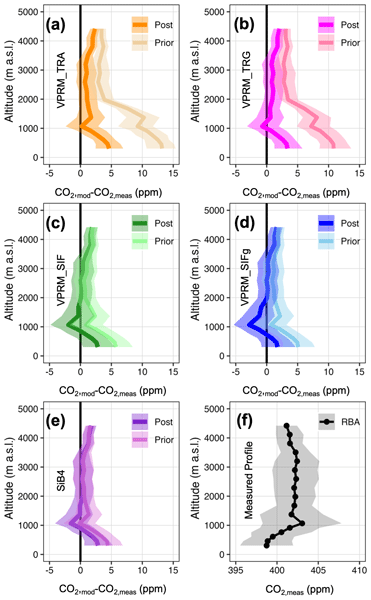
The Amazon is facing unprecedented disturbance. Determining trends in Amazonia's carbon balance and its sensitivity to disturbance requires reliable vegetation models that adequately capture how its ecosystems exchange carbon with the atmosphere. Using ground- and satellite-based ecosystem products, we present an improved model of land–atmosphere vegetation carbon exchange across the Amazon. Our model agrees with independent aircraft observations from different locations.
Hossein Maazallahi, Foteini Stavropoulou, Samuel Jonson Sutanto, Michael Steiner, Dominik Brunner, Mariano Mertens, Patrick Jöckel, Antoon Visschedijk, Hugo Denier van der Gon, Stijn Dellaert, Nataly Velandia Salinas, Stefan Schwietzke, Daniel Zavala-Araiza, Sorin Ghemulet, Alexandru Pana, Magdalena Ardelean, Marius Corbu, Andreea Calcan, Stephen A. Conley, Mackenzie L. Smith, and Thomas Röckmann
Atmos. Chem. Phys., 25, 1497–1511, https://doi.org/10.5194/acp-25-1497-2025, https://doi.org/10.5194/acp-25-1497-2025, 2025
Short summary
Short summary
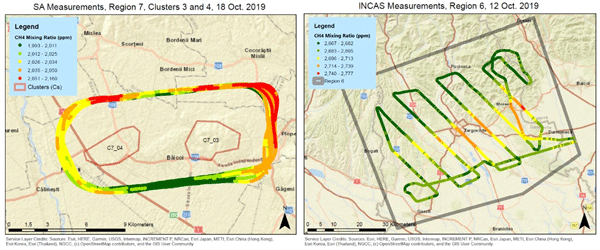
This article presents insights from airborne in situ measurements collected during the ROmanian Methane Emissions from Oil and gas (ROMEO) campaign supported by two models. Results reveal Romania's oil and gas methane emissions were significantly under-reported to the United Nations Framework Convention on Climate Change (UNFCCC) in 2019. A large underestimation was also found in the Emissions Database for Global Atmospheric Research (EDGAR) v7.0 for the study domain in the same year.
Pieter Rijsdijk, Henk Eskes, Arlene Dingemans, K. Folkert Boersma, Takashi Sekiya, Kazuyuki Miyazaki, and Sander Houweling
Geosci. Model Dev., 18, 483–509, https://doi.org/10.5194/gmd-18-483-2025, https://doi.org/10.5194/gmd-18-483-2025, 2025
Short summary
Short summary
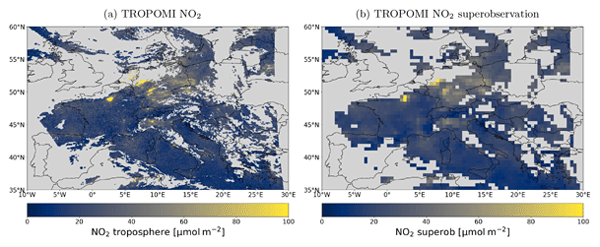
Clustering high-resolution satellite observations into superobservations improves model validation and data assimilation applications. In our paper, we derive quantitative uncertainties for satellite NO2 column observations based on knowledge of the retrievals, including a detailed analysis of spatial error correlations and representativity errors. The superobservations and uncertainty estimates are tested in a global chemical data assimilation system and are found to improve the forecasts.
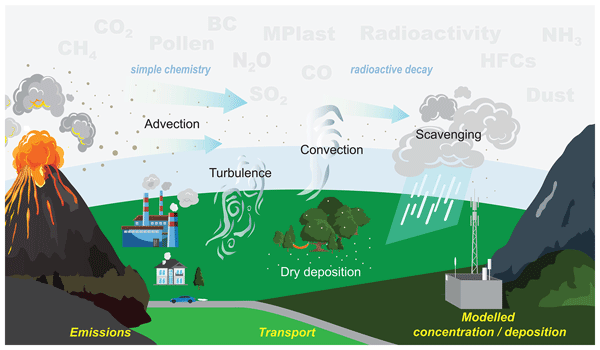
Lucie Bakels, Daria Tatsii, Anne Tipka, Rona Thompson, Marina Dütsch, Michael Blaschek, Petra Seibert, Katharina Baier, Silvia Bucci, Massimo Cassiani, Sabine Eckhardt, Christine Groot Zwaaftink, Stephan Henne, Pirmin Kaufmann, Vincent Lechner, Christian Maurer, Marie D. Mulder, Ignacio Pisso, Andreas Plach, Rakesh Subramanian, Martin Vojta, and Andreas Stohl
Geosci. Model Dev., 17, 7595–7627, https://doi.org/10.5194/gmd-17-7595-2024, https://doi.org/10.5194/gmd-17-7595-2024, 2024
Short summary
Short summary
Computer models are essential for improving our understanding of how gases and particles move in the atmosphere. We present an update of the atmospheric transport model FLEXPART. FLEXPART 11 is more accurate due to a reduced number of interpolations and a new scheme for wet deposition. It can simulate non-spherical aerosols and includes linear chemical reactions. It is parallelised using OpenMP and includes new user options. A new user manual details how to use FLEXPART 11.
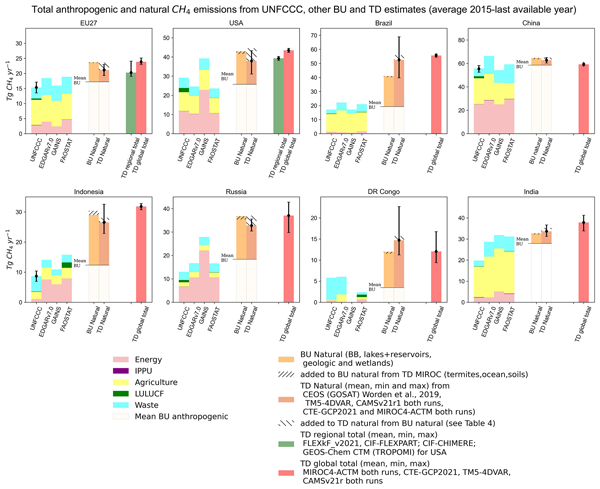
Ana Maria Roxana Petrescu, Glen P. Peters, Richard Engelen, Sander Houweling, Dominik Brunner, Aki Tsuruta, Bradley Matthews, Prabir K. Patra, Dmitry Belikov, Rona L. Thompson, Lena Höglund-Isaksson, Wenxin Zhang, Arjo J. Segers, Giuseppe Etiope, Giancarlo Ciotoli, Philippe Peylin, Frédéric Chevallier, Tuula Aalto, Robbie M. Andrew, David Bastviken, Antoine Berchet, Grégoire Broquet, Giulia Conchedda, Stijn N. C. Dellaert, Hugo Denier van der Gon, Johannes Gütschow, Jean-Matthieu Haussaire, Ronny Lauerwald, Tiina Markkanen, Jacob C. A. van Peet, Isabelle Pison, Pierre Regnier, Espen Solum, Marko Scholze, Maria Tenkanen, Francesco N. Tubiello, Guido R. van der Werf, and John R. Worden
Earth Syst. Sci. Data, 16, 4325–4350, https://doi.org/10.5194/essd-16-4325-2024, https://doi.org/10.5194/essd-16-4325-2024, 2024
Short summary
Short summary
This study provides an overview of data availability from observation- and inventory-based CH4 emission estimates. It systematically compares them and provides recommendations for robust comparisons, aiming to steadily engage more parties in using observational methods to complement their UNFCCC submissions. Anticipating improvements in atmospheric modelling and observations, future developments need to resolve knowledge gaps in both approaches and to better quantify remaining uncertainty.
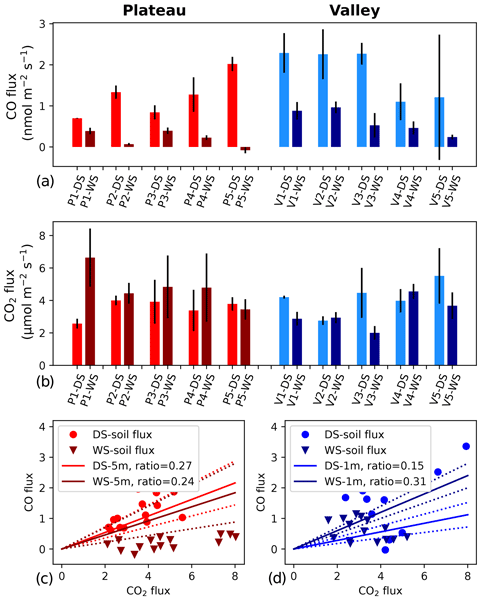
Hella van Asperen, Thorsten Warneke, Alessandro Carioca de Araújo, Bruce Forsberg, Sávio José Filgueiras Ferreira, Thomas Röckmann, Carina van der Veen, Sipko Bulthuis, Leonardo Ramos de Oliveira, Thiago de Lima Xavier, Jailson da Mata, Marta de Oliveira Sá, Paulo Ricardo Teixeira, Julie Andrews de França e Silva, Susan Trumbore, and Justus Notholt
Biogeosciences, 21, 3183–3199, https://doi.org/10.5194/bg-21-3183-2024, https://doi.org/10.5194/bg-21-3183-2024, 2024
Short summary
Short summary
Carbon monoxide (CO) is regarded as an important indirect greenhouse gas. Soils can emit and take up CO, but, until now, uncertainty remains as to which process dominates in tropical rainforests. We present the first soil CO flux measurements from a tropical rainforest. Based on our observations, we report that tropical rainforest soils are a net source of CO. In addition, we show that valley streams and inundated areas are likely additional hot spots of CO in the ecosystem.
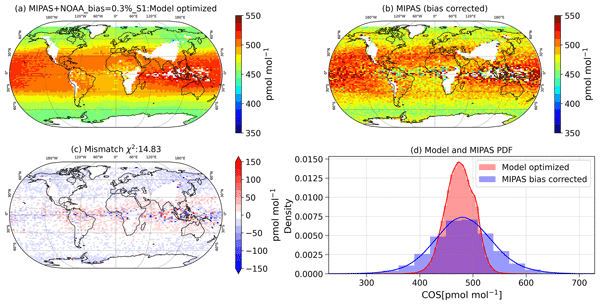
Jin Ma, Linda M. J. Kooijmans, Norbert Glatthor, Stephen A. Montzka, Marc von Hobe, Thomas Röckmann, and Maarten C. Krol
Atmos. Chem. Phys., 24, 6047–6070, https://doi.org/10.5194/acp-24-6047-2024, https://doi.org/10.5194/acp-24-6047-2024, 2024
Short summary
Short summary
The global budget of atmospheric COS can be optimised by inverse modelling using TM5-4DVAR, with the co-constraints of NOAA surface observations and MIPAS satellite data. We found reduced COS biosphere uptake from inversions and improved land and ocean separation using MIPAS satellite data assimilation. Further improvements are expected from better quantification of COS ocean and biosphere fluxes.
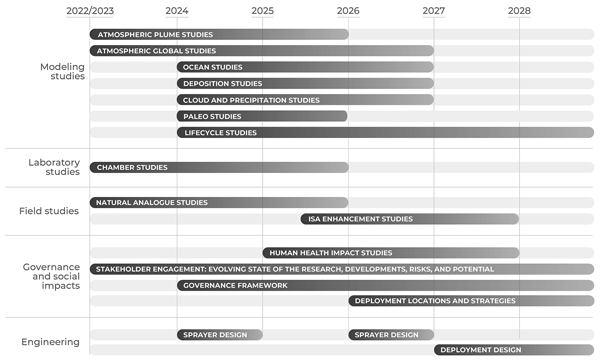
Katrine A. Gorham, Sam Abernethy, Tyler R. Jones, Peter Hess, Natalie M. Mahowald, Daphne Meidan, Matthew S. Johnson, Maarten M. J. W. van Herpen, Yangyang Xu, Alfonso Saiz-Lopez, Thomas Röckmann, Chloe A. Brashear, Erika Reinhardt, and David Mann
Atmos. Chem. Phys., 24, 5659–5670, https://doi.org/10.5194/acp-24-5659-2024, https://doi.org/10.5194/acp-24-5659-2024, 2024
Short summary
Short summary
Rapid reduction in atmospheric methane is needed to slow the rate of global warming. Reducing anthropogenic methane emissions is a top priority. However, atmospheric methane is also impacted by rising natural emissions and changing sinks. Studies of possible atmospheric methane removal approaches, such as iron salt aerosols to increase the chlorine radical sink, benefit from a roadmapped approach to understand if there may be viable and socially acceptable ways to decrease future risk.
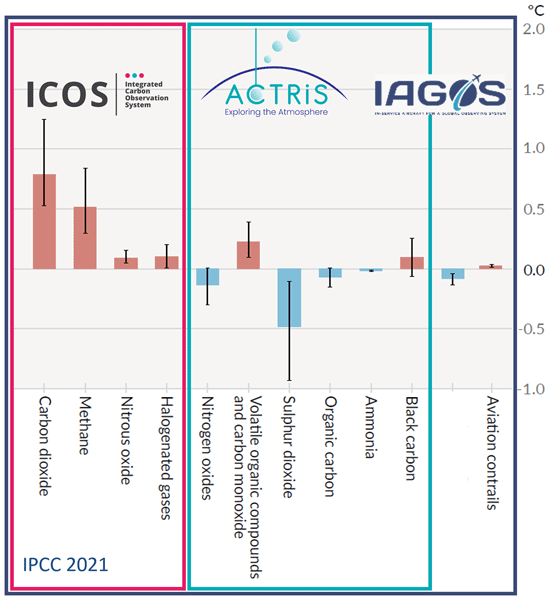
Andreas Petzold, Ulrich Bundke, Anca Hienola, Paolo Laj, Cathrine Lund Myhre, Alex Vermeulen, Angeliki Adamaki, Werner Kutsch, Valerie Thouret, Damien Boulanger, Markus Fiebig, Markus Stocker, Zhiming Zhao, and Ari Asmi
Atmos. Chem. Phys., 24, 5369–5388, https://doi.org/10.5194/acp-24-5369-2024, https://doi.org/10.5194/acp-24-5369-2024, 2024
Short summary
Short summary
Easy and fast access to long-term and high-quality observational data is recognised as fundamental to environmental research and the development of climate forecasting and assessment services. We discuss the potential new directions in atmospheric sciences offered by the atmosphere-centric European research infrastructures ACTRIS, IAGOS, and ICOS, building on their capabilities for standardised provision of data through open access combined with tools and methods of data-intensive science.
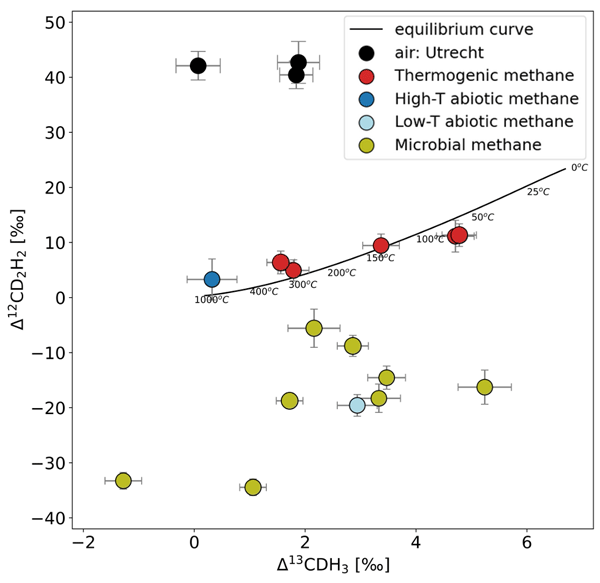
Malavika Sivan, Thomas Röckmann, Carina van der Veen, and Maria Elena Popa
Atmos. Meas. Tech., 17, 2687–2705, https://doi.org/10.5194/amt-17-2687-2024, https://doi.org/10.5194/amt-17-2687-2024, 2024
Short summary
Short summary
We have set up a measurement system for methane-clumped isotopologues. We have built an extraction and purification system to extract pure methane for these measurements, for samples of various origins, including atmospheric air, for which we need to process about 1000 L of air for one measurement. We report here the technical setup for extraction and measurements, as well as the calibration, and we give an overview of the samples measured so far.
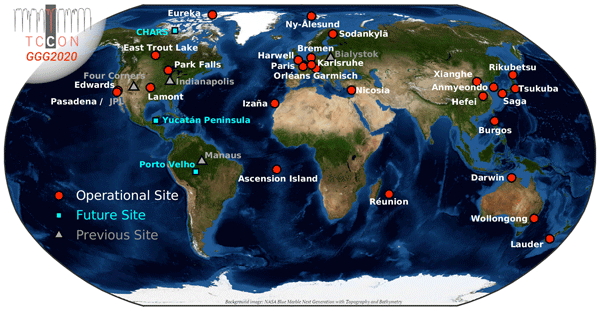
Joshua L. Laughner, Geoffrey C. Toon, Joseph Mendonca, Christof Petri, Sébastien Roche, Debra Wunch, Jean-Francois Blavier, David W. T. Griffith, Pauli Heikkinen, Ralph F. Keeling, Matthäus Kiel, Rigel Kivi, Coleen M. Roehl, Britton B. Stephens, Bianca C. Baier, Huilin Chen, Yonghoon Choi, Nicholas M. Deutscher, Joshua P. DiGangi, Jochen Gross, Benedikt Herkommer, Pascal Jeseck, Thomas Laemmel, Xin Lan, Erin McGee, Kathryn McKain, John Miller, Isamu Morino, Justus Notholt, Hirofumi Ohyama, David F. Pollard, Markus Rettinger, Haris Riris, Constantina Rousogenous, Mahesh Kumar Sha, Kei Shiomi, Kimberly Strong, Ralf Sussmann, Yao Té, Voltaire A. Velazco, Steven C. Wofsy, Minqiang Zhou, and Paul O. Wennberg
Earth Syst. Sci. Data, 16, 2197–2260, https://doi.org/10.5194/essd-16-2197-2024, https://doi.org/10.5194/essd-16-2197-2024, 2024
Short summary
Short summary
This paper describes a new version, called GGG2020, of a data set containing column-integrated observations of greenhouse and related gases (including CO2, CH4, CO, and N2O) made by ground stations located around the world. Compared to the previous version (GGG2014), improvements have been made toward site-to-site consistency. This data set plays a key role in validating space-based greenhouse gas observations and in understanding the carbon cycle.
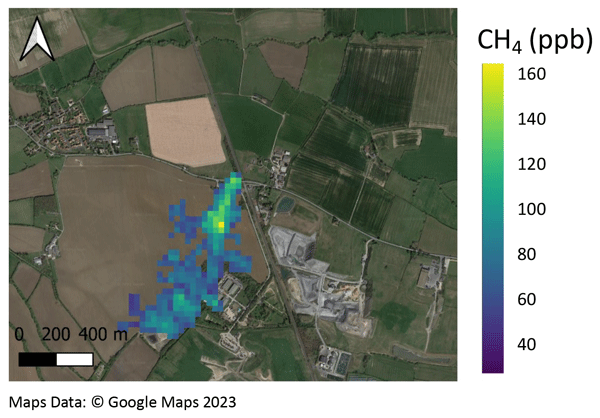
Emily Dowd, Alistair J. Manning, Bryn Orth-Lashley, Marianne Girard, James France, Rebecca E. Fisher, Dave Lowry, Mathias Lanoisellé, Joseph R. Pitt, Kieran M. Stanley, Simon O'Doherty, Dickon Young, Glen Thistlethwaite, Martyn P. Chipperfield, Emanuel Gloor, and Chris Wilson
Atmos. Meas. Tech., 17, 1599–1615, https://doi.org/10.5194/amt-17-1599-2024, https://doi.org/10.5194/amt-17-1599-2024, 2024
Short summary
Short summary
We provide the first validation of the satellite-derived emission estimates using surface-based mobile greenhouse gas surveys of an active gas leak detected near Cheltenham, UK. GHGSat’s emission estimates broadly agree with the surface-based mobile survey and steps were taken to fix the leak, highlighting the importance of satellite data in identifying emissions and helping to reduce our human impact on climate change.
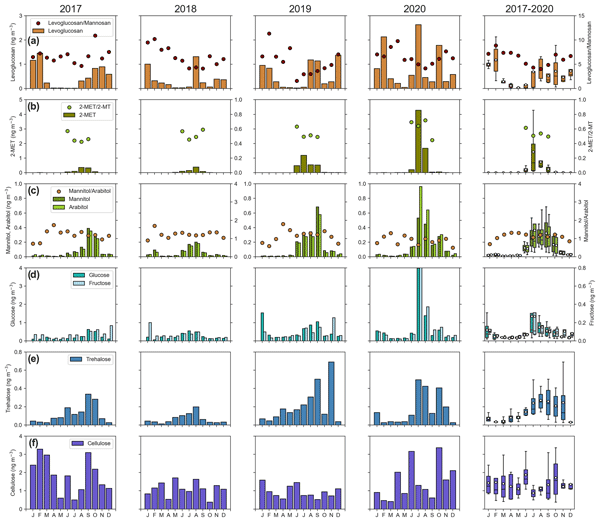
Karl Espen Yttri, Are Bäcklund, Franz Conen, Sabine Eckhardt, Nikolaos Evangeliou, Markus Fiebig, Anne Kasper-Giebl, Avram Gold, Hans Gundersen, Cathrine Lund Myhre, Stephen Matthew Platt, David Simpson, Jason D. Surratt, Sönke Szidat, Martin Rauber, Kjetil Tørseth, Martin Album Ytre-Eide, Zhenfa Zhang, and Wenche Aas
Atmos. Chem. Phys., 24, 2731–2758, https://doi.org/10.5194/acp-24-2731-2024, https://doi.org/10.5194/acp-24-2731-2024, 2024
Short summary
Short summary
We discuss carbonaceous aerosol (CA) observed at the high Arctic Zeppelin Observatory (2017 to 2020). We find that organic aerosol is a significant fraction of the Arctic aerosol, though less than sea salt aerosol and mineral dust, as well as non-sea-salt sulfate, originating mainly from anthropogenic sources in winter and from natural sources in summer, emphasizing the importance of wildfires for biogenic secondary organic aerosol and primary biological aerosol particles observed in the Arctic.
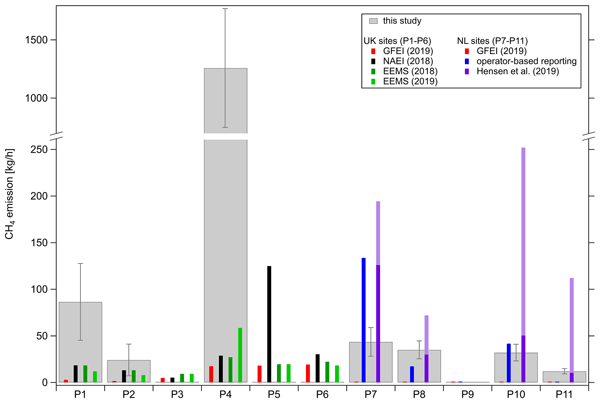
Magdalena Pühl, Anke Roiger, Alina Fiehn, Alan M. Gorchov Negron, Eric A. Kort, Stefan Schwietzke, Ignacio Pisso, Amy Foulds, James Lee, James L. France, Anna E. Jones, Dave Lowry, Rebecca E. Fisher, Langwen Huang, Jacob Shaw, Prudence Bateson, Stephen Andrews, Stuart Young, Pamela Dominutti, Tom Lachlan-Cope, Alexandra Weiss, and Grant Allen
Atmos. Chem. Phys., 24, 1005–1024, https://doi.org/10.5194/acp-24-1005-2024, https://doi.org/10.5194/acp-24-1005-2024, 2024
Short summary
Short summary
In April–May 2019 we carried out an airborne field campaign in the southern North Sea with the aim of studying methane emissions of offshore gas installations. We determined methane emissions from elevated methane measured downstream of the sampled installations. We compare our measured methane emissions with estimated methane emissions from national and global annual inventories. As a result, we find inconsistencies of inventories and large discrepancies between measurements and inventories.
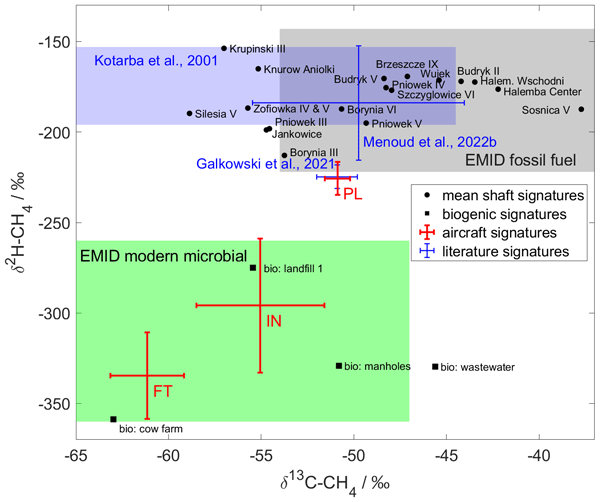
Alina Fiehn, Maximilian Eckl, Julian Kostinek, Michał Gałkowski, Christoph Gerbig, Michael Rothe, Thomas Röckmann, Malika Menoud, Hossein Maazallahi, Martina Schmidt, Piotr Korbeń, Jarosław Neçki, Mila Stanisavljević, Justyna Swolkień, Andreas Fix, and Anke Roiger
Atmos. Chem. Phys., 23, 15749–15765, https://doi.org/10.5194/acp-23-15749-2023, https://doi.org/10.5194/acp-23-15749-2023, 2023
Short summary
Short summary
During the CoMet mission in the Upper Silesian Coal Basin (USCB) ground-based and airborne air samples were taken and analyzed for the isotopic composition of CH4 to derive the mean signature of the USCB and source signatures of individual coal mines. Using δ2H signatures, the biogenic emissions from the USCB account for 15 %–50 % of total emissions, which is underestimated in common emission inventories. This demonstrates the importance of δ2H-CH4 observations for methane source apportionment.
Douglas E. J. Worthy, Michele K. Rauh, Lin Huang, Felix R. Vogel, Alina Chivulescu, Kenneth A. Masarie, Ray L. Langenfelds, Paul B. Krummel, Colin E. Allison, Andrew M. Crotwell, Monica Madronich, Gabrielle Pétron, Ingeborg Levin, Samuel Hammer, Sylvia Michel, Michel Ramonet, Martina Schmidt, Armin Jordan, Heiko Moossen, Michael Rothe, Ralph Keeling, and Eric J. Morgan
Atmos. Meas. Tech., 16, 5909–5935, https://doi.org/10.5194/amt-16-5909-2023, https://doi.org/10.5194/amt-16-5909-2023, 2023
Short summary
Short summary
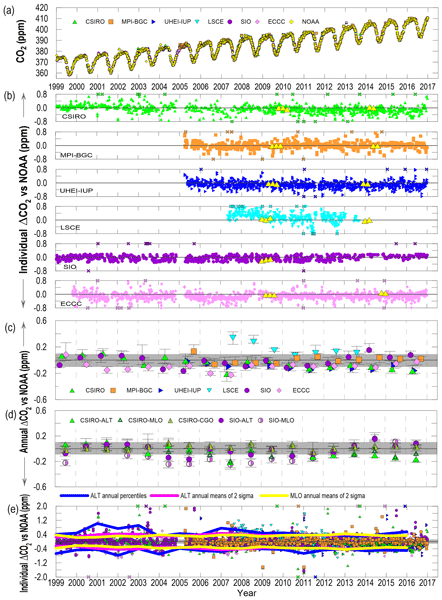
Network compatibility is important for inferring greenhouse gas fluxes at global or regional scales. This study is the first assessment of the measurement agreement among seven individual programs within the World Meteorological Organization community. It compares co-located flask air measurements at the Alert Observatory in Canada over a 17-year period. The results provide stronger confidence in the uncertainty estimation while using those datasets in various data interpretation applications.
Robbert P. J. Moonen, Getachew A. Adnew, Oscar K. Hartogensis, Jordi Vilà-Guerau de Arellano, David J. Bonell Fontas, and Thomas Röckmann
Atmos. Meas. Tech., 16, 5787–5810, https://doi.org/10.5194/amt-16-5787-2023, https://doi.org/10.5194/amt-16-5787-2023, 2023
Short summary
Short summary
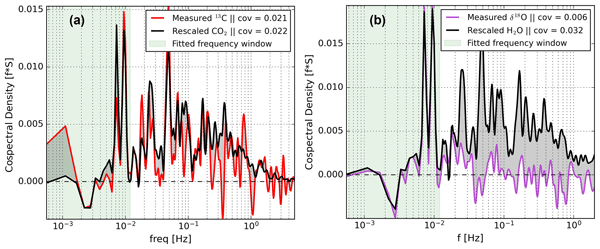
Isotope fluxes allow for net ecosystem gas exchange fluxes to be partitioned into sub-components like plant assimilation, respiration and transpiration, which can help us better understand the environmental drivers of each partial flux. We share the results of a field campaign isotope fluxes were derived using a combination of laser spectroscopy and eddy covariance. We found lag times and high frequency signal loss in the isotope fluxes we derived and present methods to correct for both.
Jinsol Kim, John B. Miller, Charles E. Miller, Scott J. Lehman, Sylvia E. Michel, Vineet Yadav, Nick E. Rollins, and William M. Berelson
Atmos. Chem. Phys., 23, 14425–14436, https://doi.org/10.5194/acp-23-14425-2023, https://doi.org/10.5194/acp-23-14425-2023, 2023
Short summary
Short summary
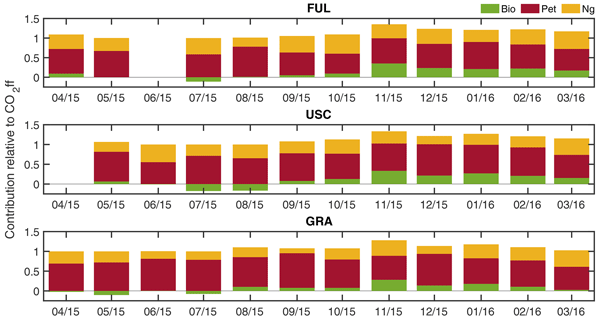
In this study, we present the partitioning of CO2 signals from biogenic, petroleum and natural gas sources by combining CO, 13CO2 and 14CO2 measurements. Using measurements from flask air samples at three sites in the greater Los Angeles region, we find larger and positive contributions of biogenic signals in winter and smaller and negative contributions in summer. The largest contribution of natural gas combustion generally occurs in summer.
Leonard Kirago, Örjan Gustafsson, Samuel Mwaniki Gaita, Sophie L. Haslett, Michael J. Gatari, Maria Elena Popa, Thomas Röckmann, Christoph Zellweger, Martin Steinbacher, Jörg Klausen, Christian Félix, David Njiru, and August Andersson
Atmos. Chem. Phys., 23, 14349–14357, https://doi.org/10.5194/acp-23-14349-2023, https://doi.org/10.5194/acp-23-14349-2023, 2023
Short summary
Short summary
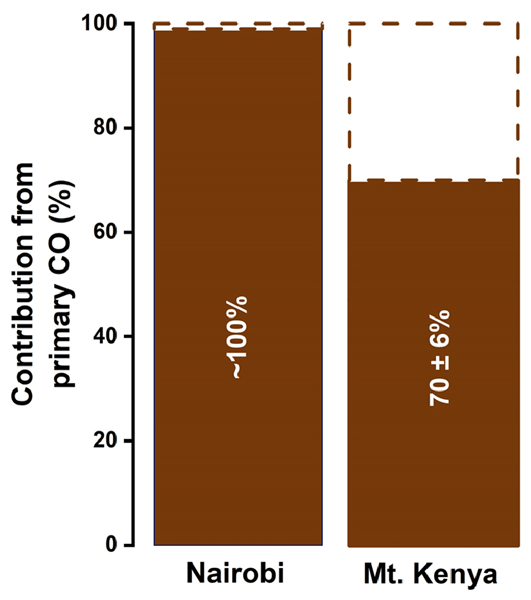
This study provides ground-observational evidence that supports earlier suggestions that savanna fires are the main emitters and modulators of carbon monoxide gas in Africa. Using isotope-based techniques, the study has shown that about two-thirds of this gas is emitted from savanna fires, while for urban areas, in this case Nairobi, primary sources approach 100 %. The latter has implications for air quality policy, suggesting primary emissions such as traffic should be targeted.
Hossein Maazallahi, Antonio Delre, Charlotte Scheutz, Anders M. Fredenslund, Stefan Schwietzke, Hugo Denier van der Gon, and Thomas Röckmann
Atmos. Meas. Tech., 16, 5051–5073, https://doi.org/10.5194/amt-16-5051-2023, https://doi.org/10.5194/amt-16-5051-2023, 2023
Short summary
Short summary
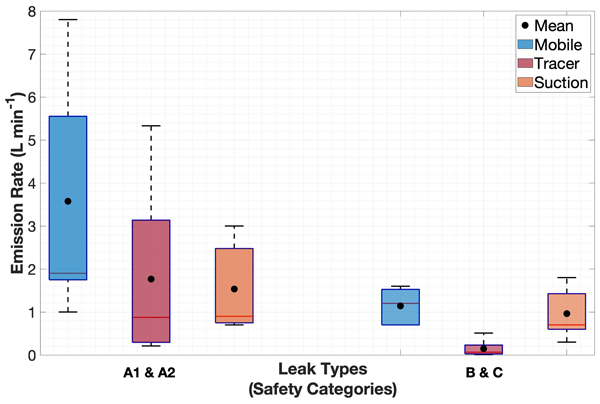
Measurement methods are increasingly deployed to verify reported methane emissions of gas leaks. This study describes unique advantages and limitations of three methods. Two methods are rapidly deployed, but uncertainties and biases exist for some leak locations. In contrast, the suction method could accurately determine leak rates in principle. However, this method, which provides data for the German emission inventory, creates an overall low bias in our study due to non-random site selection.
Nicola J. Warwick, Alex T. Archibald, Paul T. Griffiths, James Keeble, Fiona M. O'Connor, John A. Pyle, and Keith P. Shine
Atmos. Chem. Phys., 23, 13451–13467, https://doi.org/10.5194/acp-23-13451-2023, https://doi.org/10.5194/acp-23-13451-2023, 2023
Short summary
Short summary
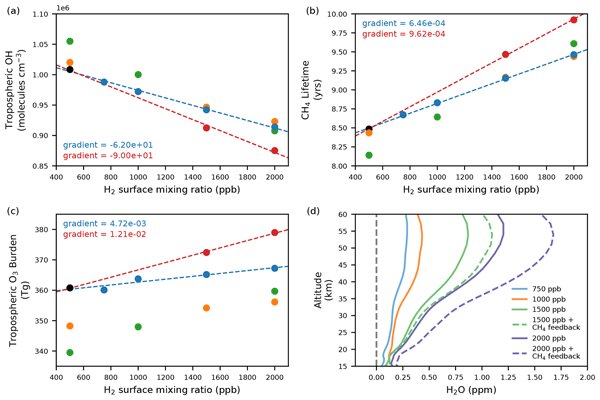
A chemistry–climate model has been used to explore the atmospheric response to changes in emissions of hydrogen and other species associated with a shift from fossil fuel to hydrogen use. Leakage of hydrogen results in indirect global warming, offsetting greenhouse gas emission reductions from reduced fossil fuel use. To maximise the benefit of hydrogen as an energy source, hydrogen leakage and emissions of methane, carbon monoxide and nitrogen oxides should be minimised.
Tim René de Groot, Anne Margriet Mol, Katherine Mesdag, Pierre Ramond, Rachel Ndhlovu, Julia Catherine Engelmann, Thomas Röckmann, and Helge Niemann
Biogeosciences, 20, 3857–3872, https://doi.org/10.5194/bg-20-3857-2023, https://doi.org/10.5194/bg-20-3857-2023, 2023
Short summary
Short summary
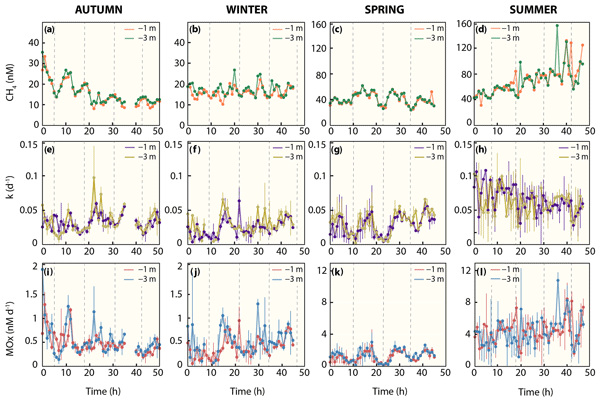
This study investigates methane dynamics in the Wadden Sea. Our measurements revealed distinct variations triggered by seasonality and tidal forcing. The methane budget was higher in warmer seasons but surprisingly high in colder seasons. Methane dynamics were amplified during low tides, flushing the majority of methane into the North Sea or releasing it to the atmosphere. Methanotrophic activity was also elevated during low tide but mitigated only a small fraction of the methane efflux.
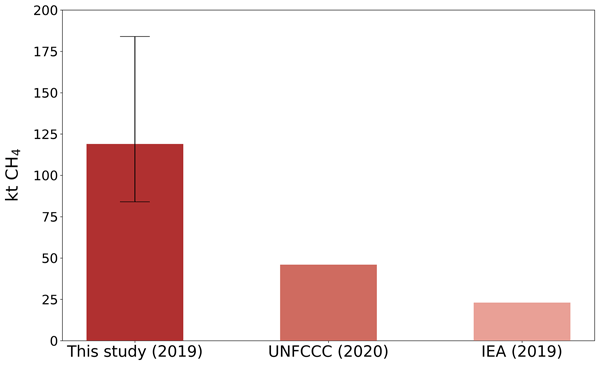
Foteini Stavropoulou, Katarina Vinković, Bert Kers, Marcel de Vries, Steven van Heuven, Piotr Korbeń, Martina Schmidt, Julia Wietzel, Pawel Jagoda, Jaroslav M. Necki, Jakub Bartyzel, Hossein Maazallahi, Malika Menoud, Carina van der Veen, Sylvia Walter, Béla Tuzson, Jonas Ravelid, Randulph Paulo Morales, Lukas Emmenegger, Dominik Brunner, Michael Steiner, Arjan Hensen, Ilona Velzeboer, Pim van den Bulk, Hugo Denier van der Gon, Antonio Delre, Maklawe Essonanawe Edjabou, Charlotte Scheutz, Marius Corbu, Sebastian Iancu, Denisa Moaca, Alin Scarlat, Alexandru Tudor, Ioana Vizireanu, Andreea Calcan, Magdalena Ardelean, Sorin Ghemulet, Alexandru Pana, Aurel Constantinescu, Lucian Cusa, Alexandru Nica, Calin Baciu, Cristian Pop, Andrei Radovici, Alexandru Mereuta, Horatiu Stefanie, Alexandru Dandocsi, Bas Hermans, Stefan Schwietzke, Daniel Zavala-Araiza, Huilin Chen, and Thomas Röckmann
Atmos. Chem. Phys., 23, 10399–10412, https://doi.org/10.5194/acp-23-10399-2023, https://doi.org/10.5194/acp-23-10399-2023, 2023
Short summary
Short summary
In this study, we quantify CH4 emissions from onshore oil production sites in Romania at source and facility level using a combination of ground- and drone-based measurement techniques. We show that the total CH4 emissions in our studied areas are much higher than the emissions reported to UNFCCC, and up to three-quarters of the detected emissions are related to operational venting. Our results suggest that oil and gas production infrastructure in Romania holds a massive mitigation potential.
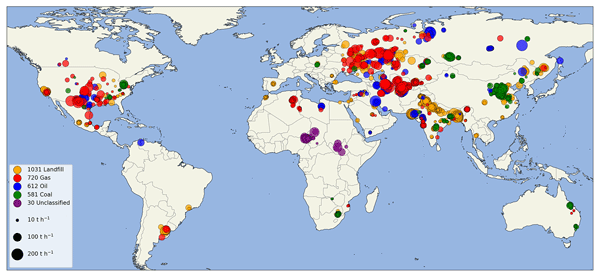
Berend J. Schuit, Joannes D. Maasakkers, Pieter Bijl, Gourav Mahapatra, Anne-Wil van den Berg, Sudhanshu Pandey, Alba Lorente, Tobias Borsdorff, Sander Houweling, Daniel J. Varon, Jason McKeever, Dylan Jervis, Marianne Girard, Itziar Irakulis-Loitxate, Javier Gorroño, Luis Guanter, Daniel H. Cusworth, and Ilse Aben
Atmos. Chem. Phys., 23, 9071–9098, https://doi.org/10.5194/acp-23-9071-2023, https://doi.org/10.5194/acp-23-9071-2023, 2023
Short summary
Short summary
Using two machine learning models, which were trained on TROPOMI methane satellite data, we detect 2974 methane plumes, so-called super-emitters, in 2021. We detect methane emissions globally related to urban areas or landfills, coal mining, and oil and gas production. Using our monitoring system, we identify 94 regions with frequent emissions. For 12 locations, we target high-resolution satellite instruments to enlarge and identify the exact infrastructure responsible for the emissions.
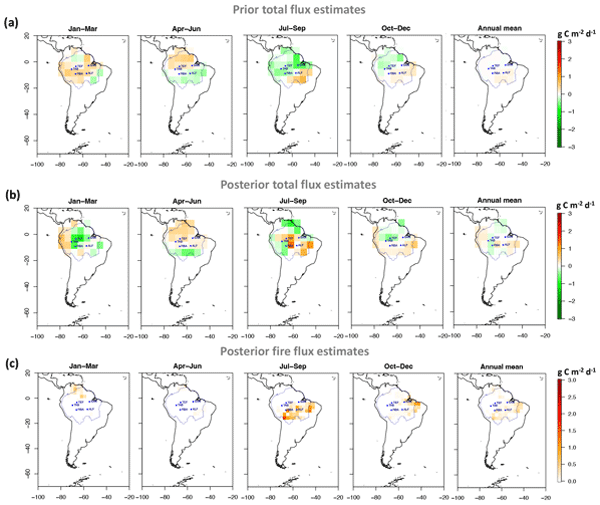
Luana S. Basso, Chris Wilson, Martyn P. Chipperfield, Graciela Tejada, Henrique L. G. Cassol, Egídio Arai, Mathew Williams, T. Luke Smallman, Wouter Peters, Stijn Naus, John B. Miller, and Manuel Gloor
Atmos. Chem. Phys., 23, 9685–9723, https://doi.org/10.5194/acp-23-9685-2023, https://doi.org/10.5194/acp-23-9685-2023, 2023
Short summary
Short summary
The Amazon’s carbon balance may have changed due to forest degradation, deforestation and warmer climate. We used an atmospheric model and atmospheric CO2 observations to quantify Amazonian carbon emissions (2010–2018). The region was a small carbon source to the atmosphere, mostly due to fire emissions. Forest uptake compensated for ~ 50 % of the fire emissions, meaning that the remaining forest is still a small carbon sink. We found no clear evidence of weakening carbon uptake over the period.
Sara M. Defratyka, James L. France, Rebecca E. Fisher, Dave Lowry, Julianne M. Fernandez, Semra Bakkaloglu, Camille Yver-Kwok, Jean-Daniel Paris, Philippe Bousquet, Tim Arnold, Chris Rennick, Jon Helmore, Nigel Yarrow, and Euan G. Nisbet
EGUsphere, https://doi.org/10.5194/egusphere-2023-1490, https://doi.org/10.5194/egusphere-2023-1490, 2023
Preprint archived
Short summary
Short summary
We are focused on verification of δ13CH4 measurements in near-source conditions and we have provided an insight into the impact of chosen calculation methods for determined isotopic signatures. Our study offers a step forward for establishing an unified, robust, and reliable analytical technique to determine δ13CH4 of methane sources. Our recommended analytical approach reduces biases and uncertainties coming from measurement conditions, data clustering and various available fitting methods.
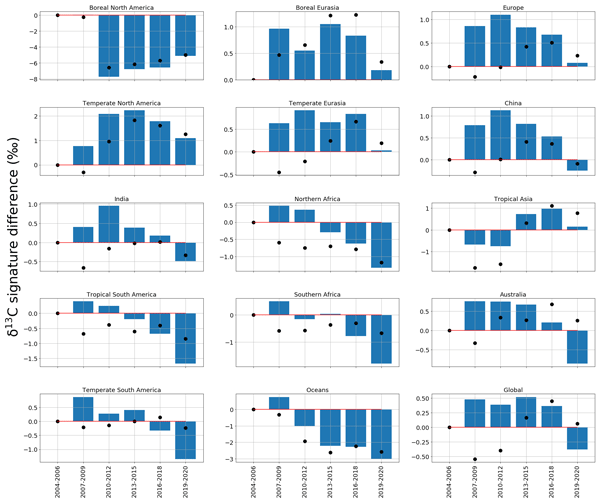
Alice Drinkwater, Paul I. Palmer, Liang Feng, Tim Arnold, Xin Lan, Sylvia E. Michel, Robert Parker, and Hartmut Boesch
Atmos. Chem. Phys., 23, 8429–8452, https://doi.org/10.5194/acp-23-8429-2023, https://doi.org/10.5194/acp-23-8429-2023, 2023
Short summary
Short summary
Changes in atmospheric methane over the last few decades are largely unexplained. Previous studies have proposed different hypotheses to explain short-term changes in atmospheric methane. We interpret observed changes in atmospheric methane and stable isotope source signatures (2004–2020). We argue that changes over this period are part of a large-scale shift from high-northern-latitude thermogenic energy emissions to tropical biogenic emissions, particularly from North Africa and South America.
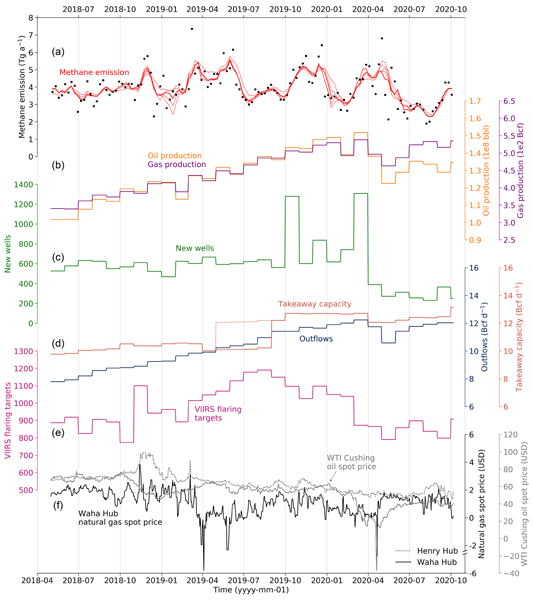
Daniel J. Varon, Daniel J. Jacob, Benjamin Hmiel, Ritesh Gautam, David R. Lyon, Mark Omara, Melissa Sulprizio, Lu Shen, Drew Pendergrass, Hannah Nesser, Zhen Qu, Zachary R. Barkley, Natasha L. Miles, Scott J. Richardson, Kenneth J. Davis, Sudhanshu Pandey, Xiao Lu, Alba Lorente, Tobias Borsdorff, Joannes D. Maasakkers, and Ilse Aben
Atmos. Chem. Phys., 23, 7503–7520, https://doi.org/10.5194/acp-23-7503-2023, https://doi.org/10.5194/acp-23-7503-2023, 2023
Short summary
Short summary
We use TROPOMI satellite observations to quantify weekly methane emissions from the US Permian oil and gas basin from May 2018 to October 2020. We find that Permian emissions are highly variable, with diverse economic and activity drivers. The most important drivers during our study period were new well development and natural gas price. Permian methane intensity averaged 4.6 % and decreased by 1 % per year.
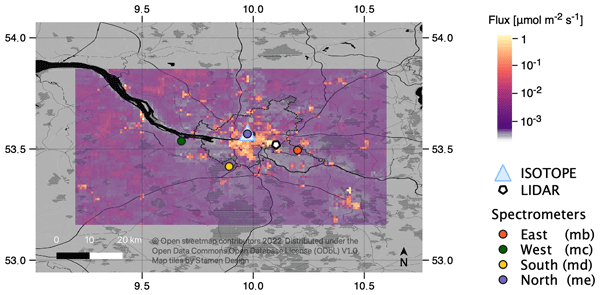
Andreas Forstmaier, Jia Chen, Florian Dietrich, Juan Bettinelli, Hossein Maazallahi, Carsten Schneider, Dominik Winkler, Xinxu Zhao, Taylor Jones, Carina van der Veen, Norman Wildmann, Moritz Makowski, Aydin Uzun, Friedrich Klappenbach, Hugo Denier van der Gon, Stefan Schwietzke, and Thomas Röckmann
Atmos. Chem. Phys., 23, 6897–6922, https://doi.org/10.5194/acp-23-6897-2023, https://doi.org/10.5194/acp-23-6897-2023, 2023
Short summary
Short summary
Large cities emit greenhouse gases which contribute to global warming. In this study, we measured the release of one important green house gas, methane, in Hamburg. Multiple sources that contribute to methane emissions were located and quantified. Methane sources were found to be mainly caused by human activity (e.g., by release from oil and gas refineries). Moreover, potential natural sources have been located, such as the Elbe River and lakes.
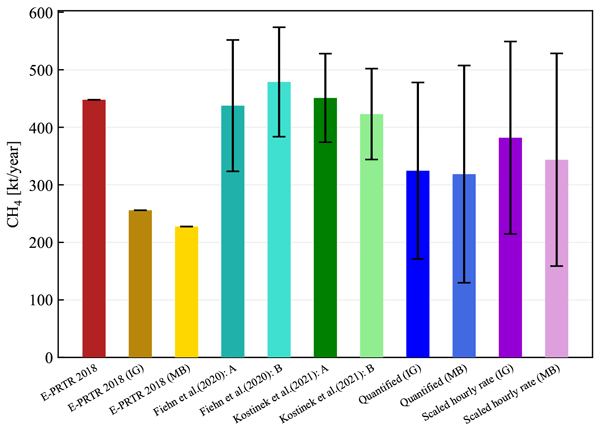
Truls Andersen, Zhao Zhao, Marcel de Vries, Jaroslaw Necki, Justyna Swolkien, Malika Menoud, Thomas Röckmann, Anke Roiger, Andreas Fix, Wouter Peters, and Huilin Chen
Atmos. Chem. Phys., 23, 5191–5216, https://doi.org/10.5194/acp-23-5191-2023, https://doi.org/10.5194/acp-23-5191-2023, 2023
Short summary
Short summary
The Upper Silesian Coal Basin, Poland, is one of the hot spots of methane emissions in Europe. Using an uncrewed aerial vehicle (UAV), we performed atmospheric measurements of methane concentrations downwind of five ventilation shafts in this region and determined the emission rates from the individual shafts. We found a strong correlation between quantified shaft-averaged emission rates and hourly inventory data, which also allows us to estimate the methane emissions from the entire region.
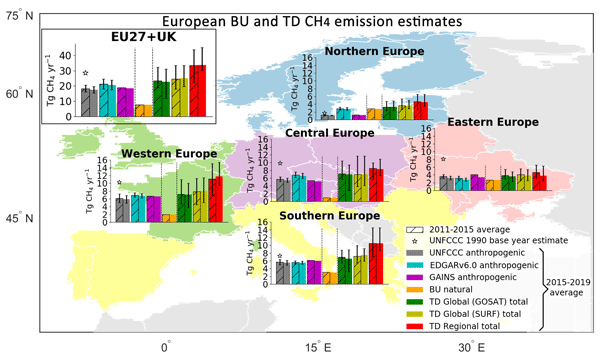
Ana Maria Roxana Petrescu, Chunjing Qiu, Matthew J. McGrath, Philippe Peylin, Glen P. Peters, Philippe Ciais, Rona L. Thompson, Aki Tsuruta, Dominik Brunner, Matthias Kuhnert, Bradley Matthews, Paul I. Palmer, Oksana Tarasova, Pierre Regnier, Ronny Lauerwald, David Bastviken, Lena Höglund-Isaksson, Wilfried Winiwarter, Giuseppe Etiope, Tuula Aalto, Gianpaolo Balsamo, Vladislav Bastrikov, Antoine Berchet, Patrick Brockmann, Giancarlo Ciotoli, Giulia Conchedda, Monica Crippa, Frank Dentener, Christine D. Groot Zwaaftink, Diego Guizzardi, Dirk Günther, Jean-Matthieu Haussaire, Sander Houweling, Greet Janssens-Maenhout, Massaer Kouyate, Adrian Leip, Antti Leppänen, Emanuele Lugato, Manon Maisonnier, Alistair J. Manning, Tiina Markkanen, Joe McNorton, Marilena Muntean, Gabriel D. Oreggioni, Prabir K. Patra, Lucia Perugini, Isabelle Pison, Maarit T. Raivonen, Marielle Saunois, Arjo J. Segers, Pete Smith, Efisio Solazzo, Hanqin Tian, Francesco N. Tubiello, Timo Vesala, Guido R. van der Werf, Chris Wilson, and Sönke Zaehle
Earth Syst. Sci. Data, 15, 1197–1268, https://doi.org/10.5194/essd-15-1197-2023, https://doi.org/10.5194/essd-15-1197-2023, 2023
Short summary
Short summary
This study updates the state-of-the-art scientific overview of CH4 and N2O emissions in the EU27 and UK in Petrescu et al. (2021a). Yearly updates are needed to improve the different respective approaches and to inform on the development of formal verification systems. It integrates the most recent emission inventories, process-based model and regional/global inversions, comparing them with UNFCCC national GHG inventories, in support to policy to facilitate real-time verification procedures.
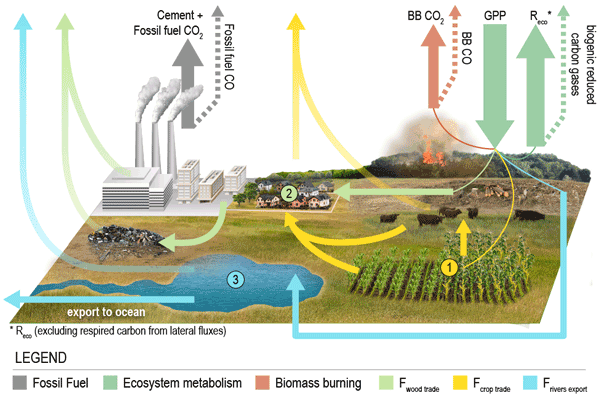
Brendan Byrne, David F. Baker, Sourish Basu, Michael Bertolacci, Kevin W. Bowman, Dustin Carroll, Abhishek Chatterjee, Frédéric Chevallier, Philippe Ciais, Noel Cressie, David Crisp, Sean Crowell, Feng Deng, Zhu Deng, Nicholas M. Deutscher, Manvendra K. Dubey, Sha Feng, Omaira E. García, David W. T. Griffith, Benedikt Herkommer, Lei Hu, Andrew R. Jacobson, Rajesh Janardanan, Sujong Jeong, Matthew S. Johnson, Dylan B. A. Jones, Rigel Kivi, Junjie Liu, Zhiqiang Liu, Shamil Maksyutov, John B. Miller, Scot M. Miller, Isamu Morino, Justus Notholt, Tomohiro Oda, Christopher W. O'Dell, Young-Suk Oh, Hirofumi Ohyama, Prabir K. Patra, Hélène Peiro, Christof Petri, Sajeev Philip, David F. Pollard, Benjamin Poulter, Marine Remaud, Andrew Schuh, Mahesh K. Sha, Kei Shiomi, Kimberly Strong, Colm Sweeney, Yao Té, Hanqin Tian, Voltaire A. Velazco, Mihalis Vrekoussis, Thorsten Warneke, John R. Worden, Debra Wunch, Yuanzhi Yao, Jeongmin Yun, Andrew Zammit-Mangion, and Ning Zeng
Earth Syst. Sci. Data, 15, 963–1004, https://doi.org/10.5194/essd-15-963-2023, https://doi.org/10.5194/essd-15-963-2023, 2023
Short summary
Short summary
Changes in the carbon stocks of terrestrial ecosystems result in emissions and removals of CO2. These can be driven by anthropogenic activities (e.g., deforestation), natural processes (e.g., fires) or in response to rising CO2 (e.g., CO2 fertilization). This paper describes a dataset of CO2 emissions and removals derived from atmospheric CO2 observations. This pilot dataset informs current capabilities and future developments towards top-down monitoring and verification systems.
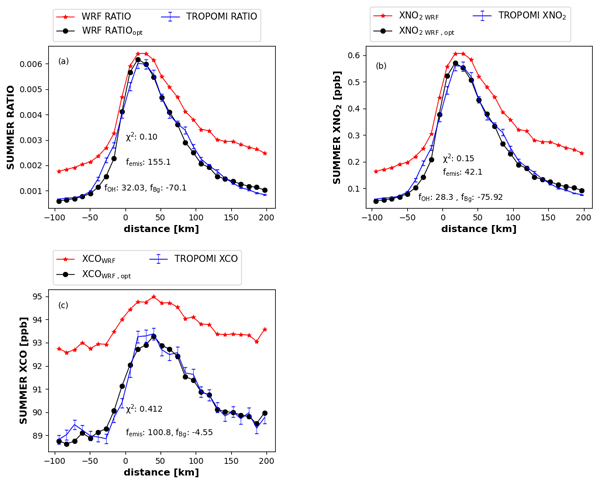
Srijana Lama, Sander Houweling, K. Folkert Boersma, Ilse Aben, Hugo A. C. Denier van der Gon, and Maarten C. Krol
Atmos. Chem. Phys., 22, 16053–16071, https://doi.org/10.5194/acp-22-16053-2022, https://doi.org/10.5194/acp-22-16053-2022, 2022
Short summary
Short summary
Hydroxyl radical (OH) is the important chemical species that determines the lifetime of some greenhouse gases and trace gases. OH plays a vital role in air pollution chemistry. OH has a short lifetime and is extremely difficult to measure directly. OH concentrations derived from the chemistry transport model (CTM) have uncertainties of >50 %. Therefore, in this study, OH is derived indirectly using satellite date in urban plumes.
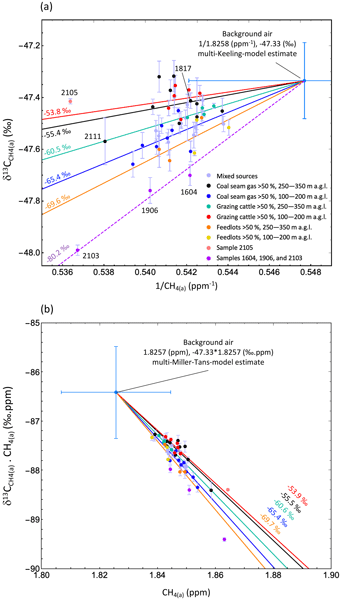
Bryce F. J. Kelly, Xinyi Lu, Stephen J. Harris, Bruno G. Neininger, Jorg M. Hacker, Stefan Schwietzke, Rebecca E. Fisher, James L. France, Euan G. Nisbet, David Lowry, Carina van der Veen, Malika Menoud, and Thomas Röckmann
Atmos. Chem. Phys., 22, 15527–15558, https://doi.org/10.5194/acp-22-15527-2022, https://doi.org/10.5194/acp-22-15527-2022, 2022
Short summary
Short summary
This study explores using the composition of methane of in-flight atmospheric air samples for greenhouse gas inventory verification. The air samples were collected above one of the largest coal seam gas production regions in the world. Adjacent to these gas fields are coal mines, Australia's largest cattle feedlot, and over 1 million grazing cattle. The results are also used to identify methane mitigation opportunities.
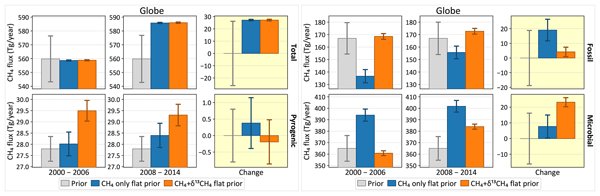
Sourish Basu, Xin Lan, Edward Dlugokencky, Sylvia Michel, Stefan Schwietzke, John B. Miller, Lori Bruhwiler, Youmi Oh, Pieter P. Tans, Francesco Apadula, Luciana V. Gatti, Armin Jordan, Jaroslaw Necki, Motoki Sasakawa, Shinji Morimoto, Tatiana Di Iorio, Haeyoung Lee, Jgor Arduini, and Giovanni Manca
Atmos. Chem. Phys., 22, 15351–15377, https://doi.org/10.5194/acp-22-15351-2022, https://doi.org/10.5194/acp-22-15351-2022, 2022
Short summary
Short summary
Atmospheric methane (CH4) has been growing steadily since 2007 for reasons that are not well understood. Here we determine sources of methane using a technique informed by atmospheric measurements of CH4 and its isotopologue 13CH4. Measurements of 13CH4 provide for better separation of microbial, fossil, and fire sources of methane than CH4 measurements alone. Compared to previous assessments such as the Global Carbon Project, we find a larger microbial contribution to the post-2007 increase.
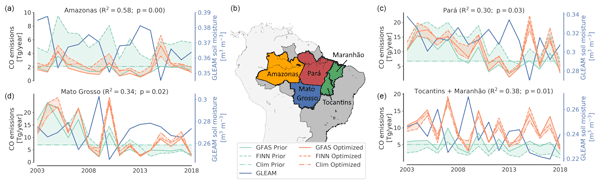
Stijn Naus, Lucas G. Domingues, Maarten Krol, Ingrid T. Luijkx, Luciana V. Gatti, John B. Miller, Emanuel Gloor, Sourish Basu, Caio Correia, Gerbrand Koren, Helen M. Worden, Johannes Flemming, Gabrielle Pétron, and Wouter Peters
Atmos. Chem. Phys., 22, 14735–14750, https://doi.org/10.5194/acp-22-14735-2022, https://doi.org/10.5194/acp-22-14735-2022, 2022
Short summary
Short summary
We assimilate MOPITT CO satellite data in the TM5-4D-Var inverse modelling framework to estimate Amazon fire CO emissions for 2003–2018. We show that fire emissions have decreased over the analysis period, coincident with a decrease in deforestation rates. However, interannual variations in fire emissions are large, and they correlate strongly with soil moisture. Our results reveal an important role for robust, top-down fire CO emissions in quantifying and attributing Amazon fire intensity.
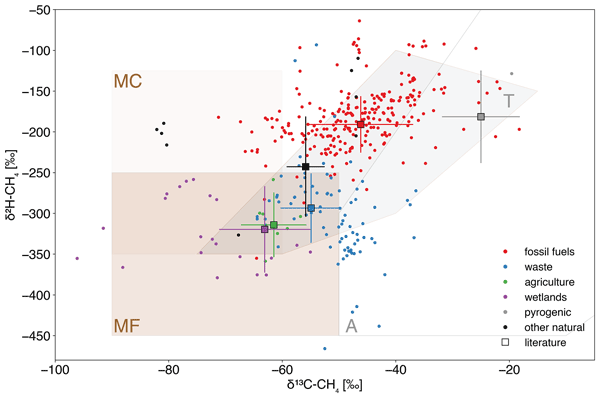
Malika Menoud, Carina van der Veen, Dave Lowry, Julianne M. Fernandez, Semra Bakkaloglu, James L. France, Rebecca E. Fisher, Hossein Maazallahi, Mila Stanisavljević, Jarosław Nęcki, Katarina Vinkovic, Patryk Łakomiec, Janne Rinne, Piotr Korbeń, Martina Schmidt, Sara Defratyka, Camille Yver-Kwok, Truls Andersen, Huilin Chen, and Thomas Röckmann
Earth Syst. Sci. Data, 14, 4365–4386, https://doi.org/10.5194/essd-14-4365-2022, https://doi.org/10.5194/essd-14-4365-2022, 2022
Short summary
Short summary
Emission sources of methane (CH4) can be distinguished with measurements of CH4 stable isotopes. We present new measurements of isotope signatures of various CH4 sources in Europe, mainly anthropogenic, sampled from 2017 to 2020. The present database also contains the most recent update of the global signature dataset from the literature. The dataset improves CH4 source attribution and the understanding of the global CH4 budget.

Lauren M. Zamora, Ralph A. Kahn, Nikolaos Evangeliou, Christine D. Groot Zwaaftink, and Klaus B. Huebert
Atmos. Chem. Phys., 22, 12269–12285, https://doi.org/10.5194/acp-22-12269-2022, https://doi.org/10.5194/acp-22-12269-2022, 2022
Short summary
Short summary
Arctic dust, smoke, and pollution particles can affect clouds and Arctic warming. The distributions of these particles were estimated in three different satellite, reanalysis, and model products. These products showed good agreement overall but indicate that it is important to include local dust in models. We hypothesize that mineral dust effects on ice processes in the Arctic atmosphere might be highest over Siberia, where it is cold, moist, and subject to relatively high dust levels.

Joël Thanwerdas, Marielle Saunois, Antoine Berchet, Isabelle Pison, Bruce H. Vaughn, Sylvia Englund Michel, and Philippe Bousquet
Geosci. Model Dev., 15, 4831–4851, https://doi.org/10.5194/gmd-15-4831-2022, https://doi.org/10.5194/gmd-15-4831-2022, 2022
Short summary
Short summary
Estimating CH4 sources by exploiting observations within an inverse modeling framework is a powerful approach. Here, a new system designed to assimilate δ13C(CH4) observations together with CH4 observations is presented. By optimizing both the emissions and associated source signatures of multiple emission categories, this new system can efficiently differentiate the co-located emission categories and provide estimates of CH4 sources that are consistent with isotopic data.
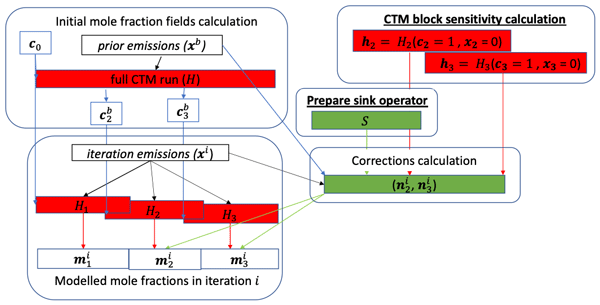
Sudhanshu Pandey, Sander Houweling, and Arjo Segers
Geosci. Model Dev., 15, 4555–4567, https://doi.org/10.5194/gmd-15-4555-2022, https://doi.org/10.5194/gmd-15-4555-2022, 2022
Short summary
Short summary
Inversions are used to calculate methane emissions using atmospheric mole-fraction measurements. Multidecadal inversions are needed to extract information from the long measurement records of methane. However, multidecadal inversion computations can take months to finish. Here, we demonstrate an order of magnitude improvement in wall clock time for an iterative multidecadal inversion by physical parallelization of chemical transport model.
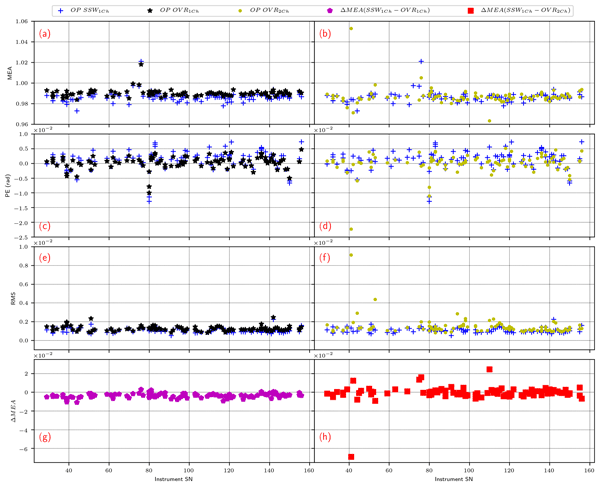
Carlos Alberti, Frank Hase, Matthias Frey, Darko Dubravica, Thomas Blumenstock, Angelika Dehn, Paolo Castracane, Gregor Surawicz, Roland Harig, Bianca C. Baier, Caroline Bès, Jianrong Bi, Hartmut Boesch, André Butz, Zhaonan Cai, Jia Chen, Sean M. Crowell, Nicholas M. Deutscher, Dragos Ene, Jonathan E. Franklin, Omaira García, David Griffith, Bruno Grouiez, Michel Grutter, Abdelhamid Hamdouni, Sander Houweling, Neil Humpage, Nicole Jacobs, Sujong Jeong, Lilian Joly, Nicholas B. Jones, Denis Jouglet, Rigel Kivi, Ralph Kleinschek, Morgan Lopez, Diogo J. Medeiros, Isamu Morino, Nasrin Mostafavipak, Astrid Müller, Hirofumi Ohyama, Paul I. Palmer, Mahesh Pathakoti, David F. Pollard, Uwe Raffalski, Michel Ramonet, Robbie Ramsay, Mahesh Kumar Sha, Kei Shiomi, William Simpson, Wolfgang Stremme, Youwen Sun, Hiroshi Tanimoto, Yao Té, Gizaw Mengistu Tsidu, Voltaire A. Velazco, Felix Vogel, Masataka Watanabe, Chong Wei, Debra Wunch, Marcia Yamasoe, Lu Zhang, and Johannes Orphal
Atmos. Meas. Tech., 15, 2433–2463, https://doi.org/10.5194/amt-15-2433-2022, https://doi.org/10.5194/amt-15-2433-2022, 2022
Short summary
Short summary
Space-borne greenhouse gas missions require ground-based validation networks capable of providing fiducial reference measurements. Here, considerable refinements of the calibration procedures for the COllaborative Carbon Column Observing Network (COCCON) are presented. Laboratory and solar side-by-side procedures for the characterization of the spectrometers have been refined and extended. Revised calibration factors for XCO2, XCO and XCH4 are provided, incorporating 47 new spectrometers.
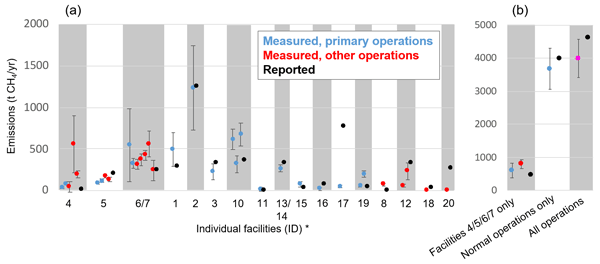
Amy Foulds, Grant Allen, Jacob T. Shaw, Prudence Bateson, Patrick A. Barker, Langwen Huang, Joseph R. Pitt, James D. Lee, Shona E. Wilde, Pamela Dominutti, Ruth M. Purvis, David Lowry, James L. France, Rebecca E. Fisher, Alina Fiehn, Magdalena Pühl, Stéphane J. B. Bauguitte, Stephen A. Conley, Mackenzie L. Smith, Tom Lachlan-Cope, Ignacio Pisso, and Stefan Schwietzke
Atmos. Chem. Phys., 22, 4303–4322, https://doi.org/10.5194/acp-22-4303-2022, https://doi.org/10.5194/acp-22-4303-2022, 2022
Short summary
Short summary
We measured CH4 emissions from 21 offshore oil and gas facilities in the Norwegian Sea in 2019. Measurements compared well with operator-reported emissions but were greatly underestimated when compared with a 2016 global fossil fuel inventory. This study demonstrates the need for up-to-date and accurate inventories for use in research and policy and the important benefits of best-practice reporting methods by operators. Airborne measurements are an effective tool to validate such inventories.
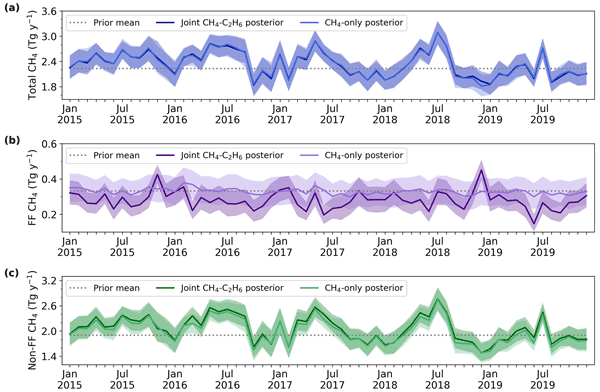
Alice E. Ramsden, Anita L. Ganesan, Luke M. Western, Matthew Rigby, Alistair J. Manning, Amy Foulds, James L. France, Patrick Barker, Peter Levy, Daniel Say, Adam Wisher, Tim Arnold, Chris Rennick, Kieran M. Stanley, Dickon Young, and Simon O'Doherty
Atmos. Chem. Phys., 22, 3911–3929, https://doi.org/10.5194/acp-22-3911-2022, https://doi.org/10.5194/acp-22-3911-2022, 2022
Short summary
Short summary
Quantifying methane emissions from different sources is a key focus of current research. We present a method for estimating sectoral methane emissions that uses ethane as a tracer for fossil fuel methane. By incorporating variable ethane : methane emission ratios into this model, we produce emissions estimates with improved uncertainty characterisation. This method will be particularly useful for studying methane emissions in areas with complex distributions of sources.

Christine D. Groot Zwaaftink, Wenche Aas, Sabine Eckhardt, Nikolaos Evangeliou, Paul Hamer, Mona Johnsrud, Arve Kylling, Stephen M. Platt, Kerstin Stebel, Hilde Uggerud, and Karl Espen Yttri
Atmos. Chem. Phys., 22, 3789–3810, https://doi.org/10.5194/acp-22-3789-2022, https://doi.org/10.5194/acp-22-3789-2022, 2022
Short summary
Short summary
We investigate causes of a poor-air-quality episode in northern Europe in October 2020 during which EU health limits for air quality were vastly exceeded. Such episodes may trigger measures to improve air quality. Analysis based on satellite observations, transport simulations, and surface observations revealed two sources of pollution. Emissions of mineral dust in Central Asia and biomass burning in Ukraine arrived almost simultaneously in Norway, and transport continued into the Arctic.
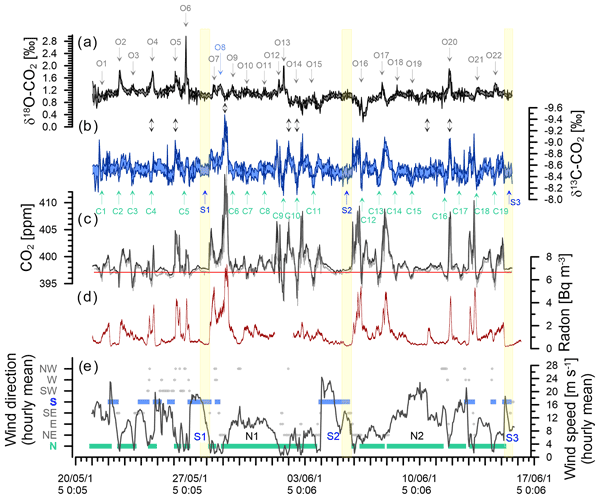
Peter Sperlich, Gordon W. Brailsford, Rowena C. Moss, John McGregor, Ross J. Martin, Sylvia Nichol, Sara Mikaloff-Fletcher, Beata Bukosa, Magda Mandic, C. Ian Schipper, Paul Krummel, and Alan D. Griffiths
Atmos. Meas. Tech., 15, 1631–1656, https://doi.org/10.5194/amt-15-1631-2022, https://doi.org/10.5194/amt-15-1631-2022, 2022
Short summary
Short summary
We tested an in situ analyser for carbon and oxygen isotopes in atmospheric CO2 at Baring Head, New Zealand’s observatory for Southern Ocean baseline air. The analyser was able to resolve regional signals of the terrestrial carbon cycle, although the analysis of small events was limited by analytical uncertainty. Further improvement of the instrument performance would be desirable for the robust analysis of distant signals and to resolve the small variability in Southern Ocean baseline air.
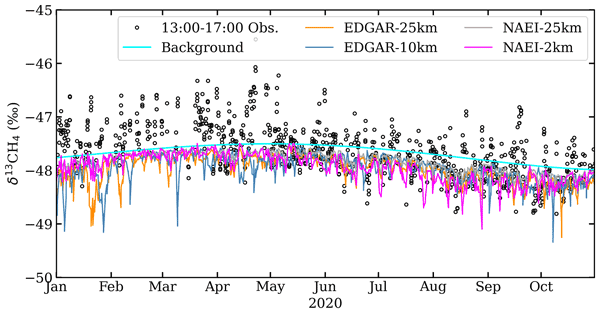
Eric Saboya, Giulia Zazzeri, Heather Graven, Alistair J. Manning, and Sylvia Englund Michel
Atmos. Chem. Phys., 22, 3595–3613, https://doi.org/10.5194/acp-22-3595-2022, https://doi.org/10.5194/acp-22-3595-2022, 2022
Short summary
Short summary
Continuous measurements of atmospheric methane concentrations and its carbon-13 isotope have been made in central London since early 2018. These measurements were used to evaluate methane emissions reported in global and UK-specific emission inventories for the London area. Compared to atmospheric methane measurements from March 2018 to October 2020, both inventories are under-reporting natural gas leakage for the London area.
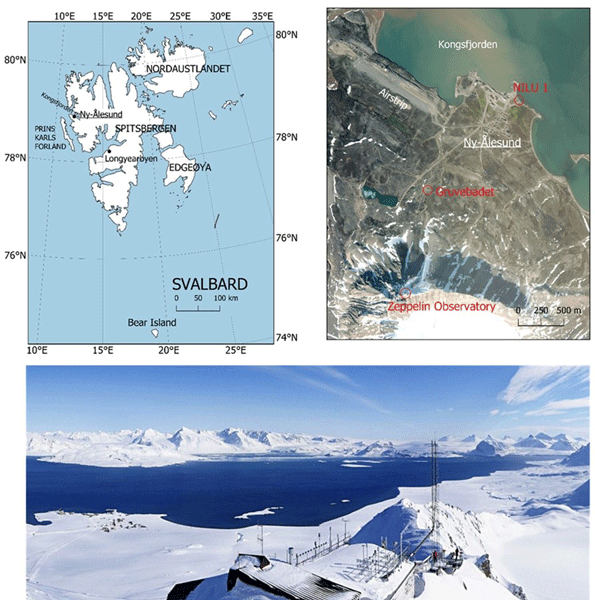
Stephen M. Platt, Øystein Hov, Torunn Berg, Knut Breivik, Sabine Eckhardt, Konstantinos Eleftheriadis, Nikolaos Evangeliou, Markus Fiebig, Rebecca Fisher, Georg Hansen, Hans-Christen Hansson, Jost Heintzenberg, Ove Hermansen, Dominic Heslin-Rees, Kim Holmén, Stephen Hudson, Roland Kallenborn, Radovan Krejci, Terje Krognes, Steinar Larssen, David Lowry, Cathrine Lund Myhre, Chris Lunder, Euan Nisbet, Pernilla B. Nizzetto, Ki-Tae Park, Christina A. Pedersen, Katrine Aspmo Pfaffhuber, Thomas Röckmann, Norbert Schmidbauer, Sverre Solberg, Andreas Stohl, Johan Ström, Tove Svendby, Peter Tunved, Kjersti Tørnkvist, Carina van der Veen, Stergios Vratolis, Young Jun Yoon, Karl Espen Yttri, Paul Zieger, Wenche Aas, and Kjetil Tørseth
Atmos. Chem. Phys., 22, 3321–3369, https://doi.org/10.5194/acp-22-3321-2022, https://doi.org/10.5194/acp-22-3321-2022, 2022
Short summary
Short summary
Here we detail the history of the Zeppelin Observatory, a unique global background site and one of only a few in the high Arctic. We present long-term time series of up to 30 years of atmospheric components and atmospheric transport phenomena. Many of these time series are important to our understanding of Arctic and global atmospheric composition change. Finally, we discuss the future of the Zeppelin Observatory and emerging areas of future research on the Arctic atmosphere.
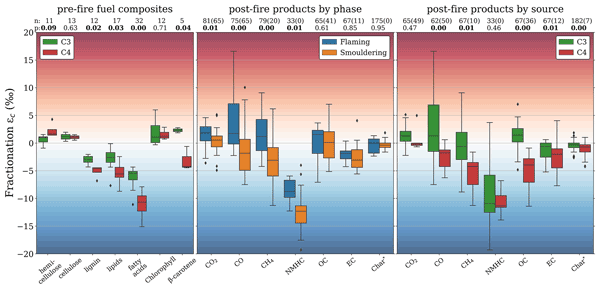
Roland Vernooij, Ulrike Dusek, Maria Elena Popa, Peng Yao, Anupam Shaikat, Chenxi Qiu, Patrik Winiger, Carina van der Veen, Thomas Callum Eames, Natasha Ribeiro, and Guido R. van der Werf
Atmos. Chem. Phys., 22, 2871–2890, https://doi.org/10.5194/acp-22-2871-2022, https://doi.org/10.5194/acp-22-2871-2022, 2022
Short summary
Short summary
Landscape fires are a major source of greenhouse gases and aerosols, particularly in sub-tropical savannas. Stable carbon isotopes in emissions can be used to trace the contribution of C3 plants (e.g. trees or shrubs) and C4 plants (e.g. savanna grasses) to greenhouse gases and aerosols if the process is well understood. This helps us to link individual vegetation types to emissions, identify biomass burning emissions in the atmosphere, and improve the reconstruction of historic fire regimes.
Yousef Albuhaisi, Ype van der Velde, and Sander Houweling
Biogeosciences Discuss., https://doi.org/10.5194/bg-2022-55, https://doi.org/10.5194/bg-2022-55, 2022
Manuscript not accepted for further review
Short summary
Short summary
An important uncertainty in the modelling of methane emissions from natural wetlands is the wetland area. It is important to get the spatiotemporal covariance between the variables that drive methane emissions right for accurate quantification. Using high-resolution wetland and soil carbon maps, in combination with a simplified methane emission model that is coarsened in six steps from 0.005° to 1°, we find a strong relation between wetland emissions and the model resolution.
Juhi Nagori, Narcisa Nechita-Bândă, Sebastian Oscar Danielache, Masumi Shinkai, Thomas Röckmann, and Maarten Krol
Atmos. Chem. Phys. Discuss., https://doi.org/10.5194/acp-2022-68, https://doi.org/10.5194/acp-2022-68, 2022
Publication in ACP not foreseen
Short summary
Short summary
The sulfur isotopes (32S and 34S) were studied to understand the sources, sinks and processes of carbonyl sulphide (COS) in the atmosphere. COS is an important source of sulfur aerosol in the stratosphere (SSA). Few measurements of COS and SSA exist, but with our 1D model, we were able to match them and show the importance of COS to sulfate formation. Moreover, we are able to highlight some important processes for the COS budget and where measurements may fill a gap in current knowledge.
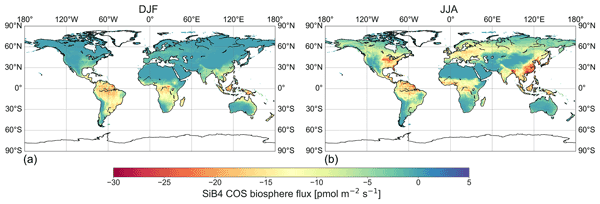
Linda M. J. Kooijmans, Ara Cho, Jin Ma, Aleya Kaushik, Katherine D. Haynes, Ian Baker, Ingrid T. Luijkx, Mathijs Groenink, Wouter Peters, John B. Miller, Joseph A. Berry, Jerome Ogée, Laura K. Meredith, Wu Sun, Kukka-Maaria Kohonen, Timo Vesala, Ivan Mammarella, Huilin Chen, Felix M. Spielmann, Georg Wohlfahrt, Max Berkelhammer, Mary E. Whelan, Kadmiel Maseyk, Ulli Seibt, Roisin Commane, Richard Wehr, and Maarten Krol
Biogeosciences, 18, 6547–6565, https://doi.org/10.5194/bg-18-6547-2021, https://doi.org/10.5194/bg-18-6547-2021, 2021
Short summary
Short summary
The gas carbonyl sulfide (COS) can be used to estimate photosynthesis. To adopt this approach on regional and global scales, we need biosphere models that can simulate COS exchange. So far, such models have not been evaluated against observations. We evaluate the COS biosphere exchange of the SiB4 model against COS flux observations. We find that the model is capable of simulating key processes in COS biosphere exchange. Still, we give recommendations for further improvement of the model.
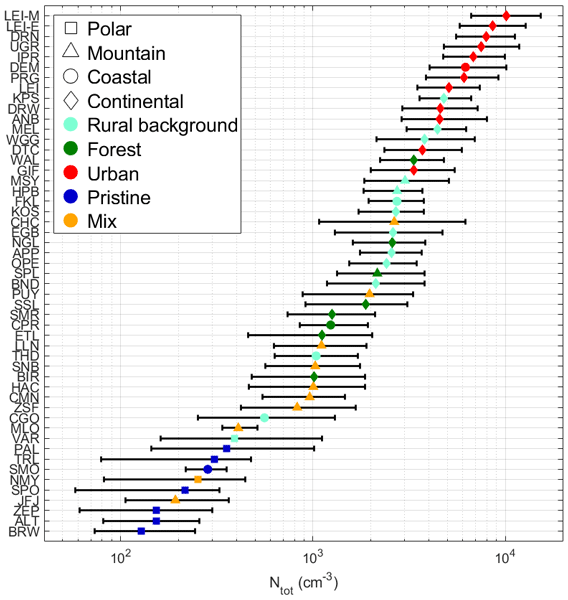
Clémence Rose, Martine Collaud Coen, Elisabeth Andrews, Yong Lin, Isaline Bossert, Cathrine Lund Myhre, Thomas Tuch, Alfred Wiedensohler, Markus Fiebig, Pasi Aalto, Andrés Alastuey, Elisabeth Alonso-Blanco, Marcos Andrade, Begoña Artíñano, Todor Arsov, Urs Baltensperger, Susanne Bastian, Olaf Bath, Johan Paul Beukes, Benjamin T. Brem, Nicolas Bukowiecki, Juan Andrés Casquero-Vera, Sébastien Conil, Konstantinos Eleftheriadis, Olivier Favez, Harald Flentje, Maria I. Gini, Francisco Javier Gómez-Moreno, Martin Gysel-Beer, Anna Gannet Hallar, Ivo Kalapov, Nikos Kalivitis, Anne Kasper-Giebl, Melita Keywood, Jeong Eun Kim, Sang-Woo Kim, Adam Kristensson, Markku Kulmala, Heikki Lihavainen, Neng-Huei Lin, Hassan Lyamani, Angela Marinoni, Sebastiao Martins Dos Santos, Olga L. Mayol-Bracero, Frank Meinhardt, Maik Merkel, Jean-Marc Metzger, Nikolaos Mihalopoulos, Jakub Ondracek, Marco Pandolfi, Noemi Pérez, Tuukka Petäjä, Jean-Eudes Petit, David Picard, Jean-Marc Pichon, Veronique Pont, Jean-Philippe Putaud, Fabienne Reisen, Karine Sellegri, Sangeeta Sharma, Gerhard Schauer, Patrick Sheridan, James Patrick Sherman, Andreas Schwerin, Ralf Sohmer, Mar Sorribas, Junying Sun, Pierre Tulet, Ville Vakkari, Pieter Gideon van Zyl, Fernando Velarde, Paolo Villani, Stergios Vratolis, Zdenek Wagner, Sheng-Hsiang Wang, Kay Weinhold, Rolf Weller, Margarita Yela, Vladimir Zdimal, and Paolo Laj
Atmos. Chem. Phys., 21, 17185–17223, https://doi.org/10.5194/acp-21-17185-2021, https://doi.org/10.5194/acp-21-17185-2021, 2021
Short summary
Short summary
Aerosol particles are a complex component of the atmospheric system the effects of which are among the most uncertain in climate change projections. Using data collected at 62 stations, this study provides the most up-to-date picture of the spatial distribution of particle number concentration and size distribution worldwide, with the aim of contributing to better representation of aerosols and their interactions with clouds in models and, therefore, better evaluation of their impact on climate.
Vilma Kangasaho, Aki Tsuruta, Leif Backman, Pyry Mäkinen, Sander Houweling, Arjo Segers, Maarten Krol, Ed Dlugokencky, Sylvia Michel, James White, and Tuula Aalto
Atmos. Chem. Phys. Discuss., https://doi.org/10.5194/acp-2021-843, https://doi.org/10.5194/acp-2021-843, 2021
Revised manuscript not accepted
Short summary
Short summary
Understanding the composition of carbon isotopes can help to better understand the changes in methane budgets. This study investigates how methane sources affect the seasonal cycle of the methane carbon-13 isotope during 2000–2012 using an atmospheric transport model. We found that emissions from both anthropogenic and natural sources contribute. The findings raise a need to revise the magnitudes, proportion, and seasonal cycles of anthropogenic sources and northern wetland emissions.
Cited articles
Anderson, D. C., Duncan, B. N., Fiore, A. M., Baublitz, C. B., Follette-Cook, M. B., Nicely, J. M., and Wolfe, G. M.: Spatial and temporal variability in the hydroxyl (OH) radical: understanding the role of large-scale climate features and their influence on OH through its dynamical and photochemical drivers, Atmos. Chem. Phys., 21, 6481–6508, https://doi.org/10.5194/acp-21-6481-2021, 2021.
Basu, S., Lan, X., Dlugokencky, E., Michel, S., Schwietzke, S., Miller, J. B., Bruhwiler, L., Oh, Y., Tans, P. P., Apadula, F., Gatti, L. V., Jordan, A., Necki, J., Sasakawa, M., Morimoto, S., Di Iorio, T., Lee, H., Arduini, J., and Manca, G.: Estimating emissions of methane consistent with atmospheric measurements of methane and δ13C of methane, Atmos. Chem. Phys., 22, 15351–15377, https://doi.org/10.5194/acp-22-15351-2022, 2022.
Bellisario, L. M., Bubier, J. L., Moore, T. R., and Chanton, J. P.: Controls on CH4 emissions from a northern peatland, Global Biogeochem. Cy., 13, 81–91, https://doi.org/10.1029/1998GB900021, 1999.
Bousquet, P., Ciais, P., Miller, J. B., Dlugokencky, E. J., Hauglustaine, D. A., Prigent, C., Van der Werf, G. R., Peylin, P., Brunke, E. G., Carouge, C., and Langenfelds, R. L.: Contribution of anthropogenic and natural sources to atmospheric methane variability, Nature, 443, 439–443, https://doi.org/10.1038/nature05132, 2006.
Bousquet, P., Ringeval, B., Pison, I., Dlugokencky, E. J., Brunke, E.-G., Carouge, C., Chevallier, F., Fortems-Cheiney, A., Frankenberg, C., Hauglustaine, D. A., Krummel, P. B., Langenfelds, R. L., Ramonet, M., Schmidt, M., Steele, L. P., Szopa, S., Yver, C., Viovy, N., and Ciais, P.: Source attribution of the changes in atmospheric methane for 2006–2008, Atmos. Chem. Phys., 11, 3689–3700, https://doi.org/10.5194/acp-11-3689-2011, 2011.
Cantrell, C. A., Shetter, R. E., McDaniel, A. H., Calvert, J. G., Davidson, J. A., Lowe, D. C., Tyler, S. C., Cicerone, R. J., and Greenberg, J. P.: Carbon kinetic isotope effect in the oxidation of methane by the hydroxyl radical, J. Geophys. Res., 95, 22455–22462, https://doi.org/10.1029/JD095iD13p22455, 1990.
Chandra, N., Patra, P. K., Fujita, R., Höglund-Isaksson, L., Umezawa, T., Goto, D., Morimoto, S., Vaughn, B. H., and Röckmann, T.: Methane emissions decreased in fossil fuel exploitation and sustainably increased in microbial source sectors during 1990–2020, Commun. Earth Environ., 5, 147, https://doi.org/10.1038/s43247-024-01286-x, 2024.
Dasgupta, B., Menoud, M., van der Veen, C., Levin, I., Veidt, C., Moossen, H., Englund Michel, S., Sperlich, P., Morimoto, S., Fujita, R., Umezawa, T., Platt, S., Zwaaftink, C. G., Myhre, C. L., Fisher, R., Lowry, D., Nisbet, E. G., France, J., Woolley Maisch, C., Brailsford, G., Moss, R., Goto, D., Pandey, S., Houweling, S., Warwick, N., and Röckmann, T.: Harmonisation of methane isotope ratio measurements from different laboratories using atmospheric samples, Atmos. Meas. Tech., 18, 6591–6607, https://doi.org/10.5194/amt-18-6591-2025, 2025a.
Dasgupta, B., Menoud, M., van der Veen, C., Levin, I., Moossen, H., Englund Michel, S., Sperlich, P., Morimoto, S., Fujita, R., Umezawa, T., Platt, S. M., Groot Zwaaftink, C., Lund Myhre, C., Fisher, R., Lowry, D., Nisbet, E., France, J., Woolley Maisch, C., Brailsford, G., Moss, R., Goto, D., Pandey, S., Houweling, S., Warwick, N., and Röckmann, T.: Harmonised and offset corrected methane isotopic composition (ch4, 13ch4, d2h_ch4) from high northern and southern latitudes, ICOS Data Portal [data set], https://doi.org/10.18160/V1Y4-NTK0, 2025b.
Douglas, P. M. J., Stratigopoulos, E., Park, S., and Phan, D.: Geographic variability in freshwater methane hydrogen isotope ratios and its implications for global isotopic source signatures, Biogeosciences, 18, 3505–3527, https://doi.org/10.5194/bg-18-3505-2021, 2021.
Fujita, R., Graven, H., Zazzeri, G., Hmiel, B., Petrenko, V. V., Smith, A. M., Michel, S. E., and Morimoto, S.: Global fossil methane emissions constrained by multi-isotopic atmospheric methane histories, J. Geophys. Res.-Atmos., 130, e2024JD041266, https://doi.org/10.1029/2024JD041266, 2025.
Fujita, R., Morimoto, S., Maksyutov, S., Kim, H.-S., Arshinov, M., Brailsford, G., Aoki, S., and Nakazawa, T.: Global and Regional CH4 Emissions for 1995–2013 Derived From Atmospheric CH4, δ13C-CH4, and δD-CH4 Observations and a Chemical Transport Model, J. Geophys. Res.-Atmos., 125, e2020JD032903, https://doi.org/10.1029/2020JD032903, 2020.
Höglund-Isaksson, L., Gómez-Sanabria, A., Klimont, Z., Rafaj, P., and Schöpp, W.: Technical potentials and costs for reducing global anthropogenic methane emissions in the 2050 timeframe–results from the GAINS model, Environ. Res. Commun., 2, 025004, https://doi.org/10.1088/2515-7620/ab7457, 2020.
Hornibrook, E. R. and Bowes, H. L.: Trophic status impacts both the magnitude and stable carbon isotope composition of methane flux from peatlands, Geophys. Res. Lett., 34, L21401, https://doi.org/10.1029/2007GL031231, 2007.
Hornibrook, E. R.: The stable carbon isotope composition of methane produced and emitted from northern peatlands, in: Carbon cycling in northern peatlands, Geophys. Monogr. Ser., 184, 187–203, https://doi.org/10.1029/2008GM000828, 2009.
Houweling, S., Bergamaschi, P., Chevallier, F., Heimann, M., Kaminski, T., Krol, M., Michalak, A. M., and Patra, P.: Global inverse modeling of CH4 sources and sinks: an overview of methods, Atmos. Chem. Phys., 17, 235–256, https://doi.org/10.5194/acp-17-235-2017, 2017.
Hu, H., Geng, G., Xu, R., Liu, Y., Shi, Q., Xiao, Q., Liu, X., Zheng, B., Zhang, Q., and He, K.: Notable uncertainties in near real-time CO2 emission estimates in China, npj Clim. Atmos. Sci., 8, 108, https://doi.org/10.1038/s41612-025-00991-4, 2025.
IEA: Fossil fuel supply, IEA, Paris, https://www.iea.org/reports/fossil-fuel-supply (last access: 4 January 2025), 2023.
Kirschke, S., Bousquet, P., Ciais, P., Saunois, M., Canadell, J. G., Dlugokencky, E. J., Bergamaschi, P., Bergmann, D., Blake, D. R., Bruhwiler, L., Cameron-Smith, P., Castaldi, S., Chevallier, F., Feng, L., Fraser, A., Heimann, M., Hodson, E. L., Houweling, S., Josse, B., Fraser, P. J., Krummel, P. B., Lamarque, J.-F., Langenfelds, R. L., Le Quéré, C., Naik, V., O'Doherty, S., Palmer, P. I., Pison, I., Plummer, D., Poulter, B., Prinn, R. G., Rigby, M., Ringeval, B., Santini, M., Schmidt, M., Shindell, D. T., Simpson, I. J., Spahni, R., Steele, L. P., Strode, S. A., Sudo, K., Szopa, S., van der Werf, G. R., Voulgarakis, A., van Weele, M., Weiss, R. F., Williams, J. E., and Zeng, G.: Three decades of global methane sources and sinks, Nat. Geosci., 6, 813–823, https://doi.org/10.1038/ngeo1955, 2013.
Lan, X., Basu, S., Schwietzke, S., Bruhwiler, L. M. P., Dlugokencky, E. J., Michel, S. E., Sherwood, O. A., Tans, P. P., Thoning, K., Etiope, G., Zhuang, Q., Liu, L., Oh, Y., Miller, J. B., Pétron, G., Vaughn, B. H., and Crippa, M.: Improved Constraints on Global Methane Emissions and Sinks Using δ13C-CH4, Global Biogeochem. Cy., 35, e2021GB007000, https://doi.org/10.1029/2021GB007000, 2021.
Lin, X., Peng, S., Ciais, P., Hauglustaine, D., Lan, X., Liu, G., Ramonet, M., Xi, Y., Yin, Y., Zhang, Z., Bösch, H., Bousquet, P., Saunois, M., and Li, Z.: Recent methane surges reveal heightened emissions from tropical inundated areas, Nat. Commun., 15, 10894, https://doi.org/10.1038/s41467-024-55266-y, 2024.
Liu, Z., Guan, D., Wei, W., Davis, S. J., Ciais, P., Bai, J., Peng, S., Zhang, Q., Hubacek, K., Marland, G., Andres, R. J., Crawford-Brown, D., Lin, J., Zhao, H., Hong, C., Boden, T. A., Feng, K., Peters, G. P., Xi, F., Liu, J., Li, Y., Zhao, Y., Zeng, N., and He, K.: Reduced carbon emission estimates from fossil fuel combustion and cement production in China, Nature, 524, 335–338, https://doi.org/10.1038/nature14677, 2015.
Menoud, M., van der Veen, C., Lowry, D., Fernandez, J. M., Bakkaloglu, S., France, J. L., Fisher, R. E., Maazallahi, H., Stanisavljević, M., Nęcki, J., Vinkovic, K., Łakomiec, P., Rinne, J., Korbeń, P., Schmidt, M., Defratyka, S., Yver-Kwok, C., Andersen, T., Chen, H., and Röckmann, T.: New contributions of measurements in Europe to the global inventory of the stable isotopic composition of methane, Earth Syst. Sci. Data, 14, 4365–4386, https://doi.org/10.5194/essd-14-4365-2022, 2022.
Michel, S. E., Lan, X., Miller, J., Tans, P., Clark, J. R., Schaefer, H., Sperlich, P., Brailsford, G., Morimoto, S., Moossen, H., Li, J., Englund Michel, S., Umezawa, T., and Röckmann, T.: Rapid shift in methane carbon isotopes suggests microbial emissions drove record high atmospheric methane growth in 2020–2022, P. Natl. Acad. Sci. USA, 121, e2411212121, https://doi.org/10.1073/pnas.2411212121, 2024.
Mikaloff Fletcher, S. E., Tans, P. P., Bruhwiler, L. M., Miller, J. B., and Heimann, M.: CH4 sources estimated from atmospheric observations of CH4 and its
Monteil, G., Houweling, S., Dlugockenky, E. J., Maenhout, G., Vaughn, B. H., White, J. W. C., and Rockmann, T.: Interpreting methane variations in the past two decades using measurements of CH4 mixing ratio and isotopic composition, Atmos. Chem. Phys., 11, 9141–9153, https://doi.org/10.5194/acp-11-9141-2011, 2011.
Myhre, G., Shindell, D., Bréon, F. M., Collins, W., Fuglestvedt, J., Huang, J., Koch, D., Lamarque, J. F., Lee, D., Mendoza, B., Nakajima, T., Robock, A., Stephens, G., Takemura, T., and Zhang, H.: Anthropogenic and natural radiative forcing, in: Climate Change 2013: The Physical Science Basis. Contribution of Working Group I to the Fifth Assessment Report of the Intergovernmental Panel on Climate Change, edited by: Stocker, T. F., Qin, D., Plattner, G.-K., Tignor, M., Allen, S. K., Boschung, J., Nauels, A., Xia, Y., Bex, V., and Midgley, P. M., Cambridge University Press, Cambridge, United Kingdom and New York, NY, USA, 659–740, https://doi.org/10.1017/CBO9781107415324.018, 2014.
Nisbet, E. G., Dlugokencky, E. J., Manning, M. R., Lowry, D., Fisher, R. E., France, J. L., Michel, S. E., Miller, J. B., White, J. W. C., Vaughn, B., Bousquet, P., Pyle, J. A., Warwick, N. J., Cain, M., Brownlow, R., Zazzeri, G., Lanoisellé, M., Manning, A. C., Gloor, E., Worthy, D. E. J., Brunke, E.-G., Labuschagne, C., Wolff, E. W., and Ganesan, A. L.: Rising atmospheric methane: 2007–2014 growth and isotopic shift, Global Biogeochem. Cy., 30, 1356–1370, https://doi.org/10.1002/2016GB005406, 2016.
Nisbet, E. G., Manning, M. R., Dlugokencky, E. J., Fisher, R. E., Lowry, D., Michel, S. E., Lund Myhre, C., Platt, S. M., Allen, G., Bousquet, P., Brownlow, R., Cain, M., France, J. L., Hermansen, O., Hossaini, R., Jones, A. E., Levin, I., Manning, A. C., Myhre, G., Pyle, J. A., Vaughn, B. H., Warwick, N. J., and White, J. W. C.: Very Strong Atmospheric Methane Growth in the 4 Years 2014–2017: Implications for the Paris Agreement, Global Biogeochem. Cy., 33, 318–342, https://doi.org/10.1029/2018GB006009, 2019.
Prather, M. J., Holmes, C. D., and Hsu, J.: Reactive greenhouse gas scenarios: Systematic exploration of uncertainties and the role of atmospheric chemistry, Geophys. Res. Lett., 39, L09803, https://doi.org/10.1029/2012GL051440, 2012.
Qu, Z., Jacob, D. J., Bloom, A. A., Worden, J. R., Parker, R. J., and Boesch, H.: Inverse modeling of 2010–2022 satellite observations shows that inundation of the wet tropics drove the 2020–2022 methane surge, P. Natl. Acad. Sci. USA, 121, e2402730121, https://doi.org/10.1073/pnas.2402730121, 2024.
Reeburgh, W. S., Hirsch, A. I., Sansone, F. J., Popp, B. N., and Rust, T. M.: Carbon kinetic isotope effect accompanying microbial oxidation of methane in boreal forest soils, Geochim. Cosmochim. Ac., 61, 4761–4767, https://doi.org/10.1016/S0016-7037(97)00277-9, 1997.
Riddell-Young, B., Michel, S.E., Lan, X., Tans, P., Röckmann, T., Dasgupta, B., Oh, Y., Bruhwiler, L.M., Fujita, R., Umezawa, T., and Morimoto, S.: Microbial driver of 2006–2023 CH4 growth indicated by trends in atmospheric δD–CH4 and δ13C–CH4. P. Natl. Acad. Sci. USA, 122, e2516543122, https://doi.org/10.1073/pnas.2516543122, 2025.
Rigby, M., Manning, A. J., and Prinn, R. G.: The value of high-frequency high-precision methane isotopologue measurements for source and sink estimation, J. Geophys. Res.-Atmos., 117, D12312, https://doi.org/10.1029/2011JD017384, 2012.
Röckmann, T., Brass, M., Borchers, R., and Engel, A.: The isotopic composition of methane in the stratosphere: high-altitude balloon sample measurements, Atmos. Chem. Phys., 11, 13287–13304, https://doi.org/10.5194/acp-11-13287-2011, 2011.
Sapart, C. J., Martinerie, P., Witrant, E., Chappellaz, J., van de Wal, R. S. W., Sperlich, P., van der Veen, C., Bernard, S., Sturges, W. T., Blunier, T., Schwander, J., Etheridge, D., and Röckmann, T.: Can the carbon isotopic composition of methane be reconstructed from multi-site firn air measurements?, Atmos. Chem. Phys., 13, 6993–7005, https://doi.org/10.5194/acp-13-6993-2013, 2013.
Saueressig, G., Bergamaschi, P., Crowley, J. N., Fischer, H., and Harris, G. W.: Carbon kinetic isotope effect in the reaction of CH4 with Cl atoms, Geophys. Res. Lett., 22, 1225–1228, https://doi.org/10.1029/95GL00881, 1995.
Saueressig, G., Bergamaschi, P., Crowley, J. N., Fischer, H., and Harris, G. W.: D
Saueressig, G., Crowley, J. N., Bergamaschi, P., Brühl, C., Brenninkmeijer, C. A. M., and Fischer, H.: Carbon 13 and D kinetic isotope effects in the reactions of CH4 with O(1D) and OH: New laboratory measurements and their implications for the isotopic composition of stratospheric methane, J. Geophys. Res.-Atmos., 106, 23127–23138, https://doi.org/10.1029/2000JD000120, 2001.
Saunois, M., Martinez, A., Poulter, B., Zhang, Z., Raymond, P. A., Regnier, P., Canadell, J. G., Jackson, R. B., Patra, P. K., Bousquet, P., Ciais, P., Dlugokencky, E. J., Lan, X., Allen, G. H., Bastviken, D., Beerling, D. J., Belikov, D. A., Blake, D. R., Castaldi, S., Crippa, M., Deemer, B. R., Dennison, F., Etiope, G., Gedney, N., Höglund-Isaksson, L., Holgerson, M. A., Hopcroft, P. O., Hugelius, G., Ito, A., Jain, A. K., Janardanan, R., Johnson, M. S., Kleinen, T., Krummel, P. B., Lauerwald, R., Li, T., Liu, X., McDonald, K. C., Melton, J. R., Mühle, J., Müller, J., Murguia-Flores, F., Niwa, Y., Noce, S., Pan, S., Parker, R. J., Peng, C., Ramonet, M., Riley, W. J., Rocher-Ros, G., Rosentreter, J. A., Sasakawa, M., Segers, A., Smith, S. J., Stanley, E. H., Thanwerdas, J., Tian, H., Tsuruta, A., Tubiello, F. N., Weber, T. S., van der Werf, G. R., Worthy, D. E. J., Xi, Y., Yoshida, Y., Zhang, W., Zheng, B., Zhu, Q., Zhu, Q., and Zhuang, Q.: Global Methane Budget 2000–2020, Earth Syst. Sci. Data, 17, 1873–1958, https://doi.org/10.5194/essd-17-1873-2025, 2025.
Schaefer, H., Fletcher, S. E. M., Veidt, C., Lassey, K. R., Brailsford, G. W., Bromley, T. M., Dlugokencky, E. J., Michel, S. E., Miller, J. B., Levin, I., Lowe, D. C., Martin, R. J., Vaughn, B. H., and White, J. W. C.: A 21st-century shift from fossil-fuel to biogenic methane emissions indicated by 13CH4, Science, 352, 80–84, https://doi.org/10.1126/science.aad2705, 2016.
Schwietzke, S., Sherwood, O. A., Bruhwiler, L. M. P., Miller, J. B., Etiope, G., Dlugokencky, E. J., Michel, S. E., Arling, V. A., Vaughn, B. H., White, J. W. C., and Tans, P. P.: Upward revision of global fossil fuel methane emissions based on isotope database, Nature, 538, 88–91, https://doi.org/10.1038/nature19797, 2016.
Sherwood, O. A., Schwietzke, S., Arling, V. A., and Etiope, G.: Global Inventory of Gas Geochemistry Data from Fossil Fuel, Microbial and Burning Sources, version 2017, Earth Syst. Sci. Data, 9, 639–656, https://doi.org/10.5194/essd-9-639-2017, 2017.
Shyamsundar, P., Springer, N. P., Tallis, H., Polasky, S., Jat, M. L., Sidhu, H. S., Krishnapriya, P. P., Skiba, N., Ginn, W., Ahuja, V., Cummins, J., Datta, I., Dholakia, H. H., Dixon, J., Farrell, P., Gonzalez-Abraham, C., Tittonell, P., Leisher, C., Mandle, L., Mulligan, M., Naeem, S., Ricketts, T. H., Wunder, S., and Zhang, W.: Fields on fire: Alternatives to crop residue burning in India, Science, 365, 536–538, https://doi.org/10.1126/science.aaw4085, 2019.
Snover, A. K. and Quay, P. D.: Hydrogen and carbon kinetic isotope effects during soil uptake of atmospheric methane, Global Biogeochem. Cy., 14, 25–39, https://doi.org/10.1029/1999GB900089, 2000.
Stavert, A. R., Saunois, M., Canadell, J. G., Poulter, B., Jackson, R. B., Regnier, P., Lauerwald, R., Raymond, P. A., Allen, G. H., Patra, P. K., Bergamaschi, P., Bousquet, P., Chandra, N., Ciais, P., Gustafson, A., Ishizawa, M., Ito, A., Kleinen, T., Maksyutov, S., Joe McNorton, J. R., Melton, Müller, J., Niwa, Y., Peng, S., Riley, W. J., Segers, A., Tian, H., Tsuruta, A., Yin, Y., Zhang, Z., Zheng, B., and Zhuang, Q.: Regional trends and drivers of the global methane budget, Glob. Change Biol., 28, 182–200, https://doi.org/10.1111/gcb.15901, 2021.
Stell, A. C., Douglas, P. M. J., Rigby, M., and Ganesan, A. L.: The impact of spatially varying wetland source signatures on the atmospheric variability of δD-CH4, Philos. T. R. Soc. A, 379, 20200442, https://doi.org/10.1098/rsta.2020.0442, 2021.
Stevenson, D. S., Zhao, A., Naik, V., O'Connor, F. M., Tilmes, S., Zeng, G., Murray, L. T., Collins, W. J., Griffiths, P. T., Shim, S., Horowitz, L. W., Sentman, L. T., and Emmons, L.: Trends in global tropospheric hydroxyl radical and methane lifetime since 1850 from AerChemMIP, Atmos. Chem. Phys., 20, 12905–12920, https://doi.org/10.5194/acp-20-12905-2020, 2020.
Thompson, R. L., Nisbet, E. G., Pisso, I., Stohl, A., Blake, D., Dlugokencky, E. J., Helmig, D., and White, J. W. C.: Variability in Atmospheric Methane From Fossil Fuel and Microbial Sources Over the Last Three Decades, Geophys. Res. Lett., 45, 11499–11508, https://doi.org/10.1029/2018GL078127, 2018.
Turner, A. J., Frankenberg, C., Wennberg, P. O., and Jacob, D. J.: Ambiguity in the causes for decadal trends in atmospheric methane and hydroxyl, P. Natl. Acad. Sci. USA, 114, 5367–5372, https://doi.org/10.1073/pnas.1616020114, 2017.
Tyler, S. C., Brailsford, G. W., Yagi, K., Minami, K., and Cicerone, R. J.: Seasonal variations in methane flux and δ13CH4 values for rice paddies in Japan and their implications, Global Biogeochem. Cy., 8, 1–12, https://doi.org/10.1029/93GB03123, 1994.
Tyler, S. C., Rice, A. L., and Ajie, H. O.: Stable isotope ratios in atmospheric CH4: Implications for seasonal sources and sinks, J. Geophys. Res., 112, D03303, https://doi.org/10.1029/2006JD007231, 2007.
Uveges, B. T., Howarth, R. W., and Sparks, J. P.: Fossil fuel methane emissions likely underestimated in a model based on atmospheric δ13C trends, P. Natl. Acad. Sci. USA, 122, e2507837122, https://doi.org/10.1073/pnas.2507837122, 2025.
van der Werf, G. R., Randerson, J. T., Giglio, L., van Leeuwen, T. T., Chen, Y., Rogers, B. M., Mu, M., van Marle, M. J. E., Morton, D. C., Collatz, G. J., Yokelson, R. J., and Kasibhatla, P. S.: Global fire emissions estimates during 1997–2016, Earth Syst. Sci. Data, 9, 697–720, https://doi.org/10.5194/essd-9-697-2017, 2017.
Warwick, N. J., Cain, M. L., Fisher, R., France, J. L., Lowry, D., Michel, S. E., Nisbet, E. G., Vaughn, B. H., White, J. W. C., and Pyle, J. A.: Using δ13C-CH4 and δD-CH4 to constrain Arctic methane emissions, Atmos. Chem. Phys., 16, 14891–14908, https://doi.org/10.5194/acp-16-14891-2016, 2016.
Worden, J. R., Bloom, A. A., Pandey, S., Jiang, Z., Worden, H. M., Walker, T. W., Houweling, S., and Röckmann, T.: Reduced biomass burning emissions reconcile conflicting estimates of the post-2006 atmospheric methane budget, Nat. Commun., 8, 2227, https://doi.org/10.1038/s41467-017-02246-0, 2017.
Short summary
Methane is a strong greenhouse gas, and its rise since the mid-2000s is debated in terms of sources and sinks. Using top-down and bottom-up data, along with inversion models and methane isotopes (δ13C-CH4 and δD-CH4), we find that wetlands are the primary driver of post-2006 increases, followed by agriculture and fossil fuels. Methane's lifetime has decreased by about 0.1 years. We also assess how isotope signatures and sink processes influence uncertainties.
Methane is a strong greenhouse gas, and its rise since the mid-2000s is debated in terms of...


Altmetrics
Final-revised paper
Preprint