
Articles | Volume 26, issue 17
https://doi.org/10.5194/acp-26-12355-2026
© Author(s) 2026. This work is distributed under
the Creative Commons Attribution 4.0 License.
the Creative Commons Attribution 4.0 License.
https://doi.org/10.5194/acp-26-12355-2026
© Author(s) 2026. This work is distributed under
the Creative Commons Attribution 4.0 License.
the Creative Commons Attribution 4.0 License.
Research article
| 
01 Sep 2026
Research article |
| 01 Sep 2026
| 01 Sep 2026
Aircraft observations suggest an important contribution of methanesulfonic and sulfuric acids to tropical Indo-Pacific aerosol
Hannah Klebach
CORRESPONDING AUTHOR

Institute for Atmospheric and Environmental Sciences, Goethe University Frankfurt, 60438 Frankfurt am Main, Germany
Martin Heinritzi
Institute for Atmospheric and Environmental Sciences, Goethe University Frankfurt, 60438 Frankfurt am Main, Germany
Katharina Kaiser
Aerosol Chemistry Department, Max Planck Institute for Chemistry, 55128 Mainz, Germany
Lisa Beck
Institute for Atmospheric and Environmental Sciences, Goethe University Frankfurt, 60438 Frankfurt am Main, Germany
Samuel Ruhl
Atmospheric Chemistry Department, Max Planck Institute for Chemistry, 55128 Mainz, Germany
Samira Atabakhsh
Atmospheric Microphysics Department, Leibniz Institute for Tropospheric Research, 04318 Leipzig, Germany
Nirvan Bhattacharyya
Institute for Atmospheric and Environmental Sciences, Goethe University Frankfurt, 60438 Frankfurt am Main, Germany
Lucía Caudillo-Plath
Institute for Atmospheric and Environmental Sciences, Goethe University Frankfurt, 60438 Frankfurt am Main, Germany
Philipp Joppe
Aerosol Chemistry Department, Max Planck Institute for Chemistry, 55128 Mainz, Germany
Thomas Klimach
Multiphase Chemistry Department, Max Planck Institute for Chemistry, 55128 Mainz, Germany
Peter Lloyd
Atmospheric Microphysics Department, Leibniz Institute for Tropospheric Research, 04318 Leipzig, Germany
Mira Pöhlker
Atmospheric Microphysics Department, Leibniz Institute for Tropospheric Research, 04318 Leipzig, Germany
Faculty of Physics and Earth Sciences, Leipzig University, 04103 Leipzig, Germany
Ulrich Pöschl
Multiphase Chemistry Department, Max Planck Institute for Chemistry, 55128 Mainz, Germany
Sarah Richter
Institute for Atmospheric and Environmental Sciences, Goethe University Frankfurt, 60438 Frankfurt am Main, Germany
Douglas M. Russell
Institute for Atmospheric and Environmental Sciences, Goethe University Frankfurt, 60438 Frankfurt am Main, Germany
Johannes Schneider
Aerosol Chemistry Department, Max Planck Institute for Chemistry, 55128 Mainz, Germany
Marcel Zauner-Wieczorek
Institute for Atmospheric and Environmental Sciences, Goethe University Frankfurt, 60438 Frankfurt am Main, Germany
Joachim Curtius
Institute for Atmospheric and Environmental Sciences, Goethe University Frankfurt, 60438 Frankfurt am Main, Germany
Related authors
Samuel Ruhl, Matthias Kohl, Rima Baalbaki, Christos Xenofontos, Ryan Vella, Sergey Gromov, Xu-Cheng He, Jiali Shen, Dina Alfaouri, Samira Atabakhsh, Lubna Dada, Jenna DeVivo, Jonathan Duplissy, Imad El Haddad, Hartwig Harder, Tuija Jokinen, Heikki Junninen, Vijay P. Kanawade, Milin K. Sebastian, Hannah Klebach, Markku Kulmala, Felix Kunkler, Jos Lelieveld, Katrianne Lehtipalo, Clara J. Lietzke, Lu Liu, Roy Mauldin, Bernhard Mentler, Ottmar Möhler, Tuukka Petäjä, Douglas M. Russell, Mario Simon, Roseline C. Thakur, Wenjuan Yu, Jiangyi Zhang, Zhensen Zheng, Jasper Kirkby, Holger Tost, Theodoros Christoudias, Rolf Sander, and Andrea Pozzer
EGUsphere, https://doi.org/10.5194/egusphere-2026-4020, https://doi.org/10.5194/egusphere-2026-4020, 2026
This preprint is open for discussion and under review for Atmospheric Chemistry and Physics (ACP).
Short summary
Short summary
Marine microbes release sulfur gases that form tiny particles able to seed clouds. Using a global chemistry-climate model, we compare four schemes for how these gases oxidise and test them against ship and ground measurements. We find that methanesulfonic acid can drive new particle formation as strongly as sulfuric acid over the cold Southern Ocean, supplying around 25 % of the cloud-forming particles there, a natural, climate-relevant source that models often overlook.
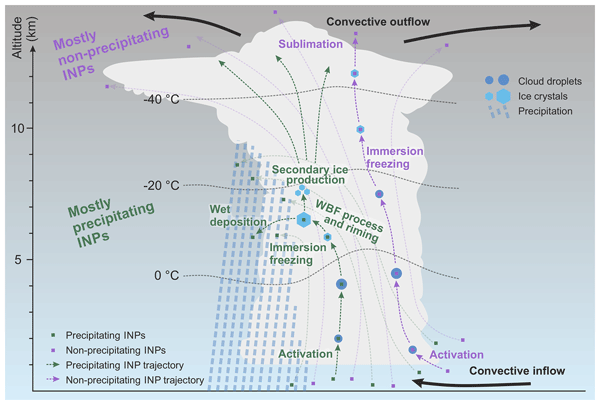
Jonas Schaefer, Sarah Grawe, Hans-Christian Clemen, Stephan Mertes, Johannes Schneider, Bruno Wetzel, Daniel Sauer, Jennifer Wolf, Laura Tomsche, Johanna Mayer, Roland Schrödner, Silvia Henning, Tina Jurkat-Witschas, Christiane Voigt, Helmut Ziereis, Theresa Harlaß, Mira Pöhlker, and Frank Stratmann
Atmos. Chem. Phys., 26, 12505–12520, https://doi.org/10.5194/acp-26-12505-2026, https://doi.org/10.5194/acp-26-12505-2026, 2026
Short summary
Short summary
Ice-nucleating particles (INP) are aerosol particles important for ice formation in clouds droplets and thereby influence climate. This study uses airborne measurements over Europe to show how INP are transported through thunderstorms. We show which particles are washed out and which are are transported into the higher troposphere, where they can again affect cloud ice formation. The findings improve understanding of atmospheric particle distribution and help refine climate models.
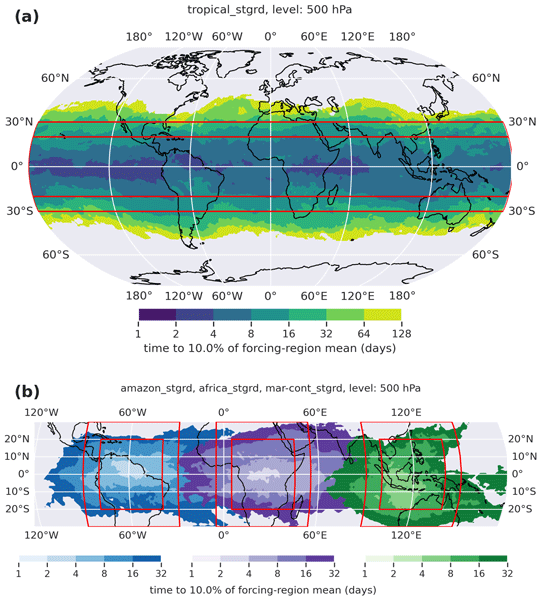
Lianet Hernández Pardo, Joachim Curtius, Patrick Jöckel, J. Moritz Menken, Christopher Pöhlker, Mira Pöhlker, and Anna Possner
Atmos. Chem. Phys., 26, 12275–12293, https://doi.org/10.5194/acp-26-12275-2026, https://doi.org/10.5194/acp-26-12275-2026, 2026
Short summary
Short summary
Many tiny particles are formed high in the tropical atmosphere, but their impact lower down is unclear. We studied how these particles move downward using long-term computer simulations. We found that particles can reach middle levels of the atmosphere within a week, carried by winds. These results help us understand how pollution and clouds might change as particles spread around the world.
Yifan Yang, Thomas Müller, Baseerat Romshoo, Jens Voigtländer, and Mira L. Pöhlker
EGUsphere, https://doi.org/10.5194/egusphere-2026-5074, https://doi.org/10.5194/egusphere-2026-5074, 2026
This preprint is open for discussion and under review for Atmospheric Chemistry and Physics (ACP).
Short summary
Short summary
Black carbon particles absorb sunlight and warm the atmosphere. After emission, they become coated by other airborne material, but this coating is not evenly distributed among particles. We found that differences in coating amount and particle size can strongly change the overall light absorption of black carbon. Accounting for this particle-to-particle variability can improve estimates of black carbon’s climate effects.
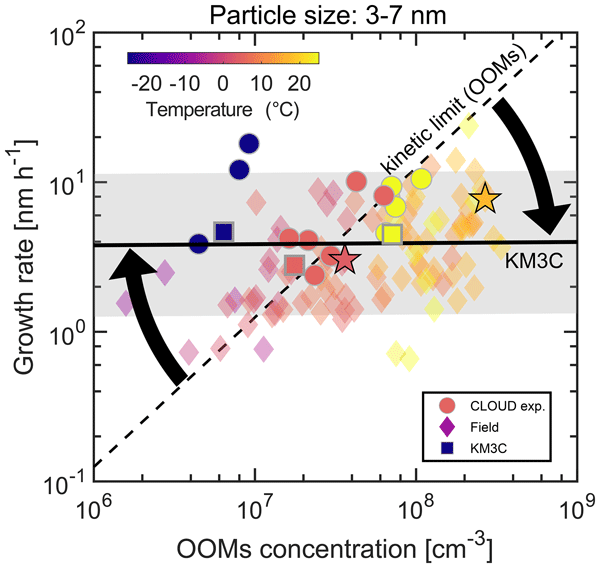
Zhiqiang Zhang, Hyun Gu Kang, Ulrich Pöschl, and Thomas Berkemeier
Atmos. Chem. Phys., 26, 12037–12047, https://doi.org/10.5194/acp-26-12037-2026, https://doi.org/10.5194/acp-26-12037-2026, 2026
Short summary
Short summary
New particle formation in the atmosphere has long been a scientific conundrum because nanoparticle growth rates are less dependent on condensable vapor concentration than expected. We have developed a new multiphase chemical kinetics model that reconciles observational data from field measurements and chamber experiments. We uncover an effective buffering of particle growth rates through antagonistic effects concerning particle phase state and shifts in volatility distributions.
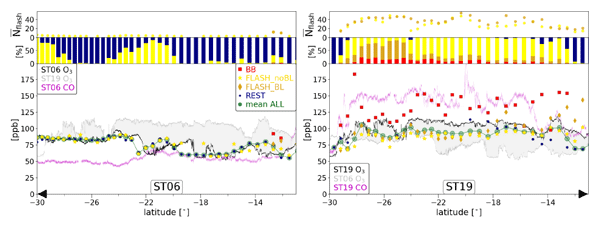
Linda Smoydzin, Vera Bense, Heiko Bozem, Philipp Joppe, Daniel Kunkel, Hans-Christoph Lachnitt, Holger Tost, Andreas Zahn, Helmut Ziereis, Martin Riese, and Peter Hoor
Atmos. Chem. Phys., 26, 11857–11874, https://doi.org/10.5194/acp-26-11857-2026, https://doi.org/10.5194/acp-26-11857-2026, 2026
Short summary
Short summary
During a research flight in early October elevated upper tropospheric mixing ratios of CO, NO, NOy and O3 were observed over a distance of more than 1000 km east of the Brasilian coast. Ozone mixing ratios are 20–40 ppbv higher than during a flight in early September. By combining aircraft observations with model simulations we find that ozone production from biomass burning over Amazonia caused predominantly the ozone enhancements which have a local effect on the radiative forcing of 50 mW m−2.
Ashmi Mishra, Steven Lelieveld, Matteo Krüger, Steven J. Campbell, Deepchandra Srivastava, Grazia Maria Lanzafame, Sophie Tomaz, Olivier Favez, Nicolas Bonnaire, Franco Lucarelli, Laurent Y. Alleman, Gaëlle Uzu, Jean-Luc Jaffrezo, Gang I. Chen, David C. Green, Max Priestman, Anja H. Tremper, Alexandre Barth, Markus Kalberer, Benjamin A. Musa Bandowe, Gerhard Lammel, Ulrich Pöschl, Pourya Shahpoury, Alexandre Albinet, and Thomas Berkemeier
Atmos. Chem. Phys., 26, 10605–10627, https://doi.org/10.5194/acp-26-10605-2026, https://doi.org/10.5194/acp-26-10605-2026, 2026
Short summary
Short summary
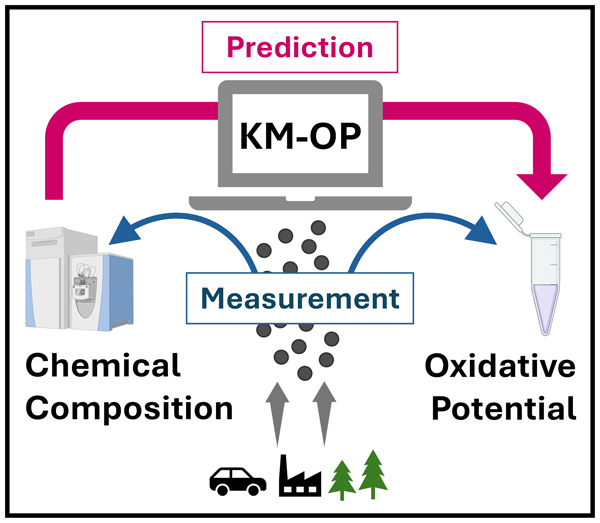
In this study, we develop and apply a kinetic model that estimates oxidative potential (OP) based on particulate matter (PM) composition. The model consolidates a large set of laboratory data from different OP assays in the presence of organic molecules, metals, and quinones. We applied the model to field data of PM composition and OP and found good agreement across three sites. The model analysis indicates that OP is mainly driven by organic molecules and copper.
Fatih Ekinci, Oliver Eppers, Oliver Appel, Felix Ploeger, Antonis Dragoneas, Sergej Molleker, Philipp Brauner, Hans-Christoph Lachnitt, Franziska Weyland, Linda Ort, Nicolas Emig, Hans-Christian Clemen, Laura Tomsche, Martin Ebert, Peter Hoor, Bärbel Vogel, Yafang Cheng, Johannes Schneider, Stephan Borrmann, and Franziska Köllner
Atmos. Chem. Phys., 26, 10399–10421, https://doi.org/10.5194/acp-26-10399-2026, https://doi.org/10.5194/acp-26-10399-2026, 2026
Short summary
Short summary
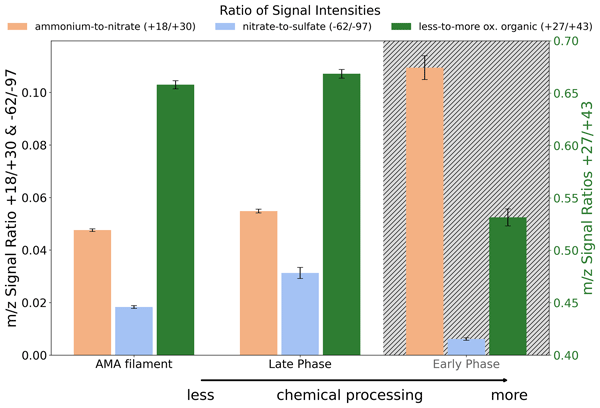
This study shows that aerosol transported from the Asian summer monsoon region can substantially alter the background composition of the extratropical lower stratosphere. Aircraft-based measurements and model simulations reveal a strong increase of ammonium nitrate aerosol from summer to autumn 2023 caused by transport of young air masses from South and East Asia. These particles can persist for months and undergo chemical aging.
Samuel Ruhl, Matthias Kohl, Rima Baalbaki, Christos Xenofontos, Ryan Vella, Sergey Gromov, Xu-Cheng He, Jiali Shen, Dina Alfaouri, Samira Atabakhsh, Lubna Dada, Jenna DeVivo, Jonathan Duplissy, Imad El Haddad, Hartwig Harder, Tuija Jokinen, Heikki Junninen, Vijay P. Kanawade, Milin K. Sebastian, Hannah Klebach, Markku Kulmala, Felix Kunkler, Jos Lelieveld, Katrianne Lehtipalo, Clara J. Lietzke, Lu Liu, Roy Mauldin, Bernhard Mentler, Ottmar Möhler, Tuukka Petäjä, Douglas M. Russell, Mario Simon, Roseline C. Thakur, Wenjuan Yu, Jiangyi Zhang, Zhensen Zheng, Jasper Kirkby, Holger Tost, Theodoros Christoudias, Rolf Sander, and Andrea Pozzer
EGUsphere, https://doi.org/10.5194/egusphere-2026-4020, https://doi.org/10.5194/egusphere-2026-4020, 2026
This preprint is open for discussion and under review for Atmospheric Chemistry and Physics (ACP).
Short summary
Short summary
Marine microbes release sulfur gases that form tiny particles able to seed clouds. Using a global chemistry-climate model, we compare four schemes for how these gases oxidise and test them against ship and ground measurements. We find that methanesulfonic acid can drive new particle formation as strongly as sulfuric acid over the cold Southern Ocean, supplying around 25 % of the cloud-forming particles there, a natural, climate-relevant source that models often overlook.
Aino Ovaska, Daniel Holmberg, Elio Rauth, Mansour Alghamdi, Paulo Artaxo, Eija Asmi, John Backman, Benjamin Bergmans, Matthew Boyer, Liezl Bredenkamp, Maurizio Busetto, Delano Campos De Oliveira, Juan Andrés Casquero-Vera, Darius Ceburnis, Tak Chan, Tommy Chan, Sebastien Conil, Daniele Contini, Suzanne Crumeyrolle, Valentin Duflot, Kostas Eleftheriadis, Johan Esveld, Ekaterina Ezhova, Markus Fiebig, Shahzad Gani, Olga Garmash, Francisco Gómez-Moreno, Roy M. Harrison, Andras Hoffer, Rakesh Hooda, Antti Hyvärinen, Tareq Hussein, Jorma Joutsensaari, Nikos Kalivitis, Heinz Kaminski, Jutta Kesti, Radovan Krejci, Adam Kristensson, Chongai Kuang, Markku Kulmala, Lauri Laakso, Ari Leskinen, Heikki Lihavainen, Andreas Massling, Maik Merkel, Steffen Noe, Jakub Ondracek, Noemí Perez, Jean-Eudes Petit, Tuukka Petäjä, Michael Pikridas, Christopher Pöhlker, Mira Pöhlker, Jean-Philippe Putaud, Ximeng Qi, Cristina Reche, Sergio Rodríguez, Petr Roztocil, Jean Sciare, Karine Sellegri, Dongjie Shang, Ashish Singh, Mikko Sipilä, Henrik Skov, Mar Sorribas, Tamanna Subba, Junying Sun, Peter Tunved, Ville Vakkari, Pieter G. Van Zyl, Aki Virkkula, Jens Voigtländer, Kay Weinhold, Alfred Wiedensohler, Hee-Jung Yoo, Putian Zhou, Kai Puolamäki, Tuomo Nieminen, Veli-Matti Kerminen, Victoria A. Sinclair, and Pauli Paasonen
Earth Syst. Sci. Data Discuss., https://doi.org/10.5194/essd-2026-415, https://doi.org/10.5194/essd-2026-415, 2026
Preprint under review for ESSD
Short summary
Short summary
All clouds form around aerosol particles, and their abundance influences cloud properties. In turn, clouds affect climate by changing how energy moves through the atmosphere, making them important for climate change. To better understand these interactions, we need accurate information on how many aerosol particles are in the atmosphere. Therefore, we have developed a new 21-year global dataset of particle concentrations relevant for cloud formation.
Costanza Civale, Maria Dolores Andrés Hernández, Jean-Philippe Putaud, Francesca Barnaba, Henri Diémoz, Johannes Schneider, Helmut Ziereis, Katharina Kaiser, Jörg Schmidt, Ovid Oktavian Krüger, Bruna Holanda, Robert Baumann, Benjamin Weyland, Eric Förster, Midhun George, Yangzhuoran Liu, Daniel Sauer, Jennifer Wolf, Annachiara Bellini, Birger Bohn, Klaus Pfeilsticker, and John Philip Burrows
Atmos. Chem. Phys., 26, 9827–9855, https://doi.org/10.5194/acp-26-9827-2026, https://doi.org/10.5194/acp-26-9827-2026, 2026
Short summary
Short summary
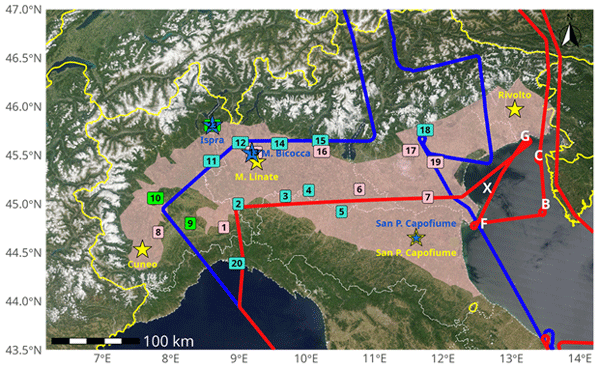
This study combines measurements of gases and particles at the ground and on-board an instrumented aircraft to investigate pollution transport over the Po Valley, a major atmospheric pollution hotspot in Europe. Overall, the extensive data set obtained at different altitudes provides insight into the mixing of pollution plumes and their export towards the Adriatic coast as well as with naturally occurring dust and its impact on air quality over the Po Plain.
Matthias Kohl, Christoph Brühl, Holger Tost, Christos Xenofontos, Theodoros Christoudias, Sergey Gromov, Oliver Appel, Stephan Borrmann, Adam Bourassa, Pedro Campunzano-Jost, Yafang Cheng, Oliver Eppers, Karl D. Froyd, Bruna A. Holanda, Jose L. Jimenez, Patrick Jöckel, Philipp Joppe, Katharina Kaiser, Joseph M. Katich, Klaus Klingmüller, Franziska Köllner, Agnieszka Kupc, Anna Martin, Christopher Pöhlker, Mira L. Pöhlker, Ulrich Pöschl, Landon Rieger, Samuel Ruhl, Gregory P. Schill, Johannes Schneider, Christiane Schulz, Joshua P. Schwarz, Alexandra P. Tsimpidi, Ryan Vella, Christina J. Williamson, Yifan Yang, Daniel Zawada, Jos Lelieveld, and Andrea Pozzer
EGUsphere, https://doi.org/10.5194/egusphere-2026-3649, https://doi.org/10.5194/egusphere-2026-3649, 2026
Short summary
Short summary
Aerosols are crucial for Earth's climate, yet their vertical distribution remains poorly understood. We present first consistent global simulations of aerosol distributions and composition from the Earth's surface to the stratosphere, validated by extensive observations. Key findings include a global minimum in aerosol mass in the free troposphere, a significant contribution of organic aerosol in the lower stratosphere, and limited transport of primary particles to the stratosphere.
Cecilia Righi, Mihai Ciobanu, Neha Deot, Tuija Jokinen, Chengfeng Liu, Qi Yuan, Lauriane Lucie Josette Quéléver, Spiro Jorga, Veronika Pospisilova, Lisa Beck, Mario Simon, Marcel Zauner-Wieczorek, Ruben Soler, Teresa Vera, Amalia Muñoz, Lauri Reino Ahonen, Chao Yan, Tuukka Petäjä, and Nina Sarnela
EGUsphere, https://doi.org/10.5194/egusphere-2026-3794, https://doi.org/10.5194/egusphere-2026-3794, 2026
Short summary
Short summary
Chemical ionization mass spectrometry is widely used to detect condensable vapors as sulfuric acid and highly oxygenated organic molecules, but results across studies are not always comparable. In summer 2024, an intercomparison campaign involving six instruments was conducted at a boreal forest site. Comparable measurements were achievable when all calibration and correction factors were applied. Instrument behavior depended more on inlet design and operating conditions than reagent ion choice.
Neil M. Donahue, Lubna Dada, Dominik Stolzenburg, Eva Sommer, Mario Simon, Meredith Schervish, Jenna DeVivo, Alexandra Stinchfield, Natalie Burton, Nirvan Bhattacharyya, Brandon Lopez, Mingyi Wang, Wiebke Scholz, João Almeida, Bin Zhao, Martin Heinritzi, Hamish Gordon, Armin Hansel, Joachim Curtius, Katrianne Lehtipalo, Imad El Haddad, Jasper Kirkby, Richard Flagan, Markku Kulmala, and Douglas Worsnop
Atmos. Chem. Phys., 26, 8311–8339, https://doi.org/10.5194/acp-26-8311-2026, https://doi.org/10.5194/acp-26-8311-2026, 2026
Short summary
Short summary
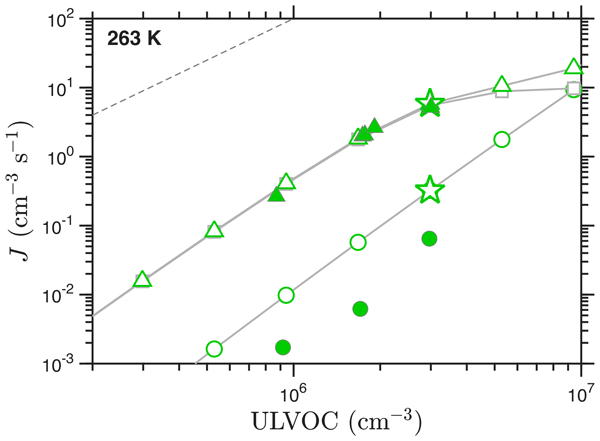
A new theory has the potential to accurately describe changes to atmospheric particle formation from the pre-industrial to the present and onwards along socioeconomic pathways addressing air pollution and climate. The model places organic nucleation in the context of the Volatility Basis Set and reveals a competition between chemistry, which accelerates as temperature rises, and vapor pressure, which drops as temperature decreases. The model reproduces observations from the CERN (European Organization for Nuclear Research) CLOUD (Cosmics Leaving Outdoor Droplets) chamber.
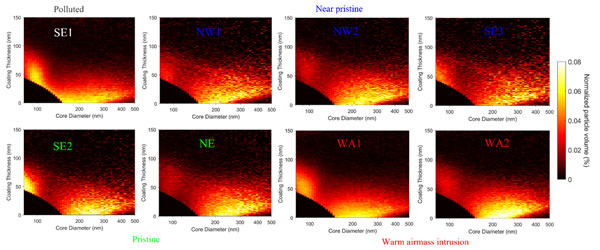
Babu Suja Arun, Thomas Müller, Mira L. Pöhlker, Andreas Held, Christopher Pöhlker, Manuela van Pinxteren, Yifan Yang, Sabine Lüchtrath, Andreas Walbröl, Janna E. Rückert, Philipp Oehlke, Maik Merkel, and Birgit Wehner
Atmos. Chem. Phys., 26, 7287–7310, https://doi.org/10.5194/acp-26-7287-2026, https://doi.org/10.5194/acp-26-7287-2026, 2026
Short summary
Short summary
Black carbon (BC) aerosols absorb solar radiation and perturb the Arctic energy budget, yet in-situ studies of their microphysical properties and mixing state in the Arctic remain scarce. Based on observations from a shipborne expedition in the Arctic Ocean, we found substantial BC concentrations and showed that warm airmass intrusions enhanced BC levels. Aged BC exhibited enhanced light absorption. These findings will help improve the representation of BC in climate models.
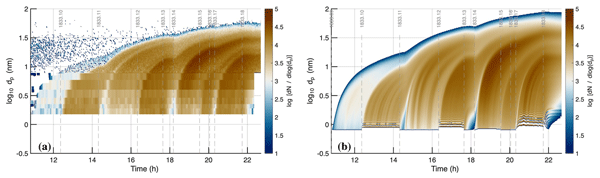
Neil M. Donahue, Victoria Hofbauer, Henning Finkenzeller, Dominik Stolzenburg, Paulus S. Bauer, Randall Chiu, Lubna Dada, Jonathan Duplissy, Xu-Cheng He, Martin Heinritzi, Christopher R. Hoyle, Andreas Kürten, Aleksandr Kvashnin, Katrianne Lehtipalo, Naser Mahfouz, Vladimir Makhmutov, Roy L. Mauldin III, Ugo Molteni, Lauriane L. J. Quéléver, Matti Rissanen, Siegfried Schobesberger, Mario Simon, Andrea C. Wagner, Mingyi Wang, Chao Yan, Penglin Ye, Ilona Riipinen, Hamish Gordon, Joachim Curtius, Armin Hansel, Imad El Haddad, Markku Kulmala, Douglas R. Worsnop, Rainer Volkamer, Paul M. Winkler, Jasper Kirkby, and Richard Flagan
Atmos. Meas. Tech., 19, 3363–3396, https://doi.org/10.5194/amt-19-3363-2026, https://doi.org/10.5194/amt-19-3363-2026, 2026
Short summary
Short summary
We describe accurate measurement of particle formation and growth in the CERN CLOUD (European Council for Nuclear Research Cosmics Leaving OUtdoor Droplets) chamber, using a suite of gas- and particle-phase instruments. The interconnected measurements establish high accuracy in key particle properties and critically important gas-phase sulfuric acid. This is a template for accurate calibration of similar experiments and thus accurate determination of aerosol nucleation and growth rates, which are an important source of uncertainty in climate science.
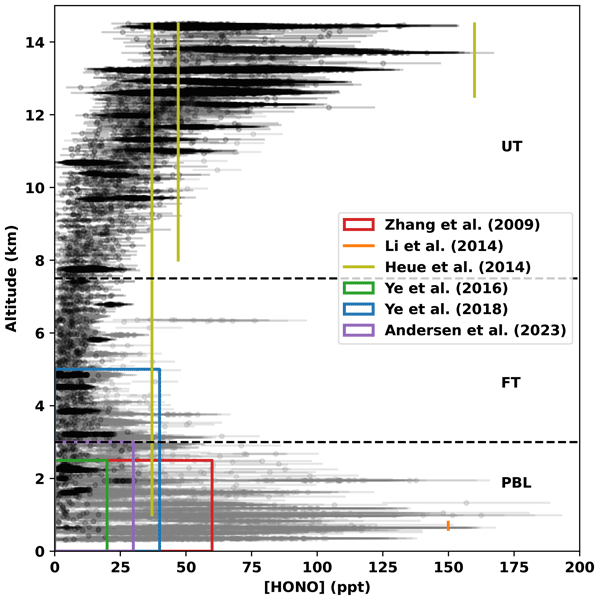
Benjamin Weyland, Simon Rosanka, Domenico Taraborrelli, Birger Bohn, Andreas Zahn, Florian Obersteiner, Eric Förster, Mariano Mertens, Patrick Jöckel, Helmut Ziereis, Katharina Kaiser, Horst Fischer, John N. Crowley, Nijing Wang, Achim Edtbauer, Jonathan Williams, Maria Dolores Andrés Hernández, John P. Burrows, Flora Kluge, Meike K. Rotermund, Andre Butz, and Klaus Pfeilsticker
Atmos. Chem. Phys., 26, 6825–6856, https://doi.org/10.5194/acp-26-6825-2026, https://doi.org/10.5194/acp-26-6825-2026, 2026
Short summary
Short summary
The destruction by sunlight of nitrous acid (HONO) produces the so-called detergent of the atmosphere. HONO has been measured in concentrations which exceed predictions based on known chemistry for decades. Several reactions have been proposed which may explain this excess HONO. This study reports on airborne measurements of HONO; the observations exceed predictions and form a C-shaped profile in the troposphere. Together with a host of other measurements, various reactions are investigated.
David J. Simon, Jonas Schaefer, Jörg Hartmann, Benjamin Kirbus, Joshua Müller, Markus Hartmann, Bruno Wetzel, Laura Köhler, Anna-Marie Jörss, Kay Weinhold, Andreas Herber, Zsófia Jurányi, Silvia Henning, Gregory C. Roberts, Manfred Wendisch, Mira L. Pöhlker, and Frank Stratmann
EGUsphere, https://doi.org/10.5194/egusphere-2026-2215, https://doi.org/10.5194/egusphere-2026-2215, 2026
Short summary
Short summary
We investigate the occurrence of newly formed aerosol particles in the Arctic atmosphere by analyzing aerosol particle measurements conducted aboard a research aircraft in April 2024. We frequently detected newly formed particles at altitudes of up to 4 km, while many previous studies had predominantly found such particles close to the surface. Newly formed particles were associated with air mass transport from lower latitudes, the occurrence of clouds, as well as the presence of sea ice.
Shravan Deshmukh, Laurent Poulain, Birgit Wehner, Silvia Henning, Hartmut Herrmann, and Mira Pöhlker
EGUsphere, https://doi.org/10.5194/egusphere-2026-1992, https://doi.org/10.5194/egusphere-2026-1992, 2026
Short summary
Short summary
Improved representation of aerosol hygroscopicity is critical for understanding how atmospheric particles influence cloud formation, climate, air quality, and human health. This work advances understanding of aerosol hygroscopicity by connecting laboratory measurements of organic aerosol properties with ambient observations through an explainable machine learning framework.
Philipp Brauner, Oliver Appel, Oliver Eppers, Franziska Köllner, Hans-Christian Clemen, Tiziana Bräuer, Hans-Christoph Lachnitt, Katharina Kaiser, Johannes Schneider, Antonis Dragoneas, Andreas Hünig, Sergej Molleker, Bruce E. Anderson, Yafang Cheng, Hans Schlager, Christiane Voigt, and Stephan Borrmann
EGUsphere, https://doi.org/10.5194/egusphere-2026-2161, https://doi.org/10.5194/egusphere-2026-2161, 2026
Preprint archived
Short summary
Short summary
Airborne measurements of the aerosol chemical composition were conducted in the 2018 wintertime tropopause region over Germany using a hybrid aerosol mass spectrometer, regarding the atmospheric background and aircraft exhaust plumes. Biomass burning aerosol of North American wildfires contributes to the aerosol population. Soot and engine oil were attributed to aircraft exhaust, and were detected in contrail residuals, implying their impact on chemical processes and properties of contrails.
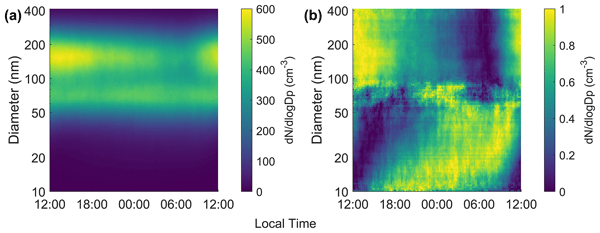
Bruno B. Meller, Marco A. Franco, Rafael Valiati, Christopher Pöhlker, Luiz A. T. Machado, Florian Ditas, Leslie A. Kremper, Subha S. Raj, Cleo Q. Dias-Júnior, Flávio A. F. D'Oliveira, Luciana V. Rizzo, Ulrich Pöschl, and Paulo Artaxo
Atmos. Chem. Phys., 26, 4885–4899, https://doi.org/10.5194/acp-26-4885-2026, https://doi.org/10.5194/acp-26-4885-2026, 2026
Short summary
Short summary
Aerosols are tiny particles that help clouds form and influence the climate. In the Amazon, clear events of new aerosol particle formation are rare, making it difficult to explain their origin. Using ten years of measurements, we discovered a subtle but frequent process called Quiet New Particle Formation. This hidden mechanism slowly produces and grows small particles and is responsible for nearly half of the smallest aerosols observed during the wet season.
Yannick Emanuel Anders, Karoline Block, Mira Pöhlker, and Johannes Quaas
EGUsphere, https://doi.org/10.5194/egusphere-2026-1404, https://doi.org/10.5194/egusphere-2026-1404, 2026
Short summary
Short summary
Particles in the atmosphere can trigger the formation of cloud droplets, affecting cloud properties and climate. This study evaluates a new global dataset of these particles with measurements from 25 sites around the world. The variability in time and space and their conditional formation behaviour is analysed. The authors identify systematic biases and introduce a simple correction based on observations that greatly improves the dataset’s accuracy.

Chun Hang Chau, Peter Hoor, Katharina Kaiser, and Holger Tost
Atmos. Chem. Phys., 26, 3637–3652, https://doi.org/10.5194/acp-26-3637-2026, https://doi.org/10.5194/acp-26-3637-2026, 2026
Short summary
Short summary
This study examines the potential impact of different greenhouse gases to vertical mixing by clear air turbulence in the upper troposphere and lower stratosphere . We found that ozone is most sensitive to vertical mixing and could lead to cooling at the top of the atmosphere by -0.2 W/m2. We also found that the vertical mixing by clear air turbulence could lead to changes in atmospheric chemistry including changing the methane lifetime and the ozone sensitivity.
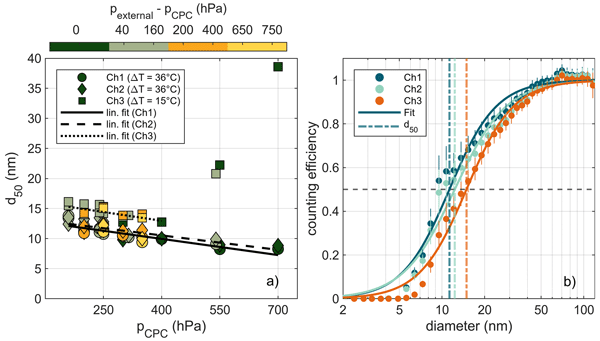
Sarah Richter, Timo Keber, Martin Heinritzi, Lisa Beck, Laurin Merkel, Sarah Kirchhoff, Jann Schrod, Patrick Weber, and Joachim Curtius
Atmos. Meas. Tech., 19, 1093–1116, https://doi.org/10.5194/amt-19-1093-2026, https://doi.org/10.5194/amt-19-1093-2026, 2026
Short summary
Short summary
We constructed and characterized a Fluorinert multi-channel Condensation Particle Counter for aircraft applications that comprises three channels and a pressure regulation system to measure nucleation mode particles in the upper troposphere. The cutoffs were determined at several ambient and internal pressures and sample flows. During the first aircraft campaign TPEx we were able to identify possible new particle formation events.
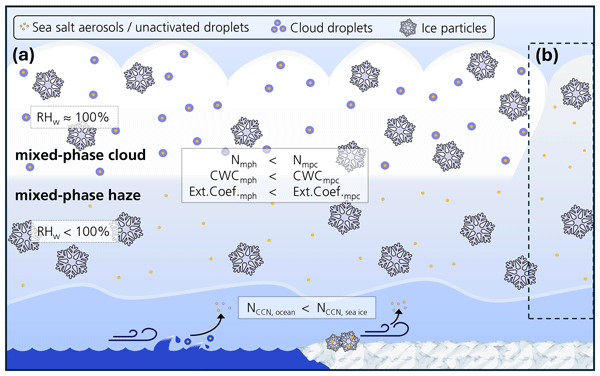
Manuel Moser, Christiane Voigt, Oliver Eppers, Johannes Lucke, Elena De La Torre Castro, Johanna Mayer, Regis Dupuy, Guillaume Mioche, Olivier Jourdan, Hans-Christian Clemen, Johannes Schneider, Philipp Joppe, Stephan Mertes, Bruno Wetzel, Stephan Borrmann, Marcus Klingebiel, Mario Mech, Christof Lüpkes, Susanne Crewell, André Ehrlich, Andreas Herber, and Manfred Wendisch
Atmos. Chem. Phys., 26, 1867–1887, https://doi.org/10.5194/acp-26-1867-2026, https://doi.org/10.5194/acp-26-1867-2026, 2026
Short summary
Short summary
In this study we analyzed Arctic mixed-phase clouds using airborne in-situ measurements in spring 2022. Based on microphysical properties, we show that within these clouds a distinction must be made between classic mixed-phase clouds and a mixed-phase haze regime. Instead of supercooled droplets, the haze regime contains large wet sea salt aerosols. These findings improve our understanding of Arctic low-level cloud processes.
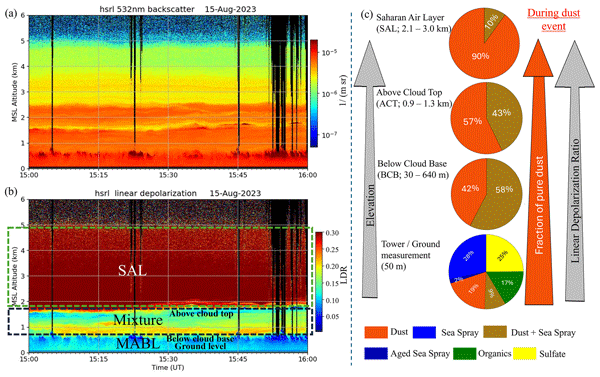
Sujan Shrestha, Robert E. Holz, Willem J. Marais, Zachary Buckholtz, Ilya Razenkov, Edwin Eloranta, Jeffrey S. Reid, Hope E. Elliott, Nurun Nahar Lata, Zezhen Cheng, Swarup China, Edmund Blades, Albert D. Ortiz, Rebecca Chewitt-Lucas, Alyson Allen, Devon Blades, Ria Agrawal, Elizabeth A. Reid, Jesus Ruiz-Plancarte, Anthony Bucholtz, Ryan Yamaguchi, Qing Wang, Thomas Eck, Elena Lind, Mira L. Pöhlker, Andrew P. Ault, and Cassandra J. Gaston
Atmos. Chem. Phys., 26, 983–999, https://doi.org/10.5194/acp-26-983-2026, https://doi.org/10.5194/acp-26-983-2026, 2026
Short summary
Short summary
Coordinated observations from MAGPIE 2023 show that Saharan dust in the marine atmospheric boundary layer becomes internally mixed with sea spray. This mixing increases particle sphericity and hygroscopicity, likely leading to suppressed lidar linear depolarization ratios despite high dust concentrations. The findings have key implications for interpreting lidar-derived dust retrievals, estimating surface dust from satellite products, and improving dust representation in models.
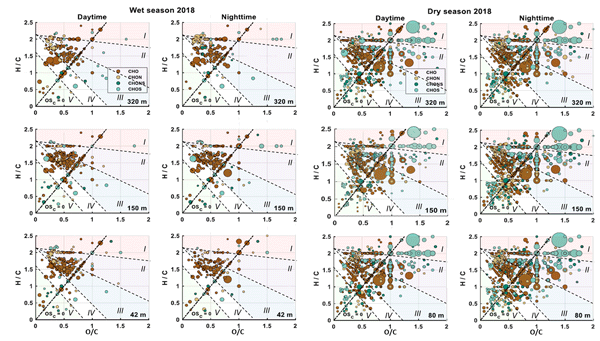
Denis Leppla, Stefanie Hildmann, Nora Zannoni, Leslie A. Kremper, Bruna A. Holanda, Jonathan Williams, Christopher Pöhlker, Stefan Wolff, Marta Sà, Maria Christina Solci, Ulrich Pöschl, and Thorsten Hoffmann
Atmos. Chem. Phys., 26, 365–390, https://doi.org/10.5194/acp-26-365-2026, https://doi.org/10.5194/acp-26-365-2026, 2026
Short summary
Short summary
The chemical composition of organic particles in the Amazon rainforest was investigated to understand how biogenic and human emissions influence the atmosphere in this unique ecosystem. Seasonal patterns were found where wet seasons were dominated by biogenic compounds from natural sources while dry seasons showed increased fire-related pollutants. These findings reveal how emissions, fires and long-range transport affect atmospheric chemistry, with implications for climate models.
Sebastian Brill, Björn Nillius, Jan-David Förster, Paulo Artaxo, Florian Ditas, Dennis Geis, Christian Gurk, Thomas Kenntner, Thomas Klimach, Mark Lamneck, Rafael Valiati, Bettina Weber, Stefan Wolff, Ulrich Pöschl, and Christopher Pöhlker
Atmos. Meas. Tech., 19, 101–118, https://doi.org/10.5194/amt-19-101-2026, https://doi.org/10.5194/amt-19-101-2026, 2026
Short summary
Short summary
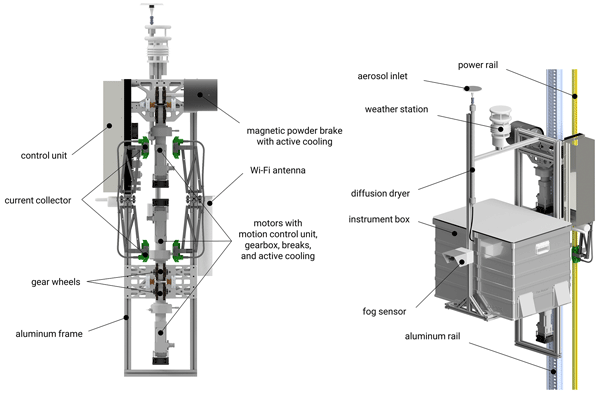
Highly resolved vertical profiles are crucial for understanding ecosystem–atmosphere interactions. We developed the robotic lift (RoLi) as a platform for vertical profile measurements at the Amazon Tall Tower Observatory in the central Amazon basin. First results reveal spatiotemporal patterns in temperature, humidity, fog, and aerosol profiles, proving RoLi's technical capability to resolve the diel interplay of convectively mixed daytime and stable stratified nighttime conditions.

Patrick Konjari, Christian Rolf, Martina Krämer, Armin Afchine, Nicole Spelten, Irene Bartolome Garcia, Annette Miltenberger, Nicolas Emig, Philipp Joppe, Johannes Schneider, Yun Li, Andreas Petzold, Heiko Bozem, and Peter Hoor
Atmos. Chem. Phys., 25, 18031–18050, https://doi.org/10.5194/acp-25-18031-2025, https://doi.org/10.5194/acp-25-18031-2025, 2025
Short summary
Short summary
We investigated how a powerful storm over southern Sweden in June 2024 transported ice particles and moist air into the normally dry stratosphere. We observed unusually high water vapor and ice levels up to 1.5 kilometers above the tropopause. Although the extra water vapor lasted only a few days to weeks, it shows how such storms can temporarily alter the upper atmosphere’s composition.
Jianqiang Zhu, Guo Li, Uwe Kuhn, Bruno Backes Meller, Christopher Pöhlker, Paulo Artaxo, Ulrich Pöschl, Yafang Cheng, and Hang Su
Atmos. Chem. Phys., 25, 17667–17684, https://doi.org/10.5194/acp-25-17667-2025, https://doi.org/10.5194/acp-25-17667-2025, 2025
Short summary
Short summary
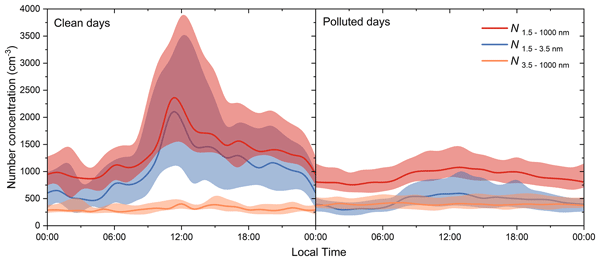
The manuscript reports unique measurements of sub-40 nm particles and ions, especially those smaller than 10 nm, in the Amazon from December 2022 to January 2023. A large number of sub-3 nm particles and naturally charged ions were present in the Amazonia boundary layer, and they showed a clear diurnal variation. The research will contribute to a better understanding of atmospheric processes in the pristine environment.
Aino Ovaska, Elio Rauth, Daniel Holmberg, Paulo Artaxo, John Backman, Benjamin Bergmans, Don Collins, Marco Aurélio Franco, Shahzad Gani, Roy M. Harrison, Rakesh K. Hooda, Tareq Hussein, Antti-Pekka Hyvärinen, Kerneels Jaars, Adam Kristensson, Markku Kulmala, Lauri Laakso, Ari Laaksonen, Nikolaos Mihalopoulos, Colin O'Dowd, Jakub Ondracek, Tuukka Petäjä, Kristina Plauškaitė, Mira Pöhlker, Ximeng Qi, Peter Tunved, Ville Vakkari, Alfred Wiedensohler, Kai Puolamäki, Tuomo Nieminen, Veli-Matti Kerminen, Victoria A. Sinclair, and Pauli Paasonen
Aerosol Research, 3, 589–618, https://doi.org/10.5194/ar-3-589-2025, https://doi.org/10.5194/ar-3-589-2025, 2025
Short summary
Short summary
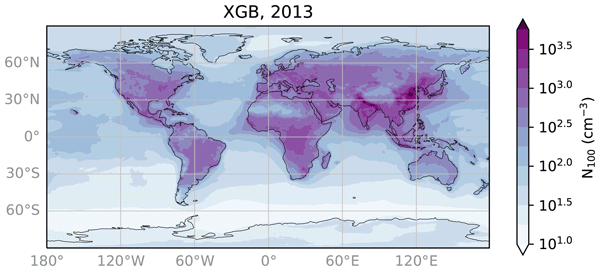
We trained machine learning models to estimate the number of aerosol particles large enough to form clouds and generated daily estimates for the entire globe. The models performed well in many continental regions but struggled in remote and marine areas. Still, this approach offers a way to quantify these particles in areas that lack direct measurements, helping us understand their influence on clouds and climate on a global scale.
Anna Breuninger, Philipp Joppe, Jonas Wilsch, Cornelis Schwenk, Heiko Bozem, Nicolas Emig, Laurin Merkel, Rainer Rossberg, Timo Keber, Arthur Kutschka, Philipp Waleska, Stefan Hofmann, Sarah Richter, Florian Ungeheuer, Konstantin Dörholt, Thorsten Hoffmann, Annette Miltenberger, Johannes Schneider, Peter Hoor, and Alexander L. Vogel
Atmos. Chem. Phys., 25, 16533–16551, https://doi.org/10.5194/acp-25-16533-2025, https://doi.org/10.5194/acp-25-16533-2025, 2025
Short summary
Short summary
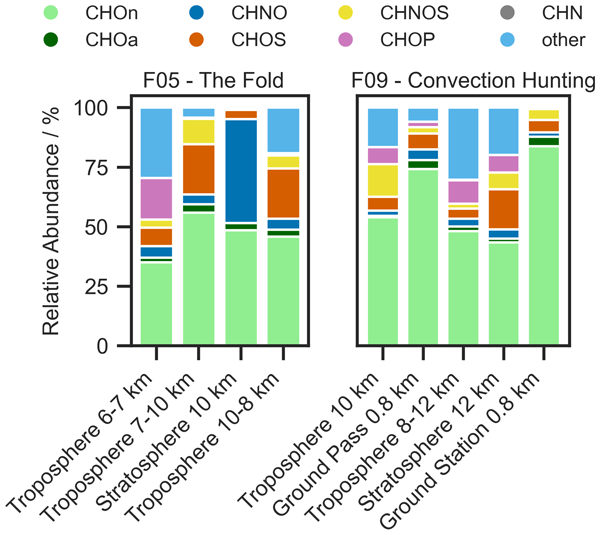
This study investigates molecular organic aerosol composition in the upper troposphere and lower stratosphere from an airborne campaign over Central Europe in summer 2024. Via ultra-high-performance liquid chromatography and high-resolution mass spectrometry of tropospheric and stratospheric filter samples, we identified various organic compounds. Our findings underscore the significant cross-tropopause transport of biogenic secondary organic aerosol and anthropogenic pollutants.
Heiko Bozem, Philipp Joppe, Yun Li, Nicolas Emig, Armin Afchine, Anna Breuninger, Joachim Curtius, Stefan Hofmann, Sadath Ismayil, Konrad Kandler, Daniel Kunkel, Arthur Kutschka, Hans-Christoph Lachnitt, Andreas Petzold, Sarah Richter, Timo Röschenthaler, Christian Rolf, Lisa Schneider, Johannes Schneider, Alexander Vogel, and Peter Hoor
Atmos. Meas. Tech., 18, 6545–6568, https://doi.org/10.5194/amt-18-6545-2025, https://doi.org/10.5194/amt-18-6545-2025, 2025
Short summary
Short summary
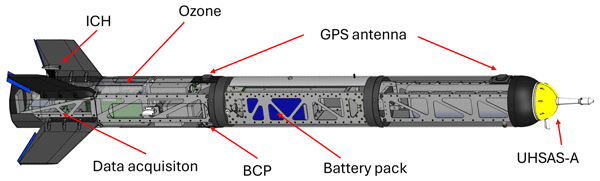
Deployed on a Learjet as a tandem measurement platform during the TPEx I (TropoPause composition gradients and mixing Experiment) campaign in June 2024, the new TPC-TOSS (TropoPause Composition Towed Sensor Shuttle) system delivers high-resolution in situ data on ozone, aerosol, and key meteorological parameters. Laboratory and in-flight tests confirmed its precision and stability. Observed gradients near the tropopause reveal active mixing and transport processes in the tropopause region.
Philipp Joppe, Johannes Schneider, Jonas Wilsch, Heiko Bozem, Anna Breuninger, Joachim Curtius, Martin Ebert, Nicolas Emig, Peter Hoor, Sadath Ismayil, Konrad Kandler, Daniel Kunkel, Isabel Kurth, Hans-Christoph Lachnitt, Yun Li, Annette Miltenberger, Sarah Richter, Christian Rolf, Lisa Schneider, Cornelis Schwenk, Nicole Spelten, Alexander L. Vogel, Yafang Cheng, and Stephan Borrmann
Atmos. Chem. Phys., 25, 15077–15103, https://doi.org/10.5194/acp-25-15077-2025, https://doi.org/10.5194/acp-25-15077-2025, 2025
Short summary
Short summary
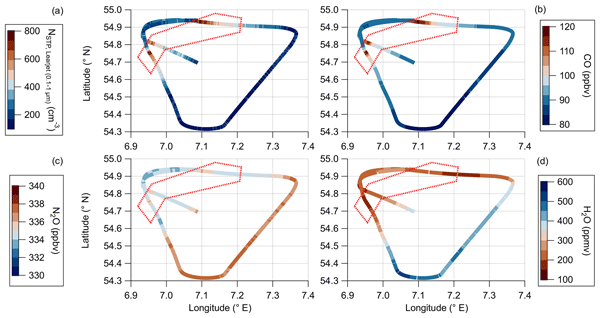
We show measurements of a filament with biomass burning influence transported by a warm conveyor belt (WCB) into the tropopause region over Europe. The pollution originates from Canadian forest fires and is transported in the lower troposphere towards Europe. The WCB transport is followed by mixing with air masses of stratospheric chemical signatures. We hypothesize that this mixing leads to a change in the vertical gradient of the potential temperature.
Rafael Valiati, Bruno B. Meller, Marco A. Franco, Luciana V. Rizzo, Luiz A. T. Machado, Sebastian Brill, Bruna A. Holanda, Leslie A. Kremper, Subha S. Raj, Samara Carbone, Cléo Q. Dias-Júnior, Fernando G. Morais, Meinrat O. Andreae, Ulrich Pöschl, Christopher Pöhlker, and Paulo Artaxo
Atmos. Chem. Phys., 25, 14923–14944, https://doi.org/10.5194/acp-25-14923-2025, https://doi.org/10.5194/acp-25-14923-2025, 2025
Short summary
Short summary
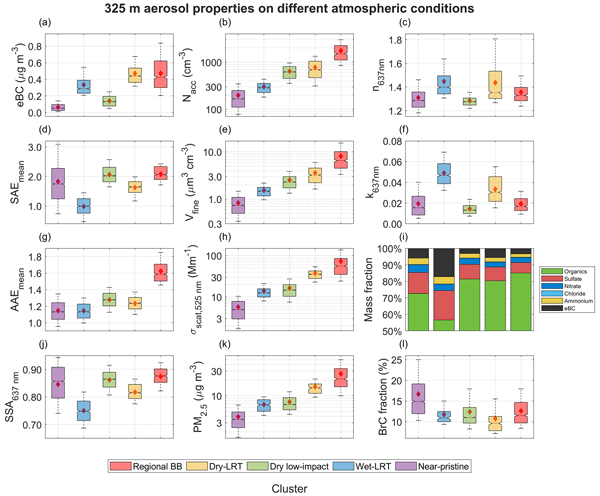
This study highlights the different aerosol populations that are commonly observed in the central Amazon. Vertical gradients of aerosol optical and chemical properties were evaluated on different atmospheric conditions, and showed distinct characteristics of these particles. Intercontinental transport events bring to the region particles with a contrasting chemical composition, while vertical transport processes influence the aerosol properties by promoting the development of coating and aging.
Barbara Ervens, Ken S. Carslaw, Thomas Koop, and Ulrich Pöschl
Atmos. Chem. Phys., 25, 13903–13952, https://doi.org/10.5194/acp-25-13903-2025, https://doi.org/10.5194/acp-25-13903-2025, 2025
Short summary
Short summary
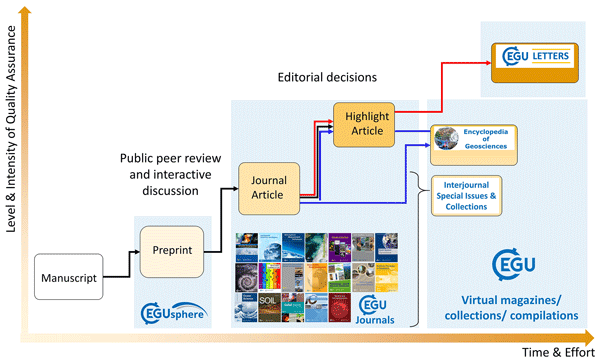
Over 25 years, the European Geosciences Union (EGU) has demonstrated the success, viability and benefits of interactive open-access (OA) publishing with public peer review in its journals, its publishing platform EGUsphere and virtual compilations. The article summarizes the evolution of the EGU/Copernicus publications and of OA publishing with interactive public peer review at large by placing the EGU/Copernicus publications in the context of current and future global open science.
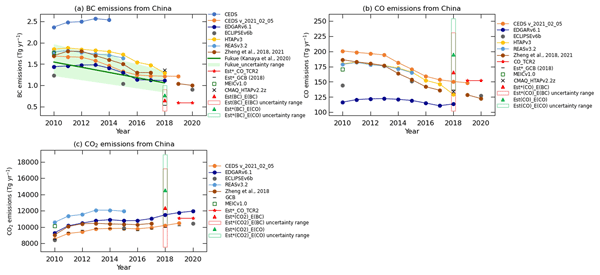
Phuc Thi Minh Ha, Yugo Kanaya, Kazuyo Yamaji, Syuichi Itahashi, Satoru Chatani, Takashi Sekiya, Maria Dolores Andrés Hernández, John Philip Burrows, Hans Schlager, Michael Lichtenstern, Mira Poehlker, and Bruna Holanda
Atmos. Chem. Phys., 25, 13429–13452, https://doi.org/10.5194/acp-25-13429-2025, https://doi.org/10.5194/acp-25-13429-2025, 2025
Short summary
Short summary
Black carbon and CO are important to climate change. EMeRGe airborne observation can identify the suitability of emission inventories used in the CMAQv5.0.2 model for Asian polluted regions. GFEDv4.1s is suitable for fire emissions. Anthropogenic BC and CO emissions from the Philippines (REASv2.1) are insufficient. The estimated Chinese emissions in 2018 are 0.65±0.25 TgBC, 166±65 TgCO, and 12.4±4.8 PgCO2, suggesting a reduction and increment for China's BC and CO emissions in the HTAPv2.2z inventory.
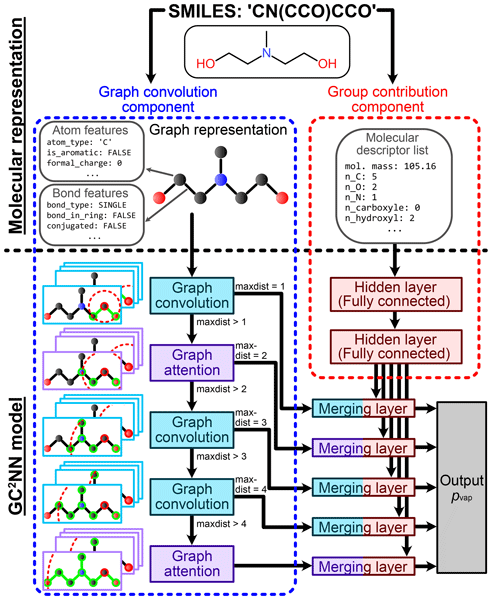
Matteo Krüger, Tommaso Galeazzo, Ivan Eremets, Bertil Schmidt, Ulrich Pöschl, Manabu Shiraiwa, and Thomas Berkemeier
Geosci. Model Dev., 18, 7357–7371, https://doi.org/10.5194/gmd-18-7357-2025, https://doi.org/10.5194/gmd-18-7357-2025, 2025
Short summary
Short summary
This work uses machine learning to predict saturation vapor pressures of atmospherically-relevant organic compounds, crucial for partitioning of secondary organic aerosol (SOA). We introduce a new method using graph convolutional neural networks, in which molecular graphs enable the model to capture molecular connectivity better than with non-structural embeddings. The method shows strong agreement with experimentally determined vapor pressures, and outperforms existing estimation methods.
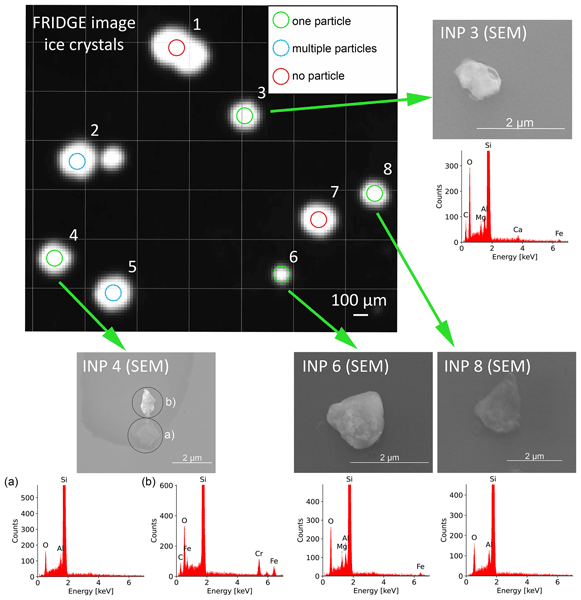
Lisa Schneider, Jann Schrod, Daniel Weber, Heinz Bingemer, Konrad Kandler, Joachim Curtius, and Martin Ebert
Atmos. Meas. Tech., 18, 5223–5245, https://doi.org/10.5194/amt-18-5223-2025, https://doi.org/10.5194/amt-18-5223-2025, 2025
Short summary
Short summary
Ice-nucleating particles (INPs) are important for cloud formation and properties affecting weather and climate. This article presents a method coupling an offline ice nucleus counter to an electron microscope to obtain information, not only about INP number concentrations but also about physico-chemical properties (e.g., size and chemical composition) relevant to ice nucleation on single particles. The method was evaluated on the basis of a case study at the high-altitude research station Jungfraujoch.
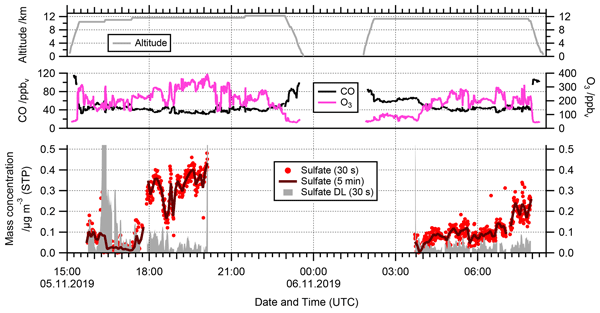
Johannes Schneider, Christiane Schulz, Florian Rubach, Anna Ludwig, Jonas Wilsch, Philipp Joppe, Christian Gurk, Sergej Molleker, Laurent Poulain, Florian Obersteiner, Torsten Gehrlein, Harald Bönisch, Andreas Zahn, Peter Hoor, Nicolas Emig, Heiko Bozem, Stephan Borrmann, and Markus Hermann
Atmos. Meas. Tech., 18, 5103–5128, https://doi.org/10.5194/amt-18-5103-2025, https://doi.org/10.5194/amt-18-5103-2025, 2025
Short summary
Short summary
An instrumented container laboratory is operated on regular commercial passenger flights to obtain a long-term representative dataset on the composition of the upper troposphere and lower stratosphere. Here we report on the development of a fully automated aerosol mass spectrometer for this project. We present technical specifications, necessary modifications for the automation, instrument calibration and comparisons, detection limits, and the first in-flight data.

Ryan Vella, Sergey Gromov, Clara M. Nussbaumer, Laura Stecher, Matthias Kohl, Samuel Ruhl, Holger Tost, Jos Lelieveld, and Andrea Pozzer
Atmos. Chem. Phys., 25, 9885–9904, https://doi.org/10.5194/acp-25-9885-2025, https://doi.org/10.5194/acp-25-9885-2025, 2025
Short summary
Short summary
This work examines the impact of replacing forests with farmland and grazing areas on atmospheric composition. Using a global climate–chemistry model, we found that deforestation reduces biogenic volatile organic compounds (BVOCs), increases farming emissions, and shifts ozone chemistry. These changes result in a slight cooling effect on the climate. Restoring natural vegetation could reverse some of these effects.
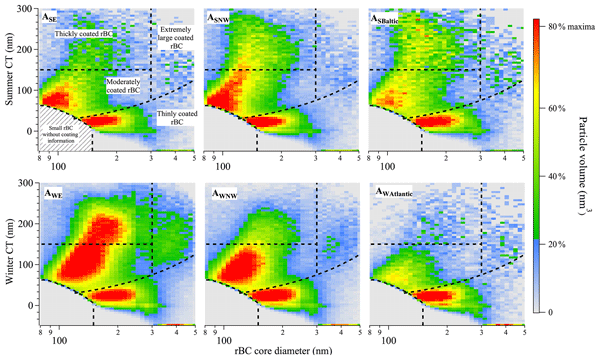
Yifan Yang, Thomas Müller, Laurent Poulain, Samira Atabakhsh, Bruna A. Holanda, Jens Voigtländer, Shubhi Arora, and Mira L. Pöhlker
Atmos. Chem. Phys., 25, 8637–8655, https://doi.org/10.5194/acp-25-8637-2025, https://doi.org/10.5194/acp-25-8637-2025, 2025
Short summary
Short summary
Black carbon (BC) is the major atmospheric aerosol that can absorb light and influence climate. We measured the physical properties of BC at a background site in Germany. In summer, BC particles were smaller and the mixture with other atmospheric components occurred during the daytime. In winter, emissions from residential heating significantly influenced BC's properties. Understanding these characteristics of BC can help to improve the accuracy of aerosol optic simulation.
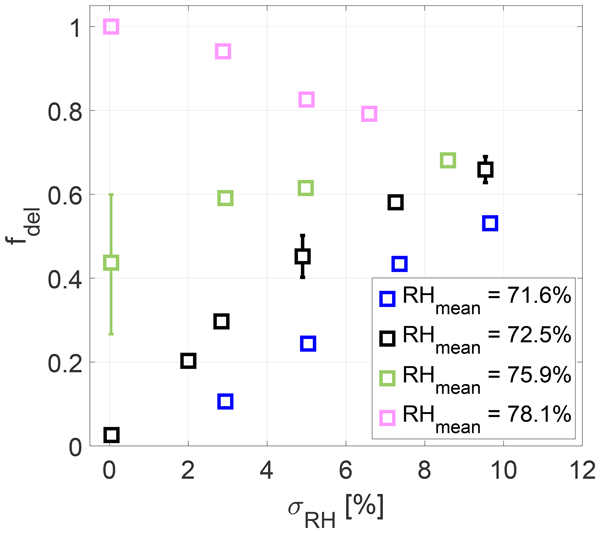
Dennis Niedermeier, Rasmus Hoffmann, Silvio Schmalfuss, Wiebke Frey, Fabian Senf, Olaf Hellmuth, Mira Pöhlker, and Frank Stratmann
Aerosol Research, 3, 219–230, https://doi.org/10.5194/ar-3-219-2025, https://doi.org/10.5194/ar-3-219-2025, 2025
Short summary
Short summary
This study examines the deliquescence behavior of NaCl particles in a turbulent humidity field using the wind tunnel LACIS-T (Turbulent Leipzig Aerosol Cloud Interaction Simulator). The results show that turbulent relative humidity (RH) fluctuations affect the number of deliquesced particles, depending on the mean RH, strength of humidity fluctuations, and particle residence time. It turns out that, in addition to the mean RH, it is essential to consider humidity fluctuations and particle history when determining the phase state of the deliquescent particles.

André Ehrlich, Susanne Crewell, Andreas Herber, Marcus Klingebiel, Christof Lüpkes, Mario Mech, Sebastian Becker, Stephan Borrmann, Heiko Bozem, Matthias Buschmann, Hans-Christian Clemen, Elena De La Torre Castro, Henning Dorff, Regis Dupuy, Oliver Eppers, Florian Ewald, Geet George, Andreas Giez, Sarah Grawe, Christophe Gourbeyre, Jörg Hartmann, Evelyn Jäkel, Philipp Joppe, Olivier Jourdan, Zsófia Jurányi, Benjamin Kirbus, Johannes Lucke, Anna E. Luebke, Maximilian Maahn, Nina Maherndl, Christian Mallaun, Johanna Mayer, Stephan Mertes, Guillaume Mioche, Manuel Moser, Hanno Müller, Veronika Pörtge, Nils Risse, Greg Roberts, Sophie Rosenburg, Johannes Röttenbacher, Michael Schäfer, Jonas Schaefer, Andreas Schäfler, Imke Schirmacher, Johannes Schneider, Sabrina Schnitt, Frank Stratmann, Christian Tatzelt, Christiane Voigt, Andreas Walbröl, Anna Weber, Bruno Wetzel, Martin Wirth, and Manfred Wendisch
Earth Syst. Sci. Data, 17, 1295–1328, https://doi.org/10.5194/essd-17-1295-2025, https://doi.org/10.5194/essd-17-1295-2025, 2025
Short summary
Short summary
This paper provides an overview of the HALO–(AC)3 aircraft campaign data sets, the campaign-specific instrument operation, data processing, and data quality. The data set comprises in situ and remote sensing observations from three research aircraft: HALO, Polar 5, and Polar 6. All data are published in the PANGAEA database by instrument-separated data subsets. It is highlighted how the scientific analysis of the HALO–(AC)3 data benefits from the coordinated operation of three aircraft.
Mega Octaviani, Benjamin A. Musa Bandowe, Qing Mu, Jake Wilson, Holger Tost, Hang Su, Yafang Cheng, Manabu Shiraiwa, Ulrich Pöschl, Thomas Berkemeier, and Gerhard Lammel
EGUsphere, https://doi.org/10.5194/egusphere-2025-186, https://doi.org/10.5194/egusphere-2025-186, 2025
This preprint is open for discussion and under review for Geoscientific Model Development (GMD).
Short summary
Short summary
This research explores the atmospheric concentration of benzo(a)pyrene (BaP), a harmful air pollutant linked to lung cancer. Using advanced Earth system modeling, the study examines how BaP's degradation varies with temperature and humidity, affecting its global distribution and associated lung cancer risks. The findings reveal that BaP persists longer in colder, less humid regions, leading to higher lung cancer risks in parts of Europe and Asia.
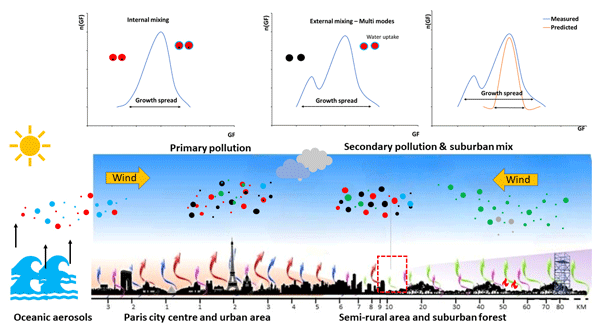
Shravan Deshmukh, Laurent Poulain, Birgit Wehner, Silvia Henning, Jean-Eudes Petit, Pauline Fombelle, Olivier Favez, Hartmut Herrmann, and Mira Pöhlker
Atmos. Chem. Phys., 25, 741–758, https://doi.org/10.5194/acp-25-741-2025, https://doi.org/10.5194/acp-25-741-2025, 2025
Short summary
Short summary
Aerosol hygroscopicity has been investigated at a sub-urban site in Paris; analysis shows the sub-saturated regime's measured hygroscopicity and the chemically derived hygroscopic growth, shedding light on the large effect of external particle mixing and its influence on predicting hygroscopicity.
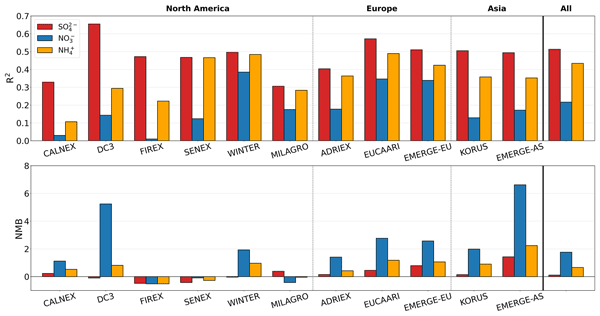
Olivia G. Norman, Colette L. Heald, Solomon Bililign, Pedro Campuzano-Jost, Hugh Coe, Marc N. Fiddler, Jaime R. Green, Jose L. Jimenez, Katharina Kaiser, Jin Liao, Ann M. Middlebrook, Benjamin A. Nault, John B. Nowak, Johannes Schneider, and André Welti
Atmos. Chem. Phys., 25, 771–795, https://doi.org/10.5194/acp-25-771-2025, https://doi.org/10.5194/acp-25-771-2025, 2025
Short summary
Short summary
This study finds that one component of secondary inorganic aerosols, nitrate, is greatly overestimated by a global atmospheric chemistry model compared to observations from 11 flight campaigns. None of the loss and production pathways explored can explain the nitrate bias alone. The model’s inability to capture the variability in the observations remains and requires future investigation to avoid biases in policy-related studies (i.e., air quality, health, climate impacts of these aerosols).
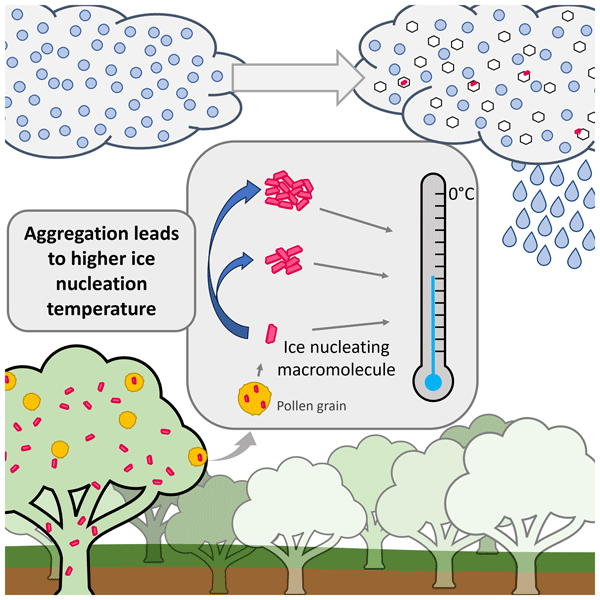
Florian Wieland, Nadine Bothen, Ralph Schwidetzky, Teresa M. Seifried, Paul Bieber, Ulrich Pöschl, Konrad Meister, Mischa Bonn, Janine Fröhlich-Nowoisky, and Hinrich Grothe
Biogeosciences, 22, 103–115, https://doi.org/10.5194/bg-22-103-2025, https://doi.org/10.5194/bg-22-103-2025, 2025
Short summary
Short summary
Betula pendula is a widespread birch tree species containing ice nucleation agents that can trigger the freezing of cloud droplets and thereby alter the evolution of clouds. Our study identifies three distinct ice-nucleating macromolecule (INM) aggregates of varying size that can nucleate ice at temperatures up to –5.4°C. Our findings suggest that these vegetation-derived particles may influence atmospheric processes, weather, and climate more strongly than previously thought.
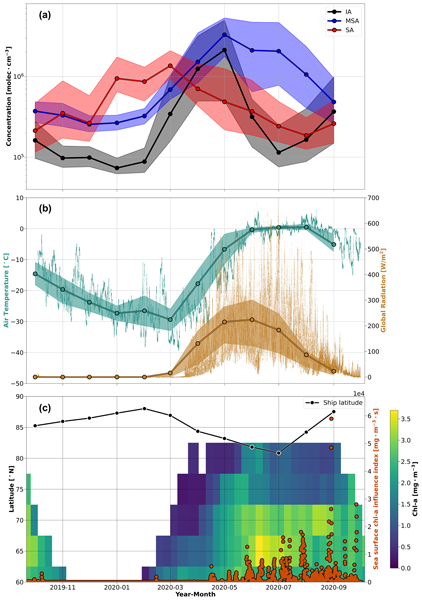
Matthew Boyer, Diego Aliaga, Lauriane L. J. Quéléver, Silvia Bucci, Hélène Angot, Lubna Dada, Benjamin Heutte, Lisa Beck, Marina Duetsch, Andreas Stohl, Ivo Beck, Tiia Laurila, Nina Sarnela, Roseline C. Thakur, Branka Miljevic, Markku Kulmala, Tuukka Petäjä, Mikko Sipilä, Julia Schmale, and Tuija Jokinen
Atmos. Chem. Phys., 24, 12595–12621, https://doi.org/10.5194/acp-24-12595-2024, https://doi.org/10.5194/acp-24-12595-2024, 2024
Short summary
Short summary
We analyze the seasonal cycle and sources of gases that are relevant for the formation of aerosol particles in the central Arctic. Since theses gases can form new particles, they can influence Arctic climate. We show that the sources of these gases are associated with changes in the Arctic environment during the year, especially with respect to sea ice. Therefore, the concentration of these gases will likely change in the future as the Arctic continues to warm.
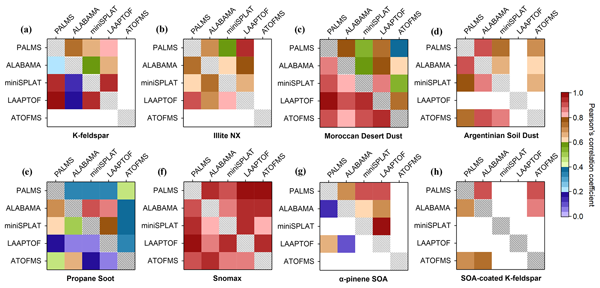
Xiaoli Shen, David M. Bell, Hugh Coe, Naruki Hiranuma, Fabian Mahrt, Nicholas A. Marsden, Claudia Mohr, Daniel M. Murphy, Harald Saathoff, Johannes Schneider, Jacqueline Wilson, Maria A. Zawadowicz, Alla Zelenyuk, Paul J. DeMott, Ottmar Möhler, and Daniel J. Cziczo
Atmos. Chem. Phys., 24, 10869–10891, https://doi.org/10.5194/acp-24-10869-2024, https://doi.org/10.5194/acp-24-10869-2024, 2024
Short summary
Short summary
Single-particle mass spectrometry (SPMS) is commonly used to measure the chemical composition and mixing state of aerosol particles. Intercomparison of SPMS instruments was conducted. All instruments reported similar size ranges and common spectral features. The instrument-specific detection efficiency was found to be more dependent on particle size than type. All differentiated secondary organic aerosol, soot, and soil dust but had difficulties differentiating among minerals and dusts.
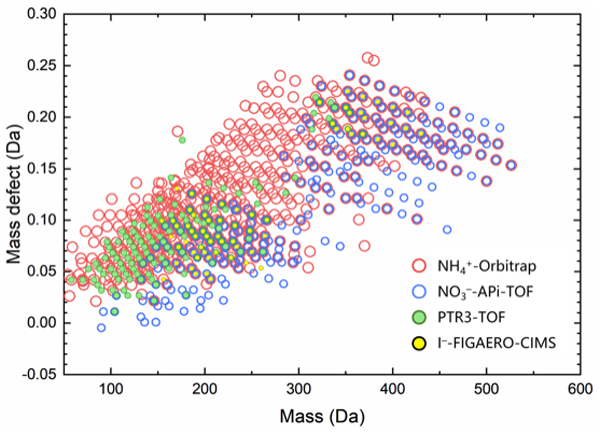
Dandan Li, Dongyu Wang, Lucia Caudillo, Wiebke Scholz, Mingyi Wang, Sophie Tomaz, Guillaume Marie, Mihnea Surdu, Elias Eccli, Xianda Gong, Loic Gonzalez-Carracedo, Manuel Granzin, Joschka Pfeifer, Birte Rörup, Benjamin Schulze, Pekka Rantala, Sébastien Perrier, Armin Hansel, Joachim Curtius, Jasper Kirkby, Neil M. Donahue, Christian George, Imad El-Haddad, and Matthieu Riva
Atmos. Meas. Tech., 17, 5413–5428, https://doi.org/10.5194/amt-17-5413-2024, https://doi.org/10.5194/amt-17-5413-2024, 2024
Short summary
Short summary
Due to the analytical challenges of measuring organic vapors, it remains challenging to identify and quantify organic molecules present in the atmosphere. Here, we explore the performance of the Orbitrap chemical ionization mass spectrometer (CI-Orbitrap) using ammonium ion chemistry. This study shows that ammonium-ion-based chemistry associated with the high mass resolution of the Orbitrap mass analyzer can measure almost all inclusive compounds.
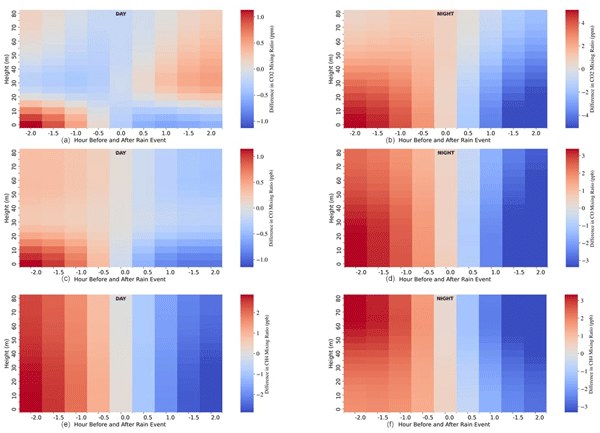
Luiz A. T. Machado, Jürgen Kesselmeier, Santiago Botía, Hella van Asperen, Meinrat O. Andreae, Alessandro C. de Araújo, Paulo Artaxo, Achim Edtbauer, Rosaria R. Ferreira, Marco A. Franco, Hartwig Harder, Sam P. Jones, Cléo Q. Dias-Júnior, Guido G. Haytzmann, Carlos A. Quesada, Shujiro Komiya, Jost Lavric, Jos Lelieveld, Ingeborg Levin, Anke Nölscher, Eva Pfannerstill, Mira L. Pöhlker, Ulrich Pöschl, Akima Ringsdorf, Luciana Rizzo, Ana M. Yáñez-Serrano, Susan Trumbore, Wanda I. D. Valenti, Jordi Vila-Guerau de Arellano, David Walter, Jonathan Williams, Stefan Wolff, and Christopher Pöhlker
Atmos. Chem. Phys., 24, 8893–8910, https://doi.org/10.5194/acp-24-8893-2024, https://doi.org/10.5194/acp-24-8893-2024, 2024
Short summary
Short summary
Composite analysis of gas concentration before and after rainfall, during the day and night, gives insight into the complex relationship between trace gas variability and precipitation. The analysis helps us to understand the sources and sinks of trace gases within a forest ecosystem. It elucidates processes that are not discernible under undisturbed conditions and contributes to a deeper understanding of the trace gas life cycle and its intricate interactions with cloud dynamics in the Amazon.
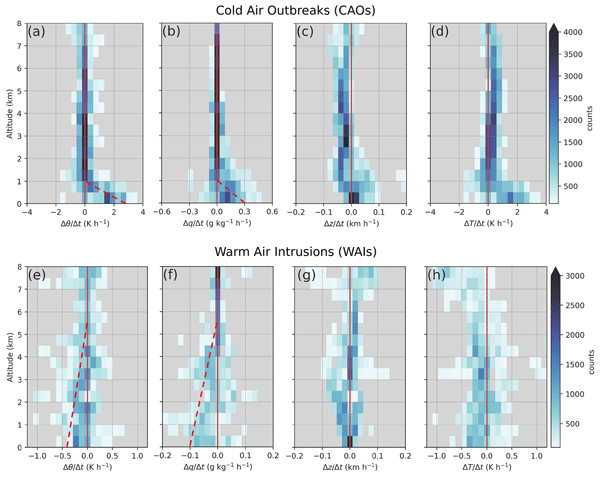
Manfred Wendisch, Susanne Crewell, André Ehrlich, Andreas Herber, Benjamin Kirbus, Christof Lüpkes, Mario Mech, Steven J. Abel, Elisa F. Akansu, Felix Ament, Clémantyne Aubry, Sebastian Becker, Stephan Borrmann, Heiko Bozem, Marlen Brückner, Hans-Christian Clemen, Sandro Dahlke, Georgios Dekoutsidis, Julien Delanoë, Elena De La Torre Castro, Henning Dorff, Regis Dupuy, Oliver Eppers, Florian Ewald, Geet George, Irina V. Gorodetskaya, Sarah Grawe, Silke Groß, Jörg Hartmann, Silvia Henning, Lutz Hirsch, Evelyn Jäkel, Philipp Joppe, Olivier Jourdan, Zsofia Jurányi, Michail Karalis, Mona Kellermann, Marcus Klingebiel, Michael Lonardi, Johannes Lucke, Anna E. Luebke, Maximilian Maahn, Nina Maherndl, Marion Maturilli, Bernhard Mayer, Johanna Mayer, Stephan Mertes, Janosch Michaelis, Michel Michalkov, Guillaume Mioche, Manuel Moser, Hanno Müller, Roel Neggers, Davide Ori, Daria Paul, Fiona M. Paulus, Christian Pilz, Felix Pithan, Mira Pöhlker, Veronika Pörtge, Maximilian Ringel, Nils Risse, Gregory C. Roberts, Sophie Rosenburg, Johannes Röttenbacher, Janna Rückert, Michael Schäfer, Jonas Schaefer, Vera Schemann, Imke Schirmacher, Jörg Schmidt, Sebastian Schmidt, Johannes Schneider, Sabrina Schnitt, Anja Schwarz, Holger Siebert, Harald Sodemann, Tim Sperzel, Gunnar Spreen, Bjorn Stevens, Frank Stratmann, Gunilla Svensson, Christian Tatzelt, Thomas Tuch, Timo Vihma, Christiane Voigt, Lea Volkmer, Andreas Walbröl, Anna Weber, Birgit Wehner, Bruno Wetzel, Martin Wirth, and Tobias Zinner
Atmos. Chem. Phys., 24, 8865–8892, https://doi.org/10.5194/acp-24-8865-2024, https://doi.org/10.5194/acp-24-8865-2024, 2024
Short summary
Short summary
The Arctic is warming faster than the rest of the globe. Warm-air intrusions (WAIs) into the Arctic may play an important role in explaining this phenomenon. Cold-air outbreaks (CAOs) out of the Arctic may link the Arctic climate changes to mid-latitude weather. In our article, we describe how to observe air mass transformations during CAOs and WAIs using three research aircraft instrumented with state-of-the-art remote-sensing and in situ measurement devices.
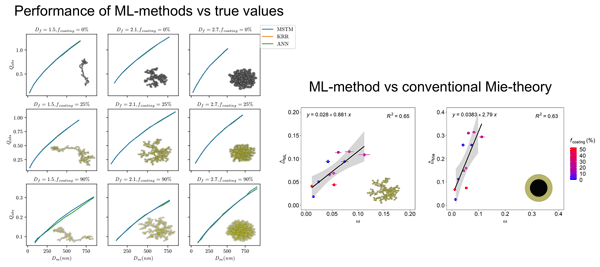
Baseerat Romshoo, Jaikrishna Patil, Tobias Michels, Thomas Müller, Marius Kloft, and Mira Pöhlker
Atmos. Chem. Phys., 24, 8821–8846, https://doi.org/10.5194/acp-24-8821-2024, https://doi.org/10.5194/acp-24-8821-2024, 2024
Short summary
Short summary
Through the use of our machine-learning-based optical model, realistic BC morphologies can be incorporated into atmospheric science applications that require highly accurate results with minimal computational resources. The results of the study demonstrate that the predictions of single-scattering albedo (ω) and mass absorption cross-section (MAC) were improved over the conventional Mie-based predictions when using the machine learning method.
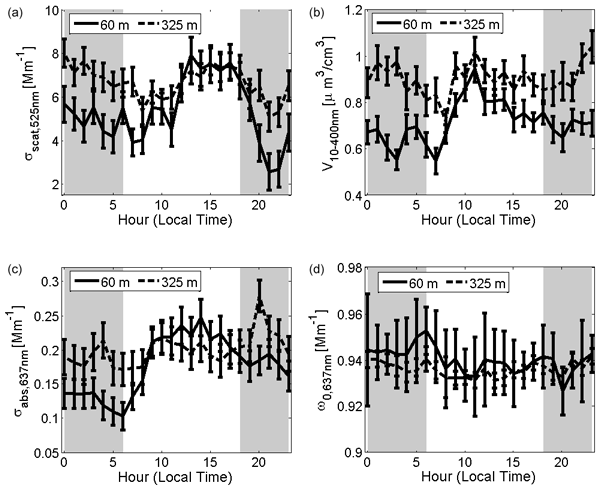
Marco A. Franco, Rafael Valiati, Bruna A. Holanda, Bruno B. Meller, Leslie A. Kremper, Luciana V. Rizzo, Samara Carbone, Fernando G. Morais, Janaína P. Nascimento, Meinrat O. Andreae, Micael A. Cecchini, Luiz A. T. Machado, Milena Ponczek, Ulrich Pöschl, David Walter, Christopher Pöhlker, and Paulo Artaxo
Atmos. Chem. Phys., 24, 8751–8770, https://doi.org/10.5194/acp-24-8751-2024, https://doi.org/10.5194/acp-24-8751-2024, 2024
Short summary
Short summary
The Amazon wet-season atmosphere was studied at the Amazon Tall Tower Observatory site, revealing vertical variations (between 60 and 325 m) in natural aerosols. Daytime mixing contrasted with nighttime stratification, with distinct rain-induced changes in aerosol populations. Notably, optical property recovery at higher levels was faster, while near-canopy aerosols showed higher scattering efficiency. These findings enhance our understanding of aerosol impacts on climate dynamics.
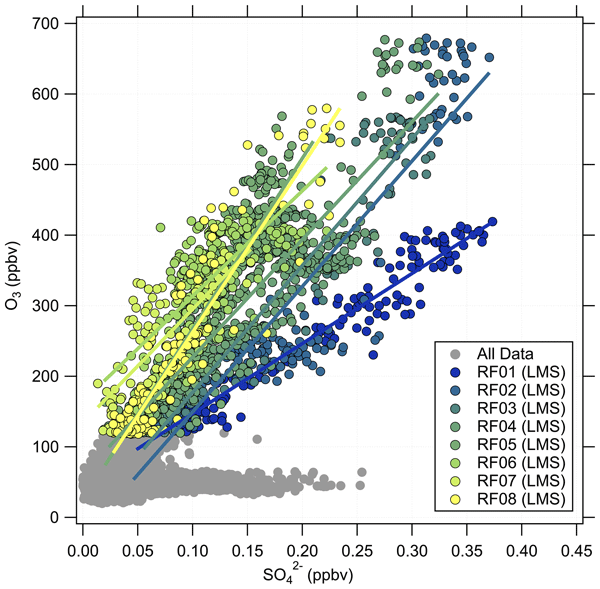
Philipp Joppe, Johannes Schneider, Katharina Kaiser, Horst Fischer, Peter Hoor, Daniel Kunkel, Hans-Christoph Lachnitt, Andreas Marsing, Lenard Röder, Hans Schlager, Laura Tomsche, Christiane Voigt, Andreas Zahn, and Stephan Borrmann
Atmos. Chem. Phys., 24, 7499–7522, https://doi.org/10.5194/acp-24-7499-2024, https://doi.org/10.5194/acp-24-7499-2024, 2024
Short summary
Short summary
From aircraft measurements in the upper troposphere/lower stratosphere, we find a correlation between the ozone and particulate sulfate in the lower stratosphere. The correlation exhibits some variability over the measurement period exceeding the background sulfate-to-ozone correlation. From our analysis, we conclude that gas-to-particle conversion of volcanic sulfur dioxide leads to observed enhanced sulfate aerosol mixing ratios.
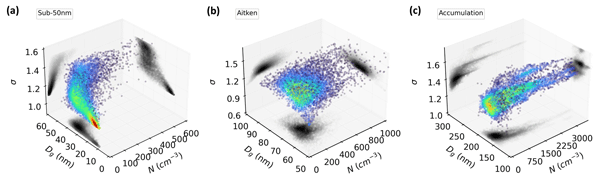
Gabriela R. Unfer, Luiz A. T. Machado, Paulo Artaxo, Marco A. Franco, Leslie A. Kremper, Mira L. Pöhlker, Ulrich Pöschl, and Christopher Pöhlker
Atmos. Chem. Phys., 24, 3869–3882, https://doi.org/10.5194/acp-24-3869-2024, https://doi.org/10.5194/acp-24-3869-2024, 2024
Short summary
Short summary
Amazonian aerosols and their interactions with precipitation were studied by understanding them in a 3D space based on three parameters that characterize the concentration and size distribution of aerosols. The results showed characteristic arrangements regarding seasonal and diurnal cycles, as well as when interacting with precipitation. The use of this 3D space appears to be a promising tool for aerosol population analysis and for model validation and parameterization.
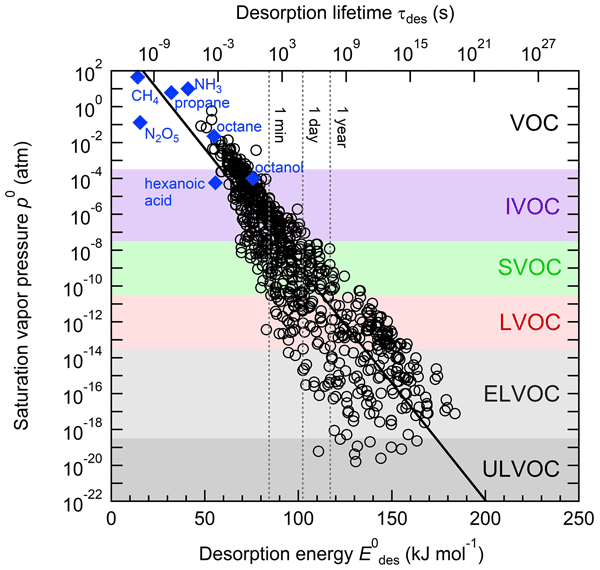
Daniel A. Knopf, Markus Ammann, Thomas Berkemeier, Ulrich Pöschl, and Manabu Shiraiwa
Atmos. Chem. Phys., 24, 3445–3528, https://doi.org/10.5194/acp-24-3445-2024, https://doi.org/10.5194/acp-24-3445-2024, 2024
Short summary
Short summary
The initial step of interfacial and multiphase chemical processes involves adsorption and desorption of gas species. This study demonstrates the role of desorption energy governing the residence time of the gas species at the environmental interface. A parameterization is formulated that enables the prediction of desorption energy based on the molecular weight, polarizability, and oxygen-to-carbon ratio of the desorbing chemical species. Its application to gas–particle interactions is discussed.
Adrien Deroubaix, Marco Vountas, Benjamin Gaubert, Maria Dolores Andrés Hernández, Stephan Borrmann, Guy Brasseur, Bruna Holanda, Yugo Kanaya, Katharina Kaiser, Flora Kluge, Ovid Oktavian Krüger, Inga Labuhn, Michael Lichtenstern, Klaus Pfeilsticker, Mira Pöhlker, Hans Schlager, Johannes Schneider, Guillaume Siour, Basudev Swain, Paolo Tuccella, Kameswara S. Vinjamuri, Mihalis Vrekoussis, Benjamin Weyland, and John P. Burrows
EGUsphere, https://doi.org/10.5194/egusphere-2024-516, https://doi.org/10.5194/egusphere-2024-516, 2024
Preprint archived
Short summary
Short summary
This study assesses atmospheric composition using air quality models during aircraft campaigns in Europe and Asia, focusing on carbonaceous aerosols and trace gases. While carbon monoxide is well modeled, other pollutants have moderate to weak agreement with observations. Wind speed modeling is reliable for identifying pollution plumes, where models tend to overestimate concentrations. This highlights challenges in accurately modeling aerosol and trace gas composition, particularly in cities.
Adrien Deroubaix, Marco Vountas, Benjamin Gaubert, Maria Dolores Andrés Hernández, Stephan Borrmann, Guy Brasseur, Bruna Holanda, Yugo Kanaya, Katharina Kaiser, Flora Kluge, Ovid Oktavian Krüger, Inga Labuhn, Michael Lichtenstern, Klaus Pfeilsticker, Mira Pöhlker, Hans Schlager, Johannes Schneider, Guillaume Siour, Basudev Swain, Paolo Tuccella, Kameswara S. Vinjamuri, Mihalis Vrekoussis, Benjamin Weyland, and John P. Burrows
EGUsphere, https://doi.org/10.5194/egusphere-2024-521, https://doi.org/10.5194/egusphere-2024-521, 2024
Preprint archived
Short summary
Short summary
This study explores the proportional relationships between carbonaceous aerosols (black and organic carbon) and trace gases using airborne measurements from two campaigns in Europe and East Asia. Differences between regions were found, but air quality models struggled to reproduce them accurately. We show that these proportional relationships can help to constrain models and can be used to infer aerosol concentrations from satellite observations of trace gases, especially in urban areas.
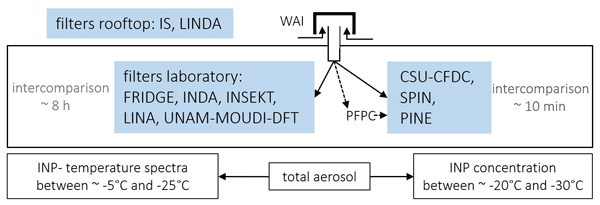
Larissa Lacher, Michael P. Adams, Kevin Barry, Barbara Bertozzi, Heinz Bingemer, Cristian Boffo, Yannick Bras, Nicole Büttner, Dimitri Castarede, Daniel J. Cziczo, Paul J. DeMott, Romy Fösig, Megan Goodell, Kristina Höhler, Thomas C. J. Hill, Conrad Jentzsch, Luis A. Ladino, Ezra J. T. Levin, Stephan Mertes, Ottmar Möhler, Kathryn A. Moore, Benjamin J. Murray, Jens Nadolny, Tatjana Pfeuffer, David Picard, Carolina Ramírez-Romero, Mickael Ribeiro, Sarah Richter, Jann Schrod, Karine Sellegri, Frank Stratmann, Benjamin E. Swanson, Erik S. Thomson, Heike Wex, Martin J. Wolf, and Evelyn Freney
Atmos. Chem. Phys., 24, 2651–2678, https://doi.org/10.5194/acp-24-2651-2024, https://doi.org/10.5194/acp-24-2651-2024, 2024
Short summary
Short summary
Aerosol particles that trigger ice formation in clouds are important for the climate system but are very rare in the atmosphere, challenging measurement techniques. Here we compare three cloud chambers and seven methods for collecting aerosol particles on filters for offline analysis at a mountaintop station. A general good agreement of the methods was found when sampling aerosol particles behind a whole air inlet, supporting their use for obtaining data that can be implemented in models.
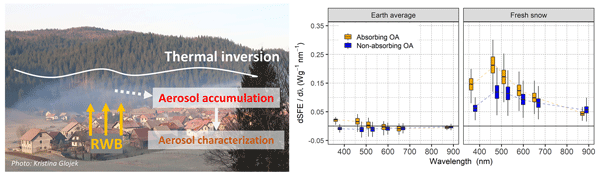
Andrea Cuesta-Mosquera, Kristina Glojek, Griša Močnik, Luka Drinovec, Asta Gregorič, Martin Rigler, Matej Ogrin, Baseerat Romshoo, Kay Weinhold, Maik Merkel, Dominik van Pinxteren, Hartmut Herrmann, Alfred Wiedensohler, Mira Pöhlker, and Thomas Müller
Atmos. Chem. Phys., 24, 2583–2605, https://doi.org/10.5194/acp-24-2583-2024, https://doi.org/10.5194/acp-24-2583-2024, 2024
Short summary
Short summary
This study evaluated the air pollution and climate impacts of residential-wood-burning particle emissions from a rural European site. The authors investigate the optical and physical properties that connect the aerosol emissions with climate by evaluating atmospheric radiative impacts via simple-forcing calculations. The study contributes to reducing the lack of information on the understanding of the optical properties of air pollution from anthropogenic sources.

Rolf Müller, Ulrich Pöschl, Thomas Koop, Thomas Peter, and Ken Carslaw
Atmos. Chem. Phys., 23, 15445–15453, https://doi.org/10.5194/acp-23-15445-2023, https://doi.org/10.5194/acp-23-15445-2023, 2023
Short summary
Short summary
Paul J. Crutzen was a pioneer in atmospheric sciences and a kind-hearted, humorous person with empathy for the private lives of his colleagues and students. He made fundamental scientific contributions to a wide range of scientific topics in all parts of the atmosphere. Paul was among the founders of the journal Atmospheric Chemistry and Physics. His work will continue to be a guide for generations of scientists and environmental policymakers to come.
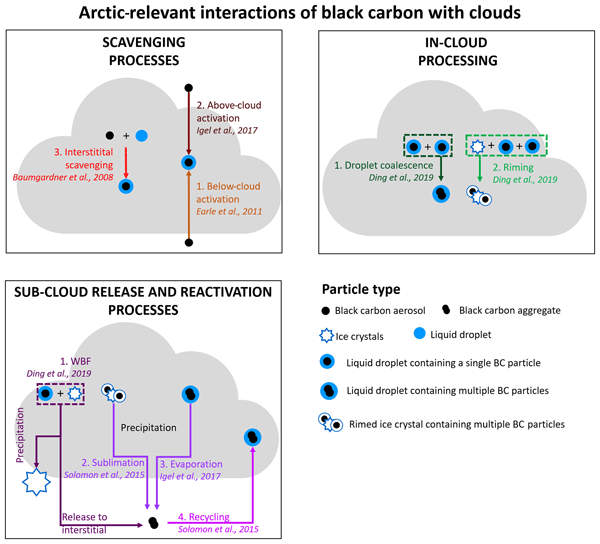
Marco Zanatta, Stephan Mertes, Olivier Jourdan, Regis Dupuy, Emma Järvinen, Martin Schnaiter, Oliver Eppers, Johannes Schneider, Zsófia Jurányi, and Andreas Herber
Atmos. Chem. Phys., 23, 7955–7973, https://doi.org/10.5194/acp-23-7955-2023, https://doi.org/10.5194/acp-23-7955-2023, 2023
Short summary
Short summary
Black carbon (BC) particles influence the Arctic radiative balance. Vertical measurements of black carbon were conducted during the ACLOUD campaign in the European Arctic to study the interaction of BC with clouds. This study shows that clouds influence the vertical variability of BC properties across the inversion layer and that multiple activation and transformation mechanisms of BC may occur in the presence of low-level, persistent, mixed-phase clouds.
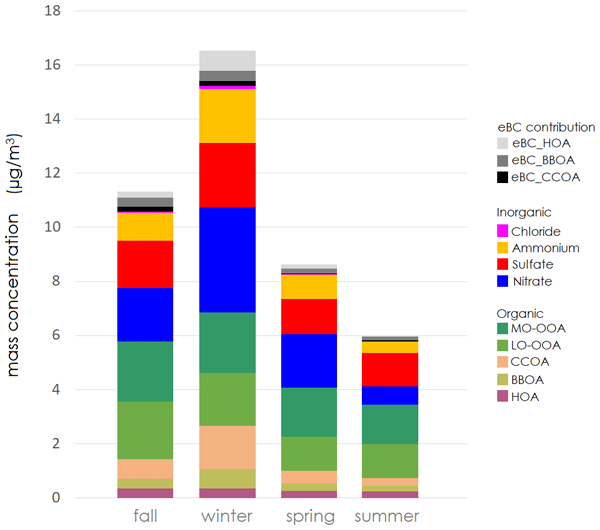
Samira Atabakhsh, Laurent Poulain, Gang Chen, Francesco Canonaco, André S. H. Prévôt, Mira Pöhlker, Alfred Wiedensohler, and Hartmut Herrmann
Atmos. Chem. Phys., 23, 6963–6988, https://doi.org/10.5194/acp-23-6963-2023, https://doi.org/10.5194/acp-23-6963-2023, 2023
Short summary
Short summary
The study focuses on the aerosol chemical variations found in the rural-background station of Melpitz based on ACSM and MAAP measurements. Source apportionment on both organic aerosol (OA) and black carbon (eBC) was performed, and source seasonality was also linked to air mass trajectories. Overall, three anthropogenic sources were identified in OA and eBC plus two additional aged OA. Our results demonstrate the influence of transported coal-combustion-related OA even during summer time.
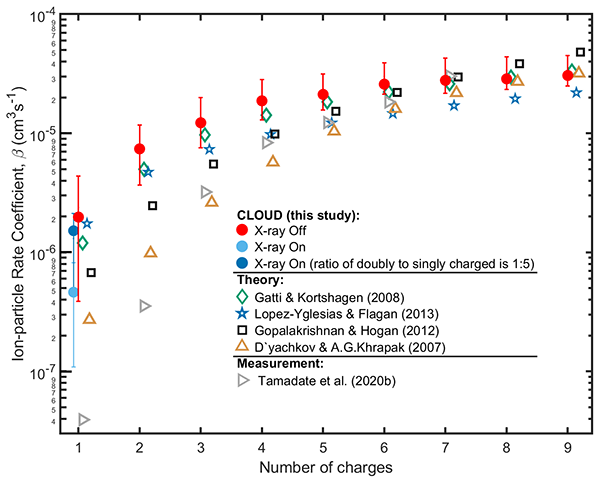
Joschka Pfeifer, Naser G. A. Mahfouz, Benjamin C. Schulze, Serge Mathot, Dominik Stolzenburg, Rima Baalbaki, Zoé Brasseur, Lucia Caudillo, Lubna Dada, Manuel Granzin, Xu-Cheng He, Houssni Lamkaddam, Brandon Lopez, Vladimir Makhmutov, Ruby Marten, Bernhard Mentler, Tatjana Müller, Antti Onnela, Maxim Philippov, Ana A. Piedehierro, Birte Rörup, Meredith Schervish, Ping Tian, Nsikanabasi S. Umo, Dongyu S. Wang, Mingyi Wang, Stefan K. Weber, André Welti, Yusheng Wu, Marcel Zauner-Wieczorek, Antonio Amorim, Imad El Haddad, Markku Kulmala, Katrianne Lehtipalo, Tuukka Petäjä, António Tomé, Sander Mirme, Hanna E. Manninen, Neil M. Donahue, Richard C. Flagan, Andreas Kürten, Joachim Curtius, and Jasper Kirkby
Atmos. Chem. Phys., 23, 6703–6718, https://doi.org/10.5194/acp-23-6703-2023, https://doi.org/10.5194/acp-23-6703-2023, 2023
Short summary
Short summary
Attachment rate coefficients between ions and charged aerosol particles determine their lifetimes and may also influence cloud dynamics and aerosol processing. Here we present novel experiments that measure ion–aerosol attachment rate coefficients for multiply charged aerosol particles under atmospheric conditions in the CERN CLOUD chamber. Our results provide experimental discrimination between various theoretical models.
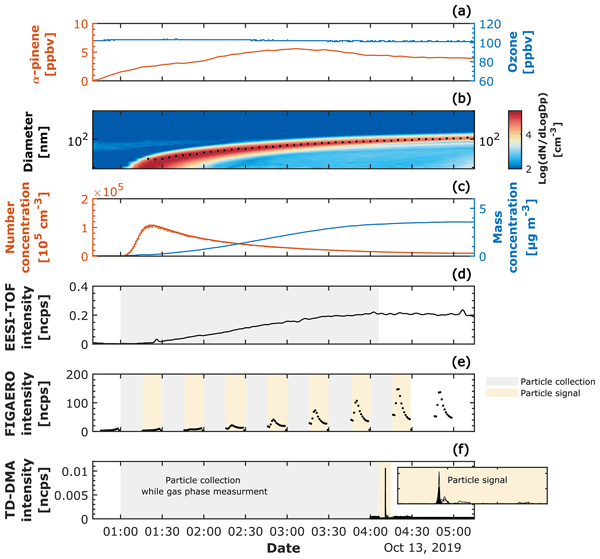
Lucía Caudillo, Mihnea Surdu, Brandon Lopez, Mingyi Wang, Markus Thoma, Steffen Bräkling, Angela Buchholz, Mario Simon, Andrea C. Wagner, Tatjana Müller, Manuel Granzin, Martin Heinritzi, Antonio Amorim, David M. Bell, Zoé Brasseur, Lubna Dada, Jonathan Duplissy, Henning Finkenzeller, Xu-Cheng He, Houssni Lamkaddam, Naser G. A. Mahfouz, Vladimir Makhmutov, Hanna E. Manninen, Guillaume Marie, Ruby Marten, Roy L. Mauldin, Bernhard Mentler, Antti Onnela, Tuukka Petäjä, Joschka Pfeifer, Maxim Philippov, Ana A. Piedehierro, Birte Rörup, Wiebke Scholz, Jiali Shen, Dominik Stolzenburg, Christian Tauber, Ping Tian, António Tomé, Nsikanabasi Silas Umo, Dongyu S. Wang, Yonghong Wang, Stefan K. Weber, André Welti, Marcel Zauner-Wieczorek, Urs Baltensperger, Richard C. Flagan, Armin Hansel, Jasper Kirkby, Markku Kulmala, Katrianne Lehtipalo, Douglas R. Worsnop, Imad El Haddad, Neil M. Donahue, Alexander L. Vogel, Andreas Kürten, and Joachim Curtius
Atmos. Chem. Phys., 23, 6613–6631, https://doi.org/10.5194/acp-23-6613-2023, https://doi.org/10.5194/acp-23-6613-2023, 2023
Short summary
Short summary
In this study, we present an intercomparison of four different techniques for measuring the chemical composition of nanoparticles. The intercomparison was performed based on the observed chemical composition, calculated volatility, and analysis of the thermograms. We found that the methods generally agree on the most important compounds that are found in the nanoparticles. However, they do see different parts of the organic spectrum. We suggest potential explanations for these differences.
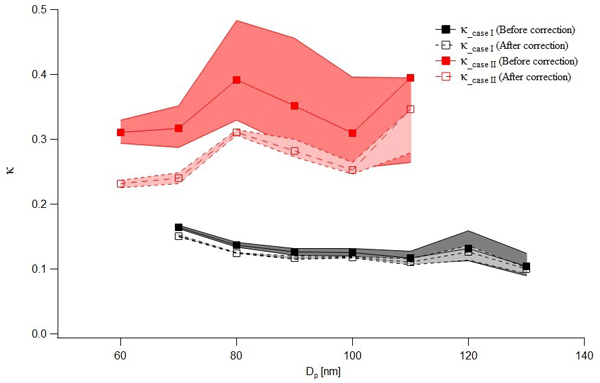
Najin Kim, Hang Su, Nan Ma, Ulrich Pöschl, and Yafang Cheng
Atmos. Meas. Tech., 16, 2771–2780, https://doi.org/10.5194/amt-16-2771-2023, https://doi.org/10.5194/amt-16-2771-2023, 2023
Short summary
Short summary
We propose a multiple-charging correction algorithm for a broad-supersaturation scanning cloud condensation nuclei (BS2-CCN) system which can obtain high time-resolution aerosol hygroscopicity and CCN activity. The correction algorithm aims at deriving the activation fraction's true value for each particle size. The meaningful differences between corrected and original κ values (single hygroscopicity parameter) emphasize the correction algorithm's importance for ambient aerosol measurement.
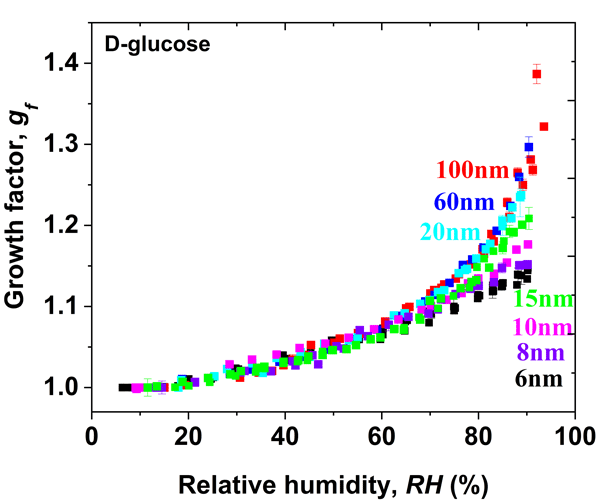
Ting Lei, Hang Su, Nan Ma, Ulrich Pöschl, Alfred Wiedensohler, and Yafang Cheng
Atmos. Chem. Phys., 23, 4763–4774, https://doi.org/10.5194/acp-23-4763-2023, https://doi.org/10.5194/acp-23-4763-2023, 2023
Short summary
Short summary
We investigate the hygroscopic behavior of levoglucosan and D-glucose nanoparticles using a nano-HTDMA. There is a weak size dependence of the hygroscopic growth factor of levoglucosan and D-glucose with diameters down to 20 nm, while a strong size dependence of the hygroscopic growth factor of D-glucose has been clearly observed in the size range 6 to 20 nm. The use of the DKA method leads to good agreement with the hygroscopic growth factor of glucose nanoparticles with diameters down to 6 nm.
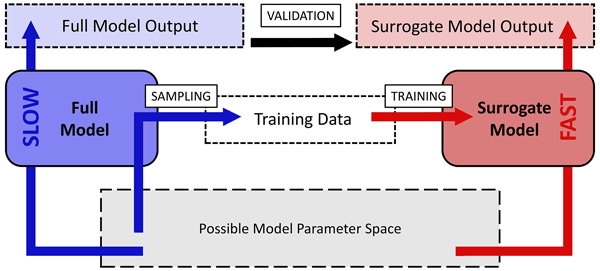
Thomas Berkemeier, Matteo Krüger, Aryeh Feinberg, Marcel Müller, Ulrich Pöschl, and Ulrich K. Krieger
Geosci. Model Dev., 16, 2037–2054, https://doi.org/10.5194/gmd-16-2037-2023, https://doi.org/10.5194/gmd-16-2037-2023, 2023
Short summary
Short summary
Kinetic multi-layer models (KMs) successfully describe heterogeneous and multiphase atmospheric chemistry. In applications requiring repeated execution, however, these models can be too expensive. We trained machine learning surrogate models on output of the model KM-SUB and achieved high correlations. The surrogate models run orders of magnitude faster, which suggests potential applicability in global optimization tasks and as sub-modules in large-scale atmospheric models.
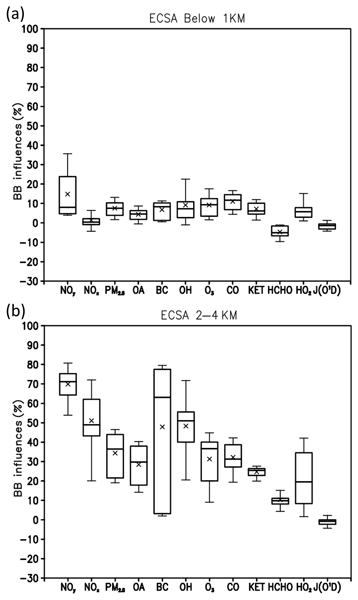
Chuan-Yao Lin, Wan-Chin Chen, Yi-Yun Chien, Charles C. K. Chou, Chian-Yi Liu, Helmut Ziereis, Hans Schlager, Eric Förster, Florian Obersteiner, Ovid O. Krüger, Bruna A. Holanda, Mira L. Pöhlker, Katharina Kaiser, Johannes Schneider, Birger Bohn, Klaus Pfeilsticker, Benjamin Weyland, Maria Dolores Andrés Hernández, and John P. Burrows
Atmos. Chem. Phys., 23, 2627–2647, https://doi.org/10.5194/acp-23-2627-2023, https://doi.org/10.5194/acp-23-2627-2023, 2023
Short summary
Short summary
During the EMeRGe campaign in Asia, atmospheric pollutants were measured on board the HALO aircraft. The WRF-Chem model was employed to evaluate the biomass burning (BB) plume transported from Indochina and its impact on the downstream areas. The combination of BB aerosol enhancement with cloud water resulted in a reduction in incoming shortwave radiation at the surface in southern China and the East China Sea, which potentially has significant regional climate implications.
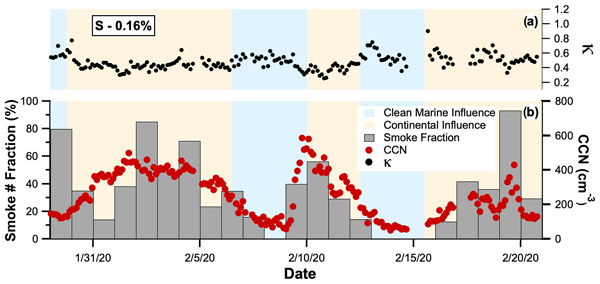
Haley M. Royer, Mira L. Pöhlker, Ovid Krüger, Edmund Blades, Peter Sealy, Nurun Nahar Lata, Zezhen Cheng, Swarup China, Andrew P. Ault, Patricia K. Quinn, Paquita Zuidema, Christopher Pöhlker, Ulrich Pöschl, Meinrat Andreae, and Cassandra J. Gaston
Atmos. Chem. Phys., 23, 981–998, https://doi.org/10.5194/acp-23-981-2023, https://doi.org/10.5194/acp-23-981-2023, 2023
Short summary
Short summary
This paper presents atmospheric particle chemical composition and measurements of aerosol water uptake properties collected at Ragged Point, Barbados, during the winter of 2020. The result of this study indicates the importance of small African smoke particles for cloud droplet formation in the tropical North Atlantic and highlights the large spatial and temporal pervasiveness of smoke over the Atlantic Ocean.
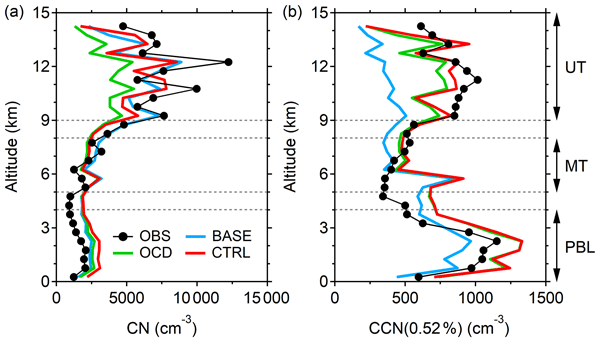
Yunfan Liu, Hang Su, Siwen Wang, Chao Wei, Wei Tao, Mira L. Pöhlker, Christopher Pöhlker, Bruna A. Holanda, Ovid O. Krüger, Thorsten Hoffmann, Manfred Wendisch, Paulo Artaxo, Ulrich Pöschl, Meinrat O. Andreae, and Yafang Cheng
Atmos. Chem. Phys., 23, 251–272, https://doi.org/10.5194/acp-23-251-2023, https://doi.org/10.5194/acp-23-251-2023, 2023
Short summary
Short summary
The origins of the abundant cloud condensation nuclei (CCN) in the upper troposphere (UT) of the Amazon remain unclear. With model developments of new secondary organic aerosol schemes and constrained by observation, we show that strong aerosol nucleation and condensation in the UT is triggered by biogenic organics, and organic condensation is key for UT CCN production. This UT CCN-producing mechanism may prevail over broader vegetation canopies and deserves emphasis in aerosol–climate feedback.
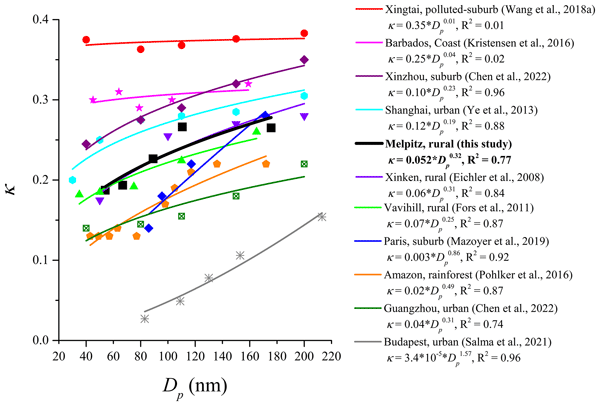
Yuan Wang, Silvia Henning, Laurent Poulain, Chunsong Lu, Frank Stratmann, Yuying Wang, Shengjie Niu, Mira L. Pöhlker, Hartmut Herrmann, and Alfred Wiedensohler
Atmos. Chem. Phys., 22, 15943–15962, https://doi.org/10.5194/acp-22-15943-2022, https://doi.org/10.5194/acp-22-15943-2022, 2022
Short summary
Short summary
Aerosol particle activation affects cloud, precipitation, radiation, and thus the global climate. Its long-term measurements are important but still scarce. In this study, more than 4 years of measurements at a central European station were analyzed. The overall characteristics and seasonal changes of aerosol particle activation are summarized. The power-law fit between particle hygroscopicity factor and diameter was recommended for predicting cloud
condensation nuclei number concentration.
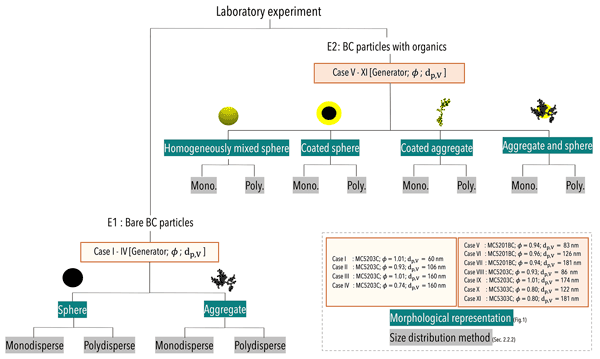
Baseerat Romshoo, Mira Pöhlker, Alfred Wiedensohler, Sascha Pfeifer, Jorge Saturno, Andreas Nowak, Krzysztof Ciupek, Paul Quincey, Konstantina Vasilatou, Michaela N. Ess, Maria Gini, Konstantinos Eleftheriadis, Chris Robins, François Gaie-Levrel, and Thomas Müller
Atmos. Meas. Tech., 15, 6965–6989, https://doi.org/10.5194/amt-15-6965-2022, https://doi.org/10.5194/amt-15-6965-2022, 2022
Short summary
Short summary
Black carbon (BC) is often assumed to be spherically shaped, causing uncertainties in its optical properties when modelled. This study investigates different modelling techniques for the optical properties of BC by comparing them to laboratory measurements. We provide experimental support for emphasizing the use of appropriate size representation (polydisperse size method) and morphological representation (aggregate morphology) for optical modelling and parameterization scheme development of BC.
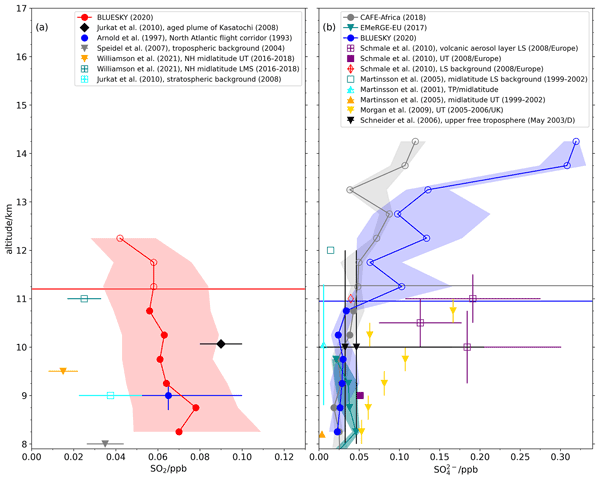
Laura Tomsche, Andreas Marsing, Tina Jurkat-Witschas, Johannes Lucke, Stefan Kaufmann, Katharina Kaiser, Johannes Schneider, Monika Scheibe, Hans Schlager, Lenard Röder, Horst Fischer, Florian Obersteiner, Andreas Zahn, Martin Zöger, Jos Lelieveld, and Christiane Voigt
Atmos. Chem. Phys., 22, 15135–15151, https://doi.org/10.5194/acp-22-15135-2022, https://doi.org/10.5194/acp-22-15135-2022, 2022
Short summary
Short summary
The detection of sulfur compounds in the upper troposphere (UT) and lower stratosphere (LS) is a challenge. In-flight measurements of SO2 and sulfate aerosol were performed during the BLUESKY mission in spring 2020 under exceptional atmospheric conditions. Reduced sinks in the dry UTLS and lower but still significant air traffic influenced the enhanced SO2 in the UT, and aged volcanic plumes enhanced the LS sulfate aerosol impacting the atmospheric radiation budget and global climate.
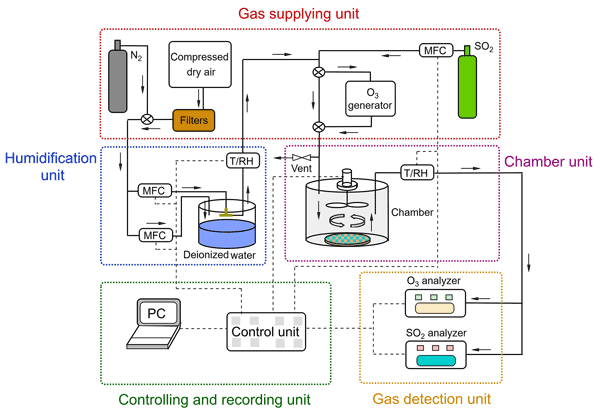
Guo Li, Hang Su, Meng Li, Uwe Kuhn, Guangjie Zheng, Lei Han, Fengxia Bao, Ulrich Pöschl, and Yafang Cheng
Atmos. Meas. Tech., 15, 6433–6446, https://doi.org/10.5194/amt-15-6433-2022, https://doi.org/10.5194/amt-15-6433-2022, 2022
Short summary
Short summary
A large fraction of previous work using dynamic flow chambers was to quantify gas exchange in terms of flux or deposition/emission rate. Here, we extended the usage of this technique to examine uptake kinetics on sample surfaces. The good performance of the chamber system was validated. This technique can be further used for liquid samples and real atmospheric aerosol samples without complicated coating procedures, which complements the existing techniques in atmospheric kinetic studies.
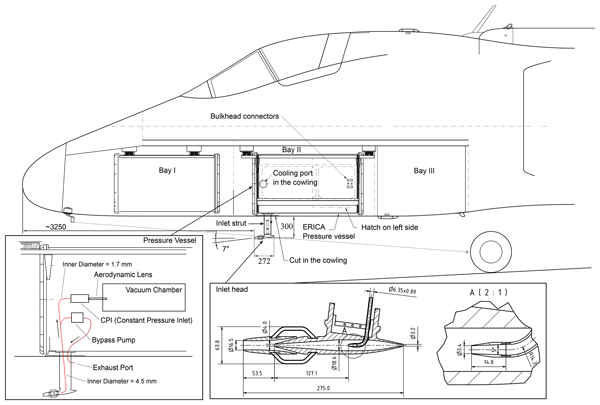
Antonis Dragoneas, Sergej Molleker, Oliver Appel, Andreas Hünig, Thomas Böttger, Markus Hermann, Frank Drewnick, Johannes Schneider, Ralf Weigel, and Stephan Borrmann
Atmos. Meas. Tech., 15, 5719–5742, https://doi.org/10.5194/amt-15-5719-2022, https://doi.org/10.5194/amt-15-5719-2022, 2022
Short summary
Short summary
The ERICA is a specially designed aerosol particle mass spectrometer for in situ, real-time chemical composition analysis of aerosols. It can operate completely autonomously, in the absence of an instrument operator. Its design has enabled its operation under harsh conditions, like those experienced in the upper troposphere and lower stratosphere, aboard unpressurized high-altitude research aircraft. The instrument has successfully participated in several aircraft operations around the world.
Marcel Zauner-Wieczorek, Joachim Curtius, and Andreas Kürten
Atmos. Chem. Phys., 22, 12443–12465, https://doi.org/10.5194/acp-22-12443-2022, https://doi.org/10.5194/acp-22-12443-2022, 2022
Short summary
Short summary
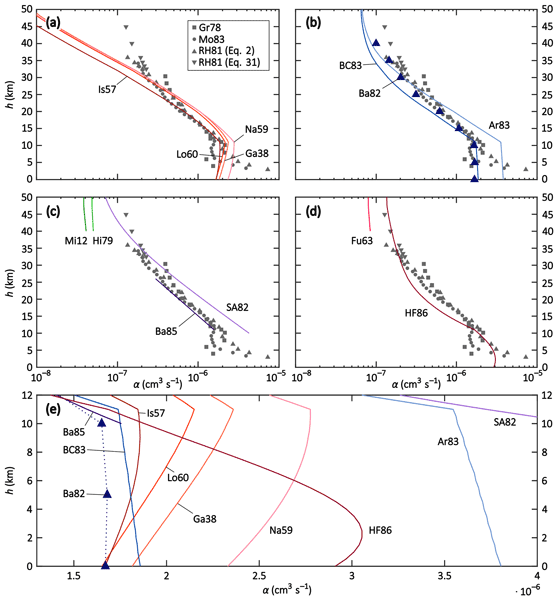
We reviewed different theories of the ion–ion recombination coefficient α, which describes the reaction and mutual neutralisation of two oppositely charged ions. We focussed on temperature and pressure dependencies and the atmospheric altitude range between 0–50 km. We compared the theories for atmospheric conditions and identified the most favourable value for standard conditions, 1.7 × 10⁻⁶ cm3 s−1, and recommend different theories or parameterisations depending on the altitude.
Marcel Zauner-Wieczorek, Martin Heinritzi, Manuel Granzin, Timo Keber, Andreas Kürten, Katharina Kaiser, Johannes Schneider, and Joachim Curtius
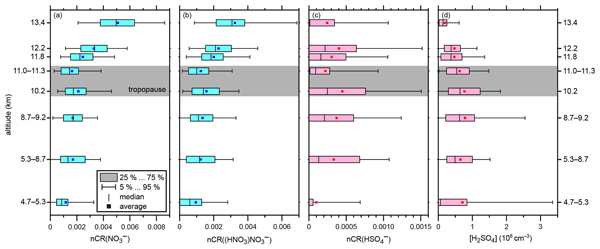
Atmos. Chem. Phys., 22, 11781–11794, https://doi.org/10.5194/acp-22-11781-2022, https://doi.org/10.5194/acp-22-11781-2022, 2022
Short summary
Short summary
We present measurements of ambient ions in the free troposphere and lower stratosphere over Europe in spring 2020. We observed nitrate and hydrogen sulfate, amongst others. From their ratio, the number concentrations of gaseous sulfuric acid were inferred. Nitrate increased towards the stratosphere, whilst sulfuric acid was slightly decreased there. The average values for sulfuric acid were 1.9 to 7.8 × 105 cm-3. Protonated pyridine was identified in an altitude range of 4.6 to 8.5 km.
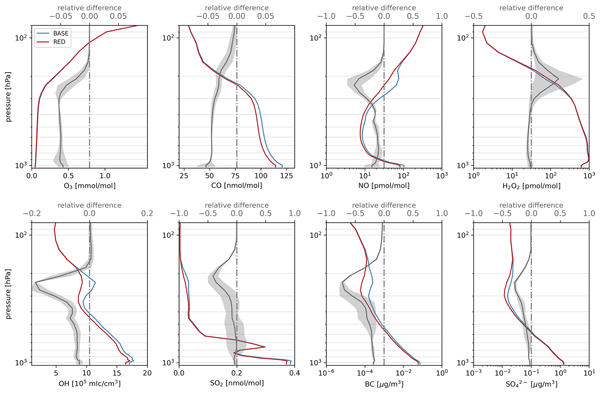
Simon F. Reifenberg, Anna Martin, Matthias Kohl, Sara Bacer, Zaneta Hamryszczak, Ivan Tadic, Lenard Röder, Daniel J. Crowley, Horst Fischer, Katharina Kaiser, Johannes Schneider, Raphael Dörich, John N. Crowley, Laura Tomsche, Andreas Marsing, Christiane Voigt, Andreas Zahn, Christopher Pöhlker, Bruna A. Holanda, Ovid Krüger, Ulrich Pöschl, Mira Pöhlker, Patrick Jöckel, Marcel Dorf, Ulrich Schumann, Jonathan Williams, Birger Bohn, Joachim Curtius, Hardwig Harder, Hans Schlager, Jos Lelieveld, and Andrea Pozzer
Atmos. Chem. Phys., 22, 10901–10917, https://doi.org/10.5194/acp-22-10901-2022, https://doi.org/10.5194/acp-22-10901-2022, 2022
Short summary
Short summary
In this work we use a combination of observational data from an aircraft campaign and model results to investigate the effect of the European lockdown due to COVID-19 in spring 2020. Using model results, we show that the largest relative changes to the atmospheric composition caused by the reduced emissions are located in the upper troposphere around aircraft cruise altitude, while the largest absolute changes are present at the surface.
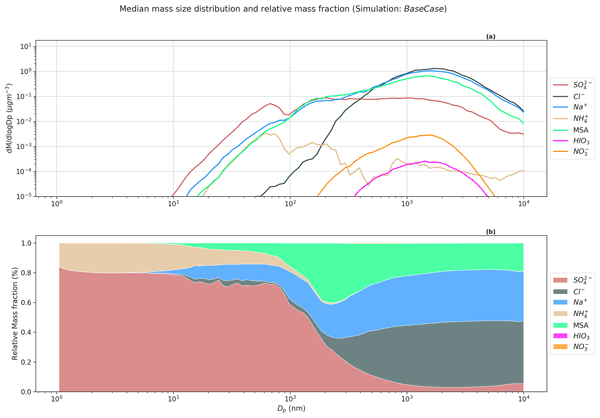
Carlton Xavier, Metin Baykara, Robin Wollesen de Jonge, Barbara Altstädter, Petri Clusius, Ville Vakkari, Roseline Thakur, Lisa Beck, Silvia Becagli, Mirko Severi, Rita Traversi, Radovan Krejci, Peter Tunved, Mauro Mazzola, Birgit Wehner, Mikko Sipilä, Markku Kulmala, Michael Boy, and Pontus Roldin
Atmos. Chem. Phys., 22, 10023–10043, https://doi.org/10.5194/acp-22-10023-2022, https://doi.org/10.5194/acp-22-10023-2022, 2022
Short summary
Short summary
The focus of this work is to study and improve our understanding of processes involved in the formation and growth of new particles in a remote Arctic marine environment. We run the 1D model ADCHEM along air mass trajectories arriving at Ny-Ålesund in May 2018. The model finds that ion-mediated H2SO4–NH3 nucleation can explain the observed new particle formation at Ny-Ålesund. The growth of particles is driven via H2SO4 condensation and formation of methane sulfonic acid in the aqueous phase.
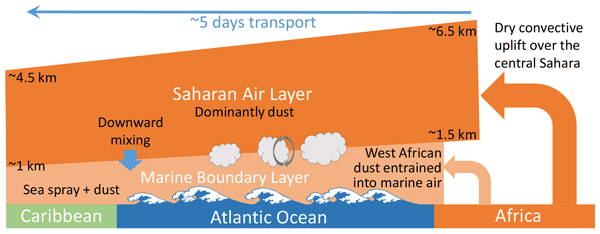
Alexander D. Harrison, Daniel O'Sullivan, Michael P. Adams, Grace C. E. Porter, Edmund Blades, Cherise Brathwaite, Rebecca Chewitt-Lucas, Cassandra Gaston, Rachel Hawker, Ovid O. Krüger, Leslie Neve, Mira L. Pöhlker, Christopher Pöhlker, Ulrich Pöschl, Alberto Sanchez-Marroquin, Andrea Sealy, Peter Sealy, Mark D. Tarn, Shanice Whitehall, James B. McQuaid, Kenneth S. Carslaw, Joseph M. Prospero, and Benjamin J. Murray
Atmos. Chem. Phys., 22, 9663–9680, https://doi.org/10.5194/acp-22-9663-2022, https://doi.org/10.5194/acp-22-9663-2022, 2022
Short summary
Short summary
The formation of ice in clouds fundamentally alters cloud properties; hence it is important we understand the special aerosol particles that can nucleate ice when immersed in supercooled cloud droplets. In this paper we show that African desert dust that has travelled across the Atlantic to the Caribbean nucleates ice much less well than we might have expected.
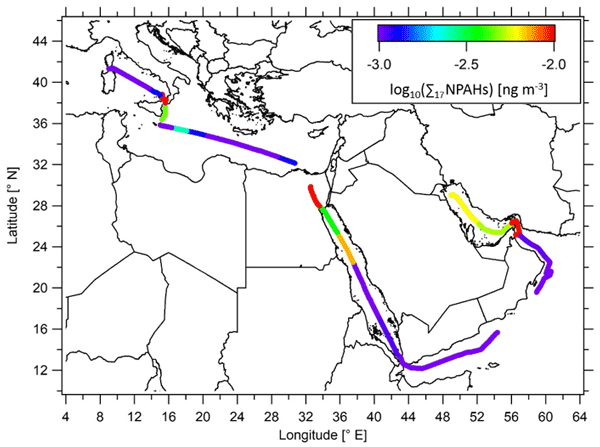
Marco Wietzoreck, Marios Kyprianou, Benjamin A. Musa Bandowe, Siddika Celik, John N. Crowley, Frank Drewnick, Philipp Eger, Nils Friedrich, Minas Iakovides, Petr Kukučka, Jan Kuta, Barbora Nežiková, Petra Pokorná, Petra Přibylová, Roman Prokeš, Roland Rohloff, Ivan Tadic, Sebastian Tauer, Jake Wilson, Hartwig Harder, Jos Lelieveld, Ulrich Pöschl, Euripides G. Stephanou, and Gerhard Lammel
Atmos. Chem. Phys., 22, 8739–8766, https://doi.org/10.5194/acp-22-8739-2022, https://doi.org/10.5194/acp-22-8739-2022, 2022
Short summary
Short summary
A unique dataset of concentrations and sources of polycyclic aromatic hydrocarbons (PAHs) and their alkylated, oxygenated and nitrated derivatives, in total 74 individual species, in the marine atmosphere is presented. Exposure to these substances poses a major health risk. We found very low concentrations over the Arabian Sea, while both local and long-range-transported pollution caused elevated levels over the Mediterranean Sea and the Arabian Gulf.
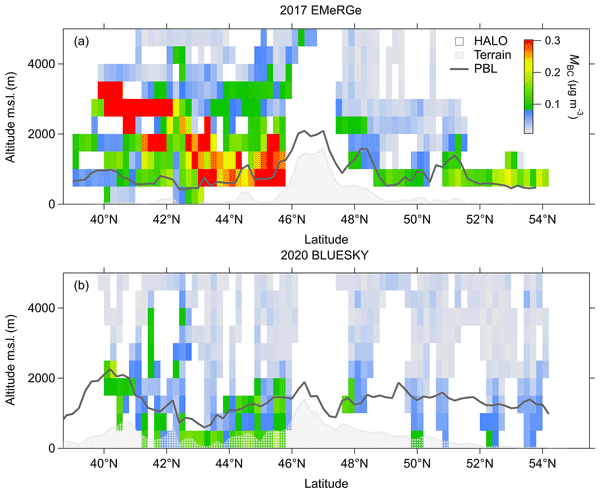
Ovid O. Krüger, Bruna A. Holanda, Sourangsu Chowdhury, Andrea Pozzer, David Walter, Christopher Pöhlker, Maria Dolores Andrés Hernández, John P. Burrows, Christiane Voigt, Jos Lelieveld, Johannes Quaas, Ulrich Pöschl, and Mira L. Pöhlker
Atmos. Chem. Phys., 22, 8683–8699, https://doi.org/10.5194/acp-22-8683-2022, https://doi.org/10.5194/acp-22-8683-2022, 2022
Short summary
Short summary
The abrupt reduction in human activities during the first COVID-19 lockdown created unprecedented atmospheric conditions. We took the opportunity to quantify changes in black carbon (BC) as a major anthropogenic air pollutant. Therefore, we measured BC on board a research aircraft over Europe during the lockdown and compared the results to measurements from 2017. With model simulations we account for different weather conditions and find a lockdown-related decrease in BC of 41 %.
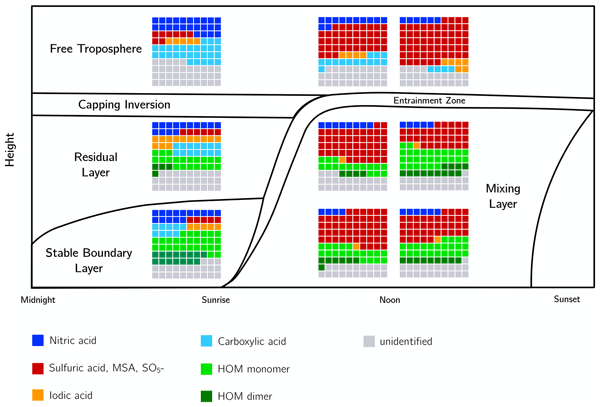
Lisa J. Beck, Siegfried Schobesberger, Heikki Junninen, Janne Lampilahti, Antti Manninen, Lubna Dada, Katri Leino, Xu-Cheng He, Iida Pullinen, Lauriane L. J. Quéléver, Anna Franck, Pyry Poutanen, Daniela Wimmer, Frans Korhonen, Mikko Sipilä, Mikael Ehn, Douglas R. Worsnop, Veli-Matti Kerminen, Tuukka Petäjä, Markku Kulmala, and Jonathan Duplissy
Atmos. Chem. Phys., 22, 8547–8577, https://doi.org/10.5194/acp-22-8547-2022, https://doi.org/10.5194/acp-22-8547-2022, 2022
Short summary
Short summary
The presented article introduces an overview of atmospheric ions and their composition above the boreal forest. We provide the results of an extensive airborne measurement campaign with an air ion mass spectrometer and particle measurements, showing their diurnal evolution within the boundary layer and free troposphere. In addition, we compare the airborne dataset with the co-located data from the ground at SMEAR II station, Finland.

Simon Kirschler, Christiane Voigt, Bruce Anderson, Ramon Campos Braga, Gao Chen, Andrea F. Corral, Ewan Crosbie, Hossein Dadashazar, Richard A. Ferrare, Valerian Hahn, Johannes Hendricks, Stefan Kaufmann, Richard Moore, Mira L. Pöhlker, Claire Robinson, Amy J. Scarino, Dominik Schollmayer, Michael A. Shook, K. Lee Thornhill, Edward Winstead, Luke D. Ziemba, and Armin Sorooshian
Atmos. Chem. Phys., 22, 8299–8319, https://doi.org/10.5194/acp-22-8299-2022, https://doi.org/10.5194/acp-22-8299-2022, 2022
Short summary
Short summary
In this study we show that the vertical velocity dominantly impacts the cloud droplet number concentration (NC) of low-level clouds over the western North Atlantic in the winter and summer season, while the cloud condensation nuclei concentration, aerosol size distribution and chemical composition impact NC within a season. The observational data presented in this study can evaluate and improve the representation of aerosol–cloud interactions for a wide range of conditions.
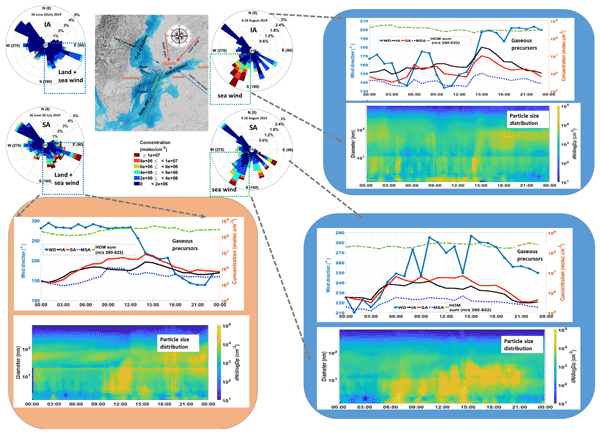
Roseline C. Thakur, Lubna Dada, Lisa J. Beck, Lauriane L. J. Quéléver, Tommy Chan, Marjan Marbouti, Xu-Cheng He, Carlton Xavier, Juha Sulo, Janne Lampilahti, Markus Lampimäki, Yee Jun Tham, Nina Sarnela, Katrianne Lehtipalo, Alf Norkko, Markku Kulmala, Mikko Sipilä, and Tuija Jokinen
Atmos. Chem. Phys., 22, 6365–6391, https://doi.org/10.5194/acp-22-6365-2022, https://doi.org/10.5194/acp-22-6365-2022, 2022
Short summary
Short summary
Every year intense cyanobacterial and macroalgal blooms occur in the Baltic Sea and in the coastal areas surrounding Helsinki, yet no studies have addressed the impact of biogenic emissions from these blooms on gas vapor concentrations, which in turn could influence new particle formation. This is the first study of its kind to address the chemistry driving new particle formation (NPF) during a bloom period in this region, highlighting the role of biogenic sulfuric acid and iodic acid.
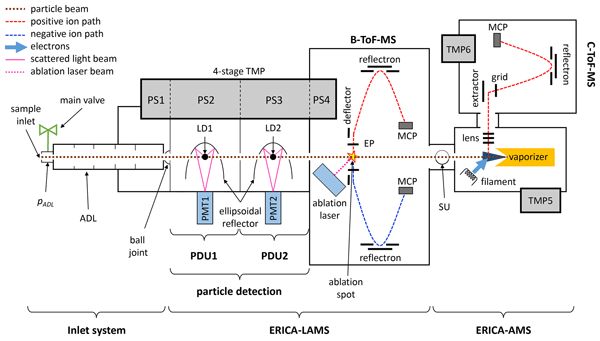
Andreas Hünig, Oliver Appel, Antonis Dragoneas, Sergej Molleker, Hans-Christian Clemen, Frank Helleis, Thomas Klimach, Franziska Köllner, Thomas Böttger, Frank Drewnick, Johannes Schneider, and Stephan Borrmann
Atmos. Meas. Tech., 15, 2889–2921, https://doi.org/10.5194/amt-15-2889-2022, https://doi.org/10.5194/amt-15-2889-2022, 2022
Short summary
Short summary
We have serially combined the two well-established methods for in situ real-time measurement of fine particle chemical composition, the single-particle laser ablation method and the flash evaporation with electron impact ionization method, into a novel instrument. Here we present the design; instrument characteristics, as derived from laboratory and field measurements; and results from the first field deployment during the 2017 StratoClim aircraft campaign.
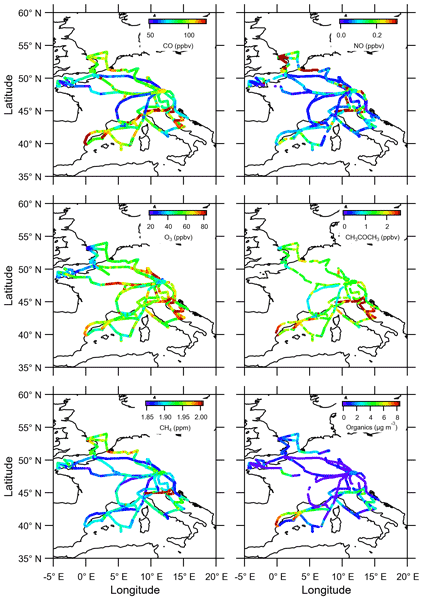
M. Dolores Andrés Hernández, Andreas Hilboll, Helmut Ziereis, Eric Förster, Ovid O. Krüger, Katharina Kaiser, Johannes Schneider, Francesca Barnaba, Mihalis Vrekoussis, Jörg Schmidt, Heidi Huntrieser, Anne-Marlene Blechschmidt, Midhun George, Vladyslav Nenakhov, Theresa Harlass, Bruna A. Holanda, Jennifer Wolf, Lisa Eirenschmalz, Marc Krebsbach, Mira L. Pöhlker, Anna B. Kalisz Hedegaard, Linlu Mei, Klaus Pfeilsticker, Yangzhuoran Liu, Ralf Koppmann, Hans Schlager, Birger Bohn, Ulrich Schumann, Andreas Richter, Benjamin Schreiner, Daniel Sauer, Robert Baumann, Mariano Mertens, Patrick Jöckel, Markus Kilian, Greta Stratmann, Christopher Pöhlker, Monica Campanelli, Marco Pandolfi, Michael Sicard, José L. Gómez-Amo, Manuel Pujadas, Katja Bigge, Flora Kluge, Anja Schwarz, Nikos Daskalakis, David Walter, Andreas Zahn, Ulrich Pöschl, Harald Bönisch, Stephan Borrmann, Ulrich Platt, and John P. Burrows
Atmos. Chem. Phys., 22, 5877–5924, https://doi.org/10.5194/acp-22-5877-2022, https://doi.org/10.5194/acp-22-5877-2022, 2022
Short summary
Short summary
EMeRGe provides a unique set of in situ and remote sensing airborne measurements of trace gases and aerosol particles along selected flight routes in the lower troposphere over Europe. The interpretation uses also complementary collocated ground-based and satellite measurements. The collected data help to improve the current understanding of the complex spatial distribution of trace gases and aerosol particles resulting from mixing, transport, and transformation of pollution plumes over Europe.
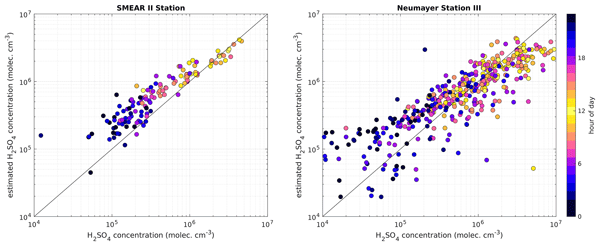
Lisa J. Beck, Siegfried Schobesberger, Mikko Sipilä, Veli-Matti Kerminen, and Markku Kulmala
Atmos. Meas. Tech., 15, 1957–1965, https://doi.org/10.5194/amt-15-1957-2022, https://doi.org/10.5194/amt-15-1957-2022, 2022
Short summary
Short summary
Sulfuric acid is known to be a main compound in atmospheric new particle formation. Yet, its concentration is very low, which leads to challenges in detecting it. In our study, we derive the sulfuric acid concentration from measurements of ambient ions with a mass spectrometer. Our validation shows that the theoretical approach using the bisulfate ion and its clusters with H2SO4 captures the sulfuric acid concentration very well during daytime.
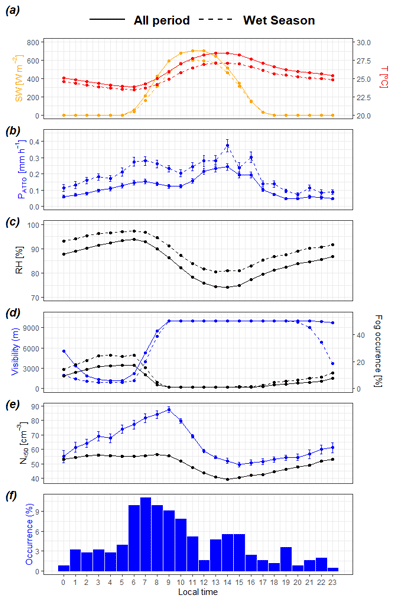
Marco A. Franco, Florian Ditas, Leslie A. Kremper, Luiz A. T. Machado, Meinrat O. Andreae, Alessandro Araújo, Henrique M. J. Barbosa, Joel F. de Brito, Samara Carbone, Bruna A. Holanda, Fernando G. Morais, Janaína P. Nascimento, Mira L. Pöhlker, Luciana V. Rizzo, Marta Sá, Jorge Saturno, David Walter, Stefan Wolff, Ulrich Pöschl, Paulo Artaxo, and Christopher Pöhlker
Atmos. Chem. Phys., 22, 3469–3492, https://doi.org/10.5194/acp-22-3469-2022, https://doi.org/10.5194/acp-22-3469-2022, 2022
Short summary
Short summary
In Central Amazonia, new particle formation in the planetary boundary layer is rare. Instead, there is the appearance of sub-50 nm aerosols with diameters larger than about 20 nm that eventually grow to cloud condensation nuclei size range. Here, 254 growth events were characterized which have higher predominance in the wet season. About 70 % of them showed direct relation to convective downdrafts, while 30 % occurred partly under clear-sky conditions, evidencing still unknown particle sources.
Marjan Marbouti, Sehyun Jang, Silvia Becagli, Gabriel Navarro, Rita Traversi, Kitack Lee, Tuomo Nieminen, Lisa J. Beck, Markku Kulmala, Veli-Matti Kerminen, and Mikko Sipilä
Atmos. Chem. Phys. Discuss., https://doi.org/10.5194/acp-2022-52, https://doi.org/10.5194/acp-2022-52, 2022
Publication in ACP not foreseen
Short summary
Short summary
This research was done to understand and investigate the roles of Chl-a, PP and sea ice extent in controlling and producing the in-situ measured MSA, SA, HIO3, HOM and aerosol concentrations over the Greenland and Barents Seas. Our results provide strong support to the hypothesis that MSA, SA and small-particle concentrations in the Svalbard area are directly linked to ocean biological activity and sea ice melting during springtime.
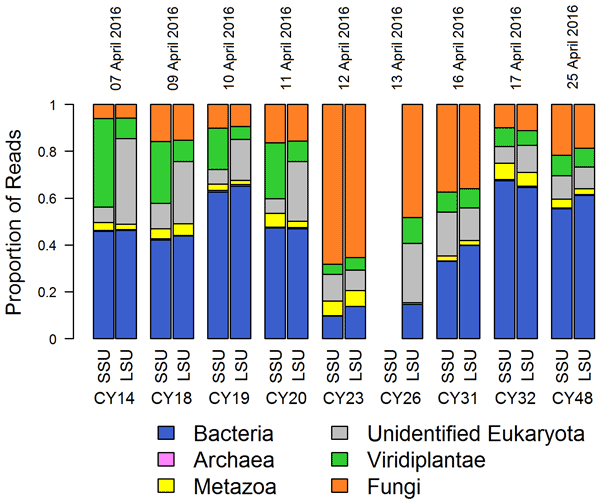
Kai Tang, Beatriz Sánchez-Parra, Petya Yordanova, Jörn Wehking, Anna T. Backes, Daniel A. Pickersgill, Stefanie Maier, Jean Sciare, Ulrich Pöschl, Bettina Weber, and Janine Fröhlich-Nowoisky
Biogeosciences, 19, 71–91, https://doi.org/10.5194/bg-19-71-2022, https://doi.org/10.5194/bg-19-71-2022, 2022
Short summary
Short summary
Metagenomic sequencing and freezing experiments of aerosol samples collected on Cyprus revealed rain-related short-term changes of bioaerosol and ice nuclei composition. Filtration experiments showed a rain-related enhancement of biological ice nuclei > 5 µm and < 0.1 µm. The observed effects of rainfall on the composition of atmospheric bioaerosols and ice nuclei may influence the hydrological cycle as well as the health effects of air particulate matter (pathogens, allergens).
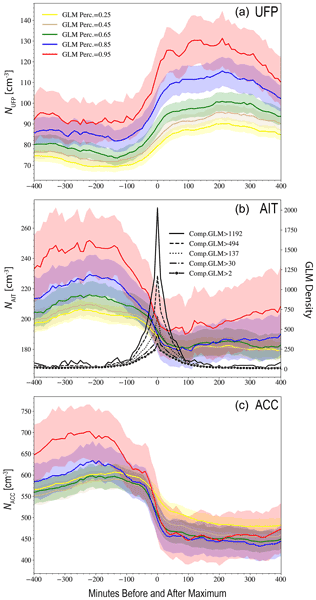
Luiz A. T. Machado, Marco A. Franco, Leslie A. Kremper, Florian Ditas, Meinrat O. Andreae, Paulo Artaxo, Micael A. Cecchini, Bruna A. Holanda, Mira L. Pöhlker, Ivan Saraiva, Stefan Wolff, Ulrich Pöschl, and Christopher Pöhlker
Atmos. Chem. Phys., 21, 18065–18086, https://doi.org/10.5194/acp-21-18065-2021, https://doi.org/10.5194/acp-21-18065-2021, 2021
Short summary
Short summary
Several studies evaluate aerosol–cloud interactions, but only a few attempted to describe how clouds modify aerosol properties. This study evaluates the effect of weather events on the particle size distribution at the ATTO, combining remote sensing and in situ data. Ultrafine, Aitken and accumulation particles modes have different behaviors for the diurnal cycle and for rainfall events. This study opens up new scientific questions that need to be pursued in detail in new field campaigns.
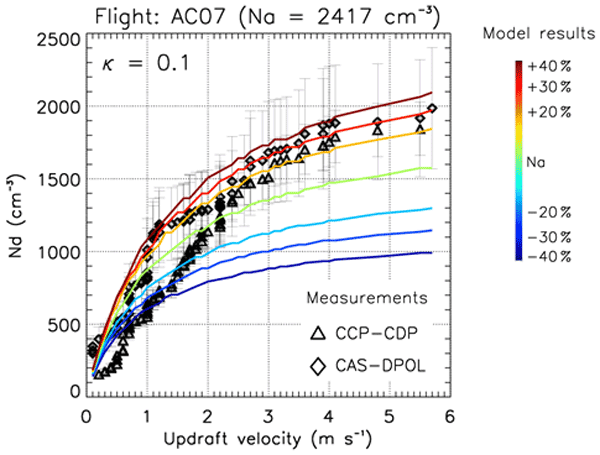
Ramon Campos Braga, Barbara Ervens, Daniel Rosenfeld, Meinrat O. Andreae, Jan-David Förster, Daniel Fütterer, Lianet Hernández Pardo, Bruna A. Holanda, Tina Jurkat-Witschas, Ovid O. Krüger, Oliver Lauer, Luiz A. T. Machado, Christopher Pöhlker, Daniel Sauer, Christiane Voigt, Adrian Walser, Manfred Wendisch, Ulrich Pöschl, and Mira L. Pöhlker
Atmos. Chem. Phys., 21, 17513–17528, https://doi.org/10.5194/acp-21-17513-2021, https://doi.org/10.5194/acp-21-17513-2021, 2021
Short summary
Short summary
Interactions of aerosol particles with clouds represent a large uncertainty in estimates of climate change. Properties of aerosol particles control their ability to act as cloud condensation nuclei. Using aerosol measurements in the Amazon, we performed model studies to compare predicted and measured cloud droplet number concentrations at cloud bases. Our results confirm previous estimates of particle hygroscopicity in this region.
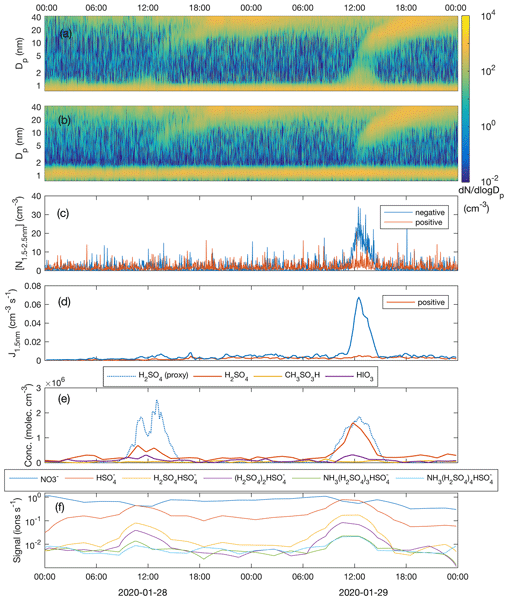
Mikko Sipilä, Nina Sarnela, Kimmo Neitola, Totti Laitinen, Deniz Kemppainen, Lisa Beck, Ella-Maria Duplissy, Salla Kuittinen, Tuuli Lehmusjärvi, Janne Lampilahti, Veli-Matti Kerminen, Katrianne Lehtipalo, Pasi P. Aalto, Petri Keronen, Erkki Siivola, Pekka A. Rantala, Douglas R. Worsnop, Markku Kulmala, Tuija Jokinen, and Tuukka Petäjä
Atmos. Chem. Phys., 21, 17559–17576, https://doi.org/10.5194/acp-21-17559-2021, https://doi.org/10.5194/acp-21-17559-2021, 2021
Short summary
Short summary
Metallurgical industry in Kola peninsula is a large source of air pollution in the (sub-)Arctic domain. Sulfur dioxide emissions from the ore smelters are transported across large areas. We investigated sulfur dioxide and its transformation to sulfuric acid aerosol particles during winter months in Finnish Lapland, close to Kola industrial areas. We observed intense formation of new aerosol particles despite the low solar radiation intensity, often required for new particle formation elsewhere.
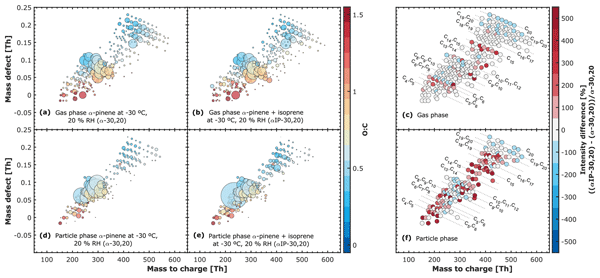
Lucía Caudillo, Birte Rörup, Martin Heinritzi, Guillaume Marie, Mario Simon, Andrea C. Wagner, Tatjana Müller, Manuel Granzin, Antonio Amorim, Farnoush Ataei, Rima Baalbaki, Barbara Bertozzi, Zoé Brasseur, Randall Chiu, Biwu Chu, Lubna Dada, Jonathan Duplissy, Henning Finkenzeller, Loïc Gonzalez Carracedo, Xu-Cheng He, Victoria Hofbauer, Weimeng Kong, Houssni Lamkaddam, Chuan P. Lee, Brandon Lopez, Naser G. A. Mahfouz, Vladimir Makhmutov, Hanna E. Manninen, Ruby Marten, Dario Massabò, Roy L. Mauldin, Bernhard Mentler, Ugo Molteni, Antti Onnela, Joschka Pfeifer, Maxim Philippov, Ana A. Piedehierro, Meredith Schervish, Wiebke Scholz, Benjamin Schulze, Jiali Shen, Dominik Stolzenburg, Yuri Stozhkov, Mihnea Surdu, Christian Tauber, Yee Jun Tham, Ping Tian, António Tomé, Steffen Vogt, Mingyi Wang, Dongyu S. Wang, Stefan K. Weber, André Welti, Wang Yonghong, Wu Yusheng, Marcel Zauner-Wieczorek, Urs Baltensperger, Imad El Haddad, Richard C. Flagan, Armin Hansel, Kristina Höhler, Jasper Kirkby, Markku Kulmala, Katrianne Lehtipalo, Ottmar Möhler, Harald Saathoff, Rainer Volkamer, Paul M. Winkler, Neil M. Donahue, Andreas Kürten, and Joachim Curtius
Atmos. Chem. Phys., 21, 17099–17114, https://doi.org/10.5194/acp-21-17099-2021, https://doi.org/10.5194/acp-21-17099-2021, 2021
Short summary
Short summary
We performed experiments in the CLOUD chamber at CERN at low temperatures to simulate new particle formation in the upper free troposphere (at −30 ºC and −50 ºC). We measured the particle and gas phase and found that most of the compounds present in the gas phase are detected as well in the particle phase. The major compounds in the particles are C8–10 and C18–20. Specifically, we showed that C5 and C15 compounds are detected in a mixed system with isoprene and α-pinene at −30 ºC, 20 % RH.
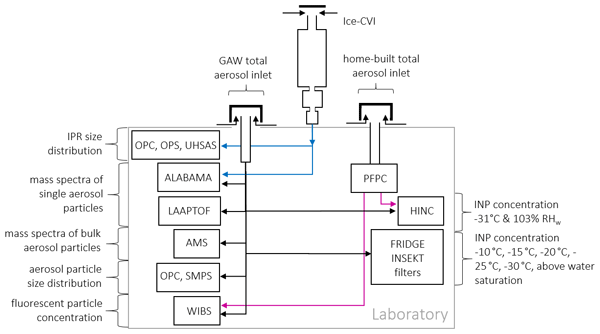
Larissa Lacher, Hans-Christian Clemen, Xiaoli Shen, Stephan Mertes, Martin Gysel-Beer, Alireza Moallemi, Martin Steinbacher, Stephan Henne, Harald Saathoff, Ottmar Möhler, Kristina Höhler, Thea Schiebel, Daniel Weber, Jann Schrod, Johannes Schneider, and Zamin A. Kanji
Atmos. Chem. Phys., 21, 16925–16953, https://doi.org/10.5194/acp-21-16925-2021, https://doi.org/10.5194/acp-21-16925-2021, 2021
Short summary
Short summary
We investigate ice-nucleating particle properties at Jungfraujoch during the 2017 joint INUIT/CLACE field campaign, to improve the knowledge about those rare particles in a cloud-relevant environment. By quantifying ice-nucleating particles in parallel to single-particle mass spectrometry measurements, we find that mineral dust and aged sea spray particles are potential candidates for ice-nucleating particles. Our findings are supported by ice residual analysis and source region modeling.

Najin Kim, Yafang Cheng, Nan Ma, Mira L. Pöhlker, Thomas Klimach, Thomas F. Mentel, Ovid O. Krüger, Ulrich Pöschl, and Hang Su
Atmos. Meas. Tech., 14, 6991–7005, https://doi.org/10.5194/amt-14-6991-2021, https://doi.org/10.5194/amt-14-6991-2021, 2021
Short summary
Short summary
A broad supersaturation scanning CCN (BS2-CCN) system, in which particles are exposed to a range of supersaturation simultaneously, can measure a broad range of CCN activity distribution with a high time resolution. We describe how the BS2-CCN system can be effectively calibrated and which factors can affect the calibration curve. Intercomparison experiments between typical DMA-CCN and BS2-CCN measurements to evaluate the BS2-CCN system showed high correlation and good agreement.
Yu-Wen Chen, Yi-Chun Chen, Charles C.-K. Chou, Hui-Ming Hung, Shih-Yu Chang, Lisa Eirenschmalz, Michael Lichtenstern, Helmut Ziereis, Hans Schlager, Greta Stratmann, Katharina Kaiser, Johannes Schneider, Stephan Borrmann, Florian Obersteiner, Eric Förster, Andreas Zahn, Wei-Nai Chen, Po-Hsiung Lin, Shuenn-Chin Chang, Maria Dolores Andrés Hernández, Pao-Kuan Wang, and John P. Burrows
Atmos. Chem. Phys. Discuss., https://doi.org/10.5194/acp-2021-788, https://doi.org/10.5194/acp-2021-788, 2021
Preprint withdrawn
Short summary
Short summary
By presenting an approach using EMeRGe-Asia airborne field measurements and surface observations, this study shows that the fraction of OH reactivity due to SO2-OH reaction has a significant correlation with the sulfate concentration. Approximately 30 % of sulfate is produced by SO2-OH reaction. Our results underline the importance of SO2-OH gas-phase oxidation in sulfate formation, and demonstrate that the method can be applied to other regions and under different meteorological conditions.
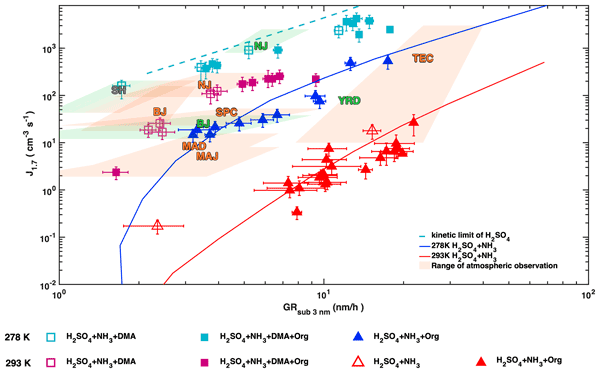
Mao Xiao, Christopher R. Hoyle, Lubna Dada, Dominik Stolzenburg, Andreas Kürten, Mingyi Wang, Houssni Lamkaddam, Olga Garmash, Bernhard Mentler, Ugo Molteni, Andrea Baccarini, Mario Simon, Xu-Cheng He, Katrianne Lehtipalo, Lauri R. Ahonen, Rima Baalbaki, Paulus S. Bauer, Lisa Beck, David Bell, Federico Bianchi, Sophia Brilke, Dexian Chen, Randall Chiu, António Dias, Jonathan Duplissy, Henning Finkenzeller, Hamish Gordon, Victoria Hofbauer, Changhyuk Kim, Theodore K. Koenig, Janne Lampilahti, Chuan Ping Lee, Zijun Li, Huajun Mai, Vladimir Makhmutov, Hanna E. Manninen, Ruby Marten, Serge Mathot, Roy L. Mauldin, Wei Nie, Antti Onnela, Eva Partoll, Tuukka Petäjä, Joschka Pfeifer, Veronika Pospisilova, Lauriane L. J. Quéléver, Matti Rissanen, Siegfried Schobesberger, Simone Schuchmann, Yuri Stozhkov, Christian Tauber, Yee Jun Tham, António Tomé, Miguel Vazquez-Pufleau, Andrea C. Wagner, Robert Wagner, Yonghong Wang, Lena Weitz, Daniela Wimmer, Yusheng Wu, Chao Yan, Penglin Ye, Qing Ye, Qiaozhi Zha, Xueqin Zhou, Antonio Amorim, Ken Carslaw, Joachim Curtius, Armin Hansel, Rainer Volkamer, Paul M. Winkler, Richard C. Flagan, Markku Kulmala, Douglas R. Worsnop, Jasper Kirkby, Neil M. Donahue, Urs Baltensperger, Imad El Haddad, and Josef Dommen
Atmos. Chem. Phys., 21, 14275–14291, https://doi.org/10.5194/acp-21-14275-2021, https://doi.org/10.5194/acp-21-14275-2021, 2021
Short summary
Short summary
Experiments at CLOUD show that in polluted environments new particle formation (NPF) is largely driven by the formation of sulfuric acid–base clusters, stabilized by amines, high ammonia concentrations or lower temperatures. While oxidation products of aromatics can nucleate, they play a minor role in urban NPF. Our experiments span 4 orders of magnitude variation of observed NPF rates in ambient conditions. We provide a framework based on NPF and growth rates to interpret ambient observations.
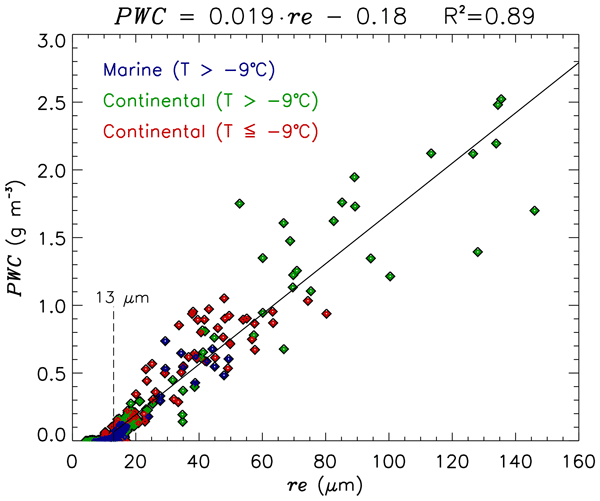
Ramon Campos Braga, Daniel Rosenfeld, Ovid O. Krüger, Barbara Ervens, Bruna A. Holanda, Manfred Wendisch, Trismono Krisna, Ulrich Pöschl, Meinrat O. Andreae, Christiane Voigt, and Mira L. Pöhlker
Atmos. Chem. Phys., 21, 14079–14088, https://doi.org/10.5194/acp-21-14079-2021, https://doi.org/10.5194/acp-21-14079-2021, 2021
Short summary
Short summary
Quantifying the precipitation within clouds is crucial for our understanding of the Earth's hydrological cycle. Using in situ measurements of cloud and rain properties over the Amazon Basin and Atlantic Ocean, we show here a linear relationship between the effective radius (re) and precipitation water content near the tops of convective clouds for different pollution states and temperature levels. Our results emphasize the role of re to determine both initiation and amount of precipitation.
Cited articles
Andreae, M. O., Afchine, A., Albrecht, R., Holanda, B. A., Artaxo, P., Barbosa, H. M. J., Borrmann, S., Cecchini, M. A., Costa, A., Dollner, M., Fütterer, D., Järvinen, E., Jurkat, T., Klimach, T., Konemann, T., Knote, C., Krämer, M., Krisna, T., Machado, L. A. T., Mertes, S., Minikin, A., Pöhlker, C., Pöhlker, M. L., Pöschl, U., Rosenfeld, D., Sauer, D., Schlager, H., Schnaiter, M., Schneider, J., Schulz, C., Spanu, A., Sperling, V. B., Voigt, C., Walser, A., Wang, J., Weinzierl, B., Wendisch, M., and Ziereis, H.: Aerosol characteristics and particle production in the upper troposphere over the Amazon Basin, Atmos. Chem. Phys., 18, 921–961, https://doi.org/10.5194/acp-18-921-2018, 2018. a, b
Baalbaki, R., Shen, J., Simon, M., Klebach, H., Ruhl, S., DeVivo, J., Wang, M., Scholz, W., Dada, L., Rörup, B., Stolzenburg, D., Manninen, H. E., Sommer, E., Caudillo-Plath, L., Marie, G., Friedrich, M., Yu, W., Leiminger, M., Alfaouri, D., Amorim, A., Arnoldi-Meadows, T., Beckmann, H., Berntheusel, M., Bräkling, S., Brasseur, Z., Chiu, R., Duplissy, J., Finkenzeller, H., Heinritzi, M., Kunkler, F., Lamkaddam, H., Lopez, B., Mahfouz, N., Makhmutov, V., Martinez, M., Marten, R., Massabo, D., Mauldin, R., Mentler, B., Müller, M., Philippov, M., Piedehierro, A. A., Rato, P., Reinecke, T., Richter, S., Russell, D. M., Schulze, B., Surdu, M., Thakur, R., Tham, Y. J., Tian, P., Tomé, A., Tong, Y., Top, J., Wagner, A. C., Wang, D. S., Wang, Y., Ward, R. X., Weber, S. K., Welti, A., Wu, Y., Zauner-Wieczorek, M., Zhang, J., Curtius, J., Donahue, N. M., El Haddad, I., Flagan, R. C., Hansel, A., Harder, H., Kürten, A., Petäjä, T., Schobesberger, S., Sipilä, M., Volkamer, R., Winkler, P. M., Worsnop, D. R., Christoudias, T., Pozzer, A., Kulmala, M., Kirkby, J., Lehtipalo, K., and He, X.-C.: Role of methanesulfonic acid in atmospheric particle nucleation and growth, Nature, https://doi.org/10.1038/s41586-026-10810-2, 2026. a, b
Baccarini, A., Dommen, J., Lehtipalo, K., Henning, S., Modini, R. L., Gysel-Beer, M., Baltensperger, U., and Schmale, J.: Low-Volatility Vapors and New Particle Formation Over the Southern Ocean During the Antarctic Circumnavigation Expedition, J. Geophys. Res.-Atmos., 126, e2021JD035126, https://doi.org/10.1029/2021JD035126, 2021. a, b
Bahreini, R., Ervens, B., Middlebrook, A. M., Warneke, C., de Gouw, J. A., DeCarlo, P. F., Jimenez, J. L., Brock, C. A., Neuman, J. A., Ryerson, T. B., Stark, H., Atlas, E., Brioude, J., Fried, A., Holloway, J. S., Peischl, J., Richter, D., Walega, J., Weibring, P., Wollny, A. G., and Fehsenfeld, F. C.: Organic aerosol formation in urban and industrial plumes near Houston and Dallas, Texas, J. Geophys. Res.-Atmos., 114, https://doi.org/10.1029/2008JD011493, 2009. a
Beck, L. J., Sarnela, N., Junninen, H., Hoppe, C. J. M., Garmash, O., Bianchi, F., Riva, M., Rose, C., Peräkylä, O., Wimmer, D., Kausiala, O., Jokinen, T., Ahonen, L., Mikkilä, J., Hakala, J., He, X.-C., Kontkanen, J., Wolf, K. K. E., Cappelletti, D., Mazzola, M., Traversi, R., Petroselli, C., Viola, A. P., Vitale, V., Lange, R., Massling, A., Nøjgaard, J. K., Krejci, R., Karlsson, L., Zieger, P., Jang, S., Lee, K., Vakkari, V., Lampilahti, J., Thakur, R. C., Leino, K., Kangasluoma, J., Duplissy, E.-M., Siivola, E., Marbouti, M., Tham, Y. J., Saiz-Lopez, A., Petäjä, T., Ehn, M., Worsnop, D. R., Skov, H., Kulmala, M., Kerminen, V.-M., and Sipilä, M.: Differing Mechanisms of New Particle Formation at Two Arctic Sites, Geophys. Res. Lett., 48, https://doi.org/10.1029/2020GL091334, 2021. a, b
Bock, J., Michou, M., Nabat, P., Abe, M., Mulcahy, J. P., Olivié, D. J. L., Schwinger, J., Suntharalingam, P., Tjiputra, J., van Hulten, M., Watanabe, M., Yool, A., and Séférian, R.: Evaluation of ocean dimethylsulfide concentration and emission in CMIP6 models, Biogeosciences, 18, 3823–3860, https://doi.org/10.5194/bg-18-3823-2021, 2021. a
Broch, S.: Ein neues LIF-Instrument für flugzeug- und bodengebundene Messungen von OH- und HO 2 -Radikalen in der Troposphäre, PhD thesis, Bergische Universität Wuppertal, Jülich, https://nbn-resolving.org/urn:nbn:de:hbz:468-20120305-092715-1 (last access: 9 April 2026), 2012. a
Brock, C. A., Hamill, P., Wilson, J. C., Jonsson, H. H., and Chan, K. R.: Particle Formation in the Upper Tropical Troposphere: A Source of Nuclei for the Stratospheric Aerosol, Science, 270, 1650–1653, https://doi.org/10.1126/science.270.5242.1650, 1995. a
Bureau Of Meteorology: Bureau of Meteorology Satellite Derived Products, https://doi.org/10.25914/c2vt-8n41, 2024. a
Burkholder, J. B., Sander, S. P., Abbatt, J., Barker, J. R., Cappa, C., Crounse, J. D., Dibble, T. S., Huie, R. E., Kolb, C. E., Kurylo, M. J., Orkin, V. L., Percival, C. J., Wilmouth, D. M., and Wine, P. H.: Chemical Kinetics and Photochemical Data for Use in Atmospheric Studies, Evaluation No. 19, JPL Publication 19-5, https://science.jpl.nasa.gov/documents/1487/NASA-JPL_Evaluation_19-5.pdf (last access: 15 March 2026), 2019. a, b
Cala, B. A., Archer-Nicholls, S., Weber, J., Abraham, N. L., Griffiths, P. T., Jacob, L., Shin, Y. M., Revell, L. E., Woodhouse, M., and Archibald, A. T.: Development, intercomparison, and evaluation of an improved mechanism for the oxidation of dimethyl sulfide in the UKCA model, Atmos. Chem. Phys., 23, 14735–14760, https://doi.org/10.5194/acp-23-14735-2023, 2023. a, b
Canagaratna, M. R., Jayne, J. T., Jimenez, J. L., Allan, J. D., Alfarra, M. R., Zhang, Q., Onasch, T. B., Drewnick, F., Coe, H., Middlebrook, A., Delia, A., Williams, L. R., Trimborn, A. M., Northway, M. J., DeCarlo, P. F., Kolb, C. E., Davidovits, P., and Worsnop, D. R.: Chemical and microphysical characterization of ambient aerosols with the aerodyne aerosol mass spectrometer, Mass Spectrom. Rev., 26, 185–222, https://doi.org/10.1002/mas.20115, 2007. a
Carslaw, K. S., Gordon, H., Hamilton, D. S., Johnson, J. S., Regayre, L. A., Yoshioka, M., and Pringle, K. J.: Aerosols in the Pre-industrial Atmosphere, Current Climate Change Reports, 3, 1–15, https://doi.org/10.1007/s40641-017-0061-2, 2017. a
Chen, H., Varner, M. E., Gerber, R. B., and Finlayson-Pitts, B. J.: Reactions of Methanesulfonic Acid with Amines and Ammonia as a Source of New Particles in Air, J. Phys. Chem. B, 120, 1526–1536, https://doi.org/10.1021/acs.jpcb.5b07433, 2016. a
Clarke, A. D. and Kapustin, V. N.: A Pacific Aerosol Survey. Part I: A Decade of Data on Particle Production, Transport, Evolution, and Mixing in the Troposphere, J. Atmos. Sci., 59, 363–382, https://doi.org/10.1175/1520-0469(2002)059<0363:APASPI>2.0.CO;2, 2002. a
Curtius, J., Heinritzi, M., Beck, L. J., Pöhlker, M. L., Tripathi, N., Krumm, B. E., Holzbeck, P., Nussbaumer, C. M., Hernández Pardo, L., Klimach, T., Barmpounis, K., Andersen, S. T., Bardakov, R., Bohn, B., Cecchini, M. A., Chaboureau, J.-P., Dauhut, T., Dienhart, D., Dörich, R., Edtbauer, A., Giez, A., Hartmann, A., Holanda, B. A., Joppe, P., Kaiser, K., Keber, T., Klebach, H., Krüger, O. O., Kürten, A., Mallaun, C., Marno, D., Martinez, M., Monteiro, C., Nelson, C., Ort, L., Raj, S. S., Richter, S., Ringsdorf, A., Rocha, F., Simon, M., Sreekumar, S., Tsokankunku, A., Unfer, G. R., Valenti, I. D., Wang, N., Zahn, A., Zauner-Wieczorek, M., Albrecht, R. I., Andreae, M. O., Artaxo, P., Crowley, J. N., Fischer, H., Harder, H., Herdies, D. L., Machado, L. A. T., Pöhlker, C., Pöschl, U., Possner, A., Pozzer, A., Schneider, J., Williams, J., and Lelieveld, J.: Isoprene nitrates drive new particle formation in Amazon's upper troposphere, Nature, 636, 124–130, https://doi.org/10.1038/s41586-024-08192-4, 2024. a, b, c, d, e, f, g
Dal Maso, M., Kulmala, M., Lehtinen, K. E. J., Mäkelä, J. M., Aalto, P., and O'Dowd, C. D.: Condensation and coagulation sinks and formation of nucleation mode particles in coastal and boreal forest boundary layers, J. Geophys. Res.-Atmos., 107, PAR 2-1–PAR 2-10, https://doi.org/10.1029/2001JD001053, 2002. a
de Deckker, P.: The Indo-Pacific Warm Pool: critical to world oceanography and world climate, Geoscience Letters, 3, 20, https://doi.org/10.1186/s40562-016-0054-3, 2016. a
Draxler, R. R.: An Overview of the HYSPLIT_4 Modelling System for Trajectories, Dispersion, and Deposition, Australian Meteorological Magazine, 295–308, https://www.arl.noaa.gov/documents/reports/MetMag.pdf (last access: 10 December 2025), 1998. a
Draxler, R. R.: HYSPLIT4 user's guide: NOAA Technical Momerandum ERL ARL-230, Air Resources Laboratory Silver Spring, Maryland, https://arl.noaa.gov/wp_arl/wp-content/uploads/documents/reports/arl-230.pdf (last access: 10 December 2025), 1999. a
Draxler, R. R. and Hess, G. D.: Description of the HYSPLIT_4 modeling system: NOAA Technical Memorandum ERL ARL-224, Air Resources Laboratory Silver Spring, Maryland, https://www.arl.noaa.gov/wp_arl/wp-content/uploads/documents/reports/arl-224.pdf (last access: 10 December 2025), 1997. a
Drewnick, F., Hings, S. S., DeCarlo, P., Jayne, J. T., Gonin, M., Fuhrer, K., Weimer, S., Jimenez, J. L., Demerjian, K. L., Borrmann, S., and Worsnop, D. R.: A New Time-of-Flight Aerosol Mass Spectrometer (TOF-AMS)–Instrument Description and First Field Deployment, Aerosol Science and Technology, 39, 637–658, https://doi.org/10.1080/02786820500182040, 2005. a
Dunne, E. M., Gordon, H., Kürten, A., Almeida, J., Duplissy, J., Williamson, C., Ortega, I. K., Pringle, K. J., Adamov, A., Baltensperger, U., Barmet, P., Benduhn, F., Bianchi, F., Breitenlechner, M., Clarke, A., Curtius, J., Dommen, J., Donahue, N. M., Ehrhart, S., Flagan, R. C., Franchin, A., Guida, R., Hakala, J., Hansel, A., Heinritzi, M., Jokinen, T., Kangasluoma, J., Kirkby, J., Kulmala, M., Kupc, A., Lawler, M. J., Lehtipalo, K., Makhmutov, V., Mann, G., Mathot, S., Merikanto, J., Miettinen, P., Nenes, A., Onnela, A., Rap, A., Reddington, C. L. S., Riccobono, F., Richards, N. A. D., Rissanen, M. P., Rondo, L., Sarnela, N., Schobesberger, S., Sengupta, K., Simon, M., Sipilä, M., Smith, J. N., Stozkhov, Y., Tomé, A., Tröstl, J., Wagner, P. E., Wimmer, D., Winkler, P. M., Worsnop, D. R., and Carslaw, K. S.: Global atmospheric particle formation from CERN CLOUD measurements, Science, 354, 1119–1124, https://doi.org/10.1126/science.aaf2649, 2016. a, b, c
Folkins, I. and Martin, R. V.: The Vertical Structure of Tropical Convection and Its Impact on the Budgets of Water Vapor and Ozone, J. Atmos. Sci., 62, 1560–1573, https://doi.org/10.1175/JAS3407.1, 2005. a
Froyd, K. D., Murphy, D. M., Sanford, T. J., Thomson, D. S., Wilson, J. C., Pfister, L., and Lait, L.: Aerosol composition of the tropical upper troposphere, Atmos. Chem. Phys., 9, 4363–4385, https://doi.org/10.5194/acp-9-4363-2009, 2009. a, b
Fung, K. M., Heald, C. L., Kroll, J. H., Wang, S., Jo, D. S., Gettelman, A., Lu, Z., Liu, X., Zaveri, R. A., Apel, E. C., Blake, D. R., Jimenez, J.-L., Campuzano-Jost, P., Veres, P. R., Bates, T. S., Shilling, J. E., and Zawadowicz, M.: Exploring dimethyl sulfide (DMS) oxidation and implications for global aerosol radiative forcing, Atmos. Chem. Phys., 22, 1549–1573, https://doi.org/10.5194/acp-22-1549-2022, 2022. a
Giez, A., Zöger, M., Mallaun, C., Nenakhov, V., Schimpf, M., Grad, C., Numberger, A., and Raynor, K.: Determination of the Measurement Errors for the HALO Basic Data System BAHAMAS by Means of Error Propagation, DLR electronic library, https://doi.org/10.57676/5RDC-Q708, 2022. a
Global Ocean Biogeochemistry Analysis and Forecast: E.U. Copernicus Marine Service Information (CMEMS), Marine Data Store (MDS), https://doi.org/10.48670/moi-00015, 2026. a
Gormley, P. G. and Kennedy, M.: Diffusion from a Stream Flowing through a Cylindrical Tube, P. Roy. Irish Acad. A, 52, 163–169, http://www.jstor.org/stable/20488498 (last access: 23 July 2026), 1948. a
He, X.-C., Abraham, N. L., Ding, H., Russo, M. R., Grosvenor, D. P., Ge, Y., Wang, X., Jones, A. C., Campuzano-Jost, P., Nault, B., Kupc, A., Blake, D., Jimenez, J. L., Williamson, C. J., Weber, J., Archibald, A. T., and Gordon, H.: Evaluation of UKESM aerosol size and composition using ATom measurements indicates missing marine aerosol formation mechanisms, Atmos. Chem. Phys., 26, 3805–3851, https://doi.org/10.5194/acp-26-3805-2026, 2026. a
Hernández Pardo, L., Curtius, J., Jöckel, P., Menken, M., and Possner, A.: Global transport of upper-tropospheric tropical tracers: multi-year insights from idealized simulations, EGUsphere [preprint], https://doi.org/10.5194/egusphere-2025-4338, 2026. a, b
von Hobe, M., Grooß, J.-U., Günther, G., Konopka, P., Gensch, I., Krämer, M., Spelten, N., Afchine, A., Schiller, C., Ulanovsky, A., Sitnikov, N., Shur, G., Yushkov, V., Ravegnani, F., Cairo, F., Roiger, A., Voigt, C., Schlager, H., Weigel, R., Frey, W., Borrmann, S., Müller, R., and Stroh, F.: Evidence for heterogeneous chlorine activation in the tropical UTLS, Atmos. Chem. Phys., 11, 241–256, https://doi.org/10.5194/acp-11-241-2011, 2011. a
Hodshire, A. L., Campuzano-Jost, P., Kodros, J. K., Croft, B., Nault, B. A., Schroder, J. C., Jimenez, J. L., and Pierce, J. R.: The potential role of methanesulfonic acid (MSA) in aerosol formation and growth and the associated radiative forcings, Atmos. Chem. Phys., 19, 3137–3160, https://doi.org/10.5194/acp-19-3137-2019, 2019. a
Höpfner, M., Volkamer, R., Grabowski, U., Grutter, M., Orphal, J., Stiller, G., von Clarmann, T., and Wetzel, G.: First detection of ammonia (NH3) in the Asian summer monsoon upper troposphere, Atmos. Chem. Phys., 16, 14357–14369, https://doi.org/10.5194/acp-16-14357-2016, 2016. a, b
Hoffmann, E. H., Tilgner, A., Schrödner, R., Bräuer, P., Wolke, R., and Herrmann, H.: An advanced modeling study on the impacts and atmospheric implications of multiphase dimethyl sulfide chemistry, P. Natl. Acad. Sci. USA, 113, 11776–11781, https://doi.org/10.1073/pnas.1606320113, 2016. a, b, c, d
Inness, A., Ades, M., Agustí-Panareda, A., Barré, J., Benedictow, A., Blechschmidt, A.-M., Dominguez, J. J., Engelen, R., Eskes, H., Flemming, J., Huijnen, V., Jones, L., Kipling, Z., Massart, S., Parrington, M., Peuch, V.-H., Razinger, M., Remy, S., Schulz, M., and Suttie, M.: The CAMS reanalysis of atmospheric composition, Atmos. Chem. Phys., 19, 3515–3556, https://doi.org/10.5194/acp-19-3515-2019, 2019. a, b, c
Jacob, L. S. D., Giorio, C., and Archibald, A. T.: Extension, development, and evaluation of the representation of the OH-initiated dimethyl sulfide (DMS) oxidation mechanism in the Master Chemical Mechanism (MCM) v3.3.1 framework, Atmos. Chem. Phys., 24, 3329–3347, https://doi.org/10.5194/acp-24-3329-2024, 2024. a, b, c, d, e, f, g, h, i
Jernigan, C. M., Rivard, M. J., Berkelhammer, M. B., and Bertram, T. H.: Sulfate and Carbonyl Sulfide Production in Aqueous Reactions of Hydroperoxymethyl Thioformate, ACS ES&T Air, 1, 397–404, https://doi.org/10.1021/acsestair.3c00098, 2024. a
Joge, S. D., Mansour, K., Simó, R., Galí, M., Steiner, N., Saiz-Lopez, A., and Mahajan, A. S.: Climate warming increases global oceanic dimethyl sulfide emissions, P. Natl. Acad. Sci. USA, 122, e2502077122, https://doi.org/10.1073/pnas.2502077122, 2025. a
Johansson, S., Höpfner, M., Friedl-Vallon, F., Glatthor, N., Gulde, T., Huijnen, V., Kleinert, A., Kretschmer, E., Maucher, G., Neubert, T., Nordmeyer, H., Piesch, C., Preusse, P., Riese, M., Sinnhuber, B.-M., Ungermann, J., Wetzel, G., and Woiwode, W.: Ammonia in the upper troposphere–lower stratosphere (UTLS): GLORIA airborne measurements for CAMS model evaluation in the Asian monsoon and in biomass burning plumes above the South Atlantic, Atmos. Chem. Phys., 24, 8125–8138, https://doi.org/10.5194/acp-24-8125-2024, 2024. a, b
Johnson, J. S. and Jen, C. N.: Role of Methanesulfonic Acid in Sulfuric Acid-Amine and Ammonia New Particle Formation, ACS Earth & Space Chemistry, 7, 653–660, https://doi.org/10.1021/acsearthspacechem.3c00017, 2023. a
Jokinen, T., Sipilä, M., Junninen, H., Ehn, M., Lönn, G., Hakala, J., Petäjä, T., Mauldin III, R. L., Kulmala, M., and Worsnop, D. R.: Atmospheric sulphuric acid and neutral cluster measurements using CI-APi-TOF, Atmos. Chem. Phys., 12, 4117–4125, https://doi.org/10.5194/acp-12-4117-2012, 2012. a
Jokinen, T., Sipilä, M., Kontkanen, J., Vakkari, V., Tisler, P., Duplissy, E. M., Junninen, H., Kangasluoma, J., Manninen, H. E., Petäjä, T., Kulmala, M., Worsnop, D. R., Kirkby, J., Virkkula, A., and Kerminen, V. M.: Ion-induced sulfuric acid–ammonia nucleation drives particle formation in coastal Antarctica, Sci. Adv., 4, eaat9744, https://doi.org/10.1126/sciadv.aat9744, 2018. a
Jongebloed, U. A., Chalif, J. I., Tashmim, L., Porter, W. C., Bates, K. H., Chen, Q., Osterberg, E. C., Koffman, B. G., Cole-Dai, J., Winski, D. A., Ferris, D. G., Kreutz, K. J., Wake, C. P., and Alexander, B.: Dimethyl sulfide chemistry over the industrial era: comparison of key oxidation mechanisms and long-term observations, Atmos. Chem. Phys., 25, 4083–4106, https://doi.org/10.5194/acp-25-4083-2025, 2025. a, b
Kerdraon, G. and Fontaine, E.: Algorithm Theoretical Basis Documentfor the Cloud Product Processors of the NWC/GEO, https://opus.nci.org.au/spaces/NDP/pages/206110970/Himawari-AHI+Cloud+Type+CT?preview=/206110970/206373617/NWC-CDOP3-GEO-MFL-SCI-ATBD-Cloud_v1.0.1.pdf (last access: 9 April 2026), 2021. a
Khan, M. A. H., Gillespie, S. M. P., Razis, B., Xiao, P., Davies-Coleman, M. T., Percival, C. J., Derwent, R. G., Dyke, J. M., Ghosh, M. V., Lee, E. P. F., and Shallcross, D. E.: A modelling study of the atmospheric chemistry of DMS using the global model, STOCHEM-CRI, Atmos. Environ., 127, 69–79, https://doi.org/10.1016/j.atmosenv.2015.12.028, 2016. a
Kilgour, D. B., Jernigan, C. M., Garmash, O., Aggarwal, S., Zhou, S., Mohr, C., Salter, M. E., Thornton, J. A., Wang, J., Zieger, P., and Bertram, T. H.: Cloud processing of dimethyl sulfide (DMS) oxidation products limits sulfur dioxide (SO2) and carbonyl sulfide (OCS) production in the eastern North Atlantic marine boundary layer, Atmos. Chem. Phys., 25, 1931–1947, https://doi.org/10.5194/acp-25-1931-2025, 2025. a
Klebach, H., Heinritzi, M., Kaiser, K., Beck, L., Ruhl, S., Atabakhsh, S., Bhattacharyya, N., Caudillo-Plath, L., Joppe, P., Klimach, T., Lloyd, P., Pöhlker, M., Pöschl, U., Richter, S., Russell, D. M., Schneider, J., Zauner-Wieczorek, M., and Curtius, J.: Aircraft observations suggest an important contribution of methanesulfonic and sulfuric acids to tropical Indo-Pacific aerosol: Data, Zenodo [data set], https://doi.org/10.5281/zenodo.19555789, 2026. a
Koenig, T. K., Volkamer, R., Baidar, S., Dix, B., Wang, S., Anderson, D. C., Salawitch, R. J., Wales, P. A., Cuevas, C. A., Fernandez, R. P., Saiz-Lopez, A., Evans, M. J., Sherwen, T., Jacob, D. J., Schmidt, J., Kinnison, D., Lamarque, J.-F., Apel, E. C., Bresch, J. C., Campos, T., Flocke, F. M., Hall, S. R., Honomichl, S. B., Hornbrook, R., Jensen, J. B., Lueb, R., Montzka, D. D., Pan, L. L., Reeves, J. M., Schauffler, S. M., Ullmann, K., Weinheimer, A. J., Atlas, E. L., Donets, V., Navarro, M. A., Riemer, D., Blake, N. J., Chen, D., Huey, L. G., Tanner, D. J., Hanisco, T. F., and Wolfe, G. M.: BrO and inferred Bry profiles over the western Pacific: relevance of inorganic bromine sources and a Bry minimum in the aged tropical tropopause layer, Atmos. Chem. Phys., 17, 15245–15270, https://doi.org/10.5194/acp-17-15245-2017, 2017. a
Koga, S. and Tanaka, H.: Modeling the methanesulfonate to non-sea-salt sulfate molar ratio and dimethylsulfide oxidation in the atmosphere, J. Geophys. Res.-Atmos., 104, 13735–13747, https://doi.org/10.1029/1999JD900069, 1999. a
Krautstrunk, M. and Giez, A.: The Transition From FALCON to HALO Era Airborne Atmospheric Research, in: Atmospheric Physics: Background – Methods – Trends, edited by: Schumann, U., Springer Berlin Heidelberg, Berlin, Heidelberg, 609–624, ISBN 978-3-642-30183-4, https://doi.org/10.1007/978-3-642-30183-4_37, 2012. a
Kremser, S., Thomason, L. W., von Hobe, M., Hermann, M., Deshler, T., Timmreck, C., Toohey, M., Stenke, A., Schwarz, J. P., Weigel, R., Fueglistaler, S., Prata, F. J., Vernier, J.-P., Schlager, H., Barnes, J. E., Antuña-Marrero, J.-C., Fairlie, D., Palm, M., Mahieu, E., Notholt, J., Rex, M., Bingen, C., Vanhellemont, F., Bourassa, A., Plane, J. M. C., Klocke, D., Carn, S. A., Clarisse, L., Trickl, T., Neely, R., James, A. D., Rieger, L., Wilson, J. C., and Meland, B.: Stratospheric aerosol-Observations, processes, and impact on climate, Rev. Geophys., 54, 278–335, https://doi.org/10.1002/2015RG000511, 2016. a
Kürten, A., Rondo, L., Ehrhart, S., and Curtius, J.: Performance of a corona ion source for measurement of sulfuric acid by chemical ionization mass spectrometry, Atmos. Meas. Tech., 4, 437–443, https://doi.org/10.5194/amt-4-437-2011, 2011. a
Kürten, A., Rondo, L., Ehrhart, S., and Curtius, J.: Calibration of a chemical ionization mass spectrometer for the measurement of gaseous sulfuric acid, J. Phys. Chem. A, 116, 6375–6386, https://doi.org/10.1021/jp212123n, 2012. a
Librando, V., Tringali, G., Hjorth, J., and Coluccia, S.: OH-initiated oxidation of DMS/DMSO: reaction products at high NOx levels, Environ. Pollut., 127, 403–410, https://doi.org/10.1016/j.envpol.2003.08.003, 2004. a
Liu, C. and Zipser, E. J.: The global distribution of largest, deepest, and most intense precipitation systems, Geophys. Res. Lett., 42, 3591–3595, https://doi.org/10.1002/2015GL063776, 2015. a
Loh, A., Kim, D., An, J. G., Choi, N., and Yim, U. H.: Chemical characterization of sub-micron aerosols over the East Sea (Sea of Japan), Sci. Total Environ., 856, 159173, https://doi.org/10.1016/j.scitotenv.2022.159173, 2023. a
Ma, J., Chen, B., He, Q., Yan, X., Wang, G., Cheng, S., Steil, B., Brühl, C., Tost, H., Höpfner, M., Pozzer, A., and Lelieveld, J.: Modelling the deep convective transport of trace gases (CO, NH3 and SO2) from the planetary boundary layer to the Asian summer monsoon anticyclone, Atmos. Chem. Phys., 26, 8125–8144, https://doi.org/10.5194/acp-26-8125-2026, 2026. a
MacQueen, J.: Some methods for classification and analysis of multivariate observations, Proc. Fifth Berkeley Sympos. Math. Statist. and Probability (Berkeley, Calif., 1965/66), 281–297, 0214.46201, https://zbmath.org/?format=complete&q=an:0214.46201 (last access: 25 March 2026), 1967. a
Mauldin, R. L., Cantrell, C., Zondlo, M. A., Kosciuch, E., Eisele, F. L., Chen, G., Davis, D. D., Weber, R., Crawford, J. H., Blake, D. R., Bandy, A. R., and Thornton, D. C.: Highlights of OH, H2SO4, and methane sulfonic acid measurements made aboard the NASA P–3B during Transport and Chemical Evolution over the Pacific, J. Geophys. Res., 108, 8796, https://doi.org/10.1029/2003JD003410, 2003. a
Middlebrook, A. M., Bahreini, R., Jimenez, J. L., and Canagaratna, M. R.: Evaluation of Composition-Dependent Collection Efficiencies for the Aerodyne Aerosol Mass Spectrometer using Field Data, Aerosol Sci. Technol., 46, 258–271, https://doi.org/10.1080/02786826.2011.620041, 2012. a
Miljevic, B., Mallet, M. D., Osuagwu, C. G., Ristovski, Z. D., Humphries, R. S., Selleck, P., Taylor, S., and Keywood, M. D.: Aerosol acidity controls methanesulfonic acid evaporation from aerosols during Antarctic katabatic outflow, Commun. Earth Environ., 6, 1057, https://doi.org/10.1038/s43247-025-03041-2, 2025. a
Müller, K., von der Gathen, P., and Rex, M.: Air mass transport to the tropical western Pacific troposphere inferred from ozone and relative humidity balloon observations above Palau, Atmos. Chem. Phys., 24, 4693–4716, https://doi.org/10.5194/acp-24-4693-2024, 2024. a
Murphy, B. N., Julin, J., Riipinen, I., and Ekman, A. M. L.: Organic aerosol processing in tropical deep convective clouds: Development of a new model (CRM–ORG) and implications for sources of particle number, J. Geophys. Res.-Atmos., 120, https://doi.org/10.1002/2015JD023551, 2015. a, b
Nair, A. A. and Yu, F.: Quantification of Atmospheric Ammonia Concentrations: A Review of Its Measurement and Modeling, Atmosphere, 11, https://doi.org/10.3390/atmos11101092, 2020. a
NOAA Global Forecast System: National Oceanic and Atmospheric Administration Global Forecast System (GFS), meteorological data, https://registry.opendata.aws/noaa-gfs-bdp-pds (last access: 9 April 2026), 2026. a
Novak, G. A., Fite, C. H., Holmes, C. D., Veres, P. R., Neuman, J. A., Faloona, I., Thornton, J. A., Wolfe, G. M., Vermeuel, M. P., Jernigan, C. M., Peischl, J., Ryerson, T. B., Thompson, C. R., Bourgeois, I., Warneke, C., Gkatzelis, G. I., Coggon, M. M., Sekimoto, K., Bui, T. P., Dean-Day, J., Diskin, G. S., DiGangi, J. P., Nowak, J. B., Moore, R. H., Wiggins, E. B., Winstead, E. L., Robinson, C., Thornhill, K. L., Sanchez, K. J., Hall, S. R., Ullmann, K., Dollner, M., Weinzierl, B., Blake, D. R., and Bertram, T. H.: Rapid cloud removal of dimethyl sulfide oxidation products limits SO2 and cloud condensation nuclei production in the marine atmosphere, P. Natl. Acad. Sci. USA, 118, e2110472118, https://doi.org/10.1073/pnas.2110472118, 2021. a, b, c
Nussbaumer, C. M., Pozzer, A., Hewson, M., Ort, L., Krumm, B., Byron, J., Williams, J., Joppe, P., Obersteiner, F., Zahn, A., Lelieveld, J., and Fischer, H.: Low Tropospheric Ozone Over the Indo-Pacific Warm Pool Related to Non-Electrified Convection, Geophys. Res. Lett., 52, e2024GL112788, https://doi.org/10.1029/2024GL112788, 2025. a, b, c
Perraud, V., Smith, J. N., and Olfert, J.: High-accuracy effective density measurements of sodium methanesulfonate and aminium chloride nanoparticles using a particulate calibration standard, Aerosol Sci. Technol., 57, 355–366, https://doi.org/10.1080/02786826.2023.2176739, 2023. a, b
Quéléver, L. L. J., Dada, L., Asmi, E., Lampilahti, J., Chan, T., Ferrara, J. E., Copes, G. E., Pérez-Fogwill, G., Barreira, L., Aurela, M., Worsnop, D. R., Jokinen, T., and Sipilä, M.: Investigation of new particle formation mechanisms and aerosol processes at Marambio Station, Antarctic Peninsula, Atmos. Chem. Phys., 22, 8417–8437, https://doi.org/10.5194/acp-22-8417-2022, 2022. a
Ranjithkumar, A., Gordon, H., Williamson, C., Rollins, A., Pringle, K., Kupc, A., Abraham, N. L., Brock, C., and Carslaw, K.: Constraints on global aerosol number concentration, SO2 and condensation sink in UKESM1 using ATom measurements, Atmos. Chem. Phys., 21, 4979–5014, https://doi.org/10.5194/acp-21-4979-2021, 2021. a
Riese, M., Hoor, P., Rolf, C., Kunkel, D., Vogel, B., Köllner, F., Pöhlker, M., Ploeger, F., Ungermann, J., Woiwode, W., Johansson, S., Bauer, R., Barmpounis, K., Borrmann, S., Brauner, P., Clemens, J., Dragoneas, A., Ekinci, F., Emig, N., Engel, A., Eppers, O., Fadnavis, S., Friedl-Vallon, F., Geldenhuys, M., Günther, G., Grooß, J. U., Hegglin, M. I., Höpfner, M., Jesswein, M., Joppe, P., Kaumanns, J., Kachula, O., Keber, T., Kretschmer, E., Lachnitt, H. C., Lauther, V., Lloyd, P. E., Molleker, S., Müller, R., Neubert, T., Ort, L., Pöschl, U., Pöhlker, C., Rapp, M., Retzlaff, M., Rhode, S., Schneider, J., Schuck, T., Sinnhuber, B. M., Spelten, N., Strobel, J., Tomsche, L., Turhal, K., van Luijt, R., Versick, S., Voigt, C., Volk, M., Hobe, M. v., Weyland, F., Zahn, A., Ziereis, H., and Zlotos, L. O.: Long-range transport of polluted Asian summer monsoon air to high latitudes during the PHILEAS campaign in the boreal summer 2023, B. Am. Meteor. Soc., BAMS-D-24-0232.1, https://doi.org/10.1175/BAMS-D-24-0232.1, 2025. a
Salignat, R., Rissanen, M., Iyer, S., Baray, J.-L., Tulet, P., Metzger, J.-M., Brioude, J., Sellegri, K., and Rose, C.: Measurement report: Insights into the chemical composition and origin of molecular clusters and potential precursor molecules present in the free troposphere over the southern Indian Ocean: observations from the Maïdo Observatory (2150 m a.s.l., Réunion), Atmos. Chem. Phys., 24, 3785–3812, https://doi.org/10.5194/acp-24-3785-2024, 2024. a
Sander, R., Baumgaertner, A., Cabrera-Perez, D., Frank, F., Gromov, S., Grooß, J.-U., Harder, H., Huijnen, V., Jöckel, P., Karydis, V. A., Niemeyer, K. E., Pozzer, A., Riede, H., Schultz, M. G., Taraborrelli, D., and Tauer, S.: The community atmospheric chemistry box model CAABA/MECCA-4.0, Geosci. Model Dev., 12, 1365–1385, https://doi.org/10.5194/gmd-12-1365-2019, 2019. a
Schulz, C., Schneider, J., Amorim Holanda, B., Appel, O., Costa, A., de Sá, S. S., Dreiling, V., Fütterer, D., Jurkat-Witschas, T., Klimach, T., Knote, C., Krämer, M., Martin, S. T., Mertes, S., Pöhlker, M. L., Sauer, D., Voigt, C., Walser, A., Weinzierl, B., Ziereis, H., Zöger, M., Andreae, M. O., Artaxo, P., Machado, L. A. T., Pöschl, U., Wendisch, M., and Borrmann, S.: Aircraft-based observations of isoprene-epoxydiol-derived secondary organic aerosol (IEPOX-SOA) in the tropical upper troposphere over the Amazon region, Atmos. Chem. Phys., 18, 14979–15001, https://doi.org/10.5194/acp-18-14979-2018, 2018. a
Shen, J., Scholz, W., He, X.-C., Zhou, P., Marie, G., Wang, M., Marten, R., Surdu, M., Rörup, B., Baalbaki, R., Amorim, A., Ataei, F., Bell, D. M., Bertozzi, B., Brasseur, Z., Caudillo, L., Chen, D., Chu, B., Dada, L., Duplissy, J., Finkenzeller, H., Granzin, M., Guida, R., Heinritzi, M., Hofbauer, V., Iyer, S., Kemppainen, D., Kong, W., Krechmer, J. E., Kürten, A., Lamkaddam, H., Lee, C. P., Lopez, B., Mahfouz, N. G. A., Manninen, H. E., Massabò, D., Mauldin, R. L., Mentler, B., Müller, T., Pfeifer, J., Philippov, M., Piedehierro, A. A., Roldin, P., Schobesberger, S., Simon, M., Stolzenburg, D., Tham, Y. J., Tomé, A., Umo, N. S., Wang, D., Wang, Y., Weber, S. K., Welti, A., Wollesen de Jonge, R., Wu, Y., Zauner-Wieczorek, M., Zust, F., Baltensperger, U., Curtius, J., Flagan, R. C., Hansel, A., Möhler, O., Petäjä, T., Volkamer, R., Kulmala, M., Lehtipalo, K., Rissanen, M., Kirkby, J., El-Haddad, I., Bianchi, F., Sipilä, M., Donahue, N. M., and Worsnop, D. R.: High Gas-Phase Methanesulfonic Acid Production in the OH-Initiated Oxidation of Dimethyl Sulfide at Low Temperatures, Environ. Sci. Technol., 56, 13931–13944, https://doi.org/10.1021/acs.est.2c05154, 2022. a, b, c, d, e, f, g, h, i, j, k, l, m, n
Shen, J., Russell, D. M., DeVivo, J., Kunkler, F., Baalbaki, R., Mentler, B., Scholz, W., Yu, W., Caudillo-Plath, L., Sommer, E., Ahongshangbam, E., Alfaouri, D., Almeida, J., Amorim, A., Beck, L. J., Beckmann, H., Berntheusel, M., Bhattacharyya, N., Canagaratna, M. R., Chassaing, A., Cruz-Simbron, R., Dada, L., Duplissy, J., Gordon, H., Granzin, M., Große Schute, L., Heinritzi, M., Iyer, S., Klebach, H., Krüger, T., Kürten, A., Lampimäki, M., Liu, L., Lopez, B., Martinez, M., Morawiec, A., Onnela, A., Peltola, M., Rato, P., Reza, M., Richter, S., Rörup, B., Sebastian, M. K., Simon, M., Surdu, M., Tamme, K., Thakur, R. C., Tomé, A., Tong, Y., Top, J., Umo, N. S., Unfer, G., Vettikkat, L., Weissbacher, J., Xenofontos, C., Yang, B., Zauner-Wieczorek, M., Zhang, J., Zheng, Z., Baltensperger, U., Christoudias, T., Flagan, R. C., El Haddad, I., Junninen, H., Möhler, O., Riipinen, I., Rohner, U., Schobesberger, S., Volkamer, R., Winkler, P. M., Hansel, A., Lehtipalo, K., Donahue, N. M., Lelieveld, J., Harder, H., Kulmala, M., Worsnop, D. R., Kirkby, J., Curtius, J., and He, X.-C.: New particle formation from isoprene under upper-tropospheric conditions, Nature, 636, 115–123, https://doi.org/10.1038/s41586-024-08196-0, 2024. a
Simon, M., Dada, L., Heinritzi, M., Scholz, W., Stolzenburg, D., Fischer, L., Wagner, A. C., Kürten, A., Rörup, B., He, X.-C., Almeida, J., Baalbaki, R., Baccarini, A., Bauer, P. S., Beck, L., Bergen, A., Bianchi, F., Bräkling, S., Brilke, S., Caudillo, L., Chen, D., Chu, B., Dias, A., Draper, D. C., Duplissy, J., El-Haddad, I., Finkenzeller, H., Frege, C., Gonzalez-Carracedo, L., Gordon, H., Granzin, M., Hakala, J., Hofbauer, V., Hoyle, C. R., Kim, C., Kong, W., Lamkaddam, H., Lee, C. P., Lehtipalo, K., Leiminger, M., Mai, H., Manninen, H. E., Marie, G., Marten, R., Mentler, B., Molteni, U., Nichman, L., Nie, W., Ojdanic, A., Onnela, A., Partoll, E., Petäjä, T., Pfeifer, J., Philippov, M., Quéléver, L. L. J., Ranjithkumar, A., Rissanen, M. P., Schallhart, S., Schobesberger, S., Schuchmann, S., Shen, J., Sipilä, M., Steiner, G., Stozhkov, Y., Tauber, C., Tham, Y. J., Tomé, A. R., Vazquez-Pufleau, M., Vogel, A. L., Wagner, R., Wang, M., Wang, D. S., Wang, Y., Weber, S. K., Wu, Y., Xiao, M., Yan, C., Ye, P., Ye, Q., Zauner-Wieczorek, M., Zhou, X., Baltensperger, U., Dommen, J., Flagan, R. C., Hansel, A., Kulmala, M., Volkamer, R., Winkler, P. M., Worsnop, D. R., Donahue, N. M., Kirkby, J., and Curtius, J.: Molecular understanding of new-particle formation from α-pinene between −50 and +25 °C, Atmos. Chem. Phys., 20, 9183–9207, https://doi.org/10.5194/acp-20-9183-2020, 2020. a
Stein, A. F., Draxler, R. R., Rolph, G. D., Stunder, B. J. B., Cohen, M. D., and Ngan, F.: NOAA's HYSPLIT Atmospheric Transport and Dispersion Modeling System, B. Am. Meteor. Soc., 96, 2059–2077, https://doi.org/10.1175/BAMS-D-14-00110.1, 2015. a
Stolzenburg, D., Simon, M., Ranjithkumar, A., Kürten, A., Lehtipalo, K., Gordon, H., Ehrhart, S., Finkenzeller, H., Pichelstorfer, L., Nieminen, T., He, X.-C., Brilke, S., Xiao, M., Amorim, A., Baalbaki, R., Baccarini, A., Beck, L., Bräkling, S., Caudillo Murillo, L., Chen, D., Chu, B., Dada, L., Dias, A., Dommen, J., Duplissy, J., El Haddad, I., Fischer, L., Gonzalez Carracedo, L., Heinritzi, M., Kim, C., Koenig, T. K., Kong, W., Lamkaddam, H., Lee, C. P., Leiminger, M., Li, Z., Makhmutov, V., Manninen, H. E., Marie, G., Marten, R., Müller, T., Nie, W., Partoll, E., Petäjä, T., Pfeifer, J., Philippov, M., Rissanen, M. P., Rörup, B., Schobesberger, S., Schuchmann, S., Shen, J., Sipilä, M., Steiner, G., Stozhkov, Y., Tauber, C., Tham, Y. J., Tomé, A., Vazquez-Pufleau, M., Wagner, A. C., Wang, M., Wang, Y., Weber, S. K., Wimmer, D., Wlasits, P. J., Wu, Y., Ye, Q., Zauner-Wieczorek, M., Baltensperger, U., Carslaw, K. S., Curtius, J., Donahue, N. M., Flagan, R. C., Hansel, A., Kulmala, M., Lelieveld, J., Volkamer, R., Kirkby, J., and Winkler, P. M.: Enhanced growth rate of atmospheric particles from sulfuric acid, Atmos. Chem. Phys., 20, 7359–7372, https://doi.org/10.5194/acp-20-7359-2020, 2020. a
Tashmim, L., Porter, W. C., Chen, Q., Alexander, B., Fite, C. H., Holmes, C. D., Pierce, J. R., Croft, B., and Ishino, S.: Contribution of expanded marine sulfur chemistry to the seasonal variability of dimethyl sulfide oxidation products and size-resolved sulfate aerosol, Atmos. Chem. Phys., 24, 3379–3403, https://doi.org/10.5194/acp-24-3379-2024, 2024. a, b, c, d, e
Thornton, D. C., Bandy, A. R., Blomquist, B. W., Bradshaw, J. D., and Blake, D. R.: Vertical transport of sulfur dioxide and dimethyl sulfide in deep convection and its role in new particle formation, J. Geophys. Res.-Atmos., 102, 28501–28509, https://doi.org/10.1029/97JD01647, 1997. a
Tuovinen, S., Kontkanen, J., Cai, R., and Kulmala, M.: Condensation sink of atmospheric vapors: the effect of vapor properties and the resulting uncertainties, Environ. Sci.: Atmos., 1, 543–557, https://doi.org/10.1039/D1EA00032B, 2021. a
Wang, Y., Liu, S. C., Anderson, B. E., Kondo, Y., Gregory, G. L., Sachse, G. W., Vay, S. A., Blake, D. R., Singh, H. B., and Thompson, A. M.: Evidence of convection as a major source of condensation nuclei in the northern midlatitude upper troposphere, Geophys. Res. Lett., 27, 369–372, https://doi.org/10.1029/1999GL010930, 2000. a
Wilcox, E. M., Yuan, T., and Song, H.: Deep convective cloud system size and structure across the global tropics and subtropics, Atmos. Meas. Tech., 16, 5387–5401, https://doi.org/10.5194/amt-16-5387-2023, 2023. a, b
Williamson, C. J., Kupc, A., Axisa, D., Bilsback, K. R., Bui, T., Campuzano-Jost, P., Dollner, M., Froyd, K. D., Hodshire, A. L., Jimenez, J. L., Kodros, J. K., Luo, G., Murphy, D. M., Nault, B. A., Ray, E. A., Weinzierl, B., Wilson, J. C., Yu, F., Yu, P., Pierce, J. R., and Brock, C. A.: A large source of cloud condensation nuclei from new particle formation in the tropics, Nature, 574, 399–403, https://doi.org/10.1038/s41586-019-1638-9, 2019. a, b, c
Xenofontos, C., Kohl, M., Ruhl, S., Almeida, J., Caudillo-Plath, L., Cruz-Simbron, R., Dada, L., Duplissy, J., Ehrhart, S., Finkenzeller, H., Höhler, K., Kong, W., Kunkler, F., Lietzke, C. J., Mentler, B., Morawiec, A., Onnela, A., Rato, P., Rörup, B., Russell, D. M., Schervish, M., Scholz, W., Sebastian, M. K., Simon, M., Sommer, E., Tong, Y., Umo, N. S., Unfer, G. R., Vettikkat, L., Yang, B., Yu, W., Zgheib, I., Zheng, Z., Curtius, J., Donahue, N. M., Flagan, R. C., Gordon, H., Haddad, I. E., Hansel, A., Harder, H., He, X.-C., Kirkby, J., Kulmala, M., Lehtipalo, K., Möhler, O., Petäjä, T., Pöhlker, M. L., Schobesberger, S., Stolzenburg, D., Wang, M., Winkler, P. M., Worsnop, D. R., Höpfner, M., Volkamer, R., Pozzer, A., Lelieveld, J., and Christoudias, T.: Global impact of anthropogenic NH3 emissions on upper tropospheric aerosol formation, P. Natl. Acad. Sci. USA, 122, e2506658122, https://doi.org/10.1073/pnas.2506658122, 2025. a
Xu, L., Cameron-Smith, P., Russell, L. M., Ghan, S. J., Liu, Y., Elliott, S., Yang, Y., Lou, S., Lamjiri, M. A., and Manizza, M.: DMS role in ENSO cycle in the tropics, J. Geophys. Res.-Atmos., 121, 13537–13558, https://doi.org/10.1002/2016JD025333, 2016. a
Ye, Q., Goss, M. B., Krechmer, J. E., Majluf, F., Zaytsev, A., Li, Y., Roscioli, J. R., Canagaratna, M., Keutsch, F. N., Heald, C. L., and Kroll, J. H.: Product distribution, kinetics, and aerosol formation from the OH oxidation of dimethyl sulfide under different RO2 regimes, Atmos. Chem. Phys., 22, 16003–16015, https://doi.org/10.5194/acp-22-16003-2022, 2022. a
Yu, W., Baalbaki, R., Shen, J., DeVivo, J., Caudillo-Plath, L., Sommer, E., Heitto, A., Klebach, H., Russell, D. M., Amorim, A., Beckmann, H., Bhattacharyya, N., Blankenship, V., Chassaing, A., Cruz-Simbron, R., Dada, L., Jacobshagen, A., Judmaier, B., Kaniyodical Sebastian, M., Konrat, R., Krüger, T., Kunkler, F., Lietzke, C. J., Liu, L., Mauldin, R., Mentler, B., Morawiec, A., Rato, P., Rörup, B., Ruhl, S., Scholz, W., Simon, M., Stinchfield, A., Tomé, A., Tong, Y., Top, J., Umo, N. S., Unfer, G. R., Vettikkat, L., Weissbacher, J., Xenofontos, C., Yang, B., Zauner-Wieczorek, M., Zhang, J., Zheng, Z., Christoudias, T., Curtius, J., El Haddad, I., Flagan, R., Hansel, A., Harder, H., Kürten, A., Möhler, O., Petäjä, T., Volkamer, R., Winkler, P. M., Worsnop, D. R., Kulmala, M., Donahue, N. M., Kirkby, J., Yli-Juuti, T., Riipinen, I., He, X.-C., and Lehtipalo, K.: Impact of humidity on aerosol growth from methanesulfonic acid, Environmental Science: Atmospheres, https://doi.org/10.1039/d5ea00123d, 2026. a
Zahn, A., Weppner, J., Widmann, H., Schlote-Holubek, K., Burger, B., Kühner, T., and Franke, H.: A fast and precise chemiluminescence ozone detector for eddy flux and airborne application, Atmos. Meas. Tech., 5, 363–375, https://doi.org/10.5194/amt-5-363-2012, 2012. a
Zauner-Wieczorek, M., Heinritzi, M., Granzin, M., Keber, T., Kürten, A., Kaiser, K., Schneider, J., and Curtius, J.: Mass spectrometric measurements of ambient ions and estimation of gaseous sulfuric acid in the free troposphere and lowermost stratosphere during the CAFE-EU/BLUESKY campaign, Atmos. Chem. Phys., 22, 11781–11794, https://doi.org/10.5194/acp-22-11781-2022, 2022. a
Zhang, Q., Jimenez, J. L., Worsnop, D. R., and Canagaratna, M.: A Case Study of Urban Particle Acidity and Its Influence on Secondary Organic Aerosol, Environ. Sci. Technol., 41, 3213–3219, https://doi.org/10.1021/es061812j, 2007. a
Zhang, Y., Wang, Y., Gray, B. A., Gu, D., Mauldin, L., Cantrell, C., and Bandy, A.: Surface and free tropospheric sources of methanesulfonic acid over the tropical Pacific Ocean, Geophys. Res. Lett., 41, 5239–5245, https://doi.org/10.1002/2014GL060934, 2014. a
Short summary
Marine atmospheric aerosols remain a major uncertainty in climate models. We report gas and particle phase measurements of two important aerosol forming vapours, sulfuric acid and methanesulfonic acid in the Indo-Pacific. We find that the latter typically dominates over sulfuric acid and contributes significantly to free tropospheric aerosol. Deep convection transports the precursor of both acids to the upper troposphere, providing a key aerosol source in the pristine remote Pacific Ocean.
Marine atmospheric aerosols remain a major uncertainty in climate models. We report gas and...


Altmetrics
Final-revised paper
Preprint