
Articles | Volume 25, issue 23
https://doi.org/10.5194/acp-25-18031-2025
© Author(s) 2025. This work is distributed under
the Creative Commons Attribution 4.0 License.
the Creative Commons Attribution 4.0 License.
Special issue:
https://doi.org/10.5194/acp-25-18031-2025
© Author(s) 2025. This work is distributed under
the Creative Commons Attribution 4.0 License.
the Creative Commons Attribution 4.0 License.
Research article
| 
09 Dec 2025
Research article |
| 09 Dec 2025
| 09 Dec 2025
Stratospheric hydration and ice microphysics of a convective overshoot observed during the TPEx campaign over Sweden
Patrick Konjari
CORRESPONDING AUTHOR

Forschungszentrum Jülich GmbH, Institute of Climate and Energy Systems 4 – Stratosphere, Jülich, Germany
Johannes Gutenberg-Universität Mainz, IPA, Mainz, Germany
Forschungszentrum Jülich GmbH, Institute of Climate and Energy Systems 4 – Stratosphere, Jülich, Germany
Martina Krämer
Forschungszentrum Jülich GmbH, Institute of Climate and Energy Systems 4 – Stratosphere, Jülich, Germany
Johannes Gutenberg-Universität Mainz, IPA, Mainz, Germany
Armin Afchine
Forschungszentrum Jülich GmbH, Institute of Climate and Energy Systems 4 – Stratosphere, Jülich, Germany
Nicole Spelten
Forschungszentrum Jülich GmbH, Institute of Climate and Energy Systems 4 – Stratosphere, Jülich, Germany
Irene Bartolome Garcia
Forschungszentrum Jülich GmbH, Institute of Climate and Energy Systems 4 – Stratosphere, Jülich, Germany
Johannes Gutenberg-Universität Mainz, IPA, Mainz, Germany
Annette Miltenberger
Johannes Gutenberg-Universität Mainz, IPA, Mainz, Germany
Nicolas Emig
Johannes Gutenberg-Universität Mainz, IPA, Mainz, Germany
Philipp Joppe
Johannes Gutenberg-Universität Mainz, MPIC, Mainz, Germany
Johannes Schneider
Johannes Gutenberg-Universität Mainz, MPIC, Mainz, Germany
Forschungszentrum Jülich GmbH, Institute of Climate and Energy Systems 3 – Troposphere, Jülich, Germany
Andreas Petzold
Forschungszentrum Jülich GmbH, Institute of Climate and Energy Systems 3 – Troposphere, Jülich, Germany
Heiko Bozem
Johannes Gutenberg-Universität Mainz, IPA, Mainz, Germany
Peter Hoor
Johannes Gutenberg-Universität Mainz, IPA, Mainz, Germany
Related authors
Athulya Saiprakash, Martina Krämer, Christian Rolf, Patrick Konjari, Jérôme Riedi, and Odran Sourdeval
EGUsphere, https://doi.org/10.5194/egusphere-2026-2416, https://doi.org/10.5194/egusphere-2026-2416, 2026
Short summary
Short summary
To better understand how observed high ice clouds, known as cirrus, form and change, satellite images were combined with calculations that reconstruct how the air moved before the clouds formed. Case studies showed that cloud history differs with height, age, and surrounding conditions, and that small temperature changes strongly shape cloud growth. This helps reveal and characterize the mechanisms behind observed cirrus.
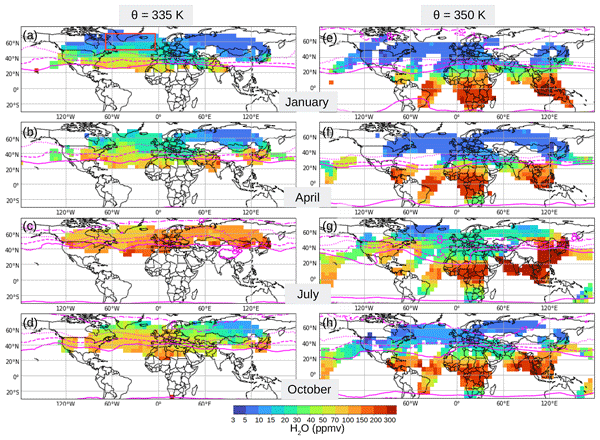
Patrick Konjari, Christian Rolf, Michaela I. Hegglin, Susanne Rohs, Yun Li, Andreas Zahn, Harald Bönisch, Philippe Nedelec, Martina Krämer, and Andreas Petzold
Atmos. Chem. Phys., 25, 4269–4289, https://doi.org/10.5194/acp-25-4269-2025, https://doi.org/10.5194/acp-25-4269-2025, 2025
Short summary
Short summary
This study introduces a new method to derive adjusted water vapor (H2O) climatologies for the upper tropopshere and lower statosphere (UT/LS) using data from 60 000 flights under the IAGOS program. Biases in the IAGOS water vapour dataset are adjusted, based on the more accurate IAGOS-CARIBIC data. The resulting highly resolved H2O climatologies will contribute to a better understanding of the H2O variability in the UT/LS and its connection to various transport and mixing processes.
Yann Cohen, Didier Hauglustaine, Bastien Sauvage, Susanne Rohs, Patrick Konjari, Ulrich Bundke, Andreas Petzold, Valérie Thouret, Andreas Zahn, and Helmut Ziereis
Atmos. Chem. Phys., 23, 14973–15009, https://doi.org/10.5194/acp-23-14973-2023, https://doi.org/10.5194/acp-23-14973-2023, 2023
Short summary
Short summary
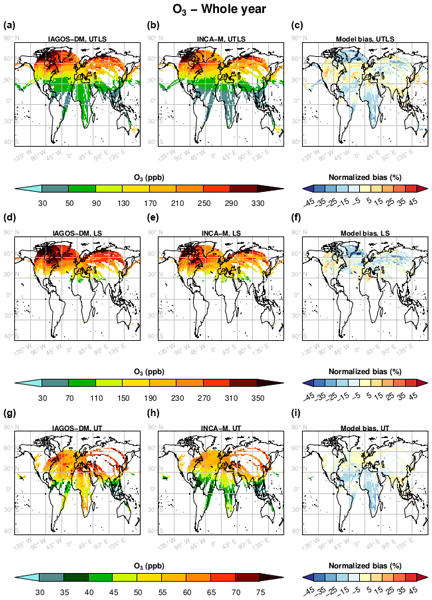
The upper troposphere–lower stratosphere (UTLS) is a key region regarding the lower atmospheric composition. This study consists of a comprehensive evaluation of an up-to-date chemistry–climate model in this layer, using regular in situ measurements based on passenger aircraft. For this purpose, a specific software (Interpol-IAGOS) has been updated and made publicly available. The model reproduces the carbon monoxide peaks due to biomass burning over the continental tropics particularly well.
Nicolas Emig, Annette Miltenberger, Heiko Bozem, Martina Krämer, Armin Afchine, Daniel Kunkel, Hans-Christoph Lachnitt, Yun Li, Philipp Reutter, Christian Rolf, Nicole Spelten, Holger Tost, and Peter Hoor
EGUsphere, https://doi.org/10.5194/egusphere-2026-4614, https://doi.org/10.5194/egusphere-2026-4614, 2026
This preprint is open for discussion and under review for Atmospheric Chemistry and Physics (ACP).
Short summary
Short summary
In this study we show mixing of ice particles across the extratropical tropopause via turbulence in the jet shear zone based on in situ measurements from the TPEx campaign over the North Sea, combined with Lagrangian model analysis. Trace gas correlations and subsaturated ice particles constrain the timing and mechanism, while backward trajectories indicate suitable turbulent conditions beforehand. This process possibly impacts the water vapour budget of the extratropical lowermost stratosphere.
Hyunkwang Lim, Tamaki Fujinawa, Takafumi Sugita, Satoshi Inomata, Hiroshi Tanimoto, Christoph Mahnke, Andreas Petzold, Ulrich Bundke, Yugo Kanaya, Yasuko Kasai, Tomohiro O. Sato, Sang Seo Park, Minseok Kim, Yun Gon Lee, and Ukkyo Jeong
EGUsphere, https://doi.org/10.5194/egusphere-2026-4968, https://doi.org/10.5194/egusphere-2026-4968, 2026
This preprint is open for discussion and under review for Atmospheric Measurement Techniques (AMT).
Short summary
Short summary
Satellite measurements of nitrogen dioxide can be biased when the assumed vertical distribution of pollution does not match reality. We combined satellite, aircraft, and ground-based observations near major Asian airports and found that using aircraft-measured profiles generally reduced this bias. However, improvements varied by location, showing that spatial representativeness and other retrieval uncertainties also remain important.
Mélanie Ghysels, Luca Palchetti, Silvia Viciani, Claudio Belotti, Marco Barucci, Gwenaël Berthet, Elizabeth Asher, Emrys Hall, Alex Fritz, Armin Afchine, Christian Rolf, Thomas Kuhn, Chris Stopford, Alain Hauchecorne, Nadir Amarouche, Georges Durry, Jean-Christophe Samake, Lars E. Kalnajs, Terry Deshler, Samuele Del Bianco, and Paolo Pettinari
Earth Syst. Sci. Data Discuss., https://doi.org/10.5194/essd-2026-557, https://doi.org/10.5194/essd-2026-557, 2026
Preprint under review for ESSD
Short summary
Short summary
ATMOSFER, a CNES-supported 2024 balloon campaign in Kiruna, Sweden, prepared ESA’s FORUM mission by measuring far-infrared radiation, water vapor, clouds and aerosols in the UTLS. FIRMOS-B (balloon borne demonstrator of FORUM) showed excellent performance, while hygrometers agreed closely. The campaign observed cirrus clouds, ice crystals and stratospheric aerosol layers linked to wildfire and tropical air masses, improving climate observations and FORUM validation.
Tim Lüttmer, Annette Miltenberger, and Peter Spichtinger
EGUsphere, https://doi.org/10.5194/egusphere-2026-5375, https://doi.org/10.5194/egusphere-2026-5375, 2026
This preprint is open for discussion and under review for Atmospheric Chemistry and Physics (ACP).
Short summary
Short summary
Moist air rising rapidly in cyclones produces ice clouds. Uncertain assumptions about ice-nucleating particles strongly affect ice formation. Ice formed by freezing of droplets and ice formed directly from vapor mix as they fall.
Jonas Schaefer, Sarah Grawe, Hans-Christian Clemen, Stephan Mertes, Johannes Schneider, Bruno Wetzel, Daniel Sauer, Jennifer Wolf, Laura Tomsche, Johanna Mayer, Roland Schrödner, Silvia Henning, Tina Jurkat-Witschas, Christiane Voigt, Helmut Ziereis, Theresa Harlaß, Mira Pöhlker, and Frank Stratmann
Atmos. Chem. Phys., 26, 12505–12520, https://doi.org/10.5194/acp-26-12505-2026, https://doi.org/10.5194/acp-26-12505-2026, 2026
Short summary
Short summary
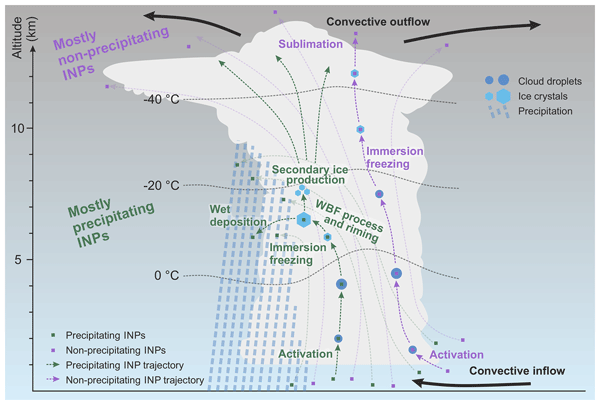
Ice-nucleating particles (INP) are aerosol particles important for ice formation in clouds droplets and thereby influence climate. This study uses airborne measurements over Europe to show how INP are transported through thunderstorms. We show which particles are washed out and which are are transported into the higher troposphere, where they can again affect cloud ice formation. The findings improve understanding of atmospheric particle distribution and help refine climate models.
Hannah Klebach, Martin Heinritzi, Katharina Kaiser, Lisa Beck, Samuel Ruhl, Samira Atabakhsh, Nirvan Bhattacharyya, Lucía Caudillo-Plath, Philipp Joppe, Thomas Klimach, Peter Lloyd, Mira Pöhlker, Ulrich Pöschl, Sarah Richter, Douglas M. Russell, Johannes Schneider, Marcel Zauner-Wieczorek, and Joachim Curtius
Atmos. Chem. Phys., 26, 12355–12393, https://doi.org/10.5194/acp-26-12355-2026, https://doi.org/10.5194/acp-26-12355-2026, 2026
Short summary
Short summary
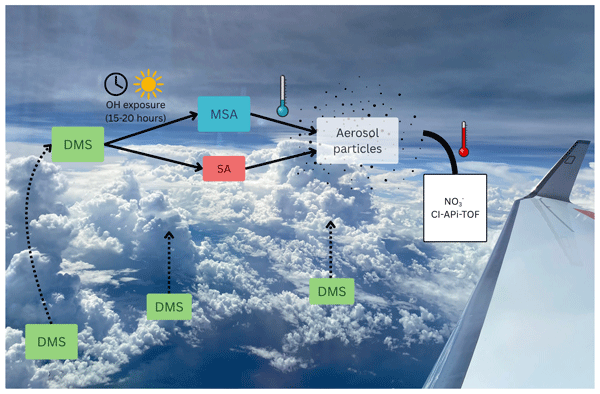
Marine atmospheric aerosols remain a major uncertainty in climate models. We report gas and particle phase measurements of two important aerosol forming vapours, sulfuric acid and methanesulfonic acid in the Indo-Pacific. We find that the latter typically dominates over sulfuric acid and contributes significantly to free tropospheric aerosol. Deep convection transports the precursor of both acids to the upper troposphere, providing a key aerosol source in the pristine remote Pacific Ocean.
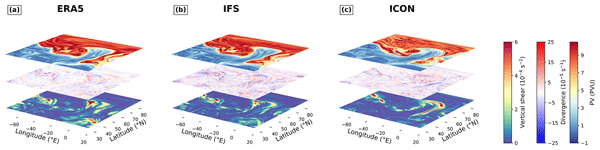
Madhuri Umbarkar, Daniel Kunkel, Annette Miltenberger, Hans-Christoph Lachnitt, Thorsten Kaluza, Cornelis Schwenk, and Peter Hoor
Atmos. Chem. Phys., 26, 12067–12096, https://doi.org/10.5194/acp-26-12067-2026, https://doi.org/10.5194/acp-26-12067-2026, 2026
Short summary
Short summary
We present an extratropical cyclone case study over the North Atlantic focusing on the role of atmospheric gravity waves (GW) in the generation of strong vertical shear and (clear-air) turbulence (CAT), as well as their impact on tracer distribution in the lowermost stratosphere. Our findings suggest that GW related processes should be considered as a key for upper troposphere lower stratosphere (UTLS) transport and mixing, and as an important candidate for the interpretation of CAT in the UTLS.
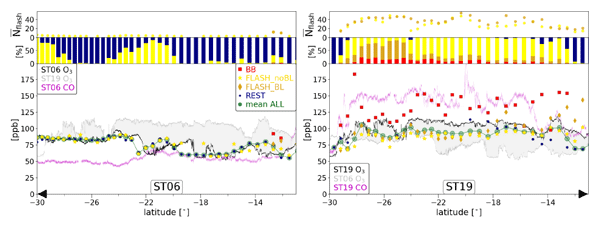
Linda Smoydzin, Vera Bense, Heiko Bozem, Philipp Joppe, Daniel Kunkel, Hans-Christoph Lachnitt, Holger Tost, Andreas Zahn, Helmut Ziereis, Martin Riese, and Peter Hoor
Atmos. Chem. Phys., 26, 11857–11874, https://doi.org/10.5194/acp-26-11857-2026, https://doi.org/10.5194/acp-26-11857-2026, 2026
Short summary
Short summary
During a research flight in early October elevated upper tropospheric mixing ratios of CO, NO, NOy and O3 were observed over a distance of more than 1000 km east of the Brasilian coast. Ozone mixing ratios are 20–40 ppbv higher than during a flight in early September. By combining aircraft observations with model simulations we find that ozone production from biomass burning over Amazonia caused predominantly the ozone enhancements which have a local effect on the radiative forcing of 50 mW m−2.
Wolfgang Woiwode, Bärbel Vogel, Valentin Lauther, Jens-Uwe Grooß, Jeremy Harrison, Sören Johansson, Jörn Ungermann, Peter Braesicke, Markus Dick, Andreas Engel, Felix Friedl-Vallon, Norbert Glatthor, Thomas Gulde, Michael Höpfner, Markus Jesswein, Jan Kaumanns, Timo Keber, Anne Kleinert, Erik Kretschmer, Guido Maucher, Tom Neubert, Hans Nordmeyer, Christof Piesch, Felix Plöger, Peter Preusse, Markus Retzlaff, Sebastian Rhode, Heinz Rongen, Georg Schardt, Tanja Schuck, Björn-Martin Sinnhuber, Johannes Strobel, Franziska Trinkl, Ronja Van Luijt, Stefan Versick, C. Michael Volk, Gerald Wetzel, Peter Hoor, and Martin Riese
EGUsphere, https://doi.org/10.5194/egusphere-2026-3271, https://doi.org/10.5194/egusphere-2026-3271, 2026
This preprint is open for discussion and under review for Atmospheric Chemistry and Physics (ACP).
Short summary
Short summary
Filaments of CH2Cl2-rich air are revealed by airborne infrared limb-imaging observations in late summer 2023 above the North Pacific, Canada and Alaska and traced back to the Asian Summer Monsoon region. Involving new spectroscopic data, high CH2Cl2 levels were retrieved in the troposphere and moderate enhancements also in air masses with characteristics of the lowermost stratosphere. Mesoscale filaments are shown to transport substantial amounts of CH2Cl2 across the North Pacific.
Georgios Dekoutsidis, Silke Groß, Florian Ewald, Martina Krämer, Christian Rolf, Andreas Schäfler, and Martin Wirth
EGUsphere, https://doi.org/10.5194/egusphere-2026-3788, https://doi.org/10.5194/egusphere-2026-3788, 2026
This preprint is open for discussion and under review for Atmospheric Chemistry and Physics (ACP).
Short summary
Short summary
Cirrus clouds interact with radiation, but their exact effects are not well-defined and depend on their properties, formation process and the ambient conditions. We used airborne lidar and radar measurements and models in order to compare cirrus that formed in undisturbed conditions and during Warm Air intrusions (WAI). We found that WAIs cause a change in the formation and their properties. Our findings can improve the representation of cirrus in models and the estimation of their impact.
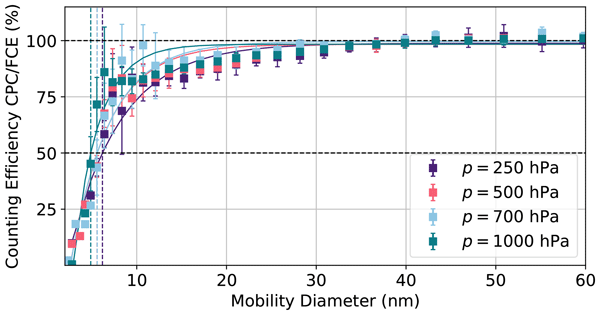
Sarah Kirchhoff, Patrick Weber, Oliver F. Bischof, Gerhard Steiner, Christian Kunath, Lothar Keck, Victoria M. Fruhmann, Helmut Krasa, Alexander Bergmann, Andreas Petzold, and Ulrich Bundke
Atmos. Meas. Tech., 19, 5243–5266, https://doi.org/10.5194/amt-19-5243-2026, https://doi.org/10.5194/amt-19-5243-2026, 2026
Short summary
Short summary
We evaluated dimethyl sulfoxide (DMSO) as a safe, non-flammable working fluid for condensation particle counters, comparing it with butanol under varied pressures, temperatures, and aerosols. Laboratory, field, and simulation results show reliable particle activation, comparable counting efficiency, reduced fluid use, and stable long-term operation. Mixtures with water extend usability, supporting safe monitoring in remote or harsh environments.
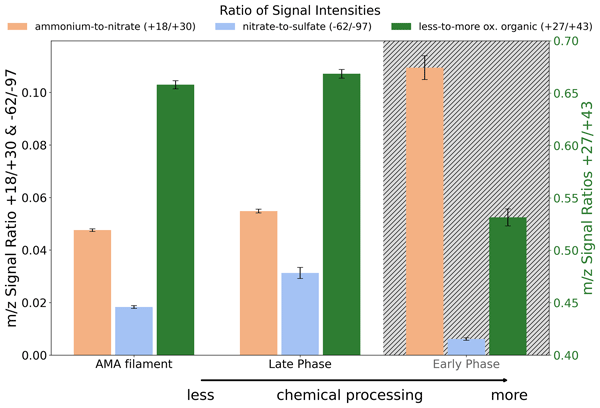
Fatih Ekinci, Oliver Eppers, Oliver Appel, Felix Ploeger, Antonis Dragoneas, Sergej Molleker, Philipp Brauner, Hans-Christoph Lachnitt, Franziska Weyland, Linda Ort, Nicolas Emig, Hans-Christian Clemen, Laura Tomsche, Martin Ebert, Peter Hoor, Bärbel Vogel, Yafang Cheng, Johannes Schneider, Stephan Borrmann, and Franziska Köllner
Atmos. Chem. Phys., 26, 10399–10421, https://doi.org/10.5194/acp-26-10399-2026, https://doi.org/10.5194/acp-26-10399-2026, 2026
Short summary
Short summary
This study shows that aerosol transported from the Asian summer monsoon region can substantially alter the background composition of the extratropical lower stratosphere. Aircraft-based measurements and model simulations reveal a strong increase of ammonium nitrate aerosol from summer to autumn 2023 caused by transport of young air masses from South and East Asia. These particles can persist for months and undergo chemical aging.
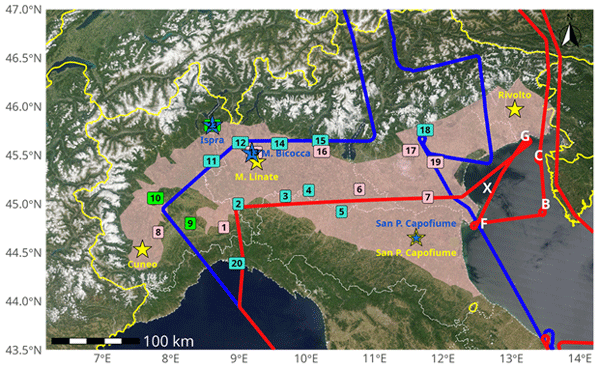
Costanza Civale, Maria Dolores Andrés Hernández, Jean-Philippe Putaud, Francesca Barnaba, Henri Diémoz, Johannes Schneider, Helmut Ziereis, Katharina Kaiser, Jörg Schmidt, Ovid Oktavian Krüger, Bruna Holanda, Robert Baumann, Benjamin Weyland, Eric Förster, Midhun George, Yangzhuoran Liu, Daniel Sauer, Jennifer Wolf, Annachiara Bellini, Birger Bohn, Klaus Pfeilsticker, and John Philip Burrows
Atmos. Chem. Phys., 26, 9827–9855, https://doi.org/10.5194/acp-26-9827-2026, https://doi.org/10.5194/acp-26-9827-2026, 2026
Short summary
Short summary
This study combines measurements of gases and particles at the ground and on-board an instrumented aircraft to investigate pollution transport over the Po Valley, a major atmospheric pollution hotspot in Europe. Overall, the extensive data set obtained at different altitudes provides insight into the mixing of pollution plumes and their export towards the Adriatic coast as well as with naturally occurring dust and its impact on air quality over the Po Plain.
Matthias Kohl, Christoph Brühl, Holger Tost, Christos Xenofontos, Theodoros Christoudias, Sergey Gromov, Oliver Appel, Stephan Borrmann, Adam Bourassa, Pedro Campunzano-Jost, Yafang Cheng, Oliver Eppers, Karl D. Froyd, Bruna A. Holanda, Jose L. Jimenez, Patrick Jöckel, Philipp Joppe, Katharina Kaiser, Joseph M. Katich, Klaus Klingmüller, Franziska Köllner, Agnieszka Kupc, Anna Martin, Christopher Pöhlker, Mira L. Pöhlker, Ulrich Pöschl, Landon Rieger, Samuel Ruhl, Gregory P. Schill, Johannes Schneider, Christiane Schulz, Joshua P. Schwarz, Alexandra P. Tsimpidi, Ryan Vella, Christina J. Williamson, Yifan Yang, Daniel Zawada, Jos Lelieveld, and Andrea Pozzer
EGUsphere, https://doi.org/10.5194/egusphere-2026-3649, https://doi.org/10.5194/egusphere-2026-3649, 2026
Short summary
Short summary
Aerosols are crucial for Earth's climate, yet their vertical distribution remains poorly understood. We present first consistent global simulations of aerosol distributions and composition from the Earth's surface to the stratosphere, validated by extensive observations. Key findings include a global minimum in aerosol mass in the free troposphere, a significant contribution of organic aerosol in the lower stratosphere, and limited transport of primary particles to the stratosphere.
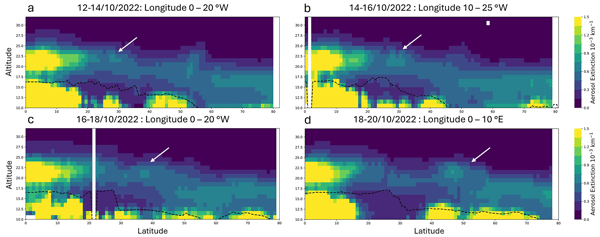
Corinna Kloss, Gwenaël Berthet, Pasquale Sellitto, Irene Bartolome Garcia, Emmanuel Briaud, Rubel Chandra Das, Stéphane Chevrier, Nicolas Dumelié, Lilian Joly, Thomas Lecas, Pauline Marbach, Felix Ploeger, Jean-Baptiste Renard, Jean-Paul Vernier, Frank G. Wienhold, and Michaela I. Hegglin
Atmos. Chem. Phys., 26, 8981–8997, https://doi.org/10.5194/acp-26-8981-2026, https://doi.org/10.5194/acp-26-8981-2026, 2026
Short summary
Short summary
In October 2022, we detected volcanic particles in the stratosphere over France, linked to the January 2022 Hunga eruption in the South Pacific. Found between 17 and 23 km altitude, they were traced back to the tropics using trajectory simulations and satellite data. Their optical properties matched those in the Southern Hemisphere. The particles spread across the Northern Hemisphere, reflecting sunlight and slightly cooling the surface – a small but non-negligible effect.
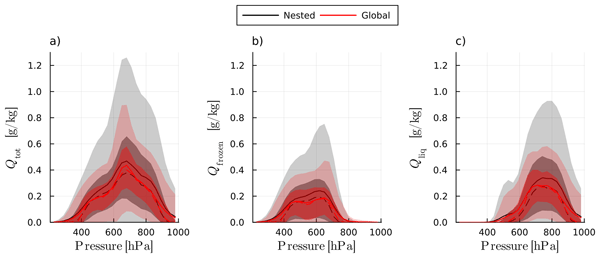
Cornelis Schwenk and Annette Miltenberger
Atmos. Chem. Phys., 26, 7435–7462, https://doi.org/10.5194/acp-26-7435-2026, https://doi.org/10.5194/acp-26-7435-2026, 2026
Short summary
Short summary
We studied how model grid-spacing affects how moisture and ice are carried upward in large weather systems that move warm, moist air into the upper troposphere. By comparing high- and low-resolution simulations, we found that models which are able to represent convectively ascending air produce much drier air at high altitudes. This shows that model resolution strongly influences how water and clouds are transported and how they may affect climate.
Kasper Juurikkala, Tomi Raatikainen, Martina Krämer, Christina J. Williamson, and Ari Laaksonen
EGUsphere, https://doi.org/10.5194/egusphere-2026-2427, https://doi.org/10.5194/egusphere-2026-2427, 2026
Short summary
Short summary
We use large-eddy simulations constrained by observations to study how mineral dust controls the evolution of cirrus clouds during dust outbreaks. Results show that sustained dusty cirrus forms only under strongly elevated dust concentrations, where ice forms mainly on dust particles. This identifies mineral dust as the key control on cirrus persistence and highlights the need to improve representation of dust-driven ice formation in weather and climate models.
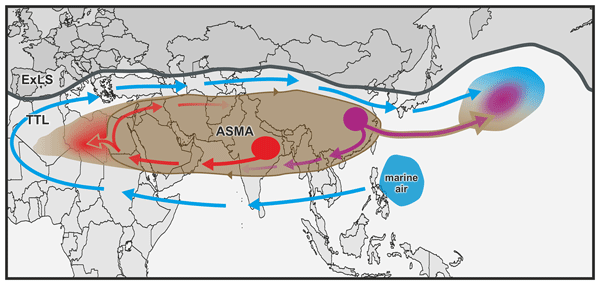
Bärbel Vogel, Valentin Lauther, Franziska Köllner, Fatih Ekinci, Christian Rolf, Johannes Strobel, Ronja van Luijt, C. Michael Volk, Stephan Borrmann, Antonis Dragoneas, Oliver Eppers, Sergej Molleker, Peter Hoor, Linda Ort, Franziska Weyland, Andreas Zahn, Jan Clemens, Gebhard Günther, Oleh Kachula, Rolf Müller, Felix Ploeger, and Martin Riese
Atmos. Chem. Phys., 26, 6283–6319, https://doi.org/10.5194/acp-26-6283-2026, https://doi.org/10.5194/acp-26-6283-2026, 2026
Short summary
Short summary
This work highlights the impact of the Asian summer monsoon on the chemical composition of the upper troposphere and lower stratosphere. Measurements of trace gases and aerosol particles uplifted by the Asian summer monsoon to higher altitudes are sparse. Here, we had the opportunity to use a whole suite of different measured trace gases and the chemical composition of aerosols, in combination with simulations, to better understand the complex transport and mixing processes in this region.
Athulya Saiprakash, Martina Krämer, Christian Rolf, Patrick Konjari, Jérôme Riedi, and Odran Sourdeval
EGUsphere, https://doi.org/10.5194/egusphere-2026-2416, https://doi.org/10.5194/egusphere-2026-2416, 2026
Short summary
Short summary
To better understand how observed high ice clouds, known as cirrus, form and change, satellite images were combined with calculations that reconstruct how the air moved before the clouds formed. Case studies showed that cloud history differs with height, age, and surrounding conditions, and that small temperature changes strongly shape cloud growth. This helps reveal and characterize the mechanisms behind observed cirrus.
Athulya Saiprakash, Martina Krämer, Christian Rolf, Jérôme Riedi, and Odran Sourdeval
EGUsphere, https://doi.org/10.5194/egusphere-2026-2423, https://doi.org/10.5194/egusphere-2026-2423, 2026
Short summary
Short summary
This second part of the study tested the new method by comparing its results with satellite and aircraft observations and by examining how sensitive it is to key assumptions. The method agreed well with observations in most cases, although clouds formed over mountains remained harder to capture. It also showed which conditions and processes matter most for reconstructing how cirrus form and evolve.
Philipp Brauner, Oliver Appel, Oliver Eppers, Franziska Köllner, Hans-Christian Clemen, Tiziana Bräuer, Hans-Christoph Lachnitt, Katharina Kaiser, Johannes Schneider, Antonis Dragoneas, Andreas Hünig, Sergej Molleker, Bruce E. Anderson, Yafang Cheng, Hans Schlager, Christiane Voigt, and Stephan Borrmann
EGUsphere, https://doi.org/10.5194/egusphere-2026-2161, https://doi.org/10.5194/egusphere-2026-2161, 2026
Preprint archived
Short summary
Short summary
Airborne measurements of the aerosol chemical composition were conducted in the 2018 wintertime tropopause region over Germany using a hybrid aerosol mass spectrometer, regarding the atmospheric background and aircraft exhaust plumes. Biomass burning aerosol of North American wildfires contributes to the aerosol population. Soot and engine oil were attributed to aircraft exhaust, and were detected in contrail residuals, implying their impact on chemical processes and properties of contrails.
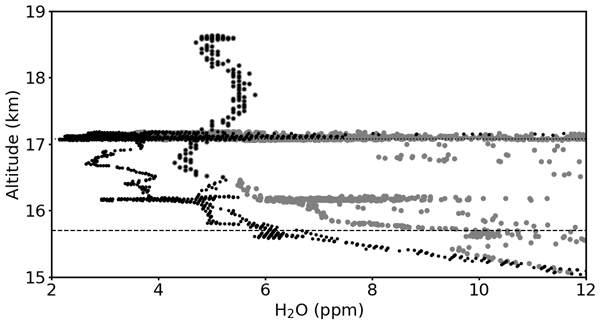
Rolf Müller, Bärbel Vogel, Martina Krämer, Christian Rolf, Nicole Spelten, and Fabrizio Ravegnani
Atmos. Chem. Phys., 26, 4359–4376, https://doi.org/10.5194/acp-26-4359-2026, https://doi.org/10.5194/acp-26-4359-2026, 2026
Short summary
Short summary
In the Asian summer monsoon anticyclone the lapse rate tropopause, and not the cold point, constitutes a good estimate of the upper boundary of the well mixed tropospheric air mass. For strong convection there is substantial dehydration at the cold point tropopause (in summer 2017). Above the cold point tropopause, under such conditions, neither ice particle occurrence, nor enhanced molar mixing ratios of water vapour (above ≲ 6 ppm) are observed.

Chun Hang Chau, Peter Hoor, Katharina Kaiser, and Holger Tost
Atmos. Chem. Phys., 26, 3637–3652, https://doi.org/10.5194/acp-26-3637-2026, https://doi.org/10.5194/acp-26-3637-2026, 2026
Short summary
Short summary
This study examines the potential impact of different greenhouse gases to vertical mixing by clear air turbulence in the upper troposphere and lower stratosphere . We found that ozone is most sensitive to vertical mixing and could lead to cooling at the top of the atmosphere by -0.2 W/m2. We also found that the vertical mixing by clear air turbulence could lead to changes in atmospheric chemistry including changing the methane lifetime and the ozone sensitivity.
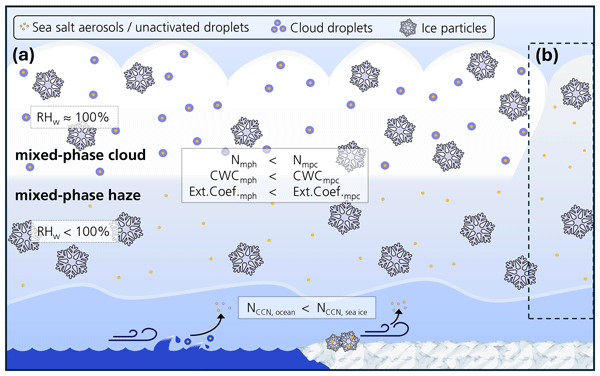
Manuel Moser, Christiane Voigt, Oliver Eppers, Johannes Lucke, Elena De La Torre Castro, Johanna Mayer, Regis Dupuy, Guillaume Mioche, Olivier Jourdan, Hans-Christian Clemen, Johannes Schneider, Philipp Joppe, Stephan Mertes, Bruno Wetzel, Stephan Borrmann, Marcus Klingebiel, Mario Mech, Christof Lüpkes, Susanne Crewell, André Ehrlich, Andreas Herber, and Manfred Wendisch
Atmos. Chem. Phys., 26, 1867–1887, https://doi.org/10.5194/acp-26-1867-2026, https://doi.org/10.5194/acp-26-1867-2026, 2026
Short summary
Short summary
In this study we analyzed Arctic mixed-phase clouds using airborne in-situ measurements in spring 2022. Based on microphysical properties, we show that within these clouds a distinction must be made between classic mixed-phase clouds and a mixed-phase haze regime. Instead of supercooled droplets, the haze regime contains large wet sea salt aerosols. These findings improve our understanding of Arctic low-level cloud processes.
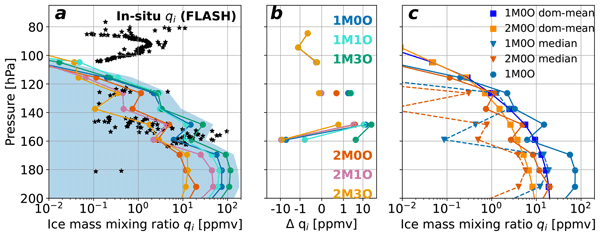
Sylvia C. Sullivan, Aiko Voigt, Edgardo Sepúlveda Araya, Silvia Bucci, Annette Miltenberger, Meredith K. Kupinski, Christian Rolf, and Martina Krämer
Atmos. Chem. Phys., 26, 1685–1698, https://doi.org/10.5194/acp-26-1685-2026, https://doi.org/10.5194/acp-26-1685-2026, 2026
Short summary
Short summary
We assess the temperature, moisture, and dynamics in the upper troposphere-lower stratosphere simulated over South Asia in a high-resolution model relative to aircraft data. The lower stratosphere tends to be too warm, too dry, and too quiescent in the model, and as a result, too few ice clouds are predicted to form there. These biases could affect radiative balance and circulation in other areas also, as significant upward transport of moisture and pollutants occurs during the Asian monsoon.
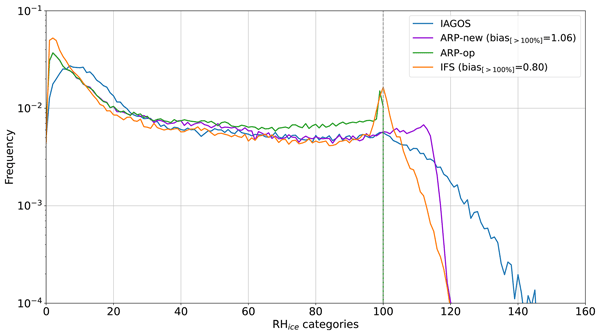
Sara Arriolabengoa, Pierre Crispel, Olivier Jaron, Yves Bouteloup, Benoît Vié, Yun Li, Andreas Petzold, and Matthieu Plu
Atmos. Chem. Phys., 25, 18051–18076, https://doi.org/10.5194/acp-25-18051-2025, https://doi.org/10.5194/acp-25-18051-2025, 2025
Short summary
Short summary
Aircraft condensation trails, also known as contrails, have a significant impact on the global climate when they persist. In this work, we present a modification to the Météo-France weather model ARPEGE (Action de Recherche Petite Echelle Grande Echelle) to improve the forecasting of areas favourable to the persistence of contrails. The spatial correspondence between observations and the modified model is demonstrated and evaluated by appropriate metrics. The modified model can therefore be used for further contrail climate impact applications.

Paul Konopka, Felix Ploeger, Francesco D'Amato, Teresa Campos, Marc von Hobe, Shawn B. Honomichl, Peter Hoor, Laura L. Pan, Michelle L. Santee, Silvia Viciani, Kaley A. Walker, and Michaela I. Hegglin
Atmos. Chem. Phys., 25, 17973–17996, https://doi.org/10.5194/acp-25-17973-2025, https://doi.org/10.5194/acp-25-17973-2025, 2025
Short summary
Short summary
We present an improved version of the Chemical Lagrangian Model of the Stratosphere (CLaMS-3.0), which better represents transport from the lower atmosphere to the upper troposphere and lower stratosphere. By refining grid resolution and improving convection representation, the model more accurately simulates carbon monoxide transport. Comparisons with satellite and in situ observations highlight its ability to capture seasonal variations and improve our understanding of atmospheric transport.
Cornelis Schwenk and Annette Miltenberger
EGUsphere, https://doi.org/10.5194/egusphere-2025-5631, https://doi.org/10.5194/egusphere-2025-5631, 2025
Short summary
Short summary
We examined how model resolution affects the moisture and cloud content of large weather systems that move warm, moist air into the upper troposphere. By comparing high- and low-resolution simulations, we found that models which can resolve convectively ascending air produce drier air and more outgoing longwave radiation. This shows that model grid-spacing impacts modeled upper-level moisture and Earth's radiative balance.
Anna Breuninger, Philipp Joppe, Jonas Wilsch, Cornelis Schwenk, Heiko Bozem, Nicolas Emig, Laurin Merkel, Rainer Rossberg, Timo Keber, Arthur Kutschka, Philipp Waleska, Stefan Hofmann, Sarah Richter, Florian Ungeheuer, Konstantin Dörholt, Thorsten Hoffmann, Annette Miltenberger, Johannes Schneider, Peter Hoor, and Alexander L. Vogel
Atmos. Chem. Phys., 25, 16533–16551, https://doi.org/10.5194/acp-25-16533-2025, https://doi.org/10.5194/acp-25-16533-2025, 2025
Short summary
Short summary
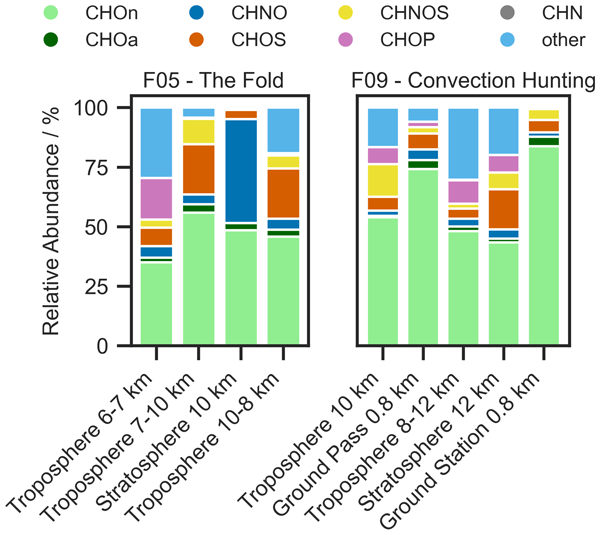
This study investigates molecular organic aerosol composition in the upper troposphere and lower stratosphere from an airborne campaign over Central Europe in summer 2024. Via ultra-high-performance liquid chromatography and high-resolution mass spectrometry of tropospheric and stratospheric filter samples, we identified various organic compounds. Our findings underscore the significant cross-tropopause transport of biogenic secondary organic aerosol and anthropogenic pollutants.
Heiko Bozem, Philipp Joppe, Yun Li, Nicolas Emig, Armin Afchine, Anna Breuninger, Joachim Curtius, Stefan Hofmann, Sadath Ismayil, Konrad Kandler, Daniel Kunkel, Arthur Kutschka, Hans-Christoph Lachnitt, Andreas Petzold, Sarah Richter, Timo Röschenthaler, Christian Rolf, Lisa Schneider, Johannes Schneider, Alexander Vogel, and Peter Hoor
Atmos. Meas. Tech., 18, 6545–6568, https://doi.org/10.5194/amt-18-6545-2025, https://doi.org/10.5194/amt-18-6545-2025, 2025
Short summary
Short summary
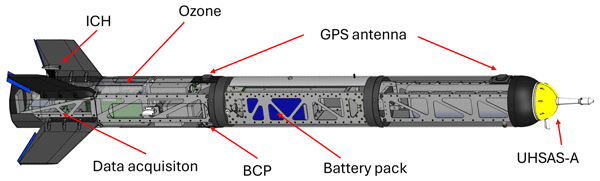
Deployed on a Learjet as a tandem measurement platform during the TPEx I (TropoPause composition gradients and mixing Experiment) campaign in June 2024, the new TPC-TOSS (TropoPause Composition Towed Sensor Shuttle) system delivers high-resolution in situ data on ozone, aerosol, and key meteorological parameters. Laboratory and in-flight tests confirmed its precision and stability. Observed gradients near the tropopause reveal active mixing and transport processes in the tropopause region.
Philipp Joppe, Johannes Schneider, Jonas Wilsch, Heiko Bozem, Anna Breuninger, Joachim Curtius, Martin Ebert, Nicolas Emig, Peter Hoor, Sadath Ismayil, Konrad Kandler, Daniel Kunkel, Isabel Kurth, Hans-Christoph Lachnitt, Yun Li, Annette Miltenberger, Sarah Richter, Christian Rolf, Lisa Schneider, Cornelis Schwenk, Nicole Spelten, Alexander L. Vogel, Yafang Cheng, and Stephan Borrmann
Atmos. Chem. Phys., 25, 15077–15103, https://doi.org/10.5194/acp-25-15077-2025, https://doi.org/10.5194/acp-25-15077-2025, 2025
Short summary
Short summary
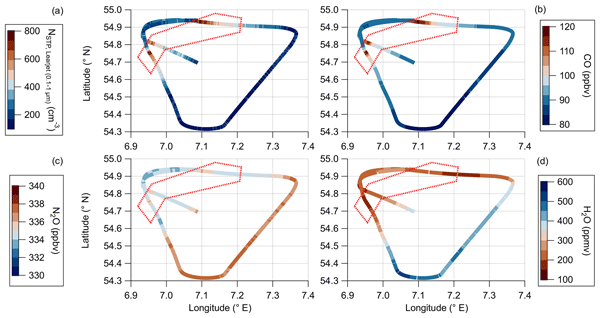
We show measurements of a filament with biomass burning influence transported by a warm conveyor belt (WCB) into the tropopause region over Europe. The pollution originates from Canadian forest fires and is transported in the lower troposphere towards Europe. The WCB transport is followed by mixing with air masses of stratospheric chemical signatures. We hypothesize that this mixing leads to a change in the vertical gradient of the potential temperature.
Linda Ort, Andrea Pozzer, Peter Hoor, Florian Obersteiner, Andreas Zahn, Thomas B. Ryerson, Chelsea R. Thompson, Jeff Peischl, Róisín Commane, Bruce Daube, Ilann Bourgeois, Jos Lelieveld, and Horst Fischer
Atmos. Chem. Phys., 25, 14987–15007, https://doi.org/10.5194/acp-25-14987-2025, https://doi.org/10.5194/acp-25-14987-2025, 2025
Short summary
Short summary
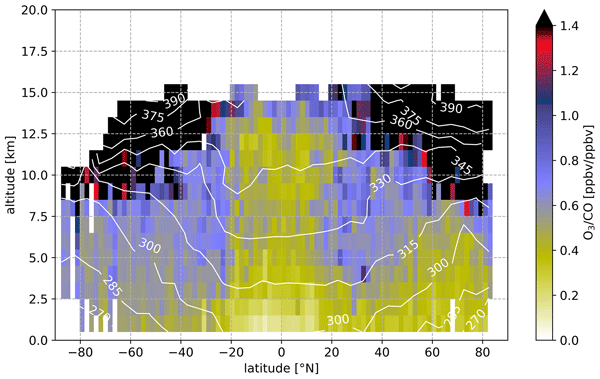
This study investigates the role of lightning emissions on the O3–CO ratio in the northern subtropics. We used in situ observations and a global circulation model to show an effect of up to 40 % onto the subtropical O3–CO ratio by tropical air masses transported via the Hadley cell. This influence of lightning emissions and its photochemistry has a global effect on trace and greenhouse gases and needs to be considered for global chemical distributions.
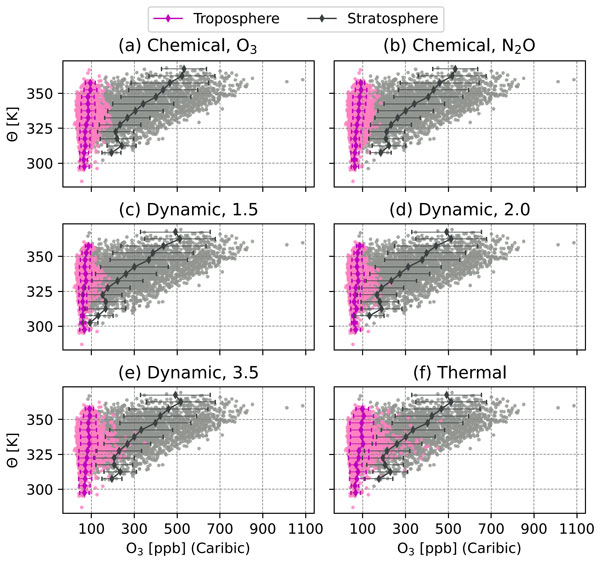
Sophie Bauchinger, Andreas Engel, Markus Jesswein, Timo Keber, Harald Bönisch, Florian Obersteiner, Andreas Zahn, Nicolas Emig, Peter Hoor, Hans-Christoph Lachnitt, Franziska Weyland, Linda Ort, and Tanja J. Schuck
Atmos. Chem. Phys., 25, 14167–14186, https://doi.org/10.5194/acp-25-14167-2025, https://doi.org/10.5194/acp-25-14167-2025, 2025
Short summary
Short summary
We compared different ways to define the upper barrier of the troposphere in the extra-tropics, the “tropopause”. By analysing ozone distributions sorted by different definitions, we found that the traditional temperature-based tropopause works less well than dynamic or tracer-based definitions. We saw a sharper transition of ozone across the tropopause using a higher value of potential vorticity than often used and recommend this value for future studies of exchange processes in this region.
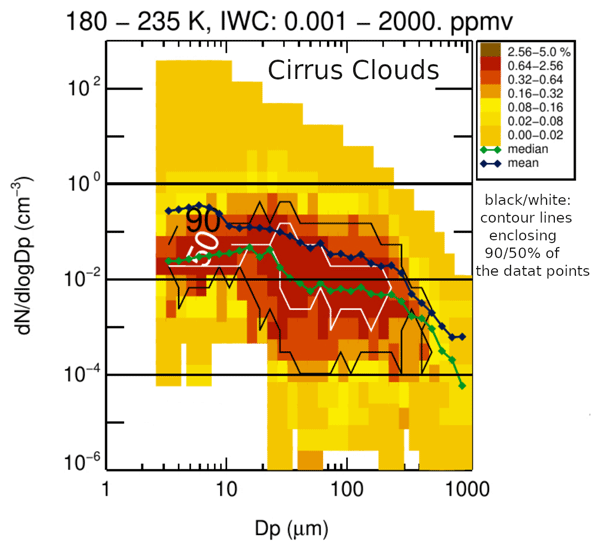
Martina Krämer, Nicole Spelten, Christian Rolf, and Reinhold Spang
Atmos. Chem. Phys., 25, 13563–13583, https://doi.org/10.5194/acp-25-13563-2025, https://doi.org/10.5194/acp-25-13563-2025, 2025
Short summary
Short summary
The size and number of cirrus ice crystals is one parameter influencing the still uncertain effect of cirrus clouds on climate. Here, the occurrence of ice particle sizes and concentrations with varying temperature and cloud microphysical thickness is analyzed as well as whether they formed in-situ or were transported upwards as frozen droplets from further below. The analyses are based on a large database of airborne measurements and extensive simulations.
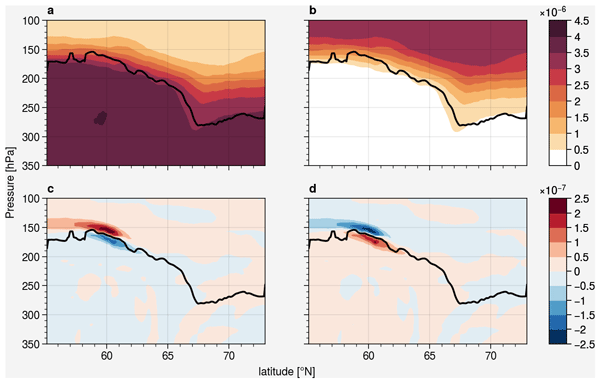
Chun Hang Chau, Peter Hoor, and Holger Tost
Atmos. Chem. Phys., 25, 13123–13140, https://doi.org/10.5194/acp-25-13123-2025, https://doi.org/10.5194/acp-25-13123-2025, 2025
Short summary
Short summary
This study examines how the turbulence in the upper troposphere/lower stratosphere (UTLS) could modify the tracer distribution under different situations. Using a multi-scale chemistry model with a novel diagnostic, we found that both the pre-existing tracer gradient and the dynamical and thermodynamical forcing play a role in modifying the tracer distribution. These results allow further research on the UTLS turbulent mixing and its implications for the climate system.
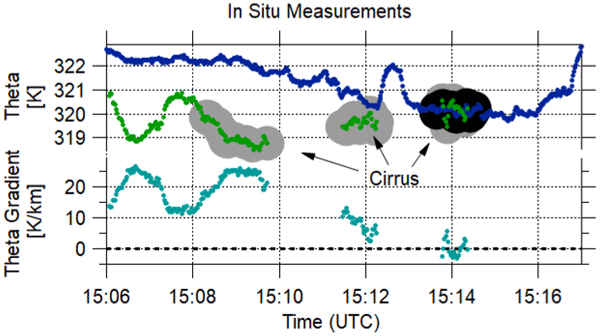
Nicolas Emig, Annette K. Miltenberger, Peter M. Hoor, and Andreas Petzold
Atmos. Chem. Phys., 25, 13077–13101, https://doi.org/10.5194/acp-25-13077-2025, https://doi.org/10.5194/acp-25-13077-2025, 2025
Short summary
Short summary
This study presents in situ observations of cirrus occurrence from aircraft measurements in the extratropical transition layer (ExTL) using simultaneous measurements from two platforms. Lagrangian diagnostics based on high-resolution ICON simulations show long residence times of the cirrus in stratospheric air, allowing us to separate different diabatic processes during transit. The findings suggest that radiative diabatic cloud processes significantly impact the tropopause thermodynamic structure.
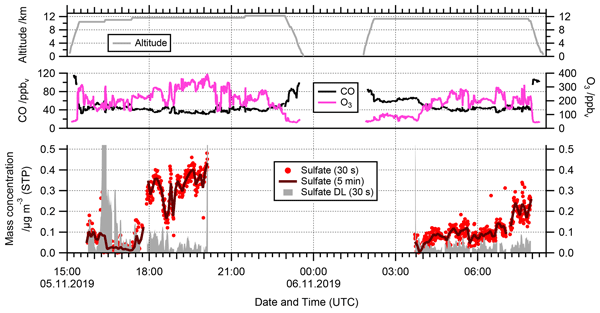
Johannes Schneider, Christiane Schulz, Florian Rubach, Anna Ludwig, Jonas Wilsch, Philipp Joppe, Christian Gurk, Sergej Molleker, Laurent Poulain, Florian Obersteiner, Torsten Gehrlein, Harald Bönisch, Andreas Zahn, Peter Hoor, Nicolas Emig, Heiko Bozem, Stephan Borrmann, and Markus Hermann
Atmos. Meas. Tech., 18, 5103–5128, https://doi.org/10.5194/amt-18-5103-2025, https://doi.org/10.5194/amt-18-5103-2025, 2025
Short summary
Short summary
An instrumented container laboratory is operated on regular commercial passenger flights to obtain a long-term representative dataset on the composition of the upper troposphere and lower stratosphere. Here we report on the development of a fully automated aerosol mass spectrometer for this project. We present technical specifications, necessary modifications for the automation, instrument calibration and comparisons, detection limits, and the first in-flight data.
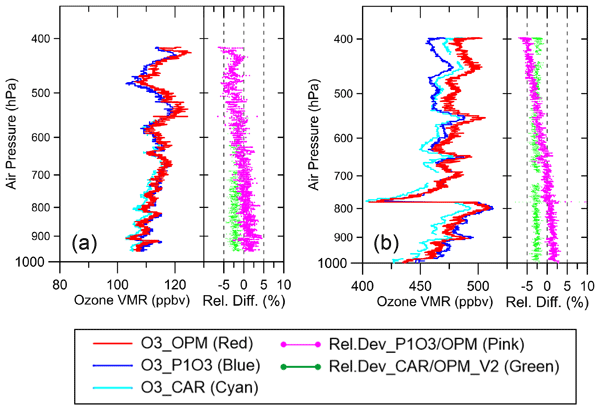
Herman G. J. Smit, Torben Galle, Romain Blot, Florian Obersteiner, Philippe Nédélec, Andreas Zahn, Jean-Marc Cousin, Ulrich Bundke, Andreas Petzold, Valerie Thouret, and Hannah Clark
Atmos. Meas. Tech., 18, 4985–5001, https://doi.org/10.5194/amt-18-4985-2025, https://doi.org/10.5194/amt-18-4985-2025, 2025
Short summary
Short summary
The two ozone instruments of IAGOS (In-service Aircraft for a Global Observation System) have been compared with the Ozone PhotoMeter (OPM) of the World Calibration Center of Ozone Sondes (WCCOS) in an atmospheric simulation chamber under realistic flight conditions of pressure, temperature, and ozone concentrations. The two IAGOS-instruments showed good agreement with the OPM within 5–6 %. The observed differences are small but systematic and reproducible during the intercomparison.
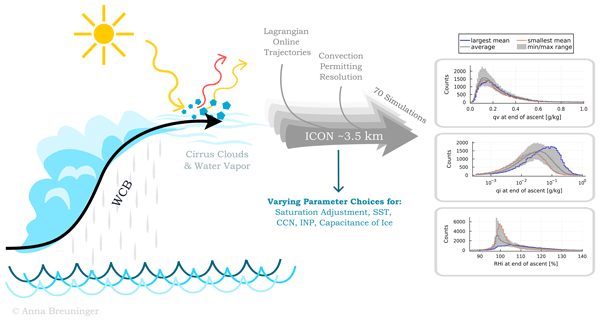
Cornelis Schwenk, Annette Miltenberger, and Annika Oertel
Atmos. Chem. Phys., 25, 11333–11361, https://doi.org/10.5194/acp-25-11333-2025, https://doi.org/10.5194/acp-25-11333-2025, 2025
Short summary
Short summary
We studied how different parameter choices concerning cloud processes affect the simulated transport of water and ice into the upper atmosphere (which affects the greenhouse effect) during a weather system called a warm conveyor belt. Using a set of model experiments, we found that some parameters have a strong effect on humidity and ice, especially during fast ascents. These findings could help improve weather and climate models and may also be relevant for future climate engineering studies.
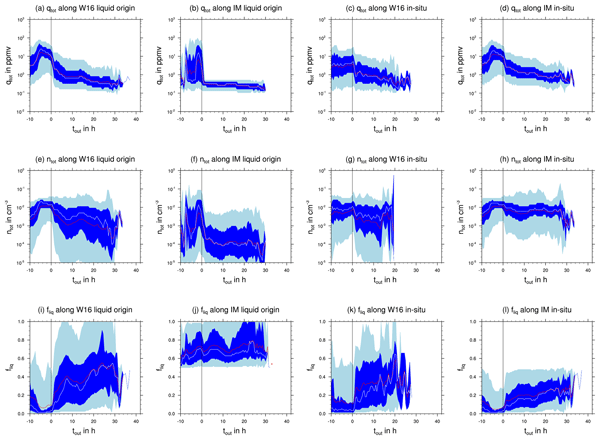
Tim Lüttmer, Annette Miltenberger, and Peter Spichtinger
Atmos. Chem. Phys., 25, 10245–10265, https://doi.org/10.5194/acp-25-10245-2025, https://doi.org/10.5194/acp-25-10245-2025, 2025
Short summary
Short summary
We investigate ice formation pathways in a warm conveyor belt case study. We employ a multi-phase microphysics scheme that distinguishes between ice from different nucleation processes. Ice crystals in the cirrus outflow mostly stem from in situ formation. Hence, they were formed directly from the vapor phase. Sedimentational redistribution modulates cirrus properties and leads to disagreement between cirrus origin classifications based on thermodynamic history and nucleation processes.
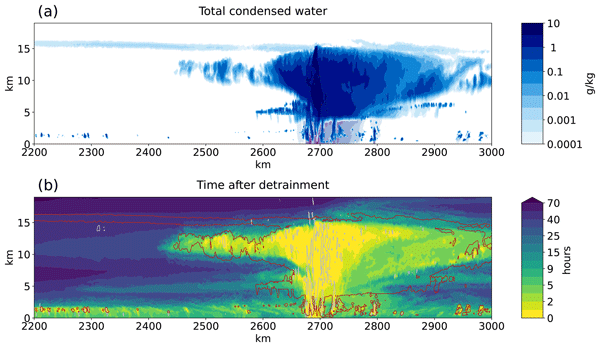
Blaž Gasparini, Rachel Atlas, Aiko Voigt, Martina Krämer, and Peter N. Blossey
Atmos. Chem. Phys., 25, 9957–9979, https://doi.org/10.5194/acp-25-9957-2025, https://doi.org/10.5194/acp-25-9957-2025, 2025
Short summary
Short summary
The evolution of tropical cirrus clouds is poorly understood, which contributes to large uncertainties in climate projections. To address this issue, we use novel tracers in a cloud-resolving model to track the life cycle of cirrus clouds. This approach provides insights into cloud formation, ice crystal evolution, and radiative effects of cirrus clouds. Additionally, we improve the model's cloud microphysics using a simple, computationally efficient approach that can be applied to other models.
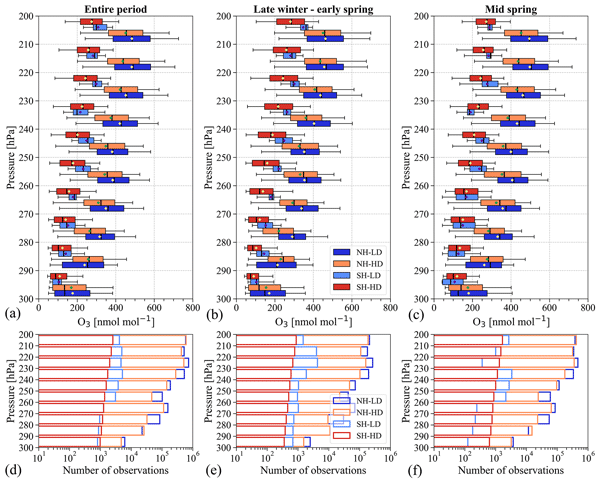
Rodrigo J. Seguel, Charlie Opazo, Yann Cohen, Owen R. Cooper, Laura Gallardo, Björn-Martin Sinnhuber, Florian Obersteiner, Andreas Zahn, Peter Hoor, Susanne Rohs, and Andreas Marsing
Atmos. Chem. Phys., 25, 8553–8573, https://doi.org/10.5194/acp-25-8553-2025, https://doi.org/10.5194/acp-25-8553-2025, 2025
Short summary
Short summary
We explored ozone differences between the Northern Hemisphere and Southern Hemispheres in the upper troposphere–lower stratosphere. We found lower ozone (with stratospheric origin) in the Southern Hemisphere, especially during years of severe ozone depletion. Sudden stratospheric warming events increased the ozone in each hemisphere, highlighting the relationship between stratospheric processes and ozone in the upper troposphere, where ozone is an important greenhouse gas.
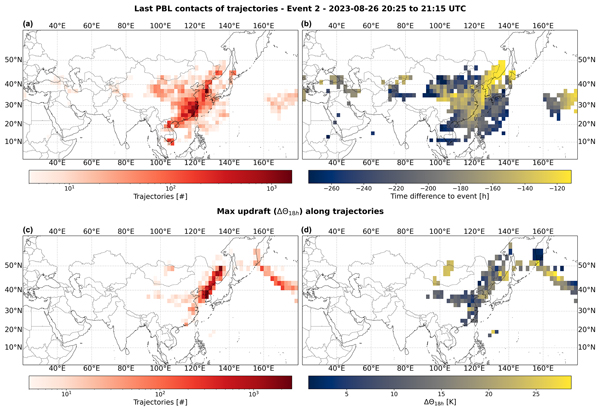
Markus Jesswein, Valentin Lauther, Nicolas Emig, Peter Hoor, Timo Keber, Hans-Christoph Lachnitt, Linda Ort, Tanja Schuck, Johannes Strobel, Ronja Van Luijt, C. Michael Volk, Franziska Weyland, and Andreas Engel
Atmos. Chem. Phys., 25, 8107–8126, https://doi.org/10.5194/acp-25-8107-2025, https://doi.org/10.5194/acp-25-8107-2025, 2025
Short summary
Short summary
The study investigates transport within the Asian Summer Monsoon, focusing on how CH2Cl2 reaches the subarctic tropopause region. Using data from the PHILEAS campaign in 2023, events with increased mixing ratios were detected. Their origin, the transport paths to the tropopause region, and the potential entry into the stratosphere were analyzed. The East Asian Summer Monsoon was identified as the main transport pathway, with only a small contribution to the stratosphere in the following days.
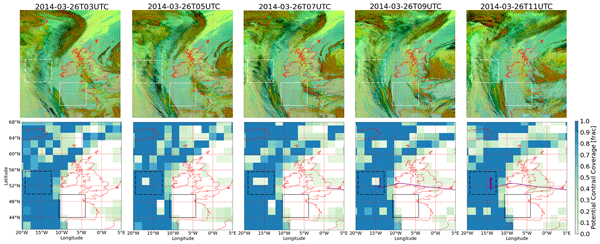
Patrick Peter, Sigrun Matthes, Christine Frömming, Patrick Jöckel, Luca Bugliaro, Andreas Giez, Martina Krämer, and Volker Grewe
Atmos. Chem. Phys., 25, 5911–5934, https://doi.org/10.5194/acp-25-5911-2025, https://doi.org/10.5194/acp-25-5911-2025, 2025
Short summary
Short summary
Our study examines how well the global climate model EMAC (ECHAM/MESSy Atmospheric Chemistry) predicts contrail formation by analysing temperature and humidity – two key factors for contrail development and persistence. The model underestimates temperature, leading to an overprediction of contrail formation and larger ice-supersaturated regions. Adjusting the model improves temperature accuracy but adds uncertainties. Better predictions of contrail formation areas can help optimise flight tracks to reduce aviation's climate effect.
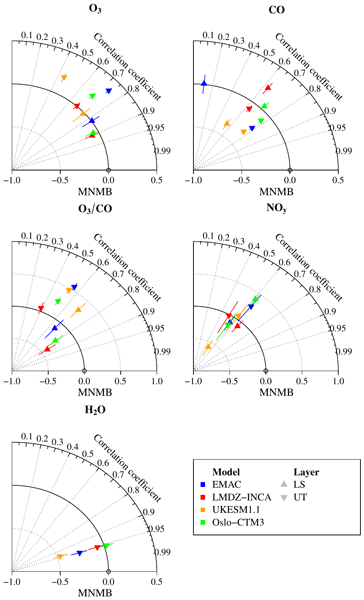
Yann Cohen, Didier Hauglustaine, Nicolas Bellouin, Marianne Tronstad Lund, Sigrun Matthes, Agnieszka Skowron, Robin Thor, Ulrich Bundke, Andreas Petzold, Susanne Rohs, Valérie Thouret, Andreas Zahn, and Helmut Ziereis
Atmos. Chem. Phys., 25, 5793–5836, https://doi.org/10.5194/acp-25-5793-2025, https://doi.org/10.5194/acp-25-5793-2025, 2025
Short summary
Short summary
The chemical composition of the atmosphere near the tropopause is a key parameter for evaluating the climate impact of subsonic aviation pollutants. This study uses in situ data collected aboard passenger aircraft to assess the ability of four chemistry–climate models to reproduce (bi-)decadal climatologies of ozone, carbon monoxide, water vapour, and reactive nitrogen in this region. The models reproduce the very distinct ozone seasonality in the upper troposphere and in the lower stratosphere well.
Sreehari Kizhuveettil, Jordi Vila-Guerau de Arellano, Martina Krämer, Armin Afchine, Luiz A. T. Machado, Martin Zöger, and Wiebke Frey
EGUsphere, https://doi.org/10.5194/egusphere-2025-1637, https://doi.org/10.5194/egusphere-2025-1637, 2025
Preprint archived
Short summary
Short summary
Aircraft measurements are used to investigate high-altitude downdrafts in tropical deep convective clouds. The cloud water present in the downdrafts and its intensity do not show any correlation. Surprisingly, downdrafts occurred in supersaturated regions, contradicting the classical view of subsaturated downdrafts. Up- and downdrafts of similar strength show similar particle size distributions. These findings shed new light on the interplay between deep convection dynamics and microphysics.
Patrick Konjari, Christian Rolf, Michaela I. Hegglin, Susanne Rohs, Yun Li, Andreas Zahn, Harald Bönisch, Philippe Nedelec, Martina Krämer, and Andreas Petzold
Atmos. Chem. Phys., 25, 4269–4289, https://doi.org/10.5194/acp-25-4269-2025, https://doi.org/10.5194/acp-25-4269-2025, 2025
Short summary
Short summary
This study introduces a new method to derive adjusted water vapor (H2O) climatologies for the upper tropopshere and lower statosphere (UT/LS) using data from 60 000 flights under the IAGOS program. Biases in the IAGOS water vapour dataset are adjusted, based on the more accurate IAGOS-CARIBIC data. The resulting highly resolved H2O climatologies will contribute to a better understanding of the H2O variability in the UT/LS and its connection to various transport and mixing processes.

André Ehrlich, Susanne Crewell, Andreas Herber, Marcus Klingebiel, Christof Lüpkes, Mario Mech, Sebastian Becker, Stephan Borrmann, Heiko Bozem, Matthias Buschmann, Hans-Christian Clemen, Elena De La Torre Castro, Henning Dorff, Regis Dupuy, Oliver Eppers, Florian Ewald, Geet George, Andreas Giez, Sarah Grawe, Christophe Gourbeyre, Jörg Hartmann, Evelyn Jäkel, Philipp Joppe, Olivier Jourdan, Zsófia Jurányi, Benjamin Kirbus, Johannes Lucke, Anna E. Luebke, Maximilian Maahn, Nina Maherndl, Christian Mallaun, Johanna Mayer, Stephan Mertes, Guillaume Mioche, Manuel Moser, Hanno Müller, Veronika Pörtge, Nils Risse, Greg Roberts, Sophie Rosenburg, Johannes Röttenbacher, Michael Schäfer, Jonas Schaefer, Andreas Schäfler, Imke Schirmacher, Johannes Schneider, Sabrina Schnitt, Frank Stratmann, Christian Tatzelt, Christiane Voigt, Andreas Walbröl, Anna Weber, Bruno Wetzel, Martin Wirth, and Manfred Wendisch
Earth Syst. Sci. Data, 17, 1295–1328, https://doi.org/10.5194/essd-17-1295-2025, https://doi.org/10.5194/essd-17-1295-2025, 2025
Short summary
Short summary
This paper provides an overview of the HALO–(AC)3 aircraft campaign data sets, the campaign-specific instrument operation, data processing, and data quality. The data set comprises in situ and remote sensing observations from three research aircraft: HALO, Polar 5, and Polar 6. All data are published in the PANGAEA database by instrument-separated data subsets. It is highlighted how the scientific analysis of the HALO–(AC)3 data benefits from the coordinated operation of three aircraft.
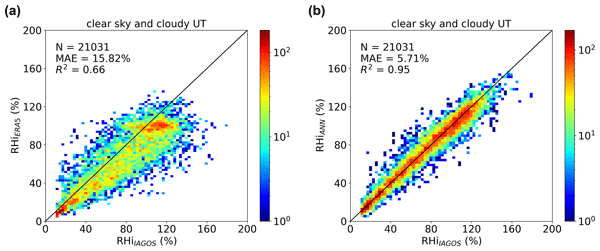
Ziming Wang, Luca Bugliaro, Klaus Gierens, Michaela I. Hegglin, Susanne Rohs, Andreas Petzold, Stefan Kaufmann, and Christiane Voigt
Atmos. Chem. Phys., 25, 2845–2861, https://doi.org/10.5194/acp-25-2845-2025, https://doi.org/10.5194/acp-25-2845-2025, 2025
Short summary
Short summary
Upper-tropospheric relative humidity bias in the ERA5 weather model is corrected by 10 % by an artificial neural network using aircraft in-service humidity data and thermodynamic and dynamical variables. The improved skills of the weather model will advance cirrus research, weather forecasts, and measures for contrail reduction.
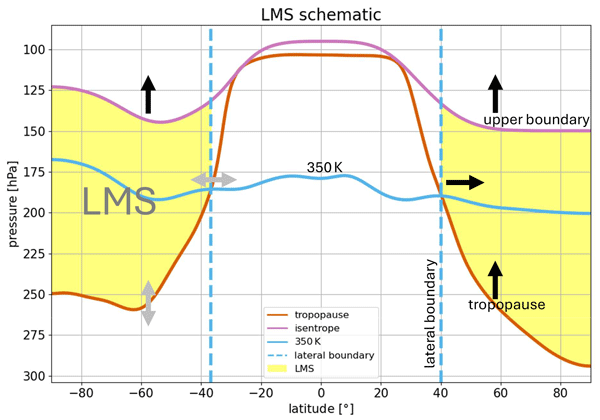
Franziska Weyland, Peter Hoor, Daniel Kunkel, Thomas Birner, Felix Plöger, and Katharina Turhal
Atmos. Chem. Phys., 25, 1227–1252, https://doi.org/10.5194/acp-25-1227-2025, https://doi.org/10.5194/acp-25-1227-2025, 2025
Short summary
Short summary
The lowermost stratosphere (LMS) plays an important role in the Earth's climate, containing strong gradients of ozone and water vapor. Our results indicate that the thermodynamic structure of the LMS was changing between 1979–2019 in response to anthropogenic climate change and the recovery of stratospheric ozone, also indicating large-scale circulation changes. We find that both the upper and the lower LMS boundaries show an (upward) trend, which has implications for the LMS mass.
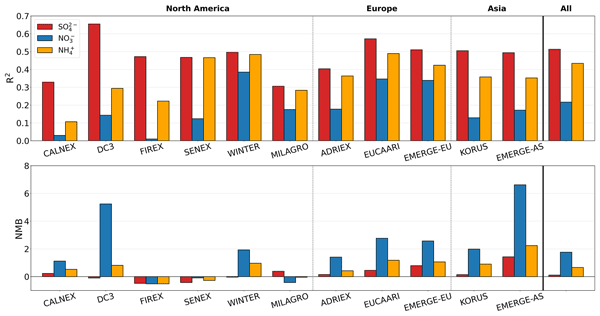
Olivia G. Norman, Colette L. Heald, Solomon Bililign, Pedro Campuzano-Jost, Hugh Coe, Marc N. Fiddler, Jaime R. Green, Jose L. Jimenez, Katharina Kaiser, Jin Liao, Ann M. Middlebrook, Benjamin A. Nault, John B. Nowak, Johannes Schneider, and André Welti
Atmos. Chem. Phys., 25, 771–795, https://doi.org/10.5194/acp-25-771-2025, https://doi.org/10.5194/acp-25-771-2025, 2025
Short summary
Short summary
This study finds that one component of secondary inorganic aerosols, nitrate, is greatly overestimated by a global atmospheric chemistry model compared to observations from 11 flight campaigns. None of the loss and production pathways explored can explain the nitrate bias alone. The model’s inability to capture the variability in the observations remains and requires future investigation to avoid biases in policy-related studies (i.e., air quality, health, climate impacts of these aerosols).
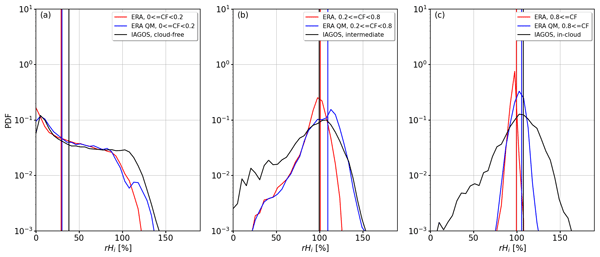
Kevin Wolf, Nicolas Bellouin, Olivier Boucher, Susanne Rohs, and Yun Li
Atmos. Chem. Phys., 25, 157–181, https://doi.org/10.5194/acp-25-157-2025, https://doi.org/10.5194/acp-25-157-2025, 2025
Short summary
Short summary
ERA5 atmospheric reanalysis and airborne in situ observations from IAGOS are compared in terms of the representation of the contrail formation potential and the presence of supersaturation. Differences are traced back to biases in ERA5 relative humidity fields. Those biases are addressed by applying a quantile mapping technique that significantly improved contrail estimation based on post-processed ERA5 data.
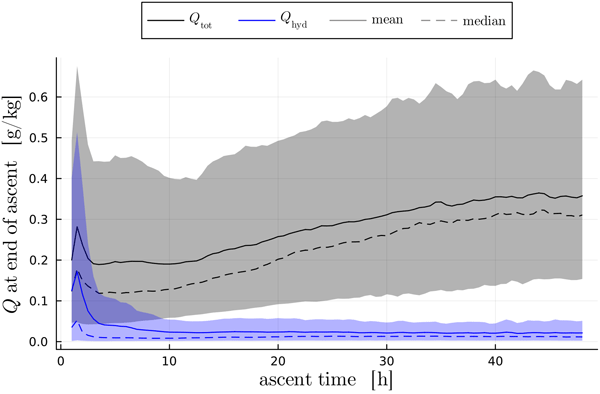
Cornelis Schwenk and Annette Miltenberger
Atmos. Chem. Phys., 24, 14073–14099, https://doi.org/10.5194/acp-24-14073-2024, https://doi.org/10.5194/acp-24-14073-2024, 2024
Short summary
Short summary
Warm conveyor belts (WCBs) transport moisture into the upper atmosphere, where it acts as a greenhouse gas. This transport is not well understood, and the role of rapidly rising air is unclear. We simulate a WCB and look at fast- and slow-rising air to see how moisture is (differently) transported. We find that for fast-ascending air more ice particles reach higher into the atmosphere and that frozen cloud particles are removed differently than during slow ascent, which has more water vapour.

Katharina Turhal, Felix Plöger, Jan Clemens, Thomas Birner, Franziska Weyland, Paul Konopka, and Peter Hoor
Atmos. Chem. Phys., 24, 13653–13679, https://doi.org/10.5194/acp-24-13653-2024, https://doi.org/10.5194/acp-24-13653-2024, 2024
Short summary
Short summary
The tropopause separates the troposphere, where many greenhouse gases originate, from the stratosphere. This study examines a tropopause defined by potential vorticity – an analogue for angular momentum that changes sharply in the subtropics, creating a transport barrier. Between 1980 and 2017, this tropopause shifted poleward at lower altitudes and equatorward above, suggesting height-dependent changes in atmospheric circulation that may affect greenhouse gas distribution and global warming.
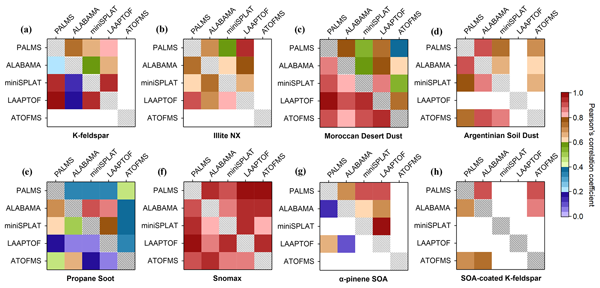
Xiaoli Shen, David M. Bell, Hugh Coe, Naruki Hiranuma, Fabian Mahrt, Nicholas A. Marsden, Claudia Mohr, Daniel M. Murphy, Harald Saathoff, Johannes Schneider, Jacqueline Wilson, Maria A. Zawadowicz, Alla Zelenyuk, Paul J. DeMott, Ottmar Möhler, and Daniel J. Cziczo
Atmos. Chem. Phys., 24, 10869–10891, https://doi.org/10.5194/acp-24-10869-2024, https://doi.org/10.5194/acp-24-10869-2024, 2024
Short summary
Short summary
Single-particle mass spectrometry (SPMS) is commonly used to measure the chemical composition and mixing state of aerosol particles. Intercomparison of SPMS instruments was conducted. All instruments reported similar size ranges and common spectral features. The instrument-specific detection efficiency was found to be more dependent on particle size than type. All differentiated secondary organic aerosol, soot, and soil dust but had difficulties differentiating among minerals and dusts.
Kuo-Ying Wang, Philippe Nedelec, Valerie Thouret, Hannah Clark, Andreas Wahner, and Andreas Petzold
EGUsphere, https://doi.org/10.5194/egusphere-2024-2414, https://doi.org/10.5194/egusphere-2024-2414, 2024
Preprint archived
Short summary
Short summary
We use routine in-service commercial passenger airplanes Airbus A340 and A330 to collect air pollutants in the upper troposphere. The beauty in using commercial airplanes is that these commercial airplanes, like taxi on the ground, keep flying all the time. We find that short-lived air pollutants are very sensitive to ground-level emissions. Effective regulation in ground-level emissions can help to reduce air pollution in the upper troposphere.
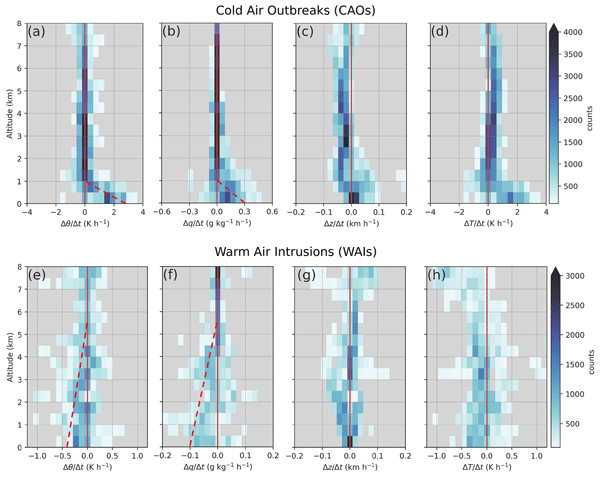
Manfred Wendisch, Susanne Crewell, André Ehrlich, Andreas Herber, Benjamin Kirbus, Christof Lüpkes, Mario Mech, Steven J. Abel, Elisa F. Akansu, Felix Ament, Clémantyne Aubry, Sebastian Becker, Stephan Borrmann, Heiko Bozem, Marlen Brückner, Hans-Christian Clemen, Sandro Dahlke, Georgios Dekoutsidis, Julien Delanoë, Elena De La Torre Castro, Henning Dorff, Regis Dupuy, Oliver Eppers, Florian Ewald, Geet George, Irina V. Gorodetskaya, Sarah Grawe, Silke Groß, Jörg Hartmann, Silvia Henning, Lutz Hirsch, Evelyn Jäkel, Philipp Joppe, Olivier Jourdan, Zsofia Jurányi, Michail Karalis, Mona Kellermann, Marcus Klingebiel, Michael Lonardi, Johannes Lucke, Anna E. Luebke, Maximilian Maahn, Nina Maherndl, Marion Maturilli, Bernhard Mayer, Johanna Mayer, Stephan Mertes, Janosch Michaelis, Michel Michalkov, Guillaume Mioche, Manuel Moser, Hanno Müller, Roel Neggers, Davide Ori, Daria Paul, Fiona M. Paulus, Christian Pilz, Felix Pithan, Mira Pöhlker, Veronika Pörtge, Maximilian Ringel, Nils Risse, Gregory C. Roberts, Sophie Rosenburg, Johannes Röttenbacher, Janna Rückert, Michael Schäfer, Jonas Schaefer, Vera Schemann, Imke Schirmacher, Jörg Schmidt, Sebastian Schmidt, Johannes Schneider, Sabrina Schnitt, Anja Schwarz, Holger Siebert, Harald Sodemann, Tim Sperzel, Gunnar Spreen, Bjorn Stevens, Frank Stratmann, Gunilla Svensson, Christian Tatzelt, Thomas Tuch, Timo Vihma, Christiane Voigt, Lea Volkmer, Andreas Walbröl, Anna Weber, Birgit Wehner, Bruno Wetzel, Martin Wirth, and Tobias Zinner
Atmos. Chem. Phys., 24, 8865–8892, https://doi.org/10.5194/acp-24-8865-2024, https://doi.org/10.5194/acp-24-8865-2024, 2024
Short summary
Short summary
The Arctic is warming faster than the rest of the globe. Warm-air intrusions (WAIs) into the Arctic may play an important role in explaining this phenomenon. Cold-air outbreaks (CAOs) out of the Arctic may link the Arctic climate changes to mid-latitude weather. In our article, we describe how to observe air mass transformations during CAOs and WAIs using three research aircraft instrumented with state-of-the-art remote-sensing and in situ measurement devices.
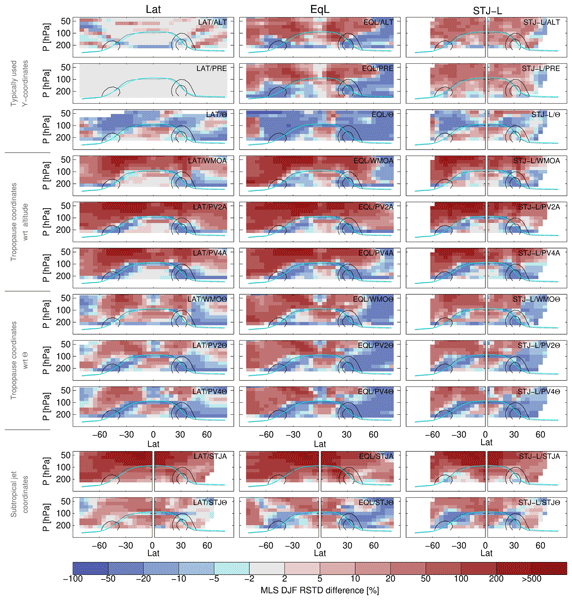
Luis F. Millán, Peter Hoor, Michaela I. Hegglin, Gloria L. Manney, Harald Boenisch, Paul Jeffery, Daniel Kunkel, Irina Petropavlovskikh, Hao Ye, Thierry Leblanc, and Kaley Walker
Atmos. Chem. Phys., 24, 7927–7959, https://doi.org/10.5194/acp-24-7927-2024, https://doi.org/10.5194/acp-24-7927-2024, 2024
Short summary
Short summary
In the Observed Composition Trends And Variability in the UTLS (OCTAV-UTLS) Stratosphere-troposphere Processes And their Role in Climate (SPARC) activity, we have mapped multiplatform ozone datasets into coordinate systems to systematically evaluate the influence of these coordinates on binned climatological variability. This effort unifies the work of studies that focused on individual coordinate system variability. Our goal was to create the most comprehensive assessment of this topic.
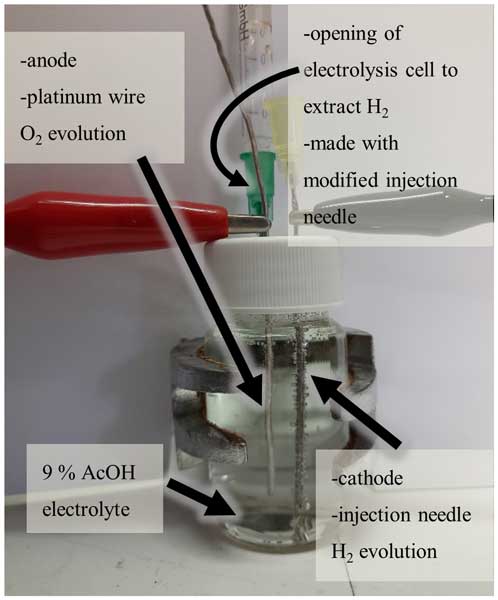
Niklas Karbach, Lisa Höhler, Peter Hoor, Heiko Bozem, Nicole Bobrowski, and Thorsten Hoffmann
Atmos. Meas. Tech., 17, 4081–4086, https://doi.org/10.5194/amt-17-4081-2024, https://doi.org/10.5194/amt-17-4081-2024, 2024
Short summary
Short summary
The system presented here can accurately generate and reproduce a stable flow of gas mixtures of known concentrations over several days using ambient air as a dilution medium. In combination with the small size and low weight of the system, this enables the calibration of hydrogen sensors in the field, reducing the influence of matrix effects on the accuracy of the sensor. The system is inexpensive to assemble and easy to maintain, which is the key to reliable measurement results.
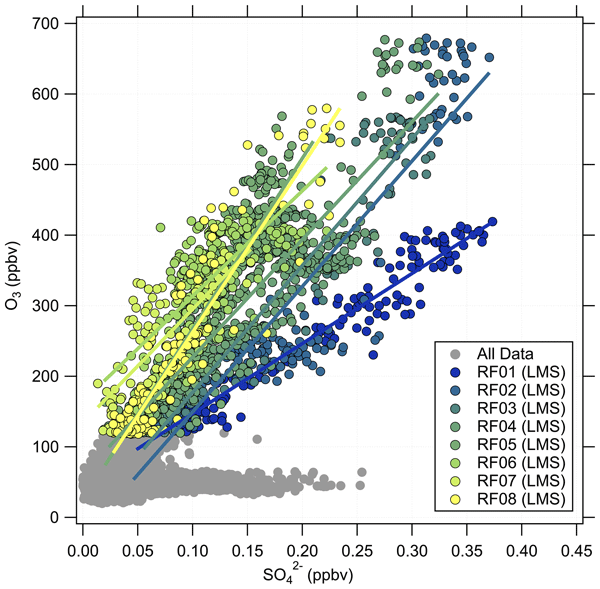
Philipp Joppe, Johannes Schneider, Katharina Kaiser, Horst Fischer, Peter Hoor, Daniel Kunkel, Hans-Christoph Lachnitt, Andreas Marsing, Lenard Röder, Hans Schlager, Laura Tomsche, Christiane Voigt, Andreas Zahn, and Stephan Borrmann
Atmos. Chem. Phys., 24, 7499–7522, https://doi.org/10.5194/acp-24-7499-2024, https://doi.org/10.5194/acp-24-7499-2024, 2024
Short summary
Short summary
From aircraft measurements in the upper troposphere/lower stratosphere, we find a correlation between the ozone and particulate sulfate in the lower stratosphere. The correlation exhibits some variability over the measurement period exceeding the background sulfate-to-ozone correlation. From our analysis, we conclude that gas-to-particle conversion of volcanic sulfur dioxide leads to observed enhanced sulfate aerosol mixing ratios.
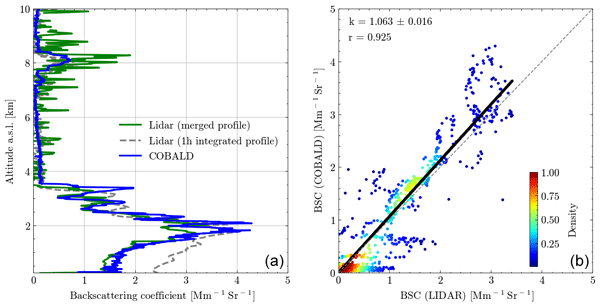
Hengheng Zhang, Christian Rolf, Ralf Tillmann, Christian Wesolek, Frank Gunther Wienhold, Thomas Leisner, and Harald Saathoff
Aerosol Research, 2, 135–151, https://doi.org/10.5194/ar-2-135-2024, https://doi.org/10.5194/ar-2-135-2024, 2024
Short summary
Short summary
Our study employs advanced tools, including scanning lidar, balloons, and UAVs, to explore aerosol particles in the atmosphere. The scanning lidar offers distinctive near-ground-level insights, enriching our comprehension of aerosol distribution from ground level to the free troposphere. This research provides valuable data for comparing remote sensing and in situ aerosol measurements, advancing our understanding of aerosol impacts on radiative transfer, clouds, and air quality.
Edward Groot, Patrick Kuntze, Annette Miltenberger, and Holger Tost
Weather Clim. Dynam., 5, 779–803, https://doi.org/10.5194/wcd-5-779-2024, https://doi.org/10.5194/wcd-5-779-2024, 2024
Short summary
Short summary
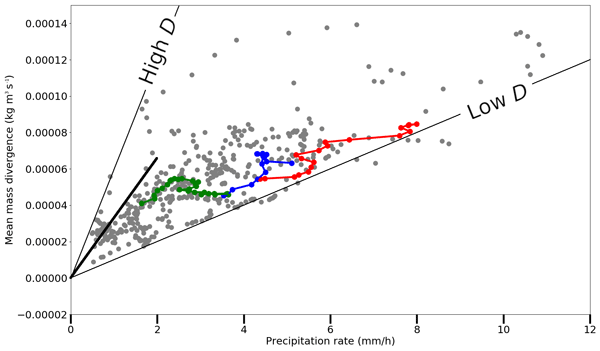
Deep convective clouds (thunderstorms), which may cause severe weather, tend to coherently organise into structured cloud systems. Accurate representation of these systems in models is difficult due to their complex dynamics and, in numerical simulations, the dependence of their dynamics on resolution. Here, the effect of convective organisation and geometry on their outflow winds (altitudes of 7–14 km) is investigated. Representation of their dynamics and outflows improves at higher resolution.
Andreas Petzold, Ulrich Bundke, Anca Hienola, Paolo Laj, Cathrine Lund Myhre, Alex Vermeulen, Angeliki Adamaki, Werner Kutsch, Valerie Thouret, Damien Boulanger, Markus Fiebig, Markus Stocker, Zhiming Zhao, and Ari Asmi
Atmos. Chem. Phys., 24, 5369–5388, https://doi.org/10.5194/acp-24-5369-2024, https://doi.org/10.5194/acp-24-5369-2024, 2024
Short summary
Short summary
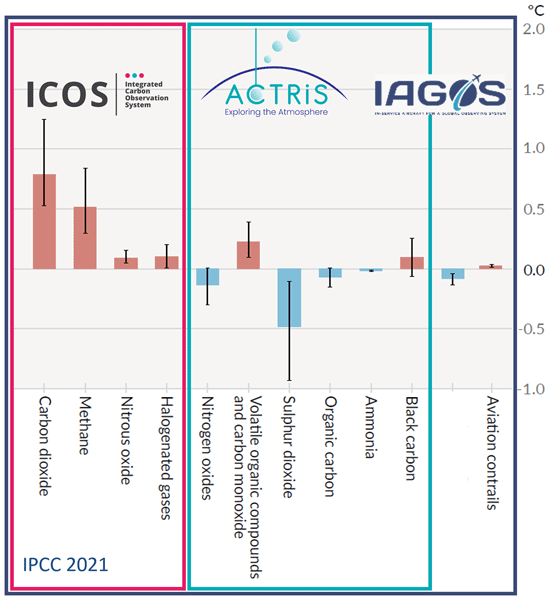
Easy and fast access to long-term and high-quality observational data is recognised as fundamental to environmental research and the development of climate forecasting and assessment services. We discuss the potential new directions in atmospheric sciences offered by the atmosphere-centric European research infrastructures ACTRIS, IAGOS, and ICOS, building on their capabilities for standardised provision of data through open access combined with tools and methods of data-intensive science.
Ella Gilbert, Jhaswantsing Purseed, Yun Li, Martina Krämer, Beatrice Altamura, and Nicolas Bellouin
EGUsphere, https://doi.org/10.5194/egusphere-2024-821, https://doi.org/10.5194/egusphere-2024-821, 2024
Preprint withdrawn
Short summary
Short summary
We use a simple experiment to explore the non-CO2 impacts of aviation on climate, which are considerably larger than the impact of the sector’s carbon emissions alone. We show that the main effect of our experiments – which intend to mimic the effect of aircraft soot emissions reaching existing high-altitude cirrus clouds – is to extend cloud lifetime, thereby enhancing their effect on climate.
Adrien Deroubaix, Marco Vountas, Benjamin Gaubert, Maria Dolores Andrés Hernández, Stephan Borrmann, Guy Brasseur, Bruna Holanda, Yugo Kanaya, Katharina Kaiser, Flora Kluge, Ovid Oktavian Krüger, Inga Labuhn, Michael Lichtenstern, Klaus Pfeilsticker, Mira Pöhlker, Hans Schlager, Johannes Schneider, Guillaume Siour, Basudev Swain, Paolo Tuccella, Kameswara S. Vinjamuri, Mihalis Vrekoussis, Benjamin Weyland, and John P. Burrows
EGUsphere, https://doi.org/10.5194/egusphere-2024-516, https://doi.org/10.5194/egusphere-2024-516, 2024
Preprint archived
Short summary
Short summary
This study assesses atmospheric composition using air quality models during aircraft campaigns in Europe and Asia, focusing on carbonaceous aerosols and trace gases. While carbon monoxide is well modeled, other pollutants have moderate to weak agreement with observations. Wind speed modeling is reliable for identifying pollution plumes, where models tend to overestimate concentrations. This highlights challenges in accurately modeling aerosol and trace gas composition, particularly in cities.
Adrien Deroubaix, Marco Vountas, Benjamin Gaubert, Maria Dolores Andrés Hernández, Stephan Borrmann, Guy Brasseur, Bruna Holanda, Yugo Kanaya, Katharina Kaiser, Flora Kluge, Ovid Oktavian Krüger, Inga Labuhn, Michael Lichtenstern, Klaus Pfeilsticker, Mira Pöhlker, Hans Schlager, Johannes Schneider, Guillaume Siour, Basudev Swain, Paolo Tuccella, Kameswara S. Vinjamuri, Mihalis Vrekoussis, Benjamin Weyland, and John P. Burrows
EGUsphere, https://doi.org/10.5194/egusphere-2024-521, https://doi.org/10.5194/egusphere-2024-521, 2024
Preprint archived
Short summary
Short summary
This study explores the proportional relationships between carbonaceous aerosols (black and organic carbon) and trace gases using airborne measurements from two campaigns in Europe and East Asia. Differences between regions were found, but air quality models struggled to reproduce them accurately. We show that these proportional relationships can help to constrain models and can be used to infer aerosol concentrations from satellite observations of trace gases, especially in urban areas.
Irene Bartolomé García, Odran Sourdeval, Reinhold Spang, and Martina Krämer
Atmos. Chem. Phys., 24, 1699–1716, https://doi.org/10.5194/acp-24-1699-2024, https://doi.org/10.5194/acp-24-1699-2024, 2024
Short summary
Short summary
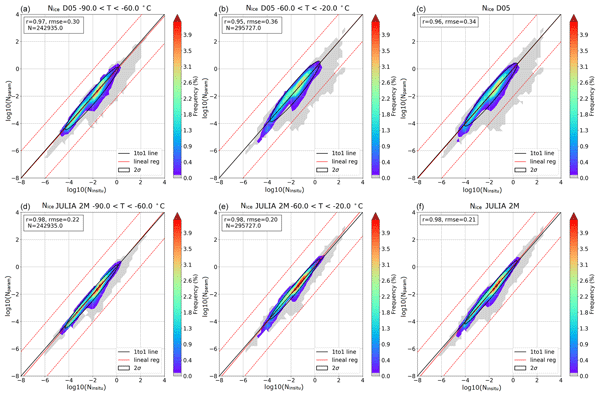
How many ice crystals of each size are in a cloud is a key parameter for the retrieval of cloud properties. The distribution of ice crystals is obtained from in situ measurements and used to create parameterizations that can be used when analyzing the remote-sensing data. Current parameterizations are based on data sets that do not include reliable measurements of small crystals, but in our study we use a data set that includes very small ice crystals to improve these parameterizations.
Tanja J. Schuck, Johannes Degen, Eric Hintsa, Peter Hoor, Markus Jesswein, Timo Keber, Daniel Kunkel, Fred Moore, Florian Obersteiner, Matt Rigby, Thomas Wagenhäuser, Luke M. Western, Andreas Zahn, and Andreas Engel
Atmos. Chem. Phys., 24, 689–705, https://doi.org/10.5194/acp-24-689-2024, https://doi.org/10.5194/acp-24-689-2024, 2024
Short summary
Short summary
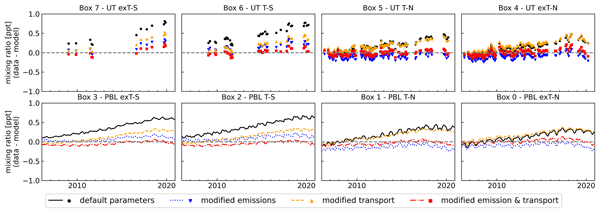
We study the interhemispheric gradient of sulfur hexafluoride (SF6), a strong long-lived greenhouse gas. Its emissions are stronger in the Northern Hemisphere; therefore, mixing ratios in the Southern Hemisphere lag behind. Comparing the observations to a box model, the model predicts air in the Southern Hemisphere to be older. For a better agreement, the emissions used as model input need to be increased (and their spatial pattern changed), and we need to modify north–south transport.
Yann Cohen, Didier Hauglustaine, Bastien Sauvage, Susanne Rohs, Patrick Konjari, Ulrich Bundke, Andreas Petzold, Valérie Thouret, Andreas Zahn, and Helmut Ziereis
Atmos. Chem. Phys., 23, 14973–15009, https://doi.org/10.5194/acp-23-14973-2023, https://doi.org/10.5194/acp-23-14973-2023, 2023
Short summary
Short summary
The upper troposphere–lower stratosphere (UTLS) is a key region regarding the lower atmospheric composition. This study consists of a comprehensive evaluation of an up-to-date chemistry–climate model in this layer, using regular in situ measurements based on passenger aircraft. For this purpose, a specific software (Interpol-IAGOS) has been updated and made publicly available. The model reproduces the carbon monoxide peaks due to biomass burning over the continental tropics particularly well.
Thomas Trickl, Martin Adelwart, Dina Khordakova, Ludwig Ries, Christian Rolf, Michael Sprenger, Wolfgang Steinbrecht, and Hannes Vogelmann
Atmos. Meas. Tech., 16, 5145–5165, https://doi.org/10.5194/amt-16-5145-2023, https://doi.org/10.5194/amt-16-5145-2023, 2023
Short summary
Short summary
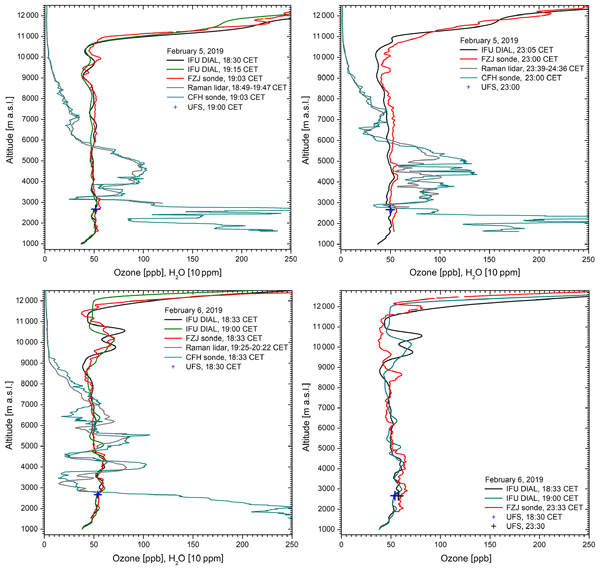
Tropospheric ozone have been measured for more than a century. Highly quantitative ozone measurements have been made at monitoring stations. However, deficits have been reported for vertical sounding systems. Here, we report a thorough intercomparison effort between a differential-absorption lidar system and two types of balloon-borne ozone sondes, also using ozone sensors at nearby mountain sites as references. The sondes agree very well with the lidar after offset corrections.
Francesco Cairo, Martina Krämer, Armin Afchine, Guido Di Donfrancesco, Luca Di Liberto, Sergey Khaykin, Lorenza Lucaferri, Valentin Mitev, Max Port, Christian Rolf, Marcel Snels, Nicole Spelten, Ralf Weigel, and Stephan Borrmann
Atmos. Meas. Tech., 16, 4899–4925, https://doi.org/10.5194/amt-16-4899-2023, https://doi.org/10.5194/amt-16-4899-2023, 2023
Short summary
Short summary
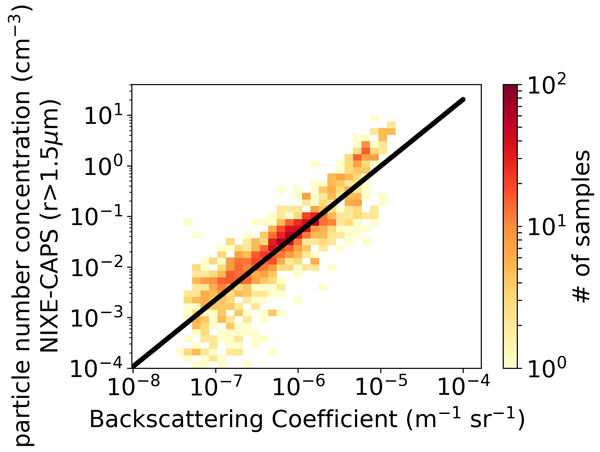
Cirrus clouds have been observed over the Himalayan region between 10 km and the tropopause at 17–18 km. Data from backscattersonde, hygrometers, and particle cloud spectrometers have been compared to assess their consistency. Empirical relationships between optical parameters accessible with remote sensing lidars and cloud microphysical parameters (such as ice water content, particle number and surface area density, and particle aspherical fraction) have been established.
Elena De La Torre Castro, Tina Jurkat-Witschas, Armin Afchine, Volker Grewe, Valerian Hahn, Simon Kirschler, Martina Krämer, Johannes Lucke, Nicole Spelten, Heini Wernli, Martin Zöger, and Christiane Voigt
Atmos. Chem. Phys., 23, 13167–13189, https://doi.org/10.5194/acp-23-13167-2023, https://doi.org/10.5194/acp-23-13167-2023, 2023
Short summary
Short summary
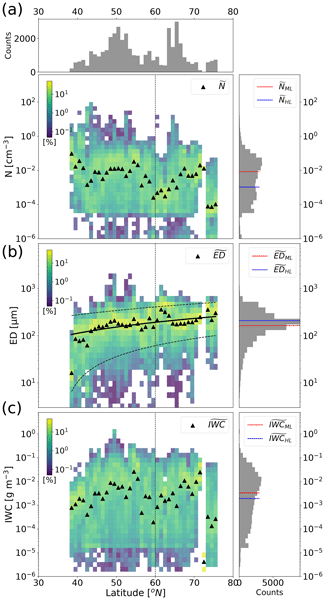
In this study, we show the differences in the microphysical properties between high-latitude (HL) cirrus and mid-latitude (ML) cirrus over the Arctic, North Atlantic, and central Europe during summer. The in situ measurements are combined with backward trajectories to investigate the influence of the region on cloud formation. We show that HL cirrus are characterized by a lower concentration of larger ice crystals when compared to ML cirrus.
Paul Konopka, Christian Rolf, Marc von Hobe, Sergey M. Khaykin, Benjamin Clouser, Elisabeth Moyer, Fabrizio Ravegnani, Francesco D'Amato, Silvia Viciani, Nicole Spelten, Armin Afchine, Martina Krämer, Fred Stroh, and Felix Ploeger
Atmos. Chem. Phys., 23, 12935–12947, https://doi.org/10.5194/acp-23-12935-2023, https://doi.org/10.5194/acp-23-12935-2023, 2023
Short summary
Short summary
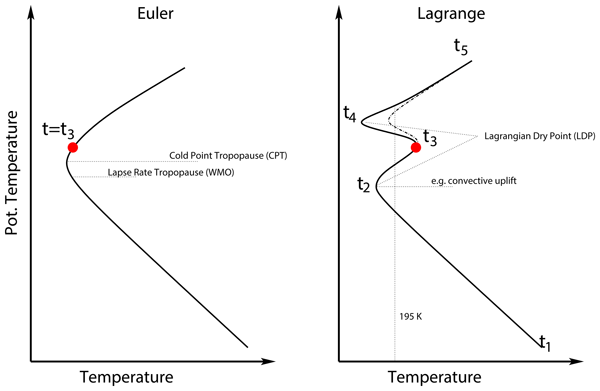
We studied water vapor in a critical region of the atmosphere, the Asian summer monsoon anticyclone, using rare in situ observations. Our study shows that extremely high water vapor values observed in the stratosphere within the Asian monsoon anticyclone still undergo significant freeze-drying and that water vapor concentrations set by the Lagrangian dry point are a better proxy for the stratospheric water vapor budget than rare observations of enhanced water mixing ratios.
Marc von Hobe, Domenico Taraborrelli, Sascha Alber, Birger Bohn, Hans-Peter Dorn, Hendrik Fuchs, Yun Li, Chenxi Qiu, Franz Rohrer, Roberto Sommariva, Fred Stroh, Zhaofeng Tan, Sergej Wedel, and Anna Novelli
Atmos. Chem. Phys., 23, 10609–10623, https://doi.org/10.5194/acp-23-10609-2023, https://doi.org/10.5194/acp-23-10609-2023, 2023
Short summary
Short summary
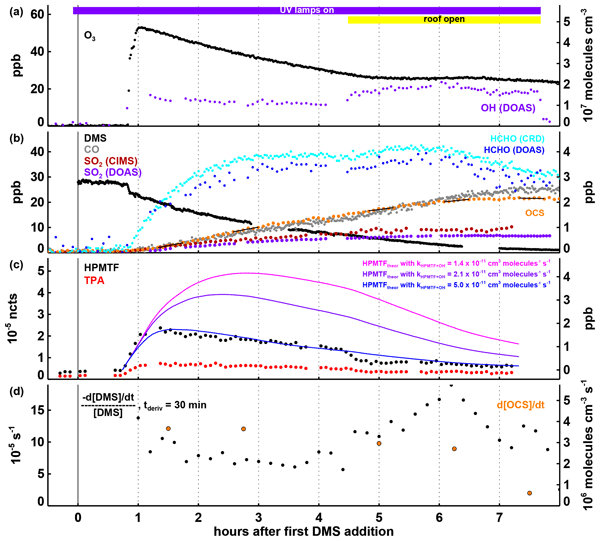
The trace gas carbonyl sulfide (OCS) transports sulfur from the troposphere to the stratosphere, where sulfate aerosols are formed that influence climate and stratospheric chemistry. An uncertain OCS source in the troposphere is chemical production form dimethyl sulfide (DMS), a gas released in large quantities from the oceans. We carried out experiments in a large atmospheric simulation chamber to further elucidate the chemical mechanism of OCS production from DMS.
Frederik Harzer, Hella Garny, Felix Ploeger, Harald Bönisch, Peter Hoor, and Thomas Birner
Atmos. Chem. Phys., 23, 10661–10675, https://doi.org/10.5194/acp-23-10661-2023, https://doi.org/10.5194/acp-23-10661-2023, 2023
Short summary
Short summary
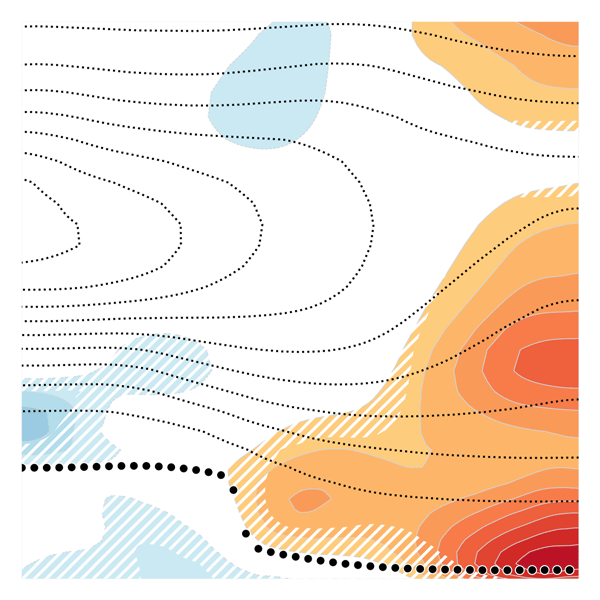
We study the statistical relation between year-by-year fluctuations in winter-mean ozone and the strength of the stratospheric polar vortex. In the latitude–pressure plane, regression analysis shows that anomalously weak polar vortex years are associated with three pronounced local ozone maxima over the polar cap relative to the winter climatology. These response maxima primarily reflect the non-trivial combination of different ozone transport processes with varying relative contributions.
Annika Oertel, Annette K. Miltenberger, Christian M. Grams, and Corinna Hoose
Atmos. Chem. Phys., 23, 8553–8581, https://doi.org/10.5194/acp-23-8553-2023, https://doi.org/10.5194/acp-23-8553-2023, 2023
Short summary
Short summary
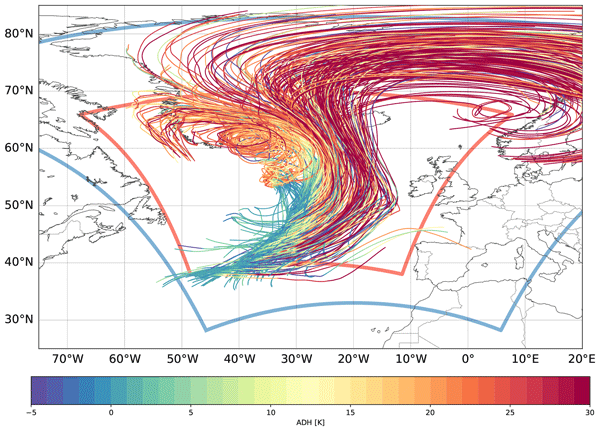
Warm conveyor belts (WCBs) are cloud- and precipitation-producing airstreams in extratropical cyclones that are important for the large-scale flow and cloud radiative forcing. We analyze cloud formation processes during WCB ascent in a two-moment microphysics scheme. Quantification of individual diabatic heating rates shows the importance of condensation, vapor deposition, rain evaporation, melting, and cloud-top radiative cooling for total heating and WCB-related potential vorticity structure.
Silke Groß, Tina Jurkat-Witschas, Qiang Li, Martin Wirth, Benedikt Urbanek, Martina Krämer, Ralf Weigel, and Christiane Voigt
Atmos. Chem. Phys., 23, 8369–8381, https://doi.org/10.5194/acp-23-8369-2023, https://doi.org/10.5194/acp-23-8369-2023, 2023
Short summary
Short summary
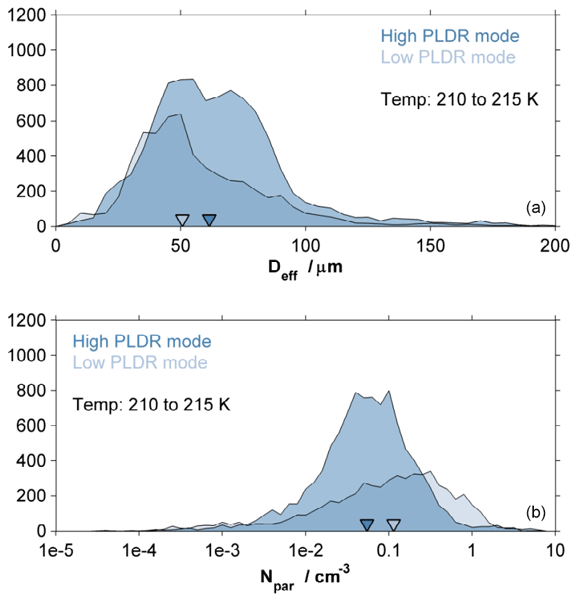
Aviation-emitted aerosol can have an impact on cirrus clouds. We present optical and microphysical properties of mid-latitude cirrus clouds which were formed under the influence of aviation-emitted aerosol or which were formed under rather pristine conditions. We find that cirrus clouds affected by aviation-emitted aerosol show larger values of the particle linear depolarization ratio, larger mean effective ice particle diameters and decreased ice particle number concentrations.
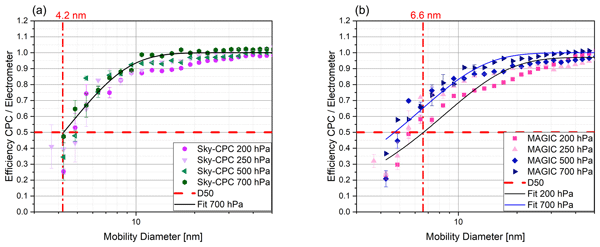
Patrick Weber, Oliver F. Bischof, Benedikt Fischer, Marcel Berg, Susanne Hering, Steven Spielman, Gregory Lewis, Andreas Petzold, and Ulrich Bundke
Atmos. Meas. Tech., 16, 3505–3514, https://doi.org/10.5194/amt-16-3505-2023, https://doi.org/10.5194/amt-16-3505-2023, 2023
Short summary
Short summary
This study tests the new water condensation particle counter (MAGIC 210-LP) for deployment on passenger aircraft coordinated by the European research infrastructure IAGOS. We conducted a series of laboratory experiments for flight altitude conditions. We demonstrate that this water condensation particle counter model shows excellent agreement with a butanol-based instrument used in parallel and a Faraday cup electrometer as reference instrument at all tested pressure conditions.
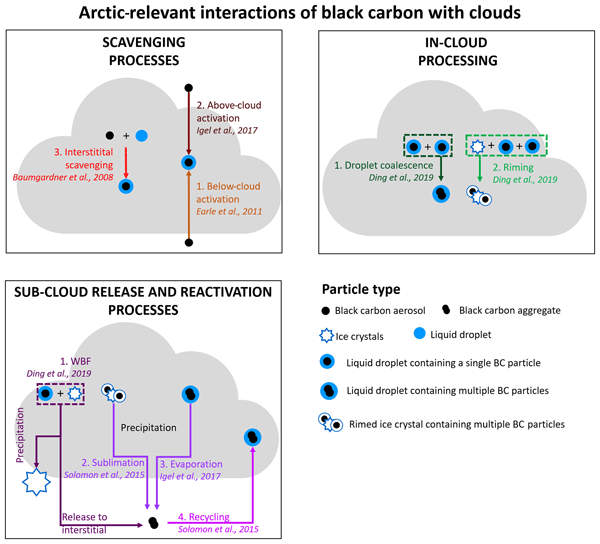
Marco Zanatta, Stephan Mertes, Olivier Jourdan, Regis Dupuy, Emma Järvinen, Martin Schnaiter, Oliver Eppers, Johannes Schneider, Zsófia Jurányi, and Andreas Herber
Atmos. Chem. Phys., 23, 7955–7973, https://doi.org/10.5194/acp-23-7955-2023, https://doi.org/10.5194/acp-23-7955-2023, 2023
Short summary
Short summary
Black carbon (BC) particles influence the Arctic radiative balance. Vertical measurements of black carbon were conducted during the ACLOUD campaign in the European Arctic to study the interaction of BC with clouds. This study shows that clouds influence the vertical variability of BC properties across the inversion layer and that multiple activation and transformation mechanisms of BC may occur in the presence of low-level, persistent, mixed-phase clouds.
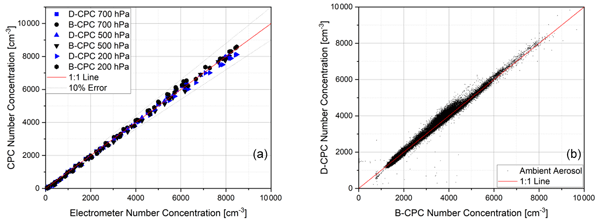
Patrick Weber, Oliver F. Bischof, Benedikt Fischer, Marcel Berg, Jannik Schmitt, Gerhard Steiner, Lothar Keck, Andreas Petzold, and Ulrich Bundke
Aerosol Research, 1, 1–12, https://doi.org/10.5194/ar-1-1-2023, https://doi.org/10.5194/ar-1-1-2023, 2023
Short summary
Short summary
The aerosol number concentration is essential information for aerosol science. A condensation particle counter (CPC) can robustly provide this information. Butanol is often used as a working fluid in a CPC. We could show that dimethyl sulfoxide (DMSO) behaves equivalently to butanol in terms of the instrument`s counting efficiency, cut-off diameter and concentration linearity. We tested this on different aerosols, including sodium chloride, ammonium sulfate and fresh combustion soot.
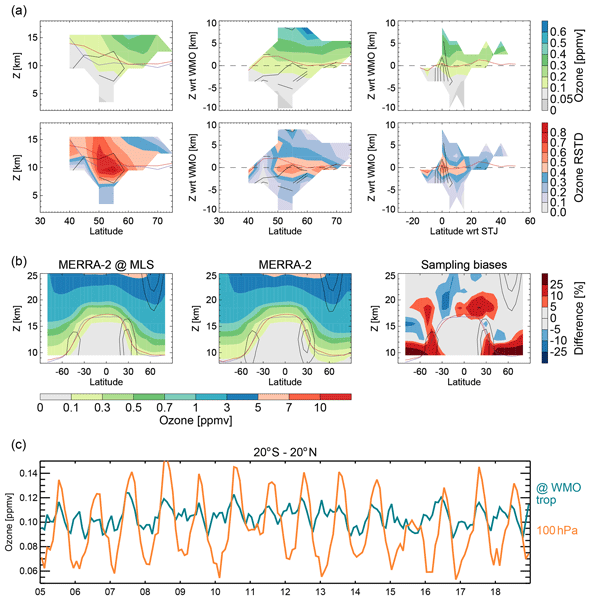
Luis F. Millán, Gloria L. Manney, Harald Boenisch, Michaela I. Hegglin, Peter Hoor, Daniel Kunkel, Thierry Leblanc, Irina Petropavlovskikh, Kaley Walker, Krzysztof Wargan, and Andreas Zahn
Atmos. Meas. Tech., 16, 2957–2988, https://doi.org/10.5194/amt-16-2957-2023, https://doi.org/10.5194/amt-16-2957-2023, 2023
Short summary
Short summary
The determination of atmospheric composition trends in the upper troposphere and lower stratosphere (UTLS) is still highly uncertain. We present the creation of dynamical diagnostics to map several ozone datasets (ozonesondes, lidars, aircraft, and satellite measurements) in geophysically based coordinate systems. The diagnostics can also be used to analyze other greenhouse gases relevant to surface climate and UTLS chemistry.
Claudio Belotti, Flavio Barbara, Marco Barucci, Giovanni Bianchini, Francesco D'Amato, Samuele Del Bianco, Gianluca Di Natale, Marco Gai, Alessio Montori, Filippo Pratesi, Markus Rettinger, Christian Rolf, Ralf Sussmann, Thomas Trickl, Silvia Viciani, Hannes Vogelmann, and Luca Palchetti
Atmos. Meas. Tech., 16, 2511–2529, https://doi.org/10.5194/amt-16-2511-2023, https://doi.org/10.5194/amt-16-2511-2023, 2023
Short summary
Short summary
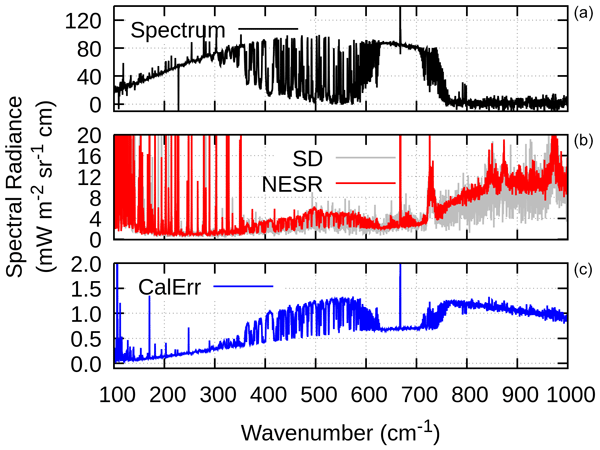
FIRMOS (Far-Infrared Radiation Mobile Observation System) is a spectroradiometer measuring in the far-infrared, developed to support the preparation of the FORUM (Far-infrared Outgoing Radiation Understanding and Monitoring) satellite mission. In this paper, we describe the instrument, its data products, and the results of the comparison with a suite of observations made from a high-altitude site during a field campaign, in winter 2018–2019.
Georgios Dekoutsidis, Silke Groß, Martin Wirth, Martina Krämer, and Christian Rolf
Atmos. Chem. Phys., 23, 3103–3117, https://doi.org/10.5194/acp-23-3103-2023, https://doi.org/10.5194/acp-23-3103-2023, 2023
Short summary
Short summary
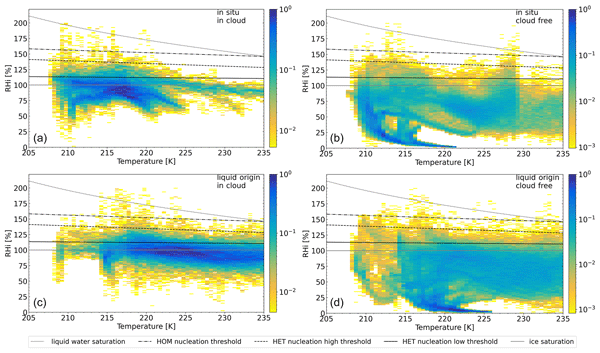
Cirrus clouds affect Earth's atmosphere, deeming our study important. Here we use water vapor measurements by lidar and study the relative humidity (RHi) within and around midlatitude cirrus clouds. We find high supersaturations in the cloud-free air and within the clouds, especially near the cloud top. We study two cloud types with different formation processes. Finally, we conclude that the shape of the distribution of RHi can be used as an indicator of different cloud evolutionary stages.
Chuan-Yao Lin, Wan-Chin Chen, Yi-Yun Chien, Charles C. K. Chou, Chian-Yi Liu, Helmut Ziereis, Hans Schlager, Eric Förster, Florian Obersteiner, Ovid O. Krüger, Bruna A. Holanda, Mira L. Pöhlker, Katharina Kaiser, Johannes Schneider, Birger Bohn, Klaus Pfeilsticker, Benjamin Weyland, Maria Dolores Andrés Hernández, and John P. Burrows
Atmos. Chem. Phys., 23, 2627–2647, https://doi.org/10.5194/acp-23-2627-2023, https://doi.org/10.5194/acp-23-2627-2023, 2023
Short summary
Short summary
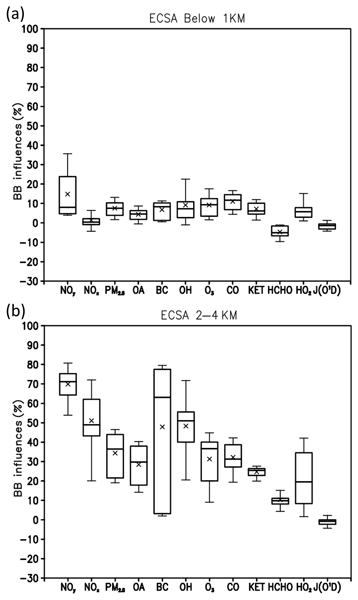
During the EMeRGe campaign in Asia, atmospheric pollutants were measured on board the HALO aircraft. The WRF-Chem model was employed to evaluate the biomass burning (BB) plume transported from Indochina and its impact on the downstream areas. The combination of BB aerosol enhancement with cloud water resulted in a reduction in incoming shortwave radiation at the surface in southern China and the East China Sea, which potentially has significant regional climate implications.
Fayçal Lamraoui, Martina Krämer, Armin Afchine, Adam B. Sokol, Sergey Khaykin, Apoorva Pandey, and Zhiming Kuang
Atmos. Chem. Phys., 23, 2393–2419, https://doi.org/10.5194/acp-23-2393-2023, https://doi.org/10.5194/acp-23-2393-2023, 2023
Short summary
Short summary
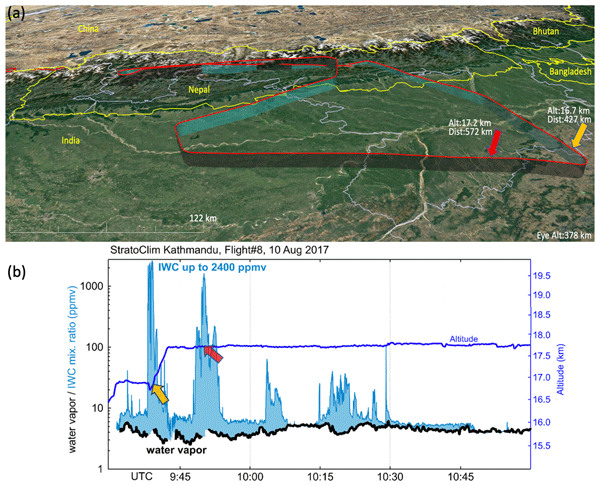
Cirrus in the tropical tropopause layer (TTL) can play a key role in vertical transport. We investigate the role of different cloud regimes and the associated ice habits in regulating the properties of the TTL. We use high-resolution numerical experiments at the scales of large-eddy simulations (LESs) and aircraft measurements. We found that LES-scale parameterizations that predict ice shape are crucial for an accurate representation of TTL cirrus and thus the associated (de)hydration process.
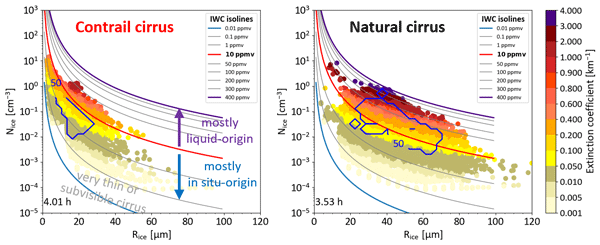
Yun Li, Christoph Mahnke, Susanne Rohs, Ulrich Bundke, Nicole Spelten, Georgios Dekoutsidis, Silke Groß, Christiane Voigt, Ulrich Schumann, Andreas Petzold, and Martina Krämer
Atmos. Chem. Phys., 23, 2251–2271, https://doi.org/10.5194/acp-23-2251-2023, https://doi.org/10.5194/acp-23-2251-2023, 2023
Short summary
Short summary
The radiative effect of aviation-induced cirrus is closely related to ambient conditions and its microphysical properties. Our study investigated the occurrence of contrail and natural cirrus measured above central Europe in spring 2014. It finds that contrail cirrus appears frequently in the pressure range 200 to 245 hPa and occurs more often in slightly ice-subsaturated environments than expected. Avoiding slightly ice-subsaturated regions by aviation might help mitigate contrail cirrus.
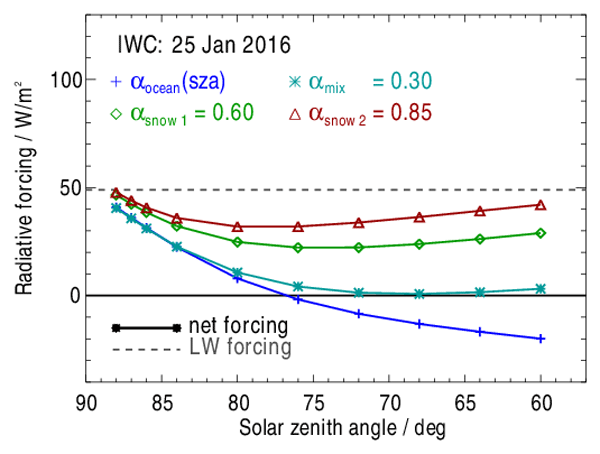
Andreas Marsing, Ralf Meerkötter, Romy Heller, Stefan Kaufmann, Tina Jurkat-Witschas, Martina Krämer, Christian Rolf, and Christiane Voigt
Atmos. Chem. Phys., 23, 587–609, https://doi.org/10.5194/acp-23-587-2023, https://doi.org/10.5194/acp-23-587-2023, 2023
Short summary
Short summary
We employ highly resolved aircraft measurements of profiles of the ice water content (IWC) in Arctic cirrus clouds in winter and spring, when solar irradiation is low. Using radiation transfer calculations, we assess the cloud radiative effect over different surfaces like snow or ocean. The variability in the IWC of the clouds affects their overall radiative effect and drives internal processes. This helps understand the role of cirrus in a rapidly changing Arctic environment.
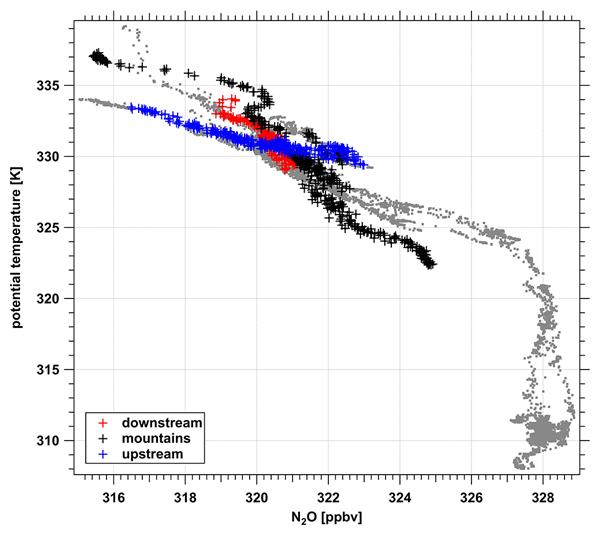
Hans-Christoph Lachnitt, Peter Hoor, Daniel Kunkel, Martina Bramberger, Andreas Dörnbrack, Stefan Müller, Philipp Reutter, Andreas Giez, Thorsten Kaluza, and Markus Rapp
Atmos. Chem. Phys., 23, 355–373, https://doi.org/10.5194/acp-23-355-2023, https://doi.org/10.5194/acp-23-355-2023, 2023
Short summary
Short summary
We present an analysis of high-resolution airborne measurements during a flight of the DEEPWAVE 2014 campaign in New Zealand. The focus of this flight was to study the effects of enhanced mountain wave activity over the Southern Alps. We discuss changes in the upstream and downstream distributions of N2O and CO and show that these changes are related to turbulence-induced trace gas fluxes which have persistent effects on the trace gas composition in the lower stratosphere.
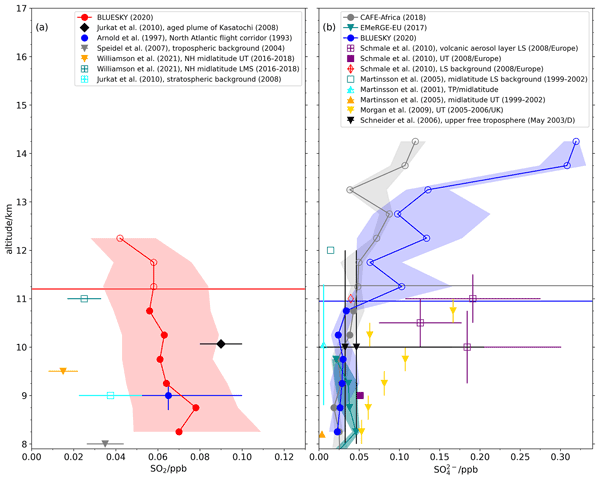
Laura Tomsche, Andreas Marsing, Tina Jurkat-Witschas, Johannes Lucke, Stefan Kaufmann, Katharina Kaiser, Johannes Schneider, Monika Scheibe, Hans Schlager, Lenard Röder, Horst Fischer, Florian Obersteiner, Andreas Zahn, Martin Zöger, Jos Lelieveld, and Christiane Voigt
Atmos. Chem. Phys., 22, 15135–15151, https://doi.org/10.5194/acp-22-15135-2022, https://doi.org/10.5194/acp-22-15135-2022, 2022
Short summary
Short summary
The detection of sulfur compounds in the upper troposphere (UT) and lower stratosphere (LS) is a challenge. In-flight measurements of SO2 and sulfate aerosol were performed during the BLUESKY mission in spring 2020 under exceptional atmospheric conditions. Reduced sinks in the dry UTLS and lower but still significant air traffic influenced the enhanced SO2 in the UT, and aged volcanic plumes enhanced the LS sulfate aerosol impacting the atmospheric radiation budget and global climate.
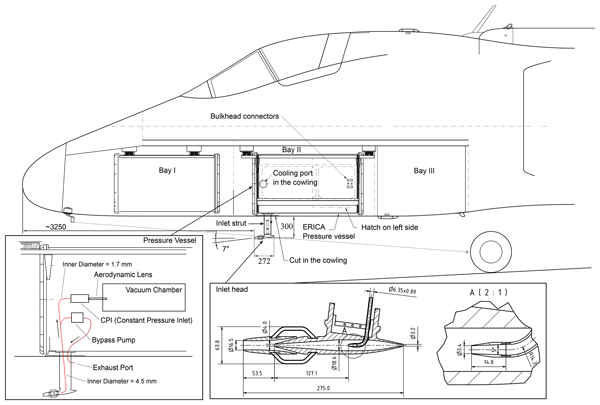
Antonis Dragoneas, Sergej Molleker, Oliver Appel, Andreas Hünig, Thomas Böttger, Markus Hermann, Frank Drewnick, Johannes Schneider, Ralf Weigel, and Stephan Borrmann
Atmos. Meas. Tech., 15, 5719–5742, https://doi.org/10.5194/amt-15-5719-2022, https://doi.org/10.5194/amt-15-5719-2022, 2022
Short summary
Short summary
The ERICA is a specially designed aerosol particle mass spectrometer for in situ, real-time chemical composition analysis of aerosols. It can operate completely autonomously, in the absence of an instrument operator. Its design has enabled its operation under harsh conditions, like those experienced in the upper troposphere and lower stratosphere, aboard unpressurized high-altitude research aircraft. The instrument has successfully participated in several aircraft operations around the world.
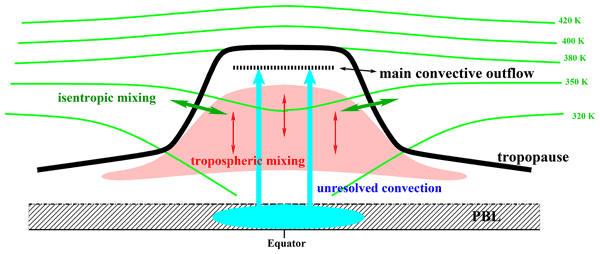
Paul Konopka, Mengchu Tao, Marc von Hobe, Lars Hoffmann, Corinna Kloss, Fabrizio Ravegnani, C. Michael Volk, Valentin Lauther, Andreas Zahn, Peter Hoor, and Felix Ploeger
Geosci. Model Dev., 15, 7471–7487, https://doi.org/10.5194/gmd-15-7471-2022, https://doi.org/10.5194/gmd-15-7471-2022, 2022
Short summary
Short summary
Pure trajectory-based transport models driven by meteorology derived from reanalysis products (ERA5) take into account only the resolved, advective part of transport. That means neither mixing processes nor unresolved subgrid-scale advective processes like convection are included. The Chemical Lagrangian Model of the Stratosphere (CLaMS) includes these processes. We show that isentropic mixing dominates unresolved transport. The second most important transport process is unresolved convection.
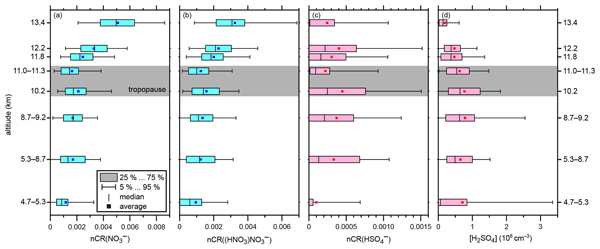
Marcel Zauner-Wieczorek, Martin Heinritzi, Manuel Granzin, Timo Keber, Andreas Kürten, Katharina Kaiser, Johannes Schneider, and Joachim Curtius
Atmos. Chem. Phys., 22, 11781–11794, https://doi.org/10.5194/acp-22-11781-2022, https://doi.org/10.5194/acp-22-11781-2022, 2022
Short summary
Short summary
We present measurements of ambient ions in the free troposphere and lower stratosphere over Europe in spring 2020. We observed nitrate and hydrogen sulfate, amongst others. From their ratio, the number concentrations of gaseous sulfuric acid were inferred. Nitrate increased towards the stratosphere, whilst sulfuric acid was slightly decreased there. The average values for sulfuric acid were 1.9 to 7.8 × 105 cm-3. Protonated pyridine was identified in an altitude range of 4.6 to 8.5 km.
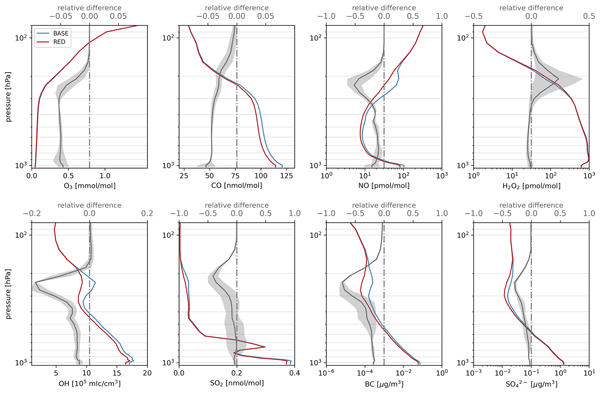
Simon F. Reifenberg, Anna Martin, Matthias Kohl, Sara Bacer, Zaneta Hamryszczak, Ivan Tadic, Lenard Röder, Daniel J. Crowley, Horst Fischer, Katharina Kaiser, Johannes Schneider, Raphael Dörich, John N. Crowley, Laura Tomsche, Andreas Marsing, Christiane Voigt, Andreas Zahn, Christopher Pöhlker, Bruna A. Holanda, Ovid Krüger, Ulrich Pöschl, Mira Pöhlker, Patrick Jöckel, Marcel Dorf, Ulrich Schumann, Jonathan Williams, Birger Bohn, Joachim Curtius, Hardwig Harder, Hans Schlager, Jos Lelieveld, and Andrea Pozzer
Atmos. Chem. Phys., 22, 10901–10917, https://doi.org/10.5194/acp-22-10901-2022, https://doi.org/10.5194/acp-22-10901-2022, 2022
Short summary
Short summary
In this work we use a combination of observational data from an aircraft campaign and model results to investigate the effect of the European lockdown due to COVID-19 in spring 2020. Using model results, we show that the largest relative changes to the atmospheric composition caused by the reduced emissions are located in the upper troposphere around aircraft cruise altitude, while the largest absolute changes are present at the surface.
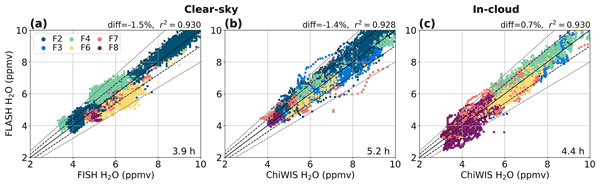
Clare E. Singer, Benjamin W. Clouser, Sergey M. Khaykin, Martina Krämer, Francesco Cairo, Thomas Peter, Alexey Lykov, Christian Rolf, Nicole Spelten, Armin Afchine, Simone Brunamonti, and Elisabeth J. Moyer
Atmos. Meas. Tech., 15, 4767–4783, https://doi.org/10.5194/amt-15-4767-2022, https://doi.org/10.5194/amt-15-4767-2022, 2022
Short summary
Short summary
In situ measurements of water vapor in the upper troposphere are necessary to study cloud formation and hydration of the stratosphere but challenging due to cold–dry conditions. We compare measurements from three water vapor instruments from the StratoClim campaign in 2017. In clear sky (clouds), point-by-point differences were <1.5±8 % (<1±8 %). This excellent agreement allows detection of fine-scale structures required to understand the impact of convection on stratospheric water vapor.
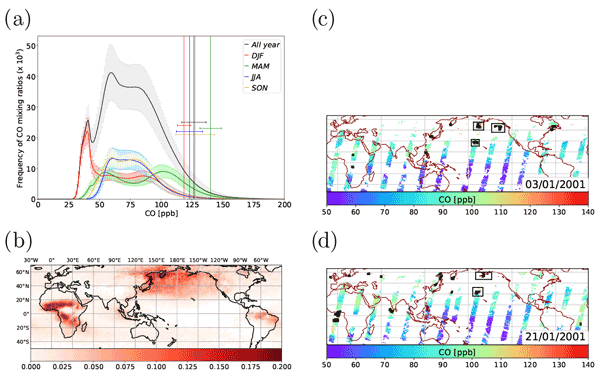
Linda Smoydzin and Peter Hoor
Atmos. Chem. Phys., 22, 7193–7206, https://doi.org/10.5194/acp-22-7193-2022, https://doi.org/10.5194/acp-22-7193-2022, 2022
Short summary
Short summary
Our study presents a detailed analysis of the spatial and temporal distribution of elevated CO level in the upper troposphere over the Pacific using 20 years of MOPITT data. We create a climatology of severe pollution episodes and use trajectory calculations to link each particular pollution event detected in MOPITT satellite data with a distinct source region. Additionally, we analyse uplift mechanisms such as WCB-related upward transport.
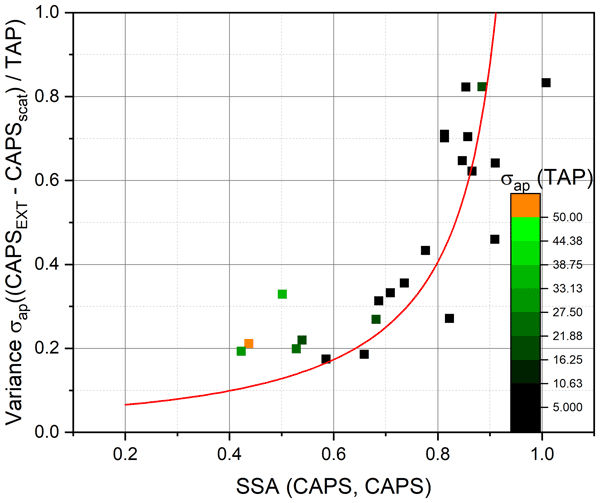
Patrick Weber, Andreas Petzold, Oliver F. Bischof, Benedikt Fischer, Marcel Berg, Andrew Freedman, Timothy B. Onasch, and Ulrich Bundke
Atmos. Meas. Tech., 15, 3279–3296, https://doi.org/10.5194/amt-15-3279-2022, https://doi.org/10.5194/amt-15-3279-2022, 2022
Short summary
Short summary
In our laboratory closure study, we measured the full set of aerosol optical properties for different light-absorbing aerosols using a set of instruments.
Our key finding is that the extensive and intensive aerosol optical properties obtained agree with data from reference instruments, except the absorption Ångström exponent of externally mixed aerosols. The reported uncertainty in the single-scattering albedo fulfils the defined goals for Global Climate Observing System applications of 10 %.
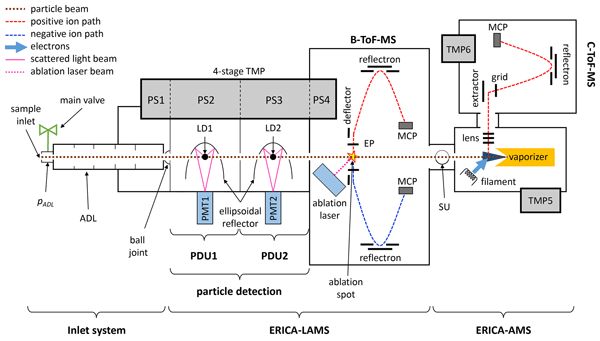
Andreas Hünig, Oliver Appel, Antonis Dragoneas, Sergej Molleker, Hans-Christian Clemen, Frank Helleis, Thomas Klimach, Franziska Köllner, Thomas Böttger, Frank Drewnick, Johannes Schneider, and Stephan Borrmann
Atmos. Meas. Tech., 15, 2889–2921, https://doi.org/10.5194/amt-15-2889-2022, https://doi.org/10.5194/amt-15-2889-2022, 2022
Short summary
Short summary
We have serially combined the two well-established methods for in situ real-time measurement of fine particle chemical composition, the single-particle laser ablation method and the flash evaporation with electron impact ionization method, into a novel instrument. Here we present the design; instrument characteristics, as derived from laboratory and field measurements; and results from the first field deployment during the 2017 StratoClim aircraft campaign.
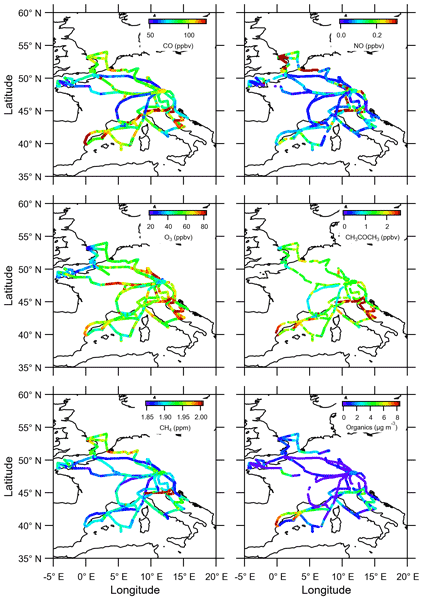
M. Dolores Andrés Hernández, Andreas Hilboll, Helmut Ziereis, Eric Förster, Ovid O. Krüger, Katharina Kaiser, Johannes Schneider, Francesca Barnaba, Mihalis Vrekoussis, Jörg Schmidt, Heidi Huntrieser, Anne-Marlene Blechschmidt, Midhun George, Vladyslav Nenakhov, Theresa Harlass, Bruna A. Holanda, Jennifer Wolf, Lisa Eirenschmalz, Marc Krebsbach, Mira L. Pöhlker, Anna B. Kalisz Hedegaard, Linlu Mei, Klaus Pfeilsticker, Yangzhuoran Liu, Ralf Koppmann, Hans Schlager, Birger Bohn, Ulrich Schumann, Andreas Richter, Benjamin Schreiner, Daniel Sauer, Robert Baumann, Mariano Mertens, Patrick Jöckel, Markus Kilian, Greta Stratmann, Christopher Pöhlker, Monica Campanelli, Marco Pandolfi, Michael Sicard, José L. Gómez-Amo, Manuel Pujadas, Katja Bigge, Flora Kluge, Anja Schwarz, Nikos Daskalakis, David Walter, Andreas Zahn, Ulrich Pöschl, Harald Bönisch, Stephan Borrmann, Ulrich Platt, and John P. Burrows
Atmos. Chem. Phys., 22, 5877–5924, https://doi.org/10.5194/acp-22-5877-2022, https://doi.org/10.5194/acp-22-5877-2022, 2022
Short summary
Short summary
EMeRGe provides a unique set of in situ and remote sensing airborne measurements of trace gases and aerosol particles along selected flight routes in the lower troposphere over Europe. The interpretation uses also complementary collocated ground-based and satellite measurements. The collected data help to improve the current understanding of the complex spatial distribution of trace gases and aerosol particles resulting from mixing, transport, and transformation of pollution plumes over Europe.
Andreas Wieser, Andreas Güntner, Peter Dietrich, Jan Handwerker, Dina Khordakova, Uta Ködel, Martin Kohler, Hannes Mollenhauer, Bernhard Mühr, Erik Nixdorf, Marvin Reich, Christian Rolf, Martin Schrön, Claudia Schütze, and Ute Weber
Hydrol. Earth Syst. Sci. Discuss., https://doi.org/10.5194/hess-2022-131, https://doi.org/10.5194/hess-2022-131, 2022
Preprint withdrawn
Short summary
Short summary
We present an event-triggered observation concept which covers the entire process chain from heavy precipitation to flooding at the catchment scale. It combines flexible and mobile observing systems out of the fields of meteorology, hydrology and geophysics with stationary networks to capture atmospheric transport processes, heterogeneous precipitation patterns, land surface and subsurface storage processes, and runoff dynamics.
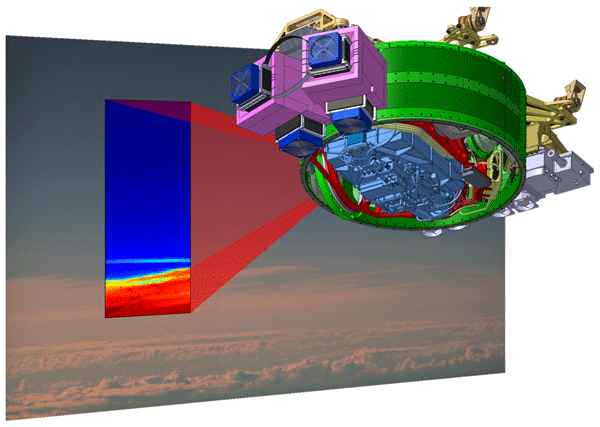
Jörn Ungermann, Anne Kleinert, Guido Maucher, Irene Bartolomé, Felix Friedl-Vallon, Sören Johansson, Lukas Krasauskas, and Tom Neubert
Atmos. Meas. Tech., 15, 2503–2530, https://doi.org/10.5194/amt-15-2503-2022, https://doi.org/10.5194/amt-15-2503-2022, 2022
Short summary
Short summary
GLORIA is a 2-D infrared imaging spectrometer operated on two high-flying research aircraft. This paper details our instrument calibration and characterization efforts, which in particular leverage in-flight data almost exclusively and often exploit the novel 2-D nature of the measurements. We show that the instrument surpasses the original instrument specifications and conclude by analyzing how the derived errors affect temperature and ozone retrievals, two of our main derived quantities.
Mireia Papke Chica, Valerian Hahn, Tiziana Braeuer, Elena de la Torre Castro, Florian Ewald, Mathias Gergely, Simon Kirschler, Luca Bugliaro Goggia, Stefanie Knobloch, Martina Kraemer, Johannes Lucke, Johanna Mayer, Raphael Maerkl, Manuel Moser, Laura Tomsche, Tina Jurkat-Witschas, Martin Zoeger, Christian von Savigny, and Christiane Voigt
Atmos. Chem. Phys. Discuss., https://doi.org/10.5194/acp-2022-255, https://doi.org/10.5194/acp-2022-255, 2022
Preprint withdrawn
Short summary
Short summary
The mixed-phase temperature regime in convective clouds challenges our understanding of microphysical and radiative cloud properties. We provide a rare and unique dataset of aircraft in situ measurements in a strong mid-latitude convective system. We find that mechanisms initiating ice nucleation and growth strongly depend on temperature, relative humidity, and vertical velocity and variate within the measured system, resulting in altitude dependent changes of the cloud liquid and ice fraction.
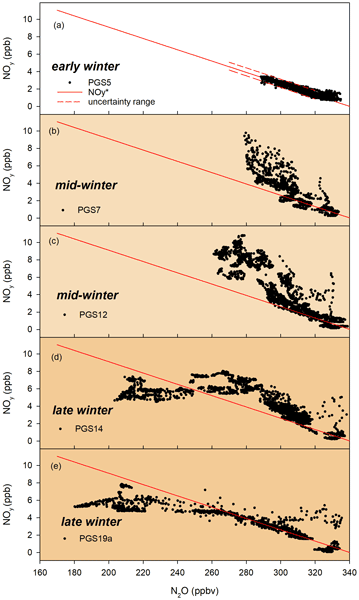
Helmut Ziereis, Peter Hoor, Jens-Uwe Grooß, Andreas Zahn, Greta Stratmann, Paul Stock, Michael Lichtenstern, Jens Krause, Vera Bense, Armin Afchine, Christian Rolf, Wolfgang Woiwode, Marleen Braun, Jörn Ungermann, Andreas Marsing, Christiane Voigt, Andreas Engel, Björn-Martin Sinnhuber, and Hermann Oelhaf
Atmos. Chem. Phys., 22, 3631–3654, https://doi.org/10.5194/acp-22-3631-2022, https://doi.org/10.5194/acp-22-3631-2022, 2022
Short summary
Short summary
Airborne observations were conducted in the lowermost Arctic stratosphere during the winter of 2015/2016. The observed distribution of reactive nitrogen shows clear indications of nitrification in mid-winter and denitrification in late winter. This was caused by the formation of polar stratospheric cloud particles, which were observed during several flights. The sedimentation and evaporation of these particles and the descent of air masses cause a redistribution of reactive nitrogen.
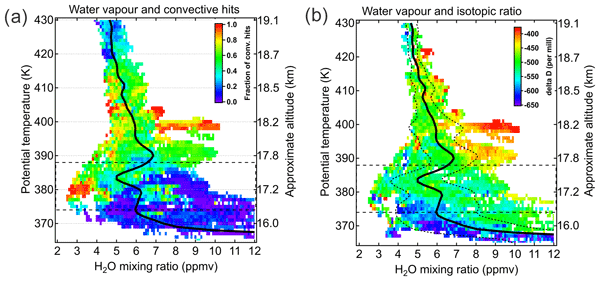
Sergey M. Khaykin, Elizabeth Moyer, Martina Krämer, Benjamin Clouser, Silvia Bucci, Bernard Legras, Alexey Lykov, Armin Afchine, Francesco Cairo, Ivan Formanyuk, Valentin Mitev, Renaud Matthey, Christian Rolf, Clare E. Singer, Nicole Spelten, Vasiliy Volkov, Vladimir Yushkov, and Fred Stroh
Atmos. Chem. Phys., 22, 3169–3189, https://doi.org/10.5194/acp-22-3169-2022, https://doi.org/10.5194/acp-22-3169-2022, 2022
Short summary
Short summary
The Asian monsoon anticyclone is the key contributor to the global annual maximum in lower stratospheric water vapour. We investigate the impact of deep convection on the lower stratospheric water using a unique set of observations aboard the high-altitude M55-Geophysica aircraft deployed in Nepal in summer 2017 within the EU StratoClim project. We find that convective plumes of wet air can persist within the Asian anticyclone for weeks, thereby enhancing the occurrence of high-level clouds.
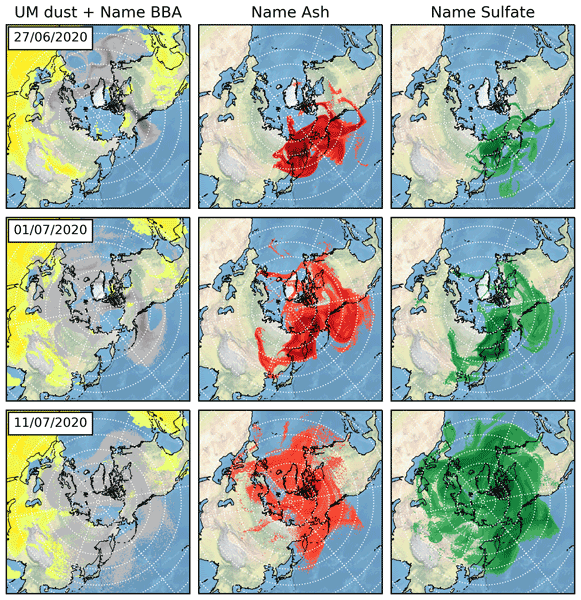
Martin J. Osborne, Johannes de Leeuw, Claire Witham, Anja Schmidt, Frances Beckett, Nina Kristiansen, Joelle Buxmann, Cameron Saint, Ellsworth J. Welton, Javier Fochesatto, Ana R. Gomes, Ulrich Bundke, Andreas Petzold, Franco Marenco, and Jim Haywood
Atmos. Chem. Phys., 22, 2975–2997, https://doi.org/10.5194/acp-22-2975-2022, https://doi.org/10.5194/acp-22-2975-2022, 2022
Short summary
Short summary
Using the Met Office NAME dispersion model, supported by satellite- and ground-based remote-sensing observations, we describe the dispersion of aerosols from the 2019 Raikoke eruption and the concurrent wildfires in Alberta Canada. We show how the synergy of dispersion modelling and multiple observation sources allowed observers in the London VAAC to arrive at a more complete picture of the aerosol loading at altitudes commonly used by aviation.
Rupert Holzinger, Oliver Eppers, Kouji Adachi, Heiko Bozem, Markus Hartmann, Andreas Herber, Makoto Koike, Dylan B. Millet, Nobuhiro Moteki, Sho Ohata, Frank Stratmann, and Atsushi Yoshida
Atmos. Chem. Phys. Discuss., https://doi.org/10.5194/acp-2022-95, https://doi.org/10.5194/acp-2022-95, 2022
Revised manuscript not accepted
Short summary
Short summary
In spring 2018 the research aircraft Polar 5 conducted flights in the Arctic atmosphere. The flight operation was from Station Nord in Greenland, 1700 km north of the Arctic Circle (81°43'N, 17°47'W). Using a mass spectrometer we measured more than 100 organic compounds in the air. We found a clear signature of natural organic compounds that are transported from forests to the high Arctic. These compounds have the potential to change the cloud cover and energy budget of the Arctic region.
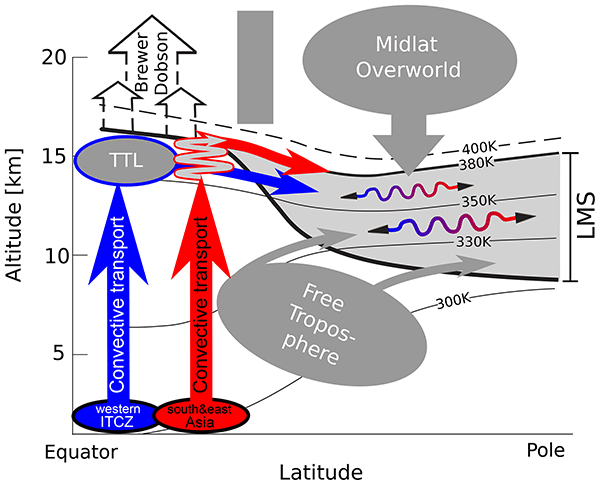
Valentin Lauther, Bärbel Vogel, Johannes Wintel, Andrea Rau, Peter Hoor, Vera Bense, Rolf Müller, and C. Michael Volk
Atmos. Chem. Phys., 22, 2049–2077, https://doi.org/10.5194/acp-22-2049-2022, https://doi.org/10.5194/acp-22-2049-2022, 2022
Short summary
Short summary
We show airborne in situ measurements of the very short-lived ozone-depleting substances CH2Cl2 and CHCl3, revealing particularly high concentrations of both species in the lower stratosphere. Back-trajectory calculations and 3D model simulations show that the air masses with high concentrations originated in the Asian boundary layer and were transported via the Asian summer monsoon. We also identify a fast transport pathway into the stratosphere via the North American monsoon and by hurricanes.
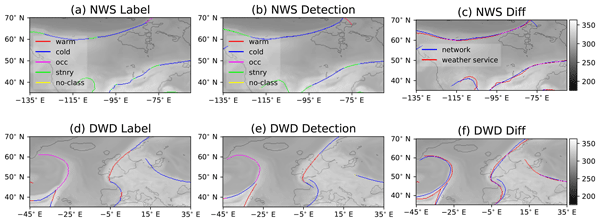
Stefan Niebler, Annette Miltenberger, Bertil Schmidt, and Peter Spichtinger
Weather Clim. Dynam., 3, 113–137, https://doi.org/10.5194/wcd-3-113-2022, https://doi.org/10.5194/wcd-3-113-2022, 2022
Short summary
Short summary
We use machine learning to create a network that detects and classifies four types of synoptic-scale weather fronts from ERA5 atmospheric reanalysis data. We present an application of our method, showing its use case in a scientific context. Additionally, our results show that multiple sources of training data are necessary to perform well on different regions, implying differences within those regions. Qualitative evaluation shows that the results are physically plausible.
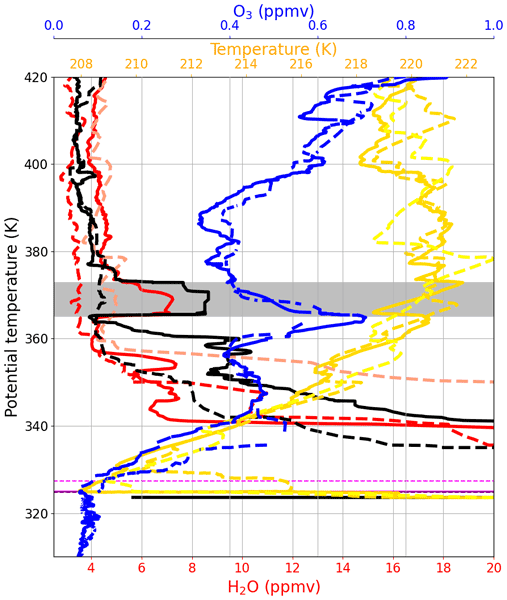
Dina Khordakova, Christian Rolf, Jens-Uwe Grooß, Rolf Müller, Paul Konopka, Andreas Wieser, Martina Krämer, and Martin Riese
Atmos. Chem. Phys., 22, 1059–1079, https://doi.org/10.5194/acp-22-1059-2022, https://doi.org/10.5194/acp-22-1059-2022, 2022
Short summary
Short summary
Extreme storms transport humidity from the troposphere to the stratosphere. Here it has a strong impact on the climate. With ongoing global warming, we expect more storms and, hence, an enhancement of this effect. A case study was performed in order to measure the impact of the direct injection of water vapor into the lower stratosphere. The measurements displayed a significant transport of water vapor into the lower stratosphere, and this was supported by satellite and reanalysis data.
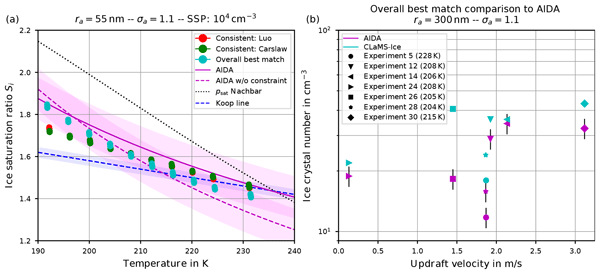
Manuel Baumgartner, Christian Rolf, Jens-Uwe Grooß, Julia Schneider, Tobias Schorr, Ottmar Möhler, Peter Spichtinger, and Martina Krämer
Atmos. Chem. Phys., 22, 65–91, https://doi.org/10.5194/acp-22-65-2022, https://doi.org/10.5194/acp-22-65-2022, 2022
Short summary
Short summary
An important mechanism for the appearance of ice particles in the upper troposphere at low temperatures is homogeneous nucleation. This process is commonly described by the
Koop line, predicting the humidity at freezing. However, laboratory measurements suggest that the freezing humidities are above the Koop line, motivating the present study to investigate the influence of different physical parameterizations on the homogeneous freezing with the help of a detailed numerical model.
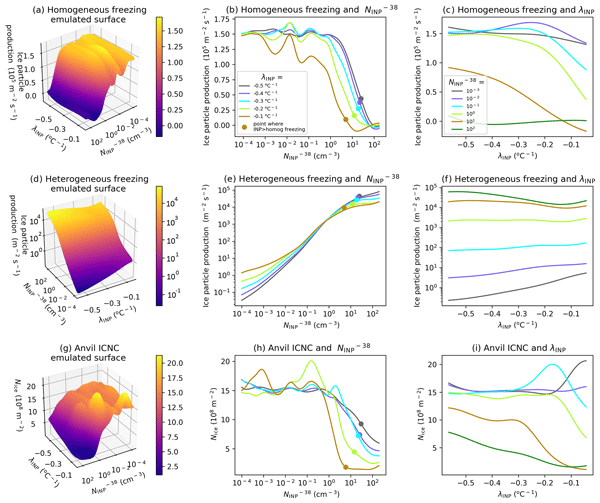
Rachel E. Hawker, Annette K. Miltenberger, Jill S. Johnson, Jonathan M. Wilkinson, Adrian A. Hill, Ben J. Shipway, Paul R. Field, Benjamin J. Murray, and Ken S. Carslaw
Atmos. Chem. Phys., 21, 17315–17343, https://doi.org/10.5194/acp-21-17315-2021, https://doi.org/10.5194/acp-21-17315-2021, 2021
Short summary
Short summary
We find that ice-nucleating particles (INPs), aerosols that can initiate the freezing of cloud droplets, cause substantial changes to the properties of radiatively important convectively generated anvil cirrus. The number concentration of INPs had a large effect on ice crystal number concentration while the INP temperature dependence controlled ice crystal size and cloud fraction. The results indicate information on INP number and source is necessary for the representation of cloud glaciation.
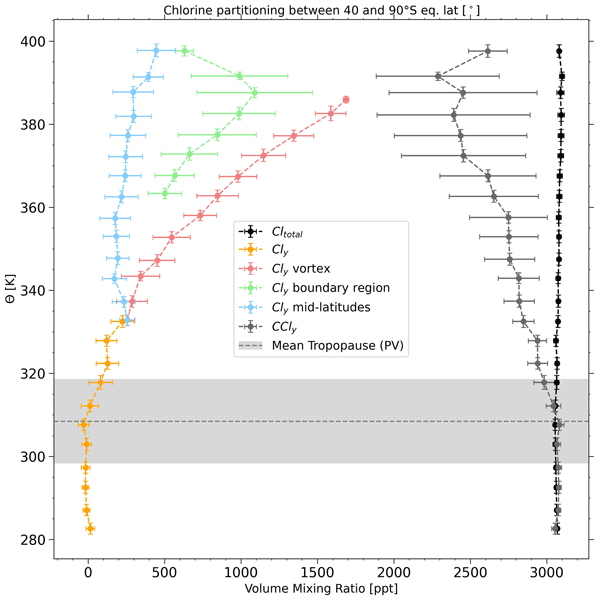
Markus Jesswein, Heiko Bozem, Hans-Christoph Lachnitt, Peter Hoor, Thomas Wagenhäuser, Timo Keber, Tanja Schuck, and Andreas Engel
Atmos. Chem. Phys., 21, 17225–17241, https://doi.org/10.5194/acp-21-17225-2021, https://doi.org/10.5194/acp-21-17225-2021, 2021
Short summary
Short summary
This study presents and compares inorganic chlorine (Cly) derived from observations with the HALO research aircraft in the Antarctic late winter–early fall 2019 and the Arctic winter 2015–2016. Trend-corrected correlations from the Northern Hemisphere show excellent agreement with those from the Southern Hemisphere. After observation allocation inside and outside the vortex based on N2O measurements, results of the two campaigns reveal substantial differences in Cly within the respective vortex.
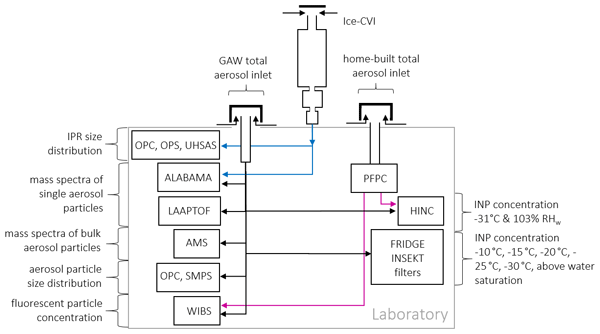
Larissa Lacher, Hans-Christian Clemen, Xiaoli Shen, Stephan Mertes, Martin Gysel-Beer, Alireza Moallemi, Martin Steinbacher, Stephan Henne, Harald Saathoff, Ottmar Möhler, Kristina Höhler, Thea Schiebel, Daniel Weber, Jann Schrod, Johannes Schneider, and Zamin A. Kanji
Atmos. Chem. Phys., 21, 16925–16953, https://doi.org/10.5194/acp-21-16925-2021, https://doi.org/10.5194/acp-21-16925-2021, 2021
Short summary
Short summary
We investigate ice-nucleating particle properties at Jungfraujoch during the 2017 joint INUIT/CLACE field campaign, to improve the knowledge about those rare particles in a cloud-relevant environment. By quantifying ice-nucleating particles in parallel to single-particle mass spectrometry measurements, we find that mineral dust and aged sea spray particles are potential candidates for ice-nucleating particles. Our findings are supported by ice residual analysis and source region modeling.
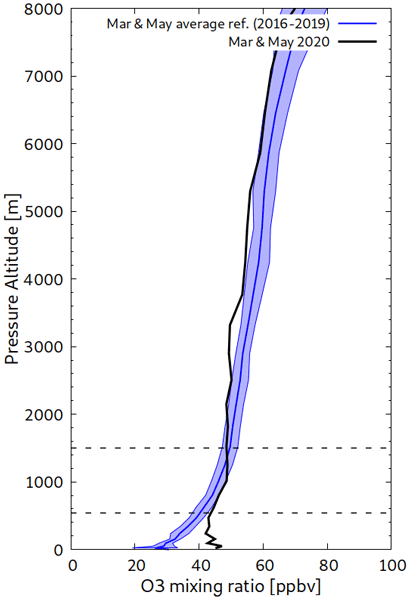
Hannah Clark, Yasmine Bennouna, Maria Tsivlidou, Pawel Wolff, Bastien Sauvage, Brice Barret, Eric Le Flochmoën, Romain Blot, Damien Boulanger, Jean-Marc Cousin, Philippe Nédélec, Andreas Petzold, and Valérie Thouret
Atmos. Chem. Phys., 21, 16237–16256, https://doi.org/10.5194/acp-21-16237-2021, https://doi.org/10.5194/acp-21-16237-2021, 2021
Short summary
Short summary
We examined 27 years of IAGOS (In-service Aircraft for a Global Observing System) profiles at Frankfurt to see if there were unusual features during the spring of 2020 related to COVID-19 lockdowns in Europe. Increased ozone near the surface was partly linked to the reduction in emissions. Carbon monoxide decreased near the surface, but the impact of the lockdowns was offset by polluted air masses from elsewhere. There were small reductions in ozone and carbon monoxide in the free troposphere.
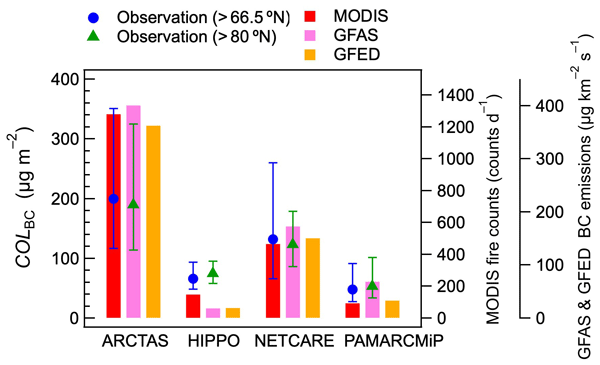
Sho Ohata, Makoto Koike, Atsushi Yoshida, Nobuhiro Moteki, Kouji Adachi, Naga Oshima, Hitoshi Matsui, Oliver Eppers, Heiko Bozem, Marco Zanatta, and Andreas B. Herber
Atmos. Chem. Phys., 21, 15861–15881, https://doi.org/10.5194/acp-21-15861-2021, https://doi.org/10.5194/acp-21-15861-2021, 2021
Short summary
Short summary
Vertical profiles of black carbon (BC) in the Arctic were measured during the PAMARCMiP aircraft-based experiment in spring 2018 and compared with those observed during previous aircraft campaigns in 2008, 2010, and 2015. Their differences were explained primarily by the year-to-year variation of biomass burning activities in northern midlatitudes over Eurasia. Our observations provide a bases to evaluate numerical model simulations that assess the BC radiative effects in the Arctic spring.
Yu-Wen Chen, Yi-Chun Chen, Charles C.-K. Chou, Hui-Ming Hung, Shih-Yu Chang, Lisa Eirenschmalz, Michael Lichtenstern, Helmut Ziereis, Hans Schlager, Greta Stratmann, Katharina Kaiser, Johannes Schneider, Stephan Borrmann, Florian Obersteiner, Eric Förster, Andreas Zahn, Wei-Nai Chen, Po-Hsiung Lin, Shuenn-Chin Chang, Maria Dolores Andrés Hernández, Pao-Kuan Wang, and John P. Burrows
Atmos. Chem. Phys. Discuss., https://doi.org/10.5194/acp-2021-788, https://doi.org/10.5194/acp-2021-788, 2021
Preprint withdrawn
Short summary
Short summary
By presenting an approach using EMeRGe-Asia airborne field measurements and surface observations, this study shows that the fraction of OH reactivity due to SO2-OH reaction has a significant correlation with the sulfate concentration. Approximately 30 % of sulfate is produced by SO2-OH reaction. Our results underline the importance of SO2-OH gas-phase oxidation in sulfate formation, and demonstrate that the method can be applied to other regions and under different meteorological conditions.
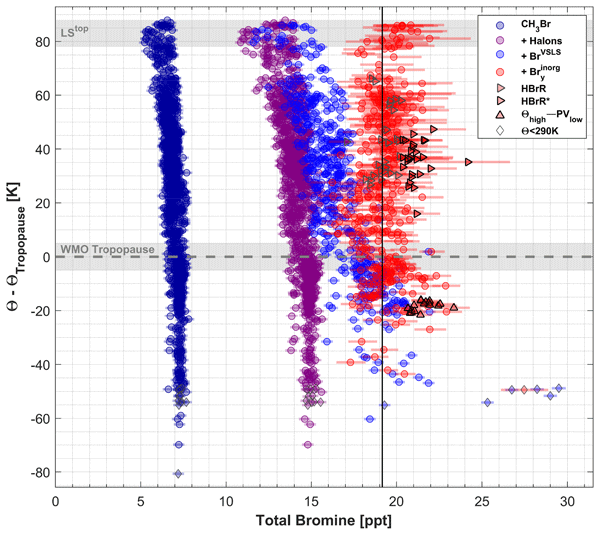
Meike K. Rotermund, Vera Bense, Martyn P. Chipperfield, Andreas Engel, Jens-Uwe Grooß, Peter Hoor, Tilman Hüneke, Timo Keber, Flora Kluge, Benjamin Schreiner, Tanja Schuck, Bärbel Vogel, Andreas Zahn, and Klaus Pfeilsticker
Atmos. Chem. Phys., 21, 15375–15407, https://doi.org/10.5194/acp-21-15375-2021, https://doi.org/10.5194/acp-21-15375-2021, 2021
Short summary
Short summary
Airborne total bromine (Brtot) and tracer measurements suggest Brtot-rich air masses persistently protruded into the lower stratosphere (LS), creating a high Brtot region over the North Atlantic in fall 2017. The main source is via isentropic transport by the Asian monsoon and to a lesser extent transport across the extratropical tropopause as quantified by a Lagrange model. The transport of Brtot via Central American hurricanes is also observed. Lastly, the impact of Brtot on LS O3 is assessed.

Christoph Mahnke, Ralf Weigel, Francesco Cairo, Jean-Paul Vernier, Armin Afchine, Martina Krämer, Valentin Mitev, Renaud Matthey, Silvia Viciani, Francesco D'Amato, Felix Ploeger, Terry Deshler, and Stephan Borrmann
Atmos. Chem. Phys., 21, 15259–15282, https://doi.org/10.5194/acp-21-15259-2021, https://doi.org/10.5194/acp-21-15259-2021, 2021
Short summary
Short summary
In 2017, in situ aerosol measurements were conducted aboard the M55 Geophysica in the Asian monsoon region. The vertical particle mixing ratio profiles show a distinct layer (15–18.5 km), the Asian tropopause aerosol layer (ATAL). The backscatter ratio (BR) was calculated based on the aerosol size distributions and compared with the BRs detected by a backscatter probe and a lidar aboard M55, and by the CALIOP lidar. All four methods show enhanced BRs in the ATAL altitude range (max. at 17.5 km).
Cited articles
Banerjee, A., Chiodo, G., Previdi, M., Ponater, M., and Polvani, L. M.: Stratospheric water vapor: An important climate feedback, Clim. Dynam., 53, 1697–1710, https://doi.org/10.1007/s00382-019-04721-4, 2019. a
Bechtold, P., Köhler, M., Jung, T., Doblas-Reyes, F., Leutbecher, M., Rodwell, M. J., Vitart, F., and Balsamo, G.: Advances in simulating atmospheric variability with the ECMWF model: From synoptic to decadal time-scales, Q. J. Roy. Meteorol. Soc., 134, 1337–1351, https://doi.org/10.1002/qj.289, 2008. a
Bedka, K. M.: Overshooting cloud top detections using MSG SEVIRI Infrared brightness temperatures and their relationship to severe weather over Europe, Atmos. Res., 99, 175–189, https://doi.org/10.1016/j.atmosres.2010.10.001, 2011. a
Berkes, F., Neis, P., Schultz, M. G., Bundke, U., Rohs, S., Smit, H. G. J., Wahner, A., Konopka, P., Boulanger, D., Nédélec, P., Thouret, V., and Petzold, A.: In situ temperature measurements in the upper troposphere and lowermost stratosphere from 2 decades of IAGOS long-term routine observation, Atmos. Chem. Phys., 17, 12495–12508, https://doi.org/10.5194/acp-17-12495-2017, 2017. a
Bozem, H., Joppe, P., Li, Y., Emig, N., Afchine, A., Breuninger, A., Curtius, J., Hofmann, S., Ismayil, S., Kandler, K., Kunkel, D., Kutschka, A., Lachnitt, H.-C., Petzold, A., Richter, S., Röschenthaler, T., Rolf, C., Schneider, L., Schneider, J., Vogel, A., and Hoor, P.: The TropoPause Composition TOwed Sensor Shuttle (TPC-TOSS): a new airborne dual platform approach for atmospheric composition measurements at the tropopause, Atmos. Meas. Tech., 18, 6545–6568, https://doi.org/10.5194/amt-18-6545-2025, 2025. a
Bundke, U., Berg, M., Houben, N., Ibrahim, A., Fiebig, M., Tettich, F., Klaus, C., Franke, H., and Petzold, A.: The IAGOS-CORE aerosol package: Instrument design, operation and performance for continuous measurement aboard in-service aircraft, Tellus B, 67, 28339, https://doi.org/10.3402/tellusb.v67.28339, 2015. a, b
Cai, Y., Montague, D. C., Mooiweer-Bryan, W., and Deshler, T.: Performance characteristics of the ultra high sensitivity aerosol spectrometer for particles between 55 and 800 nm: Laboratory and field studies, J. Aerosol Sci., 39, 759–769, https://doi.org/10.1016/j.jaerosci.2008.04.007, 2008. a
Cooney, J. W., Bowman, K. P., Homeyer, C. R., and Fenske, T. M.: Ten Year Analysis of Tropopause-Overshooting Convection Using GridRad Data, J. Geophys. Res.-Atmos., 123, 329–343, https://doi.org/10.1002/2017JD027718, 2018. a, b
Dauhut, T. and Hohenegger, C.: The Contribution of Convection to the Stratospheric Water Vapor Budget, J. Geophys. Res.-Atmos., 127, e2021JD036295, https://doi.org/10.1029/2021JD036295, 2022. a
Dauhut, T., Chaboureau, J.-P., Haynes, P. H., and Lane, T. P.: The Mechanisms Leading to a Stratospheric Hydration by Overshooting Convection, J. Atmos. Sci., 75, 4387–4403, https://doi.org/10.1175/JAS-D-18-0176.1, 2018. a
Frey, W., Schofield, R., Hoor, P., Kunkel, D., Ravegnani, F., Ulanovsky, A., Viciani, S., D'Amato, F., and Lane, T. P.: The impact of overshooting deep convection on local transport and mixing in the tropical upper troposphere/lower stratosphere (UTLS), Atmos. Chem. Phys., 15, 6467–6486, https://doi.org/10.5194/acp-15-6467-2015, 2015. a
Gettelman, A., Hoor, P., Pan, L. L., Randel, W. J., Hegglin, M. I., and Birner, T.: The extratropical upper troposphere and lower stratosphere, Rev. Geophys., 49, https://doi.org/10.1029/2011RG000355, 2011. a
Gordon, A. E. and Homeyer, C. R.: Sensitivities of Cross‐Tropopause Transport in Midlatitude Overshooting Convection to the Lower Stratosphere Environment, J. Geophys. Res.-Atmos., 127, e2022JD036713, https://doi.org/10.1029/2022JD036713, 2022. a
Gordon, A. E., Homeyer, C. R., Smith, J. B., Ueyama, R., Dean-Day, J., Atlas, E., Smith, K., Pittman, J. V., Sayres, D., Wilmouth, D., Pandey, A., St. Clair, J. M., Hanisco, T. F., Hare, J., Hannun, R. A., Wofsy, S. C., Daube, B., and Donnelly, S.: Airborne observations of upper troposphere and lower stratosphere composition change in active convection producing above-anvil cirrus plumes, Atmos. Chem. Phys., 24, 7591–7612, https://doi.org/10.5194/acp-24-7591-2024, 2024. a
Hersbach, H., Bell, B., Berrisford, P., Hirahara, S., Horányi, A., Muñoz-Sabater, J., Nicolas, J., Peubey, C., Radu, R., Schepers, D., Simmons, A., Soci, C., Abdalla, S., Abellan, X., Balsamo, G., Bechtold, P., Biavati, G., Bidlot, J., Bonavita, M., De Chiara, G., Dahlgren, P., Dee, D., Diamantakis, M., Dragani, R., Flemming, J., Forbes, R., Fuentes, M., Geer, A., Haimberger, L., Healy, S., Hogan, R. J., Hólm, E. A., Janisková, M., Keeley, S., Laloyaux, P., Lopez, P., Radnoti, G., Rosnay, P. D., Rozum, I., Vamborg, F., Villaume, S., and Thépaut, J.-N.: The ERA5 global reanalysis, Q. J. Roy. Meteorol. Soc., 146, 1999–2049, https://doi.org/10.1002/qj.3803, 2020. a
Hogan, R. J. and Bozzo, A.: A Flexible and Efficient Radiation Scheme for the ECMWF Model, J. Adv. Model. Earth Syst., 10, 1990–2008, https://doi.org/10.1029/2018MS001364, 2018. a
Homeyer, C. R. and Bowman, K. P.: A 22-Year Evaluation of Convection Reaching the Stratosphere Over the United States, J. Geophys. Res.-Atmos., 126, e2021JD034808, https://doi.org/10.1029/2021JD034808, 2021. a, b
Homeyer, C. R., Pan, L. L., Dorsi, S. W., Avallone, L. M., Weinheimer, A. J., O'Brien, A. S., DiGangi, J. P., Zondlo, M. A., Ryerson, T. B., Diskin, G. S., and Campos, T. L.: Convective transport of water vapor into the lower stratosphere observed during double‐tropopause events, J. Geophys. Res.-Atmos., 119, 10941–10958, https://doi.org/10.1002/2014JD021485, 2014. a
Homeyer, C. R., Bowman, K. P., Smith, J. B., Ueyama, R., Dean-Day, J., Atlas, E., Smith, K., Pittman, J. V., Sayres, D., Wilmouth, D., Pandey, A., St. Clair, J. M., Hanisco, T. F., Hare, J., Hannun, R. A., Wofsy, S. C., Daube, B., and Donnelly, S.: Extreme Altitudes of Stratospheric Hydration by Midlatitude Tropopause-Overshooting Convection, Geophys. Res. Lett., 50, e2023GL104914, https://doi.org/10.1029/2023GL104914, 2023. a
Homeyer, C. R., Gordon, A. E., Smith, J. B., Ueyama, R., Wilmouth, D. M., Sayres, D. S., Hare, J., Pandey, A., Hanisco, T. F., Dean-Day, J. M., Hannun, R., and Clair, J. M. S.: Stratospheric Hydration Processes in Tropopause‐Overshooting Convection Revealed by Tracer‐Tracer Correlations From the DCOTSS Field Campaign, J. Geophys. Res.-Atmos., 129, e2024JD041340, https://doi.org/10.1029/2024JD041340, 2024. a, b, c, d
Hou, A. Y., Kakar, R. K., Neeck, S., Azarbarzin, A. A., Kummerow, C. D., Kojima, M., Oki, R., Nakamura, K., and Iguchi, T.: The Global Precipitation Measurement Mission, B. Am. Meteorol. Soc., 95, 701–722, https://doi.org/10.1175/BAMS-D-13-00164.1, 2014. a
Jensen, E., Pfister, L., Park, M., and Ryoo, J.: Convective impact on the global lower stratospheric water vapor budget, J. Geophys. Res.-Atmos., 129, e2023JD038765, https://doi.org/10.1029/2023JD038765, 2024. a, b
Johnson, T., Capel, J., and Ollison, W.: Measurement of microenvironmental ozone concentrations in Durham, North Carolina, using a 2B Technologies 205 Federal Equivalent Method monitor and an interference-free 2B Technologies 211 monitor, J. Air Waste Manage. Assoc., 64, 360–371, https://doi.org/10.1080/10962247.2013.839968, 2014. a, b
Joppe, P., Schneider, J., Wilsch, J., Bozem, H., Breuninger, A., Curtius, J., Ebert, M., Emig, N., Hoor, P., Ismayil, S., Kandler, K., Kunkel, D., Kurth, I., Lachnitt, H.-C., Li, Y., Miltenberger, A., Richter, S., Rolf, C., Schneider, L., Schwenk, C., Spelten, N., Vogel, A. L., Cheng, Y., and Borrmann, S.: Transport of Biomass Burning Aerosol into the Extratropical Tropopause Region over Europe via Warm Conveyor Belt Uplift, Atmos. Chem. Phys., 25, 15077–15103, https://doi.org/10.5194/acp-25-15077-2025, 2025. a
Khaykin, S., Afchine, A., Borrmann, S., Bucci, S., Cairo, F., Dragoneas, A., Frey, W., Krämer, M., Mahnke, C., Molleker, S., Rolf, C., Spelten, N., Viciani, S., and Voigt, C.: Persistence of moist plumes from overshooting convection in the Asian monsoon anticyclone, Atmos. Chem. Phys., 22, 3169–3188, https://doi.org/10.5194/acp-22-3169-2022, 2022. a
Khordakova, D., Rolf, C., Grooß, J.-U., Müller, R. D., Konopka, P., Wieser, A., Krämer, M., and Riese, M.: A case study on the impact of severe convective storms on the water vapor mixing ratio in the lower mid-latitude stratosphere observed in 2019 over Europe, Atmos. Chem. Phys., 22, 1059–1079, https://doi.org/10.5194/acp-22-1059-2022, 2022. a
Konjari, P., Rolf, C., Hegglin, M. I., Rohs, S., Li, Y., Zahn, A., Bönisch, H., Nédélec, P., Krämer, M., and Petzold, A.: Technical note: Water vapour climatologies in the extra-tropical upper troposphere and lower stratosphere derived from a synthesis of passenger and research aircraft measurements, Atmos. Chem. Phys., 25, 4269–4289, https://doi.org/10.5194/acp-25-4269-2025, 2025. a
Konopka, P., Tao, M., Ploeger, F., Hurst, D. F., Santee, M. L., Wright, J. S., and Riese, M.: Stratospheric Moistening After 2000, Geophys. Res. Lett., 49, e2021GL097609, https://doi.org/10.1029/2021GL097609, 2022. a
Konopka, P., Rolf, C., von Hobe, M., Khaykin, S. M., Clouser, B., Moyer, E., Ravegnani, F., D'Amato, F., Viciani, S., Spelten, N., Afchine, A., Krämer, M., Stroh, F., and Ploeger, F.: The dehydration carousel of stratospheric water vapor in the Asian summer monsoon anticyclone, Atmos. Chem. Phys., 23, 12935–12947, https://doi.org/10.5194/acp-23-12935-2023, 2023. a
Krämer, M., Rolf, C., Luebke, A., Afchine, A., Spelten, N., Costa, A., Meyer, J., Zöger, M., Smith, J., Herman, R. L., Buchholz, B., Ebert, V., Baumgardner, D., Borrmann, S., Klingebiel, M., and Avallone, L.: A microphysics guide to cirrus clouds – Part 1: Cirrus types, Atmos. Chem. Phys., 16, 3463–3483, https://doi.org/10.5194/acp-16-3463-2016, 2016. a, b, c
Krämer, M., Rolf, C., Spelten, N., Afchine, A., Fahey, D., Jensen, E., Khaykin, S., Kuhn, T., Lawson, P., Lykov, A., Pan, L. L., Riese, M., Rollins, A., Stroh, F., Thornberry, T., Wolf, V., Woods, S., Spichtinger, P., Quaas, J., and Sourdeval, O.: A microphysics guide to cirrus – Part 2: Climatologies of clouds and humidity from observations, Atmos. Chem. Phys., 20, 12569–12608, https://doi.org/10.5194/acp-20-12569-2020, 2020. a
Krämer, M., Spelten, N., Rolf, C., and Spang, R.: A microphysics guide to cirrus – Part 3: Occurrence patterns of cloud particles, Atmos. Chem. Phys., 25, 13563–13583, https://doi.org/10.5194/acp-25-13563-2025, 2025. a
Kupc, A., Williamson, C., Wagner, N. L., Richardson, M., and Brock, C. A.: Modification, calibration, and performance of the Ultra‐High Sensitivity Aerosol Spectrometer for particle size distribution and volatility measurements during the Atmospheric Tomography Mission (ATom) airborne campaign, Atmos. Meas. Tech., 11, 369–383, https://doi.org/10.5194/amt-11-369-2018, 2018. a
Liu, N., Liu, C., and Hayden, L.: Climatology and Detection of Overshooting Convection From 4 Years of GPM Precipitation Radar and Passive Microwave Observations, J. Geophys. Res.-Atmos., 125, e2019JD032003, https://doi.org/10.1029/2019JD032003, 2020. a, b, c
Lott, F. and Miller, M. J.: A new subgrid-scale orographic drag parametrization: Its formulation and testing, Q. J. Roy. Meteorol. Soc., 123, 101–127, https://doi.org/10.1002/qj.49712353704, 1997. a
Lu, C., Sun, C., Liu, Y., Zhang, G. J., Lin, Y., Gao, W., Niu, S., Yin, Y., Qiu, Y., and Jin, L.: Observational relationship between entrainment rate and environmental relative humidity and implications for convection parameterization, Geophys. Res. Lett., 45, 13495–13503, https://doi.org/10.1029/2018GL080264, 2018. a
Lüttmer, T., Spichtinger, P., and Seifert, A.: Investigating ice formation pathways using a novel two-moment multi-class cloud microphysics scheme, Atmos. Chem. Phys., 25, 4505–4529, https://doi.org/10.5194/acp-25-4505-2025, 2025. a
McKenna, D. S., Konopka, P., Grooß, J.-U., Günther, G., Müller, R., Spang, R., Offermann, D., and Orsolini, Y.: A new Chemical Lagrangian Model of the Stratosphere (CLaMS) 1. Formulation of advection and mixing, J. Geophys. Res.-Atmos., 107, ACH 15-1–ACH 15-15, https://doi.org/10.1029/2000JD000114, 2002. a
Meyer, J., Rolf, C., Schiller, C., Rohs, S., Spelten, N., Afchine, A., Zöger, M., Sitnikov, N., Thornberry, T. D., Rollins, A. W., Bozóki, Z., Tátrai, D., Ebert, V., Kühnreich, B., Mackrodt, P., Möhler, O., Saathoff, H., Rosenlof, K. H., and Krämer, M.: Two decades of water vapor measurements with the FISH fluorescence hygrometer: a review, Atmos. Chem. Phys., 15, 8521–8538, https://doi.org/10.5194/acp-15-8521-2015, 2015. a, b
Moore, R. H., Brock, C. A., Murphy, D. M., Cziczo, D. J., Froyd, K. D., Kupc, A., Williamson, C. J., Campuzano-Jost, P., Jimenez, J. L., Wagner, N. L., Gordon, T. D., and Schwarz, J. P.: Sizing response of the Ultra-High Sensitivity Aerosol Spectrometer (UHSAS) and Laser Aerosol Spectrometer (LAS) to changes in submicron aerosol composition and refractive index, Atmos. Meas. Tech., 14, 4517–4531, https://doi.org/10.5194/amt-14-4517-2021, 2021. a
Müller, S., Hoor, P., Berkes, F., Bozem, H., Klingebiel, M., Reutter, P., Smit, H. G. J., Wendisch, M., Spichtinger, P., and Borrmann, S.: In situ detection of stratosphere–troposphere exchange of cirrus particles in the midlatitudes, Geophys. Res. Lett., 42, 949–955, https://doi.org/10.1002/2014GL062556, 2015. a, b
Neiman, P. J. and Wakimoto, R. M.: The Interaction of a Pacific Cold Front with Shallow Air Masses East of the Rocky Mountains, Mon. Weather Rev., 127, 2102–2127, https://doi.org/10.1175/1520-0493(1999)127<2102:TIOAPC>2.0.CO;2, 1999. a
Neis, P., Smit, H., Rohs, S., Bundke, U., Krämer, M., Spelten, N., Ebert, V., Buchholz, B., Thomas, K., and Petzold, A.: Quality assessment of MOZAIC and IAGOS capacitive hygrometers: Insights from airborne field studies, Tellus B, 67, https://doi.org/10.3402/tellusb.v67.28320, 2015. a, b
Orr, A., Bechtold, P., Scinocca, J., Ern, M., and Janiskova, M.: Improved Middle Atmosphere Climate and Forecasts in the ECMWF Model through a Nonorographic Gravity Wave Drag Parameterization, J. Climate, 23, 5905–5926, https://doi.org/10.1175/2010JCLI3490.1, 2010. a
Pandey, S., Jensen, E. J., Homeyer, C. R., Diskin, G. S., Thornberry, T. D., Rollins, A. W., Sayres, D. S., Hintsa, E. J., Smith, J. B., Selkirk, H. B., Avery, M. A., Jensen, M. P., Lawson, R. P., Toon, O. B., and Bui, T. P.: Characteristics of Convective Overshooting and Its Impact on the Lower Stratosphere Composition During the DCOTSS Field Campaign, J. Geophys. Res.-Atmos., 127, e2022JD037053, https://doi.org/10.1029/2022JD037053, 2022. a
Petzold, A., Neis, P., Rütimann, M., Rohs, S., Berkes, F., Smit, H. G. J., Krämer, M., Spelten, N., Spichtinger, P., Nédélec, P., and Wahner, A.: Ice-supersaturated air masses in the northern mid-latitudes from regular in situ observations by passenger aircraft: vertical distribution, seasonality and tropospheric fingerprint, Atmos. Chem. Phys., 20, 8157–8179, https://doi.org/10.5194/acp-20-8157-2020, 2020. a
Phoenix, D. B. and Homeyer, C. R.: Simulated Impacts of Tropopause-Overshooting Convection on the Chemical Composition of the Upper Troposphere and Lower Stratosphere, J. Geophys. Res.-Atmos., 126, e2021JD034568, https://doi.org/10.1029/2021JD034568, 2021. a, b, c
Qu, Z., Huang, Y., Vaillancourt, P., Cole, J., Milbrandt, J.-A., Yau, M.-K., Walker, K., and de Grandpre, J.: Simulation of convective moistening of the extratropical lower stratosphere using a numerical weather prediction model, Atmos. Chem. Phys., 20, 2143–2159, https://doi.org/10.5194/acp-20-2143-2020, 2020. a, b, c, d
Read, W. G., Livesey, N. J., Froidevaux, L., Lambert, A., Santee, M. L., Schwartz, M. J., Millán, L. F., Jarnot, R. F., Wagner, P. A., Hurst, D. F., Walker, K. A., Sheese, P. E., and Nedoluha, G. E.: Validation of the Aura Microwave Limb Sounder middle atmosphere water vapor and nitrous oxide measurements, J. Geophys. Res.-Atmos., 112, D24S37, https://doi.org/10.1029/2007JD008724, 2007. a
Rieger, D., Köhler, M., Hogan, R., Schäfer, A., Seifert, A., de Lozar, A., and Zängl, G.: ecRad in ICON – Details on the Implementation and First Results, Reports on ICON 4, Deutscher Wetterdienst, https://doi.org/10.5676/DWD_pub/nwv/icon_004, 2019. a
Riese, M., Ploeger, F., Rap, A., Vogel, B., Konopka, P., Dameris, M., and Forster, P.: Impact of uncertainties in atmospheric mixing on simulated UTLS composition and related radiative effects, J. Geophys. Res., 117, D16305, https://doi.org/10.1029/2012JD017751, 2012. a
Rolf, C., Spelten, N., Afchine, A., Borrmann, S., Cairo, F., Dragoneas, A., Frey, W., Krãmer, M., Mahnke, C., Molleker, S., Riese, M., Viciani, S., and Voigt, C.: Transport of pollution and water vapour by the Asian Summer Monsoon, Atmos. Chem. Phys., 17, 11075–11095, https://doi.org/10.5194/acp-17-11075-2017, 2017. a
Rolf, C., Rohs, S., Smit, H., Krämer, M., Bozóki, Z., Hofmann, S., Franke, H., Maser, R., Hoor, P., and Petzold, A.: Evaluation of compact hygrometers for continuous airborne measurements, Meteorol. Z., https://doi.org/10.1127/metz/2023/1187, 2023. a
Sang, W., Huang, Q., Tian, W., Wright, J. S., Zhang, J., Tian, H., Luo, J., Hu, D., and Han, Y.: A Large Eddy Model Study on the Effect of Overshooting Convection on Lower Stratospheric Water Vapor, J. Geophys. Res.-Atmos., 123, 10023–10036, https://doi.org/10.1029/2017JD028069, 2018. a, b
Sayres, D. S., Smith, J. B., Wilmouth, D. M., Pandey, A., Homeyer, C. R., Bowman, K. P., and Anderson, J. G.: Using the NAMA as a Natural Integrator to Quantify the Convective Contribution to Lower Stratospheric Water Vapor Over North America, J. Geophys. Res.-Atmos., 129, e2024JD041641, https://doi.org/10.1029/2024JD041641, 2024. a, b
Schoeberl, M. R., Douglass, A. R., Jackman, C. H., Waters, J. W., Livesey, N. J., Read, W. G., Froidevaux, L., Lambert, A., Santee, M. L., Schwartz, M. J., Millán, L. F., Jarnot, R. F., Wagner, P. A., Hurst, D. F., Walker, K. A., Sheese, P. E., and Nedoluha, G. E.: Overview of the EOS Aura Mission, IEEE T. Geosci. Remote, 44, 1066–1074, https://doi.org/10.1029/2018GL080264, 2006. a
Seifert, A. and Beheng, K.: A tow-moment cloud microphysics parameterization for mixed-phase clouds. Part 1: Model description, Meteorol. Atmos. Phys., 92, 45–66, https://doi.org/10.1007/s00703-005-0112-4, 2006. a
Smith, J. B., Wilmouth, D. M., Bedka, K. M., Bowman, K. P., Homeyer, C. R., Dykema, J. A., Sargent, M. R., Clapp, C. E., Leroy, S. S., Sayres, D. S., Dean-Day, J. M., Paul Bui, T., and Anderson, J. G.: A case study of convectively sourced water vapor observed in the overworld stratosphere over the United States, J. Geophys. Res.-Atmos., 122, 9529–9554, https://doi.org/10.1002/2017JD026831, 2017. a
Spichtinger, P. and Gierens, K. M.: Modelling of cirrus clouds – Part 1a: Model description and validation, Atmos. Chem. Phys., 9, 685–706, https://doi.org/10.5194/acp-9-685-2009, 2009. a
Tiedtke, M.: A Comprehensive Mass Flux Scheme for Cumulus Parameterization in Large-Scale Models, Mon. Weather Rev., 117, 1779 – 1800, https://doi.org/10.1175/1520-0493(1989)117<1779:ACMFSF>2.0.CO;2, 1989. a
Ueyama, R., Schoeberl, M., Jensen, E., Pfister, L., Park, M., and Ryoo, J.-M.: Convective Impact on the Global Lower Stratospheric Water Vapor Budget, J. Geophys. Res.-Atmos., 128, e2022JD037135, https://doi.org/10.1029/2022JD037135, 2023. a
Wang, P. K.: The thermodynamic structure atop a penetrating convective thunderstorm, Atmos. Res., 83, 254–262, https://doi.org/10.1016/j.atmosres.2005.08.010, 2007. a
Wang, Y., Liu, X., Smith, J. A., Zhang, L., and Chen, H.: Convectively Transported Water Vapor Plumes in the Midlatitude Lower Stratosphere, J. Geophys. Res.-Atmos., 128, e2022JD037699, https://doi.org/10.1029/2022JD037699, 2023. a, b, c, d
Zahn, A., Brenninkmeijer, C. A. M., and van Velthoven, P. F. J.: Passenger aircraft project CARIBIC 1997–2002, Part I: the extratropical chemical tropopause, Atmos. Chem. Phys. Discuss., 4, 1091–1117, https://doi.org/10.5194/acpd-4-1091-2004, 2004. a
Zahn, A., Christner, E., Velthoven, P., Rauthe‐Schöch, A., and Brenninkmeijer, C.: Processes controlling water vapor in the upper troposphere/lowermost stratosphere: An analysis of 8 years of monthly measurements by the IAGOS-CARIBIC observatory: CARIBIC H2O in the UT/LMS, J. Geophys. Res.-Atmos., 119, https://doi.org/10.1002/2014JD021687, 2014. a
Zängl, G., Reinert, D., and Prill, F.: Grid refinement in ICON v2.6.4, Geosci. Model Dev., 15, 7153–7176, https://doi.org/10.5194/gmd-15-7153-2022, 2022. a
Zöger, M., Engel, A., McKenna, D. S., Schiller, C., Schmidt, U., and Woyke, T.: Balloon-borne in situ measurements of stratospheric H2O, CH4, and H2 t midlatitudes, J. Geophys. Res.-Atmos., 104, 1817–1825, https://doi.org/10.1029/1998JD100024, 1999. a, b
Short summary
We investigated how a powerful storm over southern Sweden in June 2024 transported ice particles and moist air into the normally dry stratosphere. We observed unusually high water vapor and ice levels up to 1.5 kilometers above the tropopause. Although the extra water vapor lasted only a few days to weeks, it shows how such storms can temporarily alter the upper atmosphere’s composition.
We investigated how a powerful storm over southern Sweden in June 2024 transported ice particles...


Altmetrics
Final-revised paper
Preprint