Articles | Volume 26, issue 6
https://doi.org/10.5194/acp-26-4313-2026
© Author(s) 2026. This work is distributed under
the Creative Commons Attribution 4.0 License.

https://doi.org/10.5194/acp-26-4313-2026
© Author(s) 2026. This work is distributed under
the Creative Commons Attribution 4.0 License.
Exceptional wildfire smoke over Greece in summer 2023: a synergistic study of aerosol optical-microphysical and UVB radiative impacts
Marilena Gidarakou

CORRESPONDING AUTHOR
Laser Remote Sensing Unit (LRSU), Department of Physics, National Technical University of Athens (NTUA), 15780 Zografou, Greece
Alexandros Papayannis
CORRESPONDING AUTHOR
Laser Remote Sensing Unit (LRSU), Department of Physics, National Technical University of Athens (NTUA), 15780 Zografou, Greece
Laboratory of Atmospheric Processes and Their Impact (LAPI), École Polytechnique Fédérale de Laussane (EPFL), 1015 Lausanne, Switzerland
Maria Mylonaki
Meteorological Institute, Ludwig-Maximilians-Universität München, 80539 Munich, Germany
Eleni Kralli
Laser Remote Sensing Unit (LRSU), Department of Physics, National Technical University of Athens (NTUA), 15780 Zografou, Greece
Kostas Eleftheratos
National Kapodistrian University of Athens, Department of Geology and Geoenvironment, Athens, Greece
Biomedical Research Foundation, Academy of Athens, Athens, Greece
Ilias Fountoulakis
Research Centre for Atmospheric Physics and Climatology, Academy of Athens, Athens, Greece
Olga Zografou
Environmental Radioactivity & Aerosol Technology for atmospheric & Climate Impact Lab, INRaSTES, NCSR Demokritos, 15341 Athens, Greece
Evangelia Diapouli
Environmental Radioactivity & Aerosol Technology for atmospheric & Climate Impact Lab, INRaSTES, NCSR Demokritos, 15341 Athens, Greece
Maria I. Gini
Environmental Radioactivity & Aerosol Technology for atmospheric & Climate Impact Lab, INRaSTES, NCSR Demokritos, 15341 Athens, Greece
Stergios Vratolis
Environmental Radioactivity & Aerosol Technology for atmospheric & Climate Impact Lab, INRaSTES, NCSR Demokritos, 15341 Athens, Greece
Konstantinos Granakis
Environmental Radioactivity & Aerosol Technology for atmospheric & Climate Impact Lab, INRaSTES, NCSR Demokritos, 15341 Athens, Greece
Climate and Climatic Change Group, Section of Environmental Physics and Meteorology, Department of Physics, National and Kapodistrian University of Athens, Athens, Greece
Konstantinos Eleftheriadis
Environmental Radioactivity & Aerosol Technology for atmospheric & Climate Impact Lab, INRaSTES, NCSR Demokritos, 15341 Athens, Greece
Nikolaos Evangeliou
Department for Atmospheric and Climate Research (ATMOS), Stiftelsen NILU (former Norwegian Institute for Air Research), Kjeller, 2007, Norway
Christine Groot Zwaaftink
Department for Atmospheric and Climate Research (ATMOS), Stiftelsen NILU (former Norwegian Institute for Air Research), Kjeller, 2007, Norway
Eugenia Giagka
Laser Remote Sensing Unit (LRSU), Department of Physics, National Technical University of Athens (NTUA), 15780 Zografou, Greece
Marios-Andreas Zagklis
Laser Remote Sensing Unit (LRSU), Department of Physics, National Technical University of Athens (NTUA), 15780 Zografou, Greece
Igor Veselovskii
Prokhorov General Physics Institute, Russian Academy of Sciences, Moscow, Russia
Related authors
Marilena Gidarakou, Alexandros Papayannis, Kunfeng Gao, Panagiotis Gidarakos, Benoît Crouzy, Romanos Foskinis, Sophie Erb, Benjamin T. Brem, Cuiqi Zhang, Gian Lieberherr, Martine Collaud Coen, Branko Sikoparija, Zamin A. Kanji, Bernard Clot, Bertrand Calpini, Eugenia Giagka, and Athanasios Nenes
Atmos. Chem. Phys., 26, 923–945, https://doi.org/10.5194/acp-26-923-2026, https://doi.org/10.5194/acp-26-923-2026, 2026
Short summary
Short summary
Vertical profiles of pollen and biomass burning particles were obtained at a semi-rural site at the MeteoSwiss station near Payerne (Switzerland) using a novel multi-channel elastic-fluorescence lidar system combined with in situ measurements during the spring 2023 wildfires and pollination season during the PERICLES (PayernE lidaR and Insitu detection of fluorescent bioaerosol and dust partiCLES and their cloud impacts) campaign.
Nikolaos Papadimitriou, Ilias Fountoulakis, Antonis Gkikas, Kyriakoula Papachristopoulou, Andreas Kazantzidis, Stelios Kazadzis, Stefan Pfenninger, John Kapsomenakis, Kostas Eleftheratos, Athanassios A. Argiriou, Lionel Doppler, and Christos S. Zerefos
Atmos. Meas. Tech., 19, 1227–1244, https://doi.org/10.5194/amt-19-1227-2026, https://doi.org/10.5194/amt-19-1227-2026, 2026
Short summary
Short summary
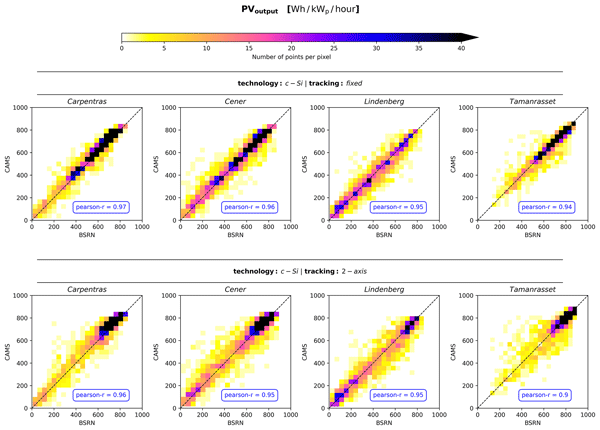
We perform Photovoltaic (PV) power simulations with the Global Solar Energy Estimator and assess the uncertainty linked to the use of a diffuse fraction model. Validation is conducted under diverse atmospheric conditions, including cloudiness and aerosols, using input data from ground-based measurements and the Copernicus Atmosphere Monitoring Service (CAMS). Results indicate that simulations are reliable under most conditions, with overestimations occurring during intense dust events.
Martine Collaud Coen, Benjamin Tobias Brem, Martin Gysel-Beer, Robin Modini, Stephan Henne, Martin Steinbacher, Davide Putero, Maria I. Gini, and Kostantinos Eleftheriadis
Atmos. Chem. Phys., 26, 1623–1645, https://doi.org/10.5194/acp-26-1623-2026, https://doi.org/10.5194/acp-26-1623-2026, 2026
Short summary
Short summary
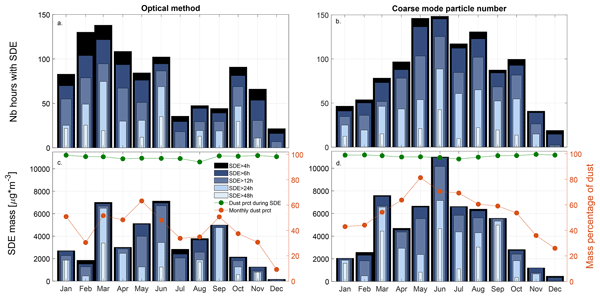
Saharan dust (SD) is transported over long distances by large-scale atmospheric circulation, reaching the Jungfraujoch high-altitude station 30 to 150 times per year. This study analyses the influence of instrument types on the SD detection using the single scattering albedo spectral dependence. This optical method is then compared to those based on size distribution and back-trajectories. The 23-year climatology of dust frequency and mass as well as the source sensitivity are also examined.
Ross James Herbert, Larissa Lacher, Alexander Böhmländer, Mark D. Tarn, Antione Canzi, Aidan Pantoya, Evelyn Freney, Kristina Höhler, Pia Bogert, Celine Planche, Ping Tian, Michael Adams, Sarah Barr, David Brus, Nicole Büttner, Martin Daily, Konstantinos Doulgeris, Konstantinos Eleftheridadis, Grant Forster, Romy Fösig, Dimitrios Georgakopoulos, Maria Gini, A. Gannett Hallar, Radovan Krejci, Elke Ludewig, Mauro Mazzola, Ian B. McCubbin, Tuukka Petäjä, Joseph Robinson, Franziska Vogel, Paul Zieger, Stephen R. Arnold, Kenneth S. Carslaw, Naruki Hiranuma, Ottmar Möhler, and Benjamin J. Murray
Earth Syst. Sci. Data Discuss., https://doi.org/10.5194/essd-2026-41, https://doi.org/10.5194/essd-2026-41, 2026
Preprint under review for ESSD
Short summary
Short summary
Ice formation in sub-zero clouds is influenced by airborne particles called ice-nucleating particles (INPs), whose concentrations vary substantially over short time and spatial scales. To assess the role of INPs in our climate, a comprehensive and consistent global dataset is essential. Our GloPINE model-ready dataset is a major step in this direction, comprising 36,000 measurements made using a single instrument design (PINE) over 70,000 hours of operation at 20 northern hemisphere sites.
Sara Herrero-Anta, Sabine Eckhardt, Nikolaos Evangeliou, Stefania Gilardoni, Sandra Graßl, Dominic Heslin-Rees, Stelios Kazadzis, Natalia Kouremeti, Radovan Krejci, David Mateos, Mauro Mazzola, Christoph Ritter, Roberto Román, Kerstin Stebel, and Tymon Zielinski
Atmos. Chem. Phys., 26, 1435–1457, https://doi.org/10.5194/acp-26-1435-2026, https://doi.org/10.5194/acp-26-1435-2026, 2026
Short summary
Short summary
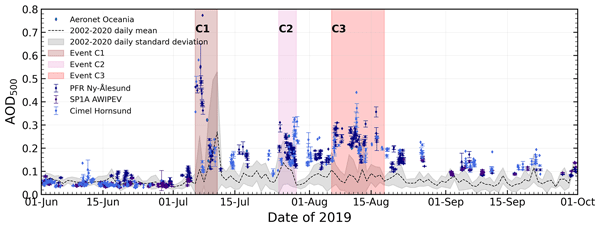
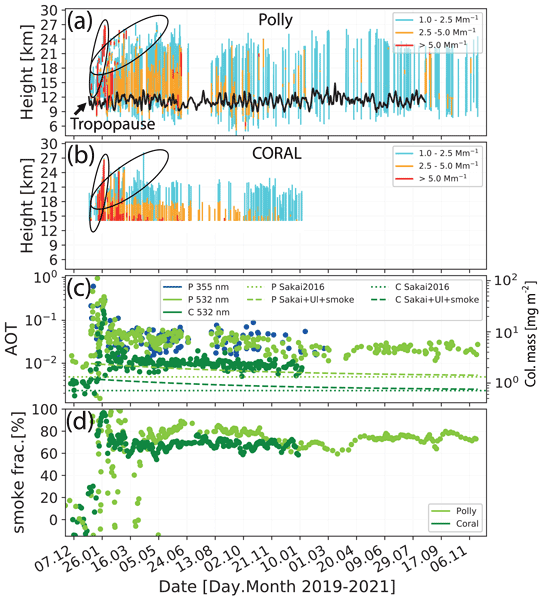
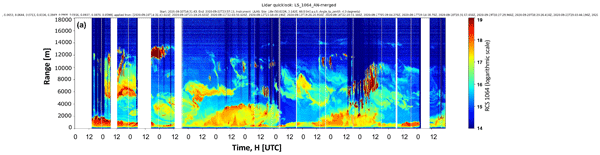
In summer 2019, unusually high aerosol concentrations were measured in the Arctic, extending through the troposphere and stratosphere up to 16 km. Using multiple instruments and models, aerosol particles were linked to wildfires, volcanic eruptions, and anthropogenic pollution. The aerosol consisted of spherical, fine-mode, weakly absorbing particles, which significantly reduced direct solar radiation. This combined approach improves understanding of Arctic aerosol events and climate processes.
Marilena Gidarakou, Alexandros Papayannis, Kunfeng Gao, Panagiotis Gidarakos, Benoît Crouzy, Romanos Foskinis, Sophie Erb, Benjamin T. Brem, Cuiqi Zhang, Gian Lieberherr, Martine Collaud Coen, Branko Sikoparija, Zamin A. Kanji, Bernard Clot, Bertrand Calpini, Eugenia Giagka, and Athanasios Nenes
Atmos. Chem. Phys., 26, 923–945, https://doi.org/10.5194/acp-26-923-2026, https://doi.org/10.5194/acp-26-923-2026, 2026
Short summary
Short summary
Vertical profiles of pollen and biomass burning particles were obtained at a semi-rural site at the MeteoSwiss station near Payerne (Switzerland) using a novel multi-channel elastic-fluorescence lidar system combined with in situ measurements during the spring 2023 wildfires and pollination season during the PERICLES (PayernE lidaR and Insitu detection of fluorescent bioaerosol and dust partiCLES and their cloud impacts) campaign.
Stefanos Papagiannis, Manousos I. Manousakas, Dimitrios F. Anagnostopoulos, Michael Pipkridas, Rima Baalbaki, Jean Sciare, Niall O'Sullivan, Stig Hellebust, John Wenger, Kirsten N. Fossum, Jurgita Ovadnevaite, Anja Tremper, David Green, Konstantinos Eleftheriadis, and Evangelia Diapouli
EGUsphere, https://doi.org/10.5194/egusphere-2025-5977, https://doi.org/10.5194/egusphere-2025-5977, 2026
Short summary
Short summary
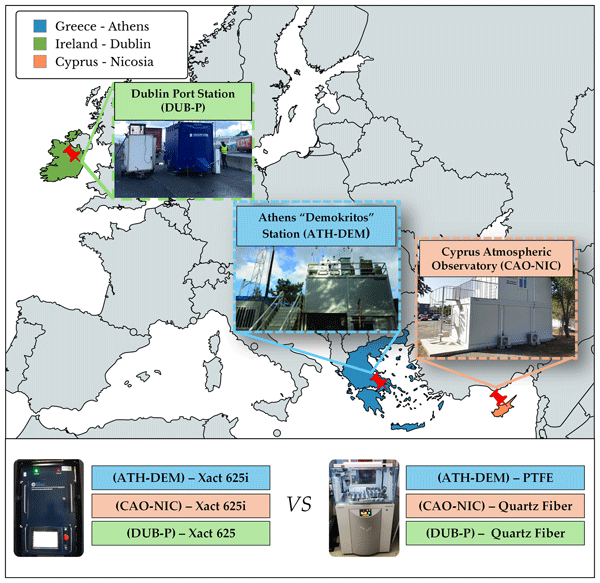
This study compared continuous and benchtop XRF elemental monitors across three European cities to validate air quality measurement consistency. PTFE filters yield strong agreement, but common quartz filters introduce systematic deviations, especially for light elements, due to attenuation effects. We provide practical methodologies to harmonize data from diverse filter types and instruments, which is essential for pollution source tracking and reliable data sharing across monitoring networks.
Christos Spyrou, Ilias Fountoulakis, Stavros Solomos, Nikolaos Papadimitriou, Alkiviadis Bais, Julian Gröbner, Daniela Meloni, and Christos Zerefos
Atmos. Meas. Tech., 18, 7717–7734, https://doi.org/10.5194/amt-18-7717-2025, https://doi.org/10.5194/amt-18-7717-2025, 2025
Short summary
Short summary
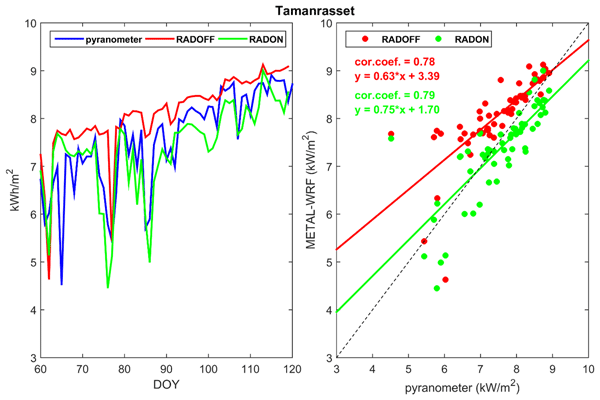
Dust particles originating from desert areas of the planet have significant radiative impacts on the ground and atmospheric column. The magnitude of the dust radiative effect is dependent on their optical properties and mineralogical content. Therefore, we upgrade the METAL-WRF model to incorporate the direct radiative impact of the minerals in dust. The capabilities of the model to simulate the chemical composition and associated impacts is significantly improved.
Bibhasvata Dasgupta, Sudhanshu Pandey, Sander Houweling, Malika Menoud, Carina van der Veen, John Miller, Ben Riddell-Young, Sylvia Englund Michel, Peter Sperlich, Shinji Morimoto, Ryo Fujita, Ingeborg Levin, Cordelia Veidt, Stephen Platt, Christine Groot Zwaaftink, Cathrine Lund Myhre, Ceres Woolley Maisch, Rebecca Fisher, Euan G. Nisbet, James France, Rowena Moss, Nicola Warwick, and Thomas Röckmann
EGUsphere, https://doi.org/10.5194/egusphere-2025-5571, https://doi.org/10.5194/egusphere-2025-5571, 2025
This preprint is open for discussion and under review for Atmospheric Chemistry and Physics (ACP).
Short summary
Short summary
Methane is a strong greenhouse gas, and its rise since the mid-2000s is debated in terms of sources and sinks. Using top-down and bottom-up data, along with inversion models and methane isotopes (δ13C-CH4 and δD-CH4), we find that wetlands are the primary driver of post-2006 increases, followed by agriculture and fossil fuels. Methane's lifetime has decreased by about 0.1 years. We also assess how isotope signatures and sink processes influence uncertainties.
Cameron McErlich, Felix Goddard, Alex Aves, Catherine Hardacre, Nikolaos Evangeliou, Alan J. Hewitt, and Laura E. Revell
Geosci. Model Dev., 18, 8827–8854, https://doi.org/10.5194/gmd-18-8827-2025, https://doi.org/10.5194/gmd-18-8827-2025, 2025
Short summary
Short summary
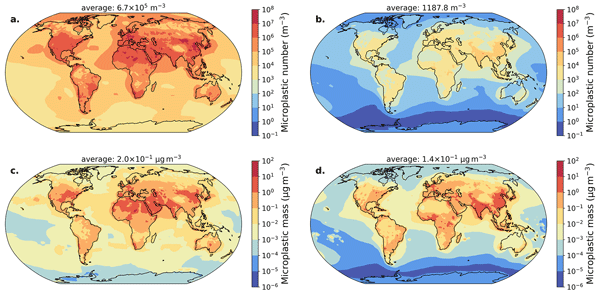
Airborne microplastics are a new air pollutant but are not yet included in most global models. We add them to the UK Earth System Model to show how they move, change, and are removed from air. Smaller microplastics persist for longer and can travel further, even to Antarctica. While their current role in air pollution is small, their presence is expected to grow in future. This work offers a framework to assess future impacts of microplastics on air quality and climate.
Qiaoyun Hu, Philippe Goloub, Igor Veselovskii, Thierry Podvin, Gaël Dubois, Sergey Khaykin, William Boissière, Fabrice Ducos, and Mikhail Korenskiy
EGUsphere, https://doi.org/10.5194/egusphere-2025-5041, https://doi.org/10.5194/egusphere-2025-5041, 2025
Short summary
Short summary
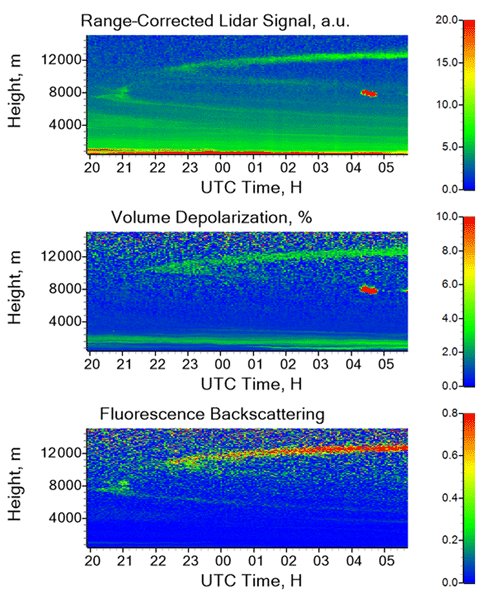
We studied lidar observations of long-range transported biomass burning aerosols (BBAs) from 2023 Canadian wildfires at ATOLL (France) and GPI (Russia). Combined multi-wavelength and fluorescence data reveal clear contrasts between free-tropospheric and UTLS BBAs in depolarization, lidar ratio, Ångström exponent, and fluorescence spectra. Cross-site comparisons show consistent fluorescence properties, supporting coordinated multi-lidar observations.
Bibhasvata Dasgupta, Malika Menoud, Carina van der Veen, Ingeborg Levin, Cordelia Veidt, Heiko Moossen, Sylvia Englund Michel, Peter Sperlich, Shinji Morimoto, Ryo Fujita, Taku Umezawa, Stephen Platt, Christine Groot Zwaaftink, Cathrine Lund Myhre, Rebecca Fisher, David Lowry, Euan G. Nisbet, James France, Ceres Woolley Maisch, Gordon Brailsford, Rowena Moss, Daisuke Goto, Sudhanshu Pandey, Sander Houweling, Nicola Warwick, and Thomas Röckmann
Atmos. Meas. Tech., 18, 6591–6607, https://doi.org/10.5194/amt-18-6591-2025, https://doi.org/10.5194/amt-18-6591-2025, 2025
Short summary
Short summary
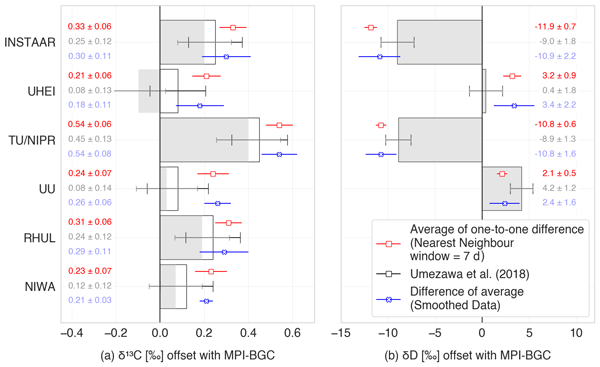
We combined long-term methane mole fraction and isotope measurements from eight laboratories that sample high-latitude stations to compare, offset correct and harmonise the datasets into a hemisphere merged timeseries. Because each laboratory uses slightly different methods, we adjusted the data to make it directly comparable. This allowed us to create a consistent record of atmospheric methane concentration and its isotopes from 1988 to 2023.
Zihui Teng, Jane Tygesen Skønager, Andreas Massling, Henrik Skov, Nikolaos Evangeliou, Sabine Eckhardt, Merete Bilde, and Bernadette Rosati
Aerosol Research Discuss., https://doi.org/10.5194/ar-2025-34, https://doi.org/10.5194/ar-2025-34, 2025
Revised manuscript accepted for AR
Short summary
Short summary
Coastal aerosols in Scandinavian urban areas remain understudied. We examined aerosol optical properties and size distributions along Denmark's coastline. Combining in-situ data with dispersion modelling, we identified two main aerosol types: carbonaceous aerosols from fossil fuel and biomass burning and large, highly-scattering aerosols (potentially sea salt). Black carbon from in-situ data and dispersion modelling correlated well while FLEXPART underestimated the concentration.
Emmanouil Proestakis, Kyriakoula Papachristopoulou, Thanasis Georgiou, Sofia Eirini Chatoutsidou, Mihalis Lazaridis, Antonis Gkikas, Ilias Fountoulakis, Ioanna Tsikoudi, Manolis P. Petrakis, and Vassilis Amiridis
Atmos. Chem. Phys., 25, 14777–14823, https://doi.org/10.5194/acp-25-14777-2025, https://doi.org/10.5194/acp-25-14777-2025, 2025
Short summary
Short summary
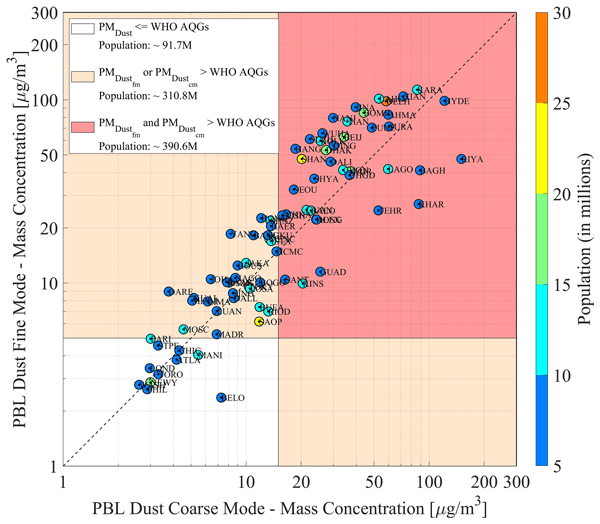
Based on Earth observations of dust the study addresses the questions: To what extent have the fine and coarse modes of atmospheric dust within the planetary boundary layer (PBL) changed over major cities worldwide? Which areas experience fine-mode and coarse-mode dust mass concentrations within the PBL that exceed World Health Organization air quality guidelines, and which areas are projected to exceed these guidelines in the near future? Can we quantify associated impacts on human health?
Igor Veselovskii, Qiaoyun Hu, Philippe Goloub, Thierry Podvin, Gaël Dubois, Alexey Kolgotin, and Mikhail Korenskii
Atmos. Meas. Tech., 18, 6039–6051, https://doi.org/10.5194/amt-18-6039-2025, https://doi.org/10.5194/amt-18-6039-2025, 2025
Short summary
Short summary
A Mie–Raman–fluorescence lidar is used to analyze possible quenching of aerosol fluorescence during hygroscopic growth. The well-mixed planetary boundary layer serves as a convenient environment for such studies, since the fluorescence backscattering coefficient should remain constant in the absence of water uptake effects. However, during some episodes, we observed a systematic decrease in fluorescence backscattering, which likely indicates fluorescence quenching.
Robin Miri, Olivier Pujol, Qiaoyun Hu, Philippe Goloub, Igor Veselovskii, Thierry Podvin, and Fabrice Ducos
Atmos. Meas. Tech., 18, 5729–5747, https://doi.org/10.5194/amt-18-5729-2025, https://doi.org/10.5194/amt-18-5729-2025, 2025
Short summary
Short summary
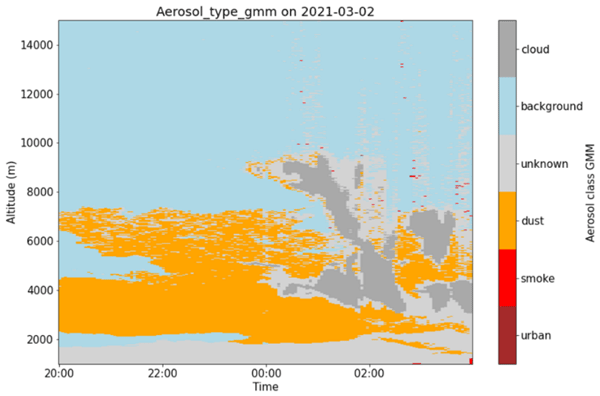
We developed a new method to automatically identify types of particles in the air, such as smoke, dust, or pollution, using a specialized laser system. This helps monitor air quality more efficiently and in greater detail. Our method uses real data collected over 3 years in northern France and can detect changes caused by weather conditions. It offers a faster and more accurate way to understand what is in the air we breathe.
Ilias Fountoulakis, Kyriaki Papachristopoulou, Stelios Kazadzis, Gregor Hülsen, Julian Gröbner, Ioannis-Panagiotis Raptis, Dimitra Kouklaki, Akriti Masoom, Natalia Kouremeti, Charalampos Kontoes, and Christos S. Zerefos
Geosci. Model Dev., 18, 7451–7473, https://doi.org/10.5194/gmd-18-7451-2025, https://doi.org/10.5194/gmd-18-7451-2025, 2025
Short summary
Short summary
The UVIOS2 model has been evaluated at Davos, Switzerland during the UVCIII campaign. The accuracy in the modelled UV indices has been assessed for different combinations of model inputs. A good overall agreement between UVIOS2 and the world reference spectroradiometer QASUME was found (average ratio of ~ 1 between the modelled and measured UV index), although the variability in the ratio can be large under cloudy conditions.
Marco Paglione, Yufang Hao, Stefano Decesari, Mara Russo, Karam Mansour, Mauro Mazzola, Diego Fellin, Andrea Mazzanti, Emilio Tagliavini, Manousos Ioannis Manousakas, Evangelia Diapouli, Elena Barbaro, Matteo Feltracco, Kaspar R. Daellenbach, and Matteo Rinaldi
Atmos. Chem. Phys., 25, 12853–12874, https://doi.org/10.5194/acp-25-12853-2025, https://doi.org/10.5194/acp-25-12853-2025, 2025
Short summary
Short summary
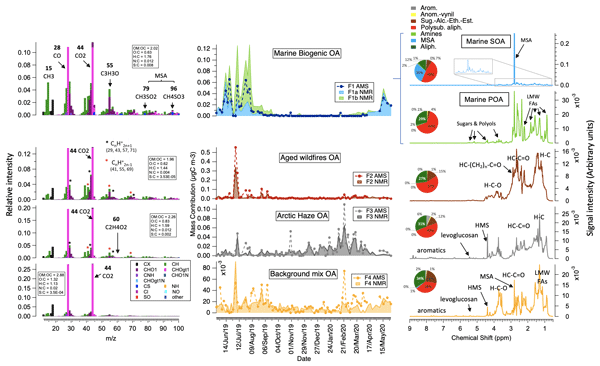
A year-long set of submicron aerosol samples (PM1) from Ny-Ålesund, Svalbard, was analyzed by proton nuclear magnetic resonance spectroscopy (H-NMR) and high-resolution time-of-flight aerosol mass spectrometry (HR-TOF-AMS) to characterize the organic fraction. Positive matrix factorization identified five organic aerosol sources. Winter–spring was dominated by Eurasian pollution and summer by marine biogenic aerosols, with occasional wildfire events.
Manousos I. Manousakas, Olga Zografou, Francesco Canonaco, Evangelia Diapouli, Stefanos Papagiannis, Maria Gini, Vasiliki Vasilatou, Anna Tobler, Stergios Vratolis, Jay G. Slowik, Kaspar R. Daellenbach, André S. H. Prevot, and Konstantinos Eleftheriadis
Atmos. Meas. Tech., 18, 3983–4002, https://doi.org/10.5194/amt-18-3983-2025, https://doi.org/10.5194/amt-18-3983-2025, 2025
Short summary
Short summary
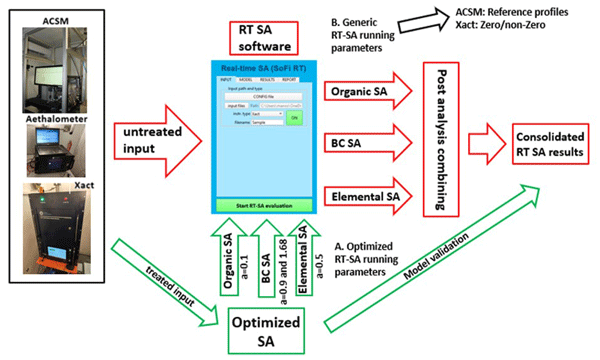
Air pollution from airborne particles is a major health and environmental concern, especially in cities. Understanding the particles' sources is key to addressing this issue, but traditional methods require time-consuming sampling, delaying action. Our study introduces a real-time monitoring system that uses advanced instruments and software to track pollution instantly. This technology allows faster, more precise pollution analysis, helping cities create targeted strategies to improve air quality.
Olga B. Popovicheva, Marina A. Chichaeva, Nikolaos Evangeliou, Sabine Eckhardt, Evangelia Diapouli, and Nikolay S. Kasimov
Atmos. Chem. Phys., 25, 7719–7739, https://doi.org/10.5194/acp-25-7719-2025, https://doi.org/10.5194/acp-25-7719-2025, 2025
Short summary
Short summary
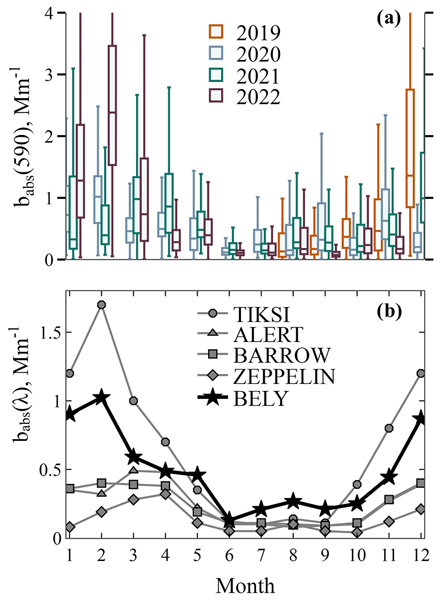
High-quality measurements of light-absorbing carbon were performed at the polar aerosol station "Island Bely” (Western Siberian Arctic) from 2019 to 2022. The maximum light absorption coefficients were seen in summer due to gas flaring, which is the most significant source in the region. However, the increasing Siberian wildfires had a special share in carbon contribution at this high Arctic station, with a persistent smoke layer extending over the whole troposphere in summer.
Yuyang Chang, Qiaoyun Hu, Philippe Goloub, Thierry Podvin, Igor Veselovskii, Fabrice Ducos, Gaël Dubois, Masanori Saito, Anton Lopatin, Oleg Dubovik, and Cheng Chen
Atmos. Chem. Phys., 25, 6787–6821, https://doi.org/10.5194/acp-25-6787-2025, https://doi.org/10.5194/acp-25-6787-2025, 2025
Short summary
Short summary
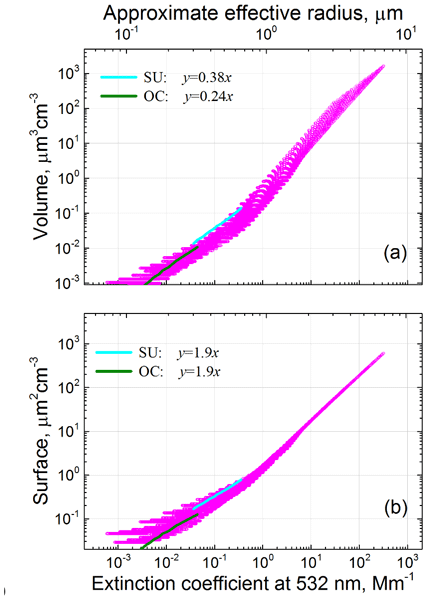
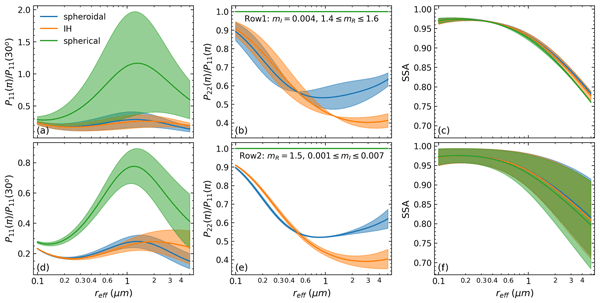
Our study retrieved dust aerosol microphysical properties from lidar measurements using different scattering models. Numeric simulations and real data applications revealed the importance of considering depolarization measurements and the superiority of the irregular–hexahedral model in the retrieval of dust aerosols from lidar measurements.
Lubna Dada, Benjamin T. Brem, Lidia-Marta Amarandi-Netedu, Martine Collaud Coen, Nikolaos Evangeliou, Christoph Hueglin, Nora Nowak, Robin Modini, Martin Steinbacher, and Martin Gysel-Beer
Aerosol Research, 3, 315–336, https://doi.org/10.5194/ar-3-315-2025, https://doi.org/10.5194/ar-3-315-2025, 2025
Short summary
Short summary
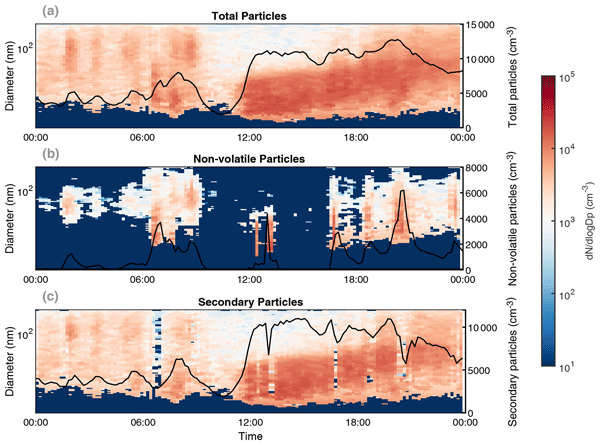
We investigated the sources of ultrafine particles (UFPs) in Payerne, Switzerland, highlighting the significant role of secondary processes in elevating UFP concentrations to levels comparable to urban areas. As the first study in rural midland Switzerland to analyze new particle formation events and secondary contributions, it offers key insights for air quality regulation and the role of agriculture in Switzerland and central Europe.
Natalie M. Mahowald, Longlei Li, Julius Vira, Marje Prank, Douglas S. Hamilton, Hitoshi Matsui, Ron L. Miller, P. Louis Lu, Ezgi Akyuz, Daphne Meidan, Peter Hess, Heikki Lihavainen, Christine Wiedinmyer, Jenny Hand, Maria Grazia Alaimo, Célia Alves, Andres Alastuey, Paulo Artaxo, Africa Barreto, Francisco Barraza, Silvia Becagli, Giulia Calzolai, Shankararaman Chellam, Ying Chen, Patrick Chuang, David D. Cohen, Cristina Colombi, Evangelia Diapouli, Gaetano Dongarra, Konstantinos Eleftheriadis, Johann Engelbrecht, Corinne Galy-Lacaux, Cassandra Gaston, Dario Gomez, Yenny González Ramos, Roy M. Harrison, Chris Heyes, Barak Herut, Philip Hopke, Christoph Hüglin, Maria Kanakidou, Zsofia Kertesz, Zbigniew Klimont, Katriina Kyllönen, Fabrice Lambert, Xiaohong Liu, Remi Losno, Franco Lucarelli, Willy Maenhaut, Beatrice Marticorena, Randall V. Martin, Nikolaos Mihalopoulos, Yasser Morera-Gómez, Adina Paytan, Joseph Prospero, Sergio Rodríguez, Patricia Smichowski, Daniela Varrica, Brenna Walsh, Crystal L. Weagle, and Xi Zhao
Atmos. Chem. Phys., 25, 4665–4702, https://doi.org/10.5194/acp-25-4665-2025, https://doi.org/10.5194/acp-25-4665-2025, 2025
Short summary
Short summary
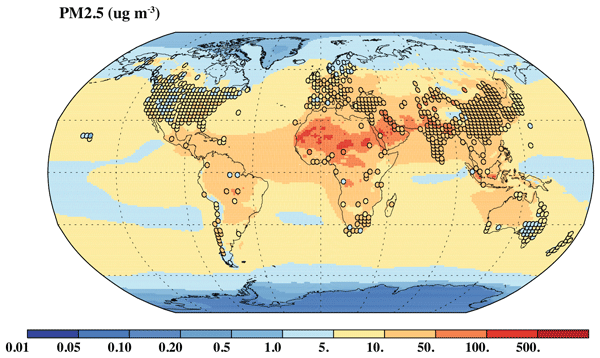
Aerosol particles are an important part of the Earth system, but their concentrations are spatially and temporally heterogeneous, as well as being variable in size and composition. Here, we present a new compilation of PM2.5 and PM10 aerosol observations, focusing on the spatial variability across different observational stations, including composition, and demonstrate a method for comparing the data sets to model output.
Nikolaos Evangeliou, Ondřej Tichý, Marit Svendby Otervik, Sabine Eckhardt, Yves Balkanski, and Didier A. Hauglustaine
Aerosol Research, 3, 155–174, https://doi.org/10.5194/ar-3-155-2025, https://doi.org/10.5194/ar-3-155-2025, 2025
Short summary
Short summary
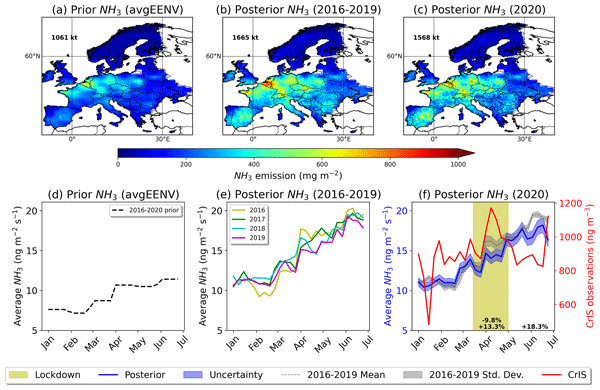
The COVID-19 lockdown measures in 2020 reduced emissions of various substances, improving air quality. However, PM2.5 stayed unchanged due to NH3 and related chemical transformations. Higher humidity favoured more SO42- production, as did the accumulated NH3. Excess NH3 reacted with HNO3 to make NO3-. In high-NH3 conditions such as those in 2020, a small reduction in NOx levels drove faster oxidation of NO3- and slower deposition of total inorganic NO3-, causing high secondary PM2.5.
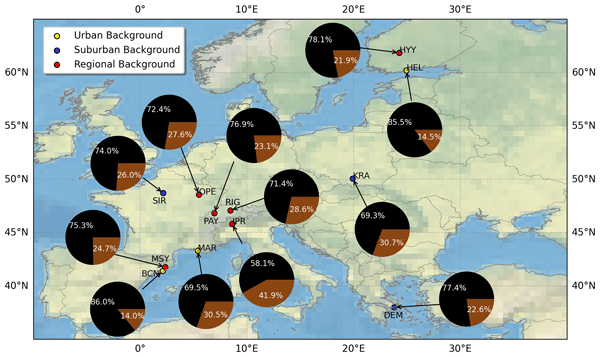
Hector Navarro-Barboza, Jordi Rovira, Vincenzo Obiso, Andrea Pozzer, Marta Via, Andres Alastuey, Xavier Querol, Noemi Perez, Marjan Savadkoohi, Gang Chen, Jesus Yus-Díez, Matic Ivancic, Martin Rigler, Konstantinos Eleftheriadis, Stergios Vratolis, Olga Zografou, Maria Gini, Benjamin Chazeau, Nicolas Marchand, Andre S. H. Prevot, Kaspar Dallenbach, Mikael Ehn, Krista Luoma, Tuukka Petäjä, Anna Tobler, Jaroslaw Necki, Minna Aurela, Hilkka Timonen, Jarkko Niemi, Olivier Favez, Jean-Eudes Petit, Jean-Philippe Putaud, Christoph Hueglin, Nicolas Pascal, Aurélien Chauvigné, Sébastien Conil, Marco Pandolfi, and Oriol Jorba
Atmos. Chem. Phys., 25, 2667–2694, https://doi.org/10.5194/acp-25-2667-2025, https://doi.org/10.5194/acp-25-2667-2025, 2025
Short summary
Short summary
Brown carbon (BrC) absorbs ultraviolet (UV) and visible light, influencing climate. This study explores BrC's imaginary refractive index (k) using data from 12 European sites. Residential emissions are a major organic aerosol (OA) source in winter, while secondary organic aerosol (SOA) dominates in summer. Source-specific k values were derived, improving model accuracy. The findings highlight BrC's climate impact and emphasize source-specific constraints in atmospheric models.
Igor Veselovskii, Mikhail Korenskiy, Nikita Kasianik, Boris Barchunov, Qiaoyun Hu, Philippe Goloub, and Thierry Podvin
Atmos. Chem. Phys., 25, 1603–1615, https://doi.org/10.5194/acp-25-1603-2025, https://doi.org/10.5194/acp-25-1603-2025, 2025
Short summary
Short summary
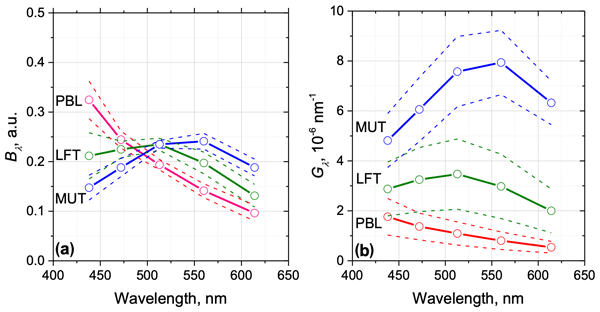
A fluorescence lidar was used to study transported Canadian smoke in May–September 2023. The fluorescence measurements were taken at five wavelengths. The results revealed that fluorescence capacity increases with altitude, suggesting a higher concentration of organic compounds in the upper troposphere and lower stratosphere than in the lower troposphere. The fluorescence spectra peaked in the 513 and 560 nm channels in smoke layers but decreased with wavelength in urban aerosols.
Lucie Bakels, Daria Tatsii, Anne Tipka, Rona Thompson, Marina Dütsch, Michael Blaschek, Petra Seibert, Katharina Baier, Silvia Bucci, Massimo Cassiani, Sabine Eckhardt, Christine Groot Zwaaftink, Stephan Henne, Pirmin Kaufmann, Vincent Lechner, Christian Maurer, Marie D. Mulder, Ignacio Pisso, Andreas Plach, Rakesh Subramanian, Martin Vojta, and Andreas Stohl
Geosci. Model Dev., 17, 7595–7627, https://doi.org/10.5194/gmd-17-7595-2024, https://doi.org/10.5194/gmd-17-7595-2024, 2024
Short summary
Short summary
Computer models are essential for improving our understanding of how gases and particles move in the atmosphere. We present an update of the atmospheric transport model FLEXPART. FLEXPART 11 is more accurate due to a reduced number of interpolations and a new scheme for wet deposition. It can simulate non-spherical aerosols and includes linear chemical reactions. It is parallelised using OpenMP and includes new user options. A new user manual details how to use FLEXPART 11.
Kunfeng Gao, Franziska Vogel, Romanos Foskinis, Stergios Vratolis, Maria I. Gini, Konstantinos Granakis, Anne-Claire Billault-Roux, Paraskevi Georgakaki, Olga Zografou, Prodromos Fetfatzis, Alexis Berne, Alexandros Papayannis, Konstantinos Eleftheridadis, Ottmar Möhler, and Athanasios Nenes
Atmos. Chem. Phys., 24, 9939–9974, https://doi.org/10.5194/acp-24-9939-2024, https://doi.org/10.5194/acp-24-9939-2024, 2024
Short summary
Short summary
Ice nucleating particle (INP) concentrations are required for correct predictions of clouds and precipitation in a changing climate, but they are poorly constrained in climate models. We unravel source contributions to INPs in the eastern Mediterranean and find that biological particles are important, regardless of their origin. The parameterizations developed exhibit superior performance and enable models to consider biological-particle effects on INPs.
Romanos Foskinis, Ghislain Motos, Maria I. Gini, Olga Zografou, Kunfeng Gao, Stergios Vratolis, Konstantinos Granakis, Ville Vakkari, Kalliopi Violaki, Andreas Aktypis, Christos Kaltsonoudis, Zongbo Shi, Mika Komppula, Spyros N. Pandis, Konstantinos Eleftheriadis, Alexandros Papayannis, and Athanasios Nenes
Atmos. Chem. Phys., 24, 9827–9842, https://doi.org/10.5194/acp-24-9827-2024, https://doi.org/10.5194/acp-24-9827-2024, 2024
Short summary
Short summary
Analysis of modeling, in situ, and remote sensing measurements reveals the microphysical state of orographic clouds and their response to aerosol from the boundary layer and free troposphere. We show that cloud response to aerosol is robust, as predicted supersaturation and cloud droplet number levels agree with those determined from in-cloud measurements. The ability to determine if clouds are velocity- or aerosol-limited allows for novel model constraints and remote sensing products.
Olga Zografou, Maria Gini, Prodromos Fetfatzis, Konstantinos Granakis, Romanos Foskinis, Manousos Ioannis Manousakas, Fotios Tsopelas, Evangelia Diapouli, Eleni Dovrou, Christina N. Vasilakopoulou, Alexandros Papayannis, Spyros N. Pandis, Athanasios Nenes, and Konstantinos Eleftheriadis
Atmos. Chem. Phys., 24, 8911–8926, https://doi.org/10.5194/acp-24-8911-2024, https://doi.org/10.5194/acp-24-8911-2024, 2024
Short summary
Short summary
Characterization of PM1 and positive matrix factorization (PMF) source apportionment of organic and inorganic fractions were conducted at the high-altitude station (HAC)2. Cloud presence reduced PM1, affecting sulfate more than organics. Free-troposphere (FT) conditions showed more black carbon (eBC) than planetary boundary layer (PBL) conditions.
Olga Zografou, Christos Kaltsonoudis, Maria Gini, Angeliki Matrali, Elias Panagiotopoulos, Alexandros Lekkas, Dimitris Papanastasiou, Spyros N. Pandis, and Konstantinos Eleftheriadis
EGUsphere, https://doi.org/10.5194/egusphere-2024-2126, https://doi.org/10.5194/egusphere-2024-2126, 2024
Preprint archived
Short summary
Short summary
A novel charge transfer ionization orthogonal Time-of-Flight Mass Spectrometer (oToF-MS) was field evaluated for the first time during a field campaign at the suburban DEM station in Athens, Greece from May to August 2023 focusing on key ambient Volatile Organic Compounds (VOCs). The results demonstrate the strengths of the new instrument in performing online, real time measurements of ambient VOCs.
Igor Veselovskii, Boris Barchunov, Qiaoyun Hu, Philippe Goloub, Thierry Podvin, Mikhail Korenskii, Gaël Dubois, William Boissiere, and Nikita Kasianik
Atmos. Meas. Tech., 17, 4137–4152, https://doi.org/10.5194/amt-17-4137-2024, https://doi.org/10.5194/amt-17-4137-2024, 2024
Short summary
Short summary
The paper presents a new method that categorizes atmospheric aerosols by analyzing their optical properties with a Mie–Raman–fluorescence lidar. The research specifically looks into understanding the presence of smoke, urban, and dust aerosols in the mixtures identified by this lidar. The reliability of the results is evaluated using the Monte Carlo technique. The effectiveness of this approach is successfully demonstrated through testing in ATOLL, an observatory influenced by diverse aerosols.
Robin Miri, Olivier Pujol, Qiaoyun Hu, Philippe Goloub, Igor Veselovskii, Thierry Podvin, and Fabrice Ducos
Atmos. Meas. Tech., 17, 3367–3375, https://doi.org/10.5194/amt-17-3367-2024, https://doi.org/10.5194/amt-17-3367-2024, 2024
Short summary
Short summary
This paper focuses on the use of fluorescence to study aerosols with lidar. An innovative method for aerosol hygroscopic growth study using fluorescence is presented. The paper presents case studies to showcase the effectiveness and potential of the proposed approach. These advancements will contribute to better understanding the interactions between aerosols and water vapor, with future work expected to be dedicated to aerosol–cloud interaction.
Ilias Fountoulakis, Alexandra Tsekeri, Stelios Kazadzis, Vassilis Amiridis, Angelos Nersesian, Maria Tsichla, Emmanouil Proestakis, Antonis Gkikas, Kyriakoula Papachristopoulou, Vasileios Barlakas, Claudia Emde, and Bernhard Mayer
Atmos. Chem. Phys., 24, 4915–4948, https://doi.org/10.5194/acp-24-4915-2024, https://doi.org/10.5194/acp-24-4915-2024, 2024
Short summary
Short summary
In our study we provide an assessment, through a sensitivity study, of the limitations of models to calculate the dust direct radiative effect (DRE) due to the underrepresentation of its size, refractive index (RI), and shape. Our results indicate the necessity of including more realistic sizes and RIs for dust particles in dust models, in order to derive better estimations of the dust direct radiative effects.
Kyriakoula Papachristopoulou, Ilias Fountoulakis, Alkiviadis F. Bais, Basil E. Psiloglou, Nikolaos Papadimitriou, Ioannis-Panagiotis Raptis, Andreas Kazantzidis, Charalampos Kontoes, Maria Hatzaki, and Stelios Kazadzis
Atmos. Meas. Tech., 17, 1851–1877, https://doi.org/10.5194/amt-17-1851-2024, https://doi.org/10.5194/amt-17-1851-2024, 2024
Short summary
Short summary
The upgraded systems SENSE2 and NextSENSE2 focus on improving the quality of solar nowcasting and forecasting. SENSE2 provides real-time estimates of solar irradiance across a wide region every 15 min. NextSENSE2 offers short-term forecasts of irradiance up to 3 h ahead. Evaluation with actual data showed that the instantaneous comparison yields the most discrepancies due to the uncertainties of cloud-related information and satellite versus ground-based spatial representativeness limitations.
Karl Espen Yttri, Are Bäcklund, Franz Conen, Sabine Eckhardt, Nikolaos Evangeliou, Markus Fiebig, Anne Kasper-Giebl, Avram Gold, Hans Gundersen, Cathrine Lund Myhre, Stephen Matthew Platt, David Simpson, Jason D. Surratt, Sönke Szidat, Martin Rauber, Kjetil Tørseth, Martin Album Ytre-Eide, Zhenfa Zhang, and Wenche Aas
Atmos. Chem. Phys., 24, 2731–2758, https://doi.org/10.5194/acp-24-2731-2024, https://doi.org/10.5194/acp-24-2731-2024, 2024
Short summary
Short summary
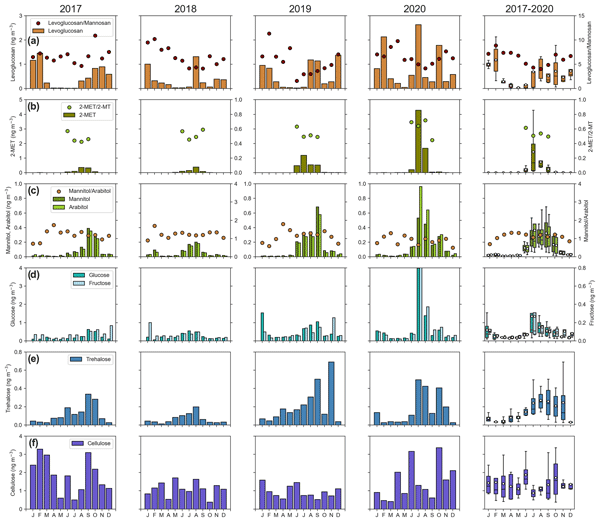
We discuss carbonaceous aerosol (CA) observed at the high Arctic Zeppelin Observatory (2017 to 2020). We find that organic aerosol is a significant fraction of the Arctic aerosol, though less than sea salt aerosol and mineral dust, as well as non-sea-salt sulfate, originating mainly from anthropogenic sources in winter and from natural sources in summer, emphasizing the importance of wildfires for biogenic secondary organic aerosol and primary biological aerosol particles observed in the Arctic.
Dominic Heslin-Rees, Peter Tunved, Johan Ström, Roxana Cremer, Paul Zieger, Ilona Riipinen, Annica M. L. Ekman, Konstantinos Eleftheriadis, and Radovan Krejci
Atmos. Chem. Phys., 24, 2059–2075, https://doi.org/10.5194/acp-24-2059-2024, https://doi.org/10.5194/acp-24-2059-2024, 2024
Short summary
Short summary
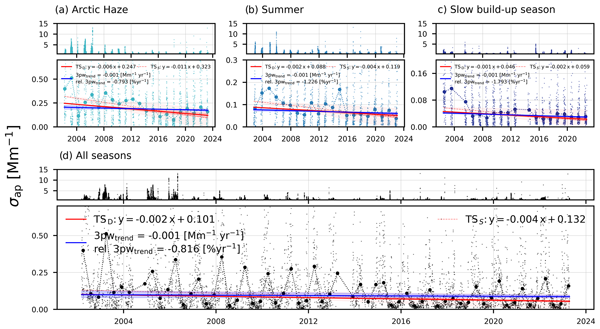
Light-absorbing atmospheric particles (e.g. black carbon – BC) exert a warming effect on the Arctic climate. We show that the amount of particle light absorption decreased from 2002 to 2023. We conclude that in addition to reductions in emissions of BC, wet removal plays a role in the long-term reduction of BC in the Arctic, given the increase in surface precipitation experienced by air masses arriving at the site. The potential impact of biomass burning events is shown to have increased.
Igor Veselovskii, Qiaoyun Hu, Philippe Goloub, Thierry Podvin, William Boissiere, Mikhail Korenskiy, Nikita Kasianik, Sergey Khaykyn, and Robin Miri
Atmos. Meas. Tech., 17, 1023–1036, https://doi.org/10.5194/amt-17-1023-2024, https://doi.org/10.5194/amt-17-1023-2024, 2024
Short summary
Short summary
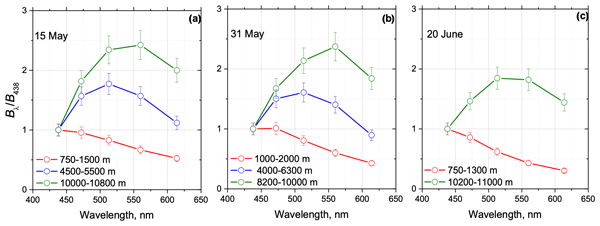
Measurements of transported smoke layers were performed with a lidar in Lille and a five-channel fluorescence lidar in Moscow. Results show the peak of fluorescence in the boundary layer is at 438 nm, while in the smoke layer it shifts to longer wavelengths. The fluorescence depolarization is 45 % to 55 %. The depolarization ratio of the water vapor channel is low (2 ± 0.5 %) in the absence of fluorescence and can be used to evaluate the contribution of fluorescence to water vapor signal.
Natalie M. Mahowald, Longlei Li, Julius Vira, Marje Prank, Douglas S. Hamilton, Hitoshi Matsui, Ron L. Miller, Louis Lu, Ezgi Akyuz, Daphne Meidan, Peter Hess, Heikki Lihavainen, Christine Wiedinmyer, Jenny Hand, Maria Grazia Alaimo, Célia Alves, Andres Alastuey, Paulo Artaxo, Africa Barreto, Francisco Barraza, Silvia Becagli, Giulia Calzolai, Shankarararman Chellam, Ying Chen, Patrick Chuang, David D. Cohen, Cristina Colombi, Evangelia Diapouli, Gaetano Dongarra, Konstantinos Eleftheriadis, Corinne Galy-Lacaux, Cassandra Gaston, Dario Gomez, Yenny González Ramos, Hannele Hakola, Roy M. Harrison, Chris Heyes, Barak Herut, Philip Hopke, Christoph Hüglin, Maria Kanakidou, Zsofia Kertesz, Zbiginiw Klimont, Katriina Kyllönen, Fabrice Lambert, Xiaohong Liu, Remi Losno, Franco Lucarelli, Willy Maenhaut, Beatrice Marticorena, Randall V. Martin, Nikolaos Mihalopoulos, Yasser Morera-Gomez, Adina Paytan, Joseph Prospero, Sergio Rodríguez, Patricia Smichowski, Daniela Varrica, Brenna Walsh, Crystal Weagle, and Xi Zhao
Earth Syst. Sci. Data Discuss., https://doi.org/10.5194/essd-2024-1, https://doi.org/10.5194/essd-2024-1, 2024
Preprint withdrawn
Short summary
Short summary
Aerosol particles can interact with incoming solar radiation and outgoing long wave radiation, change cloud properties, affect photochemistry, impact surface air quality, and when deposited impact surface albedo of snow and ice, and modulate carbon dioxide uptake by the land and ocean. Here we present a new compilation of aerosol observations including composition, a methodology for comparing the datasets to model output, and show the implications of these results using one model.
Andreas Aktypis, Christos Kaltsonoudis, David Patoulias, Panayiotis Kalkavouras, Angeliki Matrali, Christina N. Vasilakopoulou, Evangelia Kostenidou, Kalliopi Florou, Nikos Kalivitis, Aikaterini Bougiatioti, Konstantinos Eleftheriadis, Stergios Vratolis, Maria I. Gini, Athanasios Kouras, Constantini Samara, Mihalis Lazaridis, Sofia-Eirini Chatoutsidou, Nikolaos Mihalopoulos, and Spyros N. Pandis
Atmos. Chem. Phys., 24, 65–84, https://doi.org/10.5194/acp-24-65-2024, https://doi.org/10.5194/acp-24-65-2024, 2024
Short summary
Short summary
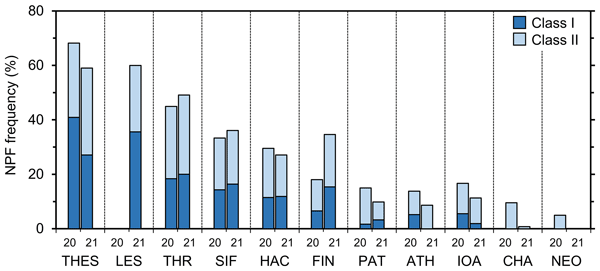
Extensive continuous particle number size distribution measurements took place during two summers (2020 and 2021) at 11 sites in Greece for the investigation of the frequency and the spatial extent of new particle formation. The frequency during summer varied from close to zero in southwestern Greece to more than 60 % in the northern, central, and eastern regions. The spatial variability can be explained by the proximity of the sites to coal-fired power plants and agricultural areas.
Ondřej Tichý, Sabine Eckhardt, Yves Balkanski, Didier Hauglustaine, and Nikolaos Evangeliou
Atmos. Chem. Phys., 23, 15235–15252, https://doi.org/10.5194/acp-23-15235-2023, https://doi.org/10.5194/acp-23-15235-2023, 2023
Short summary
Short summary
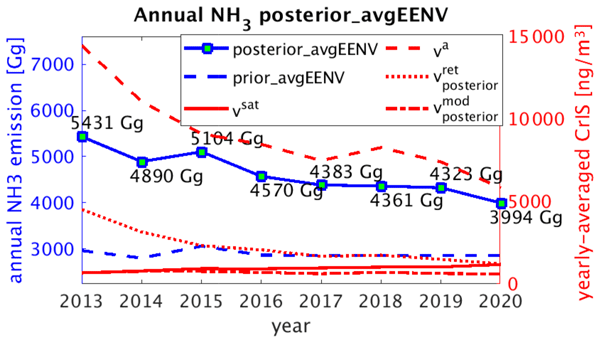
We show declining trends in NH3 emissions over Europe for 2013–2020 using advanced dispersion and inverse modelling and satellite measurements from CrIS. Emissions decreased by −26% since 2013, showing that the abatement strategies adopted by the European Union have been very efficient. Ammonia emissions are low in winter and peak in summer due to temperature-dependent soil volatilization. The largest decreases were observed in central and western Europe in countries with high emissions.
Rimal Abeed, Camille Viatte, William C. Porter, Nikolaos Evangeliou, Cathy Clerbaux, Lieven Clarisse, Martin Van Damme, Pierre-François Coheur, and Sarah Safieddine
Atmos. Chem. Phys., 23, 12505–12523, https://doi.org/10.5194/acp-23-12505-2023, https://doi.org/10.5194/acp-23-12505-2023, 2023
Short summary
Short summary
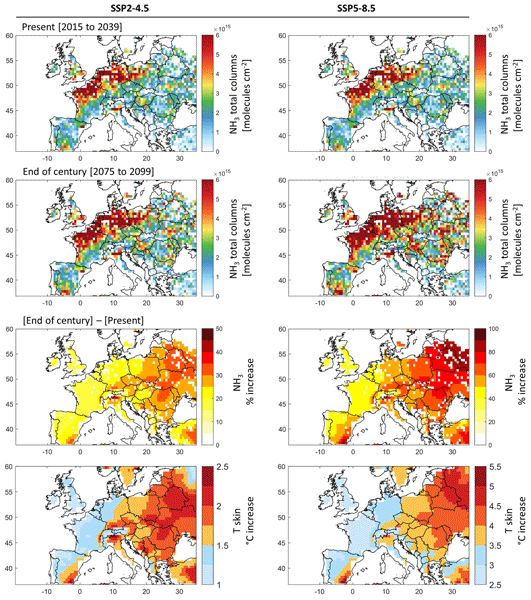
Ammonia emissions from agricultural activities will inevitably increase with the rise in population. We use a variety of datasets (satellite, reanalysis, and model simulation) to calculate the first regional map of ammonia emission potential during the start of the growing season in Europe. We then apply our developed method using a climate model to show the effect of the temperature increase on future ammonia columns under two possible climate scenarios.
Jean-Philippe Putaud, Enrico Pisoni, Alexander Mangold, Christoph Hueglin, Jean Sciare, Michael Pikridas, Chrysanthos Savvides, Jakub Ondracek, Saliou Mbengue, Alfred Wiedensohler, Kay Weinhold, Maik Merkel, Laurent Poulain, Dominik van Pinxteren, Hartmut Herrmann, Andreas Massling, Claus Nordstroem, Andrés Alastuey, Cristina Reche, Noemí Pérez, Sonia Castillo, Mar Sorribas, Jose Antonio Adame, Tuukka Petaja, Katrianne Lehtipalo, Jarkko Niemi, Véronique Riffault, Joel F. de Brito, Augustin Colette, Olivier Favez, Jean-Eudes Petit, Valérie Gros, Maria I. Gini, Stergios Vratolis, Konstantinos Eleftheriadis, Evangelia Diapouli, Hugo Denier van der Gon, Karl Espen Yttri, and Wenche Aas
Atmos. Chem. Phys., 23, 10145–10161, https://doi.org/10.5194/acp-23-10145-2023, https://doi.org/10.5194/acp-23-10145-2023, 2023
Short summary
Short summary
Many European people are still exposed to levels of air pollution that can affect their health. COVID-19 lockdowns in 2020 were used to assess the impact of the reduction in human mobility on air pollution across Europe by comparing measurement data with values that would be expected if no lockdown had occurred. We show that lockdown measures did not lead to consistent decreases in the concentrations of fine particulate matter suspended in the air, and we investigate why.
Akriti Masoom, Ilias Fountoulakis, Stelios Kazadzis, Ioannis-Panagiotis Raptis, Anna Kampouri, Basil E. Psiloglou, Dimitra Kouklaki, Kyriakoula Papachristopoulou, Eleni Marinou, Stavros Solomos, Anna Gialitaki, Dimitra Founda, Vasileios Salamalikis, Dimitris Kaskaoutis, Natalia Kouremeti, Nikolaos Mihalopoulos, Vassilis Amiridis, Andreas Kazantzidis, Alexandros Papayannis, Christos S. Zerefos, and Kostas Eleftheratos
Atmos. Chem. Phys., 23, 8487–8514, https://doi.org/10.5194/acp-23-8487-2023, https://doi.org/10.5194/acp-23-8487-2023, 2023
Short summary
Short summary
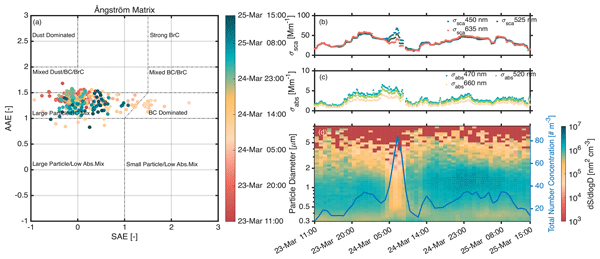
We analyse the spatial and temporal aerosol spectral optical properties during the extreme wildfires of August 2021 in Greece and assess their effects on air quality and solar radiation quantities related to health, agriculture, and energy. Different aerosol conditions are identified (pure smoke, pure dust, dust–smoke together); the largest impact on solar radiation quantities is found for cases with mixed dust–smoke aerosols. Such situations are expected to occur more frequently in the future.
Jonas Elm, Aladár Czitrovszky, Andreas Held, Annele Virtanen, Astrid Kiendler-Scharr, Benjamin J. Murray, Daniel McCluskey, Daniele Contini, David Broday, Eirini Goudeli, Hilkka Timonen, Joan Rosell-Llompart, Jose L. Castillo, Evangelia Diapouli, Mar Viana, Maria E. Messing, Markku Kulmala, Naděžda Zíková, and Sebastian H. Schmitt
Aerosol Research, 1, 13–16, https://doi.org/10.5194/ar-1-13-2023, https://doi.org/10.5194/ar-1-13-2023, 2023
Stergios Vratolis, Evangelia Diapouli, Manousos I. Manousakas, Susana Marta Almeida, Ivan Beslic, Zsofia Kertesz, Lucyna Samek, and Konstantinos Eleftheriadis
Atmos. Chem. Phys., 23, 6941–6961, https://doi.org/10.5194/acp-23-6941-2023, https://doi.org/10.5194/acp-23-6941-2023, 2023
Short summary
Short summary
Using a dataset from 16 European and Asian cities we develop a new method so as to identify and quantify the emission fluxes from each geographic grid cell for secondary sulfate and dust aerosol. The information provided by the new method allows the implementation of targeted mitigation measures. The new method could be applied to several other pollutants (e.g., black carbon).
Igor Veselovskii, Nikita Kasianik, Mikhail Korenskii, Qiaoyun Hu, Philippe Goloub, Thierry Podvin, and Dong Liu
Atmos. Meas. Tech., 16, 2055–2065, https://doi.org/10.5194/amt-16-2055-2023, https://doi.org/10.5194/amt-16-2055-2023, 2023
Short summary
Short summary
A five-channel fluorescence lidar was developed for the study of atmospheric aerosol. The fluorescence spectrum induced by 355 nm laser emission is analyzed in five spectral intervals, namely 438 and 29, 472 and 32, 513 and 29, 560 and 40, and 614 and 54 nm. This lidar system was operated during strong forest fires. Our results demonstrate that, for urban aerosol, the maximal fluorescence backscattering is observed at 472 nm, while for smoke, the spectrum is shifted toward longer wavelengths.
Ana Maria Roxana Petrescu, Chunjing Qiu, Matthew J. McGrath, Philippe Peylin, Glen P. Peters, Philippe Ciais, Rona L. Thompson, Aki Tsuruta, Dominik Brunner, Matthias Kuhnert, Bradley Matthews, Paul I. Palmer, Oksana Tarasova, Pierre Regnier, Ronny Lauerwald, David Bastviken, Lena Höglund-Isaksson, Wilfried Winiwarter, Giuseppe Etiope, Tuula Aalto, Gianpaolo Balsamo, Vladislav Bastrikov, Antoine Berchet, Patrick Brockmann, Giancarlo Ciotoli, Giulia Conchedda, Monica Crippa, Frank Dentener, Christine D. Groot Zwaaftink, Diego Guizzardi, Dirk Günther, Jean-Matthieu Haussaire, Sander Houweling, Greet Janssens-Maenhout, Massaer Kouyate, Adrian Leip, Antti Leppänen, Emanuele Lugato, Manon Maisonnier, Alistair J. Manning, Tiina Markkanen, Joe McNorton, Marilena Muntean, Gabriel D. Oreggioni, Prabir K. Patra, Lucia Perugini, Isabelle Pison, Maarit T. Raivonen, Marielle Saunois, Arjo J. Segers, Pete Smith, Efisio Solazzo, Hanqin Tian, Francesco N. Tubiello, Timo Vesala, Guido R. van der Werf, Chris Wilson, and Sönke Zaehle
Earth Syst. Sci. Data, 15, 1197–1268, https://doi.org/10.5194/essd-15-1197-2023, https://doi.org/10.5194/essd-15-1197-2023, 2023
Short summary
Short summary
This study updates the state-of-the-art scientific overview of CH4 and N2O emissions in the EU27 and UK in Petrescu et al. (2021a). Yearly updates are needed to improve the different respective approaches and to inform on the development of formal verification systems. It integrates the most recent emission inventories, process-based model and regional/global inversions, comparing them with UNFCCC national GHG inventories, in support to policy to facilitate real-time verification procedures.
Antonis Gkikas, Anna Gialitaki, Ioannis Binietoglou, Eleni Marinou, Maria Tsichla, Nikolaos Siomos, Peristera Paschou, Anna Kampouri, Kalliopi Artemis Voudouri, Emmanouil Proestakis, Maria Mylonaki, Christina-Anna Papanikolaou, Konstantinos Michailidis, Holger Baars, Anne Grete Straume, Dimitris Balis, Alexandros Papayannis, Tomasso Parrinello, and Vassilis Amiridis
Atmos. Meas. Tech., 16, 1017–1042, https://doi.org/10.5194/amt-16-1017-2023, https://doi.org/10.5194/amt-16-1017-2023, 2023
Short summary
Short summary
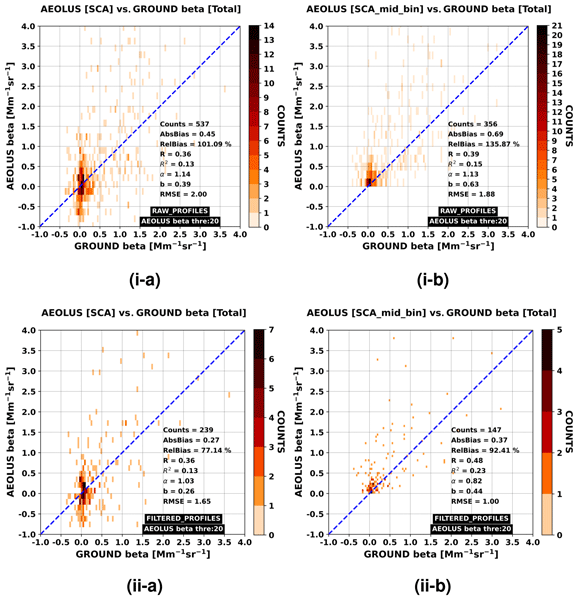
We perform an assessment analysis of the Aeolus Standard Correct Algorithm (SCA) backscatter coefficient retrievals against reference observations acquired at three Greek lidar stations (Athens, Thessaloniki and Antikythera) of the PANACEA network. Overall, 43 cases are analysed, whereas specific aerosol scenarios in the vicinity of Antikythera island (SW Greece) are emphasised. All key Cal/Val aspects and recommendations, and the ongoing related activities, are thoroughly discussed.
Maureen Beaudor, Nicolas Vuichard, Juliette Lathière, Nikolaos Evangeliou, Martin Van Damme, Lieven Clarisse, and Didier Hauglustaine
Geosci. Model Dev., 16, 1053–1081, https://doi.org/10.5194/gmd-16-1053-2023, https://doi.org/10.5194/gmd-16-1053-2023, 2023
Short summary
Short summary
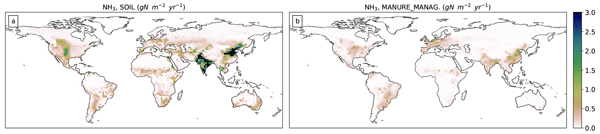
Ammonia mainly comes from the agricultural sector, and its volatilization relies on environmental variables. Our approach aims at benefiting from an Earth system model framework to estimate it. By doing so, we represent a consistent spatial distribution of the emissions' response to environmental changes.
We greatly improved the seasonal cycle of emissions compared with previous work. In addition, our model includes natural soil emissions (that are rarely represented in modeling approaches).
Konstantinos Michailidis, Maria-Elissavet Koukouli, Dimitris Balis, J. Pepijn Veefkind, Martin de Graaf, Lucia Mona, Nikolaos Papagianopoulos, Gesolmina Pappalardo, Ioanna Tsikoudi, Vassilis Amiridis, Eleni Marinou, Anna Gialitaki, Rodanthi-Elisavet Mamouri, Argyro Nisantzi, Daniele Bortoli, Maria João Costa, Vanda Salgueiro, Alexandros Papayannis, Maria Mylonaki, Lucas Alados-Arboledas, Salvatore Romano, Maria Rita Perrone, and Holger Baars
Atmos. Chem. Phys., 23, 1919–1940, https://doi.org/10.5194/acp-23-1919-2023, https://doi.org/10.5194/acp-23-1919-2023, 2023
Short summary
Short summary
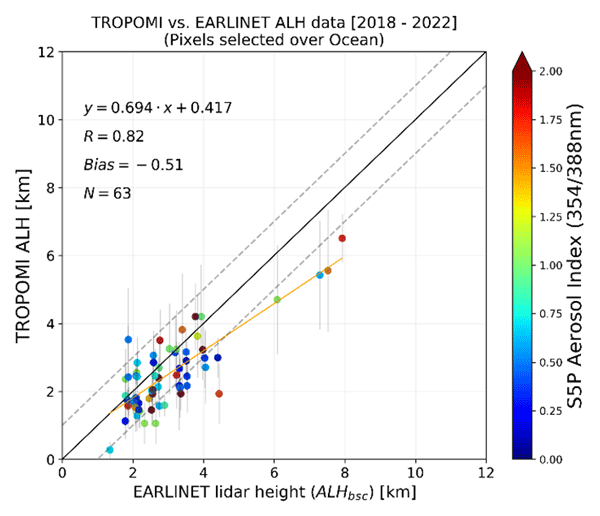
Comparisons with ground-based correlative lidar measurements constitute a key component in the validation of satellite aerosol products. This paper presents the validation of the TROPOMI aerosol layer height (ALH) product, using archived quality assured ground-based data from lidar stations that belong to the EARLINET network. Comparisons between the TROPOMI ALH and co-located EARLINET measurements show good agreement over the ocean.
Christina Spitieri, Maria Gini, Martin Gysel-Beer, and Konstantinos Eleftheriadis
Atmos. Chem. Phys., 23, 235–249, https://doi.org/10.5194/acp-23-235-2023, https://doi.org/10.5194/acp-23-235-2023, 2023
Short summary
Short summary
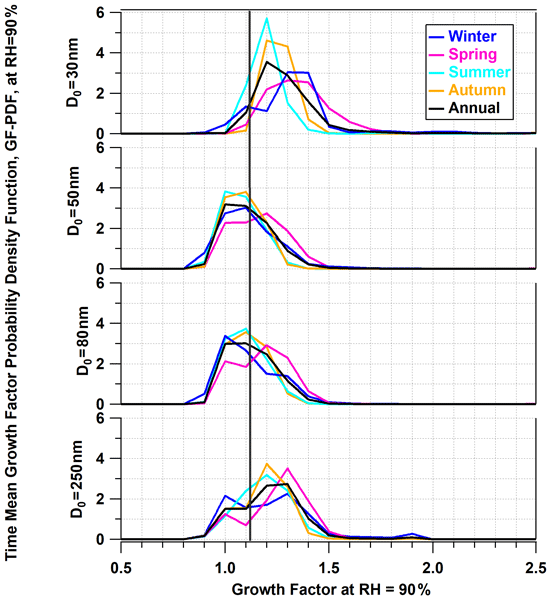
The paper provides insights into the hygroscopic properties and state of mixing of atmospheric aerosol through 1 year of measurements of key microphysical parameters in the suburbs of the most densely populated city of Greece, Athens, in the eastern Mediterranean, which is considered an important climate change hotspot. The results can be used for the prediction of cloud condensation nuclei and quantification of the influence of ambient relative humidity on light scattering by aerosol particles.
Kyriakoula Papachristopoulou, Ioannis-Panagiotis Raptis, Antonis Gkikas, Ilias Fountoulakis, Akriti Masoom, and Stelios Kazadzis
Atmos. Chem. Phys., 22, 15703–15727, https://doi.org/10.5194/acp-22-15703-2022, https://doi.org/10.5194/acp-22-15703-2022, 2022
Short summary
Short summary
Megacities' air quality is determined by atmospheric aerosols. We focus on changes over the last two decades in the 81 largest cities, using satellite data. European and American cities have lower aerosol compared to African and Asian cities. For European, North American and East Asian cities, aerosols are decreasing over time, especially in China and the US. In the remaining cities, aerosol loads are increasing, particularly in India.
Baseerat Romshoo, Mira Pöhlker, Alfred Wiedensohler, Sascha Pfeifer, Jorge Saturno, Andreas Nowak, Krzysztof Ciupek, Paul Quincey, Konstantina Vasilatou, Michaela N. Ess, Maria Gini, Konstantinos Eleftheriadis, Chris Robins, François Gaie-Levrel, and Thomas Müller
Atmos. Meas. Tech., 15, 6965–6989, https://doi.org/10.5194/amt-15-6965-2022, https://doi.org/10.5194/amt-15-6965-2022, 2022
Short summary
Short summary
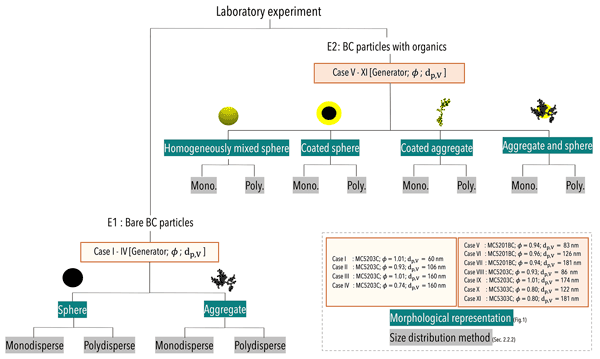
Black carbon (BC) is often assumed to be spherically shaped, causing uncertainties in its optical properties when modelled. This study investigates different modelling techniques for the optical properties of BC by comparing them to laboratory measurements. We provide experimental support for emphasizing the use of appropriate size representation (polydisperse size method) and morphological representation (aggregate morphology) for optical modelling and parameterization scheme development of BC.
Kostas Eleftheratos, John Kapsomenakis, Ilias Fountoulakis, Christos S. Zerefos, Patrick Jöckel, Martin Dameris, Alkiviadis F. Bais, Germar Bernhard, Dimitra Kouklaki, Kleareti Tourpali, Scott Stierle, J. Ben Liley, Colette Brogniez, Frédérique Auriol, Henri Diémoz, Stana Simic, Irina Petropavlovskikh, Kaisa Lakkala, and Kostas Douvis
Atmos. Chem. Phys., 22, 12827–12855, https://doi.org/10.5194/acp-22-12827-2022, https://doi.org/10.5194/acp-22-12827-2022, 2022
Short summary
Short summary
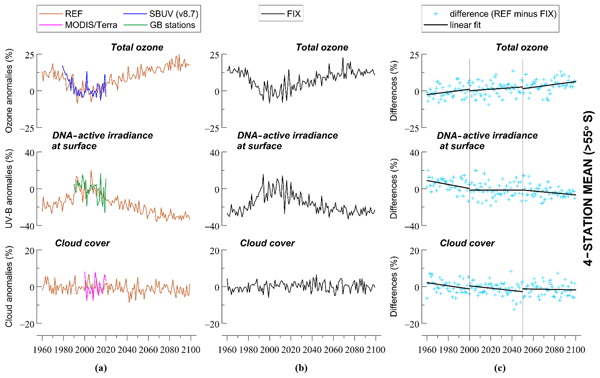
We present the future evolution of DNA-active ultraviolet (UV) radiation in view of increasing greenhouse gases (GHGs) and decreasing ozone depleting substances (ODSs). It is shown that DNA-active UV radiation might increase after 2050 between 50° N–50° S due to GHG-induced reductions in clouds and ozone, something that is likely not to happen at high latitudes, where DNA-active UV radiation will continue its downward trend mainly due to stratospheric ozone recovery from the reduction in ODSs.
Lauren M. Zamora, Ralph A. Kahn, Nikolaos Evangeliou, Christine D. Groot Zwaaftink, and Klaus B. Huebert
Atmos. Chem. Phys., 22, 12269–12285, https://doi.org/10.5194/acp-22-12269-2022, https://doi.org/10.5194/acp-22-12269-2022, 2022
Short summary
Short summary
Arctic dust, smoke, and pollution particles can affect clouds and Arctic warming. The distributions of these particles were estimated in three different satellite, reanalysis, and model products. These products showed good agreement overall but indicate that it is important to include local dust in models. We hypothesize that mineral dust effects on ice processes in the Arctic atmosphere might be highest over Siberia, where it is cold, moist, and subject to relatively high dust levels.
Igor Veselovskii, Qiaoyun Hu, Philippe Goloub, Thierry Podvin, Boris Barchunov, and Mikhail Korenskii
Atmos. Meas. Tech., 15, 4881–4900, https://doi.org/10.5194/amt-15-4881-2022, https://doi.org/10.5194/amt-15-4881-2022, 2022
Short summary
Short summary
An approach to reveal variability in aerosol type at a high spatiotemporal resolution, by combining fluorescence and Mie–Raman lidar data, is presented. We applied this new classification scheme to lidar data obtained by LOA, University of Lille, in 2020–2021. It is demonstrated that the separation of the main particle types, such as smoke, dust, pollen, and urban, can be performed with a height resolution of 60 m and temporal resolution better than 10 min for the current lidar configuration.
Olga Zografou, Maria Gini, Manousos I. Manousakas, Gang Chen, Athina C. Kalogridis, Evangelia Diapouli, Athina Pappa, and Konstantinos Eleftheriadis
Atmos. Meas. Tech., 15, 4675–4692, https://doi.org/10.5194/amt-15-4675-2022, https://doi.org/10.5194/amt-15-4675-2022, 2022
Short summary
Short summary
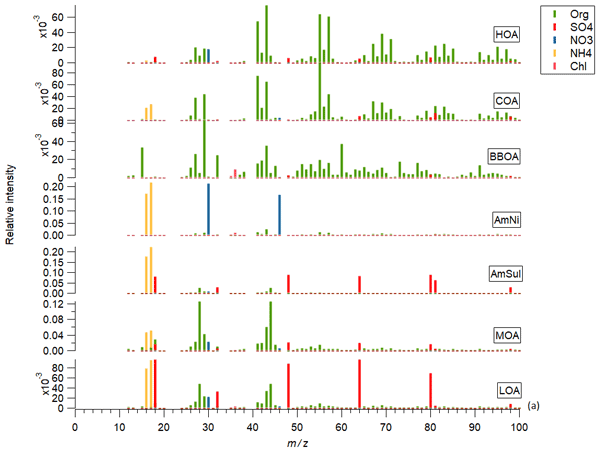
A yearlong ToF-ACSM dataset was used to characterize ambient aerosols over a suburban Athenian site, and innovative software for source apportionment was implemented in order to distinguish the sources of the total non-refractory species of PM1. A comparison between the methodology of combined organic and inorganic PMF analysis and the conventional organic PMF took place.
Kevin Ohneiser, Albert Ansmann, Bernd Kaifler, Alexandra Chudnovsky, Boris Barja, Daniel A. Knopf, Natalie Kaifler, Holger Baars, Patric Seifert, Diego Villanueva, Cristofer Jimenez, Martin Radenz, Ronny Engelmann, Igor Veselovskii, and Félix Zamorano
Atmos. Chem. Phys., 22, 7417–7442, https://doi.org/10.5194/acp-22-7417-2022, https://doi.org/10.5194/acp-22-7417-2022, 2022
Short summary
Short summary
We present and discuss 2 years of long-term lidar observations of the largest stratospheric perturbation by wildfire smoke ever observed. The smoke originated from the record-breaking Australian fires in 2019–2020 and affects climate conditions and even the ozone layer in the Southern Hemisphere. The obvious link between dense smoke occurrence in the stratosphere and strong ozone depletion found in the Arctic and in the Antarctic in 2020 can be regarded as a new aspect of climate change.
Olga B. Popovicheva, Nikolaos Evangeliou, Vasilii O. Kobelev, Marina A. Chichaeva, Konstantinos Eleftheriadis, Asta Gregorič, and Nikolay S. Kasimov
Atmos. Chem. Phys., 22, 5983–6000, https://doi.org/10.5194/acp-22-5983-2022, https://doi.org/10.5194/acp-22-5983-2022, 2022
Short summary
Short summary
Measurements of black carbon (BC) combined with atmospheric transport modeling reveal that gas flaring from oil and gas extraction in Kazakhstan, Volga-Ural, Komi, Nenets and western Siberia contributes the largest share of surface BC in the Russian Arctic dominating over domestic, industrial and traffic sectors. Pollution episodes show an increasing trend in concentration levels and frequency as the station is in the Siberian gateway of the highest anthropogenic pollution to the Russian Arctic.
Cynthia H. Whaley, Rashed Mahmood, Knut von Salzen, Barbara Winter, Sabine Eckhardt, Stephen Arnold, Stephen Beagley, Silvia Becagli, Rong-You Chien, Jesper Christensen, Sujay Manish Damani, Xinyi Dong, Konstantinos Eleftheriadis, Nikolaos Evangeliou, Gregory Faluvegi, Mark Flanner, Joshua S. Fu, Michael Gauss, Fabio Giardi, Wanmin Gong, Jens Liengaard Hjorth, Lin Huang, Ulas Im, Yugo Kanaya, Srinath Krishnan, Zbigniew Klimont, Thomas Kühn, Joakim Langner, Kathy S. Law, Louis Marelle, Andreas Massling, Dirk Olivié, Tatsuo Onishi, Naga Oshima, Yiran Peng, David A. Plummer, Olga Popovicheva, Luca Pozzoli, Jean-Christophe Raut, Maria Sand, Laura N. Saunders, Julia Schmale, Sangeeta Sharma, Ragnhild Bieltvedt Skeie, Henrik Skov, Fumikazu Taketani, Manu A. Thomas, Rita Traversi, Kostas Tsigaridis, Svetlana Tsyro, Steven Turnock, Vito Vitale, Kaley A. Walker, Minqi Wang, Duncan Watson-Parris, and Tahya Weiss-Gibbons
Atmos. Chem. Phys., 22, 5775–5828, https://doi.org/10.5194/acp-22-5775-2022, https://doi.org/10.5194/acp-22-5775-2022, 2022
Short summary
Short summary
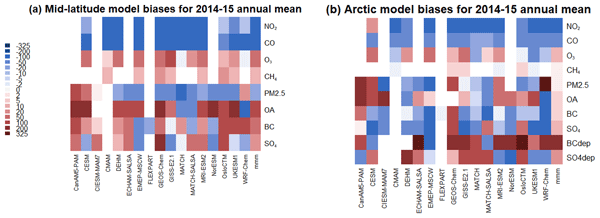
Air pollutants, like ozone and soot, play a role in both global warming and air quality. Atmospheric models are often used to provide information to policy makers about current and future conditions under different emissions scenarios. In order to have confidence in those simulations, in this study we compare simulated air pollution from 18 state-of-the-art atmospheric models to measured air pollution in order to assess how well the models perform.
Qiaoyun Hu, Philippe Goloub, Igor Veselovskii, and Thierry Podvin
Atmos. Chem. Phys., 22, 5399–5414, https://doi.org/10.5194/acp-22-5399-2022, https://doi.org/10.5194/acp-22-5399-2022, 2022
Short summary
Short summary
Our lidar observations show that the optical properties of wildfire smoke particles are highly varied after long-range transport. The variabilities are probably relevant to vegetation type, combustion condition and the aging process, which alter the smoke particle properties, as well as their impact on cloud processes and properties. The lidar fluorescence channel provides a good opportunity for smoke characterization and heterogenous ice crystal formation.
Igor Veselovskii, Qiaoyun Hu, Albert Ansmann, Philippe Goloub, Thierry Podvin, and Mikhail Korenskiy
Atmos. Chem. Phys., 22, 5209–5221, https://doi.org/10.5194/acp-22-5209-2022, https://doi.org/10.5194/acp-22-5209-2022, 2022
Short summary
Short summary
A remote sensing method based on fluorescence lidar measurements can detect and quantify the smoke content in the upper troposphere and inside cirrus clouds. Based on two case studies, we demonstrate that the fluorescence lidar technique provides the possibility to estimate the smoke surface area concentration within freshly formed cirrus layers. This value was used in a smoke ice nucleating particle parameterization scheme to predict ice crystal number concentrations in cirrus generation cells.
Hanna K. Lappalainen, Tuukka Petäjä, Timo Vihma, Jouni Räisänen, Alexander Baklanov, Sergey Chalov, Igor Esau, Ekaterina Ezhova, Matti Leppäranta, Dmitry Pozdnyakov, Jukka Pumpanen, Meinrat O. Andreae, Mikhail Arshinov, Eija Asmi, Jianhui Bai, Igor Bashmachnikov, Boris Belan, Federico Bianchi, Boris Biskaborn, Michael Boy, Jaana Bäck, Bin Cheng, Natalia Chubarova, Jonathan Duplissy, Egor Dyukarev, Konstantinos Eleftheriadis, Martin Forsius, Martin Heimann, Sirkku Juhola, Vladimir Konovalov, Igor Konovalov, Pavel Konstantinov, Kajar Köster, Elena Lapshina, Anna Lintunen, Alexander Mahura, Risto Makkonen, Svetlana Malkhazova, Ivan Mammarella, Stefano Mammola, Stephany Buenrostro Mazon, Outi Meinander, Eugene Mikhailov, Victoria Miles, Stanislav Myslenkov, Dmitry Orlov, Jean-Daniel Paris, Roberta Pirazzini, Olga Popovicheva, Jouni Pulliainen, Kimmo Rautiainen, Torsten Sachs, Vladimir Shevchenko, Andrey Skorokhod, Andreas Stohl, Elli Suhonen, Erik S. Thomson, Marina Tsidilina, Veli-Pekka Tynkkynen, Petteri Uotila, Aki Virkkula, Nadezhda Voropay, Tobias Wolf, Sayaka Yasunaka, Jiahua Zhang, Yubao Qiu, Aijun Ding, Huadong Guo, Valery Bondur, Nikolay Kasimov, Sergej Zilitinkevich, Veli-Matti Kerminen, and Markku Kulmala
Atmos. Chem. Phys., 22, 4413–4469, https://doi.org/10.5194/acp-22-4413-2022, https://doi.org/10.5194/acp-22-4413-2022, 2022
Short summary
Short summary
We summarize results during the last 5 years in the northern Eurasian region, especially from Russia, and introduce recent observations of the air quality in the urban environments in China. Although the scientific knowledge in these regions has increased, there are still gaps in our understanding of large-scale climate–Earth surface interactions and feedbacks. This arises from limitations in research infrastructures and integrative data analyses, hindering a comprehensive system analysis.
Christine D. Groot Zwaaftink, Wenche Aas, Sabine Eckhardt, Nikolaos Evangeliou, Paul Hamer, Mona Johnsrud, Arve Kylling, Stephen M. Platt, Kerstin Stebel, Hilde Uggerud, and Karl Espen Yttri
Atmos. Chem. Phys., 22, 3789–3810, https://doi.org/10.5194/acp-22-3789-2022, https://doi.org/10.5194/acp-22-3789-2022, 2022
Short summary
Short summary
We investigate causes of a poor-air-quality episode in northern Europe in October 2020 during which EU health limits for air quality were vastly exceeded. Such episodes may trigger measures to improve air quality. Analysis based on satellite observations, transport simulations, and surface observations revealed two sources of pollution. Emissions of mineral dust in Central Asia and biomass burning in Ukraine arrived almost simultaneously in Norway, and transport continued into the Arctic.
Stephen M. Platt, Øystein Hov, Torunn Berg, Knut Breivik, Sabine Eckhardt, Konstantinos Eleftheriadis, Nikolaos Evangeliou, Markus Fiebig, Rebecca Fisher, Georg Hansen, Hans-Christen Hansson, Jost Heintzenberg, Ove Hermansen, Dominic Heslin-Rees, Kim Holmén, Stephen Hudson, Roland Kallenborn, Radovan Krejci, Terje Krognes, Steinar Larssen, David Lowry, Cathrine Lund Myhre, Chris Lunder, Euan Nisbet, Pernilla B. Nizzetto, Ki-Tae Park, Christina A. Pedersen, Katrine Aspmo Pfaffhuber, Thomas Röckmann, Norbert Schmidbauer, Sverre Solberg, Andreas Stohl, Johan Ström, Tove Svendby, Peter Tunved, Kjersti Tørnkvist, Carina van der Veen, Stergios Vratolis, Young Jun Yoon, Karl Espen Yttri, Paul Zieger, Wenche Aas, and Kjetil Tørseth
Atmos. Chem. Phys., 22, 3321–3369, https://doi.org/10.5194/acp-22-3321-2022, https://doi.org/10.5194/acp-22-3321-2022, 2022
Short summary
Short summary
Here we detail the history of the Zeppelin Observatory, a unique global background site and one of only a few in the high Arctic. We present long-term time series of up to 30 years of atmospheric components and atmospheric transport phenomena. Many of these time series are important to our understanding of Arctic and global atmospheric composition change. Finally, we discuss the future of the Zeppelin Observatory and emerging areas of future research on the Arctic atmosphere.
Dimitris Karagkiozidis, Martina Michaela Friedrich, Steffen Beirle, Alkiviadis Bais, François Hendrick, Kalliopi Artemis Voudouri, Ilias Fountoulakis, Angelos Karanikolas, Paraskevi Tzoumaka, Michel Van Roozendael, Dimitris Balis, and Thomas Wagner
Atmos. Meas. Tech., 15, 1269–1301, https://doi.org/10.5194/amt-15-1269-2022, https://doi.org/10.5194/amt-15-1269-2022, 2022
Short summary
Short summary
In this study we focus on the retrieval of aerosol, NO2, and HCHO vertical profiles from multi-axis differential optical absorption spectroscopy (MAX-DOAS) observations for the first time over Thessaloniki, Greece. We use two independent inversion algorithms for the profile retrievals. We evaluate their performance, we intercompare their results, and we validate their products with ancillary data, measured by other co-located reference instruments.
Julia Schmale, Sangeeta Sharma, Stefano Decesari, Jakob Pernov, Andreas Massling, Hans-Christen Hansson, Knut von Salzen, Henrik Skov, Elisabeth Andrews, Patricia K. Quinn, Lucia M. Upchurch, Konstantinos Eleftheriadis, Rita Traversi, Stefania Gilardoni, Mauro Mazzola, James Laing, and Philip Hopke
Atmos. Chem. Phys., 22, 3067–3096, https://doi.org/10.5194/acp-22-3067-2022, https://doi.org/10.5194/acp-22-3067-2022, 2022
Short summary
Short summary
Long-term data sets of Arctic aerosol properties from 10 stations across the Arctic provide evidence that anthropogenic influence on the Arctic atmospheric chemical composition has declined in winter, a season which is typically dominated by mid-latitude emissions. The number of significant trends in summer is smaller than in winter, and overall the pattern is ambiguous with some significant positive and negative trends. This reflects the mixed influence of natural and anthropogenic emissions.
Ilias Fountoulakis, Henri Diémoz, Anna Maria Siani, Alcide di Sarra, Daniela Meloni, and Damiano M. Sferlazzo
Atmos. Chem. Phys., 21, 18689–18705, https://doi.org/10.5194/acp-21-18689-2021, https://doi.org/10.5194/acp-21-18689-2021, 2021
Short summary
Short summary
The variability and trends of solar spectral UV irradiance have been studied for the periods 1996–2020 (for Rome) and 2006–2020 (for Lampedusa, Rome, and Aosta) with respect to the variability and trends of total ozone and geopotential height. Analyses revealed increasing UV in particular months at all sites, possibly due to decreasing lower-stratospheric ozone (at Rome in 1996–2020) and decreasing attenuation by aerosols and/or clouds (at all stations in 2006–2020).
Clémence Rose, Martine Collaud Coen, Elisabeth Andrews, Yong Lin, Isaline Bossert, Cathrine Lund Myhre, Thomas Tuch, Alfred Wiedensohler, Markus Fiebig, Pasi Aalto, Andrés Alastuey, Elisabeth Alonso-Blanco, Marcos Andrade, Begoña Artíñano, Todor Arsov, Urs Baltensperger, Susanne Bastian, Olaf Bath, Johan Paul Beukes, Benjamin T. Brem, Nicolas Bukowiecki, Juan Andrés Casquero-Vera, Sébastien Conil, Konstantinos Eleftheriadis, Olivier Favez, Harald Flentje, Maria I. Gini, Francisco Javier Gómez-Moreno, Martin Gysel-Beer, Anna Gannet Hallar, Ivo Kalapov, Nikos Kalivitis, Anne Kasper-Giebl, Melita Keywood, Jeong Eun Kim, Sang-Woo Kim, Adam Kristensson, Markku Kulmala, Heikki Lihavainen, Neng-Huei Lin, Hassan Lyamani, Angela Marinoni, Sebastiao Martins Dos Santos, Olga L. Mayol-Bracero, Frank Meinhardt, Maik Merkel, Jean-Marc Metzger, Nikolaos Mihalopoulos, Jakub Ondracek, Marco Pandolfi, Noemi Pérez, Tuukka Petäjä, Jean-Eudes Petit, David Picard, Jean-Marc Pichon, Veronique Pont, Jean-Philippe Putaud, Fabienne Reisen, Karine Sellegri, Sangeeta Sharma, Gerhard Schauer, Patrick Sheridan, James Patrick Sherman, Andreas Schwerin, Ralf Sohmer, Mar Sorribas, Junying Sun, Pierre Tulet, Ville Vakkari, Pieter Gideon van Zyl, Fernando Velarde, Paolo Villani, Stergios Vratolis, Zdenek Wagner, Sheng-Hsiang Wang, Kay Weinhold, Rolf Weller, Margarita Yela, Vladimir Zdimal, and Paolo Laj
Atmos. Chem. Phys., 21, 17185–17223, https://doi.org/10.5194/acp-21-17185-2021, https://doi.org/10.5194/acp-21-17185-2021, 2021
Short summary
Short summary
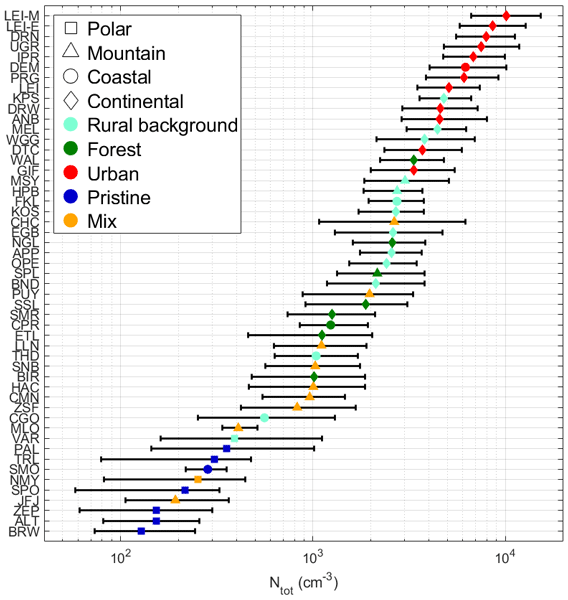
Aerosol particles are a complex component of the atmospheric system the effects of which are among the most uncertain in climate change projections. Using data collected at 62 stations, this study provides the most up-to-date picture of the spatial distribution of particle number concentration and size distribution worldwide, with the aim of contributing to better representation of aerosols and their interactions with clouds in models and, therefore, better evaluation of their impact on climate.
Kevin Ohneiser, Albert Ansmann, Alexandra Chudnovsky, Ronny Engelmann, Christoph Ritter, Igor Veselovskii, Holger Baars, Henriette Gebauer, Hannes Griesche, Martin Radenz, Julian Hofer, Dietrich Althausen, Sandro Dahlke, and Marion Maturilli
Atmos. Chem. Phys., 21, 15783–15808, https://doi.org/10.5194/acp-21-15783-2021, https://doi.org/10.5194/acp-21-15783-2021, 2021
Short summary
Short summary
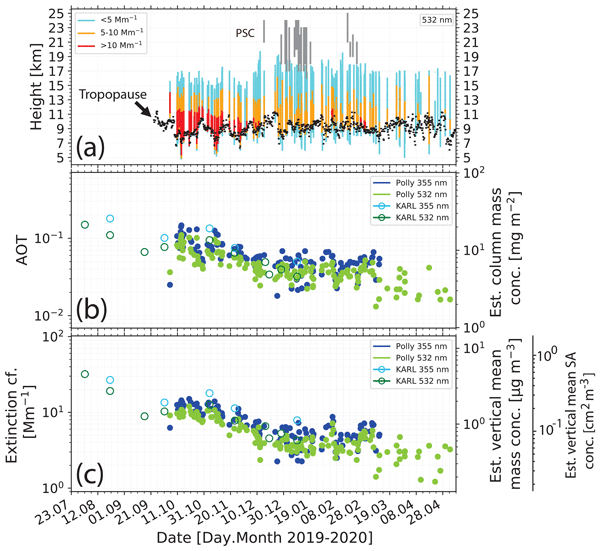
The highlight of the lidar measurements during the 1-year MOSAiC (Multidisciplinary drifting Observatory for the Study of Arctic Climate) expedition of the German icebreaker Polarstern (October 2019–October 2020) was the detection of a persistent, 10 km deep Siberian wildfire smoke layer in the upper troposphere and lower stratosphere (UTLS) from about 7–8 km to 17–18 km height that could potentially have impacted the record-breaking ozone depletion over the Arctic in the spring of 2020.
Sho Ohata, Tatsuhiro Mori, Yutaka Kondo, Sangeeta Sharma, Antti Hyvärinen, Elisabeth Andrews, Peter Tunved, Eija Asmi, John Backman, Henri Servomaa, Daniel Veber, Konstantinos Eleftheriadis, Stergios Vratolis, Radovan Krejci, Paul Zieger, Makoto Koike, Yugo Kanaya, Atsushi Yoshida, Nobuhiro Moteki, Yongjing Zhao, Yutaka Tobo, Junji Matsushita, and Naga Oshima
Atmos. Meas. Tech., 14, 6723–6748, https://doi.org/10.5194/amt-14-6723-2021, https://doi.org/10.5194/amt-14-6723-2021, 2021
Short summary
Short summary
Reliable values of mass absorption cross sections (MACs) of black carbon (BC) are required to determine mass concentrations of BC at Arctic sites using different types of filter-based absorption photometers. We successfully estimated MAC values for these instruments through comparison with independent measurements of BC by a continuous soot monitoring system called COSMOS. These MAC values are consistent with each other and applicable to study spatial and temporal variation in BC in the Arctic.
Jessica L. McCarty, Juha Aalto, Ville-Veikko Paunu, Steve R. Arnold, Sabine Eckhardt, Zbigniew Klimont, Justin J. Fain, Nikolaos Evangeliou, Ari Venäläinen, Nadezhda M. Tchebakova, Elena I. Parfenova, Kaarle Kupiainen, Amber J. Soja, Lin Huang, and Simon Wilson
Biogeosciences, 18, 5053–5083, https://doi.org/10.5194/bg-18-5053-2021, https://doi.org/10.5194/bg-18-5053-2021, 2021
Short summary
Short summary
Fires, including extreme fire seasons, and fire emissions are more common in the Arctic. A review and synthesis of current scientific literature find climate change and human activity in the north are fuelling an emerging Arctic fire regime, causing more black carbon and methane emissions within the Arctic. Uncertainties persist in characterizing future fire landscapes, and thus emissions, as well as policy-relevant challenges in understanding, monitoring, and managing Arctic fire regimes.
Ronny Engelmann, Albert Ansmann, Kevin Ohneiser, Hannes Griesche, Martin Radenz, Julian Hofer, Dietrich Althausen, Sandro Dahlke, Marion Maturilli, Igor Veselovskii, Cristofer Jimenez, Robert Wiesen, Holger Baars, Johannes Bühl, Henriette Gebauer, Moritz Haarig, Patric Seifert, Ulla Wandinger, and Andreas Macke
Atmos. Chem. Phys., 21, 13397–13423, https://doi.org/10.5194/acp-21-13397-2021, https://doi.org/10.5194/acp-21-13397-2021, 2021
Short summary
Short summary
A Raman lidar was operated aboard the icebreaker Polarstern during MOSAiC and monitored aerosol and cloud layers in the central Arctic up to 30 km height. The article provides an overview of the spectrum of aerosol profiling observations and shows aerosol–cloud interaction studies for liquid-water and ice clouds. A highlight was the detection of a 10 km deep wildfire smoke layer over the North Pole up to 17 km height from the fire season of 2019, which persisted over the whole winter period.
Panagiotis G. Kosmopoulos, Stelios Kazadzis, Alois W. Schmalwieser, Panagiotis I. Raptis, Kyriakoula Papachristopoulou, Ilias Fountoulakis, Akriti Masoom, Alkiviadis F. Bais, Julia Bilbao, Mario Blumthaler, Axel Kreuter, Anna Maria Siani, Kostas Eleftheratos, Chrysanthi Topaloglou, Julian Gröbner, Bjørn Johnsen, Tove M. Svendby, Jose Manuel Vilaplana, Lionel Doppler, Ann R. Webb, Marina Khazova, Hugo De Backer, Anu Heikkilä, Kaisa Lakkala, Janusz Jaroslawski, Charikleia Meleti, Henri Diémoz, Gregor Hülsen, Barbara Klotz, John Rimmer, and Charalampos Kontoes
Atmos. Meas. Tech., 14, 5657–5699, https://doi.org/10.5194/amt-14-5657-2021, https://doi.org/10.5194/amt-14-5657-2021, 2021
Short summary
Short summary
Large-scale retrievals of the ultraviolet index (UVI) in real time by exploiting the modern Earth observation data and techniques are capable of forming operational early warning systems that raise awareness among citizens of the health implications of high UVI doses. In this direction a novel UVI operating system, the so-called UVIOS, was introduced for massive outputs, while its performance was tested against ground-based measurements revealing a dependence on the input quality and resolution.
Daniel Pérez-Ramírez, David N. Whiteman, Igor Veselovskii, Richard Ferrare, Gloria Titos, María José Granados-Muñoz, Guadalupe Sánchez-Hernández, and Francisco Navas-Guzmán
Atmos. Chem. Phys., 21, 12021–12048, https://doi.org/10.5194/acp-21-12021-2021, https://doi.org/10.5194/acp-21-12021-2021, 2021
Short summary
Short summary
This paper shows how aerosol hygroscopicity enhances the vertical profile of aerosol backscattering and extinction. The study is possible thanks to the large set of remote sensing instruments and focuses on the the Baltimore–Washington DC metropolitan area during hot and humid summer days with very relevant anthropogenic emission aerosol sources. The results illustrate how the combination of aerosol emissions and meteorological conditions ultimately alters the aerosol radiative forcing.
Dimitrios Bousiotis, Francis D. Pope, David C. S. Beddows, Manuel Dall'Osto, Andreas Massling, Jakob Klenø Nøjgaard, Claus Nordstrøm, Jarkko V. Niemi, Harri Portin, Tuukka Petäjä, Noemi Perez, Andrés Alastuey, Xavier Querol, Giorgos Kouvarakis, Nikos Mihalopoulos, Stergios Vratolis, Konstantinos Eleftheriadis, Alfred Wiedensohler, Kay Weinhold, Maik Merkel, Thomas Tuch, and Roy M. Harrison
Atmos. Chem. Phys., 21, 11905–11925, https://doi.org/10.5194/acp-21-11905-2021, https://doi.org/10.5194/acp-21-11905-2021, 2021
Short summary
Short summary
Formation of new particles is a key process in the atmosphere. New particle formation events arising from nucleation of gaseous precursors have been analysed in extensive datasets from 13 sites in five European countries in terms of frequency, nucleation rate, and particle growth rate, with several common features and many differences identified. Although nucleation frequencies are lower at roadside sites, nucleation rates and particle growth rates are typically higher.
Eija Asmi, John Backman, Henri Servomaa, Aki Virkkula, Maria I. Gini, Konstantinos Eleftheriadis, Thomas Müller, Sho Ohata, Yutaka Kondo, and Antti Hyvärinen
Atmos. Meas. Tech., 14, 5397–5413, https://doi.org/10.5194/amt-14-5397-2021, https://doi.org/10.5194/amt-14-5397-2021, 2021
Short summary
Short summary
Absorbing aerosols are warming the planet and accurate measurements of their concentrations in pristine environments are needed. We applied eight different absorbing-aerosol measurement methods in a field campaign at the Arctic Pallas station. The filter-based techniques were found to be the most sensitive to detect the minuscule amounts of black carbon present, showing a 40 % agreement between them. Our results help to reduce uncertainties in absorbing aerosol measurements.
Congbo Song, Manuel Dall'Osto, Angelo Lupi, Mauro Mazzola, Rita Traversi, Silvia Becagli, Stefania Gilardoni, Stergios Vratolis, Karl Espen Yttri, David C. S. Beddows, Julia Schmale, James Brean, Agung Ghani Kramawijaya, Roy M. Harrison, and Zongbo Shi
Atmos. Chem. Phys., 21, 11317–11335, https://doi.org/10.5194/acp-21-11317-2021, https://doi.org/10.5194/acp-21-11317-2021, 2021
Short summary
Short summary
We present a cluster analysis of relatively long-term (2015–2019) aerosol aerodynamic volume size distributions up to 20 μm in the Arctic for the first time. The study found that anthropogenic and natural aerosols comprised 27 % and 73 % of the occurrence of the coarse-mode aerosols, respectively. Our study shows that about two-thirds of the coarse-mode aerosols are related to two sea-spray-related aerosol clusters, indicating that sea spray aerosol may more complex in the Arctic environment.
Igor Veselovskii, Qiaoyun Hu, Philippe Goloub, Thierry Podvin, Marie Choël, Nicolas Visez, and Mikhail Korenskiy
Atmos. Meas. Tech., 14, 4773–4786, https://doi.org/10.5194/amt-14-4773-2021, https://doi.org/10.5194/amt-14-4773-2021, 2021
Short summary
Short summary
The multiwavelength Mie–Raman–fluorescence lidar of the University of Lille was used to characterize aerosols during the pollen season in the north of France for the period March–June 2020. The results of observations demonstrate that the presence of pollen grains in aerosol mixtures leads to an increase in the depolarization ratio and to the enhancement of the fluorescence backscattering.
Albert Ansmann, Kevin Ohneiser, Rodanthi-Elisavet Mamouri, Daniel A. Knopf, Igor Veselovskii, Holger Baars, Ronny Engelmann, Andreas Foth, Cristofer Jimenez, Patric Seifert, and Boris Barja
Atmos. Chem. Phys., 21, 9779–9807, https://doi.org/10.5194/acp-21-9779-2021, https://doi.org/10.5194/acp-21-9779-2021, 2021
Short summary
Short summary
We present retrievals of tropospheric and stratospheric height profiles of particle mass, volume, surface area concentration of wildfire smoke layers, and related cloud condensation nuclei (CCN) and ice-nucleating particle (INP) concentrations. The new analysis scheme is applied to ground-based lidar observations of stratospheric Australian smoke over southern South America and to spaceborne lidar observations of tropospheric North American smoke.
Sehyun Jang, Ki-Tae Park, Kitack Lee, Young Jun Yoon, Kitae Kim, Hyun Young Chung, Eunho Jang, Silvia Becagli, Bang Yong Lee, Rita Traversi, Konstantinos Eleftheriadis, Radovan Krejci, and Ove Hermansen
Atmos. Chem. Phys., 21, 9761–9777, https://doi.org/10.5194/acp-21-9761-2021, https://doi.org/10.5194/acp-21-9761-2021, 2021
Short summary
Short summary
This study provides comprehensive datasets encompassing seasonal and interannual variations in sulfate and MSA concentration in aerosol particles in the Arctic atmosphere. As oxidation products of DMS have important roles in new particle formation and growth, we focused on factors affecting their variability and the branching ratio of DMS oxidation. We found a strong correlation between the ratio and the light condition, chemical properties of particles, and biological activities near Svalbard.
Ana Maria Roxana Petrescu, Chunjing Qiu, Philippe Ciais, Rona L. Thompson, Philippe Peylin, Matthew J. McGrath, Efisio Solazzo, Greet Janssens-Maenhout, Francesco N. Tubiello, Peter Bergamaschi, Dominik Brunner, Glen P. Peters, Lena Höglund-Isaksson, Pierre Regnier, Ronny Lauerwald, David Bastviken, Aki Tsuruta, Wilfried Winiwarter, Prabir K. Patra, Matthias Kuhnert, Gabriel D. Oreggioni, Monica Crippa, Marielle Saunois, Lucia Perugini, Tiina Markkanen, Tuula Aalto, Christine D. Groot Zwaaftink, Hanqin Tian, Yuanzhi Yao, Chris Wilson, Giulia Conchedda, Dirk Günther, Adrian Leip, Pete Smith, Jean-Matthieu Haussaire, Antti Leppänen, Alistair J. Manning, Joe McNorton, Patrick Brockmann, and Albertus Johannes Dolman
Earth Syst. Sci. Data, 13, 2307–2362, https://doi.org/10.5194/essd-13-2307-2021, https://doi.org/10.5194/essd-13-2307-2021, 2021
Short summary
Short summary
This study is topical and provides a state-of-the-art scientific overview of data availability from bottom-up and top-down CH4 and N2O emissions in the EU27 and UK. The data integrate recent emission inventories with process-based model data and regional/global inversions for the European domain, aiming at reconciling them with official country-level UNFCCC national GHG inventories in support to policy and to facilitate real-time verification procedures.
Karl Espen Yttri, Francesco Canonaco, Sabine Eckhardt, Nikolaos Evangeliou, Markus Fiebig, Hans Gundersen, Anne-Gunn Hjellbrekke, Cathrine Lund Myhre, Stephen Matthew Platt, André S. H. Prévôt, David Simpson, Sverre Solberg, Jason Surratt, Kjetil Tørseth, Hilde Uggerud, Marit Vadset, Xin Wan, and Wenche Aas
Atmos. Chem. Phys., 21, 7149–7170, https://doi.org/10.5194/acp-21-7149-2021, https://doi.org/10.5194/acp-21-7149-2021, 2021
Short summary
Short summary
Carbonaceous aerosol sources and trends were studied at the Birkenes Observatory. A large decrease in elemental carbon (EC; 2001–2018) and a smaller decline in levoglucosan (2008–2018) suggest that organic carbon (OC)/EC from traffic/industry is decreasing, whereas the abatement of OC/EC from biomass burning has been less successful. Positive matrix factorization apportioned 72 % of EC to fossil fuel sources and 53 % (PM2.5) and 78 % (PM10–2.5) of OC to biogenic sources.
Anton Lopatin, Oleg Dubovik, David Fuertes, Georgiy Stenchikov, Tatyana Lapyonok, Igor Veselovskii, Frank G. Wienhold, Illia Shevchenko, Qiaoyun Hu, and Sagar Parajuli
Atmos. Meas. Tech., 14, 2575–2614, https://doi.org/10.5194/amt-14-2575-2021, https://doi.org/10.5194/amt-14-2575-2021, 2021
Short summary
Short summary
The article presents novelties in characterizing fine particles suspended in the air by means of combining various measurements that observe light propagation in atmosphere. Several non-coincident observations (some of which require sunlight, while others work only at night) could be united under the assumption that aerosol properties do not change drastically at nighttime. It also proposes how to describe particles' composition in a simplified manner that uses new types of observations.
Cited articles
Alados-Arboledas, L., Müller, D., Guerrero-Rascado, J. L., Navas-Guzmán, F., Pérez-Ramírez, D., and Olmo, F. J.: Optical and microphysical properties of fresh biomass burning aerosol retrieved by Raman lidar, and star-and sun-photometry, Geophys. Res. Lett., 38, https://doi.org/10.1029/2010GL045999, 2011.
Amiridis, V., Zerefos, C., Kazadzis, S., Gerasopoulos, E., Eleftheratos, K., Vrekoussis, M., Stohl, A., Mamouri, R. E., Kokkalis, P., Papayannis, A., Eleftheriadis, K., Diapouli, E., Keramitsoglou, I., Kontoes, C., Kotroni, V., Lagouvardos, K., Marinou, E., Giannakaki, E., Kostopoulou, E., Giannakopoulos, C., Richter, A., Burrows, J. P., and Mihalopoulos, N.: Impact of the 2009 Attica wild fires on the air quality in urban Athens, Atmos. Environ., 46, 536–544, https://doi.org/10.1016/j.atmosenv.2011.07.056, 2012.
Amiridis, V., Kazadzis, S., Gkikas, A., Voudouri, K. A., Kouklaki, D., Koukouli, M.-E., Garane, K., Georgoulias, A. K., Solomos, S., Varlas, G., Kampouri, A., Founda, D., Psiloglou, B. E., Katsafados, P., Papachristopoulou, K., Fountoulakis, I., Raptis, P.-I., Georgiou, T., Gialitaki, A., Proestakis, E., Tsekeri, A., Drakaki, E., Marinou, E., Giannakaki, E., Misios, S., Kapsomenakis, J., Eleftheratos, K., Hatzianastassiou, N., Kalabokas, P., Zanis, P., Vrekoussis, M., Papayannis, A., Kazantzidis, A., Kourtidis, K., Balis, D., Bais, A. F., and Zerefos, C.: Natural Aerosols, Gaseous Precursors and Their Impacts in Greece: A Review from the Remote Sensing Perspective, Atmosphere, 15, 753, https://doi.org/10.3390/atmos15070753, 2024.
Anderson, G. P., Clough, S. A., Kneizys, F. X., Chetwynd, J. H., and Shettle, E. P.: AFGL Atmospheric Constituent Profiles (0.120 km), Tech. Rep. AFGL-TR-86-0110, Air Force Geophys. Lab., Hanscom Air Force Base, Bedford, Mass., 1986.
Ansmann, A., Seifert, P., Tesche, M., and Wandinger, U.: Profiling of fine and coarse particle mass: case studies of Saharan dust and Eyjafjallajökull/Grimsvötn volcanic plumes, Atmos. Chem. Phys., 12, 9399–9415, https://doi.org/10.5194/acp-12-9399-2012, 2012.
Ansmann, A., Mamouri, R.-E., Hofer, J., Baars, H., Althausen, D., and Abdullaev, S. F.: Dust mass, cloud condensation nuclei, and ice-nucleating particle profiling with polarization lidar: updated POLIPHON conversion factors from global AERONET analysis, Atmos. Meas. Tech., 12, 4849–4865, https://doi.org/10.5194/amt-12-4849-2019, 2019.
Baars, H., Ansmann, A., Althausen, D., Engelmann, R., Heese, B., Müller, D., Artaxo, P., Paixao, M., Pauliquevis, T., and Souza, R.: Aerosol profiling with lidar in the Amazon Basin during the wet and dry season, J. Geophys. Res.-Atmos., 117, https://doi.org/10.1029/2012JD018338, 2012.
Bais, A. F., Gardiner, B. G., Slaper, H., Blumthaler, M., Bernhard, G., McKenzie, R., Webb, A. R., Seckmeyer, G., Kjeldstad, B., Koskela, T., Kirsch, P. J., Gröbner, J., Kerr, J. B., Kazadzis, S., Leszczynski, K., Wardle, D., Josefsson, W., Brogniez, C., Gillotay, D., Reinen, H., Weihs, P., Svenoe, T., Eriksen, P., Kuik, F., and Redondas, A.: SUSPEN intercomparison of ultraviolet spectroradiometers, J. Geophys. Res.-Atmos., 106, 12509–12525, https://doi.org/10.1029/2000JD900561, 2001.
Bais, A. F., Kazantzidis, A., Kazadzis, S., Balis, D. S., Zerefos, C. S., and Meleti, C.: Deriving an effective aerosol single scattering albedo from spectral surface UV irradiance measurements, Atmos. Environ., 39, 1093–1102, https://doi.org/10.1016/j.atmosenv.2004.09.080, 2005.
Buras, R., Dowling, T., and Emde, C.: New secondary-scattering correction in DISORT with increased efficiency for forward scattering, J. Quant. Spectrosc. Ra., 112, 2028–2034, https://doi.org/10.1016/j.jqsrt.2011.03.019, 2011.
Burton, S. P., Ferrare, R. A., Hostetler, C. A., Hair, J. W., Rogers, R. R., Obland, M. D., Butler, C. F., Cook, A. L., Harper, D. B., and Froyd, K. D.: Aerosol classification using airborne High Spectral Resolution Lidar measurements – methodology and examples, Atmos. Meas. Tech., 5, 73–98, https://doi.org/10.5194/amt-5-73-2012, 2012.
Chang, D. Y., Yoon, J., Lelieveld, J., Park, S. K., Yum, S. S., Kim, J., and Jeong, S.: Direct radiative forcing of biomass burning aerosols from the extensive Australian wildfires in 2019–2020, Environ. Res. Lett., 16, 044041, https://doi.org/10.1088/1748-9326/abecfe, 2021.
Chirizzi, D., Cesari, D., Guascito, M. R., Dinoi, A., Giotta, L., Donateo, A., and Contini, D.: Influence of Saharan dust outbreaks and carbon content on oxidative potential of water-soluble fractions of PM2.5 and PM10, Atmos. Environ., 163, 1–8, https://doi.org/10.1016/j.atmosenv.2017.05.021, 2017.
Diapouli, E., Kalogridis, A.-C., Markantonaki, C., Vratolis, S., Fetfatzis, P., Colombi, C., and Eleftheriadis, K.: Annual Variability of Black Carbon Concentrations Originating from Biomass and Fossil Fuel Combustion for the Suburban Aerosol in Athens, Greece, Atmosphere, 8, 234, https://doi.org/10.3390/atmos8120234, 2017.
Dubovik, O. and King, M. D.: A flexible inversion algorithm for retrieval of aerosol optical properties from Sun and sky radiance measurements, J. Geophys. Res.-Atmos., 105, 20673–20696, https://doi.org/10.1029/2000JD900282, 2000.
Eleftheratos, K., Kouklaki, D., and Zerefos, C.: Sixteen Years of Measurements of Ozone over Athens, Greece with a Brewer Spectrophotometer, Oxygen, 1, 32–45, https://doi.org/10.3390/oxygen1010005, 2021.
Emde, C., Buras-Schnell, R., Kylling, A., Mayer, B., Gasteiger, J., Hamann, U., Kylling, J., Richter, B., Pause, C., Dowling, T., and Bugliaro, L.: The libRadtran software package for radiative transfer calculations (version 2.0.1), Geosci. Model Dev., 9, 1647–1672, https://doi.org/10.5194/gmd-9-1647-2016, 2016.
Engelhart, G. J., Hennigan, C. J., Miracolo, M. A., Robinson, A. L., and Pandis, S. N.: Cloud condensation nuclei activity of fresh primary and aged biomass burning aerosol, Atmos. Chem. Phys., 12, 7285–7293, https://doi.org/10.5194/acp-12-7285-2012, 2012.
Evangeliou, N., Platt, S. M., Eckhardt, S., Lund Myhre, C., Laj, P., Alados-Arboledas, L., Backman, J., Brem, B. T., Fiebig, M., Flentje, H., Marinoni, A., Pandolfi, M., Yus-Dìez, J., Prats, N., Putaud, J. P., Sellegri, K., Sorribas, M., Eleftheriadis, K., Vratolis, S., Wiedensohler, A., and Stohl, A.: Changes in black carbon emissions over Europe due to COVID-19 lockdowns, Atmos. Chem. Phys., 21, 2675–2692, https://doi.org/10.5194/acp-21-2675-2021, 2021.
Fountoulakis, I.: WP2 – Athens Campaign – BRFAA, Zenodo [data set], https://doi.org/10.5281/zenodo.17714735, 2025.
Fountoulakis, I., Bais, A. F., Fragkos, K., Meleti, C., Tourpali, K., and Zempila, M. M.: Short- and long-term variability of spectral solar UV irradiance at Thessaloniki, Greece: effects of changes in aerosols, total ozone and clouds, Atmos. Chem. Phys., 16, 2493–2505, https://doi.org/10.5194/acp-16-2493-2016, 2016.
Fountoulakis, I., Natsis, A., Siomos, N., Drosoglou, T., and Bais, A. F.: Deriving Aerosol Absorption Properties from Solar Ultraviolet Radiation Spectral Measurements at Thessaloniki, Greece, Remote Sens., 11, 2179, https://doi.org/10.3390/rs11182179, 2019.
Fröhlich, R., Cubison, M. J., Slowik, J. G., Bukowiecki, N., Canonaco, F., Croteau, P. L., Gysel, M., Henne, S., Herrmann, E., Jayne, J. T., Steinbacher, M., Worsnop, D. R., Baltensperger, U., and Prévôt, A. S. H.: Fourteen months of on-line measurements of the non-refractory submicron aerosol at the Jungfraujoch (3580 ) – chemical composition, origins and organic aerosol sources, Atmos. Chem. Phys., 15, 11373–11398, https://doi.org/10.5194/acp-15-11373-2015, 2015.
Giannakaki, E., van Zyl, P. G., Müller, D., Balis, D., and Komppula, M.: Optical and microphysical characterization of aerosol layers over South Africa by means of multi-wavelength depolarization and Raman lidar measurements, Atmos. Chem. Phys., 16, 8109–8123, https://doi.org/10.5194/acp-16-8109-2016, 2016.
Gidarakou, M., Papayannis, A., Kokkalis, P., Evangeliou, N., Vratolis, S., Remoundaki, E., Groot Zwaaftink, C., Eckhardt, S., Veselovskii, I., Mylonaki, M., Argyrouli, A., Eleftheriadis, K., Solomos, S., and Gini, M. I.: Optical and Microphysical Properties of the Aerosols during a Rare Event of Biomass-Burning Mixed with Polluted Dust, Atmosphere, 15, 190, https://doi.org/10.3390/atmos15020190, 2024.
Gidarakou, M., Papayannis, A., Gao, K., Gidarakos, P., Crouzy, B., Foskinis, R., Erb, S., Zhang, C., Lieberherr, G., Collaud Coen, M., Sikoparija, B., Kanji, Z. A., Clot, B., Calpini, B., Giagka, E., and Nenes, A.: Profiling pollen and biomass burning particles over Payerne, Switzerland using laser-induced fluorescence lidar and in situ techniques during the 2023 PERICLES campaign, EGUsphere [preprint], https://doi.org/10.5194/egusphere-2025-2978, 2025.
Gidarakou, M., Gini, M. I., Eleftheriadis, K., Zografou, O., Granakis, K., and Veselovskii, I.: Data used in egusphere-2025-5856, Zenodo [data set], https://doi.org/10.5281/zenodo.18924230, 2026.
Giglio, L., Randerson, J. T., and van der Werf, G. R.: Analysis of daily, monthly, and annual burned area using the fourth-generation global fire emissions database (GFED4), J. Geophys. Res.-Biogeo., 118, 317–328, https://doi.org/10.1002/jgrg.20042, 2013.
Giglio, L., Schroeder, W., and Justice, C. O.: The collection 6 MODIS active fire detection algorithm and fire products, Remote Sens. Environ., 178, 31–41, https://doi.org/10.1016/j.rse.2016.02.054, 2016.
Groot Zwaaftink, C. D., Aas, W., Eckhardt, S., Evangeliou, N., Hamer, P., Johnsrud, M., Kylling, A., Platt, S. M., Stebel, K., Uggerud, H., and Yttri, K. E.: What caused a record high PM10 episode in northern Europe in October 2020?, Atmos. Chem. Phys., 22, 3789–3810, https://doi.org/10.5194/acp-22-3789-2022, 2022.
Groß, S., Tesche, M., Freudenthaler, V., Toledano, C., Wiegner, M., Ansmann, A., Althausen, D., and Seefeldner, M.: Characterization of Saharan dust, marine aerosols and mixtures of biomass-burning aerosols and dust by means of multi-wavelength depolarization and Raman lidar measurements during SAMUM 2, Tellus B, 63, 706, https://doi.org/10.1111/j.1600-0889.2011.00556.x, 2011.
Groß, S., Esselborn, M., Weinzierl, B., Wirth, M., Fix, A., and Petzold, A.: Aerosol classification by airborne high spectral resolution lidar observations, Atmos. Chem. Phys., 13, 2487–2505, https://doi.org/10.5194/acp-13-2487-2013, 2013.
Haarig, M., Walser, A., Ansmann, A., Dollner, M., Althausen, D., Sauer, D., Farrell, D., and Weinzierl, B.: Profiles of cloud condensation nuclei, dust mass concentration, and ice-nucleating-particle-relevant aerosol properties in the Saharan Air Layer over Barbados from polarization lidar and airborne in situ measurements, Atmos. Chem. Phys., 19, 13773–13788, https://doi.org/10.5194/acp-19-13773-2019, 2019.
Heinold, B., Baars, H., Barja, B., Christensen, M., Kubin, A., Ohneiser, K., Schepanski, K., Schutgens, N., Senf, F., Schrödner, R., Villanueva, D., and Tegen, I.: Important role of stratospheric injection height for the distribution and radiative forcing of smoke aerosol from the 2019–2020 Australian wildfires, Atmos. Chem. Phys., 22, 9969–9985, https://doi.org/10.5194/acp-22-9969-2022, 2022.
Hersbach, H., Bell, B., Berrisford, P., Hirahara, S., Horányi, A., Muñoz-Sabater, J., Nicolas, J., Peubey, C., Radu, R., Schepers, D., Simmons, A., Soci, C., Abdalla, S., Abellan, X., Balsamo, G., Bechtold, P., Biavati, G., Bidlot, J., Bonavita, M., De Chiara, G., Dahlgren, P., Dee, D., Diamantakis, M., Dragani, R., Flemming, J., Forbes, R., Fuentes, M., Geer, A., Haimberger, L., Healy, S., Hogan, R. J., Hólm, E., Janisková, M., Keeley, S., Laloyaux, P., Lopez, P., Lupu, C., Radnoti, G., de Rosnay, P., Rozum, I., Vamborg, F., Villaume, S., and Thépaut, J.-N.: The ERA5 global reanalysis, Q. J. Roy. Meteor. Soc., 146, 1999–2049, https://doi.org/10.1002/qj.3803, 2020.
Hess, M., Koepke, P., and Schult, I.: Optical Properties of Aerosols and Clouds: The Software Package OPAC, B. Am. Meteorol. Soc., 79, 831–844, https://doi.org/10.1175/1520-0477(1998)079<0831:OPOAAC>2.0.CO;2, 1998.
Holben, B. N., Eck, T. F., Slutsker, I., Tanré, D., Buis, J. P., Setzer, A., Vermote, E., Reagan, J. A., Kaufman, Y. J., Nakajima, T., Lavenu, F., Jankowiak, I., and Smirnov, A.: AERONET—A Federated Instrument Network and Data Archive for Aerosol Characterization, Remote Sens. Environ., 66, 1–16, https://doi.org/10.1016/S0034-4257(98)00031-5, 1998.
Intergovernmental Panel On Climate Change (IPCC): Climate Change 2021 – The Physical Science Basis: Working Group I Contribution to the Sixth Assessment Report of the Intergovernmental Panel on Climate Change, 1st edn., Cambridge University Press, https://doi.org/10.1017/9781009157896, 2023.
Janicka, L., Stachlewska, I. S., Veselovskii, I., and Baars, H.: Temporal variations in optical and microphysical properties of mineral dust and biomass burning aerosol derived from daytime Raman lidar observations over Warsaw, Poland, Atmos. Environ., 169, 162–174, https://doi.org/10.1016/j.atmosenv.2017.09.022, 2017.
Justice, C. O., Giglio, L., Korontzi, S., Owens, J., Morisette, J. T., Roy, D., Descloitres, J., Alleaume, S., Petitcolin, F., and Kaufman, Y.: The MODIS fire products, Remote Sens. Environ., 83, 244–262, https://doi.org/10.1016/S0034-4257(02)00076-7, 2002.
Kaskaoutis, D. G., Kharol, S. K., Sifakis, N., Nastos, P. T., Sharma, A. R., Badarinath, K. V. S., and Kambezidis, H. D.: Satellite monitoring of the biomass-burning aerosols during the wildfires of August 2007 in Greece: Climate implications, Atmos. Environ., 45, 716–726, https://doi.org/10.1016/j.atmosenv.2010.09.043, 2011.
Kaskaoutis, D. G., Grivas, G., Stavroulas, I., Bougiatioti, A., Liakakou, E., Dumka, U. C., Gerasopoulos, E., and Mihalopoulos, N.: Apportionment of black and brown carbon spectral absorption sources in the urban environment of Athens, Greece, during winter, Sci. Total Environ., 801, 149739, https://doi.org/10.1016/j.scitotenv.2021.149739, 2021.
Kaskaoutis, D. G., Petrinoli, K., Grivas, G., Kalkavouras, P., Tsagkaraki, M., Tavernaraki, K., Papoutsidaki, K., Stavroulas, I., Paraskevopoulou, D., Bougiatioti, A., Liakakou, E., Rashki, A., Sotiropoulou, R. E. P., Tagaris, E., Gerasopoulos, E., and Mihalopoulos, N.: Impact of peri-urban forest fires on air quality and aerosol optical and chemical properties: The case of the August 2021 wildfires in Athens, Greece, Sci. Total Environ., 907, 168028, https://doi.org/10.1016/j.scitotenv.2023.168028, 2024.
Kazadzis, S., Bais, A., Amiridis, V., Balis, D., Meleti, C., Kouremeti, N., Zerefos, C. S., Rapsomanikis, S., Petrakakis, M., Kelesis, A., Tzoumaka, P., and Kelektsoglou, K.: Nine years of UV aerosol optical depth measurements at Thessaloniki, Greece, Atmos. Chem. Phys., 7, 2091–2101, https://doi.org/10.5194/acp-7-2091-2007, 2007.
Klimont, Z., Kupiainen, K., Heyes, C., Purohit, P., Cofala, J., Rafaj, P., Borken-Kleefeld, J., and Schöpp, W.: Global anthropogenic emissions of particulate matter including black carbon, Atmos. Chem. Phys., 17, 8681–8723, https://doi.org/10.5194/acp-17-8681-2017, 2017.
Knorr, W., Dentener, F., Lamarque, J.-F., Jiang, L., and Arneth, A.: Wildfire air pollution hazard during the 21st century, Atmos. Chem. Phys., 17, 9223–9236, https://doi.org/10.5194/acp-17-9223-2017, 2017.
Kurucz, R. L.: Synthetic Infrared Spectra, Symp. – Int. Astron. Union, 154, 523–531, https://doi.org/10.1017/S0074180900124805, 1994.
Liakakou, E., Stavroulas, I., Kaskaoutis, D. G., Grivas, G., Paraskevopoulou, D., Dumka, U. C., Tsagkaraki, M., Bougiatioti, A., Oikonomou, K., Sciare, J., Gerasopoulos, E., and Mihalopoulos, N.: Long-term variability, source apportionment and spectral properties of black carbon at an urban background site in Athens, Greece, Atmos. Environ., 222, 117137, https://doi.org/10.1016/j.atmosenv.2019.117137, 2020.
Liu, C.-C., Portmann, R. W., Liu, S., Rosenlof, K. H., Peng, Y., and Yu, P.: Significant Effective Radiative Forcing of Stratospheric Wildfire Smoke, Geophys. Res. Lett., 49, e2022GL100175, https://doi.org/10.1029/2022GL100175, 2022.
Liu, L., Cheng, Y., Wang, S., Wei, C., Pöhlker, M. L., Pöhlker, C., Artaxo, P., Shrivastava, M., Andreae, M. O., Pöschl, U., and Su, H.: Impact of biomass burning aerosols on radiation, clouds, and precipitation over the Amazon: relative importance of aerosol–cloud and aerosol–radiation interactions, Atmos. Chem. Phys., 20, 13283–13301, https://doi.org/10.5194/acp-20-13283-2020, 2020.
López-Solano, J., Redondas, A., Carlund, T., Rodriguez-Franco, J. J., Diémoz, H., León-Luis, S. F., Hernández-Cruz, B., Guirado-Fuentes, C., Kouremeti, N., Gröbner, J., Kazadzis, S., Carreño, V., Berjón, A., Santana-Díaz, D., Rodríguez-Valido, M., De Bock, V., Moreta, J. R., Rimmer, J., Smedley, A. R. D., Boulkelia, L., Jepsen, N., Eriksen, P., Bais, A. F., Shirotov, V., Vilaplana, J. M., Wilson, K. M., and Karppinen, T.: Aerosol optical depth in the European Brewer Network, Atmos. Chem. Phys., 18, 3885–3902, https://doi.org/10.5194/acp-18-3885-2018, 2018.
Mamouri, R. E. and Ansmann, A.: Fine and coarse dust separation with polarization lidar, Atmos. Meas. Tech., 7, 3717–3735, https://doi.org/10.5194/amt-7-3717-2014, 2014.
Masoom, A., Fountoulakis, I., Kazadzis, S., Raptis, I.-P., Kampouri, A., Psiloglou, B. E., Kouklaki, D., Papachristopoulou, K., Marinou, E., Solomos, S., Gialitaki, A., Founda, D., Salamalikis, V., Kaskaoutis, D., Kouremeti, N., Mihalopoulos, N., Amiridis, V., Kazantzidis, A., Papayannis, A., Zerefos, C. S., and Eleftheratos, K.: Investigation of the effects of the Greek extreme wildfires of August 2021 on air quality and spectral solar irradiance, Atmos. Chem. Phys., 23, 8487–8514, https://doi.org/10.5194/acp-23-8487-2023, 2023.
Mayol-Bracero, O. L., Guyon, P., Graham, B., Roberts, G., Andreae, M. O., Decesari, S., Facchini, M. C., Fuzzi, S., and Artaxo, P.: Water-soluble organic compounds in biomass burning aerosols over Amazonia 2. Apportionment of the chemical composition and importance of the polyacidic fraction, J. Geophys. Res.-Atmos., 107, LBA 59-1–LBA 59-15, https://doi.org/10.1029/2001JD000522, 2002.
Michailidis, K., Garane, K., Karagkiozidis, D., Peletidou, G., Voudouri, K.-A., Balis, D., and Bais, A.: Extreme wildfires over northern Greece during summer 2023 – Part A: Effects on aerosol optical properties and solar UV radiation, Atmos. Res., 311, 107700, https://doi.org/10.1016/j.atmosres.2024.107700, 2024.
Müller, D., Wandinger, U., and Ansmann, A.: Microphysical particle parameters from extinction and backscatter lidar data by inversion with regularization: theory, Appl. Optics, 38, 2346, https://doi.org/10.1364/AO.38.002346, 1999.
Müller, D., Mattis, I., Wandinger, U., Ansmann, A., Althausen, D., and Stohl, A.: Raman lidar observations of aged Siberian and Canadian forest fire smoke in the free troposphere over Germany in 2003: Microphysical particle characterization, J. Geophys. Res.-Atmos., 110, 2004JD005756, https://doi.org/10.1029/2004JD005756, 2005.
Müller, D., Ansmann, A., Mattis, I., Tesche, M., Wandinger, U., Althausen, D., and Pisani, G.: Aerosol-type-dependent lidar ratios observed with Raman lidar, J. Geophys. Res.-Atmos., 112, https://doi.org/10.1029/2006JD008292, 2007.
Murayama, T., Müller, D., Wada, K., Shimizu, A., Sekiguchi, M., and Tsukamoto, T.: Characterization of Asian dust and Siberian smoke with multi-wavelength Raman lidar over Tokyo, Japan in spring 2003, Geophys. Res. Lett., 31, https://doi.org/10.1029/2004GL021105, 2004.
Mylonaki, M., Papayannis, A., Anagnou, D., Veselovskii, I., Papanikolaou, C.-A., Kokkalis, P., Soupiona, O., Foskinis, R., Gidarakou, M., and Kralli, E.: Optical and Microphysical Properties of Aged Biomass Burning Aerosols and Mixtures, Based on 9-Year Multiwavelength Raman Lidar Observations in Athens, Greece, Remote Sens., 13, 3877, https://doi.org/10.3390/rs13193877, 2021.
Mylonaki, M., Gini, M., Georgopoulou, M., Pilou, M., Chalvatzaki, E., Solomos, S., Diapouli, E., Giannakaki, E., Lazaridis, M., Pandis, S. N., Nenes, A., Eleftheriadis, K., and Papayannis, A.: Wildfire and African dust aerosol oxidative potential, exposure and dose in the human respiratory tract, Sci. Total Environ., 913, 169683, https://doi.org/10.1016/j.scitotenv.2023.169683, 2024.
Nemuc, A., Vasilescu, J., Talianu, C., Belegante, L., and Nicolae, D.: Assessment of aerosol's mass concentrations from measured linear particle depolarization ratio (vertically resolved) and simulations, Atmos. Meas. Tech., 6, 3243–3255, https://doi.org/10.5194/amt-6-3243-2013, 2013.
Nicolae, D., Nemuc, A., Müller, D., Talianu, C., Vasilescu, J., Belegante, L., and Kolgotin, A.: Characterization of fresh and aged biomass burning events using multiwavelength Raman lidar and mass spectrometry, J. Geophys. Res.-Atmos., 118, 2956–2965, https://doi.org/10.1002/jgrd.50324, 2013.
OBSERVER: Global Wildfire Watch: Copernicus EMS and CAMS Monitor Wildfires in 2023 | Copernicus, https://www.copernicus.eu/en/news/news/observer-global-wildfire-watch-copernicus-ems-and-cams-monitor-wildfires-2023 (last access: 20 January 2026).
Ohneiser, K., Ansmann, A., Baars, H., Seifert, P., Barja, B., Jimenez, C., Radenz, M., Teisseire, A., Floutsi, A., Haarig, M., Foth, A., Chudnovsky, A., Engelmann, R., Zamorano, F., Bühl, J., and Wandinger, U.: Smoke of extreme Australian bushfires observed in the stratosphere over Punta Arenas, Chile, in January 2020: optical thickness, lidar ratios, and depolarization ratios at 355 and 532 nm, Atmos. Chem. Phys., 20, 8003–8015, https://doi.org/10.5194/acp-20-8003-2020, 2020.
Ortiz-Amezcua, P., Guerrero-Rascado, J. L., Granados-Muñoz, M. J., Benavent-Oltra, J. A., Böckmann, C., Samaras, S., Stachlewska, I. S., Janicka, Ł., Baars, H., Bohlmann, S., and Alados-Arboledas, L.: Microphysical characterization of long-range transported biomass burning particles from North America at three EARLINET stations, Atmos. Chem. Phys., 17, 5931–5946, https://doi.org/10.5194/acp-17-5931-2017, 2017.
Osswald, T., Gama, C., Fernandes, A. P., Lopes, D., Varela, V., and Miranda, A. I.: Effects of the wildfires in August 2021 on the air quality of Athens through a numerical simulation, Int. J. Wildland Fire, 32, 1633–1645, https://doi.org/10.1071/WF22148, 2023.
Papagiannopoulos, N., Mona, L., Amodeo, A., D'Amico, G., Gumà Claramunt, P., Pappalardo, G., Alados-Arboledas, L., Guerrero-Rascado, J. L., Amiridis, V., Kokkalis, P., Apituley, A., Baars, H., Schwarz, A., Wandinger, U., Binietoglou, I., Nicolae, D., Bortoli, D., Comerón, A., Rodríguez-Gómez, A., Sicard, M., Papayannis, A., and Wiegner, M.: An automatic observation-based aerosol typing method for EARLINET, Atmos. Chem. Phys., 18, 15879–15901, https://doi.org/10.5194/acp-18-15879-2018, 2018.
Papanikolaou, C.-A., Kokkalis, P., Soupiona, O., Solomos, S., Papayannis, A., Mylonaki, M., Anagnou, D., Foskinis, R., and Gidarakou, M.: Australian Bushfires (2019–2020): Aerosol Optical Properties and Radiative Forcing, Atmosphere, 13, 867, https://doi.org/10.3390/atmos13060867, 2022.
Papayannis, A., Nicolae, D., Kokkalis, P., Binietoglou, I., Talianu, C., Belegante, L., Tsaknakis, G., Cazacu, M. M., Vetres, I., and Ilic, L.: Optical, size and mass properties of mixed type aerosols in Greece and Romania as observed by synergy of lidar and sunphotometers in combination with model simulations: A case study, Sci. Total Environ., 500–501, 277–294, https://doi.org/10.1016/j.scitotenv.2014.08.101, 2014.
Papayannis, A., Kokkalis, P., Mylonaki, M., Soupiona, R., Papanikolaou, C. A., Foskinis, R., and Giakoumaki, A.: Recent Upgrades of the EOLE and AIAS Lidar Systems of the National Technical University of Athens Operating Since 2000 in Athens, Greece, EPJ Web Conf., 237, 02030, https://doi.org/10.1051/epjconf/202023702030, 2020.
Papayannis, A., Mylonaki, M., Gidarakou, M., and Kralli, E.: WP2 – Athens Campaign – NTUA / Level 2 – (June–August 2023), Zenodo [data set], https://doi.org/10.5281/zenodo.17787794, 2025.
Paraskevopoulou, D., Liakakou, E., Gerasopoulos, E., Theodosi, C., and Mihalopoulos, N.: Long-term characterization of organic and elemental carbon in the PM2.5 fraction: the case of Athens, Greece, Atmos. Chem. Phys., 14, 13313–13325, https://doi.org/10.5194/acp-14-13313-2014, 2014.
Pierrard, V., Bolsée, D., Winant, A., Al-Qaaod, A., Krasniqi, F., Bonhome, M. P. de, Botek, E., Laeken, L. V., Sapundjiev, D., Malderen, R. V., Mangold, A., Ambrozova, I., Sommer, M., Slegl, J., Geronikolou, S. A., Georgakilas, A. G., Dorn, A., Rapp, B., Solc, J., Marek, L., Oancea, C., Doppler, L., Langer, R., Walsh, S., Sabia, M., Vuolo, M., Papayannis, A., Granja, C., Pierrard, V., Bolsée, D., Winant, A., Al-Qaaod, A., Krasniqi, F., Bonhome, M. P. de, Botek, E., Laeken, L. V., Sapundjiev, D., Malderen, R. V., Mangold, A., Ambrozova, I., Sommer, M., Slegl, J., Geronikolou, S. A., Georgakilas, A. G., Dorn, A., Rapp, B., Solc, J., Marek, L., Oancea, C., Doppler, L., Langer, R., Walsh, S., Sabia, M., Vuolo, M., Papayannis, A., and Granja, C.: BIOSPHERE measurement campaign from January 2024 to March 2024 and in May 2024: Effects of the solar events on the radiation belts, UV radiation and ozone in the atmosphere, AIMS Geosci., 11, 117–154, https://doi.org/10.3934/geosci.2025007, 2025.
Pisso, I., Sollum, E., Grythe, H., Kristiansen, N. I., Cassiani, M., Eckhardt, S., Arnold, D., Morton, D., Thompson, R. L., Groot Zwaaftink, C. D., Evangeliou, N., Sodemann, H., Haimberger, L., Henne, S., Brunner, D., Burkhart, J. F., Fouilloux, A., Brioude, J., Philipp, A., Seibert, P., and Stohl, A.: The Lagrangian particle dispersion model FLEXPART version 10.4, Geosci. Model Dev., 12, 4955–4997, https://doi.org/10.5194/gmd-12-4955-2019, 2019.
Pokhrel, R. P., Wagner, N. L., Langridge, J. M., Lack, D. A., Jayarathne, T., Stone, E. A., Stockwell, C. E., Yokelson, R. J., and Murphy, S. M.: Parameterization of single-scattering albedo (SSA) and absorption Ångström exponent (AAE) with for aerosol emissions from biomass burning, Atmos. Chem. Phys., 16, 9549–9561, https://doi.org/10.5194/acp-16-9549-2016, 2016.
Poutli, M., Mamouri, R. E., Nisantzi, A., Ene, D., Michailidis, K., Balis, D., and Hadjimitsis, D.: Variability of Smoke Optical Properties in Eastern Mediterranean, in: IGARSS 2024 – 2024 IEEE International Geoscience and Remote Sensing Symposium, 5782–5786, https://doi.org/10.1109/IGARSS53475.2024.10641256, 2024.
Proestakis, E., Gkikas, A., Georgiou, T., Kampouri, A., Drakaki, E., Ryder, C. L., Marenco, F., Marinou, E., and Amiridis, V.: A near-global multiyear climate data record of the fine-mode and coarse-mode components of atmospheric pure dust, Atmos. Meas. Tech., 17, 3625–3667, https://doi.org/10.5194/amt-17-3625-2024, 2024.
Raptis, I.-P., Kazadzis, S., Eleftheratos, K., Amiridis, V., and Fountoulakis, I.: Single Scattering Albedo's Spectral Dependence Effect on UV Irradiance, Atmosphere, 9, 364, https://doi.org/10.3390/atmos9090364, 2018.
Raptis, I.-P., Kazadzis, S., Amiridis, V., Gkikas, A., Gerasopoulos, E., and Mihalopoulos, N.: A Decade of Aerosol Optical Properties Measurements over Athens, Greece, Atmosphere, 11, 154, https://doi.org/10.3390/atmos11020154, 2020.
Reichardt, J., Lauermann, F., and Behrendt, O.: Fluorescence spectra of atmospheric aerosols, https://doi.org/10.5194/egusphere-2024-3928, 19 December 2024.
Reid, J. S., Eck, T. F., Christopher, S. A., Koppmann, R., Dubovik, O., Eleuterio, D. P., Holben, B. N., Reid, E. A., and Zhang, J.: A review of biomass burning emissions part III: intensive optical properties of biomass burning particles, Atmos. Chem. Phys., 5, 827–849, https://doi.org/10.5194/acp-5-827-2005, 2005.
Ruffault, J., Curt, T., Martin-StPaul, N. K., Moron, V., and Trigo, R. M.: Extreme wildfire events are linked to global-change-type droughts in the northern Mediterranean, Nat. Hazards Earth Syst. Sci., 18, 847–856, https://doi.org/10.5194/nhess-18-847-2018, 2018.
Russell, P. B., Bergstrom, R. W., Shinozuka, Y., Clarke, A. D., DeCarlo, P. F., Jimenez, J. L., Livingston, J. M., Redemann, J., Dubovik, O., and Strawa, A.: Absorption Angstrom Exponent in AERONET and related data as an indicator of aerosol composition, Atmos. Chem. Phys., 10, 1155–1169, https://doi.org/10.5194/acp-10-1155-2010, 2010.
Salgueiro, V., Costa, M. J., Guerrero-Rascado, J. L., Couto, F. T., and Bortoli, D.: Characterization of forest fire and Saharan desert dust aerosols over south-western Europe using a multi-wavelength Raman lidar and Sun-photometer, Atmos. Environ., 252, 118346, https://doi.org/10.1016/j.atmosenv.2021.118346, 2021.
Sandradewi, J., Prévôt, A. S. H., Szidat, S., Perron, N., Alfarra, M. R., Lanz, V. A., Weingartner, E., and Baltensperger, U.: Using Aerosol Light Absorption Measurements for the Quantitative Determination of Wood Burning and Traffic Emission Contributions to Particulate Matter, Environ. Sci. Technol., 42, 3316–3323, https://doi.org/10.1021/es702253m, 2008.
Sellitto, P., Belhadji, R., Kloss, C., and Legras, B.: Radiative impacts of the Australian bushfires 2019–2020 – Part 1: Large-scale radiative forcing, Atmos. Chem. Phys., 22, 9299–9311, https://doi.org/10.5194/acp-22-9299-2022, 2022.
Sellitto, P., Belhadji, R., Cuesta, J., Podglajen, A., and Legras, B.: Radiative impacts of the Australian bushfires 2019–2020 – Part 2: Large-scale and in-vortex radiative heating, Atmos. Chem. Phys., 23, 15523–15535, https://doi.org/10.5194/acp-23-15523-2023, 2023.
Sicard, M., Mallet, M., Garcia-Vizcaino, D., Comeŕon, A., Rocadenbosch, F., Dubuisson, P., and Muñoz-Porcar, C.: Intense dust and extremely fresh biomass burning outbreak in Barcelona, Spain: Characterization of their optical properties and estimation of their direct radiative forcing, Environ. Res. Lett., 7, 034016–1–6, https://doi.org/10.1088/1748-9326/7/3/034016, 2012.
Singh, A., Srivastava, A. K., Pathak, V., and Shukla, A. K.: Quantifying the impact of biomass burning and dust storm activities on aerosol characteristics over the Indo-Gangetic Basin, Atmos. Environ., 270, 118893, https://doi.org/10.1016/j.atmosenv.2021.118893, 2022.
Stathopoulos, V. K., Evangeliou, N., Stohl, A., Vratolis, S., Matsoukas, C., and Eleftheriadis, K.: Large Circulation Patterns Strongly Modulate Long-Term Variability of Arctic Black Carbon Levels and Areas of Origin, Geophys. Res. Lett., 48, e2021GL092876, https://doi.org/10.1029/2021GL092876, 2021.
Stohl, A., Hittenberger, M., and Wotawa, G.: Validation of the lagrangian particle dispersion model FLEXPART against large-scale tracer experiment data, Atmos. Environ., 32, 4245–4264, https://doi.org/10.1016/S1352-2310(98)00184-8, 1998.
Tesche, M., Ansmann, A., Müller, D., Althausen, D., Engelmann, R., Freudenthaler, V., and Groß, S.: Vertically resolved separation of dust and smoke over Cape Verde using multiwavelength Raman and polarization lidars during Saharan Mineral Dust Experiment 2008, J. Geophys. Res.-Atmos., 114, https://doi.org/10.1029/2009JD011862, 2009.
Torres, O., Bhartia, P. K., Taha, G., Jethva, H., Das, S., Colarco, P., Krotkov, N., Omar, A., and Ahn, C.: Stratospheric Injection of Massive Smoke Plume From Canadian Boreal Fires in 2017 as Seen by DSCOVR-EPIC, CALIOP, and OMPS-LP Observations, J. Geophys. Res.-Atmos., 125, e2020JD032579, https://doi.org/10.1029/2020JD032579, 2020.
Turquety, S., Hurtmans, D., Hadji-Lazaro, J., Coheur, P.-F., Clerbaux, C., Josset, D., and Tsamalis, C.: Tracking the emission and transport of pollution from wildfires using the IASI CO retrievals: analysis of the summer 2007 Greek fires, Atmos. Chem. Phys., 9, 4897–4913, https://doi.org/10.5194/acp-9-4897-2009, 2009.
Vadrevu, K. and Lasko, K.: Intercomparison of MODIS AQUA and VIIRS I-Band Fires and Emissions in an Agricultural Landscape—Implications for Air Pollution Research, Remote Sens., 10, 978, https://doi.org/10.3390/rs10070978, 2018.
Vasilakopoulou, C. N., Matrali, A., Skyllakou, K., Georgopoulou, M., Aktypis, A., Florou, K., Kaltsonoudis, C., Siouti, E., Kostenidou, E., Błaziak, A., Nenes, A., Papagiannis, S., Eleftheriadis, K., Patoulias, D., Kioutsioukis, I., and Pandis, S. N.: Rapid transformation of wildfire emissions to harmful background aerosol, npj Clim. Atmos. Sci., 6, 218, https://doi.org/10.1038/s41612-023-00544-7, 2023.
Veselovskii, I., Hu, Q., Goloub, P., Podvin, T., Boissiere, W., Korenskiy, M., Kasianik, N., Khaykyn, S., and Miri, R.: Derivation of depolarization ratios of aerosol fluorescence and water vapor Raman backscatters from lidar measurements, Atmos. Meas. Tech., 17, 1023–1036, https://doi.org/10.5194/amt-17-1023-2024, 2024.
Weinzierl, B., Sauer, D., Esselborn, M., Petzold, A., Veira, A., Rose, M., Mund, S., Wirth, M., Ansmann, A., Tesche, M., Gross, S., and Freudenthaler, V.: Microphysical and optical properties of dust and tropical biomass burning aerosol layers in the Cape Verde region—an overview of the airborne in situ and lidar measurements during SAMUM-2, Tellus B Chem. Phys. Meteorol., 63, 589, https://doi.org/10.1111/j.1600-0889.2011.00566.x, 2011.
Wildfires: 2023 among the worst in the EU in this century, The Joint Research Centre: EU Science Hub, https://joint-research-centre.ec.europa.eu/jrc-news-and-updates/wildfires-2023-among-worst-eu-century-2024-04-10_en (last access: 20 January 2026).
Zografou, O., Gini, M., Manousakas, M. I., Chen, G., Kalogridis, A. C., Diapouli, E., Pappa, A., and Eleftheriadis, K.: Combined organic and inorganic source apportionment on yearlong ToF-ACSM dataset at a suburban station in Athens, Atmos. Meas. Tech., 15, 4675–4692, https://doi.org/10.5194/amt-15-4675-2022, 2022.
Short summary
In summer 2023, Greece experienced one of its most intense wildfire seasons, with major fires across several regions. This study examines how smoke from two major fire events affected air quality and ultraviolet radiation in Athens using satellite images, modelling, and ground-based measurements to understand the optical and microphysical behavior of airborne particles.
In summer 2023, Greece experienced one of its most intense wildfire seasons, with major fires...
Altmetrics
Final-revised paper
Preprint