
Articles | Volume 26, issue 16
https://doi.org/10.5194/acp-26-11525-2026
© Author(s) 2026. This work is distributed under
the Creative Commons Attribution 4.0 License.
the Creative Commons Attribution 4.0 License.
https://doi.org/10.5194/acp-26-11525-2026
© Author(s) 2026. This work is distributed under
the Creative Commons Attribution 4.0 License.
the Creative Commons Attribution 4.0 License.
Research article
| 
17 Aug 2026
Research article |
| 17 Aug 2026
| 17 Aug 2026
Depolarization ratio of smoke and volcanic ash aerosol particles at 1565 nm using a HALO Doppler lidar

Finnish Meteorological Institute, Atmospheric Research Centre of Eastern Finland, Kuopio, Finland
Krista Luoma
Finnish Meteorological Institute, Helsinki, Finland
Eija Asmi
Finnish Meteorological Institute, Helsinki, Finland
Finnish Meteorological Institute, Helsinki, Finland
Klaus Haikarainen
Finnish Meteorological Institute, Helsinki, Finland
David Brus
Finnish Meteorological Institute, Helsinki, Finland
Tero Mielonen
Finnish Meteorological Institute, Atmospheric Research Centre of Eastern Finland, Kuopio, Finland
Mika Komppula
Finnish Meteorological Institute, Atmospheric Research Centre of Eastern Finland, Kuopio, Finland
Annele Virtanen
Department of Technical Physics, University of Eastern Finland, Kuopio, Finland
Olli Sippula
Department of Technical Physics, University of Eastern Finland, Kuopio, Finland
Iida Pullinen
Department of Technical Physics, University of Eastern Finland, Kuopio, Finland
Angela Buchholz
Department of Technical Physics, University of Eastern Finland, Kuopio, Finland
Pasi Miettinen
Department of Technical Physics, University of Eastern Finland, Kuopio, Finland
Snehitha Kommula
Department of Technical Physics, University of Eastern Finland, Kuopio, Finland
Saara Peltokorpi
Department of Technical Physics, University of Eastern Finland, Kuopio, Finland
Liqing Hao
Department of Technical Physics, University of Eastern Finland, Kuopio, Finland
Kajar Köster
Department of Technical Physics, University of Eastern Finland, Kuopio, Finland
Annika Saarto
Department of Biodiversity Sciences, University of Turku, Turku, Finland
Sanna Pätsi
Department of Biodiversity Sciences, University of Turku, Turku, Finland
Pieter G. van Zyl
Atmospheric Chemistry Research Group, Chemical Resource Beneficiation, North-West University, Potchefstroom, South Africa
Liezl Bredenkamp
Atmospheric Chemistry Research Group, Chemical Resource Beneficiation, North-West University, Potchefstroom, South Africa
Ville Vakkari
Finnish Meteorological Institute, Helsinki, Finland
Atmospheric Chemistry Research Group, Chemical Resource Beneficiation, North-West University, Potchefstroom, South Africa
Related authors
Viet Le, Ewan J. O'Connor, Maria Filioglou, and Ville Vakkari
Atmos. Meas. Tech., 19, 4923–4941, https://doi.org/10.5194/amt-19-4923-2026, https://doi.org/10.5194/amt-19-4923-2026, 2026
Short summary
Short summary
We evaluate the performance of the Vaisala CL61 ceilometer, with depolarization ratio capability at 910 nm, over a three-year period at four locations. This study examines instrument performance over time, describes methods for correcting instrument bias and presents corresponding uncertainty estimates. As these instruments are being deployed across large research networks, our findings support stable instrument performance and the generation of reliable measurements and derived products.
Maria Christina Gatou, Antti Lipponen, Ari Leskinen, Petri Tiitta, Maria Filioglou, Xiaoxia Shang, Sanna Pätsi, Annika Saarto, Marjut Roponen, Elina Giannakaki, and Mika Komppula
EGUsphere, https://doi.org/10.5194/egusphere-2026-1806, https://doi.org/10.5194/egusphere-2026-1806, 2026
Short summary
Short summary
We investigate the pollen distribution at different heights using measurements from ground level up to 272 meters in eastern Finland. By combining optical pollen sensors with traditional monitoring methods and atmospheric model predictions, we examined how pollen concentrations vary with height. The results show that pollen concentrations decrease with altitude and that optical sensors combined with machine learning can identify dominant pollen types for continuous pollen monitoring.
Xiaoxia Shang, Maria Filioglou, Julian Hofer, Moritz Haarig, Qiaoyun Hu, Philippe Goloub, Sami Romakkaniemi, and Mika Komppula
Atmos. Meas. Tech., 19, 679–697, https://doi.org/10.5194/amt-19-679-2026, https://doi.org/10.5194/amt-19-679-2026, 2026
Short summary
Short summary
We developed a simple method to identify different types of airborne particles using laser-based measurements. It can distinguish coarse dust, fine dust, and non-dust aerosols. Tests with real data from regions affected by desert dust show the method works well. This helps improve understanding of how particles are distributed in the atmosphere, which is important for air quality and climate studies.
Maria Filioglou, Petri Tiitta, Xiaoxia Shang, Ari Leskinen, Pasi Ahola, Sanna Pätsi, Annika Saarto, Ville Vakkari, Uula Isopahkala, and Mika Komppula
Atmos. Chem. Phys., 25, 1639–1657, https://doi.org/10.5194/acp-25-1639-2025, https://doi.org/10.5194/acp-25-1639-2025, 2025
Short summary
Short summary
Every year a vast number of people experience allergic reactions due to exposure to airborne pollen. These symptoms are concentration dependent; thus accurate information about the pollen load in the atmosphere is essential. Moreover, pollen grains and fragments of it are likely to contribute to cloud processes and suppress precipitation. Here, we estimate the concentration and cloud-relevant parameters of birch pollen in the atmosphere using observations from a PollyXT and a CL61 ceilometer.
Jutta Kesti, Ewan J. O'Connor, Anne Hirsikko, John Backman, Maria Filioglou, Anu-Maija Sundström, Juha Tonttila, Heikki Lihavainen, Hannele Korhonen, and Eija Asmi
Atmos. Chem. Phys., 24, 9369–9386, https://doi.org/10.5194/acp-24-9369-2024, https://doi.org/10.5194/acp-24-9369-2024, 2024
Short summary
Short summary
The study combines aerosol particle measurements at the surface and vertical profiling of the atmosphere with a scanning Doppler lidar to investigate how particle transportation together with boundary layer evolution can affect particle and SO2 concentrations at the surface in the Arabian Peninsula region. The instrumentation enabled us to see elevated nucleation mode particle and SO2 concentrations at the surface when air masses transported from polluted areas are mixed in the boundary layer.
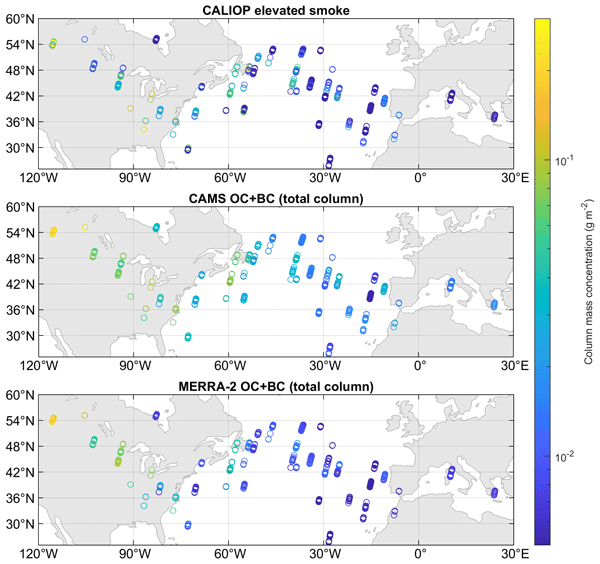
Xiaoxia Shang, Antti Lipponen, Maria Filioglou, Anu-Maija Sundström, Mark Parrington, Virginie Buchard, Anton S. Darmenov, Ellsworth J. Welton, Eleni Marinou, Vassilis Amiridis, Michael Sicard, Alejandro Rodríguez-Gómez, Mika Komppula, and Tero Mielonen
Atmos. Chem. Phys., 24, 1329–1344, https://doi.org/10.5194/acp-24-1329-2024, https://doi.org/10.5194/acp-24-1329-2024, 2024
Short summary
Short summary
In June 2019, smoke particles from a Canadian wildfire event were transported to Europe. The long-range-transported smoke plumes were monitored with a spaceborne lidar and reanalysis models. Based on the aerosol mass concentrations estimated from the observations, the reanalysis models had difficulties in reproducing the amount and location of the smoke aerosols during the transport event. Consequently, more spaceborne lidar missions are needed for reliable monitoring of aerosol plumes.
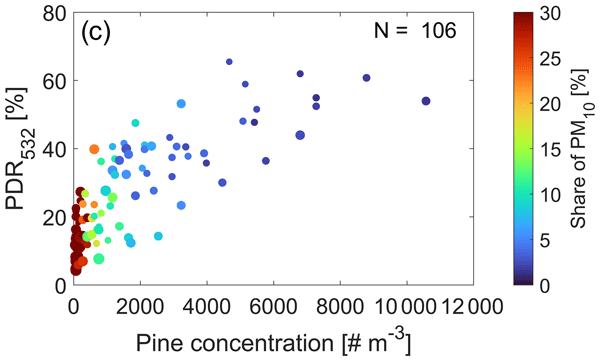
Maria Filioglou, Ari Leskinen, Ville Vakkari, Ewan O'Connor, Minttu Tuononen, Pekko Tuominen, Samuli Laukkanen, Linnea Toiviainen, Annika Saarto, Xiaoxia Shang, Petri Tiitta, and Mika Komppula
Atmos. Chem. Phys., 23, 9009–9021, https://doi.org/10.5194/acp-23-9009-2023, https://doi.org/10.5194/acp-23-9009-2023, 2023
Short summary
Short summary
Pollen impacts climate and public health, and it can be detected in the atmosphere by lidars which measure the linear particle depolarization ratio (PDR), a shape-relevant optical parameter. As aerosols also cause depolarization, surface aerosol and pollen observations were combined with measurements from ground-based lidars operating at different wavelengths to determine the optical properties of birch and pine pollen and quantify their relative contribution to the PDR.
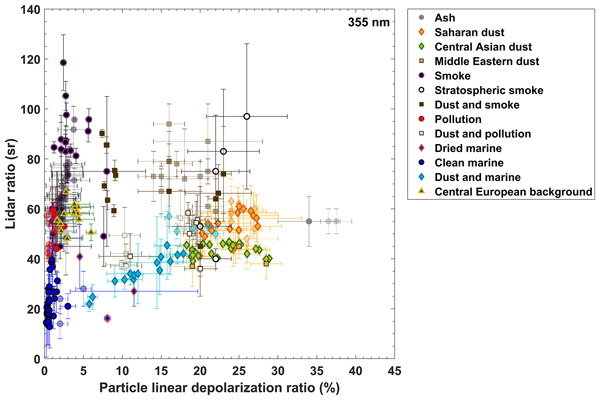
Athena Augusta Floutsi, Holger Baars, Ronny Engelmann, Dietrich Althausen, Albert Ansmann, Stephanie Bohlmann, Birgit Heese, Julian Hofer, Thomas Kanitz, Moritz Haarig, Kevin Ohneiser, Martin Radenz, Patric Seifert, Annett Skupin, Zhenping Yin, Sabur F. Abdullaev, Mika Komppula, Maria Filioglou, Elina Giannakaki, Iwona S. Stachlewska, Lucja Janicka, Daniele Bortoli, Eleni Marinou, Vassilis Amiridis, Anna Gialitaki, Rodanthi-Elisavet Mamouri, Boris Barja, and Ulla Wandinger
Atmos. Meas. Tech., 16, 2353–2379, https://doi.org/10.5194/amt-16-2353-2023, https://doi.org/10.5194/amt-16-2353-2023, 2023
Short summary
Short summary
DeLiAn is a collection of lidar-derived aerosol intensive optical properties for several aerosol types, namely the particle linear depolarization ratio, the extinction-to-backscatter ratio (lidar ratio) and the Ångström exponent. The data collection is based on globally distributed, long-term, ground-based, multiwavelength, Raman and polarization lidar measurements and currently covers two wavelengths, 355 and 532 nm, for 13 aerosol categories ranging from basic aerosol types to mixtures.
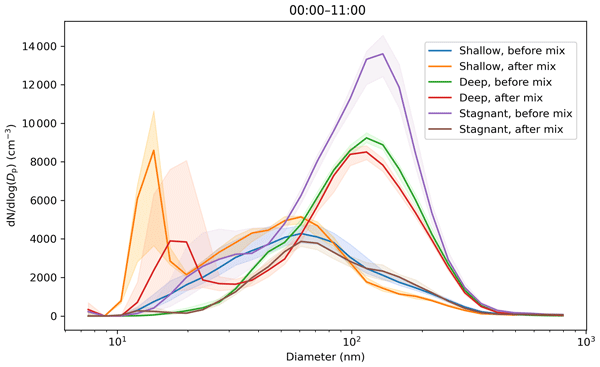
Jutta Kesti, John Backman, Ewan J. O'Connor, Anne Hirsikko, Eija Asmi, Minna Aurela, Ulla Makkonen, Maria Filioglou, Mika Komppula, Hannele Korhonen, and Heikki Lihavainen
Atmos. Chem. Phys., 22, 481–503, https://doi.org/10.5194/acp-22-481-2022, https://doi.org/10.5194/acp-22-481-2022, 2022
Short summary
Short summary
In this study we combined aerosol particle measurements at the surface with a scanning Doppler lidar providing vertical profiles of the atmosphere to study the effect of different boundary layer conditions on aerosol particle properties in the understudied Arabian Peninsula region. The instrumentation used in this study enabled us to identify periods when pollution from remote sources was mixed down to the surface and initiated new particle formation in the growing boundary layer.
Kanika Taneja, Silvia M. Calderón, Harri Kokkola, Juha Tonttila, Sami Romakkaniemi, Seethala Chellappan, Antti Arola, Antti Lipponen, Taina Yli-Juuti, Snehitha M. Kommula, Tuukka Petäjä, Markku Kulmala, and Tero Mielonen
EGUsphere, https://doi.org/10.5194/egusphere-2026-4750, https://doi.org/10.5194/egusphere-2026-4750, 2026
This preprint is open for discussion and under review for Atmospheric Chemistry and Physics (ACP).
Short summary
Short summary
Vegetation can cool the climate by releasing gases that form aerosols, which scatter sunlight and brighten clouds. To quantify this feedback in Finland and the United States, we combine field measurements of aerosols and satellite observations of clouds. It is essential to select near-ideal clouds; otherwise, cloud-related cooling is underestimated. Cloud cooling matched aerosol cooling at the clean site in Finland and was nearly three times stronger at the rural site in the United States.
Jenna DeVivo, Alexandria Stinchfield, Nirvan Bhattacharyya, Mitch Alton, Mingyi Wang, Siegfried Schobesberger, Liqing Hao, Mitchell Rogers, Alexander Vogel, Imad Zgheib, Natalie Burton, Clara Lietzke, Douglas M. Russell, Eva Sommer, Drew Gentner, Liine Heikkinen, Rainer Volkamer, Jasper Kirkby, Felipe Lopez-Hilfiker, Douglas Worsnop, Manjula Canagaratna, and Neil M. Donahue
EGUsphere, https://doi.org/10.5194/egusphere-2026-4542, https://doi.org/10.5194/egusphere-2026-4542, 2026
This preprint is open for discussion and under review for Atmospheric Chemistry and Physics (ACP).
Short summary
Short summary
The vapors driving atmospheric new particle formation are uncertain, in part because of instrumental limitations at small particle sizes. This study presents a novel coupling of a temperature-programmed desorption inlet with a bipolar mass spectrometer that has multiple types of chemical ionization used to study acid-base reactions controlling particulate evaporation.This method measures more components in atmospheric aerosol and separates reactive pathways contributing to early particle growth.
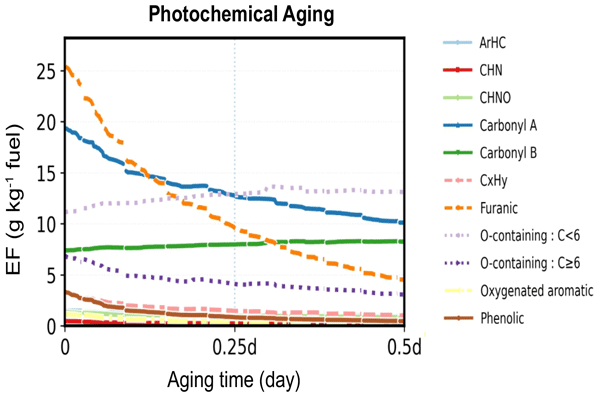
Deeksha Shukla, Lejish Vettikkat, Mika Ihalainen, Markus Somero, Hendryk Czech, Siegfried Schobesberger, Angela Buchholz, Iida Pullinen, Kerneels Jaars, Kajar Köster, Viet Le, Pasi Yli-Pirilä, Stefan J. Siebert, Pieter G. van Zyl, Annele Virtanen, Ville Vakkari, Olli Sippula, and Ralf Zimmermann
Atmos. Chem. Phys., 26, 12977–13000, https://doi.org/10.5194/acp-26-12977-2026, https://doi.org/10.5194/acp-26-12977-2026, 2026
Short summary
Short summary
Biomass burning emits large amounts of pollutants that undergo atmospheric transformation. This study examined organic vapor emissions from three biomass fuels and their transformation under different oxidation regimes in a smog chamber by real-time mass spectrometry. OH-driven oxidation rapidly altered organic vapor composition than dark oxidation, eliminating differences in chemical vapor composition arising from fuel types or combustion conditions.
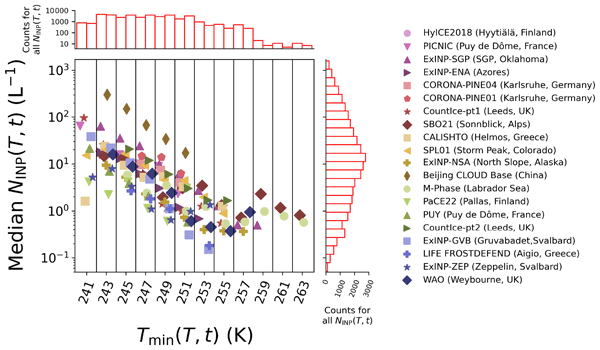
Ross J. Herbert, Larissa Lacher, Alexander Böhmländer, Mark D. Tarn, Antoine Canzi, Aidan Pantoya, Evelyn Freney, Kristina Höhler, Pia Bogert, Céline Planche, Ping Tian, Michael Adams, Sarah Barr, David Brus, Nicole Büttner, Martin Daily, Konstantinos Doulgeris, Konstantinos Eleftheriadis, Grant Forster, Romy Fösig, Dimitrios G. Georgakopoulos, Maria I. Gini, A. Gannet Hallar, Radovan Krejci, Elke Ludewig, Mauro Mazzola, Ian B. McCubbin, Athanasios Nenes, Tuukka Petäjä, Joseph Robinson, Franziska Vogel, Paul Zieger, Stephen Arnold, Kenneth S. Carslaw, Naruki Hiranuma, Ottmar Möhler, and Benjamin J. Murray
Earth Syst. Sci. Data, 18, 6465–6483, https://doi.org/10.5194/essd-18-6465-2026, https://doi.org/10.5194/essd-18-6465-2026, 2026
Short summary
Short summary
Ice formation in sub-zero clouds is influenced by airborne particles called ice-nucleating particles (INPs), whose concentrations vary substantially over short time and spatial scales. To assess the role of INPs in our climate, a comprehensive and consistent global dataset is essential. Our GloPINE model-ready dataset is a major step in this direction, comprising 36,000 measurements made using a single instrument design (PINE) over 70,000 hours of operation at 20 Northern Hemisphere sites.
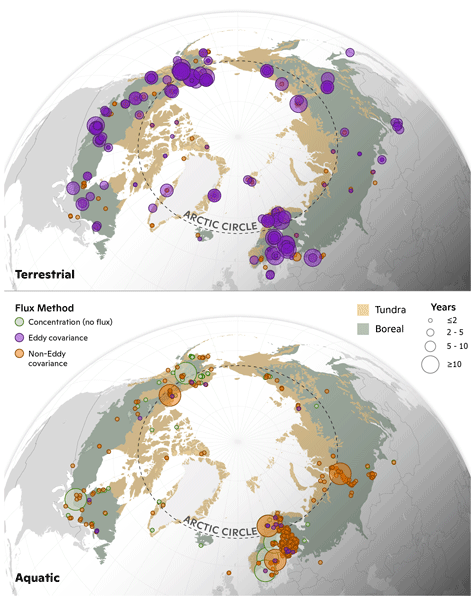
Anna-Maria Virkkala, Isabel Wargowsky, Judith Vogt, McKenzie A. Kuhn, Simran Madaan, Tiffany Windholz, Kyle A. Arndt, Gerard Rocher-Ros, Mathias Göckede, David Olefeldt, Edward A. G. Schuur, David Bastviken, Richard O'Keefe, Brendan M. Rogers, Jennifer D. Watts, Kelcy Kent, Kristoffer Aalstad, Kelly Aho, Joonatan Ala-Könni, Haley Alcock, Inge Althuizen, Christopher D. Arp, Jun Asanuma, Mika Aurela, Sivakiruthika Balathandayuthabani, Katrin Attermeyer, Alan Barr, Maialen Barret, Ochirbat Batkhishig, Christina Biasi, Mats P. Björkman, Andrew Black, Elena Blanc-Betes, Pascal Bodmer, Julia Boike, Abdullah Bolek, Frédéric Bouchard, Ingeborg Bussmann, Lea Cabrol, Eleonora Canfora, Sean Carey, Karel Castro-Morales, Namyi Chae, Andreas Christen, Torben R. Christensen, Casper T. Christiansen, Housen Chu, Graham Clark, Francois Clayer, Patrick Crill, Christopher Cunada, Scott J. Davidson, Joshua F. Dean, Sigrid Dengel, Matteo Detto, Catherine Dieleman, Florent Domine, Egor Dyukarev, Colin Edgar, Bo Elberling, Craig A. Emmerton, Eugenie Euskirchen, Grant Falvo, Thomas Friborg, Michelle Garneau, Mariasilvia Giamberini, Mikhail V. Glagolev, Miquel A. Gonzalez-Meler, Gustaf Granath, Jón Guðmundsson, Konsta Happonen, Yoshinobu Harazono, Lorna Harris, Josh Hashemi, Nicholas Hasson, Janna Heerah, Liam Heffernan, Manuel Helbig, Warren Helgason, Michal Heliasz, Greg Henry, Geert Hensgens, Tetsuya Hiyama, Beth Holmes, Macall Hock, David Holl, Jutta Holst, Thomas Holst, Gabriel Hould-Gosselin, Elyn Humphreys, Jacqueline Hung, Jussi Huotari, Hiroki Ikawa, Danil V. Ilyasov, Mamoru Ishikawa, Go Iwahana, Hiroki Iwata, Marcin Antoni Jackowicz-Korczynski, Joachim Jansen, Järvi Järveoja, Vincent E. J. Jassey, Rasmus Jensen, Katharina Jentzsch, Robert G. Jespersen, Carl-Fredrik Johannesson, Cheristy P. Jones, Anders Jonsson, Ji Young Jung, Sari Juutinen, Evan Kane, Jan Karlsson, Sergey Karsanaev, Kuno Kasak, Julia Kelly, Kasha Kempton, Marcus Klaus, George W. Kling, Natascha Kljun, Jacqueline Knutson, Hideki Kobayashi, John Kochendorfer, Kukka-Maaria Kohonen, Pasi Kolari, Mika Korkiakoski, Aino Korrensalo, Pirkko Kortelainen, Egle Koster, Kajar Koster, Ayumi Kotani, Praveena Krishnan, Juliya Kurbatova, Lars Kutzbach, Min Jung Kwon, Ethan D. Kyzivat, Jessica Lagroix, Theodore Langhorst, Elena Lapshina, Tuula Larmola, Klaus S. Larsen, Isabelle Laurion, Justin Ledman, Hanna Lee, A. Joshua Leffler, Lance Lesack, Anders Lindroth, David Lipson, Annalea Lohila, Efrén López-Blanco, Vincent L. St. Louis, Erik Lundin, Miska Luoto, Takashi Machimura, Marta Magnani, Avni Malhotra, Marja Maljanen, Ivan Mammarella, Elisa Männistö, Luca Belelli Marchesini, Phil Marsh, Pertti J. Martikainen, Maija E. Marushchak, Mikhail Mastepanov, Alex Mavrovic, Trofim Maximov, Christina Minions, Daniel F. Nadeau, Marco Montemayor, Tomoaki Morishita, Patrick Murphy, Erin Nicholls, Mats B. Nilsson, Anastasia Niyazova, Jenni Nordén, Koffi Dodji Noumonvi, Hannu Nykänen, Walter Oechel, Anne Ojala, Tomohiro Okadera, Sujan Pal, Alexey V. Panov, Tim Papakyriakou, Dario Papale, Sang-Jong Park, Frans-Jan W. Parmentier, Gilberto Pastorello, Mike Peacock, Matthias Peichl, Roman Petrov, Kyra St. Pierre, Norbert Pirk, Jessica Plein, Vilmantas Preskienis, Anatoly Prokushkin, Jukka Pumpanen, Hilary A. Rains, Niklas Rakos, Aleksi Räsänen, Helena Rautakoski, Riikka Rinnan, Janne Rinne, Adrian Rocha, Nigel Roulet, Alexandre Roy, Anna Rutgersson, Aleksandr F. Sabrekov, Torsten Sachs, Erik Sahlée, Alejandro Salazar, Henrique Oliveira Sawakuchi, Christopher Schulze, Roger Seco, Armando Sepulveda-Jauregui, Svetlana Serikova, Abbey Serrone, Hanna M. Silvennoinen, Sofie Sjogersten, June Skeeter, Jo Snöälv, Sebastian Sobek, Oliver Sonnentag, Emily H. Stanley, Maria Strack, Lena Strom, Patrick Sullivan, Ryan Sullivan, Anna Sytiuk, Torbern Tagesson, Pierre Taillardat, Julie Talbot, Suzanne E. Tank, Mario Tenuta, Irina Terenteva, Frederic Thalasso, Antoine Thiboult, Halldor Thorgeirsson, Fenix Garcia Tigreros, Margaret Torn, Amy Townsend-Small, Claire Treat, Alain Tremblay, Carlo Trotta, Eeva-Stiina Tuittila, Merritt Turetsky, Masahito Ueyama, Muhammad Umair, Aki Vähä, Lona van Delden, Maarten van Hardenbroek, Andrej Varlagin, Ruth K. Varner, Tarmo Virtanen, Elena Veretennikova, Timo Vesala, Carolina Voigt, Jorien E. Vonk, Robert Wagner, Katey Walter Anthony, Qinxue Wang, Masataka Watanabe, Hailey Webb, Jeffrey M. Welker, Andreas Westergaard-Nielsen, Sebastian Westermann, Jeffrey R. White, Christian Wille, Scott N. Williamson, Scott Zolkos, Donatella Zona, and Susan M. Natali
Earth Syst. Sci. Data, 18, 6357–6409, https://doi.org/10.5194/essd-18-6357-2026, https://doi.org/10.5194/essd-18-6357-2026, 2026
Short summary
Short summary
This dataset includes monthly measurements of carbon dioxide and methane exchange between land, water, and the atmosphere from over 1000 sites in Arctic and boreal regions. It combines measurements from a variety of ecosystems, including wetlands, forests, tundra, lakes, and rivers, gathered by over 260 researchers from 1984–2024. This dataset can be used to improve and reduce uncertainty in carbon budgets in order to strengthen our understanding of climate feedbacks in a warming world.
Konstantinos Matthaios Doulgeris, David Brus, Christian Maier, Naděžda Zikova, Kajal Julaha, Cuiqi Zhang, Zamin A. Kanji, Ville Kaikkonen, Harri Juttula, Eero Molkoselkä, Anssi Makynen, Mika Komppula, Sergej Sel, and Elke Ludewig
EGUsphere, https://doi.org/10.5194/egusphere-2026-3898, https://doi.org/10.5194/egusphere-2026-3898, 2026
Short summary
Short summary
Clouds are important for weather and climate, but measuring their cloud water droplets accurately is difficult. We compared seven instruments during a field campaign at a high mountain observatory under natural cloud conditions. We found that the way instruments are installed can strongly influence the measurements. Our results provide practical guidance for improving cloud observations and support more consistent measurements across the European ACTRIS research infrastructure.
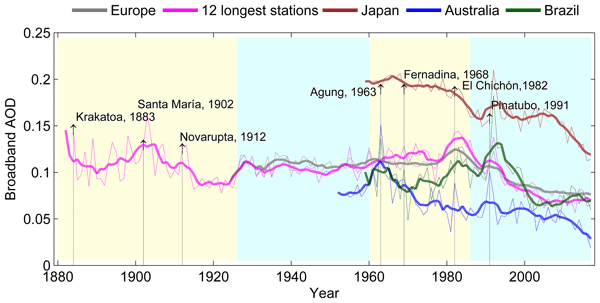
William Wandji Nyamsi, Ville Leinonen, Antti Lipponen, Else van den Besselaar, Santtu Mikkonen, Arturo Sanchez-Lorenzo, Martin Wild, Doris Folini, Tero Mielonen, Harri Kokkola, Antti Kukkurainen, Neus Sabater, Rei Kudo, Ben Liley, Raghav Srinivasan, Bruce W. Forgan, Alexandru Dumitrescu, Grzegorz Urban, Michał K. Kowalewski, Márcia Akemi Yamasoe, Nilton Évora do Rosário, Dimitra Founda, Stelios Kazadzis, Veronica Manara, Derbetini A. Vondou, Christian Gueymard, Anders V. Lindfors, Atsumu Ohmura, and Antti Arola
Atmos. Chem. Phys., 26, 10767–10788, https://doi.org/10.5194/acp-26-10767-2026, https://doi.org/10.5194/acp-26-10767-2026, 2026
Short summary
Short summary
Worldwide reconstructed historical aerosol load reveals that during the period of:
- 1900–1959: the atmosphere became cleaner in most European cities;
- 1960–1985: anthropogenic aerosols were responsible for the dimming phenomenon in Europe. AOD increased over Southeast Brazil and decreased noticeably over Japan while a small negative trend was found over Oceania;
- 1986–2015: generally, the atmosphere has become much cleaner everywhere after the reversal trend around 1980s mainly observed in Europe.
Jonas Svensson, Ramazon Rakhmonov, Kamoliddin Nazirzoda, Abdusamad Hojiev, Tamlikho Jurabekov, Amirsho Hiyoev, Davlatjon Rahimzoda, Hizbullo Kholzoda, Muzaffar Shodmonov, David Brus, Viet Le, Krista Luoma, Adriano Lemos, Germán Perez Fogwill, Meri M. Ruppel, Outi Meinander, Johan Ström, Eija Asmi, and Antti Hyvärinen
Earth Syst. Sci. Data, 18, 5697–5712, https://doi.org/10.5194/essd-18-5697-2026, https://doi.org/10.5194/essd-18-5697-2026, 2026
Short summary
Short summary
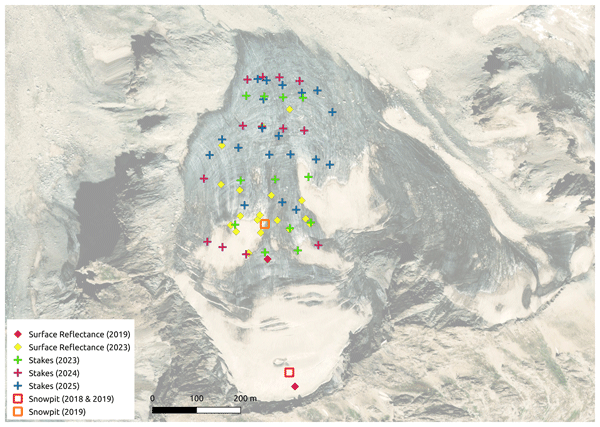
This paper presents data collected at the Zarafshon River Basin and the Hydrographic Party Glacier (GGP), Tajikistan. In annual field expeditions from 2018–2025, data has been collected on the glacier, as well as including meteorological measurements and aerosols. Presented results highlight the environmental conditions that are driving environmental change in Central Asia.
Viet Le, Ewan J. O'Connor, Maria Filioglou, and Ville Vakkari
Atmos. Meas. Tech., 19, 4923–4941, https://doi.org/10.5194/amt-19-4923-2026, https://doi.org/10.5194/amt-19-4923-2026, 2026
Short summary
Short summary
We evaluate the performance of the Vaisala CL61 ceilometer, with depolarization ratio capability at 910 nm, over a three-year period at four locations. This study examines instrument performance over time, describes methods for correcting instrument bias and presents corresponding uncertainty estimates. As these instruments are being deployed across large research networks, our findings support stable instrument performance and the generation of reliable measurements and derived products.
Aino Ovaska, Daniel Holmberg, Elio Rauth, Mansour Alghamdi, Paulo Artaxo, Eija Asmi, John Backman, Benjamin Bergmans, Matthew Boyer, Liezl Bredenkamp, Maurizio Busetto, Delano Campos De Oliveira, Juan Andrés Casquero-Vera, Darius Ceburnis, Tak Chan, Tommy Chan, Sebastien Conil, Daniele Contini, Suzanne Crumeyrolle, Valentin Duflot, Kostas Eleftheriadis, Johan Esveld, Ekaterina Ezhova, Markus Fiebig, Shahzad Gani, Olga Garmash, Francisco Gómez-Moreno, Roy M. Harrison, Andras Hoffer, Rakesh Hooda, Antti Hyvärinen, Tareq Hussein, Jorma Joutsensaari, Nikos Kalivitis, Heinz Kaminski, Jutta Kesti, Radovan Krejci, Adam Kristensson, Chongai Kuang, Markku Kulmala, Lauri Laakso, Ari Leskinen, Heikki Lihavainen, Andreas Massling, Maik Merkel, Steffen Noe, Jakub Ondracek, Noemí Perez, Jean-Eudes Petit, Tuukka Petäjä, Michael Pikridas, Christopher Pöhlker, Mira Pöhlker, Jean-Philippe Putaud, Ximeng Qi, Cristina Reche, Sergio Rodríguez, Petr Roztocil, Jean Sciare, Karine Sellegri, Dongjie Shang, Ashish Singh, Mikko Sipilä, Henrik Skov, Mar Sorribas, Tamanna Subba, Junying Sun, Peter Tunved, Ville Vakkari, Pieter G. Van Zyl, Aki Virkkula, Jens Voigtländer, Kay Weinhold, Alfred Wiedensohler, Hee-Jung Yoo, Putian Zhou, Kai Puolamäki, Tuomo Nieminen, Veli-Matti Kerminen, Victoria A. Sinclair, and Pauli Paasonen
Earth Syst. Sci. Data Discuss., https://doi.org/10.5194/essd-2026-415, https://doi.org/10.5194/essd-2026-415, 2026
Preprint under review for ESSD
Short summary
Short summary
All clouds form around aerosol particles, and their abundance influences cloud properties. In turn, clouds affect climate by changing how energy moves through the atmosphere, making them important for climate change. To better understand these interactions, we need accurate information on how many aerosol particles are in the atmosphere. Therefore, we have developed a new 21-year global dataset of particle concentrations relevant for cloud formation.
Maria Christina Gatou, Antti Lipponen, Ari Leskinen, Petri Tiitta, Maria Filioglou, Xiaoxia Shang, Sanna Pätsi, Annika Saarto, Marjut Roponen, Elina Giannakaki, and Mika Komppula
EGUsphere, https://doi.org/10.5194/egusphere-2026-1806, https://doi.org/10.5194/egusphere-2026-1806, 2026
Short summary
Short summary
We investigate the pollen distribution at different heights using measurements from ground level up to 272 meters in eastern Finland. By combining optical pollen sensors with traditional monitoring methods and atmospheric model predictions, we examined how pollen concentrations vary with height. The results show that pollen concentrations decrease with altitude and that optical sensors combined with machine learning can identify dominant pollen types for continuous pollen monitoring.
Ari Leskinen, Antonia Radlwimmer, Uula Isopahkala, Silvia Calderón, David Brus, Konstantinos Doulgeris, Ville Kaikkonen, Eero Molkoselkä, Dmitri Moiseev, Marie Lou Hirschy, Anssi Mäkynen, Sami Romakkaniemi, and Mika Komppula
EGUsphere, https://doi.org/10.5194/egusphere-2026-2088, https://doi.org/10.5194/egusphere-2026-2088, 2026
Short summary
Short summary
We present a lightweight holographic imaging instrument, designed for high-resolution in-cloud particle measurements at a rate of 10 holograms per second, which leads to sub-meter spatial resolution on-board UAV. The approach offers a cost-effective and versatile alternative, capable of accessing confined or remote areas, enabling improved validation of remote sensing products and numerical cloud models. We present the potential of such instrumentation for high-resolution cloud observations.
Hendrik Fuchs, Niklas Illmann, Amalia Muñoz, Mila Ródenas, Bénédicte Picquet-Varrault, M. Rami Alfarra, Cecilia Arsene, Iustinian G. Bejan, David M. Bell, Merete Bilde, Alexander Böhmländer, Mixtli Campos-Pineda, Mathieu Cazaunau, Patrice Coll, Véronique Daële, Claudia Di Biagio, Michael Flynn, Paola Formenti, Hartmut Herrmann, Kristina Höhler, Thorsten Hohaus, Matthew S. Johnson, Eija Juurola, Niku Kivekäs, Jan Kaiser, Christos Kaltsonoudis, Paolo Laj, Dario Massabò, Federico Mazzei, Gordon McFiggans, Max R. McGillen, Abdelwahid Mellouki, Peter Mettke, Ottmar Möhler, Falk Mothes, Dennis Niedermeier, Anna Novelli, Romeo I. Olariu, Spyros N. Pandis, Iulia Patroescu-Klotz, Rosa Maria Petracca Altieri, Paolo Prati, Claudiu Roman, Albert A. Ruth, Harald Saathoff, Silvio Schmalfuß, Frank Stratmann, Virginia Vernocchi, Aristeidis Voliotis, Jens Voigtländer, Annele Virtanen, Andreas Wahner, Robert Wagner, John Wenger, Sören Zorn, Peter Wiesen, and Jean-Francois Doussin
Atmos. Meas. Tech., 19, 4165–4199, https://doi.org/10.5194/amt-19-4165-2026, https://doi.org/10.5194/amt-19-4165-2026, 2026
Short summary
Short summary
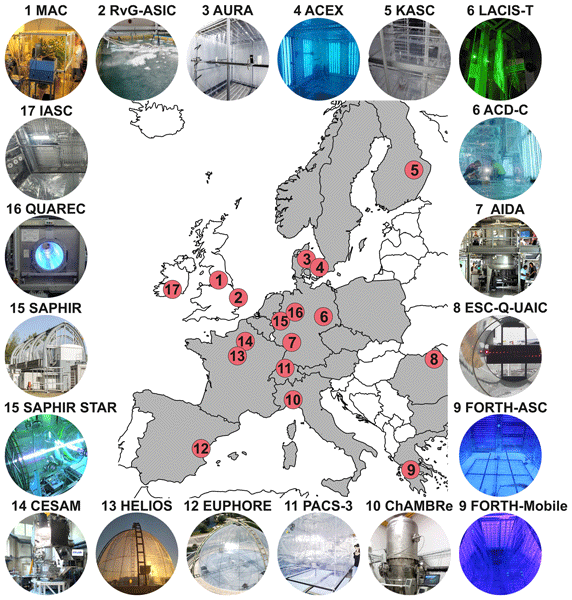
Atmospheric simulation chambers enable experiments to be conducted under controlled conditions, improving our understanding of, and ability to predict, changes in the composition of the atmosphere. This is important for assessing air quality and its effects on human health, climate, the environment, and the economy. This paper describes the chambers of the European ACTRIS research infrastructure and discusses topics and directions that can be addressed in future chamber experiments.
Tamryn Hamilton, Kerneels Jaars, Pieter G. van Zyl, Mika Aurela, Marcellin Adon, Johan P. Beukes, Miroslav Josipovic, Gregor T. Feig, Markku Kulmala, Lauri Laakso, and Ville Vakkari
EGUsphere, https://doi.org/10.5194/egusphere-2026-3066, https://doi.org/10.5194/egusphere-2026-3066, 2026
Short summary
Short summary
South Africa is a global hotspot for nitrogen dioxide, yet direct surface exchange measurements are absent from Africa. Using a high-precision laser at a savanna grassland site from 2015 to 2020, we made the first landscape-scale nitrogen dioxide flux measurements on the continent. The site mainly released nitrogen dioxide, driven by summer rainfall and soil microbes. We estimated the ecosystem-scale balance point between uptake and release. Widely used models overestimate daytime deposition.
Luka Drinovec, Jesus Yus-Diez, Tobias Bühlmann, Maitane Iturrate-Garcia, Tobias Hammer, Konstantina Vasilatou, Arun Babu Suja, Thomas Müller, Krzysztof Ciupek, Alejandro Keller, Ernest Weingartner, Jorge Saturno, Maria Gini, Kostas Eleftheriadis, John Backman, Eija Asmi, and Griša Močnik
EGUsphere, https://doi.org/10.5194/egusphere-2026-1501, https://doi.org/10.5194/egusphere-2026-1501, 2026
Short summary
Short summary
We evaluated a traceable calibration method for aerosol absorption instruments based on monodisperse nigrosin particles. The absorption coefficient calculated using Mie theory was compared with measurements using the Photo-Thermal Aerosol Absorption Monitor, traceably calibrated with NO2. Particle classification using setups with the differential mobility analyzer, the centrifugal particle mass analyzer and a tandem of both in series were tested.
Nick Schutgens, Elisabeth J. Andrews, Antti Arola, Yusuf Bhatti, Guanliang Fu, Otto Hasekamp, Pekka Kolmonen, Antti Lipponen, Tero Mielonen, Leighton Reygare, and Andrew M. Sayer
EGUsphere, https://doi.org/10.5194/egusphere-2026-2656, https://doi.org/10.5194/egusphere-2026-2656, 2026
Short summary
Short summary
Aerosol are fine particles in the air that affect public health and the climate. We develop a new method to study aerosol through patterns (called autocorrelations) in their time-series. We show that autocorrelations are linked to aerosol deposition processes and contain information on the important but uncertain aerosol lifetime. Autocorrelations can be observed from satellites and we provide the first ever global climatology of aerosol autocorrelations.
Viet Le, Konstantinos Doulgeris, Mika Komppula, John Backman, Gholamhossein Bagheri, Eberhard Bodenschatz, and David Brus
Earth Syst. Sci. Data Discuss., https://doi.org/10.5194/essd-2026-135, https://doi.org/10.5194/essd-2026-135, 2026
Preprint under review for ESSD
Short summary
Short summary
Vertical profiles and time series of aerosol particles, cloud droplets, and weather conditions were measured by the Finnish Meteorological Institute airborne payload attached to tethered balloons during the Pallas Cloud Experiment 2022 in Finland. When combined with other datasets collected during the campaign, these measurements will enable integrated analyses and offer a comprehensive view of the atmospheric conditions during the experiment.
John Backman, Sho Ohata, Yutaka Kondo, Jonas Svensson, Eija Asmi, Hitoshi Matsui, and Tatsuhiro Mori
EGUsphere, https://doi.org/10.5194/egusphere-2026-2102, https://doi.org/10.5194/egusphere-2026-2102, 2026
Short summary
Short summary
The Arctic climate is affected detrimentally by black carbon (BC). Our unique long-term observational results imply that Arctic BC size distributions do not wary substantially in space nor time although the mass concentration of BC can vary by orders of magnitude. Our findings suggest that, when modeling the climate impacts of BC in the Arctic, it is realistic to consider a BC size distribution with low variability.
Jessica Girdwood, David Brus, Konstantinos-Matthaios Doulgeris, and Alexander Böhmländer
Earth Syst. Sci. Data, 18, 2819–2828, https://doi.org/10.5194/essd-18-2819-2026, https://doi.org/10.5194/essd-18-2819-2026, 2026
Short summary
Short summary
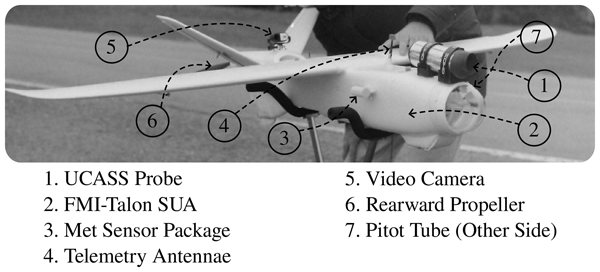
In-situ data of cloud microphysics is essential for targeted studies of cloud processes, validating remote sensing, and both assessing and improving the accuracy of weather and climate models. In this work we adopt a novel technique using a small uncrewed aircraft (SUA) and a bespoke sensor to produce vertical profiles of cloud microphysical parameters. The data are publicly available from https://zenodo.org/records/14756233.
Hugo Rubio, Ville Vakkari, Martin Kühn, and Julia Gottschall
Wind Energ. Sci. Discuss., https://doi.org/10.5194/wes-2026-50, https://doi.org/10.5194/wes-2026-50, 2026
Preprint withdrawn
Short summary
Short summary
Offshore wind farms need accurate wind data, but collecting measurements at sea is often difficult and expensive. In this study, we investigate how wind measurements from a lidar mounted on a moving ship can improve the accuracy of commonly used reanalysis datasets. Using a statistical correction method, we are able to reduce errors in wind speed estimates. This efficient approach can make offshore wind planning and resource assessment more reliable in areas where measurements are limited.
Zhen Song, Chenqi Zhang, Hongru Shen, Hao Ma, Iida Pullinen, and Defeng Zhao
Atmos. Chem. Phys., 26, 2769–2784, https://doi.org/10.5194/acp-26-2769-2026, https://doi.org/10.5194/acp-26-2769-2026, 2026
Short summary
Short summary
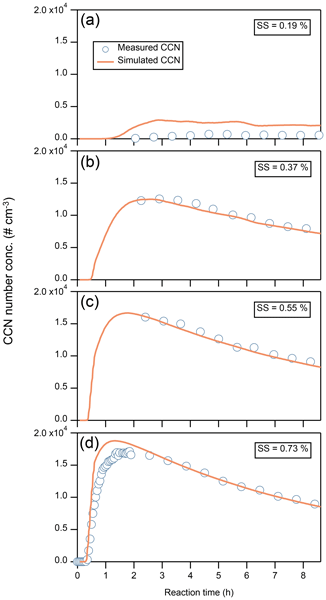
Secondary organic aerosol (SOA) can act as cloud condensation nuclei (CCN) and influence global cloud formation. This study modeled CCN and chemical composition, aerosol size and hygroscopicity (κ) of SOA using a model treating every single step. We evaluated the model ability and limitations in simulated chemical composition, κ, particle size distribution and CCN as a potential benchmark model and found that the accurate simulation of SOA size and κ is essential for reliable CCN prediction.
Xiaoxia Shang, Maria Filioglou, Julian Hofer, Moritz Haarig, Qiaoyun Hu, Philippe Goloub, Sami Romakkaniemi, and Mika Komppula
Atmos. Meas. Tech., 19, 679–697, https://doi.org/10.5194/amt-19-679-2026, https://doi.org/10.5194/amt-19-679-2026, 2026
Short summary
Short summary
We developed a simple method to identify different types of airborne particles using laser-based measurements. It can distinguish coarse dust, fine dust, and non-dust aerosols. Tests with real data from regions affected by desert dust show the method works well. This helps improve understanding of how particles are distributed in the atmosphere, which is important for air quality and climate studies.
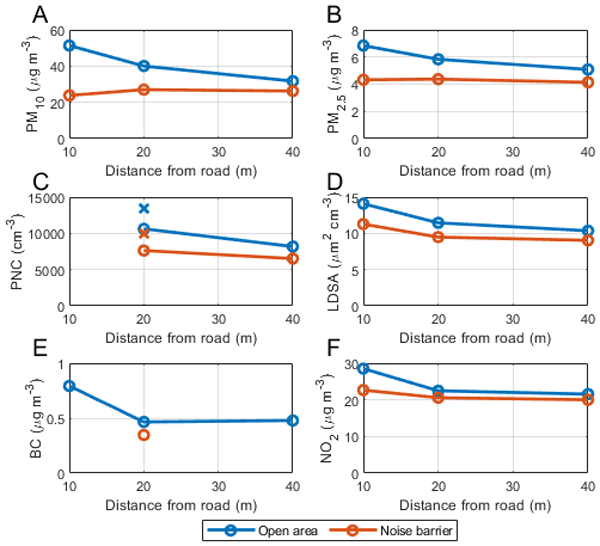
Sami D. Harni, Lasse Johansson, Jarkko V. Niemi, Ville Silvonen, Juan Andrés Casquero-Vera, Anu Kousa, Krista Luoma, Viet Le, David Brus, Konstantinos Doulgeris, Topi Rönkkö, Hanna E. Manninen, Tuukka Petäjä, and Hilkka Timonen
Atmos. Chem. Phys., 25, 18719–18738, https://doi.org/10.5194/acp-25-18719-2025, https://doi.org/10.5194/acp-25-18719-2025, 2025
Short summary
Short summary
A three-month-long measurement campaign was conducted at Espoo, Finland, in spring 2023. The measurement campaign studied the effect of the noise barrier on pollutant concentration gradients on the side of a major highway. The studied pollutants included PM10, PM2.5, lung deposited surface area (LDSA), particle number concentration (PNC), NO2, and black carbon (BC). The noise barrier was found to be effective in reducing, especially the concentration of particulate pollutants.
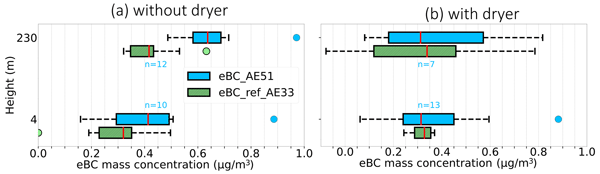
Kajal Julaha, Vladimír Ždímal, Saliou Mbengue, David Brus, and Naděžda Zíková
Atmos. Chem. Phys., 25, 17933–17951, https://doi.org/10.5194/acp-25-17933-2025, https://doi.org/10.5194/acp-25-17933-2025, 2025
Short summary
Short summary
This study used drones for vertical profiling of black carbon and particle number at rural and urban sites in Czechia. With aerosol drying, drone measurements matched with fixed instruments; without drying, black carbon was significantly overestimated. Rural profiles were more stratified in winter, while urban summer profiles were well-mixed. These findings can help improve air-quality monitoring and policies by capturing vertical pollution structures that ground stations cannot resolve.
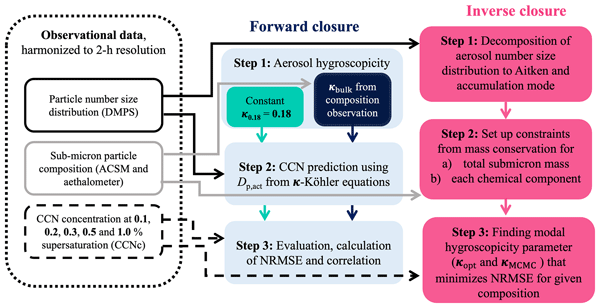
Rahul Ranjan, Maura Dewey, Liine Heikkinen, Lauri R. Ahonen, Krista Luoma, Paul Bowen, Tuukka Petäjä, Annica M. L. Ekman, Daniel G. Partridge, and Ilona Riipinen
Atmos. Chem. Phys., 25, 17275–17300, https://doi.org/10.5194/acp-25-17275-2025, https://doi.org/10.5194/acp-25-17275-2025, 2025
Short summary
Short summary
We use multi-year measurements of cloud condensation nuclei (CCN) at a boreal forest site to inversely infer size-resolved aerosol chemical composition. We find that inorganic species are more enriched in the larger end (accumulation mode) of the sub-micron aerosol population while organics often dominate the smaller end (Aitken mode). Our approach demonstrates the potential of long-term CCN measurements to infer size-resolved chemical composition of sub-micron aerosol.
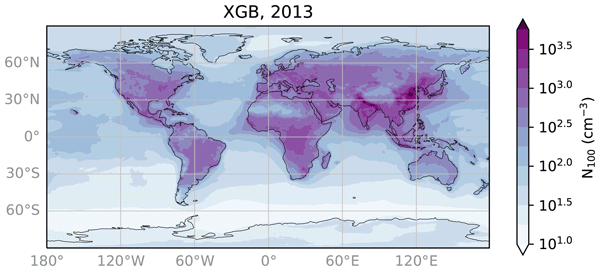
Aino Ovaska, Elio Rauth, Daniel Holmberg, Paulo Artaxo, John Backman, Benjamin Bergmans, Don Collins, Marco Aurélio Franco, Shahzad Gani, Roy M. Harrison, Rakesh K. Hooda, Tareq Hussein, Antti-Pekka Hyvärinen, Kerneels Jaars, Adam Kristensson, Markku Kulmala, Lauri Laakso, Ari Laaksonen, Nikolaos Mihalopoulos, Colin O'Dowd, Jakub Ondracek, Tuukka Petäjä, Kristina Plauškaitė, Mira Pöhlker, Ximeng Qi, Peter Tunved, Ville Vakkari, Alfred Wiedensohler, Kai Puolamäki, Tuomo Nieminen, Veli-Matti Kerminen, Victoria A. Sinclair, and Pauli Paasonen
Aerosol Research, 3, 589–618, https://doi.org/10.5194/ar-3-589-2025, https://doi.org/10.5194/ar-3-589-2025, 2025
Short summary
Short summary
We trained machine learning models to estimate the number of aerosol particles large enough to form clouds and generated daily estimates for the entire globe. The models performed well in many continental regions but struggled in remote and marine areas. Still, this approach offers a way to quantify these particles in areas that lack direct measurements, helping us understand their influence on clouds and climate on a global scale.
Konstantinos Matthaios Doulgeris, Ville Kaikkonen, Harri Juttula, Eero Molkoselkä, Anssi Mäkynen, and David Brus
Earth Syst. Sci. Data, 17, 6497–6506, https://doi.org/10.5194/essd-17-6497-2025, https://doi.org/10.5194/essd-17-6497-2025, 2025
Short summary
Short summary
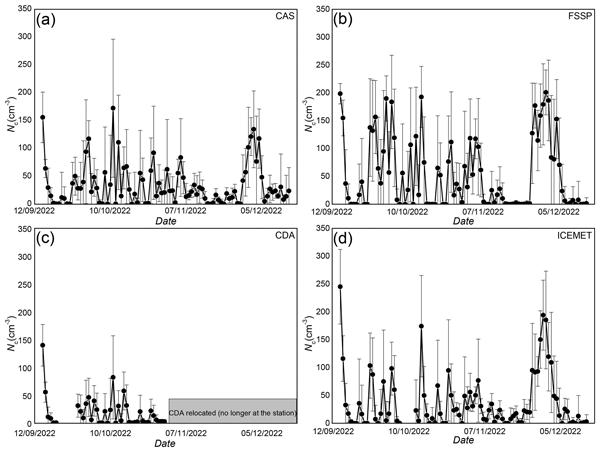
We present data collected from ground-based cloud instruments that measured cloud droplets in autumn 2022 in northern Finland. The aim of the research was to improve understanding of how clouds form and behave in cold regions. Measurements were taken directly inside clouds and include information on droplet sizes, water content, and weather conditions. The results support better climate and weather prediction.
Sujai Banerji, Krista Luoma, Ilona Ylivinkka, Lauri Ahonen, Veli-Matti Kerminen, and Tuukka Petäjä
Atmos. Chem. Phys., 25, 16895–16914, https://doi.org/10.5194/acp-25-16895-2025, https://doi.org/10.5194/acp-25-16895-2025, 2025
Short summary
Short summary
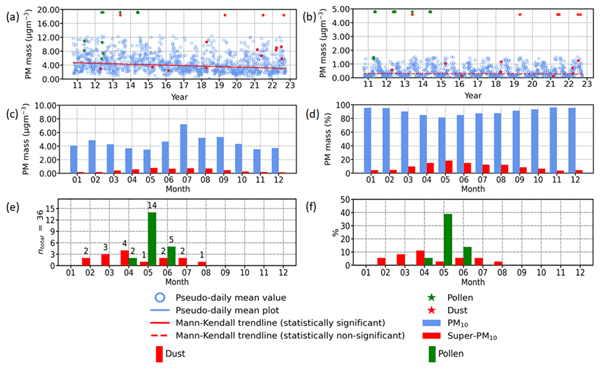
We studied supermicron aerosol particles (PM1–10) for 12 years at a Finnish boreal forest by subtracting PM1 from total measurements. This allowed us to examine their optical and mass properties, seasonal patterns and events like pollen and dust. We also measured particles >10 µm using filters, which are missed by optical instruments. These large particles significantly influence light scattering.
Arya Mukherjee, Anni Hartikainen, Markus Somero, Viljami Luostari, Mika Ihalainen, Christopher P. Rüger, Timo Kekäläinen, Ville H. Nissinen, Luis M. F. Barreira, Hanna Koponen, Tuukka Kokkola, Delun Li, Lejish Vettikkat, Pasi Yli-Pirilä, Muhammad Shahzaib, Meri M. Ruppel, Ville Vakkari, Kerneels Jaars, Stefan J. Siebert, Angela Buchholz, Kajar Köster, Pieter G. van Zyl, Hilkka Timonen, Niko Kinnunen, Janne Jänis, Annele Virtanen, Aki Virkkula, and Olli Sippula
Atmos. Chem. Phys., 25, 16747–16774, https://doi.org/10.5194/acp-25-16747-2025, https://doi.org/10.5194/acp-25-16747-2025, 2025
Short summary
Short summary
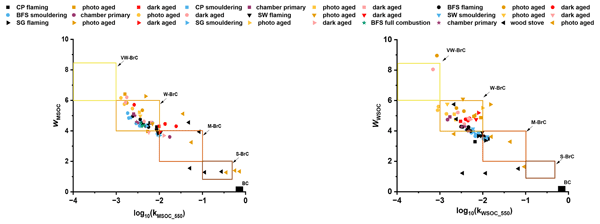
Warming climate is predicted to increase boreal and peatland fires in Northern Eurasia. Limited studies have characterized light absorbing aerosol emissions from these biomasses, thus necessitating this work. Brown carbon (BrC) emitted from laboratory-scale biomass burning had weak light absorptivities based on their complex refractive index values. A combustion temperature dependent light absorptivity continuum existed for emitted BrC. Photochemical aging decreased BrC light absorptivity.
Ioanna Tsikoudi, Eleni Marinou, Maria Tombrou, Eleni Giannakaki, Emmanouil Proestakis, Konstantinos Rizos, Ville Vakkari, Holger Baars, Annett Skupin, Ronny Engelmann, Zhenping Yin, and Vassilis Amiridis
Atmos. Chem. Phys., 25, 16491–16510, https://doi.org/10.5194/acp-25-16491-2025, https://doi.org/10.5194/acp-25-16491-2025, 2025
Short summary
Short summary
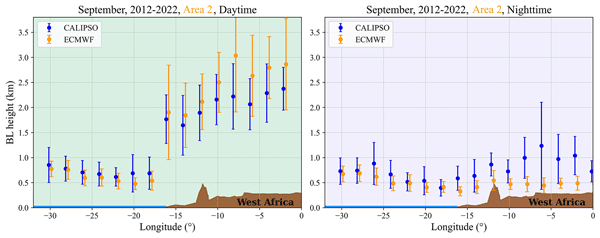
We study the characteristics of the boundary layer over three areas: the tropical Atlantic, the tropical West African continent, and near Cabo Verde using PollyXT and CALIPSO (Cloud-Aerosol Lidar and Infrared Pathfinder Satellite Observations) lidar measurements, as well as ECMWF (European Centre for Medium-Range Weather Forecasts) data. The findings underline the strengths and limitations of different observational and modeling approaches, and emphasizes on the importance of considering aerosol conditions and local meteorology when interpreting boundary layer dynamics.
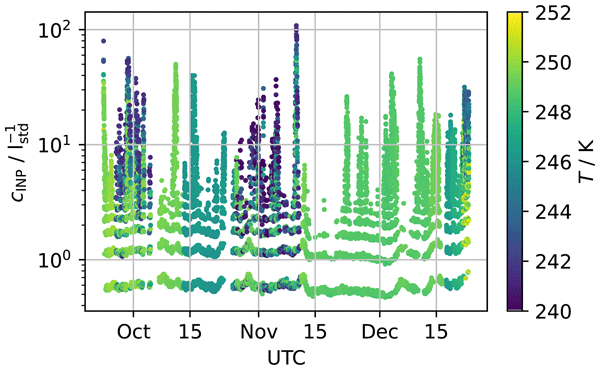
Alexander Böhmländer, Larissa Lacher, Romy Fösig, Nicole Büttner, Jens Nadolny, David Brus, Konstantinos-Matthaios Doulgeris, and Ottmar Möhler
Earth Syst. Sci. Data, 17, 6165–6171, https://doi.org/10.5194/essd-17-6165-2025, https://doi.org/10.5194/essd-17-6165-2025, 2025
Short summary
Short summary
Cloud-aerosol interactions lead to a phase change of water droplets inside the atmosphere. One of these interactions happens due to a small subset of aerosols, ice-nucleating particles (INPs). These INPs lead to the freezing of pure water droplets above −35 °C, which otherwise would stay liquid. This has impacts on the weather and climate. The present data set presents a unique data set with a high temporal resolution.
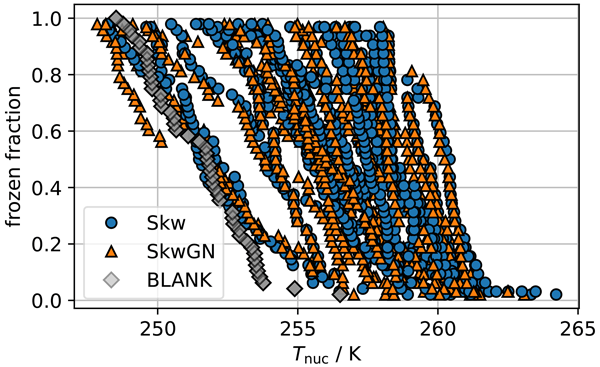
Alexander Böhmländer, Larissa Lacher, Kristina Höhler, David Brus, Konstantinos-Matthaios Doulgeris, Jessica Girdwood, Thomas Leisner, and Ottmar Möhler
Earth Syst. Sci. Data, 17, 6157–6164, https://doi.org/10.5194/essd-17-6157-2025, https://doi.org/10.5194/essd-17-6157-2025, 2025
Short summary
Short summary
Clouds play a key role in weather and climate. Pure liquid water droplets are liquid until about −35 °C without the presence of a small subset of aerosols, ice-nucleating particles (INPs). These INPs lead to primary ice formation and therefore impact the phase of clouds. The dataset described herein provides INP concentration measurements at two altitudes. Connecting this data to synoptic conditions and ambient data might provide a better understanding of INPs in Finnish Lapland.
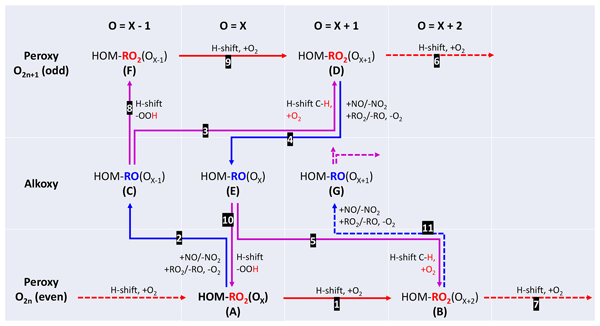
Sungah Kang, Jürgen Wildt, Iida Pullinen, Luc Vereecken, Cheng Wu, Andreas Wahner, Sören R. Zorn, and Thomas F. Mentel
Atmos. Chem. Phys., 25, 15715–15740, https://doi.org/10.5194/acp-25-15715-2025, https://doi.org/10.5194/acp-25-15715-2025, 2025
Short summary
Short summary
Highly oxygenated organic molecules by atmospheric oxidation of plant emitted monoterpenes are important components in secondary organic aerosol formation. Autoxidation of organic peroxy radicals is one important pathway of their formation. We show that isomerization of highly oxygenated alkoxy radicals leads to highly oxygenated peroxy radicals that continue the autoxidation chain. Alkoxy-peroxy steps may dominate the formation of highly oxygenated molecules at high nitrogen oxide levels.
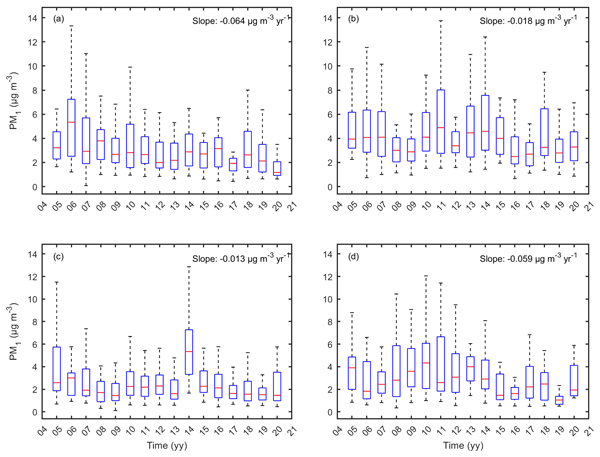
Ilona Ylivinkka, Helmi-Marja Keskinen, Lauri R. Ahonen, Liine Heikkinen, Pasi P. Aalto, Tuomo Nieminen, Katrianne Lehtipalo, Krista Luoma, Sujai Banerji, Juho Aalto, Janne Levula, Jutta Kesti, Ekaterina Ezhova, Markku Kulmala, and Tuukka Petäjä
Aerosol Research, 3, 503–520, https://doi.org/10.5194/ar-3-503-2025, https://doi.org/10.5194/ar-3-503-2025, 2025
Short summary
Short summary
Three different particulate matter (PM) measurement techniques were compared in Finland, showing good correlation (R about 0.8). Although the measured PM concentrations were low, decreasing trends were observed in all seasons. The decrease followed the trends observed in concentrations of anthropogenic pollutants, resulting from the EU legislation to improve air quality. The highest PM concentrations were measured in summer, indicating the dominance of organic compounds to the PM mass.
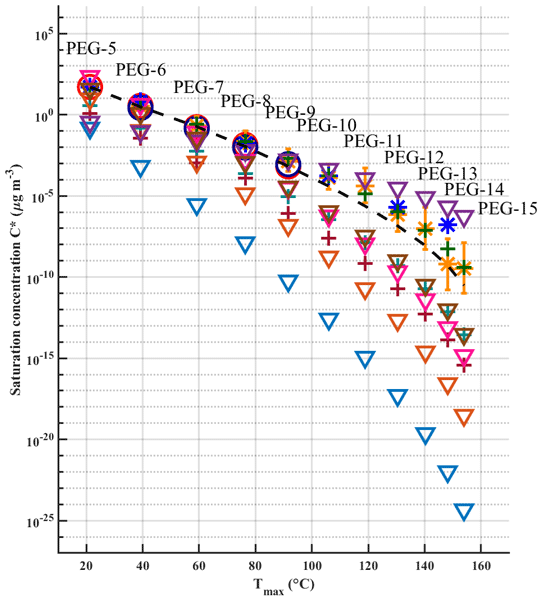
Arttu Ylisirniö, Noora Hyttinen, Zijun Li, Mitchell Alton, Aki Nissinen, Iida Pullinen, Pasi Miettinen, Taina Yli-Juuti, and Siegfried Schobesberger
Atmos. Meas. Tech., 18, 6449–6464, https://doi.org/10.5194/amt-18-6449-2025, https://doi.org/10.5194/amt-18-6449-2025, 2025
Short summary
Short summary
This study increases the knowledge of the low-volatility organic compounds observed in ambient aerosol particles by providing new volatility information about compounds used for calibrating volatility measurement instruments. Previously, such information was not available, and calibration of the instrument had to be extrapolated to cover the whole measurement range. Results of this study will provide the scientific community with better tools for investigating the complexity of ambient aerosols.
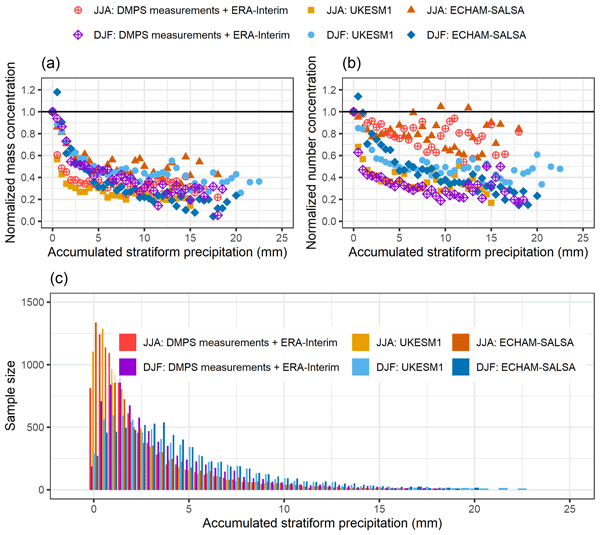
Sini Talvinen, Paul Kim, Emanuele Tovazzi, Eemeli Holopainen, Roxana Cremer, Thomas Kühn, Harri Kokkola, Zak Kipling, David Neubauer, João C. Teixeira, Alistair Sellar, Duncan Watson-Parris, Yang Yang, Jialei Zhu, Srinath Krishnan, Annele Virtanen, and Daniel G. Partridge
Atmos. Chem. Phys., 25, 14449–14478, https://doi.org/10.5194/acp-25-14449-2025, https://doi.org/10.5194/acp-25-14449-2025, 2025
Short summary
Short summary
Climate models struggle to predict how clouds and aerosols interact, affecting Earth’s energy balance. This study compares models to observations to see how they describe effects of clouds and rain on aerosols. While both models show similar overall trends, seasonal differences emerged. These, however, align with differences in key variables participating in cloud formation. The study provides insights on how to improve the representation of aerosol-cloud interactions in climate models.
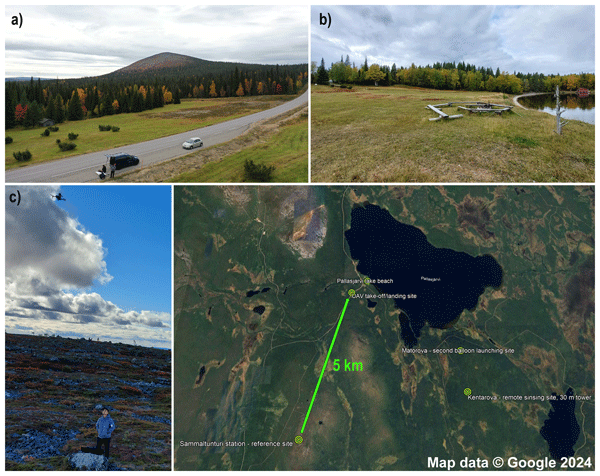
David Brus, Viet Le, Joel Kuula, and Konstantinos Doulgeris
Earth Syst. Sci. Data, 17, 5209–5219, https://doi.org/10.5194/essd-17-5209-2025, https://doi.org/10.5194/essd-17-5209-2025, 2025
Short summary
Short summary
This paper provides datasets collected as part of the Pallas Cloud Experiment campaign in northern Finland during autumn of 2022. We provide an overview of a custom-built drone backpack for air quality and atmospheric state variable measurements carried on top of a consumer-grade drone (DJI Mavic 2 Pro). Moreover, we describe the flight strategies and provide an overview of the datasets obtained, including a description of the measurements against a reference for data validation.
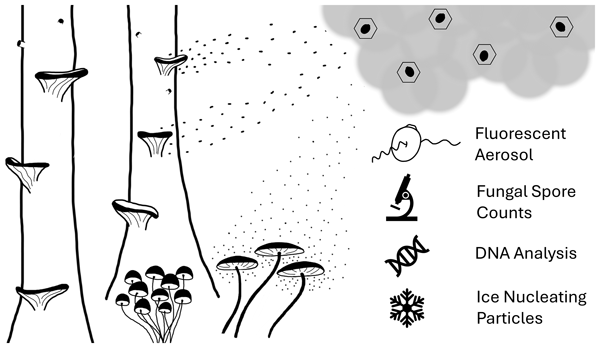
Jürgen Gratzl, Alexander Böhmländer, Sanna Pätsi, Clara-E. Pogner, Markus Gorfer, David Brus, Konstantinos Matthaios Doulgeris, Florian Wieland, Eija Asmi, Annika Saarto, Ottmar Möhler, Dominik Stolzenburg, and Hinrich Grothe
Atmos. Chem. Phys., 25, 12007–12035, https://doi.org/10.5194/acp-25-12007-2025, https://doi.org/10.5194/acp-25-12007-2025, 2025
Short summary
Short summary
We studied particles in the air over 1 year in the Finnish sub-Arctic to understand how biological particles affect ice formation in clouds. We found that fungal spores are the main contributors to ice formation at warmer temperatures. These particles are released locally and vary with the weather. Our results also show that we know very little about which fungi can form ice in the atmosphere, highlighting a major gap in our understanding of how nature influences weather and climate.
Henri Oikarinen, Anni Hartikainen, Pauli Simonen, Miska Olin, Ukko-Ville Mäkinen, Petteri Marjanen, Laura Salo, Ville Silvonen, Sampsa Martikainen, Jussi Hoivala, Mika Ihalainen, Pasi Miettinen, Pasi Yli-Pirilä, Olli Sippula, Santtu Mikkonen, and Panu Karjalainen
Atmos. Meas. Tech., 18, 4271–4292, https://doi.org/10.5194/amt-18-4271-2025, https://doi.org/10.5194/amt-18-4271-2025, 2025
Short summary
Short summary
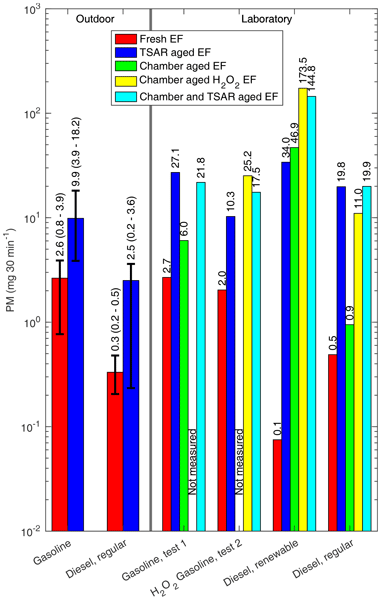
Fuel-operated auxiliary heaters are used in vehicles to provide extra heating to improve passenger comfort and vehicle functionality in cold climates. Currently heater emissions are not regulated as part of vehicle emissions, so this research was done to assess harmful gaseous and airborne particle emissions from them. Heaters were found to be major source of particles, especially when particles formed after combustion were accounted for, and large carbon monoxide emissions were also observed.
Anni Hartikainen, Mika Ihalainen, Deeksha Shukla, Marius Rohkamp, Arya Mukherjee, Quanfu He, Sandra Piel, Aki Virkkula, Delun Li, Tuukka Kokkola, Seongho Jeong, Hanna Koponen, Uwe Etzien, Anusmita Das, Krista Luoma, Lukas Schwalb, Thomas Gröger, Alexandre Barth, Martin Sklorz, Thorsten Streibel, Hendryk Czech, Benedikt Gündling, Markus Kalberer, Bert Buchholz, Andreas Hupfer, Thomas Adam, Thorsten Hohaus, Johan Øvrevik, Ralf Zimmermann, and Olli Sippula
Atmos. Chem. Phys., 25, 9275–9294, https://doi.org/10.5194/acp-25-9275-2025, https://doi.org/10.5194/acp-25-9275-2025, 2025
Short summary
Short summary
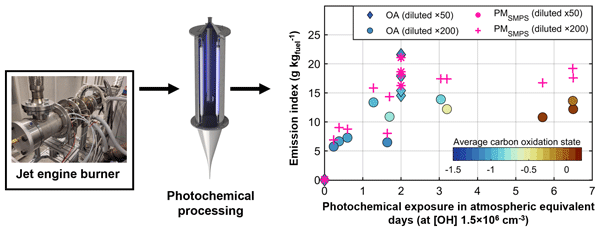
Photochemical reactions altered the properties of kerosene-operated jet engine burner exhaust emissions, which were studied in a laboratory using an oxidation flow reactor. Particle mass increased 300-fold as particles and gases became more oxidized. Light absorption increased, but the total direct radiative forcing efficiency was estimated to have shifted from positive to negative. The results highlight the importance of considering secondary aerosol formation when assessing the impacts of aviation.
Alexander Böhmländer, Larissa Lacher, David Brus, Konstantinos-Matthaios Doulgeris, Zoé Brasseur, Matthew Boyer, Joel Kuula, Thomas Leisner, and Ottmar Möhler
Atmos. Meas. Tech., 18, 3959–3971, https://doi.org/10.5194/amt-18-3959-2025, https://doi.org/10.5194/amt-18-3959-2025, 2025
Short summary
Short summary
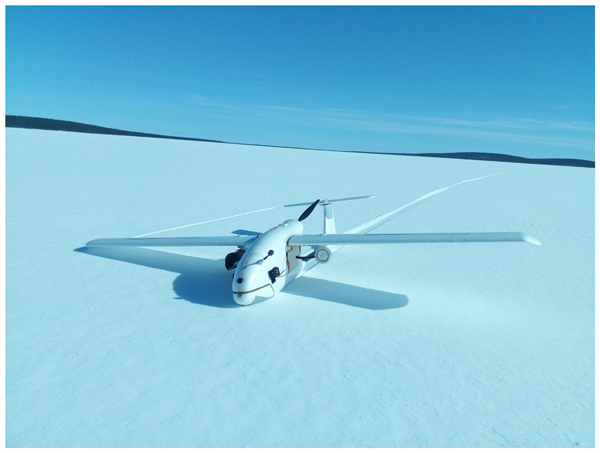
Clouds and aerosol are important for weather and climate. Typically, pure water cloud droplets stay liquid until around −35 °C, unless they come into contact with ice-nucleating particles (INPs). INPs are a rare subset of aerosol particles. Using uncrewed aerial vehicles (UAVs), it is possible to collect aerosol particles and analyse their ice-nucleating ability. This study describes the test and validation of a sampling set-up that can be used to collect aerosol particles onto a filter.
Jürgen Gratzl, David Brus, Konstantinos Doulgeris, Alexander Böhmländer, Ottmar Möhler, and Hinrich Grothe
Earth Syst. Sci. Data, 17, 3975–3985, https://doi.org/10.5194/essd-17-3975-2025, https://doi.org/10.5194/essd-17-3975-2025, 2025
Short summary
Short summary
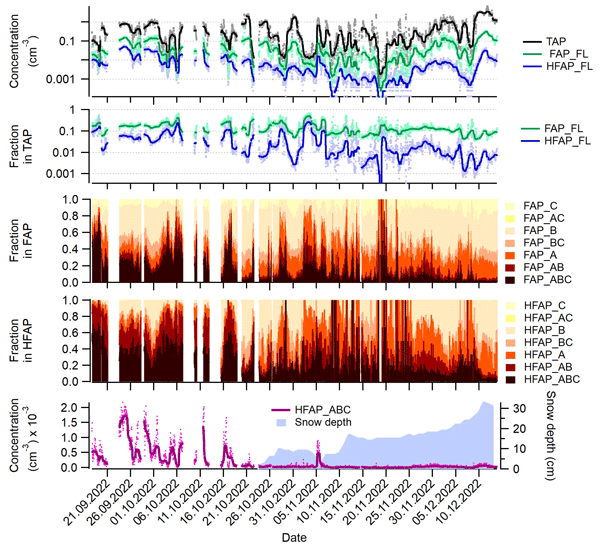
Near-real time monitoring of airborne biological particles like fungal spores or pollen grains is of great interest for two main reasons: to improve atmospheric allergen forecasts and to deepen the understanding of how bio-aerosols influence cloud formation. Here, we measured fluorescent bio-aerosols in the Finnish sub-Arctic with a high time resolution. A data set that might improve our understanding of biosphere–cloud interactions and the dynamics of bio-aerosols in the atmosphere.
John Backman, Krista Luoma, Henri Servomaa, Ville Vakkari, and David Brus
Earth Syst. Sci. Data Discuss., https://doi.org/10.5194/essd-2025-284, https://doi.org/10.5194/essd-2025-284, 2025
Revised manuscript under review for ESSD
Short summary
Short summary
This work describes the in-situ aerosol measurements at the Arctic Sammaltunturi measurement station in Pallas in northern Finland. This data paper describes the instruments and the data post processing of key aerosol particle measurements that are relevant for cloud properties. Data reported here are part of the Pallas Cloud Experiment in 2022 (PaCE2022).
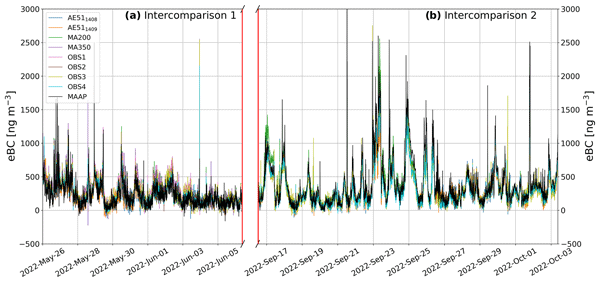
J. Tapio Elomaa, Krista Luoma, Sami D. Harni, Aki Virkkula, Hilkka Timonen, and Tuukka Petäjä
Aerosol Research, 3, 293–314, https://doi.org/10.5194/ar-3-293-2025, https://doi.org/10.5194/ar-3-293-2025, 2025
Short summary
Short summary
Black carbon (BC) is a pollutant from combustion that affects the climate and is harmful to health. We tested four different small BC sensors with a reference in Helsinki. The sensors compared well with the reference. As a sensor network they were able to capture differences in BC. Changes in temperature (T) and relative humidity (RH) caused error in the measurements. To reduce the effects of T and RH on BC sensors, more robust boxes should be developed, or corrections should be applied.
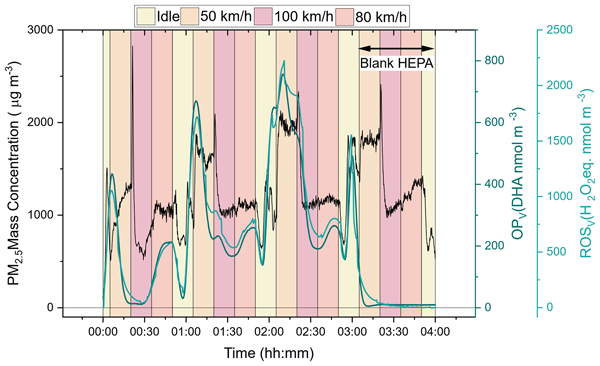
Battist Utinger, Alexandre Barth, Andreas Paul, Arya Mukherjee, Steven John Campbell, Christa-Maria Müller, Mika Ihalainen, Pasi Yli-Pirilä, Miika Kortelainen, Zheng Fang, Patrick Martens, Markus Somero, Juho Louhisalmi, Thorsten Hohaus, Hendryk Czech, Olli Sippula, Yinon Rudich, Ralf Zimmermann, and Markus Kalberer
Aerosol Research, 3, 205–218, https://doi.org/10.5194/ar-3-205-2025, https://doi.org/10.5194/ar-3-205-2025, 2025
Short summary
Short summary
The oxidative potential (OP) of air pollution particles might be a metric explaining particle toxicity. This study quantifies the OP of fresh and aged car and wood burning emission particles and explores how the OP changes over time, using novel high-temporal-resolution instruments. We show that emissions from wood burning are more toxic than car exhaust per unit particle mass, especially as they age in the atmosphere. We also calculate emission factors for the OP, which could help to improve air pollution policies.
Viet Le, Konstantinos Matthaios Doulgeris, Mika Komppula, John Backman, Gholamhossein Bagheri, Eberhard Bodenschatz, and David Brus
Earth Syst. Sci. Data Discuss., https://doi.org/10.5194/essd-2025-148, https://doi.org/10.5194/essd-2025-148, 2025
Preprint withdrawn
Short summary
Short summary
This manuscript presents datasets collected during the Pallas Cloud Experiment in northern Finland during the autumn of 2022. We provide an overview of the payload that measured meteorological, cloud, and aerosol properties, and was deployed on tethered balloon systems across 21 flights. Additionally, we describe the datasets obtained, including details of the instruments on the payload.
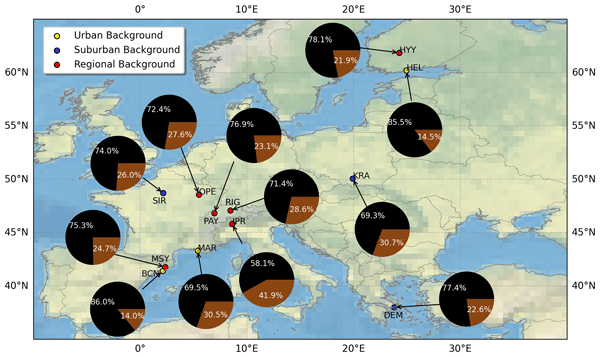
Hector Navarro-Barboza, Jordi Rovira, Vincenzo Obiso, Andrea Pozzer, Marta Via, Andres Alastuey, Xavier Querol, Noemi Perez, Marjan Savadkoohi, Gang Chen, Jesus Yus-Díez, Matic Ivancic, Martin Rigler, Konstantinos Eleftheriadis, Stergios Vratolis, Olga Zografou, Maria Gini, Benjamin Chazeau, Nicolas Marchand, Andre S. H. Prevot, Kaspar Dallenbach, Mikael Ehn, Krista Luoma, Tuukka Petäjä, Anna Tobler, Jaroslaw Necki, Minna Aurela, Hilkka Timonen, Jarkko Niemi, Olivier Favez, Jean-Eudes Petit, Jean-Philippe Putaud, Christoph Hueglin, Nicolas Pascal, Aurélien Chauvigné, Sébastien Conil, Marco Pandolfi, and Oriol Jorba
Atmos. Chem. Phys., 25, 2667–2694, https://doi.org/10.5194/acp-25-2667-2025, https://doi.org/10.5194/acp-25-2667-2025, 2025
Short summary
Short summary
Brown carbon (BrC) absorbs ultraviolet (UV) and visible light, influencing climate. This study explores BrC's imaginary refractive index (k) using data from 12 European sites. Residential emissions are a major organic aerosol (OA) source in winter, while secondary organic aerosol (SOA) dominates in summer. Source-specific k values were derived, improving model accuracy. The findings highlight BrC's climate impact and emphasize source-specific constraints in atmospheric models.
Maria Filioglou, Petri Tiitta, Xiaoxia Shang, Ari Leskinen, Pasi Ahola, Sanna Pätsi, Annika Saarto, Ville Vakkari, Uula Isopahkala, and Mika Komppula
Atmos. Chem. Phys., 25, 1639–1657, https://doi.org/10.5194/acp-25-1639-2025, https://doi.org/10.5194/acp-25-1639-2025, 2025
Short summary
Short summary
Every year a vast number of people experience allergic reactions due to exposure to airborne pollen. These symptoms are concentration dependent; thus accurate information about the pollen load in the atmosphere is essential. Moreover, pollen grains and fragments of it are likely to contribute to cloud processes and suppress precipitation. Here, we estimate the concentration and cloud-relevant parameters of birch pollen in the atmosphere using observations from a PollyXT and a CL61 ceilometer.
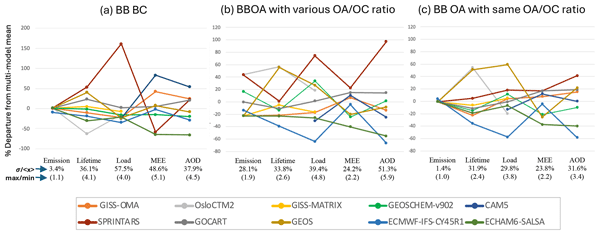
Mariya Petrenko, Ralph Kahn, Mian Chin, Susanne E. Bauer, Tommi Bergman, Huisheng Bian, Gabriele Curci, Ben Johnson, Johannes W. Kaiser, Zak Kipling, Harri Kokkola, Xiaohong Liu, Keren Mezuman, Tero Mielonen, Gunnar Myhre, Xiaohua Pan, Anna Protonotariou, Samuel Remy, Ragnhild Bieltvedt Skeie, Philip Stier, Toshihiko Takemura, Kostas Tsigaridis, Hailong Wang, Duncan Watson-Parris, and Kai Zhang
Atmos. Chem. Phys., 25, 1545–1567, https://doi.org/10.5194/acp-25-1545-2025, https://doi.org/10.5194/acp-25-1545-2025, 2025
Short summary
Short summary
We compared smoke plume simulations from 11 global models to each other and to satellite smoke amount observations aimed at constraining smoke source strength. In regions where plumes are thick and background aerosol is low, models and satellites compare well. However, the input emission inventory tends to underestimate in many places, and particle property and loss rate assumptions vary enormously among models, causing uncertainties that require systematic in situ measurements to resolve.
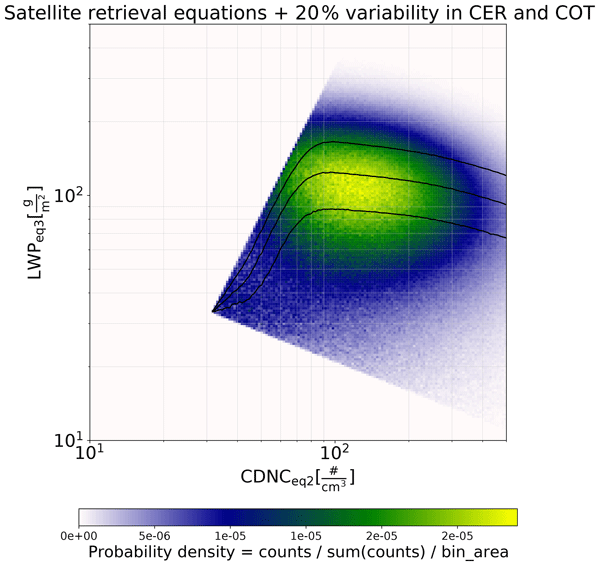
Harri Kokkola, Juha Tonttila, Silvia M. Calderón, Sami Romakkaniemi, Antti Lipponen, Aapo Peräkorpi, Tero Mielonen, Edward Gryspeerdt, Timo Henrik Virtanen, Pekka Kolmonen, and Antti Arola
Atmos. Chem. Phys., 25, 1533–1543, https://doi.org/10.5194/acp-25-1533-2025, https://doi.org/10.5194/acp-25-1533-2025, 2025
Short summary
Short summary
Understanding how atmospheric aerosols affect clouds is a scientific challenge. One question is how aerosols affects the amount of cloud water. We used a cloud-scale model to study these effects on marine clouds. The study showed that variations in cloud properties and instrument noise can cause bias in satellite-derived cloud water content. However, our results suggest that for similar weather conditions with well-defined aerosol concentrations, satellite data can reliably track these effects.
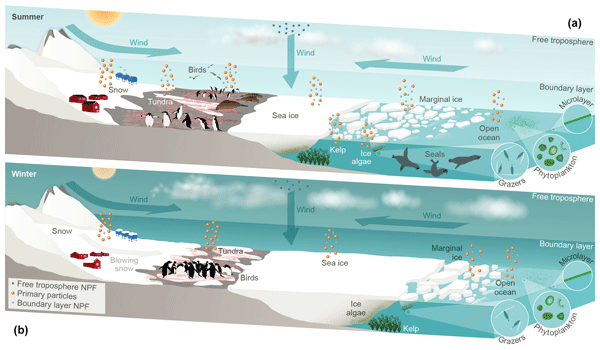
James Brean, David C. S. Beddows, Eija Asmi, Aki Virkkula, Lauriane L. J. Quéléver, Mikko Sipilä, Floortje Van Den Heuvel, Thomas Lachlan-Cope, Anna Jones, Markus Frey, Angelo Lupi, Jiyeon Park, Young Jun Yoon, Rolf Weller, Giselle L. Marincovich, Gabriela C. Mulena, Roy M. Harrison, and Manuel Dall'Osto
Atmos. Chem. Phys., 25, 1145–1162, https://doi.org/10.5194/acp-25-1145-2025, https://doi.org/10.5194/acp-25-1145-2025, 2025
Short summary
Short summary
Our results emphasise how understanding the geographical variation in surface types across the Antarctic is key to understanding secondary aerosol sources.
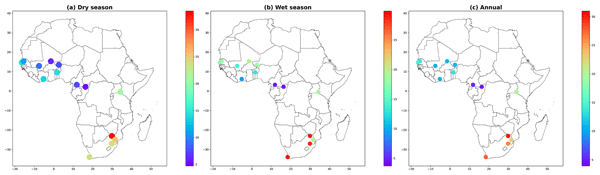
Hagninou Elagnon Venance Donnou, Aristide Barthélémy Akpo, Money Ossohou, Claire Delon, Véronique Yoboué, Dungall Laouali, Marie Ouafo-Leumbe, Pieter Gideon Van Zyl, Ousmane Ndiaye, Eric Gardrat, Maria Dias-Alves, and Corinne Galy-Lacaux
Atmos. Chem. Phys., 24, 13151–13182, https://doi.org/10.5194/acp-24-13151-2024, https://doi.org/10.5194/acp-24-13151-2024, 2024
Short summary
Short summary
Ozone is a secondary air pollutant that is detrimental to human and plant health. A better understanding of its chemical evolution is a challenge for Africa, where it is still undersampled. Out of 14 sites examined (1995–2020), high levels of O3 are reported in southern Africa. The dominant chemical processes leading to O3 formation are identified. A decrease in O3 is observed at Katibougou (Mali) and Banizoumbou (Niger), and an increase is found at Zoétélé (Cameroon) and Skukuza (South Africa).
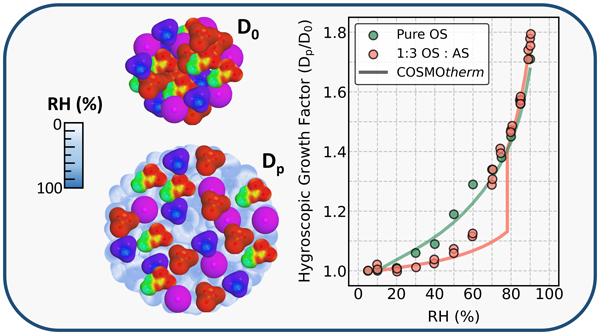
Zijun Li, Angela Buchholz, and Noora Hyttinen
Atmos. Chem. Phys., 24, 11717–11725, https://doi.org/10.5194/acp-24-11717-2024, https://doi.org/10.5194/acp-24-11717-2024, 2024
Short summary
Short summary
Evaluating organosulfur (OS) hygroscopicity is important for assessing aerosol–cloud climate interactions in the post-fossil-fuel future, when SO2 emissions decrease and OS compounds become increasingly important. Here a state-of-the-art quantum-chemistry-based method was used to predict the hygroscopic growth factors (HGFs) of a group of atmospherically relevant OS compounds and their mixtures with (NH4)2SO4. A good agreement was observed between their model-estimated and experimental HGFs.
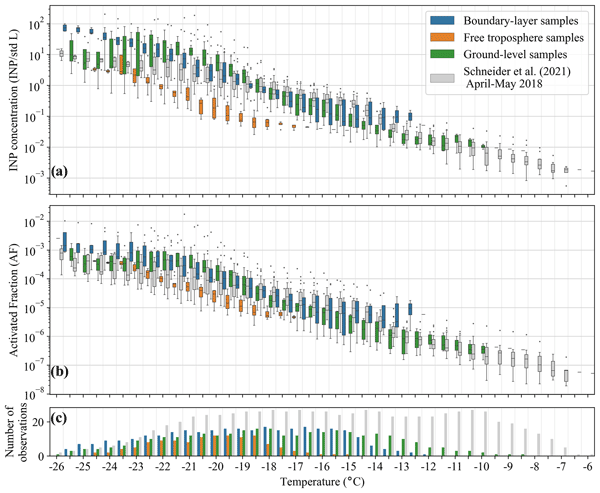
Zoé Brasseur, Julia Schneider, Janne Lampilahti, Ville Vakkari, Victoria A. Sinclair, Christina J. Williamson, Carlton Xavier, Dmitri Moisseev, Markus Hartmann, Pyry Poutanen, Markus Lampimäki, Markku Kulmala, Tuukka Petäjä, Katrianne Lehtipalo, Erik S. Thomson, Kristina Höhler, Ottmar Möhler, and Jonathan Duplissy
Atmos. Chem. Phys., 24, 11305–11332, https://doi.org/10.5194/acp-24-11305-2024, https://doi.org/10.5194/acp-24-11305-2024, 2024
Short summary
Short summary
Ice-nucleating particles (INPs) strongly influence the formation of clouds by initiating the formation of ice crystals. However, very little is known about the vertical distribution of INPs in the atmosphere. Here, we present aircraft measurements of INP concentrations above the Finnish boreal forest. Results show that near-surface INPs are efficiently transported and mixed within the boundary layer and occasionally reach the free troposphere.
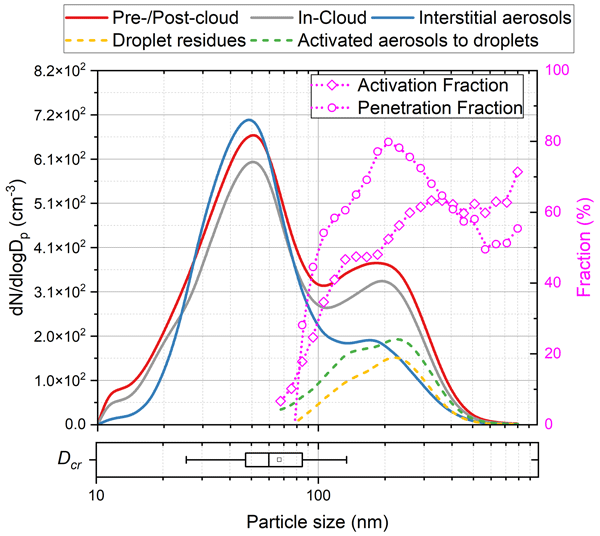
Romanos Foskinis, Ghislain Motos, Maria I. Gini, Olga Zografou, Kunfeng Gao, Stergios Vratolis, Konstantinos Granakis, Ville Vakkari, Kalliopi Violaki, Andreas Aktypis, Christos Kaltsonoudis, Zongbo Shi, Mika Komppula, Spyros N. Pandis, Konstantinos Eleftheriadis, Alexandros Papayannis, and Athanasios Nenes
Atmos. Chem. Phys., 24, 9827–9842, https://doi.org/10.5194/acp-24-9827-2024, https://doi.org/10.5194/acp-24-9827-2024, 2024
Short summary
Short summary
Analysis of modeling, in situ, and remote sensing measurements reveals the microphysical state of orographic clouds and their response to aerosol from the boundary layer and free troposphere. We show that cloud response to aerosol is robust, as predicted supersaturation and cloud droplet number levels agree with those determined from in-cloud measurements. The ability to determine if clouds are velocity- or aerosol-limited allows for novel model constraints and remote sensing products.
Jutta Kesti, Ewan J. O'Connor, Anne Hirsikko, John Backman, Maria Filioglou, Anu-Maija Sundström, Juha Tonttila, Heikki Lihavainen, Hannele Korhonen, and Eija Asmi
Atmos. Chem. Phys., 24, 9369–9386, https://doi.org/10.5194/acp-24-9369-2024, https://doi.org/10.5194/acp-24-9369-2024, 2024
Short summary
Short summary
The study combines aerosol particle measurements at the surface and vertical profiling of the atmosphere with a scanning Doppler lidar to investigate how particle transportation together with boundary layer evolution can affect particle and SO2 concentrations at the surface in the Arabian Peninsula region. The instrumentation enabled us to see elevated nucleation mode particle and SO2 concentrations at the surface when air masses transported from polluted areas are mixed in the boundary layer.
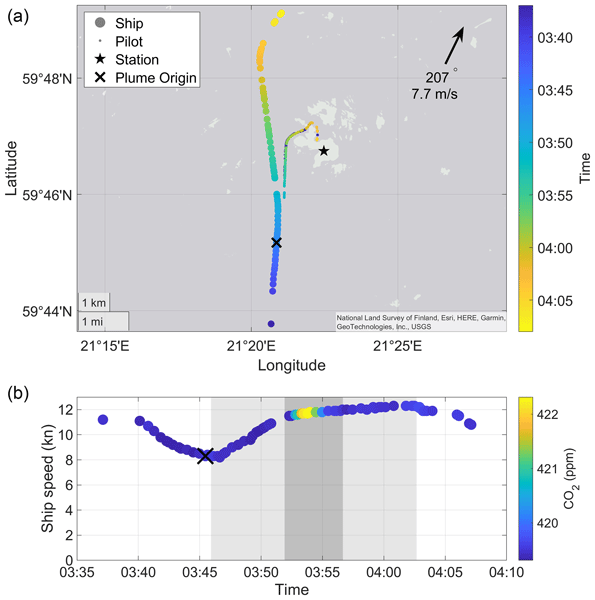
Mikko Heikkilä, Krista Luoma, Timo Mäkelä, and Tiia Grönholm
Atmos. Chem. Phys., 24, 8927–8941, https://doi.org/10.5194/acp-24-8927-2024, https://doi.org/10.5194/acp-24-8927-2024, 2024
Short summary
Short summary
Black carbon (BC) concentration was measured from 211 ship exhaust gas plumes at a remote marine station. Emission factors of BC were calculated in grams per kilogram of fuel. Ships with an exhaust gas cleaning system (EGCS) were found to have median BC emissions per fuel consumed 5 times lower than ships without an EGCS. However, this might be because of non-EGCS ships running at low engine loads rather than the EGCS itself. A local speed restriction would increase BC emissions of ships.
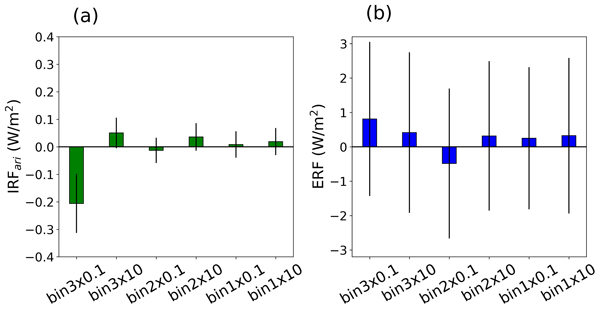
Muhammed Irfan, Thomas Kühn, Taina Yli-Juuti, Anton Laakso, Eemeli Holopainen, Douglas R. Worsnop, Annele Virtanen, and Harri Kokkola
Atmos. Chem. Phys., 24, 8489–8506, https://doi.org/10.5194/acp-24-8489-2024, https://doi.org/10.5194/acp-24-8489-2024, 2024
Short summary
Short summary
The study examines how the volatility of semi-volatile organic compounds affects secondary organic aerosol (SOA) formation and climate. Our simulations show that uncertainties in these volatilities influence aerosol mass and climate impacts. Accurate representation of these compounds in climate models is crucial for predicting global climate patterns.
Christoffer Hallgren, Jeanie A. Aird, Stefan Ivanell, Heiner Körnich, Ville Vakkari, Rebecca J. Barthelmie, Sara C. Pryor, and Erik Sahlée
Wind Energ. Sci., 9, 821–840, https://doi.org/10.5194/wes-9-821-2024, https://doi.org/10.5194/wes-9-821-2024, 2024
Short summary
Short summary
Knowing the wind speed across the rotor of a wind turbine is key in making good predictions of the power production. However, models struggle to capture both the speed and the shape of the wind profile. Using machine learning methods based on the model data, we show that the predictions can be improved drastically. The work focuses on three coastal sites, spread over the Northern Hemisphere (the Baltic Sea, the North Sea, and the US Atlantic coast) with similar results for all sites.
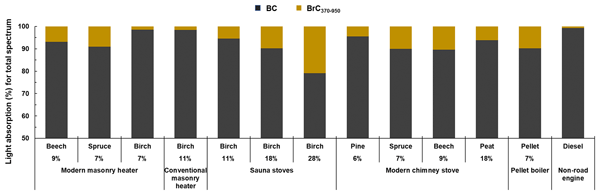
Satish Basnet, Anni Hartikainen, Aki Virkkula, Pasi Yli-Pirilä, Miika Kortelainen, Heikki Suhonen, Laura Kilpeläinen, Mika Ihalainen, Sampsa Väätäinen, Juho Louhisalmi, Markus Somero, Jarkko Tissari, Gert Jakobi, Ralf Zimmermann, Antti Kilpeläinen, and Olli Sippula
Atmos. Chem. Phys., 24, 3197–3215, https://doi.org/10.5194/acp-24-3197-2024, https://doi.org/10.5194/acp-24-3197-2024, 2024
Short summary
Short summary
Brown carbon (BrC) emissions were estimated, for residential wood combustion (RWC) from various northern European appliances, utilizing an extensive seven-wavelength aethalometer dataset and thermal–optical carbon analysis. The contribution of BrC370–950 to the absorption of visible light varied between 1 % and 21 %, and was linked with fuel moisture content and combustion efficiency. This study provides important information required for assessing the climate effects of RWC emissions.
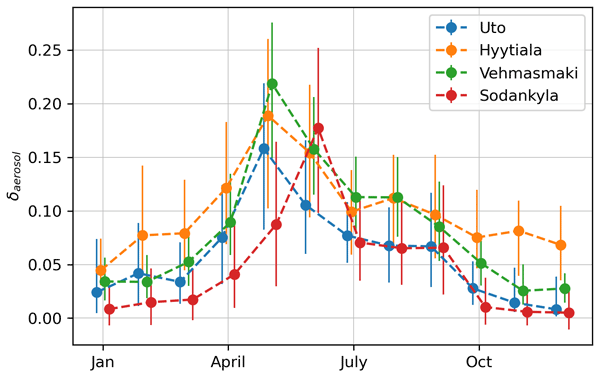
Viet Le, Hannah Lobo, Ewan J. O'Connor, and Ville Vakkari
Atmos. Meas. Tech., 17, 921–941, https://doi.org/10.5194/amt-17-921-2024, https://doi.org/10.5194/amt-17-921-2024, 2024
Short summary
Short summary
This study offers a long-term overview of aerosol particle depolarization ratio at the wavelength of 1565 nm obtained from vertical profiling measurements by Halo Doppler lidars during 4 years at four different locations across Finland. Our observations support the long-term usage of Halo Doppler lidar depolarization ratio such as the detection of aerosols that may pose a safety risk for aviation. Long-range Saharan dust transport and pollen transport are also showcased here.
Xiaoxia Shang, Antti Lipponen, Maria Filioglou, Anu-Maija Sundström, Mark Parrington, Virginie Buchard, Anton S. Darmenov, Ellsworth J. Welton, Eleni Marinou, Vassilis Amiridis, Michael Sicard, Alejandro Rodríguez-Gómez, Mika Komppula, and Tero Mielonen
Atmos. Chem. Phys., 24, 1329–1344, https://doi.org/10.5194/acp-24-1329-2024, https://doi.org/10.5194/acp-24-1329-2024, 2024
Short summary
Short summary
In June 2019, smoke particles from a Canadian wildfire event were transported to Europe. The long-range-transported smoke plumes were monitored with a spaceborne lidar and reanalysis models. Based on the aerosol mass concentrations estimated from the observations, the reanalysis models had difficulties in reproducing the amount and location of the smoke aerosols during the transport event. Consequently, more spaceborne lidar missions are needed for reliable monitoring of aerosol plumes.
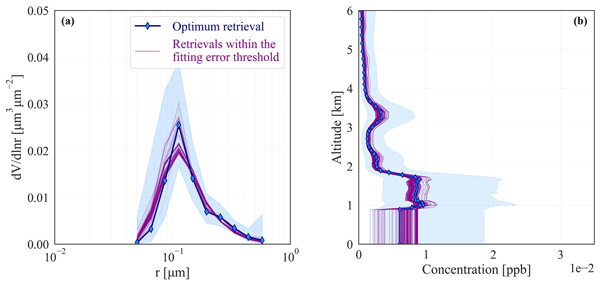
Alexandra Tsekeri, Anna Gialitaki, Marco Di Paolantonio, Davide Dionisi, Gian Luigi Liberti, Alnilam Fernandes, Artur Szkop, Aleksander Pietruczuk, Daniel Pérez-Ramírez, Maria J. Granados Muñoz, Juan Luis Guerrero-Rascado, Lucas Alados-Arboledas, Diego Bermejo Pantaleón, Juan Antonio Bravo-Aranda, Anna Kampouri, Eleni Marinou, Vassilis Amiridis, Michael Sicard, Adolfo Comerón, Constantino Muñoz-Porcar, Alejandro Rodríguez-Gómez, Salvatore Romano, Maria Rita Perrone, Xiaoxia Shang, Mika Komppula, Rodanthi-Elisavet Mamouri, Argyro Nisantzi, Diofantos Hadjimitsis, Francisco Navas-Guzmán, Alexander Haefele, Dominika Szczepanik, Artur Tomczak, Iwona S. Stachlewska, Livio Belegante, Doina Nicolae, Kalliopi Artemis Voudouri, Dimitris Balis, Athena A. Floutsi, Holger Baars, Linda Miladi, Nicolas Pascal, Oleg Dubovik, and Anton Lopatin
Atmos. Meas. Tech., 16, 6025–6050, https://doi.org/10.5194/amt-16-6025-2023, https://doi.org/10.5194/amt-16-6025-2023, 2023
Short summary
Short summary
EARLINET/ACTRIS organized an intensive observational campaign in May 2020, with the objective of monitoring the atmospheric state over Europe during the COVID-19 lockdown and relaxation period. The work presented herein focuses on deriving a common methodology for applying a synergistic retrieval that utilizes the network's ground-based passive and active remote sensing measurements and deriving the aerosols from anthropogenic activities over Europe.
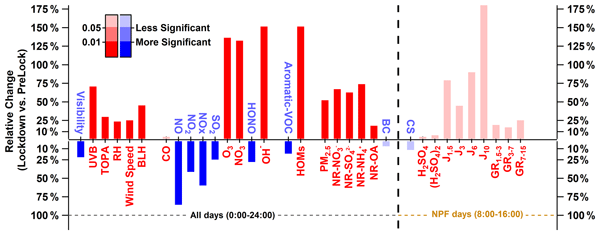
Markku Kulmala, Anna Lintunen, Hanna Lappalainen, Annele Virtanen, Chao Yan, Ekaterina Ezhova, Tuomo Nieminen, Ilona Riipinen, Risto Makkonen, Johanna Tamminen, Anu-Maija Sundström, Antti Arola, Armin Hansel, Kari Lehtinen, Timo Vesala, Tuukka Petäjä, Jaana Bäck, Tom Kokkonen, and Veli-Matti Kerminen
Atmos. Chem. Phys., 23, 14949–14971, https://doi.org/10.5194/acp-23-14949-2023, https://doi.org/10.5194/acp-23-14949-2023, 2023
Short summary
Short summary
To be able to meet global grand challenges, we need comprehensive open data with proper metadata. In this opinion paper, we describe the SMEAR (Station for Measuring Earth surface – Atmosphere Relations) concept and include several examples (cases), such as new particle formation and growth, feedback loops and the effect of COVID-19, and what has been learned from these investigations. The future needs and the potential of comprehensive observations of the environment are summarized.
Christoffer Hallgren, Heiner Körnich, Stefan Ivanell, Ville Vakkari, and Erik Sahlée
Wind Energ. Sci. Discuss., https://doi.org/10.5194/wes-2023-129, https://doi.org/10.5194/wes-2023-129, 2023
Preprint withdrawn
Short summary
Short summary
Sometimes, the wind changes direction between the bottom and top part of a wind turbine. This affects both the power production and the loads on the turbine. In this study, a climatology of pronounced changes in wind direction across the rotor is created, focusing on Scandinavia. The weather conditions responsible for these changes in wind direction are investigated and the climatology is compared to measurements from two coastal sites, indicating an underestimation by the climatology.
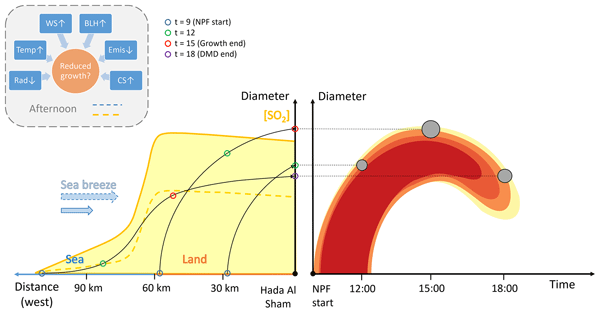
Simo Hakala, Ville Vakkari, Heikki Lihavainen, Antti-Pekka Hyvärinen, Kimmo Neitola, Jenni Kontkanen, Veli-Matti Kerminen, Markku Kulmala, Tuukka Petäjä, Tareq Hussein, Mamdouh I. Khoder, Mansour A. Alghamdi, and Pauli Paasonen
Atmos. Chem. Phys., 23, 9287–9321, https://doi.org/10.5194/acp-23-9287-2023, https://doi.org/10.5194/acp-23-9287-2023, 2023
Short summary
Short summary
Things are not always as they first seem in ambient aerosol measurements. Observations of decreasing particle sizes are often interpreted as resulting from particle evaporation. We show that such observations can counterintuitively be explained by particles that are constantly growing in size. This requires one to account for the previous movements of the observed air. Our explanation implies a larger number of larger particles, meaning more significant effects of aerosols on climate and health.
Maria Filioglou, Ari Leskinen, Ville Vakkari, Ewan O'Connor, Minttu Tuononen, Pekko Tuominen, Samuli Laukkanen, Linnea Toiviainen, Annika Saarto, Xiaoxia Shang, Petri Tiitta, and Mika Komppula
Atmos. Chem. Phys., 23, 9009–9021, https://doi.org/10.5194/acp-23-9009-2023, https://doi.org/10.5194/acp-23-9009-2023, 2023
Short summary
Short summary
Pollen impacts climate and public health, and it can be detected in the atmosphere by lidars which measure the linear particle depolarization ratio (PDR), a shape-relevant optical parameter. As aerosols also cause depolarization, surface aerosol and pollen observations were combined with measurements from ground-based lidars operating at different wavelengths to determine the optical properties of birch and pine pollen and quantify their relative contribution to the PDR.

Jonas Elm, Aladár Czitrovszky, Andreas Held, Annele Virtanen, Astrid Kiendler-Scharr, Benjamin J. Murray, Daniel McCluskey, Daniele Contini, David Broday, Eirini Goudeli, Hilkka Timonen, Joan Rosell-Llompart, Jose L. Castillo, Evangelia Diapouli, Mar Viana, Maria E. Messing, Markku Kulmala, Naděžda Zíková, and Sebastian H. Schmitt
Aerosol Research, 1, 13–16, https://doi.org/10.5194/ar-1-13-2023, https://doi.org/10.5194/ar-1-13-2023, 2023
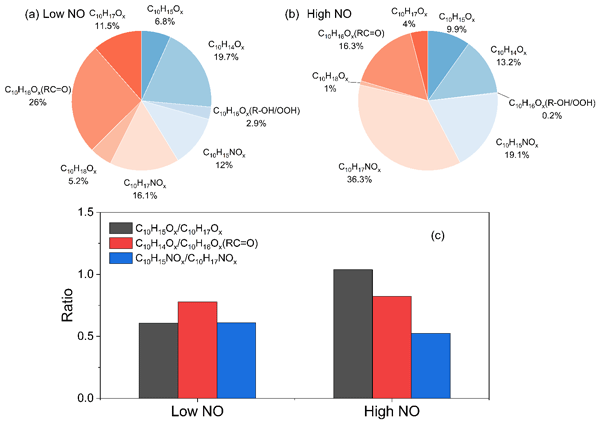
Hao Luo, Luc Vereecken, Hongru Shen, Sungah Kang, Iida Pullinen, Mattias Hallquist, Hendrik Fuchs, Andreas Wahner, Astrid Kiendler-Scharr, Thomas F. Mentel, and Defeng Zhao
Atmos. Chem. Phys., 23, 7297–7319, https://doi.org/10.5194/acp-23-7297-2023, https://doi.org/10.5194/acp-23-7297-2023, 2023
Short summary
Short summary
Oxidation of limonene, an element emitted by trees and chemical products, by OH, a daytime oxidant, forms many highly oxygenated organic molecules (HOMs), including C10-20 compounds. HOMs play an important role in new particle formation and growth. HOM formation can be explained by the chemistry of peroxy radicals. We found that a minor branching ratio initial pathway plays an unexpected, significant role. Considering this pathway enables accurate simulations of HOMs and other concentrations.
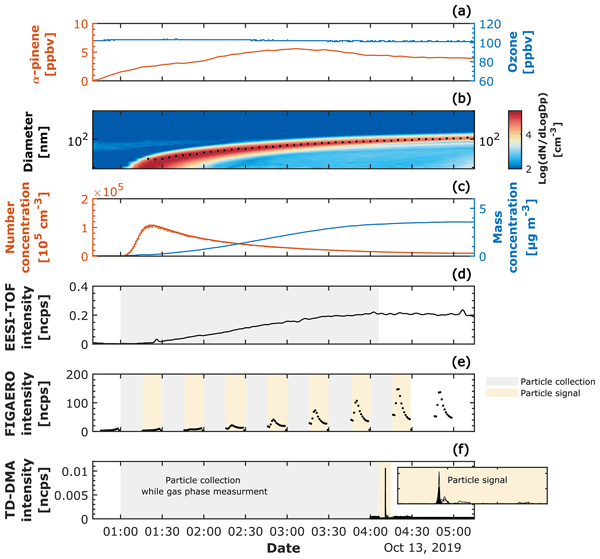
Lucía Caudillo, Mihnea Surdu, Brandon Lopez, Mingyi Wang, Markus Thoma, Steffen Bräkling, Angela Buchholz, Mario Simon, Andrea C. Wagner, Tatjana Müller, Manuel Granzin, Martin Heinritzi, Antonio Amorim, David M. Bell, Zoé Brasseur, Lubna Dada, Jonathan Duplissy, Henning Finkenzeller, Xu-Cheng He, Houssni Lamkaddam, Naser G. A. Mahfouz, Vladimir Makhmutov, Hanna E. Manninen, Guillaume Marie, Ruby Marten, Roy L. Mauldin, Bernhard Mentler, Antti Onnela, Tuukka Petäjä, Joschka Pfeifer, Maxim Philippov, Ana A. Piedehierro, Birte Rörup, Wiebke Scholz, Jiali Shen, Dominik Stolzenburg, Christian Tauber, Ping Tian, António Tomé, Nsikanabasi Silas Umo, Dongyu S. Wang, Yonghong Wang, Stefan K. Weber, André Welti, Marcel Zauner-Wieczorek, Urs Baltensperger, Richard C. Flagan, Armin Hansel, Jasper Kirkby, Markku Kulmala, Katrianne Lehtipalo, Douglas R. Worsnop, Imad El Haddad, Neil M. Donahue, Alexander L. Vogel, Andreas Kürten, and Joachim Curtius
Atmos. Chem. Phys., 23, 6613–6631, https://doi.org/10.5194/acp-23-6613-2023, https://doi.org/10.5194/acp-23-6613-2023, 2023
Short summary
Short summary
In this study, we present an intercomparison of four different techniques for measuring the chemical composition of nanoparticles. The intercomparison was performed based on the observed chemical composition, calculated volatility, and analysis of the thermograms. We found that the methods generally agree on the most important compounds that are found in the nanoparticles. However, they do see different parts of the organic spectrum. We suggest potential explanations for these differences.
Franz Martin Schnaiter, Claudia Linke, Eija Asmi, Henri Servomaa, Antti-Pekka Hyvärinen, Sho Ohata, Yutaka Kondo, and Emma Järvinen
Atmos. Meas. Tech., 16, 2753–2769, https://doi.org/10.5194/amt-16-2753-2023, https://doi.org/10.5194/amt-16-2753-2023, 2023
Short summary
Short summary
Light-absorbing particles from combustion processes are important contributors to climate warming. Their highly variable spectral light absorption properties need to be monitored in the field. Commonly used methods show measurement artefacts that are difficult to correct. We introduce a new instrument that is based on the photoacoustic effect. Long-term operation in the Finnish Arctic demonstrates the applicability of the new instrument for unattended light absorption monitoring.
Eka Dian Pusfitasari, Jose Ruiz-Jimenez, Aleksi Tiusanen, Markus Suuronen, Jesse Haataja, Yusheng Wu, Juha Kangasluoma, Krista Luoma, Tuukka Petäjä, Matti Jussila, Kari Hartonen, and Marja-Liisa Riekkola
Atmos. Chem. Phys., 23, 5885–5904, https://doi.org/10.5194/acp-23-5885-2023, https://doi.org/10.5194/acp-23-5885-2023, 2023
Short summary
Short summary
A miniaturized air-sampling drone system was successfully applied for the collection of volatile organic compounds (VOCs) and for the measurement of black carbon (BC) and total particle number concentrations in atmospheric air. Here we report, for the first time, the vertical profiles of BC and aerosol number concentrations above the boreal forest in Hyytiälä (Finland) at high altitudes close to the boundary layer in autumn 2021. VOC composition with its distribution was studied as well.
Athena Augusta Floutsi, Holger Baars, Ronny Engelmann, Dietrich Althausen, Albert Ansmann, Stephanie Bohlmann, Birgit Heese, Julian Hofer, Thomas Kanitz, Moritz Haarig, Kevin Ohneiser, Martin Radenz, Patric Seifert, Annett Skupin, Zhenping Yin, Sabur F. Abdullaev, Mika Komppula, Maria Filioglou, Elina Giannakaki, Iwona S. Stachlewska, Lucja Janicka, Daniele Bortoli, Eleni Marinou, Vassilis Amiridis, Anna Gialitaki, Rodanthi-Elisavet Mamouri, Boris Barja, and Ulla Wandinger
Atmos. Meas. Tech., 16, 2353–2379, https://doi.org/10.5194/amt-16-2353-2023, https://doi.org/10.5194/amt-16-2353-2023, 2023
Short summary
Short summary
DeLiAn is a collection of lidar-derived aerosol intensive optical properties for several aerosol types, namely the particle linear depolarization ratio, the extinction-to-backscatter ratio (lidar ratio) and the Ångström exponent. The data collection is based on globally distributed, long-term, ground-based, multiwavelength, Raman and polarization lidar measurements and currently covers two wavelengths, 355 and 532 nm, for 13 aerosol categories ranging from basic aerosol types to mixtures.
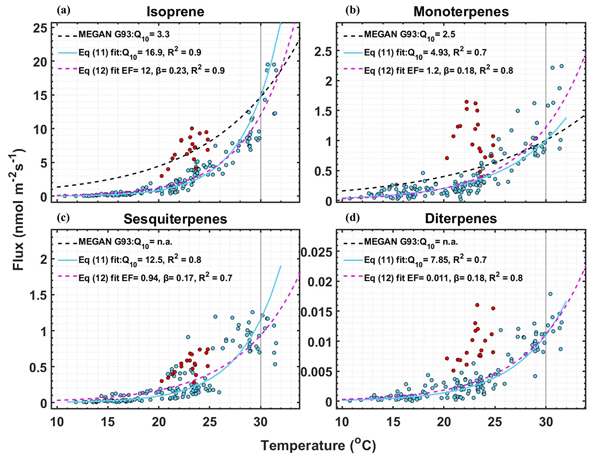
Lejish Vettikkat, Pasi Miettinen, Angela Buchholz, Pekka Rantala, Hao Yu, Simon Schallhart, Tuukka Petäjä, Roger Seco, Elisa Männistö, Markku Kulmala, Eeva-Stiina Tuittila, Alex B. Guenther, and Siegfried Schobesberger
Atmos. Chem. Phys., 23, 2683–2698, https://doi.org/10.5194/acp-23-2683-2023, https://doi.org/10.5194/acp-23-2683-2023, 2023
Short summary
Short summary
Wetlands cover a substantial fraction of the land mass in the northern latitudes, from northern Europe to Siberia and Canada. Yet, their isoprene and terpene emissions remain understudied. Here, we used a state-of-the-art measurement technique to quantify ecosystem-scale emissions from a boreal wetland during an unusually warm spring/summer. We found that the emissions from this wetland were (a) higher and (b) even more strongly dependent on temperature than commonly thought.
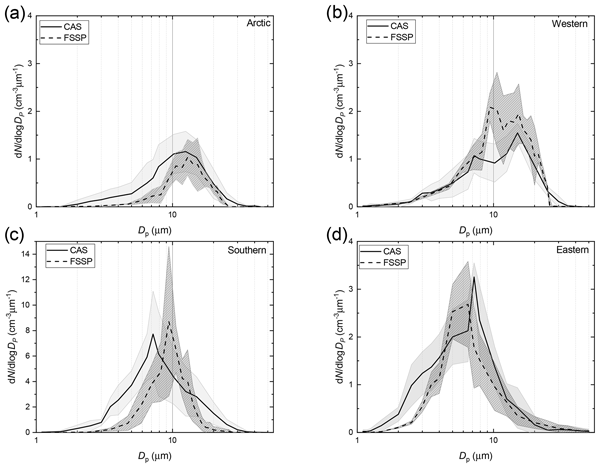
Konstantinos Matthaios Doulgeris, Ville Vakkari, Ewan J. O'Connor, Veli-Matti Kerminen, Heikki Lihavainen, and David Brus
Atmos. Chem. Phys., 23, 2483–2498, https://doi.org/10.5194/acp-23-2483-2023, https://doi.org/10.5194/acp-23-2483-2023, 2023
Short summary
Short summary
We investigated how different long-range-transported air masses can affect the microphysical properties of low-level clouds in a clean subarctic environment. A connection was revealed. Higher values of cloud droplet number concentrations were related to continental air masses, whereas the lowest values of number concentrations were related to marine air masses. These were characterized by larger cloud droplets. Clouds in all regions were sensitive to increases in cloud number concentration.
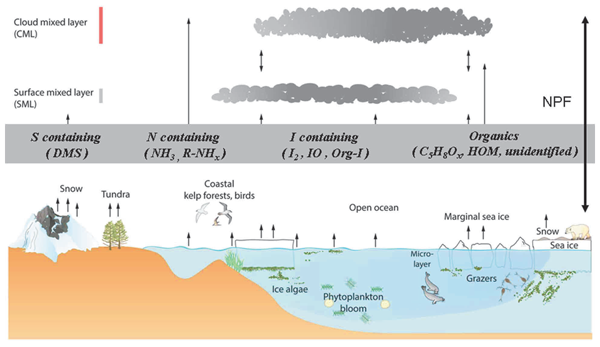
James Brean, David C. S. Beddows, Roy M. Harrison, Congbo Song, Peter Tunved, Johan Ström, Radovan Krejci, Eyal Freud, Andreas Massling, Henrik Skov, Eija Asmi, Angelo Lupi, and Manuel Dall'Osto
Atmos. Chem. Phys., 23, 2183–2198, https://doi.org/10.5194/acp-23-2183-2023, https://doi.org/10.5194/acp-23-2183-2023, 2023
Short summary
Short summary
Our results emphasize how understanding the geographical variation in surface types across the Arctic is key to understanding secondary aerosol sources. We provide a harmonised analysis of new particle formation across the Arctic.
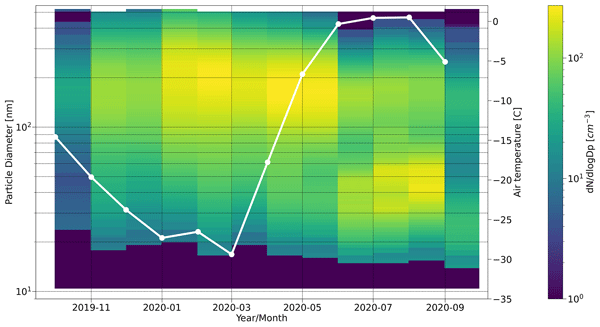
Matthew Boyer, Diego Aliaga, Jakob Boyd Pernov, Hélène Angot, Lauriane L. J. Quéléver, Lubna Dada, Benjamin Heutte, Manuel Dall'Osto, David C. S. Beddows, Zoé Brasseur, Ivo Beck, Silvia Bucci, Marina Duetsch, Andreas Stohl, Tiia Laurila, Eija Asmi, Andreas Massling, Daniel Charles Thomas, Jakob Klenø Nøjgaard, Tak Chan, Sangeeta Sharma, Peter Tunved, Radovan Krejci, Hans Christen Hansson, Federico Bianchi, Katrianne Lehtipalo, Alfred Wiedensohler, Kay Weinhold, Markku Kulmala, Tuukka Petäjä, Mikko Sipilä, Julia Schmale, and Tuija Jokinen
Atmos. Chem. Phys., 23, 389–415, https://doi.org/10.5194/acp-23-389-2023, https://doi.org/10.5194/acp-23-389-2023, 2023
Short summary
Short summary
The Arctic is a unique environment that is warming faster than other locations on Earth. We evaluate measurements of aerosol particles, which can influence climate, over the central Arctic Ocean for a full year and compare the data to land-based measurement stations across the Arctic. Our measurements show that the central Arctic has similarities to but also distinct differences from the stations further south. We note that this may change as the Arctic warms and sea ice continues to decline.
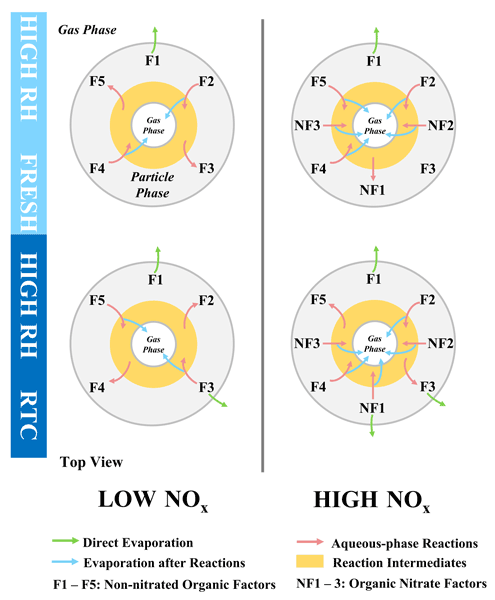
Zijun Li, Angela Buchholz, Luis M. F. Barreira, Arttu Ylisirniö, Liqing Hao, Iida Pullinen, Siegfried Schobesberger, and Annele Virtanen
Atmos. Chem. Phys., 23, 203–220, https://doi.org/10.5194/acp-23-203-2023, https://doi.org/10.5194/acp-23-203-2023, 2023
Short summary
Short summary
Interaction between NOx and biogenic emissions can be important in suburban areas. Our study showed that the addition of NOx during α-pinene SOA formation produced considerable amounts of organic nitrates and affected the composition of non-nitrated organic compounds. The compositional difference consequently altered the primary type of aqueous-phase processes during the isothermal particle evaporation.
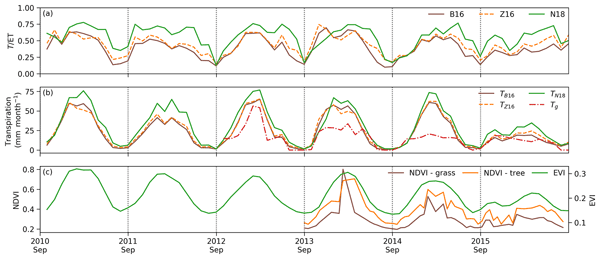
Matti Räsänen, Mika Aurela, Ville Vakkari, Johan P. Beukes, Juha-Pekka Tuovinen, Pieter G. Van Zyl, Miroslav Josipovic, Stefan J. Siebert, Tuomas Laurila, Markku Kulmala, Lauri Laakso, Janne Rinne, Ram Oren, and Gabriel Katul
Hydrol. Earth Syst. Sci., 26, 5773–5791, https://doi.org/10.5194/hess-26-5773-2022, https://doi.org/10.5194/hess-26-5773-2022, 2022
Short summary
Short summary
The productivity of semiarid grazed grasslands is linked to the variation in rainfall and transpiration. By combining carbon dioxide and water flux measurements, we show that the annual transpiration is nearly constant during wet years while grasses react quickly to dry spells and drought, which reduce transpiration. The planning of annual grazing strategies could consider the early-season rainfall frequency that was linked to the portion of annual transpiration.
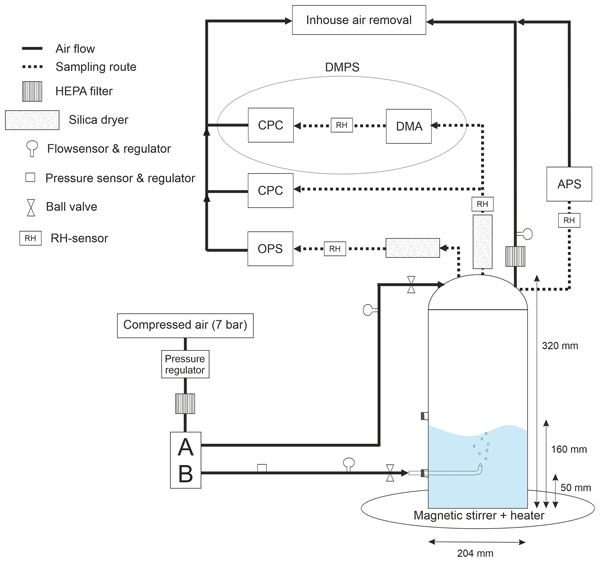
Svetlana Sofieva, Eija Asmi, Nina S. Atanasova, Aino E. Heikkinen, Emeline Vidal, Jonathan Duplissy, Martin Romantschuk, Rostislav Kouznetsov, Jaakko Kukkonen, Dennis H. Bamford, Antti-Pekka Hyvärinen, and Mikhail Sofiev
Atmos. Meas. Tech., 15, 6201–6219, https://doi.org/10.5194/amt-15-6201-2022, https://doi.org/10.5194/amt-15-6201-2022, 2022
Short summary
Short summary
A new bubble-generating glass chamber design with an extensive set of aerosol production experiments is presented to re-evaluate bubble-bursting-mediated aerosol production as a function of water parameters: bubbling air flow, water salinity, and temperature. Our main findings suggest modest dependence of aerosol production on the water salinity and a strong dependence on temperature below ~ 10 °C.
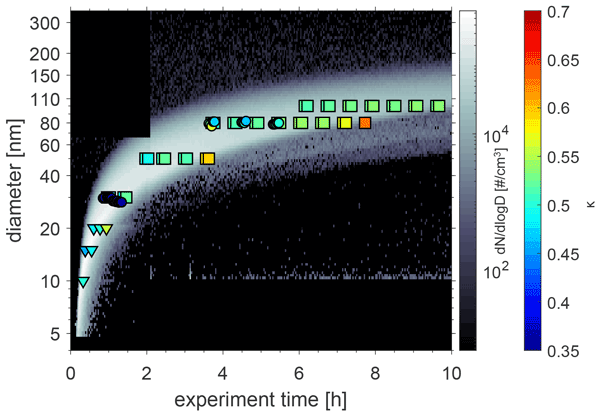
Bernadette Rosati, Sini Isokääntä, Sigurd Christiansen, Mads Mørk Jensen, Shamjad P. Moosakutty, Robin Wollesen de Jonge, Andreas Massling, Marianne Glasius, Jonas Elm, Annele Virtanen, and Merete Bilde
Atmos. Chem. Phys., 22, 13449–13466, https://doi.org/10.5194/acp-22-13449-2022, https://doi.org/10.5194/acp-22-13449-2022, 2022
Short summary
Short summary
Sulfate aerosols have a strong influence on climate. Due to the reduction in sulfur-based fossil fuels, natural sulfur emissions play an increasingly important role. Studies investigating the climate relevance of natural sulfur aerosols are scarce. We study the water uptake of such particles in the laboratory, demonstrating a high potential to take up water and form cloud droplets. During atmospheric transit, chemical processing affects the particles’ composition and thus their water uptake.
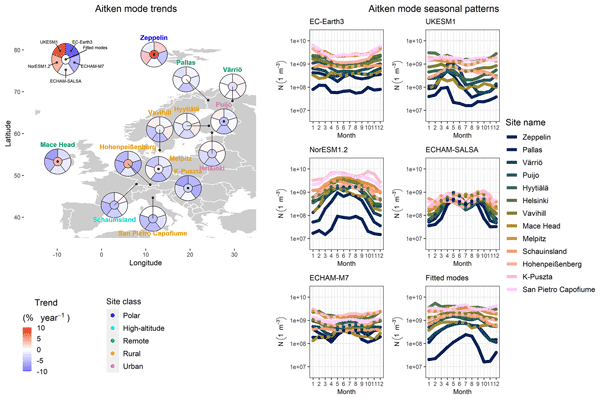
Ville Leinonen, Harri Kokkola, Taina Yli-Juuti, Tero Mielonen, Thomas Kühn, Tuomo Nieminen, Simo Heikkinen, Tuuli Miinalainen, Tommi Bergman, Ken Carslaw, Stefano Decesari, Markus Fiebig, Tareq Hussein, Niku Kivekäs, Radovan Krejci, Markku Kulmala, Ari Leskinen, Andreas Massling, Nikos Mihalopoulos, Jane P. Mulcahy, Steffen M. Noe, Twan van Noije, Fiona M. O'Connor, Colin O'Dowd, Dirk Olivie, Jakob B. Pernov, Tuukka Petäjä, Øyvind Seland, Michael Schulz, Catherine E. Scott, Henrik Skov, Erik Swietlicki, Thomas Tuch, Alfred Wiedensohler, Annele Virtanen, and Santtu Mikkonen
Atmos. Chem. Phys., 22, 12873–12905, https://doi.org/10.5194/acp-22-12873-2022, https://doi.org/10.5194/acp-22-12873-2022, 2022
Short summary
Short summary
We provide the first extensive comparison of detailed aerosol size distribution trends between in situ observations from Europe and five different earth system models. We investigated aerosol modes (nucleation, Aitken, and accumulation) separately and were able to show the differences between measured and modeled trends and especially their seasonal patterns. The differences in model results are likely due to complex effects of several processes instead of certain specific model features.
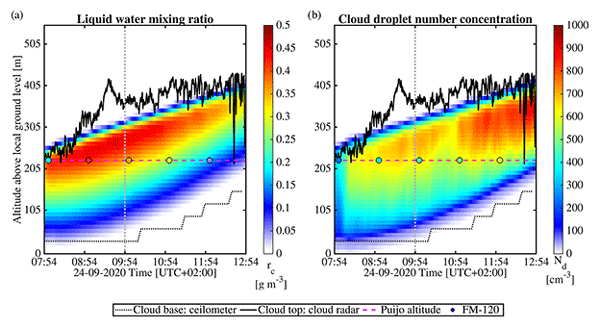
Silvia M. Calderón, Juha Tonttila, Angela Buchholz, Jorma Joutsensaari, Mika Komppula, Ari Leskinen, Liqing Hao, Dmitri Moisseev, Iida Pullinen, Petri Tiitta, Jian Xu, Annele Virtanen, Harri Kokkola, and Sami Romakkaniemi
Atmos. Chem. Phys., 22, 12417–12441, https://doi.org/10.5194/acp-22-12417-2022, https://doi.org/10.5194/acp-22-12417-2022, 2022
Short summary
Short summary
The spatial and temporal restrictions of observations and oversimplified aerosol representation in large eddy simulations (LES) limit our understanding of aerosol–stratocumulus interactions. In this closure study of in situ and remote sensing observations and outputs from UCLALES–SALSA, we have assessed the role of convective overturning and aerosol effects in two cloud events observed at the Puijo SMEAR IV station, Finland, a diurnal-high aerosol case and a nocturnal-low aerosol case.
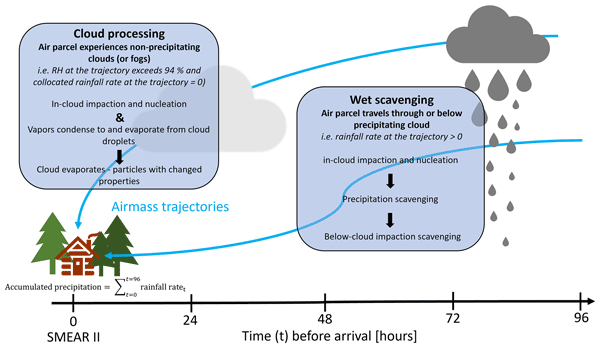
Sini Isokääntä, Paul Kim, Santtu Mikkonen, Thomas Kühn, Harri Kokkola, Taina Yli-Juuti, Liine Heikkinen, Krista Luoma, Tuukka Petäjä, Zak Kipling, Daniel Partridge, and Annele Virtanen
Atmos. Chem. Phys., 22, 11823–11843, https://doi.org/10.5194/acp-22-11823-2022, https://doi.org/10.5194/acp-22-11823-2022, 2022
Short summary
Short summary
This research employs air mass history analysis and observations to study how clouds and precipitation affect atmospheric aerosols during transport to a boreal forest site. The mass concentrations of studied chemical species showed exponential decrease as a function of accumulated rain along the air mass route. Our analysis revealed in-cloud sulfate formation, while no major changes in organic mass were seen. Most of the in-cloud-formed sulfate could be assigned to particle sizes above 200 nm.
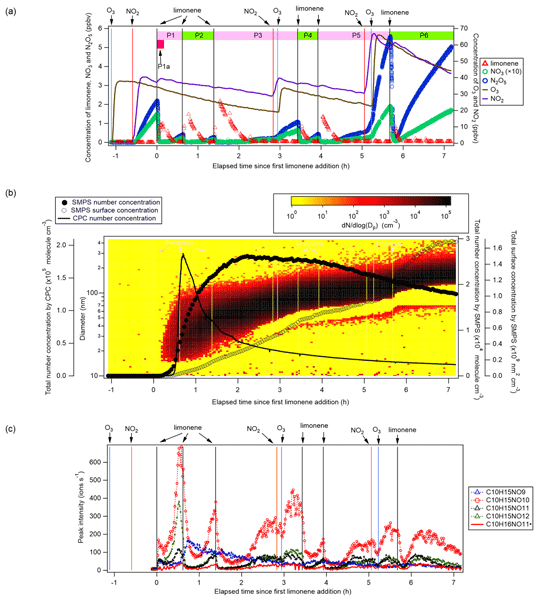
Yindong Guo, Hongru Shen, Iida Pullinen, Hao Luo, Sungah Kang, Luc Vereecken, Hendrik Fuchs, Mattias Hallquist, Ismail-Hakki Acir, Ralf Tillmann, Franz Rohrer, Jürgen Wildt, Astrid Kiendler-Scharr, Andreas Wahner, Defeng Zhao, and Thomas F. Mentel
Atmos. Chem. Phys., 22, 11323–11346, https://doi.org/10.5194/acp-22-11323-2022, https://doi.org/10.5194/acp-22-11323-2022, 2022
Short summary
Short summary
The oxidation of limonene, a common volatile emitted by trees and chemical products, by NO3, a nighttime oxidant, forms many highly oxygenated organic molecules (HOM), including C10-30 compounds. Most of the HOM are second-generation organic nitrates, in which carbonyl-substituted C10 nitrates accounted for a major fraction. Their formation can be explained by chemistry of peroxy radicals. HOM, especially low-volatile ones, play an important role in nighttime new particle formation and growth.
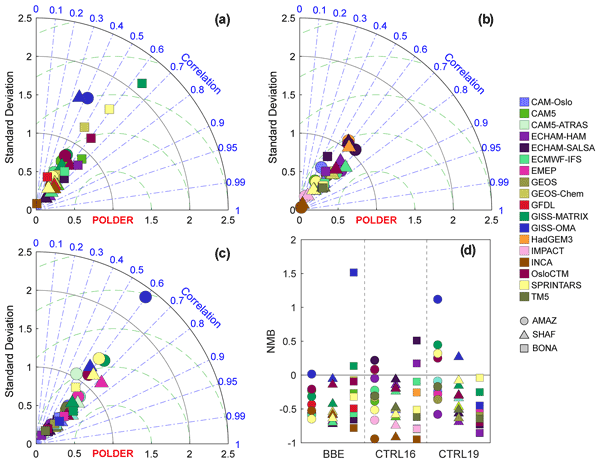
Qirui Zhong, Nick Schutgens, Guido van der Werf, Twan van Noije, Kostas Tsigaridis, Susanne E. Bauer, Tero Mielonen, Alf Kirkevåg, Øyvind Seland, Harri Kokkola, Ramiro Checa-Garcia, David Neubauer, Zak Kipling, Hitoshi Matsui, Paul Ginoux, Toshihiko Takemura, Philippe Le Sager, Samuel Rémy, Huisheng Bian, Mian Chin, Kai Zhang, Jialei Zhu, Svetlana G. Tsyro, Gabriele Curci, Anna Protonotariou, Ben Johnson, Joyce E. Penner, Nicolas Bellouin, Ragnhild B. Skeie, and Gunnar Myhre
Atmos. Chem. Phys., 22, 11009–11032, https://doi.org/10.5194/acp-22-11009-2022, https://doi.org/10.5194/acp-22-11009-2022, 2022
Short summary
Short summary
Aerosol optical depth (AOD) errors for biomass burning aerosol (BBA) are evaluated in 18 global models against satellite datasets. Notwithstanding biases in satellite products, they allow model evaluations. We observe large and diverse model biases due to errors in BBA. Further interpretations of AOD diversities suggest large biases exist in key processes for BBA which require better constraining. These results can contribute to further model improvement and development.
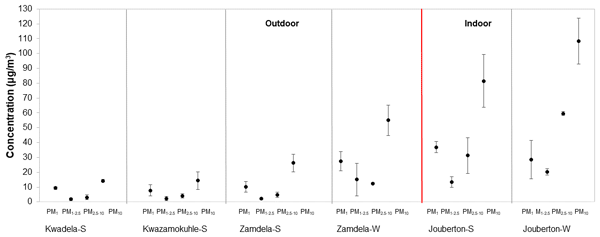
Constance K. Segakweng, Pieter G. van Zyl, Cathy Liousse, Johan P. Beukes, Jan-Stefan Swartz, Eric Gardrat, Maria Dias-Alves, Brigitte Language, Roelof P. Burger, and Stuart J. Piketh
Atmos. Chem. Phys., 22, 10291–10317, https://doi.org/10.5194/acp-22-10291-2022, https://doi.org/10.5194/acp-22-10291-2022, 2022
Short summary
Short summary
A detailed size-resolved assessment of the chemical characteristics of outdoor and indoor aerosols collected in low-income urban settlements in South Africa indicated the significance of household combustion for cooking and space heating – an important source of pollutants in the developing world – to atmospheric chemical composition. The regional impact of industrial sources in the highly industrialised and densely populated north-eastern interior of South Africa was also evident.
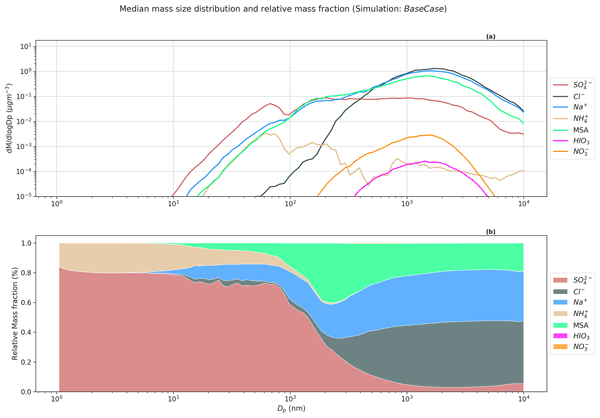
Carlton Xavier, Metin Baykara, Robin Wollesen de Jonge, Barbara Altstädter, Petri Clusius, Ville Vakkari, Roseline Thakur, Lisa Beck, Silvia Becagli, Mirko Severi, Rita Traversi, Radovan Krejci, Peter Tunved, Mauro Mazzola, Birgit Wehner, Mikko Sipilä, Markku Kulmala, Michael Boy, and Pontus Roldin
Atmos. Chem. Phys., 22, 10023–10043, https://doi.org/10.5194/acp-22-10023-2022, https://doi.org/10.5194/acp-22-10023-2022, 2022
Short summary
Short summary
The focus of this work is to study and improve our understanding of processes involved in the formation and growth of new particles in a remote Arctic marine environment. We run the 1D model ADCHEM along air mass trajectories arriving at Ny-Ålesund in May 2018. The model finds that ion-mediated H2SO4–NH3 nucleation can explain the observed new particle formation at Ny-Ålesund. The growth of particles is driven via H2SO4 condensation and formation of methane sulfonic acid in the aqueous phase.
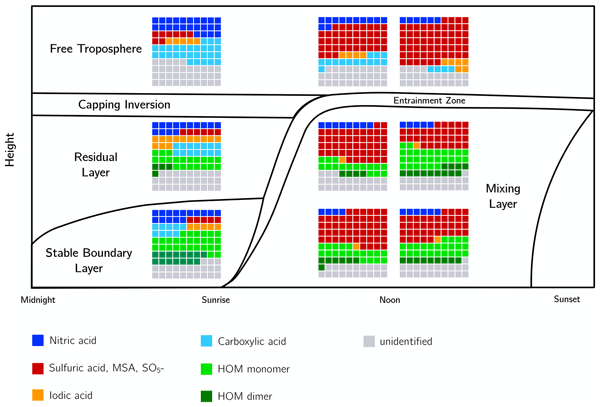
Lisa J. Beck, Siegfried Schobesberger, Heikki Junninen, Janne Lampilahti, Antti Manninen, Lubna Dada, Katri Leino, Xu-Cheng He, Iida Pullinen, Lauriane L. J. Quéléver, Anna Franck, Pyry Poutanen, Daniela Wimmer, Frans Korhonen, Mikko Sipilä, Mikael Ehn, Douglas R. Worsnop, Veli-Matti Kerminen, Tuukka Petäjä, Markku Kulmala, and Jonathan Duplissy
Atmos. Chem. Phys., 22, 8547–8577, https://doi.org/10.5194/acp-22-8547-2022, https://doi.org/10.5194/acp-22-8547-2022, 2022
Short summary
Short summary
The presented article introduces an overview of atmospheric ions and their composition above the boreal forest. We provide the results of an extensive airborne measurement campaign with an air ion mass spectrometer and particle measurements, showing their diurnal evolution within the boundary layer and free troposphere. In addition, we compare the airborne dataset with the co-located data from the ground at SMEAR II station, Finland.
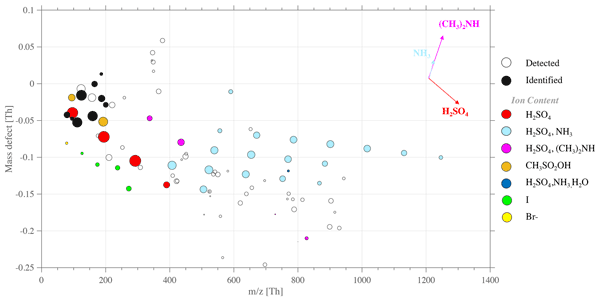
Lauriane L. J. Quéléver, Lubna Dada, Eija Asmi, Janne Lampilahti, Tommy Chan, Jonathan E. Ferrara, Gustavo E. Copes, German Pérez-Fogwill, Luis Barreira, Minna Aurela, Douglas R. Worsnop, Tuija Jokinen, and Mikko Sipilä
Atmos. Chem. Phys., 22, 8417–8437, https://doi.org/10.5194/acp-22-8417-2022, https://doi.org/10.5194/acp-22-8417-2022, 2022
Short summary
Short summary
Understanding how aerosols form is crucial for correctly modeling the climate and improving future predictions. This work provides extensive analysis of aerosol particles and their precursors at Marambio Station, Antarctic Peninsula. We show that sulfuric acid, ammonia, and dimethylamine are key contributors to the frequent new particle formation events observed at the site. We discuss nucleation mechanisms and highlight the need for targeted measurement to fully understand these processes.
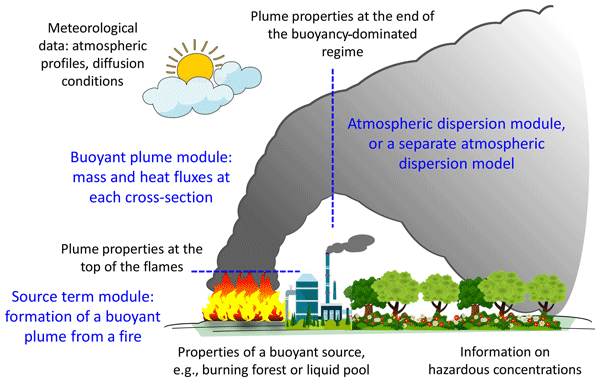
Jaakko Kukkonen, Juha Nikmo, Kari Riikonen, Ilmo Westerholm, Pekko Ilvessalo, Tuomo Bergman, and Klaus Haikarainen
Geosci. Model Dev., 15, 4027–4054, https://doi.org/10.5194/gmd-15-4027-2022, https://doi.org/10.5194/gmd-15-4027-2022, 2022
Short summary
Short summary
A mathematical model has been developed for the dispersion of plumes originating from major fires. We have refined the model for the early evolution of the fire plumes; such a module has not been previously presented. We have evaluated the model against experimental field-scale data. The predicted concentrations agreed well with the aircraft measurements. We have also compiled an operational version of the model, which can be used for emergency contingency planning in the case of major fires.
Ajit Ahlawat, Kay Weinhold, Jesus Marval, Paolo Tronville, Ari Leskinen, Mika Komppula, Holger Gerwig, Lars Gerling, Stephan Weber, Rikke Bramming Jørgensen, Thomas Nørregaard Jensen, Marouane Merizak, Ulrich Vogt, Carla Ribalta, Mar Viana, Andre Schmitz, Maria Chiesa, Giacomo Gerosa, Lothar Keck, Markus Pesch, Gerhard Steiner, Thomas Krinke, Torsten Tritscher, Wolfram Birmili, and Alfred Wiedensohler
Atmos. Meas. Tech. Discuss., https://doi.org/10.5194/amt-2022-155, https://doi.org/10.5194/amt-2022-155, 2022
Revised manuscript not accepted
Short summary
Short summary
Measurements of ultrafine particles must be done with quality-assured instruments. The performance of portable instruments such as NanoScan SMPS, and GRIMM Mini WRAS spectrometer measuring the particle number size distribution in the range from 10 to 200 nm were investigated. The influence of different aerosol types and maintenance activities on these instruments were explored. The results show that these portable instruments are suitable for mobile UFP measurements for source identification.
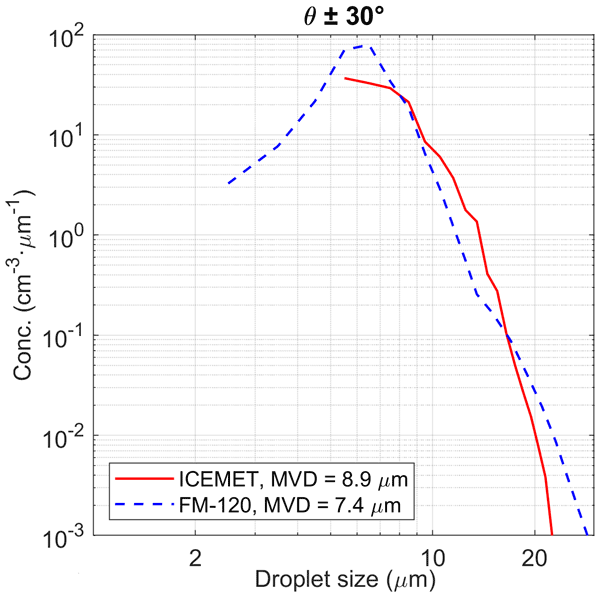
Petri Tiitta, Ari Leskinen, Ville A. Kaikkonen, Eero O. Molkoselkä, Anssi J. Mäkynen, Jorma Joutsensaari, Silvia Calderon, Sami Romakkaniemi, and Mika Komppula
Atmos. Meas. Tech., 15, 2993–3009, https://doi.org/10.5194/amt-15-2993-2022, https://doi.org/10.5194/amt-15-2993-2022, 2022
Short summary
Short summary
The novel holographic imaging instrument (ICEMET) was adapted to measure the microphysical properties of liquid clouds, and these values were compared with parallel measurements of a cloud droplet spectrometer (FM-120) and particle measurements using a twin-inlet system. When the intercomparison was carried out during isoaxial sampling, our results showed good agreement in terms of variability between the instruments. This agreement was confirmed using Mutual and Pearson correlation analyses.
Zoé Brasseur, Dimitri Castarède, Erik S. Thomson, Michael P. Adams, Saskia Drossaart van Dusseldorp, Paavo Heikkilä, Kimmo Korhonen, Janne Lampilahti, Mikhail Paramonov, Julia Schneider, Franziska Vogel, Yusheng Wu, Jonathan P. D. Abbatt, Nina S. Atanasova, Dennis H. Bamford, Barbara Bertozzi, Matthew Boyer, David Brus, Martin I. Daily, Romy Fösig, Ellen Gute, Alexander D. Harrison, Paula Hietala, Kristina Höhler, Zamin A. Kanji, Jorma Keskinen, Larissa Lacher, Markus Lampimäki, Janne Levula, Antti Manninen, Jens Nadolny, Maija Peltola, Grace C. E. Porter, Pyry Poutanen, Ulrike Proske, Tobias Schorr, Nsikanabasi Silas Umo, János Stenszky, Annele Virtanen, Dmitri Moisseev, Markku Kulmala, Benjamin J. Murray, Tuukka Petäjä, Ottmar Möhler, and Jonathan Duplissy
Atmos. Chem. Phys., 22, 5117–5145, https://doi.org/10.5194/acp-22-5117-2022, https://doi.org/10.5194/acp-22-5117-2022, 2022
Short summary
Short summary
The present measurement report introduces the ice nucleation campaign organized in Hyytiälä, Finland, in 2018 (HyICE-2018). We provide an overview of the campaign settings, and we describe the measurement infrastructure and operating procedures used. In addition, we use results from ice nucleation instrument inter-comparison to show that the suite of these instruments deployed during the campaign reports consistent results.

Mathew Sebastian, Sobhan Kumar Kompalli, Vasudevan Anil Kumar, Sandhya Jose, S. Suresh Babu, Govindan Pandithurai, Sachchidanand Singh, Rakesh K. Hooda, Vijay K. Soni, Jeffrey R. Pierce, Ville Vakkari, Eija Asmi, Daniel M. Westervelt, Antti-Pekka Hyvärinen, and Vijay P. Kanawade
Atmos. Chem. Phys., 22, 4491–4508, https://doi.org/10.5194/acp-22-4491-2022, https://doi.org/10.5194/acp-22-4491-2022, 2022
Short summary
Short summary
Characteristics of particle number size distributions and new particle formation in six locations in India were analyzed. New particle formation occurred frequently during the pre-monsoon (spring) season and it significantly modulates the shape of the particle number size distributions. The contribution of newly formed particles to cloud condensation nuclei concentrations was ~3 times higher in urban locations than in mountain background locations.
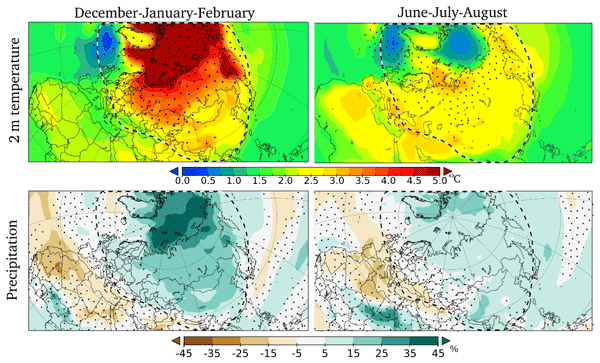
Hanna K. Lappalainen, Tuukka Petäjä, Timo Vihma, Jouni Räisänen, Alexander Baklanov, Sergey Chalov, Igor Esau, Ekaterina Ezhova, Matti Leppäranta, Dmitry Pozdnyakov, Jukka Pumpanen, Meinrat O. Andreae, Mikhail Arshinov, Eija Asmi, Jianhui Bai, Igor Bashmachnikov, Boris Belan, Federico Bianchi, Boris Biskaborn, Michael Boy, Jaana Bäck, Bin Cheng, Natalia Chubarova, Jonathan Duplissy, Egor Dyukarev, Konstantinos Eleftheriadis, Martin Forsius, Martin Heimann, Sirkku Juhola, Vladimir Konovalov, Igor Konovalov, Pavel Konstantinov, Kajar Köster, Elena Lapshina, Anna Lintunen, Alexander Mahura, Risto Makkonen, Svetlana Malkhazova, Ivan Mammarella, Stefano Mammola, Stephany Buenrostro Mazon, Outi Meinander, Eugene Mikhailov, Victoria Miles, Stanislav Myslenkov, Dmitry Orlov, Jean-Daniel Paris, Roberta Pirazzini, Olga Popovicheva, Jouni Pulliainen, Kimmo Rautiainen, Torsten Sachs, Vladimir Shevchenko, Andrey Skorokhod, Andreas Stohl, Elli Suhonen, Erik S. Thomson, Marina Tsidilina, Veli-Pekka Tynkkynen, Petteri Uotila, Aki Virkkula, Nadezhda Voropay, Tobias Wolf, Sayaka Yasunaka, Jiahua Zhang, Yubao Qiu, Aijun Ding, Huadong Guo, Valery Bondur, Nikolay Kasimov, Sergej Zilitinkevich, Veli-Matti Kerminen, and Markku Kulmala
Atmos. Chem. Phys., 22, 4413–4469, https://doi.org/10.5194/acp-22-4413-2022, https://doi.org/10.5194/acp-22-4413-2022, 2022
Short summary
Short summary
We summarize results during the last 5 years in the northern Eurasian region, especially from Russia, and introduce recent observations of the air quality in the urban environments in China. Although the scientific knowledge in these regions has increased, there are still gaps in our understanding of large-scale climate–Earth surface interactions and feedbacks. This arises from limitations in research infrastructures and integrative data analyses, hindering a comprehensive system analysis.
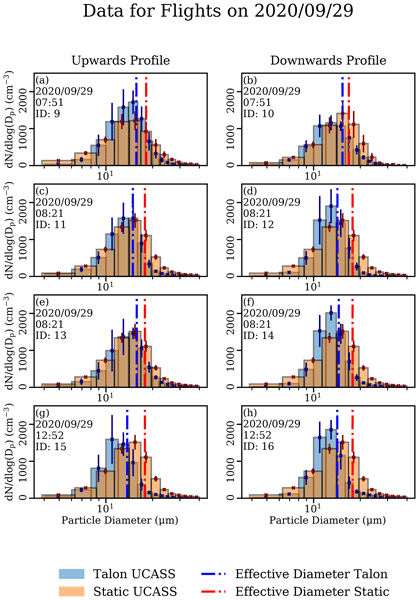
Joseph Girdwood, Warren Stanley, Chris Stopford, and David Brus
Atmos. Meas. Tech., 15, 2061–2076, https://doi.org/10.5194/amt-15-2061-2022, https://doi.org/10.5194/amt-15-2061-2022, 2022
Short summary
Short summary
UAVs have great potential to be used for airborne measurements of cloud and aerosol properties, which are of particular importance due to the largely uncharacterised nature of such phenomena. However, since UAVs are a new tool in atmospheric physics expensive platform validation and characterisation of UAV-instrument combinations needs to be performed. This paper presents an evaluation of a fixed-wing UAV in combination with an instrument that measures cloud droplet diameter.
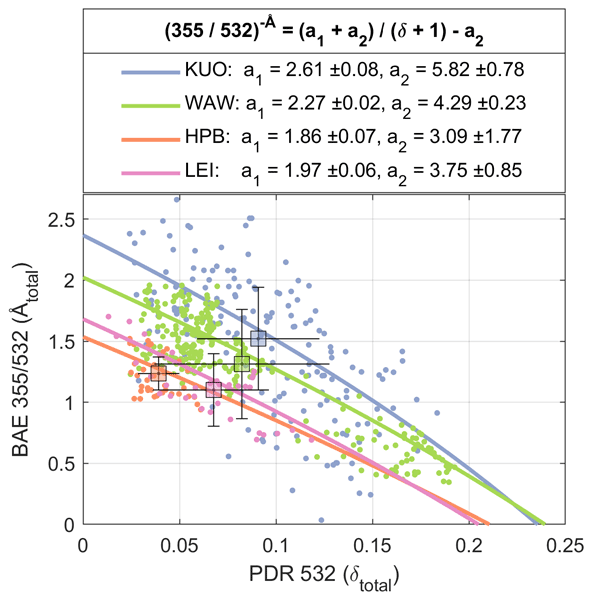
Xiaoxia Shang, Holger Baars, Iwona S. Stachlewska, Ina Mattis, and Mika Komppula
Atmos. Chem. Phys., 22, 3931–3944, https://doi.org/10.5194/acp-22-3931-2022, https://doi.org/10.5194/acp-22-3931-2022, 2022
Short summary
Short summary
This study reports pollen observations at four lidar stations (Hohenpeißenberg, Germany; Kuopio, Finland; Leipzig, Germany; and Warsaw, Poland) during the intensive observation campaign organized in May 2020. A novel simple method for the characterization of the pure pollen is proposed, based on lidar measurements. It was applied to evaluate the pollen depolarization ratio and for the aerosol classifications.
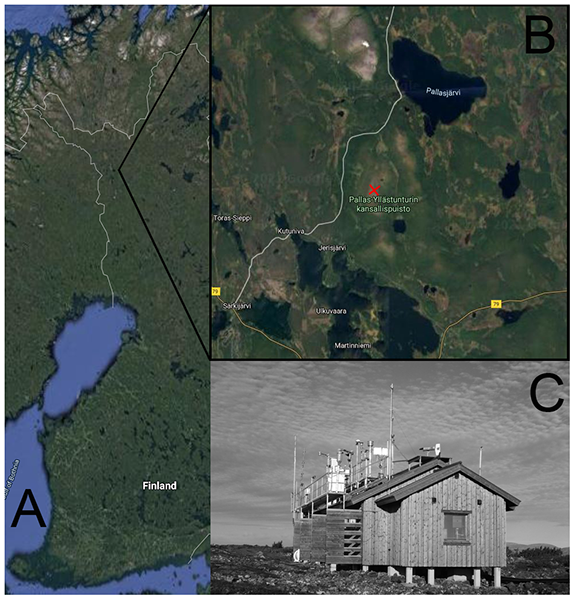
Konstantinos Matthaios Doulgeris, Heikki Lihavainen, Anti-Pekka Hyvärinen, Veli-Matti Kerminen, and David Brus
Earth Syst. Sci. Data, 14, 637–649, https://doi.org/10.5194/essd-14-637-2022, https://doi.org/10.5194/essd-14-637-2022, 2022
Short summary
Short summary
We produced and summarized data sets obtained from two cloud ground-based spectrometers (CAPS and FSSP-100 ground setups) during 8 years of Pallas Cloud Experiment campaigns conducted in autumn from 2004 until 2019 along with several meteorological variables. The campaigns took place in the Finnish sub-Arctic region in a clear environment in temperatures that were usually below zero. This data set provides a helpful contribution to cloud microphysics processes.
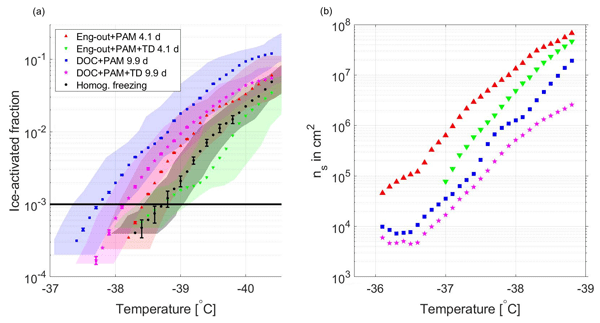
Kimmo Korhonen, Thomas Bjerring Kristensen, John Falk, Vilhelm B. Malmborg, Axel Eriksson, Louise Gren, Maja Novakovic, Sam Shamun, Panu Karjalainen, Lassi Markkula, Joakim Pagels, Birgitta Svenningsson, Martin Tunér, Mika Komppula, Ari Laaksonen, and Annele Virtanen
Atmos. Chem. Phys., 22, 1615–1631, https://doi.org/10.5194/acp-22-1615-2022, https://doi.org/10.5194/acp-22-1615-2022, 2022
Short summary
Short summary
We investigated the ice-nucleating abilities of particulate emissions from a modern diesel engine using the portable ice-nuclei counter SPIN, a continuous-flow diffusion chamber instrument. Three different fuels were studied without blending, including fossil diesel and two renewable fuels, testing different emission aftertreatment systems and photochemical aging. We found that the diesel emissions were inefficient ice nuclei, and aging had no or little effect on their ice-nucleating abilities.
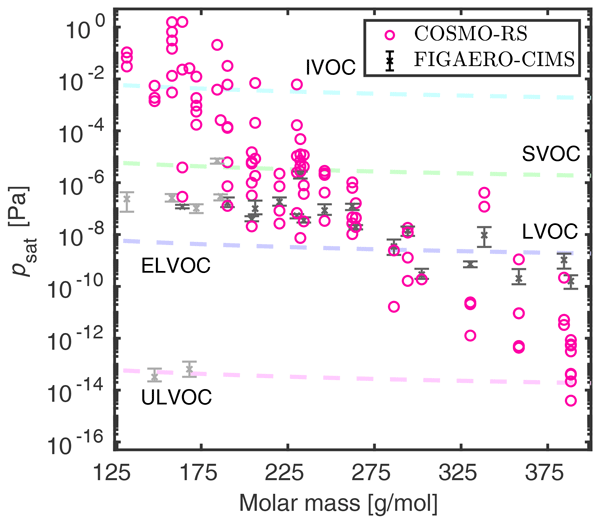
Noora Hyttinen, Iida Pullinen, Aki Nissinen, Siegfried Schobesberger, Annele Virtanen, and Taina Yli-Juuti
Atmos. Chem. Phys., 22, 1195–1208, https://doi.org/10.5194/acp-22-1195-2022, https://doi.org/10.5194/acp-22-1195-2022, 2022
Short summary
Short summary
Accurate saturation vapor pressure estimates of atmospherically relevant organic compounds are critical for modeling secondary organic aerosol (SOA) formation. We investigated vapor pressures of highly oxygenated SOA constituents using state-of-the-art computational and experimental methods. We found a good agreement between low and extremely low vapor pressures estimated using the two methods, and the smallest molecules detected in our experiment were likely products of thermal decomposition.
Jutta Kesti, John Backman, Ewan J. O'Connor, Anne Hirsikko, Eija Asmi, Minna Aurela, Ulla Makkonen, Maria Filioglou, Mika Komppula, Hannele Korhonen, and Heikki Lihavainen
Atmos. Chem. Phys., 22, 481–503, https://doi.org/10.5194/acp-22-481-2022, https://doi.org/10.5194/acp-22-481-2022, 2022
Short summary
Short summary
In this study we combined aerosol particle measurements at the surface with a scanning Doppler lidar providing vertical profiles of the atmosphere to study the effect of different boundary layer conditions on aerosol particle properties in the understudied Arabian Peninsula region. The instrumentation used in this study enabled us to identify periods when pollution from remote sources was mixed down to the surface and initiated new particle formation in the growing boundary layer.
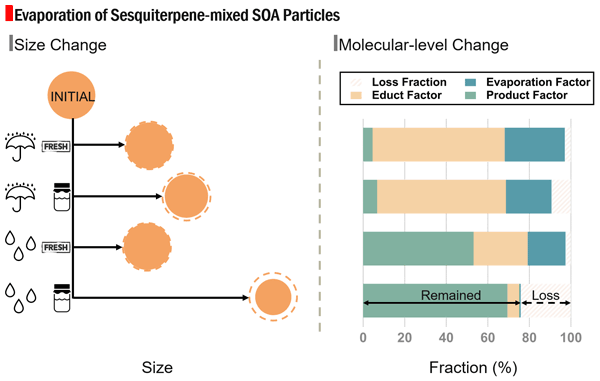
Zijun Li, Angela Buchholz, Arttu Ylisirniö, Luis Barreira, Liqing Hao, Siegfried Schobesberger, Taina Yli-Juuti, and Annele Virtanen
Atmos. Chem. Phys., 21, 18283–18302, https://doi.org/10.5194/acp-21-18283-2021, https://doi.org/10.5194/acp-21-18283-2021, 2021
Short summary
Short summary
We compared the evolution of two types of secondary organic aerosol (SOA) particles during isothermal evaporation. The sesquiterpene SOA particles demonstrated higher resilience to evaporation than α-pinene SOA particles generated under comparable conditions. In-depth analysis showed that under high-relative-humidity conditions, particulate water drove the evolution of particulate constituents by reducing the particle viscosity and initiating chemical aqueous-phase processes.
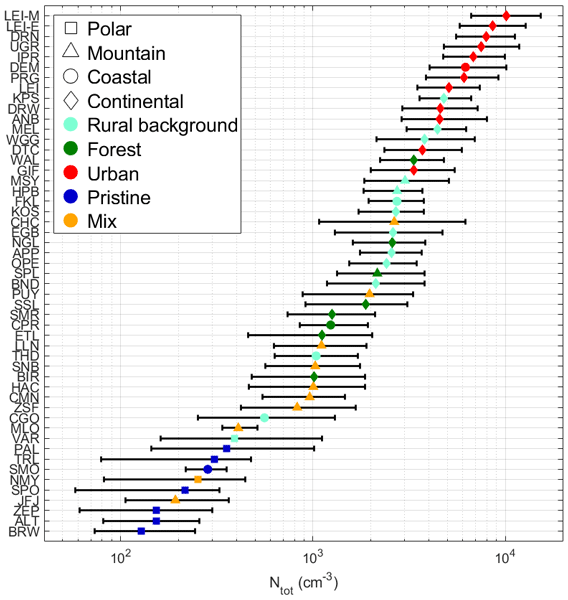
Clémence Rose, Martine Collaud Coen, Elisabeth Andrews, Yong Lin, Isaline Bossert, Cathrine Lund Myhre, Thomas Tuch, Alfred Wiedensohler, Markus Fiebig, Pasi Aalto, Andrés Alastuey, Elisabeth Alonso-Blanco, Marcos Andrade, Begoña Artíñano, Todor Arsov, Urs Baltensperger, Susanne Bastian, Olaf Bath, Johan Paul Beukes, Benjamin T. Brem, Nicolas Bukowiecki, Juan Andrés Casquero-Vera, Sébastien Conil, Konstantinos Eleftheriadis, Olivier Favez, Harald Flentje, Maria I. Gini, Francisco Javier Gómez-Moreno, Martin Gysel-Beer, Anna Gannet Hallar, Ivo Kalapov, Nikos Kalivitis, Anne Kasper-Giebl, Melita Keywood, Jeong Eun Kim, Sang-Woo Kim, Adam Kristensson, Markku Kulmala, Heikki Lihavainen, Neng-Huei Lin, Hassan Lyamani, Angela Marinoni, Sebastiao Martins Dos Santos, Olga L. Mayol-Bracero, Frank Meinhardt, Maik Merkel, Jean-Marc Metzger, Nikolaos Mihalopoulos, Jakub Ondracek, Marco Pandolfi, Noemi Pérez, Tuukka Petäjä, Jean-Eudes Petit, David Picard, Jean-Marc Pichon, Veronique Pont, Jean-Philippe Putaud, Fabienne Reisen, Karine Sellegri, Sangeeta Sharma, Gerhard Schauer, Patrick Sheridan, James Patrick Sherman, Andreas Schwerin, Ralf Sohmer, Mar Sorribas, Junying Sun, Pierre Tulet, Ville Vakkari, Pieter Gideon van Zyl, Fernando Velarde, Paolo Villani, Stergios Vratolis, Zdenek Wagner, Sheng-Hsiang Wang, Kay Weinhold, Rolf Weller, Margarita Yela, Vladimir Zdimal, and Paolo Laj
Atmos. Chem. Phys., 21, 17185–17223, https://doi.org/10.5194/acp-21-17185-2021, https://doi.org/10.5194/acp-21-17185-2021, 2021
Short summary
Short summary
Aerosol particles are a complex component of the atmospheric system the effects of which are among the most uncertain in climate change projections. Using data collected at 62 stations, this study provides the most up-to-date picture of the spatial distribution of particle number concentration and size distribution worldwide, with the aim of contributing to better representation of aerosols and their interactions with clouds in models and, therefore, better evaluation of their impact on climate.
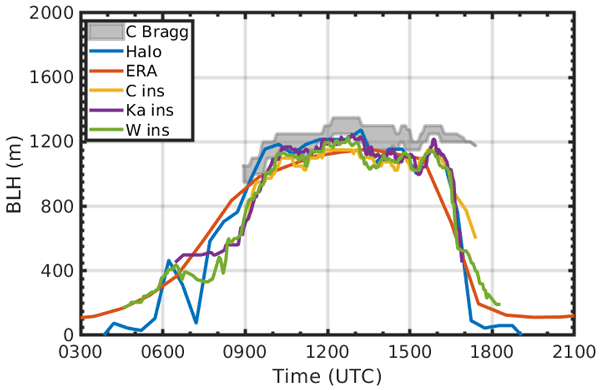
Anna Franck, Dmitri Moisseev, Ville Vakkari, Matti Leskinen, Janne Lampilahti, Veli-Matti Kerminen, and Ewan O'Connor
Atmos. Meas. Tech., 14, 7341–7353, https://doi.org/10.5194/amt-14-7341-2021, https://doi.org/10.5194/amt-14-7341-2021, 2021
Short summary
Short summary
We proposed a method to derive a convective boundary layer height, using insects in radar observations, and we investigated the consistency of these retrievals among different radar frequencies (5, 35 and 94 GHz). This method can be applied to radars at other measurement stations and serve as additional way to estimate the boundary layer height during summer. The entrainment zone was also observed by the 5 GHz radar above the boundary layer in the form of a Bragg scatter layer.
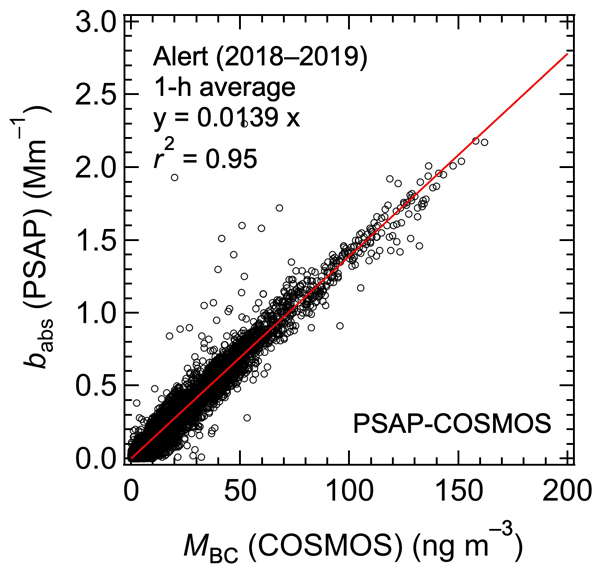
Sho Ohata, Tatsuhiro Mori, Yutaka Kondo, Sangeeta Sharma, Antti Hyvärinen, Elisabeth Andrews, Peter Tunved, Eija Asmi, John Backman, Henri Servomaa, Daniel Veber, Konstantinos Eleftheriadis, Stergios Vratolis, Radovan Krejci, Paul Zieger, Makoto Koike, Yugo Kanaya, Atsushi Yoshida, Nobuhiro Moteki, Yongjing Zhao, Yutaka Tobo, Junji Matsushita, and Naga Oshima
Atmos. Meas. Tech., 14, 6723–6748, https://doi.org/10.5194/amt-14-6723-2021, https://doi.org/10.5194/amt-14-6723-2021, 2021
Short summary
Short summary
Reliable values of mass absorption cross sections (MACs) of black carbon (BC) are required to determine mass concentrations of BC at Arctic sites using different types of filter-based absorption photometers. We successfully estimated MAC values for these instruments through comparison with independent measurements of BC by a continuous soot monitoring system called COSMOS. These MAC values are consistent with each other and applicable to study spatial and temporal variation in BC in the Arctic.
Cited articles
Ansmann, A., Riebesell, M., and Weitkamp, C.: Measurement of atmospheric aerosol extinction profiles with a Raman lidar, Opt. Lett., 15, 746–748, https://doi.org/10.1364/OL.15.000746, 1990. a
Ansmann, A., Baars, H., Tesche, M., Müller, D., Althausen, D., Engelmann, R., Pauliquevis, T., and Artaxo, P.: Dust and smoke transport from Africa to South America: Lidar profiling over Cape Verde and the Amazon rainforest, Geophys. Res. Lett., 36, https://doi.org/10.1029/2009GL037923, 2009. a
Ansmann, A., Tesche, M., Groß, S., Freudenthaler, V., Seifert, P., Hiebsch, A., Schmidt, J., Wandinger, U., Mattis, I., Müller, D., and Wiegner, M.: The 16 April 2010 major volcanic ash plume over central Europe: EARLINET lidar and AERONET photometer observations at Leipzig and Munich, Germany, Geophys. Res. Lett., 37, https://doi.org/10.1029/2010GL043809, 2010. a, b
Ansmann, A., Tesche, M., Seifert, P., Groß, S., Freudenthaler, V., Apituley, A., Wilson, K. M., Serikov, I., Linné, H., Heinold, B., Hiebsch, A., Schnell, F., Schmidt, J., Mattis, I., Wandinger, U., and Wiegner, M.: Ash and fine-mode particle mass profiles from EARLINET-AERONET observations over central Europe after the eruptions of the Eyjafjallajökull volcano in 2010, J. Geophys. Res.-Atmos., 116, https://doi.org/10.1029/2010JD015567, 2011. a
Ansmann, A., Hofer, J., Mamouri, R.-E., Haarig, M., Baars, H., and Wandinger, U.: Aerosol optical-to-microphysical conversion factors for lidars and ceilometers from extended AERONET data analyses: POLIPHON update, Atmos. Meas. Tech., 19, 3801–3830, https://doi.org/10.5194/amt-19-3801-2026, 2026. a, b
Baars, H., Radenz, M., Floutsi, A. A., Engelmann, R., Althausen, D., Heese, B., Ansmann, A., Flament, T., Dabas, A., Trapon, D., Reitebuch, O., Bley, S., and Wandinger, U.: Californian Wildfire Smoke Over Europe: A First Example of the Aerosol Observing Capabilities of Aeolus Compared to Ground-Based Lidar, Geophys. Res. Lett., 48, e2020GL092194, https://doi.org/10.1029/2020GL092194, 2021. a
Bakels, L., Tatsii, D., Tipka, A., Thompson, R., Dütsch, M., Blaschek, M., Seibert, P., Baier, K., Bucci, S., Cassiani, M., Eckhardt, S., Groot Zwaaftink, C., Henne, S., Kaufmann, P., Lechner, V., Maurer, C., Mulder, M. D., Pisso, I., Plach, A., Subramanian, R., Vojta, M., and Stohl, A.: FLEXPART version 11: improved accuracy, efficiency, and flexibility, Geosci. Model Dev., 17, 7595–7627, https://doi.org/10.5194/gmd-17-7595-2024, 2024. a
Bedoya-Velásquez, A. E., Hoyos-Restrepo, M., Barreto, A., García, R. D., Romero-Campos, P. M., García, O., Ramos, R., Roininen, R., Toledano, C., Sicard, M., and Ceolato, R.: Estimation of the Mass Concentration of Volcanic Ash Using Ceilometers: Study of Fresh and Transported Plumes from La Palma Volcano, Remote Sensing, 14, https://doi.org/10.3390/rs14225680, 2022. a
Benedetti, A., Morcrette, J.-J., Boucher, O., Dethof, A., Engelen, R. J., Fisher, M., Flentje, H., Huneeus, N., Jones, L., Kaiser, J. W., Kinne, S., Mangold, A., Razinger, M., Simmons, A. J., and Suttie, M.: Aerosol analysis and forecast in the European Centre for Medium-Range Weather Forecasts Integrated Forecast System: 2. Data assimilation, J. Geophys. Res., 114, D13205, https://doi.org/10.1029/2008JD011115, 2009. a
Bohlmann, S., Shang, X., Vakkari, V., Giannakaki, E., Leskinen, A., Lehtinen, K. E. J., Pätsi, S., and Komppula, M.: Lidar depolarization ratio of atmospheric pollen at multiple wavelengths, Atmos. Chem. Phys., 21, 7083–7097, https://doi.org/10.5194/acp-21-7083-2021, 2021. a
Brus, D., Le, V., Kuula, J., and Doulgeris, K.: Data collected by a drone backpack for air quality and atmospheric state measurements during Pallas Cloud Experiment 2022 (PaCE2022), Earth Syst. Sci. Data, 17, 5209–5219, https://doi.org/10.5194/essd-17-5209-2025, 2025. a
Bucholtz, A.: Rayleigh-scattering calculations for the terrestrial atmosphere, Appl. Optics, 34, 2765–2773, https://doi.org/10.1364/AO.34.002765, 1995. a
Burton, S. P., Hair, J. W., Kahnert, M., Ferrare, R. A., Hostetler, C. A., Cook, A. L., Harper, D. B., Berkoff, T. A., Seaman, S. T., Collins, J. E., Fenn, M. A., and Rogers, R. R.: Observations of the spectral dependence of linear particle depolarization ratio of aerosols using NASA Langley airborne High Spectral Resolution Lidar, Atmos. Chem. Phys., 15, 13453–13473, https://doi.org/10.5194/acp-15-13453-2015, 2015. a, b
Cahill, C. F., Cahill, T. A., and Perry, K. D.: The size- and time-resolved composition of aerosols from a sub-Arctic boreal forest prescribed burn, Atmos. Environ., 42, 7553–7559, https://doi.org/10.1016/j.atmosenv.2008.04.034, 2008. a
Cairo, F., Di Liberto, L., Dionisi, D., and Snels, M.: Understanding Aerosol-Cloud Interactions through Lidar Techniques: A Review, Remote Sensing, 16, https://doi.org/10.3390/rs16152788, 2024. a
Crilley, L. R., Shaw, M., Pound, R., Kramer, L. J., Price, R., Young, S., Lewis, A. C., and Pope, F. D.: Evaluation of a low-cost optical particle counter (Alphasense OPC-N2) for ambient air monitoring, Atmos. Meas. Tech., 11, 709–720, https://doi.org/10.5194/amt-11-709-2018, 2018. a
DeCarlo, P. F., Kimmel, J. R., Trimborn, A., Northway, M. J., Jayne, J. T., Aiken, A. C., Gonin, M., Fuhrer, K., Horvath, T., Docherty, K. S., Worsnop, D. R., and Jimenez, J. L.: Field-deployable, high-resolution, time-of-flight aerosol mass spectrometer, Anal. Chem., 78, 8281–8289, https://doi.org/10.1021/ac061249n, 2006. a
De Rosa, B., Amato, F., Amodeo, A., D’Amico, G., Dema, C., Falconieri, A., Giunta, A., Gumà-Claramunt, P., Kampouri, A., Solomos, S., Mytilinaios, M., Papagiannopoulos, N., Summa, D., Veselovskii, I., and Mona, L.: Characterization of Extremely Fresh Biomass Burning Aerosol by Means of Lidar Observations, Remote Sensing, 14, https://doi.org/10.3390/rs14194984, 2022. a, b
De Rosa, B., Amodeo, A., D’Amico, G., Papagiannopoulos, N., Rosoldi, M., Veselovskii, I., Cardellicchio, F., Falconieri, A., Gumà-Claramunt, P., Laurita, T., Mytilinaios, M., Papanikolaou, C.-A., Amodio, D., Colangelo, C., Di Girolamo, P., Gandolfi, I., Giunta, A., Lapenna, E., Marra, F., Petracca Altieri, R. M., Ripepi, E., Summa, D., Volini, M., Arienzo, A., and Mona, L.: Characterization of Fresh and Aged Smoke Particles Simultaneously Observed with an ACTRIS Multi-Wavelength Raman Lidar in Potenza, Italy, Remote Sensing, 17, https://doi.org/10.3390/rs17152538, 2025. a, b
Donovan, D. P., Klein Baltink, H., Henzing, J. S., de Roode, S. R., and Siebesma, A. P.: A depolarisation lidar-based method for the determination of liquid-cloud microphysical properties, Atmos. Meas. Tech., 8, 237–266, https://doi.org/10.5194/amt-8-237-2015, 2015. a
EU: CORINE Land Cover 2018 (raster 100 m), Europe, 6-yearly version 2020 20u1, https://sdi.eea.europa.eu/catalogue/copernicus/api/records/960998c1-1870-4e82-8051-6485205ebbac?language=all (last access: 14 November 2025), 2025. a
Filioglou, M., Giannakaki, E., Backman, J., Kesti, J., Hirsikko, A., Engelmann, R., O'Connor, E., Leskinen, J. T. T., Shang, X., Korhonen, H., Lihavainen, H., Romakkaniemi, S., and Komppula, M.: Optical and geometrical aerosol particle properties over the United Arab Emirates, Atmos. Chem. Phys., 20, 8909–8922, https://doi.org/10.5194/acp-20-8909-2020, 2020. a
Filioglou, M., Leskinen, A., Vakkari, V., O'Connor, E., Tuononen, M., Tuominen, P., Laukkanen, S., Toiviainen, L., Saarto, A., Shang, X., Tiitta, P., and Komppula, M.: Spectral dependence of birch and pine pollen optical properties using a synergy of lidar instruments, Atmos. Chem. Phys., 23, 9009–9021, https://doi.org/10.5194/acp-23-9009-2023, 2023. a, b, c, d, e
Floutsi, A. A., Baars, H., and Wandinger, U.: HETEAC-Flex: an optimal estimation method for aerosol typing based on lidar-derived intensive optical properties, Atmos. Meas. Tech., 17, 693–714, https://doi.org/10.5194/amt-17-693-2024, 2024. a
Freudenthaler, V., Esselborn, M., Wiegner, M., Heese, B., Tesche, M., Ansmann, A., Müller, D., Althausen, D., Wirth, M., Fix, A., Ehret, G., Knippertz, P., Toledano, C., Gasteiger, J., Garhammer, M., and Seefeldner, M.: Depolarization ratio profiling at several wavelengths in pure Saharan dust during SAMUM 2006, Tellus B, 61, 165–179, https://doi.org/10.1111/j.1600-0889.2008.00396.x, 2009. a, b, c
Galán, C., Smith, M., Thibaudon, M., Frenguelli, G., Oteros, J., Gehrig, R., Berger, U., Clot, B., Brandao, R., and Group, E. Q. W.: Pollen monitoring: minimum requirements and reproducibility of analysis, Aerobiologia, 30, 385–395, https://doi.org/10.1007/s10453-014-9335-5, 2014. a
Giglio, L., Schroeder, W., and Justice, C. O.: The collection 6 MODIS active fire detection algorithm and fire products, Remote Sens. Environ., 178, 31–41, https://doi.org/10.1016/j.rse.2016.02.054, 2016. a
González, Y., Sánchez-Barrero, M. F., Popovici, I., Barreto, Á., Victori, S., Welton, E. J., García, R. D., Sicilia, P. G., Almansa, F. A., Torres, C., and Goloub, P.: Compact dual-wavelength depolarization lidar for aerosol characterization over the subtropical North Atlantic, Atmos. Meas. Tech., 18, 1885–1908, https://doi.org/10.5194/amt-18-1885-2025, 2025. a
Groß, S., Tesche, M., Freudenthaler, V., Toledano, C., Wiegner, M., Ansmann, A., Althausen, D., and Seefeldner, M.: Characterization of Saharan dust, marine aerosols and mixtures of biomass-burning aerosols and dust by means of multi-wavelength depolarization and Raman lidar measurements during SAMUM 2, Tellus B, 63, 706–724, https://doi.org/10.1111/j.1600-0889.2011.00556.x, 2011. a
Groß, S., Freudenthaler, V., Wiegner, M., Gasteiger, J., Geiß, A., and Schnell, F.: Dual-wavelength linear depolarization ratio of volcanic aerosols: Lidar measurements of the Eyjafjallajökull plume over Maisach, Germany, Atmos. Environ., 48, 85–96, https://doi.org/10.1016/j.atmosenv.2011.06.017, 2012. a
Groß, S., Esselborn, M., Abicht, F., Wirth, M., Fix, A., and Minikin, A.: Airborne high spectral resolution lidar observation of pollution aerosol during EUCAARI-LONGREX, Atmos. Chem. Phys., 13, 2435–2444, https://doi.org/10.5194/acp-13-2435-2013, 2013. a
Haarig, M., Ansmann, A., Gasteiger, J., Kandler, K., Althausen, D., Baars, H., Radenz, M., and Farrell, D. A.: Dry versus wet marine particle optical properties: RH dependence of depolarization ratio, backscatter, and extinction from multiwavelength lidar measurements during SALTRACE, Atmos. Chem. Phys., 17, 14199–14217, https://doi.org/10.5194/acp-17-14199-2017, 2017. a
Haarig, M., Ansmann, A., Baars, H., Jimenez, C., Veselovskii, I., Engelmann, R., and Althausen, D.: Depolarization and lidar ratios at 355, 532, and 1064 nm and microphysical properties of aged tropospheric and stratospheric Canadian wildfire smoke, Atmos. Chem. Phys., 18, 11847–11861, https://doi.org/10.5194/acp-18-11847-2018, 2018. a, b, c, d, e, f, g
Haarig, M., Ansmann, A., Engelmann, R., Baars, H., Toledano, C., Torres, B., Althausen, D., Radenz, M., and Wandinger, U.: First triple-wavelength lidar observations of depolarization and extinction-to-backscatter ratios of Saharan dust, Atmos. Chem. Phys., 22, 355–369, https://doi.org/10.5194/acp-22-355-2022, 2022. a
Haarig, M., Engelmann, R., Baars, H., Gast, B., Althausen, D., and Ansmann, A.: Discussion of the spectral slope of the lidar ratio between 355 and 1064 nm from multiwavelength Raman lidar observations, Atmos. Chem. Phys., 25, 7741–7763, https://doi.org/10.5194/acp-25-7741-2025, 2025. a
Hagan, D. H. and Kroll, J. H.: Assessing the accuracy of low-cost optical particle sensors using a physics-based approach, Atmos. Meas. Tech., 13, 6343–6355, https://doi.org/10.5194/amt-13-6343-2020, 2020. a
Hersbach, H., Bell, B., Berrisford, P., Biavati, G., Horányi, A., Muñoz Sabater, J., Nicolas, J., Peubey, C., Radu, R., Rozum, I., Schepers, D., Simmons, A., Soci, C., Dee, D., and Thépaut, J.-N.: ERA5 hourly data on single levels from 1940 to present, Copernicus Climate Change Service (C3S) Climate Data Store (CDS) [data set], https://doi.org/10.24381/cds.adbb2d47, 2023. a
Hirst, J. M.: An automatic volumetric spore trap, Ann. Appl. Biol.y, 39, 257–265, https://doi.org/10.1111/j.1744-7348.1952.tb00904.x, 1952. a
Hu, Q., Goloub, P., Veselovskii, I., Bravo-Aranda, J.-A., Popovici, I. E., Podvin, T., Haeffelin, M., Lopatin, A., Dubovik, O., Pietras, C., Huang, X., Torres, B., and Chen, C.: Long-range-transported Canadian smoke plumes in the lower stratosphere over northern France, Atmos. Chem. Phys., 19, 1173–1193, https://doi.org/10.5194/acp-19-1173-2019, 2019. a
IPCC: Climate Change 2021: The Physical Science Basis. Contribution of Working Group I to the Sixth Assessment Report of the Intergovernmental Panel on Climate Change, vol. In Press, Cambridge University Press, Cambridge, United Kingdom and New York, NY, USA, https://doi.org/10.1017/9781009157896, 2021. a
Janicka, L., Davuliene, L., Bycenkiene, S., and Stachlewska, I. S.: Long term observations of biomass burning aerosol over Warsaw by means of multiwavelength lidar, Opt. Express, 31, 33150–33174, https://doi.org/10.1364/OE.496794, 2023. a
Julaha, K., Ždímal, V., Mbengue, S., Brus, D., and Zíková, N.: Drone-based vertical profiling of particulate matter size distribution and carbonaceous aerosols: urban vs. rural environment, Atmos. Chem. Phys., 25, 17933–17951, https://doi.org/10.5194/acp-25-17933-2025, 2025. a
Kahn, R. A., Andrews, E., Brock, C. A., Chin, M., Feingold, G., Gettelman, A., Levy, R. C., Murphy, D. M., Nenes, A., Pierce, J. R., Popp, T., Redemann, J., Sayer, A. M., da Silva, A. M., Sogacheva, L., and Stier, P.: Reducing Aerosol Forcing Uncertainty by Combining Models With Satellite and Within-The-Atmosphere Observations: A Three-Way Street, Rev. Geophys., 61, e2022RG000796, https://doi.org/10.1029/2022RG000796, 2023. a
Kahnert, M. and Kanngießer, F.: Modelling optical properties of atmospheric black carbon aerosols, J. Quant. Spectrosc. Ra., 244, 106849, https://doi.org/10.1016/j.jqsrt.2020.106849, 2020. a
Kalembkiewicz, J., Galas, D., and Sitarz-Palczak, E.: The Physicochemical Properties and Composition of Biomass Ash and Evaluating Directions of its Applications, Pol. J. Environ. Stud., 27, 2593–2603, https://doi.org/10.15244/pjoes/80870, 2018. a
Kleinman, L. I., Sedlacek III, A. J., Adachi, K., Buseck, P. R., Collier, S., Dubey, M. K., Hodshire, A. L., Lewis, E., Onasch, T. B., Pierce, J. R., Shilling, J., Springston, S. R., Wang, J., Zhang, Q., Zhou, S., and Yokelson, R. J.: Rapid evolution of aerosol particles and their optical properties downwind of wildfires in the western US, Atmos. Chem. Phys., 20, 13319–13341, https://doi.org/10.5194/acp-20-13319-2020, 2020. a
Komppula, M. and O'Connor, E.: Doppler lidar data from Kiviniemi on 6 June 2024, ACTRIS Cloud remote sensing data centre unit (CLU), ACTRIS Cloud remote sensing data centre unit (CLU) [data set], https://cloudnet.fmi.fi/file/7fc69d32-56df-48d8-ba9d-d302051bc414 (last access: 6 March 2026), 2025. a
Kong, Z., Yu, J., Gong, Z., Hua, D., and Mei, L.: Visible, near-infrared dual-polarization lidar based on polarization cameras: system design, evaluation and atmospheric measurements, Opt. Express, 30, 28514–28533, https://doi.org/10.1364/OE.463763, 2022. a
Le, V., Lobo, H., O'Connor, E. J., and Vakkari, V.: Long-term aerosol particle depolarization ratio measurements with HALO Photonics Doppler lidar, Atmos. Meas. Tech., 17, 921–941, https://doi.org/10.5194/amt-17-921-2024, 2024. a, b, c, d
Liu, L. and Mishchenko, M. I.: Spectrally dependent linear depolarization and lidar ratios for nonspherical smoke aerosols, J. Quant. Spectrosc. Ra., 248, 106953, https://doi.org/10.1016/j.jqsrt.2020.106953, 2020. a
Martinent, B., Santoni, P.-A., Coppalle, A., Quilichini, Y., and Barboni, T.: Investigation of the morphology and composition of aerosols from plant burning, J. Aerosol Sci., 187, 106589, https://doi.org/10.1016/j.jaerosci.2025.106589, 2025. a
Mie, G.: Beiträge zur Optik trüber Medien, speziell kolloidaler Metallösungen, Ann. Phys., 330, 377–445, https://doi.org/10.1002/andp.19083300302, 1908. a
Mukherjee, A., Hartikainen, A., Somero, M., Luostari, V., Ihalainen, M., Rüger, C. P., Kekäläinen, T., Nissinen, V. H., Barreira, L. M. F., Koponen, H., Kokkola, T., Li, D., Vettikkat, L., Yli-Pirilä, P., Shahzaib, M., Ruppel, M. M., Vakkari, V., Jaars, K., Siebert, S. J., Buchholz, A., Köster, K., van Zyl, P. G., Timonen, H., Kinnunen, N., Jänis, J., Virtanen, A., Virkkula, A., and Sippula, O.: Brown carbon emissions from laboratory combustion of Eurasian arctic-boreal and South African savanna biomass, Atmos. Chem. Phys., 25, 16747–16774, https://doi.org/10.5194/acp-25-16747-2025, 2025. a, b, c
Murayama, T., Müller, D., Wada, K., Shimizu, A., Sekiguchi, M., and Tsukamoto, T.: Characterization of Asian dust and Siberian smoke with multi-wavelength Raman lidar over Tokyo, Japan in spring 2003, Geophys. Res. Lett., 31, https://doi.org/10.1029/2004GL021105, 2004. a
Müller, D., Mattis, I., Wandinger, U., Ansmann, A., Althausen, D., and Stohl, A.: Raman lidar observations of aged Siberian and Canadian forest fire smoke in the free troposphere over Germany in 2003: Microphysical particle characterization, J. Geophys. Res.-Atmos., 110, https://doi.org/10.1029/2004JD005756, 2005. a, b
Nicolae, D., Nemuc, A., Müller, D., Talianu, C., Vasilescu, J., Belegante, L., and Kolgotin, A.: Characterization of fresh and aged biomass burning events using multiwavelength Raman lidar and mass spectrometry, J. Geophys. Res.-Atmos., 118, 2956–2965, https://doi.org/10.1002/jgrd.50324, 2013. a
Nicolae, D., Vasilescu, J., Talianu, C., Binietoglou, I., Nicolae, V., Andrei, S., and Antonescu, B.: A neural network aerosol-typing algorithm based on lidar data, Atmos. Chem. Phys., 18, 14511–14537, https://doi.org/10.5194/acp-18-14511-2018, 2018. a
Noh, Y. M., Müller, D., Lee, H., Lee, K., Kim, K., Shin, S., and Kim, Y. J.: Estimation of radiative forcing by the dust and non-dust content in mixed East Asian pollution plumes on the basis of depolarization ratios measured with lidar, Atmos. Environ., 61, 221–231, https://doi.org/10.1016/j.atmosenv.2012.07.034, 2012. a
Ohata, S., Mori, T., Kondo, Y., Sharma, S., Hyvärinen, A., Andrews, E., Tunved, P., Asmi, E., Backman, J., Servomaa, H., Veber, D., Eleftheriadis, K., Vratolis, S., Krejci, R., Zieger, P., Koike, M., Kanaya, Y., Yoshida, A., Moteki, N., Zhao, Y., Tobo, Y., Matsushita, J., and Oshima, N.: Estimates of mass absorption cross sections of black carbon for filter-based absorption photometers in the Arctic, Atmos. Meas. Tech., 14, 6723–6748, https://doi.org/10.5194/amt-14-6723-2021, 2021. a
Paez, P., Cogliati, M., Caselli, A., and Monasterio, A.: An analysis of volcanic SO2 and ash emissions from Copahue volcano, J. S. Am. Earth Sci., 110, 103365, https://doi.org/10.1016/j.jsames.2021.103365, 2021. a
Papagiannopoulos, N., Mona, L., Amodeo, A., D'Amico, G., Gumà Claramunt, P., Pappalardo, G., Alados-Arboledas, L., Guerrero-Rascado, J. L., Amiridis, V., Kokkalis, P., Apituley, A., Baars, H., Schwarz, A., Wandinger, U., Binietoglou, I., Nicolae, D., Bortoli, D., Comerón, A., Rodríguez-Gómez, A., Sicard, M., Papayannis, A., and Wiegner, M.: An automatic observation-based aerosol typing method for EARLINET, Atmos. Chem. Phys., 18, 15879–15901, https://doi.org/10.5194/acp-18-15879-2018, 2018. a
Papayannis, A., Soupiona, O., Gidarakou, M., Papanikolaou, C.-A., Anagnou, D., Foskinis, R., Mylonaki, M., Mandelia, K., and Solomos, S.: Optical Properties and Radiative Forcing Estimations of High-Altitude Aerosol Transport During Saharan Dust Events Based on Laser Remote Sensing Techniques (CLIMPACT Campaign 2021, Greece), Remote Sensing, 17, https://doi.org/10.3390/rs17213607, 2025. a
Pappalardo, G., Mona, L., D'Amico, G., Wandinger, U., Adam, M., Amodeo, A., Ansmann, A., Apituley, A., Alados Arboledas, L., Balis, D., Boselli, A., Bravo-Aranda, J. A., Chaikovsky, A., Comeron, A., Cuesta, J., De Tomasi, F., Freudenthaler, V., Gausa, M., Giannakaki, E., Giehl, H., Giunta, A., Grigorov, I., Groß, S., Haeffelin, M., Hiebsch, A., Iarlori, M., Lange, D., Linné, H., Madonna, F., Mattis, I., Mamouri, R.-E., McAuliffe, M. A. P., Mitev, V., Molero, F., Navas-Guzman, F., Nicolae, D., Papayannis, A., Perrone, M. R., Pietras, C., Pietruczuk, A., Pisani, G., Preißler, J., Pujadas, M., Rizi, V., Ruth, A. A., Schmidt, J., Schnell, F., Seifert, P., Serikov, I., Sicard, M., Simeonov, V., Spinelli, N., Stebel, K., Tesche, M., Trickl, T., Wang, X., Wagner, F., Wiegner, M., and Wilson, K. M.: Four-dimensional distribution of the 2010 Eyjafjallajökull volcanic cloud over Europe observed by EARLINET, Atmos. Chem. Phys., 13, 4429–4450, https://doi.org/10.5194/acp-13-4429-2013, 2013. a
Pearson, G., Davies, F., and Collier, C.: An Analysis of the Performance of the UFAM Pulsed Doppler Lidar for Observing the Boundary Layer, J. Atmos. Ocean. Tech., 26, 240–250, https://doi.org/10.1175/2008JTECHA1128.1, 2009. a
Peltokorpi, S., Kommula, S. M., Buchholz, A., Hao, L., Ihalainen, M., Jaars, K., Köster, K., Rosewig, E. I., Siebert, S. J., Somero, M., Vettikkat, L., Yli-Pirilä, P., van Zyl, P. G., Passig, J., Zimmermann, R., Sippula, O., Vakkari, V., and Virtanen, A.: Savannah and Boreal Biomass Burning as a Source for Cloud Condensation Nuclei, J. Geophys. Res.-Atmos., 131, e2025JD044564, https://doi.org/10.1029/2025JD044564, 2026. a
Pereira, S., Preißer, J., Guerrero-Rascado, J. L., Silva, A. M., and Wagner, F.: Forest Fire Smoke Layers Observed in the Free Troposphere over Portugal with a Multiwavelength Raman Lidar: Optical and Microphysical Properties, The Scientific World Journal, 2014, 421838, https://doi.org/10.1155/2014/421838, 2014. a, b
Petzold, A. and Schönlinner, M.: Multi-angle absorption photometry-a new method for the measurement of aerosol light absorption and atmospheric black carbon, J. Aerosol Sci., 35, 421–441, https://doi.org/10.1016/j.jaerosci.2003.09.005, 2004. a
Pisani, G., Boselli, A., Coltelli, M., Leto, G., Pica, G., Scollo, S., Spinelli, N., and Wang, X.: Lidar depolarization measurement of fresh volcanic ash from Mt. Etna, Italy, Atmos. Environ., 62, 34–40, https://doi.org/10.1016/j.atmosenv.2012.08.015, 2012. a, b
Qin, Z., Wang, H., He, A., Sun, Y., Li, J., Zhang, Y., and Zhang, Q.: Backscattering Linear Depolarization Ratio of Smoke Aerosols From Biomass Burning, J. Geophys. Res.-Atmos., 129, e2024JD041276, https://doi.org/10.1029/2024JD041276, 2024. a
Reid, J. S., Koppmann, R., Eck, T. F., and Eleuterio, D. P.: A review of biomass burning emissions part II: intensive physical properties of biomass burning particles, Atmos. Chem. Phys., 5, 799–825, https://doi.org/10.5194/acp-5-799-2005, 2005. a
Rogers, B. M., Soja, A. J., Goulden, M. L., and Randerson, J. T.: Influence of tree species on continental differences in boreal fires and climate feedbacks, Nat. Geosci., 8, 228–234, https://doi.org/10.1038/ngeo2352, 2015. a
Saide, P. E., Thapa, L. H., Ye, X., Pagonis, D., Campuzano-Jost, P., Guo, H., Schueneman, M. K., Jimenez, J.-L., Moore, R., Wiggins, E., Winstead, E., Robinson, C., Thornhill, L., Sanchez, K., Wagner, N. L., Ahern, A., Katich, J. M., Perring, A. E., Schwarz, J. P., Lyu, M., Holmes, C. D., Hair, J. W., Fenn, M. A., and Shingler, T. J.: Understanding the Evolution of Smoke Mass Extinction Efficiency Using Field Campaign Measurements, Geophys. Res. Lett., 49, e2022GL099175, https://doi.org/10.1029/2022GL099175, 2022. a
Sayer, A. M., Hsu, N. C., Eck, T. F., Smirnov, A., and Holben, B. N.: AERONET-based models of smoke-dominated aerosol near source regions and transported over oceans, and implications for satellite retrievals of aerosol optical depth, Atmos. Chem. Phys., 14, 11493–11523, https://doi.org/10.5194/acp-14-11493-2014, 2014. a
Schotland, R. M., Sassen, K., and Stone, R.: Observations by Lidar of Linear Depolarization Ratios for Hydrometeors, J. Appl. Meteorol. Clim., 10, 1011–1017, https://doi.org/10.1175/1520-0450(1971)010<1011:OBLOLD>2.0.CO;2, 1971. a
Sekiyama, T. T., Tanaka, T. Y., Shimizu, A., and Miyoshi, T.: Data assimilation of CALIPSO aerosol observations, Atmos. Chem. Phys., 10, 39–49, https://doi.org/10.5194/acp-10-39-2010, 2010. a
Shimizu, A., Nakamichi, H., and Iguchi, M.: Long-Term Lidar Observations of Volcanic Ash from Sakurajima, J. Disaster Res., 20, 281–286, https://doi.org/10.20965/jdr.2025.p0281, 2025. a
Sousan, S., Koehler, K., Hallett, L., and Peters, T. M.: Evaluation of the Alphasense optical particle counter (OPC-N2) and the Grimm portable aerosol spectrometer (PAS-1.108), Aerosol Sci. Technol., 50, 1352–1365, https://doi.org/10.1080/02786826.2016.1232859, 2016. a
Su, J., Delgado, R., Berkoff, T. A., Sullivan, J. T., Gronoff, G. P., and Phoenix, D. B.: Observation of fresh wildfire smoke over Hampton, VA in winter, Atmos. Environ., 358, 121370, https://doi.org/10.1016/j.atmosenv.2025.121370, 2025. a, b
Sugimoto, N. and Lee, C. H.: Characteristics of dust aerosols inferred from lidar depolarization measurements at two wavelengths, Appl. Optics, 45, 7468–7474, https://doi.org/10.1364/AO.45.007468, 2006. a, b, c
Sugimoto, N., Matsui, I., Shimizu, A., Uno, I., Asai, K., Endoh, T., and Nakajima, T.: Observation of dust and anthropogenic aerosol plumes in the Northwest Pacific with a two-wavelength polarization lidar on board the research vessel Mirai, Geophys. Res. Lett., 29, 7–1–7–4, https://doi.org/10.1029/2002GL015112, 2002. a
Sumlin, B. J., Heinson, W. R., and Chakrabarty, R. K.: Retrieving the aerosol complex refractive index using PyMieScatt: A Mie computational package with visualization capabilities, J. Quant. Spectrosc. Ra., 205, 127–134, https://doi.org/10.1016/j.jqsrt.2017.10.012, 2018a. a
Sumlin, B. J., Heinson, Y. W., Shetty, N., Pandey, A., Pattison, R. S., Baker, S., Hao, W. M., and Chakrabarty, R. K.: UV–Vis–IR spectral complex refractive indices and optical properties of brown carbon aerosol from biomass burning, J. Quant. Spectrosc. Ra., 206, 392–398, https://doi.org/10.1016/j.jqsrt.2017.12.009, 2018b. a
Tesche, M., Ansmann, A., Müller, D., Althausen, D., Engelmann, R., Freudenthaler, V., and Groß, S.: Vertically resolved separation of dust and smoke over Cape Verde using multiwavelength Raman and polarization lidars during Saharan Mineral Dust Experiment 2008, J. Geophys. Res.-Atmos., 114, https://doi.org/10.1029/2009JD011862, 2009. a
Tesche, M., Gross, S., Ansmann, A., Müller, D., Althausen, D., Freudenthaler, V., and Esselborn, M.: Profiling of Saharan dust and biomass-burning smoke with multiwavelength polarization Raman lidar at Cape Verde, Tellus B, 63, 649–676, https://doi.org/10.1111/j.1600-0889.2011.00548.x, 2011. a
Vakkari, V., Beukes, J. P., Dal Maso, M., Aurela, M., Josipovic, M., Van Zyl, P. G., Tiitta, P., Kulmala, M., and Laakso, L.: Major secondary aerosol formation in southern African open biomass burning plumes, Nat. Geosci., 11, 580–583, https://doi.org/10.1038/s41561-018-0170-0, 2018. a
Vakkari, V., Manninen, A. J., O'Connor, E. J., Schween, J. H., van Zyl, P. G., and Marinou, E.: A novel post-processing algorithm for Halo Doppler lidars, Atmos. Meas. Tech., 12, 839–852, https://doi.org/10.5194/amt-12-839-2019, 2019. a, b, c
Vakkari, V., Vettikkat, L., Kommula, S., Mukherjee, A., Hao, L., Backman, J., Buchholz, A., Gawlitta, N., Ihalainen, M., Jaars, K., Köster, K., Le, V., Miettinen, P., Nissinen, A., Czech, H., Alton, M., Passig, J., Peltokorpi, S., Piedehierro, A. A., Pullinen, I., Rosewig, E. I., Schobesberger, S., Shukla, D., Siebert, S. J., Somero, M., Virkkula, A., Welti, A., Yli-Pirilä, P., Ylisirniö, A., Zimmermann, R., van Zyl, P. G., Virtanen, A., and Sippula, O.: Laboratory Experiments on Savannah and European Boreal Forest Fire Emissions, J. Geophys. Res.-Atmos., 131, e2025JD044543, https://doi.org/10.1029/2025JD044543, 2026. a, b
Wiegner, M. and Geiß, A.: Aerosol profiling with the Jenoptik ceilometer CHM15kx, Atmos. Meas. Tech., 5, 1953–1964, https://doi.org/10.5194/amt-5-1953-2012, 2012. a
Xian, J., Sun, D., Xu, W., Han, Y., Zheng, J., Peng, J., and Yang, S.: Urban air pollution monitoring using scanning Lidar, Environ. Pollut., 258, 113696, https://doi.org/10.1016/j.envpol.2019.113696, 2020. a
Zhang, J., Reid, J. S., Westphal, D. L., Baker, N. L., and Hyer, E. J.: A system for operational aerosol optical depth data assimilation over global oceans, J. Geophys. Res.-Atmos., 119, 2013JD020666, https://doi.org/10.1002/2013JD020666, 2014. a
Zhang, Y., Favez, O., Canonaco, F., Liu, D., Močnik, G., Amodeo, T., Sciare, J., Prévôt, A. S. H., Gros, V., and Albinet, A.: Evidence of major secondary organic aerosol contribution to lensing effect black carbon absorption enhancement, npj Climate and Atmospheric Science, 1, 47, https://doi.org/10.1038/s41612-018-0056-2, 2018. a
Short summary
This study explores how smoke and volcanic ash particles, alter the way light is scattered in the atmosphere. By using a ground‑based HALO Doppler lidar system, we observed clear differences in the depolarization ratio, a shape-relevant optical parameter, between fresh smoke, aged smoke, and volcanic ash. These findings show that HALO Doppler lidars can help identify particle types in the air and even provide estimates of smoke mass concentrations, improving assessments of air quality.
This study explores how smoke and volcanic ash particles, alter the way light is scattered in...


Altmetrics
Final-revised paper
Preprint