
Articles | Volume 26, issue 19
https://doi.org/10.5194/acp-26-13885-2026
© Author(s) 2026. This work is distributed under
the Creative Commons Attribution 4.0 License.
the Creative Commons Attribution 4.0 License.
https://doi.org/10.5194/acp-26-13885-2026
© Author(s) 2026. This work is distributed under
the Creative Commons Attribution 4.0 License.
the Creative Commons Attribution 4.0 License.
Research article
| 
05 Oct 2026
Research article |
| 05 Oct 2026
| 05 Oct 2026
Synthesis of the tethered balloon system and other TRACER campaign measurements elucidates aerosol property profiles

Integrated Discovery Sciences Directorate, Pacific Northwest National Laboratory, Richland, WA, 99352, USA
Jian Wang
Energy, Environmental & Chemical Engineering Department, Washington University in St. Louis, St. Louis, MO, 63130, USA
Israel Silber
Integrated Discovery Sciences Directorate, Pacific Northwest National Laboratory, Richland, WA, 99352, USA
Nurun Nahar Lata
Environmental Molecular Sciences Laboratory, Pacific Northwest National Laboratory, Richland, WA, 99352, USA
Gregory W. Vandergrift
Environmental Molecular Sciences Laboratory, Pacific Northwest National Laboratory, Richland, WA, 99352, USA
Energy, Environmental & Chemical Engineering Department, Washington University in St. Louis, St. Louis, MO, 63130, USA
Department of Atmospheric Sciences, Texas A&M University, College Station, 77843, USA
Department of Atmospheric Science, Colorado State University, Fort Collins, CO, 80521, USA
Sarah D. Brooks
Department of Atmospheric Sciences, Texas A&M University, College Station, 77843, USA
Michael P. Jensen
Environmental and Climate Sciences Department, Brookhaven National Laboratory, Upton, NY, 11973, USA
Environmental and Climate Sciences Department, Brookhaven National Laboratory, Upton, NY, 11973, USA
Damao Zhang
Integrated Discovery Sciences Directorate, Pacific Northwest National Laboratory, Richland, WA, 99352, USA
Darielle Dexheimer
Sandia National Laboratories, Albuquerque, NM, 87185, USA
Beat Schmid
Integrated Discovery Sciences Directorate, Pacific Northwest National Laboratory, Richland, WA, 99352, USA
Zezhen Cheng
Environmental Molecular Sciences Laboratory, Pacific Northwest National Laboratory, Richland, WA, 99352, USA
Swarup China
Environmental Molecular Sciences Laboratory, Pacific Northwest National Laboratory, Richland, WA, 99352, USA
Related authors
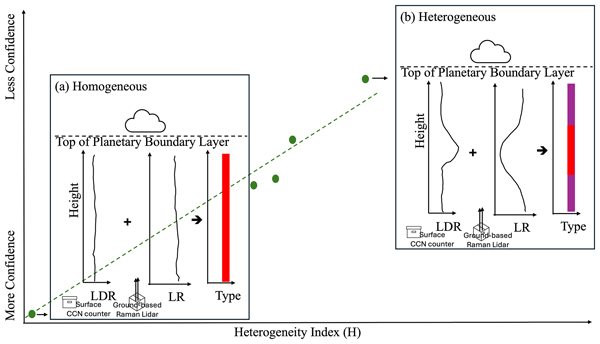
Jingjing Tian, Gourihar Kulkarni, Jennifer M. Comstock, John E. Shilling, Damao Zhang, Peng Wu, and Fan Mei
Atmos. Meas. Tech., 19, 5051–5069, https://doi.org/10.5194/amt-19-5051-2026, https://doi.org/10.5194/amt-19-5051-2026, 2026
Short summary
Short summary
Cloud condensation nuclei are tiny particles that attract water vapor and help form clouds. A ground-based lidar method can estimate their number at different heights, but assumes the aerosol type does not change with height. Comparisons with aircraft data show good agreement of this method when aerosols are well mixed, but larger errors when stacked layers occur. We also developed an index to flag these complex conditions and indicate when this estimation method is more reliable.
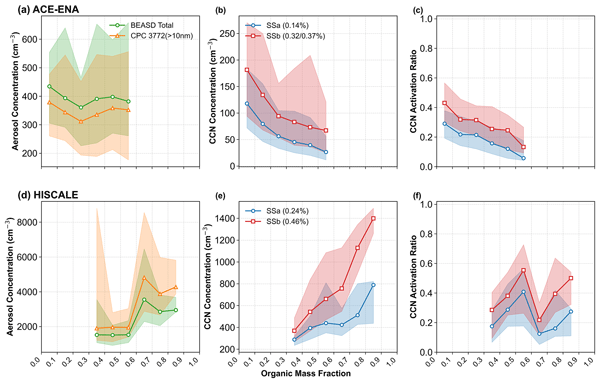
Guangxin Ai, Shuaiqi Tang, Hailong Wang, Fan Mei, and Minghuai Wang
Atmos. Chem. Phys., 26, 7967–7984, https://doi.org/10.5194/acp-26-7967-2026, https://doi.org/10.5194/acp-26-7967-2026, 2026
Short summary
Short summary
Tiny aerosol particles help form cloud droplets and can affect rainfall and climate, but their behavior is hard to predict. We used aircraft measurements over the ocean near the Azores and over the central United States to compare clean and polluted air. We found that particle size and chemical makeup together control how easily clouds form, and organic-rich particles often reduce droplet formation. These results can improve how weather and climate models represent clouds.
Susanne Glienke, Kevin L. Bertschinger, Fan Mei, and John E. Shilling
EGUsphere, https://doi.org/10.5194/egusphere-2026-2141, https://doi.org/10.5194/egusphere-2026-2141, 2026
Short summary
Short summary
Knowing accurate cloud droplet size distributions and droplet movement is important to understand cloud formation and lifetime. To better measure these, we developed and tested the HOLOgraphic DROPlet Sensor (HOLODROPS) with two operational configurations, which can be used for both long-term cloud measurements and for short-term droplet tracking, in conjunction with an event-camera-based Particle Imaging Velocimetry (ePIV) system for fast analysis of droplet movements.
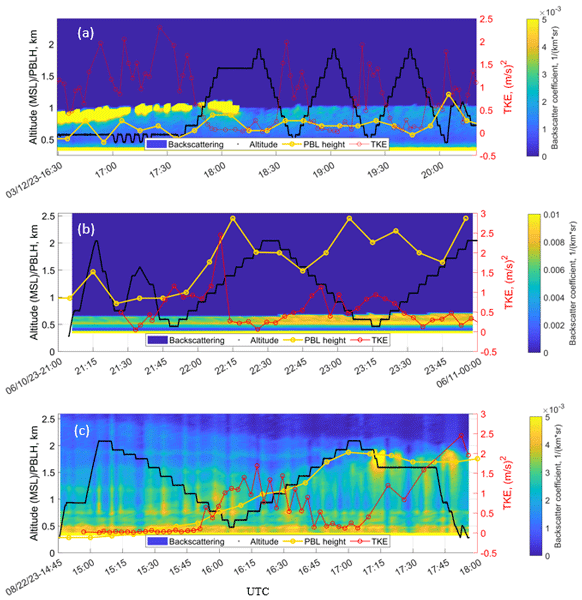
Fan Mei, Qi Zhang, Damao Zhang, Jerome D. Fast, Gourihar Kulkarni, Mikhail S. Pekour, Christopher R. Niedek, Susanne Glienke, Israel Silber, Beat Schmid, Jason M. Tomlinson, Hardeep S. Mehta, Xena Mansoura, Zezhen Cheng, Gregory W. Vandergrift, Nurun Nahar Lata, Swarup China, and Zihua Zhu
Atmos. Chem. Phys., 25, 3425–3444, https://doi.org/10.5194/acp-25-3425-2025, https://doi.org/10.5194/acp-25-3425-2025, 2025
Short summary
Short summary
This study highlights the unique capability of the ArcticShark, an uncrewed aerial system, in measuring vertically resolved atmospheric properties. Data from 32 research flights in 2023 reveal seasonal patterns and correlations with conventional measurements. The consistency and complementarity of in situ and remote sensing methods are highlighted. The study demonstrates the ArcticShark’s versatility in bridging data gaps and improving the understanding of vertical atmospheric structures.
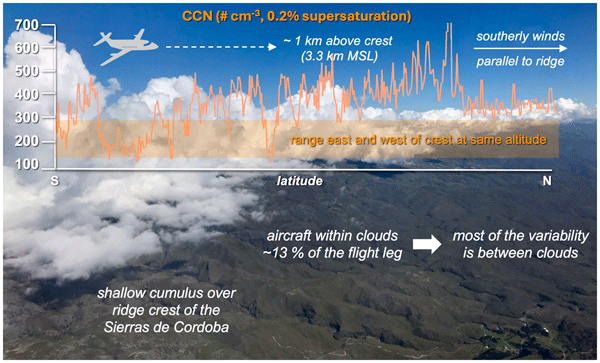
Jerome D. Fast, Adam C. Varble, Fan Mei, Mikhail Pekour, Jason Tomlinson, Alla Zelenyuk, Art J. Sedlacek III, Maria Zawadowicz, and Louisa Emmons
Atmos. Chem. Phys., 24, 13477–13502, https://doi.org/10.5194/acp-24-13477-2024, https://doi.org/10.5194/acp-24-13477-2024, 2024
Short summary
Short summary
Aerosol property measurements recently collected on the ground and by a research aircraft in central Argentina during the Cloud, Aerosol, and Complex Terrain Interactions (CACTI) campaign exhibit large spatial and temporal variability. These measurements coupled with coincident meteorological information provide a valuable data set needed to evaluate and improve model predictions of aerosols in a traditionally data-sparse region of South America.
Fan Mei, Jennifer M. Comstock, Mikhail S. Pekour, Jerome D. Fast, Krista L. Gaustad, Beat Schmid, Shuaiqi Tang, Damao Zhang, John E. Shilling, Jason M. Tomlinson, Adam C. Varble, Jian Wang, L. Ruby Leung, Lawrence Kleinman, Scot Martin, Sebastien C. Biraud, Brian D. Ermold, and Kenneth W. Burk
Earth Syst. Sci. Data, 16, 5429–5448, https://doi.org/10.5194/essd-16-5429-2024, https://doi.org/10.5194/essd-16-5429-2024, 2024
Short summary
Short summary
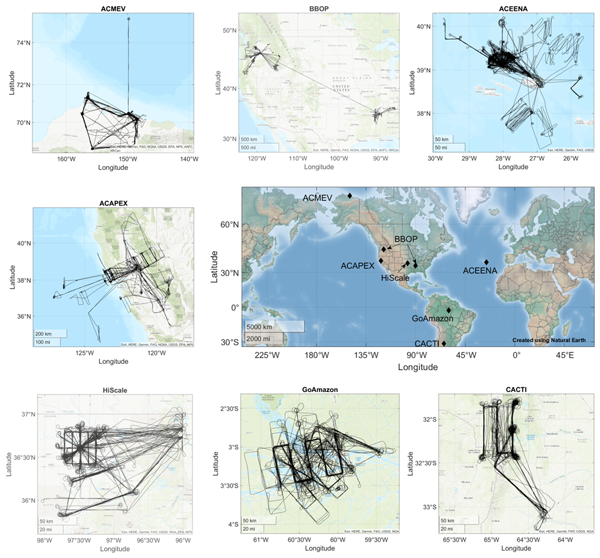
Our study explores a comprehensive dataset from airborne field studies (2013–2018) conducted using the US Department of Energy's Gulfstream 1 (G-1). The 236 flights span diverse regions, including the Arctic, US Southern Great Plains, US West Coast, eastern North Atlantic, Amazon Basin in Brazil, and Sierras de Córdoba range in Argentina. This dataset provides unique insights into atmospheric dynamics, aerosols, and clouds and makes data available in a more accessible format.
Yang Wang, Chanakya Bagya Ramesh, Scott E. Giangrande, Jerome Fast, Xianda Gong, Jiaoshi Zhang, Ahmet Tolga Odabasi, Marcus Vinicius Batista Oliveira, Alyssa Matthews, Fan Mei, John E. Shilling, Jason Tomlinson, Die Wang, and Jian Wang
Atmos. Chem. Phys., 23, 15671–15691, https://doi.org/10.5194/acp-23-15671-2023, https://doi.org/10.5194/acp-23-15671-2023, 2023
Short summary
Short summary
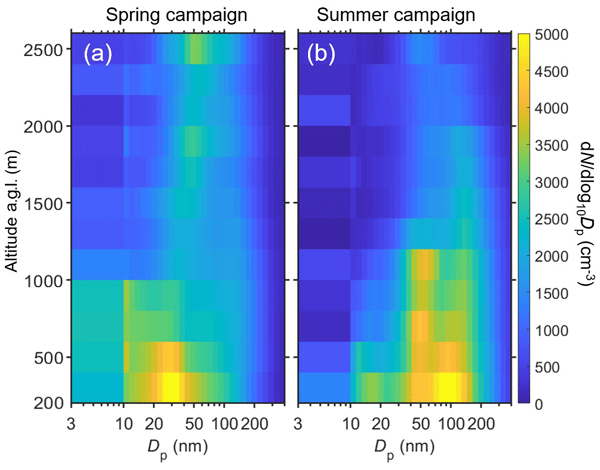
We report the vertical profiles of aerosol properties over the Southern Great Plains (SGP), a region influenced by shallow convective clouds, land–atmosphere interactions, boundary layer turbulence, and the aerosol life cycle. We examined the processes that drive the aerosol population and distribution in the lower troposphere over the SGP. This study helps improve our understanding of aerosol–cloud interactions and the model representation of aerosol processes.
Damao Zhang, Andrew M. Vogelmann, Fan Yang, Edward Luke, Pavlos Kollias, Zhien Wang, Peng Wu, William I. Gustafson Jr., Fan Mei, Susanne Glienke, Jason Tomlinson, and Neel Desai
Atmos. Meas. Tech., 16, 5827–5846, https://doi.org/10.5194/amt-16-5827-2023, https://doi.org/10.5194/amt-16-5827-2023, 2023
Short summary
Short summary
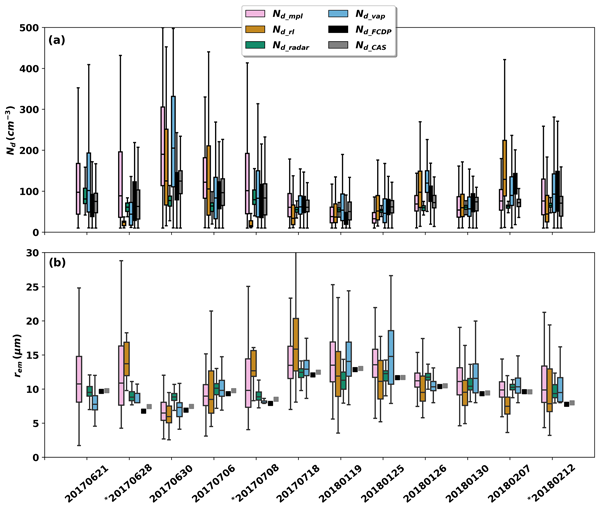
Cloud droplet number concentration can be retrieved from remote sensing measurements. Aircraft measurements are used to validate four ground-based retrievals of cloud droplet number concentration. We demonstrate that retrieved cloud droplet number concentrations align well with aircraft measurements for overcast clouds, but they may substantially differ for broken clouds. The ensemble of various retrievals can help quantify retrieval uncertainties and identify reliable retrieval scenarios.
Shuaiqi Tang, Adam C. Varble, Jerome D. Fast, Kai Zhang, Peng Wu, Xiquan Dong, Fan Mei, Mikhail Pekour, Joseph C. Hardin, and Po-Lun Ma
Geosci. Model Dev., 16, 6355–6376, https://doi.org/10.5194/gmd-16-6355-2023, https://doi.org/10.5194/gmd-16-6355-2023, 2023
Short summary
Short summary
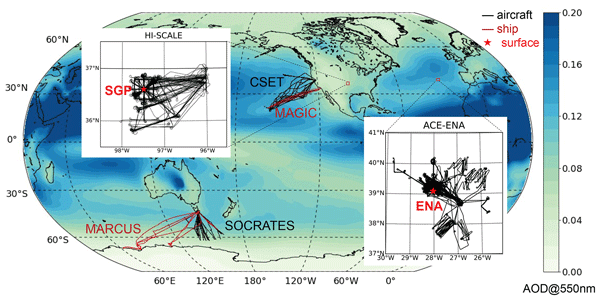
To assess the ability of Earth system model (ESM) predictions, we developed a tool called ESMAC Diags to understand how aerosols, clouds, and aerosol–cloud interactions are represented in ESMs. This paper describes its version 2 functionality. We compared the model predictions with measurements taken by planes, ships, satellites, and ground instruments over four regions across the world. Results show that this new tool can help identify model problems and guide future development of ESMs.
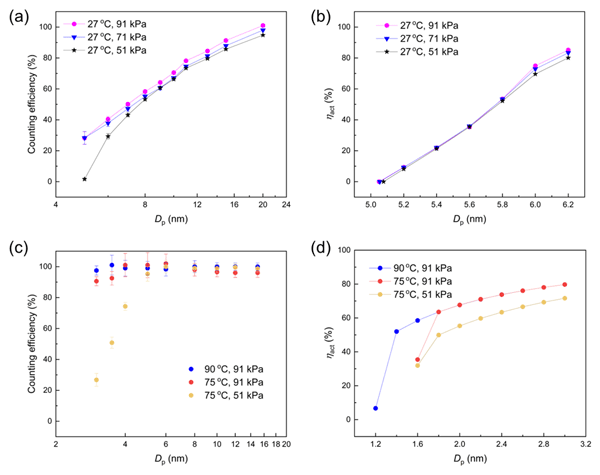
Weixing Hao, Fan Mei, Susanne Hering, Steven Spielman, Beat Schmid, Jason Tomlinson, and Yang Wang
Atmos. Meas. Tech., 16, 3973–3986, https://doi.org/10.5194/amt-16-3973-2023, https://doi.org/10.5194/amt-16-3973-2023, 2023
Short summary
Short summary
Airborne aerosol instrumentation plays a crucial role in understanding the spatial distribution of ambient aerosol particles. This study investigates a versatile water-based condensation particle counter through simulations and experiments. It provides valuable insights to improve versatile water-based condensation particle counter (vWCPC) aerosol measurement and operation for the community.

Francesca Gallo, Janek Uin, Kevin J. Sanchez, Richard H. Moore, Jian Wang, Robert Wood, Fan Mei, Connor Flynn, Stephen Springston, Eduardo B. Azevedo, Chongai Kuang, and Allison C. Aiken
Atmos. Chem. Phys., 23, 4221–4246, https://doi.org/10.5194/acp-23-4221-2023, https://doi.org/10.5194/acp-23-4221-2023, 2023
Short summary
Short summary
This study provides a summary statistic of multiday aerosol plume transport event influences on aerosol physical properties and the cloud condensation nuclei budget at the U.S. Department of Energy Atmospheric Radiation Measurement Facility in the eastern North Atlantic (ENA). An algorithm that integrates aerosol properties is developed and applied to identify multiday aerosol transport events. The influence of the aerosol plumes on aerosol populations at the ENA is successively assessed.
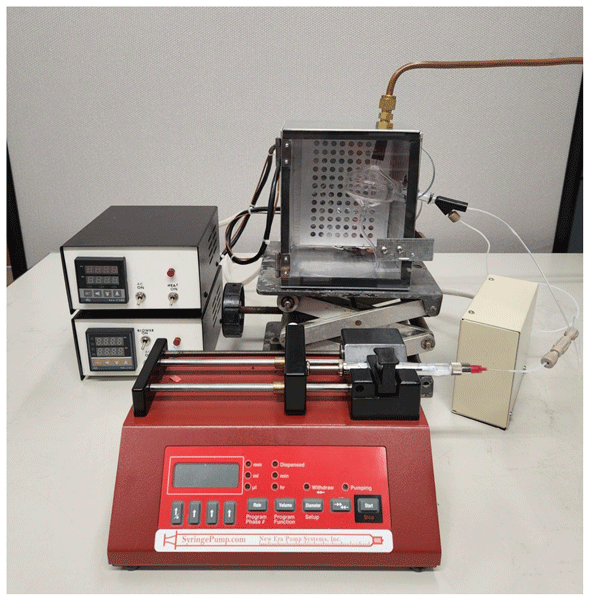
Christopher R. Niedek, Fan Mei, Maria A. Zawadowicz, Zihua Zhu, Beat Schmid, and Qi Zhang
Atmos. Meas. Tech., 16, 955–968, https://doi.org/10.5194/amt-16-955-2023, https://doi.org/10.5194/amt-16-955-2023, 2023
Short summary
Short summary
This novel micronebulization aerosol mass spectrometry (MS) technique requires a low sample volume (10 μL) and can quantify nanogram levels of organic and inorganic particulate matter (PM) components when used with 34SO4. This technique was successfully applied to PM samples collected from uncrewed atmospheric measurement platforms and provided chemical information that agrees well with real-time data from a co-located aerosol chemical speciation monitor and offline data from secondary ion MS.

Jerome D. Fast, David M. Bell, Gourihar Kulkarni, Jiumeng Liu, Fan Mei, Georges Saliba, John E. Shilling, Kaitlyn Suski, Jason Tomlinson, Jian Wang, Rahul Zaveri, and Alla Zelenyuk
Atmos. Chem. Phys., 22, 11217–11238, https://doi.org/10.5194/acp-22-11217-2022, https://doi.org/10.5194/acp-22-11217-2022, 2022
Short summary
Short summary
Recent aircraft measurements from the HI-SCALE campaign conducted over the Southern Great Plains (SGP) site in Oklahoma are used to quantify spatial variability of aerosol properties in terms of grid spacings typically used by weather and climate models. Surprisingly large horizontal gradients in aerosol properties were frequently observed in this rural area. This spatial variability can be used as an uncertainty range when comparing surface point measurements with model predictions.
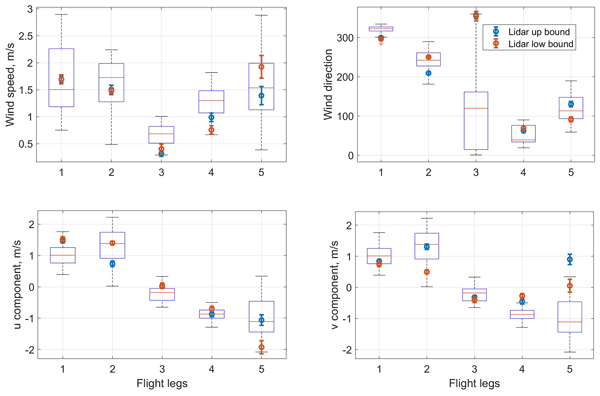
Fan Mei, Mikhail S. Pekour, Darielle Dexheimer, Gijs de Boer, RaeAnn Cook, Jason Tomlinson, Beat Schmid, Lexie A. Goldberger, Rob Newsom, and Jerome D. Fast
Earth Syst. Sci. Data, 14, 3423–3438, https://doi.org/10.5194/essd-14-3423-2022, https://doi.org/10.5194/essd-14-3423-2022, 2022
Short summary
Short summary
This work focuses on an expanding number of data sets observed using ARM TBS (133 flights) and UAS (seven flights) platforms by the Department of Energy (DOE) Atmospheric Radiation Measurement (ARM) user facility. These data streams provide new perspectives on spatial variability of atmospheric and surface parameters, helping to address critical science questions in Earth system science research, such as the aerosol–cloud interaction in the boundary layer.
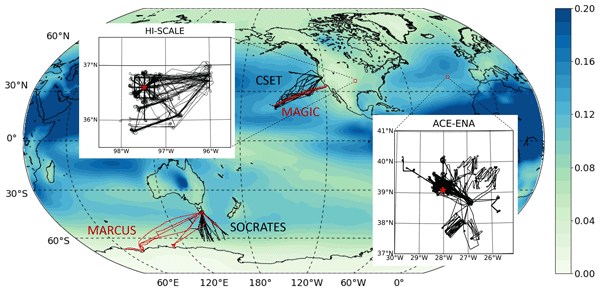
Shuaiqi Tang, Jerome D. Fast, Kai Zhang, Joseph C. Hardin, Adam C. Varble, John E. Shilling, Fan Mei, Maria A. Zawadowicz, and Po-Lun Ma
Geosci. Model Dev., 15, 4055–4076, https://doi.org/10.5194/gmd-15-4055-2022, https://doi.org/10.5194/gmd-15-4055-2022, 2022
Short summary
Short summary
We developed an Earth system model (ESM) diagnostics package to compare various types of aerosol properties simulated in ESMs with aircraft, ship, and surface measurements from six field campaigns across spatial scales. The diagnostics package is coded and organized to be flexible and modular for future extension to other field campaign datasets and adapted to higher-resolution model simulations. Future releases will include comprehensive cloud and aerosol–cloud interaction diagnostics.
Fan Mei, Steven Spielman, Susanne Hering, Jian Wang, Mikhail S. Pekour, Gregory Lewis, Beat Schmid, Jason Tomlinson, and Maynard Havlicek
Atmos. Meas. Tech., 14, 7329–7340, https://doi.org/10.5194/amt-14-7329-2021, https://doi.org/10.5194/amt-14-7329-2021, 2021
Short summary
Short summary
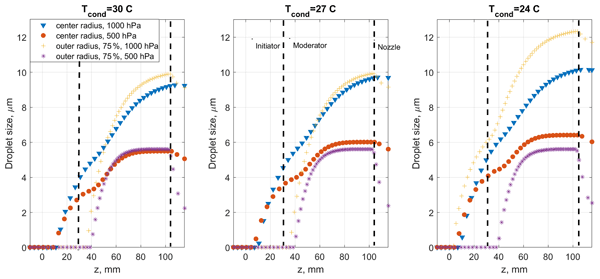
This study focuses on understanding a versatile water-based condensation particle counter (vWCPC 3789) performance under various ambient pressure conditions (500–1000 hPa). A vWCPC has the advantage of avoiding health and safety concerns. However, its performance characterization under low pressure is rare but crucial for ensuring successful airborne deployment. This paper provides advanced knowledge of operating a vWCPC 3789 to capture the spatial variations of atmospheric aerosols.
Kang Yang, Zhien Wang, and Min Deng
Atmos. Chem. Phys., 26, 13319–13339, https://doi.org/10.5194/acp-26-13319-2026, https://doi.org/10.5194/acp-26-13319-2026, 2026
Short summary
Short summary
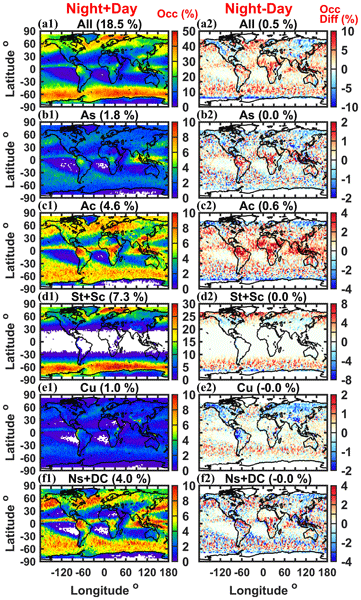
Mixed-phase clouds, which contain both ice crystals and supercooled liquid droplets, strongly influence Earth's radiation budget but remain difficult to represent in climate models. Using global satellite observations, we show that they vary greatly by cloud type, with distinct spatial distributions, vertical structures, and seasonal and surface contrasts. These results provide new observational constraints for improving model representation of mixed-phase clouds.
Timothy W. Juliano, Florian Tornow, Ann M. Fridlind, Andrew S. Ackerman, Gregory S. Elsaesser, Bart Geerts, Christian P. Lackner, David Painemal, Israel Silber, Mikhail Ovchinnikov, Gunilla Svensson, Michael Tjernström, Peng Wu, Alejandro Baró Pérez, Peter Bogenschutz, Dmitry Chechin, Kamal Kant Chandrakar, Jan Chylik, Andrey Debolskiy, Rostislav Fadeev, Anu Gupta, Luisa Ickes, Michail Karalis, Martin Köhler, Branko Kosović, Peter Kuma, Weiwei Li, Evgeny Mortikov, Hugh Morrison, Roel A. J. Neggers, Anna Possner, Tomi Raatikainen, Lea Raillard, Sami Romakkaniemi, Niklas Schnierstein, Shin-ichiro Shima, Nikita Silin, Mikhail Tolstykh, Étienne Vignon, Lulin Xue, Meng Zhang, and Xue Zheng
Atmos. Chem. Phys., 26, 13267–13302, https://doi.org/10.5194/acp-26-13267-2026, https://doi.org/10.5194/acp-26-13267-2026, 2026
Short summary
Short summary
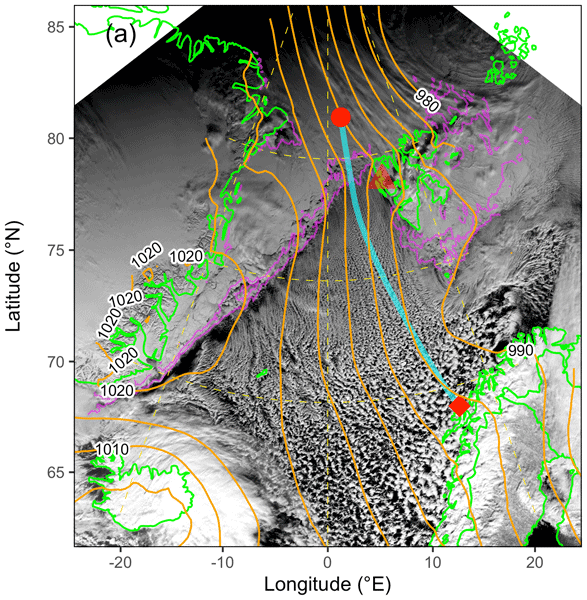
Models struggle to capture cloud and precipitation processes and their radiative effects in marine cold-air outbreaks. We use a quasi-Lagrangian framework to compare large-eddy simulation (LES) and single-column model (SCM) output with field and satellite observations. With fixed droplet and ice numbers, LES and SCM agree in liquid-only tests. In mixed-phase conditions, LES plausibly capture cloud thinning and breakup, while SCMs largely remain overcast and thereby miss cloud radiative effects.
Yuhang Guo, Chongai Kuang, Darielle Dexheimer, Manish Shrivastava, Ogochukwu Enekwizu, Yang Wang, Jingbo Mao, Gan Luo, Fangqun Yu, and Jie Zhang
EGUsphere, https://doi.org/10.5194/egusphere-2026-4905, https://doi.org/10.5194/egusphere-2026-4905, 2026
This preprint is open for discussion and under review for Atmospheric Chemistry and Physics (ACP).
Short summary
Short summary
Aerosol particle size distributions can vary greatly with height, but these vertical changes are rarely measured directly. Using a tethered balloon, we measured particle size distributions from the ground to about 1.2 kilometers in two contrasting environments. We found that atmospheric mixing strongly shapes their vertical structure, storage overnight, and redistribution the next day. These observations improve our understanding of how aerosol populations evolve in the lower atmosphere.
Yuezhi Li, Ganesh S. Chelluboyina, Taveen S. Kapoor, Joseph V. Puthussery, Joshin Kumar, Guodong Ren, Jordan A. Hachtel, Zezhen Cheng, Nurun Nahar Lata, Gregory W. Vandergrift, Bejamin J. Sumlin, Chenchong Zhang, Dishit P. Ghumra, Swarup China, Rohan Mishra, and Rajan K. Chakrabarty
EGUsphere, https://doi.org/10.5194/egusphere-2026-4745, https://doi.org/10.5194/egusphere-2026-4745, 2026
This preprint is open for discussion and under review for Atmospheric Chemistry and Physics (ACP).
Short summary
Short summary
We investigated the airborne light-absorbing particles in a coastal urban environment. By combining field measurements with laboratory analyses and computer simulations, we found that a previously overlooked type of strongly light-absorbing organic particle potentially contributes to urban atmospheric warming and surface dimming. These particles, likely produced by combustion sources, affect climate not only in wildfire smoke but also in cities and therefore should be included in climate models.
Israel Silber, Donna M. Flynn, Jennifer M. Comstock, Erol L. Cromwell, and Brian D. Ermold
Atmos. Meas. Tech., 19, 5457–5474, https://doi.org/10.5194/amt-19-5457-2026, https://doi.org/10.5194/amt-19-5457-2026, 2026
Short summary
Short summary
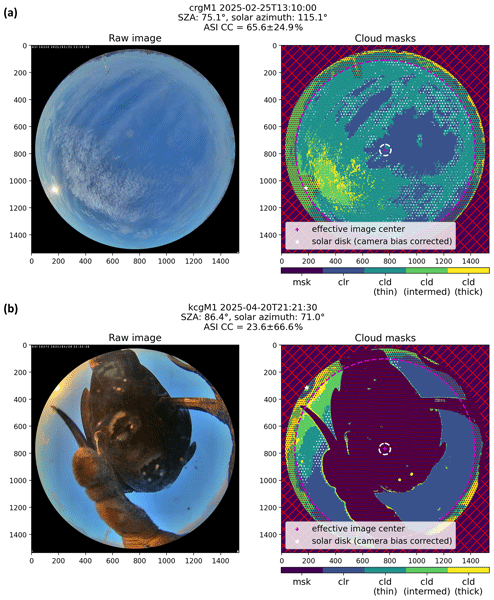
We describe ASISKYCOVER, a new machine learning algorithm for pixel segmentation of all-sky imager (ASI-16) data used by the Atmospheric Radiation Measurement (ARM) User Facility. ASISKYCOVER provides cloud cover and thickness estimates, detects artifacts, and reports uncertainties. Using one year of data from the ARM Southern Great Plains site and comparisons with other ARM datasets, we demonstrate its use and robustness, which will improve cloud cover analyses and data evaluation efforts.
Sneha Aggarwal, Matthew Salter, Olga Garmash, Felipe Lopez-Hilfiker, Julika Zinke, Joel A. Thornton, Timothy H. Bertram, Jian Wang, Paul Zieger, and Claudia Mohr
EGUsphere, https://doi.org/10.26434/chemrxiv.15000402/v3, https://doi.org/10.26434/chemrxiv.15000402/v3, 2026
Short summary
Short summary
Perfluoroalkyl carboxylic acids (PFCAs) are persistent global contaminants. While sea spray aerosol (SSA) formed by wave breaking is known to transport PFCAs from the ocean to the atmosphere, the focus has primarily been on particle-phase transport. Here, we present evidence that particle-bound PFCAs are subsequently converted to gas phase following SSA emission. This previously unconsidered process may cause particle-only measurements to underestimate the total atmospheric PFCA from SSA.
Jingjing Tian, Gourihar Kulkarni, Jennifer M. Comstock, John E. Shilling, Damao Zhang, Peng Wu, and Fan Mei
Atmos. Meas. Tech., 19, 5051–5069, https://doi.org/10.5194/amt-19-5051-2026, https://doi.org/10.5194/amt-19-5051-2026, 2026
Short summary
Short summary
Cloud condensation nuclei are tiny particles that attract water vapor and help form clouds. A ground-based lidar method can estimate their number at different heights, but assumes the aerosol type does not change with height. Comparisons with aircraft data show good agreement of this method when aerosols are well mixed, but larger errors when stacked layers occur. We also developed an index to flag these complex conditions and indicate when this estimation method is more reliable.
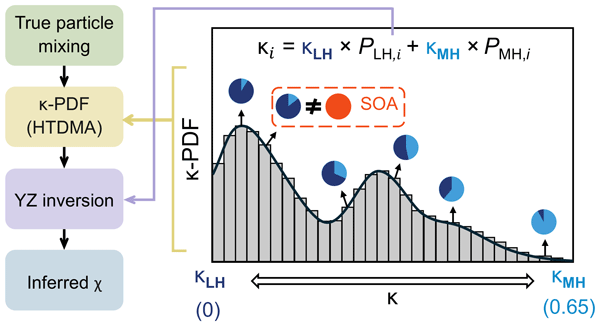
Yicen Liu, Jian Wang, and Nicole Riemer
Atmos. Chem. Phys., 26, 10965–10978, https://doi.org/10.5194/acp-26-10965-2026, https://doi.org/10.5194/acp-26-10965-2026, 2026
Short summary
Short summary
Airborne particles affect clouds, climate, and air quality, but it is difficult to determine how their chemical components are mixed within individual particles. We tested a method that estimates this mixing from water-uptake measurements using detailed computer simulations. The method works well in many cases, but can overestimate particle mixing when moderately water-attracting material exists in separate particle types. We then applied this uncertainty framework to long-term observations.
Yicen Liu, Shengqian Zhou, Jian Wang, and Nicole Riemer
EGUsphere, https://doi.org/10.5194/egusphere-2026-4216, https://doi.org/10.5194/egusphere-2026-4216, 2026
Short summary
Short summary
Airborne particles contain different chemicals, and their distribution among particles influences cloud formation and climate. Given limited long-term evidence, we combined measurements from eight locations to examine changes across particle sizes, seasons, and environments. Larger particles were more similar in composition, while smaller particles and those influenced by urban or marine air varied more. The results provide observational benchmarks for improving atmospheric and climate models.
Jingchuan Chen, Upasna B. Rai, Kyle A. McMillan, Ryan D. Davis, Margaret A. Tolbert, and Sarah D. Brooks
EGUsphere, https://doi.org/10.5194/egusphere-2026-3946, https://doi.org/10.5194/egusphere-2026-3946, 2026
Short summary
Short summary
Ice nucleating particles influence cloud ice formation, affecting precipitation and climate. Yet freezing triggered by particle-droplet collision remains difficult to quantify. We developed a cold-stage method that directs controlled aerosol flows onto single water droplets. Validations with silver iodide show reliable measurements, clear separation from background freezing, and particle-size effects. This work can support better representation of cloud ice formation in models.
Gavin Cornwell, Alla Zelenyuk-Imre, Gourihar Kulkarni, Nurun Nahar Lata, Kaizad Patel, Jennifer Yao, Zihua Zhu, Laura Fierce, Payton Beeler, Swarup China, Isabelle Steinke, and Susannah Burrows
EGUsphere, https://doi.org/10.5194/egusphere-2026-3882, https://doi.org/10.5194/egusphere-2026-3882, 2026
This preprint is open for discussion and under review for Atmospheric Chemistry and Physics (ACP).
Short summary
Short summary
Ice in clouds strongly affects rainfall and how much sunlight clouds reflect. We studied which airborne particles can trigger ice formation. We created soil-like mixtures and examined individual particles to see whether biological material and mineral dust were truly combined or stayed separate, and how this affected their ice formation. We found that the total amount of biological material was more important than how the particles were mixed.
Patrick C. Taylor, Armin Sorooshian, Rei Ueyama, Sebastian Schmidt, Ihab Abboud, Quincy Allison, Kevin Barry, Sebastian Becker, Holly A. Bender, Joseph R. Bennett, James B. Blair, Niklas Bohn, Linette Boisvert, Matthew D. Brown, Roelof Bruintjes, Anthony Bucholtz, Megan Buzanowicz, Brian Cairns, Filippo Calì Quaglia, Eduard Chemyakin, Bo Chen, Gao Chen, Hong Chen, Yu-Wen Chen, Zezhen Cheng, Swarup China, Dan Chirica, Yonghoon Choi, Peter Colarco, Brian Collister, Ewan Crosbie, Maurice J. Cross, Janet Daniels, Paul DeMott, Joshua P. DiGangi, Alcide Giorgio di Sarra, Glenn S. Diskin, Erica K. Dolinar, Eva-Lou Edwards, Samuel Ephraim, Nikolaos Evangeliou, Romanos Foskinis, Francesca Gallo, Lan Gao, José Luis Gómez-Amo, Daisy Gonzalez, Christine Groot Zwaaftink, Pawan Gupta, Ivan Heckman, Michael Hendrickson, Miguel Ricardo A. Hilario, Ken Hirata, Michelle Hofton, Andrew L. Holen, Ulas Im, Alia L. Khan, Ralph Kahn, Alexei V. Korolev, Sonia Kreidenweis, Thomas Krumpen, Nathan Kurtz, Leslie Lait, Bradley Lamkin, Jack Landy, Nurun Nahar Lata, Paul Lawson, Samuel LeBlanc, Sean Leavor, Jing Li, Thorsten Markus, Hal Maring, Andreas H. Massling, Camille Mavis, Flynn McGinnity, Kerry Meyer, Gabriel Mojica, Richard H. Moore, Parker Morris, Giovanni Muscari, Vikas Nataraja, Amin R. Nehrir, Athanasios Nenes, Edward P. Nowottnick, Matteo Ottaviani, Chelsea Parker, Ryan Patnaude, Michael Perez, Russell J. Perkins, Colten Peterson, Alek Petty, Stevie Phothisane, Chris Polashenski, Kerri A. Pratt, Kayla M. Preisler, John Prytherch, David Rabine, Jens Redemann, Ju-Mee Ryoo, Joseph S. Schlosser, Vanessa Selimovic, Michael A. Shook, Morgan Silverman, Henrik Skov, Alexander Smirnov, Cassidy Soloff, Amy Solomon, Snorre Stamnes, Azusa Takeishi, David R. Thompson, K. Lee Thornhill, Rachel Tilling, Michael Tjernström, Monica Tosco, Pedro C. Valdelomar, David Van Gilst, Jian Wang, Zhien Wang, Andrzej Wasilewski, Manfred Wendisch, Brent Wilder, Edward L. Winstead, Albert Wu, Peng Xian, Lauren M. Zamora, Jiaoshi Zhang, Lei Zhang, Lu Zhang, Luke Ziemba, and Paquita Zuidema
Earth Syst. Sci. Data Discuss., https://doi.org/10.5194/essd-2026-241, https://doi.org/10.5194/essd-2026-241, 2026
Preprint under review for ESSD
Short summary
Short summary
This article summarizes the data sets collected during the Arctic Radiation Cloud aerosol Sea ice Interaction eXperiment (ARCSIX), NASA's most comprehensive Arctic field campaign to date. The overarching goal was to quantify the contributions of surface, clouds, aerosol particles, and precipitation to summer sea ice melt. This paper describes the ARCSIX implementation including the flight strategy, instruments, complementary data sets, access, and usage details.
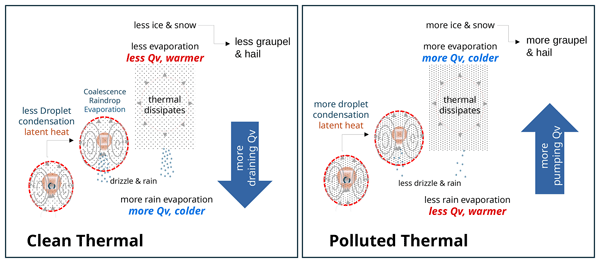
Daniel Hernandez-Deckers, Toshihisa Matsui, Takamichi Iguchi, Kelcy Brunner, Eric Bruning, Marcus van Lier-Walqui, Edward R. Mansell, Tamanna Subba, Chongai Kuang, Michael P. Jensen, and Scott Braun
Atmos. Chem. Phys., 26, 10071–10099, https://doi.org/10.5194/acp-26-10071-2026, https://doi.org/10.5194/acp-26-10071-2026, 2026
Short summary
Short summary
Aerosols from air pollution affect weather and climate in various ways. Uncertainties remain on their interactions with clouds, in particular via microphysics (processes related to phase-changes of water that generate rain and lightning). We investigate this with high resolution simulations, focusing on cumulus thermals (the rising bubbles in clouds). We describe the thermals’ roles in these interactions, and identify related mesoscale feedback that enhance convection under polluted conditions.
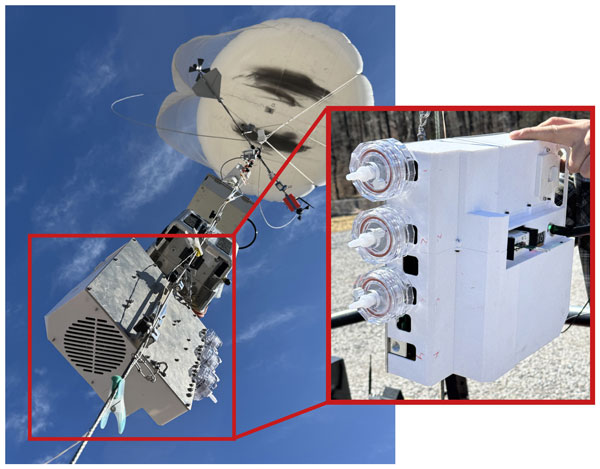
Jessie M. Creamean, Darielle Dexheimer, Carson C. Hume, Maria Vazquez, Benjamin T. M. Hess, Casey M. Longbottom, Carlos A. Ruiz, and Adam K. Theisen
Atmos. Meas. Tech., 19, 4601–4615, https://doi.org/10.5194/amt-19-4601-2026, https://doi.org/10.5194/amt-19-4601-2026, 2026
Short summary
Short summary
PUFIN (Profiling Upper altitudes For Ice Nucleation) is a lightweight sampler flown on the U.S. Department of Energy’s Atmospheric Radiation Measurement user facility’s tethered balloons to measure ice nucleating particles at multiple altitudes. Deployments in Maryland and Alabama show it can detect low concentrations in under an hour and capture changes with height. All data are publicly available, and future flights will help track seasonal and vertical patterns of these unique particles.
Min Deng, Scott Giangrande, Adam K. Theisen, Karen Johnson, Iosif A. Lindenmaier, Timothy G. Wendler, Jennifer Comstock, Marquette Rocque, Zeen Zhu, and Alyssa Matthews
EGUsphere, https://doi.org/10.5194/egusphere-2026-3304, https://doi.org/10.5194/egusphere-2026-3304, 2026
Short summary
Short summary
Cloud radars are used to measure air motion, clouds, and precipitation, but small pointing errors can reduce their accuracy. We developed a method to detect these errors using routine weather balloon observations. Tests with several radar systems in different environments showed that the method can identify small but important pointing biases, helping improve the accuracy and long-term consistency of weather and climate observations.
Guangxin Ai, Shuaiqi Tang, Hailong Wang, Fan Mei, and Minghuai Wang
Atmos. Chem. Phys., 26, 7967–7984, https://doi.org/10.5194/acp-26-7967-2026, https://doi.org/10.5194/acp-26-7967-2026, 2026
Short summary
Short summary
Tiny aerosol particles help form cloud droplets and can affect rainfall and climate, but their behavior is hard to predict. We used aircraft measurements over the ocean near the Azores and over the central United States to compare clean and polluted air. We found that particle size and chemical makeup together control how easily clouds form, and organic-rich particles often reduce droplet formation. These results can improve how weather and climate models represent clouds.
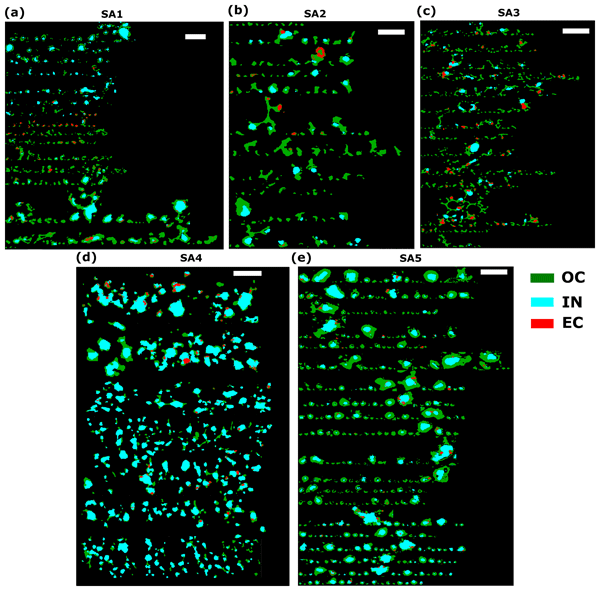
Nurun Nahar Lata, Trung Diep, Stefania Gilardoni, Mauro Mazzola, Zezhen Cheng, Ashfiqur Rahman, Mickey M. Rogers, Matthew Fraund, Matthew A. Marcus, Naruki Hiranuma, and Swarup China
Atmos. Chem. Phys., 26, 6611–6628, https://doi.org/10.5194/acp-26-6611-2026, https://doi.org/10.5194/acp-26-6611-2026, 2026
Short summary
Short summary
Ice in the Arctic clouds is initiated by rare particles, and their properties are not well understood due to atmospheric processing. By combining microscopy with freezing experiments, we found that both chemical composition and the thickness and morphological configuration of organic coatings influence ice formation. This finding highlights the importance of particle surface chemistry in cloud formation and offers new insights into how Arctic aerosols influence cloud formation.
Susanne Glienke, Kevin L. Bertschinger, Fan Mei, and John E. Shilling
EGUsphere, https://doi.org/10.5194/egusphere-2026-2141, https://doi.org/10.5194/egusphere-2026-2141, 2026
Short summary
Short summary
Knowing accurate cloud droplet size distributions and droplet movement is important to understand cloud formation and lifetime. To better measure these, we developed and tested the HOLOgraphic DROPlet Sensor (HOLODROPS) with two operational configurations, which can be used for both long-term cloud measurements and for short-term droplet tracking, in conjunction with an event-camera-based Particle Imaging Velocimetry (ePIV) system for fast analysis of droplet movements.
Bo Chen, Seth A. Thompson, Brianna H. Matthews, Milind Sharma, Ron Li, Anita D. Rapp, Christopher J. Nowotarski, and Sarah D. Brooks
EGUsphere, https://doi.org/10.5194/egusphere-2026-1748, https://doi.org/10.5194/egusphere-2026-1748, 2026
Short summary
Short summary
This paper studies how aerosols, tiny particles suspended in the air, are distributed at different heights in the atmosphere. We use lidar and other ground-based measurements to estimate aerosol vertical profiles. We also develop a simple mathematical equation that can recreate the observed profile shape using a few adjustable parameters. Finally, we examine several case studies and explore how the profile shape is related to boundary-layer structure and atmospheric conditions.
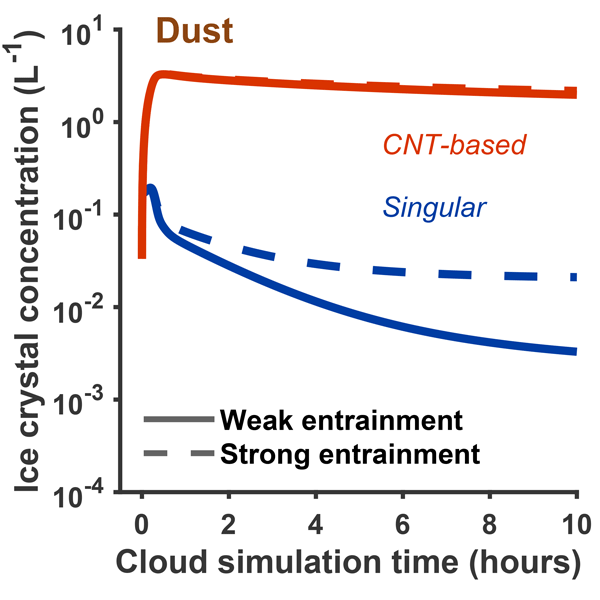
Yijia Sun, Ann M. Fridlind, Israel Silber, Nicole Riemer, and Daniel A. Knopf
Geosci. Model Dev., 19, 1581–1617, https://doi.org/10.5194/gmd-19-1581-2026, https://doi.org/10.5194/gmd-19-1581-2026, 2026
Short summary
Short summary
The role of Arctic clouds in the regional climate remains uncertain due to insufficient understanding of the amount of liquid droplets and ice crystals present in these clouds. An aerosol-cloud model is employed to examine the role of different aerosol types and freezing parameterizations on the number of ice crystals. The choice of freezing parameterization significantly changes the number of ice crystals impacting the interpretation of the evolution and warming effect of Arctic clouds.
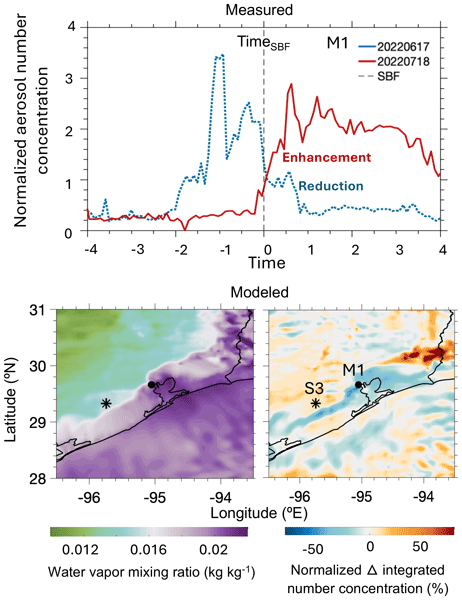
Tamanna Subba, Michael P. Jensen, Min Deng, Scott E. Giangrande, Mark C. Harvey, Ashish Singh, Die Wang, Maria Zawadowicz, and Chongai Kuang
Atmos. Chem. Phys., 26, 2853–2879, https://doi.org/10.5194/acp-26-2853-2026, https://doi.org/10.5194/acp-26-2853-2026, 2026
Short summary
Short summary
Using TRacking Aerosol Convection Interactions Experiment field campaign observations and model simulations, we studied summertime sea-breeze events in southern Texas. When sea-breeze fronts moved inland, they mixed marine and continental air, changing aerosol concentrations by up to a factor of two as far as 50 km inland. The sea breeze also reduced the number of particles that can form cloud droplets, highlighting the connection between coastal meteorology and aerosol-cloud interactions.
Uma Puttu, Jamie R. Kamp, Xiaoyu Chen, Jhao-Hong Chen, Bingru Wang, Jing Li, Miquel A. Gonzalez-Meler, Jian Wang, and Lu Xu
Atmos. Meas. Tech., 19, 1421–1439, https://doi.org/10.5194/amt-19-1421-2026, https://doi.org/10.5194/amt-19-1421-2026, 2026
Short summary
Short summary
We developed a new technique to measure air pollutants. This method can detect many gases, including volatile organic compounds and nitrogen oxide released by plants and human activities. We tested it in two locations and found it agreed well with standard instruments, while offering improved performance. Our results show this approach can provide broad and sensitive monitoring of air quality and chemical processes in the atmosphere.
Amit Singh Chandel, Chandan Sarangi, Nurun Nahar, Saqib Ahmad Zargar, Poul Cherian, Xena Mansoura, Vijay P. Kanawade, Bhishma Tyagi, Antti-Pekka Hyvärinen, Aki Virkkula, Harendra S. Negi, Swarup China, and Rakesh K. Hooda
EGUsphere, https://doi.org/10.5194/egusphere-2026-424, https://doi.org/10.5194/egusphere-2026-424, 2026
Short summary
Short summary
Dust storms reaching the western Himalayas often mix with pollution during transport. Using high-altitude measurements from May 2023, we show that this polluted dust has altered intrinsic optical properties, scattering and absorbing more sunlight than clean dust, with important implications for atmospheric heating and regional climate.
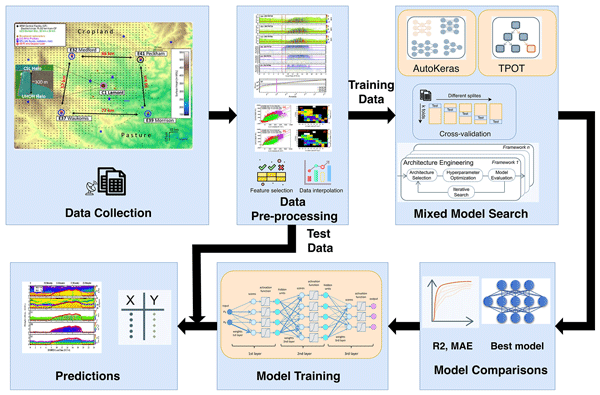
Yufei Chu, Guo Lin, Min Deng, Lulin Xue, Weiwei Li, Hyeyum Hailey Shin, Jun A. Zhang, Hanqing Guo, and Zhien Wang
Atmos. Chem. Phys., 26, 1415–1434, https://doi.org/10.5194/acp-26-1415-2026, https://doi.org/10.5194/acp-26-1415-2026, 2026
Short summary
Short summary
We developed a new machine learning approach to estimate the height of the mixing layer in the lower atmosphere, which is important for predicting weather and air quality. By using daily temperature and heat patterns, the model learns how the atmosphere changes throughout the day. It gives accurate results across different locations and seasons, helping improve future climate and weather forecasts through better understanding of surface–atmosphere interactions.
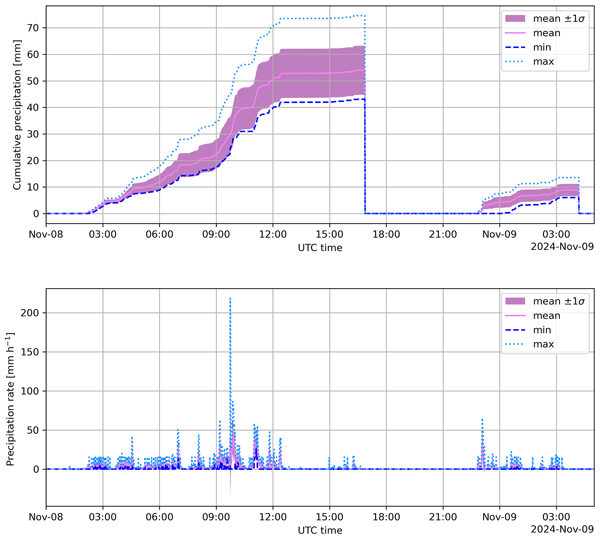
Israel Silber, Jennifer M. Comstock, Adam K. Theisen, Michael R. Kieburtz, Zeen Zhu, and Jenni Kyrouac
Atmos. Meas. Tech., 19, 485–506, https://doi.org/10.5194/amt-19-485-2026, https://doi.org/10.5194/amt-19-485-2026, 2026
Short summary
Short summary
We present PrecipBE, a multi-instrument precipitation event best-estimate data product developed at the Atmospheric Radiation Measurement (ARM) User Facility, providing time series and tabular statistics of events, which could help advance model evaluation and cloud-process studies. We demonstrate PrecipBE's utilization with a brief 30-year trend analysis of ARM Southern Great Plains (SGP) site data, suggesting shorter, less intense events, but rising annual rainfall, driven by rare extremes.
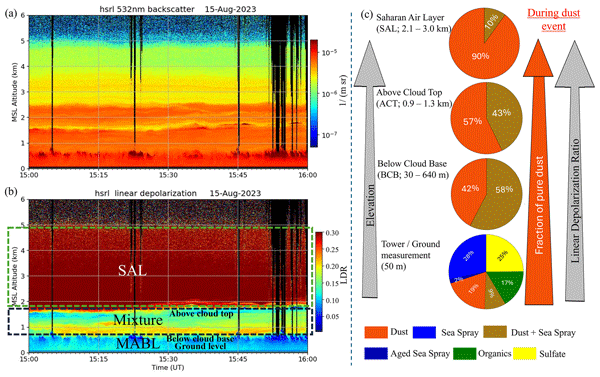
Sujan Shrestha, Robert E. Holz, Willem J. Marais, Zachary Buckholtz, Ilya Razenkov, Edwin Eloranta, Jeffrey S. Reid, Hope E. Elliott, Nurun Nahar Lata, Zezhen Cheng, Swarup China, Edmund Blades, Albert D. Ortiz, Rebecca Chewitt-Lucas, Alyson Allen, Devon Blades, Ria Agrawal, Elizabeth A. Reid, Jesus Ruiz-Plancarte, Anthony Bucholtz, Ryan Yamaguchi, Qing Wang, Thomas Eck, Elena Lind, Mira L. Pöhlker, Andrew P. Ault, and Cassandra J. Gaston
Atmos. Chem. Phys., 26, 983–999, https://doi.org/10.5194/acp-26-983-2026, https://doi.org/10.5194/acp-26-983-2026, 2026
Short summary
Short summary
Coordinated observations from MAGPIE 2023 show that Saharan dust in the marine atmospheric boundary layer becomes internally mixed with sea spray. This mixing increases particle sphericity and hygroscopicity, likely leading to suppressed lidar linear depolarization ratios despite high dust concentrations. The findings have key implications for interpreting lidar-derived dust retrievals, estimating surface dust from satellite products, and improving dust representation in models.
Timothy W. Juliano, Florian Tornow, Ann M. Fridlind, Andrew S. Ackerman, Gregory S. Elsaesser, Bart Geerts, Christian P. Lackner, David Painemal, Israel Silber, Mikhail Ovchinnikov, Gunilla Svensson, Michael Tjernström, Peng Wu, Alejandro Baró Pérez, Peter Bogenschutz, Dmitry Chechin, Kamal Kant Chandrakar, Jan Chylik, Andrey Debolskiy, Rostislav Fadeev, Anu Gupta, Luisa Ickes, Michail Karalis, Martin Köhler, Branko Kosović, Peter Kuma, Weiwei Li, Evgeny Mortikov, Hugh Morrison, Roel A. J. Neggers, Anna Possner, Tomi Raatikainen, Sami Romakkaniemi, Niklas Schnierstein, Shin-ichiro Shima, Nikita Silin, Mikhail Tolstykh, Lulin Xue, Meng Zhang, and Xue Zheng
EGUsphere, https://doi.org/10.5194/egusphere-2025-6217, https://doi.org/10.5194/egusphere-2025-6217, 2026
Preprint archived
Short summary
Short summary
Models struggle to capture cloud and precipitation processes and their radiative effects in marine cold-air outbreaks. We use a quasi-Lagrangian framework to compare large-eddy simulation (LES) and single-column model (SCM) output with field and satellite observations. With fixed droplet and ice numbers, LES and SCM agree in liquid-only tests. In mixed-phase conditions, LES plausibly capture cloud thinning and breakup, while SCMs largely remain overcast and thereby miss cloud radiative effects.
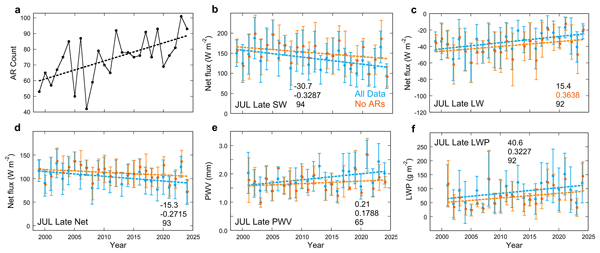
Dan Lubin, Xun Zou, Johannes Mülmenstädt, Andrew Vogelmann, Maria Cadeddu, and Damao Zhang
Atmos. Chem. Phys., 26, 295–311, https://doi.org/10.5194/acp-26-295-2026, https://doi.org/10.5194/acp-26-295-2026, 2026
Short summary
Short summary
The US Department of Energy Atmospheric Radiation Measurement (ARM) North Slope of Alaska Facility has measured solar and atmospheric infrared radiation, and cloud properties, for the past 25 years. Statistically significant trends are emerging, including increasing infrared radiation due to a warming atmosphere, and decreasing solar radiation due to increasing liquid water content in clouds. These trends are influenced by large-scale atmospheric circulation patterns and by atmospheric rivers.
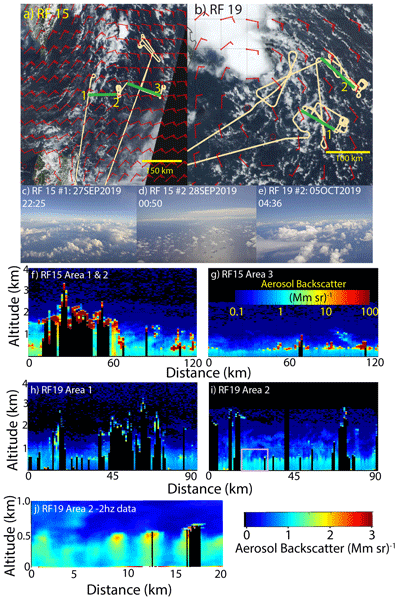
Jeffrey S. Reid, Robert E. Holz, Chris A. Hostetler, Richard A. Ferrare, Juli I. Rubin, Elizabeth J. Thompson, Susan C. van den Heever, Corey G. Amiot, Sharon P. Burton, Joshua P. DiGangi, Glenn S. Diskin, Joshua H. Cossuth, Daniel P. Eleuterio, Edwin W. Eloranta, Ralph Kuehn, Willem J. Marais, Hal B. Maring, Armin Sorooshian, Kenneth L. Thornhill, Charles R. Trepte, Jian Wang, Peng Xian, and Luke D. Ziemba
Atmos. Chem. Phys., 25, 18639–18673, https://doi.org/10.5194/acp-25-18639-2025, https://doi.org/10.5194/acp-25-18639-2025, 2025
Short summary
Short summary
We document air and ship born measurements of the vertical distribution of pollution and biomass burning aerosol particles transported within the Maritime Continent's monsoonal flows for 1000s of kilometers, and yet still exhibit intricate patterns around clouds near the ocean's surface. Findings demonstrate that, while aerosol transport occurs near the surface, there is heterogeneity in particle extinction that must be considered for both in situ observations and satellite retrievals.
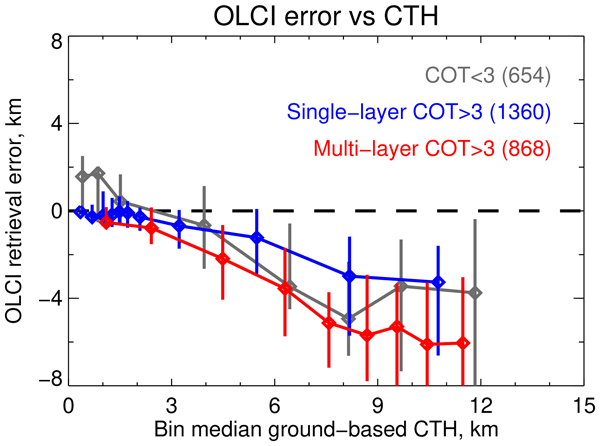
Andrew M. Sayer, Brian Cairns, Kirk D. Knobelspiesse, Luca Lelli, Chamara Rajapakshe, Scott E. Giangrande, Gareth E. Thomas, and Damao Zhang
Atmos. Meas. Tech., 18, 6681–6703, https://doi.org/10.5194/amt-18-6681-2025, https://doi.org/10.5194/amt-18-6681-2025, 2025
Short summary
Short summary
Satellites can estimate cloud height in several ways: two include a thermal technique (colder clouds being higher up), and another looking at colours of light that oxygen in the atmosphere absorbs (darker clouds being lower down). It can also be measured (from ground or space) by radar and lidar. We compare satellite data we developed using the oxygen method with other estimates to help us refine our technique.
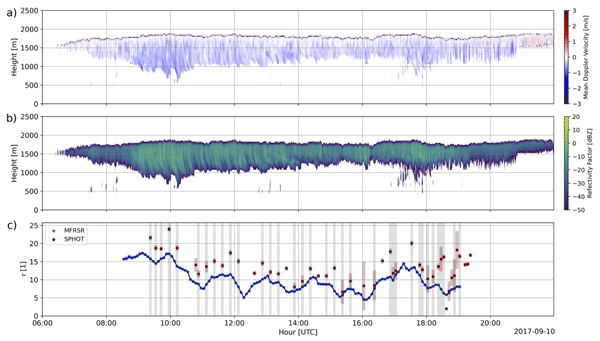
Kaiden Sookdar, Scott E. Giangrande, John Rausch, Lihong Ma, Meng Wang, Dié Wang, Michael P. Jensen, Ching-Shu Hung, and J. Christine Chiu
Atmos. Meas. Tech., 18, 6271–6289, https://doi.org/10.5194/amt-18-6271-2025, https://doi.org/10.5194/amt-18-6271-2025, 2025
Short summary
Short summary
Photometer observations of stratocumulus cloud properties are evaluated for a multiyear archive. Retrievals for cloud optical depth, cloud droplet effective radius, and liquid water path show solid agreement with collocated references. Continental stratocumulus clouds sorted by cloud thickness indicate double the cloud optical depth and liquid water path of their marine counterparts, while exhibiting similar bulk cloud droplet effective radius.
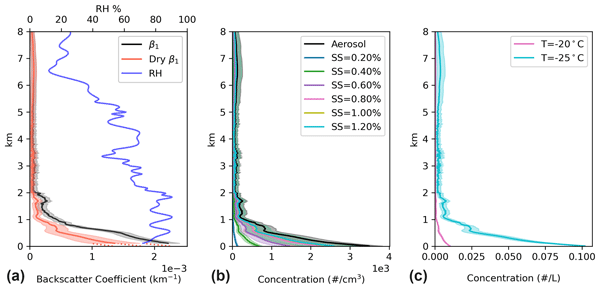
Bo Chen, Seth A. Thompson, Brianna H. Matthews, Milind Sharma, Ron Li, Christopher J. Nowotarski, Anita D. Rapp, and Sarah D. Brooks
Atmos. Meas. Tech., 18, 5841–5859, https://doi.org/10.5194/amt-18-5841-2025, https://doi.org/10.5194/amt-18-5841-2025, 2025
Short summary
Short summary
This study presents a new method combining ground-based measurements and lidar to track how aerosols are distributed at different heights in the atmosphere. By correcting for humidity, which causes aerosols to grow and intensify the lidar signal, the method provides more accurate aerosol vertical profiles. Our results show that aerosol profiles can vary significantly over short distances. This technique can help improve understanding of aerosol-cloud interactions.
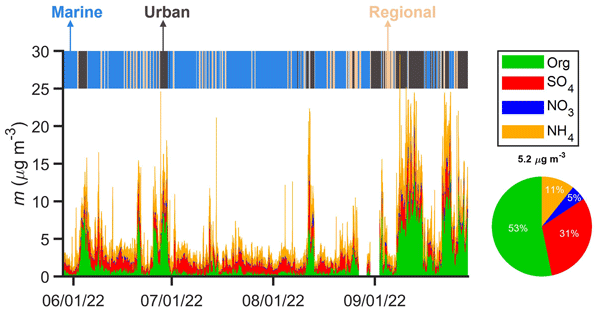
Jing Li, Jiaoshi Zhang, Xianda Gong, Steven Spielman, Chongai Kuang, Ashish Singh, Maria A. Zawadowicz, Lu Xu, and Jian Wang
Atmos. Chem. Phys., 25, 13975–13993, https://doi.org/10.5194/acp-25-13975-2025, https://doi.org/10.5194/acp-25-13975-2025, 2025
Short summary
Short summary
Using measurements at a rural coastal site, we quantified aerosols in representative air masses and identified major sources of organics in the Houston area. Our results show cooking aerosol is likely overestimated by earlier studies. Additionally, diurnal variation of highly oxidized organics is mostly driven by air mass changes instead of photochemistry. This study highlights the impacts of emissions, atmospheric chemistry, and meteorology on aerosol properties in the coastal–rural environment.
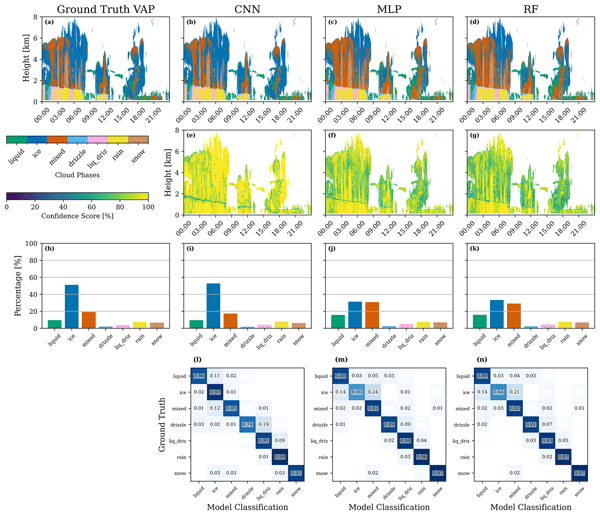
Lexie Goldberger, Maxwell Levin, Carlandra Harris, Andrew Geiss, Matthew D. Shupe, and Damao Zhang
Atmos. Meas. Tech., 18, 5393–5414, https://doi.org/10.5194/amt-18-5393-2025, https://doi.org/10.5194/amt-18-5393-2025, 2025
Short summary
Short summary
This study leverages machine learning models to classify cloud thermodynamic phases using multi-sensor remote sensing data collected at the Department of Energy Atmospheric Radiation Measurement North Slope of Alaska observatory. We evaluate model performance, feature importance, and application of the model to another observatory and quantify how the models respond to instrument outages.
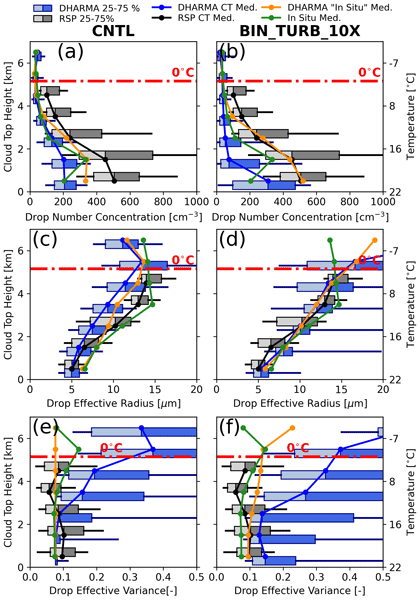
McKenna W. Stanford, Ann M. Fridlind, Andrew S. Ackerman, Bastiaan van Diedenhoven, Qian Xiao, Jian Wang, Toshihisa Matsui, Daniel Hernandez-Deckers, and Paul Lawson
Atmos. Chem. Phys., 25, 11199–11231, https://doi.org/10.5194/acp-25-11199-2025, https://doi.org/10.5194/acp-25-11199-2025, 2025
Short summary
Short summary
The evolution of cloud droplets, from the point they are activated by atmospheric aerosol to the formation of precipitation, is an important process relevant to understanding cloud–climate feedbacks. This study demonstrates a benchmark framework for using novel airborne measurements and retrievals to constrain high-resolution simulations of moderately deep cumulus clouds and pathways for scaling results to large-scale models and space-based observational platforms.
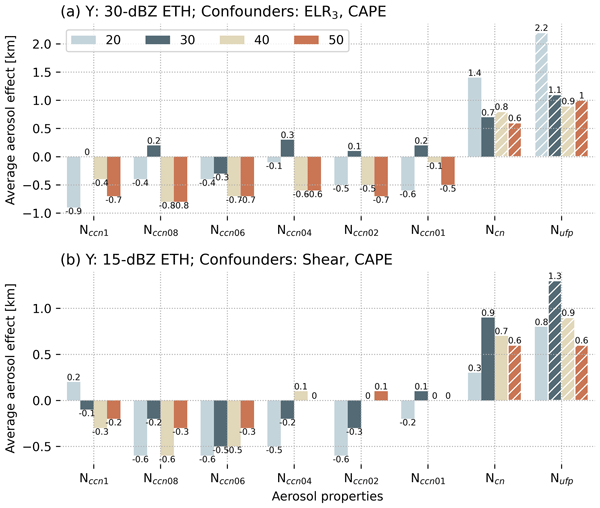
Dié Wang, Roni Kobrosly, Tao Zhang, Tamanna Subba, Susan van den Heever, Siddhant Gupta, and Michael Jensen
Atmos. Chem. Phys., 25, 9295–9314, https://doi.org/10.5194/acp-25-9295-2025, https://doi.org/10.5194/acp-25-9295-2025, 2025
Short summary
Short summary
We aim to understand how tiny particles in the air, called aerosols, affect rain clouds in the Houston–Galveston area. More aerosols generally do not make these clouds grow much taller, with an average height increase of about 1 km. However, their effects on rainfall strength and cloud expansion are less certain. Clouds influenced by sea breezes show a stronger aerosol impact, possibly due to factors that are unaccounted for like vertical winds in near-surface layers.

Damao Zhang, Jennifer Comstock, Chitra Sivaraman, Kefei Mo, Raghavendra Krishnamurthy, Jingjing Tian, Tianning Su, Zhanqing Li, and Natalia Roldán-Henao
Atmos. Meas. Tech., 18, 3453–3475, https://doi.org/10.5194/amt-18-3453-2025, https://doi.org/10.5194/amt-18-3453-2025, 2025
Short summary
Short summary
Planetary boundary layer height (PBLHT) is an important parameter in atmospheric process studies and numerical model simulations. We use machine learning methods to produce a best-estimate planetary boundary layer height (PBLHT-BE-ML) by integrating four PBLHT estimates derived from remote sensing measurements. We demonstrated that PBLHT-BE-ML greatly improved the comparisons against sounding-derived PBLHT.
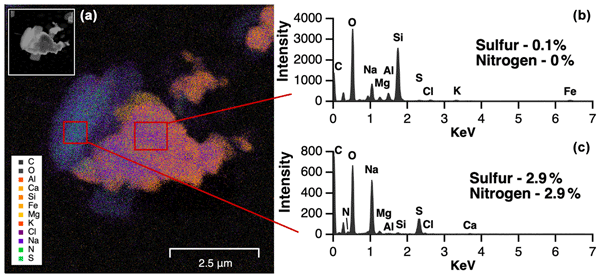
Haley M. Royer, Michael T. Sheridan, Hope E. Elliott, Edmund Blades, Nurun Nahar Lata, Zezhen Cheng, Swarup China, Zihua Zhu, Andrew P. Ault, and Cassandra J. Gaston
Atmos. Chem. Phys., 25, 5743–5759, https://doi.org/10.5194/acp-25-5743-2025, https://doi.org/10.5194/acp-25-5743-2025, 2025
Short summary
Short summary
Saharan dust transported across the Atlantic to the Caribbean, South America, and North America is hypothesized to undergo chemical processing by acids that enhances cloud droplet formation and nutrient availability. In this study, chemical analysis performed on African dust deposited over Barbados shows that acid tracers are found mostly on sea salt and smoke particles, rather than dust, indicating that dust particles undergo minimal chemical processing.
Genevieve Rose Lorenzo, Luke D. Ziemba, Avelino F. Arellano, Mary C. Barth, Ewan C. Crosbie, Joshua P. DiGangi, Glenn S. Diskin, Richard Ferrare, Miguel Ricardo A. Hilario, Michael A. Shook, Simone Tilmes, Jian Wang, Qian Xiao, Jun Zhang, and Armin Sorooshian
Atmos. Chem. Phys., 25, 5469–5495, https://doi.org/10.5194/acp-25-5469-2025, https://doi.org/10.5194/acp-25-5469-2025, 2025
Short summary
Short summary
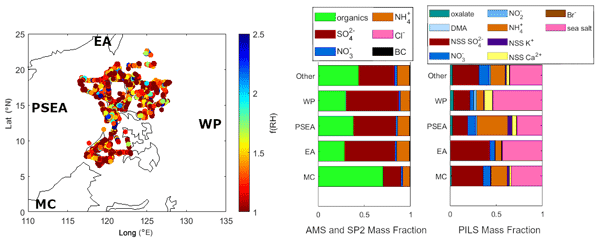
Novel aerosol hygroscopicity analyses of CAMP2Ex (Cloud, Aerosol, and Monsoon Processes Philippines Experiment) field campaign data show low aerosol hygroscopicity values in Southeast Asia. Organic carbon from smoke decreases hygroscopicity to levels more like those in continental than in polluted marine regions. Hygroscopicity changes at cloud level demonstrate how surface particles impact clouds in the region, affecting model representation of aerosol and cloud interactions in similar polluted marine regions with high organic carbon emissions.
Meghan Guagenti, Darielle Dexheimer, Alexandra Ulinksi, Paul Walter, James H. Flynn III, and Sascha Usenko
Atmos. Meas. Tech., 18, 2125–2136, https://doi.org/10.5194/amt-18-2125-2025, https://doi.org/10.5194/amt-18-2125-2025, 2025
Short summary
Short summary
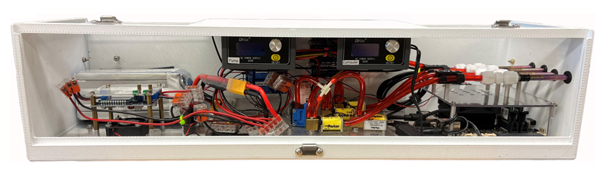
A robust, automatic volatile organic compound (VOC) collection system was developed for vertical VOC sampling associated with the 2022 DOE ARM-program-led TRACER in Houston, Texas. This modular sampler has been developed to measure vertical profiles of VOCs to improve near-surface characterization. This article helps fill the current lack of commercially available options for aerial VOC sampling and serves to support and encourage researchers to build and develop custom samplers.
Min Deng, Scott E. Giangrande, Michael P. Jensen, Karen Johnson, Christopher R. Williams, Jennifer M. Comstock, Ya-Chien Feng, Alyssa Matthews, Iosif A. Lindenmaier, Timothy G. Wendler, Marquette Rocque, Aifang Zhou, Zeen Zhu, Edward Luke, and Die Wang
Atmos. Meas. Tech., 18, 1641–1657, https://doi.org/10.5194/amt-18-1641-2025, https://doi.org/10.5194/amt-18-1641-2025, 2025
Short summary
Short summary
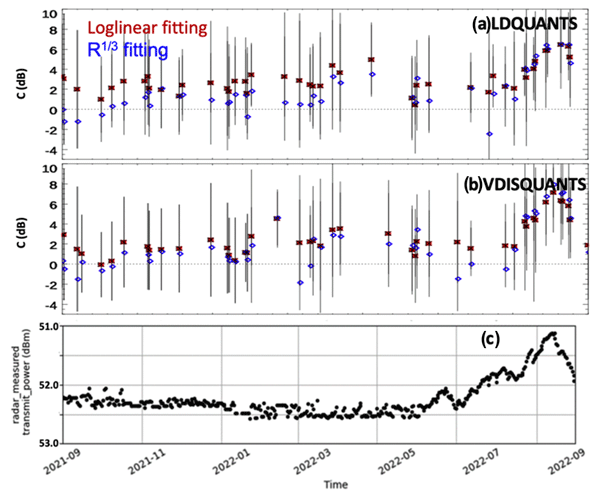
A relative calibration technique is developed for the cloud radar by monitoring the intercept of the wet-radome attenuation log-linear behavior as a function of rainfall rates in light and moderate rain conditions. This resulting reflectivity offset during the recent field campaign is compared favorably with the traditional disdrometer comparison near the rain onset, while it also demonstrates similar trends with respect to collocated and independently calibrated reference radars.
Fan Mei, Qi Zhang, Damao Zhang, Jerome D. Fast, Gourihar Kulkarni, Mikhail S. Pekour, Christopher R. Niedek, Susanne Glienke, Israel Silber, Beat Schmid, Jason M. Tomlinson, Hardeep S. Mehta, Xena Mansoura, Zezhen Cheng, Gregory W. Vandergrift, Nurun Nahar Lata, Swarup China, and Zihua Zhu
Atmos. Chem. Phys., 25, 3425–3444, https://doi.org/10.5194/acp-25-3425-2025, https://doi.org/10.5194/acp-25-3425-2025, 2025
Short summary
Short summary
This study highlights the unique capability of the ArcticShark, an uncrewed aerial system, in measuring vertically resolved atmospheric properties. Data from 32 research flights in 2023 reveal seasonal patterns and correlations with conventional measurements. The consistency and complementarity of in situ and remote sensing methods are highlighted. The study demonstrates the ArcticShark’s versatility in bridging data gaps and improving the understanding of vertical atmospheric structures.
Delaney B. Kilgour, Christopher M. Jernigan, Olga Garmash, Sneha Aggarwal, Shengqian Zhou, Claudia Mohr, Matt E. Salter, Joel A. Thornton, Jian Wang, Paul Zieger, and Timothy H. Bertram
Atmos. Chem. Phys., 25, 1931–1947, https://doi.org/10.5194/acp-25-1931-2025, https://doi.org/10.5194/acp-25-1931-2025, 2025
Short summary
Short summary
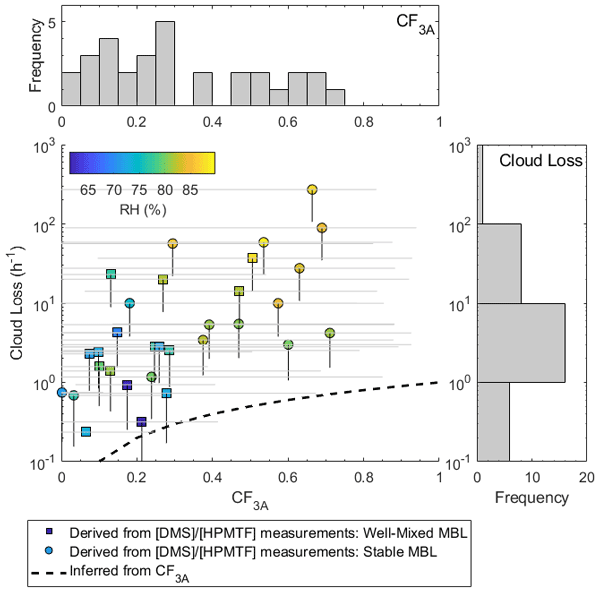
We report simultaneous measurements of dimethyl sulfide (DMS) and hydroperoxymethyl thioformate (HPMTF) in the eastern North Atlantic. We use an observationally constrained box model to show that cloud loss is the dominant sink of HPMTF in this region over 6 weeks, resulting in large reductions in DMS-derived products that contribute to aerosol formation and growth. Our findings indicate that fast cloud processing of HPMTF must be included in global models to accurately capture the sulfur cycle.
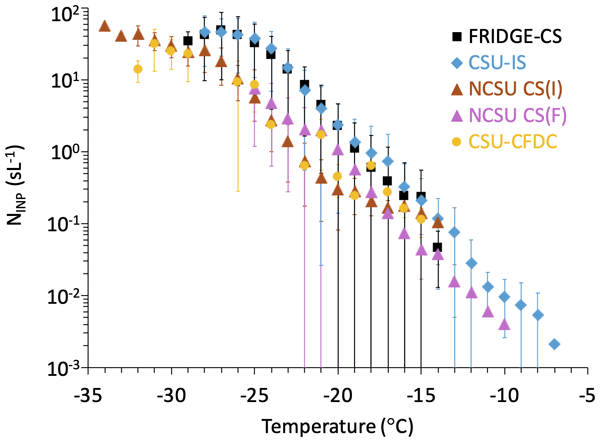
Paul J. DeMott, Jessica A. Mirrielees, Sarah Suda Petters, Daniel J. Cziczo, Markus D. Petters, Heinz G. Bingemer, Thomas C. J. Hill, Karl Froyd, Sarvesh Garimella, A. Gannet Hallar, Ezra J. T. Levin, Ian B. McCubbin, Anne E. Perring, Christopher N. Rapp, Thea Schiebel, Jann Schrod, Kaitlyn J. Suski, Daniel Weber, Martin J. Wolf, Maria Zawadowicz, Jake Zenker, Ottmar Möhler, and Sarah D. Brooks
Atmos. Meas. Tech., 18, 639–672, https://doi.org/10.5194/amt-18-639-2025, https://doi.org/10.5194/amt-18-639-2025, 2025
Short summary
Short summary
The Fifth International Ice Nucleation Workshop Phase 3 (FIN-03) compared the ambient atmospheric performance of ice-nucleating particle (INP) measuring systems and explored general methods for discerning atmospheric INP compositions. Mirroring laboratory results, INP concentrations agreed within 5–10 factors. Measurements of total aerosol properties and investigations of INP compositions supported a dominant role of soil and plant organic aerosol elements as INPs during the study.
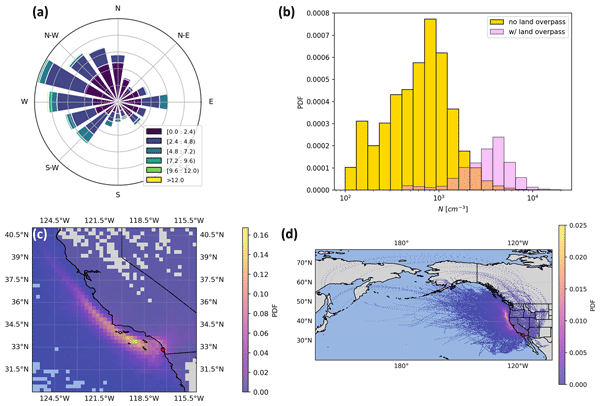
Israel Silber, Jennifer M. Comstock, Michael R. Kieburtz, and Lynn M. Russell
Earth Syst. Sci. Data, 17, 29–42, https://doi.org/10.5194/essd-17-29-2025, https://doi.org/10.5194/essd-17-29-2025, 2025
Short summary
Short summary
We present ARMTRAJ, a set of multipurpose trajectory datasets, which augments cloud, aerosol, and boundary layer studies utilizing the U.S. Department of Energy Atmospheric Radiation Measurement (ARM) user facility data. ARMTRAJ data include ensemble run statistics that enhance consistency and serve as uncertainty metrics for air mass coordinates and state variables. ARMTRAJ will soon become a near real-time product that will accompany past, ongoing, and future ARM deployments.
Jerome D. Fast, Adam C. Varble, Fan Mei, Mikhail Pekour, Jason Tomlinson, Alla Zelenyuk, Art J. Sedlacek III, Maria Zawadowicz, and Louisa Emmons
Atmos. Chem. Phys., 24, 13477–13502, https://doi.org/10.5194/acp-24-13477-2024, https://doi.org/10.5194/acp-24-13477-2024, 2024
Short summary
Short summary
Aerosol property measurements recently collected on the ground and by a research aircraft in central Argentina during the Cloud, Aerosol, and Complex Terrain Interactions (CACTI) campaign exhibit large spatial and temporal variability. These measurements coupled with coincident meteorological information provide a valuable data set needed to evaluate and improve model predictions of aerosols in a traditionally data-sparse region of South America.
Fan Mei, Jennifer M. Comstock, Mikhail S. Pekour, Jerome D. Fast, Krista L. Gaustad, Beat Schmid, Shuaiqi Tang, Damao Zhang, John E. Shilling, Jason M. Tomlinson, Adam C. Varble, Jian Wang, L. Ruby Leung, Lawrence Kleinman, Scot Martin, Sebastien C. Biraud, Brian D. Ermold, and Kenneth W. Burk
Earth Syst. Sci. Data, 16, 5429–5448, https://doi.org/10.5194/essd-16-5429-2024, https://doi.org/10.5194/essd-16-5429-2024, 2024
Short summary
Short summary
Our study explores a comprehensive dataset from airborne field studies (2013–2018) conducted using the US Department of Energy's Gulfstream 1 (G-1). The 236 flights span diverse regions, including the Arctic, US Southern Great Plains, US West Coast, eastern North Atlantic, Amazon Basin in Brazil, and Sierras de Córdoba range in Argentina. This dataset provides unique insights into atmospheric dynamics, aerosols, and clouds and makes data available in a more accessible format.
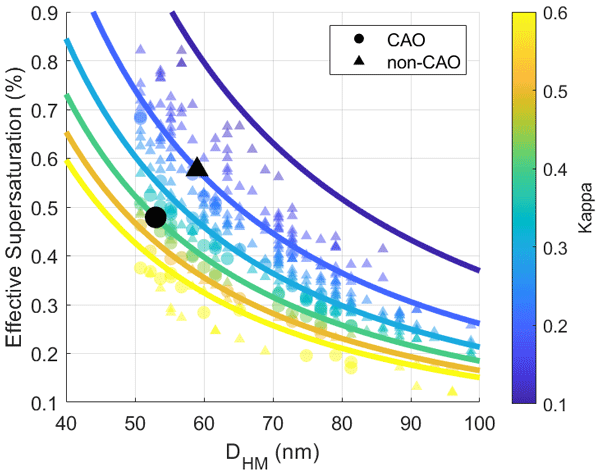
Abigail S. Williams, Jeramy L. Dedrick, Lynn M. Russell, Florian Tornow, Israel Silber, Ann M. Fridlind, Benjamin Swanson, Paul J. DeMott, Paul Zieger, and Radovan Krejci
Atmos. Chem. Phys., 24, 11791–11805, https://doi.org/10.5194/acp-24-11791-2024, https://doi.org/10.5194/acp-24-11791-2024, 2024
Short summary
Short summary
The measured aerosol size distribution modes reveal distinct properties characteristic of cold-air outbreaks in the Norwegian Arctic. We find higher sea spray number concentrations, smaller Hoppel minima, lower effective supersaturations, and accumulation-mode particle scavenging during cold-air outbreaks. These results advance our understanding of cold-air outbreak aerosol–cloud interactions in order to improve their accurate representation in models.
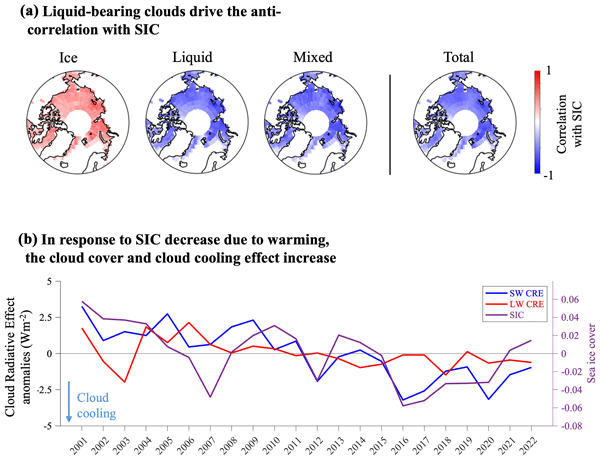
Grégory V. Cesana, Olivia Pierpaoli, Matteo Ottaviani, Linh Vu, Zhonghai Jin, and Israel Silber
Atmos. Chem. Phys., 24, 7899–7909, https://doi.org/10.5194/acp-24-7899-2024, https://doi.org/10.5194/acp-24-7899-2024, 2024
Short summary
Short summary
Better characterizing the relationship between sea ice and clouds is key to understanding Arctic climate because clouds and sea ice affect surface radiation and modulate Arctic surface warming. Our results indicate that Arctic liquid clouds robustly increase in response to sea ice decrease. This increase has a cooling effect on the surface because more solar radiation is reflected back to space, and it should contribute to dampening future Arctic surface warming.
Siddhant Gupta, Dié Wang, Scott E. Giangrande, Thiago S. Biscaro, and Michael P. Jensen
Atmos. Chem. Phys., 24, 4487–4510, https://doi.org/10.5194/acp-24-4487-2024, https://doi.org/10.5194/acp-24-4487-2024, 2024
Short summary
Short summary
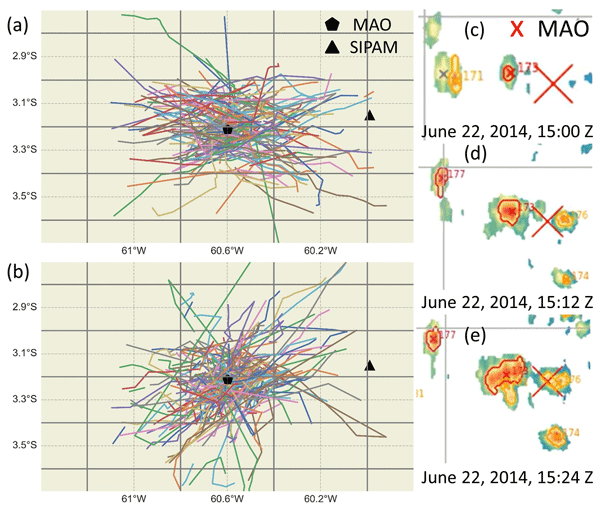
We examine the lifecycle of isolated deep convective clouds (DCCs) in the Amazon rainforest. Weather radar echoes from the DCCs are tracked to evaluate their lifecycle. The DCC size and intensity increase, reach a peak, and then decrease over the DCC lifetime. Vertical profiles of air motion and mass transport from different seasons are examined to understand the transport of energy and momentum within DCC cores and to address the deficiencies in simulating DCCs using weather and climate models.
Jingting Huang, S. Marcela Loría-Salazar, Min Deng, Jaehwa Lee, and Heather A. Holmes
Atmos. Chem. Phys., 24, 3673–3698, https://doi.org/10.5194/acp-24-3673-2024, https://doi.org/10.5194/acp-24-3673-2024, 2024
Short summary
Short summary
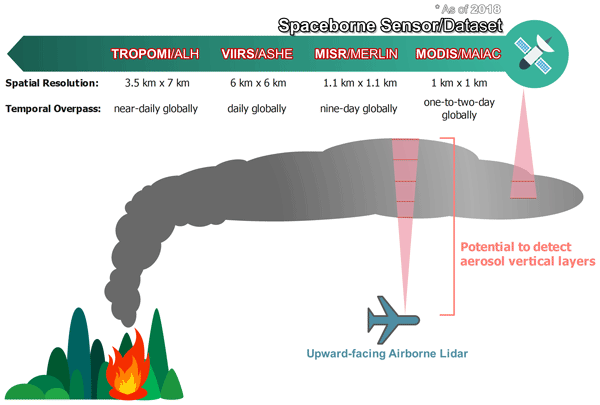
Increased wildfire intensity has resulted in taller wildfire smoke plumes. We investigate the vertical structure of wildfire smoke plumes using aircraft lidar data and establish two effective smoke plume height metrics. Four novel satellite-based plume height products are evaluated for wildfires in the western US. Our results provide guidance on the strengths and limitations of these satellite products and set the stage for improved plume rise estimates by leveraging satellite products.
Yang Wang, Chanakya Bagya Ramesh, Scott E. Giangrande, Jerome Fast, Xianda Gong, Jiaoshi Zhang, Ahmet Tolga Odabasi, Marcus Vinicius Batista Oliveira, Alyssa Matthews, Fan Mei, John E. Shilling, Jason Tomlinson, Die Wang, and Jian Wang
Atmos. Chem. Phys., 23, 15671–15691, https://doi.org/10.5194/acp-23-15671-2023, https://doi.org/10.5194/acp-23-15671-2023, 2023
Short summary
Short summary
We report the vertical profiles of aerosol properties over the Southern Great Plains (SGP), a region influenced by shallow convective clouds, land–atmosphere interactions, boundary layer turbulence, and the aerosol life cycle. We examined the processes that drive the aerosol population and distribution in the lower troposphere over the SGP. This study helps improve our understanding of aerosol–cloud interactions and the model representation of aerosol processes.
Damao Zhang, Andrew M. Vogelmann, Fan Yang, Edward Luke, Pavlos Kollias, Zhien Wang, Peng Wu, William I. Gustafson Jr., Fan Mei, Susanne Glienke, Jason Tomlinson, and Neel Desai
Atmos. Meas. Tech., 16, 5827–5846, https://doi.org/10.5194/amt-16-5827-2023, https://doi.org/10.5194/amt-16-5827-2023, 2023
Short summary
Short summary
Cloud droplet number concentration can be retrieved from remote sensing measurements. Aircraft measurements are used to validate four ground-based retrievals of cloud droplet number concentration. We demonstrate that retrieved cloud droplet number concentrations align well with aircraft measurements for overcast clouds, but they may substantially differ for broken clouds. The ensemble of various retrievals can help quantify retrieval uncertainties and identify reliable retrieval scenarios.
Shuaiqi Tang, Adam C. Varble, Jerome D. Fast, Kai Zhang, Peng Wu, Xiquan Dong, Fan Mei, Mikhail Pekour, Joseph C. Hardin, and Po-Lun Ma
Geosci. Model Dev., 16, 6355–6376, https://doi.org/10.5194/gmd-16-6355-2023, https://doi.org/10.5194/gmd-16-6355-2023, 2023
Short summary
Short summary
To assess the ability of Earth system model (ESM) predictions, we developed a tool called ESMAC Diags to understand how aerosols, clouds, and aerosol–cloud interactions are represented in ESMs. This paper describes its version 2 functionality. We compared the model predictions with measurements taken by planes, ships, satellites, and ground instruments over four regions across the world. Results show that this new tool can help identify model problems and guide future development of ESMs.
Daniel C. O. Thornton, Sarah D. Brooks, Elise K. Wilbourn, Jessica Mirrielees, Alyssa N. Alsante, Gerardo Gold-Bouchot, Andrew Whitesell, and Kiana McFadden
Atmos. Chem. Phys., 23, 12707–12729, https://doi.org/10.5194/acp-23-12707-2023, https://doi.org/10.5194/acp-23-12707-2023, 2023
Short summary
Short summary
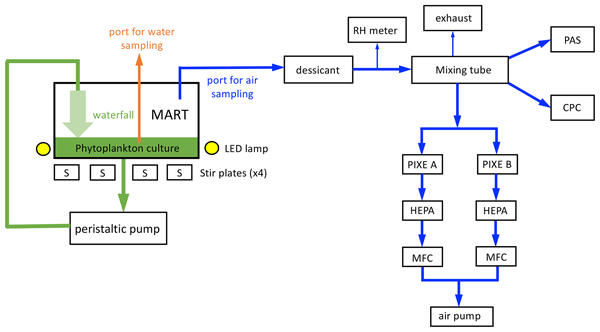
A major uncertainty in our understanding of clouds and climate is the sources and properties of the aerosol on which clouds grow. We found that aerosol containing organic matter from fast-growing marine phytoplankton was a source of ice-nucleating particles (INPs). INPs facilitate freezing of ice crystals at warmer temperatures than otherwise possible and therefore change cloud formation and properties. Our results show that ecosystem processes and the properties of sea spray aerosol are linked.
Guangyu Li, Elise K. Wilbourn, Zezhen Cheng, Jörg Wieder, Allison Fagerson, Jan Henneberger, Ghislain Motos, Rita Traversi, Sarah D. Brooks, Mauro Mazzola, Swarup China, Athanasios Nenes, Ulrike Lohmann, Naruki Hiranuma, and Zamin A. Kanji
Atmos. Chem. Phys., 23, 10489–10516, https://doi.org/10.5194/acp-23-10489-2023, https://doi.org/10.5194/acp-23-10489-2023, 2023
Short summary
Short summary
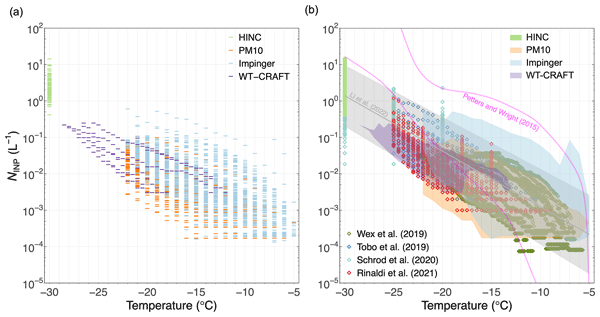
In this work, we present results from an Arctic field campaign (NASCENT) in Ny-Ålesund, Svalbard, on the abundance, variability, physicochemical properties, and potential sources of ice-nucleating particles (INPs) relevant for mixed-phase cloud formation. This work improves the data coverage of Arctic INPs and aerosol properties, allowing for the validation of models predicting cloud microphysical and radiative properties of mixed-phase clouds in the rapidly warming Arctic.
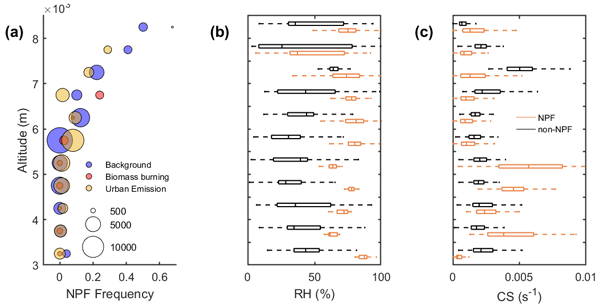
Qian Xiao, Jiaoshi Zhang, Yang Wang, Luke D. Ziemba, Ewan Crosbie, Edward L. Winstead, Claire E. Robinson, Joshua P. DiGangi, Glenn S. Diskin, Jeffrey S. Reid, K. Sebastian Schmidt, Armin Sorooshian, Miguel Ricardo A. Hilario, Sarah Woods, Paul Lawson, Snorre A. Stamnes, and Jian Wang
Atmos. Chem. Phys., 23, 9853–9871, https://doi.org/10.5194/acp-23-9853-2023, https://doi.org/10.5194/acp-23-9853-2023, 2023
Short summary
Short summary
Using recent airborne measurements, we show that the influences of anthropogenic emissions, transport, convective clouds, and meteorology lead to new particle formation (NPF) under a variety of conditions and at different altitudes in tropical marine environments. NPF is enhanced by fresh urban emissions in convective outflow but is suppressed in air masses influenced by aged urban emissions where reactive precursors are mostly consumed while particle surface area remains relatively high.
Weixing Hao, Fan Mei, Susanne Hering, Steven Spielman, Beat Schmid, Jason Tomlinson, and Yang Wang
Atmos. Meas. Tech., 16, 3973–3986, https://doi.org/10.5194/amt-16-3973-2023, https://doi.org/10.5194/amt-16-3973-2023, 2023
Short summary
Short summary
Airborne aerosol instrumentation plays a crucial role in understanding the spatial distribution of ambient aerosol particles. This study investigates a versatile water-based condensation particle counter through simulations and experiments. It provides valuable insights to improve versatile water-based condensation particle counter (vWCPC) aerosol measurement and operation for the community.
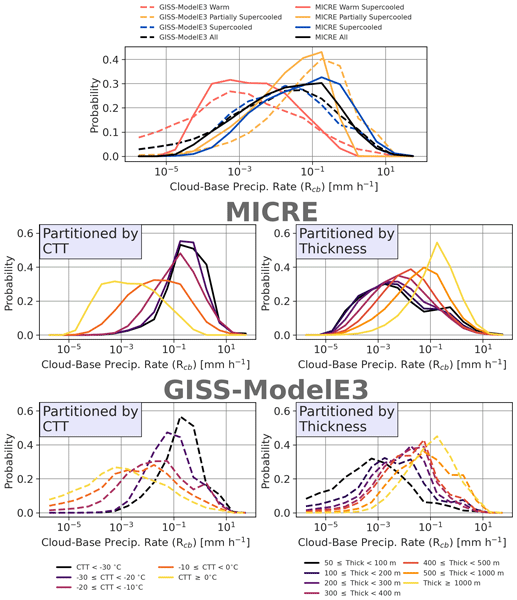
McKenna W. Stanford, Ann M. Fridlind, Israel Silber, Andrew S. Ackerman, Greg Cesana, Johannes Mülmenstädt, Alain Protat, Simon Alexander, and Adrian McDonald
Atmos. Chem. Phys., 23, 9037–9069, https://doi.org/10.5194/acp-23-9037-2023, https://doi.org/10.5194/acp-23-9037-2023, 2023
Short summary
Short summary
Clouds play an important role in the Earth’s climate system as they modulate the amount of radiation that either reaches the surface or is reflected back to space. This study demonstrates an approach to robustly evaluate surface-based observations against a large-scale model. We find that the large-scale model precipitates too infrequently relative to observations, contrary to literature documentation suggesting otherwise based on satellite measurements.
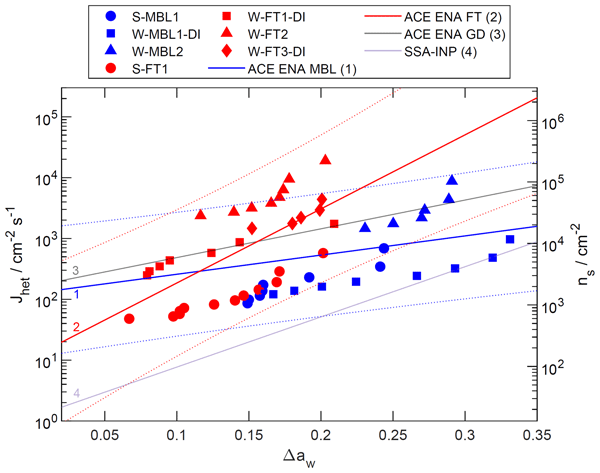
Daniel A. Knopf, Peiwen Wang, Benny Wong, Jay M. Tomlin, Daniel P. Veghte, Nurun N. Lata, Swarup China, Alexander Laskin, Ryan C. Moffet, Josephine Y. Aller, Matthew A. Marcus, and Jian Wang
Atmos. Chem. Phys., 23, 8659–8681, https://doi.org/10.5194/acp-23-8659-2023, https://doi.org/10.5194/acp-23-8659-2023, 2023
Short summary
Short summary
Ambient particle populations and associated ice-nucleating particles (INPs)
were examined from particle samples collected on board aircraft in the marine
boundary layer and free troposphere in the eastern North Atlantic during
summer and winter. Chemical imaging shows distinct differences in the
particle populations seasonally and with sampling altitudes, which are
reflected in the INP types. Freezing parameterizations are derived for
implementation in cloud-resolving and climate models.
Francesca Gallo, Janek Uin, Kevin J. Sanchez, Richard H. Moore, Jian Wang, Robert Wood, Fan Mei, Connor Flynn, Stephen Springston, Eduardo B. Azevedo, Chongai Kuang, and Allison C. Aiken
Atmos. Chem. Phys., 23, 4221–4246, https://doi.org/10.5194/acp-23-4221-2023, https://doi.org/10.5194/acp-23-4221-2023, 2023
Short summary
Short summary
This study provides a summary statistic of multiday aerosol plume transport event influences on aerosol physical properties and the cloud condensation nuclei budget at the U.S. Department of Energy Atmospheric Radiation Measurement Facility in the eastern North Atlantic (ENA). An algorithm that integrates aerosol properties is developed and applied to identify multiday aerosol transport events. The influence of the aerosol plumes on aerosol populations at the ENA is successively assessed.
Christopher R. Niedek, Fan Mei, Maria A. Zawadowicz, Zihua Zhu, Beat Schmid, and Qi Zhang
Atmos. Meas. Tech., 16, 955–968, https://doi.org/10.5194/amt-16-955-2023, https://doi.org/10.5194/amt-16-955-2023, 2023
Short summary
Short summary
This novel micronebulization aerosol mass spectrometry (MS) technique requires a low sample volume (10 μL) and can quantify nanogram levels of organic and inorganic particulate matter (PM) components when used with 34SO4. This technique was successfully applied to PM samples collected from uncrewed atmospheric measurement platforms and provided chemical information that agrees well with real-time data from a co-located aerosol chemical speciation monitor and offline data from secondary ion MS.
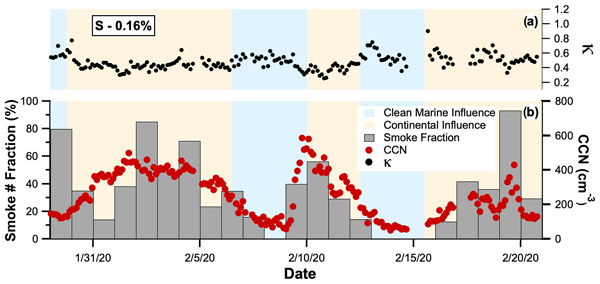
Haley M. Royer, Mira L. Pöhlker, Ovid Krüger, Edmund Blades, Peter Sealy, Nurun Nahar Lata, Zezhen Cheng, Swarup China, Andrew P. Ault, Patricia K. Quinn, Paquita Zuidema, Christopher Pöhlker, Ulrich Pöschl, Meinrat Andreae, and Cassandra J. Gaston
Atmos. Chem. Phys., 23, 981–998, https://doi.org/10.5194/acp-23-981-2023, https://doi.org/10.5194/acp-23-981-2023, 2023
Short summary
Short summary
This paper presents atmospheric particle chemical composition and measurements of aerosol water uptake properties collected at Ragged Point, Barbados, during the winter of 2020. The result of this study indicates the importance of small African smoke particles for cloud droplet formation in the tropical North Atlantic and highlights the large spatial and temporal pervasiveness of smoke over the Atlantic Ocean.

Qianjie Chen, Jessica A. Mirrielees, Sham Thanekar, Nicole A. Loeb, Rachel M. Kirpes, Lucia M. Upchurch, Anna J. Barget, Nurun Nahar Lata, Angela R. W. Raso, Stephen M. McNamara, Swarup China, Patricia K. Quinn, Andrew P. Ault, Aaron Kennedy, Paul B. Shepson, Jose D. Fuentes, and Kerri A. Pratt
Atmos. Chem. Phys., 22, 15263–15285, https://doi.org/10.5194/acp-22-15263-2022, https://doi.org/10.5194/acp-22-15263-2022, 2022
Short summary
Short summary
During a spring field campaign in the coastal Arctic, ultrafine particles were enhanced during high wind speeds, and coarse-mode particles were reduced during blowing snow. Calculated periods blowing snow were overpredicted compared to observations. Sea spray aerosols produced by sea ice leads affected the composition of aerosols and snowpack. An improved understanding of aerosol emissions from leads and blowing snow is critical for predicting the future climate of the rapidly warming Arctic.
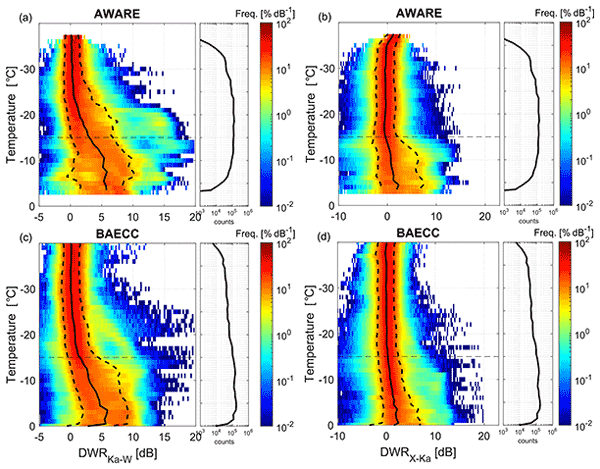
Frederic Tridon, Israel Silber, Alessandro Battaglia, Stefan Kneifel, Ann Fridlind, Petros Kalogeras, and Ranvir Dhillon
Atmos. Chem. Phys., 22, 12467–12491, https://doi.org/10.5194/acp-22-12467-2022, https://doi.org/10.5194/acp-22-12467-2022, 2022
Short summary
Short summary
The role of ice precipitation in the Earth water budget is not well known because ice particles are complex, and their formation involves intricate processes. Riming of ice crystals by supercooled water droplets is an efficient process, but little is known about its importance at high latitudes. In this work, by exploiting the deployment of an unprecedented number of remote sensing systems in Antarctica, we find that riming occurs at much lower temperatures compared with the mid-latitudes.
Jerome D. Fast, David M. Bell, Gourihar Kulkarni, Jiumeng Liu, Fan Mei, Georges Saliba, John E. Shilling, Kaitlyn Suski, Jason Tomlinson, Jian Wang, Rahul Zaveri, and Alla Zelenyuk
Atmos. Chem. Phys., 22, 11217–11238, https://doi.org/10.5194/acp-22-11217-2022, https://doi.org/10.5194/acp-22-11217-2022, 2022
Short summary
Short summary
Recent aircraft measurements from the HI-SCALE campaign conducted over the Southern Great Plains (SGP) site in Oklahoma are used to quantify spatial variability of aerosol properties in terms of grid spacings typically used by weather and climate models. Surprisingly large horizontal gradients in aerosol properties were frequently observed in this rural area. This spatial variability can be used as an uncertainty range when comparing surface point measurements with model predictions.
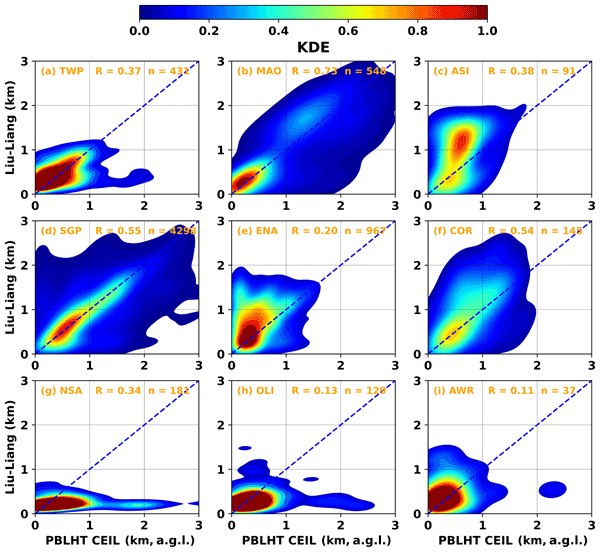
Damao Zhang, Jennifer Comstock, and Victor Morris
Atmos. Meas. Tech., 15, 4735–4749, https://doi.org/10.5194/amt-15-4735-2022, https://doi.org/10.5194/amt-15-4735-2022, 2022
Short summary
Short summary
The planetary boundary layer is the lowest part of the atmosphere. Its structure and depth (PBLHT) significantly impact air quality, global climate, land–atmosphere interactions, and a wide range of atmospheric processes. To test the robustness of the ceilometer-estimated PBLHT under different atmospheric conditions, we compared ceilometer- and radiosonde-estimated PBLHTs using multiple years of U.S. DOE ARM measurements at various ARM observatories located around the world.
Fan Mei, Mikhail S. Pekour, Darielle Dexheimer, Gijs de Boer, RaeAnn Cook, Jason Tomlinson, Beat Schmid, Lexie A. Goldberger, Rob Newsom, and Jerome D. Fast
Earth Syst. Sci. Data, 14, 3423–3438, https://doi.org/10.5194/essd-14-3423-2022, https://doi.org/10.5194/essd-14-3423-2022, 2022
Short summary
Short summary
This work focuses on an expanding number of data sets observed using ARM TBS (133 flights) and UAS (seven flights) platforms by the Department of Energy (DOE) Atmospheric Radiation Measurement (ARM) user facility. These data streams provide new perspectives on spatial variability of atmospheric and surface parameters, helping to address critical science questions in Earth system science research, such as the aerosol–cloud interaction in the boundary layer.

Ivo Beck, Hélène Angot, Andrea Baccarini, Lubna Dada, Lauriane Quéléver, Tuija Jokinen, Tiia Laurila, Markus Lampimäki, Nicolas Bukowiecki, Matthew Boyer, Xianda Gong, Martin Gysel-Beer, Tuukka Petäjä, Jian Wang, and Julia Schmale
Atmos. Meas. Tech., 15, 4195–4224, https://doi.org/10.5194/amt-15-4195-2022, https://doi.org/10.5194/amt-15-4195-2022, 2022
Short summary
Short summary
We present the pollution detection algorithm (PDA), a new method to identify local primary pollution in remote atmospheric aerosol and trace gas time series. The PDA identifies periods of contaminated data and relies only on the target dataset itself; i.e., it is independent of ancillary data such as meteorological variables. The parameters of all pollution identification steps are adjustable so that the PDA can be tuned to different locations and situations. It is available as open-access code.
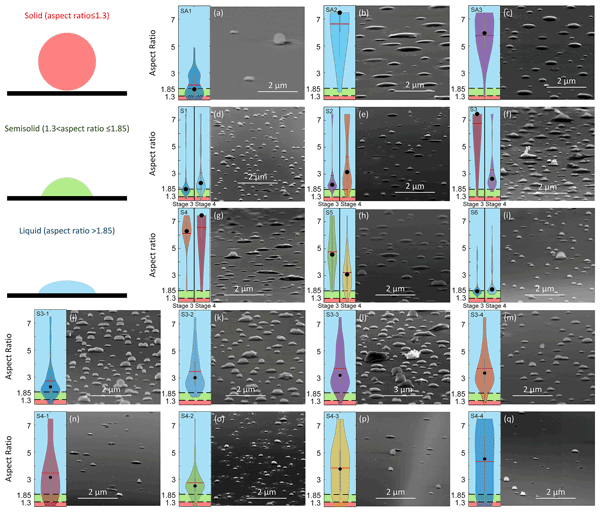
Zezhen Cheng, Megan Morgenstern, Bo Zhang, Matthew Fraund, Nurun Nahar Lata, Rhenton Brimberry, Matthew A. Marcus, Lynn Mazzoleni, Paulo Fialho, Silvia Henning, Birgit Wehner, Claudio Mazzoleni, and Swarup China
Atmos. Chem. Phys., 22, 9033–9057, https://doi.org/10.5194/acp-22-9033-2022, https://doi.org/10.5194/acp-22-9033-2022, 2022
Short summary
Short summary
We observed a high abundance of liquid and internally mixed particles in samples collected in the North Atlantic free troposphere during summer. We also found several solid and semisolid particles for different emission sources and transport patterns. Our results suggest that considering the mixing state, emission source, and transport patterns of particles is necessary to estimate their phase state in the free troposphere, which is critical for predicting their effects on climate.
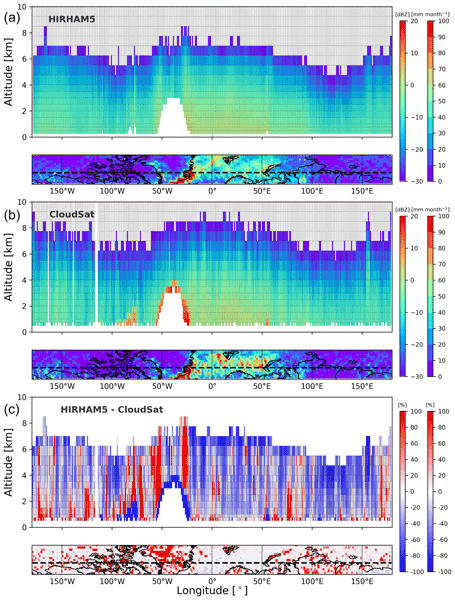
Annakaisa von Lerber, Mario Mech, Annette Rinke, Damao Zhang, Melanie Lauer, Ana Radovan, Irina Gorodetskaya, and Susanne Crewell
Atmos. Chem. Phys., 22, 7287–7317, https://doi.org/10.5194/acp-22-7287-2022, https://doi.org/10.5194/acp-22-7287-2022, 2022
Short summary
Short summary
Snowfall is an important climate indicator. However, microphysical snowfall processes are challenging for atmospheric models. In this study, the performance of a regional climate model is evaluated in modeling the spatial and temporal distribution of Arctic snowfall when compared to CloudSat satellite observations. Excellent agreement in averaged annual snowfall rates is found, and the shown methodology offers a promising diagnostic tool to investigate the shown differences further.
Shuaiqi Tang, Jerome D. Fast, Kai Zhang, Joseph C. Hardin, Adam C. Varble, John E. Shilling, Fan Mei, Maria A. Zawadowicz, and Po-Lun Ma
Geosci. Model Dev., 15, 4055–4076, https://doi.org/10.5194/gmd-15-4055-2022, https://doi.org/10.5194/gmd-15-4055-2022, 2022
Short summary
Short summary
We developed an Earth system model (ESM) diagnostics package to compare various types of aerosol properties simulated in ESMs with aircraft, ship, and surface measurements from six field campaigns across spatial scales. The diagnostics package is coded and organized to be flexible and modular for future extension to other field campaign datasets and adapted to higher-resolution model simulations. Future releases will include comprehensive cloud and aerosol–cloud interaction diagnostics.
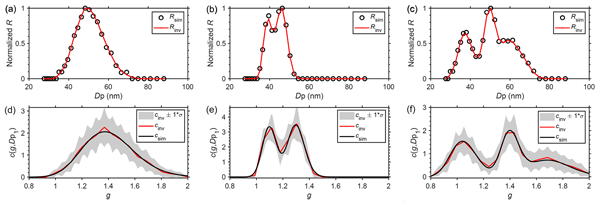
Jiaoshi Zhang, Yang Wang, Steven Spielman, Susanne Hering, and Jian Wang
Atmos. Meas. Tech., 15, 2579–2590, https://doi.org/10.5194/amt-15-2579-2022, https://doi.org/10.5194/amt-15-2579-2022, 2022
Short summary
Short summary
New nonparametric, regularized methods are developed to invert the growth factor probability density function (GF-PDF) from humidity-controlled fast integrated mobility spectrometer measurements. These algorithms are computationally efficient, require no prior assumptions of the GF-PDF distribution, and reduce the error in inverted GF-PDF. They can be applied to humidified tandem differential mobility analyzer data. Among all algorithms, Twomey’s method retrieves GF-PDF with the smallest error.
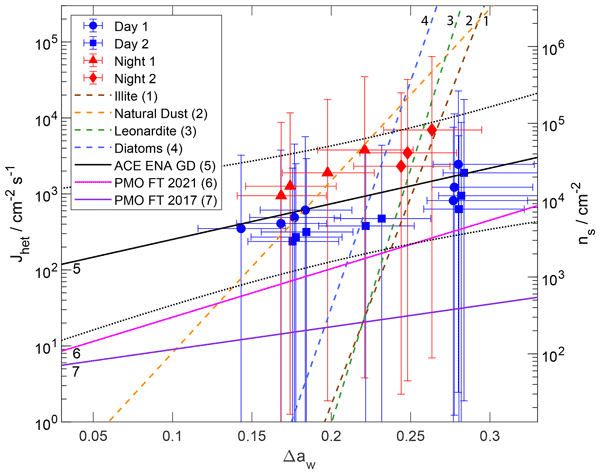
Daniel A. Knopf, Joseph C. Charnawskas, Peiwen Wang, Benny Wong, Jay M. Tomlin, Kevin A. Jankowski, Matthew Fraund, Daniel P. Veghte, Swarup China, Alexander Laskin, Ryan C. Moffet, Mary K. Gilles, Josephine Y. Aller, Matthew A. Marcus, Shira Raveh-Rubin, and Jian Wang
Atmos. Chem. Phys., 22, 5377–5398, https://doi.org/10.5194/acp-22-5377-2022, https://doi.org/10.5194/acp-22-5377-2022, 2022
Short summary
Short summary
Marine boundary layer aerosols collected in the remote region of the eastern North Atlantic induce immersion freezing and deposition ice nucleation under typical mixed-phase and cirrus cloud conditions. Corresponding ice nucleation parameterizations for model applications have been derived. Chemical imaging of ambient aerosol and ice-nucleating particles demonstrates that the latter is dominated by sea salt and organics while also representing a major particle type in the particle population.

Israel Silber, Robert C. Jackson, Ann M. Fridlind, Andrew S. Ackerman, Scott Collis, Johannes Verlinde, and Jiachen Ding
Geosci. Model Dev., 15, 901–927, https://doi.org/10.5194/gmd-15-901-2022, https://doi.org/10.5194/gmd-15-901-2022, 2022
Short summary
Short summary
The Earth Model Column Collaboratory (EMC2) is an open-source ground-based (and air- or space-borne) lidar and radar simulator and subcolumn generator designed for large-scale models, in particular climate models, applicable also for high-resolution models. EMC2 emulates measurements while remaining faithful to large-scale models' physical assumptions implemented in their cloud or radiation schemes. We demonstrate the use of EMC2 to compare AWARE measurements with the NASA GISS ModelE3 and LES.
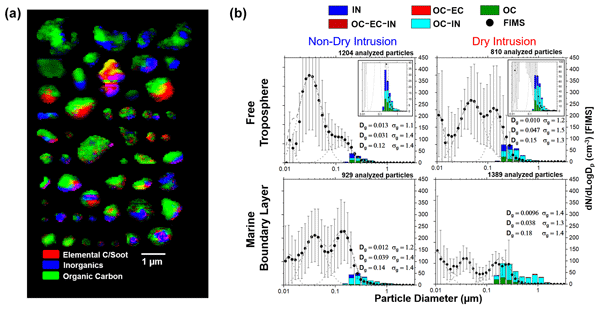
Jay M. Tomlin, Kevin A. Jankowski, Daniel P. Veghte, Swarup China, Peiwen Wang, Matthew Fraund, Johannes Weis, Guangjie Zheng, Yang Wang, Felipe Rivera-Adorno, Shira Raveh-Rubin, Daniel A. Knopf, Jian Wang, Mary K. Gilles, Ryan C. Moffet, and Alexander Laskin
Atmos. Chem. Phys., 21, 18123–18146, https://doi.org/10.5194/acp-21-18123-2021, https://doi.org/10.5194/acp-21-18123-2021, 2021
Short summary
Short summary
Analysis of individual atmospheric particles shows that aerosol transported from North America during meteorological dry intrusion episodes may have a substantial impact on the mixing state and particle-type population over the mid-Atlantic, as organic contribution and particle-type diversity are significantly enhanced during these periods. These observations need to be considered in current atmospheric models.
Fan Mei, Steven Spielman, Susanne Hering, Jian Wang, Mikhail S. Pekour, Gregory Lewis, Beat Schmid, Jason Tomlinson, and Maynard Havlicek
Atmos. Meas. Tech., 14, 7329–7340, https://doi.org/10.5194/amt-14-7329-2021, https://doi.org/10.5194/amt-14-7329-2021, 2021
Short summary
Short summary
This study focuses on understanding a versatile water-based condensation particle counter (vWCPC 3789) performance under various ambient pressure conditions (500–1000 hPa). A vWCPC has the advantage of avoiding health and safety concerns. However, its performance characterization under low pressure is rare but crucial for ensuring successful airborne deployment. This paper provides advanced knowledge of operating a vWCPC 3789 to capture the spatial variations of atmospheric aerosols.
Cited articles
Ajayi, T., Choi, Y., Crosbie, E. C., DiGangi, J. P., Diskin, G. S., Fenn, M. A., Ferrare, R. A., Hair, J. W., Hilario, M. R. A., Hostetler, C. A., Kirschler, S., Moore, R. H., Shingler, T. J., Shook, M. A., Soloff, C., Thornhill, K. L., Voigt, C., Winstead, E. L., Ziemba, L. D., and Sorooshian, A.: Vertical variability of aerosol properties and trace gases over a remote marine region: a case study over Bermuda, Atmos. Chem. Phys., 24, 9197–9218, https://doi.org/10.5194/acp-24-9197-2024, 2024.
Anderson, B. E., Grant, W. B., Gregory, G. L., Browell, E. V., Collins Jr., J. E., Sachse, G. W., Bagwell, D. R., Hudgins, C. H., Blake, D. R., and Blake, N. J.: Aerosols from biomass burning over the tropical South Atlantic region: Distributions and impacts, J. Geophys. Res.-Atmos., 101, 24117–24137, https://doi.org/10.1029/96JD00717, 1996.
Andreae, M. O., Jones, C. D., and Cox, P. M.: Strong present-day aerosol cooling implies a hot future, Nature, 435, 1187–1190, https://doi.org/10.1038/nature03671, 2005.
Ansmann, A. and Müller, D.: Lidar and Atmospheric Aerosol Particles, in: Lidar: Range-Resolved Optical Remote Sensing of the Atmosphere, edited by: Weitkamp, C., Springer New York, New York, NY, 105–141, ISBN 0-387-40075-3, 2005.
Ansmann, A., Seifert, P., Tesche, M., and Wandinger, U.: Profiling of fine and coarse particle mass: case studies of Saharan dust and Eyjafjallajökull/Grimsvötn volcanic plumes, Atmos. Chem. Phys., 12, 9399–9415, https://doi.org/10.5194/acp-12-9399-2012, 2012.
Brady, J. M., Stokes, M. D., Bonnardel, J., and Bertram, T. H.: Characterization of a Quadrotor Unmanned Aircraft System for Aerosol-Particle-Concentration Measurements, Environ. Sci. Technol., 50, 1376–1383, https://doi.org/10.1021/acs.est.5b05320, 2016.
Burton, S. P., Ferrare, R. A., Hostetler, C. A., Hair, J. W., Rogers, R. R., Obland, M. D., Butler, C. F., Cook, A. L., Harper, D. B., and Froyd, K. D.: Aerosol classification using airborne High Spectral Resolution Lidar measurements – methodology and examples, Atmos. Meas. Tech., 5, 73–98, https://doi.org/10.5194/amt-5-73-2012, 2012.
Cadeddu, M. P., Liljegren, J. C., and Turner, D. D.: The Atmospheric radiation measurement (ARM) program network of microwave radiometers: instrumentation, data, and retrievals, Atmos. Meas. Tech., 6, 2359–2372, https://doi.org/10.5194/amt-6-2359-2013, 2013.
Chen, B., Thompson, S. A., Matthews, B. H., Sharma, M., Li, R., Nowotarski, C. J., Rapp, A. D., and Brooks, S. D.: A new technique to retrieve aerosol vertical profiles using micropulse lidar and ground-based aerosol measurements, Atmos. Meas. Tech., 18, 5841–5859, https://doi.org/10.5194/amt-18-5841-2025, 2025.
Cheng, Z., Liyu, A., Dexheimer, D., Lata, N. N., Kulkarni, G., Longbottom, C. M., Mei, F., and China, S.: An automated size and time-resolved aerosol collector platform integrated with environmental sensors to study the vertical profile of aerosols, Environ. Sci.-Atmos., 2, 1263–1276, 2022.
Chiliński, M. T., Markowicz, K. M., and Kubicki, M.: UAS as a Support for Atmospheric Aerosols Research: Case Study, Pure Appl. Geophys., 175, 3325–3342, https://doi.org/10.1007/s00024-018-1767-3, 2018.
Corrigan, C. E., Roberts, G. C., Ramana, M. V., Kim, D., and Ramanathan, V.: Capturing vertical profiles of aerosols and black carbon over the Indian Ocean using autonomous unmanned aerial vehicles, Atmos. Chem. Phys., 8, 737–747, https://doi.org/10.5194/acp-8-737-2008, 2008.
Creamean, J. M., de Boer, G., Telg, H., Mei, F., Dexheimer, D., Shupe, M. D., Solomon, A., and McComiskey, A.: Assessing the vertical structure of Arctic aerosols using balloon-borne measurements, Atmos. Chem. Phys., 21, 1737–1757, https://doi.org/10.5194/acp-21-1737-2021, 2021.
Creamean, J. M., Dexheimer, D., Hume, C. C., Vazquez, M., Hess, B. T. M., Longbottom, C. M., Ruiz, C. A., and Theisen, A. K.: Reaching new heights: A vertically-resolved ice nucleating particle sampler operating on Atmospheric Radiation Measurement (ARM) tethered balloon systems, EGUsphere [preprint], https://doi.org/10.5194/egusphere-2025-5000, 2025.
Cromwell, E., Dexheimer, D., Shi, Y., and Whitson, G.: Meteorological Instrumentation Aboard TBS (TBSIMET), 2022-06-03 to 2022-09-14, ARM Mobile Facility (HOU), Houston, TX; Supplemental Facility 3 for ANC: Upwind Site for Summer Iop (S3), Atmospheric Radiation Measurement (ARM) User Facility [data set], https://doi.org/10.5439/1530482, last access: 22 November 2025a.
Cromwell, E., Dexheimer, D., Shi, Y., and Whitson, G.: Meteorological Instrumentation Aboard TBS (TBSIMETXQ2), 2022-06-03 to 2022-09-14, ARM Mobile Facility (HOU), Houston, TX; Supplemental Facility 3 for ANC: Upwind Site for Summer Iop (S3), Atmospheric Radiation Measurement (ARM) User Facility [data set], https://doi.org/10.5439/1483632, last access: 22 November 2025b.
Cromwell, E., Dexheimer, D., Shi, Y., and Whitson, G.: Anemometers Aboard Tethered Balloon System (TBSWIND), 2022-06-03 to 2022-09-14, ARM Mobile Facility (HOU), Houston, TX; Supplemental Facility 3 for ANC: Upwind Site for Summer Iop (S3), Atmospheric Radiation Measurement (ARM) User Facility [data set], https://doi.org/10.5439/1515075, last access: 22 November 2025c.
Dexheimer, D., Creamean, J., Gaustad, K., Longbottom, C., Cheng, Z., Sammon, J., and Mei, F.: Tethered Balloon System (TBS) Instrument Handbook, ARM Climate Research Facility, DOE Office of Science Atmospheric Radiation Measurement (ARM) Program (United States), United States, 2026.
Dmitrovic, S., Hair, J. W., Collister, B. L., Crosbie, E., Fenn, M. A., Ferrare, R. A., Harper, D. B., Hostetler, C. A., Hu, Y., Reagan, J. A., Robinson, C. E., Seaman, S. T., Shingler, T. J., Thornhill, K. L., Vömel, H., Zeng, X., and Sorooshian, A.: High Spectral Resolution Lidar – generation 2 (HSRL-2) retrievals of ocean surface wind speed: methodology and evaluation, Atmos. Meas. Tech., 17, 3515–3532, https://doi.org/10.5194/amt-17-3515-2024, 2024.
Engelhart, G. J., Moore, R. H., Nenes, A., and Pandis, S. N.: Cloud condensation nuclei activity of isoprene secondary organic aerosol, J. Geophys. Res.-Atmos., 116, https://doi.org/10.1029/2010JD014706, 2011.
Ervens, B., Turpin, B. J., and Weber, R. J.: Secondary organic aerosol formation in cloud droplets and aqueous particles (aqSOA): a review of laboratory, field and model studies, Atmos. Chem. Phys., 11, 11069–11102, https://doi.org/10.5194/acp-11-11069-2011, 2011.
Farley, R. N., Lee, J. E., Rivellini, L.-H., Lee, A. K. Y., Dal Porto, R., Cappa, C. D., Gorkowski, K., Shawon, A. S. M., Benedict, K. B., Aiken, A. C., Dubey, M. K., and Zhang, Q.: Chemical properties and single-particle mixing state of soot aerosol in Houston during the TRACER campaign, Atmos. Chem. Phys., 24, 3953–3971, https://doi.org/10.5194/acp-24-3953-2024, 2024.
Fernald, F. G.: Analysis of atmospheric lidar observations: some comments, Appl. Optics, 23, 652–653, https://doi.org/10.1364/AO.23.000652, 1984.
Ferrero, L., Cappelletti, D., Busetto, M., Mazzola, M., Lupi, A., Lanconelli, C., Becagli, S., Traversi, R., Caiazzo, L., Giardi, F., Moroni, B., Crocchianti, S., Fierz, M., Močnik, G., Sangiorgi, G., Perrone, M. G., Maturilli, M., Vitale, V., Udisti, R., and Bolzacchini, E.: Vertical profiles of aerosol and black carbon in the Arctic: a seasonal phenomenology along 2 years (2011–2012) of field campaigns, Atmos. Chem. Phys., 16, 12601–12629, https://doi.org/10.5194/acp-16-12601-2016, 2016.
Fröhlich, R., Cubison, M. J., Slowik, J. G., Bukowiecki, N., Prévôt, A. S. H., Baltensperger, U., Schneider, J., Kimmel, J. R., Gonin, M., Rohner, U., Worsnop, D. R., and Jayne, J. T.: The ToF-ACSM: a portable aerosol chemical speciation monitor with TOFMS detection, Atmos. Meas. Tech., 6, 3225–3241, https://doi.org/10.5194/amt-6-3225-2013, 2013.
Fuzzi, S., Baltensperger, U., Carslaw, K., Decesari, S., Denier van der Gon, H., Facchini, M. C., Fowler, D., Koren, I., Langford, B., Lohmann, U., Nemitz, E., Pandis, S., Riipinen, I., Rudich, Y., Schaap, M., Slowik, J. G., Spracklen, D. V., Vignati, E., Wild, M., Williams, M., and Gilardoni, S.: Particulate matter, air quality and climate: lessons learned and future needs, Atmos. Chem. Phys., 15, 8217–8299, https://doi.org/10.5194/acp-15-8217-2015, 2015.
Galfione, A., Battaglia, A., Oue, M., Cattani, E., and Kollias, P.: Comparison of GOES16 Data with the TRACER-ESCAPE Field Campaign Dataset for Convection Characterization: A Selection of Case Studies and Lessons Learnt, Remote Sens., 17, 2621, https://doi.org/10.3390/rs17152621, 2025.
Gautam, T., Vandergrift, G. W., Lata, N. N., Cheng, Z., Rahman, A., Minke, A., Lai, Z., Dexheimer, D. N., Zhang, D., Marcus, M. A., Zawadowicz, M. A., Kuang, C., Zhao, R., Steiner, A. L., and China, S.: Chemical Insights into the Molecular Composition of Organic Aerosols in the Urban Region of Houston, Texas, ACS ES&T Air, 1, 1304–1316, https://doi.org/10.1021/acsestair.4c00141, 2024.
Geiß, A., Wiegner, M., Bonn, B., Schäfer, K., Forkel, R., von Schneidemesser, E., Münkel, C., Chan, K. L., and Nothard, R.: Mixing layer height as an indicator for urban air quality?, Atmos. Meas. Tech., 10, 2969–2988, https://doi.org/10.5194/amt-10-2969-2017, 2017.
Hair, J. W., Hostetler, C. A., Cook, A. L., Harper, D. B., Ferrare, R. A., Mack, T. L., Welch, W., Izquierdo, L. R., and Hovis, F. E.: Airborne High Spectral Resolution Lidar for profiling aerosol optical properties, Appl. Optics, 47, 6734–6752, https://doi.org/10.1364/AO.47.006734, 2008.
Hersbach, H., Bell, B., Berrisford, P., Hirahara, S., Horányi, A., Muñoz-Sabater, J., Nicolas, J., Peubey, C., Radu, R., Schepers, D., Simmons, A., Soci, C., Abdalla, S., Abellan, X., Balsamo, G., Bechtold, P., Biavati, G., Bidlot, J., Bonavita, M., De Chiara, G., Dahlgren, P., Dee, D., Diamantakis, M., Dragani, R., Flemming, J., Forbes, R., Fuentes, M., Geer, A., Haimberger, L., Healy, S., Hogan, R. J., Hólm, E., Janisková, M., Keeley, S., Laloyaux, P., Lopez, P., Lupu, C., Radnoti, G., de Rosnay, P., Rozum, I., Vamborg, F., Villaume, S., and Thépaut, J.-N.: The ERA5 global reanalysis, Q. J. Roy. Meteor. Soc., 146, 1999–2049, https://doi.org/10.1002/qj.3803, 2020.
Huang, R.-J., Zhang, Y., Bozzetti, C., Ho, K.-F., Cao, J.-J., Han, Y., Daellenbach, K. R., Slowik, J. G., Platt, S. M., Canonaco, F., Zotter, P., Wolf, R., Pieber, S. M., Bruns, E. A., Crippa, M., Ciarelli, G., Piazzalunga, A., Schwikowski, M., Abbaszade, G., Schnelle-Kreis, J., Zimmermann, R., An, Z., Szidat, S., Baltensperger, U., Haddad, I. E., and Prévôt, A. S. H.: High secondary aerosol contribution to particulate pollution during haze events in China, Nature, 514, 218–222, https://doi.org/10.1038/nature13774, 2014.
Huffman, J. A., Docherty, K. S., Mohr, C., Cubison, M. J., Ulbrich, I. M., Ziemann, P. J., Onasch, T. B., and Jimenez, J. L.: Chemically-Resolved Volatility Measurements of Organic Aerosol from Different Sources, Environ. Sci. Technol., 43, 5351–5357, https://doi.org/10.1021/es803539d, 2009.
Hussein, T., Dal Maso, M., Petäjä, T., Koponen, I. K., Paatero, P., Aalto, P. P., Hämeri, K., and Kulmala, M.: Evaluation of an automatic algorithm for fitting the particle number size distributions, Boreal Environ. Res., 10, 337, https://doi.org/10.60910/gkzd-jt7v, 2005.
Jensen, M. P., Flynn, J. H., Kollias, P., Kuang, C., McFarquhar, G., Powers, H., Brooks, S., Bruning, E., Collins, D., Collis, S. M., Fan, J., Fridlind, A., Giangrande, S. E., Griffin, R., Hu, J., Jackson, R. C., Kumjian, M., Logan, T., Matsui, T., Nowotarski, C. J., Oue, M., Rapp, A. D., Rosenfeld, D., Ryzhkov, A., Sheesley, R., Snyder, J., Stier, P., Usenko, S., van den Heever, S. C., van Lier-Walqui, M., Varble, A., Wang, Y., Aiken, A., Deng, M., Dexheimer, D., Dubey, M., Feng, Y., Ghate, V. P., Johnson, K. L., Lamer, K., Saleeby, S. M., Wang, D., Zawadowicz, M. A., and Zhou, A.: Tracking Aerosol Convection Interactions Experiment (TRACER) Field Campaign Report, Oak Ridge National Laboratory (ORNL), Oak Ridge, TN (United States), Atmospheric Radiation Measurement (ARM) Data Center, United States, 2023.
Jolliffe, I. T. and Cadima, J.: Principal component analysis: a review and recent developments, Philos. T. R. Soc. A, 374, https://doi.org/10.1098/rsta.2015.0202, 2016.
Kezoudi, M., Papetta, A., Kandler, K., Ryder, C. L., Leonidou, A., Keleshis, C., Stopford, C., Thornberry, T., Mamouri, R.-E., Sciare, J., and Marenco, F.: Microphysical and Compositional Differences Between Saharan and Middle Eastern Dust Revealed by UAS Observations, Atmos. Chem. Phys., 26, 7361–7385, https://doi.org/10.5194/acp-26-7361-2026, 2026.
Klett, J. D.: Stable analytical inversion solution for processing lidar returns, Appl. Optics, 20, 211–220, https://doi.org/10.1364/AO.20.000211, 1981.
Kyrouac, J., Shi, Y., and Tuftedal, M.: Surface Meteorological Instrumentation (MET), 2022-05-12 to 2022-10-01, ARM Mobile Facility (HOU), Houston, TX; Supplemental Facility 3 for ANC: Upwind Site for Summer Iop (S3), Atmospheric Radiation Measurement (ARM) User Facility [data set], https://doi.org/10.5439/1786358, last access: 22 November 2025.
Lata, N. N., Cheng, Z., Dexheimer, D., Zhang, D., Mei, F., and China, S.: Vertical Gradient of Size-Resolved Aerosol Compositions over the Arctic Reveals Cloud Processed Aerosol in-Cloud and above Cloud, Environ. Sci. Technol., 57, 5821–5830, https://doi.org/10.1021/acs.est.2c09498, 2023.
Lata, N. N., Cheng, Z., Dexheimer, D., Mathai, S., Marcus, M. A., Pratt, K. A., Thevuthasan, T., Mei, F., and China, S.: Vertical gradient in atmospheric particle phase state: a case study over the alaskan arctic oil fields, Environ. Sci.-Atmos., 5, 415–428, https://doi.org/10.1039/D4EA00150H, 2025.
Li, H., Liu, B., Ma, X., Jin, S., Ma, Y., Zhao, Y., and Gong, W.: Evaluation of retrieval methods for planetary boundary layer height based on radiosonde data, Atmos. Meas. Tech., 14, 5977–5986, https://doi.org/10.5194/amt-14-5977-2021, 2021.
Li, J., Zhang, J., Gong, X., Spielman, S., Kuang, C., Singh, A., Zawadowicz, M. A., Xu, L., and Wang, J.: The sources and diurnal variations of submicron aerosols in a coastal–rural environment near Houston, US, Atmos. Chem. Phys., 25, 13975–13993, https://doi.org/10.5194/acp-25-13975-2025, 2025.
Liu, S. and Liang, X.-Z.: Observed Diurnal Cycle Climatology of Planetary Boundary Layer Height, J. Climate, 23, 5790–5809, https://doi.org/10.1175/2010JCLI3552.1, 2010.
Lohmann, U. and Feichter, J.: Impact of sulfate aerosols on albedo and lifetime of clouds: A sensitivity study with the ECHAM4 GCM, J. Geophys. Res.-Atmos., 102, 13685–13700, https://doi.org/10.1029/97JD00631, 1997.
Lohmann, U. and Hoose, C.: Sensitivity studies of different aerosol indirect effects in mixed-phase clouds, Atmos. Chem. Phys., 9, 8917–8934, https://doi.org/10.5194/acp-9-8917-2009, 2009.
Mei, F., Wang, J., Comstock, J. M., Weigel, R., Krämer, M., Mahnke, C., Shilling, J. E., Schneider, J., Schulz, C., Long, C. N., Wendisch, M., Machado, L. A. T., Schmid, B., Krisna, T., Pekour, M., Hubbe, J., Giez, A., Weinzierl, B., Zoeger, M., Pöhlker, M. L., Schlager, H., Cecchini, M. A., Andreae, M. O., Martin, S. T., de Sá, S. S., Fan, J., Tomlinson, J., Springston, S., Pöschl, U., Artaxo, P., Pöhlker, C., Klimach, T., Minikin, A., Afchine, A., and Borrmann, S.: Comparison of aircraft measurements during GoAmazon2014/5 and ACRIDICON-CHUVA, Atmos. Meas. Tech., 13, 661–684, https://doi.org/10.5194/amt-13-661-2020, 2020.
Mei, F., Pekour, M. S., Dexheimer, D., de Boer, G., Cook, R., Tomlinson, J., Schmid, B., Goldberger, L. A., Newsom, R., and Fast, J. D.: Observational data from uncrewed systems over Southern Great Plains, Earth Syst. Sci. Data, 14, 3423–3438, https://doi.org/10.5194/essd-14-3423-2022, 2022.
Mei, F., Wang, H., Zhu, Z., Zhang, D., Zhang, Q., Fast, J. D., Gustafson, W. I., Li, X.-Y., Schmid, B., Niedek, C., Tomlinson, J., and Flynn, C.: Bridging New Observational Capabilities and Process-Level Simulation: Insights into Aerosol Roles in the Earth System, B. Am. Meteorol. Soc., 105, E709–E724, https://doi.org/10.1175/BAMS-D-23-0110.1, 2024.
Mei, F., Zhang, Q., Zhang, D., Fast, J. D., Kulkarni, G., Pekour, M. S., Niedek, C. R., Glienke, S., Silber, I., Schmid, B., Tomlinson, J. M., Mehta, H. S., Mansoura, X., Cheng, Z., Vandergrift, G. W., Lata, N. N., China, S., and Zhu, Z.: Measurement report: Vertically resolved atmospheric properties observed over the Southern Great Plains with the ArcticShark uncrewed aerial system, Atmos. Chem. Phys., 25, 3425–3444, https://doi.org/10.5194/acp-25-3425-2025, 2025a.
Mei, F., Stephenson, J., and Pekour, M.: Portable Optical Particle Spectrometer Aboard Tethered Balloon System (TBSPOPS), 2022-06-03 to 2022-09-14, ARM Mobile Facility (HOU), Houston, TX; Supplemental Facility 3 for ANC: Upwind Site for Summer Iop (S3), Atmospheric Radiation Measurement (ARM) User Facility [data set], https://doi.org/10.5439/1827703, last access: 22 November 2025b.
Mei, F., Stephenson, J., and Pekour, M.: Condensation Particle Counter Aboard Tethered Balloon System (TBSCPC), 2022-06-03 to 2022-09-14, ARM Mobile Facility (HOU), Houston, TX; Supplemental Facility 3 for ANC: Upwind Site for Summer Iop (S3), Atmospheric Radiation Measurement (ARM) User Facility [data set], https://doi.org/10.5439/1582131, last access: 22 November 2025c.
Mushtaq, Z., Sharma, M., Bangotra, P., Gautam, A. S., and Gautam, S.: Atmospheric Aerosols: Some Highlights and Highlighters, Past to Recent Years, Aerosol Sci. Eng., 6, 135–145, https://doi.org/10.1007/s41810-022-00133-w, 2022.
NOAA National Weather Service (NWS) Radar Operations Center: NOAA Next Generation Radar (NEXRAD) Level 2 Base Data, NOAA National Centers for Environmental Information, https://doi.org/10.7289/V5W9574V (last access: 22 April 2026), 1991.
Ramanathan, V., Crutzen, P. J., Lelieveld, J., Mitra, A. P., Althausen, D., Anderson, J., Andreae, M. O., Cantrell, W., Cass, G. R., Chung, C. E., Clarke, A. D., Coakley, J. A., Collins, W. D., Conant, W. C., Dulac, F., Heintzenberg, J., Heymsfield, A. J., Holben, B., Howell, S., Hudson, J., Jayaraman, A., Kiehl, J. T., Krishnamurti, T. N., Lubin, D., McFarquhar, G., Novakov, T., Ogren, J. A., Podgorny, I. A., Prather, K., Priestley, K., Prospero, J. M., Quinn, P. K., Rajeev, K., Rasch, P., Rupert, S., Sadourny, R., Satheesh, S. K., Shaw, G. E., Sheridan, P., and Valero, F. P. J.: Indian Ocean Experiment: An integrated analysis of the climate forcing and effects of the great Indo-Asian haze, J. Geophys. Res.-Atmos., 106, 28371–28398, https://doi.org/10.1029/2001JD900133, 2001.
Rapp, A. D., Brooks, S. D., Nowotarski, C. J., Sharma, M., Thompson, S. A., Chen, B., Matthews, B. H., Etten-Bohm, M., Nielsen, E. R., and Li, R.: TAMU TRACER: Targeted Mobile Measurements to Isolate the Impacts of Aerosols and Meteorology on Deep Convection, B. Am. Meteorol. Soc., 105, E1685–E1702, https://doi.org/10.1175/BAMS-D-23-0218.1, 2024.
Ren, J., Xu, W., Huang, R.-J., Zhang, F., Wang, Y., Chen, L., Ovadnevaite, J., Ceburnis, D., O'Dowd, C., and Sun, Y.: Contrasting aerosol mixing states at inland and coastal sites: an entropy-based metric for CCN activity, Atmos. Chem. Phys., 26, 2985–3000, https://doi.org/10.5194/acp-26-2985-2026, 2026.
Roach, P. J., Laskin, J., and Laskin, A.: Molecular Characterization of Organic Aerosols Using Nanospray-Desorption/Electrospray Ionization-Mass Spectrometry, Anal. Chem., 82, 7979–7986, https://doi.org/10.1021/ac101449p, 2010.
Rosenfeld, D., Andreae, M. O., Asmi, A., Chin, M., de Leeuw, G., Donovan, D. P., Kahn, R., Kinne, S., Kivekäs, N., Kulmala, M., Lau, W., Schmidt, K. S., Suni, T., Wagner, T., Wild, M., and Quaas, J.: Global observations of aerosol-cloud-precipitation-climate interactions, Rev. Geophys., 52, 750–808, https://doi.org/10.1002/2013RG000441, 2014.
Rosenfeld, D., Zhu, Y., Wang, M., Zheng, Y., Goren, T., and Yu, S.: Aerosol-driven droplet concentrations dominate coverage and water of oceanic low-level clouds, Science, 363, eaav0566, https://doi.org/10.1126/science.aav0566, 2019.
Schmale, J., Henning, S., Henzing, B., Keskinen, H., Sellegri, K., Ovadnevaite, J., Bougiatioti, A., Kalivitis, N., Stavroulas, I., Jefferson, A., Park, M., Schlag, P., Kristensson, A., Iwamoto, Y., Pringle, K., Reddington, C., Aalto, P., Äijälä, M., Baltensperger, U., Bialek, J., Birmili, W., Bukowiecki, N., Ehn, M., Fjæraa, A. M., Fiebig, M., Frank, G., Fröhlich, R., Frumau, A., Furuya, M., Hammer, E., Heikkinen, L., Herrmann, E., Holzinger, R., Hyono, H., Kanakidou, M., Kiendler-Scharr, A., Kinouchi, K., Kos, G., Kulmala, M., Mihalopoulos, N., Motos, G., Nenes, A., O'Dowd, C., Paramonov, M., Petäjä, T., Picard, D., Poulain, L., Prévôt, A. S. H., Slowik, J., Sonntag, A., Swietlicki, E., Svenningsson, B., Tsurumaru, H., Wiedensohler, A., Wittbom, C., Ogren, J. A., Matsuki, A., Yum, S. S., Myhre, C. L., Carslaw, K., Stratmann, F., and Gysel, M.: Collocated observations of cloud condensation nuclei, particle size distributions, and chemical composition, Sci. Data, 4, 170003, https://doi.org/10.1038/sdata.2017.3, 2017.
Schulze, B. C., Charan, S. M., Kenseth, C. M., Kong, W., Bates, K. H., Williams, W., Metcalf, A. R., Jonsson, H. H., Woods, R., Sorooshian, A., Flagan, R. C., and Seinfeld, J. H.: Characterization of Aerosol Hygroscopicity Over the Northeast Pacific Ocean: Impacts on Prediction of CCN and Stratocumulus Cloud Droplet Number Concentrations, Earth Space Sci., 7, e2020EA001098, https://doi.org/10.1029/2020EA001098, 2020.
Seidel, D. J., Ao, C. O., and Li, K.: Estimating climatological planetary boundary layer heights from radiosonde observations: Comparison of methods and uncertainty analysis, J. Geophys. Res.-Atmos., 115, https://doi.org/10.1029/2009JD013680, 2010.
Seinfeld, J. H. and Pandis, S. N.: Atmospheric chemistry and physics: from air pollution to climate change, John Wiley & Sons, ISBN 978-1-118-94740-1, 2016.
Silber, I., Comstock, J. M., Kieburtz, M. R., Gaustad, K. L., and Mei, F.: ARM Trajectories Data Set Value-Added Product Report, Oak Ridge National Laboratory (ORNL), Oak Ridge, TN (United States). Atmospheric Radiation Measurement (ARM) Data Center, United States, 2025a.
Silber, I., Comstock, J. M., Kieburtz, M. R., and Russell, L. M.: ARMTRAJ: a set of multipurpose trajectory datasets augmenting the Atmospheric Radiation Measurement (ARM) user facility measurements, Earth Syst. Sci. Data, 17, 29–42, https://doi.org/10.5194/essd-17-29-2025, 2025b.
Sivaraman, C., McFarlane, S., Dong, X., and Xi, B.: Planetary Boundary Layer (PBL) Height Value Added Product Technical Report, U.S. Department of Energy, Office of Science, Biological and Environmental Research, DOE/SC-ARM-TR-132, https://www.osti.gov/servlets/purl/1808688 (last access: 27 January 2026), 2013.
Stein, A. F., Draxler, R. R., Rolph, G. D., Stunder, B. J. B., Cohen, M. D., and Ngan, F.: NOAA's HYSPLIT Atmospheric Transport and Dispersion Modeling System, B. Am. Meteorol. Soc., 96, 2059–2077, https://doi.org/10.1175/BAMS-D-14-00110.1, 2015.
Stull, R. B.: An introduction to boundary layer meteorology, Springer Science & Business Media, https://doi.org/10.1007/978-94-009-3027-8, 2012.
Thompson, S. A., Chen, B., Matthews, B. H., Li, R., Nowotarski, C. J., Rapp, A. D., and Brooks, S. D.: Characterizing Greater Houston's Aerosol by Air Mass During TRACER, J. Geophys. Res.-Atmos., 130, e2025JD043353, https://doi.org/10.1029/2025JD043353, 2025a.
Thompson, S. A., Peña, T. A., Chen, B., Sharma, M., Matthews, B. H., Li, R., Nowotarski, C. J., Rapp, A. D., and Brooks, S. D.: Variability in Ice Nucleating Particles Across Greater Houston Texas, J. Geophys. Res.-Atmos., 130, e2025JD044164, https://doi.org/10.1029/2025JD044164, 2025b.
Tsimpidi, A. P., Scholz, S. M. C., Milousis, A., Mihalopoulos, N., and Karydis, V. A.: Aerosol composition trends during 2000–2020: in-depth insights from model predictions and multiple worldwide near-surface observation datasets, Atmos. Chem. Phys., 25, 10183–10213, https://doi.org/10.5194/acp-25-10183-2025, 2025.
Turner, D. D., Clough, S. A., Liljegren, J. C., Clothiaux, E. E., Cady-Pereira, K. E., and Gaustad, K. L.: Retrieving Liquid Wat0er Path and Precipitable Water Vapor From the Atmospheric Radiation Measurement (ARM) Microwave Radiometers, IEEE T. Geosci. Remote, 45, 3680–3690, https://doi.org/10.1109/TGRS.2007.903703, 2007.
Twomey, S.: The Influence of Pollution on the Shortwave Albedo of Clouds, J. Atmos. Sci., 34, 1149–1152, https://doi.org/10.1175/1520-0469(1977)034<1149:TIOPOT>2.0.CO;2, 1977.
Vandergrift, G. W., Shawon, A. S. M., Dexheimer, D. N., Zawadowicz, M. A., Mei, F., and China, S.: Molecular Characterization of Organosulfate-Dominated Aerosols over Agricultural Fields from the Southern Great Plains by High-Resolution Mass Spectrometry, ACS Earth Space Chem., 6, 1733–1741, https://doi.org/10.1021/acsearthspacechem.2c00043, 2022.
Vandergrift, G. W., Dexheimer, D. N., Zhang, D., Cheng, Z., Lata, N. N., Rogers, M. M., Shrivastava, M., Zhang, J., Gaudet, B. J., Mei, F., and China, S.: Tethered balloon system and High-Resolution Mass Spectrometry Reveal Increased Organonitrates Aloft Compared to the Ground Level, Environ. Sci. Technol., 58, 10060–10071, https://doi.org/10.1021/acs.est.4c02090, 2024.
Wang, D., Kobrosly, R., Zhang, T., Subba, T., van den Heever, S., Gupta, S., and Jensen, M.: Aerosol impacts on isolated deep convection: findings from TRACER, Atmos. Chem. Phys., 25, 9295–9314, https://doi.org/10.5194/acp-25-9295-2025, 2025.
Zawadowicz, M., Howie, J., Shilling, J., and Levin, M.: ACSM, Corrected for Composition-Dependent Collection Efficiency (ACSMCDCE), 2022-05-28 to 2022-09-29, ARM Mobile Facility (HOU), Houston, TX; Supplemental Facility 3 for ANC: Upwind Site for Summer Iop (S3), Atmospheric Radiation Measurement (ARM) User Facility [data set], https://doi.org/10.5439/1763029, last access: 22 November 2025.
Zhang, R., Zhang, D., Mei, F., Mehra, M., Cai, J., Yu, H., Satheesh, A. R., Carillo-Cardenas, G., Hallar, A. G., Meskhidze, N., and Wang, Y.: Investigating Ultrafine Aerosol Turbulent Fluxes during Atmospheric New Particle Formation Events, Environ. Sci. Technol., 60, 19984–19998, https://doi.org/10.1021/acs.est.6c06924, 2026.
Short summary
Tethered balloon measurements from 149 flights during DOE ARM TRACER over Houston characterize vertical aerosol and CCN structure. Back-trajectory clustering identifies three air mass types – marine, mixed, and urban – with distinct profiles shaped by boundary-layer depth and coastal circulations. A case study shows mesoscale advection simultaneously transforms thermodynamic and aerosol conditions, underscoring the need to constrain meteorology before attributing cloud changes to aerosol forcing.
Tethered balloon measurements from 149 flights during DOE ARM TRACER over Houston characterize...


Altmetrics
Final-revised paper
Preprint