Articles | Volume 21, issue 21
https://doi.org/10.5194/acp-21-16349-2021
© Author(s) 2021. This work is distributed under
the Creative Commons Attribution 4.0 License.
https://doi.org/10.5194/acp-21-16349-2021
© Author(s) 2021. This work is distributed under
the Creative Commons Attribution 4.0 License.
Dipole pattern of summer ozone pollution in the east of China and its connection with climate variability
Xiaoqing Ma
Key Laboratory of Meteorological Disaster, Ministry of Education/Joint International Research Laboratory of Climate and Environment Change (ILCEC)/Collaborative Innovation Center on Forecast and Evaluation of Meteorological Disasters (CIC-FEMD), Nanjing University of Information
Science & Technology, Nanjing 210044, China
Zhicong Yin
CORRESPONDING AUTHOR
Key Laboratory of Meteorological Disaster, Ministry of Education/Joint International Research Laboratory of Climate and Environment Change (ILCEC)/Collaborative Innovation Center on Forecast and Evaluation of Meteorological Disasters (CIC-FEMD), Nanjing University of Information
Science & Technology, Nanjing 210044, China
Southern Marine Science and Engineering Guangdong Laboratory (Zhuhai), Zhuhai, China
Nansen-Zhu International Research Centre, Institute of Atmospheric
Physics, Chinese Academy of Sciences, Beijing, China
Related authors
Qianyi Huo, Zhicong Yin, Xiaoqing Ma, and Huijun Wang
Atmos. Chem. Phys., 25, 1711–1724, https://doi.org/10.5194/acp-25-1711-2025, https://doi.org/10.5194/acp-25-1711-2025, 2025
Short summary
Short summary
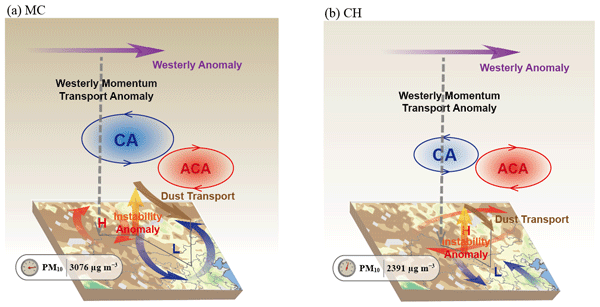
Dust days during the spring seasons of 2015–2023 in North China were classified into Mongolian cyclone and cold high types depending on the presence of the Mongolian cyclone. The Mongolian cyclone type led to more frequent and severe dust weather, indicated by PM10 concentrations. To comprehensively forecast the two types of dust weather, a common predictor was established based on 500 hPa anomalous circulation systems, offering insights for dust weather forecasting and climate prediction.
Fang Zhou, Shuo Han, Zhicong Yin, Tingting Han, and Dingzhu Hu
EGUsphere, https://doi.org/10.5194/egusphere-2026-4214, https://doi.org/10.5194/egusphere-2026-4214, 2026
This preprint is open for discussion and under review for Atmospheric Chemistry and Physics (ACP).
Short summary
Short summary
Winter extreme rainfall causes severe floods. Its link to the stratospheric polar vortex was thought weak. We found this hidden link is unlocked by a tropical oscillation. When the vortex shifts toward Eurasia, it amplifies rainfall only during certain phases. Two routes act: the vortex lifts warm moist air and strengthens tropical moisture supply. Climate models show capturing this tropical pathway is key. Joint monitoring of the vortex and oscillation may improve predictions.
Qianyi Huo, Zhicong Yin, Xiaoqing Ma, and Huijun Wang
Atmos. Chem. Phys., 25, 1711–1724, https://doi.org/10.5194/acp-25-1711-2025, https://doi.org/10.5194/acp-25-1711-2025, 2025
Short summary
Short summary
Dust days during the spring seasons of 2015–2023 in North China were classified into Mongolian cyclone and cold high types depending on the presence of the Mongolian cyclone. The Mongolian cyclone type led to more frequent and severe dust weather, indicated by PM10 concentrations. To comprehensively forecast the two types of dust weather, a common predictor was established based on 500 hPa anomalous circulation systems, offering insights for dust weather forecasting and climate prediction.
Zhicong Yin, Mingkeng Duan, Yuyan Li, Tianbao Xu, and Huijun Wang
Atmos. Chem. Phys., 22, 11173–11185, https://doi.org/10.5194/acp-22-11173-2022, https://doi.org/10.5194/acp-22-11173-2022, 2022
Short summary
Short summary
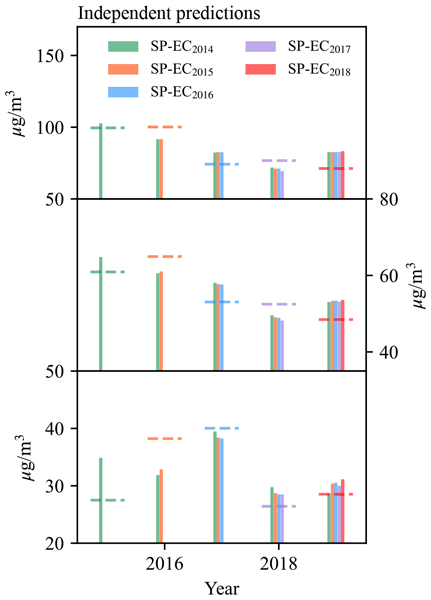
The PM2.5 concentration has been greatly reduced in recent years in China and has entered a crucial stage that required fine seasonal prediction. However, there is still no study aimed at predicting gridded PM2.5 concentration. A model for seasonal prediction of gridded winter PM2.5 concentration in the east of China was developed by analyzing the contributions of emissions and climate variability, which could provide scientific support for air pollution control at the regional and city levels.
Shiyue Zhang, Gang Zeng, Xiaoye Yang, Ruixi Wu, and Zhicong Yin
Atmos. Chem. Phys., 21, 15185–15197, https://doi.org/10.5194/acp-21-15185-2021, https://doi.org/10.5194/acp-21-15185-2021, 2021
Short summary
Short summary
This study classified the winter cold surge in eastern China into blocking cold surge and wave-train cold surge and investigated the difference of haze dispersion ability between the two types. The results show that the haze dispersion of blocking cold surge is weaker than that of wave-train cold surge. In the past 4 decades, the frequency of wave-train (blocking) cold surge shows a downward (upward) trend, which means that the ability of cold surge to disperse haze is declining.
Cited articles
Behera, S. K. and Yamagata, T.: Subtropical SST dipole events in the
southern Indian Ocean, Geophys. Res. Lett., 28, 327–330,
https://doi.org/10.1029/2000GL011451, 2001.
Bey, I., Jacob, D. J., Yantosca, R. M., Logan, J. A., Field, B., Fiore, A. M., Li, Q., Liu, H., Mickley, L. J., and Schultz, M.: Global modeling of
tropospheric chemistry with assimilated meteorology: Model description and
evaluation, J. Geophys. Res., 106, 23073–23095, https://doi.org/10.1029/2001JD000807, 2001.
Chen, Z. Y., Zhuang, Y., Xie, X. M., Chen, D. L., Cheng, N. L., Yang, L.,
and Lia, R. Y.: Understanding long-term variations of meteorological influences on ground ozone concentrations in Beijing During 2006–2016, Environ. Pollut., 245, 29–37, https://doi.org/10.1016/j.envpol.2018.10.117, 2019.
Gelaro, R., McCarty, W., Suarez, M. J., Todling, R., Molod, A., Takacs,L.,
Randles,C.A., Darmenov,A., Bosilovich, M. G., Reichle, R., Wargan, K., Coy,
L., Cullather, R., Draper, C., Akella, S., Buchard, V., Conaty, A., da
Silva, A. M., Gu, W., Kim, G. K., Koster, R., Lucchesi, R., Merkova, D.,
Nielsen, J. E., Partyka, G., Pawson,S., Putman, W., Rienecker, M., Schubert, S. D., Sienkiewicz, M., and Zhao, B.: The Modern-Era Retrospective Analysis for Research and Applications, Version 2 (MERRA2), J. Climate, 30,
5419–5454, https://doi.org/10.1175/JCLI-D-16-0758.1, 2017.
Good, S. A., Martin, M. J., and Rayner, N. A.: EN4: quality controlled ocean
temperature and salinity profiles and monthly objective analyses with uncertainty estimates, J. Geophys. Res.-Oceans, 118, 6704–6716, https://doi.org/10.1002/2013JC009067, 2013.
Han, H., Liu, J., Shu, L., Wang, T. J., and Yuan, H. L.: Local and synoptic
meteorological influences on daily variability in summertime surface ozone
in eastern China, Atmos. Chem. Phys. 20, 203–222,
https://doi.org/10.5194/acp-20-203-2020, 2020.
Han, J. P. and Zhang, R. H.: The Dipole Mode of the Summer Rainfall over
East China during 1958–2001, Adv. Atmos. Sci., 26, 727–735,
https://doi.org/10.1007/s00376-009-9014-6, 2009.
Holtslag, A. and Boville, B. A.: Local versus nonlocal boundary layer
diffusion in a global climate model, J. Climate, 6, 1825–1842, https://doi.org/10.1175/1520-0442(1993)006<1825:LVNBLD>2.0.CO;2, 1993.
Jia, X. L. and Li, C. Y.: Dipole oscillation in the Southern Indian Ocean and its impacts on climate, Chinese J. Geophys., 48, 1323–1335, https://doi.org/10.1002/cjg2.780, 2013.
Kay, J. E., Deser, C., Phillips, A., Mai, A., Hannay, C., Strand, G., Arblaster, J., Bates, S., Danabasoglu, G., Edwards, J., Holland, M., Kushner, P., Lamarque, J.-F., Lawrence, D., Lindsay, K., Middleton, A., Munoz, E., Neale, R., Oleson, K., Polvani, L., and Vertenstein, M.: The Community Earth System Model (CESM) Large Ensemble Project: A community resource for studying climate change in the presence of internal climate variability, B. Am. Meteorol. Soc., 96, 1333–1349, https://doi.org/10.1175/BAMS-D-13-00255.1, 2015.
Li, H. X., Sun, B., Zhou, B. T., Wang, S. Z., Zhu, B. Y., and Fan, Y.: Effect of the Barents Sea ice in March on the dipole pattern of air temperature in August in eastern China and the corresponding physical mechanisms, Trans. Atmos. Sci., 44, 89–103, https://doi.org/10.13878/j.cnki.dqkxxb.20201013001, 2021.
Li, K., Jacob, D. J., Liao, H., Zhu, J., Shah, V., Shen, L., Bates, K. H., Zhang, Q., and Zhai, S. X.: A two-pollutant strategy for improving ozone and
particulate matter air quality in China, Nat. Geosci., 12, 906–910,
https://doi.org/10.1038/s41561-019-0464-x, 2019.
Li, S. P., Wei, H., and Feng, G. L.: Atmospheric Circulation Patterns over
East Asia and Their Connection with Summer Precipitation and Surface Air
Temperature in Eastern China during 1961–2013, J. Meteorol. Res., 32, 203–218, https://doi.org/10.1007/s13351-018-7071-4, 2018.
Li, Z. Q. and Xiao, Z. N.: Thermal contrast between the Tibetan Plateau and
tropical Indian Ocean and its relationship to the South Asian summer monsoon, Atmos. Ocean. Sci. Lett., 14, 100002, https://doi.org/10.1016/j.aosl.2020.100002, 2021.
Liao, H., Chen, W. T., and Seinfeld, J. H.: Role of climate change in global
predictions of future tropospheric ozone and aerosols, J. Geophys. Res.-Atmos., 111, D12304, https://doi.org/10.1029/2005JD006852, 2006.
Liu, H. L., Zhang, M. G., and Han, X.: A review of surface ozone source
apportionment in China, Atmos. Ocean. Sci. Lett., 13, 470–484,
https://doi.org/10.1080/16742834.2020.1768025, 2020.
Liu, L., Guo, J. P., Chen, W., Wu, R. G., Wang, L., Gong, H. N., Liu, B., Chen, D. D., and Li, J.: Dominant Interannual Covariations of the East Asian-Australian Land Precipitation during Boreal Winter, J. Climate, 32,
3279–3296, https://doi.org/10.1175/JCLI-D-18-0477.1, 2019.
Lin, Z. D. and Li, F.: Impact of interannual variations of spring sea ice
in the Barents Sea on East Asian rainfall in June, Atmos. Ocean. Sci. Lett., 11, 275–281, https://doi.org/10.1080/16742834.2018.1454249, 2018.
Lu, X., Zhang, L., Chen, Y., Zhou, M., Zheng, B., Li, K., Liu, Y., Lin, J.,
Fu, T.-M., and Zhang, Q.: Exploring 2016–2017 surface ozone pollution over
China: source contributions and meteorological influences, Atmos. Chem. Phys., 19, 8339–8361, https://doi.org/10.5194/acp-19-8339-2019, 2019.
MERRA-2: Meteorological data, available at: https://disc.gsfc.nasa.gov/datasets?page=1, last access: 1 September 2021.
Met Office Hadley Centre: Sea ice concentration, sea surface temperature, and subsurface ocean temperature data, available at:
https://www.metoffice.gov.uk/hadobs/, last access: 4 March 2021.
Ministry of Environmental Protection of China: Hourly O3 concentration data, available at: https://quotsoft.net/air/, last access: 23 September 2020.
North, G. R., Bell, T. L., Cahalan, R. F., and Moeng, F. J.: Sampling errors
in the estimation of empirical orthogonal functions, Mon. Weather Rev., 110,
699–706, https://doi.org/10.1175/1520-0493(1982)110<0699:SEITEO>2.0.CO;2, 1982.
Pu, X., Wang, T. J., Huang, X., Melas, D., Zanis, P., Papanastasiou, D. K.,
and Poupkou, A.: Enhanced surface ozone during the heat wave of 2013 in yangtze river delta region, china, Sci. Total Environ., 603, 807–816, https://doi.org/10.1016/j.scitotenv.2017.03.056, 2017.
Rayner, N. A., Parker, D. E., Horton, E. B., Folland, C. K., Alexander, L. V., Rowell, D. P., Kent, E. C., and Kaplan, A.: Global analyses of sea surface temperature, sea ice, and night marine air temperature since the late nineteenth century, J. Geophys. Res., 108, 4407, https://doi.org/10.1029/2002JD002670, 2003.
Rider, C. F. and Carlsten, C.: Air pollution and DNA methylation: effects
of exposure in humans, Clin. Epigenet., 11, 131, https://doi.org/10.1186/s13148-019-0713-2, 2019.
Sardeshmukh, P. D. and Hoskins, B. J.: The generation of global rotational
flow by steady idealized tropical divergence, J. Atmos. Sci., 45, 1228–1251,
https://doi.org/10.1175/1520-0469(1988)045<1228:TGOGRF>2.0.CO;2, 1988.
Takaya, K. and Nakamura, H.: A Formulation of a Phase-Independent Wave-Activity Flux for Stationary and Migratory Quasigeostrophic Eddies on a
Zonally Varying Basic Flow, J. Atmos. Sci., 58, 608–627,
https://doi.org/10.1175/1520-0469(2001)058<0608:AFOAPI>2.0.CO;2, 2001.
Tian, B. and Fan, K.: Climate prediction of summer extreme precipitation frequency in the Yangtze River valley based on sea surface temperature in
the southern Indian Ocean and ice concentration in the Beaufort Sea, Int. J.
Climatol., 40, 4117–4130, https://doi.org/10.1002/joc.6446, 2019.
University of Maryland OLR Climate Data Record portal: OLR data, available
at: http://olr.umd.edu/, last access: 28 May 2021.
Wang, H. and He, S.: The North China/northeastern Asia severe summer drought
in 2014, J. Climate, 28, 6667–6681, https://doi.org/10.1175/JCLI-D-15-0202.1, 2015.
Wang, J. and Guo, Y.: Possible impacts of Barents Sea ice on the Eurasian
atmospheric circulation and the rainfall of East China in the beginning of
summer, Adv. Atmos. Sci., 21, 662–674, https://doi.org/10.1007/BF02915733, 2004.
Xia, S. W., Yin, Z. C., and Wang, H. J.: Remote Impacts from Tropical Indian
Ocean on January Haze Pollution over the Yangtze River Delta, Atmos. Ocean.
Sci. Lett., 14, 100042, https://doi.org/10.1016/j.aosl.2021.100042, 2021.
Xu, H. W., Chen, H. P., and Wang, H. J.: Interannual variation in summer
extreme precipitation over Southwestern China and the possible associated
mechanisms, Int. J. Climatol., 41, 3425–3438, https://doi.org/10.1002/joc.7027, 2021.
Xu, W. Y., Xu, X. B., Lin, M. Y., Lin, W. L., Tarasick, D., Tang, J., Ma, J.
Z., and Zheng, X. D.: Long-term trends of surface ozone and its influencing
factors at the Mt Waliguan GAW station, China – Part 2: The roles of
anthropogenic emissions and climate variability, Atmos. Chem. Phys., 18,
773–798, https://doi.org/10.5194/acp-18-773-2018, 2018.
Yang, Y., Liao, H., and Li, J.: Impacts of the East Asian summer monsoon on
interannual variations of summertime surface-layer ozone concentrations over
China, Atmos. Chem. Phys., 14, 6867–6879, https://doi.org/10.5194/acp-14-6867-2014, 2014.
Yin, Z. C. and Ma, X. Q.: Meteorological Conditions Contributed to Changes in Dominant Patterns of Summer Ozone Pollution in Eastern China, Environ. Res. Lett., 15, 124062, https://doi.org/10.1088/1748-9326/abc915, 2020.
Yin, Z. C., Wang, H. J., Li, Y. Y., Ma, X. H., and Zhang, X. Y.: Links of
Climate Variability among Arctic sea ice, Eurasia teleconnection pattern and
summer surface ozone pollution in North China, Atmos. Chem. Phys., 19,
3857–3871, https://doi.org/10.5194/acp-19-3857-2019, 2019.
Zhao, Z. J. and Wang, Y. X.: Influence of the west pacific subtropical high on surface ozone daily variability in summertime over eastern China, Atmos.
Environ., 170, 197–204, https://doi.org/10.1016/j.atmosenv.2017.09.024, 2017.
Zhou, D. R., Ding, A. J., Mao, H. T., Fu, C. B., Wang, T., Chan, L. Y., Ding, K., Zhang, Y., Liu, J., Lu, A., and Hao, N.: Impacts of the East Asian monsoon on lower tropospheric ozone over coastal South China, Environ. Res.
Lett., 8, 044011, https://doi.org/10.1088/1748-9326/8/4/044011, 2013.
Short summary
Severe ozone pollution frequently occurred in the east of China and obviously damages human health. The meteorological conditions effectively affect the variations in ozone pollution by modulating the natural emissions of ozone precursors and photochemical reactions in the atmosphere. In this study, a south–north dipole pattern of summer-mean ozone concentration in the east of China was identified, and its connections with preceding climate variability at different latitudes were also examined.
Severe ozone pollution frequently occurred in the east of China and obviously damages human...
Altmetrics
Final-revised paper
Preprint