Articles | Volume 26, issue 2
https://doi.org/10.5194/acp-26-1497-2026
© Author(s) 2026. This work is distributed under
the Creative Commons Attribution 4.0 License.

https://doi.org/10.5194/acp-26-1497-2026
© Author(s) 2026. This work is distributed under
the Creative Commons Attribution 4.0 License.
An improved Bayesian inversion to estimate daily NOx emissions of Paris from TROPOMI NO2 observations between 2018–2023
Alba Mols
Wageningen University, Meteorological and Air Quality department, Wageningen, the Netherlands
Klaas Folkert Boersma
CORRESPONDING AUTHOR
Wageningen University, Meteorological and Air Quality department, Wageningen, the Netherlands
Royal Netherlands Meteorological Institute (KNMI), De Bilt, the Netherlands
Hugo Denier van der Gon
Department of Climate, Air and Sustainability, TNO, Utrecht, the Netherlands
Maarten Krol
Wageningen University, Meteorological and Air Quality department, Wageningen, the Netherlands
Institute for Marine and Atmospheric Research Utrecht (IMAU), Utrecht University, Utrecht, the Netherlands
Related authors
Qianqian Zhang, K. Folkert Boersma, Chiel van der Laan, Alba Mols, Bin Zhao, Shengyue Li, and Yuepeng Pan
Atmos. Chem. Phys., 25, 3313–3326, https://doi.org/10.5194/acp-25-3313-2025, https://doi.org/10.5194/acp-25-3313-2025, 2025
Short summary
Short summary
Accurate NOx emission estimates are required to better understand air pollution. This study investigates and demonstrates the ability of the superposition column model in combination with TROPOMI tropospheric NO2 column data to estimate city-scale NOx emissions and lifetimes and their variabilities. The results of this work nevertheless confirm the strength of the superposition column model in estimating urban NOx emissions with reasonable accuracy.
Farhan R. Nursanto, Quanfu He, Sophia van de Wouw, Annika Zanders, Thorsten Hohaus, Willem S. J. Kroese, Robert Wegener, Max Gerrit Adam, Benjamin Winter, René Dubus, Lukas Kesper, Franz Rohrer, Yuwei Wang, Emily Matthews, Aristeidis Voliotis, Thomas J. Bannan, Gordon McFiggans, Hugh Coe, Yizhen Wu, Milan Roska, Manjula Canagaratna, Mitch Alton, Matthew M. Coggon, Chelsea E. Stockwell, Kelvin H. Bates, Eva Y. Pfannerstill, Sören R. Zorn, Hui Wang, Matthieu Riva, Sebastien Perrier, Boxing Yang, Lu Liu, Anna Novelli, Michelle Färber, Hendrik Fuchs, Andrea Carolina Marcillo Lara, Achim Grasse, Christian Wesolek, Ralf Tillmann, Rupert Holzinger, Maarten C. Krol, Georgios I. Gkatzelis, and Juliane L. Fry
EGUsphere, https://doi.org/10.5194/egusphere-2025-6310, https://doi.org/10.5194/egusphere-2025-6310, 2026
This preprint is open for discussion and under review for Atmospheric Chemistry and Physics (ACP).
Short summary
Short summary
Urban air contains reactive gases that can form organic nitrate particles and carry nitrogen oxides pollution far from cities. We recreated urban emissions in a large atmospheric chamber and observed their reactions under day and night conditions. We found that these emissions form organic nitrate particles similar to those from natural sources, with higher amounts and heavier particles at night, making nitrogen pollution longer lived and likely to travel further before depositing on ecosystems.
Felipe Cifuentes, Henk Eskes, Ankie Piters, Julian Gomez, John Douros, Gaia Pinardi, Martina M. Friedrich, Enrico Dammers, Manuel Gebetsberger, and K. Folkert Boersma
EGUsphere, https://doi.org/10.5194/egusphere-2025-6175, https://doi.org/10.5194/egusphere-2025-6175, 2026
This preprint is open for discussion and under review for Atmospheric Measurement Techniques (AMT).
Short summary
Short summary
Satellite NO2 data are essential for monitoring air pollution, but they are affected by several sources of uncertainty. This study evaluates the major error contributors in TROPOMI NO2 retrievals by analyzing each retrieval step and comparing with ground-based observations. Key findings include biases in the separation of stratospheric and tropospheric NO2, representation and smoothing errors, and substantial variability among the ground-based instruments used for validation.
Bas Mijling, Benjamin Afotey, Tim Henrik Eckert, Magdalena Mairhofer, Águeda Gil Pascual, Emmanuel Yuorkuu, Philip Darko, Phiona Amakah, Klaas Folkert Boersma, and Prince Junior Asilevi
EGUsphere, https://doi.org/10.5194/egusphere-2025-5782, https://doi.org/10.5194/egusphere-2025-5782, 2026
This preprint is open for discussion and under review for Atmospheric Measurement Techniques (AMT).
Short summary
Short summary
We established the first Palmes tube laboratory in Sub-Saharan Africa to monitor urban nitrogen dioxide (NO2) in Kumasi, Ghana. Our measurements reveal high surface NO2 levels that satellites underestimate, showing the importance of local measurements. This low-cost, scalable approach provides continuous local data and improves the interpretation of satellite observations, helping policymakers better understand and manage air quality in tropical cities.
Daniel Kühbacher, Jia Chen, Patrick Aigner, Mario Ilic, Ingrid Super, and Hugo Denier van der Gon
Geosci. Model Dev., 18, 9967–9990, https://doi.org/10.5194/gmd-18-9967-2025, https://doi.org/10.5194/gmd-18-9967-2025, 2025
Short summary
Short summary
We present DRIVE v1.0, a data-driven framework to estimate road transport emissions, their temporal profiles, and the associated uncertainties. The method was applied to the city of Munich, where we present bottom-up emission estimates for the years 2019 to 2022. The estimates are compared against official municipal reports as well as national and European downscaled inventories.
Juliëtte C. S. Anema, K. Folkert Boersma, Lieuwe G. Tilstra, Ruben van't Loo, and Olaf N. E. Tuinder
Earth Syst. Sci. Data Discuss., https://doi.org/10.5194/essd-2025-561, https://doi.org/10.5194/essd-2025-561, 2025
Preprint under review for ESSD
Short summary
Short summary
The GOME-2 series offers a long solar-induced fluorescence (SIF) record, but sensor-specific instrumental artefacts diverge intersensor observations. We developed a combined GOME-2 SIF record (2007–2023) from GOME-2A and GOME-2B SIF using the SIFTER v3 algorithm, which corrects these artefacts. Both records show strong spatial and temporal coherence. A framework is provided to detect and, if needed, correct intersensor offsets, supporting consistent long-term monitoring of vegetation dynamics.
Peter J. M. Bosman, Maarten C. Krol, Laurens N. Ganzeveld, Felix M. Spielmann, and Georg Wohlfahrt
EGUsphere, https://doi.org/10.5194/egusphere-2025-4714, https://doi.org/10.5194/egusphere-2025-4714, 2025
Short summary
Short summary
Carbonyl sulphide (COS) is a trace gas that can be used to estimate plant CO2 uptake. For this, the ratio of deposition velocities of COS and CO2 (LRU) is relevant. We use a soil – canopy – atmospheric mixed layer model to simulate COS and CO2 plant uptake in needleleaf ecosystems, and derive LRU. We find significant in-canopy variability of LRU, and develop a regression model for LRU. The results can contribute to improving COS-based ecosystem plant CO2 uptake estimates in needleleaf forests.
Marc Guevara, Augustin Colette, Antoine Guion, Valentin Petiot, Mario Adani, Joaquim Arteta, Anna Benedictow, Robert Bergström, Andrea Bolignano, Paula Camps, Ana C. Carvalho, Jesper Heile Christensen, Florian Couvidat, Ilaria D'Elia, Hugo Denier van der Gon, Gaël Descombes, John Douros, Hilde Fagerli, Yalda Fatahi, Elmar Friese, Lise Frohn, Michael Gauss, Camilla Geels, Risto Hänninen, Kaj Hansen, Oriol Jorba, Jacek W. Kaminski, Rostislav Kouznetsov, Richard Kranenburg, Jeroen Kuenen, Victor Lannuque, Frédérik Meleux, Agnes Nyíri, Yuliia Palamarchuk, Carlos Pérez García-Pando, Lennard Robertson, Felicita Russo, Arjo Segers, Mikhail Sofiev, Joanna Struzewska, Renske Timmermans, Andreas Uppstu, Alvaro Valdebenito, and Zhuyun Ye
Atmos. Chem. Phys., 25, 13245–13278, https://doi.org/10.5194/acp-25-13245-2025, https://doi.org/10.5194/acp-25-13245-2025, 2025
Short summary
Short summary
Air quality models require hourly emissions to accurately represent dispersion and physico-chemical processes in the atmosphere. Since emission inventories are typically provided at the annual level, emissions are downscaled to a refined temporal resolution using temporal profiles. This study quantifies the impact of using new anthropogenic temporal profiles on the performance of an European air quality multi-model ensemble. Overall, the findings indicate an improvement of the modelling results.
Sophie L. Baartman, Steven M. Driever, Maarten L. J. Wassenaar, Linda M. J. Kooijmans, Nerea Ubierna, Leon Mossink, Maria E. Popa, Ara Cho, Lisa Wingate, Thomas Röckmann, Steven M. A. C. van Heuven, and Maarten C. Krol
Biogeosciences, 22, 5683–5703, https://doi.org/10.5194/bg-22-5683-2025, https://doi.org/10.5194/bg-22-5683-2025, 2025
Short summary
Short summary
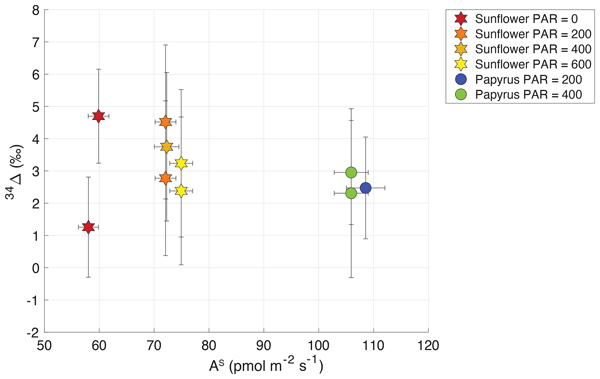
Carbonyl sulfide (COS) is a proposed tracer for gross primary production. For the first time, COS and carbon dioxide (CO2) uptake fluxes and isotope discrimination were jointly measured in sunflower and papyrus plants, using a flow-through plant chamber approach and varying light availability. COS isotope discrimination did not differ significantly between the species, nor with changes in light. CO2 fluxes and isotope values provided additional valuable information for data interpretation.
Augustin Colette, Gaëlle Collin, François Besson, Etienne Blot, Vincent Guidard, Frédérik Meleux, Adrien Royer, Valentin Petiot, Claire Miller, Oihana Fermond, Alizé Jeant, Mario Adani, Joaquim Arteta, Anna Benedictow, Robert Bergström, Dene Bowdalo, Jorgen Brandt, Gino Briganti, Ana C. Carvalho, Jesper Heile Christensen, Florian Couvidat, Ilaria D'Elia, Massimo D'Isidoro, Hugo Denier van der Gon, Gaël Descombes, Enza Di Tomaso, John Douros, Jeronimo Escribano, Henk Eskes, Hilde Fagerli, Yalda Fatahi, Johannes Flemming, Elmar Friese, Lise Frohn, Michael Gauss, Camilla Geels, Guido Guarnieri, Marc Guevara, Antoine Guion, Jonathan Guth, Risto Hänninen, Kaj Hansen, Ulas Im, Ruud Janssen, Marine Jeoffrion, Mathieu Joly, Luke Jones, Oriol Jorba, Evgeni Kadantsev, Michael Kahnert, Jacek W. Kaminski, Rostislav Kouznetsov, Richard Kranenburg, Jeroen Kuenen, Anne Caroline Lange, Joachim Langner, Victor Lannuque, Francesca Macchia, Astrid Manders, Mihaela Mircea, Agnes Nyiri, Miriam Olid, Carlos Pérez García-Pando, Yuliia Palamarchuk, Antonio Piersanti, Blandine Raux, Miha Razinger, Lennard Robertson, Arjo Segers, Martijn Schaap, Pilvi Siljamo, David Simpson, Mikhail Sofiev, Anders Stangel, Joanna Struzewska, Carles Tena, Renske Timmermans, Thanos Tsikerdekis, Svetlana Tsyro, Svyatoslav Tyuryakov, Anthony Ung, Andreas Uppstu, Alvaro Valdebenito, Peter van Velthoven, Lina Vitali, Zhuyun Ye, Vincent-Henri Peuch, and Laurence Rouïl
Geosci. Model Dev., 18, 6835–6883, https://doi.org/10.5194/gmd-18-6835-2025, https://doi.org/10.5194/gmd-18-6835-2025, 2025
Short summary
Short summary
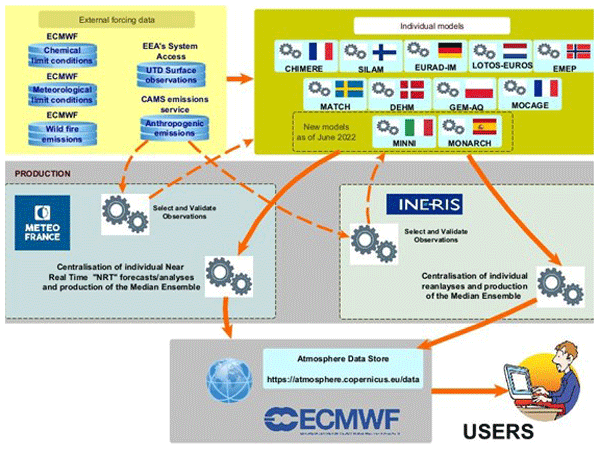
The Copernicus Atmosphere Monitoring Service – Regional Production delivers daily forecasts, analyses, and reanalyses of air quality in Europe. The service relies on a distributed modelling production by 11 leading European modelling teams following stringent requirements with an operational design that has no equivalent in the world. All the products are free, open, and quality-assured and disseminated with a high level of reliability.
Isolde Glissenaar, Klaas Folkert Boersma, Isidora Anglou, Pieter Rijsdijk, Tijl Verhoelst, Steven Compernolle, Gaia Pinardi, Jean-Christopher Lambert, Michel Van Roozendael, and Henk Eskes
Earth Syst. Sci. Data, 17, 4627–4650, https://doi.org/10.5194/essd-17-4627-2025, https://doi.org/10.5194/essd-17-4627-2025, 2025
Short summary
Short summary
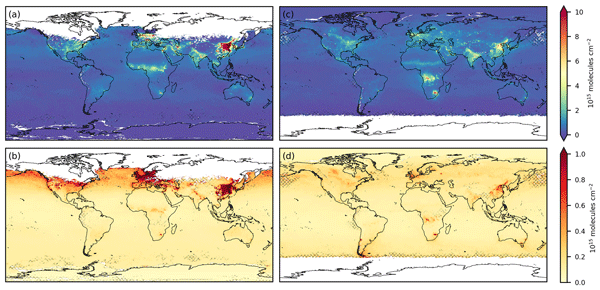
We developed a new global dataset of nitrogen dioxide (NO2) levels in the lower atmosphere, using data from TROPOMI for 2018–2021. This dataset offers improved accuracy and detail compared to earlier versions, meeting high international standards for climate data. By refining how measurement errors are calculated and reduced over time and space, we provide clearer insights into pollution patterns. This work supports better air quality monitoring and informs actions to address pollution globally.
Hong Zhao, Han Dolman, Jan Elbers, Wilma Jans, Bart Kruijt, Eddy Moors, Henk Snellen, Jordi Vila-Guerau de Arellano, Wouter Peters, Maarten Krol, Ronald Hutjes, and Michiel van der Molen
Earth Syst. Sci. Data Discuss., https://doi.org/10.5194/essd-2025-372, https://doi.org/10.5194/essd-2025-372, 2025
Revised manuscript under review for ESSD
Short summary
Short summary
Under the Kyoto Protocol the carbon dioxide (CO2) balance for forest ecosystems was required to be measured. Consequently, CO2 flux measurements have been conducted in Loobos site in the Netherlands since 1996, becoming one of the 17 first FLUXNET sites globally. This paper provides a comprehensive overview of the instrumentation, data processing and the resulting data archive, enabling its further use in data analysis, model development and validation of satellite data retrievals.
Suvarna Fadnavis, Yasin Elshorbany, Jerald Ziemke, Brice Barret, Alexandru Rap, P. R. Satheesh Chandran, Richard J. Pope, Vijay Sagar, Domenico Taraborrelli, Eric Le Flochmoen, Juan Cuesta, Catherine Wespes, Folkert Boersma, Isolde Glissenaar, Isabelle De Smedt, Michel Van Roozendael, Hervé Petetin, and Isidora Anglou
Atmos. Chem. Phys., 25, 8229–8254, https://doi.org/10.5194/acp-25-8229-2025, https://doi.org/10.5194/acp-25-8229-2025, 2025
Short summary
Short summary
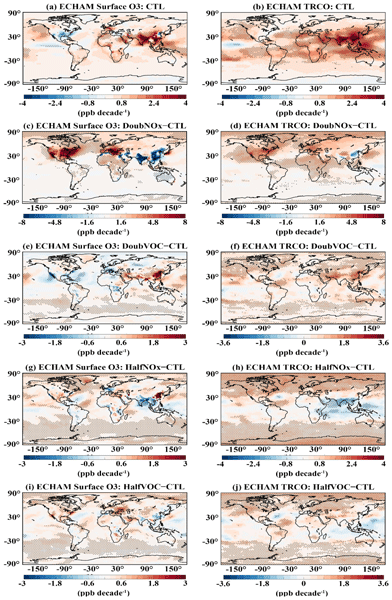
Satellites and model simulations show enhancement in tropospheric ozone, which is highly impacted by human-produced nitrous oxides compared to volatile organic compounds. The increased amount of ozone enhances ozone radiative forcing. The ozone enhancement and associated radiative forcing are the highest over South and East Asia. The emissions of nitrous oxides show a higher influence on shifting ozone photochemical regimes than volatile organic compounds.
August Thomasson, Pontus Roldin, Nick Schutgens, Babitha George, Hugo Denier van der Gon, Guillaume Monteil, and Marko Scholze
EGUsphere, https://doi.org/10.5194/egusphere-2025-1568, https://doi.org/10.5194/egusphere-2025-1568, 2025
Short summary
Short summary
We present top-down black carbon emissions estimates in Europe based on surface observations of concentrations at 24 rural sites from 2021. The annual emissions are 411 ± 10 Gg, overall 18 % higher compared to a traditional bottom-up estimate. Emissions are higher in for instance eastern Europe and the Iberian peninsula but lower in Poland and Italy. Validation with independent observations show overall better match and the uncertainties are reduced.
Arseniy Karagodin-Doyennel, Fredrik Jansson, Bart J. H. van Stratum, Hugo Denier van der Gon, Jordi Vilà-Guerau de Arellano, and Sander Houweling
Geosci. Model Dev., 18, 4571–4599, https://doi.org/10.5194/gmd-18-4571-2025, https://doi.org/10.5194/gmd-18-4571-2025, 2025
Short summary
Short summary
We introduce a new simulation platform based on the Dutch Atmospheric Large-Eddy Simulation (DALES) to simulate carbon dioxide (CO2) emissions and their dispersion in turbulent environments at a hectometer resolution. This model incorporates both anthropogenic emission inventories and online ecosystem fluxes. Simulation results for the main urban area in the Netherlands demonstrate the strong potential of DALES to improve CO2 emission modeling and to support mitigation strategies.
Alessandro Zanchetta, Steven van Heuven, Joram Hooghiem, Rigel Kivi, Thomas Laemmel, Michel Ramonet, Markus Leuenberger, Peter Nyfeler, Sophia Louise Baartman, Maarten Krol, and Huilin Chen
EGUsphere, https://doi.org/10.5194/egusphere-2025-3079, https://doi.org/10.5194/egusphere-2025-3079, 2025
Short summary
Short summary
Continuous vertical profiles and discrete stratospheric samples of carbonyl sulfide (COS) were collected deploying the balloon-borne AirCore, LISA and BigLISA samplers and measured on a Quantum Cascade Laser Spectrometer (QCLS). Our measurements show good accordance with previous COS observations. Moreover, laboratory tests of ozone (O3) scrubbers proved squalene to remove O3 very efficiently without biasing the measurements of other trace gases.
Getachew Agmuas Adnew, Gerbrand Koren, Neha Mehendale, Sergey Gromov, Maarten Krol, and Thomas Röckmann
Atmos. Meas. Tech., 18, 2701–2719, https://doi.org/10.5194/amt-18-2701-2025, https://doi.org/10.5194/amt-18-2701-2025, 2025
Short summary
Short summary
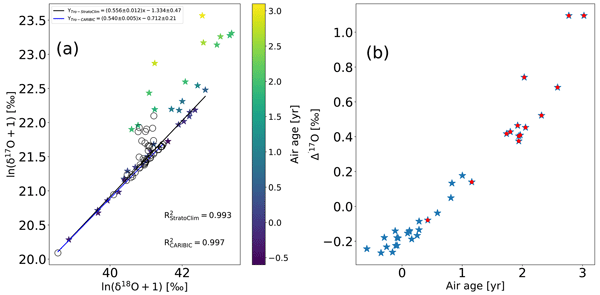
This study presents high-precision measurements of ∆′17O(CO2). Key findings include the extension of the N2O–∆′17O correlation to the upper troposphere and the identification of significant differences in the N2O–∆′17O slope in StratoClim samples. Additionally, the ∆′17O measurements are used to estimate global stratospheric production and surface removal of ∆′17O, providing an independent estimate of global vegetation CO2 exchange.
Audrey Fortems-Cheiney, Grégoire Broquet, Elise Potier, Antoine Berchet, Isabelle Pison, Adrien Martinez, Robin Plauchu, Rimal Abeed, Aurélien Sicsik-Paré, Gaelle Dufour, Adriana Coman, Dilek Savas, Guillaume Siour, Henk Eskes, Hugo A. C. Denier van der Gon, and Stijn N. C. Dellaert
Atmos. Chem. Phys., 25, 6047–6068, https://doi.org/10.5194/acp-25-6047-2025, https://doi.org/10.5194/acp-25-6047-2025, 2025
Short summary
Short summary
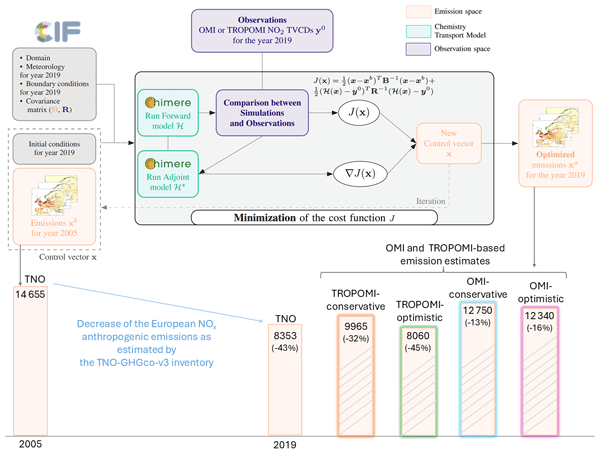
This study assesses the potential of the Ozone Monitoring Instrument (OMI) and the TROPOspheric Monitoring Instrument (TROPOMI) satellite observations to inform about the decrease in anthropogenic emissions of nitrogen oxides (NOx) in 2019 compared with 2005 at regional to national scales in Europe. Both the OMI and TROPOMI inversions show decreases in European NOx anthropogenic emission budgets in 2019 compared to 2005 but with different magnitudes.
Johann Rasmus Nüß, Nikos Daskalakis, Fabian Günther Piwowarczyk, Angelos Gkouvousis, Oliver Schneising, Michael Buchwitz, Maria Kanakidou, Maarten C. Krol, and Mihalis Vrekoussis
Geosci. Model Dev., 18, 2861–2890, https://doi.org/10.5194/gmd-18-2861-2025, https://doi.org/10.5194/gmd-18-2861-2025, 2025
Short summary
Short summary
We estimate carbon monoxide emissions through inverse modeling, an approach where measurements of tracers in the atmosphere are fed to a model to calculate backwards in time (inverse) where the tracers came from. We introduce measurements from a new satellite instrument and show that, in most places globally, these on their own sufficiently constrain the emissions. This alleviates the need for additional datasets, which could shorten the delay for future carbon monoxide source estimates.
Juliëtte C. S. Anema, K. Folkert Boersma, Lieuwe G. Tilstra, Olaf N. E. Tuinder, and Willem W. Verstraeten
Atmos. Meas. Tech., 18, 1961–1979, https://doi.org/10.5194/amt-18-1961-2025, https://doi.org/10.5194/amt-18-1961-2025, 2025
Short summary
Short summary
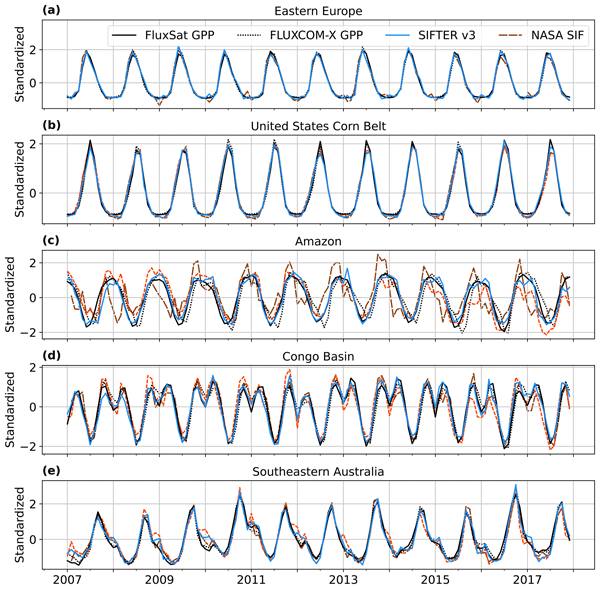
Long-term records of plant fluorescence offer vital insights into changing vegetation activity. The GOME-2A sensor provides extensive global observations but suffers from calibration and instrument degradation, which affects data consistency. This study presents the SIFTER v3 algorithm, which effectively resolves these issues and includes other improvements, resulting in robust, accurate, and consistent GOME-2A fluorescence measurements from 2007 to 2017.
Qianqian Zhang, K. Folkert Boersma, Chiel van der Laan, Alba Mols, Bin Zhao, Shengyue Li, and Yuepeng Pan
Atmos. Chem. Phys., 25, 3313–3326, https://doi.org/10.5194/acp-25-3313-2025, https://doi.org/10.5194/acp-25-3313-2025, 2025
Short summary
Short summary
Accurate NOx emission estimates are required to better understand air pollution. This study investigates and demonstrates the ability of the superposition column model in combination with TROPOMI tropospheric NO2 column data to estimate city-scale NOx emissions and lifetimes and their variabilities. The results of this work nevertheless confirm the strength of the superposition column model in estimating urban NOx emissions with reasonable accuracy.
Maria K. Tenkanen, Aki Tsuruta, Hugo Denier van der Gon, Lena Höglund-Isaksson, Antti Leppänen, Tiina Markkanen, Ana Maria Roxana Petrescu, Maarit Raivonen, Hermanni Aaltonen, and Tuula Aalto
Atmos. Chem. Phys., 25, 2181–2206, https://doi.org/10.5194/acp-25-2181-2025, https://doi.org/10.5194/acp-25-2181-2025, 2025
Short summary
Short summary
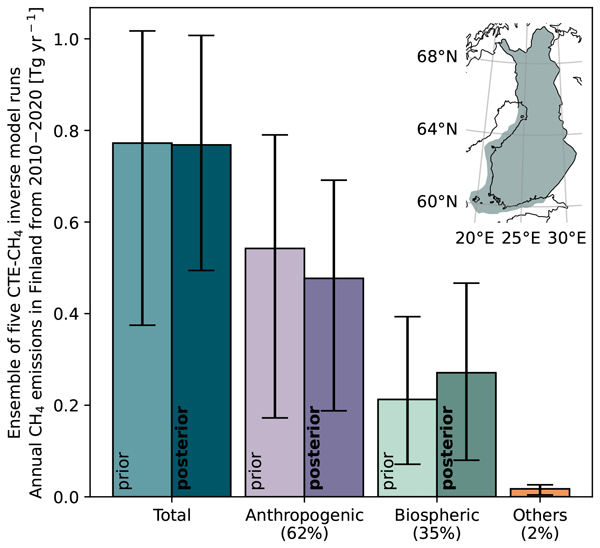
Accurate national methane (CH4) emission estimates are essential for tracking progress towards climate goals. This study compares estimates from Finland, which use different methods and scales, and shows how well a global model estimates emissions within a country. The bottom-up estimates vary a lot, but constraining them with atmospheric CH4 measurements brought the estimates closer together. We also highlight the importance of quantifying natural emissions alongside anthropogenic emissions.
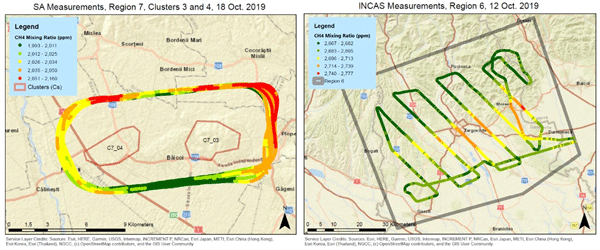
Hossein Maazallahi, Foteini Stavropoulou, Samuel Jonson Sutanto, Michael Steiner, Dominik Brunner, Mariano Mertens, Patrick Jöckel, Antoon Visschedijk, Hugo Denier van der Gon, Stijn Dellaert, Nataly Velandia Salinas, Stefan Schwietzke, Daniel Zavala-Araiza, Sorin Ghemulet, Alexandru Pana, Magdalena Ardelean, Marius Corbu, Andreea Calcan, Stephen A. Conley, Mackenzie L. Smith, and Thomas Röckmann
Atmos. Chem. Phys., 25, 1497–1511, https://doi.org/10.5194/acp-25-1497-2025, https://doi.org/10.5194/acp-25-1497-2025, 2025
Short summary
Short summary
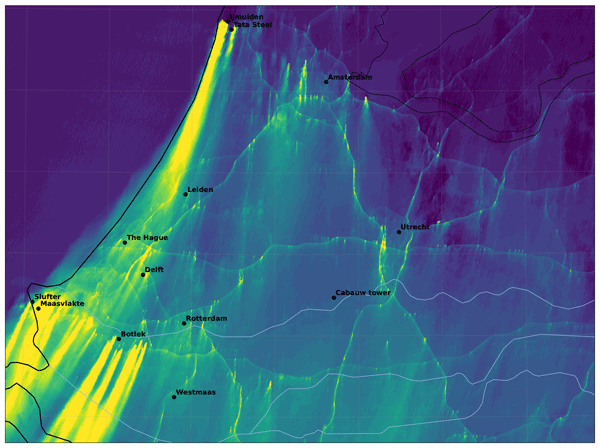
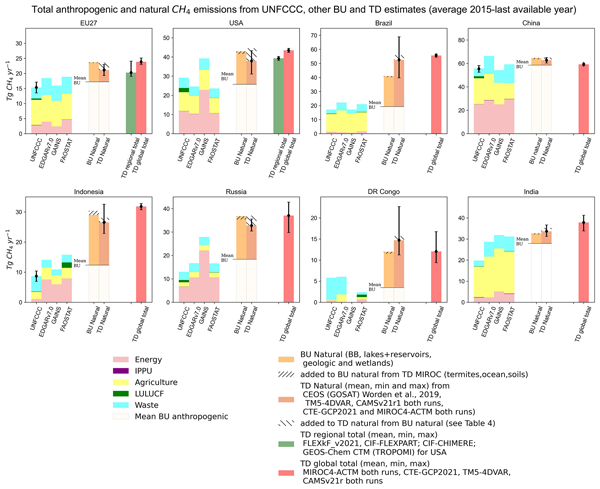
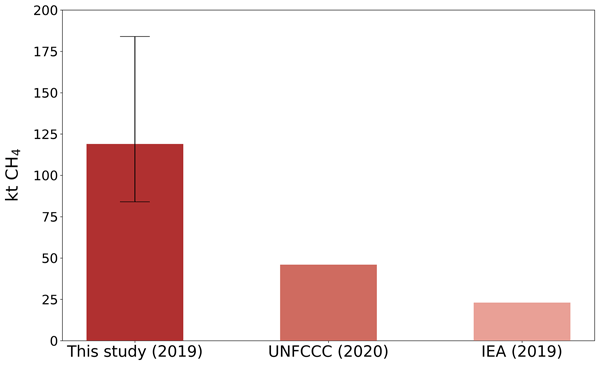
This article presents insights from airborne in situ measurements collected during the ROmanian Methane Emissions from Oil and gas (ROMEO) campaign supported by two models. Results reveal Romania's oil and gas methane emissions were significantly under-reported to the United Nations Framework Convention on Climate Change (UNFCCC) in 2019. A large underestimation was also found in the Emissions Database for Global Atmospheric Research (EDGAR) v7.0 for the study domain in the same year.
Felipe Cifuentes, Henk Eskes, Enrico Dammers, Charlotte Bryan, and Folkert Boersma
Geosci. Model Dev., 18, 621–649, https://doi.org/10.5194/gmd-18-621-2025, https://doi.org/10.5194/gmd-18-621-2025, 2025
Short summary
Short summary
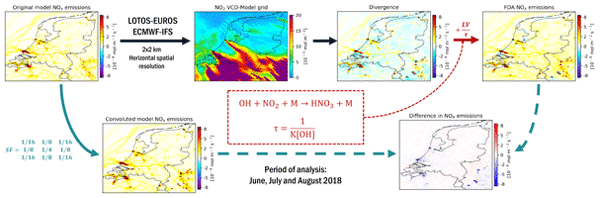
We tested the capability of the flux divergence approach (FDA) to reproduce known NOx emissions using synthetic NO2 satellite column retrievals from high-resolution model simulations. The FDA accurately reproduced NOx emissions when column observations were limited to the boundary layer and when the variability of the NO2 lifetime, the NOx : NO2 ratio, and NO2 profile shapes were correctly modeled. This introduces strong model dependency, reducing the simplicity of the original FDA formulation.
Pieter Rijsdijk, Henk Eskes, Arlene Dingemans, K. Folkert Boersma, Takashi Sekiya, Kazuyuki Miyazaki, and Sander Houweling
Geosci. Model Dev., 18, 483–509, https://doi.org/10.5194/gmd-18-483-2025, https://doi.org/10.5194/gmd-18-483-2025, 2025
Short summary
Short summary
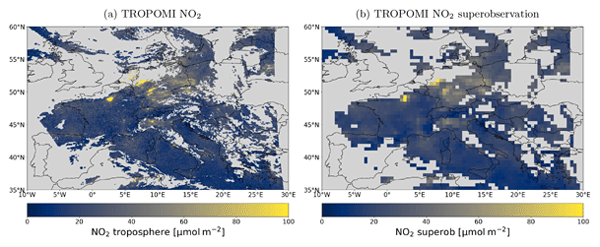
Clustering high-resolution satellite observations into superobservations improves model validation and data assimilation applications. In our paper, we derive quantitative uncertainties for satellite NO2 column observations based on knowledge of the retrievals, including a detailed analysis of spatial error correlations and representativity errors. The superobservations and uncertainty estimates are tested in a global chemical data assimilation system and are found to improve the forecasts.
Gijs Leguijt, Joannes D. Maasakkers, Hugo A. C. Denier van der Gon, Arjo J. Segers, Tobias Borsdorff, Ivar R. van der Velde, and Ilse Aben
Atmos. Chem. Phys., 25, 555–574, https://doi.org/10.5194/acp-25-555-2025, https://doi.org/10.5194/acp-25-555-2025, 2025
Short summary
Short summary
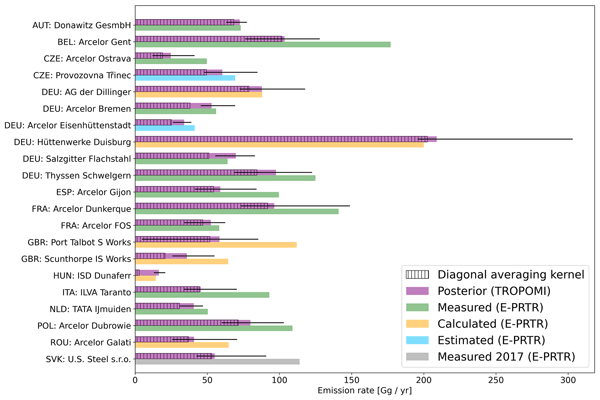
The production of steel coincides with large emissions of greenhouse gases and air pollutants including carbon monoxide. European facilities are required to report their emissions, which are estimated using a variety of methods. We evaluate these estimates using carbon monoxide concentrations measured via satellite. We find generally good agreement between our values and those reported but also identify some uncertainties, showing that satellites can provide insights into these emissions.
Ana Maria Roxana Petrescu, Glen P. Peters, Richard Engelen, Sander Houweling, Dominik Brunner, Aki Tsuruta, Bradley Matthews, Prabir K. Patra, Dmitry Belikov, Rona L. Thompson, Lena Höglund-Isaksson, Wenxin Zhang, Arjo J. Segers, Giuseppe Etiope, Giancarlo Ciotoli, Philippe Peylin, Frédéric Chevallier, Tuula Aalto, Robbie M. Andrew, David Bastviken, Antoine Berchet, Grégoire Broquet, Giulia Conchedda, Stijn N. C. Dellaert, Hugo Denier van der Gon, Johannes Gütschow, Jean-Matthieu Haussaire, Ronny Lauerwald, Tiina Markkanen, Jacob C. A. van Peet, Isabelle Pison, Pierre Regnier, Espen Solum, Marko Scholze, Maria Tenkanen, Francesco N. Tubiello, Guido R. van der Werf, and John R. Worden
Earth Syst. Sci. Data, 16, 4325–4350, https://doi.org/10.5194/essd-16-4325-2024, https://doi.org/10.5194/essd-16-4325-2024, 2024
Short summary
Short summary
This study provides an overview of data availability from observation- and inventory-based CH4 emission estimates. It systematically compares them and provides recommendations for robust comparisons, aiming to steadily engage more parties in using observational methods to complement their UNFCCC submissions. Anticipating improvements in atmospheric modelling and observations, future developments need to resolve knowledge gaps in both approaches and to better quantify remaining uncertainty.
Tong Sha, Siyu Yang, Qingcai Chen, Liangqing Li, Xiaoyan Ma, Yan-Lin Zhang, Zhaozhong Feng, K. Folkert Boersma, and Jun Wang
Atmos. Chem. Phys., 24, 8441–8455, https://doi.org/10.5194/acp-24-8441-2024, https://doi.org/10.5194/acp-24-8441-2024, 2024
Short summary
Short summary
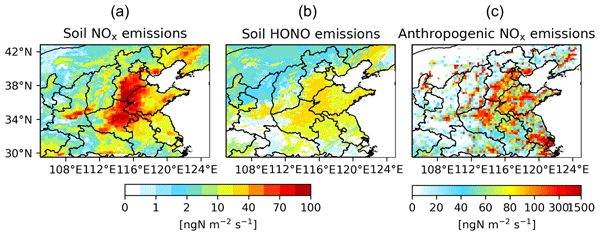
Using an updated soil reactive nitrogen emission scheme in the Unified Inputs for Weather Research and Forecasting coupled with Chemistry (UI-WRF-Chem) model, we investigate the role of soil NO and HONO (Nr) emissions in air quality and temperature in North China. Contributions of soil Nr emissions to O3 and secondary pollutants are revealed, exceeding effects of soil NOx or HONO emission. Soil Nr emissions play an important role in mitigating O3 pollution and addressing climate change.
Maarten Krol, Bart van Stratum, Isidora Anglou, and Klaas Folkert Boersma
Atmos. Chem. Phys., 24, 8243–8262, https://doi.org/10.5194/acp-24-8243-2024, https://doi.org/10.5194/acp-24-8243-2024, 2024
Short summary
Short summary
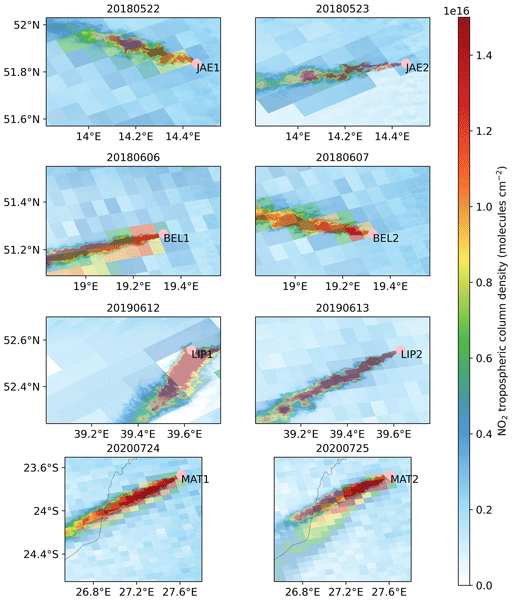
This paper presents detailed plume simulations of nitrogen oxides and carbon dioxide that are emitted from four large industrial facilities world-wide. Results from the high-resolution simulations that include atmospheric chemistry are compared to nitrogen dioxide observations from satellites. We find good performance of the model and show that common assumptions that are used in simplified models need revision. This work is important for the monitoring of emissions using satellite data.
Fabian Maier, Ingeborg Levin, Sébastien Conil, Maksym Gachkivskyi, Hugo Denier van der Gon, and Samuel Hammer
Atmos. Chem. Phys., 24, 8205–8223, https://doi.org/10.5194/acp-24-8205-2024, https://doi.org/10.5194/acp-24-8205-2024, 2024
Short summary
Short summary
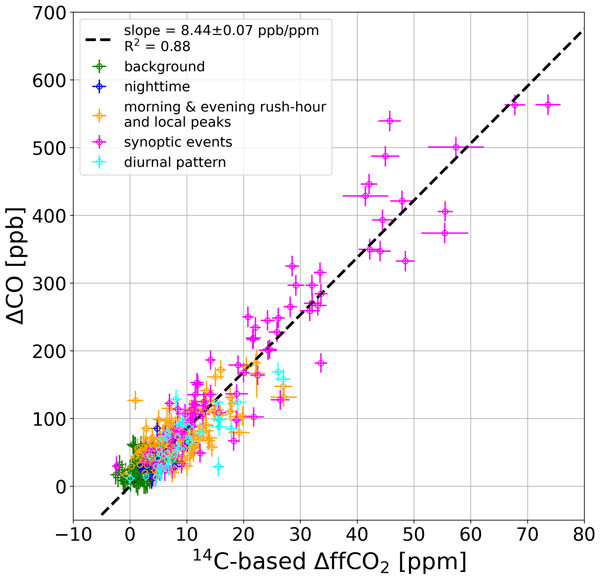
We assess the uncertainty in continuous fossil fuel carbon dioxide (ffCO2) estimates derived from carbon monoxide (CO) observations and radiocarbon (14CO2) flask measurements from an urban and a rural site. This study provides the basis for using continuous CO-based ffCO2 observations in atmospheric transport inversion frameworks to derive ffCO2 emission estimates. We also compare the flask-based CO / ffCO2 ratios with modeled ratios to validate an emission inventory for central Europe.
Sandro Meier, Erik F. M. Koene, Maarten Krol, Dominik Brunner, Alexander Damm, and Gerrit Kuhlmann
Atmos. Chem. Phys., 24, 7667–7686, https://doi.org/10.5194/acp-24-7667-2024, https://doi.org/10.5194/acp-24-7667-2024, 2024
Short summary
Short summary
Nitrogen oxides (NOx = NO + NO2) are important air pollutants. This study addresses the challenge of accurately estimating NOx emissions from NO2 satellite observations. We develop a realistic model to convert NO2 to NOx by using simulated plumes from various power plants. We apply the model to satellite NO2 observations, significantly reducing biases in estimated NOx emissions. The study highlights the potential for a consistent, high-resolution estimation of NOx emissions using satellite data.
Jin Ma, Linda M. J. Kooijmans, Norbert Glatthor, Stephen A. Montzka, Marc von Hobe, Thomas Röckmann, and Maarten C. Krol
Atmos. Chem. Phys., 24, 6047–6070, https://doi.org/10.5194/acp-24-6047-2024, https://doi.org/10.5194/acp-24-6047-2024, 2024
Short summary
Short summary
The global budget of atmospheric COS can be optimised by inverse modelling using TM5-4DVAR, with the co-constraints of NOAA surface observations and MIPAS satellite data. We found reduced COS biosphere uptake from inversions and improved land and ocean separation using MIPAS satellite data assimilation. Further improvements are expected from better quantification of COS ocean and biosphere fluxes.
Juliëtte C. S. Anema, Klaas Folkert Boersma, Piet Stammes, Gerbrand Koren, William Woodgate, Philipp Köhler, Christian Frankenberg, and Jacqui Stol
Biogeosciences, 21, 2297–2311, https://doi.org/10.5194/bg-21-2297-2024, https://doi.org/10.5194/bg-21-2297-2024, 2024
Short summary
Short summary
To keep the Paris agreement goals within reach, negative emissions are necessary. They can be achieved with mitigation techniques, such as reforestation, which remove CO2 from the atmosphere. While governments have pinned their hopes on them, there is not yet a good set of tools to objectively determine whether negative emissions do what they promise. Here we show how satellite measurements of plant fluorescence are useful in detecting carbon uptake due to reforestation and vegetation regrowth.
Audrey Fortems-Cheiney, Gregoire Broquet, Elise Potier, Robin Plauchu, Antoine Berchet, Isabelle Pison, Hugo Denier van der Gon, and Stijn Dellaert
Atmos. Chem. Phys., 24, 4635–4649, https://doi.org/10.5194/acp-24-4635-2024, https://doi.org/10.5194/acp-24-4635-2024, 2024
Short summary
Short summary
We have estimated the carbon monixide (CO) European emissions from satellite observations of the MOPITT instrument at the relatively high resolution of 0.5° for a period of over 10 years from 2011 to 2021. The analysis of the inversion results reveals the challenges associated with the inversion of CO emissions at the regional scale over Europe.
Ville-Veikko Paunu, Niko Karvosenoja, David Segersson, Susana López-Aparicio, Ole-Kenneth Nielsen, Marlene Schmidt Plejdrup, Throstur Thorsteinsson, Dam Thanh Vo, Jeroen Kuenen, Hugo Denier van der Gon, Jukka-Pekka Jalkanen, Jørgen Brandt, and Camilla Geels
Earth Syst. Sci. Data, 16, 1453–1474, https://doi.org/10.5194/essd-16-1453-2024, https://doi.org/10.5194/essd-16-1453-2024, 2024
Short summary
Short summary
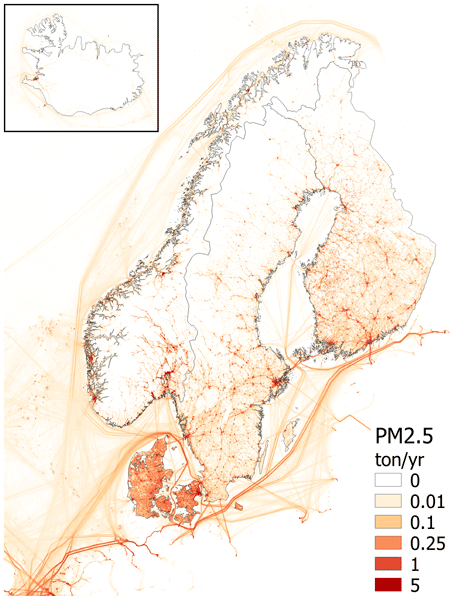
Air pollution is an important cause of adverse health effects, even in Nordic countries. To assess their health impacts, emission inventories with high spatial resolution are needed. We studied how national data and methods for the spatial distribution of the emissions compare to a European level inventory. For road transport the methods are well established, but for machinery and off-road emissions the current recommendations for the spatial distribution of these emissions should be improved.
Ruben Urraca, Greet Janssens-Maenhout, Nicolás Álamos, Lucas Berna-Peña, Monica Crippa, Sabine Darras, Stijn Dellaert, Hugo Denier van der Gon, Mark Dowell, Nadine Gobron, Claire Granier, Giacomo Grassi, Marc Guevara, Diego Guizzardi, Kevin Gurney, Nicolás Huneeus, Sekou Keita, Jeroen Kuenen, Ana Lopez-Noreña, Enrique Puliafito, Geoffrey Roest, Simone Rossi, Antonin Soulie, and Antoon Visschedijk
Earth Syst. Sci. Data, 16, 501–523, https://doi.org/10.5194/essd-16-501-2024, https://doi.org/10.5194/essd-16-501-2024, 2024
Short summary
Short summary
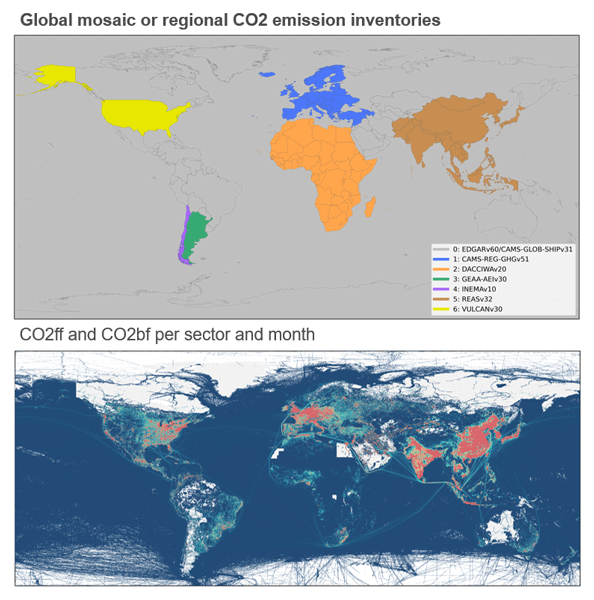
CoCO2-MOSAIC 1.0 is a global mosaic of regional bottom-up inventories providing gridded (0.1×0.1) monthly emissions of anthropogenic CO2. Regional inventories include country-specific information and finer spatial resolution than global inventories. CoCO2-MOSAIC provides harmonized access to these datasets and can be considered as a regionally accepted reference to assess the quality of global inventories, as done in the current paper.
Marc Guevara, Santiago Enciso, Carles Tena, Oriol Jorba, Stijn Dellaert, Hugo Denier van der Gon, and Carlos Pérez García-Pando
Earth Syst. Sci. Data, 16, 337–373, https://doi.org/10.5194/essd-16-337-2024, https://doi.org/10.5194/essd-16-337-2024, 2024
Short summary
Short summary
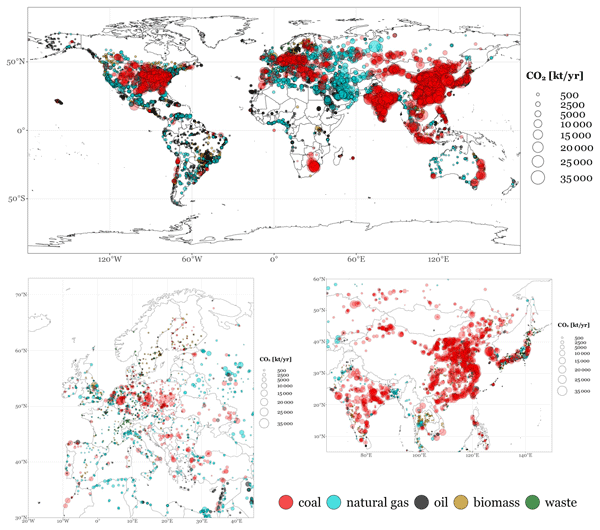
A global dataset of emissions from thermal power plants was created for the year 2018. The resulting catalogue reports annual emissions of CO2 and co-emitted species (NOx, CO, SO2 and CH4) for more than 16000 individual facilities at their exact geographical locations. Information on the temporal and vertical distributions of the emissions is also provided at the facility level. The dataset is intended to support current and future satellite emission monitoring and inverse modelling efforts.
Tobias Christoph Valentin Werner Riess, Klaas Folkert Boersma, Ward Van Roy, Jos de Laat, Enrico Dammers, and Jasper van Vliet
Atmos. Meas. Tech., 16, 5287–5304, https://doi.org/10.5194/amt-16-5287-2023, https://doi.org/10.5194/amt-16-5287-2023, 2023
Short summary
Short summary
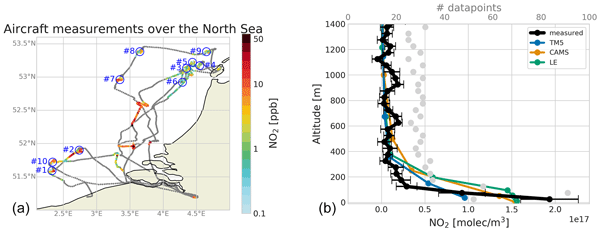
Satellite retrievals of trace gases require prior knowledge of the vertical distribution of the pollutant, which is usually obtained from models. Using aircraft-measured vertical NO2 profiles over the North Sea in summer 2021, we evaluate the Transport Model 5 profiles used in the TROPOMI NO2 retrieval. We conclude that driven by the low horizontal resolution and the overestimated vertical mixing, resulting NO2 columns are 20 % too low. This has important implications for emission estimates.
Hossein Maazallahi, Antonio Delre, Charlotte Scheutz, Anders M. Fredenslund, Stefan Schwietzke, Hugo Denier van der Gon, and Thomas Röckmann
Atmos. Meas. Tech., 16, 5051–5073, https://doi.org/10.5194/amt-16-5051-2023, https://doi.org/10.5194/amt-16-5051-2023, 2023
Short summary
Short summary
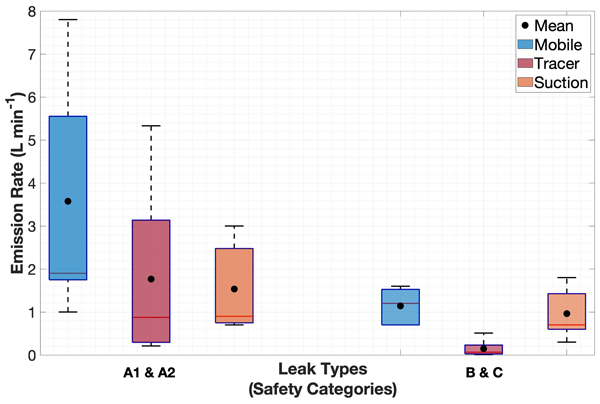
Measurement methods are increasingly deployed to verify reported methane emissions of gas leaks. This study describes unique advantages and limitations of three methods. Two methods are rapidly deployed, but uncertainties and biases exist for some leak locations. In contrast, the suction method could accurately determine leak rates in principle. However, this method, which provides data for the German emission inventory, creates an overall low bias in our study due to non-random site selection.
Matthew J. McGrath, Ana Maria Roxana Petrescu, Philippe Peylin, Robbie M. Andrew, Bradley Matthews, Frank Dentener, Juraj Balkovič, Vladislav Bastrikov, Meike Becker, Gregoire Broquet, Philippe Ciais, Audrey Fortems-Cheiney, Raphael Ganzenmüller, Giacomo Grassi, Ian Harris, Matthew Jones, Jürgen Knauer, Matthias Kuhnert, Guillaume Monteil, Saqr Munassar, Paul I. Palmer, Glen P. Peters, Chunjing Qiu, Mart-Jan Schelhaas, Oksana Tarasova, Matteo Vizzarri, Karina Winkler, Gianpaolo Balsamo, Antoine Berchet, Peter Briggs, Patrick Brockmann, Frédéric Chevallier, Giulia Conchedda, Monica Crippa, Stijn N. C. Dellaert, Hugo A. C. Denier van der Gon, Sara Filipek, Pierre Friedlingstein, Richard Fuchs, Michael Gauss, Christoph Gerbig, Diego Guizzardi, Dirk Günther, Richard A. Houghton, Greet Janssens-Maenhout, Ronny Lauerwald, Bas Lerink, Ingrid T. Luijkx, Géraud Moulas, Marilena Muntean, Gert-Jan Nabuurs, Aurélie Paquirissamy, Lucia Perugini, Wouter Peters, Roberto Pilli, Julia Pongratz, Pierre Regnier, Marko Scholze, Yusuf Serengil, Pete Smith, Efisio Solazzo, Rona L. Thompson, Francesco N. Tubiello, Timo Vesala, and Sophia Walther
Earth Syst. Sci. Data, 15, 4295–4370, https://doi.org/10.5194/essd-15-4295-2023, https://doi.org/10.5194/essd-15-4295-2023, 2023
Short summary
Short summary
Accurate estimation of fluxes of carbon dioxide from the land surface is essential for understanding future impacts of greenhouse gas emissions on the climate system. A wide variety of methods currently exist to estimate these sources and sinks. We are continuing work to develop annual comparisons of these diverse methods in order to clarify what they all actually calculate and to resolve apparent disagreement, in addition to highlighting opportunities for increased understanding.
Foteini Stavropoulou, Katarina Vinković, Bert Kers, Marcel de Vries, Steven van Heuven, Piotr Korbeń, Martina Schmidt, Julia Wietzel, Pawel Jagoda, Jaroslav M. Necki, Jakub Bartyzel, Hossein Maazallahi, Malika Menoud, Carina van der Veen, Sylvia Walter, Béla Tuzson, Jonas Ravelid, Randulph Paulo Morales, Lukas Emmenegger, Dominik Brunner, Michael Steiner, Arjan Hensen, Ilona Velzeboer, Pim van den Bulk, Hugo Denier van der Gon, Antonio Delre, Maklawe Essonanawe Edjabou, Charlotte Scheutz, Marius Corbu, Sebastian Iancu, Denisa Moaca, Alin Scarlat, Alexandru Tudor, Ioana Vizireanu, Andreea Calcan, Magdalena Ardelean, Sorin Ghemulet, Alexandru Pana, Aurel Constantinescu, Lucian Cusa, Alexandru Nica, Calin Baciu, Cristian Pop, Andrei Radovici, Alexandru Mereuta, Horatiu Stefanie, Alexandru Dandocsi, Bas Hermans, Stefan Schwietzke, Daniel Zavala-Araiza, Huilin Chen, and Thomas Röckmann
Atmos. Chem. Phys., 23, 10399–10412, https://doi.org/10.5194/acp-23-10399-2023, https://doi.org/10.5194/acp-23-10399-2023, 2023
Short summary
Short summary
In this study, we quantify CH4 emissions from onshore oil production sites in Romania at source and facility level using a combination of ground- and drone-based measurement techniques. We show that the total CH4 emissions in our studied areas are much higher than the emissions reported to UNFCCC, and up to three-quarters of the detected emissions are related to operational venting. Our results suggest that oil and gas production infrastructure in Romania holds a massive mitigation potential.
Jean-Philippe Putaud, Enrico Pisoni, Alexander Mangold, Christoph Hueglin, Jean Sciare, Michael Pikridas, Chrysanthos Savvides, Jakub Ondracek, Saliou Mbengue, Alfred Wiedensohler, Kay Weinhold, Maik Merkel, Laurent Poulain, Dominik van Pinxteren, Hartmut Herrmann, Andreas Massling, Claus Nordstroem, Andrés Alastuey, Cristina Reche, Noemí Pérez, Sonia Castillo, Mar Sorribas, Jose Antonio Adame, Tuukka Petaja, Katrianne Lehtipalo, Jarkko Niemi, Véronique Riffault, Joel F. de Brito, Augustin Colette, Olivier Favez, Jean-Eudes Petit, Valérie Gros, Maria I. Gini, Stergios Vratolis, Konstantinos Eleftheriadis, Evangelia Diapouli, Hugo Denier van der Gon, Karl Espen Yttri, and Wenche Aas
Atmos. Chem. Phys., 23, 10145–10161, https://doi.org/10.5194/acp-23-10145-2023, https://doi.org/10.5194/acp-23-10145-2023, 2023
Short summary
Short summary
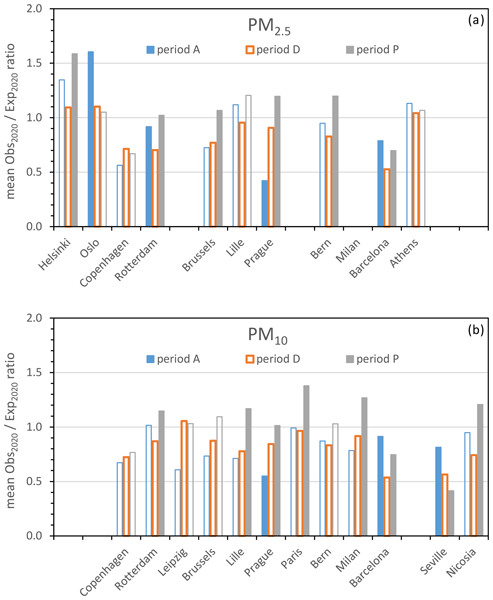
Many European people are still exposed to levels of air pollution that can affect their health. COVID-19 lockdowns in 2020 were used to assess the impact of the reduction in human mobility on air pollution across Europe by comparing measurement data with values that would be expected if no lockdown had occurred. We show that lockdown measures did not lead to consistent decreases in the concentrations of fine particulate matter suspended in the air, and we investigate why.
Farhan R. Nursanto, Roy Meinen, Rupert Holzinger, Maarten C. Krol, Xinya Liu, Ulrike Dusek, Bas Henzing, and Juliane L. Fry
Atmos. Chem. Phys., 23, 10015–10034, https://doi.org/10.5194/acp-23-10015-2023, https://doi.org/10.5194/acp-23-10015-2023, 2023
Short summary
Short summary
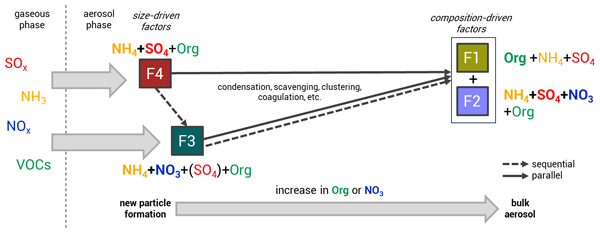
Particulate matter (PM) is a harmful air pollutant that depends on the complex mixture of natural and anthropogenic emissions into the atmosphere. Thus, in different regions and seasons, the way that PM is formed and grows can differ. In this study, we use a combined statistical analysis of the chemical composition and particle size distribution to determine what drives particle formation and growth across seasons, using varying wind directions to elucidate the role of different sources.
Alessandro Zanchetta, Linda M. J. Kooijmans, Steven van Heuven, Andrea Scifo, Hubertus A. Scheeren, Ivan Mammarella, Ute Karstens, Jin Ma, Maarten Krol, and Huilin Chen
Biogeosciences, 20, 3539–3553, https://doi.org/10.5194/bg-20-3539-2023, https://doi.org/10.5194/bg-20-3539-2023, 2023
Short summary
Short summary
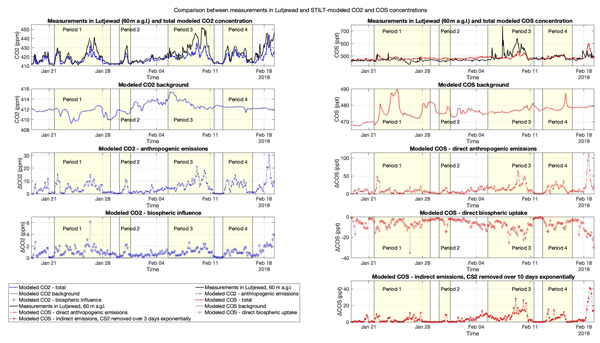
Carbonyl sulfide (COS) has been suggested as a tool to estimate carbon dioxide (CO2) uptake by plants during photosynthesis. However, understanding its sources and sinks is critical to preventing biases in this estimate. Combining observations and models, this study proves that regional sources occasionally influence the measurements at the 60 m tall Lutjewad tower (1 m a.s.l.; 53°24′ N, 6°21′ E) in the Netherlands. Moreover, it estimates nighttime COS fluxes to be −3.0 ± 2.6 pmol m−2 s−1.
Gijs Leguijt, Joannes D. Maasakkers, Hugo A. C. Denier van der Gon, Arjo J. Segers, Tobias Borsdorff, and Ilse Aben
Atmos. Chem. Phys., 23, 8899–8919, https://doi.org/10.5194/acp-23-8899-2023, https://doi.org/10.5194/acp-23-8899-2023, 2023
Short summary
Short summary
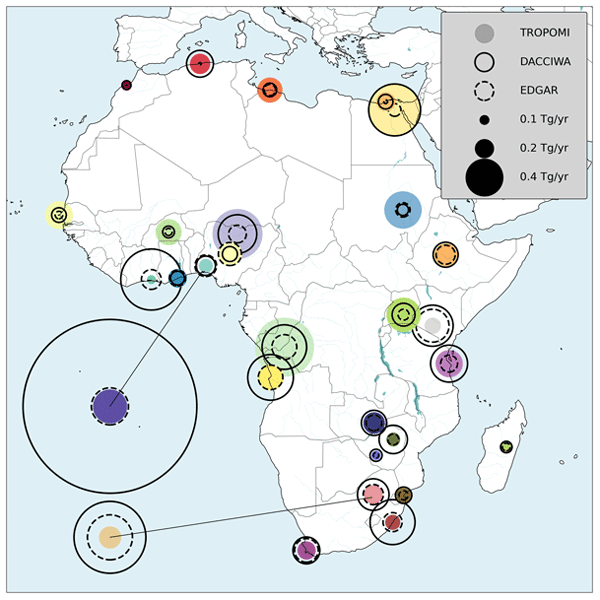
We present a fast method to evaluate carbon monoxide emissions from cities in Africa. Carbon monoxide is important for climate change in an indirect way, as it is linked to ozone, methane, and carbon dioxide. Our measurements are made with a satellite that sees the entire globe every single day. This means that we can check from space whether the current knowledge of emission rates is up to date. We make the comparison and show that the emission rates in northern Africa are underestimated.
Jinghui Lian, Thomas Lauvaux, Hervé Utard, François-Marie Bréon, Grégoire Broquet, Michel Ramonet, Olivier Laurent, Ivonne Albarus, Mali Chariot, Simone Kotthaus, Martial Haeffelin, Olivier Sanchez, Olivier Perrussel, Hugo Anne Denier van der Gon, Stijn Nicolaas Camiel Dellaert, and Philippe Ciais
Atmos. Chem. Phys., 23, 8823–8835, https://doi.org/10.5194/acp-23-8823-2023, https://doi.org/10.5194/acp-23-8823-2023, 2023
Short summary
Short summary
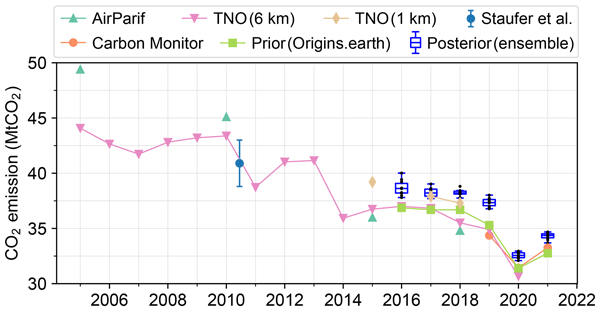
This study quantifies urban CO2 emissions via an atmospheric inversion for the Paris metropolitan area over a 6-year period from 2016 to 2021. Results show a long-term decreasing trend of about 2 % ± 0.6 % per year in the annual CO2 emissions over Paris. We conclude that our current capacity can deliver near-real-time CO2 emission estimates at the city scale in under a month, and the results agree within 10 % with independent estimates from multiple city-scale inventories.
Marc Guevara, Hervé Petetin, Oriol Jorba, Hugo Denier van der Gon, Jeroen Kuenen, Ingrid Super, Claire Granier, Thierno Doumbia, Philippe Ciais, Zhu Liu, Robin D. Lamboll, Sabine Schindlbacher, Bradley Matthews, and Carlos Pérez García-Pando
Atmos. Chem. Phys., 23, 8081–8101, https://doi.org/10.5194/acp-23-8081-2023, https://doi.org/10.5194/acp-23-8081-2023, 2023
Short summary
Short summary
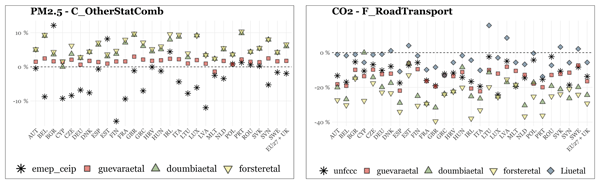
This study provides an intercomparison of European 2020 emission changes derived from official inventories, which are reported by countries under the framework of several international conventions and directives, and non-official near-real-time estimates, the use of which has significantly grown since the COVID-19 outbreak. The results of the work are used to produce recommendations on how best to approach and make use of near-real-time emissions for modelling and monitoring applications.
Ara Cho, Linda M. J. Kooijmans, Kukka-Maaria Kohonen, Richard Wehr, and Maarten C. Krol
Biogeosciences, 20, 2573–2594, https://doi.org/10.5194/bg-20-2573-2023, https://doi.org/10.5194/bg-20-2573-2023, 2023
Short summary
Short summary
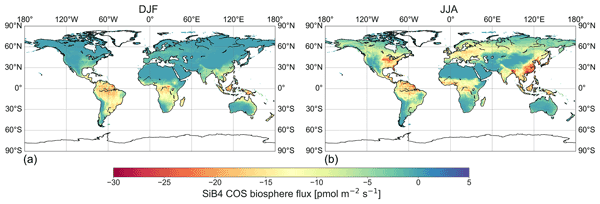
Carbonyl sulfide (COS) is a useful constraint for estimating photosynthesis. To simulate COS leaf flux better in the SiB4 model, we propose a novel temperature function for enzyme carbonic anhydrase (CA) activity and optimize conductances using observations. The optimal activity of CA occurs below 40 °C, and Ball–Woodrow–Berry parameters are slightly changed. These reduce/increase uptakes in the tropics/higher latitudes and contribute to resolving discrepancies in the COS global budget.
Andreas Forstmaier, Jia Chen, Florian Dietrich, Juan Bettinelli, Hossein Maazallahi, Carsten Schneider, Dominik Winkler, Xinxu Zhao, Taylor Jones, Carina van der Veen, Norman Wildmann, Moritz Makowski, Aydin Uzun, Friedrich Klappenbach, Hugo Denier van der Gon, Stefan Schwietzke, and Thomas Röckmann
Atmos. Chem. Phys., 23, 6897–6922, https://doi.org/10.5194/acp-23-6897-2023, https://doi.org/10.5194/acp-23-6897-2023, 2023
Short summary
Short summary
Large cities emit greenhouse gases which contribute to global warming. In this study, we measured the release of one important green house gas, methane, in Hamburg. Multiple sources that contribute to methane emissions were located and quantified. Methane sources were found to be mainly caused by human activity (e.g., by release from oil and gas refineries). Moreover, potential natural sources have been located, such as the Elbe River and lakes.
John Douros, Henk Eskes, Jos van Geffen, K. Folkert Boersma, Steven Compernolle, Gaia Pinardi, Anne-Marlene Blechschmidt, Vincent-Henri Peuch, Augustin Colette, and Pepijn Veefkind
Geosci. Model Dev., 16, 509–534, https://doi.org/10.5194/gmd-16-509-2023, https://doi.org/10.5194/gmd-16-509-2023, 2023
Short summary
Short summary
We focus on the challenges associated with comparing atmospheric composition models with satellite products such as tropospheric NO2 columns. The aim is to highlight the methodological difficulties and propose sound ways of doing such comparisons. Building on the comparisons, a new satellite product is proposed and made available, which takes advantage of higher-resolution, regional atmospheric modelling to improve estimates of troposheric NO2 columns over Europe.
Viral Shah, Daniel J. Jacob, Ruijun Dang, Lok N. Lamsal, Sarah A. Strode, Stephen D. Steenrod, K. Folkert Boersma, Sebastian D. Eastham, Thibaud M. Fritz, Chelsea Thompson, Jeff Peischl, Ilann Bourgeois, Ilana B. Pollack, Benjamin A. Nault, Ronald C. Cohen, Pedro Campuzano-Jost, Jose L. Jimenez, Simone T. Andersen, Lucy J. Carpenter, Tomás Sherwen, and Mat J. Evans
Atmos. Chem. Phys., 23, 1227–1257, https://doi.org/10.5194/acp-23-1227-2023, https://doi.org/10.5194/acp-23-1227-2023, 2023
Short summary
Short summary
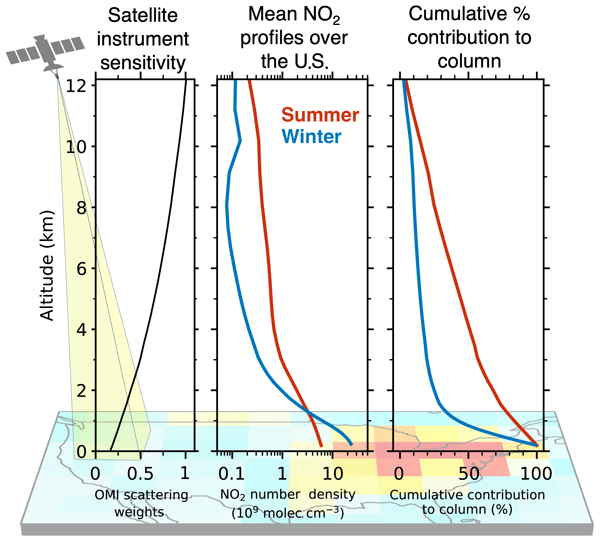
NOx in the free troposphere (above 2 km) affects global tropospheric chemistry and the retrieval and interpretation of satellite NO2 measurements. We evaluate free tropospheric NOx in global atmospheric chemistry models and find that recycling NOx from its reservoirs over the oceans is faster than that simulated in the models, resulting in increases in simulated tropospheric ozone and OH. Over the U.S., free tropospheric NO2 contributes the majority of the tropospheric NO2 column in summer.
Qianqian Zhang, K. Folkert Boersma, Bin Zhao, Henk Eskes, Cuihong Chen, Haotian Zheng, and Xingying Zhang
Atmos. Chem. Phys., 23, 551–563, https://doi.org/10.5194/acp-23-551-2023, https://doi.org/10.5194/acp-23-551-2023, 2023
Short summary
Short summary
We developed an improved superposition column model and used the latest released (v2.3.1) TROPOMI satellite NO2 observations to estimate daily city-scale NOx and CO2 emissions. The results are verified against bottom-up emissions and OCO-2 XCO2 observations. We obtained the day-to-day variation of city NOx and CO2 emissions, allowing policymakers to gain real-time information on spatial–temporal emission patterns and the effectiveness of carbon and nitrogen regulation in urban environments.
Peter J. M. Bosman and Maarten C. Krol
Geosci. Model Dev., 16, 47–74, https://doi.org/10.5194/gmd-16-47-2023, https://doi.org/10.5194/gmd-16-47-2023, 2023
Short summary
Short summary
We describe an inverse modelling framework constructed around a simple model for the atmospheric boundary layer. This framework can be fed with various observation types to study the boundary layer and land–atmosphere exchange. With this framework, it is possible to estimate model parameters and the associated uncertainties. Some of these parameters are difficult to obtain directly by observations. An example application for a grassland in the Netherlands is included.
Srijana Lama, Sander Houweling, K. Folkert Boersma, Ilse Aben, Hugo A. C. Denier van der Gon, and Maarten C. Krol
Atmos. Chem. Phys., 22, 16053–16071, https://doi.org/10.5194/acp-22-16053-2022, https://doi.org/10.5194/acp-22-16053-2022, 2022
Short summary
Short summary
Hydroxyl radical (OH) is the important chemical species that determines the lifetime of some greenhouse gases and trace gases. OH plays a vital role in air pollution chemistry. OH has a short lifetime and is extremely difficult to measure directly. OH concentrations derived from the chemistry transport model (CTM) have uncertainties of >50 %. Therefore, in this study, OH is derived indirectly using satellite date in urban plumes.
Stijn Naus, Lucas G. Domingues, Maarten Krol, Ingrid T. Luijkx, Luciana V. Gatti, John B. Miller, Emanuel Gloor, Sourish Basu, Caio Correia, Gerbrand Koren, Helen M. Worden, Johannes Flemming, Gabrielle Pétron, and Wouter Peters
Atmos. Chem. Phys., 22, 14735–14750, https://doi.org/10.5194/acp-22-14735-2022, https://doi.org/10.5194/acp-22-14735-2022, 2022
Short summary
Short summary
We assimilate MOPITT CO satellite data in the TM5-4D-Var inverse modelling framework to estimate Amazon fire CO emissions for 2003–2018. We show that fire emissions have decreased over the analysis period, coincident with a decrease in deforestation rates. However, interannual variations in fire emissions are large, and they correlate strongly with soil moisture. Our results reveal an important role for robust, top-down fire CO emissions in quantifying and attributing Amazon fire intensity.
Anja Ražnjević, Chiel van Heerwaarden, and Maarten Krol
Atmos. Meas. Tech., 15, 3611–3628, https://doi.org/10.5194/amt-15-3611-2022, https://doi.org/10.5194/amt-15-3611-2022, 2022
Short summary
Short summary
We evaluate two widely used observational techniques (Other Test Method (OTM) 33A and car drive-bys) that estimate point source gas emissions. We performed our analysis on high-resolution plume dispersion simulation. For car drive-bys we found that at least 15 repeated measurements were needed to get within 40 % of the true emissions. OTM 33A produced large errors in estimation (50 %–200 %) due to its sensitivity to dispersion coefficients and underlying simplifying assumptions.
Marc Guevara, Hervé Petetin, Oriol Jorba, Hugo Denier van der Gon, Jeroen Kuenen, Ingrid Super, Jukka-Pekka Jalkanen, Elisa Majamäki, Lasse Johansson, Vincent-Henri Peuch, and Carlos Pérez García-Pando
Earth Syst. Sci. Data, 14, 2521–2552, https://doi.org/10.5194/essd-14-2521-2022, https://doi.org/10.5194/essd-14-2521-2022, 2022
Short summary
Short summary
To control the spread of the COVID-19 disease, European governments implemented mobility restriction measures that resulted in an unprecedented drop in anthropogenic emissions. This work presents a dataset of emission adjustment factors that allows quantifying changes in 2020 European primary emissions per country and pollutant sector at the daily scale. The resulting dataset can be used as input in modelling studies aiming at quantifying the impact of COVID-19 on air quality levels.
Anja Ražnjević, Chiel van Heerwaarden, Bart van Stratum, Arjan Hensen, Ilona Velzeboer, Pim van den Bulk, and Maarten Krol
Atmos. Chem. Phys., 22, 6489–6505, https://doi.org/10.5194/acp-22-6489-2022, https://doi.org/10.5194/acp-22-6489-2022, 2022
Short summary
Short summary
Mobile measurement techniques (e.g., instruments placed in cars) are often employed to identify and quantify individual sources of greenhouse gases. Due to road restrictions, those observations are often sparse (temporally and spatially). We performed high-resolution simulations of plume dispersion, with realistic weather conditions encountered in the field, to reproduce the measurement process of a methane plume emitted from an oil well and provide additional information about the plume.
Stelios Myriokefalitakis, Elisa Bergas-Massó, María Gonçalves-Ageitos, Carlos Pérez García-Pando, Twan van Noije, Philippe Le Sager, Akinori Ito, Eleni Athanasopoulou, Athanasios Nenes, Maria Kanakidou, Maarten C. Krol, and Evangelos Gerasopoulos
Geosci. Model Dev., 15, 3079–3120, https://doi.org/10.5194/gmd-15-3079-2022, https://doi.org/10.5194/gmd-15-3079-2022, 2022
Short summary
Short summary
We here describe the implementation of atmospheric multiphase processes in the EC-Earth Earth system model. We provide global budgets of oxalate, sulfate, and iron-containing aerosols, along with an analysis of the links among atmospheric composition, aqueous-phase processes, and aerosol dissolution, supported by comparison to observations. This work is a first step towards an interactive calculation of the deposition of bioavailable atmospheric iron coupled to the model’s ocean component.
Jos van Geffen, Henk Eskes, Steven Compernolle, Gaia Pinardi, Tijl Verhoelst, Jean-Christopher Lambert, Maarten Sneep, Mark ter Linden, Antje Ludewig, K. Folkert Boersma, and J. Pepijn Veefkind
Atmos. Meas. Tech., 15, 2037–2060, https://doi.org/10.5194/amt-15-2037-2022, https://doi.org/10.5194/amt-15-2037-2022, 2022
Short summary
Short summary
Nitrogen dioxide (NO2) is one of the main data products measured by the Tropospheric Monitoring Instrument (TROPOMI) on the Sentinel-5 Precursor (S5P) satellite. This study describes improvements in the TROPOMI NO2 retrieval leading to version v2.2, operational since 1 July 2021. It compares results with previous versions v1.2–v1.4 and with Ozone Monitoring Instrument (OMI) and ground-based measurements.
Tobias Christoph Valentin Werner Riess, Klaas Folkert Boersma, Jasper van Vliet, Wouter Peters, Maarten Sneep, Henk Eskes, and Jos van Geffen
Atmos. Meas. Tech., 15, 1415–1438, https://doi.org/10.5194/amt-15-1415-2022, https://doi.org/10.5194/amt-15-1415-2022, 2022
Short summary
Short summary
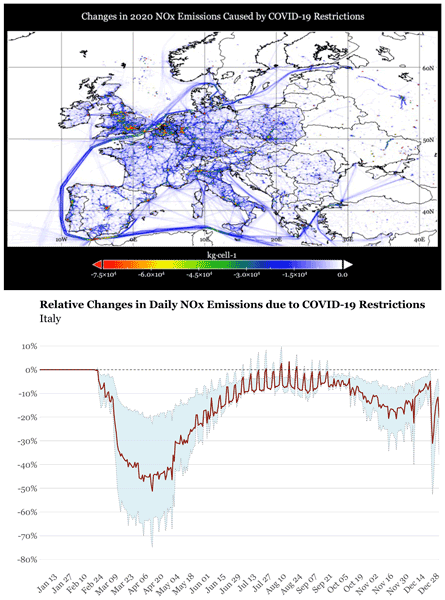
This paper reports on improved monitoring of ship nitrogen oxide emissions by TROPOMI. With its fantastic resolution we can identify lanes of ship nitrogen dioxide (NO2) pollution not detected from space before. The quality of TROPOMI NO2 data over sea is improved further by recent upgrades in cloud retrievals and the use of sun glint scenes. Lastly, we study the impact of COVID-19 on ship NO2 in European seas and compare the found reductions to emission estimates gained from ship-specific data.
Jeroen Kuenen, Stijn Dellaert, Antoon Visschedijk, Jukka-Pekka Jalkanen, Ingrid Super, and Hugo Denier van der Gon
Earth Syst. Sci. Data, 14, 491–515, https://doi.org/10.5194/essd-14-491-2022, https://doi.org/10.5194/essd-14-491-2022, 2022
Short summary
Short summary
This paper presents an 18-year time series for anthropogenic emissions for the main air pollutants in Europe, distinguishing 15 main source categories. It provides a complete overview of emissions to air and is designed to support air quality modelling. The data build where possible on official country total emissions used in the policy processes, but where necessary alternative data were used. The emission data are spatially distributed at high resolution (~ 6 km x 6 km) in a consistent way.
Nicolás Álamos, Nicolás Huneeus, Mariel Opazo, Mauricio Osses, Sebastián Puja, Nicolás Pantoja, Hugo Denier van der Gon, Alejandra Schueftan, René Reyes, and Rubén Calvo
Earth Syst. Sci. Data, 14, 361–379, https://doi.org/10.5194/essd-14-361-2022, https://doi.org/10.5194/essd-14-361-2022, 2022
Short summary
Short summary
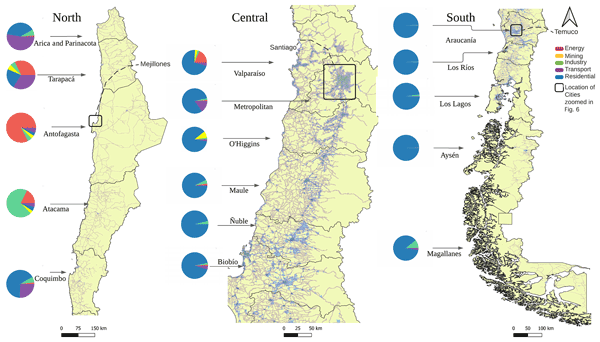
This study presents the first high-resolution national inventory of anthropogenic emissions for Chile (Inventario Nacional de Emisiones Antropogénicas, INEMA). Emissions for vehicular, industrial, energy, mining and residential sectors are estimated for the period 2015–2017 and spatially distributed onto a high-resolution grid (1 × 1 km). This inventory will support policies seeking to mitigate climate change and improve air quality by providing qualified scientific spatial emission information.
Juhi Nagori, Narcisa Nechita-Bândă, Sebastian Oscar Danielache, Masumi Shinkai, Thomas Röckmann, and Maarten Krol
Atmos. Chem. Phys. Discuss., https://doi.org/10.5194/acp-2022-68, https://doi.org/10.5194/acp-2022-68, 2022
Publication in ACP not foreseen
Short summary
Short summary
The sulfur isotopes (32S and 34S) were studied to understand the sources, sinks and processes of carbonyl sulphide (COS) in the atmosphere. COS is an important source of sulfur aerosol in the stratosphere (SSA). Few measurements of COS and SSA exist, but with our 1D model, we were able to match them and show the importance of COS to sulfate formation. Moreover, we are able to highlight some important processes for the COS budget and where measurements may fill a gap in current knowledge.
Linda M. J. Kooijmans, Ara Cho, Jin Ma, Aleya Kaushik, Katherine D. Haynes, Ian Baker, Ingrid T. Luijkx, Mathijs Groenink, Wouter Peters, John B. Miller, Joseph A. Berry, Jerome Ogée, Laura K. Meredith, Wu Sun, Kukka-Maaria Kohonen, Timo Vesala, Ivan Mammarella, Huilin Chen, Felix M. Spielmann, Georg Wohlfahrt, Max Berkelhammer, Mary E. Whelan, Kadmiel Maseyk, Ulli Seibt, Roisin Commane, Richard Wehr, and Maarten Krol
Biogeosciences, 18, 6547–6565, https://doi.org/10.5194/bg-18-6547-2021, https://doi.org/10.5194/bg-18-6547-2021, 2021
Short summary
Short summary
The gas carbonyl sulfide (COS) can be used to estimate photosynthesis. To adopt this approach on regional and global scales, we need biosphere models that can simulate COS exchange. So far, such models have not been evaluated against observations. We evaluate the COS biosphere exchange of the SiB4 model against COS flux observations. We find that the model is capable of simulating key processes in COS biosphere exchange. Still, we give recommendations for further improvement of the model.
Auke J. Visser, Laurens N. Ganzeveld, Ignacio Goded, Maarten C. Krol, Ivan Mammarella, Giovanni Manca, and K. Folkert Boersma
Atmos. Chem. Phys., 21, 18393–18411, https://doi.org/10.5194/acp-21-18393-2021, https://doi.org/10.5194/acp-21-18393-2021, 2021
Short summary
Short summary
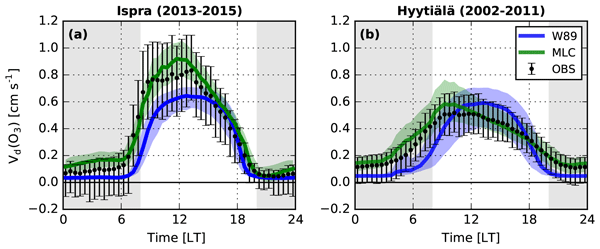
Dry deposition is an important sink for tropospheric ozone that affects ecosystem carbon uptake, but process understanding remains incomplete. We apply a common deposition representation in atmospheric chemistry models and a multi-layer canopy model to multi-year ozone deposition observations. The multi-layer canopy model performs better on diurnal timescales compared to the common approach, leading to a substantially improved simulation of ozone deposition and vegetation ozone impact metrics.
Margarita Choulga, Greet Janssens-Maenhout, Ingrid Super, Efisio Solazzo, Anna Agusti-Panareda, Gianpaolo Balsamo, Nicolas Bousserez, Monica Crippa, Hugo Denier van der Gon, Richard Engelen, Diego Guizzardi, Jeroen Kuenen, Joe McNorton, Gabriel Oreggioni, and Antoon Visschedijk
Earth Syst. Sci. Data, 13, 5311–5335, https://doi.org/10.5194/essd-13-5311-2021, https://doi.org/10.5194/essd-13-5311-2021, 2021
Short summary
Short summary
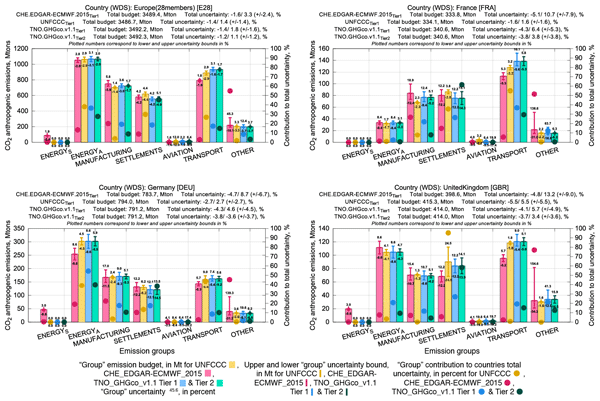
People worry that growing man-made carbon dioxide (CO2) concentrations lead to climate change. Global models, use of observations, and datasets can help us better understand behaviour of CO2. Here a tool to compute uncertainty in man-made CO2 sources per country per year and month is presented. An example of all sources separated into seven groups (intensive and average energy, industry, humans, ground and air transport, others) is presented. Results will be used to predict CO2 concentrations.
Vilma Kangasaho, Aki Tsuruta, Leif Backman, Pyry Mäkinen, Sander Houweling, Arjo Segers, Maarten Krol, Ed Dlugokencky, Sylvia Michel, James White, and Tuula Aalto
Atmos. Chem. Phys. Discuss., https://doi.org/10.5194/acp-2021-843, https://doi.org/10.5194/acp-2021-843, 2021
Revised manuscript not accepted
Short summary
Short summary
Understanding the composition of carbon isotopes can help to better understand the changes in methane budgets. This study investigates how methane sources affect the seasonal cycle of the methane carbon-13 isotope during 2000–2012 using an atmospheric transport model. We found that emissions from both anthropogenic and natural sources contribute. The findings raise a need to revise the magnitudes, proportion, and seasonal cycles of anthropogenic sources and northern wetland emissions.
Mehliyar Sadiq, Paul I. Palmer, Mark F. Lunt, Liang Feng, Ingrid Super, Stijn N. C. Dellaert, and Hugo A. C. Denier van der Gon
Atmos. Chem. Phys. Discuss., https://doi.org/10.5194/acp-2021-816, https://doi.org/10.5194/acp-2021-816, 2021
Publication in ACP not foreseen
Short summary
Short summary
We make use of high-resolution emission inventory of CO2 and co-emitted tracers, satellite measurements, together with nested atmospheric transport model simulation, to investigate how reactive trace gases such as nitrogen dioxide and carbon monoxide can be used as proxies to determine the combustion contribution to atmospheric CO2 over Europe. We find stronger correlation in ratios of nitrogen dioxide and carbon dioxide between emission and satellite observed and modelled column concentration.
Isabelle De Smedt, Gaia Pinardi, Corinne Vigouroux, Steven Compernolle, Alkis Bais, Nuria Benavent, Folkert Boersma, Ka-Lok Chan, Sebastian Donner, Kai-Uwe Eichmann, Pascal Hedelt, François Hendrick, Hitoshi Irie, Vinod Kumar, Jean-Christopher Lambert, Bavo Langerock, Christophe Lerot, Cheng Liu, Diego Loyola, Ankie Piters, Andreas Richter, Claudia Rivera Cárdenas, Fabian Romahn, Robert George Ryan, Vinayak Sinha, Nicolas Theys, Jonas Vlietinck, Thomas Wagner, Ting Wang, Huan Yu, and Michel Van Roozendael
Atmos. Chem. Phys., 21, 12561–12593, https://doi.org/10.5194/acp-21-12561-2021, https://doi.org/10.5194/acp-21-12561-2021, 2021
Short summary
Short summary
This paper assess the performances of the TROPOMI formaldehyde observations compared to its predecessor OMI at different spatial and temporal scales. We also use a global network of MAX-DOAS instruments to validate both satellite datasets for a large range of HCHO columns. The precision obtained with daily TROPOMI observations is comparable to monthly OMI observations. We present clear detection of weak HCHO column enhancements related to shipping emissions in the Indian Ocean.
Jianfeng Li, Yuhang Wang, Ruixiong Zhang, Charles Smeltzer, Andrew Weinheimer, Jay Herman, K. Folkert Boersma, Edward A. Celarier, Russell W. Long, James J. Szykman, Ruben Delgado, Anne M. Thompson, Travis N. Knepp, Lok N. Lamsal, Scott J. Janz, Matthew G. Kowalewski, Xiong Liu, and Caroline R. Nowlan
Atmos. Chem. Phys., 21, 11133–11160, https://doi.org/10.5194/acp-21-11133-2021, https://doi.org/10.5194/acp-21-11133-2021, 2021
Short summary
Short summary
Comprehensive evaluations of simulated diurnal cycles of NO2 and NOy concentrations, vertical profiles, and tropospheric vertical column densities at two different resolutions with various measurements during the DISCOVER-AQ 2011 campaign show potential distribution biases of NOx emissions in the National Emissions Inventory 2011 at both 36 and 4 km resolutions, providing another possible explanation for the overestimation of model results.
Johannes G. M. Barten, Laurens N. Ganzeveld, Gert-Jan Steeneveld, and Maarten C. Krol
Atmos. Chem. Phys., 21, 10229–10248, https://doi.org/10.5194/acp-21-10229-2021, https://doi.org/10.5194/acp-21-10229-2021, 2021
Short summary
Short summary
We present an evaluation of ocean and snow/ice O3 deposition in explaining observed hourly surface O3 at 25 pan-Arctic sites using an atmospheric meteorology/chemistry model. The model includes a mechanistic representation of ocean O3 deposition as a function of ocean biogeochemical and mixing conditions. The mechanistic representation agrees better with O3 observations in terms of magnitude and temporal variability especially in the High Arctic (> 70° N).
Ana Maria Roxana Petrescu, Matthew J. McGrath, Robbie M. Andrew, Philippe Peylin, Glen P. Peters, Philippe Ciais, Gregoire Broquet, Francesco N. Tubiello, Christoph Gerbig, Julia Pongratz, Greet Janssens-Maenhout, Giacomo Grassi, Gert-Jan Nabuurs, Pierre Regnier, Ronny Lauerwald, Matthias Kuhnert, Juraj Balkovič, Mart-Jan Schelhaas, Hugo A. C. Denier van der
Gon, Efisio Solazzo, Chunjing Qiu, Roberto Pilli, Igor B. Konovalov, Richard A. Houghton, Dirk Günther, Lucia Perugini, Monica Crippa, Raphael Ganzenmüller, Ingrid T. Luijkx, Pete Smith, Saqr Munassar, Rona L. Thompson, Giulia Conchedda, Guillaume Monteil, Marko Scholze, Ute Karstens, Patrick Brockmann, and Albertus Johannes Dolman
Earth Syst. Sci. Data, 13, 2363–2406, https://doi.org/10.5194/essd-13-2363-2021, https://doi.org/10.5194/essd-13-2363-2021, 2021
Short summary
Short summary
This study is topical and provides a state-of-the-art scientific overview of data availability from bottom-up and top-down CO2 fossil emissions and CO2 land fluxes in the EU27+UK. The data integrate recent emission inventories with ecosystem data, land carbon models and regional/global inversions for the European domain, aiming at reconciling CO2 estimates with official country-level UNFCCC national GHG inventories in support to policy and facilitating real-time verification procedures.
Anteneh Getachew Mengistu, Gizaw Mengistu Tsidu, Gerbrand Koren, Maurits L. Kooreman, K. Folkert Boersma, Torbern Tagesson, Jonas Ardö, Yann Nouvellon, and Wouter Peters
Biogeosciences, 18, 2843–2857, https://doi.org/10.5194/bg-18-2843-2021, https://doi.org/10.5194/bg-18-2843-2021, 2021
Short summary
Short summary
In this study, we assess the usefulness of Sun-Induced Fluorescence of Terrestrial Ecosystems Retrieval (SIFTER) data from the GOME-2A instrument and near-infrared reflectance of vegetation (NIRv) from MODIS to capture the seasonality and magnitudes of gross primary production (GPP) derived from six eddy-covariance flux towers in Africa in the overlap years between 2007–2014. We also test the robustness of sun-induced fluoresence and NIRv to compare the seasonality of GPP for the major biomes.
Stijn Naus, Stephen A. Montzka, Prabir K. Patra, and Maarten C. Krol
Atmos. Chem. Phys., 21, 4809–4824, https://doi.org/10.5194/acp-21-4809-2021, https://doi.org/10.5194/acp-21-4809-2021, 2021
Short summary
Short summary
Following up on previous box model studies, we employ a 3D transport model to estimate variations in the hydroxyl radical (OH) from observations of methyl chloroform (MCF). We derive small interannual OH variations that are consistent with variations in the El Niño–Southern Oscillation. We also find evidence for the release of MCF from oceans in atmospheric gradients of MCF. Both findings highlight the added value of a 3D transport model since box model studies did not identify these effects.
Eloise A. Marais, John F. Roberts, Robert G. Ryan, Henk Eskes, K. Folkert Boersma, Sungyeon Choi, Joanna Joiner, Nader Abuhassan, Alberto Redondas, Michel Grutter, Alexander Cede, Laura Gomez, and Monica Navarro-Comas
Atmos. Meas. Tech., 14, 2389–2408, https://doi.org/10.5194/amt-14-2389-2021, https://doi.org/10.5194/amt-14-2389-2021, 2021
Short summary
Short summary
Nitrogen oxides in the upper troposphere have a profound influence on the global troposphere, but routine reliable observations there are exceedingly rare. We apply cloud-slicing to TROPOMI total columns of nitrogen dioxide (NO2) at high spatial resolution to derive near-global observations of NO2 in the upper troposphere and show consistency with existing datasets. These data offer tremendous potential to address knowledge gaps in this oft underappreciated portion of the atmosphere.
Jin Ma, Linda M. J. Kooijmans, Ara Cho, Stephen A. Montzka, Norbert Glatthor, John R. Worden, Le Kuai, Elliot L. Atlas, and Maarten C. Krol
Atmos. Chem. Phys., 21, 3507–3529, https://doi.org/10.5194/acp-21-3507-2021, https://doi.org/10.5194/acp-21-3507-2021, 2021
Short summary
Short summary
Carbonyl sulfide is an important trace gas in the atmosphere and useful to estimating gross primary productivity in ecosystems, but its sources and sinks remain highly uncertain. Therefore, we applied inverse model system TM5-4DVAR to better constrain the global budget. Our finding is in line with earlier studies, pointing to missing sources in the tropics and more uptake in high latitudes. We also stress the necessity of more ground-based observations and satellite data assimilation in future.
Marc Guevara, Oriol Jorba, Carles Tena, Hugo Denier van der Gon, Jeroen Kuenen, Nellie Elguindi, Sabine Darras, Claire Granier, and Carlos Pérez García-Pando
Earth Syst. Sci. Data, 13, 367–404, https://doi.org/10.5194/essd-13-367-2021, https://doi.org/10.5194/essd-13-367-2021, 2021
Short summary
Short summary
The temporal variability of atmospheric emissions is linked to changes in activity patterns, emission processes and meteorology. Accounting for the change in temporal emission characteristics is a key aspect for modelling the trends of air pollutants. This work presents a dataset of global and European emission temporal profiles to be used for air quality modelling purposes. The profiles were constructed considering the influences of local sociodemographic factors and climatological conditions.
Cited articles
AirParif: Émissions de polluants atmosphériques et de gaz à effet de serre, Tech. Rep., https://www.airparif.fr/sites/default/files/document_publication/bilan_emissions_Paris_2021.pdf (last access: 28 November 2025), 2021. a
Émissions et consommations 2021 en Île-de-France (estimations faites en 2023), https://www.airparif.fr/surveiller-la-pollution/les-emissions (last access: 28 November 2025), 2023. a
Bernard, Y., Miller, J., Wappelhorst, S., and Braun, C.: Impacts of the Paris low-emission zone and implications for other cities, TRUE-The Real Urban Emissions Initiative, United Kingdom, ISBN 1744072, 2020. a
Boningari, T. and Smirniotis, P. G.: Impact of nitrogen oxides on the environment and human health: Mn-based materials for the NOx abatement, Current Opinion in Chemical Engineering, 13, 133–141, 2016. a
Brioude, J., Angevine, W. M., Ahmadov, R., Kim, S.-W., Evan, S., McKeen, S. A., Hsie, E.-Y., Frost, G. J., Neuman, J. A., Pollack, I. B., Peischl, J., Ryerson, T. B., Holloway, J., Brown, S. S., Nowak, J. B., Roberts, J. M., Wofsy, S. C., Santoni, G. W., Oda, T., and Trainer, M.: Top-down estimate of surface flux in the Los Angeles Basin using a mesoscale inverse modeling technique: assessing anthropogenic emissions of CO, NOx and CO2 and their impacts, Atmos. Chem. Phys., 13, 3661–3677, https://doi.org/10.5194/acp-13-3661-2013, 2013. a
Burkholder, J. B., Sander, S. P., Abbatt, J. P. D., Barker, J. R., Cappa, C., Crounse, J. D., Dibble, T. S., Huie, R. E., Kolb, C. E., and Kurylo, M. J.: Chemical kinetics and photochemical data for use in atmospheric studies; evaluation number 19, Tech. rep., http://jpldataeval.jpl.nasa.gov (last access: 9 January 2026), 2020. a
Cheng, X., Hao, Z., Zang, Z., Liu, Z., Xu, X., Wang, S., Liu, Y., Hu, Y., and Ma, X.: A new inverse modeling approach for emission sources based on the DDM-3D and 3DVAR techniques: an application to air quality forecasts in the Beijing–Tianjin–Hebei region, Atmos. Chem. Phys., 21, 13747–13761, https://doi.org/10.5194/acp-21-13747-2021, 2021. a
de Foy, B. and Schauer, J. J.: An improved understanding of NOx emissions in South Asian megacities using TROPOMI NO2 retrievals, Environmental Research Letters, 17, 024006, https://doi.org/10.1088/1748-9326/ac48b4, 2022. a
Degrauewe, B., Pisoni, E., Peduzzi, E., De Meij, A., Monforti-Ferrario, F., Bodis, K., Mascherpa, A., AstorgaLlorens, M., Thunis, P and Vignati, E.: NO2 Atlas, EUR 29943 EN, Publications Office of the European Union, Luxembourg, https://doi.org/10.2760/43523, 2019. a
Denier van der Gon, H., Hendriks, C., Kuenen, J., Segers, A., and Visschedijk, A.: TNO Report: Description of current temporal emission patterns and sensitivity of predicted AQ for temporal emission patterns, Tech. rep., TNO, Utrecht, https://atmosphere.copernicus.eu/sites/default/files/2019-07/MACC_TNO_del_1_3_v2.pdf (last access: 9 January 2026), 2011. a
Douros, J., Eskes, H., van Geffen, J., Boersma, K. F., Compernolle, S., Pinardi, G., Blechschmidt, A.-M., Peuch, V.-H., Colette, A., and Veefkind, P.: Comparing Sentinel-5P TROPOMI NO2 column observations with the CAMS regional air quality ensemble, Geosci. Model Dev., 16, 509–534, https://doi.org/10.5194/gmd-16-509-2023, 2023. a, b, c, d
EEA: Air quality in Europe 2019, https://doi.org/10.2800/822355, 2019. a
EEA: France – air pollution country fact sheet, https://www.eea.europa.eu/en/analysis/maps-and-charts/France-air-pollution-country-fact-sheet-2023-country-fact-sheets?activeTab=265e2bee-7de3-46e8-b6ee-76005f3f434f (last access: 9 January 2026), 2023. a
Erisman, J. W. and Draaijers, G. P. J.: Atmospheric deposition: in relation to acidification and eutrophication, Elsevier, ISBN 0080527671, 1995. a
Eskes, H. J. and Boersma, K. F.: Averaging kernels for DOAS total-column satellite retrievals, Atmos. Chem. Phys., 3, 1285–1291, https://doi.org/10.5194/acp-3-1285-2003, 2003. a
Fischer, E. V., Jacob, D. J., Yantosca, R. M., Sulprizio, M. P., Millet, D. B., Mao, J., Paulot, F., Singh, H. B., Roiger, A., Ries, L., Talbot, R. W., Dzepina, K., and Pandey Deolal, S.: Atmospheric peroxyacetyl nitrate (PAN): a global budget and source attribution, Atmos. Chem. Phys., 14, 2679–2698, https://doi.org/10.5194/acp-14-2679-2014, 2014. a
Goldberg, D. L., Harkey, M., de Foy, B., Judd, L., Johnson, J., Yarwood, G., and Holloway, T.: Evaluating NOx emissions and their effect on O3 production in Texas using TROPOMI NO2 and HCHO, Atmos. Chem. Phys., 22, 10875–10900, https://doi.org/10.5194/acp-22-10875-2022, 2022. a
Guevara, M., Jorba, O., Tena, C., Denier van der Gon, H., Kuenen, J., Elguindi, N., Darras, S., Granier, C., and Pérez García-Pando, C.: Copernicus Atmosphere Monitoring Service TEMPOral profiles (CAMS-TEMPO): global and European emission temporal profile maps for atmospheric chemistry modelling, Earth Syst. Sci. Data, 13, 367–404, https://doi.org/10.5194/essd-13-367-2021, 2021a. a
Guevara, M., Jorba, O., Soret, A., Petetin, H., Bowdalo, D., Serradell, K., Tena, C., Denier van der Gon, H., Kuenen, J., Peuch, V.-H., and Pérez García-Pando, C.: Time-resolved emission reductions for atmospheric chemistry modelling in Europe during the COVID-19 lockdowns, Atmos. Chem. Phys., 21, 773–797, https://doi.org/10.5194/acp-21-773-2021, 2021b. a, b
Hakkarainen, J., Kuhlmann, G., Koene, E., Santaren, D., Meier, S., Krol, M. C., van Stratum, B. J. H., Ialongo, I., Chevallier, F., and Tamminen, J.: Analyzing nitrogen dioxide to nitrogen oxide scaling factors for data-driven satellite-based emission estimation methods: A case study of Matimba/Medupi power stations in South Africa, Atmospheric Pollution Research, 15, 102171, https://doi.org/10.1016/j.apr.2024.102171, 2024. a
Ikhlasse, H., Benjamin, D., Vincent, C., and Hicham, M.: Environmental impacts of pre/during and post-lockdown periods on prominent air pollutants in France, Environment, Development and Sustainability, 23, 14140–14161, 2021. a
Jacob, D.: Introduction to Atmospheric Chemistry, Princeton University Press, ISBN 9780691001852, 1999. a
Johnson, M. S., Philip, S., Meech, S., Kumar, R., Sorek-Hamer, M., Shiga, Y. P., and Jung, J.: Insights into the long-term (2005–2021) spatiotemporal evolution of summer ozone production sensitivity in the Northern Hemisphere derived with the Ozone Monitoring Instrument (OMI), Atmos. Chem. Phys., 24, 10363–10384, https://doi.org/10.5194/acp-24-10363-2024, 2024. a
Krol, M.: Code, input, output, and analysis software of the CoCO2 paper, submitted to Atmospheric Chemistry and Physics, Zenodo [code], https://doi.org/10.5281/zenodo.10053684, 2023. a
Krol, M., van Stratum, B., Anglou, I., and Boersma, K. F.: Evaluating NOx stack plume emissions using a high-resolution atmospheric chemistry model and satellite-derived NO2 columns, Atmos. Chem. Phys., 24, 8243–8262, https://doi.org/10.5194/acp-24-8243-2024, 2024. a, b, c
Kuenen, J., Dellaert, S., Visschedijk, A., Jalkanen, J.-P., Super, I., and Denier van der Gon, H.: Copernicus Atmosphere Monitoring Service regional emissions version 4.2 (CAMS-REG-v4.2), [data set], https://doi.org/10.24380/0vzb-a387, 2021. a
Kuenen, J., Dellaert, S., Visschedijk, A., Jalkanen, J.-P., Super, I., and Denier van der Gon, H.: CAMS-REG-v4: a state-of-the-art high-resolution European emission inventory for air quality modelling, Earth Syst. Sci. Data, 14, 491–515, https://doi.org/10.5194/essd-14-491-2022, 2022. a
Kuenen, J. J. P., Visschedijk, A. J. H., Jozwicka, M., and Denier van der Gon, H. A. C.: TNO-MACC_II emission inventory; a multi-year (2003–2009) consistent high-resolution European emission inventory for air quality modelling, Atmos. Chem. Phys., 14, 10963–10976, https://doi.org/10.5194/acp-14-10963-2014, 2014. a, b, c
Kurokawa, J.-i., Yumimoto, K., Uno, I., and Ohara, T.: Adjoint inverse modeling of NOx emissions over eastern China using satellite observations of NO2 vertical column densities, Atmospheric Environment, 43, 1878–1887, 2009. a
Lange, K., Richter, A., and Burrows, J. P.: Variability of nitrogen oxide emission fluxes and lifetimes estimated from Sentinel-5P TROPOMI observations, Atmos. Chem. Phys., 22, 2745–2767, https://doi.org/10.5194/acp-22-2745-2022, 2022. a, b, c
Lange, K., Richter, A., Bösch, T., Zilker, B., Latsch, M., Behrens, L. K., Okafor, C. M., Bösch, H., Burrows, J. P., Merlaud, A., Pinardi, G., Fayt, C., Friedrich, M. M., Dimitropoulou, E., Van Roozendael, M., Ziegler, S., Ripperger-Lukosiunaite, S., Kuhn, L., Lauster, B., Wagner, T., Hong, H., Kim, D., Chang, L.-S., Bae, K., Song, C.-K., Park, J.-U., and Lee, H.: Validation of GEMS tropospheric NO2 columns and their diurnal variation with ground-based DOAS measurements, Atmos. Meas. Tech., 17, 6315–6344, https://doi.org/10.5194/amt-17-6315-2024, 2024. a
Liu, F., Tao, Z., Beirle, S., Joiner, J., Yoshida, Y., Smith, S. J., Knowland, K. E., and Wagner, T.: A new method for inferring city emissions and lifetimes of nitrogen oxides from high-resolution nitrogen dioxide observations: a model study, Atmos. Chem. Phys., 22, 1333–1349, https://doi.org/10.5194/acp-22-1333-2022, 2022. a, b, c
Lonsdale, C. R. and Sun, K.: Nitrogen oxides emissions from selected cities in North America, Europe, and East Asia observed by the TROPOspheric Monitoring Instrument (TROPOMI) before and after the COVID-19 pandemic, Atmos. Chem. Phys., 23, 8727–8748, https://doi.org/10.5194/acp-23-8727-2023, 2023. a
Lorente, A., Boersma, K. F., Eskes, H. J., Veefkind, J. P., Van Geffen, J., De Zeeuw, M. B., Denier Van Der Gon, H. A. C., Beirle, S., and Krol, M. C.: Quantification of nitrogen oxides emissions from build-up of pollution over Paris with TROPOMI, Scientific Reports, 9, 1–10, 2019. a, b, c, d, e, f, g, h, i, j, k, l, m, n, o, p, q, r, s, t
Meier, S., Koene, E. F. M., Krol, M., Brunner, D., Damm, A., and Kuhlmann, G.: A lightweight NO2-to-NOx conversion model for quantifying NOx emissions of point sources from NO2 satellite observations, Atmos. Chem. Phys., 24, 7667–7686, https://doi.org/10.5194/acp-24-7667-2024, 2024. a
Mols, A. and Boersma, K.: Daily NOx emissions and lifetimes from Paris between May 2018 and July 2023 inferred from TROPOMI, Zenodo [data set], https://doi.org/10.5281/zenodo.14893825, 2025. a
Pazmiño, A., Beekmann, M., Goutail, F., Ionov, D., Bazureau, A., Nunes-Pinharanda, M., Hauchecorne, A., and Godin-Beekmann, S.: Impact of the COVID-19 pandemic related to lockdown measures on tropospheric NO2 columns over Île-de-France, Atmos. Chem. Phys., 21, 18303–18317, https://doi.org/10.5194/acp-21-18303-2021, 2021. a
Ražnjević, A., van Heerwaarden, C., van Stratum, B., Hensen, A., Velzeboer, I., van den Bulk, P., and Krol, M.: Technical note: Interpretation of field observations of point-source methane plume using observation-driven large-eddy simulations, Atmos. Chem. Phys., 22, 6489–6505, https://doi.org/10.5194/acp-22-6489-2022, 2022. a
Rey-Pommier, A., Chevallier, F., Ciais, P., Broquet, G., Christoudias, T., Kushta, J., Hauglustaine, D., and Sciare, J.: Quantifying NOx emissions in Egypt using TROPOMI observations, Atmos. Chem. Phys., 22, 11505–11527, https://doi.org/10.5194/acp-22-11505-2022, 2022. a
Riess, T. C. V. W., Boersma, K. F., Van Roy, W., de Laat, J., Dammers, E., and van Vliet, J.: To new heights by flying low: comparison of aircraft vertical NO2 profiles to model simulations and implications for TROPOMI NO2 retrievals, Atmos. Meas. Tech., 16, 5287–5304, https://doi.org/10.5194/amt-16-5287-2023, 2023. a
Rijsdijk, P., Eskes, H., Dingemans, A., Boersma, K. F., Sekiya, T., Miyazaki, K., and Houweling, S.: Quantifying uncertainties in satellite NO2 superobservations for data assimilation and model evaluation, Geosci. Model Dev., 18, 483–509, https://doi.org/10.5194/gmd-18-483-2025, 2025. a
Sierk, B., Fernandez, V., Bézy, J.-L., Meijer, Y., Durand, Y., Courrèges-Lacoste, G. B., Pachot, C., Löscher, A., Nett, H., and Minoglou, K.: The Copernicus CO2M mission for monitoring anthropogenic carbon dioxide emissions from space, in: International Conference on Space Optics-ICSO 2020, 11852, 1563–1580, SPIE, https://doi.org/10.1117/12.2599613, 2021. a
Stavrakou, T., Müller, J.-F., Boersma, K. F., van der A, R. J., Kurokawa, J., Ohara, T., and Zhang, Q.: Key chemical NOx sink uncertainties and how they influence top-down emissions of nitrogen oxides, Atmos. Chem. Phys., 13, 9057–9082, https://doi.org/10.5194/acp-13-9057-2013, 2013. a, b
Tilstra, L. G., de Graaf, M., Trees, V. J. H., Litvinov, P., Dubovik, O., and Stammes, P.: A directional surface reflectance climatology determined from TROPOMI observations, Atmos. Meas. Tech., 17, 2235–2256, https://doi.org/10.5194/amt-17-2235-2024, 2024. a
Tu, R., Xu, J., Wang, A., Zhai, Z., and Hatzopoulou, M.: Effects of ambient temperature and cold starts on excess NOx emissions in a gasoline direct injection vehicle, Science of the Total Environment, 760, 143402, https://doi.org/10.1016/j.scitotenv.2020.143402, 2021. a
Valin, L. C., Russell, A. R., and Cohen, R. C.: Variations of OH radical in an urban plume inferred from NO2 column measurements, Geophysical Research Letters, 40, 1856–1860, 2013. a
van Geffen, J., Eskes, H., Boersma, K., and Veefkind, J.: TROPOMI ATBD of the total and tropospheric NO2 data products: S5P-KNMI-L2-0005-RP, Tech. rep., https://sentiwiki.copernicus.eu/ attachments/1673595/S5P-KNMI-L2-0005-RP - Sentinel-5P TROPOMI ATBD NO2 data products 2024 - 2.8.0.pdf?inst-v=1339b118-e271-4db6-917e-ca802c618f17 (last access:), 2022. a
van Geffen, J., Eskes, H., Compernolle, S., Pinardi, G., Verhoelst, T., Lambert, J.-C., Sneep, M., ter Linden, M., Ludewig, A., Boersma, K. F., and Veefkind, J. P.: Sentinel-5P TROPOMI NO2 retrieval: impact of version v2.2 improvements and comparisons with OMI and ground-based data, Atmos. Meas. Tech., 15, 2037–2060, https://doi.org/10.5194/amt-15-2037-2022, 2022. a
van Heerwaarden, C. C., van Stratum, B. J. H., Heus, T., Gibbs, J. A., Fedorovich, E., and Mellado, J. P.: MicroHH 1.0: a computational fluid dynamics code for direct numerical simulation and large-eddy simulation of atmospheric boundary layer flows, Geosci. Model Dev., 10, 3145–3165, https://doi.org/10.5194/gmd-10-3145-2017, 2017. a, b, c
Vilà-Guerau de Arellano, J., Dosio, A., Vinuesa, J.-F., Holtslag, A. A. M., and Galmarini, S.: The dispersion of chemically reactive species in the atmospheric boundary layer, Meteorology and Atmospheric Physics, 87, 23–38, 2004. a
Visser, A. J., Boersma, K. F., Ganzeveld, L. N., and Krol, M. C.: European NOx emissions in WRF-Chem derived from OMI: impacts on summertime surface ozone, Atmos. Chem. Phys., 19, 11821–11841, https://doi.org/10.5194/acp-19-11821-2019, 2019. a
Vitousek, P. M., Aber, J. D., Howarth, R. W., Likens, G. E., Matson, P. A., Schindler, D. W., Schlesinger, W. H., and Tilman, D. G.: Human alteration of the global nitrogen cycle: sources and consequences, Ecological Applications, 7, 737–750, 1997. a
WHO: WHO global air quality guidelines: particulate matter (PM2.5 and PM10), ozone, nitrogen dioxide, sulfur dioxide and carbon monoxide, World Health Organization, ISBN 9240034226, 2021. a
Yan, C., Nie, W., Vogel, A. L., Dada, L., Lehtipalo, K., Stolzenburg, D., Wagner, R., Rissanen, M. P., Xiao, M., and Ahonen, L.: Size-dependent influence of NOx on the growth rates of organic aerosol particles, Science Advances, 6, eaay4945, https://doi.org/10.1126/sciadv.aay4945, 2020. a
Zhang, Q., Boersma, K. F., Zhao, B., Eskes, H., Chen, C., Zheng, H., and Zhang, X.: Quantifying daily NOx and CO2 emissions from Wuhan using satellite observations from TROPOMI and OCO-2, Atmos. Chem. Phys., 23, 551–563, https://doi.org/10.5194/acp-23-551-2023, 2023. a, b, c
Zhu, Q., Laughner, J. L., and Cohen, R. C.: Estimate of OH trends over one decade in North American cities, Proceedings of the National Academy of Sciences, 119, e2117399119, https://doi.org/10.1073/pnas.2117399119, 2022. a, b
Short summary
We created a new method to estimate city air pollution (NOx emissions) using satellite data. Testing showed our approach works well to track how pollution spreads in urban areas. By combining observations with prior knowledge, we improved the accuracy of emission estimates. Applying this method in Paris, we found emissions were 9 % lower than expected and dropped significantly during COVID-19 lockdowns. Our method offers a reliable way to monitor pollution and support environmental policies.
We created a new method to estimate city air pollution (NOx emissions) using satellite data....
Altmetrics
Final-revised paper
Preprint