Articles | Volume 21, issue 9
https://doi.org/10.5194/acp-21-6963-2021
© Author(s) 2021. This work is distributed under
the Creative Commons Attribution 4.0 License.
https://doi.org/10.5194/acp-21-6963-2021
© Author(s) 2021. This work is distributed under
the Creative Commons Attribution 4.0 License.
Laboratory study of the collection efficiency of submicron aerosol particles by cloud droplets – Part II: Influence of electric charges
Alexis Dépée
Institut de Radioprotection et de Sûreté
Nucléaire (IRSN), PSN-RES, SCA, Gif-sur-Yvette, 91192,
France
Université Clermont Auvergne, Laboratoire de
Météorologie Physique, Clermont-Ferrand, France
Institut de Radioprotection et de Sûreté
Nucléaire (IRSN), PSN-RES, SCA, Gif-sur-Yvette, 91192,
France
Thomas Gelain
Institut de Radioprotection et de Sûreté
Nucléaire (IRSN), PSN-RES, SCA, Gif-sur-Yvette, 91192,
France
Marie Monier
Université Clermont Auvergne, Laboratoire de
Météorologie Physique, Clermont-Ferrand, France
CNRS, INSU, UMR 6016, LaMP, Aubière,
France
Andrea Flossmann
Université Clermont Auvergne, Laboratoire de
Météorologie Physique, Clermont-Ferrand, France
CNRS, INSU, UMR 6016, LaMP, Aubière,
France
Related authors
Pascal Lemaitre, Arnaud Quérel, Alexis Dépée, Alice Guerra Devigne, Marie Monier, Thibault Hiron, Chloé Soto Minguez, Daniel Hardy, and Andrea Flossmann
Atmos. Chem. Phys., 24, 9713–9732, https://doi.org/10.5194/acp-24-9713-2024, https://doi.org/10.5194/acp-24-9713-2024, 2024
Short summary
Short summary
A new in-cloud scavenging scheme is proposed. It is based on a microphysical model of cloud formation and may be applied to long-distance atmospheric transport models (> 100 km) and climatic models. This model is applied to the two most extreme precipitating cloud types in terms of both relative humidity and vertical extension: cumulonimbus and stratus.
Alexis Dépée, Pascal Lemaitre, Thomas Gelain, Marie Monier, and Andrea Flossmann
Atmos. Chem. Phys., 21, 6945–6962, https://doi.org/10.5194/acp-21-6945-2021, https://doi.org/10.5194/acp-21-6945-2021, 2021
Short summary
Short summary
Present article describe a new In-Cloud Aerosol Scavenging Experiment (In-CASE) that has been conceived to measure the collection efficiency of submicron aerosol particles by cloud droplets. The present article focuses on the influence of phoretic effects on the collection efficiency.
Thibaut Ménard, Emmanuel Reyes, Wojciech Aniszewski, Pascal Lemaitre, and Emmanuel Belut
Aerosol Research Discuss., https://doi.org/10.5194/ar-2026-1, https://doi.org/10.5194/ar-2026-1, 2026
Preprint under review for AR
Short summary
Short summary
This study uses advanced computer simulations to explore how falling water drops remove airborne particles. It shows that when drops deform and oscillate, their motion strongly affects how efficiently aerosols are captured. The model accurately predicts drop speed and shape, but capture rates can differ from experiments by up to an order of magnitude. These gaps likely stem from missing physical effects (evaporation), uncertainties in aerosol measurements and numerical inaccuracies.
Pascal Lemaitre, Arnaud Quérel, Alexis Dépée, Alice Guerra Devigne, Marie Monier, Thibault Hiron, Chloé Soto Minguez, Daniel Hardy, and Andrea Flossmann
Atmos. Chem. Phys., 24, 9713–9732, https://doi.org/10.5194/acp-24-9713-2024, https://doi.org/10.5194/acp-24-9713-2024, 2024
Short summary
Short summary
A new in-cloud scavenging scheme is proposed. It is based on a microphysical model of cloud formation and may be applied to long-distance atmospheric transport models (> 100 km) and climatic models. This model is applied to the two most extreme precipitating cloud types in terms of both relative humidity and vertical extension: cumulonimbus and stratus.
Anthony C. Jones, Adrian Hill, John Hemmings, Pascal Lemaitre, Arnaud Quérel, Claire L. Ryder, and Stephanie Woodward
Atmos. Chem. Phys., 22, 11381–11407, https://doi.org/10.5194/acp-22-11381-2022, https://doi.org/10.5194/acp-22-11381-2022, 2022
Short summary
Short summary
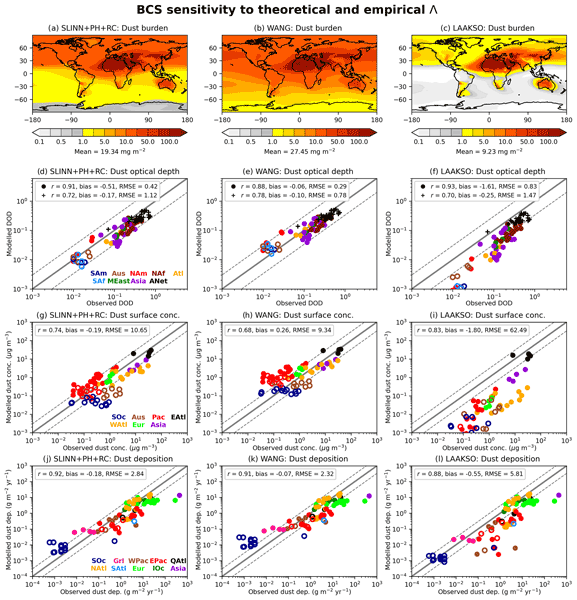
As raindrops fall to the ground, they capture aerosol (i.e. below-cloud scavenging or BCS). Many different BCS schemes are available to climate models, and it is unclear what the impact of selecting one scheme over another is. Here, various BCS models are outlined and then applied to mineral dust in climate model simulations. We find that dust concentrations are highly sensitive to the BCS scheme, with dust atmospheric lifetimes ranging from 5 to 44 d.
Alexis Dépée, Pascal Lemaitre, Thomas Gelain, Marie Monier, and Andrea Flossmann
Atmos. Chem. Phys., 21, 6945–6962, https://doi.org/10.5194/acp-21-6945-2021, https://doi.org/10.5194/acp-21-6945-2021, 2021
Short summary
Short summary
Present article describe a new In-Cloud Aerosol Scavenging Experiment (In-CASE) that has been conceived to measure the collection efficiency of submicron aerosol particles by cloud droplets. The present article focuses on the influence of phoretic effects on the collection efficiency.
Cited articles
Ardon-Dryer, K., Huang, Y.-W., and Cziczo, D. J.: Laboratory studies of collection efficiency of sub-micrometer aerosol particles by cloud droplets on a single-droplet basis, Atmos. Chem. Phys., 15, 9159–9171, https://doi.org/10.5194/acp-15-9159-2015, 2015.
Barlow, A. K. and Latham, J.: A laboratory study of the scavenging of
sub-micron aerosol by charged raindrops, Q. J. Roy. Meteor. Soc., 109, 763–770, 1983.
Beard, K. V.: Experimental and numerical collision efficiencies for
submicron particles scavenged by small
raindrops, J. Atmos. Sci., 31, 1595–1603, 1974.
Beard, K. V.: Terminal velocity and shape of cloud and precipitation
drops aloft, J. Atmos. Sci., 33, 851–864, 1976.
Byrne, M. A. and Jennings, S. G.: Scavenging of sub-micrometre
aerosol particles by water
drops, Atmos. Environ. A-Gen., 27, 2099–2105, 1993.
Chate, D. M. and Pranesha, T. S.: Field studies of scavenging of aerosols by
rain events, J. Aerosol Sci., 35, 695–706, 2004.
Cherrier, G., Belut, E., Gerardin, F., Tanière, A., and Rimbert, N.:
Aerosol particles scavenging by a droplet: Microphysical modeling in the
Greenfield gap, Atmos. Environ., 166, 519–530, 2017.
Clement, C. F. and Harrison, R. G.: The charging of radioactive
aerosols, J. Aerosol Sci., 23, 481–504, 1992.
Davenport, H. M. and Peters, L. K.: Field studies of atmospheric particulate
concentration changes during precipitation, Atmos. Environ., 12, 997–1008, 1978.
Dépée, A., Lemaitre, P., Gelain, T., Mathieu, A., Monier, M., and
Flossmann, A.: Theoretical study of aerosol particle electroscavenging by
clouds, J. Aerosol Sci., 135, 1–20, 2019.
Dépée, A., Lemaitre, P., Gelain, T., Monier, M., and Flossmann, A.: Laboratory study of the collection efficiency of submicron aerosol particles
by cloud droplets – Part I: Influence of relative humidity, Atmos. Chem. Phys., 21, 6945–6962, https://doi.org/10.5194/acp-21-6945-2021, 2021.
Depuydt, G.: Etude expérimentale in situ du potentiel de lessivage de
l'aérosol atmosphérique par les précipitations (Doctoral
dissertation), Institut National Polytechnique de Toulouse, available at: http://ethesis.inp-toulouse.fr/archive/00002550/, 2013.
Dockery, D. W., Schwartz, J., and Spengler, J. D.: Air pollution and daily
mortality: associations with particulates and acid
aerosols, Environ. Res., 59, 362–373, 1992.
Flossmann, A. I.: Interaction of aerosol particles and clouds, J. Atmos. Sci., 55, 879–887, 1998.
Flossmann, A. I., Hall, W. D., and Pruppacher, H. R.: A theoretical study of
the wet removal of atmospheric pollutants, Part I: The redistribution of
aerosol particles captured through nucleation and impaction scavenging by
growing cloud drops, J. Atmos. Sci., 42, 583–606, 1985.
Greenfield, S. M.: Rain scavenging of radioactive particulate matter from
the atmosphere, J. Meteorol., 14, 115–125, 1957.
Grover, S. N. and Beard, K. V.: A numerical determination of the efficiency
with which electrically charged cloud drops and small raindrops collide with
electrically charged spherical particles of various densities, J. Atmos. Sci., 32, 2156–2165, 1975.
Grover, S. N., Pruppacher, H. R., and Hamielec, A. E.: A numerical
determination of the efficiency with which spherical aerosol particles
collide with spherical water drops due to inertial impaction and phoretic
and electrical forces, J. Atmos. Sci., 34, 1655–1663, 1977.
Hinds, W. C.: Aerosol technology: properties, behavior, and measurement of
airborne particles, John Wiley & Sons, New York, Chichester, Weinheim, Bribane, Singapore, Toronto, 483 pp., 2012.
Jackson, J. D.: Classical electrodynamics, 3rd edition, Wiley & Sons, New York, London, Sydney, 808, 1999.
Jaenicke, R.: Chapter 1: Tropospheric aerosols, Aerosol-cloud-climate interactions, in: International Geophysics, Vol. 54, edited by: Hobbs, P. Academic Press, 1–31, https://doi.org/10.1016/S0074-6142(08)60210-7, 1993.
Jaworek, A., Adamiak, K., Balachandran, W., Krupa, A., Castle, P., and
Machowski, W.: Numerical simulation of scavenging of small particles by
charged droplets, Aerosol Sci. Tech., 36, 913–924, 2002.
Kerker, M. and Hampl, V.: Scavenging of Aerosol Particles by a Failing
Water Drop and Calculation of Washout Coefficients, J. Atmos. Sci., 31, 1368–1376, 1974.
Kraemer, H. F. and Johnstone, H. F.: Collection of aerosol particles in
presence of electrostatic fields, Ind. Eng. Chem., 47, 2426–2434.
Laakso, L., Grönholm, T., Rannik, Ü., Kosmale, M., Fiedler, V.,
Vehkamäki, H., and Kulmala, M.: Ultrafine particle scavenging
coefficients calculated from 6 years field
measurements, Atmos. Environ., 37, 3605–3613, 2003.
Ladino, L., Stetzer, O., Hattendorf, B., Günther, D., Croft, B., and
Lohmann, U.: Experimental study of collection efficiencies between submicron
aerosols and cloud droplets, J. Atmos. Sci., 68, 1853–1864, 2011.
Laguionie, P., Roupsard, P., Maro, D., Solier, L., Rozet, M., Hébert,
D., and Connan, O.: Simultaneous quantification of the contributions of dry,
washout and rainout deposition to the total deposition of particle-bound 7 Be and 210 Pb on an urban catchment area on a monthly scale, J. Aerosol Sci., 77, 67–84, 2014.
Lai, K. Y., Dayan, N., and Kerker, M.: Scavenging of aerosol particles by a
falling water drop, J. Atmos. Sci., 35, 674–682, 1978.
Lemaitre, P., Querel, A., Monier, M., Menard, T., Porcheron, E., and Flossmann, A. I.: Experimental evidence of the rear capture of aerosol particles by raindrops, Atmos. Chem. Phys., 17, 4159–4176, https://doi.org/10.5194/acp-17-4159-2017, 2017.
Lemaitre, P., Sow, M., Quérel, A., Dépée, A., Monier, M.,
Menard, T., and Flossmann, A. I.: Contribution of Phoretic and Electrostatic
Effects to the Collection Efficiency of Submicron Aerosol Particles by
Raindrops, Atmosphere, 11, 1–19, 1028TS29, https://doi.org/10.3390/atmos11101028, 2020.
Lira, I.: Evaluating the measurement uncertainty: fundamentals and practical guidance, in: institute of physics, series in measurement science and technology, Institute of Physics Publishing, Bristol and Philadelphia, 251, https://doi.org/10.1119/1.1522703, 2002.
Pauthenier, M. and Moreau-Hanot, M.: La charge des particules sphériques dans un champ ionisé, J. Phys. Radium, 3, 590–613, 1932.
Pranesha, T. S. and Kamra, A. K.: Scavenging of aerosol particles by large
water drops: 1. Neutral case, J. Geophys. Res.-Atmos., 101, 23373–23380, 1996.
Pruppacher, H. R. and Klett, J. D.: Microphysics of Clouds and Precipitation, in Atmospheric and oceanographic Sciences Library, Kluwer Academic Press, Dordrecht/Boston/London, 954 pp., 1997.
Quérel, A., Lemaitre, P., Monier, M., Porcheron, E., Flossmann, A. I., and Hervo, M.: An experiment to measure raindrop collection efficiencies: influence of rear capture, Atmos. Meas. Tech., 7, 1321–1330, https://doi.org/10.5194/amt-7-1321-2014, 2014.
Reischl, G. P. W. W., John, W., and Devor, W.: Uniform electrical charging
of monodisperse aerosols, J. Aerosol Sci., 8, 55–65, 1977.
Santachiara, G., Prodi, F., and Belosi, F.: A review of termo-and diffusio-phoresis in the atmospheric aerosol scavenging process, Part 1: Drop scavenging, 2, 148–158, https://doi.org/10.4236/acs.2012.22016, 2012.
Slinn, W. G. N.: Precipitation scavenging: some problems, approximate solutions and suggestions for future research No. BNWL-SA-5062, Battelle Pacific Northwest Labs., Richland, Wash, USA, 1974.
Slinn, W. G. N. and Hales, J. M.: A reevaluation of the role of
thermophoresis as a mechanism of in-and below-cloud scavenging, J. Atmos. Sci., 28, 1465–1471, 1971.
Takahashi, T.: Measurement of electric charge of cloud droplets, drizzle, and
raindrops, Rev. Geophys., 11, 903–924, 1973.
Tinsley, B. A. and Zhou, L.: Parameterization of aerosol scavenging due to
atmospheric ionization, J. Geophys. Res.-Atmos., 120, 8389–8410, 2015.
Tinsley, B. A., Rohrbaugh, R. P., Hei, M., and Beard, K. V.: Effects of
image charges on the scavenging of aerosol particles by cloud droplets and
on droplet charging and possible ice nucleation
processes, J. Atmos. Sci., 57, 2118–2134, 2000.
Tinsley, B. A., Zhou, L., and Plemmons, A.: Changes in scavenging of
particles by droplets due to weak electrification in
clouds, Atmos. Res., 79, 266–295, 2006.
Twomey, S.: Pollution and the planetary
albedo, Atmos. Environ., 8, 1251–1256, 1974.
Unger, L.: Charge d'aérosols par décharge électrique pour la filtration d'effluents particulaires. Orsay: PhD thesis of Université Paris Sud., 2001.
Unger, L., Boulaud, D., and Borra, J. P.: Unipolar field charging of
particles by electrical discharge: effect of particle shape, J. Aerosol Sci., 35, 965–979, 2004.
Vohl, O., Mitra, S. K., Wurzler, S., Diehl, K., and Pruppacher, H. R.:
Collision efficiencies empirically determined from laboratory investigations
of collisional growth of small raindrops in a laminar flow
field, Atmos. Res., 85, 120–125, 2007.
Volken, M. and Schumann, T.: A critical review of below-cloud aerosol
scavenging results on Mt. Rigi, Water Air Soil Poll., 68, 15–28, 1993.
Wang, H. C., Leong, K. H., Stukel, J. J., and Hopke, P. K.: Collection of
hydrophilic and hydrophobic charged submicron particles by charged water
droplets, J. Aerosol Sci., 14, 703–712, 1983.
Wang, P. K. and Pruppacher, H. R.: An experimental determination of the
efficiency with which aerosol particles are collected by water drops in
subsaturated air, J. Atmos. Sci., 34, 1664–1669, 1977.
Wang, P. K., Grover, S. N., and Pruppacher, H. R.: On the effect of electric
charges on the scavenging of aerosol particles by clouds and small
raindrops, J. Atmos. Sci., 35, 1735–1743, 1978.
Young, K. C.: The role of contact nucleation in ice phase initiation in
clouds, J. Atmos. Sci., 31, 768–776, 1974.

Short summary
The present article describes a new In-Cloud Aerosol Scavenging Experiment (In-CASE) that has been conceived to measure the collection efficiency of submicron aerosol particles by cloud droplets. The present article focuses on the influence of electrostatic effects on the collection efficiency.
The present article describes a new In-Cloud Aerosol Scavenging Experiment (In-CASE) that has...
Altmetrics
Final-revised paper
Preprint