
Articles | Volume 26, issue 12
https://doi.org/10.5194/acp-26-8765-2026
© Author(s) 2026. This work is distributed under
the Creative Commons Attribution 4.0 License.
the Creative Commons Attribution 4.0 License.
https://doi.org/10.5194/acp-26-8765-2026
© Author(s) 2026. This work is distributed under
the Creative Commons Attribution 4.0 License.
the Creative Commons Attribution 4.0 License.
Research article
| 
23 Jun 2026
Research article |
| 23 Jun 2026
| 23 Jun 2026
A robust aerosol impact on clouds along the subtropical to tropical transition
Netta Yeheskel
Fredy and Nadine Herrmann Institute of Earth Sciences, Hebrew University of Jerusalem, Jerusalem, Israel
Matthew W. Christensen
Pacific Northwest National Laboratory, Richland, WA, USA
Fabian Hoffmann
Institut für Meteorologie, Freie Universität Berlin, Berlin, Germany
Graham Feingold
NOAA Chemical Sciences Laboratory, Boulder, CO, USA

Fredy and Nadine Herrmann Institute of Earth Sciences, Hebrew University of Jerusalem, Jerusalem, Israel
Related authors
No articles found.

Richard Maier, Fabian Jakub, Fabian Hoffmann, and Bernhard Mayer
Atmos. Chem. Phys., 26, 12771–12791, https://doi.org/10.5194/acp-26-12771-2026, https://doi.org/10.5194/acp-26-12771-2026, 2026
Short summary
Short summary
Most atmospheric models only use 1D radiation, neglecting any 3D radiative effects. Here, we show that the dynamic TenStream solver provides a computationally efficient way to represent these effects. Like full 3D radiation, it causes daytime clouds to organize into streets, grow larger, and contain more liquid water. We show that this occurs because 3D radiation does not shade cloud updrafts and modifies the surface energy balance, resulting in an increased latent heat flux into the atmosphere.
Benjamin Ascher and Fabian Hoffmann
Atmos. Chem. Phys., 26, 11747–11770, https://doi.org/10.5194/acp-26-11747-2026, https://doi.org/10.5194/acp-26-11747-2026, 2026
Short summary
Short summary
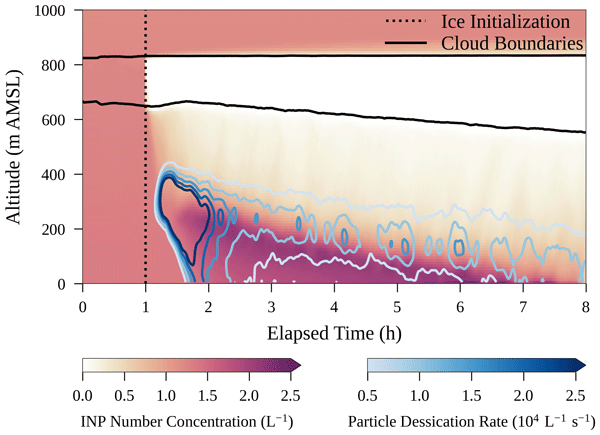
Arctic clouds with liquid and ice have important effects on climate. To investigate how ice crystals and liquid droplets grow in shallow Arctic clouds, we conducted high-resolution simulations. We find that drier air above the cloud leads to a greater sublimation rate of ice beneath the cloud and recycling of particles necessary for ice formation within the cloud. We also find that the amount of sublimation and recycling is affected by the rate of temperature change with height above the cloud.
Andrew Geiss, Johannes Mülmenstädt, Adam C. Varble, Matthew W. Christensen, and Heng Xiao
EGUsphere, https://doi.org/10.5194/egusphere-2026-4426, https://doi.org/10.5194/egusphere-2026-4426, 2026
This preprint is open for discussion and under review for Atmospheric Chemistry and Physics (ACP).
Short summary
Short summary
Cloud droplet and liquid water concentrations change in response to atmospheric aerosols, affecting cloud brightness, lifetime, and ultimately the Earth's climate. This study examines how the relationship between droplet number and liquid water concentrations varies by cloud type. We find that cloud type can be used to explain most variance in liquid water between satellite-observed cloud scenes, but the influence of droplet concentration on water content is largely independent of cloud type.
Johannes Kainz, Daniel P. Harrison, and Fabian Hoffmann
Atmos. Chem. Phys., 26, 9443–9451, https://doi.org/10.5194/acp-26-9443-2026, https://doi.org/10.5194/acp-26-9443-2026, 2026
Short summary
Short summary
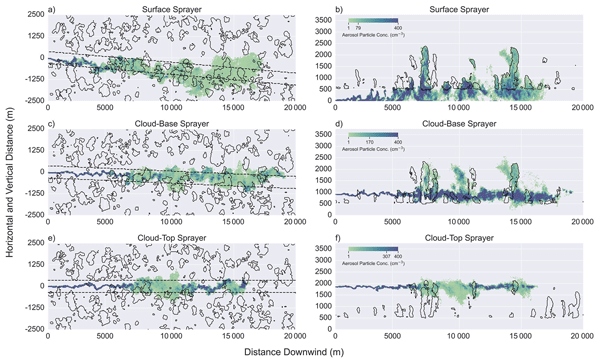
Marine Cloud Brightening (MCB) aims to counter global warming. It suggests to increase cloud reflectance by spraying aerosols from which additional cloud droplets can form. We demonstrate that MCB can be applied to cumulus clouds. The impact of aerosol particles released by a single aerosol sprayer using simulations is analyzed. The study draws conclusions on the optimal placement height of the sprayer to optimize aerosol transport, the ability to form new cloud droplets, and the area affected.
Benjamin Hernandez, Martin S. Singh, Takanobu Yamaguchi, Graham Feingold, and Franziska Glassmeier
Atmos. Chem. Phys., 26, 9337–9356, https://doi.org/10.5194/acp-26-9337-2026, https://doi.org/10.5194/acp-26-9337-2026, 2026
Short summary
Short summary
Using detailed numerical simulations, we quantify how stratocumulus cloud decks dissipate energy and produce entropy. We find that entropy production is dominated by irreversible moist processes and is much smaller than in deeper convective clouds. As a result, stratocumulus are remarkably inefficient at converting available energy into atmospheric motions.
Rebecca Gjini, Matthias Morzfeld, Franziska Glassmeier, and Graham Feingold
EGUsphere, https://doi.org/10.5194/egusphere-2026-2871, https://doi.org/10.5194/egusphere-2026-2871, 2026
Short summary
Short summary
We connect two very different types of precipitating stratocumulus cloud models. The first model is a high-resolution simulation that can realistically represent clouds. The second model is a simple, 1D equation that interprets clouds as prey and rain as the predator of clouds. We evaluate the extent to which a simplified cloud model can represent selected aspects of a realistic cloud simulation under different meteorological conditions, highlighting both successes and limitations.
Omer Roi-Cohen, Gaea Hadary, Casey J. Wall, Paulo Ceppi, and Guy Dagan
EGUsphere, https://doi.org/10.5194/egusphere-2026-3075, https://doi.org/10.5194/egusphere-2026-3075, 2026
Short summary
Short summary
When humans burn fossil fuels, released particles make clouds more reflective, cooling Earth. This effect is a major uncertainty in climate projections, and recent satellite studies disagree widely on its magnitude. We developed a framework, validated against models and observations, to test which analytical choices are most reliable. Our resulting estimate aligns with major international climate assessments, providing independent observational support for consensus climate projections.
Anna Weber, Fabian Hoffmann, and Bernhard Mayer
Atmos. Chem. Phys., 26, 8001–8020, https://doi.org/10.5194/acp-26-8001-2026, https://doi.org/10.5194/acp-26-8001-2026, 2026
Short summary
Short summary
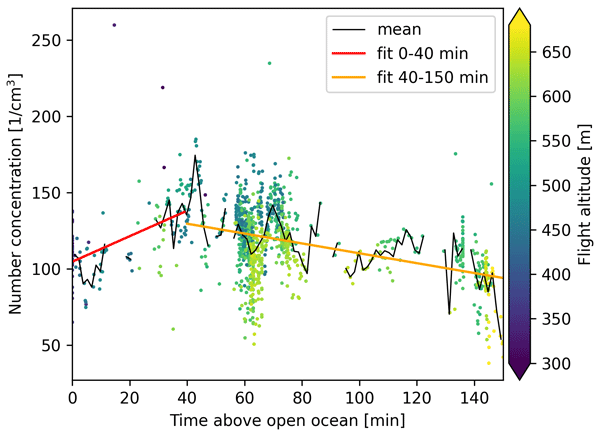
The vertical evolution of microphysical cloud properties in low-level mixed-phase clouds during a marine cold air outbreak in the Arctic is analyzed based on measurements collected during the HALO–(𝒜𝒞)3 campaign. In particular, pseudo-vertical profiles of cloud thermodynamic phase and the cloud droplet size are constructed. The measured vertical profiles are compared to predictions from an entraining parcel model to investigate the influence of ice processes on supercooled liquid water droplets.
Tom Goren, Goutam Choudhury, and Graham Feingold
Atmos. Chem. Phys., 26, 7193–7206, https://doi.org/10.5194/acp-26-7193-2026, https://doi.org/10.5194/acp-26-7193-2026, 2026
Short summary
Short summary
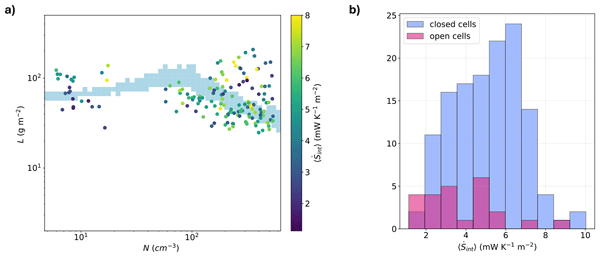
We introduce a new way to describe marine low cloud morphologies as a continuous range rather than discrete types. Using this approach, we show that cloud brightness responses to changes in droplet concentrations vary strongly across cloud morphologies, but the overall effect is small. This suggests that marine cloud brightening may rely more on increasing cloud cover than on making existing clouds brighter.
Jianhao Zhang, David Painemal, Tom Dror, Jung-Sub Lim, Armin Sorooshian, and Graham Feingold
Atmos. Chem. Phys., 26, 6015–6034, https://doi.org/10.5194/acp-26-6015-2026, https://doi.org/10.5194/acp-26-6015-2026, 2026
Short summary
Short summary
Clouds transitioning from overcast to broken fields play an important role in regulating the amount of sunlight reaching Earth’s surface. Using satellite imagery and a novel space-time exchange approach, we examine these transitions during marine cold-air outbreaks. Our analysis reveals characteristic signatures (or fingerprints) of liquid- and ice-phase processes, demonstrating how space-borne observations can provide new physical insight into cloud evolution.
Jung-Sub Lim and Fabian Hoffmann
Atmos. Chem. Phys., 26, 5427–5446, https://doi.org/10.5194/acp-26-5427-2026, https://doi.org/10.5194/acp-26-5427-2026, 2026
Short summary
Short summary
We used high-resolution simulations to track individual cloud droplets within marine clouds. We discovered that while droplets grow similarly, they evaporate differently depending on their specific history of exposure to dry air. This helps resolve ambiguities in interpreting field observations, where droplet history is often unknown. We also propose a simple formula to capture this variability, offering a more accurate tool for representing cloud evolution in models.
Prasanth Prabhakaran, Timothy A. Myers, Fabian Hoffmann, and Graham Feingold
Atmos. Chem. Phys., 26, 5151–5167, https://doi.org/10.5194/acp-26-5151-2026, https://doi.org/10.5194/acp-26-5151-2026, 2026
Short summary
Short summary
We explore how climate change and aerosol affect the evolution of marine low-clouds. Using high-resolution simulations, we find that warming has a stronger impact on these clouds, but aerosol becomes more important after the clouds form precipitation. Our results suggest that attempts to brighten these clouds using aerosol may become less effective in a warmer future due to the decrease in cloud cover.
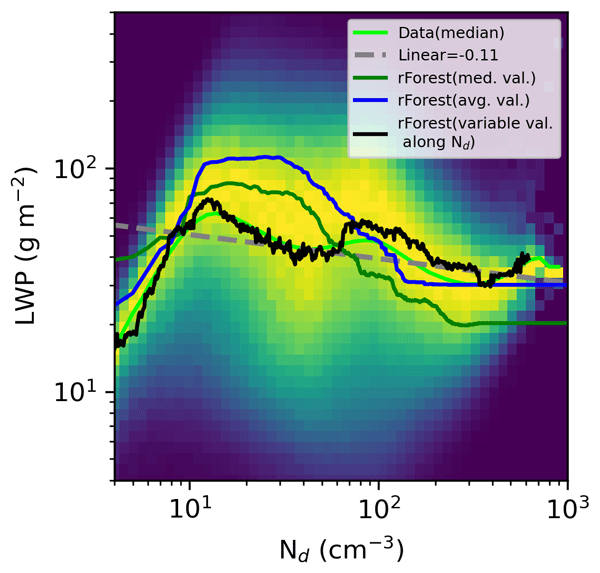
Matthew W. Christensen, Andrew Geiss, Adam C. Varble, and Po-Lun Ma
Atmos. Chem. Phys., 26, 59–76, https://doi.org/10.5194/acp-26-59-2026, https://doi.org/10.5194/acp-26-59-2026, 2026
Short summary
Short summary
We used satellite data and machine learning to better understand how tiny particles in the atmosphere affect clouds and their brightness. At higher spatial resolution, we discovered a new “M”-shaped pattern in the relationship between cloud water and droplet concentration unlike the inverted-V shape observed at coarsely gridded scales. Cloud water increases more with droplet concentration when rain is present. These findings support the development of next-generation atmospheric models.
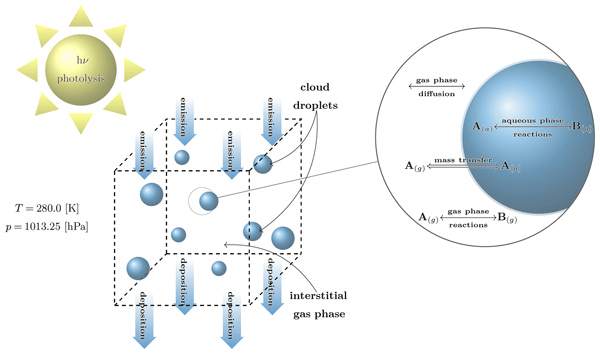
Levin Rug, Willi Schimmel, Fabian Hoffmann, and Oswald Knoth
Geosci. Model Dev., 18, 9039–9059, https://doi.org/10.5194/gmd-18-9039-2025, https://doi.org/10.5194/gmd-18-9039-2025, 2025
Short summary
Short summary
We present the Chemical Mechanism Integrator (Cminor) v1.0, a tool to predict concentrations of chemical compounds undergoing arbitrary reactions. Cminor is an advanced, open-source solver to model either combustion chemistry, or atmospheric chemistry and its direct influence on condensation of cloud droplets and the subsequent processing of aerosol. It uses the superdroplet idea, making it particularly feasible for coupling with such models, which is part of future work.
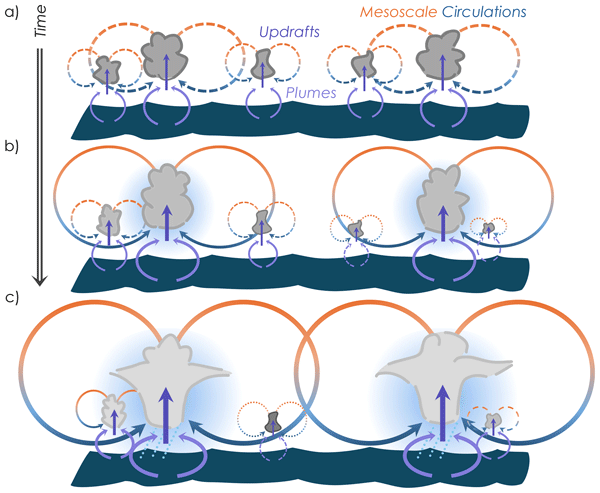
Isabel L. McCoy, Sunil Baidar, Paquita Zuidema, Jan Kazil, W. Alan Brewer, Wayne M. Angevine, and Graham Feingold
Atmos. Chem. Phys., 25, 16233–16261, https://doi.org/10.5194/acp-25-16233-2025, https://doi.org/10.5194/acp-25-16233-2025, 2025
Short summary
Short summary
We use ship observations to investigate the dynamics of small clouds over the tropical oceans. When these cumulus clouds cluster together, they more efficiently move moisture into the cloud layer due to strengthened updrafts. This encourages further clustering, increases local cloud development success, and may help sustain clouds against diurnal variations in their environment. These results have implications for cumulus feedback on the climate, a significant uncertainty in future projections.
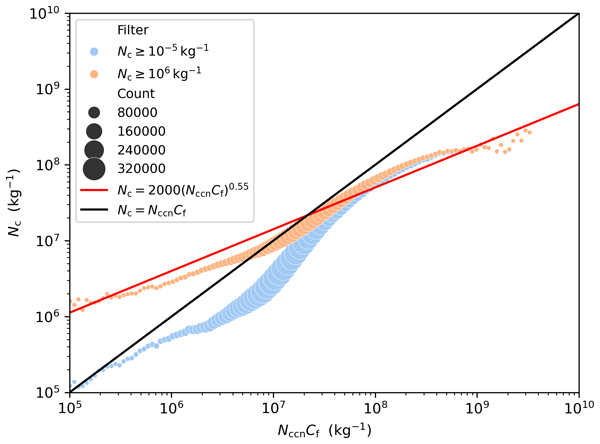
Naser Mahfouz, Hassan Beydoun, Johannes Mülmenstädt, Noel Keen, Adam C. Varble, Luca Bertagna, Peter Bogenschutz, Andrew Bradley, Matthew W. Christensen, T. Conrad Clevenger, Aaron Donahue, Jerome Fast, James Foucar, Jean-Christophe Golaz, Oksana Guba, Walter Hannah, Benjamin Hillman, Robert Jacob, Wuyin Lin, Po-Lun Ma, Yun Qian, Balwinder Singh, Christopher Terai, Hailong Wang, Mingxuan Wu, Kai Zhang, Andrew Gettelman, Mark Taylor, L. Ruby Leung, Peter Caldwell, and Susannah Burrows
Atmos. Chem. Phys., 25, 15105–15120, https://doi.org/10.5194/acp-25-15105-2025, https://doi.org/10.5194/acp-25-15105-2025, 2025
Short summary
Short summary
Our study assesses the aerosol effective radiative forcing in a global cloud-resolving atmosphere model at ultra-high resolution. We demonstrate that global aerosol forcing signal can be robustly reproduced across resolutions when aerosol activation processes are carefully parameterized. Further, we argue that simplified prescribed aerosol schemes will open the door for further process/mechanism studies under controlled conditions.
Graham Feingold, Franziska Glassmeier, Jianhao Zhang, and Fabian Hoffmann
Atmos. Chem. Phys., 25, 10869–10885, https://doi.org/10.5194/acp-25-10869-2025, https://doi.org/10.5194/acp-25-10869-2025, 2025
Short summary
Short summary
Scientists usually use snapshots of atmospheric data to glean understanding of time-evolving atmospheric processes. We examine how much can be learned about processes from snapshots using examples from cloud and atmospheric physics. We couch the analysis in terms of the theory of ergodic systems, space-time-exchange, and the Deborah number – concepts that are commonly applied in other branches of physics. We discuss the reasons for the varying degrees of success.
Fabian Hoffmann, Yao-Sheng Chen, and Graham Feingold
Atmos. Chem. Phys., 25, 8657–8670, https://doi.org/10.5194/acp-25-8657-2025, https://doi.org/10.5194/acp-25-8657-2025, 2025
Short summary
Short summary
Clouds reflect a substantial portion of the incoming solar radiation back into space. This capacity is determined by the number of cloud droplets, which in turn is influenced by the number of aerosol particles, forming the basis for aerosol–cloud–climate interactions. In this study, we use a simple entrainment parameterization to understand the effect of aerosol on cloud water in weakly and non-precipitating stratocumulus.
Yao-Sheng Chen, Prasanth Prabhakaran, Fabian Hoffmann, Jan Kazil, Takanobu Yamaguchi, and Graham Feingold
Atmos. Chem. Phys., 25, 6141–6159, https://doi.org/10.5194/acp-25-6141-2025, https://doi.org/10.5194/acp-25-6141-2025, 2025
Short summary
Short summary
Injecting sea salt aerosols into marine stratiform clouds can distribute the cloud water over more droplets in smaller sizes. This process is expected to make the clouds brighter, allowing them to reflect more sunlight back to space. However, it may also cause the clouds to lose water over time, reducing their ability to reflect sunlight. We use a computer model to show that the loss of cloud water occurs relatively quickly and does not completely offset the initial brightening.
Jung-Sub Lim, Yign Noh, Hyunho Lee, and Fabian Hoffmann
Atmos. Chem. Phys., 25, 5313–5329, https://doi.org/10.5194/acp-25-5313-2025, https://doi.org/10.5194/acp-25-5313-2025, 2025
Short summary
Short summary
Rain formation in warm clouds begins when small droplets collide, but this process can be slow without larger droplets. We used simulations to explore the role of bigger droplets, known as precipitation embryos, in triggering rain. We found that they speed up rain only when their size and number exceed a critical threshold. This threshold becomes larger when collisions are naturally efficient, such as in clouds with broad droplet size distributions or strong turbulence.
Fan Yang, Hamed Fahandezh Sadi, Raymond A. Shaw, Fabian Hoffmann, Pei Hou, Aaron Wang, and Mikhail Ovchinnikov
Atmos. Chem. Phys., 25, 3785–3806, https://doi.org/10.5194/acp-25-3785-2025, https://doi.org/10.5194/acp-25-3785-2025, 2025
Short summary
Short summary
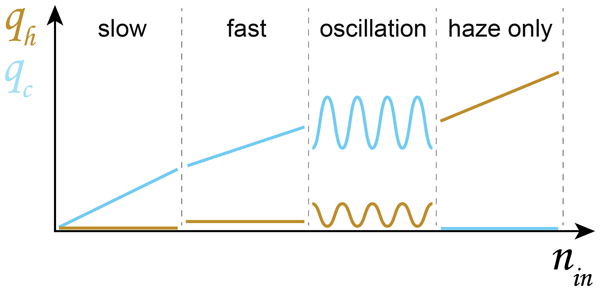
Large-eddy simulations of a convection cloud chamber show two new microphysics regimes, cloud oscillation and cloud collapse, due to haze–cloud interactions. Our results suggest that haze particles and their interactions with cloud droplets should be considered especially in polluted conditions. To properly simulate haze–cloud interactions, we need to resolve droplet activation and deactivation processes, instead of using Twomey-type activation parameterization.
Johannes Mülmenstädt, Andrew S. Ackerman, Ann M. Fridlind, Meng Huang, Po-Lun Ma, Naser Mahfouz, Susanne E. Bauer, Susannah M. Burrows, Matthew W. Christensen, Sudhakar Dipu, Andrew Gettelman, L. Ruby Leung, Florian Tornow, Johannes Quaas, Adam C. Varble, Hailong Wang, Kai Zhang, and Youtong Zheng
Atmos. Chem. Phys., 24, 13633–13652, https://doi.org/10.5194/acp-24-13633-2024, https://doi.org/10.5194/acp-24-13633-2024, 2024
Short summary
Short summary
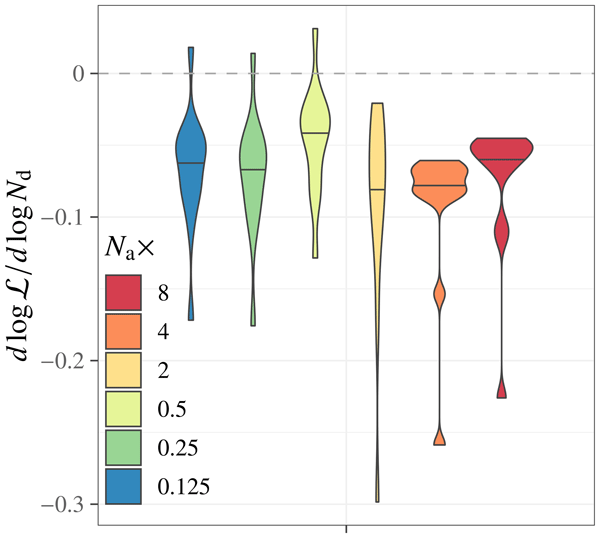
Stratocumulus clouds play a large role in Earth's climate by reflecting incoming solar energy back to space. Turbulence at stratocumulus cloud top mixes in dry, warm air, which can lead to cloud dissipation. This process is challenging for coarse-resolution global models to represent. We show that global models nevertheless agree well with our process understanding. Global models also think the process is less important for the climate than other lines of evidence have led us to conclude.
Fabian Hoffmann, Franziska Glassmeier, and Graham Feingold
Atmos. Chem. Phys., 24, 13403–13412, https://doi.org/10.5194/acp-24-13403-2024, https://doi.org/10.5194/acp-24-13403-2024, 2024
Short summary
Short summary
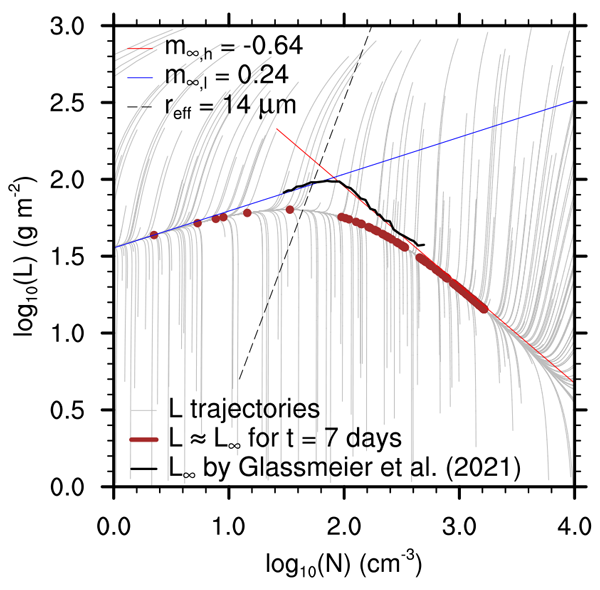
Clouds constitute a major cooling influence on Earth's climate system by reflecting a large fraction of the incident solar radiation back to space. This ability is controlled by the number of cloud droplets, which is governed by the number of aerosol particles in the atmosphere, laying the foundation for so-called aerosol–cloud–climate interactions. In this study, a simple model to understand the effect of aerosol on cloud water is developed and applied.
Yao-Sheng Chen, Jianhao Zhang, Fabian Hoffmann, Takanobu Yamaguchi, Franziska Glassmeier, Xiaoli Zhou, and Graham Feingold
Atmos. Chem. Phys., 24, 12661–12685, https://doi.org/10.5194/acp-24-12661-2024, https://doi.org/10.5194/acp-24-12661-2024, 2024
Short summary
Short summary
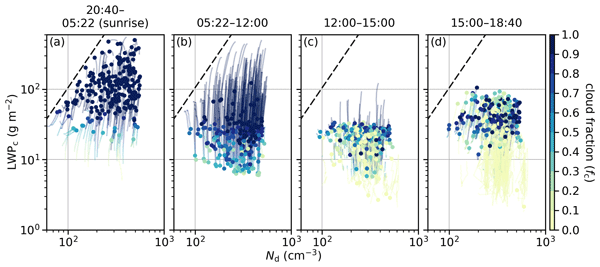
Marine stratocumulus cloud is a type of shallow cloud that covers the vast areas of Earth's surface. It plays an important role in Earth's energy balance by reflecting solar radiation back to space. We used numerical models to simulate a large number of marine stratocumuli with different characteristics. We found that how the clouds develop throughout the day is affected by the level of humidity in the air above the clouds and how closely the clouds connect to the ocean surface.
Jianhao Zhang, Yao-Sheng Chen, Takanobu Yamaguchi, and Graham Feingold
Atmos. Chem. Phys., 24, 10425–10440, https://doi.org/10.5194/acp-24-10425-2024, https://doi.org/10.5194/acp-24-10425-2024, 2024
Short summary
Short summary
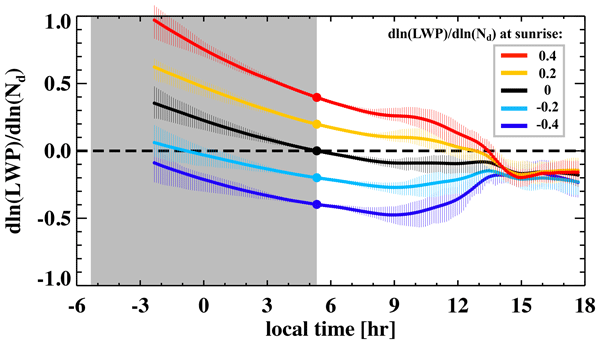
Quantifying cloud response to aerosol perturbations presents a major challenge in understanding the human impact on climate. Using a large number of process-resolving simulations of marine stratocumulus, we show that solar heating drives a negative feedback mechanism that buffers the persistent negative trend in cloud water adjustment after sunrise. This finding has implications for the dependence of the cloud cooling effect on the timing of deliberate aerosol perturbations.
Suf Lorian and Guy Dagan
Atmos. Chem. Phys., 24, 9323–9338, https://doi.org/10.5194/acp-24-9323-2024, https://doi.org/10.5194/acp-24-9323-2024, 2024
Short summary
Short summary
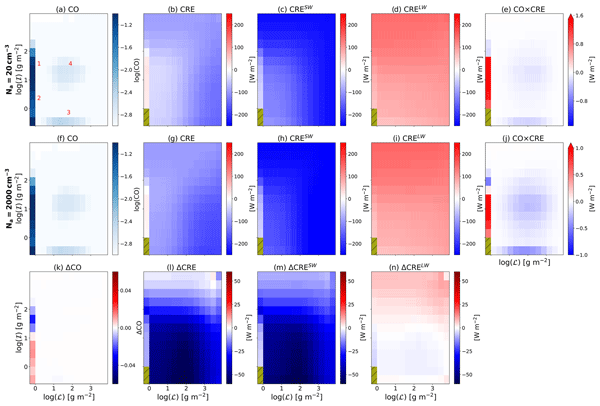
We examine the combined effect of aerosols and sea surface temperature (SST) on clouds under equilibrium conditions in cloud-resolving radiative–convective equilibrium simulations. We demonstrate that the aerosol–cloud interaction's effect on top-of-atmosphere energy gain strongly depends on the underlying SST, while the shortwave part of the spectrum is significantly more sensitive to SST. Furthermore, increasing aerosols influences upper-troposphere stability and thus anvil cloud fraction.
Johannes Mülmenstädt, Edward Gryspeerdt, Sudhakar Dipu, Johannes Quaas, Andrew S. Ackerman, Ann M. Fridlind, Florian Tornow, Susanne E. Bauer, Andrew Gettelman, Yi Ming, Youtong Zheng, Po-Lun Ma, Hailong Wang, Kai Zhang, Matthew W. Christensen, Adam C. Varble, L. Ruby Leung, Xiaohong Liu, David Neubauer, Daniel G. Partridge, Philip Stier, and Toshihiko Takemura
Atmos. Chem. Phys., 24, 7331–7345, https://doi.org/10.5194/acp-24-7331-2024, https://doi.org/10.5194/acp-24-7331-2024, 2024
Short summary
Short summary
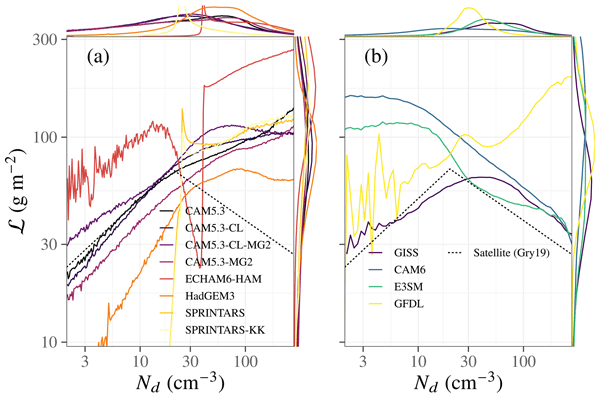
Human activities release copious amounts of small particles called aerosols into the atmosphere. These particles change how much sunlight clouds reflect to space, an important human perturbation of the climate, whose magnitude is highly uncertain. We found that the latest climate models show a negative correlation but a positive causal relationship between aerosols and cloud water. This means we need to be very careful when we interpret observational studies that can only see correlation.
Matthew W. Christensen, Peng Wu, Adam C. Varble, Heng Xiao, and Jerome D. Fast
Atmos. Chem. Phys., 24, 6455–6476, https://doi.org/10.5194/acp-24-6455-2024, https://doi.org/10.5194/acp-24-6455-2024, 2024
Short summary
Short summary
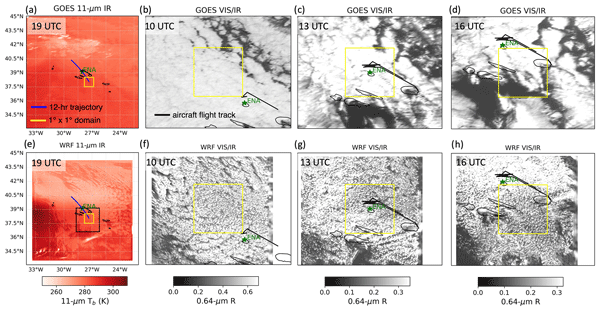
Clouds are essential to keep Earth cooler by reflecting sunlight back to space. We show that an increase in aerosol concentration suppresses precipitation in clouds, causing them to accumulate water and expand in a polluted environment with stronger turbulence and radiative cooling. This process enhances their reflectance by 51 %. It is therefore prudent to account for cloud fraction changes in assessments of aerosol–cloud interactions to improve predictions of climate change.
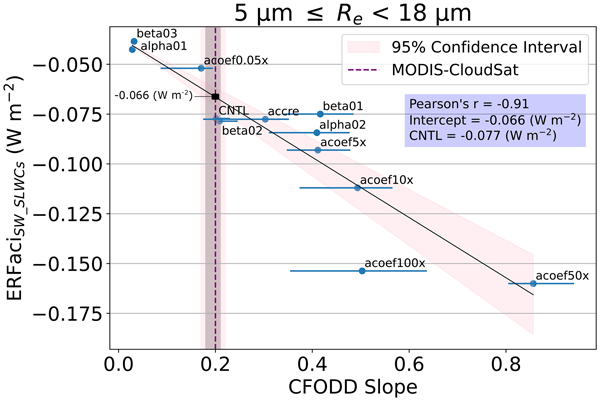
Charlotte M. Beall, Po-Lun Ma, Matthew W. Christensen, Johannes Mülmenstädt, Adam Varble, Kentaroh Suzuki, and Takuro Michibata
Atmos. Chem. Phys., 24, 5287–5302, https://doi.org/10.5194/acp-24-5287-2024, https://doi.org/10.5194/acp-24-5287-2024, 2024
Short summary
Short summary
Single-layer warm liquid clouds cover nearly one-third of the Earth's surface, and uncertainties regarding the impact of aerosols on their radiative properties pose a significant challenge to climate prediction. Here, we demonstrate how satellite observations can be used to constrain Earth system model estimates of the radiative forcing from the interactions of aerosols with clouds due to warm rain processes.
Yu Yao, Po-Lun Ma, Yi Qin, Matthew W. Christensen, Hui Wan, Kai Zhang, Balwinder Singh, Meng Huang, and Mikhail Ovchinnikov
EGUsphere, https://doi.org/10.5194/egusphere-2024-523, https://doi.org/10.5194/egusphere-2024-523, 2024
Preprint withdrawn
Short summary
Short summary
Giant aerosols have substantial effects on warm rain formation. However, it remains challenging to quantify the impact of giant particles at global scale. In this work, we applied earth system model to investigate its impacts by implementing new giant aerosol treatments to consider its physical process. We found this approach substantially affect liquid cloud and improved model's precipitation response to aerosols. Our findings demonstrate the significant impact of giant aerosols on climate.
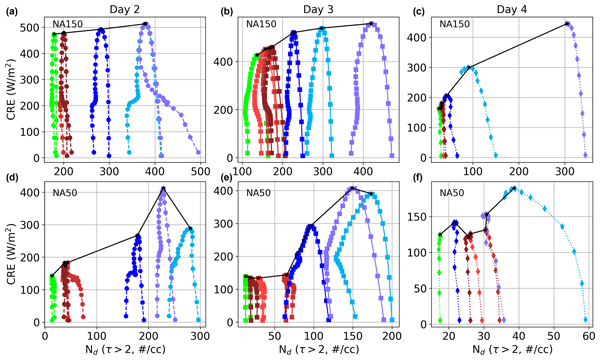
Prasanth Prabhakaran, Fabian Hoffmann, and Graham Feingold
Atmos. Chem. Phys., 24, 1919–1937, https://doi.org/10.5194/acp-24-1919-2024, https://doi.org/10.5194/acp-24-1919-2024, 2024
Short summary
Short summary
In this study, we explore the impact of deliberate aerosol perturbation in the northeast Pacific region using large-eddy simulations. Our results show that cloud reflectivity is sensitive to the aerosol sprayer arrangement in the pristine system, whereas in the polluted system it is largely proportional to the total number of aerosol particles injected. These insights would aid in assessing the efficiency of various aerosol injection strategies for climate intervention applications.
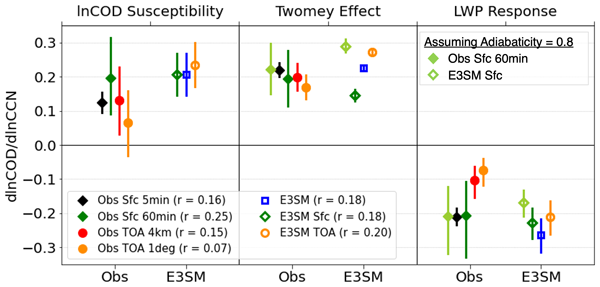
Adam C. Varble, Po-Lun Ma, Matthew W. Christensen, Johannes Mülmenstädt, Shuaiqi Tang, and Jerome Fast
Atmos. Chem. Phys., 23, 13523–13553, https://doi.org/10.5194/acp-23-13523-2023, https://doi.org/10.5194/acp-23-13523-2023, 2023
Short summary
Short summary
We evaluate how clouds change in response to changing atmospheric particle (aerosol) concentrations in a climate model and find that the model-predicted cloud brightness increases too much as aerosols increase because the cloud drop number increases too much. Excessive drizzle in the model mutes this difference. Many differences between observational and model estimates are explained by varying assumptions of how much liquid has been lost in clouds, which impacts the estimated cloud drop number.
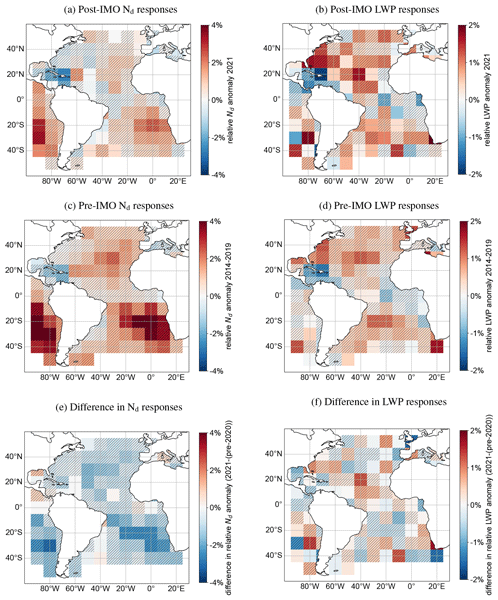
Peter Manshausen, Duncan Watson-Parris, Matthew W. Christensen, Jukka-Pekka Jalkanen, and Philip Stier
Atmos. Chem. Phys., 23, 12545–12555, https://doi.org/10.5194/acp-23-12545-2023, https://doi.org/10.5194/acp-23-12545-2023, 2023
Short summary
Short summary
Aerosol from burning fuel changes cloud properties, e.g., the number of droplets and the content of water. Here, we study how clouds respond to different amounts of shipping aerosol. Droplet numbers increase linearly with increasing aerosol over a broad range until they stop increasing, while the amount of liquid water always increases, independently of emission amount. These changes in cloud properties can make them reflect more or less sunlight, which is important for the earth's climate.

Hong Chen, K. Sebastian Schmidt, Steven T. Massie, Vikas Nataraja, Matthew S. Norgren, Jake J. Gristey, Graham Feingold, Robert E. Holz, and Hironobu Iwabuchi
Atmos. Meas. Tech., 16, 1971–2000, https://doi.org/10.5194/amt-16-1971-2023, https://doi.org/10.5194/amt-16-1971-2023, 2023
Short summary
Short summary
We introduce the Education and Research 3D Radiative Transfer Toolbox (EaR3T) and propose a radiance self-consistency approach for quantifying and mitigating 3D bias in legacy airborne and spaceborne imagery retrievals due to spatially inhomogeneous clouds and surfaces.
William K. Jones, Matthew W. Christensen, and Philip Stier
Atmos. Meas. Tech., 16, 1043–1059, https://doi.org/10.5194/amt-16-1043-2023, https://doi.org/10.5194/amt-16-1043-2023, 2023
Short summary
Short summary
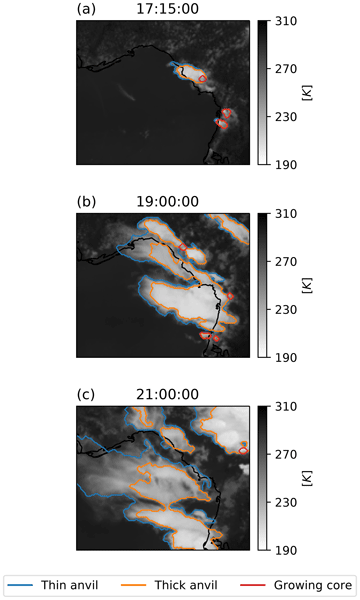
Geostationary weather satellites have been used to detect storm clouds since their earliest applications. However, this task remains difficult as imaging satellites cannot observe the strong vertical winds that are characteristic of storm clouds. Here we introduce a new method that allows us to detect the early development of storms and continue to track them throughout their lifetime, allowing us to study how their early behaviour affects subsequent weather.

Matthew W. Christensen, Po-Lun Ma, Peng Wu, Adam C. Varble, Johannes Mülmenstädt, and Jerome D. Fast
Atmos. Chem. Phys., 23, 2789–2812, https://doi.org/10.5194/acp-23-2789-2023, https://doi.org/10.5194/acp-23-2789-2023, 2023
Short summary
Short summary
An increase in aerosol concentration (tiny airborne particles) is shown to suppress rainfall and increase the abundance of droplets in clouds passing over Graciosa Island in the Azores. Cloud drops remain affected by aerosol for several days across thousands of kilometers in satellite data. Simulations from an Earth system model show good agreement, but differences in the amount of cloud water and its extent remain despite modifications to model parameters that control the warm-rain process.
Jianhao Zhang and Graham Feingold
Atmos. Chem. Phys., 23, 1073–1090, https://doi.org/10.5194/acp-23-1073-2023, https://doi.org/10.5194/acp-23-1073-2023, 2023
Short summary
Short summary
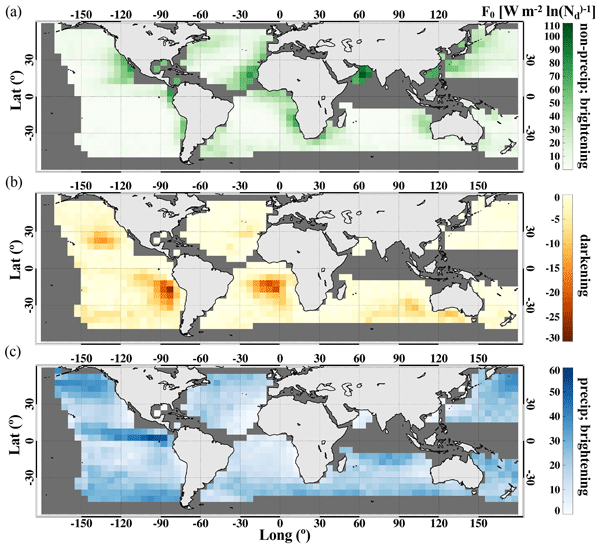
Using observations from space, we show maps of potential brightness changes in marine warm clouds in response to increases in cloud droplet concentrations. The environmental and aerosol conditions in which these clouds reside covary differently in each ocean basin, leading to distinct evolutions of cloud brightness changes. This work stresses the central importance of the covariability between meteorology and aerosol for scaling up the radiative response of cloud brightness changes.
Guy Dagan
Atmos. Chem. Phys., 22, 15767–15775, https://doi.org/10.5194/acp-22-15767-2022, https://doi.org/10.5194/acp-22-15767-2022, 2022
Short summary
Short summary
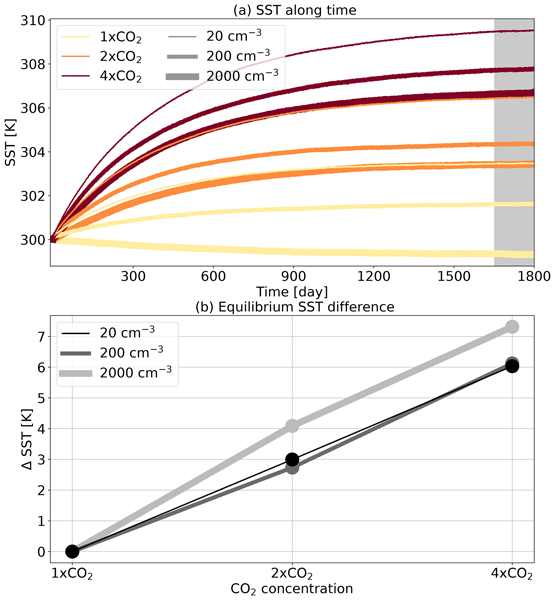
Using idealized simulations we demonstrate that the equilibrium climate sensitivity (ECS), i.e. the increase in surface temperature under equilibrium conditions due to doubling of the CO2 concentration, increases with the aerosol concentration. The ECS increase is explained by a faster increase in precipitation efficiency with warming under high aerosol concentrations, which more efficiently depletes the water from the cloud and thus is manifested as an increase in the cloud feedback parameter.
Michael S. Diamond, Pablo E. Saide, Paquita Zuidema, Andrew S. Ackerman, Sarah J. Doherty, Ann M. Fridlind, Hamish Gordon, Calvin Howes, Jan Kazil, Takanobu Yamaguchi, Jianhao Zhang, Graham Feingold, and Robert Wood
Atmos. Chem. Phys., 22, 12113–12151, https://doi.org/10.5194/acp-22-12113-2022, https://doi.org/10.5194/acp-22-12113-2022, 2022
Short summary
Short summary
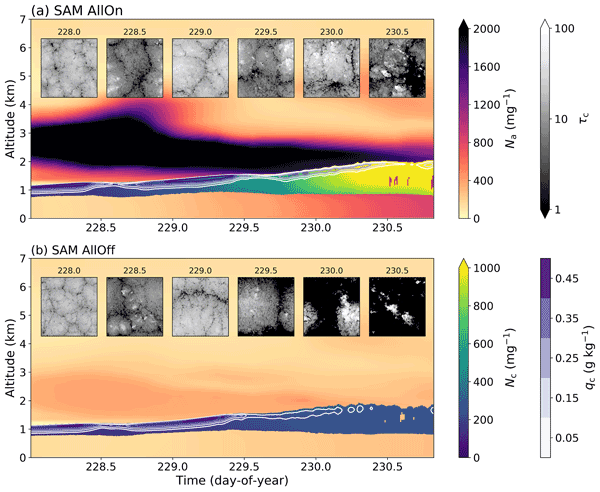
Smoke from southern Africa blankets the southeast Atlantic from June-October, overlying a major transition region between overcast and scattered clouds. The smoke affects Earth's radiation budget by absorbing sunlight and changing cloud properties. We investigate these effects in regional climate and large eddy simulation models based on international field campaigns. We find that large-scale circulation changes more strongly affect cloud transitions than smoke microphysical effects in our case.

Vikas Nataraja, Sebastian Schmidt, Hong Chen, Takanobu Yamaguchi, Jan Kazil, Graham Feingold, Kevin Wolf, and Hironobu Iwabuchi
Atmos. Meas. Tech., 15, 5181–5205, https://doi.org/10.5194/amt-15-5181-2022, https://doi.org/10.5194/amt-15-5181-2022, 2022
Short summary
Short summary
A convolutional neural network (CNN) is introduced to retrieve cloud optical thickness (COT) from passive cloud imagery. The CNN, trained on large eddy simulations from the Sulu Sea, learns from spatial information at multiple scales to reduce cloud inhomogeneity effects. By considering the spatial context of a pixel, the CNN outperforms the traditional independent pixel approximation (IPA) across several cloud morphology metrics.
Edward Gryspeerdt, Franziska Glassmeier, Graham Feingold, Fabian Hoffmann, and Rebecca J. Murray-Watson
Atmos. Chem. Phys., 22, 11727–11738, https://doi.org/10.5194/acp-22-11727-2022, https://doi.org/10.5194/acp-22-11727-2022, 2022
Short summary
Short summary
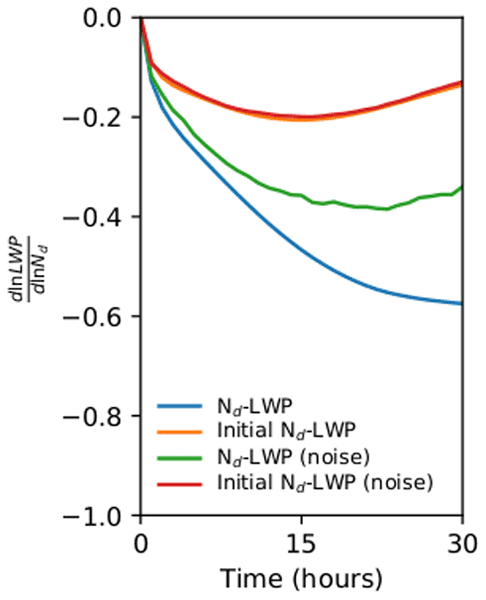
The response of clouds to changes in aerosol remains a large uncertainty in our understanding of the climate. Studies typically look at aerosol and cloud processes in snapshot images, measuring all properties at the same time. Here we use multiple images to characterise how cloud temporal development responds to aerosol. We find a reduction in liquid water path with increasing aerosol, party due to feedbacks. This suggests the aerosol impact on cloud water may be weaker than in previous studies.

Bernd Heinold, Holger Baars, Boris Barja, Matthew Christensen, Anne Kubin, Kevin Ohneiser, Kerstin Schepanski, Nick Schutgens, Fabian Senf, Roland Schrödner, Diego Villanueva, and Ina Tegen
Atmos. Chem. Phys., 22, 9969–9985, https://doi.org/10.5194/acp-22-9969-2022, https://doi.org/10.5194/acp-22-9969-2022, 2022
Short summary
Short summary
The extreme 2019–2020 Australian wildfires produced massive smoke plumes lofted into the lower stratosphere by pyrocumulonimbus convection. Most climate models do not adequately simulate the injection height of such intense fires. By combining aerosol-climate modeling with prescribed pyroconvective smoke injection and lidar observations, this study shows the importance of the representation of the most extreme wildfire events for estimating the atmospheric energy budget.
Graham Feingold, Tom Goren, and Takanobu Yamaguchi
Atmos. Chem. Phys., 22, 3303–3319, https://doi.org/10.5194/acp-22-3303-2022, https://doi.org/10.5194/acp-22-3303-2022, 2022
Short summary
Short summary
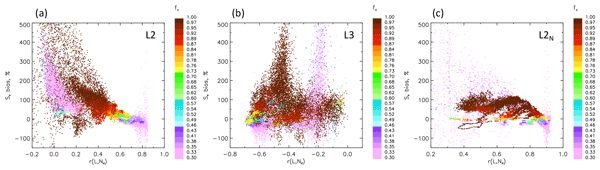
The evaluation of radiative forcing associated with aerosol–cloud interactions remains a significant source of uncertainty in future climate projections. Using high-resolution numerical model output, we mimic typical satellite retrieval methodologies to show that data aggregation can introduce significant error (hundreds of percent) in the cloud albedo susceptibility metric. Spatial aggregation errors tend to be countered by temporal aggregation errors.
Jianhao Zhang, Xiaoli Zhou, Tom Goren, and Graham Feingold
Atmos. Chem. Phys., 22, 861–880, https://doi.org/10.5194/acp-22-861-2022, https://doi.org/10.5194/acp-22-861-2022, 2022
Short summary
Short summary
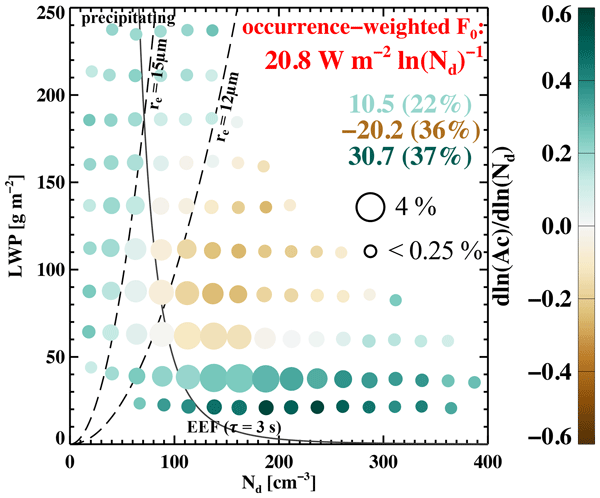
Oceanic liquid-form clouds are effective sunlight reflectors. Their brightness is highly sensitive to changes in the amount of aerosol particles in the atmosphere and the state of the atmosphere they reside in. This study quantifies this sensitivity using long-term satellite observations and finds an overall cloud brightening (a cooling effect) potential and an essential role of the covarying meteorological conditions in governing this sensitivity for northeastern Pacific stratocumulus.

Matthew W. Christensen, Andrew Gettelman, Jan Cermak, Guy Dagan, Michael Diamond, Alyson Douglas, Graham Feingold, Franziska Glassmeier, Tom Goren, Daniel P. Grosvenor, Edward Gryspeerdt, Ralph Kahn, Zhanqing Li, Po-Lun Ma, Florent Malavelle, Isabel L. McCoy, Daniel T. McCoy, Greg McFarquhar, Johannes Mülmenstädt, Sandip Pal, Anna Possner, Adam Povey, Johannes Quaas, Daniel Rosenfeld, Anja Schmidt, Roland Schrödner, Armin Sorooshian, Philip Stier, Velle Toll, Duncan Watson-Parris, Robert Wood, Mingxi Yang, and Tianle Yuan
Atmos. Chem. Phys., 22, 641–674, https://doi.org/10.5194/acp-22-641-2022, https://doi.org/10.5194/acp-22-641-2022, 2022
Short summary
Short summary
Trace gases and aerosols (tiny airborne particles) are released from a variety of point sources around the globe. Examples include volcanoes, industrial chimneys, forest fires, and ship stacks. These sources provide opportunistic experiments with which to quantify the role of aerosols in modifying cloud properties. We review the current state of understanding on the influence of aerosol on climate built from the wide range of natural and anthropogenic laboratories investigated in recent decades.
Cited articles
Abbott, T. H. and Cronin, T. W.: Aerosol invigoration of atmospheric convection through increases in humidity, Science, 371, 83–85, https://doi.org/10.1126/science.abc5181, 2021. a, b, c
Ackerman, A. S., Kirkpatrick, M. P., Stevens, B., and Toon, O. B.: The impact of humidity above stratiform clouds on indirect aerosol climate forcing, Nature, 432, 1014–1017, https://doi.org/10.1038/nature03174, 2004. a
Ahn, S. H., Yoon, Y. J., Choi, T. J., Lee, J. Y., Kim, Y. P., Lee, B. Y., and Jung, C. H.: Relationship between cloud condensation nuclei (CCN) concentration and aerosol optical depth in the Arctic region, Atmos. Environ., 267, 118748, https://doi.org/10.1016/j.atmosenv.2021.118748, 2021. a, b
Albrecht, B. A.: Aerosols, cloud microphysics, and fractional cloudiness, Science, 245, 1227–1230, https://doi.org/10.1126/science.245.4923.1227, 1989. a, b
Arieli, Y., Khain, A., Gavze, E., Altaratz, O., Eytan, E., and Koren, I.: The impact of regenerated aerosols on the microphysics of cumulus clouds, J. Atmos. Sci., 82, 2491–2503, https://doi.org/10.1175/JAS-D-25-0011.1, 2025. a
Bellouin, N., Quaas, J., Gryspeerdt, E., Kinne, S., Stier, P., Watson-Parris, D., Boucher, O., Carslaw, K. S., Christensen, M., Daniau, A.-L., Dufresne, J.-L., Feingold, G., Fiedler, S., Forster, P., Gettelman, A., Haywood, J. M., Lohmann, U., Malavelle, F., Mauritsen, T., McCoy, D. T., Myhre, G., Mülmenstädt, J., Neubauer, D., Possner, A., Rugenstein, M., Sato, Y., Schulz, M., Schwartz, S. E., Sourdeval, O., Storelvmo, T., Toll, V., Winker, D., and Stevens, B.: Bounding global aerosol radiative forcing of climate change, Rev. Geophys., 58, e2019RG000660, https://doi.org/10.1029/2019RG000660, 2020. a, b
Bolton, D.: The computation of equivalent potential temperature, Mon. Weather Rev., 108, 1046–1053, https://doi.org/10.1175/1520-0493(1980)108<1046:TCOEPT>2.0.CO;2, 1980. a
Bony, S., Stevens, B., Frierson, D. M. W., Jakob, C., Kageyama, M., Pincus, R., Shepherd, T. G., Sherwood, S. C., Siebesma, A. P., Sobel, A. H., Watanabe, M., and Webb, M. J.: Clouds, circulation and climate sensitivity, Nat. Geosci., 8, 261–268, https://doi.org/10.1038/ngeo2398, 2015. a, b, c, d
Bretherton, C., Blossey, P. N., and Uchida, J.: Cloud droplet sedimentation, entrainment efficiency, and subtropical stratocumulus albedo, Geophys. Res. Lett., 34, https://doi.org/10.1029/2006GL027648, 2007. a, b
Christensen, M. W., Chen, Y.-C., and Stephens, G. L.: Aerosol indirect effect dictated by liquid clouds, J. Geophys. Res.-Atmos., 121, 14–636, https://doi.org/10.1002/2016JD025245, 2016. a
Christensen, M. W., Gettelman, A., Cermak, J., Dagan, G., Diamond, M., Douglas, A., Feingold, G., Glassmeier, F., Goren, T., Grosvenor, D. P., Gryspeerdt, E., Kahn, R., Li, Z., Ma, P.-L., Malavelle, F., McCoy, I. L., McCoy, D. T., McFarquhar, G., Mülmenstädt, J., Pal, S., Possner, A., Povey, A., Quaas, J., Rosenfeld, D., Schmidt, A., Schrödner, R., Sorooshian, A., Stier, P., Toll, V., Watson-Parris, D., Wood, R., Yang, M., and Yuan, T.: Opportunistic experiments to constrain aerosol effective radiative forcing, Atmos. Chem. Phys., 22, 641–674, https://doi.org/10.5194/acp-22-641-2022, 2022. a, b
Christensen, M. W., Ma, P.-L., Wu, P., Varble, A. C., Mülmenstädt, J., and Fast, J. D.: Evaluation of aerosol–cloud interactions in E3SM using a Lagrangian framework, Atmos. Chem. Phys., 23, 2789–2812, https://doi.org/10.5194/acp-23-2789-2023, 2023. a
Chun, J.-Y., Wood, R., Blossey, P. N., and Doherty, S. J.: Impact on the stratocumulus-to-cumulus transition of the interaction of cloud microphysics and macrophysics with large-scale circulation, Atmos. Chem. Phys., 25, 5251–5271, https://doi.org/10.5194/acp-25-5251-2025, 2025. a, b
Dagan, G.: Sub‐Tropical Aerosols Enhance Tropical Cloudiness – A Remote Aerosol-Cloud Lifetime Effect, J. Adv. Model. Earth Sy., 14, e2022MS003368, https://doi.org/10.1029/2022MS003368, 2022. a
Dagan, G. and Chemke, R.: The effect of subtropical aerosol loading on equatorial precipitation, Geophys. Res. Lett., 43, 11–048, https://doi.org/10.1002/2016GL071206, 2016. a
Dagan, G. and Stier, P.: Ensemble daily simulations for elucidating cloud–aerosol interactions under a large spread of realistic environmental conditions, Atmos. Chem. Phys., 20, 6291–6303, https://doi.org/10.5194/acp-20-6291-2020, 2020. a
Dagan, G., Koren, I., Altaratz, O., and Heiblum, R. H.: Aerosol effect on the evolution of the thermodynamic properties of warm convective cloud fields, Sci. Rep., 6, 1–8, https://doi.org/10.1038/srep38769, 2016. a, b
Dagan, G., Koren, I., Altaratz, O., and Heiblum, R. H.: Time-dependent, non-monotonic response of warm convective cloud fields to changes in aerosol loading, Atmos. Chem. Phys., 17, 7435–7444, https://doi.org/10.5194/acp-17-7435-2017, 2017. a
Doelling, D. R., Sun, M., Nguyen, L. T., Nordeen, M. L., Haney, C. O., Keyes, D. F., and Mlynczak, P. E.: Advances in geostationary-derived longwave fluxes for the CERES synoptic (SYN1deg) product, J. Atmos. Ocean. Tech., 33, 503–521, https://doi.org/10.1175/JTECH-D-15-0147.1, 2016. a
Douglas, A. and L'Ecuyer, T.: Quantifying cloud adjustments and the radiative forcing due to aerosol–cloud interactions in satellite observations of warm marine clouds, Atmos. Chem. Phys., 20, 6225–6241, https://doi.org/10.5194/acp-20-6225-2020, 2020. a
Emanuel, K. A., David Neelin, J., and Bretherton, C. S.: On large-scale circulations in convecting atmospheres, Q. J. Roy. Meteor. Soc., 120, 1111–1143, https://doi.org/10.1002/qj.49712051902, 1994. a
Erfani, E., Blossey, P., Wood, R., Mohrmann, J., Doherty, S. J., Wyant, M., and O, K.-T.: Simulating aerosol lifecycle impacts on the subtropical stratocumulus-to-cumulus transition using large-eddy simulations, J. Geophys. Res.-Atmos., 127, e2022JD037258, https://doi.org/10.1029/2022JD037258, 2022. a
Erfani, E., Wood, R., Blossey, P., Doherty, S. J., and Eastman, R.: Building a comprehensive library of observed Lagrangian trajectories for testing modeled cloud evolution, aerosol–cloud interactions, and marine cloud brightening, Atmos. Chem. Phys., 25, 8743–8768, https://doi.org/10.5194/acp-25-8743-2025, 2025. a, b
Fons, E., Runge, J., Neubauer, D., and Lohmann, U.: Stratocumulus adjustments to aerosol perturbations disentangled with a causal approach, npj Climate and Atmospheric Science, 6, 130, https://doi.org/10.1038/s41612-023-00452-w, 2023. a
Gelaro, R., McCarty, W., Suárez, M. J., Todling, R., Molod, A., Takacs, L., Randles, C. A., Darmenov, A., Bosilovich, M. G., Reichle, R., Wargan, K., Coy, L., Cullather, R., Draper, C., Akella, S., Buchard, V., Conaty, A., da Silva, A. M., Gu, W., Kim, G.-K., Koster, R., Lucchesi, R., Merkova, D., Nielsen, J. E., Partyka, G., Pawson, S., Putman, W., Rienecker, M., Schubert, S. D., Sienkiewicz, M., and Zhao, B.: The Modern-Era Retrospective Analysis for Research and Applications, Version 2 (MERRA-2), J. Climate, 30, 5419–5454, https://doi.org/10.1175/JCLI-D-16-0758.1, 2017. a
George, R. C. and Wood, R.: Subseasonal variability of low cloud radiative properties over the southeast Pacific Ocean, Atmos. Chem. Phys., 10, 4047–4063, https://doi.org/10.5194/acp-10-4047-2010, 2010. a
Glassmeier, F., Hoffmann, F., Johnson, J. S., Yamaguchi, T., Carslaw, K. S., and Feingold, G.: Aerosol-cloud-climate cooling overestimated by ship-track data, Science, 371, 485–489, https://doi.org/10.1126/science.abd3980, 2021. a
Goren, T., Feingold, G., Gryspeerdt, E., Kazil, J., Kretzschmar, J., Jia, H., and Quaas, J.: Projecting stratocumulus transitions on the albedo–Cloud fraction relationship reveals linearity of albedo to droplet concentrations, Geophys. Res. Lett., 49, e2022GL101169, https://doi.org/10.1029/2022GL101169, 2022. a
Goren, T., Choudhury, G., Kretzschmar, J., and McCoy, I.: Co-variability drives the inverted-V sensitivity between liquid water path and droplet concentrations, Atmos. Chem. Phys., 25, 3413–3423, https://doi.org/10.5194/acp-25-3413-2025, 2025. a
Gryspeerdt, E. and Stier, P.: Regime-based analysis of aerosol‐cloud interactions, Geophys. Res. Lett., 39, https://doi.org/10.1029/2012GL053221, 2012. a
Gryspeerdt, E., Stier, P., and Partridge, D. G.: Satellite observations of cloud regime development: the role of aerosol processes, Atmos. Chem. Phys., 14, 1141–1158, https://doi.org/10.5194/acp-14-1141-2014, 2014. a
Gryspeerdt, E., Quaas, J., and Bellouin, N.: Constraining the aerosol influence on cloud fraction, J. Geophys. Res.-Atmos., 121, 3566–3583, https://doi.org/10.1002/2015JD023744, 2016. a
Gryspeerdt, E., Goren, T., Sourdeval, O., Quaas, J., Mülmenstädt, J., Dipu, S., Unglaub, C., Gettelman, A., and Christensen, M.: Constraining the aerosol influence on cloud liquid water path, Atmos. Chem. Phys., 19, 5331–5347, https://doi.org/10.5194/acp-19-5331-2019, 2019. a, b
Gulistan, N., Alam, K., and Liu, Y.: Influence of covariance of aerosol and meteorology on co-located precipitating and non-precipitating clouds over the Indo-Gangetic Plain, Atmos. Chem. Phys., 24, 11333–11349, https://doi.org/10.5194/acp-24-11333-2024, 2024. a
Haywood, J. M., Abel, S. J., Barrett, P. A., Bellouin, N., Blyth, A., Bower, K. N., Brooks, M., Carslaw, K., Che, H., Coe, H., Cotterell, M. I., Crawford, I., Cui, Z., Davies, N., Dingley, B., Field, P., Formenti, P., Gordon, H., de Graaf, M., Herbert, R., Johnson, B., Jones, A. C., Langridge, J. M., Malavelle, F., Partridge, D. G., Peers, F., Redemann, J., Stier, P., Szpek, K., Taylor, J. W., Watson-Parris, D., Wood, R., Wu, H., and Zuidema, P.: The CLoud–Aerosol–Radiation Interaction and Forcing: Year 2017 (CLARIFY-2017) measurement campaign, Atmos. Chem. Phys., 21, 1049–1084, https://doi.org/10.5194/acp-21-1049-2021, 2021. a
Hinkelman, L. M. and Marchand, R.: Evaluation of CERES and CloudSat Surface Radiative Fluxes Over Macquarie Island, the Southern Ocean, Earth Space Sci., 7, e2020EA001224, https://doi.org/10.1029/2020EA001224, 2020. a
Huffman, G. J., Bolvin, D. T., Braithwaite, D., Hsu, K., Joyce, R., and Xie, P.: Integrated Multi-satellite Retrievals for GPM (IMERG) Version 06, J. Hydrometeorol., 21, 387–403, https://doi.org/10.1175/JHM-D-19-0110.1, 2020. a
Huneeus, N., Gallardo, L., and Rutllant, J. A.: Offshore transport episodes of anthropogenic sulfur in northern Chile: Potential impact on the stratocumulus cloud deck, Geophys. Res. Lett., 33, L19603, https://doi.org/10.1029/2006GL027698, 2006. a
Jansson, F., Janssens, M., Grönqvist, J. H., Siebesma, A. P., Glassmeier, F., Attema, J., Azizi, V., Satoh, M., Sato, Y., Schulz, H., and Kölling, T.: Cloud botany: Shallow cumulus clouds in an ensemble of idealized large-domain large-eddy simulations of the trades, J. Adv. Model. Earth Sy., 15, e2023MS003796, https://doi.org/10.1029/2023MS003796, 2023. a
Kazil, J., Christensen, M. W., Abel, S. J., Yamaguchi, T., and Feingold, G.: Realism of Lagrangian large eddy simulations driven by reanalysis meteorology: Tracking a pocket of open cells under a biomass burning aerosol layer, J. Adv. Model. Earth Sy., 13, e2021MS002664, https://doi.org/10.1029/2021MS002664, 2021. a
Khairoutdinov, M. F. and Randall, D. A.: Cloud resolving modeling of the ARM summer 1997 IOP: Model formulation, results, uncertainties, and sensitivities, J. Atmos. Sci., 60, 607–625, https://doi.org/10.1175/1520-0469(2003)060<0607:CRMOTA>2.0.CO;2, 2003. a
Koren, I., Remer, L. A., Kaufman, Y. J., Rudich, Y., and Martins, J. V.: On the twilight zone between clouds and aerosols, Geophys. Res. Lett., 34, L08805, https://doi.org/10.1029/2007GL029253, 2007. a
Kurowski, M. J., Lebsock, M. D., and Smalley, K. M.: The diurnal susceptibility of subtropical clouds to aerosols, Atmos. Chem. Phys., 25, 15329–15342, https://doi.org/10.5194/acp-25-15329-2025, 2025. a
Lee, S. S., Feingold, G., and Chuang, P. Y.: Effect of aerosol on cloud–environment interactions in trade cumulus, J. Atmos. Sci., 69, 3607–3632, https://doi.org/10.1175/JAS-D-11-0211.1, 2012. a
Leung, G. R., Saleeby, S. M., Sokolowsky, G. A., Freeman, S. W., and van den Heever, S. C.: Aerosol–cloud impacts on aerosol detrainment and rainout in shallow maritime tropical clouds, Atmos. Chem. Phys., 23, 5263–5278, https://doi.org/10.5194/acp-23-5263-2023, 2023. a
Levy, R. C., Mattoo, S., Munchak, L. A., Remer, L. A., Sayer, A. M., Patadia, F., and Hsu, N. C.: The Collection 6 MODIS aerosol products over land and ocean, Atmos. Meas. Tech., 6, 2989–3034, https://doi.org/10.5194/amt-6-2989-2013, 2013. a
Li, J., Wang, Y., Li, J., Zhang, W., Zhang, L., and Wang, Y.: Strong aerosol indirect radiative effect from dynamic-driven diurnal variations of cloud water adjustments, Atmos. Chem. Phys., 25, 17455–17472, https://doi.org/10.5194/acp-25-17455-2025, 2025. a
Loeb, N. G., Doelling, D. R., Wang, H., Su, W., Nguyen, C., Corbett, J. G., Liang, L., Mitrescu, C., Rose, F. G., and Kato, S.: Clouds and the earth’s radiant energy system (CERES) energy balanced and filled (EBAF) top-of-atmosphere (TOA) edition-4.0 data product, J. Climate, 31, 895–918, https://doi.org/10.1175/JCLI-D-17-0208.1, 2018. a
McCoy, D. T., Bender, F. A.-M., Grosvenor, D. P., Mohrmann, J. K., Hartmann, D. L., Wood, R., and Field, P. R.: Predicting decadal trends in cloud droplet number concentration using reanalysis and satellite data, Atmos. Chem. Phys., 18, 2035–2047, https://doi.org/10.5194/acp-18-2035-2018, 2018. a, b
McCoy, I. L., McCoy, D. T., Wood, R., Regayre, L., Watson-Parris, D., Grosvenor, D. P., Mulcahy, J. P., Hu, Y., Bender, F. A.-M., Field, P. R., Carslaw, K. S., and Gordon, H.: The hemispheric contrast in cloud microphysical properties constrains aerosol forcing, P. Natl. Acad. Sci. USA, 117, 18998–19006, https://doi.org/10.1073/pnas.1922502117, 2020. a
McGibbon, J. and Bretherton, C. S.: Skill of ship‐following large‐eddy simulations in reproducing MAGIC observations across the northeast Pacific stratocumulus to cumulus transition region, J. Adv. Model. Earth Sy., 9, 810–831, https://doi.org/10.1002/2017MS000924, 2017. a
Mlawer, E. J., Taubman, S. J., Brown, P. D., Iacono, M. J., and Clough, S. A.: Radiative transfer for inhomogeneous atmospheres: RRTM, a validated correlated-k model for the longwave, J. Geophys. Res.-Atmos., 102, 16663–16682, https://doi.org/10.1029/97JD00237, 1997. a
Morrison, H., Curry, J., and Khvorostyanov, V.: A new double-moment microphysics parameterization for application in cloud and climate models. Part I: Description, J. Atmos. Sci., 62, 1665–1677, https://doi.org/10.1175/JAS3446.1, 2005. a
Muller, C. J. and Held, I. M.: Detailed investigation of the self-aggregation of convection in cloud-resolving simulations, J. Atmos. Sci., 69, 2551–2565, https://doi.org/10.1175/JAS-D-11-0257.1, 2012. a
Mülmenstädt, J., Gryspeerdt, E., Dipu, S., Quaas, J., Ackerman, A. S., Fridlind, A. M., Tornow, F., Bauer, S. E., Gettelman, A., Ming, Y., Zheng, Y., Ma, P.-L., Wang, H., Zhang, K., Christensen, M. W., Varble, A. C., Leung, L. R., Liu, X., Neubauer, D., Partridge, D. G., Stier, P., and Takemura, T.: General circulation models simulate negative liquid water path–droplet number correlations, but anthropogenic aerosols still increase simulated liquid water path, Atmos. Chem. Phys., 24, 7331–7345, https://doi.org/10.5194/acp-24-7331-2024, 2024. a
Neggers, R., Stevens, B., and Neelin, J.: Impact mechanisms of shallow cumulus convection on tropical climate dynamics, J. Climate, 20, 2623–2642, https://doi.org/10.1175/JCLI4079.1, 2007. a, b
Nishant, N. and Sherwood, S. C.: A cloud-resolving model study of aerosol-cloud correlation in a pristine maritime environment, Geophys. Res. Lett., 44, 5774–5781, https://doi.org/10.1002/2017GL073267, 2017. a
Platnick, S., Meyer, K. G., King, M. D., Wind, G., Amarasinghe, N., Marchant, B., Arnold, G. T., Zhang, Z., Hubanks, P. A., Holz, R. E., Yang, P., Ridgway, W. L., and Riedi, J.: The MODIS cloud optical and microphysical products: Collection 6 updates and examples from Terra and Aqua, IEEE T. Geosci. Remote, 55, 502–525, https://doi.org/10.1109/TGRS.2016.2610522, 2016. a
Pugsley, E., Gryspeerdt, E., and Nair, V.: Cloud fraction response to aerosol driven by nighttime processes, P. Natl. Acad. Sci. USA, 122, e2509949122, https://doi.org/10.1073/pnas.2509949122, 2025. a
Quaas, J., Andrews, T., Bellouin, N., Block, K., Boucher, O., Ceppi, P., Dagan, G., Doktorowski, S., Eichholz, H. M., Forster, P., Goren, T., Gryspeerdt, E., Hodnebrog, Ø., Jia, H., Kramer, R., Lange, C., Maycock, A. C., Mülmenstädt, J., Myhre, G., O'Connor, F. M., Pincus, R., Samset, B. H., Senf, F., Shine, K. P., Smith, C., Stjern, C. W., Takemura, T., Toll, V., and Wall, C. J.: Adjustments to climate perturbations-mechanisms, implications, observational constraints, AGU Advances, https://doi.org/10.1029/2023AV001144, 2024. a
Sandu, I., Stevens, B., and Pincus, R.: On the transitions in marine boundary layer cloudiness, Atmos. Chem. Phys., 10, 2377–2391, https://doi.org/10.5194/acp-10-2377-2010, 2010. a, b
Seifert, A. and Heus, T.: Large-eddy simulation of organized precipitating trade wind cumulus clouds, Atmos. Chem. Phys., 13, 5631–5645, https://doi.org/10.5194/acp-13-5631-2013, 2013. a, b, c
Siebesma, A. P., Bretherton, C. S., Brown, A., Chlond, A., Cuxart, J., Duynkerke, P. G., Jiang, H., Khairoutdinov, M., Lewellen, D., Moeng, C.-H., Sanchez, E., Stevens, B., and Stevens, D. E.: A large eddy simulation intercomparison study of shallow cumulus convection, J. Atmos. Sci., 60, 1201–1219, https://doi.org/10.1175/1520-0469(2003)60<1201:ALESIS>2.0.CO;2, 2003. a
Smalley, K. M., Lebsock, M. D., and Eastman, R.: Diurnal patterns in the observed cloud liquid water path response to droplet number perturbations, Geophys. Res. Lett., 51, e2023GL107323, https://doi.org/10.1029/2023GL107323, 2024. a
Spill, G., Stier, P., Field, P. R., and Dagan, G.: Effects of aerosol in simulations of realistic shallow cumulus cloud fields in a large domain, Atmos. Chem. Phys., 19, 13507–13517, https://doi.org/10.5194/acp-19-13507-2019, 2019. a
Spill, G., Stier, P., Field, P. R., and Dagan, G.: Contrasting responses of idealised and realistic simulations of shallow cumuli to aerosol perturbations, Geophys. Res. Lett., 48, e2021GL094137, https://doi.org/10.1029/2021GL094137, 2021. a
Stein, A., Draxler, R. R., Rolph, G. D., Stunder, B. J., Cohen, M., and Ngan, F.: NOAA's HYSPLIT atmospheric transport and dispersion modeling system, B. Am. Meteor. Soc., 96, 2059–2077, https://doi.org/10.1175/BAMS-D-14-00110.1, 2015a. a
Stein, A. F., Draxler, R. R., Rolph, G. D., Stunder, B. J., Cohen, M. D., and Ngan, F.: NOAA's HYSPLIT atmospheric transport and dispersion modeling system, B. Am. Meteor. Soc., 96, 2059–2077, https://doi.org/10.1175/BAMS-D-14-00110.1, 2015b. a
Stevens, B. and Feingold, G.: Untangling aerosol effects on clouds and precipitation in a buffered system, Nature, 461, 607–613, https://doi.org/10.1038/nature08281, 2009. a, b, c
Stier, P.: Limitations of passive remote sensing to constrain global cloud condensation nuclei, Atmos. Chem. Phys., 16, 6595–6607, https://doi.org/10.5194/acp-16-6595-2016, 2016. a, b, c
Twomey, S.: The influence of pollution on the shortwave albedo of clouds, J. Atmos. Sci., 34, 1149–1152, https://doi.org/10.1175/1520-0469(1977)034<1149:TIOPOT>2.0.CO;2, 1977. a, b
van der Dussen, J. J., de Roode, S. R., and Siebesma, A. P.: How large-scale subsidence affects stratocumulus transitions, Atmos. Chem. Phys., 16, 691–701, https://doi.org/10.5194/acp-16-691-2016, 2016. a
Voigt, A. and Shaw, T. A.: Circulation response to warming shaped by radiative changes of clouds and water vapour, Nat. Geosci., 8, 102–106, https://doi.org/10.1038/ngeo2345, 2015. a
Voigt, A., Albern, N., Ceppi, P., Grise, K., Li, Y., and Medeiros, B.: Clouds, radiation, and atmospheric circulation in the present-day climate and under climate change, Wiley Interdisciplinary Reviews: Climate Change, 12, e694, https://doi.org/10.1002/wcc.694, 2021. a
Wall, C. J., Norris, J. R., Possner, A., McCoy, D. T., McCoy, I. L., and Lutsko, N. J.: Assessing effective radiative forcing from aerosol-cloud interactions over the global ocean, P. Natl. Acad. Sci. USA, 119, e2210481119, https://doi.org/10.1073/pnas.2210481119, 2022. a, b, c
Wang, S., Wang, Q., and Feingold, G.: Turbulence, condensation, and liquid water transport in numerically simulated nonprecipitating stratocumulus clouds, J. Atmos. Sci., 60, 262–278, https://doi.org/10.1175/1520-0469(2003)060<0262:TCALWT>2.0.CO;2, 2003. a
Wood, R.: Stratocumulus Clouds, Mon. Weather Rev., 140, 2373–2423, https://doi.org/10.1175/MWR-D-11-00121.1, 2012. a, b
Wood, R.: Assessing the potential efficacy of marine cloud brightening for cooling Earth using a simple heuristic model, Atmos. Chem. Phys., 21, 14507–14533, https://doi.org/10.5194/acp-21-14507-2021, 2021. a
Wood, R., Bretherton, C., Huebert, B., Mechoso, C. R., and Weller, R.: VOCALS-SouthEast Pacific Regional Experiment (REx): Scientific Program Overview, Tech. rep., VOCALS Program Office, http://www.eol.ucar.edu/projects/vocals/ (last access: 16 June 2026), 2006. a
Xue, L., Teller, A., Rasmussen, R., Geresdi, I., and Pan, Z.: Effects of aerosol solubility and regeneration on warm-phase orographic clouds and precipitation simulated by a detailed bin microphysical scheme, J. Atmos. Sci., 67, 3336–3354, https://doi.org/10.1175/2010JAS3511.1, 2010. a
Yeheskel, N. and Dagan, G.: Dataset for the paper “A Robust Aerosol Impact on Clouds Along the Subtropical to Tropical Transition” by Yeheskel et al., Zenodo [data set], https://doi.org/10.5281/zenodo.18031100, 2025. a
Yamaguchi, T., Feingold, G., Kazil, J., and McComiskey, A.: Stratocumulus to cumulus transition in the presence of elevated smoke layers, Geophys. Res. Lett., 42, 10478–10485, https://doi.org/10.1002/2015GL066544, 2015. a, b, c
Yamaguchi, T., Feingold, G., and Kazil, J.: Stratocumulus to cumulus transition by drizzle, J. Adv. Model. Earth Sy., 9, 2333–2349, https://doi.org/10.1002/2017MS001104, 2017. a, b
Short summary
Aerosols influence cloud formation, structure, and radiative effects. As air masses move from the subtropics to the tropics, clouds transition from shallow to deeper systems. Using five years of satellite observations and numerical simulations, we find a robust aerosol impact on this Lagrangian cloud evolution: higher aerosol levels produce thicker, more reflective clouds, enhancing cooling and modifying energy and moisture transport toward the tropics.
Aerosols influence cloud formation, structure, and radiative effects. As air masses move from...


Altmetrics
Final-revised paper
Preprint