Articles | Volume 20, issue 13
https://doi.org/10.5194/acp-20-7895-2020
© Author(s) 2020. This work is distributed under
the Creative Commons Attribution 4.0 License.
https://doi.org/10.5194/acp-20-7895-2020
© Author(s) 2020. This work is distributed under
the Creative Commons Attribution 4.0 License.
Technical note: Equilibrium droplet size distributions in a turbulent cloud chamber with uniform supersaturation
Department of Atmospheric Sciences, University of Utah, Salt Lake City, Utah, USA
Related authors
James Simmons, Jesse Anderson, Corey Bois, Hamed Fahandezh Sadi, Kadja Flore Gali, Suryadev Pratap Singh, Andrei Vakhtin, Kurt Hibert, Bruce Boe, Youssef Wehbe, Steve Krueger, Raymond A. Shaw, and Will Cantrell
Atmos. Chem. Phys., 26, 10881–10891, https://doi.org/10.5194/acp-26-10881-2026, https://doi.org/10.5194/acp-26-10881-2026, 2026
Short summary
Short summary
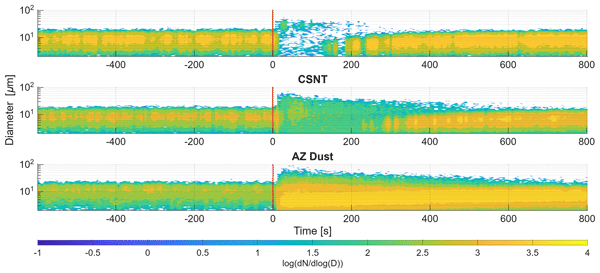
Precipitation from warm clouds requires large droplets to promote collision-coalescence. As part of an investigation into cloud seeding, we tested two hygroscopic materials in a laboratory cloud chamber where they formed large droplets and increased the concentration of liquid water. Sodium chloride particles with diameters of 4 to 25 micrometers proved most effective, supporting in-cloud seeding for precipitation enhancement in warm clouds, particularly in arid regions.
Zeen Zhu, Fan Yang, Steven Krueger, and Yangang Liu
Atmos. Chem. Phys., 25, 18461–18474, https://doi.org/10.5194/acp-25-18461-2025, https://doi.org/10.5194/acp-25-18461-2025, 2025
Short summary
Short summary
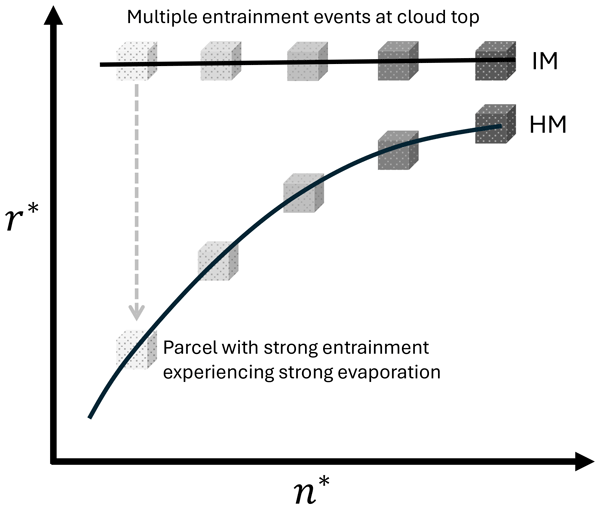
To better understand cloud behavior, we used model simulation to study how the air mix in clouds. Our results show that the pattern of mixing seen from aircraft measurements may not reflect the true mixing process happening inside clouds. This result suggests that care is needed when using aircraft data to study the cloud mixing process and that new ways of observing clouds could offer clearer insights.
Karlie N. Rees, Timothy J. Garrett, Thomas D. DeWitt, Corey Bois, Steven K. Krueger, and Jérôme C. Riedi
Nonlin. Processes Geophys., 31, 497–513, https://doi.org/10.5194/npg-31-497-2024, https://doi.org/10.5194/npg-31-497-2024, 2024
Short summary
Short summary
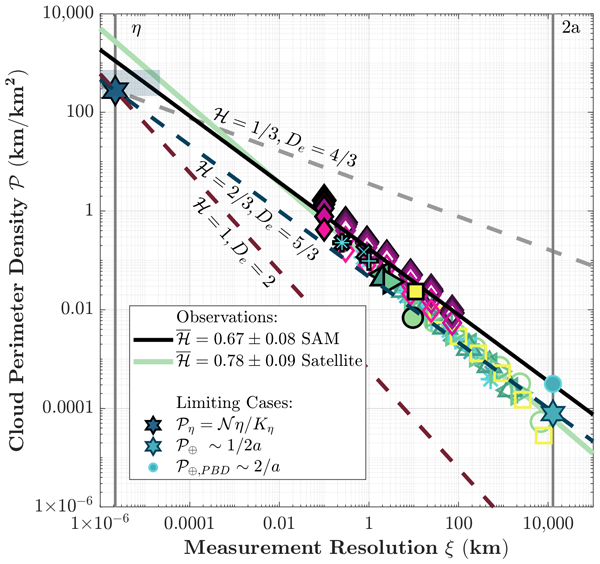
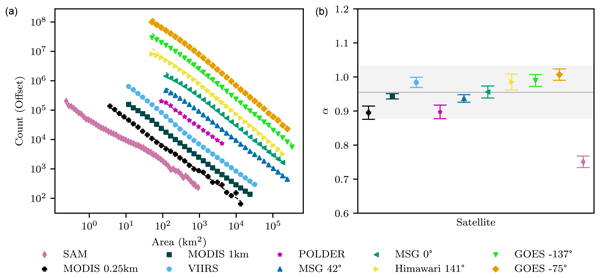
The shapes of clouds viewed from space reflect vertical and horizontal motions in the atmosphere. We theorize that, globally, cloud perimeter complexity is related to the dimension of turbulence also governed by horizontal and vertical motions. We find agreement between theory and observations from various satellites and a numerical model and, remarkably, that the theory applies globally using only basic planetary physical parameters from the smallest scales of turbulence to the planetary scale.
Aaron Wang, Steve Krueger, Sisi Chen, Mikhail Ovchinnikov, Will Cantrell, and Raymond A. Shaw
Atmos. Chem. Phys., 24, 10245–10260, https://doi.org/10.5194/acp-24-10245-2024, https://doi.org/10.5194/acp-24-10245-2024, 2024
Short summary
Short summary
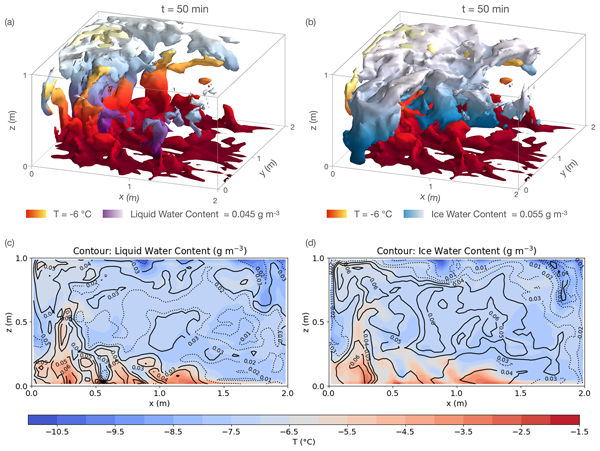
We employ two methods to examine a laboratory experiment on clouds with both ice and liquid phases. The first assumes well-mixed properties; the second resolves the spatial distribution of turbulence and cloud particles. Results show that while the trends in mean properties generally align, when turbulence is resolved, liquid droplets are not fully depleted by ice due to incomplete mixing. This underscores the threshold of ice mass fraction in distinguishing mixed-phase clouds from ice clouds.
Zeen Zhu, Fan Yang, Pavlos Kollias, Raymond A. Shaw, Alex B. Kostinski, Steve Krueger, Katia Lamer, Nithin Allwayin, and Mariko Oue
Atmos. Meas. Tech., 17, 1133–1143, https://doi.org/10.5194/amt-17-1133-2024, https://doi.org/10.5194/amt-17-1133-2024, 2024
Short summary
Short summary
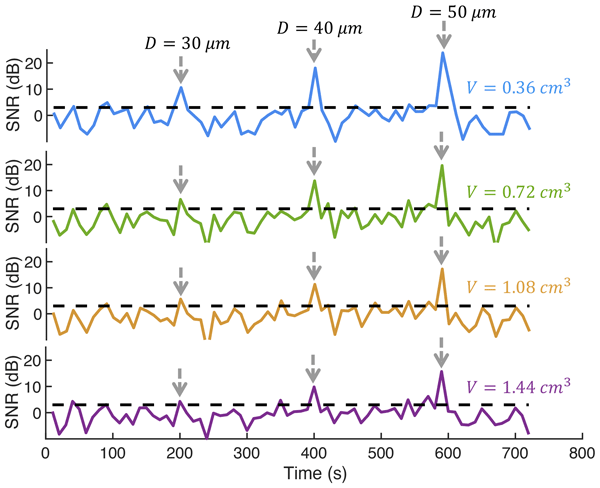
In this article, we demonstrate the feasibility of applying advanced radar technology to detect liquid droplets generated in the cloud chamber. Specifically, we show that using radar with centimeter-scale resolution, single drizzle drops with a diameter larger than 40 µm can be detected. This study demonstrates the applicability of remote sensing instruments in laboratory experiments and suggests new applications of ultrahigh-resolution radar for atmospheric sensing.
Thomas D. DeWitt, Timothy J. Garrett, Karlie N. Rees, Corey Bois, Steven K. Krueger, and Nicolas Ferlay
Atmos. Chem. Phys., 24, 109–122, https://doi.org/10.5194/acp-24-109-2024, https://doi.org/10.5194/acp-24-109-2024, 2024
Short summary
Short summary
Viewed from space, a defining feature of Earth's atmosphere is the wide spectrum of cloud sizes. A recent study predicted the distribution of cloud sizes, and this paper compares the prediction to observations. Although there is nuance in viewing perspective, we find robust agreement with theory across different climatological conditions, including land–ocean contrasts, time of year, or latitude, suggesting a minor role for Coriolis forces, aerosol loading, or surface temperature.
Cited articles
Chandrakar, K., Cantrell, W., Chang, K., Ciochetto, D., Niedermeier, D.,
Ovchinnikov, M., Shaw, R. A., and Yang, F.: Aerosol indirect effect from
turbulence-induced broadening of cloud-droplet size distributions, P.
Natl. Acad. Sci. USA, 113, 14243–14248, https://doi.org/10.1073/pnas.1612686113, 2016. a, b, c
Chandrakar, K. K., Cantrell, W., Ciochetto, D., Karki, S., Kinney, G., and
Shaw, R. A.: Aerosol removal and cloud collapse accelerated by
supersaturation fluctuations in turbulence, Geophys. Res. Lett., 44,
4359–4367, https://doi.org/10.1002/2017GL072762, 2017. a
Chandrakar, K. K., Cantrell, W., Kostinski, A., and Shaw, R. A.: Data
supporting the paper “Dispersion aerosol indirect effect in turbulent
clouds: Laboratory measurements of effective radius”, available at:
https://digitalcommons.mtu.edu/physics-fp/137 (last access: 22 October 2018),
2018b. a, b, c, d, e, f, g
Chandrakar, K. K., Cantrell, W., Krueger, S., Shaw, R. A., and Wunsch, S.:
Supersaturation fluctuations in moist turbulent Rayleigh-Bénard convection:
a two-scalar transport problem, J. Fluid Mech., 884, A19,
https://doi.org/10.1017/jfm.2019.895, 2020a. a
Chandrakar, K. K., Saito, I., Yang, F., Cantrell, W., Gotoh, T., and Shaw,
R. A.: Droplet size distributions in turbulent clouds: experimental
evaluation of theoretical distributions, Q. J. Roy.
Meteor. Soc., 146, 483–504, https://doi.org/10.1002/qj.3692,
2020b. a
Chang, K., Bench, J., Brege, M., Cantrell, W., Chandrakar, K., Ciochetto, D.,
Mazzoleni, C., Mazzoleni, L. R., Niedermeier, D., and Shaw, R. A.: A
laboratory facility to study gas-aerosol-cloud interactions in a turbulent
environment: The Π chamber, B. Am. Meteorol. Soc., 97, 2343–2358,
https://doi.org/10.1175/BAMS-D-15-00203.1, 2016. a
Garrett, T. J.: Analytical solutions for precipitation size distributions at
steady state, J. Atmos. Sci., 76, 1031–1037,
https://doi.org/10.1175/JAS-D-18-0309.1, 2019. a, b
Korolev, A. V. and Mazin, I. P.: Supersaturation of water vapor in clouds, J. Atmos. Sci., 60, 2957–2974, 2003. a
Nauman, E. B. and Buffham, B. A.: Mixing in Continuous Flow Systems, John Wiley
& Sons, New York, 1983. a
Saito, I., Gotoh, T., and Watanabe, T.: Broadening of cloud droplet size
distributions by condensation in turbulence, J. Meteorol.
Soc. Jpn., 97, 867–891, https://doi.org/10.2151/jmsj.2019-049, 2019. a, b, c
Siewert, C., Bec, J., and Krstulovic, G.: Statistical steady state in turbulent
droplet condensation, J. Fluid Mech., 810, 254–280,
https://doi.org/10.1017/jfm.2016.712, 2017. a
Squires, P.: The growth of cloud drops by condensation. I. General
characteristics, Aust. J. Sci. Res., 5, 66–86, https://doi.org/10.1071/CH9520059,
1952.
a
Srivastava, R. C.: Growth of cloud drops by condensation: Effect of surface
tension on the dispersion of drop sizes, J. Atmos. Sci., 48, 1596–1599,
https://doi.org/10.1175/1520-0469(1991)048<1596:GOCDBC>2.0.CO;2, 1991. a
Short summary
When CCN are injected into a turbulent cloud chamber at a constant rate, and the rate of droplet activation is balanced by the rate of droplet fallout, a steady-state droplet size distribution (DSD) can be achieved. Analytic DSDs and PDFs of droplet radius were derived for such conditions when there is uniform supersaturation. Given the chamber height, the analytic PDF is determined by the supersaturation alone. This could allow one to infer the supersaturation that produced a measured PDF.
When CCN are injected into a turbulent cloud chamber at a constant rate, and the rate of droplet...
Altmetrics
Final-revised paper
Preprint