
Articles | Volume 26, issue 4
https://doi.org/10.5194/acp-26-2487-2026
© Author(s) 2026. This work is distributed under
the Creative Commons Attribution 4.0 License.
the Creative Commons Attribution 4.0 License.
https://doi.org/10.5194/acp-26-2487-2026
© Author(s) 2026. This work is distributed under
the Creative Commons Attribution 4.0 License.
the Creative Commons Attribution 4.0 License.
Research article
| 
17 Feb 2026
Research article |
| 17 Feb 2026
| 17 Feb 2026
Detection of potential structural deficiencies in a global aerosol model using a perturbed parameter ensemble

School of Earth and Environment, University of Leeds, Leeds, LS2 9JT, UK
Leighton A. Regayre
School of Earth and Environment, University of Leeds, Leeds, LS2 9JT, UK
Met Office Hadley Centre, Exeter, Fitzroy Road, Exeter, Devon, EX1 3PB, UK
Centre for Environmental Modelling and Computation, School of Earth and Environment, University of Leeds, Leeds, LS29JT, UK
Jill S. Johnson
School of Mathematical and Physical Sciences, University of Sheffield, Sheffield, S3 7RH, UK
Doug McNeall
Met Office Hadley Centre, Exeter, Fitzroy Road, Exeter, Devon, EX1 3PB, UK
Sean Milton
School of Earth and Environment, University of Leeds, Leeds, LS2 9JT, UK
Kenneth S. Carslaw
School of Earth and Environment, University of Leeds, Leeds, LS2 9JT, UK
Related authors
Kunal Ghosh, Leighton A. Regayre, Léa Prévost, and Ken S. Carslaw
EGUsphere, https://doi.org/10.5281/zenodo.20374157, https://doi.org/10.5281/zenodo.20374157, 2026
This preprint is open for discussion and under review for Atmospheric Chemistry and Physics (ACP).
Short summary
Short summary
Tiny airborne particles affect climate by changing clouds, but this remains hard to predict. We tested whether an observed link between cloud droplet number and cloud water can reduce uncertainty in climate-model estimates. Using many versions of a climate model, we found that this link gives useful clues about cloud processes but cannot constrain aerosol–cloud climate effects on its own. Combining it with other observations helps, but also reveals weaknesses in how models represent clouds.

Leighton A. Regayre, Léa M. C. Prévost, Kunal Ghosh, Jill S. Johnson, Jeremy E. Oakley, Jonathan Owen, Iain Webb, and Ken S. Carslaw
Atmos. Chem. Phys., 26, 2293–2317, https://doi.org/10.5194/acp-26-2293-2026, https://doi.org/10.5194/acp-26-2293-2026, 2026
Short summary
Short summary
Tiny particles called aerosols affect how much sunlight the Earth reflects back into space – one of the biggest climate uncertainties. We use a large set of climate model simulations and find that uncertainty drops in some regions, but persists in other areas, after comparing models to observations. By identifying the specific processes that cause the remaining uncertainty, we guide future efforts to reduce the aerosol forcing uncertainty so we can make more reliable climate predictions.
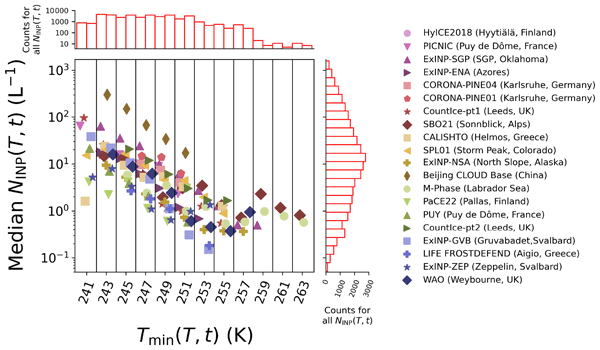
Ross J. Herbert, Larissa Lacher, Alexander Böhmländer, Mark D. Tarn, Antoine Canzi, Aidan Pantoya, Evelyn Freney, Kristina Höhler, Pia Bogert, Céline Planche, Ping Tian, Michael Adams, Sarah Barr, David Brus, Nicole Büttner, Martin Daily, Konstantinos Doulgeris, Konstantinos Eleftheriadis, Grant Forster, Romy Fösig, Dimitrios G. Georgakopoulos, Maria I. Gini, A. Gannet Hallar, Radovan Krejci, Elke Ludewig, Mauro Mazzola, Ian B. McCubbin, Athanasios Nenes, Tuukka Petäjä, Joseph Robinson, Franziska Vogel, Paul Zieger, Stephen Arnold, Kenneth S. Carslaw, Naruki Hiranuma, Ottmar Möhler, and Benjamin J. Murray
Earth Syst. Sci. Data, 18, 6465–6483, https://doi.org/10.5194/essd-18-6465-2026, https://doi.org/10.5194/essd-18-6465-2026, 2026
Short summary
Short summary
Ice formation in sub-zero clouds is influenced by airborne particles called ice-nucleating particles (INPs), whose concentrations vary substantially over short time and spatial scales. To assess the role of INPs in our climate, a comprehensive and consistent global dataset is essential. Our GloPINE model-ready dataset is a major step in this direction, comprising 36,000 measurements made using a single instrument design (PINE) over 70,000 hours of operation at 20 Northern Hemisphere sites.
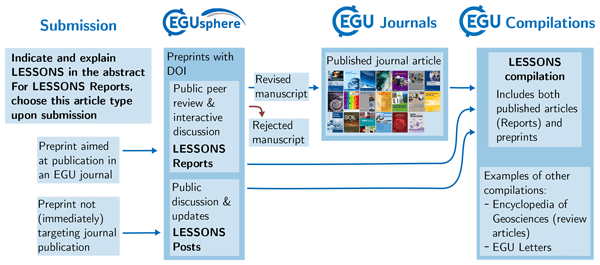
Ulrike Proske, John Hillier, Stefan Gaillard, Theresa Blume, Eduardo Queiroz Alves, Susanne Buiter, Ken S. Carslaw, Kirsten von Elverfeldt, Tim H. M. van Emmerik, Barbara Ervens, Rolf Hut, Sam Illingworth, Daniel Klotz, and Jonas Pyschik
Geosci. Commun., 9, 371–383, https://doi.org/10.5194/gc-9-371-2026, https://doi.org/10.5194/gc-9-371-2026, 2026
Short summary
Short summary
We explain a new article type that is being introduced in participating EGU publications. "LESSONS" articles describe the Limitations, Errors, Surprises, Shortcomings and Opportunities for New Science emerging from the scientific process. The publication of non-positive results and associated learnings aims to complete an unbiased record of the research effort, contributes to open and transparent science, allows the authors and others to learn, and may open opportunities for new science.
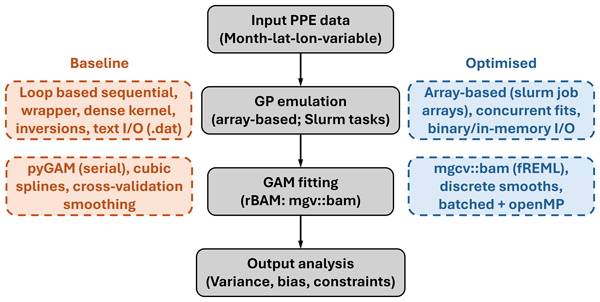
Kunal Ghosh and Leighton A. Regayre
Geosci. Model Dev., 19, 7767–7785, https://doi.org/10.5194/gmd-19-7767-2026, https://doi.org/10.5194/gmd-19-7767-2026, 2026
Short summary
Short summary
Understanding which parts of climate models cause uncertainty requires many large computer experiments. We developed a new workflow that greatly improves the speed and efficiency of these studies. It can analyse millions of model variations up to 25 times faster without losing accuracy, allowing scientists to explore uncertainty in more detail and make climate predictions more reliable.
Noah Liguori-Bills, Catherine E. Scott, Ken S. Carslaw, Natalie Kehrwald, Stijn Hantson, Susan Kaspari, Carlo Barbante, Elena Barbaro, Paolo Gabrielli, Roberta Zangrando, Lonnie G. Thompson, and Douglas S. Hamilton
EGUsphere, https://doi.org/10.5194/egusphere-2026-2728, https://doi.org/10.5194/egusphere-2026-2728, 2026
This preprint is open for discussion and under review for Atmospheric Chemistry and Physics (ACP).
Short summary
Short summary
Ice cores preserve changes in landscape fires and human-caused combustion. In this study, we compared ice core data from every continent, except Oceania, to computer model simulations of fire. We found a large disagreement in the 1850 CE to 1980 CE black carbon ratio. After exploring changes in emissions, transport, and aerosol microphysical processes as potential reasons for this disagreement, our results suggested that fire emission input datasets for climate models are the primary cause.
Prince Xavier, Martin Willett, Tim Graham, Paul Earnshaw, Dan Copsey, Nikesh Narayan, Charline Marzin, Alistair Sellar, Duncan Ackerley, Adam Blaker, Ed Blockley, Alejandro Bodas-Salcedo, Andrew Bushell, Nakbin Choi, Xin Rong Chua, Catherine Guiavarc'h, Muhammad Hassim, Julian Heming, Debra Hudson, Sarah Ineson, Anthony Jones, Colin Jones, Richard Keane, Kiwook Kim, Jiyeong Kim, Till Kuhlbrodt, Myong-In Lee, Richard Levine, Chen Li, Gill Martin, Alex Megann, Anne Mccabe, Aurel Moise, Leighton Regayre, Jeff Ridley, Luke Roberts, Sandeep Sahany, Reinhard K. H. Schiemann, David Storkey, Warren Tennant, Lorenzo Tomassini, Yoko Tsushima, Graham P. Weedon, Alex West, Matthew C. Wheeler, Keith Williams, Xiaobing Zhou, and Hongyan Zhu
EGUsphere, https://doi.org/10.5194/egusphere-2026-4281, https://doi.org/10.5194/egusphere-2026-4281, 2026
This preprint is open for discussion and under review for Geoscientific Model Development (GMD).
Short summary
Short summary
GC5 is the Met Office's newest climate and weather model, combining an updated atmosphere/land component with an improved ocean and sea-ice component. Compared to its predecessor GC4, it better simulates global temperatures, winds, monsoons over India and SE Asia, and African weather, and forecasts tropical cyclones more accurately. Southern Ocean errors shrank too. Some tropical patterns and regional biases worsened slightly. A lower-resolution version will underpin the UK's Earth System Model.
Kunal Ghosh, Leighton A. Regayre, Léa Prévost, and Ken S. Carslaw
EGUsphere, https://doi.org/10.5281/zenodo.20374157, https://doi.org/10.5281/zenodo.20374157, 2026
This preprint is open for discussion and under review for Atmospheric Chemistry and Physics (ACP).
Short summary
Short summary
Tiny airborne particles affect climate by changing clouds, but this remains hard to predict. We tested whether an observed link between cloud droplet number and cloud water can reduce uncertainty in climate-model estimates. Using many versions of a climate model, we found that this link gives useful clues about cloud processes but cannot constrain aerosol–cloud climate effects on its own. Combining it with other observations helps, but also reveals weaknesses in how models represent clouds.
Nick Schutgens, Elisabeth J. Andrews, Antti Arola, Yusuf Bhatti, Guanliang Fu, Otto Hasekamp, Pekka Kolmonen, Antti Lipponen, Tero Mielonen, Leighton Reygare, and Andrew M. Sayer
EGUsphere, https://doi.org/10.5194/egusphere-2026-2656, https://doi.org/10.5194/egusphere-2026-2656, 2026
This preprint is open for discussion and under review for Atmospheric Chemistry and Physics (ACP).
Short summary
Short summary
Aerosol are fine particles in the air that affect public health and the climate. We develop a new method to study aerosol through patterns (called autocorrelations) in their time-series. We show that autocorrelations are linked to aerosol deposition processes and contain information on the important but uncertain aerosol lifetime. Autocorrelations can be observed from satellites and we provide the first ever global climatology of aerosol autocorrelations.
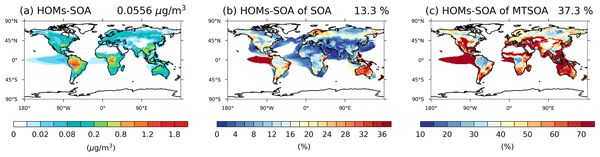
Xinyue Shao, Yaman Liu, Xinyi Dong, Minghuai Wang, Ruochong Xu, Joel A. Thornton, Duseong S. Jo, Man Yue, Wenxiang Shen, Manish Shrivastava, Stephen R. Arnold, and Ken S. Carslaw
Atmos. Chem. Phys., 26, 6427–6448, https://doi.org/10.5194/acp-26-6427-2026, https://doi.org/10.5194/acp-26-6427-2026, 2026
Short summary
Short summary
Highly Oxygenated Organic Molecules (HOMs) are key precursors of secondary organic aerosols (SOA). Incorporating the HOMs chemical mechanism into a global climate model allows for a reasonable reproduction of observed HOM characteristics. HOM-SOA constitutes a significant fraction of global SOA, and its distribution and formation pathways exhibit strong sensitivity to uncertainties in autoxidation processes and peroxy radical branching ratios.
Ken S. Carslaw, Leighton A. Regayre, Ulrike Proske, Andrew Gettelman, David M. H. Sexton, Yun Qian, Lauren R. Marshall, Oliver Wild, Marcus van Lier-Walqui, Annika Oertel, Saloua Peatier, Ben Yang, Jill S. Johnson, Sihan Li, Daniel T. McCoy, Benjamin M. Sanderson, Christina J. Williamson, Gregory S. Elsaesser, Kuniko Yamazaki, and Ben B. B. Booth
Atmos. Chem. Phys., 26, 4651–4667, https://doi.org/10.5194/acp-26-4651-2026, https://doi.org/10.5194/acp-26-4651-2026, 2026
Short summary
Short summary
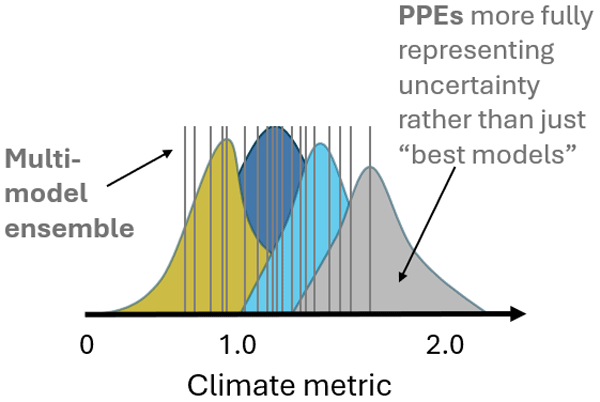
A major challenge in climate science is reducing projection uncertainty despite advances in models and observational constraints. Perturbed parameter ensembles (PPEs) offer a powerful tool to explore and reduce uncertainty by revealing model weaknesses and guiding development. PPEs are now widely applied across climate systems and scales. We argue they should be prioritized alongside complexity and resolution in model resource planning.
Xinyue Shao, Minghuai Wang, Xinyi Dong, Yaman Liu, Stephen R. Arnold, Leighton A. Regayre, Duseong S. Jo, Wenxiang Shen, Hao Wang, Man Yue, Jingyi Wang, Wenxin Zhang, and Ken S. Carslaw
Atmos. Chem. Phys., 26, 4439–4451, https://doi.org/10.5194/acp-26-4439-2026, https://doi.org/10.5194/acp-26-4439-2026, 2026
Short summary
Short summary
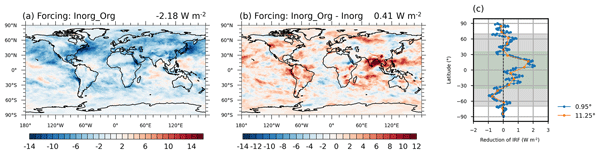
This study uses a global chemistry–climate model to investigate how new particle formation (NPF) from highly oxygenated organic molecules (HOMs) contributes to cloud condensation nuclei (CCN) in both preindustrial and present-day environments and its impact on aerosol indirect radiative forcing. The findings highlight the crucial role of biogenic emissions in climate change, providing new insights for carbon-neutral scenarios and enhancing our understanding of aerosol–cloud interactions.
Xu-Cheng He, Nathan Luke Abraham, Han Ding, Maria R. Russo, Daniel P. Grosvenor, Yao Ge, Xuemei Wang, Anthony C. Jones, Pedro Campuzano-Jost, Benjamin Nault, Agnieszka Kupc, Donald Blake, Jose L. Jimenez, Christina J. Williamson, James Weber, Alexander T. Archibald, and Hamish Gordon
Atmos. Chem. Phys., 26, 3805–3851, https://doi.org/10.5194/acp-26-3805-2026, https://doi.org/10.5194/acp-26-3805-2026, 2026
Short summary
Short summary
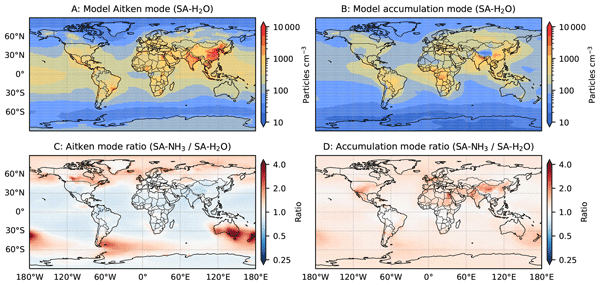
Aerosols affect clouds and climate. However, current climate models still struggle to simulate them accurately. We used aircraft data from a global mission to evaluate how well the UK Earth System Model represents aerosols and their precursors. Our results show that the model misses key formation processes in clean ocean regions, suggesting that future improvements should focus on better representing how aerosols form naturally in the atmosphere.
Leighton A. Regayre, Léa M. C. Prévost, Kunal Ghosh, Jill S. Johnson, Jeremy E. Oakley, Jonathan Owen, Iain Webb, and Ken S. Carslaw
Atmos. Chem. Phys., 26, 2293–2317, https://doi.org/10.5194/acp-26-2293-2026, https://doi.org/10.5194/acp-26-2293-2026, 2026
Short summary
Short summary
Tiny particles called aerosols affect how much sunlight the Earth reflects back into space – one of the biggest climate uncertainties. We use a large set of climate model simulations and find that uncertainty drops in some regions, but persists in other areas, after comparing models to observations. By identifying the specific processes that cause the remaining uncertainty, we guide future efforts to reduce the aerosol forcing uncertainty so we can make more reliable climate predictions.
Rachel W. N. Sansom, Jill S. Johnson, Leighton A. Regayre, Lindsay A. Lee, and Ken S. Carslaw
Atmos. Chem. Phys., 26, 1713–1733, https://doi.org/10.5194/acp-26-1713-2026, https://doi.org/10.5194/acp-26-1713-2026, 2026
Short summary
Short summary
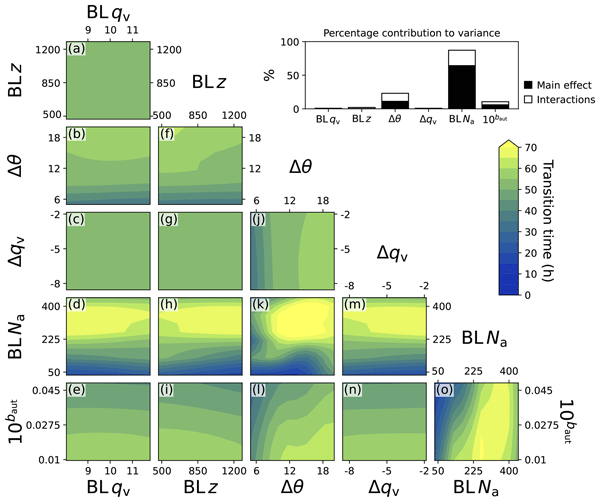
The cloud transition from stratocumulus to cumulus features a distinct decrease in cloud cover. We used a high-resolution model to simulate many instances of the transition with different environmental conditions. In low aerosol conditions, the transition occurred faster due to drizzle depleting the cloud of moisture and aerosol, whereas in high aerosol conditions, other factors were more important. Understanding different regimes is important for accurately simulating clouds in global models.
Xinyi Huang, Paul R. Field, Ross J. Herbert, Benjamin J. Murray, Floortje van den Heuvel, Daniel P. Grosvenor, Rachel W. N. Sansom, and Kenneth S. Carslaw
EGUsphere, https://doi.org/10.5194/egusphere-2026-311, https://doi.org/10.5194/egusphere-2026-311, 2026
Short summary
Short summary
Aerosol-cloud interactions and ice formation processes are key to modelling mixed-phase clouds in cold-air outbreaks. However, no studies have investigated the joint effects of these processes. Here, we used perturbed parameter ensembles and model emulators to show that these processes have strongly interacting effects on the properties of cold air outbreak clouds. Single sensitivity tests may therefore provide incomplete information about cloud-controlling factors.
Yusuf A. Bhatti, Duncan Watson-Parris, Leighton A. Regayre, Hailing Jia, David Neubauer, Ulas Im, Carl Svenhag, Nick Schutgens, Athanasios Tsikerdekis, Athanasios Nenes, Muhammed Irfan, Bastiaan van Diedenhoven, Ardit Arifi, Guangliang Fu, and Otto P. Hasekamp
Atmos. Chem. Phys., 26, 269–293, https://doi.org/10.5194/acp-26-269-2026, https://doi.org/10.5194/acp-26-269-2026, 2026
Short summary
Short summary
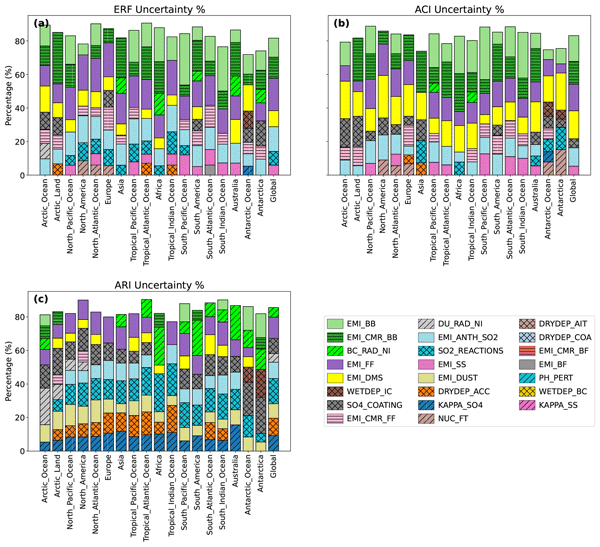
Aerosols (small airborne particles) impact Earth's climate, but their extent is unknown. By running climate model simulations and using machine learning to emulate millions of additional variants with different settings, we found that natural emissions like sea spray and sulfur are key sources of uncertainty in climate predictions. Our work shows that understanding these natural processes better can help improve climate models and make future climate projections more accurate.
Chihiro Matsukawa, José M. Rodríguez, and Sean F. Milton
Weather Clim. Dynam., 6, 1539–1564, https://doi.org/10.5194/wcd-6-1539-2025, https://doi.org/10.5194/wcd-6-1539-2025, 2025
Short summary
Short summary
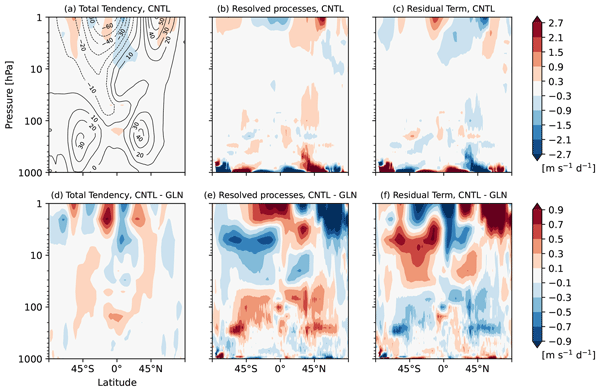
To identify sources of the model systematic errors, we investigate northern hemisphere mid-latitude wind errors at short- to medium-range timescale using the atmospheric zonal-mean budgets analysis and the relaxation technique. These process-based diagnostics specify to what extent the individual components in the budgets contribute to the total tendency of the corresponding variable. This study shows disentanglements of compensating errors caused by mechanical and thermal forcings.
Barbara Ervens, Ken S. Carslaw, Thomas Koop, and Ulrich Pöschl
Atmos. Chem. Phys., 25, 13903–13952, https://doi.org/10.5194/acp-25-13903-2025, https://doi.org/10.5194/acp-25-13903-2025, 2025
Short summary
Short summary
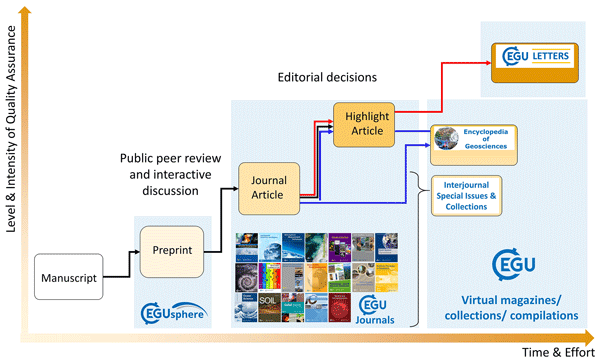
Over 25 years, the European Geosciences Union (EGU) has demonstrated the success, viability and benefits of interactive open-access (OA) publishing with public peer review in its journals, its publishing platform EGUsphere and virtual compilations. The article summarizes the evolution of the EGU/Copernicus publications and of OA publishing with interactive public peer review at large by placing the EGU/Copernicus publications in the context of current and future global open science.
Xinyi Huang, Paul R. Field, Benjamin J. Murray, Daniel P. Grosvenor, Floortje van den Heuvel, and Kenneth S. Carslaw
Atmos. Chem. Phys., 25, 11363–11406, https://doi.org/10.5194/acp-25-11363-2025, https://doi.org/10.5194/acp-25-11363-2025, 2025
Short summary
Short summary
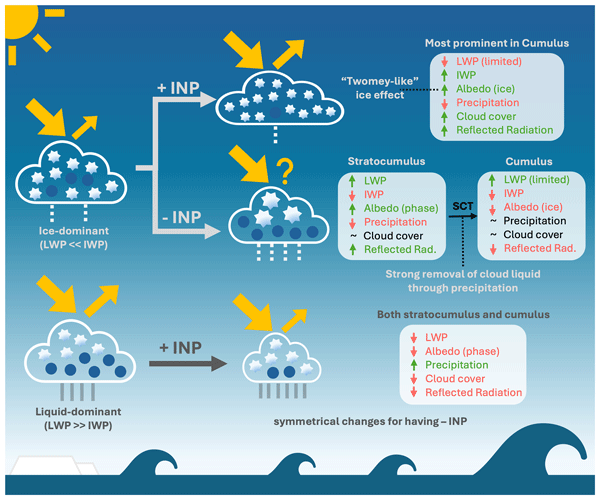
Cold-air outbreak (CAO) clouds play a vital role in climate prediction. This study explores the responses of CAO clouds to aerosols and ice production under different environmental conditions. We found that CAO cloud responses vary with cloud temperature and are strongly controlled by the liquid–ice partitioning in these clouds, suggesting the importance of good representations of cloud microphysics properties to predict the behaviours of CAO clouds in a warming climate.
Xuemei Wang, Kenneth S. Carslaw, Daniel P. Grosvenor, and Hamish Gordon
Atmos. Chem. Phys., 25, 9685–9717, https://doi.org/10.5194/acp-25-9685-2025, https://doi.org/10.5194/acp-25-9685-2025, 2025
Short summary
Short summary
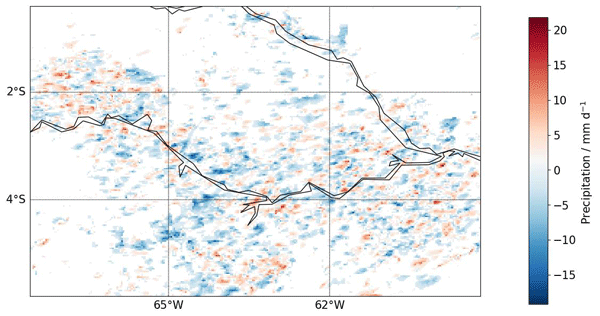
Anthropogenic emissions can influence aerosol particle number concentrations and cloud formation. Our model simulations predict around a 10 % increase in the particle and cloud droplet number concentrations when doubling the emissions in the Manaus region in the Amazonian wet season. However, the corresponding changes in cloud water and rain mass are around 4 %. Such a weak response implies that this convective environment is not sensitive to the localized anthropogenic emission changes here.
Camilla Mathison, Eleanor J. Burke, Gregory Munday, Chris D. Jones, Chris J. Smith, Norman J. Steinert, Andy J. Wiltshire, Chris Huntingford, Eszter Kovacs, Laila K. Gohar, Rebecca M. Varney, and Douglas McNeall
Geosci. Model Dev., 18, 1785–1808, https://doi.org/10.5194/gmd-18-1785-2025, https://doi.org/10.5194/gmd-18-1785-2025, 2025
Short summary
Short summary
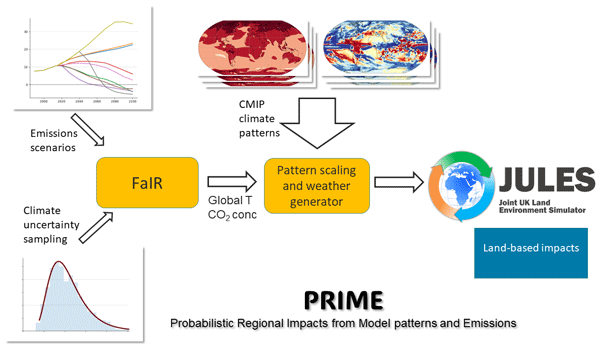
We present PRIME (Probabilistic Regional Impacts from Model patterns and Emissions), which is designed to take new emissions scenarios and rapidly provide regional impact information. PRIME allows large ensembles to be run on multi-centennial timescales, including the analysis of many important variables for impact assessments. Our evaluation shows that PRIME reproduces the climate response for known scenarios, providing confidence in using PRIME for novel scenarios.
Ross J. Herbert, Alberto Sanchez-Marroquin, Daniel P. Grosvenor, Kirsty J. Pringle, Stephen R. Arnold, Benjamin J. Murray, and Kenneth S. Carslaw
Atmos. Chem. Phys., 25, 291–325, https://doi.org/10.5194/acp-25-291-2025, https://doi.org/10.5194/acp-25-291-2025, 2025
Short summary
Short summary
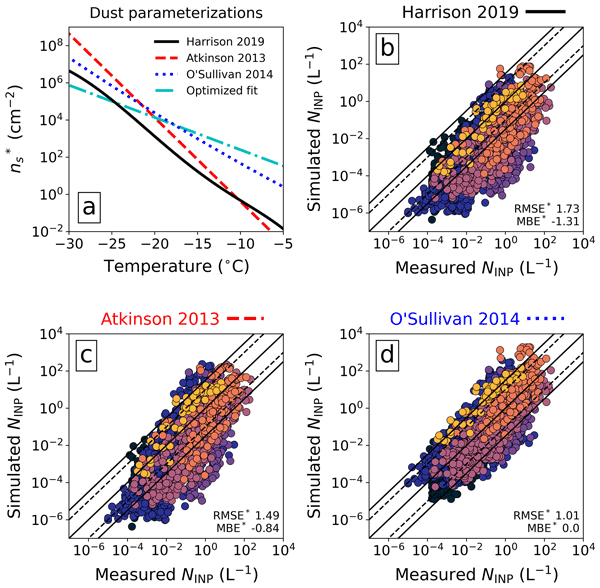
Aerosol particles that help form ice in clouds vary in number and type around the world and with time. However, in many weather and climate models cloud ice is not linked to aerosols that are known to nucleate ice. Here we report the first steps towards representing ice-nucleating particles within the UK Earth System Model. We conclude that in addition to ice nucleation by sea spray and mineral components of soil dust, we also need to represent ice nucleation by the organic components of soils.
Erin N. Raif, Sarah L. Barr, Mark D. Tarn, James B. McQuaid, Martin I. Daily, Steven J. Abel, Paul A. Barrett, Keith N. Bower, Paul R. Field, Kenneth S. Carslaw, and Benjamin J. Murray
Atmos. Chem. Phys., 24, 14045–14072, https://doi.org/10.5194/acp-24-14045-2024, https://doi.org/10.5194/acp-24-14045-2024, 2024
Short summary
Short summary
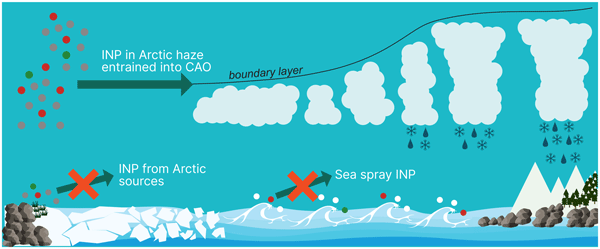
Ice-nucleating particles (INPs) allow ice to form in clouds at temperatures warmer than −35°C. We measured INP concentrations over the Norwegian and Barents seas in weather events where cold air is ejected from the Arctic. These concentrations were among the highest measured in the Arctic. It is likely that the INPs were transported to the Arctic from distant regions. These results show it is important to consider hemispheric-scale INP processes to understand INP concentrations in the Arctic.
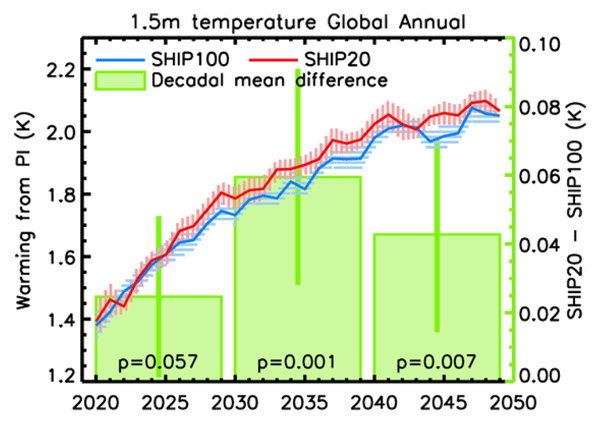
Masaru Yoshioka, Daniel P. Grosvenor, Ben B. B. Booth, Colin P. Morice, and Ken S. Carslaw
Atmos. Chem. Phys., 24, 13681–13692, https://doi.org/10.5194/acp-24-13681-2024, https://doi.org/10.5194/acp-24-13681-2024, 2024
Short summary
Short summary
A 2020 regulation has reduced sulfur emissions from shipping by about 80 %, leading to a decrease in atmospheric aerosols that have a cooling effect primarily by affecting cloud properties and amounts. Our climate model simulations predict a global temperature increase of 0.04 K over the next 3 decades as a result, which could contribute to surpassing the Paris Agreement's 1.5 °C target. Reduced aerosols may have also contributed to the recent temperature spikes.
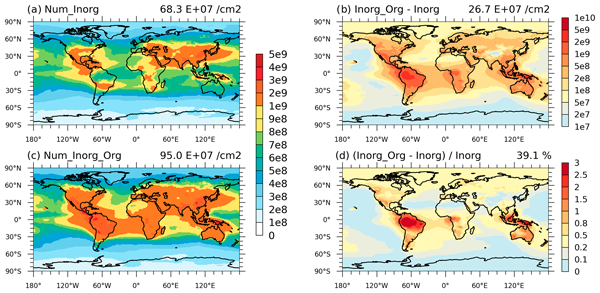
Xinyue Shao, Minghuai Wang, Xinyi Dong, Yaman Liu, Wenxiang Shen, Stephen R. Arnold, Leighton A. Regayre, Meinrat O. Andreae, Mira L. Pöhlker, Duseong S. Jo, Man Yue, and Ken S. Carslaw
Atmos. Chem. Phys., 24, 11365–11389, https://doi.org/10.5194/acp-24-11365-2024, https://doi.org/10.5194/acp-24-11365-2024, 2024
Short summary
Short summary
Highly oxygenated organic molecules (HOMs) play an important role in atmospheric new particle formation (NPF). By semi-explicitly coupling the chemical mechanism of HOMs and a comprehensive nucleation scheme in a global climate model, the updated model shows better agreement with measurements of nucleation rate, growth rate, and NPF event frequency. Our results reveal that HOM-driven NPF leads to a considerable increase in particle and cloud condensation nuclei burden globally.
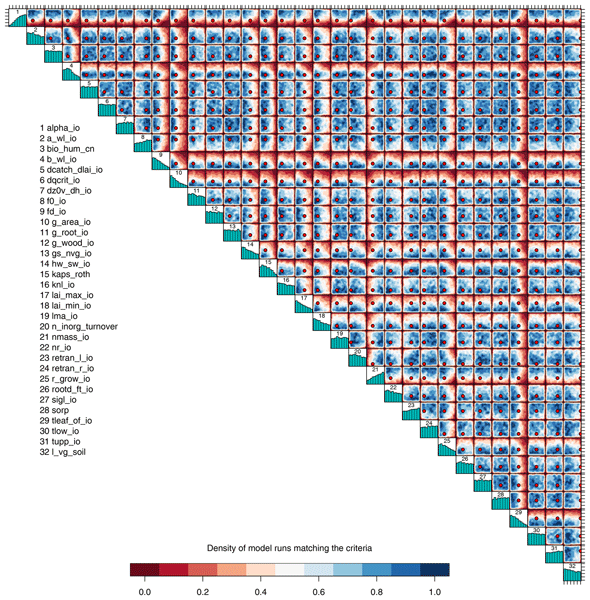
Douglas McNeall, Eddy Robertson, and Andy Wiltshire
Geosci. Model Dev., 17, 1059–1089, https://doi.org/10.5194/gmd-17-1059-2024, https://doi.org/10.5194/gmd-17-1059-2024, 2024
Short summary
Short summary
We can run simulations of the land surface and carbon cycle, using computer models to help us understand and predict climate change and its impacts. These simulations are not perfect reproductions of the real land surface, and that can make them less effective tools. We use new statistical and computational techniques to help us understand how different our models are from the real land surface, how to make them more realistic, and how well we can simulate past and future climate.
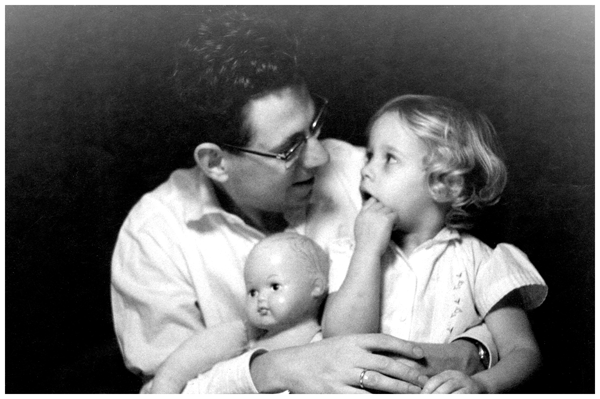
Rolf Müller, Ulrich Pöschl, Thomas Koop, Thomas Peter, and Ken Carslaw
Atmos. Chem. Phys., 23, 15445–15453, https://doi.org/10.5194/acp-23-15445-2023, https://doi.org/10.5194/acp-23-15445-2023, 2023
Short summary
Short summary
Paul J. Crutzen was a pioneer in atmospheric sciences and a kind-hearted, humorous person with empathy for the private lives of his colleagues and students. He made fundamental scientific contributions to a wide range of scientific topics in all parts of the atmosphere. Paul was among the founders of the journal Atmospheric Chemistry and Physics. His work will continue to be a guide for generations of scientists and environmental policymakers to come.
Hamza Ahsan, Hailong Wang, Jingbo Wu, Mingxuan Wu, Steven J. Smith, Susanne Bauer, Harrison Suchyta, Dirk Olivié, Gunnar Myhre, Hitoshi Matsui, Huisheng Bian, Jean-François Lamarque, Ken Carslaw, Larry Horowitz, Leighton Regayre, Mian Chin, Michael Schulz, Ragnhild Bieltvedt Skeie, Toshihiko Takemura, and Vaishali Naik
Atmos. Chem. Phys., 23, 14779–14799, https://doi.org/10.5194/acp-23-14779-2023, https://doi.org/10.5194/acp-23-14779-2023, 2023
Short summary
Short summary
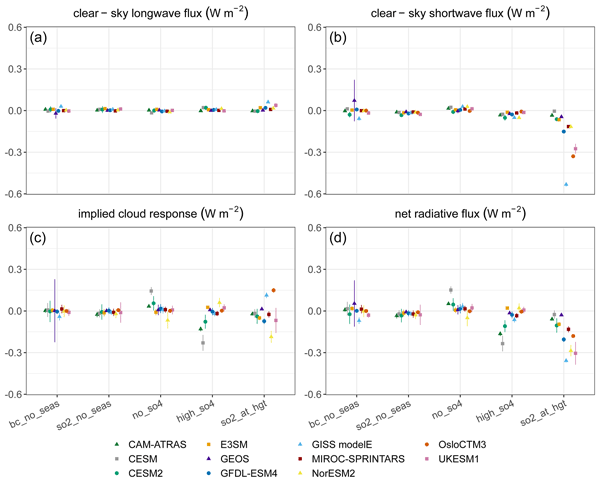
We examine the impact of the assumed effective height of SO2 injection, SO2 and BC emission seasonality, and the assumed fraction of SO2 emissions injected as SO4 on climate and chemistry model results. We find that the SO2 injection height has a large impact on surface SO2 concentrations and, in some models, radiative flux. These assumptions are a
hiddensource of inter-model variability and may be leading to bias in some climate model results.
Leighton A. Regayre, Lucia Deaconu, Daniel P. Grosvenor, David M. H. Sexton, Christopher Symonds, Tom Langton, Duncan Watson-Paris, Jane P. Mulcahy, Kirsty J. Pringle, Mark Richardson, Jill S. Johnson, John W. Rostron, Hamish Gordon, Grenville Lister, Philip Stier, and Ken S. Carslaw
Atmos. Chem. Phys., 23, 8749–8768, https://doi.org/10.5194/acp-23-8749-2023, https://doi.org/10.5194/acp-23-8749-2023, 2023
Short summary
Short summary
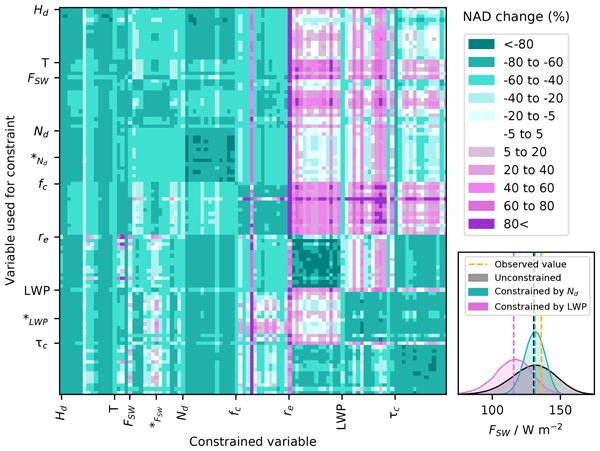
Aerosol forcing of Earth’s energy balance has persisted as a major cause of uncertainty in climate simulations over generations of climate model development. We show that structural deficiencies in a climate model are exposed by comprehensively exploring parametric uncertainty and that these deficiencies limit how much the model uncertainty can be reduced through observational constraint. This provides a future pathway towards building models with greater physical realism and lower uncertainty.
Daniel P. Grosvenor and Kenneth S. Carslaw
Atmos. Chem. Phys., 23, 6743–6773, https://doi.org/10.5194/acp-23-6743-2023, https://doi.org/10.5194/acp-23-6743-2023, 2023
Short summary
Short summary
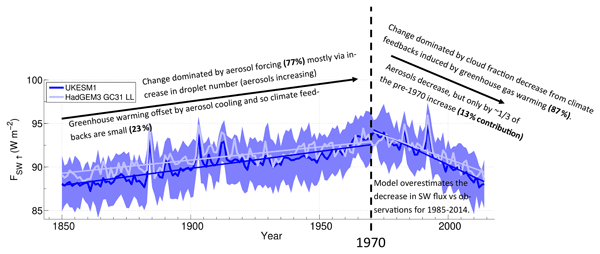
We determine what causes long-term trends in short-wave (SW) radiative fluxes in two climate models. A positive trend occurs between 1850 and 1970 (increasing SW reflection) and a negative trend between 1970 and 2014; the pre-1970 positive trend is mainly driven by an increase in cloud droplet number concentrations due to increases in aerosol, and the 1970–2014 trend is driven by a decrease in cloud fraction, which we attribute to changes in clouds caused by greenhouse gas-induced warming.
Ernesto Reyes-Villegas, Douglas Lowe, Jill S. Johnson, Kenneth S. Carslaw, Eoghan Darbyshire, Michael Flynn, James D. Allan, Hugh Coe, Ying Chen, Oliver Wild, Scott Archer-Nicholls, Alex Archibald, Siddhartha Singh, Manish Shrivastava, Rahul A. Zaveri, Vikas Singh, Gufran Beig, Ranjeet Sokhi, and Gordon McFiggans
Atmos. Chem. Phys., 23, 5763–5782, https://doi.org/10.5194/acp-23-5763-2023, https://doi.org/10.5194/acp-23-5763-2023, 2023
Short summary
Short summary
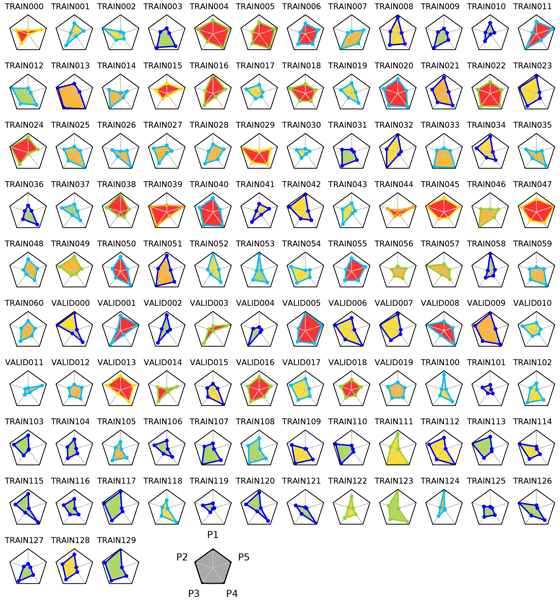
Organic aerosols (OAs), their sources and their processes remain poorly understood. The volatility basis set (VBS) approach, implemented in air quality models such as WRF-Chem, can be a useful tool to describe primary OA (POA) production and aging. However, the main disadvantage is its complexity. We used a Gaussian process simulator to reproduce model results and to estimate the sources of model uncertainty. We do this by comparing the outputs with OA observations made at Delhi, India, in 2018.
Xuemei Wang, Hamish Gordon, Daniel P. Grosvenor, Meinrat O. Andreae, and Ken S. Carslaw
Atmos. Chem. Phys., 23, 4431–4461, https://doi.org/10.5194/acp-23-4431-2023, https://doi.org/10.5194/acp-23-4431-2023, 2023
Short summary
Short summary
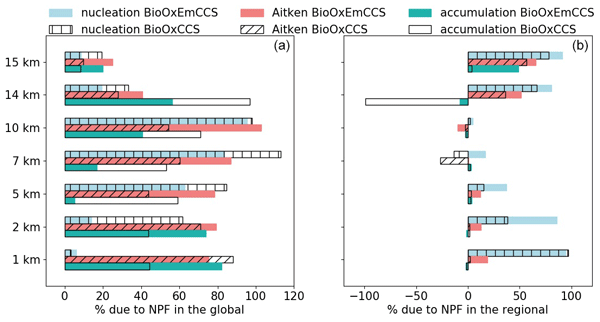
New particle formation in the upper troposphere is important for the global boundary layer aerosol population, and they can be transported downward in Amazonia. We use a global and a regional model to quantify the number of aerosols that are formed at high altitude and transported downward in a 1000 km region. We find that the majority of the aerosols are from outside the region. This suggests that the 1000 km region is unlikely to be a
closed loopfor aerosol formation, transport and growth.
Ruth Price, Andrea Baccarini, Julia Schmale, Paul Zieger, Ian M. Brooks, Paul Field, and Ken S. Carslaw
Atmos. Chem. Phys., 23, 2927–2961, https://doi.org/10.5194/acp-23-2927-2023, https://doi.org/10.5194/acp-23-2927-2023, 2023
Short summary
Short summary
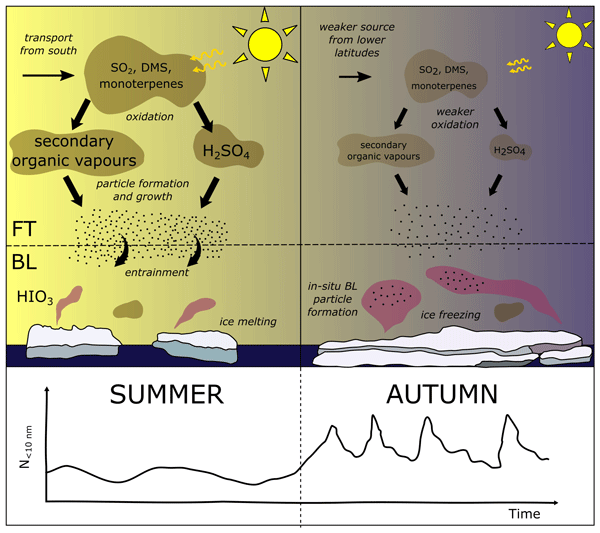
Arctic clouds can control how much energy is absorbed by the surface or reflected back to space. Using a computer model of the atmosphere we investigated the formation of atmospheric particles that allow cloud droplets to form. We found that particles formed aloft are transported to the lowest part of the Arctic atmosphere and that this is a key source of particles. Our results have implications for the way Arctic clouds will behave in the future as climate change continues to impact the region.
Leighton A. Regayre, Lucia Deaconu, Daniel P. Grosvenor, David Sexton, Christopher C. Symonds, Tom Langton, Duncan Watson-Paris, Jane P. Mulcahy, Kirsty J. Pringle, Mark Richardson, Jill S. Johnson, John Rostron, Hamish Gordon, Grenville Lister, Philip Stier, and Ken S. Carslaw
EGUsphere, https://doi.org/10.5194/egusphere-2022-1330, https://doi.org/10.5194/egusphere-2022-1330, 2022
Preprint archived
Short summary
Short summary
We show that potential structural deficiencies in a climate model can be exposed by comprehensively exploring its parametric uncertainty, and that these deficiencies limit how much the model uncertainty can be reduced through observational constraint. Combined consideration of parametric and structural uncertainties provides a future pathway towards building models that have greater physical realism and lower uncertainty.
Ville Leinonen, Harri Kokkola, Taina Yli-Juuti, Tero Mielonen, Thomas Kühn, Tuomo Nieminen, Simo Heikkinen, Tuuli Miinalainen, Tommi Bergman, Ken Carslaw, Stefano Decesari, Markus Fiebig, Tareq Hussein, Niku Kivekäs, Radovan Krejci, Markku Kulmala, Ari Leskinen, Andreas Massling, Nikos Mihalopoulos, Jane P. Mulcahy, Steffen M. Noe, Twan van Noije, Fiona M. O'Connor, Colin O'Dowd, Dirk Olivie, Jakob B. Pernov, Tuukka Petäjä, Øyvind Seland, Michael Schulz, Catherine E. Scott, Henrik Skov, Erik Swietlicki, Thomas Tuch, Alfred Wiedensohler, Annele Virtanen, and Santtu Mikkonen
Atmos. Chem. Phys., 22, 12873–12905, https://doi.org/10.5194/acp-22-12873-2022, https://doi.org/10.5194/acp-22-12873-2022, 2022
Short summary
Short summary
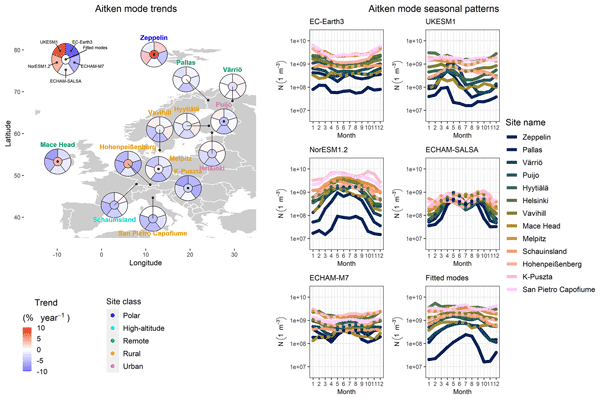
We provide the first extensive comparison of detailed aerosol size distribution trends between in situ observations from Europe and five different earth system models. We investigated aerosol modes (nucleation, Aitken, and accumulation) separately and were able to show the differences between measured and modeled trends and especially their seasonal patterns. The differences in model results are likely due to complex effects of several processes instead of certain specific model features.
Amy H. Peace, Ben B. B. Booth, Leighton A. Regayre, Ken S. Carslaw, David M. H. Sexton, Céline J. W. Bonfils, and John W. Rostron
Earth Syst. Dynam., 13, 1215–1232, https://doi.org/10.5194/esd-13-1215-2022, https://doi.org/10.5194/esd-13-1215-2022, 2022
Short summary
Short summary
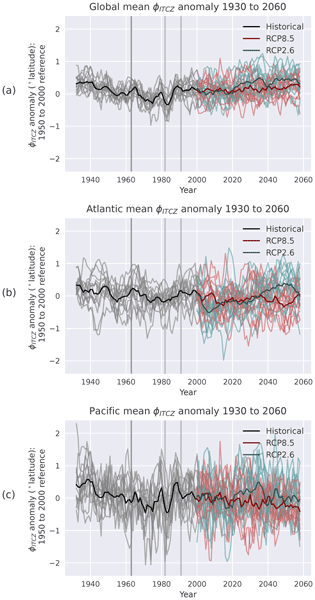
Anthropogenic aerosol emissions have been linked to driving climate responses such as shifts in the location of tropical rainfall. However, the interaction of aerosols with climate remains one of the most uncertain aspects of climate modelling and limits our ability to predict future climate change. We use an ensemble of climate model simulations to investigate what impact the large uncertainty in how aerosols interact with climate has on predicting future tropical rainfall shifts.
Alexander D. Harrison, Daniel O'Sullivan, Michael P. Adams, Grace C. E. Porter, Edmund Blades, Cherise Brathwaite, Rebecca Chewitt-Lucas, Cassandra Gaston, Rachel Hawker, Ovid O. Krüger, Leslie Neve, Mira L. Pöhlker, Christopher Pöhlker, Ulrich Pöschl, Alberto Sanchez-Marroquin, Andrea Sealy, Peter Sealy, Mark D. Tarn, Shanice Whitehall, James B. McQuaid, Kenneth S. Carslaw, Joseph M. Prospero, and Benjamin J. Murray
Atmos. Chem. Phys., 22, 9663–9680, https://doi.org/10.5194/acp-22-9663-2022, https://doi.org/10.5194/acp-22-9663-2022, 2022
Short summary
Short summary
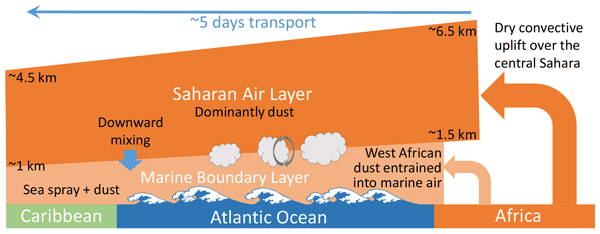
The formation of ice in clouds fundamentally alters cloud properties; hence it is important we understand the special aerosol particles that can nucleate ice when immersed in supercooled cloud droplets. In this paper we show that African desert dust that has travelled across the Atlantic to the Caribbean nucleates ice much less well than we might have expected.
Rachel E. Hawker, Annette K. Miltenberger, Jill S. Johnson, Jonathan M. Wilkinson, Adrian A. Hill, Ben J. Shipway, Paul R. Field, Benjamin J. Murray, and Ken S. Carslaw
Atmos. Chem. Phys., 21, 17315–17343, https://doi.org/10.5194/acp-21-17315-2021, https://doi.org/10.5194/acp-21-17315-2021, 2021
Short summary
Short summary
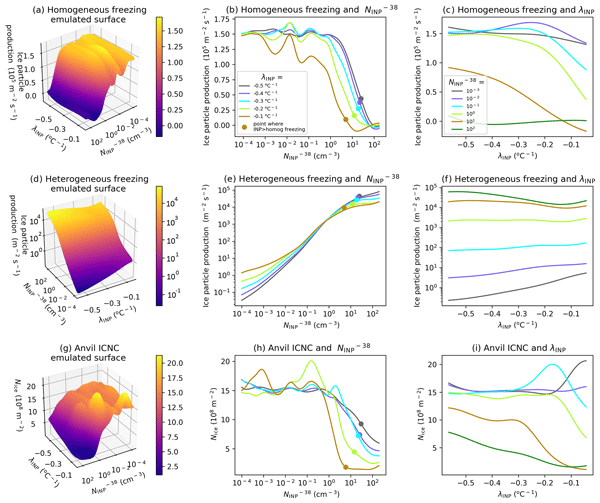
We find that ice-nucleating particles (INPs), aerosols that can initiate the freezing of cloud droplets, cause substantial changes to the properties of radiatively important convectively generated anvil cirrus. The number concentration of INPs had a large effect on ice crystal number concentration while the INP temperature dependence controlled ice crystal size and cloud fraction. The results indicate information on INP number and source is necessary for the representation of cloud glaciation.
Heather Guy, Ian M. Brooks, Ken S. Carslaw, Benjamin J. Murray, Von P. Walden, Matthew D. Shupe, Claire Pettersen, David D. Turner, Christopher J. Cox, William D. Neff, Ralf Bennartz, and Ryan R. Neely III
Atmos. Chem. Phys., 21, 15351–15374, https://doi.org/10.5194/acp-21-15351-2021, https://doi.org/10.5194/acp-21-15351-2021, 2021
Short summary
Short summary
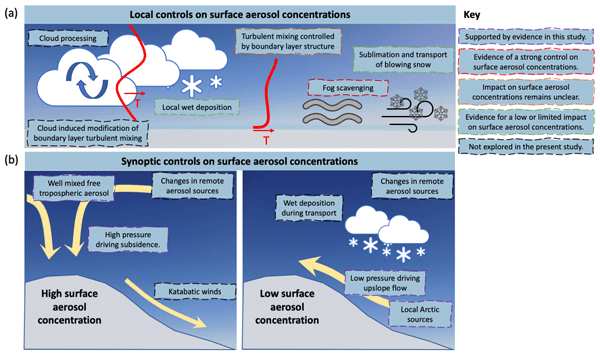
We present the first full year of surface aerosol number concentration measurements from the central Greenland Ice Sheet. Aerosol concentrations here have a distinct seasonal cycle from those at lower-altitude Arctic sites, which is driven by large-scale atmospheric circulation. Our results can be used to help understand the role aerosols might play in Greenland surface melt through the modification of cloud properties. This is crucial in a rapidly changing region where observations are sparse.
Mao Xiao, Christopher R. Hoyle, Lubna Dada, Dominik Stolzenburg, Andreas Kürten, Mingyi Wang, Houssni Lamkaddam, Olga Garmash, Bernhard Mentler, Ugo Molteni, Andrea Baccarini, Mario Simon, Xu-Cheng He, Katrianne Lehtipalo, Lauri R. Ahonen, Rima Baalbaki, Paulus S. Bauer, Lisa Beck, David Bell, Federico Bianchi, Sophia Brilke, Dexian Chen, Randall Chiu, António Dias, Jonathan Duplissy, Henning Finkenzeller, Hamish Gordon, Victoria Hofbauer, Changhyuk Kim, Theodore K. Koenig, Janne Lampilahti, Chuan Ping Lee, Zijun Li, Huajun Mai, Vladimir Makhmutov, Hanna E. Manninen, Ruby Marten, Serge Mathot, Roy L. Mauldin, Wei Nie, Antti Onnela, Eva Partoll, Tuukka Petäjä, Joschka Pfeifer, Veronika Pospisilova, Lauriane L. J. Quéléver, Matti Rissanen, Siegfried Schobesberger, Simone Schuchmann, Yuri Stozhkov, Christian Tauber, Yee Jun Tham, António Tomé, Miguel Vazquez-Pufleau, Andrea C. Wagner, Robert Wagner, Yonghong Wang, Lena Weitz, Daniela Wimmer, Yusheng Wu, Chao Yan, Penglin Ye, Qing Ye, Qiaozhi Zha, Xueqin Zhou, Antonio Amorim, Ken Carslaw, Joachim Curtius, Armin Hansel, Rainer Volkamer, Paul M. Winkler, Richard C. Flagan, Markku Kulmala, Douglas R. Worsnop, Jasper Kirkby, Neil M. Donahue, Urs Baltensperger, Imad El Haddad, and Josef Dommen
Atmos. Chem. Phys., 21, 14275–14291, https://doi.org/10.5194/acp-21-14275-2021, https://doi.org/10.5194/acp-21-14275-2021, 2021
Short summary
Short summary
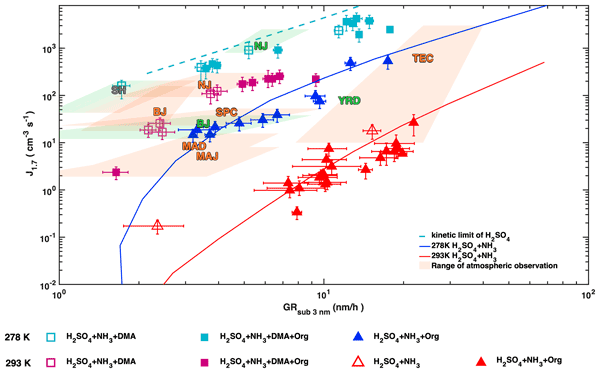
Experiments at CLOUD show that in polluted environments new particle formation (NPF) is largely driven by the formation of sulfuric acid–base clusters, stabilized by amines, high ammonia concentrations or lower temperatures. While oxidation products of aromatics can nucleate, they play a minor role in urban NPF. Our experiments span 4 orders of magnitude variation of observed NPF rates in ambient conditions. We provide a framework based on NPF and growth rates to interpret ambient observations.
Cited articles
Ahsan, H., Wang, H., Wu, J., Wu, M., Smith, S. J., Bauer, S., Suchyta, H., Olivié, D., Myhre, G., Matsui, H., Bian, H., Lamarque, J.-F., Carslaw, K., Horowitz, L., Regayre, L., Chin, M., Schulz, M., Skeie, R. B., Takemura, T., and Naik, V.: The Emissions Model Intercomparison Project (Emissions-MIP): quantifying model sensitivity to emission characteristics, Atmos. Chem. Phys., 23, 14779–14799, https://doi.org/10.5194/acp-23-14779-2023, 2023.
Andreae, M. O., Jones, C. D., and Cox, P. M.: Strong present-day aerosol cooling implies a hot future, Nature, 435, 1187–1190, https://doi.org/10.1038/nature03671, 2005.
Andres, R. J. and Kasgnoc, A. D.: A time-averaged inventory of subaerial volcanic sulfur emissions, J. Geophys. Res.-Atmos., 103, 25251–25261, https://doi.org/10.1029/98JD02091, 1998.
Archibald, A. T., O'Connor, F. M., Abraham, N. L., Archer-Nicholls, S., Chipperfield, M. P., Dalvi, M., Folberth, G. A., Dennison, F., Dhomse, S. S., Griffiths, P. T., Hardacre, C., Hewitt, A. J., Hill, R. S., Johnson, C. E., Keeble, J., Köhler, M. O., Morgenstern, O., Mulcahy, J. P., Ordóñez, C., Pope, R. J., Rumbold, S. T., Russo, M. R., Savage, N. H., Sellar, A., Stringer, M., Turnock, S. T., Wild, O., and Zeng, G.: Description and evaluation of the UKCA stratosphere–troposphere chemistry scheme (StratTrop vn 1.0) implemented in UKESM1, Geosci. Model Dev., 13, 1223–1266, https://doi.org/10.5194/gmd-13-1223-2020, 2020.
Balkanski, Y., Schulz, M., Claquin, T., and Guibert, S.: Reevaluation of Mineral aerosol radiative forcings suggests a better agreement with satellite and AERONET data, Atmos. Chem. Phys., 7, 81–95, https://doi.org/10.5194/acp-7-81-2007, 2007.
Bellouin, N., Quaas, J., Morcrette, J.-J., and Boucher, O.: Estimates of aerosol radiative forcing from the MACC re-analysis, Atmos. Chem. Phys., 13, 2045–2062, https://doi.org/10.5194/acp-13-2045-2013, 2013.
Beven, K.: A manifesto for the equifinality thesis, J. Hydrol., 320, 18–36, https://doi.org/10.1016/j.jhydrol.2005.07.007, 2006.
Bowdalo, D.: GHOST: A globally harmonised dataset of surface atmospheric composition measurements (1.5), Zenodo [data set], https://doi.org/10.5281/zenodo.10637450, 2024.
Bowdalo, D., Basart, S., Guevara, M., Jorba, O., Pérez García-Pando, C., Jaimes Palomera, M., Rivera Hernandez, O., Puchalski, M., Gay, D., Klausen, J., Moreno, S., Netcheva, S., and Tarasova, O.: GHOST: a globally harmonised dataset of surface atmospheric composition measurements, Earth Syst. Sci. Data, 16, 4417–4495, https://doi.org/10.5194/essd-16-4417-2024, 2024.
Browse, J., Carslaw, K. S., Arnold, S. R., Pringle, K., and Boucher, O.: The scavenging processes controlling the seasonal cycle in Arctic sulphate and black carbon aerosol, Atmos. Chem. Phys., 12, 6775–6798, https://doi.org/10.5194/acp-12-6775-2012, 2012.
Brynjarsdóttir, J. and O'Hagan, A.: Learning about physical parameters: the importance of model discrepancy, Inverse Probl., 30, 114007, https://doi.org/10.1088/0266-5611/30/11/114007, 2014.
Carslaw, K. S., Lee, L. A., Reddington, C. L., Pringle, K. J., Rap, A., Forster, P. M., Mann, G. W., Spracklen, D. V., Woodhouse, M. T., Regayre, L. A., and Pierce, J. R.: Large contribution of natural aerosols to uncertainty in indirect forcing, Nature, 503, 67–71, https://doi.org/10.1038/nature12674, 2013.
Carslaw, K. S., Regayre, L. A., Proske, U., Gettelman, A., Sexton, D. M. H., Qian, Y., Marshall, L., Wild, O., van Lier-Walqui, M., Oertel, A., Peatier, S., Yang, B., Johnson, J. S., Li, S., McCoy, D. T., Sanderson, B. M., Williamson, C. J., Elsaesser, G. S., Yamazaki, K., and Booth, B. B. B.: Opinion: The importance and future development of perturbed parameter ensembles in climate and atmospheric science, EGUsphere [preprint], https://doi.org/10.5194/egusphere-2025-4341, 2025.
Collins, M.: Ensembles and probabilities: a new era in the prediction of climate change, Philos. Trans. R. Soc. London, Ser. A, 365, 1957–1970, https://doi.org/10.1098/rsta.2007.2068, 2007.
Couvreux, F., Hourdin, F., Williamson, D., Roehrig, R., Volodina, V., Villefranque, N., Rio, C., Audouin, O., Salter, J., Bazile, E., Brient, F., Favot, F., Honnert, R., Lefebvre, M.-P., Madeleine, J.-B., Rodier, Q., and Xu, W.: Process-Based Climate Model Development Harnessing Machine Learning: I. A Calibration Tool for Parameterization Improvement, J. Adv. Model. Earth Syst., 13, e2020MS002217, https://doi.org/10.1029/2020MS002217, 2021.
Craig, P. S., Goldstein, M., Seheult, A. H., and Smith, J. A.: Pressure Matching for Hydrocarbon Reservoirs: A Case Study in the Use of Bayes Linear Strategies for Large Computer Experiments, in: Case Studies in Bayesian Statistics, Springer, New York, NY, 37–93, https://doi.org/10.1007/978-1-4612-2290-3_2, 1997.
Delle Donne, D., Aiuppa, A., Bitetto, M., D'Aleo, R., Coltelli, M., Coppola, D., Pecora, E., Ripepe, M., and Tamburello, G.: Changes in SO2 Flux Regime at Mt. Etna Captured by Automatically Processed Ultraviolet Camera Data, Remote Sens., 11, 1201, https://doi.org/10.3390/rs11101201, 2019.
Eidhammer, T., Gettelman, A., Thayer-Calder, K., Watson-Parris, D., Elsaesser, G., Morrison, H., van Lier-Walqui, M., Song, C., and McCoy, D.: An extensible perturbed parameter ensemble for the Community Atmosphere Model version 6, Geosci. Model Dev., 17, 7835–7853, https://doi.org/10.5194/gmd-17-7835-2024, 2024.
Elsaesser, G. S., van Lier-Walqui, M., Yang, Q., Kelley, M., Ackerman, A. S., Fridlind, A. M., Cesana, G. V., Schmidt, G. A., Wu, J., Behrangi, A., Camargo, S. J., De, B., Inoue, K., Leitmann-Niimi, N. M., and Strong, J. D. O.: Using Machine Learning to Generate a GISS ModelE Calibrated Physics Ensemble (CPE), J. Adv. Model. Earth Syst., 17, e2024MS004713, https://doi.org/10.1029/2024MS004713, 2025.
Eyring, V., Bony, S., Meehl, G. A., Senior, C. A., Stevens, B., Stouffer, R. J., and Taylor, K. E.: Overview of the Coupled Model Intercomparison Project Phase 6 (CMIP6) experimental design and organization, Geosci. Model Dev., 9, 1937–1958, https://doi.org/10.5194/gmd-9-1937-2016, 2016.
Flato, G., Marotzke, J., Abiodun, B., Braconnot, P., Chou, S. C., Collins, W., Cox, P., Driouech, F., Emori, S., Eyring, V., Forest, C., Gleckler, P., Guilyardi, E., Jakob, C., Kattsov, V., Reason, C., and Rummukainen, M.: Evaluation of Climate Models, in: Climate Change 2013: The Physical Science Basis. Contribution of Working Group I to the Fifth Assessment Report of the Intergovernmental Panel on Climate Change, edited by: Stocker, T. F., Qin, D., Plattner, G.-K., Tignor, M., Allen, S. K., Boschung, J., Nauels, A., Xia, Y., Bex, V., and Midgley, P. M., Cambridge University Press, Cambridge, United Kingdom and New York, NY, USA, https://doi.org/10.1017/CBO9781107415324.020, 2013.
Forster, P., Storelvmo, T., Armour, K., Collins, W., Dufresne, J.-L., Frame, D., Lunt, D. J., Mauritsen, T., Palmer, M. D., Watanabe, M., Wild, M., and Zhang, H.: The Earth’s Energy Budget, Climate Feedbacks, and Climate Sensitivity. In Climate Change 2021: The Physical Science Basis. Contribution of Working Group I to the Sixth Assessment Report of the Intergovernmental Panel on Climate Change, edited by: Masson-Delmotte, V., Zhai, P., Pirani, A., Connors, S. L., Péan, C., Berger, S., Caud, N., Chen, Y., Goldfarb, L., Gomis, M. I., Huang, M., Leitzell, K., Lonnoy, E., Matthews, J. B. R., Maycock, T. K., Waterfield, T., Yelekçi, O., Yu, R., and Zhou, B., Cambridge University Press, Cambridge, United Kingdom and New York, NY, USA, 923–1054, https://doi.org/10.1017/9781009157896.009, 2021.
Furtado, K., Tsushima, Y., Field, P. R., Rostron, J., and Sexton, D.: The Relationship Between the Present-Day Seasonal Cycles of Clouds in the Mid-Latitudes and Cloud-Radiative Feedback, Geophys. Res. Lett., 50, e2023GL103902, https://doi.org/10.1029/2023GL103902, 2023.
Gao, J., Wang, H., Liu, W., Xu, H., Wei, Y., Tian, X., Feng, Y., Song, S., and Shi, G.: Hydrogen peroxide serves as pivotal fountainhead for aerosol aqueous sulfate formation from a global perspective, Nat. Commun., 15, 4625, https://doi.org/10.1038/s41467-024-48793-1, 2024.
Golaz, J.-C., Horowitz, L. W., and Levy II, H.: Cloud tuning in a coupled climate model: Impact on 20th century warming, Geophys. Res. Lett., 40, 2246–2251, https://doi.org/10.1002/grl.50232, 2013.
Goldstein, M. and Rougier, J. C.: Probabilistic Formulations for Transferring Inferences from Mathematical Models to Physical Systems, SIAM J. Sci. Comput., 26, https://doi.org/10.1137/s106482750342670x, 2004.
Gosling, J. P.: SHELF: The Sheffield Elicitation Framework, in: Elicitation: The Science and Art of Structuring Judgement, edited by: Dias, L. C., Morton, A., and Quigley, J., Springer International Publishing, Cham, 61–93, https://doi.org/10.1007/978-3-319-65052-4_4, 2018.
Halmer, M. M., Schmincke, H.-U., and Graf, H.-F.: The annual volcanic gas input into the atmosphere, in particular into the stratosphere: a global data set for the past 100 years, J. Volcanol. Geotherm. Res., 115, 511–528, https://doi.org/10.1016/S0377-0273(01)00318-3, 2002.
Hourdin, F., Mauritsen, T., Gettelman, A., Golaz, J.-C., Balaji, V., Duan, Q., Folini, D., Ji, D., Klocke, D., Qian, Y., Rauser, F., Rio, C., Tomassini, L., Watanabe, M., and Williamson, D.: The Art and Science of Climate Model Tuning, Bull. Am. Meteorol. Soc., 98, 589–602, https://doi.org/10.1175/BAMS-D-15-00135.1, 2017.
Johnson, J. S., Regayre, L. A., Yoshioka, M., Pringle, K. J., Turnock, S. T., Browse, J., Sexton, D. M. H., Rostron, J. W., Schutgens, N. A. J., Partridge, D. G., Liu, D., Allan, J. D., Coe, H., Ding, A., Cohen, D. D., Atanacio, A., Vakkari, V., Asmi, E., and Carslaw, K. S.: Robust observational constraint of uncertain aerosol processes and emissions in a climate model and the effect on aerosol radiative forcing, Atmos. Chem. Phys., 20, 9491–9524, https://doi.org/10.5194/acp-20-9491-2020, 2020.
Jones, A. C., Hill, A., Remy, S., Abraham, N. L., Dalvi, M., Hardacre, C., Hewitt, A. J., Johnson, B., Mulcahy, J. P., and Turnock, S. T.: Exploring the sensitivity of atmospheric nitrate concentrations to nitric acid uptake rate using the Met Office's Unified Model, Atmos. Chem. Phys., 21, 15901–15927, https://doi.org/10.5194/acp-21-15901-2021, 2021.
Kennedy, M. C. and O'Hagan, A.: Bayesian Calibration of Computer Models, J. R. Stat. Soc. B, 63, 425–464, https://doi.org/10.1111/1467-9868.00294, 2001.
Knutti, R., Furrer, R., Tebaldi, C., Cermak, J., and Meehl, G. A.: Challenges in Combining Projections from Multiple Climate Models, Journal of Climate, 23, 2739–2758, https://doi.org/10.1175/2009JCLI3361.1, 2010.
Lee, L. A., Carslaw, K. S., Pringle, K. J., Mann, G. W., and Spracklen, D. V.: Emulation of a complex global aerosol model to quantify sensitivity to uncertain parameters, Atmos. Chem. Phys., 11, 12253–12273, https://doi.org/10.5194/acp-11-12253-2011, 2011.
Lee, L. A., Carslaw, K. S., Pringle, K. J., and Mann, G. W.: Mapping the uncertainty in global CCN using emulation, Atmos. Chem. Phys., 12, 9739–9751, https://doi.org/10.5194/acp-12-9739-2012, 2012.
Mann, G. W., Carslaw, K. S., Spracklen, D. V., Ridley, D. A., Manktelow, P. T., Chipperfield, M. P., Pickering, S. J., and Johnson, C. E.: Description and evaluation of GLOMAP-mode: a modal global aerosol microphysics model for the UKCA composition-climate model, Geosci. Model Dev., 3, 519–551, https://doi.org/10.5194/gmd-3-519-2010, 2010.
Mann, G. W., Carslaw, K. S., Ridley, D. A., Spracklen, D. V., Pringle, K. J., Merikanto, J., Korhonen, H., Schwarz, J. P., Lee, L. A., Manktelow, P. T., Woodhouse, M. T., Schmidt, A., Breider, T. J., Emmerson, K. M., Reddington, C. L., Chipperfield, M. P., and Pickering, S. J.: Intercomparison of modal and sectional aerosol microphysics representations within the same 3-D global chemical transport model, Atmos. Chem. Phys., 12, 4449–4476, https://doi.org/10.5194/acp-12-4449-2012, 2012.
Masson, D. and Knutti, R.: Climate model genealogy, Geophys. Res. Lett., 38, https://doi.org/10.1029/2011GL046864, 2011.
McNeall, D., Williams, J., Booth, B., Betts, R., Challenor, P., Wiltshire, A., and Sexton, D.: The impact of structural error on parameter constraint in a climate model, Earth Syst. Dynam., 7, 917–935, https://doi.org/10.5194/esd-7-917-2016, 2016.
Metzger, A., Verheggen, B., Dommen, J., Duplissy, J., Prevot, A. S. H., Weingartner, E., Riipinen, I., Kulmala, M., Spracklen, D. V., Carslaw, K. S., and Baltensperger, U.: Evidence for the role of organics in aerosol particle formation under atmospheric conditions, Proc. Natl. Acad. Sci. USA, 107, 6646–6651, https://doi.org/10.1073/pnas.0911330107, 2010.
Mikkelsen, A., McCoy, D. T., Eidhammer, T., Gettelman, A., Song, C., Gordon, H., and McCoy, I. L.: Constraining aerosol–cloud adjustments by uniting surface observations with a perturbed parameter ensemble, Atmos. Chem. Phys., 25, 4547–4570, https://doi.org/10.5194/acp-25-4547-2025, 2025.
Mulcahy, J. P., Jones, C., Sellar, A., Johnson, B., Boutle, I. A., Jones, A., Andrews, T., Rumbold, S. T., Mollard, J., Bellouin, N., Johnson, C. E., Williams, K. D., Grosvenor, D. P., and McCoy, D. T.: Improved Aerosol Processes and Effective Radiative Forcing in HadGEM3 and UKESM1, J. Adv. Model. Earth Syst., 10, 2786–2805, https://doi.org/10.1029/2018MS001464, 2018.
Mulcahy, J. P., Johnson, C., Jones, C. G., Povey, A. C., Scott, C. E., Sellar, A., Turnock, S. T., Woodhouse, M. T., Abraham, N. L., Andrews, M. B., Bellouin, N., Browse, J., Carslaw, K. S., Dalvi, M., Folberth, G. A., Glover, M., Grosvenor, D. P., Hardacre, C., Hill, R., Johnson, B., Jones, A., Kipling, Z., Mann, G., Mollard, J., O'Connor, F. M., Palmiéri, J., Reddington, C., Rumbold, S. T., Richardson, M., Schutgens, N. A. J., Stier, P., Stringer, M., Tang, Y., Walton, J., Woodward, S., and Yool, A.: Description and evaluation of aerosol in UKESM1 and HadGEM3-GC3.1 CMIP6 historical simulations, Geosci. Model Dev., 13, 6383–6423, https://doi.org/10.5194/gmd-13-6383-2020, 2020.
Murphy, J. M., Sexton, D. M. H., Barnett, D. N., Jones, G. S., Webb, M. J., Collins, M., and Stainforth, D. A.: Quantification of modelling uncertainties in a large ensemble of climate change simulations, Nature, 430, 768–772, https://doi.org/10.1038/nature02771, 2004.
O'Hagan, A.: Bayesian analysis of computer code outputs: A tutorial, Reliability Engineering & System Safety, 91, 1290–1300, https://doi.org/10.1016/j.ress.2005.11.025, 2006.
Peace, A. H., Carslaw, K. S., Lee, L. A., Regayre, L. A., Booth, B. B. B., Johnson, J. S., and Bernie, D.: Effect of aerosol radiative forcing uncertainty on projected exceedance year of a 1.5 °C global temperature rise, Environ. Res. Lett., 15, 0940a6, https://doi.org/10.1088/1748-9326/aba20c, 2020.
Peatier, S., Sanderson, B. M., and Terray, L.: Exploration of diverse solutions for the calibration of imperfect climate models, Earth Syst. Dynam., 15, 987–1014, https://doi.org/10.5194/esd-15-987-2024, 2024.
Pedregosa, F., Varoquaux, G., Gramfort, A., Michel, V., Thirion, B., Grisel, O., Blondel, M., Prettenhofer, P., Weiss, R., Dubourg, V., Vanderplas, J., Passos, A., and Cournapeau, D.: Scikit-learn: Machine Learning in Python, arXiv [preprint], https://doi.org/10.48550/arXiv.1201.0490, 2011.
Prévost, L. M. C.: Code for “Detection of structural deficiencies in a global aerosol model to explain limits in parametric uncertainty reduction” (Prévost et al., 2025), Zenodo [code], https://doi.org/10.5281/zenodo.18008353, 2025.
Proske, U., Ferrachat, S., Klampt, S., Abeling, M., and Lohmann, U.: Addressing Complexity in Global Aerosol Climate Model Cloud Microphysics, J. Adv. Model. Earth Syst., 15, e2022MS003571, https://doi.org/10.1029/2022MS003571, 2023.
Qian, Y., Guo, Z., Larson, V. E., Leung, L. R., Lin, W., Ma, P.-L., Wan, H., Wang, H., Xiao, H., Xie, S., Yang, B., Zhang, K., Zhang, S., and Zhang, Y.: Region and cloud regime dependence of parametric sensitivity in E3SM atmosphere model, Clim. Dyn., 62, 1517–1533, https://doi.org/10.1007/s00382-023-06977-3, 2024.
Raoult, N., Beylat, S., Salter, J. M., Hourdin, F., Bastrikov, V., Ottlé, C., and Peylin, P.: Exploring the potential of history matching for land surface model calibration, Geosci. Model Dev., 17, 5779–5801, https://doi.org/10.5194/gmd-17-5779-2024, 2024.
Regayre, L. A., Pringle, K. J., Lee, L. A., Rap, A., Browse, J., Mann, G. W., Reddington, C. L., Carslaw, K. S., Booth, B. B. B., and Woodhouse, M. T.: The Climatic Importance of Uncertainties in Regional Aerosol–Cloud Radiative Forcings over Recent Decades, Journal of Climate, 28, 6589–6607, https://doi.org/10.1175/JCLI-D-15-0127.1, 2015.
Regayre, L. A., Johnson, J. S., Yoshioka, M., Pringle, K. J., Sexton, D. M. H., Booth, B. B. B., Lee, L. A., Bellouin, N., and Carslaw, K. S.: Aerosol and physical atmosphere model parameters are both important sources of uncertainty in aerosol ERF, Atmos. Chem. Phys., 18, 9975–10006, https://doi.org/10.5194/acp-18-9975-2018, 2018.
Regayre, L. A., Schmale, J., Johnson, J. S., Tatzelt, C., Baccarini, A., Henning, S., Yoshioka, M., Stratmann, F., Gysel-Beer, M., Grosvenor, D. P., and Carslaw, K. S.: The value of remote marine aerosol measurements for constraining radiative forcing uncertainty, Atmos. Chem. Phys., 20, 10063–10072, https://doi.org/10.5194/acp-20-10063-2020, 2020.
Regayre, L. A., Carslaw, K. S., Deaconu, L., Symonds, C., Richardson, M., Langton, T., Watson-Parris, D., and Stier, P.: A-CURE: Monthly mean perturbed parameter ensemble data, CEDA, https://catalogue.ceda.ac.uk/uuid/b735718d66c1403fbf6b93ba3bd3b1a9 (last access: 16 February 2026), 2021.
Regayre, L. A., Deaconu, L., Grosvenor, D. P., Sexton, D. M. H., Symonds, C., Langton, T., Watson-Paris, D., Mulcahy, J. P., Pringle, K. J., Richardson, M., Johnson, J. S., Rostron, J. W., Gordon, H., Lister, G., Stier, P., and Carslaw, K. S.: Identifying climate model structural inconsistencies allows for tight constraint of aerosol radiative forcing, Atmos. Chem. Phys., 23, 8749–8768, https://doi.org/10.5194/acp-23-8749-2023, 2023.
Regayre, L. A., Prévost, L. M. C., Ghosh, K., Johnson, J. S., Oakley, J. E., Owen, J., Webb, I., and Carslaw, K. S.: Remaining aerosol forcing uncertainty after observational constraint and the processes that cause it, Atmos. Chem. Phys., 26, 2293–2317, https://doi.org/10.5194/acp-26-2293-2026, 2026.
Ricciardelli, I., Bacco, D., Rinaldi, M., Bonafè, G., Scotto, F., Trentini, A., Bertacci, G., Ugolini, P., Zigola, C., Rovere, F., Maccone, C., Pironi, C., and Poluzzi, V.: A three-year investigation of daily PM2.5 main chemical components in four sites: the routine measurement program of the Supersito Project (Po Valley, Italy), Atmos. Environ., 152, 418–430, https://doi.org/10.1016/j.atmosenv.2016.12.052, 2017.
Rostron, J. W., Sexton, D. M. H., Furtado, K., Carvalho, M. J., Milton, S. F., Rodríguez, J. M., and Zhang, W.: Evaluation and projections of the East Asian summer monsoon in a perturbed parameter ensemble, Clim. Dyn., 60, 3901–3926, https://doi.org/10.1007/s00382-022-06507-7, 2023.
Rostron, J. W., Sexton, D. M. H., Furtado, K., and Tsushima, Y.: A clearer view of systematic errors in model development: two practical approaches using perturbed parameter ensembles, ResearchSquare, https://doi.org/10.21203/rs.3.rs-5025285/v1, 2025.
Salameh, D., Detournay, A., Pey, J., Pérez, N., Liguori, F., Saraga, D., Bove, M. C., Brotto, P., Cassola, F., Massabò, D., Latella, A., Pillon, S., Formenton, G., Patti, S., Armengaud, A., Piga, D., Jaffrezo, J. L., Bartzis, J., Tolis, E., Prati, P., Querol, X., Wortham, H., and Marchand, N.: PM2.5 chemical composition in five European Mediterranean cities: A 1-year study, Atmos. Res., 155, 102–117, https://doi.org/10.1016/j.atmosres.2014.12.001, 2015.
Salter, J. M., Williamson, D. B., Scinocca, J., and Kharin, V.: Uncertainty Quantification for Computer Models With Spatial Output Using Calibration-Optimal Bases, J. Am. Stat. Assoc., 114, 1800–1814, https://doi.org/10.1080/01621459.2018.1514306, 2019.
Schmidt, G. A., Bader, D., Donner, L. J., Elsaesser, G. S., Golaz, J.-C., Hannay, C., Molod, A., Neale, R. B., and Saha, S.: Practice and philosophy of climate model tuning across six US modeling centers, Geosci. Model Dev., 10, 3207–3223, https://doi.org/10.5194/gmd-10-3207-2017, 2017.
Sellar, A. A., Jones, C. G., Mulcahy, J. P., Tang, Y., Yool, A., Wiltshire, A., O'Connor, F. M., Stringer, M., Hill, R., Palmieri, J., Woodward, S., de Mora, L., Kuhlbrodt, T., Rumbold, S. T., Kelley, D. I., Ellis, R., Johnson, C. E., Walton, J., Abraham, N. L., Andrews, M. B., Andrews, T., Archibald, A. T., Berthou, S., Burke, E., Blockley, E., Carslaw, K., Dalvi, M., Edwards, J., Folberth, G. A., Gedney, N., Griffiths, P. T., Harper, A. B., Hendry, M. A., Hewitt, A. J., Johnson, B., Jones, A., Jones, C. D., Keeble, J., Liddicoat, S., Morgenstern, O., Parker, R. J., Predoi, V., Robertson, E., Siahaan, A., Smith, R. S., Swaminathan, R., Woodhouse, M. T., Zeng, G., and Zerroukat, M.: UKESM1: Description and Evaluation of the U. K. Earth System Model, J. Adv. Model. Earth Syst., 11, 4513–4558, https://doi.org/10.1029/2019MS001739, 2019.
Servén, D. and Brummitt, C.: pyGAM: Generalized Additive Models in Python, Zenodo, https://doi.org/10.5281/zenodo.1208724, 2018.
Sexton, D. M. H., Murphy, J. M., Collins, M., and Webb, M. J.: Multivariate probabilistic projections using imperfect climate models part I: outline of methodology, Clim. Dyn., 38, 2513–2542, https://doi.org/10.1007/s00382-011-1208-9, 2012.
Sexton, D. M. H., McSweeney, C. F., Rostron, J. W., Yamazaki, K., Booth, B. B. B., Murphy, J. M., Regayre, L., Johnson, J. S., and Karmalkar, A. V.: A perturbed parameter ensemble of HadGEM3-GC3.05 coupled model projections: part 1: selecting the parameter combinations, Clim. Dyn., 56, 3395–3436, https://doi.org/10.1007/s00382-021-05709-9, 2021.
Sinyuk, A., Holben, B. N., Eck, T. F., Giles, D. M., Slutsker, I., Korkin, S., Schafer, J. S., Smirnov, A., Sorokin, M., and Lyapustin, A.: The AERONET Version 3 aerosol retrieval algorithm, associated uncertainties and comparisons to Version 2, Atmos. Meas. Tech., 13, 3375–3411, https://doi.org/10.5194/amt-13-3375-2020, 2020.
Song, C., McCoy, D. T., Eidhammer, T., Gettelman, A., McCoy, I. L., Watson-Parris, D., Wall, C. J., Elsaesser, G., and Wood, R.: Buffering of Aerosol-Cloud Adjustments by Coupling Between Radiative Susceptibility and Precipitation Efficiency, Geophys. Res. Lett., 51, e2024GL108663, https://doi.org/10.1029/2024GL108663, 2024.
Strong, M., Oakley, J. E., and Brennan, A.: Estimating Multiparameter Partial Expected Value of Perfect Information from a Probabilistic Sensitivity Analysis Sample: A Nonparametric Regression Approach, Med. Decis. Making., 34, 311–326, https://doi.org/10.1177/0272989X13505910, 2014.
Tørseth, K., Aas, W., Breivik, K., Fjæraa, A. M., Fiebig, M., Hjellbrekke, A. G., Lund Myhre, C., Solberg, S., and Yttri, K. E.: Introduction to the European Monitoring and Evaluation Programme (EMEP) and observed atmospheric composition change during 1972–2009, Atmos. Chem. Phys., 12, 5447–5481, https://doi.org/10.5194/acp-12-5447-2012, 2012.
Turnock, S. T., Mann, G. W., Woodhouse, M. T., Dalvi, M., O'Connor, F. M., Carslaw, K. S., and Spracklen, D. V.: The Impact of Changes in Cloud Water pH on Aerosol Radiative Forcing, Geophys. Res. Lett., 46, 4039–4048, https://doi.org/10.1029/2019GL082067, 2019.
van Donkelaar, A., Martin, R., Brauer, M., Kahn, R., Levy, R., Verduzco, C., and Villeneuve, P.: Global estimates of ambient fine particulate matter concentrations from satellite-based aerosol optical depth: development and application, Environ. Health Perspect., 118, https://pubmed.ncbi.nlm.nih.gov/20519161/ (15 February 2026), 2010.
Walters, D., Baran, A. J., Boutle, I., Brooks, M., Earnshaw, P., Edwards, J., Furtado, K., Hill, P., Lock, A., Manners, J., Morcrette, C., Mulcahy, J., Sanchez, C., Smith, C., Stratton, R., Tennant, W., Tomassini, L., Van Weverberg, K., Vosper, S., Willett, M., Browse, J., Bushell, A., Carslaw, K., Dalvi, M., Essery, R., Gedney, N., Hardiman, S., Johnson, B., Johnson, C., Jones, A., Jones, C., Mann, G., Milton, S., Rumbold, H., Sellar, A., Ujiie, M., Whitall, M., Williams, K., and Zerroukat, M.: The Met Office Unified Model Global Atmosphere 7.0/7.1 and JULES Global Land 7.0 configurations, Geosci. Model Dev., 12, 1909–1963, https://doi.org/10.5194/gmd-12-1909-2019, 2019.
Watson-Parris, D. and Smith, C. J.: Large uncertainty in future warming due to aerosol forcing, Nat. Clim. Chang., 12, 1111–1113, https://doi.org/10.1038/s41558-022-01516-0, 2022.
Williams, K. D., Copsey, D., Blockley, E. W., Bodas-Salcedo, A., Calvert, D., Comer, R., Davis, P., Graham, T., Hewitt, H. T., Hill, R., Hyder, P., Ineson, S., Johns, T. C., Keen, A. B., Lee, R. W., Megann, A., Milton, S. F., Rae, J. G. L., Roberts, M. J., Scaife, A. A., Schiemann, R., Storkey, D., Thorpe, L., Watterson, I. G., Walters, D. N., West, A., Wood, R. A., Woollings, T., and Xavier, P. K.: The Met Office Global Coupled Model 3.0 and 3.1 (GC3.0 and GC3.1) Configurations, J. Adv. Model. Earth Syst., 10, 357–380, https://doi.org/10.1002/2017MS001115, 2018.
Williamson, D., Goldstein, M., Allison, L., Blaker, A., Challenor, P., Jackson, L., and Yamazaki, K.: History matching for exploring and reducing climate model parameter space using observations and a large perturbed physics ensemble, Clim. Dyn., 41, 1703–1729, https://doi.org/10.1007/s00382-013-1896-4, 2013.
Williamson, D., Blaker, A. T., Hampton, C., and Salter, J.: Identifying and removing structural biases in climate models with history matching, Clim. Dyn., 45, 1299–1324, https://doi.org/10.1007/s00382-014-2378-z, 2015.
Williamson, D. B., Blaker, A. T., and Sinha, B.: Tuning without over-tuning: parametric uncertainty quantification for the NEMO ocean model, Geosci. Model Dev., 10, 1789–1816, https://doi.org/10.5194/gmd-10-1789-2017, 2017.
Yoshioka, M., Regayre, L. A., Pringle, K. J., Johnson, J. S., Mann, G. W., Partridge, D. G., Sexton, D. M. H., Lister, G. M. S., Schutgens, N., Stier, P., Kipling, Z., Bellouin, N., Browse, J., Booth, B. B. B., Johnson, C. E., Johnson, B., Mollard, J. D. P., Lee, L., and Carslaw, K. S.: Ensembles of Global Climate Model Variants Designed for the Quantification and Constraint of Uncertainty in Aerosols and Their Radiative Forcing, J. Adv. Model. Earth Syst., 11, 3728–3754, https://doi.org/10.1029/2019MS001628, 2019.
Yu, S., Eder, B., Dennis, R., Chu, S., and Schwartz, S. E.: New unbiased symmetric metrics for evaluation of air quality models, Atmos. Sci. Lett., 7, 26–34, https://doi.org/10.1002/asl.125, 2006.
Short summary
Climate models rely on uncertain adjustable parameters. We tested millions of combinations of these inputs to see how well the model matches real-world data. We found that no single set of inputs can match several observations at the same time, which suggests that the issue lies in the model itself. We developed a method to detect these conflicts and trace them back trace them to their source. The aim is to help modellers target improvements that reduce uncertainty in climate projections.
Climate models rely on uncertain adjustable parameters. We tested millions of combinations of...


Altmetrics
Final-revised paper
Preprint