
Articles | Volume 26, issue 3
https://doi.org/10.5194/acp-26-1685-2026
© Author(s) 2026. This work is distributed under
the Creative Commons Attribution 4.0 License.
the Creative Commons Attribution 4.0 License.
https://doi.org/10.5194/acp-26-1685-2026
© Author(s) 2026. This work is distributed under
the Creative Commons Attribution 4.0 License.
the Creative Commons Attribution 4.0 License.
Research article
| 
03 Feb 2026
Research article |
| 03 Feb 2026
| 03 Feb 2026
Evaluation of upper-tropospheric lower-stratospheric properties over the Asian monsoon region in a storm-resolving model

Department of Chemical and Environmental Engineering, University of Arizona, Tucson, Arizona, USA
Department of Meteorology and Geophysics, University of Vienna, Vienna, Austria
Aiko Voigt
Department of Meteorology and Geophysics, University of Vienna, Vienna, Austria
Edgardo Sepúlveda Araya
Department of Chemical and Environmental Engineering, University of Arizona, Tucson, Arizona, USA
Silvia Bucci
Department of Meteorology and Geophysics, University of Vienna, Vienna, Austria
Annette Miltenberger
Institute for Atmospheric Physics, Johannes Gutenberg University, Mainz, Germany
Meredith K. Kupinski
Department of Chemical and Environmental Engineering, University of Arizona, Tucson, Arizona, USA
Wyant School of Optical Sciences, University of Arizona, Tucson, Arizona, USA
Christian Rolf
Forschungzentrum Jülich, Jülich, Germany
Martina Krämer
Institute for Atmospheric Physics, Johannes Gutenberg University, Mainz, Germany
Forschungzentrum Jülich, Jülich, Germany
Related authors
Thabo Makgoale, Sylvia Sullivan, and Julia Kukulies
Atmos. Chem. Phys., 26, 13157–13173, https://doi.org/10.5194/acp-26-13157-2026, https://doi.org/10.5194/acp-26-13157-2026, 2026
Short summary
Short summary
Mesoscale convective systems (MCSs) produce a major portion of tropical rainfall. but how efficiently cloud water becomes rain remains uncertain. Using satellite observations and atmospheric reanalysis, we analyzed thousands of MCSs over the Asian monsoon region. We find that these organized systems produce rain more efficiently than non-MCS, particularly when clouds grow larger and deeper and during early stages of system development.
Edgardo I. Sepulveda Araya, Sylvia C. Sullivan, and Aiko Voigt
Atmos. Chem. Phys., 25, 8943–8958, https://doi.org/10.5194/acp-25-8943-2025, https://doi.org/10.5194/acp-25-8943-2025, 2025
Short summary
Short summary
Clouds composed of ice crystals are key when evaluating atmospheric radiation. The morphology of the crystals found in clouds is not clear yet, and even less clear is the impact on the cloud heating rate, which is essential to describe precipitation and wind patterns. This motivated us to study how the heating rate behaves under a variety of ice complexity and environmental conditions, finding that increasing complexity in high and dense clouds weakens the heating rate.
Blaž Gasparini, Sylvia C. Sullivan, Adam B. Sokol, Bernd Kärcher, Eric Jensen, and Dennis L. Hartmann
Atmos. Chem. Phys., 23, 15413–15444, https://doi.org/10.5194/acp-23-15413-2023, https://doi.org/10.5194/acp-23-15413-2023, 2023
Short summary
Short summary
Tropical cirrus clouds are essential for climate, but our understanding of these clouds is limited due to their dependence on a wide range of small- and large-scale climate processes. In this opinion paper, we review recent advances in the study of tropical cirrus clouds, point out remaining open questions, and suggest ways to resolve them.
Sylvia Sullivan, Behrooz Keshtgar, Nicole Albern, Elzina Bala, Christoph Braun, Anubhav Choudhary, Johannes Hörner, Hilke Lentink, Georgios Papavasileiou, and Aiko Voigt
Geosci. Model Dev., 16, 3535–3551, https://doi.org/10.5194/gmd-16-3535-2023, https://doi.org/10.5194/gmd-16-3535-2023, 2023
Short summary
Short summary
Clouds absorb and re-emit infrared radiation from Earth's surface and absorb and reflect incoming solar radiation. As a result, they change atmospheric temperature gradients that drive large-scale circulation. To better simulate this circulation, we study how the radiative heating and cooling from clouds depends on model settings like grid spacing; whether we describe convection approximately or exactly; and the level of detail used to describe small-scale processes, or microphysics, in clouds.
Thabo Makgoale, Sylvia Sullivan, and Julia Kukulies
Atmos. Chem. Phys., 26, 13157–13173, https://doi.org/10.5194/acp-26-13157-2026, https://doi.org/10.5194/acp-26-13157-2026, 2026
Short summary
Short summary
Mesoscale convective systems (MCSs) produce a major portion of tropical rainfall. but how efficiently cloud water becomes rain remains uncertain. Using satellite observations and atmospheric reanalysis, we analyzed thousands of MCSs over the Asian monsoon region. We find that these organized systems produce rain more efficiently than non-MCS, particularly when clouds grow larger and deeper and during early stages of system development.
Nicolas Emig, Annette Miltenberger, Heiko Bozem, Martina Krämer, Armin Afchine, Daniel Kunkel, Hans-Christoph Lachnitt, Yun Li, Philipp Reutter, Christian Rolf, Nicole Spelten, Holger Tost, and Peter Hoor
EGUsphere, https://doi.org/10.5194/egusphere-2026-4614, https://doi.org/10.5194/egusphere-2026-4614, 2026
This preprint is open for discussion and under review for Atmospheric Chemistry and Physics (ACP).
Short summary
Short summary
In this study we show mixing of ice particles across the extratropical tropopause via turbulence in the jet shear zone based on in situ measurements from the TPEx campaign over the North Sea, combined with Lagrangian model analysis. Trace gas correlations and subsaturated ice particles constrain the timing and mechanism, while backward trajectories indicate suitable turbulent conditions beforehand. This process possibly impacts the water vapour budget of the extratropical lowermost stratosphere.
Mélanie Ghysels, Luca Palchetti, Silvia Viciani, Claudio Belotti, Marco Barucci, Gwenaël Berthet, Elizabeth Asher, Emrys Hall, Alex Fritz, Armin Afchine, Christian Rolf, Thomas Kuhn, Chris Stopford, Alain Hauchecorne, Nadir Amarouche, Georges Durry, Jean-Christophe Samake, Lars E. Kalnajs, Terry Deshler, Samuele Del Bianco, and Paolo Pettinari
Earth Syst. Sci. Data Discuss., https://doi.org/10.5194/essd-2026-557, https://doi.org/10.5194/essd-2026-557, 2026
Preprint under review for ESSD
Short summary
Short summary
ATMOSFER, a CNES-supported 2024 balloon campaign in Kiruna, Sweden, prepared ESA’s FORUM mission by measuring far-infrared radiation, water vapor, clouds and aerosols in the UTLS. FIRMOS-B (balloon borne demonstrator of FORUM) showed excellent performance, while hygrometers agreed closely. The campaign observed cirrus clouds, ice crystals and stratospheric aerosol layers linked to wildfire and tropical air masses, improving climate observations and FORUM validation.
Tim Lüttmer, Annette Miltenberger, and Peter Spichtinger
EGUsphere, https://doi.org/10.5194/egusphere-2026-5375, https://doi.org/10.5194/egusphere-2026-5375, 2026
This preprint is open for discussion and under review for Atmospheric Chemistry and Physics (ACP).
Short summary
Short summary
Moist air rising rapidly in cyclones produces ice clouds. Uncertain assumptions about ice-nucleating particles strongly affect ice formation. Ice formed by freezing of droplets and ice formed directly from vapor mix as they fall.
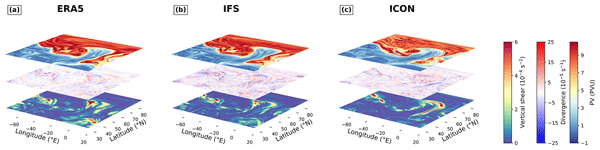
Madhuri Umbarkar, Daniel Kunkel, Annette Miltenberger, Hans-Christoph Lachnitt, Thorsten Kaluza, Cornelis Schwenk, and Peter Hoor
Atmos. Chem. Phys., 26, 12067–12096, https://doi.org/10.5194/acp-26-12067-2026, https://doi.org/10.5194/acp-26-12067-2026, 2026
Short summary
Short summary
We present an extratropical cyclone case study over the North Atlantic focusing on the role of atmospheric gravity waves (GW) in the generation of strong vertical shear and (clear-air) turbulence (CAT), as well as their impact on tracer distribution in the lowermost stratosphere. Our findings suggest that GW related processes should be considered as a key for upper troposphere lower stratosphere (UTLS) transport and mixing, and as an important candidate for the interpretation of CAT in the UTLS.
Georgios Dekoutsidis, Silke Groß, Florian Ewald, Martina Krämer, Christian Rolf, Andreas Schäfler, and Martin Wirth
EGUsphere, https://doi.org/10.5194/egusphere-2026-3788, https://doi.org/10.5194/egusphere-2026-3788, 2026
Short summary
Short summary
Cirrus clouds interact with radiation, but their exact effects are not well-defined and depend on their properties, formation process and the ambient conditions. We used airborne lidar and radar measurements and models in order to compare cirrus that formed in undisturbed conditions and during Warm Air intrusions (WAI). We found that WAIs cause a change in the formation and their properties. Our findings can improve the representation of cirrus in models and the estimation of their impact.
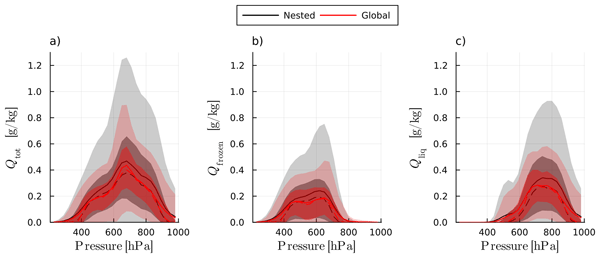
Cornelis Schwenk and Annette Miltenberger
Atmos. Chem. Phys., 26, 7435–7462, https://doi.org/10.5194/acp-26-7435-2026, https://doi.org/10.5194/acp-26-7435-2026, 2026
Short summary
Short summary
We studied how model grid-spacing affects how moisture and ice are carried upward in large weather systems that move warm, moist air into the upper troposphere. By comparing high- and low-resolution simulations, we found that models which are able to represent convectively ascending air produce much drier air at high altitudes. This shows that model resolution strongly influences how water and clouds are transported and how they may affect climate.
Kasper Juurikkala, Tomi Raatikainen, Martina Krämer, Christina J. Williamson, and Ari Laaksonen
EGUsphere, https://doi.org/10.5194/egusphere-2026-2427, https://doi.org/10.5194/egusphere-2026-2427, 2026
Short summary
Short summary
We use large-eddy simulations constrained by observations to study how mineral dust controls the evolution of cirrus clouds during dust outbreaks. Results show that sustained dusty cirrus forms only under strongly elevated dust concentrations, where ice forms mainly on dust particles. This identifies mineral dust as the key control on cirrus persistence and highlights the need to improve representation of dust-driven ice formation in weather and climate models.
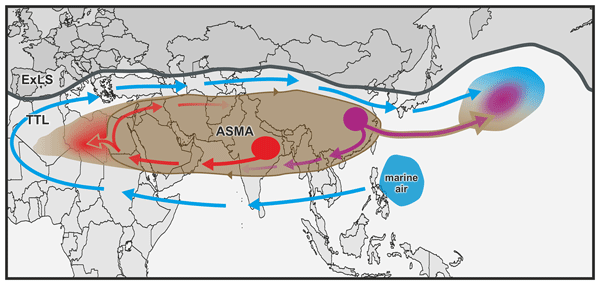
Bärbel Vogel, Valentin Lauther, Franziska Köllner, Fatih Ekinci, Christian Rolf, Johannes Strobel, Ronja van Luijt, C. Michael Volk, Stephan Borrmann, Antonis Dragoneas, Oliver Eppers, Sergej Molleker, Peter Hoor, Linda Ort, Franziska Weyland, Andreas Zahn, Jan Clemens, Gebhard Günther, Oleh Kachula, Rolf Müller, Felix Ploeger, and Martin Riese
Atmos. Chem. Phys., 26, 6283–6319, https://doi.org/10.5194/acp-26-6283-2026, https://doi.org/10.5194/acp-26-6283-2026, 2026
Short summary
Short summary
This work highlights the impact of the Asian summer monsoon on the chemical composition of the upper troposphere and lower stratosphere. Measurements of trace gases and aerosol particles uplifted by the Asian summer monsoon to higher altitudes are sparse. Here, we had the opportunity to use a whole suite of different measured trace gases and the chemical composition of aerosols, in combination with simulations, to better understand the complex transport and mixing processes in this region.
Athulya Saiprakash, Martina Krämer, Christian Rolf, Patrick Konjari, Jérôme Riedi, and Odran Sourdeval
EGUsphere, https://doi.org/10.5194/egusphere-2026-2416, https://doi.org/10.5194/egusphere-2026-2416, 2026
Short summary
Short summary
To better understand how observed high ice clouds, known as cirrus, form and change, satellite images were combined with calculations that reconstruct how the air moved before the clouds formed. Case studies showed that cloud history differs with height, age, and surrounding conditions, and that small temperature changes strongly shape cloud growth. This helps reveal and characterize the mechanisms behind observed cirrus.
Athulya Saiprakash, Martina Krämer, Christian Rolf, Jérôme Riedi, and Odran Sourdeval
EGUsphere, https://doi.org/10.5194/egusphere-2026-2423, https://doi.org/10.5194/egusphere-2026-2423, 2026
Short summary
Short summary
This second part of the study tested the new method by comparing its results with satellite and aircraft observations and by examining how sensitive it is to key assumptions. The method agreed well with observations in most cases, although clouds formed over mountains remained harder to capture. It also showed which conditions and processes matter most for reconstructing how cirrus form and evolve.
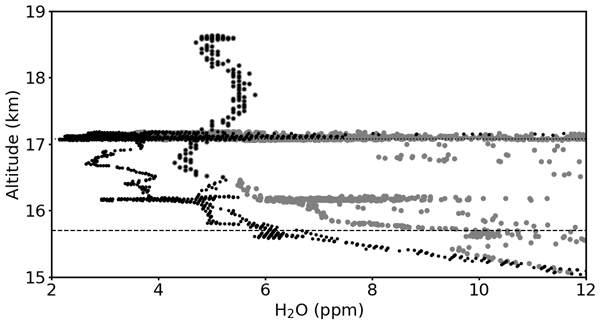
Rolf Müller, Bärbel Vogel, Martina Krämer, Christian Rolf, Nicole Spelten, and Fabrizio Ravegnani
Atmos. Chem. Phys., 26, 4359–4376, https://doi.org/10.5194/acp-26-4359-2026, https://doi.org/10.5194/acp-26-4359-2026, 2026
Short summary
Short summary
In the Asian summer monsoon anticyclone the lapse rate tropopause, and not the cold point, constitutes a good estimate of the upper boundary of the well mixed tropospheric air mass. For strong convection there is substantial dehydration at the cold point tropopause (in summer 2017). Above the cold point tropopause, under such conditions, neither ice particle occurrence, nor enhanced molar mixing ratios of water vapour (above ≲ 6 ppm) are observed.

Patrick Konjari, Christian Rolf, Martina Krämer, Armin Afchine, Nicole Spelten, Irene Bartolome Garcia, Annette Miltenberger, Nicolas Emig, Philipp Joppe, Johannes Schneider, Yun Li, Andreas Petzold, Heiko Bozem, and Peter Hoor
Atmos. Chem. Phys., 25, 18031–18050, https://doi.org/10.5194/acp-25-18031-2025, https://doi.org/10.5194/acp-25-18031-2025, 2025
Short summary
Short summary
We investigated how a powerful storm over southern Sweden in June 2024 transported ice particles and moist air into the normally dry stratosphere. We observed unusually high water vapor and ice levels up to 1.5 kilometers above the tropopause. Although the extra water vapor lasted only a few days to weeks, it shows how such storms can temporarily alter the upper atmosphere’s composition.
Redha Belhadji, Pasquale Sellitto, Maxim Eremenko, Silvia Bucci, Tran M. Nguyet, Martin Schwell, and Bernard Legras
Atmos. Meas. Tech., 18, 7465–7476, https://doi.org/10.5194/amt-18-7465-2025, https://doi.org/10.5194/amt-18-7465-2025, 2025
Short summary
Short summary
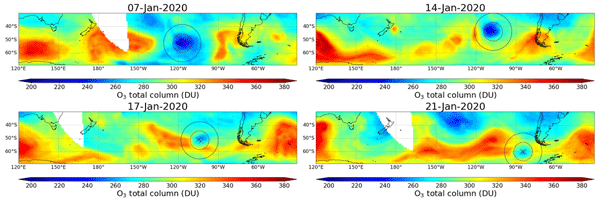
The 2019–2020 Australian wildfires triggered massive Pyro-cumulonimbus clouds, injecting smoke aerosols into the stratosphere and forming a self-sustaining vortex that reached 35 km altitude. This vortex created a transient ozone mini-hole. Using satellite and ground-based observations, we tracked a 30–40 % initial ozone depletion, which decayed to ~7 % within a month. These findings highlight the impact of extreme wildfires on stratospheric dynamics and ozone composition.
Cornelis Schwenk and Annette Miltenberger
EGUsphere, https://doi.org/10.5194/egusphere-2025-5631, https://doi.org/10.5194/egusphere-2025-5631, 2025
Short summary
Short summary
We examined how model resolution affects the moisture and cloud content of large weather systems that move warm, moist air into the upper troposphere. By comparing high- and low-resolution simulations, we found that models which can resolve convectively ascending air produce drier air and more outgoing longwave radiation. This shows that model grid-spacing impacts modeled upper-level moisture and Earth's radiative balance.
Anna Breuninger, Philipp Joppe, Jonas Wilsch, Cornelis Schwenk, Heiko Bozem, Nicolas Emig, Laurin Merkel, Rainer Rossberg, Timo Keber, Arthur Kutschka, Philipp Waleska, Stefan Hofmann, Sarah Richter, Florian Ungeheuer, Konstantin Dörholt, Thorsten Hoffmann, Annette Miltenberger, Johannes Schneider, Peter Hoor, and Alexander L. Vogel
Atmos. Chem. Phys., 25, 16533–16551, https://doi.org/10.5194/acp-25-16533-2025, https://doi.org/10.5194/acp-25-16533-2025, 2025
Short summary
Short summary
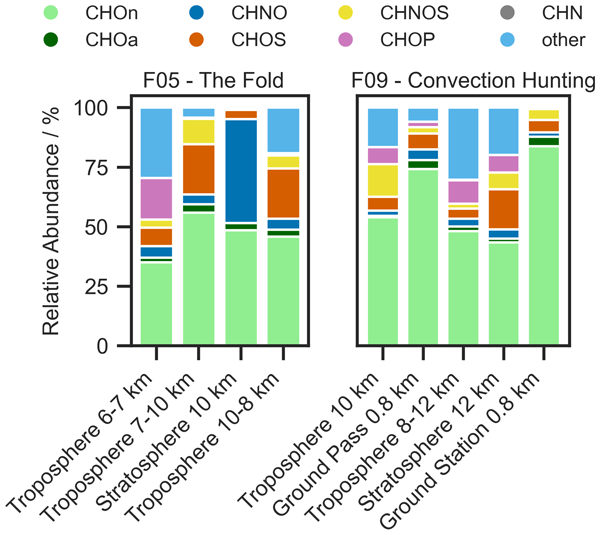
This study investigates molecular organic aerosol composition in the upper troposphere and lower stratosphere from an airborne campaign over Central Europe in summer 2024. Via ultra-high-performance liquid chromatography and high-resolution mass spectrometry of tropospheric and stratospheric filter samples, we identified various organic compounds. Our findings underscore the significant cross-tropopause transport of biogenic secondary organic aerosol and anthropogenic pollutants.
Heiko Bozem, Philipp Joppe, Yun Li, Nicolas Emig, Armin Afchine, Anna Breuninger, Joachim Curtius, Stefan Hofmann, Sadath Ismayil, Konrad Kandler, Daniel Kunkel, Arthur Kutschka, Hans-Christoph Lachnitt, Andreas Petzold, Sarah Richter, Timo Röschenthaler, Christian Rolf, Lisa Schneider, Johannes Schneider, Alexander Vogel, and Peter Hoor
Atmos. Meas. Tech., 18, 6545–6568, https://doi.org/10.5194/amt-18-6545-2025, https://doi.org/10.5194/amt-18-6545-2025, 2025
Short summary
Short summary
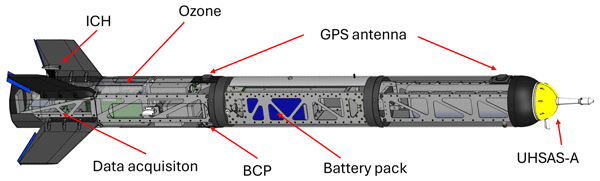
Deployed on a Learjet as a tandem measurement platform during the TPEx I (TropoPause composition gradients and mixing Experiment) campaign in June 2024, the new TPC-TOSS (TropoPause Composition Towed Sensor Shuttle) system delivers high-resolution in situ data on ozone, aerosol, and key meteorological parameters. Laboratory and in-flight tests confirmed its precision and stability. Observed gradients near the tropopause reveal active mixing and transport processes in the tropopause region.
Philipp Joppe, Johannes Schneider, Jonas Wilsch, Heiko Bozem, Anna Breuninger, Joachim Curtius, Martin Ebert, Nicolas Emig, Peter Hoor, Sadath Ismayil, Konrad Kandler, Daniel Kunkel, Isabel Kurth, Hans-Christoph Lachnitt, Yun Li, Annette Miltenberger, Sarah Richter, Christian Rolf, Lisa Schneider, Cornelis Schwenk, Nicole Spelten, Alexander L. Vogel, Yafang Cheng, and Stephan Borrmann
Atmos. Chem. Phys., 25, 15077–15103, https://doi.org/10.5194/acp-25-15077-2025, https://doi.org/10.5194/acp-25-15077-2025, 2025
Short summary
Short summary
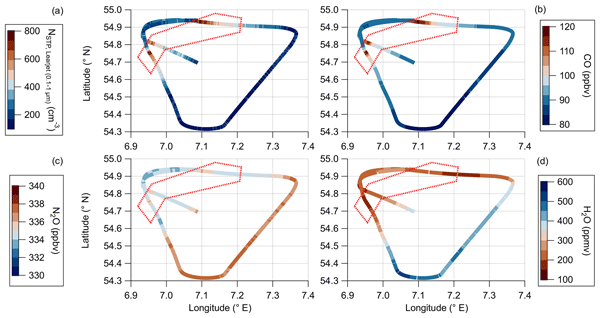
We show measurements of a filament with biomass burning influence transported by a warm conveyor belt (WCB) into the tropopause region over Europe. The pollution originates from Canadian forest fires and is transported in the lower troposphere towards Europe. The WCB transport is followed by mixing with air masses of stratospheric chemical signatures. We hypothesize that this mixing leads to a change in the vertical gradient of the potential temperature.
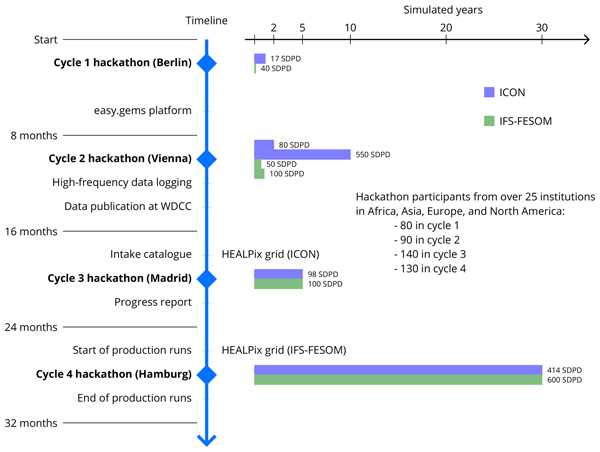
Hans Segura, Xabier Pedruzo-Bagazgoitia, Philipp Weiss, Sebastian K. Müller, Thomas Rackow, Junhong Lee, Edgar Dolores-Tesillos, Imme Benedict, Matthias Aengenheyster, Razvan Aguridan, Gabriele Arduini, Alexander J. Baker, Jiawei Bao, Swantje Bastin, Eulàlia Baulenas, Tobias Becker, Sebastian Beyer, Hendryk Bockelmann, Nils Brüggemann, Lukas Brunner, Suvarchal K. Cheedela, Sushant Das, Jasper Denissen, Ian Dragaud, Piotr Dziekan, Madeleine Ekblom, Jan Frederik Engels, Monika Esch, Richard Forbes, Claudia Frauen, Lilli Freischem, Diego García-Maroto, Philipp Geier, Paul Gierz, Álvaro González-Cervera, Katherine Grayson, Matthew Griffith, Oliver Gutjahr, Helmuth Haak, Ioan Hadade, Kerstin Haslehner, Shabeh ul Hasson, Jan Hegewald, Lukas Kluft, Aleksei Koldunov, Nikolay Koldunov, Tobias Kölling, Shunya Koseki, Sergey Kosukhin, Josh Kousal, Peter Kuma, Arjun U. Kumar, Rumeng Li, Nicolas Maury, Maximilian Meindl, Sebastian Milinski, Kristian Mogensen, Bimochan Niraula, Jakub Nowak, Divya Sri Praturi, Ulrike Proske, Dian Putrasahan, René Redler, David Santuy, Domokos Sármány, Reiner Schnur, Patrick Scholz, Dmitry Sidorenko, Dorian Spät, Birgit Sützl, Daisuke Takasuka, Adrian Tompkins, Alejandro Uribe, Mirco Valentini, Menno Veerman, Aiko Voigt, Sarah Warnau, Fabian Wachsmann, Marta Wacławczyk, Nils Wedi, Karl-Hermann Wieners, Jonathan Wille, Marius Winkler, Yuting Wu, Florian Ziemen, Janos Zimmermann, Frida A.-M. Bender, Dragana Bojovic, Sandrine Bony, Simona Bordoni, Patrice Brehmer, Marcus Dengler, Emanuel Dutra, Saliou Faye, Erich Fischer, Chiel van Heerwaarden, Cathy Hohenegger, Heikki Järvinen, Markus Jochum, Thomas Jung, Johann H. Jungclaus, Noel S. Keenlyside, Daniel Klocke, Heike Konow, Martina Klose, Szymon Malinowski, Olivia Martius, Thorsten Mauritsen, Juan Pedro Mellado, Theresa Mieslinger, Elsa Mohino, Hanna Pawłowska, Karsten Peters-von Gehlen, Abdoulaye Sarré, Pajam Sobhani, Philip Stier, Lauri Tuppi, Pier Luigi Vidale, Irina Sandu, and Bjorn Stevens
Geosci. Model Dev., 18, 7735–7761, https://doi.org/10.5194/gmd-18-7735-2025, https://doi.org/10.5194/gmd-18-7735-2025, 2025
Short summary
Short summary
The Next Generation of Earth Modeling Systems project (nextGEMS) developed two Earth system models that use horizontal grid spacing of 10 km and finer, giving more fidelity to the representation of local phenomena, globally. In its fourth cycle, nextGEMS simulated the Earth System climate over the 2020–2049 period under the SSP3-7.0 scenario. Here, we provide an overview of nextGEMS, insights into the model development, and the realism of multi-decadal, kilometer-scale simulations.
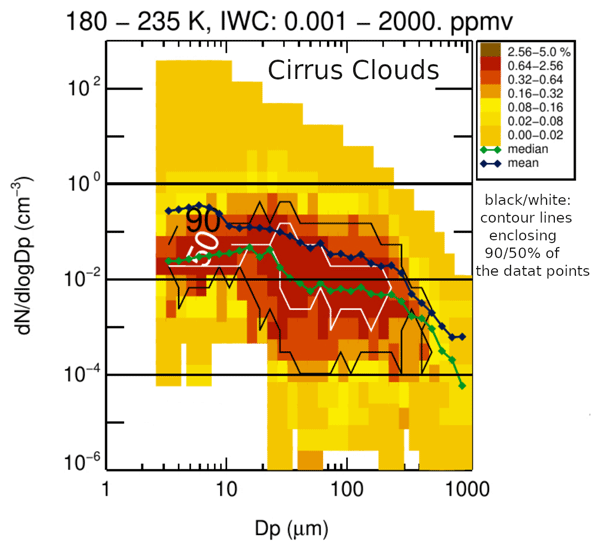
Martina Krämer, Nicole Spelten, Christian Rolf, and Reinhold Spang
Atmos. Chem. Phys., 25, 13563–13583, https://doi.org/10.5194/acp-25-13563-2025, https://doi.org/10.5194/acp-25-13563-2025, 2025
Short summary
Short summary
The size and number of cirrus ice crystals is one parameter influencing the still uncertain effect of cirrus clouds on climate. Here, the occurrence of ice particle sizes and concentrations with varying temperature and cloud microphysical thickness is analyzed as well as whether they formed in-situ or were transported upwards as frozen droplets from further below. The analyses are based on a large database of airborne measurements and extensive simulations.
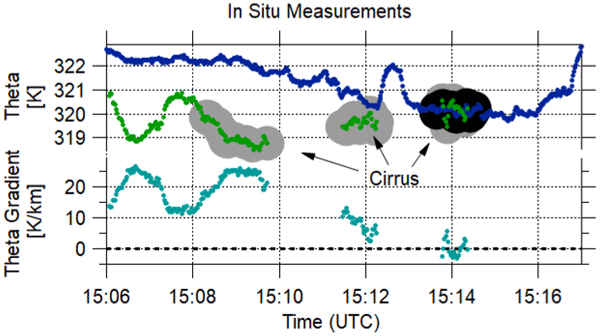
Nicolas Emig, Annette K. Miltenberger, Peter M. Hoor, and Andreas Petzold
Atmos. Chem. Phys., 25, 13077–13101, https://doi.org/10.5194/acp-25-13077-2025, https://doi.org/10.5194/acp-25-13077-2025, 2025
Short summary
Short summary
This study presents in situ observations of cirrus occurrence from aircraft measurements in the extratropical transition layer (ExTL) using simultaneous measurements from two platforms. Lagrangian diagnostics based on high-resolution ICON simulations show long residence times of the cirrus in stratospheric air, allowing us to separate different diabatic processes during transit. The findings suggest that radiative diabatic cloud processes significantly impact the tropopause thermodynamic structure.
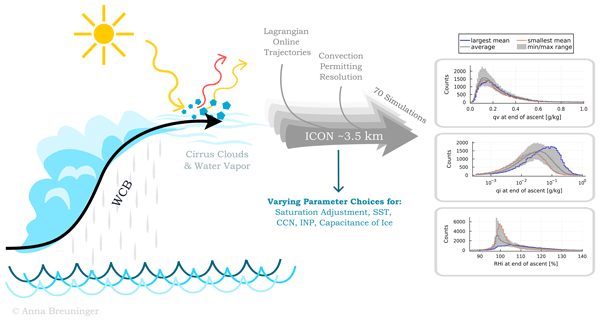
Cornelis Schwenk, Annette Miltenberger, and Annika Oertel
Atmos. Chem. Phys., 25, 11333–11361, https://doi.org/10.5194/acp-25-11333-2025, https://doi.org/10.5194/acp-25-11333-2025, 2025
Short summary
Short summary
We studied how different parameter choices concerning cloud processes affect the simulated transport of water and ice into the upper atmosphere (which affects the greenhouse effect) during a weather system called a warm conveyor belt. Using a set of model experiments, we found that some parameters have a strong effect on humidity and ice, especially during fast ascents. These findings could help improve weather and climate models and may also be relevant for future climate engineering studies.
Tim Lüttmer, Annette Miltenberger, and Peter Spichtinger
Atmos. Chem. Phys., 25, 10245–10265, https://doi.org/10.5194/acp-25-10245-2025, https://doi.org/10.5194/acp-25-10245-2025, 2025
Short summary
Short summary
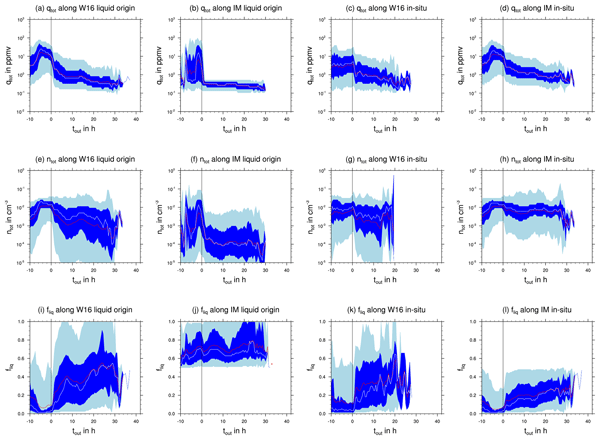
We investigate ice formation pathways in a warm conveyor belt case study. We employ a multi-phase microphysics scheme that distinguishes between ice from different nucleation processes. Ice crystals in the cirrus outflow mostly stem from in situ formation. Hence, they were formed directly from the vapor phase. Sedimentational redistribution modulates cirrus properties and leads to disagreement between cirrus origin classifications based on thermodynamic history and nucleation processes.
Blaž Gasparini, Rachel Atlas, Aiko Voigt, Martina Krämer, and Peter N. Blossey
Atmos. Chem. Phys., 25, 9957–9979, https://doi.org/10.5194/acp-25-9957-2025, https://doi.org/10.5194/acp-25-9957-2025, 2025
Short summary
Short summary
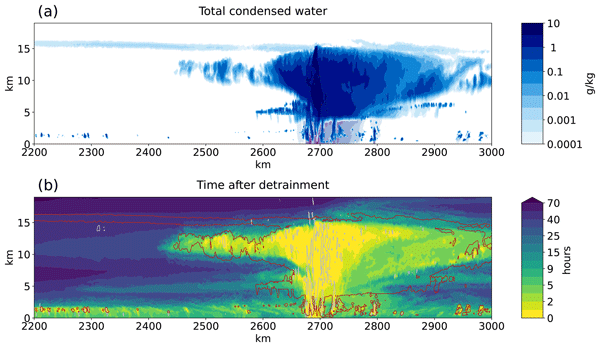
The evolution of tropical cirrus clouds is poorly understood, which contributes to large uncertainties in climate projections. To address this issue, we use novel tracers in a cloud-resolving model to track the life cycle of cirrus clouds. This approach provides insights into cloud formation, ice crystal evolution, and radiative effects of cirrus clouds. Additionally, we improve the model's cloud microphysics using a simple, computationally efficient approach that can be applied to other models.
Edgardo I. Sepulveda Araya, Sylvia C. Sullivan, and Aiko Voigt
Atmos. Chem. Phys., 25, 8943–8958, https://doi.org/10.5194/acp-25-8943-2025, https://doi.org/10.5194/acp-25-8943-2025, 2025
Short summary
Short summary
Clouds composed of ice crystals are key when evaluating atmospheric radiation. The morphology of the crystals found in clouds is not clear yet, and even less clear is the impact on the cloud heating rate, which is essential to describe precipitation and wind patterns. This motivated us to study how the heating rate behaves under a variety of ice complexity and environmental conditions, finding that increasing complexity in high and dense clouds weakens the heating rate.
Patrick Peter, Sigrun Matthes, Christine Frömming, Patrick Jöckel, Luca Bugliaro, Andreas Giez, Martina Krämer, and Volker Grewe
Atmos. Chem. Phys., 25, 5911–5934, https://doi.org/10.5194/acp-25-5911-2025, https://doi.org/10.5194/acp-25-5911-2025, 2025
Short summary
Short summary
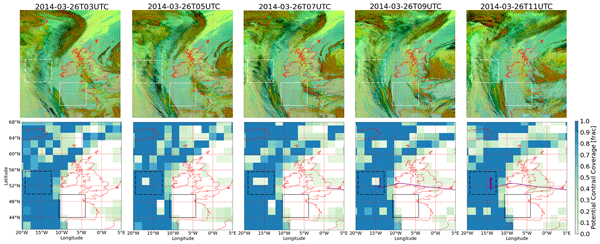
Our study examines how well the global climate model EMAC (ECHAM/MESSy Atmospheric Chemistry) predicts contrail formation by analysing temperature and humidity – two key factors for contrail development and persistence. The model underestimates temperature, leading to an overprediction of contrail formation and larger ice-supersaturated regions. Adjusting the model improves temperature accuracy but adds uncertainties. Better predictions of contrail formation areas can help optimise flight tracks to reduce aviation's climate effect.
Sreehari Kizhuveettil, Jordi Vila-Guerau de Arellano, Martina Krämer, Armin Afchine, Luiz A. T. Machado, Martin Zöger, and Wiebke Frey
EGUsphere, https://doi.org/10.5194/egusphere-2025-1637, https://doi.org/10.5194/egusphere-2025-1637, 2025
Preprint archived
Short summary
Short summary
Aircraft measurements are used to investigate high-altitude downdrafts in tropical deep convective clouds. The cloud water present in the downdrafts and its intensity do not show any correlation. Surprisingly, downdrafts occurred in supersaturated regions, contradicting the classical view of subsaturated downdrafts. Up- and downdrafts of similar strength show similar particle size distributions. These findings shed new light on the interplay between deep convection dynamics and microphysics.
Patrick Konjari, Christian Rolf, Michaela I. Hegglin, Susanne Rohs, Yun Li, Andreas Zahn, Harald Bönisch, Philippe Nedelec, Martina Krämer, and Andreas Petzold
Atmos. Chem. Phys., 25, 4269–4289, https://doi.org/10.5194/acp-25-4269-2025, https://doi.org/10.5194/acp-25-4269-2025, 2025
Short summary
Short summary
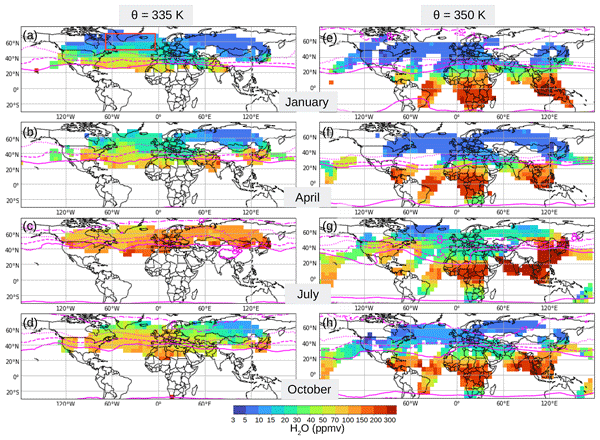
This study introduces a new method to derive adjusted water vapor (H2O) climatologies for the upper tropopshere and lower statosphere (UT/LS) using data from 60 000 flights under the IAGOS program. Biases in the IAGOS water vapour dataset are adjusted, based on the more accurate IAGOS-CARIBIC data. The resulting highly resolved H2O climatologies will contribute to a better understanding of the H2O variability in the UT/LS and its connection to various transport and mixing processes.
Germar H. Bernhard, George T. Janson, Scott Simpson, Raúl R. Cordero, Edgardo I. Sepúlveda Araya, Jose Jorquera, Juan A. Rayas, and Randall N. Lind
Atmos. Chem. Phys., 25, 819–841, https://doi.org/10.5194/acp-25-819-2025, https://doi.org/10.5194/acp-25-819-2025, 2025
Short summary
Short summary
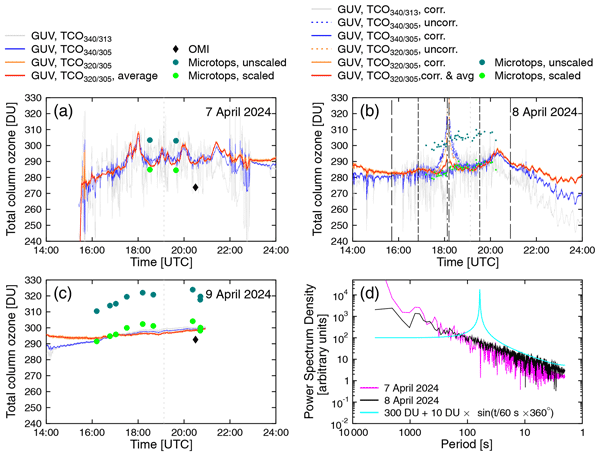
Several publications have reported that total column ozone (TCO) may oscillate during solar eclipses, whereas other researchers have not seen evidence of such fluctuations. Here, we try to resolve these contradictions by measuring variations in TCO during three solar eclipses. In all instances, the variability in TCO was within natural variability. We conclude that solar eclipses do not lead to measurable variations in TCO, drawing into question reports of much larger changes found in the past.
Cornelis Schwenk and Annette Miltenberger
Atmos. Chem. Phys., 24, 14073–14099, https://doi.org/10.5194/acp-24-14073-2024, https://doi.org/10.5194/acp-24-14073-2024, 2024
Short summary
Short summary
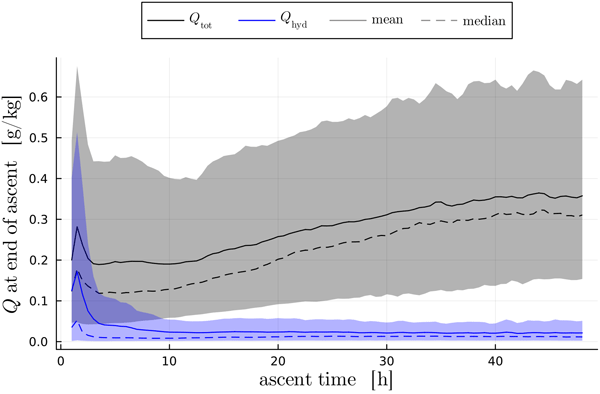
Warm conveyor belts (WCBs) transport moisture into the upper atmosphere, where it acts as a greenhouse gas. This transport is not well understood, and the role of rapidly rising air is unclear. We simulate a WCB and look at fast- and slow-rising air to see how moisture is (differently) transported. We find that for fast-ascending air more ice particles reach higher into the atmosphere and that frozen cloud particles are removed differently than during slow ascent, which has more water vapour.
Matthew Boyer, Diego Aliaga, Lauriane L. J. Quéléver, Silvia Bucci, Hélène Angot, Lubna Dada, Benjamin Heutte, Lisa Beck, Marina Duetsch, Andreas Stohl, Ivo Beck, Tiia Laurila, Nina Sarnela, Roseline C. Thakur, Branka Miljevic, Markku Kulmala, Tuukka Petäjä, Mikko Sipilä, Julia Schmale, and Tuija Jokinen
Atmos. Chem. Phys., 24, 12595–12621, https://doi.org/10.5194/acp-24-12595-2024, https://doi.org/10.5194/acp-24-12595-2024, 2024
Short summary
Short summary
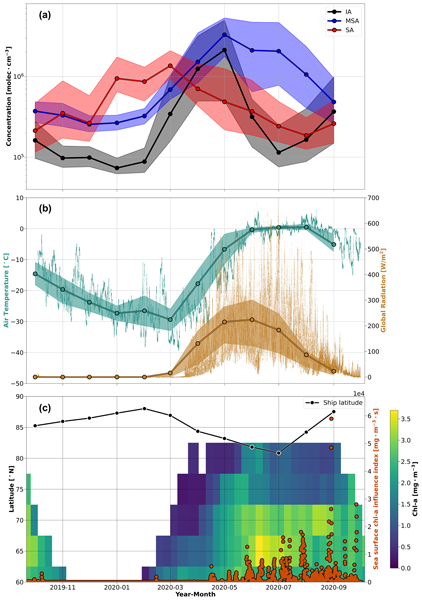
We analyze the seasonal cycle and sources of gases that are relevant for the formation of aerosol particles in the central Arctic. Since theses gases can form new particles, they can influence Arctic climate. We show that the sources of these gases are associated with changes in the Arctic environment during the year, especially with respect to sea ice. Therefore, the concentration of these gases will likely change in the future as the Arctic continues to warm.
Lucie Bakels, Daria Tatsii, Anne Tipka, Rona Thompson, Marina Dütsch, Michael Blaschek, Petra Seibert, Katharina Baier, Silvia Bucci, Massimo Cassiani, Sabine Eckhardt, Christine Groot Zwaaftink, Stephan Henne, Pirmin Kaufmann, Vincent Lechner, Christian Maurer, Marie D. Mulder, Ignacio Pisso, Andreas Plach, Rakesh Subramanian, Martin Vojta, and Andreas Stohl
Geosci. Model Dev., 17, 7595–7627, https://doi.org/10.5194/gmd-17-7595-2024, https://doi.org/10.5194/gmd-17-7595-2024, 2024
Short summary
Short summary
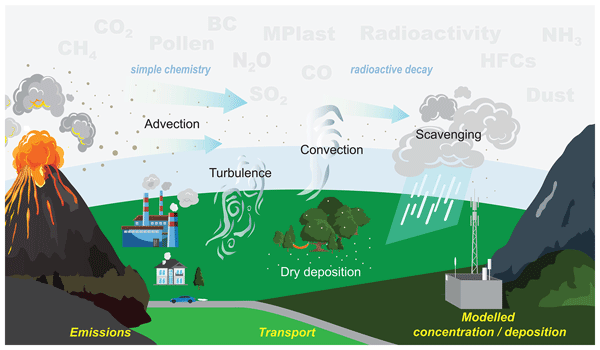
Computer models are essential for improving our understanding of how gases and particles move in the atmosphere. We present an update of the atmospheric transport model FLEXPART. FLEXPART 11 is more accurate due to a reduced number of interpolations and a new scheme for wet deposition. It can simulate non-spherical aerosols and includes linear chemical reactions. It is parallelised using OpenMP and includes new user options. A new user manual details how to use FLEXPART 11.
Aiko Voigt, Stefanie North, Blaž Gasparini, and Seung-Hee Ham
Atmos. Chem. Phys., 24, 9749–9775, https://doi.org/10.5194/acp-24-9749-2024, https://doi.org/10.5194/acp-24-9749-2024, 2024
Short summary
Short summary
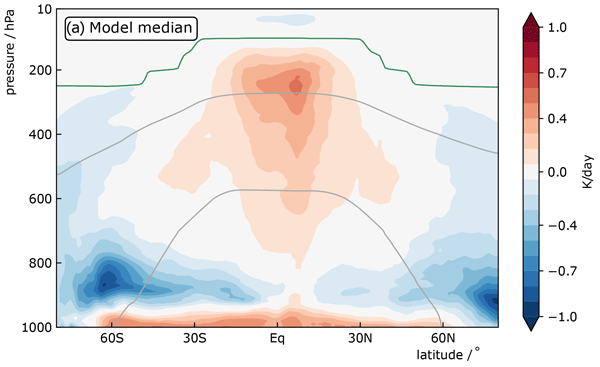
Clouds shape weather and climate by interacting with photons, which changes temperatures within the atmosphere. We assess how well CMIP6 climate models capture this radiative heating by clouds within the atmosphere. While we find large differences among models, especially in cold regions of the atmosphere with abundant ice clouds, we also demonstrate that physical understanding allows us to predict the response of clouds and their radiative heating near the tropopause to climate change.
Hengheng Zhang, Christian Rolf, Ralf Tillmann, Christian Wesolek, Frank Gunther Wienhold, Thomas Leisner, and Harald Saathoff
Aerosol Research, 2, 135–151, https://doi.org/10.5194/ar-2-135-2024, https://doi.org/10.5194/ar-2-135-2024, 2024
Short summary
Short summary
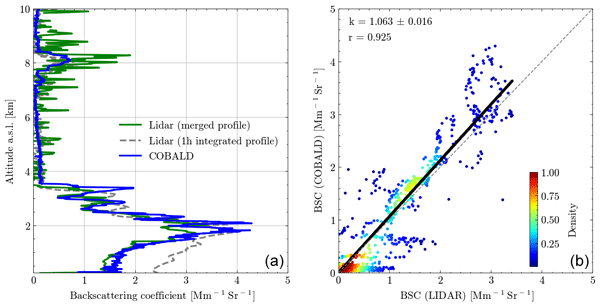
Our study employs advanced tools, including scanning lidar, balloons, and UAVs, to explore aerosol particles in the atmosphere. The scanning lidar offers distinctive near-ground-level insights, enriching our comprehension of aerosol distribution from ground level to the free troposphere. This research provides valuable data for comparing remote sensing and in situ aerosol measurements, advancing our understanding of aerosol impacts on radiative transfer, clouds, and air quality.
Edward Groot, Patrick Kuntze, Annette Miltenberger, and Holger Tost
Weather Clim. Dynam., 5, 779–803, https://doi.org/10.5194/wcd-5-779-2024, https://doi.org/10.5194/wcd-5-779-2024, 2024
Short summary
Short summary
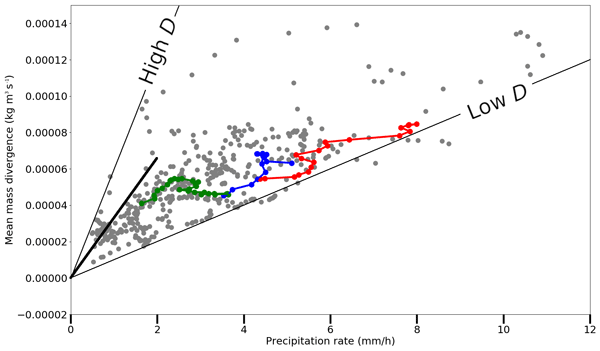
Deep convective clouds (thunderstorms), which may cause severe weather, tend to coherently organise into structured cloud systems. Accurate representation of these systems in models is difficult due to their complex dynamics and, in numerical simulations, the dependence of their dynamics on resolution. Here, the effect of convective organisation and geometry on their outflow winds (altitudes of 7–14 km) is investigated. Representation of their dynamics and outflows improves at higher resolution.
Richard Maier, Fabian Jakub, Claudia Emde, Mihail Manev, Aiko Voigt, and Bernhard Mayer
Geosci. Model Dev., 17, 3357–3383, https://doi.org/10.5194/gmd-17-3357-2024, https://doi.org/10.5194/gmd-17-3357-2024, 2024
Short summary
Short summary
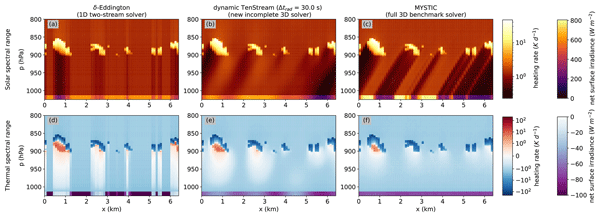
Based on the TenStream solver, we present a new method to accelerate 3D radiative transfer towards the speed of currently used 1D solvers. Using a shallow-cumulus-cloud time series, we evaluate the performance of this new solver in terms of both speed and accuracy. Compared to a 3D benchmark simulation, we show that our new solver is able to determine much more accurate irradiances and heating rates than a 1D δ-Eddington solver, even when operated with a similar computational demand.
Behrooz Keshtgar, Aiko Voigt, Bernhard Mayer, and Corinna Hoose
Atmos. Chem. Phys., 24, 4751–4769, https://doi.org/10.5194/acp-24-4751-2024, https://doi.org/10.5194/acp-24-4751-2024, 2024
Short summary
Short summary
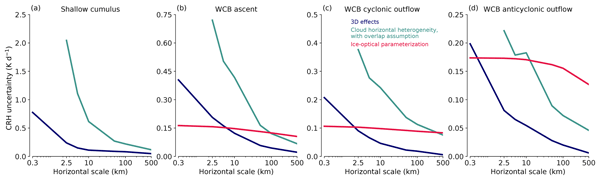
Cloud-radiative heating (CRH) affects extratropical cyclones but is uncertain in weather and climate models. We provide a framework to quantify uncertainties in CRH within an extratropical cyclone due to four factors and show that the parameterization of ice optical properties contributes significantly to uncertainty in CRH. We also argue that ice optical properties, by affecting CRH on spatial scales of 100 km, are relevant for the large-scale dynamics of extratropical cyclones.
Ella Gilbert, Jhaswantsing Purseed, Yun Li, Martina Krämer, Beatrice Altamura, and Nicolas Bellouin
EGUsphere, https://doi.org/10.5194/egusphere-2024-821, https://doi.org/10.5194/egusphere-2024-821, 2024
Preprint withdrawn
Short summary
Short summary
We use a simple experiment to explore the non-CO2 impacts of aviation on climate, which are considerably larger than the impact of the sector’s carbon emissions alone. We show that the main effect of our experiments – which intend to mimic the effect of aircraft soot emissions reaching existing high-altitude cirrus clouds – is to extend cloud lifetime, thereby enhancing their effect on climate.
Johannes Hörner and Aiko Voigt
Earth Syst. Dynam., 15, 215–223, https://doi.org/10.5194/esd-15-215-2024, https://doi.org/10.5194/esd-15-215-2024, 2024
Short summary
Short summary
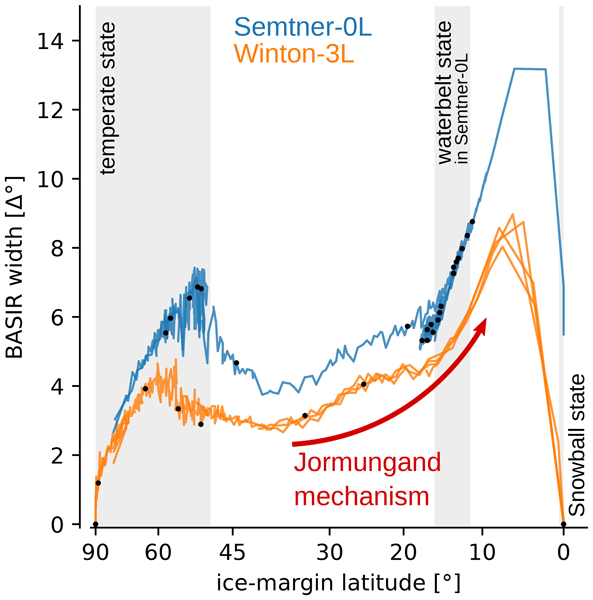
Snowball Earth refers to a climate in the deep past of the Earth where the whole planet was covered in ice. Waterbelt states, where a narrow region of open water remains at the Equator, have been discussed as an alternative scenario, which might explain how life was able to survive these periods. Here, we demonstrate how waterbelt states are influenced by the thermodynamical sea-ice model used. The sea-ice model modulates snow on ice, ice albedo and ultimately the stability of waterbelt states.
Irene Bartolomé García, Odran Sourdeval, Reinhold Spang, and Martina Krämer
Atmos. Chem. Phys., 24, 1699–1716, https://doi.org/10.5194/acp-24-1699-2024, https://doi.org/10.5194/acp-24-1699-2024, 2024
Short summary
Short summary
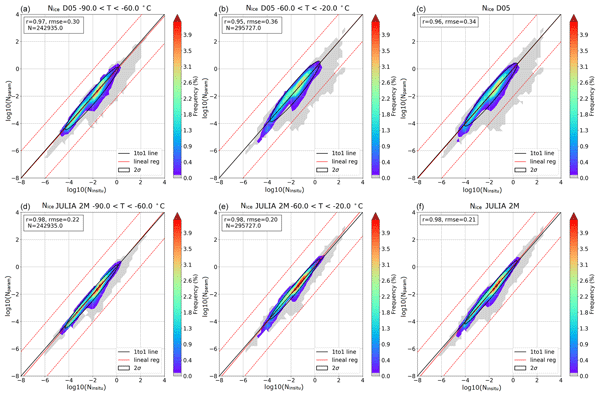
How many ice crystals of each size are in a cloud is a key parameter for the retrieval of cloud properties. The distribution of ice crystals is obtained from in situ measurements and used to create parameterizations that can be used when analyzing the remote-sensing data. Current parameterizations are based on data sets that do not include reliable measurements of small crystals, but in our study we use a data set that includes very small ice crystals to improve these parameterizations.
Blaž Gasparini, Sylvia C. Sullivan, Adam B. Sokol, Bernd Kärcher, Eric Jensen, and Dennis L. Hartmann
Atmos. Chem. Phys., 23, 15413–15444, https://doi.org/10.5194/acp-23-15413-2023, https://doi.org/10.5194/acp-23-15413-2023, 2023
Short summary
Short summary
Tropical cirrus clouds are essential for climate, but our understanding of these clouds is limited due to their dependence on a wide range of small- and large-scale climate processes. In this opinion paper, we review recent advances in the study of tropical cirrus clouds, point out remaining open questions, and suggest ways to resolve them.
Thomas Trickl, Martin Adelwart, Dina Khordakova, Ludwig Ries, Christian Rolf, Michael Sprenger, Wolfgang Steinbrecht, and Hannes Vogelmann
Atmos. Meas. Tech., 16, 5145–5165, https://doi.org/10.5194/amt-16-5145-2023, https://doi.org/10.5194/amt-16-5145-2023, 2023
Short summary
Short summary
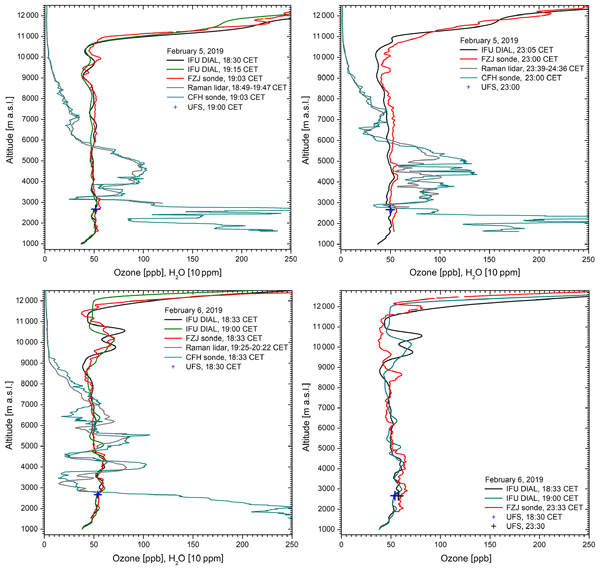
Tropospheric ozone have been measured for more than a century. Highly quantitative ozone measurements have been made at monitoring stations. However, deficits have been reported for vertical sounding systems. Here, we report a thorough intercomparison effort between a differential-absorption lidar system and two types of balloon-borne ozone sondes, also using ozone sensors at nearby mountain sites as references. The sondes agree very well with the lidar after offset corrections.
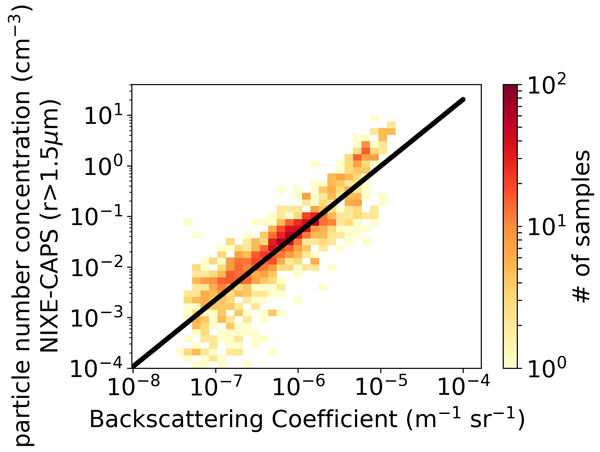
Francesco Cairo, Martina Krämer, Armin Afchine, Guido Di Donfrancesco, Luca Di Liberto, Sergey Khaykin, Lorenza Lucaferri, Valentin Mitev, Max Port, Christian Rolf, Marcel Snels, Nicole Spelten, Ralf Weigel, and Stephan Borrmann
Atmos. Meas. Tech., 16, 4899–4925, https://doi.org/10.5194/amt-16-4899-2023, https://doi.org/10.5194/amt-16-4899-2023, 2023
Short summary
Short summary
Cirrus clouds have been observed over the Himalayan region between 10 km and the tropopause at 17–18 km. Data from backscattersonde, hygrometers, and particle cloud spectrometers have been compared to assess their consistency. Empirical relationships between optical parameters accessible with remote sensing lidars and cloud microphysical parameters (such as ice water content, particle number and surface area density, and particle aspherical fraction) have been established.
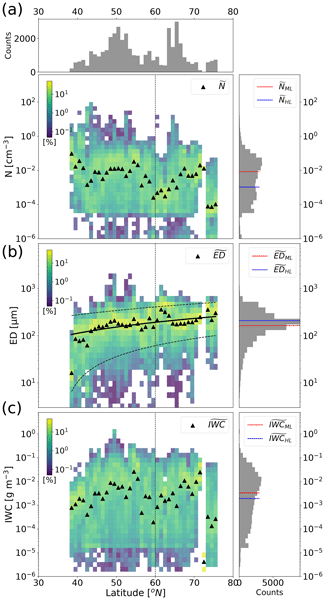
Elena De La Torre Castro, Tina Jurkat-Witschas, Armin Afchine, Volker Grewe, Valerian Hahn, Simon Kirschler, Martina Krämer, Johannes Lucke, Nicole Spelten, Heini Wernli, Martin Zöger, and Christiane Voigt
Atmos. Chem. Phys., 23, 13167–13189, https://doi.org/10.5194/acp-23-13167-2023, https://doi.org/10.5194/acp-23-13167-2023, 2023
Short summary
Short summary
In this study, we show the differences in the microphysical properties between high-latitude (HL) cirrus and mid-latitude (ML) cirrus over the Arctic, North Atlantic, and central Europe during summer. The in situ measurements are combined with backward trajectories to investigate the influence of the region on cloud formation. We show that HL cirrus are characterized by a lower concentration of larger ice crystals when compared to ML cirrus.
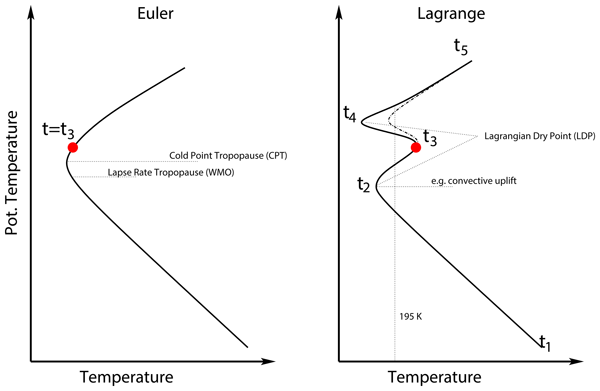
Paul Konopka, Christian Rolf, Marc von Hobe, Sergey M. Khaykin, Benjamin Clouser, Elisabeth Moyer, Fabrizio Ravegnani, Francesco D'Amato, Silvia Viciani, Nicole Spelten, Armin Afchine, Martina Krämer, Fred Stroh, and Felix Ploeger
Atmos. Chem. Phys., 23, 12935–12947, https://doi.org/10.5194/acp-23-12935-2023, https://doi.org/10.5194/acp-23-12935-2023, 2023
Short summary
Short summary
We studied water vapor in a critical region of the atmosphere, the Asian summer monsoon anticyclone, using rare in situ observations. Our study shows that extremely high water vapor values observed in the stratosphere within the Asian monsoon anticyclone still undergo significant freeze-drying and that water vapor concentrations set by the Lagrangian dry point are a better proxy for the stratospheric water vapor budget than rare observations of enhanced water mixing ratios.
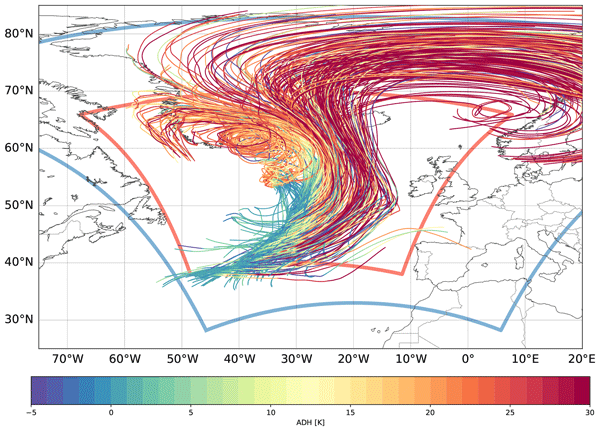
Annika Oertel, Annette K. Miltenberger, Christian M. Grams, and Corinna Hoose
Atmos. Chem. Phys., 23, 8553–8581, https://doi.org/10.5194/acp-23-8553-2023, https://doi.org/10.5194/acp-23-8553-2023, 2023
Short summary
Short summary
Warm conveyor belts (WCBs) are cloud- and precipitation-producing airstreams in extratropical cyclones that are important for the large-scale flow and cloud radiative forcing. We analyze cloud formation processes during WCB ascent in a two-moment microphysics scheme. Quantification of individual diabatic heating rates shows the importance of condensation, vapor deposition, rain evaporation, melting, and cloud-top radiative cooling for total heating and WCB-related potential vorticity structure.
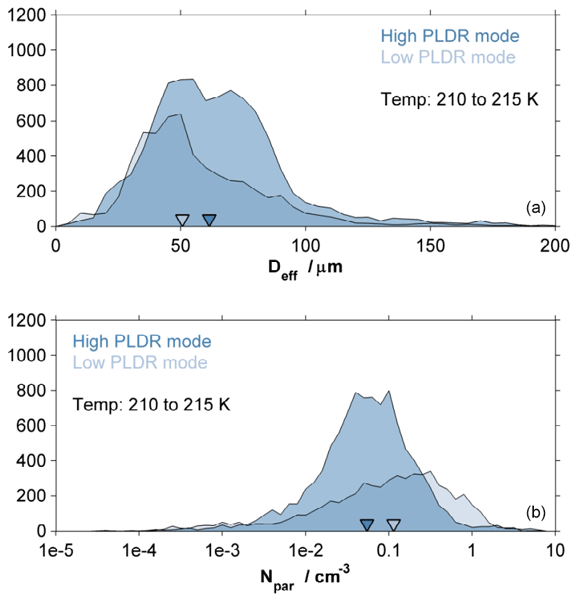
Silke Groß, Tina Jurkat-Witschas, Qiang Li, Martin Wirth, Benedikt Urbanek, Martina Krämer, Ralf Weigel, and Christiane Voigt
Atmos. Chem. Phys., 23, 8369–8381, https://doi.org/10.5194/acp-23-8369-2023, https://doi.org/10.5194/acp-23-8369-2023, 2023
Short summary
Short summary
Aviation-emitted aerosol can have an impact on cirrus clouds. We present optical and microphysical properties of mid-latitude cirrus clouds which were formed under the influence of aviation-emitted aerosol or which were formed under rather pristine conditions. We find that cirrus clouds affected by aviation-emitted aerosol show larger values of the particle linear depolarization ratio, larger mean effective ice particle diameters and decreased ice particle number concentrations.
Sylvia Sullivan, Behrooz Keshtgar, Nicole Albern, Elzina Bala, Christoph Braun, Anubhav Choudhary, Johannes Hörner, Hilke Lentink, Georgios Papavasileiou, and Aiko Voigt
Geosci. Model Dev., 16, 3535–3551, https://doi.org/10.5194/gmd-16-3535-2023, https://doi.org/10.5194/gmd-16-3535-2023, 2023
Short summary
Short summary
Clouds absorb and re-emit infrared radiation from Earth's surface and absorb and reflect incoming solar radiation. As a result, they change atmospheric temperature gradients that drive large-scale circulation. To better simulate this circulation, we study how the radiative heating and cooling from clouds depends on model settings like grid spacing; whether we describe convection approximately or exactly; and the level of detail used to describe small-scale processes, or microphysics, in clouds.
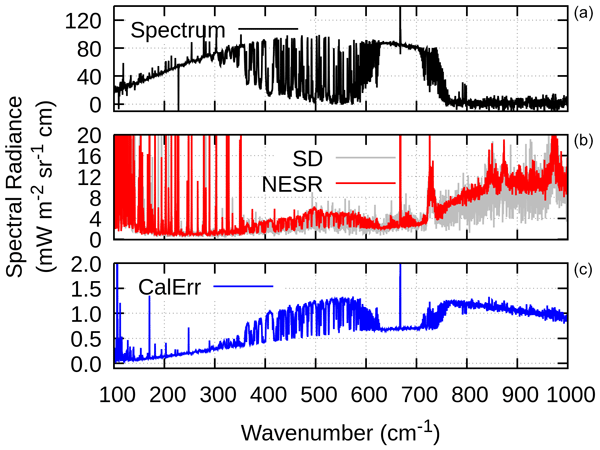
Claudio Belotti, Flavio Barbara, Marco Barucci, Giovanni Bianchini, Francesco D'Amato, Samuele Del Bianco, Gianluca Di Natale, Marco Gai, Alessio Montori, Filippo Pratesi, Markus Rettinger, Christian Rolf, Ralf Sussmann, Thomas Trickl, Silvia Viciani, Hannes Vogelmann, and Luca Palchetti
Atmos. Meas. Tech., 16, 2511–2529, https://doi.org/10.5194/amt-16-2511-2023, https://doi.org/10.5194/amt-16-2511-2023, 2023
Short summary
Short summary
FIRMOS (Far-Infrared Radiation Mobile Observation System) is a spectroradiometer measuring in the far-infrared, developed to support the preparation of the FORUM (Far-infrared Outgoing Radiation Understanding and Monitoring) satellite mission. In this paper, we describe the instrument, its data products, and the results of the comparison with a suite of observations made from a high-altitude site during a field campaign, in winter 2018–2019.
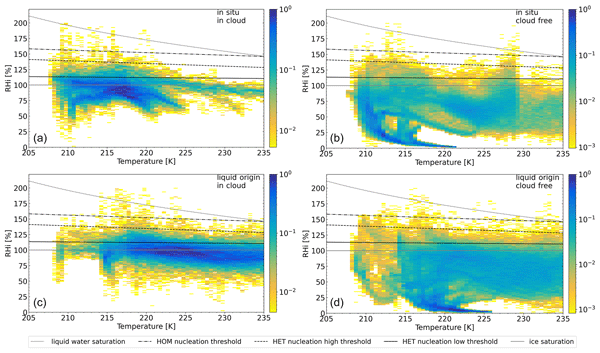
Georgios Dekoutsidis, Silke Groß, Martin Wirth, Martina Krämer, and Christian Rolf
Atmos. Chem. Phys., 23, 3103–3117, https://doi.org/10.5194/acp-23-3103-2023, https://doi.org/10.5194/acp-23-3103-2023, 2023
Short summary
Short summary
Cirrus clouds affect Earth's atmosphere, deeming our study important. Here we use water vapor measurements by lidar and study the relative humidity (RHi) within and around midlatitude cirrus clouds. We find high supersaturations in the cloud-free air and within the clouds, especially near the cloud top. We study two cloud types with different formation processes. Finally, we conclude that the shape of the distribution of RHi can be used as an indicator of different cloud evolutionary stages.
Fayçal Lamraoui, Martina Krämer, Armin Afchine, Adam B. Sokol, Sergey Khaykin, Apoorva Pandey, and Zhiming Kuang
Atmos. Chem. Phys., 23, 2393–2419, https://doi.org/10.5194/acp-23-2393-2023, https://doi.org/10.5194/acp-23-2393-2023, 2023
Short summary
Short summary
Cirrus in the tropical tropopause layer (TTL) can play a key role in vertical transport. We investigate the role of different cloud regimes and the associated ice habits in regulating the properties of the TTL. We use high-resolution numerical experiments at the scales of large-eddy simulations (LESs) and aircraft measurements. We found that LES-scale parameterizations that predict ice shape are crucial for an accurate representation of TTL cirrus and thus the associated (de)hydration process.
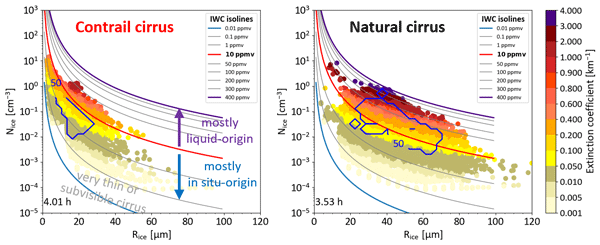
Yun Li, Christoph Mahnke, Susanne Rohs, Ulrich Bundke, Nicole Spelten, Georgios Dekoutsidis, Silke Groß, Christiane Voigt, Ulrich Schumann, Andreas Petzold, and Martina Krämer
Atmos. Chem. Phys., 23, 2251–2271, https://doi.org/10.5194/acp-23-2251-2023, https://doi.org/10.5194/acp-23-2251-2023, 2023
Short summary
Short summary
The radiative effect of aviation-induced cirrus is closely related to ambient conditions and its microphysical properties. Our study investigated the occurrence of contrail and natural cirrus measured above central Europe in spring 2014. It finds that contrail cirrus appears frequently in the pressure range 200 to 245 hPa and occurs more often in slightly ice-subsaturated environments than expected. Avoiding slightly ice-subsaturated regions by aviation might help mitigate contrail cirrus.
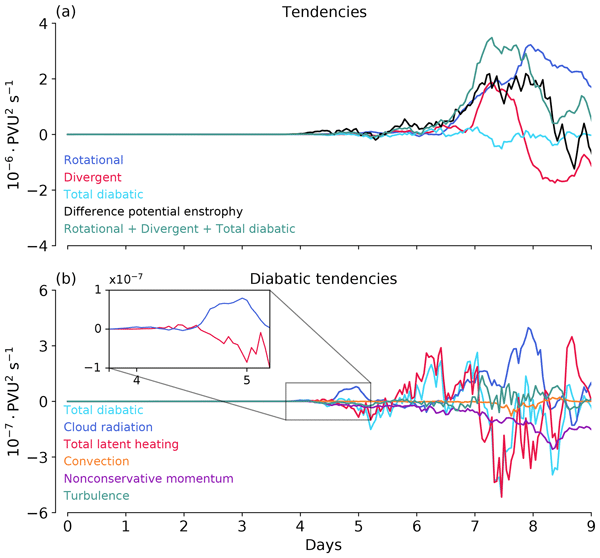
Behrooz Keshtgar, Aiko Voigt, Corinna Hoose, Michael Riemer, and Bernhard Mayer
Weather Clim. Dynam., 4, 115–132, https://doi.org/10.5194/wcd-4-115-2023, https://doi.org/10.5194/wcd-4-115-2023, 2023
Short summary
Short summary
Forecasting extratropical cyclones is challenging due to many physical factors influencing their behavior. One such factor is the impact of heating and cooling of the atmosphere by the interaction between clouds and radiation. In this study, we show that cloud-radiative heating (CRH) increases the intensity of an idealized cyclone and affects its predictability. We find that CRH affects the cyclone mostly via increasing latent heat release and subsequent changes in the synoptic circulation.
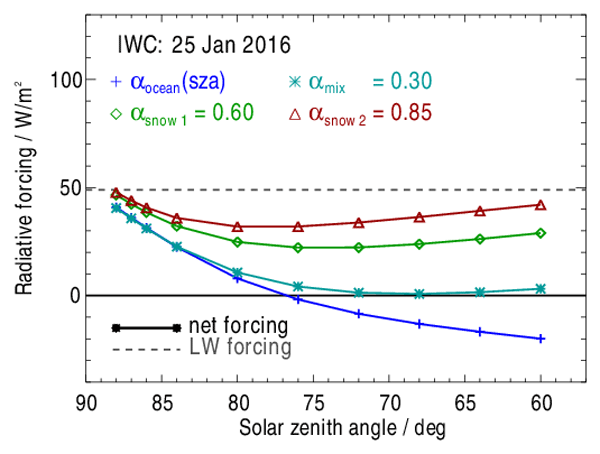
Andreas Marsing, Ralf Meerkötter, Romy Heller, Stefan Kaufmann, Tina Jurkat-Witschas, Martina Krämer, Christian Rolf, and Christiane Voigt
Atmos. Chem. Phys., 23, 587–609, https://doi.org/10.5194/acp-23-587-2023, https://doi.org/10.5194/acp-23-587-2023, 2023
Short summary
Short summary
We employ highly resolved aircraft measurements of profiles of the ice water content (IWC) in Arctic cirrus clouds in winter and spring, when solar irradiation is low. Using radiation transfer calculations, we assess the cloud radiative effect over different surfaces like snow or ocean. The variability in the IWC of the clouds affects their overall radiative effect and drives internal processes. This helps understand the role of cirrus in a rapidly changing Arctic environment.
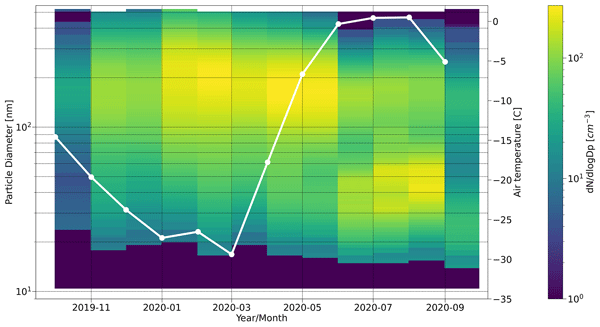
Matthew Boyer, Diego Aliaga, Jakob Boyd Pernov, Hélène Angot, Lauriane L. J. Quéléver, Lubna Dada, Benjamin Heutte, Manuel Dall'Osto, David C. S. Beddows, Zoé Brasseur, Ivo Beck, Silvia Bucci, Marina Duetsch, Andreas Stohl, Tiia Laurila, Eija Asmi, Andreas Massling, Daniel Charles Thomas, Jakob Klenø Nøjgaard, Tak Chan, Sangeeta Sharma, Peter Tunved, Radovan Krejci, Hans Christen Hansson, Federico Bianchi, Katrianne Lehtipalo, Alfred Wiedensohler, Kay Weinhold, Markku Kulmala, Tuukka Petäjä, Mikko Sipilä, Julia Schmale, and Tuija Jokinen
Atmos. Chem. Phys., 23, 389–415, https://doi.org/10.5194/acp-23-389-2023, https://doi.org/10.5194/acp-23-389-2023, 2023
Short summary
Short summary
The Arctic is a unique environment that is warming faster than other locations on Earth. We evaluate measurements of aerosol particles, which can influence climate, over the central Arctic Ocean for a full year and compare the data to land-based measurement stations across the Arctic. Our measurements show that the central Arctic has similarities to but also distinct differences from the stations further south. We note that this may change as the Arctic warms and sea ice continues to decline.
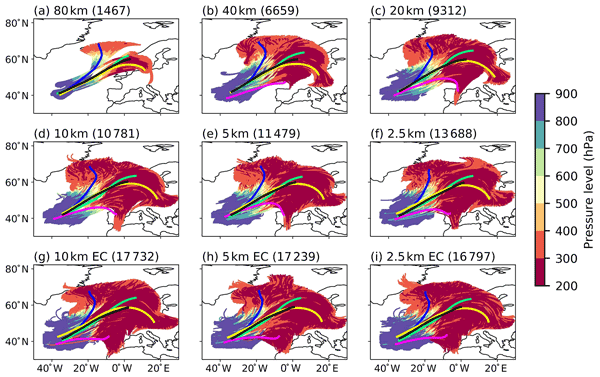
Anubhav Choudhary and Aiko Voigt
Weather Clim. Dynam., 3, 1199–1214, https://doi.org/10.5194/wcd-3-1199-2022, https://doi.org/10.5194/wcd-3-1199-2022, 2022
Short summary
Short summary
The warm conveyor belt (WCB), which is a stream of coherently rising air parcels, is an important feature of extratropical cyclones. This work presents the impact of model grid spacing on simulation of cloud diabatic processes in the WCB of a North Atlantic cyclone. We find that the refinement of the model grid systematically enhances the dynamical properties and heat releasing processes within the WCB. However, this pattern does not have a strong impact on the strength of associated cyclones.
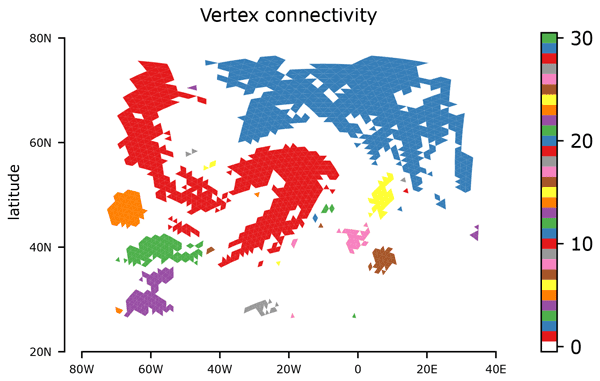
Aiko Voigt, Petra Schwer, Noam von Rotberg, and Nicole Knopf
Geosci. Model Dev., 15, 7489–7504, https://doi.org/10.5194/gmd-15-7489-2022, https://doi.org/10.5194/gmd-15-7489-2022, 2022
Short summary
Short summary
In climate science, it is helpful to identify coherent objects, for example, those formed by clouds. However, many models now use unstructured grids, which makes it harder to identify coherent objects. We present a new method that solves this problem by moving model data from an unstructured triangular grid to a structured cubical grid. We implement the method in an open-source Python package and show that the method is ready to be applied to climate model data.
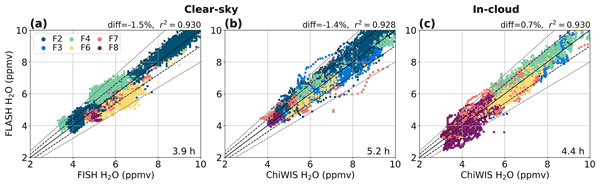
Clare E. Singer, Benjamin W. Clouser, Sergey M. Khaykin, Martina Krämer, Francesco Cairo, Thomas Peter, Alexey Lykov, Christian Rolf, Nicole Spelten, Armin Afchine, Simone Brunamonti, and Elisabeth J. Moyer
Atmos. Meas. Tech., 15, 4767–4783, https://doi.org/10.5194/amt-15-4767-2022, https://doi.org/10.5194/amt-15-4767-2022, 2022
Short summary
Short summary
In situ measurements of water vapor in the upper troposphere are necessary to study cloud formation and hydration of the stratosphere but challenging due to cold–dry conditions. We compare measurements from three water vapor instruments from the StratoClim campaign in 2017. In clear sky (clouds), point-by-point differences were <1.5±8 % (<1±8 %). This excellent agreement allows detection of fine-scale structures required to understand the impact of convection on stratospheric water vapor.
Andreas Wieser, Andreas Güntner, Peter Dietrich, Jan Handwerker, Dina Khordakova, Uta Ködel, Martin Kohler, Hannes Mollenhauer, Bernhard Mühr, Erik Nixdorf, Marvin Reich, Christian Rolf, Martin Schrön, Claudia Schütze, and Ute Weber
Hydrol. Earth Syst. Sci. Discuss., https://doi.org/10.5194/hess-2022-131, https://doi.org/10.5194/hess-2022-131, 2022
Preprint withdrawn
Short summary
Short summary
We present an event-triggered observation concept which covers the entire process chain from heavy precipitation to flooding at the catchment scale. It combines flexible and mobile observing systems out of the fields of meteorology, hydrology and geophysics with stationary networks to capture atmospheric transport processes, heterogeneous precipitation patterns, land surface and subsurface storage processes, and runoff dynamics.
Mireia Papke Chica, Valerian Hahn, Tiziana Braeuer, Elena de la Torre Castro, Florian Ewald, Mathias Gergely, Simon Kirschler, Luca Bugliaro Goggia, Stefanie Knobloch, Martina Kraemer, Johannes Lucke, Johanna Mayer, Raphael Maerkl, Manuel Moser, Laura Tomsche, Tina Jurkat-Witschas, Martin Zoeger, Christian von Savigny, and Christiane Voigt
Atmos. Chem. Phys. Discuss., https://doi.org/10.5194/acp-2022-255, https://doi.org/10.5194/acp-2022-255, 2022
Preprint withdrawn
Short summary
Short summary
The mixed-phase temperature regime in convective clouds challenges our understanding of microphysical and radiative cloud properties. We provide a rare and unique dataset of aircraft in situ measurements in a strong mid-latitude convective system. We find that mechanisms initiating ice nucleation and growth strongly depend on temperature, relative humidity, and vertical velocity and variate within the measured system, resulting in altitude dependent changes of the cloud liquid and ice fraction.
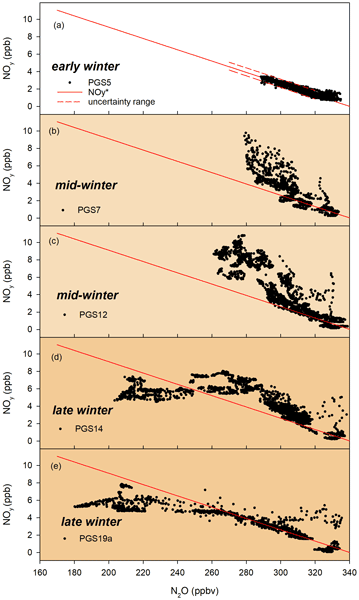
Helmut Ziereis, Peter Hoor, Jens-Uwe Grooß, Andreas Zahn, Greta Stratmann, Paul Stock, Michael Lichtenstern, Jens Krause, Vera Bense, Armin Afchine, Christian Rolf, Wolfgang Woiwode, Marleen Braun, Jörn Ungermann, Andreas Marsing, Christiane Voigt, Andreas Engel, Björn-Martin Sinnhuber, and Hermann Oelhaf
Atmos. Chem. Phys., 22, 3631–3654, https://doi.org/10.5194/acp-22-3631-2022, https://doi.org/10.5194/acp-22-3631-2022, 2022
Short summary
Short summary
Airborne observations were conducted in the lowermost Arctic stratosphere during the winter of 2015/2016. The observed distribution of reactive nitrogen shows clear indications of nitrification in mid-winter and denitrification in late winter. This was caused by the formation of polar stratospheric cloud particles, which were observed during several flights. The sedimentation and evaporation of these particles and the descent of air masses cause a redistribution of reactive nitrogen.
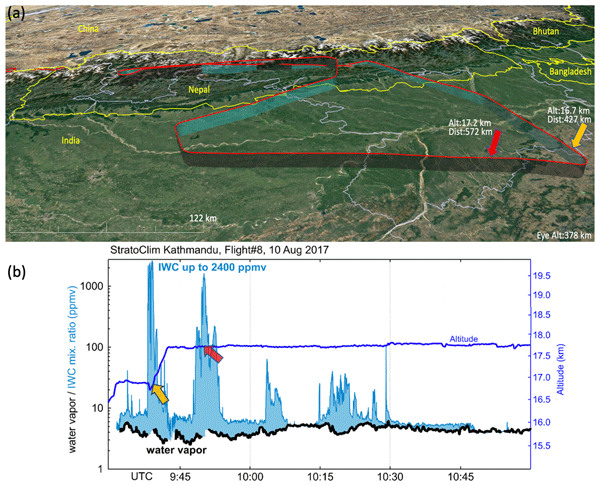
Sergey M. Khaykin, Elizabeth Moyer, Martina Krämer, Benjamin Clouser, Silvia Bucci, Bernard Legras, Alexey Lykov, Armin Afchine, Francesco Cairo, Ivan Formanyuk, Valentin Mitev, Renaud Matthey, Christian Rolf, Clare E. Singer, Nicole Spelten, Vasiliy Volkov, Vladimir Yushkov, and Fred Stroh
Atmos. Chem. Phys., 22, 3169–3189, https://doi.org/10.5194/acp-22-3169-2022, https://doi.org/10.5194/acp-22-3169-2022, 2022
Short summary
Short summary
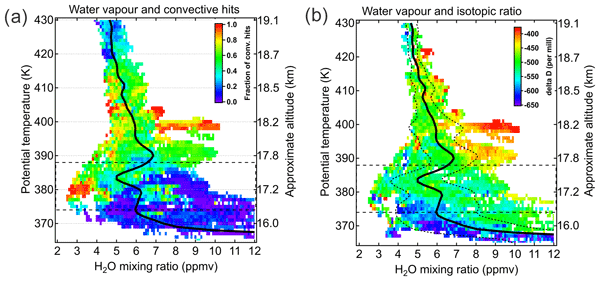
The Asian monsoon anticyclone is the key contributor to the global annual maximum in lower stratospheric water vapour. We investigate the impact of deep convection on the lower stratospheric water using a unique set of observations aboard the high-altitude M55-Geophysica aircraft deployed in Nepal in summer 2017 within the EU StratoClim project. We find that convective plumes of wet air can persist within the Asian anticyclone for weeks, thereby enhancing the occurrence of high-level clouds.
Stefan Niebler, Annette Miltenberger, Bertil Schmidt, and Peter Spichtinger
Weather Clim. Dynam., 3, 113–137, https://doi.org/10.5194/wcd-3-113-2022, https://doi.org/10.5194/wcd-3-113-2022, 2022
Short summary
Short summary
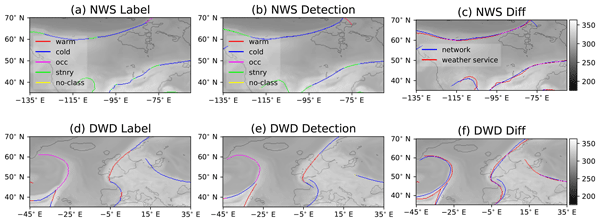
We use machine learning to create a network that detects and classifies four types of synoptic-scale weather fronts from ERA5 atmospheric reanalysis data. We present an application of our method, showing its use case in a scientific context. Additionally, our results show that multiple sources of training data are necessary to perform well on different regions, implying differences within those regions. Qualitative evaluation shows that the results are physically plausible.
Dina Khordakova, Christian Rolf, Jens-Uwe Grooß, Rolf Müller, Paul Konopka, Andreas Wieser, Martina Krämer, and Martin Riese
Atmos. Chem. Phys., 22, 1059–1079, https://doi.org/10.5194/acp-22-1059-2022, https://doi.org/10.5194/acp-22-1059-2022, 2022
Short summary
Short summary
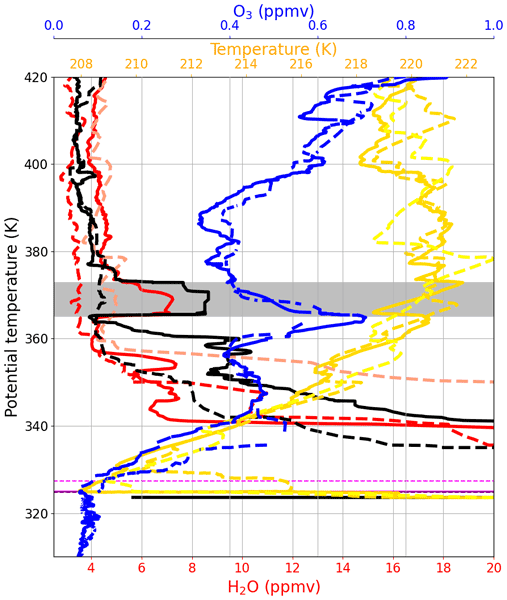
Extreme storms transport humidity from the troposphere to the stratosphere. Here it has a strong impact on the climate. With ongoing global warming, we expect more storms and, hence, an enhancement of this effect. A case study was performed in order to measure the impact of the direct injection of water vapor into the lower stratosphere. The measurements displayed a significant transport of water vapor into the lower stratosphere, and this was supported by satellite and reanalysis data.
Manuel Baumgartner, Christian Rolf, Jens-Uwe Grooß, Julia Schneider, Tobias Schorr, Ottmar Möhler, Peter Spichtinger, and Martina Krämer
Atmos. Chem. Phys., 22, 65–91, https://doi.org/10.5194/acp-22-65-2022, https://doi.org/10.5194/acp-22-65-2022, 2022
Short summary
Short summary
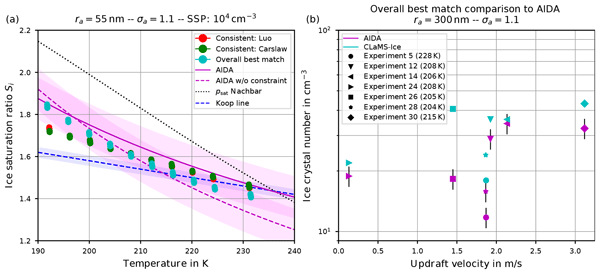
An important mechanism for the appearance of ice particles in the upper troposphere at low temperatures is homogeneous nucleation. This process is commonly described by the
Koop line, predicting the humidity at freezing. However, laboratory measurements suggest that the freezing humidities are above the Koop line, motivating the present study to investigate the influence of different physical parameterizations on the homogeneous freezing with the help of a detailed numerical model.
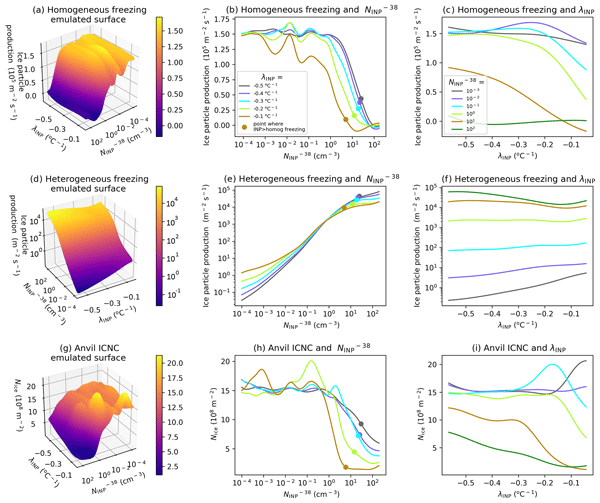
Rachel E. Hawker, Annette K. Miltenberger, Jill S. Johnson, Jonathan M. Wilkinson, Adrian A. Hill, Ben J. Shipway, Paul R. Field, Benjamin J. Murray, and Ken S. Carslaw
Atmos. Chem. Phys., 21, 17315–17343, https://doi.org/10.5194/acp-21-17315-2021, https://doi.org/10.5194/acp-21-17315-2021, 2021
Short summary
Short summary
We find that ice-nucleating particles (INPs), aerosols that can initiate the freezing of cloud droplets, cause substantial changes to the properties of radiatively important convectively generated anvil cirrus. The number concentration of INPs had a large effect on ice crystal number concentration while the INP temperature dependence controlled ice crystal size and cloud fraction. The results indicate information on INP number and source is necessary for the representation of cloud glaciation.
Cited articles
Afchine, A., Rolf, C., Costa, A., Spelten, N., Riese, M., Buchholz, B., Ebert, V., Heller, R., Kaufmann, S., Minikin, A., Voigt, C., Zöger, M., Smith, J., Lawson, P., Lykov, A., Khaykin, S., and Krämer, M.: Ice particle sampling from aircraft – influence of the probing position on the ice water content, Atmos. Meas. Tech., 11, 4015–4031, https://doi.org/10.5194/amt-11-4015-2018, 2018. a
Atlas, R., Bretherton, C., Sokol, A., Blossey, P., and Khairoutdinov, M.: Tropical Cirrus Are Highly Sensitive to Ice Microphysics Within a Nudged Global Storm-Resolving Model, Geophysical Research Letters, 51, e2023GL105868, https://doi.org/10.1029/2023GL105868, 2024. a
Banerjee, A., Chiodo, G., Previdi, M., Ponater, M., Conley, A. J., and Polvani, L. M.: Stratospheric water vapor: an important climate feedback, Climate Dynamics, 53, 1697–1710, 2019. a
Baran, A. J., Hilla, P., Walters, D., Hardman, S. C., Furtado, K., Field, P. R., and Manners, J.: The Impact of Two Coupled Cirrus Microphysics–Radiation Parameterizations on the Temperature and Specific Humidity Biases in the Tropical Tropopause Layer in a Climate Model, Journal of Climate, 29, 5299–5316, https://doi.org/10.1175/JCLI-D-15-0821.1, 2016. a, b
Charlesworth, E., Plöger, F., Birner, T., Baikhadzhaev, R., Abalos, M., Abraham, N. L., Akiyoshi, H., Bekki, S., Dennison, F., Jöckel, P., Keeble, J., Kinnison, D., Morgenstern, O., Plummer, D., Rozanov, E., Strode, S., Zeng, G., Egorova, T., Riese, M.: Stratospheric water vapor affecting atmospheric circulation, Nature Communications, 14, 3925, https://doi.org/10.1038/s41467-023-39559-2, 2023. a
Cohen, Y., Hauglustaine, D., Bellouin, N., Lund, M. T., Matthes, S., Skowron, A., Thor, R., Bundke, U., Petzold, A., Rohs, S., Thouret, V., Zahn, A., and Ziereis, H.: Evaluation of O3, H2O, CO, and NOy climatologies simulated by four global models in the upper troposphere–lower stratosphere with IAGOS measurements, Atmos. Chem. Phys., 25, 5793–5836, https://doi.org/10.5194/acp-25-5793-2025, 2025. a
Corcos, M., Hertzog, A., Plougonven, R., and Podglajen, A.: Observation of gravity waves at the tropical tropopause using superpressure balloons, Journal of Geophysical Research: Atmospheres, 126, e2021JD035165, https://doi.org/10.1029/2021JD035165, 2021. a
Crueger, T., Giorgetta, M. A., Brokopf, R., Esch, M., Fiedler, S., Hohenegger, C., Kornblueh, L., Mauritsen, T., Nam, C., Naumann, A. K., Peters, K., Rast, S., Roeckner, E., Sakradzija, M., Schmidt, H., Vial, J., Vogel, R., and Stevens, B.: ICON-A, The atmosphere component of the ICON Earth System Model: II. Model evaluation, J. Adv. Model Earth Sys., 10, 1638–1662, 2018. a
Dauhut, T. and Hohenegger, C.: The contribution of convection to the stratospheric water vapor: The first budget using a global storm-resolving model, Journal of Geophysical Research: Atmospheres, 127, e2021JD036295, https://doi.org/10.1029/2021JD036295, 2022. a
Dessler, A., Schoeberl, M., Wang, T., Davis, S., and Rosenlof, K.: Stratospheric water vapor feedback, Proceedings of the National Academy of Sciences, 110, 18087–18091, 2013. a
Dolan, B., Kollias, P., van den Heever, S. C., Rasmussen, K. L., Oue, M., Luke, E., Lamer, K., Treserras, B. P., Haddad, Z., Stephens, G., and Chandrasekar, V.: Time resolved reflectivity measurements of convective clouds, Geophysical Research Letters, 50, e2023GL105723, https://doi.org/10.1029/2023GL105723, 2023. a
Doms, G., Förstner, J., Heise, E., Herzog, H.-J., Raschendorfer, M., Schrodin, R., Reinhardt, T., and Vogel, G.: A description of the nonhydrostatic regional model LM, Tech. rep., Deutscher Wetterdienst, P.O. Box 100465, 63004 Offenbach, Germany, https://www.cosmo-model.org/content/model/cosmo/coreDocumentation/cosmo_physics_4.20.pdf (last access: 27 January 2026), 2005. a, b
Fu, Q.: An Accurate Parameterization of the Solar Radiative Properties of Cirrus Clouds for Climate Models, Journal of Climate, 9, 2058–2082, https://doi.org/10.1175/1520-0442(1996)009<2058:AAPOTS>2.0.CO;2, 1996. a, b
Fu, Q., Yang, P., and Sun, W. B.: An Accurate Parameterization of the Infrared Radiative Properties of Cirrus Clouds for Climate Models, Journal of Climate, 11, 2223–2237, https://doi.org/10.1175/1520-0442(1998)011<2223:AAPOTI>2.0.CO;2, 1998. a, b
Gettelman, A., Birner, T., Eyring, V., Akiyoshi, H., Bekki, S., Brühl, C., Dameris, M., Kinnison, D. E., Lefevre, F., Lott, F., Mancini, E., Pitari, G., Plummer, D. A., Rozanov, E., Shibata, K., Stenke, A., Struthers, H., and Tian, W.: The Tropical Tropopause Layer 1960–2100, Atmos. Chem. Phys., 9, 1621–1637, https://doi.org/10.5194/acp-9-1621-2009, 2009. a
Gettelman, A., Hegglin, M. I., Son, S.-W., Kim, J., Fujiwara, M., Birner, T., Kremser, S., Rex, M., Añel, J. A. A., Akiyoshi, H., Austin, J., Bekki, S., Kraesike, P., Brühl, C., Butchart, N., Chipperfield, M., Dameris, M., Dhomse, S., Garny, H., Hardiman, S. C., Jöckel, P., Kinnison, D. E., Lamarque, J. F., Mancini, E., Marchand, M., Michou, M., Morgenstern, O., Pawson, S., Pitari, G., Plummer, D., Pyle, J. A., Rozanov, E., Scinocca, J., Shepherd, T. G., Shibata, K., Smale, D., Teyssèdre, H., and Tian, W.: Multimodel assessment of the upper troposphere and lower stratosphere:Tropics and global trends, J. Geophys. Res., 115, https://doi.org/10.1029/2009JD013638, 2010. a, b
Giorgetta, M. A., Brokopf, R., Crueger, T., Esch, M., Fiedler, S., Helmert, J., Hohenegger, C., Kornblueh, L., Köhler, M., Manzini, E., Mauritsen, T., Nam, C., Raddatz, T., Rast, S., Reinert, D., Sakradzija, M., Schmidt, H., Schneck, R., Schnur, R., Silvers, L., Wan, H., Zängl, G., and Stevens, B.: ICON-A, the Atmosphere Component of the ICON Earth System Model: I. Model Description, J. Adv. Modeling Earth Sys., 10, 1613–1637, https://doi.org/10.1029/2017MS001242, 2018. a
Gong, J. and Wu, D. L.: Microphysical properties of frozen particles inferred from Global Precipitation Measurement (GPM) Microwave Imager (GMI) polarimetric measurements, Atmos. Chem. Phys., 17, 2741–2757, https://doi.org/10.5194/acp-17-2741-2017, 2017. a
Gong, J., Zeng, X., Wu, D. L., and Li, X.: Diurnal variation of tropical ice cloud microphysics: Evidence from Global Precipitation Measurement Microwave Imager polarimetric measurements, Geophysical Research Letters, 45, 1185–1193, 2018. a
Haase, J. S., Alexander, M. J., Hertzog, A., Kalnajs, L., Deshler, T., Davis, S. M., Plougonven, R., Cocquerez, P., and Venel, S.: Around the world in 84 days, Eos, 99, https://doi.org/10.1029/2018EO091907, 2018. a
Hersbach, H., Bell, B., Berrisford, P., Hirahara, S., Horányi, A., Muñoz-Sabater, J. M., Nicolas, J., Peubey, C., Radu, R., Schepers, D., Simmons, A., Soci, C., Abdalla, S., Abellan, X., Balsamo, G., Bechtold, P., Biavati, G., Bidlot, J., Bonavita, M., Chiara, G. D., Dahlgren, P., Dee, D., Diamantakis, M., Dragani, R., Flemming, J., Forbes, R., Fuentes, M., Geer, A., Haimberger, L., Healy, S., Hogan, R. J., Hólm, E., Janisková, M., Keeley, S., Laloyaux, P., Lopez, P., Lupu, C., Radnoti, G., de Rosnay, P., Rozum, I., Vamborg, F., Villaume, S., and Thépautet, J.: The ERA5 global reanalysis, Q. J. Roy. Meteorol. Soc., 146, 1999–2049, 2020. a
Hoffmann, L. and Spang, R.: An assessment of tropopause characteristics of the ERA5 and ERA-Interim meteorological reanalyses, Atmos. Chem. Phys., 22, 4019–4046, https://doi.org/10.5194/acp-22-4019-2022, 2022. a
Jensen, E. J., Ueyama, R., Pfister, L., Bui, T. V., Alexander, M. J., Podglajen, A., Hertzog, A., Woods, S., Lawson, R. P., Kim, J.-E., and Schoeberl, M. R.: High-frequency gravity waves and homogeneous ice nucleation in tropical tropopause layer cirrus, Geophys. Res. Lett., 43, 6629–6635, 2016. a
Jensen, E. J., Pfister, L., Jordan, D. E., Bui, T. V., Ueyama, R., Singh, H. B., Thornberry, T. D., Rollins, A. W., Gao, R.-S., Fahey, D. W., Pfeilsticker, K., Diskin, G. S., DiGangi, J. P., Lawson, R. P., Woods, S., Atlas, E. L., Bardeen, C. G., Toon, O. B., Kindel, B. C., Newman, P. A., McGill, M. J., Hlavka, D. L., Lait, L. R., Schoeberl, M. R., Bergman, J. W., Selkirk, H. B., Alexander, M. J., Kim, J.-E., Lim, B. H., and Stutz, J.: The NASA Airborne Tropical Tropopause Experiment: High-altitude aircraft measurements in the tropical western Pacific, Bulletin of the American Meteorological Society, 98, 129–143, 2017. a
Johansson, E., Devasthale, A., Ekman, A. M., Tjernström, M., and L'Ecuyer, T.: How does cloud overlap affect the radiative heating in the tropical upper troposphere/lower stratosphere?, Geophysical Research Letters, 46, 5623–5631, 2019. a
John, J. A., Gong, J., Parkinson, J. C., Sullivan, S. C., Wu, D. L., and Kupinski, M. K.: Cloud Top Observations of LWIR Spectro-Polarimetry, Wiley Online Library, https://doi.org/10.1117/12.3063972, 2025. a
Khaykin, S. M., Engel, I., Vömel, H., Formanyuk, I. M., Kivi, R., Korshunov, L. I., Krämer, M., Lykov, A. D., Meier, S., Naebert, T., Pitts, M. C., Santee, M. L., Spelten, N., Wienhold, F. G., Yushkov, V. A., and Peter, T.: Arctic stratospheric dehydration – Part 1: Unprecedented observation of vertical redistribution of water, Atmos. Chem. Phys., 13, 11503–11517, https://doi.org/10.5194/acp-13-11503-2013, 2013. a
Kienast-Sjögren, E., Miltenberger, A. K., Luo, B. P., and Peter, T.: Sensitivities of Lagrangian modelling of mid-latitude cirrus clouds to trajectory data quality, Atmos. Chem. Phys., 15, 7429–7447, https://doi.org/10.5194/acp-15-7429-2015, 2015. a
Kim, J., Grise, K. M., and Son, S.-W.: Thermal characteristics of the cold-point tropopause region in CMIP5 models, Journal of Geophysical Research: Atmospheres, 118, 8827–8841, 2013. a
Krämer, M., Rolf, C., Spelten, N., Afchine, A., Fahey, D., Jensen, E., Khaykin, S., Kuhn, T., Lawson, P., Lykov, A., Pan, L. L., Riese, M., Rollins, A., Stroh, F., Thornberry, T., Wolf, V., Woods, S., Spichtinger, P., Quaas, J., and Sourdeval, O.: A microphysics guide to cirrus – Part 2: Climatologies of clouds and humidity from observations, Atmos. Chem. Phys., 20, 12569–12608, https://doi.org/10.5194/acp-20-12569-2020, 2020. a
Krüger, K., Schäfler, A., Wirth, M., Weissmann, M., and Craig, G. C.: Vertical structure of the lower-stratospheric moist bias in the ERA5 reanalysis and its connection to mixing processes, Atmos. Chem. Phys., 22, 15559–15577, https://doi.org/10.5194/acp-22-15559-2022, 2022. a
Lee, K.-O., Dauhut, T., Chaboureau, J.-P., Khaykin, S., Krämer, M., and Rolf, C.: Convective hydration in the tropical tropopause layer during the StratoClim aircraft campaign: pathway of an observed hydration patch, Atmos. Chem. Phys., 19, 11803–11820, https://doi.org/10.5194/acp-19-11803-2019, 2019. a, b, c, d, e, f, g
Marécal, V., Durry, G., Longo, K., Freitas, S., Rivière, E. D., and Pirre, M.: Mesoscale modelling of water vapour in the tropical UTLS: two case studies from the HIBISCUS campaign, Atmos. Chem. Phys., 7, 1471–1489, https://doi.org/10.5194/acp-7-1471-2007, 2007. a
Maycock, A. C., Joshi, M. M., Shine, K. P., and Scaife, A. A.: The circulation response to idealized changes in stratospheric water vapor, Journal of Climate, 26, 545–561, 2013. a
Merlis, T. M., Guendelman, I., Cheng, K.-Y., Harris, L., Chen, Y.-T., Bretherton, C. S., Bolot, M., Zhou, L., Kaltenbaugh, A., Clark, S. K., and Fueglistaler, S.: The vertical structure of tropical temperature change in global storm-resolving model simulations of climate change, Geophysical Research Letters, 51, e2024GL111549, https://doi.org/10.1029/2024GL111549, 2024. a
Meyer, J., Rolf, C., Schiller, C., Rohs, S., Spelten, N., Afchine, A., Zöger, M., Sitnikov, N., Thornberry, T. D., Rollins, A. W., Bozóki, Z., Tátrai, D., Ebert, V., Kühnreich, B., Mackrodt, P., Möhler, O., Saathoff, H., Rosenlof, K. H., and Krämer, M.: Two decades of water vapor measurements with the FISH fluorescence hygrometer: a review, Atmos. Chem. Phys., 15, 8521–8538, https://doi.org/10.5194/acp-15-8521-2015, 2015. a
Miltenberger, A. K., Lüttmer, T., and Siewert, C.: Secondary Ice Formation in Idealised Deep Convection–Source of Primary Ice and Impact on Glaciation, Atmosphere, 11, https://doi.org/10.3390/atmos11050542, 2020. a
Nordeng, T. E.: Extended versions of the convective parametrization scheme at ECMWF and their impact on the mean and transient activity of the model in the tropics, Tech. rep., ECMWF Tech. Memo., Shinfield Park, Reading, https://doi.org/10.21957/e34xwhysw, 1994. a
Nugent, J., Turbeville, S., Bretherton, C., Blossey, P., and Ackerman, T.: Tropical Cirrus in Global Storm-Resolving Models: 1. Role of Deep Convection, Earth and Space Science, 9, https://doi.org/10.1029/2021EA001965, 2022. a
Ploeger, F., Birner, T., Charlesworth, E., Konopka, P., and Müller, R.: Moist bias in the Pacific upper troposphere and lower stratosphere (UTLS) in climate models affects regional circulation patterns, Atmos. Chem. Phys., 24, 2033–2043, https://doi.org/10.5194/acp-24-2033-2024, 2024. a, b
Podglajen, A., Bui, T. P., Dean-Day, J. M., Pfister, L., Jensen, E. J., Alexander, M. J., Hertzog, A., Kärcher, B., Plougonven, R., and Randel, W. J.: Small-scale wind fluctuations in the tropical tropopause layer from aircraft measurements: Occurrence, nature, and impact on vertical mixing, Journal of the Atmospheric Sciences, 74, 3847–3869, 2017. a
Podglajen, A., Plougonven, R., Hertzog, A., and Jensen, E.: Impact of gravity waves on the motion and distribution of atmospheric ice particles, Atmos. Chem. Phys., 18, 10799–10823, https://doi.org/10.5194/acp-18-10799-2018, 2018. a
Podglajen, A., Hertzog, A., Plougonven, R., and Legras, B.: Lagrangian gravity wave spectra in the lower stratosphere of current (re)analyses, Atmos. Chem. Phys., 20, 9331–9350, https://doi.org/10.5194/acp-20-9331-2020, 2020. a
Potter, B. E. and Holton, J. R.: The role of monsoon convection in the dehydration of the lower tropical stratosphere, J. Atm. Sci., 52, 1034–1050, 1995. a
Poujol, B. and Bony, S.: Measuring clear-air vertical motions from space, AGU Advances, 5, e2024AV001267, https://doi.org/10.1029/2024AV001267, 2024. a
Schoeberl, M. R., Dessler, A. E., and Wang, T.: Modeling upper tropospheric and lower stratospheric water vapor anomalies, Atmos. Chem. Phys., 13, 7783–7793, https://doi.org/10.5194/acp-13-7783-2013, 2013. a
Seifert, A. and Beheng, K. D.: A two-moment cloud microphysics parameterization for mixed-phase clouds. Part I: Model description, Meteorol. Atmos. Phys., 92, 45–66, https://doi.org/10.1002/2014JD021917, 2006. a, b
Sepulveda Araya, E. I., Sullivan, S. C., and Voigt, A.: Ice crystal complexity leads to weaker ice cloud radiative heating in idealized single-column simulations, Atmos. Chem. Phys., 25, 8943–8958, https://doi.org/10.5194/acp-25-8943-2025, 2025. a
Shanks, K. A., John, J. A., Parkinson, J. C., Wu, D. L., and Kupinski, M. K.: High-altitude demonstration of LWIR polarimeter using uncooled microbolometer, Journal of Quantitative Spectroscopy and Radiative Transfer (JQSRT), 315, 108872, https://doi.org/10.1016/j.jqsrt.2023.108872, 2024. a
Simmons, A., Poli, P., Dee, D., Berrisford, P., Dragani, R., Fuentes, M., Kobayashi, S., Radu, R., and Schepers, D.: Global stratospheric temperature bias and other stratospheric aspects of ERA5 and ERA5.1, ERA Report Series, 10, https://www.ecmwf.int/en/elibrary/81149-global-stratospheric-temperature-bias (last access: 27 January 2026), 2020. a
Singer, C. E., Clouser, B. W., Khaykin, S. M., Krämer, M., Cairo, F., Peter, T., Lykov, A., Rolf, C., Spelten, N., Afchine, A., Brunamonti, S., and Moyer, E. J.: Intercomparison of upper tropospheric and lower stratospheric water vapor measurements over the Asian Summer Monsoon during the StratoClim campaign, Atmos. Meas. Tech., 15, 4767–4783, https://doi.org/10.5194/amt-15-4767-2022, 2022. a
Smith, W. P., Pan, L. L., Kinnison, D., Atlas, E., Honomichl, S., Zhang, J., Tilmes, S., Fernandez, R. P., Saiz-Lopez, A., Treadaway, V., Adcock, K. E., Laube, J. C., von Hobe, M., Kloss, C., Viciani, S., D’Amato, F., Volk, C. M., and Ravegnani, F.: Evaluating the model representation of Asian summer monsoon upper troposphere and lower stratosphere transport and composition using airborne in situ observations, Journal of Geophysical Research: Atmospheres, 129, e2023JD039756, https://doi.org/10.1029/2023JD039756, 2024. a
Solomon, S., Rosenlof, K. H., Portmann, R. W., Daniel, J. S., Davis, S. M., Sanford, T. J., and Plattner, G.-K.: Contributions of stratospheric water vapor to decadal changes in the rate of global warming, Science, 327, 1219–1223, 2010. a
Sullivan, S. C.: sylviasullivan/UTLS-profiles: Submission version 1 (submission-version1), Zenodo [code], https://doi.org/10.5281/zenodo.17252591, 2026b. a, b
Sullivan, S. C., Voigt, A., Miltenberger, A., Rolf, C., and Krämer, M.: A Lagrangian Perspective of Microphysical Impact on Ice Cloud Evolution and Radiative Heating, J. Adv. Model. Earth Sys., 14, https://doi.org/10.1029/2022MS003226, 2022. a, b
Turbeville, S., Nugent, J., Ackerman, T., Bretherton, C., and Blossey, P.: Tropical cirrus in global storm-resolving models: 2. Cirrus life cycle and top-of-atmosphere radiative fluxes, Earth and Space Science, 9, e2021EA001978, https://doi.org/10.1029/2021EA001978 2022. a
Wang, W., Shangguan, M., Tian, W., Schmidt, T., and Ding, A.: Large uncertainties in estimation of tropical tropopause temperature variabilities due to model vertical resolution, Geophysical Research Letters, 46, 10043–10052, 2019. a
Waters, J. W., Froidevaux, L., Harwood, R. S., Jarnot, R. F., Pickett, H. M., Read, W. G., Siegel, P. H., Cofield, R. E., Filipiak, M. J., Flower, D. A., Holden, J. R., Lau, G. K., Livesey, N. J., Manney, G. L., Pumphrey, H. C., Santee, M. L., Wu, D. L., Cuddy, D. T., Lay, R. R., Loo, M. S., Perun, V. S., Schwartz, M. J., Stek, P. C., Thurstans, R. P., Boyles, M. A., Chandra, K. M., Chavez, M. C., Chen, G.-S., Chudasama, B. V., Dodge, R., Fuller, R. A., Girard, M. A., Jiang, J. H., Jiang, Y., Knosp, B. W., LaBelle, R. C., Lam, J. C., Lee, K. A., Miller, D., Oswald, J. E., Patel, N. C., Pukala, D. M., Quintero, O., Scaff, D. M., Snyder, W. V., Tope, M. C., Wagner, P. A., and Walch, M. J.: The earth observing system microwave limb sounder (EOS MLS) on the Aura satellite, IEEE Transactions on Geoscience and Remote Sensing, 44, 1075–1092, 2006. a
Yi, B., Yang, P., Baum, B. A., L'Ecuyer, T., Oreopoulos, L., Mlawer, E. J., Heymsfield, A. J., and Liou, K. N.: Influence of Ice Particle Surface Roughening on the Global Cloud Radiative Effect, Journal of the Atmospheric Sciences, 70, 2794–2807, https://doi.org/10.1175/JAS-D-13-020.1, 2013. a, b, c
Short summary
We assess the temperature, moisture, and dynamics in the upper troposphere-lower stratosphere simulated over South Asia in a high-resolution model relative to aircraft data. The lower stratosphere tends to be too warm, too dry, and too quiescent in the model, and as a result, too few ice clouds are predicted to form there. These biases could affect radiative balance and circulation in other areas also, as significant upward transport of moisture and pollutants occurs during the Asian monsoon.
We assess the temperature, moisture, and dynamics in the upper troposphere-lower stratosphere...


Altmetrics
Final-revised paper
Preprint