
Articles | Volume 26, issue 2
https://doi.org/10.5194/acp-26-1515-2026
© Author(s) 2026. This work is distributed under
the Creative Commons Attribution 4.0 License.
the Creative Commons Attribution 4.0 License.
https://doi.org/10.5194/acp-26-1515-2026
© Author(s) 2026. This work is distributed under
the Creative Commons Attribution 4.0 License.
the Creative Commons Attribution 4.0 License.
Research article
| 
29 Jan 2026
Research article |
| 29 Jan 2026
| 29 Jan 2026
Seasonal variability, sources, and parameterization of ice-nucleating particles in the Rocky Mountain region: importance of soil dust and biological contributions
Ruichen Zhou
Department of Atmospheric Science, Colorado State University, Fort Collins, Colorado 80523, USA

Department of Atmospheric Science, Colorado State University, Fort Collins, Colorado 80523, USA
Drew Juergensen
Department of Atmospheric Science, Colorado State University, Fort Collins, Colorado 80523, USA
Kevin Barry
Department of Atmospheric Science, Colorado State University, Fort Collins, Colorado 80523, USA
Kelton Ayars
Department of Atmospheric Science, Colorado State University, Fort Collins, Colorado 80523, USA
Oren Dutton
Department of Atmospheric Science, Colorado State University, Fort Collins, Colorado 80523, USA
Paul DeMott
Department of Atmospheric Science, Colorado State University, Fort Collins, Colorado 80523, USA
Sonia Kreidenweis
Department of Atmospheric Science, Colorado State University, Fort Collins, Colorado 80523, USA
Related authors

Qianzhe Sun, Ruichen Zhou, Sho Ohata, Chiaki Shirota, Tuukka Petäjä, Ilona Jaakkola, Lauri Ahonen, Markku Kulmala, and Michihiro Mochida
Atmos. Chem. Phys., 26, 12813–12836, https://doi.org/10.5194/acp-26-12813-2026, https://doi.org/10.5194/acp-26-12813-2026, 2026
Short summary
Short summary
Source identification of atmospheric aerosols is crucial for understanding their properties and resulting environmental impacts. By mass spectrometry for aerosol samples, organic aerosols in a European boreal forest were apportioned to five source-related types based on chemical structure, highlighting the importance of biomass-originated organics. Polarity-based fractionation advanced source apportionment, which is expected to improve the capability of property analysis for organic aerosols.
Qianzhe Sun, Ruichen Zhou, Sho Ohata, Chiaki Shirota, Tuukka Petäjä, Ilona Jaakkola, Lauri Ahonen, Markku Kulmala, and Michihiro Mochida
Atmos. Chem. Phys., 26, 12813–12836, https://doi.org/10.5194/acp-26-12813-2026, https://doi.org/10.5194/acp-26-12813-2026, 2026
Short summary
Short summary
Source identification of atmospheric aerosols is crucial for understanding their properties and resulting environmental impacts. By mass spectrometry for aerosol samples, organic aerosols in a European boreal forest were apportioned to five source-related types based on chemical structure, highlighting the importance of biomass-originated organics. Polarity-based fractionation advanced source apportionment, which is expected to improve the capability of property analysis for organic aerosols.
Nora Bergner, Grace Marsh, Kevin Barry, Larissa Lacher, Alexander Böhmländer, Joanna Alden, Carina Ahlqvist, Ianina Altshuler, Lisa Bröder, Daniel Farinotti, Lionel Favre, Coline Guillosson, Benjamin Heutte, Kristina Höhler, Roman Pohorsky, Julian Weng, and Julia Schmale
Atmos. Chem. Phys., 26, 10557–10585, https://doi.org/10.5194/acp-26-10557-2026, https://doi.org/10.5194/acp-26-10557-2026, 2026
Short summary
Short summary
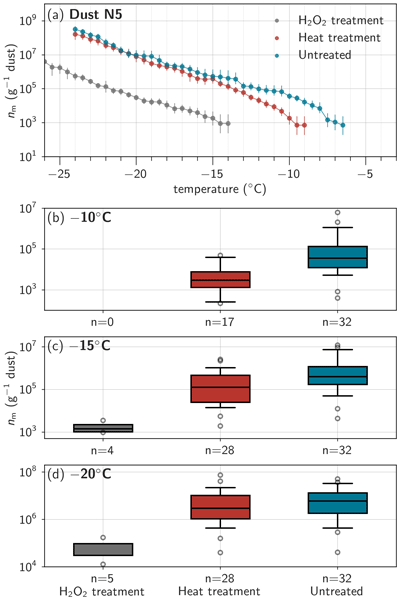
Dust from Greenlandic glacial outwash plains can form ice in clouds, a process relevant for climate. Its ice-nucleating activity varies strongly and is largely controlled by small amounts of biological material. During summer, the influence on atmospheric ice-nucleating particles is mostly local. Lower activity compared to other high-latitude dust sources highlights the need to account for regional differences in Arctic dust.
Patrick C. Taylor, Armin Sorooshian, Rei Ueyama, Sebastian Schmidt, Ihab Abboud, Quincy Allison, Kevin Barry, Sebastian Becker, Holly A. Bender, Joseph R. Bennett, James B. Blair, Niklas Bohn, Linette Boisvert, Matthew D. Brown, Roelof Bruintjes, Anthony Bucholtz, Megan Buzanowicz, Brian Cairns, Filippo Calì Quaglia, Eduard Chemyakin, Bo Chen, Gao Chen, Hong Chen, Yu-Wen Chen, Zezhen Cheng, Swarup China, Dan Chirica, Yonghoon Choi, Peter Colarco, Brian Collister, Ewan Crosbie, Maurice J. Cross, Janet Daniels, Paul DeMott, Joshua P. DiGangi, Alcide Giorgio di Sarra, Glenn S. Diskin, Erica K. Dolinar, Eva-Lou Edwards, Samuel Ephraim, Nikolaos Evangeliou, Romanos Foskinis, Francesca Gallo, Lan Gao, José Luis Gómez-Amo, Daisy Gonzalez, Christine Groot Zwaaftink, Pawan Gupta, Ivan Heckman, Michael Hendrickson, Miguel Ricardo A. Hilario, Ken Hirata, Michelle Hofton, Andrew L. Holen, Ulas Im, Alia L. Khan, Ralph Kahn, Alexei V. Korolev, Sonia Kreidenweis, Thomas Krumpen, Nathan Kurtz, Leslie Lait, Bradley Lamkin, Jack Landy, Nurun Nahar Lata, Paul Lawson, Samuel LeBlanc, Sean Leavor, Jing Li, Thorsten Markus, Hal Maring, Andreas H. Massling, Camille Mavis, Flynn McGinnity, Kerry Meyer, Gabriel Mojica, Richard H. Moore, Parker Morris, Giovanni Muscari, Vikas Nataraja, Amin R. Nehrir, Athanasios Nenes, Edward P. Nowottnick, Matteo Ottaviani, Chelsea Parker, Ryan Patnaude, Michael Perez, Russell J. Perkins, Colten Peterson, Alek Petty, Stevie Phothisane, Chris Polashenski, Kerri A. Pratt, Kayla M. Preisler, John Prytherch, David Rabine, Jens Redemann, Ju-Mee Ryoo, Joseph S. Schlosser, Vanessa Selimovic, Michael A. Shook, Morgan Silverman, Henrik Skov, Alexander Smirnov, Cassidy Soloff, Amy Solomon, Snorre Stamnes, Azusa Takeishi, David R. Thompson, K. Lee Thornhill, Rachel Tilling, Michael Tjernström, Monica Tosco, Pedro C. Valdelomar, David Van Gilst, Jian Wang, Zhien Wang, Andrzej Wasilewski, Manfred Wendisch, Brent Wilder, Edward L. Winstead, Albert Wu, Peng Xian, Lauren M. Zamora, Jiaoshi Zhang, Lei Zhang, Lu Zhang, Luke Ziemba, and Paquita Zuidema
Earth Syst. Sci. Data Discuss., https://doi.org/10.5194/essd-2026-241, https://doi.org/10.5194/essd-2026-241, 2026
Preprint under review for ESSD
Short summary
Short summary
This article summarizes the data sets collected during the Arctic Radiation Cloud aerosol Sea ice Interaction eXperiment (ARCSIX), NASA's most comprehensive Arctic field campaign to date. The overarching goal was to quantify the contributions of surface, clouds, aerosol particles, and precipitation to summer sea ice melt. This paper describes the ARCSIX implementation including the flight strategy, instruments, complementary data sets, access, and usage details.
Gabriella Wallentin, Alexander Böhmländer, Ross Herbert, Heike Wex, Charlotte M. Beall, Pia Bogert, Zoé Brasseur, Jie Chen, Jessie M. Creamean, Paul J. DeMott, Oliver Eckermann, Kunfeng Gao, Xianda Gong, Silvia Henning, Naruki Hiranuma, Christina S. McCluskey, Christos Mitsios, Ottmar Möhler, Athanasios Nenes, Mark D. Tarn, Christian Tatzelt, Ping Tian, Yutaka Tobo, Franziska Vogel, André Welti, Elise Wilbourn, Jennifer Winstone, and Corinna Hoose
EGUsphere, https://doi.org/10.5194/egusphere-2026-4134, https://doi.org/10.5194/egusphere-2026-4134, 2026
Short summary
Short summary
Ice nucleating particles (INPs) are aerosols essential for cloud ice formation in the temperature range -38 °C and 0 °C. Due to measurement challenges, the availability of observations of INPs remains scarce. This study applies machine learning to predict a global INP distribution using aerosol mass concentration reanalysis and observed INPs. This manuscript demonstrates that even with limited measurements, the occurrence of INPs can be estimated, following the spatial pattern of key aerosols.
Samuel Ephraim, Paquita Zuidema, Aaron Bansemer, Lintong Cai, Markus Petters, Elise Rosky, Jefferson R. Snider, Zhien Wang, Sarah Woods, Kevin Barry, Theresa Campos, Owen Cruikshank, Sabine Eckhardt, Nikolaos Evangeliou, Romanos Foskinis, Jeffrey R. French, Bart Geerts, Coltin Grasmick, Silvia Henning, Varun Kumar, Andreas Massling, Camille Mavis, Greg M. McFarquhar, Athanasios Nenes, Gunnar Noer, Ryan Patnaude, Russell Perkins, Lise Lotte Sorensen, Henrik Skov, Tyler Tatro, Florian Tornow, and Lu Zhang
EGUsphere, https://doi.org/10.5194/egusphere-2026-2940, https://doi.org/10.5194/egusphere-2026-2940, 2026
Short summary
Short summary
The processes that establish how mixed-phase closed-cell clouds transition to more open cellular structures are poorly known. First-of-its kind aircraft observations document such a transition in the presence of anomalously high aerosol concentrations over the Nordic Seas at cloud temperatures < -15 °C. The reduces the drop size, discouraging riming. Eventually, ice precipitation produces surface cold pools that drive the convective transition, despite strong counteracting surface fluxes.
Hannes J. Griesche, Ronny Engelmann, Martin Radenz, Julian Hofer, Dietrich Althausen, Albert Ansmann, Kevin Barry, Jessie Creamean, Cristofer Jimenez, and Patric Seifert
Atmos. Chem. Phys., 26, 7141–7163, https://doi.org/10.5194/acp-26-7141-2026, https://doi.org/10.5194/acp-26-7141-2026, 2026
Short summary
Short summary
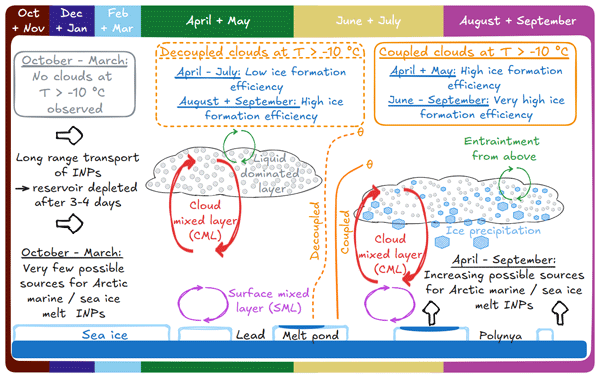
An annual cycle of mixed-phase ice-formation temperatures in the high Arctic is presented. Ship-based remote sensing with lidar and cloud radar from the MOSAiC (Multidisciplinary drifting Observatory for the Study of Arctic Climate) expedition was used to investigate the impact of surface processes on mixed-phase cloud properties. Surface mixed-layer cloud coupling was derived from radiosonde profiles. Combined with ice nucleating particle filter samples, sea ice concentration, and trajectory analysis an influence of surface processes on cloud properties was found.
Kevin R. Barry, Thomas C. J. Hill, Sonia M. Kreidenweis, Paul J. DeMott, Yutaka Tobo, and Jessie M. Creamean
Atmos. Chem. Phys., 25, 11919–11933, https://doi.org/10.5194/acp-25-11919-2025, https://doi.org/10.5194/acp-25-11919-2025, 2025
Short summary
Short summary
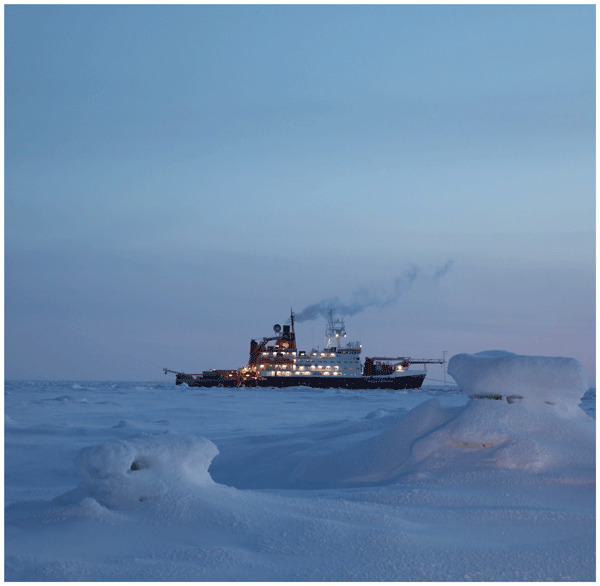
The Arctic is changing rapidly, and we sought to better understand how Arctic clouds may change in the future through quantifying the ice-forming particles over a year and uncovering what they are made of. We determined their likely sources through concurrent DNA sequencing of airborne bacteria and fungi and found persistent mixtures of local and longer-range sources at all times.
Charles M. Davis, Susan C. van den Heever, Leah D. Grant, Sonia M. Kreidenweis, Claudia Mignani, Russell J. Perkins, and Elizabeth A. Stone
EGUsphere, https://doi.org/10.5194/egusphere-2025-2968, https://doi.org/10.5194/egusphere-2025-2968, 2025
Short summary
Short summary
Plant- and other biological matter is released into the air from the earth’s surface when it rains. When present in clouds, these particles promote ice formation. We simulate three kinds of storms to see whether they pick up surface air from rainy regions where these particles would be. We find that all the storms ingest similar amounts of air from regions of light rain, but the types of storms that are typically longer-lived and more severe ingest more air from regions of heavy rain.
Kathryn A. Moore, Thomas C. J. Hill, Chamika K. Madawala, Raymond J. Leibensperger III, Samantha Greeney, Christopher D. Cappa, M. Dale Stokes, Grant B. Deane, Christopher Lee, Alexei V. Tivanski, Kimberly A. Prather, and Paul J. DeMott
Atmos. Chem. Phys., 25, 3131–3159, https://doi.org/10.5194/acp-25-3131-2025, https://doi.org/10.5194/acp-25-3131-2025, 2025
Short summary
Short summary
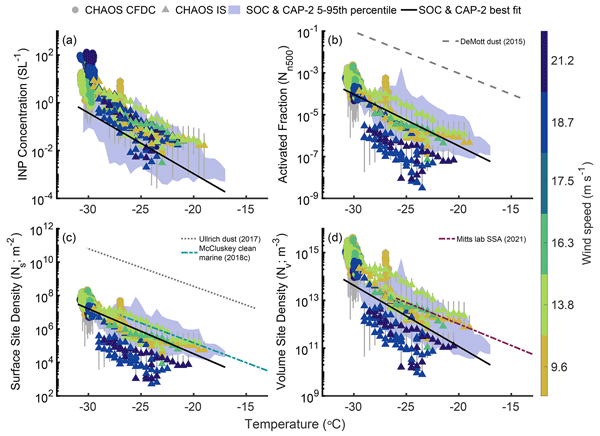
This article presents results from the first study in a new wind–wave channel at the Scripps Institution of Oceanography. The experiment tested how wind over the ocean surface influences production of sea spray particles, which are important for radiative forcing and cloud formation in the atmosphere. We found that particle concentration and chemical composition varied with wind speed and that variations were driven by changes in wind and wave breaking rather than seawater biology or chemistry.
Paul J. DeMott, Jessica A. Mirrielees, Sarah Suda Petters, Daniel J. Cziczo, Markus D. Petters, Heinz G. Bingemer, Thomas C. J. Hill, Karl Froyd, Sarvesh Garimella, A. Gannet Hallar, Ezra J. T. Levin, Ian B. McCubbin, Anne E. Perring, Christopher N. Rapp, Thea Schiebel, Jann Schrod, Kaitlyn J. Suski, Daniel Weber, Martin J. Wolf, Maria Zawadowicz, Jake Zenker, Ottmar Möhler, and Sarah D. Brooks
Atmos. Meas. Tech., 18, 639–672, https://doi.org/10.5194/amt-18-639-2025, https://doi.org/10.5194/amt-18-639-2025, 2025
Short summary
Short summary
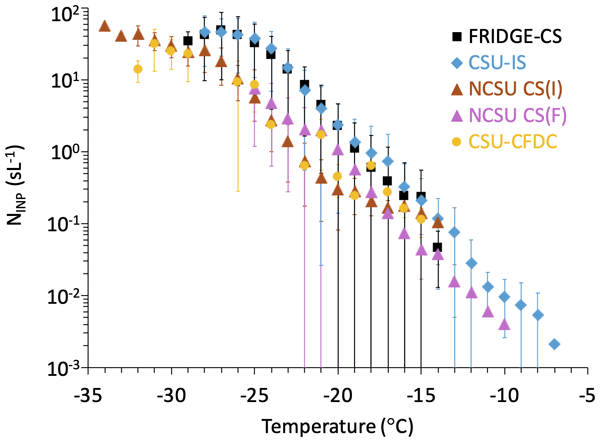
The Fifth International Ice Nucleation Workshop Phase 3 (FIN-03) compared the ambient atmospheric performance of ice-nucleating particle (INP) measuring systems and explored general methods for discerning atmospheric INP compositions. Mirroring laboratory results, INP concentrations agreed within 5–10 factors. Measurements of total aerosol properties and investigations of INP compositions supported a dominant role of soil and plant organic aerosol elements as INPs during the study.
Abigail S. Williams, Jeramy L. Dedrick, Lynn M. Russell, Florian Tornow, Israel Silber, Ann M. Fridlind, Benjamin Swanson, Paul J. DeMott, Paul Zieger, and Radovan Krejci
Atmos. Chem. Phys., 24, 11791–11805, https://doi.org/10.5194/acp-24-11791-2024, https://doi.org/10.5194/acp-24-11791-2024, 2024
Short summary
Short summary
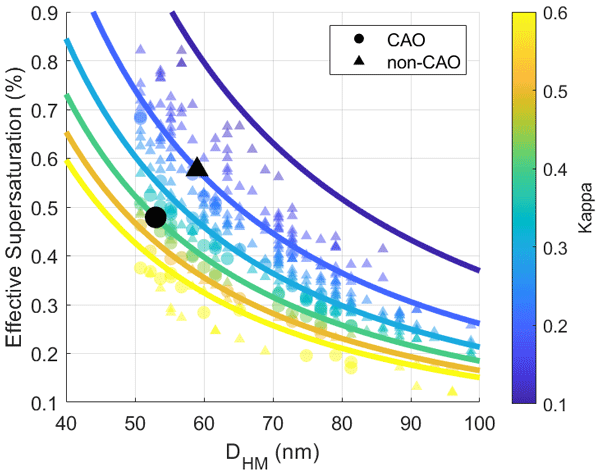
The measured aerosol size distribution modes reveal distinct properties characteristic of cold-air outbreaks in the Norwegian Arctic. We find higher sea spray number concentrations, smaller Hoppel minima, lower effective supersaturations, and accumulation-mode particle scavenging during cold-air outbreaks. These results advance our understanding of cold-air outbreak aerosol–cloud interactions in order to improve their accurate representation in models.
Xiaoli Shen, David M. Bell, Hugh Coe, Naruki Hiranuma, Fabian Mahrt, Nicholas A. Marsden, Claudia Mohr, Daniel M. Murphy, Harald Saathoff, Johannes Schneider, Jacqueline Wilson, Maria A. Zawadowicz, Alla Zelenyuk, Paul J. DeMott, Ottmar Möhler, and Daniel J. Cziczo
Atmos. Chem. Phys., 24, 10869–10891, https://doi.org/10.5194/acp-24-10869-2024, https://doi.org/10.5194/acp-24-10869-2024, 2024
Short summary
Short summary
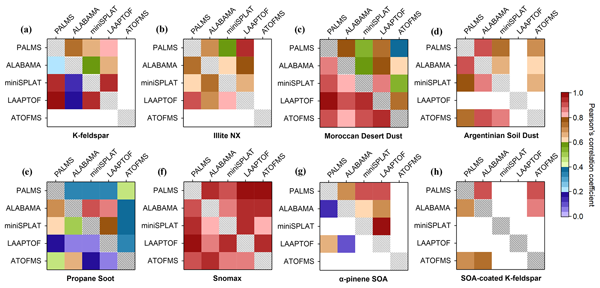
Single-particle mass spectrometry (SPMS) is commonly used to measure the chemical composition and mixing state of aerosol particles. Intercomparison of SPMS instruments was conducted. All instruments reported similar size ranges and common spectral features. The instrument-specific detection efficiency was found to be more dependent on particle size than type. All differentiated secondary organic aerosol, soot, and soil dust but had difficulties differentiating among minerals and dusts.
Larissa Lacher, Michael P. Adams, Kevin Barry, Barbara Bertozzi, Heinz Bingemer, Cristian Boffo, Yannick Bras, Nicole Büttner, Dimitri Castarede, Daniel J. Cziczo, Paul J. DeMott, Romy Fösig, Megan Goodell, Kristina Höhler, Thomas C. J. Hill, Conrad Jentzsch, Luis A. Ladino, Ezra J. T. Levin, Stephan Mertes, Ottmar Möhler, Kathryn A. Moore, Benjamin J. Murray, Jens Nadolny, Tatjana Pfeuffer, David Picard, Carolina Ramírez-Romero, Mickael Ribeiro, Sarah Richter, Jann Schrod, Karine Sellegri, Frank Stratmann, Benjamin E. Swanson, Erik S. Thomson, Heike Wex, Martin J. Wolf, and Evelyn Freney
Atmos. Chem. Phys., 24, 2651–2678, https://doi.org/10.5194/acp-24-2651-2024, https://doi.org/10.5194/acp-24-2651-2024, 2024
Short summary
Short summary
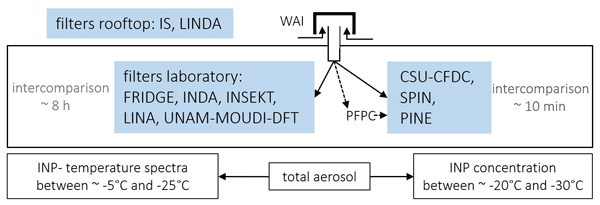
Aerosol particles that trigger ice formation in clouds are important for the climate system but are very rare in the atmosphere, challenging measurement techniques. Here we compare three cloud chambers and seven methods for collecting aerosol particles on filters for offline analysis at a mountaintop station. A general good agreement of the methods was found when sampling aerosol particles behind a whole air inlet, supporting their use for obtaining data that can be implemented in models.
Ryan J. Patnaude, Kathryn A. Moore, Russell J. Perkins, Thomas C. J. Hill, Paul J. DeMott, and Sonia M. Kreidenweis
Atmos. Chem. Phys., 24, 911–928, https://doi.org/10.5194/acp-24-911-2024, https://doi.org/10.5194/acp-24-911-2024, 2024
Short summary
Short summary
In this study we examined the effect of atmospheric aging on sea spray aerosols (SSAs) to form ice and how newly formed secondary marine aerosols (SMAs) may freeze at cirrus temperatures (< −38 °C). Results show that SSAs freeze at different relative humidities (RHs) depending on the temperature and that the ice-nucleating ability of SSA was not hindered by atmospheric aging. SMAs are shown to freeze at high RHs and are likely inefficient at forming ice at cirrus temperatures.
Kevin R. Barry, Thomas C. J. Hill, Marina Nieto-Caballero, Thomas A. Douglas, Sonia M. Kreidenweis, Paul J. DeMott, and Jessie M. Creamean
Atmos. Chem. Phys., 23, 15783–15793, https://doi.org/10.5194/acp-23-15783-2023, https://doi.org/10.5194/acp-23-15783-2023, 2023
Short summary
Short summary
Ice-nucleating particles (INPs) are important for the climate due to their influence on cloud properties. To understand potential land-based sources of them in the Arctic, we carried out a survey near the northernmost point of Alaska, a landscape connected to the permafrost (thermokarst). Permafrost contained high concentrations of INPs, with the largest values near the coast. The thermokarst lakes were found to emit INPs, and the water contained elevated concentrations.
Aishwarya Raman, Thomas Hill, Paul J. DeMott, Balwinder Singh, Kai Zhang, Po-Lun Ma, Mingxuan Wu, Hailong Wang, Simon P. Alexander, and Susannah M. Burrows
Atmos. Chem. Phys., 23, 5735–5762, https://doi.org/10.5194/acp-23-5735-2023, https://doi.org/10.5194/acp-23-5735-2023, 2023
Short summary
Short summary
Ice-nucleating particles (INPs) play an important role in cloud processes and associated precipitation. Yet, INPs are not accurately represented in climate models. This study attempts to uncover these gaps by comparing model-simulated INP concentrations against field campaign measurements in the SO for an entire year, 2017–2018. Differences in INP concentrations and variability between the model and observations have major implications for modeling cloud properties in high latitudes.
Alexei Korolev, Paul J. DeMott, Ivan Heckman, Mengistu Wolde, Earle Williams, David J. Smalley, and Michael F. Donovan
Atmos. Chem. Phys., 22, 13103–13113, https://doi.org/10.5194/acp-22-13103-2022, https://doi.org/10.5194/acp-22-13103-2022, 2022
Short summary
Short summary
The present study provides the first explicit in situ observation of secondary ice production at temperatures as low as −27 °C, which is well outside the range of the Hallett–Mossop process (−3 to −8 °C). This observation expands our knowledge of the temperature range of initiation of secondary ice in clouds. The obtained results are intended to stimulate laboratory and theoretical studies to develop physically based parameterizations for weather prediction and climate models.
Nicole A. June, Anna L. Hodshire, Elizabeth B. Wiggins, Edward L. Winstead, Claire E. Robinson, K. Lee Thornhill, Kevin J. Sanchez, Richard H. Moore, Demetrios Pagonis, Hongyu Guo, Pedro Campuzano-Jost, Jose L. Jimenez, Matthew M. Coggon, Jonathan M. Dean-Day, T. Paul Bui, Jeff Peischl, Robert J. Yokelson, Matthew J. Alvarado, Sonia M. Kreidenweis, Shantanu H. Jathar, and Jeffrey R. Pierce
Atmos. Chem. Phys., 22, 12803–12825, https://doi.org/10.5194/acp-22-12803-2022, https://doi.org/10.5194/acp-22-12803-2022, 2022
Short summary
Short summary
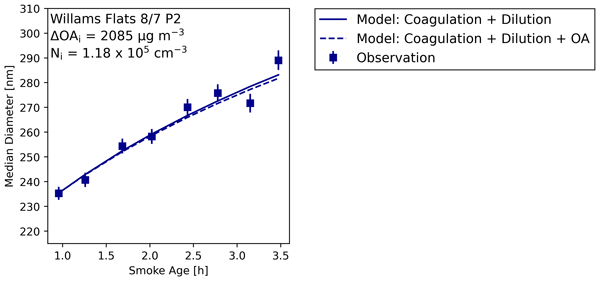
The evolution of organic aerosol composition and size is uncertain due to variability within and between smoke plumes. We examine the impact of plume concentration on smoke evolution from smoke plumes sampled by the NASA DC-8 during FIREX-AQ. We find that observed organic aerosol and size distribution changes are correlated to plume aerosol mass concentrations. Additionally, coagulation explains the majority of the observed growth.
Charlotte M. Beall, Thomas C. J. Hill, Paul J. DeMott, Tobias Köneman, Michael Pikridas, Frank Drewnick, Hartwig Harder, Christopher Pöhlker, Jos Lelieveld, Bettina Weber, Minas Iakovides, Roman Prokeš, Jean Sciare, Meinrat O. Andreae, M. Dale Stokes, and Kimberly A. Prather
Atmos. Chem. Phys., 22, 12607–12627, https://doi.org/10.5194/acp-22-12607-2022, https://doi.org/10.5194/acp-22-12607-2022, 2022
Short summary
Short summary
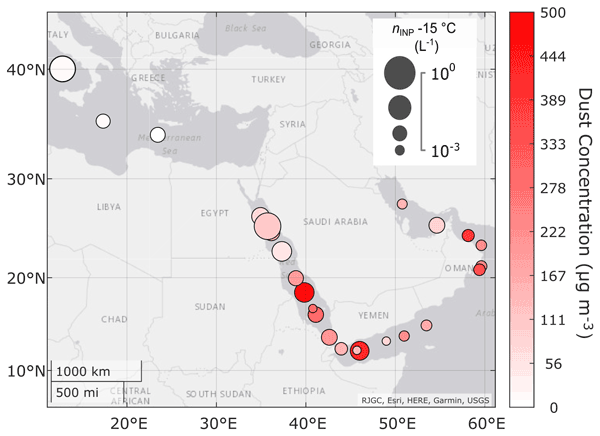
Ice-nucleating particles (INPs) are rare aerosols that can trigger ice formation in clouds and affect climate-relevant cloud properties such as phase, reflectivity and lifetime. Dust is the dominant INP source, yet few measurements have been reported near major dust sources. We report INP observations within hundreds of kilometers of the biggest dust source regions globally: the Sahara and the Arabian Peninsula. Results show that at temperatures > −15 °C, INPs are dominated by organics.

Yun Lin, Jiwen Fan, Pengfei Li, Lai-yung Ruby Leung, Paul J. DeMott, Lexie Goldberger, Jennifer Comstock, Ying Liu, Jong-Hoon Jeong, and Jason Tomlinson
Atmos. Chem. Phys., 22, 6749–6771, https://doi.org/10.5194/acp-22-6749-2022, https://doi.org/10.5194/acp-22-6749-2022, 2022
Short summary
Short summary
How sea spray aerosols may affect cloud and precipitation over the region by acting as ice-nucleating particles (INPs) is unknown. We explored the effects of INPs from marine aerosols on orographic cloud and precipitation for an atmospheric river event observed during the 2015 ACAPEX field campaign. The marine INPs enhance the formation of ice and snow, leading to less shallow warm clouds but more mixed-phase and deep clouds. This work suggests models need to consider the impacts of marine INPs.
Russell J. Perkins, Peter J. Marinescu, Ezra J. T. Levin, Don R. Collins, and Sonia M. Kreidenweis
Atmos. Chem. Phys., 22, 6197–6215, https://doi.org/10.5194/acp-22-6197-2022, https://doi.org/10.5194/acp-22-6197-2022, 2022
Short summary
Short summary
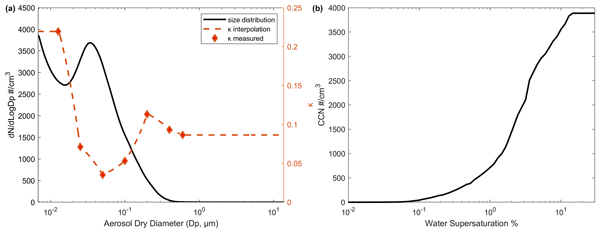
We used 5 years (2009–2013) of aerosol and cloud condensation nuclei (CCN) data from a total of seven instruments housed at the Southern Great Plains site, which were merged into a quality-controlled, continuous dataset of CCN spectra at ~45 min resolution. The data cover all seasons, are representative of a rural, agricultural mid-continental site, and are useful for model initialization and validation. Our analysis of this dataset focuses on seasonal and hourly variability.
Isabelle Steinke, Paul J. DeMott, Grant B. Deane, Thomas C. J. Hill, Mathew Maltrud, Aishwarya Raman, and Susannah M. Burrows
Atmos. Chem. Phys., 22, 847–859, https://doi.org/10.5194/acp-22-847-2022, https://doi.org/10.5194/acp-22-847-2022, 2022
Short summary
Short summary
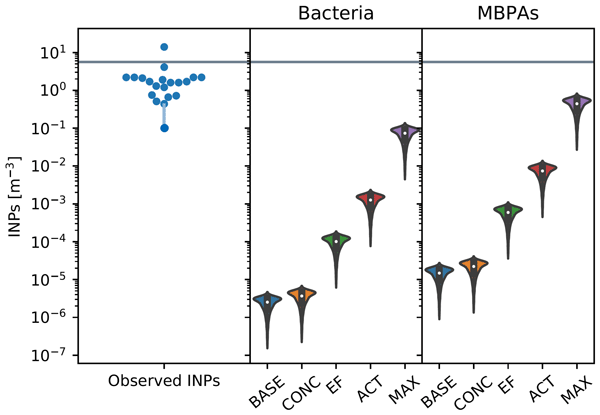
Over the oceans, sea spray aerosol is an important source of particles that may initiate the formation of cloud ice, which then has implications for the radiative properties of marine clouds. In our study, we focus on marine biogenic particles that are emitted episodically and develop a numerical framework to describe these emissions. We find that further cloud-resolving model studies and targeted observations are needed to fully understand the climate impacts from marine biogenic particles.
Cited articles
Agresti, A. and Coull, B. A.: Approximate is better than “exact” for interval estimation of binomial proportions, Am. Stat., 52, 119–126, 1998.
Ashbaugh, L. L., Malm, W. C., and Sadeh, W. Z.: A residence time probability analysis of sulfur concentrations at Grand Canyon National Park, Atmos. Environ., 19, 1263–1270, 1985.
Atkinson, J. D., Murray, B. J., Woodhouse, M. T., Whale, T. F., Baustian, K. J., Carslaw, K. S., Dobbie, S., O'Sullivan, D., and Malkin, T. L.: The importance of feldspar for ice nucleation by mineral dust in mixed-phase clouds, Nature, 498, 355–358, https://doi.org/10.1038/nature12278, 2013.
Barry, K. R., Hill, T. C. J., Jentzsch, C., Moffett, B. F., Stratmann, F., and DeMott, P. J.: Pragmatic protocols for working cleanly when measuring ice nucleating particles, Atmos. Res., 250, 105419, https://doi.org/10.1016/j.atmosres.2020.105419, 2021a.
Barry, K. R., Hill, T. C. J., Levin, E. J. T., Twohy, C. H., Moore, K. A., Weller, Z. D., Toohey, D. W., Reeves, M., Campos, T., Geiss, R., Schill, G. P., Fischer, E. V., Kreidenweis, S. M., and DeMott, P. J.: Observations of Ice Nucleating Particles in the Free Troposphere From Western US Wildfires, J. Geophys. Res.: Atmos., 126, e2020JD033752, https://doi.org/10.1029/2020jd033752, 2021b.
Beall, C. M., Hill, T. C. J., DeMott, P. J., Köneman, T., Pikridas, M., Drewnick, F., Harder, H., Pöhlker, C., Lelieveld, J., Weber, B., Iakovides, M., Prokeš, R., Sciare, J., Andreae, M. O., Stokes, M. D., and Prather, K. A.: Ice-nucleating particles near two major dust source regions, Atmos. Chem. Phys., 22, 12607–12627, https://doi.org/10.5194/acp-22-12607-2022, 2022.
Bigg, E. K.: The supercooling of water, Proc. Phys. Soc. B, 66, 688–694, 1953.
Bowers, R. M., McCubbin, I. B., Hallar, A. G., and Fierer, N.: Seasonal variability in airborne bacterial communities at a high-elevation site, Atmos. Environ., 50, 41–49, https://doi.org/10.1016/j.atmosenv.2012.01.005, 2012.
Brown, S. G., Eberly, S., Paatero, P., and Norris, G. A.: Methods for estimating uncertainty in PMF solutions: examples with ambient air and water quality data and guidance on reporting PMF results, Sci. Total Environ., 518–519, 626–635, https://doi.org/10.1016/j.scitotenv.2015.01.022, 2015.
Burrows, S. M., McCluskey, C. S., Cornwell, G., Steinke, I., Zhang, K., Zhao, B., Zawadowicz, M., Raman, A., Kulkarni, G., and China, S.: Ice-nucleating particles that impact clouds and climate: Observational and modeling research needs, Rev. Geophys., 60, e2021RG000745, https://doi.org/10.1029/2021RG000745, 2022.
Conen, F. and Yakutin, M. V.: Soils rich in biological ice-nucleating particles abound in ice-nucleating macromolecules likely produced by fungi, Biogeosciences, 15, 4381–4385, https://doi.org/10.5194/bg-15-4381-2018, 2018.
Conen, F., Rodríguez, S., Hülin, C., Henne, S., Herrmann, E., Bukowiecki, N., and Alewell, C.: Atmospheric ice nuclei at the high-altitude observatory Jungfraujoch, Switzerland, Tellus B: Chem. Phys. Meteorol., 67, 25014, https://doi.org/10.3402/tellusb.v67.25014, 2015.
Creamean, J. M., Hill, T. C., Hume, C. C., and Devadoss, T.: Ice Nucleation Spectrometer (INS) Instrument Handbook, Oak Ridge National Laboratory (ORNL), Atmospheric Radiation Measurement (ARM) Data Center, Oak Ridge, TN, USA, https://doi.org/10.2172/1846263, 2024.
Creamean, J. M., Suski, K. J., Rosenfeld, D., Cazorla, A., DeMott, P. J., Sullivan, R. C., White, A. B., Ralph, F. M., Minnis, P., and Comstock, J. M.: Dust and biological aerosols from the Sahara and Asia influence precipitation in the western US, Science, 339, 1572–1578, https://doi.org/10.1126/science.1227279, 2013.
Cornwell, G. C., McCluskey, C. S., Hill, T. C. J., Levin, E. T., Rothfuss, N. E., Tai, S. L., Petters, M. D., DeMott, P. J., Kreidenweis, S., Prather, K. A., and Burrows, S. M.: Bioaerosols are the dominant source of warm-temperature immersion-mode INPs and drive uncertainties in INP predictability, Sci. Adv., 9, eadg3715, https://doi.org/10.1126/sciadv.adg3715, 2023.
Cornwell, G. C., Steinke, I., Lata, N. N., Zelenyuk, A., Kulkarni, G., Pekour, M., Perkins, R., Levin, E. J. T., China, S., Demott, P. J., and Burrows, S. M.: Enrichment of Phosphates, Lead, and Mixed Soil-Organic Particles in INPs at the Southern Great Plains Site, J. Geophys. Res.: Atmos., 129, e2024JD040826, https://doi.org/10.1029/2024jd040826, 2024.
Cromwell, E., Singh, A., and Kuang, C.: Optical Particle Counter (AOSOPC), 2021-10-27 to 2023-06-16, ARM Mobile Facility (GUC), Gunnison, CO, Supplemental Facility 2 (S2), Atmospheric Radiation Measurement (ARM) User Facility [data set], https://doi.org/10.5439/1824224, 2024.
Daily, M. I., Tarn, M. D., Whale, T. F., and Murray, B. J.: An evaluation of the heat test for the ice-nucleating ability of minerals and biological material, Atmos. Meas. Tech., 15, 2635–2665, https://doi.org/10.5194/amt-15-2635-2022, 2022.
de Boer, G., Morrison, H., Shupe, M. D., and Hildner, R.: Evidence of liquid dependent ice nucleation in high-latitude stratiform clouds from surface remote sensors, Geophys. Res. Lett., 38, L01803, https://doi.org/10.1029/2010GL046016, 2011.
DeMott, P. J., Sassen, K., Poellot, M. R., Baumgardner, D., Rogers, D. C., Brooks, S. D., Prenni, A. J., and Kreidenweis, S. M.: African dust aerosols as atmospheric ice nuclei, Geophys. Res. Lett., 30, 1732, https://doi.org/10.1029/2003gl017410, 2003.
DeMott, P. J., Prenni, A. J., Liu, X., Kreidenweis, S. M., Petters, M. D., Twohy, C. H., Richardson, M. S., Eidhammer, T., and Rogers, D. C.: Predicting global atmospheric ice nuclei distributions and their impacts on climate, Proc. Natl. Acad. Sci. USA, 107, 11217–11222, https://doi.org/10.1073/pnas.0910818107, 2010.
DeMott, P. J., Prenni, A. J., McMeeking, G. R., Sullivan, R. C., Petters, M. D., Tobo, Y., Niemand, M., Möhler, O., Snider, J. R., Wang, Z., and Kreidenweis, S. M.: Integrating laboratory and field data to quantify the immersion freezing ice nucleation activity of mineral dust particles, Atmos. Chem. Phys., 15, 393–409, https://doi.org/10.5194/acp-15-393-2015, 2015.
DeMott, P. J., Mirrielees, J. A., Petters, S. S., Cziczo, D. J., Petters, M. D., Bingemer, H. G., Hill, T. C. J., Froyd, K., Garimella, S., Hallar, A. G., Levin, E. J. T., McCubbin, I. B., Perring, A. E., Rapp, C. N., Schiebel, T., Schrod, J., Suski, K. J., Weber, D., Wolf, M. J., Zawadowicz, M., Zenker, J., Möhler, O., and Brooks, S. D.: Field intercomparison of ice nucleation measurements: the Fifth International Workshop on Ice Nucleation Phase 3 (FIN-03), Atmos. Meas. Tech., 18, 639–672, https://doi.org/10.5194/amt-18-639-2025, 2025.
Després, V., Huffman, J. A., Burrows, S. M., Hoose, C., Safatov, A., Buryak, G., Fröhlich-Nowoisky, J., Elbert, W., Andreae, M., Pöschl, U., and Jaenicke, R.: Primary biological aerosol particles in the atmosphere: a review, Tellus B., 64, 15598, https://doi.org/10.3402/tellusb.v64i0.15598, 2012.
Fall, P. L.: Spatial patterns of atmospheric pollen dispersal in the Colorado Rocky Mountains, USA, Rev. Palaeobot. Palynol., 74, 293–313, https://doi.org/10.1016/0034-6667(92)90013-7, 1992.
Feldman, D. R., Aiken, A. C., Boos, W. R., Carroll, R. W. H., Chandrasekar, V., Collis, S., Creamean, J. M., de Boer, G., Deems, J., DeMott, P. J., Fan, J., Flores, A. N., Gochis, D., Grover, M., Hill, T. C. J., Hodshire, A., Hulm, E., Hume, C. C., Jackson, R., Junyent, F., Kennedy, A., Kumjian, M., Levin, E. J. T., Lundquist, J. D., O'Brien, J., Raleigh, M. S., Reithel, J., Rhoades, A., Rittger, K., Rudisill, W., Sherman, Z., Siirila-Woodburn, E., Skiles, S. M., Smith, J. N., Sullivan, R. C., Theisen, A., Tuftedal, M., Varble, A. C., Wiedlea, A., Wielandt, S., Williams, K., and Xu, Z.: The Surface Atmosphere Integrated Field Laboratory (SAIL) Campaign, Bull. Am. Meteorol. Soc., 104, E2192–E2222, https://doi.org/10.1175/bams-d-22-0049.1, 2023.
Fröhlich-Nowoisky, J., Kampf, C. J., Weber, B., Huffman, J. A., Pöhlker, C., Andreae, M. O., Lang-Yona, N., Burrows, S. M., Gunthe, S. S., and Elbert, W.: Bioaerosols in the Earth system: Climate, health, and ecosystem interactions, Atmos. Res., 182, 346–376, https://doi.org/10.1016/j.atmosres.2016.07.018, 2016.
Garcia, E., Hill, T. C., Prenni, A. J., DeMott, P. J., Franc, G. D., and Kreidenweis, S. M.: Biogenic ice nuclei in boundary layer air over two US High Plains agricultural regions, J. Geophys. Res.: Atmos., 117, D18209, https://doi.org/10.1029/2012JD018343, 2012.
Ginoux, P., Prospero, J. M., Gill, T. E., Hsu, N. C., and Zhao, M.: Global-scale attribution of anthropogenic and natural dust sources and their emission rates based on MODIS Deep Blue aerosol products, Rev. Geophys., 50, RG3005, https://doi.org/10.1029/2012rg000388, 2012.
Hamzehpour, N., Marcolli, C., Klumpp, K., Thöny, D., and Peter, T.: The Urmia playa as a source of airborne dust and ice-nucleating particles – Part 2: Unraveling the relationship between soil dust composition and ice nucleation activity, Atmos. Chem. Phys., 22, 14931–14956, https://doi.org/10.5194/acp-22-14931-2022, 2022.
Hand, J. L. and Kreidenweis, S. M.: A New Method for Retrieving Particle Refractive Index and Effective Density from Aerosol Size Distribution Data, Aerosol Sci. Technol., 36, 1012–1026, https://doi.org/10.1080/02786820290092276, 2002.
Hand, J. L., Gill, T. E., and Schichtel, B. A.: Spatial and seasonal variability in fine mineral dust and coarse aerosol mass at remote sites across the United States, J. Geophys. Res.: Atmos., 122, 3080–3097, https://doi.org/10.1002/2016jd026290, 2017.
Hand, J.: IMPROVE Data User Guide 2023 (Version 2), Interagency Monitoring of Protected Visual Environments (IMPROVE) Program, https://vista.cira.colostate.edu/Improve/data-user-guide/ (last access: 21 January 2026), 2023.
Harrison, A. D., Lever, K., Sanchez-Marroquin, A., Holden, M. A., Whale, T. F., Tarn, M. D., McQuaid, J. B., and Murray, B. J.: The ice-nucleating ability of quartz immersed in water and its atmospheric importance compared to K-feldspar, Atmos. Chem. Phys., 19, 11343–11361, https://doi.org/10.5194/acp-19-11343-2019, 2019.
Herbert, R. J., Sanchez-Marroquin, A., Grosvenor, D. P., Pringle, K. J., Arnold, S. R., Murray, B. J., and Carslaw, K. S.: Gaps in our understanding of ice-nucleating particle sources exposed by global simulation of the UK Earth System Model, Atmos. Chem. Phys., 25, 291–325, https://doi.org/10.5194/acp-25-291-2025, 2025.
Hill, T. C. J., DeMott, P. J., Tobo, Y., Fröhlich-Nowoisky, J., Moffett, B. F., Franc, G. D., and Kreidenweis, S. M.: Sources of organic ice nucleating particles in soils, Atmos. Chem. Phys., 16, 7195–7211, https://doi.org/10.5194/acp-16-7195-2016, 2016.
Hiranuma, N., Augustin-Bauditz, S., Bingemer, H., Budke, C., Curtius, J., Danielczok, A., Diehl, K., Dreischmeier, K., Ebert, M., Frank, F., Hoffmann, N., Kandler, K., Kiselev, A., Koop, T., Leisner, T., Möhler, O., Nillius, B., Peckhaus, A., Rose, D., Weinbruch, S., Wex, H., Boose, Y., DeMott, P. J., Hader, J. D., Hill, T. C. J., Kanji, Z. A., Kulkarni, G., Levin, E. J. T., McCluskey, C. S., Murakami, M., Murray, B. J., Niedermeier, D., Petters, M. D., O'Sullivan, D., Saito, A., Schill, G. P., Tajiri, T., Tolbert, M. A., Welti, A., Whale, T. F., Wright, T. P., and Yamashita, K.: A comprehensive laboratory study on the immersion freezing behavior of illite NX particles: a comparison of 17 ice nucleation measurement techniques, Atmos. Chem. Phys., 15, 2489–2518, https://doi.org/10.5194/acp-15-2489-2015, 2015.
Hoose, C. and Möhler, O.: Heterogeneous ice nucleation on atmospheric aerosols: a review of results from laboratory experiments, Atmos. Chem. Phys., 12, 9817–9854, https://doi.org/10.5194/acp-12-9817-2012, 2012.
Hopke, P. K., Dai, Q., Li, L., and Feng, Y.: Global review of recent source apportionments for airborne particulate matter, Sci. Total Environ., 740, 140091, https://doi.org/10.1016/j.scitotenv.2020.140091, 2020.
Huang, S., Hu, W., Chen, J., Wu, Z. J., Zhang, D. Z., and Fu, P. Q.: Overview of biological ice nucleating particles in the atmosphere, Environ. Int., 146, 106197, https://doi.org/10.1016/j.envint.2020.106197, 2021.
Hwang, I. and Hopke, P. K.: Estimation of source apportionment and potential source locations of PM2.5 at a west coastal IMPROVE site, Atmos. Environ., 41, 506–518, https://doi.org/10.1016/j.atmosenv.2006.08.043, 2007.
IPCC: Climate Change 2022: Impacts, Adaptation, and Vulnerability, Contribution of Working Group II to the Sixth Assessment Report of the Intergovernmental Panel on Climate Change, edited by: Pörtner, H.-O., Roberts, D. C., Tignor, M., Poloczanska, E. S., Mintenbeck, K., Alegría, A., Craig, M., Langsdorf, S., Löschke, S., Möller, V., Okem, A., and Rama, B., Cambridge University Press, Cambridge, UK and New York, NY, USA, 3056 pp., https://doi.org/10.1017/9781009325844, 2022.
Jahl, L. G., Brubaker, T. A., Polen, M. J., Jahn, L. G., Cain, K. P., Bowers, B. B., Fahy, W. D., Graves, S., and Sullivan, R. C.: Atmospheric aging enhances the ice nucleation ability of biomass-burning aerosol, Sci. Adv., 7, eabd3440, https://doi.org/10.1126/sciadv.abd3440, 2021.
Jahn, L. G., Jahl, L. G., Bland, G. D., Bowers, B. B., Monroe, L. W., and Sullivan, R. C.: Metallic and crustal elements in biomass-burning aerosol and ash: Prevalence, significance, and similarity to soil particles, ACS Earth Space Chem., 5, 136–148, https://doi.org/10.1021/acsearthspacechem.9b00322, 2020.
Jain, P., Sharma, A. R., Acuna, D. C., Abatzoglou, J. T., and Flannigan, M.: Record-breaking fire weather in North America in 2021 was initiated by the Pacific Northwest heat dome, Commun. Earth Environ., 5, 202, https://doi.org/10.1038/s43247-024-01346-2, 2024.
Kanji, Z. A., Ladino, L. A., Wex, H., Boose, Y., Burkert-Kohn, M., Cziczo, D. J., and Krämer, M.: Overview of Ice Nucleating Particles, Meteor. Monogr., 58, 1.1–1.33, https://doi.org/10.1175/amsmonographs-d-16-0006.1, 2017.
Kiselev, A., Bachmann, F., Pedevilla, P., Cox, S. J., Michaelides, A., Gerthsen, D., and Leisner, T.: Active sites in heterogeneous ice nucleation-the example of K-rich feldspars, Science, 355, 367–371, https://doi.org/10.1126/science.aai8034, 2017.
Knippertz, P. and Stuut, J.-B. W.: Mineral dust, Mineral dust–A key player in the Earth system, Springer, Dordrecht, the Netherlands, 121–147, https://doi.org/10.15201/hungeobull.65.1.8, 2014.
Kobziar, L. N., Lampman, P., Tohidi, A., Kochanski, A. K., Cervantes, A., Hudak, A. T., McCarley, R., Gullett, B., Aurell, J., and Moore, R.: Bacterial emission factors: a foundation for the terrestrial-atmospheric modeling of bacteria aerosolized by wildland fires, Environ. Sci. Technol., 58, 2413–2422, https://doi.org/10.1021/acs.est.3c05142, 2024.
Koehler, K. A., Kreidenweis, S. M., DeMott, P. J., Prenni, A. J., and Petters, M. D.: Potential impact of Owens (dry) Lake dust on warm and cold cloud formation, J. Geophys. Res: Atmos., 112, D12210, https://doi.org/10.1029/2006JD008175, 2007.
Kuang, C., Singh, A., Howie, J., Salwen, C., and Hayes, C.: Scanning mobility particle sizer (AOSSMPS), 2021-10-27 to 2023-06-16, ARM Mobile Facility (GUC), Gunnison, CO; Supplemental Facility 2 (S2). Atmospheric Radiation Measurement (ARM) User Facility [data set], https://doi.org/10.5439/1476898, 2024.
Lacher, L., Steinbacher, M., Bukowiecki, N., Herrmann, E., Zipori, A., and Kanji, Z. A.: Impact of Air Mass Conditions and Aerosol Properties on Ice Nucleating Particle Concentrations at the High Altitude Research Station Jungfraujoch, Atmosphere, 9, 363, https://doi.org/10.3390/atmos9090363, 2018.
Lacher, L., Hallar, A. G., McCubbin, I. B., Bail, J., Froyd, K. D., Jacquot, J., Shen, X., Rapp, C., Möhler, O., and Cziczo, D.: Strong springtime increase of ice-nucleating particle concentration in the Rocky Mountains, EGUsphere [preprint], https://doi.org/10.5194/egusphere-2025-4492, 2025.
Liu, W. and Hopke, P. K.: Origins of fine aerosol mass in the western United States using positive matrix factorization, J. Geophys. Res: Atmos., 108, 4127, https://doi.org/10.1029/2003jd003678, 2003.
Lohmann, U. and Feichter, J.: Global indirect aerosol effects: a review, Atmos. Chem. Phys., 5, 715–737, https://doi.org/10.5194/acp-5-715-2005, 2005.
Lynn, B., Khain, A., Rosenfeld, D., and Woodley, W. L.: Effects of aerosols on precipitation from orographic clouds, J. Geophys. Res: Atmos., 112, D10225, https://doi.org/10.1029/2006JD007537, 2007.
Malm, W. C., Sisler, J. F., Huffman, D., Eldred, R. A., and Cahill, T. A.: Spatial and seasonal trends in particle concentration and optical extinction in the United States, J. Geophys. Res: Atmos., 99, 1347–1370, https://doi.org/10.1029/93JD02916, 1994.
Marinescu, P. J., Levin, E. J. T., Collins, D., Kreidenweis, S. M., and van den Heever, S. C.: Quantifying aerosol size distributions and their temporal variability in the Southern Great Plains, USA, Atmos. Chem. Phys., 19, 11985–12006, https://doi.org/10.5194/acp-19-11985-2019, 2019.
McCluskey, C. S., DeMott, P. J., Prenni, A. J., Levin, E. J. T., McMeeking, G. R., Sullivan, A. P., Hill, T. C. J., Nakao, S., Carrico, C. M., and Kreidenweis, S. M.: Characteristics of atmospheric ice nucleating particles associated with biomass burning in the US: Prescribed burns and wildfires, J. Geophys. Res.: Atmos., 119, 10458–10470, https://doi.org/10.1002/2014jd021980, 2014.
McCluskey, C. S., Ovadnevaite, J., Rinaldi, M., Atkinson, J., Belosi, F., Ceburnis, D., Marullo, S., Hill, T. C. J., Lohmann, U., Kanji, Z. A., O'Dowd, C., Kreidenweis, S. M., and DeMott, P. J.: Marine and Terrestrial Organic Ice-Nucleating Particles in Pristine Marine to Continentally Influenced Northeast Atlantic Air Masses, J. Geophys. Res.: Atmos., 123, 6196–6212, https://doi.org/10.1029/2017jd028033, 2018a.
McCluskey, C. S., Hill, T. C. J., Malfatti, F., Sultana, C. M., Lee, C., Santander, M. V., Beall, C. M., Moore, K. A., Cornwell, G. C., Collins, D. B., Prather, K. A., Jayarathne, T., Stone, E. A., Azam, F., Kreidenweis, S. M., and DeMott, P. J.: A Dynamic Link between Ice Nucleating Particles Released in Nascent Sea Spray Aerosol and Oceanic Biological Activity during Two Mesocosm Experiments, J. Atmos. Sci., 74, 151–166, https://doi.org/10.1175/Jas-D-16-0087.1, 2017.
McCluskey, C. S., Hill, T. C. J., Humphries, R. S., Rauker, A. M., Moreau, S., Strutton, P. G., Chambers, S. D., Williams, A. G., McRobert, I., Ward, J., Keywood, M. D., Harnwell, J., Ponsonby, W., Loh, Z. M., Krummel, P. B., Protat, A., Kreidenweis, S. M., and DeMott, P. J.: Observations of Ice Nucleating Particles Over Southern Ocean Waters, Geophys. Res. Lett., 45, e2018GL079981, https://doi.org/10.1029/2018gl079981, 2018b.
Meng, X., Yu, Y., and Ginoux, P.: Rise in dust emissions from burned landscapes primarily driven by small fires, Nat. Geosci., 18, 586–592, https://doi.org/10.1038/s41561-025-01730-3, 2025.
Meyers, M. P., DeMott, P. J., and Cotton, W. R.: New primary ice-nucleation parameterizations in an explicit cloud model, J. Appl. Meteor. Climatol., 31, 708–721, https://doi.org/10.1175/1520-0450(1992)031<0708:NPINPI>2.0.CO;2, 1992.
Miltenberger, A. K., Field, P. R., Hill, A. A., Rosenberg, P., Shipway, B. J., Wilkinson, J. M., Scovell, R., and Blyth, A. M.: Aerosol–cloud interactions in mixed-phase convective clouds – Part 1: Aerosol perturbations, Atmos. Chem. Phys., 18, 3119–3145, https://doi.org/10.5194/acp-18-3119-2018, 2018.
Mignani, C., Hill, T. C. J., Nieto-Caballero, M., Barry, K. R., Bryan, N. C., Marinescu, P. J., Dolan, B., Sullivan, A. P., Hernandez, M., Bosco-Lauth, A., van den Heever, S. C., Stone, E. A., Grant, L. D., Perkins, R. J., DeMott, P. J., and Kreidenweis, S. M.: Ice-Nucleating Particles Are Emitted by Raindrop Impact, J. Geophys. Res: Atmos., 130, e2024JD042584, https://doi.org/10.1029/2024jd042584, 2025.
Murray, B. J., O'Sullivan, D., Atkinson, J. D., and Webb, M. E.: Ice nucleation by particles immersed in supercooled cloud droplets, Chem. Soc. Rev., 41, 6519–6554, https://doi.org/10.1039/c2cs35200a, 2012.
Niemand, M., Möhler, O., Vogel, B., Vogel, H., Hoose, C., Connolly, P., Klein, H., Bingemer, H., DeMott, P., Skrotzki, J., and Leisner, T.: A Particle-Surface-Area-Based Parameterization of Immersion Freezing on Desert Dust Particles, J. Atmos. Sci., 69, 3077–3092, https://doi.org/10.1175/Jas-D-11-0249.1, 2012.
Norris, G., Duvall, R., Brown, S., and Bai, S.: EPA positive matrix factorization (PMF) 5.0 fundamentals and user guide, U.S. Environmental Protection Agency, Washington, DC, https://www.epa.gov/sites/default/files/2015-02/documents/pmf_5.0_user_guide.pdf (last access: 21 January 2026), 2014.
O'Sullivan, D., Murray, B. J., Ross, J. F., and Webb, M. E.: The adsorption of fungal ice-nucleating proteins on mineral dusts: a terrestrial reservoir of atmospheric ice-nucleating particles, Atmos. Chem. Phys., 16, 7879–7887, https://doi.org/10.5194/acp-16-7879-2016, 2016.
O'Sullivan, D., Murray, B. J., Malkin, T. L., Whale, T. F., Umo, N. S., Atkinson, J. D., Price, H. C., Baustian, K. J., Browse, J., and Webb, M. E.: Ice nucleation by fertile soil dusts: relative importance of mineral and biogenic components, Atmos. Chem. Phys., 14, 1853–1867, https://doi.org/10.5194/acp-14-1853-2014, 2014.
Paatero, P. and Tapper, U.: Positive matrix factorization: A non-negative factor model with optimal utilization of error estimates of data values, Environmetrics, 5, 111–126, https://doi.org/10.1002/env.3170050203, 1994.
Pereira, D. L., Gavilán, I., Letechipía, C., Raga, G. B., Puig, T. P., Mugica-Álvarez, V., Alvarez-Ospina, H., Rosas, I., Martinez, L., Salinas, E., Quintana, E. T., Rosas, D., and Ladino, L. A.: Mexican agricultural soil dust as a source of ice nucleating particles, Atmos. Chem. Phys., 22, 6435–6447, https://doi.org/10.5194/acp-22-6435-2022, 2022.
Pratt, K. A., DeMott, P. J., French, J. R., Wang, Z., Westphal, D. L., Heymsfield, A. J., Twohy, C. H., Prenni, A. J., and Prather, K. A.: In situ detection of biological particles in cloud ice-crystals, Nat. Geosci., 2, 398–401, https://doi.org/10.1038/ngeo521, 2009.
Pratt, K. A., Twohy, C. H., Murphy, S. M., Moffet, R. C., Heymsfield, A. J., Gaston, C. J., DeMott, P. J., Field, P. R., Henn, T. R., Rogers, D. C., Gilles, M. K., Seinfeld, J. H., and Prather, K. A.: Observation of playa salts as nuclei in orographic wave clouds, J. Geophys. Res.: Atmos., 115, D21304, https://doi.org/10.1029/2009jd013606, 2010.
Prenni, A. J., DeMott, P. J., Sullivan, A. P., Sullivan, R. C., Kreidenweis, S. M., and Rogers, D. C.: Biomass burning as a potential source for atmospheric ice nuclei: Western wildfires and prescribed burns, Geophys. Res. Lett., 39, L11805, https://doi.org/10.1029/2012gl051915, 2012.
Prenni, A. J., Tobo, Y., Garcia, E., DeMott, P. J., Huffman, J. A., McCluskey, C. S., Kreidenweis, S. M., Prenni, J. E., Pöhlker, C., and Pöschl, U.: The impact of rain on ice nuclei populations at a forested site in Colorado, Geophys. Res. Lett., 40, 227–231, https://doi.org/10.1029/2012gl053953, 2013.
Reicher, N., Budke, C., Eickhoff, L., Raveh-Rubin, S., Kaplan-Ashiri, I., Koop, T., and Rudich, Y.: Size-dependent ice nucleation by airborne particles during dust events in the eastern Mediterranean, Atmos. Chem. Phys., 19, 11143–11158, https://doi.org/10.5194/acp-19-11143-2019, 2019.
Rolph, G., Stein, A., and Stunder, B.: Real-time environmental applications and display system: READY, Environ. Model. Softw., 95, 210–228, https://doi.org/10.1016/j.envsoft.2017.06.025, 2017.
Sanchez-Marroquin, A., West, J. S., Burke, I. T., McQuaid, J. B., and Murray, B. J.: Mineral and biological ice-nucleating particles above the South East of the British Isles, Environ. Sci.: Atmos., 1, 176–191, https://doi.org/10.1039/d1ea00003a, 2021.
Schill, G. P., DeMott, P. J., Emerson, E. W., Rauker, A. M. C., Kodros, J. K., Suski, K. J., Hill, T. C. J., Levin, E. J. T., Pierce, J. R., Farmer, D. K., and Kreidenweis, S. M.: The contribution of black carbon to global ice nucleating particle concentrations relevant to mixed-phase clouds, Proc. Natl. Acad. Sci. USA, 117, 22705–22711, https://doi.org/10.1073/pnas.2001674117, 2020.
Schnell, R. C. and Vali, G.: Looking Back: An Account of How Ice Nucleation by Bacteria Was Discovered (1963 to about Mid-1980s). Part II: Broadening the Scope, Bull. Am. Meteorol. Soc., 105, E1004–E1014, https://doi.org/10.1175/bams-d-23-0115.1, 2024.
Seinfeld, J. H. and Pandis, S. N.: Atmospheric chemistry and physics: from air pollution to climate change, 3rd edn., Wiley, Hoboken, NJ, ISBN 978-1-118-94740-1, 2016.
Seinfeld, J. H., Bretherton, C., Carslaw, K. S., Coe, H., DeMott, P. J., Dunlea, E. J., Feingold, G., Ghan, S., Guenther, A. B., Kahn, R., Kraucunas, I., Kreidenweis, S. M., Molina, M. J., Nenes, A., Penner, J. E., Prather, K. A., Ramanathan, V., Ramaswamy, V., Rasch, P. J., Ravishankara, A. R., Rosenfeld, D., Stephens, G., and Wood, R.: Improving our fundamental understanding of the role of aerosol-cloud interactions in the climate system, Proc. Natl. Acad. Sci. USA, 113, 5781–5790, https://doi.org/10.1073/pnas.1514043113, 2016.
Shawon, A. S. M., Benedict, K. B., Gutierrez, A., and Aiken, A. C.: Diurnal Trends and Meteorological Factors Influencing the Variability of Fluorescent Bioaerosol in Mt. Crested Butte, Colorado During SAIL, J. Geophys. Res.: Atmos., 130, e2024JD041186, https://doi.org/10.1029/2024jd041186, 2025.
Shi, Y., Creamean, J., Hill, T., Hume, C., and Vazquez, M.: Ice Nucleation Spectrometer for INP measurement (INP), 2021-09-09 to 2023-06-12, ARM Mobile Facility (GUC), Gunnison, CO, Supplemental Facility 2 (S2), Atmospheric Radiation Measurement (ARM) User Facility [data set], https://doi.org/10.5439/1770816, 2025.
Shi, Y. and Liu, X.: Dust radiative effects on climate by glaciating mixed-phase clouds, Geophys. Res. Lett., 46, 6128–6137, https://doi.org/10.1029/2019GL082992, 2019.
Stein, A. F., Draxler, R. R., Rolph, G. D., Stunder, B. J., Cohen, M. D., and Ngan, F.: NOAA's HYSPLIT atmospheric transport and dispersion modeling system, Bull. Am. Meteorol. Soc., 96, 2059–2077, https://doi.org/10.1175/BAMS-D-14-00110.1, 2015.
Steinke, I., Funk, R., Busse, J., Iturri, A., Kirchen, S., Leue, M., Möhler, O., Schwartz, T., Schnaiter, M., Sierau, B., Toprak, E., Ullrich, R., Ulrich, A., Hoose, C., and Leisner, T.: Ice nucleation activity of agricultural soil dust aerosols from Mongolia, Argentina, and Germany, J. Geophys. Res.: Atmos., 121, 13559–13576, https://doi.org/10.1002/2016jd025160, 2016.
Storelvmo, T., Hoose, C., and Eriksson, P.: Global modeling of mixed-phase clouds: The albedo and lifetime effects of aerosols, J. Geophys. Res.: Atmos., 116, D05207, https://doi.org/10.1029/2010JD014724, 2011.
Sun, Y., Zhu, Y., Qi, Y., Chen, L., Mu, J., Shan, Y., Yang, Y., Nie, Y., Liu, P., Cui, C., Zhang, J., Liu, M., Zhang, L., Wang, Y., Wang, X., Tang, M., Wang, W., and Xue, L.: Measurement report: Atmospheric ice nuclei in the Changbai Mountains (2623 m a.s.l.) in northeastern Asia, Atmos. Chem. Phys., 24, 3241–3256, https://doi.org/10.5194/acp-24-3241-2024, 2024.
Suski, K. J., Hill, T. C. J., Levin, E. J. T., Miller, A., DeMott, P. J., and Kreidenweis, S. M.: Agricultural harvesting emissions of ice-nucleating particles, Atmos. Chem. Phys., 18, 13755–13771, https://doi.org/10.5194/acp-18-13755-2018, 2018.
Testa, B., Hill, T. C. J., Marsden, N. A., Barry, K. R., Hume, C. C., Bian, Q., Uetake, J., Hare, H., Perkins, R. J., Möhler, O., Kreidenweis, S. M., and DeMott, P. J.: Ice Nucleating Particle Connections to Regional Argentinian Land Surface Emissions and Weather During the Cloud, Aerosol, and Complex Terrain Interactions Experiment, J. Geophys. Res.: Atmos., 126, e2021JD035186, https://doi.org/10.1029/2021jd035186, 2021.
Tobo, Y., DeMott, P. J., Hill, T. C. J., Prenni, A. J., Swoboda-Colberg, N. G., Franc, G. D., and Kreidenweis, S. M.: Organic matter matters for ice nuclei of agricultural soil origin, Atmos. Chem. Phys., 14, 8521–8531, https://doi.org/10.5194/acp-14-8521-2014, 2014.
Tobo, Y., Prenni, A. J., DeMott, P. J., Huffman, J. A., McCluskey, C. S., Tian, G., Pöhlker, C., Pöschl, U., and Kreidenweis, S. M.: Biological aerosol particles as a key determinant of ice nuclei populations in a forest ecosystem, J. Geophys. Res.: Atmos., 118, 10100–10110, https://doi.org/10.1002/jgrd.50801, 2013.
Umo, N. S., Murray, B. J., Baeza-Romero, M. T., Jones, J. M., Lea-Langton, A. R., Malkin, T. L., O'Sullivan, D., Neve, L., Plane, J. M. C., and Williams, A.: Ice nucleation by combustion ash particles at conditions relevant to mixed-phase clouds, Atmos. Chem. Phys., 15, 5195–5210, https://doi.org/10.5194/acp-15-5195-2015, 2015.
Vali, G.: Quantitative evaluation of experimental results on the heterogeneous freezing nucleation of supercooled liquids, J. Atmos. Sci., 28, 402–409, 1971.
Vali, G. and Schnell, R. C.: Looking Back: An Account of How Ice Nucleation by Bacteria Was Discovered (1963 to about Mid-1980s). Part I: The Basics, Bull. Am. Meteorol. Soc., 105, E778–E788, https://doi.org/10.1175/bams-d-23-0114.1, 2024.
Viviroli, D., Dürr, H. H., Messerli, B., Meybeck, M., and Weingartner, R.: Mountains of the world, water towers for humanity: Typology, mapping, and global significance, Water Resour. Res., 43, W07447, https://doi.org/10.1029/2006WR005653,2007.
Wagner, R., Jähn, M., and Schepanski, K.: Wildfires as a source of airborne mineral dust – revisiting a conceptual model using large-eddy simulation (LES), Atmos. Chem. Phys., 18, 11863–11884, https://doi.org/10.5194/acp-18-11863-2018, 2018.
Wilson, T. W., Ladino, L. A., Alpert, P. A., Breckels, M. N., Brooks, I. M., Browse, J., Burrows, S. M., Carslaw, K. S., Huffman, J. A., Judd, C., Kilthau, W. P., Mason, R. H., McFiggans, G., Miller, L. A., Najera, J. J., Polishchuk, E., Rae, S., Schiller, C. L., Si, M., Temprado, J. V., Whale, T. F., Wong, J. P., Wurl, O., Yakobi-Hancock, J. D., Abbatt, J. P., Aller, J. Y., Bertram, A. K., Knopf, D. A., and Murray, B. J.: A marine biogenic source of atmospheric ice-nucleating particles, Nature, 525, 234–238, https://doi.org/10.1038/nature14986, 2015.
Zhao, X., Jiang, K., Ouyang, S., Li, Y., Wang, Y., Wang, J., Zhao, N., and Shen, G.: Global Biomass Burning Emission Contributions to Ice Nucleating Particles, Geophys. Res. Lett., 51, e2024GL111881, https://doi.org/10.1029/2024gl111881, 2024.
Zhou, R., Perkins, R., and Kreidenweis, S.: Source apportionment of aerosols at the White River IMPROVE site near the SAIL site, ARM Data Collection, Oak Ridge National Laboratory, U.S. Department of Energy, Oak Ridge, Tennessee, USA [data set], https://doi.org/10.5439/2573028, 2025a.
Zhou, R., Perkins, R., Kreidenweis, S., and Ayars, K.: Back trajectories during SAIL, ARM Data Collection, Oak Ridge National Laboratory, U.S. Department of Energy, Oak Ridge, Tennessee, USA [data set], https://doi.org/10.5439/2574969, 2025b.
Zhou, R., Perkins, R., and Kreidenweis, S.: Merged aerosol size distribution from SMPS and OPC for SAIL, ARM Data Collection, Oak Ridge National Laboratory, U.S. Department of Energy, Oak Ridge, Tennessee, USA [data set], https://doi.org/10.5439/2572899, 2025c.
Short summary
A small fraction of aerosol particles, microscopic pieces of solid or liquid in the air, are important for controlling the freezing processes in clouds, which in turn impacts rain and snow. This work examines how concentrations of these special and important particles change throughout the year at a measurement location in the Colorado Rocky Mountains. We find at this location, most of these special particles are associated with soil dusts in the air, and concentrations decrease in the winter.
A small fraction of aerosol particles, microscopic pieces of solid or liquid in the air, are...


Altmetrics
Final-revised paper
Preprint