
Articles | Volume 26, issue 15
https://doi.org/10.5194/acp-26-10965-2026
© Author(s) 2026. This work is distributed under
the Creative Commons Attribution 4.0 License.
the Creative Commons Attribution 4.0 License.
https://doi.org/10.5194/acp-26-10965-2026
© Author(s) 2026. This work is distributed under
the Creative Commons Attribution 4.0 License.
the Creative Commons Attribution 4.0 License.
Research article
| 
06 Aug 2026
Research article |
| 06 Aug 2026
| 06 Aug 2026
From κ to χ: evaluating hygroscopicity-based mixing state estimates with a particle-resolved model

Department of Civil and Environmental Engineering, Grainger College of Engineering, University of Illinois Urbana-Champaign, Urbana, IL, USA
Jian Wang
Department of Energy, Environmental, and Chemical Engineering, Washington University in St. Louis, St. Louis, MO, USA
Department of Climate, Meteorology, and Atmospheric Science, University of Illinois Urbana-Champaign, Urbana, IL, USA
Related authors
Yicen Liu, Shengqian Zhou, Jian Wang, and Nicole Riemer
EGUsphere, https://doi.org/10.5194/egusphere-2026-4216, https://doi.org/10.5194/egusphere-2026-4216, 2026
Short summary
Short summary
Airborne particles contain different chemicals, and their distribution among particles influences cloud formation and climate. Given limited long-term evidence, we combined measurements from eight locations to examine changes across particle sizes, seasons, and environments. Larger particles were more similar in composition, while smaller particles and those influenced by urban or marine air varied more. The results provide observational benchmarks for improving atmospheric and climate models.
Fan Mei, Jian Wang, Israel Silber, Nurun Nahar Lata, Gregory W. Vandergrift, Jing Li, Bo Chen, Sarah D. Brooks, Michael P. Jensen, Min Deng, Damao Zhang, Darielle Dexheimer, Beat Schmid, Zezhen Cheng, and Swarup China
Atmos. Chem. Phys., 26, 13885–13908, https://doi.org/10.5194/acp-26-13885-2026, https://doi.org/10.5194/acp-26-13885-2026, 2026
Short summary
Short summary
Tethered balloon measurements from 149 flights during DOE ARM TRACER over Houston characterize vertical aerosol and CCN structure. Back-trajectory clustering identifies three air mass types – marine, mixed, and urban – with distinct profiles shaped by boundary-layer depth and coastal circulations. A case study shows mesoscale advection simultaneously transforms thermodynamic and aerosol conditions, underscoring the need to constrain meteorology before attributing cloud changes to aerosol forcing.
Sneha Aggarwal, Matthew Salter, Olga Garmash, Felipe Lopez-Hilfiker, Julika Zinke, Joel A. Thornton, Timothy H. Bertram, Jian Wang, Paul Zieger, and Claudia Mohr
EGUsphere, https://doi.org/10.26434/chemrxiv.15000402/v3, https://doi.org/10.26434/chemrxiv.15000402/v3, 2026
Short summary
Short summary
Perfluoroalkyl carboxylic acids (PFCAs) are persistent global contaminants. While sea spray aerosol (SSA) formed by wave breaking is known to transport PFCAs from the ocean to the atmosphere, the focus has primarily been on particle-phase transport. Here, we present evidence that particle-bound PFCAs are subsequently converted to gas phase following SSA emission. This previously unconsidered process may cause particle-only measurements to underestimate the total atmospheric PFCA from SSA.
Xiaotian Xu, Jeffrey H. Curtis, Matthew West, and Nicole Riemer
Atmos. Chem. Phys., 26, 10647–10659, https://doi.org/10.5194/acp-26-10647-2026, https://doi.org/10.5194/acp-26-10647-2026, 2026
Short summary
Short summary
This study examines how common simplifications in atmospheric models affect predictions of particles that form cloud droplets. Using a detailed simulation that tracks individual particles, we compare it with simplified approaches. We find that these simplifications can produce seemingly accurate results because different errors cancel each other. However, this masks incorrect physical processes. Including surfactants effect improves predictions, highlighting a pathway to better climate modeling.
Yicen Liu, Shengqian Zhou, Jian Wang, and Nicole Riemer
EGUsphere, https://doi.org/10.5194/egusphere-2026-4216, https://doi.org/10.5194/egusphere-2026-4216, 2026
Short summary
Short summary
Airborne particles contain different chemicals, and their distribution among particles influences cloud formation and climate. Given limited long-term evidence, we combined measurements from eight locations to examine changes across particle sizes, seasons, and environments. Larger particles were more similar in composition, while smaller particles and those influenced by urban or marine air varied more. The results provide observational benchmarks for improving atmospheric and climate models.
Patrick C. Taylor, Armin Sorooshian, Rei Ueyama, Sebastian Schmidt, Ihab Abboud, Quincy Allison, Kevin Barry, Sebastian Becker, Holly A. Bender, Joseph R. Bennett, James B. Blair, Niklas Bohn, Linette Boisvert, Matthew D. Brown, Roelof Bruintjes, Anthony Bucholtz, Megan Buzanowicz, Brian Cairns, Filippo Calì Quaglia, Eduard Chemyakin, Bo Chen, Gao Chen, Hong Chen, Yu-Wen Chen, Zezhen Cheng, Swarup China, Dan Chirica, Yonghoon Choi, Peter Colarco, Brian Collister, Ewan Crosbie, Maurice J. Cross, Janet Daniels, Paul DeMott, Joshua P. DiGangi, Alcide Giorgio di Sarra, Glenn S. Diskin, Erica K. Dolinar, Eva-Lou Edwards, Samuel Ephraim, Nikolaos Evangeliou, Romanos Foskinis, Francesca Gallo, Lan Gao, José Luis Gómez-Amo, Daisy Gonzalez, Christine Groot Zwaaftink, Pawan Gupta, Ivan Heckman, Michael Hendrickson, Miguel Ricardo A. Hilario, Ken Hirata, Michelle Hofton, Andrew L. Holen, Ulas Im, Alia L. Khan, Ralph Kahn, Alexei V. Korolev, Sonia Kreidenweis, Thomas Krumpen, Nathan Kurtz, Leslie Lait, Bradley Lamkin, Jack Landy, Nurun Nahar Lata, Paul Lawson, Samuel LeBlanc, Sean Leavor, Jing Li, Thorsten Markus, Hal Maring, Andreas H. Massling, Camille Mavis, Flynn McGinnity, Kerry Meyer, Gabriel Mojica, Richard H. Moore, Parker Morris, Giovanni Muscari, Vikas Nataraja, Amin R. Nehrir, Athanasios Nenes, Edward P. Nowottnick, Matteo Ottaviani, Chelsea Parker, Ryan Patnaude, Michael Perez, Russell J. Perkins, Colten Peterson, Alek Petty, Stevie Phothisane, Chris Polashenski, Kerri A. Pratt, Kayla M. Preisler, John Prytherch, David Rabine, Jens Redemann, Ju-Mee Ryoo, Joseph S. Schlosser, Vanessa Selimovic, Michael A. Shook, Morgan Silverman, Henrik Skov, Alexander Smirnov, Cassidy Soloff, Amy Solomon, Snorre Stamnes, Azusa Takeishi, David R. Thompson, K. Lee Thornhill, Rachel Tilling, Michael Tjernström, Monica Tosco, Pedro C. Valdelomar, David Van Gilst, Jian Wang, Zhien Wang, Andrzej Wasilewski, Manfred Wendisch, Brent Wilder, Edward L. Winstead, Albert Wu, Peng Xian, Lauren M. Zamora, Jiaoshi Zhang, Lei Zhang, Lu Zhang, Luke Ziemba, and Paquita Zuidema
Earth Syst. Sci. Data Discuss., https://doi.org/10.5194/essd-2026-241, https://doi.org/10.5194/essd-2026-241, 2026
Preprint under review for ESSD
Short summary
Short summary
This article summarizes the data sets collected during the Arctic Radiation Cloud aerosol Sea ice Interaction eXperiment (ARCSIX), NASA's most comprehensive Arctic field campaign to date. The overarching goal was to quantify the contributions of surface, clouds, aerosol particles, and precipitation to summer sea ice melt. This paper describes the ARCSIX implementation including the flight strategy, instruments, complementary data sets, access, and usage details.
Wenhan Tang, Sylwester Arabas, Jeffrey H. Curtis, Daniel A. Knopf, Matthew West, and Nicole Riemer
Atmos. Chem. Phys., 26, 9221–9255, https://doi.org/10.5194/acp-26-9221-2026, https://doi.org/10.5194/acp-26-9221-2026, 2026
Short summary
Short summary
We studied how aerosol particles help form ice in clouds. Using new theory and detailed computer simulations, we found that the way different materials are mixed within these particles has a strong impact on how much ice forms. When ice-forming material is spread across all particles, more droplets freeze than when it is only in a few. This result means that to better predict clouds and climate, models need to account for how particle materials are mixed.
Samuel G. Frederick, Matin Mohebalhojeh, Jeffrey H. Curtis, Matthew West, and Nicole Riemer
Atmos. Chem. Phys., 26, 4863–4883, https://doi.org/10.5194/acp-26-4863-2026, https://doi.org/10.5194/acp-26-4863-2026, 2026
Short summary
Short summary
We show with detailed computer simulations that spatial patterns of emissions strongly affect aerosols and their ability to seed clouds. Highly variable emissions can raise cloud-forming particle concentrations in the boundary layer by up to 25 %. Because clouds regulate climate and precipitation, these findings underscore the need to represent realistic emission patterns to improve climate predictions.
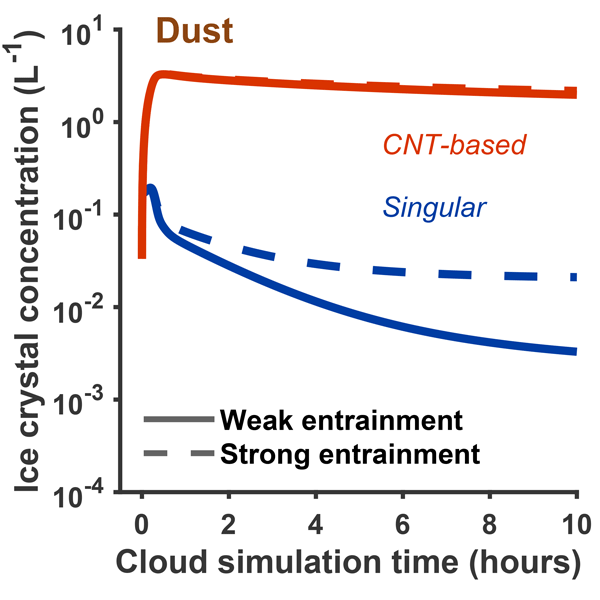
Yijia Sun, Ann M. Fridlind, Israel Silber, Nicole Riemer, and Daniel A. Knopf
Geosci. Model Dev., 19, 1581–1617, https://doi.org/10.5194/gmd-19-1581-2026, https://doi.org/10.5194/gmd-19-1581-2026, 2026
Short summary
Short summary
The role of Arctic clouds in the regional climate remains uncertain due to insufficient understanding of the amount of liquid droplets and ice crystals present in these clouds. An aerosol-cloud model is employed to examine the role of different aerosol types and freezing parameterizations on the number of ice crystals. The choice of freezing parameterization significantly changes the number of ice crystals impacting the interpretation of the evolution and warming effect of Arctic clouds.
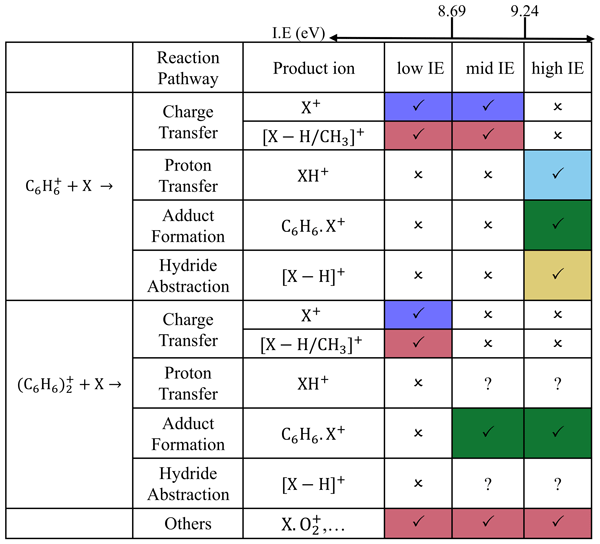
Uma Puttu, Jamie R. Kamp, Xiaoyu Chen, Jhao-Hong Chen, Bingru Wang, Jing Li, Miquel A. Gonzalez-Meler, Jian Wang, and Lu Xu
Atmos. Meas. Tech., 19, 1421–1439, https://doi.org/10.5194/amt-19-1421-2026, https://doi.org/10.5194/amt-19-1421-2026, 2026
Short summary
Short summary
We developed a new technique to measure air pollutants. This method can detect many gases, including volatile organic compounds and nitrogen oxide released by plants and human activities. We tested it in two locations and found it agreed well with standard instruments, while offering improved performance. Our results show this approach can provide broad and sensitive monitoring of air quality and chemical processes in the atmosphere.
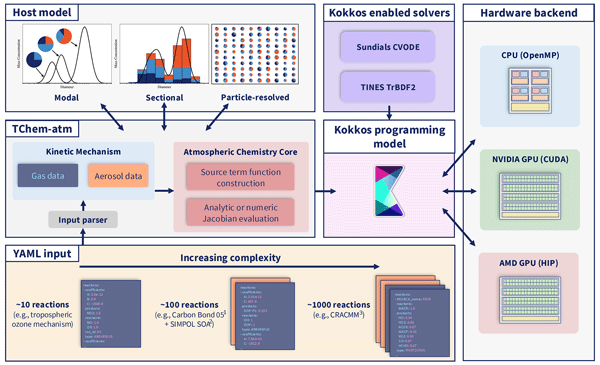
Oscar H. Díaz-Ibarra, Samuel G. Frederick, Jeffrey H. Curtis, Zachary D'Aquino, Peter A. Bosler, Lekha Patel, Cosmin Safta, Matthew West, and Nicole Riemer
Geosci. Model Dev., 19, 1281–1299, https://doi.org/10.5194/gmd-19-1281-2026, https://doi.org/10.5194/gmd-19-1281-2026, 2026
Short summary
Short summary
We developed TChem-atm, a new open-source tool for simulating atmospheric chemistry and aerosols. As models become more detailed, traditional methods are too slow. TChem-atm runs on both standard processors and graphics processors, making these simulations faster and more efficient. The tool provides a foundation for next-generation models that improve predictions of air quality and climate.
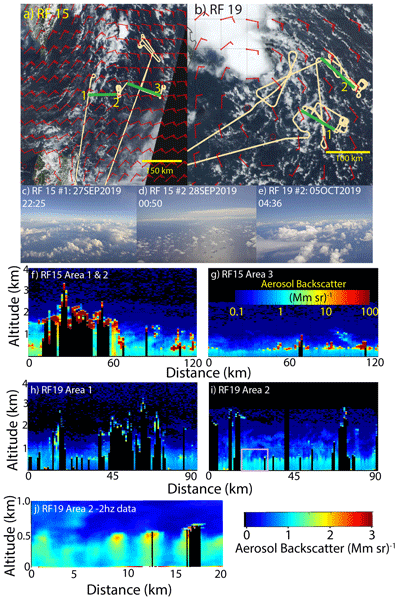
Jeffrey S. Reid, Robert E. Holz, Chris A. Hostetler, Richard A. Ferrare, Juli I. Rubin, Elizabeth J. Thompson, Susan C. van den Heever, Corey G. Amiot, Sharon P. Burton, Joshua P. DiGangi, Glenn S. Diskin, Joshua H. Cossuth, Daniel P. Eleuterio, Edwin W. Eloranta, Ralph Kuehn, Willem J. Marais, Hal B. Maring, Armin Sorooshian, Kenneth L. Thornhill, Charles R. Trepte, Jian Wang, Peng Xian, and Luke D. Ziemba
Atmos. Chem. Phys., 25, 18639–18673, https://doi.org/10.5194/acp-25-18639-2025, https://doi.org/10.5194/acp-25-18639-2025, 2025
Short summary
Short summary
We document air and ship born measurements of the vertical distribution of pollution and biomass burning aerosol particles transported within the Maritime Continent's monsoonal flows for 1000s of kilometers, and yet still exhibit intricate patterns around clouds near the ocean's surface. Findings demonstrate that, while aerosol transport occurs near the surface, there is heterogeneity in particle extinction that must be considered for both in situ observations and satellite retrievals.
Jing Li, Jiaoshi Zhang, Xianda Gong, Steven Spielman, Chongai Kuang, Ashish Singh, Maria A. Zawadowicz, Lu Xu, and Jian Wang
Atmos. Chem. Phys., 25, 13975–13993, https://doi.org/10.5194/acp-25-13975-2025, https://doi.org/10.5194/acp-25-13975-2025, 2025
Short summary
Short summary
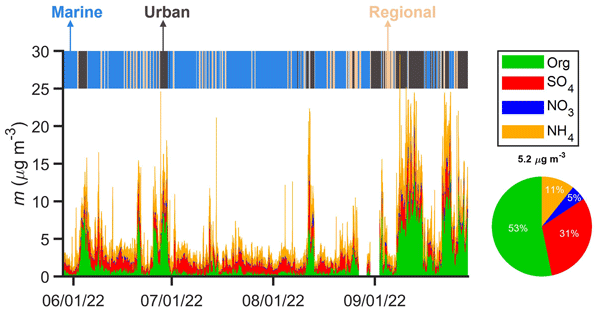
Using measurements at a rural coastal site, we quantified aerosols in representative air masses and identified major sources of organics in the Houston area. Our results show cooking aerosol is likely overestimated by earlier studies. Additionally, diurnal variation of highly oxidized organics is mostly driven by air mass changes instead of photochemistry. This study highlights the impacts of emissions, atmospheric chemistry, and meteorology on aerosol properties in the coastal–rural environment.
McKenna W. Stanford, Ann M. Fridlind, Andrew S. Ackerman, Bastiaan van Diedenhoven, Qian Xiao, Jian Wang, Toshihisa Matsui, Daniel Hernandez-Deckers, and Paul Lawson
Atmos. Chem. Phys., 25, 11199–11231, https://doi.org/10.5194/acp-25-11199-2025, https://doi.org/10.5194/acp-25-11199-2025, 2025
Short summary
Short summary
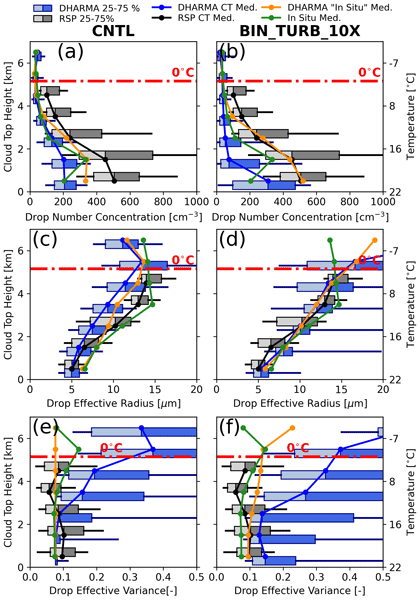
The evolution of cloud droplets, from the point they are activated by atmospheric aerosol to the formation of precipitation, is an important process relevant to understanding cloud–climate feedbacks. This study demonstrates a benchmark framework for using novel airborne measurements and retrievals to constrain high-resolution simulations of moderately deep cumulus clouds and pathways for scaling results to large-scale models and space-based observational platforms.
Genevieve Rose Lorenzo, Luke D. Ziemba, Avelino F. Arellano, Mary C. Barth, Ewan C. Crosbie, Joshua P. DiGangi, Glenn S. Diskin, Richard Ferrare, Miguel Ricardo A. Hilario, Michael A. Shook, Simone Tilmes, Jian Wang, Qian Xiao, Jun Zhang, and Armin Sorooshian
Atmos. Chem. Phys., 25, 5469–5495, https://doi.org/10.5194/acp-25-5469-2025, https://doi.org/10.5194/acp-25-5469-2025, 2025
Short summary
Short summary
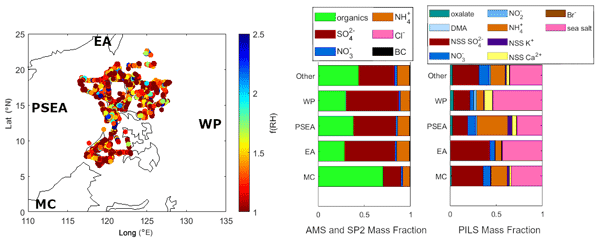
Novel aerosol hygroscopicity analyses of CAMP2Ex (Cloud, Aerosol, and Monsoon Processes Philippines Experiment) field campaign data show low aerosol hygroscopicity values in Southeast Asia. Organic carbon from smoke decreases hygroscopicity to levels more like those in continental than in polluted marine regions. Hygroscopicity changes at cloud level demonstrate how surface particles impact clouds in the region, affecting model representation of aerosol and cloud interactions in similar polluted marine regions with high organic carbon emissions.
Delaney B. Kilgour, Christopher M. Jernigan, Olga Garmash, Sneha Aggarwal, Shengqian Zhou, Claudia Mohr, Matt E. Salter, Joel A. Thornton, Jian Wang, Paul Zieger, and Timothy H. Bertram
Atmos. Chem. Phys., 25, 1931–1947, https://doi.org/10.5194/acp-25-1931-2025, https://doi.org/10.5194/acp-25-1931-2025, 2025
Short summary
Short summary
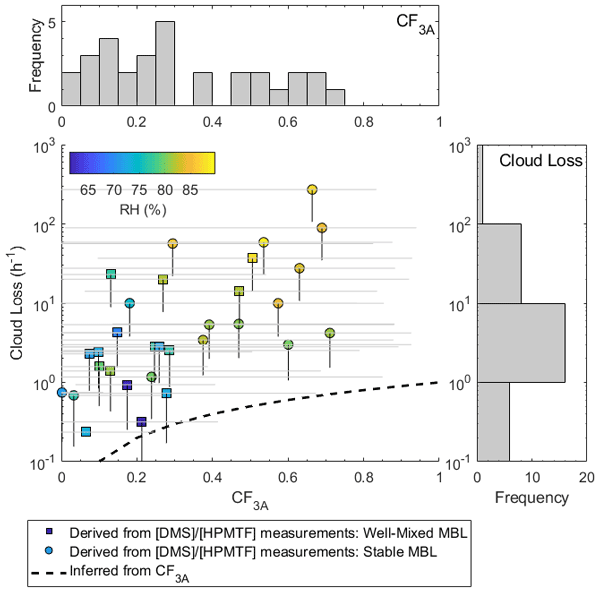
We report simultaneous measurements of dimethyl sulfide (DMS) and hydroperoxymethyl thioformate (HPMTF) in the eastern North Atlantic. We use an observationally constrained box model to show that cloud loss is the dominant sink of HPMTF in this region over 6 weeks, resulting in large reductions in DMS-derived products that contribute to aerosol formation and growth. Our findings indicate that fast cloud processing of HPMTF must be included in global models to accurately capture the sulfur cycle.
Zhouyang Zhang, Jiandong Wang, Jiaping Wang, Nicole Riemer, Chao Liu, Yuzhi Jin, Zeyuan Tian, Jing Cai, Yueyue Cheng, Ganzhen Chen, Bin Wang, Shuxiao Wang, and Aijun Ding
Atmos. Chem. Phys., 25, 1869–1881, https://doi.org/10.5194/acp-25-1869-2025, https://doi.org/10.5194/acp-25-1869-2025, 2025
Short summary
Short summary
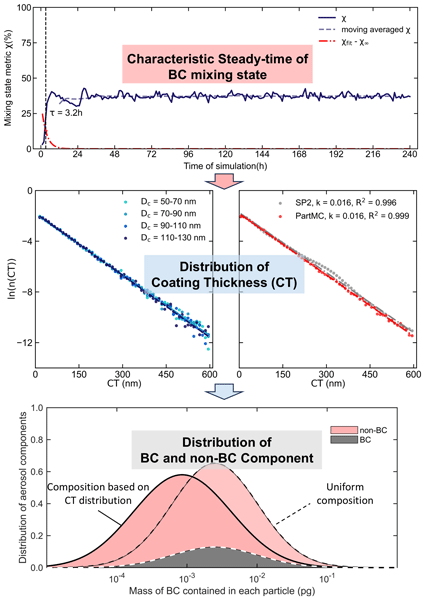
Black carbon (BC) exerts notable warming effects. We use a particle-resolved model to investigate the long-term behavior of the BC mixing state, revealing its compositions, coating thickness distribution, and optical properties all stabilize with a characteristic time of less than 1 d. This study can effectively simplify the description of the BC mixing state, which facilitates the precise assessment of the optical properties of BC aerosols in global and chemical transport models.
Fan Mei, Jennifer M. Comstock, Mikhail S. Pekour, Jerome D. Fast, Krista L. Gaustad, Beat Schmid, Shuaiqi Tang, Damao Zhang, John E. Shilling, Jason M. Tomlinson, Adam C. Varble, Jian Wang, L. Ruby Leung, Lawrence Kleinman, Scot Martin, Sebastien C. Biraud, Brian D. Ermold, and Kenneth W. Burk
Earth Syst. Sci. Data, 16, 5429–5448, https://doi.org/10.5194/essd-16-5429-2024, https://doi.org/10.5194/essd-16-5429-2024, 2024
Short summary
Short summary
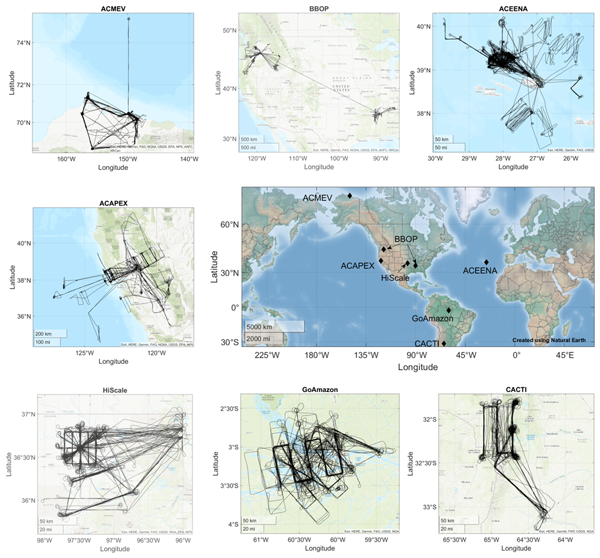
Our study explores a comprehensive dataset from airborne field studies (2013–2018) conducted using the US Department of Energy's Gulfstream 1 (G-1). The 236 flights span diverse regions, including the Arctic, US Southern Great Plains, US West Coast, eastern North Atlantic, Amazon Basin in Brazil, and Sierras de Córdoba range in Argentina. This dataset provides unique insights into atmospheric dynamics, aerosols, and clouds and makes data available in a more accessible format.
Jeffrey H. Curtis, Nicole Riemer, and Matthew West
Geosci. Model Dev., 17, 8399–8420, https://doi.org/10.5194/gmd-17-8399-2024, https://doi.org/10.5194/gmd-17-8399-2024, 2024
Short summary
Short summary
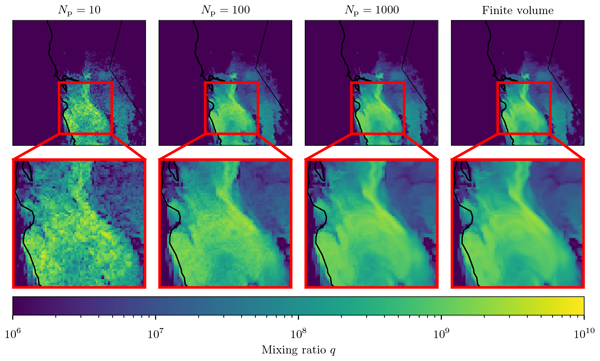
This paper introduces a numerical method for simulating particle-based aerosol transport in atmospheric models. We detail the various numerical properties of the advection order method and demonstrate its implementation in a 3D weather prediction model (WRF) for the first time. Particle-based techniques improve the accuracy of aerosol size and composition predictions, which are key for aerosol–cloud and aerosol–radiation interactions.
Yang Wang, Chanakya Bagya Ramesh, Scott E. Giangrande, Jerome Fast, Xianda Gong, Jiaoshi Zhang, Ahmet Tolga Odabasi, Marcus Vinicius Batista Oliveira, Alyssa Matthews, Fan Mei, John E. Shilling, Jason Tomlinson, Die Wang, and Jian Wang
Atmos. Chem. Phys., 23, 15671–15691, https://doi.org/10.5194/acp-23-15671-2023, https://doi.org/10.5194/acp-23-15671-2023, 2023
Short summary
Short summary
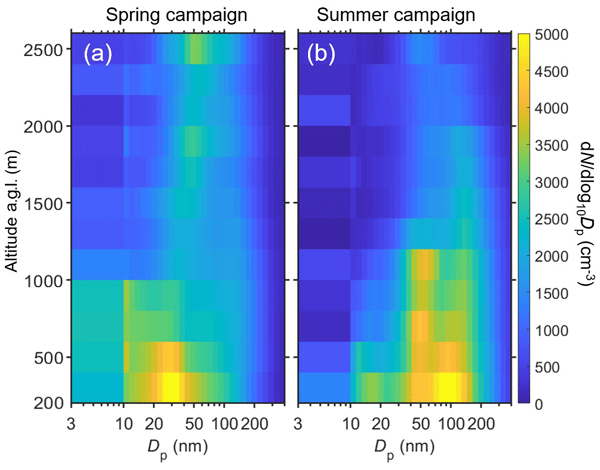
We report the vertical profiles of aerosol properties over the Southern Great Plains (SGP), a region influenced by shallow convective clouds, land–atmosphere interactions, boundary layer turbulence, and the aerosol life cycle. We examined the processes that drive the aerosol population and distribution in the lower troposphere over the SGP. This study helps improve our understanding of aerosol–cloud interactions and the model representation of aerosol processes.
Qian Xiao, Jiaoshi Zhang, Yang Wang, Luke D. Ziemba, Ewan Crosbie, Edward L. Winstead, Claire E. Robinson, Joshua P. DiGangi, Glenn S. Diskin, Jeffrey S. Reid, K. Sebastian Schmidt, Armin Sorooshian, Miguel Ricardo A. Hilario, Sarah Woods, Paul Lawson, Snorre A. Stamnes, and Jian Wang
Atmos. Chem. Phys., 23, 9853–9871, https://doi.org/10.5194/acp-23-9853-2023, https://doi.org/10.5194/acp-23-9853-2023, 2023
Short summary
Short summary
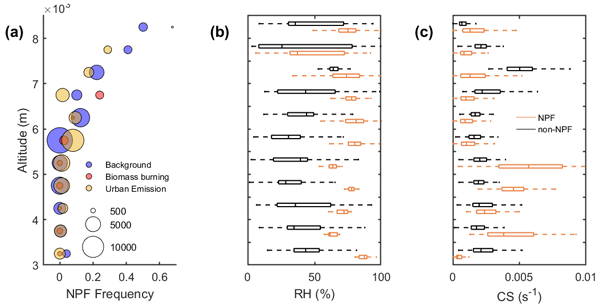
Using recent airborne measurements, we show that the influences of anthropogenic emissions, transport, convective clouds, and meteorology lead to new particle formation (NPF) under a variety of conditions and at different altitudes in tropical marine environments. NPF is enhanced by fresh urban emissions in convective outflow but is suppressed in air masses influenced by aged urban emissions where reactive precursors are mostly consumed while particle surface area remains relatively high.
Daniel A. Knopf, Peiwen Wang, Benny Wong, Jay M. Tomlin, Daniel P. Veghte, Nurun N. Lata, Swarup China, Alexander Laskin, Ryan C. Moffet, Josephine Y. Aller, Matthew A. Marcus, and Jian Wang
Atmos. Chem. Phys., 23, 8659–8681, https://doi.org/10.5194/acp-23-8659-2023, https://doi.org/10.5194/acp-23-8659-2023, 2023
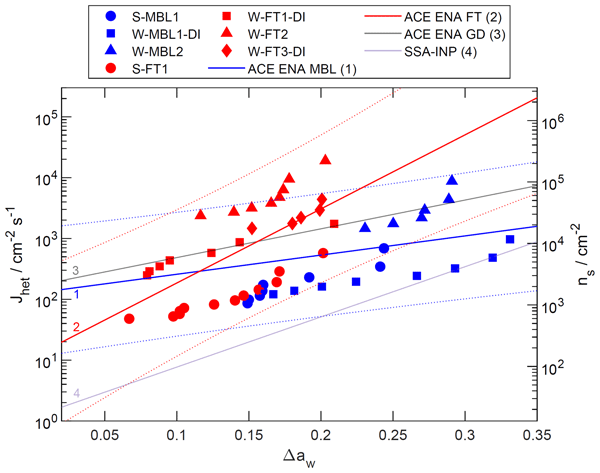
Short summary
Short summary
Ambient particle populations and associated ice-nucleating particles (INPs)
were examined from particle samples collected on board aircraft in the marine
boundary layer and free troposphere in the eastern North Atlantic during
summer and winter. Chemical imaging shows distinct differences in the
particle populations seasonally and with sampling altitudes, which are
reflected in the INP types. Freezing parameterizations are derived for
implementation in cloud-resolving and climate models.

Francesca Gallo, Janek Uin, Kevin J. Sanchez, Richard H. Moore, Jian Wang, Robert Wood, Fan Mei, Connor Flynn, Stephen Springston, Eduardo B. Azevedo, Chongai Kuang, and Allison C. Aiken
Atmos. Chem. Phys., 23, 4221–4246, https://doi.org/10.5194/acp-23-4221-2023, https://doi.org/10.5194/acp-23-4221-2023, 2023
Short summary
Short summary
This study provides a summary statistic of multiday aerosol plume transport event influences on aerosol physical properties and the cloud condensation nuclei budget at the U.S. Department of Energy Atmospheric Radiation Measurement Facility in the eastern North Atlantic (ENA). An algorithm that integrates aerosol properties is developed and applied to identify multiday aerosol transport events. The influence of the aerosol plumes on aerosol populations at the ENA is successively assessed.
Sudipta Ghosh, Sagnik Dey, Sushant Das, Nicole Riemer, Graziano Giuliani, Dilip Ganguly, Chandra Venkataraman, Filippo Giorgi, Sachchida Nand Tripathi, Srikanthan Ramachandran, Thazhathakal Ayyappen Rajesh, Harish Gadhavi, and Atul Kumar Srivastava
Geosci. Model Dev., 16, 1–15, https://doi.org/10.5194/gmd-16-1-2023, https://doi.org/10.5194/gmd-16-1-2023, 2023
Short summary
Short summary
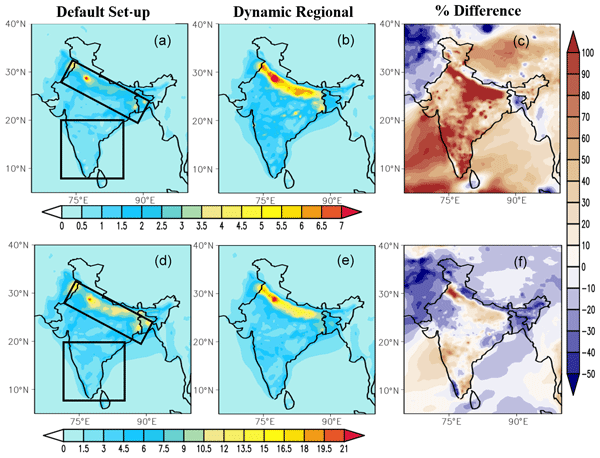
Accurate representation of aerosols in climate models is critical for minimizing the uncertainty in climate projections. Here, we implement region-specific emission fluxes and a more accurate scheme for carbonaceous aerosol ageing processes in a regional climate model (RegCM4) and show that it improves model performance significantly against in situ, reanalysis, and satellite data over the Indian subcontinent. We recommend improving the model performance before using them for climate studies.

Jerome D. Fast, David M. Bell, Gourihar Kulkarni, Jiumeng Liu, Fan Mei, Georges Saliba, John E. Shilling, Kaitlyn Suski, Jason Tomlinson, Jian Wang, Rahul Zaveri, and Alla Zelenyuk
Atmos. Chem. Phys., 22, 11217–11238, https://doi.org/10.5194/acp-22-11217-2022, https://doi.org/10.5194/acp-22-11217-2022, 2022
Short summary
Short summary
Recent aircraft measurements from the HI-SCALE campaign conducted over the Southern Great Plains (SGP) site in Oklahoma are used to quantify spatial variability of aerosol properties in terms of grid spacings typically used by weather and climate models. Surprisingly large horizontal gradients in aerosol properties were frequently observed in this rural area. This spatial variability can be used as an uncertainty range when comparing surface point measurements with model predictions.
Ivo Beck, Hélène Angot, Andrea Baccarini, Lubna Dada, Lauriane Quéléver, Tuija Jokinen, Tiia Laurila, Markus Lampimäki, Nicolas Bukowiecki, Matthew Boyer, Xianda Gong, Martin Gysel-Beer, Tuukka Petäjä, Jian Wang, and Julia Schmale
Atmos. Meas. Tech., 15, 4195–4224, https://doi.org/10.5194/amt-15-4195-2022, https://doi.org/10.5194/amt-15-4195-2022, 2022
Short summary
Short summary
We present the pollution detection algorithm (PDA), a new method to identify local primary pollution in remote atmospheric aerosol and trace gas time series. The PDA identifies periods of contaminated data and relies only on the target dataset itself; i.e., it is independent of ancillary data such as meteorological variables. The parameters of all pollution identification steps are adjustable so that the PDA can be tuned to different locations and situations. It is available as open-access code.
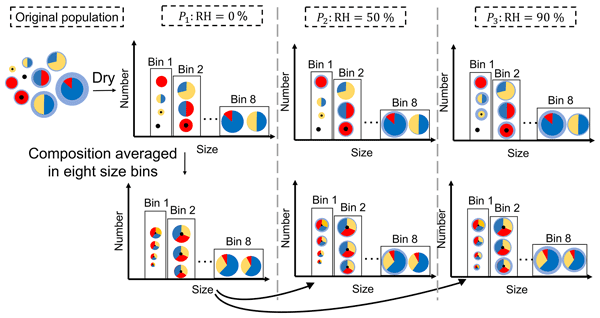
Yu Yao, Jeffrey H. Curtis, Joseph Ching, Zhonghua Zheng, and Nicole Riemer
Atmos. Chem. Phys., 22, 9265–9282, https://doi.org/10.5194/acp-22-9265-2022, https://doi.org/10.5194/acp-22-9265-2022, 2022
Short summary
Short summary
Investigating the impacts of aerosol mixing state on aerosol optical properties has a long history from both the modeling and experimental perspective. In this study, we used particle-resolved simulations as a benchmark to determine the error in optical properties when using simplified aerosol representations. We found that errors in single scattering albedo due to the internal mixture assumptions can have substantial effects on calculating aerosol direct radiative forcing.
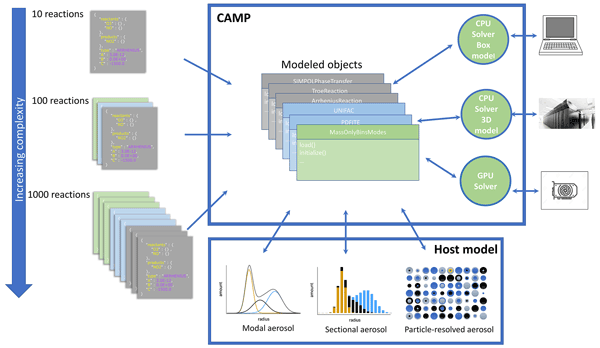
Matthew L. Dawson, Christian Guzman, Jeffrey H. Curtis, Mario Acosta, Shupeng Zhu, Donald Dabdub, Andrew Conley, Matthew West, Nicole Riemer, and Oriol Jorba
Geosci. Model Dev., 15, 3663–3689, https://doi.org/10.5194/gmd-15-3663-2022, https://doi.org/10.5194/gmd-15-3663-2022, 2022
Short summary
Short summary
Progress in identifying complex, mixed-phase physicochemical processes has resulted in an advanced understanding of the evolution of atmospheric systems but has also introduced a level of complexity that few atmospheric models were designed to handle. We present a flexible treatment for multiphase chemical processes for models of diverse scale, from box up to global models. This enables users to build a customized multiphase mechanism that is accessible to a much wider community.
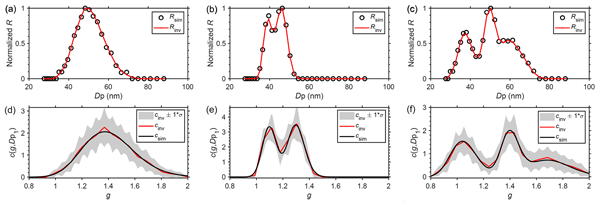
Jiaoshi Zhang, Yang Wang, Steven Spielman, Susanne Hering, and Jian Wang
Atmos. Meas. Tech., 15, 2579–2590, https://doi.org/10.5194/amt-15-2579-2022, https://doi.org/10.5194/amt-15-2579-2022, 2022
Short summary
Short summary
New nonparametric, regularized methods are developed to invert the growth factor probability density function (GF-PDF) from humidity-controlled fast integrated mobility spectrometer measurements. These algorithms are computationally efficient, require no prior assumptions of the GF-PDF distribution, and reduce the error in inverted GF-PDF. They can be applied to humidified tandem differential mobility analyzer data. Among all algorithms, Twomey’s method retrieves GF-PDF with the smallest error.
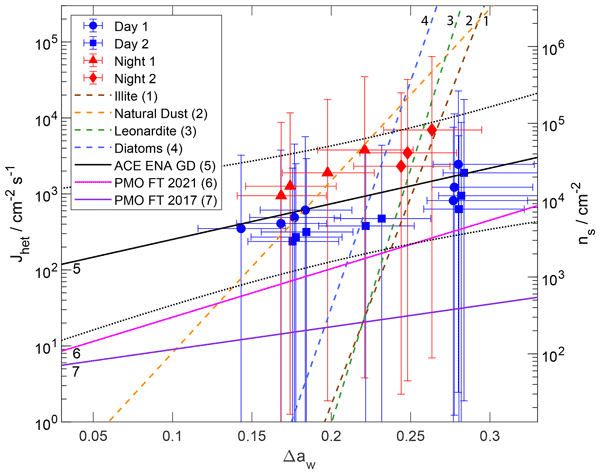
Daniel A. Knopf, Joseph C. Charnawskas, Peiwen Wang, Benny Wong, Jay M. Tomlin, Kevin A. Jankowski, Matthew Fraund, Daniel P. Veghte, Swarup China, Alexander Laskin, Ryan C. Moffet, Mary K. Gilles, Josephine Y. Aller, Matthew A. Marcus, Shira Raveh-Rubin, and Jian Wang
Atmos. Chem. Phys., 22, 5377–5398, https://doi.org/10.5194/acp-22-5377-2022, https://doi.org/10.5194/acp-22-5377-2022, 2022
Short summary
Short summary
Marine boundary layer aerosols collected in the remote region of the eastern North Atlantic induce immersion freezing and deposition ice nucleation under typical mixed-phase and cirrus cloud conditions. Corresponding ice nucleation parameterizations for model applications have been derived. Chemical imaging of ambient aerosol and ice-nucleating particles demonstrates that the latter is dominated by sea salt and organics while also representing a major particle type in the particle population.
Jay M. Tomlin, Kevin A. Jankowski, Daniel P. Veghte, Swarup China, Peiwen Wang, Matthew Fraund, Johannes Weis, Guangjie Zheng, Yang Wang, Felipe Rivera-Adorno, Shira Raveh-Rubin, Daniel A. Knopf, Jian Wang, Mary K. Gilles, Ryan C. Moffet, and Alexander Laskin
Atmos. Chem. Phys., 21, 18123–18146, https://doi.org/10.5194/acp-21-18123-2021, https://doi.org/10.5194/acp-21-18123-2021, 2021
Short summary
Short summary
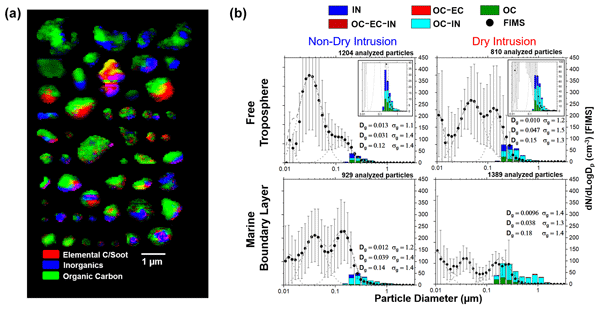
Analysis of individual atmospheric particles shows that aerosol transported from North America during meteorological dry intrusion episodes may have a substantial impact on the mixing state and particle-type population over the mid-Atlantic, as organic contribution and particle-type diversity are significantly enhanced during these periods. These observations need to be considered in current atmospheric models.
Zhonghua Zheng, Matthew West, Lei Zhao, Po-Lun Ma, Xiaohong Liu, and Nicole Riemer
Atmos. Chem. Phys., 21, 17727–17741, https://doi.org/10.5194/acp-21-17727-2021, https://doi.org/10.5194/acp-21-17727-2021, 2021
Short summary
Short summary
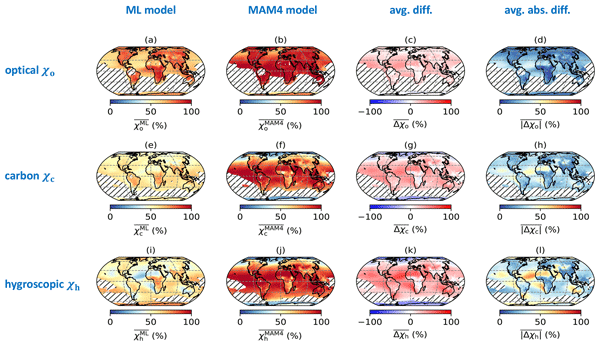
Aerosol mixing state is an important emergent property that affects aerosol radiative forcing and aerosol–cloud interactions, but it has not been easy to constrain this property globally. We present a framework for evaluating the error in aerosol mixing state induced by aerosol representation assumptions, which is one of the important contributors to structural uncertainty in aerosol models. Our study provides insights into potential improvements to model process representation for aerosols.
Fan Mei, Steven Spielman, Susanne Hering, Jian Wang, Mikhail S. Pekour, Gregory Lewis, Beat Schmid, Jason Tomlinson, and Maynard Havlicek
Atmos. Meas. Tech., 14, 7329–7340, https://doi.org/10.5194/amt-14-7329-2021, https://doi.org/10.5194/amt-14-7329-2021, 2021
Short summary
Short summary
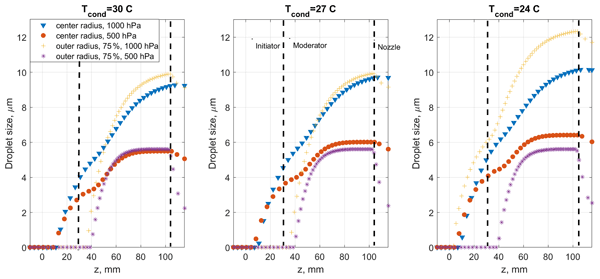
This study focuses on understanding a versatile water-based condensation particle counter (vWCPC 3789) performance under various ambient pressure conditions (500–1000 hPa). A vWCPC has the advantage of avoiding health and safety concerns. However, its performance characterization under low pressure is rare but crucial for ensuring successful airborne deployment. This paper provides advanced knowledge of operating a vWCPC 3789 to capture the spatial variations of atmospheric aerosols.
Cited articles
Adachi, K., Tobo, Y., Koike, M., Freitas, G., Zieger, P., and Krejci, R.: Composition and mixing state of Arctic aerosol and cloud residual particles from long-term single-particle observations at Zeppelin Observatory, Svalbard, Atmos. Chem. Phys., 22, 14421–14439, https://doi.org/10.5194/acp-22-14421-2022, 2022. a
Adam, M., Putaud, J. P., Martins dos Santos, S., Dell'Acqua, A., and Gruening, C.: Aerosol hygroscopicity at a regional background site (Ispra) in Northern Italy, Atmos. Chem. Phys., 12, 5703–5717, https://doi.org/10.5194/acp-12-5703-2012, 2012. a
Baustian, K. J., Cziczo, D. J., Wise, M. E., Pratt, K. A., Kulkarni, G., Hallar, A. G., and Tolbert, M. A.: Importance of Aerosol Composition, Mixing State, and Morphology for Heterogeneous Ice Nucleation: A Combined Field and Laboratory Approach, J. Geophys. Res.-Atmos., 117, https://doi.org/10.1029/2011JD016784, 2012. a
Bertram, T. H., Cochran, R. E., Grassian, V. H., and Stone, E. A.: Sea Spray Aerosol Chemical Composition: Elemental and Molecular Mimics for Laboratory Studies of Heterogeneous and Multiphase Reactions, Chem. Soc. Rev., 47, 2374–2400, https://doi.org/10.1039/C7CS00008A, 2018. a
Bian, H., Froyd, K., Murphy, D. M., Dibb, J., Darmenov, A., Chin, M., Colarco, P. R., da Silva, A., Kucsera, T. L., Schill, G., Yu, H., Bui, P., Dollner, M., Weinzierl, B., and Smirnov, A.: Observationally constrained analysis of sea salt aerosol in the marine atmosphere, Atmos. Chem. Phys., 19, 10773–10785, https://doi.org/10.5194/acp-19-10773-2019, 2019. a
Bondy, A. L., Bonanno, D., Moffet, R. C., Wang, B., Laskin, A., and Ault, A. P.: The diverse chemical mixing state of aerosol particles in the southeastern United States, Atmos. Chem. Phys., 18, 12595–12612, https://doi.org/10.5194/acp-18-12595-2018, 2018. a
Brechtel, F. J. and Kreidenweis, S. M.: Predicting Particle Critical Supersaturation from Hygroscopic Growth Measurements in the Humidified TDMA. Part I: Theory and Sensitivity Studies, J. Atmos. Sci., 57, 1854–1871, https://doi.org/10.1175/1520-0469(2000)057<1854:PPCSFH>2.0.CO;2, 2000. a
Cheng, Z., Morgenstern, M., Henning, S., Zhang, B., Roberts, G. C., Fraund, M., Marcus, M. A., Lata, N. N., Fialho, P., Mazzoleni, L., Wehner, B., Mazzoleni, C., and China, S.: Cloud Condensation Nuclei Activity of Internally Mixed Particle Populations at a Remote Marine Free Troposphere Site in the North Atlantic Ocean, Sci. Total Environ., 904, 166865, https://doi.org/10.1016/j.scitotenv.2023.166865, 2023. a
Collins, D. R., Cocker, D. R., Flagan, R. C., and Seinfeld, J. H.: The Scanning DMA Transfer Function, Aerosol Sci. Tech., 38, 833–850, https://doi.org/10.1080/027868290503082, 2004. a
Cubison, M. J., Ervens, B., Feingold, G., Docherty, K. S., Ulbrich, I. M., Shields, L., Prather, K., Hering, S., and Jimenez, J. L.: The influence of chemical composition and mixing state of Los Angeles urban aerosol on CCN number and cloud properties, Atmos. Chem. Phys., 8, 5649–5667, https://doi.org/10.5194/acp-8-5649-2008, 2008. a
Deshmukh, S., Poulain, L., Wehner, B., Henning, S., Petit, J.-E., Fombelle, P., Favez, O., Herrmann, H., and Pöhlker, M.: External particle mixing influences hygroscopicity in a sub-urban area, Atmos. Chem. Phys., 25, 741–758, https://doi.org/10.5194/acp-25-741-2025, 2025. a
Drame, M. S., Ceamanos, X., Roujean, J. L., Boone, A., Lafore, J. P., Carrer, D., and Geoffroy, O.: On the Importance of Aerosol Composition for Estimating Incoming Solar Radiation: Focus on the Western African Stations of Dakar and Niamey during the Dry Season, Atmosphere, 6, 1608–1632, https://doi.org/10.3390/atmos6111608, 2015. a
Ebert, M., Weinbruch, S., Hoffmann, P., and Ortner, H. M.: The Chemical Composition and Complex Refractive Index of Rural and Urban Influenced Aerosols Determined by Individual Particle Analysis, Atmos. Environ., 38, 6531–6545, https://doi.org/10.1016/j.atmosenv.2004.08.048, 2004. a
Farley, R. N., Lee, J. E., Rivellini, L.-H., Lee, A. K. Y., Dal Porto, R., Cappa, C. D., Gorkowski, K., Shawon, A. S. M., Benedict, K. B., Aiken, A. C., Dubey, M. K., and Zhang, Q.: Chemical properties and single-particle mixing state of soot aerosol in Houston during the TRACER campaign, Atmos. Chem. Phys., 24, 3953–3971, https://doi.org/10.5194/acp-24-3953-2024, 2024. a
Fraund, M., Pham, D. Q., Bonanno, D., Harder, T. H., Wang, B., Brito, J., De Sá, S. S., Carbone, S., China, S., Artaxo, P., Martin, S. T., Pöhlker, C., Andreae, M. O., Laskin, A., Gilles, M. K., and Moffet, R. C.: Elemental Mixing State of Aerosol Particles Collected in Central Amazonia during GoAmazon2014/15, Atmosphere, 8, 173, https://doi.org/10.3390/atmos8090173, 2017. a
Gasparik, J. T., Ye, Q., Curtis, J. H., Presto, A. A., Donahue, N. M., Sullivan, R. C., West, M., and Riemer, N.: Quantifying Errors in the Aerosol Mixing-State Index Based on Limited Particle Sample Size, Aerosol Sci. Tech., 54, 1527–1541, https://doi.org/10.1080/02786826.2020.1804523, 2020. a
George, I. J. and Abbatt, J. P. D.: Heterogeneous Oxidation of Atmospheric Aerosol Particles by Gas-Phase Radicals, Nat. Chem., 2, 713–722, https://doi.org/10.1038/nchem.806, 2010. a
Hallberg, A., Ogren, J. A., Noone, K. J., Okada, K., Heintzenberg, J., and Svenningsson, I. B.: The Influence of Aerosol Particle Composition on Cloud Droplet Formation, J. Atmos. Chem., 19, 153–171, https://doi.org/10.1007/BF00696587, 1994. a
Jiang, F., Zheng, Z., Coe, H., Healy, R. M., Poulain, L., Gros, V., Zhang, H., Li, W., Liu, D., West, M., Topping, D., and Riemer, N.: Integrating Simulations and Observations: A Foundation Model for Estimating the Aerosol Mixing State Index, ACS ES&T Air, 2, 877–890, https://doi.org/10.1021/acsestair.4c00329, 2025. a
Kleinman, L. I., Springston, S. R., Daum, P. H., Lee, Y.-N., Nunnermacker, L. J., Senum, G. I., Wang, J., Weinstein-Lloyd, J., Alexander, M. L., Hubbe, J., Ortega, J., Canagaratna, M. R., and Jayne, J.: The time evolution of aerosol composition over the Mexico City plateau, Atmos. Chem. Phys., 8, 1559–1575, https://doi.org/10.5194/acp-8-1559-2008, 2008. a
Laskin, A., Iedema, M. J., and Cowin, J. P.: Quantitative Time-Resolved Monitoring of Nitrate Formation in Sea Salt Particles Using a CCSEM/EDX Single Particle Analysis, Environ. Sci. Technol., 36, 4948–4955, https://doi.org/10.1021/es020551k, 2002. a
Lata, N. N., Zhang, B., Schum, S., Mazzoleni, L., Brimberry, R., Marcus, M. A., Cantrell, W. H., Fialho, P., Mazzoleni, C., and China, S.: Aerosol Composition, Mixing State, and Phase State of Free Tropospheric Particles and Their Role in Ice Cloud Formation, ACS Earth and Space Chemistry, 5, 3499–3510, https://doi.org/10.1021/acsearthspacechem.1c00315, 2021. a
Leck, C. and Svensson, E.: Importance of aerosol composition and mixing state for cloud droplet activation over the Arctic pack ice in summer, Atmos. Chem. Phys., 15, 2545–2568, https://doi.org/10.5194/acp-15-2545-2015, 2015. a
Leck, C., Norman, M., Bigg, E. K., and Hillamo, R.: Chemical Composition and Sources of the High Arctic Aerosol Relevant for Cloud Formation, J. Geophys. Res.-Atmos., 107, AAC 1-1–AAC 1-17, https://doi.org/10.1029/2001JD001463, 2002. a
Li, W., Shao, L., Wang, Z., Shen, R., Yang, S., and Tang, U.: Size, Composition, and Mixing State of Individual Aerosol Particles in a South China Coastal City, J. Environ. Sci., 22, 561–569, https://doi.org/10.1016/S1001-0742(09)60146-7, 2010. a
Li, W., Sun, J., Xu, L., Shi, Z., Riemer, N., Sun, Y., Fu, P., Zhang, J., Lin, Y., Wang, X., Shao, L., Chen, J., Zhang, X., Wang, Z., and Wang, W.: A Conceptual Framework for Mixing Structures in Individual Aerosol Particles, J. Geophys. Res.-Atmos., 121, 13784–13798, https://doi.org/10.1002/2016JD025252, 2016. a
Liu, Y., Yao, Y., Curtis, J. H., West, M., and Riemer, N.: The Impacts of Aerosol Mixing State on Heterogeneous N2O5 Hydrolysis, Aerosol Sci. Tech., 59, 402–423, https://doi.org/10.1080/02786826.2024.2443587, 2025. a
Liu, Y., Wang, J., and Riemer, N.: Data for From κ to χ: Evaluating Hygroscopicity-Based Mixing State Estimates with a Particle-Resolved Model, University of Illinois Urbana-Champaign [data set], https://doi.org/10.13012/B2IDB-8214798_V1, 2026. a
Mochida, M., Nishita-Hara, C., Kitamori, Y., Aggarwal, S. G., Kawamura, K., Miura, K., and Takami, A.: Size-Segregated Measurements of Cloud Condensation Nucleus Activity and Hygroscopic Growth for Aerosols at Cape Hedo, Japan, in Spring 2008, J. Geophys. Res.-Atmos., 115, https://doi.org/10.1029/2009JD013216, 2010. a
Murphy, D. M., Anderson, J. R., Quinn, P. K., McInnes, L. M., Brechtel, F. J., Kreidenweis, S. M., Middlebrook, A. M., Pósfai, M., Thomson, D. S., and Buseck, P. R.: Influence of Sea-Salt on Aerosol Radiative Properties in the Southern Ocean Marine Boundary Layer, Nature, 392, 62–65, https://doi.org/10.1038/32138, 1998. a
Murphy, D. M., Froyd, K. D., Bian, H., Brock, C. A., Dibb, J. E., DiGangi, J. P., Diskin, G., Dollner, M., Kupc, A., Scheuer, E. M., Schill, G. P., Weinzierl, B., Williamson, C. J., and Yu, P.: The distribution of sea-salt aerosol in the global troposphere, Atmos. Chem. Phys., 19, 4093–4104, https://doi.org/10.5194/acp-19-4093-2019, 2019. a
O'Brien, R. E., Wang, B., Laskin, A., Riemer, N., West, M., Zhang, Q., Sun, Y., Yu, X.-Y., Alpert, P., Knopf, D. A., Gilles, M. K., and Moffet, R. C.: Chemical Imaging of Ambient Aerosol Particles: Observational Constraints on Mixing State Parameterization, J. Geophys. Res.-Atmos., 120, 9591–9605, https://doi.org/10.1002/2015JD023480, 2015. a
O'Dowd, C. D. and Smith, M. H.: Physicochemical Properties of Aerosols over the Northeast Atlantic: Evidence for Wind-Speed-Related Submicron Sea-Salt Aerosol Production, J. Geophys. Res.-Atmos., 98, 1137–1149, https://doi.org/10.1029/92JD02302, 1993. a
Patterson, E. M.: Optical Properties of the Crustal Aerosol: Relation to Chemical and Physical Characteristics, J. Geophys. Res.-Oceans, 86, 3236–3246, https://doi.org/10.1029/JC086iC04p03236, 1981. a
Petters, M. D. and Kreidenweis, S. M.: A single parameter representation of hygroscopic growth and cloud condensation nucleus activity, Atmos. Chem. Phys., 7, 1961–1971, https://doi.org/10.5194/acp-7-1961-2007, 2007. a, b
Phillips, B. N., Royalty, T. M., Dawson, K. W., Reed, R., Petters, M. D., and Meskhidze, N.: Hygroscopicity- and Size-Resolved Measurements of Submicron Aerosol on the East Coast of the United States, J. Geophys. Res.-Atmos., 123, 1826–1839, https://doi.org/10.1002/2017JD027702, 2018. a
Rader, D. J. and McMurry, P. H.: Application of the Tandem Differential Mobility Analyzer to Studies of Droplet Growth or Evaporation, J. Aerosol Sci., 17, 771–787, https://doi.org/10.1016/0021-8502(86)90031-5, 1986. a
Ravishankara, A. R., Rudich, Y., and Wuebbles, D. J.: Physical Chemistry of Climate Metrics, Chem. Rev., 115, 3682–3703, https://doi.org/10.1021/acs.chemrev.5b00010, 2015. a
Riemer, N. and West, M.: Quantifying aerosol mixing state with entropy and diversity measures, Atmos. Chem. Phys., 13, 11423–11439, https://doi.org/10.5194/acp-13-11423-2013, 2013. a, b, c
Riemer, N., Vogel, H., and Vogel, B.: Soot aging time scales in polluted regions during day and night, Atmos. Chem. Phys., 4, 1885–1893, https://doi.org/10.5194/acp-4-1885-2004, 2004. a
Riemer, N., West, M., Zaveri, R. A., and Easter, R. C.: Simulating the Evolution of Soot Mixing State with a Particle-resolved Aerosol Model, J. Geophys. Res., 114, D09202, https://doi.org/10.1029/2008JD011073, 2009. a
Rivera-Adorno, F. A., Tomlin, J. M., Lata, N. N., Azzarello, L., Robinson, M. A., Washenfelder, R. A., Franchin, A., Middlebrook, A. M., China, S., Brown, S. S., Young, C. J., Fraund, M., Moffet, R. C., and Laskin, A.: Chemical Imaging of Atmospheric Biomass Burning Particles from North American Wildfires, ACS ES&T Air, 2, 508–521, https://doi.org/10.1021/acsestair.4c00242, 2025. a
Schell, B., Ackermann, I. J., Hass, H., Binkowski, F. S., and Ebel, A.: Modeling the Formation of Secondary Organic Aerosol within a Comprehensive Air Quality Model System, J. Geophys. Res.-Atmos., 106, 28275–28293, https://doi.org/10.1029/2001JD000384, 2001. a
Sharpe, S., Li, Y., Benjemia, S., Rivera-Adorno, F., Olayemi, T., Ese, J., Shen, X., Fraund, M., Moffet, R., Nahar Lata, N., Cheng, Z., China, S., Homeyer, C. R., Dykema, J., Marcus, M. A., Wang, J., Cziczo, D., Keutsch, F., and Laskin, A.: Chemical Imaging of Individual Stratospheric Particles Sampled over North America, Environmental Science: Atmospheres, 6, 47–60, https://doi.org/10.1039/D5EA00127G, 2026. a
Shou, C., Riemer, N., Onasch, T. B., Sedlacek, A. J., Lambe, A. T., Lewis, E. R., Davidovits, P., and West, M.: Mixing State Evolution of Agglomerating Particles in an Aerosol Chamber: Comparison of Measurements and Particle-Resolved Simulations, Aerosol Sci. Tech., 53, 1229–1243, https://doi.org/10.1080/02786826.2019.1661959, 2019. a
Singh, N., Banerjee, T., Deboudt, K., Chakraborty, A., Khan, M. F., and Latif, M. T.: Sources, Composition, and Mixing State of Submicron Particulates over the Central Indo-Gangetic Plain, ACS Earth and Space Chemistry, 5, 2052–2065, https://doi.org/10.1021/acsearthspacechem.1c00130, 2021. a
Sun, Y., Wang, Z., Fu, P., Jiang, Q., Yang, T., Li, J., and Ge, X.: The Impact of Relative Humidity on Aerosol Composition and Evolution Processes during Wintertime in Beijing, China, Atmos. Environ., 77, 927–934, https://doi.org/10.1016/j.atmosenv.2013.06.019, 2013. a
Tao, J., Kuang, Y., Luo, B., Liu, L., Xu, H., Ma, N., Liu, P., Xue, B., Zhai, M., Xu, W., Xu, W., and Sun, Y.: Kinetic Limitations Affect Cloud Condensation Nuclei Activity Measurements Under Low Supersaturation, Geophys. Res. Lett., 50, e2022GL101603, https://doi.org/10.1029/2022GL101603, 2023. a
Tomlin, M. J., Weis, J., Veghte, D. P., China, S., Fraund, M., He, Q., Reicher, N., Li, C., Jankowski, A. K., Rivera-Adorno, F. A., Morales, A. C., Rudich, Y., Moffet, R. C., Gilles, M. K., and Laskin, A.: Chemical Composition and Morphological Analysis of Atmospheric Particles from an Intensive Bonfire Burning Festival, Environmental Science: Atmospheres, 2, 616–633, https://doi.org/10.1039/D2EA00037G, 2022. a
Uin, J., Cromwell, E., Hayes, C., and Salwen, C.: Atmospheric Radiation Measurement (ARM) User Facility. Humidified Tandem Differential Mobility Analyzer (AOSHTDMA), updated daily. 2025-03-13 to 2025-11-30, ARM Mobile Facility (CRG), Baltimore, MD: Supplemental Facility 2 in rural setting (S2); 2023-02-15 to 2024-02-13, ARM Mobile Facility (EPC), La Jolla, CA: AMF1 (main site for EPCAPE on Scripps Pier) (M1); 2021-10-01 to 2022-09-30, ARM Mobile Facility (HOU), Houston, TX: AMF1 (main site for TRACER) (M1); 2021-04-27 to 2023-10-24, Southern Great Plains (SGP), Lamont, OK (Extended and Co-located with C1) (E13), Atmospheric Radiation Measurement (ARM) user facility [data set], https://doi.org/10.5439/1776643, 2012. a
Wang, J., Cubison, M. J., Aiken, A. C., Jimenez, J. L., and Collins, D. R.: The importance of aerosol mixing state and size-resolved composition on CCN concentration and the variation of the importance with atmospheric aging of aerosols, Atmos. Chem. Phys., 10, 7267–7283, https://doi.org/10.5194/acp-10-7267-2010, 2010. a
Wang, Y. and Chen, Y.: Significant Climate Impact of Highly Hygroscopic Atmospheric Aerosols in Delhi, India, Geophys. Res. Lett., 46, 5535–5545, https://doi.org/10.1029/2019GL082339, 2019. a
West, M., Riemer, N., Curtis, J., Michelotti, M., Tian, J., and Arabas, S.: compdyn/partmc: Version 2.6.1, Zenodo [code],https://doi.org/10.5281/zenodo.6144610, 2022. a
Wu, J., Liu, J., Gunsch, M. J., Mirrielees, J. A., Moffett, C. E., Zhang, Q., Sheesley, R. J., and Pratt, K. A.: Quantifying the Diversity of an Atmospheric Aerosol Population in an Arctic Oil Field on a Single-Particle Level, J. Geophys. Res.-Atmos., 129, e2024JD041001, https://doi.org/10.1029/2024JD041001, 2024. a
Xue, J., Zhang, T., Park, K., Yan, J., Yoon, Y. J., Park, J., and Wang, B.: Diverse sources and aging change the mixing state and ice nucleation properties of aerosol particles over the western Pacific and Southern Ocean, Atmos. Chem. Phys., 24, 7731–7754, https://doi.org/10.5194/acp-24-7731-2024, 2024. a, b
Yao, X., Fang, M., and Chan, C. K.: The Size Dependence of Chloride Depletion in Fine and Coarse Sea-Salt Particles, Atmos. Environ., 37, 743–751, https://doi.org/10.1016/S1352-2310(02)00955-X, 2003. a
Yao, Y., Curtis, J. H., Ching, J., Zheng, Z., and Riemer, N.: Quantifying the effects of mixing state on aerosol optical properties, Atmos. Chem. Phys., 22, 9265–9282, https://doi.org/10.5194/acp-22-9265-2022, 2022. a
Yeung, M. C., Lee, B. P., Li, Y. J., and Chan, C. K.: Simultaneous HTDMA and HR-ToF-AMS measurements at the HKUST Supersite in Hong Kong in 2011, J. Geophys. Res.-Atmos., 119, 9864–9883, https://doi.org/10.1002/2013JD021146, 2014. a
Yoo, H., Wu, L., Geng, H., and Ro, C.-U.: Physicochemical and temporal characteristics of individual atmospheric aerosol particles in urban Seoul during KORUS-AQ campaign: insights from single-particle analysis, Atmos. Chem. Phys., 24, 853–867, https://doi.org/10.5194/acp-24-853-2024, 2024. a
Yu, C., Liu, D., Broda, K., Joshi, R., Olfert, J., Sun, Y., Fu, P., Coe, H., and Allan, J. D.: Characterising mass-resolved mixing state of black carbon in Beijing using a morphology-independent measurement method, Atmos. Chem. Phys., 20, 3645–3661, https://doi.org/10.5194/acp-20-3645-2020, 2020. a
Zaveri, R. A. and Peters, L. K.: A New Lumped Structure Photochemical Mechanism for Large-Scale Applications, J. Geophys. Res.-Atmos., 104, 30387–30415, https://doi.org/10.1029/1999JD900876, 1999. a
Zaveri, R. A., Easter, R. C., and Peters, L. K.: A Computationally Efficient Multicomponent Equilibrium Solver for Aerosols (MESA), J. Geophys. Res.-Atmos., 110, https://doi.org/10.1029/2004JD005618, 2005a. a
Zaveri, R. A., Easter, R. C., and Wexler, A. S.: A New Method for Multicomponent Activity Coefficients of Electrolytes in Aqueous Atmospheric Aerosols, J. Geophys. Res.-Atmos., 110, https://doi.org/10.1029/2004JD004681, 2005b. a
Zaveri, R. A., Easter, R. C., Fast, J. D., and Peters, L. K.: Model for Simulating Aerosol Interactions and Chemistry (MOSAIC), J. Geophys. Res.-Atmos., 113, https://doi.org/10.1029/2007JD008782, 2008. a, b
Zeng, L., Tan, T., Zhao, G., Du, Z., Hu, S., Shang, D., and Hu, M.: Overestimation of Black Carbon Light Absorption Due to Mixing State Heterogeneity, npj Clim. Atmos. Sci., 7, 2, https://doi.org/10.1038/s41612-023-00535-8, 2024. a
Zhang, F., Wang, Y., Peng, J., Ren, J., Collins, D., Zhang, R., Sun, Y., Yang, X., and Li, Z.: Uncertainty in Predicting CCN Activity of Aged and Primary Aerosols, J. Geophys. Res.-Atmos., 122, 11723–11736, https://doi.org/10.1002/2017JD027058, 2017. a
Zhang, Z., Wang, J., Wang, J., Riemer, N., Liu, C., Jin, Y., Tian, Z., Cai, J., Cheng, Y., Chen, G., Wang, B., Wang, S., and Ding, A.: Steady-state mixing state of black carbon aerosols from a particle-resolved model, Atmos. Chem. Phys., 25, 1869–1881, https://doi.org/10.5194/acp-25-1869-2025, 2025. a
Zhao, G., Tan, T., Zhu, Y., Hu, M., and Zhao, C.: Method to quantify black carbon aerosol light absorption enhancement with a mixing state index, Atmos. Chem. Phys., 21, 18055–18063, https://doi.org/10.5194/acp-21-18055-2021, 2021. a, b
Zheng, Z., West, M., Zhao, L., Ma, P.-L., Liu, X., and Riemer, N.: Quantifying the structural uncertainty of the aerosol mixing state representation in a modal model, Atmos. Chem. Phys., 21, 17727–17741, https://doi.org/10.5194/acp-21-17727-2021, 2021. a, b
Zhu, S., Sartelet, K. N., Healy, R. M., and Wenger, J. C.: Simulation of Particle Diversity and Mixing State over Greater Paris: A Model–Measurement Inter-Comparison, Faraday Discuss., 189, 547–566, https://doi.org/10.1039/C5FD00175G, 2016. a
Short summary
Airborne particles affect clouds, climate, and air quality, but it is difficult to determine how their chemical components are mixed within individual particles. We tested a method that estimates this mixing from water-uptake measurements using detailed computer simulations. The method works well in many cases, but can overestimate particle mixing when moderately water-attracting material exists in separate particle types. We then applied this uncertainty framework to long-term observations.
Airborne particles affect clouds, climate, and air quality, but it is difficult to determine how...


Altmetrics
Final-revised paper
Preprint