
Articles | Volume 26, issue 10
https://doi.org/10.5194/acp-26-6929-2026
© Author(s) 2026. This work is distributed under
the Creative Commons Attribution 4.0 License.
the Creative Commons Attribution 4.0 License.
Special issue:
https://doi.org/10.5194/acp-26-6929-2026
© Author(s) 2026. This work is distributed under
the Creative Commons Attribution 4.0 License.
the Creative Commons Attribution 4.0 License.
Measurement report
| 
22 May 2026
Measurement report |
| 22 May 2026
| 22 May 2026
Measurement report: Insights into the high temporal variability of atmospheric carbon dioxide (CO2) at a suburban station in the Indo-Gangetic Plain
Vimal Jose Vazhathara
CORRESPONDING AUTHOR

Centre for Atmospheric Sciences, Indian Institute of Technology Delhi, New Delhi, India
Ravi Kumar Kunchala
Centre for Atmospheric Sciences, Indian Institute of Technology Delhi, New Delhi, India
Sajeev Philip
Centre for Atmospheric Sciences, Indian Institute of Technology Delhi, New Delhi, India
Jaswant Rathore
Centre for Atmospheric Sciences, Indian Institute of Technology Delhi, New Delhi, India
Dilip Ganguly
Centre for Atmospheric Sciences, Indian Institute of Technology Delhi, New Delhi, India
Sagnik Dey
Centre for Atmospheric Sciences, Indian Institute of Technology Delhi, New Delhi, India
Centre of Excellence for Research on Clean Air, Indian Institute of Technology Delhi, New Delhi, India
Tomoki Nakayama
Graduate School of Integrated Science and Technology, Nagasaki University, 1–14 Bunkyo-machi, Nagasaki, Nagasaki, 852–8521, Japan
Yutaka Matsumi
Research Institute for Humanity and Nature, Kyoto, Japan
Institute for Space-Earth Environmental Research, Nagoya University, Nagoya, Japan
Prabir K. Patra
Research Institute for Humanity and Nature, Kyoto, Japan
Japan Agency for Marine-Earth Science and Technology (JAMSTEC), Yokohama, Japan
Related authors
No articles found.
Christopher R. Oxford, Haihui Zhu, Maya Mehrotra, Xuan Liu, Yuxuan Ren, Maya Arnott, Isaac Abionum Adimula, Taiye Benjamin Ajibolataiye, Clement Akoshile, Omar Amador-Munoz, Araya Asfaw, Rachel Ying-Wen Chang, Sagnik Dey, Ann M. Dillner, David J. Diner, Connor J. Flynn, Diana Francis, Paterne Gahungu, Rebecca M. Garland, Michel Grutter, Sina Hasheminassab, Fahad Imam, Jhoon Kim, Kristy Langerman, Pei-Chen Lee, Puji Lestari, Po-Hsiung Lin, S. Marcela Loria-Salazar, Tesfaye Mamo, Olga L. Mayol-Bracero, Mogesh Naidoo, Narendra Nelli, Sang Seo Park, Abdus Salam, Bighnaraj Sarangi, Trailokya Saud, Robyn Schofield, Yoav Schechner, Sachchida N. Tripathi, Emily K. West, Eli Windwer, Ming-Tsang Wu, Qiang Zhang, Michael Brauer, Yinon Rudich, Jay R. Turner, and Randall V. Martin
EGUsphere, https://doi.org/10.5194/egusphere-2026-3224, https://doi.org/10.5194/egusphere-2026-3224, 2026
Short summary
Short summary
A high-sensitivity balance, controlled temperature and relative humidity chamber, and filter samples collected around the world were used to develop a mass as a function of relative humidity relationship. We subsequently measured the chemical composition of these same samples. A relationship between the chemical composition and water mass was created and used to calculate aerosol water content showing how composition and water content varies worldwide.
Gaurav K. Srivastav, Aasif A. Wagay, Janne Lampilahti, Jaswant Rathore, Ravi K. Kunchala, Dilip Ganguly, Markku Kulmala, Tuukka Petäjä, Pauli Paasonen, Roseline C. Thakur, and Shahzad Gani
EGUsphere, https://doi.org/10.5194/egusphere-2026-2212, https://doi.org/10.5194/egusphere-2026-2212, 2026
Short summary
Short summary
Particle formation events affect climate and air quality. Using measurements of particle number concentrations down to very small particles (~3 nm) in polluted northern India, we show that these events occur frequently in summer under reduced background particle load. However, in this environment, emissions and changing air masses can mask or distort these events, making them difficult to detect. Such environments require adaptation of standard analytical methods used in cleaner regions.
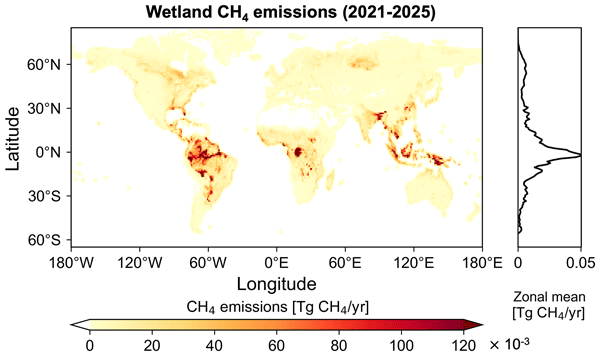
Mengze Li, Robert B. Jackson, Marielle Saunois, Philippe Ciais, Ben Poulter, Josep G. Canadell, Prabir K. Patra, Hanqin Tian, Zhen Zhang, Etienne Fluet-Chouinard, Zutao Ouyang, Ting Zhang, David J. Beerling, Dmitry A. Belikov, Philippe Bousquet, Danilo Custodio, Naveen Chandra, Xinyu Dou, Nicola Gedney, Peter O. Hopcroft, Alison M. Hoyt, Kazuhito Ichii, Akihito Ito, Atul K. Jain, Katherine Jensen, Fortunat Joos, Thomas Kleinen, Masayuki Kondo, Fa Li, Tingting Li, Xiangyu Liu, Shamil Maksyutov, Avni Malhotra, Adrien Martinez, Kyle McDonald, Joe R. Melton, Jurek Müller, Yosuke Niwa, Shufen Pan, Shushi Peng, Changhui Peng, Zhangcai Qin, Peter Raymond, William Riley, Arjo Segers, Rona L. Thompson, Aki Tsuruta, Yi Xi, Kunxiaojia Yuan, Wenxin Zhang, Bo Zheng, Qing Zhu, Qiuan Zhu, and Qianlai Zhuang
Earth Syst. Sci. Data, 18, 3507–3524, https://doi.org/10.5194/essd-18-3507-2026, https://doi.org/10.5194/essd-18-3507-2026, 2026
Short summary
Short summary
We proposed a framework that combines machine-learning and climate data to predict global natural vegetated wetland methane emissions for 2000–2025. We found that although total global emissions remained stable in the post-2020s, Northern Hemisphere emissions surged whilst tropical emissions fell. This approach allows us to rapidly monitor emissions and provides early warnings for climate impacts.
Vasu Singh, Dilip Ganguly, Jaswant Rathore, Lokesh Kumar Sahu, Ravi K. Kunchala, and Sagnik Dey
EGUsphere, https://doi.org/10.5194/egusphere-2026-1428, https://doi.org/10.5194/egusphere-2026-1428, 2026
Short summary
Short summary
Each post-monsoon season, northern India faces severe air pollution, especially around Delhi, largely linked to crop residue burning and stagnant weather. We measured air pollution in Sonipat, northwest of Delhi, along the pathway of incoming smoke. Fine particle levels were extremely high and mainly made of carbon-rich particles from crop burning and solid fuels. Much of this pollution formed before reaching Delhi, showing regional sources drive the city’s severe haze.
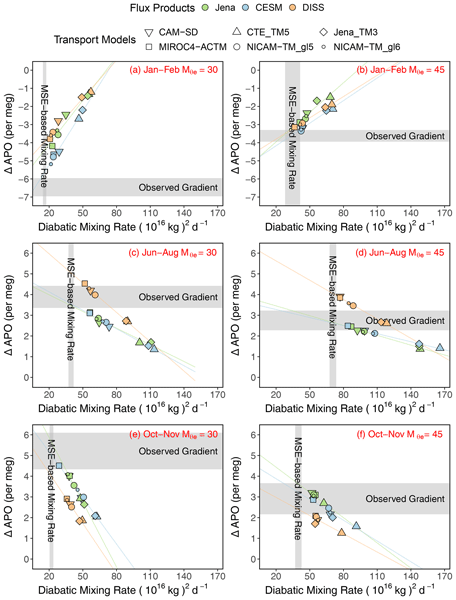
Yuming Jin, Britton B. Stephens, Matthew C. Long, Naveen Chandra, Frédéric Chevallier, Joram J. D. Hooghiem, Ingrid T. Luijkx, Shamil Maksyutov, Eric J. Morgan, Yosuke Niwa, Prabir K. Patra, Christian Rödenbeck, and Jesse Vance
Geosci. Model Dev., 18, 5937–5969, https://doi.org/10.5194/gmd-18-5937-2025, https://doi.org/10.5194/gmd-18-5937-2025, 2025
Short summary
Short summary
We carry out a comprehensive atmospheric transport model (ATM) intercomparison project. This project aims to evaluate errors in ATMs and three air-sea O2 flux products by comparing model simulations with observations collected from surface stations, ships, and aircraft. We also present a model evaluation framework to independently quantify transport-related and flux-related biases that contribute to model-observation discrepancies in atmospheric tracer distributions.
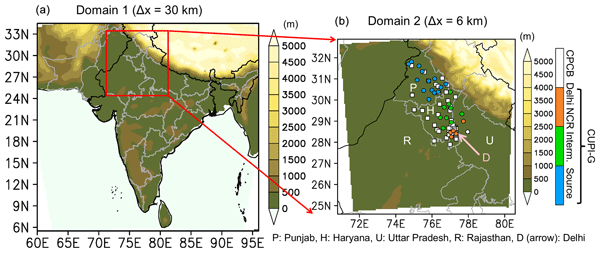
Mizuo Kajino, Kentaro Ishijima, Joseph Ching, Kazuyo Yamaji, Rio Ishikawa, Tomoki Kajikawa, Tanbir Singh, Tomoki Nakayama, Yutaka Matsumi, Koyo Kojima, Taisei Machida, Takashi Maki, Prabir K. Patra, and Sachiko Hayashida
Atmos. Chem. Phys., 25, 7137–7160, https://doi.org/10.5194/acp-25-7137-2025, https://doi.org/10.5194/acp-25-7137-2025, 2025
Short summary
Short summary
Air pollution in Delhi during the post-monsoon period is severe, and association with intensive crop residue burning (CRB) over Punjab state has attracted attention. However, the relationship has been unclear as the CRB emissions conventionally derived from satellites were underestimated due to clouds or thick smoke/haze over the region. We evaluated the impact of CRB on PM2.5 to be about 50 %, based on a combination of numerical modeling and an observation network using low-cost sensors we installed.
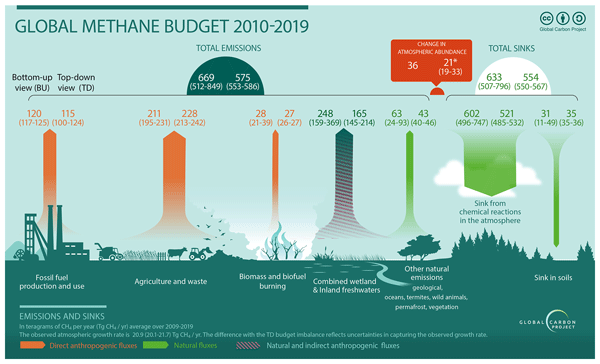
Marielle Saunois, Adrien Martinez, Benjamin Poulter, Zhen Zhang, Peter A. Raymond, Pierre Regnier, Josep G. Canadell, Robert B. Jackson, Prabir K. Patra, Philippe Bousquet, Philippe Ciais, Edward J. Dlugokencky, Xin Lan, George H. Allen, David Bastviken, David J. Beerling, Dmitry A. Belikov, Donald R. Blake, Simona Castaldi, Monica Crippa, Bridget R. Deemer, Fraser Dennison, Giuseppe Etiope, Nicola Gedney, Lena Höglund-Isaksson, Meredith A. Holgerson, Peter O. Hopcroft, Gustaf Hugelius, Akihiko Ito, Atul K. Jain, Rajesh Janardanan, Matthew S. Johnson, Thomas Kleinen, Paul B. Krummel, Ronny Lauerwald, Tingting Li, Xiangyu Liu, Kyle C. McDonald, Joe R. Melton, Jens Mühle, Jurek Müller, Fabiola Murguia-Flores, Yosuke Niwa, Sergio Noce, Shufen Pan, Robert J. Parker, Changhui Peng, Michel Ramonet, William J. Riley, Gerard Rocher-Ros, Judith A. Rosentreter, Motoki Sasakawa, Arjo Segers, Steven J. Smith, Emily H. Stanley, Joël Thanwerdas, Hanqin Tian, Aki Tsuruta, Francesco N. Tubiello, Thomas S. Weber, Guido R. van der Werf, Douglas E. J. Worthy, Yi Xi, Yukio Yoshida, Wenxin Zhang, Bo Zheng, Qing Zhu, Qiuan Zhu, and Qianlai Zhuang
Earth Syst. Sci. Data, 17, 1873–1958, https://doi.org/10.5194/essd-17-1873-2025, https://doi.org/10.5194/essd-17-1873-2025, 2025
Short summary
Short summary
Methane (CH4) is the second most important human-influenced greenhouse gas in terms of climate forcing after carbon dioxide (CO2). A consortium of multi-disciplinary scientists synthesise and update the budget of the sources and sinks of CH4. This edition benefits from important progress in estimating emissions from lakes and ponds, reservoirs, and streams and rivers. For the 2010s decade, global CH4 emissions are estimated at 575 Tg CH4 yr-1, including ~65 % from anthropogenic sources.
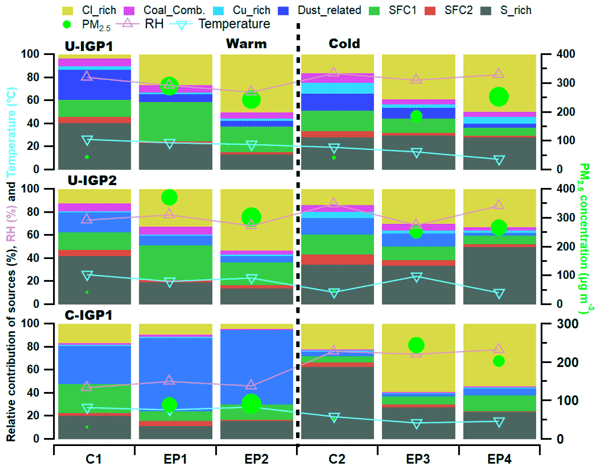
Ashutosh K. Shukla, Sachchida N. Tripathi, Shamitaksha Talukdar, Vishnu Murari, Sreenivas Gaddamidi, Manousos-Ioannis Manousakas, Vipul Lalchandani, Kuldeep Dixit, Vinayak M. Ruge, Peeyush Khare, Mayank Kumar, Vikram Singh, Neeraj Rastogi, Suresh Tiwari, Atul K. Srivastava, Dilip Ganguly, Kaspar Rudolf Daellenbach, and André S. H. Prévôt
Atmos. Chem. Phys., 25, 3765–3784, https://doi.org/10.5194/acp-25-3765-2025, https://doi.org/10.5194/acp-25-3765-2025, 2025
Short summary
Short summary
Our study delves into the elemental composition of aerosols at three sites across the Indo-Gangetic Plain (IGP), revealing distinct patterns during pollution episodes. We found significant increases in chlorine (Cl)-rich and solid fuel combustion (SFC) sources, indicating dynamic emission sources, agricultural burning impacts, and meteorological influences. Surges in Cl-rich particles during cold periods highlight their role in particle growth under high-relative-humidity conditions.
Chiranjit Das, Ravi Kumar Kunchala, Prabir K. Patra, Naveen Chandra, Kentaro Ishijima, and Toshinobu Machida
EGUsphere, https://doi.org/10.5194/egusphere-2024-3976, https://doi.org/10.5194/egusphere-2024-3976, 2025
Preprint archived
Short summary
Short summary
Our study compares model CO2 with aircraft and OCO-2 data to identify transport model errors to better policy-related flux estimation. The model align better with aircraft data than satellite data, especially over oceans, but struggles near the surface due to inaccurate CO2 estimates. Over the Amazon and Asian megacities, differences arise from limited measurements and coarse model resolution, highlighting the need for improved monitoring and higher-resolution data to capture emissions better.
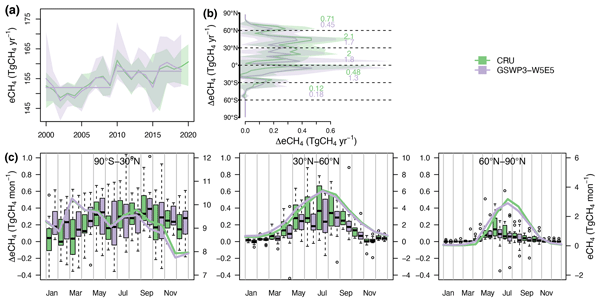
Zhen Zhang, Benjamin Poulter, Joe R. Melton, William J. Riley, George H. Allen, David J. Beerling, Philippe Bousquet, Josep G. Canadell, Etienne Fluet-Chouinard, Philippe Ciais, Nicola Gedney, Peter O. Hopcroft, Akihiko Ito, Robert B. Jackson, Atul K. Jain, Katherine Jensen, Fortunat Joos, Thomas Kleinen, Sara H. Knox, Tingting Li, Xin Li, Xiangyu Liu, Kyle McDonald, Gavin McNicol, Paul A. Miller, Jurek Müller, Prabir K. Patra, Changhui Peng, Shushi Peng, Zhangcai Qin, Ryan M. Riggs, Marielle Saunois, Qing Sun, Hanqin Tian, Xiaoming Xu, Yuanzhi Yao, Yi Xi, Wenxin Zhang, Qing Zhu, Qiuan Zhu, and Qianlai Zhuang
Biogeosciences, 22, 305–321, https://doi.org/10.5194/bg-22-305-2025, https://doi.org/10.5194/bg-22-305-2025, 2025
Short summary
Short summary
This study assesses global methane emissions from wetlands between 2000 and 2020 using multiple models. We found that wetland emissions increased by 6–7 Tg CH4 yr-1 in the 2010s compared to the 2000s. Rising temperatures primarily drove this increase, while changes in precipitation and CO2 levels also played roles. Our findings highlight the importance of wetlands in the global methane budget and the need for continuous monitoring to understand their impact on climate change.
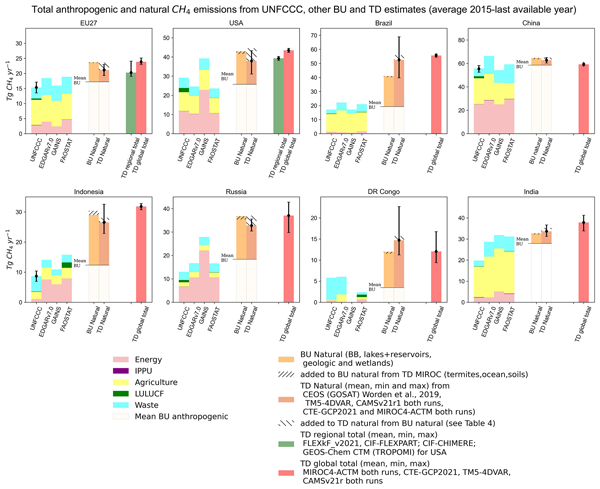
Ana Maria Roxana Petrescu, Glen P. Peters, Richard Engelen, Sander Houweling, Dominik Brunner, Aki Tsuruta, Bradley Matthews, Prabir K. Patra, Dmitry Belikov, Rona L. Thompson, Lena Höglund-Isaksson, Wenxin Zhang, Arjo J. Segers, Giuseppe Etiope, Giancarlo Ciotoli, Philippe Peylin, Frédéric Chevallier, Tuula Aalto, Robbie M. Andrew, David Bastviken, Antoine Berchet, Grégoire Broquet, Giulia Conchedda, Stijn N. C. Dellaert, Hugo Denier van der Gon, Johannes Gütschow, Jean-Matthieu Haussaire, Ronny Lauerwald, Tiina Markkanen, Jacob C. A. van Peet, Isabelle Pison, Pierre Regnier, Espen Solum, Marko Scholze, Maria Tenkanen, Francesco N. Tubiello, Guido R. van der Werf, and John R. Worden
Earth Syst. Sci. Data, 16, 4325–4350, https://doi.org/10.5194/essd-16-4325-2024, https://doi.org/10.5194/essd-16-4325-2024, 2024
Short summary
Short summary
This study provides an overview of data availability from observation- and inventory-based CH4 emission estimates. It systematically compares them and provides recommendations for robust comparisons, aiming to steadily engage more parties in using observational methods to complement their UNFCCC submissions. Anticipating improvements in atmospheric modelling and observations, future developments need to resolve knowledge gaps in both approaches and to better quantify remaining uncertainty.
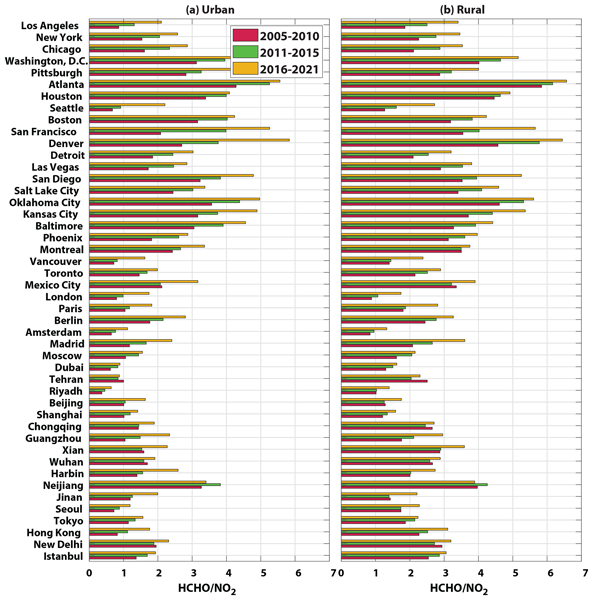
Matthew S. Johnson, Sajeev Philip, Scott Meech, Rajesh Kumar, Meytar Sorek-Hamer, Yoichi P. Shiga, and Jia Jung
Atmos. Chem. Phys., 24, 10363–10384, https://doi.org/10.5194/acp-24-10363-2024, https://doi.org/10.5194/acp-24-10363-2024, 2024
Short summary
Short summary
Satellites, like the Ozone Monitoring Instrument (OMI), retrieve proxy species of ozone (O3) formation (formaldehyde and nitrogen dioxide) and the ratios (FNRs) which can define O3 production sensitivity regimes. Here we investigate trends of OMI FNRs from 2005 to 2021, and they have increased in major cities, suggesting a transition from radical- to NOx-limited regimes. OMI also observed the impact of reduced emissions during the 2020 COVID-19 lockdown that resulted in increased FNRs.

Hanqin Tian, Naiqing Pan, Rona L. Thompson, Josep G. Canadell, Parvadha Suntharalingam, Pierre Regnier, Eric A. Davidson, Michael Prather, Philippe Ciais, Marilena Muntean, Shufen Pan, Wilfried Winiwarter, Sönke Zaehle, Feng Zhou, Robert B. Jackson, Hermann W. Bange, Sarah Berthet, Zihao Bian, Daniele Bianchi, Alexander F. Bouwman, Erik T. Buitenhuis, Geoffrey Dutton, Minpeng Hu, Akihiko Ito, Atul K. Jain, Aurich Jeltsch-Thömmes, Fortunat Joos, Sian Kou-Giesbrecht, Paul B. Krummel, Xin Lan, Angela Landolfi, Ronny Lauerwald, Ya Li, Chaoqun Lu, Taylor Maavara, Manfredi Manizza, Dylan B. Millet, Jens Mühle, Prabir K. Patra, Glen P. Peters, Xiaoyu Qin, Peter Raymond, Laure Resplandy, Judith A. Rosentreter, Hao Shi, Qing Sun, Daniele Tonina, Francesco N. Tubiello, Guido R. van der Werf, Nicolas Vuichard, Junjie Wang, Kelley C. Wells, Luke M. Western, Chris Wilson, Jia Yang, Yuanzhi Yao, Yongfa You, and Qing Zhu
Earth Syst. Sci. Data, 16, 2543–2604, https://doi.org/10.5194/essd-16-2543-2024, https://doi.org/10.5194/essd-16-2543-2024, 2024
Short summary
Short summary
Atmospheric concentrations of nitrous oxide (N2O), a greenhouse gas 273 times more potent than carbon dioxide, have increased by 25 % since the preindustrial period, with the highest observed growth rate in 2020 and 2021. This rapid growth rate has primarily been due to a 40 % increase in anthropogenic emissions since 1980. Observed atmospheric N2O concentrations in recent years have exceeded the worst-case climate scenario, underscoring the importance of reducing anthropogenic N2O emissions.
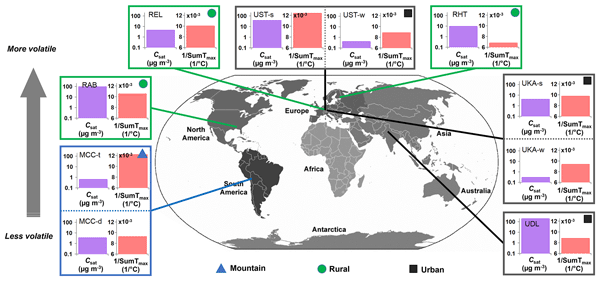
Wei Huang, Cheng Wu, Linyu Gao, Yvette Gramlich, Sophie L. Haslett, Joel Thornton, Felipe D. Lopez-Hilfiker, Ben H. Lee, Junwei Song, Harald Saathoff, Xiaoli Shen, Ramakrishna Ramisetty, Sachchida N. Tripathi, Dilip Ganguly, Feng Jiang, Magdalena Vallon, Siegfried Schobesberger, Taina Yli-Juuti, and Claudia Mohr
Atmos. Chem. Phys., 24, 2607–2624, https://doi.org/10.5194/acp-24-2607-2024, https://doi.org/10.5194/acp-24-2607-2024, 2024
Short summary
Short summary
We present distinct molecular composition and volatility of oxygenated organic aerosol particles in different rural, urban, and mountain environments. We do a comprehensive investigation of the relationship between the chemical composition and volatility of oxygenated organic aerosol particles across different systems and environments. This study provides implications for volatility descriptions of oxygenated organic aerosol particles in different model frameworks.
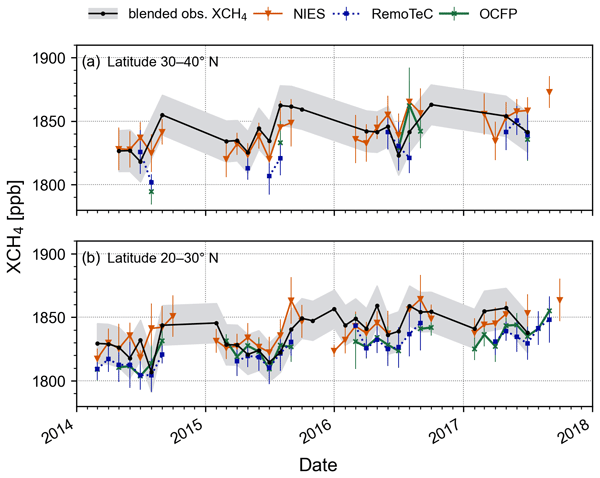
Astrid Müller, Hiroshi Tanimoto, Takafumi Sugita, Prabir K. Patra, Shin-ichiro Nakaoka, Toshinobu Machida, Isamu Morino, André Butz, and Kei Shiomi
Atmos. Meas. Tech., 17, 1297–1316, https://doi.org/10.5194/amt-17-1297-2024, https://doi.org/10.5194/amt-17-1297-2024, 2024
Short summary
Short summary
Satellite CH4 observations with high accuracy are needed to understand changes in atmospheric CH4 concentrations. But over oceans, reference data are limited. We combine various ship and aircraft observations with the help of atmospheric chemistry models to derive observation-based column-averaged mixing ratios of CH4 (obs. XCH4). We discuss three different approaches and demonstrate the applicability of the new reference dataset for carbon cycle studies and satellite evaluation.
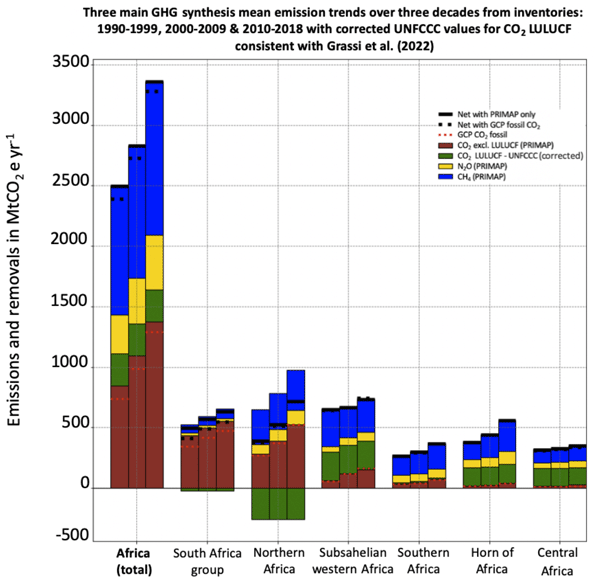
Mounia Mostefaoui, Philippe Ciais, Matthew J. McGrath, Philippe Peylin, Prabir K. Patra, and Yolandi Ernst
Earth Syst. Sci. Data, 16, 245–275, https://doi.org/10.5194/essd-16-245-2024, https://doi.org/10.5194/essd-16-245-2024, 2024
Short summary
Short summary
Our aim is to assess African anthropogenic greenhouse gas emissions and removals by using different data products, including inventories and process-based models, and to compare their relative merits with inversion data coming from satellites. We show a good match among the various estimates in terms of overall trends at a regional level and on a decadal basis, but large differences exist even among similar data types, which is a limit to the possibility of verification of country-reported data.
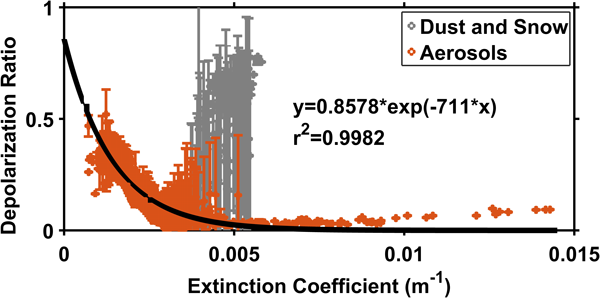
Nofel Lagrosas, Kosuke Okubo, Hitoshi Irie, Yutaka Matsumi, Tomoki Nakayama, Yutaka Sugita, Takashi Okada, and Tatsuo Shiina
Atmos. Meas. Tech., 16, 5937–5951, https://doi.org/10.5194/amt-16-5937-2023, https://doi.org/10.5194/amt-16-5937-2023, 2023
Short summary
Short summary
This work examines the near-ground aerosol–weather relationship from 7-month continuous lidar and weather observations in Chiba, Japan. Optical parameters from lidar data are compared with weather parameters to understand and quantify the aerosol–weather relationship and how these optical parameters are affected by the weather and season. The results provide insights into analyzing optical properties of radioactive aerosols when the lidar system is continuously operated in a radioactive area.
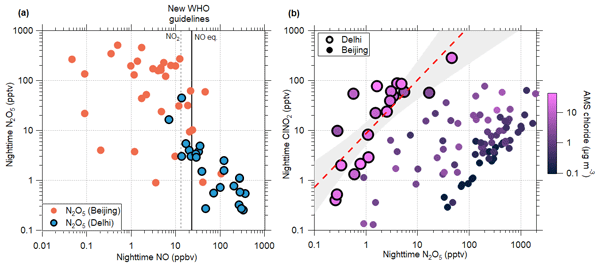
Sophie L. Haslett, David M. Bell, Varun Kumar, Jay G. Slowik, Dongyu S. Wang, Suneeti Mishra, Neeraj Rastogi, Atinderpal Singh, Dilip Ganguly, Joel Thornton, Feixue Zheng, Yuanyuan Li, Wei Nie, Yongchun Liu, Wei Ma, Chao Yan, Markku Kulmala, Kaspar R. Daellenbach, David Hadden, Urs Baltensperger, Andre S. H. Prevot, Sachchida N. Tripathi, and Claudia Mohr
Atmos. Chem. Phys., 23, 9023–9036, https://doi.org/10.5194/acp-23-9023-2023, https://doi.org/10.5194/acp-23-9023-2023, 2023
Short summary
Short summary
In Delhi, some aspects of daytime and nighttime atmospheric chemistry are inverted, and parodoxically, vehicle emissions may be limiting other forms of particle production. This is because the nighttime emissions of nitrogen oxide (NO) by traffic and biomass burning prevent some chemical processes that would otherwise create even more particles and worsen the urban haze.
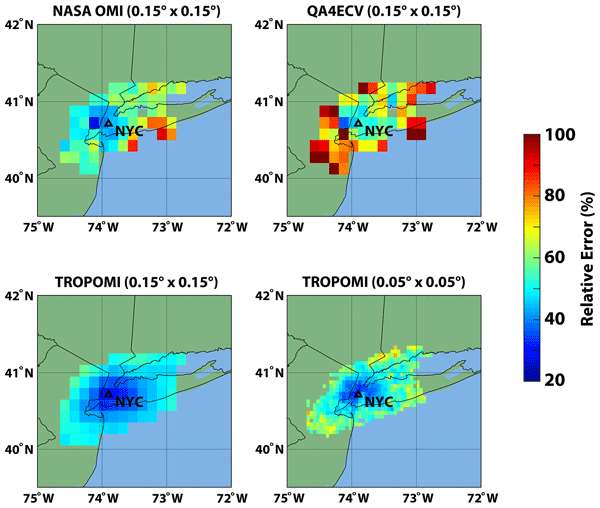
Matthew S. Johnson, Amir H. Souri, Sajeev Philip, Rajesh Kumar, Aaron Naeger, Jeffrey Geddes, Laura Judd, Scott Janz, Heesung Chong, and John Sullivan
Atmos. Meas. Tech., 16, 2431–2454, https://doi.org/10.5194/amt-16-2431-2023, https://doi.org/10.5194/amt-16-2431-2023, 2023
Short summary
Short summary
Satellites provide vital information for studying the processes controlling ozone formation. Based on the abundance of particular gases in the atmosphere, ozone formation is sensitive to specific human-induced and natural emission sources. However, errors and biases in satellite retrievals hinder this data source’s application for studying ozone formation sensitivity. We conducted a thorough statistical evaluation of two commonly applied satellites for investigating ozone formation sensitivity.

Jagat S. H. Bisht, Prabir K. Patra, Masayuki Takigawa, Takashi Sekiya, Yugo Kanaya, Naoko Saitoh, and Kazuyuki Miyazaki
Geosci. Model Dev., 16, 1823–1838, https://doi.org/10.5194/gmd-16-1823-2023, https://doi.org/10.5194/gmd-16-1823-2023, 2023
Short summary
Short summary
In this study, we estimated CH4 fluxes using an advanced 4D-LETKF method. The system was tested and optimized using observation system simulation experiments (OSSEs), where a known surface emission distribution is retrieved from synthetic observations. The availability of satellite measurements has increased, and there are still many missions focused on greenhouse gas observations that have not yet launched. The technique being referred to has the potential to improve estimates of CH4 fluxes.
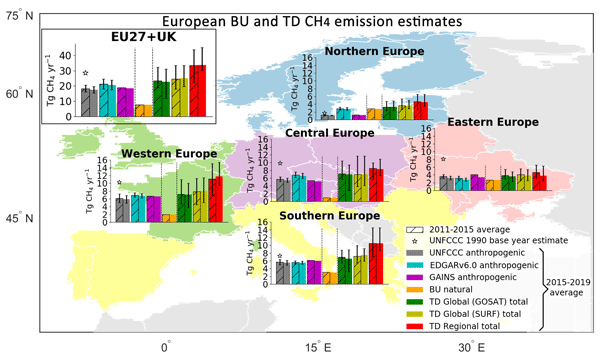
Ana Maria Roxana Petrescu, Chunjing Qiu, Matthew J. McGrath, Philippe Peylin, Glen P. Peters, Philippe Ciais, Rona L. Thompson, Aki Tsuruta, Dominik Brunner, Matthias Kuhnert, Bradley Matthews, Paul I. Palmer, Oksana Tarasova, Pierre Regnier, Ronny Lauerwald, David Bastviken, Lena Höglund-Isaksson, Wilfried Winiwarter, Giuseppe Etiope, Tuula Aalto, Gianpaolo Balsamo, Vladislav Bastrikov, Antoine Berchet, Patrick Brockmann, Giancarlo Ciotoli, Giulia Conchedda, Monica Crippa, Frank Dentener, Christine D. Groot Zwaaftink, Diego Guizzardi, Dirk Günther, Jean-Matthieu Haussaire, Sander Houweling, Greet Janssens-Maenhout, Massaer Kouyate, Adrian Leip, Antti Leppänen, Emanuele Lugato, Manon Maisonnier, Alistair J. Manning, Tiina Markkanen, Joe McNorton, Marilena Muntean, Gabriel D. Oreggioni, Prabir K. Patra, Lucia Perugini, Isabelle Pison, Maarit T. Raivonen, Marielle Saunois, Arjo J. Segers, Pete Smith, Efisio Solazzo, Hanqin Tian, Francesco N. Tubiello, Timo Vesala, Guido R. van der Werf, Chris Wilson, and Sönke Zaehle
Earth Syst. Sci. Data, 15, 1197–1268, https://doi.org/10.5194/essd-15-1197-2023, https://doi.org/10.5194/essd-15-1197-2023, 2023
Short summary
Short summary
This study updates the state-of-the-art scientific overview of CH4 and N2O emissions in the EU27 and UK in Petrescu et al. (2021a). Yearly updates are needed to improve the different respective approaches and to inform on the development of formal verification systems. It integrates the most recent emission inventories, process-based model and regional/global inversions, comparing them with UNFCCC national GHG inventories, in support to policy to facilitate real-time verification procedures.
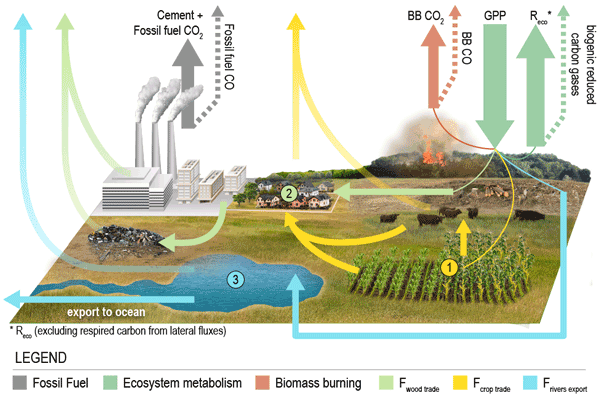
Brendan Byrne, David F. Baker, Sourish Basu, Michael Bertolacci, Kevin W. Bowman, Dustin Carroll, Abhishek Chatterjee, Frédéric Chevallier, Philippe Ciais, Noel Cressie, David Crisp, Sean Crowell, Feng Deng, Zhu Deng, Nicholas M. Deutscher, Manvendra K. Dubey, Sha Feng, Omaira E. García, David W. T. Griffith, Benedikt Herkommer, Lei Hu, Andrew R. Jacobson, Rajesh Janardanan, Sujong Jeong, Matthew S. Johnson, Dylan B. A. Jones, Rigel Kivi, Junjie Liu, Zhiqiang Liu, Shamil Maksyutov, John B. Miller, Scot M. Miller, Isamu Morino, Justus Notholt, Tomohiro Oda, Christopher W. O'Dell, Young-Suk Oh, Hirofumi Ohyama, Prabir K. Patra, Hélène Peiro, Christof Petri, Sajeev Philip, David F. Pollard, Benjamin Poulter, Marine Remaud, Andrew Schuh, Mahesh K. Sha, Kei Shiomi, Kimberly Strong, Colm Sweeney, Yao Té, Hanqin Tian, Voltaire A. Velazco, Mihalis Vrekoussis, Thorsten Warneke, John R. Worden, Debra Wunch, Yuanzhi Yao, Jeongmin Yun, Andrew Zammit-Mangion, and Ning Zeng
Earth Syst. Sci. Data, 15, 963–1004, https://doi.org/10.5194/essd-15-963-2023, https://doi.org/10.5194/essd-15-963-2023, 2023
Short summary
Short summary
Changes in the carbon stocks of terrestrial ecosystems result in emissions and removals of CO2. These can be driven by anthropogenic activities (e.g., deforestation), natural processes (e.g., fires) or in response to rising CO2 (e.g., CO2 fertilization). This paper describes a dataset of CO2 emissions and removals derived from atmospheric CO2 observations. This pilot dataset informs current capabilities and future developments towards top-down monitoring and verification systems.
Amir H. Souri, Matthew S. Johnson, Glenn M. Wolfe, James H. Crawford, Alan Fried, Armin Wisthaler, William H. Brune, Donald R. Blake, Andrew J. Weinheimer, Tijl Verhoelst, Steven Compernolle, Gaia Pinardi, Corinne Vigouroux, Bavo Langerock, Sungyeon Choi, Lok Lamsal, Lei Zhu, Shuai Sun, Ronald C. Cohen, Kyung-Eun Min, Changmin Cho, Sajeev Philip, Xiong Liu, and Kelly Chance
Atmos. Chem. Phys., 23, 1963–1986, https://doi.org/10.5194/acp-23-1963-2023, https://doi.org/10.5194/acp-23-1963-2023, 2023
Short summary
Short summary
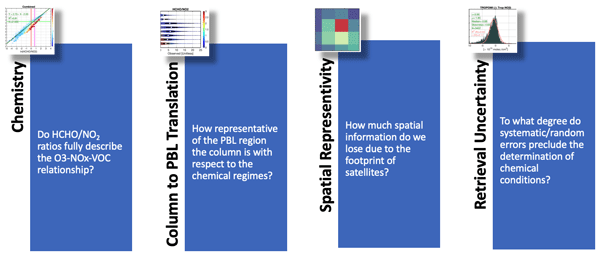
We have rigorously characterized different sources of error in satellite-based HCHO / NO2 tropospheric columns, a widely used metric for diagnosing near-surface ozone sensitivity. Specifically, the errors were categorized/quantified into (i) an inherent chemistry error, (ii) the decoupled relationship between columns and the near-surface concentration, (iii) the spatial representativeness error of ground satellite pixels, and (iv) the satellite retrieval errors.
Sudipta Ghosh, Sagnik Dey, Sushant Das, Nicole Riemer, Graziano Giuliani, Dilip Ganguly, Chandra Venkataraman, Filippo Giorgi, Sachchida Nand Tripathi, Srikanthan Ramachandran, Thazhathakal Ayyappen Rajesh, Harish Gadhavi, and Atul Kumar Srivastava
Geosci. Model Dev., 16, 1–15, https://doi.org/10.5194/gmd-16-1-2023, https://doi.org/10.5194/gmd-16-1-2023, 2023
Short summary
Short summary
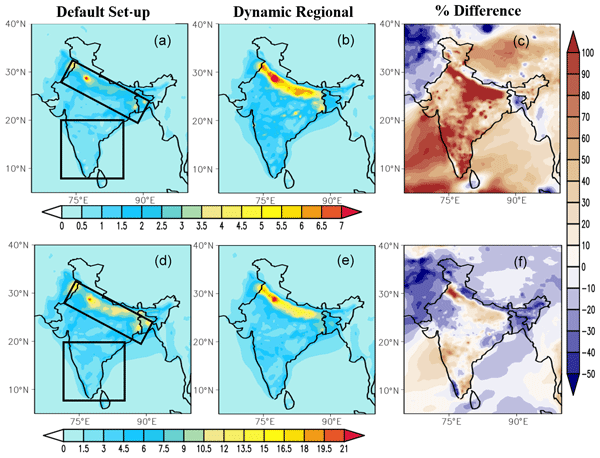
Accurate representation of aerosols in climate models is critical for minimizing the uncertainty in climate projections. Here, we implement region-specific emission fluxes and a more accurate scheme for carbonaceous aerosol ageing processes in a regional climate model (RegCM4) and show that it improves model performance significantly against in situ, reanalysis, and satellite data over the Indian subcontinent. We recommend improving the model performance before using them for climate studies.
Brendan Byrne, Junjie Liu, Yonghong Yi, Abhishek Chatterjee, Sourish Basu, Rui Cheng, Russell Doughty, Frédéric Chevallier, Kevin W. Bowman, Nicholas C. Parazoo, David Crisp, Xing Li, Jingfeng Xiao, Stephen Sitch, Bertrand Guenet, Feng Deng, Matthew S. Johnson, Sajeev Philip, Patrick C. McGuire, and Charles E. Miller
Biogeosciences, 19, 4779–4799, https://doi.org/10.5194/bg-19-4779-2022, https://doi.org/10.5194/bg-19-4779-2022, 2022
Short summary
Short summary
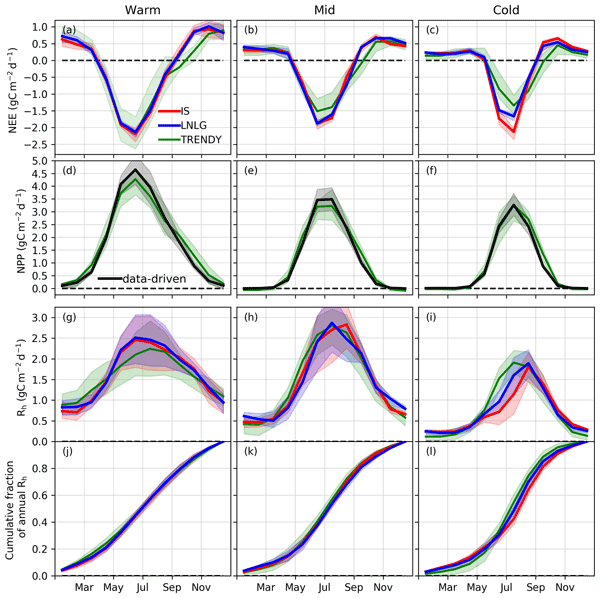
Plants draw CO2 from the atmosphere during the growing season, while respiration releases CO2 to the atmosphere throughout the year, driving seasonal variations in atmospheric CO2 that can be observed by satellites, such as the Orbiting Carbon Observatory 2 (OCO-2). Using OCO-2 XCO2 data and space-based constraints on plant growth, we show that permafrost-rich northeast Eurasia has a strong seasonal release of CO2 during the autumn, hinting at an unexpectedly large respiration signal from soils.
Naveen Chandra, Prabir K. Patra, Yousuke Niwa, Akihiko Ito, Yosuke Iida, Daisuke Goto, Shinji Morimoto, Masayuki Kondo, Masayuki Takigawa, Tomohiro Hajima, and Michio Watanabe
Atmos. Chem. Phys., 22, 9215–9243, https://doi.org/10.5194/acp-22-9215-2022, https://doi.org/10.5194/acp-22-9215-2022, 2022
Short summary
Short summary
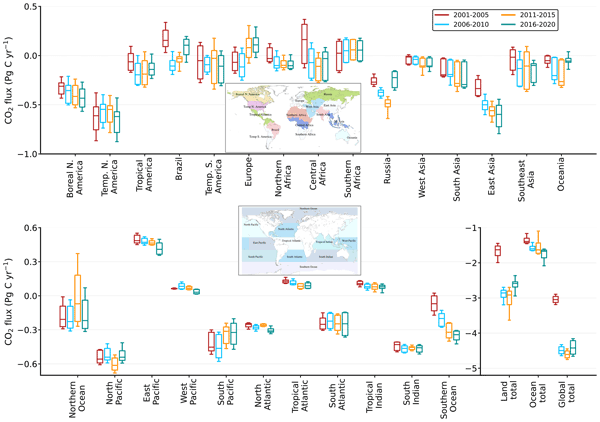
This paper is intended to accomplish two goals: (1) quantify mean and uncertainty in non-fossil-fuel CO2 fluxes estimated by inverse modeling and (2) provide in-depth analyses of regional CO2 fluxes in support of emission mitigation policymaking. CO2 flux variability and trends are discussed concerning natural climate variability and human disturbances using multiple lines of evidence.

Varun Kumar, Stamatios Giannoukos, Sophie L. Haslett, Yandong Tong, Atinderpal Singh, Amelie Bertrand, Chuan Ping Lee, Dongyu S. Wang, Deepika Bhattu, Giulia Stefenelli, Jay S. Dave, Joseph V. Puthussery, Lu Qi, Pawan Vats, Pragati Rai, Roberto Casotto, Rangu Satish, Suneeti Mishra, Veronika Pospisilova, Claudia Mohr, David M. Bell, Dilip Ganguly, Vishal Verma, Neeraj Rastogi, Urs Baltensperger, Sachchida N. Tripathi, André S. H. Prévôt, and Jay G. Slowik
Atmos. Chem. Phys., 22, 7739–7761, https://doi.org/10.5194/acp-22-7739-2022, https://doi.org/10.5194/acp-22-7739-2022, 2022
Short summary
Short summary
Here we present source apportionment results from the first field deployment in Delhi of an extractive electrospray ionization time-of-flight mass spectrometer (EESI-TOF). The EESI-TOF is a recently developed instrument capable of providing uniquely detailed online chemical characterization of organic aerosol (OA), in particular the secondary OA (SOA) fraction. Here, we are able to apportion not only primary OA but also SOA to specific sources, which is performed for the first time in Delhi.
Pawan Gupta, Prakash Doraiswamy, Jashwanth Reddy, Palak Balyan, Sagnik Dey, Ryan Chartier, Adeel Khan, Karmann Riter, Brandon Feenstra, Robert C. Levy, Nhu Nguyen Minh Tran, Olga Pikelnaya, Kurinji Selvaraj, Tanushree Ganguly, and Karthik Ganesan
Atmos. Meas. Tech. Discuss., https://doi.org/10.5194/amt-2022-140, https://doi.org/10.5194/amt-2022-140, 2022
Revised manuscript not accepted
Short summary
Short summary
The use of low-cost sensors in air quality monitoring has been gaining interest across all walks of society. We present the results of evaluations of the PurpleAir against regulatory-grade PM2.5. The results indicate that with proper calibration, we can achieve bias-corrected PM2.5 data using PA sensors. Our study also suggests that pre-deployment calibrations developed at local or regional scales are required for the PA sensors to correct data from the field for scientific data analysis.
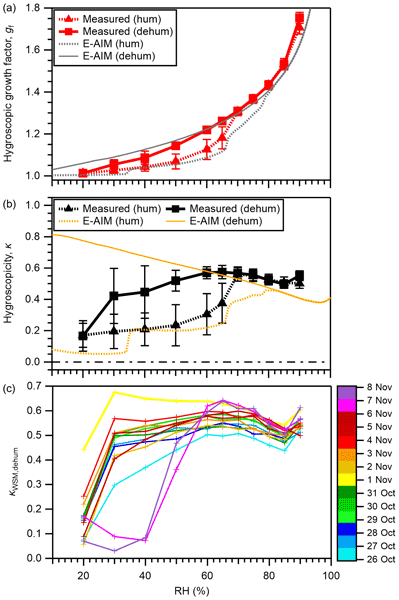
Yange Deng, Hiroaki Fujinari, Hikari Yai, Kojiro Shimada, Yuzo Miyazaki, Eri Tachibana, Dhananjay K. Deshmukh, Kimitaka Kawamura, Tomoki Nakayama, Shiori Tatsuta, Mingfu Cai, Hanbing Xu, Fei Li, Haobo Tan, Sho Ohata, Yutaka Kondo, Akinori Takami, Shiro Hatakeyama, and Michihiro Mochida
Atmos. Chem. Phys., 22, 5515–5533, https://doi.org/10.5194/acp-22-5515-2022, https://doi.org/10.5194/acp-22-5515-2022, 2022
Short summary
Short summary
Offline analyses of the hygroscopicity and composition of atmospheric aerosols are complementary to online analyses in view of the applicability to broader sizes, specific compound groups, and investigations at remote sites. This offline study characterized the composition of water-soluble matter in aerosols and their humidity-dependent hygroscopicity on Okinawa, a receptor site of East Asian outflow. Further, comparison with online analyses showed the appropriateness of the offline method.
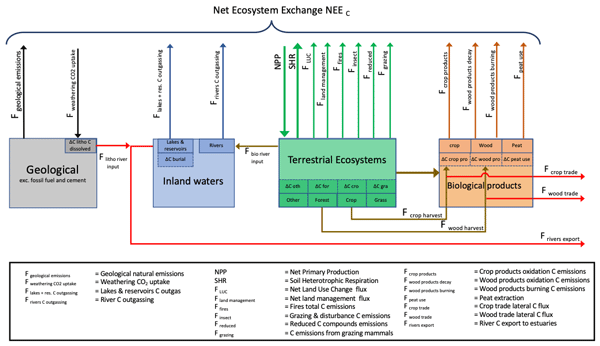
Philippe Ciais, Ana Bastos, Frédéric Chevallier, Ronny Lauerwald, Ben Poulter, Josep G. Canadell, Gustaf Hugelius, Robert B. Jackson, Atul Jain, Matthew Jones, Masayuki Kondo, Ingrid T. Luijkx, Prabir K. Patra, Wouter Peters, Julia Pongratz, Ana Maria Roxana Petrescu, Shilong Piao, Chunjing Qiu, Celso Von Randow, Pierre Regnier, Marielle Saunois, Robert Scholes, Anatoly Shvidenko, Hanqin Tian, Hui Yang, Xuhui Wang, and Bo Zheng
Geosci. Model Dev., 15, 1289–1316, https://doi.org/10.5194/gmd-15-1289-2022, https://doi.org/10.5194/gmd-15-1289-2022, 2022
Short summary
Short summary
The second phase of the Regional Carbon Cycle Assessment and Processes (RECCAP) will provide updated quantification and process understanding of CO2, CH4, and N2O emissions and sinks for ten regions of the globe. In this paper, we give definitions, review different methods, and make recommendations for estimating different components of the total land–atmosphere carbon exchange for each region in a consistent and complete approach.
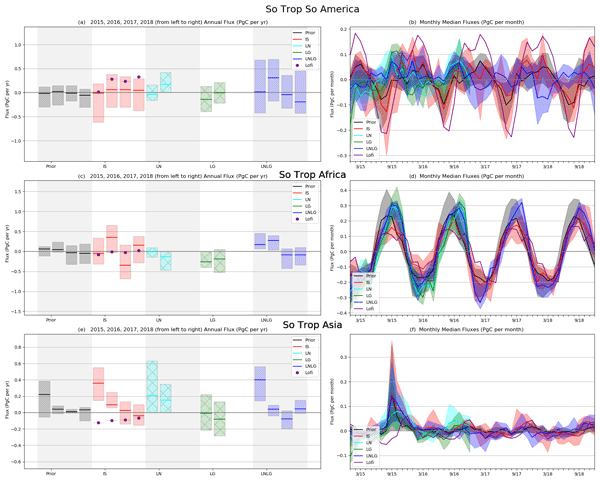
Hélène Peiro, Sean Crowell, Andrew Schuh, David F. Baker, Chris O'Dell, Andrew R. Jacobson, Frédéric Chevallier, Junjie Liu, Annmarie Eldering, David Crisp, Feng Deng, Brad Weir, Sourish Basu, Matthew S. Johnson, Sajeev Philip, and Ian Baker
Atmos. Chem. Phys., 22, 1097–1130, https://doi.org/10.5194/acp-22-1097-2022, https://doi.org/10.5194/acp-22-1097-2022, 2022
Short summary
Short summary
Satellite CO2 observations are constantly improved. We study an ensemble of different atmospheric models (inversions) from 2015 to 2018 using separate ground-based data or two versions of the OCO-2 satellite. Our study aims to determine if different satellite data corrections can yield different estimates of carbon cycle flux. A difference in the carbon budget between the two versions is found over tropical Africa, which seems to show the impact of corrections applied in satellite data.
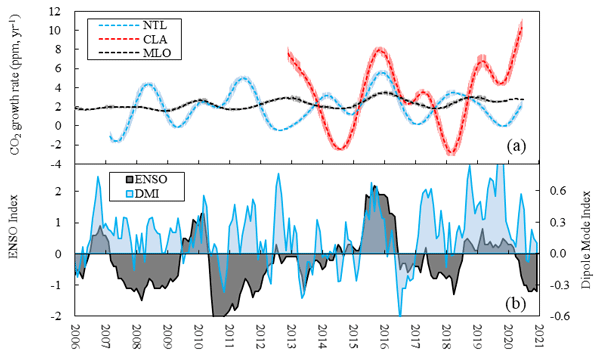
Shohei Nomura, Manish Naja, M. Kawser Ahmed, Hitoshi Mukai, Yukio Terao, Toshinobu Machida, Motoki Sasakawa, and Prabir K. Patra
Atmos. Chem. Phys., 21, 16427–16452, https://doi.org/10.5194/acp-21-16427-2021, https://doi.org/10.5194/acp-21-16427-2021, 2021
Short summary
Short summary
Long-term measurements of greenhouse gases (GHGs) in India and Bangladesh unveiled specific characteristics in their variations in these regions. Plants including rice cultivated in winter and summer strongly affected seasonal variations and levels in CO2 and CH4. Long-term variability of GHGs showed quite different features in their growth rates from those in Mauna Loa. GHG trends in this region seemed to be hardly affected by El Niño–Southern Oscillation (ENSO).
Cited articles
Aburas, M. M., Abdullah, S. H., Ramli, M. F., and Ash'aari, Z. H.: Measuring Land Cover Change in Seremban, Malaysia Using NDVI Index, Procedia Environ. Sci., 30, 238–243, https://doi.org/10.1016/j.proenv.2015.10.043, 2015.
Ammoura, L., Xueref-Remy, I., Gros, V., Baudic, A., Bonsang, B., Petit, J.-E., Perrussel, O., Bonnaire, N., Sciare, J., and Chevallier, F.: Atmospheric measurements of ratios between CO2 and co-emitted species from traffic: a tunnel study in the Paris megacity, Atmos. Chem. Phys., 14, 12871–12882, https://doi.org/10.5194/acp-14-12871-2014, 2014.
Andreae, M. O. and Merlet, P.: Emission of trace gases and aerosols from biomass burning, Global Biogeochem. Cy., 15, 955–966, https://doi.org/10.1029/2000GB001382, 2001.
Apadula, F., Cassardo, C., Ferrarese, S., Heltai, D., and Lanza, A.: Thirty Years of Atmospheric CO2 Observations at the Plateau Rosa Station, Italy, Atmosphere-Basel, 10, 418, https://doi.org/10.3390/atmos10070418, 2019.
Baars, H., Ansmann, A., Engelmann, R., and Althausen, D.: Continuous monitoring of the boundary-layer top with lidar, Atmos. Chem. Phys., 8, 7281–7296, https://doi.org/10.5194/acp-8-7281-2008, 2008.
Baker, A. K., Schuck, T. J., Brenninkmeijer, C. A. M., Rauthe-Schöch, A., Slemr, F., van Velthoven, P. F. J., and Lelieveld, J.: Estimating the contribution of monsoon-related biogenic production to methane emissions from South Asia using CARIBIC observations, Geophys. Res. Lett., 39, https://doi.org/10.1029/2012GL051756, 2012.
Bakwin, P. S., Tans, P. S., Zhao, C., Ussler III, W., and Quesnell, E.: Measurements of carbon dioxide on a very tall tower, Tellus B, 47, 535–549, https://doi.org/10.3402/tellusb.v47i5.16070, 1995.
Bhattacharya, S. K., Borole, D. V., Francy, R. J., Allison, C. E., Steele, L. P., Krummel, P., Langenfelds, R., Masarie, K. A., Tiwari, Y. K., and Patra, P. K.: Trace gases and CO2 isotope records from Cabo de Rama, India, Curr. Sci. India, 97, 1336–1344, 2009.
Byrne, B., Jones, D. B. A., Strong, K., Zeng, Z.-C., Deng, F., and Liu, J.: Sensitivity of CO2 surface flux constraints to observational coverage, J. Geophys. Res.-Atmos., 122, 6672–6694, https://doi.org/10.1002/2016JD026164, 2017.
Chakraborty, S., Tiwari, Y. K., Deb Burman, P. K., Baidya Roy, S., and Valsala, V.: Observations and Modeling of GHG Concentrations and Fluxes Over India, in: Assessment of Climate Change over the Indian Region: A Report of the Ministry of Earth Sciences (MoES), Government of India, edited by: Krishnan, R., Sanjay, J., Gnanaseelan, C., Mujumdar, M., Kulkarni, A., and Chakraborty, S., Springer, Singapore, 73–92, https://doi.org/10.1007/978-981-15-4327-2_4, 2020.
Chandra, N., Lal, S., Venkataramani, S., Patra, P. K., and Sheel, V.: Temporal variations of atmospheric CO2 and CO at Ahmedabad in western India, Atmos. Chem. Phys., 16, 6153–6173, https://doi.org/10.5194/acp-16-6153-2016, 2016.
Chandra, N., Venkataramani, S., Lal, S., Patra, P. K., Ramonet, M., Lin, X., and Sharma, S. K.: Observational evidence of high methane emissions over a city in western India, Atmos. Environ., 202, 41–52, https://doi.org/10.1016/j.atmosenv.2019.01.007, 2019.
Chandra, N., Patra, P. K., Niwa, Y., Ito, A., Iida, Y., Goto, D., Morimoto, S., Kondo, M., Takigawa, M., Hajima, T., and Watanabe, M.: Estimated regional CO2 flux and uncertainty based on an ensemble of atmospheric CO2 inversions, Atmos. Chem. Phys., 22, 9215–9243, https://doi.org/10.5194/acp-22-9215-2022, 2022.
Chen, H., Karion, A., Rella, C. W., Winderlich, J., Gerbig, C., Filges, A., Newberger, T., Sweeney, C., and Tans, P. P.: Accurate measurements of carbon monoxide in humid air using the cavity ring-down spectroscopy (CRDS) technique, Atmos. Meas. Tech., 6, 1031–1040, https://doi.org/10.5194/amt-6-1031-2013, 2013.
Chen, Y., Hall, J., van Wees, D., Andela, N., Hantson, S., Giglio, L., van der Werf, G. R., Morton, D. C., and Randerson, J. T.: Multi-decadal trends and variability in burned area from the fifth version of the Global Fire Emissions Database (GFED5), Earth Syst. Sci. Data, 15, 5227–5259, https://doi.org/10.5194/essd-15-5227-2023, 2023.
Crisp, D., Pollock, H. R., Rosenberg, R., Chapsky, L., Lee, R. A. M., Oyafuso, F. A., Frankenberg, C., O'Dell, C. W., Bruegge, C. J., Doran, G. B., Eldering, A., Fisher, B. M., Fu, D., Gunson, M. R., Mandrake, L., Osterman, G. B., Schwandner, F. M., Sun, K., Taylor, T. E., Wennberg, P. O., and Wunch, D.: The on-orbit performance of the Orbiting Carbon Observatory-2 (OCO-2) instrument and its radiometrically calibrated products, Atmos. Meas. Tech., 10, 59–81, https://doi.org/10.5194/amt-10-59-2017, 2017.
Das, C., Kunchala, R. K., Chandra, N., Chhabra, A., and Pandya, M. R.: Characterizing the regional XCO2 variability and its association with ENSO over India inferred from GOSAT and OCO-2 satellite observations, Sci. Total Environ., 902, 166176, https://doi.org/10.1016/j.scitotenv.2023.166176, 2023.
Eldering, A., O'Dell, C. W., Wennberg, P. O., Crisp, D., Gunson, M. R., Viatte, C., Avis, C., Braverman, A., Castano, R., Chang, A., Chapsky, L., Cheng, C., Connor, B., Dang, L., Doran, G., Fisher, B., Frankenberg, C., Fu, D., Granat, R., Hobbs, J., Lee, R. A. M., Mandrake, L., McDuffie, J., Miller, C. E., Myers, V., Natraj, V., O'Brien, D., Osterman, G. B., Oyafuso, F., Payne, V. H., Pollock, H. R., Polonsky, I., Roehl, C. M., Rosenberg, R., Schwandner, F., Smyth, M., Tang, V., Taylor, T. E., To, C., Wunch, D., and Yoshimizu, J.: The Orbiting Carbon Observatory-2: first 18 months of science data products, Atmos. Meas. Tech., 10, 549–563, https://doi.org/10.5194/amt-10-549-2017, 2017.
Eldering, A., Taylor, T. E., O'Dell, C. W., and Pavlick, R.: The OCO-3 mission: measurement objectives and expected performance based on 1 year of simulated data, Atmos. Meas. Tech., 12, 2341–2370, https://doi.org/10.5194/amt-12-2341-2019, 2019.
Fan, N. and Forkel, M.: Drivers of the enhanced amplitude of atmospheric CO2 in northern terrestrial ecosystems, EGU General Assembly 2025, Vienna, Austria, 27 Apr–2 May 2025, EGU25-7279, https://doi.org/10.5194/egusphere-egu25-7279, 2025.
Fang, S. X., Tans, P. P., Steinbacher, M., Zhou, L. X., and Luan, T.: Comparison of the regional CO2 mole fraction filtering approaches at a WMO/GAW regional station in China, Atmos. Meas. Tech., 8, 5301–5313, https://doi.org/10.5194/amt-8-5301-2015, 2015.
Fawzy, S., Osman, A. I., Doran, J., and Rooney, D. W.: Strategies for mitigation of climate change: a review, Environ. Chem. Lett., 18, 2069–2094, https://doi.org/10.1007/s10311-020-01059-w, 2020.
Frankenberg, C., O'Dell, C., Berry, J., Guanter, L., Joiner, J., Köhler, P., Pollock, R., and Taylor, T. E.: Prospects for chlorophyll fluorescence remote sensing from the Orbiting Carbon Observatory-2, Remote Sens. Environ., 147, 1–12, https://doi.org/10.1016/j.rse.2014.02.007, 2014.
Halder, S., Tiwari, Y. K., Valsala, V., Sreeush, M. G., Sijikumar, S., Janardanan, R., and Maksyutov, S.: Quantification of enhancement in atmospheric CO2 background due to Indian biospheric fluxes and fossil fuel emissions, J. Geophys. Res.-Atmos., 126, e2021JD034545, https://doi.org/10.1029/2021JD034545, 2021.
Harriss, R. C., Sachse, G. W., Collins Jr., J. E., Wade, L., Bartlett, K. B., Talbot, R. W., Browell, E. V., Barrie, L. A., Hill, G. F., and Burney, L. G.: Carbon monoxide and methane over Canada: July–August 1990, J. Geophys. Res.-Atmos., 99, 1659–1669, https://doi.org/10.1029/93JD01906, 1994.
Huang, J., Golombek, A., Prinn, R., Weiss, R., Fraser, P., Simmonds, P., Dlugokencky, E. J., Hall, B., Elkins, J., Steele, P., Langenfelds, R., Krummel, P., Dutton, G., and Porter, L.: Estimation of regional emissions of nitrous oxide from 1997 to 2005 using multinetwork measurements, a chemical transport model, and an inverse method, J. Geophys. Res.-Atmos., 113, https://doi.org/10.1029/2007JD009381, 2008.
Huang, J., Yu, H., Guan, X., Wang, G., and Guo, R.: Accelerated dryland expansion under climate change, Nat. Clim. Change, 6, 166–171, https://doi.org/10.1038/nclimate2837, 2016.
ICOS RI: ICOS Atmosphere Station Specifications V2.0, editeb by: Laurent, O., ICOS ERIC, https://doi.org/10.18160/GK28-2188, 2020.
Imasu, R. and Tanabe, Y.: Diurnal and Seasonal Variations of Carbon Dioxide (CO2) Concentration in Urban, Suburban, and Rural Areas around Tokyo, Atmosphere, 9, 367, https://doi.org/10.3390/atmos9100367, 2018.
IPCC: Climate Change 2021: The Physical Science Basis. Contribution of Working Group I to the Sixth Assessment Report of the Intergovernmental Panel on Climate Change, edited by: Masson-Delmotte, V., Zhai, P. Pirani, A., Connors, S. L., Péan, C., Berger, S., Caud, N., Chen, Y., Goldfarb, L., Gomis, M. I., Huang, M., Leitzell, K., Lonnoy, E., Matthews, J. B. R., Maycock, T. K., Waterfield, T., Yelekçi, O., Yu, R., and Zhou, B., Cambridge University Press, Cambridge, United Kingdom and New York, NY, USA, in press, https://doi.org/10.1017/9781009157896, 2021.
Ito, A.: Disequilibrium of terrestrial ecosystem CO2 budget caused by disturbance-induced emissions and non-CO2 carbon export flows: a global model assessment, Earth Syst. Dynam., 10, 685–709, https://doi.org/10.5194/esd-10-685-2019, 2019.
Jain, C. D., Singh, V., Akhil Raj, S. T., Madhavan, B. L., and Ratnam, M. V.: Local emission and long-range transport impacts on the CO, CO2, and CH4 concentrations at a tropical rural site, Atmos. Environ., 254, 118397, https://doi.org/10.1016/j.atmosenv.2021.118397, 2021.
Jing, X., Huang, J., Wang, G., Higuchi, K., Bi, J., Sun, Y., Yu, H., and Wang, T.: The effects of clouds and aerosols on net ecosystem CO2 exchange over semi-arid Loess Plateau of Northwest China, Atmos. Chem. Phys., 10, 8205–8218, https://doi.org/10.5194/acp-10-8205-2010, 2010.
Joiner, J. and Yoshida, Y.: Satellite-based reflectances capture large fraction of variability in global gross primary production (GPP) at weekly time scales, Agr. Forest Meteorol., 291, 108092, https://doi.org/10.1016/j.agrformet.2020.108092, 2020.
Joiner, J., Yoshida, Y., Zhang, Y., Duveiller, G., Jung, M., Lyapustin, A., Wang, Y., and Tucker, C. J.: Estimation of Terrestrial Global Gross Primary Production (GPP) with Satellite Data-Driven Models and Eddy Covariance Flux Data, Remote Sens.-Basel, 10, 1346, https://doi.org/10.3390/rs10091346, 2018.
Jones, M. W., Andrew, R. M., Peters, G. P., Janssens-Maenhout, G., De-Gol, A. J., Ciais, P., Patra, P. K., Chevallier, F., and Le Quéré, C.: Gridded fossil CO2 emissions and related O2 combustion consistent with national inventories 1959–2018, Sci. Data, 8, 2, https://doi.org/10.1038/s41597-020-00779-6, 2021.
Kar, J., Bremer, H., Drummond, J. R., Rochon, Y. J., Jones, D. B. A., Nichitiu, F., Zou, J., Liu, J., Gille, J. C., Edwards, D. P., Deeter, M. N., Francis, G., Ziskin, D., and Warner, J.: Evidence of vertical transport of carbon monoxide from Measurements of Pollution in the Troposphere (MOPITT), Geophys. Res. Lett., 31, https://doi.org/10.1029/2004GL021128, 2004.
Krishnapriya, M., Pattanaik, D. R., Kumar, A., Ramana, M. V., and Naidu, C. V.: Spatio-temporal dynamics of atmospheric CO2 over India and its inter-relationship with combustion emissions, ecosystem exchange, and meteorological factors, J. Earth Syst. Sci., 134, 193, https://doi.org/10.1007/s12040-025-02642-x, 2025.
Krol, M., Houweling, S., Bregman, B., van den Broek, M., Segers, A., van Velthoven, P., Peters, W., Dentener, F., and Bergamaschi, P.: The two-way nested global chemistry-transport zoom model TM5: algorithm and applications, Atmos. Chem. Phys., 5, 417–432, https://doi.org/10.5194/acp-5-417-2005, 2005.
Kumar, A., Yu, Z.-G., Klemeš, J. J., and Bokhari, A.: A state-of-the-art review of greenhouse gas emissions from Indian hydropower reservoirs, J. Clean. Prod., 320, 128806, https://doi.org/10.1016/j.jclepro.2021.128806, 2021.
Kunchala, R. K., Patra, P. K., Kumar, K. N., Chandra, N., Attada, R., and Karumuri, R. K.: Spatio-temporal variability of XCO2 over Indian region inferred from Orbiting Carbon Observatory (OCO-2) satellite and Chemistry Transport Model, Atmos. Res., 269, 106044, https://doi.org/10.1016/j.atmosres.2022.106044, 2022.
Kunchala, R. K., Girach, I., Das, C., Jain, C., Burman, P. K. D., Pathakoti, M., Patra, P. K., Tiwari, Y. K., Ratnam, M. V., Sinha, V., Valsala, V., Naja, M., Venkataramani, S., Chandra, N., Babu, S. S., Pandya, M. R., Hakkim, H., Datta, S., and Jain, V.: Carbon dioxide (CO2) variations across India: Synthesis of observations and model simulations, Atmos. Environ., 121746, https://doi.org/10.1016/j.atmosenv.2025.121746, 2025.
Kuttippurath, J., Peter, R., Singh, A., and Raj, S.: The increasing atmospheric CO2 over India: Comparison to global trends, iScience, 25, 104863, https://doi.org/10.1016/j.isci.2022.104863, 2022.
Lai, S. C., Baker, A. K., Schuck, T. J., van Velthoven, P., Oram, D. E., Zahn, A., Hermann, M., Weigelt, A., Slemr, F., Brenninkmeijer, C. A. M., and Ziereis, H.: Pollution events observed during CARIBIC flights in the upper troposphere between South China and the Philippines, Atmos. Chem. Phys., 10, 1649–1660, https://doi.org/10.5194/acp-10-1649-2010, 2010.
Lin, X., Indira, N. K., Ramonet, M., Delmotte, M., Ciais, P., Bhatt, B. C., Reddy, M. V., Angchuk, D., Balakrishnan, S., Jorphail, S., Dorjai, T., Mahey, T. T., Patnaik, S., Begum, M., Brenninkmeijer, C., Durairaj, S., Kirubagaran, R., Schmidt, M., Swathi, P. S., Vinithkumar, N. V., Yver Kwok, C., and Gaur, V. K.: Long-lived atmospheric trace gases measurements in flask samples from three stations in India, Atmos. Chem. Phys., 15, 9819–9849, https://doi.org/10.5194/acp-15-9819-2015, 2015.
Lin, X., Ciais, P., Bousquet, P., Ramonet, M., Yin, Y., Balkanski, Y., Cozic, A., Delmotte, M., Evangeliou, N., Indira, N. K., Locatelli, R., Peng, S., Piao, S., Saunois, M., Swathi, P. S., Wang, R., Yver-Kwok, C., Tiwari, Y. K., and Zhou, L.: Simulating CH4 and CO2 over South and East Asia using the zoomed chemistry transport model LMDz-INCA, Atmos. Chem. Phys., 18, 9475–9497, https://doi.org/10.5194/acp-18-9475-2018, 2018.
Liu, J., Bowman, K. W., Lee, M., Henze, D. K., Bousserez, N., Brix, H., Collatz, G. J., Menemenlis, D., Ott, L., Pawson, S., Jones, D., and Nassar, R.: Carbon monitoring system flux estimation and attribution: impact of ACOS-GOSAT XCO2 sampling on the inference of terrestrial biospheric sources and sinks, Tellus B, 66, 22486, https://doi.org/10.3402/tellusb.v66.22486, 2014.
Lopez, M.: Estimation des émissions de gaz à effet de serre à différentes échelles en France à l'aide d’observations de haute précision. Autre [cond-mat.other]. Université Paris Sud – Paris XI, 2012. Français, NNT: 2012PA112284, tel-00777476, 2012.
Mahesh, P., Sreenivas, G., Rao, P. V. N., Dadhwal, V. K., Sai Krishna, S. V. S., and Mallikarjun, K.: High-precision surface-level CO2 and CH4 using off-axis integrated cavity output spectroscopy (OA-ICOS) over Shadnagar, India, Int. J. Remote Sens., 36, 5754–5765, https://doi.org/10.1080/01431161.2015.1104744, 2015.
Mangaraj, P., Matsumi, Y., Nakayama, T., Biswal, A., Yamaji, K., Araki, H., Yasutomi, N., Takigawa, M., Patra, P. K., Hayashida, S., Sharma, A., Dimri, A. P., Dhaka, S. K., Bhatti, M. S., Kajino, M., Mor, S., Khaiwal, R., Bhardwaj, S., Vazhathara, V. J., Kunchala, R. K., Mandal, T. K., Misra, P., Singh, T., Vatta, K., and Mor, S.: Weak coupling of observed surface PM2.5 in Delhi-NCR with rice crop residue burning in Punjab and Haryana, npj Clim. Atmos. Sci., 8, 1–9, https://doi.org/10.1038/s41612-025-00901-8, 2025.
Masarie, K. A., Peters, W., Jacobson, A. R., and Tans, P. P.: ObsPack: a framework for the preparation, delivery, and attribution of atmospheric greenhouse gas measurements, Earth Syst. Sci. Data, 6, 375–384, https://doi.org/10.5194/essd-6-375-2014, 2014.
Matsueda, H., Inoue, H. Y., Ishii, M., and Tsutsumi, Y.: Large injection of carbon monoxide into the upper troposphere due to intense biomass burning in 1997, J. Geophys. Res., 104, 26867–26879, https://doi.org/10.1029/1999JD900193, 1999.
Mauzerall, D. L., Logan, J. A., Jacob, D. J., Anderson, B. E., Blake, D. R., Bradshaw, J. D., Heikes, B., Sachse, G. W., Singh, H., and Talbot, B.: Photochemistry in biomass burning plumes and implications for tropospheric ozone over the tropical South Atlantic, J. Geophys. Res., 103, 8401–8423, https://doi.org/10.1029/97JD02612, 1998.
Metya, A., Datye, A., Chakraborty, S., Tiwari, Y. K., Sarma, D., Bora, A., and Gogoi, N.: Diurnal and seasonal variability of CO2 and CH4 concentration in a semi-urban environment of western India, Sci. Rep.-UK, 11, 2931, https://doi.org/10.1038/s41598-021-82321-1, 2021.
Mühle, J., Brenninkmeijer, C. A. M., Rhee, T. S., Slemr, F., Oram, D. E., Penkett, S. A., and Zahn, A.: Biomass burning and fossil fuel signatures in the upper troposphere observed during a CARIBIC flight from Namibia to Germany, Geophys. Res. Lett., 29, 16-1–16-4, https://doi.org/10.1029/2002GL015764, 2002.
Munksgaard, N. C., Lee, I. L., Napier, T. P., Zwart, C., Cernusak, L. A., and Bird, M. I.: One year of spectroscopic high-frequency measurements of atmospheric CO2, CH4, H, Geosci. Data J., https://doi.org/10.1002/gdj3.180, 2022.
Nalini, K., Sijikumar, S., Valsala, V., Tiwari, Y. K., and Ramachandran, R.: Designing surface CO2 monitoring network to constrain the Indian land fluxes, Atmos. Environ., 218, 117003, https://doi.org/10.1016/j.atmosenv.2019.117003, 2019.
Nath, B.: Quantitative assessment of forest cover change of a part of Bandarban Hill tracts using NDVI techniques, J. Geosci. Geomatics, 2, 21–27, 2014.
Nishanth, T., Praseed, K. M., Kumar, M. K. S., and Valsaraj, K. T.: Observational Study of Surface O3, NOx, CH4 and Total NMHCs at Kannur, India, Aerosol Air Qual. Res., 14, 1074–1088, https://doi.org/10.4209/aaqr.2012.11.0323, 2014.
Niwa, Y., Machida, T., Sawa, Y., Matsueda, H., Schuck, T. J., Brenninkmeijer, C. A. M., Imasu, R., and Satoh, M.: Imposing strong constraints on tropical terrestrial CO2 fluxes using passenger aircraft based measurements, J. Geophys. Res.-Atmos., 117, https://doi.org/10.1029/2012JD017474, 2012.
Nomura, S., Naja, M., Ahmed, M. K., Mukai, H., Terao, Y., Machida, T., Sasakawa, M., and Patra, P. K.: Measurement report: Regional characteristics of seasonal and long-term variations in greenhouse gases at Nainital, India, and Comilla, Bangladesh, Atmos. Chem. Phys., 21, 16427–16452, https://doi.org/10.5194/acp-21-16427-2021, 2021.
Paris, J.-D., Ciais, P., Nédélec, P., Ramonet, M., Belan, B. D., Arshinov, M. Yu., Golitsyn, G. S., Granberg, I., Stohl, A., Cayez, G., Athier, G., Boumard, F., and Cousin, J.-M.: The YAK-AEROSIB transcontinental aircraft campaigns: new insights on the transport of CO2, CO and O3 across Siberia, Tellus B, 60, 551–568, https://doi.org/10.1111/j.1600-0889.2008.00369.x, 2008.
Park, M., Randel, W. J., Emmons, L. K., and Livesey, N. J.: Transport pathways of carbon monoxide in the Asian summer monsoon diagnosed from Model of Ozone and Related Tracers (MOZART), J. Geophys. Res., 114, 2008JD010621, https://doi.org/10.1029/2008JD010621, 2009.
Pathakoti, M., Mahalakshmi, D. V., Gaddamidi, S., Arun, S. S., Bothale, R. V., Chauhan, P., Raja, P., Rajan, K. S., and Chandra, N.: Three-dimensional view of CO2 variability in the atmosphere over the Indian region, Atmos. Res., 290, 106785, https://doi.org/10.1016/j.atmosres.2023.106785, 2023.
Patil, M. N., Dharmaraj, T., Waghmare, R. T., Prabha, T. V., and Kulkarni, J. R.: Measurements of carbon dioxide and heat fluxes during monsoon-2011 season over rural site of India by eddy covariance technique, J. Earth Syst. Sci., 123, 177–185, https://doi.org/10.1007/s12040-013-0374-z, 2014.
Patra, P. K., Niwa, Y., Schuck, T. J., Brenninkmeijer, C. A. M., Machida, T., Matsueda, H., and Sawa, Y.: Carbon balance of South Asia constrained by passenger aircraft CO2 measurements, Atmos. Chem. Phys., 11, 4163–4175, https://doi.org/10.5194/acp-11-4163-2011, 2011.
Patra, P. K., Canadell, J. G., Houghton, R. A., Piao, S. L., Oh, N.-H., Ciais, P., Manjunath, K. R., Chhabra, A., Wang, T., Bhattacharya, T., Bousquet, P., Hartman, J., Ito, A., Mayorga, E., Niwa, Y., Raymond, P. A., Sarma, V. V. S. S., and Lasco, R.: The carbon budget of South Asia, Biogeosciences, 10, 513–527, https://doi.org/10.5194/bg-10-513-2013, 2013.
Patra, P. K., Takigawa, M., Watanabe, S., Chandra, N., Ishijima, K., and Yamashita, Y.: Improved Chemical Tracer Simulation by MIROC4.0-based Atmospheric Chemistry-Transport Model (MIROC4-ACTM), Sola, 14, 91–96, https://doi.org/10.2151/sola.2018-016, 2018.
Peters, W., Miller, J. B., Whitaker, J., Denning, A. S., Hirsch, A., Krol, M. C., Zupanski, D., Bruhwiler, L., and Tans, P. P.: An ensemble data assimilation system to estimate CO2 surface fluxes from atmospheric trace gas observations, J. Geophys. Res.-Atmos., 110, https://doi.org/10.1029/2005JD006157, 2005.
Philip, S., Johnson, M. S., Potter, C., Genovesse, V., Baker, D. F., Haynes, K. D., Henze, D. K., Liu, J., and Poulter, B.: Prior biosphere model impact on global terrestrial CO2 fluxes estimated from OCO-2 retrievals, Atmos. Chem. Phys., 19, 13267–13287, https://doi.org/10.5194/acp-19-13267-2019, 2019.
Philip, S., Johnson, M. S., Baker, D. F., Basu, S., Tiwari, Y. K., Indira, N. K., Ramonet, M., and Poulter, B.: OCO-2 Satellite-Imposed Constraints on Terrestrial Biospheric CO2 Fluxes Over South Asia, J. Geophys. Res.-Atmos., 127, e2021JD035035, https://doi.org/10.1029/2021JD035035, 2022.
Potter, C. S., Randerson, J. T., Field, C. B., Matson, P. A., Vitousek, P. M., Mooney, H. A., and Klooster, S. A.: Terrestrial ecosystem production: A process model based on global satellite and surface data, Global Biogeochem. Cy., 7, 811–841, https://doi.org/10.1029/93GB02725, 1993.
Randel, W. J. and Park, M.: Deep convective influence on the Asian summer monsoon anticyclone and associated tracer variability observed with Atmospheric Infrared Sounder (AIRS), J. Geophys. Res.-Atmos., 111, https://doi.org/10.1029/2005JD006490, 2006.
Randerson, J. T., Thompson, M. V., Conway, T. J., Fung, I. Y., and Field, C. B.: The contribution of terrestrial sources and sinks to trends in the seasonal cycle of atmospheric carbon dioxide, Global Biogeochem. Cy., 11, 535–560, https://doi.org/10.1029/97GB02268, 1997.
Rathore, J., Ganguly, D., Singh, V., Gupta, M., Vazhathara, V. J., Biswal, A., Kunchala, R. K., Patra, P. K., Sahu, L. K., Gani, S., and Dey, S.: Characteristics of Haze Pollution Events During Biomass Burning Period at an Upwind Site of Delhi, J. Geophys. Res.-Atmos., 130, e2024JD042347, https://doi.org/10.1029/2024JD042347, 2025.
Rayner, P. J., Law, R. M., Allison, C. E., Francey, R. J., Trudinger, C. M., and Pickett-Heaps, C.: Interannual variability of the global carbon cycle (1992–2005) inferred by inversion of atmospheric CO2 and δ13CO2 measurements, Global Biogeochem. Cy., 22, https://doi.org/10.1029/2007GB003068, 2008.
Russo, R. S., Talbot, R. W., Dibb, J. E., Scheuer, E., Seid, G., Jordan, C. E., Fuelberg, H. E., Sachse, G. W., Avery, M. A., Vay, S. A., Blake, D. R., Blake, N. J., Atlas, E., Fried, A., Sandholm, S. T., Tan, D., Singh, H. B., Snow, J., and Heikes, B. G.: Chemical composition of Asian continental outflow over the western Pacific: Results from Transport and Chemical Evolution over the Pacific (TRACE-P), J. Geophys. Res.-Atmos., 108, https://doi.org/10.1029/2002JD003184, 2003.
Sawa, Y., Matsueda, H., Makino, Y., Inoue, H. Y., Murayama, S., Hirota, M., Tsutsumi, Y., Zaizen, Y., Ikegami, M., and Okada, K.: Aircraft Observation of CO2, CO2 O3 and H2 over the North Pacific during the PACE-7 Campaign, Tellus B, 56, 2, https://doi.org/10.3402/tellusb.v56i1.16402, 2004.
Schaaf, C. and Wang, Z.: MODIS/Terra+Aqua BRDF/Albedo Nadir BRDF-Adjusted Ref Band6 Daily L3 Global 30ArcSec CMG V061, https://doi.org/10.5067/MODIS/MCD43D67.061, 2021.
Schaaf, C. B., Gao, F., Strahler, A. H., Lucht, W., Li, X., Tsang, T., Strugnell, N. C., Zhang, X., Jin, Y., Muller, J.-P., Lewis, P., Barnsley, M., Hobson, P., Disney, M., Roberts, G., Dunderdale, M., Doll, C., d'Entremont, R. P., Hu, B., Liang, S., Privette, J. L., and Roy, D.: First operational BRDF, albedo nadir reflectance products from MODIS, Remote Sens. Environ., 83, 135–148, https://doi.org/10.1016/S0034-4257(02)00091-3, 2002.
Schuck, T. J., Ishijima, K., Patra, P. K., Baker, A. K., Machida, T., Matsueda, H., Sawa, Y., Umezawa, T., Brenninkmeijer, C. A. M., and Lelieveld, J.: Distribution of methane in the tropical upper troposphere measured by CARIBIC and CONTRAIL aircraft, J. Geophys. Res.-Atmos., 117, https://doi.org/10.1029/2012JD018199, 2012.
Sharma, N., Dadhwal, V. K., Kant, Y., Mahesh, P., Mallikarjun, K., Gadavi, H., Sharma, A., and Ali, M. M.: Atmospheric CO2 Variations in Two Contrasting Environmental Sites Over India, Air, Soil Water Res., 7, ASWR.S13987, https://doi.org/10.4137/ASWR.S13987, 2014.
Sreenivas, G., Mahesh, P., Subin, J., Kanchana, A. L., Rao, P. V. N., and Dadhwal, V. K.: Influence of Meteorology and interrelationship with greenhouse gases (CO2 and CH4) at a suburban site of India, Atmos. Chem. Phys., 16, 3953–3967, https://doi.org/10.5194/acp-16-3953-2016, 2016.
Sreenivas, G., Mahesh, P., Mahalakshmi, D. V., Kanchana, A. L., Chandra, N., Patra, P. K., Raja, P., Sesha Sai, M. V. R., Sripada, S., Rao, P. V. N., and Dadhwal, V. K.: Seasonal and annual variations of CO2 and CH4 at Shadnagar, a semi-urban site, Sci. Total Environ., 819, 153114, https://doi.org/10.1016/j.scitotenv.2022.153114, 2022.
Srivastava, P., Bennett, M. W., Bedrosian, G., Rosenberg, R., Solish, B., and Basilio, R. R.: Establishing Launch Readiness of NASA ISS Instrument OCO-3, in: IGARSS 2020 – 2020 IEEE International Geoscience and Remote Sensing Symposium, Waikoloa, HI, USA, 6101–6104, https://doi.org/10.1109/IGARSS39084.2020.9323631, 2020.
Stocker, T. F., Qin, D., Plattner, G.-K., Alexander, L. V., Allen, S. K., Bindoff, N. L., Bréon, F.-M., Church, J. A., Cubasch, U., Emori, S., Forster, P., Friedlingstein, P., Gillett, N., Gregory, J. M., Hartmann, D. L., Jansen, E., Kirtman, B., Knutti, R., Krishna Kumar, K., Lemke, P., Marotzke, J., Masson-Delmotte, V., Meehl, G. A., Mokhov, I. I., Piao, S., Ramaswamy, V., Randall, D., Rhein, M., Rojas, M., Sabine, C., Shindell, D., Talley, L. D., Vaughan, D. G., and Xie, S.-P.: Technical Summary, in: Climate Change 2013: The Physical Science Basis. Contribution of Working Group I to the Fifth Assessment Report of the Intergovernmental Panel on Climate Change, edited by: Stocker, T. F., Qin, D., Plattner, G.-K., Tignor, M., Allen, S. K., Boschung, J., Nauels, A., Xia, Y., Bex, V., and Midgley, P. M., 33–115, Cambridge University Press, 2013.
Stull, R. B. (Ed.): An Introduction to Boundary Layer Meteorology, Springer Netherlands, Dordrecht, https://doi.org/10.1007/978-94-009-3027-8, 1988.
Summa, D., Di Girolamo, P., Stelitano, D., and Cacciani, M.: Characterization of the planetary boundary layer height and structure by Raman lidar: comparison of different approaches, Atmos. Meas. Tech., 6, 3515–3525, https://doi.org/10.5194/amt-6-3515-2013, 2013.
Sun, Y., Frankenberg, C., Jung, M., Joiner, J., Guanter, L., Köhler, P., and Magney, T.: Overview of Solar-Induced chlorophyll Fluorescence (SIF) from the Orbiting Carbon Observatory-2: Retrieval, cross-mission comparison, and global monitoring for GPP, Remote Sens. Environ., 209, 808–823, https://doi.org/10.1016/j.rse.2018.02.016, 2018.
Thilakan, V., Pillai, D., Sukumaran, J., Gerbig, C., Hakkim, H., Sinha, V., Terao, Y., Naja, M., and Deshpande, M. V.: Potential of using CO2 observations over India in a regional carbon budget estimation by improving the modelling system, Atmos. Chem. Phys., 24, 5315–5335, https://doi.org/10.5194/acp-24-5315-2024, 2024.
Tiwari, Y., Valsala, V., Vellore, R., and Kunchala, R.: Effectiveness of surface monitoring stations in representing regional CO2 emissions over India, Clim. Res., 56, 121–129, https://doi.org/10.3354/cr01149, 2013.
Tiwari, Y. K., Vellore, R. K., Ravi Kumar, K., Van Der Schoot, M., and Cho, C.-H.: Influence of monsoons on atmospheric CO2 spatial variability and ground-based monitoring over India, Sci. Total Environ., 490, 570–578, https://doi.org/10.1016/j.scitotenv.2014.05.045, 2014.
Vazhathara, V. J., Kunchala, R. K., and Philip, S.: Measurement report: Insights into the high temporal variability of atmospheric carbon dioxide (CO2) at a suburban station in the Indo-Gangetic Plain, Zenodo [data set], https://doi.org/10.5281/zenodo.19628722, 2026.
Vermote, E. and NOAA CDR Program: NOAA Climate Data Record (CDR) of AVHRR Normalized Difference Vegetation Index (NDVI), Version 5, https://doi.org/10.7289/V5ZG6QH9, 2018.
Wada, A., Matsueda, H., Sawa, Y., Tsuboi, K., and Okubo, S.: Seasonal variation of enhancement ratios of trace gases observed over 10 years in the western North Pacific, Atmos. Environ., 45, 2129–2137, https://doi.org/10.1016/j.atmosenv.2011.01.043, 2011.
Wang, G., Huang, J., Guo, W., Zuo, J., Wang, J., Bi, J., Huang, Z., and Shi, J.: Observation analysis of land-atmosphere interactions over the Loess Plateau of northwest China, J. Geophys. Res.-Atmos., 115, https://doi.org/10.1029/2009JD013372, 2010.
Wang, Z., Schaaf, C. B., Sun, Q., Shuai, Y., and Román, M. O.: Capturing rapid land surface dynamics with Collection V006 MODIS BRDF/NBAR/Albedo (MCD43) products, Remote Sens. Environ., 207, 50–64, https://doi.org/10.1016/j.rse.2018.02.001, 2018.
Weir, B.: MiCASA Daily NPP Rh Fire Fuel Fluxes 0.1 degree × 0.1 degree V1, Greenbelt, MD, USA, NASA Center for Climate Simulation (NCCS) DataPortal, https://doi.org/10.5067/ZBXSA1LEN453, 2024.
Wigley, T. M. L.: The pre-industrial carbon dioxide level, Climatic Change, 5, 315–320, 1983.
Worthy, D. E. J., Chan, E., Ishizawa, M., Chan, D., Poss, C., Dlugokencky, E. J., Maksyutov, S., and Levin, I.: Decreasing anthropogenic methane emissions in Europe and Siberia inferred from continuous carbon dioxide and methane observations at Alert, Canada, J. Geophys. Res.-Atmos., 114, https://doi.org/10.1029/2008JD011239, 2009.
Xiao, Y., Jacob, D. J., Wang, J. S., Logan, J. A., Palmer, P. I., Suntharalingam, P., Yantosca, R. M., Sachse, G. W., Blake, D. R., and Streets, D. G.: Constraints on Asian and European sources of methane from CH4-C2H6-CO correlations in Asian outflow, J. Geophys. Res., 109, 2003JD004475, https://doi.org/10.1029/2003JD004475, 2004.
Xiong, X., Houweling, S., Wei, J., Maddy, E., Sun, F., and Barnet, C.: Methane plume over south Asia during the monsoon season: satellite observation and model simulation, Atmos. Chem. Phys., 9, 783–794, https://doi.org/10.5194/acp-9-783-2009, 2009.
Yoro, K. O. and Daramola, M. O.: CO2 emission sources, greenhouse gases, and the global warming effect, in: Advances in Carbon Capture, Elsevier, 3–28, https://doi.org/10.1016/B978-0-12-819657-1.00001-3, 2020.
Yuan, Y., Ries, L., Petermeier, H., Steinbacher, M., Gómez-Peláez, A. J., Leuenberger, M. C., Schumacher, M., Trickl, T., Couret, C., Meinhardt, F., and Menzel, A.: Adaptive selection of diurnal minimum variation: a statistical strategy to obtain representative atmospheric CO2 data and its application to European elevated mountain stations, Atmos. Meas. Tech., 11, 1501–1514, https://doi.org/10.5194/amt-11-1501-2018, 2018.
Zhang, H. F., Chen, B. Z., van der Laan-Luijk, I. T., Machida, T., Matsueda, H., Sawa, Y., Fukuyama, Y., Langenfelds, R., van der Schoot, M., Xu, G., Yan, J. W., Cheng, M. L., Zhou, L. X., Tans, P. P., and Peters, W.: Estimating Asian terrestrial carbon fluxes from CONTRAIL aircraft and surface CO2 observations for the period 2006–2010, Atmos. Chem. Phys., 14, 5807–5824, https://doi.org/10.5194/acp-14-5807-2014, 2014.
Zhang, X., Nakazawa, T., Ishizawa, M., Aoki, S., Nakaoka, S.-I., Sugawara, S., Maksyutov, S., Saeki, T., and Hayasaka, T.: Temporal variations of atmospheric carbon dioxide in the southernmost part of Japan, Tellus B, 59, 654–663, https://doi.org/10.1111/j.1600-0889.2007.00288.x, 2007.
Download
The requested paper has a corresponding corrigendum published. Please read the corrigendum first before downloading the article.
- Article
(6453 KB) - Full-text XML
- Corrigendum
-
Supplement
(2532 KB) - BibTeX
- EndNote
Short summary
To address the lack of continuous ground-based CO2 measurements in the Indo-Gangetic Plain, we started ground-based measurements of atmospheric CO2 concentrations, for the very first time at Sonipat within the IGP. Based on these measurements, we examined the seasonal and diurnal patterns of atmospheric CO2. We found that the interplay of anthropogenic emissions, biospheric fluxes, and prevailing meteorology contributes to the observed high seasonal and diurnal variability of atmospheric CO2.
To address the lack of continuous ground-based CO2 measurements in the Indo-Gangetic Plain, we...


Special issue
Altmetrics
Final-revised paper
Preprint