
Articles | Volume 26, issue 6
https://doi.org/10.5194/acp-26-4131-2026
© Author(s) 2026. This work is distributed under
the Creative Commons Attribution 4.0 License.
the Creative Commons Attribution 4.0 License.
https://doi.org/10.5194/acp-26-4131-2026
© Author(s) 2026. This work is distributed under
the Creative Commons Attribution 4.0 License.
the Creative Commons Attribution 4.0 License.
Measurement report
| 
24 Mar 2026
Measurement report |
| 24 Mar 2026
| 24 Mar 2026
Measurement report: Formation and brownness of aqueous secondary organic aerosol from the aged biomass-burning emissions in the Sichuan Basin, China
Chao Peng
CORRESPONDING AUTHOR

Chongqing Academy of Ecology and Environmental Sciences, Chongqing, 401336, China
Chongqing Branch Academy of Chinese Research Academy of Environmental Sciences, Chongqing, 401336, China
Chongqing Key Laboratory of Urban Atmospheric Environment Observation and Pollution Prevention, Chongqing, 401336, China
Chinese Research Academy of Environmental Sciences, Beijing 100012, China
Yan Ding
Chinese Research Academy of Environmental Sciences, Beijing 100012, China
Zhenliang Li
Chongqing Academy of Ecology and Environmental Sciences, Chongqing, 401336, China
Chongqing Branch Academy of Chinese Research Academy of Environmental Sciences, Chongqing, 401336, China
Chongqing Key Laboratory of Urban Atmospheric Environment Observation and Pollution Prevention, Chongqing, 401336, China
Tianyu Zhai
Chinese Research Academy of Environmental Sciences, Beijing 100012, China
Xinping Yang
Chinese Research Academy of Environmental Sciences, Beijing 100012, China
Mi Tian
College of Environment and Ecology, Chongqing University, Chongqing, 400045, China
Yang Chen
Chongqing Institute of Green and Intelligent Technology, Chinese Academy of Sciences, Chongqing, 400714, China
Xin Long
Chongqing Institute of Green and Intelligent Technology, Chinese Academy of Sciences, Chongqing, 400714, China
Haohui Tang
College of Environment and Ecology, Chongqing University, Chongqing, 400045, China
Guangming Shi
College of Carbon Neutrality Future Technology, Sichuan University, Chengdu, 610065, China
Liuyi Zhang
Chongqing Three Gorges University, Wanzhou, 404000, China
Kangyin Zhang
Chongqing Three Gorges University, Wanzhou, 404000, China
Fumo Yang
College of Carbon Neutrality Future Technology, Sichuan University, Chengdu, 610065, China
Chongzhi Zhai
CORRESPONDING AUTHOR
Chongqing Academy of Ecology and Environmental Sciences, Chongqing, 401336, China
Chongqing Branch Academy of Chinese Research Academy of Environmental Sciences, Chongqing, 401336, China
Chongqing Key Laboratory of Urban Atmospheric Environment Observation and Pollution Prevention, Chongqing, 401336, China
Related authors
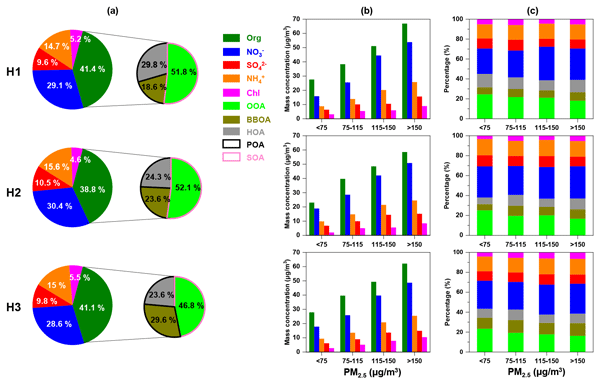
Zhier Bao, Xinyi Zhang, Qing Li, Jiawei Zhou, Guangming Shi, Li Zhou, Fumo Yang, Shaodong Xie, Dan Zhang, Chongzhi Zhai, Zhenliang Li, Chao Peng, and Yang Chen
Atmos. Chem. Phys., 23, 1147–1167, https://doi.org/10.5194/acp-23-1147-2023, https://doi.org/10.5194/acp-23-1147-2023, 2023
Short summary
Short summary
We characterised non-refractory fine particulate matter (PM2.5) during winter in the Sichuan Basin (SCB), Southwest China. The factors driving severe aerosol pollution were revealed, highlighting the importance of rapid nitrate formation and intensive biomass burning. Nitrate was primarily formed through gas-phase oxidation during daytime and aqueous-phase oxidation during nighttime. Controlling nitrate and biomass burning will benefit the mitigation of haze formation in the SCB.
Tan Mi, Xueting Pu, Xi Zheng, Guangcheng Nie, Xinyi Liu, Han Zhang, Michael L. Grieneisen, Yu Zhan, Maohua Wang, and Fumo Yang
Earth Syst. Sci. Data Discuss., https://doi.org/10.5194/essd-2026-554, https://doi.org/10.5194/essd-2026-554, 2026
Preprint under review for ESSD
Short summary
Short summary
We present a temporally continuous hourly CO2 dataset for global GAW stations from 2000 to 2024. Gaps in the original hourly observations can bias daily, monthly, and annual mean CO2 estimates and obscure diurnal variability and short-lived events. The dataset enables improved estimates of global mean surface CO2, regional short-term CO2 variability, and regional carbon-emission inversions.
Lijuan Li, Hongmei Xu, Xin Zhang, Qiyuan Wang, Hui Su, Fengxian Liu, Yang Chen, Yuemei Han, and Junji Cao
EGUsphere, https://doi.org/10.5194/egusphere-2026-4948, https://doi.org/10.5194/egusphere-2026-4948, 2026
Short summary
Short summary
We compared fine particles collected in a city road tunnel with particles from controlled tests of gasoline vehicle exhaust. The exhaust samples reproduced the main chemical pattern in the tunnel but missed many chemicals containing sulfur and substances linked to tire wear. The results show that tailpipe exhaust alone cannot fully describe traffic pollution and that road wear and chemical changes near roads should also be considered.
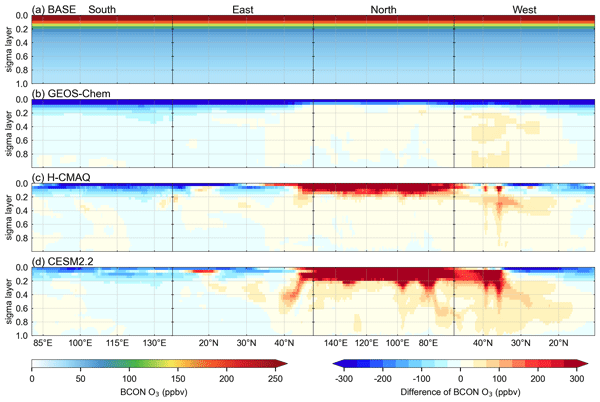
Yunsong Du, Fumo Yang, Sijia Lou, Baolei Lyu, Ran Huang, Guangming Shi, Yongtao Hu, Yan Jiang, and Nan Wang
Atmos. Chem. Phys., 26, 6223–6241, https://doi.org/10.5194/acp-26-6223-2026, https://doi.org/10.5194/acp-26-6223-2026, 2026
Short summary
Short summary
This study shows that using dynamically changing chemical boundary conditions is essential for accurately simulating summer ozone pollution in China. By integrating real-time global data, we improve model performance and reveal how large-scale weather patterns drive cross-border and stratospheric transport. These results support more reliable ozone forecasting and pollution mitigation.
Yuelin Liu, Yuanjun Gong, Nan Wang, Guangming Shi, Fumo Yang, Yuanhang Zhang, and Keding Lu
EGUsphere, https://doi.org/10.5194/egusphere-2026-1786, https://doi.org/10.5194/egusphere-2026-1786, 2026
Short summary
Short summary
Ozone pollution is difficult to predict because its formation depends on complex chemical reactions that vary under different pollution conditions. By comparing multiple modeling approaches during a pollution event in Chengdu, China, we examine how ozone formation and the underlying chemical processes, particularly radical-driven reactions, differ between low- and high-pollution environments.
Song Liu, Xiaopu Lyu, Fumo Yang, Zongbo Shi, Xin Huang, Tengyu Liu, Hongli Wang, Mei Li, Jian Gao, Nan Chen, Guoliang Shi, Yu Zou, Chenglei Pei, Chengxu Tong, Xinyi Liu, Li Zhou, Alex B. Guenther, and Nan Wang
Atmos. Chem. Phys., 26, 635–646, https://doi.org/10.5194/acp-26-635-2026, https://doi.org/10.5194/acp-26-635-2026, 2026
Short summary
Short summary
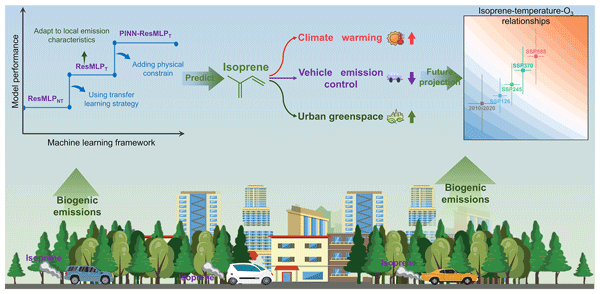
We studied the invisible gas isoprene, which trees and vehicles release into the air and which can worsen urban smog. Using advanced computer learning trained on measurements from many cities, we uncovered how temperature, sunlight, and city greening shape isoprene levels. Comparing Hong Kong and London, we found climate warming boosts isoprene and future ozone pollution, but strong cuts in anthropogenic emission could limit this impact.
Zhuozhi Shu, Fumo Yang, Guangming Shi, Yuqing Zhang, Yongjie Huang, Xinning Yu, Baiwan Pan, and Tianliang Zhao
Atmos. Chem. Phys., 25, 15437–15451, https://doi.org/10.5194/acp-25-15437-2025, https://doi.org/10.5194/acp-25-15437-2025, 2025
Short summary
Short summary
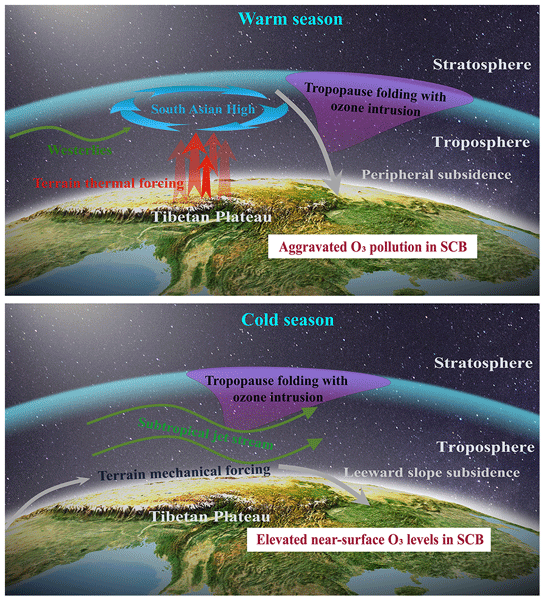
We targeted four stratospheric intrusion episodes to investigate the impacts of cross-layer transport of stratospheric O3 on the near-surface environmental atmosphere over Sichuan Basin and uncover multi-scale atmospheric circulation coupling mechanisms with the seasonally discrepant terrain effects of Tibetan Plateau. Results provided the critical insights into understanding of regional O3 pollution genesis with the exceptional natural sources contribution derived from the stratosphere.
Liuwei Kong, Xin Li, Yu Wang, Sihua Lu, Ying Liu, Shengrong Lou, Wenxin Zhou, Xinping Yang, Yan Ding, Yi Liu, Mengdi Song, Shuyu He, Kai Wang, Feng Wang, Xiaocen Shi, Jian Wang, Yun Zou, Chaofan Lian, Hefan Liu, Miao Feng, Xiaoya Dou, Limin Zeng, and Yuanhang Zhang
Atmos. Chem. Phys., 25, 13311–13326, https://doi.org/10.5194/acp-25-13311-2025, https://doi.org/10.5194/acp-25-13311-2025, 2025
Short summary
Short summary
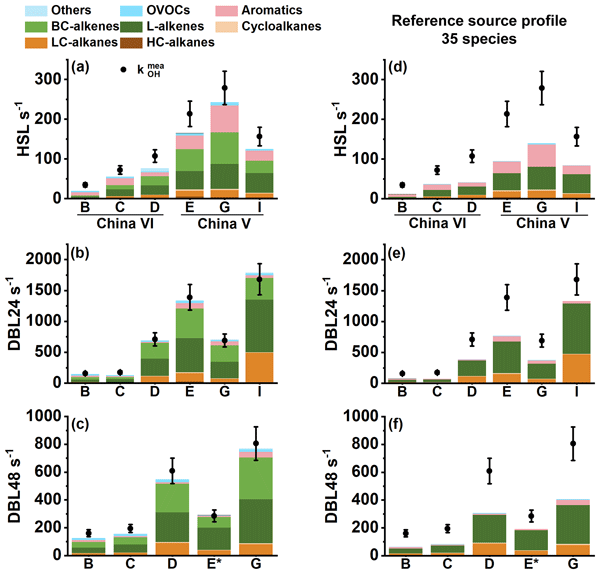
Our research investigates the volatile organic compounds evaporative emission characteristics of China's typical representative vehicle regulatory standards. The emission factors, chemical composition characteristics and source profiles of volatile organic compounds were determined. The hydroxyl radical total reactivity and compositions of evaporative emissions were quantified, and identified key volatile organic compounds reactive species contributing to atmospheric photochemical processes.
Yuhang Hao, Peizhao Li, Yafeng Gou, Zhenshuai Wang, Mi Tian, Yang Chen, Ye Kuang, Hanbing Xu, Fenglian Wan, Yuqian Luo, Wei Huang, and Jing Chen
Atmos. Chem. Phys., 25, 12811–12830, https://doi.org/10.5194/acp-25-12811-2025, https://doi.org/10.5194/acp-25-12811-2025, 2025
Short summary
Short summary
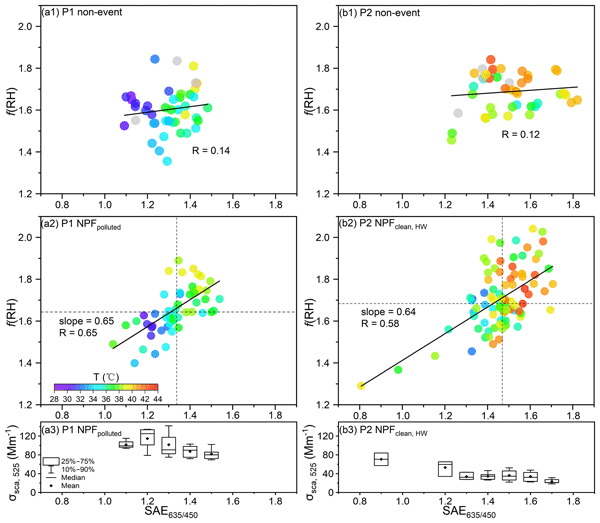
Intensified heatwaves under global warming have influenced new particle formation (NPF) and related aerosol physicochemical properties. We show that aerosol optical hygroscopicity (f(RH)) was generally higher on NPF days than in non-event cases, likely due to enhanced secondary formation and subsequent growth of both pre-existing and newly formed particles with stronger photooxidation, specifically under persistent heatwaves. This would further impact the aerosol direct radiative forcing.
Tian Feng, Guohui Li, Shuyu Zhao, Naifang Bei, Xin Long, Yuepeng Pan, Yu Song, Ruonan Wang, Xuexi Tie, and Luisa T. Molina
Atmos. Chem. Phys., 25, 11703–11718, https://doi.org/10.5194/acp-25-11703-2025, https://doi.org/10.5194/acp-25-11703-2025, 2025
Short summary
Short summary
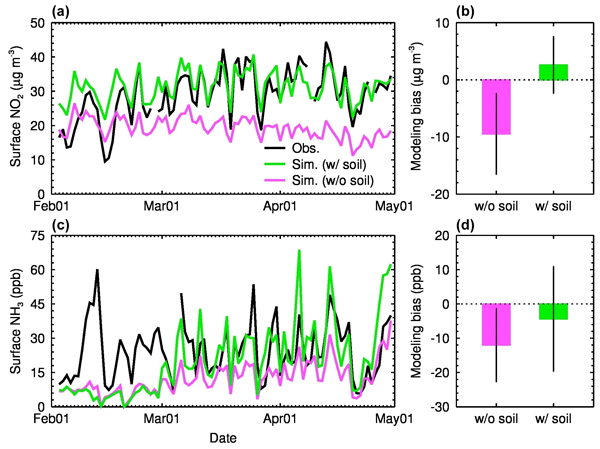
The impacts of agricultural fertilization on nitrogen oxide and air quality are becoming more pronounced with continuous reductions in fossil fuel sources in China. We report that atmospheric nitrogen dioxide pulses driven by agricultural fertilization largely complicate air pollution in the North China Plain, highlighting the necessity of agricultural emission control.
Nan Wang, Song Liu, Jiawei Xu, Yanyu Wang, Chun Li, Yuning Xie, Hua Lu, and Fumo Yang
Atmos. Chem. Phys., 25, 8859–8870, https://doi.org/10.5194/acp-25-8859-2025, https://doi.org/10.5194/acp-25-8859-2025, 2025
Short summary
Short summary
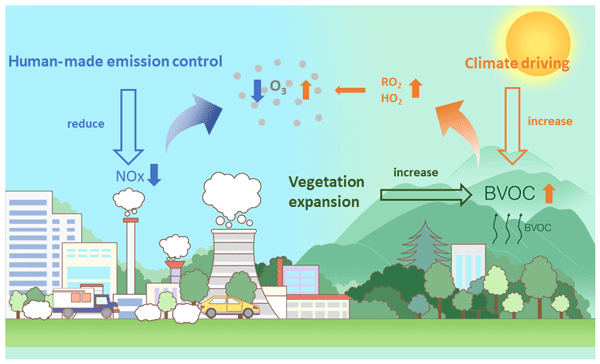
We found that climate warming and changes in vegetation have increased biogenic volatile organic compound emissions in the Pearl River Delta region. These increasing natural emissions, mainly due to climate warming, are weakening the benefits of reducing human-made emissions through control, leading to higher ozone levels. This work helps us understand how climate change influences air quality and provides important insights for improving pollution control strategies in the future.
Xinping Yang, Jia Ke, Zhihui Huang, Yi Wen, Dailin Yin, Zhen Jiang, Zhigang Yue, Yunjing Wang, Songdi Liao, Hang Yin, and Yan Ding
Atmos. Chem. Phys., 25, 7669–7682, https://doi.org/10.5194/acp-25-7669-2025, https://doi.org/10.5194/acp-25-7669-2025, 2025
Short summary
Short summary
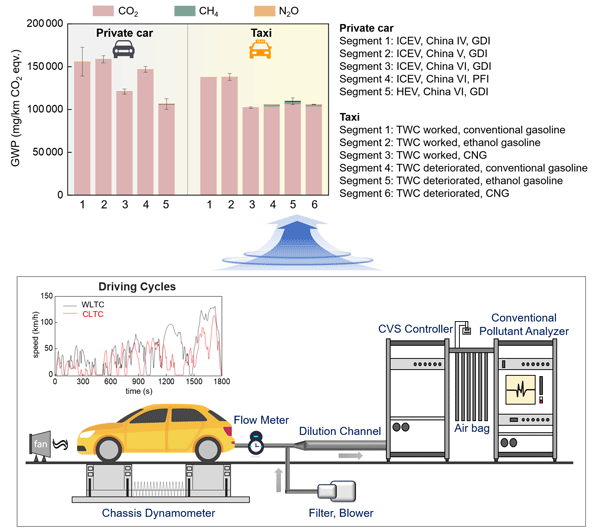
Given the limitation of insufficient research on greenhouse gas emission characteristics of light-duty vehicles in China against a dual-carbon background, we conducted chassis dynamometer tests on over 10 vehicles and elaborated in detail on the characteristics of greenhouse gas emissions from vehicles in the context of technological updates.
Jiayin Li, Tianyu Zhai, Xiaorui Chen, Haichao Wang, Shuyang Xie, Shiyi Chen, Chunmeng Li, Yuanjun Gong, Huabin Dong, and Keding Lu
Atmos. Chem. Phys., 25, 6395–6406, https://doi.org/10.5194/acp-25-6395-2025, https://doi.org/10.5194/acp-25-6395-2025, 2025
Short summary
Short summary
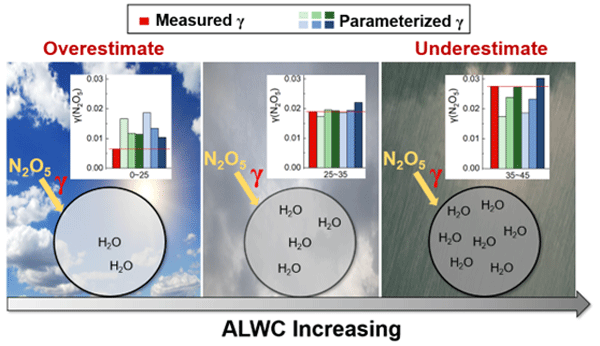
We directly measured the dinitrogen pentoxide (N2O5) uptake coefficient using an aerosol flow tube, which critically impacts the NOx fate and particulate nitrate formation in a typical highland city, Kunming, in China. We found that the performance of current γ (N2O5) parameterizations showed deviations with the varying aerosol liquid water content (ALWC). Such differences would lead to biased estimation of particulate nitrate production potential. We give suggestions for future research directions.

Chunmeng Li, Xiaorui Chen, Haichao Wang, Tianyu Zhai, Xuefei Ma, Xinping Yang, Shiyi Chen, Min Zhou, Shengrong Lou, Xin Li, Limin Zeng, and Keding Lu
Atmos. Chem. Phys., 25, 3905–3918, https://doi.org/10.5194/acp-25-3905-2025, https://doi.org/10.5194/acp-25-3905-2025, 2025
Short summary
Short summary
This study reports an observation of organic nitrate (including total peroxy nitrates and total alkyl nitrates) in Shanghai, China, during the summer of 2021, by homemade thermal dissociation cavity-enhanced absorption spectroscopy (TD-CEAS; Atmos. Meas. Tech., 14, 4033–4051, 2021). The distribution of organic nitrates and their effects on local ozone production are analyzed based on field observations in conjunction with model simulations.
Jiemeng Bao, Xin Zhang, Zhenhai Wu, Li Zhou, Jun Qian, Qinwen Tan, Fumo Yang, Junhui Chen, Yunfeng Li, Hefan Liu, Liqun Deng, and Hong Li
Atmos. Chem. Phys., 25, 1899–1916, https://doi.org/10.5194/acp-25-1899-2025, https://doi.org/10.5194/acp-25-1899-2025, 2025
Short summary
Short summary
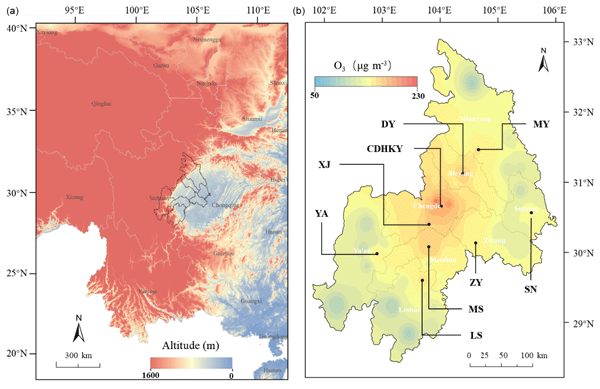
We studied carbonyl compounds' role in ozone pollution in the Chengdu Plain Urban Agglomeration, China. During heavy pollution in August 2019, we measured carbonyls at nine sites and analyzed their impact. Areas with higher carbonyl levels, like Chengdu, had worse ozone pollution. While their abundance matters, chemical reactions with other pollutants are the main drivers. Our findings show regional cooperation is vital to reducing ozone pollution effectively.
Lang Liu, Xin Long, Yi Li, Zengliang Zang, Fengwen Wang, Yan Han, Zhier Bao, Yang Chen, Tian Feng, and Jinxin Yang
Atmos. Chem. Phys., 25, 1569–1585, https://doi.org/10.5194/acp-25-1569-2025, https://doi.org/10.5194/acp-25-1569-2025, 2025
Short summary
Short summary
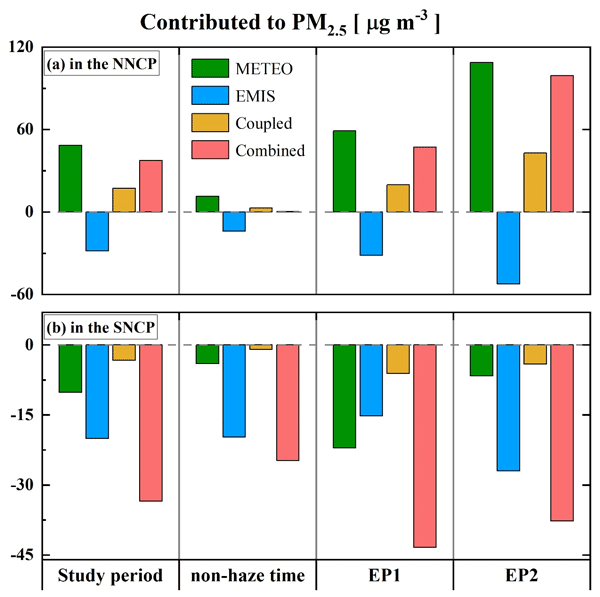
This study uses WRF-Chem to assess how meteorological conditions and emission reductions affected fine particulate matter (PM2.5) in the North China Plain (NCP). It highlights regional disparities: in the northern NCP, adverse weather negated emission reduction effects. In contrast, the southern NCP featured a PM2.5 decrease due to favorable weather and emission reductions. The research highlighted the interaction between emissions, meteorology, and PM2.5.

Yiliang Liu, Arttu Yli-Kujala, Fabian Schmidt-Ott, Sebastian Holm, Lauri Ahonen, Tommy Chan, Joonas Enroth, Joonas Vanhanen, Runlong Cai, Tuukka Petäjä, Markku Kulmala, Yang Chen, and Juha Kangasluoma
Atmos. Meas. Tech., 18, 431–442, https://doi.org/10.5194/amt-18-431-2025, https://doi.org/10.5194/amt-18-431-2025, 2025
Short summary
Short summary
Accurate measurement of nanoparticles is crucial for understanding their impact on new particle formation and climate change. In this study, we calibrated the Particle Size Magnifier version 2.0 (PSM 2.0), using both laboratory-generated and atmospheric particles. Some differences were observed in the calibration results, with direct calibration using atmospheric particles enhancing measurement accuracy.
Nan Wang, Yunsong Du, Dongyang Chen, Haiyan Meng, Xi Chen, Li Zhou, Guangming Shi, Yu Zhan, Miao Feng, Wei Li, Mulan Chen, Zhenliang Li, and Fumo Yang
Atmos. Chem. Phys., 24, 3029–3042, https://doi.org/10.5194/acp-24-3029-2024, https://doi.org/10.5194/acp-24-3029-2024, 2024
Short summary
Short summary
In the scorching August 2022 heatwave, China's Sichuan Basin saw a stark contrast in ozone (O3) levels between Chengdu and Chongqing. The regional disparities were studied considering meteorology, precursors, photochemistry, and transportation. The study highlighted the importance of tailored pollution control measures and underlined the necessity for region-specific strategies to combat O3 pollution on a regional scale.
Chen He, Hanxiong Che, Zier Bao, Yiliang Liu, Qing Li, Miao Hu, Jiawei Zhou, Shumin Zhang, Xiaojiang Yao, Quan Shi, Chunmao Chen, Yan Han, Lingshuo Meng, Xin Long, Fumo Yang, and Yang Chen
Atmos. Chem. Phys., 24, 1627–1639, https://doi.org/10.5194/acp-24-1627-2024, https://doi.org/10.5194/acp-24-1627-2024, 2024
Short summary
Short summary
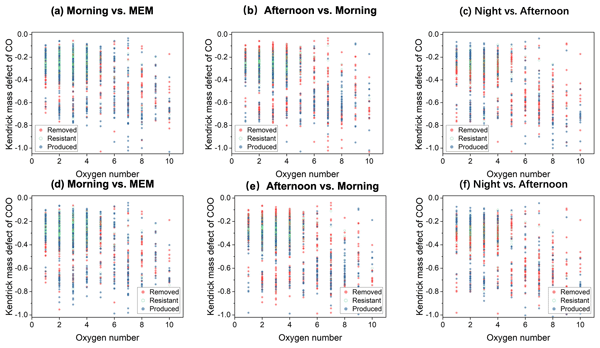
We examined the daily evolution of high molecular-weight organic compounds with a molecular weight of up to 1000 Da in order to comprehend their behaviors in the atmosphere under actual conditions. These compounds were proven to undergo multi-generation oxidation, carboxylation, and nitrification via both day- and nighttime chemistry.
Nan Wang, Hongyue Wang, Xin Huang, Xi Chen, Yu Zou, Tao Deng, Tingyuan Li, Xiaopu Lyu, and Fumo Yang
Atmos. Chem. Phys., 24, 1559–1570, https://doi.org/10.5194/acp-24-1559-2024, https://doi.org/10.5194/acp-24-1559-2024, 2024
Short summary
Short summary
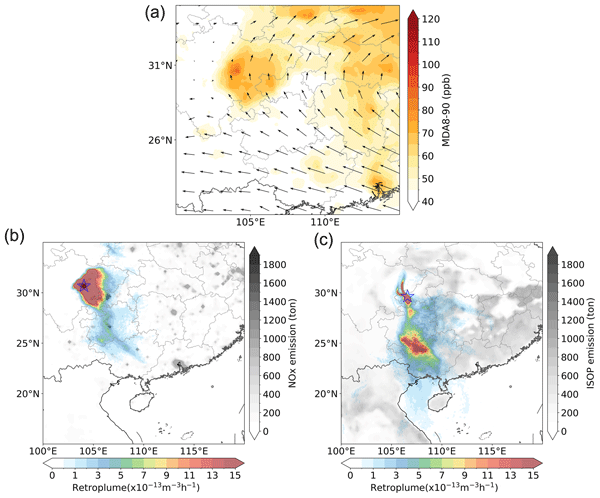
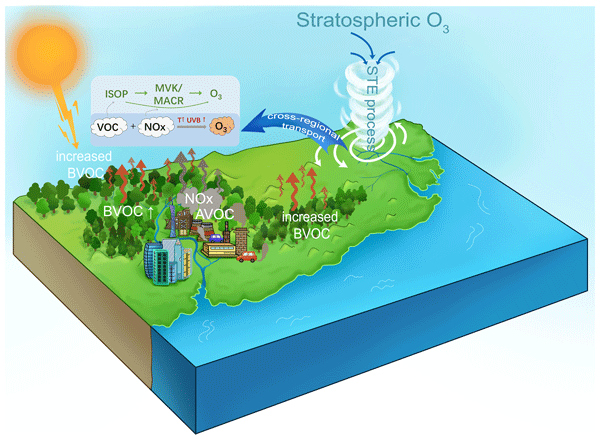
This study explores the influence of extreme-weather-induced natural processes on ozone pollution, which is often overlooked. By analyzing meteorological factors, natural emissions, chemistry pathways and atmospheric transport, we discovered that these natural processes could substantially exacerbate ozone pollution. The findings contribute to a deeper understanding of ozone pollution and offer valuable insights for controlling ozone pollution in the context of global warming.
Can Ye, Keding Lu, Xuefei Ma, Wanyi Qiu, Shule Li, Xinping Yang, Chaoyang Xue, Tianyu Zhai, Yuhan Liu, Xuan Li, Yang Li, Haichao Wang, Zhaofeng Tan, Xiaorui Chen, Huabin Dong, Limin Zeng, Min Hu, and Yuanhang Zhang
Atmos. Chem. Phys., 23, 15455–15472, https://doi.org/10.5194/acp-23-15455-2023, https://doi.org/10.5194/acp-23-15455-2023, 2023
Short summary
Short summary
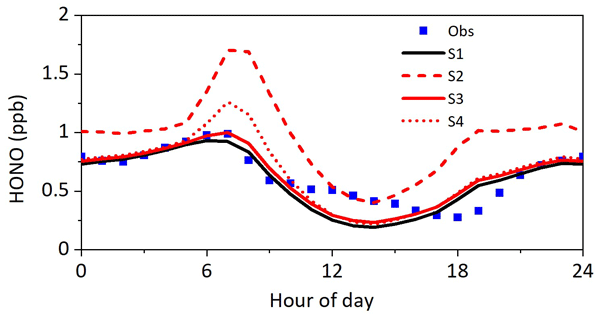
In this study, combining comprehensive field measurements and a box model, we found NO2 conversion on the ground surface was the most important source for HONO production among the proposed heterogeneous and gas-phase HONO sources. In addition, HONO was found to evidently enhance O3 production and aggravate O3 pollution in summer in China. Our study improved our understanding of the relative importance of different HONO sources and the crucial role of HONO in O3 formation in polluted areas.
Zhongwei Luo, Yan Han, Kun Hua, Yufen Zhang, Jianhui Wu, Xiaohui Bi, Qili Dai, Baoshuang Liu, Yang Chen, Xin Long, and Yinchang Feng
Geosci. Model Dev., 16, 6757–6771, https://doi.org/10.5194/gmd-16-6757-2023, https://doi.org/10.5194/gmd-16-6757-2023, 2023
Short summary
Short summary
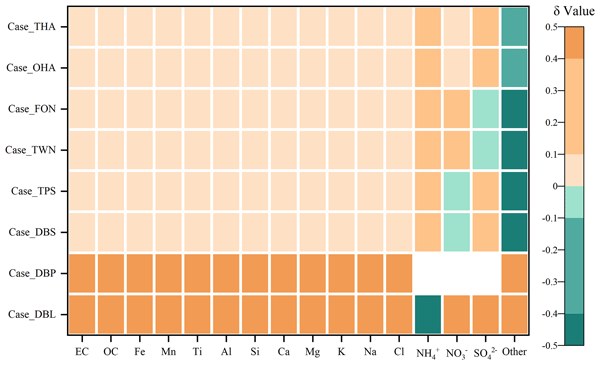
This study explores how the variation in the source profiles adopted in chemical transport models (CTMs) impacts the simulated results of chemical components in PM2.5 based on sensitivity analysis. The impact on PM2.5 components cannot be ignored, and its influence can be transmitted and linked between components. The representativeness and timeliness of the source profile should be paid adequate attention in air quality simulation.
Taomou Zong, Zhijun Wu, Junrui Wang, Kai Bi, Wenxu Fang, Yanrong Yang, Xuena Yu, Zhier Bao, Xiangxinyue Meng, Yuheng Zhang, Song Guo, Yang Chen, Chunshan Liu, Yue Zhang, Shao-Meng Li, and Min Hu
Atmos. Meas. Tech., 16, 3679–3692, https://doi.org/10.5194/amt-16-3679-2023, https://doi.org/10.5194/amt-16-3679-2023, 2023
Short summary
Short summary
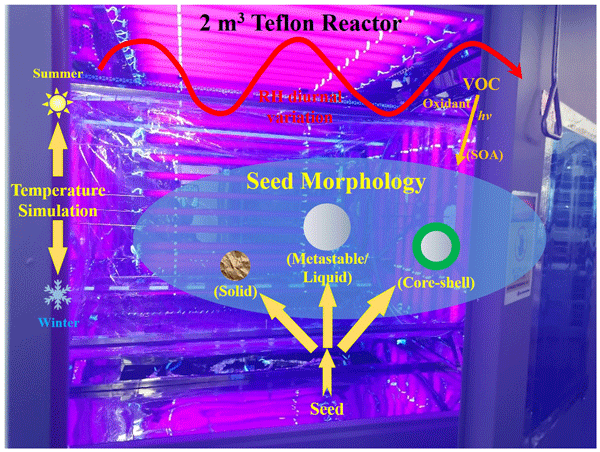
This study developed and characterized an indoor chamber system (AIR) to simulate atmospheric multiphase chemistry processes. The AIR chamber can accurately control temperature and relative humidity (RH) over a broad range and simulate diurnal variation of ambient atmospheric RH. The aerosol generation unit can generate organic-coating seed particles with different phase states. The AIR chamber demonstrates high-quality performance in simulating secondary aerosol formation.
Hejun Hu, Haichao Wang, Keding Lu, Jie Wang, Zelong Zheng, Xuezhen Xu, Tianyu Zhai, Xiaorui Chen, Xiao Lu, Wenxing Fu, Xin Li, Limin Zeng, Min Hu, Yuanhang Zhang, and Shaojia Fan
Atmos. Chem. Phys., 23, 8211–8223, https://doi.org/10.5194/acp-23-8211-2023, https://doi.org/10.5194/acp-23-8211-2023, 2023
Short summary
Short summary
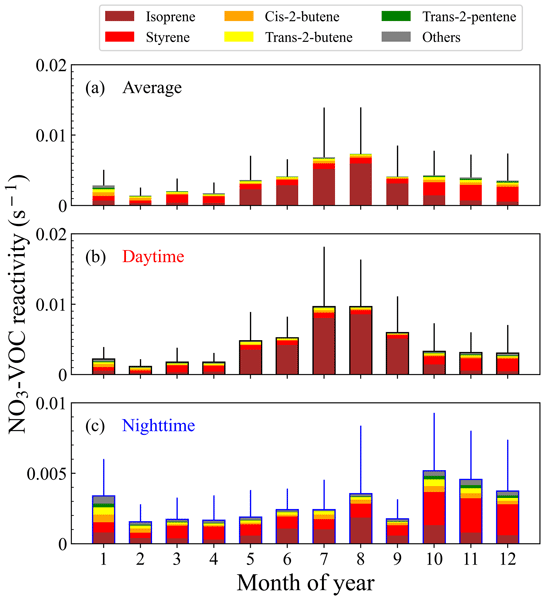
Nitrate radical chemistry is critical to the degradation of volatile organic compounds (VOCs) and secondary organic aerosol formation. This work investigated the level, seasonal variation, and trend of nitrate radical reactivity towards volatile organic compounds (kNO3) in Beijing. We show the key role of isoprene and styrene in regulating seasonal variation in kNO3 and rebuild a long-term record of kNO3 based on the reported VOC measurements.
Tianyu Zhai, Keding Lu, Haichao Wang, Shengrong Lou, Xiaorui Chen, Renzhi Hu, and Yuanhang Zhang
Atmos. Chem. Phys., 23, 2379–2391, https://doi.org/10.5194/acp-23-2379-2023, https://doi.org/10.5194/acp-23-2379-2023, 2023
Short summary
Short summary
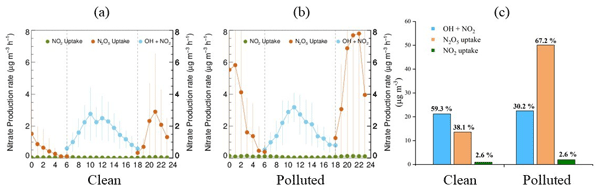
Particulate nitrate is a growing issue in air pollution. Based on comprehensive field measurement, we show heavy nitrate pollution in eastern China in summer. OH reacting with NO2 at daytime dominates nitrate formation on clean days, while N2O5 hydrolysis largely enhances and become comparable with that of OH reacting with O2 on polluted days (67.2 % and 30.2 %). Model simulation indicates that VOC : NOx = 2 : 1 is effective in mitigating the O3 and nitrate pollution coordinately.
Zhier Bao, Xinyi Zhang, Qing Li, Jiawei Zhou, Guangming Shi, Li Zhou, Fumo Yang, Shaodong Xie, Dan Zhang, Chongzhi Zhai, Zhenliang Li, Chao Peng, and Yang Chen
Atmos. Chem. Phys., 23, 1147–1167, https://doi.org/10.5194/acp-23-1147-2023, https://doi.org/10.5194/acp-23-1147-2023, 2023
Short summary
Short summary
We characterised non-refractory fine particulate matter (PM2.5) during winter in the Sichuan Basin (SCB), Southwest China. The factors driving severe aerosol pollution were revealed, highlighting the importance of rapid nitrate formation and intensive biomass burning. Nitrate was primarily formed through gas-phase oxidation during daytime and aqueous-phase oxidation during nighttime. Controlling nitrate and biomass burning will benefit the mitigation of haze formation in the SCB.
Xinping Yang, Keding Lu, Xuefei Ma, Yue Gao, Zhaofeng Tan, Haichao Wang, Xiaorui Chen, Xin Li, Xiaofeng Huang, Lingyan He, Mengxue Tang, Bo Zhu, Shiyi Chen, Huabin Dong, Limin Zeng, and Yuanhang Zhang
Atmos. Chem. Phys., 22, 12525–12542, https://doi.org/10.5194/acp-22-12525-2022, https://doi.org/10.5194/acp-22-12525-2022, 2022
Short summary
Short summary
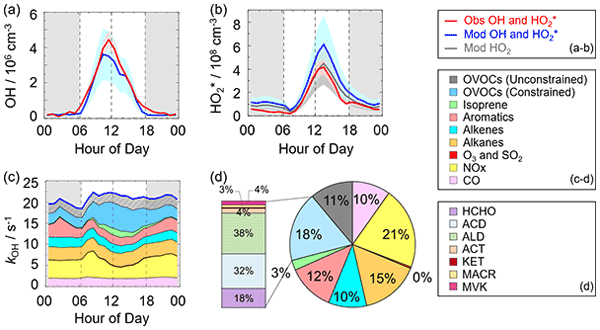
We present the OH and HO2 radical observations at the Shenzhen site (Pearl River Delta, China) in the autumn of 2018. The diurnal maxima were 4.5 × 106 cm−3 for OH and 4.2 × 108 cm−3 for HO2 (including an estimated interference of 23 %–28 % from RO2 radicals during the daytime). The OH underestimation was identified again, and it was attributable to the missing OH sources. HO2 heterogeneous uptake, ROx sources and sinks, and the atmospheric oxidation capacity were evaluated as well.
Cited articles
Akagi, S. K., Yokelson, R. J., Wiedinmyer, C., Alvarado, M. J., Reid, J. S., Karl, T., Crounse, J. D., and Wennberg, P. O.: Emission factors for open and domestic biomass burning for use in atmospheric models, Atmos. Chem. Phys., 11, 4039–4072, https://doi.org/10.5194/acp-11-4039-2011, 2011.
Alfarra, M. R., Prévôt, A. S. H., Szidat, S., Sandradewi, J., Sandradewi, S., Lanz, V. A., Schreiber, D., Mohr, M., and Baltensperger, U.: Identification of the Mass Spectral Signature of Organic Aerosols from Wood Burning Emissions, Environ. Sci. Technol., 41, 5770–5777, https://doi.org/10.1021/es062289b, 2007.
Bahreini, R., Ervens, B., Middlebrook, A. M., Warneke, C., de Gouw, J. A., DeCarlo, P. F., Jimenez, J. L., Brock, C. A., Neuman, J. A., Ryerson, T. B., Stark, H., Atlas, E., Brioude, J., Fried, A., Holloway, J. S., Peischl, J., Richter, D., Walega, J., Weibring, P., Wollny, A. G., and Fehsenfeld, F. C.: Organic Aerosol Formation in Urban and Industrial Plumes Near Houston and Dallas, Texas, J. Geophys. Res.-Atmos., 114, D00F16, https://doi.org/10.1029/2008JD011493, 2009.
Bao, Z., Zhang, X., Li, Q., Zhou, J., Shi, G., Zhou, L., Yang, F., Xie, S., Zhang, D., Zhai, C., Li, Z., Peng, C., and Chen, Y.: Measurement report: Intensive biomass burning emissions and rapid nitrate formation drive severe haze formation in the Sichuan Basin, China – insights from aerosol mass spectrometry, Atmos. Chem. Phys., 23, 1147–1167, https://doi.org/10.5194/acp-23-1147-2023, 2023.
Bao, Z. E., Zeng, X. L., Zhou, J. W., Yang, F. M., Lu, K. D., Zhai, C. Z., Li, X., Feng, M., Tan, Q. W., and Chen, Y.: Evolution of black carbon and brown carbon during summertime in Southwestern China: An assessment of control measures during the 2023 Chengdu Summer World University Games, Environ. Pollut., 357, 124467, https://doi.org/10.1016/j.envpol.2024.124467, 2024.
Bao, Z. E., Liu, Y. L., Meng, L. S., Han, Y., Tian, M., Shi, G. M., Wang, Q. Y., Huang, Y., Peng, C., Luo, B., Zhang, W., Wang, H. B., Cao, J. J., Yang, F. M., and Chen, Y.: Evaluating the effects of biomass burning on severe haze formation in a megacity of Sichuan Basin, Southwestern China, J. Geophys. Res.-Atmos., 130, e2024JD042516, https://doi.org/10.1029/2024JD042516, 2025.
Canagaratna, M. R., Jayne, J. T., Jimenez, J. L., Allan, J. D., Alfarra, M. R., Zhang, Q., Onasch, T. B., Drewnick, F., Coe, H., Middlebrook, A., Delia, A., Williams, L. R., Trimborn, A. M., Northway, M. J., DeCarlo, P. F., Kolb, C. E., Davidovits, P., and Worsnop, D. R.: Chemical and microphysical characterization of ambient aerosols with the aerodyne aerosol mass spectrometer, Mass Spectrom. Rev., 26, 185–222, https://doi.org/10.1002/mas.20115, 2007.
Canagaratna, M. R., Jimenez, J. L., Kroll, J. H., Chen, Q., Kessler, S. H., Massoli, P., Hildebrandt Ruiz, L., Fortner, E., Williams, L. R., Wilson, K. R., Surratt, J. D., Donahue, N. M., Jayne, J. T., and Worsnop, D. R.: Elemental ratio measurements of organic compounds using aerosol mass spectrometry: characterization, improved calibration, and implications, Atmos. Chem. Phys., 15, 253–272, https://doi.org/10.5194/acp-15-253-2015, 2015.
Canonaco, F., Crippa, M., Slowik, J. G., Baltensperger, U., and Prévôt, A. S. H.: SoFi, an IGOR-based interface for the efficient use of the generalized multilinear engine (ME-2) for the source apportionment: ME-2 application to aerosol mass spectrometer data, Atmos. Meas. Tech., 6, 3649–3661, https://doi.org/10.5194/amt-6-3649-2013, 2013.
Carlton, A. G., Turpin, B. J., Altieri, K. E., Seitzinger, S., Reff, A., Lim, H. J., and Ervens, B.: Atmospheric oxalic acid and SOA production from glyoxal: results of aqueous photooxidation experiments, Atmos. Environ., 41, 7588–7602, https://doi.org/10.1016/j.atmosenv.2007.05.035, 2007.
Chen, C. R., Zhang, H. X., Yan, W. J., Wu, N. N., Zhang, Q., and He, K. B.: Aerosol water content enhancement leads to changes in the major formation mechanisms of nitrate and secondary organic aerosols in winter over the North China Plain, Environ. Pollut., 287, 117625, https://doi.org/10.1016/j.envpol.2021.117625, 2021.
Chen, Y., Xie, S. D., Luo, B., and Zhai, C. Z.: Characteristics and origins of carbonaceous aerosol in the Sichuan Basin, China, Atmos. Environ., 94, 215–223, https://doi.org/10.1016/j.atmosenv.2014.05.037, 2014.
Chen, Y., Xie, S. D., Luo, B., and Zhai, C. Z.: Particulate pollution in urban Chongqing of southwest China: Historical trends of variation, chemical characteristics and source apportionment, Sci. Total Environ., 584–585, 523–534, https://doi.org/10.1016/j.scitotenv.2017.01.060, 2017.
Chen, Y., Tian, M., Huang, R.-J., Shi, G., Wang, H., Peng, C., Cao, J., Wang, Q., Zhang, S., Guo, D., Zhang, L., and Yang, F.: Characterization of urban amine-containing particles in southwestern China: seasonal variation, source, and processing, Atmos. Chem. Phys., 19, 3245–3255, https://doi.org/10.5194/acp-19-3245-2019, 2019.
Collaud Coen, M., Weingartner, E., Apituley, A., Ceburnis, D., Fierz-Schmidhauser, R., Flentje, H., Henzing, J. S., Jennings, S. G., Moerman, M., Petzold, A., Schmid, O., and Baltensperger, U.: Minimizing light absorption measurement artifacts of the Aethalometer: evaluation of five correction algorithms, Atmos. Meas. Tech., 3, 457–474, https://doi.org/10.5194/amt-3-457-2010, 2010.
Cubison, M. J., Ortega, A. M., Hayes, P. L., Farmer, D. K., Day, D., Lechner, M. J., Brune, W. H., Apel, E., Diskin, G. S., Fisher, J. A., Fuelberg, H. E., Hecobian, A., Knapp, D. J., Mikoviny, T., Riemer, D., Sachse, G. W., Sessions, W., Weber, R. J., Weinheimer, A. J., Wisthaler, A., and Jimenez, J. L.: Effects of aging on organic aerosol from open biomass burning smoke in aircraft and laboratory studies, Atmos. Chem. Phys., 11, 12049–12064, https://doi.org/10.5194/acp-11-12049-2011, 2011.
DeCarlo, P. F., Ulbrich, I. M., Crounse, J., de Foy, B., Dunlea, E. J., Aiken, A. C., Knapp, D., Weinheimer, A. J., Campos, T., Wennberg, P. O., and Jimenez, J. L.: Investigation of the sources and processing of organic aerosol over the Central Mexican Plateau from aircraft measurements during MILAGRO, Atmos. Chem. Phys., 10, 5257–5280, https://doi.org/10.5194/acp-10-5257-2010, 2010.
Drinovec, L., Močnik, G., Zotter, P., Prévôt, A. S. H., Ruckstuhl, C., Coz, E., Rupakheti, M., Sciare, J., Müller, T., Wiedensohler, A., and Hansen, A. D. A.: The ”dual-spot” Aethalometer: an improved measurement of aerosol black carbon with real-time loading compensation, Atmos. Meas. Tech., 8, 1965–1979, https://doi.org/10.5194/amt-8-1965-2015, 2015.
Drozd, G. T. and McNeill, V. F.: Organic matrix effects on the formation of light-absorbing compounds from α-dicarbonyls in aqueous salt solution, Environ. Sci.-Proc. Imp., 16, 741–747, https://doi.org/10.1039/c3em00579h, 2014.
Elser, M., Huang, R.-J., Wolf, R., Slowik, J. G., Wang, Q., Canonaco, F., Li, G., Bozzetti, C., Daellenbach, K. R., Huang, Y., Zhang, R., Li, Z., Cao, J., Baltensperger, U., El-Haddad, I., and Prévôt, A. S. H.: New insights into PM2.5 chemical composition and sources in two major cities in China during extreme haze events using aerosol mass spectrometry, Atmos. Chem. Phys., 16, 3207–3225, https://doi.org/10.5194/acp-16-3207-2016, 2016.
Ervens, B., Turpin, B. J., and Weber, R. J.: Secondary organic aerosol formation in cloud droplets and aqueous particles (aqSOA): a review of laboratory, field and model studies, Atmos. Chem. Phys., 11, 11069–11102, https://doi.org/10.5194/acp-11-11069-2011, 2011.
Feng, Z., Liu, Y., Zheng, F., Yan, C., Fu, P., Zhang, Y., Lian, C., Wang, W., Cai, J., Du, W., Chu, B., Wang, Y., Kangasluoma, J., Bianchi, F., Petäjä, T., and Kulmala, M.: Highly oxidized organic aerosols in Beijing: Possible contribution of aqueous-phase chemistry, Atmos. Environ., 273, 118971, https://doi.org/10.1016/j.atmosenv.2022.118971, 2022.
Fountoukis, C. and Nenes, A.: ISORROPIA II: a computationally efficient thermodynamic equilibrium model for K+–Ca2+–Mg2+–NH
Fröhlich, R., Cubison, M. J., Slowik, J. G., Bukowiecki, N., Prévôt, A. S. H., Baltensperger, U., Schneider, J., Kimmel, J. R., Gonin, M., Rohner, U., Worsnop, D. R., and Jayne, J. T.: The ToF-ACSM: a portable aerosol chemical speciation monitor with TOFMS detection, Atmos. Meas. Tech., 6, 3225–3241, https://doi.org/10.5194/amt-6-3225-2013, 2013.
Gilardoni, S., Massoli, P., Paglione, M., Giulianelli, L., Carbone, C., Rinaldi, M., Decesari, S., Sandrini, S., Costabile, F., Gobbi, G. P., Pietrogrande, M. C., Visentin, M., Scotto, F., Fuzzi, S., and Facchini, M. C.: Direct observation of aqueous secondary organic aerosol from biomass-burning emissions, P. Natl. Acad. Sci. USA, 113, 10013–10018, https://doi.org/10.1073/pnas.1602212113, 2016.
Guo, H., Xu, L., Bougiatioti, A., Cerully, K. M., Capps, S. L., Hite Jr., J. R., Carlton, A. G., Lee, S.-H., Bergin, M. H., Ng, N. L., Nenes, A., and Weber, R. J.: Fine-particle water and pH in the southeastern United States, Atmos. Chem. Phys., 15, 5211–5228, https://doi.org/10.5194/acp-15-5211-2015, 2015.
Gyawali, M., Arnott, W. P., Lewis, K., and Moosmüller, H.: In situ aerosol optics in Reno, NV, USA during and after the summer 2008 California wildfires and the influence of absorbing and non-absorbing organic coatings on spectral light absorption, Atmos. Chem. Phys., 9, 8007–8015, https://doi.org/10.5194/acp-9-8007-2009, 2009.
He, M., Wang, X. R., Han, L., Feng, X. D., and M, X.: Emission Inventory of Crop Residues Field Burning and Its Temporal and Spatial Distribution in Sichuan Province, Environ. Sci., 36, 1208–1216, https://doi.org/10.13227/j.hjkx.2015.04.010, 2015.
Hennigan, C. J., Sullivan, A. P., Collett, J. L., and Robinson, A. L.: Levoglucosan stability in biomass burning particles exposed to hydroxyl radicals, Geophys. Res. Lett., 37, L09806, https://doi.org/10.1029/2010GL043088, 2010.
Hennigan, C. J., Izumi, J., Sullivan, A. P., Weber, R. J., and Nenes, A.: A critical evaluation of proxy methods used to estimate the acidity of atmospheric particles, Atmos. Chem. Phys., 15, 2775–2790, https://doi.org/10.5194/acp-15-2775-2015, 2015.
Herrmann, H., Schaefer, T., Tilgner, A., Styler, S. A., Weller, C., Teich, M., and Otto, T.: Tropospheric Aqueous-Phase Chemistry: Kinetics, Mechanisms, and Its Coupling to a Changing Gas Phase, Chem. Rev., 115, 4259–4334, https://doi.org/10.1021/cr500447k, 2015.
Huang, R. J., Zhang, Y. L., Bozzetti, C., Ho, K. F., Cao, J. J., Han, Y. M., Daellenbach, K. R., Slowik, J. G., Platt, S. M., Canonaco, F., Zotter, P., Wolf, R., Pieber, S. M., Bruns, E. A., Crippa, M., Ciarelli, G., Piazzalunga, A., Schwikowski, M., Abbaszade, G., Schnelle-Kreis, J., Zimmermann, R., An, Z. S., Szidat, S., Baltensperger, U., El Haddad, I., and Prevot, A. S.: High secondary aerosol contribution to particulate pollution during haze events in China, Nature, 514, 218–222, https://doi.org/10.1038/nature13774, 2014.
Huang, R.-J., He, Y., Duan, J., Li, Y., Chen, Q., Zheng, Y., Chen, Y., Hu, W., Lin, C., Ni, H., Dai, W., Cao, J., Wu, Y., Zhang, R., Xu, W., Ovadnevaite, J., Ceburnis, D., Hoffmann, T., and O'Dowd, C. D.: Contrasting sources and processes of particulate species in haze days with low and high relative humidity in wintertime Beijing, Atmos. Chem. Phys., 20, 9101–9114, https://doi.org/10.5194/acp-20-9101-2020, 2020.
Huang, X. J., Liu, Z., Ge, Y. Z., Li, Q., Wang, X. F., Fu, H. B., Zhu, J., Zhou, B., Wang, L., George, C., Wang, Y., Wang, X. F., Su, J. X., Xue, L. K., Yu, S. C., Mellouki, A., and Chen, J. M.: Aerosol high water contents favor sulfate and secondary organic aerosol formation from fossil fuel combustion emissions, npj Clim. Atmos. Sci., 6, 173, https://doi.org/10.1038/s41612-023-00504-1, 2023.
Jimenez, J. L., Canagaratna, M. R., Donahue, N. M., Prevot, A. S. H., Zhang, Q., Kroll, J. H., DeCarlo, P. F., Allan, J. D., Coe, H., Ng, N. L., Aiken, A. C., Docherty, K. S., Ulbrich, I. M., Grieshop, A. P., Robinson, A. L., Duplissy, J., Smith, J. D., Wilson, K. R., Lanz, V. A., Hueglin, C., Sun, Y. L., Tian, J., Laaksonen, A., Raatikainen, T., Rautiainen, J., Vaattovaara, P., Ehn, M., Kulmala, M., Tomlinson, J. M., Collins, D. R., Cubison, M. J., Dunlea, J., Huffman, J. A., Onasch, T. B., Alfarra, M. R., Williams, P. I., Bower, K., Kondo, Y., Schneider, J., Drewnick, F., Borrmann, S., Weimer, S., Demerjian, K., Salcedo, D., Cottrell, L., Griffin, R., Takami, A., Miyoshi, T., Hatakeyama, S., Shimono, A., Sun, J. Y., Zhang, Y. M., Dzepina, K., Kimmel, J. R., Sueper, D., Jayne, J. T., Herndon, S. C., Trimborn, A. M., Williams, L. R., Wood, E. C., Middlebrook, A. M., Kolb, C. E., Baltensperger, U., and Worsnop, D. R.: Evolution of Organic Aerosols in the Atmosphere, Science, 326, 1525–1529, https://doi.org/10.1126/science.1180353, 2009.
Kampf, C. J., Jakob, R., and Hoffmann, T.: Identification and characterization of aging products in the glyoxal/ammonium sulfate system – implications for light-absorbing material in atmospheric aerosols, Atmos. Chem. Phys., 12, 6323–6333, https://doi.org/10.5194/acp-12-6323-2012, 2012.
Kim, H., Collier, S., Ge, X. L., Xu, J. Z., Sun, Y. L., Jiang, W. Q., Wang, Y. L., Herckes, P., and Zhang, Q.: Chemical processing of water-soluble species and formation of secondary organic aerosol in fogs, Atmos. Environ., 200, 158–166, https://doi.org/10.1016/j.atmosenv.2018.11.062, 2019.
Kirchstetter, T. W. and Novakov T.: Evidence that the spectral dependence of light absorption by aerosols is affected by organic carbon, J. Geophys. Res., 109, D21208, https://doi.org/10.1029/2004JD004999, 2004.
Kondo, Y., Komazaki, Y., Miyazaki, Y., Moteki, N., Takegawa, N., Kodama, D., Deguchi, S., Nogami, M., Fukuda, M., Miyakawa, T., Morino, Y., Koike, M., Sakurai, H., and Ehara, K.: Temporal Variations of Elemental Carbon in Tokyo, J. Geophys. Res., 111, D12205, https://doi.org/10.1029/2005JD006257, 2006.
Kourtchev, I., Giorio, C., Manninen, A., Wilson, E., Mahon, B., Aalto, J., Kajos, M., Venables, D., Ruuskanen, T., Levula, J., Loponen, M., Connors, S., Harris, N., Zhao, D. F., Kiendler-Scharr, A., Mentel, T., Rudich, Y., Hallquist, M., Doussin, J. F., Maenhaut, W., Bäck, J., Petäjä, T., Wenger, J., Kulmala, M., and Kalberer, M.: Enhanced Volatile Organic Compounds emissions and organic aerosol mass increase the oligomer content of atmospheric aerosols, Sci. Rep., 6, 35038, https://doi.org/10.1038/srep35038, 2016.
Kroflic, A., Grilc, M., and Grgic, I.: Unraveling pathways of guaiacol nitration in atmospheric waters: nitrite, a source of reactive nitronium ion in the atmosphere, Environ. Sci. Technol., 49, 9150–9158, https://doi.org/10.1021/acs.est.5b01811, 2015.
Lack, D. A. and Langridge, J. M.: On the attribution of black and brown carbon light absorption using the Ångström exponent, Atmos. Chem. Phys., 13, 10535–10543, https://doi.org/10.5194/acp-13-10535-2013, 2013.
Lanz, V. A., Alfarra, M. R., Baltensperger, U., Buchmann, B., Hueglin, C., and Prévôt, A. S. H.: Source apportionment of submicron organic aerosols at an urban site by factor analytical modelling of aerosol mass spectra, Atmos. Chem. Phys., 7, 1503–1522, https://doi.org/10.5194/acp-7-1503-2007, 2007.
Laskin, A., Laskin, J., and Nizkorodov, S. A.: Chemistry of atmospheric brown carbon, Chem. Rev., 115, 4335–4382, https://doi.org/10.1021/cr5006167, 2015.
Lee, A. K., Zhao, R., Li, R., Liggio, J., Li, S. M., and Abbatt, J. P.: Formation of Light Absorbing Organo-Nitrogen Species from Evaporation of Droplets Containing Glyoxal and Ammonium Sulfate, Environ. Sci. Technol., 47, 12819–12826, https://doi.org/10.1021/es402687w, 2013.
Lei, Y., Lei, X., Tian, G., Yang, J., Huang, D., Yang, X., Chen, C. C., and Zhao, J. C.: Optical Variation and Molecular Transformation of Brown Carbon During Oxidation by NO3⋅ in the Aqueous Phase, Environ. Sci. Technol., 58, 3353–3362, https://doi.org/10.1021/acs.est.3c08726, 2024.
Li, C. L., He, Q. F., Fang, Z., Brown, S. S., Laskin, A., Cohen, S. R., and Rudich, Y.: Laboratory Insights into the Diel Cycle of Optical and Chemical Transformations of Biomass Burning Brown Carbon Aerosols, Environ. Sci. Technol., 54, 11827–11837, https://doi.org/10.1021/acs.est.0c04310, 2020.
Li, F. H., Zhou, S. Z., Du, L., Zhao, J., Hang, J., and Wang, X. M.: Aqueous-phase chemistry of atmospheric phenolic compounds: A critical review of laboratory studies, Sci. Total Environ., 856, 158895, https://doi.org/10.1016/j.scitotenv.2022.158895, 2023.
Li, G., Bei, N., Tie, X., and Molina, L. T.: Aerosol effects on the photochemistry in Mexico City during MCMA-2006/MILAGRO campaign, Atmos. Chem. Phys., 11, 5169–5182, https://doi.org/10.5194/acp-11-5169-2011, 2011.
Li, Z., Tan, H., Zheng, J., Liu, L., Qin, Y., Wang, N., Li, F., Li, Y., Cai, M., Ma, Y., and Chan, C. K.: Light absorption properties and potential sources of particulate brown carbon in the Pearl River Delta region of China, Atmos. Chem. Phys., 19, 11669–11685, https://doi.org/10.5194/acp-19-11669-2019, 2019.
Lim, Y. B., Tan, Y., Perri, M. J., Seitzinger, S. P., and Turpin, B. J.: Aqueous chemistry and its role in secondary organic aerosol (SOA) formation, Atmos. Chem. Phys., 10, 10521–10539, https://doi.org/10.5194/acp-10-10521-2010, 2010.
Liu, M. X., Song, Y., Zhou, T., Xu, Z. Y., Yan, C. Q., Zheng, M., Wu, Z. J., Hu, M., Wu, Y. S., and Zhu, T.: Fine particle pH during severe haze episodes in northern China, Geophys. Res. Lett., 44, 5213–5221, https://doi.org/10.1002/2017gl073210, 2017.
Liu, Y., Huang, R. J., Lin, C. S., Yuan, W., Li, Y. J., Zhong, H. B., Yang, L., Wang, T., Huang, W., Xu, W., Huang, D. D., and Huang, C.: Nitrate-Photolysis Shortens the Lifetimes of Brown Carbon Tracers from Biomass Burning, Environ. Sci. Technol., 59, 640–649, https://doi.org/10.1021/acs.est.4c06123, 2024.
Lorenzo, R. A. D., Washenfelder, R. A., Attwood, A. R., Guo, H., Xu, L., Ng, N. L., Weber, R. J., Baumann, K., Edgerton, E., and Young, C. J.: Molecular-Size-Separated Brown Carbon Absorption for Biomass-Burning Aerosol at Multiple Field Sites, Environ. Sci. Technol., 51, 3128–3137, https://doi.org/10.1021/acs.est.6b06160, 2017.
Lu, Z., Streets, D. G., Winijkul, E., Yan, F., Chen, Y., Bond, T. C., Feng, Y., Dubey, M. K., Liu, S., Pinto, J. P., and Carmichael, G. R.: Light absorption properties and radiative effects of primary organic aerosol emissions, Environ. Sci. Technol., 49, 4868–4877, https://doi.org/10.1021/acs.est.5b00211, 2015.
Luo, J. Q., Zhang, J. K., Huang, X. J., Liu, Q., Luo, B., Zhang, W., Rao, Z. H., and Yu, Y. C.: Characteristics, evolution, and regional differences of biomass burning particles in the Sichuan Basin, China, J. Environ. Sci., 89, 35–46, https://doi.org/10.1016/j.jes.2019.09.015, 2020.
Matthew, B. M., Middlebrook, A. M., and Onasch, T. B.: Collection Efficiencies in an Aerodyne Aerosol Mass Spectrometer as a Function of Particle Phase for Laboratory Generated Aerosols, Aerosol Sci. Technol., 42, 884–898, https://doi.org/10.1080/02786820802356797, 2008.
McNeill, V. F.: Aqueous Organic Chemistry in the Atmosphere: Sources and Chemical Processing of Organic Aerosols, Environ. Sci. Technol., 49, 1237–1244, https://doi.org/10.1021/es5043707, 2015.
Meng, J. J., Liu, X. D., Hou, Z. F., Yi, Y. A., Yan, L., Li, Z., Cao, J. J., Li, J. J., and Wang, G. H.: Molecular characteristics and stable carbon isotope compositions of dicarboxylic acids and related compounds in the urban atmosphere of the North China Plain: Implications for aqueous phase formation of SOA during the haze periods, Sci. Total Environ., 705, 135256, https://doi.org/10.1016/j.scitotenv.2019.135256, 2020.
Middlebrook, A. M., Bahreini, R., Jimenez, J. L., and Canagaratna, M. R.: Evaluation of Composition-Dependent Collection Efficiencies for the Aerodyne Aerosol Mass Spectrometer using Field Data, Aerosol Sci. Technol., 46, 258–271, https://doi.org/10.1080/02786826.2011.620041, 2012.
Ministry of Ecology and Environmental (MEE): P.R. Of China, China National Ambient Air Quality Standard (GB 3095-2012), https://www.mee.gov.cn/ywgz/fgbz/bz/bzwb/dqhjbh/dqhjzlbz/201203/t20120302_224165.shtml (last access: 20 March 2026), 2012.
Moosmüller, H., Chakrabarty, R. K., and Arnott, W. P.: Aerosol light absorption and its measurement: A review, J. Quant. Spectrosc. Ra., 110, 844–878, https://doi.org/10.1016/j.jqsrt.2009.02.035, 2009.
Ng, N. L., Canagaratna, M. R., Zhang, Q., Jimenez, J. L., Tian, J., Ulbrich, I. M., Kroll, J. H., Docherty, K. S., Chhabra, P. S., Bahreini, R., Murphy, S. M., Seinfeld, J. H., Hildebrandt, L., Donahue, N. M., DeCarlo, P. F., Lanz, V. A., Prévôt, A. S. H., Dinar, E., Rudich, Y., and Worsnop, D. R.: Organic aerosol components observed in Northern Hemispheric datasets from Aerosol Mass Spectrometry, Atmos. Chem. Phys., 10, 4625–4641, https://doi.org/10.5194/acp-10-4625-2010, 2010.
Ng, N. L., Canagaratna, M. R., Jimenez, J. L., Chhabra, P. S., Seinfeld, J. H., and Worsnop, D. R.: Changes in organic aerosol composition with aging inferred from aerosol mass spectra, Atmos. Chem. Phys., 11, 6465–6474, https://doi.org/10.5194/acp-11-6465-2011, 2011a.
Ng, N. L., Canagaratna, M. R., Jimenez, J. L., Zhang, Q., Ulbrich, I. M., and Worsnop, D. R.: Real-Time Methods for Estimating Organic Component Mass Concentrations from Aerosol Mass Spectrometer Data, Environ. Sci. Technol., 45, 910–916, https://doi.org/10.1021/es102951k, 2011b.
Ng, N. L., Herndon, S. C., Trimborn, A., Canagaratna, M. R., Croteau, P. L., Onasch, T. B., Sueper, D., Worsnop, D. R., Zhang, Q., Sun, Y. L., and Jayne J. T.: An Aerosol Chemical Speciation Monitor (ACSM) for Routine Monitoring of the Composition and Mass Concentrations of Ambient Aerosol, Aerosol Sci. Technol., 45, 780–794, https://doi.org/10.1080/02786826.2011.560211, 2011c.
Nguyen, T. K. V., Zhang, Q., Jimenez, J. L., Pike, M., and Carlton, A. G.: Liquid Water: Ubiquitous Contributor to Aerosol Mass, Environ. Sci. Technol. Lett., 3, 257–263, https://doi.org/10.1021/acs.estlett.6b00167, 2016.
Nozière, B. and Esteve, W.: Light-absorbing aldol condensation products in acidic aerosols: Spectra, kinetics, and contribution to the absorption index, Atmos. Environ., 41, 1150–1163, https://doi.org/10.1016/j.atmosenv.2006.10.001, 2007.
Nozière, B., Dziedzic, P., and Córdova, A.: Products and Kinetics of the Liquid-Phase Reaction of Glyoxal Catalyzed by Ammonium Ions (NH
Ortega, A. M., Day, D. A., Cubison, M. J., Brune, W. H., Bon, D., de Gouw, J. A., and Jimenez, J. L.: Secondary organic aerosol formation and primary organic aerosol oxidation from biomass-burning smoke in a flow reactor during FLAME-3, Atmos. Chem. Phys., 13, 11551–11571, https://doi.org/10.5194/acp-13-11551-2013, 2013.
Ortiz-Montalvo, D. L., Lim, Y. B., Perri, M. J., Seitzinger, S. P., and Turpin, B. J.: Volatility and Yield of Glycolaldehyde SOA Formed through Aqueous Photochemistry and Droplet Evaporation, Aerosol Sci. Technol., 46, 1002–1014, https://doi.org/10.1080/02786826.2012.686676, 2012.
Paatero, P.: The Multilinear Engine: A Table-Driven, Least Squares Program for Solving Multilinear Problems, Including the n-Way Parallel Factor Analysis Model, J. Comput. Graph. Stat., 8, 854–888, https://doi.org/10.1080/10618600.1999.10474853, 1999.
Paatero, P. and Hopke, P. K.: Discarding or downweighting high-noise variables in factor analytic models, Anal. Chim. Acta, 490, 277–289, https://doi.org/10.1016/S0003-2670(02)01643-4, 2003.
Paatero, P. and Tapper, U.: Positive matrix factorization: A non-negative factor model with optimal utilization of error estimates of data values, Environmetrics, 5, 111–126, https://doi.org/10.1002/env.3170050203, 1994.
Paglione, M., Gilardoni, S., Rinaldi, M., Decesari, S., Zanca, N., Sandrini, S., Giulianelli, L., Bacco, D., Ferrari, S., Poluzzi, V., Scotto, F., Trentini, A., Poulain, L., Herrmann, H., Wiedensohler, A., Canonaco, F., Prévôt, A. S. H., Massoli, P., Carbone, C., Facchini, M. C., and Fuzzi, S.: The impact of biomass burning and aqueous-phase processing on air quality: a multi-year source apportionment study in the Po Valley, Italy, Atmos. Chem. Phys., 20, 1233–1254, https://doi.org/10.5194/acp-20-1233-2020, 2020.
Pang, H. W., Zhang, Q., Lu, X. H., Li, K. N., Chen, H., Chen, J. M., Yang, X., Ma, Y. G., Ma, J. L., and Huang, C.: Nitrite-Mediated Photooxidation of Vanillin in the Atmospheric Aqueous Phase, Environ. Sci. Technol., 53, 14253–14263, https://doi.org/10.1021/acs.est.9b03649, 2019.
Peng, C., Tian, M., Chen, Y., Wang, H. B., Zhang, L. M., Shi, G. M., Liu, Y., Yang, F. M., and Zhai, C. Z.: Characteristics, Formation Mechanisms and Potential Transport Pathways of PM2.5 at a Rural Background Site in Chongqing, Southwest China, Aerosol Air Qual. Res., 19, 1980–1992, https://doi.org/10.4209/aaqr.2019.01.0010, 2019.
Peng, C., Tian, M., Shi, G. M., Zhang, S. M., Long, X., Che, H. X., Zhong, J., You, X. Y., Bao, Z. E., Yang, F. M., Qi, X., Zhai, C. Z., and Chen, Y.: Sources and light absorption of brown carbon in urban areas of the Sichuan Basin, China: Contribution from biomass burning and secondary formation, Atmos. Res., 318, 107992, https://doi.org/10.1016/j.atmosres.2025.107992, 2025.
Peng, C., Ding, Y., Li, Z. L., Zhai, T. Y., Yang, X. P., Tian, M., Chen, Y., Long, X., Tang, H. H., Shi, G. M., Zhang, L. Y., Zhang, K. Y., Yang, F. M., and Zhai, C. Z.: Chemical composition of PM2.5 and Abs370,BrC for Yongchuan campaign, Zenodo [data set], https://doi.org/10.5281/zenodo.18635386, 2026.
Powelson, M. H., Espelien, B. M., Hawkins, L. N., Galloway, M. M., and Haan, D. O. D.: Brown Carbon Formation by Aqueous-Phase Carbonyl Compound Reactions with Amines and Ammonium Sulfate, Environ. Sci. Technol., 48, 985–993, https://doi.org/10.1021/es4038325, 2014.
Qin, Y. M., Tan, H. B., Li, Y. J., Li, Z. J., Schurman, M. I., Liu, L., Wu, C., and Chan, C. K.: Chemical characteristics of brown carbon in atmospheric particles at a suburban site near Guangzhou, China, Atmos. Chem. Phys., 18, 16409–16418, https://doi.org/10.5194/acp-18-16409-2018, 2018.
Qiu, X., Duan, L., Chai, F., Wang, S., Yu, Q., and Wang, S.: Deriving High-Resolution Emission Inventory of Open Biomass Burning in China based on Satellite Observations, Environ. Sci. Technol., 50, 11779–11786, https://doi.org/10.1021/acs.est.6b02705, 2016.
Saleh, R., Hennigan, C. J., McMeeking, G. R., Chuang, W. K., Robinson, E. S., Coe, H., Donahue, N. M., and Robinson, A. L.: Absorptivity of brown carbon in fresh and photo-chemically aged biomass-burning emissions, Atmos. Chem. Phys., 13, 7683–7693, https://doi.org/10.5194/acp-13-7683-2013, 2013.
Saleh, R., Robinson, E. S., Tkacik, D. S., Ahern, A. T., Liu, S., Aiken, A. C., Sullivan, R. C., Presto, A. A., Dubey, M. K., Yokelson, R. J., Donahue, N. M., and Robinson, A. L.: Brownness of organics in aerosols from biomass burning linked to their black carbon content, Nat. Geosci., 7, 647–650, https://doi.org/10.1038/ngeo2220, 2014.
Sareen, N., Moussa, S. G., and McNeill, V. F.: Photochemical Aging of Light-Absorbing Secondary Organic Aerosol Material, J. Phys. Chem. A, 117, 2987–2996, https://doi.org/10.1021/jp309413j, 2013.
Shrivastava, M., Cappa, C. D., Fan, J. W., Goldstein, A. H., Guenther, A. B., Jimenez, J. L., Kuang, C. A., Laskin, A., Martin, S. T., Ng, N. L., Petaja, T., Pierce, J. R., Rasch, P. J., Roldin, P., Seinfeld, J. H., Shilling, J., Smith, J. N., Thornton, J. A., Volkamer, R., Wang, J., Worsnop, D. R., Zaveri, R. A., Zelenyuk, A., and Zhang, Q.: Recent advances in understanding secondary organic aerosol: Implications for global climate forcing, Rev. Geophys., 55, 509-559, https://doi.org/10.1002/2016RG000540, 2017.
Sun, Y., Du, W., Fu, P., Wang, Q., Li, J., Ge, X., Zhang, Q., Zhu, C., Ren, L., Xu, W., Zhao, J., Han, T., Worsnop, D. R., and Wang, Z.: Primary and secondary aerosols in Beijing in winter: sources, variations and processes, Atmos. Chem. Phys., 16, 8309–8329, https://doi.org/10.5194/acp-16-8309-2016, 2016a.
Sun, Y. L., Jiang, Q., Xu, Y. S., Ma, Y., Zhang, Y. J., Liu, X. G., Li, W. J., Wang, F., Li, J., Wang, P. C., and Li, Z. Q.: Aerosol characterization over the North China Plain: Haze life cycle and biomass burning impacts in summer, J. Geophys. Res.-Atmos., 121, 2508–2521, https://doi.org/10.1002/2015jd024261, 2016b.
Sun, Y. L., Zhang, Q., Anastasio, C., and Sun, J.: Insights into secondary organic aerosol formed via aqueous-phase reactions of phenolic compounds based on high resolution mass spectrometry, Atmos. Chem. Phys., 10, 4809–4822, https://doi.org/10.5194/acp-10-4809-2010, 2010.
Tan, Y., Lim, Y. B., Altieri, K. E., Seitzinger, S. P., and Turpin, B. J.: Mechanisms leading to oligomers and SOA through aqueous photooxidation: insights from OH radical oxidation of acetic acid and methylglyoxal, Atmos. Chem. Phys., 12, 801–813, https://doi.org/10.5194/acp-12-801-2012, 2012.
Tang, H. H., Li, Z. L., Tian, M., Peng, C., Ding, Y., Chen, M. L., Wang, X., C., Chen, Y., Yang, F. M., and Zhai, C. Z.: Formation of Oxidized Organic Aerosols in Winter Haze in a Megacity of Southwest China: Implication for the Importance of Biomass Burning, J. Geophys. Res.-Atmos., 130, e2025JD044028, https://doi.org/10.1029/2025JD044028, 2025.
Tao, J., Gao, J., Zhang, L., Zhang, R., Che, H., Zhang, Z., Lin, Z., Jing, J., Cao, J., and Hsu, S.-C.: PM2.5 pollution in a megacity of southwest China: source apportionment and implication, Atmos. Chem. Phys., 14, 8679–8699, https://doi.org/10.5194/acp-14-8679-2014, 2014.
Tian, M., Liu, Y., Yang, F. M., Zhang, L. M., Peng, C., Chen, Y., Shi, G. M., Wang, H. B., Luo, B., Jiang, C. T., Li, B., Takeda, N., and Koizumi, K.: Increasing importance of nitrate formation for heavy aerosol pollution in two megacities in Sichuan Basin, southwest China, Environ. Pollut., 250, 898–905, https://doi.org/10.1016/j.envpol.2019.04.098, 2019.
Wang, G. H., Zhang, R. Y., Gomez, M. E., Yang, L. X., Zamora, M. L., Hu, M., Lin, Y., Peng, J. F., Guo, S., Meng, J. J., Li, J. J., Cheng, C. L., Hu T. F., Ren, Y. Q., Wang, Y. S., Gao, J., Cao, J. J., An, Z. S., Zhou, W. J., Li, G. H., Wang, J. Y., Tian, P. F., Marrero-Ortiz, W., Secrest, J., Du, Z. F., Zheng, J., Shang, D. J., Zeng, L. M., Shao, M., Wang, W. G., Huang, Y., Wang, Y., Zhu, Y. J., Li, Y. X., Hu, J. X., Pan, B., Cai, L., Cheng, Y. T., Ji, Y. M., Zhang, F., Rosenfeld, D., Liss, P. S., Duce, R. A., Kolb, C. E., and Molina, M. J.: Persistent sulfate formation from London Fog to Chinese haze, P. Natl. Acad. Sci. USA, 113, 13630–13635, https://doi.org/10.1073/pnas.1616540113, 2016.
Wang, H., Tian, M., Chen, Y., Shi, G., Liu, Y., Yang, F., Zhang, L., Deng, L., Yu, J., Peng, C., and Cao, X.: Seasonal characteristics, formation mechanisms and source origins of PM2.5 in two megacities in Sichuan Basin, China, Atmos. Chem. Phys., 18, 865–881, https://doi.org/10.5194/acp-18-865-2018, 2018.
Wang, H. B., Zhang, L. M., Huo, T. T., Wang, B., Yang, F. M., Chen, Y., Tian, M., Qiao, B. Q., and Peng, C.: Application of parallel factor analysis model to decompose excitation-emission matrix fluorescence spectra for characterizing sources of water-soluble brown carbon in PM2.5, Atmos. Environ., 223, 117192, https://doi.org/10.1016/j.atmosenv.2019.117192, 2019a.
Wang, J. F., Ye, J. H., Zhang, Q., Zhao, J., Wu, Y. Z., Li, J. Y., Liu, D. T., Li, W. J., Zhang, Y. G., Wu, C., Xie, C. H., Qin, Y. M., Lei, Y. L., Huang, X. P., Guo, J. P., Liu, P. F., Fu, P. Q., Li, Y. J., Lee, H. C., Choi, H., Zhang, J., Liao, H., Chen, M. D., Sun, Y. L., Ge, X. L., Martin, S. T., and Jacob, D. J.: Aqueous production of secondary organic aerosol from fossil-fuel emissions in winter Beijing haze, P. Natl. Acad. Sci. USA, 118, e2022179118, https://doi.org/10.1073/pnas.2022179118, 2021.
Wang, Q. Y., Ye, J. H., Wang, Y. C., Zhang, T., Ran, W. K., Wu, Y. F., Tian, J., Li, L., Zhou, Y. Q., Ho, H. S. S., Dang, B., Zhang, Q., Zhang, R. J., Chen, Y., Zhu, C. S., and Cao, J. J.: Wintertime Optical Properties of Primary and Secondary Brown Carbon at a Regional Site in the North China Plain, Environ. Sci. Technol., 53, 12389–12397, https://doi.org/10.1021/acs.est.9b03406, 2019b.
Washenfelder, R. A., Attwood, A. R., Brock, C. A., Guo, H., Xu, L., Weber, R. J., Ng, N. L., Allen, H. M., Ayres, B. R., Baumann, K., Cohen, R. C., Draper, D. C., Duffey, K. C., Edgerton, E., Fry, J. L., Hu, W. W., Jimenez, J. L., Palm, B. B., Romer, P., Stone, E. A., Wooldridge, P. J., and Brown, S. S.: Biomass burning dominates brown carbon absorption in the rural southeastern United States, Geophys. Res. Lett., 42, 653–664, https://doi.org/10.1002/2014gl062444, 2015.
Wu, C. and Yu, J. Z.: Determination of primary combustion source organic carbon-to-elemental carbon (OC / EC) ratio using ambient OC and EC measurements: secondary OC-EC correlation minimization method, Atmos. Chem. Phys., 16, 5453–5465, https://doi.org/10.5194/acp-16-5453-2016, 2016.
Wu, H., Peng, C., Zhai, T. Y., Deng, J. C., Lu, P. L., Li, Z. L., Chen, Y., Tian, M., Bao, Z. E., Long, X., Yang, F. M., and Zhai, C. Z.: Characteristics of light absorption and environmental effects of Brown carbon aerosol in Chongqing during summer and winter based on online measurement: Implications of secondary formation, Atmos. Environ., 338, 120843, https://doi.org/10.1016/j.atmosenv.2024.120843, 2024.
Xie, C., Xu, W., Wang, J., Wang, Q., Liu, D., Tang, G., Chen, P., Du, W., Zhao, J., Zhang, Y., Zhou, W., Han, T., Bian, Q., Li, J., Fu, P., Wang, Z., Ge, X., Allan, J., Coe, H., and Sun, Y.: Vertical characterization of aerosol optical properties and brown carbon in winter in urban Beijing, China, Atmos. Chem. Phys., 19, 165–179, https://doi.org/10.5194/acp-19-165-2019, 2019.
Xu, B. Q., Zhang, G., Gustafsson, Ö., Kawamura, K., Li, J., Andersson, A., Bikkina, S., Kunwar, B., Pokhrel, A., Zhong, G. C., Zhao, S. Z., Li, J., Huang, C., Cheng, Z. N., Zhu, S. Y., Peng, P. A., and Sheng, G. Y.: Large contribution of fossil-derived components to aqueous secondary organic aerosols in China, Nat. Commun., 13, 5115, https://doi.org/10.1038/s41467-022-32863-3, 2022.
Xu, W. Q., Sun, Y. L., Chen, C., Du, W., Han, T. T., Wang, Q. Q., Fu, P. Q., Wang, Z. F., Zhao, X. J., Zhou, L. B., Ji, D. S., Wang, P. C., and Worsnop, D. R.: Aerosol composition, oxidation properties, and sources in Beijing: results from the 2014 Asia-Pacific Economic Cooperation summit study, Atmos. Chem. Phys., 15, 13681–13698, https://doi.org/10.5194/acp-15-13681-2015, 2015.
Xu, W. Q., Han, T. T., Du, W., Wang, Q. Q., Chen, C., Zhao, J., Zhang, Y. J., Li, J., Fu, P. Q., Wang, Z. F., Worsnop, D. R., and Sun, Y. L.: Effects of Aqueous-Phase and Photochemical Processing on Secondary Organic Aerosol Formation and Evolution in Beijing, China, Environ. Sci. Technol., 51, 762–770, https://doi.org/10.1021/acs.est.6b04498, 2017.
Xu, W. Q., Sun, Y. L., Wang, Q. Q., Zhao, J., Wang, J. F., Ge, X. L., Xie, C. J., Zhou, W., Du, W., Li, J., Fu, P. Q., Wang, Z. F., Worsnop, D. R., and Coe, H.: Changes in Aerosol Chemistry From 2014 to 2016 in Winter in Beijing: Insights From High-Resolution Aerosol Mass Spectrometry, J. Geophys. Res.-Atmos., 124, 1132–1147, https://doi.org/10.1029/2018JD029245, 2019.
Yan, C. Q., Zheng, M., Bosch, C., Andersson, A., Desyaterik, Y., Sullivan, A. P., Collett, J. L., Zhao, B., Wang, S. X., He, K. B., and Gustafsson, Ö.: Important fossil source contribution to brown carbon in Beijing during winter, Sci. Rep., 7, 43182, https://doi.org/10.1038/srep43182, 2017.
Yang, F., Tan, J., Zhao, Q., Du, Z., He, K., Ma, Y., Duan, F., Chen, G., and Zhao, Q.: Characteristics of PM2.5 speciation in representative megacities and across China, Atmos. Chem. Phys., 11, 5207–5219, https://doi.org/10.5194/acp-11-5207-2011, 2011.
Yang, J. W., Au, W. C., Law, H., Lam, C. H., and Nah, T.: Formation and evolution of brown carbon during aqueous-phase nitrate-mediated photooxidation of guaiacol and 5-nitroguaiacol, Atmos. Environ., 254, 118401, https://doi.org/10.1016/j.atmosenv.2021.118401, 2021.
Yang, W., Xie, S., Zhang, Z., Hu, J., Zhang, L., Lei, X., Zhong, L., Hao, Y., and Shi, F.: Characteristics and sources of carbonaceous aerosol across urban and rural sites in a rapidly urbanized but low-level industrialized city in the Sichuan Basin, China, Environ. Sci. Pollut. R., 26, 26646–26663, https://doi.org/10.1007/s11356-019-05242-7, 2019.
Ye, Z. L., Qu, Z. X., Ma, S. S., Luo, S. P., Chen, Y. T., Chen, H., Chen, Y. F., Zhao, Z. Z., Chen, M. D., and Ge, X. L.: A comprehensive investigation of aqueous-phase photochemical oxidation of 4-ethylphenol, Sci. Total Environ., 685, 976–985, https://doi.org/10.1016/j.scitotenv.2019.06.276, 2019.
Yokelson, R. J., Urbanski, S. P., Atlas, E. L., Toohey, D. W., Alvarado, E. C., Crounse, J. D., Wennberg, P. O., Fisher, M. E., Wold, C. E., Campos, T. L., Adachi, K., Buseck, P. R., and Hao, W. M.: Emissions from forest fires near Mexico City, Atmos. Chem. Phys., 7, 5569–5584, https://doi.org/10.5194/acp-7-5569-2007, 2007.
Yu, L., Smith, J., Laskin, A., Anastasio, C., Laskin, J., and Zhang, Q.: Chemical characterization of SOA formed from aqueous-phase reactions of phenols with the triplet excited state of carbonyl and hydroxyl radical, Atmos. Chem. Phys., 14, 13801–13816, https://doi.org/10.5194/acp-14-13801-2014, 2014.
Yu, L., Smith, J., Laskin, A., George, K. M., Anastasio, C., Laskin, J., Dillner, A. M., and Zhang, Q.: Molecular transformations of phenolic SOA during photochemical aging in the aqueous phase: competition among oligomerization, functionalization, and fragmentation, Atmos. Chem. Phys., 16, 4511–4527, https://doi.org/10.5194/acp-16-4511-2016, 2016.
Zeng, X., Bao, Z., Zhou, J., Shi, G., Zhou, L., Zhang, S., Qi, X., Lu, K., Zhai, C., Li, Z., Li, X., Peng, C., Yang, F., Tang, M., Feng, M., Tan, Q., and Chen, Y.: Effects of photochemical and aqueous-phase oxidation on secondary formation during the 31st FISU Summer World University Games, 2023, J. Environ. Sci., 162, 810–820, https://doi.org/10.1016/j.jes.2025.08.039, 2025.
Zhang, X. Y., Bao, Z. R., Zhang, L. Y., Zhou, J. W., Che, H. X., Li, Q., Tian, M., Yang, F. M., and Chen, Y.: Biomass burning and aqueous reactions drive the elevation of wintertime PM2.5 in the rural area of the Sichuan basin, China, Atmos. Environ., 306, 119779, https://doi.org/10.1016/j.atmosenv.2023.119779, 2023.
Zhang, X. Y., Liu, H. X., Cheng, J. L., Song, W., Wang, H. C., Zhang, Y. L., and Wang, X. M.: Gas-Phase Oxidation of Guaiacol by NO3 Radicals: Kinetic Measurements and Implications, ACS ES&T Air, 2, 903–910, https://doi.org/10.1021/acsestair.4c00353, 2025.
Zhao, R., Mungall, E. L., Lee, A. K. Y., Aljawhary, D., and Abbatt, J. P. D.: Aqueous-phase photooxidation of levoglucosan – a mechanistic study using aerosol time-of-flight chemical ionization mass spectrometry (Aerosol ToF-CIMS), Atmos. Chem. Phys., 14, 9695–9706, https://doi.org/10.5194/acp-14-9695-2014, 2014.
Zhao, R., Lee, A. K. Y., Huang, L., Li, X., Yang, F., and Abbatt, J. P. D.: Photochemical processing of aqueous atmospheric brown carbon, Atmos. Chem. Phys., 15, 6087–6100, https://doi.org/10.5194/acp-15-6087-2015, 2015.
Zhao, J., Du, W., Zhang, Y., Wang, Q., Chen, C., Xu, W., Han, T., Wang, Y., Fu, P., Wang, Z., Li, Z., and Sun, Y.: Insights into aerosol chemistry during the 2015 China Victory Day parade: results from simultaneous measurements at ground level and 260 m in Beijing, Atmos. Chem. Phys., 17, 3215–3232, https://doi.org/10.5194/acp-17-3215-2017, 2017.
Zhao, J., Qiu, Y. M.,Zhou, W., Xu, W. Q., Wang, J. F., Zhang, Y. J., Li, L. J., Xie, C. H., Wang, Q. Q., Du, W., Worsnop, D. R., Canagaratna, M. R., Zhou, L. B., Ge, X. L., Fu, P. Q., Li, J., Wang, Z. F., Donahue, N. M., and Sun, Y. L.: Organic Aerosol Processing During Winter Severe Haze Episodes in Beijing, J. Geophys. Res.-Atmos., 124, 10248–10263, https://doi.org/10.1029/2019JD030832, 2019.
Zhong, H. B., Huang, R. J., Chang, Y. H., Duan, J., Lin, C. S., and Chen, Y.: Enhanced formation of secondary organic aerosol from photochemical oxidation during the COVID-19 lockdown in a background site in Northwest China, Sci. Total Environ., 778, 144947, https://doi.org/10.1016/j.scitotenv.2021.144947, 2021.
Zhu, C. S., Cao, J. J., Hu, T. F., Shen, Z. X., Tie, X. X., Huang, H., Wang, Q. Y., Huang, R. J., Zhao, Z. Z., Mocnik, G., and Hansen, A. D. A.: Spectral dependence of aerosol light absorption at an urban and a remote site over the Tibetan Plateau, Sci. Total Environ., 590–591, 14–21, https://doi.org/10.1016/j.scitotenv.2017.03.057, 2017.
Zhu, L. W., Cui, Y. J., Ge, X. L., Ye, Z. l., and Zhao, Z. Z.: Aqueous-phase photochemical oxidation of extracted WSOC in PM2.5 from biomass burning, China Environ. Sci., 43, 1014–1025, https://doi.org/10.19674/j.cnki.issn1000-6923.20220928.004, 2023.
Short summary
Organic aerosol is a dominant component of atmospheric aerosol worldwide, and it is recognized as a key factor affecting air quality and possibly climate. We revealed the aqueous secondary organic aerosol formation and brownness from aged biomass-burning emissions and highlighted the importance of aqueous-phase reactions on air quality and climate. The aqueous secondary organic aerosol from aged biomass-burning emissions should be taken into account in air quality and climate models.
Organic aerosol is a dominant component of atmospheric aerosol worldwide, and it is recognized...


Altmetrics
Final-revised paper
Preprint