
Articles | Volume 26, issue 19
https://doi.org/10.5194/acp-26-14345-2026
© Author(s) 2026. This work is distributed under
the Creative Commons Attribution 4.0 License.
the Creative Commons Attribution 4.0 License.
https://doi.org/10.5194/acp-26-14345-2026
© Author(s) 2026. This work is distributed under
the Creative Commons Attribution 4.0 License.
the Creative Commons Attribution 4.0 License.
Research article
| 
12 Oct 2026
Research article |
| 12 Oct 2026
| 12 Oct 2026
Vertical distribution of pollution trapped by wintertime surface inversions in Fairbanks, Alaska, during the ALPACA experiment

Department of Atmospheric and Oceanic Science, University of California Los Angeles, Los Angeles, CA, USA
Jonas Kuhn
Department of Atmospheric and Oceanic Science, University of California Los Angeles, Los Angeles, CA, USA
now at: Institute of Environmental Physics, Heidelberg University, Heidelberg, Germany
Sol Cooperdock
Department of Atmospheric and Oceanic Science, University of California Los Angeles, Los Angeles, CA, USA
now at: Department of Earth, Environmental, and Planetary Sciences, Brown University, Providence, RI, USA
Sarah Johnson
Department of Atmospheric and Oceanic Science, University of California Los Angeles, Los Angeles, CA, USA
Fangzhou Guo
Department of Earth and Atmospheric Sciences, University of Houston, Houston, TX, USA
Aerodyne Research Inc., Billerica, MA, USA
James H. Flynn
Department of Earth and Atmospheric Sciences, University of Houston, Houston, TX, USA
Meeta Cesler-Maloney
Department of Chemistry and Biochemistry, University of Alaska, Fairbanks, AK, USA
William R. Simpson
Department of Chemistry and Biochemistry, University of Alaska, Fairbanks, AK, USA
Related authors
Julia Bigwood, Jochen Stutz, Milagros Rodriguez-Caton, Troy Magney, Diego Dierick, Nicholas Parazoo, Gregory R. Goldsmith, Sol Cooperdock, and Ulrike Seibt
EGUsphere, https://doi.org/10.2139/ssrn.6429182, https://doi.org/10.2139/ssrn.6429182, 2026
This preprint is open for discussion and under review for Biogeosciences (BG).
Short summary
Short summary
Tropical forests absorb a large amount of carbon from the atmosphere. Even so, we still have a limited understanding of how this may change with a changing climate. We measured carbon exchange in a Costa Rican rainforest and found that the forest remained a strong carbon sink. However, estimates of carbon uptake depended on how measurements are analyzed and the time period considered, highlighting important challenges for predicting tropical forest responses to climate change.
Tea Thum, Javier Pacheco-Labrador, Mika Aurela, Alan Barr, Marika Honkanen, Bruce Johnson, Hannakaisa Lindqvist, Troy Magney, Mirco Migliavacca, Zoe Amie Pierrat, Tristan Quaife, Jochen Stutz, and Sönke Zaehle
Biogeosciences, 23, 3541–3565, https://doi.org/10.5194/bg-23-3541-2026, https://doi.org/10.5194/bg-23-3541-2026, 2026
Short summary
Short summary
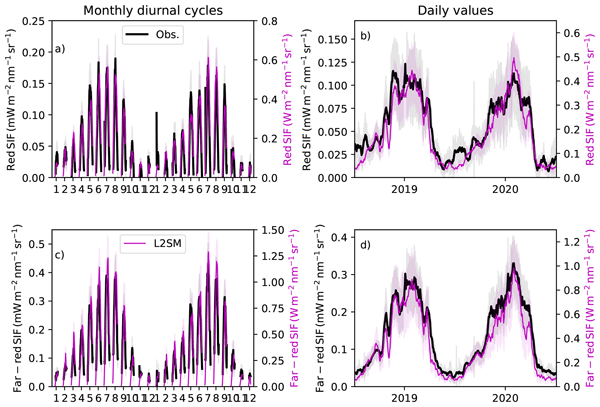
Solar-induced chlorophyll fluorescence (SIF) is an optical signal emitted by plants, connected to the biochemical status of the plants. Therefore it helps to unveil what happens inside plants and since it can be observed with remote sensing, it provides a global view of plant activity. We included SIF module in a terrestrial biosphere model and examined how to best describe movement of the SIF signal in the forest. Our work will help to model SIF in boreal coniferous forests.
Allison R. Moon, Leyang Liu, Xuan Wang, Yuk-Chun Chan, Alyson Fritzmann, Ryan Pound, Amy Lees, Lewis Marden, Mat Evans, Lucy J. Carpenter, Jochen Stutz, Joel A. Thornton, Gordon Novak, Andrew Rollins, Gregory P. Schill, Xu-Cheng He, Henning Finkenzeller, Mago Reza, Rainer Volkamer, Kelvin H. Bates, Alfonso Saiz-Lopez, Anoop S. Mahajan, and Becky Alexander
Atmos. Chem. Phys., 26, 2353–2389, https://doi.org/10.5194/acp-26-2353-2026, https://doi.org/10.5194/acp-26-2353-2026, 2026
Short summary
Short summary
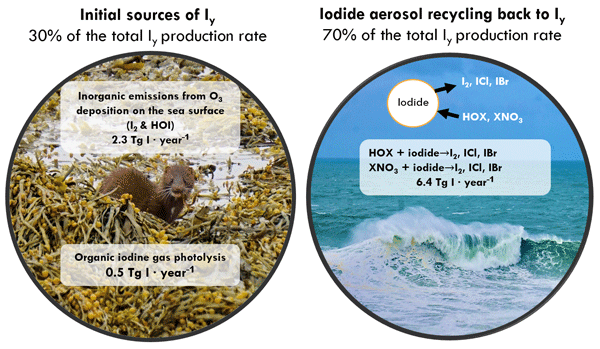
Global chemical transport models previously treated aerosols as a sink for reactive iodine (Iy); however, aerosol iodide is also a source of Iy via heterogeneous reactions involving hypohalous acids and halogen nitrates. We implemented this chemistry into GEOS-Chem, in addition to explicitly representing three aerosol iodine types: soluble organic iodine (SOI), iodide, and iodate. We found that aerosol recycling of iodide to form Iy is more than twice as fast as the other Iy sources combined.
Jan-Lukas Tirpitz, Nathaniel Brockway, Santo Fedele Colosimo, Robert Spurr, Matt Christi, Samuel Hall, Kirk Ullmann, Vijay Natraj, Nicolas Theys, Johnathan Hair, Taylor Shingler, Rodney Weber, Ruchen Zhu, Jack Dibb, Richard Moore, Elizabeth Wiggins, and Jochen Stutz
EGUsphere, https://doi.org/10.5194/egusphere-2025-5541, https://doi.org/10.5194/egusphere-2025-5541, 2026
Short summary
Short summary
This study applies a novel remote sensing algorithm to airborne radiation measurements performed in wildfire plumes, to retrieve the absorptive properties of biomass burning aerosols. The results provide new insights on the magnitude, wavelength dependence, and atmospheric aging of the imaginary refractive index, volume absorption cross-section, and single scattering albedo of the smoke particles. Furthermore, potential and limitations of the applied method are discussed.
Laura M. D. Heinlein, Junwei He, Michael Oluwatoyin Sunday, Fangzhou Guo, James Campbell, Allison Moon, Sukriti Kapur, Ting Fang, Kasey Edwards, Meeta Cesler-Maloney, Alyssa J. Burns, Jack Dibb, William Simpson, Manabu Shiraiwa, Becky Alexander, Jingqiu Mao, James H. Flynn III, Jochen Stutz, and Cort Anastasio
Atmos. Chem. Phys., 25, 9561–9581, https://doi.org/10.5194/acp-25-9561-2025, https://doi.org/10.5194/acp-25-9561-2025, 2025
Short summary
Short summary
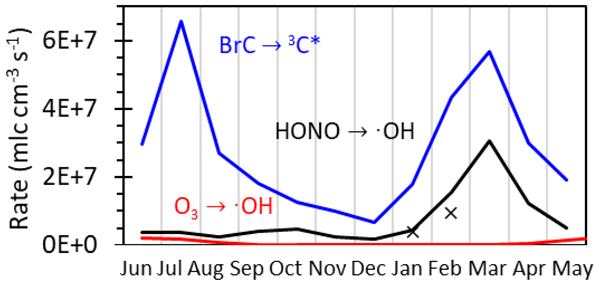
High-latitude cities like Fairbanks, Alaska, experience severe wintertime pollution episodes. While conventional wisdom holds that oxidation is slow under these conditions, field measurements find oxidized products in particles. To explore this, we measured oxidants in aqueous extracts of winter particles from Fairbanks. We find high concentrations of oxidants during illumination experiments, indicating that particle photochemistry can be significant even in high latitudes during winter.
Jan-Lukas Tirpitz, Santo Fedele Colosimo, Nathaniel Brockway, Robert Spurr, Matt Christi, Samuel Hall, Kirk Ullmann, Johnathan Hair, Taylor Shingler, Rodney Weber, Jack Dibb, Richard Moore, Elizabeth Wiggins, Vijay Natraj, Nicolas Theys, and Jochen Stutz
Atmos. Chem. Phys., 25, 1989–2015, https://doi.org/10.5194/acp-25-1989-2025, https://doi.org/10.5194/acp-25-1989-2025, 2025
Short summary
Short summary
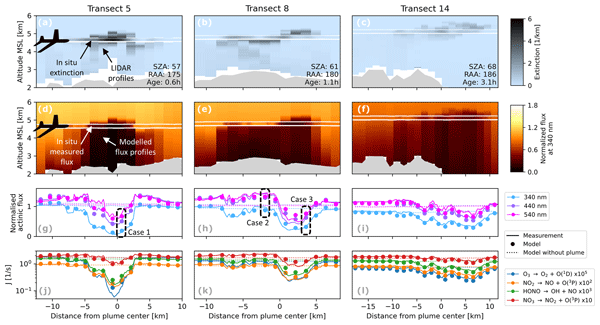
We combine plume composition data from the 2019 NASA FIREX-AQ campaign with state-of-the-art radiative transfer modeling techniques to calculate distributions of actinic flux and photolysis frequencies in a wildfire plume. Excellent agreement of the model and observations demonstrates the applicability of this approach to constrain photochemistry in such plumes. We identify limiting factors for the modeling accuracy and discuss spatial and spectral features of the distributions.
Santo Fedele Colosimo, Nathaniel Brockway, Vijay Natraj, Robert Spurr, Klaus Pfeilsticker, Lisa Scalone, Max Spolaor, Sarah Woods, and Jochen Stutz
Atmos. Meas. Tech., 17, 2367–2385, https://doi.org/10.5194/amt-17-2367-2024, https://doi.org/10.5194/amt-17-2367-2024, 2024
Short summary
Short summary
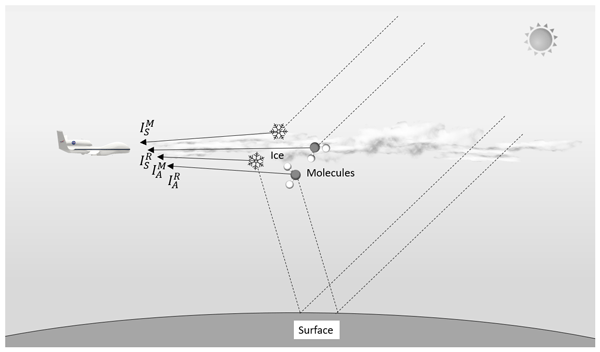
Cirrus clouds are poorly understood components of the climate system, in part due to the challenge of observing thin, sub-visible ice clouds. We address this issue with a new observational approach that uses the remote sensing of near-infrared ice water absorption features from a high-altitude aircraft. We describe the underlying principle of this approach and present a new procedure to retrieve ice concentration in cirrus clouds. Our retrievals compare well with in situ observations.
Meeta Cesler-Maloney, William Simpson, Jonas Kuhn, Jochen Stutz, Jennie Thomas, Tjarda Roberts, Deanna Huff, and Sol Cooperdock
EGUsphere, https://doi.org/10.5194/egusphere-2023-3082, https://doi.org/10.5194/egusphere-2023-3082, 2024
Preprint archived
Short summary
Short summary
We used a one-dimensional model to simulate how pollution in Fairbanks, Alaska, accumulates in shallow layers near the ground when temperature inversions are present. We find pollution accumulates in a 20 m to 50 m thick layer. The model agrees with observations of SO2 pollution using only home heating emissions sources, which shows that ground-based sources dominate sulfur pollution in downtown Fairbanks. Air residence times in downtown are only a few hours, limiting chemical transformations.
Julia Bigwood, Jochen Stutz, Milagros Rodriguez-Caton, Troy Magney, Diego Dierick, Nicholas Parazoo, Gregory R. Goldsmith, Sol Cooperdock, and Ulrike Seibt
EGUsphere, https://doi.org/10.2139/ssrn.6429182, https://doi.org/10.2139/ssrn.6429182, 2026
This preprint is open for discussion and under review for Biogeosciences (BG).
Short summary
Short summary
Tropical forests absorb a large amount of carbon from the atmosphere. Even so, we still have a limited understanding of how this may change with a changing climate. We measured carbon exchange in a Costa Rican rainforest and found that the forest remained a strong carbon sink. However, estimates of carbon uptake depended on how measurements are analyzed and the time period considered, highlighting important challenges for predicting tropical forest responses to climate change.
Tea Thum, Javier Pacheco-Labrador, Mika Aurela, Alan Barr, Marika Honkanen, Bruce Johnson, Hannakaisa Lindqvist, Troy Magney, Mirco Migliavacca, Zoe Amie Pierrat, Tristan Quaife, Jochen Stutz, and Sönke Zaehle
Biogeosciences, 23, 3541–3565, https://doi.org/10.5194/bg-23-3541-2026, https://doi.org/10.5194/bg-23-3541-2026, 2026
Short summary
Short summary
Solar-induced chlorophyll fluorescence (SIF) is an optical signal emitted by plants, connected to the biochemical status of the plants. Therefore it helps to unveil what happens inside plants and since it can be observed with remote sensing, it provides a global view of plant activity. We included SIF module in a terrestrial biosphere model and examined how to best describe movement of the SIF signal in the forest. Our work will help to model SIF in boreal coniferous forests.
James R. Campbell, Brice Temime-Roussel, Barbara D'Anna, Kathy S. Law, Weihang Zhang, Rodney J. Weber, Michael Battaglia Jr., Kayane K. Dingilian, Meeta Cesler-Maloney, Jason M. St. Clair, and Jingqiu Mao
EGUsphere, https://doi.org/10.5194/egusphere-2026-2073, https://doi.org/10.5194/egusphere-2026-2073, 2026
Short summary
Short summary
Fairbanks, Alaska experiences episodes of high concentrations of PM2.5 pollution in the wintertime. The sources and mixing ratios of gas-phase pollution, and the extent to which it affects the formation of PM2.5, are not well understood. Here, we examine the sources of gas-phase species measured in wintertime Fairbanks. We compare these results with other PM2.5 measurements to determine how various sources can affect the formation of PM2.5 pollution.
Maja Rüth, Nicole Bobrowski, Ellen Bräutigam, Alexander Nies, Jonas Kuhn, Thorsten Hoffmann, Niklas Karbach, Bastien Geil, Ralph Kleinschek, Stefan Schmitt, and Ulrich Platt
Atmos. Meas. Tech., 19, 2047–2059, https://doi.org/10.5194/amt-19-2047-2026, https://doi.org/10.5194/amt-19-2047-2026, 2026
Short summary
Short summary
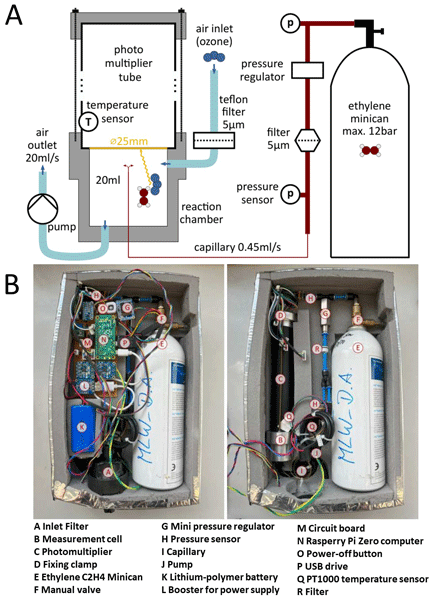
UV absorption and electrochemical O3 sensor measurement techniques suffer from interferences, especially from SO2, which is a main constituent of volcanic plumes. Only chemiluminescence (CL) O3 monitors have no known interference with SO2. However, modern CL O3 monitors are impractical because they are heavy and bulky. We developed and applied a lightweight version of a CL O3 instrument (l.5 kg, shoebox size) and present the result of those drone based CL O3 measurements.
Davis Earley, Elena Lind, James Flynn, Subin Yoon, Sergio Alvarez, and Travis Griggs
EGUsphere, https://doi.org/10.5194/egusphere-2025-5179, https://doi.org/10.5194/egusphere-2025-5179, 2026
Short summary
Short summary
This paper focuses on the relationship between concentrations of trace gases measured at the surface and path averaged concentrations, known as vertical column densities, to produce a column to surface ratio, which is an estimation of the effective height of each trace gas’s vertical profile. In addition, sensitivity studies are performed to analyze the effect of uncertain aerosol information on the estimation of air mass factors through radiative transfer simulations.
Allison R. Moon, Leyang Liu, Xuan Wang, Yuk-Chun Chan, Alyson Fritzmann, Ryan Pound, Amy Lees, Lewis Marden, Mat Evans, Lucy J. Carpenter, Jochen Stutz, Joel A. Thornton, Gordon Novak, Andrew Rollins, Gregory P. Schill, Xu-Cheng He, Henning Finkenzeller, Mago Reza, Rainer Volkamer, Kelvin H. Bates, Alfonso Saiz-Lopez, Anoop S. Mahajan, and Becky Alexander
Atmos. Chem. Phys., 26, 2353–2389, https://doi.org/10.5194/acp-26-2353-2026, https://doi.org/10.5194/acp-26-2353-2026, 2026
Short summary
Short summary
Global chemical transport models previously treated aerosols as a sink for reactive iodine (Iy); however, aerosol iodide is also a source of Iy via heterogeneous reactions involving hypohalous acids and halogen nitrates. We implemented this chemistry into GEOS-Chem, in addition to explicitly representing three aerosol iodine types: soluble organic iodine (SOI), iodide, and iodate. We found that aerosol recycling of iodide to form Iy is more than twice as fast as the other Iy sources combined.
Jan-Lukas Tirpitz, Nathaniel Brockway, Santo Fedele Colosimo, Robert Spurr, Matt Christi, Samuel Hall, Kirk Ullmann, Vijay Natraj, Nicolas Theys, Johnathan Hair, Taylor Shingler, Rodney Weber, Ruchen Zhu, Jack Dibb, Richard Moore, Elizabeth Wiggins, and Jochen Stutz
EGUsphere, https://doi.org/10.5194/egusphere-2025-5541, https://doi.org/10.5194/egusphere-2025-5541, 2026
Short summary
Short summary
This study applies a novel remote sensing algorithm to airborne radiation measurements performed in wildfire plumes, to retrieve the absorptive properties of biomass burning aerosols. The results provide new insights on the magnitude, wavelength dependence, and atmospheric aging of the imaginary refractive index, volume absorption cross-section, and single scattering albedo of the smoke particles. Furthermore, potential and limitations of the applied method are discussed.
Antonio Donateo, Gianluca Pappaccogli, Federico Scoto, Maurizio Busetto, Francesca L. Lovisco, Natalie Brett, Douglas Keller, Brice Barret, Elsa Dieudonné, Roman Pohorsky, Andrea Baccarini, Slimane Bekki, Jean-Christophe Raut, Julia Schmale, Kathy S. Law, Steve R. Arnold, Javier G. Fochesatto, William R. Simpson, and Stefano Decesari
Atmos. Chem. Phys., 25, 18129–18156, https://doi.org/10.5194/acp-25-18129-2025, https://doi.org/10.5194/acp-25-18129-2025, 2025
Short summary
Short summary
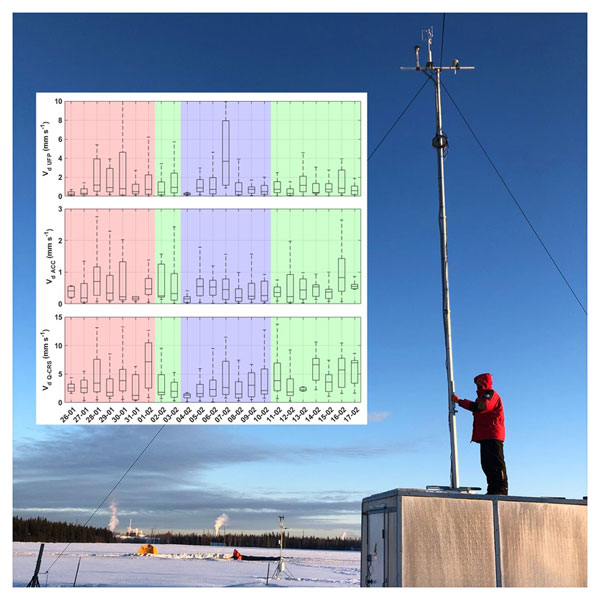
A study in Fairbanks, Alaska, measured winter aerosol fluxes on snow. Both emission and deposition occurred, with larger particles settling faster. Weather influenced dispersion and deposition, while wind-driven turbulence enhanced deposition despite stable conditions. Results show aerosol accumulation in snow impacts pollution and snowmelt. Findings help improve aerosol models and pollution studies in cold cities.
Joshua P. DiGangi, Glenn S. Diskin, Subin Yoon, Sergio L. Alvarez, James H. Flynn, Claire E. Robinson, Michael A. Shook, K. Lee Thornhill, Edward L. Winstead, Luke D. Ziemba, Maria Obiminda L. Cambaliza, James B. Simpas, Miguel Ricardo A. Hilario, and Armin Sorooshian
Atmos. Chem. Phys., 25, 17387–17397, https://doi.org/10.5194/acp-25-17387-2025, https://doi.org/10.5194/acp-25-17387-2025, 2025
Short summary
Short summary
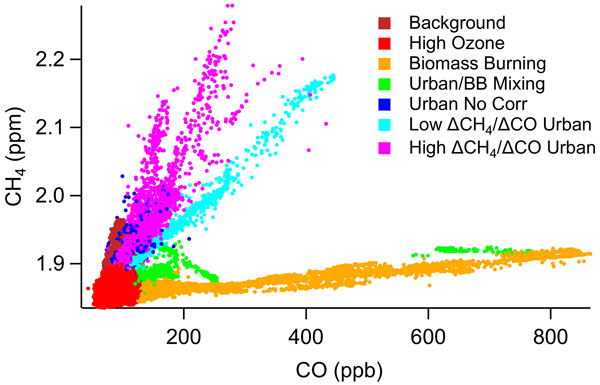
Both fire and urban emissions are major contributors to air pollution in Southeast Asia. Relative increases in measurements of methane and carbon monoxide gases during an aircraft campaign near the Philippines in 2019 were used to isolate pollution emissions from fires vs. urban sources. Results were compared to atmospheric transport models to determine the sources' regional origins, and relationships between pollution indicators relevant to poor air quality were investigated for each source.
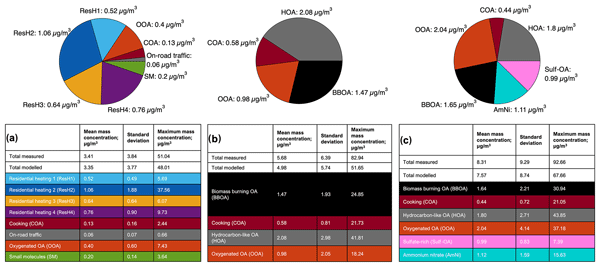
Amna Ijaz, Brice Temime-Roussel, Benjamin Chazeau, Sarah Albertin, Stephen R. Arnold, Brice Barret, Slimane Bekki, Natalie Brett, Meeta Cesler-Maloney, Elsa Dieudonne, Kayane K. Dingilian, Javier G. Fochesatto, Jingqiu Mao, Allison Moon, Joel Savarino, William Simpson, Rodney J. Weber, Kathy S. Law, and Barbara D'Anna
Atmos. Chem. Phys., 25, 11789–11811, https://doi.org/10.5194/acp-25-11789-2025, https://doi.org/10.5194/acp-25-11789-2025, 2025
Short summary
Short summary
Fairbanks is among the most polluted cities, with the highest particulate matter (PM) levels in the US during winters. Highly time-resolved measurements of the submicron PM found residential heating with wood and oil and hydrocarbon-like organics from traffic, as well as sulfur-containing aerosol, to be the key pollution sources. Remarkable differences existed between complementary instruments, warranting the deployment of multiple tools at sites, with wide-ranging influences.
Laura M. D. Heinlein, Junwei He, Michael Oluwatoyin Sunday, Fangzhou Guo, James Campbell, Allison Moon, Sukriti Kapur, Ting Fang, Kasey Edwards, Meeta Cesler-Maloney, Alyssa J. Burns, Jack Dibb, William Simpson, Manabu Shiraiwa, Becky Alexander, Jingqiu Mao, James H. Flynn III, Jochen Stutz, and Cort Anastasio
Atmos. Chem. Phys., 25, 9561–9581, https://doi.org/10.5194/acp-25-9561-2025, https://doi.org/10.5194/acp-25-9561-2025, 2025
Short summary
Short summary
High-latitude cities like Fairbanks, Alaska, experience severe wintertime pollution episodes. While conventional wisdom holds that oxidation is slow under these conditions, field measurements find oxidized products in particles. To explore this, we measured oxidants in aqueous extracts of winter particles from Fairbanks. We find high concentrations of oxidants during illumination experiments, indicating that particle photochemistry can be significant even in high latitudes during winter.
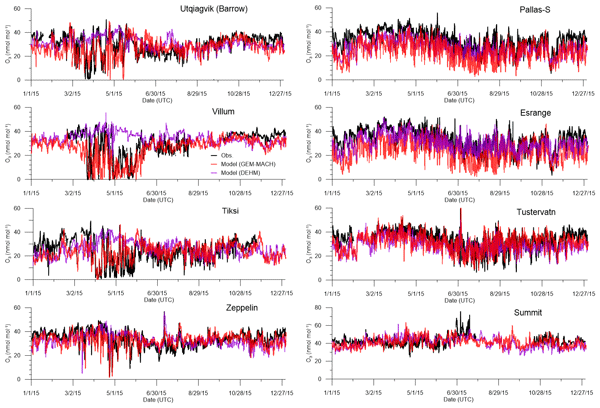
Wanmin Gong, Stephen R. Beagley, Kenjiro Toyota, Henrik Skov, Jesper Heile Christensen, Alex Lupu, Diane Pendlebury, Junhua Zhang, Ulas Im, Yugo Kanaya, Alfonso Saiz-Lopez, Roberto Sommariva, Peter Effertz, John W. Halfacre, Nis Jepsen, Rigel Kivi, Theodore K. Koenig, Katrin Müller, Claus Nordstrøm, Irina Petropavlovskikh, Paul B. Shepson, William R. Simpson, Sverre Solberg, Ralf M. Staebler, David W. Tarasick, Roeland Van Malderen, and Mika Vestenius
Atmos. Chem. Phys., 25, 8355–8405, https://doi.org/10.5194/acp-25-8355-2025, https://doi.org/10.5194/acp-25-8355-2025, 2025
Short summary
Short summary
This study showed that the springtime O3 depletion plays a critical role in driving the surface O3 seasonal cycle in the central Arctic. The O3 depletion events, while occurring most notably within the lowest few hundred metres above the Arctic Ocean, can induce a 5–7 % loss in the pan-Arctic tropospheric O3 burden during springtime. The study also found enhancements in O3 and NOy (mostly peroxyacetyl nitrate) concentrations in the Arctic due to northern boreal wildfires, particularly at higher altitudes.
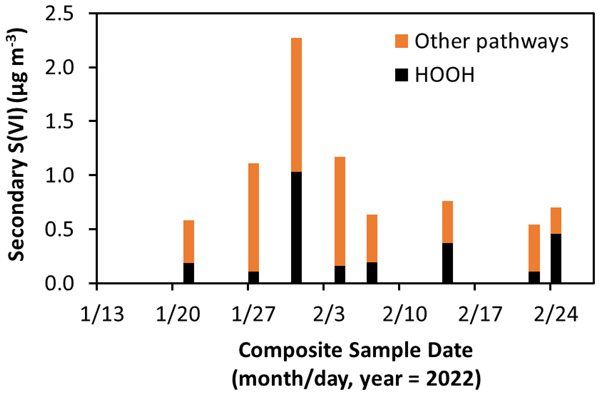
Michael Oluwatoyin Sunday, Laura Marie Dahler Heinlein, Junwei He, Allison Moon, Sukriti Kapur, Ting Fang, Kasey C. Edwards, Fangzhou Guo, Jack Dibb, James H. Flynn III, Becky Alexander, Manabu Shiraiwa, and Cort Anastasio
Atmos. Chem. Phys., 25, 5087–5100, https://doi.org/10.5194/acp-25-5087-2025, https://doi.org/10.5194/acp-25-5087-2025, 2025
Short summary
Short summary
Hydrogen peroxide (HOOH) is an important oxidant that forms atmospheric sulfate. We demonstrate that the illumination of brown carbon can rapidly form HOOH within particles, even under the low-sunlight conditions of Fairbanks, Alaska, during winter. This in-particle formation of HOOH is fast enough that it forms sulfate at significant rates. In contrast, the formation of HOOH in the gas phase during the campaign is expected to be negligible because of high NOx levels.
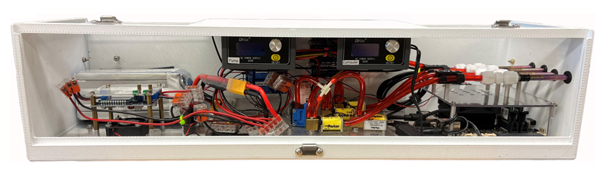
Meghan Guagenti, Darielle Dexheimer, Alexandra Ulinksi, Paul Walter, James H. Flynn III, and Sascha Usenko
Atmos. Meas. Tech., 18, 2125–2136, https://doi.org/10.5194/amt-18-2125-2025, https://doi.org/10.5194/amt-18-2125-2025, 2025
Short summary
Short summary
A robust, automatic volatile organic compound (VOC) collection system was developed for vertical VOC sampling associated with the 2022 DOE ARM-program-led TRACER in Houston, Texas. This modular sampler has been developed to measure vertical profiles of VOCs to improve near-surface characterization. This article helps fill the current lack of commercially available options for aerial VOC sampling and serves to support and encourage researchers to build and develop custom samplers.
Roman Pohorsky, Andrea Baccarini, Natalie Brett, Brice Barret, Slimane Bekki, Gianluca Pappaccogli, Elsa Dieudonné, Brice Temime-Roussel, Barbara D'Anna, Meeta Cesler-Maloney, Antonio Donateo, Stefano Decesari, Kathy S. Law, William R. Simpson, Javier Fochesatto, Steve R. Arnold, and Julia Schmale
Atmos. Chem. Phys., 25, 3687–3715, https://doi.org/10.5194/acp-25-3687-2025, https://doi.org/10.5194/acp-25-3687-2025, 2025
Short summary
Short summary
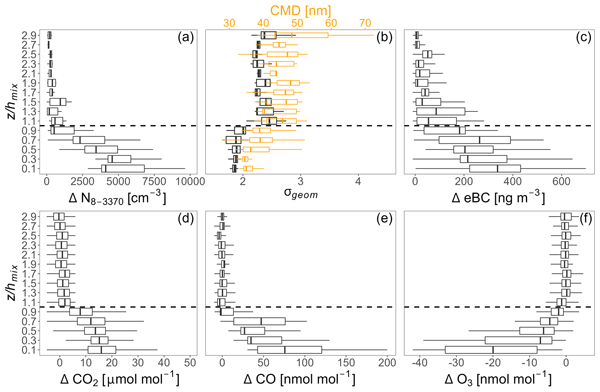
This study presents an analysis of vertical measurements of pollution in an Alaskan city during winter. It investigates the relationship between the atmospheric structure and the layering of aerosols and trace gases. Results indicate an overall very shallow surface mixing layer. The height of this layer is strongly influenced by a local shallow wind. The study also provides information on the pollution chemical composition at different altitudes, including pollution signatures from power plants.
Brice Barret, Patrice Medina, Natalie Brett, Roman Pohorsky, Kathy S. Law, Slimane Bekki, Gilberto J. Fochesatto, Julia Schmale, Steve R. Arnold, Andrea Baccarini, Maurizio Busetto, Meeta Cesler-Maloney, Barbara D'Anna, Stefano Decesari, Jingqiu Mao, Gianluca Pappaccogli, Joel Savarino, Federico Scoto, and William R. Simpson
Atmos. Meas. Tech., 18, 1163–1184, https://doi.org/10.5194/amt-18-1163-2025, https://doi.org/10.5194/amt-18-1163-2025, 2025
Short summary
Short summary
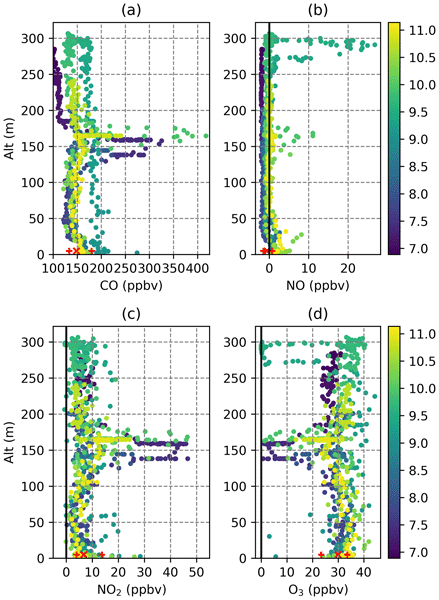
The Fairbanks area experiences severe pollution episodes in winter because of enhanced emissions of pollutants trapped near the surface by strong temperature inversions. Low-cost sensors were deployed on board a car and a tethered balloon to measure the concentrations of gaseous pollutants (CO, O3, and NOx) in Fairbanks during winter 2022. Data calibration with reference measurements and machine learning methods enabled us to document pollution at the surface and power plant plumes aloft.
Jan-Lukas Tirpitz, Santo Fedele Colosimo, Nathaniel Brockway, Robert Spurr, Matt Christi, Samuel Hall, Kirk Ullmann, Johnathan Hair, Taylor Shingler, Rodney Weber, Jack Dibb, Richard Moore, Elizabeth Wiggins, Vijay Natraj, Nicolas Theys, and Jochen Stutz
Atmos. Chem. Phys., 25, 1989–2015, https://doi.org/10.5194/acp-25-1989-2025, https://doi.org/10.5194/acp-25-1989-2025, 2025
Short summary
Short summary
We combine plume composition data from the 2019 NASA FIREX-AQ campaign with state-of-the-art radiative transfer modeling techniques to calculate distributions of actinic flux and photolysis frequencies in a wildfire plume. Excellent agreement of the model and observations demonstrates the applicability of this approach to constrain photochemistry in such plumes. We identify limiting factors for the modeling accuracy and discuss spatial and spectral features of the distributions.
Natalie Brett, Kathy S. Law, Steve R. Arnold, Javier G. Fochesatto, Jean-Christophe Raut, Tatsuo Onishi, Robert Gilliam, Kathleen Fahey, Deanna Huff, George Pouliot, Brice Barret, Elsa Dieudonné, Roman Pohorsky, Julia Schmale, Andrea Baccarini, Slimane Bekki, Gianluca Pappaccogli, Federico Scoto, Stefano Decesari, Antonio Donateo, Meeta Cesler-Maloney, William Simpson, Patrice Medina, Barbara D'Anna, Brice Temime-Roussel, Joel Savarino, Sarah Albertin, Jingqiu Mao, Becky Alexander, Allison Moon, Peter F. DeCarlo, Vanessa Selimovic, Robert Yokelson, and Ellis S. Robinson
Atmos. Chem. Phys., 25, 1063–1104, https://doi.org/10.5194/acp-25-1063-2025, https://doi.org/10.5194/acp-25-1063-2025, 2025
Short summary
Short summary
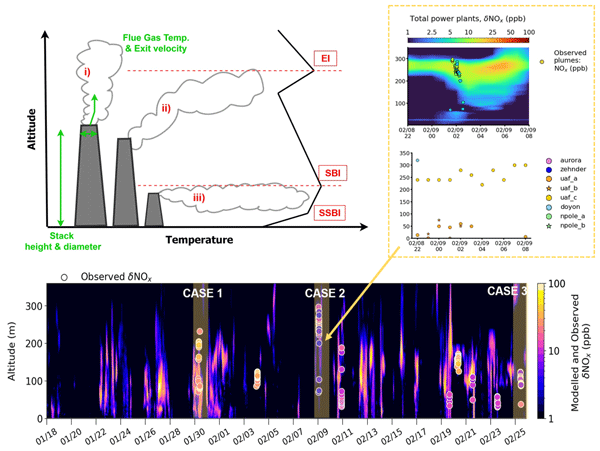
Processes influencing dispersion of local anthropogenic pollution in Arctic wintertime are investigated with Lagrangian dispersion modelling. Simulated power plant plume rise that considers temperature inversion layers improves results compared to observations (interior Alaska). Modelled surface concentrations are improved by representation of vertical mixing and emission estimates. Large increases in diesel vehicle emissions at temperatures reaching −35°C are required to reproduce observed NOx.
Lee Tiszenkel, James H. Flynn, and Shan-Hu Lee
Atmos. Chem. Phys., 24, 11351–11363, https://doi.org/10.5194/acp-24-11351-2024, https://doi.org/10.5194/acp-24-11351-2024, 2024
Short summary
Short summary
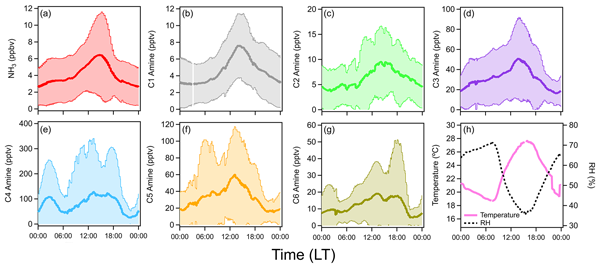
Ammonia and amines are important ingredients for aerosol formation in urban environments, but the measurements of these compounds are extremely challenging. Our observations show that urban ammonia and amines in Houston are emitted from urban sources, and diurnal variations in their concentrations are likely governed by gas-to-particle conversion and emissions.
Akinleye Folorunsho, Jimy Dudhia, John Sullivan, Paul Walter, James Flynn, Travis Griggs, Rebecca Sheesley, Sascha Usenko, Guillaume Gronoff, Mark Estes, and Yang Li
EGUsphere, https://doi.org/10.5194/egusphere-2024-1190, https://doi.org/10.5194/egusphere-2024-1190, 2024
Preprint archived
Short summary
Short summary
Our study investigates the factors driving high ozone levels over the Houston urban area. Using advanced modeling techniques and real-world measurements, we found vehicle and industrial emissions especially of highly reactive organic compounds play a key role in ozone formation. Our study highlights spatial and temporal changes in ozone sensitivity and variability of atmosphere's self-cleaning capacity to emissions, signifying effective ways of controlling emissions to mitigate urban ozone.

Heesung Chong, Gonzalo González Abad, Caroline R. Nowlan, Christopher Chan Miller, Alfonso Saiz-Lopez, Rafael P. Fernandez, Hyeong-Ahn Kwon, Zolal Ayazpour, Huiqun Wang, Amir H. Souri, Xiong Liu, Kelly Chance, Ewan O'Sullivan, Jhoon Kim, Ja-Ho Koo, William R. Simpson, François Hendrick, Richard Querel, Glen Jaross, Colin Seftor, and Raid M. Suleiman
Atmos. Meas. Tech., 17, 2873–2916, https://doi.org/10.5194/amt-17-2873-2024, https://doi.org/10.5194/amt-17-2873-2024, 2024
Short summary
Short summary
We present a new bromine monoxide (BrO) product derived using radiances measured from OMPS-NM on board the Suomi-NPP satellite. This product provides nearly a decade of global stratospheric and tropospheric column retrievals, a feature that is currently rare in publicly accessible datasets. Both stratospheric and tropospheric columns from OMPS-NM demonstrate robust performance, exhibiting good agreement with ground-based observations collected at three stations (Lauder, Utqiagvik, and Harestua).
Santo Fedele Colosimo, Nathaniel Brockway, Vijay Natraj, Robert Spurr, Klaus Pfeilsticker, Lisa Scalone, Max Spolaor, Sarah Woods, and Jochen Stutz
Atmos. Meas. Tech., 17, 2367–2385, https://doi.org/10.5194/amt-17-2367-2024, https://doi.org/10.5194/amt-17-2367-2024, 2024
Short summary
Short summary
Cirrus clouds are poorly understood components of the climate system, in part due to the challenge of observing thin, sub-visible ice clouds. We address this issue with a new observational approach that uses the remote sensing of near-infrared ice water absorption features from a high-altitude aircraft. We describe the underlying principle of this approach and present a new procedure to retrieve ice concentration in cirrus clouds. Our retrievals compare well with in situ observations.
Meeta Cesler-Maloney, William Simpson, Jonas Kuhn, Jochen Stutz, Jennie Thomas, Tjarda Roberts, Deanna Huff, and Sol Cooperdock
EGUsphere, https://doi.org/10.5194/egusphere-2023-3082, https://doi.org/10.5194/egusphere-2023-3082, 2024
Preprint archived
Short summary
Short summary
We used a one-dimensional model to simulate how pollution in Fairbanks, Alaska, accumulates in shallow layers near the ground when temperature inversions are present. We find pollution accumulates in a 20 m to 50 m thick layer. The model agrees with observations of SO2 pollution using only home heating emissions sources, which shows that ground-based sources dominate sulfur pollution in downtown Fairbanks. Air residence times in downtown are only a few hours, limiting chemical transformations.
Nathaniel Brockway, Peter K. Peterson, Katja Bigge, Kristian D. Hajny, Paul B. Shepson, Kerri A. Pratt, Jose D. Fuentes, Tim Starn, Robert Kaeser, Brian H. Stirm, and William R. Simpson
Atmos. Chem. Phys., 24, 23–40, https://doi.org/10.5194/acp-24-23-2024, https://doi.org/10.5194/acp-24-23-2024, 2024
Short summary
Short summary
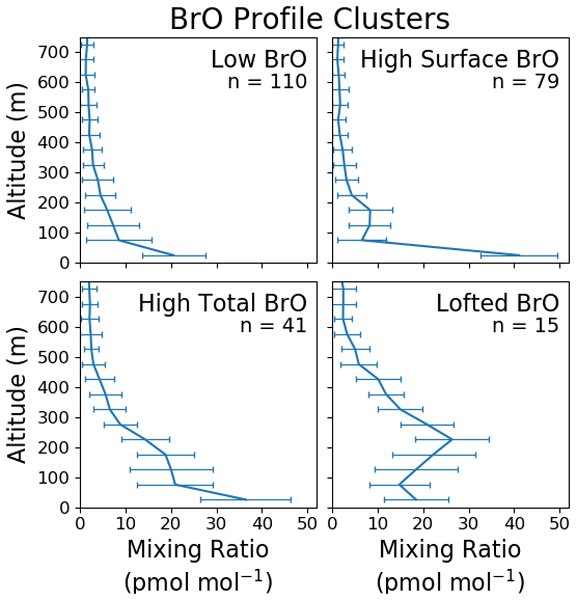
Bromine monoxide (BrO) strongly affects atmospheric chemistry in the springtime Arctic, yet there are still many uncertainties around its sources and recycling, particularly in the context of a rapidly changing Arctic. In this study, we observed BrO as a function of altitude above the Alaskan Arctic. We found that BrO was often most concentrated near the ground, confirming the ability of snow to produce and recycle reactive bromine, and identified four common vertical distributions of BrO.
Tobias D. Schmitt, Jonas Kuhn, Ralph Kleinschek, Benedikt A. Löw, Stefan Schmitt, William Cranton, Martina Schmidt, Sanam N. Vardag, Frank Hase, David W. T. Griffith, and André Butz
Atmos. Meas. Tech., 16, 6097–6110, https://doi.org/10.5194/amt-16-6097-2023, https://doi.org/10.5194/amt-16-6097-2023, 2023
Short summary
Short summary
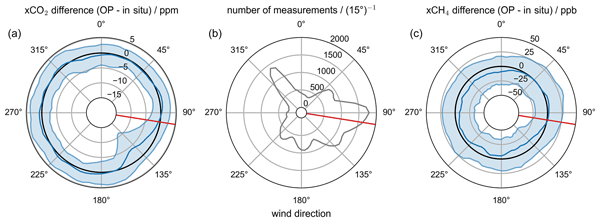
Our new observatory measures greenhouse gas concentrations of carbon dioxide (CO2) and methane (CH4) along a 1.55 km long light path over the city of Heidelberg, Germany. We compared our measurements with measurements that were taken at a single point at one end of our path. The two mostly agreed but show a significant difference for CO2 with certain wind directions. This is important when using greenhouse gas concentration measurements to observe greenhouse gas emissions of cities.
Wei Li, Yuxuan Wang, Xueying Liu, Ehsan Soleimanian, Travis Griggs, James Flynn, and Paul Walter
Atmos. Chem. Phys., 23, 13685–13699, https://doi.org/10.5194/acp-23-13685-2023, https://doi.org/10.5194/acp-23-13685-2023, 2023
Short summary
Short summary
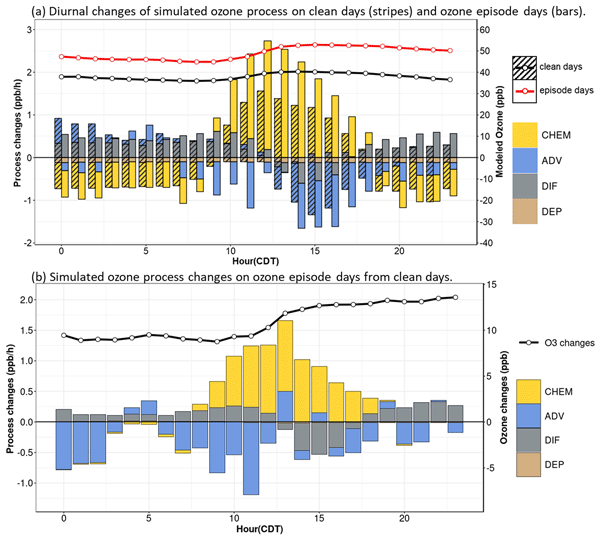
This study examined high offshore ozone events in Galveston Bay and the Gulf of Mexico, using boat data and WRF–CAMx modeling during the TRACER-AQ 2021 field campaign. On average, high ozone is caused by chemistry due to the regional transport of volatile organic compounds and downwind advection of NOx from the ship channel. Two case studies show advection of ozone can be another process leading to high ozone, and accurate wind prediction is crucial for air quality forecasting in coastal areas.
Sujan Shrestha, Shan Zhou, Manisha Mehra, Meghan Guagenti, Subin Yoon, Sergio L. Alvarez, Fangzhou Guo, Chun-Ying Chao, James H. Flynn III, Yuxuan Wang, Robert J. Griffin, Sascha Usenko, and Rebecca J. Sheesley
Atmos. Chem. Phys., 23, 10845–10867, https://doi.org/10.5194/acp-23-10845-2023, https://doi.org/10.5194/acp-23-10845-2023, 2023
Short summary
Short summary
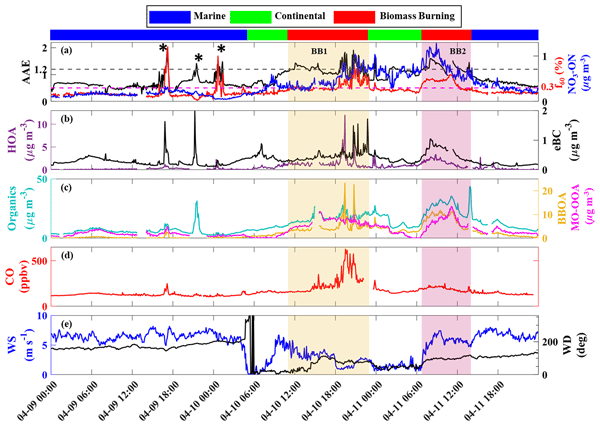
We evaluated different methods for assessing the influence of long-range transport of biomass burning (BB) plumes at a coastal site in Texas, USA. We show that the aerosol composition and optical properties exhibited good agreement, while CO and acetonitrile trends were less specific for assessing BB source influence. Our results demonstrate that the network of aerosol optical measurements can be useful for identifying the influence of aged BB plumes in anthropogenically influenced areas.
Xueying Liu, Yuxuan Wang, Shailaja Wasti, Wei Li, Ehsan Soleimanian, James Flynn, Travis Griggs, Sergio Alvarez, John T. Sullivan, Maurice Roots, Laurence Twigg, Guillaume Gronoff, Timothy Berkoff, Paul Walter, Mark Estes, Johnathan W. Hair, Taylor Shingler, Amy Jo Scarino, Marta Fenn, and Laura Judd
Geosci. Model Dev., 16, 5493–5514, https://doi.org/10.5194/gmd-16-5493-2023, https://doi.org/10.5194/gmd-16-5493-2023, 2023
Short summary
Short summary
With a comprehensive suite of ground-based and airborne remote sensing measurements during the 2021 TRacking Aerosol Convection ExpeRiment – Air Quality (TRACER-AQ) campaign in Houston, this study evaluates the simulation of the planetary boundary layer (PBL) height and the ozone vertical profile by a high-resolution (1.33 km) 3-D photochemical model Weather Research and Forecasting-driven GEOS-Chem (WRF-GC).
Brandon Bottorff, Michelle M. Lew, Youngjun Woo, Pamela Rickly, Matthew D. Rollings, Benjamin Deming, Daniel C. Anderson, Ezra Wood, Hariprasad D. Alwe, Dylan B. Millet, Andrew Weinheimer, Geoff Tyndall, John Ortega, Sebastien Dusanter, Thierry Leonardis, James Flynn, Matt Erickson, Sergio Alvarez, Jean C. Rivera-Rios, Joshua D. Shutter, Frank Keutsch, Detlev Helmig, Wei Wang, Hannah M. Allen, Johnathan H. Slade, Paul B. Shepson, Steven Bertman, and Philip S. Stevens
Atmos. Chem. Phys., 23, 10287–10311, https://doi.org/10.5194/acp-23-10287-2023, https://doi.org/10.5194/acp-23-10287-2023, 2023
Short summary
Short summary
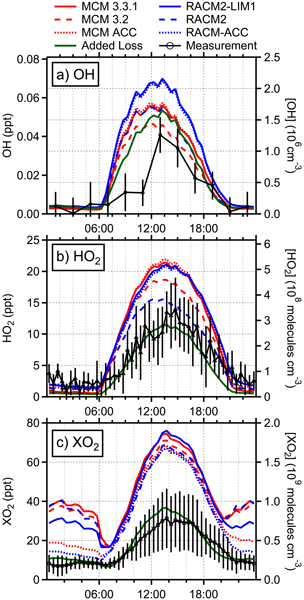
The hydroxyl (OH), hydroperoxy (HO2), and organic peroxy (RO2) radicals play important roles in atmospheric chemistry and have significant air quality implications. Here, we compare measurements of OH, HO2, and total peroxy radicals (XO2) made in a remote forest in Michigan, USA, to predictions from a series of chemical models. Lower measured radical concentrations suggest that the models may be missing an important radical sink and overestimating the rate of ozone production in this forest.
Stefano Potter, Sol Cooperdock, Sander Veraverbeke, Xanthe Walker, Michelle C. Mack, Scott J. Goetz, Jennifer Baltzer, Laura Bourgeau-Chavez, Arden Burrell, Catherine Dieleman, Nancy French, Stijn Hantson, Elizabeth E. Hoy, Liza Jenkins, Jill F. Johnstone, Evan S. Kane, Susan M. Natali, James T. Randerson, Merritt R. Turetsky, Ellen Whitman, Elizabeth Wiggins, and Brendan M. Rogers
Biogeosciences, 20, 2785–2804, https://doi.org/10.5194/bg-20-2785-2023, https://doi.org/10.5194/bg-20-2785-2023, 2023
Short summary
Short summary
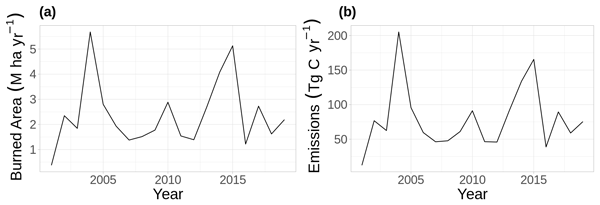
Here we developed a new burned-area detection algorithm between 2001–2019 across Alaska and Canada at 500 m resolution. We estimate 2.37 Mha burned annually between 2001–2019 over the domain, emitting 79.3 Tg C per year, with a mean combustion rate of 3.13 kg C m−2. We found larger-fire years were generally associated with greater mean combustion. The burned-area and combustion datasets described here can be used for local- to continental-scale applications of boreal fire science.
William F. Swanson, Chris D. Holmes, William R. Simpson, Kaitlyn Confer, Louis Marelle, Jennie L. Thomas, Lyatt Jaeglé, Becky Alexander, Shuting Zhai, Qianjie Chen, Xuan Wang, and Tomás Sherwen
Atmos. Chem. Phys., 22, 14467–14488, https://doi.org/10.5194/acp-22-14467-2022, https://doi.org/10.5194/acp-22-14467-2022, 2022
Short summary
Short summary
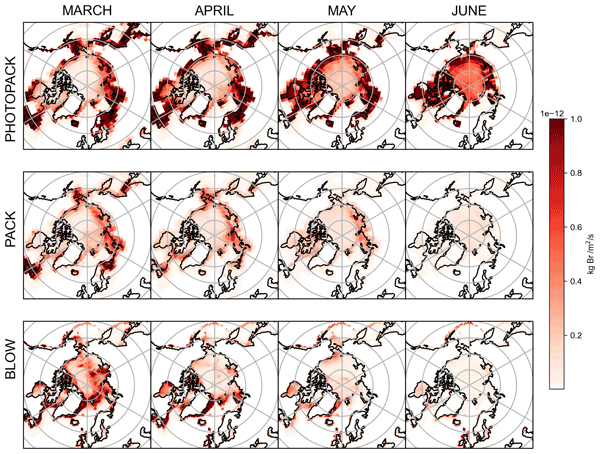
Radical bromine molecules are seen at higher concentrations during the Arctic spring. We use the global model GEOS-Chem to test whether snowpack and wind-blown snow sources can explain high bromine concentrations. We run this model for the entire year of 2015 and compare results to observations of bromine from floating platforms on the Arctic Ocean and at Utqiaġvik. We find that the model performs best when both sources are enabled but may overestimate bromine production in summer and fall.
Subin Yoon, Alexander Kotsakis, Sergio L. Alvarez, Mark G. Spychala, Elizabeth Klovenski, Paul Walter, Gary Morris, Ernesto Corrales, Alfredo Alan, Jorge A. Diaz, and James H. Flynn
Atmos. Meas. Tech., 15, 4373–4384, https://doi.org/10.5194/amt-15-4373-2022, https://doi.org/10.5194/amt-15-4373-2022, 2022
Short summary
Short summary
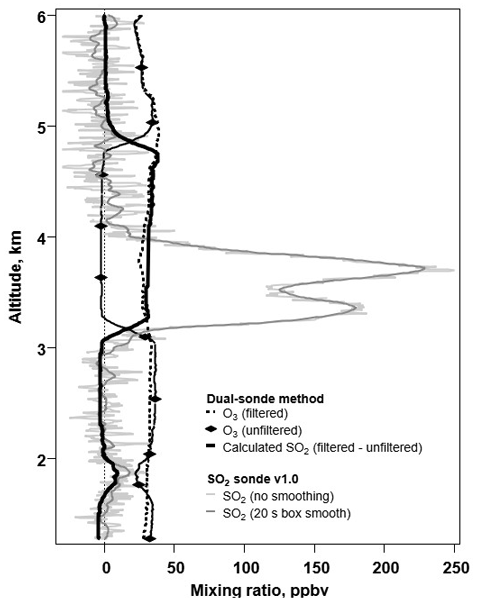
SO2 is adverse to human health and the environment. A single SO2 sonde was developed to provide direct SO2 measurement with a greater vertical extent, a lower limit of detection, and less uncertainty relative to the previous dual-sonde method. The single sonde was tested in the field near volcanoes and anthropogenic sources where the sonde measured SO2 ranging from 0.5 to 940 ppb. This lighter-weight payload can be a great candidate to attach to small drones and unmanned aerial vehicles.
Tianlang Zhao, Jingqiu Mao, William R. Simpson, Isabelle De Smedt, Lei Zhu, Thomas F. Hanisco, Glenn M. Wolfe, Jason M. St. Clair, Gonzalo González Abad, Caroline R. Nowlan, Barbara Barletta, Simone Meinardi, Donald R. Blake, Eric C. Apel, and Rebecca S. Hornbrook
Atmos. Chem. Phys., 22, 7163–7178, https://doi.org/10.5194/acp-22-7163-2022, https://doi.org/10.5194/acp-22-7163-2022, 2022
Short summary
Short summary
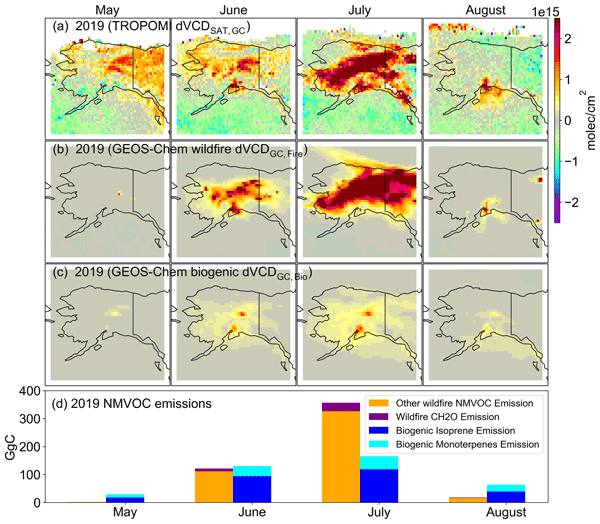
Monitoring formaldehyde (HCHO) can help us understand Arctic vegetation change. Here, we compare satellite data and model and show that Alaska summertime HCHO is largely dominated by a background from methane oxidation during mild wildfire years and is dominated by wildfire (largely from direct emission of fire) during strong fire years. Consequently, it is challenging to use satellite HCHO to study vegetation change in the Arctic region.
Carlos Alberti, Frank Hase, Matthias Frey, Darko Dubravica, Thomas Blumenstock, Angelika Dehn, Paolo Castracane, Gregor Surawicz, Roland Harig, Bianca C. Baier, Caroline Bès, Jianrong Bi, Hartmut Boesch, André Butz, Zhaonan Cai, Jia Chen, Sean M. Crowell, Nicholas M. Deutscher, Dragos Ene, Jonathan E. Franklin, Omaira García, David Griffith, Bruno Grouiez, Michel Grutter, Abdelhamid Hamdouni, Sander Houweling, Neil Humpage, Nicole Jacobs, Sujong Jeong, Lilian Joly, Nicholas B. Jones, Denis Jouglet, Rigel Kivi, Ralph Kleinschek, Morgan Lopez, Diogo J. Medeiros, Isamu Morino, Nasrin Mostafavipak, Astrid Müller, Hirofumi Ohyama, Paul I. Palmer, Mahesh Pathakoti, David F. Pollard, Uwe Raffalski, Michel Ramonet, Robbie Ramsay, Mahesh Kumar Sha, Kei Shiomi, William Simpson, Wolfgang Stremme, Youwen Sun, Hiroshi Tanimoto, Yao Té, Gizaw Mengistu Tsidu, Voltaire A. Velazco, Felix Vogel, Masataka Watanabe, Chong Wei, Debra Wunch, Marcia Yamasoe, Lu Zhang, and Johannes Orphal
Atmos. Meas. Tech., 15, 2433–2463, https://doi.org/10.5194/amt-15-2433-2022, https://doi.org/10.5194/amt-15-2433-2022, 2022
Short summary
Short summary
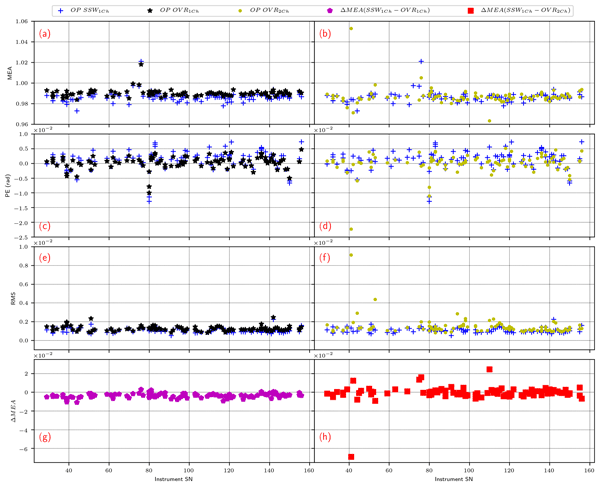
Space-borne greenhouse gas missions require ground-based validation networks capable of providing fiducial reference measurements. Here, considerable refinements of the calibration procedures for the COllaborative Carbon Column Observing Network (COCCON) are presented. Laboratory and solar side-by-side procedures for the characterization of the spectrometers have been refined and extended. Revised calibration factors for XCO2, XCO and XCH4 are provided, incorporating 47 new spectrometers.
Leon Kuhn, Jonas Kuhn, Thomas Wagner, and Ulrich Platt
Atmos. Meas. Tech., 15, 1395–1414, https://doi.org/10.5194/amt-15-1395-2022, https://doi.org/10.5194/amt-15-1395-2022, 2022
Short summary
Short summary
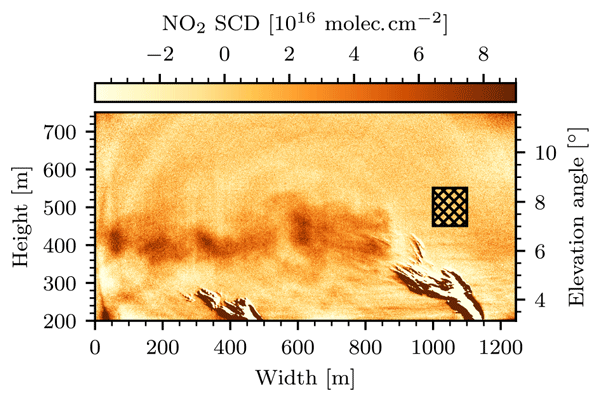
We present a novel instrument for imaging measurements of NO2 with high spatiotemporal resolution based on gas correlation spectroscopy, called the GCS NO2 camera. The instrument works by placing two gas cells (cuvettes) in front of two photosensor arrays, one filled with air and one filled with a high concentration of NO2, acting as a non-dispersive spectral filter. NO2 images are then generated on the basis of the signal ratio of the two channels in the spectral region of 430–445 nm.
Jonas Kuhn, Nicole Bobrowski, Thomas Wagner, and Ulrich Platt
Atmos. Meas. Tech., 14, 7873–7892, https://doi.org/10.5194/amt-14-7873-2021, https://doi.org/10.5194/amt-14-7873-2021, 2021
Short summary
Short summary
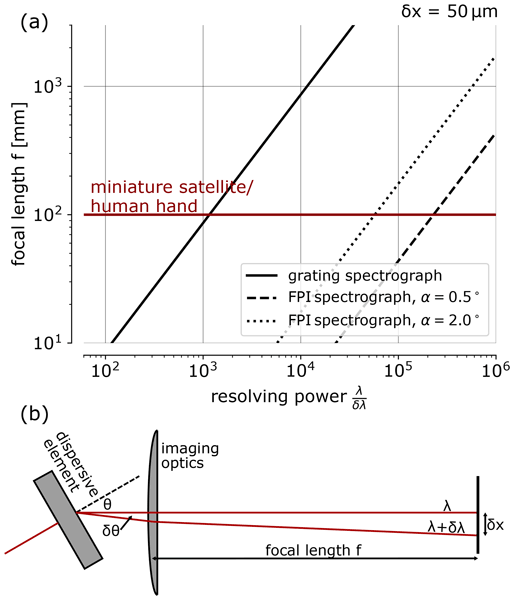
We propose spectrograph implementations using Fabry–Pérot interferometers for atmospheric trace gas remote sensing. Compared with widely used grating spectrographs, we find substantial light throughput and mobility advantages for high resolving powers. Besides lowering detection limits and increasing the spatial and temporal resolution of many atmospheric trace gas measurements, this approach might enable remote sensing of further important gases such as tropospheric OH radicals.
Alexander A. T. Bui, Henry W. Wallace, Sarah Kavassalis, Hariprasad D. Alwe, James H. Flynn, Matt H. Erickson, Sergio Alvarez, Dylan B. Millet, Allison L. Steiner, and Robert J. Griffin
Atmos. Chem. Phys., 21, 17031–17050, https://doi.org/10.5194/acp-21-17031-2021, https://doi.org/10.5194/acp-21-17031-2021, 2021
Short summary
Short summary
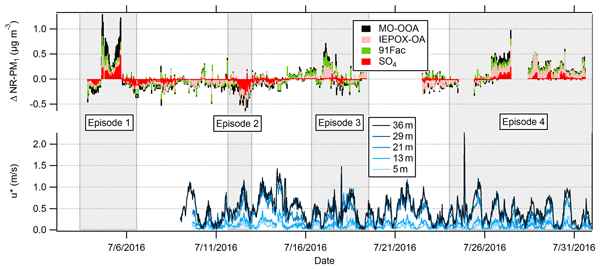
Differences in atmospheric species above and below a forest canopy provide insight into the relative importance of local mixing, long-range transport, and chemical processes in determining vertical gradients in atmospheric particles in a forested environment. This helps in understanding the flux of climate-relevant material out of the forest to the atmosphere. We studied this in a remote forest using vertically resolved measurements of gases and particles.
Nicole Jacobs, William R. Simpson, Kelly A. Graham, Christopher Holmes, Frank Hase, Thomas Blumenstock, Qiansi Tu, Matthias Frey, Manvendra K. Dubey, Harrison A. Parker, Debra Wunch, Rigel Kivi, Pauli Heikkinen, Justus Notholt, Christof Petri, and Thorsten Warneke
Atmos. Chem. Phys., 21, 16661–16687, https://doi.org/10.5194/acp-21-16661-2021, https://doi.org/10.5194/acp-21-16661-2021, 2021
Short summary
Short summary
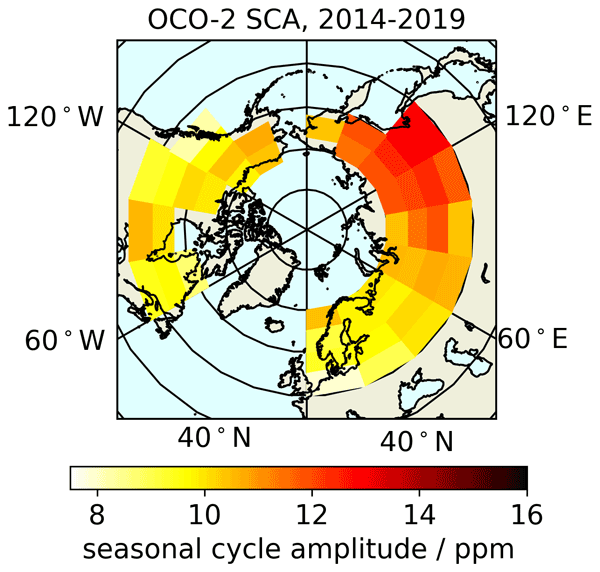
Spatial patterns of carbon dioxide seasonal cycle amplitude and summer drawdown timing derived from the OCO-2 satellite over northern high latitudes agree well with corresponding estimates from two models. The Asian boreal forest is anomalous with the largest amplitude and earliest seasonal drawdown. Modeled land contact tracers suggest that accumulated CO2 exchanges during atmospheric transport play a major role in shaping carbon dioxide seasonality in northern high-latitude regions.
Ulrich Platt, Thomas Wagner, Jonas Kuhn, and Thomas Leisner
Atmos. Meas. Tech., 14, 6867–6883, https://doi.org/10.5194/amt-14-6867-2021, https://doi.org/10.5194/amt-14-6867-2021, 2021
Short summary
Short summary
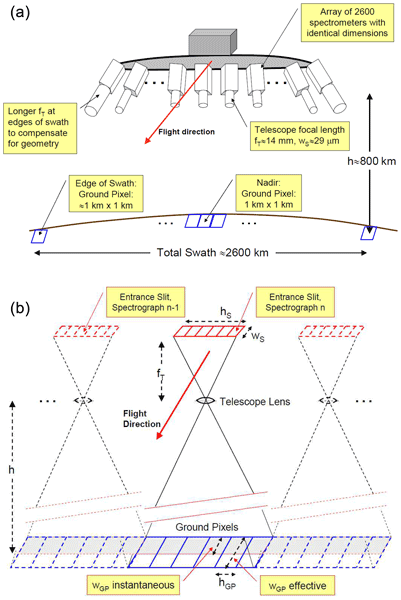
Absorption spectroscopy of scattered sunlight is extremely useful for the analysis of atmospheric trace gas distributions. A central parameter for the achievable sensitivity of spectroscopic instruments is the light throughput, which can be enhanced in a number of ways. We present new ideas and considerations of how instruments could be optimized. Particular emphasis is on arrays of massively parallel instruments. Such arrays can reduce the size and weight of instruments by orders of magnitude.
Cited articles
Adler, B., Wilczak, J. M., Kenyon, J., Bianco, L., Djalalova, I. V., Olson, J. B., and Turner, D. D.: Evaluation of a cloudy cold-air pool in the Columbia River basin in different versions of the High-Resolution Rapid Refresh (HRRR) model, Geosci. Model Dev., 16, 597–619, https://doi.org/10.5194/gmd-16-597-2023, 2023. a
Ahmed, S., Thomas, J. L., Tuite, K., Stutz, J., Flocke, F., Orlando, J. J., Hornbrook, R. S., Apel, E. C., Emmons, L. K., Helmig, D., Boylan, P., Huey, L. G., Hall, S. R., Ullmann, K., Cantrell, C. A., and Fried, A.: The role of snow in controlling halogen chemistry and boundary layer oxidation during Arctic spring: A 1D modeling case study, J. Geophys. Res.-Atmos., 127, https://doi.org/10.1029/2021JD036140, 2022. a, b
Albertin, S., Bekki, S., Savarino, J., Brett, N., Law, K. S., Cesler-Maloney, M., Flynn, J. H., Guo, F., Barret, B., Caillon, N., D’Anna, B., Dieudonné, E., Lamothe, A., Richard, S., Temime-Roussel, B., Alexander, B., Arnold, S. R., Decesari, S., Fochesatto, G. J., Mao, J., and Simpson, W.: Unraveling urban NOx emission sources in polluted arctic wintertime using NO2 nitrogen isotopes, J. Geophys. Res.-Atmos., 129, e2024JD041842, https://doi.org/10.1029/2024JD041842, 2024. a
Anderson, P. S. and Neff, W. D.: Boundary layer physics over snow and ice, Atmos. Chem. Phys., 8, 3563–3582, https://doi.org/10.5194/acp-8-3563-2008, 2008. a, b, c
Baasandorj, M., Hoch, S. W., Bares, R., Lin, J. C., Brown, S. S., Millet, D. B., Martin, R., Kelly, K., Zarzana, K. J., Whiteman, C. D., Dube, W. P., Tonnesen, G., Jaramillo, I. C., and Sohl, J.: Coupling between chemical and meteorological processes under persistent cold-air pool conditions: Evolution of wintertime PM2.5 pollution events and N2O5 observations in Utah's Salt Lake Valley, Environ. Sci. Technol., 51, 5941–5950, https://doi.org/10.1021/acs.est.6b06603, 2017. a
Baker, K. R., Simon, H., and Kelly, J. T.: Challenges to modeling “cold pool” meteorology associated with high pollution episodes, Environ. Sci. Technol., 45, 7118–7119, https://doi.org/10.1021/es202705v, 2011. a
Beard, J. D., Beck, C., Graham, R., Packham, S. C., Traphagan, M., Giles, R. T., and Morgan, J. G.: Winter temperature inversions and emergency department visits for asthma in Salt Lake County, Utah, 2003–2008, Environ. Health Persp., 120, 1385–1390, https://doi.org/10.1289/ehp.1104349, 2012. a
Beare, R. J., Macvean, M. K., Holtslag, A. A. M., Cuxart, J., Esau, I., Golaz, J.-C., Jimenez, M. A., Khairoutdinov, M., Kosovic, B., Lewellen, D., Lund, T. S., Lundquist, J. K., Mccabe, A., Moene, A. F., Noh, Y., Raasch, S., and Sullivan, P.: An intercomparison of large-eddy simulations of the stable boundary layer, Bound.-Lay. Meteorol., 118, 247–272, https://doi.org/10.1007/s10546-004-2820-6, 2006. a
Bell, M. L. and Davis, D. L.: Reassessment of the lethal London Fog of 1952: Novel indicators of acute and chronic consequences of acute exposure to air pollution, Environ. Health Persp., 109, 389–394, https://doi.org/10.2307/3434786, 2001. a
Bowling, S. A., Ohtake, T., and Benson, C. S.: Winter pressure systems and ice fog in Fairbanks, Alaska, J. Appl. Meteorol. Clim., 7, 961–968, https://doi.org/10.1175/1520-0450(1968)007<0961:WPSAIF>2.0.CO;2, 1968. a
Brett, N., Law, K. S., Arnold, S. R., Fochesatto, J. G., Raut, J.-C., Onishi, T., Gilliam, R., Fahey, K., Huff, D., Pouliot, G., Barret, B., Dieudonné, E., Pohorsky, R., Schmale, J., Baccarini, A., Bekki, S., Pappaccogli, G., Scoto, F., Decesari, S., Donateo, A., Cesler-Maloney, M., Simpson, W., Medina, P., D'Anna, B., Temime-Roussel, B., Savarino, J., Albertin, S., Mao, J., Alexander, B., Moon, A., DeCarlo, P. F., Selimovic, V., Yokelson, R., and Robinson, E. S.: Investigating processes influencing simulation of local Arctic wintertime anthropogenic pollution in Fairbanks, Alaska, during ALPACA-2022, Atmos. Chem. Phys., 25, 1063–1104, https://doi.org/10.5194/acp-25-1063-2025, 2025. a, b, c
Brown, S. S. and Stutz, J.: Nighttime radical observations and chemistry, Chem. Soc. Rev., 41, 6405–6447, https://doi.org/10.1039/c2cs35181a, 2012. a
Brown, S. S., Dubé, W. P., Osthoff, H. D., Wolfe, D. E., Angevine, W. M., and Ravishankara, A. R.: High resolution vertical distributions of NO3 and N2O5 through the nocturnal boundary layer, Atmos. Chem. Phys., 7, 139–149, https://doi.org/10.5194/acp-7-139-2007, 2007a. a
Brown, S. S., Dubé, W. P., Osthoff, H. D., Stutz, J., Ryerson, T. B., Wollny, A. G., Brock, C. A., Warneke, C., de Gouw, J. A., Atlas, E., Neuman, J. A., Holloway, J. S., Lerner, B. M., Williams, E. J., Kuster, W. C., Goldan, P. D., Angevine, W. M., Trainer, M., Fehsenfeld, F. C., and Ravishankara, A. R.: Vertical profiles in NO3 and N2O5 measured from an aircraft: Results from the NOAA P-3 and surface platforms during the New England Air Quality Study 2004, J. Geophys. Res., 112, 1–17, https://doi.org/10.1029/2007JD008883, 2007b. a
Campbell, J. R., Battaglia Jr., M., Dingilian, K. K., Cesler-Maloney, M., Simpson, W. R., Robinson, E. S., DeCarlo, P. F., Temime-Roussel, B., D’Anna, B., Holen, A. L., Wu, J., Pratt, K. A., Dibb, J. E., Nenes, A., Weber, R. J., and Mao, J.: Enhanced aqueous formation and neutralization of fine atmospheric particles driven by extreme cold, Science Advances, 10, eado4373, https://doi.org/10.1126/sciadv.ado4373, 2024. a, b
Cao, L., Platt, U., and Gutheil, E.: Role of the boundary layer in the occurrence and termination of the tropospheric ozone depletion events in polar spring, Atmos. Environ., 132, 98–110, https://doi.org/10.1016/j.atmosenv.2016.02.034, 2016. a
Cesler-Maloney, M., Simpson, W. R., Miles, T., Mao, J., Law, K. S., and Roberts, T. J.: Differences in ozone and particulate matter between ground level and 20 m aloft are frequent during wintertime surface-based temperature inversions in Fairbanks, Alaska, J. Geophys. Res.-Atmos., 127, e2021JD036215, https://doi.org/10.1029/2021JD036215, 2022. a, b, c, d, e
Chen, C., Tsuang, B., Tu, C., Cheng, W., and Lin, M.: Wintertime vertical profiles of air pollutants over a suburban area in central Taiwan, Atmos. Environ., 36, 2049–2059, https://doi.org/10.1016/S1352-2310(02)00086-9, 2002. a
Cheng, Y., Zheng, G., Wei, C., Mu, Q., Zheng, B., Wang, Z., Gao, M., Zhang, Q., He, K., Carmichael, G., Pöschl, U., and Su, H.: Reactive nitrogen chemistry in aerosol water as a source of sulfate during haze events in China, Science Advances, 2, e1601530, https://doi.org/10.1126/sciadv.1601530, 2016. a, b
Dingilian, K., Hebert, E., Battaglia Jr., M., Campbell, J. R., Cesler-Maloney, M., Simpson, W., St. Clair, J. M., Dibb, J., Temime-Roussel, B., D’Anna, B., Moon, A., Alexander, B., Yang, Y., Nenes, A., Mao, J., and Weber, R. J.: Hydroxymethanesulfonate and sulfur(IV) in Fairbanks winter during the ALPACA study, ACS ES&T Air, 1, 646–659, https://doi.org/10.1021/acsestair.4c00012, 2024. a, b
Foken, T.: Micrometeorology, 1st edn., Springer, Berlin, Heidelberg, https://doi.org/10.1007/978-3-540-74666-9, 2008. a
Franchin, A., Fibiger, D. L., Goldberger, L., McDuffie, E. E., Moravek, A., Womack, C. C., Crosman, E. T., Docherty, K. S., Dube, W. P., Hoch, S. W., Lee, B. H., Long, R., Murphy, J. G., Thornton, J. A., Brown, S. S., Baasandorj, M., and Middlebrook, A. M.: Airborne and ground-based observations of ammonium-nitrate-dominated aerosols in a shallow boundary layer during intense winter pollution episodes in northern Utah, Atmos. Chem. Phys., 18, 17259–17276, https://doi.org/10.5194/acp-18-17259-2018, 2018. a
Gao, M., Carmichael, G. R., Wang, Y., Ji, D., Liu, Z., and Wang, Z.: Improving simulations of sulfate aerosols during winter haze over Northern China: the impacts of heterogeneous oxidation by NO2, Front. Env. Sci. Eng., 10, 1–11, https://doi.org/10.1007/s11783-016-0878-2, 2016. a
Garratt, J.: Review: The atmospheric boundary layer, Earth-Sci. Rev., 37, 89–134, https://doi.org/10.1016/0012-8252(94)90026-4, 1994. a
Geyer, A. and Stutz, J.: Vertical profiles of NO3, N2O5, O3, and NOx in the nocturnal boundary layer: 2. Model studies on the altitude dependence of composition and chemistry, J. Geophys. Res., 109, D12307, https://doi.org/10.1029/2003JD004211, 2004. a, b
Goliff, W. S., Stockwell, W. R., and Lawson, C. V.: The regional atmospheric chemistry mechanism, version 2, Atmos. Environ., 68, 174–185, https://doi.org/10.1016/j.atmosenv.2012.11.038, 2013. a
Hallar, A. G., Brown, S. S., Crosman, E., Barsanti, K. C., Cappa, C. D., Faloona, I., Fast, J., Holmes, H. A., Horel, J., Lin, J., Middlebrook, A., Mitchell, L., Murphy, J., Womack, C. C., Aneja, V., Baasandorj, M., Bahreini, R., Banta, R., Bray, C., Brewer, A., Caulton, D., De Gouw, J., De Wekker, S. F., Farmer, D. K., Gaston, C. J., Hoch, S., Hopkins, F., Karle, N. N., Kelly, J. T., Kelly, K., Lareau, N., Lu, K., Mauldin, R. L., Mallia, D. V., Martin, R., Mendoza, D. L., Oldroyd, H. J., Pichugina, Y., Pratt, K. A., Saide, P. E., Silva, P. J., Simpson, W., Stephens, B. B., Stutz, J., and Sullivan, A.: Coupled air quality and boundary-layer meteorology in western U. S. Basins during winter design and rationale for a comprehensive study, B. Am. Meteorol. Soc., 101, E2012–E2033, https://doi.org/10.1175/BAMS-D-20-0017.1, 2021. a, b, c, d, e
Herrmann, M., Cao, L., Sihler, H., Platt, U., and Gutheil, E.: On the contribution of chemical oscillations to ozone depletion events in the polar spring, Atmos. Chem. Phys., 19, 10161–10190, https://doi.org/10.5194/acp-19-10161-2019, 2019. a
Jacob, D. J.: Atmospheric Chemistry, Princeton University Press, Princeton, New Jersey, ISBN 9780691001852, 2000. a
Kuhn, J., Stutz, J., Bartels-Rausch, T., Thomas, J. L., Cesler-Maloney, M., Simpson, W. R., Dibb, J. E., Heinlein, L. M. D., and Anastasio, C.: The interplay between snow and polluted air masses in cold urban environments, Faraday Discuss., 502–520, https://doi.org/10.1039/D4FD00176A, 2025. a
Kuhn, J., Heinlein, L. M. D., Cesler-Maloney, M., Sunday, M. O., Guo, F., Flynn, J. H., Moon, A., Alexander, B., Simpson, W. R., Anastasio, C., and Stutz, J.: Atmospheric mixing controls air pollution chemistry and mitigation efficacy in high-latitude cities, Environ. Sci. Technol., 60, 21104–21112, https://doi.org/10.1021/acs.est.6c00181, 2026. a, b, c, d
Lareau, N. P., Crosman, E., Whiteman, C. D., Horel, J. D., Hoch, S. W., Brown, W. O., and Horst, T. W.: The persistent cold-air pool study, B. Am. Meteorol. Soc., 94, 51–63, https://doi.org/10.1175/BAMS-D-11-00255.1, 2013. a, b, c
Largeron, Y. and Staquet, C.: Persistent inversion dynamics and wintertime PM10 air pollution in Alpine valleys, Atmos. Environ., 135, 92–108, https://doi.org/10.1016/j.atmosenv.2016.03.045, 2016. a, b
Laskin, D.: The Great London Smog, Weatherwise, 59, 42–45, https://doi.org/10.3200/WEWI.59.6.42-45, 2006. a
Li, Z., Xiangde, X., Guoan, D., Mingyu, Z., and Xinghong, C.: Diurnal variations of air pollution and atmospheric boundary layer structure in Beijing during winter 2000/2001, Adv. Atmos. Sci., 22, 126–132, https://doi.org/10.1007/BF02930876, 2005. a
Lu, W. and Zhong, S.: A numerical study of a persistent cold air pool episode in the Salt Lake Valley, Utah, J. Geophys. Res.-Atmos., 119, 1733–1752, https://doi.org/10.1002/2013JD020410, 2014. a
Mahrt, L.: Stratified atmospheric boundary layers, Bound.-Lay. Meteorol., 375–396, https://doi.org/10.1023/A:1001765727956, 1999. a
Mahrt, L.: Stably stratified atmospheric boundary layers, Annu. Rev. Fluid Mech., 46, 23–45, https://doi.org/10.1146/annurev-fluid-010313-141354, 2014. a, b
Moch, J. M., Dovrou, E., Mickley, L. J., Keutsch, F. N., Cheng, Y., Jacob, D. J., Jiang, J., Li, M., Munger, J. W., Qiao, X., and Zhang, Q.: Contribution of hydroxymethane sulfonate to ambient particulate matter: A potential explanation for high particulate sulfur during severe winter haze in Beijing, Geophys. Res. Lett., 45, 11969–11979, https://doi.org/10.1029/2018GL079309, 2018. a
Mölders, N., Tran, H. N. Q., Cahill, C. F., Leelasakultum, K., and Tran, T. T.: Assessment of WRF/Chem PM2.5 forecasts using mobile and fixed location data from the Fairbanks, Alaska winter 2008/09 field campaign, Atmos. Pollut. Res., 3, 180–191, https://doi.org/10.5094/APR.2012.018, 2012. a
Moon, A., Jongebloed, U., Dingilian, K. K., Schauer, A. J., Chan, Y.-C., Cesler-Maloney, M., Simpson, W. R., Weber, R. J., Tsiang, L., Yazbeck, F., Zhai, S., Wedum, A., Turner, A. J., Albertin, S., Bekki, S., Savarino, J., Gribanov, K., Pratt, K. A., Costa, E. J., Anastasio, C., Sunday, M. O., Heinlein, L. M. D., Mao, J., and Alexander, B.: Primary sulfate is the dominant source of particulate sulfate during winter in Fairbanks, Alaska, ACS ES&T Air, 1, 139–149, https://doi.org/10.1021/acsestair.3c00023, 2024. a
Platt, U. and Stutz, J.: Differential Optical Absorption Spectroscopy, Springer Berlin Heidelberg, https://doi.org/10.1007/978-3-540-75776-4, 2008. a, b, c
Pohorsky, R., Baccarini, A., Brett, N., Barret, B., Bekki, S., Pappaccogli, G., Dieudonné, E., Temime-Roussel, B., D'Anna, B., Cesler-Maloney, M., Donateo, A., Decesari, S., Law, K. S., Simpson, W. R., Fochesatto, J., Arnold, S. R., and Schmale, J.: In situ vertical observations of the layered structure of air pollution in a continental high-latitude urban boundary layer during winter, Atmos. Chem. Phys., 25, 3687–3715, https://doi.org/10.5194/acp-25-3687-2025, 2025. a, b
Pope III, C. A.: Respiratory hospital admissions associated with PM10 pollution in Utah, Salt Lake, and Cache Valleys, Arch. Environ. Health, 46, 90–97, https://doi.org/10.1080/00039896.1991.9937434, 1991. a
Pope III, C. A., Hill, R. W., and Villegas, G. M.: Particulate air pollution and daily mortality on Utah's Wasatch Front, Environ. Health Persp., 107, https://doi.org/10.1289/ehp.99107567, 1999. a
Simpson, W. R., Mao, J., Fochesatto, G. J., Law, K. S., DeCarlo, P. F., Schmale, J., Pratt, K. A., Arnold, S. R., Stutz, J., Dibb, J. E., Creamean, J. M., Weber, R. J., Williams, B. J., Alexander, B., Hu, L., Yokelson, R. J., Shiraiwa, M., Decesari, S., Anastasio, C., D’Anna, B., Gilliam, R. C., Nenes, A., St. Clair, J. M., Trost, B., Flynn, J. H., Savarino, J., Conner, L. D., Kettle, N., Heeringa, K. M., Albertin, S., Baccarini, A., Barret, B., Battaglia, M. A., Bekki, S., Brado, T., Brett, N., Brus, D., Campbell, J. R., Cesler-Maloney, M., Cooperdock, S., Cysneiros de Carvalho, K., Delbarre, H., DeMott, P. J., Dennehy, C. J., Dieudonné, E., Dingilian, K. K., Donateo, A., Doulgeris, K. M., Edwards, K. C., Fahey, K., Fang, T., Guo, F., Heinlein, L. M. D., Holen, A. L., Huff, D., Ijaz, A., Johnson, S., Kapur, S., Ketcherside, D. T., Levin, E., Lill, E., Moon, A. R., Onishi, T., Pappaccogli, G., Perkins, R., Pohorsky, R., Raut, J.-C., Ravetta, F., Roberts, T., Robinson, E. S., Scoto, F., Selimovic, V., Sunday, M. O., Temime-Roussel, B., Tian, X., Wu, J., and Yang, Y.: Overview of the Alaskan Layered Pollution and Chemical Analysis (ALPACA) Field Experiment, ACS ES&T Air, 1, 200–222, https://doi.org/10.1021/acsestair.3c00076, 2024. a, b, c, d, e, f, g, h, i, j, k
Simpson, W., Cesler-Maloney, M., and Hoskins-Chaddon, R.: Gas and meteorological measurements at the CTC site and Birch Hill in Fairbanks, Alaska, during the ALPACA-2022 field study, NSF Artic Data Center [data set] https://doi.org/10.18739/A27D2Q87W, 2023. a
Stull, R. B.: An Introduction to Boundary Layer Meteorology, 1st edn., Springer, https://doi.org/10.1007/978-94-009-3027-8, 1988. a, b
Stutz, J. and Platt, U.: Numerical analysis and estimation of the statistical error of differential optical absorption spectroscopy measurements with least-squares methods, Appl. Optics, 35, 6041–6053, https://doi.org/10.1364/AO.35.006041, 1996. a
Stutz, J. and Platt, U.: Improving long-path differential optical absorption spectroscopy with a quartz-fiber mode mixer, Appl. Optics, 36, 1105–1115, https://doi.org/10.1364/AO.36.001105, 1997. a, b
Stutz, J., Alicke, B., Ackermann, R., Geyer, A., White, A., and Williams, E.: Vertical profiles of NO3, N2O5, O3, and NOx in the nocturnal boundary layer: 1. Observations during the Texas Air Quality Study 2000, J. Geophys. Res.-Atmos., 109, 2003JD004209, https://doi.org/10.1029/2003JD004209, 2004. a, b
Stutz, J., Cooperdock, S., Johnson, S., Simpson, W. R., and Cesler-Maloney, M.: Longpath Differential Optical Absorption Spectroscopy (LP-DOAS) observations of vertical trace gas profiles in Fairbanks, Alaska, during the Alaskan Layered Pollution and Chemical Analysis (ALPACA) experiment (2022), NSF Artic Data Center [data set], https://doi.org/10.18739/A21G0HW9H, 2025. a
Sun, X., Ivey, C. E., Baker, K. R., Nenes, A., Lareau, N. P., and Holmes, H. A.: Confronting uncertainties of simulated air pollution concentrations during persistent cold air pool events in the Salt Lake Valley, Utah, Environ. Sci. Technol., 55, 15072–15081, https://doi.org/10.1021/acs.est.1c05467, 2021. a
Thomas, J. L., Stutz, J., Lefer, B., Huey, L. G., Toyota, K., Dibb, J. E., and von Glasow, R.: Modeling chemistry in and above snow at Summit, Greenland – Part 1: Model description and results, Atmos. Chem. Phys., 11, 4899–4914, https://doi.org/10.5194/acp-11-4899-2011, 2011. a
Tran, H. N. Q. and Mölders, N.: Investigations on meteorological conditions for elevated PM2.5 in Fairbanks, Alaska, Atmos. Res., 99, 39–49, https://doi.org/10.1016/j.atmosres.2010.08.028, 2011. a, b
Tsai, C., Wong, C., Hurlock, S., Pikelnaya, O., Mielke, L. H., Osthoff, H. D., Flynn, J. H., Haman, C., Lefer, B., Gilman, J., Gouw, J., and Stutz, J.: Nocturnal loss of NOx during the 2010 CalNex-LA study in the Los Angeles Basin, J. Geophys. Res.-Atmos., 119, 13004–13025, https://doi.org/10.1002/2014JD022171, 2014. a, b
Tuite, K., Thomas, J. L., Veres, P. R., Roberts, J. M., Stevens, P. S., Griffith, S. M., Dusanter, S., Flynn, J. H., Ahmed, S., Emmons, L., Kim, S., Washenfelder, R., Young, C., Tsai, C., Pikelnaya, O., and Stutz, J.: Quantifying nitrous acid formation mechanisms using measured vertical profiles during the CalNex 2010 campaign and 1D column modeling, J. Geophys. Res.-Atmos., 126, https://doi.org/10.1029/2021JD034689, 2021. a, b, c, d, e, f
Wang, G., Zhang, R., Gomez, M. E., Yang, L., Zamora, M. L., Hu, M., Lin, Y., Peng, J., Guo, S., Meng, J., Li, J., Cheng, C., Hu, T., Ren, Y., Wang, Y., Gao, J., Cao, J., An, Z., Zhou, W., Li, G., Wang, J., Tian, P., Marrero-Ortiz, W., Secrest, J., Du, Z., Zheng, J., Shang, D., Zeng, L., Shao, M., Wang, W., Huang, Y., Wang, Y., Zhu, Y., Li, Y., Hu, J., Pan, B., Cai, L., Cheng, Y., Ji, Y., Zhang, F., Rosenfeld, D., Liss, P. S., Duce, R. A., Kolb, C. E., and Molina, M. J.: Persistent sulfate formation from London Fog to Chinese haze, P. Natl. Acad. Sci. USA, 113, 13630–13635, https://doi.org/10.1073/pnas.1616540113, 2016. a, b, c
Wang, Q., Sun, Y., Xu, W., Du, W., Zhou, L., Tang, G., Chen, C., Cheng, X., Zhao, X., Ji, D., Han, T., Wang, Z., Li, J., and Wang, Z.: Vertically resolved characteristics of air pollution during two severe winter haze episodes in urban Beijing, China, Atmos. Chem. Phys., 18, 2495–2509, https://doi.org/10.5194/acp-18-2495-2018, 2018. a
Wang, S., Ackermann, R., and Stutz, J.: Vertical profiles of O3 and NOx chemistry in the polluted nocturnal boundary layer in Phoenix, AZ: I. Field observations by long-path DOAS, Atmos. Chem. Phys., 6, 2671–2693, https://doi.org/10.5194/acp-6-2671-2006, 2006. a
Wang, Y., Zhang, Q., Jiang, J., Zhou, W., Wang, B., He, K., Duan, F., Zhang, Q., Philip, S., and Xie, Y.: Enhanced sulfate formation during China's severe winter haze episode in January 2013 missing from current models, J. Geophys. Res.-Atmos., 119, 10425–10440, https://doi.org/10.1002/2013JD021426, 2014. a, b
Ward, T., Trost, B., Conner, J., Flanagan, J., and Jayanty, R. K. M.: Source apportionment of PM2.5 in a subarctic airshed – Fairbanks, Alaska, Aerosol Air Qual. Res., 12, 536–543, https://doi.org/10.4209/aaqr.2011.11.0208, 2012. a
Whiteman, C. D., Zhong, S., Shaw, W. J., Hubbe, J. M., Bian, X., and Mittelstadt, J.: Cold Pools in the Columbia Basin, Weather Forecast., 16, 432–447, https://doi.org/10.1175/1520-0434(2001)016<0432:CPITCB>2.0.CO;2, 2001. a
Wong, K. W., Oh, H.-J., Lefer, B. L., Rappenglück, B., and Stutz, J.: Vertical profiles of nitrous acid in the nocturnal urban atmosphere of Houston, TX, Atmos. Chem. Phys., 11, 3595–3609, https://doi.org/10.5194/acp-11-3595-2011, 2011. a, b, c
Ye, L. and Wang, Y.: Long-term air quality study in Fairbanks, Alaska: Air pollutant temporal variations, correlations, and PM2.5 source apportionment, Atmosphere-Basel, 11, 1203, https://doi.org/10.3390/atmos11111203, 2020. a
Zhang, H., Xu, Y., and Jia, L.: Hydroxymethanesulfonate formation as a significant pathway of transformation of SO2, Atmos. Environ., 294, 119474, https://doi.org/10.1016/j.atmosenv.2022.119474, 2023. a
Short summary
Northern cities often experience periods of wintertime air pollution, which are associated with surface temperature inversions and weak winds. In Fairbanks, Alaska, pollutants accumulate in a 20–40 m high surface layer with SO2 and NO2 mixing ratios of up to 35 and 65 ppb, respectively. This surface pollution is caused by the balance of emissions, chemistry, and inefficient mixing with clean background air. This balance has to be considered for air pollution mitigation strategies.
Northern cities often experience periods of wintertime air pollution, which are associated with...


Altmetrics
Final-revised paper
Preprint