
Articles | Volume 26, issue 17
https://doi.org/10.5194/acp-26-12771-2026
© Author(s) 2026. This work is distributed under
the Creative Commons Attribution 4.0 License.
the Creative Commons Attribution 4.0 License.
https://doi.org/10.5194/acp-26-12771-2026
© Author(s) 2026. This work is distributed under
the Creative Commons Attribution 4.0 License.
the Creative Commons Attribution 4.0 License.
Research article
| 
11 Sep 2026
Research article |
| 11 Sep 2026
| 11 Sep 2026
Capturing and explaining the effects of three-dimensional radiative transfer on cloud evolution with the dynamic TenStream solver
Richard Maier
CORRESPONDING AUTHOR

Meteorological Institute, Faculty of Physics, Ludwig-Maximilians-Universität München, Munich, Germany
Fabian Jakub
Meteorological Institute, Faculty of Physics, Ludwig-Maximilians-Universität München, Munich, Germany
Fabian Hoffmann
Meteorological Institute, Faculty of Physics, Ludwig-Maximilians-Universität München, Munich, Germany
Institute of Meteorology, Freie Universität Berlin, Berlin, Germany
Bernhard Mayer
Meteorological Institute, Faculty of Physics, Ludwig-Maximilians-Universität München, Munich, Germany
Related authors
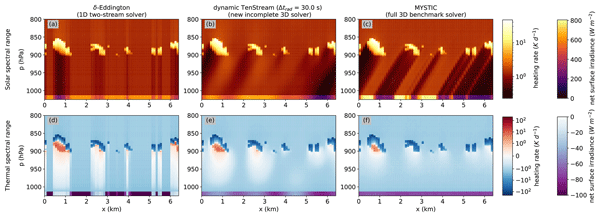
Richard Maier, Fabian Jakub, Claudia Emde, Mihail Manev, Aiko Voigt, and Bernhard Mayer
Geosci. Model Dev., 17, 3357–3383, https://doi.org/10.5194/gmd-17-3357-2024, https://doi.org/10.5194/gmd-17-3357-2024, 2024
Short summary
Short summary
Based on the TenStream solver, we present a new method to accelerate 3D radiative transfer towards the speed of currently used 1D solvers. Using a shallow-cumulus-cloud time series, we evaluate the performance of this new solver in terms of both speed and accuracy. Compared to a 3D benchmark simulation, we show that our new solver is able to determine much more accurate irradiances and heating rates than a 1D δ-Eddington solver, even when operated with a similar computational demand.
Lea Volkmer, Leandro Dörfer, and Bernhard Mayer
EGUsphere, https://doi.org/10.5194/egusphere-2026-4795, https://doi.org/10.5194/egusphere-2026-4795, 2026
Short summary
Short summary
While cloud droplet size distributions (CDSDs) of shallow cumulus or stratiform clouds are often well described under the assumption of single mode (gamma) distributions, CDSDs exhibit a multimodal structure in the presence of drizzle or rain leading to biases in passive remote sensing retrievals. Here, we present a new approach to derive multimodal droplet size distributions from aircraft-based polarized measurements of the cloud-/rainbow using a superposition of multiple gamma distributions.
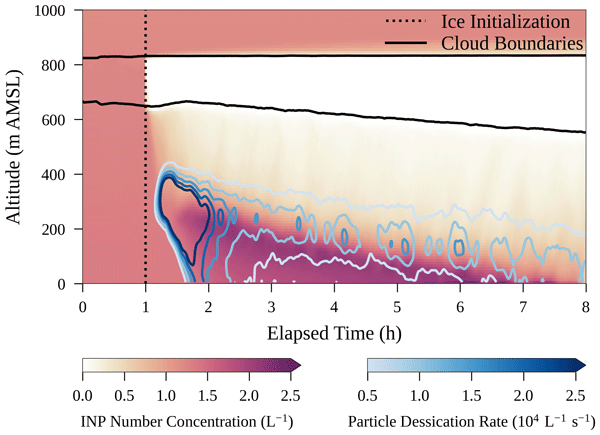
Benjamin Ascher and Fabian Hoffmann
Atmos. Chem. Phys., 26, 11747–11770, https://doi.org/10.5194/acp-26-11747-2026, https://doi.org/10.5194/acp-26-11747-2026, 2026
Short summary
Short summary
Arctic clouds with liquid and ice have important effects on climate. To investigate how ice crystals and liquid droplets grow in shallow Arctic clouds, we conducted high-resolution simulations. We find that drier air above the cloud leads to a greater sublimation rate of ice beneath the cloud and recycling of particles necessary for ice formation within the cloud. We also find that the amount of sublimation and recycling is affected by the rate of temperature change with height above the cloud.
Leonie von Terzi, Axel Seifert, Christoph Siewert, Fabian Jakub, and Stefan Kneifel
EGUsphere, https://doi.org/10.5194/egusphere-2026-3865, https://doi.org/10.5194/egusphere-2026-3865, 2026
Short summary
Short summary
A distinct temperature layer in clouds promotes growth of dendritic ice crystals, producing characteristic radar signatures whose origin has remained unclear. We combined radar observations with microphysical simulations to identify the dominant microphysical processes. Collisions breaking particles into fragments prove essential to reproducing the signatures, alongside crystal growth and aggregation, clarifying the link between radar signals and ice processes for weather models.
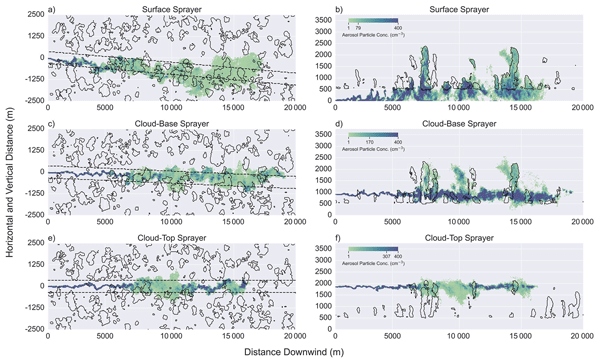
Johannes Kainz, Daniel P. Harrison, and Fabian Hoffmann
Atmos. Chem. Phys., 26, 9443–9451, https://doi.org/10.5194/acp-26-9443-2026, https://doi.org/10.5194/acp-26-9443-2026, 2026
Short summary
Short summary
Marine Cloud Brightening (MCB) aims to counter global warming. It suggests to increase cloud reflectance by spraying aerosols from which additional cloud droplets can form. We demonstrate that MCB can be applied to cumulus clouds. The impact of aerosol particles released by a single aerosol sprayer using simulations is analyzed. The study draws conclusions on the optimal placement height of the sprayer to optimize aerosol transport, the ability to form new cloud droplets, and the area affected.
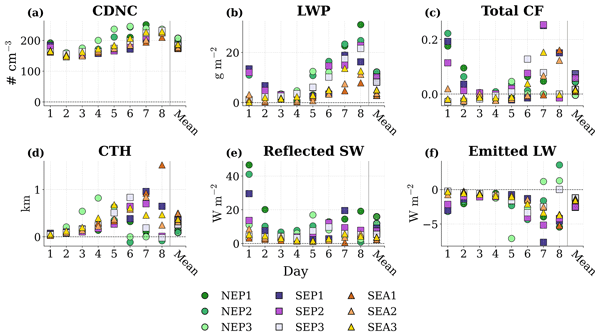
Netta Yeheskel, Matthew W. Christensen, Fabian Hoffmann, Graham Feingold, and Guy Dagan
Atmos. Chem. Phys., 26, 8765–8781, https://doi.org/10.5194/acp-26-8765-2026, https://doi.org/10.5194/acp-26-8765-2026, 2026
Short summary
Short summary
Aerosols influence cloud formation, structure, and radiative effects. As air masses move from the subtropics to the tropics, clouds transition from shallow to deeper systems. Using five years of satellite observations and numerical simulations, we find a robust aerosol impact on this Lagrangian cloud evolution: higher aerosol levels produce thicker, more reflective clouds, enhancing cooling and modifying energy and moisture transport toward the tropics.
Silke Groß, Florian Ewald, Bjorn Stevens, Martin Wirth, Georgios Dekoutsidis, André Ehrlich, Dimitra Kouklaki, Konstantin Krüger, Sophie Rosenburg, Lea Volkmer, Jonas von Bismark, Lutz Hirsch, Anna E. Luebke, Eleni Marinou, Bernhard Mayer, Montserrat Pinol Sole, Manfred Wendisch, Julia Windmiller, Vassilis Amiridis, Rob Koopman, Takuji Kubota, and Markus Rapp
Atmos. Meas. Tech., 19, 3933–3959, https://doi.org/10.5194/amt-19-3933-2026, https://doi.org/10.5194/amt-19-3933-2026, 2026
Short summary
Short summary
In May 2024 the joint European Space Agency (ESA) and the Japan Aerospace Exploration Agency (JAXA) mission EarthCARE was launched. A similar payload as on the satellite was set up on the German research aircraft HALO, and deployed during an extensive measurement campaign to validated the satellite. We present our instrumentation, the measurements, and its potential for the validation of EarthCARE. We show first validation results and assessments of the EarthCARE data quality.
Anna Weber, Fabian Hoffmann, and Bernhard Mayer
Atmos. Chem. Phys., 26, 8001–8020, https://doi.org/10.5194/acp-26-8001-2026, https://doi.org/10.5194/acp-26-8001-2026, 2026
Short summary
Short summary
The vertical evolution of microphysical cloud properties in low-level mixed-phase clouds during a marine cold air outbreak in the Arctic is analyzed based on measurements collected during the HALO–(𝒜𝒞)3 campaign. In particular, pseudo-vertical profiles of cloud thermodynamic phase and the cloud droplet size are constructed. The measured vertical profiles are compared to predictions from an entraining parcel model to investigate the influence of ice processes on supercooled liquid water droplets.
Jung-Sub Lim and Fabian Hoffmann
Atmos. Chem. Phys., 26, 5427–5446, https://doi.org/10.5194/acp-26-5427-2026, https://doi.org/10.5194/acp-26-5427-2026, 2026
Short summary
Short summary
We used high-resolution simulations to track individual cloud droplets within marine clouds. We discovered that while droplets grow similarly, they evaporate differently depending on their specific history of exposure to dry air. This helps resolve ambiguities in interpreting field observations, where droplet history is often unknown. We also propose a simple formula to capture this variability, offering a more accurate tool for representing cloud evolution in models.
Prasanth Prabhakaran, Timothy A. Myers, Fabian Hoffmann, and Graham Feingold
Atmos. Chem. Phys., 26, 5151–5167, https://doi.org/10.5194/acp-26-5151-2026, https://doi.org/10.5194/acp-26-5151-2026, 2026
Short summary
Short summary
We explore how climate change and aerosol affect the evolution of marine low-clouds. Using high-resolution simulations, we find that warming has a stronger impact on these clouds, but aerosol becomes more important after the clouds form precipitation. Our results suggest that attempts to brighten these clouds using aerosol may become less effective in a warmer future due to the decrease in cloud cover.

Anna Weber, Benjamin Kirbus, Manfred Wendisch, and Bernhard Mayer
Atmos. Chem. Phys., 26, 3521–3540, https://doi.org/10.5194/acp-26-3521-2026, https://doi.org/10.5194/acp-26-3521-2026, 2026
Short summary
Short summary
Macrophysical and microphysical properties of clouds and their evolution during the initial phase of marine cold air outbreaks in the Arctic are studied with a focus on cloud thermodynamic phase partitioning and phase transitions. To this end, high-resolution quasi-Lagrangian observations of the hyperspectral and polarized imaging system specMACS during the HALO-(AC)3 campaign are combined with backward trajectories. Six cold air outbreaks with varying strengths are analyzed and compared.
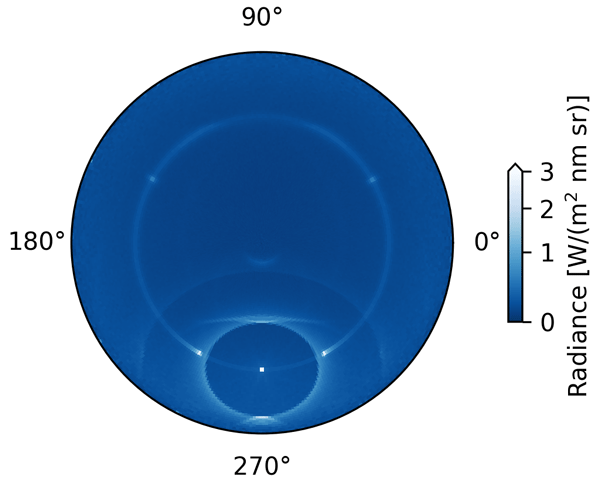
Linda Forster, Anna Weber, and Bernhard Mayer
Atmos. Meas. Tech., 18, 7853–7863, https://doi.org/10.5194/amt-18-7853-2025, https://doi.org/10.5194/amt-18-7853-2025, 2025
Short summary
Short summary
CrystalTrace is a Monte Carlo raytracing algorithm for simulating radiative transfer in ice clouds with different crystal shapes and orientations. Integrated into libradtran's MYSTIC solver, it enables efficient, realistic simulations of ice alongside water clouds. By computing single-scattering properties online at the crystal scale, it eliminates the need for precomputed lookup tables, improving efficiency and angular resolution for satellite, airborne, and ground-based observation retrievals.
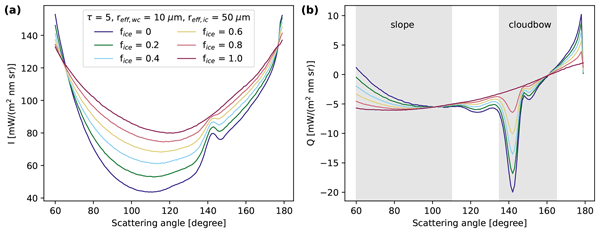
Anna Weber, Veronika Pörtge, Claudia Emde, and Bernhard Mayer
Atmos. Meas. Tech., 18, 7581–7601, https://doi.org/10.5194/amt-18-7581-2025, https://doi.org/10.5194/amt-18-7581-2025, 2025
Short summary
Short summary
In this work, a new quantitative retrieval of cloud thermodynamic phase partitioning based on multi-angle polarimetric imaging is presented. The retrieval is validated using synthetic data for idealized and realistic cloud cases and applied to measurements of the airborne specMACS instrument during the HALO-(AC)3 campaign. It provides high spatial resolution information about phase partitioning at cloud top and allows for example to study phase transitions in Arctic mixed-phase clouds.
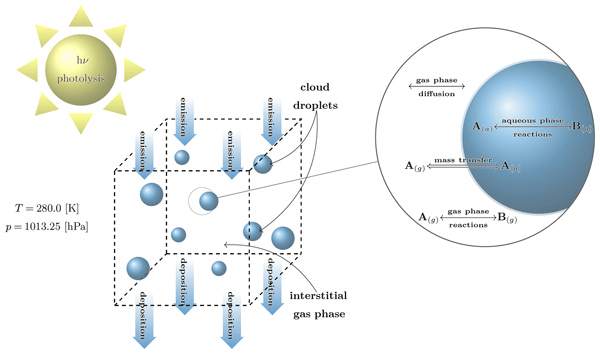
Levin Rug, Willi Schimmel, Fabian Hoffmann, and Oswald Knoth
Geosci. Model Dev., 18, 9039–9059, https://doi.org/10.5194/gmd-18-9039-2025, https://doi.org/10.5194/gmd-18-9039-2025, 2025
Short summary
Short summary
We present the Chemical Mechanism Integrator (Cminor) v1.0, a tool to predict concentrations of chemical compounds undergoing arbitrary reactions. Cminor is an advanced, open-source solver to model either combustion chemistry, or atmospheric chemistry and its direct influence on condensation of cloud droplets and the subsequent processing of aerosol. It uses the superdroplet idea, making it particularly feasible for coupling with such models, which is part of future work.
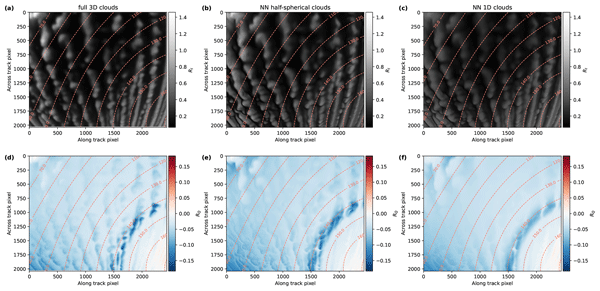
Anna Weber, Gregor Köcher, and Bernhard Mayer
Atmos. Meas. Tech., 18, 5805–5821, https://doi.org/10.5194/amt-18-5805-2025, https://doi.org/10.5194/amt-18-5805-2025, 2025
Short summary
Short summary
A neural-network-based fast forward operator for polarized 3D radiative transfer is presented. The forward operator uses the new InDEpendent column local halF-sphere ApproXimation (IDEFAX). Polarized radiances simulated with IDEFAX and the forward operator were validated against full 3D radiative transfer simulations with MYSTIC and show a significantly improved representation of 3D radiative effects compared to the plane-parallel independent column approximation at comparable computation times.
Graham Feingold, Franziska Glassmeier, Jianhao Zhang, and Fabian Hoffmann
Atmos. Chem. Phys., 25, 10869–10885, https://doi.org/10.5194/acp-25-10869-2025, https://doi.org/10.5194/acp-25-10869-2025, 2025
Short summary
Short summary
Scientists usually use snapshots of atmospheric data to glean understanding of time-evolving atmospheric processes. We examine how much can be learned about processes from snapshots using examples from cloud and atmospheric physics. We couch the analysis in terms of the theory of ergodic systems, space-time-exchange, and the Deborah number – concepts that are commonly applied in other branches of physics. We discuss the reasons for the varying degrees of success.
Fabian Hoffmann, Yao-Sheng Chen, and Graham Feingold
Atmos. Chem. Phys., 25, 8657–8670, https://doi.org/10.5194/acp-25-8657-2025, https://doi.org/10.5194/acp-25-8657-2025, 2025
Short summary
Short summary
Clouds reflect a substantial portion of the incoming solar radiation back into space. This capacity is determined by the number of cloud droplets, which in turn is influenced by the number of aerosol particles, forming the basis for aerosol–cloud–climate interactions. In this study, we use a simple entrainment parameterization to understand the effect of aerosol on cloud water in weakly and non-precipitating stratocumulus.
Yao-Sheng Chen, Prasanth Prabhakaran, Fabian Hoffmann, Jan Kazil, Takanobu Yamaguchi, and Graham Feingold
Atmos. Chem. Phys., 25, 6141–6159, https://doi.org/10.5194/acp-25-6141-2025, https://doi.org/10.5194/acp-25-6141-2025, 2025
Short summary
Short summary
Injecting sea salt aerosols into marine stratiform clouds can distribute the cloud water over more droplets in smaller sizes. This process is expected to make the clouds brighter, allowing them to reflect more sunlight back to space. However, it may also cause the clouds to lose water over time, reducing their ability to reflect sunlight. We use a computer model to show that the loss of cloud water occurs relatively quickly and does not completely offset the initial brightening.
Jung-Sub Lim, Yign Noh, Hyunho Lee, and Fabian Hoffmann
Atmos. Chem. Phys., 25, 5313–5329, https://doi.org/10.5194/acp-25-5313-2025, https://doi.org/10.5194/acp-25-5313-2025, 2025
Short summary
Short summary
Rain formation in warm clouds begins when small droplets collide, but this process can be slow without larger droplets. We used simulations to explore the role of bigger droplets, known as precipitation embryos, in triggering rain. We found that they speed up rain only when their size and number exceed a critical threshold. This threshold becomes larger when collisions are naturally efficient, such as in clouds with broad droplet size distributions or strong turbulence.
Fan Yang, Hamed Fahandezh Sadi, Raymond A. Shaw, Fabian Hoffmann, Pei Hou, Aaron Wang, and Mikhail Ovchinnikov
Atmos. Chem. Phys., 25, 3785–3806, https://doi.org/10.5194/acp-25-3785-2025, https://doi.org/10.5194/acp-25-3785-2025, 2025
Short summary
Short summary
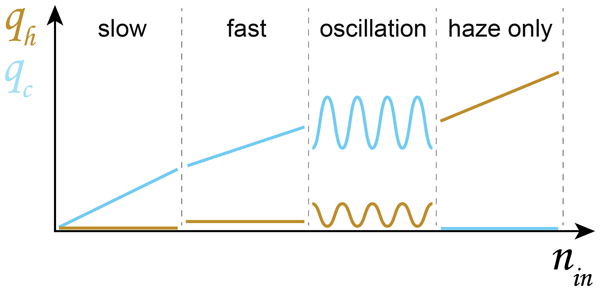
Large-eddy simulations of a convection cloud chamber show two new microphysics regimes, cloud oscillation and cloud collapse, due to haze–cloud interactions. Our results suggest that haze particles and their interactions with cloud droplets should be considered especially in polluted conditions. To properly simulate haze–cloud interactions, we need to resolve droplet activation and deactivation processes, instead of using Twomey-type activation parameterization.
Fabian Hoffmann, Franziska Glassmeier, and Graham Feingold
Atmos. Chem. Phys., 24, 13403–13412, https://doi.org/10.5194/acp-24-13403-2024, https://doi.org/10.5194/acp-24-13403-2024, 2024
Short summary
Short summary
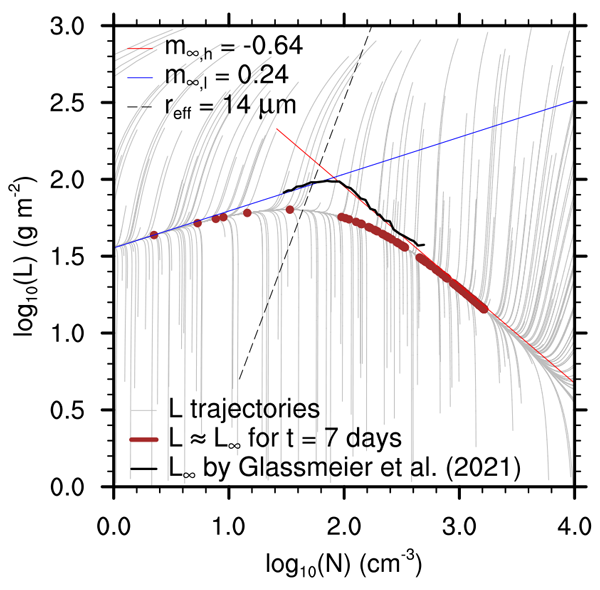
Clouds constitute a major cooling influence on Earth's climate system by reflecting a large fraction of the incident solar radiation back to space. This ability is controlled by the number of cloud droplets, which is governed by the number of aerosol particles in the atmosphere, laying the foundation for so-called aerosol–cloud–climate interactions. In this study, a simple model to understand the effect of aerosol on cloud water is developed and applied.
Lea Volkmer, Tobias Kölling, Tobias Zinner, and Bernhard Mayer
Atmos. Meas. Tech., 17, 6807–6817, https://doi.org/10.5194/amt-17-6807-2024, https://doi.org/10.5194/amt-17-6807-2024, 2024
Short summary
Short summary
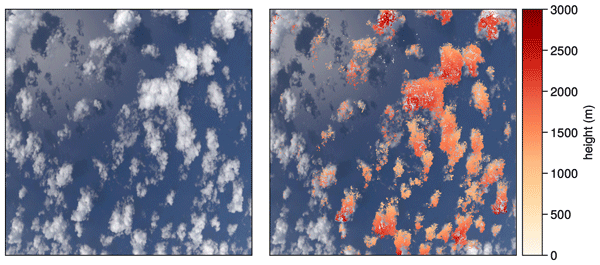
The importance of the consideration of cloud motion for the stereographic determination of cloud top height from aircraft observations is demonstrated using measurements of the airborne spectrometer of the Munich Aerosol Cloud Scanner (specMACS). A method for cloud motion correction using model winds from the European Centre for Medium-Range Weather Forecasts is presented and validated using both real measurements and realistic radiative transfer simulations.

Claudia Emde, Veronika Pörtge, Mihail Manev, and Bernhard Mayer
Atmos. Meas. Tech., 17, 6769–6789, https://doi.org/10.5194/amt-17-6769-2024, https://doi.org/10.5194/amt-17-6769-2024, 2024
Short summary
Short summary
We introduce an innovative method to retrieve the cloud fraction and optical thickness of liquid water clouds over the ocean based on polarimetry. This is well suited for satellite observations providing multi-angle polarization measurements. Cloud fraction and cloud optical thickness can be derived from measurements at two viewing angles: one within the cloudbow and one in the sun glint region.
Yao-Sheng Chen, Jianhao Zhang, Fabian Hoffmann, Takanobu Yamaguchi, Franziska Glassmeier, Xiaoli Zhou, and Graham Feingold
Atmos. Chem. Phys., 24, 12661–12685, https://doi.org/10.5194/acp-24-12661-2024, https://doi.org/10.5194/acp-24-12661-2024, 2024
Short summary
Short summary
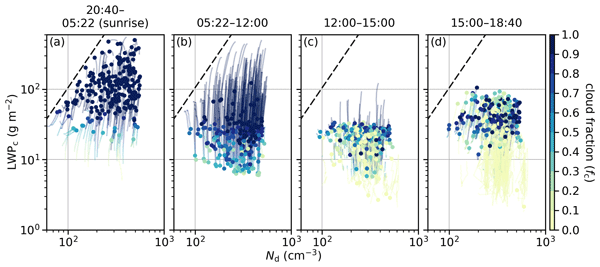
Marine stratocumulus cloud is a type of shallow cloud that covers the vast areas of Earth's surface. It plays an important role in Earth's energy balance by reflecting solar radiation back to space. We used numerical models to simulate a large number of marine stratocumuli with different characteristics. We found that how the clouds develop throughout the day is affected by the level of humidity in the air above the clouds and how closely the clouds connect to the ocean surface.
Johanna Mayer, Bernhard Mayer, Luca Bugliaro, Ralf Meerkötter, and Christiane Voigt
Atmos. Meas. Tech., 17, 5161–5185, https://doi.org/10.5194/amt-17-5161-2024, https://doi.org/10.5194/amt-17-5161-2024, 2024
Short summary
Short summary
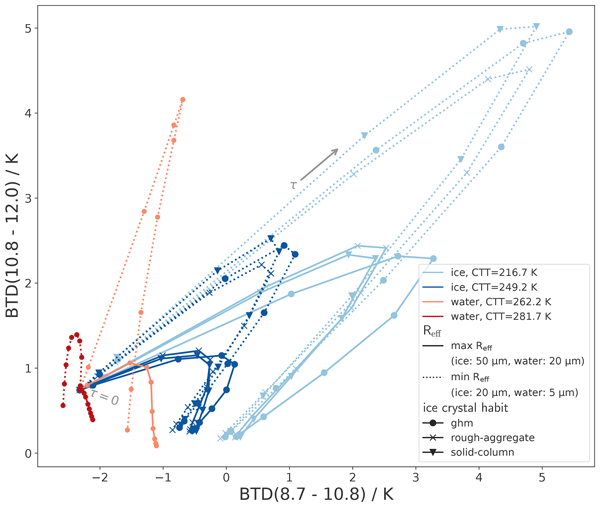
This study uses radiative transfer calculations to characterize the relation of two satellite channel combinations (namely infrared window brightness temperature differences – BTDs – of SEVIRI) to the thermodynamic cloud phase. A sensitivity analysis reveals the complex interplay of cloud parameters and their contribution to the observed phase dependence of BTDs. This knowledge helps to design optimal cloud-phase retrievals and to understand their potential and limitations.
Manfred Wendisch, Susanne Crewell, André Ehrlich, Andreas Herber, Benjamin Kirbus, Christof Lüpkes, Mario Mech, Steven J. Abel, Elisa F. Akansu, Felix Ament, Clémantyne Aubry, Sebastian Becker, Stephan Borrmann, Heiko Bozem, Marlen Brückner, Hans-Christian Clemen, Sandro Dahlke, Georgios Dekoutsidis, Julien Delanoë, Elena De La Torre Castro, Henning Dorff, Regis Dupuy, Oliver Eppers, Florian Ewald, Geet George, Irina V. Gorodetskaya, Sarah Grawe, Silke Groß, Jörg Hartmann, Silvia Henning, Lutz Hirsch, Evelyn Jäkel, Philipp Joppe, Olivier Jourdan, Zsofia Jurányi, Michail Karalis, Mona Kellermann, Marcus Klingebiel, Michael Lonardi, Johannes Lucke, Anna E. Luebke, Maximilian Maahn, Nina Maherndl, Marion Maturilli, Bernhard Mayer, Johanna Mayer, Stephan Mertes, Janosch Michaelis, Michel Michalkov, Guillaume Mioche, Manuel Moser, Hanno Müller, Roel Neggers, Davide Ori, Daria Paul, Fiona M. Paulus, Christian Pilz, Felix Pithan, Mira Pöhlker, Veronika Pörtge, Maximilian Ringel, Nils Risse, Gregory C. Roberts, Sophie Rosenburg, Johannes Röttenbacher, Janna Rückert, Michael Schäfer, Jonas Schaefer, Vera Schemann, Imke Schirmacher, Jörg Schmidt, Sebastian Schmidt, Johannes Schneider, Sabrina Schnitt, Anja Schwarz, Holger Siebert, Harald Sodemann, Tim Sperzel, Gunnar Spreen, Bjorn Stevens, Frank Stratmann, Gunilla Svensson, Christian Tatzelt, Thomas Tuch, Timo Vihma, Christiane Voigt, Lea Volkmer, Andreas Walbröl, Anna Weber, Birgit Wehner, Bruno Wetzel, Martin Wirth, and Tobias Zinner
Atmos. Chem. Phys., 24, 8865–8892, https://doi.org/10.5194/acp-24-8865-2024, https://doi.org/10.5194/acp-24-8865-2024, 2024
Short summary
Short summary
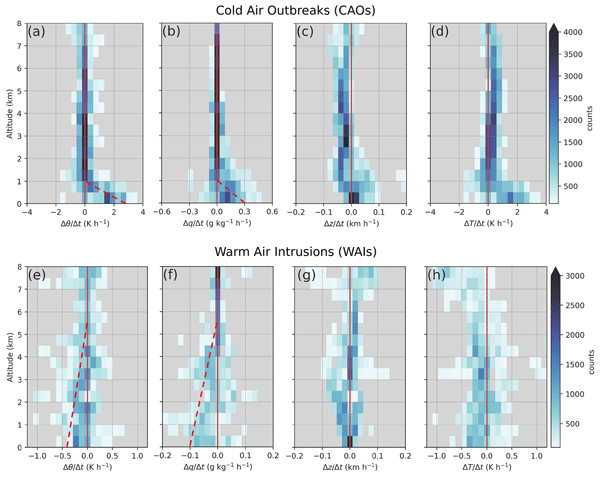
The Arctic is warming faster than the rest of the globe. Warm-air intrusions (WAIs) into the Arctic may play an important role in explaining this phenomenon. Cold-air outbreaks (CAOs) out of the Arctic may link the Arctic climate changes to mid-latitude weather. In our article, we describe how to observe air mass transformations during CAOs and WAIs using three research aircraft instrumented with state-of-the-art remote-sensing and in situ measurement devices.
Johanna Mayer, Luca Bugliaro, Bernhard Mayer, Dennis Piontek, and Christiane Voigt
Atmos. Meas. Tech., 17, 4015–4039, https://doi.org/10.5194/amt-17-4015-2024, https://doi.org/10.5194/amt-17-4015-2024, 2024
Short summary
Short summary
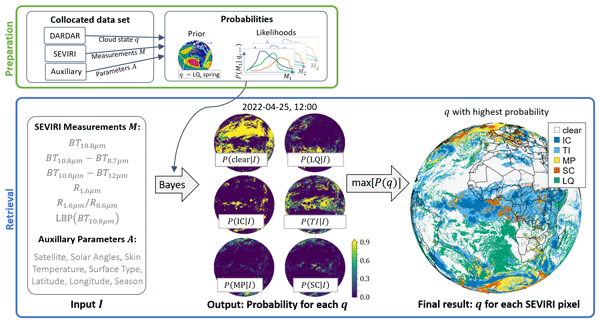
ProPS (PRObabilistic cloud top Phase retrieval for SEVIRI) is a method to detect clouds and their thermodynamic phase with a geostationary satellite, distinguishing between clear sky and ice, mixed-phase, supercooled and warm liquid clouds. It uses a Bayesian approach based on the lidar–radar product DARDAR. The method allows studying cloud phases, especially mixed-phase and supercooled clouds, rarely observed from geostationary satellites. This can be used for comparison with climate models.
Richard Maier, Fabian Jakub, Claudia Emde, Mihail Manev, Aiko Voigt, and Bernhard Mayer
Geosci. Model Dev., 17, 3357–3383, https://doi.org/10.5194/gmd-17-3357-2024, https://doi.org/10.5194/gmd-17-3357-2024, 2024
Short summary
Short summary
Based on the TenStream solver, we present a new method to accelerate 3D radiative transfer towards the speed of currently used 1D solvers. Using a shallow-cumulus-cloud time series, we evaluate the performance of this new solver in terms of both speed and accuracy. Compared to a 3D benchmark simulation, we show that our new solver is able to determine much more accurate irradiances and heating rates than a 1D δ-Eddington solver, even when operated with a similar computational demand.
Ilias Fountoulakis, Alexandra Tsekeri, Stelios Kazadzis, Vassilis Amiridis, Angelos Nersesian, Maria Tsichla, Emmanouil Proestakis, Antonis Gkikas, Kyriakoula Papachristopoulou, Vasileios Barlakas, Claudia Emde, and Bernhard Mayer
Atmos. Chem. Phys., 24, 4915–4948, https://doi.org/10.5194/acp-24-4915-2024, https://doi.org/10.5194/acp-24-4915-2024, 2024
Short summary
Short summary
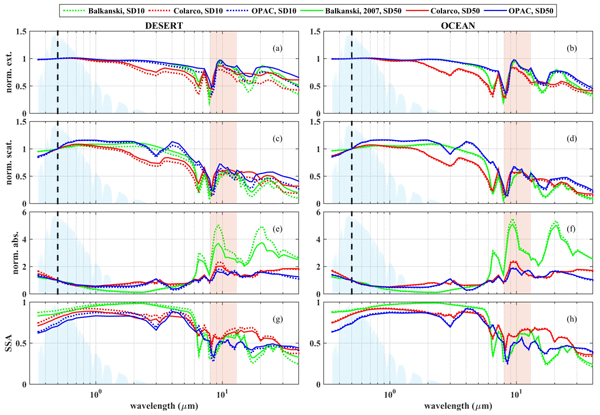
In our study we provide an assessment, through a sensitivity study, of the limitations of models to calculate the dust direct radiative effect (DRE) due to the underrepresentation of its size, refractive index (RI), and shape. Our results indicate the necessity of including more realistic sizes and RIs for dust particles in dust models, in order to derive better estimations of the dust direct radiative effects.
Behrooz Keshtgar, Aiko Voigt, Bernhard Mayer, and Corinna Hoose
Atmos. Chem. Phys., 24, 4751–4769, https://doi.org/10.5194/acp-24-4751-2024, https://doi.org/10.5194/acp-24-4751-2024, 2024
Short summary
Short summary
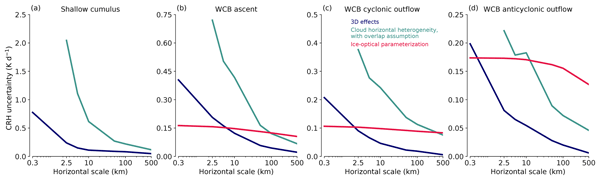
Cloud-radiative heating (CRH) affects extratropical cyclones but is uncertain in weather and climate models. We provide a framework to quantify uncertainties in CRH within an extratropical cyclone due to four factors and show that the parameterization of ice optical properties contributes significantly to uncertainty in CRH. We also argue that ice optical properties, by affecting CRH on spatial scales of 100 km, are relevant for the large-scale dynamics of extratropical cyclones.
Lea Volkmer, Veronika Pörtge, Fabian Jakub, and Bernhard Mayer
Atmos. Meas. Tech., 17, 1703–1719, https://doi.org/10.5194/amt-17-1703-2024, https://doi.org/10.5194/amt-17-1703-2024, 2024
Short summary
Short summary
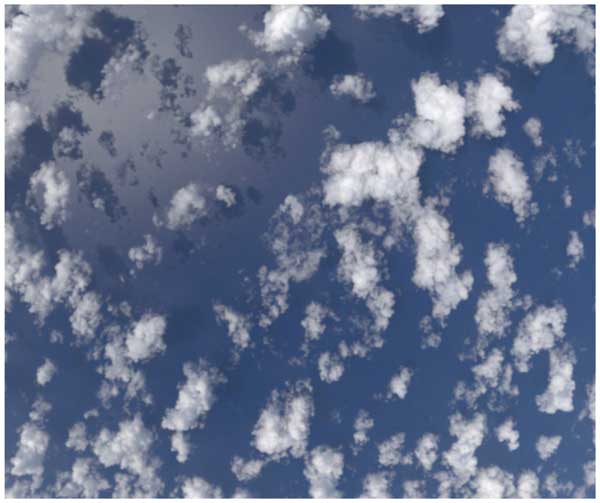
Three-dimensional radiative transfer simulations are used to evaluate the performance of retrieval algorithms in the derivation of cloud geometry (cloud top heights) and cloud droplet size distributions from two-dimensional polarized radiance measurements of the airborne spectrometer of the Munich Aerosol Cloud Scanner. The cloud droplet size distributions are derived for the effective radius and variance. The simulations are based on cloud data from highly resolved large-eddy simulations.
Anna Weber, Tobias Kölling, Veronika Pörtge, Andreas Baumgartner, Clemens Rammeloo, Tobias Zinner, and Bernhard Mayer
Atmos. Meas. Tech., 17, 1419–1439, https://doi.org/10.5194/amt-17-1419-2024, https://doi.org/10.5194/amt-17-1419-2024, 2024
Short summary
Short summary
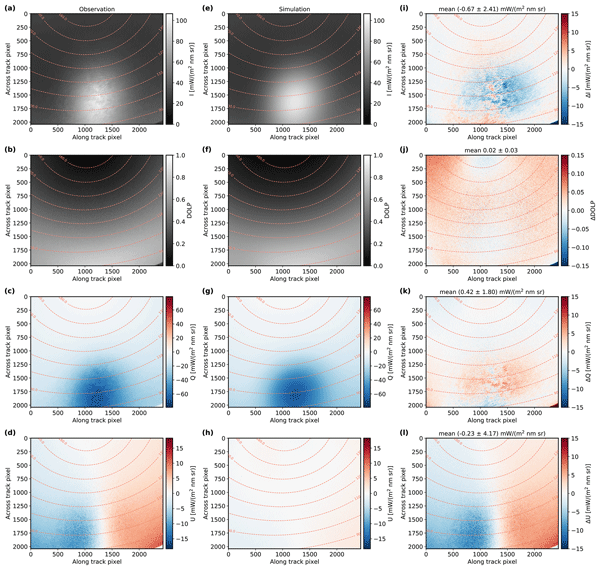
In this work, we introduce the 2D RGB polarization-resolving cameras of the airborne hyperspectral and polarized imaging system specMACS. A full characterization and calibration of the cameras including a geometric calibration as well as a radiometric characterization is provided, allowing for the computation of absolute calibrated, georeferenced Stokes vectors rotated into the scattering plane. We validate the calibration by comparing sunglint measurements to radiative transfer simulations.
Prasanth Prabhakaran, Fabian Hoffmann, and Graham Feingold
Atmos. Chem. Phys., 24, 1919–1937, https://doi.org/10.5194/acp-24-1919-2024, https://doi.org/10.5194/acp-24-1919-2024, 2024
Short summary
Short summary
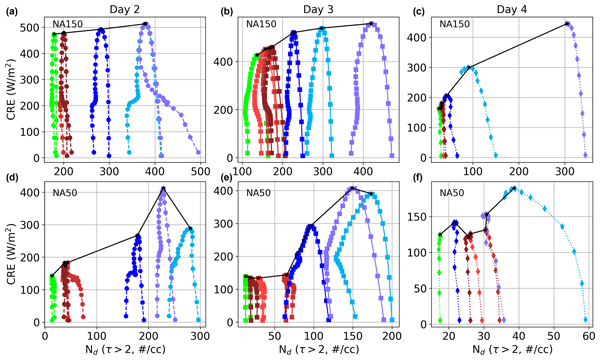
In this study, we explore the impact of deliberate aerosol perturbation in the northeast Pacific region using large-eddy simulations. Our results show that cloud reflectivity is sensitive to the aerosol sprayer arrangement in the pristine system, whereas in the polluted system it is largely proportional to the total number of aerosol particles injected. These insights would aid in assessing the efficiency of various aerosol injection strategies for climate intervention applications.
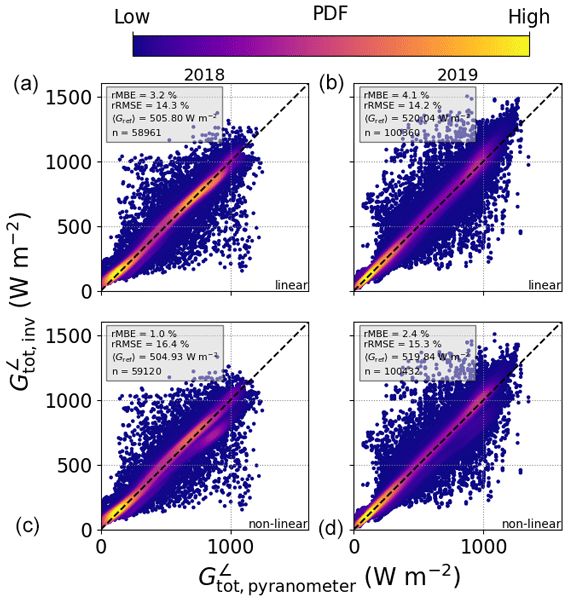
James Barry, Stefanie Meilinger, Klaus Pfeilsticker, Anna Herman-Czezuch, Nicola Kimiaie, Christopher Schirrmeister, Rone Yousif, Tina Buchmann, Johannes Grabenstein, Hartwig Deneke, Jonas Witthuhn, Claudia Emde, Felix Gödde, Bernhard Mayer, Leonhard Scheck, Marion Schroedter-Homscheidt, Philipp Hofbauer, and Matthias Struck
Atmos. Meas. Tech., 16, 4975–5007, https://doi.org/10.5194/amt-16-4975-2023, https://doi.org/10.5194/amt-16-4975-2023, 2023
Short summary
Short summary
Measured power data from solar photovoltaic (PV) systems contain information about the state of the atmosphere. In this work, power data from PV systems in the Allgäu region in Germany were used to determine the solar irradiance at each location, using state-of-the-art simulation and modelling. The results were validated using concurrent measurements of the incoming solar radiation in each case. If applied on a wider scale, this algorithm could help improve weather and climate models.
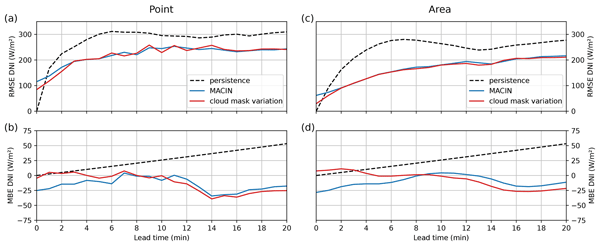
Philipp Gregor, Tobias Zinner, Fabian Jakub, and Bernhard Mayer
Atmos. Meas. Tech., 16, 3257–3271, https://doi.org/10.5194/amt-16-3257-2023, https://doi.org/10.5194/amt-16-3257-2023, 2023
Short summary
Short summary
This work introduces MACIN, a model for short-term forecasting of direct irradiance for solar energy applications. MACIN exploits cloud images of multiple cameras to predict irradiance. The model is applied to artificial images of clouds from a weather model. The artificial cloud data allow for a more in-depth evaluation and attribution of errors compared with real data. Good performance of derived cloud information and significant forecast improvements over a baseline forecast were found.
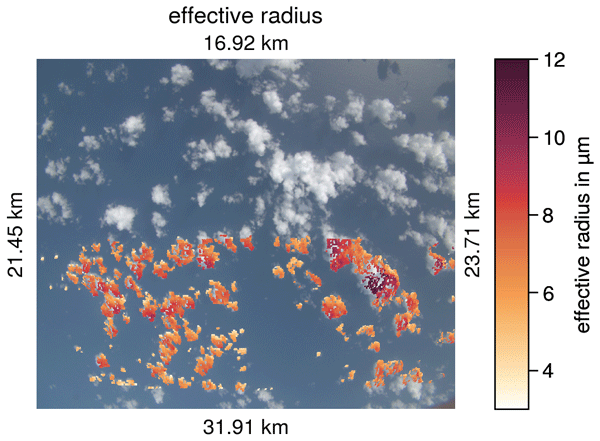
Veronika Pörtge, Tobias Kölling, Anna Weber, Lea Volkmer, Claudia Emde, Tobias Zinner, Linda Forster, and Bernhard Mayer
Atmos. Meas. Tech., 16, 645–667, https://doi.org/10.5194/amt-16-645-2023, https://doi.org/10.5194/amt-16-645-2023, 2023
Short summary
Short summary
In this work, we analyze polarized cloudbow observations by the airborne camera system specMACS to retrieve the cloud droplet size distribution defined by the effective radius (reff) and the effective variance (veff). Two case studies of trade-wind cumulus clouds observed during the EUREC4A field campaign are presented. The results are combined into maps of reff and veff with a very high spatial resolution (100 m × 100 m) that allow new insights into cloud microphysics.
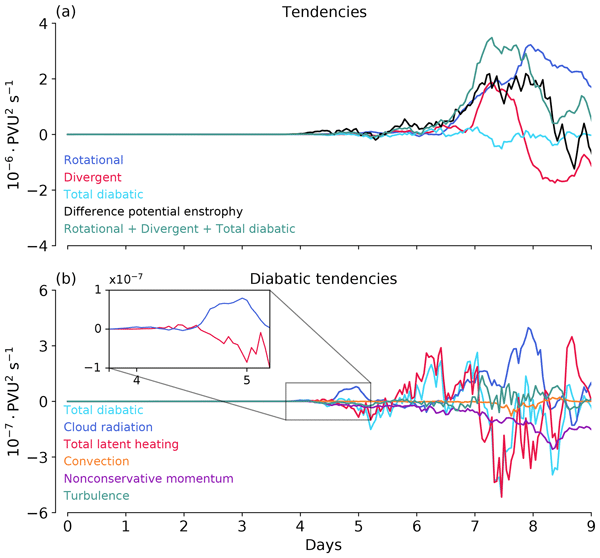
Behrooz Keshtgar, Aiko Voigt, Corinna Hoose, Michael Riemer, and Bernhard Mayer
Weather Clim. Dynam., 4, 115–132, https://doi.org/10.5194/wcd-4-115-2023, https://doi.org/10.5194/wcd-4-115-2023, 2023
Short summary
Short summary
Forecasting extratropical cyclones is challenging due to many physical factors influencing their behavior. One such factor is the impact of heating and cooling of the atmosphere by the interaction between clouds and radiation. In this study, we show that cloud-radiative heating (CRH) increases the intensity of an idealized cyclone and affects its predictability. We find that CRH affects the cyclone mostly via increasing latent heat release and subsequent changes in the synoptic circulation.
Linda Forster and Bernhard Mayer
Atmos. Chem. Phys., 22, 15179–15205, https://doi.org/10.5194/acp-22-15179-2022, https://doi.org/10.5194/acp-22-15179-2022, 2022
Short summary
Short summary
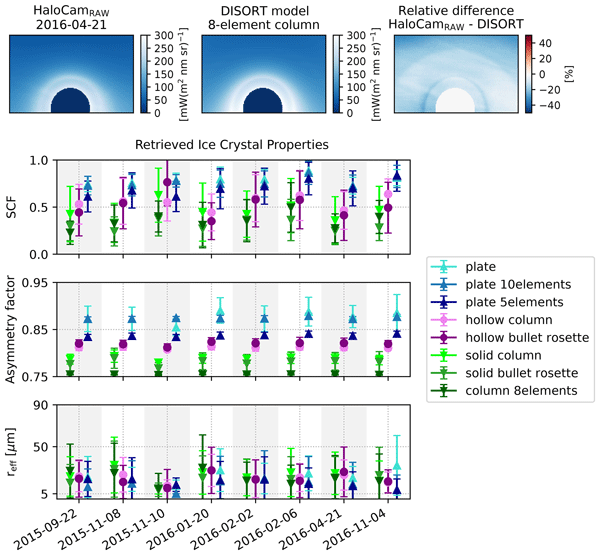
We present a novel retrieval using ground-based imaging observations of halo displays together with radiative transfer simulations to help improve our understanding of ice crystal properties representative of cirrus clouds. Analysis of 4400 calibrated HaloCam images featuring a 22° halo revealed aggregates of hexagonal columns of 20 µm effective radius with a mixture of about 37 % smooth and 63% severely roughened surfaces as the best match in general.
Huan Yu, Claudia Emde, Arve Kylling, Ben Veihelmann, Bernhard Mayer, Kerstin Stebel, and Michel Van Roozendael
Atmos. Meas. Tech., 15, 5743–5768, https://doi.org/10.5194/amt-15-5743-2022, https://doi.org/10.5194/amt-15-5743-2022, 2022
Short summary
Short summary
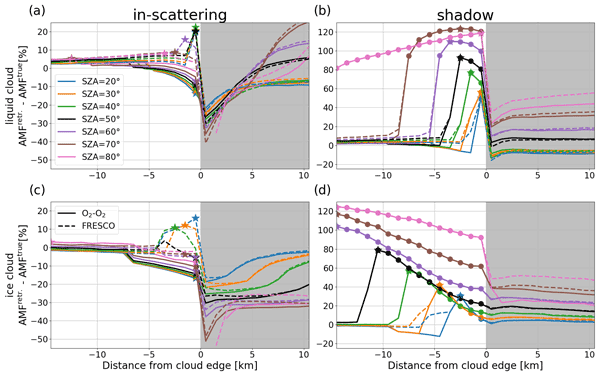
In this study, we have investigated the impact of 3D clouds on the tropospheric NO2 retrieval from UV–visible sensors. We applied standard NO2 retrieval methods including cloud corrections to synthetic data generated by the 3D radiative transfer model. A sensitivity study was done for synthetic data, and dependencies on various parameters were investigated. Possible mitigation strategies were investigated and compared based on 3D simulations and observed data.
Edward Gryspeerdt, Franziska Glassmeier, Graham Feingold, Fabian Hoffmann, and Rebecca J. Murray-Watson
Atmos. Chem. Phys., 22, 11727–11738, https://doi.org/10.5194/acp-22-11727-2022, https://doi.org/10.5194/acp-22-11727-2022, 2022
Short summary
Short summary
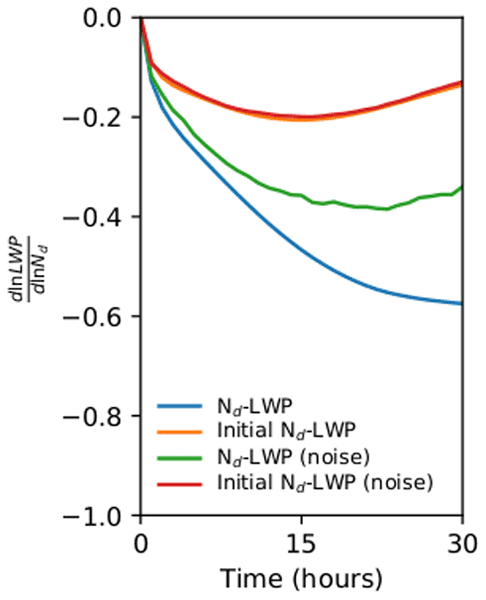
The response of clouds to changes in aerosol remains a large uncertainty in our understanding of the climate. Studies typically look at aerosol and cloud processes in snapshot images, measuring all properties at the same time. Here we use multiple images to characterise how cloud temporal development responds to aerosol. We find a reduction in liquid water path with increasing aerosol, party due to feedbacks. This suggests the aerosol impact on cloud water may be weaker than in previous studies.

Arve Kylling, Claudia Emde, Huan Yu, Michel van Roozendael, Kerstin Stebel, Ben Veihelmann, and Bernhard Mayer
Atmos. Meas. Tech., 15, 3481–3495, https://doi.org/10.5194/amt-15-3481-2022, https://doi.org/10.5194/amt-15-3481-2022, 2022
Short summary
Short summary
Atmospheric trace gases such as nitrogen dioxide (NO2) may be measured by satellite instruments sensitive to solar ultraviolet–visible radiation reflected from Earth and its atmosphere. For a single pixel, clouds in neighbouring pixels may affect the radiation and hence the retrieved trace gas amount. We found that for a solar zenith angle less than about 40° this cloud-related NO2 bias is typically below 10 %, while for larger solar zenith angles the NO2 bias is on the order of tens of percent.
Luca Bugliaro, Dennis Piontek, Stephan Kox, Marius Schmidl, Bernhard Mayer, Richard Müller, Margarita Vázquez-Navarro, Daniel M. Peters, Roy G. Grainger, Josef Gasteiger, and Jayanta Kar
Nat. Hazards Earth Syst. Sci., 22, 1029–1054, https://doi.org/10.5194/nhess-22-1029-2022, https://doi.org/10.5194/nhess-22-1029-2022, 2022
Short summary
Short summary
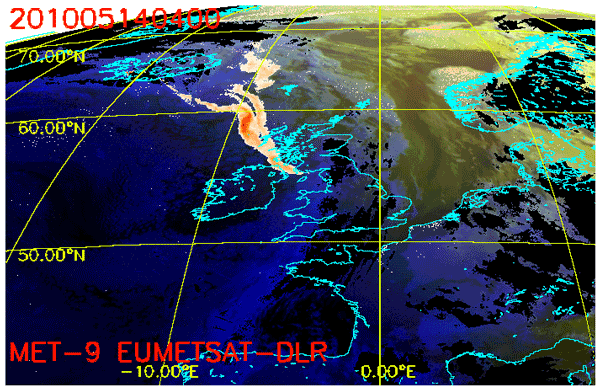
The monitoring of ash dispersion in the atmosphere is an important task for satellite remote sensing since ash represents a threat to air traffic. We present an AI-based method that retrieves the spatial extension and properties of volcanic ash clouds with high temporal resolution during day and night by means of geostationary satellite measurements. This algorithm, trained on realistic observations simulated with a radiative transfer model, runs operationally at the German Weather Service.
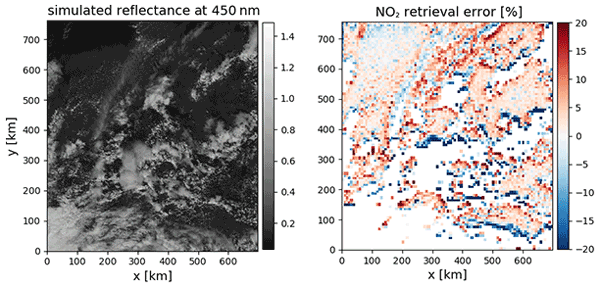
Claudia Emde, Huan Yu, Arve Kylling, Michel van Roozendael, Kerstin Stebel, Ben Veihelmann, and Bernhard Mayer
Atmos. Meas. Tech., 15, 1587–1608, https://doi.org/10.5194/amt-15-1587-2022, https://doi.org/10.5194/amt-15-1587-2022, 2022
Short summary
Short summary
Retrievals of trace gas concentrations from satellite observations can be affected by clouds in the vicinity, either by shadowing or by scattering of radiation from clouds in the clear region. We used a Monte Carlo radiative transfer model to generate synthetic satellite observations, which we used to test retrieval algorithms and to quantify the error of retrieved NO2 vertical column density due to cloud scattering.
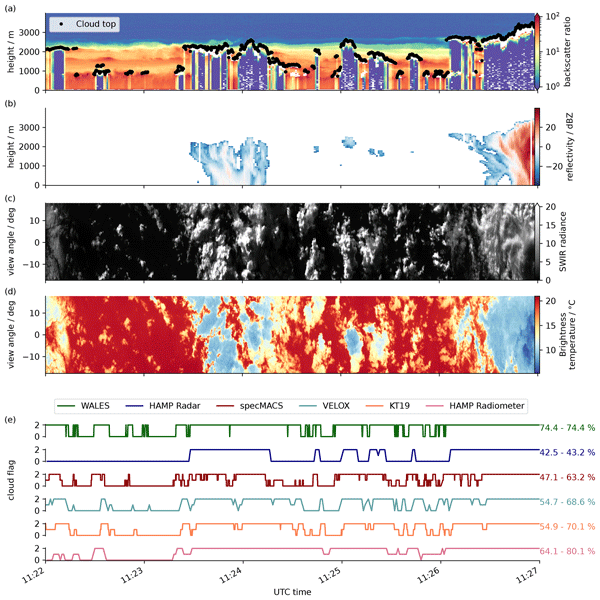
Heike Konow, Florian Ewald, Geet George, Marek Jacob, Marcus Klingebiel, Tobias Kölling, Anna E. Luebke, Theresa Mieslinger, Veronika Pörtge, Jule Radtke, Michael Schäfer, Hauke Schulz, Raphaela Vogel, Martin Wirth, Sandrine Bony, Susanne Crewell, André Ehrlich, Linda Forster, Andreas Giez, Felix Gödde, Silke Groß, Manuel Gutleben, Martin Hagen, Lutz Hirsch, Friedhelm Jansen, Theresa Lang, Bernhard Mayer, Mario Mech, Marc Prange, Sabrina Schnitt, Jessica Vial, Andreas Walbröl, Manfred Wendisch, Kevin Wolf, Tobias Zinner, Martin Zöger, Felix Ament, and Bjorn Stevens
Earth Syst. Sci. Data, 13, 5545–5563, https://doi.org/10.5194/essd-13-5545-2021, https://doi.org/10.5194/essd-13-5545-2021, 2021
Short summary
Short summary
The German research aircraft HALO took part in the research campaign EUREC4A in January and February 2020. The focus area was the tropical Atlantic east of the island of Barbados. We describe the characteristics of the 15 research flights, provide auxiliary information, derive combined cloud mask products from all instruments that observe clouds on board the aircraft, and provide code examples that help new users of the data to get started.
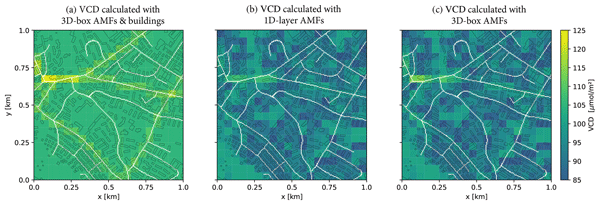
Marc Schwaerzel, Dominik Brunner, Fabian Jakub, Claudia Emde, Brigitte Buchmann, Alexis Berne, and Gerrit Kuhlmann
Atmos. Meas. Tech., 14, 6469–6482, https://doi.org/10.5194/amt-14-6469-2021, https://doi.org/10.5194/amt-14-6469-2021, 2021
Short summary
Short summary
NO2 maps from airborne imaging remote sensing often appear much smoother than one would expect from high-resolution model simulations of NO2 over cities, despite the small ground-pixel size of the sensors. Our case study over Zurich, using the newly implemented building module of the MYSTIC radiative transfer solver, shows that the 3D effect can explain part of the smearing and that building shadows cause a noticeable underestimation and noise in the measured NO2 columns.
Cited articles
Anderson, G., Clough, S., Kneizys, F., Chetwynd, J., and Shettle, E.: AFGL atmospheric constituent profiles (0–120 km), Tech. Rep. AFGL-TR-86-0110, Air Force Geophys. Lab., Hanscom Air Force Base, Bedford, Mass., https://apps.dtic.mil/sti/pdfs/ADA175173.pdf (last access: 25 June 2026), 1986. a
Bowen, I. S.: The Ratio of Heat Losses by Conduction and by Evaporation from any Water Surface, Phys. Rev., 27, 779–787, https://doi.org/10.1103/physrev.27.779, 1926. a
Davis, A., Gabriel, P., Lovejoy, S., Schertzer, D., and Austin, G. L.: Discrete angle radiative transfer: 3. Numerical results and meteorological applications, J. Geophys. Res.-Atmos., 95, 11729–11742, https://doi.org/10.1029/jd095id08p11729, 1990. a
DWD: Operational NWP System: Model configuration upgrade of ICON, https://www.dwd.de/DE/fachnutzer/forschung_lehre/numerische_wettervorhersage/nwv_aenderungen/_functions/DownloadBox_modellaenderungen/icon/pdf_2021/pdf_icon_14_04_2021.pdf?__blob=publicationFile&v=3 (last access: 25 June 2026), 2021. a
Gabriel, P., Lovejoy, S., Davis, A., Schertzer, D., and Austin, G. L.: Discrete angle radiative transfer: 2. Renormalization approach for homogeneous and fractal clouds, J. Geophys. Res.-Atmos., 95, 11717–11728, https://doi.org/10.1029/jd095id08p11717, 1990. a
Gristey, J. J., Feingold, G., Glenn, I. B., Schmidt, K. S., and Chen, H.: Surface Solar Irradiance in Continental Shallow Cumulus Fields: Observations and Large-Eddy Simulation, J. Atmos. Sci., 77, 1065–1080, https://doi.org/10.1175/jas-d-19-0261.1, 2020. a
Hogan, R. J. and Bozzo, A.: A Flexible and Efficient Radiation Scheme for the ECMWF Model, J. Adv. Model. Earth Sy., 10, 1990–2008, https://doi.org/10.1029/2018ms001364, 2018. a
Hogan, R. J. and Shonk, J. K. P.: Incorporating the Effects of 3D Radiative Transfer in the Presence of Clouds into Two-Stream Multilayer Radiation Schemes, J. Atmos. Sci., 70, 708–724, https://doi.org/10.1175/jas-d-12-041.1, 2013. a, b, c
Hogan, R. J., Fielding, M. D., Barker, H. W., Villefranque, N., and Schäfer, S. A. K.: Entrapment: An Important Mechanism to Explain the Shortwave 3D Radiative Effect of Clouds, J. Atmos. Sci., 76, 2123–2141, https://doi.org/10.1175/JAS-D-18-0366.1, 2019. a, b, c
Horn, G. L., Ouwersloot, H. G., Vilà-Guerau de Arellano, J., and Sikma, M.: Cloud Shading Effects on Characteristic Boundary-Layer Length Scales, Bound.-Lay. Meteorol., 157, 237–263, https://doi.org/10.1007/s10546-015-0054-4, 2015. a
Jakub, F. and Mayer, B.: A three-dimensional parallel radiative transfer model for atmospheric heating rates for use in cloud resolving models – The TenStream solver, J. Quant. Spectrosc. Ra., 163, 63–71, https://doi.org/10.1016/j.jqsrt.2015.05.003, 2015. a
Khairoutdinov, M. and Kogan, Y.: A New Cloud Physics Parameterization in a Large-Eddy Simulation Model of Marine Stratocumulus, Mon. Weather Rev., 128, 229–243, https://doi.org/10.1175/1520-0493(2000)128<0229:ancppi>2.0.co;2, 2000. a
Khvorostyanov, V. I. and Curry, J. A.: Aerosol size spectra and CCN activity spectra: Reconciling the lognormal, algebraic, and power laws, J. Geophys. Res.-Atmos., 111, D12202, https://doi.org/10.1029/2005jd006532, 2006. a
Klinger, C. and Mayer, B.: The Neighboring Column Approximation (NCA) – A fast approach for the calculation of 3D thermal heating rates in cloud resolving models, J. Quant. Spectrosc. Ra., 168, 17–28, https://doi.org/10.1016/j.jqsrt.2015.08.020, 2016. a
Klinger, C. and Mayer, B.: Neighboring Column Approximation – An Improved 3D Thermal Radiative Transfer Approximation for Non-Rectangular Grids, J. Adv. Model. Earth Sy., 12, e2019MS001843, https://doi.org/10.1029/2019ms001843, 2020. a
Klinger, C., Mayer, B., Jakub, F., Zinner, T., Park, S.-B., and Gentine, P.: Effects of 3-D thermal radiation on the development of a shallow cumulus cloud field, Atmos. Chem. Phys., 17, 5477–5500, https://doi.org/10.5194/acp-17-5477-2017, 2017. a
Kotthaus, S. and Grimmond, C.: Energy exchange in a dense urban environment – Part I: Temporal variability of long-term observations in central London, Urban Climate, 10, 261–280, https://doi.org/10.1016/j.uclim.2013.10.002, 2014. a
Lovejoy, S., Davis, A., Gabriel, P., Schertzer, D., and Austin, G. L.: Discrete angle radiative transfer: 1. Scaling and similarity, universality and diffusion, J. Geophys. Res.-Atmos., 95, 11699–11715, https://doi.org/10.1029/jd095id08p11699, 1990. a
Maier, R.: Development and application of a dynamic approach to 3D radiative transfer in subkilometer-scale numerical weather prediction models, PhD thesis, Ludwig-Maximilians-Universität München, https://doi.org/10.5282/EDOC.35575, 2025. a
Maier, R., Jakub, F., Emde, C., Manev, M., Voigt, A., and Mayer, B.: A dynamic approach to three-dimensional radiative transfer in subkilometer-scale numerical weather prediction models: the dynamic TenStream solver v1.0, Geosci. Model Dev., 17, 3357–3383, https://doi.org/10.5194/gmd-17-3357-2024, 2024. a, b, c, d, e, f, g, h, i, j, k, l, m, n, o, p, q, r, s, t
Maier, R., Jakub, F., and Mayer, B.: PALM-LES dataset for evaluating the impact of radiative transfer solvers on shallow cumulus cloud development, LMU Munich, Faculty of Physics [data set], https://doi.org/10.57970/NP5R3-T5X93, 2026a. a, b, c
Maier, R., Jakub, F., and Mayer, B.: PALM-LES dataset for evaluating the impact of radiative transfer solvers on shallow cumulus cloud development – Part 2, LMU Munich, Faculty of Physics [data set], https://doi.org/10.57970/NZMWF-70W34, 2026b. a, b, c
Maronga, B., Gryschka, M., Heinze, R., Hoffmann, F., Kanani-Sühring, F., Keck, M., Ketelsen, K., Letzel, M. O., Sühring, M., and Raasch, S.: The Parallelized Large-Eddy Simulation Model (PALM) version 4.0 for atmospheric and oceanic flows: model formulation, recent developments, and future perspectives, Geosci. Model Dev., 8, 2515–2551, https://doi.org/10.5194/gmd-8-2515-2015, 2015. a, b
Maronga, B., Banzhaf, S., Burmeister, C., Esch, T., Forkel, R., Fröhlich, D., Fuka, V., Gehrke, K. F., Geletič, J., Giersch, S., Gronemeier, T., Groß, G., Heldens, W., Hellsten, A., Hoffmann, F., Inagaki, A., Kadasch, E., Kanani-Sühring, F., Ketelsen, K., Khan, B. A., Knigge, C., Knoop, H., Krč, P., Kurppa, M., Maamari, H., Matzarakis, A., Mauder, M., Pallasch, M., Pavlik, D., Pfafferott, J., Resler, J., Rissmann, S., Russo, E., Salim, M., Schrempf, M., Schwenkel, J., Seckmeyer, G., Schubert, S., Sühring, M., von Tils, R., Vollmer, L., Ward, S., Witha, B., Wurps, H., Zeidler, J., and Raasch, S.: Overview of the PALM model system 6.0, Geosci. Model Dev., 13, 1335–1372, https://doi.org/10.5194/gmd-13-1335-2020, 2020. a, b, c, d
Mol, W. B., Knap, W. H., and van Heerwaarden, C. C.: Ten years of 1 Hz solar irradiance observations at Cabauw, the Netherlands, with cloud observations, variability classifications, and statistics, Earth Syst. Sci. Data, 15, 2139–2151, https://doi.org/10.5194/essd-15-2139-2023, 2023. a
Morrison, H. and Grabowski, W. W.: Comparison of Bulk and Bin Warm-Rain Microphysics Models Using a Kinematic Framework, J. Atmos. Sci., 64, 2839–2861, https://doi.org/10.1175/jas3980, 2007. a
Neggers, R. A. J., Duynkerke, P. G., and Rodts, S. M. A.: Shallow cumulus convection: A validation of large‐eddy simulation against aircraft and Landsat observations, Q. J. Roy. Meteor. Soc., 129, 2671–2696, https://doi.org/10.1256/qj.02.93, 2003. a
PALM: PALM model system, version 25.04, GitLab [code], https://gitlab.palm-model.org/releases/palm_model_system/-/tree/v25.04 (last access: 25 June 2026), 2025. a
PALM: Land surface model, Gottfried Wilhelm Leibniz Universität Hannover, https://palm.muk.uni-hannover.de/trac/wiki/doc/tec/lsm, last access: 25 June 2026a. a
PALM: Land surface parameters, Gottfried Wilhelm Leibniz Universität Hannover, https://palm.muk.uni-hannover.de/trac/wiki/doc/app/land_surface_parameters, last access: 25 June 2026b. a
Pincus, R., Barker, H. W., and Morcrette, J.-J.: A fast, flexible, approximate technique for computing radiative transfer in inhomogeneous cloud fields, J. Geophys. Res.-Atmos., 108, 4376, https://doi.org/10.1029/2002JD003322, 2003. a
Raasch, S. and Schröter, M.: PALM - A large-eddy simulation model performing on massively parallel computers, Meteorol. Z., 10, 363–372, https://doi.org/10.1127/0941-2948/2001/0010-0363, 2001. a, b
Schumann, U., Dörnbrack, A., and Mayer, B.: Cloud-shadow effects on the structure of the convective boundary layer, Meteorol. Z., 11, 285–294, https://doi.org/10.1127/0941-2948/2002/0011-0285, 2002. a
Seifert, A. and Beheng, K. D.: A two-moment cloud microphysics parameterization for mixed-phase clouds. Part 1: Model description, Meteorol. Atmos. Phys., 92, 45–66, https://doi.org/10.1007/s00703-005-0112-4, 2005. a
Stull, R.: The Atmospheric Boundary Layer, in: Atmospheric Science: An Introductory Survey, chap. 9, Elsevier, second edn., 375–417, ISBN 978-0-12-732951-2, https://doi.org/10.1016/b978-0-12-732951-2.50014-4, 2006. a
Tijhuis, M., van Stratum, B. J. H., Veerman, M. A., and van Heerwaarden, C. C.: An Efficient Parameterization for Surface Shortwave 3D Radiative Effects in Large‐Eddy Simulations of Shallow Cumulus Clouds, J. Adv. Model. Earth Sy., 15, e2022MS003262, https://doi.org/10.1029/2022ms003262, 2022. a
Veerman, M. A., Pedruzo‐Bagazgoitia, X., Jakub, F., Vilà‐Guerau de Arellano, J., and van Heerwaarden, C. C.: Three‐Dimensional Radiative Effects By Shallow Cumulus Clouds on Dynamic Heterogeneities Over a Vegetated Surface, J. Adv. Model. Earth Sy., 12, e2019MS001990, https://doi.org/10.1029/2019ms001990, 2020. a, b, c, d, e
Short summary
Most atmospheric models only use 1D radiation, neglecting any 3D radiative effects. Here, we show that the dynamic TenStream solver provides a computationally efficient way to represent these effects. Like full 3D radiation, it causes daytime clouds to organize into streets, grow larger, and contain more liquid water. We show that this occurs because 3D radiation does not shade cloud updrafts and modifies the surface energy balance, resulting in an increased latent heat flux into the atmosphere.
Most atmospheric models only use 1D radiation, neglecting any 3D radiative effects. Here, we...


Altmetrics
Final-revised paper
Preprint