
Articles | Volume 26, issue 10
https://doi.org/10.5194/acp-26-7705-2026
© Author(s) 2026. This work is distributed under
the Creative Commons Attribution 4.0 License.
the Creative Commons Attribution 4.0 License.
https://doi.org/10.5194/acp-26-7705-2026
© Author(s) 2026. This work is distributed under
the Creative Commons Attribution 4.0 License.
the Creative Commons Attribution 4.0 License.
Research article
| 
01 Jun 2026
Research article |
| 01 Jun 2026
| 01 Jun 2026
Advancing the quantification of aerosol-cloud interactions with the CALIPSO-CloudSat-Aqua/MODIS record
Zhujun Li
Analytical Mechanics Associates, Inc., Hampton, 23666, USA
NASA Langley Research Center, Hampton, 23666, USA
David Painemal
CORRESPONDING AUTHOR

NASA Langley Research Center, Hampton, 23666, USA
Argonne National Laboratory, Lemont, 60439, USA
Xiaojian Zheng
Stanford University, Stanford, 94305, USA
Related authors
Xiaojian Zheng, Yan Feng, David Painemal, Shaocheng Xie, Zhujun Li, and Yuan Wang
EGUsphere, https://doi.org/10.5194/egusphere-2026-5932, https://doi.org/10.5194/egusphere-2026-5932, 2026
This preprint is open for discussion and under review for Atmospheric Chemistry and Physics (ACP).
Short summary
Short summary
Smoke from African fires often drifts over the cloud deck of the southeastern Atlantic, but how it changes the water in these clouds remains uncertain. Using nine years of satellite data, we sorted days by weather pattern and by whether the smoke sat above or touched the clouds. The cloud-water response depends on both, and averaging over all days hides it. A climate model gives the opposite response, pointing to processes that need improvement in the model.
Xiaojian Zheng, Yan Feng, David Painemal, Meng Zhang, Shaocheng Xie, Zhujun Li, Robert Jacob, and Bethany Lusch
Atmos. Chem. Phys., 25, 17473–17499, https://doi.org/10.5194/acp-25-17473-2025, https://doi.org/10.5194/acp-25-17473-2025, 2025
Short summary
Short summary
This study used satellite observations and climate model simulations to examine how aerosols affect marine clouds over the Eastern North Atlantic. Cloud responses to aerosols differed significantly across meteorological regimes. The model captured overall trends but exaggerated cloud responses, performing better for shallower than deeper clouds. The results highlight the need to untangle aerosol effects from meteorology and improve cloud process representation in climate models.
Travis D. Toth, Marian B. Clayton, Zhujun Li, David Painemal, Sharon D. Rodier, Jayanta Kar, Tyler J. Thorsen, Richard A. Ferrare, Mark A. Vaughan, Jason L. Tackett, Huisheng Bian, Mian Chin, Anne E. Garnier, Ellsworth J. Welton, Robert A. Ryan, Charles R. Trepte, and David M. Winker
Atmos. Meas. Tech., 18, 6765–6793, https://doi.org/10.5194/amt-18-6765-2025, https://doi.org/10.5194/amt-18-6765-2025, 2025
Short summary
Short summary
NASA's CALIPSO satellite mission observed aerosols (airborne particles) globally from 2006 to 2023. Its final data products update improves its aerosol optical parameters over oceans by adjusting for regional and seasonal differences in a new measurement-model synergistic approach. This results in a more realistic aerosol characterization, specifically near coastlines (where sea salt mixes with pollution), with potential impacts to future studies of science applications (e.g., climate effects).
Zhujun Li, David Painemal, Gregory Schuster, Marian Clayton, Richard Ferrare, Mark Vaughan, Damien Josset, Jayanta Kar, and Charles Trepte
Atmos. Meas. Tech., 15, 2745–2766, https://doi.org/10.5194/amt-15-2745-2022, https://doi.org/10.5194/amt-15-2745-2022, 2022
Short summary
Short summary
For more than 15 years, CALIPSO has revolutionized our understanding of the role of aerosols in climate. Here we evaluate CALIPSO aerosol typing over the ocean using an independent CALIPSO–CloudSat product. The analysis suggests that CALIPSO correctly categorizes clean marine aerosol over the open ocean, elevated smoke over the SE Atlantic, and dust over the tropical Atlantic. Similarities between clean and dusty marine over the open ocean implies that algorithm modifications are warranted.
Xiaojian Zheng, Yan Feng, David Painemal, Shaocheng Xie, Zhujun Li, and Yuan Wang
EGUsphere, https://doi.org/10.5194/egusphere-2026-5932, https://doi.org/10.5194/egusphere-2026-5932, 2026
This preprint is open for discussion and under review for Atmospheric Chemistry and Physics (ACP).
Short summary
Short summary
Smoke from African fires often drifts over the cloud deck of the southeastern Atlantic, but how it changes the water in these clouds remains uncertain. Using nine years of satellite data, we sorted days by weather pattern and by whether the smoke sat above or touched the clouds. The cloud-water response depends on both, and averaging over all days hides it. A climate model gives the opposite response, pointing to processes that need improvement in the model.
Michael S. Diamond, Andrew S. Ackerman, Alejandro Baró Pérez, Ann M. Fridlind, Ehsan Erfani, Caspar Jungbacker, Hyunho Lee, David Painemal, Frida A.-M. Bender, Annica M. L. Ekman, Franziska Glassmeier, Graham Feingold, Fredrik Jansson, David A. Johnson, Matthias Schwarz, Robert Wood, Takanobu Yamaguchi, Jianhao Zhang, Xiaoli Zhou, and Paquita Zuidema
EGUsphere, https://doi.org/10.5194/egusphere-2026-5350, https://doi.org/10.5194/egusphere-2026-5350, 2026
This preprint is open for discussion and under review for Atmospheric Chemistry and Physics (ACP).
Short summary
Short summary
We compare how cloud resolving models represent an important cloud transition over the subtropical oceans. Clouds can either break up by deepening and drying out or by raining and forming an open cell pattern. Compared to observations, the clouds deepen a bit too much and get too polluted when smoke is present. In clean conditions, some models drizzle and break up into open cells while others barely rain; the model spread stems from different rain amounts for similar clouds.
Timothy W. Juliano, Florian Tornow, Ann M. Fridlind, Andrew S. Ackerman, Gregory S. Elsaesser, Bart Geerts, Christian P. Lackner, David Painemal, Israel Silber, Mikhail Ovchinnikov, Gunilla Svensson, Michael Tjernström, Peng Wu, Alejandro Baró Pérez, Peter Bogenschutz, Dmitry Chechin, Kamal Kant Chandrakar, Jan Chylik, Andrey Debolskiy, Rostislav Fadeev, Anu Gupta, Luisa Ickes, Michail Karalis, Martin Köhler, Branko Kosović, Peter Kuma, Weiwei Li, Evgeny Mortikov, Hugh Morrison, Roel A. J. Neggers, Anna Possner, Tomi Raatikainen, Lea Raillard, Sami Romakkaniemi, Niklas Schnierstein, Shin-ichiro Shima, Nikita Silin, Mikhail Tolstykh, Étienne Vignon, Lulin Xue, Meng Zhang, and Xue Zheng
Atmos. Chem. Phys., 26, 13267–13302, https://doi.org/10.5194/acp-26-13267-2026, https://doi.org/10.5194/acp-26-13267-2026, 2026
Short summary
Short summary
Models struggle to capture cloud and precipitation processes and their radiative effects in marine cold-air outbreaks. We use a quasi-Lagrangian framework to compare large-eddy simulation (LES) and single-column model (SCM) output with field and satellite observations. With fixed droplet and ice numbers, LES and SCM agree in liquid-only tests. In mixed-phase conditions, LES plausibly capture cloud thinning and breakup, while SCMs largely remain overcast and thereby miss cloud radiative effects.
Jianhao Zhang, David Painemal, Tom Dror, Jung-Sub Lim, Armin Sorooshian, and Graham Feingold
Atmos. Chem. Phys., 26, 6015–6034, https://doi.org/10.5194/acp-26-6015-2026, https://doi.org/10.5194/acp-26-6015-2026, 2026
Short summary
Short summary
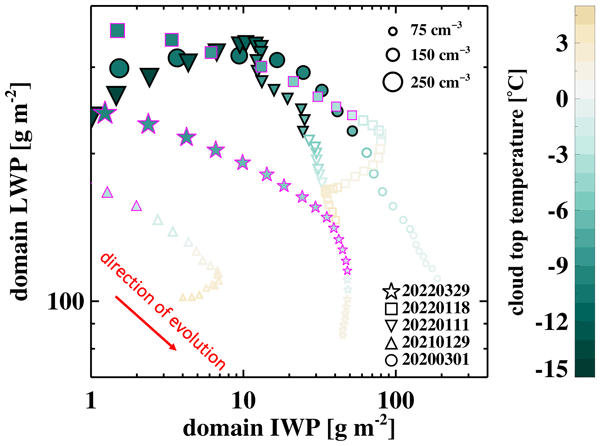
Clouds transitioning from overcast to broken fields play an important role in regulating the amount of sunlight reaching Earth’s surface. Using satellite imagery and a novel space-time exchange approach, we examine these transitions during marine cold-air outbreaks. Our analysis reveals characteristic signatures (or fingerprints) of liquid- and ice-phase processes, demonstrating how space-borne observations can provide new physical insight into cloud evolution.
Seethala Chellappan, David Painemal, Mandana Thieman, Christian Pelayo, William L. Smith Jr., and Lynn M. Russell
EGUsphere, https://doi.org/10.5194/egusphere-2026-933, https://doi.org/10.5194/egusphere-2026-933, 2026
Short summary
Short summary
We analyzed observations from the ARM EPCAPE campaign at coastal California, and satellite cloud properties to understand how large-scale weather patterns influence marine low clouds and aerosols. Using ERA5 data and Self-Organizing Maps, we identified nine synoptic regimes linked to cloud cover, depth, and liquid water path. Satellite data show anticyclone position strongly affects cloud properties, while aerosol–cloud covariability depends on turbulence and supersaturation.
Jingyi Chen, Hailong Wang, Bo Zhang, Hongyu Liu, David Painemal, Armin Sorooshian, Sheng-Lun Tai, and Christiane Voigt
Atmos. Chem. Phys., 26, 2209–2224, https://doi.org/10.5194/acp-26-2209-2026, https://doi.org/10.5194/acp-26-2209-2026, 2026
Short summary
Short summary
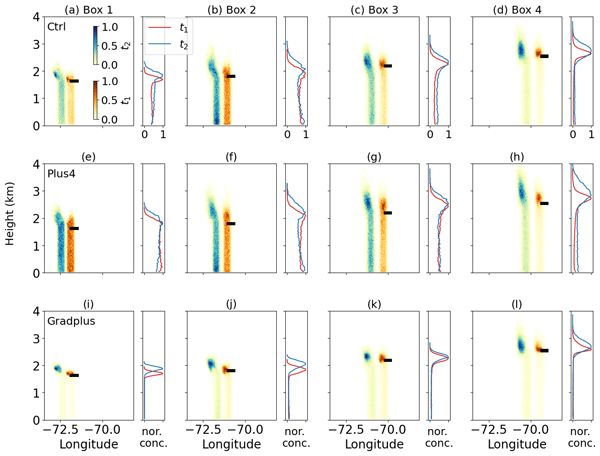
NASA-validated modeling shows +4K SST (sea surface temperature) & +25 % gradients distinctly alter boundary layer dynamics, cloud physics in cold-air outbreaks. Warmer SST reduces cloud cover; increases size, elongation; hydrometeors shift to ice. Sharper Gradients boost liquid water (cold upwind); reduces ice; disrupts organization. Also, SST changes alter cloud-top properties via entrained airmass origin. Resolving ocean-atmosphere coupling in global models is essential for accurate cloud feedback projections.
Xinzhu Li, Longlei Li, Yan Feng, and Xin Xi
Atmos. Chem. Phys., 26, 963–981, https://doi.org/10.5194/acp-26-963-2026, https://doi.org/10.5194/acp-26-963-2026, 2026
Short summary
Short summary
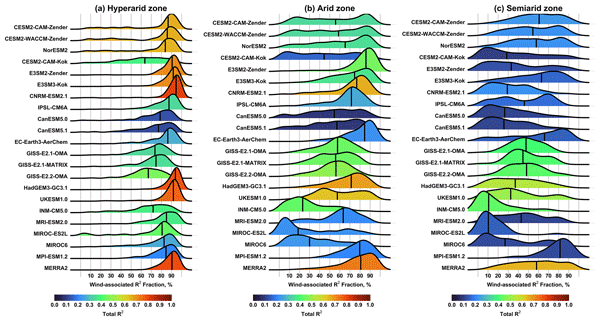
Earth system models are essential tools for predicting windblown dust emissions from global drylands. These models show large discrepancies in simulating the interannual variability of historical dust emissions, as well as the relative importance of wind speed versus hydroclimate drivers. This study underscores the need to improve near-surface wind simulations in hyperarid areas and land surface process representations in arid and semiarid areas to reduce dust emission uncertainties.
Timothy W. Juliano, Florian Tornow, Ann M. Fridlind, Andrew S. Ackerman, Gregory S. Elsaesser, Bart Geerts, Christian P. Lackner, David Painemal, Israel Silber, Mikhail Ovchinnikov, Gunilla Svensson, Michael Tjernström, Peng Wu, Alejandro Baró Pérez, Peter Bogenschutz, Dmitry Chechin, Kamal Kant Chandrakar, Jan Chylik, Andrey Debolskiy, Rostislav Fadeev, Anu Gupta, Luisa Ickes, Michail Karalis, Martin Köhler, Branko Kosović, Peter Kuma, Weiwei Li, Evgeny Mortikov, Hugh Morrison, Roel A. J. Neggers, Anna Possner, Tomi Raatikainen, Sami Romakkaniemi, Niklas Schnierstein, Shin-ichiro Shima, Nikita Silin, Mikhail Tolstykh, Lulin Xue, Meng Zhang, and Xue Zheng
EGUsphere, https://doi.org/10.5194/egusphere-2025-6217, https://doi.org/10.5194/egusphere-2025-6217, 2026
Preprint archived
Short summary
Short summary
Models struggle to capture cloud and precipitation processes and their radiative effects in marine cold-air outbreaks. We use a quasi-Lagrangian framework to compare large-eddy simulation (LES) and single-column model (SCM) output with field and satellite observations. With fixed droplet and ice numbers, LES and SCM agree in liquid-only tests. In mixed-phase conditions, LES plausibly capture cloud thinning and breakup, while SCMs largely remain overcast and thereby miss cloud radiative effects.
Xiaojian Zheng, Yan Feng, David Painemal, Meng Zhang, Shaocheng Xie, Zhujun Li, Robert Jacob, and Bethany Lusch
Atmos. Chem. Phys., 25, 17473–17499, https://doi.org/10.5194/acp-25-17473-2025, https://doi.org/10.5194/acp-25-17473-2025, 2025
Short summary
Short summary
This study used satellite observations and climate model simulations to examine how aerosols affect marine clouds over the Eastern North Atlantic. Cloud responses to aerosols differed significantly across meteorological regimes. The model captured overall trends but exaggerated cloud responses, performing better for shallower than deeper clouds. The results highlight the need to untangle aerosol effects from meteorology and improve cloud process representation in climate models.
Travis D. Toth, Marian B. Clayton, Zhujun Li, David Painemal, Sharon D. Rodier, Jayanta Kar, Tyler J. Thorsen, Richard A. Ferrare, Mark A. Vaughan, Jason L. Tackett, Huisheng Bian, Mian Chin, Anne E. Garnier, Ellsworth J. Welton, Robert A. Ryan, Charles R. Trepte, and David M. Winker
Atmos. Meas. Tech., 18, 6765–6793, https://doi.org/10.5194/amt-18-6765-2025, https://doi.org/10.5194/amt-18-6765-2025, 2025
Short summary
Short summary
NASA's CALIPSO satellite mission observed aerosols (airborne particles) globally from 2006 to 2023. Its final data products update improves its aerosol optical parameters over oceans by adjusting for regional and seasonal differences in a new measurement-model synergistic approach. This results in a more realistic aerosol characterization, specifically near coastlines (where sea salt mixes with pollution), with potential impacts to future studies of science applications (e.g., climate effects).
Mingxuan Wu, Hailong Wang, Zheng Lu, Xiaohong Liu, Huisheng Bian, David D. Cohen, Yan Feng, Mian Chin, Didier A. Hauglustaine, Vlassis A. Karydis, Marianne T. Lund, Gunnar Myhre, Andrea Pozzer, Michael Schulz, Ragnhild B. Skeie, Alexandra P. Tsimpidi, Svetlana G. Tsyro, and Shaocheng Xie
Atmos. Chem. Phys., 25, 10049–10074, https://doi.org/10.5194/acp-25-10049-2025, https://doi.org/10.5194/acp-25-10049-2025, 2025
Short summary
Short summary
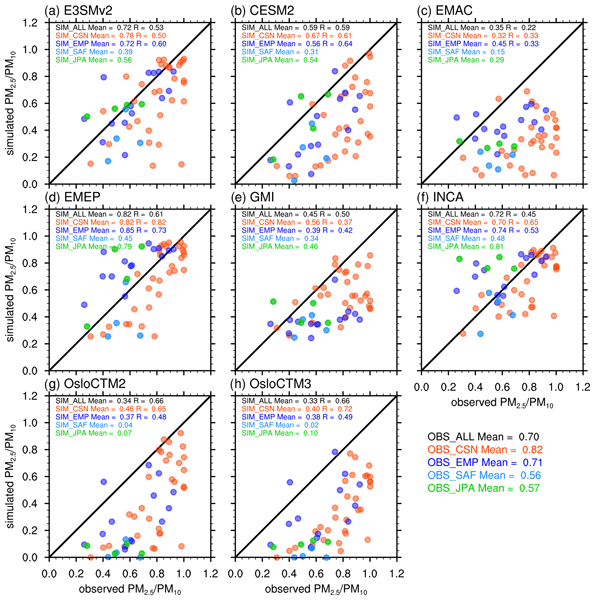
A key challenge in simulating the life cycle of nitrate aerosol in global models is accurately representing the mass size distribution of nitrate aerosol, which lacks sufficient observational constraints. We found that most global models underestimate the mass fraction of fine-mode nitrate at the surface in all regions. Our study highlights the importance of gas–aerosol partitioning parameterization and the simulation of dust and sea salt in correctly simulating the mass size distribution of nitrate.
Anik Das, Baike Xi, Xiaojian Zheng, and Xiquan Dong
EGUsphere, https://doi.org/10.5194/egusphere-2025-874, https://doi.org/10.5194/egusphere-2025-874, 2025
Preprint withdrawn
Short summary
Short summary
This study presents a method to identify cloud boundaries and phases for marine boundary layer clouds over the Southern Ocean using airborne cloud radar and in situ probe data collected during the SOCRATES campaign. Single-layer low-level clouds (<3 km) were found to be dominating (85 %) across all observed samples. Phase classification showed 48.8 % liquid, 23.3 % mixed, and 6.9 % ice. Results support cloud process understanding and improve satellite and climate model studies.
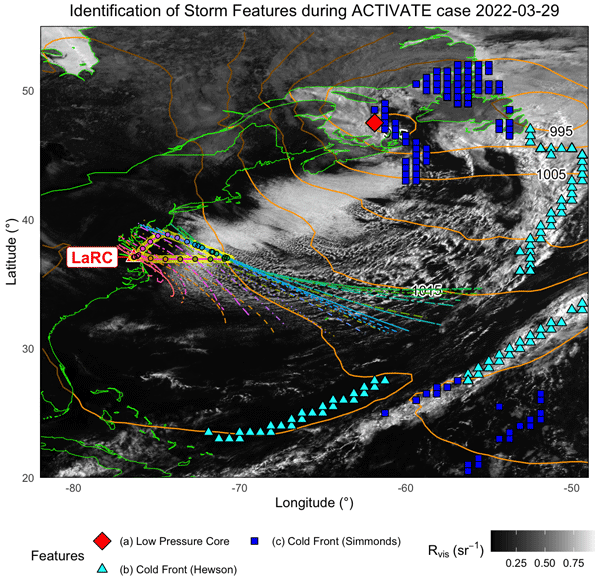
Florian Tornow, Ann Fridlind, George Tselioudis, Brian Cairns, Andrew Ackerman, Seethala Chellappan, David Painemal, Paquita Zuidema, Christiane Voigt, Simon Kirschler, and Armin Sorooshian
Atmos. Chem. Phys., 25, 5053–5074, https://doi.org/10.5194/acp-25-5053-2025, https://doi.org/10.5194/acp-25-5053-2025, 2025
Short summary
Short summary
The recent NASA campaign ACTIVATE (Aerosol Cloud meTeorology Interactions oVer the western ATlantic Experiment) performed 71 tandem flights in mid-latitude marine cold-air outbreaks off the US eastern seaboard. We provide meteorological and cloud transition stage context, allowing us to identify days that are most suitable for Lagrangian modeling and analysis. Surveyed cloud properties show signatures of cloud microphysical processes, such as cloud-top entrainment and secondary ice formation.
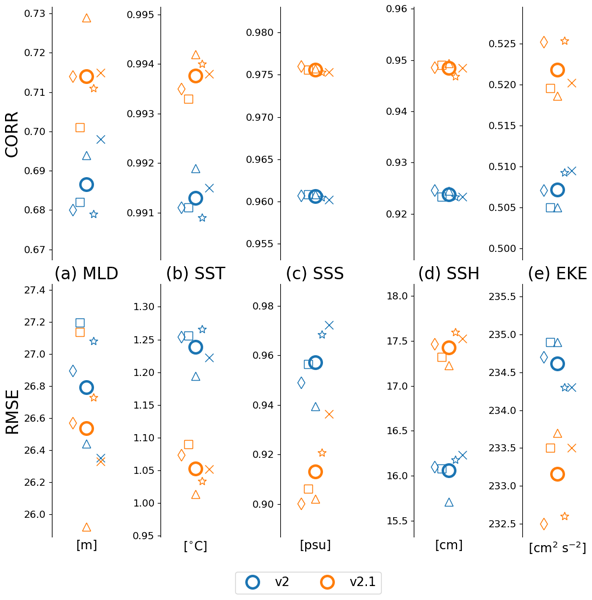
Katherine M. Smith, Alice M. Barthel, LeAnn M. Conlon, Luke P. Van Roekel, Anthony Bartoletti, Jean-Christophe Golaz, Chengzhu Zhang, Carolyn Branecky Begeman, James J. Benedict, Gautam Bisht, Yan Feng, Walter Hannah, Bryce E. Harrop, Nicole Jeffery, Wuyin Lin, Po-Lun Ma, Mathew E. Maltrud, Mark R. Petersen, Balwinder Singh, Qi Tang, Teklu Tesfa, Jonathan D. Wolfe, Shaocheng Xie, Xue Zheng, Karthik Balaguru, Oluwayemi Garuba, Peter Gleckler, Aixue Hu, Jiwoo Lee, Ben Moore-Maley, and Ana C. Ordoñez
Geosci. Model Dev., 18, 1613–1633, https://doi.org/10.5194/gmd-18-1613-2025, https://doi.org/10.5194/gmd-18-1613-2025, 2025
Short summary
Short summary
Version 2.1 of the U.S. Department of Energy's Energy Exascale Earth System Model (E3SM) adds the Fox-Kemper et al. (2011) mixed-layer eddy parameterization, which restratifies the ocean surface layer through an overturning streamfunction. Results include surface layer bias reduction in temperature, salinity, and sea ice extent in the North Atlantic; a small strengthening of the Atlantic meridional overturning circulation; and improvements to many atmospheric climatological variables.
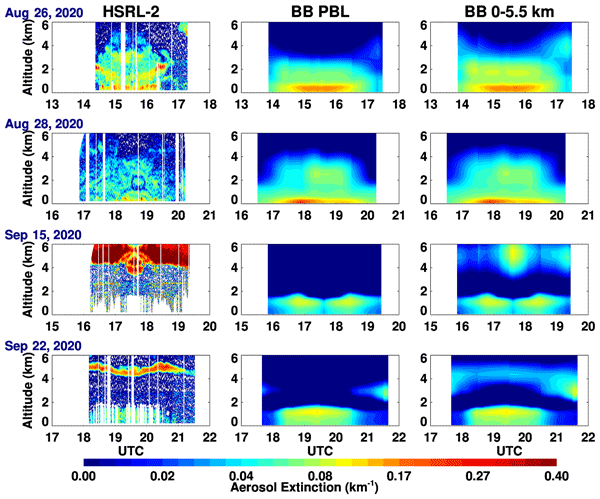
Hongyu Liu, Bo Zhang, Richard H. Moore, Luke D. Ziemba, Richard A. Ferrare, Hyundeok Choi, Armin Sorooshian, David Painemal, Hailong Wang, Michael A. Shook, Amy Jo Scarino, Johnathan W. Hair, Ewan C. Crosbie, Marta A. Fenn, Taylor J. Shingler, Chris A. Hostetler, Gao Chen, Mary M. Kleb, Gan Luo, Fangqun Yu, Mark A. Vaughan, Yongxiang Hu, Glenn S. Diskin, John B. Nowak, Joshua P. DiGangi, Yonghoon Choi, Christoph A. Keller, and Matthew S. Johnson
Atmos. Chem. Phys., 25, 2087–2121, https://doi.org/10.5194/acp-25-2087-2025, https://doi.org/10.5194/acp-25-2087-2025, 2025
Short summary
Short summary
We use the GEOS-Chem model to simulate aerosol distributions and properties over the western North Atlantic Ocean (WNAO) during the winter and summer deployments in 2020 of the NASA ACTIVATE mission. Model results are evaluated against aircraft, ground-based, and satellite observations. The improved understanding of life cycle, composition, transport pathways, and distribution of aerosols has important implications for characterizing aerosol–cloud–meteorology interactions over WNAO.
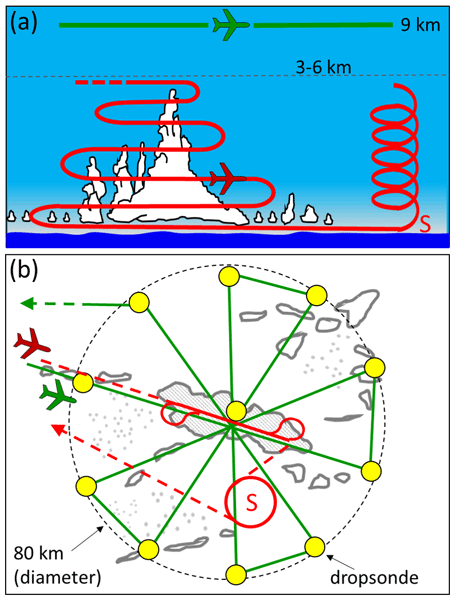
Ewan Crosbie, Luke D. Ziemba, Michael A. Shook, Taylor Shingler, Johnathan W. Hair, Armin Sorooshian, Richard A. Ferrare, Brian Cairns, Yonghoon Choi, Joshua DiGangi, Glenn S. Diskin, Chris Hostetler, Simon Kirschler, Richard H. Moore, David Painemal, Claire Robinson, Shane T. Seaman, K. Lee Thornhill, Christiane Voigt, and Edward Winstead
Atmos. Chem. Phys., 24, 6123–6152, https://doi.org/10.5194/acp-24-6123-2024, https://doi.org/10.5194/acp-24-6123-2024, 2024
Short summary
Short summary
Marine clouds are found to clump together in regions or lines, readily discernible from satellite images of the ocean. While clustering is also a feature of deep storm clouds, we focus on smaller cloud systems associated with fair weather and brief localized showers. Two aircraft sampled the region around these shallow systems: one incorporated measurements taken within, adjacent to, and below the clouds, while the other provided a survey from above using remote sensing techniques.
Leong Wai Siu, Joseph S. Schlosser, David Painemal, Brian Cairns, Marta A. Fenn, Richard A. Ferrare, Johnathan W. Hair, Chris A. Hostetler, Longlei Li, Mary M. Kleb, Amy Jo Scarino, Taylor J. Shingler, Armin Sorooshian, Snorre A. Stamnes, and Xubin Zeng
Atmos. Meas. Tech., 17, 2739–2759, https://doi.org/10.5194/amt-17-2739-2024, https://doi.org/10.5194/amt-17-2739-2024, 2024
Short summary
Short summary
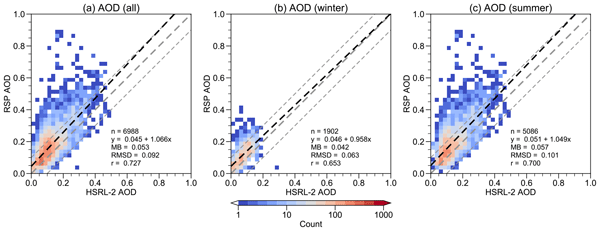
An unprecedented 3-year aerosol dataset was collected from a recent NASA field campaign over the western North Atlantic Ocean, which offers a special opportunity to evaluate two state-of-the-art remote sensing instruments, one lidar and the other polarimeter, on the same aircraft. Special attention has been paid to validate aerosol optical depth data and their uncertainties when no reference dataset is available. Physical reasons for the disagreement between two instruments are discussed.
Alejandro Baró Pérez, Michael S. Diamond, Frida A.-M. Bender, Abhay Devasthale, Matthias Schwarz, Julien Savre, Juha Tonttila, Harri Kokkola, Hyunho Lee, David Painemal, and Annica M. L. Ekman
Atmos. Chem. Phys., 24, 4591–4610, https://doi.org/10.5194/acp-24-4591-2024, https://doi.org/10.5194/acp-24-4591-2024, 2024
Short summary
Short summary
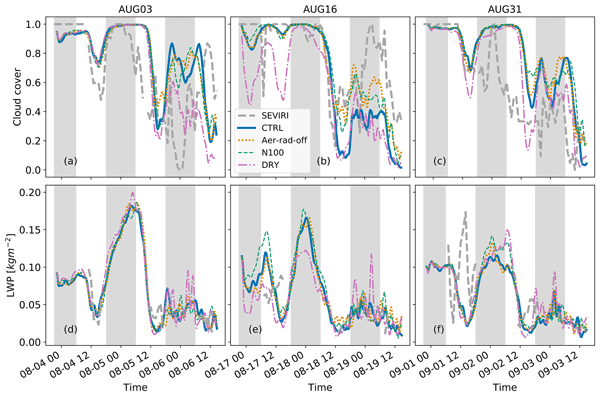
We use a numerical model to study interactions between humid light-absorbing aerosol plumes, clouds, and radiation over the southeast Atlantic. We find that the warming produced by the aerosols reduces cloud cover, especially in highly polluted situations. Aerosol impacts on drizzle play a minor role. However, aerosol effects on cloud reflectivity and moisture-induced changes in cloud cover dominate the climatic response and lead to an overall cooling by the biomass burning plumes.
Shaoyue Qiu, Xue Zheng, David Painemal, Christopher R. Terai, and Xiaoli Zhou
Atmos. Chem. Phys., 24, 2913–2935, https://doi.org/10.5194/acp-24-2913-2024, https://doi.org/10.5194/acp-24-2913-2024, 2024
Short summary
Short summary
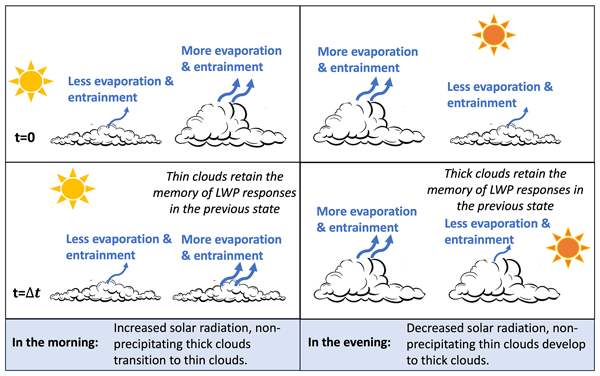
The aerosol indirect effect (AIE) depends on cloud states, which exhibit significant diurnal variations in the northeastern Atlantic. Yet the AIE diurnal cycle remains poorly understood. Using satellite retrievals, we find a pronounced “U-shaped” diurnal variation in the AIE, which is contributed to by the transition of cloud states combined with the lagged cloud responses. This suggests that polar-orbiting satellites with overpass times at noon underestimate daytime mean values of the AIE.
Hui Wan, Kai Zhang, Christopher J. Vogl, Carol S. Woodward, Richard C. Easter, Philip J. Rasch, Yan Feng, and Hailong Wang
Geosci. Model Dev., 17, 1387–1407, https://doi.org/10.5194/gmd-17-1387-2024, https://doi.org/10.5194/gmd-17-1387-2024, 2024
Short summary
Short summary
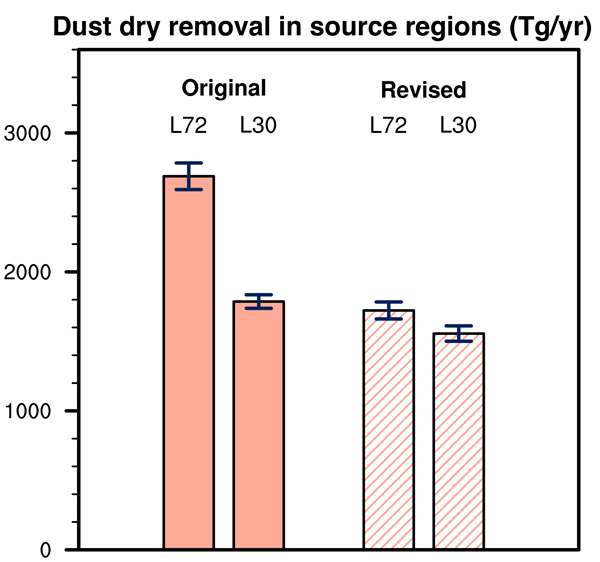
Sophisticated numerical models of the Earth's atmosphere include representations of many physical and chemical processes. In numerical simulations, these processes need to be calculated in a certain sequence. This study reveals the weaknesses of the sequence of calculations used for aerosol processes in a global atmosphere model. A revision of the sequence is proposed and its impacts on the simulated global aerosol climatology are evaluated.
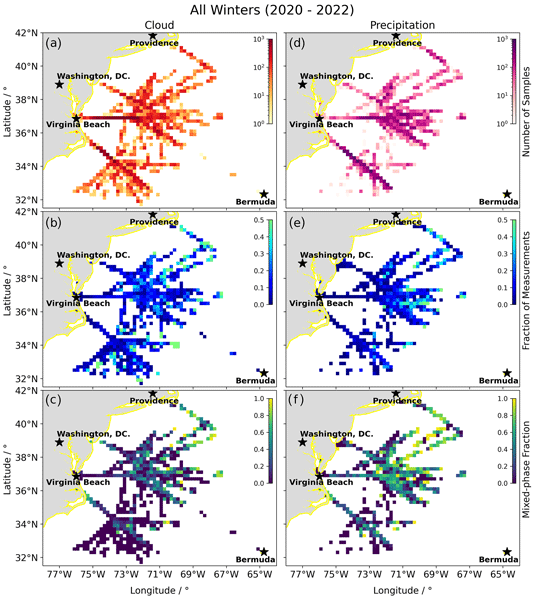
Simon Kirschler, Christiane Voigt, Bruce E. Anderson, Gao Chen, Ewan C. Crosbie, Richard A. Ferrare, Valerian Hahn, Johnathan W. Hair, Stefan Kaufmann, Richard H. Moore, David Painemal, Claire E. Robinson, Kevin J. Sanchez, Amy J. Scarino, Taylor J. Shingler, Michael A. Shook, Kenneth L. Thornhill, Edward L. Winstead, Luke D. Ziemba, and Armin Sorooshian
Atmos. Chem. Phys., 23, 10731–10750, https://doi.org/10.5194/acp-23-10731-2023, https://doi.org/10.5194/acp-23-10731-2023, 2023
Short summary
Short summary
In this study we present an overview of liquid and mixed-phase clouds and precipitation in the marine boundary layer over the western North Atlantic Ocean. We compare microphysical properties of pure liquid clouds to mixed-phase clouds and show that the initiation of the ice phase in mixed-phase clouds promotes precipitation. The observational data presented in this study are well suited for investigating the processes that give rise to liquid and mixed-phase clouds, ice, and precipitation.
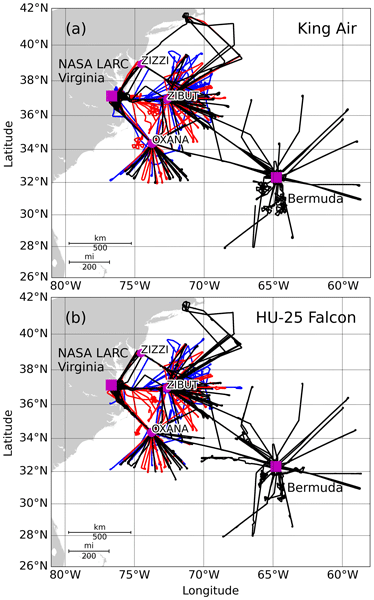
Armin Sorooshian, Mikhail D. Alexandrov, Adam D. Bell, Ryan Bennett, Grace Betito, Sharon P. Burton, Megan E. Buzanowicz, Brian Cairns, Eduard V. Chemyakin, Gao Chen, Yonghoon Choi, Brian L. Collister, Anthony L. Cook, Andrea F. Corral, Ewan C. Crosbie, Bastiaan van Diedenhoven, Joshua P. DiGangi, Glenn S. Diskin, Sanja Dmitrovic, Eva-Lou Edwards, Marta A. Fenn, Richard A. Ferrare, David van Gilst, Johnathan W. Hair, David B. Harper, Miguel Ricardo A. Hilario, Chris A. Hostetler, Nathan Jester, Michael Jones, Simon Kirschler, Mary M. Kleb, John M. Kusterer, Sean Leavor, Joseph W. Lee, Hongyu Liu, Kayla McCauley, Richard H. Moore, Joseph Nied, Anthony Notari, John B. Nowak, David Painemal, Kasey E. Phillips, Claire E. Robinson, Amy Jo Scarino, Joseph S. Schlosser, Shane T. Seaman, Chellappan Seethala, Taylor J. Shingler, Michael A. Shook, Kenneth A. Sinclair, William L. Smith Jr., Douglas A. Spangenberg, Snorre A. Stamnes, Kenneth L. Thornhill, Christiane Voigt, Holger Vömel, Andrzej P. Wasilewski, Hailong Wang, Edward L. Winstead, Kira Zeider, Xubin Zeng, Bo Zhang, Luke D. Ziemba, and Paquita Zuidema
Earth Syst. Sci. Data, 15, 3419–3472, https://doi.org/10.5194/essd-15-3419-2023, https://doi.org/10.5194/essd-15-3419-2023, 2023
Short summary
Short summary
The NASA Aerosol Cloud meTeorology Interactions oVer the western ATlantic Experiment (ACTIVATE) produced a unique dataset for research into aerosol–cloud–meteorology interactions. HU-25 Falcon and King Air aircraft conducted systematic and spatially coordinated flights over the northwest Atlantic Ocean. This paper describes the ACTIVATE flight strategy, instrument and complementary dataset products, data access and usage details, and data application notes.
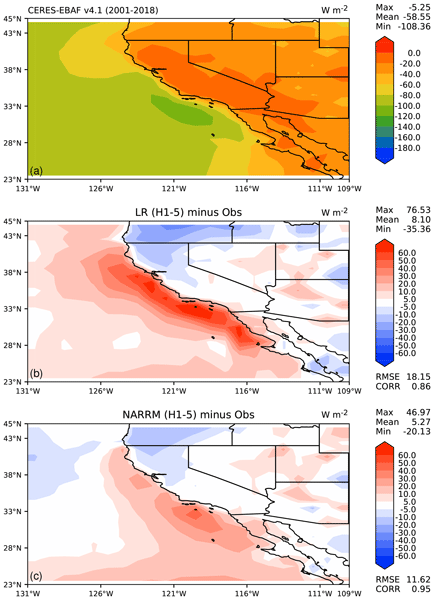
Qi Tang, Jean-Christophe Golaz, Luke P. Van Roekel, Mark A. Taylor, Wuyin Lin, Benjamin R. Hillman, Paul A. Ullrich, Andrew M. Bradley, Oksana Guba, Jonathan D. Wolfe, Tian Zhou, Kai Zhang, Xue Zheng, Yunyan Zhang, Meng Zhang, Mingxuan Wu, Hailong Wang, Cheng Tao, Balwinder Singh, Alan M. Rhoades, Yi Qin, Hong-Yi Li, Yan Feng, Yuying Zhang, Chengzhu Zhang, Charles S. Zender, Shaocheng Xie, Erika L. Roesler, Andrew F. Roberts, Azamat Mametjanov, Mathew E. Maltrud, Noel D. Keen, Robert L. Jacob, Christiane Jablonowski, Owen K. Hughes, Ryan M. Forsyth, Alan V. Di Vittorio, Peter M. Caldwell, Gautam Bisht, Renata B. McCoy, L. Ruby Leung, and David C. Bader
Geosci. Model Dev., 16, 3953–3995, https://doi.org/10.5194/gmd-16-3953-2023, https://doi.org/10.5194/gmd-16-3953-2023, 2023
Short summary
Short summary
High-resolution simulations are superior to low-resolution ones in capturing regional climate changes and climate extremes. However, uniformly reducing the grid size of a global Earth system model is too computationally expensive. We provide an overview of the fully coupled regionally refined model (RRM) of E3SMv2 and document a first-of-its-kind set of climate production simulations using RRM at an economic cost. The key to this success is our innovative hybrid time step method.
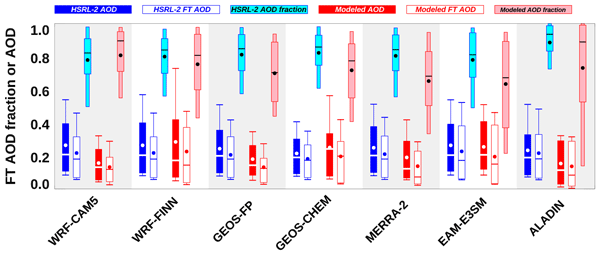
Ian Chang, Lan Gao, Connor J. Flynn, Yohei Shinozuka, Sarah J. Doherty, Michael S. Diamond, Karla M. Longo, Gonzalo A. Ferrada, Gregory R. Carmichael, Patricia Castellanos, Arlindo M. da Silva, Pablo E. Saide, Calvin Howes, Zhixin Xue, Marc Mallet, Ravi Govindaraju, Qiaoqiao Wang, Yafang Cheng, Yan Feng, Sharon P. Burton, Richard A. Ferrare, Samuel E. LeBlanc, Meloë S. Kacenelenbogen, Kristina Pistone, Michal Segal-Rozenhaimer, Kerry G. Meyer, Ju-Mee Ryoo, Leonhard Pfister, Adeyemi A. Adebiyi, Robert Wood, Paquita Zuidema, Sundar A. Christopher, and Jens Redemann
Atmos. Chem. Phys., 23, 4283–4309, https://doi.org/10.5194/acp-23-4283-2023, https://doi.org/10.5194/acp-23-4283-2023, 2023
Short summary
Short summary
Abundant aerosols are present above low-level liquid clouds over the southeastern Atlantic during late austral spring. The model simulation differences in the proportion of aerosol residing in the planetary boundary layer and in the free troposphere can greatly affect the regional aerosol radiative effects. This study examines the aerosol loading and fractional aerosol loading in the free troposphere among various models and evaluates them against measurements from the NASA ORACLES campaign.
Kai Zhang, Wentao Zhang, Hui Wan, Philip J. Rasch, Steven J. Ghan, Richard C. Easter, Xiangjun Shi, Yong Wang, Hailong Wang, Po-Lun Ma, Shixuan Zhang, Jian Sun, Susannah M. Burrows, Manish Shrivastava, Balwinder Singh, Yun Qian, Xiaohong Liu, Jean-Christophe Golaz, Qi Tang, Xue Zheng, Shaocheng Xie, Wuyin Lin, Yan Feng, Minghuai Wang, Jin-Ho Yoon, and L. Ruby Leung
Atmos. Chem. Phys., 22, 9129–9160, https://doi.org/10.5194/acp-22-9129-2022, https://doi.org/10.5194/acp-22-9129-2022, 2022
Short summary
Short summary
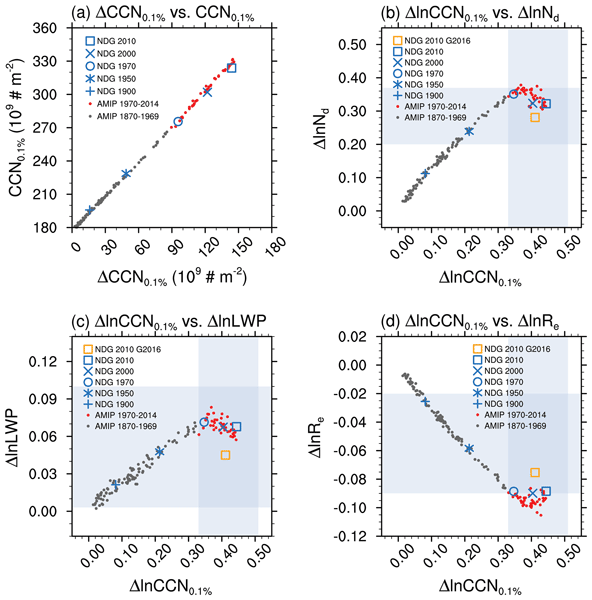
Here we analyze the effective aerosol forcing simulated by E3SM version 1 using both century-long free-running and short nudged simulations. The aerosol forcing in E3SMv1 is relatively large compared to other models, mainly due to the large indirect aerosol effect. Aerosol-induced changes in liquid and ice cloud properties in E3SMv1 have a strong correlation. The aerosol forcing estimates in E3SMv1 are sensitive to the parameterization changes in both liquid and ice cloud processes.
Edward Gryspeerdt, Daniel T. McCoy, Ewan Crosbie, Richard H. Moore, Graeme J. Nott, David Painemal, Jennifer Small-Griswold, Armin Sorooshian, and Luke Ziemba
Atmos. Meas. Tech., 15, 3875–3892, https://doi.org/10.5194/amt-15-3875-2022, https://doi.org/10.5194/amt-15-3875-2022, 2022
Short summary
Short summary
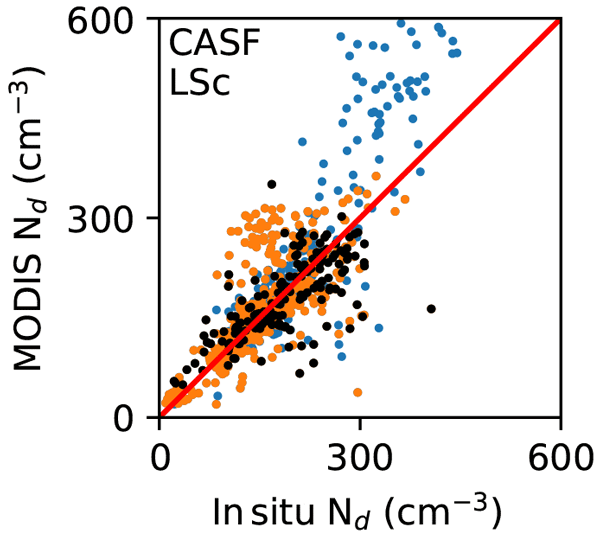
Droplet number concentration is a key property of clouds, influencing a variety of cloud processes. It is also used for estimating the cloud response to aerosols. The satellite retrieval depends on a number of assumptions – different sampling strategies are used to select cases where these assumptions are most likely to hold. Here we investigate the impact of these strategies on the agreement with in situ data, the droplet number climatology and estimates of the indirect radiative forcing.
Zhujun Li, David Painemal, Gregory Schuster, Marian Clayton, Richard Ferrare, Mark Vaughan, Damien Josset, Jayanta Kar, and Charles Trepte
Atmos. Meas. Tech., 15, 2745–2766, https://doi.org/10.5194/amt-15-2745-2022, https://doi.org/10.5194/amt-15-2745-2022, 2022
Short summary
Short summary
For more than 15 years, CALIPSO has revolutionized our understanding of the role of aerosols in climate. Here we evaluate CALIPSO aerosol typing over the ocean using an independent CALIPSO–CloudSat product. The analysis suggests that CALIPSO correctly categorizes clean marine aerosol over the open ocean, elevated smoke over the SE Atlantic, and dust over the tropical Atlantic. Similarities between clean and dusty marine over the open ocean implies that algorithm modifications are warranted.
Sarah J. Doherty, Pablo E. Saide, Paquita Zuidema, Yohei Shinozuka, Gonzalo A. Ferrada, Hamish Gordon, Marc Mallet, Kerry Meyer, David Painemal, Steven G. Howell, Steffen Freitag, Amie Dobracki, James R. Podolske, Sharon P. Burton, Richard A. Ferrare, Calvin Howes, Pierre Nabat, Gregory R. Carmichael, Arlindo da Silva, Kristina Pistone, Ian Chang, Lan Gao, Robert Wood, and Jens Redemann
Atmos. Chem. Phys., 22, 1–46, https://doi.org/10.5194/acp-22-1-2022, https://doi.org/10.5194/acp-22-1-2022, 2022
Short summary
Short summary
Between July and October, biomass burning smoke is advected over the southeastern Atlantic Ocean, leading to climate forcing. Model calculations of forcing by this plume vary significantly in both magnitude and sign. This paper compares aerosol and cloud properties observed during three NASA ORACLES field campaigns to the same in four models. It quantifies modeled biases in properties key to aerosol direct radiative forcing and evaluates how these biases propagate to biases in forcing.
Cited articles
Albrecht, B. A., Fairall, C. W., Thomson, D. W., White, A. B., Snider, J. B., and Schubert, W. H.: Surface-based remote sensing of the observed and the adiabatic liquid water content of stratocumulus clouds, Geophys. Res. Lett., 17, 89–92, https://doi.org/10.1029/GL017i001p00089, 1990.
Alexandri, F., Müller, F., Choudhury, G., Achtert, P., Seelig, T., and Tesche, M.: A cloud-by-cloud approach for studying aerosol–cloud interaction in satellite observations, Atmos. Meas. Tech., 17, 1739–1757, https://doi.org/10.5194/amt-17-1739-2024, 2024.
Arola, A., Lipponen, A., Kolmonen, P., Virtanen, T. H., Bellouin, N., Grosvenor, D. P., Gryspeerdt, E., Quaas, J., and Kokkola, H.: Aerosol effects on clouds are concealed by natural cloud heterogeneity and satellite retrieval errors, Nat. Commun., 13, 7357, https://doi.org/10.1038/s41467-022-34948-5, 2022.
Burton, S. P., Ferrare, R. A., Hostetler, C. A., Hair, J. W., Rogers, R. R., Obland, M. D., Butler, C. F., Cook, A. L., Harper, D. B., and Froyd, K. D.: Aerosol classification using airborne High Spectral Resolution Lidar measurements – methodology and examples, Atmos. Meas. Tech., 5, 73–98, https://doi.org/10.5194/amt-5-73-2012, 2012igenreferenz.
Chen, Y.-C., Christensen, M. W., Stephens, G. L., and Seinfeld, J. H.: Satellite-based estimate of global aerosol–cloud radiative forcing by marine warm clouds, Nat. Geosci., 7, 643–646, https://doi.org/10.1038/NGEO2214, 2014.
Christensen, M. W., Neubauer, D., Poulsen, C. A., Thomas, G. E., McGarragh, G. R., Povey, A. C., Proud, S. R., and Grainger, R. G.: Unveiling aerosol–cloud interactions – Part 1: Cloud contamination in satellite products enhances the aerosol indirect forcing estimate, Atmos. Chem. Phys., 17, 13151–13164, https://doi.org/10.5194/acp-17-13151-2017, 2017igenreferenz.
Fernald, F. G.: Analysis of atmospheric lidar observations: Some comments, Appl. Opt., 23, 652–653, https://doi.org/10.1364/AO.23.000652, 1984.
Gasso, S., Hegg, D. A., Covert, D. S., Collins, D., Noone, K. J., Ostrom, E., Schmid, B., Russell, P. B., Livingston, J. M., Durkee P. A., and Jonsson, H.: Influence of humidity on the aerosol scattering coefficient and its effect on the upwelling radiance during ACE-2, Tellus B, 52, 546–567, https://doi.org/10.1034/j.1600-0889.2000.00055.x, 2000.
Goren, T., Choudhury, G., Kretzschmar, J., and McCoy, I.: Co-variability drives the inverted-V sensitivity between liquid water path and droplet concentrations, Atmos. Chem. Phys., 25, 3413–3423, https://doi.org/10.5194/acp-25-3413-2025, 2025.
Groß, S., Esselborn, M., Weinzierl, B., Wirth, M., Fix, A., and Petzold, A.: Aerosol classification by airborne high spectral resolution lidar observations, Atmos. Chem. Phys., 13, 2487–2505, https://doi.org/10.5194/acp-13-2487-2013, 2013.
Grosvenor, D. P., Sourdeval, O., Zuidema, P., Ackerman, A., Alexandrov, M. D., Bennartz, R., Boers, R., Cairns, B., Chiu, J. C., Christensen, M., Deneke, H., Diamond, M., Feingold, G., Fridlind, A., Hünerbein, A., Knist, C., Kollias, P., Marshak, A., McCoy, D., Merk, D., Painemal, D., Rausch, J., Rosenfeld, D., Russchenberg, H., Seifert, P., Sinclair, K., Stier, P., van Diedenhoven, B., Wendisch, M., Werner, F., Wood, R., Zhang, Z., and Quaas, J.: Remote sensing of droplet number concentration in warm clouds: A review of the current state of knowledge and perspectives, Rev. Geophys., 56, 409–453, https://doi.org/10.1029/2017RG000593, 2018.
Gryspeerdt, E., Quaas, J., and Bellouin, N.: Constraining the aerosol influence on cloud fraction, J. Geophys. Res., 121, 3566–3583, https://doi.org/10.1002/2015JD023744, 2016.
Gryspeerdt, E., Goren, T., Sourdeval, O., Quaas, J., Mülmenstädt, J., Dipu, S., Unglaub, C., Gettelman, A., and Christensen, M.: Constraining the aerosol influence on cloud liquid water path, Atmos. Chem. Phys., 19, 5331–5347, https://doi.org/10.5194/acp-19-5331-2019, 2019.
Gryspeerdt, E., McCoy, D. T., Crosbie, E., Moore, R. H., Nott, G. J., Painemal, D., Small-Griswold, J., Sorooshian, A., and Ziemba, L.: The impact of sampling strategy on the cloud droplet number concentration estimated from satellite data, Atmos. Meas. Tech., 15, 3875–3892, https://doi.org/10.5194/amt-15-3875-2022, 2022.
Gupta, S., McFarquhar, G. M., O'Brien, J. R., Poellot, M. R., Delene, D. J., Chang, I., Gao, L., Xu, F., and Redemann, J.: In situ and satellite-based estimates of cloud properties and aerosol–cloud interactions over the southeast Atlantic Ocean, Atmos. Chem. Phys., 22, 12923–12943, https://doi.org/10.5194/acp-22-12923-2022, 2022.
Humphries, R. S., Keywood, M. D., Gribben, S., McRobert, I. M., Ward, J. P., Selleck, P., Taylor, S., Harnwell, J., Flynn, C., Kulkarni, G. R., Mace, G. G., Protat, A., Alexander, S. P., and McFarquhar, G.: Southern Ocean latitudinal gradients of cloud condensation nuclei, Atmos. Chem. Phys., 21, 12757–12782, https://doi.org/10.5194/acp-21-12757-2021, 2021.
Jia, H., Quaas, J., Gryspeerdt, E., Böhm, C., and Sourdeval, O.: Addressing the difficulties in quantifying droplet number response to aerosol from satellite observations, Atmos. Chem. Phys., 22, 7353–7372, https://doi.org/10.5194/acp-22-7353-2022, 2022.
Josset, D., Pelon, J., Protat, A., and Flamant, C.: New approach to determine aerosol optical depth from combined CALIPSO and CloudSat ocean surface echoes, Geophys. Res. Lett., 35, L10805, https://doi.org/10.1029/2008GL033442, 2008.
Kang, L., Marchand, R. T., and Smith, W. L.: Evaluation of MODIS and Himawari-8 low clouds retrievals over the Southern Ocean with in-situ measurements from the SOCRATES campaign, Earth and Space Science, 8, e2020EA001397, https://doi.org/10.1029/2020EA001397, 2021.
Kim, M.-H., Omar, A. H., Vaughan, M. A., Winker, D. M., Trepte, C. R., Hu, Y., Liu, Z., and Kim, S.-W.: Quantifying the low bias of CALIPSO's column aerosol optical depth due to undetected aerosol layers, J. Geophys. Res.-Atmos., 122, 1098–1113, https://doi.org/10.1002/2016JD025797, 2017.
Lang, F., Huang, Y., Protat, A., Truong, S. C. H., Siems, S. T., and Manton, M. J.: Shallow Convection and Precipitation over the Southern Ocean: A Case Study during the CAPRICORN 2016 Field Campaign, J. Geophys. Res.-Atmos., 126, 9, https://doi.org/10.1029/2020JD034088, 2021.
Levy, R. C., Mattoo, S., Munchak, L. A., Remer, L. A., Sayer, A. M., Patadia, F., and Hsu, N. C.: The Collection 6 MODIS aerosol products over land and ocean, Atmos. Meas. Tech., 6, 2989–3034, https://doi.org/10.5194/amt-6-2989-2013, 2013.
Li, Z., Painemal, D., Schuster, G., Clayton, M., Ferrare, R., Vaughan, M., Josset, D., Kar, J., and Trepte, C.: Assessment of tropospheric CALIPSO Version 4.2 aerosol types over the ocean using independent CALIPSO–SODA lidar ratios, Atmos. Meas. Tech., 15, 2745–2766, https://doi.org/10.5194/amt-15-2745-2022, 2022.
Mace, G. G. and Zhang, Q.: The CloudSat radar-lidar geometrical profile product (RL-GeoProf): Updates, improvements, and selected results, J. Geophys. Res., 119, 9441–9462, https://doi.org/10.1002/2013JD021374, 2014.
Martin, G. M., Johnson, D. W., and Spice, A.: The measurement and parameterization of effective radius of droplets in warm stratocumulus clouds, J. Atmos. Sci., 51, 1823–1842, https://doi.org/10.1175/1520-0469(1994)051<1823:TMAPOE>2.0.CO;2, 1994.
McFarquhar, G. M., Bretherton, C. S., Marchand, R., Protat, A., DeMott, P. J., Alexander, S. P., Roberts, G. C., Twohy, C. H., Toohey, D., Siems, S., Huang, Y., Wood, R., Rauber, R. M., Lasher-Trapp, S., Jensen, J., Stith, J. L., Mace, J., Um, J., Järvinen, E., Schnaiter, M., Gettelman, A., Sanchez, K. J., McCluskey, C. S., Russell, L. M., McCoy, I. L., Atlas, R. L., Bardeen, C. G., Moore, K. A., Hill, T. C. J., Humphries, R. S., Keywood, M. D., Ristovski, Z., Cravigan, L., Schofield, R., Fairall, C., Mallet, M. D., Kreidenweis, S. M., Rainwater, B., D'Alessandro, J., Wang, Y., Wu, W., Saliba, G., Levin, E. J. T., Ding, S., Lang, F., Truong, S. C. H., Wolff, C., Haggerty, J., Harvey, M. J., and Klekociuk, A. R., and McDonald, A: Observations of Clouds, Aerosols, Precipitation, and Surface Radiation over the Southern Ocean: An Overview of CAPRICORN, MARCUS, MICRE, and SOCRATES, B. Am. Meteorol. Soc., 102, E894–E928, https://doi.org/10.1175/BAMS-D-20-0132.1, 2021.
Minnis, P., Sun-Mack, S., Yost, C. R., Chen, Y., Smith Jr., W. L., Heck P. W., Arduini, R. F., Bedka, S. T., Yi, Y., Hong, G., Jin, Z., Painemal, D., Palikonda, R., Scarino, B., Spangenberg, D. A., Smith, R. A., Trepte, Q. Z., Yang, P., and Xie, Y.: CERES MODIS cloud product retrievals for Edition 4, Part I: Algorithm changes, IEEE T. Geosci. Remote, https://doi.org/10.1109/TGRS.2020.3008866, 2020.
Müller, D., Ansmann, A., Mattis, I., Tesche, M., Wandinger, U., Althausen, D., and Pisani, G.: Aerosol-type-dependent lidar ratios observed with Raman lidar, J. Geophys. Res., 112, D16202, https://doi.org/10.1029/2006JD008292, 2007.
Mülmenstädt, J., Gryspeerdt, E., Dipu, S., Quaas, J., Ackerman, A. S., Fridlind, A. M., Tornow, F., Bauer, S. E., Gettelman, A., Ming, Y., Zheng, Y., Ma, P.-L., Wang, H., Zhang, K., Christensen, M. W., Varble, A. C., Leung, L. R., Liu, X., Neubauer, D., Partridge, D. G., Stier, P., and Takemura, T.: General circulation models simulate negative liquid water path–droplet number correlations, but anthropogenic aerosols still increase simulated liquid water path, Atmos. Chem. Phys., 24, 7331–7345, https://doi.org/10.5194/acp-24-7331-2024, 2024.
Myhre, G., Stordal, F., Johnsrud, M., Kaufman, Y. J., Rosenfeld, D., Storelvmo, T., Kristjansson, J. E., Berntsen, T. K., Myhre, A., and Isaksen, I. S. A.: Aerosol-cloud interaction inferred from MODIS satellite data and global aerosol models, Atmos. Chem. Phys., 7, 3081–3101, https://doi.org/10.5194/acp-7-3081-2007, 2007.
Painemal, D.: Global estimates of changes in shortwave low-cloud albedo and fluxes due to variations in cloud droplet number concentration derived from CERES-MODIS satellite sensors, Geophys. Res. Lett., 45, 9288–9296, https://doi.org/10.1029/2018GL078880, 2018.
Painemal, D.: CALIPSO IIR Lidar Level 3 Global Energy and Water Cycle Experiment (GEWEX) Cloud, Standard V2-00, NASA Langley Atmospheric Science Data Center Distributed Active Archive Center [data set], https://doi.org/10.5067/SATCORPS/CALIOP_CLOUDSAT_ MODIS_25KM_L3.1.0, 2026.
Painemal, D. and Zuidema, P.: The first aerosol indirect effect quantified through airborne remote sensing during VOCALS-REx, Atmos. Chem. Phys., 13, 917–931, https://doi.org/10.5194/acp-13-917-2013, 2013.
Painemal, D., Clayton, M., Ferrare, R., Burton, S., Josset, D., and Vaughan, M.: Novel aerosol extinction coefficients and lidar ratios over the ocean from CALIPSO–CloudSat: evaluation and global statistics, Atmos. Meas. Tech., 12, 2201–2217, https://doi.org/10.5194/amt-12-2201-2019, 2019.
Painemal, D., Chang, F.-L., Ferrare, R., Burton, S., Li, Z., Smith Jr., W. L., Minnis, P., Feng, Y., and Clayton, M.: Reducing uncertainties in satellite estimates of aerosol–cloud interactions over the subtropical ocean by integrating vertically resolved aerosol observations, Atmos. Chem. Phys., 20, 7167–7177, https://doi.org/10.5194/acp-20-7167-2020, 2020.
Painemal, D., Smith Jr., W. L., Gupta, S., Moore, R., Cairns, B., McFarquhar, G. M., and O'Brien, J.: Can we rely on satellite visible/infrared microphysical retrievals of boundary layer clouds in partially cloudy scenes? Implications for climate research, Geophys. Res. Lett., 52, e2024GL113825, https://doi.org/10.1029/2024GL113825, 2025.
Quaas, J., Boucher, O., Bellouin, N., and Kinne, S.: Satellite-based estimate of the direct and indirect aerosol climate forcing, J. Geophys. Res., 113, D05204, https://doi.org/10.1029/2007JD008962, 2008.
Quaas, J., Ming, Y., Menon, S., Takemura, T., Wang, M., Penner, J. E., Gettelman, A., Lohmann, U., Bellouin, N., Boucher, O., Sayer, A. M., Thomas, G. E., McComiskey, A., Feingold, G., Hoose, C., Kristjánsson, J. E., Liu, X., Balkanski, Y., Donner, L. J., Ginoux, P. A., Stier, P., Grandey, B., Feichter, J., Sednev, I., Bauer, S. E., Koch, D., Grainger, R. G., Kirkevåg, A., Iversen, T., Seland, Ø., Easter, R., Ghan, S. J., Rasch, P. J., Morrison, H., Lamarque, J.-F., Iacono, M. J., Kinne, S., and Schulz, M.: Aerosol indirect effects – general circulation model intercomparison and evaluation with satellite data, Atmos. Chem. Phys., 9, 8697–8717, https://doi.org/10.5194/acp-9-8697-2009, 2009.
Quaas, J., Arola, A., Cairns, B., Christensen, M., Deneke, H., Ekman, A. M. L., Feingold, G., Fridlind, A., Gryspeerdt, E., Hasekamp, O., Li, Z., Lipponen, A., Ma, P.-L., Mülmenstädt, J., Nenes, A., Penner, J. E., Rosenfeld, D., Schrödner, R., Sinclair, K., Sourdeval, O., Stier, P., Tesche, M., van Diedenhoven, B., and Wendisch, M.: Constraining the Twomey effect from satellite observations: issues and perspectives, Atmos. Chem. Phys., 20, 15079–15099, https://doi.org/10.5194/acp-20-15079-2020, 2020.
Qiu, S., Zheng, X., Painemal, D., Terai, C. R., and Zhou, X.: Daytime variation in the aerosol indirect effect for warm marine boundary layer clouds in the eastern North Atlantic, Atmos. Chem. Phys., 24, 2913–2935, https://doi.org/10.5194/acp-24-2913-2024, 2024.
Ramanathan, V., Crutzen, P. J., Kiehl, J. T., and Rosenfeld, D.: Aerosols, climate, and the hydrological cycle, Science, 294, 2119–2124, https://doi.org/10.1126/science.1064034, 2001.
Reutter, P., Su, H., Trentmann, J., Simmel, M., Rose, D., Gunthe, S. S., Wernli, H., Andreae, M. O., and Pöschl, U.: Aerosol- and updraft-limited regimes of cloud droplet formation: influence of particle number, size and hygroscopicity on the activation of cloud condensation nuclei (CCN), Atmos. Chem. Phys., 9, 7067–7080, https://doi.org/10.5194/acp-9-7067-2009, 2009.
Rosenfeld, D., Kokhanovsky, A., Goren, T., Gryspeerdt, E., Hasekamp, O., Jia, H., Lopatin, A., Quaas, J., Pan, Z., and Sourdeval, O.: Frontiers in satellite-based estimates of cloud-mediated aerosol forcing, Rev. Geophys., 61, e2022RG000799, https://doi.org/10.1029/2022RG000799, 2023.
Shinozuka, Y., Clarke, A. D., Nenes, A., Jefferson, A., Wood, R., McNaughton, C. S., Ström, J., Tunved, P., Redemann, J., Thornhill, K. L., Moore, R. H., Lathem, T. L., Lin, J. J., and Yoon, Y. J.: The relationship between cloud condensation nuclei (CCN) concentration and light extinction of dried particles: indications of underlying aerosol processes and implications for satellite-based CCN estimates, Atmos. Chem. Phys., 15, 7585–7604, https://doi.org/10.5194/acp-15-7585-2015, 2015.
Sorooshian, A., Anderson, B., Bauer, S. E., Braun, R. A., Cairns, B., Crosbie, E., Dadashazar, H., Diskin, G., Ferrare, R., Flagan, R. C., Hair, J., Hostetler, C., Jonsson, H. H., Kleb, M. M., Liu, H., MacDonald, A. B., McComiskey, A., Moore, R., Painemal, D., Russell, L. M., Seinfeld, J. H., Shook, M., Smith Jr, W. L., Thornhill, K., Tselioudis, G., Wang, H., Zeng, X., Zhang, B., Ziemba, L., and Zuidema, P.: Aerosol–Cloud–Meteorology Interaction Airborne Field Investigations: Using Lessons Learned from the U. S. West Coast in the Design of ACTIVATE off the U. S. East Coast, B. Am. Meteorol. Soc., 100, 1511–1528, https://doi.org/10.1175/BAMS-D-18-0100.1, 2019.
Stier, P.: Limitations of passive remote sensing to constrain global cloud condensation nuclei, Atmos. Chem. Phys., 16, 6595–6607, https://doi.org/10.5194/acp-16-6595-2016, 2016.
Toth, T. D., Clayton, M. B., Li, Z., Painemal, D., Rodier, S. D., Kar, J., Thorsen, T. J., Ferrare, R. A., Vaughan, M. A., Tackett, J. L., Bian, H., Chin, M., Garnier, A. E., Welton, E. J., Ryan, R. A., Trepte, C. R., and Winker, D. M.: Mapping 532 nm lidar ratios for CALIPSO-classified marine aerosols using MODIS AOD constrained retrievals and GOCART model simulations, Atmos. Meas. Tech., 18, 6765–6793, https://doi.org/10.5194/amt-18-6765-2025, 2025.
Várnai, T. and Marshak, A.: MODIS observations of enhanced clear sky reflectance near clouds, Geophys. Res. Lett., 36, L6807, https://doi.org/10.1029/2008GL037089, 2009.
Wehr, T., Kubota, T., Tzeremes, G., Wallace, K., Nakatsuka, H., Ohno, Y., Koopman, R., Rusli, S., Kikuchi, M., Eisinger, M., Tanaka, T., Taga, M., Deghaye, P., Tomita, E., and Bernaerts, D.: The EarthCARE mission – science and system overview, Atmos. Meas. Tech., 16, 3581–3608, https://doi.org/10.5194/amt-16-3581-2023, 2023.
Yang, W., Marshak, A., Várnai, T., and Wood, R.: CALIPSO observations of near-cloud aerosol properties as a function of cloud fraction, Geophys. Res. Lett., 41, 9150–9157, https://doi.org/10.1002/2014GL061896, 2014.
Zhang, J. and Feingold, G.: Distinct regional meteorological influences on low-cloud albedo susceptibility over global marine stratocumulus regions, Atmos. Chem. Phys., 23, 1073–1090, https://doi.org/10.5194/acp-23-1073-2023, 2023.
Zhang, Z., Ackerman, A. S., Feingold, G., Platnick, S., Pincus, R., and Xue, H.: Effects of cloud horizontal inhomogeneity and drizzle on remote sensing of cloud droplet effective radius: Case studies based on large-eddy simulations, J. Geophys. Res., 117, D19208, https://doi.org/10.1029/2012JD017655, 2012.
Zheng, X., Dong, X., Xi, B., Logan, T., and Wang, Y.: Distinctive aerosol–cloud–precipitation interactions in marine boundary layer clouds from the ACE-ENA and SOCRATES aircraft field campaigns, Atmos. Chem. Phys., 24, 10323–10347, https://doi.org/10.5194/acp-24-10323-2024, 2024.
Zheng, X., Feng, Y., Painemal, D., Zhang, M., Xie, S., Li, Z., Jacob, R., and Lusch, B.: Regime-based aerosol–cloud interactions from CALIPSO-MODIS and the Energy Exascale Earth System Model version 2 (E3SMv2) over the Eastern North Atlantic, Atmos. Chem. Phys., 25, 17473–17499, https://doi.org/10.5194/acp-25-17473-2025, 2025.
Short summary
This study is the first global assessment of aerosol-cloud interactions (ACI) and cloud adjustments that relies on vertically resolved aerosol retrievals that are vertically matched with the location of the cloud layer. We computed ACI metrics and cloud adjustments over the global ocean by combining retrievals from active and passive satellite sensors and found high sensitivity of clouds to changes in their cloud droplet number concentration due to aerosols.
This study is the first global assessment of aerosol-cloud interactions (ACI) and cloud...


Altmetrics
Final-revised paper
Preprint