
Articles | Volume 26, issue 6
https://doi.org/10.5194/acp-26-4153-2026
© Author(s) 2026. This work is distributed under
the Creative Commons Attribution 4.0 License.
the Creative Commons Attribution 4.0 License.
https://doi.org/10.5194/acp-26-4153-2026
© Author(s) 2026. This work is distributed under
the Creative Commons Attribution 4.0 License.
the Creative Commons Attribution 4.0 License.
ACP Letters
| Highlight paper
| 
26 Mar 2026
ACP Letters | Highlight paper |
| 26 Mar 2026
| 26 Mar 2026
Emerging low-cloud feedback and adjustment in global satellite observations

Department of Physics, Imperial College London, London, United Kingdom
Sarah Wilson Kemsley
Climatic Research Unit, School of Environmental Sciences, University of East Anglia, Norwich, United Kingdom
School of Geography and the Environment, University of Oxford, Oxford, United Kingdom
Hendrik Andersen
Institute of Meteorology and Climate Research Atmospheric Trace Gases and Remote Sensing, Karlsruhe Institute of Technology, Karlsruhe, Germany
Institute of Photogrammetry and Remote Sensing, Karlsruhe Institute of Technology, Karlsruhe, Germany
Timothy Andrews
Met Office Hadley Centre, Exeter, United Kingdom
School of Earth and Environment, University of Leeds, Leeds, United Kingdom
Ryan J. Kramer
Geophysical Fluid Dynamics Laboratory, NOAA, Princeton, NJ, United States
Peer Nowack
Institute of Meteorology and Climate Research Atmospheric Trace Gases and Remote Sensing, Karlsruhe Institute of Technology, Karlsruhe, Germany
Institute of Theoretical Informatics, Karlsruhe Institute of Technology, Karlsruhe, Germany
Casey J. Wall
Department of Meteorology, Stockholm University, Stockholm, Sweden
Bolin Centre for Climate Research, Stockholm University, Stockholm, Sweden
Mark D. Zelinka
Lawrence Livermore National Laboratory, Livermore, CA, United States
Related authors
Aleena M. Jaison, Paulo Ceppi, and Sarah Wilson Kemsley
Atmos. Chem. Phys., 26, 14403–14416, https://doi.org/10.5194/acp-26-14403-2026, https://doi.org/10.5194/acp-26-14403-2026, 2026
Short summary
Short summary
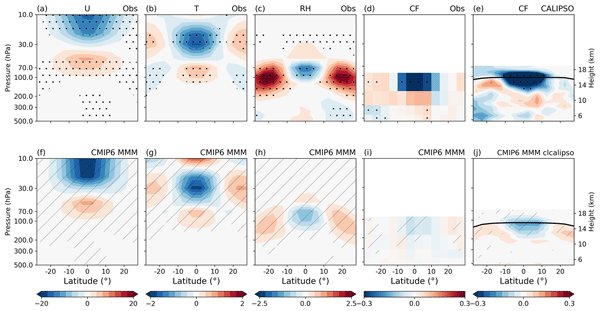
We investigate how stratospheric winds influence high clouds using satellite observations and climate models. These winds, known as the quasi-biennial oscillation, alter meteorological conditions in the troposphere such as upper-tropospheric temperature, stability, and humidity, and clouds respond to these changes. Reducing model biases requires improving cloud sensitivity to these factors. This framework could also help assess cloud responses to stratospheric cooling driven by climate change.
Paulo Ceppi, Alejandro Bodas-Salcedo, Mark D. Zelinka, Timothy Andrews, Florent Brient, Robin Chadwick, An-Zhuo Dai, Jonathan M. Gregory, Yen-Ting Hwang, Sarah M. Kang, Jennifer E. Kay, Thorsten Mauritsen, Tomoo Ogura, George Tselioudis, Masahiro Watanabe, Mark J. Webb, and Allison A. Wing
Geosci. Model Dev., 19, 8693–8708, https://doi.org/10.5194/gmd-19-8693-2026, https://doi.org/10.5194/gmd-19-8693-2026, 2026
Short summary
Short summary
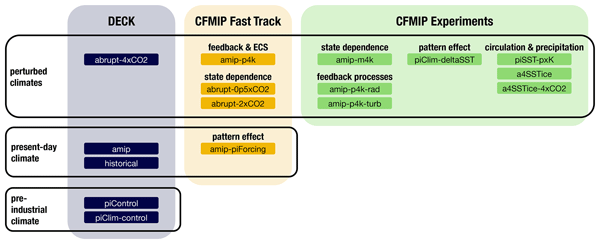
Clouds constitute a key uncertainty for climate change projections. The Cloud Feedback Model Intercomparison Project (CFMIP) aims to address this challenge by evaluating and understanding clouds and their impacts on atmospheric circulation, precipitation, and climate sensitivity. The present paper describes the CFMIP experiment protocol for the Coupled Model Intercomparison Project phase 7 (CMIP7), and discusses the accompanying science questions and opportunities for progress.
Abel Shibu, Henrik Auestad, Paulo Ceppi, and Tim Woollings
EGUsphere, https://doi.org/10.5194/egusphere-2026-4895, https://doi.org/10.5194/egusphere-2026-4895, 2026
Short summary
Short summary
We estimate the contributions from various processes to the strength of extratropical cyclones using a novel framework applied to cyclones tracked in climate model data. Diabatic processes increase in importance with cyclone strength and account for most of the strength of the strongest storms in both summer and winter. In a warmer climate with increased moisture availability, winter storms show a significant increase in strength, with implications for future weather extremes.
Omer Roi-Cohen, Gaea Hadary, Casey J. Wall, Paulo Ceppi, and Guy Dagan
EGUsphere, https://doi.org/10.5194/egusphere-2026-3075, https://doi.org/10.5194/egusphere-2026-3075, 2026
Short summary
Short summary
When humans burn fossil fuels, released particles make clouds more reflective, cooling Earth. This effect is a major uncertainty in climate projections, and recent satellite studies disagree widely on its magnitude. We developed a framework, validated against models and observations, to test which analytical choices are most reliable. Our resulting estimate aligns with major international climate assessments, providing independent observational support for consensus climate projections.
Richard G. Williams, Philip Goodwin, Paulo Ceppi, Chris D. Jones, and Andrew H. MacDougall
Biogeosciences, 22, 7167–7186, https://doi.org/10.5194/bg-22-7167-2025, https://doi.org/10.5194/bg-22-7167-2025, 2025
Short summary
Short summary
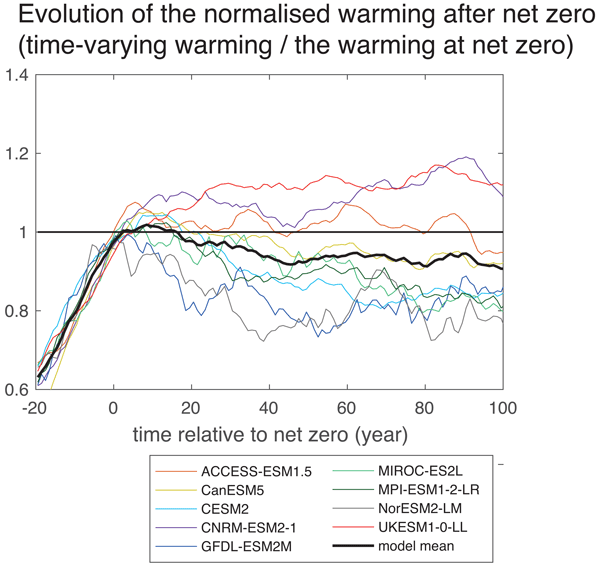
How the climate system responds when carbon emissions cease is an open question: some climate models reveal a slight warming, whereas most models reveal a slight cooling. The temperature response after net zero is connected via a new framework to quantify and compare the opposing thermal and carbon drivers. The climate response after net zero is controlled by how the planet takes up heat and radiates heat back to space, and how the land and ocean sequester carbon from the atmosphere.
Philipp Breul, Paulo Ceppi, and Peer Nowack
Atmos. Chem. Phys., 25, 11991–12005, https://doi.org/10.5194/acp-25-11991-2025, https://doi.org/10.5194/acp-25-11991-2025, 2025
Short summary
Short summary
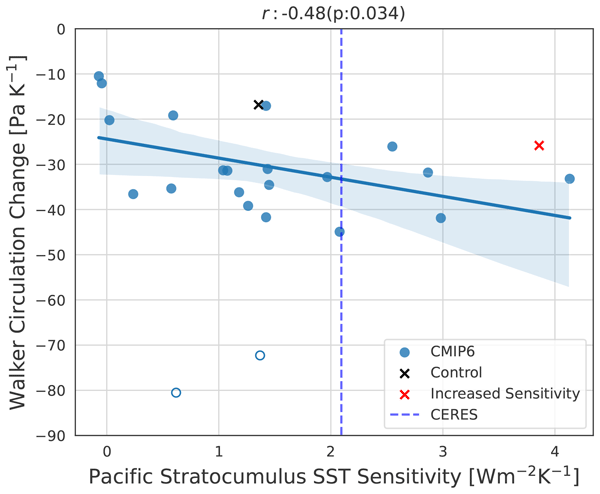
We explore how Pacific low-level clouds influence projections of regional climate change by adjusting a climate model to enhance low-cloud response to surface temperatures. We find significant changes in projected warming patterns and circulation changes under increased CO2 conditions. Our findings are supported by similar relationships across state-of-the-art climate models. These results highlight the importance of accurately representing clouds for predicting regional climate change impacts.
Henrik Auestad, Clemens Spensberger, Andrea Marcheggiani, Paulo Ceppi, Thomas Spengler, and Tim Woollings
Weather Clim. Dynam., 5, 1269–1286, https://doi.org/10.5194/wcd-5-1269-2024, https://doi.org/10.5194/wcd-5-1269-2024, 2024
Short summary
Short summary
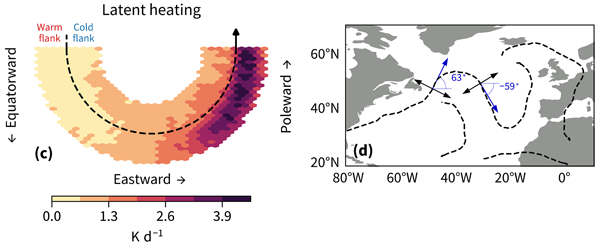
Latent heating due to condensation can influence atmospheric circulation by strengthening or weakening horizontal temperature contrasts. Strong temperature contrasts intensify storms and imply the existence of strong upper tropospheric winds called jets. It remains unclear whether latent heating preferentially reinforces or abates the existing jet. We show that this disagreement is attributable to how the jet is defined, confirming that latent heating reinforces the jet.
Sarah Wilson Kemsley, Paulo Ceppi, Hendrik Andersen, Jan Cermak, Philip Stier, and Peer Nowack
Atmos. Chem. Phys., 24, 8295–8316, https://doi.org/10.5194/acp-24-8295-2024, https://doi.org/10.5194/acp-24-8295-2024, 2024
Short summary
Short summary
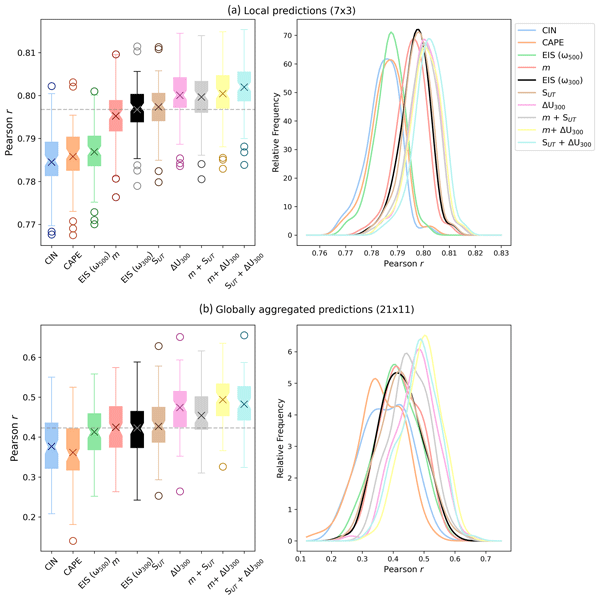
Aiming to inform parameter selection for future observational constraint analyses, we incorporate five candidate meteorological drivers specifically targeting high clouds into a cloud controlling factor framework within a range of spatial domain sizes. We find a discrepancy between optimal domain size for predicting locally and globally aggregated cloud radiative anomalies and identify upper-tropospheric static stability as an important high-cloud controlling factor.
Philip Goodwin, Richard Williams, Paulo Ceppi, and B. B. Cael
EGUsphere, https://doi.org/10.5194/egusphere-2023-2307, https://doi.org/10.5194/egusphere-2023-2307, 2023
Preprint archived
Short summary
Short summary
Climate feedbacks are normally evaluated by considering the change over time for Earth's energy balance and surface temperatures in the climate system. However, we only have around 1 degree Celsius of temperature change to utilise. Here, climate feedbacks are instead evaluated from the change in latitude of Earth's energy balance and surface temperatures, where we have around 70 degrees Celsius of temperature change to utilise.
Philipp Breul, Paulo Ceppi, and Theodore G. Shepherd
Weather Clim. Dynam., 4, 39–47, https://doi.org/10.5194/wcd-4-39-2023, https://doi.org/10.5194/wcd-4-39-2023, 2023
Short summary
Short summary
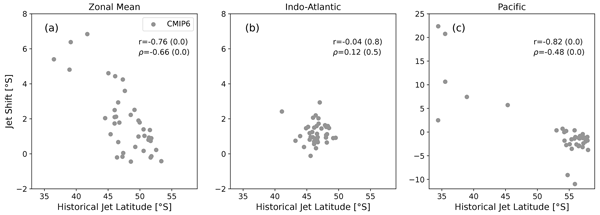
Accurately predicting the response of the midlatitude jet stream to climate change is very important, but models show a variety of possible scenarios. Previous work identified a relationship between climatological jet latitude and future jet shift in the southern hemispheric winter. We show that the relationship does not hold in separate sectors and propose that zonal asymmetries are the ultimate cause in the zonal mean. This questions the usefulness of the relationship.
Philipp Breul, Paulo Ceppi, and Theodore G. Shepherd
Weather Clim. Dynam., 3, 645–658, https://doi.org/10.5194/wcd-3-645-2022, https://doi.org/10.5194/wcd-3-645-2022, 2022
Short summary
Short summary
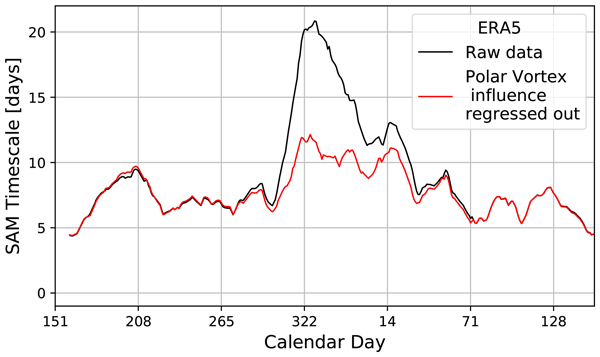
Understanding how the mid-latitude jet stream will respond to a changing climate is highly important. Unfortunately, climate models predict a wide variety of possible responses. Theoretical frameworks can link an internal jet variability timescale to its response. However, we show that stratospheric influence approximately doubles the internal timescale, inflating predicted responses. We demonstrate an approach to account for the stratospheric influence and recover correct response predictions.
Aleena M. Jaison, Paulo Ceppi, and Sarah Wilson Kemsley
Atmos. Chem. Phys., 26, 14403–14416, https://doi.org/10.5194/acp-26-14403-2026, https://doi.org/10.5194/acp-26-14403-2026, 2026
Short summary
Short summary
We investigate how stratospheric winds influence high clouds using satellite observations and climate models. These winds, known as the quasi-biennial oscillation, alter meteorological conditions in the troposphere such as upper-tropospheric temperature, stability, and humidity, and clouds respond to these changes. Reducing model biases requires improving cloud sensitivity to these factors. This framework could also help assess cloud responses to stratospheric cooling driven by climate change.
Viola Hipler, Hendrik Andersen, Robert Spirig, Roland Vogt, Stuart Piketh, Bianca Adler, and Jan Cermak
Atmos. Chem. Phys., 26, 14367–14384, https://doi.org/10.5194/acp-26-14367-2026, https://doi.org/10.5194/acp-26-14367-2026, 2026
Short summary
Short summary
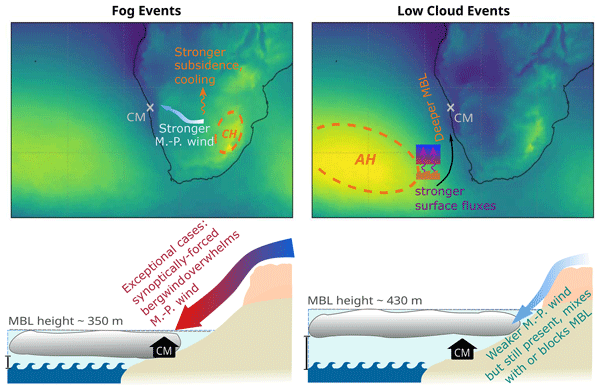
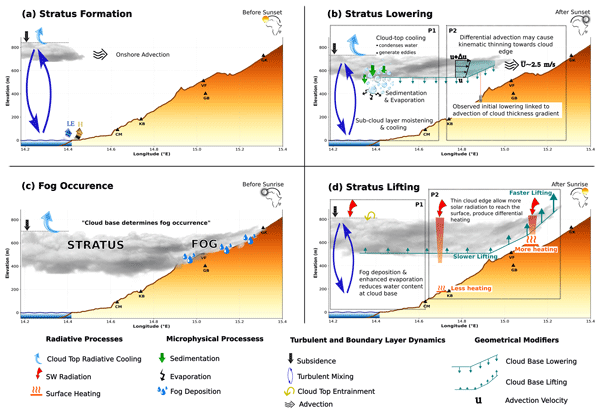
Fog is a key component of the Namib Desert ecosystem, and is mostly associated with the advection of marine stratus clouds. Here, we use local measurements near the coast to distinguish fog situations from lifted low-cloud situations. Using reanalysis data, we find synoptic and regional-scale processes over the ocean and over the continent that are connected to stratus altitude and therefore fog occurrence patterns. The results lead to a better understanding of the coastal desert fog system.
Paulo Ceppi, Alejandro Bodas-Salcedo, Mark D. Zelinka, Timothy Andrews, Florent Brient, Robin Chadwick, An-Zhuo Dai, Jonathan M. Gregory, Yen-Ting Hwang, Sarah M. Kang, Jennifer E. Kay, Thorsten Mauritsen, Tomoo Ogura, George Tselioudis, Masahiro Watanabe, Mark J. Webb, and Allison A. Wing
Geosci. Model Dev., 19, 8693–8708, https://doi.org/10.5194/gmd-19-8693-2026, https://doi.org/10.5194/gmd-19-8693-2026, 2026
Short summary
Short summary
Clouds constitute a key uncertainty for climate change projections. The Cloud Feedback Model Intercomparison Project (CFMIP) aims to address this challenge by evaluating and understanding clouds and their impacts on atmospheric circulation, precipitation, and climate sensitivity. The present paper describes the CFMIP experiment protocol for the Coupled Model Intercomparison Project phase 7 (CMIP7), and discusses the accompanying science questions and opportunities for progress.
Deepanshu Malik, Hendrik Andersen, Jan Cermak, and Roland Vogt
EGUsphere, https://doi.org/10.5194/egusphere-2026-2693, https://doi.org/10.5194/egusphere-2026-2693, 2026
This preprint is open for discussion and under review for Atmospheric Measurement Techniques (AMT).
Short summary
Short summary
We created the first continuous maps of fog occurrence for the central Namib Desert by combining satellite observations with ground measurements. The study shows where and how often fog reaches the surface and distinguishes it from low clouds that remain above the ground. These maps improve understanding of an important hidden water source that supports desert ecosystems and may help future studies of climate and water availability.
Alexandre Mass, Jan Cermak, and Hendrik Andersen
Atmos. Chem. Phys., 26, 12565–12589, https://doi.org/10.5194/acp-26-12565-2026, https://doi.org/10.5194/acp-26-12565-2026, 2026
Short summary
Short summary
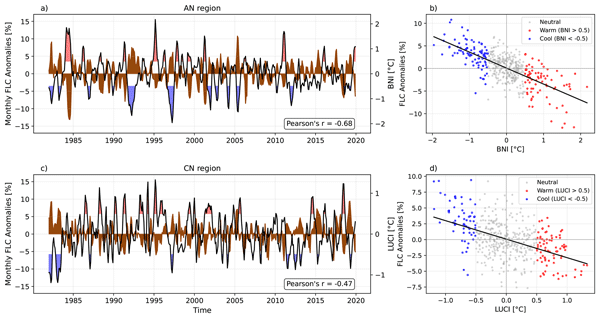
Fog is a vital water source in the Namib Desert, but its year-to-year variability is poorly understood. Using satellite observations and reanalysis data, we show that fog and low-cloud variability is closely tied to sea surface temperatures in the Benguela upwelling system. Warm events driven by tropical water intrusions are followed by reduced fog in the northern Namib, indicating that ocean state carries predictive information for fog in this hyper-arid ecosystem.
Jaume Ruiz de Morales, Josep Calbó, Josep-Abel González, Hendrik Andersen, Jan Cermak, Julia Fuchs, Yolanda Sola, and José Luis Gómez-Amo
EGUsphere, https://doi.org/10.5194/egusphere-2026-3737, https://doi.org/10.5194/egusphere-2026-3737, 2026
Short summary
Short summary
This study presents cloud–aerosol transition zone distributions from coincidental ground-based and satellite lidar observations. The aim is to evaluate the capabilities of both observing systems and improve knowledge of transition zones, including their occurrence, horizontal extent, and vertical distribution. The results show how integrating both methods can compensate for their individual limitations and provide a more comprehensive characterization of cloud-TZ-aerosol distribution.
Abel Shibu, Henrik Auestad, Paulo Ceppi, and Tim Woollings
EGUsphere, https://doi.org/10.5194/egusphere-2026-4895, https://doi.org/10.5194/egusphere-2026-4895, 2026
Short summary
Short summary
We estimate the contributions from various processes to the strength of extratropical cyclones using a novel framework applied to cyclones tracked in climate model data. Diabatic processes increase in importance with cyclone strength and account for most of the strength of the strongest storms in both summer and winter. In a warmer climate with increased moisture availability, winter storms show a significant increase in strength, with implications for future weather extremes.
Casey J. Wall, Adam C. Varble, Rusen Öktem, and David M. Romps
EGUsphere, https://doi.org/10.5194/egusphere-2026-3986, https://doi.org/10.5194/egusphere-2026-3986, 2026
Short summary
Short summary
The concept of warm-phase convective invigoration from aerosol-cloud interactions posits that polluted clouds form smaller and more numerous droplets than their non-polluted counterparts. This causes polluted cloud updrafts to consume moisture more readily, which ultimately leads to faster updrafts. This work develops a theoretical model of warm-phase convective invigoration and applies the model with aircraft measurements to infer how much the mechanism can invigorate cloud updrafts in nature.
Casey J. Wall
EGUsphere, https://doi.org/10.5194/egusphere-2026-3985, https://doi.org/10.5194/egusphere-2026-3985, 2026
Short summary
Short summary
The concept of warm-phase convective invigoration from aerosol-cloud interactions posits that polluted clouds form smaller and more numerous droplets than their non-polluted counterparts. This causes polluted cloud updrafts to consume moisture more readily, which ultimately leads to faster updrafts. This work develops a theoretical model of warm-phase convective invigoration and applies the model with aircraft measurements to infer how much the mechanism can invigorate cloud updrafts in nature.
Alexandre Mass, Jan Cermak, Reto Knutti, Anna L. Merrifield, and Hendrik Andersen
EGUsphere, https://doi.org/10.5194/egusphere-2026-3242, https://doi.org/10.5194/egusphere-2026-3242, 2026
Short summary
Short summary
Fog is a critical water source for life in the Namib Desert. To assess how fog may change in the future, we combined satellite observations with climate model projections. Warming ocean temperatures reduce fog, but stronger onshore winds and increased atmospheric stability counteract this effect. Overall, Namib fog appears more resilient to climate change than previously thought, a finding that may apply to other fog-prone coasts worldwide.
Omer Roi-Cohen, Gaea Hadary, Casey J. Wall, Paulo Ceppi, and Guy Dagan
EGUsphere, https://doi.org/10.5194/egusphere-2026-3075, https://doi.org/10.5194/egusphere-2026-3075, 2026
Short summary
Short summary
When humans burn fossil fuels, released particles make clouds more reflective, cooling Earth. This effect is a major uncertainty in climate projections, and recent satellite studies disagree widely on its magnitude. We developed a framework, validated against models and observations, to test which analytical choices are most reliable. Our resulting estimate aligns with major international climate assessments, providing independent observational support for consensus climate projections.
Ryan J. Kramer, Chris Smith, and Timothy Andrews
Geosci. Model Dev., 19, 4447–4466, https://doi.org/10.5194/gmd-19-4447-2026, https://doi.org/10.5194/gmd-19-4447-2026, 2026
Short summary
Short summary
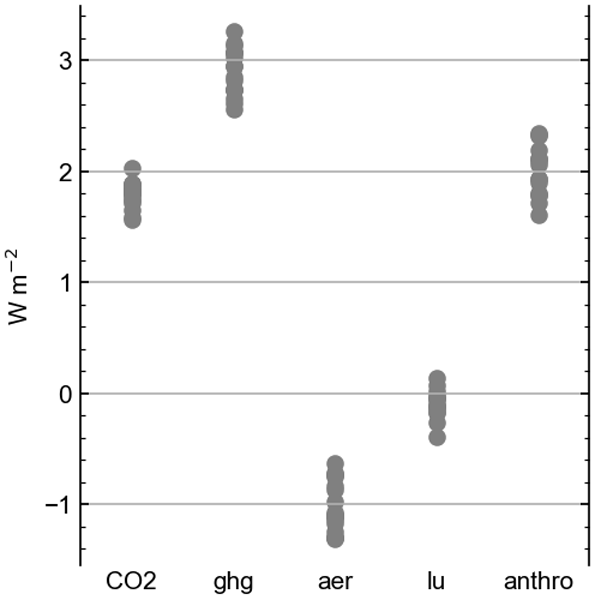
Natural or anthropogenic activities can cause a perturbation in Earth's radiative energy budget known as a radiative forcing, which induces a climate response. Diagnosing radiative forcing and its uncertainty is foundational to understanding past and future climate change. Here we outline the protocol for the second iteration of the Radiative Forcing Model Intercomparison Project (RFMIP2.0), which provides a standardized method for diagnosing radiative forcing across Global Climate Models.
Beth Dingley, James A. Anstey, Marta Abalos, Carsten Abraham, Tommi Bergman, Lisa Bock, Sonya Fiddes, Birgit Hassler, Ryan J. Kramer, Fei Luo, Fiona M. O'Connor, Petr Šácha, Isla R. Simpson, Laura J. Wilcox, and Mark D. Zelinka
Geosci. Model Dev., 19, 2945–2984, https://doi.org/10.5194/gmd-19-2945-2026, https://doi.org/10.5194/gmd-19-2945-2026, 2026
Short summary
Short summary
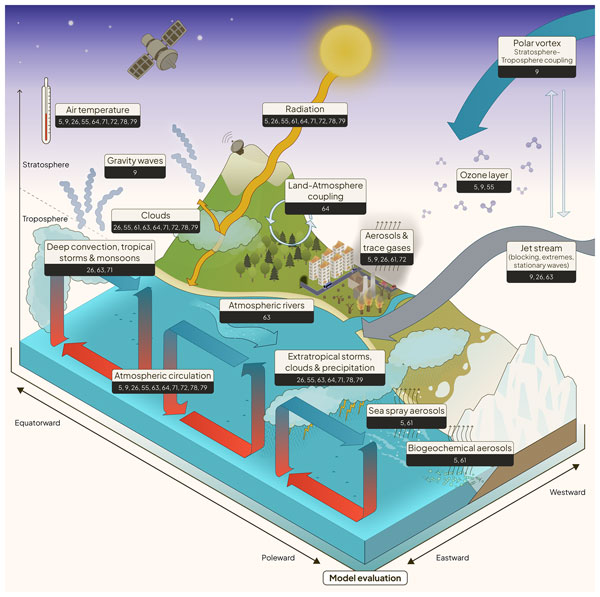
This manuscript defines as a list of variables and scientific opportunities which are requested from the Coupled Model Intercomparison Project Phase 7 (CMIP7) Assessment Fast Track to address open atmospheric science questions. The list reflects the output of a large public community engagement effort, coordinated across autumn 2025 through to summer 2025.
Rachel Yuen Sum Tam, Timothy A. Myers, Mark D. Zelinka, Cristian Proistosescu, Yuan-Jen Lin, and Kate Marvel
Atmos. Chem. Phys., 26, 4289–4311, https://doi.org/10.5194/acp-26-4289-2026, https://doi.org/10.5194/acp-26-4289-2026, 2026
Short summary
Short summary
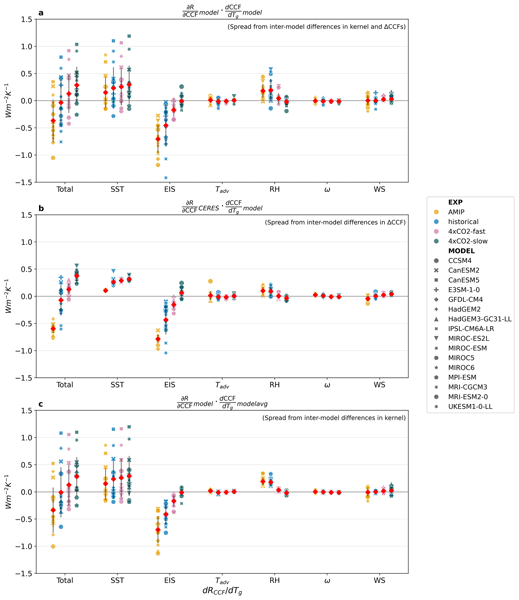
This work identifies the key driver to the change of present and future climate response, known as the pattern effect, by breaking down low-cloud feedback as the radiative changes to meteorology and the meteorology changes to warming using a cloud controlling factor framework. We identify inversion strength in the Southern Ocean and the South East Pacific as the main driver to the pattern effect, and larger uncertainty remains in the sensitivities of radiative flux to meteorology.
Yichen Jia, Hendrik Andersen, David Neubauer, Ulrike Lohmann, Corinna Hoose, and Jan Cermak
EGUsphere, https://doi.org/10.5194/egusphere-2026-569, https://doi.org/10.5194/egusphere-2026-569, 2026
Short summary
Short summary
Understanding how ocean clouds respond to air pollution is important for climate projections. Using artificial intelligence and a climate model, we show that some model settings produce very high cloud cover, leaving little room for further cloud growth as pollution increases. This “headroom effect” can make cloud responses appear weak. Our results highlight the need to consider existing cloud conditions when interpreting how cloud cover responds to the environment.
Deepanshu Malik, Hendrik Andersen, Jan Cermak, Roland Vogt, and Bianca Adler
Atmos. Chem. Phys., 26, 681–701, https://doi.org/10.5194/acp-26-681-2026, https://doi.org/10.5194/acp-26-681-2026, 2026
Short summary
Short summary
We investigated cloud base height changes in the Namib Desert and developed a method to estimate it using ground-based humidity data. This improves fog monitoring by distinguishing fog from low clouds, which satellites alone cannot reliably do. Our results reveal diurnal patterns and linkages to coastal proximity in the vertical dynamics of fog and low clouds, highlighting key atmospheric processes with potential importance for future research.
Laura A. Mansfield, Peer J. Nowack, Edmund M. Ryan, Oliver Wild, and Apostolos Voulgarakis
EGUsphere, https://doi.org/10.5194/egusphere-2025-6046, https://doi.org/10.5194/egusphere-2025-6046, 2025
Short summary
Short summary
We present a fast machine learning emulator that predicts how Earth’s surface temperature reacts within the first five years to changes in greenhouse gases and aerosol pollutants. It is trained on carefully designed simulations from a complex climate model, but can be run much faster. Our emulator can be used to show where the climate is most sensitive to different emissions and can help explore many possible future paths, making it easier to assess the climate effects of policy choices.
Jingyu Wang, Gabriel Chiodo, Blanca Ayarzagüena, William T. Ball, Mohamadou Diallo, Birgit Hassler, James Keeble, Peer Nowack, Clara Orbe, Sandro Vattioni, and Timofei Sukhodolov
Atmos. Chem. Phys., 25, 17819–17844, https://doi.org/10.5194/acp-25-17819-2025, https://doi.org/10.5194/acp-25-17819-2025, 2025
Short summary
Short summary
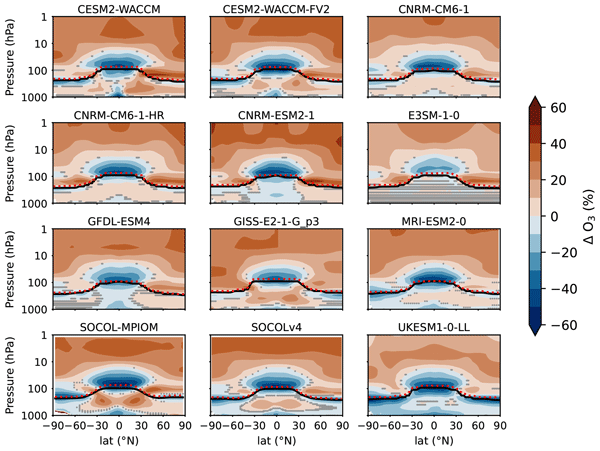
We analyzed the ozone response under elevated CO2 using the data from CMIP6 DECK experiments. We then examined the relations between ozone response and changes in temperature and circulation to identify the drivers of ozone change. The climate feedback of ozone is investigated through offline calculations and by comparing models with and without interactive chemistry. We find that ozone–climate interactions are important for Earth system models and thus should be considered in future model development.
Anna Zehrung, Andrew D. King, Zebedee Nicholls, Mark D. Zelinka, and Malte Meinshausen
Geosci. Model Dev., 18, 9433–9450, https://doi.org/10.5194/gmd-18-9433-2025, https://doi.org/10.5194/gmd-18-9433-2025, 2025
Short summary
Short summary
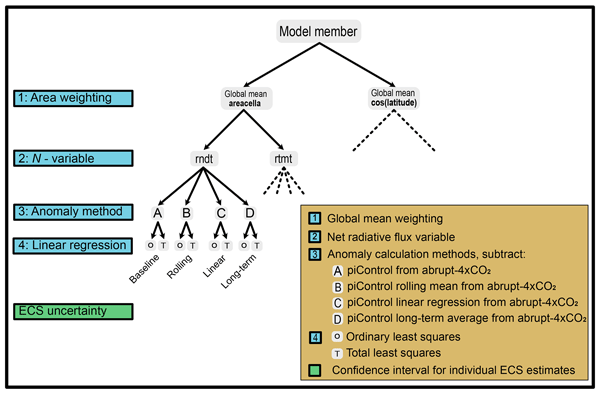
The Gregory method is a common approach for calculating the equilibrium climate sensitivity (ECS). However, studies which apply this method lack transparency in how model data is processed prior to calculating the ECS, inhibiting replicability. Different choices of global weighting, net radiative flux variable, anomaly calculation, and linear regression fit can affect the ECS estimates. We investigate the impact of these choices and propose a standardised method for future ECS calculations.
Richard G. Williams, Philip Goodwin, Paulo Ceppi, Chris D. Jones, and Andrew H. MacDougall
Biogeosciences, 22, 7167–7186, https://doi.org/10.5194/bg-22-7167-2025, https://doi.org/10.5194/bg-22-7167-2025, 2025
Short summary
Short summary
How the climate system responds when carbon emissions cease is an open question: some climate models reveal a slight warming, whereas most models reveal a slight cooling. The temperature response after net zero is connected via a new framework to quantify and compare the opposing thermal and carbon drivers. The climate response after net zero is controlled by how the planet takes up heat and radiates heat back to space, and how the land and ocean sequester carbon from the atmosphere.
Philipp Breul, Paulo Ceppi, and Peer Nowack
Atmos. Chem. Phys., 25, 11991–12005, https://doi.org/10.5194/acp-25-11991-2025, https://doi.org/10.5194/acp-25-11991-2025, 2025
Short summary
Short summary
We explore how Pacific low-level clouds influence projections of regional climate change by adjusting a climate model to enhance low-cloud response to surface temperatures. We find significant changes in projected warming patterns and circulation changes under increased CO2 conditions. Our findings are supported by similar relationships across state-of-the-art climate models. These results highlight the importance of accurately representing clouds for predicting regional climate change impacts.
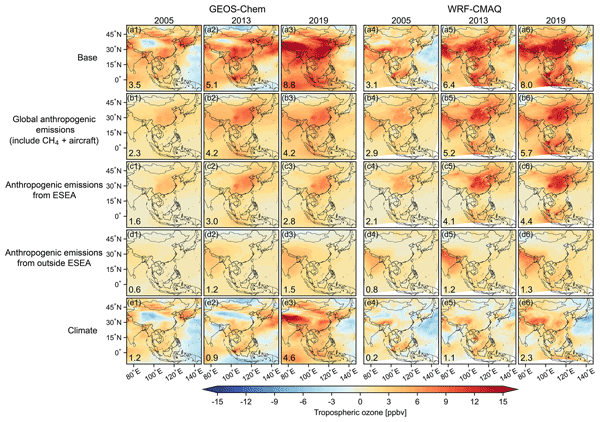
Xiao Lu, Yiming Liu, Jiayin Su, Xiang Weng, Tabish Ansari, Yuqiang Zhang, Guowen He, Yuqi Zhu, Haolin Wang, Ganquan Zeng, Jingyu Li, Cheng He, Shuai Li, Teerachai Amnuaylojaroen, Tim Butler, Qi Fan, Shaojia Fan, Grant L. Forster, Meng Gao, Jianlin Hu, Yugo Kanaya, Mohd Talib Latif, Keding Lu, Philippe Nédélec, Peer Nowack, Bastien Sauvage, Xiaobin Xu, Lin Zhang, Ke Li, Ja-Ho Koo, and Tatsuya Nagashima
Atmos. Chem. Phys., 25, 7991–8028, https://doi.org/10.5194/acp-25-7991-2025, https://doi.org/10.5194/acp-25-7991-2025, 2025
Short summary
Short summary
This study analyzes summertime ozone trends in East and Southeast Asia derived from a comprehensive observational database spanning from 1995 to 2019, incorporating aircraft observations, ozonesonde data, and measurements from 2500 surface sites. Multiple models are applied to attribute to changes in anthropogenic emissions and climate. The results highlight that increases in anthropogenic emissions are the primary driver of ozone increases both in the free troposphere and at the surface.
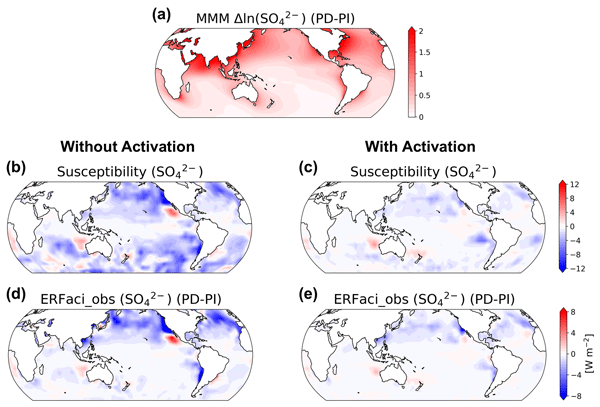
Chanyoung Park, Brian J. Soden, Ryan J. Kramer, Tristan S. L'Ecuyer, and Haozhe He
Atmos. Chem. Phys., 25, 7299–7313, https://doi.org/10.5194/acp-25-7299-2025, https://doi.org/10.5194/acp-25-7299-2025, 2025
Short summary
Short summary
This study addresses the long-standing challenge of quantifying the impact of aerosol–cloud interactions. Using satellite observations, reanalysis data, and a "perfect-model" cross-validation, we show that explicitly accounting for aerosol–cloud droplet activation rates is key to accurately estimating ERFaci (effective radiative forcing due to aerosol–cloud interactions). Our results indicate a smaller and less uncertain ERFaci than previously assessed, implying the reduced role of aerosol–cloud interactions in shaping climate sensitivity.
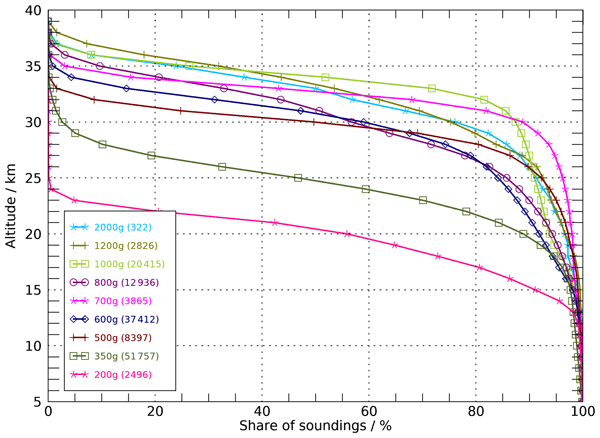
Masatomo Fujiwara, Bomin Sun, Anthony Reale, Domenico Cimini, Salvatore Larosa, Lori Borg, Christoph von Rohden, Michael Sommer, Ruud Dirksen, Marion Maturilli, Holger Vömel, Rigel Kivi, Bruce Ingleby, Ryan J. Kramer, Belay Demoz, Fabio Madonna, Fabien Carminati, Owen Lewis, Brett Candy, Christopher Thomas, David Edwards, Noersomadi, Kensaku Shimizu, and Peter Thorne
Atmos. Meas. Tech., 18, 2919–2955, https://doi.org/10.5194/amt-18-2919-2025, https://doi.org/10.5194/amt-18-2919-2025, 2025
Short summary
Short summary
We assess and illustrate the benefits of high-altitude attainment of balloon-borne radiosonde soundings up to and beyond 10 hPa level from various aspects. We show that the extra costs and technical challenges involved in consistent attainment of high ascents are more than outweighed by the benefits for a broad variety of real-time and delayed-mode applications. Consistent attainment of high ascents should therefore be pursued across the balloon observational network.
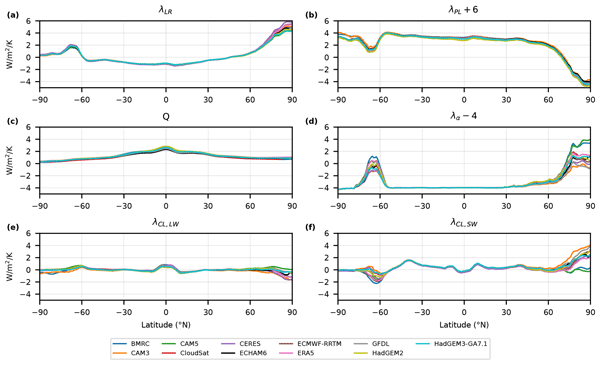
Tyler P. Janoski, Ivan Mitevski, Ryan J. Kramer, Michael Previdi, and Lorenzo M. Polvani
Geosci. Model Dev., 18, 3065–3079, https://doi.org/10.5194/gmd-18-3065-2025, https://doi.org/10.5194/gmd-18-3065-2025, 2025
Short summary
Short summary
We developed ClimKern, a Python package and radiative kernel repository, to simplify calculating radiative feedbacks and make climate sensitivity studies more reproducible. Testing of ClimKern with sample climate model data reveals that radiative kernel choice may be more important than previously thought, especially in polar regions. Our work highlights the need for kernel sensitivity analyses to be included in future studies.
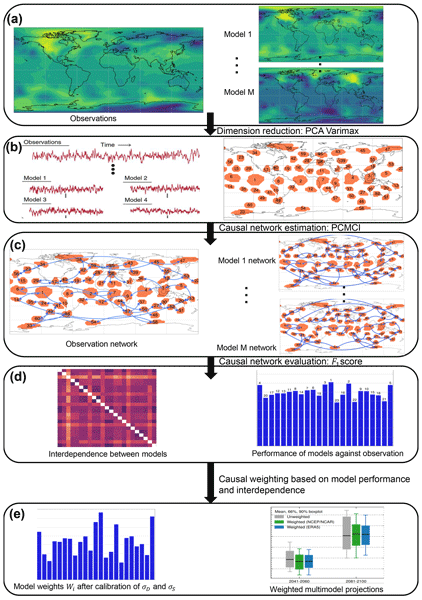
Kevin Debeire, Lisa Bock, Peer Nowack, Jakob Runge, and Veronika Eyring
Earth Syst. Dynam., 16, 607–630, https://doi.org/10.5194/esd-16-607-2025, https://doi.org/10.5194/esd-16-607-2025, 2025
Short summary
Short summary
Projecting future precipitation is essential for preparing for climate change, but current climate models still have large uncertainties, especially over land. This study presents a new method to improve precipitation projections by identifying which models best capture key climate patterns. By giving more weight to models that better represent these patterns, our approach leads to more reliable future precipitation projections over land.
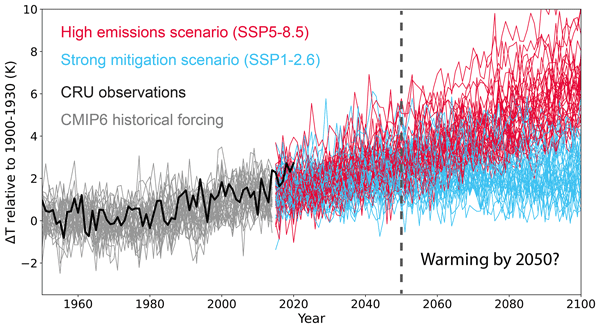
Peer Nowack and Duncan Watson-Parris
Atmos. Chem. Phys., 25, 2365–2384, https://doi.org/10.5194/acp-25-2365-2025, https://doi.org/10.5194/acp-25-2365-2025, 2025
Short summary
Short summary
In our article, we review uncertainties in global climate change projections and current methods using Earth observations as constraints, which is crucial for climate risk assessments and for informing society. We then discuss how machine learning can advance the field, discussing recent work that provides potentially stronger and more robust links between observed data and future climate projections. We further discuss the challenges of applying machine learning to climate science.

Brandon M. Duran, Casey J. Wall, Nicholas J. Lutsko, Takuro Michibata, Po-Lun Ma, Yi Qin, Margaret L. Duffy, Brian Medeiros, and Matvey Debolskiy
Atmos. Chem. Phys., 25, 2123–2146, https://doi.org/10.5194/acp-25-2123-2025, https://doi.org/10.5194/acp-25-2123-2025, 2025
Short summary
Short summary
We use satellite simulator data generated by global climate models to investigate how aerosol particles impact the radiative properties of liquid clouds. Specifically, we quantify the radiative perturbations arising from aerosol-driven changes in the number density of cloud droplets, the vertically integrated cloud water mass, and the cloud amount. Our results show that, in models, aerosol effects on the number density of cloud droplets contribute the most to anthropogenic climate forcing.
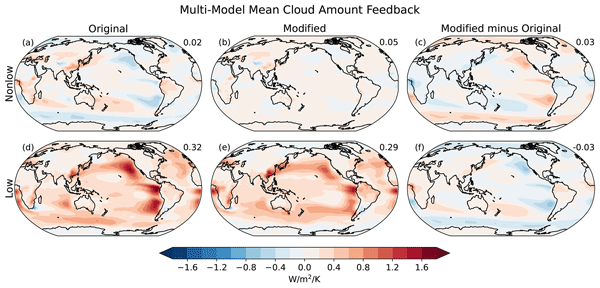
Mark D. Zelinka, Li-Wei Chao, Timothy A. Myers, Yi Qin, and Stephen A. Klein
Atmos. Chem. Phys., 25, 1477–1495, https://doi.org/10.5194/acp-25-1477-2025, https://doi.org/10.5194/acp-25-1477-2025, 2025
Short summary
Short summary
Clouds lie at the heart of uncertainty in both climate sensitivity and radiative forcing, making it imperative to properly diagnose their radiative effects. Here we provide a recommended methodology and code base for the community to use in performing such diagnoses using cloud radiative kernels. We show that properly accounting for changes in obscuration of lower-level clouds by upper-level clouds is important for accurate diagnosis and attribution of cloud feedbacks and adjustments.
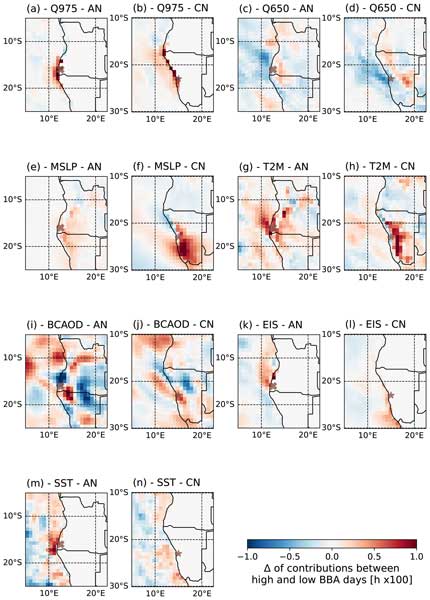
Alexandre Mass, Hendrik Andersen, Jan Cermak, Paola Formenti, Eva Pauli, and Julian Quinting
Atmos. Chem. Phys., 25, 491–510, https://doi.org/10.5194/acp-25-491-2025, https://doi.org/10.5194/acp-25-491-2025, 2025
Short summary
Short summary
This study investigates the interaction between smoke aerosols and fog and low clouds (FLCs) in the Namib Desert between June and October. Here, a satellite-based dataset of FLCs, reanalysis data and machine learning are used to systematically analyze FLC persistence under different aerosol loadings. Aerosol plumes are shown to modify local thermodynamics, which increase FLC persistence. But fully disentangling aerosol effects from meteorological ones remains a challenge.
Yichen Jia, Hendrik Andersen, and Jan Cermak
Atmos. Chem. Phys., 24, 13025–13045, https://doi.org/10.5194/acp-24-13025-2024, https://doi.org/10.5194/acp-24-13025-2024, 2024
Short summary
Short summary
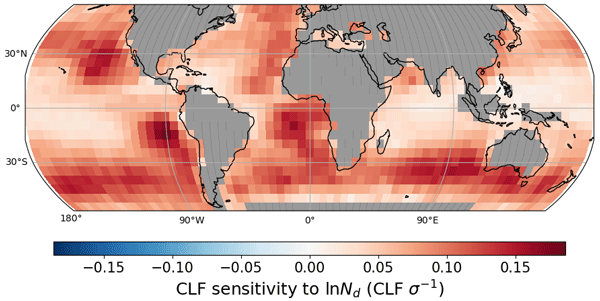
We present a near-global observation-based explainable machine learning framework to quantify the response of cloud fraction (CLF) of marine low clouds to cloud droplet number concentration (Nd), accounting for the covariations with meteorological factors. This approach provides a novel data-driven method to analyse the CLF adjustment by assessing the CLF sensitivity to Nd and numerous meteorological factors as well as the dependence of the Nd–CLF sensitivity on the meteorological conditions.
Henrik Auestad, Clemens Spensberger, Andrea Marcheggiani, Paulo Ceppi, Thomas Spengler, and Tim Woollings
Weather Clim. Dynam., 5, 1269–1286, https://doi.org/10.5194/wcd-5-1269-2024, https://doi.org/10.5194/wcd-5-1269-2024, 2024
Short summary
Short summary
Latent heating due to condensation can influence atmospheric circulation by strengthening or weakening horizontal temperature contrasts. Strong temperature contrasts intensify storms and imply the existence of strong upper tropospheric winds called jets. It remains unclear whether latent heating preferentially reinforces or abates the existing jet. We show that this disagreement is attributable to how the jet is defined, confirming that latent heating reinforces the jet.
Robert J. Allen, Xueying Zhao, Cynthia A. Randles, Ryan J. Kramer, Bjørn H. Samset, and Christopher J. Smith
Atmos. Chem. Phys., 24, 11207–11226, https://doi.org/10.5194/acp-24-11207-2024, https://doi.org/10.5194/acp-24-11207-2024, 2024
Short summary
Short summary
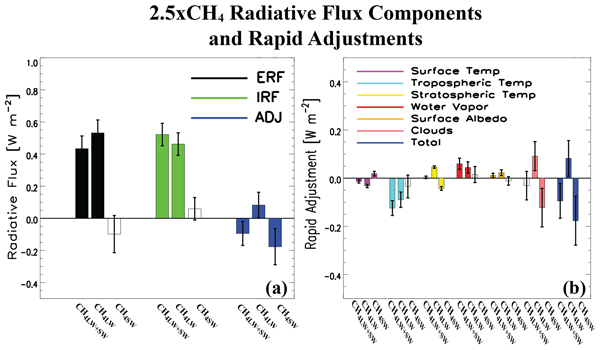
Present-day methane shortwave absorption mutes 28% (7–55%) of the surface warming associated with its longwave absorption. The precipitation increase associated with the longwave radiative effects of the present-day methane perturbation is also muted by shortwave absorption but not significantly so. Methane shortwave absorption also impacts the magnitude of its climate feedback parameter, largely through the cloud feedback.
Sarah Wilson Kemsley, Paulo Ceppi, Hendrik Andersen, Jan Cermak, Philip Stier, and Peer Nowack
Atmos. Chem. Phys., 24, 8295–8316, https://doi.org/10.5194/acp-24-8295-2024, https://doi.org/10.5194/acp-24-8295-2024, 2024
Short summary
Short summary
Aiming to inform parameter selection for future observational constraint analyses, we incorporate five candidate meteorological drivers specifically targeting high clouds into a cloud controlling factor framework within a range of spatial domain sizes. We find a discrepancy between optimal domain size for predicting locally and globally aggregated cloud radiative anomalies and identify upper-tropospheric static stability as an important high-cloud controlling factor.
Jiwoo Lee, Peter J. Gleckler, Min-Seop Ahn, Ana Ordonez, Paul A. Ullrich, Kenneth R. Sperber, Karl E. Taylor, Yann Y. Planton, Eric Guilyardi, Paul Durack, Celine Bonfils, Mark D. Zelinka, Li-Wei Chao, Bo Dong, Charles Doutriaux, Chengzhu Zhang, Tom Vo, Jason Boutte, Michael F. Wehner, Angeline G. Pendergrass, Daehyun Kim, Zeyu Xue, Andrew T. Wittenberg, and John Krasting
Geosci. Model Dev., 17, 3919–3948, https://doi.org/10.5194/gmd-17-3919-2024, https://doi.org/10.5194/gmd-17-3919-2024, 2024
Short summary
Short summary
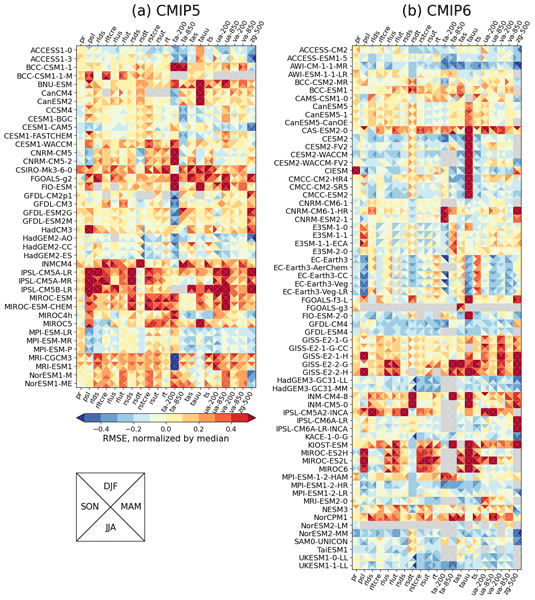
We introduce an open-source software, the PCMDI Metrics Package (PMP), developed for a comprehensive comparison of Earth system models (ESMs) with real-world observations. Using diverse metrics evaluating climatology, variability, and extremes simulated in thousands of simulations from the Coupled Model Intercomparison Project (CMIP), PMP aids in benchmarking model improvements across generations. PMP also enables efficient tracking of performance evolutions during ESM developments.
Stephanie Fiedler, Vaishali Naik, Fiona M. O'Connor, Christopher J. Smith, Paul Griffiths, Ryan J. Kramer, Toshihiko Takemura, Robert J. Allen, Ulas Im, Matthew Kasoar, Angshuman Modak, Steven Turnock, Apostolos Voulgarakis, Duncan Watson-Parris, Daniel M. Westervelt, Laura J. Wilcox, Alcide Zhao, William J. Collins, Michael Schulz, Gunnar Myhre, and Piers M. Forster
Geosci. Model Dev., 17, 2387–2417, https://doi.org/10.5194/gmd-17-2387-2024, https://doi.org/10.5194/gmd-17-2387-2024, 2024
Short summary
Short summary
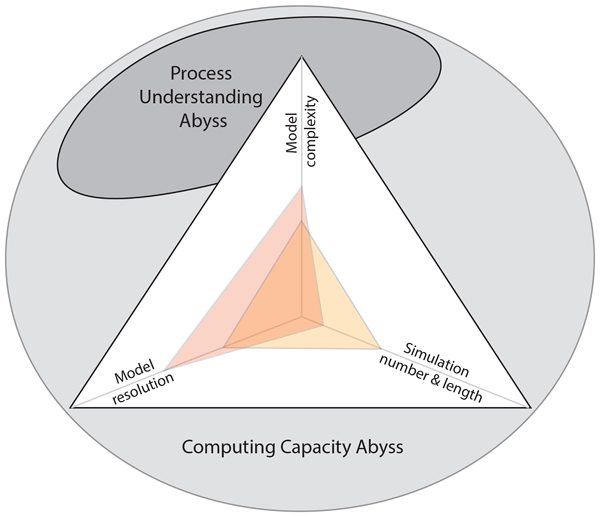
Climate scientists want to better understand modern climate change. Thus, climate model experiments are performed and compared. The results of climate model experiments differ, as assessed in the latest Intergovernmental Panel on Climate Change (IPCC) assessment report. This article gives insights into the challenges and outlines opportunities for further improving the understanding of climate change. It is based on views of a group of experts in atmospheric composition–climate interactions.
Karine Desboeufs, Paola Formenti, Raquel Torres-Sánchez, Kerstin Schepanski, Jean-Pierre Chaboureau, Hendrik Andersen, Jan Cermak, Stefanie Feuerstein, Benoit Laurent, Danitza Klopper, Andreas Namwoonde, Mathieu Cazaunau, Servanne Chevaillier, Anaïs Feron, Cécile Mirande-Bret, Sylvain Triquet, and Stuart J. Piketh
Atmos. Chem. Phys., 24, 1525–1541, https://doi.org/10.5194/acp-24-1525-2024, https://doi.org/10.5194/acp-24-1525-2024, 2024
Short summary
Short summary
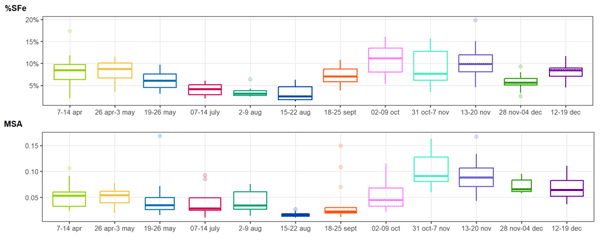
This study investigates the fractional solubility of iron (Fe) in dust particles along the coast of Namibia, a critical region for the atmospheric Fe supply of the South Atlantic Ocean. Our results suggest a possible two-way interplay whereby marine biogenic emissions from the coastal marine ecosystems into the atmosphere would increase the solubility of Fe-bearing dust by photo-reduction processes. The subsequent deposition of soluble Fe could act to further enhance marine biogenic emissions.
Philip Goodwin, Richard Williams, Paulo Ceppi, and B. B. Cael
EGUsphere, https://doi.org/10.5194/egusphere-2023-2307, https://doi.org/10.5194/egusphere-2023-2307, 2023
Preprint archived
Short summary
Short summary
Climate feedbacks are normally evaluated by considering the change over time for Earth's energy balance and surface temperatures in the climate system. However, we only have around 1 degree Celsius of temperature change to utilise. Here, climate feedbacks are instead evaluated from the change in latitude of Earth's energy balance and surface temperatures, where we have around 70 degrees Celsius of temperature change to utilise.
Casey J. Wall, Trude Storelvmo, and Anna Possner
Atmos. Chem. Phys., 23, 13125–13141, https://doi.org/10.5194/acp-23-13125-2023, https://doi.org/10.5194/acp-23-13125-2023, 2023
Short summary
Short summary
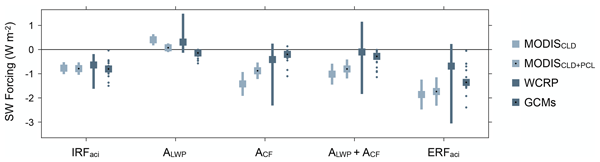
Interactions between aerosol pollution and liquid clouds are one of the largest sources of uncertainty in the effective radiative forcing of climate over the industrial era. We use global satellite observations to decompose the forcing into components from changes in cloud-droplet number concentration, cloud water content, and cloud amount. Our results reduce uncertainty in these forcing components and clarify their relative importance.
Hendrik Andersen, Jan Cermak, Alyson Douglas, Timothy A. Myers, Peer Nowack, Philip Stier, Casey J. Wall, and Sarah Wilson Kemsley
Atmos. Chem. Phys., 23, 10775–10794, https://doi.org/10.5194/acp-23-10775-2023, https://doi.org/10.5194/acp-23-10775-2023, 2023
Short summary
Short summary
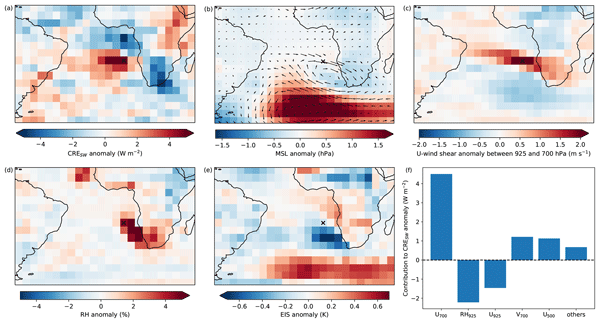
This study uses an observation-based cloud-controlling factor framework to study near-global sensitivities of cloud radiative effects to a large number of meteorological and aerosol controls. We present near-global sensitivity patterns to selected thermodynamic, dynamic, and aerosol factors and discuss the physical mechanisms underlying the derived sensitivities. Our study hopes to guide future analyses aimed at constraining cloud feedbacks and aerosol–cloud interactions.
Mark D. Zelinka, Christopher J. Smith, Yi Qin, and Karl E. Taylor
Atmos. Chem. Phys., 23, 8879–8898, https://doi.org/10.5194/acp-23-8879-2023, https://doi.org/10.5194/acp-23-8879-2023, 2023
Short summary
Short summary
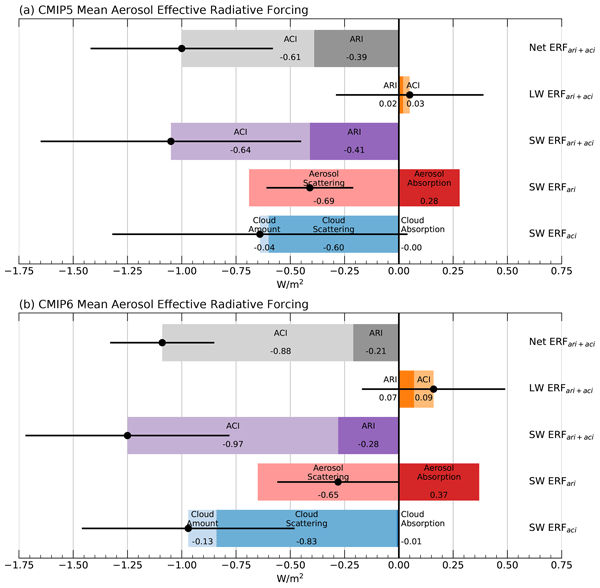
The primary uncertainty in how strongly Earth's climate has been perturbed by human activities comes from the unknown radiative impact of aerosol changes. Accurately quantifying these forcings – and their sub-components – in climate models is crucial for understanding the past and future simulated climate. In this study we describe biases in previously published estimates of aerosol radiative forcing in climate models and provide corrected estimates along with code for users to compute them.
Robert Pincus, Paul A. Hubanks, Steven Platnick, Kerry Meyer, Robert E. Holz, Denis Botambekov, and Casey J. Wall
Earth Syst. Sci. Data, 15, 2483–2497, https://doi.org/10.5194/essd-15-2483-2023, https://doi.org/10.5194/essd-15-2483-2023, 2023
Short summary
Short summary
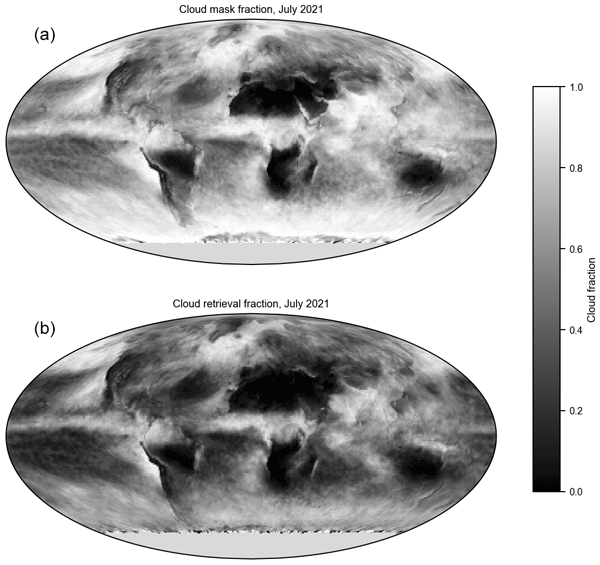
This paper describes a new global dataset of cloud properties observed by a specific satellite program created to facilitate comparison with a matching observational proxy used in climate models. Statistics are accumulated over daily and monthly timescales on an equal-angle grid. Statistics include cloud detection, cloud-top pressure, and cloud optical properties. Joint histograms of several variable pairs are also available.
Jane P. Mulcahy, Colin G. Jones, Steven T. Rumbold, Till Kuhlbrodt, Andrea J. Dittus, Edward W. Blockley, Andrew Yool, Jeremy Walton, Catherine Hardacre, Timothy Andrews, Alejandro Bodas-Salcedo, Marc Stringer, Lee de Mora, Phil Harris, Richard Hill, Doug Kelley, Eddy Robertson, and Yongming Tang
Geosci. Model Dev., 16, 1569–1600, https://doi.org/10.5194/gmd-16-1569-2023, https://doi.org/10.5194/gmd-16-1569-2023, 2023
Short summary
Short summary
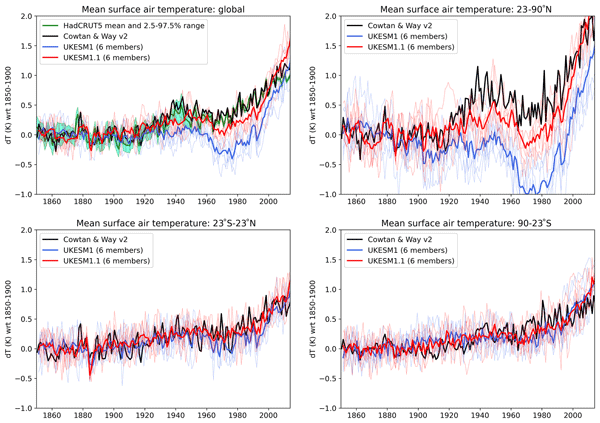
Recent global climate models simulate historical global mean surface temperatures which are too cold, possibly to due to excessive aerosol cooling. This raises questions about the models' ability to simulate important climate processes and reduces confidence in future climate predictions. We present a new version of the UK Earth System Model, which has an improved aerosols simulation and a historical temperature record. Interestingly, the long-term response to CO2 remains largely unchanged.
Philipp Breul, Paulo Ceppi, and Theodore G. Shepherd
Weather Clim. Dynam., 4, 39–47, https://doi.org/10.5194/wcd-4-39-2023, https://doi.org/10.5194/wcd-4-39-2023, 2023
Short summary
Short summary
Accurately predicting the response of the midlatitude jet stream to climate change is very important, but models show a variety of possible scenarios. Previous work identified a relationship between climatological jet latitude and future jet shift in the southern hemispheric winter. We show that the relationship does not hold in separate sectors and propose that zonal asymmetries are the ultimate cause in the zonal mean. This questions the usefulness of the relationship.
Julia Fuchs, Hendrik Andersen, Jan Cermak, Eva Pauli, and Rob Roebeling
Atmos. Meas. Tech., 15, 4257–4270, https://doi.org/10.5194/amt-15-4257-2022, https://doi.org/10.5194/amt-15-4257-2022, 2022
Short summary
Short summary
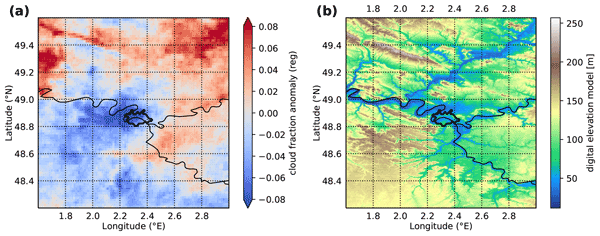
Two cloud-masking approaches, a local and a regional approach, using high-resolution satellite data are developed and validated for the region of Paris to improve applicability for analyses of urban effects on low clouds. We found that cloud masks obtained from the regional approach are more appropriate for the high-resolution analysis of locally induced cloud processes. Its applicability is tested for the analysis of typical fog conditions over different surface types.
Xiang Weng, Grant L. Forster, and Peer Nowack
Atmos. Chem. Phys., 22, 8385–8402, https://doi.org/10.5194/acp-22-8385-2022, https://doi.org/10.5194/acp-22-8385-2022, 2022
Short summary
Short summary
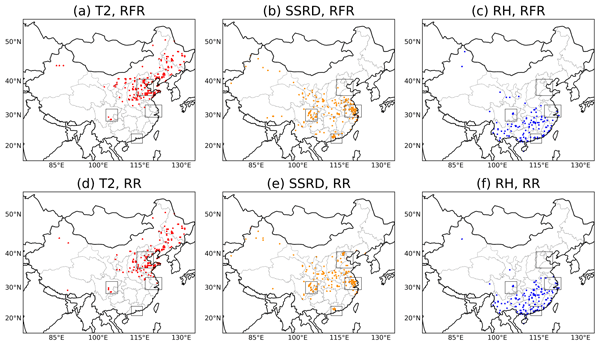
We use machine learning to quantify the meteorological drivers behind surface ozone variations in China between 2015 and 2019. Our novel approaches show improved performance when compared to previous analysis methods. We highlight that nonlinearity in driver relationships and the impacts of large-scale meteorological phenomena are key to understanding ozone pollution. Moreover, we find that almost half of the observed ozone trend between 2015 and 2019 might have been driven by meteorology.
Philipp Breul, Paulo Ceppi, and Theodore G. Shepherd
Weather Clim. Dynam., 3, 645–658, https://doi.org/10.5194/wcd-3-645-2022, https://doi.org/10.5194/wcd-3-645-2022, 2022
Short summary
Short summary
Understanding how the mid-latitude jet stream will respond to a changing climate is highly important. Unfortunately, climate models predict a wide variety of possible responses. Theoretical frameworks can link an internal jet variability timescale to its response. However, we show that stratospheric influence approximately doubles the internal timescale, inflating predicted responses. We demonstrate an approach to account for the stratospheric influence and recover correct response predictions.
Po-Lun Ma, Bryce E. Harrop, Vincent E. Larson, Richard B. Neale, Andrew Gettelman, Hugh Morrison, Hailong Wang, Kai Zhang, Stephen A. Klein, Mark D. Zelinka, Yuying Zhang, Yun Qian, Jin-Ho Yoon, Christopher R. Jones, Meng Huang, Sheng-Lun Tai, Balwinder Singh, Peter A. Bogenschutz, Xue Zheng, Wuyin Lin, Johannes Quaas, Hélène Chepfer, Michael A. Brunke, Xubin Zeng, Johannes Mülmenstädt, Samson Hagos, Zhibo Zhang, Hua Song, Xiaohong Liu, Michael S. Pritchard, Hui Wan, Jingyu Wang, Qi Tang, Peter M. Caldwell, Jiwen Fan, Larry K. Berg, Jerome D. Fast, Mark A. Taylor, Jean-Christophe Golaz, Shaocheng Xie, Philip J. Rasch, and L. Ruby Leung
Geosci. Model Dev., 15, 2881–2916, https://doi.org/10.5194/gmd-15-2881-2022, https://doi.org/10.5194/gmd-15-2881-2022, 2022
Short summary
Short summary
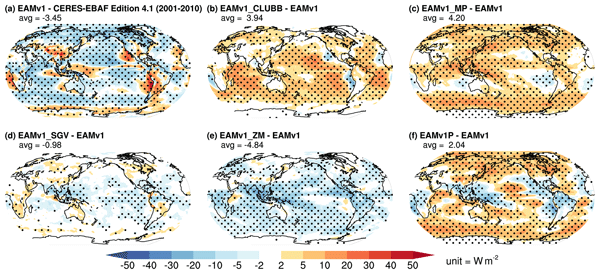
An alternative set of parameters for E3SM Atmospheric Model version 1 has been developed based on a tuning strategy that focuses on clouds. When clouds in every regime are improved, other aspects of the model are also improved, even though they are not the direct targets for calibration. The recalibrated model shows a lower sensitivity to anthropogenic aerosols and surface warming, suggesting potential improvements to the simulated climate in the past and future.
Babak Jahani, Hendrik Andersen, Josep Calbó, Josep-Abel González, and Jan Cermak
Atmos. Chem. Phys., 22, 1483–1494, https://doi.org/10.5194/acp-22-1483-2022, https://doi.org/10.5194/acp-22-1483-2022, 2022
Short summary
Short summary
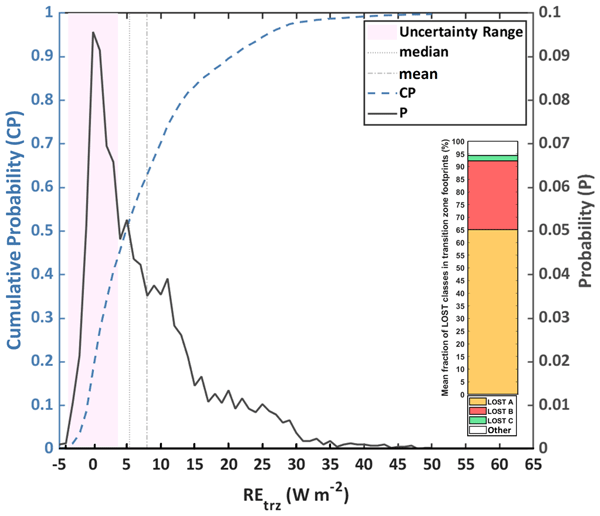
The change in the state of sky from cloudy to cloudless (or vice versa) comprises an additional phase called
transition zonewith characteristics laying between those of aerosols and clouds. This study presents an approach for the quantification of the broadband longwave radiative effects of the cloud–aerosol transition zone at the top of the atmosphere during daytime over the ocean based on satellite observations and radiative transfer simulations.
Cited articles
AIRS project: Aqua/AIRS L3 Monthly Standard Physical Retrieval (AIRS-only) 1 degree × 1 degree, V2, GES DISC [data set], https://doi.org/10.5067/UBENJB9D3T2H, 2019. a
Andrews, T. and Forster, P. M.: CO2 forcing induces semi-direct effects with consequences for climate feedback interpretations, Geophys. Res. Lett., 35, L04802, https://doi.org/10.1029/2007GL032273, 2008. a
Andrews, T., Gregory, J. M., Forster, P. M., and Webb, M. J.: Cloud Adjustment and its Role in CO2 Radiative Forcing and Climate Sensitivity: A Review, Surv. Geophys., 33, 619–635, https://doi.org/10.1007/s10712-011-9152-0, 2012. a, b, c
Andrews, T., Bodas-Salcedo, A., Gregory, J. M., Dong, Y., Armour, K. C., Paynter, D., Lin, P., Modak, A., Mauritsen, T., Cole, J. N. S., Medeiros, B., Benedict, J. J., Douville, H., Roehrig, R., Koshiro, T., Kawai, H., Ogura, T., Dufresne, J.-L., Allan, R. P., and Liu, C.: On the Effect of Historical SST Patterns on Radiative Feedback, J. Geophys. Res.-Atmos., 127, e2022JD036675, https://doi.org/10.1029/2022JD036675, 2022. a, b
Aumann, H., Chahine, M., Gautier, C., Goldberg, M., Kalnay, E., McMillin, L., Revercomb, H., Rosenkranz, P., Smith, W., Staelin, D., Strow, L., and Susskind, J.: AIRS/AMSU/HSB on the Aqua mission: design, science objectives, data products, and processing systems, IEEE T. Geosci. Remote, 41, 253–264, https://doi.org/10.1109/TGRS.2002.808356, 2003. a
Barnet, C.: Sounder SIPS: AQUA AIRS IR-only Level 3 CLIMCAPS: Comprehensive Quality Control Gridded Monthly, V7.0, GES DISC [data set], https://doi.org/10.5067/ZPZ430KOPMIX, 2019. a
Bodas-Salcedo, A., Webb, M. J., Bony, S., Chepfer, H., Dufresne, J.-L., Klein, S. A., Zhang, Y., Marchand, R., Haynes, J. M., Pincus, R., and John, V. O.: COSP: Satellite simulation software for model assessment, B. Am. Meteorol. Soc., 92, 1023–1043, https://doi.org/10.1175/2011BAMS2856.1, 2011. a
Ceppi, P. and Andrews, T.: HadGEM3-GC31-LL estimated inversion strength (EIS) fields for an amip experiment forced with HadISST1 SST and sea-ice, Zenodo [data set], https://doi.org/10.5281/zenodo.18592827, 2026. a
Ceppi, P. and Nowack, P.: Observational evidence that cloud feedback amplifies global warming, P. Natl. Acad. Sci. USA, 118, https://doi.org/10.1073/pnas.2026290118, 2021. a
Ceppi, P., Brient, F., Zelinka, M. D., and Hartmann, D. L.: Cloud feedback mechanisms and their representation in global climate models, Wiley Interdisciplin. Rev.: Clim. Change, 8, e465, https://doi.org/10.1002/wcc.465, 2017. a
Eyring, V., Bony, S., Meehl, G. A., Senior, C. A., Stevens, B., Stouffer, R. J., and Taylor, K. E.: Overview of the Coupled Model Intercomparison Project Phase 6 (CMIP6) experimental design and organization, Geosci. Model Dev., 9, 1937–1958, https://doi.org/10.5194/gmd-9-1937-2016, 2016. a
Forster, P. M., Storelvmo, T., Armour, K., Collins, W., Dufresne, J.-L., Frame, D., Lunt, D., Mauritsen, T., Palmer, M., Watanabe, M., Wild, M., and Zhang, H.: The Earth's energy budget, climate feedbacks, and climate sensitivity, in: Climate Change 2021: The Physical Science Basis, Contribution of Working Group I to the Sixth Assessment Report of the Intergovernmental Panel on Climate Change, edited by: Masson-Delmotte, V., Zhai, P., Pirani, A., Connors, S. L., Péan, C., Berger, S., Caud, N., Chen, Y., Goldfarb, L., Gomis, M. I., Huang, M., Leitzell, K., Lonnoy, E., Matthews, J. B. R., Maycock, T. K., Waterfield, T., Yelekçi, O., Yu, R., and Zhou, B., Cambridge University Press, https://www.ipcc.ch/report/ar6/wg1/downloads/report/IPCC_AR6_WGI_Chapter07.pdf (last access: 13 February 2026), 2021. a
Forster, P. M., Smith, C., Walsh, T., Lamb, W. F., Lamboll, R., Cassou, C., Hauser, M., Hausfather, Z., Lee, J.-Y., Palmer, M. D., von Schuckmann, K., Slangen, A. B. A., Szopa, S., Trewin, B., Yun, J., Gillett, N. P., Jenkins, S., Matthews, H. D., Raghavan, K., Ribes, A., Rogelj, J., Rosen, D., Zhang, X., Allen, M., Aleluia Reis, L., Andrew, R. M., Betts, R. A., Borger, A., Broersma, J. A., Burgess, S. N., Cheng, L., Friedlingstein, P., Domingues, C. M., Gambarini, M., Gasser, T., Gütschow, J., Ishii, M., Kadow, C., Kennedy, J., Killick, R. E., Krummel, P. B., Liné, A., Monselesan, D. P., Morice, C., Mühle, J., Naik, V., Peters, G. P., Pirani, A., Pongratz, J., Minx, J. C., Rigby, M., Rohde, R., Savita, A., Seneviratne, S. I., Thorne, P., Wells, C., Western, L. M., van der Werf, G. R., Wijffels, S. E., Masson-Delmotte, V., and Zhai, P.: Indicators of Global Climate Change 2024: annual update of key indicators of the state of the climate system and human influence, Earth Syst. Sci. Data, 17, 2641–2680, https://doi.org/10.5194/essd-17-2641-2025, 2025. a, b
Gelaro, R., McCarty, W., Suárez, M. J., Todling, R., Molod, A., Takacs, L., Randles, C. A., Darmenov, A., Bosilovich, M. G., Reichle, R., Wargan, K., Coy, L., Cullather, R., Draper, C., Akella, S., Buchard, V., Conaty, A., da Silva, A. M., Gu, W., Kim, G.-K., Koster, R., Lucchesi, R., Merkova, D., Nielsen, J. E., Partyka, G., Pawson, S., Putman, W., Rienecker, M., Schubert, S. D., Sienkiewicz, M., and Zhao, B.: The Modern-Era Retrospective Analysis for Research and Applications, Version 2 (MERRA-2), J. Climate, 30, 5419–5454, https://doi.org/10.1175/JCLI-D-16-0758.1, 2017. a
Gettelman, A., Christensen, M. W., Diamond, M. S., Gryspeerdt, E., Manshausen, P., Stier, P., Watson-Parris, D., Yang, M., Yoshioka, M., and Yuan, T.: Has Reducing Ship Emissions Brought Forward Global Warming?, Geophys. Res. Lett., 51, e2024GL109077, https://doi.org/10.1029/2024GL109077, 2024. a
GMAO – Global Modeling and Assimilation Office: MERRA-2 instM_2d_asm_Nx: 2d, Monthly mean, Single-Level, Assimilation, Single-Level Diagnostics, V5.12.4, GMAO [data set], https://doi.org/10.5067/5ESKGQTZG7FO, 2015a. a
GMAO – Global Modeling and Assimilation Office: MERRA-2 instM_3d_asm_Np: 3d, Monthly mean, Pressure-Level, Assimilation, Assimilated Meteorological Fields, V5.12.4, https://doi.org/10.5067/2E096JV59PK7, GMAO [data set], 2015b. a
Goessling, H. F., Rackow, T., and Jung, T.: Recent global temperature surge intensified by record-low planetary albedo, Science, 387, 68–73, https://doi.org/10.1126/science.adq7280, 2025. a
Gregory, J. and Webb, M.: Tropospheric Adjustment Induces a Cloud Component in CO2 Forcing, J. Climate, 21, 58–71, https://doi.org/10.1175/2007JCLI1834.1, 2008. a
Grise, K. M. and Kelleher, M. K.: Midlatitude Cloud Radiative Effect Sensitivity to Cloud Controlling Factors in Observations and Models: Relationship with Southern Hemisphere Jet Shifts and Climate Sensitivity, J. Climate, 34, 5869–5886, https://doi.org/10.1175/JCLI-D-20-0986.1, 2021. a
Hersbach, H., Bell, B., Berrisford, P., Hirahara, S., Horányi, A., Muñoz-Sabater, J., Nicolas, J., Peubey, C., Radu, R., Schepers, D., Simmons, A., Soci, C., Abdalla, S., Abellan, X., Balsamo, G., Bechtold, P., Biavati, G., Bidlot, J., Bonavita, M., De Chiara, G., Dahlgren, P., Dee, D., Diamantakis, M., Dragani, R., Flemming, J., Forbes, R., Fuentes, M., Geer, A., Haimberger, L., Healy, S., Hogan, R. J., Hólm, E., Janisková, M., Keeley, S., Laloyaux, P., Lopez, P., Lupu, C., Radnoti, G., de Rosnay, P., Rozum, I., Vamborg, F., Villaume, S., and Thépaut, J.-N.: The ERA5 global reanalysis, Q. J. Roy. Meteorol. Soc., 146, 1999–2049, https://doi.org/10.1002/qj.3803, 2020. a
Hersbach, H., Bell, B., Berrisford, P., Biavati, G., Horányi, A., Muñoz Sabater, J., Nicolas, J., Peubey, C., Radu, R., Rozum, I., Schepers, D., Simmons, A., Soci, C., Dee, D., and Thépaut, J.-N.: ERA5 monthly averaged data on single levels from 1940 to present, Copernicus Climate Change Service (C3S) Climate Data Store (CDS) [data set], https://doi.org/10.24381/cds.f17050d7, 2023a. a
Hersbach, H., Bell, B., Berrisford, P., Biavati, G., Horányi, A., Muñoz Sabater, J., Nicolas, J., Peubey, C., Radu, R., Rozum, I., Schepers, D., Simmons, A., Soci, C., Dee, D., and Thépaut, J.-N.: ERA5 monthly averaged data on pressure levels from 1940 to present, Copernicus Climate Change Service (C3S) Climate Data Store (CDS) [data set], https://doi.org/10.24381/cds.6860a573, 2023b. a
Hodnebrog, Ø., Myhre, G., Jouan, C., Andrews, T., Forster, P. M., Jia, H., Loeb, N. G., Olivié, D. J. L., Paynter, D., Quaas, J., Raghuraman, S. P., and Schulz, M.: Recent reductions in aerosol emissions have increased Earth's energy imbalance, Commun. Earth Environ., 5, 166, https://doi.org/10.1038/s43247-024-01324-8, 2024. a, b, c, d
JMA – Japan Meteorological Agency: The Japanese Reanalysis for Three Quarters of a Century (JRA-3Q), JMA [data set], https://doi.org/10.20783/DIAS.645, 2022. a
Kamae, Y., Watanabe, M., Ogura, T., Yoshimori, M., and Shiogama, H.: Rapid Adjustments of Cloud and Hydrological Cycle to Increasing CO2: a Review, Curr. Clim. Change Rep., 1, 103–113, https://doi.org/10.1007/s40641-015-0007-5, 2015. a
Kawaguchi, K. and Ceppi, P.: Responses to Lower-Tropospheric Stability Dominate Intermodel Differences in the Historical Pattern Effect, Geophys. Res. Lett., 52, e2025GL117015, https://doi.org/10.1029/2025GL117015, 2025. a
Klein, S. A. and Hartmann, D. L.: The Seasonal Cycle of Low Stratiform Clouds, J. Climate, 6, 1587–1606, https://doi.org/10.1175/1520-0442(1993)006<1587:TSCOLS>2.0.CO;2, 1993. a
Klein, S. A., Hall, A., Norris, J. R., and Pincus, R.: Low-Cloud Feedbacks from Cloud-Controlling Factors: A Review, Surv. Geophys., 38, 1–23, https://doi.org/10.1007/s10712-017-9433-3, 2017. a
Kosaka, Y., Kobayashi, S., Harada, Y., Kobayashi, C., Naoe, H., Yoshimoto, K., Harada, M., Goto, N., Chiba, J., Miyaoka, K., Sekiguchi, R., Deushi, M., Kamahori, H., Nakaegawa, T., Tanaka, T. Y., Tokuhiro, T., Sato, Y., Matsushita, Y., and Onogi, K.: The JRA-3Q Reanalysis, J. Meteorol. Soc. Jpn. Ser. II, 102, 49–109, https://doi.org/10.2151/jmsj.2024-004, 2024. a
Kramer, R. J., He, H., Soden, B. J., Oreopoulos, L., Myhre, G., Forster, P. M., and Smith, C. J.: Observational Evidence of Increasing Global Radiative Forcing, Geophys. Res. Lett., 48, https://doi.org/10.1029/2020GL091585, 2021. a, b
Loeb, N. G., Doelling, D. R., Wang, H., Su, W., Nguyen, C., Corbett, J. G., Liang, L., Mitrescu, C., Rose, F. G., and Kato, S.: Clouds and the Earth's Radiant Energy System (CERES) Energy Balanced and Filled (EBAF) Top-of-Atmosphere (TOA) Edition-4.0 Data Product, J. Climate, 31, 895–918, https://doi.org/10.1175/JCLI-D-17-0208.1, 2018. a
Loeb, N. G., Johnson, G. C., Thorsen, T. J., Lyman, J. M., Rose, F. G., and Kato, S.: Satellite and Ocean Data Reveal Marked Increase in Earth's Heating Rate, Geophys. Res. Lett., 48, e2021GL093047, https://doi.org/10.1029/2021GL093047, 2021. a
Loeb, N. G., Doelling, D. R., Kato, S., Su, W., Mlynczak, P. E., and Wilkins, J. C.: Continuity in Top-of-Atmosphere Earth Radiation Budget Observations, J. Climate, 37, 6093–6108, https://doi.org/10.1175/JCLI-D-24-0180.1, 2024a. a, b
Mauritsen, T., Tsushima, Y., Meyssignac, B., Loeb, N. G., Hakuba, M., Pilewskie, P., Cole, J., Suzuki, K., Ackerman, T. P., Allan, R. P., Andrews, T., Bender, F. A.-M., Bloch-Johnson, J., Bodas-Salcedo, A., Brookshaw, A., Ceppi, P., Clerbaux, N., Dessler, A. E., Donohoe, A., Dufresne, J.-L., Eyring, V., Findell, K. L., Gettelman, A., Gristey, J. J., Hawkins, E., Heimbach, P., Hewitt, H. T., Jeevanjee, N., Jones, C., Kang, S. M., Kato, S., Kay, J. E., Klein, S. A., Knutti, R., Kramer, R., Lee, J.-Y., McCoy, D. T., Medeiros, B., Megner, L., Modak, A., Ogura, T., Palmer, M. D., Paynter, D., Quaas, J., Ramanathan, V., Ringer, M., von Schuckmann, K., Sherwood, S., Stevens, B., Tan, I., Tselioudis, G., Sutton, R., Voigt, A., Watanabe, M., Webb, M. J., Wild, M., and Zelinka, M. D.: Earth's Energy Imbalance More Than Doubled in Recent Decades, AGU Adv., 6, e2024AV001636, https://doi.org/10.1029/2024AV001636, 2025. a, b, c, d, e
Myers, T. A., Zelinka, M. D., and Klein, S. A.: Observational Constraints on the Cloud Feedback Pattern Effect, J. Climate, 36, 6533–6545, https://doi.org/10.1175/JCLI-D-22-0862.1, 2023. a
Myhre, G., Hodnebrog, Ø., Loeb, N., and Forster, P. M.: Observed trend in Earth energy imbalance may provide a constraint for low climate sensitivity models, Science, 388, 1210–1213, https://doi.org/10.1126/science.adt0647, 2025. a
NASA/LARC/SD/ASDC: CERES monthly daytime mean regionally averaged Terra and Aqua TOA fluxes and associated cloud properties stratified by optical depth and effective pressure Edition4A, NASA/LARC/SD/ASDC [data set], https://doi.org/10.5067/Terra-Aqua/CERES/FLUXBYCLDTYP-MONTH_L3.004A, 2020. a
NASA/LARC/SD/ASDC: CERES energy balanced and filled (EBAF) TOA monthly means data in netCDF Edition4.2, NASA/LARC/SD/ASDC [data set], https://doi.org/10.5067/TERRA-AQUA-NOAA20/CERES/EBAF-TOA_L3B004.2, 2022. a
NASA/LARC/SD/ASDC: CERES monthly daytime mean regionally averaged NOAA-20 TOA fluxes and associated cloud properties stratified by optical depth and effective pressure Edition1B, NASA/LARC/SD/ASDC [data set], https://doi.org/10.5067/NOAA20/CERES/FLUXBYCLDTYP-MONTH_L3.001B, 2023. a
Park, C. and Soden, B. J.: Negligible Contribution from Aerosols to Recent Trends in Earth's Energy Imbalance, Sci. Adv., 11, eadv9429, https://doi.org/10.1126/sciadv.adv9429, 2025. a, b, c, d
Park, C., Soden, B. J., Kramer, R. J., L'Ecuyer, T. S., and He, H.: Observational constraints suggest a smaller effective radiative forcing from aerosol–cloud interactions, Atmos. Chem. Phys., 25, 7299–7313, https://doi.org/10.5194/acp-25-7299-2025, 2025. a
Quaas, J., Andrews, T., Bellouin, N., Block, K., Boucher, O., Ceppi, P., Dagan, G., Doktorowski, S., Eichholz, H. M., Forster, P., Goren, T., Gryspeerdt, E., Hodnebrog, Ø., Jia, H., Kramer, R., Lange, C., Maycock, A. C., Mülmenstädt, J., Myhre, G., O'Connor, F. M., Pincus, R., Samset, B. H., Senf, F., Shine, K. P., Smith, C., Stjern, C. W., Takemura, T., Toll, V., and Wall, C. J.: Adjustments to Climate Perturbations – Mechanisms, Implications, Observational Constraints, AGU Adv., 5, e2023AV001144, https://doi.org/10.1029/2023AV001144, 2024. a
Raghuraman, S. P., Paynter, D., and Ramaswamy, V.: Anthropogenic forcing and response yield observed positive trend in Earth's energy imbalance, Nat. Commun., 12, 4577, https://doi.org/10.1038/s41467-021-24544-4, 2021. a, b, c
Raghuraman, S. P., Paynter, D., Menzel, R., and Ramaswamy, V.: Forcing, Cloud Feedbacks, Cloud Masking, and Internal Variability in the Cloud Radiative Effect Satellite Record, J. Climate, 36, 4151–4167, https://doi.org/10.1175/JCLI-D-22-0555.1, 2023. a, b, c, d
Rayner, N. A., Parker, D. E., Horton, E. B., Folland, C. K., Alexander, L. V., Rowell, D. P., Kent, E. C., and Kaplan, A.: Global analyses of sea surface temperature, sea ice, and night marine air temperature since the late nineteenth century, J. Geophys. Res.-Atmos., 108, https://doi.org/10.1029/2002JD002670, 2003. a
Rossow, W. B. and Schiffer, R. A.: Advances in Understanding Clouds from ISCCP, B. Am. Meteorol. Soc., 80, 2261–2287, https://doi.org/10.1175/1520-0477(1999)080<2261:AIUCFI>2.0.CO;2, 1999. a
Salvi, P., Ceppi, P., and Gregory, J. M.: Interpreting the Dependence of Cloud-Radiative Adjustment on Forcing Agent, Geophys. Res. Lett., 48, e2021GL093616, https://doi.org/10.1029/2021GL093616, 2021. a
Schmidt, G. A., Andrews, T., Bauer, S. E., Durack, P. J., Loeb, N. G., Ramaswamy, V., Arnold, N. P., Bosilovich, M. G., Cole, J., Horowitz, L. W., Johnson, G. C., Lyman, J. M., Medeiros, B., Michibata, T., Olonscheck, D., Paynter, D., Raghuraman, S. P., Schulz, M., Takasuka, D., Tallapragada, V., Taylor, P. C., and Ziehn, T.: CERESMIP: a climate modeling protocol to investigate recent trends in the Earth's Energy Imbalance, Front. Clim., 5, https://doi.org/10.3389/fclim.2023.1202161, 2023. a
Scott, R. C., Myers, T. A., Norris, J. R., Zelinka, M. D., Klein, S. A., Sun, M., and Doelling, D. R.: Observed Sensitivity of Low-Cloud Radiative Effects to Meteorological Perturbations over the Global Oceans, J. Climate, 33, 7717–7734, https://doi.org/10.1175/JCLI-D-19-1028.1, 2020. a, b
Simpson, I. R., Shaw, T. A., Ceppi, P., Clement, A. C., Fischer, E., Grise, K. M., Pendergrass, A. G., Screen, J. A., Wills, R. C. J., Woollings, T., Blackport, R., Kang, J. M., and Po-Chedley, S.: Confronting Earth System Model trends with observations, Sci. Adv., 11, eadt8035, https://doi.org/10.1126/sciadv.adt8035, 2025. a
Smith, N. and Barnet, C. D.: CLIMCAPS – A NASA Long-Term Product for Infrared + Microwave Atmospheric Soundings, Earth Space Sci., 10, e2022EA002701, https://doi.org/10.1029/2022EA002701, 2023. a
Soden, B. J., Broccoli, A. J., and Hemler, R. S.: On the Use of Cloud Forcing to Estimate Cloud Feedback, J. Climate, 17, 3661–3665, https://doi.org/10.1175/1520-0442(2004)017<3661:OTUOCF>2.0.CO;2, 2004. a
Stephens, G. L., Hakuba, M. Z., Kato, S., Gettelman, A., Dufresne, J.-L., Andrews, T., Cole, J. N. S., Willen, U., and Mauritsen, T.: The changing nature of Earth's reflected sunlight, P. Roy. Soc. A, 478, 20220053, https://doi.org/10.1098/rspa.2022.0053, 2022. a
Sun, M., Doelling, D. R., Loeb, N. G., Scott, R. C., Wilkins, J., Nguyen, L. T., and Mlynczak, P.: Clouds and the Earth’s Radiant Energy System (CERES) FluxByCldTyp Edition 4 Data Product, J. Atmos. Ocean. Tech., 39, 303–318, https://doi.org/10.1175/JTECH-D-21-0029.1, 2022. a
Tselioudis, G., Remillard, J., Jakob, C., and Rossow, W. B.: Contraction of the World's Storm-Cloud Zones the Primary Contributor to the 21st Century Increase in the Earth's Sunlight Absorption, Geophys. Res. Lett., 52, e2025GL114882, https://doi.org/10.1029/2025GL114882, 2025. a
Wall, C. J., Norris, J. R., Possner, A., McCoy, D. T., McCoy, I. L., and Lutsko, N. J.: Assessing effective radiative forcing from aerosol–cloud interactions over the global ocean, P. Natl. Acad. Sci. USA, 119, e2210481119, https://doi.org/10.1073/pnas.2210481119, 2022. a, b
Wills, R. C. J., Dong, Y., Proistosescu, C., Armour, K. C., and Battisti, D. S.: Systematic Climate Model Biases in the Large-Scale Patterns of Recent Sea-Surface Temperature and Sea-Level Pressure Change, Geophys. Res. Lett., 49, e2022GL100011, https://doi.org/10.1029/2022GL100011, 2022. a
Wilson Kemsley, S., Ceppi, P., Andersen, H., Cermak, J., Stier, P., and Nowack, P.: A systematic evaluation of high-cloud controlling factors, Atmos. Chem. Phys., 24, 8295–8316, https://doi.org/10.5194/acp-24-8295-2024, 2024. a
Wood, R. and Bretherton, C. S.: On the Relationship between Stratiform Low Cloud Cover and Lower-Tropospheric Stability, J. Climate, 19, 6425–6432, https://doi.org/10.1175/JCLI3988.1, 2006. a
Yuan, T., Song, H., Wood, R., Wang, C., Oreopoulos, L., Platnick, S. E., von Hippel, S., Meyer, K., Light, S., and Wilcox, E.: Global reduction in ship-tracks from sulfur regulations for shipping fuel, Sci. Adv., 8, eabn7988, https://doi.org/10.1126/sciadv.abn7988, 2022. a
Yuan, T., Song, H., Oreopoulos, L., Wood, R., Bian, H., Breen, K., Chin, M., Yu, H., Barahona, D., Meyer, K., and Platnick, S.: Abrupt reduction in shipping emission as an inadvertent geoengineering termination shock produces substantial radiative warming, Commun. Earth Environ., 5, 281, https://doi.org/10.1038/s43247-024-01442-3, 2024. a
Zelinka, M. D., Klein, S. A., and Hartmann, D. L.: Computing and Partitioning Cloud Feedbacks Using Cloud Property Histograms. Part I: Cloud Radiative Kernels, J. Climate, 25, 3715–3735, https://doi.org/10.1175/JCLI-D-11-00248.1, 2012. a, b
Zelinka, M. D., Grise, K. M., Klein, S. A., Zhou, C., DeAngelis, A. M., and Christensen, M. W.: Drivers of the Low-Cloud Response to Poleward Jet Shifts in the North Pacific in Observations and Models, J. Climate, 31, 7925–7947, https://doi.org/10.1175/JCLI-D-18-0114.1, 2018. a
Zelinka, M. D., Myers, T. A., McCoy, D. T., Po‐Chedley, S., Caldwell, P. M., Ceppi, P., Klein, S. A., and Taylor, K. E.: Causes of Higher Climate Sensitivity in CMIP6 Models, Geophys. Res. Lett., 47, https://doi.org/10.1029/2019GL085782, 2020. a
Zelinka, M. D., Chao, L. W., Myers, T. A., Qin, Y., and Klein, S. A.: Technical note: Recommendations for diagnosing cloud feedbacks and rapid cloud adjustments using cloud radiative kernels, Atmos. Chem. Phys., 25, 1477–1495, https://doi.org/10.5194/acp-25-1477-2025, 2025. a
Zhang, J., Chen, Y.-S., Gryspeerdt, E., Yamaguchi, T., and Feingold, G.: Radiative Forcing from the 2020 Shipping Fuel Regulation Is Large but Hard to Detect, Commun. Earth Environ., 6, 18, https://doi.org/10.1038/s43247-024-01911-9, 2025. a
Zhou, C., Zelinka, M. D., and Klein, S. A.: Impact of decadal cloud variations on the Earth's energy budget, Nat. Geosci., 9, 871–874, https://doi.org/10.1038/ngeo2828, 2016. a, b
Editorial statement
Recent observations show a decrease in global low-level cloudiness, which has implications for the rate of global warming. This study shows that the decrease can be explained by known physical processes – cloud feedback and adjustments to greenhouse gases and aerosols. Global climate models simulate similar trends, providing confidence that current estimates of aerosol forcing and climate sensitivity are consistent with the observational record.
Recent observations show a decrease in global low-level cloudiness, which has implications for...
Short summary
Recent decades have seen a marked decrease in global low-level cloud cover, leading to more sunlight heating the Earth. This trend is poorly understood, raising the concern that clouds may amplify global warming more than previously thought. We show that the cloud decrease is mostly caused by human forcing on climate, and that it agrees with previous estimates of how clouds respond to decreasing aerosol pollution, increasing greenhouse gas concentration, and their effects on global temperature.
Recent decades have seen a marked decrease in global low-level cloud cover, leading to more...


Altmetrics
Final-revised paper
Preprint