
Articles | Volume 26, issue 4
https://doi.org/10.5194/acp-26-2561-2026
© Author(s) 2026. This work is distributed under
the Creative Commons Attribution 4.0 License.
the Creative Commons Attribution 4.0 License.
https://doi.org/10.5194/acp-26-2561-2026
© Author(s) 2026. This work is distributed under
the Creative Commons Attribution 4.0 License.
the Creative Commons Attribution 4.0 License.
Research article
| 
18 Feb 2026
Research article |
| 18 Feb 2026
| 18 Feb 2026
Constraining a data-driven CO2 flux model by ecosystem and atmospheric observations using atmospheric transport

Department of Biogeochemical Integration, Max Plank Institute of Biogeochemistry, Jena, Germany
Environmental Sciences Group, Wageningen University, Wageningen, the Netherlands
Markus Reichstein
Department of Biogeochemical Integration, Max Plank Institute of Biogeochemistry, Jena, Germany
Wouter Peters
Environmental Sciences Group, Wageningen University, Wageningen, the Netherlands
University of Groningen, Centre for Isotope Research, Groningen, the Netherlands
Santiago Botía
Department of Biogeochemical Signals, Max Plank Institute of Biogeochemistry, Jena, Germany
Jacob A. Nelson
Department of Biogeochemical Integration, Max Plank Institute of Biogeochemistry, Jena, Germany
Sophia Walther
Department of Biogeochemical Integration, Max Plank Institute of Biogeochemistry, Jena, Germany
Martin Jung
Department of Biogeochemical Integration, Max Plank Institute of Biogeochemistry, Jena, Germany
Fabian Gans
Department of Biogeochemical Integration, Max Plank Institute of Biogeochemistry, Jena, Germany
László Haszpra
International Radiocarbon AMS Competence and Training Center, HUN-REN Institute for Nuclear Research, Debrecen, Hungary
Institute of Earth Physics and Space Science, Sopron, Hungary
Ana Bastos
Department of Biogeochemical Integration, Max Plank Institute of Biogeochemistry, Jena, Germany
Institute for Earth System Science and Remote Sensing, Leipzig University, Leipzig, Germany
Related authors
Samuel Upton, Markus Reichstein, Fabian Gans, Wouter Peters, Basil Kraft, and Ana Bastos
Atmos. Chem. Phys., 24, 2555–2582, https://doi.org/10.5194/acp-24-2555-2024, https://doi.org/10.5194/acp-24-2555-2024, 2024
Short summary
Short summary
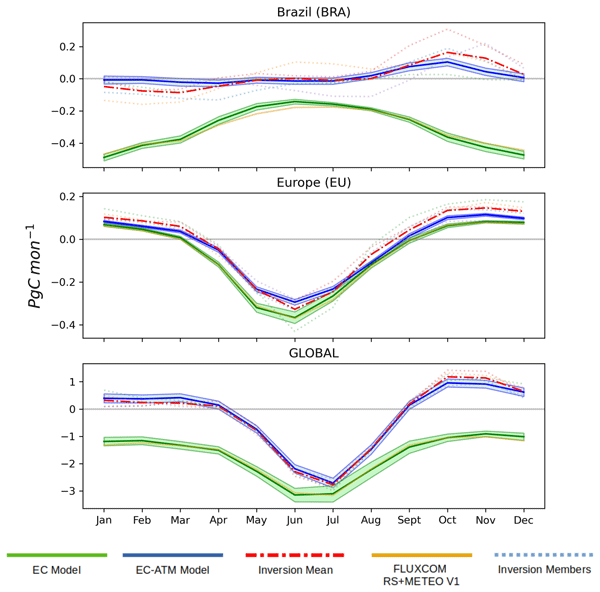
Data-driven eddy-covariance upscaled estimates of the global land–atmosphere net CO2 exchange (NEE) show important mismatches with regional and global estimates based on atmospheric information. To address this, we create a model with a dual constraint based on bottom-up eddy-covariance data and top-down atmospheric inversion data. Our model overcomes shortcomings of each approach, producing improved NEE estimates from local to global scale, helping to reduce uncertainty in the carbon budget.
Ruxandra-Maria Zotta, Moritz Clemens Müller, Raul Lezameta, Sophia Walther, Matthias Forkel, and Wouter Dorigo
EGUsphere, https://doi.org/10.5194/egusphere-2026-6254, https://doi.org/10.5194/egusphere-2026-6254, 2026
This preprint is open for discussion and under review for Biogeosciences (BG).
Short summary
Short summary
We developed a satellite-based method to estimate how much carbon plants take up through photosynthesis worldwide from 2002 to 2020. Using microwave observations, land cover and machine learning, we found that land-cover information improved estimates most, while deeper soil moisture better captured water-related changes in short vegetation. The approach complements existing products, but the total amount of plant carbon uptake remains uncertain.
Nora Linscheid, Laura Mayer, Chiara Aquino, Manuela Balzarolo, Maria Vincenza Chiriacò, Mélanie Juillard, Martin Brandt, Emilio Chuvieco, Philippe Ciais, Maoyuan Feng, Rasmus Fensholt, Teja Kattenborn, Amin Khairoun, Katja Kowalski, Siyu Liu, Joachim Maack, Clemens Mosig, Pierre Regnier, Cornelius Senf, Alba Viana-Soto, Yidi Xu, Yanzi Yan, and Ana Bastos
EGUsphere, https://doi.org/10.5194/egusphere-2026-6189, https://doi.org/10.5194/egusphere-2026-6189, 2026
This preprint is open for discussion and under review for Earth Observation (EO).
Short summary
Short summary
Despite the recent strong reduction in European forest carbon uptake, a comparison of EU forest carbon losses from different datasets is still lacking. We quantify these carbon sink losses combining new high-resolution Earth Observation estimates of forest disturbance, EO-based bookkeeping models, atmospheric CO2 inversions, and National Greenhouse Gas Inventories (NGHGI). We highlight how EO and NGHGIs can benefit each other in better quantifying C losses in a comprehensive and timely manner.
Sanam N. Vardag, Kilian Ticks, Santiago Botía, Gerrit Eisele, Philip Papastefanou, Cleo Quaresma, Hella van Asperen, Carla Souza, Flavio A. F. D'Oliveira, Susan Trumbore, Sönke Zaehle, and Sam P. Jones
EGUsphere, https://doi.org/10.5194/egusphere-2026-6034, https://doi.org/10.5194/egusphere-2026-6034, 2026
This preprint is open for discussion and under review for Biogeosciences (BG).
Short summary
Short summary
This study introduces a 2.5-year data set of CO2 and its stable carbon isotope 13C measured at the Amazon rainforest and analyses what these observations can reveal about how the forest responds to its environment. We find clear day–night changes but much weaker seasonal changes than predicted by a vegetation model, suggesting that the real forest is better buffered against seasonal water stress than the model represents.
Anne-Wil van den Berg, Joram J. D. Hooghiem, Auke M. van der Woude, Pieter Rijsdijk, Roland Vernooij, Santiago Botía, Guido R. van der Werf, John B. Miller, Ingrid T. Luijkx, Maarten C. Krol, and Wouter Peters
Atmos. Chem. Phys., 26, 13929–13958, https://doi.org/10.5194/acp-26-13929-2026, https://doi.org/10.5194/acp-26-13929-2026, 2026
Short summary
Short summary
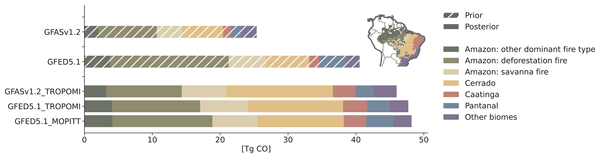
We estimate 2019 Brazilian fire carbon monoxide (CO) emissions using CO retrievals from multiple satellites in a new top-down inversion framework. The retrievals strongly constrain fire emissions and complement existing inventories. National-scale posterior emissions align well with the new Global Fire Emissions Database v5.1, supporting progress in fire emission models. Yet, posterior emissions in the Cerrado and Caatinga are systematically higher than inventories; we discuss potential drivers.
Myriam Terristi, Sebastian Sippel, Benjamin D. Stocker, and Ana Bastos
EGUsphere, https://doi.org/10.5194/egusphere-2026-5509, https://doi.org/10.5194/egusphere-2026-5509, 2026
This preprint is open for discussion and under review for Earth System Dynamics (ESD).
Short summary
Short summary
Satellite records reveal a paradox: vegetation is greening across much of the world even as water scarcity intensifies. Using 24 years of global observations, we followed vegetation throughout dry periods rather than treating droughts as isolated events. Greenness often rose at first, then declined as water shortages deepened. Extreme droughts also shifted many ecosystems towards water limitation, revealing a growing vulnerability beneath the global greening trend.
Shrutika Wagh, Luana S. Basso, Ayan F. Fleischmann, João Henrique Fernandes Amaral, John Melack, Jost Larvic, David Walter, Stijn Hantson, Julia Marshall, Chris Wilson, Youmi Oh, Lori Bruhwiler, John B. Miller, Corinne Vigouroux, Christian Rödenbeck, and Santiago Botía
EGUsphere, https://doi.org/10.5194/egusphere-2026-5245, https://doi.org/10.5194/egusphere-2026-5245, 2026
This preprint is open for discussion and under review for Atmospheric Chemistry and Physics (ACP).
Short summary
Short summary
We estimated methane emissions from the Amazon, Orinoco, and Paraná river basins using the Jena CarboScope global inversion system. We included Amazon measurements to evaluate their effect on the results. Adding them led to a large adjustment in estimated wetland emissions and strongly influenced the Amazon estimate. Without these measurements, the Amazon estimate increased by about 75 %. Our findings highlight the need to maintain and expand measurements across tropical South America.
Wenli Zhao, Alexander J. Winkler, Markus Reichstein, Rene Orth, and Pierre Gentine
Hydrol. Earth Syst. Sci., 30, 5373–5394, https://doi.org/10.5194/hess-30-5373-2026, https://doi.org/10.5194/hess-30-5373-2026, 2026
Short summary
Short summary
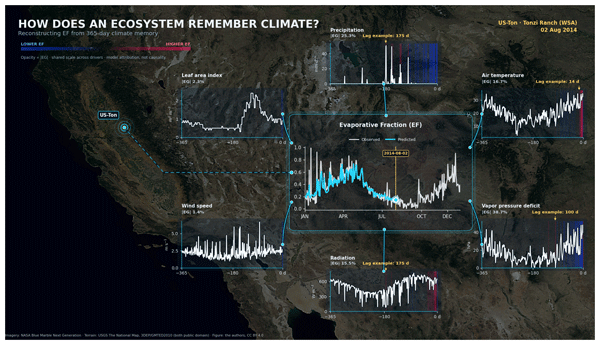
We used explainable machine learning that incorporates memory effects to study how plants respond to weather and drought. Using data from 90 sites worldwide, we show that memory plays a key role in regulating plant water stress. Forests and savannas rely on longer past conditions than grasslands, reflecting differences in rooting depth and water use. These insights improve our ability to anticipate ecosystem vulnerability as droughts intensify.
Theo Glauch, Marcia J. Kroker, Sanam N. Vardag, Santiago Botía, André Butz, and Julia Marshall
EGUsphere, https://doi.org/10.5194/egusphere-2026-4847, https://doi.org/10.5194/egusphere-2026-4847, 2026
This preprint is open for discussion and under review for Biogeosciences (BG).
Short summary
Short summary
Ecosystems absorb CO2 through photosynthesis and release it via respiration, but sensors only measure the combined, net effect. This paper introduces pyVPRNN, an AI model to separate these two processes using satellite imagery, land-cover, and weather data. Tested at 32 European sites, it outperforms current methods, especially in forests and grasslands, and can even estimate carbon exchange in places without physical sensors – helping track how ecosystems absorb carbon as the climate changes.
Marina Friedel, Johanna Beikert, Ana Bastos, Nora Linscheid, and Marlene Kretschmer
EGUsphere, https://doi.org/10.5194/egusphere-2026-4689, https://doi.org/10.5194/egusphere-2026-4689, 2026
Short summary
Short summary
We show that the winter Northern Hemisphere stratospheric polar vortex (SPV) – strong stratospheric winds shaping European winter weather – impacts vegetation across Europe from winter into summer. We establish the mechanisms linking winter SPV to summertime vegetation, and show that in France's breadbasket region, SPV anomalies translate into measurable crop yield anomalies. Winter SPV thus emerges as an underappreciated long-lead precursor of European vegetation and crop yield.
Kim Faassen, Auke M. van der Woude, Joram J. D. Hooghiem, Aleya Kaushik, Boaz Hilman, Wouter Peters, Penelope A. Pickers, and Ingrid T. Luijkx
EGUsphere, https://doi.org/10.5194/egusphere-2026-4491, https://doi.org/10.5194/egusphere-2026-4491, 2026
This preprint is open for discussion and under review for Atmospheric Chemistry and Physics (ACP).
Short summary
Short summary
Atmospheric oxygen (O2) can be used to partition components of the carbon budget, but they commonly assume a constant biospheric O2:CO2 exchange ratio. By implementing O2 fluxes in the Simple Biosphere Model (SiB4), we show that this exchange ratio varies substantially in space and time. Accounting for this variability improves the interpretation of atmospheric O2 observations and can reduce biases in regional fossil fuel CO2 estimates derived from atmospheric potential oxygen.
Siyuan Wang, Hui Yang, Sujan Koirala, Maurizio Santoro, Anna Candotti, Ulrich Weber, Ranit De, Claire Robin, Felix Cremer, Matthias Forkel, Markus Reichstein, and Nuno Carvalhais
Earth Syst. Sci. Data, 18, 5895–5913, https://doi.org/10.5194/essd-18-5895-2026, https://doi.org/10.5194/essd-18-5895-2026, 2026
Short summary
Short summary
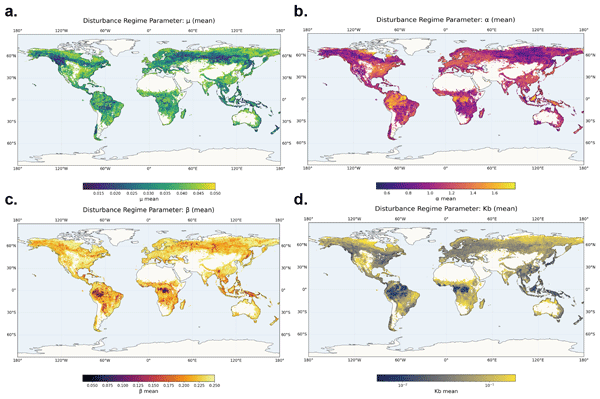
Forest disturbances are difficult to predict in models because they occur randomly. We discovered that the long-term rules of disturbance known as
regimeleave a unique footprint in a forest's spatial biomass patterns. We trained a model on millions of computer simulations to learn this link. By applying this model to detailed satellite biomass, we could read these patterns to infer the disturbance regime globally, helping make climate projections more accurate.
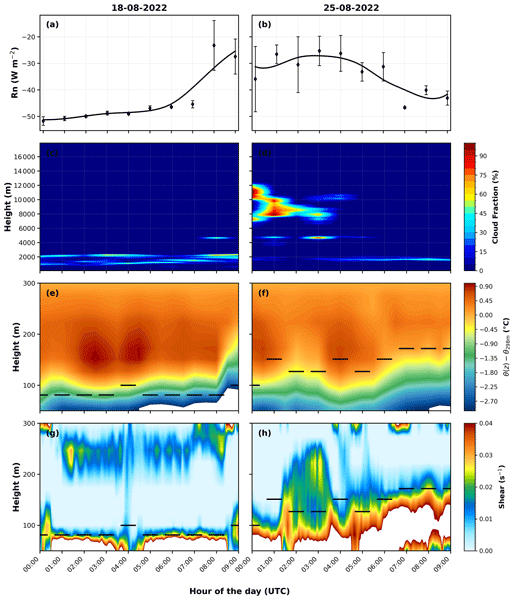
Carla M. A. Souza, Anne C. S. Mendonça, Hella van Asperen, Flávio A. F. D'Oliveira, Santiago Botía, Luís G. N. Martins, Denisi H. Hall, Raoni A. Santana, Gilberto Fisch, Leonardo R. Oliveira, Jailson R. Mata, Ranyelli Figueiredo, Rachel Albrecht, Bruno T. T. Portela, Carlos A. Quesada, and Cléo Q. Dias-Júnior
Atmos. Chem. Phys., 26, 10679–10694, https://doi.org/10.5194/acp-26-10679-2026, https://doi.org/10.5194/acp-26-10679-2026, 2026
Short summary
Short summary
We investigated how the height of the nocturnal air layer (hn) above the Amazon forest changes over the year and how this influences gas measurements. Using two years of tower observations, we found that this layer is higher during wetter periods and much lower during dry periods linked to large climate events. hn can controls how gases accumulate or disperse at night, which affects how we interpret observations and improve weather and climate predictions.
Mengrong Lu, Huilin Chen, Xun Zhang, Xuguang Chi, Chong Wei, Shuangxi Fang, Fenjuan Wang, Eleftherios Ioannidis, Friedemann Reum, Xinlu Wang, Prajal Pradhan, Wouter Peters, Klaus Hubacek, and Sander Houweling
EGUsphere, https://doi.org/10.5194/egusphere-2026-3879, https://doi.org/10.5194/egusphere-2026-3879, 2026
Short summary
Short summary
Effective methane mitigation requires accurate knowledge of the spatial and temporal distribution of sources and sinks. Using high-resolution atmospheric modeling and ground-based observations, we estimated methane emissions in East Asia, focusing on the Yangtze River Delta. Emissions are lower than most inventories suggest, but show a clear seasonal cycle, with summer peaks driven by rice cultivation and natural sources. This seasonality is critical for emission tracking and mitigation design.
Tim Stripp, Zhixuan Guo, Pierre Friedlingstein, Michael O’Sullivan, Stephen Sitch, Ana Bastos, Philippe Ciais, Jefferson Goncalves de Souza, Akihiko Ito, Wei Li, and Lei Ma
EGUsphere, https://doi.org/10.5194/egusphere-2026-3584, https://doi.org/10.5194/egusphere-2026-3584, 2026
Short summary
Short summary
Fire is a key process within the Earth system, yet it is often poorly represented in land carbon cycle models used to estimate how much carbon land ecosystems absorb from the atmosphere. We improved these models by applying long-term burned area data reconstructed from satellite observations. This reduced biases and uncertainty in fire carbon emission estimates and improved estimates of land carbon uptake, implying this method could enhance global and regional carbon budget estimates.
Bárbara Antonucci, Raoni A. Santana, Nara L. R. Andrade, Eliane Gomes Alves, Santiago Botía, Carla M.A. Souza, Anne C. S. Mendonça, Shujiro Komiya, Denisi H. Hall, Natalia Restrepo-Coupe, Gabriel B. Costa, and Cléo Q. Dias-Júnior
EGUsphere, https://doi.org/10.5194/egusphere-2026-3167, https://doi.org/10.5194/egusphere-2026-3167, 2026
This preprint is open for discussion and under review for Biogeosciences (BG).
Short summary
Short summary
The Amazon rainforest helps regulate the global climate by absorbing carbon from the atmosphere. We developed a simple method to improve long-term estimates of forest carbon exchange using measurements available at many monitoring sites. Applying this approach to a 13-year record from the southwestern Amazon showed that the forest absorbed carbon during wetter years but became a weaker carbon sink, or even a carbon source, during droughts and El Niño events.
Firmin T. Stroo, Joram J. D. Hooghiem, Maarten C. Krol, and Wouter Peters
EGUsphere, https://doi.org/10.5194/egusphere-2026-3077, https://doi.org/10.5194/egusphere-2026-3077, 2026
Short summary
Short summary
Measurements and computer modelling were used to improve quantification of the global hydrogen budget from 2003–2023. We estimate a global soil sink of 52.8 Tg/yr and a photochemical source of 34.6 Tg/yr. Changes in the hydrogen growth rate were mainly driven by shifts in photochemical production and a weakening soil sink. Soil uptake responds to the El Niño–Southern Oscillation, especially in tropical South America, likely controlled by changes in soil moisture.
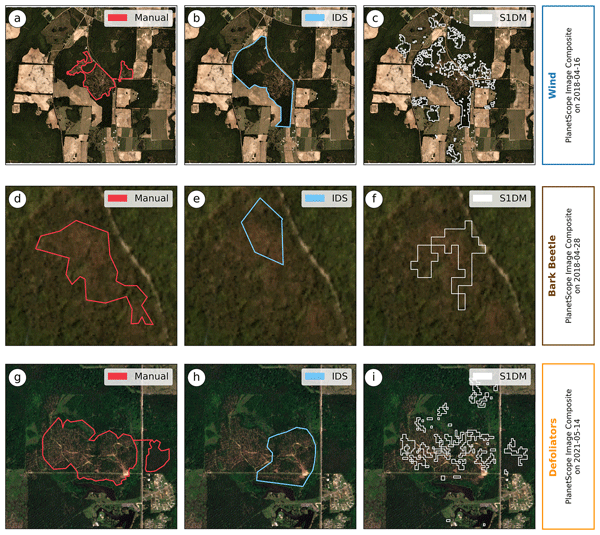
Franziska Müller, Laura Eifler, Felix Cremer, Pieter Beck, Gustau Camps-Valls, and Ana Bastos
Nat. Hazards Earth Syst. Sci., 26, 2785–2815, https://doi.org/10.5194/nhess-26-2785-2026, https://doi.org/10.5194/nhess-26-2785-2026, 2026
Short summary
Short summary
Forest health is increasingly threatened, but disturbances like wind damage and insect outbreaks are hard to track. Our Sentinel-1 Disturbance Mapping (S1DM) approach combines satellite radar with survey data, improving detection for wind and bark beetle impacts and often spotting them earlier. Defoliators remain difficult to capture, but this method strengthens monitoring and supports better forest management.
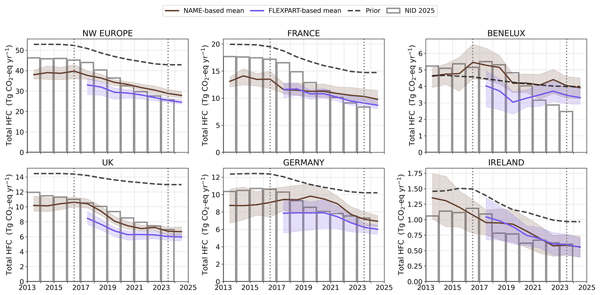
Hélène De Longueville, Daniela B. Melo, Alison L. Redington, Alice Ramsden, Alexandre Danjou, Peter Andrews, Joseph Pitt, Brendan Murphy, Lionel Constantin, Kieran M. Stanley, Simon O'Doherty, Angelina Wenger, Dickon Young, Andreas Engel, Tanja Schuck, Katharina Meixner, Thomas Wagenhaeuser, Fides Gad, Martin K. Vollmer, Stefan Reimann, Michela Maoine, Jgor Arduini, Chris Lunder, Norbert Schmidtbauer, László Haszpra, Mihály Molnár, Arnoud Frumau, Cedric Couret, Matthew Rigby, Stephan Henne, Alistair Manning, and Anita L. Ganesan
Atmos. Chem. Phys., 26, 7647–7675, https://doi.org/10.5194/acp-26-7647-2026, https://doi.org/10.5194/acp-26-7647-2026, 2026
Short summary
Short summary
This study estimates emissions of hydrofluorocarbons, potent greenhouse gases, in north-western Europe using atmospheric observations and atmospheric modelling. The estimates are compared with nationally reported emissions submitted to the United Nations. Overall, our results are consistent with reported values, although differences are found for some gases and countries. The findings indicate that emissions in north-western Europe are declining, reflecting the effects of climate regulations.
Liang Feng, Paul I. Palmer, Haolin Wang, Robert Parker, Hartmut Boesch, Sébastien C. Biraud, Łukasz Chmura, Emanuel Gloor, László Haszpra, Elena Kozlova, Euan G. Nisbet, Steffen M. Noe, Thomas Röckmann, Rodrigo Augusto Ferreira de Souza, and Martin Steinbacher
EGUsphere, https://doi.org/10.5194/egusphere-2026-2662, https://doi.org/10.5194/egusphere-2026-2662, 2026
Short summary
Short summary
This study examines the relative roles of emissions and oxidation in recent rapid methane growth. Using an ensemble Kalman filter, we quantify global methane sources and sinks for 2018–2024. Emission changes dominate the increase, except in 2020 when a COVID‑19‑related OH decline strongly affected sinks. Atmospheric photochemistry—including OH and CH₄ variability and temperature‑dependent oxidation—also significantly shapes the methane budget.
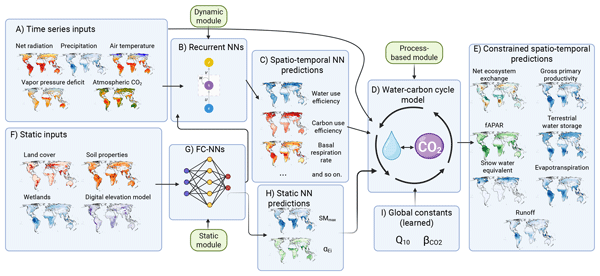
Zavud Baghirov, Markus Reichstein, Basil Kraft, Bernhard Ahrens, Marco Körner, and Martin Jung
Geosci. Model Dev., 19, 4467–4496, https://doi.org/10.5194/gmd-19-4467-2026, https://doi.org/10.5194/gmd-19-4467-2026, 2026
Short summary
Short summary
We introduce a new global model that links how water and carbon move through land ecosystems. By combining process knowledge with artificial intelligence that learns from observations, we model daily changes in vegetation, water and carbon cycle processes. This model outperforms both purely data-driven and traditional process models, especially in dry and tropical regions. This advance could improve current understanding of water–carbon cycle relationships.
Anna T. Schackow, Susan C. Steele-Dunne, David T. Milodowski, Jean-Marc Limousin, and Ana Bastos
Biogeosciences, 23, 3365–3386, https://doi.org/10.5194/bg-23-3365-2026, https://doi.org/10.5194/bg-23-3365-2026, 2026
Short summary
Short summary
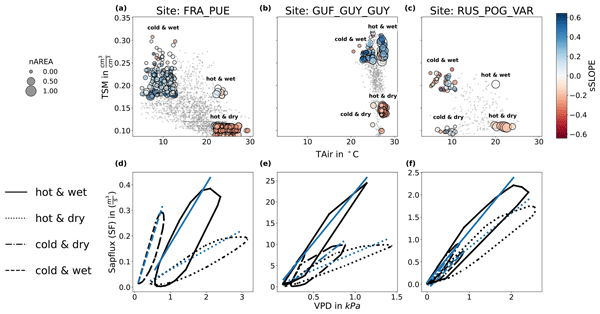
Plants regulate how much water they lose and how much carbon they take in, but rising heat and dryness make this balance harder. We studied how water movement inside plant stems changes during the day and relates to dryness in the air and soil. By analyzing these daily patterns, we identified signals of stress that could be tracked not only with sensors in plants but also from satellites, offering new ways to monitor global vegetation health.
Pierre Friedlingstein, Michael O'Sullivan, Matthew W. Jones, Robbie M. Andrew, Dorothee C. E. Bakker, Judith Hauck, Peter Landschützer, Corinne Le Quéré, Hongmei Li, Ingrid T. Luijkx, Glen P. Peters, Wouter Peters, Julia Pongratz, Clemens Schwingshackl, Stephen Sitch, Josep G. Canadell, Philippe Ciais, Kjetil Aas, Simone R. Alin, Peter Anthoni, Leticia Barbero, Nicholas R. Bates, Nicolas Bellouin, Alice Benoit-Cattin, Carla F. Berghoff, Raffaele Bernardello, Laurent Bopp, Ida Bagus Mandhara Brasika, Matthew A. Chamberlain, Naveen Chandra, Frédéric Chevallier, Louise P. Chini, Nathan O. Collier, Thomas H. Colligan, Margot Cronin, Laique M. Djeutchouang, Xinyu Dou, Matt P. Enright, Kazutaka Enyo, Michael Erb, Wiley Evans, Richard A. Feely, Liang Feng, Daniel J. Ford, Adrianna Foster, Filippa Fransner, Thomas Gasser, Marion Gehlen, Thanos Gkritzalis, Jefferson Goncalves De Souza, Giacomo Grassi, Luke Gregor, Nicolas Gruber, Bertrand Guenet, Özgür Gürses, Kirsty Harrington, Ian Harris, Jens Heinke, George C. Hurtt, Yosuke Iida, Tatiana Ilyina, Akihiko Ito, Andrew R. Jacobson, Atul K. Jain, Tereza Jarníková, Annika Jersild, Fei Jiang, Steve D. Jones, Etsushi Kato, Ralph F. Keeling, Kees Klein Goldewijk, Jürgen Knauer, Yawen Kong, Jan Ivar Korsbakken, Charles Koven, Taro Kunimitsu, Xin Lan, Junjie Liu, Zhiqiang Liu, Zhu Liu, Claire Lo Monaco, Lei Ma, Gregg Marland, Patrick C. McGuire, Galen A. McKinley, Joe R. Melton, Natalie Monacci, Erwan Monier, Eric J. Morgan, David R. Munro, Jens D. Müller, Shin-Ichiro Nakaoka, Lorna R. Nayagam, Yosuke Niwa, Tobias Nutzel, Are Olsen, Abdirahman M. Omar, Naiqing Pan, Sudhanshu Pandey, Denis Pierrot, Zhangcai Qin, Pierre Regnier, Gregor Rehder, Laure Resplandy, Alizée Roobaert, Thais M. Rosan, Christian Rödenbeck, Jörg Schwinger, Ingunn Skjelvan, T. Luke Smallman, Victoria Spada, Mohanan G. Sreeush, Qing Sun, Adrienne J. Sutton, Colm Sweeney, Didier Swingedouw, Roland Séférian, Shintaro Takao, Hiroaki Tatebe, Hanqin Tian, Xiangjun Tian, Bronte Tilbrook, Hiroyuki Tsujino, Francesco Tubiello, Erik van Ooijen, Guido R. van der Werf, Sebastiaan J. van de Velde, Anthony P. Walker, Rik Wanninkhof, Xiaojuan Yang, Wenping Yuan, Xu Yue, and Jiye Zeng
Earth Syst. Sci. Data, 18, 3211–3288, https://doi.org/10.5194/essd-18-3211-2026, https://doi.org/10.5194/essd-18-3211-2026, 2026
Short summary
Short summary
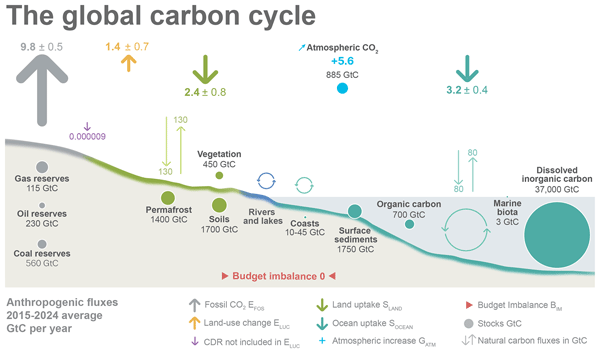
The Global Carbon Budget 2025 describes the methodology, main results, and datasets used to quantify the anthropogenic emissions of carbon dioxide (CO2) and their partitioning among the atmosphere, land ecosystems, and the ocean over the historical period (1750–2025). These living datasets are updated every year to provide the highest transparency and traceability in the reporting of CO2, the key driver of climate change.
Guohua Liu, Philippe Ciais, Shengli Tao, Hui Yang, Chenwei Xiao, and Ana Bastos
Earth Syst. Sci. Data Discuss., https://doi.org/10.5194/essd-2026-246, https://doi.org/10.5194/essd-2026-246, 2026
Preprint under review for ESSD
Short summary
Short summary
We developed a long-term, moderate-resolution global dataset of forest above ground biomass, from satellite radar data and machine learning. The significance of this dataset lies in its ability to provide a continuous, moderate-resolution view of biomass carbon dynamics, offering a valuable resource for supporting studies of climate change, disturbance, and land use, and will help improve Earth System models and future carbon cycle.
László Haszpra, Zoltán Barcza, Anikó Kern, and Natascha Kljun
EGUsphere, https://doi.org/10.5194/egusphere-2026-1077, https://doi.org/10.5194/egusphere-2026-1077, 2026
Short summary
Short summary
The net land-atmosphere exchange of carbon monoxide remains highly uncertain due to the scarcity of long-term monitoring. This study analyses a 10-year-long data series from a tall-tower eddy covariance system. The flux footprint of this system covers a heterogeneous landscape. Vegetation-dominated areas acted as a weak net source. Solar radiation was identified as the primary driver of the emissions. Emissions from the populated areas significantly exceeded the activity-based estimations.
Joao Henrique Fernandes Amaral, Santiago Botía, Paula Torres Quintero, Anghy Sthephany Gutierrez Rincon, David Ho, Adriana Sanchez, Alvaro Avila-Diaz, Antje Uhde, Benjamin Quesada, Juan C. Benavides, R. Scott Winton, Carlos A. Sierra, Miguel A. Navarro-Ramírez, Diego David Pardo Buitrago, and Stijn Hantson
EGUsphere, https://doi.org/10.5194/egusphere-2026-2080, https://doi.org/10.5194/egusphere-2026-2080, 2026
Short summary
Short summary
Methane is a powerful greenhouse gas driving climate change. Atmospheric methane levels are rising by anthropogenic emissions from livestock, oil and gas, rice farms, fires, and, naturally, mainly from wetlands. Tropical wetlands are a major source, yet data is uncertain. Our study examines South America's Orinoco wetlands (Colombia, Venezuela), reviewing emissions from natural and anthropogenic sources. We discuss and identify research needed to better understand this ecosystem's methane cycle.
Mara Y. McPartland, Tomas Lovato, Charles Koven, Jamie D. Wilson, Briony Turner, Colleen M. Petrik, José Licón-Saláiz, Fang Li, Fanny Lhardy, Jaclyn Clement Kinney, Michio Kawamiya, Birgit Hassler, Nathan P. Gillett, Cheikh Modou Noreyni Fall, Christopher Danek, Chris M. Brierley, Ana Bastos, and Oliver Andrews
Geosci. Model Dev., 19, 2849–2880, https://doi.org/10.5194/gmd-19-2849-2026, https://doi.org/10.5194/gmd-19-2849-2026, 2026
Short summary
Short summary
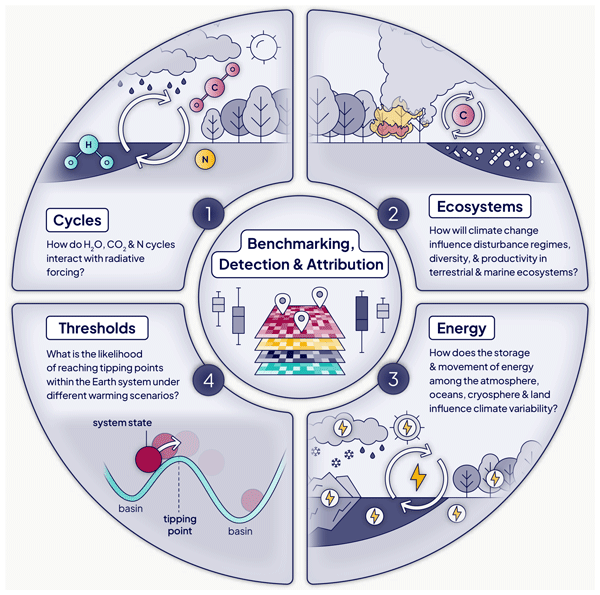
The Coupled Model Intercomparison Project (CMIP) is an international consortium of climate modeling groups that produce coordinated experiments in order to evaluate human influence on the climate and test knowledge of Earth systems. This paper describes the data requested for Earth systems research in CMIP7. We detail the request for model output of the carbon cycle, the flows of energy among the atmosphere, land and the oceans, and interactions between these and the global climate.
Michiel K. van der Molen, Henk Snellen, Rupert Holzinger, Johannes G. M. Barten, Hong Zhao, Laurens Ganzeveld, Julie Fry, Wouter Peters, Maarten Krol, Jordi Vila-Guerau de Arrelano, and Bart Kruijt
Earth Syst. Sci. Data Discuss., https://doi.org/10.5194/essd-2026-99, https://doi.org/10.5194/essd-2026-99, 2026
Revised manuscript under review for ESSD
Short summary
Short summary
In 2021, a second tower was built in Loobos (NL-Loo) to measure carbon dioxide and water fluxes, as an Integrated Carbon Observing System (ICOS) Class 2 Ecosystem station. Instrumentation was installed to measure volatile organic compound and ozone fluxes. This paper describes the site’s geological and cultural history, ecosystem composition, instrumentation and ancillary ecosystem measurements. The paper goes into the quality of the measurements and continuity with respect to the first tower.
Noelia R. Benavente, Santiago Botía, Luciana V. Rizzo, Angel Vara-Vela, Paulo Artaxo, Hella van Asperen, Felipe Santos da Silva, Flavio A. F. D'Oliveira, Horst Fischer, Michał Gałkowski, Theo Glauch, Alice Henkes, David Ho, Cléo Q. Dias-Júnior, Amauri C. P. Junior, Julia Marshall, Linda Ort, Ben-Hur M. Portella, and Luiz A. T. Machado
EGUsphere, https://doi.org/10.5194/egusphere-2026-979, https://doi.org/10.5194/egusphere-2026-979, 2026
Short summary
Short summary
The Amazon Basin plays a vital role in regulating Earth's climate by absorbing and releasing carbon dioxide and methane. We studied how a high-resolution atmospheric transport model captures these gases, comparing it with measurements from towers and aircraft over the forest. Adjusting for forest carbon exchange improved carbon dioxide results, while methane levels were heavily dependent on emission estimates. Remaining errors were linked to winds and atmospheric mixing.
Pierre Laluet, Chiara Corbari, Oscar Baez-Villanueva, Sophia Walther, Yongqiang Zhang, Joaquín Muñoz-Sabater, Clément Albergel, and Wouter Dorigo
Hydrol. Earth Syst. Sci., 30, 1779–1799, https://doi.org/10.5194/hess-30-1779-2026, https://doi.org/10.5194/hess-30-1779-2026, 2026
Short summary
Short summary
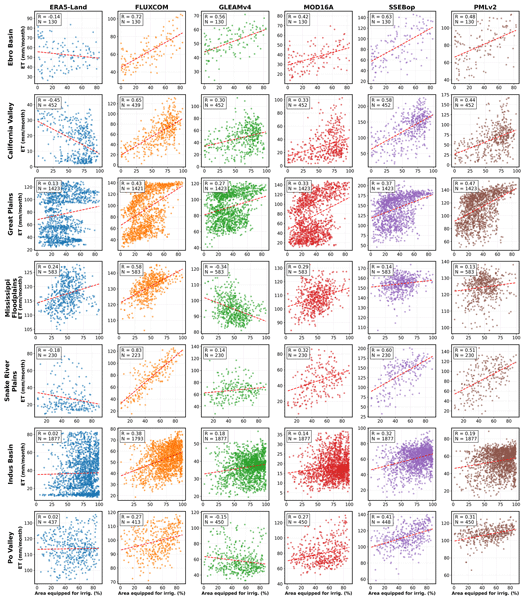
We examined how well global datasets estimate evapotranspiration, the water moving from land to the air, in irrigated areas. We compared six widely used products with irrigation maps, satellite estimates, and field measurements across different climate regions. Some datasets better capture irrigation effects, especially those using temperature and vegetation satellite data. This work helps guide dataset selection and supports better inclusion of irrigation in hydrological and climate models.
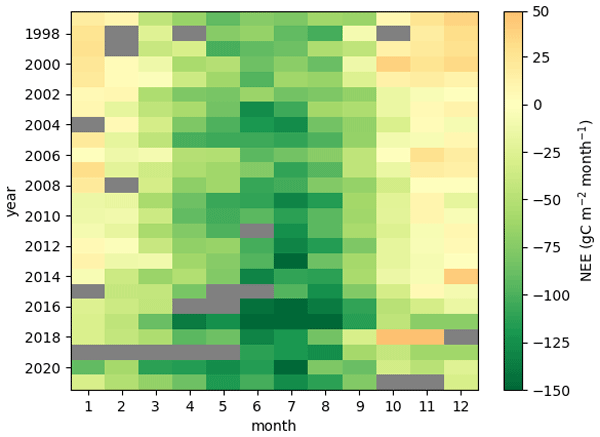
Hong Zhao, Han Dolman, Jan Elbers, Wilma Jans, Bart Kruijt, Eddy Moors, Henk Snellen, Jordi Vila-Guerau de Arellano, Wouter Peters, Maarten C. Krol, Ronald Hutjes, and Michiel van der Molen
Earth Syst. Sci. Data, 18, 2023–2045, https://doi.org/10.5194/essd-18-2023-2026, https://doi.org/10.5194/essd-18-2023-2026, 2026
Short summary
Short summary
Under the Kyoto Protocol the carbon dioxide (CO2) balance for forest ecosystems was required to be measured. Consequently, CO2 flux measurements have been conducted in Loobos site in the Netherlands since 1996, becoming one of the 17 first FLUXNET sites globally. This paper provides a comprehensive overview of the instrumentation, data processing and the resulting data archive, enabling its further use in data analysis, model development and validation of satellite data retrievals.
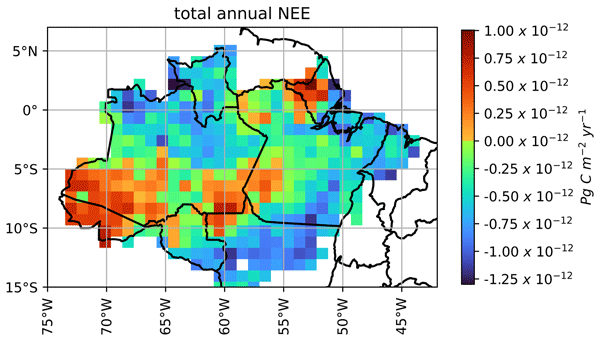
Amauri C. Prudente Jr., Luiz A. T. Machado, Felipe S. Silva, Tercio Ambrizzi, Paulo Artaxo, Santiago Botia, Luan P. Cordeiro, Cleo Q. Dias Jr., Edmilson Freitas, Demerval S. Moreira, Christopher Pöhlker, Ivan M. C. Toro, Xiyan Xu, and Luciana V. Rizzo
Biogeosciences, 23, 1771–1793, https://doi.org/10.5194/bg-23-1771-2026, https://doi.org/10.5194/bg-23-1771-2026, 2026
Short summary
Short summary
This study propoes a new method of spatialization to estimate carbon fluxes in the Brazilian Amazon biome. To do so, was used a land surface model (JULES) and two vegetation properties. The results of this spatialization resulted in a carbon fluxes of -1.34 Pg C during the year of 2021 in the entire Brazilian Amazon biome being the states of Amapa and Acre main relevant regions of carbon source.
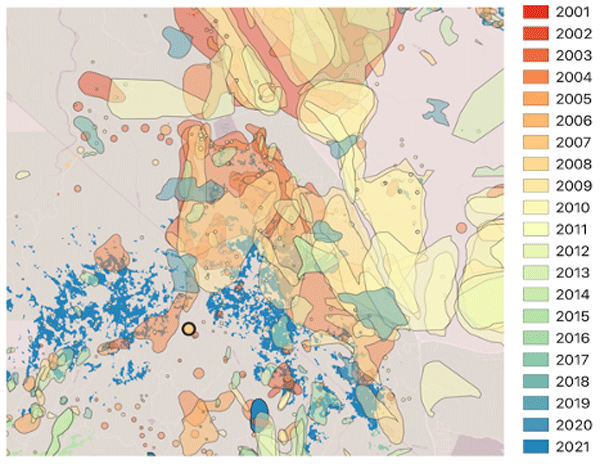
Laura Eifler, Franziska Müller, and Ana Bastos
Biogeosciences, 23, 1291–1325, https://doi.org/10.5194/bg-23-1291-2026, https://doi.org/10.5194/bg-23-1291-2026, 2026
Short summary
Short summary
Forests provide ecosystem services and biodiversity, but they are increasingly affected by disturbances. We evaluate five forest disturbance datasets across the Unites States to assess their consistency in space, timing, and disturbance agents. While datasets show good agreement in disturbance timing, spatial overlap and agent attribution differ substantially. This emphasizes the need for enhanced data quality assessment, integration, and accuracy to better understand forest disturbances.
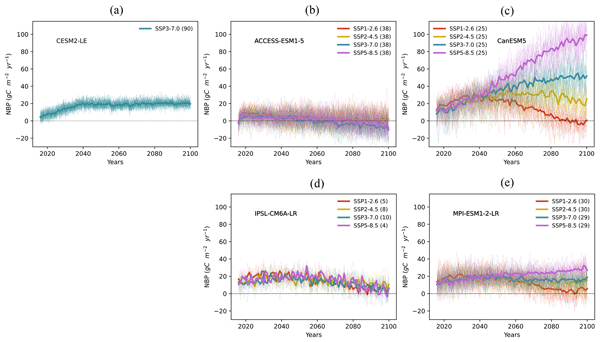
Na Li, Sebastian Sippel, Nora Linscheid, Miguel D. Mahecha, Markus Reichstein, and Ana Bastos
Biogeosciences, 23, 767–792, https://doi.org/10.5194/bg-23-767-2026, https://doi.org/10.5194/bg-23-767-2026, 2026
Short summary
Short summary
We study when anthropogenic signal becomes detectable in the global land carbon sink, which has risen since the 1950s due to CO₂ fertilization and mid- to high-latitude warming. The signal emerges earlier at the global than at regional scales. Future scenarios (2016–2100) take longer to detect than the historical period (1851–2014) because the signal is weaker relative to larger natural variability. Removing circulation-induced variability with dynamical adjustment shortens the detection time.
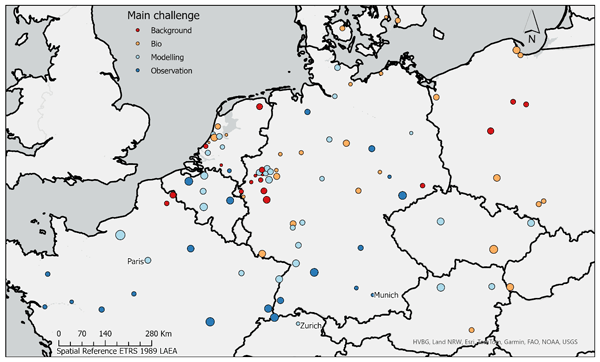
Ida Storm, Ute Karstens, Claudio D'Onofrio, Alex Vermeulen, Samuel Hammer, Ingrid Super, Theo Glauch, and Wouter Peters
Earth Syst. Sci. Data, 17, 6681–6701, https://doi.org/10.5194/essd-17-6681-2025, https://doi.org/10.5194/essd-17-6681-2025, 2025
Short summary
Short summary
Many cities are committed to ambitious CO2 emission reduction targets, supported by climate action plans. Atmospheric measurements are essential to verify that these efforts lead to the expected reductions. Here, we characterise and compare 96 European cities across 18 metrics, linking them to four major challenges in CO2 emissions monitoring. Our framework includes a tool with additional cities and metrics, as well as "mapbooks" for the 96 cities.
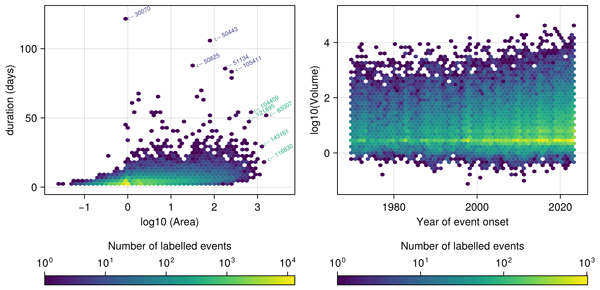
Mélanie Weynants, Chaonan Ji, Nora Linscheid, Ulrich Weber, Miguel D. Mahecha, and Fabian Gans
Earth Syst. Sci. Data, 17, 6621–6645, https://doi.org/10.5194/essd-17-6621-2025, https://doi.org/10.5194/essd-17-6621-2025, 2025
Short summary
Short summary
The impacts of climate extremes such as heatwaves and droughts can be made worse when they happen at the same time. Dheed is a global database of dry and hot compound extreme events from 1950 to 2023. It can be combined with other data to study the impacts of those events on terrestrial ecosystems, specific species or human societies. Dheed's analysis confirms that extremely dry and hot days have become more common on all continents in recent decades, especially in Europe and Africa.
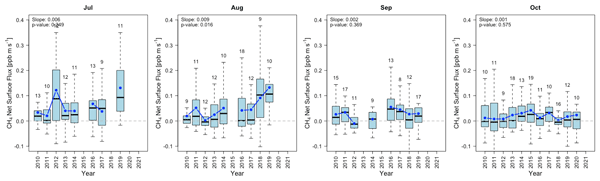
Dieu Anh Tran, Jordi Vilà-Guerau de Arellano, Ingrid T. Luijkx, Christoph Gerbig, Michał Gałkowski, Santiago Botía, Kim Faassen, and Sönke Zaehle
Atmos. Chem. Phys., 25, 16553–16588, https://doi.org/10.5194/acp-25-16553-2025, https://doi.org/10.5194/acp-25-16553-2025, 2025
Short summary
Short summary
Analysis of CH4 data (2010–2021) from ZOtino Tall Tower Observatory in Central Siberia shows an increase in the late summer diurnal amplitude, driven by nighttime emissions. These trends correlate with rising soil temperature and moisture during the late summer and snow depth of the preceding spring. Peaks in 2012 and 2019 emission link to wildfires activity. Findings suggest wetlands as key CH4 sources and underscore the need for ongoing high-resolution monitoring in this region.
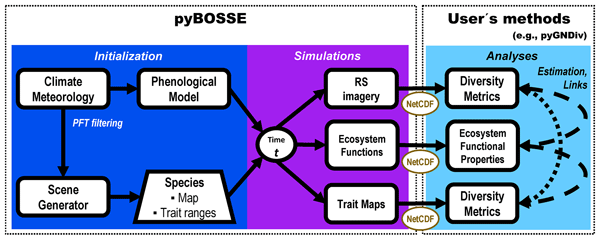
Javier Pacheco-Labrador, Ulisse Gomarasca, Daniel E. Pabon-Moreno, Wantong Li, Mirco Migliavacca, Martin Jung, and Gregory Duveiller
Geosci. Model Dev., 18, 8401–8422, https://doi.org/10.5194/gmd-18-8401-2025, https://doi.org/10.5194/gmd-18-8401-2025, 2025
Short summary
Short summary
Measuring biodiversity is necessary to assess its loss, evolution, and role in ecosystem functions. Satellites image the whole terrestrial surface and could cost-efficiently map plant diversity globally. However, developing the necessary methods lacks consistent and sufficient field measurements. Thus, we propose using a simulation tool that generates virtual ecosystems, with species properties and functions varying in response to meteorology and the respective remote sensing imagery.
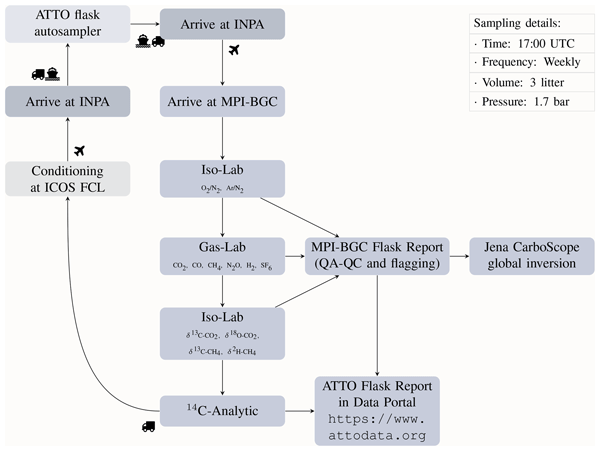
Carlos A. Sierra, Ingrid Chanca, Meinrat O. Andreae, Alessandro Carioca de Araújo, Hella van Asperen, Lars Borchardt, Santiago Botía, Luiz Antonio Candido, Caio S. C. Correa, Cléo Quaresma Dias-Junior, Markus Eritt, Annica Fröhlich, Luciana V. Gatti, Marcus Guderle, Samuel Hammer, Martin Heimann, Viviana Horna, Armin Jordan, Steffen Knabe, Richard Kneißl, Jost Valentin Lavric, Ingeborg Levin, Kita Macario, Juliana Menger, Heiko Moossen, Carlos Alberto Quesada, Michael Rothe, Christian Rödenbeck, Yago Santos, Axel Steinhof, Bruno Takeshi, Susan Trumbore, and Sönke Zaehle
Earth Syst. Sci. Data, 17, 5871–5884, https://doi.org/10.5194/essd-17-5871-2025, https://doi.org/10.5194/essd-17-5871-2025, 2025
Short summary
Short summary
We present here a unique dataset of atmospheric observations of greenhouse gases and isotopes that provide key information on land-atmosphere interactions for the Amazon forests of central Brazil. The data show a relatively large level of variability, but also important trends in greenhouse gases, and signals from fires as well as seasonal biological activity.
Friedrich J. Bohn, Giles B. Sioen, Ana Bastos, Yolandi Ernst, Marcin P. Jarzebski, Niak S. Koh, Romina Martin, Anja Rammig, Alex Godoy-Faúndez, Alexandros Gasparatos, Alvaro G. Gutiérrez, Amanda J. Aceituno, Andra-Ioana Horcea-Milcu, Andrea Marais-Potgieter, Ayyoob Sharifi, Caroline Howe, Cornelia B. Krug, Eduardo E. Acosta, Emmanuel F. Nzunda, Erik Andersson, Hans-Otto Pörtner, Helen Sooväli-Sepping, Ishihara Hiroe, Ivan Palmegiani, Kaera Coetzer, Kirsten Thonike, Krizler Tanalgo, Lisa Biber-Freudenberger, Nicholas O. Oguge, Mi S. Park, Milena Gross, Pablo De La Cruz, Paula R. Prist, Peng Bi, Rivera Diego, Roman Isaac, Rosemary McFarlane, Sinikka J. Paulus, Stefanie Burkhart, Sung-Ching Lee, Susanne Müller, Uchi D. Terhile, Wan-Yu Shih, William K. Smith, Viola Hakkarainen, Virginia Murray, Yuki Yoshida, Yohannes T. Damtew, and Zeenat Niazi
EGUsphere, https://doi.org/10.5194/egusphere-2025-3619, https://doi.org/10.5194/egusphere-2025-3619, 2025
Short summary
Short summary
The aim of this series is to provide decision-makers with valuable insights into the current state of biosphere research. Firstly, it is intended to ensure the flow of information between the comprehensive assessment reports of the IPCC and IPBES. On the other hand, it is intended to support economic and political decisions closely related to the biosphere with scientifically sound findings – including uncertainties – and comprehensive polysolutions, helping to solve the earth system polycrisis.
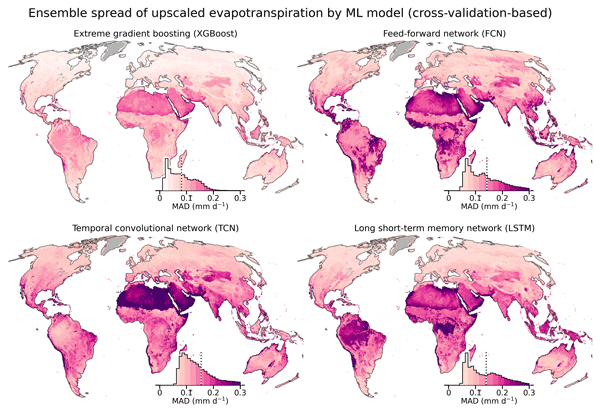
Basil Kraft, Jacob A. Nelson, Sophia Walther, Fabian Gans, Ulrich Weber, Gregory Duveiller, Markus Reichstein, Weijie Zhang, Marc Rußwurm, Devis Tuia, Marco Körner, Zayd Hamdi, and Martin Jung
Biogeosciences, 22, 3965–3987, https://doi.org/10.5194/bg-22-3965-2025, https://doi.org/10.5194/bg-22-3965-2025, 2025
Short summary
Short summary
This study evaluates machine learning approaches for upscaling evapotranspiration from the site to the global scale. Sequential models capture temporal dynamics better, especially with precipitation data, but all models show biases in data-scarce regions. Improved upscaling requires richer training data, informed covariate selection, and physical constraints to enhance robustness and reduce extrapolation errors.
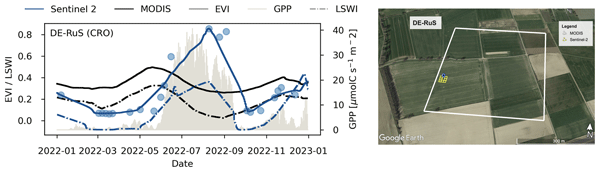
Theo Glauch, Julia Marshall, Christoph Gerbig, Santiago Botía, Michał Gałkowski, Sanam N. Vardag, and André Butz
Geosci. Model Dev., 18, 4713–4742, https://doi.org/10.5194/gmd-18-4713-2025, https://doi.org/10.5194/gmd-18-4713-2025, 2025
Short summary
Short summary
The Vegetation Photosynthesis and Respiration Model (VPRM) estimates carbon exchange between the atmosphere and biosphere by modeling gross primary production and respiration using satellite data and weather variables. Our new version, pyVPRM, supports diverse satellite products like Sentinel-2, MODIS, VIIRS, and new land cover maps, enabling high spatial and temporal resolution. This improves flux estimates, especially in complex landscapes, and ensures continuity as MODIS nears decommissioning.
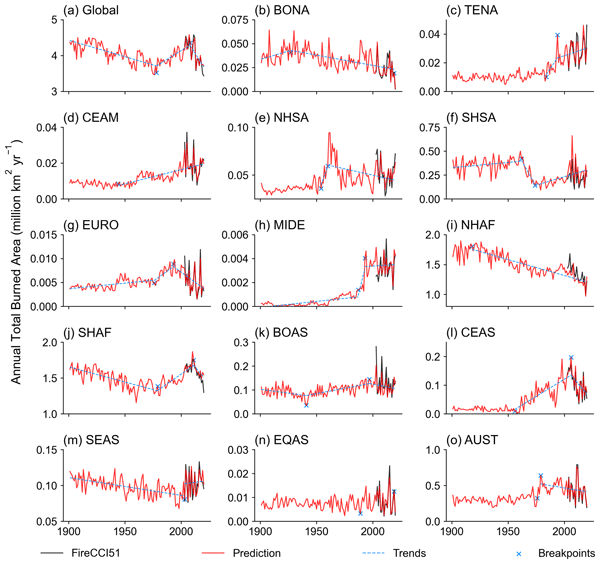
Zhixuan Guo, Wei Li, Philippe Ciais, Stephen Sitch, Guido R. van der Werf, Simon P. K. Bowring, Ana Bastos, Florent Mouillot, Jiaying He, Minxuan Sun, Lei Zhu, Xiaomeng Du, Nan Wang, and Xiaomeng Huang
Earth Syst. Sci. Data, 17, 3599–3618, https://doi.org/10.5194/essd-17-3599-2025, https://doi.org/10.5194/essd-17-3599-2025, 2025
Short summary
Short summary
To address the limitations of short time spans in satellite data and spatiotemporal discontinuity in site records, we reconstructed global monthly burned area maps at a 0.5° resolution for 1901–2020 using machine learning models. The global burned area is predicted at 3.46 × 10⁶–4.58 × 10⁶ km² per year, showing a decline from 1901 to 1978, an increase from 1978 to 2008 and a sharper decrease from 2008 to 2020. This dataset provides a benchmark for studies on fire ecology and the carbon cycle.
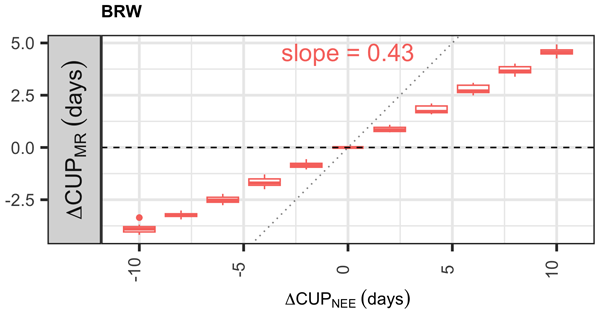
Theertha Kariyathan, Ana Bastos, Markus Reichstein, Wouter Peters, and Julia Marshall
Atmos. Chem. Phys., 25, 7863–7878, https://doi.org/10.5194/acp-25-7863-2025, https://doi.org/10.5194/acp-25-7863-2025, 2025
Short summary
Short summary
The carbon uptake period (CUP) is the time period when land absorbs more CO2 than it emits. While atmospheric CO2 mole fraction measurements can be used to assess CUP changes, atmospheric transport and asynchronous timing across regions reduce the accuracy of the estimates. Forward model experiments show that only ~ 50 % of prescribed shifts in CUP timing applied to surface fluxes (ΔCUPNEE) are captured in simulated CO2 mole fraction data at monitoring sites like the Barrow Atmospheric Baseline Observatory.
Guohua Liu, Philippe Ciais, Shengli Tao, Hui Yang, and Ana Bastos
Earth Syst. Sci. Data Discuss., https://doi.org/10.5194/essd-2025-330, https://doi.org/10.5194/essd-2025-330, 2025
Manuscript not accepted for further review
Short summary
Short summary
We have developed a long-term and high-resolution global map of above-ground biomass changes from 1993 to 2020 using radar data and machine learning approach. This dataset can help understand the effects of disturbances, land-use changes, and extreme events on global carbon cycle, and enhance the representation of these processes in Earth System Models.
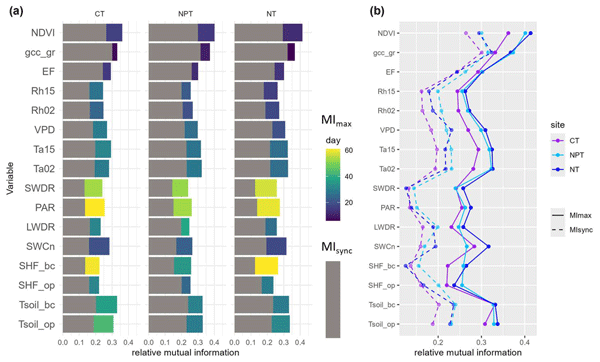
Laura Nadolski, Tarek S. El-Madany, Jacob Nelson, Arnaud Carrara, Gerardo Moreno, Richard Nair, Yunpeng Luo, Anke Hildebrandt, Victor Rolo, Markus Reichstein, and Sung-Ching Lee
Biogeosciences, 22, 2935–2958, https://doi.org/10.5194/bg-22-2935-2025, https://doi.org/10.5194/bg-22-2935-2025, 2025
Short summary
Short summary
Semi-arid ecosystems are crucial for Earth's carbon balance and are sensitive to changes in nitrogen (N) and phosphorus (P) levels. Their carbon dynamics are complex and not fully understood. We studied how long-term nutrient changes affect carbon exchange. In summer, the addition of N+P changed plant composition and productivity. In transitional seasons, carbon exchange was less weather-dependent with N. The addition of N and N+P increases carbon-exchange variability, driven by grass greenness.
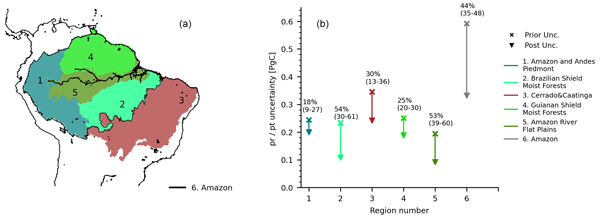
Santiago Botía, Saqr Munassar, Thomas Koch, Danilo Custodio, Luana S. Basso, Shujiro Komiya, Jost V. Lavric, David Walter, Manuel Gloor, Giordane Martins, Stijn Naus, Gerbrand Koren, Ingrid T. Luijkx, Stijn Hantson, John B. Miller, Wouter Peters, Christian Rödenbeck, and Christoph Gerbig
Atmos. Chem. Phys., 25, 6219–6255, https://doi.org/10.5194/acp-25-6219-2025, https://doi.org/10.5194/acp-25-6219-2025, 2025
Short summary
Short summary
This study uses dry CO2 mole fractions from the Amazon Tall Tower Observatory together with airborne profiles to estimate net carbon exchange in tropical South America. We found that the biogeographic Amazon is a net carbon sink, while the Cerrado and Caatinga biomes are net carbon sources, resulting in an overall neutral balance. Finally, to further reduce the uncertainty in our estimates we call for an expansion of the monitoring capacity, especially in the Amazon–Andes foothills.
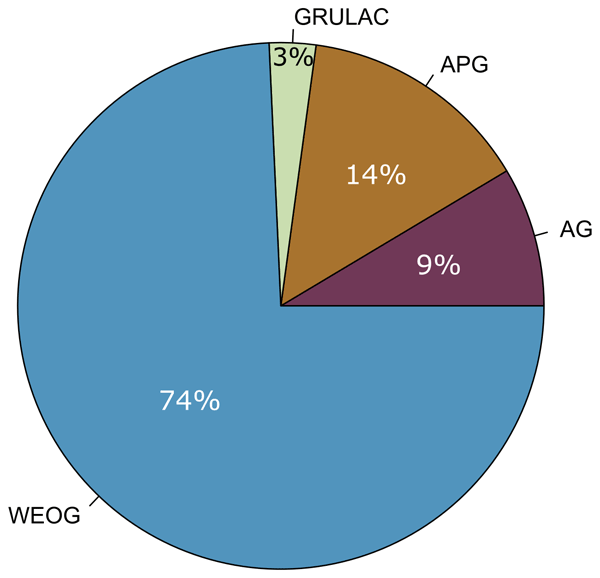
Friedrich J. Bohn, Ana Bastos, Romina Martin, Anja Rammig, Niak Sian Koh, Giles B. Sioen, Bram Buscher, Louise Carver, Fabrice DeClerck, Moritz Drupp, Robert Fletcher, Matthew Forrest, Alexandros Gasparatos, Alex Godoy-Faúndez, Gregor Hagedorn, Martin C. Hänsel, Jessica Hetzer, Thomas Hickler, Cornelia B. Krug, Stasja Koot, Xiuzhen Li, Amy Luers, Shelby Matevich, H. Damon Matthews, Ina C. Meier, Mirco Migliavacca, Awaz Mohamed, Sungmin O, David Obura, Ben Orlove, Rene Orth, Laura Pereira, Markus Reichstein, Lerato Thakholi, Peter H. Verburg, and Yuki Yoshida
Biogeosciences, 22, 2425–2460, https://doi.org/10.5194/bg-22-2425-2025, https://doi.org/10.5194/bg-22-2425-2025, 2025
Short summary
Short summary
An interdisciplinary collaboration of 36 international researchers from 35 institutions highlights recent findings in biosphere research. Within eight themes, they discuss issues arising from climate change and other anthropogenic stressors and highlight the co-benefits of nature-based solutions and ecosystem services. Based on an analysis of these eight topics, we have synthesized four overarching insights.
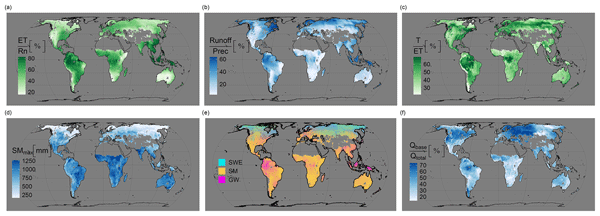
Zavud Baghirov, Martin Jung, Markus Reichstein, Marco Körner, and Basil Kraft
Geosci. Model Dev., 18, 2921–2943, https://doi.org/10.5194/gmd-18-2921-2025, https://doi.org/10.5194/gmd-18-2921-2025, 2025
Short summary
Short summary
We use an innovative approach to studying the Earth's water cycle by integrating advanced machine learning techniques with a traditional water cycle model. Our model is designed to learn from observational data, with a particular emphasis on understanding the influence of vegetation on water movement. By closely aligning with real-world observations, our model offers new possibilities for enhancing our understanding of the water cycle and its interactions with vegetation.
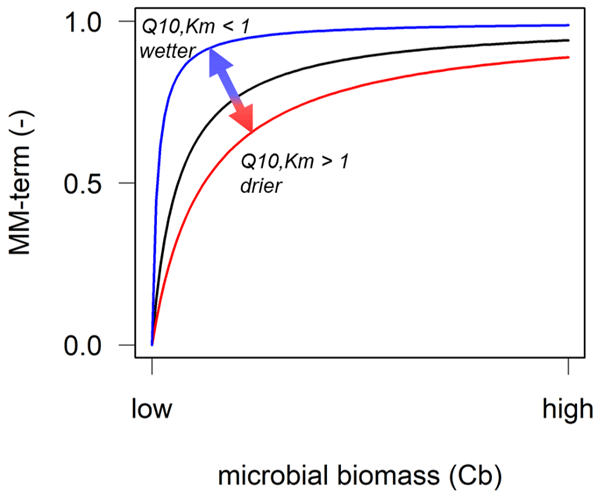
Marleen Pallandt, Marion Schrumpf, Holger Lange, Markus Reichstein, Lin Yu, and Bernhard Ahrens
Biogeosciences, 22, 1907–1928, https://doi.org/10.5194/bg-22-1907-2025, https://doi.org/10.5194/bg-22-1907-2025, 2025
Short summary
Short summary
As soils warm due to climate change, soil organic carbon (SOC) decomposes faster due to increased microbial activity, given sufficient available moisture. We modelled the microbial decomposition of plant litter and residue at different depths and found that deep soil layers are more sensitive than topsoils. Warming causes SOC loss, but its extent depends on the litter type and its temperature sensitivity, which can either counteract or amplify losses. Droughts may also counteract warming-induced SOC losses.
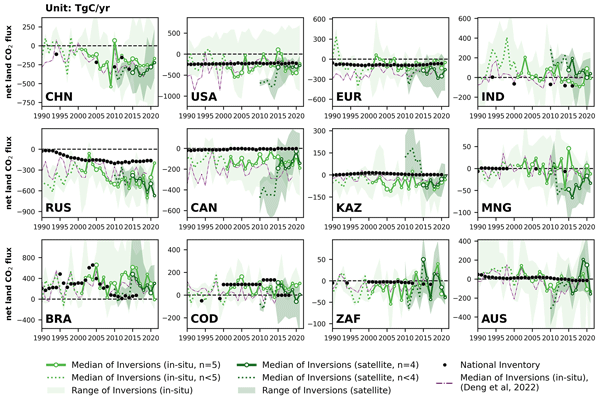
Zhu Deng, Philippe Ciais, Liting Hu, Adrien Martinez, Marielle Saunois, Rona L. Thompson, Kushal Tibrewal, Wouter Peters, Brendan Byrne, Giacomo Grassi, Paul I. Palmer, Ingrid T. Luijkx, Zhu Liu, Junjie Liu, Xuekun Fang, Tengjiao Wang, Hanqin Tian, Katsumasa Tanaka, Ana Bastos, Stephen Sitch, Benjamin Poulter, Clément Albergel, Aki Tsuruta, Shamil Maksyutov, Rajesh Janardanan, Yosuke Niwa, Bo Zheng, Joël Thanwerdas, Dmitry Belikov, Arjo Segers, and Frédéric Chevallier
Earth Syst. Sci. Data, 17, 1121–1152, https://doi.org/10.5194/essd-17-1121-2025, https://doi.org/10.5194/essd-17-1121-2025, 2025
Short summary
Short summary
This study reconciles national greenhouse gas (GHG) inventories with updated atmospheric inversion results to evaluate discrepancies for three principal GHG fluxes at the national level. Compared to our previous study, new satellite-based CO2 inversions were included and an updated mask of managed lands was used, improving agreement for Brazil and Canada. The proposed methodology can be regularly applied as a check to assess the gap between top-down inversions and bottom-up inventories.
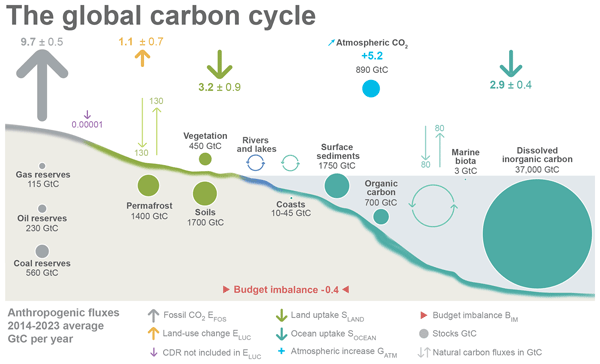
Pierre Friedlingstein, Michael O'Sullivan, Matthew W. Jones, Robbie M. Andrew, Judith Hauck, Peter Landschützer, Corinne Le Quéré, Hongmei Li, Ingrid T. Luijkx, Are Olsen, Glen P. Peters, Wouter Peters, Julia Pongratz, Clemens Schwingshackl, Stephen Sitch, Josep G. Canadell, Philippe Ciais, Robert B. Jackson, Simone R. Alin, Almut Arneth, Vivek Arora, Nicholas R. Bates, Meike Becker, Nicolas Bellouin, Carla F. Berghoff, Henry C. Bittig, Laurent Bopp, Patricia Cadule, Katie Campbell, Matthew A. Chamberlain, Naveen Chandra, Frédéric Chevallier, Louise P. Chini, Thomas Colligan, Jeanne Decayeux, Laique M. Djeutchouang, Xinyu Dou, Carolina Duran Rojas, Kazutaka Enyo, Wiley Evans, Amanda R. Fay, Richard A. Feely, Daniel J. Ford, Adrianna Foster, Thomas Gasser, Marion Gehlen, Thanos Gkritzalis, Giacomo Grassi, Luke Gregor, Nicolas Gruber, Özgür Gürses, Ian Harris, Matthew Hefner, Jens Heinke, George C. Hurtt, Yosuke Iida, Tatiana Ilyina, Andrew R. Jacobson, Atul K. Jain, Tereza Jarníková, Annika Jersild, Fei Jiang, Zhe Jin, Etsushi Kato, Ralph F. Keeling, Kees Klein Goldewijk, Jürgen Knauer, Jan Ivar Korsbakken, Xin Lan, Siv K. Lauvset, Nathalie Lefèvre, Zhu Liu, Junjie Liu, Lei Ma, Shamil Maksyutov, Gregg Marland, Nicolas Mayot, Patrick C. McGuire, Nicolas Metzl, Natalie M. Monacci, Eric J. Morgan, Shin-Ichiro Nakaoka, Craig Neill, Yosuke Niwa, Tobias Nützel, Lea Olivier, Tsuneo Ono, Paul I. Palmer, Denis Pierrot, Zhangcai Qin, Laure Resplandy, Alizée Roobaert, Thais M. Rosan, Christian Rödenbeck, Jörg Schwinger, T. Luke Smallman, Stephen M. Smith, Reinel Sospedra-Alfonso, Tobias Steinhoff, Qing Sun, Adrienne J. Sutton, Roland Séférian, Shintaro Takao, Hiroaki Tatebe, Hanqin Tian, Bronte Tilbrook, Olivier Torres, Etienne Tourigny, Hiroyuki Tsujino, Francesco Tubiello, Guido van der Werf, Rik Wanninkhof, Xuhui Wang, Dongxu Yang, Xiaojuan Yang, Zhen Yu, Wenping Yuan, Xu Yue, Sönke Zaehle, Ning Zeng, and Jiye Zeng
Earth Syst. Sci. Data, 17, 965–1039, https://doi.org/10.5194/essd-17-965-2025, https://doi.org/10.5194/essd-17-965-2025, 2025
Short summary
Short summary
The Global Carbon Budget 2024 describes the methodology, main results, and datasets used to quantify the anthropogenic emissions of carbon dioxide (CO2) and their partitioning among the atmosphere, land ecosystems, and the ocean over the historical period (1750–2024). These living datasets are updated every year to provide the highest transparency and traceability in the reporting of CO2, the key driver of climate change.
Wenli Zhao, Alexander J. Winkler, Markus Reichstein, Rene Orth, and Pierre Gentine
EGUsphere, https://doi.org/10.5194/egusphere-2025-365, https://doi.org/10.5194/egusphere-2025-365, 2025
Preprint archived
Short summary
Short summary
We developed a machine learning model that accounts for the memory effects of soil moisture and vegetation to predict Evaporative Fraction (EF) without relying on soil moisture as a direct input. The model accurately predicts EF during dry periods for the unseen sites, highlighting the key of meteorological memory effects. The learned memory effect related to rooting depth and soil water holding capacity could potentially serve as proxies for assessing the plant water stress.
Eva-Marie Metz, Sanam Noreen Vardag, Sourish Basu, Martin Jung, and André Butz
Biogeosciences, 22, 555–584, https://doi.org/10.5194/bg-22-555-2025, https://doi.org/10.5194/bg-22-555-2025, 2025
Short summary
Short summary
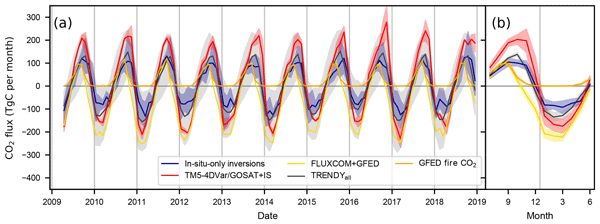
We estimate CO2 fluxes in semiarid southern Africa from 2009 to 2018 based on satellite CO2 measurements and atmospheric inverse modeling. By selecting process-based vegetation models, which agree with the satellite CO2 fluxes, we find that soil respiration mainly drives the seasonality, whereas photosynthesis substantially influences the interannual variability. Our study emphasizes the need for better representation of the response of semiarid ecosystems to soil rewetting in vegetation models.
István Dunkl, Ana Bastos, and Tatiana Ilyina
Earth Syst. Dynam., 16, 151–167, https://doi.org/10.5194/esd-16-151-2025, https://doi.org/10.5194/esd-16-151-2025, 2025
Short summary
Short summary
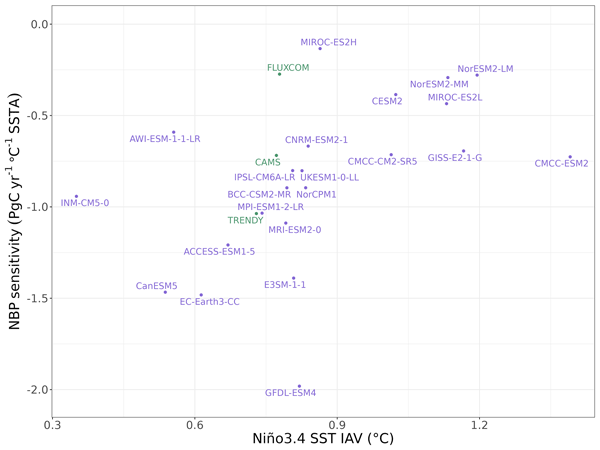
While the El Niño–Southern Oscillation, a climate mode, has a similar impact on CO2 growth rates across Earth system models, there is significant uncertainty in the processes behind this relationship. We found a compensatory effect that masks differences in the sensitivity of carbon fluxes to climate anomalies and observed that the carbon fluxes contributing to global CO2 anomalies originate from different regions and are caused by different drivers.
Saqr Munassar, Christian Rödenbeck, Michał Gałkowski, Frank-Thomas Koch, Kai U. Totsche, Santiago Botía, and Christoph Gerbig
Atmos. Chem. Phys., 25, 639–656, https://doi.org/10.5194/acp-25-639-2025, https://doi.org/10.5194/acp-25-639-2025, 2025
Short summary
Short summary
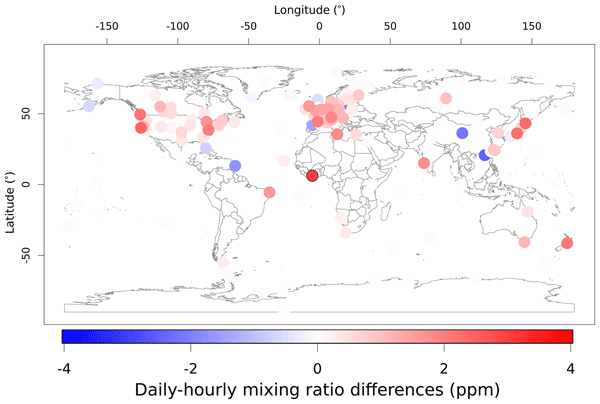
CO2 mole fractions simulated over a global set of stations showed an overestimation of CO2 if the diurnal cycle is missing in biogenic fluxes. This leads to biases in the estimated fluxes derived from the regional-scale inversions. Interannual variability of estimated biogenic fluxes is also affected by the exclusion of the CO2 diurnal cycle. The findings point to the importance of including the diurnal variations of CO2 in the biogenic fluxes used as priors in global and regional inversions.
Jacob A. Nelson, Sophia Walther, Fabian Gans, Basil Kraft, Ulrich Weber, Kimberly Novick, Nina Buchmann, Mirco Migliavacca, Georg Wohlfahrt, Ladislav Šigut, Andreas Ibrom, Dario Papale, Mathias Göckede, Gregory Duveiller, Alexander Knohl, Lukas Hörtnagl, Russell L. Scott, Jiří Dušek, Weijie Zhang, Zayd Mahmoud Hamdi, Markus Reichstein, Sergio Aranda-Barranco, Jonas Ardö, Maarten Op de Beeck, Dave Billesbach, David Bowling, Rosvel Bracho, Christian Brümmer, Gustau Camps-Valls, Shiping Chen, Jamie Rose Cleverly, Ankur Desai, Gang Dong, Tarek S. El-Madany, Eugenie Susanne Euskirchen, Iris Feigenwinter, Marta Galvagno, Giacomo A. Gerosa, Bert Gielen, Ignacio Goded, Sarah Goslee, Christopher Michael Gough, Bernard Heinesch, Kazuhito Ichii, Marcin Antoni Jackowicz-Korczynski, Anne Klosterhalfen, Sara Knox, Hideki Kobayashi, Kukka-Maaria Kohonen, Mika Korkiakoski, Ivan Mammarella, Mana Gharun, Riccardo Marzuoli, Roser Matamala, Stefan Metzger, Leonardo Montagnani, Giacomo Nicolini, Thomas O'Halloran, Jean-Marc Ourcival, Matthias Peichl, Elise Pendall, Borja Ruiz Reverter, Marilyn Roland, Simone Sabbatini, Torsten Sachs, Marius Schmidt, Christopher R. Schwalm, Ankit Shekhar, Richard Silberstein, Maria Lucia Silveira, Donatella Spano, Torbern Tagesson, Gianluca Tramontana, Carlo Trotta, Fabio Turco, Timo Vesala, Caroline Vincke, Domenico Vitale, Enrique R. Vivoni, Yi Wang, William Woodgate, Enrico A. Yepez, Junhui Zhang, Donatella Zona, and Martin Jung
Biogeosciences, 21, 5079–5115, https://doi.org/10.5194/bg-21-5079-2024, https://doi.org/10.5194/bg-21-5079-2024, 2024
Short summary
Short summary
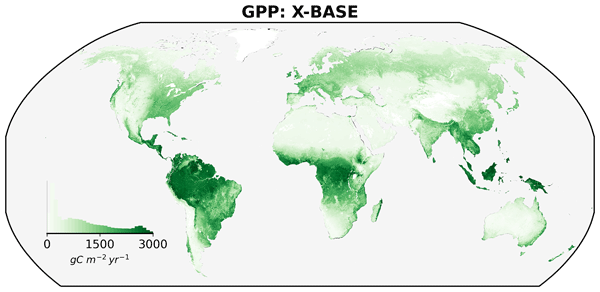
The movement of water, carbon, and energy from the Earth's surface to the atmosphere, or flux, is an important process to understand because it impacts our lives. Here, we outline a method called FLUXCOM-X to estimate global water and CO2 fluxes based on direct measurements from sites around the world. We go on to demonstrate how these new estimates of net CO2 uptake/loss, gross CO2 uptake, total water evaporation, and transpiration from plants compare to previous and independent estimates.
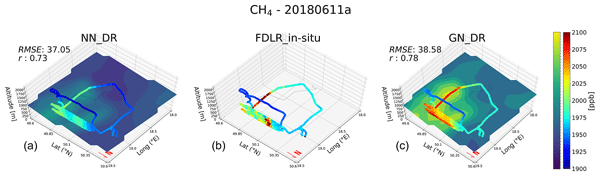
David Ho, Michał Gałkowski, Friedemann Reum, Santiago Botía, Julia Marshall, Kai Uwe Totsche, and Christoph Gerbig
Geosci. Model Dev., 17, 7401–7422, https://doi.org/10.5194/gmd-17-7401-2024, https://doi.org/10.5194/gmd-17-7401-2024, 2024
Short summary
Short summary
Atmospheric model users often overlook the impact of the land–atmosphere interaction. This study accessed various setups of WRF-GHG simulations that ensure consistency between the model and driving reanalysis fields. We found that a combination of nudging and frequent re-initialization allows certain improvement by constraining the soil moisture fields and, through its impact on atmospheric mixing, improves atmospheric transport.
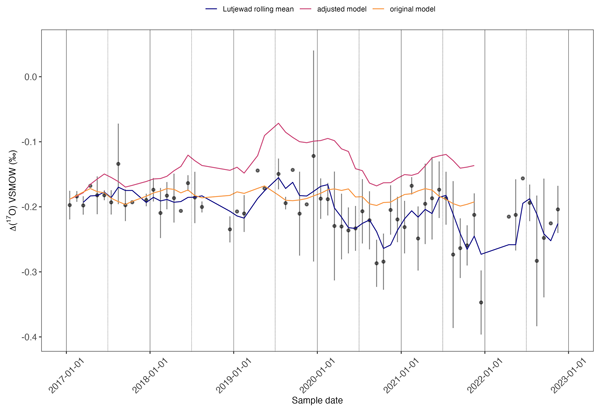
Pharahilda M. Steur, Hubertus A. Scheeren, Gerbrand Koren, Getachew A. Adnew, Wouter Peters, and Harro A. J. Meijer
Atmos. Chem. Phys., 24, 11005–11027, https://doi.org/10.5194/acp-24-11005-2024, https://doi.org/10.5194/acp-24-11005-2024, 2024
Short summary
Short summary
We present records of the triple oxygen isotope signature (Δ(17O)) of atmospheric CO2 obtained with laser absorption spectroscopy from two mid-latitude stations. Significant interannual variability is observed in both records. A model sensitivity study suggests that stratosphere–troposphere exchange, which carries high-Δ(17O) CO2 from the stratosphere into the troposphere, causes most of the variability. This makes Δ(17O) a potential tracer for stratospheric intrusions into the troposphere.
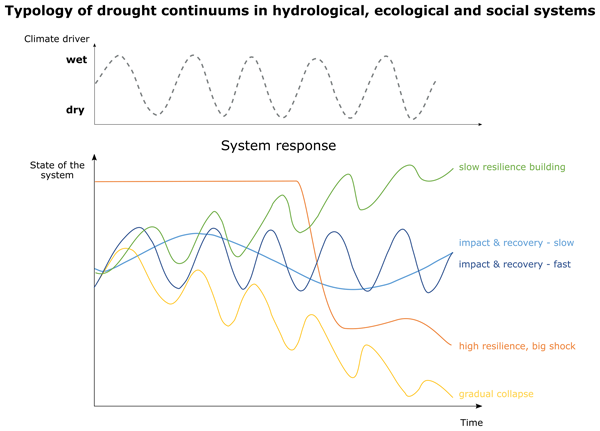
Anne F. Van Loon, Sarra Kchouk, Alessia Matanó, Faranak Tootoonchi, Camila Alvarez-Garreton, Khalid E. A. Hassaballah, Minchao Wu, Marthe L. K. Wens, Anastasiya Shyrokaya, Elena Ridolfi, Riccardo Biella, Viorica Nagavciuc, Marlies H. Barendrecht, Ana Bastos, Louise Cavalcante, Franciska T. de Vries, Margaret Garcia, Johanna Mård, Ileen N. Streefkerk, Claudia Teutschbein, Roshanak Tootoonchi, Ruben Weesie, Valentin Aich, Juan P. Boisier, Giuliano Di Baldassarre, Yiheng Du, Mauricio Galleguillos, René Garreaud, Monica Ionita, Sina Khatami, Johanna K. L. Koehler, Charles H. Luce, Shreedhar Maskey, Heidi D. Mendoza, Moses N. Mwangi, Ilias G. Pechlivanidis, Germano G. Ribeiro Neto, Tirthankar Roy, Robert Stefanski, Patricia Trambauer, Elizabeth A. Koebele, Giulia Vico, and Micha Werner
Nat. Hazards Earth Syst. Sci., 24, 3173–3205, https://doi.org/10.5194/nhess-24-3173-2024, https://doi.org/10.5194/nhess-24-3173-2024, 2024
Short summary
Short summary
Drought is a creeping phenomenon but is often still analysed and managed like an isolated event, without taking into account what happened before and after. Here, we review the literature and analyse five cases to discuss how droughts and their impacts develop over time. We find that the responses of hydrological, ecological, and social systems can be classified into four types and that the systems interact. We provide suggestions for further research and monitoring, modelling, and management.

Guohua Liu, Mirco Migliavacca, Christian Reimers, Basil Kraft, Markus Reichstein, Andrew D. Richardson, Lisa Wingate, Nicolas Delpierre, Hui Yang, and Alexander J. Winkler
Geosci. Model Dev., 17, 6683–6701, https://doi.org/10.5194/gmd-17-6683-2024, https://doi.org/10.5194/gmd-17-6683-2024, 2024
Short summary
Short summary
Our study employs long short-term memory (LSTM) networks to model canopy greenness and phenology, integrating meteorological memory effects. The LSTM model outperforms traditional methods, enhancing accuracy in predicting greenness dynamics and phenological transitions across plant functional types. Highlighting the importance of multi-variate meteorological memory effects, our research pioneers unlock the secrets of vegetation phenology responses to climate change with deep learning techniques.
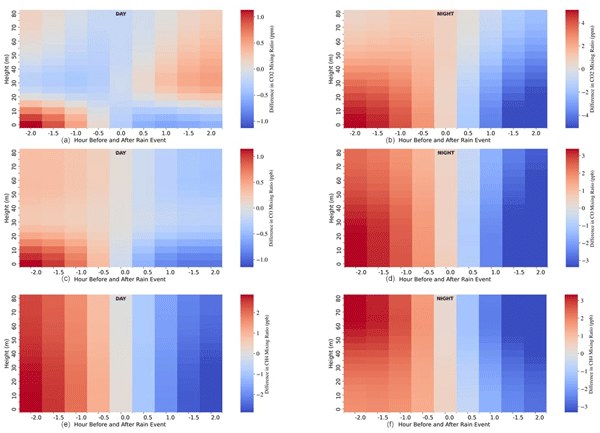
Luiz A. T. Machado, Jürgen Kesselmeier, Santiago Botía, Hella van Asperen, Meinrat O. Andreae, Alessandro C. de Araújo, Paulo Artaxo, Achim Edtbauer, Rosaria R. Ferreira, Marco A. Franco, Hartwig Harder, Sam P. Jones, Cléo Q. Dias-Júnior, Guido G. Haytzmann, Carlos A. Quesada, Shujiro Komiya, Jost Lavric, Jos Lelieveld, Ingeborg Levin, Anke Nölscher, Eva Pfannerstill, Mira L. Pöhlker, Ulrich Pöschl, Akima Ringsdorf, Luciana Rizzo, Ana M. Yáñez-Serrano, Susan Trumbore, Wanda I. D. Valenti, Jordi Vila-Guerau de Arellano, David Walter, Jonathan Williams, Stefan Wolff, and Christopher Pöhlker
Atmos. Chem. Phys., 24, 8893–8910, https://doi.org/10.5194/acp-24-8893-2024, https://doi.org/10.5194/acp-24-8893-2024, 2024
Short summary
Short summary
Composite analysis of gas concentration before and after rainfall, during the day and night, gives insight into the complex relationship between trace gas variability and precipitation. The analysis helps us to understand the sources and sinks of trace gases within a forest ecosystem. It elucidates processes that are not discernible under undisturbed conditions and contributes to a deeper understanding of the trace gas life cycle and its intricate interactions with cloud dynamics in the Amazon.
László Haszpra
Atmos. Meas. Tech., 17, 4629–4647, https://doi.org/10.5194/amt-17-4629-2024, https://doi.org/10.5194/amt-17-4629-2024, 2024
Short summary
Short summary
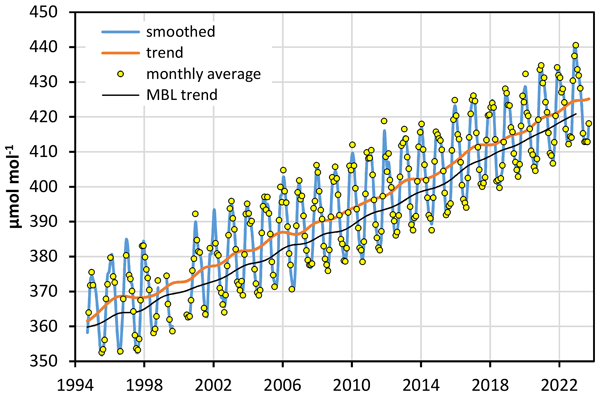
The paper evaluates a 30-year-long atmospheric CO2 data series from a mid-continental central European site, Hegyhátsál (HUN). It presents the site-specific features observed in the long-term evolution of the atmospheric CO2 concentration. Since the measurement data are widely used in atmospheric inverse models and budget calculations all around the world, the paper provides potentially valuable information for model tuning and interpretation of the model results.
Kim A. P. Faassen, Jordi Vilà-Guerau de Arellano, Raquel González-Armas, Bert G. Heusinkveld, Ivan Mammarella, Wouter Peters, and Ingrid T. Luijkx
Biogeosciences, 21, 3015–3039, https://doi.org/10.5194/bg-21-3015-2024, https://doi.org/10.5194/bg-21-3015-2024, 2024
Short summary
Short summary
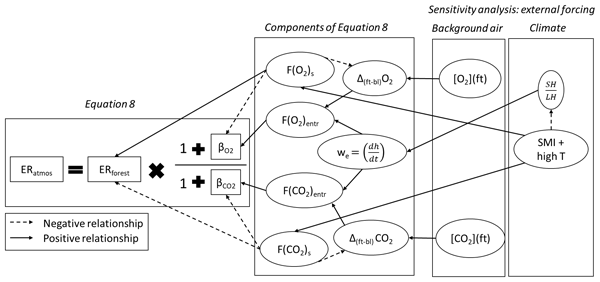
The ratio between atmospheric O2 and CO2 can be used to characterize the carbon balance at the surface. By combining a model and observations from the Hyytiälä forest (Finland), we show that using atmospheric O2 and CO2 measurements from a single height provides a weak constraint on the surface CO2 exchange because large-scale processes such as entrainment confound this signal. We therefore recommend always using multiple heights of O2 and CO2 measurements to study surface CO2 exchange.
Jasper M. C. Denissen, Adriaan J. Teuling, Sujan Koirala, Markus Reichstein, Gianpaolo Balsamo, Martha M. Vogel, Xin Yu, and René Orth
Earth Syst. Dynam., 15, 717–734, https://doi.org/10.5194/esd-15-717-2024, https://doi.org/10.5194/esd-15-717-2024, 2024
Short summary
Short summary
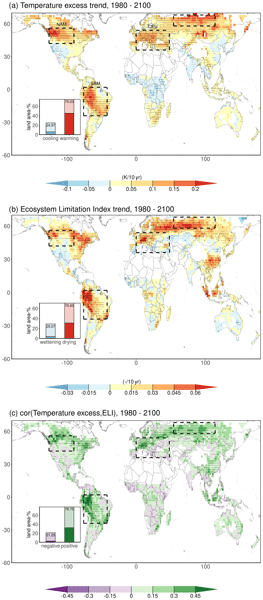
Heat extremes have severe implications for human health and ecosystems. Heat extremes are mostly introduced by large-scale atmospheric circulation but can be modulated by vegetation. Vegetation with access to water uses solar energy to evaporate water into the atmosphere. Under dry conditions, water may not be available, suppressing evaporation and heating the atmosphere. Using climate projections, we show that regionally less water is available for vegetation, intensifying future heat extremes.
Bjorn Stevens, Stefan Adami, Tariq Ali, Hartwig Anzt, Zafer Aslan, Sabine Attinger, Jaana Bäck, Johanna Baehr, Peter Bauer, Natacha Bernier, Bob Bishop, Hendryk Bockelmann, Sandrine Bony, Guy Brasseur, David N. Bresch, Sean Breyer, Gilbert Brunet, Pier Luigi Buttigieg, Junji Cao, Christelle Castet, Yafang Cheng, Ayantika Dey Choudhury, Deborah Coen, Susanne Crewell, Atish Dabholkar, Qing Dai, Francisco Doblas-Reyes, Dale Durran, Ayoub El Gaidi, Charlie Ewen, Eleftheria Exarchou, Veronika Eyring, Florencia Falkinhoff, David Farrell, Piers M. Forster, Ariane Frassoni, Claudia Frauen, Oliver Fuhrer, Shahzad Gani, Edwin Gerber, Debra Goldfarb, Jens Grieger, Nicolas Gruber, Wilco Hazeleger, Rolf Herken, Chris Hewitt, Torsten Hoefler, Huang-Hsiung Hsu, Daniela Jacob, Alexandra Jahn, Christian Jakob, Thomas Jung, Christopher Kadow, In-Sik Kang, Sarah Kang, Karthik Kashinath, Katharina Kleinen-von Königslöw, Daniel Klocke, Uta Kloenne, Milan Klöwer, Chihiro Kodama, Stefan Kollet, Tobias Kölling, Jenni Kontkanen, Steve Kopp, Michal Koran, Markku Kulmala, Hanna Lappalainen, Fakhria Latifi, Bryan Lawrence, June Yi Lee, Quentin Lejeun, Christian Lessig, Chao Li, Thomas Lippert, Jürg Luterbacher, Pekka Manninen, Jochem Marotzke, Satoshi Matsouoka, Charlotte Merchant, Peter Messmer, Gero Michel, Kristel Michielsen, Tomoki Miyakawa, Jens Müller, Ramsha Munir, Sandeep Narayanasetti, Ousmane Ndiaye, Carlos Nobre, Achim Oberg, Riko Oki, Tuba Özkan-Haller, Tim Palmer, Stan Posey, Andreas Prein, Odessa Primus, Mike Pritchard, Julie Pullen, Dian Putrasahan, Johannes Quaas, Krishnan Raghavan, Venkatachalam Ramaswamy, Markus Rapp, Florian Rauser, Markus Reichstein, Aromar Revi, Sonakshi Saluja, Masaki Satoh, Vera Schemann, Sebastian Schemm, Christina Schnadt Poberaj, Thomas Schulthess, Cath Senior, Jagadish Shukla, Manmeet Singh, Julia Slingo, Adam Sobel, Silvina Solman, Jenna Spitzer, Philip Stier, Thomas Stocker, Sarah Strock, Hang Su, Petteri Taalas, John Taylor, Susann Tegtmeier, Georg Teutsch, Adrian Tompkins, Uwe Ulbrich, Pier-Luigi Vidale, Chien-Ming Wu, Hao Xu, Najibullah Zaki, Laure Zanna, Tianjun Zhou, and Florian Ziemen
Earth Syst. Sci. Data, 16, 2113–2122, https://doi.org/10.5194/essd-16-2113-2024, https://doi.org/10.5194/essd-16-2113-2024, 2024
Short summary
Short summary
To manage Earth in the Anthropocene, new tools, new institutions, and new forms of international cooperation will be required. Earth Virtualization Engines is proposed as an international federation of centers of excellence to empower all people to respond to the immense and urgent challenges posed by climate change.
Sinikka J. Paulus, Rene Orth, Sung-Ching Lee, Anke Hildebrandt, Martin Jung, Jacob A. Nelson, Tarek Sebastian El-Madany, Arnaud Carrara, Gerardo Moreno, Matthias Mauder, Jannis Groh, Alexander Graf, Markus Reichstein, and Mirco Migliavacca
Biogeosciences, 21, 2051–2085, https://doi.org/10.5194/bg-21-2051-2024, https://doi.org/10.5194/bg-21-2051-2024, 2024
Short summary
Short summary
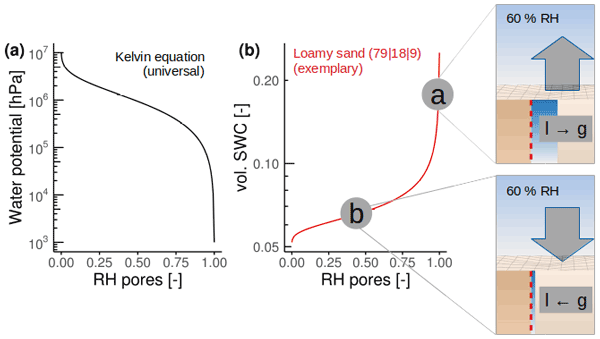
Porous materials are known to reversibly trap water from the air, even at low humidity. However, this behavior is poorly understood for soils. In this analysis, we test whether eddy covariance is able to measure the so-called adsorption of atmospheric water vapor by soils. We find that this flux occurs frequently during dry nights in a Mediterranean ecosystem, while EC detects downwardly directed vapor fluxes. These results can help to map moisture uptake globally.
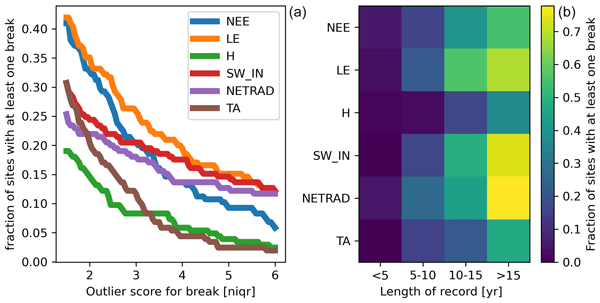
Martin Jung, Jacob Nelson, Mirco Migliavacca, Tarek El-Madany, Dario Papale, Markus Reichstein, Sophia Walther, and Thomas Wutzler
Biogeosciences, 21, 1827–1846, https://doi.org/10.5194/bg-21-1827-2024, https://doi.org/10.5194/bg-21-1827-2024, 2024
Short summary
Short summary
We present a methodology to detect inconsistencies in perhaps the most important data source for measurements of ecosystem–atmosphere carbon, water, and energy fluxes. We expect that the derived consistency flags will be relevant for data users and will help in improving our understanding of and our ability to model ecosystem–climate interactions.
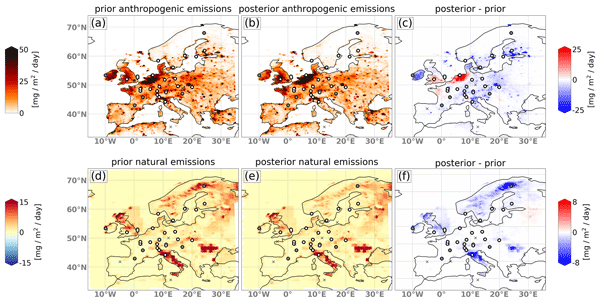
Michael Steiner, Wouter Peters, Ingrid Luijkx, Stephan Henne, Huilin Chen, Samuel Hammer, and Dominik Brunner
Atmos. Chem. Phys., 24, 2759–2782, https://doi.org/10.5194/acp-24-2759-2024, https://doi.org/10.5194/acp-24-2759-2024, 2024
Short summary
Short summary
The Paris Agreement increased interest in estimating greenhouse gas (GHG) emissions of individual countries, but top-down emission estimation is not yet considered policy-relevant. It is therefore paramount to reduce large errors and to build systems that are based on the newest atmospheric transport models. In this study, we present the first application of ICON-ART in the inverse modeling of GHG fluxes with an ensemble Kalman filter and present our results for European CH4 emissions.
Samuel Upton, Markus Reichstein, Fabian Gans, Wouter Peters, Basil Kraft, and Ana Bastos
Atmos. Chem. Phys., 24, 2555–2582, https://doi.org/10.5194/acp-24-2555-2024, https://doi.org/10.5194/acp-24-2555-2024, 2024
Short summary
Short summary
Data-driven eddy-covariance upscaled estimates of the global land–atmosphere net CO2 exchange (NEE) show important mismatches with regional and global estimates based on atmospheric information. To address this, we create a model with a dual constraint based on bottom-up eddy-covariance data and top-down atmospheric inversion data. Our model overcomes shortcomings of each approach, producing improved NEE estimates from local to global scale, helping to reduce uncertainty in the carbon budget.
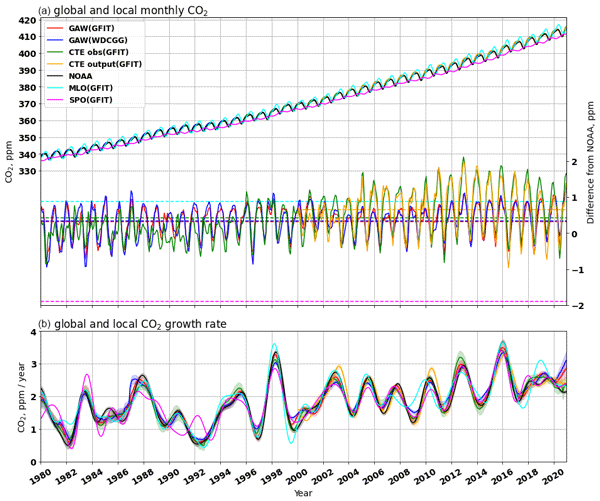
Zhendong Wu, Alex Vermeulen, Yousuke Sawa, Ute Karstens, Wouter Peters, Remco de Kok, Xin Lan, Yasuyuki Nagai, Akinori Ogi, and Oksana Tarasova
Atmos. Chem. Phys., 24, 1249–1264, https://doi.org/10.5194/acp-24-1249-2024, https://doi.org/10.5194/acp-24-1249-2024, 2024
Short summary
Short summary
This study focuses on exploring the differences in calculating global surface CO2 and its growth rate, considering the impact of analysis methodologies and site selection. Our study reveals that the current global CO2 network has a good capacity to represent global surface CO2 and its growth rate, as well as trends in atmospheric CO2 mass changes. However, small differences exist in different analyses due to the impact of methodology and site selection.
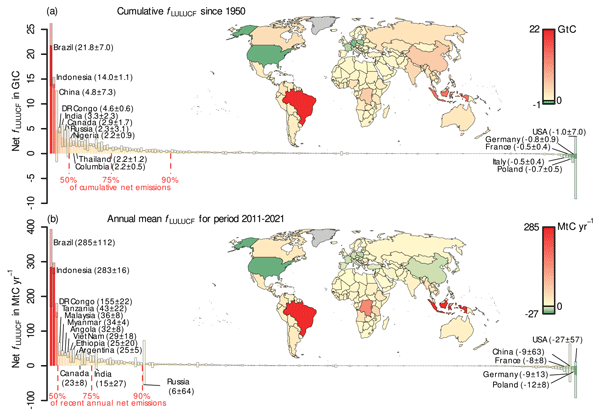
Wolfgang Alexander Obermeier, Clemens Schwingshackl, Ana Bastos, Giulia Conchedda, Thomas Gasser, Giacomo Grassi, Richard A. Houghton, Francesco Nicola Tubiello, Stephen Sitch, and Julia Pongratz
Earth Syst. Sci. Data, 16, 605–645, https://doi.org/10.5194/essd-16-605-2024, https://doi.org/10.5194/essd-16-605-2024, 2024
Short summary
Short summary
We provide and compare country-level estimates of land-use CO2 fluxes from a variety and large number of models, bottom-up estimates, and country reports for the period 1950–2021. Although net fluxes are small in many countries, they are often composed of large compensating emissions and removals. In many countries, the estimates agree well once their individual characteristics are accounted for, but in other countries, including some of the largest emitters, substantial uncertainties exist.
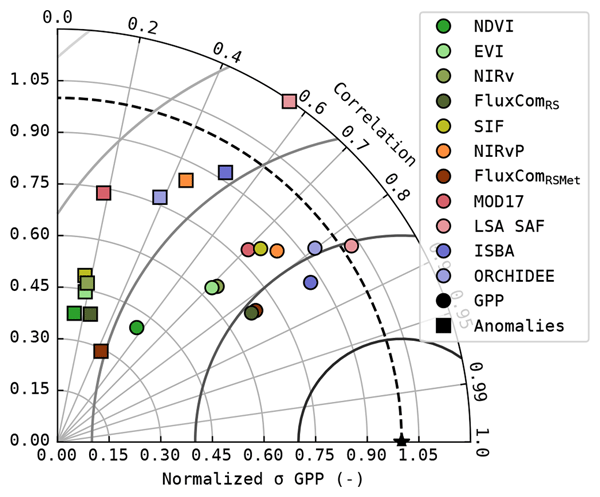
Jan De Pue, Sebastian Wieneke, Ana Bastos, José Miguel Barrios, Liyang Liu, Philippe Ciais, Alirio Arboleda, Rafiq Hamdi, Maral Maleki, Fabienne Maignan, Françoise Gellens-Meulenberghs, Ivan Janssens, and Manuela Balzarolo
Biogeosciences, 20, 4795–4818, https://doi.org/10.5194/bg-20-4795-2023, https://doi.org/10.5194/bg-20-4795-2023, 2023
Short summary
Short summary
The gross primary production (GPP) of the terrestrial biosphere is a key source of variability in the global carbon cycle. To estimate this flux, models can rely on remote sensing data (RS-driven), meteorological data (meteo-driven) or a combination of both (hybrid). An intercomparison of 11 models demonstrated that RS-driven models lack the sensitivity to short-term anomalies. Conversely, the simulation of soil moisture dynamics and stress response remains a challenge in meteo-driven models.
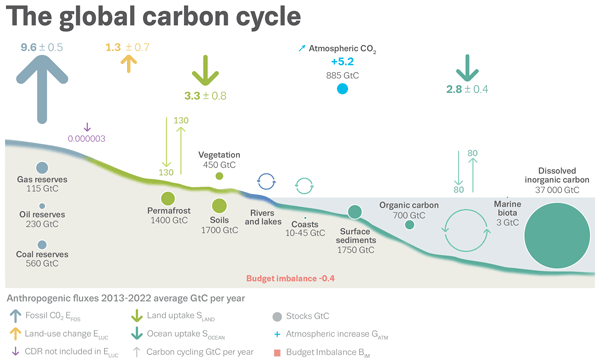
Pierre Friedlingstein, Michael O'Sullivan, Matthew W. Jones, Robbie M. Andrew, Dorothee C. E. Bakker, Judith Hauck, Peter Landschützer, Corinne Le Quéré, Ingrid T. Luijkx, Glen P. Peters, Wouter Peters, Julia Pongratz, Clemens Schwingshackl, Stephen Sitch, Josep G. Canadell, Philippe Ciais, Robert B. Jackson, Simone R. Alin, Peter Anthoni, Leticia Barbero, Nicholas R. Bates, Meike Becker, Nicolas Bellouin, Bertrand Decharme, Laurent Bopp, Ida Bagus Mandhara Brasika, Patricia Cadule, Matthew A. Chamberlain, Naveen Chandra, Thi-Tuyet-Trang Chau, Frédéric Chevallier, Louise P. Chini, Margot Cronin, Xinyu Dou, Kazutaka Enyo, Wiley Evans, Stefanie Falk, Richard A. Feely, Liang Feng, Daniel J. Ford, Thomas Gasser, Josefine Ghattas, Thanos Gkritzalis, Giacomo Grassi, Luke Gregor, Nicolas Gruber, Özgür Gürses, Ian Harris, Matthew Hefner, Jens Heinke, Richard A. Houghton, George C. Hurtt, Yosuke Iida, Tatiana Ilyina, Andrew R. Jacobson, Atul Jain, Tereza Jarníková, Annika Jersild, Fei Jiang, Zhe Jin, Fortunat Joos, Etsushi Kato, Ralph F. Keeling, Daniel Kennedy, Kees Klein Goldewijk, Jürgen Knauer, Jan Ivar Korsbakken, Arne Körtzinger, Xin Lan, Nathalie Lefèvre, Hongmei Li, Junjie Liu, Zhiqiang Liu, Lei Ma, Greg Marland, Nicolas Mayot, Patrick C. McGuire, Galen A. McKinley, Gesa Meyer, Eric J. Morgan, David R. Munro, Shin-Ichiro Nakaoka, Yosuke Niwa, Kevin M. O'Brien, Are Olsen, Abdirahman M. Omar, Tsuneo Ono, Melf Paulsen, Denis Pierrot, Katie Pocock, Benjamin Poulter, Carter M. Powis, Gregor Rehder, Laure Resplandy, Eddy Robertson, Christian Rödenbeck, Thais M. Rosan, Jörg Schwinger, Roland Séférian, T. Luke Smallman, Stephen M. Smith, Reinel Sospedra-Alfonso, Qing Sun, Adrienne J. Sutton, Colm Sweeney, Shintaro Takao, Pieter P. Tans, Hanqin Tian, Bronte Tilbrook, Hiroyuki Tsujino, Francesco Tubiello, Guido R. van der Werf, Erik van Ooijen, Rik Wanninkhof, Michio Watanabe, Cathy Wimart-Rousseau, Dongxu Yang, Xiaojuan Yang, Wenping Yuan, Xu Yue, Sönke Zaehle, Jiye Zeng, and Bo Zheng
Earth Syst. Sci. Data, 15, 5301–5369, https://doi.org/10.5194/essd-15-5301-2023, https://doi.org/10.5194/essd-15-5301-2023, 2023
Short summary
Short summary
The Global Carbon Budget 2023 describes the methodology, main results, and data sets used to quantify the anthropogenic emissions of carbon dioxide (CO2) and their partitioning among the atmosphere, land ecosystems, and the ocean over the historical period (1750–2023). These living datasets are updated every year to provide the highest transparency and traceability in the reporting of CO2, the key driver of climate change.
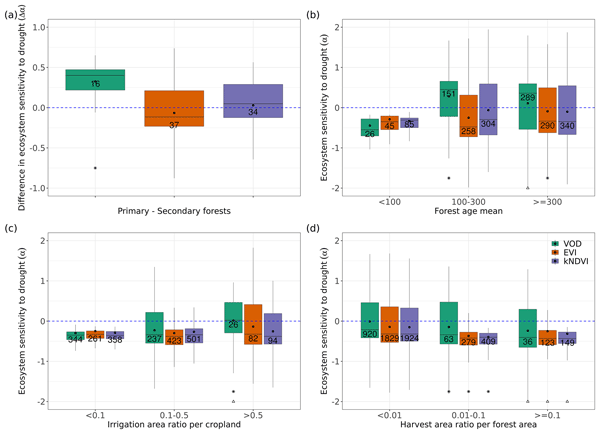
Chenwei Xiao, Sönke Zaehle, Hui Yang, Jean-Pierre Wigneron, Christiane Schmullius, and Ana Bastos
Earth Syst. Dynam., 14, 1211–1237, https://doi.org/10.5194/esd-14-1211-2023, https://doi.org/10.5194/esd-14-1211-2023, 2023
Short summary
Short summary
Ecosystem resistance reflects their susceptibility during adverse conditions and can be changed by land management. We estimate ecosystem resistance to drought and temperature globally. We find a higher resistance to drought in forests compared to croplands and an evident loss of resistance to drought when primary forests are converted to secondary forests or they are harvested. Old-growth trees tend to be more resistant in some forests and crops benefit from irrigation during drought periods.
Richard Nair, Yunpeng Luo, Tarek El-Madany, Victor Rolo, Javier Pacheco-Labrador, Silvia Caldararu, Kendalynn A. Morris, Marion Schrumpf, Arnaud Carrara, Gerardo Moreno, Markus Reichstein, and Mirco Migliavacca
EGUsphere, https://doi.org/10.5194/egusphere-2023-2434, https://doi.org/10.5194/egusphere-2023-2434, 2023
Preprint archived
Short summary
Short summary
We studied a Mediterranean ecosystem to understand carbon uptake efficiency and its controls. These ecosystems face potential nitrogen-phosphorus imbalances due to pollution. Analysing six years of carbon data, we assessed controls at different timeframes. This is crucial for predicting such vulnerable regions. Our findings revealed N limitation on C uptake, not N:P imbalance, and strong influence of water availability. whether drought or wetness promoted net C uptake depended on timescale.
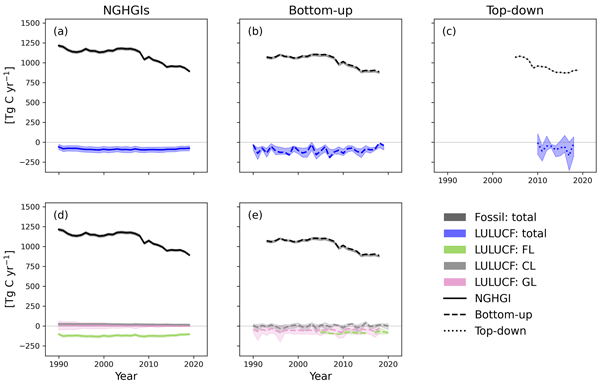
Matthew J. McGrath, Ana Maria Roxana Petrescu, Philippe Peylin, Robbie M. Andrew, Bradley Matthews, Frank Dentener, Juraj Balkovič, Vladislav Bastrikov, Meike Becker, Gregoire Broquet, Philippe Ciais, Audrey Fortems-Cheiney, Raphael Ganzenmüller, Giacomo Grassi, Ian Harris, Matthew Jones, Jürgen Knauer, Matthias Kuhnert, Guillaume Monteil, Saqr Munassar, Paul I. Palmer, Glen P. Peters, Chunjing Qiu, Mart-Jan Schelhaas, Oksana Tarasova, Matteo Vizzarri, Karina Winkler, Gianpaolo Balsamo, Antoine Berchet, Peter Briggs, Patrick Brockmann, Frédéric Chevallier, Giulia Conchedda, Monica Crippa, Stijn N. C. Dellaert, Hugo A. C. Denier van der Gon, Sara Filipek, Pierre Friedlingstein, Richard Fuchs, Michael Gauss, Christoph Gerbig, Diego Guizzardi, Dirk Günther, Richard A. Houghton, Greet Janssens-Maenhout, Ronny Lauerwald, Bas Lerink, Ingrid T. Luijkx, Géraud Moulas, Marilena Muntean, Gert-Jan Nabuurs, Aurélie Paquirissamy, Lucia Perugini, Wouter Peters, Roberto Pilli, Julia Pongratz, Pierre Regnier, Marko Scholze, Yusuf Serengil, Pete Smith, Efisio Solazzo, Rona L. Thompson, Francesco N. Tubiello, Timo Vesala, and Sophia Walther
Earth Syst. Sci. Data, 15, 4295–4370, https://doi.org/10.5194/essd-15-4295-2023, https://doi.org/10.5194/essd-15-4295-2023, 2023
Short summary
Short summary
Accurate estimation of fluxes of carbon dioxide from the land surface is essential for understanding future impacts of greenhouse gas emissions on the climate system. A wide variety of methods currently exist to estimate these sources and sinks. We are continuing work to develop annual comparisons of these diverse methods in order to clarify what they all actually calculate and to resolve apparent disagreement, in addition to highlighting opportunities for increased understanding.
Luana S. Basso, Chris Wilson, Martyn P. Chipperfield, Graciela Tejada, Henrique L. G. Cassol, Egídio Arai, Mathew Williams, T. Luke Smallman, Wouter Peters, Stijn Naus, John B. Miller, and Manuel Gloor
Atmos. Chem. Phys., 23, 9685–9723, https://doi.org/10.5194/acp-23-9685-2023, https://doi.org/10.5194/acp-23-9685-2023, 2023
Short summary
Short summary
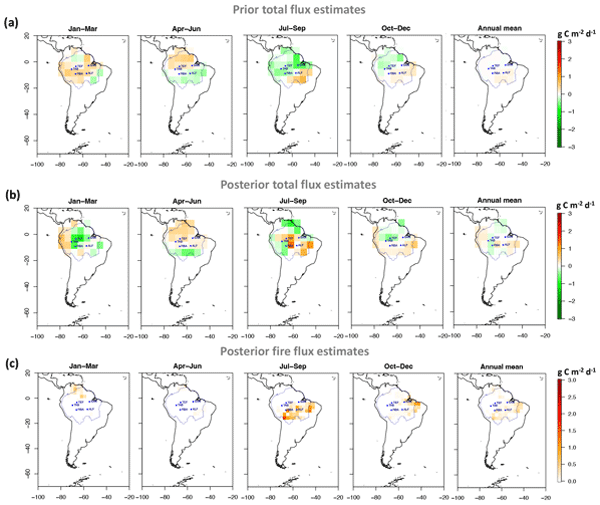
The Amazon’s carbon balance may have changed due to forest degradation, deforestation and warmer climate. We used an atmospheric model and atmospheric CO2 observations to quantify Amazonian carbon emissions (2010–2018). The region was a small carbon source to the atmosphere, mostly due to fire emissions. Forest uptake compensated for ~ 50 % of the fire emissions, meaning that the remaining forest is still a small carbon sink. We found no clear evidence of weakening carbon uptake over the period.
Eliane Gomes Alves, Raoni Aquino Santana, Cléo Quaresma Dias-Júnior, Santiago Botía, Tyeen Taylor, Ana Maria Yáñez-Serrano, Jürgen Kesselmeier, Efstratios Bourtsoukidis, Jonathan Williams, Pedro Ivo Lembo Silveira de Assis, Giordane Martins, Rodrigo de Souza, Sérgio Duvoisin Júnior, Alex Guenther, Dasa Gu, Anywhere Tsokankunku, Matthias Sörgel, Bruce Nelson, Davieliton Pinto, Shujiro Komiya, Diogo Martins Rosa, Bettina Weber, Cybelli Barbosa, Michelle Robin, Kenneth J. Feeley, Alvaro Duque, Viviana Londoño Lemos, Maria Paula Contreras, Alvaro Idarraga, Norberto López, Chad Husby, Brett Jestrow, and Iván Mauricio Cely Toro
Atmos. Chem. Phys., 23, 8149–8168, https://doi.org/10.5194/acp-23-8149-2023, https://doi.org/10.5194/acp-23-8149-2023, 2023
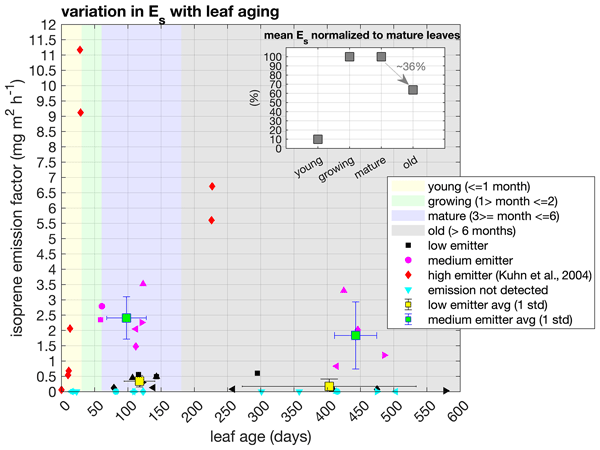
Short summary
Short summary
Isoprene is emitted mainly by plants and can influence atmospheric chemistry and air quality. But, there are uncertainties in model emission estimates and follow-up atmospheric processes. In our study, with long-term observational datasets of isoprene and biological and environmental factors from central Amazonia, we show that isoprene emission estimates could be improved when biological processes were mechanistically incorporated into the model.
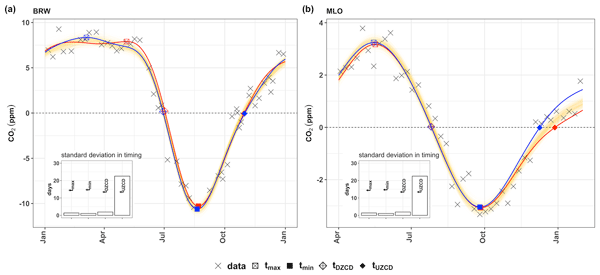
Theertha Kariyathan, Ana Bastos, Julia Marshall, Wouter Peters, Pieter Tans, and Markus Reichstein
Atmos. Meas. Tech., 16, 3299–3312, https://doi.org/10.5194/amt-16-3299-2023, https://doi.org/10.5194/amt-16-3299-2023, 2023
Short summary
Short summary
The timing and duration of the carbon uptake period (CUP) are sensitive to the occurrence of major phenological events, which are influenced by recent climate change. This study presents an ensemble-based approach for quantifying the timing and duration of the CUP and their uncertainty when derived from atmospheric CO2 measurements with noise and gaps. The CUP metrics derived with the approach are more robust and have less uncertainty than when estimated with the conventional methods.
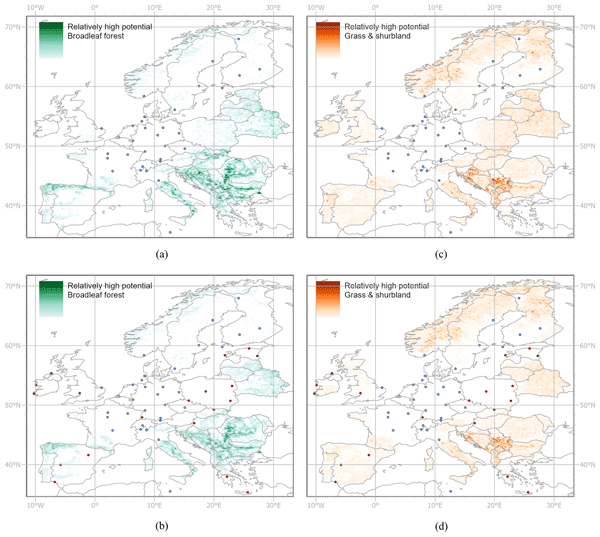
Ida Storm, Ute Karstens, Claudio D'Onofrio, Alex Vermeulen, and Wouter Peters
Atmos. Chem. Phys., 23, 4993–5008, https://doi.org/10.5194/acp-23-4993-2023, https://doi.org/10.5194/acp-23-4993-2023, 2023
Short summary
Short summary
In this study, we evaluate what is in the influence regions of the ICOS atmospheric measurement stations to gain insight into what land cover types and land-cover-associated fluxes the network represents. Subsequently, insights about strengths, weaknesses, and potential gaps can assist in future network expansion decisions. The network is concentrated in central Europe, which leads to a general overrepresentation of coniferous forest and cropland and underrepresentation of grass and shrubland.
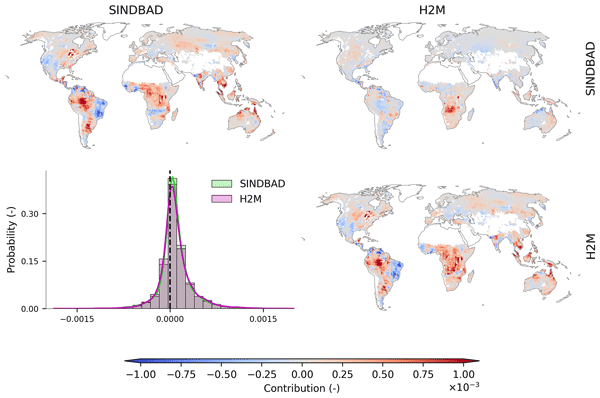
Hoontaek Lee, Martin Jung, Nuno Carvalhais, Tina Trautmann, Basil Kraft, Markus Reichstein, Matthias Forkel, and Sujan Koirala
Hydrol. Earth Syst. Sci., 27, 1531–1563, https://doi.org/10.5194/hess-27-1531-2023, https://doi.org/10.5194/hess-27-1531-2023, 2023
Short summary
Short summary
We spatially attribute the variance in global terrestrial water storage (TWS) interannual variability (IAV) and its modeling error with two data-driven hydrological models. We find error hotspot regions that show a disproportionately large significance in the global mismatch and the association of the error regions with a smaller-scale lateral convergence of water. Our findings imply that TWS IAV modeling can be efficiently improved by focusing on model representations for the error hotspots.

Robert Vautard, Geert Jan van Oldenborgh, Rémy Bonnet, Sihan Li, Yoann Robin, Sarah Kew, Sjoukje Philip, Jean-Michel Soubeyroux, Brigitte Dubuisson, Nicolas Viovy, Markus Reichstein, Friederike Otto, and Iñaki Garcia de Cortazar-Atauri
Nat. Hazards Earth Syst. Sci., 23, 1045–1058, https://doi.org/10.5194/nhess-23-1045-2023, https://doi.org/10.5194/nhess-23-1045-2023, 2023
Short summary
Short summary
A deep frost occurred in early April 2021, inducing severe damages in grapevine and fruit trees in France. We found that such extreme frosts occurring after the start of the growing season such as those of April 2021 are currently about 2°C colder [0.5 °C to 3.3 °C] in observations than in preindustrial climate. This observed intensification of growing-period frosts is attributable, at least in part, to human-caused climate change, making the 2021 event 50 % more likely [10 %–110 %].
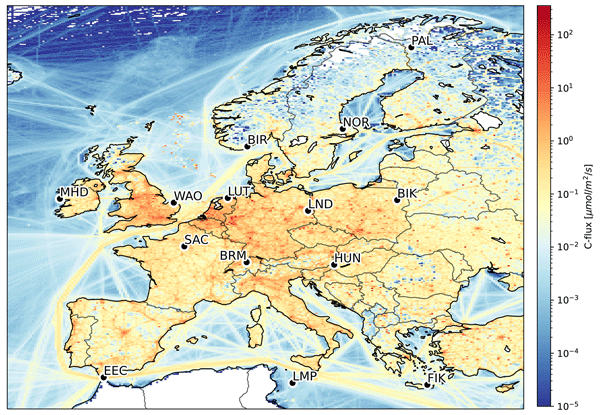
Auke M. van der Woude, Remco de Kok, Naomi Smith, Ingrid T. Luijkx, Santiago Botía, Ute Karstens, Linda M. J. Kooijmans, Gerbrand Koren, Harro A. J. Meijer, Gert-Jan Steeneveld, Ida Storm, Ingrid Super, Hubertus A. Scheeren, Alex Vermeulen, and Wouter Peters
Earth Syst. Sci. Data, 15, 579–605, https://doi.org/10.5194/essd-15-579-2023, https://doi.org/10.5194/essd-15-579-2023, 2023
Short summary
Short summary
To monitor the progress towards the CO2 emission goals set out in the Paris Agreement, the European Union requires an independent validation of emitted CO2. For this validation, atmospheric measurements of CO2 can be used, together with first-guess estimates of CO2 emissions and uptake. To quickly inform end users, it is imperative that this happens in near real-time. To aid these efforts, we create estimates of European CO2 exchange at high resolution in near real time.
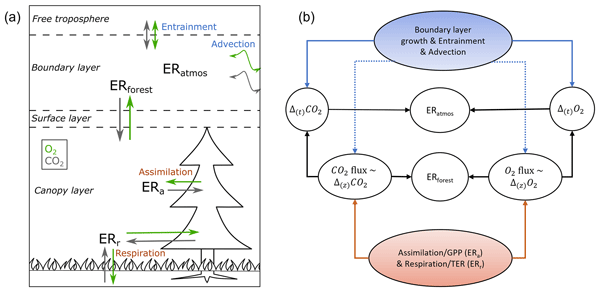
Kim A. P. Faassen, Linh N. T. Nguyen, Eadin R. Broekema, Bert A. M. Kers, Ivan Mammarella, Timo Vesala, Penelope A. Pickers, Andrew C. Manning, Jordi Vilà-Guerau de Arellano, Harro A. J. Meijer, Wouter Peters, and Ingrid T. Luijkx
Atmos. Chem. Phys., 23, 851–876, https://doi.org/10.5194/acp-23-851-2023, https://doi.org/10.5194/acp-23-851-2023, 2023
Short summary
Short summary
The exchange ratio (ER) between atmospheric O2 and CO2 provides a useful tracer for separately estimating photosynthesis and respiration processes in the forest carbon balance. This is highly relevant to better understand the expected biosphere sink, which determines future atmospheric CO2 levels. We therefore measured O2, CO2, and their ER above a boreal forest in Finland and investigated their diurnal behaviour for a representative day, and we show the most suitable way to determine the ER.
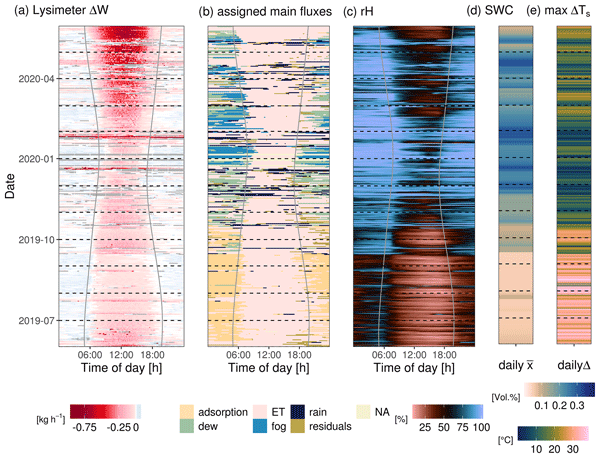
Sinikka Jasmin Paulus, Tarek Sebastian El-Madany, René Orth, Anke Hildebrandt, Thomas Wutzler, Arnaud Carrara, Gerardo Moreno, Oscar Perez-Priego, Olaf Kolle, Markus Reichstein, and Mirco Migliavacca
Hydrol. Earth Syst. Sci., 26, 6263–6287, https://doi.org/10.5194/hess-26-6263-2022, https://doi.org/10.5194/hess-26-6263-2022, 2022
Short summary
Short summary
In this study, we analyze small inputs of water to ecosystems such as fog, dew, and adsorption of vapor. To measure them, we use a scaling system and later test our attribution of different water fluxes to weight changes. We found that they occur frequently during 1 year in a dry summer ecosystem. In each season, a different flux seems dominant, but they all mainly occur during the night. Therefore, they could be important for the biosphere because rain is unevenly distributed over the year.
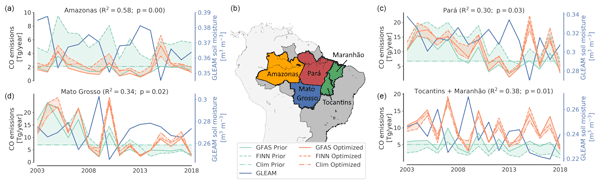
Stijn Naus, Lucas G. Domingues, Maarten Krol, Ingrid T. Luijkx, Luciana V. Gatti, John B. Miller, Emanuel Gloor, Sourish Basu, Caio Correia, Gerbrand Koren, Helen M. Worden, Johannes Flemming, Gabrielle Pétron, and Wouter Peters
Atmos. Chem. Phys., 22, 14735–14750, https://doi.org/10.5194/acp-22-14735-2022, https://doi.org/10.5194/acp-22-14735-2022, 2022
Short summary
Short summary
We assimilate MOPITT CO satellite data in the TM5-4D-Var inverse modelling framework to estimate Amazon fire CO emissions for 2003–2018. We show that fire emissions have decreased over the analysis period, coincident with a decrease in deforestation rates. However, interannual variations in fire emissions are large, and they correlate strongly with soil moisture. Our results reveal an important role for robust, top-down fire CO emissions in quantifying and attributing Amazon fire intensity.
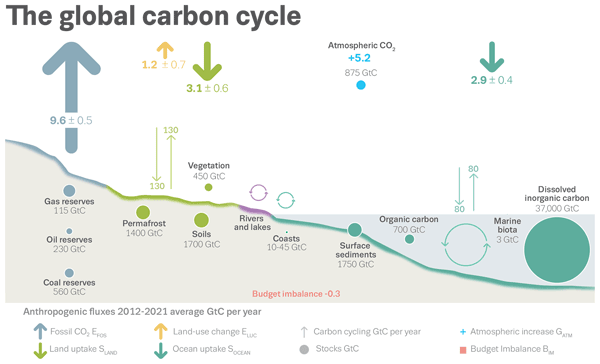
Pierre Friedlingstein, Michael O'Sullivan, Matthew W. Jones, Robbie M. Andrew, Luke Gregor, Judith Hauck, Corinne Le Quéré, Ingrid T. Luijkx, Are Olsen, Glen P. Peters, Wouter Peters, Julia Pongratz, Clemens Schwingshackl, Stephen Sitch, Josep G. Canadell, Philippe Ciais, Robert B. Jackson, Simone R. Alin, Ramdane Alkama, Almut Arneth, Vivek K. Arora, Nicholas R. Bates, Meike Becker, Nicolas Bellouin, Henry C. Bittig, Laurent Bopp, Frédéric Chevallier, Louise P. Chini, Margot Cronin, Wiley Evans, Stefanie Falk, Richard A. Feely, Thomas Gasser, Marion Gehlen, Thanos Gkritzalis, Lucas Gloege, Giacomo Grassi, Nicolas Gruber, Özgür Gürses, Ian Harris, Matthew Hefner, Richard A. Houghton, George C. Hurtt, Yosuke Iida, Tatiana Ilyina, Atul K. Jain, Annika Jersild, Koji Kadono, Etsushi Kato, Daniel Kennedy, Kees Klein Goldewijk, Jürgen Knauer, Jan Ivar Korsbakken, Peter Landschützer, Nathalie Lefèvre, Keith Lindsay, Junjie Liu, Zhu Liu, Gregg Marland, Nicolas Mayot, Matthew J. McGrath, Nicolas Metzl, Natalie M. Monacci, David R. Munro, Shin-Ichiro Nakaoka, Yosuke Niwa, Kevin O'Brien, Tsuneo Ono, Paul I. Palmer, Naiqing Pan, Denis Pierrot, Katie Pocock, Benjamin Poulter, Laure Resplandy, Eddy Robertson, Christian Rödenbeck, Carmen Rodriguez, Thais M. Rosan, Jörg Schwinger, Roland Séférian, Jamie D. Shutler, Ingunn Skjelvan, Tobias Steinhoff, Qing Sun, Adrienne J. Sutton, Colm Sweeney, Shintaro Takao, Toste Tanhua, Pieter P. Tans, Xiangjun Tian, Hanqin Tian, Bronte Tilbrook, Hiroyuki Tsujino, Francesco Tubiello, Guido R. van der Werf, Anthony P. Walker, Rik Wanninkhof, Chris Whitehead, Anna Willstrand Wranne, Rebecca Wright, Wenping Yuan, Chao Yue, Xu Yue, Sönke Zaehle, Jiye Zeng, and Bo Zheng
Earth Syst. Sci. Data, 14, 4811–4900, https://doi.org/10.5194/essd-14-4811-2022, https://doi.org/10.5194/essd-14-4811-2022, 2022
Short summary
Short summary
The Global Carbon Budget 2022 describes the datasets and methodology used to quantify the anthropogenic emissions of carbon dioxide (CO2) and their partitioning among the atmosphere, the land ecosystems, and the ocean. These living datasets are updated every year to provide the highest transparency and traceability in the reporting of CO2, the key driver of climate change.
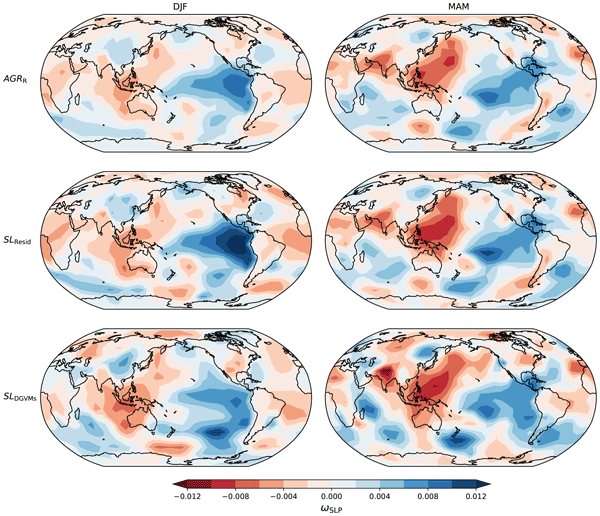
Na Li, Sebastian Sippel, Alexander J. Winkler, Miguel D. Mahecha, Markus Reichstein, and Ana Bastos
Earth Syst. Dynam., 13, 1505–1533, https://doi.org/10.5194/esd-13-1505-2022, https://doi.org/10.5194/esd-13-1505-2022, 2022
Short summary
Short summary
Quantifying the imprint of large-scale atmospheric circulation dynamics and associated carbon cycle responses is key to improving our understanding of carbon cycle dynamics. Using a statistical model that relies on spatiotemporal sea level pressure as a proxy for large-scale atmospheric circulation, we quantify the fraction of interannual variability in atmospheric CO2 growth rate and the land CO2 sink that are driven by atmospheric circulation variability.
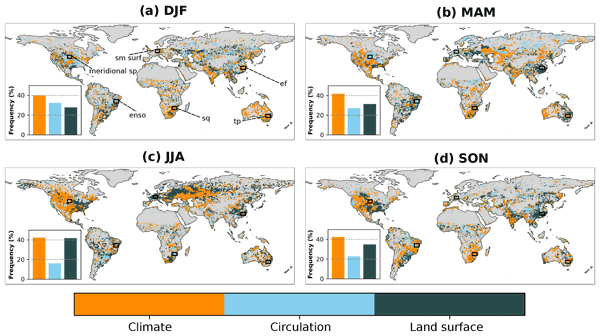
Melissa Ruiz-Vásquez, Sungmin O, Alexander Brenning, Randal D. Koster, Gianpaolo Balsamo, Ulrich Weber, Gabriele Arduini, Ana Bastos, Markus Reichstein, and René Orth
Earth Syst. Dynam., 13, 1451–1471, https://doi.org/10.5194/esd-13-1451-2022, https://doi.org/10.5194/esd-13-1451-2022, 2022
Short summary
Short summary
Subseasonal forecasts facilitate early warning of extreme events; however their predictability sources are not fully explored. We find that global temperature forecast errors in many regions are related to climate variables such as solar radiation and precipitation, as well as land surface variables such as soil moisture and evaporative fraction. A better representation of these variables in the forecasting and data assimilation systems can support the accuracy of temperature forecasts.
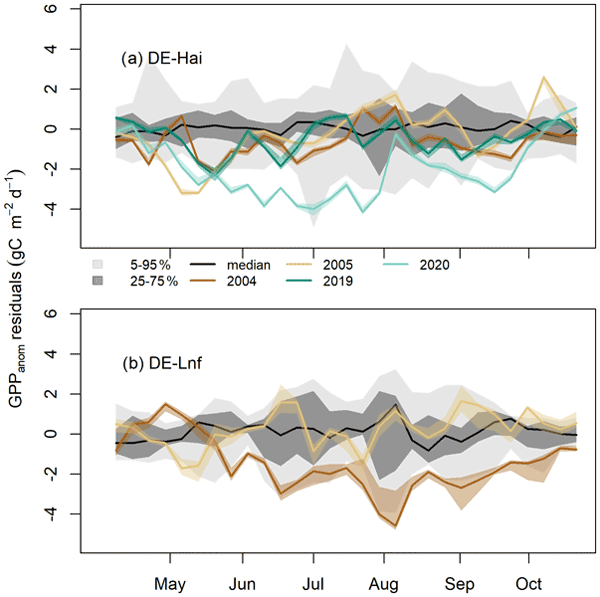
Xin Yu, René Orth, Markus Reichstein, Michael Bahn, Anne Klosterhalfen, Alexander Knohl, Franziska Koebsch, Mirco Migliavacca, Martina Mund, Jacob A. Nelson, Benjamin D. Stocker, Sophia Walther, and Ana Bastos
Biogeosciences, 19, 4315–4329, https://doi.org/10.5194/bg-19-4315-2022, https://doi.org/10.5194/bg-19-4315-2022, 2022
Short summary
Short summary
Identifying drought legacy effects is challenging because they are superimposed on variability driven by climate conditions in the recovery period. We develop a residual-based approach to quantify legacies on gross primary productivity (GPP) from eddy covariance data. The GPP reduction due to legacy effects is comparable to the concurrent effects at two sites in Germany, which reveals the importance of legacy effects. Our novel methodology can be used to quantify drought legacies elsewhere.
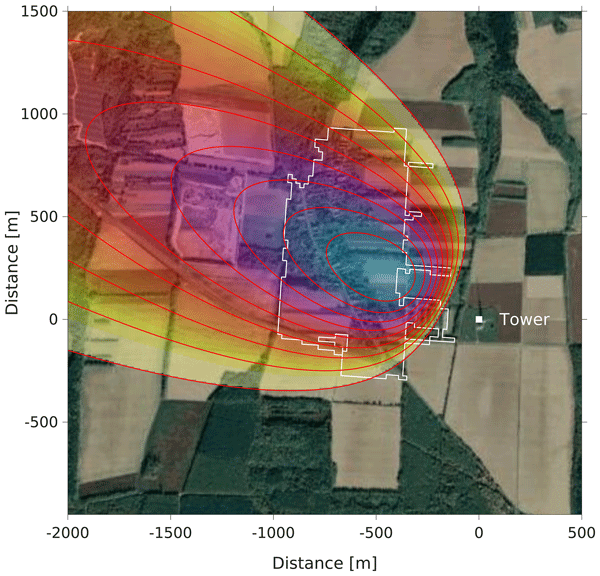
László Haszpra, Zoltán Barcza, Zita Ferenczi, Roland Hollós, Anikó Kern, and Natascha Kljun
Atmos. Meas. Tech., 15, 5019–5031, https://doi.org/10.5194/amt-15-5019-2022, https://doi.org/10.5194/amt-15-5019-2022, 2022
Short summary
Short summary
A novel approach is used for the determination of greenhouse gas (GHG) emissions of small rural settlements, which may significantly differ from those of urban regions and have hardly been studied yet. Among other results, it turned out that wintertime nitrous oxide emission is significantly underestimated in the official emission inventories. Given the large number of such settlements, the underestimation may also distort the national total emission values reported to international databases.
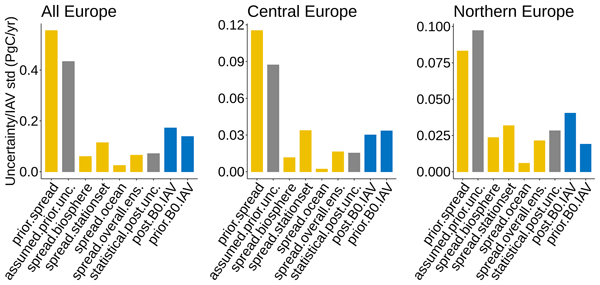
Saqr Munassar, Christian Rödenbeck, Frank-Thomas Koch, Kai U. Totsche, Michał Gałkowski, Sophia Walther, and Christoph Gerbig
Atmos. Chem. Phys., 22, 7875–7892, https://doi.org/10.5194/acp-22-7875-2022, https://doi.org/10.5194/acp-22-7875-2022, 2022
Short summary
Short summary
The results obtained from ensembles of inversions over 13 years show the largest spread in the a posteriori fluxes over the station set ensemble. Using different prior fluxes in the inversions led to a smaller impact. Drought occurrences in 2018 and 2019 affected CO2 fluxes as seen in net ecosystem exchange estimates. Our study highlights the importance of expanding the atmospheric site network across Europe to better constrain CO2 fluxes in inverse modelling.
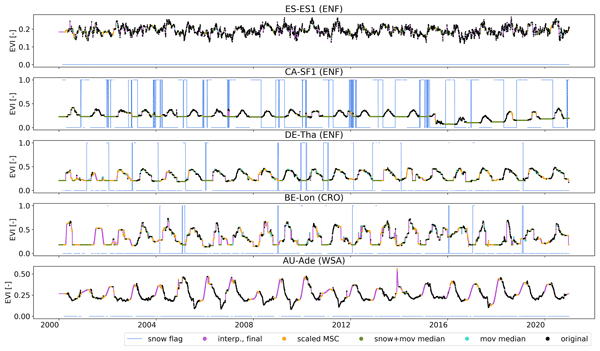
Sophia Walther, Simon Besnard, Jacob Allen Nelson, Tarek Sebastian El-Madany, Mirco Migliavacca, Ulrich Weber, Nuno Carvalhais, Sofia Lorena Ermida, Christian Brümmer, Frederik Schrader, Anatoly Stanislavovich Prokushkin, Alexey Vasilevich Panov, and Martin Jung
Biogeosciences, 19, 2805–2840, https://doi.org/10.5194/bg-19-2805-2022, https://doi.org/10.5194/bg-19-2805-2022, 2022
Short summary
Short summary
Satellite observations help interpret station measurements of local carbon, water, and energy exchange between the land surface and the atmosphere and are indispensable for simulations of the same in land surface models and their evaluation. We propose generalisable and efficient approaches to systematically ensure high quality and to estimate values in data gaps. We apply them to satellite data of surface reflectance and temperature with different resolutions at the stations.
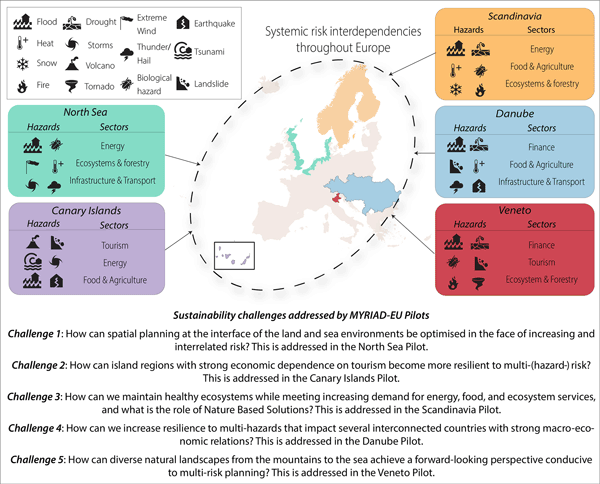
Philip J. Ward, James Daniell, Melanie Duncan, Anna Dunne, Cédric Hananel, Stefan Hochrainer-Stigler, Annegien Tijssen, Silvia Torresan, Roxana Ciurean, Joel C. Gill, Jana Sillmann, Anaïs Couasnon, Elco Koks, Noemi Padrón-Fumero, Sharon Tatman, Marianne Tronstad Lund, Adewole Adesiyun, Jeroen C. J. H. Aerts, Alexander Alabaster, Bernard Bulder, Carlos Campillo Torres, Andrea Critto, Raúl Hernández-Martín, Marta Machado, Jaroslav Mysiak, Rene Orth, Irene Palomino Antolín, Eva-Cristina Petrescu, Markus Reichstein, Timothy Tiggeloven, Anne F. Van Loon, Hung Vuong Pham, and Marleen C. de Ruiter
Nat. Hazards Earth Syst. Sci., 22, 1487–1497, https://doi.org/10.5194/nhess-22-1487-2022, https://doi.org/10.5194/nhess-22-1487-2022, 2022
Short summary
Short summary
The majority of natural-hazard risk research focuses on single hazards (a flood, a drought, a volcanic eruption, an earthquake, etc.). In the international research and policy community it is recognised that risk management could benefit from a more systemic approach. In this perspective paper, we argue for an approach that addresses multi-hazard, multi-risk management through the lens of sustainability challenges that cut across sectors, regions, and hazards.
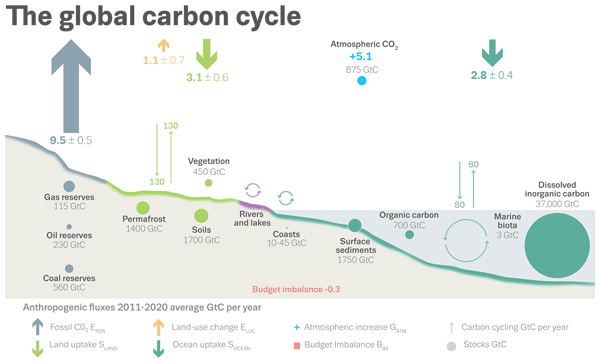
Pierre Friedlingstein, Matthew W. Jones, Michael O'Sullivan, Robbie M. Andrew, Dorothee C. E. Bakker, Judith Hauck, Corinne Le Quéré, Glen P. Peters, Wouter Peters, Julia Pongratz, Stephen Sitch, Josep G. Canadell, Philippe Ciais, Rob B. Jackson, Simone R. Alin, Peter Anthoni, Nicholas R. Bates, Meike Becker, Nicolas Bellouin, Laurent Bopp, Thi Tuyet Trang Chau, Frédéric Chevallier, Louise P. Chini, Margot Cronin, Kim I. Currie, Bertrand Decharme, Laique M. Djeutchouang, Xinyu Dou, Wiley Evans, Richard A. Feely, Liang Feng, Thomas Gasser, Dennis Gilfillan, Thanos Gkritzalis, Giacomo Grassi, Luke Gregor, Nicolas Gruber, Özgür Gürses, Ian Harris, Richard A. Houghton, George C. Hurtt, Yosuke Iida, Tatiana Ilyina, Ingrid T. Luijkx, Atul Jain, Steve D. Jones, Etsushi Kato, Daniel Kennedy, Kees Klein Goldewijk, Jürgen Knauer, Jan Ivar Korsbakken, Arne Körtzinger, Peter Landschützer, Siv K. Lauvset, Nathalie Lefèvre, Sebastian Lienert, Junjie Liu, Gregg Marland, Patrick C. McGuire, Joe R. Melton, David R. Munro, Julia E. M. S. Nabel, Shin-Ichiro Nakaoka, Yosuke Niwa, Tsuneo Ono, Denis Pierrot, Benjamin Poulter, Gregor Rehder, Laure Resplandy, Eddy Robertson, Christian Rödenbeck, Thais M. Rosan, Jörg Schwinger, Clemens Schwingshackl, Roland Séférian, Adrienne J. Sutton, Colm Sweeney, Toste Tanhua, Pieter P. Tans, Hanqin Tian, Bronte Tilbrook, Francesco Tubiello, Guido R. van der Werf, Nicolas Vuichard, Chisato Wada, Rik Wanninkhof, Andrew J. Watson, David Willis, Andrew J. Wiltshire, Wenping Yuan, Chao Yue, Xu Yue, Sönke Zaehle, and Jiye Zeng
Earth Syst. Sci. Data, 14, 1917–2005, https://doi.org/10.5194/essd-14-1917-2022, https://doi.org/10.5194/essd-14-1917-2022, 2022
Short summary
Short summary
The Global Carbon Budget 2021 describes the data sets and methodology used to quantify the emissions of carbon dioxide and their partitioning among the atmosphere, land, and ocean. These living data are updated every year to provide the highest transparency and traceability in the reporting of CO2, the key driver of climate change.
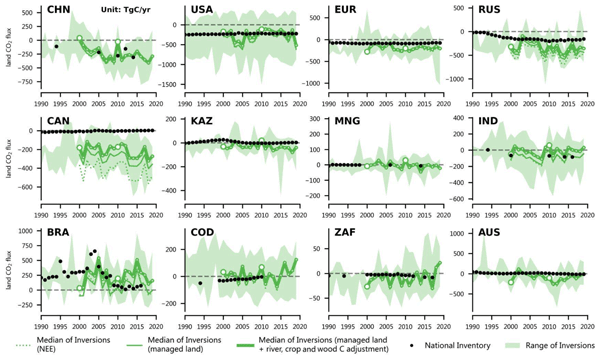
Zhu Deng, Philippe Ciais, Zitely A. Tzompa-Sosa, Marielle Saunois, Chunjing Qiu, Chang Tan, Taochun Sun, Piyu Ke, Yanan Cui, Katsumasa Tanaka, Xin Lin, Rona L. Thompson, Hanqin Tian, Yuanzhi Yao, Yuanyuan Huang, Ronny Lauerwald, Atul K. Jain, Xiaoming Xu, Ana Bastos, Stephen Sitch, Paul I. Palmer, Thomas Lauvaux, Alexandre d'Aspremont, Clément Giron, Antoine Benoit, Benjamin Poulter, Jinfeng Chang, Ana Maria Roxana Petrescu, Steven J. Davis, Zhu Liu, Giacomo Grassi, Clément Albergel, Francesco N. Tubiello, Lucia Perugini, Wouter Peters, and Frédéric Chevallier
Earth Syst. Sci. Data, 14, 1639–1675, https://doi.org/10.5194/essd-14-1639-2022, https://doi.org/10.5194/essd-14-1639-2022, 2022
Short summary
Short summary
In support of the global stocktake of the Paris Agreement on climate change, we proposed a method for reconciling the results of global atmospheric inversions with data from UNFCCC national greenhouse gas inventories (NGHGIs). Here, based on a new global harmonized database that we compiled from the UNFCCC NGHGIs and a comprehensive framework presented in this study to process the results of inversions, we compared their results of carbon dioxide (CO2), methane (CH4), and nitrous oxide (N2O).
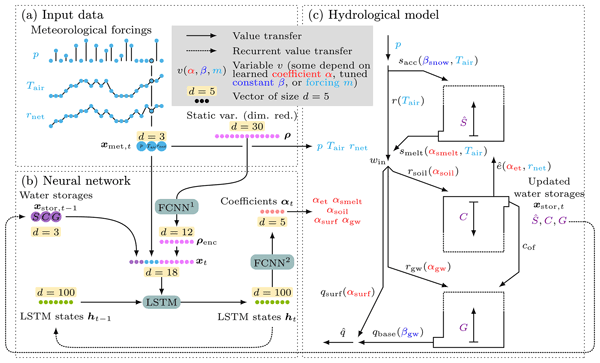
Basil Kraft, Martin Jung, Marco Körner, Sujan Koirala, and Markus Reichstein
Hydrol. Earth Syst. Sci., 26, 1579–1614, https://doi.org/10.5194/hess-26-1579-2022, https://doi.org/10.5194/hess-26-1579-2022, 2022
Short summary
Short summary
We present a physics-aware machine learning model of the global hydrological cycle. As the model uses neural networks under the hood, the simulations of the water cycle are learned from data, and yet they are informed and constrained by physical knowledge. The simulated patterns lie within the range of existing hydrological models and are plausible. The hybrid modeling approach has the potential to tackle key environmental questions from a novel perspective.
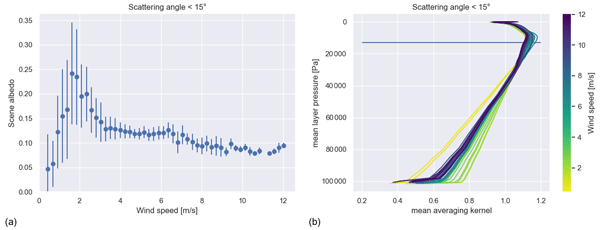
Tobias Christoph Valentin Werner Riess, Klaas Folkert Boersma, Jasper van Vliet, Wouter Peters, Maarten Sneep, Henk Eskes, and Jos van Geffen
Atmos. Meas. Tech., 15, 1415–1438, https://doi.org/10.5194/amt-15-1415-2022, https://doi.org/10.5194/amt-15-1415-2022, 2022
Short summary
Short summary
This paper reports on improved monitoring of ship nitrogen oxide emissions by TROPOMI. With its fantastic resolution we can identify lanes of ship nitrogen dioxide (NO2) pollution not detected from space before. The quality of TROPOMI NO2 data over sea is improved further by recent upgrades in cloud retrievals and the use of sun glint scenes. Lastly, we study the impact of COVID-19 on ship NO2 in European seas and compare the found reductions to emission estimates gained from ship-specific data.

Tina Trautmann, Sujan Koirala, Nuno Carvalhais, Andreas Güntner, and Martin Jung
Hydrol. Earth Syst. Sci., 26, 1089–1109, https://doi.org/10.5194/hess-26-1089-2022, https://doi.org/10.5194/hess-26-1089-2022, 2022
Short summary
Short summary
We assess the effect of how vegetation is defined in a global hydrological model on the composition of total water storage (TWS). We compare two experiments, one with globally uniform and one with vegetation parameters that vary in space and time. While both experiments are constrained against observational data, we found a drastic change in the partitioning of TWS, highlighting the important role of the interaction between groundwater–soil moisture–vegetation in understanding TWS variations.
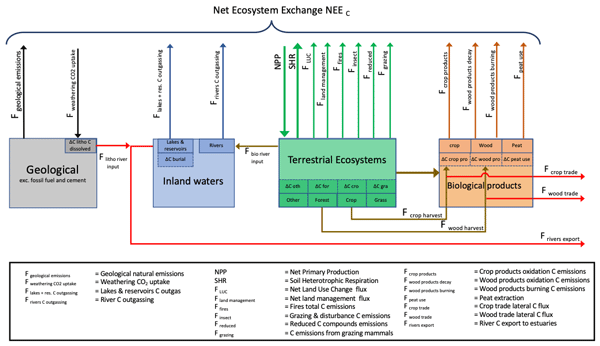
Philippe Ciais, Ana Bastos, Frédéric Chevallier, Ronny Lauerwald, Ben Poulter, Josep G. Canadell, Gustaf Hugelius, Robert B. Jackson, Atul Jain, Matthew Jones, Masayuki Kondo, Ingrid T. Luijkx, Prabir K. Patra, Wouter Peters, Julia Pongratz, Ana Maria Roxana Petrescu, Shilong Piao, Chunjing Qiu, Celso Von Randow, Pierre Regnier, Marielle Saunois, Robert Scholes, Anatoly Shvidenko, Hanqin Tian, Hui Yang, Xuhui Wang, and Bo Zheng
Geosci. Model Dev., 15, 1289–1316, https://doi.org/10.5194/gmd-15-1289-2022, https://doi.org/10.5194/gmd-15-1289-2022, 2022
Short summary
Short summary
The second phase of the Regional Carbon Cycle Assessment and Processes (RECCAP) will provide updated quantification and process understanding of CO2, CH4, and N2O emissions and sinks for ten regions of the globe. In this paper, we give definitions, review different methods, and make recommendations for estimating different components of the total land–atmosphere carbon exchange for each region in a consistent and complete approach.
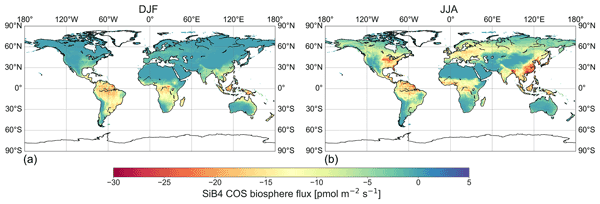
Linda M. J. Kooijmans, Ara Cho, Jin Ma, Aleya Kaushik, Katherine D. Haynes, Ian Baker, Ingrid T. Luijkx, Mathijs Groenink, Wouter Peters, John B. Miller, Joseph A. Berry, Jerome Ogée, Laura K. Meredith, Wu Sun, Kukka-Maaria Kohonen, Timo Vesala, Ivan Mammarella, Huilin Chen, Felix M. Spielmann, Georg Wohlfahrt, Max Berkelhammer, Mary E. Whelan, Kadmiel Maseyk, Ulli Seibt, Roisin Commane, Richard Wehr, and Maarten Krol
Biogeosciences, 18, 6547–6565, https://doi.org/10.5194/bg-18-6547-2021, https://doi.org/10.5194/bg-18-6547-2021, 2021
Short summary
Short summary
The gas carbonyl sulfide (COS) can be used to estimate photosynthesis. To adopt this approach on regional and global scales, we need biosphere models that can simulate COS exchange. So far, such models have not been evaluated against observations. We evaluate the COS biosphere exchange of the SiB4 model against COS flux observations. We find that the model is capable of simulating key processes in COS biosphere exchange. Still, we give recommendations for further improvement of the model.
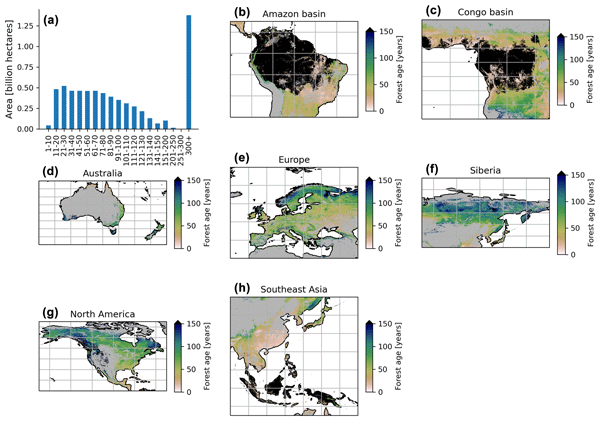
Simon Besnard, Sujan Koirala, Maurizio Santoro, Ulrich Weber, Jacob Nelson, Jonas Gütter, Bruno Herault, Justin Kassi, Anny N'Guessan, Christopher Neigh, Benjamin Poulter, Tao Zhang, and Nuno Carvalhais
Earth Syst. Sci. Data, 13, 4881–4896, https://doi.org/10.5194/essd-13-4881-2021, https://doi.org/10.5194/essd-13-4881-2021, 2021
Short summary
Short summary
Forest age can determine the capacity of a forest to uptake carbon from the atmosphere. Yet, a lack of global diagnostics that reflect the forest stage and associated disturbance regimes hampers the quantification of age-related differences in forest carbon dynamics. In this paper, we introduced a new global distribution of forest age inferred from forest inventory, remote sensing and climate data in support of a better understanding of the global dynamics in the forest water and carbon cycles.
Cited articles
Agarap, A. F.: Deep Learning using Rectified Linear Units (ReLU), arXiv:1803.08375 [cs, stat], https://doi.org/10.48550/arXiv.1803.08375, 2019. a
Ahlström, A., Raupach, M. R., Schurgers, G., Smith, B., Arneth, A., Jung, M., Reichstein, M., Canadell, J. G., Friedlingstein, P., Jain, A. K., Kato, E., Poulter, B., Sitch, S., Stocker, B. D., Viovy, N., Wang, Y. P., Wiltshire, A., Zaehle, S., and Zeng, N.: The dominant role of semi-arid ecosystems in the trend and variability of the land CO2 sink, Science, 348, 895–899, https://doi.org/10.1126/science.aaa1668, 2015. a
Amiro, B.: FLUXNET2015 CA-SF2 Saskatchewan – Western Boreal, Forest Burned in 1989, FLUXNET [data set], https://doi.org/10.18140/flx/1440047 (last access: 1 November 2022), 2016a. a
Amiro, B.: FLUXNET2015 CA-Man Manitoba – Northern Old Black Spruce (Former BOREAS Northern Study Area), FLUXNET [data set], https://doi.org/10.18140/flx/1440035 (last access: 1 November 2022), 2016b. a
Amiro, B.: FLUXNET2015 CA-SF1 Saskatchewan – Western Boreal, Forest Burned in 1977, FLUXNET [data set], https://doi.org/10.18140/flx/1440046 (last access: 1 November 2022), 2016c. a
Amiro, B.: FLUXNET2015 CA-SF3 Saskatchewan – Western Boreal, Forest Burned in 1998, FLUXNET [data set], https://doi.org/10.18140/flx/1440048 (last access: 1 November 2022), 2016d. a
Ammann, C.: FLUXNET2015 CH-Oe1 Oensingen Grassland, FLUXNET [data set], https://doi.org/10.18140/flx/1440135 (last access: 1 November 2022), 2016. a
Angevine, W. M., Brioude, J., McKeen, S., and Holloway, J. S.: Uncertainty in Lagrangian pollutant transport simulations due to meteorological uncertainty from a mesoscale WRF ensemble, Geosci. Model Dev., 7, 2817–2829, https://doi.org/10.5194/gmd-7-2817-2014, 2014. a
Arain, M.: AmeriFlux FLUXNET-1F CA-TPD Ontario – Turkey Point Mature Deciduous, AmeriFlux AMP [data set], https://doi.org/10.17190/amf/1881567 (last access: 1 November 2022), 2022a. a
Arain, M.: AmeriFlux FLUXNET-1F CA-TP3 Ontario – Turkey Point 1974 Plantation White Pine, AmeriFlux AMP [data set], https://doi.org/10.17190/amf/1881566 (last access: 1 November 2022), 2022b. a
Arain, M. A.: FLUXNET2015 CA-TP2 Ontario – Turkey Point 1989 Plantation White Pine, FLUXNET [data set], https://doi.org/10.18140/flx/1440051 (last access: 1 November 2022), 2016a. a
Arain, M. A.: FLUXNET2015 CA-TP1 Ontario – Turkey Point 2002 Plantation White Pine, FLUXNET [data set], https://doi.org/10.18140/flx/1440050 (last access: 1 November 2022), 2016b. a
Arain, M. A.: FLUXNET2015 CA-TP4 Ontario – Turkey Point 1939 Plantation White Pine, FLUXNET [data set], https://doi.org/10.18140/flx/1440053 (last access: 1 November 2022), 2016c. a
Ardö, J., El Tahir, B. A., and ElKhidir, H. A. M.: FLUXNET2015 SD-Dem Demokeya, FLUXNET [data set], https://doi.org/10.18140/flx/1440186 (last access: 1 November 2022), 2016. a
Arndt, S., Hinko-Najera, N., and Griebel, A.: FLUXNET2015 AU-Wom Wombat, FLUXNET [data set], https://doi.org/10.18140/flx/1440207 (last access: 1 November 2022), 2016. a
Aubinet, M., Berbigier, P., Bernhofer, C., Cescatti, A., Feigenwinter, C., Granier, A., Grünwald, T., Havrankova, K., Heinesch, B., Longdoz, B., Marcolla, B., Montagnani, L., and Sedlak, P.: Comparing CO2 Storage and Advection Conditions at Night at Different Carboeuroflux Sites, Bound.-Lay. Meteorol., 116, 63–93, https://doi.org/10.1007/s10546-004-7091-8, 2005. a
Aurela, M., Lohila, A., Tuovinen, J.-P., Hatakka, J., Rainne, J., Mäkelä, T., and Lauria, T.: FLUXNET2015 FI-Lom Lompolojankka, FLUXNET [data set], https://doi.org/10.18140/flx/1440228 (last access: 1 November 2022), 2016a. a
Aurela, M., Tuovinen, J.-P., Hatakka, J., Lohila, A., Mäkelä, T., Rainne, J., and Lauria, T.: FLUXNET2015 FI-Sod Sodankyla, FLUXNET [data set], https://doi.org/10.18140/flx/1440160 (last access: 1 November 2022), 2016b. a
Badgley, G., Anderegg, L. D. L., Berry, J. A., and Field, C. B.: Terrestrial gross primary production: Using NIRV to scale from site to globe, Global Change Biol., 25, 3731–3740, https://doi.org/10.1111/gcb.14729, 2019. a
Baker, D. F., Law, R. M., Gurney, K. R., Rayner, P., Peylin, P., Denning, A. S., Bousquet, P., Bruhwiler, L., Chen, Y.-H., Ciais, P., Fung, I. Y., Heimann, M., John, J., Maki, T., Maksyutov, S., Masarie, K., Prather, M., Pak, B., Taguchi, S., and Zhu, Z.: TransCom 3 inversion intercomparison: Impact of transport model errors on the interannual variability of regional CO2 fluxes, 1988–2003, Global Biogeochem. Cycles, 20, https://doi.org/10.1029/2004GB002439, 2006. a
Baker, J. and Griffis, T.: AmeriFlux FLUXNET-1F US-Ro5 Rosemount I18South, AmeriFlux AMP [data set], https://doi.org/10.17190/amf/1818371 (last access: 1 November 2022), 2021. a
Baker, J. and Griffis, T.: AmeriFlux FLUXNET-1F US-Ro4 Rosemount Prairie, AmeriFlux AMP [data set], https://doi.org/10.17190/amf/1881589 (last access: 1 November 2022), 2022a. a
Baker, J. and Griffis, T.: AmeriFlux FLUXNET-1F US-Ro6 Rosemount I18North, AmeriFlux AMP [data set], https://doi.org/10.17190/amf/1881590 (last access: 1 November 2022), 2022b. a
Baker, J., Griffis, T., and Griffis, T.: AmeriFlux FLUXNET-1F US-Ro1 Rosemount- G21, AmeriFlux AMP [data set], https://doi.org/10.17190/amf/1881588 (last access: 1 November 2022), 2022. a
Baldocchi, D.: FLUXNET2015 US-Twt Twitchell Island, FLUXNET [data set], https://doi.org/10.18140/flx/1440106 (last access: 1 November 2022), 2016. a
Baldocchi, D. and Ma, S.: FLUXNET2015 US-Ton Tonzi Ranch, FLUXNET [data set], https://doi.org/10.18140/flx/1440092 (last access: 1 November 2022), 2016. a
Baldocchi, D., Ma, S., and Xu, L.: FLUXNET2015 US-Var Vaira Ranch- Ione, FLUXNET [data set], https://doi.org/10.18140/flx/1440094 (last access: 1 November 2022), 2016. a
Bastos, A., Ciais, P., Sitch, S., Aragão, L. E. O. C., Chevallier, F., Fawcett, D., Rosan, T. M., Saunois, M., Günther, D., Perugini, L., Robert, C., Deng, Z., Pongratz, J., Ganzenmüller, R., Fuchs, R., Winkler, K., Zaehle, S., and Albergel, C.: On the use of Earth Observation to support estimates of national greenhouse gas emissions and sinks for the Global stocktake process: lessons learned from ESA-CCI RECCAP2, Carbon Balance and Management, 17, 15, https://doi.org/10.1186/s13021-022-00214-w, 2022. a
Beck, H. E., Zimmermann, N. E., McVicar, T. R., Vergopolan, N., Berg, A., and Wood, E. F.: Present and future Köppen-Geiger climate classification maps at 1-km resolution, Sci. Data, 5, 180214, https://doi.org/10.1038/sdata.2018.214, 2018. a, b
Belelli, L., Papale, D., and Valentini, R.: FLUXNET2015 RU-Ha1 Hakasia Steppe, FLUXNET [data set], https://doi.org/10.18140/flx/1440184 (last access: 1 November 2022), 2016. a
Berbigier, P. and Loustau, D.: FLUXNET2015 FR-LBr Le Bray, FLUXNET [data set], https://doi.org/10.18140/flx/1440163 (last access: 1 November 2022), 2016. a
Beringer, J. and Hutley, L.: FLUXNET2015 AU-Fog Fogg Dam, FLUXNET [data set], https://doi.org/10.18140/flx/1440124 (last access: 1 November 2022), 2016a. a
Beringer, J. and Hutley, L.: FLUXNET2015 AU-DaP Daly River Savanna, FLUXNET [data set], https://doi.org/10.18140/flx/1440123 (last access: 1 November 2022), 2016b. a
Beringer, J. and Hutley, L.: FLUXNET2015 AU-Ade Adelaide River, FLUXNET [data set], https://doi.org/10.18140/flx/1440193 (last access: 1 November 2022), 2016c. a
Beringer, J. and Hutley, L.: FLUXNET2015 AU-RDF Red Dirt Melon Farm, Northern Territory, FLUXNET [data set], https://doi.org/10.18140/flx/1440201 (last access: 1 November 2022), 2016d. a
Beringer, J. and Hutley, L.: FLUXNET2015 AU-Dry Dry River, FLUXNET [data set], https://doi.org/10.18140/flx/1440197 (last access: 1 November 2022), 2016e. a
Beringer, J. and Hutley, P. L.: FLUXNET2015 AU-DaS Daly River Cleared, FLUXNET [data set], https://doi.org/10.18140/flx/1440122 (last access: 1 November 2022), 2016f. a
Beringer, J. and Walker, J.: FLUXNET2015 AU-Ync Jaxa, FLUXNET [data set], https://doi.org/10.18140/flx/1440208 (last access: 1 November 2022), 2016. a
Beringer, J., Cunningham, S., Baker, P., Cavagnaro, T., MacNally, R., Thompson, R., and McHugh, I.: FLUXNET2015 AU-Whr Whroo, FLUXNET [data set], https://doi.org/10.18140/flx/1440206 (last access: 1 November 2022), 2016a. a
Beringer, J., Hutley, L., McGuire, D., and U, P.: FLUXNET2015 AU-Wac Wallaby Creek, FLUXNET [data set], https://doi.org/10.18140/flx/1440127 (last access: 1 November 2022), 2016b. a
Bernhofer, C., Grünwald, T., Moderow, U., Hehn, M., Eichelmann, U., and Prasse, H.: FLUXNET2015 DE-Spw Spreewald, FLUXNET [data set], https://doi.org/10.18140/flx/1440220 (last access: 1 November 2022), 2016. a
Billesbach, D., Bradford, J., and Torn, M.: FLUXNET2015 US-AR2 ARM USDA UNL OSU Woodward Switchgrass 2, FLUXNET [data set], https://doi.org/10.18140/flx/1440104 (last access: 1 November 2022), 2016a. a
Billesbach, D., Bradford, J., and Torn, M.: FLUXNET2015 US-AR1 ARM USDA UNL OSU Woodward Switchgrass 1, FLUXNET [data set], https://doi.org/10.18140/flx/1440103 (last access: 1 November 2022), 2016b. a
Billesbach, D., Kueppers, L., Torn, M., and Biraud, S.: AmeriFlux FLUXNET-1F US-A32 ARM-SGP Medford Hay Pasture, AmeriFlux AMP [data set], https://doi.org/10.17190/amf/1881568 (last access: 1 November 2022), 2022. a
Biraud, S., Fischer, M., Chan, S., and Torn, M.: AmeriFlux FLUXNET-1F US-ARM ARM Southern Great Plains Site – Lamont, AmeriFlux AMP [data set], https://doi.org/10.17190/amf/1854366 (last access: 1 November 2022), 2022. a
Black, T.: AmeriFlux FLUXNET-1F CA-LP1 British Columbia – Mountain Pine Beetle-Attacked Lodgepole Pine Stand, AmeriFlux AMP [data set], https://doi.org/10.17190/amf/1832155 (last access: 1 November 2022), 2021. a
Black, T. A.: FLUXNET2015 CA-Obs Saskatchewan – Western Boreal, Mature Black Spruce, FLUXNET [data set], https://doi.org/10.18140/flx/1440044 (last access: 1 November 2022), 2016a. a
Black, T. A.: FLUXNET2015 CA-Oas Saskatchewan – Western Boreal, Mature Aspen, FLUXNET [data set], https://doi.org/10.18140/flx/1440043 (last access: 1 November 2022), 2016b. a
Blanken, P., Monson, R., Burns, S., Bowling, D., and Turnipseed, A.: AmeriFlux FLUXNET-1F US-NR1 Niwot Ridge Forest (LTER NWT1), AmeriFlux AMP [data set], https://doi.org/10.17190/amf/1871141 (last access: 1 November 2022), 2022. a
Bodesheim, P., Jung, M., Gans, F., Mahecha, M. D., and Reichstein, M.: Upscaled diurnal cycles of land–atmosphere fluxes: a new global half-hourly data product, Earth Syst. Sci. Data, 10, 1327–1365, https://doi.org/10.5194/essd-10-1327-2018, 2018. a
Bohrer, G.: AmeriFlux FLUXNET-1F US-ORv Olentangy River Wetland Research Park, AmeriFlux AMP [data set], https://doi.org/10.17190/amf/1832164 (last access: 1 November 2022), 2021. a
Bohrer, G.: AmeriFlux FLUXNET-1F US-UM3 Douglas Lake, AmeriFlux AMP [data set], https://doi.org/10.17190/amf/1881596 (last access: 1 November 2022), 2022. a
Bohrer, G. and Kerns, J.: AmeriFlux FLUXNET-1F US-OWC Old Woman Creek, AmeriFlux AMP [data set], https://doi.org/10.17190/amf/1871142 (last access: 1 November 2022), 2022. a
Boike, J., Westermann, S., Lüers, J., Langer, M., and Piel, K.: FLUXNET2015 SJ-Blv Bayelva, Spitsbergen, FLUXNET [data set], https://doi.org/10.18140/flx/1440242 (last access: 1 November 2022), 2016. a
Botia, S., Komiya, S., Marshall, J., Koch, T., Galkowski, M., Lavric, J., Gomes-Alves, E., Walter, D., Fisch, G., Pinho, D. M., Nelson, B. W., Martins, G., Luijkx, I. T., Koren, G., Florentie, L., de Araujo, A. C., Sa, M., Andreae, M. O., Heimann, M., Peters, W., and Gerbig, C.: The CO2 record at the Amazon Tall Tower Observatory: A new opportunity to study processes on seasonal and inter-annual scales, Global Change Biol., 28, 588–611, https://doi.org/10.1111/gcb.15905, 2022. a, b, c, d, e
Botía, S., Munassar, S., Koch, T., Custodio, D., Basso, L. S., Komiya, S., Lavric, J. V., Walter, D., Gloor, M., Martins, G., Naus, S., Koren, G., Luijkx, I. T., Hantson, S., Miller, J. B., Peters, W., Rödenbeck, C., and Gerbig, C.: Combined CO2 measurement record indicates Amazon forest carbon uptake is offset by savanna carbon release, Atmos. Chem. Phys., 25, 6219–6255, https://doi.org/10.5194/acp-25-6219-2025, 2025. a, b
Bowling, D.: FLUXNET2015 US-Cop Corral Pocket, FLUXNET [data set], https://doi.org/10.18140/flx/1440100 (last access: 1 November 2022), 2016. a
Brunsell, N.: AmeriFlux FLUXNET-1F US-KFS Kansas Field Station, AmeriFlux AMP [data set], https://doi.org/10.17190/amf/1881585 (last access: 1 November 2022), 2022a. a
Brunsell, N.: AmeriFlux FLUXNET-1F US-KLS Kansas Land Institute, AmeriFlux AMP [data set], https://doi.org/10.17190/amf/1854367 (last access: 1 November 2022), 2022b. a
Cescatti, A., Marcolla, B., Zorer, R., and Gianelle, D.: FLUXNET2015 IT-La2 Lavarone2, FLUXNET [data set], https://doi.org/10.18140/flx/1440235 (last access: 1 November 2022), 2016. a
Chamberlain, S., Oikawa, P., Sturtevant, C., Szutu, D., Verfaillie, J., and Baldocchi, D.: AmeriFlux FLUXNET-1F US-Tw3 Twitchell Alfalfa, AmeriFlux AMP [data set], https://doi.org/10.17190/amf/1881594 (last access: 1 November 2022), 2022. a
Chen, J.: FLUXNET2015 US-Wi5 Mixed Young Jack Pine (MYJP), FLUXNET [data set], https://doi.org/10.18140/flx/1440059 (last access: 1 November 2022), 2016a. a
Chen, J.: FLUXNET2015 US-Wi3 Mature Hardwood (MHW), FLUXNET [data set], https://doi.org/10.18140/flx/1440057 (last access: 1 November 2022), 2016b. a
Chen, J.: FLUXNET2015 US-Wi8 Young Hardwood Clearcut (YHW), FLUXNET [data set], https://doi.org/10.18140/flx/1440062 (last access: 1 November 2022), 2016c. a
Chen, J.: FLUXNET2015 US-Wi4 Mature Red Pine (MRP), FLUXNET [data set], https://doi.org/10.18140/flx/1440058 (last access: 1 November 2022), 2016d. a
Chen, J.: FLUXNET2015 US-Wi1 Intermediate Hardwood (IHW), FLUXNET [data set], https://doi.org/10.18140/flx/1440054 (last access: 1 November 2022), 2016e. a
Chen, J.: FLUXNET2015 US-Wi9 Young Jack Pine (YJP), FLUXNET [data set], https://doi.org/10.18140/flx/1440063 (last access: 1 November 2022), 2016f. a
Chen, J.: FLUXNET2015 US-Wi0 Young Red Pine (YRP), FLUXNET [data set], https://doi.org/10.18140/flx/1440055 (last access: 1 November 2022), 2016g. a
Chen, J.: FLUXNET2015 US-Wi6 Pine Barrens 1 (PB1), FLUXNET [data set], https://doi.org/10.18140/flx/1440060 (last access: 1 November 2022), 2016h. a
Chen, J.: FLUXNET2015 US-Wi7 Red Pine Clearcut (RPCC), FLUXNET [data set], https://doi.org/10.18140/flx/1440061 (last access: 1 November 2022), 2016i. a
Chen, J.: FLUXNET2015 US-Wi2 Intermediate Red Pine (IRP), FLUXNET [data set], https://doi.org/10.18140/flx/1440056 (last access: 1 November 2022), 2016j. a
Chen, J. and Chu, H.: FLUXNET2015 US-WPT Winous Point North Marsh, FLUXNET [data set], https://doi.org/10.18140/flx/1440116 (last access: 1 November 2022), 2016a. a
Chen, J. and Chu, H.: FLUXNET2015 US-CRT Curtice Walter-Berger Cropland, FLUXNET [data set], https://doi.org/10.18140/flx/1440117 (last access: 1 November 2022), 2016b. a
Chen, J., Chu, H., and Noormets, A.: FLUXNET2015 US-Oho Oak Openings, FLUXNET [data set], https://doi.org/10.18140/flx/1440088 (last access: 1 November 2022), 2016. a
Chen, S.: FLUXNET2015 CN-Du2 Duolungrassland (D01), FLUXNET [data set], https://doi.org/10.18140/flx/1440140 (last access: 1 November 2022), 2016k. a
Chen, T. and Guestrin, C.: XGBoost: A Scalable Tree Boosting System, in: Proceedings of the 22nd ACM SIGKDD International Conference on Knowledge Discovery and Data Mining, KDD '16, pp. 785–794, Association for Computing Machinery, New York, NY, USA, ISBN 978-1-4503-4232-2, https://doi.org/10.1145/2939672.2939785, 2016. a
Chevallier, F., Fisher, M., Peylin, P., Serrar, S., Bousquet, P., Bréon, F.-M., Chédin, A., and Ciais, P.: Inferring CO2 sources and sinks from satellite observations: Method and application to TOVS data, J. Geophys. Res.-Atmos., 110, https://doi.org/10.1029/2005JD006390, 2005. a
Chevallier, F., Remaud, M., O'Dell, C. W., Baker, D., Peylin, P., and Cozic, A.: Objective evaluation of surface- and satellite-driven carbon dioxide atmospheric inversions, Atmos. Chem. Phys., 19, 14233–14251, https://doi.org/10.5194/acp-19-14233-2019, 2019. a
Christen, A. and Knox, S.: AmeriFlux FLUXNET-1F CA-DBB Delta Burns Bog, AmeriFlux AMP [data set], https://doi.org/10.17190/amf/1881565 (last access: 1 November 2022), 2022. a
Christensen, T.: FLUXNET2015 SJ-Adv Adventdalen, FLUXNET [data set], https://doi.org/10.18140/flx/1440241 (last access: 1 November 2022), 2016. a
Chu, H., Baldocchi, D. D., John, R., Wolf, S., and Reichstein, M.: Fluxes all of the time? A primer on the temporal representativeness of FLUXNET, J. Geophys. Res.-Biogeo., 122, 289–307, https://doi.org/10.1002/2016JG003576, 2017. a, b, c
Ciais, P., Bastos, A., Chevallier, F., Lauerwald, R., Poulter, B., Canadell, J. G., Hugelius, G., Jackson, R. B., Jain, A., Jones, M., Kondo, M., Luijkx, I. T., Patra, P. K., Peters, W., Pongratz, J., Petrescu, A. M. R., Piao, S., Qiu, C., Von Randow, C., Regnier, P., Saunois, M., Scholes, R., Shvidenko, A., Tian, H., Yang, H., Wang, X., and Zheng, B.: Definitions and methods to estimate regional land carbon fluxes for the second phase of the REgional Carbon Cycle Assessment and Processes Project (RECCAP-2), Geosci. Model Dev., 15, 1289–1316, https://doi.org/10.5194/gmd-15-1289-2022, 2022. a, b, c
Cleverly, J. and Eamus, D.: FLUXNET2015 AU-TTE Ti Tree East, FLUXNET [data set], https://doi.org/10.18140/flx/1440205 (last access: 1 November 2022), 2016a. a
Cleverly, J. and Eamus, D.: FLUXNET2015 AU-ASM Alice Springs, FLUXNET [data set], https://doi.org/10.18140/flx/1440194 (last access: 1 November 2022), 2016b. a
Cochrane, M. A. and Laurance, W. F.: Synergisms among Fire, Land Use, and Climate Change in the Amazon, Ambio, 37, 522–527, 2008. a
Crisp, D., Dolman, H., Tanhua, T., McKinley, G. A., Hauck, J., Bastos, A., Sitch, S., Eggleston, S., and Aich, V.: How Well Do We Understand the Land-Ocean-Atmosphere Carbon Cycle?, Rev. Geophys., 60, e2021RG000736, https://doi.org/10.1029/2021RG000736, 2022. a
Desai, A.: FLUXNET2015 US-WCr Willow Creek, FLUXNET [data set], https://doi.org/10.18140/flx/1440095 (last access: 1 November 2022), 2016a. a
Desai, A.: FLUXNET2015 US-Syv Sylvania Wilderness Area, FLUXNET [data set], https://doi.org/10.18140/flx/1440091 (last access: 1 November 2022), 2016b. a
Desai, A.: FLUXNET2015 US-Los Lost Creek, FLUXNET [data set], https://doi.org/10.18140/flx/1440076 (last access: 1 November 2022), 2016c. a
Desai, A.: FLUXNET2015 US-PFa Park Falls/WLEF, FLUXNET [data set], https://doi.org/10.18140/flx/1440089 (last access: 1 November 2022), 2016d. a
Desai, A.: AmeriFlux FLUXNET-1F US-CS1 Central Sands Irrigated Agricultural Field, AmeriFlux AMP [data set], https://doi.org/10.17190/amf/1881576 (last access: 1 November 2022), 2022a. a
Desai, A.: AmeriFlux FLUXNET-1F US-CS4 Central Sands Irrigated Agricultural Field, AmeriFlux AMP [data set], https://doi.org/10.17190/amf/1881579 (last access: 1 November 2022), 2022b. a
Desai, A.: AmeriFlux FLUXNET-1F US-CS2 Tri County School Pine Forest, AmeriFlux AMP [data set], https://doi.org/10.17190/amf/1881577 (last access: 1 November 2022), 2022c. a
Desai, A.: AmeriFlux FLUXNET-1F US-CS3 Central Sands Irrigated Agricultural Field, AmeriFlux AMP [data set], https://doi.org/10.17190/amf/1881578 (last access: 1 November 2022), 2022d. a
Dolman, H., Hendriks, D., Parmentier, F.-J., Marchesini, L. B., Dean, J., and Van Huissteden, K.: FLUXNET2015 NL-Hor Horstermeer, FLUXNET [data set], https://doi.org/10.18140/flx/1440177 (last access: 1 November 2022), 2016a. a
Dolman, H., Van Der Molen, M., Parmentier, F.-J., Marchesini, L. B., Dean, J., Van Huissteden, K., and Maximov, T.: FLUXNET2015 RU-Cok Chokurdakh, FLUXNET [data set], https://doi.org/10.18140/flx/1440182 (last access: 1 November 2022), 2016b. a
Dong, G.: FLUXNET2015 CN-Cng Changling, FLUXNET [data set], https://doi.org/10.18140/flx/1440209 (last access: 1 November 2022), 2016. a
Drake, B. and Hinkle, R.: FLUXNET2015 US-KS1 Kennedy Space Center (Slash Pine), FLUXNET [data set], https://doi.org/10.18140/flx/1440074 (last access: 1 November 2022), 2016a. a
Drake, B. and Hinkle, R.: FLUXNET2015 US-KS2 Kennedy Space Center (Scrub Oak), FLUXNET [data set], https://doi.org/10.18140/flx/1440075 (last access: 1 November 2022), 2016b. a
Euskirchen, E.: AmeriFlux FLUXNET-1F US-BZo Bonanza Creek Old Thermokarst Bog, AmeriFlux AMP [data set], https://doi.org/10.17190/amf/1881571 (last access: 1 November 2022), 2022a. a
Euskirchen, E.: AmeriFlux FLUXNET-1F US-BZB Bonanza Creek Thermokarst Bog, AmeriFlux AMP [data set], https://doi.org/10.17190/amf/1881569 (last access: 1 November 2022), 2022b. a
Euskirchen, E.: AmeriFlux FLUXNET-1F US-BZF Bonanza Creek Rich Fen, AmeriFlux AMP [data set], https://doi.org/10.17190/amf/1881570 (last access: 1 November 2022), 2022c. a
Euskirchen, E.: AmeriFlux FLUXNET-1F US-BZS Bonanza Creek Black Spruce, AmeriFlux AMP [data set], https://doi.org/10.17190/amf/1881572 (last access: 1 November 2022), 2022d. a
Euskirchen, E., Shaver, G., and Bret-Harte, S.: AmeriFlux FLUXNET-1F US-ICs Imnavait Creek Watershed Wet Sedge Tundra, AmeriFlux AMP [data set], https://doi.org/10.17190/amf/1871138 (last access: 1 November 2022), 2022a. a
Euskirchen, E., Shaver, G., and Bret-Harte, S.: AmeriFlux FLUXNET-1F US-ICt Imnavait Creek Watershed Tussock Tundra, AmeriFlux AMP [data set], https://doi.org/10.17190/amf/1881583 (last access: 1 November 2022), 2022b. a
Ewers, B. and Pendall, E.: FLUXNET2015 US-Sta Saratoga, FLUXNET [data set], https://doi.org/10.18140/flx/1440115 (last access: 1 November 2022), 2016. a
Faassen, K. A. P., Vilà-Guerau de Arellano, J., González-Armas, R., Heusinkveld, B. G., Mammarella, I., Peters, W., and Luijkx, I. T.: Separating above-canopy CO2 and O2 measurements into their atmospheric and biospheric signatures, Biogeosciences, 21, 3015–3039, https://doi.org/10.5194/bg-21-3015-2024, 2024. a
Fares, S.: FLUXNET2015 US-Lin Lindcove Orange Orchard, FLUXNET [data set], https://doi.org/10.18140/flx/1440107 (last access: 1 November 2022), 2016. a
Flerchinger, G.: AmeriFlux FLUXNET-1F US-Rwf RCEW Upper Sheep Prescibed Fire, AmeriFlux AMP [data set], https://doi.org/10.17190/amf/1881591 (last access: 1 November 2022), 2022a. a
Flerchinger, G.: AmeriFlux FLUXNET-1F US-Rws Reynolds Creek Wyoming Big Sagebrush, AmeriFlux AMP [data set], https://doi.org/10.17190/amf/1881592 (last access: 1 November 2022), 2022b. a
Flerchinger, G.: AmeriFlux FLUXNET-1F US-Rms RCEW Mountain Big Sagebrush, AmeriFlux AMP [data set], https://doi.org/10.17190/amf/1881587 (last access: 1 November 2022), 2022c. a
Flerchinger, G. and Reba, M.: AmeriFlux FLUXNET-1F US-Rwe RCEW Reynolds Mountain East, AmeriFlux AMP [data set], https://doi.org/10.17190/amf/1871143 (last access: 1 November 2022), 2022. a
Forsythe, J., Kline, M., and O'Halloran, T.: AmeriFlux FLUXNET-1F US-HB1 North Inlet Crab Haul Creek, AmeriFlux AMP [data set], https://doi.org/10.17190/amf/1832160 (last access: 1 November 2022), 2021. a
Friedlingstein, P., Meinshausen, M., Arora, V. K., Jones, C. D., Anav, A., Liddicoat, S. K., and Knutti, R.: Uncertainties in CMIP5 Climate Projections due to Carbon Cycle Feedbacks, J. Climate, 27, 511–526, https://doi.org/10.1175/JCLI-D-12-00579.1, 2014. a
Friedlingstein, P., O'Sullivan, M., Jones, M. W., Andrew, R. M., Bakker, D. C. E., Hauck, J., Landschützer, P., Le Quéré, C., Luijkx, I. T., Peters, G. P., Peters, W., Pongratz, J., Schwingshackl, C., Sitch, S., Canadell, J. G., Ciais, P., Jackson, R. B., Alin, S. R., Anthoni, P., Barbero, L., Bates, N. R., Becker, M., Bellouin, N., Decharme, B., Bopp, L., Brasika, I. B. M., Cadule, P., Chamberlain, M. A., Chandra, N., Chau, T.-T.-T., Chevallier, F., Chini, L. P., Cronin, M., Dou, X., Enyo, K., Evans, W., Falk, S., Feely, R. A., Feng, L., Ford, D. J., Gasser, T., Ghattas, J., Gkritzalis, T., Grassi, G., Gregor, L., Gruber, N., Gürses, Ö., Harris, I., Hefner, M., Heinke, J., Houghton, R. A., Hurtt, G. C., Iida, Y., Ilyina, T., Jacobson, A. R., Jain, A., Jarníková, T., Jersild, A., Jiang, F., Jin, Z., Joos, F., Kato, E., Keeling, R. F., Kennedy, D., Klein Goldewijk, K., Knauer, J., Korsbakken, J. I., Körtzinger, A., Lan, X., Lefèvre, N., Li, H., Liu, J., Liu, Z., Ma, L., Marland, G., Mayot, N., McGuire, P. C., McKinley, G. A., Meyer, G., Morgan, E. J., Munro, D. R., Nakaoka, S.-I., Niwa, Y., O'Brien, K. M., Olsen, A., Omar, A. M., Ono, T., Paulsen, M., Pierrot, D., Pocock, K., Poulter, B., Powis, C. M., Rehder, G., Resplandy, L., Robertson, E., Rödenbeck, C., Rosan, T. M., Schwinger, J., Séférian, R., Smallman, T. L., Smith, S. M., Sospedra-Alfonso, R., Sun, Q., Sutton, A. J., Sweeney, C., Takao, S., Tans, P. P., Tian, H., Tilbrook, B., Tsujino, H., Tubiello, F., van der Werf, G. R., van Ooijen, E., Wanninkhof, R., Watanabe, M., Wimart-Rousseau, C., Yang, D., Yang, X., Yuan, W., Yue, X., Zaehle, S., Zeng, J., and Zheng, B.: Global Carbon Budget 2023, Earth Syst. Sci. Data, 15, 5301–5369, https://doi.org/10.5194/essd-15-5301-2023, 2023. a, b
Fu, Z., Gerken, T., Bromley, G., Araújo, A., Bonal, D., Burban, B., Ficklin, D., Fuentes, J. D., Goulden, M., Hirano, T., Kosugi, Y., Liddell, M., Nicolini, G., Niu, S., Roupsard, O., Stefani, P., Mi, C., Tofte, Z., Xiao, J., Valentini, R., Wolf, S., and Stoy, P. C.: The surface-atmosphere exchange of carbon dioxide in tropical rainforests: Sensitivity to environmental drivers and flux measurement methodology, Agric. Forest Meteorol., 263, 292–307, https://doi.org/10.1016/j.agrformet.2018.09.001, 2018. a, b
Gao, B.-C.: NDWI – A normalized difference water index for remote sensing of vegetation liquid water from space, Remote Sens. Environ., 58, 257–266, https://doi.org/10.1016/S0034-4257(96)00067-3, 1996. a
Garcia, A., Di Bella, C., Houspanossian, J., Magliano, P., Jobbágy, E., Posse, G., Fernández, R., and Nosetto, M.: FLUXNET2015 AR-SLu San Luis, FLUXNET [data set], https://doi.org/10.18140/flx/1440191 (last access: 1 November 2022), 2016. a
Gaubert, B., Edwards, D. P., Anderson, J. L., Arellano, A. F., Barré, J., Buchholz, R. R., Darras, S., Emmons, L. K., Fillmore, D., Granier, C., Hannigan, J. W., Ortega, I., Raeder, K., Soulié, A., Tang, W., Worden, H. M., and Ziskin, D.: Global Scale Inversions from MOPITT CO and MODIS AOD, Remote Sens., 15, 4813, https://doi.org/10.3390/rs15194813, 2023. a
Goldstein, A.: FLUXNET2015 US-Blo Blodgett Forest, FLUXNET [data set], https://doi.org/10.18140/flx/1440068 (last access: 1 November 2022), 2016. a
Goslee, S.: AmeriFlux FLUXNET-1F US-HWB USDA ARS Pasture Sytems and Watershed Management Research Unit- Hawbecker Site, AmeriFlux AMP [data set], https://doi.org/10.17190/amf/1881582 (last access: 1 November 2022), 2022. a
Gough, C., Bohrer, G., and Curtis, P.: FLUXNET2015 US-UMB Univ. Of Mich. Biological Station, FLUXNET [data set], https://doi.org/10.18140/flx/1440093 (last access: 1 November 2022), 2016. a
Gough, C., Bohrer, G., and Curtis, P.: AmeriFlux FLUXNET-1F US-UMd UMBS Disturbance, AmeriFlux AMP [data set], https://doi.org/10.17190/amf/1881597 (last access: 1 November 2022), 2022. a
Goulden, M.: FLUXNET2015 CA-NS2 UCI-1930 Burn Site, FLUXNET [data set], https://doi.org/10.18140/flx/1440037 (last access: 1 November 2022), 2016a. a
Goulden, M.: FLUXNET2015 CA-NS3 UCI-1964 Burn Site, FLUXNET [data set], https://doi.org/10.18140/flx/1440038 (last access: 1 November 2022), 2016b. a
Goulden, M.: FLUXNET2015 CA-NS4 UCI-1964 Burn Site Wet, FLUXNET [data set], https://doi.org/10.18140/flx/1440039 (last access: 1 November 2022), 2016c. a
Goulden, M.: FLUXNET2015 BR-Sa3 Santarem-Km83-Logged Forest, FLUXNET [data set], https://doi.org/10.18140/flx/1440033 (last access: 1 November 2022), 2016d. a
Goulden, M.: FLUXNET2015 CA-NS6 UCI-1989 Burn Site, FLUXNET [data set], https://doi.org/10.18140/flx/1440041 (last access: 1 November 2022), 2016e. a
Goulden, M.: FLUXNET2015 CA-NS7 UCI-1998 Burn Site, FLUXNET [data set], https://doi.org/10.18140/flx/1440042 (last access: 1 November 2022), 2016f. a
Goulden, M.: FLUXNET2015 CA-NS5 UCI-1981 Burn Site, FLUXNET [data set], https://doi.org/10.18140/flx/1440040 (last access: 1 November 2022), 2016g. a
Griffis, T. and Roman, T.: AmeriFlux FLUXNET-1F PE-QFR Quistococha Forest Reserve, AmeriFlux AMP [data set], https://doi.org/10.17190/amf/1832157 (last access: 1 November 2022), 2021. a
Gruening, C., Goded, I., Cescatti, A., Manca, G., and Seufert, G.: FLUXNET2015 IT-SRo San Rossore, FLUXNET [data set], https://doi.org/10.18140/flx/1440176 (last access: 1 November 2022), 2016a. a
Gruening, C., Goded, I., Cescatti, A., and Pokorska, O.: FLUXNET2015 IT-Isp Ispra ABC-IS, FLUXNET [data set], https://doi.org/10.18140/flx/1440234 (last access: 1 November 2022), 2016b. a
Hansen, B. U.: FLUXNET2015 GL-NuF Nuuk Fen, FLUXNET [data set], https://doi.org/10.18140/flx/1440222 (last access: 1 November 2022), 2016. a
Haszpra, L.: Multi-decadal atmospheric carbon dioxide measurements in Hungary, central Europe, Atmos. Meas. Tech., 17, 4629–4647, https://doi.org/10.5194/amt-17-4629-2024, 2024. a
Hayek, M. N., Wehr, R., Longo, M., Hutyra, L. R., Wiedemann, K., Munger, J. W., Bonal, D., Saleska, S. R., Fitzjarrald, D. R., and Wofsy, S. C.: A novel correction for biases in forest eddy covariance carbon balance, Agric. Forest Meteorol., 250-251, 90–101, https://doi.org/10.1016/j.agrformet.2017.12.186, 2018. a
Hegarty, J., Draxler, R. R., Stein, A. F., Brioude, J., Mountain, M., Eluszkiewicz, J., Nehrkorn, T., Ngan, F., and Andrews, A.: Evaluation of Lagrangian Particle Dispersion Models with Measurements from Controlled Tracer Releases, J. Appl. Meteorol. Climatol., 52, 2623–2637, https://doi.org/10.1175/JAMC-D-13-0125.1, 2013. a
Hersbach, H., Bell, B., Berrisford, P., Hirahara, S., Horányi, A., Muñoz-Sabater, J., Nicolas, J., Peubey, C., Radu, R., Schepers, D., Simmons, A., Soci, C., Abdalla, S., Abellan, X., Balsamo, G., Bechtold, P., Biavati, G., Bidlot, J., Bonavita, M., De Chiara, G., Dahlgren, P., Dee, D., Diamantakis, M., Dragani, R., Flemming, J., Forbes, R., Fuentes, M., Geer, A., Haimberger, L., Healy, S., Hogan, R. J., Hólm, E., Janisková, M., Keeley, S., Laloyaux, P., Lopez, P., Lupu, C., Radnoti, G., de Rosnay, P., Rozum, I., Vamborg, F., Villaume, S., and Thépaut, J.-N.: The ERA5 global reanalysis, Q. J. Roy. Meteor. Soc., 146, 1999–2049, https://doi.org/10.1002/qj.3803, 2020. a
Hinkle, R.: AmeriFlux FLUXNET-1F US-KS3 Kennedy Space Center (Salt Marsh), AmeriFlux AMP [data set], https://doi.org/10.17190/amf/1881586 (last access: 1 November 2022), 2022. a
Hollinger, D.: AmeriFlux FLUXNET-1F US-Ho2 Howland Forest (West Tower), AmeriFlux AMP [data set], https://doi.org/10.17190/amf/1881581 (last access: 1 November 2022), 2022. a
Huete, A., Didan, K., Miura, T., Rodriguez, E. P., Gao, X., and Ferreira, L. G.: Overview of the radiometric and biophysical performance of the MODIS vegetation indices, Remote Sens. Environ., 83, 195–213, https://doi.org/10.1016/S0034-4257(02)00096-2, 2002. a
Huggins, D.: AmeriFlux FLUXNET-1F US-CF1 CAF-LTAR Cook East, AmeriFlux AMP [data set], https://doi.org/10.17190/amf/1832158 (last access: 1 November 2022), 2021. a
Huggins, D.: AmeriFlux FLUXNET-1F US-CF3 CAF-LTAR Boyd North, AmeriFlux AMP [data set], https://doi.org/10.17190/amf/1881574 (last access: 1 November 2022), 2022a. a
Huggins, D.: AmeriFlux FLUXNET-1F US-CF4 CAF-LTAR Boyd South, AmeriFlux AMP [data set], https://doi.org/10.17190/amf/1881575 (last access: 1 November 2022), 2022b. a
Huggins, D.: AmeriFlux FLUXNET-1F US-CF2 CAF-LTAR Cook West, AmeriFlux AMP [data set], https://doi.org/10.17190/amf/1881573 (last access: 1 November 2022), 2022c. a
Jones, M. W., Andrew, R. M., Peters, G. P., Janssens-Maenhout, G., De-Gol, A. J., Ciais, P., Patra, P. K., Chevallier, F., and Le Quéré, C.: Gridded fossil CO2 emissions and related O2 combustion consistent with national inventories 1959–2018, Sci. Data, 8, 2, https://doi.org/10.1038/s41597-020-00779-6, 2021. a
Jung, M., Koirala, S., Weber, U., Ichii, K., Gans, F., Camps-Valls, G., Papale, D., Schwalm, C., Tramontana, G., and Reichstein, M.: The FLUXCOM ensemble of global land-atmosphere energy fluxes, Sci. Data, 6, 74, https://doi.org/10.1038/s41597-019-0076-8, 2019. a
Jung, M., Schwalm, C., Migliavacca, M., Walther, S., Camps-Valls, G., Koirala, S., Anthoni, P., Besnard, S., Bodesheim, P., Carvalhais, N., Chevallier, F., Gans, F., Goll, D. S., Haverd, V., Köhler, P., Ichii, K., Jain, A. K., Liu, J., Lombardozzi, D., Nabel, J. E. M. S., Nelson, J. A., O'Sullivan, M., Pallandt, M., Papale, D., Peters, W., Pongratz, J., Rödenbeck, C., Sitch, S., Tramontana, G., Walker, A., Weber, U., and Reichstein, M.: Scaling carbon fluxes from eddy covariance sites to globe: synthesis and evaluation of the FLUXCOM approach, Biogeosciences, 17, 1343–1365, https://doi.org/10.5194/bg-17-1343-2020, 2020. a, b, c, d, e, f, g
Jung, M., Nelson, J., Migliavacca, M., El-Madany, T., Papale, D., Reichstein, M., Walther, S., and Wutzler, T.: Technical note: Flagging inconsistencies in flux tower data, Biogeosciences, 21, 1827–1846, https://doi.org/10.5194/bg-21-1827-2024, 2024. a, b
Kaminski, T. and Heimann, M.: Inverse Modeling of Atmospheric Carbon Dioxide Fluxes, Science, 294, 259, https://doi.org/10.1126/science.294.5541.259a, 2001. a
Kelley, H. J.: Gradient theory of optimal flight paths, Ars Journal, 30, 947–954, 1960. a
Kendall, A., Gal, Y., and Cipolla, R.: Multi-task Learning Using Uncertainty to Weigh Losses for Scene Geometry and Semantics, in: 2018 IEEE/CVF Conference on Computer Vision and Pattern Recognition, 7482–7491, IEEE, Salt Lake City, UT, USA, ISBN 978-1-5386-6420-9, https://doi.org/10.1109/CVPR.2018.00781, 2018. a
Klatt, J., Schmid, H. P., Mauder, M., and Steinbrecher, R.: FLUXNET2015 DE-SfN Schechenfilz Nord, FLUXNET [data set], https://doi.org/10.18140/flx/1440219 (last access: 1 November 2022), 2016. a
Knohl, A., Tiedemann, F., Kolle, O., Schulze, E.-D., Anthoni, P., Kutsch, W., Herbst, M., and Siebicke, L.: FLUXNET2015 DE-Lnf Leinefelde, FLUXNET [data set], https://doi.org/10.18140/flx/1440150 (last access: 1 November 2022), 2016. a
Knox, S.: AmeriFlux FLUXNET-1F CA-DB2 Delta Burns Bog 2, AmeriFlux AMP [data set], https://doi.org/10.17190/amf/1881564 (last access: 1 November 2022), 2022. a
Kobayashi, H. and Suzuki, R.: FLUXNET2015 US-Prr Poker Flat Research Range Black Spruce Forest, FLUXNET [data set], https://doi.org/10.18140/flx/1440113 (last access: 1 November 2022), 2016. a
Kondo, M., Ichii, K., Takagi, H., and Sasakawa, M.: Comparison of the data-driven top-down and bottom-up global terrestrial CO2 exchanges: GOSAT CO2 inversion and empirical eddy flux upscaling: Data-driven Terrestrial CO2 Exchanges, J. Geophys. Res.-Biogeo., 120, https://doi.org/10.1002/2014JG002866, 2015. a
Kondo, M., Patra, P. K., Sitch, S., Friedlingstein, P., Poulter, B., Chevallier, F., Ciais, P., Canadell, J. G., Bastos, A., Lauerwald, R., Calle, L., Ichii, K., Anthoni, P., Arneth, A., Haverd, V., Jain, A. K., Kato, E., Kautz, M., Law, R. M., Lienert, S., Lombardozzi, D., Maki, T., Nakamura, T., Peylin, P., Rödenbeck, C., Zhuravlev, R., Saeki, T., Tian, H., Zhu, D., and Ziehn, T.: State of the science in reconciling top-down and bottom-up approaches for terrestrial CO2 budget, Global Change Biol., 26, 1068–1084, https://doi.org/10.1111/gcb.14917, 2020. a, b
Kosugi, Y. and Takanashi, S.: FLUXNET2015 MY-PSO Pasoh Forest Reserve (PSO), FLUXNET [data set], https://doi.org/10.18140/flx/1440240 (last access: 1 November 2022), 2016. a
Kotani, A.: FLUXNET2015 JP-SMF Seto Mixed Forest Site, FLUXNET [data set], https://doi.org/10.18140/flx/1440239 (last access: 1 November 2022), 2016a. a
Kotani, A.: FLUXNET2015 JP-MBF Moshiri Birch Forest Site, FLUXNET [data set], https://doi.org/10.18140/flx/1440238 (last access: 1 November 2022), 2016b. a
Kraft, B., Nelson, J. A., Walther, S., Gans, F., Weber, U., Duveiller, G., Reichstein, M., Zhang, W., Rußwurm, M., Tuia, D., Körner, M., Hamdi, Z., and Jung, M.: On the added value of sequential deep learning for the upscaling of evapotranspiration, Biogeosciences, 22, 3965–3987, https://doi.org/10.5194/bg-22-3965-2025, 2025. a
Kurc, S.: AmeriFlux FLUXNET-1F US-SRC Santa Rita Creosote, AmeriFlux AMP [data set], https://doi.org/10.17190/amf/1871145 (last access: 1 November 2022), 2022. a
Kusak, K., Sanchez, C., Szutu, D., and Baldocchi, D.: AmeriFlux FLUXNET-1F US-Snf Sherman Barn, AmeriFlux AMP [data set], https://doi.org/10.17190/amf/1854371 (last access: 1 November 2022), 2022. a
Kutzbach, L.: AmeriFlux FLUXNET-1F AR-TF1 Rio Moat Bog, AmeriFlux AMP [data set], https://doi.org/10.17190/amf/1818370 (last access: 1 November 2022), 2021. a
Law, B.: FLUXNET2015 US-Me3 Metolius-second Young Aged Pine, FLUXNET [data set], https://doi.org/10.18140/flx/1440080 (last access: 1 November 2022), 2016a. a
Law, B.: FLUXNET2015 US-Me6 Metolius Young Pine Burn, FLUXNET [data set], https://doi.org/10.18140/flx/1440099 (last access: 1 November 2022), 2016b. a
Law, B.: FLUXNET2015 US-Me1 Metolius – Eyerly Burn, FLUXNET [data set], https://doi.org/10.18140/flx/1440078 (last access: 1 November 2022), 2016c. a
Law, B.: FLUXNET2015 US-Me5 Metolius-first Young Aged Pine, FLUXNET [data set], https://doi.org/10.18140/flx/1440082 (last access: 1 November 2022), 2016d. a
Law, B.: FLUXNET2015 US-Me4 Metolius-old Aged Ponderosa Pine, FLUXNET [data set], https://doi.org/10.18140/flx/1440081 (last access: 1 November 2022), 2016e. a
Law, B.: AmeriFlux FLUXNET-1F US-Me2 Metolius Mature Ponderosa Pine, AmeriFlux AMP [data set], https://doi.org/10.17190/amf/1854368 (last access: 1 November 2022), 2022. a
Lee, H., Jung, M., Carvalhais, N., Trautmann, T., Kraft, B., Reichstein, M., Forkel, M., and Koirala, S.: Diagnosing modeling errors in global terrestrial water storage interannual variability, Hydrol. Earth Syst. Sci., 27, 1531–1563, https://doi.org/10.5194/hess-27-1531-2023, 2023. a, b
Liddell, M. J.: FLUXNET2015 AU-Rob Robson Creek, Queensland, Australia, FLUXNET [data set], https://doi.org/10.18140/flx/1440203 (last access: 1 November 2022), 2016. a
Lin, J. C., Gerbig, C., Wofsy, S. C., Andrews, A. E., Daube, B. C., Davis, K. J., and Grainger, C. A.: A near-field tool for simulating the upstream influence of atmospheric observations: The Stochastic Time-Inverted Lagrangian Transport (STILT) model, J. Geophys. Res.-Atmos., 108, https://doi.org/10.1029/2002JD003161, 2003. a, b, c
Lindauer, M., Steinbrecher, R., Wolpert, B., Mauder, M., and Schmid, H. P.: FLUXNET2015 DE-Lkb Lackenberg, FLUXNET [data set], https://doi.org/10.18140/flx/1440214 (last access: 1 November 2022), 2016. a
Litvak, M.: AmeriFlux FLUXNET-1F US-Mpj Mountainair Pinyon-Juniper Woodland, AmeriFlux AMP [data set], https://doi.org/10.17190/amf/1832161 (last access: 1 November 2022), 2021. a
Litvak, M.: AmeriFlux FLUXNET-1F US-Wjs Willard Juniper Savannah, AmeriFlux AMP [data set], https://doi.org/10.17190/amf/1871146 (last access: 1 November 2022), 2022. a
Liu, H., Huang, M., and Chen, X.: AmeriFlux FLUXNET-1F US-Hn3 Hanford 100H Sagebrush, AmeriFlux AMP [data set], https://doi.org/10.17190/amf/1881580 (last access: 1 November 2022), 2022. a
Lohila, A., Aurela, M., Tuovinen, J.-P., Hatakka, J., and Laurila, T.: FLUXNET2015 FI-Jok Jokioinen, FLUXNET [data set], https://doi.org/10.18140/flx/1440159 (last access: 1 November 2022), 2016. a
Luijkx, I. T., Chevallier, F., Roedenbeck, C., Niwa, Y., Liu, J., Feng, L., Palmer, P. I., Bowman, K., Peters, W., Tian, X., Piao, S., Zheng, B., Lloret, Z., Cozic, A., Jacobson, A. R., Yun, J., Byrne, B., Bloom, A., Jin, Z., Wang, Y., Zhang, H., Zhao, M., Wang, T., Ding, J., Liu, Z., Jiang, F., Ju, W., Yang, D., Chandra, N., and Patra, P.: Global CO2 gridded flux fields from 14 atmospheric inversions in GCB2023, ICOS [data set], https://doi.org/10.18160/4M52-VCRU, 2024. a
Lund, M., Jackowicz-Korczyński, M., and Abermann, J.: FLUXNET2015 GL-ZaH Zackenberg Heath, FLUXNET [data set], https://doi.org/10.18140/flx/1440224 (last access: 1 November 2022), 2016a. a
Lund, M., Jackowicz-Korczyński, M., and Abermann, J.: FLUXNET2015 GL-ZaF Zackenberg Fen, FLUXNET [data set], https://doi.org/10.18140/flx/1440223 (last access: 1 November 2022), 2016b. a
Macfarlane, C., Lambert, P., Byrne, J., Johnstone, C., and Smart, N.: FLUXNET2015 AU-Gin Gingin, FLUXNET [data set], https://doi.org/10.18140/flx/1440199 (last access: 1 November 2022), 2016. a
Manca, G. and Goded, I.: FLUXNET2015 IT-PT1 Parco Ticino Forest, FLUXNET [data set], https://doi.org/10.18140/flx/1440172 (last access: 1 November 2022), 2016. a
Margolis, H. A.: FLUXNET2015 CA-Qfo Quebec – Eastern Boreal, Mature Black Spruce, FLUXNET [data set], https://doi.org/10.18140/flx/1440045 (last access: 1 November 2022), 2016. a
Masarie, K. A., Peters, W., Jacobson, A. R., and Tans, P. P.: ObsPack: a framework for the preparation, delivery, and attribution of atmospheric greenhouse gas measurements, Earth Syst. Sci. Data, 6, 375–384, https://doi.org/10.5194/essd-6-375-2014, 2014. a
Massman, B.: FLUXNET2015 US-GBT GLEES Brooklyn Tower, FLUXNET [data set], https://doi.org/10.18140/flx/1440118 (last access: 1 November 2022), 2016. a
Massman, B.: AmeriFlux FLUXNET-1F US-GLE GLEES, AmeriFlux AMP [data set], https://doi.org/10.17190/amf/1871136 (last access: 1 November 2022), 2022. a
Matamala, R.: FLUXNET2015 US-IB2 Fermi National Accelerator Laboratory- Batavia (Prairie Site), FLUXNET [data set], https://doi.org/10.18140/flx/1440072 (last access: 1 November 2022), 2016. a
Matteucci, G.: FLUXNET2015 IT-Col Collelongo, FLUXNET [data set], https://doi.org/10.18140/flx/1440167 (last access: 1 November 2022), 2016. a
McCaughey, H.: FLUXNET2015 CA-Gro Ontario – Groundhog River, Boreal Mixedwood Forest, FLUXNET [data set], https://doi.org/10.18140/flx/1440034 (last access: 1 November 2022), 2016. a
Merbold, L., Rebmann, C., and Corradi, C.: FLUXNET2015 RU-Che Cherski, FLUXNET [data set], https://doi.org/10.18140/flx/1440181 (last access: 1 November 2022), 2016. a
Metz, E.-M., Vardag, S. N., Basu, S., Jung, M., Ahrens, B., El-Madany, T., Sitch, S., Arora, V. K., Briggs, P. R., Friedlingstein, P., Goll, D. S., Jain, A. K., Kato, E., Lombardozzi, D., Nabel, J. E. M. S., Poulter, B., Séférian, R., Tian, H., Wiltshire, A., Yuan, W., Yue, X., Zaehle, S., Deutscher, N. M., Griffith, D. W. T., and Butz, A.: Soil respiration – driven CO2 pulses dominate Australia's flux variability, Science, 379, 1332–1335, https://doi.org/10.1126/science.add7833, 2023. a
Metz, E.-M., Vardag, S. N., Basu, S., Jung, M., and Butz, A.: Seasonal and interannual variability in CO2 fluxes in southern Africa seen by GOSAT, Biogeosciences, 22, 555–584, https://doi.org/10.5194/bg-22-555-2025, 2025. a
Meyer, W., Cale, P., Koerber, G., Ewenz, C., and Sun, Q.: FLUXNET2015 AU-Cpr Calperum, FLUXNET [data set], https://doi.org/10.18140/flx/1440195 (last access: 1 November 2022), 2016. a
Meyers, T.: FLUXNET2015 US-LWW Little Washita Watershed, FLUXNET [data set], https://doi.org/10.18140/flx/1440077 (last access: 1 November 2022), 2016a. a
Meyers, T.: FLUXNET2015 US-Goo Goodwin Creek, FLUXNET [data set], https://doi.org/10.18140/flx/1440070 (last access: 1 November 2022), 2016b. a
Moncrieff, J., Malhi, Y., and Leuning, R.: The propagation of errors in long-term measurements of land-atmosphere fluxes of carbon and water, Global Change Biol., 2, 231–240, https://doi.org/10.1111/j.1365-2486.1996.tb00075.x, 1996. a
Munassar, S., Rödenbeck, C., Koch, F.-T., Totsche, K. U., Gałkowski, M., Walther, S., and Gerbig, C.: Net ecosystem exchange (NEE) estimates 2006–2019 over Europe from a pre-operational ensemble-inversion system, Atmos. Chem. Phys., 22, 7875–7892, https://doi.org/10.5194/acp-22-7875-2022, 2022. a
Munger, J. W.: FLUXNET2015 US-Ha1 Harvard Forest EMS Tower (HFR1), FLUXNET [data set], https://doi.org/10.18140/flx/1440071 (last access: 1 November 2022), 2016. a
Nash, J. E. and Sutcliffe, J. V.: River flow forecasting through conceptual models part I – A discussion of principles, J. Hydrol., 10, 282–290, https://doi.org/10.1016/0022-1694(70)90255-6, 1970. a
Nelson, J. A., Walther, S., Gans, F., Kraft, B., Weber, U., Novick, K., Buchmann, N., Migliavacca, M., Wohlfahrt, G., Šigut, L., Ibrom, A., Papale, D., Göckede, M., Duveiller, G., Knohl, A., Hörtnagl, L., Scott, R. L., Dušek, J., Zhang, W., Hamdi, Z. M., Reichstein, M., Aranda-Barranco, S., Ardö, J., Op de Beeck, M., Billesbach, D., Bowling, D., Bracho, R., Brümmer, C., Camps-Valls, G., Chen, S., Cleverly, J. R., Desai, A., Dong, G., El-Madany, T. S., Euskirchen, E. S., Feigenwinter, I., Galvagno, M., Gerosa, G. A., Gielen, B., Goded, I., Goslee, S., Gough, C. M., Heinesch, B., Ichii, K., Jackowicz-Korczynski, M. A., Klosterhalfen, A., Knox, S., Kobayashi, H., Kohonen, K.-M., Korkiakoski, M., Mammarella, I., Gharun, M., Marzuoli, R., Matamala, R., Metzger, S., Montagnani, L., Nicolini, G., O'Halloran, T., Ourcival, J.-M., Peichl, M., Pendall, E., Ruiz Reverter, B., Roland, M., Sabbatini, S., Sachs, T., Schmidt, M., Schwalm, C. R., Shekhar, A., Silberstein, R., Silveira, M. L., Spano, D., Tagesson, T., Tramontana, G., Trotta, C., Turco, F., Vesala, T., Vincke, C., Vitale, D., Vivoni, E. R., Wang, Y., Woodgate, W., Yepez, E. A., Zhang, J., Zona, D., and Jung, M.: X-BASE: the first terrestrial carbon and water flux products from an extended data-driven scaling framework, FLUXCOM-X, Biogeosciences, 21, 5079–5115, https://doi.org/10.5194/bg-21-5079-2024, 2024. a, b, c, d, e, f, g, h, i
Network), N.: AmeriFlux FLUXNET-1F US-xBR NEON Bartlett Experimental Forest (BART), AmeriFlux AMP [data set], https://doi.org/10.17190/amf/1881598 (last access: 1 November 2022), 2022. a
Nouvellon, Y.: FLUXNET2015 CG-Tch Tchizalamou, FLUXNET [data set], https://doi.org/10.18140/flx/1440142 (last access: 1 November 2022), 2016. a
Novick, K. and Phillips, R.: AmeriFlux FLUXNET-1F US-MMS Morgan Monroe State Forest, AmeriFlux AMP [data set], https://doi.org/10.17190/amf/1854369 (last access: 1 November 2022), 2022. a
Oikawa, P.: AmeriFlux FLUXNET-1F US-EDN Eden Landing Ecological Reserve, AmeriFlux AMP [data set], https://doi.org/10.17190/amf/1832159 (last access: 1 November 2022), 2021. a
Olesen, J.: FLUXNET2015 DK-Fou Foulum, FLUXNET [data set], https://doi.org/10.18140/flx/1440154 (last access: 1 November 2022), 2016. a
Ourcival, J.-M.: FLUXNET2015 FR-Pue Puechabon, FLUXNET [data set], https://doi.org/10.18140/flx/1440164 (last access: 1 November 2022), 2016. a
O'Sullivan, M., Sitch, S., Friedlingstein, P., Luijkx, I. T., Peters, W., Rosan, T. M., Arneth, A., Arora, V. K., Chandra, N., Chevallier, F., Ciais, P., Falk, S., Feng, L., Gasser, T., Houghton, R. A., Jain, A. K., Kato, E., Kennedy, D., Knauer, J., McGrath, M. J., Niwa, Y., Palmer, P. I., Patra, P. K., Pongratz, J., Poulter, B., Rödenbeck, C., Schwingshackl, C., Sun, Q., Tian, H., Walker, A. P., Yang, D., Yuan, W., Yue, X., and Zaehle, S.: The key role of forest disturbance in reconciling estimates of the northern carbon sink, Commun. Earth Environ., 5, 1–10, https://doi.org/10.1038/s43247-024-01827-4, 2024. a
Pallandt, M. M. T. A., Kumar, J., Mauritz, M., Schuur, E. A. G., Virkkala, A.-M., Celis, G., Hoffman, F. M., and Göckede, M.: Representativeness assessment of the pan-Arctic eddy covariance site network and optimized future enhancements, Biogeosciences, 19, 559–583, https://doi.org/10.5194/bg-19-559-2022, 2022. a
Palmer, P. I., Feng, L., Baker, D., Chevallier, F., Bösch, H., and Somkuti, P.: Net carbon emissions from African biosphere dominate pan-tropical atmospheric CO2 signal, Nat. Commun., 10, 3344, https://doi.org/10.1038/s41467-019-11097-w, 2019. a, b
Papale, D., Tirone, G., Valentini, R., Arriga, N., Belelli, L., Consalvo, C., Dore, S., Manca, G., Mazzenga, F., Sabbatini, S., and Stefani, P.: FLUXNET2015 IT-Ro2 Roccarespampani 2, FLUXNET [data set], https://doi.org/10.18140/flx/1440175 (last access: 1 November 2022), 2016. a
Pastorello, G., Trotta, C., Canfora, E., Chu, H., Christianson, D., Cheah, Y.-W., Poindexter, C., Chen, J., Elbashandy, A., Humphrey, M., Isaac, P., Polidori, D., Reichstein, M., Ribeca, A., van Ingen, C., Vuichard, N., Zhang, L., Amiro, B., Ammann, C., Arain, M. A., Ardö, J., Arkebauer, T., Arndt, S. K., Arriga, N., Aubinet, M., Aurela, M., Baldocchi, D., Barr, A., Beamesderfer, E., Marchesini, L. B., Bergeron, O., Beringer, J., Bernhofer, C., Berveiller, D., Billesbach, D., Black, T. A., Blanken, P. D., Bohrer, G., Boike, J., Bolstad, P. V., Bonal, D., Bonnefond, J.-M., Bowling, D. R., Bracho, R., Brodeur, J., Brümmer, C., Buchmann, N., Burban, B., Burns, S. P., Buysse, P., Cale, P., Cavagna, M., Cellier, P., Chen, S., Chini, I., Christensen, T. R., Cleverly, J., Collalti, A., Consalvo, C., Cook, B. D., Cook, D., Coursolle, C., Cremonese, E., Curtis, P. S., D’Andrea, E., da Rocha, H., Dai, X., Davis, K. J., Cinti, B. D., Grandcourt, A. d., Ligne, A. D., De Oliveira, R. C., Delpierre, N., Desai, A. R., Di Bella, C. M., Tommasi, P. d., Dolman, H., Domingo, F., Dong, G., Dore, S., Duce, P., Dufrêne, E., Dunn, A., Dušek, J., Eamus, D., Eichelmann, U., ElKhidir, H. A. M., Eugster, W., Ewenz, C. M., Ewers, B., Famulari, D., Fares, S., Feigenwinter, I., Feitz, A., Fensholt, R., Filippa, G., Fischer, M., Frank, J., Galvagno, M., Gharun, M., Gianelle, D., Gielen, B., Gioli, B., Gitelson, A., Goded, I., Goeckede, M., Goldstein, A. H., Gough, C. M., Goulden, M. L., Graf, A., Griebel, A., Gruening, C., Grünwald, T., Hammerle, A., Han, S., Han, X., Hansen, B. U., Hanson, C., Hatakka, J., He, Y., Hehn, M., Heinesch, B., Hinko-Najera, N., Hörtnagl, L., Hutley, L., Ibrom, A., Ikawa, H., Jackowicz-Korczynski, M., Janouš, D., Jans, W., Jassal, R., Jiang, S., Kato, T., Khomik, M., Klatt, J., Knohl, A., Knox, S., Kobayashi, H., Koerber, G., Kolle, O., Kosugi, Y., Kotani, A., Kowalski, A., Kruijt, B., Kurbatova, J., Kutsch, W. L., Kwon, H., Launiainen, S., Laurila, T., Law, B., Leuning, R., Li, Y., Liddell, M., Limousin, J.-M., Lion, M., Liska, A. J., Lohila, A., López-Ballesteros, A., López-Blanco, E., Loubet, B., Loustau, D., Lucas-Moffat, A., Lüers, J., Ma, S., Macfarlane, C., Magliulo, V., Maier, R., Mammarella, I., Manca, G., Marcolla, B., Margolis, H. A., Marras, S., Massman, W., Mastepanov, M., Matamala, R., Matthes, J. H., Mazzenga, F., McCaughey, H., McHugh, I., McMillan, A. M. S., Merbold, L., Meyer, W., Meyers, T., Miller, S. D., Minerbi, S., Moderow, U., Monson, R. K., Montagnani, L., Moore, C. E., Moors, E., Moreaux, V., Moureaux, C., Munger, J. W., Nakai, T., Neirynck, J., Nesic, Z., Nicolini, G., Noormets, A., Northwood, M., Nosetto, M., Nouvellon, Y., Novick, K., Oechel, W., Olesen, J. E., Ourcival, J.-M., Papuga, S. A., Parmentier, F.-J., Paul-Limoges, E., Pavelka, M., Peichl, M., Pendall, E., Phillips, R. P., Pilegaard, K., Pirk, N., Posse, G., Powell, T., Prasse, H., Prober, S. M., Rambal, S., Rannik, U., Raz-Yaseef, N., Rebmann, C., Reed, D., Dios, V. R. d., Restrepo-Coupe, N., Reverter, B. R., Roland, M., Sabbatini, S., Sachs, T., Saleska, S. R., Sánchez-Cañete, E. P., Sanchez-Mejia, Z. M., Schmid, H. P., Schmidt, M., Schneider, K., Schrader, F., Schroder, I., Scott, R. L., Sedlák, P., Serrano-Ortíz, P., Shao, C., Shi, P., Shironya, I., Siebicke, L., Šigut, L., Silberstein, R., Sirca, C., Spano, D., Steinbrecher, R., Stevens, R. M., Sturtevant, C., Suyker, A., Tagesson, T., Takanashi, S., Tang, Y., Tapper, N., Thom, J., Tomassucci, M., Tuovinen, J.-P., Urbanski, S., Valentini, R., van der Molen, M., van Gorsel, E., van Huissteden, K., Varlagin, A., Verfaillie, J., Vesala, T., Vincke, C., Vitale, D., Vygodskaya, N., Walker, J. P., Walter-Shea, E., Wang, H., Weber, R., Westermann, S., Wille, C., Wofsy, S., Wohlfahrt, G., Wolf, S., Woodgate, W., Li, Y., Zampedri, R., Zhang, J., Zhou, G., Zona, D., Agarwal, D., Biraud, S., Torn, M., and Papale, D.: The FLUXNET2015 dataset and the ONEFlux processing pipeline for eddy covariance data, Sci. Data, 7, 225, https://doi.org/10.1038/s41597-020-0534-3, 2020. a, b, c
Pendall, E. and Griebel, A.: FLUXNET2015 AU-Cum Cumberland Plains, FLUXNET [data set], https://doi.org/10.18140/flx/1440196 (last access: 1 November 2022), 2016. a
Peters, W., Krol, M. C., Van Der WERF, G. R., Houweling, S., Jones, C. D., Hughes, J., Schaefer, K., Masarie, K. A., Jacobson, A. R., Miller, J. B., Cho, C. H., Ramonet, M., Schmidt, M., Ciattaglia, L., Apadula, F., Heltai, D., Meinhardt, F., Di Sarra, A. G., Piacentino, S., Sferlazzo, D., Aalto, T., Hatakka, J., Ström, J., Haszpra, L., Meijer, H. A. J., Van Der Laan, S., Neubert, R. E. M., Jordan, A., Rodó, X., Morguí, J.-A., Vermeulen, A. T., Popa, E., Rozanski, K., Zimnoch, M., Manning, A. C., Leuenberger, M., Uglietti, C., Dolman, A. J., Ciais, P., Heimann, M., and Tans, P. P.: Seven years of recent European net terrestrial carbon dioxide exchange constrained by atmospheric observations, Global Change Biol., 16, 1317–1337, https://doi.org/10.1111/j.1365-2486.2009.02078.x, 2010. a
Peylin, P., Law, R. M., Gurney, K. R., Chevallier, F., Jacobson, A. R., Maki, T., Niwa, Y., Patra, P. K., Peters, W., Rayner, P. J., Rödenbeck, C., van der Laan-Luijkx, I. T., and Zhang, X.: Global atmospheric carbon budget: results from an ensemble of atmospheric CO2 inversions, Biogeosciences, 10, 6699–6720, https://doi.org/10.5194/bg-10-6699-2013, 2013. a, b, c, d
Pilegaard, K. and Ibrom, A.: FLUXNET2015 DK-Eng Enghave, FLUXNET [data set], https://doi.org/10.18140/flx/1440153 (last access: 1 November 2022), 2016. a
Posse, G., Lewczuk, N., Richter, K., and Cristiano, P.: FLUXNET2015 AR-Vir Virasoro, FLUXNET [data set], https://doi.org/10.18140/flx/1440192 (last access: 1 November 2022), 2016. a
Poulter, B., Frank, D., Ciais, P., Myneni, R. B., Andela, N., Bi, J., Broquet, G., Canadell, J. G., Chevallier, F., Liu, Y. Y., Running, S. W., Sitch, S., and van der Werf, G. R.: Contribution of semi-arid ecosystems to interannual variability of the global carbon cycle, Nature, 509, 600–603, https://doi.org/10.1038/nature13376, 2014. a
Poveda, F. D., Ballesteros, A. L., Cañete, E. P. S., Ortiz, P. S., Jiménez, M. R. M., Priego, O. P., and Kowalski, A. S.: FLUXNET2015 ES-Amo Amoladeras, FLUXNET [data set], https://doi.org/10.18140/flx/1440156 (last access: 1 November 2022), 2016. a
Randerson, J., Van Der Werf, G., Giglio, L., Collatz, G., and Kasibhatla, P.: Global Fire Emissions Database, Version 4.1 (GFEDv4), ORNL Distributed Active Archive Center [data set], https://doi.org/10.3334/ornldaac/1293, 2017. a, b
Reverter, B. R., Perez-Cañete, E. S., and Kowalski, A. S.: FLUXNET2015 ES-Ln2 Lanjaron-Salvage Logging, FLUXNET [data set], https://doi.org/10.18140/flx/1440226 (last access: 1 November 2022), 2016a. a
Reverter, B. R., Perez-Cañete, E. S., and Kowalski, A. S.: FLUXNET2015 ES-LgS Laguna Seca, FLUXNET [data set], https://doi.org/10.18140/flx/1440225 (last access: 1 November 2022), 2016b. a
Rey-Sanchez, C., Wang, C., Szutu, D., Hemes, K., Verfaillie, J., and Baldocchi, D.: AmeriFlux FLUXNET-1F US-Bi2 Bouldin Island Corn, AmeriFlux AMP [data set], https://doi.org/10.17190/amf/1871135 (last access: 1 November 2022), 2022a. a
Rey-Sanchez, C., Wang, C., Szutu, D., Shortt, R., Chamberlain, S., Verfaillie, J., and Baldocchi, D.: AmeriFlux FLUXNET-1F US-Bi1 Bouldin Island Alfalfa, AmeriFlux AMP [data set], https://doi.org/10.17190/amf/1871134 (last access: 1 November 2022), 2022b. a
RI, I.: Ecosystem Final Quality (L2) Product in ETC-Archive Format – Release 2021-1, ICOS [data set], https://doi.org/10.18160/fzmy-pg92 (last access: 1 November 2022), 2021a. a
Rödenbeck, C., Houweling, S., Gloor, M., and Heimann, M.: CO2 flux history 1982–2001 inferred from atmospheric data using a global inversion of atmospheric transport, Atmos. Chem. Phys., 3, 1919–1964, https://doi.org/10.5194/acp-3-1919-2003, 2003. a
Rödenbeck, C., Zaehle, S., Keeling, R., and Heimann, M.: History of El Niño impacts on the global carbon cycle 1957–2017: a quantification from atmospheric CO2 data, Phil. T. Roy. Soc. B, 373, 20170303, https://doi.org/10.1098/rstb.2017.0303, 2018. a
Sabbatini, S., Arriga, N., Gioli, B., and Papale, D.: FLUXNET2015 IT-CA2 Castel d’Asso2, FLUXNET [data set], https://doi.org/10.18140/flx/1440231 (last access: 1 November 2022), 2016a. a
Sabbatini, S., Arriga, N., Matteucci, G., and Papale, D.: FLUXNET2015 IT-CA3 Castel d’Asso 3, FLUXNET [data set], https://doi.org/10.18140/flx/1440232 (last access: 1 November 2022), 2016b. a
Sabbatini, S., Arriga, N., and Papale, D.: FLUXNET2015 IT-CA1 Castel d’Asso1, FLUXNET [data set], https://doi.org/10.18140/flx/1440230 (last access: 1 November 2022), 2016c. a
Sachs, T., Wille, C., Larmanou, E., and Franz, D.: FLUXNET2015 DE-Zrk Zarnekow, FLUXNET [data set], https://doi.org/10.18140/flx/1440221 (last access: 1 November 2022), 2016. a
Saleska, S.: FLUXNET2015 BR-Sa1 Santarem-Km67-Primary Forest, FLUXNET [data set], https://doi.org/10.18140/flx/1440032 (last access: 1 November 2022), 2016. a
Sanchez, C. R., Sturtevant, C., Szutu, D., Baldocchi, D., Eichelmann, E., and Knox, S.: FLUXNET2015 US-Tw4 Twitchell East End Wetland, FLUXNET [data set], https://doi.org/10.18140/flx/1440111 (last access: 1 November 2022), 2016. a
Schaaf, C. and Wang, Z.: MCD43A2 MODIS/Terra+Aqua BRDF/Albedo Quality Daily L3 Global – 500 m V006, NASA Land Processes Distributed Active Archive Center [data set], https://doi.org/10.5067/modis/mcd43a2.006 (last access: 1 November 2022), 2015a. a
Schaaf, C. and Wang, Z.: MCD43A4 MODIS/Terra+Aqua BRDF/Albedo Nadir BRDF Adjusted Ref Daily L3 Global – 500 m V006, , NASA Land Processes Distributed Active Archive Center [data set], https://doi.org/10.5067/modis/mcd43a4.006 (last access: 1 November 2022), 2015b. a
Schneider, K. and Schmidt, M.: FLUXNET2015 DE-Seh Selhausen, FLUXNET [data set], https://doi.org/10.18140/flx/1440217 (last access: 1 November 2022), 2016. a
Schroder, I., Zegelin, S., Palu, T., and Feitz, A.: FLUXNET2015 AU-Emr Emerald, FLUXNET [data set], https://doi.org/10.18140/flx/1440198 (last access: 1 November 2022), 2016. a
Scott, R.: FLUXNET2015 US-SRG Santa Rita Grassland, FLUXNET [data set], https://doi.org/10.18140/flx/1440114 (last access: 1 November 2022), 2016a. a
Scott, R.: FLUXNET2015 US-SRM Santa Rita Mesquite, FLUXNET [data set], https://doi.org/10.18140/flx/1440090 (last access: 1 November 2022), 2016b. a
Scott, R.: FLUXNET2015 US-Wkg Walnut Gulch Kendall Grasslands, FLUXNET [data set], https://doi.org/10.18140/flx/1440096 (last access: 1 November 2022), 2016c. a
Scott, R.: FLUXNET2015 US-Whs Walnut Gulch Lucky Hills Shrub, FLUXNET [data set], https://doi.org/10.18140/flx/1440097 (last access: 1 November 2022), 2016d. a
Shao, C.: FLUXNET2015 CN-Sw2 Siziwang Grazed (SZWG), FLUXNET [data set], https://doi.org/10.18140/flx/1440212 (last access: 1 November 2022), 2016a. a
Shao, C.: FLUXNET2015 CN-Du3 Duolun Degraded Meadow, FLUXNET [data set], https://doi.org/10.18140/flx/1440210 (last access: 1 November 2022), 2016b. a
Shi, P., Zhang, X., and He, Y.: FLUXNET2015 CN-Dan Dangxiong, FLUXNET [data set], https://doi.org/10.18140/flx/1440138 (last access: 1 November 2022), 2016. a
Shortt, R., Hemes, K., Szutu, D., Verfaillie, J., and Baldocchi, D.: AmeriFlux FLUXNET-1F US-Sne Sherman Island Restored Wetland, AmeriFlux AMP [data set], https://doi.org/10.17190/amf/1871144 (last access: 1 November 2022), 2022. a
Sigut, L., Havrankova, K., Jocher, G., Pavelka, M., and Janouš, D.: FLUXNET2015 CZ-BK2 Bily Kriz Grassland, FLUXNET [data set], https://doi.org/10.18140/flx/1440144 (last access: 1 November 2022), 2016. a
Silveira, M.: AmeriFlux FLUXNET-1F US-ONA Florida Pine Flatwoods, AmeriFlux AMP [data set], https://doi.org/10.17190/amf/1832163 (last access: 1 November 2022), 2021. a
Spano, D., Duce, P., Marras, S., Sirca, C., Arca, A., Zara, P., and Ventura, A.: FLUXNET2015 IT-Noe Arca Di Noe – Le Prigionette, FLUXNET [data set], https://doi.org/10.18140/flx/1440171 (last access: 1 November 2022), 2016. a
Staebler, R.: AmeriFlux FLUXNET-1F CA-Cbo Ontario – Mixed Deciduous, Borden Forest Site, AmeriFlux AMP [data set], https://doi.org/10.17190/amf/1854365 (last access: 1 November 2022), 2022. a
Sturtevant, C., Szutu, D., Baldocchi, D., Matthes, J. H., Oikawa, P., and Chamberlain, S. D.: FLUXNET2015 US-Myb Mayberry Wetland, FLUXNET [data set], https://doi.org/10.18140/flx/1440105 (last access: 1 November 2022), 2016. a
Sturtevant, C., Verfaillie, J., and Baldocchi, D.: AmeriFlux FLUXNET-1F US-Tw2 Twitchell Corn, AmeriFlux AMP [data set], https://doi.org/10.17190/amf/1881593 (last access: 1 November 2022), 2022. a
Suyker, A.: FLUXNET2015 US-Ne3 Mead – Rainfed Maize-Soybean Rotation Site, FLUXNET [data set], https://doi.org/10.18140/flx/1440086 (last access: 1 November 2022), 2016a. a
Suyker, A.: FLUXNET2015 US-Ne2 Mead – Irrigated Maize-Soybean Rotation Site, FLUXNET [data set], https://doi.org/10.18140/flx/1440085 (last access: 1 November 2022), 2016b. a
Suyker, A.: AmeriFlux FLUXNET-1F US-Ne1 Mead – Irrigated Continuous Maize Site, AmeriFlux AMP [data set], https://doi.org/10.17190/amf/1871140 (last access: 1 November 2022), 2022. a
Tagesson, T., Ardö, J., and Fensholt, R.: FLUXNET2015 SN-Dhr Dahra, FLUXNET [data set], https://doi.org/10.18140/flx/1440246 (last access: 1 November 2022), 2016. a
Tang, Y., Kato, T., and Du, M.: FLUXNET2015 CN-HaM Haibei Alpine Tibet Site, FLUXNET [data set], https://doi.org/10.18140/flx/1440190 (last access: 1 November 2022), 2016. a
Team, D. and Centre, I. E. T.: Drought-2018 Ecosystem Eddy Covariance Flux Product for 52 Stations in FLUXNET-Archive Format, ICOS [data set], https://doi.org/10.18160/yvr0-4898 (last access: 1 November 2022), 2020a. a, b, c
Team, W. W.. and Centre, I. E. T.: Warm Winter 2020 Ecosystem Eddy Covariance Flux Product for 73 Stations in FLUXNET-Archive Format – Release 2022-1, ICOS [data set], https://doi.org/10.18160/2g60-zhak (last access: 1 November 2022), 2022b. a, b, c, d, e, f, g, h, i, j, k, l, m, n, o, p, q, r, s, t, u, v, w, x, y, z, aa, ab, ac, ad, ae, af, ag, ah, ai, aj, ak, al, am, an, ao, ap, aq, ar, as, at, au, av, aw, ax, ay, az, ba, bb, bc, bd, be, bf, bg, bh, bi, bj, bk, bl
Torn, M.: FLUXNET2015 US-ARc ARM Southern Great Plains Control Site – Lamont, FLUXNET [data set], https://doi.org/10.18140/flx/1440065 (last access: 1 November 2022), 2016a. a
Torn, M.: FLUXNET2015 US-ARb ARM Southern Great Plains Burn Site- Lamont, FLUXNET [data set], https://doi.org/10.18140/flx/1440064 (last access: 1 November 2022), 2016b. a
Torn, M. and Dengel, S.: AmeriFlux FLUXNET-1F US-NGB NGEE Arctic Barrow, AmeriFlux AMP [data set], https://doi.org/10.17190/amf/1832162 (last access: 1 November 2022), 2021. a
Tran, D. A., Gerbig, C., Rödenbeck, C., Panov, A., Prokushkin, A., Winderlich, J., Lavrič, J., Heimann, M., Seifert, T., Schultz, U., Schmidt, S., and Zaehle, S.: Zotino Tall Tower Observatory (ZOTTO) hourly CO2 measurement dataset, Edmont [data set], https://doi.org/10.17617/3.YBPFG2, 2024a. a
Tran, D. A., Gerbig, C., Rödenbeck, C., and Zaehle, S.: Interannual variations in Siberian carbon uptake and carbon release period, Atmos. Chem. Phys., 24, 8413–8440, https://doi.org/10.5194/acp-24-8413-2024, 2024b. a
Upton, S., Reichstein, M., Gans, F., Peters, W., Kraft, B., and Bastos, A.: Constraining biospheric carbon dioxide fluxes by combined top-down and bottom-up approaches, Atmos. Chem. Phys., 24, 2555–2582, https://doi.org/10.5194/acp-24-2555-2024, 2024. a, b
Upton, S., Reichstein, M., Peters, W., Botía, S., Nelson, J., Walther, S., Gans, F., Jung, M., and Haszpra, L.: Data from: Constraining a data-driven CO2 flux model by ecosystem and atmospheric observations using atmospheric transport, Zenodo [data set], https://doi.org/10.5281/zenodo.17531189, 2026. a
Valach, A., Shortt, R., Szutu, D., Eichelmann, E., Knox, S., Hemes, K., Verfaillie, J., and Baldocchi, D.: AmeriFlux FLUXNET-1F US-Tw1 Twitchell Wetland West Pond, AmeriFlux AMP [data set], https://doi.org/10.17190/amf/1832165 (last access: 1 November 2022), 2021. a
Valach, A., Kasak, K., Szutu, D., Verfaillie, J., and Baldocchi, D.: AmeriFlux FLUXNET-1F US-Tw5 East Pond Wetland, AmeriFlux AMP [data set], https://doi.org/10.17190/amf/1881595 (last access: 1 November 2022), 2022. a
Valentini, R., Dore, S., Mazzenga, F., Sabbatini, S., Stefani, P., Tirone, G., and Papale, D.: FLUXNET2015 IT-Cpz Castelporziano, FLUXNET [data set], https://doi.org/10.18140/flx/1440168 (last access: 1 November 2022), 2016a. a
Valentini, R., Nicolini, G., Stefani, P., De Grandcourt, A., and Stivanello, S.: FLUXNET2015 GH-Ank Ankasa, FLUXNET [data set], https://doi.org/10.18140/flx/1440229 (last access: 1 November 2022), 2016b. a
Valentini, R., Tirone, G., Vitale, D., Papale, D., Arriga, N., Belelli, L., Dore, S., Manca, G., Mazzenga, F., Pegoraro, E., Sabbatini, S., and Stefani, P.: FLUXNET2015 IT-Ro1 Roccarespampani 1, FLUXNET [data set], https://doi.org/10.18140/flx/1440174 (last access: 1 November 2022), 2016c. a
van der Laan-Luijkx, I. T., van der Velde, I. R., van der Veen, E., Tsuruta, A., Stanislawska, K., Babenhauserheide, A., Zhang, H. F., Liu, Y., He, W., Chen, H., Masarie, K. A., Krol, M. C., and Peters, W.: The CarbonTracker Data Assimilation Shell (CTDAS) v1.0: implementation and global carbon balance 2001–2015, Geosci. Model Dev., 10, 2785–2800, https://doi.org/10.5194/gmd-10-2785-2017, 2017. a
Vivoni, E. and Perez-Ruiz, E.: AmeriFlux FLUXNET-1F US-Jo2 Jornada Experimental Range Mixed Shrubland, AmeriFlux AMP [data set], https://doi.org/10.17190/amf/1881584 (last access: 1 November 2022), 2022. a
Vourlitis, G., Dalmagro, H., De S. Nogueira, J., Johnson, M., and Arruda, P.: AmeriFlux FLUXNET-1F BR-Npw Northern Pantanal Wetland, AmeriFlux AMP [data set], https://doi.org/10.17190/amf/1881563 (last access: 1 November 2022), 2022. a
Wagner-Riddle, C.: AmeriFlux FLUXNET-1F CA-ER1 Elora Research Station, AmeriFlux AMP [data set], https://doi.org/10.17190/amf/1832154 (last access: 1 November 2022), 2021. a
Walther, S., Besnard, S., Nelson, J. A., El-Madany, T. S., Migliavacca, M., Weber, U., Carvalhais, N., Ermida, S. L., Brümmer, C., Schrader, F., Prokushkin, A. S., Panov, A. V., and Jung, M.: Technical note: A view from space on global flux towers by MODIS and Landsat: the FluxnetEO data set, Biogeosciences, 19, 2805–2840, https://doi.org/10.5194/bg-19-2805-2022, 2022. a, b
Wang, H. and Fu, X.: FLUXNET2015 CN-Qia Qianyanzhou, FLUXNET [data set], https://doi.org/10.18140/flx/1440141 (last access: 1 November 2022), 2016. a
Wohlfahrt, G., Hammerle, A., and Hörtnagl, L.: FLUXNET2015 AT-Neu Neustift, FLUXNET [data set], https://doi.org/10.18140/flx/1440121 (last access: 1 November 2022), 2016. a
Wolf, S., Eugster, W., and Buchmann, N.: FLUXNET2015 PA-SPs Sardinilla-Pasture, FLUXNET [data set], https://doi.org/10.18140/flx/1440179 (last access: 1 November 2022), 2016a. a
Wolf, S., Eugster, W., and Buchmann, N.: FLUXNET2015 PA-SPn Sardinilla Plantation, FLUXNET [data set], https://doi.org/10.18140/flx/1440180 (last access: 1 November 2022), 2016b. a
Wood, J. and Gu, L.: AmeriFlux FLUXNET-1F US-MOz Missouri Ozark Site, AmeriFlux AMP [data set], https://doi.org/10.17190/amf/1854370 (last access: 1 November 2022), 2022. a
Woodgate, W., Van Gorsel, E., and Leuning, R.: FLUXNET2015 AU-Tum Tumbarumba, FLUXNET [data set], https://doi.org/10.18140/flx/1440126 (last access: 1 November 2022), 2016. a
Wu, D., Lin, J. C., Fasoli, B., Oda, T., Ye, X., Lauvaux, T., Yang, E. G., and Kort, E. A.: A Lagrangian approach towards extracting signals of urban CO2 emissions from satellite observations of atmospheric column CO2 (XCO2): X-Stochastic Time-Inverted Lagrangian Transport model (“X-STILT v1”), Geosci. Model Dev., 11, 4843–4871, https://doi.org/10.5194/gmd-11-4843-2018, 2018. a
Yepez, E. and Garatuza, J.: AmeriFlux FLUXNET-1F MX-Tes Tesopaco, Secondary Tropical Dry Forest, AmeriFlux AMP [data set], https://doi.org/10.17190/amf/1832156 (last access: 1 November 2022), 2021. a
Zhang, J. and Han, S.: FLUXNET2015 CN-Cha Changbaishan, FLUXNET [data set], https://doi.org/10.18140/flx/1440137 (last access: 1 November 2022), 2016. a
Zhou, G. and Yan, J.: FLUXNET2015 CN-Din Dinghushan, FLUXNET [data set], https://doi.org/10.18140/flx/1440139 (last access: 1 November 2022), 2016. a
Zona, D. and Oechel, W.: FLUXNET2015 US-Atq Atqasuk, FLUXNET [data set], https://doi.org/10.18140/flx/1440067 (last access: 1 November 2022), 2016a. a
Zona, D. and Oechel, W.: FLUXNET2015 US-Ivo Ivotuk, FLUXNET [data set], https://doi.org/10.18140/flx/1440073 (last access: 1 November 2022), 2016b. a
Short summary
We create a hybrid ecosystem-level carbon flux model using both eddy-covariance observations and observations of the atmospheric mole fraction of CO2 at three tall-tower observatories. Our study uses an atmospheric transport model (STILT) to connect the atmospheric signal to the ecosystem-level model. We show that this inclusion of atmospheric information meaningfully improves the model's representation of the interannual variability of the global net flux of CO2.
We create a hybrid ecosystem-level carbon flux model using both eddy-covariance observations and...


Altmetrics
Final-revised paper
Preprint