
Articles | Volume 26, issue 19
https://doi.org/10.5194/acp-26-14417-2026
© Author(s) 2026. This work is distributed under
the Creative Commons Attribution 4.0 License.
the Creative Commons Attribution 4.0 License.
Special issue:
https://doi.org/10.5194/acp-26-14417-2026
© Author(s) 2026. This work is distributed under
the Creative Commons Attribution 4.0 License.
the Creative Commons Attribution 4.0 License.
Research article
| 
13 Oct 2026
Research article |
| 13 Oct 2026
| 13 Oct 2026
Influence of irradiance and mixing layer height on the vertical trace matter distribution in the lower planetary boundary layer – drone-based investigation
Lasse Moormann
Multiphase Chemistry Department, Max Planck Institute for Chemistry, Mainz, 55128, Germany
Friederike Fachinger
Multiphase Chemistry Department, Max Planck Institute for Chemistry, Mainz, 55128, Germany
Holger Tost
Institute for Atmospheric Physics, Johannes Gutenberg University, Mainz, 55128, Germany
Frank Drewnick
CORRESPONDING AUTHOR

Multiphase Chemistry Department, Max Planck Institute for Chemistry, Mainz, 55128, Germany
Related authors
Lasse Moormann, Friederike Fachinger, Frank Drewnick, and Holger Tost
Atmos. Chem. Phys., 26, 8455–8474, https://doi.org/10.5194/acp-26-8455-2026, https://doi.org/10.5194/acp-26-8455-2026, 2026
Short summary
Short summary
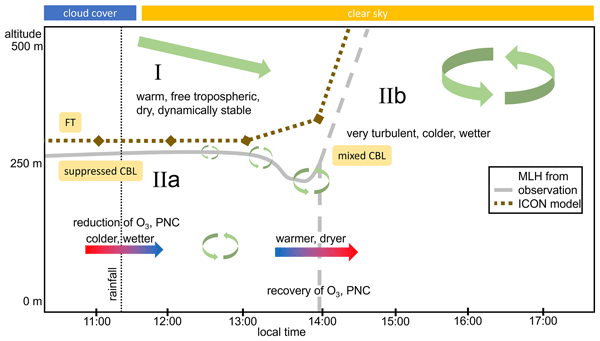
We examine boundary layer (BL) processes during summer rain in Germany, focusing on air mass exchange and precipitation effects. Using drone and ground observations, and ICON (ICOsahedral Nonhydrostatic) model data, we link delayed BL breakup and weak vertical mixing to aerosol formation and chemical processes. ICON predicts mixing layer height under stable conditions but underestimates it during cold pool events, enhancing understanding of frontal weather scenarios and atmospheric changes.
Christine Borchers, Lasse Moormann, Bastien Geil, Niklas Karbach, David Wasserzier, and Thorsten Hoffmann
Atmos. Meas. Tech., 18, 7231–7242, https://doi.org/10.5194/amt-18-7231-2025, https://doi.org/10.5194/amt-18-7231-2025, 2025
Short summary
Short summary
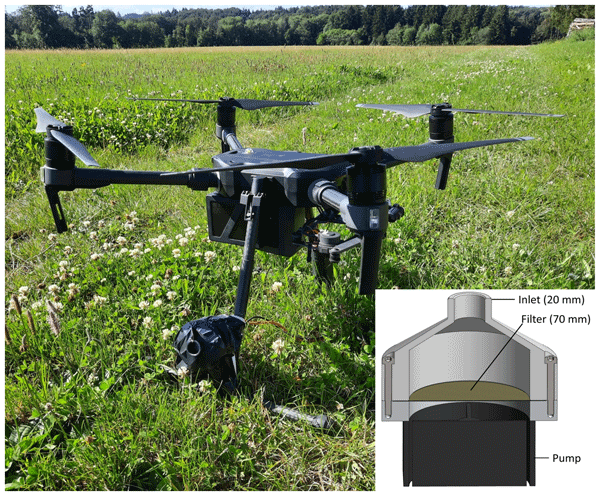
A three-dimensionally printed filter holder is connected to a lightweight, high-performance pump. This sampling system allows for easy and cost-effective measurements of organic aerosols at different heights and locations. By elucidating the chemical composition of organic aerosol, sources and processing of the compounds can be identified. Measurements at different altitudes and times of the day provide insight into the chemical aging and daytime trends of the aerosol particles.
Lasse Moormann, Thomas Böttger, Philipp Schuhmann, Luis Valero, Friederike Fachinger, and Frank Drewnick
Atmos. Meas. Tech., 18, 1441–1459, https://doi.org/10.5194/amt-18-1441-2025, https://doi.org/10.5194/amt-18-1441-2025, 2025
Short summary
Short summary
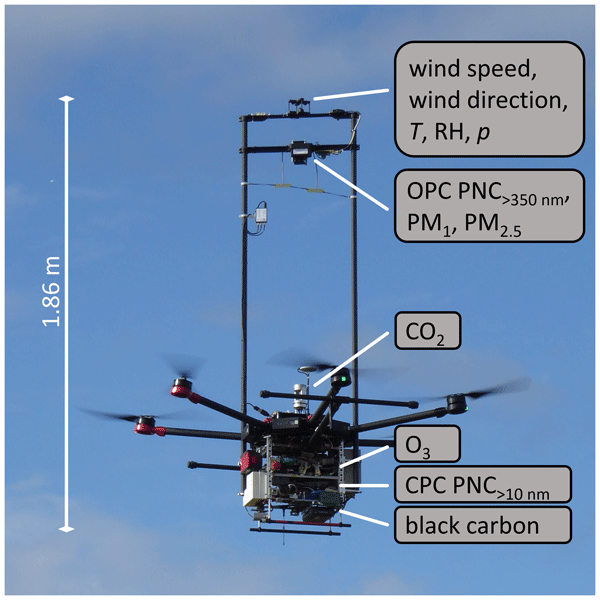
The drone-based Flying Laboratory FLab was developed to simultaneously measure aerosol (number concentration, size distribution, and black carbon), trace gas (O3, CO2), and meteorological variables. FLab was characterized in the field regarding limitations and biases due to different flight maneuvers. Two application cases are presented: analysis of the development of the lowermost troposphere (up to 300 m) and successfully bridging ground-based and aircraft- and radiosonde-based measurements.
Julia Pikmann, Lasse Moormann, Frank Drewnick, and Stephan Borrmann
Atmos. Meas. Tech., 16, 1323–1341, https://doi.org/10.5194/amt-16-1323-2023, https://doi.org/10.5194/amt-16-1323-2023, 2023
Short summary
Short summary
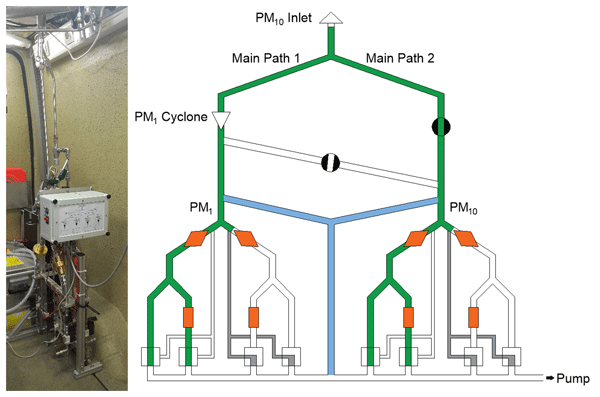
Aerosols measured in complex environments are usually a mixture of emissions from different sources. To characterize sources individually, we developed a sampling system for particles and organic trace gases which is coupled to real-time data of physical and chemical aerosol properties, gas concentrations, and meteorological variables. Using suitable sampling conditions for individual aerosols which are compared with the real-time data the desired aerosols are sampled separately from each other.
Adrienne Jeske, J. Moritz Menken, Gustavo C. Cuchiara, Hendrik Ranocha, Mary C. Barth, and Holger Tost
EGUsphere, https://doi.org/10.5194/egusphere-2026-4821, https://doi.org/10.5194/egusphere-2026-4821, 2026
This preprint is open for discussion and under review for Geoscientific Model Development (GMD).
Short summary
Short summary
The most vigorous vertical velocities in the atmosphere are found in thunderstorms. Within these cumulonimbus clouds, trace gases can be quickly redistributed vertically and also interact with cloud hydrometeors. We present the new model Mainz Convective Transport and Scavenging (MCTS), which includes both the redistribution of trace gases due to transport and the processing by cloud hydrometeors. The new model is compared against aircraft observations and the global model EMAC.
Nicolas Emig, Annette Miltenberger, Heiko Bozem, Martina Krämer, Armin Afchine, Daniel Kunkel, Hans-Christoph Lachnitt, Yun Li, Philipp Reutter, Christian Rolf, Nicole Spelten, Holger Tost, and Peter Hoor
EGUsphere, https://doi.org/10.5194/egusphere-2026-4614, https://doi.org/10.5194/egusphere-2026-4614, 2026
This preprint is open for discussion and under review for Atmospheric Chemistry and Physics (ACP).
Short summary
Short summary
In this study we show mixing of ice particles across the extratropical tropopause via turbulence in the jet shear zone based on in situ measurements from the TPEx campaign over the North Sea, combined with Lagrangian model analysis. Trace gas correlations and subsaturated ice particles constrain the timing and mechanism, while backward trajectories indicate suitable turbulent conditions beforehand. This process possibly impacts the water vapour budget of the extratropical lowermost stratosphere.
Linda Smoydzin, Vera Bense, Heiko Bozem, Philipp Joppe, Daniel Kunkel, Hans-Christoph Lachnitt, Holger Tost, Andreas Zahn, Helmut Ziereis, Martin Riese, and Peter Hoor
Atmos. Chem. Phys., 26, 11857–11874, https://doi.org/10.5194/acp-26-11857-2026, https://doi.org/10.5194/acp-26-11857-2026, 2026
Short summary
Short summary
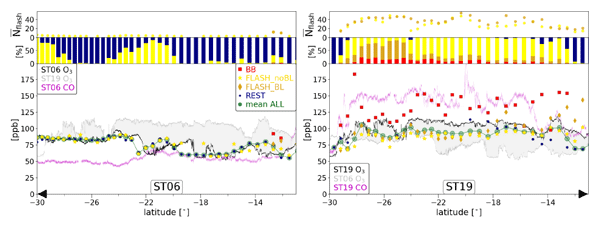
During a research flight in early October elevated upper tropospheric mixing ratios of CO, NO, NOy and O3 were observed over a distance of more than 1000 km east of the Brasilian coast. Ozone mixing ratios are 20–40 ppbv higher than during a flight in early September. By combining aircraft observations with model simulations we find that ozone production from biomass burning over Amazonia caused predominantly the ozone enhancements which have a local effect on the radiative forcing of 50 mW m−2.
Samuel Ruhl, Matthias Kohl, Rima Baalbaki, Christos Xenofontos, Ryan Vella, Sergey Gromov, Xu-Cheng He, Jiali Shen, Dina Alfaouri, Samira Atabakhsh, Lubna Dada, Jenna DeVivo, Jonathan Duplissy, Imad El Haddad, Hartwig Harder, Tuija Jokinen, Heikki Junninen, Vijay P. Kanawade, Milin K. Sebastian, Hannah Klebach, Markku Kulmala, Felix Kunkler, Jos Lelieveld, Katrianne Lehtipalo, Clara J. Lietzke, Lu Liu, Roy Mauldin, Bernhard Mentler, Ottmar Möhler, Tuukka Petäjä, Douglas M. Russell, Mario Simon, Roseline C. Thakur, Wenjuan Yu, Jiangyi Zhang, Zhensen Zheng, Jasper Kirkby, Holger Tost, Theodoros Christoudias, Rolf Sander, and Andrea Pozzer
EGUsphere, https://doi.org/10.5194/egusphere-2026-4020, https://doi.org/10.5194/egusphere-2026-4020, 2026
This preprint is open for discussion and under review for Atmospheric Chemistry and Physics (ACP).
Short summary
Short summary
Marine microbes release sulfur gases that form tiny particles able to seed clouds. Using a global chemistry-climate model, we compare four schemes for how these gases oxidise and test them against ship and ground measurements. We find that methanesulfonic acid can drive new particle formation as strongly as sulfuric acid over the cold Southern Ocean, supplying around 25 % of the cloud-forming particles there, a natural, climate-relevant source that models often overlook.
Matthias Kohl, Christoph Brühl, Holger Tost, Christos Xenofontos, Theodoros Christoudias, Sergey Gromov, Oliver Appel, Stephan Borrmann, Adam Bourassa, Pedro Campunzano-Jost, Yafang Cheng, Oliver Eppers, Karl D. Froyd, Bruna A. Holanda, Jose L. Jimenez, Patrick Jöckel, Philipp Joppe, Katharina Kaiser, Joseph M. Katich, Klaus Klingmüller, Franziska Köllner, Agnieszka Kupc, Anna Martin, Christopher Pöhlker, Mira L. Pöhlker, Ulrich Pöschl, Landon Rieger, Samuel Ruhl, Gregory P. Schill, Johannes Schneider, Christiane Schulz, Joshua P. Schwarz, Alexandra P. Tsimpidi, Ryan Vella, Christina J. Williamson, Yifan Yang, Daniel Zawada, Jos Lelieveld, and Andrea Pozzer
EGUsphere, https://doi.org/10.5194/egusphere-2026-3649, https://doi.org/10.5194/egusphere-2026-3649, 2026
Short summary
Short summary
Aerosols are crucial for Earth's climate, yet their vertical distribution remains poorly understood. We present first consistent global simulations of aerosol distributions and composition from the Earth's surface to the stratosphere, validated by extensive observations. Key findings include a global minimum in aerosol mass in the free troposphere, a significant contribution of organic aerosol in the lower stratosphere, and limited transport of primary particles to the stratosphere.
Lasse Moormann, Friederike Fachinger, Frank Drewnick, and Holger Tost
Atmos. Chem. Phys., 26, 8455–8474, https://doi.org/10.5194/acp-26-8455-2026, https://doi.org/10.5194/acp-26-8455-2026, 2026
Short summary
Short summary
We examine boundary layer (BL) processes during summer rain in Germany, focusing on air mass exchange and precipitation effects. Using drone and ground observations, and ICON (ICOsahedral Nonhydrostatic) model data, we link delayed BL breakup and weak vertical mixing to aerosol formation and chemical processes. ICON predicts mixing layer height under stable conditions but underestimates it during cold pool events, enhancing understanding of frontal weather scenarios and atmospheric changes.
Jianzhong Ma, Bin Chen, Qianshan He, Xiaolu Yan, Gaili Wang, Siyang Cheng, Benedikt Steil, Christoph Brühl, Holger Tost, Michael Höpfner, Andrea Pozzer, and Jos Lelieveld
Atmos. Chem. Phys., 26, 8125–8144, https://doi.org/10.5194/acp-26-8125-2026, https://doi.org/10.5194/acp-26-8125-2026, 2026
Short summary
Short summary
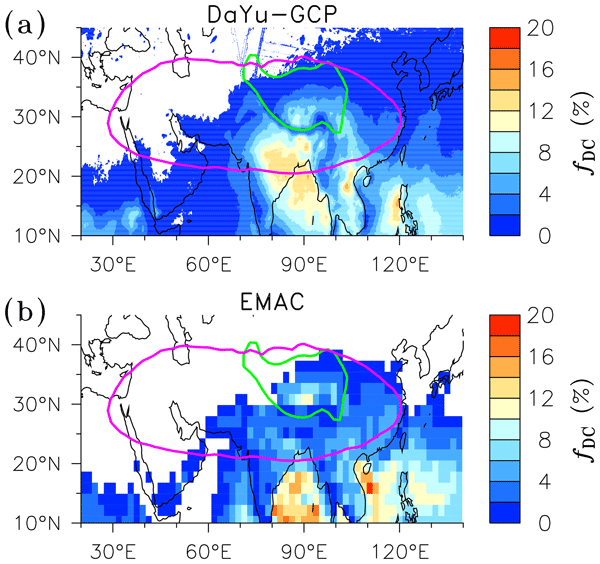
We use a global atmospheric chemistry and climate model to study the efficiency and effectiveness of the deep convective transport of CO, NH3 and SO2 from the planetary boundary layer into the Asian summer monsoon anticyclone. We find that in contrast to CO and NH3, the SO2 enhancements within the anticyclone are very weak. The wet scavenging over South Asia is more effective for SO2 than NH3 at reducing their amounts reaching the Tibetan Plateau and the Asian summer monsoon anticyclone.
Patrick Dewald, Tobias Seubert, Laura Wüst, Jan Schuladen, Frank Drewnick, Friederike Fachinger, Thorsten Hoffmann, and John N. Crowley
Atmos. Meas. Tech., 19, 3445–3457, https://doi.org/10.5194/amt-19-3445-2026, https://doi.org/10.5194/amt-19-3445-2026, 2026
Short summary
Short summary
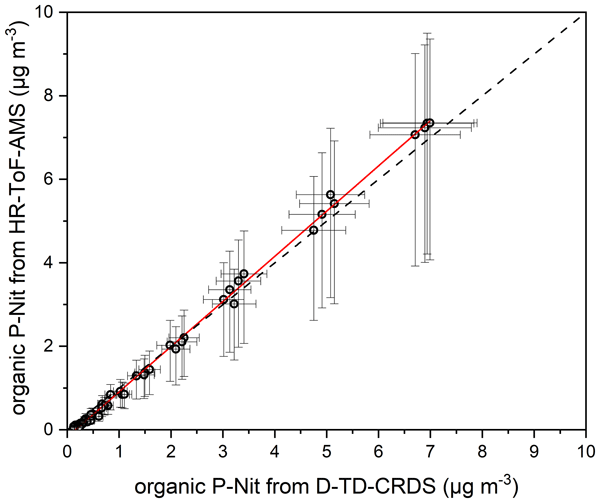
We have developed and tested an instrument that quantitatively detects particulate nitrate. Gas-phase reactive nitrogen species are denuded using an active-carbon surface and particle nitrate is converted to NO2, which is detected using cavity-ringdown-spectroscopy. Key to accurate measurement of particulate nitrate is drying of the sampled air. Excellent agreement with an aerosol-mass-spectrometer indicates that the instrument detects both organic and inorganic nitrate particle mass accurately.

Chun Hang Chau, Peter Hoor, Katharina Kaiser, and Holger Tost
Atmos. Chem. Phys., 26, 3637–3652, https://doi.org/10.5194/acp-26-3637-2026, https://doi.org/10.5194/acp-26-3637-2026, 2026
Short summary
Short summary
This study examines the potential impact of different greenhouse gases to vertical mixing by clear air turbulence in the upper troposphere and lower stratosphere . We found that ozone is most sensitive to vertical mixing and could lead to cooling at the top of the atmosphere by -0.2 W/m2. We also found that the vertical mixing by clear air turbulence could lead to changes in atmospheric chemistry including changing the methane lifetime and the ozone sensitivity.
Luis Valero, Konrad Kandler, Sina Jost, Holger Tost, Luca Katarina Eichhorn, Christian von Glahn, Harald Rott, Marilena Flory, Alexandre Baron, Kathie Smith, Troy Thornberry, and Ralf Weigel
EGUsphere, https://doi.org/10.5194/egusphere-2025-5568, https://doi.org/10.5194/egusphere-2025-5568, 2025
Preprint archived
Short summary
Short summary
We developed a low-cost, balloon-lifted platform with lightweight instruments to measure particles and collect samples. We tested this platform during two field campaigns in Germany. A case study showed its ability to observe the vertical distribution of particles and how they form cloud droplets. Electronic microscope analysis of the samples identified their chemical composition. This work shows the platform is a capable tool for studying atmospheric processes.
Christine Borchers, Lasse Moormann, Bastien Geil, Niklas Karbach, David Wasserzier, and Thorsten Hoffmann
Atmos. Meas. Tech., 18, 7231–7242, https://doi.org/10.5194/amt-18-7231-2025, https://doi.org/10.5194/amt-18-7231-2025, 2025
Short summary
Short summary
A three-dimensionally printed filter holder is connected to a lightweight, high-performance pump. This sampling system allows for easy and cost-effective measurements of organic aerosols at different heights and locations. By elucidating the chemical composition of organic aerosol, sources and processing of the compounds can be identified. Measurements at different altitudes and times of the day provide insight into the chemical aging and daytime trends of the aerosol particles.
Adrienne Jeske and Holger Tost
Atmos. Chem. Phys., 25, 14435–14448, https://doi.org/10.5194/acp-25-14435-2025, https://doi.org/10.5194/acp-25-14435-2025, 2025
Short summary
Short summary
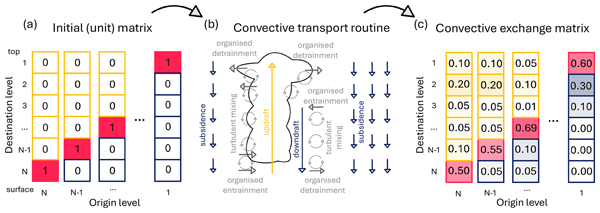
Thunderstorms lead to a vertical redistribution of tracers throughout the troposphere. We applied a new tool, the convective exchange matrix, in historical simulations with a chemistry–climate model to investigate the trends in convective transport. This reveals that convection reaches higher but that deep convection occurs less often in the time period from 2011 to 2020 than in the 1980s. Thus, convective transport towards the upper troposphere has declined as an adaptation to climate change.
Chun Hang Chau, Peter Hoor, and Holger Tost
Atmos. Chem. Phys., 25, 13123–13140, https://doi.org/10.5194/acp-25-13123-2025, https://doi.org/10.5194/acp-25-13123-2025, 2025
Short summary
Short summary
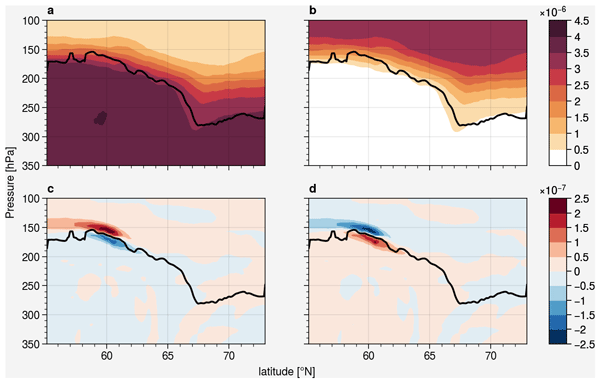
This study examines how the turbulence in the upper troposphere/lower stratosphere (UTLS) could modify the tracer distribution under different situations. Using a multi-scale chemistry model with a novel diagnostic, we found that both the pre-existing tracer gradient and the dynamical and thermodynamical forcing play a role in modifying the tracer distribution. These results allow further research on the UTLS turbulent mixing and its implications for the climate system.
Sarah Brüning and Holger Tost
Atmos. Chem. Phys., 25, 10797–10822, https://doi.org/10.5194/acp-25-10797-2025, https://doi.org/10.5194/acp-25-10797-2025, 2025
Short summary
Short summary
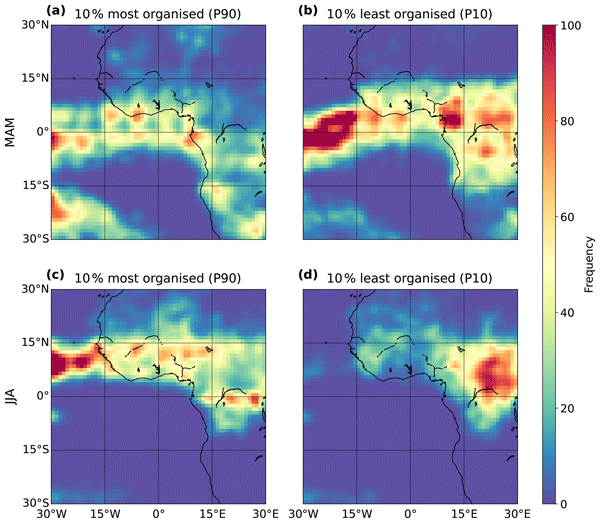
The connection between convective clouds and severe weather demands a robust characterisation of convective organisation. This study investigates spatio-temporal patterns of convective organisation and their relationship to machine-learning-based 3D cloud properties through a combination of different indices. We analyse how organisation affects cloud and core properties in a tropical domain, revealing overlapping effects of strong and weak organisation that may frequently blur statistics.
Sarah Brüning and Holger Tost
Atmos. Chem. Phys., 25, 10773–10795, https://doi.org/10.5194/acp-25-10773-2025, https://doi.org/10.5194/acp-25-10773-2025, 2025
Short summary
Short summary
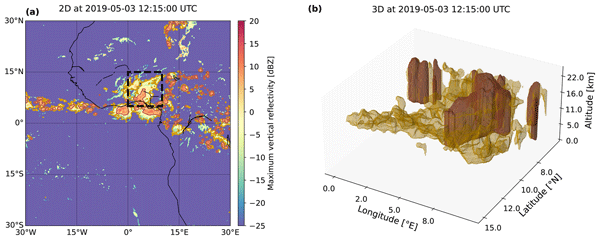
This study analyses the temporal variability and life cycle of 3D convective clouds characteristics in the tropics. We derive the data from a machine-learning-based 3D extrapolation of high-resolution 2D satellite data and an object-based detection algorithm. Cloud properties are not only affected by the surface type. Instead, our findings highlight the impact of convective cores on horizontal and vertical cloud and core properties and a potential prolonging of the cloud life cycle.
Sina Jost, Ralf Weigel, Konrad Kandler, Luis Valero, Jessica Girdwood, Chris Stopford, Warren Stanley, Luca K. Eichhorn, Christian von Glahn, and Holger Tost
Atmos. Meas. Tech., 18, 4397–4412, https://doi.org/10.5194/amt-18-4397-2025, https://doi.org/10.5194/amt-18-4397-2025, 2025
Short summary
Short summary
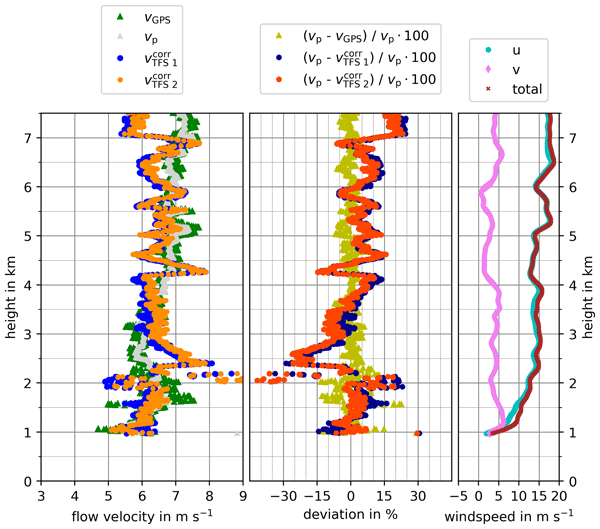
For the balloon-borne detection of particles (diameter 0.4 < Dp < 40 µm), the Universal Cloud and Aerosol Sounding System (UCASS) was used, whose sample flow is determined by GPS-measured ascent rates. In flights, actual UCASS sample flows rarely match the ascent rates. Errors are minimised by real-time detection of the UCASS flows, e.g. by implementing a thermal flow sensor (TFS) within the UCASS. The TFSs were tested in flight and calibrated at up to 10 m s−1 and at variable angles of attack.

Ryan Vella, Sergey Gromov, Clara M. Nussbaumer, Laura Stecher, Matthias Kohl, Samuel Ruhl, Holger Tost, Jos Lelieveld, and Andrea Pozzer
Atmos. Chem. Phys., 25, 9885–9904, https://doi.org/10.5194/acp-25-9885-2025, https://doi.org/10.5194/acp-25-9885-2025, 2025
Short summary
Short summary
This work examines the impact of replacing forests with farmland and grazing areas on atmospheric composition. Using a global climate–chemistry model, we found that deforestation reduces biogenic volatile organic compounds (BVOCs), increases farming emissions, and shifts ozone chemistry. These changes result in a slight cooling effect on the climate. Restoring natural vegetation could reverse some of these effects.
Matthias Kohl, Christoph Brühl, Jennifer Schallock, Holger Tost, Patrick Jöckel, Adrian Jost, Steffen Beirle, Michael Höpfner, and Andrea Pozzer
Geosci. Model Dev., 18, 3985–4007, https://doi.org/10.5194/gmd-18-3985-2025, https://doi.org/10.5194/gmd-18-3985-2025, 2025
Short summary
Short summary
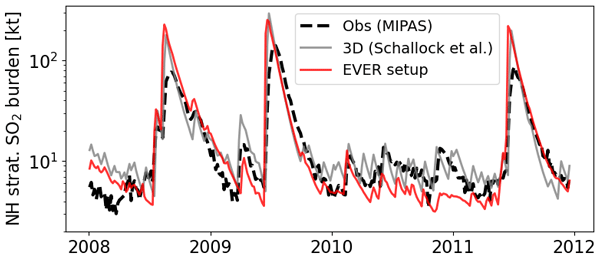
SO2 from explosive volcanic eruptions reaching the stratosphere can oxidize and form sulfur aerosols, potentially persisting for several years. We developed a new submodel, Explosive Volcanic ERuptions (EVER), that seamlessly includes stratospheric volcanic SO2 emissions in global numerical simulations based on a novel standard historical model setup, successfully evaluated with satellite observations. Sensitivity studies on the Nabro eruption in 2011 evaluate different emission methods.
Lasse Moormann, Thomas Böttger, Philipp Schuhmann, Luis Valero, Friederike Fachinger, and Frank Drewnick
Atmos. Meas. Tech., 18, 1441–1459, https://doi.org/10.5194/amt-18-1441-2025, https://doi.org/10.5194/amt-18-1441-2025, 2025
Short summary
Short summary
The drone-based Flying Laboratory FLab was developed to simultaneously measure aerosol (number concentration, size distribution, and black carbon), trace gas (O3, CO2), and meteorological variables. FLab was characterized in the field regarding limitations and biases due to different flight maneuvers. Two application cases are presented: analysis of the development of the lowermost troposphere (up to 300 m) and successfully bridging ground-based and aircraft- and radiosonde-based measurements.
Ryan Vella, Matthew Forrest, Andrea Pozzer, Alexandra P. Tsimpidi, Thomas Hickler, Jos Lelieveld, and Holger Tost
Atmos. Chem. Phys., 25, 243–262, https://doi.org/10.5194/acp-25-243-2025, https://doi.org/10.5194/acp-25-243-2025, 2025
Short summary
Short summary
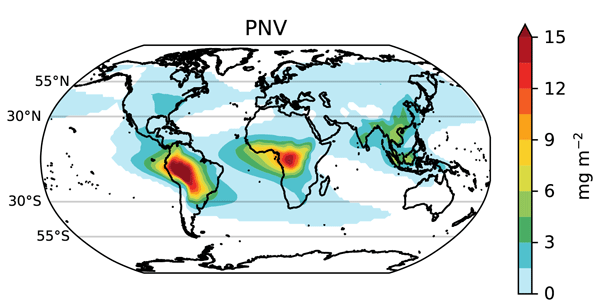
This study examines how land cover changes influence biogenic volatile organic compound (BVOC) emissions and atmospheric states. Using a coupled chemistry–climate–vegetation model, we compare present-day land cover (deforested for crops and grazing) with natural vegetation and an extreme reforestation scenario. We find that vegetation changes significantly impact global BVOC emissions and organic aerosols but have a relatively small effect on total aerosols, clouds, and radiative effects.
Julia Pikmann, Frank Drewnick, Friederike Fachinger, and Stephan Borrmann
Atmos. Chem. Phys., 24, 12295–12321, https://doi.org/10.5194/acp-24-12295-2024, https://doi.org/10.5194/acp-24-12295-2024, 2024
Short summary
Short summary
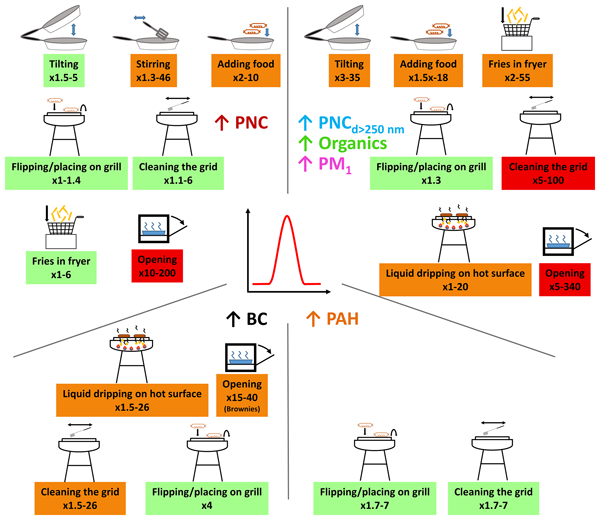
Cooking activities can contribute substantially to indoor and ambient aerosol. We performed a comprehensive study with laboratory measurements cooking 19 different dishes and ambient measurements at two Christmas markets measuring various particle properties and trace gases of emissions in real time. Similar emission characteristics were observed for dishes with the same preparation method, mainly due to similar cooking temperature and use of oil, with barbecuing as an especially strong source.
Anna Martin, Veronika Gayler, Benedikt Steil, Klaus Klingmüller, Patrick Jöckel, Holger Tost, Jos Lelieveld, and Andrea Pozzer
Geosci. Model Dev., 17, 5705–5732, https://doi.org/10.5194/gmd-17-5705-2024, https://doi.org/10.5194/gmd-17-5705-2024, 2024
Short summary
Short summary
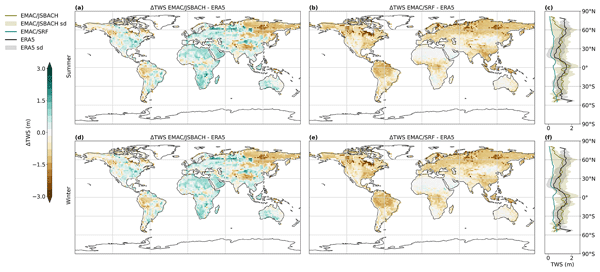
The study evaluates the land surface and vegetation model JSBACHv4 as a replacement for the simplified submodel SURFACE in EMAC. JSBACH mitigates earlier problems of soil dryness, which are critical for vegetation modelling. When analysed using different datasets, the coupled model shows strong correlations of key variables, such as land surface temperature, surface albedo and radiation flux. The versatility of the model increases significantly, while the overall performance does not degrade.
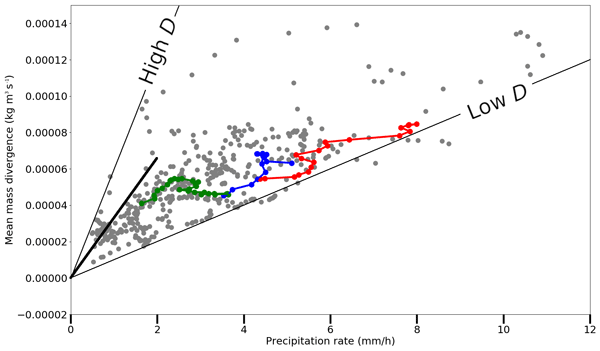
Edward Groot, Patrick Kuntze, Annette Miltenberger, and Holger Tost
Weather Clim. Dynam., 5, 779–803, https://doi.org/10.5194/wcd-5-779-2024, https://doi.org/10.5194/wcd-5-779-2024, 2024
Short summary
Short summary
Deep convective clouds (thunderstorms), which may cause severe weather, tend to coherently organise into structured cloud systems. Accurate representation of these systems in models is difficult due to their complex dynamics and, in numerical simulations, the dependence of their dynamics on resolution. Here, the effect of convective organisation and geometry on their outflow winds (altitudes of 7–14 km) is investigated. Representation of their dynamics and outflows improves at higher resolution.
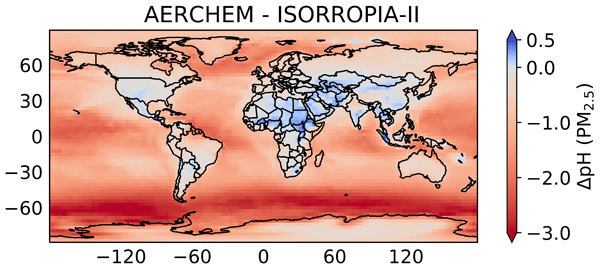
Simon Rosanka, Holger Tost, Rolf Sander, Patrick Jöckel, Astrid Kerkweg, and Domenico Taraborrelli
Geosci. Model Dev., 17, 2597–2615, https://doi.org/10.5194/gmd-17-2597-2024, https://doi.org/10.5194/gmd-17-2597-2024, 2024
Short summary
Short summary
The capabilities of the Modular Earth Submodel System (MESSy) are extended to account for non-equilibrium aqueous-phase chemistry in the representation of deliquescent aerosols. When applying the new development in a global simulation, we find that MESSy's bias in modelling routinely observed reduced inorganic aerosol mass concentrations, especially in the United States. Furthermore, the representation of fine-aerosol pH is particularly improved in the marine boundary layer.
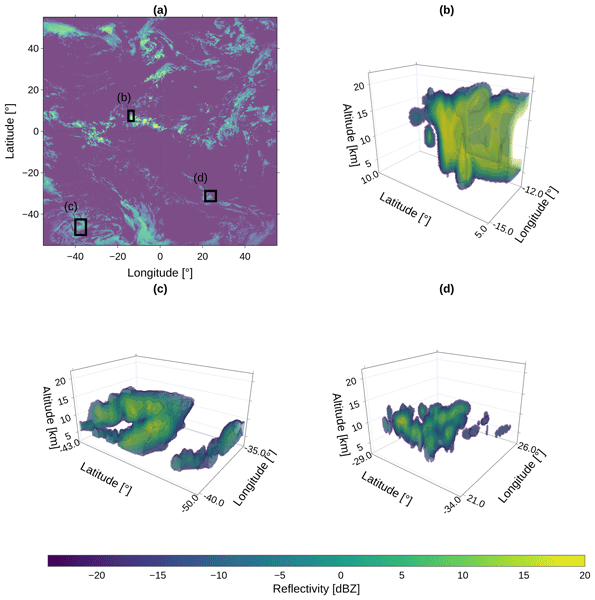
Sarah Brüning, Stefan Niebler, and Holger Tost
Atmos. Meas. Tech., 17, 961–978, https://doi.org/10.5194/amt-17-961-2024, https://doi.org/10.5194/amt-17-961-2024, 2024
Short summary
Short summary
We apply the Res-UNet to derive a comprehensive 3D cloud tomography from 2D satellite data over heterogeneous landscapes. We combine observational data from passive and active remote sensing sensors by an automated matching algorithm. These data are fed into a neural network to predict cloud reflectivities on the whole satellite domain between 2.4 and 24 km height. With an average RMSE of 2.99 dBZ, we contribute to closing data gaps in the representation of clouds in observational data.
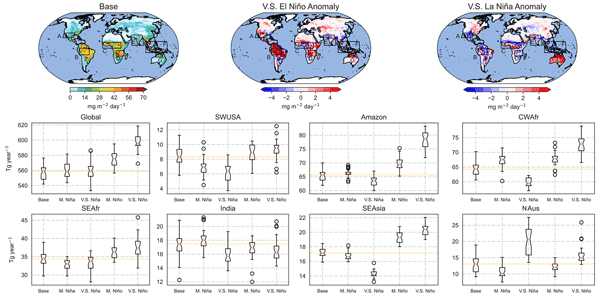
Ryan Vella, Andrea Pozzer, Matthew Forrest, Jos Lelieveld, Thomas Hickler, and Holger Tost
Biogeosciences, 20, 4391–4412, https://doi.org/10.5194/bg-20-4391-2023, https://doi.org/10.5194/bg-20-4391-2023, 2023
Short summary
Short summary
We investigated the effect of the El Niño–Southern Oscillation (ENSO) on biogenic volatile organic compound (BVOC) emissions from plants. ENSO events can cause a significant increase in these emissions, which have a long-term impact on the Earth's atmosphere. Persistent ENSO conditions can cause long-term changes in vegetation, resulting in even higher BVOC emissions. We link ENSO-induced emission anomalies with driving atmospheric and vegetational variables.
Edward Groot and Holger Tost
Atmos. Chem. Phys., 23, 6065–6081, https://doi.org/10.5194/acp-23-6065-2023, https://doi.org/10.5194/acp-23-6065-2023, 2023
Short summary
Short summary
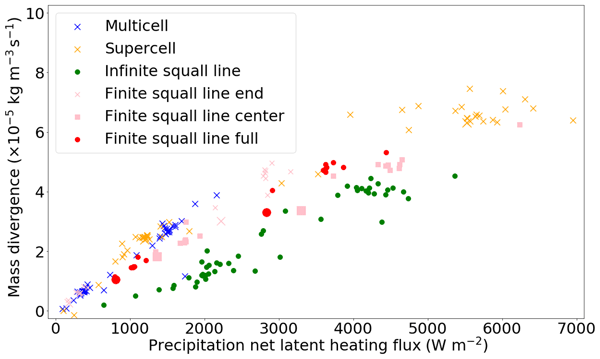
It is shown that the outflow from cumulonimbus clouds or thunderstorms in the upper troposphere and lower stratosphere in idealized high-resolution simulations (LESs) depends linearly on the net amount of latent heat released by the cloud for fixed geometry of the clouds. However, it is shown that, in more realistic situations, convective organization and aggregation (collecting mechanisms of cumulonimbus clouds) affect the amount of outflow non-linearly through non-idealized geometry.
Julia Pikmann, Lasse Moormann, Frank Drewnick, and Stephan Borrmann
Atmos. Meas. Tech., 16, 1323–1341, https://doi.org/10.5194/amt-16-1323-2023, https://doi.org/10.5194/amt-16-1323-2023, 2023
Short summary
Short summary
Aerosols measured in complex environments are usually a mixture of emissions from different sources. To characterize sources individually, we developed a sampling system for particles and organic trace gases which is coupled to real-time data of physical and chemical aerosol properties, gas concentrations, and meteorological variables. Using suitable sampling conditions for individual aerosols which are compared with the real-time data the desired aerosols are sampled separately from each other.
Ryan Vella, Matthew Forrest, Jos Lelieveld, and Holger Tost
Geosci. Model Dev., 16, 885–906, https://doi.org/10.5194/gmd-16-885-2023, https://doi.org/10.5194/gmd-16-885-2023, 2023
Short summary
Short summary
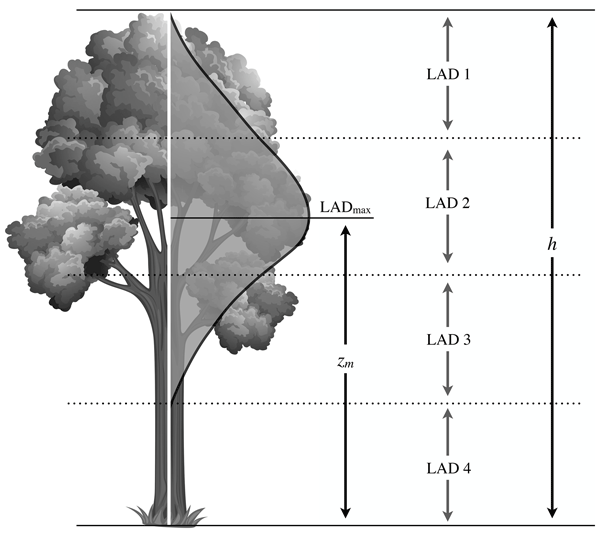
Biogenic volatile organic compounds (BVOCs) are released by vegetation and have a major impact on atmospheric chemistry and aerosol formation. Non-interacting vegetation constrains the majority of numerical models used to estimate global BVOC emissions, and thus, the effects of changing vegetation on emissions are not addressed. In this work, we replace the offline vegetation with dynamic vegetation states by linking a chemistry–climate model with a global dynamic vegetation model.
Edward Groot and Holger Tost
Atmos. Chem. Phys., 23, 565–585, https://doi.org/10.5194/acp-23-565-2023, https://doi.org/10.5194/acp-23-565-2023, 2023
Short summary
Short summary
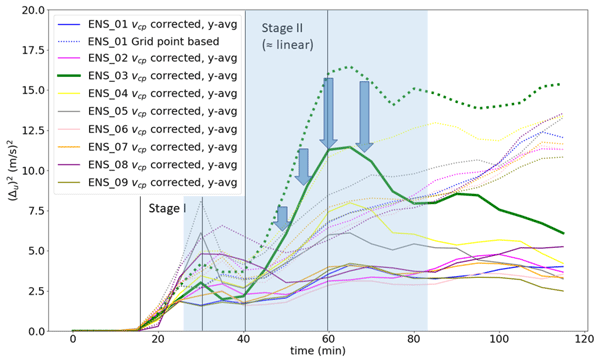
Thunderstorm systems play an important role in the dynamics of the Earth’s atmosphere, and some of them form a well-organised line: squall lines. Simulations of such squall lines with very small initial perturbations are compared to a reference simulation. The evolution of perturbations and processes amplifying them are analysed. It is shown that the formation of new secondary thunderstorm cells (after the initial primary cells) directly ahead of the line affects the spread strongly.

Mohamed Abdelkader, Georgiy Stenchikov, Andrea Pozzer, Holger Tost, and Jos Lelieveld
Atmos. Chem. Phys., 23, 471–500, https://doi.org/10.5194/acp-23-471-2023, https://doi.org/10.5194/acp-23-471-2023, 2023
Short summary
Short summary
We study the effect of injected volcanic ash, water vapor, and SO2 on the development of the volcanic cloud and the stratospheric aerosol optical depth (AOD). Both are sensitive to the initial injection height and to the aging of the volcanic ash shaped by heterogeneous chemistry coupled with the ozone cycle. The paper explains the large differences in AOD for different injection scenarios, which could improve the estimate of the radiative forcing of volcanic eruptions.
Oliver Appel, Franziska Köllner, Antonis Dragoneas, Andreas Hünig, Sergej Molleker, Hans Schlager, Christoph Mahnke, Ralf Weigel, Max Port, Christiane Schulz, Frank Drewnick, Bärbel Vogel, Fred Stroh, and Stephan Borrmann
Atmos. Chem. Phys., 22, 13607–13630, https://doi.org/10.5194/acp-22-13607-2022, https://doi.org/10.5194/acp-22-13607-2022, 2022
Short summary
Short summary
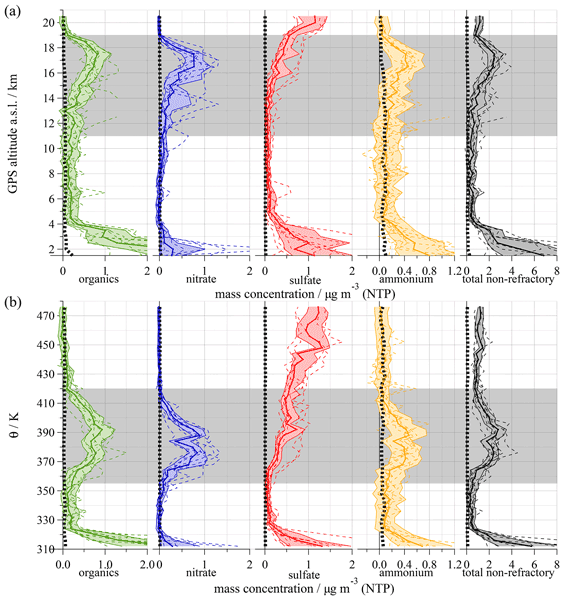
This paper clarifies the chemical composition of the Asian tropopause aerosol layer (ATAL) by means of airborne in situ aerosol mass spectrometry (AMS). Ammonium nitrate and organics are found to significantly contribute to the particle layer, while sulfate does not show a layered structure. An analysis of the single-particle mass spectra suggests that secondary particle formation and subsequent growth dominate the particle composition, rather than condensation on pre-existing primary particles.
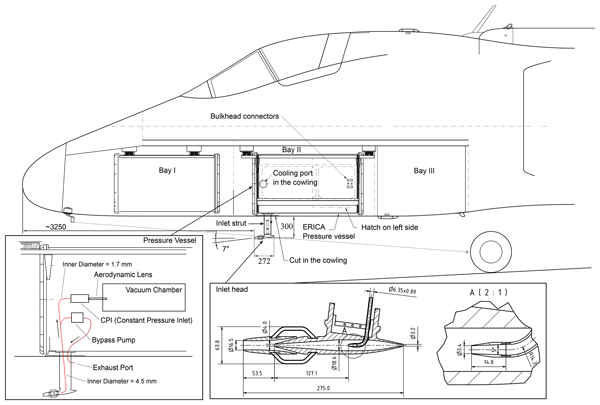
Antonis Dragoneas, Sergej Molleker, Oliver Appel, Andreas Hünig, Thomas Böttger, Markus Hermann, Frank Drewnick, Johannes Schneider, Ralf Weigel, and Stephan Borrmann
Atmos. Meas. Tech., 15, 5719–5742, https://doi.org/10.5194/amt-15-5719-2022, https://doi.org/10.5194/amt-15-5719-2022, 2022
Short summary
Short summary
The ERICA is a specially designed aerosol particle mass spectrometer for in situ, real-time chemical composition analysis of aerosols. It can operate completely autonomously, in the absence of an instrument operator. Its design has enabled its operation under harsh conditions, like those experienced in the upper troposphere and lower stratosphere, aboard unpressurized high-altitude research aircraft. The instrument has successfully participated in several aircraft operations around the world.
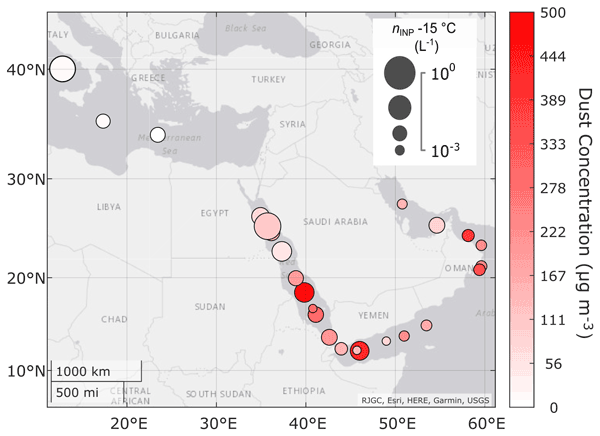
Charlotte M. Beall, Thomas C. J. Hill, Paul J. DeMott, Tobias Köneman, Michael Pikridas, Frank Drewnick, Hartwig Harder, Christopher Pöhlker, Jos Lelieveld, Bettina Weber, Minas Iakovides, Roman Prokeš, Jean Sciare, Meinrat O. Andreae, M. Dale Stokes, and Kimberly A. Prather
Atmos. Chem. Phys., 22, 12607–12627, https://doi.org/10.5194/acp-22-12607-2022, https://doi.org/10.5194/acp-22-12607-2022, 2022
Short summary
Short summary
Ice-nucleating particles (INPs) are rare aerosols that can trigger ice formation in clouds and affect climate-relevant cloud properties such as phase, reflectivity and lifetime. Dust is the dominant INP source, yet few measurements have been reported near major dust sources. We report INP observations within hundreds of kilometers of the biggest dust source regions globally: the Sahara and the Arabian Peninsula. Results show that at temperatures > −15 °C, INPs are dominated by organics.
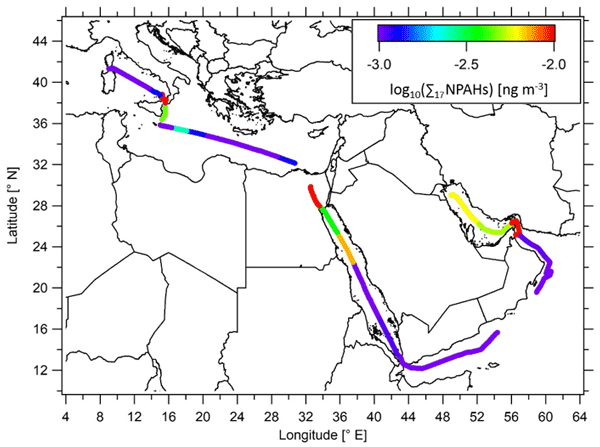
Marco Wietzoreck, Marios Kyprianou, Benjamin A. Musa Bandowe, Siddika Celik, John N. Crowley, Frank Drewnick, Philipp Eger, Nils Friedrich, Minas Iakovides, Petr Kukučka, Jan Kuta, Barbora Nežiková, Petra Pokorná, Petra Přibylová, Roman Prokeš, Roland Rohloff, Ivan Tadic, Sebastian Tauer, Jake Wilson, Hartwig Harder, Jos Lelieveld, Ulrich Pöschl, Euripides G. Stephanou, and Gerhard Lammel
Atmos. Chem. Phys., 22, 8739–8766, https://doi.org/10.5194/acp-22-8739-2022, https://doi.org/10.5194/acp-22-8739-2022, 2022
Short summary
Short summary
A unique dataset of concentrations and sources of polycyclic aromatic hydrocarbons (PAHs) and their alkylated, oxygenated and nitrated derivatives, in total 74 individual species, in the marine atmosphere is presented. Exposure to these substances poses a major health risk. We found very low concentrations over the Arabian Sea, while both local and long-range-transported pollution caused elevated levels over the Mediterranean Sea and the Arabian Gulf.
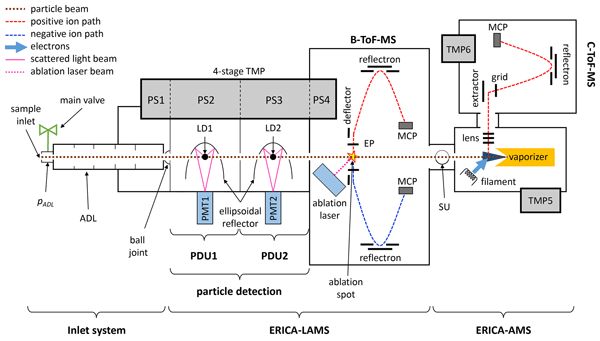
Andreas Hünig, Oliver Appel, Antonis Dragoneas, Sergej Molleker, Hans-Christian Clemen, Frank Helleis, Thomas Klimach, Franziska Köllner, Thomas Böttger, Frank Drewnick, Johannes Schneider, and Stephan Borrmann
Atmos. Meas. Tech., 15, 2889–2921, https://doi.org/10.5194/amt-15-2889-2022, https://doi.org/10.5194/amt-15-2889-2022, 2022
Short summary
Short summary
We have serially combined the two well-established methods for in situ real-time measurement of fine particle chemical composition, the single-particle laser ablation method and the flash evaporation with electron impact ionization method, into a novel instrument. Here we present the design; instrument characteristics, as derived from laboratory and field measurements; and results from the first field deployment during the 2017 StratoClim aircraft campaign.
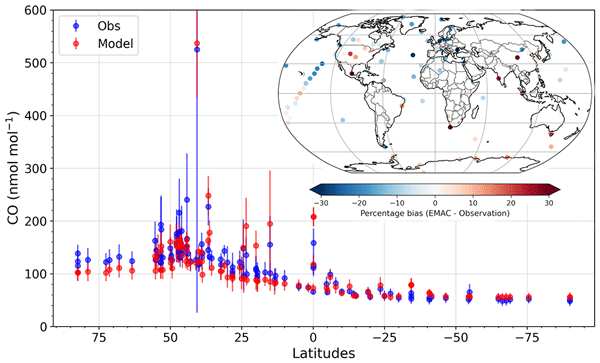
Andrea Pozzer, Simon F. Reifenberg, Vinod Kumar, Bruno Franco, Matthias Kohl, Domenico Taraborrelli, Sergey Gromov, Sebastian Ehrhart, Patrick Jöckel, Rolf Sander, Veronica Fall, Simon Rosanka, Vlassis Karydis, Dimitris Akritidis, Tamara Emmerichs, Monica Crippa, Diego Guizzardi, Johannes W. Kaiser, Lieven Clarisse, Astrid Kiendler-Scharr, Holger Tost, and Alexandra Tsimpidi
Geosci. Model Dev., 15, 2673–2710, https://doi.org/10.5194/gmd-15-2673-2022, https://doi.org/10.5194/gmd-15-2673-2022, 2022
Short summary
Short summary
A newly developed setup of the chemistry general circulation model EMAC (ECHAM5/MESSy for Atmospheric Chemistry) is evaluated here. A comprehensive organic degradation mechanism is used and coupled with a volatility base model.
The results show that the model reproduces most of the tracers and aerosols satisfactorily but shows discrepancies for oxygenated organic gases. It is also shown that this model configuration can be used for further research in atmospheric chemistry.
Cited articles
Andersen, S. T., McGillen, M. R., Xue, C., Seubert, T., Dewald, P., Türk, G. N. T. E., Schuladen, J., Denjean, C., Etienne, J.-C., Garrouste, O., Jamar, M., Harb, S., Cirtog, M., Michoud, V., Cazaunau, M., Bergé, A., Cantrell, C., Dusanter, S., Picquet-Varrault, B., Kukui, A., Mellouki, A., Carpenter, L. J., Lelieveld, J., and Crowley, J. N.: Measurement report: Sources, sinks, and lifetime of NOx in a suburban temperate forest at night, Atmos. Chem. Phys., 24, 11603–11618, https://doi.org/10.5194/acp-24-11603-2024, 2024.
Andreae, M. O., Acevedo, O. C., Araùjo, A., Artaxo, P., Barbosa, C. G. G., Barbosa, H. M. J., Brito, J., Carbone, S., Chi, X., Cintra, B. B. L., da Silva, N. F., Dias, N. L., Dias-Júnior, C. Q., Ditas, F., Ditz, R., Godoi, A. F. L., Godoi, R. H. M., Heimann, M., Hoffmann, T., Kesselmeier, J., Könemann, T., Krüger, M. L., Lavric, J. V., Manzi, A. O., Lopes, A. P., Martins, D. L., Mikhailov, E. F., Moran-Zuloaga, D., Nelson, B. W., Nölscher, A. C., Santos Nogueira, D., Piedade, M. T. F., Pöhlker, C., Pöschl, U., Quesada, C. A., Rizzo, L. V., Ro, C.-U., Ruckteschler, N., Sá, L. D. A., de Oliveira Sá, M., Sales, C. B., dos Santos, R. M. N., Saturno, J., Schöngart, J., Sörgel, M., de Souza, C. M., de Souza, R. A. F., Su, H., Targhetta, N., Tóta, J., Trebs, I., Trumbore, S., van Eijck, A., Walter, D., Wang, Z., Weber, B., Williams, J., Winderlich, J., Wittmann, F., Wolff, S., and Yáñez-Serrano, A. M.: The Amazon Tall Tower Observatory (ATTO): overview of pilot measurements on ecosystem ecology, meteorology, trace gases, and aerosols, Atmos. Chem. Phys., 15, 10723–10776, https://doi.org/10.5194/acp-15-10723-2015, 2015.
Atkinson, R., Aschmann, S. M., Arey, J., and Shorees, B.: Formation of OH radicals in the gas phase reactions of O3 with a series of terpenes, J. Geophys. Res.-Atmos., 97, 6065–6073, https://doi.org/10.1029/92JD00062, 1992.
Bakels, L., Tatsii, D., Tipka, A., Thompson, R., Dütsch, M., Blaschek, M., Seibert, P., Baier, K., Bucci, S., Cassiani, M., Eckhardt, S., Groot Zwaaftink, C., Henne, S., Kaufmann, P., Lechner, V., Maurer, C., Mulder, M. D., Pisso, I., Plach, A., Subramanian, R., Vojta, M., and Stohl, A.: FLEXPART version 11: improved accuracy, efficiency, and flexibility, Geosci. Model Dev., 17, 7595–7627, https://doi.org/10.5194/gmd-17-7595-2024, 2024.
Barbieri, L., Kral, S. T., Bailey, S. C. C., Frazier, A. E., Jacob, J. D., Reuder, J., Brus, D., Chilson, P. B., Crick, C., Detweiler, C., Doddi, A., Elston, J., Foroutan, H., González-Rocha, J., Greene, B. R., Guzman, M. I., Houston, A. L., Islam, A., Kemppinen, O., Lawrence, D., Pillar-Little, E. A., Ross, S. D., Sama, M. P., Schmale, D. G., Schuyler, T. J., Shankar, A., Smith, S. W., Waugh, S., Dixon, C., Borenstein, S., and de Boer, G.: Intercomparison of Small Unmanned Aircraft System (sUAS) Measurements for Atmospheric Science during the LAPSE-RATE Campaign, Sensors, https://doi.org/10.3390/s19092179, 2019.
Behrendt, A., Wulfmeyer, V., Senff, C., Muppa, S. K., Späth, F., Lange, D., Kalthoff, N., and Wieser, A.: Observation of sensible and latent heat flux profiles with lidar, Atmos. Meas. Tech., 13, 3221–3233, https://doi.org/10.5194/amt-13-3221-2020, 2020.
Borchers, C., Moormann, L., Geil, B., Karbach, N., Wasserzier, D., and Hoffmann, T.: Development and use of a lightweight sampling system for height-selective UAV-based measurements of organic aerosol particles, Atmos. Meas. Tech., 18, 7231–7242, https://doi.org/10.5194/amt-18-7231-2025, 2025.
Busch, N. E., Chang, S. W., and Anthes, R. A.: A Multi-Level Model of the Planetary Boundary Layer Suitable for Use with Mesoscale Dynamic Models, J. Appl. Meteorol. Clim., 15, 909–919, https://doi.org/10.1175/1520-0450(1976)015<0909:AMLMOT>2.0.CO;2, 1976.
Cao, R., Li, B., Wang, H.-W., Tao, S., Peng, Z.-R., and He, H.-D.: Vertical and Horizontal Profiles of Particulate Matter and Black Carbon Near Elevated Highways Based on Unmanned Aerial Vehicle Monitoring, Sustainability, https://doi.org/10.3390/su12031204, 2020.
Cava, D., Mortarini, L., Giostra, U., Acevedo, O., and Katul, G.: Submeso Motions and Intermittent Turbulence Across a Nocturnal Low-Level Jet: A Self-Organized Criticality Analogy, Bound.-Lay. Meteorol., 172, 17–43, https://doi.org/10.1007/s10546-019-00441-8, 2019.
Chachere, C. N. and Pu, Z.: Connections Between Cold Air Pools and Mountain Valley Fog Events in Salt Lake City, Pure Appl. Geophys., 173, 3187–3196, https://doi.org/10.1007/s00024-016-1316-x, 2016.
Chilinski, M. T., Markowicz, K. M., Poczta, P., Chojnicki, B. H., Harenda, K. M., Makuch, P., Wang, D., and Stachlewska, I. S.: Vertical Profiles of Aerosol Optical Properties (VIS/NIR) over Wetland Environment: POLIMOS-2018 Field Campaign, Remote Sens., 16, 4580, https://doi.org/10.3390/rs16234580, 2024.
Collaud Coen, M., Praz, C., Haefele, A., Ruffieux, D., Kaufmann, P., and Calpini, B.: Determination and climatology of the planetary boundary layer height above the Swiss plateau by in situ and remote sensing measurements as well as by the COSMO-2 model, Atmos. Chem. Phys., 14, 13205–13221, https://doi.org/10.5194/acp-14-13205-2014, 2014.
Collis, R. T. H. and Ligda, M. G. H.: Laser Radar Echoes from the Clear Atmosphere, Nature, 203, 508–508, https://doi.org/10.1038/203508a0, 1964.
Crueger, T., Giorgetta, M. A., Brokopf, R., Esch, M., Fiedler, S., Hohenegger, C., Kornblueh, L., Mauritsen, T., Nam, C., Naumann, A. K., Peters, K., Rast, S., Roeckner, E., Sakradzija, M., Schmidt, H., Vial, J., Vogel, R., and Stevens, B.: ICON-A, The Atmosphere Component of the ICON Earth System Model: II. Model Evaluation, J. Adv. Model. Earth Sy., 10, 1638–1662, https://doi.org/10.1029/2017ms001233, 2018.
Dai, C., Wang, Q., Kalogiros, J. A., Lenschow, D. H., Gao, Z., and Zhou, M.: Determining Boundary-Layer Height from Aircraft Measurements, Bound.-Lay. Meteorol., 152, 277–302, https://doi.org/10.1007/s10546-014-9929-z, 2014.
Dandou, A., Tombrou, M., Schäfer, K., Emeis, S., Protonotariou, A. P., Bossioli, E., Soulakellis, N., and Suppan, P.: A Comparison Between Modelled and Measured Mixing-Layer Height Over Munich, Bound.-Lay. Meteorol., 131, 425–440, https://doi.org/10.1007/s10546-009-9373-7, 2009.
Debolskiy, A. V., Mortikov, E. V., Glazunov, A. V., and Lüpkes, C.: Evaluation of Surface Layer Stability Functions and Their Extension to First Order Turbulent Closures for Weakly and Strongly Stratified Stable Boundary Layer, Bound.-Lay. Meteorol., 187, 73–93, https://doi.org/10.1007/s10546-023-00784-3, 2023.
Deot, N., Kanawade, V. P., Papetta, A., Baalbaki, R., Pikridas, M., Marenco, F., Kulmala, M., Sciare, J., Lehtipalo, K., and Jokinen, T.: Effect of planetary boundary layer evolution on new particle formation events over Cyprus, Aerosol Res., 3, 139–154, https://doi.org/10.5194/ar-3-139-2025, 2025.
Dewald, P., Nussbaumer, C. M., Schuladen, J., Ringsdorf, A., Edtbauer, A., Fischer, H., Williams, J., Lelieveld, J., and Crowley, J. N.: Fate of the nitrate radical at the summit of a semi-rural mountain site in Germany assessed with direct reactivity measurements, Atmos. Chem. Phys., 22, 7051–7069, https://doi.org/10.5194/acp-22-7051-2022, 2022.
Dewald, P., Seubert, T., Andersen, S. T., Türk, G. N. T. E., Schuladen, J., McGillen, M. R., Denjean, C., Etienne, J.-C., Garrouste, O., Jamar, M., Harb, S., Cirtog, M., Michoud, V., Cazaunau, M., Bergé, A., Cantrell, C., Dusanter, S., Picquet-Varrault, B., Kukui, A., Xue, C., Mellouki, A., Lelieveld, J., and Crowley, J. N.: NO3 reactivity during a summer period in a temperate forest below and above the canopy, Atmos. Chem. Phys., 24, 8983–8997, https://doi.org/10.5194/acp-24-8983-2024, 2024.
Drewnick, F., Böttger, T., von der Weiden-Reinmüller, S.-L., Zorn, S. R., Klimach, T., Schneider, J., and Borrmann, S.: Design of a mobile aerosol research laboratory and data processing tools for effective stationary and mobile field measurements, Atmos. Meas. Tech., 5, 1443–1457, https://doi.org/10.5194/amt-5-1443-2012, 2012.
Duncan Jr., J. B., Bianco, L., Adler, B., Bell, T., Djalalova, I. V., Riihimaki, L., Sedlar, J., Smith, E. N., Turner, D. D., Wagner, T. J., and Wilczak, J. M.: Evaluating convective planetary boundary layer height estimations resolved by both active and passive remote sensing instruments during the CHEESEHEAD19 field campaign, Atmos. Meas. Tech., 15, 2479–2502, https://doi.org/10.5194/amt-15-2479-2022, 2022.
DWD: Model documentation ICON-D2 (Regional model Germany), https://www.dwd.de/DE/leistungen/nwv_icon_d2_modelldokumentation/nwv_icon_d2_modelldokumentation.html (last access: 8 August 2024), 2025.
EEA: EMEP/EEA air pollutant emission inventory guidebook 2023, European Environment Agency, https://doi.org/10.2800/795737, 2023.
Emanuel, K. A. and Živković-Rothman, M.: Development and Evaluation of a Convection Scheme for Use in Climate Models, J. Atmos. Sci., 56, 1766–1782, https://doi.org/10.1175/1520-0469(1999)056<1766:DAEOAC>2.0.CO;2, 1999.
EPA: Air Data: Air Quality Data Collected at Outdoor Monitors Across the US, https://www.epa.gov/outdoor-air-quality-data (last access: 10 October 2025), 2025.
Gifford, F. A.: Use of routine meteorological observations for estimating atmospheric dispersion, Nucl. Safety, 2, 47–51, 1961.
Greene, B. R. and Salesky, S. T.: Random Errors in the Stable Boundary Layer: Implications for Modern Observational Techniques, J. Atmos. Sci., 80, 569–591, https://doi.org/10.1175/jas-d-22-0096.1, 2023.
Greene, B. R., Kral, S. T., Chilson, P. B., and Reuder, J.: Gradient-Based Turbulence Estimates from Multicopter Profiles in the Arctic Stable Boundary Layer, Bound.-Lay. Meteorol., 183, 321–353, https://doi.org/10.1007/s10546-022-00693-x, 2022.
Greene, B. R., Otterstatter, L. M., and Salesky, S. T.: How Representative Are Uncrewed Aircraft System Measurements of the Convective Boundary Layer?, Geophys. Res. Lett., 52, https://doi.org/10.1029/2024gl114291, 2025.
Hakuba, M. Z., Folini, D., Sanchez-Lorenzo, A., and Wild, M.: Spatial representativeness of ground-based solar radiation measurements, J. Geophys. Res.-Atmos., 118, 8585–8597, https://doi.org/10.1002/jgrd.50673, 2013.
Hanna, S. R.: Applications in Air Pollution Modeling, Springer Netherlands, 275–310, https://doi.org/10.1007/978-94-010-9112-1_7, 1984.
He, G., He, C., Wang, H., Lu, X., Pei, C., Qiu, X., Liu, C., Wang, Y., Liu, N., Zhang, J., Lei, L., Liu, Y., Wang, H., Deng, T., Fan, Q., and Fan, S.: Nighttime ozone in the lower boundary layer: insights from 3-year tower-based measurements in South China and regional air quality modeling, Atmos. Chem. Phys., 23, 13107–13124, https://doi.org/10.5194/acp-23-13107-2023, 2023.
Hinds, W. C.: Aerosol technology: properties, behavior, and measurement of airborne particles, 2nd edn., Wiley, New York, ISBN: 0-471-19410-7, 1999.
Ho, C.-C., Chen, L.-J., and Hwang, J.-S.: Estimating ground-level PM2.5 levels in Taiwan using data from air quality monitoring stations and high coverage of microsensors, Environ. Pollut., 264, 114810, https://doi.org/10.1016/j.envpol.2020.114810, 2020.
Hoerger, C. C., Claude, A., Plass-Duelmer, C., Reimann, S., Eckart, E., Steinbrecher, R., Aalto, J., Arduini, J., Bonnaire, N., Cape, J. N., Colomb, A., Connolly, R., Diskova, J., Dumitrean, P., Ehlers, C., Gros, V., Hakola, H., Hill, M., Hopkins, J. R., Jäger, J., Junek, R., Kajos, M. K., Klemp, D., Leuchner, M., Lewis, A. C., Locoge, N., Maione, M., Martin, D., Michl, K., Nemitz, E., O'Doherty, S., Pérez Ballesta, P., Ruuskanen, T. M., Sauvage, S., Schmidbauer, N., Spain, T. G., Straube, E., Vana, M., Vollmer, M. K., Wegener, R., and Wenger, A.: ACTRIS non-methane hydrocarbon intercomparison experiment in Europe to support WMO GAW and EMEP observation networks, Atmos. Meas. Tech., 8, 2715–2736, https://doi.org/10.5194/amt-8-2715-2015, 2015.
IUPAC: Database of Evaluated kinetic data, http://iupac.pole-ether.fr (last access: 9 September 2026), 2025.
Jozef, G., Cassano, J., Dahlke, S., and de Boer, G.: Testing the efficacy of atmospheric boundary layer height detection algorithms using uncrewed aircraft system data from MOSAiC, Atmos. Meas. Tech., 15, 4001–4022, https://doi.org/10.5194/amt-15-4001-2022, 2022.
Kahl, J. D. W. and Chapman, H. L.: Atmospheric stability characterization using the Pasquill method: A critical evaluation, Atmos. Environ., 187, 196–209, https://doi.org/10.1016/j.atmosenv.2018.05.058, 2018.
Kotthaus, S., Bravo-Aranda, J. A., Collaud Coen, M., Guerrero-Rascado, J. L., Costa, M. J., Cimini, D., O'Connor, E. J., Hervo, M., Alados-Arboledas, L., Jiménez-Portaz, M., Mona, L., Ruffieux, D., Illingworth, A., and Haeffelin, M.: Atmospheric boundary layer height from ground-based remote sensing: a review of capabilities and limitations, Atmos. Meas. Tech., 16, 433–479, https://doi.org/10.5194/amt-16-433-2023, 2023.
Lee, S.-H. and Kwak, K.-H.: Assessing 3-D Spatial Extent of Near-Road Air Pollution around a Signalized Intersection Using Drone Monitoring and WRF-CFD Modeling, Int. J. Env. Res. Pub. He., 17, 6915, https://doi.org/10.3390/ijerph17186915, 2020.
Lu, H., Xie, M., Zhuang, B., Ma, D., Liu, B., Zhan, Y., Wang, T., Li, S., Li, M., and Zhu, K.: Impacts of atmospheric circulation patterns and cloud inhibition on aerosol radiative effect and boundary layer structure during winter air pollution in Sichuan Basin, China, Atmos. Chem. Phys., 24, 8963–8982, https://doi.org/10.5194/acp-24-8963-2024, 2024.
Mahrt, L. and Acevedo, O.: Types of Vertical Structure of the Nocturnal Boundary Layer, Bound.-Lay. Meteorol., 187, 141–161, https://doi.org/10.1007/s10546-022-00716-7, 2023.
McWilliams, J. C., Meneveau, C., Patton, E. G., and Sullivan, P. P.: Stable Boundary Layers and Subfilter-Scale Motions, Atmosphere, 14, 1107, https://doi.org/10.3390/atmos14071107, 2023.
Mercer, A., Chang, R., and Folkins, I.: Nocturnal Relative Humidity Maxima above the Boundary Layer in the U.S. Midwest: A Diagnostic for the Mountain–Plains Solenoidal Circulation, Mon. Weather Rev., 146, 641–658, https://doi.org/10.1175/MWR-D-17-0189.1, 2018.
Merlone, A., Beges, G., Bottacin, A., Brunet, M., Gilabert, A., Groselj, D., Harper, A., Hechler, P., Ivanov, M., Musacchio, C., Trewin, B., and Wright, W.: Climatological reference stations: Definitions and requirements, Int. J. Climatol., 44, 1710–1724, https://doi.org/10.1002/joc.8406, 2024.
Moeng, C.-H. and Sullivan, P. P.: A Comparison of Shear- and Buoyancy-Driven Planetary Boundary Layer Flows, J. Atmos. Sci., 51, 999–1022, https://doi.org/10.1175/1520-0469(1994)051<0999:ACOSAB>2.0.CO;2, 1994.
Monin, A. S. and Obukhov, A. M.: Basic laws of turbulent mixing in the surface layer of the atmosphere, Tr. Akad. Nauk. SSSR Geophiz. Inst., 24, 163–187, https://gibbs.science/efd/handouts/monin_obukhov_1954.pdf (last access: 10 October 2025), 1954.
Moores, W. H., Caughey, S. J., Readings, C. J., Milford, J. R., Mansfield, D. A., Abdulla, S., Guymer, T. H., and Johnston, W. B.: Measurements of boundary layer structure and development over SE England using aircraft and tethered balloon instrumentation, Q. J. Roy. Meteor. Soc., 105, 397–421, https://doi.org/10.1002/qj.49710544406, 1979.
Moormann, L. and Drewnick, F.: Influence of irradiance and mixing layer height on the vertical trace matter distribution in the lower planetary boundary layer – drone-based investigation, Version v1, Zenodo [data set], https://doi.org/10.5281/zenodo.23019607, 2026.
Moormann, L., Böttger, T., Schuhmann, P., Valero, L., Fachinger, F., and Drewnick, F.: The Flying Laboratory FLab: development and application of a UAS to measure aerosol particles and trace gases in the lower troposphere, Atmos. Meas. Tech., 18, 1441–1459, https://doi.org/10.5194/amt-18-1441-2025, 2025.
Moormann, L., Fachinger, F., Drewnick, F., and Tost, H.: Boundary layer dynamics after rain fronts: high-resolution reconstruction and model validation using ground- and drone-based measurements, Atmos. Chem. Phys., 26, 8455–8474, https://doi.org/10.5194/acp-26-8455-2026, 2026.
Nieuwstadt, F. T. M.: The Turbulent Structure of the Stable, Nocturnal Boundary Layer, J. Atmos. Sci., 41, 2202–2216, https://doi.org/10.1175/1520-0469(1984)041<2202:TTSOTS>2.0.CO;2, 1984.
Okada, K., Okada, N., Takagi, K., Urano, S.-I., Nishida, Y., Aguilos, M., and Kobayashi, T.: CO2 flux estimation for a valley terrain using the atmospheric boundary layer method, J. Agric. Meteorol., 68, 165–174, https://doi.org/10.2480/agrmet.68.3.1, 2012.
Olszyna, K. J., Bailey, E. M., Simonaitis, R., and Meagher, J. F.: O3 and NOy relationships at a rural site, J. Geophys. Res.-Atmos., 99, 14557–14563, https://doi.org/10.1029/94jd00739, 1994.
Perrone, M. R. and Romano, S.: Relationship between the planetary boundary layer height and the particle scattering coefficient at the surface, Atmos. Res., 213, 57–69, https://doi.org/10.1016/j.atmosres.2018.04.017, 2018.
Peters, D. R., Popoola, O. A. M., Jones, R. L., Martin, N. A., Mills, J., Fonseca, E. R., Stidworthy, A., Forsyth, E., Carruthers, D., Dupuy-Todd, M., Douglas, F., Moore, K., Shah, R. U., Padilla, L. E., and Alvarez, R. A.: Evaluating uncertainty in sensor networks for urban air pollution insights, Atmos. Meas. Tech., 15, 321–334, https://doi.org/10.5194/amt-15-321-2022, 2022.
Pohorsky, R., Baccarini, A., Brett, N., Barret, B., Bekki, S., Pappaccogli, G., Dieudonné, E., Temime-Roussel, B., D'Anna, B., Cesler-Maloney, M., Donateo, A., Decesari, S., Law, K. S., Simpson, W. R., Fochesatto, J., Arnold, S. R., and Schmale, J.: In situ vertical observations of the layered structure of air pollution in a continental high-latitude urban boundary layer during winter, Atmos. Chem. Phys., 25, 3687–3715, https://doi.org/10.5194/acp-25-3687-2025, 2025.
Reuder, J., Jonassen, M. O., and Ólafsson, H.: The Small Unmanned Meteorological Observer SUMO: Recent developments and applications of a micro-UAS for atmospheric boundary layer research, Acta Geophys., 60, 1454–1473, https://doi.org/10.2478/s11600-012-0042-8, 2012.
Roelofs, G.-J. and Lelieveld, J.: Model study of the influence of cross-tropopause O3 transports on tropospheric O3 levels, Tellus B, 49, 38–55, https://doi.org/10.3402/tellusb.v49i1.15949, 1997.
Rowlinson, M. J., Carpenter, L. J., Evans, M. J., Lee, J. D., Andersen, S. T., Sherwen, T., Callaghan, A. B., Sommariva, R., Bloss, W., Hou, S., Crilley, L. R., Pfeilsticker, K., Weyland, B., Ryerson, T. B., Veres, P. R., Campuzano-Jost, P., Guo, H., Nault, B. A., Jimenez, J. L., and Fomba, K. W.: A nitrate photolysis source of tropospheric HONO is incompatible with current understanding of atmospheric chemistry, Atmos. Chem. Phys., 25, 16945–16968, https://doi.org/10.5194/acp-25-16945-2025, 2025.
Savijärvi, H.: Radiative and turbulent heating rates in the clear-air boundary layer, Q. J. Roy. Meteor. Soc., 132, 147–161, https://doi.org/10.1256/qj.05.61, 2006.
Seidel, D. J., Ao, C. O., and Li, K.: Estimating climatological planetary boundary layer heights from radiosonde observations: Comparison of methods and uncertainty analysis, J. Geophys. Res.-Atmos., 115, https://doi.org/10.1029/2009JD013680, 2010.
Sorbjan, Z.: Gradient-based scales and similarity laws in the stable boundary layer, Q. J. Roy. Meteor. Soc., 136, 1243–1254, https://doi.org/10.1002/qj.638, 2010.
Sprenger, M. and Wernli, H.: The LAGRANTO Lagrangian analysis tool – version 2.0, Geosci. Model Dev., 8, 2569–2586, https://doi.org/10.5194/gmd-8-2569-2015, 2015.
Stull, R. B.: An Introduction to Boundary Layer Meteorology, Atmospheric and Oceanographic Sciences Library, https://doi.org/10.1007/978-94-009-3027-8, 1988.
Tan, Y., Xin, J., Qin, X., Ma, Y., Xu, J., Du, Y., Shang, C., Zhao, L., Tian, Y., Fan, Q., Zhou, X., Ren, Y., Wang, P., Hao, F., Yin, N., Ren, X., Peng, K., Jia, D., Pan, X., Li, J., Wang, Z., and Butt, A. Q.: Differences Among Thermal, Dynamic, and Material Boundary Layers Over Complex Terrain, J. Geophys. Res.-Atmos., 130, https://doi.org/10.1029/2024jd043043, 2025.
Troen, I. B. and Mahrt, L.: A simple model of the atmospheric boundary layer; sensitivity to surface evaporation, Bound.-Lay. Meteorol., 37, 129–148, https://doi.org/10.1007/bf00122760, 1986.
UBA: Station Database of the Environmental Agency, https://www.env-it.de/stationen/public/language.do;jsessionid=301985B5B53A47A60F18CE16DCEDC92E?language=en (last access: 10 October 2025), 2025.
Valero, L., Kandler, K., Jost, S., Tost, H., Eichhorn, L. K., von Glahn, C., Rott, H., Flory, M., Baron, A., Smith, K., Thornberry, T., and Weigel, R.: Light-weight Observatory for sOuNdIng clouds and aeorSol, LOONIS: a balloon lifted platform for troposphere aerosol research, EGUsphere [preprint], https://doi.org/10.5194/egusphere-2025-5568, 2025.
Wang, X., Xu, J., Wu, S., Wang, Q., Dai, G., Zhu, P., Su, Z., Chen, S., Shi, X., and Fan, M.: Evolution of wind field in the atmospheric boundary layer using multiple-source observations during the passage of Super Typhoon Doksuri (2305), Atmos. Meas. Tech., 18, 3305–3320, https://doi.org/10.5194/amt-18-3305-2025, 2025.
Wetz, T., Zink, J., Bange, J., and Wildmann, N.: Analyses of Spatial Correlation and Coherence in ABL Flow with a Fleet of UAS, Bound.-Lay. Meteorol., 187, 673–701, https://doi.org/10.1007/s10546-023-00791-4, 2023.
Wilson, T. H. and Fovell, R. G.: Modeling the Evolution and Life Cycle of Stable Cold Pools, Weather Forecast., 31, 1753–1769, https://doi.org/10.1175/WAF-D-16-0108.1, 2016.
WMO: Integrated Global Greenhouse Gas Information System: Urban Emission Observation and Monitoring Good Research Practice Guidelines, https://doi.org/10.59327/WMO/GAW/314, 2025a.
WMO (Ed.): Technical Regulations (WMO-No. 49), World Meteorological Organization, Geneva, https://library.wmo.int/idurl/4/35722 (last access: 10 October 2025), 2025b.
Wyngaard, J. C. and LeMone, M. A.: Behavior of the Refractive Index Structure Parameter in the Entraining Convective Boundary Layer, J. Atmos. Sci., 37, 1573–1585, https://doi.org/10.1175/1520-0469(1980)037<1573:BOTRIS>2.0.CO;2, 1980.
Xin, J., Ahmed, M., Tan, Y., Tang, G., Ren, X., Zhao, D., Yang, L., Qiu, N., Cao, J., Lei, Z., and Ma, Y.: Seasonal Evolution of Thermal, Dynamic, and Material Boundary Layers and their impacts on air pollution in the Megacity Beijing, EGUsphere [preprint], https://doi.org/10.5194/egusphere-2026-4121, 2026.
Yang, F., He, Q., Huang, J., Mamtimin, A., Yang, X., Huo, W., Zhou, C., Liu, X., Wei, W., Cui, C., Wang, M., Li, H., Yang, L., Zhang, H., Liu, Y., Zheng, X., Pan, H., Jin, L., Zou, H., Zhou, L., Liu, Y., Zhang, J., Meng, L., Wang, Y., Qin, X., Yao, Y., Liu, H., Xue, F., and Zheng, W.: Desert Environment and Climate Observation Network over the Taklimakan Desert, B. Am. Meteorol. Soc., 102, E1172–E1191, https://doi.org/10.1175/BAMS-D-20-0236.1, 2020.
Short summary
Using drone-based vertical profiling, we a) compare the sensitivity of various meteorological and trace substances to detect mixing layer heights at night, b) investigate the dependency of the vertical trace matter distribution on irradiance and mixing layer heights and c) evaluate the representativity of ground-based measured variables for the lowermost troposphere and finally provide suggestions to enhance the representativity of ground-based measurement stations.
Using drone-based vertical profiling, we a) compare the sensitivity of various meteorological...


Altmetrics
Final-revised paper
Preprint