
Articles | Volume 26, issue 18
https://doi.org/10.5194/acp-26-13441-2026
© Author(s) 2026. This work is distributed under
the Creative Commons Attribution 4.0 License.
the Creative Commons Attribution 4.0 License.
https://doi.org/10.5194/acp-26-13441-2026
© Author(s) 2026. This work is distributed under
the Creative Commons Attribution 4.0 License.
the Creative Commons Attribution 4.0 License.
Research article
| 
24 Sep 2026
Research article |
| 24 Sep 2026
| 24 Sep 2026
First observations of solar zenith angle modulation of diurnal tidal structure in the MLT region
School of Earth and Space Sciences, University of Science and Technology of China, Hefei, China
State Key Laboratory of Environment Characteristics and Effects for Near-space, Beijing, China
National Field Observation and Research Station (Anhui Mengcheng) for Geophysics, University of Science and Technology of China, Hefei, China
Jianyuan Wang
School of Microelectronics, Tianjin University, Tianjin, China

School of Earth and Space Sciences, University of Science and Technology of China, Hefei, China
National Field Observation and Research Station (Anhui Mengcheng) for Geophysics, University of Science and Technology of China, Hefei, China
Hefei National Laboratory for the Physical Sciences at the Microscale, University of Science and Technology of China, Hefei, China
Hefei National Laboratory, University of Science and Technology of China, Hefei, China
Chengyun Yang
School of Earth and Space Sciences, University of Science and Technology of China, Hefei, China
National Field Observation and Research Station (Anhui Mengcheng) for Geophysics, University of Science and Technology of China, Hefei, China
Iain M. Reid
ATRAD Pty Ltd., Underdale, South Australia, Australia
School of Physical Sciences, University of Adelaide, Adelaide, South Australia, Australia
Robert A. Vincent
ATRAD Pty Ltd., Underdale, South Australia, Australia
School of Physical Sciences, University of Adelaide, Adelaide, South Australia, Australia
Andrew MacKinnon
School of Physical Sciences, University of Adelaide, Adelaide, South Australia, Australia
Damian J. Murphy
Australian Antarctic Division, Kingston, Tasmania, Australia
Njål Gulbrandsen
Tromsø Geophysical Observatory, UiT – The Arctic University of Norway, Tromsø, Norway
Masaki Tsutsumi
National Institute of Polar Research, Tachikawa, Japan
Baiqi Ning
Key Laboratory of Earth and Planetary Physics, Institute of Geology and Geophysics, Chinese Academy of Sciences, Beijing, China
Guozhu Li
Key Laboratory of Earth and Planetary Physics, Institute of Geology and Geophysics, Chinese Academy of Sciences, Beijing, China
Nicholas J. Mitchell
British Antarctic Survey, Cambridge, UK
Department of Electronic & Electrical Engineering, The University of Bath, Bath, UK
Tracy Moffat-Griffin
Department of Electronic & Electrical Engineering, The University of Bath, Bath, UK
Toshitaka Tsuda
Research Institute for Sustainable Humanosphere (RISH), Kyoto University, Uji, Japan
Haiying Li
National Key Laboratory of Electromagnetic Wave Propagation, China Research Institute of Radiowave Propagation, Qingdao, China
Paulo P. Batista
Heliophysics, Planetary Science and Aeronomy Division, National Institute for Space Research-INPE, São José dos Campos, SP, Brazil
Jianfei Wu
School of Earth and Space Sciences, University of Science and Technology of China, Hefei, China
National Field Observation and Research Station (Anhui Mengcheng) for Geophysics, University of Science and Technology of China, Hefei, China
Tingdi Chen
School of Earth and Space Sciences, University of Science and Technology of China, Hefei, China
National Field Observation and Research Station (Anhui Mengcheng) for Geophysics, University of Science and Technology of China, Hefei, China
Xiankang Dou
School of Earth and Space Sciences, University of Science and Technology of China, Hefei, China
Hefei National Laboratory, University of Science and Technology of China, Hefei, China
Related authors
Gunter Stober, Hanli Liu, Zishun Qiao, Kaoru Sato, Loretta Pearl Poku, Witali Krochin, Alan Liu, Alexander Kozlovsky, Diego Janches, Jie Zeng, Wen Yi, Masaki Tsutsumi, Njål Gulbrandsen, Satonori Nozawa, Mark Lester, Johan Kero, and Nicholas Mitchell
EGUsphere, https://doi.org/10.5194/egusphere-2026-3156, https://doi.org/10.5194/egusphere-2026-3156, 2026
This preprint is open for discussion and under review for Atmospheric Measurement Techniques (AMT).
Short summary
Short summary
Vertical winds are a crucial atmospheric parameter in the mesosphere/lower thermosphere and are connected to adiabatic heating and cooling of the atmosphere. Mesospheric temperatures are affected by the vertical transport driven by a pole-to-pole circulation with upwelling in the summer hemisphere and downwelling in the winter hemisphere. We present results based on a new retrieval technique for the seasonal climatological vertical winds and an intercomparison to current state-of-the-art models.
Loretta Pearl Poku, Gunter Stober, Witali Krochin, Alan Liu, Alexander Kozlovsky, Diego Janches, Jie Zeng, Wen Yi, Masaki Tsutsumi, Njål Gulbrandsen, Satonori Nozawa, Mark Lester, Johan Kero, and Nicholas Mitchell
EGUsphere, https://doi.org/10.5194/egusphere-2025-6377, https://doi.org/10.5194/egusphere-2025-6377, 2026
Short summary
Short summary
This study presents 3D spatially resolved wind fields in the MLT using advanced retrieval techniques. Specifically, a novel SVVP method in spherical coordinates to enhance the physical consistency of wind retrievals compared to the conventional VVP method in plane geometry and the 3DVAR+DIV method. The SVVP provides a robust framework for future MLT dynamics studies, and the 3DVAR+DIV retrieval is beneficial for high-resolution case studies due to its ability to capture small-scale variability.
Chao Ban, Xin Fang, Wen Yi, Jie Zeng, Gunter Stober, Weilin Pan, Tao Li, and Xianghui Xue
Atmos. Meas. Tech., 19, 1697–1709, https://doi.org/10.5194/amt-19-1697-2026, https://doi.org/10.5194/amt-19-1697-2026, 2026
Short summary
Short summary
This paper presents an intercomparison of zonal winds observed by a sodium fluorescence lidar and three types of meteor radars – a multistatic meteor radar, a conventional monostatic radar, and a forward remote receiver – located near Hefei, China. The multistatic meteor radar shows the best agreement with the lidar measurements, confirming the reliability of its wind retrievals in the mesosphere and lower thermosphere and highlighting its potential for future atmospheric dynamics studies.
Shuai Liu, Guoying Jiang, Bingxian Luo, Xiao Liu, Jiyao Xu, Yajun Zhu, and Wen Yi
Atmos. Chem. Phys., 25, 17725–17746, https://doi.org/10.5194/acp-25-17725-2025, https://doi.org/10.5194/acp-25-17725-2025, 2025
Short summary
Short summary
Disruptions of the Quasi-Biennial Oscillation modulate the migrating diurnal tide in the mesosphere and lower thermosphere. During the events, wavelengths and phases of the tide remain unchanged, but its amplitude strengthens. The variation of heating sources, dissipation, zonal wind latitude shear and gravity wave drag may contribute to the amplification of the tide amplitude. These features provide insight into the dynamical coupling of troposphere, stratosphere, mesosphere and lower thermosphere.
Jianyuan Wang, Na Li, Wen Yi, Xianghui Xue, Iain M. Reid, Jianfei Wu, Hailun Ye, Jian Li, Zonghua Ding, Jinsong Chen, Guozhu Li, Yaoyu Tian, Boyuan Chang, Jiajing Wu, and Lei Zhao
Atmos. Chem. Phys., 24, 13299–13315, https://doi.org/10.5194/acp-24-13299-2024, https://doi.org/10.5194/acp-24-13299-2024, 2024
Short summary
Short summary
We present the impact of quasi-biennial oscillation (QBO) disruption events on diurnal tides over the low- and mid-latitude MLT region observed by a meteor radar chain. By using a global atmospheric model and reanalysis data, it is found that the stratospheric QBO winds can affect the mesospheric diurnal tides by modulating the subtropical ozone variability in the upper stratosphere and the interaction between tides and gravity waves in the mesosphere.
Gunter Stober, Sharon L. Vadas, Erich Becker, Alan Liu, Alexander Kozlovsky, Diego Janches, Zishun Qiao, Witali Krochin, Guochun Shi, Wen Yi, Jie Zeng, Peter Brown, Denis Vida, Neil Hindley, Christoph Jacobi, Damian Murphy, Ricardo Buriti, Vania Andrioli, Paulo Batista, John Marino, Scott Palo, Denise Thorsen, Masaki Tsutsumi, Njål Gulbrandsen, Satonori Nozawa, Mark Lester, Kathrin Baumgarten, Johan Kero, Evgenia Belova, Nicholas Mitchell, Tracy Moffat-Griffin, and Na Li
Atmos. Chem. Phys., 24, 4851–4873, https://doi.org/10.5194/acp-24-4851-2024, https://doi.org/10.5194/acp-24-4851-2024, 2024
Short summary
Short summary
On 15 January 2022, the Hunga Tonga-Hunga Ha‘apai volcano exploded in a vigorous eruption, causing many atmospheric phenomena reaching from the surface up to space. In this study, we investigate how the mesospheric winds were affected by the volcanogenic gravity waves and estimated their propagation direction and speed. The interplay between model and observations permits us to gain new insights into the vertical coupling through atmospheric gravity waves.
Wen Yi, Jie Zeng, Xianghui Xue, Iain Reid, Wei Zhong, Jianfei Wu, Tingdi Chen, and Xiankang Dou
Atmos. Meas. Tech. Discuss., https://doi.org/10.5194/amt-2022-254, https://doi.org/10.5194/amt-2022-254, 2022
Revised manuscript not accepted
Short summary
Short summary
In recent years, the concept of multistatic meteor radar systems has attracted the attention of the atmospheric radar community, focusing on the MLT region. In this study, we apply a multistatic meteor radar system consisting of a monostatic meteor radar in Mengcheng (33.36° N, 116.49° E) and a remote receiver in Changfeng (31.98° N, 117.22° E) to estimate the two-dimensional horizontal wind field, and the horizontal divergence and relative vorticity of the wind field.
Ruichun Dong, Xin Fang, Chengyun Yang, and Tao Li
Atmos. Chem. Phys., 26, 13139–13156, https://doi.org/10.5194/acp-26-13139-2026, https://doi.org/10.5194/acp-26-13139-2026, 2026
Short summary
Short summary
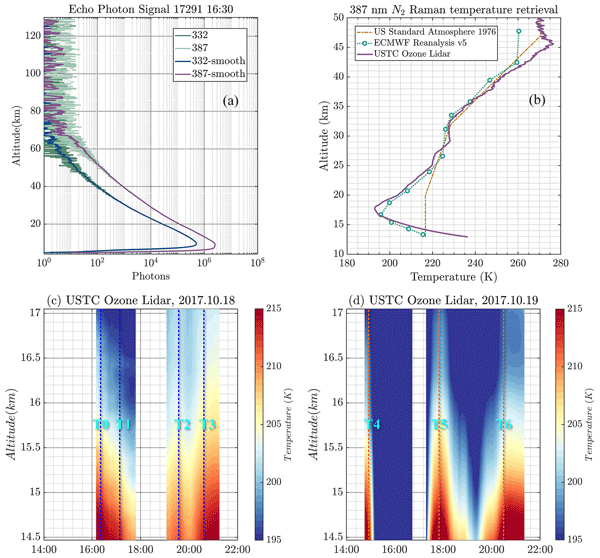
High-resolution USTC (University of Science and Technology of China) Ozone Lidar observations at Yangbajing, Tibet capture short-lived rapid STE (stratosphere-to-troposphere exchange)-related ozone descent for the first time. Lidar temperature profiles link these events to tropopause thermal variability unresolved by conventional models. Wei’s flux diagnostic and PV (potential vorticity)-threshold sensitivity identify 3 PVU (potential vorticity units) as optimal. ERA5 shows gravity-wave modulation during tropopause folding, and lidar ozone profiles are used to quantify instantaneous cross-tropopause ozone flux.
Liangyu Pu, Tingdi Chen, Yuli Han, Zhaowang Su, Yiming Song, Zhu Meng, Yuxin Wen, Chong Chen, Dongsong Sun, Xianghui Xue, and Xiankang Dou
EGUsphere, https://doi.org/10.5194/egusphere-2026-5254, https://doi.org/10.5194/egusphere-2026-5254, 2026
This preprint is open for discussion and under review for Atmospheric Measurement Techniques (AMT).
Short summary
Short summary
Atmospheric wind and temperature are essential for understanding weather and atmospheric dynamics. We developed a new lidar receiver that measures both quantities from the same atmospheric backscatter signal without frequency scanning. Field experiments demonstrated wind measurements from 2 to 20 km and simultaneous wind and temperature measurements from 5.3 to 20 km, with good agreement with radiosondes.
Kexin Ming, Chong Wang, Wei Kong, Xianghui Xue, Genghua Huang, Ruikai Xue, Wenhao Li, Yudie Li, Chen Liang, Ruocan Zhao, Mingjiao Jia, and Xiang Shang
EGUsphere, https://doi.org/10.5194/egusphere-2026-4536, https://doi.org/10.5194/egusphere-2026-4536, 2026
This preprint is open for discussion and under review for Atmospheric Measurement Techniques (AMT).
Short summary
Short summary
Boundary layer height is important for weather forecasting and climate studies, but consistent global observations remain difficult. We designed a spaceborne lidar and validated its performance through theoretical simulations and experiments with a scaled airborne prototype. Nighttime results in Yulin agreed closely with ground-based observations, while daytime tests in Hainan showed detection potential under strong background illumination, supporting future global monitoring from space.
Yuxia Jia, Chao Ban, Tao Li, Xin Fang, Zhaopeng Wu, Jianfei Wu, Weilin Pan, and Chengyun Yang
Atmos. Chem. Phys., 26, 11409–11420, https://doi.org/10.5194/acp-26-11409-2026, https://doi.org/10.5194/acp-26-11409-2026, 2026
Short summary
Short summary
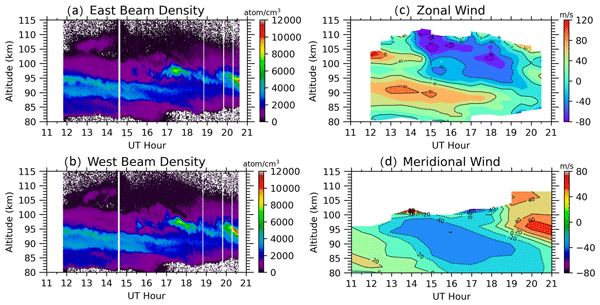
In this study, a sodium lidar at the University of Science and Technology of China (USTC) observed multiple sporadic sodium layers (SSLs) and enhanced sodium patterns (ESPs) during a single night. By combining observations from a meteor radar and an ionosonde in Wuhan, the results show that horizontal winds can not only directly transport sodium atoms through advection but also indirectly influence sodium density by modulating ion convergence and Es layers via atmospheric waves.
Yiran Pan, Jialin Zhang, Chengyun Yang, Tao Li, Xin Fang, Xinyue Wang, Xianghui Xue, and Xiankang Dou
EGUsphere, https://doi.org/10.5194/egusphere-2026-3774, https://doi.org/10.5194/egusphere-2026-3774, 2026
Short summary
Short summary
In 2024, the upper atmosphere above Antarctica experienced two sudden warming events and then repeated warming and recovery instead of returning steadily to normal. Large-scale atmospheric waves disturbed the circling polar winds, and the altered winds then shaped how later waves moved upward, allowing the disturbance to persist. This helps explain how rare Antarctic events can last longer and affect links between the upper and lower atmosphere.
Gunter Stober, Hanli Liu, Zishun Qiao, Kaoru Sato, Loretta Pearl Poku, Witali Krochin, Alan Liu, Alexander Kozlovsky, Diego Janches, Jie Zeng, Wen Yi, Masaki Tsutsumi, Njål Gulbrandsen, Satonori Nozawa, Mark Lester, Johan Kero, and Nicholas Mitchell
EGUsphere, https://doi.org/10.5194/egusphere-2026-3156, https://doi.org/10.5194/egusphere-2026-3156, 2026
This preprint is open for discussion and under review for Atmospheric Measurement Techniques (AMT).
Short summary
Short summary
Vertical winds are a crucial atmospheric parameter in the mesosphere/lower thermosphere and are connected to adiabatic heating and cooling of the atmosphere. Mesospheric temperatures are affected by the vertical transport driven by a pole-to-pole circulation with upwelling in the summer hemisphere and downwelling in the winter hemisphere. We present results based on a new retrieval technique for the seasonal climatological vertical winds and an intercomparison to current state-of-the-art models.
Gang Chen, Yimeng Xu, Guotao Yang, Wuhu Feng, Jiyao Xu, Shaodong Zhang, Guozhu Li, Hanxian Fang, Lifang Du, Haoran Zheng, Xuewu Cheng, Faquan Li, Yuchang Xun, Kaiming Huang, and Chunxiao Yan
EGUsphere, https://doi.org/10.5194/egusphere-2026-2356, https://doi.org/10.5194/egusphere-2026-2356, 2026
Short summary
Short summary
A new lidar for calcium ion (Ca+) observations has been operated in Yanqing, Beijing, China. Cloud-like Ca+ are observed to occur at altitudes of 120–300 km, and these clouds are composed of striped structures. These Ca+ are found to descend into Es layer and the main metal layer, and increase their ion density. According to the stripe-like structures and their influence on the metal ion layers, we believe that these metal ions observed by the lidar in Beijing come from meteoroids trails
Loretta Pearl Poku, Gunter Stober, Witali Krochin, Alan Liu, Alexander Kozlovsky, Diego Janches, Jie Zeng, Wen Yi, Masaki Tsutsumi, Njål Gulbrandsen, Satonori Nozawa, Mark Lester, Johan Kero, and Nicholas Mitchell
EGUsphere, https://doi.org/10.5194/egusphere-2025-6377, https://doi.org/10.5194/egusphere-2025-6377, 2026
Short summary
Short summary
This study presents 3D spatially resolved wind fields in the MLT using advanced retrieval techniques. Specifically, a novel SVVP method in spherical coordinates to enhance the physical consistency of wind retrievals compared to the conventional VVP method in plane geometry and the 3DVAR+DIV method. The SVVP provides a robust framework for future MLT dynamics studies, and the 3DVAR+DIV retrieval is beneficial for high-resolution case studies due to its ability to capture small-scale variability.
Chao Ban, Xin Fang, Wen Yi, Jie Zeng, Gunter Stober, Weilin Pan, Tao Li, and Xianghui Xue
Atmos. Meas. Tech., 19, 1697–1709, https://doi.org/10.5194/amt-19-1697-2026, https://doi.org/10.5194/amt-19-1697-2026, 2026
Short summary
Short summary
This paper presents an intercomparison of zonal winds observed by a sodium fluorescence lidar and three types of meteor radars – a multistatic meteor radar, a conventional monostatic radar, and a forward remote receiver – located near Hefei, China. The multistatic meteor radar shows the best agreement with the lidar measurements, confirming the reliability of its wind retrievals in the mesosphere and lower thermosphere and highlighting its potential for future atmospheric dynamics studies.

Xingjin Wang, Xin Fang, Wenhao Gao, Xianhang Chen, Tai Liu, Chengyun Yang, Tingdi Chen, Tao Li, and Xianghui Xue
Atmos. Meas. Tech., 19, 1629–1641, https://doi.org/10.5194/amt-19-1629-2026, https://doi.org/10.5194/amt-19-1629-2026, 2026
Short summary
Short summary
This paper reports the deployment of the first narrowband sodium lidar in the low-latitude region of China. The lidar observations are compared with satellite measurements and atmospheric models, confirming the scientific credibility of these results. Calculations of vertical gravity wave heat and sodium fluxes are used to investigate the influence of the space environment. This lidar system will provide a new ground-based detection device for studying atmospheric environment above the area.
Efua A. Ogobor, Igo Paulino, Vania F. Andrioli, Cristiano M. Wrasse, Hisao Takahashi, Amauri F. Medeiros, Paulo P. Batista, and Prosper K. Nyassor
EGUsphere, https://doi.org/10.5194/egusphere-2025-6569, https://doi.org/10.5194/egusphere-2025-6569, 2026
Short summary
Short summary
We studied four rare night-sky wave events over Brazil using coordinated all-sky airglow imager, meteor wind radar, and sodium laser temperature measurements. We found two undular and turbulent fronts shaped by layered winds and temperature, improving forecasts of upper-atmosphere changes that affect communications to understand how they form.
Kian Sartipzadeh, Andreas Kvammen, Björn Gustavsson, Njål Gulbrandsen, Magnar G. Johnsen, Devin Huyghebaert, and Juha Vierinen
Ann. Geophys., 44, 85–107, https://doi.org/10.5194/angeo-44-85-2026, https://doi.org/10.5194/angeo-44-85-2026, 2026
Short summary
Short summary
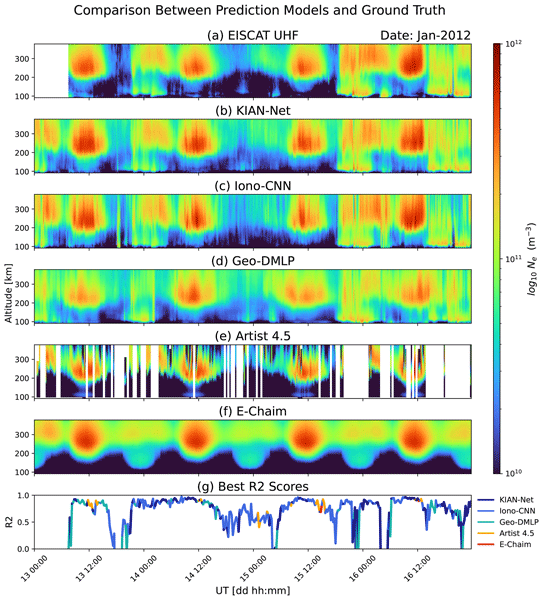
Knowledge of the charged environment in the upper atmosphere is essential for understanding space weather effects on satellites and radio communication. This environment is difficult to estimate at high latitudes, where aurora cause strong variability. We developed an artificial intelligence model to estimate this environment continuously. Our results show that the model provides reliable estimates even during auroral activity, improving monitoring of the polar upper atmosphere.
Chengyun Yang, Xiang Guo, Tao Li, Xinyue Wang, Jun Zhang, Xin Fang, and Xianghui Xue
Atmos. Chem. Phys., 26, 1021–1039, https://doi.org/10.5194/acp-26-1021-2026, https://doi.org/10.5194/acp-26-1021-2026, 2026
Short summary
Short summary
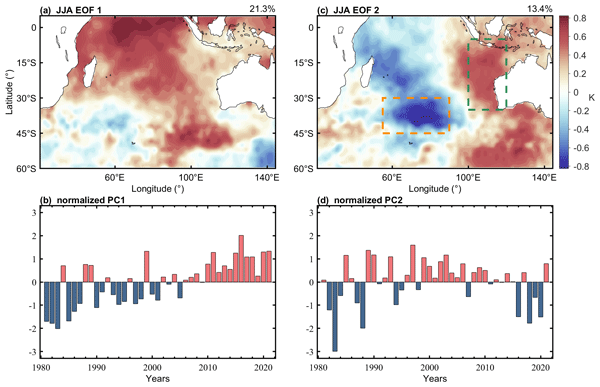
The Indian Ocean strongly influences weather and climate far beyond its region. We found that unusual sea surface warming patterns in the midlatitude Indian Ocean can disrupt winds and temperatures in the middle atmosphere, including the stratosphere and mesosphere, of the Southern Hemisphere. These disturbances alter ozone and air movement and may affect polar climate. Our results highlight the need to include Indian Ocean variability in climate models for better predictions.
Shuai Liu, Guoying Jiang, Bingxian Luo, Xiao Liu, Jiyao Xu, Yajun Zhu, and Wen Yi
Atmos. Chem. Phys., 25, 17725–17746, https://doi.org/10.5194/acp-25-17725-2025, https://doi.org/10.5194/acp-25-17725-2025, 2025
Short summary
Short summary
Disruptions of the Quasi-Biennial Oscillation modulate the migrating diurnal tide in the mesosphere and lower thermosphere. During the events, wavelengths and phases of the tide remain unchanged, but its amplitude strengthens. The variation of heating sources, dissipation, zonal wind latitude shear and gravity wave drag may contribute to the amplification of the tide amplitude. These features provide insight into the dynamical coupling of troposphere, stratosphere, mesosphere and lower thermosphere.
J. Federico Conte, Jorge L. Chau, Toralf Renkwitz, Ralph Latteck, Masaki Tsutsumi, Christoph Jacobi, Njål Gulbrandsen, and Satonori Nozawa
Ann. Geophys., 43, 603–619, https://doi.org/10.5194/angeo-43-603-2025, https://doi.org/10.5194/angeo-43-603-2025, 2025
Short summary
Short summary
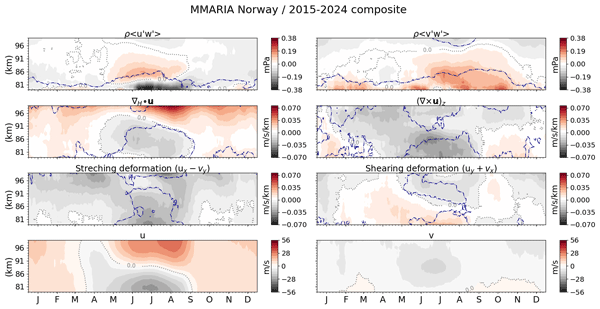
Analysis of 10 years of continuous measurements provided MMARIA/SIMONe Norway and MMARIA/SIMONe Germany reveals that the divergent and vortical motions in the mesosphere and lower thermosphere exchange the dominant role depending on the height and the time of the year. At summer mesopause altitudes over middle latitudes, the horizontal divergence and the relative vorticity contribute approximately the same, indicating an energetic balance between mesoscale divergent and vortical motions.
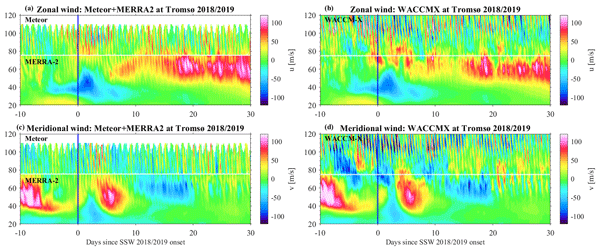
Guochun Shi, Hanli Liu, Masaki Tsutsumi, Njål Gulbrandsen, Alexander Kozlovsky, Dimitry Pokhotelov, Mark Lester, Christoph Jacobi, Kun Wu, and Gunter Stober
Atmos. Chem. Phys., 25, 9403–9430, https://doi.org/10.5194/acp-25-9403-2025, https://doi.org/10.5194/acp-25-9403-2025, 2025
Short summary
Short summary
Concerns about climate change are growing due to its widespread impacts, including rising temperatures, extreme weather events, and disruptions to ecosystems. To address these challenges, urgent global action is needed to monitor the distribution of trace gases and understand their effects on the atmosphere.
Ales Kuchar, Gunter Stober, Dimitry Pokhotelov, Huixin Liu, Han-Li Liu, Manfred Ern, Damian Murphy, Diego Janches, Tracy Moffat-Griffin, Nicholas Mitchell, and Christoph Jacobi
EGUsphere, https://doi.org/10.5194/egusphere-2025-2827, https://doi.org/10.5194/egusphere-2025-2827, 2025
Short summary
Short summary
We studied how the healing of the Antarctic ozone layer is affecting winds high above the South Pole. Using ground-based radar, satellite data, and computer models, we found that winds in the upper atmosphere have become stronger over the past two decades. These changes appear to be linked to shifts in the lower atmosphere caused by ozone recovery. Our results show that human efforts to repair the ozone layer are also influencing climate patterns far above Earth’s surface.
Gabriel Augusto Giongo, Cristiano Max Wrasse, Pierre-Dominique Pautet, José Valentin Bageston, Prosper Kwamla Nyassor, Cosme Alexandre Oliveira Barros Figueiredo, Anderson Vestena Bilibio, Tracy Moffat-Griffin, Damian John Murphy, Toyese Tunde Ayorinde, Delano Gobbi, and Hisao Takahashi
EGUsphere, https://doi.org/10.5194/egusphere-2025-3114, https://doi.org/10.5194/egusphere-2025-3114, 2025
Short summary
Short summary
This work analyzes the medium-scale atmospheric gravity waves observed by ground-based airglow imaging over the Antarctic continent. Medium-scale gravity waves refer to waves larger than 50 km of horizontal wavelength, and have not been analyzed in that region so far. Wave parameters and horizontal propagation characteristics were obtained by a recently improved methodology and are described thoroughly.
Arthur Gauthier, Claudia Borries, Alexander Kozlovsky, Diego Janches, Peter Brown, Denis Vida, Christoph Jacobi, Damian Murphy, Masaki Tsutsumi, Njål Gulbrandsen, Satonori Nozawa, Mark Lester, Johan Kero, Nicholas Mitchell, Tracy Moffat-Griffin, and Gunter Stober
Ann. Geophys., 43, 427–440, https://doi.org/10.5194/angeo-43-427-2025, https://doi.org/10.5194/angeo-43-427-2025, 2025
Short summary
Short summary
This study focuses on a TIMED Doppler Interferometer (TIDI)–meteor radar (MR) comparison of zonal and meridional winds and their dependence on local time and latitude. The correlation calculation between TIDI wind measurements and MR winds shows good agreement. A TIDI–MR seasonal comparison and analysis of the altitude–latitude dependence for winds are performed. TIDI reproduces the mean circulation well when compared with MRs and may be a useful lower boundary for general circulation models.
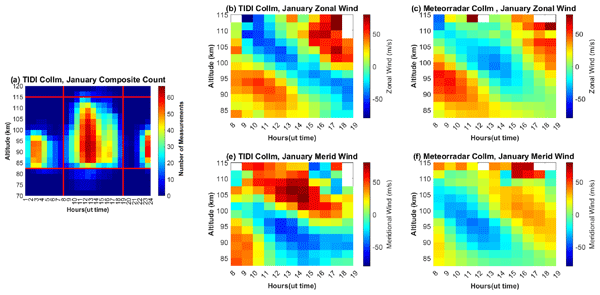
Florian Günzkofer, Gunter Stober, Johan Kero, David R. Themens, Anders Tjulin, Njål Gulbrandsen, Masaki Tsutsumi, and Claudia Borries
Ann. Geophys., 43, 331–348, https://doi.org/10.5194/angeo-43-331-2025, https://doi.org/10.5194/angeo-43-331-2025, 2025
Short summary
Short summary
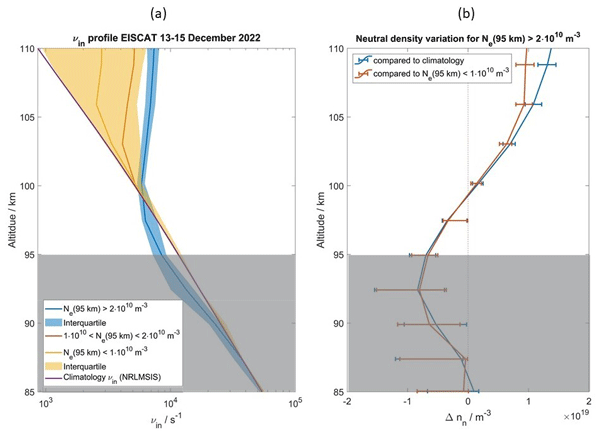
The Earth’s magnetic field is not closed at high latitudes. Electrically charged particles can penetrate the Earth’s atmosphere, deposit their energy, and heat the local atmosphere–ionosphere. This presumably causes an upwelling of the neutral atmosphere, which affects the atmosphere–ionosphere coupling. We apply a new analysis technique to infer the atmospheric density from incoherent scatter radar measurements. We identify signs of particle precipitation impact on the neutral atmosphere.
Ana Roberta Paulino, Delis Otildes Rodrigues, Igo Paulino, Lourivaldo Mota Lima, Ricardo Arlen Buriti, Paulo Prado Batista, Aaron Ridley, and Chen Wu
Ann. Geophys., 43, 183–191, https://doi.org/10.5194/angeo-43-183-2025, https://doi.org/10.5194/angeo-43-183-2025, 2025
Short summary
Short summary
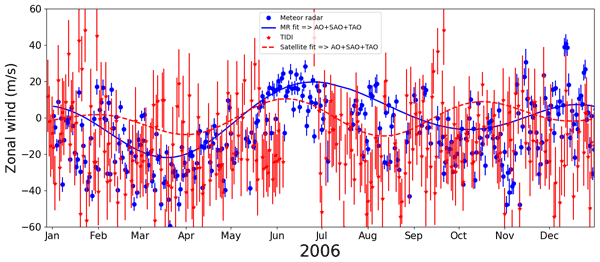
Comparisons of wind measurements using two different techniques (ground-based radar and satellite) in Brazil during 2006 were made in order to point out the advantages of each instrument for studies in the mesosphere and upper thermosphere. (i) For short-period variations, the measurements of the satellite were more advantageous. (ii) The monthly climatology using the radar was more appropriate. (iii) For long periods (longer than a few months), both instruments responded satisfactorily.
Zishun Qiao, Alan Z. Liu, Gunter Stober, Javier Fuentes, Fabio Vargas, Christian L. Adami, and Iain M. Reid
Atmos. Meas. Tech., 18, 1091–1104, https://doi.org/10.5194/amt-18-1091-2025, https://doi.org/10.5194/amt-18-1091-2025, 2025
Short summary
Short summary
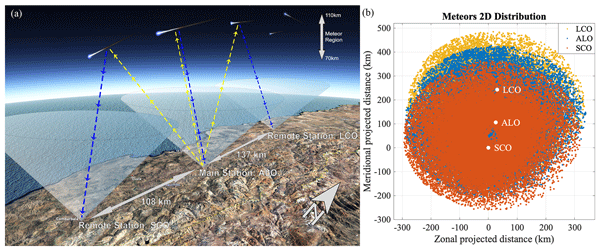
This paper describes the installation of the Chilean Observation Network De Meteor Radars (CONDOR) and its initial results. The routine winds are point-to-point comparable to the co-located lidar winds. The retrievals of spatially resolved horizontal wind fields and vertical winds are also facilitated, benefiting from the extensive meteor detections. The successful deployment and maintenance of CONDOR provide 24/7 and state-of-the-art wind measurements to the research community.
Jianyuan Wang, Na Li, Wen Yi, Xianghui Xue, Iain M. Reid, Jianfei Wu, Hailun Ye, Jian Li, Zonghua Ding, Jinsong Chen, Guozhu Li, Yaoyu Tian, Boyuan Chang, Jiajing Wu, and Lei Zhao
Atmos. Chem. Phys., 24, 13299–13315, https://doi.org/10.5194/acp-24-13299-2024, https://doi.org/10.5194/acp-24-13299-2024, 2024
Short summary
Short summary
We present the impact of quasi-biennial oscillation (QBO) disruption events on diurnal tides over the low- and mid-latitude MLT region observed by a meteor radar chain. By using a global atmospheric model and reanalysis data, it is found that the stratospheric QBO winds can affect the mesospheric diurnal tides by modulating the subtropical ozone variability in the upper stratosphere and the interaction between tides and gravity waves in the mesosphere.
Jianfei Wu, Wuhu Feng, Xianghui Xue, Daniel Robert Marsh, and John Maurice Campbell Plane
Atmos. Chem. Phys., 24, 12133–12141, https://doi.org/10.5194/acp-24-12133-2024, https://doi.org/10.5194/acp-24-12133-2024, 2024
Short summary
Short summary
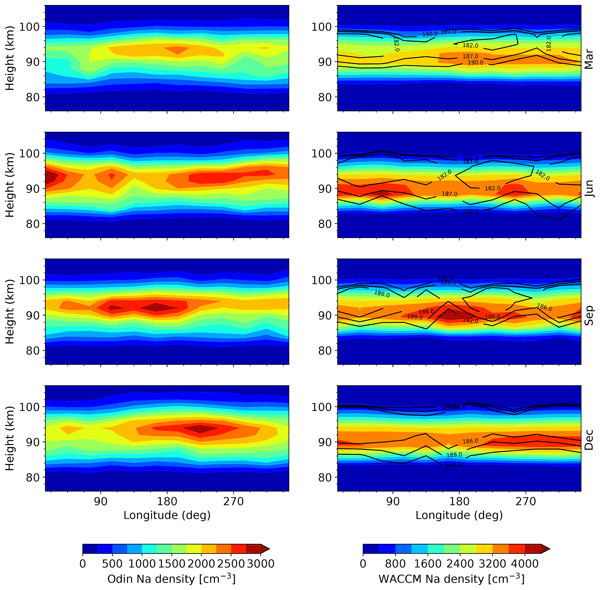
Metal layers occur in the mesosphere and lower thermosphere region 80–120 km from the ablation of cosmic dust. Nonmigrating diurnal tides are persistent global oscillations. We investigate nonmigrating diurnal tidal variations in metal layers using satellite observations and global climate model simulations; these have not been studied previously due to the limitations of measurements. The nonmigrating diurnal tides in temperature are strongly linked to the corresponding change in metal layers.
Thomas Edward Chambers, Iain Murray Reid, and Murray Hamilton
Atmos. Meas. Tech., 17, 3237–3253, https://doi.org/10.5194/amt-17-3237-2024, https://doi.org/10.5194/amt-17-3237-2024, 2024
Short summary
Short summary
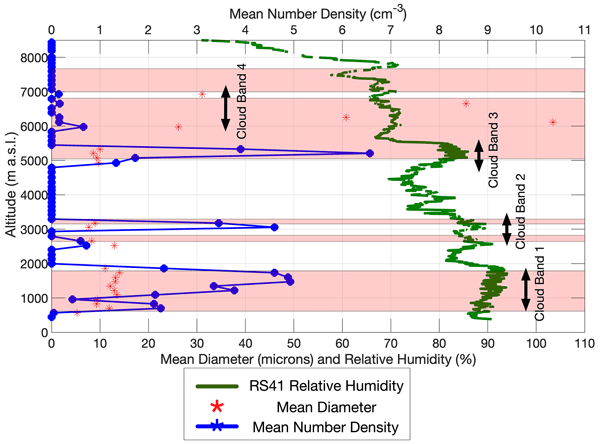
Clouds have been identified as the largest source of uncertainty in climate modelling. We report an untethered balloon launch of a holographic imager through clouds. This is the first time a holographic imager has been deployed in this way, enabled by the light weight and low cost of the imager. This work creates the potential to significantly increase the availability of cloud microphysical measurements required for the calibration and validation of climate models and remote sensing methods.
Qingchen Xu, Iain Murray Reid, Bing Cai, Christian Adami, Zengmao Zhang, Mingliang Zhao, and Wen Li
Atmos. Meas. Tech., 17, 2957–2975, https://doi.org/10.5194/amt-17-2957-2024, https://doi.org/10.5194/amt-17-2957-2024, 2024
Short summary
Short summary
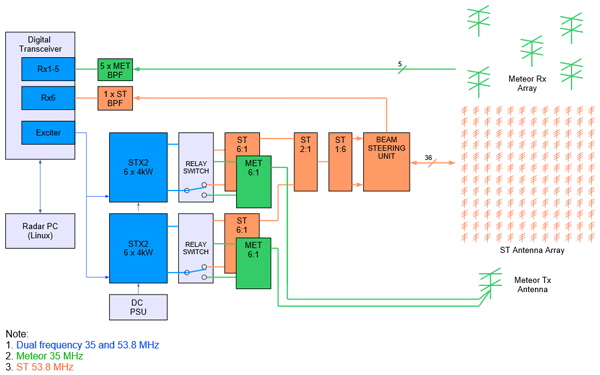
To have better understanding of the dynamics of the lower and middle atmosphere, we installed a newly designed dual-frequency radar system that uses 53.8 MHz for near-ground to 20 km wind measurements and 35.0 MHz for 70 to 100 km wind measurements. The initial results show its good performance, along with the analysis of typical winter gravity wave activities.
Gunter Stober, Sharon L. Vadas, Erich Becker, Alan Liu, Alexander Kozlovsky, Diego Janches, Zishun Qiao, Witali Krochin, Guochun Shi, Wen Yi, Jie Zeng, Peter Brown, Denis Vida, Neil Hindley, Christoph Jacobi, Damian Murphy, Ricardo Buriti, Vania Andrioli, Paulo Batista, John Marino, Scott Palo, Denise Thorsen, Masaki Tsutsumi, Njål Gulbrandsen, Satonori Nozawa, Mark Lester, Kathrin Baumgarten, Johan Kero, Evgenia Belova, Nicholas Mitchell, Tracy Moffat-Griffin, and Na Li
Atmos. Chem. Phys., 24, 4851–4873, https://doi.org/10.5194/acp-24-4851-2024, https://doi.org/10.5194/acp-24-4851-2024, 2024
Short summary
Short summary
On 15 January 2022, the Hunga Tonga-Hunga Ha‘apai volcano exploded in a vigorous eruption, causing many atmospheric phenomena reaching from the surface up to space. In this study, we investigate how the mesospheric winds were affected by the volcanogenic gravity waves and estimated their propagation direction and speed. The interplay between model and observations permits us to gain new insights into the vertical coupling through atmospheric gravity waves.
Ralph Latteck and Damian J. Murphy
Ann. Geophys., 42, 55–68, https://doi.org/10.5194/angeo-42-55-2024, https://doi.org/10.5194/angeo-42-55-2024, 2024
Short summary
Short summary
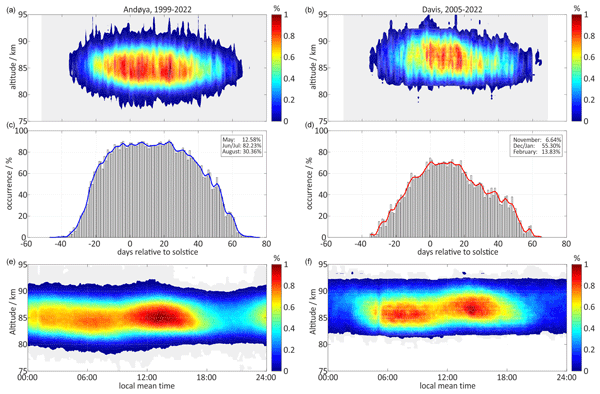
This paper gives an overview of continuous measurements of polar mesophere summer echoes (PMSE) by VHF radars at Andøya (69° N) and Davis (69° S). PMSE signal strengths are of the same order of magnitude; significantly fewer PMSE were observed in the Southern than the Northern Hemisphere. Compared to Andøya, the PMSE season over Davis starts ~7 d later and ends 9 d earlier; PMSE occur less frequently but with greater seasonal/diurnal occurrence variability, reaching higher peak altitudes.
Juliana Jaen, Toralf Renkwitz, Huixin Liu, Christoph Jacobi, Robin Wing, Aleš Kuchař, Masaki Tsutsumi, Njål Gulbrandsen, and Jorge L. Chau
Atmos. Chem. Phys., 23, 14871–14887, https://doi.org/10.5194/acp-23-14871-2023, https://doi.org/10.5194/acp-23-14871-2023, 2023
Short summary
Short summary
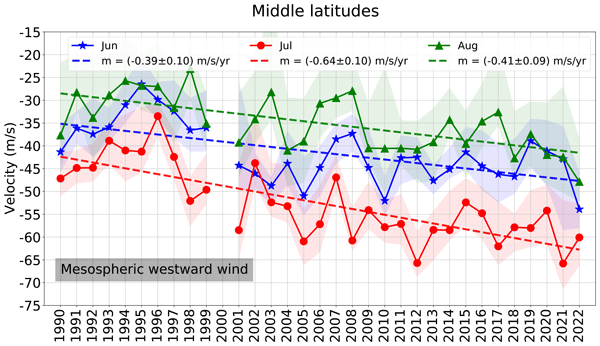
Investigation of winds is important to understand atmospheric dynamics. In the summer mesosphere and lower thermosphere, there are three main wind flows: the mesospheric westward, the mesopause southward (equatorward), and the lower-thermospheric eastward wind. Combining almost 2 decades of measurements from different radars, we study the trend, their interannual oscillations, and the effects of the geomagnetic activity over these wind maxima.
Penghao Tian, Bingkun Yu, Hailun Ye, Xianghui Xue, Jianfei Wu, and Tingdi Chen
Atmos. Chem. Phys., 23, 13413–13431, https://doi.org/10.5194/acp-23-13413-2023, https://doi.org/10.5194/acp-23-13413-2023, 2023
Short summary
Short summary
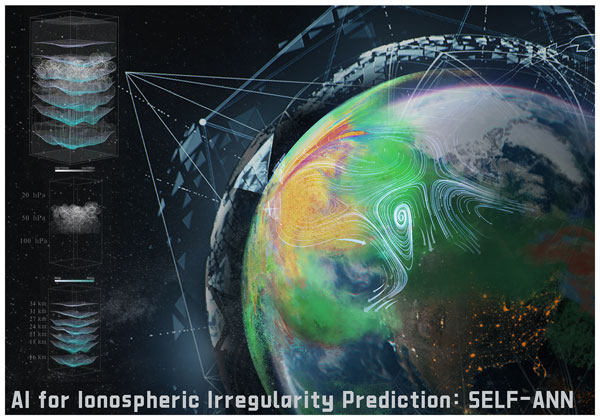
Modeling and prediction of ionospheric irregularities is an important topic in upper-atmospheric and upper-ionospheric physics. We proposed an artificial intelligence model to reconstruct the E-region ionospheric irregularities and first developed an open-source application for the community. The model reveals complex relationships between ionospheric irregularities and external driving factors. The findings suggest that spatiotemporal information plays an important role in the reconstruction.
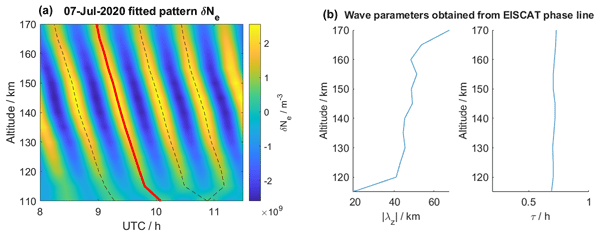
Florian Günzkofer, Dimitry Pokhotelov, Gunter Stober, Ingrid Mann, Sharon L. Vadas, Erich Becker, Anders Tjulin, Alexander Kozlovsky, Masaki Tsutsumi, Njål Gulbrandsen, Satonori Nozawa, Mark Lester, Evgenia Belova, Johan Kero, Nicholas J. Mitchell, and Claudia Borries
Ann. Geophys., 41, 409–428, https://doi.org/10.5194/angeo-41-409-2023, https://doi.org/10.5194/angeo-41-409-2023, 2023
Short summary
Short summary
Gravity waves (GWs) are waves in Earth's atmosphere and can be observed as cloud ripples. Under certain conditions, these waves can propagate up into the ionosphere. Here, they can cause ripples in the ionosphere plasma, observable as oscillations of the plasma density. Therefore, GWs contribute to the ionospheric variability, making them relevant for space weather prediction. Additionally, the behavior of these waves allows us to draw conclusions about the atmosphere at these altitudes.
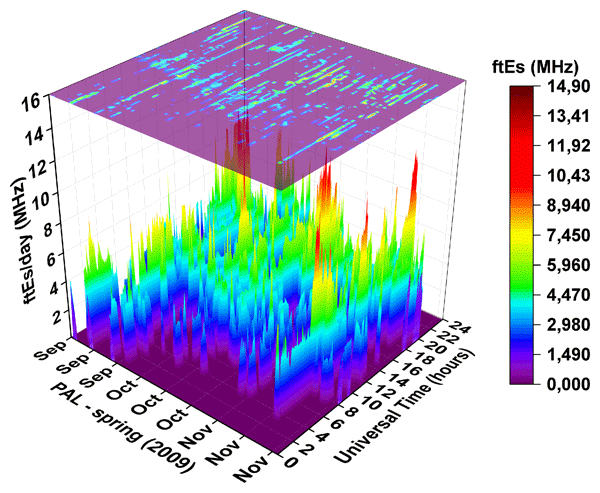
Pedro Alves Fontes, Marcio Tadeu de Assis Honorato Muella, Laysa Cristina Araújo Resende, Vânia Fátima Andrioli, Paulo Roberto Fagundes, Valdir Gil Pillat, Paulo Prado Batista, and Alexander Jose Carrasco
Ann. Geophys., 41, 209–224, https://doi.org/10.5194/angeo-41-209-2023, https://doi.org/10.5194/angeo-41-209-2023, 2023
Short summary
Short summary
In the terrestrial ionosphere, sporadic (metallic) layers are formed. The formation of these layers are related to the action of atmospheric waves. These waves, also named tides, are due to the absorption of solar radiation in the atmosphere. We investigated the role of the tides with 8 h period in the formation of the sporadic layers. The study was conducted using ionosonde and meteor radar data, as well as computing simulations. The 8 h tides intensified the density of the sporadic layers.
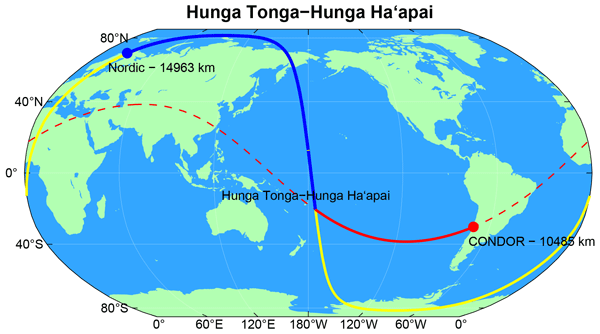
Gunter Stober, Alan Liu, Alexander Kozlovsky, Zishun Qiao, Witali Krochin, Guochun Shi, Johan Kero, Masaki Tsutsumi, Njål Gulbrandsen, Satonori Nozawa, Mark Lester, Kathrin Baumgarten, Evgenia Belova, and Nicholas Mitchell
Ann. Geophys., 41, 197–208, https://doi.org/10.5194/angeo-41-197-2023, https://doi.org/10.5194/angeo-41-197-2023, 2023
Short summary
Short summary
The Hunga Tonga–Hunga Ha‘apai volcanic eruption was one of the most vigorous volcanic explosions in the last centuries. The eruption launched many atmospheric waves traveling around the Earth. In this study, we identify these volcanic waves at the edge of space in the mesosphere/lower-thermosphere, leveraging wind observations conducted with multi-static meteor radars in northern Europe and with the Chilean Observation Network De Meteor Radars (CONDOR).
Wen Yi, Jie Zeng, Xianghui Xue, Iain Reid, Wei Zhong, Jianfei Wu, Tingdi Chen, and Xiankang Dou
Atmos. Meas. Tech. Discuss., https://doi.org/10.5194/amt-2022-254, https://doi.org/10.5194/amt-2022-254, 2022
Revised manuscript not accepted
Short summary
Short summary
In recent years, the concept of multistatic meteor radar systems has attracted the attention of the atmospheric radar community, focusing on the MLT region. In this study, we apply a multistatic meteor radar system consisting of a monostatic meteor radar in Mengcheng (33.36° N, 116.49° E) and a remote receiver in Changfeng (31.98° N, 117.22° E) to estimate the two-dimensional horizontal wind field, and the horizontal divergence and relative vorticity of the wind field.
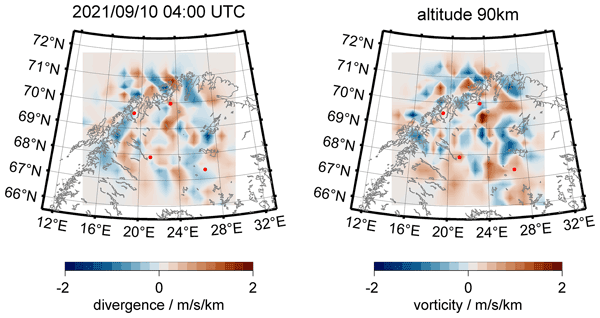
Gunter Stober, Alan Liu, Alexander Kozlovsky, Zishun Qiao, Ales Kuchar, Christoph Jacobi, Chris Meek, Diego Janches, Guiping Liu, Masaki Tsutsumi, Njål Gulbrandsen, Satonori Nozawa, Mark Lester, Evgenia Belova, Johan Kero, and Nicholas Mitchell
Atmos. Meas. Tech., 15, 5769–5792, https://doi.org/10.5194/amt-15-5769-2022, https://doi.org/10.5194/amt-15-5769-2022, 2022
Short summary
Short summary
Precise and accurate measurements of vertical winds at the mesosphere and lower thermosphere are rare. Although meteor radars have been used for decades to observe horizontal winds, their ability to derive reliable vertical wind measurements was always questioned. In this article, we provide mathematical concepts to retrieve mathematically and physically consistent solutions, which are compared to the state-of-the-art non-hydrostatic model UA-ICON.
Bingkun Yu, Xianghui Xue, Christopher J. Scott, Mingjiao Jia, Wuhu Feng, John M. C. Plane, Daniel R. Marsh, Jonas Hedin, Jörg Gumbel, and Xiankang Dou
Atmos. Chem. Phys., 22, 11485–11504, https://doi.org/10.5194/acp-22-11485-2022, https://doi.org/10.5194/acp-22-11485-2022, 2022
Short summary
Short summary
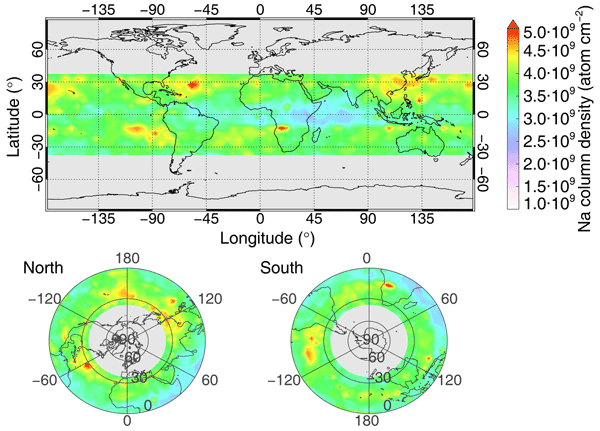
We present a study on the climatology of the metal sodium layer in the upper atmosphere from the ground-based measurements obtained from a lidar network, the Odin satellite measurements, and a global model of meteoric sodium in the atmosphere. Comprehensively, comparisons show good agreement and some discrepancies between ground-based observations, satellite measurements, and global model simulations.
Shican Qiu, Mengzhen Yuan, Willie Soon, Victor Manuel Velasco Herrera, Zhanming Zhang, and Xiankang Dou
Ann. Geophys. Discuss., https://doi.org/10.5194/angeo-2022-22, https://doi.org/10.5194/angeo-2022-22, 2022
Revised manuscript not accepted
Short summary
Short summary
In this paper, the solar radiation index Y10 acts as an indicator of the solar activity, and the vertical column of ice water content (IWC) characterizes the nature of the polar mesosphere cloud (PMC). Superposed epoch analysis is used to determine the time lag days of temperature and IWC anomalies in responding to Y10 for the PMC seasons from 2007–2015. The results show that the IWC can respond quickly to temperature within time lag of one day.
Neil P. Hindley, Nicholas J. Mitchell, Neil Cobbett, Anne K. Smith, Dave C. Fritts, Diego Janches, Corwin J. Wright, and Tracy Moffat-Griffin
Atmos. Chem. Phys., 22, 9435–9459, https://doi.org/10.5194/acp-22-9435-2022, https://doi.org/10.5194/acp-22-9435-2022, 2022
Short summary
Short summary
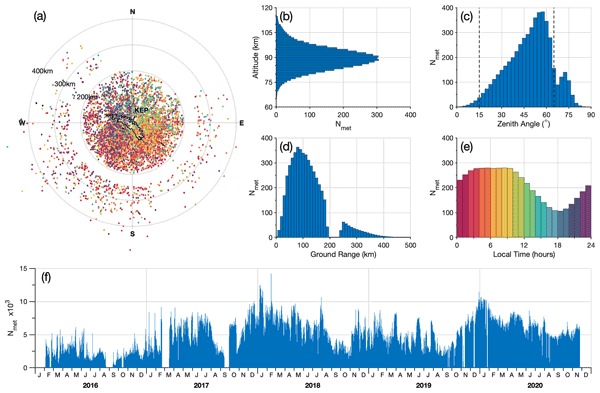
We present observations of winds in the mesosphere and lower thermosphere (MLT) from a recently installed meteor radar on the remote island of South Georgia (54° S, 36° W). We characterise mean winds, tides, planetary waves, and gravity waves in the MLT at this location and compare our measured winds with a leading climate model. We find that the observed wintertime winds are unexpectedly reversed from model predictions, probably because of missing impacts of secondary gravity waves in the model.
Yetao Cen, Chengyun Yang, Tao Li, James M. Russell III, and Xiankang Dou
Atmos. Chem. Phys., 22, 7861–7874, https://doi.org/10.5194/acp-22-7861-2022, https://doi.org/10.5194/acp-22-7861-2022, 2022
Short summary
Short summary
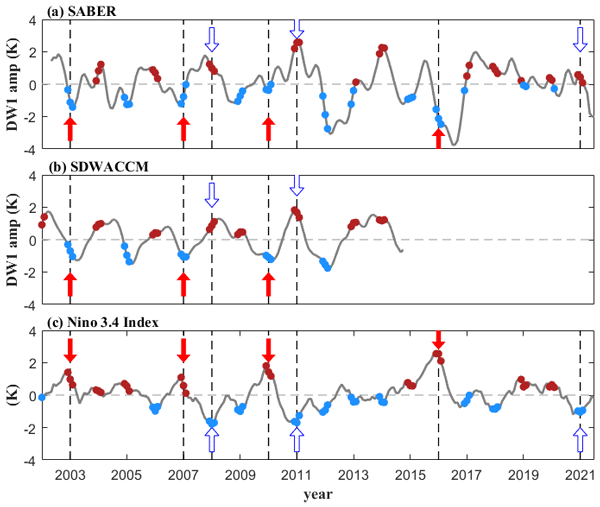
The MLT DW1 amplitude is suppressed during El Niño winters in both satellite observation and SD-WACCM simulations. The suppressed Hough mode (1, 1) in the tropopause region propagates vertically to the MLT region, leading to decreased DW1 amplitude. The latitudinal zonal wind shear anomalies during El Niño winters would narrow the waveguide and prevent the vertical propagation of DW1. The gravity wave drag excited by ENSO-induced anomalous convection could also modulate the MLT DW1 amplitude.
Jill Brouwer, Alexander D. Fraser, Damian J. Murphy, Pat Wongpan, Alberto Alberello, Alison Kohout, Christopher Horvat, Simon Wotherspoon, Robert A. Massom, Jessica Cartwright, and Guy D. Williams
The Cryosphere, 16, 2325–2353, https://doi.org/10.5194/tc-16-2325-2022, https://doi.org/10.5194/tc-16-2325-2022, 2022
Short summary
Short summary
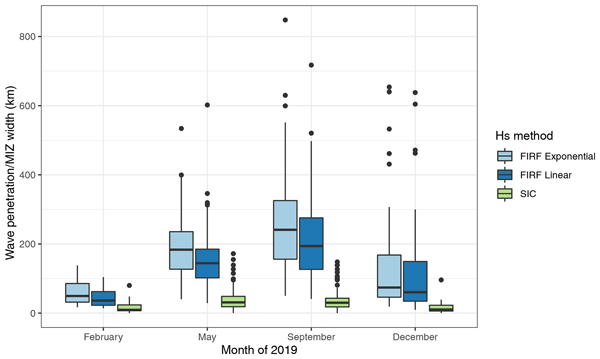
The marginal ice zone is the region where ocean waves interact with sea ice. Although this important region influences many sea ice, ocean and biological processes, it has been difficult to accurately measure on a large scale from satellite instruments. We present new techniques for measuring wave attenuation using the NASA ICESat-2 laser altimeter. By measuring how waves attenuate within the sea ice, we show that the marginal ice zone may be far wider than previously realised.
Matthew J. Griffith and Nicholas J. Mitchell
Ann. Geophys., 40, 327–358, https://doi.org/10.5194/angeo-40-327-2022, https://doi.org/10.5194/angeo-40-327-2022, 2022
Short summary
Short summary
There is great scientific interest in extending atmospheric models, such as the Met Office’s Unified Model, upwards to include the upper atmosphere. Atmospheric tides are an important driver of circulation at these greater heights. This study provides a first in-depth analysis of the migrating and non-migrating components of these tides, examining important tidal properties. Our results show that the ExUM produces a rich spectrum of spatial components, with significant non-migrating components.
Phoebe Noble, Neil Hindley, Corwin Wright, Chihoko Cullens, Scott England, Nicholas Pedatella, Nicholas Mitchell, and Tracy Moffat-Griffin
Atmos. Chem. Phys. Discuss., https://doi.org/10.5194/acp-2022-150, https://doi.org/10.5194/acp-2022-150, 2022
Revised manuscript not accepted
Short summary
Short summary
We use long term radar data and the WACCM-X model to study the impact of dynamical phenomena, including the 11-year solar cycle, ENSO, QBO and SAM, on Antarctic mesospheric winds. We find that in summer, the zonal wind (both observationally and in the model) is strongly correlated with the solar cycle. We also see important differences in the results from the other processes. In addition we find important and large biases in the winter model zonal winds relative to the observations.

Dawei Tang, Tianwen Wei, Jinlong Yuan, Haiyun Xia, and Xiankang Dou
Atmos. Meas. Tech., 15, 2819–2838, https://doi.org/10.5194/amt-15-2819-2022, https://doi.org/10.5194/amt-15-2819-2022, 2022
Short summary
Short summary
During 11–20 March 2020, three aerosol transport events were investigated by a lidar system and an online bioaerosol detection system in Hefei, China.
Observation results reveal that the events not only contributed to high particulate matter pollution but also to the transport of external bioaerosols, resulting in changes in the fraction of fluorescent biological aerosol particles.
This detection method improved the time resolution and provided more parameters for aerosol detection.
Shican Qiu, Mengxi Shi, Willie Soon, Mingjiao Jia, Xianghui Xue, Tao Li, Peng Ju, and Xiankang Dou
Atmos. Chem. Phys. Discuss., https://doi.org/10.5194/acp-2021-1085, https://doi.org/10.5194/acp-2021-1085, 2022
Revised manuscript not accepted
Short summary
Short summary
The solitary wave theory is applied for the first time to study the sporadic sodium layers (NaS). We perform soliton fitting processes on the observed data from the Andes Lidar Observatory, and find out that 24/27 NaS events exhibit similar features to a soliton. Time series of the net anomaly reveal the same variation process to the solution of a five-order KdV equation. Our results suggest the NaS phenomenon would be an appropriate tracer for nonlinear wave studies in the atmosphere.
Juliana Jaen, Toralf Renkwitz, Jorge L. Chau, Maosheng He, Peter Hoffmann, Yosuke Yamazaki, Christoph Jacobi, Masaki Tsutsumi, Vivien Matthias, and Chris Hall
Ann. Geophys., 40, 23–35, https://doi.org/10.5194/angeo-40-23-2022, https://doi.org/10.5194/angeo-40-23-2022, 2022
Short summary
Short summary
To study long-term trends in the mesosphere and lower thermosphere (70–100 km), we established two summer length definitions and analyzed the variability over the years (2004–2020). After the analysis, we found significant trends in the summer beginning of one definition. Furthermore, we were able to extend one of the time series up to 31 years and obtained evidence of non-uniform trends and periodicities similar to those known for the quasi-biennial oscillation and El Niño–Southern Oscillation.
Xiao Liu, Jiyao Xu, Jia Yue, You Yu, Paulo P. Batista, Vania F. Andrioli, Zhengkuan Liu, Tao Yuan, Chi Wang, Ziming Zou, Guozhu Li, and James M. Russell III
Earth Syst. Sci. Data, 13, 5643–5661, https://doi.org/10.5194/essd-13-5643-2021, https://doi.org/10.5194/essd-13-5643-2021, 2021
Short summary
Short summary
Based on the gradient balance wind theory and the SABER observations, a dataset of monthly mean zonal wind has been developed at heights of 18–100 km and latitudes of 50° Sndash;50° N from 2002 to 2019. The dataset agrees with the zonal wind from models (MERRA2, UARP, HWM14) and observations by meteor radar and lidar at seven stations. The dataset can be used to study seasonal and interannual variations and can serve as a background for wave studies of tides and planetary waves.
Liang Tang, Sheng-Yang Gu, and Xian-Kang Dou
Atmos. Chem. Phys., 21, 17495–17512, https://doi.org/10.5194/acp-21-17495-2021, https://doi.org/10.5194/acp-21-17495-2021, 2021
Short summary
Short summary
Our study explores the variation in the occurrence date, peak amplitude and wave period for eastward waves and the role of instability, background wind structure and the critical layer in eastward wave propagation and amplification.

Jianfei Wu, Wuhu Feng, Han-Li Liu, Xianghui Xue, Daniel Robert Marsh, and John Maurice Campbell Plane
Atmos. Chem. Phys., 21, 15619–15630, https://doi.org/10.5194/acp-21-15619-2021, https://doi.org/10.5194/acp-21-15619-2021, 2021
Short summary
Short summary
Metal layers occur in the MLT region (80–120 km) from the ablation of cosmic dust. The latest lidar observations show these metals can reach a height approaching 200 km, which is challenging to explain. We have developed the first global simulation incorporating the full life cycle of metal atoms and ions. The model results compare well with lidar and satellite observations of the seasonal and diurnal variation of the metals and demonstrate the importance of ion mass and ion-neutral coupling.
Cited articles
Alexander, M. J. and Teitelbaum, H.: Three-dimensional properties of Andes mountain waves observed by satellite: A case study, J. Geophys. Res., 116, D23110, https://doi.org/10.1029/2011JD016151, 2011.
Becker, E.: Mean-flow effects of thermal tides in the mesosphere and lower thermosphere, J. Atmos. Sci., 74, 2043–2063, https://doi.org/10.1175/JAS-D-16-0194.1, 2017.
Cao, B., Heale, C. J., Guo, Y., Liu, A. Z., and Snively, J. B.: Observation and modeling of gravity wave propagation through reflection and critical layers above Andes Lidar Observatory at Cerro Pachón, Chile, J. Geophys. Res.-Atmos., 121, 12737–12750, https://doi.org/10.1002/2016JD025173, 2016.
Cen, Y.: 1979–2014 SDWACCM data, Figshare [data set], https://doi.org/10.6084/m9.figshare.19777918, 2022.
Chapman, S. and Lindzen, R.: Atmospheric tides – thermal and gravitational, D. Reidel Publishing Company, Dordrecht, the Netherlands, ISBN 978-94-010-3401-2, 1970.
Das, S. S., Kumar, K. K., and Ramkumar, G.: First observations of quasi 120 day oscillation in mesospheric winds and temperature: Observations inferred from meteor radar, Radio Sci., 48, 310–315, 2013.
Devara, P. C. S. and Ahmed, M. I.: Momentum flux variations at lower thermospheric levels as seen from mid-latitude meteor wind observations, Meteorol. Atmos. Phys., 35, 236–241, https://doi.org/10.1007/BF01041816, 1986.
Davis, R. N., Du, J., Smith, A. K., Ward, W. E., and Mitchell, N. J.: The diurnal and semidiurnal tides over Ascension Island (°S, 14° W) and their interaction with the stratospheric quasi-biennial oscillation: studies with meteor radar, eCMAM and WACCM, Atmos. Chem. Phys., 13, 9543–9564, https://doi.org/10.5194/acp-13-9543-2013, 2013.
Deepa, V., Ramkumar, G., Antonita, M., and Kumar, K. K.: Meteor wind radar observations of tidal amplitudes over a low-latitude station Trivandrum (8.5° N, 77° E): Interannual variability and the effect of background wind on diurnal tidal amplitudes, J. Atmos. Sol.-Terr. Phys., 70, 2005–2013, 2008.
Forbes, J. M.: Tidal and planetary waves, in: The Upper Mesosphere and Lower Thermosphere: A Review of Experiment and Theory, edited by: Johnson, R. M. and Killeen, T. L., Geophys. Monogr. Ser., 87, 67–87, American Geophysical Union, https://doi.org/10.1029/GM087p0067, 1995.
Forbes, J. M. and Garrett, H. B.: Theoretical studies of atmospheric tides, Rev. Geophys. Space Phys., 17, 1951–1981, https://doi.org/10.1029/RG017i008p01951, 1979.
Guharay, A., Batista, P. P., and Buriti, R. A.: Observations of a quasi-90-day oscillation in the MLT winds and tides over an equatorial station using meteor radar winds, Adv. Space Res., 67, 3125–3133, 2021.
Hagan, M. E. and Forbes, J. M.: Migrating and nonmigrating diurnal tides in the middle and upper atmosphere excited by tropospheric latent heat release, J. Geophys. Res., 107, ACL 6-1–ACL 6-15, https://doi.org/10.1029/2001JD001236, 2002.
Hagan, M. E. and Forbes, J. M.: Migrating and nonmigrating semidiurnal tides in the upper atmosphere excited by tropospheric latent heat release, J. Geophys. Res., 108, 1062, https://doi.org/10.1029/2002JA009466, 2003.
He, M. and Chau, J. L.: Mesospheric semidiurnal tides and near-12 h waves through jointly analyzing observations of five specular meteor radars from three longitudinal sectors at boreal midlatitudes, Atmos. Chem. Phys., 19, 5993–6006, https://doi.org/10.5194/acp-19-5993-2019, 2019.
He, M., Chau, J. L., Stober, G., Li, G., Ning, B., and Hoffmann, P.: Relations between semidiurnal tidal variants through diagnosing the zonal wavenumber using a phase differencing technique based on two ground-based detectors, J. Geophys. Res.-Atmos., 123, 4015–4026, https://doi.org/10.1002/2018JD028400, 2018.
Hersbach, H., Bell, B., Berrisford, P., Hirahara, S., Horányi, A., Muñoz-Sabater, J., Nicolas, J., Peubey, C., Radu, R., Schepers, D., Simmons, A., Soci, C., Abdalla, S., Abellan, X., Balsamo, G., Bechtold, P., Biavati, G., Bidlot, J., Bonavita, M., De Chiara, G., Dahlgren, P., Dee, D., Diamantakis, M., Dragani, R., Flemming, J., Forbes, R., Fuentes, M., Geer, A., Haimberger, L., Healy, S., Hogan, R. J., Holm, E., Janisková, M., Keeley, S., Laloyaux, P., Lopez, P., Radnoti, G., de Rosnay, P., Rozum, I., Vamborg, F., Villaume, S., and Thépaut, J.-N.: The ERA5 global reanalysis, Q. J. Roy. Meteorol. Soc., 146, 1999–2049, https://doi.org/10.1002/qj.3803, 2020.
Hindley, N. P., Mitchell, N. J., Cobbett, N., Smith, A. K., Fritts, D. C., Janches, D., Wright, C. J., and Moffat-Griffin, T.: Radar observations of winds, waves and tides in the mesosphere and lower thermosphere over South Georgia island (54° S, 36° W) and comparison with WACCM simulations, Atmos. Chem. Phys., 22, 9435–9459, https://doi.org/10.5194/acp-22-9435-2022, 2022.
Hocking, W. K., Fuller, B., and Vandepeer, B.: Real-time determination of meteor-related parameters utilizing modern digital technology, J. Atmos. Sol.-Terr. Phys., 63, 155–169, https://doi.org/10.1016/S1364-6826(00)00138-3, 2001.
Holdsworth, D. A., Reid, I. M., and Cervera, M. A.: Buckland Park all-sky interferometric meteor radar, Radio Sci., 39, RS5009, https://doi.org/10.1029/2003RS003014, 2004.
Huang, F. T., Mayr, H. G., Reber, C. A., Killeen, T., Russell, J., Mlynczak, M., Skinner, W., and Mengel, J.: Diurnal variations of temperature and winds inferred from TIMED and UARS measurements, J. Geophys. Res., 111, A10S04, https://doi.org/10.1029/2005JA011426, 2006.
Jacobi, Ch., Portnyagin, Yu. I., Solovjova, T. V., Hoffmann, P., Singer, W., Fahrutdinova, A. N., Ishmuratov, R. A., Beard, A. G., Mitchell, N. J., Muller, H. G., Schminder, R., Kürschner, D., Manson, A. H., and Meek, C. E.: Climatology of the semidiurnal tide at 52–56° N from ground-based radar wind measurements 1985–1995, J. Atmos. Sol.-Terr. Phys., 61, 975–991, https://doi.org/10.1016/S1364-6826(99)00065-6, 1999.
Li, T., She, C. Y., Liu, H., Yue, J., Nakamura, T., and Krueger, D. A.: Observation of local tidal variability and instability, along with dissipation of diurnal tidal harmonics in the mesopause region over Fort Collins, Colorado (41° N, 105° W), J. Geophys. Res.-Atmos., 114, D06106, https://doi.org/10.1029/2008JD011089, 2009.
Lieberman, R. S., Ortland, D. A., and Yarosh, E. S.: Climatology and interannual variability of diurnal water vapor heating, J. Geophys. Res., 108, 4123, https://doi.org/10.1029/2002JD002308, 2003.
Lieberman, R. S., Riggin, D. M., Ortland, D. A., Nesbitt, S. W., and Vincent, R. A.: Variability of mesospheric diurnal tides and tropospheric diurnal heating during 1997–1998, J. Geophys. Res., 112, D20110, https://doi.org/10.1029/2007JD008578, 2007.
Liu, A. and Franke, S.: SKiYMET Meteor Radar Horizontal Wind, Zenodo [data set], https://doi.org/10.5281/zenodo.4267128, 2020.
Liu, G., Janches, D., Lieberman, R. S., Moffat-Griffin, T., Fritts, D. C., and Mitchell, N. J.: Coordinated observations of 8- and 6-h tides in the mesosphere and lower thermosphere by three meteor radars near 60° S latitude, Geophys. Res. Lett., 47, e2019GL086629, https://doi.org/10.1029/2019GL086629, 2020.
Liu, H., Tsutsumi, M., and Liu, H.: Vertical structure of terdiurnal tides in the Antarctic MLT region: 15-year observation over Syowa (69° S, 39° E), Geophys. Res. Lett., 46, https://doi.org/10.1029/2019GL082155, 2019.
Liu, H.-L. and Hagan, M. E.: Local heating/cooling of the mesosphere due to gravity wave and tidal coupling, Geophys. Res. Lett., 25, 2941–2944, https://doi.org/10.1029/98GL02153, 1998.
Llamedo, P., Salvador, J., de la Torre, A., Quiroga, J., Alexander, P., Hierro, R., Schmidt, T., Pazmiño, A., and Quel, E.: 11 years of Rayleigh lidar observations of gravity wave activity above the southern tip of South America, J. Geophys. Res.-Atmos., 124, 451–467, https://doi.org/10.1029/2018JD028673, 2019.
Kishore Kumar, G., Singer, W., Oberheide, J., Grieger, N., Batista, P. P., Riggin, D. M., Schmidt, H., and Clemesha, B. R.: Diurnal tides at low latitudes: radar, satellite, and model results, J. Atmos. Sol.-Terr. Phys., 118, 96–105, https://doi.org/10.1016/j.jastp.2013.07.005, 2014.
Kubota, M., Kano, A., Muramatsu, H., and Tomita, H.: Intercomparison of various surface latent heat flux fields, J. Climate, 16, 670–678, https://doi.org/10.1175/1520-0442(2003)016<0670:IOVSLH>2.0.CO;2, 2003.
Manson, A. H., Meek, C., Hagan, M., Hall, C., Hocking, W., MacDougall, J., Franke, S., Riggin, D., Fritts, D., Vincent, R., and Burrage, M.: Seasonal variations of the semi-diurnal and diurnal tides in the MLT: multi-year MF radar observations from 2 to 70° N, and the GSWM tidal model, J. Atmos. Sol.-Terr. Phys., 61, 809–828, https://doi.org/10.1016/S1364-6826(99)00045-0, 1999.
Manson, A. H., Meek, C., Hagan, M., Koshyk, J., Franke, S., Fritts, D., Hall, C., Hocking, W., Igarashi, K., MacDougall, J., Riggin, D., and Vincent, R.: Seasonal variations of the semi-diurnal and diurnal tides in the MLT: multi-year MF radar observations from 2–70° N, modelled tides (GSWM, CMAM), Ann. Geophys., 20, 661–677, https://doi.org/10.5194/angeo-20-661-2002, 2002.
Manson, A. H., Meek, C., Hagan, M., Zhang, X., and Luo, Y.: Global distributions of diurnal and semidiurnal tides: observations from HRDI-UARS of the MLT region and comparisons with GSWM-02 (migrating, nonmigrating components), Ann. Geophys., 22, 1529–1548, https://doi.org/10.5194/angeo-22-1529-2004, 2004.
McLandress, C.: The seasonal variation of the propagating diurnal tide in the mesosphere and lower thermosphere. Part I: The role of gravity waves and planetary waves, J. Atmos. Sci., 59, 893–906, https://doi.org/10.1175/1520-0469(2002)059<0893:TSVOTP>2.0.CO;2, 2002a.
McLandress, C.: The seasonal variation of the propagating diurnal tide in the mesosphere and lower thermosphere. Part II: The role of tidal heating and zonal mean winds, J. Atmos. Sci., 59, 907–922, https://doi.org/10.1175/1520-0469(2002)059<0907:TSVOTP>2.0.CO;2, 2002b.
Mitchell, N.: University of Bath: Ascension Island Skiymet Meteor radar data (2005–2012), Centre for Environmental Data Analysis [data set], https://catalogue.ceda.ac.uk/uuid/0d05cf74e17f49c2b7c5cd02faa59291 (last access: 15 September 2026), 2019.
Mitchell, N.: University of Bath: King Edward Point Skiymet Meteor radar data (2016–2020), Centre for Environmental Data Analysis [data set], https://doi.org/10.5285/061fc7fd1ca940e7ad685daf146db08f, 2021.
Mitchell, N. J., Pancheva, D., Middleton, H., and Hagan, M.: Mean winds and tides in the Arctic mesosphere/lower thermosphere, J. Geophys. Res., 107, 1004, https://doi.org/10.1029/2001JA900127, 2002.
Mukhtarov, P., Pancheva, D., and Andonov, B.: Global structure and seasonal and interannual variability of the migrating diurnal tide seen in the SABER/TIMED temperatures between 20 and 120 km, J. Geophys. Res., 114, A02309, https://doi.org/10.1029/2008JA013759, 2009.
Murphy, D. J.: Observations of a nonmigrating component of the semidiurnal tide over Antarctica, J. Geophys. Res., 108, 4241, https://doi.org/10.1029/2002JD003077, 2003.
Murphy, D. J., Forbes, J. M., Walterscheid, R. L., Hagan, M. E., Avery, S. K., Aso, T., Fraser, G. J., Fritts, D. C., Jarvis, M. J., McDonald, A. J., Riggin, D. M., Tsutsumi, M., and Vincent, R. A.: A climatology of tides in the Antarctic mesosphere and lower thermosphere, J. Geophys. Res.-Atmos., 111, D23104, https://doi.org/10.1029/2005JD006803, 2006.
Oberheide, J., Wu, Q., Killeen, T. L., Hagan, M. E., and Roble, R. G.: Diurnal nonmigrating tides from TIMED Doppler interferometer wind data: Monthly climatologies and seasonal variations, J. Geophys. Res., 111, A10S03, https://doi.org/10.1029/2005JA011491, 2006.
Pancheva, D., Mukhtarov, P., and Andonov, B.: Global structure, seasonal and interannual variability of the migrating semidiurnal tide seen in the SABER/TIMED temperatures (2002–2007), Ann. Geophys., 27, 687–703, https://doi.org/10.5194/angeo-27-687-2009, 2009.
Pancheva, D., Mukhtarov, P., and Andonov, B.: Climatology of the eastward propagating tides seen in the SABER/TIMED temperatures (2002–2007), Adv. Space Res., 46, 257–274, https://doi.org/10.1016/j.asr.2010.03.026, 2010.
Pancheva, D., Mukhtarov, P., and Smith, A. K.: Nonmigrating tidal variability in the SABER/TIMED mesospheric ozone, Geophys. Res. Lett., 41, 4059–4067, https://doi.org/10.1002/2014GL059844, 2014.
Pancheva, D., Mukhtarov, P., Hall, C., Meek, C., Tsutsumi, M., Pedatella, N., Nozawa, S., and Manson, A.: Climatology of the main (24-h and 12-h) tides observed by meteor radars at Svalbard and Tromsø: Comparison with the models CMAM-DAS and WACCM-X, J. Atmos. Sol.-Terr. Phys., 207, 105339, https://doi.org/10.1016/j.jastp.2020.105339, 2020.
Ramesh, K., Mitchell, N. J., Hindley, N. P., and Moffat-Griffin, T.: Long-term variability and tendencies in mesosphere and lower thermosphere winds from meteor radar observations over Esrange (67.9° N, 21.1° E), J. Geophys. Res.-Atmos., 129, e2023JD040404, https://doi.org/10.1029/2023JD040404, 2024.
Randall, C. E., Carstens, J., France, J. A., Harvey, V. L., Hoffmann, L., Bailey, S. M., Alexander, M. J., Lumpe, J. D., Yue, J., Thurairajah, B., Siskind, D. E., Zhao, Y., Taylor, M. J., and Russell III, J. M.: New AIM/CIPS global observations of gravity waves near 50–55 km, Geophys. Res. Lett., 44, 7044–7052, https://doi.org/10.1002/2017GL073943, 2017.
Reid, I. M., McIntosh, D. L., Murphy, D. J., and Vincent, R. A.: Mesospheric radar wind comparisons at high and middle southern latitudes, Earth Planets Space, 70, 84, https://doi.org/10.1186/s40623-018-0861-1, 2018.
Rienecker, M. M., Suarez, M. J., Todling, R., Bacmeister, J., Takacs, L., Liu, H.-C., Gu, W., Sienkiewicz, M., Koster, R. D., Gelaro, R., Stajner, I., and Nielsen, J. E.: The GEOS-5 data assimilation system – Documentation of versions 5.0.1, 5.1.0, and 5.2.0, Technical Report Series on Global Modeling and Data Assimilation, 27, NASA/TM-2008-104606, https://ntrs.nasa.gov/citations/20120011955 (last access: 15 September 2026), 2008.
Riggin, D. M., Fritts, D. C., Jarvis, M. J., and Jones, G.: Spatial structure of the 12-hour wave in the Antarctic as observed by radar, Earth Planet. Space, 51, 621–628, 1999.
Sheng, Z., He, Y., Wang, S., Chang, S., Leng, H., Wang, J., Zhang, J., Wang, Y., Zhang, H., Sui, H., Song, Y., Wu, G., Guo, S., Chai, J., Feng, W., and Song, J.: Dynamics, chemistry, and modeling studies in the aviation and aerospace transition zone, The Innovation, 6, 101012, https://doi.org/10.1016/j.xinn.2025.101012, 2025.
Smith, A. K.: Global dynamics of the MLT, Surv. Geophys., 33, 1177–1230, https://doi.org/10.1007/s10712-012-9196-9, 2012.
Stober, G., Kuchar, A., Pokhotelov, D., Liu, H., Liu, H.-L., Schmidt, H., Jacobi, C., Baumgarten, K., Brown, P., Janches, D., Murphy, D., Kozlovsky, A., Lester, M., Belova, E., Kero, J., and Mitchell, N.: Interhemispheric differences of mesosphere–lower thermosphere winds and tides investigated from three whole-atmosphere models and meteor radar observations, Atmos. Chem. Phys., 21, 13855–13902, https://doi.org/10.5194/acp-21-13855-2021, 2021a.
Stober, G., Janches, D., Matthias, V., Fritts, D., Marino, J., Moffat-Griffin, T., Baumgarten, K., Lee, W., Murphy, D., Kim, Y. H., Mitchell, N., and Palo, S.: Seasonal evolution of winds, atmospheric tides, and Reynolds stress components in the Southern Hemisphere mesosphere–lower thermosphere in 2019, Ann. Geophys., 39, 1–29, https://doi.org/10.5194/angeo-39-1-2021, 2021b.
Stober, G., Liu, A., Kozlovsky, A., Qiao, Z., Kuchar, A., Jacobi, C., Meek, C., Janches, D., Liu, G., Tsutsumi, M., Gulbrandsen, N., Nozawa, S., Lester, M., Belova, E., Kero, J., and Mitchell, N.: Meteor radar vertical wind observation biases and mathematical debiasing strategies including the 3DVAR+DIV algorithm, Atmos. Meas. Tech., 15, 5769–5792, https://doi.org/10.5194/amt-15-5769-2022, 2022.
Vincent, R. A., Kovalam, S., Fritts, D. C., and Isler, J. R.: Long-term MF radar observations of solar tides in the low-latitude mesosphere: Interannual variability and comparisons with the GSWM, J. Geophys. Res., 103, 8667–8683, https://doi.org/10.1029/98JD00482, 1998.
Wang, J., Yi, W., Wu, J., Chen, T., Xue, X., Zeng, J., Vincent, R. A., Reid, I. M., Batista, P. P., Buriti, R. A., Tsuda, T., Mitchell, N. J., and Dou, X.: Coordinated observations of migrating tides by multiple meteor radars in the equatorial mesosphere and lower thermosphere, J. Geophys. Res.-Space, 127, e2022JA030678, https://doi.org/10.1029/2022JA030678, 2022.
Wu, Q., Ortland, D. A., Killeen, T. L., Roble, R. G., Hagan, M. E., Liu, H.-L., Solomon, S. C., Xu, J., Skinner, W. R., and Niciejewski, R. J.: Global distribution and interannual variations of mesospheric and lower thermospheric neutral wind diurnal tide: 1. Migrating tide, J. Geophys. Res., 113, A05308, https://doi.org/10.1029/2007JA012542, 2008a.
Wu, Q., Ortland, D. A., Killeen, T. L., Roble, R. G., Hagan, M. E., Liu, H.-L., Solomon, S. C., Xu, J., Skinner, W. R., and Niciejewski, R. J.: Global distribution and interannual variations of mesospheric and lower thermospheric neutral wind diurnal tide: 2. Nonmigrating tide, J. Geophys. Res., 113, A05309, https://doi.org/10.1029/2007JA012543, 2008b.
Xu, J., Smith, A. K., Liu, H.-L., Yuan, W., Wu, Q., Jiang, G., Mlynczak, M. G., Russell III, J. M., and Franke, S. J.: Seasonal and quasi-biennial variations in the migrating diurnal tide observed by Thermosphere, Ionosphere, Mesosphere, Energetics and Dynamics (TIMED), J. Geophys. Res., 114, D13107, https://doi.org/10.1029/2008JD011298, 2009.
Yi, W.: Monthly mean amplitudes and phases of composite zonal and meridional diurnal, semidiurnal and terdiurnal tidal components, Figshare [data set], https://doi.org/10.6084/m9.figshare.29648918.v1, 2025.
Yi, W., Xue, X. H., Chen, J. S., Chen, T. D., and Li, N.: Quasi-90-day oscillation observed in the MLT region at low latitudes from the Kunming meteor radar and SABER, Earth Planet. Phys., 3, 1–11, https://doi.org/10.26464/epp2019013, 2019.
Yi, W., Xue, X. H., Zeng, J., Wang, J., Zhou, B., Ye, H., Chen, T., and Dou, X.: Observation of MLT region winds and tides by the USTC Mengcheng meteor radar, JUSTC, 53, 0501, https://doi.org/10.52396/JUSTC-2022-0158, 2023.
Zeng, J., Yi, W., Xue, X., Reid, I., Hao, X., Li, N., Chen, J., Chen, T., and Dou, X.: Comparison between the mesospheric winds observed by two collocated meteor radars at low latitudes, Remote Sens., 14, 2354, https://doi.org/10.3390/rs14102354, 2022.
Zhang, R., Wang, X., and Wang, C.: On the simulations of global oceanic latent heat flux in the CMIP5 multimodel ensemble, J. Climate, 31, 7111–7128, https://doi.org/10.1175/JCLI-D-17-0713.1, 2018.
Zhang, X., Forbes, J. M., and Hagan, M. E.: Longitudinal variation of tides in the MLT region: 2. Relative effects of solar radiative and latent heating, J. Geophys. Res., 115, A06317, https://doi.org/10.1029/2009JA014898, 2010.
Zhou, B. Z., Xue, X. H., Yi, W., Ye, H. L., Zeng, J., Chen, J. S., Wu, J. F., Chen, T. D., and Dou, X. K.: A comparison of MLT wind between meteor radar chain data and SD-WACCM results, Earth Planet. Phys., 6, 451–464, https://doi.org/10.26464/epp2022040, 2022.
Short summary
This study provides observational evidence that the solar zenith angle (SZA) influences the vertical structure of diurnal tides in the mesosphere and lower thermosphere (MLT) region. Diurnal tides are strongest at low and mid-latitudes (10–50° N/S) and weaker near the Equator and at polar latitudes. The results further suggest that background zonal winds influence tidal propagation and structure through filtering and momentum drag.
This study provides observational evidence that the solar zenith angle (SZA) influences the...


Altmetrics
Final-revised paper
Preprint