
Articles | Volume 26, issue 2
https://doi.org/10.5194/acp-26-1193-2026
© Author(s) 2026. This work is distributed under
the Creative Commons Attribution 4.0 License.
the Creative Commons Attribution 4.0 License.
https://doi.org/10.5194/acp-26-1193-2026
© Author(s) 2026. This work is distributed under
the Creative Commons Attribution 4.0 License.
the Creative Commons Attribution 4.0 License.
Research article
| 
26 Jan 2026
Research article |
| 26 Jan 2026
| 26 Jan 2026
A new production-based model for estimating emissions and banks of ODSs: application to HCFC-141b
Helen Walter-Terrinoni
CORRESPONDING AUTHOR
Trane Technologies, Charlotte, North Carolina, USA
John S. Daniel
NOAA Chemical Sciences Laboratory, Boulder, CO, USA
Chelsea R. Thompson
NOAA Chemical Sciences Laboratory, Boulder, CO, USA
Luke M. Western
School of Chemistry, University of Bristol, Bristol, UK and Center for Sustainability Science and Strategy, Massachusetts Institute of Technology, Cambridge, MA, USA
Related authors
No articles found.
Kane Stone, Candice Chen, Susan Solomon, Luke M. Western, Paul B. Krummel, Gabrielle Pétron, Jens Mühle, and Simon O'Doherty
Atmos. Chem. Phys., 26, 10241–10253, https://doi.org/10.5194/acp-26-10241-2026, https://doi.org/10.5194/acp-26-10241-2026, 2026
Short summary
Short summary
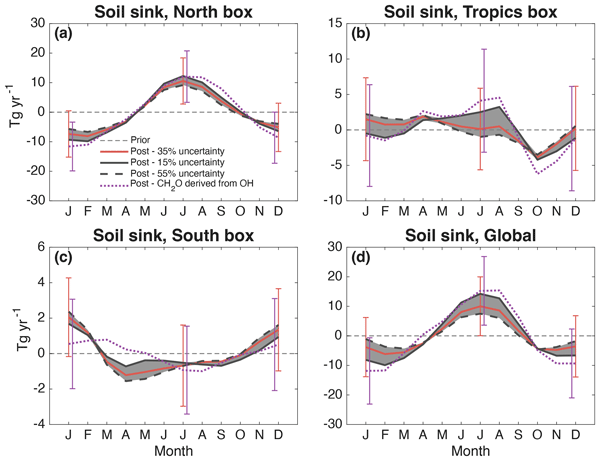
There is growing interest in hydrogens impact on atmospheric chemistry and climate. Here, the seasonality of hydrogen oxidation and loss to microbial activity in soils are investigated using information from the hydrofluorocarbon, HFC-152a. A large seasonal range of the soil sink, over twice that of hydroxyl loss, is seen in the Northern latitudes peaking in the late summer, while the Southern latitudes show a much lower range. This will be useful for validating model hydrogen cycles.
Joseph R. Pitt, Dominique Rust, Anita Ganesan, Luke M. Western, Martin K. Vollmer, Jens Mühle, Tobias Bühlmann, Christina M. Harth, Stephen A. Montzka, Brad D. Hall, Isaac J. Vimont, Alistair J. Manning, Alison L. Redington, Stephan Henne, Daniela B. Melo, Saurabh Annadate, Lionel Constantin, Brendan M. Murphy, Matthew Rigby, Dickon Young, Simon O'Doherty, Angelina Wenger, Chris R. Lunder, Ove Hermansen, Thomas Wagenhäuser, Andreas Engel, Jgor Arduini, Michela Maione, Jaegeun Yun, Blagoj Mitrevski, Paul B. Krummel, Paul J. Fraser, Jooil Kim, Ray H. J. Wang, Tae Siek Rhee, Peter K. Salameh, T. Gerard Spain, Stefan Reimann, Ronald G. Prinn, Ray F. Weiss, and Kieran M. Stanley
Atmos. Chem. Phys., 26, 10167–10195, https://doi.org/10.5194/acp-26-10167-2026, https://doi.org/10.5194/acp-26-10167-2026, 2026
Short summary
Short summary
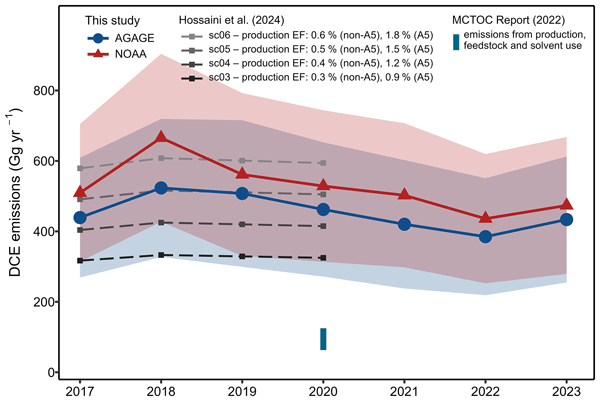
1,2‑Dichloroethane (DCE) can contribute to the depletion of the stratospheric ozone layer. Whether DCE reaches the stratosphere depends on where and when it is emitted. We present the ongoing measurements of DCE from the Advanced Global Atmospheric Gases Experiment (AGAGE) and National Oceanic and Atmospheric Administration (NOAA) global monitoring networks. For the period 2017–2023, our modelled average global emissions based on these observations align with another study, while regional estimates differ. This suggests remaining uncertainty in the geographical distribution of emissions.
Piers M. Forster, Tristram Walsh, Chris Smith, William F. Lamb, Robin Lamboll, Christophe Cassou, Mathias Hauser, Zeke Hausfather, June-Yi Lee, Matthew D. Palmer, Karina von Schuckmann, Aimée B. A. Slangen, Sophie Szopa, Blair Trewin, Jeongeun Yun, Nathan P. Gillett, Stuart Jenkins, H. Damon Matthews, Krishnan Raghavan, Aurélien Ribes, Joeri Rogelj, Debbie Rosen, Xuebin Zhang, Myles Allen, Robbie M. Andrew, Chris Atkinson, Richard A. Betts, Antonio Bombelli, Samantha N. Burgess, Lijing Cheng, Helen E. Claxton, Pierre Friedlingstein, Thomas L. Frölicher, Catia M. Domingues, Thomas Gasser, Catherine H. Gregory, Rachel M. Hoesly, Daniel Huppmann, Masayoshi Ishii, Christopher Kadow, Alexia Karwat, John Kennedy, Rachel E. Killick, Mahesh V. M. Kovilakam, Paul B. Krummel, Xin Lan, Jean-François Lamarque, Aurélien Liné, Belén Martín-Míguez, Didier P. Monselesan, Colin Morice, Jens Mühle, Pino Mussak, Glen P. Peters, Anna Pirani, Julia Pongratz, Matthew Rigby, Robert Rohde, Abhishek Savita, Sonia I. Seneviratne, Steven J. Smith, Ghassan Taha, Caterina Tassone, Peter Thorne, Christopher Wells, Luke M. Western, Guido R. van der Werf, Susan E. Wijffels, Marco Zecchetto, Junting Zhong, Xiao-Ye Zhang, Valérie Masson-Delmotte, and Panmao Zhai
Earth Syst. Sci. Data, 18, 3889–3933, https://doi.org/10.5194/essd-18-3889-2026, https://doi.org/10.5194/essd-18-3889-2026, 2026
Short summary
Short summary
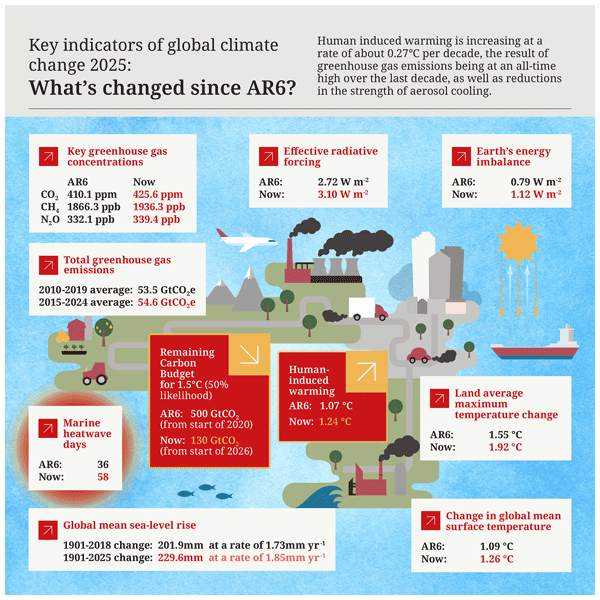
We give our annual update of key climate indicators. Our work quantifies the human contribution to global warming and the pace of climate change. This represents a large effort by the international community akin to an Intergovernmental Panel on Climate Change (IPCC) report.
Duseong S. Jo, John J. Orlando, Rebecca H. Schwantes, Louisa K. Emmons, Rebecca S. Hornbrook, Eric C. Apel, Alan J. Hills, Kirk Ullmann, L. Gregory Huey, Claire Granier, Chelsea R. Thompson, and Jeff Peischl
EGUsphere, https://doi.org/10.5194/egusphere-2026-1868, https://doi.org/10.5194/egusphere-2026-1868, 2026
Short summary
Short summary
C4-C6 alkane hydrocarbons are important precursors of air pollution, but most global atmospheric chemistry models represent them using a single lumped surrogate compound, limiting detailed simulation of their oxidation products. We developed a new chemical mechanism that explicitly treats individual C4-C6 alkane species in a global model. This explicit treatment substantially changes the simulated budgets of key oxygenated compounds such as methyl ethyl ketone.
Martin K. Vollmer, Joseph R. Pitt, Dickon Young, Stephan Henne, Blagoj Mitrevski, Jens Mühle, Anita Ganesan, Jgor Arduini, Alistair J. Manning, Thomas Wagenhäuser, Alison L. Redington, Daniela B. Melo, Brendan Murphy, Ray Gluckmann, Kieran M. Stanley, Paul B. Krummel, Chris R. Lunder, Jaegeun Yun, Dominique Rust, Angelina Wenger, Myriam Guillevic, Jooil Kim, Ray H. J. Wang, Tae Siek Rhee, Lionel Constantin, Arnoud Frumau, Christina M. Harth, Peter K. Salameh, Ove Hermansen, Matthew Rigby, Luke M. Western, Andreas Engel, Simon O'Doherty, Sunyoung Park, Michela Maione, Paul J. Fraser, Ronald G. Prinn, Ray F. Weiss, and Stefan Reimann
Atmos. Chem. Phys., 26, 6993–7012, https://doi.org/10.5194/acp-26-6993-2026, https://doi.org/10.5194/acp-26-6993-2026, 2026
Short summary
Short summary
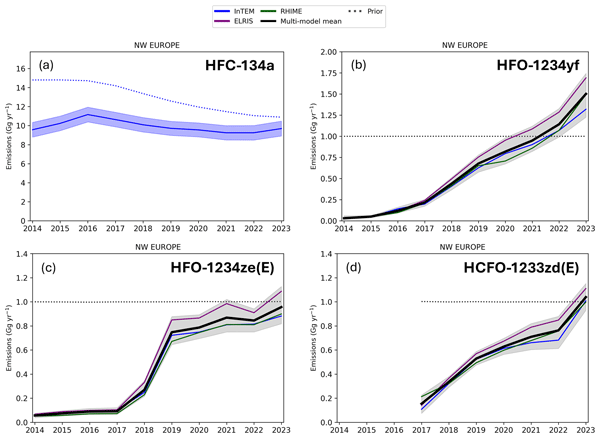
Halogenated olefins (HFOs) are newly emerging compounds in the atmosphere. They are in reach of the definition of PFAS (Per- and polyfluoroalkyl substances) and some decay to the eternal chemical trifluoroacetate (TFA). We provide atmospheric measurements of three HFOs from the large Advanced Global Atmospheric Gases Experiment (AGAGE) network and estimate emissions for Northwest Europe for the first time. We find a quasi-ubiquitous presence in the atmosphere and rapidly increasing emissions.
Sachiko Okamoto, Juan Cuesta, Gaëlle Dufour, Maxim Eremenko, Kazuyuki Miyazaki, Cathy Boonne, Hiroshi Tanimoto, Jeff Peischl, and Chelsea Thompson
Atmos. Chem. Phys., 26, 4685–4709, https://doi.org/10.5194/acp-26-4685-2026, https://doi.org/10.5194/acp-26-4685-2026, 2026
Short summary
Short summary
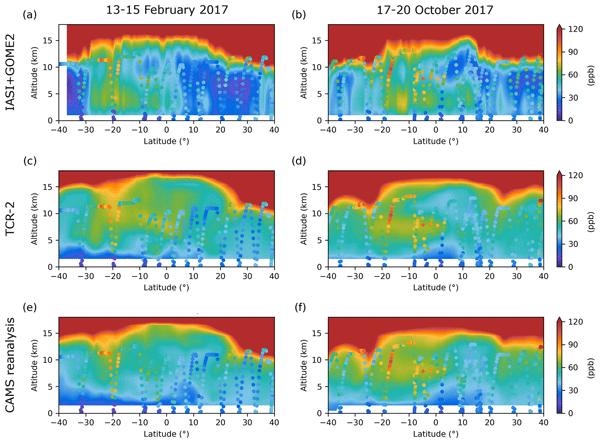
We analyse the distribution of tropospheric ozone over the Atlantic during February and October 2017 using a multispectral satellite synergism called IASI+GOME2, two chemistry reanalysis products and in situ airborne measurements. It reveals that a significant overestimation of two chemistry reanalysis products of lowermost troposphere ozone over the Atlantic in the Northern Hemisphere due to the overestimations of ozone precursors from anthropogenic sources from North America.
Elinor C. Tuffnell, Emma Leedham-Elvidge, William T. Sturges, Harald Bönisch, Karina E. Adcock, Paul J. Fraser, Paul B. Krummel, David E. Oram, Ray L. Langenfelds, Thomas Röckmann, Luke M. Western, Jens Mühle, and Johannes C. Laube
Atmos. Chem. Phys., 26, 4583–4599, https://doi.org/10.5194/acp-26-4583-2026, https://doi.org/10.5194/acp-26-4583-2026, 2026
Short summary
Short summary
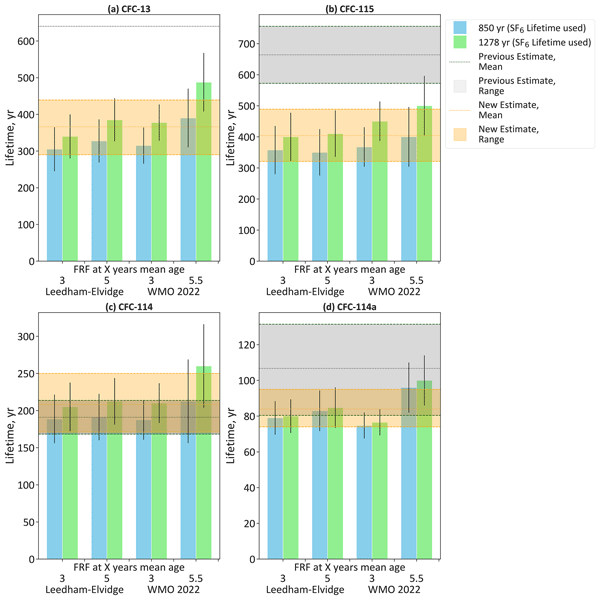
The greater the stratospheric lifetime of chlorofluorocarbons (CFCs), the longer they will deplete ozone. This paper investigates four longer-lived CFCs, and discovers two of them have much shorter lifetimes than previously believed. Demonstrating emissions of these compounds are higher than assumed, to account for their abundance. Unusually this paper uses stratospheric whole-air samples, rather than models or lab-based experiments, to derive policy-relevant metrics for these compounds.
Rebecca H. Ward, Luke M. Western, Rachel L. Tunnicliffe, Elena Fillola, Aki Tsuruta, Tuula Aalto, and Anita L. Ganesan
Atmos. Meas. Tech., 19, 813–837, https://doi.org/10.5194/amt-19-813-2026, https://doi.org/10.5194/amt-19-813-2026, 2026
Short summary
Short summary
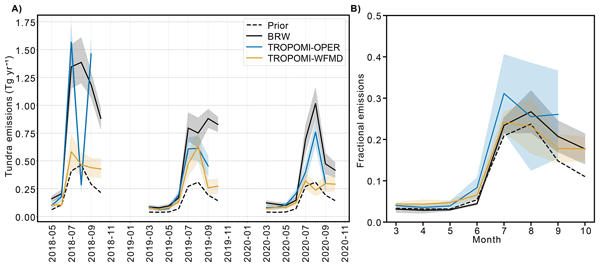
We studied methane emissions in Arctic Alaska using satellite observations to assess how well they can monitor this important greenhouse gas. We found that emission estimates varied depending on the satellite data product and were strongly affected by assumptions in the model. Our results highlight the need for careful interpretation of emissions from Arctic satellite data and thorough testing of models, with implications for reliable climate monitoring.
William J. Collins, John S. Daniel, Martyn P. Chipperfield, Martin Cussac, Makoto Deushi, Gregory Faluvegi, Paul Griffiths, Øivind Hodnebrog, Larry W. Horowitz, James Keeble, Douglas Kinnison, Vaishali Naik, Fiona M. O'Connor, Drew Shindell, Simone Tilmes, Kostas Tsigaridis, Zihao Wang, and James Weber
EGUsphere, https://doi.org/10.5194/egusphere-2025-6033, https://doi.org/10.5194/egusphere-2025-6033, 2026
Short summary
Short summary
Ozone depleting substances (ODSs) are also greenhouse gases that cause global warming. However, their destruction of ozone contributes a global cooling. We have used results from climate models that include atmospheric chemistry and found that the cooling effect of the ozone depletion diagnosed in the models was larger than that calculated using a standard method. We find that some ODSs have a net cooling effect whereas for others the warming effect is significantly reduced.
Luke M. Western, Stephen Bourguet, Molly Crotwell, Lei Hu, Paul B. Krummel, Hélène De Longueville, Alistair J. Manning, Jens Mühle, Dominique Rust, Isaac Vimont, Martin K. Vollmer, Minde An, Jgor Arduini, Andreas Engel, Paul J. Fraser, Anita L. Ganesan, Christina M. Harth, Chris Lunder, Michela Maione, Stephen A. Montzka, David Nance, Simon O'Doherty, Sunyoung Park, Stefan Reimann, Peter K. Salameh, Roland Schmidt, Kieran M. Stanley, Thomas Wagenhäuser, Dickon Young, Matt Rigby, Ronald G. Prinn, and Ray F. Weiss
Atmos. Chem. Phys., 25, 17761–17778, https://doi.org/10.5194/acp-25-17761-2025, https://doi.org/10.5194/acp-25-17761-2025, 2025
Short summary
Short summary
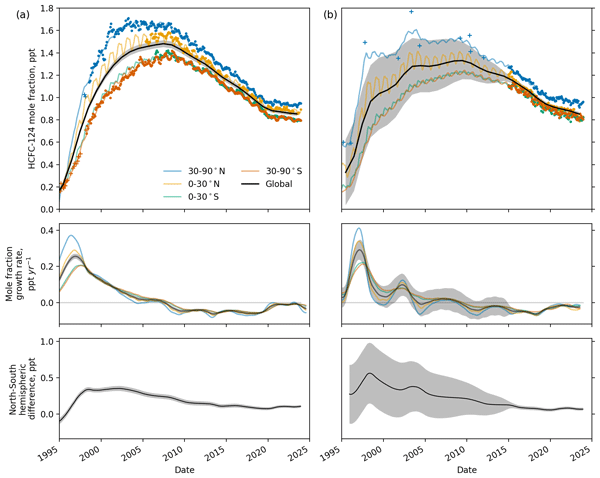
We used atmospheric measurements to estimate emissions of two hydrochlorofluorocarbon (HCFC) gases, called HCFC-123 and HCFC-124, that harm the ozone layer. Despite international regulation to stop their production, their emissions have not fallen. This may be linked to how they are used to make other chemicals. Our findings show that some banned substances are still reaching the atmosphere, likely through leaks during chemical production, which could slow the recovery of the ozone layer.
Luke M. Western, Matthew Rigby, Jens Mühle, Paul B. Krummel, Chris R. Lunder, Simon O'Doherty, Stefan Reimann, Martin K. Vollmer, Dickon Young, Ben Adam, Paul J. Fraser, Anita L. Ganesan, Christina M. Harth, Ove Hermansen, Jooil Kim, Ray L. Langenfelds, Zoë M. Loh, Blagoj Mitrevski, Joseph R. Pitt, Peter K. Salameh, Roland Schmidt, Kieran Stanley, Ann R. Stavert, Hsiang-Jui Wang, Ray F. Weiss, and Ronald G. Prinn
Earth Syst. Sci. Data, 17, 6557–6582, https://doi.org/10.5194/essd-17-6557-2025, https://doi.org/10.5194/essd-17-6557-2025, 2025
Short summary
Short summary
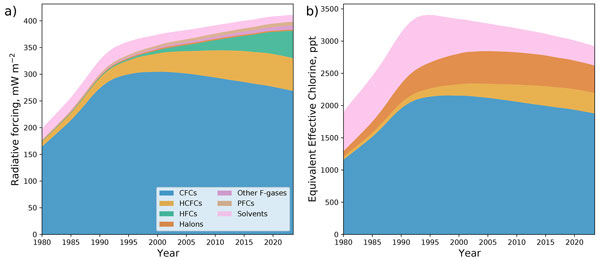
We used global measurements and an atmospheric model to estimate how emissions and abundances of 42 chemically and radiatively important trace gases have changed over time. These gases affect the Earth's radiative balance and the ozone layer. Our data sets help track progress in reducing emissions of these gases to the atmosphere. This work supports international efforts to protect the environment by providing clear, long-term, consistent data on how these gases are changing in the atmosphere.
Linda Ort, Andrea Pozzer, Peter Hoor, Florian Obersteiner, Andreas Zahn, Thomas B. Ryerson, Chelsea R. Thompson, Jeff Peischl, Róisín Commane, Bruce Daube, Ilann Bourgeois, Jos Lelieveld, and Horst Fischer
Atmos. Chem. Phys., 25, 14987–15007, https://doi.org/10.5194/acp-25-14987-2025, https://doi.org/10.5194/acp-25-14987-2025, 2025
Short summary
Short summary
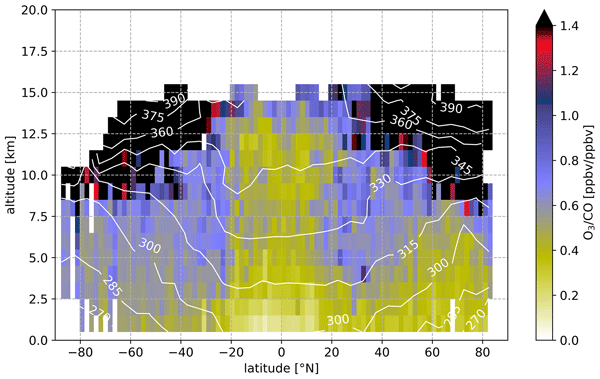
This study investigates the role of lightning emissions on the O3–CO ratio in the northern subtropics. We used in situ observations and a global circulation model to show an effect of up to 40 % onto the subtropical O3–CO ratio by tropical air masses transported via the Hadley cell. This influence of lightning emissions and its photochemistry has a global effect on trace and greenhouse gases and needs to be considered for global chemical distributions.
Yugo Kanaya, Roberto Sommariva, Alfonso Saiz-Lopez, Andrea Mazzeo, Theodore K. Koenig, Kaori Kawana, James E. Johnson, Aurélie Colomb, Pierre Tulet, Suzie Molloy, Ian E. Galbally, Rainer Volkamer, Anoop Mahajan, John W. Halfacre, Paul B. Shepson, Julia Schmale, Hélène Angot, Byron Blomquist, Matthew D. Shupe, Detlev Helmig, Junsu Gil, Meehye Lee, Sean C. Coburn, Ivan Ortega, Gao Chen, James Lee, Kenneth C. Aikin, David D. Parrish, John S. Holloway, Thomas B. Ryerson, Ilana B. Pollack, Eric J. Williams, Brian M. Lerner, Andrew J. Weinheimer, Teresa Campos, Frank M. Flocke, J. Ryan Spackman, Ilann Bourgeois, Jeff Peischl, Chelsea R. Thompson, Ralf M. Staebler, Amir A. Aliabadi, Wanmin Gong, Roeland Van Malderen, Anne M. Thompson, Ryan M. Stauffer, Debra E. Kollonige, Juan Carlos Gómez Martin, Masatomo Fujiwara, Katie Read, Matthew Rowlinson, Keiichi Sato, Junichi Kurokawa, Yoko Iwamoto, Fumikazu Taketani, Hisahiro Takashima, Mónica Navarro-Comas, Marios Panagi, and Martin G. Schultz
Earth Syst. Sci. Data, 17, 4901–4932, https://doi.org/10.5194/essd-17-4901-2025, https://doi.org/10.5194/essd-17-4901-2025, 2025
Short summary
Short summary
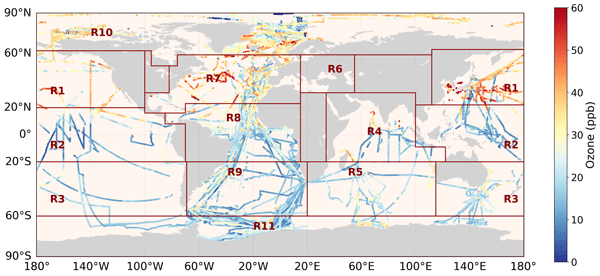
The first comprehensive dataset of tropospheric ozone over oceans/polar regions is presented, including 77 ship/buoy and 48 aircraft campaign observations (1977–2022, 0–5000 m altitude), supplemented by ozonesonde and surface data. Air masses isolated from land for 72+ hours are systematically selected as essentially oceanic. Among the 11 global regions, they show daytime decreases of 11–16 % in the tropics, while near-zero depletions are rare, unlike in the Arctic, implying different mechanisms.
Piers M. Forster, Chris Smith, Tristram Walsh, William F. Lamb, Robin Lamboll, Christophe Cassou, Mathias Hauser, Zeke Hausfather, June-Yi Lee, Matthew D. Palmer, Karina von Schuckmann, Aimée B. A. Slangen, Sophie Szopa, Blair Trewin, Jeongeun Yun, Nathan P. Gillett, Stuart Jenkins, H. Damon Matthews, Krishnan Raghavan, Aurélien Ribes, Joeri Rogelj, Debbie Rosen, Xuebin Zhang, Myles Allen, Lara Aleluia Reis, Robbie M. Andrew, Richard A. Betts, Alex Borger, Jiddu A. Broersma, Samantha N. Burgess, Lijing Cheng, Pierre Friedlingstein, Catia M. Domingues, Marco Gambarini, Thomas Gasser, Johannes Gütschow, Masayoshi Ishii, Christopher Kadow, John Kennedy, Rachel E. Killick, Paul B. Krummel, Aurélien Liné, Didier P. Monselesan, Colin Morice, Jens Mühle, Vaishali Naik, Glen P. Peters, Anna Pirani, Julia Pongratz, Jan C. Minx, Matthew Rigby, Robert Rohde, Abhishek Savita, Sonia I. Seneviratne, Peter Thorne, Christopher Wells, Luke M. Western, Guido R. van der Werf, Susan E. Wijffels, Valérie Masson-Delmotte, and Panmao Zhai
Earth Syst. Sci. Data, 17, 2641–2680, https://doi.org/10.5194/essd-17-2641-2025, https://doi.org/10.5194/essd-17-2641-2025, 2025
Short summary
Short summary
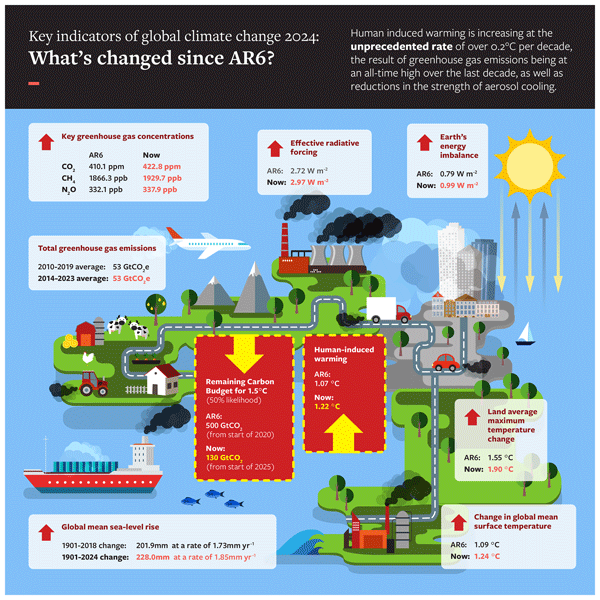
In a rapidly changing climate, evidence-based decision-making benefits from up-to-date and timely information. Here we compile monitoring datasets to track real-world changes over time. To make our work relevant to policymakers, we follow methods from the Intergovernmental Panel on Climate Change (IPCC). Human activities are increasing the Earth's energy imbalance and driving faster sea-level rise compared to the IPCC assessment.
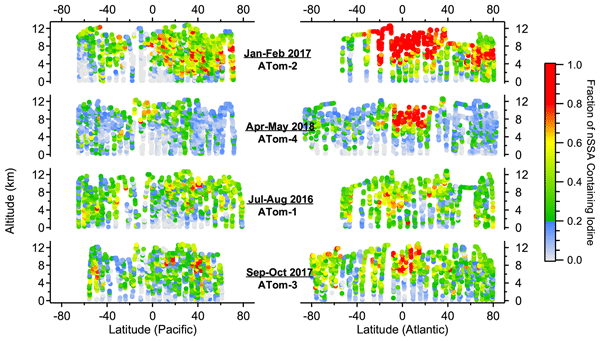
Gregory P. Schill, Karl D. Froyd, Daniel M. Murphy, Christina J. Williamson, Charles A. Brock, Tomás Sherwen, Mat J. Evans, Eric A. Ray, Eric C. Apel, Rebecca S. Hornbrook, Alan J. Hills, Jeff Peischl, Thomas B. Ryerson, Chelsea R. Thompson, Ilann Bourgeois, Donald R. Blake, Joshua P. DiGangi, and Glenn S. Diskin
Atmos. Chem. Phys., 25, 45–71, https://doi.org/10.5194/acp-25-45-2025, https://doi.org/10.5194/acp-25-45-2025, 2025
Short summary
Short summary
Using single-particle mass spectrometry, we show that trace concentrations of bromine and iodine are ubiquitous in remote tropospheric aerosol and suggest that aerosols are an important part of the global reactive iodine budget. Comparisons to a global climate model with detailed iodine chemistry are favorable in the background atmosphere; however, the model cannot replicate our measurements near the ocean surface, in biomass burning plumes, and in the stratosphere.
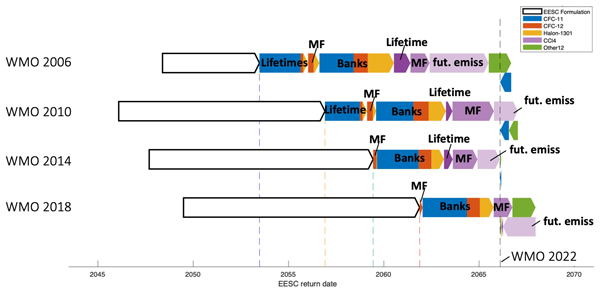
Megan J. Lickley, John S. Daniel, Laura A. McBride, Ross J. Salawitch, and Guus J. M. Velders
Atmos. Chem. Phys., 24, 13081–13099, https://doi.org/10.5194/acp-24-13081-2024, https://doi.org/10.5194/acp-24-13081-2024, 2024
Short summary
Short summary
The expected ozone recovery date was delayed by 17 years between the 2006 and 2022 international scientific assessments of ozone depletion. We quantify the primary drivers of this delay. Changes in the metric used to estimate ozone recovery explain ca. 5 years of this delay. Of the remaining 12 years, changes in estimated banks, atmospheric lifetimes, and emission projections explain 4, 3.5, and 3 years of this delay, respectively.
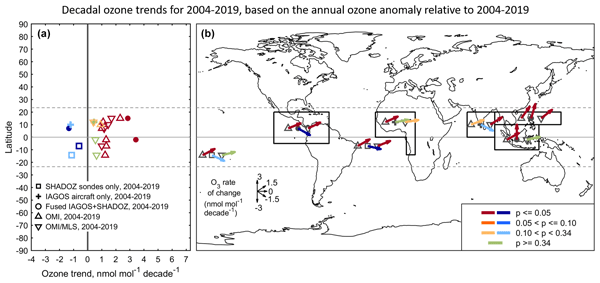
Audrey Gaudel, Ilann Bourgeois, Meng Li, Kai-Lan Chang, Jerald Ziemke, Bastien Sauvage, Ryan M. Stauffer, Anne M. Thompson, Debra E. Kollonige, Nadia Smith, Daan Hubert, Arno Keppens, Juan Cuesta, Klaus-Peter Heue, Pepijn Veefkind, Kenneth Aikin, Jeff Peischl, Chelsea R. Thompson, Thomas B. Ryerson, Gregory J. Frost, Brian C. McDonald, and Owen R. Cooper
Atmos. Chem. Phys., 24, 9975–10000, https://doi.org/10.5194/acp-24-9975-2024, https://doi.org/10.5194/acp-24-9975-2024, 2024
Short summary
Short summary
The study examines tropical tropospheric ozone changes. In situ data from 1994–2019 display increased ozone, notably over India, Southeast Asia, and Malaysia and Indonesia. Sparse in situ data limit trend detection for the 15-year period. In situ and satellite data, with limited sampling, struggle to consistently detect trends. Continuous observations are vital over the tropical Pacific Ocean, Indian Ocean, western Africa, and South Asia for accurate ozone trend estimation in these regions.

Hanqin Tian, Naiqing Pan, Rona L. Thompson, Josep G. Canadell, Parvadha Suntharalingam, Pierre Regnier, Eric A. Davidson, Michael Prather, Philippe Ciais, Marilena Muntean, Shufen Pan, Wilfried Winiwarter, Sönke Zaehle, Feng Zhou, Robert B. Jackson, Hermann W. Bange, Sarah Berthet, Zihao Bian, Daniele Bianchi, Alexander F. Bouwman, Erik T. Buitenhuis, Geoffrey Dutton, Minpeng Hu, Akihiko Ito, Atul K. Jain, Aurich Jeltsch-Thömmes, Fortunat Joos, Sian Kou-Giesbrecht, Paul B. Krummel, Xin Lan, Angela Landolfi, Ronny Lauerwald, Ya Li, Chaoqun Lu, Taylor Maavara, Manfredi Manizza, Dylan B. Millet, Jens Mühle, Prabir K. Patra, Glen P. Peters, Xiaoyu Qin, Peter Raymond, Laure Resplandy, Judith A. Rosentreter, Hao Shi, Qing Sun, Daniele Tonina, Francesco N. Tubiello, Guido R. van der Werf, Nicolas Vuichard, Junjie Wang, Kelley C. Wells, Luke M. Western, Chris Wilson, Jia Yang, Yuanzhi Yao, Yongfa You, and Qing Zhu
Earth Syst. Sci. Data, 16, 2543–2604, https://doi.org/10.5194/essd-16-2543-2024, https://doi.org/10.5194/essd-16-2543-2024, 2024
Short summary
Short summary
Atmospheric concentrations of nitrous oxide (N2O), a greenhouse gas 273 times more potent than carbon dioxide, have increased by 25 % since the preindustrial period, with the highest observed growth rate in 2020 and 2021. This rapid growth rate has primarily been due to a 40 % increase in anthropogenic emissions since 1980. Observed atmospheric N2O concentrations in recent years have exceeded the worst-case climate scenario, underscoring the importance of reducing anthropogenic N2O emissions.
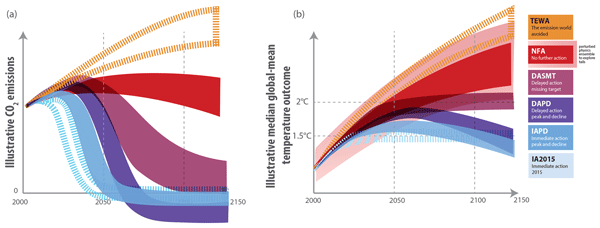
Malte Meinshausen, Carl-Friedrich Schleussner, Kathleen Beyer, Greg Bodeker, Olivier Boucher, Josep G. Canadell, John S. Daniel, Aïda Diongue-Niang, Fatima Driouech, Erich Fischer, Piers Forster, Michael Grose, Gerrit Hansen, Zeke Hausfather, Tatiana Ilyina, Jarmo S. Kikstra, Joyce Kimutai, Andrew D. King, June-Yi Lee, Chris Lennard, Tabea Lissner, Alexander Nauels, Glen P. Peters, Anna Pirani, Gian-Kasper Plattner, Hans Pörtner, Joeri Rogelj, Maisa Rojas, Joyashree Roy, Bjørn H. Samset, Benjamin M. Sanderson, Roland Séférian, Sonia Seneviratne, Christopher J. Smith, Sophie Szopa, Adelle Thomas, Diana Urge-Vorsatz, Guus J. M. Velders, Tokuta Yokohata, Tilo Ziehn, and Zebedee Nicholls
Geosci. Model Dev., 17, 4533–4559, https://doi.org/10.5194/gmd-17-4533-2024, https://doi.org/10.5194/gmd-17-4533-2024, 2024
Short summary
Short summary
The scientific community is considering new scenarios to succeed RCPs and SSPs for the next generation of Earth system model runs to project future climate change. To contribute to that effort, we reflect on relevant policy and scientific research questions and suggest categories for representative emission pathways. These categories are tailored to the Paris Agreement long-term temperature goal, high-risk outcomes in the absence of further climate policy and worlds “that could have been”.
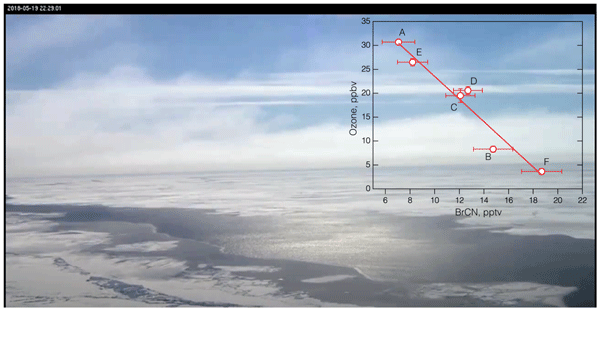
James M. Roberts, Siyuan Wang, Patrick R. Veres, J. Andrew Neuman, Michael A. Robinson, Ilann Bourgeois, Jeff Peischl, Thomas B. Ryerson, Chelsea R. Thompson, Hannah M. Allen, John D. Crounse, Paul O. Wennberg, Samuel R. Hall, Kirk Ullmann, Simone Meinardi, Isobel J. Simpson, and Donald Blake
Atmos. Chem. Phys., 24, 3421–3443, https://doi.org/10.5194/acp-24-3421-2024, https://doi.org/10.5194/acp-24-3421-2024, 2024
Short summary
Short summary
We measured cyanogen bromide (BrCN) in the troposphere for the first time. BrCN is a product of the same active bromine chemistry that destroys ozone and removes mercury in polar surface environments and is a previously unrecognized sink for active Br compounds. BrCN has an apparent lifetime against heterogeneous loss in the range 1–10 d, so it serves as a cumulative marker of Br-radical chemistry. Accounting for BrCN chemistry is an important part of understanding polar Br cycling.
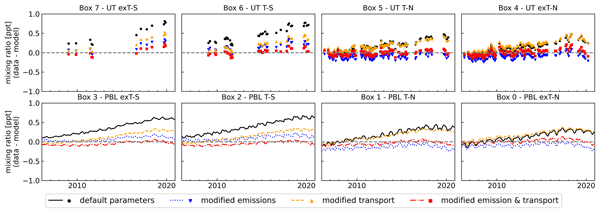
Tanja J. Schuck, Johannes Degen, Eric Hintsa, Peter Hoor, Markus Jesswein, Timo Keber, Daniel Kunkel, Fred Moore, Florian Obersteiner, Matt Rigby, Thomas Wagenhäuser, Luke M. Western, Andreas Zahn, and Andreas Engel
Atmos. Chem. Phys., 24, 689–705, https://doi.org/10.5194/acp-24-689-2024, https://doi.org/10.5194/acp-24-689-2024, 2024
Short summary
Short summary
We study the interhemispheric gradient of sulfur hexafluoride (SF6), a strong long-lived greenhouse gas. Its emissions are stronger in the Northern Hemisphere; therefore, mixing ratios in the Southern Hemisphere lag behind. Comparing the observations to a box model, the model predicts air in the Southern Hemisphere to be older. For a better agreement, the emissions used as model input need to be increased (and their spatial pattern changed), and we need to modify north–south transport.
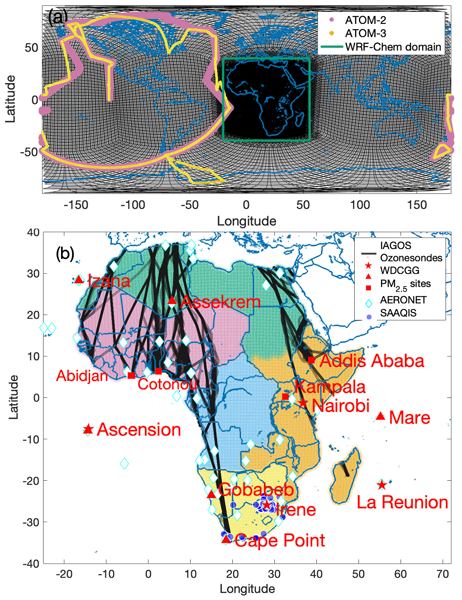
Wenfu Tang, Louisa K. Emmons, Helen M. Worden, Rajesh Kumar, Cenlin He, Benjamin Gaubert, Zhonghua Zheng, Simone Tilmes, Rebecca R. Buchholz, Sara-Eva Martinez-Alonso, Claire Granier, Antonin Soulie, Kathryn McKain, Bruce C. Daube, Jeff Peischl, Chelsea Thompson, and Pieternel Levelt
Geosci. Model Dev., 16, 6001–6028, https://doi.org/10.5194/gmd-16-6001-2023, https://doi.org/10.5194/gmd-16-6001-2023, 2023
Short summary
Short summary
The new MUSICAv0 model enables the study of atmospheric chemistry across all relevant scales. We develop a MUSICAv0 grid for Africa. We evaluate MUSICAv0 with observations and compare it with a previously used model – WRF-Chem. Overall, the performance of MUSICAv0 is comparable to WRF-Chem. Based on model–satellite discrepancies, we find that future field campaigns in an eastern African region (30°E–45°E, 5°S–5°N) could substantially improve the predictive skill of air quality models.
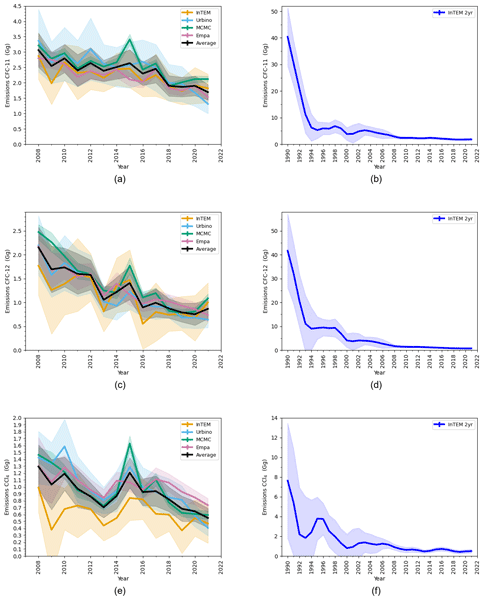
Alison L. Redington, Alistair J. Manning, Stephan Henne, Francesco Graziosi, Luke M. Western, Jgor Arduini, Anita L. Ganesan, Christina M. Harth, Michela Maione, Jens Mühle, Simon O'Doherty, Joseph Pitt, Stefan Reimann, Matthew Rigby, Peter K. Salameh, Peter G. Simmonds, T. Gerard Spain, Kieran Stanley, Martin K. Vollmer, Ray F. Weiss, and Dickon Young
Atmos. Chem. Phys., 23, 7383–7398, https://doi.org/10.5194/acp-23-7383-2023, https://doi.org/10.5194/acp-23-7383-2023, 2023
Short summary
Short summary
Chlorofluorocarbons (CFCs) were used in Europe pre-1990, damaging the stratospheric ozone layer. Legislation has controlled production and use, and global emissions have decreased sharply. The global rate of decline in CFC-11 recently slowed and was partly attributed to illegal emission in eastern China. This study concludes that emissions of CFC-11 in western Europe have not contributed to the unexplained part of the global increase in CFC-11 observed in the last decade.
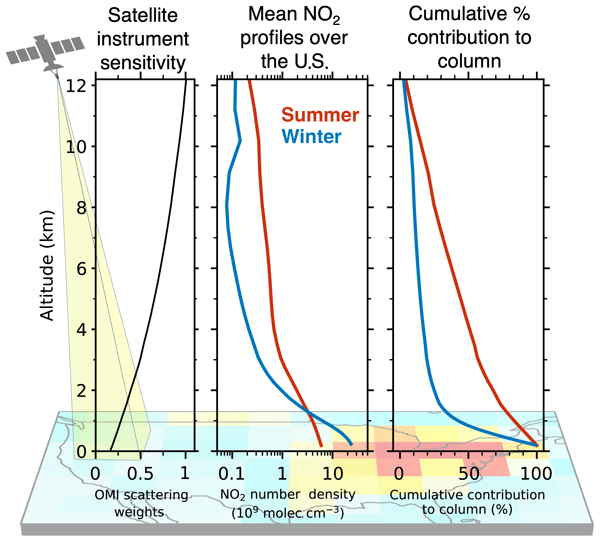
Viral Shah, Daniel J. Jacob, Ruijun Dang, Lok N. Lamsal, Sarah A. Strode, Stephen D. Steenrod, K. Folkert Boersma, Sebastian D. Eastham, Thibaud M. Fritz, Chelsea Thompson, Jeff Peischl, Ilann Bourgeois, Ilana B. Pollack, Benjamin A. Nault, Ronald C. Cohen, Pedro Campuzano-Jost, Jose L. Jimenez, Simone T. Andersen, Lucy J. Carpenter, Tomás Sherwen, and Mat J. Evans
Atmos. Chem. Phys., 23, 1227–1257, https://doi.org/10.5194/acp-23-1227-2023, https://doi.org/10.5194/acp-23-1227-2023, 2023
Short summary
Short summary
NOx in the free troposphere (above 2 km) affects global tropospheric chemistry and the retrieval and interpretation of satellite NO2 measurements. We evaluate free tropospheric NOx in global atmospheric chemistry models and find that recycling NOx from its reservoirs over the oceans is faster than that simulated in the models, resulting in increases in simulated tropospheric ozone and OH. Over the U.S., free tropospheric NO2 contributes the majority of the tropospheric NO2 column in summer.
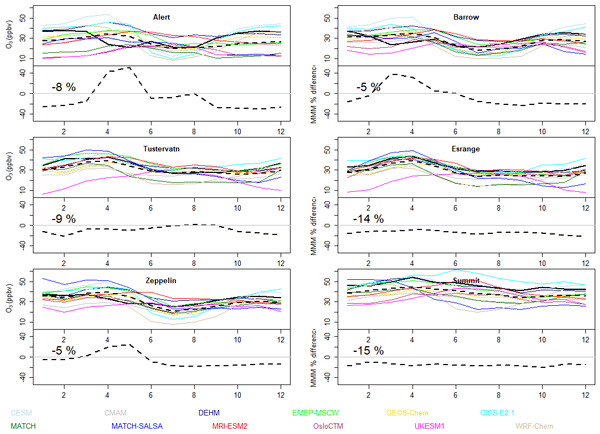
Cynthia H. Whaley, Kathy S. Law, Jens Liengaard Hjorth, Henrik Skov, Stephen R. Arnold, Joakim Langner, Jakob Boyd Pernov, Garance Bergeron, Ilann Bourgeois, Jesper H. Christensen, Rong-You Chien, Makoto Deushi, Xinyi Dong, Peter Effertz, Gregory Faluvegi, Mark Flanner, Joshua S. Fu, Michael Gauss, Greg Huey, Ulas Im, Rigel Kivi, Louis Marelle, Tatsuo Onishi, Naga Oshima, Irina Petropavlovskikh, Jeff Peischl, David A. Plummer, Luca Pozzoli, Jean-Christophe Raut, Tom Ryerson, Ragnhild Skeie, Sverre Solberg, Manu A. Thomas, Chelsea Thompson, Kostas Tsigaridis, Svetlana Tsyro, Steven T. Turnock, Knut von Salzen, and David W. Tarasick
Atmos. Chem. Phys., 23, 637–661, https://doi.org/10.5194/acp-23-637-2023, https://doi.org/10.5194/acp-23-637-2023, 2023
Short summary
Short summary
This study summarizes recent research on ozone in the Arctic, a sensitive and rapidly warming region. We find that the seasonal cycles of near-surface atmospheric ozone are variable depending on whether they are near the coast, inland, or at high altitude. Several global model simulations were evaluated, and we found that because models lack some of the ozone chemistry that is important for the coastal Arctic locations, they do not accurately simulate ozone there.
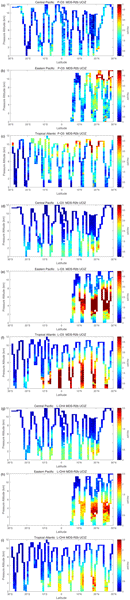
Hao Guo, Clare M. Flynn, Michael J. Prather, Sarah A. Strode, Stephen D. Steenrod, Louisa Emmons, Forrest Lacey, Jean-Francois Lamarque, Arlene M. Fiore, Gus Correa, Lee T. Murray, Glenn M. Wolfe, Jason M. St. Clair, Michelle Kim, John Crounse, Glenn Diskin, Joshua DiGangi, Bruce C. Daube, Roisin Commane, Kathryn McKain, Jeff Peischl, Thomas B. Ryerson, Chelsea Thompson, Thomas F. Hanisco, Donald Blake, Nicola J. Blake, Eric C. Apel, Rebecca S. Hornbrook, James W. Elkins, Eric J. Hintsa, Fred L. Moore, and Steven C. Wofsy
Atmos. Chem. Phys., 23, 99–117, https://doi.org/10.5194/acp-23-99-2023, https://doi.org/10.5194/acp-23-99-2023, 2023
Short summary
Short summary
We have prepared a unique and unusual result from the recent ATom aircraft mission: a measurement-based derivation of the production and loss rates of ozone and methane over the ocean basins. These are the key products of chemistry models used in assessments but have thus far lacked observational metrics. It also shows the scales of variability of atmospheric chemical rates and provides a major challenge to the atmospheric models.
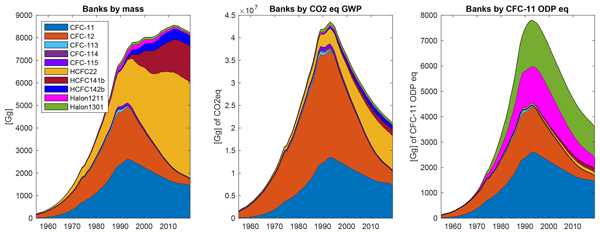
Megan Jeramaz Lickley, John S. Daniel, Eric L. Fleming, Stefan Reimann, and Susan Solomon
Atmos. Chem. Phys., 22, 11125–11136, https://doi.org/10.5194/acp-22-11125-2022, https://doi.org/10.5194/acp-22-11125-2022, 2022
Short summary
Short summary
Halocarbons contained in equipment continue to be emitted after production has ceased. These
banksmust be carefully accounted for in evaluating compliance with the Montreal Protocol. We extend a Bayesian model to the suite of regulated chemicals subject to banking. We find that banks are substantially larger than previous estimates, and we identify banks by chemical and equipment type whose future emissions will contribute to global warming and delay ozone-hole recovery if left unrecovered.
Luke M. Western, Alison L. Redington, Alistair J. Manning, Cathy M. Trudinger, Lei Hu, Stephan Henne, Xuekun Fang, Lambert J. M. Kuijpers, Christina Theodoridi, David S. Godwin, Jgor Arduini, Bronwyn Dunse, Andreas Engel, Paul J. Fraser, Christina M. Harth, Paul B. Krummel, Michela Maione, Jens Mühle, Simon O'Doherty, Hyeri Park, Sunyoung Park, Stefan Reimann, Peter K. Salameh, Daniel Say, Roland Schmidt, Tanja Schuck, Carolina Siso, Kieran M. Stanley, Isaac Vimont, Martin K. Vollmer, Dickon Young, Ronald G. Prinn, Ray F. Weiss, Stephen A. Montzka, and Matthew Rigby
Atmos. Chem. Phys., 22, 9601–9616, https://doi.org/10.5194/acp-22-9601-2022, https://doi.org/10.5194/acp-22-9601-2022, 2022
Short summary
Short summary
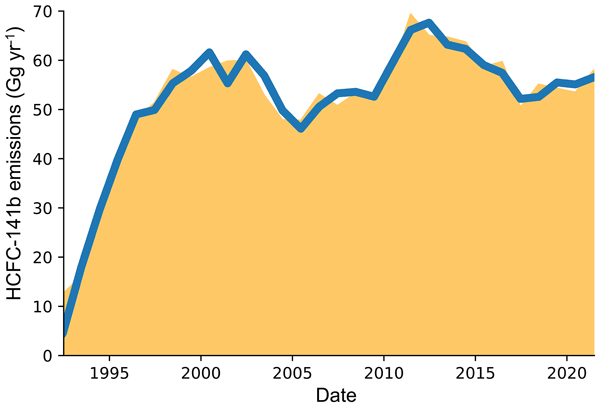
The production of ozone-destroying gases is being phased out. Even though production of one of the main ozone-depleting gases, called HCFC-141b, has been declining for many years, the amount that is being released to the atmosphere has been increasing since 2017. We do not know for sure why this is. A possible explanation is that HCFC-141b that was used to make insulating foams many years ago is only now escaping to the atmosphere, or a large part of its production is not being reported.
Guus J. M. Velders, John S. Daniel, Stephen A. Montzka, Isaac Vimont, Matthew Rigby, Paul B. Krummel, Jens Muhle, Simon O'Doherty, Ronald G. Prinn, Ray F. Weiss, and Dickon Young
Atmos. Chem. Phys., 22, 6087–6101, https://doi.org/10.5194/acp-22-6087-2022, https://doi.org/10.5194/acp-22-6087-2022, 2022
Short summary
Short summary
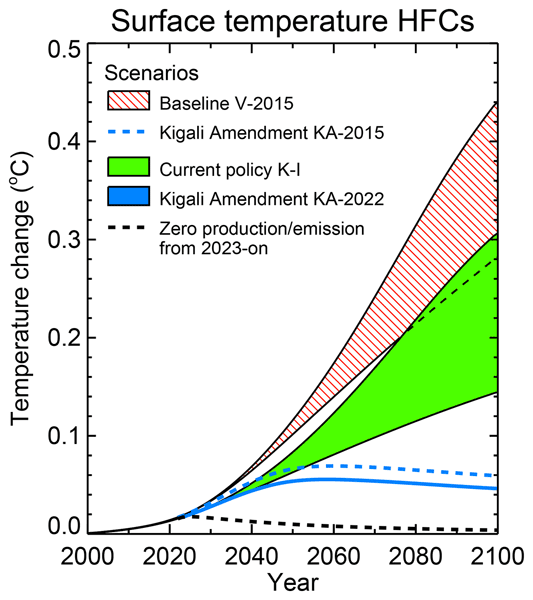
The emissions of hydrofluorocarbons (HFCs) have increased significantly in the past as a result of the phasing out of ozone-depleting substances. Observations indicate that HFCs are used much less in certain refrigeration applications than previously projected. Current policies are projected to reduce emissions and the surface temperature contribution of HFCs from 0.28–0.44 °C to 0.14–0.31 °C in 2100. The Kigali Amendment is projected to reduce the contributions further to 0.04 °C in 2100.
Alice E. Ramsden, Anita L. Ganesan, Luke M. Western, Matthew Rigby, Alistair J. Manning, Amy Foulds, James L. France, Patrick Barker, Peter Levy, Daniel Say, Adam Wisher, Tim Arnold, Chris Rennick, Kieran M. Stanley, Dickon Young, and Simon O'Doherty
Atmos. Chem. Phys., 22, 3911–3929, https://doi.org/10.5194/acp-22-3911-2022, https://doi.org/10.5194/acp-22-3911-2022, 2022
Short summary
Short summary
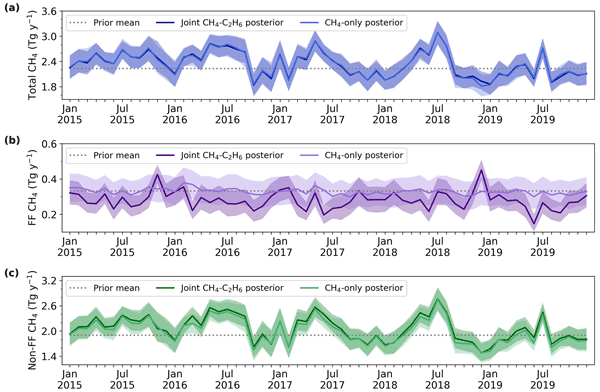
Quantifying methane emissions from different sources is a key focus of current research. We present a method for estimating sectoral methane emissions that uses ethane as a tracer for fossil fuel methane. By incorporating variable ethane : methane emission ratios into this model, we produce emissions estimates with improved uncertainty characterisation. This method will be particularly useful for studying methane emissions in areas with complex distributions of sources.
Jens Mühle, Lambert J. M. Kuijpers, Kieran M. Stanley, Matthew Rigby, Luke M. Western, Jooil Kim, Sunyoung Park, Christina M. Harth, Paul B. Krummel, Paul J. Fraser, Simon O'Doherty, Peter K. Salameh, Roland Schmidt, Dickon Young, Ronald G. Prinn, Ray H. J. Wang, and Ray F. Weiss
Atmos. Chem. Phys., 22, 3371–3378, https://doi.org/10.5194/acp-22-3371-2022, https://doi.org/10.5194/acp-22-3371-2022, 2022
Short summary
Short summary
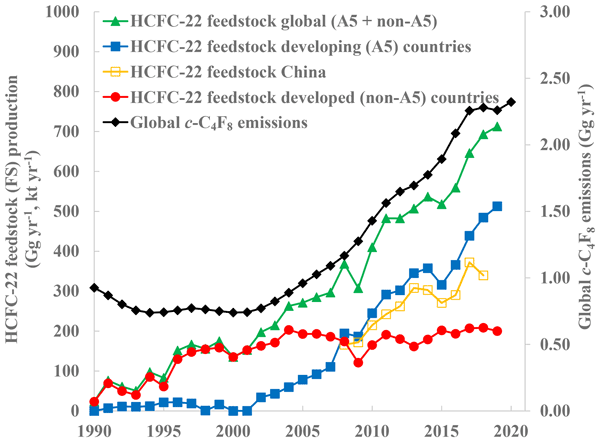
Emissions of the strong greenhouse gas perfluorocyclobutane (c-C4F8) into the atmosphere have been increasing sharply since the early 2000s. These c-C4F8 emissions are highly correlated with the amount of hydrochlorofluorocarbon-22 produced to synthesize polytetrafluoroethylene (known for its non-stick properties) and related chemicals. From this process, c-C4F8 by-product is vented to the atmosphere. Avoiding these unnecessary c-C4F8 emissions could reduce the climate impact of this industry.
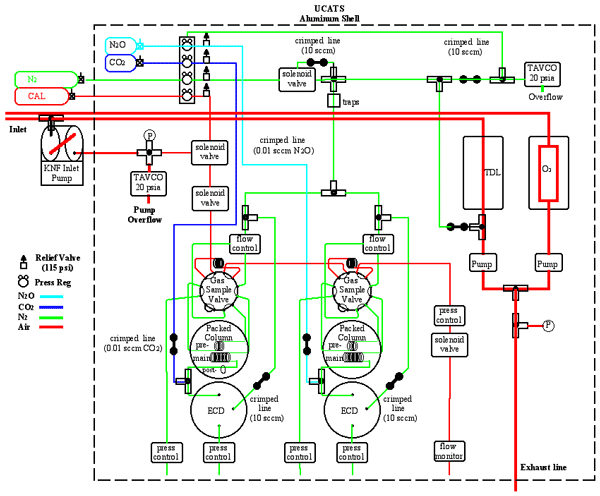
Eric J. Hintsa, Fred L. Moore, Dale F. Hurst, Geoff S. Dutton, Bradley D. Hall, J. David Nance, Ben R. Miller, Stephen A. Montzka, Laura P. Wolton, Audra McClure-Begley, James W. Elkins, Emrys G. Hall, Allen F. Jordan, Andrew W. Rollins, Troy D. Thornberry, Laurel A. Watts, Chelsea R. Thompson, Jeff Peischl, Ilann Bourgeois, Thomas B. Ryerson, Bruce C. Daube, Yenny Gonzalez Ramos, Roisin Commane, Gregory W. Santoni, Jasna V. Pittman, Steven C. Wofsy, Eric Kort, Glenn S. Diskin, and T. Paul Bui
Atmos. Meas. Tech., 14, 6795–6819, https://doi.org/10.5194/amt-14-6795-2021, https://doi.org/10.5194/amt-14-6795-2021, 2021
Short summary
Short summary
We built UCATS to study atmospheric chemistry and transport. It has measured trace gases including CFCs, N2O, SF6, CH4, CO, and H2 with gas chromatography, as well as ozone and water vapor. UCATS has been part of missions to study the tropical tropopause; transport of air into the stratosphere; greenhouse gases, transport, and chemistry in the troposphere; and ozone chemistry, on both piloted and unmanned aircraft. Its design, capabilities, and some results are shown and described here.
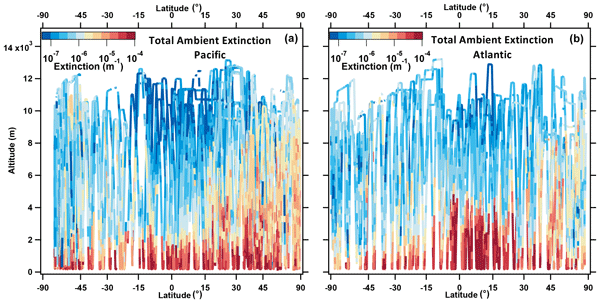
Charles A. Brock, Karl D. Froyd, Maximilian Dollner, Christina J. Williamson, Gregory Schill, Daniel M. Murphy, Nicholas J. Wagner, Agnieszka Kupc, Jose L. Jimenez, Pedro Campuzano-Jost, Benjamin A. Nault, Jason C. Schroder, Douglas A. Day, Derek J. Price, Bernadett Weinzierl, Joshua P. Schwarz, Joseph M. Katich, Siyuan Wang, Linghan Zeng, Rodney Weber, Jack Dibb, Eric Scheuer, Glenn S. Diskin, Joshua P. DiGangi, ThaoPaul Bui, Jonathan M. Dean-Day, Chelsea R. Thompson, Jeff Peischl, Thomas B. Ryerson, Ilann Bourgeois, Bruce C. Daube, Róisín Commane, and Steven C. Wofsy
Atmos. Chem. Phys., 21, 15023–15063, https://doi.org/10.5194/acp-21-15023-2021, https://doi.org/10.5194/acp-21-15023-2021, 2021
Short summary
Short summary
The Atmospheric Tomography Mission was an airborne study that mapped the chemical composition of the remote atmosphere. From this, we developed a comprehensive description of aerosol properties that provides a unique, global-scale dataset against which models can be compared. The data show the polluted nature of the remote atmosphere in the Northern Hemisphere and quantify the contributions of sea salt, dust, soot, biomass burning particles, and pollution particles to the haziness of the sky.
Cited articles
Aktas, C. B. and Bilec, M. M.: Impact of lifetime on U.S. residential building LCA results, Int. J. Life Cycle Assess., 17, 337–349, doi;10.1007/s11367-011-0363-x, 2012.
Andersen, R. and Negendahl, K.: Lifespan prediction of existing building typologies, J. Build Eng., 65, https://doi.org/10.1016/j.jobe.2022.105696, 2023.
Andersons, J., Modniks, J., and Kirpluks, M.: Estimation of the effective diffusivity of blowing agents in closed-cell low-density polyurethane foams based on thermal aging data, J. Build Eng., 44, 103365, https://doi.org/10.1016/j.jobe.2021.103365, 2021.
Andersons, J., Modniks, J., and Kirpluks, M.: Modelling the effect of morphology on thermal aging of low-density closed-cell PU foams, Int. Commun. Heat Mass Transf., 139, 106432, https://doi.org/10.1016/j.icheatmasstransfer.2022.106432, 2022.
Aprahamian, S. L. and Bowman, J. M.: Quantification of HFC blowing agent emissions of typical appliance insulating foam, Alliance for the Polyurethanes Industry's Polyurethanes Technical Conference and Trade Fair, Houston, 19–22 October, 2005.
Bomberg, M. T., Kumaran, M. K., Ascough, M. R., Creazzo, J. A., Zane, J. K., and Syrop, A. H.: Techniques to Assess the Role of Various Components in Retarding Aging of Rigid, Faced Thermal Insulating Foams, J. Cell Plast., 30, 106–124, https://doi.org/10.1177/0021955x9403000201, 1994.
Caleb Management Services Ltd.: Developing a California Inventory for Ozone Depleting Substances (ODS) and Hydrofluorocarbon (HFC) Foam Banks and Emissions from Foams, Prepared for California Air Resources Board and California Environmental Protection Agency, Technical Report, https://ww2.arb.ca.gov/sites/default/files/classic/research/apr/past/07-312.pdf (last access: 15 August 2024), 2010.
Chipperfield, M. P., Hegglin, M. I., Montzka, S. A., Newman, P. A., Park, S., Reimann, S., Rigby, M., Stohl, A., Velders, G. J. M., Walter-Terrinoni, H., and Yao, B.: Report on the unexpected emissions of CFC-11, World Meteorological Organization, Geneva, WMO-No. 1268, https://ozone.unep.org/system/files/documents/SAP-2021-report-on-the-unexpected-emissions-of-CFC-11-1268_en.pdf (last access: 16 July 2024), 2021.
Christian, J. E., Courville, G. E., Graves, R. S., Linkous, R. L., Mcelroy, D. L., Weaver, F. J., and Yarbrough, D. W.: Thermal Measurement of Insitu and Thin-Specimen Aging of Experimental Polyisocyanurate Roof Insulation Foamed with Alternative Blowing Agents, Am. Soc. Test Mater., 1116, 142–166, https://doi.org/10.1520/Stp16345s, 1991.
Daniel, J. S., Reimann, S. L. A., Ashford, P., Fleming, E. L., Hossaini, R., Lickley, M. J., Schofield, R., and Walter-Terrinoni, H.: Scenarios and Information for Policymakers, Global Atmospheric Watch Programme, Geneva, GAW Report No. 278, 509 pp., https://ozone.unep.org/sites/default/files/2023-02/Scientific-Assessment-of-Ozone-Depletion-2022.pdf (last access: 26 August 2025), 2022.
Deetman, S., Marinova, S., van der Voet, E., van Vuuren, D. P., Edelenbosch, O., and Heijungs, R.: Modelling global material stocks and flows for residential and service sector buildings towards 2050, J. Clean Prod., 245, 118658, https://doi.org/10.1016/j.jclepro.2019.118658, 2020.
DOE: Energy conservation program: Energy conservation standards for commercial refrigeration equipment, Rep. EERE-2010-BT-STD-0003, https://www.regulations.gov/document/EERE-2010-BT-STD-0003-0039 (last access: 9 December 2025), 2014.
EPA: Transitioning to low-GWP alternatives in transport refrigeration, https://www.epa.gov/sites/default/files/2015-07/documents/transitioning_to_low-gwp_alternatives_in_transport_refrigeration.pdf (last access: 7 January 2025), 2011.
Gallagher, G., Zhan, T., Hsu, Y. K., Gupta, P., Pederson, J., Croes, B., Blake, D. R., Barletta, B., Meinardi, S., Ashford, P., Vetter, A., Saba, S., Slim, R., Palandre, L., Clodic, D., Mathis, P., Wagner, M., Forgie, J., Dwyer, H., and Wolf, K.: High-Global Warming Potential F-gas Emissions in California: Comparison of Ambient-Based versus Inventory-Based Emission Estimates, and Implications of Refined Estimates, Environ. Sci. Technol., 48, 1084–1093, https://doi.org/10.1021/es403447v, 2014.
Gluckman Consulting: The HFC Outlook EU Model: https://epeeglobal.org/hfc-outlook-eu/, last access: 7 January 2025.
Holcroft, N.: Temperature dependency of the long-term thermal conductivity of spray polyurethane foam, J. Build Phys., 45, 571–603, doi;10.1177/17442591211045415, 2022.
Hueppe, C., Geppert, J., Stamminger, R., Wagner, H., Hoelscher, H., Vrabec, J., Paul, A., Elsner, A., Becker, W., Gries, U., and Freiberger, A.: Age-related efficiency loss of household refrigeration appliances: Development of an approach to measure the degradation of insulation properties, Appl. Therm. Eng., 173, https://doi.org/10.1016/j.applthermaleng.2020.115113, 2020.
IPCC: 2006 IPCC Guidelines for National Greenhouse Gas Inventories, Prepared by the National Greenhouse Gas Inventories Programme, IGES, Japan, https://www.ipcc-nggip.iges.or.jp/public/2006gl/pdf/3_Volume3/V3_7_Ch7_ODS_Substitutes.pdf (last access: 14 August 2024), 2006.
IPCC: Chemical Industry Emissions, in 2019 Refinement to the 2006 IPCC Guidelines for National Greenhouse Gas Inventories, IPCC, Switzerland, https://www.ipcc-nggip.iges.or.jp/public/2019rf/pdf/3_Volume3/19R_V3_Ch03_Chemical_Industry.pdf (last access: 28 January 2025), 2019.
IPCC/TEAP: Safeguarding the Ozone Layer and the Global Climate System: Issues Related to Hydrofluorocarbons and Perfluorocarbons, Intergovernmental Panel on Climate Change/Technology and Economic Assessment Panel, Cambridge, UK, https://www.ipcc.ch/report/safeguarding-the-ozone-layer-and-the-global-climate-system/ (last access: 14 August 2024), 2005.
Kirpluks, M., Andersons, J., and Modniks, J.: Modelling the effect of morphology on thermal aging of low-density closed-cell PU foams, Int. Commun. Heat Mass Transf., 139, https://doi.org/10.1016/j.icheatmasstransfer.2022.106432, 2022.
Kirpluks, M., Godina, D., Svajdlenkova, H., Sausa, O., Modniks, J., Simakovs, K., and Andersons, J.: Effect of Crosslink Density on Thermal Aging of Bio-Based Rigid Low-Density Closed-Cell Polyurethane Foams, ACS Appl. Polym. Mater., 5, 4305–4315, https://doi.org/10.1021/acsapm.3c00470, 2023.
Kjeldsen, P. and Scheutz, C.: Short- and long-term releases of fluorocarbons from disposal of polyurethane foam waste, Environ. Sci. Technol., 37, 5071–5079, https://doi.org/10.1021/es026385y, 2003.
Lickley, M. J., Daniel, J. S., Fleming, E. L., Reimann, S., and Solomon, S.: Bayesian assessment of chlorofluorocarbon (CFC), hydrochlorofluorocarbon (HCFC) and halon banks suggest large reservoirs still present in old equipment, Atmos. Chem. Phys., 22, 11125–11136, https://doi.org/10.5194/acp-22-11125-2022, 2022.
Makaveckas, T., Bliudzius, R., and Burlingis, A.: Determination of the impact of environmental temperature on the thermal conductivity of polyisocyanurate (PIR) foam products, J. Build Eng., 41, https://doi.org/10.1016/j.jobe.2021.102447, 2021.
Mathis, P.: Lifecycle analysis of high-global warming potential greenhouse gas destruction, The California Air Resources Board, https://ww2.arb.ca.gov/sites/default/files/classic//research/apr/past/07-330.pdf (last access: 15 August 2024), 2011.
McCulloch, A., Ashford, P., and Midgley, P. M.: Historic emissions of fluorotrichloromethane (CFC-11) based on a market survey, Atmos. Environ., 35, 4387–4397, https://doi.org/10.1016/S1352-2310(01)00249-7, 2001.
MCTOC: Report of the Medical and Chemical Technical Options Committee: 2022 Assessment Report, United Nations Environment Programme, Nairobi, Kenya, https://ozone.unep.org/system/files/documents/MCTOC-Assessment-Report-2022.pdf (last access: 18 January 2024), 2022.
Modesti, M., Lorenzetti, A., and Dall'Acqua, C.: Long-term performance of enviromentally-friendly blown polyurethane foams, Polym. Eng. Sci., 45, 260–270, https://doi.org/10.1002/pen.20272, 2005.
Montzka, S. A., McFarland, M., Andersen, S. O., Miller, B. R., Fahey, D. W., Hall, B. D., Hu, L., Siso, C., and Elkins, J. W.: Recent Trends in Global Emissions of Hydrochlorofluorocarbons and Hydrofluorocarbons: Reflecting on the 2007 Adjustments to the Montreal Protocol, J. Phys. Chem. A, 119, 4439–4449, https://doi.org/10.1021/jp5097376, 2015.
Montzka, S. A., Dutton, G. S., Yu, P., Ray, E., Portmann, R. W., Daniel, J. S., Kiujpers, L., Hall, B. D., Mondeel, D., Siso, C., Nance, J. D., Rigby, M., Manning, A. J., Hu, L., Moore, F., Miller, B. R., and Elkins, J. W.: An unexpected and persistent increase in global emissions of ozone-depleting CFC-11, Nature, 557, 413–417, https://doi.org/10.1038/s41586-018-0106-2, 2018.
Newman, P. A., Oman, L. D., Douglass, A. R., Fleming, E. L., Frith, S. M., Hurwitz, M. M., Kawa, S. R., Jackman, C. H., Krotkov, N. A., Nash, E. R., Nielsen, J. E., Pawson, S., Stolarski, R. S., and Velders, G. J. M.: What would have happened to the ozone layer if chlorofluorocarbons (CFCs) had not been regulated?, Atmos. Chem. Phys., 9, 2113–2128, https://doi.org/10.5194/acp-9-2113-2009, 2009.
Paul, A., Baumhögger, E., Elsner, A., Moczarski, L., Reineke, M., Sonnenrein, G., Hueppe, C., Stamminger, R., Hoelscher, H., Wagner, H., Gries, U., Freiberger, A., Becker, W., and Vrabec, J.: Determining the heat flow through the cabinet walls of household refrigerating appliances, Int. J. Refrig., 121, 235–242, https://doi.org/10.1016/j.ijrefrig.2020.10.007, 2021.
Prinn, R. G., Weiss, R. F., Arduini, J., Arnold, T., DeWitt, H. L., Fraser, P. J., Ganesan, A. L., Gasore, J., Harth, C. M., Hermansen, O., Kim, J., Krummel, P. B., Li, S., Loh, Z. M., Lunder, C. R., Maione, M., Manning, A. J., Miller, B. R., Mitrevski, B., Mühle, J., O'Doherty, S., Park, S., Reimann, S., Rigby, M., Saito, T., Salameh, P. K., Schmidt, R., Simmonds, P. G., Steele, L. P., Vollmer, M. K., Wang, R. H., Yao, B., Yokouchi, Y., Young, D., and Zhou, L.: History of chemically and radiatively important atmospheric gases from the Advanced Global Atmospheric Gases Experiment (AGAGE), Earth Syst. Sci. Data, 10, 985–1018, https://doi.org/10.5194/essd-10-985-2018, 2018.
Scheutz, C. and Kjeldsen, P.: Determination of the fraction of blowing agent released from refrigerator/freezer foam after decommissioning the product, Environment and Resources DTU. Technical University of Denmark, Lyngby, Denmark, https://backend.orbit.dtu.dk/ws/portalfiles/portal/6505060/MR2002-052.pdf (last access: 14 August 2024), 2002.
Scheutz, C., Fredenslund, A. M., Kjeldsen, P., and Tant, M.: Release of fluorocarbons from insulation foam in home appliances during shredding, J. Air Waste Manage., 57, 1452–1460, https://doi.org/10.3155/1047-3289.57.12.1452, 2007.
Scheutz, C., Pedersen, G. B., Costa, G., and Kjeldsen, P.: Biodegradation of Methane and Halocarbons in Simulated Landfill Biocover Systems Containing Compost Materials, J. Environ. Qual., 38, 1363–1371, https://doi.org/10.2134/jeq2008.0170, 2009.
Slaper, H., Velders, G. J. M., Daniel, J. S., deGruijl, F. R., and vanderLeun, J. C.: Estimates of ozone depletion and skin cancer incidence to examine the Vienna Convention achievements, Nature, 384, 256–258, https://doi.org/10.1038/384256a0, 1996.
TEAP: Report of the Technology and Economic Assessment Panel, Volume 3: Report of the Task Force on Foam End-of-Life Issues, United Nations Environment Programme, Ozone Secretariat, Nairobi, Kenya, https://ozone.unep.org/sites/default/files/2019-05/TEAP-May-2005-Vol-2-Forms-End-of-Life.pdf (last access: 28 January 2025), 2005.
TEAP: Volume 1: Decision XXX/3 TEAP Task Force report on unexpected emissions of trichlorofluoromethane (CFC-11), https://ozone.unep.org/system/files/documents/TEAP-TF-DecXXX-3-unexpected_CFC11_emissions-september2019.pdf (last access: 7 February 2024), 2019.
TEAP: Volume 3: Decision XXX/3 TEAP Task Force report on unexpected emissions of trichlorofluoromethane (CFC-11), https://ozone.unep.org/system/files/documents/Final_TEAP-DecisionXXXI-3-TF-Unexpected-Emissions-of-CFC-11-may2021.pdf (last access: 7 February 2024), 2021.
TEAP: 2022 Assessment Report of the Technology and Economic Assessment Panel, Montreal Protocol on Substances that Deplete the Ozone Layer. UNEP, Nairobi, Kenya, https://ozone.unep.org/system/files/documents/TEAP-Assessment-Report-2022-April23.pdf (last access: 9 July 2024), 2023.
UNEP: 2002 Report of the Rigid and Flexible Foams Technical Options Committee: 2002 Assessment, United Nations Environment Programme, Nairobi, Kenya, https://ozone.unep.org/sites/default/files/2019-05/FTOC-2002-Assessment-Report.pdf (last access: 28 January 2025), 2003a.
UNEP: Report of the UNEP Technology and Economic Assessment Panel: HCFC task force report, United Nations Environment Programme, Nairobi, Kenya, https://ozone.unep.org/sites/default/files/2019-05/HCFC03R1.pdf (last access: 28 January 2025), 2003b.
UNEP: 2006 Report of the Rigid and Flexible Foams Technical Options Committee: 2006 Assessment, Nairobi, Kenya, 169, https://ozone.unep.org/sites/default/files/2019-05/ftoc_assessment_report06.pdf (last access: 28 January 2025), 2007.
UNEP: 2010 Rigid and Flexible Foams Report, United Nations Environment Programme, Nairobi, Kenya, 106, https://ozone.unep.org/sites/default/files/2019-05/FTOC-2010-Assessment-Report.pdf (last access: 28 January 2025), 2010.
UNEP: Executive committee of the multilateral fund for the implementation of the Montreal Protocol: Country programme data and prospects for compliance, http://207.96.163.235/83/English/1/8307.pdf (last access: 9 December 2025), 2019.
UNEP: Report of the flexible and rigid foams technical options committee: 2022 assessment report, Nairobi, Kenya, https://ozone.unep.org/system/files/documents/FTOC-Assessment-Report-2022.pdf (last access: 9 July 2024), 2023.
UNEP: Ozone Secretariat: Ozone Secretariat Data Centre: https://ozone.unep.org/countries/data, last access: 7 January 2025a.
UNEP: Ozone Secretariat: The Montreal Protocol on Substances that Deplete the Ozone Layer: https://ozone.unep.org/treaties/montreal-protocol, last access: 7 January 2025b.
UNFCCC: Draft large-scale methodology: AM00XX: Energy-efficient refrigerators and air-conditioners, Rep. CDM-MP74-A04, https://cdm.unfccc.int/sunsetcms/storage/contents/stored-file-20170904161830958/Draft%20New%20RAC%20Meth%20publish.pdf (last access: 21 November 2024), 2017.
Velders, G. J. M. and Daniel, J. S.: Uncertainty analysis of projections of ozone-depleting substances: mixing ratios, EESC, ODPs, and GWPs, Atmos. Chem. Phys., 14, 2757–2776, https://doi.org/10.5194/acp-14-2757-2014, 2014.
Velders, G. J. M., Andersen, S. O., Daniel, J. S., Fahey, D. W., and McFarland, M.: The importance of the Montreal Protocol in protecting climate, P. Natl. Acad. Sci. USA, 104, 4814–4819, https://doi.org/10.1073/pnas.0610328104, 2007.
Velders, G. J. M., Fahey, D. W., Daniel, J. S., McFarland, M., and Andersen, S. O.: The large contribution of projected HFC emissions to future climate forcing, P. Natl. Acad. Sci. USA, 106, 10949–10954, 10.1073/pnas.0902817106, 2009.
Wang, Z. Y., Yan, H. H., Fang, X. K., Gao, L. Y., Zhai, Z. H., Hu, J. X., Zhang, B. Y., and Zhang, J. B.: Past, present, and future emissions of HCFC-141b in China, Atmos. Environ., 109, 228–233, https://doi.org/10.1016/j.atmosenv.2015.03.019, 2015.
Western, L. M., Redington, A. L., Manning, A. J., Trudinger, C. M., Hu, L., Henne, S., Fang, X., Kuijpers, L. J. M., Theodoridi, C., Godwin, D. S., Arduini, J., Dunse, B., Engel, A., Fraser, P. J., Harth, C. M., Krummel, P. B., Maione, M., Mühle, J., O'Doherty, S., Park, H., Park, S., Reimann, S., Salameh, P. K., Say, D., Schmidt, R., Schuck, T., Siso, C., Stanley, K. M., Vimont, I., Vollmer, M. K., Young, D., Prinn, R. G., Weiss, R. F., Montzka, S. A., and Rigby, M.: A renewed rise in global HCFC-141b emissions between 2017–2021, Atmos. Chem. Phys., 22, 9601–9616, https://doi.org/10.5194/acp-22-9601-2022, 2022.
Wilkes, K. E., Gabbard, W. A., Weaver, F. J., and Booth, J. R.: Aging of polyurethane foam insulation in simulated refrigerator panels – Two-year results with third-generation blowing agents, J. Cell Plast., 37, 400–428, https://doi.org/10.1106/N9xj-Pke1-N3uv-Dwjq, 2001.
Wilkes, K. E., Yarbrough, D. W., Nelson, G. E., and Booth, J. R.: Aging of polyurethane foam insulation in simulated refrigerator panels – four-year results with third-generation blowing agents, The Earth Technologies Forum, Washington, DC, https://www.researchgate.net/publication/228996663_Aging_of_Polyurethane_Foam_Insulation_in_Simulated_Refrigerator_Panels-Four-Year_Results_with_Third-Generation_Blowing_Agents (last access: 14 August 2024), 2003.
WMO: Scientific Assessment of Ozone Depletion: 2010, Global Ozone Research and Monitoring Project, World Meteorological Organization, Geneva, Switzerland, Rep. 52, 516 pp., https://ozone.unep.org/sites/default/files/2019-05/00-SAP-2010-Assement-report.pdf (last access: 5 July 2018), 2011.
WMO: Scientific Assessment of Ozone Depletion: 2014, World Meteorological Organization, Geneva, Switzerland, Rep. 55, 416 pp., https://ozone.unep.org/system/files/documents/SAP_Assessment_2014.pdf (last access: 6 March 2017), 2014.
WMO: Scientific Assessment of Ozone Depletion: 2018, Geneva, Switzerland, Rep. 58, 588 pp., https://ozone.unep.org/sites/default/files/2019-05/SAP-2018-Assessment-report.pdf (last access: 7 May 2020), 2018.
WMO: Scientific Assessment of Ozone Depletion: 2022, Geneva, Switzerland, GAW Report 278, 509 pp., https://ozone.unep.org/sites/default/files/2023-02/Scientific-Assessment-of-Ozone-Depletion-2022.pdf (last access: 26 August 2025), 2022.
Yazici, B., Can, Z. S., and Calli, B.: Prediction of future disposal of end-of-life refrigerators containing CFC-11, Waste Manag., 34, 162–166, https://doi.org/10.1016/j.wasman.2013.09.008, 2014.
Zhang, D. Y., Wu, J., Liu, Z. H., Wang, T., Zhang, Y. L., Hu, D. M., and Peng, L.: HCFC-141b (CH3CCl2F) Emission Estimates for 2000-2050 in Eastern China, Aerosol Air Qual. Res., 23, https://doi.org/10.4209/aaqr.230001, 2023.
Short summary
This study presents a new bottom-up model to estimate emissions and banks of long-lived ozone-depleting substances. It is applied here to HCFC-141b. Calculated global emission trends are qualitatively consistent with atmospheric observations from 1990–2017. However, they diverge after 2017, suggesting either a growing additional source or a model deficiency. The easily recoverable portion of the bank is projected to be smaller than previously estimated, impacting future recovery feasibility.
This study presents a new bottom-up model to estimate emissions and banks of long-lived...


Altmetrics
Final-revised paper
Preprint