
Articles | Volume 25, issue 24
https://doi.org/10.5194/acp-25-18571-2025
© Author(s) 2025. This work is distributed under
the Creative Commons Attribution 4.0 License.
the Creative Commons Attribution 4.0 License.
https://doi.org/10.5194/acp-25-18571-2025
© Author(s) 2025. This work is distributed under
the Creative Commons Attribution 4.0 License.
the Creative Commons Attribution 4.0 License.
Research article
| 
19 Dec 2025
Research article |
| 19 Dec 2025
| 19 Dec 2025
On the Weather Impact of Contrails: New Insights from Coupled ICON–CoCiP Simulations

Institute of Atmospheric Physics, Deutsches Zentrum für Luft- und Raumfahrt (DLR), 82234 Oberpfaffenhofen, Germany
Axel Seifert
Deutscher Wetterdienst (DWD), Offenbach, Germany
Related authors
Theresa Harlass, Rebecca Dischl, Stefan Kaufmann, Raphael Märkl, Daniel Sauer, Monika Scheibe, Paul Stock, Tiziana Bräuer, Andreas Dörnbrack, Anke Roiger, Hans Schlager, Ulrich Schumann, Magdalena Pühl, Tobias Schripp, Tobias Grein, Linda Bondorf, Charles Renard, Maxime Gauthier, Mark Johnson, Darren Luff, Paul Madden, Peter Swann, Denise Ahrens, Reetu Sallinen, and Christiane Voigt
Atmos. Chem. Phys., 24, 11807–11822, https://doi.org/10.5194/acp-24-11807-2024, https://doi.org/10.5194/acp-24-11807-2024, 2024
Short summary
Short summary
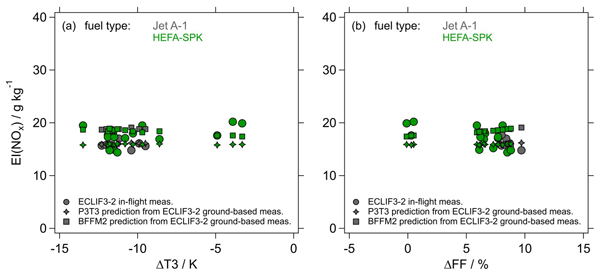
Emissions from aircraft have a direct impact on our climate. Here, we present airborne and ground-based measurement data of nitrogen oxides that were collected in the exhaust of an Airbus aircraft. We study the impact of burning fossil and sustainable aviation fuel on nitrogen oxide emissions at different engine settings related to combustor temperature, pressure and fuel flow. Further, we compare observations with engine emission models.
Rebecca Dischl, Daniel Sauer, Christiane Voigt, Theresa Harlaß, Felicitas Sakellariou, Raphael Märkl, Ulrich Schumann, Monika Scheibe, Stefan Kaufmann, Anke Roiger, Andreas Dörnbrack, Charles Renard, Maxime Gauthier, Peter Swann, Paul Madden, Darren Luff, Mark Johnson, Denise Ahrens, Reetu Sallinen, Tobias Schripp, Georg Eckel, Uwe Bauder, and Patrick Le Clercq
Atmos. Chem. Phys., 24, 11255–11273, https://doi.org/10.5194/acp-24-11255-2024, https://doi.org/10.5194/acp-24-11255-2024, 2024
Short summary
Short summary
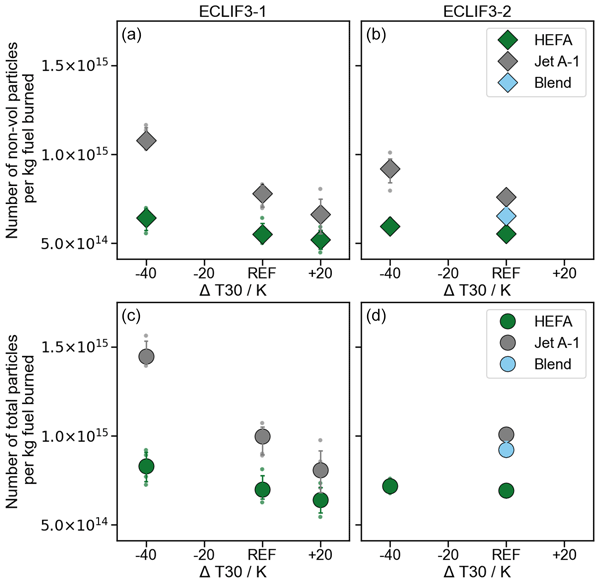
In-flight measurements of aircraft emissions burning 100 % sustainable aviation fuel (SAF) show reduced particle number concentrations up to 41 % compared to conventional jet fuel. Particle emissions are dependent on engine power setting, flight altitude, and fuel composition. Engine models show a good correlation with measurement results. Future increased prevalence of SAF can positively influence the climate impact of aviation.
Roger Teoh, Zebediah Engberg, Ulrich Schumann, Christiane Voigt, Marc Shapiro, Susanne Rohs, and Marc E. J. Stettler
Atmos. Chem. Phys., 24, 6071–6093, https://doi.org/10.5194/acp-24-6071-2024, https://doi.org/10.5194/acp-24-6071-2024, 2024
Short summary
Short summary
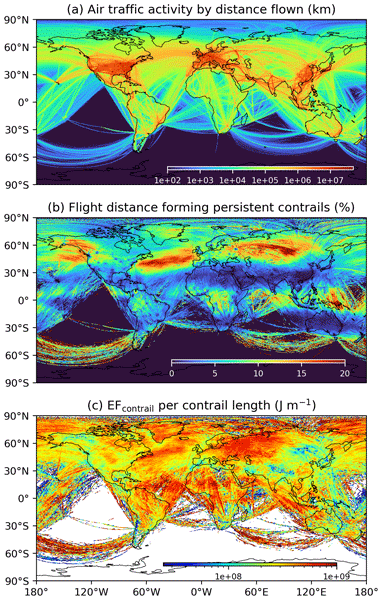
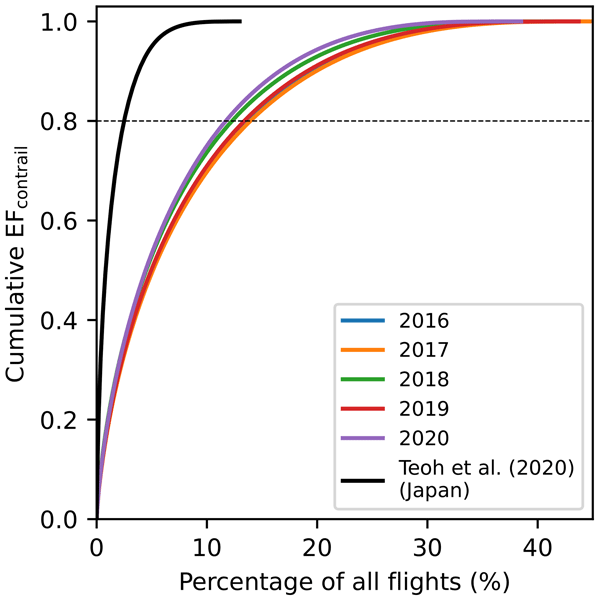
The radiative forcing (RF) due to aviation contrails is comparable to that caused by CO2. We estimate that global contrail net RF in 2019 was 62.1 mW m−2. This is ~1/2 the previous best estimate for 2018. Contrail RF varies regionally due to differences in conditions required for persistent contrails. COVID-19 reduced contrail RF by 54% in 2020 relative to 2019. Globally, 2 % of all flights account for 80 % of the annual contrail energy forcing, suggesting a opportunity to mitigate contrail RF.
Raphael Satoru Märkl, Christiane Voigt, Daniel Sauer, Rebecca Katharina Dischl, Stefan Kaufmann, Theresa Harlaß, Valerian Hahn, Anke Roiger, Cornelius Weiß-Rehm, Ulrike Burkhardt, Ulrich Schumann, Andreas Marsing, Monika Scheibe, Andreas Dörnbrack, Charles Renard, Maxime Gauthier, Peter Swann, Paul Madden, Darren Luff, Reetu Sallinen, Tobias Schripp, and Patrick Le Clercq
Atmos. Chem. Phys., 24, 3813–3837, https://doi.org/10.5194/acp-24-3813-2024, https://doi.org/10.5194/acp-24-3813-2024, 2024
Short summary
Short summary
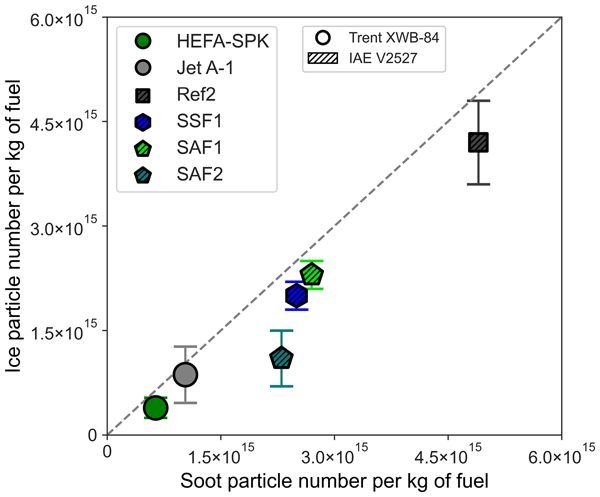
In situ measurements of contrails from a large passenger aircraft burning 100 % sustainable aviation fuel (SAF) show a 56 % reduction in contrail ice crystal numbers compared to conventional Jet A-1. Results from a climate model initialized with the observations suggest a significant decrease in radiative forcing from contrails. Our study confirms that future increased use of low aromatic SAF can reduce the climate impact from aviation.
Yun Li, Christoph Mahnke, Susanne Rohs, Ulrich Bundke, Nicole Spelten, Georgios Dekoutsidis, Silke Groß, Christiane Voigt, Ulrich Schumann, Andreas Petzold, and Martina Krämer
Atmos. Chem. Phys., 23, 2251–2271, https://doi.org/10.5194/acp-23-2251-2023, https://doi.org/10.5194/acp-23-2251-2023, 2023
Short summary
Short summary
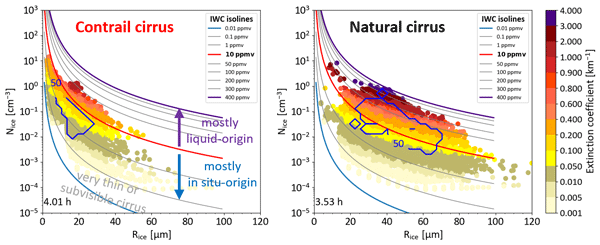
The radiative effect of aviation-induced cirrus is closely related to ambient conditions and its microphysical properties. Our study investigated the occurrence of contrail and natural cirrus measured above central Europe in spring 2014. It finds that contrail cirrus appears frequently in the pressure range 200 to 245 hPa and occurs more often in slightly ice-subsaturated environments than expected. Avoiding slightly ice-subsaturated regions by aviation might help mitigate contrail cirrus.
Roger Teoh, Ulrich Schumann, Edward Gryspeerdt, Marc Shapiro, Jarlath Molloy, George Koudis, Christiane Voigt, and Marc E. J. Stettler
Atmos. Chem. Phys., 22, 10919–10935, https://doi.org/10.5194/acp-22-10919-2022, https://doi.org/10.5194/acp-22-10919-2022, 2022
Short summary
Short summary
Aircraft condensation trails (contrails) contribute to over half of the climate forcing attributable to aviation. This study uses historical air traffic and weather data to simulate contrails in the North Atlantic over 5 years, from 2016 to 2021. We found large intra- and inter-year variability in contrail radiative forcing and observed a 66 % reduction due to COVID-19. Most warming contrails predominantly result from night-time flights in winter.
Simon F. Reifenberg, Anna Martin, Matthias Kohl, Sara Bacer, Zaneta Hamryszczak, Ivan Tadic, Lenard Röder, Daniel J. Crowley, Horst Fischer, Katharina Kaiser, Johannes Schneider, Raphael Dörich, John N. Crowley, Laura Tomsche, Andreas Marsing, Christiane Voigt, Andreas Zahn, Christopher Pöhlker, Bruna A. Holanda, Ovid Krüger, Ulrich Pöschl, Mira Pöhlker, Patrick Jöckel, Marcel Dorf, Ulrich Schumann, Jonathan Williams, Birger Bohn, Joachim Curtius, Hardwig Harder, Hans Schlager, Jos Lelieveld, and Andrea Pozzer
Atmos. Chem. Phys., 22, 10901–10917, https://doi.org/10.5194/acp-22-10901-2022, https://doi.org/10.5194/acp-22-10901-2022, 2022
Short summary
Short summary
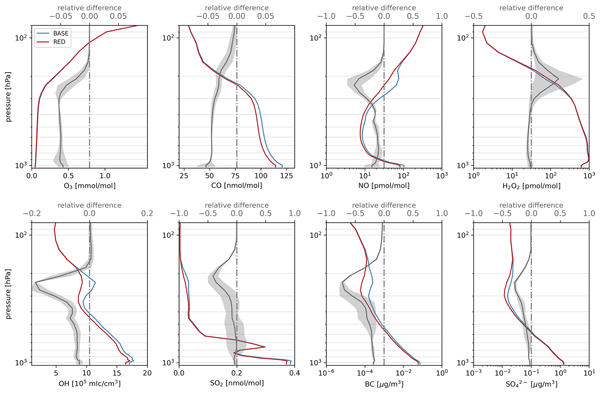
In this work we use a combination of observational data from an aircraft campaign and model results to investigate the effect of the European lockdown due to COVID-19 in spring 2020. Using model results, we show that the largest relative changes to the atmospheric composition caused by the reduced emissions are located in the upper troposphere around aircraft cruise altitude, while the largest absolute changes are present at the surface.
M. Dolores Andrés Hernández, Andreas Hilboll, Helmut Ziereis, Eric Förster, Ovid O. Krüger, Katharina Kaiser, Johannes Schneider, Francesca Barnaba, Mihalis Vrekoussis, Jörg Schmidt, Heidi Huntrieser, Anne-Marlene Blechschmidt, Midhun George, Vladyslav Nenakhov, Theresa Harlass, Bruna A. Holanda, Jennifer Wolf, Lisa Eirenschmalz, Marc Krebsbach, Mira L. Pöhlker, Anna B. Kalisz Hedegaard, Linlu Mei, Klaus Pfeilsticker, Yangzhuoran Liu, Ralf Koppmann, Hans Schlager, Birger Bohn, Ulrich Schumann, Andreas Richter, Benjamin Schreiner, Daniel Sauer, Robert Baumann, Mariano Mertens, Patrick Jöckel, Markus Kilian, Greta Stratmann, Christopher Pöhlker, Monica Campanelli, Marco Pandolfi, Michael Sicard, José L. Gómez-Amo, Manuel Pujadas, Katja Bigge, Flora Kluge, Anja Schwarz, Nikos Daskalakis, David Walter, Andreas Zahn, Ulrich Pöschl, Harald Bönisch, Stephan Borrmann, Ulrich Platt, and John P. Burrows
Atmos. Chem. Phys., 22, 5877–5924, https://doi.org/10.5194/acp-22-5877-2022, https://doi.org/10.5194/acp-22-5877-2022, 2022
Short summary
Short summary
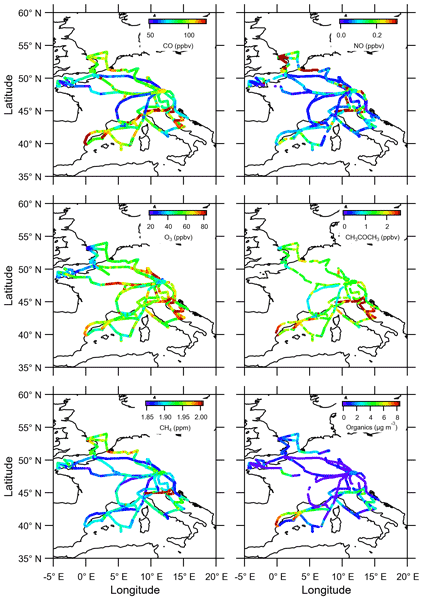
EMeRGe provides a unique set of in situ and remote sensing airborne measurements of trace gases and aerosol particles along selected flight routes in the lower troposphere over Europe. The interpretation uses also complementary collocated ground-based and satellite measurements. The collected data help to improve the current understanding of the complex spatial distribution of trace gases and aerosol particles resulting from mixing, transport, and transformation of pollution plumes over Europe.
Leonie von Terzi, Axel Seifert, Christoph Siewert, Fabian Jakub, and Stefan Kneifel
EGUsphere, https://doi.org/10.5194/egusphere-2026-3865, https://doi.org/10.5194/egusphere-2026-3865, 2026
Short summary
Short summary
A distinct temperature layer in clouds promotes growth of dendritic ice crystals, producing characteristic radar signatures whose origin has remained unclear. We combined radar observations with microphysical simulations to identify the dominant microphysical processes. Collisions breaking particles into fragments prove essential to reproducing the signatures, alongside crystal growth and aggregation, clarifying the link between radar signals and ice processes for weather models.
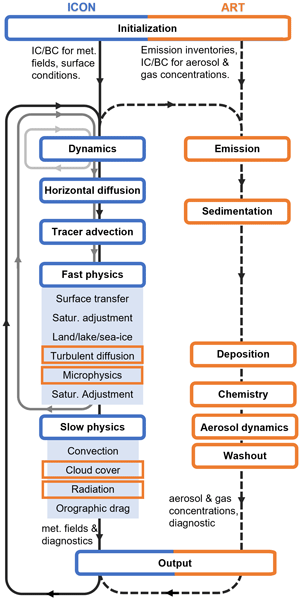
Gholam Ali Hoshyaripour, Andreas Baer, Sascha Bierbauer, Julia Bruckert, Dominik Brunner, Jochen Förstner, Arash Hamzehloo, Valentin Hanft, Corina Keller, Martina Klose, Pankaj Kumar, Patrick Ludwig, Enrico Metzner, Lisa Muth, Andreas Pauling, Nikolas Porz, Maryam Ramezani Ziarani, Thomas Reddmann, Luca Reißig, Roland Ruhnke, Khompat Satitkovitchai, Axel Seifert, Miriam Sinnhuber, Michael Steiner, Stefan Versick, Heike Vogel, Michael Weimer, Sven Werchner, and Corinna Hoose
Geosci. Model Dev., 19, 1645–1681, https://doi.org/10.5194/gmd-19-1645-2026, https://doi.org/10.5194/gmd-19-1645-2026, 2026
Short summary
Short summary
This paper presents recent advances in ICON-ART, a modeling system that simulates atmospheric composition – such as gases and particles – and their interactions with weather and climate. By integrating updated chemistry, emissions, and aerosol processes, ICON-ART enables detailed, scale-spanning simulations. It supports both scientific research and operational forecasts, contributing to improved air quality, weather and climate predictions.
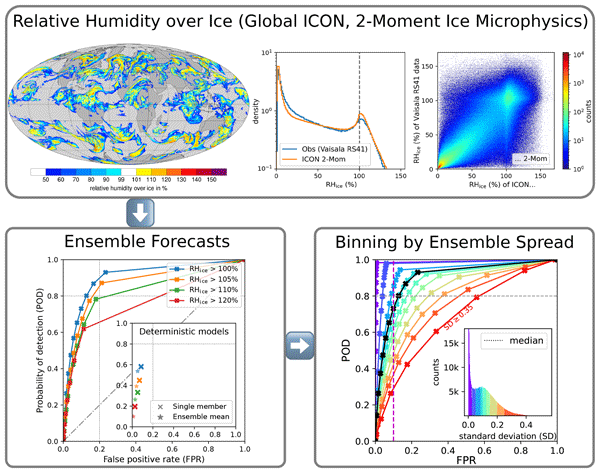
Maleen Hanst, Carmen G. Köhler, Axel Seifert, and Linda Schlemmer
Atmos. Chem. Phys., 25, 17253–17274, https://doi.org/10.5194/acp-25-17253-2025, https://doi.org/10.5194/acp-25-17253-2025, 2025
Short summary
Short summary
Persistent condensation trails typically occur due to aircraft flying through certain cold and humid regions. In most cases, these contrails have a warming impact on the climate. Predicting these regions in advance allows flight planners to re-route airplanes. We show that an adaptation of the ice microphysics scheme in a certain weather forecast model improves the prediction of these regions. Running an ensemble of simulations with this scheme improves the prediction quality even further.
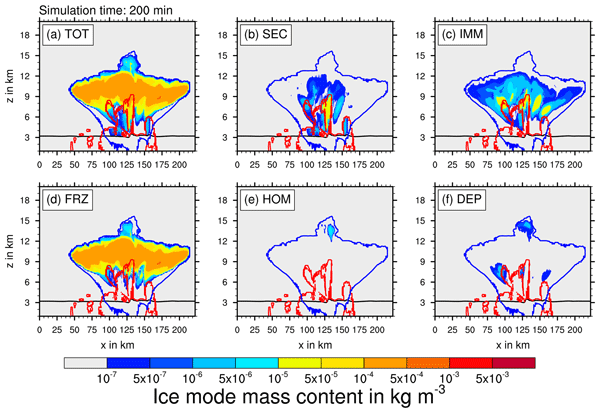
Tim Lüttmer, Peter Spichtinger, and Axel Seifert
Atmos. Chem. Phys., 25, 4505–4529, https://doi.org/10.5194/acp-25-4505-2025, https://doi.org/10.5194/acp-25-4505-2025, 2025
Short summary
Short summary
We investigate ice formation pathways in idealized convective clouds using a novel microphysics scheme that distinguishes between five ice classes each with their own unique formation mechanism. Ice crystals from rime splintering form the lowermost layer of ice crystals around the updraft core. The majority of ice crystals in the anvil of the convective cloud stems from frozen droplets. Ice stemming from homogeneous and deposition nucleation was only relevant in the overshoot.
Theresa Harlass, Rebecca Dischl, Stefan Kaufmann, Raphael Märkl, Daniel Sauer, Monika Scheibe, Paul Stock, Tiziana Bräuer, Andreas Dörnbrack, Anke Roiger, Hans Schlager, Ulrich Schumann, Magdalena Pühl, Tobias Schripp, Tobias Grein, Linda Bondorf, Charles Renard, Maxime Gauthier, Mark Johnson, Darren Luff, Paul Madden, Peter Swann, Denise Ahrens, Reetu Sallinen, and Christiane Voigt
Atmos. Chem. Phys., 24, 11807–11822, https://doi.org/10.5194/acp-24-11807-2024, https://doi.org/10.5194/acp-24-11807-2024, 2024
Short summary
Short summary
Emissions from aircraft have a direct impact on our climate. Here, we present airborne and ground-based measurement data of nitrogen oxides that were collected in the exhaust of an Airbus aircraft. We study the impact of burning fossil and sustainable aviation fuel on nitrogen oxide emissions at different engine settings related to combustor temperature, pressure and fuel flow. Further, we compare observations with engine emission models.
Rebecca Dischl, Daniel Sauer, Christiane Voigt, Theresa Harlaß, Felicitas Sakellariou, Raphael Märkl, Ulrich Schumann, Monika Scheibe, Stefan Kaufmann, Anke Roiger, Andreas Dörnbrack, Charles Renard, Maxime Gauthier, Peter Swann, Paul Madden, Darren Luff, Mark Johnson, Denise Ahrens, Reetu Sallinen, Tobias Schripp, Georg Eckel, Uwe Bauder, and Patrick Le Clercq
Atmos. Chem. Phys., 24, 11255–11273, https://doi.org/10.5194/acp-24-11255-2024, https://doi.org/10.5194/acp-24-11255-2024, 2024
Short summary
Short summary
In-flight measurements of aircraft emissions burning 100 % sustainable aviation fuel (SAF) show reduced particle number concentrations up to 41 % compared to conventional jet fuel. Particle emissions are dependent on engine power setting, flight altitude, and fuel composition. Engine models show a good correlation with measurement results. Future increased prevalence of SAF can positively influence the climate impact of aviation.
Roger Teoh, Zebediah Engberg, Ulrich Schumann, Christiane Voigt, Marc Shapiro, Susanne Rohs, and Marc E. J. Stettler
Atmos. Chem. Phys., 24, 6071–6093, https://doi.org/10.5194/acp-24-6071-2024, https://doi.org/10.5194/acp-24-6071-2024, 2024
Short summary
Short summary
The radiative forcing (RF) due to aviation contrails is comparable to that caused by CO2. We estimate that global contrail net RF in 2019 was 62.1 mW m−2. This is ~1/2 the previous best estimate for 2018. Contrail RF varies regionally due to differences in conditions required for persistent contrails. COVID-19 reduced contrail RF by 54% in 2020 relative to 2019. Globally, 2 % of all flights account for 80 % of the annual contrail energy forcing, suggesting a opportunity to mitigate contrail RF.
Raphael Satoru Märkl, Christiane Voigt, Daniel Sauer, Rebecca Katharina Dischl, Stefan Kaufmann, Theresa Harlaß, Valerian Hahn, Anke Roiger, Cornelius Weiß-Rehm, Ulrike Burkhardt, Ulrich Schumann, Andreas Marsing, Monika Scheibe, Andreas Dörnbrack, Charles Renard, Maxime Gauthier, Peter Swann, Paul Madden, Darren Luff, Reetu Sallinen, Tobias Schripp, and Patrick Le Clercq
Atmos. Chem. Phys., 24, 3813–3837, https://doi.org/10.5194/acp-24-3813-2024, https://doi.org/10.5194/acp-24-3813-2024, 2024
Short summary
Short summary
In situ measurements of contrails from a large passenger aircraft burning 100 % sustainable aviation fuel (SAF) show a 56 % reduction in contrail ice crystal numbers compared to conventional Jet A-1. Results from a climate model initialized with the observations suggest a significant decrease in radiative forcing from contrails. Our study confirms that future increased use of low aromatic SAF can reduce the climate impact from aviation.
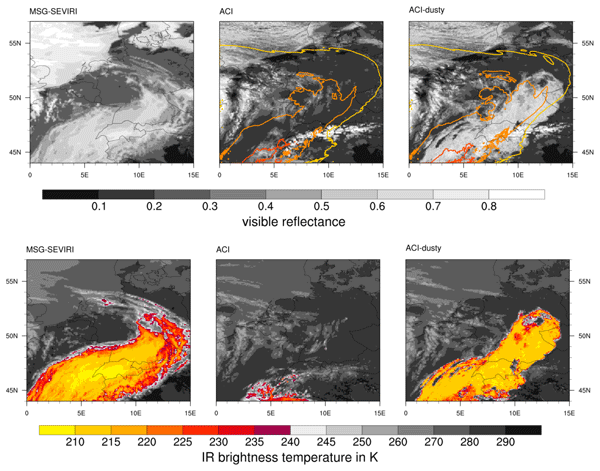
Axel Seifert, Vanessa Bachmann, Florian Filipitsch, Jochen Förstner, Christian M. Grams, Gholam Ali Hoshyaripour, Julian Quinting, Anika Rohde, Heike Vogel, Annette Wagner, and Bernhard Vogel
Atmos. Chem. Phys., 23, 6409–6430, https://doi.org/10.5194/acp-23-6409-2023, https://doi.org/10.5194/acp-23-6409-2023, 2023
Short summary
Short summary
We investigate how mineral dust can lead to the formation of cirrus clouds. Dusty cirrus clouds lead to a reduction in solar radiation at the surface and, hence, a reduced photovoltaic power generation. Current weather prediction systems are not able to predict this interaction between mineral dust and cirrus clouds. We have developed a new physical description of the formation of dusty cirrus clouds. Overall we can show a considerable improvement in the forecast quality of clouds and radiation.
Yun Li, Christoph Mahnke, Susanne Rohs, Ulrich Bundke, Nicole Spelten, Georgios Dekoutsidis, Silke Groß, Christiane Voigt, Ulrich Schumann, Andreas Petzold, and Martina Krämer
Atmos. Chem. Phys., 23, 2251–2271, https://doi.org/10.5194/acp-23-2251-2023, https://doi.org/10.5194/acp-23-2251-2023, 2023
Short summary
Short summary
The radiative effect of aviation-induced cirrus is closely related to ambient conditions and its microphysical properties. Our study investigated the occurrence of contrail and natural cirrus measured above central Europe in spring 2014. It finds that contrail cirrus appears frequently in the pressure range 200 to 245 hPa and occurs more often in slightly ice-subsaturated environments than expected. Avoiding slightly ice-subsaturated regions by aviation might help mitigate contrail cirrus.
Roger Teoh, Ulrich Schumann, Edward Gryspeerdt, Marc Shapiro, Jarlath Molloy, George Koudis, Christiane Voigt, and Marc E. J. Stettler
Atmos. Chem. Phys., 22, 10919–10935, https://doi.org/10.5194/acp-22-10919-2022, https://doi.org/10.5194/acp-22-10919-2022, 2022
Short summary
Short summary
Aircraft condensation trails (contrails) contribute to over half of the climate forcing attributable to aviation. This study uses historical air traffic and weather data to simulate contrails in the North Atlantic over 5 years, from 2016 to 2021. We found large intra- and inter-year variability in contrail radiative forcing and observed a 66 % reduction due to COVID-19. Most warming contrails predominantly result from night-time flights in winter.
Simon F. Reifenberg, Anna Martin, Matthias Kohl, Sara Bacer, Zaneta Hamryszczak, Ivan Tadic, Lenard Röder, Daniel J. Crowley, Horst Fischer, Katharina Kaiser, Johannes Schneider, Raphael Dörich, John N. Crowley, Laura Tomsche, Andreas Marsing, Christiane Voigt, Andreas Zahn, Christopher Pöhlker, Bruna A. Holanda, Ovid Krüger, Ulrich Pöschl, Mira Pöhlker, Patrick Jöckel, Marcel Dorf, Ulrich Schumann, Jonathan Williams, Birger Bohn, Joachim Curtius, Hardwig Harder, Hans Schlager, Jos Lelieveld, and Andrea Pozzer
Atmos. Chem. Phys., 22, 10901–10917, https://doi.org/10.5194/acp-22-10901-2022, https://doi.org/10.5194/acp-22-10901-2022, 2022
Short summary
Short summary
In this work we use a combination of observational data from an aircraft campaign and model results to investigate the effect of the European lockdown due to COVID-19 in spring 2020. Using model results, we show that the largest relative changes to the atmospheric composition caused by the reduced emissions are located in the upper troposphere around aircraft cruise altitude, while the largest absolute changes are present at the surface.
M. Dolores Andrés Hernández, Andreas Hilboll, Helmut Ziereis, Eric Förster, Ovid O. Krüger, Katharina Kaiser, Johannes Schneider, Francesca Barnaba, Mihalis Vrekoussis, Jörg Schmidt, Heidi Huntrieser, Anne-Marlene Blechschmidt, Midhun George, Vladyslav Nenakhov, Theresa Harlass, Bruna A. Holanda, Jennifer Wolf, Lisa Eirenschmalz, Marc Krebsbach, Mira L. Pöhlker, Anna B. Kalisz Hedegaard, Linlu Mei, Klaus Pfeilsticker, Yangzhuoran Liu, Ralf Koppmann, Hans Schlager, Birger Bohn, Ulrich Schumann, Andreas Richter, Benjamin Schreiner, Daniel Sauer, Robert Baumann, Mariano Mertens, Patrick Jöckel, Markus Kilian, Greta Stratmann, Christopher Pöhlker, Monica Campanelli, Marco Pandolfi, Michael Sicard, José L. Gómez-Amo, Manuel Pujadas, Katja Bigge, Flora Kluge, Anja Schwarz, Nikos Daskalakis, David Walter, Andreas Zahn, Ulrich Pöschl, Harald Bönisch, Stephan Borrmann, Ulrich Platt, and John P. Burrows
Atmos. Chem. Phys., 22, 5877–5924, https://doi.org/10.5194/acp-22-5877-2022, https://doi.org/10.5194/acp-22-5877-2022, 2022
Short summary
Short summary
EMeRGe provides a unique set of in situ and remote sensing airborne measurements of trace gases and aerosol particles along selected flight routes in the lower troposphere over Europe. The interpretation uses also complementary collocated ground-based and satellite measurements. The collected data help to improve the current understanding of the complex spatial distribution of trace gases and aerosol particles resulting from mixing, transport, and transformation of pollution plumes over Europe.
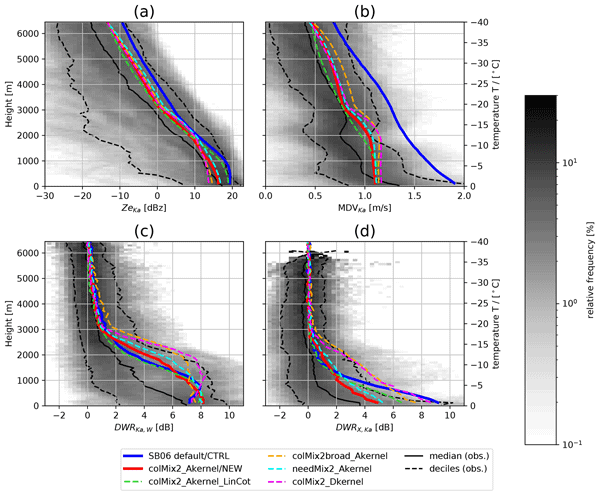
Markus Karrer, Axel Seifert, Davide Ori, and Stefan Kneifel
Atmos. Chem. Phys., 21, 17133–17166, https://doi.org/10.5194/acp-21-17133-2021, https://doi.org/10.5194/acp-21-17133-2021, 2021
Short summary
Short summary
Modeling precipitation is of great relevance, e.g., for mitigating damage caused by extreme weather. A key component in accurate precipitation modeling is aggregation, i.e., sticking together of snowflakes. Simulating aggregation is difficult due to multiple parameters that are not well-known. Knowing how these parameters affect aggregation can help its simulation. We put new parameters in the model and select a combination of parameters with which the model can simulate observations better.
Cited articles
Ackerman, T. P., Liou, K. N., Valero, F. P. J., and Pfister, L.: Heating rates in tropical anvils, J. Atmos. Sci., 45, 1606–1623, https://doi.org/10.1175/1520-0469(1988)045<1606:HRITA>2.0.CO;2, 1988.
Ancell, B. C., Bogusz, A., Lauridsen, M. J., and Nauert, C.: Seeding Chaos: The dire consequences of numerical noise in NWP perturbation experiments, B. Am. Meteorol. Soc., 615–628, https://doi.org/10.1175/BAMS-D-17-0129.1, 2018.
Bauer, P., Thorpe, A., and Brunet, G.: The quiet revolution of numerical weather prediction, Nature, 525, 47–55, https://doi.org/10.1038/nature14956, 2015.
Bickel, M., Ponater, M., Burkhardt, U., Righi, M., Hendricks, J., and Jöckel, P.: Contrail cirrus climate impact: From radiative forcing to surface temperature change, J. Climate, 38, 1895–1912, https://doi.org/10.1175/JCLI-D-24-0245.1, 2025.
Bier, A., Burkhardt, U., and Bock, L.: Synoptic control of contrail cirrus life cycles and their modification due to reduced soot number emissions, J. Geophys. Res., 122, 11584–11603, https://doi.org/10.1002/2017JD027011, 2017.
Bock, L. and Burkhardt, U.: The temporal evolution of a long-lived contrail cirrus cluster: Simulations with a global climate model, J. Geophys. Res., 121, 3548–3565, https://doi.org/10.1002/2015JD024475, 2016.
Burkhardt, U. and Kärcher, B.: Global radiative forcing from contrail cirrus, Nature Clim. Change, 1, 54–58, https://doi.org/10.1038/NCLIMATE1068, 2011.
Burkhardt, U., Kärcher, B., Ponater, M., Gierens, K., and Gettelman, A.: Contrail cirrus supporting areas in model and observations, Geophys. Res. Lett., 35, L16808, https://doi.org/10.1029/2008GL034056, 2008.
Craig, G. C. and Selz, T.: Mesoscale dynamical regimes in the midlatitudes, Geophys. Res. Lett., 45, 410–417, https://doi.org/10.1002/2017GL076174, 2018.
Dischl, R., Sauer, D., Voigt, C., Harlaß, T., Sakellariou, F., Märkl, R., Schumann, U., Scheibe, M., Kaufmann, S., Roiger, A., Dörnbrack, A., Renard, C., Gauthier, M., Swann, P., Madden, P., Luff, D., Johnson, M., Ahrens, D., Sallinen, R., Schripp, T., Eckel, G., Bauder, U., and Le Clercq, P.: Measurements of particle emissions of an A350-941 burning 100 % sustainable aviation fuels in cruise, Atmos. Chem. Phys., 24, 11255–11273, https://doi.org/10.5194/acp-24-11255-2024, 2024.
Dörnbrack, A., Bechtold, P., and Schumann, U.: High-resolution aircraft observations of turbulence and waves in the free atmosphere and comparison with global model predictions, J. Geophys. Res., 127, e2022JD036654, https://doi.org/10.1029/2022JD036654, 2022.
Driver, O. G. A., Stettler, M. E. J., and Gryspeerdt, E.: The ice supersaturation biases limiting contrail modelling are structured around extratropical depressions, EGUsphere [preprint], https://doi.org/10.5194/egusphere-2025-2737, 2025.
Dürbeck, T. and Gerz, T.: Dispersion of aircraft exhausts in the free atmosphere, J. Geophys. Res., 101, 26007–26015, https://doi.org/10.1029/96JD02217, 1996.
Feng, J., Toth, Z., Zhang, J., and Peña, M.: Ensemble forecasting: A foray of dynamics into the realm of statistics, Q. J. Roy. Meteor. Soc., 150, 2537–2560, https://doi.org/10.1002/qj.4745, 2024.
Forster, L., Emde, C., Unterstrasser, S., and Mayer, B.: Effects of three-dimensional photon transport on the radiative forcing of realistic contrails, J. Atmos. Sci., 69, 2243–2255, https://doi.org/10.1175/JAS-D-11-0206.1, 2012.
Fu, Q.: An accurate parameterisation of the solar radiative properties of cirrus clouds for climate models, J. Climate, 9, 2058–2082, https://doi.org/10.1175/1520-0442(1996)009<2058:AAPOTS>2.0.CO;2, 1996.
Fu, Q., Yang, P., and Sun, W. B.: An accurate parameterization of the infrared radiative properties of cirrus clouds for climate models, J. Climate, 25, 2223–2237, https://doi.org/10.1175/1520-0442(1998)011<2223:AAPOTI>2.0.CO;2, 1998.
Gassmann, A.: Inherent dssipation of upwind-biased potential temperature advection and its feedback on model dynamics, JAMES, 13, e2020MS002384, https://doi.org/10.1029/2020MS002384, 2021.
Gettelman, A. and Chen, C.: The climate impact of aviation aerosols, Geophys. Res. Lett., 40, 2785–2789, https://doi.org/10.1002/grl.50520, 2013.
Gettelman, A., Lamboll, R., Bardeen, C. G., Forster, P. M., and Watson-Parris, D.: Climate impacts of COVID-19 induced emission changes, Geophys. Res. Lett., 48, e2020GL091805, https://doi.org/10.1029/2020GL091805, 2021.
Gierens, K. and Brinkop, S.: Dynamical characteristics of ice supersaturated regions, Atmos. Chem. Phys., 12, 11933–11942, https://doi.org/10.5194/acp-12-11933-2012, 2012.
Gierens, K., Matthes, S., and Rohs, S.: How well can persistent contrails be predicted?, Aerospace, 7, 179, https://doi.org/10.3390/aerospace7120169, 2020.
Gounou, A. and Hogan, R. J.: A sensitivity study of the effect of horizontal photon transport on the radiative forcing of contrails, J. Atmos. Sci., 64, 1706–1716, https://doi.org/10.1175/JAS3915.1, 2007.
Hanke, M., Redler, R., Holfeld, T., and Yastremsky, M.: YAC 1.2.0: new aspects for coupling software in Earth system modelling, Geosci. Model Dev., 9, 2755–2769, https://doi.org/10.5194/gmd-9-2755-2016, 2016.
Hansen, J. E. and Travis, L. D.: Light scattering in planetary atmospheres, Space Sci. Rev., 16, 527–610, https://doi.org/10.1007/BF00168069, 1974.
Hanst, M., Köhler, C. G., Seifert, A., and Schlemmer, L.: Predicting ice supersaturation for contrail avoidance: ensemble forecasting using ICON with two-moment ice microphysics, Atmos. Chem. Phys., 25, 17253–17274, https://doi.org//10.5194/acp-25-17253-2025, 2025.
Harlass, T., Dischl, R., Kaufmann, S., Märkl, R., Sauer, D., Scheibe, M., Stock, P., Bräuer, T., Dörnbrack, A., Roiger, A., Schlager, H., Schumann, U., Pühl, M., Schripp, T., Grein, T., Bondorf, L., Renard, C., Gauthier, M., Johnson, M., Luff, D., Madden, P., Swann, P., Ahrens, D., Sallinen, R., and Voigt, C.: Measurement report: In-flight and ground-based measurements of nitrogen oxide emissions from latest-generation jet engines and 100 % sustainable aviation fuel, Atmos. Chem. Phys., 24, 11807–11822, https://doi.org/10.5194/acp-24-11807-2024, 2024.
Haywood, J. M., Allan, R. P., Bornemann, J., Forster, P. M., Francis, P. N., Milton, S., Rädel, G., Rap, A., Shine, K. P., and Thorpe, R.: A case study of the radiative forcing of persistent contrails evolving into contrail-induced cirrus, J. Geophys. Res., 114, D24201, https://doi.org/10.1029/2009JD012650, 2009.
Hofer, S., Gierens, K., and Rohs, S.: How well can persistent contrails be predicted? An update, Atmos. Chem. Phys., 24, 7911–7925, https://doi.org/10.5194/acp-24-7911-2024, 2024.
Hogan, R. J. and Bozzo, A.: A flexible and efficient radiation scheme for the ECMWF model, JAMES, 10, https://doi.org/10.1029/2018MS001364, 2018.
Hogan, R. J. and Illingworth, A. J.: Deriving cloud overlap statistics from radar, Q. J. Roy. Meteor. Soc., 126, 2903–2909, https://doi.org/10.1002/qj.49712656914, 2000.
Hogan, R. J., Ferro, C. A. T., Jolliffe, I. T., and Stephenson, D. B.: Equitability revisited: Why the “Equitable Threat Score” Is not equitable, Weather Forecasting, 25, 710–726, https://doi.org/10.1175/2009WAF2222350.1, 2010.
Hong, Y., Liu, G., and Li, J.-L. F.: Assessing the radiative effects of global ice clouds based on CloudSat and CALIPSO measurements, J. Climate, 29, 7651–7674, https://doi.org/10.1175/JCLI-D-15-0799.1, 2016.
Hyland, R. W. and Wexler, A.: Formulations for the thermodynamic properties of the saturated phases of H2O from 173.15 K to 473.15 K, ASHRAE Trans., 89, 500–519, see https://cires1.colorado.edu/~voemel/vp.html (last access: 16 December 2025), 1983.
ICAO: Manual of the ICAO Standard Atmosphere, ICAO Document No. 7488, 2nd Edition, https://openlibrary.org/books/OL21364217M/Manual_of_the_ICAO_standard_atmosphere 1964.
IPCC: Aviation and the Global Atmosphere, Cambridge Univ. Press, Cambridge, UK, 373 pp., ISBN: 9780521664042, 1999.
Jensen, E. J., Ackermann, A. S., Stevens, D. E., Toon, O. B., and Minnis, P.: Spreading and growth of contrails in a sheared environment., J. Geophys. Res., 103, 13557–513567, https://doi.org/10.1029/98JD02594, 1998a.
Jensen, E. J., Toon, O. B., Kinne, S., Sachse, G. W., Anderson, B. E., Chan, K. R., Twohy, C. H., Gandrud, B., Heymsfield, A., and Miake-Lye, R. C.: Environmental conditions required for contrail formation and persistence, J. Geophys. Res., 103, 3929–3936, https://doi.org/10.1029/97JD02808, 1998b.
Jensen, E. J., Toon, O. B., Vay, S. A., Ovarlez, J., May, R., Bui, P., Twohy, C. H., Gandrud, B., Pueschel, R. F., and Schumann, U.: Prevalence of ice-supersaturated regions in the upper troposphere: Implications for optically thin ice cloud formation, J. Geophys. Res., 106, 17253–17266, https://doi.org/10.1029/2000JD900526, 2001.
Jurkat-Witschas, T., Voigt, C., Groß, S., Kaufmann, S., Sauer, D., De la Torre Castro, E., Krämer, M., Schäfler, A., Afchine, A., Attinger, R., Irene, B. G., Beer, C. G., Bugliaro, L., Clemen, H.-C., Dekoutsidis, G., Ehrlich, A., Grawe, S., Hahn, V., Hendricks, J., Jarvinen, E., Klimach, T., Krüger, K., Krüger, O., Lucke, J., Luebke, A. E., Marsing, A., Mayer, B., Mayer, J., Mertes, S., Milenko, R.-Z., Moser, M., Müller, H., Nenarkhov, V., Pohlker, M., Pöschl, U., Portge, V., Rautenhaus, M., Righi, M., Rottenbacher, J., Schaefer, J., Schnaiter, M., Schneider, J., Schumann, U., Spelten, N., Stratmann, F., Tomsche, L., Wagner, S., Wang, Z., Weber, A., Wendisch, M., Wernli, H., Wetzel, B., Wirth, M., Zahn, A., Ziereis, H., and Zöger, M.: CIRRUS-HL: Picturing high- and mid-latitude summer cirrus and contrail cirrus above Europe with airborne measurements aboard the research aircraft HALO, B. Am. Meteorol. Soc., 106, E2300–E2327, https://doi.org/10.1175/BAMS-D-23-0270.1., 2025.
Kärcher, B.: Formation and radiative forcing of contrail cirrus, Nat. Commun., 9, 1824, https://doi.org/10.1038/s41467-018-04068-0, 2018.
Kärcher, B. and Lohmann, U.: A parameterization of cirrus cloud formation: Homogenous freezing of supercooled aerosols, J. Geophys. Res., 107, 4010, https://doi.org/10.1029/2001JD000470, 2002.
Kärcher, B., Hendricks, J., and Lohmann, U.: Physically-based parameterization of cirrus cloud formation for use in global atmospheric models, J. Geophys. Res., 111, https://doi.org/10.1029/2005JD006219, 2006.
Kästner, M., Meyer, R., and Wendling, P.: Influence of weather conditions on the distribution of persistent contrails, Meteorol. Appl., 6, 261–271, https://doi.org/10.1017/S1350482799001231, 1999.
Khvorostyanov, V. and Sassen, K.: Cloud model simulation of a contrail case study: Surface cooling against upper tropospheric warming, Geophys. Res. Lett. , 25, 2145–2148, https://doi.org/10.1029/98GL01522, 1998.
Köhler, C. and Seifert, A.: Identifying sensitivities for cirrus modelling using a two-moment two-mode bulk microphysics scheme, Tellus, B67, 24494, https://doi.org/10.3402/tellusb.v67.24494, 2015.
Korn, P.: Formulation of an unstructured grid model for global ocean dynamics, J. Comp. Phys., 339, 525–552, https://doi.org/10.1016/j.jcp.2017.03.009, 2017.
Langguth, M., Kuell, V., and Bott, A.: Implementing the HYbrid MAss flux Convection Scheme (HYMACS) in ICON – First idealized tests and adaptions to the dynamical core for local mass sources, Q. J. Roy. Meteor. Soc., 146, 2689–2716, https://doi.org/10.1002/qj.3812, 2020.
Lee, D. S., Fahey, D. W., Skowron, A., Allen, M. R., Burkhardt, U., Chen, Q., Doherty, S. J., Freeman, S., Forster, P. M., Fuglestvedt, J., Gettelman, A., Leon, R. R. D., Lim, L. L., Lund, M. T., Millar, R. J., Owen, B., Penner, J. E., Pitari, G., Prather, M. J., Sausen, R., and Wilcox, L. J.: The contribution of global aviation to anthropogenic climate forcing for 2000 to 2018, Atmos. Environ., 244, 29, https://doi.org/10.1016/j.atmosenv.2020.117834, 2021.
Lewellen, D. C.: Persistent contrails and contrail cirrus. Part II: Full lifetime behavior, J. Atmos. Sci., 71, 4420–4438, https://doi.org/10.1175/JAS-D-13-0317.1, 2014.
Li, Y., Mahnke, C., Rohs, S., Bundke, U., Spelten, N., Dekoutsidis, G., Groß, S., Voigt, C., Schumann, U., Petzold, A., and Krämer, M.: Upper-tropospheric slightly ice-subsaturated regions: frequency of occurrence and statistical evidence for the appearance of contrail cirrus, Atmos. Chem. Phys., 23, 2251–2271, https://doi.org/10.5194/acp-23-2251-2023, 2023.
Liou, K. N.: Influence of cirrus clouds on weather and climate processes: A global perspective, Mon. Weather Rev. 114, 1167–1199, https://doi.org/10.1175/1520-0493(1986)114<1167:IOCCOW>2.0.CO;2, 1986.
Lorenz, E. N.: The predictability of a flow which possesses many scales of motion, Tellus, 21, 289–307, https://doi.org/10.3402/tellusa.v21i3.10086, 1969.
Märkl, R. S., Voigt, C., Sauer, D., Dischl, R. K., Kaufmann, S., Harlaß, T., Hahn, V., Roiger, A., Weiß-Rehm, C., Burkhardt, U., Schumann, U., Marsing, A., Scheibe, M., Dörnbrack, A., Renard, C., Gauthier, M., Swann, P., Madden, P., Luff, D., Sallinen, R., Schripp, T., and Le Clercq, P.: Powering aircraft with 100 % sustainable aviation fuel reduces ice crystals in contrails, Atmos. Chem. Phys., 24, 3813–3837, https://doi.org/10.5194/acp-24-3813-2024, 2024.
Martin Frias, A., Shapiro, M. L., Engberg, Z., Zopp, R., Soler, M., and Stettler, M. E. J.: Feasibility of contrail avoidance in a commercial flight planning system: an operational analysis, Environ. Res.: Infrastruct. Sustain., 4, https://doi.org/10.1088/2634-4505/ad310c, 2024.
Mayer, B. and Kylling, A.: Technical note: The libRadtran software package for radiative transfer calculations – description and examples of use, Atmos. Chem. Phys., 5, 1855–1877, https://doi.org/10.5194/acp-5-1855-2005, 2005.
Meerkötter, R., Schumann, U., Minnis, P., Doelling, D. R., Nakajima, T., and Tsushima, Y.: Radiative forcing by contrails, Ann. Geophysicae, 17, 1080–1094, https://doi.org/10.1007/s00585-999-1080-7, 1999.
Minnis, P., Schumann, U., Doelling, D. R., Gierens, K., and Fahey, D. W.: Global distribution of contrail radiative forcing, Geophys. Res. Lett., 26, 1853 – 1856, https://doi.org/10.1029/1999GL900358, 1999.
Myhre, G., Kvalevag, M., Rädel, G., Cook, J., Shine, K. P., Clark, H., Karcher, F., Markowicz, K., Karda, A., Wolkenberg, O., Balkanski, Y., Ponater, M., Forster, P., Rap, A., and Rodriguez de Leon, R.: Intercomparison of radiative forcing calculations of stratospheric water vapour and contrails, Meteorol. Z., 18, 585–596, https://doi.org/10.1127/0941-2948/2009/0411, 2009.
Nastrom, G. D. and Gage, K. S.: A climatology fo atmospheric wavenumber spectra of wind and temperature observed by commerical aircraft, J. Atmos. Sci., 42, 950–960, https://doi.org/10.1175/1520-0469(1985)042<0950:ACOAWS>2.0.CO;2, 1985.
Ovarlez, J., Gayet, J. F., Gierens, K., Ström, J., Ovarlez, H., Auriol, F., Busen, R., and Schumann, U.: Water vapor measurements inside cirrus clouds in northern and southern hemispheres during INCA, Geophys. Res. Lett., 29, 60-61–60-64, https://doi.org/10.1029/2001gl014440, 2002.
Poll, D. I. A. and Schumann, U.: An estimation method for the fuel burn and other performance characteristics of civil transport aircraft. Part 3 Full flight profile when the trajectory is specified, Aero. J., 129, 825–886, https://doi.org/10.1017/aer.2024.141, 2025.
Ponater, M., Marquart, S., Sausen, R., and Schumann, U.: On contrail climate sensitivity, Geophys. Res. Lett., 32, L10706, https://doi.org/10.1029/2005GL022580, 2005.
Ponater, M., Dietmüller, S., Frömming, C., and Bock, L.: The shortwave to longwave ratio in contrail radiative forcing as evident in two radiation schemes used for global GCMs, 13th EMS annual meeting, 9–13 September 2013, Reading, UK, https://elib.dlr.de/85055/1/Poster_Ponater_130825_KEM.pdf (last access: 16 December 2025), 2013.
Ponsonby, J., Teoh, R., Kärcher, B., and Stettler, M.: An updated microphysical model for particle activation in contrails: the role of volatile plume particles, EGUsphere [preprint], https://doi.org/10.5194/egusphere-2025-1717, 2025.
Rap, A., Forster, P. M., Jones, A., Boucher, O., Haywood, J. M., Bellouin, N., and Leon, R. R. D.: Parameterization of contrails in the UK Met Office Climate Model, J. Geophys. Res., 115, D10205, https://doi.org/10.1029/2009JD012443, 2010.
Rodwell, M. J., Clare, M. C. A., Lock, S.-J., Lonitz, K., and Chevallier, M.: Power spectra of physics-based and data-driven ensembles, Meteorol. Appl., 32, e70071, https://doi.org/10.1002/met.70071, 2025.
Rotunno, R. and Snyder, C.: A generalization of Lorenz's model for the predictability of flows with many scales of motion, J. Atmos. Sci., 65, 1063–1076, https://doi.org/10.1175/2007JAS2449.1, 2008.
Sausen, R., Isaksen, I., Hauglustaine, D., Grewe, V., Lee, D. S., Myhre, G., Köhler, M. O., Pitari, G., Schumann, U., Stordal, F., and Zerefos, C.: Aviation radiative forcing in 2000: An update on IPCC (1999), Meteorol. Z., 14, 555–561, https://doi.org/10.1127/0941-2948/2005/0049, 2005.
Schumann, U.: On conditions for contrail formation from aircraft exhausts, Meteorol. Z., 5, 4–23, https://doi.org/10.1127/metz/5/1996/4, 1996.
Schumann, U.: Contrail cirrus, in: Cirrus, edited by: Lynch, D. K., Sassen, K., O'C. Starr, D., and Stephens, G., Oxford Univ. Press, Oxford, 231–255, https://doi.org/10.1093/oso/9780195130720.003.0015, 2002.
Schumann, U.: A contrail cirrus prediction model, Geosci. Model Dev., 5, 543–580, https://doi.org/10.5194/gmd-5-543-2012, 2012.
Schumann, U.: The horizontal spectrum of vertical velocities near the tropopause from global to gravity wave scales, J. Atmos. Sci., 76, 3847–3862, https://doi.org/10.1175/JAS-D-19-0160.1, 2019.
Schumann, U.: Note on the CoCiP-libRadtran contrail-cirrus radiative forcing model, https://zenodo.org/records/17241725, 2025.
Schumann, U. and Graf, K.: Aviation-induced cirrus and radiation changes at diurnal timescales, J. Geophys. Res., 118, 2404–2421, https://doi.org/10.1002/jgrd.50184, 2013.
Schumann, U. and Mayer, B.: Sensitivity of surface temperature to radiative forcing by contrail cirrus in a radiative-mixing model, Atmos. Chem. Phys., 17, 13833–13848, https://doi.org/10.5194/acp-17-13833-2017, 2017.
Schumann, U. and Heymsfield, A.: On the lifecycle of individual contrails and contrail cirrus, Meteor. Monogr., 58, 3.1–3.24, https://doi.org/10.1175/AMSMONOGRAPHS-D-16-0005.1, 2017.
Schumann, U., Konopka, P., Baumann, R., Busen, R., Gerz, T., Schlager, H., Schulte, P., and Volkert, H.: Estimate of diffusion parameters of aircraft exhaust plumes near the tropopause from nitric oxide and turbulence measurements, J. Geophys. Res., 100, 14147–14162, https://doi.org/10.1029/95JD01277, 1995.
Schumann, U., Mayer, B., Gierens, K., Unterstrasser, S., Jessberger, P., Petzold, A., Voigt, C., and Gayet, J.-F.: Effective radius of ice particles in cirrus and contrails, J. Atmos. Sci., 68, 300–321, https://doi.org/10.1175/2010JAS3562.1, 2011.
Schumann, U., Mayer, B., Graf, K., and Mannstein, H.: A parametric radiative forcing model for contrail cirrus, J. Appl. Meteorol. Clim., 51, 1391–1406, https://doi.org/10.1175/JAMC-D-11-0242.1, 2012.
Schumann, U., Penner, J. E., Chen, Y., Zhou, C., and Graf, K.: Dehydration effects from contrails in a coupled contrail–climate model, Atmos. Chem. Phys., 15, 11179–11199, https://doi.org/10.5194/acp-15-11179-2015, 2015.
Schumann, U., Baumann, R., Baumgardner, D., Bedka, S. T., Duda, D. P., Freudenthaler, V., Gayet, J.-F., Heymsfield, A. J., Minnis, P., Quante, M., Raschke, E., Schlager, H., Vázquez-Navarro, M., Voigt, C., and Wang, Z.: Properties of individual contrails: a compilation of observations and some comparisons, Atmos. Chem. Phys., 17, 403–438, https://doi.org/10.5194/acp-17-403-2017, 2017.
Selz, T., Bierdel, L., and Craig, G. C.: Estimation of the variability of mesoscale energy spectra with three years of COSMO-DE analyses, J. Atmos. Sci., 76, 627–637, https://doi.org/10.1175/JAS-D-18-0155.1, 2019.
Selz, T., Riemer, M., and Craig, G. C.: The Transition from Practical to Intrinsic Predictability of Midlatitude Weather, J. Atmos. Sci., 79, https://doi.org/10.1175/JAS-D-21-0271.1, 2022.
Shonk, J. K. P. and Hogan, R. J.: Tripleclouds: An efficient method for representing horizontal cloud inhomogeneity in 1D radiation schemes by using three regions at each height, J. Climate, 21, 2352–2370, https://doi.org/10.1175/2007JCLI1940.1, 2008.
Skamarock, W. C., Park, S.-H., Klemp, J. B., and Snyder, C.: Atmospheric kinetic energy spectra from global high-resolution nonhydrostatic simulations, J. Atmos. Sci., 71, 4369–4381, https://doi.org/10.1175/JAS-D-14-0114.1, 2014.
Spichtinger, P., Gierens, K., Leiterer, U., and Dier, H.: Ice supersaturation in the tropopause region over Lindenberg, Germany, Meteorol. Z., 12, 143–156, https://doi.org/10.1127/0941-2948/2003/0012-0143, 2003.
Strandgren, J., Bugliaro, L., Sehnke, F., and Schröder, L.: Cirrus cloud retrieval with MSG/SEVIRI using artificial neural networks, Atmos. Meas. Tech., 10, 3547–3573, https://doi.org/10.5194/amt-10-3547-2017, 2017.
Sun, B., Reale, T., Schroeder, S., Pettey, M., and Smith, R.: On the Accuracy of Vaisala RS41 versus RS92 Upper-Air Temperature Observations, J. Atmos. Ocean. Tech., 36, 635–653, https://doi.org/10.1175/JTECH-D-18-0081.1, 2019.
Teoh, R., Schumann, U., Majumdar, A., and Stettler, M. E. J.: Mitigating the climate forcing of aircraft contrails by small-scale diversions and technology adoption, Environ. Sci. Technol., 54, 2941–2950, https://doi.org/10.1021/acs.est.9b05608, 2020.
Teoh, R., Engberg, Z., Shapiro, M., Dray, L., and Stettler, M. E. J.: The high-resolution Global Aviation emissions Inventory based on ADS-B (GAIA) for 2019–2021, Atmos. Chem. Phys., 24, 725–744, https://doi.org/10.5194/acp-24-725-2024, 2024a.
Teoh, R., Engberg, Z., Schumann, U., Voigt, C., Shapiro, M., Rohs, S., and Stettler, M. E. J.: Global aviation contrail climate effects from 2019 to 2021, Atmos. Chem. Phys., 24, 6071–6093, https://doi.org/10.5194/acp-24-6071-2024, 2024b.
Teoh, R., Schumann, U., Gryspeerdt, E., Shapiro, M., Molloy, J., Koudis, G., Voigt, C., and Stettler, M. E. J.: Aviation contrail climate effects in the North Atlantic from 2016 to 2021, Atmos. Chem. Phys., 22, 10919–10935, https://doi.org/10.5194/acp-22-10919-2022, 2022.
Thompson, G., Scholzen, C., O'Donoghue, S., Haughton, M., Jones, R. L., Durant, A., and Farrington, C.: On the fidelity of high-resolution numerical weather forecasts of contrail-favorable conditions, Atmos. Res., 311, 107663, https://doi.org/10.1016/j.atmosres.2024.107663, 2024.
Tompkins, A., Gierens, K., and Rädel, G.: Ice supersaturation in the ECMWF Integrated Forecast System, Q. J. Roy. Meteor. Soc., 133, 53–63, https://doi.org/10.1002/qj.14, 2007.
Ullrich, R., Hoose, C., Möhler, O., Niemand, M., Wagner, R., Höhler, K., Hiranuma, N., Saathoff, H., and Leisner, T.: A new ice nucleation active site parameterization for desert dust and soot, J. Atmos. Sci., 74, 699–717, https://doi.org/10.1175/JAS-D-16-0074.1, 2017.
Unterstrasser, S.: Properties of young contrails – a parametrisation based on large-eddy simulations, Atmos. Chem. Phys., 16, 2059–2082, https://doi.org/10.5194/acp-16-2059-2016, 2016.
Unterstrasser, S. and Gierens, K.: Numerical simulations of contrail-to-cirrus transition – Part 1: An extensive parametric study, Atmos. Chem. Phys., 10, 2017–2036, https://doi.org/10.5194/acp-10-2017-2010, 2010.
Unterstrasser, S., Gierens, K., Sölch, I., and Wirth, M.: Numerical simulations of homogeneously nucleated natural cirrus and contrail-cirrus. Part 2: Interaction on local scale, Meteorol. Z., 26, 643–661, https://doi.org/10.1127/metz/2016/0780, 2016.
Vázquez-Navarro, M., Mayer, B., and Mannstein, H.: A fast method for the retrieval of integrated longwave and shortwave top-of-atmosphere upwelling irradiances from MSG/SEVIRI (RRUMS), Atmos. Meas. Tech., 6, 2627–2640, https://doi.org/10.5194/amt-6-2627-2013, 2013.
Vázquez-Navarro, M., Mannstein, H., and Kox, S.: Contrail life cycle and properties from 1 year of MSG/SEVIRI rapid-scan images, Atmos. Chem. Phys., 15, 8739–8749, https://doi.org/10.5194/acp-15-8739-2015, 2015.
Vömel, H., David, D. E., and Smith, K.: Accuracy of tropospheric and stratospheric water vapor measurements by the cryogenic frost point hygrometer: Instrumental details and observations, J. Geophys. Res., 112, D08305, https://doi.org/10.1029/2006JD007224, 2007.
Wang, Z., Bugliaro, L., Gierens, K., Hegglin, M. I., Rohs, S., Petzold, A., Kaufmann, S., and Voigt, C.: Machine learning for improvement of upper-tropospheric relative humidity in ERA5 weather model data, Atmos. Chem. Phys., 25, 2845–2861, https://doi.org/10.5194/acp-25-2845-2025, 2025.
Wielicki, B. A., Barkstrom, B. R., Harrison, E. F., Lee III, R. B., Smith, G. L., and Cooper, J. E.: Clouds and the Earth's Radiant Energy System (CERES): An earth observing system experiment, B. Am. Meteorol. Soc., 77, 853–868, https://doi.org/10.1175/1520-0477(1996)077<0853:CATERE>2.0.CO;2, 1996.
Wolf, K., Bellouin, N., and Boucher, O.: Sensitivity of cirrus and contrail radiative effect on cloud microphysical and environmental parameters, Atmos. Chem. Phys., 23, 14003–14037, https://doi.org/10.5194/acp-23-14003-2023, 2023.
Yi, B., Yang, P., Baum, B. A., L'Ecuyer, T., Oreopoulos, L., Mlawer, E. J., Heymsfield, A. J., and Liou, K.-N.: Influence of ice particle surface roughening on the global cloud radiative effect, J. Atmos. Sci., 70, 2794–2807, https://doi.org/10.1175/JAS-D-13-020.1, 2013.
Zängl, G., Reinert, D., Rıpodas, P., and Baldauf, M.: The ICON (ICOsahedral Non-hydrostatic) modelling framework of DWD and MPI-M: Description of the non-hydrostatic dynamical core, Q. J. Roy. Meteor. Soc., 141 B, 563–579, https://doi.org/10.1002/qj.2378, 2015.
Zhang, F., Snyder, C., and Rotunno, R.: Effects of moist convection on mesoscale predictability, J. Atmos. Sci., 60, 1173–1185, https://doi.org/10.1175/1520-0469(2003)060<1173:EOMCOM>2.0.CO;2, 2003.
Short summary
Contrails caused by aircraft flying in cold and humid air masses, impact weather and climate. For reduction of the climate impact, one should avoid flights forming warming contrails. This requires good weather forecast of contrail formation conditions and contrail effects. We present a two-way coupling of the Contrail Cirrus Prediction model (CoCiP) with the global Icosahedral Non-hydrostatic numerical weather model (ICON). We find that contrails are predictable – but only for a finite period.
Contrails caused by aircraft flying in cold and humid air masses, impact weather and climate....


Altmetrics
Final-revised paper
Preprint