
Articles | Volume 26, issue 7
https://doi.org/10.5194/acp-26-5019-2026
© Author(s) 2026. This work is distributed under
the Creative Commons Attribution 4.0 License.
the Creative Commons Attribution 4.0 License.
https://doi.org/10.5194/acp-26-5019-2026
© Author(s) 2026. This work is distributed under
the Creative Commons Attribution 4.0 License.
the Creative Commons Attribution 4.0 License.
Research article
| 
16 Apr 2026
Research article |
| 16 Apr 2026
| 16 Apr 2026
Can rime splintering explain the ice production in Arctic mixed-phase clouds?

Climate System Research Unit, Finnish Meteorological Institute, Helsinki 00560, Finland
Silvia Calderón
Atmospheric Research Centre of Eastern Finland, Finnish Meteorological Institute, Kuopio 70211, Finland
Emma Järvinen
Institute for Atmospheric and Environmental Research, University of Wuppertal, Wuppertal, Germany
Marje Prank
Climate System Research Unit, Finnish Meteorological Institute, Helsinki 00560, Finland
deceased
Sami Romakkaniemi
Atmospheric Research Centre of Eastern Finland, Finnish Meteorological Institute, Kuopio 70211, Finland
Related authors
Timothy W. Juliano, Florian Tornow, Ann M. Fridlind, Andrew S. Ackerman, Gregory S. Elsaesser, Bart Geerts, Christian P. Lackner, David Painemal, Israel Silber, Mikhail Ovchinnikov, Gunilla Svensson, Michael Tjernström, Peng Wu, Alejandro Baró Pérez, Peter Bogenschutz, Dmitry Chechin, Kamal Kant Chandrakar, Jan Chylik, Andrey Debolskiy, Rostislav Fadeev, Anu Gupta, Luisa Ickes, Michail Karalis, Martin Köhler, Branko Kosović, Peter Kuma, Weiwei Li, Evgeny Mortikov, Hugh Morrison, Roel A. J. Neggers, Anna Possner, Tomi Raatikainen, Lea Raillard, Sami Romakkaniemi, Niklas Schnierstein, Shin-ichiro Shima, Nikita Silin, Mikhail Tolstykh, Étienne Vignon, Lulin Xue, Meng Zhang, and Xue Zheng
Atmos. Chem. Phys., 26, 13267–13302, https://doi.org/10.5194/acp-26-13267-2026, https://doi.org/10.5194/acp-26-13267-2026, 2026
Short summary
Short summary
Models struggle to capture cloud and precipitation processes and their radiative effects in marine cold-air outbreaks. We use a quasi-Lagrangian framework to compare large-eddy simulation (LES) and single-column model (SCM) output with field and satellite observations. With fixed droplet and ice numbers, LES and SCM agree in liquid-only tests. In mixed-phase conditions, LES plausibly capture cloud thinning and breakup, while SCMs largely remain overcast and thereby miss cloud radiative effects.
Kasper Juurikkala, Tomi Raatikainen, Martina Krämer, Christina J. Williamson, and Ari Laaksonen
EGUsphere, https://doi.org/10.5194/egusphere-2026-2427, https://doi.org/10.5194/egusphere-2026-2427, 2026
Short summary
Short summary
We use large-eddy simulations constrained by observations to study how mineral dust controls the evolution of cirrus clouds during dust outbreaks. Results show that sustained dusty cirrus forms only under strongly elevated dust concentrations, where ice forms mainly on dust particles. This identifies mineral dust as the key control on cirrus persistence and highlights the need to improve representation of dust-driven ice formation in weather and climate models.
Timothy W. Juliano, Florian Tornow, Ann M. Fridlind, Andrew S. Ackerman, Gregory S. Elsaesser, Bart Geerts, Christian P. Lackner, David Painemal, Israel Silber, Mikhail Ovchinnikov, Gunilla Svensson, Michael Tjernström, Peng Wu, Alejandro Baró Pérez, Peter Bogenschutz, Dmitry Chechin, Kamal Kant Chandrakar, Jan Chylik, Andrey Debolskiy, Rostislav Fadeev, Anu Gupta, Luisa Ickes, Michail Karalis, Martin Köhler, Branko Kosović, Peter Kuma, Weiwei Li, Evgeny Mortikov, Hugh Morrison, Roel A. J. Neggers, Anna Possner, Tomi Raatikainen, Sami Romakkaniemi, Niklas Schnierstein, Shin-ichiro Shima, Nikita Silin, Mikhail Tolstykh, Lulin Xue, Meng Zhang, and Xue Zheng
EGUsphere, https://doi.org/10.5194/egusphere-2025-6217, https://doi.org/10.5194/egusphere-2025-6217, 2026
Preprint archived
Short summary
Short summary
Models struggle to capture cloud and precipitation processes and their radiative effects in marine cold-air outbreaks. We use a quasi-Lagrangian framework to compare large-eddy simulation (LES) and single-column model (SCM) output with field and satellite observations. With fixed droplet and ice numbers, LES and SCM agree in liquid-only tests. In mixed-phase conditions, LES plausibly capture cloud thinning and breakup, while SCMs largely remain overcast and thereby miss cloud radiative effects.
Silvia M. Calderón, Noora Hyttinen, Harri Kokkola, Tomi Raatikainen, R. Paul Lawson, and Sami Romakkaniemi
Atmos. Chem. Phys., 25, 14479–14500, https://doi.org/10.5194/acp-25-14479-2025, https://doi.org/10.5194/acp-25-14479-2025, 2025
Short summary
Short summary
Field campaigns suggest secondary ice production (SIP) from mm-sized supercooled droplets drives rapid glaciation and precipitation development in summer cumulus congestus clouds lacking ice-nucleating particles. Our large-eddy simulations with sectional aerosol–hydrometeor microphysics support this, reproducing observed size distributions and showing how SIP accelerates aggregation, enhancing surface precipitation.
Marje Prank, Juha Tonttila, Xiaoxia Shang, Sami Romakkaniemi, and Tomi Raatikainen
Atmos. Chem. Phys., 25, 183–197, https://doi.org/10.5194/acp-25-183-2025, https://doi.org/10.5194/acp-25-183-2025, 2025
Short summary
Short summary
Large primary bioparticles such as pollen can be abundant in the atmosphere. In humid conditions pollen can rupture and release a large number of fine sub-pollen particles (SPPs). The paper investigates what kind of birch pollen concentrations are needed for the pollen and SPPs to start playing a noticeable role in cloud processes and alter precipitation formation. In the studied cases only the largest observed pollen concentrations were able to noticeably alter the precipitation formation.
Kalle Nordling, Jukka-Pekka Keskinen, Sami Romakkaniemi, Harri Kokkola, Petri Räisänen, Antti Lipponen, Antti-Ilari Partanen, Jaakko Ahola, Juha Tonttila, Muzaffer Ege Alper, Hannele Korhonen, and Tomi Raatikainen
Atmos. Chem. Phys., 24, 869–890, https://doi.org/10.5194/acp-24-869-2024, https://doi.org/10.5194/acp-24-869-2024, 2024
Short summary
Short summary
Our results show that the global model is stable and it provides meaningful results. This way we can include a physics-based presentation of sub-grid physics (physics which happens on a 100 m scale) in the global model, whose resolution is on a 100 km scale.
Marje Prank, Juha Tonttila, Jaakko Ahola, Harri Kokkola, Thomas Kühn, Sami Romakkaniemi, and Tomi Raatikainen
Atmos. Chem. Phys., 22, 10971–10992, https://doi.org/10.5194/acp-22-10971-2022, https://doi.org/10.5194/acp-22-10971-2022, 2022
Short summary
Short summary
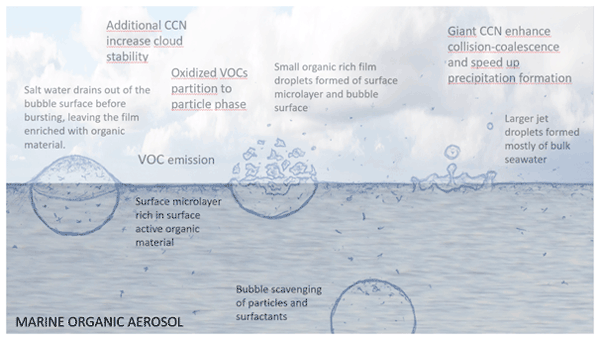
Aerosols and clouds persist as the dominant sources of uncertainty in climate projections. In this modelling study, we investigate the role of marine aerosols in influencing the lifetime of low-level clouds. Our high resolution simulations show that sea spray can both extend and shorten the lifetime of the cloud layer depending on the model setup. The impact of the primary marine organics is relatively limited while secondary aerosol from monoterpenes can have larger impact.
Jaakko Ahola, Tomi Raatikainen, Muzaffer Ege Alper, Jukka-Pekka Keskinen, Harri Kokkola, Antti Kukkurainen, Antti Lipponen, Jia Liu, Kalle Nordling, Antti-Ilari Partanen, Sami Romakkaniemi, Petri Räisänen, Juha Tonttila, and Hannele Korhonen
Atmos. Chem. Phys., 22, 4523–4537, https://doi.org/10.5194/acp-22-4523-2022, https://doi.org/10.5194/acp-22-4523-2022, 2022
Short summary
Short summary
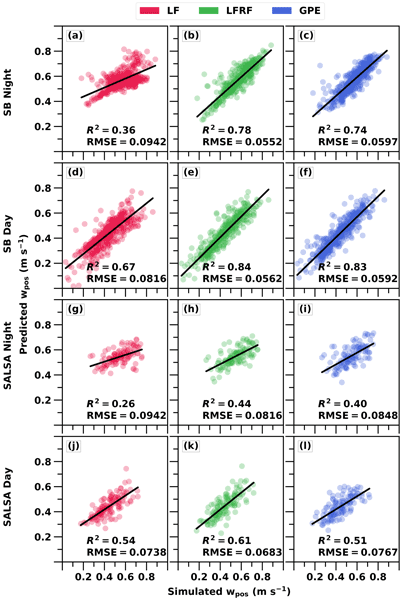
Clouds are important for the climate, and cloud droplets have a significant role in cloud properties. Cloud droplets form when air rises and cools and water vapour condenses on small particles that can be natural or of anthropogenic origin. Currently, the updraft velocity, meaning how fast the air rises, is poorly represented in global climate models. In our study, we show three methods that will improve the depiction of updraft velocity and which properties are vital to updrafts.
Tomi Raatikainen, Marje Prank, Jaakko Ahola, Harri Kokkola, Juha Tonttila, and Sami Romakkaniemi
Atmos. Chem. Phys., 22, 3763–3778, https://doi.org/10.5194/acp-22-3763-2022, https://doi.org/10.5194/acp-22-3763-2022, 2022
Short summary
Short summary
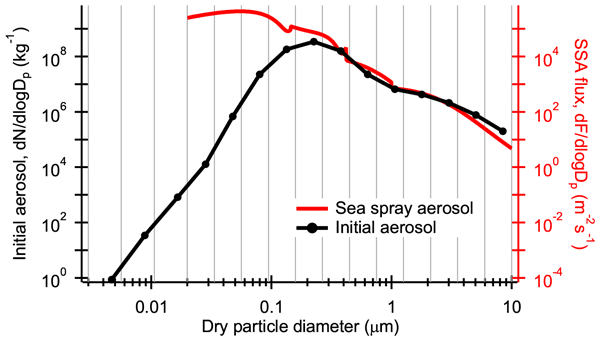
Mineral dust or similar ice-nucleating particles (INPs) are needed to initiate cloud droplet freezing at temperatures common in shallow clouds. In this work we examine how INPs that are released from the sea surface impact marine clouds. Our high-resolution simulations show that turbulent updraughts carry these particles effectively up to the clouds, where they initiate cloud droplet freezing. Sea surface INP emissions become more important with decreasing background dust INP concentrations.
Kanika Taneja, Silvia M. Calderón, Harri Kokkola, Juha Tonttila, Sami Romakkaniemi, Seethala Chellappan, Antti Arola, Antti Lipponen, Taina Yli-Juuti, Snehitha M. Kommula, Tuukka Petäjä, Markku Kulmala, and Tero Mielonen
EGUsphere, https://doi.org/10.5194/egusphere-2026-4750, https://doi.org/10.5194/egusphere-2026-4750, 2026
This preprint is open for discussion and under review for Atmospheric Chemistry and Physics (ACP).
Short summary
Short summary
Vegetation can cool the climate by releasing gases that form aerosols, which scatter sunlight and brighten clouds. To quantify this feedback in Finland and the United States, we combine field measurements of aerosols and satellite observations of clouds. It is essential to select near-ideal clouds; otherwise, cloud-related cooling is underestimated. Cloud cooling matched aerosol cooling at the clean site in Finland and was nearly three times stronger at the rural site in the United States.
Harry Ballington, Martin Schnaiter, and Emma Järvinen
EGUsphere, https://doi.org/10.5194/egusphere-2026-4436, https://doi.org/10.5194/egusphere-2026-4436, 2026
This preprint is open for discussion and under review for Atmospheric Chemistry and Physics (ACP).
Short summary
Short summary
High altitude clouds known as cirrus cover about one third of the planet and strongly influence global climate. Our understanding of how they scatter light is poorly understood because ice crystals are highly varied and it is impossible to account for them all individually. We combine measurements from the new EarthCARE satellite with in-situ aircraft data and with computer simulations to determine which crystal shapes best match observations.
Timothy W. Juliano, Florian Tornow, Ann M. Fridlind, Andrew S. Ackerman, Gregory S. Elsaesser, Bart Geerts, Christian P. Lackner, David Painemal, Israel Silber, Mikhail Ovchinnikov, Gunilla Svensson, Michael Tjernström, Peng Wu, Alejandro Baró Pérez, Peter Bogenschutz, Dmitry Chechin, Kamal Kant Chandrakar, Jan Chylik, Andrey Debolskiy, Rostislav Fadeev, Anu Gupta, Luisa Ickes, Michail Karalis, Martin Köhler, Branko Kosović, Peter Kuma, Weiwei Li, Evgeny Mortikov, Hugh Morrison, Roel A. J. Neggers, Anna Possner, Tomi Raatikainen, Lea Raillard, Sami Romakkaniemi, Niklas Schnierstein, Shin-ichiro Shima, Nikita Silin, Mikhail Tolstykh, Étienne Vignon, Lulin Xue, Meng Zhang, and Xue Zheng
Atmos. Chem. Phys., 26, 13267–13302, https://doi.org/10.5194/acp-26-13267-2026, https://doi.org/10.5194/acp-26-13267-2026, 2026
Short summary
Short summary
Models struggle to capture cloud and precipitation processes and their radiative effects in marine cold-air outbreaks. We use a quasi-Lagrangian framework to compare large-eddy simulation (LES) and single-column model (SCM) output with field and satellite observations. With fixed droplet and ice numbers, LES and SCM agree in liquid-only tests. In mixed-phase conditions, LES plausibly capture cloud thinning and breakup, while SCMs largely remain overcast and thereby miss cloud radiative effects.
Ari Leskinen, Antonia Radlwimmer, Uula Isopahkala, Silvia Calderón, David Brus, Konstantinos Doulgeris, Ville Kaikkonen, Eero Molkoselkä, Dmitri Moiseev, Marie Lou Hirschy, Anssi Mäkynen, Sami Romakkaniemi, and Mika Komppula
EGUsphere, https://doi.org/10.5194/egusphere-2026-2088, https://doi.org/10.5194/egusphere-2026-2088, 2026
Short summary
Short summary
We present a lightweight holographic imaging instrument, designed for high-resolution in-cloud particle measurements at a rate of 10 holograms per second, which leads to sub-meter spatial resolution on-board UAV. The approach offers a cost-effective and versatile alternative, capable of accessing confined or remote areas, enabling improved validation of remote sensing products and numerical cloud models. We present the potential of such instrumentation for high-resolution cloud observations.
Aymeric Dziduch, Antoine Baudoux, Guillaume Mioche, Antoine Canzi, Benjamin Doiteau, Manuel Moser, Emma Järvinen, Étienne Vignon, Jean-Christophe Raut, Régis Dupuy, Christophe Gourbeyre, Jean-Luc Baray, Marie Monier, Frédéric Szczap, Guillaume Penide, Julien Delanoë, Odran Sourdeval, Alfons Schwarzenboeck, Stephan Mertes, Franz Martin Schnaiter, Christiane Voigt, Mario Mech, Susanne Crewell, Andreas Herber, Christof Lüpkes, André Ehrlich, Manfred Wendisch, and Olivier Jourdan
EGUsphere, https://doi.org/10.5194/egusphere-2026-3265, https://doi.org/10.5194/egusphere-2026-3265, 2026
This preprint is open for discussion and under review for Atmospheric Chemistry and Physics (ACP).
Short summary
Short summary
This study examines the microphysical properties and ice crystal habits of low-level Arctic mixed-phase clouds around Svalbard. Using airborne in situ observations from four campaigns, we show that cloud microphysical structure and ice crystal habits are influenced by weather conditions and surface type. These results provide quantitative observations to better understand low-level Arctic clouds, their ice formation processes, and their influence on the Arctic atmosphere and climate system.
Kasper Juurikkala, Tomi Raatikainen, Martina Krämer, Christina J. Williamson, and Ari Laaksonen
EGUsphere, https://doi.org/10.5194/egusphere-2026-2427, https://doi.org/10.5194/egusphere-2026-2427, 2026
Short summary
Short summary
We use large-eddy simulations constrained by observations to study how mineral dust controls the evolution of cirrus clouds during dust outbreaks. Results show that sustained dusty cirrus forms only under strongly elevated dust concentrations, where ice forms mainly on dust particles. This identifies mineral dust as the key control on cirrus persistence and highlights the need to improve representation of dust-driven ice formation in weather and climate models.

Emma Järvinen and Franz Martin Schnaiter
Atmos. Chem. Phys., 26, 2465–2486, https://doi.org/10.5194/acp-26-2465-2026, https://doi.org/10.5194/acp-26-2465-2026, 2026
Short summary
Short summary
Ice clouds in the Arctic and mid-latitudes were investigated using in situ aircraft observations combining single-particle imaging with simultaneous light-scattering measurements. The joint characterisation of ice particle size, shape, and optical response shows that these clouds reflect substantially more solar radiation than is typically represented in models. The observations provide an empirical basis for improving the physical realism of ice cloud optical properties in climate models.
Xiaoxia Shang, Maria Filioglou, Julian Hofer, Moritz Haarig, Qiaoyun Hu, Philippe Goloub, Sami Romakkaniemi, and Mika Komppula
Atmos. Meas. Tech., 19, 679–697, https://doi.org/10.5194/amt-19-679-2026, https://doi.org/10.5194/amt-19-679-2026, 2026
Short summary
Short summary
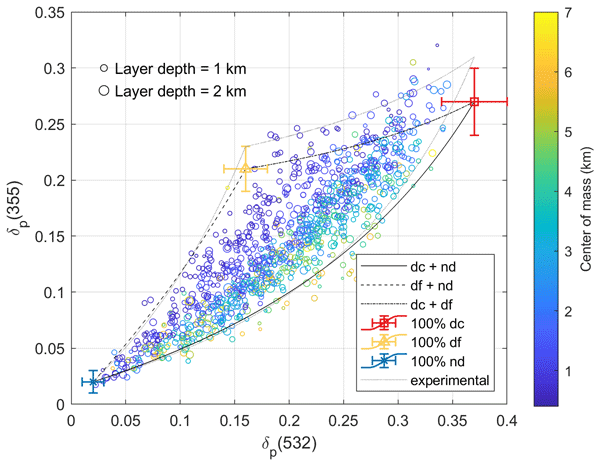
We developed a simple method to identify different types of airborne particles using laser-based measurements. It can distinguish coarse dust, fine dust, and non-dust aerosols. Tests with real data from regions affected by desert dust show the method works well. This helps improve understanding of how particles are distributed in the atmosphere, which is important for air quality and climate studies.
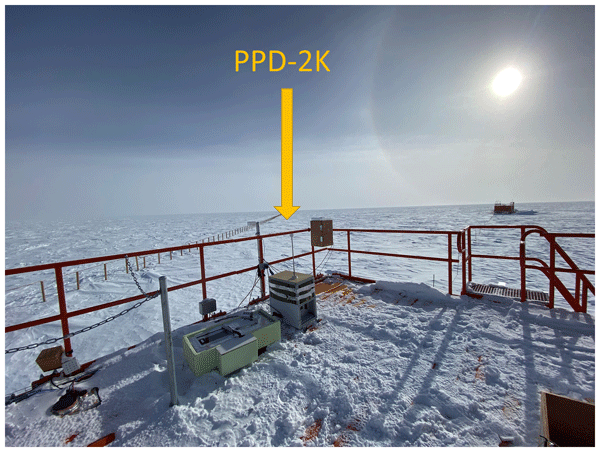
Adrian Hamel, Massimo del Guasta, Carl Schmitt, Christophe Genthon, Emma Järvinen, and Martin Schnaiter
Atmos. Chem. Phys., 26, 1211–1228, https://doi.org/10.5194/acp-26-1211-2026, https://doi.org/10.5194/acp-26-1211-2026, 2026
Short summary
Short summary
Size and shape of small ice particles in the dry and cold atmosphere of inland Antarctica were measured. We observed that particles originating near the surface are smaller than those falling from higher altitudes. Inland Antarctic particles of frozen fog occur at lower concentrations and are less complex than those observed in an urban, polluted environment. These findings can help to improve Antarctic climate models and to accurately interpret satellite observations of the polar atmosphere.
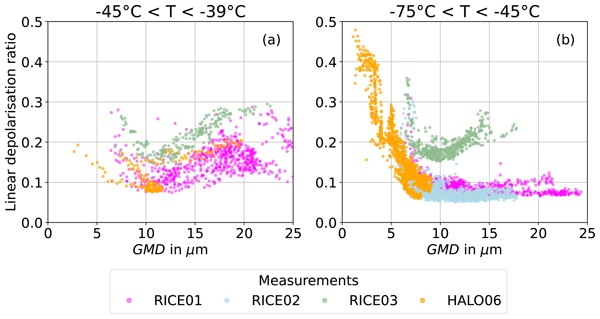
Adrian Hamel, Martin Schnaiter, Masanori Saito, Robert Wagner, and Emma Järvinen
Atmos. Chem. Phys., 26, 1277–1300, https://doi.org/10.5194/acp-26-1277-2026, https://doi.org/10.5194/acp-26-1277-2026, 2026
Short summary
Short summary
The depolarisation ratio of ice clouds is commonly measured by satellites and ground-based instruments to learn about ice particle shapes. In our cloud chamber experiments, we found that for small ice crystals, the depolarisation ratio is more strongly influenced by particle size than by nano-scale structure. The measured trends could be reproduced with numerical simulations. This result helps improve the interpretation of remote sensing data and the accuracy of light scattering models.
Timothy W. Juliano, Florian Tornow, Ann M. Fridlind, Andrew S. Ackerman, Gregory S. Elsaesser, Bart Geerts, Christian P. Lackner, David Painemal, Israel Silber, Mikhail Ovchinnikov, Gunilla Svensson, Michael Tjernström, Peng Wu, Alejandro Baró Pérez, Peter Bogenschutz, Dmitry Chechin, Kamal Kant Chandrakar, Jan Chylik, Andrey Debolskiy, Rostislav Fadeev, Anu Gupta, Luisa Ickes, Michail Karalis, Martin Köhler, Branko Kosović, Peter Kuma, Weiwei Li, Evgeny Mortikov, Hugh Morrison, Roel A. J. Neggers, Anna Possner, Tomi Raatikainen, Sami Romakkaniemi, Niklas Schnierstein, Shin-ichiro Shima, Nikita Silin, Mikhail Tolstykh, Lulin Xue, Meng Zhang, and Xue Zheng
EGUsphere, https://doi.org/10.5194/egusphere-2025-6217, https://doi.org/10.5194/egusphere-2025-6217, 2026
Preprint archived
Short summary
Short summary
Models struggle to capture cloud and precipitation processes and their radiative effects in marine cold-air outbreaks. We use a quasi-Lagrangian framework to compare large-eddy simulation (LES) and single-column model (SCM) output with field and satellite observations. With fixed droplet and ice numbers, LES and SCM agree in liquid-only tests. In mixed-phase conditions, LES plausibly capture cloud thinning and breakup, while SCMs largely remain overcast and thereby miss cloud radiative effects.
Silvia M. Calderón, Noora Hyttinen, Harri Kokkola, Tomi Raatikainen, R. Paul Lawson, and Sami Romakkaniemi
Atmos. Chem. Phys., 25, 14479–14500, https://doi.org/10.5194/acp-25-14479-2025, https://doi.org/10.5194/acp-25-14479-2025, 2025
Short summary
Short summary
Field campaigns suggest secondary ice production (SIP) from mm-sized supercooled droplets drives rapid glaciation and precipitation development in summer cumulus congestus clouds lacking ice-nucleating particles. Our large-eddy simulations with sectional aerosol–hydrometeor microphysics support this, reproducing observed size distributions and showing how SIP accelerates aggregation, enhancing surface precipitation.
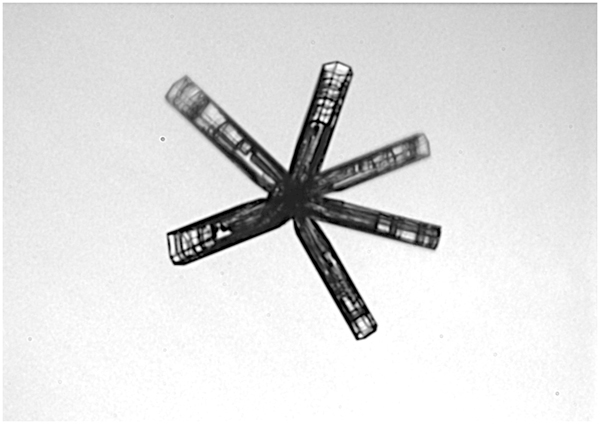
Shawn W. Wagner, Martin Schnaiter, Guanglang Xu, Franziska Rogge, and Emma Järvinen
Atmos. Chem. Phys., 25, 8785–8804, https://doi.org/10.5194/acp-25-8785-2025, https://doi.org/10.5194/acp-25-8785-2025, 2025
Short summary
Short summary
Understanding the interaction between cirrus clouds and solar radiation is critical for modeling the Earth's climate. A common crystal type found in cirrus clouds is the bullet rosette. Here, atmospheric bullet rosettes measured from jet aircraft are analyzed for their morphological and radiative properties. Atmospheric bullet rosettes are found to be more morphologically complex than previously assumed. This complexity has a significant impact on their radiative properties.
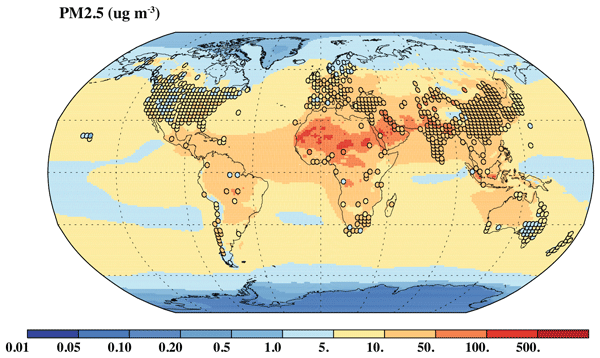
Natalie M. Mahowald, Longlei Li, Julius Vira, Marje Prank, Douglas S. Hamilton, Hitoshi Matsui, Ron L. Miller, P. Louis Lu, Ezgi Akyuz, Daphne Meidan, Peter Hess, Heikki Lihavainen, Christine Wiedinmyer, Jenny Hand, Maria Grazia Alaimo, Célia Alves, Andres Alastuey, Paulo Artaxo, Africa Barreto, Francisco Barraza, Silvia Becagli, Giulia Calzolai, Shankararaman Chellam, Ying Chen, Patrick Chuang, David D. Cohen, Cristina Colombi, Evangelia Diapouli, Gaetano Dongarra, Konstantinos Eleftheriadis, Johann Engelbrecht, Corinne Galy-Lacaux, Cassandra Gaston, Dario Gomez, Yenny González Ramos, Roy M. Harrison, Chris Heyes, Barak Herut, Philip Hopke, Christoph Hüglin, Maria Kanakidou, Zsofia Kertesz, Zbigniew Klimont, Katriina Kyllönen, Fabrice Lambert, Xiaohong Liu, Remi Losno, Franco Lucarelli, Willy Maenhaut, Beatrice Marticorena, Randall V. Martin, Nikolaos Mihalopoulos, Yasser Morera-Gómez, Adina Paytan, Joseph Prospero, Sergio Rodríguez, Patricia Smichowski, Daniela Varrica, Brenna Walsh, Crystal L. Weagle, and Xi Zhao
Atmos. Chem. Phys., 25, 4665–4702, https://doi.org/10.5194/acp-25-4665-2025, https://doi.org/10.5194/acp-25-4665-2025, 2025
Short summary
Short summary
Aerosol particles are an important part of the Earth system, but their concentrations are spatially and temporally heterogeneous, as well as being variable in size and composition. Here, we present a new compilation of PM2.5 and PM10 aerosol observations, focusing on the spatial variability across different observational stations, including composition, and demonstrate a method for comparing the data sets to model output.
Harri Kokkola, Juha Tonttila, Silvia M. Calderón, Sami Romakkaniemi, Antti Lipponen, Aapo Peräkorpi, Tero Mielonen, Edward Gryspeerdt, Timo Henrik Virtanen, Pekka Kolmonen, and Antti Arola
Atmos. Chem. Phys., 25, 1533–1543, https://doi.org/10.5194/acp-25-1533-2025, https://doi.org/10.5194/acp-25-1533-2025, 2025
Short summary
Short summary
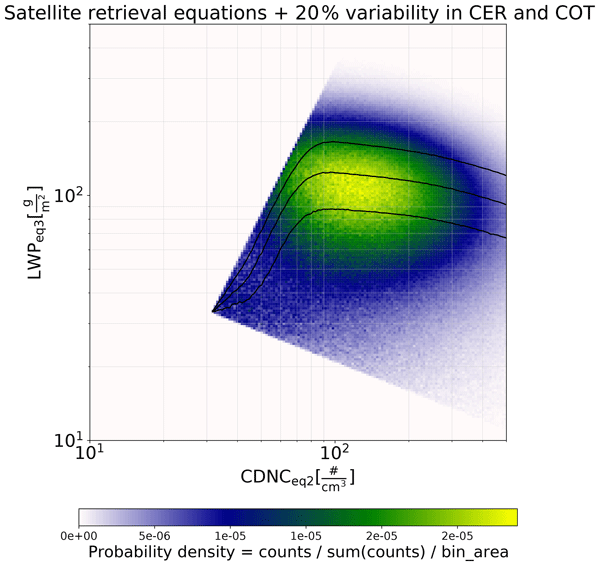
Understanding how atmospheric aerosols affect clouds is a scientific challenge. One question is how aerosols affects the amount of cloud water. We used a cloud-scale model to study these effects on marine clouds. The study showed that variations in cloud properties and instrument noise can cause bias in satellite-derived cloud water content. However, our results suggest that for similar weather conditions with well-defined aerosol concentrations, satellite data can reliably track these effects.
Marje Prank, Juha Tonttila, Xiaoxia Shang, Sami Romakkaniemi, and Tomi Raatikainen
Atmos. Chem. Phys., 25, 183–197, https://doi.org/10.5194/acp-25-183-2025, https://doi.org/10.5194/acp-25-183-2025, 2025
Short summary
Short summary
Large primary bioparticles such as pollen can be abundant in the atmosphere. In humid conditions pollen can rupture and release a large number of fine sub-pollen particles (SPPs). The paper investigates what kind of birch pollen concentrations are needed for the pollen and SPPs to start playing a noticeable role in cloud processes and alter precipitation formation. In the studied cases only the largest observed pollen concentrations were able to noticeably alter the precipitation formation.
Rostislav Kouznetsov, Risto Hänninen, Andreas Uppstu, Evgeny Kadantsev, Yalda Fatahi, Marje Prank, Dmitrii Kouznetsov, Steffen Manfred Noe, Heikki Junninen, and Mikhail Sofiev
Atmos. Chem. Phys., 24, 4675–4691, https://doi.org/10.5194/acp-24-4675-2024, https://doi.org/10.5194/acp-24-4675-2024, 2024
Short summary
Short summary
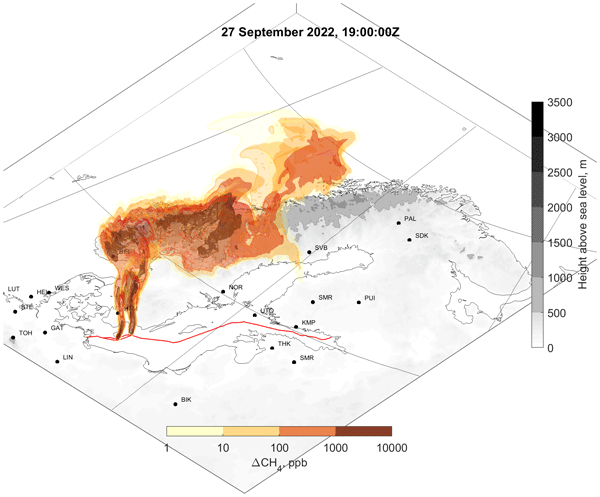
By relying solely on publicly available media reports, we were able to infer the temporal evolution and the injection height for the Nord Stream gas leaks in September 2022. The inventory specifies locations, vertical distributions, and temporal evolution of the methane sources. The inventory can be used to simulate the event with atmospheric transport models. The inventory is supplemented with a set of observational data tailored to evaluate the results of the simulated atmospheric dispersion.
Natalie M. Mahowald, Longlei Li, Julius Vira, Marje Prank, Douglas S. Hamilton, Hitoshi Matsui, Ron L. Miller, Louis Lu, Ezgi Akyuz, Daphne Meidan, Peter Hess, Heikki Lihavainen, Christine Wiedinmyer, Jenny Hand, Maria Grazia Alaimo, Célia Alves, Andres Alastuey, Paulo Artaxo, Africa Barreto, Francisco Barraza, Silvia Becagli, Giulia Calzolai, Shankarararman Chellam, Ying Chen, Patrick Chuang, David D. Cohen, Cristina Colombi, Evangelia Diapouli, Gaetano Dongarra, Konstantinos Eleftheriadis, Corinne Galy-Lacaux, Cassandra Gaston, Dario Gomez, Yenny González Ramos, Hannele Hakola, Roy M. Harrison, Chris Heyes, Barak Herut, Philip Hopke, Christoph Hüglin, Maria Kanakidou, Zsofia Kertesz, Zbiginiw Klimont, Katriina Kyllönen, Fabrice Lambert, Xiaohong Liu, Remi Losno, Franco Lucarelli, Willy Maenhaut, Beatrice Marticorena, Randall V. Martin, Nikolaos Mihalopoulos, Yasser Morera-Gomez, Adina Paytan, Joseph Prospero, Sergio Rodríguez, Patricia Smichowski, Daniela Varrica, Brenna Walsh, Crystal Weagle, and Xi Zhao
Earth Syst. Sci. Data Discuss., https://doi.org/10.5194/essd-2024-1, https://doi.org/10.5194/essd-2024-1, 2024
Preprint withdrawn
Short summary
Short summary
Aerosol particles can interact with incoming solar radiation and outgoing long wave radiation, change cloud properties, affect photochemistry, impact surface air quality, and when deposited impact surface albedo of snow and ice, and modulate carbon dioxide uptake by the land and ocean. Here we present a new compilation of aerosol observations including composition, a methodology for comparing the datasets to model output, and show the implications of these results using one model.
Kalle Nordling, Jukka-Pekka Keskinen, Sami Romakkaniemi, Harri Kokkola, Petri Räisänen, Antti Lipponen, Antti-Ilari Partanen, Jaakko Ahola, Juha Tonttila, Muzaffer Ege Alper, Hannele Korhonen, and Tomi Raatikainen
Atmos. Chem. Phys., 24, 869–890, https://doi.org/10.5194/acp-24-869-2024, https://doi.org/10.5194/acp-24-869-2024, 2024
Short summary
Short summary
Our results show that the global model is stable and it provides meaningful results. This way we can include a physics-based presentation of sub-grid physics (physics which happens on a 100 m scale) in the global model, whose resolution is on a 100 km scale.
Sampo Vepsäläinen, Silvia M. Calderón, and Nønne L. Prisle
Atmos. Chem. Phys., 23, 15149–15164, https://doi.org/10.5194/acp-23-15149-2023, https://doi.org/10.5194/acp-23-15149-2023, 2023
Short summary
Short summary
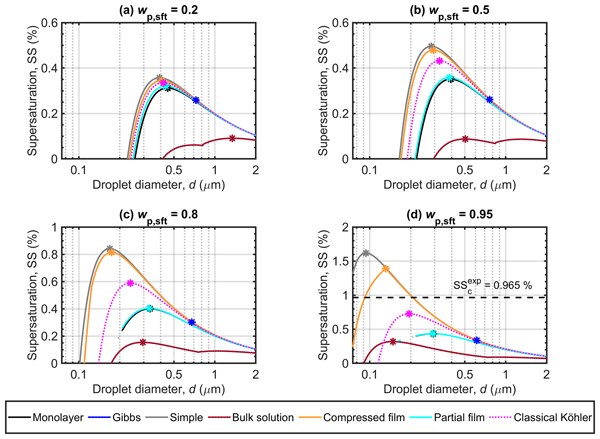
Atmospheric aerosols act as seeds for cloud formation. Many aerosols contain surface active material that accumulates at the surface of growing droplets. This can affect cloud droplet activation, but the broad significance of the effect and the best way to model it are still debated. We compare predictions of six models to surface activity of strongly surface active aerosol and find significant differences between the models, especially with large fractions of surfactant in the dry particles.
Marco Zanatta, Stephan Mertes, Olivier Jourdan, Regis Dupuy, Emma Järvinen, Martin Schnaiter, Oliver Eppers, Johannes Schneider, Zsófia Jurányi, and Andreas Herber
Atmos. Chem. Phys., 23, 7955–7973, https://doi.org/10.5194/acp-23-7955-2023, https://doi.org/10.5194/acp-23-7955-2023, 2023
Short summary
Short summary
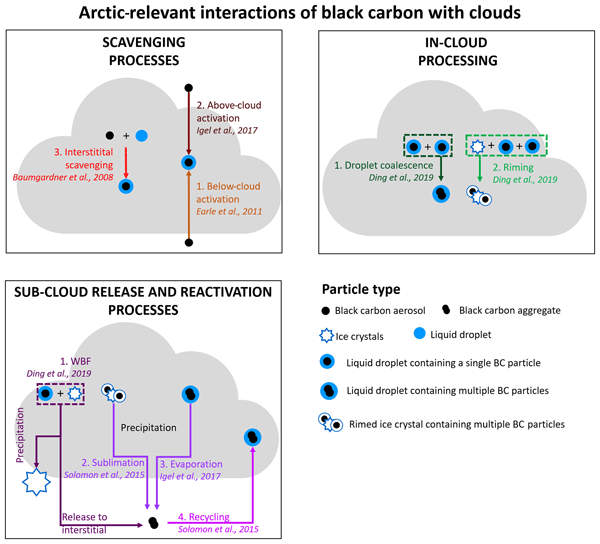
Black carbon (BC) particles influence the Arctic radiative balance. Vertical measurements of black carbon were conducted during the ACLOUD campaign in the European Arctic to study the interaction of BC with clouds. This study shows that clouds influence the vertical variability of BC properties across the inversion layer and that multiple activation and transformation mechanisms of BC may occur in the presence of low-level, persistent, mixed-phase clouds.
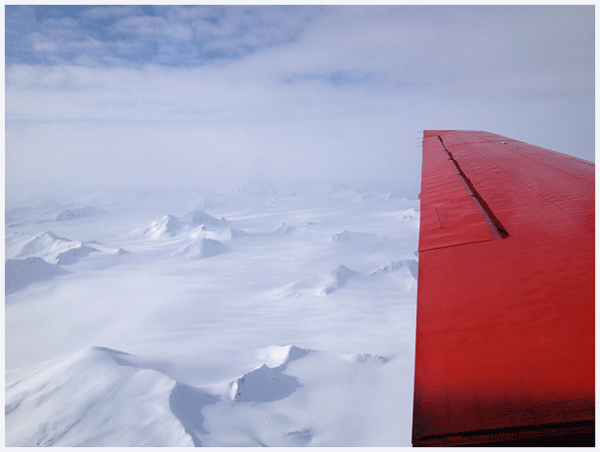
Emma Järvinen, Franziska Nehlert, Guanglang Xu, Fritz Waitz, Guillaume Mioche, Regis Dupuy, Olivier Jourdan, and Martin Schnaiter
Atmos. Chem. Phys., 23, 7611–7633, https://doi.org/10.5194/acp-23-7611-2023, https://doi.org/10.5194/acp-23-7611-2023, 2023
Short summary
Short summary
The Arctic is warming faster than other regions. Arctic low-level mixed-phase clouds, where ice crystals and liquid droplets co-exist, are thought to have an important role in Arctic warming. Here we show airborne measurements of vertical distribution of liquid and ice particles and their relative abundance. Ice particles are found in relative warm clouds, which can be explained by multiplication of existing ice crystals. However, the role of ice particles in redistributing sun light is minimal.
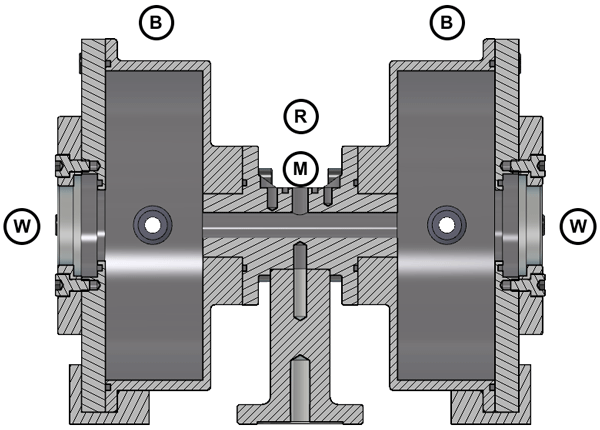
Franz Martin Schnaiter, Claudia Linke, Eija Asmi, Henri Servomaa, Antti-Pekka Hyvärinen, Sho Ohata, Yutaka Kondo, and Emma Järvinen
Atmos. Meas. Tech., 16, 2753–2769, https://doi.org/10.5194/amt-16-2753-2023, https://doi.org/10.5194/amt-16-2753-2023, 2023
Short summary
Short summary
Light-absorbing particles from combustion processes are important contributors to climate warming. Their highly variable spectral light absorption properties need to be monitored in the field. Commonly used methods show measurement artefacts that are difficult to correct. We introduce a new instrument that is based on the photoacoustic effect. Long-term operation in the Finnish Arctic demonstrates the applicability of the new instrument for unattended light absorption monitoring.
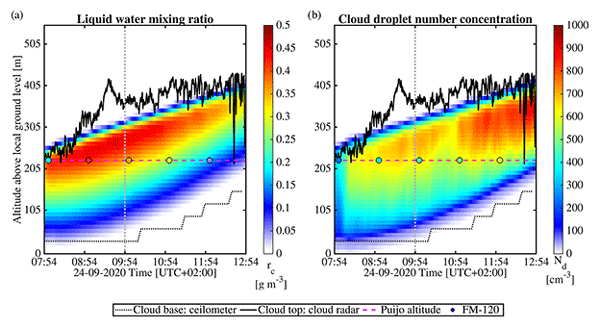
Silvia M. Calderón, Juha Tonttila, Angela Buchholz, Jorma Joutsensaari, Mika Komppula, Ari Leskinen, Liqing Hao, Dmitri Moisseev, Iida Pullinen, Petri Tiitta, Jian Xu, Annele Virtanen, Harri Kokkola, and Sami Romakkaniemi
Atmos. Chem. Phys., 22, 12417–12441, https://doi.org/10.5194/acp-22-12417-2022, https://doi.org/10.5194/acp-22-12417-2022, 2022
Short summary
Short summary
The spatial and temporal restrictions of observations and oversimplified aerosol representation in large eddy simulations (LES) limit our understanding of aerosol–stratocumulus interactions. In this closure study of in situ and remote sensing observations and outputs from UCLALES–SALSA, we have assessed the role of convective overturning and aerosol effects in two cloud events observed at the Puijo SMEAR IV station, Finland, a diurnal-high aerosol case and a nocturnal-low aerosol case.
Marje Prank, Juha Tonttila, Jaakko Ahola, Harri Kokkola, Thomas Kühn, Sami Romakkaniemi, and Tomi Raatikainen
Atmos. Chem. Phys., 22, 10971–10992, https://doi.org/10.5194/acp-22-10971-2022, https://doi.org/10.5194/acp-22-10971-2022, 2022
Short summary
Short summary
Aerosols and clouds persist as the dominant sources of uncertainty in climate projections. In this modelling study, we investigate the role of marine aerosols in influencing the lifetime of low-level clouds. Our high resolution simulations show that sea spray can both extend and shorten the lifetime of the cloud layer depending on the model setup. The impact of the primary marine organics is relatively limited while secondary aerosol from monoterpenes can have larger impact.

Fritz Waitz, Martin Schnaiter, Thomas Leisner, and Emma Järvinen
Atmos. Chem. Phys., 22, 7087–7103, https://doi.org/10.5194/acp-22-7087-2022, https://doi.org/10.5194/acp-22-7087-2022, 2022
Short summary
Short summary
Riming, i.e., the accretion of small droplets on the surface of ice particles via collision, is one of the major uncertainties in model prediction of mixed-phase clouds. We discuss the occurrence (up to 50% of particles) and aging of rimed ice particles and show correlations of the occurrence and the degree of riming with ambient meteorological parameters using data gathered by the Particle Habit Imaging and Polar Scattering (PHIPS) probe during three airborne in situ field campaigns.
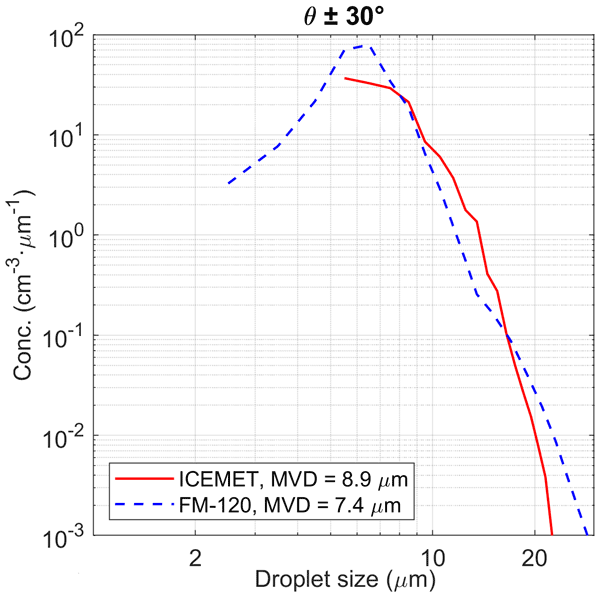
Petri Tiitta, Ari Leskinen, Ville A. Kaikkonen, Eero O. Molkoselkä, Anssi J. Mäkynen, Jorma Joutsensaari, Silvia Calderon, Sami Romakkaniemi, and Mika Komppula
Atmos. Meas. Tech., 15, 2993–3009, https://doi.org/10.5194/amt-15-2993-2022, https://doi.org/10.5194/amt-15-2993-2022, 2022
Short summary
Short summary
The novel holographic imaging instrument (ICEMET) was adapted to measure the microphysical properties of liquid clouds, and these values were compared with parallel measurements of a cloud droplet spectrometer (FM-120) and particle measurements using a twin-inlet system. When the intercomparison was carried out during isoaxial sampling, our results showed good agreement in terms of variability between the instruments. This agreement was confirmed using Mutual and Pearson correlation analyses.
Jaakko Ahola, Tomi Raatikainen, Muzaffer Ege Alper, Jukka-Pekka Keskinen, Harri Kokkola, Antti Kukkurainen, Antti Lipponen, Jia Liu, Kalle Nordling, Antti-Ilari Partanen, Sami Romakkaniemi, Petri Räisänen, Juha Tonttila, and Hannele Korhonen
Atmos. Chem. Phys., 22, 4523–4537, https://doi.org/10.5194/acp-22-4523-2022, https://doi.org/10.5194/acp-22-4523-2022, 2022
Short summary
Short summary
Clouds are important for the climate, and cloud droplets have a significant role in cloud properties. Cloud droplets form when air rises and cools and water vapour condenses on small particles that can be natural or of anthropogenic origin. Currently, the updraft velocity, meaning how fast the air rises, is poorly represented in global climate models. In our study, we show three methods that will improve the depiction of updraft velocity and which properties are vital to updrafts.
Tomi Raatikainen, Marje Prank, Jaakko Ahola, Harri Kokkola, Juha Tonttila, and Sami Romakkaniemi
Atmos. Chem. Phys., 22, 3763–3778, https://doi.org/10.5194/acp-22-3763-2022, https://doi.org/10.5194/acp-22-3763-2022, 2022
Short summary
Short summary
Mineral dust or similar ice-nucleating particles (INPs) are needed to initiate cloud droplet freezing at temperatures common in shallow clouds. In this work we examine how INPs that are released from the sea surface impact marine clouds. Our high-resolution simulations show that turbulent updraughts carry these particles effectively up to the clouds, where they initiate cloud droplet freezing. Sea surface INP emissions become more important with decreasing background dust INP concentrations.
Jessica Slater, Hugh Coe, Gordon McFiggans, Juha Tonttila, and Sami Romakkaniemi
Atmos. Chem. Phys., 22, 2937–2953, https://doi.org/10.5194/acp-22-2937-2022, https://doi.org/10.5194/acp-22-2937-2022, 2022
Short summary
Short summary
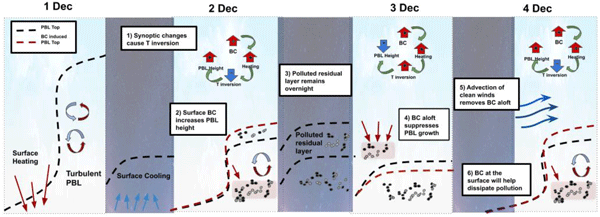
This paper shows the specific impact of black carbon (BC) on the aerosol–planetary boundary layer (PBL) feedback and its influence on a Beijing haze episode. Overall, this paper shows that strong temperature inversions prevent BC heating within the PBL from significantly increasing PBL height, while BC above the PBL suppresses PBL development significantly through the day. From this we suggest a method by which both locally and regionally emitted BC may impact urban pollution episodes.
Sampo Vepsäläinen, Silvia M. Calderón, Jussi Malila, and Nønne L. Prisle
Atmos. Chem. Phys., 22, 2669–2687, https://doi.org/10.5194/acp-22-2669-2022, https://doi.org/10.5194/acp-22-2669-2022, 2022
Short summary
Short summary
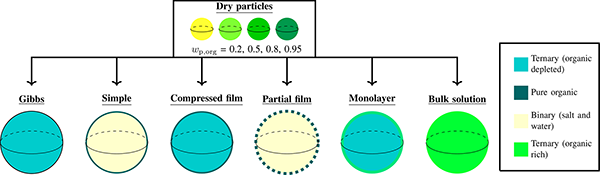
Atmospheric aerosols act as seeds for cloud formation. Many aerosols contain surface active material that accumulates at the surface of growing droplets. This can affect cloud droplet activation, but the broad significance of the effect and the best way to model it are still debated. We compare predictions of six different model approaches to surface activity of organic aerosols and find significant differences between the models, especially with large fractions of organics in the dry particles.
Ian Boutle, Wayne Angevine, Jian-Wen Bao, Thierry Bergot, Ritthik Bhattacharya, Andreas Bott, Leo Ducongé, Richard Forbes, Tobias Goecke, Evelyn Grell, Adrian Hill, Adele L. Igel, Innocent Kudzotsa, Christine Lac, Bjorn Maronga, Sami Romakkaniemi, Juerg Schmidli, Johannes Schwenkel, Gert-Jan Steeneveld, and Benoît Vié
Atmos. Chem. Phys., 22, 319–333, https://doi.org/10.5194/acp-22-319-2022, https://doi.org/10.5194/acp-22-319-2022, 2022
Short summary
Short summary
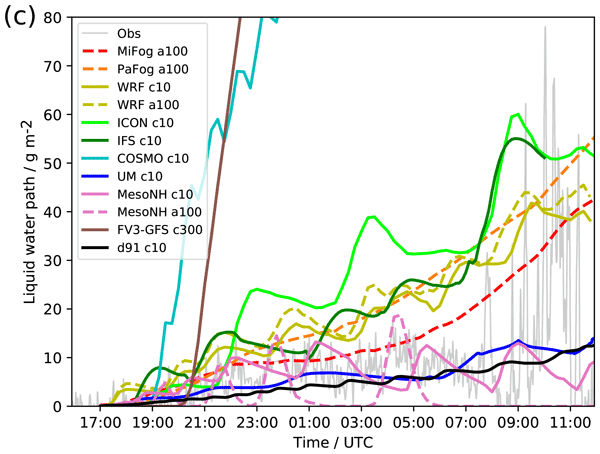
Fog forecasting is one of the biggest problems for numerical weather prediction. By comparing many models used for fog forecasting with others used for fog research, we hoped to help guide forecast improvements. We show some key processes that, if improved, will help improve fog forecasting, such as how water is deposited on the ground. We also showed that research models were not themselves a suitable baseline for comparison, and we discuss what future observations are required to improve them.
Cited articles
Ackerman, A. S., vanZanten, M. C., Stevens, B., Savic-Jovcic, V., Bretherton, C. S., Chlond, A., Golaz, J.-C., Jiang, H., Khairoutdinov, M., Krueger, S. K., Lewellen, D. C., Lock, A., Moeng, C.-H., Nakamura, K., Petters, M. D., Snider, J. R., Weinbrecht, S., and Zulauf, M.: Large-Eddy Simulations of a Drizzling, Stratocumulus-Topped Marine Boundary Layer, Mon. Weather Rev., 137, 1083–1110, https://doi.org/10.1175/2008MWR2582.1, 2009. a
Ahola, J., Korhonen, H., Tonttila, J., Romakkaniemi, S., Kokkola, H., and Raatikainen, T.: Modelling mixed-phase clouds with the large-eddy model UCLALES–SALSA, Atmos. Chem. Phys., 20, 11639–11654, https://doi.org/10.5194/acp-20-11639-2020, 2020. a, b
Atlas, R. L., Bretherton, C. S., Blossey, P. N., Gettelman, A., Bardeen, C., Lin, P., and Ming, Y.: How Well Do Large-Eddy Simulations and Global Climate Models Represent Observed Boundary Layer Structures and Low Clouds Over the Summertime Southern Ocean?, J. Adv. Model. Earth Sy., 12, e2020MS002205, https://doi.org/10.1029/2020MS002205, 2020. a
Blahak, U.: Towards a better representation of high density ice particles in a state-of-the-art two-moment bulk microphysical scheme, 15th International Conference on Clouds and Precipitation, 7–11 July 2008, Cancun, Mexico, International Commission on Clouds and Precipitation, 2008. a
Brown, P. R. A. and Francis, P. N.: Improved Measurements of the Ice Water Content in Cirrus Using a Total-Water Probe, J. Atmos. Ocean. Tech., 12, 410–414, https://doi.org/10.1175/1520-0426(1995)012<0410:IMOTIW>2.0.CO;2, 1995. a, b, c, d
Calderón, S. M., Hyttinen, N., Kokkola, H., Raatikainen, T., Lawson, R. P., and Romakkaniemi, S.: Secondary ice formation in cumulus congestus clouds: insights from observations and aerosol-aware large-eddy simulations, Atmos. Chem. Phys., 25, 14479–14500, https://doi.org/10.5194/acp-25-14479-2025, 2025. a, b, c, d
Cesana, G. and Storelvmo, T.: Improving climate projections by understanding how cloud phase affects radiation, J. Geophys. Res.-Atmos., 122, 4594–4599, https://doi.org/10.1002/2017JD026927, 2017. a
Cotton, W. R., Tripoli, G. J., Rauber, R. M., and Mulvihill, E. A.: Numerical Simulation of the Effects of Varying Ice Crystal Nucleation Rates and Aggregation Processes on Orographic Snowfall, J. Appl. Meteorol. Clim., 25, 1658–1680, https://doi.org/10.1175/1520-0450(1986)025<1658:NSOTEO>2.0.CO;2, 1986. a
Eirund, G. K., Possner, A., and Lohmann, U.: Response of Arctic mixed-phase clouds to aerosol perturbations under different surface forcings, Atmos. Chem. Phys., 19, 9847–9864, https://doi.org/10.5194/acp-19-9847-2019, 2019. a
Ehrlich, A., Wendisch, M., Lüpkes, C., Buschmann, M., Bozem, H., Chechin, D., Clemen, H.-C., Dupuy, R., Eppers, O., Hartmann, J., Herber, A., Jäkel, E., Järvinen, E., Jourdan, O., Kästner, U., Kliesch, L.-L., Köllner, F., Mech, M., Mertes, S., Neuber, R., Ruiz-Donoso, E., Schnaiter, M., Schneider, J., Stapf, J., and Zanatta, M.: A comprehensive in situ and remote sensing data set from the Arctic CLoud Observations Using airborne measurements during polar Day (ACLOUD) campaign, Earth Syst. Sci. Data, 11, 1853–1881, https://doi.org/10.5194/essd-11-1853-2019, 2019. a, b
Ferrier, B. S.: A Double-Moment Multiple-Phase Four-Class Bulk Ice Scheme. Part I: Description, J. Atmos. Sci., 51, 249–280, https://doi.org/10.1175/1520-0469(1994)051<0249:ADMMPF>2.0.CO;2, 1994. a, b, c
Field, P. R., Lawson, R. P., Brown, P. R. A., Lloyd, G., Westbrook, C., Moisseev, D., Miltenberger, A., Nenes, A., Blyth, A., Choularton, T., Connolly, P., Buehl, J., Crosier, J., Cui, Z., Dearden, C., DeMott, P., Flossmann, A., Heymsfield, A., Huang, Y., Kalesse, H., Kanji, Z. A., Korolev, A., Kirchgaessner, A., Lasher-Trapp, S., Leisner, T., McFarquhar, G., Phillips, V., Stith, J., and Sullivan, S.: Secondary Ice Production: Current State of the Science and Recommendations for the Future, Meteorol. Monogr., 58, 7.1–7.20, https://doi.org/10.1175/AMSMONOGRAPHS-D-16-0014.1, 2017. a
Gierens, R., Kneifel, S., Shupe, M. D., Ebell, K., Maturilli, M., and Löhnert, U.: Low-level mixed-phase clouds in a complex Arctic environment, Atmos. Chem. Phys., 20, 3459–3481, https://doi.org/10.5194/acp-20-3459-2020, 2020. a
Grzegorczyk, P., Wobrock, W., Canzi, A., Niquet, L., Tridon, F., and Planche, C.: Investigating secondary ice production in a deep convective cloud with a 3D bin microphysics model: Part I – Sensitivity study of microphysical processes representations, Atmos. Res., 313, 107774, https://doi.org/10.1016/j.atmosres.2024.107774, 2025. a, b, c
Hallett, J. and Mossop, S. C.: Production of secondary ice particles during the riming process, Nature, 249, 26–28, https://doi.org/10.1038/249026a0, 1974. a, b
Hartmann, J., Lüpkes, C., and Chechin, D.: 1Hz resolution aircraft measurements of wind and temperature during the ACLOUD campaign in 2017, PANGAEA, https://doi.org/10.1594/PANGAEA.902849, 2019. a, b
Hohenegger, C., Korn, P., Linardakis, L., Redler, R., Schnur, R., Adamidis, P., Bao, J., Bastin, S., Behravesh, M., Bergemann, M., Biercamp, J., Bockelmann, H., Brokopf, R., Brüggemann, N., Casaroli, L., Chegini, F., Datseris, G., Esch, M., George, G., Giorgetta, M., Gutjahr, O., Haak, H., Hanke, M., Ilyina, T., Jahns, T., Jungclaus, J., Kern, M., Klocke, D., Kluft, L., Kölling, T., Kornblueh, L., Kosukhin, S., Kroll, C., Lee, J., Mauritsen, T., Mehlmann, C., Mieslinger, T., Naumann, A. K., Paccini, L., Peinado, A., Praturi, D. S., Putrasahan, D., Rast, S., Riddick, T., Roeber, N., Schmidt, H., Schulzweida, U., Schütte, F., Segura, H., Shevchenko, R., Singh, V., Specht, M., Stephan, C. C., von Storch, J.-S., Vogel, R., Wengel, C., Winkler, M., Ziemen, F., Marotzke, J., and Stevens, B.: ICON-Sapphire: simulating the components of the Earth system and their interactions at kilometer and subkilometer scales, Geosci. Model Dev., 16, 779–811, https://doi.org/10.5194/gmd-16-779-2023, 2023. a
Huang, Y., Blyth, A. M., Brown, P. R. A., Choularton, T. W., Connolly, P., Gadian, A. M., Jones, H., Latham, J., Cui, Z., and Carslaw, K.: The development of ice in a cumulus cloud over southwest England, New J. Phys., 10, 105021, https://doi.org/10.1088/1367-2630/10/10/105021, 2008. a
Järvinen, E., Nehlert, F., Xu, G., Waitz, F., Mioche, G., Dupuy, R., Jourdan, O., and Schnaiter, M.: Investigating the vertical extent and short-wave radiative effects of the ice phase in Arctic summertime low-level clouds, Atmos. Chem. Phys., 23, 7611–7633, https://doi.org/10.5194/acp-23-7611-2023, 2023. a, b, c, d, e, f, g, h, i, j, k, l, m, n
Kanji, Z. A., Ladino, L. A., Wex, H., Boose, Y., Burkert-Kohn, M., Cziczo, D. J., and Krämer, M.: Overview of Ice Nucleating Particles, Meteorol. Monogr., 58, 1.1–1.33, https://doi.org/10.1175/AMSMONOGRAPHS-D-16-0006.1, 2017. a, b
Keinert, A., Spannagel, D., Leisner, T., and Kiselev, A.: Secondary Ice Production upon Freezing of Freely Falling Drizzle Droplets, J. Atmos. Sci., 77, 2959–2967, https://doi.org/10.1175/JAS-D-20-0081.1, 2020. a, b
Korolev, A., McFarquhar, G., Field, P. R., Franklin, C., Lawson, P., Wang, Z., Williams, E., Abel, S. J., Axisa, D., Borrmann, S., Crosier, J., Fugal, J., Krämer, M., Lohmann, U., Schlenczek, O., Schnaiter, M., and Wendisch, M.: Mixed-Phase Clouds: Progress and Challenges, Meteorol. Monogr., 58, 5.1–5.50, https://doi.org/10.1175/AMSMONOGRAPHS-D-17-0001.1, 2017. a
Kudzotsa, I., Phillips, V. T. J., Dobbie, S., Formenton, M., Sun, J., Allen, G., Bansemer, A., Spracklen, D., and Pringle, K.: Aerosol indirect effects on glaciated clouds. Part I: Model description, Q. J. Roy. Meteor. Soc., 142, 1958–1969, https://doi.org/10.1002/qj.2791, 2016. a, b
Li, G., Wieder, J., Pasquier, J. T., Henneberger, J., and Kanji, Z. A.: Predicting atmospheric background number concentration of ice-nucleating particles in the Arctic, Atmos. Chem. Phys., 22, 14441–14454, https://doi.org/10.5194/acp-22-14441-2022, 2022. a
Listowski, C., Delanoë, J., Kirchgaessner, A., Lachlan-Cope, T., and King, J.: Antarctic clouds, supercooled liquid water and mixed phase, investigated with DARDAR: geographical and seasonal variations, Atmos. Chem. Phys., 19, 6771–6808, https://doi.org/10.5194/acp-19-6771-2019, 2019. a
Luke, E. P., Yang, F., Kollias, P., Vogelmann, A. M., and Maahn, M.: New insights into ice multiplication using remote-sensing observations of slightly supercooled mixed-phase clouds in the Arctic, P. Natl. Acad. Sci. USA, 118, e2021387118, https://doi.org/10.1073/pnas.2021387118, 2021. a, b
McFarquhar, G. M. and Cober, S. G.: Single-Scattering Properties of Mixed-Phase Arctic Clouds at Solar Wavelengths: Impacts on Radiative Transfer, J. Climate, 17, 3799–3813, https://doi.org/10.1175/1520-0442(2004)017<3799:SPOMAC>2.0.CO;2, 2004. a
Mertes, S., Kästner, U., and Macke, A.: Airborne in-situ measurements of the aerosol absorption coefficient, aerosol particle number concentration and size distribution of cloud particle residuals and ambient aerosol particles during flight P6_206_ACLOUD_2017_1706021001, PANGAEA, https://doi.org/10.1594/PANGAEA.900414, 2019. a, b
Mioche, G., Jourdan, O., Ceccaldi, M., and Delanoë, J.: Variability of mixed-phase clouds in the Arctic with a focus on the Svalbard region: a study based on spaceborne active remote sensing, Atmos. Chem. Phys., 15, 2445–2461, https://doi.org/10.5194/acp-15-2445-2015, 2015. a
Mioche, G., Jourdan, O., Delanoë, J., Gourbeyre, C., Febvre, G., Dupuy, R., Monier, M., Szczap, F., Schwarzenboeck, A., and Gayet, J.-F.: Vertical distribution of microphysical properties of Arctic springtime low-level mixed-phase clouds over the Greenland and Norwegian seas, Atmos. Chem. Phys., 17, 12845–12869, https://doi.org/10.5194/acp-17-12845-2017, 2017. a
Morrison, H., Thompson, G., and Tatarskii, V.: Impact of Cloud Microphysics on the Development of Trailing Stratiform Precipitation in a Simulated Squall Line: Comparison of One- and Two-Moment Schemes, Mon. Weather Rev., 137, 991–1007, https://doi.org/10.1175/2008MWR2556.1, 2009. a
Murray, B. J., Carslaw, K. S., and Field, P. R.: Opinion: Cloud-phase climate feedback and the importance of ice-nucleating particles, Atmos. Chem. Phys., 21, 665–679, https://doi.org/10.5194/acp-21-665-2021, 2021. a
Noppel, H., Blahak, U., Seifert, A., and Beheng, K. D.: Simulations of a hailstorm and the impact of CCN using an advanced two-moment cloud microphysical scheme, Atmos. Res., 96, 286–301, https://doi.org/10.1016/j.atmosres.2009.09.008, 2010. a
Pasquier, J. T., Henneberger, J., Ramelli, F., Lauber, A., David, R. O., Wieder, J., Carlsen, T., Gierens, R., Maturilli, M., and Lohmann, U.: Conditions favorable for secondary ice production in Arctic mixed-phase clouds, Atmos. Chem. Phys., 22, 15579–15601, https://doi.org/10.5194/acp-22-15579-2022, 2022. a, b
Petters, M. D. and Kreidenweis, S. M.: A single parameter representation of hygroscopic growth and cloud condensation nucleus activity, Atmos. Chem. Phys., 7, 1961–1971, https://doi.org/10.5194/acp-7-1961-2007, 2007. a
Phillips, V. T. J., Yano, J.-I., and Khain, A.: Ice Multiplication by Breakup in Ice–Ice Collisions. Part I: Theoretical Formulation, J. Atmos. Sci., 74, 1705–1719, https://doi.org/10.1175/JAS-D-16-0224.1, 2017. a, b
Phillips, V. T. J., Patade, S., Gutierrez, J., and Bansemer, A.: Secondary Ice Production by Fragmentation of Freezing Drops: Formulation and Theory, J. Atmos. Sci., 75, 3031–3070, https://doi.org/10.1175/JAS-D-17-0190.1, 2018. a, b, c
Prenni, A. J., Harrington, J. Y., Tjernström, M., DeMott, P. J., Avramov, A., Long, C. N., Kreidenweis, S. M., Olsson, P. Q., and Verlinde, J.: Can Ice-Nucleating Aerosols Affect Arctic Seasonal Climate?, B. Am. Meteorol. Soc., 88, 541–550, https://doi.org/10.1175/BAMS-88-4-541, 2007. a
Previdi, M., Smith, K. L., and Polvani, L. M.: Arctic amplification of climate change: a review of underlying mechanisms, Environ. Res. Lett., 16, 093003, https://doi.org/10.1088/1748-9326/ac1c29, 2021. a
Raatikainen, T.: Code and data for “Can rime splintering explain the ice production in Arctic mixed-phase clouds?”, Zenodo [data set], https://doi.org/10.5281/zenodo.18184323, 2026. a
Rangno, A. L. and Hobbs, P. V.: Ice particles in stratiform clouds in the Arctic and possible mechanisms for the production of high ice concentrations, J. Geophys. Res.-Atmos., 106, 15065–15075, https://doi.org/10.1029/2000JD900286, 2001. a
Reisner, J., Rasmussen, R. M., and Bruintjes, R. T.: Explicit forecasting of supercooled liquid water in winter storms using the MM5 mesoscale model, Q. J. Roy. Meteor. Soc., 124, 1071–1107, https://doi.org/10.1002/qj.49712454804, 1998. a
Schäfer, B., David, R. O., Georgakaki, P., Pasquier, J. T., Sotiropoulou, G., and Storelvmo, T.: Simulations of primary and secondary ice production during an Arctic mixed-phase cloud case from the Ny-Ålesund Aerosol Cloud Experiment (NASCENT) campaign, Atmos. Chem. Phys., 24, 7179–7202, https://doi.org/10.5194/acp-24-7179-2024, 2024. a, b
Seidel, J. S., Kiselev, A. A., Keinert, A., Stratmann, F., Leisner, T., and Hartmann, S.: Secondary ice production – no evidence of efficient rime-splintering mechanism, Atmos. Chem. Phys., 24, 5247–5263, https://doi.org/10.5194/acp-24-5247-2024, 2024. a, b
Seifert, A.: On the Parameterization of Evaporation of Raindrops as Simulated by a One-Dimensional Rainshaft Model, J. Atmos. Sci., 65, 3608–3619, https://doi.org/10.1175/2008JAS2586.1, 2008. a, b
Seifert, A. and Beheng, K. D.: A double-moment parameterization for simulating autoconversion, accretion and selfcollection, Atmos. Res., 59–60, 265–281, https://doi.org/10.1016/S0169-8095(01)00126-0, 2001. a, b, c
Seifert, A. and Heus, T.: Large-eddy simulation of organized precipitating trade wind cumulus clouds, Atmos. Chem. Phys., 13, 5631–5645, https://doi.org/10.5194/acp-13-5631-2013, 2013. a
Sotiropoulou, G., Sullivan, S., Savre, J., Lloyd, G., Lachlan-Cope, T., Ekman, A. M. L., and Nenes, A.: The impact of secondary ice production on Arctic stratocumulus, Atmos. Chem. Phys., 20, 1301–1316, https://doi.org/10.5194/acp-20-1301-2020, 2020. a, b, c, d
Sotiropoulou, G., Vignon, É., Young, G., Morrison, H., O'Shea, S. J., Lachlan-Cope, T., Berne, A., and Nenes, A.: Secondary ice production in summer clouds over the Antarctic coast: an underappreciated process in atmospheric models, Atmos. Chem. Phys., 21, 755–771, https://doi.org/10.5194/acp-21-755-2021, 2021. a, b, c, d
Stevens, B. and Seifert, A.: Understanding macrophysical outcomes of microphysical choices in simulations of shallow cumulus convection, J. Meteorol. Soc. Jpn. Ser. II, 86A, 143–162, https://doi.org/10.2151/jmsj.86A.143, 2008. a
Stevens, B., Moeng, C.-H., and Sullivan, P. P.: Large-Eddy Simulations of Radiatively Driven Convection: Sensitivities to the Representation of Small Scales, J. Atmos. Sci., 56, 3963–3984, https://doi.org/10.1175/1520-0469(1999)056<3963:LESORD>2.0.CO;2, 1999. a
Stevens, B., Moeng, C.-H., Ackerman, A. S., Bretherton, C. S., Chlond, A., de Roode, S., Edwards, J., Golaz, J.-C., Jiang, H., Khairoutdinov, M., Kirkpatrick, M. P., Lewellen, D. C., Lock, A., Müller, F., Stevens, D. E., Whelan, E., and Zhu, P.: Evaluation of Large-Eddy Simulations via Observations of Nocturnal Marine Stratocumulus, Mon. Weather Rev., 133, 1443–1462, https://doi.org/10.1175/MWR2930.1, 2005. a
Sullivan, S. C., Hoose, C., and Nenes, A.: Investigating the contribution of secondary ice production to in-cloud ice crystal numbers, J. Geophys. Res.-Atmos., 122, 9391–9412, https://doi.org/10.1002/2017JD026546, 2017. a
Sullivan, S. C., Barthlott, C., Crosier, J., Zhukov, I., Nenes, A., and Hoose, C.: The effect of secondary ice production parameterization on the simulation of a cold frontal rainband, Atmos. Chem. Phys., 18, 16461–16480, https://doi.org/10.5194/acp-18-16461-2018, 2018a. a, b, c
Sullivan, S. C., Hoose, C., Kiselev, A., Leisner, T., and Nenes, A.: Initiation of secondary ice production in clouds, Atmos. Chem. Phys., 18, 1593–1610, https://doi.org/10.5194/acp-18-1593-2018, 2018b. a, b, c
Takahashi, T., Nagao, Y., and Kushiyama, Y.: Possible High Ice Particle Production during Graupel–Graupel Collisions, J. Atmos. Sci., 52, 4523–4527, https://doi.org/10.1175/1520-0469(1995)052<4523:PHIPPD>2.0.CO;2, 1995. a, b, c
Tonttila, J., Maalick, Z., Raatikainen, T., Kokkola, H., Kühn, T., and Romakkaniemi, S.: UCLALES–SALSA v1.0: a large-eddy model with interactive sectional microphysics for aerosol, clouds and precipitation, Geosci. Model Dev., 10, 169–188, https://doi.org/10.5194/gmd-10-169-2017, 2017. a, b
Tonttila, J., Afzalifar, A., Kokkola, H., Raatikainen, T., Korhonen, H., and Romakkaniemi, S.: Precipitation enhancement in stratocumulus clouds through airborne seeding: sensitivity analysis by UCLALES-SALSA, Atmos. Chem. Phys., 21, 1035–1048, https://doi.org/10.5194/acp-21-1035-2021, 2021. a
van der Dussen, J. J., de Roode, S. R., Ackerman, A. S., Blossey, P. N., Bretherton, C. S., Kurowski, M. J., Lock, A. P., Neggers, R. A. J., Sandu, I., and Siebesma, A. P.: The GASS/EUCLIPSE model intercomparison of the stratocumulus transition as observed during ASTEX: LES results, J. Adv. Model. Earth Sy., 5, 483–499, https://doi.org/10.1002/jame.20033, 2013. a
Weiss, A. I., King, J., Lachlan-Cope, T., and Ladkin, R.: On the effective aerodynamic and scalar roughness length of Weddell Sea ice, J. Geophys. Res.-Atmos., 116, https://doi.org/10.1029/2011JD015949, 2011. a
Wendisch, M., Macke, A., Ehrlich, A., Lüpkes, C., Mech, M., Chechin, D., Dethloff, K., Velasco, C. B., Bozem, H., Brückner, M., Clemen, H.-C., Crewell, S., Donth, T., Dupuy, R., Ebell, K., Egerer, U., Engelmann, R., Engler, C., Eppers, O., Gehrmann, M., Gong, X., Gottschalk, M., Gourbeyre, C., Griesche, H., Hartmann, J., Hartmann, M., Heinold, B., Herber, A., Herrmann, H., Heygster, G., Hoor, P., Jafariserajehlou, S., Jäkel, E., Järvinen, E., Jourdan, O., Kästner, U., Kecorius, S., Knudsen, E. M., Köllner, F., Kretzschmar, J., Lelli, L., Leroy, D., Maturilli, M., Mei, L., Mertes, S., Mioche, G., Neuber, R., Nicolaus, M., Nomokonova, T., Notholt, J., Palm, M., van Pinxteren, M., Quaas, J., Richter, P., Ruiz-Donoso, E., Schäfer, M., Schmieder, K., Schnaiter, M., Schneider, J., Schwarzenböck, A., Seifert, P., Shupe, M. D., Siebert, H., Spreen, G., Stapf, J., Stratmann, F., Vogl, T., Welti, A., Wex, H., Wiedensohler, A., Zanatta, M., and Zeppenfeld, S.: The Arctic Cloud Puzzle: Using ACLOUD/PASCAL Multiplatform Observations to Unravel the Role of Clouds and Aerosol Particles in Arctic Amplification, B. Am. Meteorol. Soc., 100, 841–871, https://doi.org/10.1175/BAMS-D-18-0072.1, 2019. a, b
Young, G., Jones, H. M., Choularton, T. W., Crosier, J., Bower, K. N., Gallagher, M. W., Davies, R. S., Renfrew, I. A., Elvidge, A. D., Darbyshire, E., Marenco, F., Brown, P. R. A., Ricketts, H. M. A., Connolly, P. J., Lloyd, G., Williams, P. I., Allan, J. D., Taylor, J. W., Liu, D., and Flynn, M. J.: Observed microphysical changes in Arctic mixed-phase clouds when transitioning from sea ice to open ocean, Atmos. Chem. Phys., 16, 13945–13967, https://doi.org/10.5194/acp-16-13945-2016, 2016. a
Young, G., Lachlan-Cope, T., O'Shea, S. J., Dearden, C., Listowski, C., Bower, K. N., Choularton, T. W., and Gallagher, M. W.: Radiative Effects of Secondary Ice Enhancement in Coastal Antarctic Clouds, Geophys. Res. Lett., 46, 2312–2321, https://doi.org/10.1029/2018GL080551, 2019. a, b, c, d
Zhao, X., Liu, X., Phillips, V. T. J., and Patade, S.: Impacts of secondary ice production on Arctic mixed-phase clouds based on ARM observations and CAM6 single-column model simulations, Atmos. Chem. Phys., 21, 5685–5703, https://doi.org/10.5194/acp-21-5685-2021, 2021. a
Ziegler, C. L., Ray, P. S., and MacGorman, D. R.: Relations of Kinematics, Microphysics and Electrification in an Isolated Mountain Thunderstorm, J. Atmos. Sci., 43, 2098–2115, https://doi.org/10.1175/1520-0469(1986)043<2098:ROKMAE>2.0.CO;2, 1986. a
Short summary
We used high-resolution simulations to examine if secondary ice production could explain the high ice particle concentrations observed during an airborne Arctic cloud study. For these clouds, the dominating secondary ice production process was rime splintering. It can produce high ice concentrations, but some model adjustments may be needed. Clouds in our simulations reached realistic steady states where rime splintering became a self-sustaining process.
We used high-resolution simulations to examine if secondary ice production could explain the...


Altmetrics
Final-revised paper
Preprint