
Articles | Volume 26, issue 1
https://doi.org/10.5194/acp-26-477-2026
© Author(s) 2026. This work is distributed under
the Creative Commons Attribution 4.0 License.
the Creative Commons Attribution 4.0 License.
https://doi.org/10.5194/acp-26-477-2026
© Author(s) 2026. This work is distributed under
the Creative Commons Attribution 4.0 License.
the Creative Commons Attribution 4.0 License.
Research article
| 
08 Jan 2026
Research article |
| 08 Jan 2026
| 08 Jan 2026
Mechanistic insights into I2O5 heterogeneous hydrolysis and its role in iodine aerosol growth in pristine and polluted atmospheres
Xiucong Deng
State Key Laboratory of Environment Characteristics and Effects for Near-space, Key Laboratory of Cluster Science, Ministry of Education of China, School of Chemistry and Chemical Engineering, Beijing Institute of Technology, Beijing, 100081, China

State Key Laboratory of Environment Characteristics and Effects for Near-space, Key Laboratory of Cluster Science, Ministry of Education of China, School of Chemistry and Chemical Engineering, Beijing Institute of Technology, Beijing, 100081, China
State Key Laboratory of Environment Characteristics and Effects for Near-space, Key Laboratory of Cluster Science, Ministry of Education of China, School of Chemistry and Chemical Engineering, Beijing Institute of Technology, Beijing, 100081, China
Fengyang Bai
State Key Laboratory of Environment Characteristics and Effects for Near-space, Key Laboratory of Cluster Science, Ministry of Education of China, School of Chemistry and Chemical Engineering, Beijing Institute of Technology, Beijing, 100081, China
Institute of Catalysis for Energy and Environment, College of Chemistry and Chemical Engineering, Shenyang Normal University, Shenyang, 110034, China
Jie Yang
State Key Laboratory of Environment Characteristics and Effects for Near-space, Key Laboratory of Cluster Science, Ministry of Education of China, School of Chemistry and Chemical Engineering, Beijing Institute of Technology, Beijing, 100081, China
Jing Li
State Key Laboratory of Environment Characteristics and Effects for Near-space, Key Laboratory of Cluster Science, Ministry of Education of China, School of Chemistry and Chemical Engineering, Beijing Institute of Technology, Beijing, 100081, China
Jiarong Liu
State Key Laboratory of Environment Characteristics and Effects for Near-space, Key Laboratory of Cluster Science, Ministry of Education of China, School of Chemistry and Chemical Engineering, Beijing Institute of Technology, Beijing, 100081, China
State Key Laboratory of Environment Characteristics and Effects for Near-space, Key Laboratory of Cluster Science, Ministry of Education of China, School of Chemistry and Chemical Engineering, Beijing Institute of Technology, Beijing, 100081, China
Related authors
No articles found.
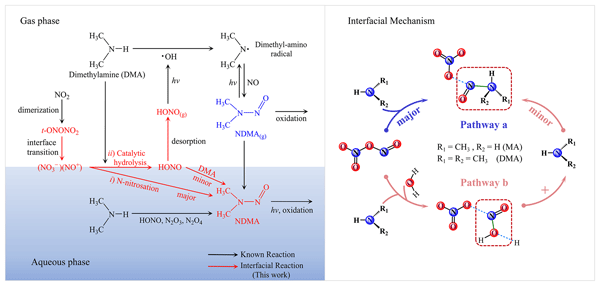
Tai-Xing Chi, An Ning, Shuang Ni, Wei-Kang Xiao, Yang Liu, Xiu-Cong Deng, Ling Liu, Feng-Yang Bai, Zhen Zhao, and Xiu-Hui Zhang
Atmos. Chem. Phys., 26, 12261–12273, https://doi.org/10.5194/acp-26-12261-2026, https://doi.org/10.5194/acp-26-12261-2026, 2026
Short summary
Short summary
Carcinogenic nitrosamines are pervasive in air pollution, yet their origins remain elusive. Using Born–Oppenheimer molecular dynamics, we demonstrate that nitrosamines form rapidly at the air–water interface via the reaction of amines with dinitrogen tetroxide. This mechanism also yields nitrous acid, thereby exacerbating pollution. By identifying this critical missing source of airborne carcinogens, our work underscores the necessity of integrating interfacial chemistry into atmospheric models.
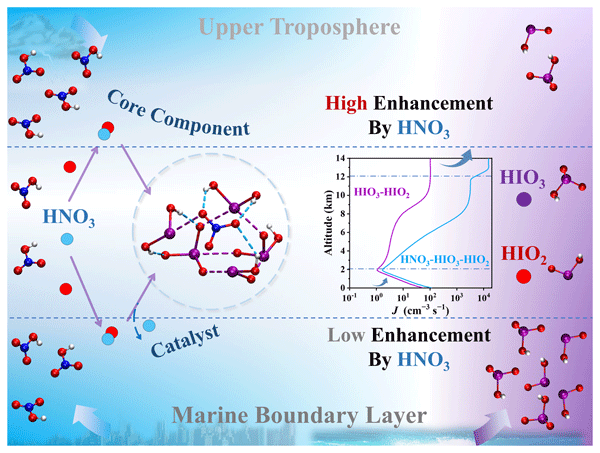
Jiaze Zhang, Ling Liu, An Ning, Haotian Zu, Jing Li, Fengyang Bai, Jie Yang, Xueshun Chen, and Xiuhui Zhang
Atmos. Chem. Phys., 26, 11627–11643, https://doi.org/10.5194/acp-26-11627-2026, https://doi.org/10.5194/acp-26-11627-2026, 2026
Short summary
Short summary
Sulfuric acid (SA)-dominated nucleation cannot explain observed tropospheric particulate matter and cloud condensation nuclei. Via quantum chemical calculations and atmospheric cluster dynamics simulations, we find the role of nitric acid shifts from a marine boundary layer catalyst to an upper troposphere cluster core in HIO3–HIO2 nucleation, with particle formation rates surpassing established SA pathways, explaining unaccounted-for new particle formation (NPF) amid falling sulfur and rising marine iodine emissions.
Ling Liu, Zizhou Cai, An Ning, Biwu Chu, Haotian Zu, Jing Li, Jiayi Tang, and Xiuhui Zhang
EGUsphere, https://doi.org/10.5194/egusphere-2026-2877, https://doi.org/10.5194/egusphere-2026-2877, 2026
Short summary
Short summary
Sulfuric acid (SA)–ammonia (NH3) nucleation cannot fully explain the observed new particle formation in cold regions. Using quantum chemical calculations and atmospheric cluster dynamics simulations, we find trifluoroacetic acid (TFA), a model perfluorocarboxylic acid (PFCA), markedly enhances SA–NH3 nucleation under cold conditions. This work reveals a PFCA-assisted nucleation mechanism and provides a molecular-level foundation for future atmospheric observations and aerosol modeling.
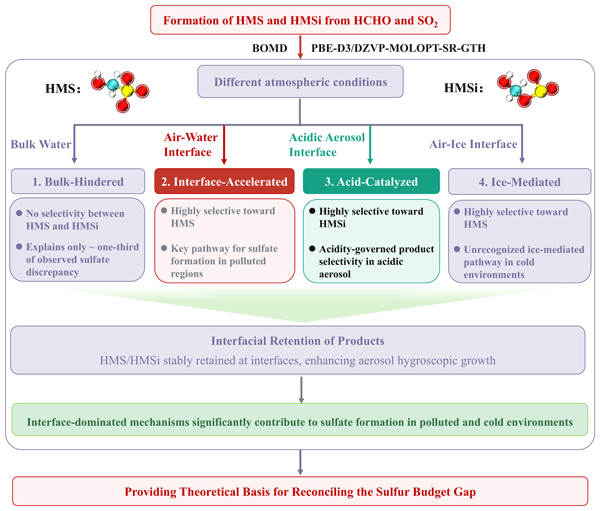
Yang Liu, An Ning, Xiaohua Yang, Yuchen Zhang, Ling Liu, and Xiuhui Zhang
Atmos. Chem. Phys., 26, 9357–9371, https://doi.org/10.5194/acp-26-9357-2026, https://doi.org/10.5194/acp-26-9357-2026, 2026
Short summary
Short summary
Current atmospheric models fail to explain observed sulfate concentrations in polluted and cold regions. Using Born–Oppenheimer molecular dynamics (BOMD) simulations, we show that hydroxymethanesulfonate and its isomer hydroxymethyl sulfite form mainly through reactions at air–water and air–ice surfaces rather than in bulk water. Strong acidity in polluted aerosols shifts formation toward hydroxymethyl sulfite. These findings help explain long-standing gaps between modeled and observed atmospheric sulfate.
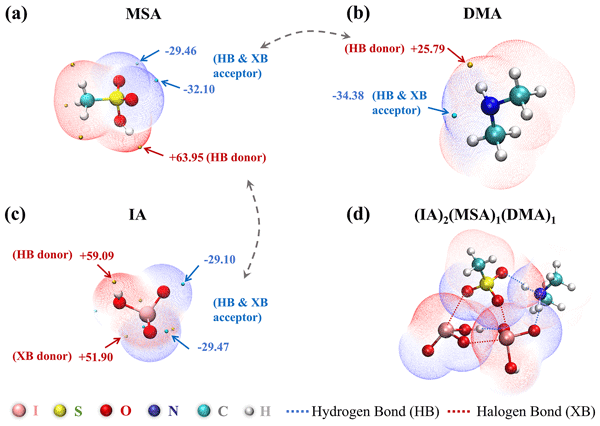
Jing Li, An Ning, Ling Liu, Xiucong Deng, and Xiuhui Zhang
Atmos. Chem. Phys., 26, 4423–4437, https://doi.org/10.5194/acp-26-4423-2026, https://doi.org/10.5194/acp-26-4423-2026, 2026
Short summary
Short summary
Marine new particle formation involves precursors such as methanesulfonic acid (MSA), iodic acid (IA), and dimethylamine (DMA), yet their nucleation mechanism remains incompletely understood. This study employs theoretical calculations to examine the IA–MSA–DMA system. We propose a nucleation mechanism that underscores the importance of synergistic interactions between sulfur-, iodine-, and nitrogen-containing vapors in driving marine new particle formation.
Jiaqi Jin, Runlong Cai, Yiliang Liu, Gan Yang, Yueyang Li, Chuang Li, Lei Yao, Jingkun Jiang, Xiuhui Zhang, and Lin Wang
Atmos. Chem. Phys., 25, 17125–17138, https://doi.org/10.5194/acp-25-17125-2025, https://doi.org/10.5194/acp-25-17125-2025, 2025
Short summary
Short summary
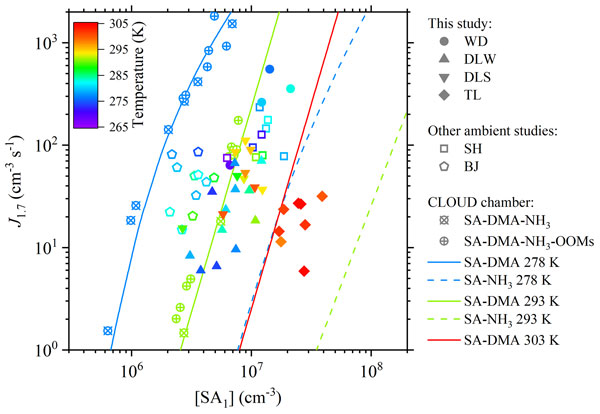
Based on observed atmospheric new particle formation events at multiple sites in eastern China, we find that sulfuric acid and dimethylamine can explain the observed atmospheric nucleation and the differences in the nucleation intensity among campaigns can be largely attributed to temperature and precursor concentrations. Our results also show that oxygenated organic molecules can make a great contribution to the initial growth of freshly nucleated particles in the real atmosphere.
Jing Li, An Ning, Ling Liu, Fengyang Bai, Qishen Huang, Pai Liu, Xiucong Deng, Yunhong Zhang, and Xiuhui Zhang
Atmos. Chem. Phys., 25, 14237–14249, https://doi.org/10.5194/acp-25-14237-2025, https://doi.org/10.5194/acp-25-14237-2025, 2025
Short summary
Short summary
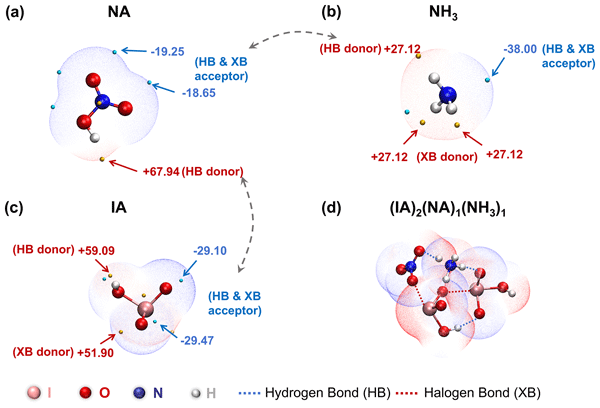
Iodic acid (IA) particles are frequently observed in the upper troposphere and lower stratosphere (UTLS), yet their formation mechanism remains unclear. Nitric acid (NA) and ammonia (NH3) are key nucleation precursors in the UTLS. This study investigates the IA–NA–NH3 system using a theoretical approach. Our proposed nucleation mechanism highlights the crucial role of NA in IA nucleation, providing molecular-level evidence for the missing sources of IA particles in the UTLS.
Jiewen Shen, Bin Zhao, Shuxiao Wang, An Ning, Yuyang Li, Runlong Cai, Da Gao, Biwu Chu, Yang Gao, Manish Shrivastava, Jingkun Jiang, Xiuhui Zhang, and Hong He
Atmos. Chem. Phys., 24, 10261–10278, https://doi.org/10.5194/acp-24-10261-2024, https://doi.org/10.5194/acp-24-10261-2024, 2024
Short summary
Short summary
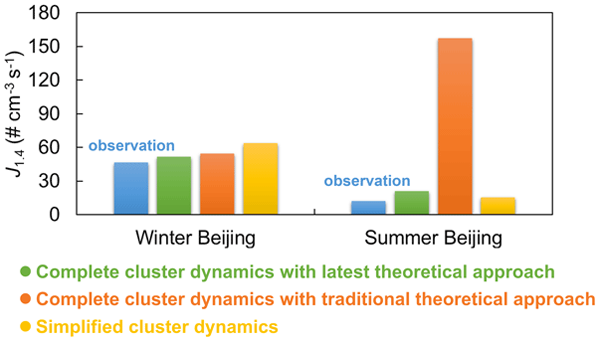
We extensively compare various cluster-dynamics-based parameterizations for sulfuric acid–dimethylamine nucleation and identify a newly developed parameterization derived from Atmospheric Cluster Dynamic Code (ACDC) simulations as being the most reliable one. This study offers a valuable reference for developing parameterizations of other nucleation systems and is meaningful for the accurate quantification of the environmental and climate impacts of new particle formation.
Haotian Zu, Biwu Chu, Yiqun Lu, Ling Liu, and Xiuhui Zhang
Atmos. Chem. Phys., 24, 5823–5835, https://doi.org/10.5194/acp-24-5823-2024, https://doi.org/10.5194/acp-24-5823-2024, 2024
Short summary
Short summary
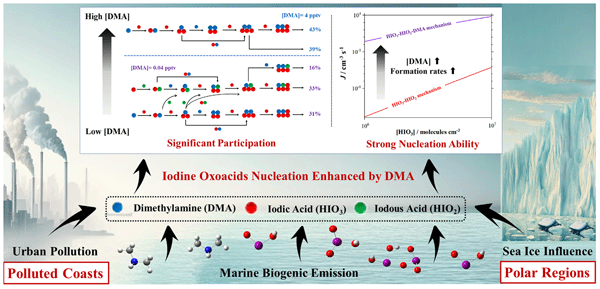
The nucleation of iodic acid (HIO3) and iodous acid (HIO2) was proven to be critical in marine areas. However, HIO3–HIO2 nucleation cannot effectively derive the rapid nucleation in some polluted coasts. We find a significant enhancement of dimethylamine (DMA) on the HIO3–HIO2 nucleation in marine and polar regions with abundant DMA sources, which may establish reasonable connections between the HIO3–HIO2 nucleation and the rapid formation of new particles in polluted marine and polar regions.
Jing Li, Nan Wu, Biwu Chu, An Ning, and Xiuhui Zhang
Atmos. Chem. Phys., 24, 3989–4000, https://doi.org/10.5194/acp-24-3989-2024, https://doi.org/10.5194/acp-24-3989-2024, 2024
Short summary
Short summary
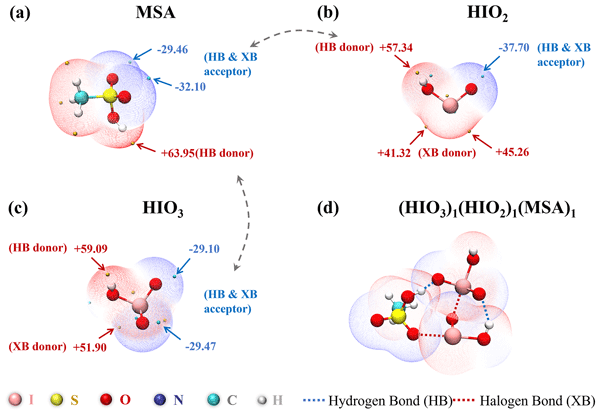
Iodic acid (HIO3) nucleates with iodous acid (HIO2) efficiently in marine areas; however, whether methanesulfonic acid (MSA) can synergistically participate in the HIO3–HIO2-based nucleation is unclear. We provide molecular-level evidence that MSA can efficiently promote the formation of HIO3–HIO2-based clusters using a theoretical approach. The proposed MSA-enhanced iodine nucleation mechanism may help us to deeply understand marine new particle formation events with bursts of iodine particles.
Yangyang Liu, Yue Deng, Jiarong Liu, Xiaozhong Fang, Tao Wang, Kejian Li, Kedong Gong, Aziz U. Bacha, Iqra Nabi, Qiuyue Ge, Xiuhui Zhang, Christian George, and Liwu Zhang
Atmos. Chem. Phys., 22, 9175–9197, https://doi.org/10.5194/acp-22-9175-2022, https://doi.org/10.5194/acp-22-9175-2022, 2022
Short summary
Short summary
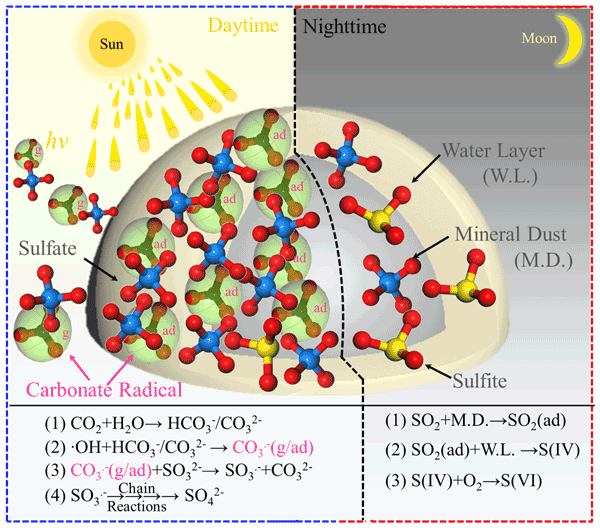
Both CO2 and carbonate salt work as the precursor of carbonate radicals, which largely promotes sulfate formation during the daytime. This study provides the first indication that the carbonate radical not only plays a role as an intermediate in tropospheric anion chemistry but also as a strong oxidant for the surface processing of trace gas in the atmosphere. CO2, carbponate radicals, and sulfate receive attention from those looking at the environment, atmosphere, aerosol, and photochemistry.
An Ning, Ling Liu, Lin Ji, and Xiuhui Zhang
Atmos. Chem. Phys., 22, 6103–6114, https://doi.org/10.5194/acp-22-6103-2022, https://doi.org/10.5194/acp-22-6103-2022, 2022
Short summary
Short summary
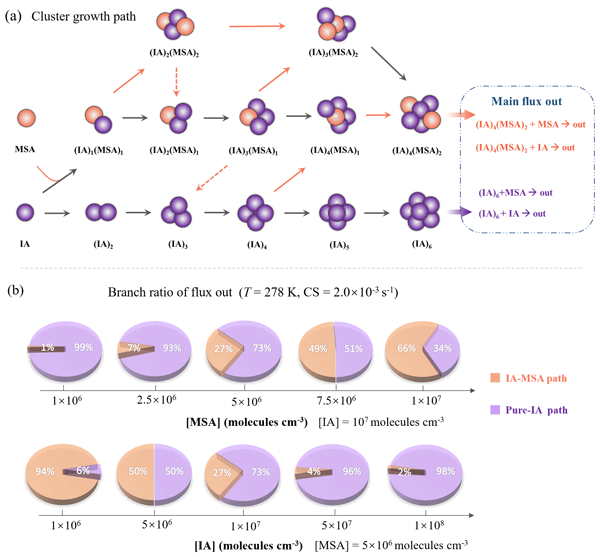
Iodic acid (IA) and methanesulfonic acid (MSA) were previously proved to be significant nucleation precursors in marine areas. However, the nucleation process involved in IA and MSA remains unclear. We show the enhancement of MSA on IA cluster formation and reveal the IAM-SA nucleating mechanism using a theoretical approach. This study helps to understand the clustering process in which marine sulfur- and iodine-containing species are jointly involved and its impact on new particle formation.

Narcisse Tsona Tchinda, Lin Du, Ling Liu, and Xiuhui Zhang
Atmos. Chem. Phys., 22, 1951–1963, https://doi.org/10.5194/acp-22-1951-2022, https://doi.org/10.5194/acp-22-1951-2022, 2022
Short summary
Short summary
This study explores the effect of pyruvic acid (PA) both in the SO3 hydrolysis and in sulfuric-acid-based aerosol formation. Results show that in dry and polluted areas, PA-catalyzed SO3 hydrolysis is about 2 orders of magnitude more efficient at forming sulfuric acid than the water-catalyzed reaction. Moreover, PA can effectively enhance the ternary SA-PA-NH3 particle formation rate by up to 4.7×10² relative to the binary SA-NH3 particle formation rate at cold temperatures.
Cited articles
Allan, J. D., Williams, P. I., Najera, J., Whitehead, J. D., Flynn, M. J., Taylor, J. W., Liu, D., Darbyshire, E., Carpenter, L. J., Chance, R., Andrews, S. J., Hackenberg, S. C., and McFiggans, G.: Iodine observed in new particle formation events in the Arctic atmosphere during ACCACIA, Atmos. Chem. Phys., 15, 5599–5609, https://doi.org/10.5194/acp-15-5599-2015, 2015.
Barnes, I., Hjorth, J., and Mihalopoulos, N.: Dimethyl Sulfide and Dimethyl Sulfoxide and Their Oxidation in the Atmosphere, Chem. Rev., 106, 940–975, https://doi.org/10.1021/cr020529+, 2006.
Bayly, C. I., Cieplak, P., Cornell, W., and Kollman, P. A.: A well-behaved electrostatic potential based method using charge restraints for deriving atomic charges: the RESP model, J. Phys. Chem., 97, 10269–10280, https://doi.org/10.1021/j100142a004, 1993.
Bussi, G. and Tribello, G. A.: Analyzing and Biasing Simulations with PLUMED, in: Methods in Molecular Biology, Springer New York, New York, NY, 529–578, https://doi.org/10.1007/978-1-4939-9608-7_21, 2019.
Carpenter, L. J., Chance, R. J., Sherwen, T., Adams, T. J., Ball, S. M., Evans, M. J., Hepach, H., Hollis, L. D. J., Hughes, C., Jickells, T. D., Mahajan, A., Stevens, D. P., Tinel, L., and Wadley, M. R.: Marine iodine emissions in a changing world, Proc. R. Soc. Math. Phys. Eng. Sci., 477, 20200824, https://doi.org/10.1098/rspa.2020.0824, 2021.
Chen, Q., Sherwen, T., Evans, M., and Alexander, B.: DMS oxidation and sulfur aerosol formation in the marine troposphere: a focus on reactive halogen and multiphase chemistry, Atmos. Chem. Phys., 18, 13617–13637, https://doi.org/10.5194/acp-18-13617-2018, 2018.
Darden, T., York, D., and Pedersen, L.: Particle mesh Ewald: An Nlog(N) method for Ewald sums in large systems, J. Chem. Phys., 98, 10089–10092, https://doi.org/10.1063/1.464397, 1993.
Droste, E. S., Baker, A. R., Yodle, C., Smith, A., and Ganzeveld, L.: Soluble Iodine Speciation in Marine Aerosols Across the Indian and Pacific Ocean Basins, Front. Mar. Sci., 8, 788105, https://doi.org/10.3389/fmars.2021.788105, 2021.
Evans, D. J. and Holian, B. L.: The Nose–Hoover thermostat, J. Chem. Phys., 83, 4069–4074, https://doi.org/10.1063/1.449071, 1985.
Fang, Y.-G., Li, X., Gao, Y., Cui, Y.-H., Francisco, J. S., Zhu, C., and Fang, W.-H.: Efficient exploration of complex free energy landscapes by stepwise multi-subphase space metadynamics, J. Chem. Phys., 157, 214111, https://doi.org/10.1063/5.0098269, 2022.
Fang, Y.-G., Tang, B., Yuan, C., Wan, Z., Zhao, L., Zhu, S., Francisco, J. S., Zhu, C., and Fang, W.-H.: Mechanistic insight into the competition between interfacial and bulk reactions in microdroplets through N2O5 ammonolysis and hydrolysis, Nat. Commun., 15, 2347, https://doi.org/10.1038/s41467-024-46674-1, 2024a.
Fang, Y.-G., Wei, L., Francisco, J. S., Zhu, C., and Fang, W.-H.: Mechanistic Insights into Chloric Acid Production by Hydrolysis of Chlorine Trioxide at an Air–Water Interface, J. Am. Chem. Soc., 146, 21052–21060, https://doi.org/10.1021/jacs.4c06269, 2024b.
Finkenzeller, H., Iyer, S., He, X.-C., Simon, M., Koenig, T. K., Lee, C. F., Valiev, R., Hofbauer, V., Amorim, A., Baalbaki, R., Baccarini, A., Beck, L., Bell, D. M., Caudillo, L., Chen, D., Chiu, R., Chu, B., Dada, L., Duplissy, J., Heinritzi, M., Kemppainen, D., Kim, C., Krechmer, J., Kürten, A., Kvashnin, A., Lamkaddam, H., Lee, C. P., Lehtipalo, K., Li, Z., Makhmutov, V., Manninen, H. E., Marie, G., Marten, R., Mauldin, R. L., Mentler, B., Müller, T., Petäjä, T., Philippov, M., Ranjithkumar, A., Rörup, B., Shen, J., Stolzenburg, D., Tauber, C., Tham, Y. J., Tomé, A., Vazquez-Pufleau, M., Wagner, A. C., Wang, D. S., Wang, M., Wang, Y., Weber, S. K., Nie, W., Wu, Y., Xiao, M., Ye, Q., Zauner-Wieczorek, M., Hansel, A., Baltensperger, U., Brioude, J., Curtius, J., Donahue, N. M., Haddad, I. E., Flagan, R. C., Kulmala, M., Kirkby, J., Sipilä, M., Worsnop, D. R., Kurten, T., Rissanen, M., and Volkamer, R.: The gas-phase formation mechanism of iodic acid as an atmospheric aerosol source, Nat. Chem., 15, 129–135, https://doi.org/10.1038/s41557-022-01067-z, 2023.
Frisch, M. J., Trucks, G. W., Schlegel, H. B., Scuseria, G. E., Robb, M. A., Cheeseman, J. R., Scalmani, G., Barone, V., Petersson, G. A., Nakatsuji, H., Li, X., Caricato, M., Marenich, A. V., Bloino, J., Janesko, B. G., Gomperts, R., Mennucci, B., Hratchian, H. P., Ortiz, J. V., Izmaylov, A. F., Sonnenberg, J. L., Ding, F., Lipparini, F., Egidi, F., Goings, J., Peng, B., Petrone, A., Henderson, T., Ranasinghe, D., Zakrzewski, V. G., Gao, J., Rega, N., Zheng, G., Liang, W., Hada, M., Ehara, M., Toyota, K., Fukuda, R., Hasegawa, J., Ishida, M., Nakajima, T., Honda, Y., Kitao, O., Nakai, H., Vreven, T., Throssell, K., Montgomery, J. A., Jr., Peralta, J. E., Ogliaro, F., Bearpark, M. J., Heyd, J. J., Brothers, E. N., Kudin, K. N., Staroverov, V. N., Keith, T. A., Kobayashi, R., Normand, J., Raghavachari, K., Rendell, A. P., Burant, J. C., Iyengar, S. S., Tomasi, J., Cossi, M., Millam, J. M., Klene, M., Adamo, C., Cammi, R., Ochterski, J. W., Martin, R. L., Morokuma, K., Farkas, O., Foresman, J. B., and Fox, D. J.: Gaussian 16, Rev. A.01, Gaussian Inc., Wallingford CT [code], https://gaussian.com/gaussian16/ (last access: 18 January 2024), 2016.
Gettelman, A. and Kahn, R.: Aerosols are critical for “nowcasting” climate, One Earth, 101239, https://doi.org/10.1016/j.oneear.2025.101239, 2025.
Goedecker, S., Teter, M., and Hutter, J.: Separable dual-space Gaussian pseudopotentials, Phys. Rev. B, 54, 1703–1710, https://doi.org/10.1103/physrevb.54.1703, 1996.
Gómez Martín, J. C., Gálvez, O., Baeza-Romero, M. T., Ingham, T., Plane, J. M. C., and Blitz, M. A.: On the mechanism of iodine oxide particle formation, Phys. Chem. Chem. Phys., 15, 15612, https://doi.org/10.1039/c3cp51217g, 2013.
Gómez Martín, J. C., Lewis, T. R., Blitz, M. A., Plane, J. M. C., Kumar, M., Francisco, J. S., and Saiz-Lopez, A.: A gas-to-particle conversion mechanism helps to explain atmospheric particle formation through clustering of iodine oxides, Nat. Commun., 11, 4521, https://doi.org/10.1038/s41467-020-18252-8, 2020.
Gómez Martín, J. C., Saiz-Lopez, A., Cuevas, C. A., Fernandez, R. P., Gilfedder, B., Weller, R., Baker, A. R., Droste, E., and Lai, S.: Spatial and Temporal Variability of Iodine in Aerosol, J. Geophys. Res.-Atmos., 126, e2020JD034410, https://doi.org/10.1029/2020JD034410, 2021.
Gómez Martín, J. C., Lewis, T. R., James, A. D., Saiz-Lopez, A., and Plane, J. M. C.: Insights into the Chemistry of Iodine New Particle Formation: The Role of Iodine Oxides and the Source of Iodic Acid, J. Am. Chem. Soc., 144, 9240–9253, https://doi.org/10.1021/jacs.1c12957, 2022a.
Gómez Martín, J. C., Saiz-Lopez, A., Cuevas, C. A., Baker, A. R., and Fernández, R. P.: On the Speciation of Iodine in Marine Aerosol, J. Geophys. Res.-Atmos., 127, e2021JD036081, https://doi.org/10.1029/2021JD036081, 2022b.
Hartwigsen, C., Goedecker, S., and Hutter, J.: Relativistic separable dual-space Gaussian pseudopotentials from H to Rn, Phys. Rev. B, 58, 3641–3662, https://doi.org/10.1103/physrevb.58.3641, 1998.
He, X.-C., Simon, M., Iyer, S., Xie, H.-B., Rörup, B., Shen, J., Finkenzeller, H., Stolzenburg, D., Zhang, R., Baccarini, A., Tham, Y. J., Wang, M., Amanatidis, S., Piedehierro, A. A., Amorim, A., Baalbaki, R., Brasseur, Z., Caudillo, L., Chu, B., Dada, L., Duplissy, J., El Haddad, I., Flagan, R. C., Granzin, M., Hansel, A., Heinritzi, M., Hofbauer, V., Jokinen, T., Kemppainen, D., Kong, W., Krechmer, J., Kürten, A., Lamkaddam, H., Lopez, B., Ma, F., Mahfouz, N. G. A., Makhmutov, V., Manninen, H. E., Marie, G., Marten, R., Massabò, D., Mauldin, R. L., Mentler, B., Onnela, A., Petäjä, T., Pfeifer, J., Philippov, M., Ranjithkumar, A., Rissanen, M. P., Schobesberger, S., Scholz, W., Schulze, B., Surdu, M., Thakur, R. C., Tomé, A., Wagner, A. C., Wang, D., Wang, Y., Weber, S. K., Welti, A., Winkler, P. M., Zauner-Wieczorek, M., Baltensperger, U., Curtius, J., Kurtén, T., Worsnop, D. R., Volkamer, R., Lehtipalo, K., Kirkby, J., Donahue, N. M., Sipilä, M., and Kulmala, M.: Iodine oxoacids enhance nucleation of sulfuric acid particles in the atmosphere, Science, 382, 1308–1314, https://doi.org/10.1126/science.adh2526, 2023.
Hess, B., Bekker, H., Berendsen, H. J. C., and Fraaije, J. G. E. M.: LINCS: A linear constraint solver for molecular simulations, J. Comput. Chem., 18, 1463–1472, https://doi.org/10.1002/(sici)1096-987x(199709)18:12<1463::aid-jcc4>3.0.co;2-h, 1997.
Hua, W., Verreault, D., and Allen, H. C.: Relative Order of Sulfuric Acid, Bisulfate, Hydronium, and Cations at the Air–Water Interface, J. Am. Chem. Soc., 137, 13920–13926, https://doi.org/10.1021/jacs.5b08636, 2015.
Huang, R.-J., Hoffmann, T., Ovadnevaite, J., Laaksonen, A., Kokkola, H., Xu, W., Xu, W., Ceburnis, D., Zhang, R., Seinfeld, J. H., and O'Dowd, C.: Heterogeneous iodine-organic chemistry fast-tracks marine new particle formation, P. Natl. Acad. Sci. USA, 119, e2201729119, https://doi.org/10.1073/pnas.2201729119, 2022.
Humphrey, W., Dalke, A., and Schulten, K.: VMD: Visual molecular dynamics, J. Mol. Graph., 14, 33–38, https://doi.org/10.1016/0263-7855(96)00018-5, 1996.
Jorgensen, W. L., Chandrasekhar, J., Madura, J. D., Impey, R. W., and Klein, M. L.: Comparison of simple potential functions for simulating liquid water, J. Chem. Phys., 79, 926–935, https://doi.org/10.1063/1.445869, 1983.
Kaloshin, G. A.: Modeling the Aerosol Extinction in Marine and Coastal Areas, IEEE Geosci. Remote Sens. Lett., 18, 376–380, https://doi.org/10.1109/LGRS.2020.2980866, 2021.
Kaltsoyannis, N. and Plane, J. M. C.: Quantum chemical calculations on a selection of iodine-containing species (IO, OIO, INO3, (IO)2, I2O3, I2O4 and I2O5) of importance in the atmosphere, Phys. Chem. Chem. Phys., 10, 1723, https://doi.org/10.1039/b715687c, 2008.
Kendall, R. A., Dunning, T. H., and Harrison, R. J.: Electron affinities of the first-row atoms revisited. Systematic basis sets and wave functions, J. Chem. Phys., 96, 6796–6806, https://doi.org/10.1063/1.462569, 1992.
Khanniche, S., Louis, F., Cantrel, L., and Černušák, I.: Computational study of the I2O5+ H2O = 2 HOIO2 gas-phase reaction, Chem. Phys. Lett., 662, 114–119, https://doi.org/10.1016/j.cplett.2016.09.023, 2016.
Kim, M. and Yoo, C.-S.: Phase transitions in I2O5 at high pressures: Raman and X-ray diffraction studies, Chem. Phys. Lett., 648, 13–18, https://doi.org/10.1016/j.cplett.2016.01.043, 2016.
Kühne, T. D., Iannuzzi, M., Del Ben, M., Rybkin, V. V., Seewald, P., Stein, F., Laino, T., Khaliullin, R. Z., Schütt, O., Schiffmann, F., Golze, D., Wilhelm, J., Chulkov, S., Bani-Hashemian, M. H., Weber, V., Borštnik, U., Taillefumier, M., Jakobovits, A. S., Lazzaro, A., Pabst, H., Müller, T., Schade, R., Guidon, M., Andermatt, S., Holmberg, N., Schenter, G. K., Hehn, A., Bussy, A., Belleflamme, F., Tabacchi, G., Glöß, A., Lass, M., Bethune, I., Mundy, C. J., Plessl, C., Watkins, M., VandeVondele, J., Krack, M., and Hutter, J.: CP2K: An electronic structure and molecular dynamics software package – Quickstep: Efficient and accurate electronic structure calculations, J. Chem. Phys. 152, 194103, https://doi.org/10.1063/5.0007045, 2020.
Kumar, M., Saiz-Lopez, A., and Francisco, J. S.: Single-Molecule Catalysis Revealed: Elucidating the Mechanistic Framework for the Formation and Growth of Atmospheric Iodine Oxide Aerosols in Gas-Phase and Aqueous Surface Environments, J. Am. Chem. Soc., 140, 14704–14716, https://doi.org/10.1021/jacs.8b07441, 2018.
Kumar, S., Rosenberg, J. M., Bouzida, D., Swendsen, R. H., and Kollman, P. A.: THE weighted histogram analysis method for free-energy calculations on biomolecules. I. The method, J. Comput. Chem., 13, 1011–1021, https://doi.org/10.1002/jcc.540130812, 1992.
Leroy, O. and Bosland, L.: Study of the stability of iodine oxides (IxOy) aerosols in severe accident conditions, Ann. Nucl. Energy, 181, 109526, https://doi.org/10.1016/j.anucene.2022.109526, 2023.
Lewis, T. R., Gómez Martín, J. C., Blitz, M. A., Cuevas, C. A., Plane, J. M. C., and Saiz-Lopez, A.: Determination of the absorption cross sections of higher-order iodine oxides at 355 and 532 nm, Atmos. Chem. Phys., 20, 10865–10887, https://doi.org/10.5194/acp-20-10865-2020, 2020.
Li, J., Wu, N., Chu, B., Ning, A., and Zhang, X.: Molecular-level study on the role of methanesulfonic acid in iodine oxoacid nucleation, Atmos. Chem. Phys., 24, 3989–4000, https://doi.org/10.5194/acp-24-3989-2024, 2024.
Li, Q., Tham, Y. J., Fernandez, R. P., He, X., Cuevas, C. A., and Saiz-Lopez, A.: Role of Iodine Recycling on Sea-Salt Aerosols in the Global Marine Boundary Layer, Geophys. Res. Lett., 49, e2021GL097567, https://doi.org/10.1029/2021GL097567, 2022.
Liang, Y., Rong, H., Liu, L., Zhang, S., Zhang, X., and Xu, W.: Gas-phase catalytic hydration of I2O5 in the polluted coastal regions: Reaction mechanisms and atmospheric implications, J. Environ. Sci., 114, 412–421, https://doi.org/10.1016/j.jes.2021.09.028, 2022.
Liu, L., Li, S., Zu, H., and Zhang, X.: Unexpectedly significant stabilizing mechanism of iodous acid on iodic acid nucleation under different atmospheric conditions, Sci. Total Environ., 859, 159832, https://doi.org/10.1016/j.scitotenv.2022.159832, 2023.
Lu, T.: Sobtop, Version 1.0 (dev5), http://sobereva.com/soft/Sobtop (last access: 5 July 2025), 2024.
Lu, T. and Chen, F.: Multiwfn: A multifunctional wavefunction analyzer, J. Comput. Chem., 33, 580–592, https://doi.org/10.1002/jcc.22885, 2012.
Mahowald, N. M., Hamilton, D. S., Mackey, K. R. M., Moore, J. K., Baker, A. R., Scanza, R. A., and Zhang, Y.: Aerosol trace metal leaching and impacts on marine microorganisms, Nat. Commun., 9, 2614, https://doi.org/10.1038/s41467-018-04970-7, 2018.
Martínez, L., Andrade, R., Birgin, E. G., and Martínez, J. M.: PACKMOL: A package for building initial configurations for molecular dynamics simulations, J. Comput. Chem., 30, 2157–2164, https://doi.org/10.1002/jcc.21224, 2009.
McFiggans, G., Bale, C. S. E., Ball, S. M., Beames, J. M., Bloss, W. J., Carpenter, L. J., Dorsey, J., Dunk, R., Flynn, M. J., Furneaux, K. L., Gallagher, M. W., Heard, D. E., Hollingsworth, A. M., Hornsby, K., Ingham, T., Jones, C. E., Jones, R. L., Kramer, L. J., Langridge, J. M., Leblanc, C., LeCrane, J.-P., Lee, J. D., Leigh, R. J., Longley, I., Mahajan, A. S., Monks, P. S., Oetjen, H., Orr-Ewing, A. J., Plane, J. M. C., Potin, P., Shillings, A. J. L., Thomas, F., von Glasow, R., Wada, R., Whalley, L. K., and Whitehead, J. D.: Iodine-mediated coastal particle formation: an overview of the Reactive Halogens in the Marine Boundary Layer (RHaMBLe) Roscoff coastal study, Atmos. Chem. Phys., 10, 2975–2999, https://doi.org/10.5194/acp-10-2975-2010, 2010.
Ning, A. and Zhang, X.: The synergistic effects of methanesulfonic acid (MSA) and methanesulfinic acid (MSIA) on marine new particle formation, Atmos. Environ., 269, 118826, https://doi.org/10.1016/j.atmosenv.2021.118826, 2022.
Ning, A., Zhong, J., Li, L., Li, H., Liu, J., Liu, L., Liang, Y., Li, J., Zhang, X., Francisco, J. S., and He, H.: Chemical Implications of Rapid Reactive Absorption of I2O4 at the Air-Water Interface, J. Am. Chem. Soc., 145, 10817–10825, https://doi.org/10.1021/jacs.3c01862, 2023.
Ning, A., Li, J., Du, L., Yang, X., Liu, J., Yang, Z., Zhong, J., Saiz-Lopez, A., Liu, L., Francisco, J. S., and Zhang, X.: Heterogenous Chemistry of I2O3 as a Critical Step in Iodine Cycling, J. Am. Chem. Soc., 146, 33229–33238, https://doi.org/10.1021/jacs.4c13060, 2024.
O'Dowd, C. D. and De Leeuw, G.: Marine aerosol production: a review of the current knowledge, Philos. Trans. R. Soc. Math. Phys. Eng. Sci., 365, 1753–1774, https://doi.org/10.1098/rsta.2007.2043, 2007.
O'Dowd, C. D., Jimenez, J. L., Bahreini, R., Flagan, R. C., Seinfeld, J. H., Hämeri, K., Pirjola, L., Kulmala, M., Jennings, S. G., and Hoffmann, T.: Marine aerosol formation from biogenic iodine emissions, Nature, 417, 632–636, https://doi.org/10.1038/nature00775, 2002.
Perdew, J. P. and Wang, Y.: Accurate and simple analytic representation of the electron-gas correlation energy, Phys. Rev. B, 45, 13244–13249, https://doi.org/10.1103/physrevb.45.13244, 1992.
Peterson, K. A., Figgen, D., Goll, E., Stoll, H., and Dolg, M.: Systematically convergent basis sets with relativistic pseudopotentials. II. Small-core pseudopotentials and correlation consistent basis sets for the post-d group 16–18 elements, J. Chem. Phys., 119, 11113–11123, https://doi.org/10.1063/1.1622924, 2003.
Rörup, B., He, X.-C., Shen, J., Baalbaki, R., Dada, L., Sipilä, M., Kirkby, J., Kulmala, M., Amorim, A., Baccarini, A., Bell, D. M., Caudillo-Plath, L., Duplissy, J., Finkenzeller, H., Kürten, A., Lamkaddam, H., Lee, C. P., Makhmutov, V., Manninen, H. E., Marie, G., Marten, R., Mentler, B., Onnela, A., Philippov, M., Scholz, C. W., Simon, M., Stolzenburg, D., Tham, Y. J., Tomé, A., Wagner, A. C., Wang, M., Wang, D., Wang, Y., Weber, S. K., Zauner-Wieczorek, M., Baltensperger, U., Curtius, J., Donahue, N. M., El Haddad, I., Flagan, R. C., Hansel, A., Möhler, O., Petäjä, T., Volkamer, R., Worsnop, D., and Lehtipalo, K.: Temperature, humidity, and ionisation effect of iodine oxoacid nucleation, Environ. Sci. Atmospheres, 4, 531–546, https://doi.org/10.1039/D4EA00013G, 2024.
Roscoe, H. K., Jones, A. E., Brough, N., Weller, R., Saiz-Lopez, A., Mahajan, A. S., Schoenhardt, A., Burrows, J. P., and Fleming, Z. L.: Particles and iodine compounds in coastal Antarctica, J. Geophys. Res.-Atmos., 120, 7144–7156, https://doi.org/10.1002/2015JD023301, 2015.
Saiz-Lopez, A., Plane, J. M. C., Baker, A. R., Carpenter, L. J., Von Glasow, R., Gómez Martín, J. C., McFiggans, G., and Saunders, R. W.: Atmospheric Chemistry of Iodine, Chem. Rev., 112, 1773–1804, https://doi.org/10.1021/cr200029u, 2012.
Saiz-Lopez, A., Fernandez, R. P., Ordóñez, C., Kinnison, D. E., Gómez Martín, J. C., Lamarque, J.-F., and Tilmes, S.: Iodine chemistry in the troposphere and its effect on ozone, Atmos. Chem. Phys., 14, 13119–13143, https://doi.org/10.5194/acp-14-13119-2014, 2014.
Shen, J., Elm, J., Xie, H.-B., Chen, J., Niu, J., and Vehkamäki, H.: Structural Effects of Amines in Enhancing Methanesulfonic Acid-Driven New Particle Formation, Environ. Sci. Technol., 54, 13498–13508, https://doi.org/10.1021/acs.est.0c05358, 2020.
Sipilä, M., Sarnela, N., Jokinen, T., Henschel, H., Junninen, H., Kontkanen, J., Richters, S., Kangasluoma, J., Franchin, A., Peräkylä, O., Rissanen, M. P., Ehn, M., Vehkamäki, H., Kurten, T., Berndt, T., Petäjä, T., Worsnop, D., Ceburnis, D., Kerminen, V.-M., Kulmala, M., and O'Dowd, C.: Molecular-scale evidence of aerosol particle formation via sequential addition of HIO3, Nature, 537, 532–534, https://doi.org/10.1038/nature19314, 2016.
Tang, B., Bai, Q., Fang, Y.-G., Francisco, J. S., Zhu, C., and Fang, W.-H.: Mechanistic Insights into N2O5-Halide Ions Chemistry at the Air–Water Interface, J. Am. Chem. Soc., 146, 21742–21751, https://doi.org/10.1021/jacs.4c05850, 2024.
Van Der Spoel, D., Lindahl, E., Hess, B., Groenhof, G., Mark, A. E., and Berendsen, H. J. C.: GROMACS: Fast, flexible, and free, J. Comput. Chem., 26, 1701–1718, https://doi.org/10.1002/jcc.20291, 2005.
Wan, Z., Fang, Y., Liu, Z., Francisco, J. S., and Zhu, C.: Mechanistic Insights into the Reactive Uptake of Chlorine Nitrate at the Air–Water Interface, J. Am. Chem. Soc., 145, 944–952, https://doi.org/10.1021/jacs.2c09837, 2023.
Wang, J., Wolf, R. M., Caldwell, J. W., Kollman, P. A., and Case, D. A.: Development and testing of a general amber force field, J. Comput. Chem., 25, 1157–1174, https://doi.org/10.1002/jcc.20035, 2004.
Xia, D., Chen, J., Yu, H., Xie, H., Wang, Y., Wang, Z., Xu, T., and Allen, D. T.: Formation Mechanisms of Iodine–Ammonia Clusters in Polluted Coastal Areas Unveiled by Thermodynamics and Kinetic Simulations, Environ. Sci. Technol., 54, 9235–9242, https://doi.org/10.1021/acs.est.9b07476, 2020.
Yu, H., Ren, L., Huang, X., Xie, M., He, J., and Xiao, H.: Iodine speciation and size distribution in ambient aerosols at a coastal new particle formation hotspot in China, Atmos. Chem. Phys., 19, 4025–4039, https://doi.org/10.5194/acp-19-4025-2019, 2019.
Zhang, R., Shen, J., Xie, H.-B., Chen, J., and Elm, J.: The role of organic acids in new particle formation from methanesulfonic acid and methylamine, Atmos. Chem. Phys., 22, 2639–2650, https://doi.org/10.5194/acp-22-2639-2022, 2022a.
Zhang, R., Xie, H.-B., Ma, F., Chen, J., Iyer, S., Simon, M., Heinritzi, M., Shen, J., Tham, Y. J., Kurtén, T., Worsnop, D. R., Kirkby, J., Curtius, J., Sipilä, M., Kulmala, M., and He, X.-C.: Critical Role of Iodous Acid in Neutral Iodine Oxoacid Nucleation, Environ. Sci. Technol., 56, 14166–14177, https://doi.org/10.1021/acs.est.2c04328, 2022b.
Zhang, R., Ma, F., Zhang, Y., Chen, J., Elm, J., He, X.-C., and Xie, H.-B.: HIO3–HIO2-Driven Three-Component Nucleation: Screening Model and Cluster Formation Mechanism, Environ. Sci. Technol., 58, 649–659, https://doi.org/10.1021/acs.est.3c06098, 2024a.
Zhang, Y., Li, D., He, X.-C., Nie, W., Deng, C., Cai, R., Liu, Y., Guo, Y., Liu, C., Li, Y., Chen, L., Li, Y., Hua, C., Liu, T., Wang, Z., Xie, J., Wang, L., Petäjä, T., Bianchi, F., Qi, X., Chi, X., Paasonen, P., Liu, Y., Yan, C., Jiang, J., Ding, A., and Kulmala, M.: Iodine oxoacids and their roles in sub-3 nm particle growth in polluted urban environments, Atmos. Chem. Phys., 24, 1873–1893, https://doi.org/10.5194/acp-24-1873-2024, 2024b.
Zhao, Y. and Truhlar, D. G.: The M06 suite of density functionals for main group thermochemistry, thermochemical kinetics, noncovalent interactions, excited states, and transition elements: two new functionals and systematic testing of four M06-class functionals and 12 other functionals, Theor. Chem. Acc., 120, 215–241, https://doi.org/10.1007/s00214-007-0310-x, 2008.
Zhong, J., Kumar, M., Francisco, J. S., and Zeng, X. C.: Insight into Chemistry on Cloud/Aerosol Water Surfaces, Acc. Chem. Res., 51, 1229–1237, https://doi.org/10.1021/acs.accounts.8b00051, 2018.
Zu, H., Chu, B., Lu, Y., Liu, L., and Zhang, X.: Rapid iodine oxoacid nucleation enhanced by dimethylamine in broad marine regions, Atmos. Chem. Phys., 24, 5823–5835, https://doi.org/10.5194/acp-24-5823-2024, 2024.
Short summary
I2O5 is known as a significant contributor to marine aerosol, yet the chemical mechanism remains unclear. The atmospheric complexity arises from intricate coupling effects between I2O5 and diverse chemical species. We performed Born-Oppenheimer molecular dynamics to elucidate the I2O5 hydrolysis mechanisms mediated by prevalent chemicals at the air-water interface. The proposed heterogeneous reactions provides molecular-level insight into the role of I2O5 in the atmospheric iodine chemistry.
I2O5 is known as a significant contributor to marine aerosol, yet the chemical mechanism remains...


Altmetrics
Final-revised paper
Preprint