
Articles | Volume 26, issue 5
https://doi.org/10.5194/acp-26-3391-2026
© Author(s) 2026. This work is distributed under
the Creative Commons Attribution 4.0 License.
the Creative Commons Attribution 4.0 License.
https://doi.org/10.5194/acp-26-3391-2026
© Author(s) 2026. This work is distributed under
the Creative Commons Attribution 4.0 License.
the Creative Commons Attribution 4.0 License.
Research article
| 
05 Mar 2026
Research article |
| 05 Mar 2026
| 05 Mar 2026
Northern Hemisphere stratospheric polar vortex morphology under localized gravity wave forcing: a shape-based classification

Leipzig Institute for Meteorology, Leipzig University, Stephanstr. 3, 04103 Leipzig, Germany
Department of Earth Science and Engineering, Imperial College London, London SW7 2AZ, UK
Sajedeh Marjani
Leipzig Institute for Meteorology, Leipzig University, Stephanstr. 3, 04103 Leipzig, Germany
Department of Physics, Imperial College London, London, UK
Dörthe Handorf
Alfred Wegener Institute for Polar and Marine Research, Research Unit Potsdam, Telegrafenberg A43, 14473 Potsdam, Germany
Christoph Jacobi
Leipzig Institute for Meteorology, Leipzig University, Stephanstr. 3, 04103 Leipzig, Germany
Related authors
Sajedeh Marjani, Sina Mehrdad, and Johannes Quaas
Atmos. Chem. Phys., 26, 10695–10725, https://doi.org/10.5194/acp-26-10695-2026, https://doi.org/10.5194/acp-26-10695-2026, 2026
Short summary
Short summary
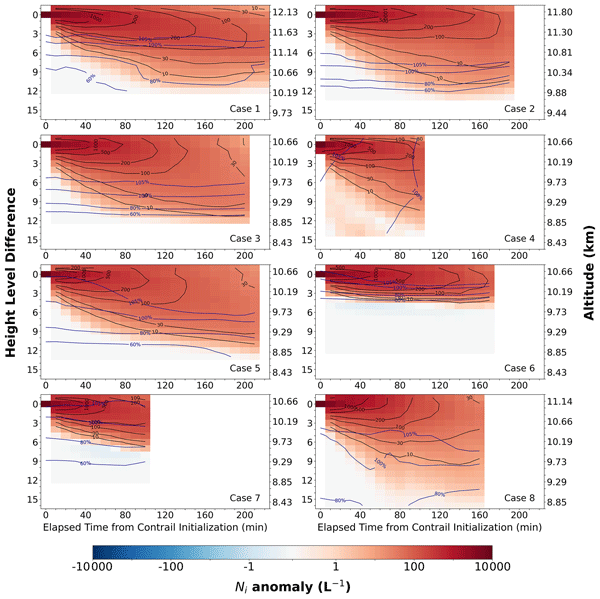
A large part of aviation's climate impact comes from persistent contrails, not just carbon dioxide. This study examined how they evolve under different ice-supersaturated conditions, usually with background clouds. Using high-resolution simulations, we found that contrail growth depends on both the thickness of the supersaturated layer and available water vapor. Contrails can alter surrounding clouds and contribute to warming. Simple thresholds are not enough to predict their impact.
Sina Mehrdad, Sajedeh Marjani, Dörthe Handorf, and Christoph Jacobi
Weather Clim. Dynam., 6, 1491–1514, https://doi.org/10.5194/wcd-6-1491-2025, https://doi.org/10.5194/wcd-6-1491-2025, 2025
Short summary
Short summary
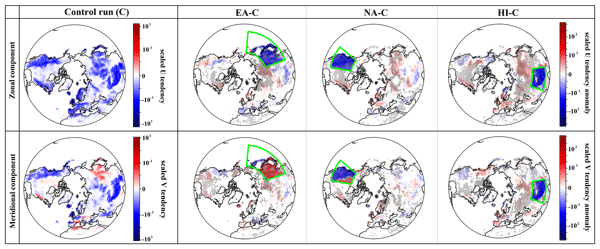
Wind flowing over mountains creates wave-like patterns aloft that can influence the atmosphere higher up in the stratosphere and mesosphere. In this study, we intensified these waves over specific regions like the Himalayas and Rocky Mountains and examined the resulting climate effects. We found that this can shift global wind patterns and even impact extreme events near the poles, showing how small regional changes in stratospheric wind patterns can influence the broader climate system.
Sina Mehrdad, Dörthe Handorf, Ines Höschel, Khalil Karami, Johannes Quaas, Sudhakar Dipu, and Christoph Jacobi
Weather Clim. Dynam., 5, 1223–1268, https://doi.org/10.5194/wcd-5-1223-2024, https://doi.org/10.5194/wcd-5-1223-2024, 2024
Short summary
Short summary
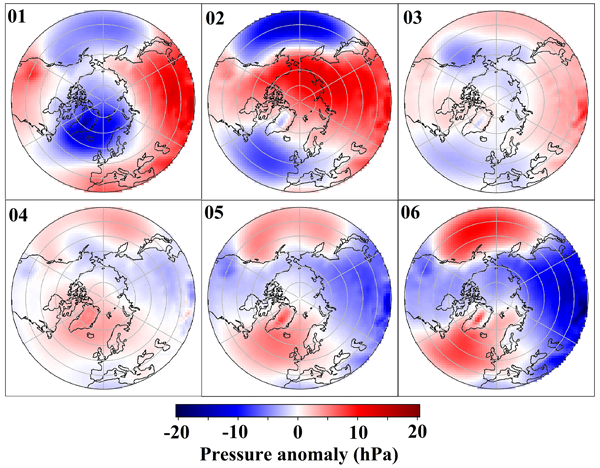
This study introduces a novel deep learning (DL) approach to analyze how regional radiative forcing in Europe impacts the Arctic climate. By integrating atmospheric poleward energy transport with DL-based clustering of atmospheric patterns and attributing anomalies to specific clusters, our method reveals crucial, nuanced interactions within the climate system, enhancing our understanding of intricate climate dynamics.
Olivia Linke, Johannes Quaas, Finja Baumer, Sebastian Becker, Jan Chylik, Sandro Dahlke, André Ehrlich, Dörthe Handorf, Christoph Jacobi, Heike Kalesse-Los, Luca Lelli, Sina Mehrdad, Roel A. J. Neggers, Johannes Riebold, Pablo Saavedra Garfias, Niklas Schnierstein, Matthew D. Shupe, Chris Smith, Gunnar Spreen, Baptiste Verneuil, Kameswara S. Vinjamuri, Marco Vountas, and Manfred Wendisch
Atmos. Chem. Phys., 23, 9963–9992, https://doi.org/10.5194/acp-23-9963-2023, https://doi.org/10.5194/acp-23-9963-2023, 2023
Short summary
Short summary
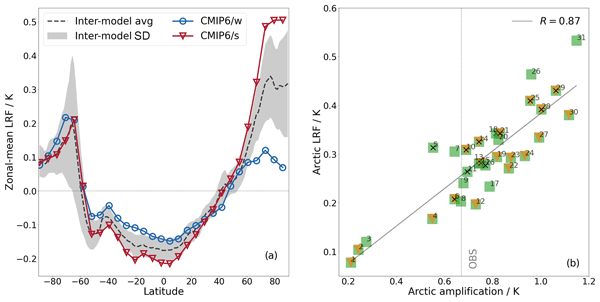
Lapse rate feedback (LRF) is a major driver of the Arctic amplification (AA) of climate change. It arises because the warming is stronger at the surface than aloft. Several processes can affect the LRF in the Arctic, such as the omnipresent temperature inversion. Here, we compare multimodel climate simulations to Arctic-based observations from a large research consortium to broaden our understanding of these processes, find synergy among them, and constrain the Arctic LRF and AA.
Lise Seland Graff, Dörthe Handorf, Raphael Köhler, Xavier Levine, René R. Wijngaard, Ryan S. Williams, Gareth J. Marshall, and Priscilla A. Mooney
EGUsphere, https://doi.org/10.5194/egusphere-2026-5525, https://doi.org/10.5194/egusphere-2026-5525, 2026
This preprint is open for discussion and under review for Weather and Climate Dynamics (WCD).
Short summary
Short summary
This work documents and explores the first storyline-based multi-model experiment sets with polar refinement, where the low-level boundary conditions represent contrasting storylines of future Arctic and Antarctic climate change. Using novel summary metrics, we quantify the influence of the storyline, model, and resolution on large-scale atmospheric fields and find that generally, the storyline forcing and model have a greater influence on the future responses than local changes in resolution.
Sajedeh Marjani, Sina Mehrdad, and Johannes Quaas
Atmos. Chem. Phys., 26, 10695–10725, https://doi.org/10.5194/acp-26-10695-2026, https://doi.org/10.5194/acp-26-10695-2026, 2026
Short summary
Short summary
A large part of aviation's climate impact comes from persistent contrails, not just carbon dioxide. This study examined how they evolve under different ice-supersaturated conditions, usually with background clouds. Using high-resolution simulations, we found that contrail growth depends on both the thickness of the supersaturated layer and available water vapor. Contrails can alter surrounding clouds and contribute to warming. Simple thresholds are not enough to predict their impact.
Christoph Jacobi, Ales Kuchar, Manfred Ern, Toralf Renkwitz, Ralph Latteck, and Jorge L. Chau
Adv. Radio Sci., 24, 15–28, https://doi.org/10.5194/ars-24-15-2026, https://doi.org/10.5194/ars-24-15-2026, 2026
Short summary
Short summary
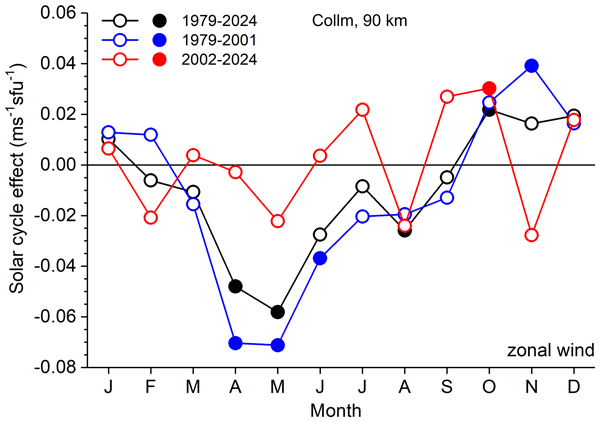
Analyses of more than four decades (1979–2024) of mean horizontal winds in the mesopause region at about 90 km altitude show long-term trends and an influence of the 11-year solar cycle. After the 1990s, both linear trends and the solar cycle effect change and strongly weaken, indicating a change in dynamics or solar forcing. Gravity wave proxies also show a solar cycle effect, which decreases after the 1990s.
Johannes Max Müller, Oskar Andreas Landgren, and Dörthe Handorf
Weather Clim. Dynam., 6, 1895–1921, https://doi.org/10.5194/wcd-6-1895-2025, https://doi.org/10.5194/wcd-6-1895-2025, 2025
Short summary
Short summary
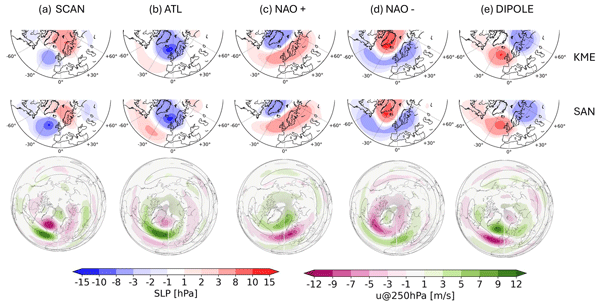
Weather and climate is determined by large-scale air pressure patterns, which can be grouped into a small number of representative patterns. We use two different statistical methods and data from 20 climate models to detect significant changes in a future scenario of strong warming. We focus on the summer season as this is important for both human activities and natural ecosystems. We find an increase in high pressure above Europe and low pressure above the Arctic ocean.
Sina Mehrdad, Sajedeh Marjani, Dörthe Handorf, and Christoph Jacobi
Weather Clim. Dynam., 6, 1491–1514, https://doi.org/10.5194/wcd-6-1491-2025, https://doi.org/10.5194/wcd-6-1491-2025, 2025
Short summary
Short summary
Wind flowing over mountains creates wave-like patterns aloft that can influence the atmosphere higher up in the stratosphere and mesosphere. In this study, we intensified these waves over specific regions like the Himalayas and Rocky Mountains and examined the resulting climate effects. We found that this can shift global wind patterns and even impact extreme events near the poles, showing how small regional changes in stratospheric wind patterns can influence the broader climate system.
J. Federico Conte, Jorge L. Chau, Toralf Renkwitz, Ralph Latteck, Masaki Tsutsumi, Christoph Jacobi, Njål Gulbrandsen, and Satonori Nozawa
Ann. Geophys., 43, 603–619, https://doi.org/10.5194/angeo-43-603-2025, https://doi.org/10.5194/angeo-43-603-2025, 2025
Short summary
Short summary
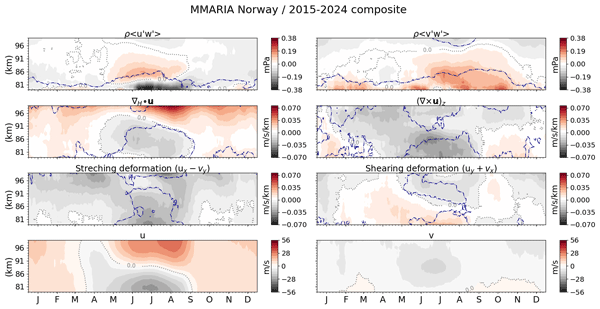
Analysis of 10 years of continuous measurements provided MMARIA/SIMONe Norway and MMARIA/SIMONe Germany reveals that the divergent and vortical motions in the mesosphere and lower thermosphere exchange the dominant role depending on the height and the time of the year. At summer mesopause altitudes over middle latitudes, the horizontal divergence and the relative vorticity contribute approximately the same, indicating an energetic balance between mesoscale divergent and vortical motions.
Guochun Shi, Hanli Liu, Masaki Tsutsumi, Njål Gulbrandsen, Alexander Kozlovsky, Dimitry Pokhotelov, Mark Lester, Christoph Jacobi, Kun Wu, and Gunter Stober
Atmos. Chem. Phys., 25, 9403–9430, https://doi.org/10.5194/acp-25-9403-2025, https://doi.org/10.5194/acp-25-9403-2025, 2025
Short summary
Short summary
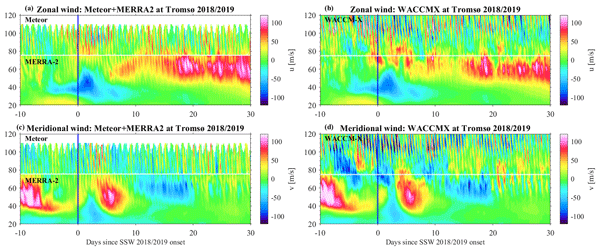
Concerns about climate change are growing due to its widespread impacts, including rising temperatures, extreme weather events, and disruptions to ecosystems. To address these challenges, urgent global action is needed to monitor the distribution of trace gases and understand their effects on the atmosphere.
Ales Kuchar, Gunter Stober, Dimitry Pokhotelov, Huixin Liu, Han-Li Liu, Manfred Ern, Damian Murphy, Diego Janches, Tracy Moffat-Griffin, Nicholas Mitchell, and Christoph Jacobi
EGUsphere, https://doi.org/10.5194/egusphere-2025-2827, https://doi.org/10.5194/egusphere-2025-2827, 2025
Short summary
Short summary
We studied how the healing of the Antarctic ozone layer is affecting winds high above the South Pole. Using ground-based radar, satellite data, and computer models, we found that winds in the upper atmosphere have become stronger over the past two decades. These changes appear to be linked to shifts in the lower atmosphere caused by ozone recovery. Our results show that human efforts to repair the ozone layer are also influencing climate patterns far above Earth’s surface.
Arthur Gauthier, Claudia Borries, Alexander Kozlovsky, Diego Janches, Peter Brown, Denis Vida, Christoph Jacobi, Damian Murphy, Masaki Tsutsumi, Njål Gulbrandsen, Satonori Nozawa, Mark Lester, Johan Kero, Nicholas Mitchell, Tracy Moffat-Griffin, and Gunter Stober
Ann. Geophys., 43, 427–440, https://doi.org/10.5194/angeo-43-427-2025, https://doi.org/10.5194/angeo-43-427-2025, 2025
Short summary
Short summary
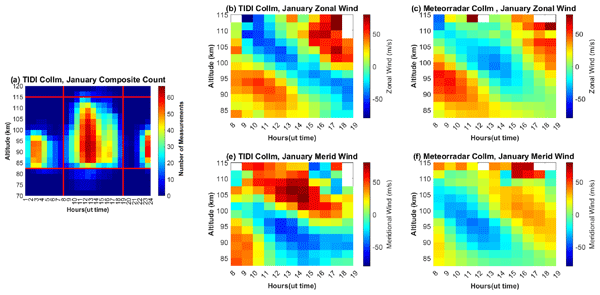
This study focuses on a TIMED Doppler Interferometer (TIDI)–meteor radar (MR) comparison of zonal and meridional winds and their dependence on local time and latitude. The correlation calculation between TIDI wind measurements and MR winds shows good agreement. A TIDI–MR seasonal comparison and analysis of the altitude–latitude dependence for winds are performed. TIDI reproduces the mean circulation well when compared with MRs and may be a useful lower boundary for general circulation models.
Christoph Jacobi, Khalil Karami, Ales Kuchar, Manfred Ern, Toralf Renkwitz, Ralph Latteck, and Jorge L. Chau
Adv. Radio Sci., 23, 21–31, https://doi.org/10.5194/ars-23-21-2025, https://doi.org/10.5194/ars-23-21-2025, 2025
Short summary
Short summary
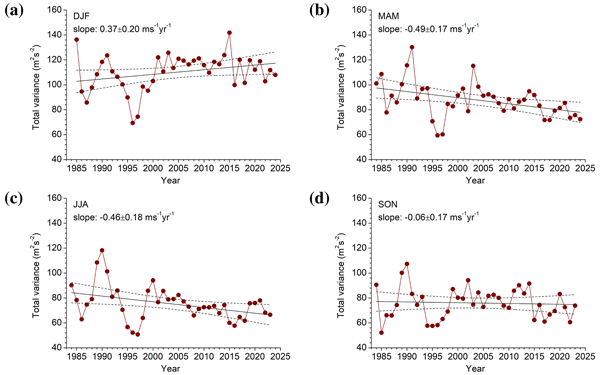
Half-hourly mean winds have been obtained using ground-based low-frequency and very high frequency radio observations of the mesopause region at Collm, Germany, since 1984. Long-term changes of wind variances, which are proxies for short-period atmospheric gravity waves, have been analysed. Gravity wave amplitudes increase with time in winter, but mainly decrease in summer. The trends are consistent with mean wind changes according to wave theory.
Sina Mehrdad, Dörthe Handorf, Ines Höschel, Khalil Karami, Johannes Quaas, Sudhakar Dipu, and Christoph Jacobi
Weather Clim. Dynam., 5, 1223–1268, https://doi.org/10.5194/wcd-5-1223-2024, https://doi.org/10.5194/wcd-5-1223-2024, 2024
Short summary
Short summary
This study introduces a novel deep learning (DL) approach to analyze how regional radiative forcing in Europe impacts the Arctic climate. By integrating atmospheric poleward energy transport with DL-based clustering of atmospheric patterns and attributing anomalies to specific clusters, our method reveals crucial, nuanced interactions within the climate system, enhancing our understanding of intricate climate dynamics.
Xavier J. Levine, Ryan S. Williams, Gareth Marshall, Andrew Orr, Lise Seland Graff, Dörthe Handorf, Alexey Karpechko, Raphael Köhler, René R. Wijngaard, Nadine Johnston, Hanna Lee, Lars Nieradzik, and Priscilla A. Mooney
Earth Syst. Dynam., 15, 1161–1177, https://doi.org/10.5194/esd-15-1161-2024, https://doi.org/10.5194/esd-15-1161-2024, 2024
Short summary
Short summary
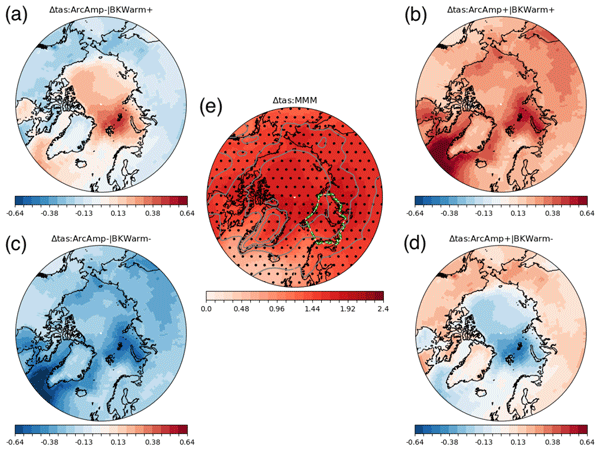
While the most recent climate projections agree that the Arctic is warming, differences remain in how much and in other climate variables such as precipitation. This presents a challenge for stakeholders who need to develop mitigation and adaptation strategies. We tackle this problem by using the storyline approach to generate four plausible and actionable realisations of end-of-century climate change for the Arctic, spanning its most likely range of variability.
Ales Kuchar, Maurice Öhlert, Roland Eichinger, and Christoph Jacobi
Weather Clim. Dynam., 5, 895–912, https://doi.org/10.5194/wcd-5-895-2024, https://doi.org/10.5194/wcd-5-895-2024, 2024
Short summary
Short summary
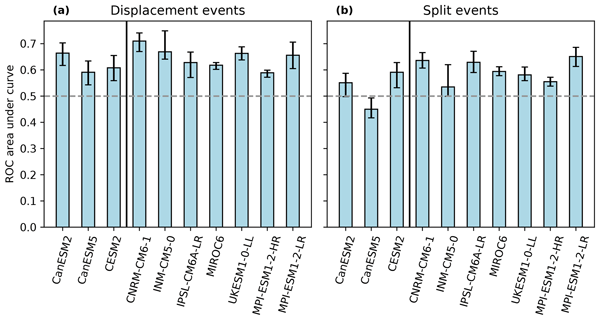
Exploring the polar vortex's impact on climate, the study evaluates model simulations against the ERA5 reanalysis data. Revelations about model discrepancies in simulating disruptive stratospheric warmings and vortex behavior highlight the need for refined model simulations of past climate. By enhancing our understanding of these dynamics, the research contributes to more reliable climate projections of the polar vortex with the impact on surface climate.
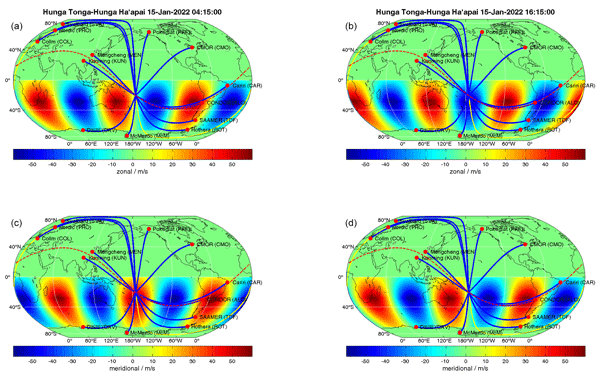
Gunter Stober, Sharon L. Vadas, Erich Becker, Alan Liu, Alexander Kozlovsky, Diego Janches, Zishun Qiao, Witali Krochin, Guochun Shi, Wen Yi, Jie Zeng, Peter Brown, Denis Vida, Neil Hindley, Christoph Jacobi, Damian Murphy, Ricardo Buriti, Vania Andrioli, Paulo Batista, John Marino, Scott Palo, Denise Thorsen, Masaki Tsutsumi, Njål Gulbrandsen, Satonori Nozawa, Mark Lester, Kathrin Baumgarten, Johan Kero, Evgenia Belova, Nicholas Mitchell, Tracy Moffat-Griffin, and Na Li
Atmos. Chem. Phys., 24, 4851–4873, https://doi.org/10.5194/acp-24-4851-2024, https://doi.org/10.5194/acp-24-4851-2024, 2024
Short summary
Short summary
On 15 January 2022, the Hunga Tonga-Hunga Ha‘apai volcano exploded in a vigorous eruption, causing many atmospheric phenomena reaching from the surface up to space. In this study, we investigate how the mesospheric winds were affected by the volcanogenic gravity waves and estimated their propagation direction and speed. The interplay between model and observations permits us to gain new insights into the vertical coupling through atmospheric gravity waves.
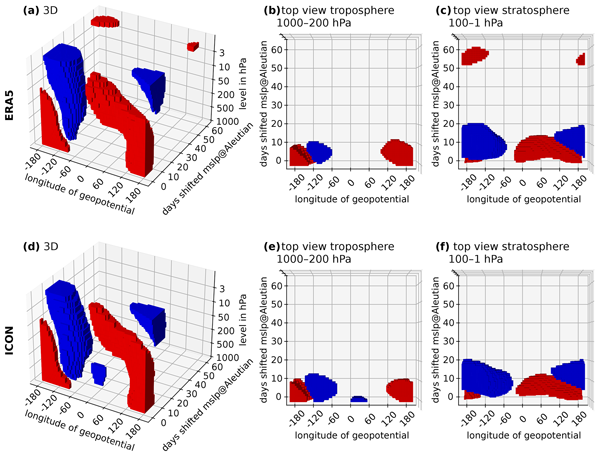
Raphael Harry Köhler, Ralf Jaiser, and Dörthe Handorf
Weather Clim. Dynam., 4, 1071–1086, https://doi.org/10.5194/wcd-4-1071-2023, https://doi.org/10.5194/wcd-4-1071-2023, 2023
Short summary
Short summary
This study explores the local mechanisms of troposphere–stratosphere coupling on seasonal timescales during extended winter in the Northern Hemisphere. The detected tropospheric precursor regions exhibit very distinct mechanisms of coupling to the stratosphere, thus highlighting the importance of the time- and zonally resolved picture. Moreover, this study demonstrates that the ICOsahedral Non-hydrostatic atmosphere model (ICON) can realistically reproduce troposphere–stratosphere coupling.
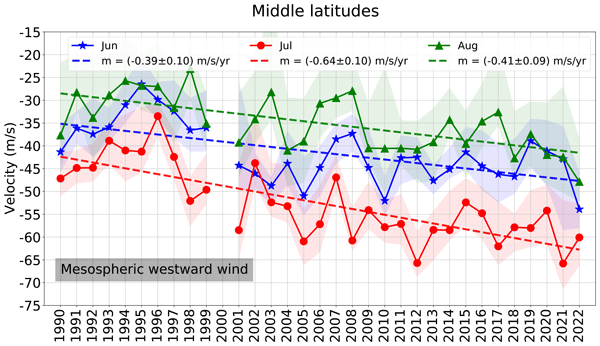
Juliana Jaen, Toralf Renkwitz, Huixin Liu, Christoph Jacobi, Robin Wing, Aleš Kuchař, Masaki Tsutsumi, Njål Gulbrandsen, and Jorge L. Chau
Atmos. Chem. Phys., 23, 14871–14887, https://doi.org/10.5194/acp-23-14871-2023, https://doi.org/10.5194/acp-23-14871-2023, 2023
Short summary
Short summary
Investigation of winds is important to understand atmospheric dynamics. In the summer mesosphere and lower thermosphere, there are three main wind flows: the mesospheric westward, the mesopause southward (equatorward), and the lower-thermospheric eastward wind. Combining almost 2 decades of measurements from different radars, we study the trend, their interannual oscillations, and the effects of the geomagnetic activity over these wind maxima.
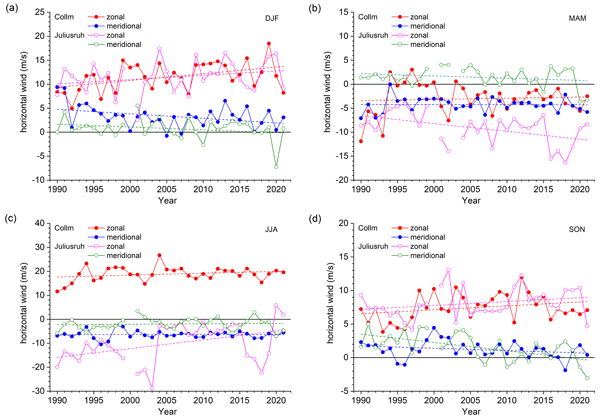
Christoph Jacobi, Ales Kuchar, Toralf Renkwitz, and Juliana Jaen
Adv. Radio Sci., 21, 111–121, https://doi.org/10.5194/ars-21-111-2023, https://doi.org/10.5194/ars-21-111-2023, 2023
Short summary
Short summary
Middle atmosphere long-term changes show the signature of climate change. We analyse 43 years of mesopause region horizontal winds obtained at two sites in Germany. We observe mainly positive trends of the zonal prevailing wind throughout the year, while the meridional winds tend to decrease in magnitude in both summer and winter. Furthermore, there is a change in long-term trends around the late 1990s, which is most clearly visible in summer winds.
Olivia Linke, Johannes Quaas, Finja Baumer, Sebastian Becker, Jan Chylik, Sandro Dahlke, André Ehrlich, Dörthe Handorf, Christoph Jacobi, Heike Kalesse-Los, Luca Lelli, Sina Mehrdad, Roel A. J. Neggers, Johannes Riebold, Pablo Saavedra Garfias, Niklas Schnierstein, Matthew D. Shupe, Chris Smith, Gunnar Spreen, Baptiste Verneuil, Kameswara S. Vinjamuri, Marco Vountas, and Manfred Wendisch
Atmos. Chem. Phys., 23, 9963–9992, https://doi.org/10.5194/acp-23-9963-2023, https://doi.org/10.5194/acp-23-9963-2023, 2023
Short summary
Short summary
Lapse rate feedback (LRF) is a major driver of the Arctic amplification (AA) of climate change. It arises because the warming is stronger at the surface than aloft. Several processes can affect the LRF in the Arctic, such as the omnipresent temperature inversion. Here, we compare multimodel climate simulations to Arctic-based observations from a large research consortium to broaden our understanding of these processes, find synergy among them, and constrain the Arctic LRF and AA.
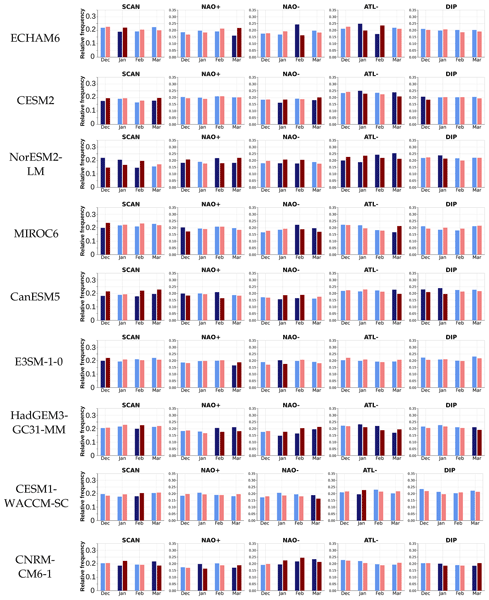
Johannes Riebold, Andy Richling, Uwe Ulbrich, Henning Rust, Tido Semmler, and Dörthe Handorf
Weather Clim. Dynam., 4, 663–682, https://doi.org/10.5194/wcd-4-663-2023, https://doi.org/10.5194/wcd-4-663-2023, 2023
Short summary
Short summary
Arctic sea ice loss might impact the atmospheric circulation outside the Arctic and therefore extremes over mid-latitudes. Here, we analyze model experiments to initially assess the influence of sea ice loss on occurrence frequencies of large-scale circulation patterns. Some of these detected circulation changes can be linked to changes in occurrences of European temperature extremes. Compared to future global temperature increases, the sea-ice-related impacts are however of secondary relevance.
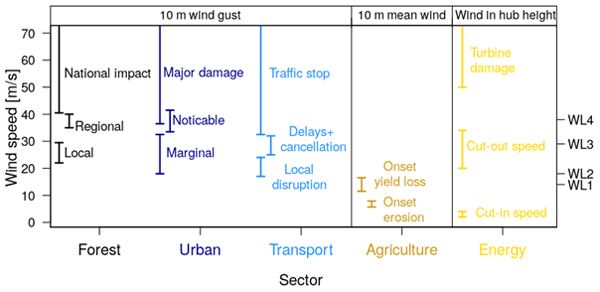
Daniel Gliksman, Paul Averbeck, Nico Becker, Barry Gardiner, Valeri Goldberg, Jens Grieger, Dörthe Handorf, Karsten Haustein, Alexia Karwat, Florian Knutzen, Hilke S. Lentink, Rike Lorenz, Deborah Niermann, Joaquim G. Pinto, Ronald Queck, Astrid Ziemann, and Christian L. E. Franzke
Nat. Hazards Earth Syst. Sci., 23, 2171–2201, https://doi.org/10.5194/nhess-23-2171-2023, https://doi.org/10.5194/nhess-23-2171-2023, 2023
Short summary
Short summary
Wind and storms are a major natural hazard and can cause severe economic damage and cost human lives. Hence, it is important to gauge the potential impact of using indices, which potentially enable us to estimate likely impacts of storms or other wind events. Here, we review basic aspects of wind and storm generation and provide an extensive overview of wind impacts and available indices. This is also important to better prepare for future climate change and corresponding changes to winds.
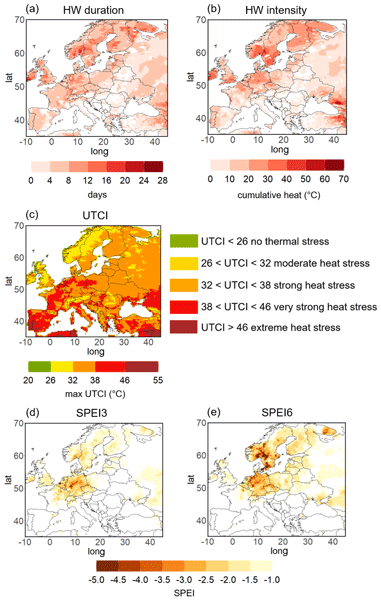
Efi Rousi, Andreas H. Fink, Lauren S. Andersen, Florian N. Becker, Goratz Beobide-Arsuaga, Marcus Breil, Giacomo Cozzi, Jens Heinke, Lisa Jach, Deborah Niermann, Dragan Petrovic, Andy Richling, Johannes Riebold, Stella Steidl, Laura Suarez-Gutierrez, Jordis S. Tradowsky, Dim Coumou, André Düsterhus, Florian Ellsäßer, Georgios Fragkoulidis, Daniel Gliksman, Dörthe Handorf, Karsten Haustein, Kai Kornhuber, Harald Kunstmann, Joaquim G. Pinto, Kirsten Warrach-Sagi, and Elena Xoplaki
Nat. Hazards Earth Syst. Sci., 23, 1699–1718, https://doi.org/10.5194/nhess-23-1699-2023, https://doi.org/10.5194/nhess-23-1699-2023, 2023
Short summary
Short summary
The objective of this study was to perform a comprehensive, multi-faceted analysis of the 2018 extreme summer in terms of heat and drought in central and northern Europe, with a particular focus on Germany. A combination of favorable large-scale conditions and locally dry soils were related with the intensity and persistence of the events. We also showed that such extremes have become more likely due to anthropogenic climate change and might occur almost every year under +2 °C of global warming.
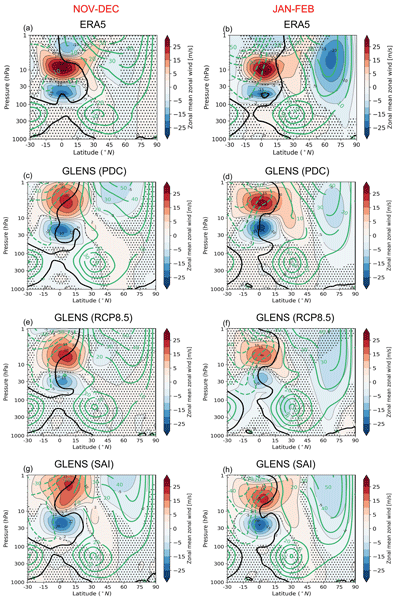
Khalil Karami, Rolando Garcia, Christoph Jacobi, Jadwiga H. Richter, and Simone Tilmes
Atmos. Chem. Phys., 23, 3799–3818, https://doi.org/10.5194/acp-23-3799-2023, https://doi.org/10.5194/acp-23-3799-2023, 2023
Short summary
Short summary
Alongside mitigation and adaptation efforts, stratospheric aerosol intervention (SAI) is increasingly considered a third pillar to combat dangerous climate change. We investigate the teleconnection between the quasi-biennial oscillation in the equatorial stratosphere and the Arctic stratospheric polar vortex under a warmer climate and an SAI scenario. We show that the Holton–Tan relationship weakens under both scenarios and discuss the physical mechanisms responsible for such changes.
Christoph Jacobi, Kanykei Kandieva, and Christina Arras
Adv. Radio Sci., 20, 85–92, https://doi.org/10.5194/ars-20-85-2023, https://doi.org/10.5194/ars-20-85-2023, 2023
Short summary
Short summary
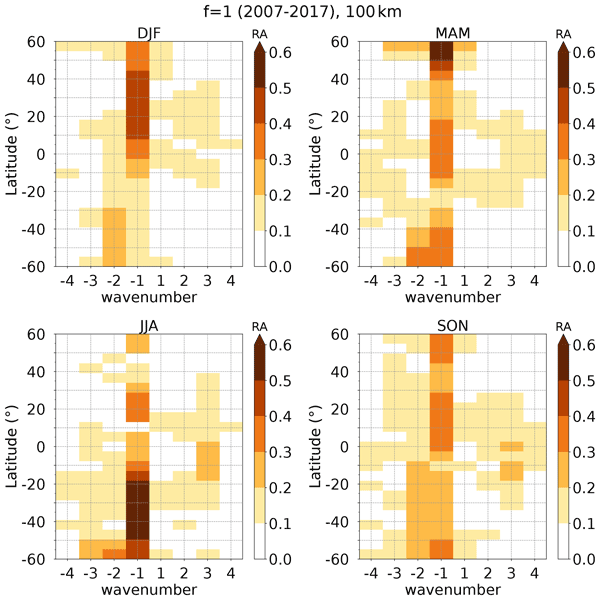
Sporadic E (Es) layers are thin regions of accumulated ions in the lower ionosphere. They can be observed by disturbances of GNSS links between low-Earth orbiting satellites and GNSS satellites. Es layers are influenced by neutral atmospheric tides and show the coupling between the neutral atmosphere and the ionosphere. Here we analyse migrating (sun-synchronous) and non-migrating tidal components in Es. The main signatures are migrating Es, but nonmigrating components are found as well.
Gerhard Georg Bruno Schmidtke, Raimund Brunner, and Christoph Jacobi
EGUsphere, https://doi.org/10.5194/egusphere-2023-139, https://doi.org/10.5194/egusphere-2023-139, 2023
Preprint withdrawn
Short summary
Short summary
The instrument records annual changes in Spectral Outgoing Radiation from 200–1100 nm, with 60 photomultiplier tubes simultaneously providing spectrometer and photometer data. Using Total Solar Irradiance data with a stability of 0.01 Wm-2 per year to recalibrate the established instruments, stable data of ~0.1 Wm-2 over a solar cycle period is expected. Determination of the changes in the global green Earth coverage and mapping will also assess the impact of climate engineering actions.
Gunter Stober, Alan Liu, Alexander Kozlovsky, Zishun Qiao, Ales Kuchar, Christoph Jacobi, Chris Meek, Diego Janches, Guiping Liu, Masaki Tsutsumi, Njål Gulbrandsen, Satonori Nozawa, Mark Lester, Evgenia Belova, Johan Kero, and Nicholas Mitchell
Atmos. Meas. Tech., 15, 5769–5792, https://doi.org/10.5194/amt-15-5769-2022, https://doi.org/10.5194/amt-15-5769-2022, 2022
Short summary
Short summary
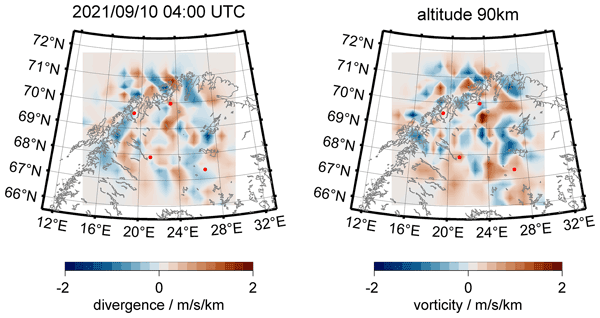
Precise and accurate measurements of vertical winds at the mesosphere and lower thermosphere are rare. Although meteor radars have been used for decades to observe horizontal winds, their ability to derive reliable vertical wind measurements was always questioned. In this article, we provide mathematical concepts to retrieve mathematically and physically consistent solutions, which are compared to the state-of-the-art non-hydrostatic model UA-ICON.
Ales Kuchar, Petr Sacha, Roland Eichinger, Christoph Jacobi, Petr Pisoft, and Harald Rieder
EGUsphere, https://doi.org/10.5194/egusphere-2022-474, https://doi.org/10.5194/egusphere-2022-474, 2022
Preprint archived
Short summary
Short summary
We focus on the impact of small-scale orographic gravity waves (OGWs) above the Himalayas. The interaction of GWs with the large-scale circulation in the stratosphere is not still well understood and can have implications on climate projections. We use a chemistry-climate model to show that these strong OGW events are associated with anomalously increased upward planetary-scale waves and in turn affect the circumpolar circulation and have the potential to alter ozone variability as well.
Sumanta Sarkhel, Gunter Stober, Jorge L. Chau, Steven M. Smith, Christoph Jacobi, Subarna Mondal, Martin G. Mlynczak, and James M. Russell III
Ann. Geophys., 40, 179–190, https://doi.org/10.5194/angeo-40-179-2022, https://doi.org/10.5194/angeo-40-179-2022, 2022
Short summary
Short summary
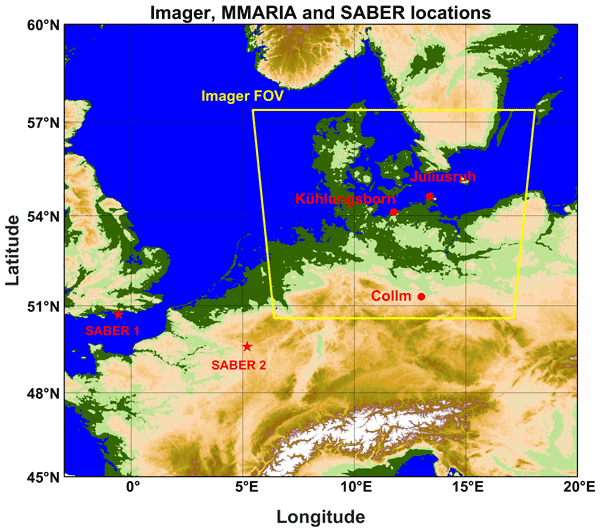
A rare gravity wave event was observed on the night of 25 April 2017 over northern Germany. An all-sky airglow imager recorded an upward-propagating wave at different altitudes in mesosphere with a prominent wave front above 91 km and faintly observed below. Based on wind and satellite-borne temperature profiles close to the event location, we have found the presence of a leaky thermal duct layer in 85–91 km. The appearance of this duct layer caused the wave amplitudes to diminish below 91 km.
Klaus Dethloff, Wieslaw Maslowski, Stefan Hendricks, Younjoo J. Lee, Helge F. Goessling, Thomas Krumpen, Christian Haas, Dörthe Handorf, Robert Ricker, Vladimir Bessonov, John J. Cassano, Jaclyn Clement Kinney, Robert Osinski, Markus Rex, Annette Rinke, Julia Sokolova, and Anja Sommerfeld
The Cryosphere, 16, 981–1005, https://doi.org/10.5194/tc-16-981-2022, https://doi.org/10.5194/tc-16-981-2022, 2022
Short summary
Short summary
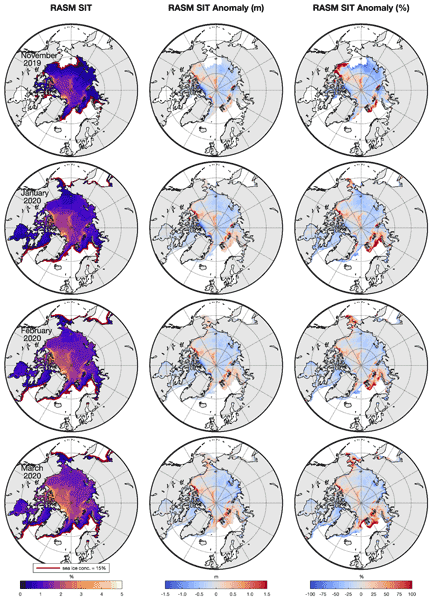
Sea ice thickness anomalies during the MOSAiC (Multidisciplinary drifting Observatory for the Study of Arctic Climate) winter in January, February and March 2020 were simulated with the coupled Regional Arctic climate System Model (RASM) and compared with CryoSat-2/SMOS satellite data. Hindcast and ensemble simulations indicate that the sea ice anomalies are driven by nonlinear interactions between ice growth processes and wind-driven sea-ice transports, with dynamics playing a dominant role.
Juliana Jaen, Toralf Renkwitz, Jorge L. Chau, Maosheng He, Peter Hoffmann, Yosuke Yamazaki, Christoph Jacobi, Masaki Tsutsumi, Vivien Matthias, and Chris Hall
Ann. Geophys., 40, 23–35, https://doi.org/10.5194/angeo-40-23-2022, https://doi.org/10.5194/angeo-40-23-2022, 2022
Short summary
Short summary
To study long-term trends in the mesosphere and lower thermosphere (70–100 km), we established two summer length definitions and analyzed the variability over the years (2004–2020). After the analysis, we found significant trends in the summer beginning of one definition. Furthermore, we were able to extend one of the time series up to 31 years and obtained evidence of non-uniform trends and periodicities similar to those known for the quasi-biennial oscillation and El Niño–Southern Oscillation.

Christoph Jacobi, Friederike Lilienthal, Dmitry Korotyshkin, Evgeny Merzlyakov, and Gunter Stober
Adv. Radio Sci., 19, 185–193, https://doi.org/10.5194/ars-19-185-2021, https://doi.org/10.5194/ars-19-185-2021, 2021
Short summary
Short summary
We compare winds and tidal amplitudes in the upper mesosphere/lower thermosphere region for cases with disturbed and undisturbed geomagnetic conditions. The zonal winds in both the mesosphere and lower thermosphere tend to be weaker during disturbed conditions. The summer equatorward meridional wind jet is weaker for disturbed geomagnetic conditions. The effect of geomagnetic variability on tidal amplitudes, except for the semidiurnal tide, is relatively small.
Cited articles
Albers, J. R. and Birner, T.: Vortex preconditioning due to planetary and gravity waves prior to sudden stratospheric warmings, J. Atmos. Sci., 71, 4028–4054, https://doi.org/10.1175/JAS-D-14-0026.1, 2014. a
Alexander, M., Holton, J. R., and Durran, D. R.: The gravity wave response above deep convection in a squall line simulation, J. Atmos. Sci., 52, 2212–2226, https://doi.org/10.1175/1520-0469(1995)052<2212:TGWRAD>2.0.CO;2, 1995. a
Andrews, D. and Mcintyre, M. E.: Planetary waves in horizontal and vertical shear: The generalized Eliassen-Palm relation and the mean zonal acceleration, J. Atmos. Sci., 33, 2031–2048, https://doi.org/10.1175/1520-0469(1976)033<2031:PWIHAV>2.0.CO;2, 1976. a
Baldwin, M. P. and Dunkerton, T. J.: Stratospheric harbingers of anomalous weather regimes, Science, 294, 581–584, https://doi.org/10.1126/science.1063315, 2001. a, b
Baldwin, M. P., Ayarzagüena, B., Birner, T., Butchart, N., Butler, A. H., Charlton‐Perez, A. J., Domeisen, D. I. V., Garfinkel, C. I., Garny, H., Gerber, E. P., Hegglin, M. I., Langematz, U., and Pedatella, N. M.: Sudden stratospheric warmings, Rev. Geophys., 59, e2020RG000708, https://doi.org/10.1029/2020RG000708, 2021. a
Boos, W. R. and Shaw, T. A.: The effect of moist convection on the tropospheric response to tropical and subtropical zonally asymmetric torques, J. Atmos. Sci., 70, 4089–4111, https://doi.org/10.1175/JAS-D-13-041.1, 2013. a
Borchert, S., Zhou, G., Baldauf, M., Schmidt, H., Zängl, G., and Reinert, D.: The upper-atmosphere extension of the ICON general circulation model (version: ua-icon-1.0), Geosci. Model Dev., 12, 3541–3569, https://doi.org/10.5194/gmd-12-3541-2019, 2019. a
Bühler, O., McIntyre, M. E., and Scinocca, J. F.: On shear-generated gravity waves that reach the mesosphere. Part I: Wave generation, J. Atmos. Sci., 56, 3749–3763, https://doi.org/10.1175/1520-0469(1999)056<3749:OSGGWT>2.0.CO;2, 1999. a
Butchart, N.: The stratosphere: a review of the dynamics and variability, Weather Clim. Dynam., 3, 1237–1272, https://doi.org/10.5194/wcd-3-1237-2022, 2022. a
Charlton, A. J. and Polvani, L. M.: A new look at stratospheric sudden warmings. Part I: Climatology and modeling benchmarks, J. Climate, 20, 449–469, https://doi.org/10.1175/JCLI3996.1, 2007. a
Cohen, N. Y., Gerber, and Oliver Bühler, E. P.: Compensation between resolved and unresolved wave driving in the stratosphere: Implications for downward control, J. Atmos. Sci., 70, 3780–3798, https://doi.org/10.1175/JAS-D-12-0346.1, 2013. a
Cohen, N. Y., Gerber, E. P., and Bühler, O.: What drives the Brewer–Dobson circulation?, J. Atmos. Sci., 71, 3837–3855, https://doi.org/10.1175/JAS-D-14-0021.1, 2014. a
Cooley, J. W. and Tukey, J. W.: An algorithm for the machine calculation of complex Fourier series, Math. Comput., 19, 297–301, https://doi.org/10.2307/2003354, 1965. a
Coy, L., Newman, P. A., Putman, W. M., Pawson, S., and Alexander, M. J.: Gravity Wave–Induced Instability of the Stratospheric Polar Vortex Edge, J. Atmos. Sci., 81, 1999–2013, https://doi.org/10.1175/JAS-D-24-0005.1, 2024. a, b, c, d
Ding, X., Chen, G., Zhang, P., Domeisen, D. I., and Orbe, C.: Extreme stratospheric wave activity as harbingers of cold events over North America, Communications Earth & Environment, 4, 187, https://doi.org/10.1038/s43247-023-00845-y, 2023. a
Eckermann, S. D. and Vincent, R. A.: VHF radar observations of gravity-wave production by cold fronts over southern Australia, J. Atmos. Sci., 50, 785–806, https://doi.org/10.1175/1520-0469(1993)050<0785:VROOGW>2.0.CO;2, 1993. a
Edmon Jr., H., Hoskins, B., and McIntyre, M.: Eliassen-Palm cross sections for the troposphere, J. Atmos. Sci., 37, 2600–2616, https://doi.org/10.1175/1520-0469(1980)037<2600:EPCSFT>2.0.CO;2, 1980. a
Ern, M., Preusse, P., Alexander, M. J., and Warner, C. D.: Absolute values of gravity wave momentum flux derived from satellite data, J. Geophys. Res.-Atmos., 109, https://doi.org/10.1029/2004JD004752, 2004. a
Finke, K., Hannachi, A., Hirooka, T., Matsuyama, Y., and Iqbal, W.: The Stratospheric Polar Vortex and Surface Effects: The Case of the North American 2018/19 Cold Winter, Atmosphere, 16, 445, https://doi.org/10.3390/atmos16040445, 2025. a
Fritts, D. C. and Alexander, M. J.: Gravity wave dynamics and effects in the middle atmosphere, Rev. Geophys., 41, https://doi.org/10.1029/2001RG000106, 2003. a
Fröhlich, K., Schmidt, T., Ern, M., Preusse, P., de la Torre, A., Wickert, J., and Jacobi, C.: The global distribution of gravity wave energy in the lower stratosphere derived from GPS data and gravity wave modelling: Attempt and challenges, J. Atmos. Sol.-Terr. Phy., 69, 2238–2248, https://doi.org/10.1016/j.jastp.2007.07.005, 2007. a
Günther, G., Müller, R., von Hobe, M., Stroh, F., Konopka, P., and Volk, C. M.: Quantification of transport across the boundary of the lower stratospheric vortex during Arctic winter 2002/2003, Atmos. Chem. Phys., 8, 3655–3670, https://doi.org/10.5194/acp-8-3655-2008, 2008. a
Gupta, A., Sheshadri, A., and Anantharaj, V.: Gravity Wave Momentum Fluxes from 1 km Global ECMWF Integrated Forecast System, Scientific Data, 11, 903, https://doi.org/10.1038/s41597-024-03699-x, 2024. a
Hájková, D. and Šácha, P.: Parameterized orographic gravity wave drag and dynamical effects in CMIP6 models, Clim. Dynam., 62, 2259–2284, https://doi.org/10.1007/s00382-023-07021-0, 2024. a, b
Hardiman, S. C. and Haynes, P. H.: Dynamical sensitivity of the stratospheric circulation and downward influence of upper level perturbations, J. Geophys. Res.-Atmos., 113, https://doi.org/10.1029/2008JD010168, 2008. a
Haynes, P., McIntyre, M., Shepherd, T., Marks, C., and Shine, K. P.: On the “downward control” of extratropical diabatic circulations by eddy-induced mean zonal forces, J. Atmos. Sci., 48, 651–678, https://doi.org/10.1175/1520-0469(1991)048<0651:OTCOED>2.0.CO;2, 1991. a
Hertzog, A., Alexander, M. J., and Plougonven, R.: On the intermittency of gravity wave momentum flux in the stratosphere, J. Atmos. Sci., 69, 3433–3448, https://doi.org/10.1175/JAS-D-12-09.1, 2012. a
Hitchcock, P. and Simpson, I. R.: The downward influence of stratospheric sudden warmings, J. Atmos. Sci., 71, 3856–3876, https://doi.org/10.1175/JAS-D-14-0012.1, 2014. a
Hoffmann, L., Xue, X., and Alexander, M.: A global view of stratospheric gravity wave hotspots located with Atmospheric Infrared Sounder observations, J. Geophys. Res.-Atmos., 118, 416–434, https://doi.org/10.1029/2012JD018658, 2013. a, b
Hozumi, Y., Saito, A., Sakanoi, T., Yue, J., Yamazaki, A., and Liu, H.: Geographical and seasonal variations of gravity wave activities in the upper mesosphere measured by space-borne imaging of molecular oxygen nightglow, Earth Planets Space, 76, 66, https://doi.org/10.1186/s40623-024-01993-x, 2024. a
Johnson, S. C.: Hierarchical clustering schemes, Psychometrika, 32, 241–254, https://doi.org/10.1007/BF02289588, 1967. a
Karami, K., Mehrdad, S., and Jacobi, C.: Response of the resolved planetary wave activity and amplitude to turned off gravity waves in the UA-ICON general circulation model, J. Atmos. Sol.-Terr. Phy., 241, 105967, https://doi.org/10.1016/j.jastp.2022.105967, 2022. a
Karpetchko, A., Kyrö, E., and Knudsen, B.: Arctic and Antarctic polar vortices 1957–2002 as seen from the ERA-40 reanalyses, J. Geophys. Res.-Atmos., 110, https://doi.org/10.1029/2005JD006113, 2005. a
Kidston, J., Scaife, A. A., Hardiman, S. C., Mitchell, D. M., Butchart, N., Baldwin, M. P., and Gray, L. J.: Stratospheric influence on tropospheric jet streams, storm tracks and surface weather, Nat. Geosci., 8, 433–440, https://doi.org/10.1038/ngeo2424, 2015. a
Köhler, R. H., Jaiser, R., and Handorf, D.: How do different pathways connect the stratospheric polar vortex to its tropospheric precursors?, Weather Clim. Dynam., 4, 1071–1086, https://doi.org/10.5194/wcd-4-1071-2023, 2023. a
Kretschmer, M., Coumou, D., Agel, L., Barlow, M., Tziperman, E., and Cohen, J.: More-persistent weak stratospheric polar vortex states linked to cold extremes, B. Am. Meteorol. Soc., 99, 49–60, https://doi.org/10.1175/BAMS-D-16-0259.1, 2018. a
Kruse, C. G., Smith, R. B., and Eckermann, S. D.: The midlatitude lower-stratospheric mountain wave “valve layer”, J. Atmos. Sci., 73, 5081–5100, https://doi.org/10.1175/JAS-D-16-0173.1, 2016. a, b
Kuchar, A., Sacha, P., Eichinger, R., Jacobi, C., Pisoft, P., and Rieder, H.: On the impact of Himalaya-induced gravity waves on the polar vortex, Rossby wave activity and ozone, EGUsphere [preprint], https://doi.org/10.5194/egusphere-2022-474, 2022. a
Kuchar, A., Öhlert, M., Eichinger, R., and Jacobi, C.: Large-ensemble assessment of the Arctic stratospheric polar vortex morphology and disruptions, Weather Clim. Dynam., 5, 895–912, https://doi.org/10.5194/wcd-5-895-2024, 2024. a, b, c, d
Kunze, M., Zülicke, C., Siddiqui, T. A., Stephan, C. C., Yamazaki, Y., Stolle, C., Borchert, S., and Schmidt, H.: UA-ICON with the NWP physics package (version ua-icon-2.1): mean state and variability of the middle atmosphere, Geosci. Model Dev., 18, 3359–3385, https://doi.org/10.5194/gmd-18-3359-2025, 2025. a
Labitzke, K.: Stratospheric-mesospheric midwinter disturbances: A summary of observed characteristics, J. Geophys. Res.-Oceans, 86, 9665–9678, https://doi.org/10.1029/JC086iC10p09665, 1981. a
Lott, F. and Miller, M. J.: A new subgrid-scale orographic drag parametrization: Its formulation and testing, Q. J. Roy. Meteor. Soc., 123, 101–127, https://doi.org/10.1002/qj.49712353704, 1997. a
Mehrdad, S., Handorf, D., Höschel, I., Karami, K., Quaas, J., Dipu, S., and Jacobi, C.: Arctic climate response to European radiative forcing: a deep learning study on circulation pattern changes, Weather Clim. Dynam., 5, 1223–1268, https://doi.org/10.5194/wcd-5-1223-2024, 2024. a, b, c, d
Mehrdad, S., Marjani, S., Handorf, D., and Jacobi, C.: Non-zonal gravity wave forcing of the Northern Hemisphere winter circulation and effects on middle atmosphere dynamics, Weather Clim. Dynam., 6, 1491–1514, https://doi.org/10.5194/wcd-6-1491-2025, 2025a. a, b, c, d, e, f, g, h, i, j, k, l, m, n, o, p, q, r, s, t, u, v
Mehrdad, S., Marjani, S., and Jacobi, C.: UA-ICON Current-Climate Simulation: Control Run (C), WDC Climate [data set], https://doi.org/10.26050/WDCC/UAICON_GW_C, 2025b. a
Mehrdad, S., Marjani, S., and Jacobi, C.: UA-ICON Current-Climate Simulation: East Asia Gravity Wave Forcing (EA), WDC Climate [data set], https://doi.org/10.26050/WDCC/UAICON_GW_EA, 2025c. a
Mehrdad, S., Marjani, S., and Jacobi, C.: UA-ICON Current-Climate Simulation: Himalayas Gravity Wave Forcing (HI), WDC Climate [data set], https://doi.org/10.26050/WDCC/UAICON_GW_HI, 2025d. a
Mehrdad, S., Marjani, S., and Jacobi, C.: UA-ICON Current-Climate Simulation: Northwest America Gravity Wave Forcing (NA), WDC Climate [data set], https://doi.org/10.26050/WDCC/UAICON_GW_NA, 2025e. a
Messori, G., Kretschmer, M., Lee, S. H., and Wendt, V.: Stratospheric downward wave reflection events modulate North American weather regimes and cold spells, Weather Clim. Dynam., 3, 1215–1236, https://doi.org/10.5194/wcd-3-1215-2022, 2022. a
Mitchell, D. M., Charlton-Perez, A. J., and Gray, L. J.: Characterizing the variability and extremes of the stratospheric polar vortices using 2D moment analysis, J. Atmos. Sci., 68, 1194–1213, https://doi.org/10.1175/2010JAS3555.1, 2011. a
Mitchell, D. M., Gray, L. J., Anstey, J., Baldwin, M. P., and Charlton-Perez, A. J.: The influence of stratospheric vortex displacements and splits on surface climate, J. Climate, 26, 2668–2682, https://doi.org/10.1175/JCLI-D-12-00030.1, 2013. a
Nastrom, G. D. and Fritts, D. C.: Sources of mesoscale variability of gravity waves. Part I: Topographic excitation, J. Atmos. Sci., 49, 101–110, https://doi.org/10.1175/1520-0469(1992)049<0101:SOMVOG>2.0.CO;2, 1992. a
Persoon, E. and Fu, K.-S.: Shape discrimination using Fourier descriptors, IEEE T. Syst. Man Cyb., 7, 170–179, https://doi.org/10.1109/TSMC.1977.4309681, 1977. a, b
Plougonven, R. and Zhang, F.: Internal gravity waves from atmospheric jets and fronts, Rev. Geophys., 52, 33–76, https://doi.org/10.1002/2012RG000419, 2014. a
Randel, W., Udelhofen, P., Fleming, E., Geller, M., Gelman, M., Hamilton, K., Karoly, D., Ortland, D., Pawson, S., Swinbank, R., Wu, F., Baldwin, M., Chanin, M.-L., Keckhut, P., Labitzke, K., Remsberg, E., Simmons, A., and Wu, D.: The SPARC intercomparison of middle-atmosphere climatologies, J. Climate, 17, 986–1003, https://doi.org/10.1175/1520-0442(2004)017<0986:TSIOMC>2.0.CO;2, 2004. a
Riese, M., Manney, G., Oberheide, J., Tie, X., Spang, R., and Küll, V.: Stratospheric transport by planetary wave mixing as observed during CRISTA-2, J. Geophys. Res.-Atmos., 107, https://doi.org/10.1029/2001JD000629, 2002. a
Šácha, P., Kuchař, A., Jacobi, C., and Pišoft, P.: Enhanced internal gravity wave activity and breaking over the northeastern Pacific–eastern Asian region, Atmos. Chem. Phys., 15, 13097–13112, https://doi.org/10.5194/acp-15-13097-2015, 2015. a
Šácha, P., Lilienthal, F., Jacobi, C., and Pišoft, P.: Influence of the spatial distribution of gravity wave activity on the middle atmospheric dynamics, Atmos. Chem. Phys., 16, 15755–15775, https://doi.org/10.5194/acp-16-15755-2016, 2016. a, b
Sacha, P., Kuchar, A., Eichinger, R., Pisoft, P., Jacobi, C., and Rieder, H. E.: Diverse dynamical response to orographic gravity wave drag hotspots – A zonal mean perspective, Geophys. Res. Lett., 48, e2021GL093305, https://doi.org/10.1029/2021GL093305, 2021. a, b, c, d
Samtleben, N., Jacobi, C., Pišoft, P., Šácha, P., and Kuchař, A.: Effect of latitudinally displaced gravity wave forcing in the lower stratosphere on the polar vortex stability, Ann. Geophys., 37, 507–523, https://doi.org/10.5194/angeo-37-507-2019, 2019. a, b, c
Samtleben, N., Kuchař, A., Šácha, P., Pišoft, P., and Jacobi, C.: Impact of local gravity wave forcing in the lower stratosphere on the polar vortex stability: effect of longitudinal displacement, Ann. Geophys., 38, 95–108, https://doi.org/10.5194/angeo-38-95-2020, 2020a. a, b, c, d
Samtleben, N., Kuchař, A., Šácha, P., Pišoft, P., and Jacobi, C.: Mutual interference of local gravity wave forcings in the stratosphere, Atmosphere, 11, 1249, https://doi.org/10.3390/atmos11111249, 2020b. a
Scaife, A. A., Baldwin, M. P., Butler, A. H., Charlton-Perez, A. J., Domeisen, D. I. V., Garfinkel, C. I., Hardiman, S. C., Haynes, P., Karpechko, A. Y., Lim, E.-P., Noguchi, S., Perlwitz, J., Polvani, L., Richter, J. H., Scinocca, J., Sigmond, M., Shepherd, T. G., Son, S.-W., and Thompson, D. W. J.: Long-range prediction and the stratosphere, Atmos. Chem. Phys., 22, 2601–2623, https://doi.org/10.5194/acp-22-2601-2022, 2022. a
Schmidt, T., Alexander, P., and de la Torre, A.: Stratospheric gravity wave momentum flux from radio occultations, J. Geophys. Res.-Atmos., 121, 4443–4467, https://doi.org/10.1002/2015JD024135, 2016. a
Seviour, W. J., Mitchell, D. M., and Gray, L. J.: A practical method to identify displaced and split stratospheric polar vortex events, Geophys. Res. Lett., 40, 5268–5273, https://doi.org/10.1002/grl.50927, 2013. a, b
Shaw, T. A. and Boos, W. R.: The tropospheric response to tropical and subtropical zonally asymmetric torques: Analytical and idealized numerical model results, J. Atmos. Sci., 69, 214–235, https://doi.org/10.1175/JAS-D-11-0139.1, 2012. a
Sigmond, M. and Shepherd, T. G.: Compensation between resolved wave driving and parameterized orographic gravity wave driving of the Brewer–Dobson circulation and its response to climate change, J. Climate, 27, 5601–5610, https://doi.org/10.1175/JCLI-D-13-00644.1, 2014. a
Sigmond, M., Anstey, J., Arora, V., Digby, R., Gillett, N., Kharin, V., Merryfield, W., Reader, C., Scinocca, J., Swart, N., Virgin, J., Abraham, C., Cole, J., Lambert, N., Lee, W.-S., Liang, Y., Malinina, E., Rieger, L., von Salzen, K., Seiler, C., Seinen, C., Shao, A., Sospedra-Alfonso, R., Wang, L., and Yang, D.: Improvements in the Canadian Earth System Model (CanESM) through systematic model analysis: CanESM5.0 and CanESM5.1, Geosci. Model Dev., 16, 6553–6591, https://doi.org/10.5194/gmd-16-6553-2023, 2023. a
Smith, R. B.: Linear theory of stratified hydrostatic flow past an isolated mountain, Tellus, 32, 348–364, https://doi.org/10.3402/tellusa.v32i4.10590, 1980. a
Snyder, J. P.: Map projections – A working manual, vol. 1395, US Government Printing Office, https://doi.org/10.3133/pp1395, 1987. a
Ward Jr., J. H.: Hierarchical grouping to optimize an objective function, J. Am. Stat. Assoc., 58, 236–244, https://doi.org/10.2307/2282967, 1963. a, b
Waugh, D. N.: Elliptical diagnostics of stratospheric polar vortices, Q. J. Roy. Meteor. Soc., 123, 1725–1748, https://doi.org/10.1002/qj.49712354213, 1997. a, b
Waugh, D. W. and Randel, W. J.: Climatology of Arctic and Antarctic polar vortices using elliptical diagnostics, J. Atmos. Sci., 56, 1594–1613, https://doi.org/10.1175/1520-0469(1999)056<1594:COAAAP>2.0.CO;2, 1999. a
Waugh, D. W., Sobel, A. H., and Polvani, L. M.: What is the polar vortex and how does it influence weather?, B. Am. Meteorol. Soc., 98, 37–44, https://doi.org/10.1175/BAMS-D-15-00212.1, 2017. a
Wright, C., Osprey, S., and Gille, J.: Global observations of gravity wave intermittency and its impact on the observed momentum flux morphology, J. Geophys. Res.-Atmos., 118, 10–980, https://doi.org/10.1002/jgrd.50869, 2013. a
Wu, Z. and Reichler, T.: Variations in the frequency of stratospheric sudden warmings in CMIP5 and CMIP6 and possible causes, J. Climate, 33, 10305–10320, https://doi.org/10.1175/JCLI-D-20-0104.1, 2020. a
Yiğit, E. and Medvedev, A. S.: Role of gravity waves in vertical coupling during sudden stratospheric warmings, Geoscience Letters, 3, 27, https://doi.org/10.1186/s40562-016-0056-1, 2016. a
Zahn, C. T. and Roskies, R. Z.: Fourier descriptors for plane closed curves, IEEE T. Comput., 100, 269–281, https://doi.org/10.1109/TC.1972.5008949, 1972. a, b
Zhao, S., Zhang, J., Zhang, C., Xu, M., Keeble, J., Wang, Z., and Xia, X.: Evaluating long-term variability of the Arctic stratospheric polar vortex simulated by CMIP6 models, Remote Sens., 14, 4701, https://doi.org/10.3390/rs14194701, 2022. a
Short summary
We studied how strong wind disturbances caused by mountains can disturb the polar vortex, a large pool of cold air high above the North Pole. Using simulations, we boosted these wind disturbances over the Himalayas, North America, and East Asia. We found they can shift, weaken, and mix the vortex in different ways depending on the region. This helps explain how mountains influence the upper atmosphere and improve forecasts of extreme cold weather at the surface.
We studied how strong wind disturbances caused by mountains can disturb the polar vortex, a...


Altmetrics
Final-revised paper
Preprint