
Articles | Volume 26, issue 4
https://doi.org/10.5194/acp-26-3277-2026
© Author(s) 2026. This work is distributed under
the Creative Commons Attribution 4.0 License.
the Creative Commons Attribution 4.0 License.
https://doi.org/10.5194/acp-26-3277-2026
© Author(s) 2026. This work is distributed under
the Creative Commons Attribution 4.0 License.
the Creative Commons Attribution 4.0 License.
Research article
| 
03 Mar 2026
Research article |
| 03 Mar 2026
| 03 Mar 2026
Snow microphysical processes in orographic turbulence revealed by cloud radar and in situ snowfall camera observations
Anton Kötsche
CORRESPONDING AUTHOR

Leipzig Institute for Meteorology (LIM), Leipzig University, Leipzig, Germany
Maximilian Maahn
Leipzig Institute for Meteorology (LIM), Leipzig University, Leipzig, Germany
Veronika Ettrichrätz
Leipzig Institute for Meteorology (LIM), Leipzig University, Leipzig, Germany
Heike Kalesse-Los
Leipzig Institute for Meteorology (LIM), Leipzig University, Leipzig, Germany
Related authors
Anna Trosits, Andreas Foth, Allison A. Wing, Johanna Roschke, Moritz Haarig, Anton Kötsche, and Heike Kalesse-Los
EGUsphere, https://doi.org/10.5194/egusphere-2026-4385, https://doi.org/10.5194/egusphere-2026-4385, 2026
This preprint is open for discussion and under review for Atmospheric Chemistry and Physics (ACP).
Short summary
Short summary
This study shows the effect of air layers originating from the Saharan Desert on clouds over the tropical Atlantic observed during the ship-borne research campaign BOWTIE. These Saharan Air Layers (SAL) were analysed with data from several instruments providing atmospheric profiles and can be characterised by low moisture and dispersed mineral dust. The investigation suggests a suppression of vertical cloud development by the SAL, also affecting microphysical properties of the cloud.
Kevin Ohneiser, Patric Seifert, Willi Schimmel, Fabian Senf, Tom Gaudek, Martin Radenz, Audrey Teisseire, Veronika Ettrichrätz, Teresa Vogl, Nina Maherndl, Nils Pfeifer, Jan Henneberger, Anna J. Miller, Nadja Omanovic, Christopher Fuchs, Huiying Zhang, Fabiola Ramelli, Robert Spirig, Anton Kötsche, Heike Kalesse-Los, Maximilian Maahn, Heather Corden, Alexis Berne, Majid Hajipour, Hannes Griesche, Julian Hofer, Ronny Engelmann, Annett Skupin, Albert Ansmann, and Holger Baars
Atmos. Chem. Phys., 25, 17363–17386, https://doi.org/10.5194/acp-25-17363-2025, https://doi.org/10.5194/acp-25-17363-2025, 2025
Short summary
Short summary
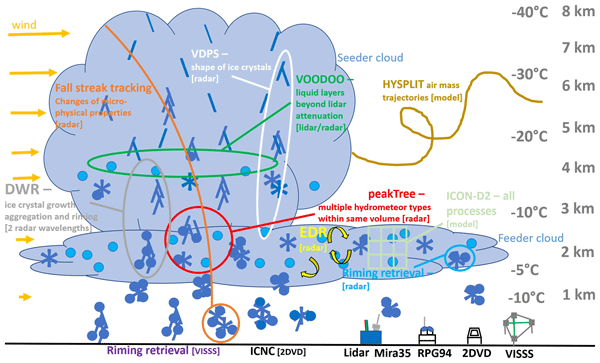
This study focuses on a seeder-feeder cloud system on 8 Jan 2024 in Eriswil, Switzerland. It is shown how the interaction of these cloud systems changes the cloud microphysical properties and the precipitation patterns. A big set of advanced remote-sensing techniques and retrieval algorithms are applied, so that a detailed view on the seeder-feeder cloud system is available. The gained knowledge can be used to improve weather models and weather forecasts.
Anton Kötsche, Alexander Myagkov, Leonie von Terzi, Maximilian Maahn, Veronika Ettrichrätz, Teresa Vogl, Alexander Ryzhkov, Petar Bukovcic, Davide Ori, and Heike Kalesse-Los
Atmos. Chem. Phys., 25, 14045–14070, https://doi.org/10.5194/acp-25-14045-2025, https://doi.org/10.5194/acp-25-14045-2025, 2025
Short summary
Short summary
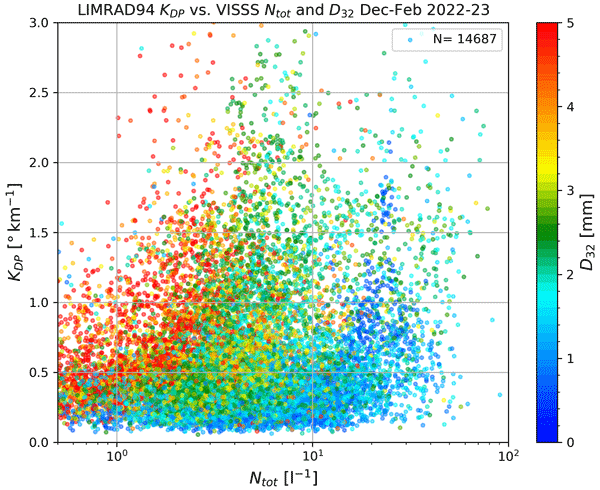
Our study combines radar observations of snow with snowfall camera observations on the ground to enhance our understanding of radar variables and snowfall properties. We found that values of an important radar variable (KDP) can be related to many different snow particle properties and number concentrations. We were able to constrain which particle sizes contribute to KDP by using computer models of snowflakes and showed which microphysical processes during snow formation can influence KDP.
Nina Maherndl, Alessandro Battaglia, Anton Kötsche, and Maximilian Maahn
Atmos. Meas. Tech., 18, 3287–3304, https://doi.org/10.5194/amt-18-3287-2025, https://doi.org/10.5194/amt-18-3287-2025, 2025
Short summary
Short summary
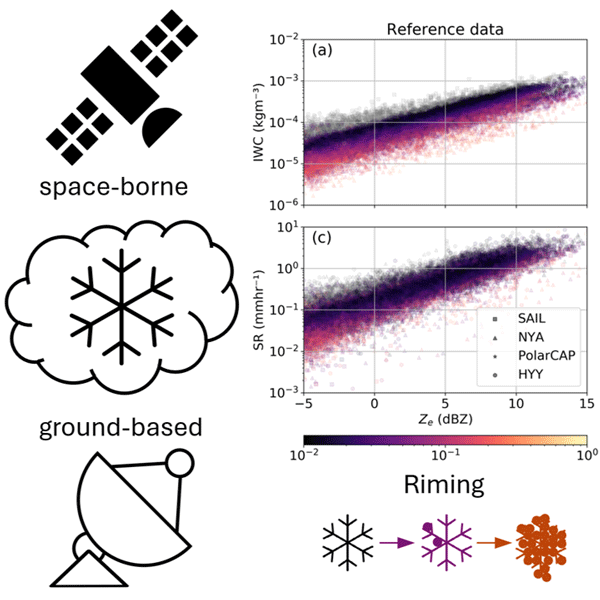
Accurate measurements of ice water content (IWC) and snowfall rate (SR) are challenging due to high spatial variability and limitations of our measurement techniques. Here, we present a novel method to derive IWC and SR from W-band cloud radar observations, considering the degree of riming. We also investigate the use of the liquid water path (LWP) as a proxy for the occurrence of riming. LWP is easier to measure, so that the method can be applied to both ground-based and space-based instruments.

Johanna Roschke, Jonas Witthuhn, Marcus Klingebiel, Moritz Haarig, Andreas Foth, Anton Kötsche, and Heike Kalesse-Los
Atmos. Meas. Tech., 18, 487–508, https://doi.org/10.5194/amt-18-487-2025, https://doi.org/10.5194/amt-18-487-2025, 2025
Short summary
Short summary
We present a technique to discriminate between the Cloudnet target classification of "drizzle or rain" and sea salt aerosols that is applicable to marine Cloudnet sites. The method is crucial for investigating the occurrence of precipitation and significantly improves the Cloudnet target classification scheme for measurements over the Barbados Cloud Observatory (BCO). A first-ever analysis of the Cloudnet product including the new "haze echo" target over 2 years at the BCO is presented.
Heike Kalesse-Los, Anton Kötsche, Andreas Foth, Johannes Röttenbacher, Teresa Vogl, and Jonas Witthuhn
Atmos. Meas. Tech., 16, 1683–1704, https://doi.org/10.5194/amt-16-1683-2023, https://doi.org/10.5194/amt-16-1683-2023, 2023
Short summary
Short summary
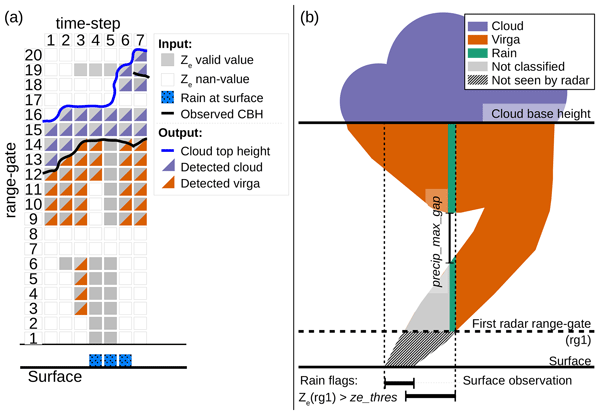
The Virga-Sniffer, a new modular open-source Python package tool to characterize full precipitation evaporation (so-called virga) from ceilometer cloud base height and vertically pointing cloud radar reflectivity time–height fields, is described. Results of its first application to RV Meteor observations during the EUREC4A field experiment in January–February 2020 are shown. About half of all detected clouds with bases below the trade inversion height were found to produce virga.
Anna Trosits, Andreas Foth, Allison A. Wing, Johanna Roschke, Moritz Haarig, Anton Kötsche, and Heike Kalesse-Los
EGUsphere, https://doi.org/10.5194/egusphere-2026-4385, https://doi.org/10.5194/egusphere-2026-4385, 2026
This preprint is open for discussion and under review for Atmospheric Chemistry and Physics (ACP).
Short summary
Short summary
This study shows the effect of air layers originating from the Saharan Desert on clouds over the tropical Atlantic observed during the ship-borne research campaign BOWTIE. These Saharan Air Layers (SAL) were analysed with data from several instruments providing atmospheric profiles and can be characterised by low moisture and dispersed mineral dust. The investigation suggests a suppression of vertical cloud development by the SAL, also affecting microphysical properties of the cloud.
Hans Segura, Allison A. Wing, Heike Kalesse-Los, Ruben Carrasco, James H. Ruppert Jr., Anna Trosits, Louise Nuijens, Felix Ament, Daniel Blandfort, Michael M. Bell, Pierre Bosser, Delián Colón-Burgos, Geet George, Joelle Habib, Jochen Horstmann, Friedhelm Jansen, Lukas Kluft, Robert Kopte, Klas Ove Möller, Peristera Paschou, Hauke Schmidt, Michael Schlundt, Ilya Serikov, Martin Stelzner, Elizabeth J. Thompson, Werenfrid Wimmer, Marcus Dengler, and Daniel Klocke
Earth Syst. Sci. Data Discuss., https://doi.org/10.5194/essd-2026-343, https://doi.org/10.5194/essd-2026-343, 2026
Preprint under review for ESSD
Short summary
Short summary
BOWTIE (Beobachtung von Ozean und Wolken - Das Trans ITCZ Experiment) was an observational campaign occurring in summer 2024, which intensively took measurements from the upper ocean to the upper troposphere in the wettest region of the tropical Atlantic. Here, we provide an overview of the measurements and instrumentation, including remote sensing and conventional, which targeted small-scale processes under different weather regimes, from calm doldrums to gusty, precipitating events.
Audrey Teisseire, Patric Seifert, Kevin Ohneiser, Maximilian Maahn, Robert Spirig, and Jan Henneberger
Atmos. Meas. Tech., 19, 2897–2921, https://doi.org/10.5194/amt-19-2897-2026, https://doi.org/10.5194/amt-19-2897-2026, 2026
Short summary
Short summary
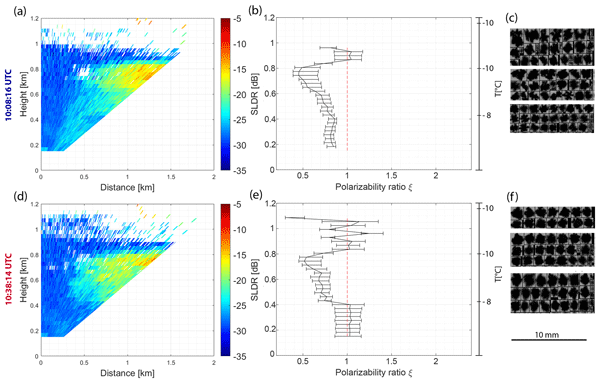
This study evaluates the vertical distribution of particle shape (VDPS) method for identifying particle shapes and riming/aggregation using in-situ and multi-frequency radar data from the CLOUDLAB campaign. Despite non-Rayleigh scattering effects, results show that the VDPS method using a Ka-band scanning cloud radar in slanted depolarization ratio (SLDR) mode is effective for hydrometeor classification.
Jonas Witthuhn, Hartwig Deneke, Andreas Macke, Oscar Ritter, Jens Redemann, Connor J. Flynn, Abdulamid A. Fakoya, Bradley F. Lamkin, Emily D. Lenhardt, Logan T. Mitchell, Emily K. West, David M. Romps, Rusen Öktem, and Heike Kalesse-Los
Atmos. Chem. Phys., 26, 5727–5745, https://doi.org/10.5194/acp-26-5727-2026, https://doi.org/10.5194/acp-26-5727-2026, 2026
Short summary
Short summary
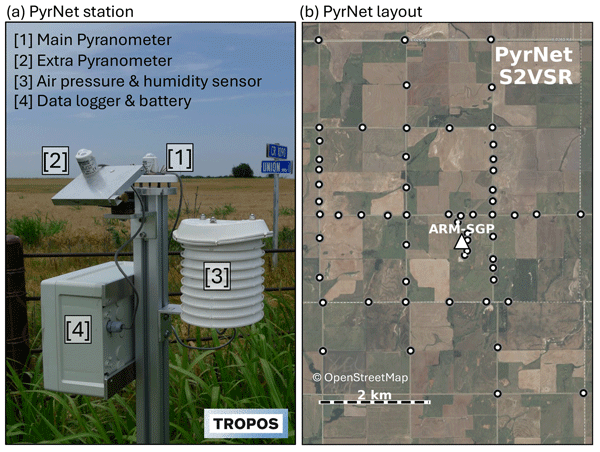
This study examines how solar irradiance changes when sunlight passes from clear sky into cloud shadows, focusing on 3‑D radiative effects of shallow cumulus clouds. Using data from a dense pyranometer network and cloud masks from cameras we found that irradiance can rise up to 20 % above clear‑sky levels near cloud edges. Key drivers include sun‑cloud geometry and microphysical cloud properties. The results highlight the need to incorporate such 3‑D effects in atmospheric models.
Johanna Roschke, Benedikt Gast, Martin Radenz, Albert Ansmann, Patric Seifert, George McCosh, and Heike Kalesse-Los
EGUsphere, https://doi.org/10.5194/egusphere-2026-718, https://doi.org/10.5194/egusphere-2026-718, 2026
Short summary
Short summary
This research introduces a new method that combines model simulations with satellite observations to attribute the influence of wildfire smoke on an airmass. By dynamically determining the height of smoke plumes, we overcome a key limitation of earlier fixed reception-height approaches. This advancement is crucial for improving our understanding of how wildfire emissions influence cloud formation and the broader Earth's climate system.
Kevin Ohneiser, Markus Hartmann, Heike Wex, Patric Seifert, Anja Hardt, Anna Miller, Katharina Baudrexl, Werner Thomas, Veronika Ettrichrätz, Maximilian Maahn, Tom Gaudek, Willi Schimmel, Fabian Senf, Hannes Griesche, Martin Radenz, and Jan Henneberger
Atmos. Chem. Phys., 26, 3223–3236, https://doi.org/10.5194/acp-26-3223-2026, https://doi.org/10.5194/acp-26-3223-2026, 2026
Short summary
Short summary
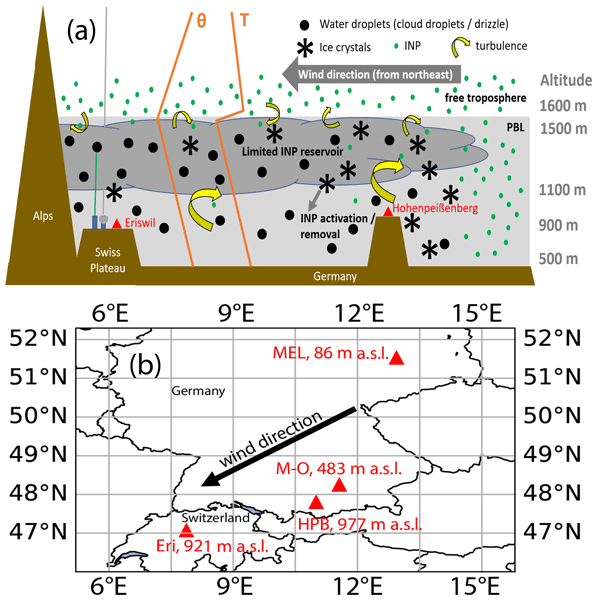
This study highlights the efficiency of supercooled liquid-dominated stratus clouds to remove ice-nucleating particles (INPs). When within the planetary boundary layer (PBL), lower concentrations of INPs were measured under supercooled stratus conditions, compared to when the stratus cloud layers occurred at temperatures above freezing. Under supercooling conditions, the free-troposphere above the supercooled stratus covered PBL was found to be an additional potential source of INP.
Kevin Ohneiser, Patric Seifert, Willi Schimmel, Fabian Senf, Tom Gaudek, Martin Radenz, Audrey Teisseire, Veronika Ettrichrätz, Teresa Vogl, Nina Maherndl, Nils Pfeifer, Jan Henneberger, Anna J. Miller, Nadja Omanovic, Christopher Fuchs, Huiying Zhang, Fabiola Ramelli, Robert Spirig, Anton Kötsche, Heike Kalesse-Los, Maximilian Maahn, Heather Corden, Alexis Berne, Majid Hajipour, Hannes Griesche, Julian Hofer, Ronny Engelmann, Annett Skupin, Albert Ansmann, and Holger Baars
Atmos. Chem. Phys., 25, 17363–17386, https://doi.org/10.5194/acp-25-17363-2025, https://doi.org/10.5194/acp-25-17363-2025, 2025
Short summary
Short summary
This study focuses on a seeder-feeder cloud system on 8 Jan 2024 in Eriswil, Switzerland. It is shown how the interaction of these cloud systems changes the cloud microphysical properties and the precipitation patterns. A big set of advanced remote-sensing techniques and retrieval algorithms are applied, so that a detailed view on the seeder-feeder cloud system is available. The gained knowledge can be used to improve weather models and weather forecasts.
Anton Kötsche, Alexander Myagkov, Leonie von Terzi, Maximilian Maahn, Veronika Ettrichrätz, Teresa Vogl, Alexander Ryzhkov, Petar Bukovcic, Davide Ori, and Heike Kalesse-Los
Atmos. Chem. Phys., 25, 14045–14070, https://doi.org/10.5194/acp-25-14045-2025, https://doi.org/10.5194/acp-25-14045-2025, 2025
Short summary
Short summary
Our study combines radar observations of snow with snowfall camera observations on the ground to enhance our understanding of radar variables and snowfall properties. We found that values of an important radar variable (KDP) can be related to many different snow particle properties and number concentrations. We were able to constrain which particle sizes contribute to KDP by using computer models of snowflakes and showed which microphysical processes during snow formation can influence KDP.
Filippo Emilio Scarsi, Alessandro Battaglia, Maximilian Maahn, and Stef Lhermitte
The Cryosphere, 19, 4875–4892, https://doi.org/10.5194/tc-19-4875-2025, https://doi.org/10.5194/tc-19-4875-2025, 2025
Short summary
Short summary
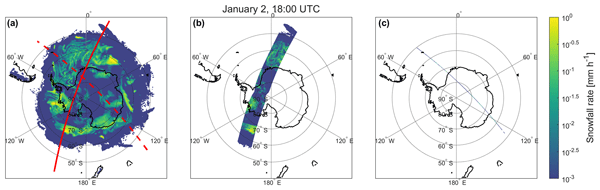
Snowfall measurements at high latitudes are crucial for estimating ice sheet mass balance. Spaceborne radar and radiometer missions help estimate snowfall but face uncertainties. This work evaluates uncertainties in snowfall estimates from a fixed near-nadir radar (CloudSat-like) and a conically scanning radar (WIVERN-like), showing that a WIVERN-like radar will provide better estimates than a CloudSat-like radar at smaller spatial and temporal scales.
Nina Maherndl, Alessandro Battaglia, Anton Kötsche, and Maximilian Maahn
Atmos. Meas. Tech., 18, 3287–3304, https://doi.org/10.5194/amt-18-3287-2025, https://doi.org/10.5194/amt-18-3287-2025, 2025
Short summary
Short summary
Accurate measurements of ice water content (IWC) and snowfall rate (SR) are challenging due to high spatial variability and limitations of our measurement techniques. Here, we present a novel method to derive IWC and SR from W-band cloud radar observations, considering the degree of riming. We also investigate the use of the liquid water path (LWP) as a proxy for the occurrence of riming. LWP is easier to measure, so that the method can be applied to both ground-based and space-based instruments.
Pablo Saavedra Garfias and Heike Kalesse-Los
EGUsphere, https://doi.org/10.5194/egusphere-2025-2327, https://doi.org/10.5194/egusphere-2025-2327, 2025
Short summary
Short summary
Arctic low level mixed-phase clouds were analysed from 14 years of wintertime observations from the North Slope of Alaska. We found that Arctic cloud physical properties are in correlation with changes in upwind sea ice. The cloud liquid and ice water content increases as sea ice decreases, although not at the same magnitude. Moreover, we uncovered that cloud properties have oscillation properties along the years that resemble climate indicators like El Niño Southern Oscillation among others.

André Ehrlich, Susanne Crewell, Andreas Herber, Marcus Klingebiel, Christof Lüpkes, Mario Mech, Sebastian Becker, Stephan Borrmann, Heiko Bozem, Matthias Buschmann, Hans-Christian Clemen, Elena De La Torre Castro, Henning Dorff, Regis Dupuy, Oliver Eppers, Florian Ewald, Geet George, Andreas Giez, Sarah Grawe, Christophe Gourbeyre, Jörg Hartmann, Evelyn Jäkel, Philipp Joppe, Olivier Jourdan, Zsófia Jurányi, Benjamin Kirbus, Johannes Lucke, Anna E. Luebke, Maximilian Maahn, Nina Maherndl, Christian Mallaun, Johanna Mayer, Stephan Mertes, Guillaume Mioche, Manuel Moser, Hanno Müller, Veronika Pörtge, Nils Risse, Greg Roberts, Sophie Rosenburg, Johannes Röttenbacher, Michael Schäfer, Jonas Schaefer, Andreas Schäfler, Imke Schirmacher, Johannes Schneider, Sabrina Schnitt, Frank Stratmann, Christian Tatzelt, Christiane Voigt, Andreas Walbröl, Anna Weber, Bruno Wetzel, Martin Wirth, and Manfred Wendisch
Earth Syst. Sci. Data, 17, 1295–1328, https://doi.org/10.5194/essd-17-1295-2025, https://doi.org/10.5194/essd-17-1295-2025, 2025
Short summary
Short summary
This paper provides an overview of the HALO–(AC)3 aircraft campaign data sets, the campaign-specific instrument operation, data processing, and data quality. The data set comprises in situ and remote sensing observations from three research aircraft: HALO, Polar 5, and Polar 6. All data are published in the PANGAEA database by instrument-separated data subsets. It is highlighted how the scientific analysis of the HALO–(AC)3 data benefits from the coordinated operation of three aircraft.
Johanna Roschke, Jonas Witthuhn, Marcus Klingebiel, Moritz Haarig, Andreas Foth, Anton Kötsche, and Heike Kalesse-Los
Atmos. Meas. Tech., 18, 487–508, https://doi.org/10.5194/amt-18-487-2025, https://doi.org/10.5194/amt-18-487-2025, 2025
Short summary
Short summary
We present a technique to discriminate between the Cloudnet target classification of "drizzle or rain" and sea salt aerosols that is applicable to marine Cloudnet sites. The method is crucial for investigating the occurrence of precipitation and significantly improves the Cloudnet target classification scheme for measurements over the Barbados Cloud Observatory (BCO). A first-ever analysis of the Cloudnet product including the new "haze echo" target over 2 years at the BCO is presented.
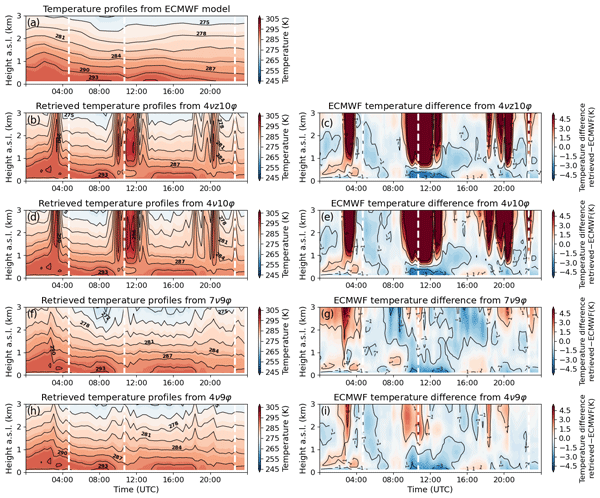
Andreas Foth, Moritz Lochmann, Pablo Saavedra Garfias, and Heike Kalesse-Los
Atmos. Meas. Tech., 17, 7169–7181, https://doi.org/10.5194/amt-17-7169-2024, https://doi.org/10.5194/amt-17-7169-2024, 2024
Short summary
Short summary
Microwave radiometers are usually not able to provide atmospheric quantities such as temperature profiles during rain. We present a method based on a selection of specific frequencies and elevation angles from microwave radiometer observations. A comparison with a numerical weather prediction model shows the presented method allows low-level temperature profiles during rain to be resolved, with rain rates of up to 2.5 mm h−1,, which was not possible before with state-of-the-art retrievals.
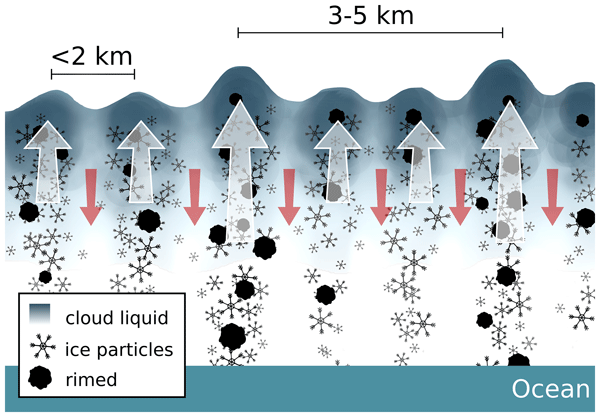
Nina Maherndl, Manuel Moser, Imke Schirmacher, Aaron Bansemer, Johannes Lucke, Christiane Voigt, and Maximilian Maahn
Atmos. Chem. Phys., 24, 13935–13960, https://doi.org/10.5194/acp-24-13935-2024, https://doi.org/10.5194/acp-24-13935-2024, 2024
Short summary
Short summary
It is not clear why ice crystals in clouds occur in clusters. Here, airborne measurements of clouds in mid-latitudes and high latitudes are used to study the spatial variability of ice. Further, we investigate the influence of riming, which occurs when liquid droplets freeze onto ice crystals. We find that riming enhances the occurrence of ice clusters. In the Arctic, riming leads to ice clustering at spatial scales of 3–5 km. This is due to updrafts and not higher amounts of liquid water.
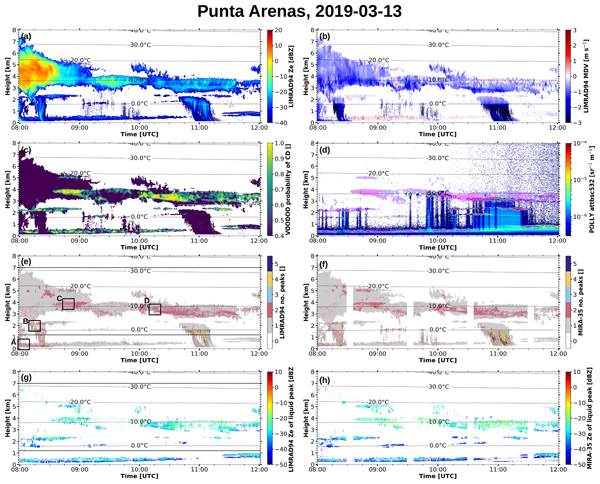
Teresa Vogl, Martin Radenz, Fabiola Ramelli, Rosa Gierens, and Heike Kalesse-Los
Atmos. Meas. Tech., 17, 6547–6568, https://doi.org/10.5194/amt-17-6547-2024, https://doi.org/10.5194/amt-17-6547-2024, 2024
Short summary
Short summary
In this study, we present a toolkit of two Python algorithms to extract information from Doppler spectra measured by ground-based cloud radars. In these Doppler spectra, several peaks can be formed due to populations of droplets/ice particles with different fall velocities coexisting in the same measurement time and height. The two algorithms can detect peaks and assign them to certain particle types, such as small cloud droplets or fast-falling ice particles like graupel.
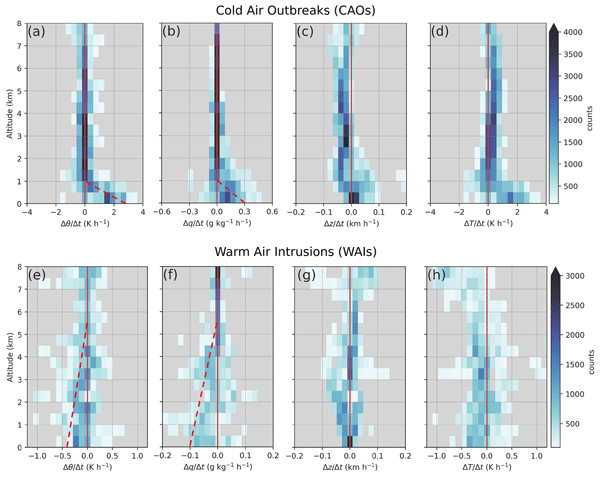
Manfred Wendisch, Susanne Crewell, André Ehrlich, Andreas Herber, Benjamin Kirbus, Christof Lüpkes, Mario Mech, Steven J. Abel, Elisa F. Akansu, Felix Ament, Clémantyne Aubry, Sebastian Becker, Stephan Borrmann, Heiko Bozem, Marlen Brückner, Hans-Christian Clemen, Sandro Dahlke, Georgios Dekoutsidis, Julien Delanoë, Elena De La Torre Castro, Henning Dorff, Regis Dupuy, Oliver Eppers, Florian Ewald, Geet George, Irina V. Gorodetskaya, Sarah Grawe, Silke Groß, Jörg Hartmann, Silvia Henning, Lutz Hirsch, Evelyn Jäkel, Philipp Joppe, Olivier Jourdan, Zsofia Jurányi, Michail Karalis, Mona Kellermann, Marcus Klingebiel, Michael Lonardi, Johannes Lucke, Anna E. Luebke, Maximilian Maahn, Nina Maherndl, Marion Maturilli, Bernhard Mayer, Johanna Mayer, Stephan Mertes, Janosch Michaelis, Michel Michalkov, Guillaume Mioche, Manuel Moser, Hanno Müller, Roel Neggers, Davide Ori, Daria Paul, Fiona M. Paulus, Christian Pilz, Felix Pithan, Mira Pöhlker, Veronika Pörtge, Maximilian Ringel, Nils Risse, Gregory C. Roberts, Sophie Rosenburg, Johannes Röttenbacher, Janna Rückert, Michael Schäfer, Jonas Schaefer, Vera Schemann, Imke Schirmacher, Jörg Schmidt, Sebastian Schmidt, Johannes Schneider, Sabrina Schnitt, Anja Schwarz, Holger Siebert, Harald Sodemann, Tim Sperzel, Gunnar Spreen, Bjorn Stevens, Frank Stratmann, Gunilla Svensson, Christian Tatzelt, Thomas Tuch, Timo Vihma, Christiane Voigt, Lea Volkmer, Andreas Walbröl, Anna Weber, Birgit Wehner, Bruno Wetzel, Martin Wirth, and Tobias Zinner
Atmos. Chem. Phys., 24, 8865–8892, https://doi.org/10.5194/acp-24-8865-2024, https://doi.org/10.5194/acp-24-8865-2024, 2024
Short summary
Short summary
The Arctic is warming faster than the rest of the globe. Warm-air intrusions (WAIs) into the Arctic may play an important role in explaining this phenomenon. Cold-air outbreaks (CAOs) out of the Arctic may link the Arctic climate changes to mid-latitude weather. In our article, we describe how to observe air mass transformations during CAOs and WAIs using three research aircraft instrumented with state-of-the-art remote-sensing and in situ measurement devices.
Junghwa Lee, Patric Seifert, Tempei Hashino, Maximilian Maahn, Fabian Senf, and Oswald Knoth
Atmos. Chem. Phys., 24, 5737–5756, https://doi.org/10.5194/acp-24-5737-2024, https://doi.org/10.5194/acp-24-5737-2024, 2024
Short summary
Short summary
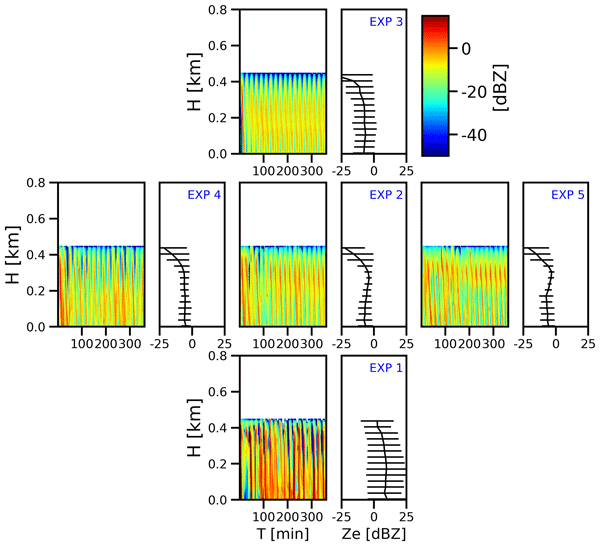
Spectral bin model simulations of an idealized supercooled stratiform cloud were performed with the AMPS model for variable CCN and INP concentrations. We performed radar forward simulations with PAMTRA to transfer the simulations into radar observational space. The derived radar reflectivity factors were compared to observational studies of stratiform mixed-phase clouds. These studies report a similar response of the radar reflectivity factor to aerosol perturbations as we found in our study.
Nina Maherndl, Manuel Moser, Johannes Lucke, Mario Mech, Nils Risse, Imke Schirmacher, and Maximilian Maahn
Atmos. Meas. Tech., 17, 1475–1495, https://doi.org/10.5194/amt-17-1475-2024, https://doi.org/10.5194/amt-17-1475-2024, 2024
Short summary
Short summary
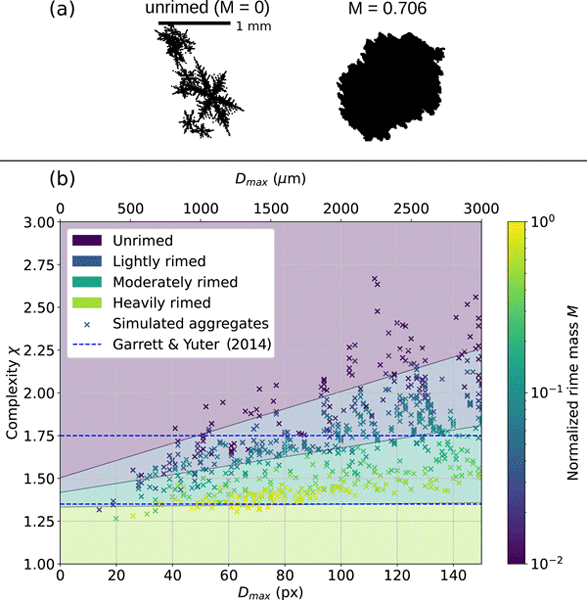
In some clouds, liquid water droplets can freeze onto ice crystals (riming). Riming leads to the formation of snowflakes. We show two ways to quantify riming using aircraft data collected in the Arctic. One aircraft had a cloud radar, while the other aircraft was measuring directly in cloud. The first method compares radar and direct observations. The second looks at snowflake shape. Both methods agree, except when there were gaps in the cloud. This improves our ability to understand riming.
Maximilian Maahn, Dmitri Moisseev, Isabelle Steinke, Nina Maherndl, and Matthew D. Shupe
Atmos. Meas. Tech., 17, 899–919, https://doi.org/10.5194/amt-17-899-2024, https://doi.org/10.5194/amt-17-899-2024, 2024
Short summary
Short summary
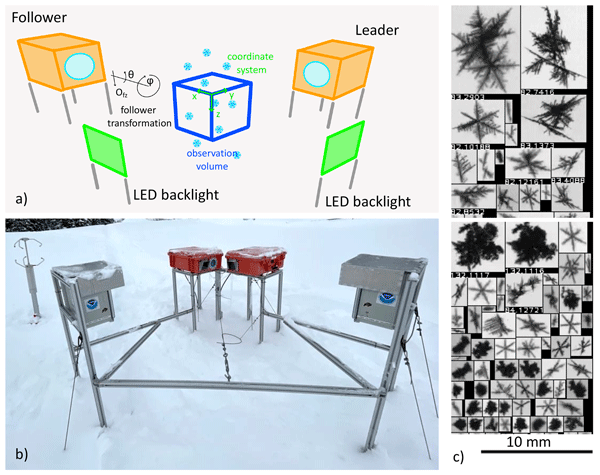
The open-source Video In Situ Snowfall Sensor (VISSS) is a novel instrument for characterizing particle shape, size, and sedimentation velocity in snowfall. It combines a large observation volume with relatively high resolution and a design that limits wind perturbations. The open-source nature of the VISSS hardware and software invites the community to contribute to the development of the instrument, which has many potential applications in atmospheric science and beyond.
Sabrina Schnitt, Andreas Foth, Heike Kalesse-Los, Mario Mech, Claudia Acquistapace, Friedhelm Jansen, Ulrich Löhnert, Bernhard Pospichal, Johannes Röttenbacher, Susanne Crewell, and Bjorn Stevens
Earth Syst. Sci. Data, 16, 681–700, https://doi.org/10.5194/essd-16-681-2024, https://doi.org/10.5194/essd-16-681-2024, 2024
Short summary
Short summary
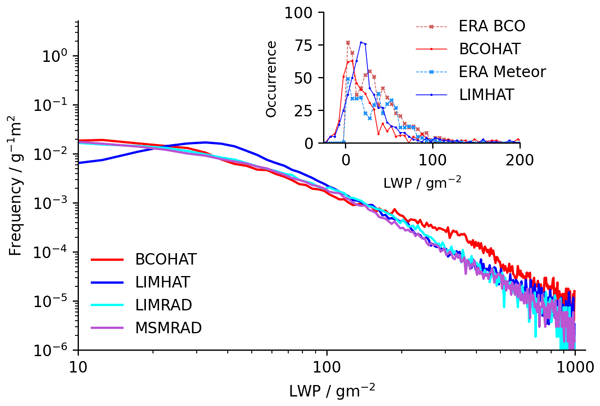
This publication describes the microwave radiometric measurements performed during the EUREC4A campaign at Barbados Cloud Observatory (BCO) and aboard RV Meteor and RV Maria S Merian. We present retrieved integrated water vapor (IWV), liquid water path (LWP), and temperature and humidity profiles as a unified, quality-controlled, multi-site data set on a 3 s temporal resolution for a core period between 19 January 2020 and 14 February 2020.
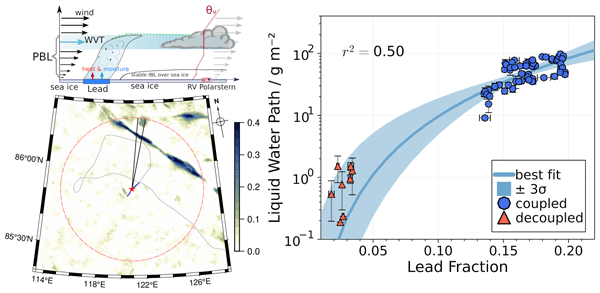
Pablo Saavedra Garfias, Heike Kalesse-Los, Luisa von Albedyll, Hannes Griesche, and Gunnar Spreen
Atmos. Chem. Phys., 23, 14521–14546, https://doi.org/10.5194/acp-23-14521-2023, https://doi.org/10.5194/acp-23-14521-2023, 2023
Short summary
Short summary
An important Arctic climate process is the release of heat fluxes from sea ice openings to the atmosphere that influence the clouds. The characterization of this process is the objective of this study. Using synergistic observations from the MOSAiC expedition, we found that single-layer cloud properties show significant differences when clouds are coupled or decoupled to the water vapour transport which is used as physical link between the upwind sea ice openings and the cloud under observation.
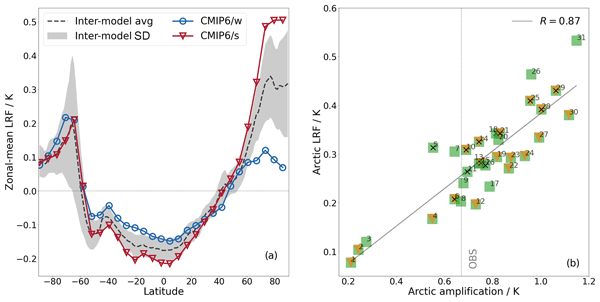
Olivia Linke, Johannes Quaas, Finja Baumer, Sebastian Becker, Jan Chylik, Sandro Dahlke, André Ehrlich, Dörthe Handorf, Christoph Jacobi, Heike Kalesse-Los, Luca Lelli, Sina Mehrdad, Roel A. J. Neggers, Johannes Riebold, Pablo Saavedra Garfias, Niklas Schnierstein, Matthew D. Shupe, Chris Smith, Gunnar Spreen, Baptiste Verneuil, Kameswara S. Vinjamuri, Marco Vountas, and Manfred Wendisch
Atmos. Chem. Phys., 23, 9963–9992, https://doi.org/10.5194/acp-23-9963-2023, https://doi.org/10.5194/acp-23-9963-2023, 2023
Short summary
Short summary
Lapse rate feedback (LRF) is a major driver of the Arctic amplification (AA) of climate change. It arises because the warming is stronger at the surface than aloft. Several processes can affect the LRF in the Arctic, such as the omnipresent temperature inversion. Here, we compare multimodel climate simulations to Arctic-based observations from a large research consortium to broaden our understanding of these processes, find synergy among them, and constrain the Arctic LRF and AA.
Samuel Kwakye, Heike Kalesse-Los, Maximilian Maahn, Patric Seifert, Roel van Klink, Christian Wirth, and Johannes Quaas
Atmos. Meas. Tech. Discuss., https://doi.org/10.5194/amt-2023-69, https://doi.org/10.5194/amt-2023-69, 2023
Publication in AMT not foreseen
Short summary
Short summary
Insect numbers in the atmosphere can be calculated using polarimetric weather radar but they have to be identified and separated from other echoes, especially weather phenomena. Here, the separation is demonstrated using three machine-learning algorithms and insect count data from suction traps and the nature of radar measurements of different radar echoes is revealed. Random forest is the best separating algorithm and insect echoes radar measurements are distinct.
Veronika Ettrichrätz, Christian Beier, Klaus Keuler, and Katja Trachte
EGUsphere, https://doi.org/10.5194/egusphere-2023-552, https://doi.org/10.5194/egusphere-2023-552, 2023
Preprint archived
Short summary
Short summary
Will heavy precipitation increase under climate change by the end of this century? The analyses of 40 regional climate simulations for two climate scenarios show that large parts of northern, central, and eastern Europe will be affected by a robust increase in heavy and extreme precipitation, while southwestern Europe will rather experience a slight decrease. Both the increase and the affected areas can be up to twice as large in an extreme than in a more moderate greenhouse gas scenario.
Heike Kalesse-Los, Anton Kötsche, Andreas Foth, Johannes Röttenbacher, Teresa Vogl, and Jonas Witthuhn
Atmos. Meas. Tech., 16, 1683–1704, https://doi.org/10.5194/amt-16-1683-2023, https://doi.org/10.5194/amt-16-1683-2023, 2023
Short summary
Short summary
The Virga-Sniffer, a new modular open-source Python package tool to characterize full precipitation evaporation (so-called virga) from ceilometer cloud base height and vertically pointing cloud radar reflectivity time–height fields, is described. Results of its first application to RV Meteor observations during the EUREC4A field experiment in January–February 2020 are shown. About half of all detected clouds with bases below the trade inversion height were found to produce virga.
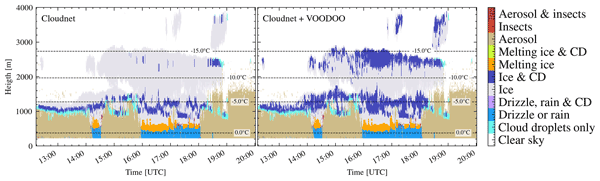
Willi Schimmel, Heike Kalesse-Los, Maximilian Maahn, Teresa Vogl, Andreas Foth, Pablo Saavedra Garfias, and Patric Seifert
Atmos. Meas. Tech., 15, 5343–5366, https://doi.org/10.5194/amt-15-5343-2022, https://doi.org/10.5194/amt-15-5343-2022, 2022
Short summary
Short summary
This study introduces the novel Doppler radar spectra-based machine learning approach VOODOO (reVealing supercOOled liquiD beyOnd lidar attenuatiOn). VOODOO is a powerful probability-based extension to the existing Cloudnet hydrometeor target classification, enabling the detection of liquid-bearing cloud layers beyond complete lidar attenuation via user-defined p* threshold. VOODOO performs best for (multi-layer) stratiform and deep mixed-phase clouds with liquid water path > 100 g m−2.

Teresa Vogl, Maximilian Maahn, Stefan Kneifel, Willi Schimmel, Dmitri Moisseev, and Heike Kalesse-Los
Atmos. Meas. Tech., 15, 365–381, https://doi.org/10.5194/amt-15-365-2022, https://doi.org/10.5194/amt-15-365-2022, 2022
Short summary
Short summary
We are using machine learning techniques, a type of artificial intelligence, to detect graupel formation in clouds. The measurements used as input to the machine learning framework were performed by cloud radars. Cloud radars are instruments located at the ground, emitting radiation with wavelenghts of a few millimeters vertically into the cloud and measuring the back-scattered signal. Our novel technique can be applied to different radar systems and different weather conditions.
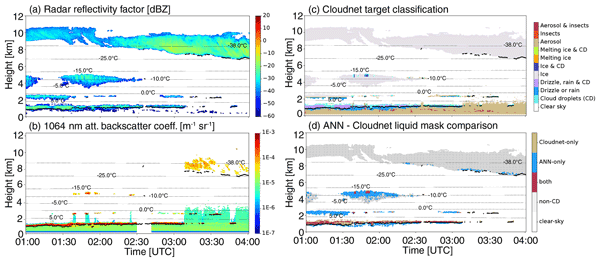
Heike Kalesse-Los, Willi Schimmel, Edward Luke, and Patric Seifert
Atmos. Meas. Tech., 15, 279–295, https://doi.org/10.5194/amt-15-279-2022, https://doi.org/10.5194/amt-15-279-2022, 2022
Short summary
Short summary
It is important to detect the vertical distribution of cloud droplets and ice in mixed-phase clouds. Here, an artificial neural network (ANN) previously developed for Arctic clouds is applied to a mid-latitudinal cloud radar data set. The performance of this technique is contrasted to the Cloudnet target classification. For thick/multi-layer clouds, the machine learning technique is better at detecting liquid than Cloudnet, but if lidar data are available Cloudnet is at least as good as the ANN.
Silke Trömel, Clemens Simmer, Ulrich Blahak, Armin Blanke, Sabine Doktorowski, Florian Ewald, Michael Frech, Mathias Gergely, Martin Hagen, Tijana Janjic, Heike Kalesse-Los, Stefan Kneifel, Christoph Knote, Jana Mendrok, Manuel Moser, Gregor Köcher, Kai Mühlbauer, Alexander Myagkov, Velibor Pejcic, Patric Seifert, Prabhakar Shrestha, Audrey Teisseire, Leonie von Terzi, Eleni Tetoni, Teresa Vogl, Christiane Voigt, Yuefei Zeng, Tobias Zinner, and Johannes Quaas
Atmos. Chem. Phys., 21, 17291–17314, https://doi.org/10.5194/acp-21-17291-2021, https://doi.org/10.5194/acp-21-17291-2021, 2021
Short summary
Short summary
The article introduces the ACP readership to ongoing research in Germany on cloud- and precipitation-related process information inherent in polarimetric radar measurements, outlines pathways to inform atmospheric models with radar-based information, and points to remaining challenges towards an improved fusion of radar polarimetry and atmospheric modelling.
Cited articles
Aikins, J., Friedrich, K., Geerts, B., and Pokharel, B.: Role of a Cross-Barrier Jet and Turbulence on Winter Orographic Snowfall, Monthly Weather Review, 144, 3277–3300, https://doi.org/10.1175/MWR-D-16-0025.1, 2016. a, b, c, d
Balakrishnan, N. and Zrnic, D. S.: Use of polarization to characterize precipitation and discriminate large hail, Journal of the Atmospheric Sciences, 47, 1525–1540, https://doi.org/10.1175/1520-0469(1990)047<1525:UOPTCP>2.0.CO;2, 1990. a
Bartholomew, M.: Laser Disdrometer Instrument Handbook, Tech. Rep. DOE/SC-ARM-TR–137, 1226796, https://doi.org/10.2172/1226796, 2020. a
Bhushan, S. and Barros, A. P.: A Numerical Study to Investigate the Relationship between Moisture Convergence Patterns and Orography in Central Mexico, Journal of Hydrometeorology, https://doi.org/10.1175/2007JHM791.1, 2007. a
Billault-Roux, A.-C., Georgakaki, P., Gehring, J., Jaffeux, L., Schwarzenboeck, A., Coutris, P., Nenes, A., and Berne, A.: Distinct secondary ice production processes observed in radar Doppler spectra: insights from a case study, Atmospheric Chemistry and Physics, 23, 10207–10234, https://doi.org/10.5194/acp-23-10207-2023, 2023. a, b
Borque, P., Luke, E., and Kollias, P.: On the unified estimation of turbulence eddy dissipation rate using Doppler cloud radars and lidars, Journal of Geophysical Research: Atmospheres, 121, 5972–5989, https://doi.org/10.1002/2015JD024543, 2016. a
Chellini, G. and Kneifel, S.: Turbulence as a Key Driver of Ice Aggregation and Riming in Arctic Low‐Level Mixed-Phase Clouds, Revealed by Long‐Term Cloud Radar Observations, Geophysical Research Letters, 51, e2023GL106599, https://doi.org/10.1029/2023GL106599, 2024. a, b, c, d
Fairless, T., Jensen, M., Zhou, A., and Giangrande, S. E.: Interpolated sonde and gridded sonde value-added products, United States Department of Energy: Washington, DC, USA, https://doi.org/10.2172/1248938, 2021. a
Feldman, D. R., Aiken, A. C., Boos, W. R., Carroll, R. W. H., Chandrasekar, V., Collis, S., Creamean, J. M., De Boer, G., Deems, J., and DeMott, P. J.: The Surface Atmosphere Integrated Field Laboratory (SAIL) Campaign, Bulletin of the American Meteorological Society, 104, E2192–E2222, https://doi.org/10.1175/BAMS-D-22-0049.1, 2023. a
Feng, Y.-C., Theisen, A., Lindenmaier, I. A., Collis, S., Giangrande, S., Comstock, J. M., Matthews, A. A., Rocque, M. N., Schuman, E. K., and Wendler, T. G.: ARM FY2024 Radar Plan, Tech. rep., Oak Ridge National Laboratory (ORNL), Oak Ridge, TN (United States) [data set], https://doi.org/10.5439/1888379, 2023. a
Foken, T. and Mauder, M.: Micrometeorology, Springer Atmospheric Sciences, Springer International Publishing, Cham, ISBN 978-3-031-47525-2, 978-3-031-47526-9, https://doi.org/10.1007/978-3-031-47526-9, 2024. a
Garrett, T. J. and Yuter, S. E.: Observed influence of riming, temperature, and turbulence on the fallspeed of solid precipitation, Geophysical Research Letters, 41, 6515–6522, https://doi.org/10.1002/2014GL061016, 2014. a
Garrett, T. J., Yuter, S. E., Fallgatter, C., Shkurko, K., Rhodes, S. R., and Endries, J. L.: Orientations and aspect ratios of falling snow, Geophysical Research Letters, 42, 4617–4622, https://doi.org/10.1002/2015GL064040, 2015. a
Goldsmith, J.: High Spectral Resolution Lidar (HSRL) Instrument Handbook, Tech. Rep. DOE/SC-ARM-TR–157, 1251392, https://doi.org/10.2172/1251392, 2016. a
Grazioli, J., Lloyd, G., Panziera, L., Hoyle, C. R., Connolly, P. J., Henneberger, J., and Berne, A.: Polarimetric radar and in situ observations of riming and snowfall microphysics during CLACE 2014, Atmospheric Chemistry and Physics, 15, 13787–13802, https://doi.org/10.5194/acp-15-13787-2015, 2015. a, b, c
Grzegorczyk, P., Yadav, S., Zanger, F., Theis, A., Mitra, S. K., Borrmann, S., and Szakáll, M.: Fragmentation of ice particles: laboratory experiments on graupel–graupel and graupel–snowflake collisions, Atmospheric Chemistry and Physics, 23, 13505–13521, https://doi.org/10.5194/acp-23-13505-2023, 2023. a
Heistermann, M., Jacobi, S., and Pfaff, T.: Technical Note: An open source library for processing weather radar data (wradlib), Hydrology and Earth System Sciences, 17, 863–871, https://doi.org/10.5194/hess-17-863-2013, 2013. a
Holz, R., Garcia, J., Schuman, E., Bambha, R., Ermold, B., and Eloranta, E.: High Spectral Resolution Lidar Data, a1 Data Level, Atmospheric Radiation Measurement (ARM) user facility [data set], https://doi.org/10.5439/1462207, 2011. a
Houze Jr., R. A.: Orographic effects on precipitating clouds, Reviews of Geophysics, 50, https://doi.org/10.1029/2011RG000365, 2012. a, b, c
Houze Jr., R. A. and Medina, S.: Turbulence as a Mechanism for Orographic Precipitation Enhancement, Journal of the Atmospheric Sciences, https://doi.org/10.1175/JAS3555.1, 2005. a, b
Hubbert, J. and Bringi, V.: Utilization of the radar polarimetric covariance matrix for polarization error and precipitation canting angle estimation, in: IGARSS 2003. 2003 IEEE International Geoscience and Remote Sensing Symposium, Proceedings (IEEE Cat. No. 03CH37477), Vol. 7, 4456–4458, https://doi.org/10.1109/IGARSS.2003.1295545, 2003. a
Jensen, M., Giangrande, S., Fairless, T., and Zhou, A.: interpolatedsonde, Tech. rep., Atmospheric Radiation Measurement (ARM) Archive, Oak Ridge National Laboratory (ORNL) [data set], https://doi.org/10.5439/1095316, 1998. a
Johnson, K., Jensen, M., and Giangrande, S.: Active Remote Sensing of CLouds (ARSCL) product using Ka-band ARM Zenith Radars (ARSCLKAZR1KOLLIAS), 2021-09-01 to 2023-06-06, ARM Mobile Facility (GUC), Gunnison, CO; AMF2 (main site for SAIL) (M1), Atmospheric Radiation Measurement (ARM) user facility [data set], https://doi.org/10.5439/1228768, 2023. a, b
Kalesse-Los, H., Maahn, M., Ettrichratz, V., and Kotsche, A.: Characterization of Orography-Influenced Riming and Secondary Ice Production and Their Effects on Precipitation Rates Using Radar Polarimetry and Doppler Spectra (CORSIPP-SAIL), Tech. rep., Oak Ridge National https://doi.org/10.2172/2242406, 2023a. a
Kalesse-Los, H., Maahn, M., Kötsche, A., Ettrichrätz, V., and Steinke, I.: Leipzig University W-Band Cloud Radar, Gothic (Colorado), SAIL Campaign Second Winter (15.11.2022–05.06.2023), Atmospheric Radiation Measurement (ARM) user facility [data set], https://doi.org/10.5439/2229846, 2023b. a
Klett, J. D.: Orientation Model for Particles in Turbulence, Journal of the Atmospheric Sciences, https://doi.org/10.1175/1520-0469(1995)052<2276:OMFPIT>2.0.CO;2, 1995. a
Kneifel, S. and Moisseev, D.: Long-term statistics of riming in nonconvective clouds derived from ground-based Doppler cloud radar observations, Journal of the Atmospheric Sciences, 77, 3495–3508, https://doi.org/10.1175/JAS-D-20-0007.1, 2020. a
Kötsche, A., Myagkov, A., von Terzi, L., Maahn, M., Ettrichrätz, V., Vogl, T., Ryzhkov, A., Bukovcic, P., Ori, D., and Kalesse-Los, H.: Investigating KDP signatures inside and below the dendritic growth layer with W-band Doppler radar and in situ snowfall camera, Atmospheric Chemistry and Physics, 25, 14045–14070, https://doi.org/10.5194/acp-25-14045-2025, 2025. a, b, c, d, e, f, g, h, i, j, k
Küchler, N., Kneifel, S., Löhnert, U., Kollias, P., Czekala, H., and Rose, T.: A W-Band Radar–Radiometer System for Accurate and Continuous Monitoring of Clouds and Precipitation, Journal of Atmospheric and Oceanic Technology, https://doi.org/10.1175/JTECH-D-17-0019.1, 2017. a, b
Kyrouac, J., Shi, Y., and Tuftedal, M.: Surface Meteorological Instrumentation (MET), 2022-11-10 to 2023-06-06, ARM Mobile Facility (GUC), Gunnison, CO; AMF2 (main site for SAIL) (M1), Atmospheric Radiation Measurement (ARM) user facility [data set], https://doi.org/10.5439/1786358, 2021. a
Lee, H., Baik, J.-J., and Han, J.-Y.: Effects of turbulence on mixed-phase deep convective clouds under different basic-state winds and aerosol concentrations, Journal of Geophysical Research: Atmospheres, 119, 13506–13525, https://doi.org/10.1002/2014JD022363, 2014. a, b, c, d
Li, X., Wang, L., Hu, B., Chen, D., and Liu, R.: Contribution of vanishing mountain glaciers to global and regional terrestrial water storage changes, Frontiers in Earth Science, 11, https://doi.org/10.3389/feart.2023.1134910, 2023. a
Maahn, M., Löhnert, U., Kollias, P., Jackson, R. C., and McFarquhar, G. M.: Developing and Evaluating Ice Cloud Parameterizations for Forward Modeling of Radar Moments Using in situ Aircraft Observations, Journal of Atmospheric and Oceanic Technology, https://doi.org/10.1175/JTECH-D-14-00112.1, 2015. a
Maahn, M., Ettrichraetz, V., and Steinke, I.: VISSS Raw data from SAIL at Gothic from November 2022 to June 2023, Atmospheric Radiation Measurement (ARM) user facility [data set], https://doi.org/10.5439/2278627, 2024a. a
Maahn, M., Moisseev, D., Steinke, I., Maherndl, N., and Shupe, M. D.: Introducing the Video In Situ Snowfall Sensor (VISSS), Atmospheric Measurement Techniques, 17, 899–919, https://doi.org/10.5194/amt-17-899-2024, 2024b. a, b, c
Maherndl, N., Moser, M., Lucke, J., Mech, M., Risse, N., Schirmacher, I., and Maahn, M.: Quantifying riming from airborne data during the HALO-(AC)3 campaign, Atmospheric Measurement Techniques, 17, 1475–1495, https://doi.org/10.5194/amt-17-1475-2024, 2024. a
Maherndl, N., Battaglia, A., Kötsche, A., and Maahn, M.: Riming-dependent snowfall rate and ice water content retrievals for W-band cloud radar, Atmospheric Measurement Techniques, 18, 3287–3304, https://doi.org/10.5194/amt-18-3287-2025, 2025. a
Moisseev, D., von Lerber, A., and Tiira, J.: Quantifying the effect of riming on snowfall using ground-based observations, Journal of Geophysical Research: Atmospheres, 122, 4019–4037, https://doi.org/10.1002/2016JD026272, 2017. a
Morris, V. R.: Ceilometer Instrument Handbook, Tech. Rep. DOE/SC-ARM-TR–020, 1036530, https://doi.org/10.2172/1036530, 2016. a
Muradyan, P. and Coulter, R.: Radar Wind Profiler (RWP) and Radio Acoustic Sounding System (RASS) Instrument Handbook, Tech. rep., DOE Office of Science Atmospheric Radiation Measurement (ARM) User Facility [data set], https://doi.org/10.5439/1993735, 2020. a, b
Myagkov, A., Seifert, P., Bauer-Pfundstein, M., and Wandinger, U.: Cloud radar with hybrid mode towards estimation of shape and orientation of ice crystals, Atmospheric Measurement Techniques, 9, 469–489, https://doi.org/10.5194/amt-9-469-2016, 2016. a
Myagkov, A., Kneifel, S., and Rose, T.: Evaluation of the reflectivity calibration of W-band radars based on observations in rain, Atmospheric Measurement Techniques, 13, 5799–5825, https://doi.org/10.5194/amt-13-5799-2020, 2020. a
Oue, M., Kollias, P., Ryzhkov, A., and Luke, E. P.: Toward Exploring the Synergy Between Cloud Radar Polarimetry and Doppler Spectral Analysis in Deep Cold Precipitating Systems in the Arctic, Journal of Geophysical Research: Atmospheres, 123, 2797–2815, https://doi.org/10.1002/2017JD027717, 2018. a
Petersen, G. N., Kristjánsson, J. E., and Ólafsson, H.: The effect of upstream wind direction on atmospheric flow in the vicinity of a large mountain, Quarterly Journal of the Royal Meteorological Society, 131, 1113–1128, https://doi.org/10.1256/qj.04.01, 2005. a
Pettersen, C., Mace, G. G., McMurdie, L., Rowe, A., Hallar, A. G., Dolan, B., and Oue, M.: Introducing the Snow Sensitivity to Clouds in a Mountain Environment (S2noCliME) Field Campaign, AMS, https://ams.confex.com/ams/21MOUNTAIN/meetingapp.cgi/Paper/444259 (last access: 12 December 2025), 2024. a
Ramelli, F., Henneberger, J., David, R. O., Lauber, A., Pasquier, J. T., Wieder, J., Bühl, J., Seifert, P., Engelmann, R., Hervo, M., and Lohmann, U.: Influence of low-level blocking and turbulence on the microphysics of a mixed-phase cloud in an inner-Alpine valley, Atmospheric Chemistry and Physics, 21, 5151–5172, https://doi.org/10.5194/acp-21-5151-2021, 2021. a, b, c, d, e, f
Ryzhkov, A., Pinsky, M., Pokrovsky, A., and Khain, A.: Polarimetric Radar Observation Operator for a Cloud Model with Spectral Microphysics, Journal of Applied Meteorology and Climatology, https://doi.org/10.1175/2010JAMC2363.1, 2011. a
Ryzhkov, A. V. and Zrnic, D. S.: Radar Polarimetry for Weather Observations, Springer Atmospheric Sciences, Springer International Publishing, Cham, ISBN 978-3-030-05092-4, 978-3-030-05093-1, https://doi.org/10.1007/978-3-030-05093-1, 2019. a, b
Ryzhkov, A. V., Zrnic, D. S., Hubbert, J. C., Bringi, V. N., Vivekanandan, J., and Brandes, E. A.: Polarimetric radar observations and interpretation of co-cross-polarcorrelation coefficients, Journal of Atmospheric and Oceanic Technology, 19, 340–354, https://doi.org/10.1175/1520-0426-19.3.340, 2002. a, b
Schmitt, C. G. and Heymsfield, A. J.: Observational quantification of the separation of simple and complex atmospheric ice particles, Geophysical Research Letters, 41, 1301–1307, https://doi.org/10.1002/2013GL058781, 2014. a
Smolarkiewicz, P. K. and Rotunno, R.: Low Froude Number Flow Past Three-Dimensional Obstacles. Part I: Baroclinically Generated Lee Vortices, Journal of the Atmospheric Sciences, https://doi.org/10.1175/1520-0469(1989)046<1154:LFNFPT>2.0.CO;2, 1989. a
Smolarkiewicz, P. K. and Rotunno, R.: Low Froude Number Flow Past Three-Dimensional Obstacles. Part II: Upwind Flow Reversal Zone, Journal of the Atmospheric Sciences, https://doi.org/10.1175/1520-0469(1990)047<1498:LFNFPT>2.0.CO;2, 1990. a
Takahashi, T., Nagao, Y., and Kushiyama, Y.: Possible High Ice Particle Production during Graupel–Graupel Collisions, Journal of the Atmospheric Sciences, 52, 4523–4527, https://doi.org/10.1175/1520-0469(1995)052<4523:PHIPPD>2.0.CO;2, 1995. a, b
Trömel, S., Kumjian, M. R., Ryzhkov, A. V., Simmer, C., and Diederich, M.: Backscatter Differential Phase – Estimation and Variability, Journal of Applied Meteorology and Climatology, https://doi.org/10.1175/JAMC-D-13-0124.1, 2013. a, b
Trömel, S., Simmer, C., Blahak, U., Blanke, A., Doktorowski, S., Ewald, F., Frech, M., Gergely, M., Hagen, M., Janjic, T., Kalesse-Los, H., Kneifel, S., Knote, C., Mendrok, J., Moser, M., Köcher, G., Mühlbauer, K., Myagkov, A., Pejcic, V., Seifert, P., Shrestha, P., Teisseire, A., von Terzi, L., Tetoni, E., Vogl, T., Voigt, C., Zeng, Y., Zinner, T., and Quaas, J.: Overview: Fusion of radar polarimetry and numerical atmospheric modelling towards an improved understanding of cloud and precipitation processes, Atmospheric Chemistry and Physics, 21, 17291–17314, https://doi.org/10.5194/acp-21-17291-2021, 2021. a
Vaisala: Technical description vaisala lidar ceilometer CL61 (2021), Vaisala, 1–43, https://www.google.com/url?sa=t&source=web&rct=j&opi=89978449&url=https://www.vaisala.com/sites/default/files/documents/WEA-MET-WhitePaper-CL61-B212267EN-A.pdf&ved=2ahUKEwiX-dGHjOCSAxV2X_EDHbxqEnUQFnoECBkQAQ&usg=AOvVaw3voW4RhWsk2vUbnEERqxIh (last access: 14 September 2025), 2021. a
Vogl, T., Maahn, M., Kneifel, S., Schimmel, W., Moisseev, D., and Kalesse-Los, H.: Using artificial neural networks to predict riming from Doppler cloud radar observations, Atmospheric Measurement Techniques, 15, 365–381, https://doi.org/10.5194/amt-15-365-2022, 2022. a
Vogl, T., Radenz, M., Ramelli, F., Gierens, R., and Kalesse-Los, H.: PEAKO and peakTree: tools for detecting and interpreting peaks in cloud radar Doppler spectra – capabilities and limitations, Atmospheric Measurement Techniques, 17, 6547–6568, https://doi.org/10.5194/amt-17-6547-2024, 2024. a
Wang, D., Zhu, Z., Shi, Y., Sturm, M., Irving, K., Mockaitis, M., and Delamere, J.: ld (b1), Atmospheric Radiation Measurement (ARM) user facility [data set], https://doi.org/10.5439/1973058, 2014. a
Widener, K., Bharadwaj, N., and Johnson, K.: Ka-Band ARM Zenith Radar (KAZR) Instrument Handbook, Tech. Rep. DOE/SC-ARM/TR-106, PNNL, Richland, WA, https://doi.org/10.2172/1035855, 2012. a, b
Zhang, D.: MWR Retrievals (MWRRET1LILJCLOU), 2022-11-10 to 2023-06-06, ARM Mobile Facility (GUC), Gunnison, CO; AMF2 (main site for SAIL) (M1), Atmospheric Radiation Measurement (ARM) user facility [data set], https://doi.org/10.5439/1027369, 1996. a
Zhang, D., Ermold, B., and Morris, V.: ceil, Atmospheric Radiation Measurement (ARM) user facility [data set], https://doi.org/10.5439/1497398, 1996. a
Zhou, R., Perkins, R., Juergensen, D., Barry, K., Ayars, K., Dutton, O., DeMott, P., and Kreidenweis, S.: Seasonal variability, sources, and parameterization of ice-nucleating particles in the Rocky Mountain region: importance of soil dust and biological contributions, Atmospheric Chemistry and Physics, 26, 1515–1535, https://doi.org/10.5194/acp-26-1515-2026, 2026. a
Zhu, Z., Yang, F., Kollias, P., and Luke, E.: Observational Investigation of the Effect of Turbulence on Microphysics and Precipitation in Warm Marine Boundary Layer Clouds, Geophysical Research Letters, 50, e2022GL102578, https://doi.org/10.1029/2022GL102578, 2023. a
Download
The requested paper has a corresponding corrigendum published. Please read the corrigendum first before downloading the article.
- Article
(9793 KB) - Full-text XML
Short summary
We studied how turbulence affects snowfall in the Colorado Rockies, focusing on a turbulent layer behind Gothic Mountain. Using radar and surface observations, we found turbulence enhances snow growth by causing snowflakes to stick and form extra ice via collisions. Liquid water at cold temperatures further boosts snow formation. This work shows how turbulence shapes mountain snowfall and demonstrates radar-based methods to study precipitation processes.
We studied how turbulence affects snowfall in the Colorado Rockies, focusing on a turbulent...


Altmetrics
Final-revised paper
Preprint