
the Creative Commons Attribution 4.0 License.
the Creative Commons Attribution 4.0 License.
 | 03 Mar 2026
Snow microphysical processes in orographic turbulence revealed by cloud radar and in situ snowfall camera observations
Anton Kötsche
Maximilian Maahn
Veronika Ettrichrätz
Heike Kalesse-Los
Turbulence influences snow microphysics and precipitation formation, while simultaneously degrading polarimetric radar measurements through broadening of the canting angle distribution. We investigate these interactions in the Colorado Rocky Mountains, where an orographic turbulent layer consistently forms in the lee of Gothic Mountain during precipitation events. To isolate microphysical signals from turbulence-induced artifacts, we apply a novel framework contrasting radar observations above and below the turbulent layer. The dataset combines polarimetric W-band and collocated Ka-band radar measurements with surface in situ observations from the Video In Situ Snowfall Sensor (VISSS). All observations were collected during the CORSIPP project, part of the ARM SAIL campaign (winter 2022/2023).
Aggregation is identified as a dominant process within the turbulent layer, occurring primarily between −12 and −15 °C. It is responsible for reflectivity (Ze) increase of up to 20 dBZ km−1 and reduction of the mean particle fall velocity. Enhanced KDP and further suggest secondary ice production through ice-collisional fragmentation, generating anisotropic splinters. Riming also occurs frequently, with Ze increases up to 15 dBZ km−1 and systematically increasing mean particle fall velocity. Riming inside the turbulent layer was often observed at temperatures below −10 °C, indicating the presence of supercooled liquid at cold conditions. Statistical analysis revealed that the turbulent layer is frequently collocated with supercooled liquid water layers near the Gothic Mountain summit.
Our findings demonstrate how radar polarimetry may be safely used to investigate microphysical processes inside a turbulent layer and highlight the impact of orographic turbulence on snow microphysics and precipitation enhancement.
Please read the corrigendum first before continuing.
-
Notice on corrigendum
The requested paper has a corresponding corrigendum published. Please read the corrigendum first before downloading the article.
-
Article
(9793 KB)
-
The requested paper has a corresponding corrigendum published. Please read the corrigendum first before downloading the article.
- Article
(9793 KB) - Full-text XML
- Corrigendum
- BibTeX
- EndNote


Mountainous regions play a central role in the earths water budget, acting as the Earth's water towers, and are especially vulnerable to changes in the amount of precipitation (e.g Li et al., 2023, and references therein). Understanding precipitation generation and distribution in mountainous regions depends on understanding the microscale dynamics and microphysics that transform condensed water into precipitation.
In the context of precipitation formation in mountainous regions, turbulence has been a key area of research in recent years. Turbulence in mountainous areas frequently occurs due to wind shear, which involves a significant variation in wind speed and/or direction across a small vertical distance. This may for example occur at the interface between a blocked low level flow inside a valley and the unblocked cross-barrier flow aloft (e.g. Ramelli et al., 2021; Kötsche et al., 2025). Blocking caused by mountains is a very complex topic and further insight may be found in the work of, for example, Smolarkiewicz and Rotunno (1989) and Smolarkiewicz and Rotunno (1990). Along the flanks of a blocking mountain, a tip jet can form which features enhanced wind speeds and hence wind shear. Downstream of the blocking mountain, a wake, recirculating flow or general deceleration of the wind is found (Petersen et al., 2005). This recirculating or converging flow in the lee of blocking mountains also leads to pronounced moisture convergence (e.g. Bhushan and Barros, 2007), which consequently may lead to cloud and precipitation formation.
Various studies in recent years focused on the implications of turbulence on precipitation formation. Lee et al. (2014) demonstrated that turbulence boosts supersaturation, leading to faster ice crystal growth through deposition. Additionally, ice particles collide more effectively with supercooled droplets, enabling them to grow into small graupel particles. Consequently, turbulence leads to a relatively large number of small-sized graupel particles. Aikins et al. (2016) also argued that in cold post frontal continental environments (temperatures below −15 °C), turbulence plays a significant role in promoting snow growth mainly via deposition and aggregation. Houze and Medina (2005), Houze (2012) and Medina and Houze (2015) discovered that turbulent updraft cells can generate areas of elevated liquid water content (LWC), which promote riming and coalescence while also enhancing aggregation due to variations in the particle fall velocities. Grazioli et al. (2015) presented measurements gathered in an inner-Alpine valley, they confirmed that if a turbulent layer persists for several hours, sustaining supercooled liquid water (SLW) production, it prolongs riming and allows for large snow accumulations at ground level. Conversely, Aikins et al. (2016) found no SLW near the turbulent cells when conducting measurements in the Sierra Madre Range in Wyoming. They suggested that the absence of liquid water is likely because the high concentration of ice particles from the cloud above rapidly depletes water vapor, preventing liquid drop formation. Ramelli et al. (2021), consistent with previous studies, reported changes in the microphysical characteristics of clouds in the turbulent shear layer. These modifications included alterations in particle shape or density and increased ice growth. Similar to Grazioli et al. (2015), their measurements were conducted within an inner-Alpine valley. They furthermore speculate that collisions of fragile ice crystals with large rimed ice particles act as a secondary ice production (SIP) mechanism. Billault-Roux et al. (2023) also reported new ice formation associated with updrafts and turbulence within the Swiss Jura Mountains. They concluded that turbulence and updraft favor riming and SIP through ice–ice collisions of these newly rimed particles. Chellini and Kneifel (2024) analysed a long-term dataset collected at AWIPEV observatory in Ny-Ålesund. They discovered that higher eddy dissipation rate (EDR) as a measure of in-cloud turbulence is associated with increasing size of ice particles at dendritic-growth temperatures and likely also aids increasing SIP via fragmentation of dendritic structures. For temperatures above −10 °C, Chellini and Kneifel (2024) found that turbulence increases riming rates, suggesting that riming in shallow liquid layers is a fundamentally turbulent process. Evidence of SIP through ice-collisional fragmentation in connection with an orographic turbulent layer was also reported in Kötsche et al. (2025).
While many studies have highlighted riming, aggregation, and secondary ice production (SIP) as key processes in turbulent layers, they often relied on case studies (Grazioli et al., 2015; Aikins et al., 2016; Billault-Roux et al., 2023; Kötsche et al., 2025) or datasets with limited temporal coverage (Medina and Houze, 2015). Furthermore, direct, collocated in situ validation of hydrometeor type and shape remains rare in remote sensing studies. Finally, turbulence is causing particles to be more randomly oriented and is hence increasing the width of the canting angle distribution of particles (Klett, 1995; Garrett et al., 2015). Polarimetric radar variables such as differential reflectivity (ZDR) and specific differential phase (KDP) are depended on the width of the canting angle distribution (Ryzhkov et al., 2002; Hubbert and Bringi, 2003; Ryzhkov and Zrnic, 2019), hence more turbulence means lower magnitudes of ZDR and KDP (e.g., Kötsche et al., 2025). Turbulence can degrade the interpretability of polarimetric signals as well as inhibit the use of radar Doppler spectra based retrieval techniques, effectively “blinding” radars within turbulent layers. This aspect has, in our opinion, not received sufficient attention in previous studies.
In this study, we focus on characterizing an orographic turbulent layer and the microphysical processes therein for a field site in the Colorado Rocky Mountains utilizing long-term measurements of a slanted dual-polarimetric W-band radar (LIMRAD94, model RPG-FMCW-94-DP; Küchler et al., 2017), collocated with the Video In Situ Snowfall Sensor (VISSS, Maahn et al., 2024b) and the single-polarization Ka-band ARM Zenith Radar (KAZR, Widener et al., 2012). To overcome the “blinding” effect of turbulence on polarimetric Doppler radar observations, we do not analyze data from inside the turbulent layer, but rather compare variables above and below the turbulent layer to then draw conclusions on the microphysical processes inside it. The collocated VISSS data provides valuable insights into the properties of the observed hydrometeor populations including rime mass fraction. The data collection was conducted under the Characterization of Orography-influenced Riming and Secondary Ice production and the associated impact on Precipitation rates using radar Polarimetry and Doppler spectra (CORSIPP) project, a component of the DFG Priority Programme SPP-PROM (Trömel et al., 2021). CORSIPP was integrated into the Atmospheric Radiation Measurement (ARM) Surface Atmosphere Integrated Field Laboratory (SAIL) campaign (Feldman et al., 2023) for which the AMF2 was deployed during the exceptionally snowy winter of 2022/2023 in the Colorado Rocky Mountains. The measurement site at Gothic, next to Gothic Mountain, is strongly influenced by turbulence and hence prompts us to examine turbulence's effects on precipitation formation. LIMRAD94, VISSS, and KAZR data are further supplemented by other nearby remote sensing and in situ instruments deployed during SAIL.
In Sect. 2, we describe the instruments, data, and methods utilized in this study. The SWL layer detection, EDR retrieval, turbulent layer formation and turbulent layer detection are explained in Sect. 2.4, 2.5, 2.6, and 2.6.1, respectively. The novel methodology developed to derive microphysical processes inside the turbulent layer is presented in Sect. 2.6.2. The results and discussion Section (Sect. 3) contains a statistical evaluation of the turbulent layer (Sect. 3.1) and an analysis of fingerprints of microphysical processes in the turbulent layer (Sect. 3.2). The summary and conclusion can be found in Sect. 4.
In the following sections, the instruments used for this study and their respective variables are described. We provide an overview of the retrievals for the eddy dissipation rate (EDR), the liquid layer using lidar data, and the turbulent layer height (TLH). Additionally, we present the methodology for deriving microphysical processes inside the turbulent layer.
2.1 Radars
2.1.1 Overview
Throughout CORSIPP, the dual-polarimetric W-band radar (LIMRAD94, model RPG-FMCW-94-DP; Küchler et al., 2017) was operated within a cold-temperature scanning unit. This installation took place at an elevation of 2905 m at the Rocky Mountain Biological Laboratory (RMBL), approximately 525 m from the second ARM Mobile Facility (AMF2) in Gothic, Colorado. LIMRAD94 was positioned near the RMBL Ore House from 15 November 2022, to 5 June 2023. Observations with LIMRAD94 were made at a fixed elevation of 40° and at an azimuth angle of 151° pointing towards the VISSS and the AMF2 as illustrated in Fig. 1. For additional technical specifics regarding the deployment of LIMRAD94 and VISSS during CORSIPP, please refer to Kalesse-Los et al. (2023a) and Kötsche et al. (2025). As part of SAIL, the ARM KAZR (Widener et al., 2012) was stationed at the AMF2 at 2889 m above mean sea level (a.m.s.l.). Also, a scanning dual polarization X-band radar (CSU X-band) from Colorado State University (CSU) was deployed in a distance of 8018 m (at 149° azimuth, 3147 m a.m.s.l.) from LIMRAD94 (also see Appendix B, Fig. B1). From the CSU X-band radar data, RHI scans at 329° azimuth (towards the AMF2 and LIMRAD94) and plane position indicator (PPI) scans at 4° elevation were used in Fig. 3. Additionally, the ARM 915 MHz Radar Wind Profiler (RWP915, Muradyan and Coulter, 2020) was installed at the AMF2 in November 2022, providing profiles of horizontal and vertical wind with a resolution of 1 h.
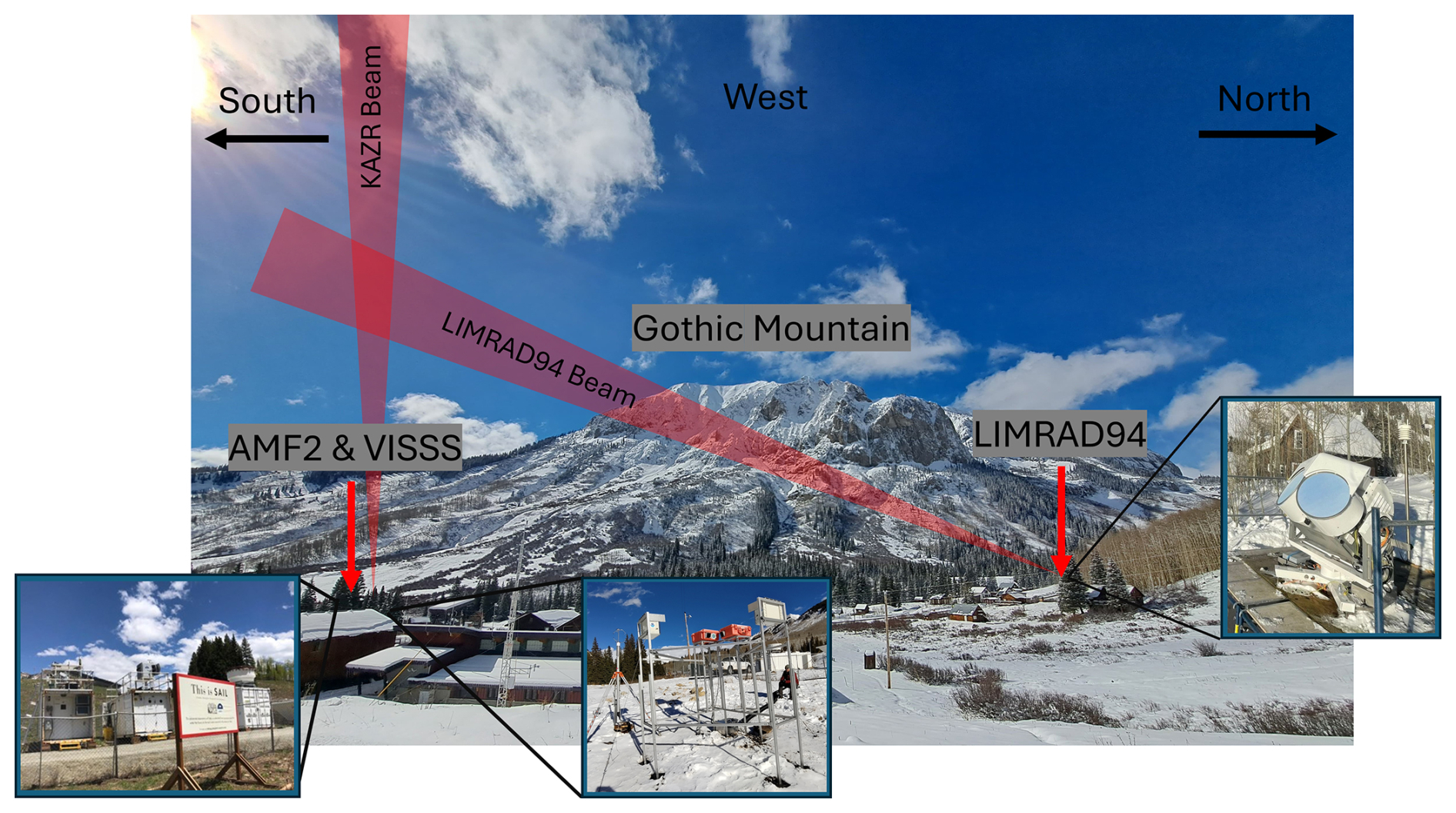
Figure 1The primary measurement site (Gothic, Colorado) during the second winter of the SAIL campaign 2022/23, where the CORSIPP project was conducted.
2.1.2 Polarimetric radar data
LIMRAD94 has the capability to measure spectral polarimetric variables such as differential phase shift and differential reflectivity, among others. The polarimetric calibration for LIMRAD94 was conducted at the onset of the field campaign, coinciding with a period of vertically oriented measurements as outlined in Myagkov et al. (2016).
The differential phase shift ΦDP (°) consists of a backscatter and a propagational part, where the propagational part is called specific differential phase KDP (° km−1). We calculated KDP from ΦDP using a convolution with low-noise Lanczos differentiators with a window length of 23 gates. This method is implemented in the python package wradlib (Heistermann et al., 2013).
Backscatter differential phase (δ) is caused by hydrometeors large enough relative to the radar wavelength such that the scattering is in the non-Rayleigh regime (Trömel et al., 2013). δ was found to be negligible for frozen hydrometeors in the S, C, and X-bands (Balakrishnan and Zrnic, 1990; Ryzhkov et al., 2011; Trömel et al., 2013). In the data of our W-band radar however, we find a contribution of δ, predominantly during cases with large graupel. Because removing the δ contribution from ΦDP is not easy to perform, we chose to omit radar data where δ is occurring. δ causes so called bumps, sudden increases in ΦDP followed by a decrease. This results in negative KDP values, which are therefore a good indicator for δ. We defined δ to be present if KDP in a radar range gate is below −0.5 ° km−1, Ze is higher than 0 dBZ and SNR is above 10 dB. We then removed all profiles where more than 10 range gates fulfilled the δ criterion. We acknowledge that the thresholds selected for the removal of δ are empirical and based on observations from instances where we noted the contribution of backscatter differential phase in our data. The method enables us to drop the majority of δ contaminated data, but the thresholds may not be directly applicable to other radar data. To the authors knowledge, there is currently no other literature available that addresses the removal of δ in snow at W-band. The approach described in Myagkov et al. (2020), which utilizes Doppler spectra in low turbulence conditions and was demonstrated during rain is not applicable in our case. It would be desirable for future publications to develop a solid method to remove the δ contribution from ΦDP in snow directly, before calculating KDP.
KDP depends on the shape, orientation, concentration, density and the size of hydrometeors. Elevated concentrations of dense ice particles that exhibit greater anisotropy in shape and possess uniform orientation result in increased values of KDP. It was furthermore shown by Kötsche et al. (2025) that up to 20 % of W-band KDP can be attributed to aggregates. Additionally, KDP is affected by turbulence due to its reliance on the width of the canting angle distribution (σ) as shown by Ryzhkov et al. (2002) and Ryzhkov and Zrnic (2019). As turbulence intensifies, the magnitude of σ increases, consequently leading to a reduction in KDP.
The differential reflectivity ZDR (dB) is commonly defined as the ratio between the radar reflectivity measured at horizontal polarization and at vertical polarization. At W-band, the largest contribution to elevated ZDR values in the ice phase typically comes from dense, anisotropic ice crystals that are small enough to be within the Rayleigh scattering regime, and often found on the slower side of the radar Doppler spectrum. Unlike KDP, ZDR is immune to the total concentration factor. Spherical and/or less dense particles result in a reduced ZDR. Since ZDR is reflectivity-weighted, its magnitude is often reduced by larger, spherical particles (e.g., Oue et al., 2018). To avoid this masking issue when using ZDR, we also determine the maximum spectral ZDR value () for each Doppler spectrum. Similar to KDP, overall ZDR values are reduced by turbulence through an increased width of the canting angle distribution. is furthermore reduced by broadening of the Doppler spectrum caused by turbulence. More detailed descriptions of these polarimetric variables and the influence of turbulence on them can be found in Kötsche et al. (2025).
2.2 VISSS
The first generation VISSS was installed next to the AMF2 facility, in the line of sight of LIMRAD94 with a horizontal distance to LIMRAD94 of approximately 550 m (Fig. 1). VISSS1 has a pixel resolution of 58.832 µm px−1, a frame rate of 140 Hz, and an observation volume of 75.2 × 75.2 × 60.1 mm3 (Maahn et al., 2024b). This yields an observational volume of 0.000339 m3. VISSS level2match variables (see Fig. 2 in Maahn et al., 2024b) used in this study include particle size distributions (PSD), D32, complexity, and total number concentration (Ntot). D32 is the ratio of the third to the second measured PSD moment. Assuming that particle mass is proportional to the particle maximum dimension squared, D32 is a proxy for the mass-weighted mean diameter of the particle population (Maahn et al., 2015). Following Schmitt and Heymsfield (2014), the complexity c is derived from the ratio of the particle perimeter p to the perimeter of a circle with the same area A:
The complexity can be used to distinguish between ice particle habits as for example demonstrated in Garrett and Yuter (2014).
2.3 Additional data products
Vertical temperature profiles on site are provided by the ARM interpolated sonde and gridded sonde value added product (Fairless et al., 2021). For the processing, ARM uses sounding data collected on site through two radiosonde launches per day (11:00 and 23:00 UTC). They then transform the data into continuous daily files with 1 min time resolution and combined with ARM 3-channel microwave radiometer precipitable water vapor data. Data from the high resolution spectral lidar (HSRL) installed at AMF2 (Goldsmith, 2016) was used to detect SLW. Particle number concentrations for the whole SAIL campaign period were measured by the ARM Laser Distrometer (Bartholomew, 2020), an OTT Parsivel2 (from now on referred to as Parsivel2). The cloud base height was retrieved by the ARM ceilometer (Morris, 2016). Rime mass fraction M was calculated using VISSS particle size distributions (PSD) and LIMRAD94 Ze with the approach of Maherndl et al. (2024, 2025).
2.4 Liquid layer detection
A liquid layer was detected when the HRSL attenuated backscatter coefficient at 1064 nm exceeded m−1 sr−1 and the linear depolarization ratio was <0.05, as the depolarization of water droplets should be close to 0 according to Vaisala (2021). The lidar data was filtered using a signal to noise ratio threshold of 10 dB. In the following, we use LLB to refer to the liquid-containing layer base height. We acknowledge that the LLB will generally be consistent with the ceilometer-derived cloud base height, since both instruments detect liquid layers as proxies for cloud base. Nevertheless, retrieving the LLB directly from HSRL adds value: it provides an independent product for cross-validation with the ceilometer, and it allows cloud-base detection to be performed using only the HSRL data set. This ensures consistency for studies that rely exclusively on HSRL observations.
2.5 Turbulence eddy dissipation rate retrieval (EDR)
As a proxy for atmospheric turbulence, the eddy dissipation rate EDR quantifies the rate at which turbulent kinetic energy is lost to viscous forces (Foken and Mauder, 2024). Elevated EDR values are associated with more intense turbulence. In this study, EDR was estimated from mean Doppler velocity (MDV) measurements obtained by KAZR, aggregated over five-minute intervals following the method outlined in Vogl et al. (2024). The original approach of the EDR calculation is based on Borque et al. (2016). To isolate regions of significant turbulence, we applied an empirical threshold of 10−3 m2 s−3, consistent with the criterion used by Vogl et al. (2022). It is important to note that during the CORSIPP campaign, the radar beams of KAZR and LIMRAD94 were not perfectly aligned (Fig. 2). As a result, the volumes from which KAZR-EDR and LIMRAD94 measurements were collected are horizontally offset, with the separation increasing with altitude (580 m horizontal distance at Gothic Mountain summit height).
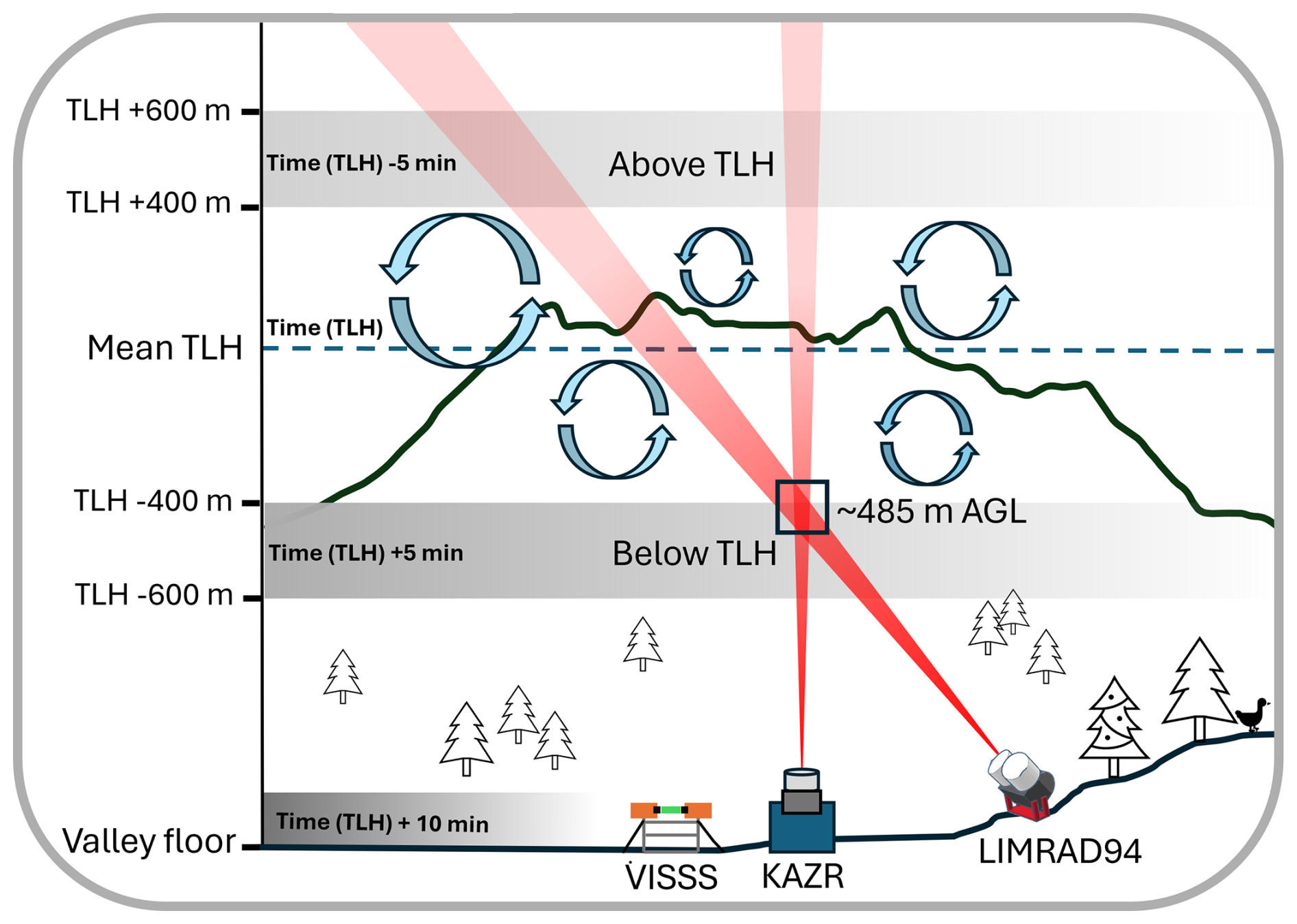
Figure 2Methodology to analyze microphysical processes inside the turbulent layer described in Sect. 2.6.2. Shown is a schematic of the measurement site including LIMRAD94, KAZR, VISSS and their measurement volumes. Blue arrows indicate turbulence which most frequently occurs around the summit height of Gothic Mountain (black line in the background). The dashed blue line indicates the mean turbulent layer height. Grey areas above TLH and below TLH mark the area in which radar data are averaged to avoid contamination of the measurement volume by turbulence.
2.6 The turbulent layer
Due to the orography surrounding the measurement site, we observed a distinct layer of enhanced turbulence, predominantly at and below 1000 m above ground level (a.g.l.) and during south westerly to north westerly wind directions (details shown in Sect. 3.1). Gothic Mountain, a cone-shaped mountain located just west of the measurement site (see Fig. B1), is suspected to be the primary driver for the formation of this turbulent layer. To illustrate this, we will present an exemplary case study on 6 December 2022 where the formation mechanism of the turbulent layer is visible. This case study was previously described in Kötsche et al. (2025).
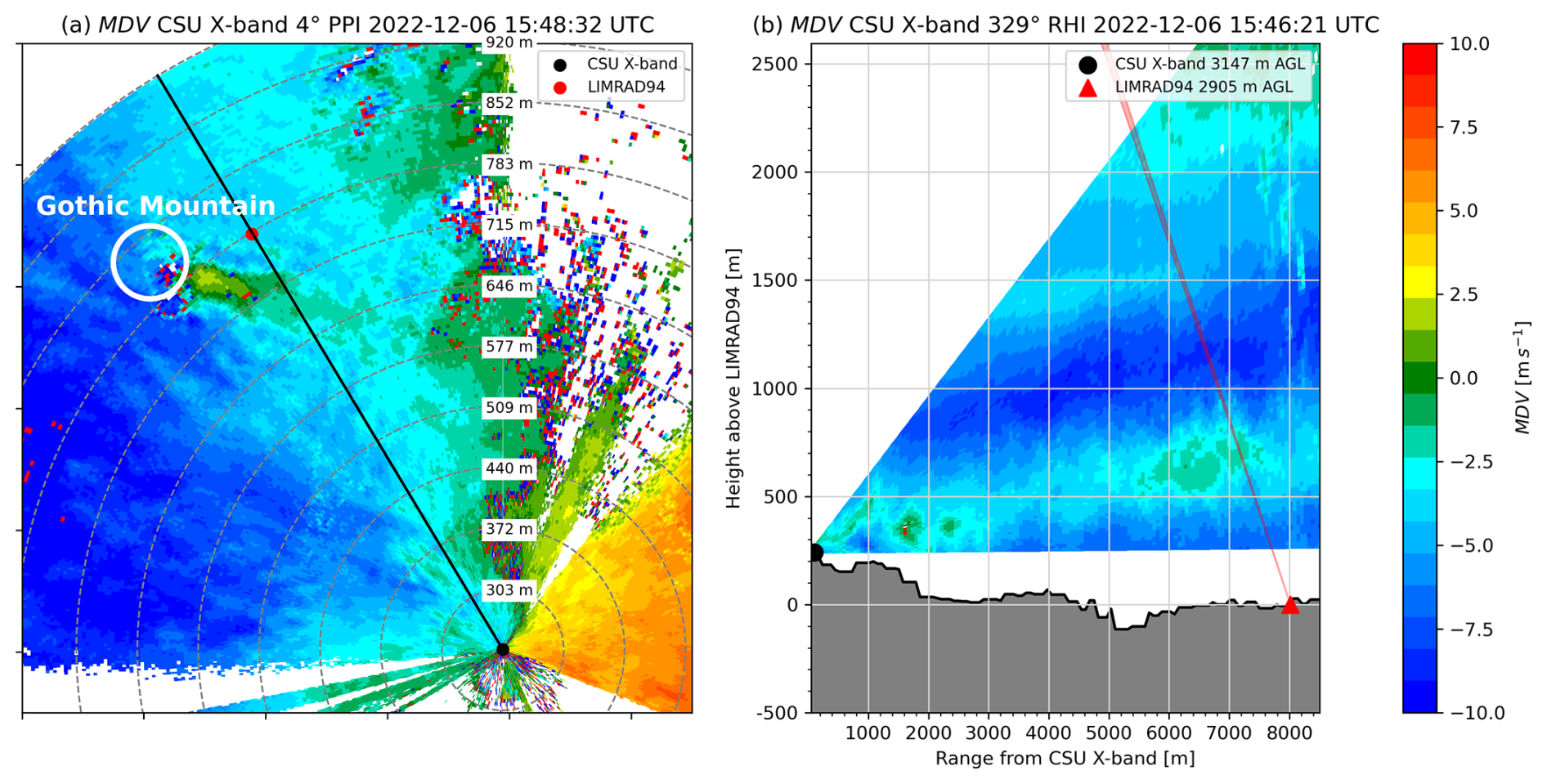
Figure 3This figure was already presented in our previous study (Kötsche et al., 2025), we show it again to visualize the turbulent layer formation behind Gothic Mountain. (a) Mean Doppler velocity (i.e., the approximate radial component of the horizontal wind) from the CSU X-band PPI scan at a 4° elevation angle, showing the position of Gothic Mountain (white circle) and the RHI scan direction at an azimuth of 329° (black line) at 15:48:32 UTC on 6 December 2022. The map is displayed in a north-up orientation, with north at the top of the figure. Grey dashed circles mark every 1000 m in range from the CSU X-band. The labels indicate the corresponding heights of the CSU X-band radar beam above LIMRAD94. (b) Mean Doppler velocity from the CSU X-band RHI scan (azimuth 329°) at 15:46:21 UTC on 6 December 2022, with the LIMRAD94 beam direction shown in red. Grey shading represents the terrain elevation profile.
Figure 3 shows the MDV of CSU X-band from a PPI (panel a) and a RHI (panel b) scan at around 15:48 and 15:46 UTC, respectively. During that time, EDR indicates enhanced turbulence between 500 and 1200 m above LIMRAD94, with the mean EDR weighted turbulent layer height of 900–950 m (Fig. 4). The MDV observed in the PPI scan can be interpreted as the radial component of the horizontal wind. Negative values (blue) in Fig. 3 represent motion toward the radar, while positive values (yellow–red) indicate motion away from it. Although parts of the PPI are blocked by surrounding mountains, a prevailing westerly flow is evident from the blue shading west of the CSU X-band and the orange–red shading to the east. Where MDV approaches zero, the wind direction is nearly perpendicular to the radar beam. Downstream of Gothic Mountain, at approximately 700–800 m above LIMRAD94, a narrow band is observed in which MDV exhibits an abrupt transition to positive values, contrasting sharply with the surrounding negative values. This pattern indicates that, in the lee of Gothic Mountain, the wind veers toward a more southerly direction, though this effect weakens rapidly further downstream.
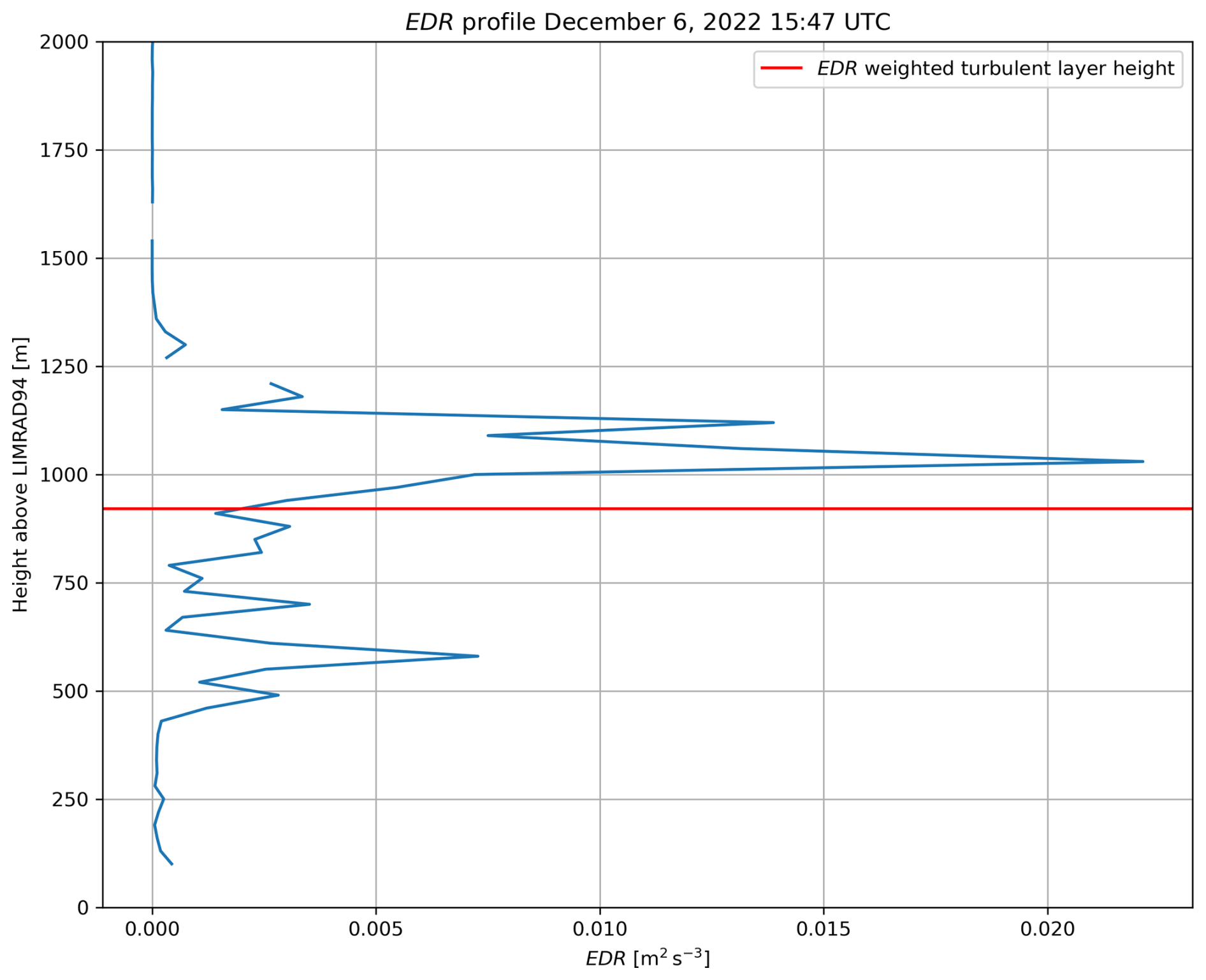
In the RHI scan (Fig. 3b), this southerly component is expressed as a region with predominantly green colors at ranges of 6000–7000 m from the CSU X-band and altitudes of 500–900 m above LIMRAD94. This disturbance is likely associated with a counterflow behind Gothic Mountain, suggesting blocked low-level flow, similar to the situations discussed in Ramelli et al. (2021). Enhanced wind shear is found along the upper and lower boundaries of this counterflow, likely producing the turbulence identified by EDR in Fig. 4. The two peaks in EDR are well collocated with the upper and lower edges of the counterflow. The LIMRAD94 beam is depicted as a red cone in Fig. 3b), clearly showing that LIMRAD94 measurements are influenced by this turbulence.
This wind pattern is frequently observed behind Gothic Mountain, although the location of the counterflow and hence the height of the turbulent layer depends on the wind direction (see Fig. 7). We argue that Gothic Mountain serves as the primary driver of the frequently observed turbulent layer, predominantly located around the summit elevation of Gothic Mountain.
2.6.1 Turbulent layer detection
The turbulent layer height (TLH) was detected using EDR (described in Sect. 2.5). Specifically, we use the vertical profile of EDR and calculate the mean EDR weighted TLH as follows:
where h is the height. This methodology is similar to the calculation of the mean Doppler velocity, a widely applied technique in radar meteorology. Our aim is to determine the representative height of the center of the turbulent layer, acknowledging that such layers often span several hundred meters in the vertical. Vertical EDR profiles frequently exhibit multiple local maxima, therefore peak-finding algorithms can introduce substantial uncertainty. Also, the absolute maximum EDR value does not necessarily coincide with the layer center. Using a mean EDR weighted TLH therefore provides a more reliable estimate by accounting for the vertical distribution of EDR rather than relying on isolated peaks (see Fig. 4). As we are interested in the turbulence directly induced by orography, we only include EDR data from up to 3100 m a.g.l. for our calculations. Because EDR requires MDV measurements from KAZR, TLH is detectable with our approach only if KAZR can measure sufficient tracers like cloud droplets, ice particles or precipitation.
2.6.2 Deriving microphysical processes inside the turbulent layer
To analyze microphysical processes within the turbulent layer, we are comparing KAZR and LIMRAD94 data above and below the turbulent layer rather than using data directly influenced by turbulence. Data between 1 December 2022 and 7 February 2023 was used for the analyses because of the continuously available constant elevation measurements of LIMRAD94 and frequent precipitation cases during that time period. A schematic of the methodology is shown in Fig. 2.
The radar data of KAZR and LIMRAD94 is first filtered using a signal to noise ratio threshold of 10 dB and resampled into 5 min mean intervals, matching the temporal resolution of EDR. In KAZR data, Ze is already corrected for gaseous attenuation (Johnson et al., 2023).
Data from range gates where the nearest EDR measurement exceeded the above mentioned turbulence threshold of 10−3 m2 s−3 are excluded from the analysis. Subsequently, range gates located between 400 and 600 m both above and below the TLH are identified, and the mean value of the data within these specific range gates is computed. This calculation is conducted solely when the TLH attains a minimum of 600 m a.g.l. The distances from the turbulent layer are based on empirical observations of the vertical extent of the turbulent layer. Afterwards, for each timestep where a turbulent layer is identified, the method computes the difference between radar observations below the TLH at the timestep T(TLH) +5 min and those above the TLH from 5 min prior at T(TLH) −5 min. The empirical time lag of 5 min (per 500 m vertical distance) is introduced to compensate for the fall velocity of hydrometeors. To complement the radar data, collocated VISSS data are selected at T(TLH) +10 min to provide additional context on the microphysical properties of the PSD. A time lag of T(TLH) +10 min is chosen because we have to take into account the time in which the particles sediment from the radar range gates below the turbulent layer to the surface. The result of this analysis is shown and discussed in Sect. 3.2.
We acknowledge that this method relies on the assumption of horizontal and temporal homogeneity of precipitation, particularly important in the case of slanted radar measurements. The prevailing wind direction during precipitation is mostly west, while LIMRAD94 is oriented toward the southeast. As a result, it is clear that we do not observe the exact same hydrometeors throughout their descent. Additionally, the horizontal distance between corresponding range gates of LIMRAD94 and KAZR increases with altitude. At summit height of Gothic Mountain, the horizontal distance between the range gate centers of LIMRAD94 and KAZR is about 580 m. The instruments also have different half-power beam widths, leading to different measurement volumes. These factors further necessitate the assumption of horizontal homogeneity and the use of temporal averaging. However, near the surface and below the turbulent layer, the measurement volumes of both radars are more closely aligned. The vertical distance from the measured volume below TLH to VISSS is approximately 500 m (assuming a mean TLH of around 1000 m a.g.l.). Since the most significant changes in precipitation are expected within the turbulent layer, any resulting inhomogeneities in snow properties most likely occur below it, where LIMRAD94 and KAZR measurement volumes are closely aligned. We therefore argue that the combined dataset remains highly informative and suitable for the intended analysis.
We are furthermore aware that ice nucleation through ice nucleating particles (INP) may constantly occur inside the turbulent layer in parallel to SIP and thereby adulterate the analysis. However, a recent study of Zhou et al. (2026) on the INP concentrations during the SAIL campaign found the INP concentrations during the cold season to be 10−2 L−1 or less at temperatures of −15 °C or warmer, which is the primary temperature region we find the turbulent layer in during our analysis. Therefore, the impact of primary ice nucleation on the total number concentration can assumed to be small. In case of precipitation from a shallow cloud layer, where the turbulent layer is close to the cloud top, the effect of primary ice nucleation may be more significant. However, these cases almost never end up in the statistic because no data will be present above the turbulent layer. The few cases that would have been included in the statistic were removed. These cases were identified using KAZR Ze, the criterion for precipitation from a shallow cloud layer was fulfilled if KAZR Ze between 500 m and 1.5 km above Gothic Mountain summit height did not exceed −10 dBZ.
In the following Section, we present a statistical analysis of the turbulent layer, as well as cloud base height (CBH) and liquid layer base height (LLB) during the whole time frame of the SAIL campaign. Furthermore, we discuss the fingerprints of microphysical processes in the turbulent layer using KAZR and LIMRAD94.
3.1 Characterization, occurrence and position of the turbulent layer
For the whole duration of the SAIL campaign, KAZR and HRSL lidar data from Gothic and hence EDR, CBH, LLB and TLH are available. In Fig. 5, a statistic of TLH, LLB and CBH between September 2021 and May 2023 is shown. In total, 63 940 time stamps (5 min resolution) are included in the statistic. In panel (a), the height difference between LLB,TLH and CBH,TLH is plotted (if a turbulent layer was detected). In ∼ 65 % of the cases included in the statistic, the difference is less then 1000 m, showing a close collocation of LLB, CBH and TLH. Panel (b) illustrates the frequency of CBH, LLB, and TLH during the same period, yet considered separately from one another (LLB and CBH also included if no TLH was present). TLH occurs most frequently just below the summit height of Gothic Mountain at around 800–900 m a.g.l. This and the collocation of LLB and CBH shown in panel (a) suggests that the turbulent layer plays a major role in cloud formation, possibly through enhanced moisture convergence in the lee of Gothic Mountain. It also implies that the turbulent layer aids the formation of a SLW layer as it was already shown in Houze (2012), Medina and Houze (2015), and Ramelli et al. (2021). The LLB/CBH were often occuring a few hundred meters above TLH, this may arise from the fact that we look at the base of the liquid-containing layer vs the mean TLH while the turbulent layer has a vertical extent of a few hundred meters. Liquid water drops, due to their low mass, are most likely found at the top of the turbulent layer as their are being lofted by the turbulent updrafts (Zhu et al., 2023). The position of TLH, CBH and LLB in the shorter time period in which we analyse LIMRAD94 data from December 2022 to February 2023 did not differ greatly.
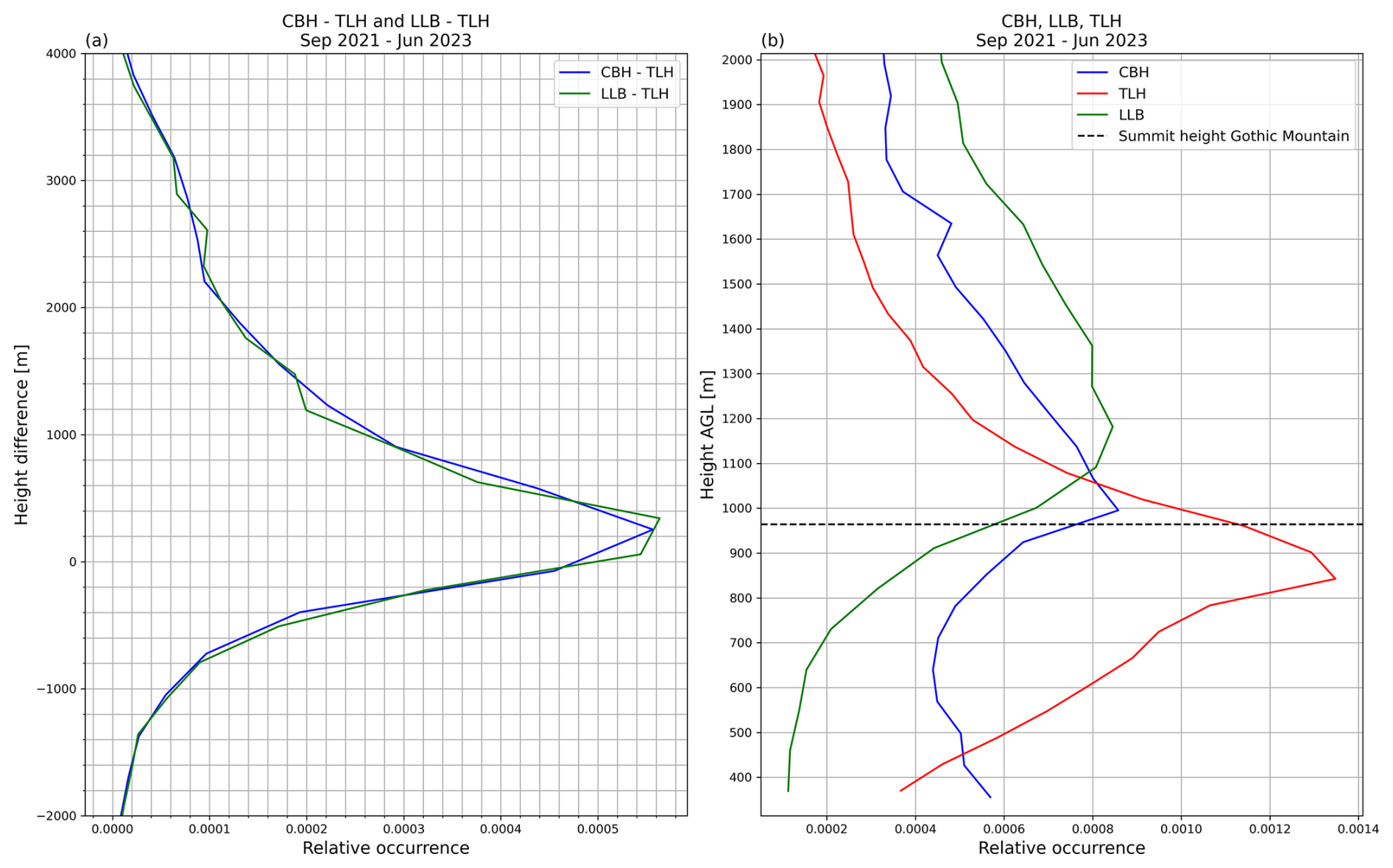
Figure 5(a) Statistic of difference between CBH and TLH (blue line) and the difference between LLB and TLH (green line) for the duration of the SAIL campaign from September 2021 to end of May 2023. (b) Statistic of turbulent layer height detected as described in Sect. 2.6.1 (red line), ceilometer cloud base (blue line), liquid layer base height (green line) for the duration of the SAIL campaign from September 2021 to end of May 2023. The black dashed line marks the Gothic Mountain summit height.
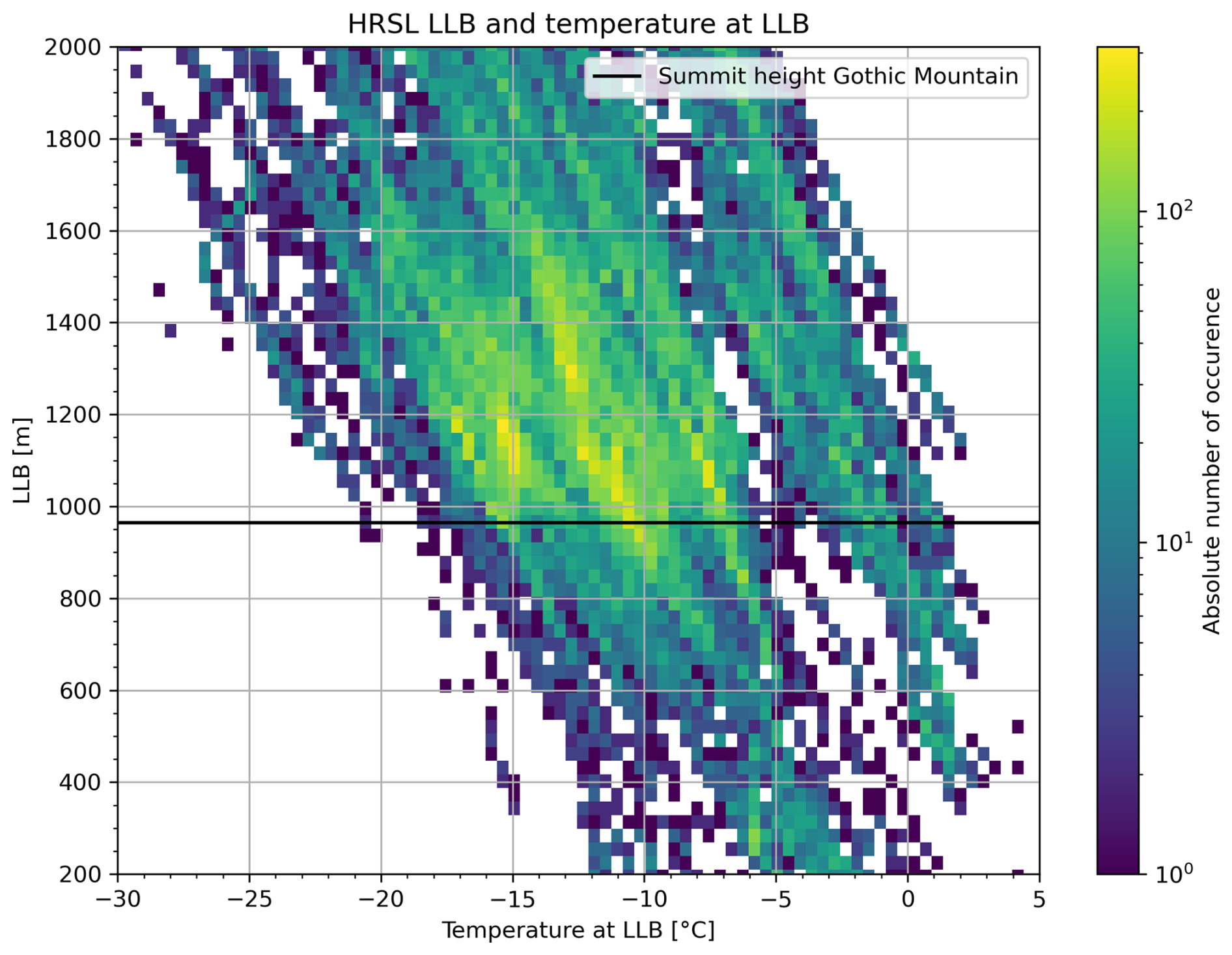
Figure 62D histogram of LLB height for the duration of the SAIL campaign from September 2021 to end of May 2023 derived from HRSL measurements, and the respective temperature at LLB height. The black solid line marks the Gothic Mountain summit height.
In Fig. 6 the HRSL LLB is plotted against the temperature at LLB height. The figure shows that cloud liquid is frequently found at heights between 900 and 1600 m a.g.l. with the maximum frequency of occurrence mostly in the vicinity of Gothic Mountain Summit and temperatures between −20 and −5 °C, theoretically allowing for riming even at temperatures down to −20 °C.
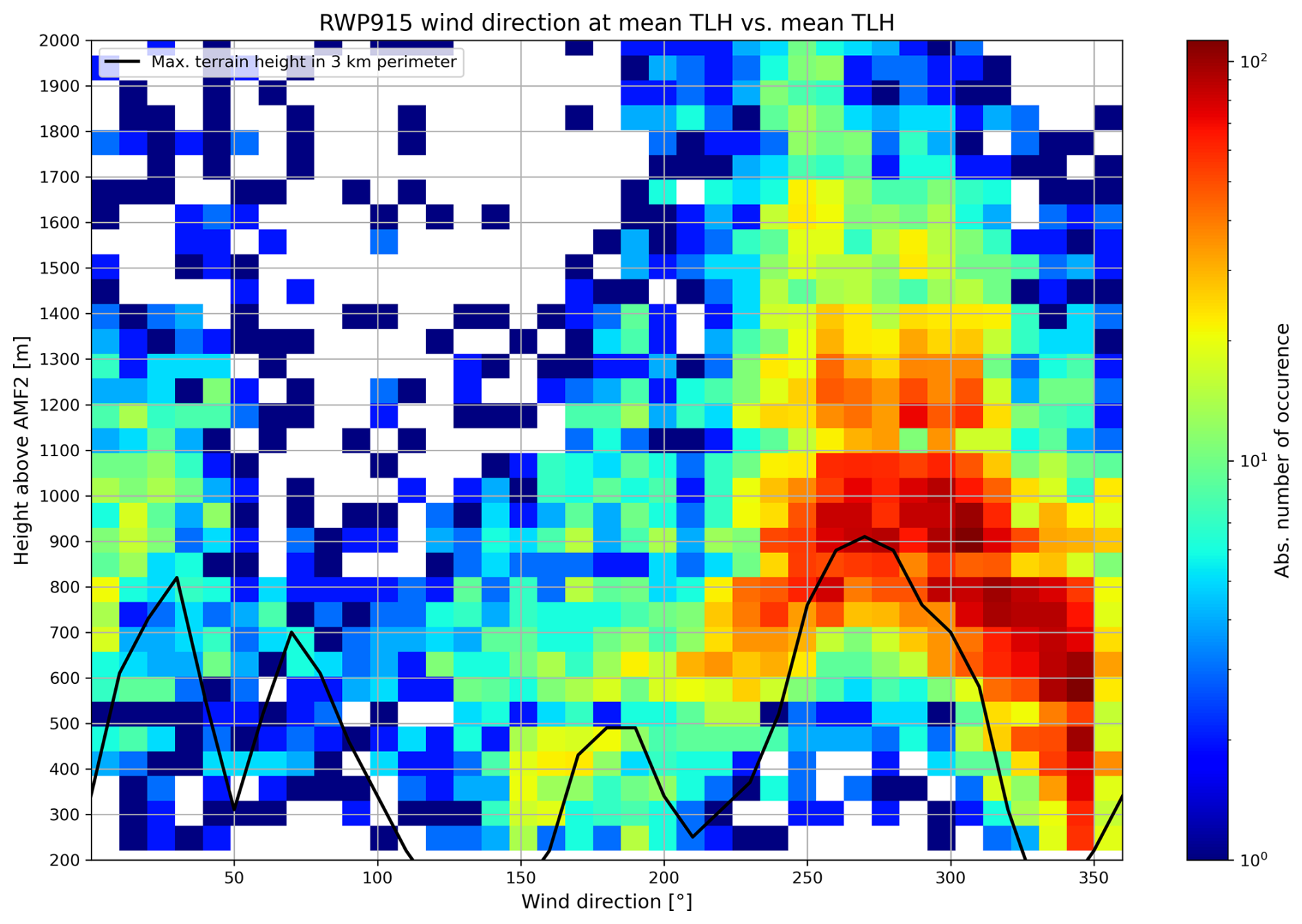
Figure 7Absolute number of occurrence of TLH (retrieved as described in Sect. 2.6.1) plotted as a function of the wind direction at TLH (measured by the RWP915 between December 2022 and May 2023). The black line is the max. terrain height in a 3 km perimeter around AMF2 at the respective azimuth direction.
Due to the availability of the wind profiler RWP915 between December 2022 and May 2023, we can relate TLH to the wind direction in this period. It is important to notice that RWP915 data is only available during precipitation when hydrometeors serve as tracers for the wind direction. Wind during this time was strongly dominated by south, west and north wind, especially during significant precipitation events. The position of the measurement site in the East River valley introduces a complex terrain, strongly varying with azimuth direction (see Fig. B1 for a map of the local topography). To link the occurrence of turbulence to the surrounding orography we combined the TLH with the wind direction at TLH retrieved by RWP915 and the max. terrain height in a 3 km perimeter around the measurement site (see Fig. 7). The highest mountain close to the measurement site is Gothic Mountain, visible as a peak in orographic height between an azimuth of 240–310°. The occurrence of TLH closely resembles the shape of Gothic Mountain. At wind directions of 240–300°, the turbulent layer is located at summit height of Gothic Mountain or a few hundred meters above, likely forming along the edges of the counterflow behind Gothic Mountain as shown in Sect. 2.6. Slight changes in the wind direction to more southerly or northerly directions causes the TLH to decrease and the turbulence seems to be created along the flanks of Gothic Mountain. During southerly wind directions, a turbulent layer is created by Snodgrass Mountain which is a second, smaller summit south of the measurement site at an azimuth of 150–200°. During periods with northerly wind directions, the wind blows down the East River valley rather undisturbed and the turbulent layer appears anywhere between almost surface level and 1000 m a.g.l. Either the turbulence is formed along the flanks of Gothic Mountain and Avery Peak to the NE (0–50° azimuth), or the flow is still influenced by Mt. Bellview, a summit located 7 km to the NNW of Gothic. A turbulent layer is only rarely detected during wind directions between 50 and 150°, simply because these wind directions are uncommon during precipitation events in that region.
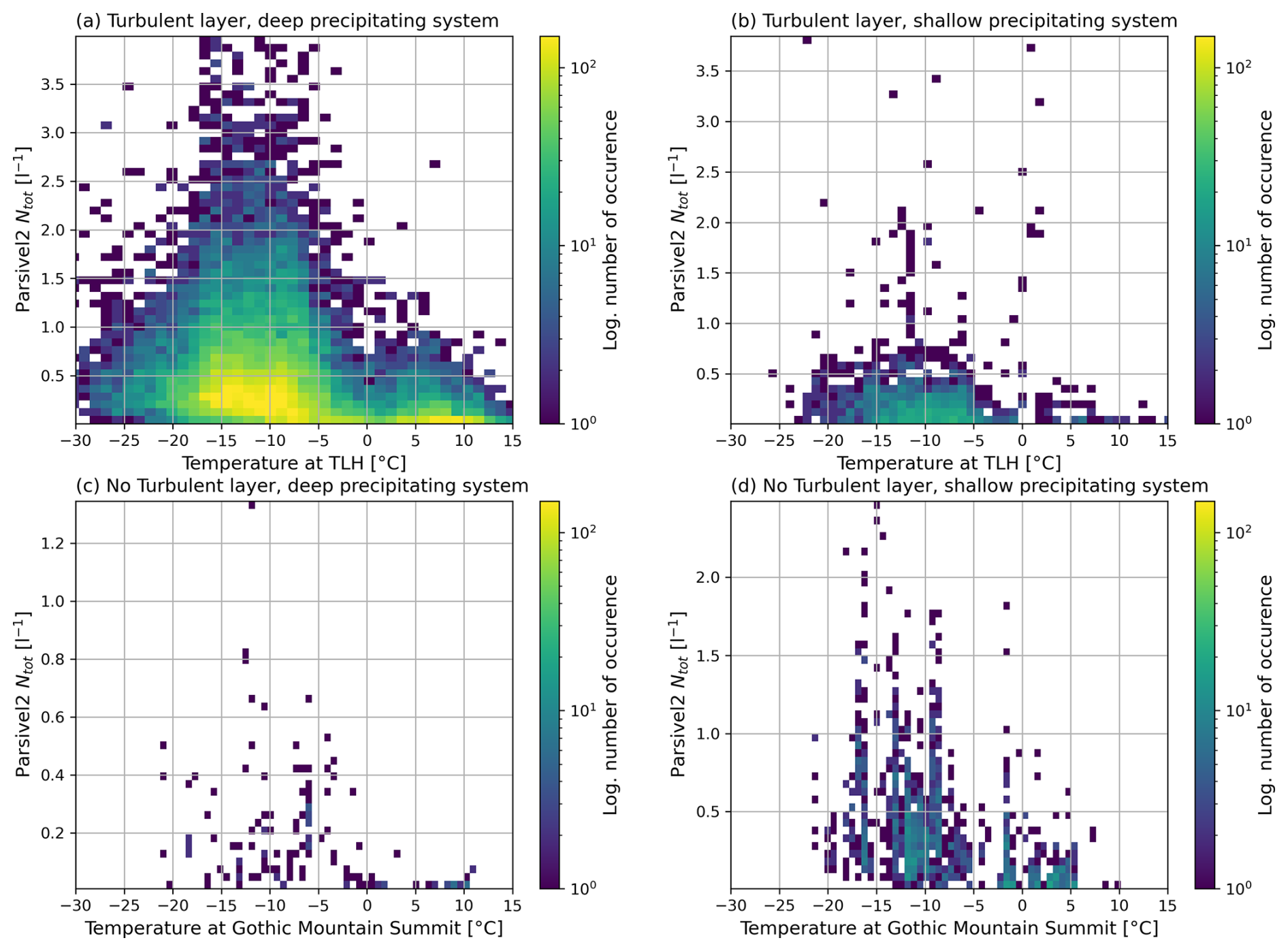
Figure 8Temperature at TLH plotted as function of the Parsivel2 Ntot for different synoptic configurations. Data from September 2021 to June 2023 was analyzed. (a) A turbulent layer is present, KAZR Ze between 500 m and 1.5 km above Gothic Mountain summit height exceeds −10 dBZ. (b) A turbulent layer is present, KAZR Ze between 500 m and 1.5 km above Gothic Mountain summit height does not exceed −10 dBZ. (c) No turbulent layer is present, KAZR Ze between 500 m and 1.5 km above Gothic Mountain summit height exceeds −10 dBZ. (d) No turbulent layer is present, KAZR Ze between 500 m and 1.5 km above Gothic Mountain summit height does not exceed −10 dBZ.
Figure 8 shows temperature at TLH plotted against the total number of hydrometeors (Ntot) observed by the Parsivel2 at the surface for different synoptic configurations. Specifically, deep and shallow precipitating systems that either do or do not contain a turbulence layer are contrasted. If no turbulent layer was present, the temperature at Gothic Mountain summit height was used. Events where precipitation was detected without a turbulent layer are rare in the analyzed time span (panels c and d), highlighting the crucial role of turbulence in orographic precipitation, as it often accompanies precipitation, even if not directly causing it. The majority of precipitation events stem from deeper precipitation systems and a turbulent layer somewhere between −5 and −15 °C (panel a). The highest Ntot is also found in this temperature region. At temperatures between −10 and −20 °C, the turbulent layer is in an especially favorable temperature regime for precipitation formation via the WBF, as liquid water formed through updrafts can quickly transition into the ice phase. Furthermore, Takahashi et al. (1995) found that ice-ice collisions produce the highest number of splinters between −10 and −20 °C. The presence of SLW in this temperature region (see Fig. 6) may further enhance depositional growth and also riming, and SIP processes enhanced by turbulence may aid the formation of new particles, which we will discuss in detail in Sect. 3.2. Most interestingly, precipitation is also detected in the presence of a turbulent layer when only a shallow precipitating system is present. Such precipitation is most common at a temperature at TLH between −5 and −20 °C, but features much lower Ntot than deep precipitating systems. Precipitation originating from these shallow clouds may be entirely induced or at least augmented by orographic turbulence; however, definitive evidence remains elusive. Panel (d) for example shows that precipitation may fall from shallow precipitating systems without the presence of turbulence. We can provide some eye witness reports of these clouds, as during the installation of our instruments in Gothic, we had the chance to observe shallow precipitating clouds forming behind Gothic Mountain (see Fig. A1 in Appendix A).
3.2 Fingerprints of microphysical processes in the turbulent layer
In this section, we focus on the microphysical processes inside the turbulent layer and the fingerprints they leave in polarimetric cloud radar data. As mentioned, the problem is that radar observations inside the turbulent layer are masked by the turbulence itself (see Sect. 2.1.2). So instead of looking at radar data inside the turbulent layer, we compare radar variables above and below the turbulent layer and therefrom draw conclusions on microphysical processes inside the turbulent layer (Sect. 2.6.2). We specifically analyze four variables: KAZR Ze, KAZR MDV, LIMRAD94 KDP and LIMRAD94 , in a period LIMRAD94 was measuring at constant elevation of 40° from December 2022 to February 2023. MDV is defined negative upward.
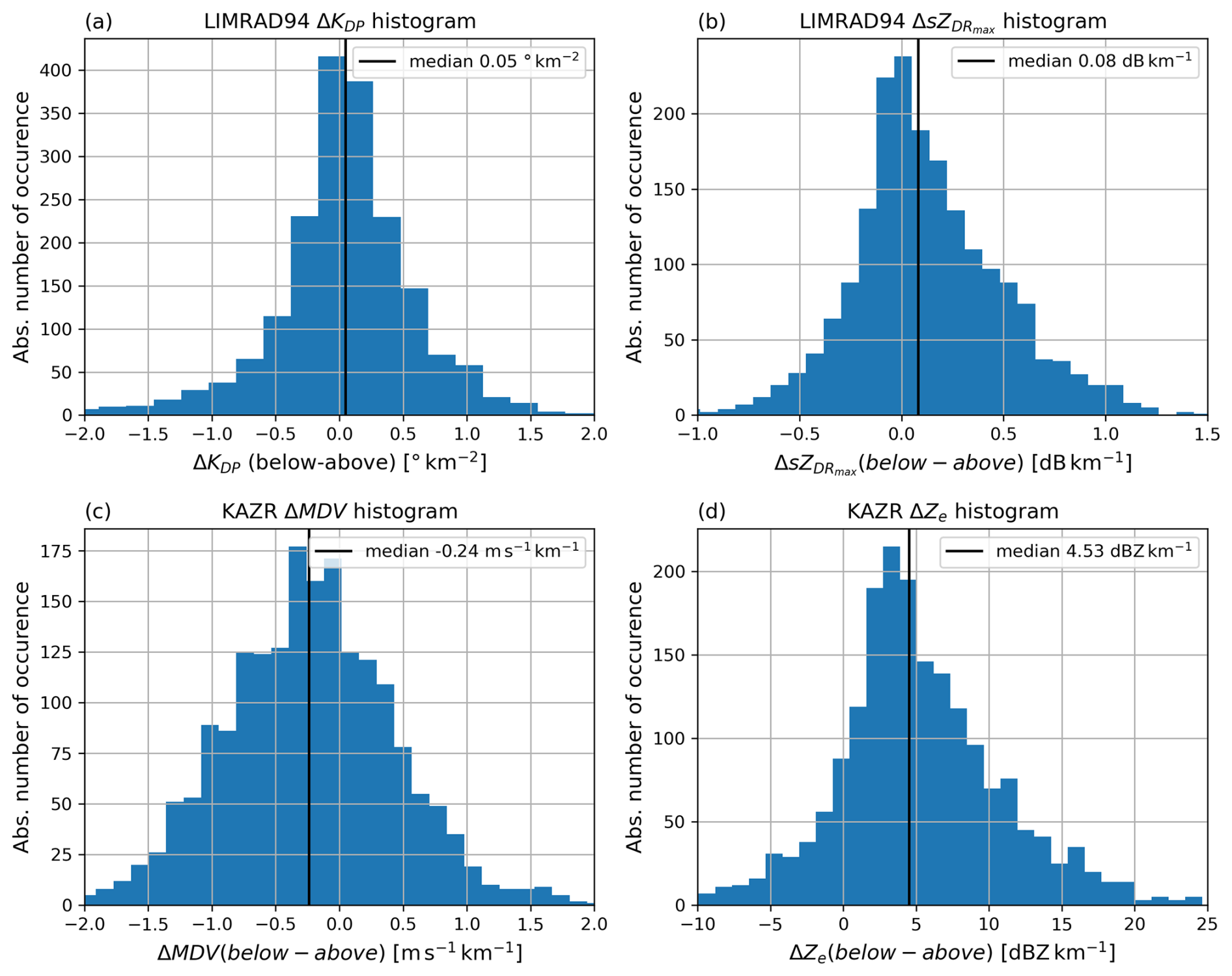
Figure 9Histograms showing the difference of radar variables above-below the turbulent. (a) LIMRAD94 ΔKDP, (b) , (c) ΔMDV, (d) KAZR ΔZe.
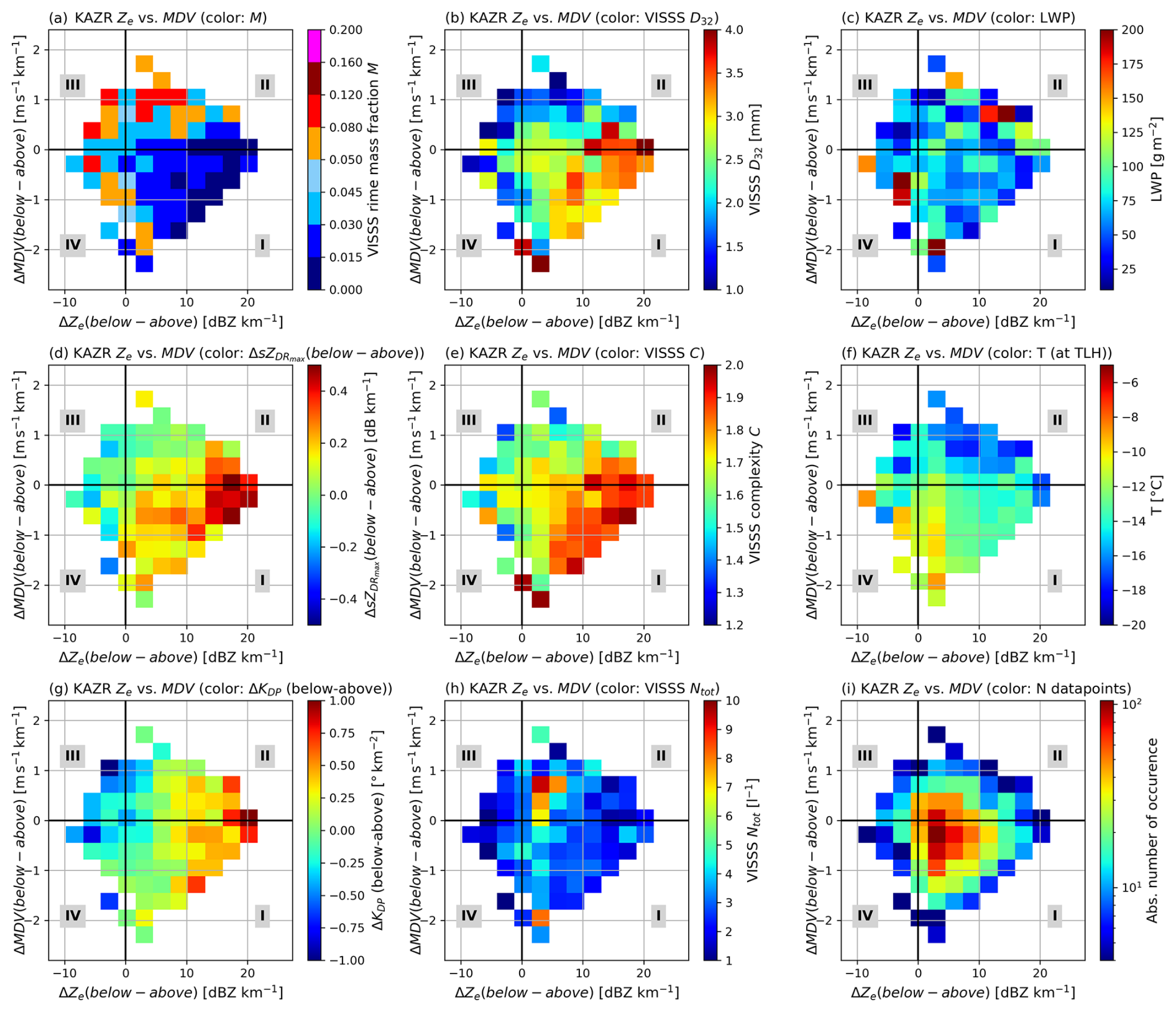
Figure 102D histograms showing the difference of radar variables below – above the turbulent layer, the color of each square represents the mean of a third variable. Each square contains at least 4 datapoints. MDV is defined negative upward. All panels divide the x-axis and y-axis into quadrants (I–IV). (a) KAZR ΔZe vs. ΔMDV, color: VISSS M, (b) KAZR ΔZe vs. ΔMDV, color: VISSS D32, (c) KAZR ΔZe vs. ΔMDV, color: , (d) KAZR ΔZe vs. ΔMDV, color: VISSS C, (e) KAZR ΔZe vs. ΔMDV, color: LIMRAD94 ΔKDP, (f) KAZR ΔZe vs. ΔMDV, color: VISSS Ntot
The histograms of the absolute change from above to below the turbulent layer are shown in Fig. 9. Negative/positive values indicate a decrease/increase of the respective variable within the turbulent layer, respectively. The change in KDP (panel a) follows a near perfect Gaussian distribution centered around 0° km−1. (panel b) reveals a tendency towards an increase below the turbulent layer, which gives a first hint on possible SIP mechanisms as increases when non-spherical ice particles are present. Below a turbulent layer, these ice particles might be splinters produced during ice collisional fragmentation. MDV (panel c) also shows a tendency to decrease below the turbulent layer, which means the particles velocity decreases inside the turbulent layer. This might be connected to the formation of a second, slower falling particle mode within the turbulent layer consisting of splinters, while the cases with increasing MDV point to the formation of rimed particles. Ze (panel d) mostly increases inside the turbulent layer, which might be explained by increasing particle diameters inside the turbulent layer or also increased density (e.g. caused by riming) or increased number concentration of particles. It is apparent that we need to exploit the full polarimetric capacity of LIMRAD94 in combination with in-situ measurements by the VISSS to fully understand the microphysical processes inside the turbulent layer.
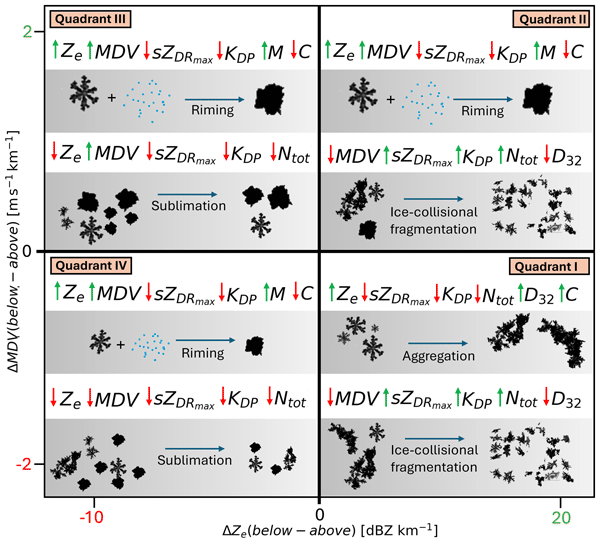
For that purpose, Fig. 10 illustrates a blend of various radar and VISSS variables, where radar variables are again represented as the difference between measurements above and below the turbulent layer. Surface-based VISSS variables assist in the classification of particle population characteristics. The plots are designed as 2D histograms between KAZR ΔMDV and ΔZe, while the color of each square represents the mean of a third variable that supplements the plot. Each panel domain is divided into four quadrants (Q) labeled I to IV. The absolute number of data points in each statistic is shown in panel (i).
Quadrant I
Quadrant I within each sub-panel comprises data points characterized by an increase in Ze within the turbulent layer combined with a decrease in MDV (slower particle descent below the TLH compared to above it). This combination is the most common during the analyzed period as evidenced in panel (i), where the total number of data points is shown.
In panel (a), KAZR ΔMDV (below-above) is plotted against KAZR ΔZe (below-above) with the retrieved rime mass fraction M as color code. Quadrant I shows that an increase of Ze in combination with a decrease of MDV (which means particles fall slower) below the turbulent layer can be attributed to mostly unrimed particles. A decrease in MDV which is accompanied by a Ze increase of less than 5 dBZ km−1 can generally be found in PSDs containing slightly rimed particles (light blue colors). In panel (b.I), the same radar variables are displayed together with VISSS D32 as color. An increase in Ze in combination with a decrease of MDV is mostly linked to a D32 of 2.5 mm or higher. These situations are mostly found when also the mean complexity (panel e.I) is higher than 1.7. This points to the existence of aggregates, meaning the Ze increase in these cases is caused by the increase in the particle diameter (Ze∼D4, Moisseev et al., 2017) through aggregation in the turbulent layer. Towards the lower Ze increase on the left of quadrant I, mean D32 is mostly around 2.5 mm and also the complexity is slightly below 1.7. These ice particles appear to be slightly more rimed smaller aggregates that do not undergo major size increase inside the turbulent layer, which may indicate they are falling from aloft during deep precipitating systems. This is supported by the higher LWP visible in panel (c) on the left side of quadrant I. Temperatures towards the left of quadrant I are slightly higher (panel f), around or higher than −10 °C, indicating that this might be connected to deeper warm frontal precipitation.
Mean LWP in panel (c.I) ranges from under 50 g m−2 in the outer edges to about 100 g m−2 more towards the center and left of the plot. At the same time, the mean complexity (panel e.I) shows an inversely proportional behavior. This relation can be explained as follows: In deep frontal systems, especially along warm fronts, LWP might be increased which causes aggregates to be rimed, reducing their complexity. Contrarily, the lower the present LWP, the less riming can occur and hence the more complex the shapes of aggregates can be.
Panel (d.I) can be used to explain the decrease in particle fall velocity in combination with Ze increase: the same combination of Ze and MDV is combined here with (below-above). The most significant increase in (below-above) coincides with the strongest increase in Ze and moderate decrease in particle fall velocity, but in the entire quadrant I, (below-above) generally tends to increase. Aggregates do not produce high ZDR, therefore the increased (below-above) points to a second particle mode of smaller, anisotropic ice at the slow edge of the Doppler spectrum which is formed inside the turbulent layer and causes the particle population as a whole (represented by MDV) to fall slower. A logical explanation would be the breakup of aggregates inside the turbulent layer through ice collisional fragmentation. This hypothesis is further supported by panel (g.I), where LIMRAD94 ΔKDP was added as color. KDP in quadrant I is mostly increasing inside the turbulent layer, which indicates a higher number of non-spherical particles, consistent with the hypothesis above. A small fraction of the KDP increase might also be attributed to the presence of aggregates, as these can be responsible for up to 20 % of W-band KDP (Kötsche et al., 2025). In the left section of quadrant I, KDP typically exhibits minimal variation or might even slightly diminish within the turbulent layer. This is potentially due to negligible changes in particle concentration within the layer. The denser nature of rimed aggregates could reduce their likelihood of generating many splinters upon collision. As temperatures at TLH tend to be higher than −10 °C during this cases, the number of splinters per ice ice collision may further be reduced as shown in Takahashi et al. (1995). Particles rimed in the turbulent layer may also tend to become more spherical, resulting in a lower KDP.
The temperature at TLH is shown in panel (f), for the pixels identified as containing mainly aggregates, it is very homogeneous between −12 and −15 °C. This appears to be a temperature where we see efficient aggregation inside the turbulent layer. As this is also still the temperature regime of the dendritic growth layer, it is reasonable to believe that splinters formed by ice collisional fragmentation quickly grow into dendrites and then aggregate as well. Enhanced supersaturation inside the turbulent layer might further aid new particle growth through deposition as also proposed by Lee et al. (2014) or Aikins et al. (2016). We analyzed radiosonde profiles measured during cases included in this statistic, almost all of them indicated supersaturation with respect to ice in the turbulent layer (not shown).
Panel (h.I) displays VISSS Ntot as color. Ntot ranges between 1 and 5 L−1, which underlines that particle populations with many aggregates on average still contain a low number of particles because small, newly formed particles quickly aggregate as well. Ntot is slightly higher in the left of quadrant I, which combined with findings from the other panels, suggests deeper warm frontal precipitation with inherently higher Ntot.
The main suspected microphysical processes and their impact on VISSS and LIMRAD94 variables are shown in quadrant I of Fig. 11.
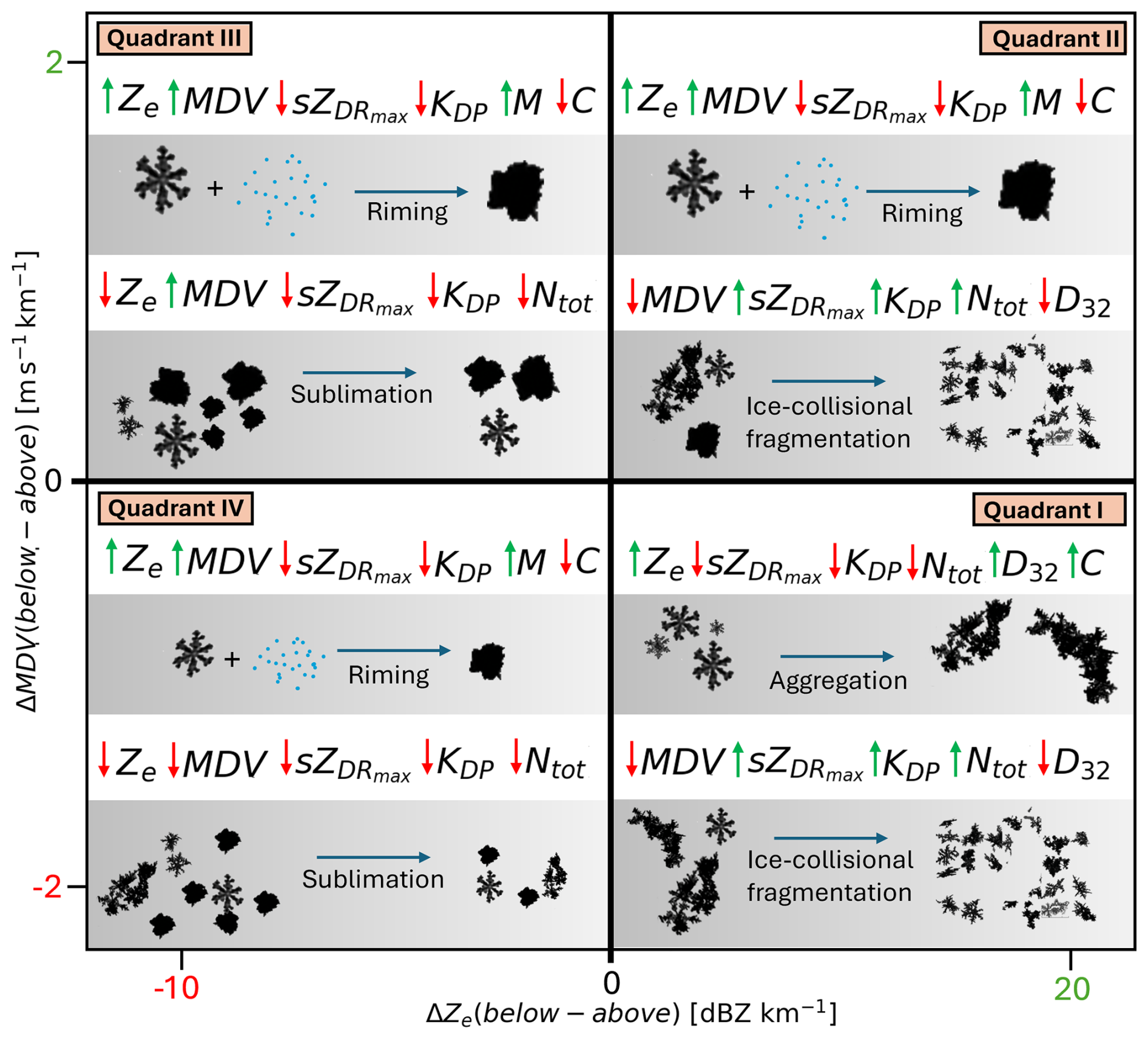
Figure 11Conceptual diagram of the suspected (dominant) microphysical processes inside the turbulent layer, displayed similar to the four quadrants in Fig. 10. The impact of microphysical processes on radar and VISSS variables is also displayed qualitatively: Red downward facing arrows indicate a decrease of the respective variable, upward facing green arrows an increase. Note that for the radar variables (Ze, MDV, and KDP), we can measure the change inside the turbulent layer. VISSS variables (Ntot, C, D32, M) are measured below the turbulent layer. Their change due to the microphysical process is suspected based on the change of particle and PSD properties. If a variable is not depicted, no clear trend can be derived. The shown particle images were recorded by VISSS.
Quadrant II
Quadrant II within each sub-panel comprises data points characterized by an increase in Ze within the turbulent layer combined with a increase in MDV (corresponding to higher fall velocity of particles below the turbulent layer compared to above it). This combination is the second most common during the analyzed period as evidenced in panel (i).
In panel (a.II), increasing of Ze in combination with a increase of MDV features more data points with higher M, these particles are rimed and fall faster due to the density increase, however, we also see pixels where near-zero M indicates unrimed particles, especially towards the highest Ze increase. Looking at panel (b.II), particle populations generally feature lower D32 values of 2.5 mm and smaller in some pixels to the left, but also higher D32 especially to the right of quadrant II. The complexity in panel (e.II) depicts lower values of around 1.5 in some pixels. Still, we also see many pixels with higher complexities indicating both more rimed aggregates and graupel, but also PSD mainly inheriting unrimed aggregates.
Panel (d.II), compared to quadrant I, generally indicates a smaller increase in (below-above) inside the turbulent layer or even a slight decrease, especially for pixels with higher M. As ZDR is closely connected to the particle shape, this decrease may be caused by riming as it tends to render small particles more spherical. For the same reason, KDP in the left half of panel (g.II) displays little change or slight decrease inside the turbulent layer for more rimed PSDs. Pixels in the right part of II indicate an increase of (below-above) and KDP, cross checking with the other panels, these are also pixels where D32 is enhanced and M is low, which are likely particle populations consisting of aggregates producing splinters via ice collisional fragmentation as in quadrant I. We may also see PSDs with coexisting aggregates and graupel particles which we described in Kötsche et al. (2025). The turbulent layer may produce pockets of SLW, causing some particles to be heavily rimed while others experience less riming (e.g. Medina and Houze, 2015). This can lead to more efficient ice collisional fragmentation through greater differences in fall velocity and density. These collisions were found to produce up to 500 fragments per collision by Grzegorczyk et al. (2023). They also showed that the number of splinters increased with increasing collision kinetic energy, which depends on both the particle masses and the square of their relative velocity. In panel (f.II), it is noteworthy that for many pixels with high M, temperature at TLH is below −15 °C, although the overall number of datapoints is low (see panel i). This result differs from previous studies like Kneifel and Moisseev (2020) who found that riming is very uncommon at temperatures colder than −10 °C. The reason is likely that they did not analyze sites influenced by orographic turbulence like in this study. As we did show in Fig. 6, SLW close to Gothic Mountain Summit can be found at temperatures down to −20 °C (see Fig. 6). This implies the turbulent layer is producing SLW even at temperatures way below −10 °C and hence enables riming.
In panel (h.II), VISSS Ntot interestingly shows very high values for the pixels with high M and low D32, indicating high number concentration of small graupel particles. This is consistent to the findings of Lee et al. (2014) who showed that turbulence can lead to a relatively large number of small-sized graupel particles.
See Fig. 11, quadrant II for a schematic view of the main microphysical processes described above.
Quadrant III
Panel (a.III) inherits a combination of decreasing Ze and increasing MDV (meaning that the particles below the turbulent layer inherit higher fall velocity compared to the ones above it). This combination appears quite infrequently (see panel i.III) and seems physically atypical, as an increase in particle fall velocity usually indicates a size and/or density increase. The reduction in Ze is up to −10 dB km−1. Quadrant III features mostly rimed particle populations (panel a) and variable D32 between 1 and 3 mm, while pixels with below 2 mm prevail (panel b.III). and KDP both show decreasing tendencies in the turbulent layer (panels d.III and g.III), which indicates that small, non-spherical particles are depleted, a signal which may be attributed to sublimation. VISSS Ntot in panel (h.III) agrees with that hypothesis, as the particle populations mostly contain less than 2 L−1. As the small particles in the PSD vanish, MDV will indicate faster falling particles because now the remaining larger particles dominate the spectrum. Given the very low number concentrations, spatial inhomogeneity may also be a reason for the observed behavior of Ze and MDV.
Quadrant IV
Panel (a.IV) inherits a combination of decreasing Ze and decreasing MDV (meaning particles below the turbulent layer fall slower than above it), such situations were rarely observed (panel i). Counterintuitively, we see a rather high fraction of more rimed PSDs (higher M). D32 ranges between 1.5 and 3 mm. The complexity also differs between the pixels (panel e.IV), indicating a mix of graupel and less rimed particles. For pixels with high D32, the complexity is also high, indicating some aggregates. and KDP both exhibit a slight decreasing or indifferent tendency, which corroborates the depletion of small particles. Nevertheless, it is plausible that both metrics were initially close to zero, as small, rimed particles with low Ntot are unlikely to generate pronounced signals in KDP or ZDR. VISSS Ntot in panel (h.III) indicates low number concentrations of below 2 L−1. Combined, these signatures points to sublimating particles in different stages of riming. As these particles sublimate, they lose mass causing them to fall slower. Without the presence of faster falling particles in the PSD, this may cause a decrease in fall velocity across the whole PSD. As for quadrant III, spatial inhomogeneity may also be a reason for the observed behavior of Ze and MDV.
In this study, we conducted a long-term observational study during the SAIL campaign in Gothic, Colorado. We used a unique and closely collocated instrument setup combining a slanted polarimetric W-band radar (LIMRAD94), a vertically pointing ARM Ka-band radar (KAZR), the Video In Situ Snowfall Sensor (VISSS) and a high resolution spectral lidar (HRSL) as well as other instruments to investigate the characteristics of orographic turbulent layers based on long-term statistical analysis (Sect. 3.1). To draw conclusions on cloud microphysical processes inside the turbulent layer, we analysed the data of LIMRAD94 and KAZR data using a novel method to assess microphysical processes by comparing radar variables above and below the turbulent layer, avoiding direct in-layer radar signal degradation from turbulence (Sect. 3.2). These results are shown in Figs. 9 and 10.
To conclude our study, we would like to highlight the following key findings:
-
A turbulent layer was almost always present at the site in Gothic during precipitation events between September 2021 and May 2023. The temperature at TLH during these events was mostly between −5 and −20 °C – a favorable region for aggregation, riming, and secondary ice production (SIP). Precipitation from shallow clouds in connection with a turbulent layer was also frequently seen in this statistical analysis, which underlines the importance of orographic turbulence for precipitation formation (Fig. 8).
-
Aggregation is a dominant process inside the turbulent layer and frequently occurs at temperatures between −12 and −15 °C (temperature at turbulent layer height). It is responsible for Ze increase of up to 20 dBZ km−1 and reduction of the mean particle fall velocity. This reduction is connected to the formation of small, anisotropic particles through SIP. This theory is supported by increasing and increased KDP inside the turbulent layer in connection to the aggregation signals (Fig. 10). This indicates SIP through ice-collisional fragmentation producing new, anisotropic ice splinters that may quickly grow into dendrites, given the favorable temperature regime for depositional growth. These results are consistent with the conclusions presented in Chellini and Kneifel (2024).
-
Riming frequently occurs inside the turbulent layer, Ze may increase by up to 15 dBZ km−1 while particle fall speeds always increase. Changes in KDP or during riming cases with high rime mass fraction M are mostly minor with a slight decreasing tendency, likely due to particles becoming more spherical. We frequently detected riming where the temperature at turbulent layer height (TLH) was below −15 °C. This implies the turbulent layer is producing SLW even at temperatures way below −10 °C and hence enables riming, contrary to the findings of Chellini and Kneifel (2024) who found riming mainly at temperatures warmer than −10 °C.
-
We observe sublimation below the turbulent layer. This is characterized by a decrease in Ze, KDP and in combination with an increase or decrease in MDV. Often, these sublimation cases feature enhanced M. We speculate that small graupel may be forming in a shallow cloud layer inside the turbulent layer and sublimates in the well mixed boundary layer. Sublimation in connection to turbulence was also reported by e.g. Lee et al. (2014) and Ramelli et al. (2021).
-
Statistical analysis showed that TLH is strongly tied to the surrounding terrain and the wind direction at turbulent layer height (see Fig. 7). TLH is often collocated with the cloud base height and supercooled liquid water layers near the summit height of Gothic Mountain (Fig. 5). This implies the turbulent layer is producing SLW which was also found by many other studies in the past (e.g. Houze and Medina, 2005; Houze, 2012; Medina and Houze, 2015; Ramelli et al., 2021, among others). The frequent collocation of cloud base height and TLH may be further explained by mechanical mixing of the boundary layer due to turbulence and increased moisture convergence in the lee of Gothic Mountain.
The authors note that the measurement location has intricate terrain and unique synoptic forcing mechanisms. Therefore, the findings are particular to this specific environmental and synoptic scenario and may not be applicable to different locations or situations. Nevertheless, the presence of analogous mountainous and valley structures throughout the Rocky Mountains suggests that comparable processes are likely to occur, which may result in notable congruence with our findings. We particularly highlight a recent campaign named S2noCliME (Pettersen et al., 2024) in the Rocky Mountains. A wide facet of instruments including multiple radar frequencies was deployed in the Park Range of Northwest Colorado during the 2024–2025 winter season. The data gathered there may provide further insights into the microphysical processes connected to orographic turbulence and we strongly recommend exploiting the data set with this special focus on orographic turbulence.
Our findings highlight the importance of orographic turbulence in precipitation enhancement, even in shallow clouds or without the presence of deep precipitating systems. This topic should be addressed in future studies. We demonstrated how radar polarimetry may be used to investigate microphysical processes inside a turbulent layer avoiding the dampening effects of turbulence on radar polarimetry.
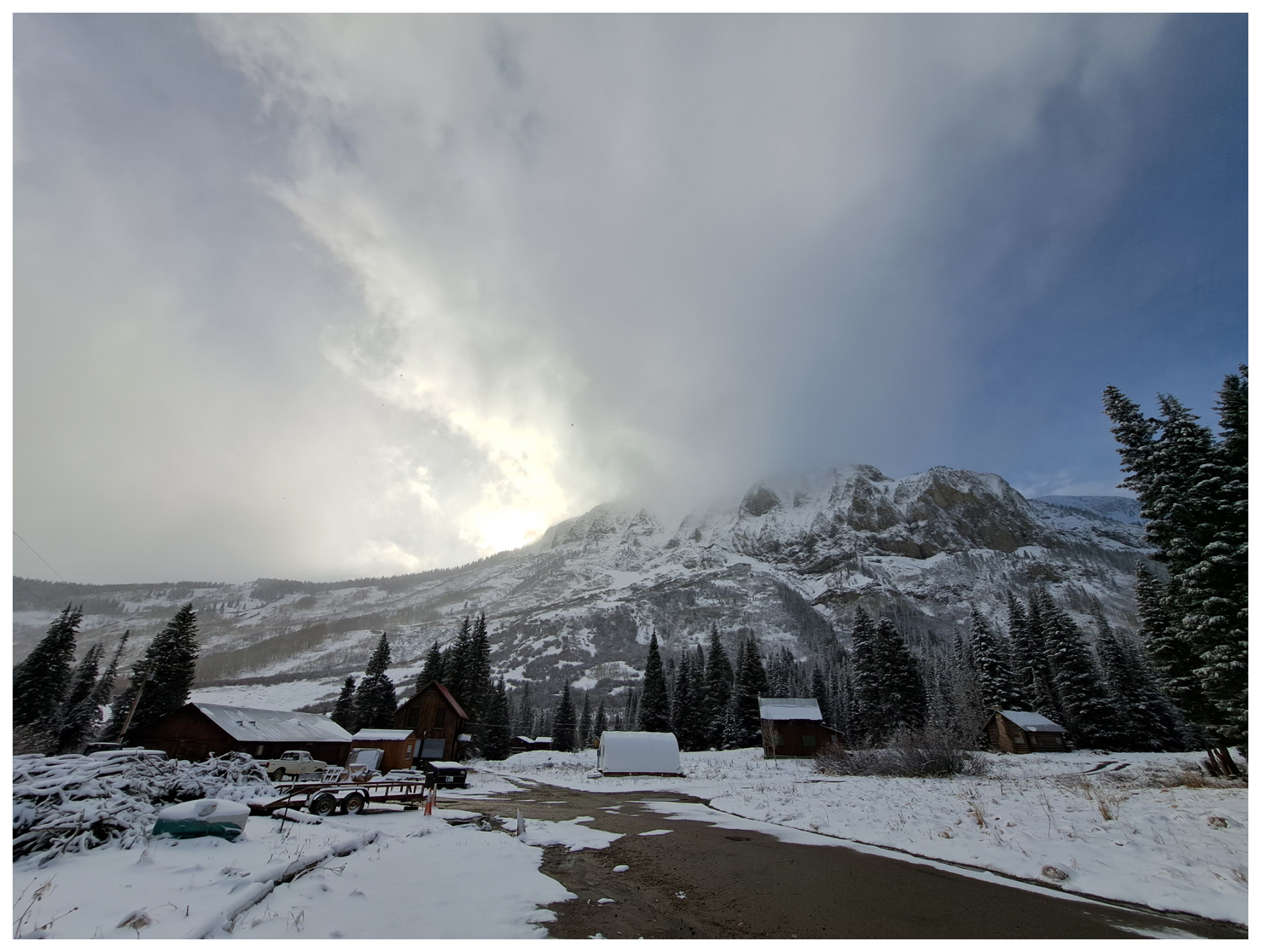
Figure B1 shows the local topography around the measurement site with all relevant mountain peaks and instrument locations marked.
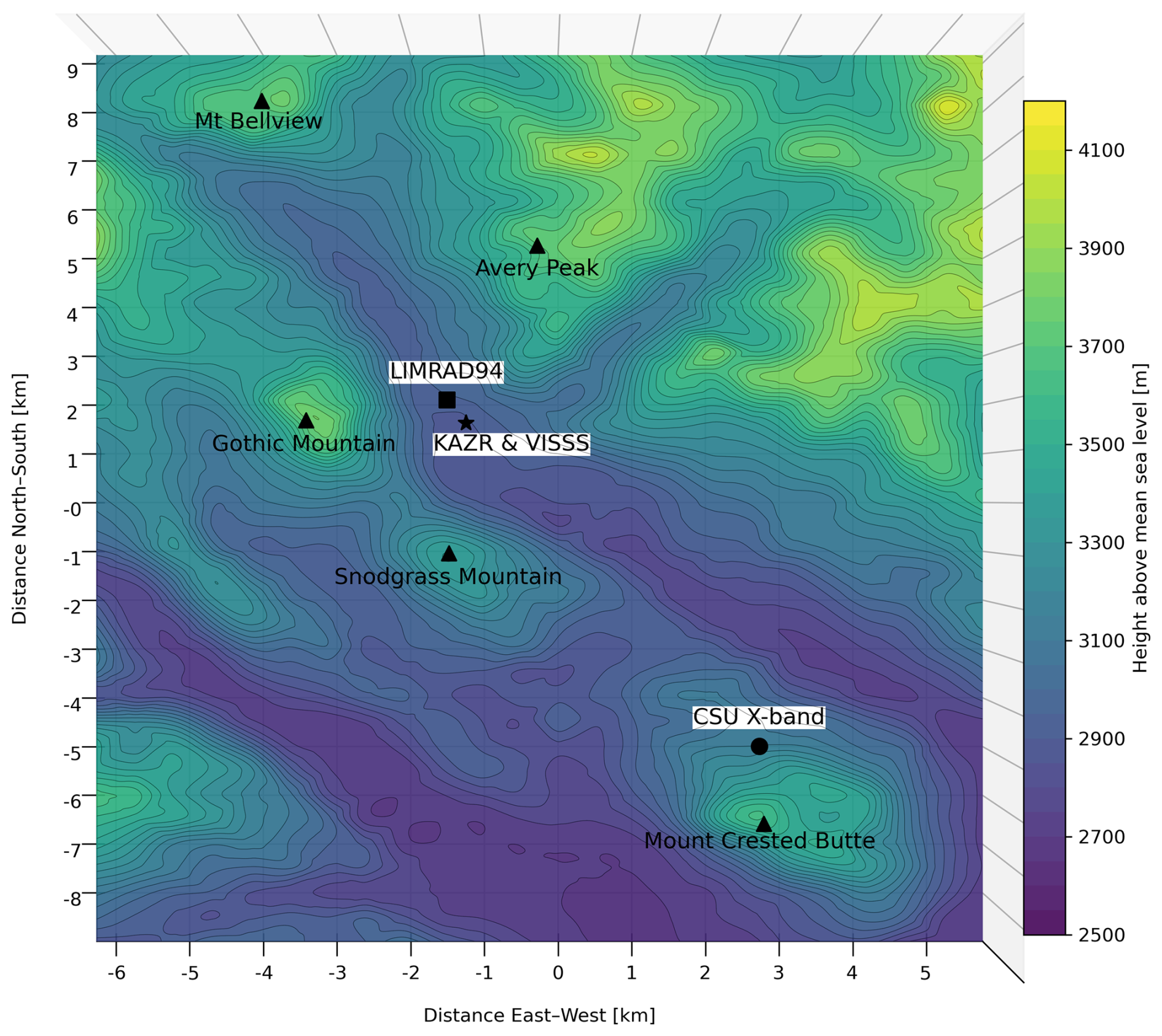
Figure B1Elevation showing the local topography around the measurement site with all relevant mountain peaks and instrument locations marked. In this view, north corresponds to the top edge of the plot, and east corresponds to the right edge; south and west follow accordingly. Blue and yellow colors mark low and high elevation, respectively.
SAIL data were obtained from the Atmospheric Radiation Measurement (ARM) user facility, a U.S. Department of Energy (DOE) Office of Science user facility managed by the Biological and Environmental Research Program: LIMRAD94 (Kalesse-Los et al., 2023b, https://doi.org/10.5439/2229846), VISSS (Maahn et al., 2024a, https://doi.org/10.5439/2278627), the meteorological in situ data of AMF2 (Kyrouac et al., 2021, https://doi.org/10.5439/1786358), the microwave radiometer retrieval products (Zhang, 1996, https://doi.org/10.5439/1027369), the ARM KAZR (Johnson et al., 2023, https://doi.org/10.5439/1228768), the ARM high resolution spectral lidar (Holz et al., 2011, https://doi.org/10.5439/1462207), the ARM RWP915 (Muradyan and Coulter, 2020, https://doi.org/10.5439/1993735), the ARM Parsivel (Wang et al., 2014, https://doi.org/10.5439/1973058), the ARM ceilometer (Zhang et al., 1996, https://doi.org/10.5439/1497398), the ARM interpolated sonde product (Jensen et al., 1998, https://doi.org/10.5439/1095316), the CSU X-band (Feng et al., 2023, https://doi.org/10.5439/1888379).
AK collected and processed the LIMRAD94 data from CORSIPP, analyzed and plotted the data and wrote the manuscript with contributions from all coauthors. All authors reviewed and edited the manuscript. The AI tool TeXGPT was used to correct spelling and typesetting.
The contact author has declared that none of the authors has any competing interests.
Publisher's note: Copernicus Publications remains neutral with regard to jurisdictional claims made in the text, published maps, institutional affiliations, or any other geographical representation in this paper. The authors bear the ultimate responsibility for providing appropriate place names. Views expressed in the text are those of the authors and do not necessarily reflect the views of the publisher.
This article is part of the special issue “Fusion of radar polarimetry and numerical atmospheric modelling towards an improved understanding of cloud and precipitation processes (ACP/AMT/GMD inter-journal SI)”. It is not associated with a conference.
We would like to thank Teresa Vogl for the help in processing EDR data used in this manuscript. We would like to thank the Rocky Mountain Biological Laboratory staff as well as ARM technicians for logistical and on-site technical support.
This research is funded by the Deutsche Forschungsgemeinschaft (DFG, German Research Foundation) – Project number: 408008112 (Characterization of orography-influenced riming and secondary ice production and their effects on precipitation rates using radar polarimetry and Doppler spectra – CORSIPP) within the Priority Program SPP 2115 “Polarimetric Radar Observations meet Atmospheric Modelling (PROM) – Fusion of Radar Polarimetry and Numerical Atmospheric Modelling Towards an Improved Understanding of Cloud and Precipitation Processes”. The paper was funded by the Open Access Publishing Fund of Leipzig University supported by the German Research Foundation within the program Open Access Publication Funding. This research was supported by the Atmospheric Radiation Measurement (ARM) user facility, a U.S. Department of Energy (DOE) Office of Science user facility managed by the Biological and Environmental Research Program. This work was supported in part by the European Space Agency under the activity WInd VElocity Radar Nephoscope (WIVERN) Phase A Science and Requirements Consolidation Study, ESA Contract Number 4000144120/24/NL/IB/ab.
Supported by the Open Access Publishing Fund
of Leipzig University.
This paper was edited by Timothy Garrett and reviewed by Haoran Li and one anonymous referee.
Aikins, J., Friedrich, K., Geerts, B., and Pokharel, B.: Role of a Cross-Barrier Jet and Turbulence on Winter Orographic Snowfall, Monthly Weather Review, 144, 3277–3300, https://doi.org/10.1175/MWR-D-16-0025.1, 2016. a, b, c, d
Balakrishnan, N. and Zrnic, D. S.: Use of polarization to characterize precipitation and discriminate large hail, Journal of the Atmospheric Sciences, 47, 1525–1540, https://doi.org/10.1175/1520-0469(1990)047<1525:UOPTCP>2.0.CO;2, 1990. a
Bartholomew, M.: Laser Disdrometer Instrument Handbook, Tech. Rep. DOE/SC-ARM-TR–137, 1226796, https://doi.org/10.2172/1226796, 2020. a
Bhushan, S. and Barros, A. P.: A Numerical Study to Investigate the Relationship between Moisture Convergence Patterns and Orography in Central Mexico, Journal of Hydrometeorology, https://doi.org/10.1175/2007JHM791.1, 2007. a
Billault-Roux, A.-C., Georgakaki, P., Gehring, J., Jaffeux, L., Schwarzenboeck, A., Coutris, P., Nenes, A., and Berne, A.: Distinct secondary ice production processes observed in radar Doppler spectra: insights from a case study, Atmospheric Chemistry and Physics, 23, 10207–10234, https://doi.org/10.5194/acp-23-10207-2023, 2023. a, b
Borque, P., Luke, E., and Kollias, P.: On the unified estimation of turbulence eddy dissipation rate using Doppler cloud radars and lidars, Journal of Geophysical Research: Atmospheres, 121, 5972–5989, https://doi.org/10.1002/2015JD024543, 2016. a
Chellini, G. and Kneifel, S.: Turbulence as a Key Driver of Ice Aggregation and Riming in Arctic Low‐Level Mixed-Phase Clouds, Revealed by Long‐Term Cloud Radar Observations, Geophysical Research Letters, 51, e2023GL106599, https://doi.org/10.1029/2023GL106599, 2024. a, b, c, d
Fairless, T., Jensen, M., Zhou, A., and Giangrande, S. E.: Interpolated sonde and gridded sonde value-added products, United States Department of Energy: Washington, DC, USA, https://doi.org/10.2172/1248938, 2021. a
Feldman, D. R., Aiken, A. C., Boos, W. R., Carroll, R. W. H., Chandrasekar, V., Collis, S., Creamean, J. M., De Boer, G., Deems, J., and DeMott, P. J.: The Surface Atmosphere Integrated Field Laboratory (SAIL) Campaign, Bulletin of the American Meteorological Society, 104, E2192–E2222, https://doi.org/10.1175/BAMS-D-22-0049.1, 2023. a
Feng, Y.-C., Theisen, A., Lindenmaier, I. A., Collis, S., Giangrande, S., Comstock, J. M., Matthews, A. A., Rocque, M. N., Schuman, E. K., and Wendler, T. G.: ARM FY2024 Radar Plan, Tech. rep., Oak Ridge National Laboratory (ORNL), Oak Ridge, TN (United States) [data set], https://doi.org/10.5439/1888379, 2023. a
Foken, T. and Mauder, M.: Micrometeorology, Springer Atmospheric Sciences, Springer International Publishing, Cham, ISBN 978-3-031-47525-2, 978-3-031-47526-9, https://doi.org/10.1007/978-3-031-47526-9, 2024. a
Garrett, T. J. and Yuter, S. E.: Observed influence of riming, temperature, and turbulence on the fallspeed of solid precipitation, Geophysical Research Letters, 41, 6515–6522, https://doi.org/10.1002/2014GL061016, 2014. a
Garrett, T. J., Yuter, S. E., Fallgatter, C., Shkurko, K., Rhodes, S. R., and Endries, J. L.: Orientations and aspect ratios of falling snow, Geophysical Research Letters, 42, 4617–4622, https://doi.org/10.1002/2015GL064040, 2015. a
Goldsmith, J.: High Spectral Resolution Lidar (HSRL) Instrument Handbook, Tech. Rep. DOE/SC-ARM-TR–157, 1251392, https://doi.org/10.2172/1251392, 2016. a
Grazioli, J., Lloyd, G., Panziera, L., Hoyle, C. R., Connolly, P. J., Henneberger, J., and Berne, A.: Polarimetric radar and in situ observations of riming and snowfall microphysics during CLACE 2014, Atmospheric Chemistry and Physics, 15, 13787–13802, https://doi.org/10.5194/acp-15-13787-2015, 2015. a, b, c
Grzegorczyk, P., Yadav, S., Zanger, F., Theis, A., Mitra, S. K., Borrmann, S., and Szakáll, M.: Fragmentation of ice particles: laboratory experiments on graupel–graupel and graupel–snowflake collisions, Atmospheric Chemistry and Physics, 23, 13505–13521, https://doi.org/10.5194/acp-23-13505-2023, 2023. a
Heistermann, M., Jacobi, S., and Pfaff, T.: Technical Note: An open source library for processing weather radar data (wradlib), Hydrology and Earth System Sciences, 17, 863–871, https://doi.org/10.5194/hess-17-863-2013, 2013. a
Holz, R., Garcia, J., Schuman, E., Bambha, R., Ermold, B., and Eloranta, E.: High Spectral Resolution Lidar Data, a1 Data Level, Atmospheric Radiation Measurement (ARM) user facility [data set], https://doi.org/10.5439/1462207, 2011. a
Houze Jr., R. A.: Orographic effects on precipitating clouds, Reviews of Geophysics, 50, https://doi.org/10.1029/2011RG000365, 2012. a, b, c
Houze Jr., R. A. and Medina, S.: Turbulence as a Mechanism for Orographic Precipitation Enhancement, Journal of the Atmospheric Sciences, https://doi.org/10.1175/JAS3555.1, 2005. a, b
Hubbert, J. and Bringi, V.: Utilization of the radar polarimetric covariance matrix for polarization error and precipitation canting angle estimation, in: IGARSS 2003. 2003 IEEE International Geoscience and Remote Sensing Symposium, Proceedings (IEEE Cat. No. 03CH37477), Vol. 7, 4456–4458, https://doi.org/10.1109/IGARSS.2003.1295545, 2003. a
Jensen, M., Giangrande, S., Fairless, T., and Zhou, A.: interpolatedsonde, Tech. rep., Atmospheric Radiation Measurement (ARM) Archive, Oak Ridge National Laboratory (ORNL) [data set], https://doi.org/10.5439/1095316, 1998. a
Johnson, K., Jensen, M., and Giangrande, S.: Active Remote Sensing of CLouds (ARSCL) product using Ka-band ARM Zenith Radars (ARSCLKAZR1KOLLIAS), 2021-09-01 to 2023-06-06, ARM Mobile Facility (GUC), Gunnison, CO; AMF2 (main site for SAIL) (M1), Atmospheric Radiation Measurement (ARM) user facility [data set], https://doi.org/10.5439/1228768, 2023. a, b
Kalesse-Los, H., Maahn, M., Ettrichratz, V., and Kotsche, A.: Characterization of Orography-Influenced Riming and Secondary Ice Production and Their Effects on Precipitation Rates Using Radar Polarimetry and Doppler Spectra (CORSIPP-SAIL), Tech. rep., Oak Ridge National https://doi.org/10.2172/2242406, 2023a. a
Kalesse-Los, H., Maahn, M., Kötsche, A., Ettrichrätz, V., and Steinke, I.: Leipzig University W-Band Cloud Radar, Gothic (Colorado), SAIL Campaign Second Winter (15.11.2022–05.06.2023), Atmospheric Radiation Measurement (ARM) user facility [data set], https://doi.org/10.5439/2229846, 2023b. a
Klett, J. D.: Orientation Model for Particles in Turbulence, Journal of the Atmospheric Sciences, https://doi.org/10.1175/1520-0469(1995)052<2276:OMFPIT>2.0.CO;2, 1995. a
Kneifel, S. and Moisseev, D.: Long-term statistics of riming in nonconvective clouds derived from ground-based Doppler cloud radar observations, Journal of the Atmospheric Sciences, 77, 3495–3508, https://doi.org/10.1175/JAS-D-20-0007.1, 2020. a
Kötsche, A., Myagkov, A., von Terzi, L., Maahn, M., Ettrichrätz, V., Vogl, T., Ryzhkov, A., Bukovcic, P., Ori, D., and Kalesse-Los, H.: Investigating KDP signatures inside and below the dendritic growth layer with W-band Doppler radar and in situ snowfall camera, Atmospheric Chemistry and Physics, 25, 14045–14070, https://doi.org/10.5194/acp-25-14045-2025, 2025. a, b, c, d, e, f, g, h, i, j, k
Küchler, N., Kneifel, S., Löhnert, U., Kollias, P., Czekala, H., and Rose, T.: A W-Band Radar–Radiometer System for Accurate and Continuous Monitoring of Clouds and Precipitation, Journal of Atmospheric and Oceanic Technology, https://doi.org/10.1175/JTECH-D-17-0019.1, 2017. a, b
Kyrouac, J., Shi, Y., and Tuftedal, M.: Surface Meteorological Instrumentation (MET), 2022-11-10 to 2023-06-06, ARM Mobile Facility (GUC), Gunnison, CO; AMF2 (main site for SAIL) (M1), Atmospheric Radiation Measurement (ARM) user facility [data set], https://doi.org/10.5439/1786358, 2021. a
Lee, H., Baik, J.-J., and Han, J.-Y.: Effects of turbulence on mixed-phase deep convective clouds under different basic-state winds and aerosol concentrations, Journal of Geophysical Research: Atmospheres, 119, 13506–13525, https://doi.org/10.1002/2014JD022363, 2014. a, b, c, d
Li, X., Wang, L., Hu, B., Chen, D., and Liu, R.: Contribution of vanishing mountain glaciers to global and regional terrestrial water storage changes, Frontiers in Earth Science, 11, https://doi.org/10.3389/feart.2023.1134910, 2023. a
Maahn, M., Löhnert, U., Kollias, P., Jackson, R. C., and McFarquhar, G. M.: Developing and Evaluating Ice Cloud Parameterizations for Forward Modeling of Radar Moments Using in situ Aircraft Observations, Journal of Atmospheric and Oceanic Technology, https://doi.org/10.1175/JTECH-D-14-00112.1, 2015. a
Maahn, M., Ettrichraetz, V., and Steinke, I.: VISSS Raw data from SAIL at Gothic from November 2022 to June 2023, Atmospheric Radiation Measurement (ARM) user facility [data set], https://doi.org/10.5439/2278627, 2024a. a
Maahn, M., Moisseev, D., Steinke, I., Maherndl, N., and Shupe, M. D.: Introducing the Video In Situ Snowfall Sensor (VISSS), Atmospheric Measurement Techniques, 17, 899–919, https://doi.org/10.5194/amt-17-899-2024, 2024b. a, b, c
Maherndl, N., Moser, M., Lucke, J., Mech, M., Risse, N., Schirmacher, I., and Maahn, M.: Quantifying riming from airborne data during the HALO-(AC)3 campaign, Atmospheric Measurement Techniques, 17, 1475–1495, https://doi.org/10.5194/amt-17-1475-2024, 2024. a
Maherndl, N., Battaglia, A., Kötsche, A., and Maahn, M.: Riming-dependent snowfall rate and ice water content retrievals for W-band cloud radar, Atmospheric Measurement Techniques, 18, 3287–3304, https://doi.org/10.5194/amt-18-3287-2025, 2025. a
Medina, S. and Houze, R. A.: Small-Scale Precipitation Elements in Midlatitude Cyclones Crossing the California Sierra Nevada, Monthly Weather Review, https://doi.org/10.1175/MWR-D-14-00124.1, 2015. a, b, c, d, e
Moisseev, D., von Lerber, A., and Tiira, J.: Quantifying the effect of riming on snowfall using ground-based observations, Journal of Geophysical Research: Atmospheres, 122, 4019–4037, https://doi.org/10.1002/2016JD026272, 2017. a
Morris, V. R.: Ceilometer Instrument Handbook, Tech. Rep. DOE/SC-ARM-TR–020, 1036530, https://doi.org/10.2172/1036530, 2016. a
Muradyan, P. and Coulter, R.: Radar Wind Profiler (RWP) and Radio Acoustic Sounding System (RASS) Instrument Handbook, Tech. rep., DOE Office of Science Atmospheric Radiation Measurement (ARM) User Facility [data set], https://doi.org/10.5439/1993735, 2020. a, b
Myagkov, A., Seifert, P., Bauer-Pfundstein, M., and Wandinger, U.: Cloud radar with hybrid mode towards estimation of shape and orientation of ice crystals, Atmospheric Measurement Techniques, 9, 469–489, https://doi.org/10.5194/amt-9-469-2016, 2016. a
Myagkov, A., Kneifel, S., and Rose, T.: Evaluation of the reflectivity calibration of W-band radars based on observations in rain, Atmospheric Measurement Techniques, 13, 5799–5825, https://doi.org/10.5194/amt-13-5799-2020, 2020. a
Oue, M., Kollias, P., Ryzhkov, A., and Luke, E. P.: Toward Exploring the Synergy Between Cloud Radar Polarimetry and Doppler Spectral Analysis in Deep Cold Precipitating Systems in the Arctic, Journal of Geophysical Research: Atmospheres, 123, 2797–2815, https://doi.org/10.1002/2017JD027717, 2018. a
Petersen, G. N., Kristjánsson, J. E., and Ólafsson, H.: The effect of upstream wind direction on atmospheric flow in the vicinity of a large mountain, Quarterly Journal of the Royal Meteorological Society, 131, 1113–1128, https://doi.org/10.1256/qj.04.01, 2005. a
Pettersen, C., Mace, G. G., McMurdie, L., Rowe, A., Hallar, A. G., Dolan, B., and Oue, M.: Introducing the Snow Sensitivity to Clouds in a Mountain Environment (S2noCliME) Field Campaign, AMS, https://ams.confex.com/ams/21MOUNTAIN/meetingapp.cgi/Paper/444259 (last access: 12 December 2025), 2024. a
Ramelli, F., Henneberger, J., David, R. O., Lauber, A., Pasquier, J. T., Wieder, J., Bühl, J., Seifert, P., Engelmann, R., Hervo, M., and Lohmann, U.: Influence of low-level blocking and turbulence on the microphysics of a mixed-phase cloud in an inner-Alpine valley, Atmospheric Chemistry and Physics, 21, 5151–5172, https://doi.org/10.5194/acp-21-5151-2021, 2021. a, b, c, d, e, f
Ryzhkov, A., Pinsky, M., Pokrovsky, A., and Khain, A.: Polarimetric Radar Observation Operator for a Cloud Model with Spectral Microphysics, Journal of Applied Meteorology and Climatology, https://doi.org/10.1175/2010JAMC2363.1, 2011. a
Ryzhkov, A. V. and Zrnic, D. S.: Radar Polarimetry for Weather Observations, Springer Atmospheric Sciences, Springer International Publishing, Cham, ISBN 978-3-030-05092-4, 978-3-030-05093-1, https://doi.org/10.1007/978-3-030-05093-1, 2019. a, b
Ryzhkov, A. V., Zrnic, D. S., Hubbert, J. C., Bringi, V. N., Vivekanandan, J., and Brandes, E. A.: Polarimetric radar observations and interpretation of co-cross-polarcorrelation coefficients, Journal of Atmospheric and Oceanic Technology, 19, 340–354, https://doi.org/10.1175/1520-0426-19.3.340, 2002. a, b
Schmitt, C. G. and Heymsfield, A. J.: Observational quantification of the separation of simple and complex atmospheric ice particles, Geophysical Research Letters, 41, 1301–1307, https://doi.org/10.1002/2013GL058781, 2014. a
Smolarkiewicz, P. K. and Rotunno, R.: Low Froude Number Flow Past Three-Dimensional Obstacles. Part I: Baroclinically Generated Lee Vortices, Journal of the Atmospheric Sciences, https://doi.org/10.1175/1520-0469(1989)046<1154:LFNFPT>2.0.CO;2, 1989. a
Smolarkiewicz, P. K. and Rotunno, R.: Low Froude Number Flow Past Three-Dimensional Obstacles. Part II: Upwind Flow Reversal Zone, Journal of the Atmospheric Sciences, https://doi.org/10.1175/1520-0469(1990)047<1498:LFNFPT>2.0.CO;2, 1990. a
Takahashi, T., Nagao, Y., and Kushiyama, Y.: Possible High Ice Particle Production during Graupel–Graupel Collisions, Journal of the Atmospheric Sciences, 52, 4523–4527, https://doi.org/10.1175/1520-0469(1995)052<4523:PHIPPD>2.0.CO;2, 1995. a, b
Trömel, S., Kumjian, M. R., Ryzhkov, A. V., Simmer, C., and Diederich, M.: Backscatter Differential Phase – Estimation and Variability, Journal of Applied Meteorology and Climatology, https://doi.org/10.1175/JAMC-D-13-0124.1, 2013. a, b
Trömel, S., Simmer, C., Blahak, U., Blanke, A., Doktorowski, S., Ewald, F., Frech, M., Gergely, M., Hagen, M., Janjic, T., Kalesse-Los, H., Kneifel, S., Knote, C., Mendrok, J., Moser, M., Köcher, G., Mühlbauer, K., Myagkov, A., Pejcic, V., Seifert, P., Shrestha, P., Teisseire, A., von Terzi, L., Tetoni, E., Vogl, T., Voigt, C., Zeng, Y., Zinner, T., and Quaas, J.: Overview: Fusion of radar polarimetry and numerical atmospheric modelling towards an improved understanding of cloud and precipitation processes, Atmospheric Chemistry and Physics, 21, 17291–17314, https://doi.org/10.5194/acp-21-17291-2021, 2021. a
Vaisala: Technical description vaisala lidar ceilometer CL61 (2021), Vaisala, 1–43, https://www.google.com/url?sa=t&source=web&rct=j&opi=89978449&url=https://www.vaisala.com/sites/default/files/documents/WEA-MET-WhitePaper-CL61-B212267EN-A.pdf&ved=2ahUKEwiX-dGHjOCSAxV2X_EDHbxqEnUQFnoECBkQAQ&usg=AOvVaw3voW4RhWsk2vUbnEERqxIh (last access: 14 September 2025), 2021. a
Vogl, T., Maahn, M., Kneifel, S., Schimmel, W., Moisseev, D., and Kalesse-Los, H.: Using artificial neural networks to predict riming from Doppler cloud radar observations, Atmospheric Measurement Techniques, 15, 365–381, https://doi.org/10.5194/amt-15-365-2022, 2022. a
Vogl, T., Radenz, M., Ramelli, F., Gierens, R., and Kalesse-Los, H.: PEAKO and peakTree: tools for detecting and interpreting peaks in cloud radar Doppler spectra – capabilities and limitations, Atmospheric Measurement Techniques, 17, 6547–6568, https://doi.org/10.5194/amt-17-6547-2024, 2024. a
Wang, D., Zhu, Z., Shi, Y., Sturm, M., Irving, K., Mockaitis, M., and Delamere, J.: ld (b1), Atmospheric Radiation Measurement (ARM) user facility [data set], https://doi.org/10.5439/1973058, 2014. a
Widener, K., Bharadwaj, N., and Johnson, K.: Ka-Band ARM Zenith Radar (KAZR) Instrument Handbook, Tech. Rep. DOE/SC-ARM/TR-106, PNNL, Richland, WA, https://doi.org/10.2172/1035855, 2012. a, b
Zhang, D.: MWR Retrievals (MWRRET1LILJCLOU), 2022-11-10 to 2023-06-06, ARM Mobile Facility (GUC), Gunnison, CO; AMF2 (main site for SAIL) (M1), Atmospheric Radiation Measurement (ARM) user facility [data set], https://doi.org/10.5439/1027369, 1996. a
Zhang, D., Ermold, B., and Morris, V.: ceil, Atmospheric Radiation Measurement (ARM) user facility [data set], https://doi.org/10.5439/1497398, 1996. a
Zhou, R., Perkins, R., Juergensen, D., Barry, K., Ayars, K., Dutton, O., DeMott, P., and Kreidenweis, S.: Seasonal variability, sources, and parameterization of ice-nucleating particles in the Rocky Mountain region: importance of soil dust and biological contributions, Atmospheric Chemistry and Physics, 26, 1515–1535, https://doi.org/10.5194/acp-26-1515-2026, 2026. a
Zhu, Z., Yang, F., Kollias, P., and Luke, E.: Observational Investigation of the Effect of Turbulence on Microphysics and Precipitation in Warm Marine Boundary Layer Clouds, Geophysical Research Letters, 50, e2022GL102578, https://doi.org/10.1029/2022GL102578, 2023. a
- Abstract
- Introduction
- Data and Methods
- Results and Discussion
- Summmary and conclusions
- Appendix A: On site images of cloud formation behind Gothic Mountain
- Appendix B: Map showing the local topography
- Data availability
- Author contributions
- Competing interests
- Disclaimer
- Special issue statement
- Acknowledgements
- Financial support
- Review statement
- References
The requested paper has a corresponding corrigendum published. Please read the corrigendum first before downloading the article.
- Article
(9793 KB) - Full-text XML
- Abstract
- Introduction
- Data and Methods
- Results and Discussion
- Summmary and conclusions
- Appendix A: On site images of cloud formation behind Gothic Mountain
- Appendix B: Map showing the local topography
- Data availability
- Author contributions
- Competing interests
- Disclaimer
- Special issue statement
- Acknowledgements
- Financial support
- Review statement
- References