Articles | Volume 26, issue 18
https://doi.org/10.5194/acp-26-13069-2026
© Author(s) 2026. This work is distributed under
the Creative Commons Attribution 4.0 License.
https://doi.org/10.5194/acp-26-13069-2026
© Author(s) 2026. This work is distributed under
the Creative Commons Attribution 4.0 License.
Advancing halocarbon radiative efficiency estimates by coupling radiative transfer and quantum chemical calculations: impact of updated spectroscopic parameters and low-frequency contributions

Daniela Alvarado-Jiménez
Scuola Normale Superiore, Piazza dei Cavalieri 7, Pisa, Italy
IUSS Scuola Universitaria Superiore Pavia, Piazza della Vittoria 15, Pavia, Italy
Nicola Tasinato
CORRESPONDING AUTHOR
Scuola Normale Superiore, Piazza dei Cavalieri 7, Pisa, Italy
Roberto Buizza
Sant'Anna School of Advanced Studies, Piazza Martiri della Libertá 33, Pisa, Italy
Department of Meteorology, University of Reading, Reading, RG6 7ET, United Kingdom
Related authors
No articles found.
William James Collins, Øivind Hodnebrog, Keith Peter Shine, and James B. Burkholder
EGUsphere, https://doi.org/10.5194/egusphere-2026-674, https://doi.org/10.5194/egusphere-2026-674, 2026
Short summary
Short summary
The global warming potential (GWP) is a commonly used metric for relating the climate impact of emissions of a gas relative to that for carbon dioxide. We show that previous calculations have systematically underestimated these values by applying calculations of radiative forcing efficiency appropriate to changes in surface mole fractions rather than changes in the mass-weighted mean mole fraction in the atmosphere.
Audran Borella, Olivier Boucher, Keith P. Shine, Marc Stettler, Katsumasa Tanaka, Roger Teoh, and Nicolas Bellouin
Atmos. Chem. Phys., 24, 9401–9417, https://doi.org/10.5194/acp-24-9401-2024, https://doi.org/10.5194/acp-24-9401-2024, 2024
Short summary
Short summary
This work studies how to compare the climate impact of the CO2 emitted and contrails formed by a flight. This is applied to contrail avoidance strategies that would decrease climate impact of flights by changing the trajectory of aircraft to avoid persistent contrail formation, at the risk of increasing CO2 emissions. We find that different comparison methods lead to different quantification of the total climate impact of a flight but lead to similar decisions of whether to reroute an aircraft.
Ryan S. Williams, Michaela I. Hegglin, Patrick Jöckel, Hella Garny, and Keith P. Shine
Atmos. Chem. Phys., 24, 1389–1413, https://doi.org/10.5194/acp-24-1389-2024, https://doi.org/10.5194/acp-24-1389-2024, 2024
Short summary
Short summary
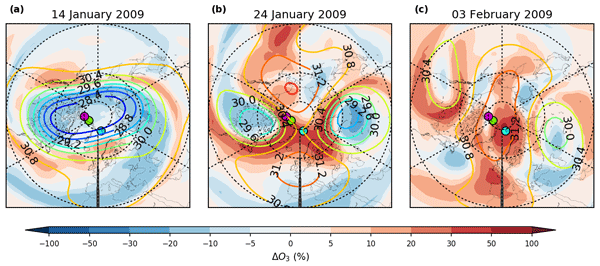
During winter, a brief but abrupt reversal of the mean stratospheric westerly flow (~30 km high) around the Arctic occurs ~6 times a decade. Using a chemistry–climate model, about half of these events are shown to induce large anomalies in Arctic ozone (>25 %) and water vapour (>±25 %) around ~8–12 km altitude for up to 2–3 months, important for weather forecasting. We also calculate a doubling to trebling of the risk in breaches of mid-latitude surface air quality (ozone) standards (~60 ppbv).
Nicola J. Warwick, Alex T. Archibald, Paul T. Griffiths, James Keeble, Fiona M. O'Connor, John A. Pyle, and Keith P. Shine
Atmos. Chem. Phys., 23, 13451–13467, https://doi.org/10.5194/acp-23-13451-2023, https://doi.org/10.5194/acp-23-13451-2023, 2023
Short summary
Short summary
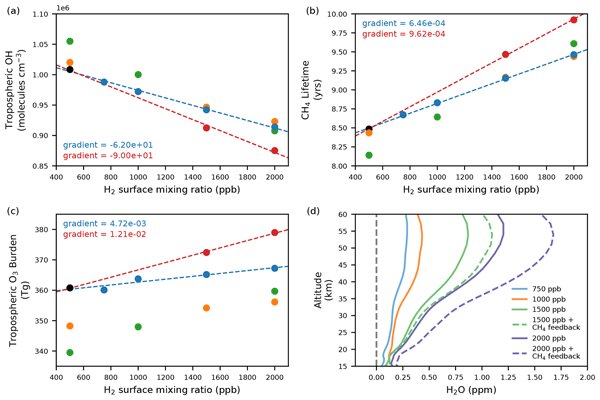
A chemistry–climate model has been used to explore the atmospheric response to changes in emissions of hydrogen and other species associated with a shift from fossil fuel to hydrogen use. Leakage of hydrogen results in indirect global warming, offsetting greenhouse gas emission reductions from reduced fossil fuel use. To maximise the benefit of hydrogen as an energy source, hydrogen leakage and emissions of methane, carbon monoxide and nitrogen oxides should be minimised.
Feijia Yin, Volker Grewe, Federica Castino, Pratik Rao, Sigrun Matthes, Katrin Dahlmann, Simone Dietmüller, Christine Frömming, Hiroshi Yamashita, Patrick Peter, Emma Klingaman, Keith P. Shine, Benjamin Lührs, and Florian Linke
Geosci. Model Dev., 16, 3313–3334, https://doi.org/10.5194/gmd-16-3313-2023, https://doi.org/10.5194/gmd-16-3313-2023, 2023
Short summary
Short summary
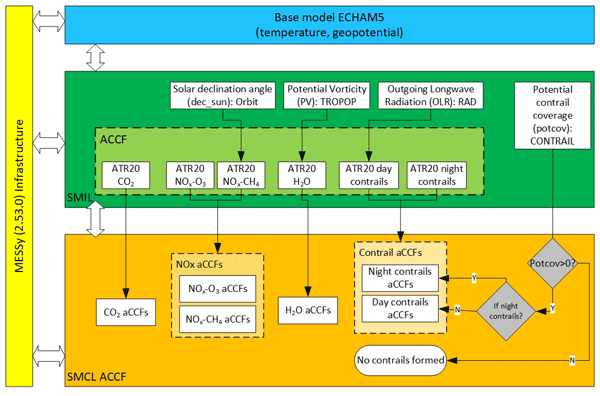
This paper describes a newly developed submodel ACCF V1.0 based on the MESSy 2.53.0 infrastructure. The ACCF V1.0 is based on the prototype algorithmic climate change functions (aCCFs) v1.0 to enable climate-optimized flight trajectories. One highlight of this paper is that we describe a consistent full set of aCCFs formulas with respect to fuel scenario and metrics. We demonstrate the usage of the ACCF submodel using AirTraf V2.0 to optimize trajectories for cost and climate impact.
Cited articles
Alvarado-Jiménez, D., Tasinato, N., Brownsword, R., Weidmann, D., Buizza, R., and Shine, K. P.: Low-frequency contributions in the radiative efficiencies of HFC-236fa, HFC-245fa and HFC-43-10mee over the 225–298 K temperature range, J. Quant. Spectrosc. Ra., https://doi.org/10.1016/j.jqsrt.2026.109908, 2026. a, b, c, d, e, f, g, h, i, j
Barone, V.: Anharmonic vibrational properties by a fully automated second-order perturbative approach, J. Chem. Phys, 122, 014108, https://doi.org/10.1063/1.1824881, 2004. a
Barone, V., Ceselin, G., Fusé, M., and Tasinato, N.: Accuracy meets interpretability for computational spectroscopy by means of hybrid and double-hybrid functionals, Front. Chem., 8, 584203, https://doi.org/10.3389/fchem.2020.584203, 2020. a, b
Bloino, J., Biczysko, M., and Barone, V.: General Perturbative Approach for Spectroscopy, Thermodynamics, and Kinetics: Methodological Background and Benchmark Studies, J. Chem. Theory Comput., 8, 1015–1036, https://doi.org/10.1021/ct200814m, 2012. a
Blowers, P. and Hollingshead, K.: Estimations of Global Warming Potentials from Computational Chemistry Calculations for CH2F2 and Other Fluorinated Methyl Species Verified by Comparison to Experiment, J. Phys. Chem. A., 113, 5942–5950, https://doi.org/10.1021/jp8114918, 2009. a
Boussessi, R., Ceselin, G., Tasinato, N., and Barone, V.: DFT meets the segmented polarization consistent basis sets: Performances in the computation of molecular structures, rotational and vibrational spectroscopic properties, J. Mol. Struct., 1208, 127886, https://doi.org/10.1016/j.molstruc.2020.127886, 2020. a
Burkholder, J. B., Marshall, P., Bera, P. P., Francisco, J. S., and Lee, T. J.: Climate Metrics for C1–C4 Hydrofluorocarbons (HFCs), J. Phys. Chem. A, 124, 4793–4800, https://doi.org/10.1021/acs.jpca.0c02679, 2020. a, b
Carnimeo, I., Puzzarini, C., Tasinato, N., Stoppa, P., Pietropolli Charmet, A., Biczysko, M., Cappelli, C., and Barone, V.: Anharmonic theoretical simulations of infrared spectra of halogenated organic compounds, J. Chem. Phys., 139, 074310, https://doi.org/10.1063/1.4817401, 2013. a
Feldman, D. R., Collins, W. D., Pincus, R., Huang, X., and Chen, X.: Far-infrared surface emissivity and climate, P. Natl. Acad. Sci. USA, 111, 16297–16302, https://doi.org/10.1073/pnas.1413640111, 2014. a
Forster, P., Storelvmo, T., Armour, K., Collins, W., Dufresne, J.-L., Frame, D., Lunt, D., Mauritsen, T., Palmer, M., Watanabe, M., Wild, M., and Zhang, H.: The Earth's Energy Budget, Climate Feedbacks, and Climate Sensitivity, IPCC 6th Assess. Rep., 923–1054, https://doi.org/10.1017/9781009157896.009, 2021. a, b
Forster, P. M., Smith, C. J., Walsh, T., Lamb, W. F., Lamboll, R., Hauser, M., Ribes, A., Rosen, D., Gillett, N., Palmer, M. D., Rogelj, J., von Schuckmann, K., Seneviratne, S. I., Trewin, B., Zhang, X., Allen, M., Andrew, R., Birt, A., Borger, A., Boyer, T., Broersma, J. A., Cheng, L., Dentener, F., Friedlingstein, P., Gutiérrez, J. M., Gütschow, J., Hall, B., Ishii, M., Jenkins, S., Lan, X., Lee, J.-Y., Morice, C., Kadow, C., Kennedy, J., Killick, R., Minx, J. C., Naik, V., Peters, G. P., Pirani, A., Pongratz, J., Schleussner, C.-F., Szopa, S., Thorne, P., Rohde, R., Rojas Corradi, M., Schumacher, D., Vose, R., Zickfeld, K., Masson-Delmotte, V., and Zhai, P.: Indicators of Global Climate Change 2022: annual update of large-scale indicators of the state of the climate system and human influence, Earth Syst. Sci. Data, 15, 2295–2327, https://doi.org/10.5194/essd-15-2295-2023, 2023. a
Freckleton, R. S., Highwood, E. J., Shine, K. P., Wild, O., Law, K. S., and Sanderson, M. G.: Greenhouse gas radiative forcing: Effects of averaging and inhomogeneities in trace gas distribution, Q. J. Roy. Meteor. Soc., 124, 2099–2127, https://doi.org/10.1002/qj.49712455014, 1998. a
Gava, M. L. L. M., Costa, S. M. S. D., and Sena, C. A. P.: The effects of changes in HITRAN and the water vapor continuum model on infrared radiative transfer calculations and remote sensing applications, J. Quant. Spectrosc. Ra., 322, 109025, https://doi.org/10.1016/j.jqsrt.2024.109025, 2024. a, b, c
Gierczak, T., Talukdar, R. K., Burkholder, J. B., Portmann, R. W., Daniel, J. S., Solomon, S., and Ravishankara, A. R.: Atmospheric fate and greenhouse warming potentials of HFC 236fa and HFC 236ea, J. Geophys. Res., 101, 12905–12911, https://doi.org/10.1029/96JD00059, 1996. a
Gordon, I. E., Rothman, L. S., Hill, C., Kochanov, R. V., Tan, Y., Bernath, P. F., Birk, M., Boudon, V., Campargue, A., Chance, K. V., Drouin, B. J., Flaud, J. M., Gamache, R. R., Hodges, J. T., Jacquemart, D., Perevalov, V. I., Perrin, A., Shine, K. P., Smith, M. A. H., Tennyson, J., Toon, G. C., Tran, H., Tyuterev, V. G., Barbe, A., Császár, A. G., Devi, V. M., Furtenbacher, T., Harrison, J. J., Hartmann, J. M., Jolly, A., Johnson, T. J., Karman, T., Kleiner, I., Kyuberis, A. A., Loos, J., Lyulin, O. M., Massie, S. T., Mikhailenko, S. N., Moazzen-Ahmadi, N., Müller, H. S. P., Naumenko, O. V., Nikitin, A. V., Polyansky, O. L., Rey, M., Rotger, M., Sharpe, S. W., Sung, K., Starikova, E., Tashkun, S. A., Auwera, J. V., Wagner, G., Wilzewski, J., Wcisło, P., Yu, S., and Zak, E. J.: The HITRAN2016 molecular spectroscopic database, J. Quant. Spectrosc. Radiat. Transf., 203, 3–69, https://doi.org/10.1016/j.jqsrt.2017.06.038, 2017. a, b
Gordon, I. E., Rothman, L. S., Hargreaves, R. J., Hashemi, R., Karlovets, E. V., Skinner, F. M., Conway, E. K., Hill, C., Kochanov, R. V., Tan, Y., Wcisło, P., Finenko, A. A., Nelson, K., Bernath, P. F., Birk, M., Boudon, V., Campargue, A., Chance, K. V., Coustenis, A., Drouin, B. J., Flaud, J., Gamache, R. R., Hodges, J. T., Jacquemart, D., Mlawer, E. J., Nikitin, A. V., Perevalov, V. I., Rotger, M., Tennyson, J., Toon, G. C., Tran, H., Tyuterev, V. G., Adkins, E. M., Baker, A., Barbe, A., Canè, E., Császár, A. G., Dudaryonok, A., Egorov, O., Fleisher, A. J., Fleurbaey, H., Foltynowicz, A., Furtenbacher, T., Harrison, J. J., Hartmann, J., Horneman, V. â., Huang, X., Karman, T., Karns, J., Kassi, S., Kleiner, I., Kofman, V., Kwabia-Tchana, F., Lavrentieva, N. N., Lee, T. J., Long, D. A., Lukashevskaya, A. A., Lyulin, O. M., Makhnev, V. Y., Matt, W., Massie, S. T., Melosso, M., Mikhailenko, S. N., Mondelain, D., Müller, H. S. P., Naumenko, O. V., Perrin, A., Polyansky, O. L., Raddaoui, E., Raston, P. L., Reed, Z. D., Rey, M., Richard, C., Tóbiás, R., Sadiek, I., Schwenke, D. W., Starikova, E., Sung, K., Tamassia, F., Tashkun, S. A., Vander Auwera, J., Vasilenko, I. A., Vigasin, A. A., Villanueva, G. L., Vispoel, B., Wagner, G., Yachmenev, A., and Yurchenko, S. N.: The HITRAN2020 molecular spectroscopic database, J. Quant. Spectrosc. Ra., 277, 107949, https://doi.org/10.1016/j.jqsrt.2021.107949, 2022. a, b, c
Gordon, I. E., Rothman, L. S., Hargreaves, R. J., Gomez, F. M., Bertin, T., Hill, C., Kochanov, R. V., Tan, Y., Wcisło, P., Makhnev, V. Y., Bernath, P. F., Birk, M., Boudon, V., Campargue, A., Coustenis, A., Drouin, B. J., Gamache, R. R., Hodges, J. T., Jacquemart, D., Mlawer, E. J., Nikitin, A. V., Perevalov, V. I., Rotger, M., Robert, S., Tennyson, J., Toon, G. C., Tran, H., Tyuterev, V. G., Adkins, E. M., Barbe, A., Bailey, D. M., Bielska, K., Bizzocchi, L., Blake, T. A., Bowesman, C. A., Cacciani, P., Čermák, P., Császár, A. G., Denis, L., Egbert, S. C., Egorov, O., Ermilov, A. Y., Fleisher, A. J., Fleurbaey, H., Foltynowicz, A., Furtenbacher, T., Germann, M., Guest, E. R., Harrison, J. J., Hartmann, J. M., Hjältén, A., Hu, S. M., Huang, X., Johnson, T. J., Jóźwiak, H., Kassi, S., Khan, M. V., Kwabia-Tchana, F., Lee, T. J., Lisak, D., Liu, A. W., Lyulin, O. M., Malarich, N. A., Manceron, L., Marinina, A. A., Massie, S. T., Mascio, J., Medvedev, E. S., Meshkov, V. V., Mellau, G. C., Melosso, M., Mikhailenko, S. N., Mondelain, D., Müller, H. S. P., O'Donnell, M., Owens, A., Perrin, A., Polyansky, O. L., Raston, P. L., Reed, Z. D., Rey, M., Richard, C., Rieker, G. B., Röske, C., Sharpe, S. W., Starikova, E., Stolarczyk, N., Stolyarov, A. V., Sung, K., Tamassia, F., Terragni, J., Ushakov, V. G., Vasilchenko, S., Vispoel, B., Vodopyanov, K. L., Wagner, G., Wójtewicz, S., Yurchenko, S. N., and Zobov, N. F.: The HITRAN2024 molecular spectroscopic database, J. Quant. Spectrosc. Ra., 353, 109807, https://doi.org/10.1016/j.jqsrt.2026.109807, 2026. a, b, c
Grimme, S., Antony, J., Ehrlich, S., and Krieg, H.: A Consistent and Accurate Ab Initio Parametrization of Density Functional Dispersion Correction (DFT-D) for the 94 Elements H-Pu, J. Chem. Phys, 132, 154104, https://doi.org/10.1063/1.3382344, 2010. a
Grimme, S., Ehrlich, S., and Goerigk, L.: Effect of the damping function in dispersion corrected density functional theory, J. Comput. Chem., 32, 1456–1465, https://doi.org/10.1002/jcc.21759, 2011. a
Harries, J., Carli, B., Rizzi, R., Serio, C., Mlynczak, M., Palchetti, L., Maestri, T., Brindley, H., and Masiello, G.: The Far-infrared Earth, Rev. Geophys, 46, https://doi.org/10.1029/2007RG000233, 2008. a
Hodnebrog, Ø., Etminan, M., Fuglestvedt, J. S., Marston, G., Myhre, G., Nielsen, C. J., Shine, K. P., and Wallington, T. J.: Global warming potentials and radiative efficiencies of halocarbons and related compounds: A comprehensive review, Rev. Geophys., 51, 300–378, https://doi.org/10.1002/rog.20013, 2013. a, b, c, d
Hodnebrog, Ø., Aamaas, B., Fuglestvedt, J. S., Marston, G., Myhre, G., Nielsen, C. J., Sandstad, M., Shine, K. P., and Wallington, T. J.: Updated Global Warming Potentials and Radiative Efficiencies of Halocarbons and Other Weak Atmospheric Absorbers, Rev. Geophys., 58, e2019RG000691, https://doi.org/10.1029/2019RG000691, 2020. a, b, c, d
Holtomo, O., Motapon, O., and Nsangou, M.: DFT Study of Photochemical Properties and Radiative Forcing Efficiency Features of the Stereoisomers cis- and trans-CHCl=CH-CF3, J. Phys. Chem. A., 123, 10437–10445, https://doi.org/10.1021/acs.jpca.9b08089, 2019. a
Melosso, M., Stoppa, P., Alvarado-Jiménez, D., Tamassia, F., Sapienza, C., Bizzocchi, L., Dore, L., Puzzarini, C., Pietropolli Charmet, A., and Tasinato, N.: Completing the Spectral Mosaic of Chloromethane by Adding the CHD2Cl Missing Piece Through the Interplay of Rotational/Vibrational Spectroscopy and Quantum Chemical Calculations, Molecules, 30, 1604, https://doi.org/10.3390/molecules30071604, 2025. a
Mlawer, E. J., Turner, D. D., Paine, S. N., Palchetti, L., Bianchini, G., Payne, V. H., Cady-Pereira, K. E., Pernak, R. L., Alvarado, M. J., Gombos, D., Delamere, J. S., Mlynczak, M. G., and Mast, J. C.: Analysis of Water Vapor Absorption in the Far-Infrared and Submillimeter Regions Using Surface Radiometric Measurements From Extremely Dry Locations, J. Geophys. Res.-Atmos., 124, 8134–8160, https://doi.org/10.1029/2018JD029508, 2019. a, b, c, d
Myhre, G. and Stordal, F.: Role of spatial and temporal variations in the computation of radiative forcing and GWP, J. Geophys. Res.-Atmos., 102, 11181–11200, https://doi.org/10.1029/97JD00148, 1997. a
Myhre, G., Stordal, F., Gausemel, I., Nielsen, C. J., and Mahieu, E.: Line-by-line calculations of thermal infrared radiation representative for global condition: CFC-12 as an example, J. Quant. Spectrosc. Ra., 97, 317–331, https://doi.org/10.1016/j.jqsrt.2005.04.015, 2006. a
Orkin, V. L., Martynova, L. E., and Ilichev, A. N.: High-Accuracy Measurements of OH Reaction Rate Constants and IR Absorption Spectra: CH2=CF-F3 and trans-CHF=CH-CF3, J. Phys. Chem. A, 114, 5967–5979, https://doi.org/10.1021/jp9092817, 2010. a
Papajak, E., Zheng, J., Xu, X., Leverentz, H. R., and Truhlar, D. G.: Perspectives on Basis Sets Beautiful: Seasonal Plantings of Diffuse Basis Functions, J. Chem. Theory Comput., 7, 3027–3034, https://doi.org/10.1021/ct200106a, 2011. a
Papasavva, S., Tai, S., Esslinger, A., Illinger, K. H., and Kenny, J. E.: Ab Initio Calculations of Vibrational Frequencies and Infrared Intensities for Global Warming Potential of CFC Substitutes: CF3CH2F (HFC-134a), J. Phys. Chem. A., 99, 3438–3443, https://doi.org/10.1021/j100011a006, 1995. a
Papoušek, D. and Aliev, M. R.: Molecular vibrational/rotational spectra, Elsevier, Amsterdam, ISBN: 0-444-99737-7, 1982. a
Peterson, K. A., Figgen, D., Goll, E., Stoll, H., and Dolg, M.: Systematically convergent basis sets with relativistic pseudopotentials. II. Small-core pseudopotentials and correlation consistent basis sets for the post-d group 16–18 elements, J. Chem. Phys., 119, 11113–11123, https://doi.org/10.1063/1.1622924, 2003. a
Pietropolli Charmet, A., Ceselin, G., Stoppa, P., and Tasinato, N.: The Spectroscopic Characterization of Halogenated Pollutants through the Interplay between Theory and Experiment: Application to R1122, Molecules, 27, 748, https://doi.org/10.3390/molecules27030748, 2022a. a
Pietropolli Charmet, A., Ceselin, G., Stoppa, P., and Tasinato, N.: The Spectroscopic Characterization of Halogenated Pollutants through the Interplay between Theory and Experiment: Application to R1122, Molecules, 27, 748, https://doi.org/10.3390/molecules27030748, 2022b. a
Pinnock, S., Hurley, M. D., Shine, K. P., Wallington, T. J., and Smyth, T. J.: Radiative forcing of climate by hydrochlorofluorocarbons and hydrofluorocarbons, J Geophys. Res.-Atmos., 100, 23227–23238, https://doi.org/10.1029/95JD02323, 1995. a, b, c, d
Pritchard, B. P., Altarawy, D., Didier, B., Gibson, T. D., and Windus, T. L.: New Basis Set Exchange: An Open, Up-to-Date Resource for the Molecular Sciences Community, J. Chem. Inf. Model., 59, 4814–4820, https://doi.org/10.1021/acs.jcim.9b00725, 2019. a
Puzzarini, C., Bloino, J., Tasinato, N., and Barone, V.: Accuracy and Interpretability: The Devil and the Holy Grail. New Routes across Old Boundaries in Computational Spectroscopy, Chem. Rev., 119, 8131–8191, https://doi.org/10.1021/acs.chemrev.9b00007, 2019. a, b
Rais, N., Salta, Z., and Tasinato, N.: Thermochemistry and Kinetics of the OH- and Cl-Initiated Degradation Pathways of the HCFC-132b Atmospheric Pollutant, ACS Earth Space Chem., 7, 892–900, https://doi.org/10.1021/acsearthspacechem.3c00025, 2023. a
Rais, N., Salta, Z., and Tasinato, N.: Theoretical Investigation of the OH-initiated Atmospheric Degradation Mechanism of CX2CHX (X = H, F, Cl) by Advanced Quantum Chemical and Transition State Theory Methods, Phys. Chem. Chem. Phys., 26, 19976–19991, https://doi.org/10.1039/D4CP01453G, 2024. a
Santra, G., Sylvetsky, N., and Martin, J. M. L.: Minimally Empirical Double-Hybrid Functionals Trained against the GMTKN55 Database: revDSD-PBEP86-D4, revDOD-PBE-D4, and DOD-SCAN-D4, J. Phys. Chem. A, 123, 5129–5143, https://doi.org/10.1021/acs.jpca.9b03157, 2019. a
Sharpe, S. W., Johnson, T. J., Sams, R. L., Chu, P. M., Rhoderick, G. C., and Johnson, P. A.: Gas-Phase Databases for Quantitative Infrared Spectroscopy, Appl. Spectrosc., 58, 1452–1461, https://doi.org/10.1366/0003702042641281, 2004. a, b
Sihra, K., Hurley, M. D., Shine, K. P., and Wallington, T. J.: Updated radiative forcing estimates of 65 halocarbons and nonmethane hydrocarbons, J. Geophys. Res.-Atmos., 106, 20493–20505, https://doi.org/10.1029/2000JD900716, 2001. a
Tasinato, N., Regini, G., Stoppa, P., Pietropolli Charmet, A., and Gambi, A.: Anharmonic force field and vibrational dynamics of CH2F2 up to 5000 cm−1 studied by Fourier transform infrared spectroscopy and state-of-the-art ab initio calculations, J. Chem. Phys, 136, 214302, https://doi.org/10.1063/1.4720502, 2012. a, b, c, d
Tasinato, N., Puzzarini, C., and Barone, V.: Correct Modeling of Cisplatin: a Paradigmatic Case, Angew. Chem. Int. Edit., 56, 13838–13841, https://doi.org/10.1002/anie.201707683, 2017. a
Tokuhashi, K., Takizawa, K., and Kondo, S.: Rate constants for the reactions of OH radicals with CF3CX=Y2 (X=H, F, CF3, Y=H, F, Cl), Environ. Sci. Pollut. Res., 25, 15204–15215, https://doi.org/10.1007/s11356-018-1700-4, 2018. a
Young, C. J., Hurley, M. D., Wallington, T. J., and Mabury, S. A.: Molecular structure and radiative efficiency of fluorinated ethers: A structure-activity relationship, J. Geophys. Res.-Atmos., 113, https://doi.org/10.1029/2008JD010178, 2008. a
Zhang, N., Chen, L., Uchimaru, T., Qing, F., Mizukado, J., Quan, H., and Suda, H.: Kinetics of gas-phase reactions of cyc-CF2CF2CF2CHFCH2 and trans-cyc-CF2CF2CF2CHFCHF with OH radicals between 253–328 K with OH radicals between 253–328 K, Chem. Phys. Lett., 639, 199–204, https://doi.org/10.1016/j.cplett.2015.09.020, 2015. a
Zhao, Y. and Truhlar, D. G.: Design of Density Functionals That Are Broadly Accurate for Thermochemistry, Thermochemical Kinetics, and Nonbonded Interactions, J. Phys. Chem. A, 109, 5656–5667, https://doi.org/10.1021/jp050536c, 2005. a
Short summary
Halocarbon gases (used e.g. in air conditioning) contribute to climate change. Their inclusion in international legislation needs emission metrics that characterise their climate importance; this requires good knowledge of how well they absorb infrared (IR) radiation. Little previous work has quantified absorption at long IR wavelengths. We report new calculations, previously validated against measurements, that improve understanding for 30 gases and allow refined estimates of emission metrics.
Halocarbon gases (used e.g. in air conditioning) contribute to climate change. Their inclusion...
Altmetrics
Final-revised paper
Preprint