
Articles | Volume 26, issue 2
https://doi.org/10.5194/acp-26-1021-2026
© Author(s) 2026. This work is distributed under
the Creative Commons Attribution 4.0 License.
the Creative Commons Attribution 4.0 License.
https://doi.org/10.5194/acp-26-1021-2026
© Author(s) 2026. This work is distributed under
the Creative Commons Attribution 4.0 License.
the Creative Commons Attribution 4.0 License.
Research article
| 
21 Jan 2026
Research article |
| 21 Jan 2026
| 21 Jan 2026
Impact of the Indian Ocean sea surface temperature on the Southern Hemisphere middle atmosphere
Chengyun Yang
School of Earth and Space Sciences, University of Science and Technology of China, Hefei 230026, China
CAS Center for Excellence in Comparative Planetology/CAS Key Laboratory of Geospace Environment/Mengcheng National Geophysical Observatory, University of Science and Technology of China, Hefei 230026, China
Hefei National Laboratory, University of Science and Technology of China, Hefei 230088, China
Xiang Guo
School of Earth and Space Sciences, University of Science and Technology of China, Hefei 230026, China

School of Earth and Space Sciences, University of Science and Technology of China, Hefei 230026, China
CAS Center for Excellence in Comparative Planetology/CAS Key Laboratory of Geospace Environment/Mengcheng National Geophysical Observatory, University of Science and Technology of China, Hefei 230026, China
Hefei National Laboratory, University of Science and Technology of China, Hefei 230088, China
Xinyue Wang
Department of Atmospheric and Oceanic Sciences, University of Colorado, Boulder, CO, USA
Jun Zhang
Atmospheric Chemistry Observations & Modeling Laboratory, NSF National Center for Atmospheric Research, Boulder, CO, USA
Xin Fang
School of Earth and Space Sciences, University of Science and Technology of China, Hefei 230026, China
CAS Center for Excellence in Comparative Planetology/CAS Key Laboratory of Geospace Environment/Mengcheng National Geophysical Observatory, University of Science and Technology of China, Hefei 230026, China
Hefei National Laboratory, University of Science and Technology of China, Hefei 230088, China
Xianghui Xue
School of Earth and Space Sciences, University of Science and Technology of China, Hefei 230026, China
CAS Center for Excellence in Comparative Planetology/CAS Key Laboratory of Geospace Environment/Mengcheng National Geophysical Observatory, University of Science and Technology of China, Hefei 230026, China
Hefei National Laboratory, University of Science and Technology of China, Hefei 230088, China
Related authors
Ruichun Dong, Xin Fang, Chengyun Yang, and Tao Li
Atmos. Chem. Phys., 26, 13139–13156, https://doi.org/10.5194/acp-26-13139-2026, https://doi.org/10.5194/acp-26-13139-2026, 2026
Short summary
Short summary
High-resolution USTC (University of Science and Technology of China) Ozone Lidar observations at Yangbajing, Tibet capture short-lived rapid STE (stratosphere-to-troposphere exchange)-related ozone descent for the first time. Lidar temperature profiles link these events to tropopause thermal variability unresolved by conventional models. Wei’s flux diagnostic and PV (potential vorticity)-threshold sensitivity identify 3 PVU (potential vorticity units) as optimal. ERA5 shows gravity-wave modulation during tropopause folding, and lidar ozone profiles are used to quantify instantaneous cross-tropopause ozone flux.
Yuxia Jia, Chao Ban, Tao Li, Xin Fang, Zhaopeng Wu, Jianfei Wu, Weilin Pan, and Chengyun Yang
Atmos. Chem. Phys., 26, 11409–11420, https://doi.org/10.5194/acp-26-11409-2026, https://doi.org/10.5194/acp-26-11409-2026, 2026
Short summary
Short summary
In this study, a sodium lidar at the University of Science and Technology of China (USTC) observed multiple sporadic sodium layers (SSLs) and enhanced sodium patterns (ESPs) during a single night. By combining observations from a meteor radar and an ionosonde in Wuhan, the results show that horizontal winds can not only directly transport sodium atoms through advection but also indirectly influence sodium density by modulating ion convergence and Es layers via atmospheric waves.
Yiran Pan, Jialin Zhang, Chengyun Yang, Tao Li, Xin Fang, Xinyue Wang, Xianghui Xue, and Xiankang Dou
EGUsphere, https://doi.org/10.5194/egusphere-2026-3774, https://doi.org/10.5194/egusphere-2026-3774, 2026
Short summary
Short summary
In 2024, the upper atmosphere above Antarctica experienced two sudden warming events and then repeated warming and recovery instead of returning steadily to normal. Large-scale atmospheric waves disturbed the circling polar winds, and the altered winds then shaped how later waves moved upward, allowing the disturbance to persist. This helps explain how rare Antarctic events can last longer and affect links between the upper and lower atmosphere.
Wen Yi, Jianyuan Wang, Xianghui Xue, Chengyun Yang, Iain M. Reid, Robert A. Vincent, Andrew Mackinnon, Damian J. Murphy, Njål Gulbrandsen, Masaki Tsutsumi, Baiqi Ning, Guozhu Li, Nicholas J. Mitchell, Tracy Moffat-Griffin, Toshitaka Tsuda, Alan Z. Liu, Zishun Qiao, Haiying Li, Paulo P. Batista, Jianfei Wu, Tingdi Chen, and Xiankang Dou
EGUsphere, https://doi.org/10.5194/egusphere-2026-1883, https://doi.org/10.5194/egusphere-2026-1883, 2026
Short summary
Short summary
This study provides observational evidence that the solar zenith angle (SZA) influences the vertical structure of diurnal tides in the MLT region. Diurnal tides are strongest at low and mid-latitudes (10–50° N/S) and weaker near the Equator and at polar latitudes. The results further suggest that background zonal winds influence tidal propagation and structure through filtering and momentum drag.

Xingjin Wang, Xin Fang, Wenhao Gao, Xianhang Chen, Tai Liu, Chengyun Yang, Tingdi Chen, Tao Li, and Xianghui Xue
Atmos. Meas. Tech., 19, 1629–1641, https://doi.org/10.5194/amt-19-1629-2026, https://doi.org/10.5194/amt-19-1629-2026, 2026
Short summary
Short summary
This paper reports the deployment of the first narrowband sodium lidar in the low-latitude region of China. The lidar observations are compared with satellite measurements and atmospheric models, confirming the scientific credibility of these results. Calculations of vertical gravity wave heat and sodium fluxes are used to investigate the influence of the space environment. This lidar system will provide a new ground-based detection device for studying atmospheric environment above the area.
Yetao Cen, Chengyun Yang, Tao Li, James M. Russell III, and Xiankang Dou
Atmos. Chem. Phys., 22, 7861–7874, https://doi.org/10.5194/acp-22-7861-2022, https://doi.org/10.5194/acp-22-7861-2022, 2022
Short summary
Short summary
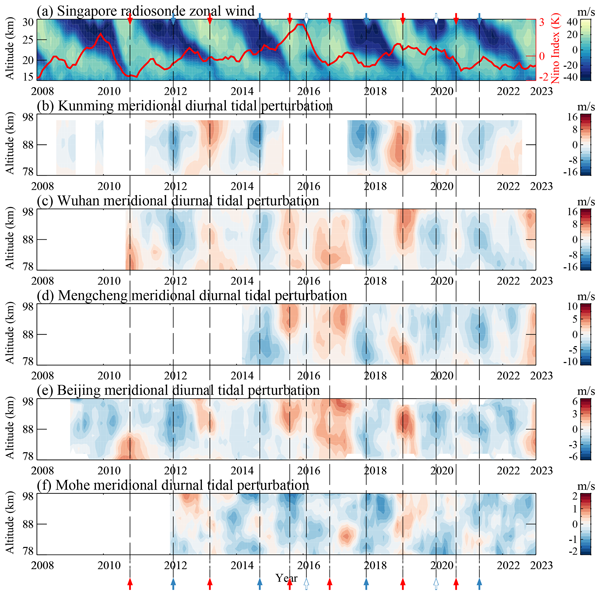
The MLT DW1 amplitude is suppressed during El Niño winters in both satellite observation and SD-WACCM simulations. The suppressed Hough mode (1, 1) in the tropopause region propagates vertically to the MLT region, leading to decreased DW1 amplitude. The latitudinal zonal wind shear anomalies during El Niño winters would narrow the waveguide and prevent the vertical propagation of DW1. The gravity wave drag excited by ENSO-induced anomalous convection could also modulate the MLT DW1 amplitude.
Ruichun Dong, Xin Fang, Chengyun Yang, and Tao Li
Atmos. Chem. Phys., 26, 13139–13156, https://doi.org/10.5194/acp-26-13139-2026, https://doi.org/10.5194/acp-26-13139-2026, 2026
Short summary
Short summary
High-resolution USTC (University of Science and Technology of China) Ozone Lidar observations at Yangbajing, Tibet capture short-lived rapid STE (stratosphere-to-troposphere exchange)-related ozone descent for the first time. Lidar temperature profiles link these events to tropopause thermal variability unresolved by conventional models. Wei’s flux diagnostic and PV (potential vorticity)-threshold sensitivity identify 3 PVU (potential vorticity units) as optimal. ERA5 shows gravity-wave modulation during tropopause folding, and lidar ozone profiles are used to quantify instantaneous cross-tropopause ozone flux.
Liangyu Pu, Tingdi Chen, Yuli Han, Zhaowang Su, Yiming Song, Zhu Meng, Yuxin Wen, Chong Chen, Dongsong Sun, Xianghui Xue, and Xiankang Dou
EGUsphere, https://doi.org/10.5194/egusphere-2026-5254, https://doi.org/10.5194/egusphere-2026-5254, 2026
This preprint is open for discussion and under review for Atmospheric Measurement Techniques (AMT).
Short summary
Short summary
Atmospheric wind and temperature are essential for understanding weather and atmospheric dynamics. We developed a new lidar receiver that measures both quantities from the same atmospheric backscatter signal without frequency scanning. Field experiments demonstrated wind measurements from 2 to 20 km and simultaneous wind and temperature measurements from 5.3 to 20 km, with good agreement with radiosondes.
Kexin Ming, Chong Wang, Wei Kong, Xianghui Xue, Genghua Huang, Ruikai Xue, Wenhao Li, Yudie Li, Chen Liang, Ruocan Zhao, Mingjiao Jia, and Xiang Shang
EGUsphere, https://doi.org/10.5194/egusphere-2026-4536, https://doi.org/10.5194/egusphere-2026-4536, 2026
This preprint is open for discussion and under review for Atmospheric Measurement Techniques (AMT).
Short summary
Short summary
Boundary layer height is important for weather forecasting and climate studies, but consistent global observations remain difficult. We designed a spaceborne lidar and validated its performance through theoretical simulations and experiments with a scaled airborne prototype. Nighttime results in Yulin agreed closely with ground-based observations, while daytime tests in Hainan showed detection potential under strong background illumination, supporting future global monitoring from space.
Yuxia Jia, Chao Ban, Tao Li, Xin Fang, Zhaopeng Wu, Jianfei Wu, Weilin Pan, and Chengyun Yang
Atmos. Chem. Phys., 26, 11409–11420, https://doi.org/10.5194/acp-26-11409-2026, https://doi.org/10.5194/acp-26-11409-2026, 2026
Short summary
Short summary
In this study, a sodium lidar at the University of Science and Technology of China (USTC) observed multiple sporadic sodium layers (SSLs) and enhanced sodium patterns (ESPs) during a single night. By combining observations from a meteor radar and an ionosonde in Wuhan, the results show that horizontal winds can not only directly transport sodium atoms through advection but also indirectly influence sodium density by modulating ion convergence and Es layers via atmospheric waves.
Ewa M. Bednarz, Valentina Aquila, Amy H. Butler, Peter Colarco, Eric Fleming, Freja F. Østerstrøm, David Plummer, Ilaria Quaglia, William Randel, Michelle L. Santee, Takashi Sekiya, Simone Tilmes, Xinyue Wang, Shingo Watanabe, Wandi Yu, Jun Zhang, Yunqian Zhu, and Zhihong Zhuo
Atmos. Chem. Phys., 26, 11355–11370, https://doi.org/10.5194/acp-26-11355-2026, https://doi.org/10.5194/acp-26-11355-2026, 2026
Short summary
Short summary
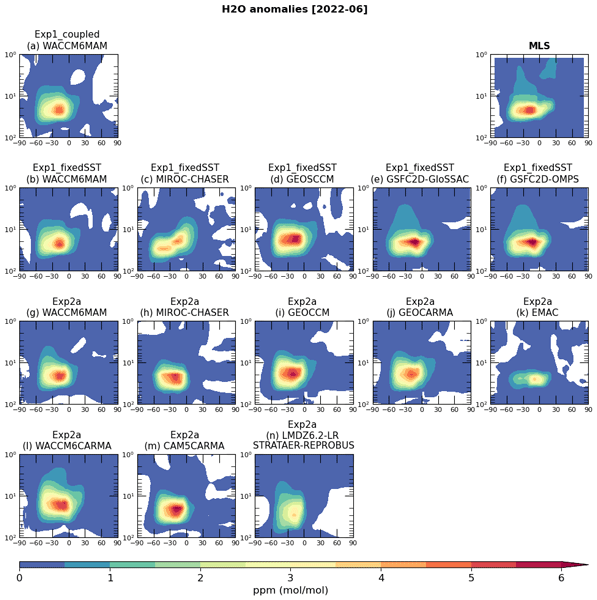
The 2022 Hunga eruption injected unprecedented quantities of water vapor into the stratosphere, alongside modest amounts of aerosol precursors. We assess its impacts on stratospheric ozone layer using a multi-model ensemble of chemistry-climate simulations. The results confirm the eruption's role in modulating SH (Southern Hemisphere) mid and high latitudes ozone abundances in the short term, and discuss the different chemical and dynamical processes driving those changes as well as the role of natural variability.
Kimberlee Dubé, William Randel, Adam Bourassa, Susann Tegtmeier, Xinyue Wang, Jun Zhang, Eilidh Hlady, Meghan Brehon, Sergey Khaykin, and Douglas Degenstein
EGUsphere, https://doi.org/10.5194/egusphere-2026-4022, https://doi.org/10.5194/egusphere-2026-4022, 2026
Short summary
Short summary
The Hunga volcanic eruption in January 2022 increased the total stratospheric water vapor (H2O) mass by 10 %. The study uses satellite observations and models to track the transport of the Hunga H2O. We find that there is substantially more H2O in the observations than the model during 2024 and 2025, suggesting that the modelled transport across the lower stratosphere is too fast. We also find evidence that some of the H2O that reaches the lower stratosphere is mixed back into the tropics.
Zhiting Wang, Yijie Zheng, Xinlong Hong, Plummer David, and Jun Zhang
EGUsphere, https://doi.org/10.5194/egusphere-2026-3817, https://doi.org/10.5194/egusphere-2026-3817, 2026
Short summary
Short summary
The tropospheric OH radical impacts air quality and greenhouse gas concentrations. Here it shown that stratospheric intrusion significantly influence tropospheric OH, particularly over subtropical oceans (20 %) and the Tibetan Plateau (12 %) in summer. This influence is expected to intensify in the future due to enhanced stratosphere-troposphere exchange and stratospheric ozone recovery, highlighting a growing coupling between upper-atmosphere processes and surface oxidation chemistry.
Yiran Pan, Jialin Zhang, Chengyun Yang, Tao Li, Xin Fang, Xinyue Wang, Xianghui Xue, and Xiankang Dou
EGUsphere, https://doi.org/10.5194/egusphere-2026-3774, https://doi.org/10.5194/egusphere-2026-3774, 2026
Short summary
Short summary
In 2024, the upper atmosphere above Antarctica experienced two sudden warming events and then repeated warming and recovery instead of returning steadily to normal. Large-scale atmospheric waves disturbed the circling polar winds, and the altered winds then shaped how later waves moved upward, allowing the disturbance to persist. This helps explain how rare Antarctic events can last longer and affect links between the upper and lower atmosphere.
Ilaria Quaglia, Daniele Visioni, Ewa M. Bednarz, Yunqian Zhu, Georgiy Stenchikov, Valentina Aquila, Cheng-Cheng Liu, Graham W. Mann, Yifeng Peng, Takashi Sekiya, Simone Tilmes, Xinyue Wang, Shingo Watanabe, Pengfei Yu, Jun Zhang, Wandi Yu, and Zhihong Zhuo
Atmos. Chem. Phys., 26, 7677–7704, https://doi.org/10.5194/acp-26-7677-2026, https://doi.org/10.5194/acp-26-7677-2026, 2026
Short summary
Short summary
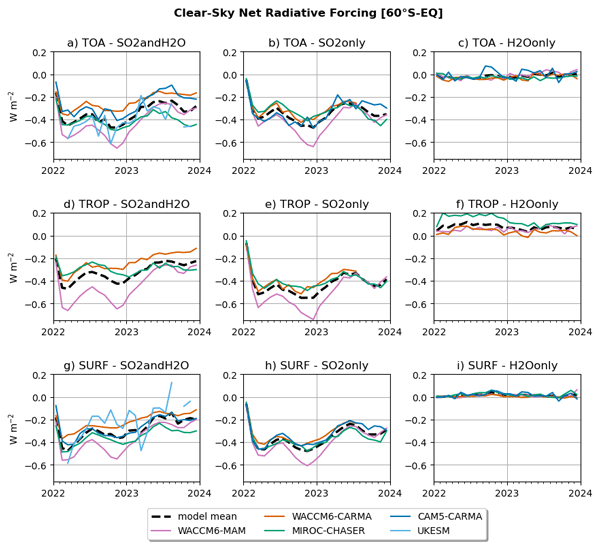
On January 15, 2022, the Hunga volcano eruption released unprecedented amounts of water vapor into the atmosphere alongside a modest amount of SO2. In this work we analyse results from multiple Earth system models. The models agree that the eruption led to small negative radiative forcing from sulfate aerosols and that the contribution from water vapor was minimal. Therefore, the Hunga eruption cannot explain the exceptional surface warming observed in 2023.
Jiahui Hu, Alan Liu, Adriana Feener, Wenjun Dong, Jing Li, and Tao Li
EGUsphere, https://doi.org/10.48550/arXiv.2603.03669, https://doi.org/10.48550/arXiv.2603.03669, 2026
Short summary
Short summary
All-sky OH airglow imaging captures mesospheric gravity waves near ~87 km, but ripple-scale instabilities (5–15 km) are difficult to identify manually. We develop an automated SE-CNN framework trained on image patches to detect ripples in 512×512 images. Using MAD normalization and sliding-window detection with clustering, the model achieves 92% F1-score and recovers ~90% of manual events, enabling objective, scalable analysis of ripple occurrence and variability.
Wen Yi, Jianyuan Wang, Xianghui Xue, Chengyun Yang, Iain M. Reid, Robert A. Vincent, Andrew Mackinnon, Damian J. Murphy, Njål Gulbrandsen, Masaki Tsutsumi, Baiqi Ning, Guozhu Li, Nicholas J. Mitchell, Tracy Moffat-Griffin, Toshitaka Tsuda, Alan Z. Liu, Zishun Qiao, Haiying Li, Paulo P. Batista, Jianfei Wu, Tingdi Chen, and Xiankang Dou
EGUsphere, https://doi.org/10.5194/egusphere-2026-1883, https://doi.org/10.5194/egusphere-2026-1883, 2026
Short summary
Short summary
This study provides observational evidence that the solar zenith angle (SZA) influences the vertical structure of diurnal tides in the MLT region. Diurnal tides are strongest at low and mid-latitudes (10–50° N/S) and weaker near the Equator and at polar latitudes. The results further suggest that background zonal winds influence tidal propagation and structure through filtering and momentum drag.
Chao Ban, Xin Fang, Wen Yi, Jie Zeng, Gunter Stober, Weilin Pan, Tao Li, and Xianghui Xue
Atmos. Meas. Tech., 19, 1697–1709, https://doi.org/10.5194/amt-19-1697-2026, https://doi.org/10.5194/amt-19-1697-2026, 2026
Short summary
Short summary
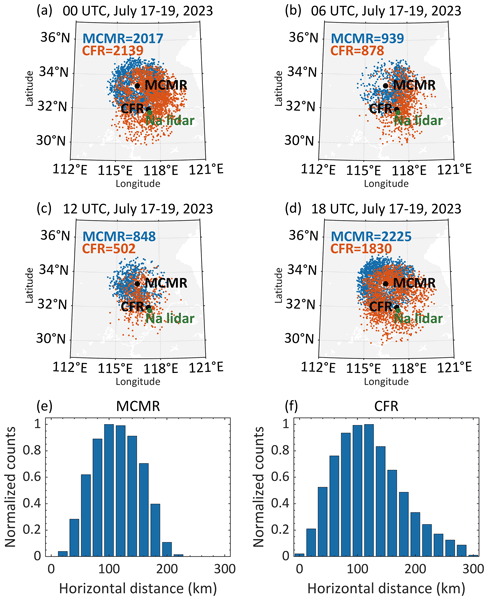
This paper presents an intercomparison of zonal winds observed by a sodium fluorescence lidar and three types of meteor radars – a multistatic meteor radar, a conventional monostatic radar, and a forward remote receiver – located near Hefei, China. The multistatic meteor radar shows the best agreement with the lidar measurements, confirming the reliability of its wind retrievals in the mesosphere and lower thermosphere and highlighting its potential for future atmospheric dynamics studies.
Xingjin Wang, Xin Fang, Wenhao Gao, Xianhang Chen, Tai Liu, Chengyun Yang, Tingdi Chen, Tao Li, and Xianghui Xue
Atmos. Meas. Tech., 19, 1629–1641, https://doi.org/10.5194/amt-19-1629-2026, https://doi.org/10.5194/amt-19-1629-2026, 2026
Short summary
Short summary
This paper reports the deployment of the first narrowband sodium lidar in the low-latitude region of China. The lidar observations are compared with satellite measurements and atmospheric models, confirming the scientific credibility of these results. Calculations of vertical gravity wave heat and sodium fluxes are used to investigate the influence of the space environment. This lidar system will provide a new ground-based detection device for studying atmospheric environment above the area.
Ewa M. Bednarz, Amy H. Butler, Xinyue Wang, Zhihong Zhuo, Wandi Yu, Georgiy Stenchikov, Matthew Toohey, and Yunqian Zhu
Atmos. Chem. Phys., 26, 197–215, https://doi.org/10.5194/acp-26-197-2026, https://doi.org/10.5194/acp-26-197-2026, 2026
Short summary
Short summary
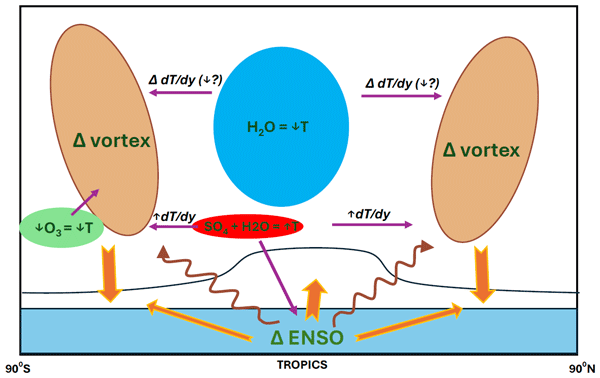
We investigate whether the 2022 Hunga eruption could affect surface climate via indirect pathways using large ensembles of Earth System Model simulations. These suggest that the eruption could have a non-negligible influence on regional surface climate, and we discuss the mechanisms via which such an influence could occur but also highlight that the forcing is relatively weak compared to natural climate variability which significantly hinders the detection of such impacts in the real world.
Zhihong Zhuo, Xinyue Wang, Yunqian Zhu, Wandi Yu, Ewa M. Bednarz, Eric Fleming, Peter R. Colarco, Shingo Watanabe, David Plummer, Georgiy Stenchikov, William Randel, Adam Bourassa, Valentina Aquila, Takashi Sekiya, Mark R. Schoeberl, Simone Tilmes, Jun Zhang, Paul J. Kushner, and Francesco S. R. Pausata
Atmos. Chem. Phys., 25, 13161–13176, https://doi.org/10.5194/acp-25-13161-2025, https://doi.org/10.5194/acp-25-13161-2025, 2025
Short summary
Short summary
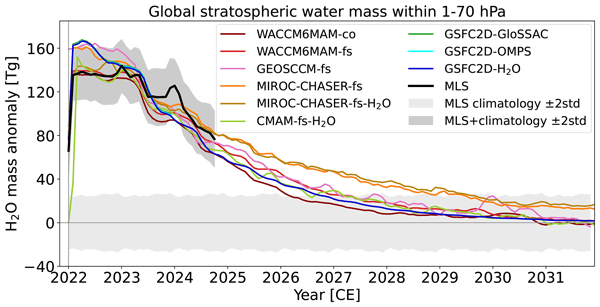
The 2022 Hunga eruption caused unprecedented stratospheric water injection, triggering unique atmospheric impacts. This study combines observations and model simulations, projecting a stratospheric water vapor anomaly lasting 4–7 years, with significant temperature variations and ozone depletion in the upper atmosphere lasting 7–10 years. These findings offer critical insights into the role of stratospheric water vapor in shaping climate and atmospheric chemistry.
Yunqian Zhu, Hideharu Akiyoshi, Valentina Aquila, Elizabeth Asher, Ewa M. Bednarz, Slimane Bekki, Christoph Brühl, Amy H. Butler, Parker Case, Simon Chabrillat, Gabriel Chiodo, Margot Clyne, Peter R. Colarco, Sandip Dhomse, Lola Falletti, Eric Fleming, Ben Johnson, Andrin Jörimann, Mahesh Kovilakam, Gerbrand Koren, Ales Kuchar, Nicolas Lebas, Qing Liang, Cheng-Cheng Liu, Graham Mann, Michael Manyin, Marion Marchand, Olaf Morgenstern, Paul Newman, Luke D. Oman, Freja F. Østerstrøm, Yifeng Peng, David Plummer, Ilaria Quaglia, William Randel, Samuel Rémy, Takashi Sekiya, Stephen Steenrod, Timofei Sukhodolov, Simone Tilmes, Kostas Tsigaridis, Rei Ueyama, Daniele Visioni, Xinyue Wang, Shingo Watanabe, Yousuke Yamashita, Pengfei Yu, Wandi Yu, Jun Zhang, and Zhihong Zhuo
Geosci. Model Dev., 18, 5487–5512, https://doi.org/10.5194/gmd-18-5487-2025, https://doi.org/10.5194/gmd-18-5487-2025, 2025
Short summary
Short summary
To understand the climate impact of the 2022 Hunga volcanic eruption, we developed a climate model–observation comparison project. The paper describes the protocols and models that participate in the experiments. We designed several experiments to achieve our goals of this activity: (1) to evaluate the climate model performance and (2) to understand the Earth system responses to this eruption.
Genevieve Rose Lorenzo, Luke D. Ziemba, Avelino F. Arellano, Mary C. Barth, Ewan C. Crosbie, Joshua P. DiGangi, Glenn S. Diskin, Richard Ferrare, Miguel Ricardo A. Hilario, Michael A. Shook, Simone Tilmes, Jian Wang, Qian Xiao, Jun Zhang, and Armin Sorooshian
Atmos. Chem. Phys., 25, 5469–5495, https://doi.org/10.5194/acp-25-5469-2025, https://doi.org/10.5194/acp-25-5469-2025, 2025
Short summary
Short summary
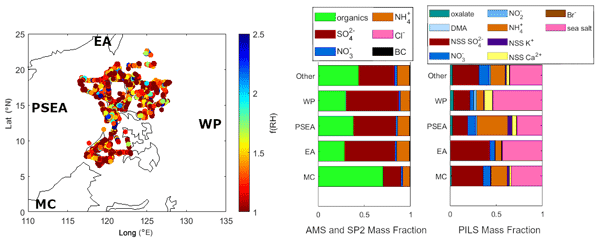
Novel aerosol hygroscopicity analyses of CAMP2Ex (Cloud, Aerosol, and Monsoon Processes Philippines Experiment) field campaign data show low aerosol hygroscopicity values in Southeast Asia. Organic carbon from smoke decreases hygroscopicity to levels more like those in continental than in polluted marine regions. Hygroscopicity changes at cloud level demonstrate how surface particles impact clouds in the region, affecting model representation of aerosol and cloud interactions in similar polluted marine regions with high organic carbon emissions.
Jianyuan Wang, Na Li, Wen Yi, Xianghui Xue, Iain M. Reid, Jianfei Wu, Hailun Ye, Jian Li, Zonghua Ding, Jinsong Chen, Guozhu Li, Yaoyu Tian, Boyuan Chang, Jiajing Wu, and Lei Zhao
Atmos. Chem. Phys., 24, 13299–13315, https://doi.org/10.5194/acp-24-13299-2024, https://doi.org/10.5194/acp-24-13299-2024, 2024
Short summary
Short summary
We present the impact of quasi-biennial oscillation (QBO) disruption events on diurnal tides over the low- and mid-latitude MLT region observed by a meteor radar chain. By using a global atmospheric model and reanalysis data, it is found that the stratospheric QBO winds can affect the mesospheric diurnal tides by modulating the subtropical ozone variability in the upper stratosphere and the interaction between tides and gravity waves in the mesosphere.
Jianfei Wu, Wuhu Feng, Xianghui Xue, Daniel Robert Marsh, and John Maurice Campbell Plane
Atmos. Chem. Phys., 24, 12133–12141, https://doi.org/10.5194/acp-24-12133-2024, https://doi.org/10.5194/acp-24-12133-2024, 2024
Short summary
Short summary
Metal layers occur in the mesosphere and lower thermosphere region 80–120 km from the ablation of cosmic dust. Nonmigrating diurnal tides are persistent global oscillations. We investigate nonmigrating diurnal tidal variations in metal layers using satellite observations and global climate model simulations; these have not been studied previously due to the limitations of measurements. The nonmigrating diurnal tides in temperature are strongly linked to the corresponding change in metal layers.
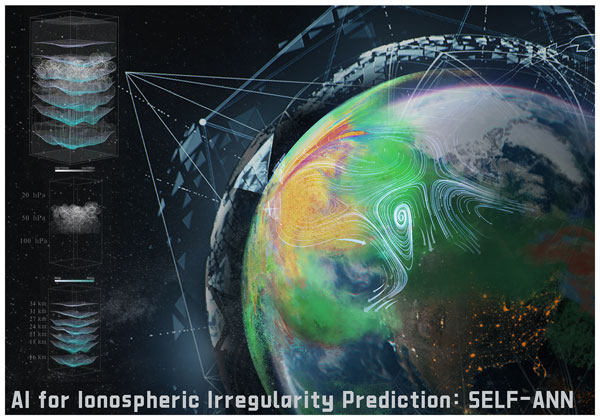
Penghao Tian, Bingkun Yu, Hailun Ye, Xianghui Xue, Jianfei Wu, and Tingdi Chen
Atmos. Chem. Phys., 23, 13413–13431, https://doi.org/10.5194/acp-23-13413-2023, https://doi.org/10.5194/acp-23-13413-2023, 2023
Short summary
Short summary
Modeling and prediction of ionospheric irregularities is an important topic in upper-atmospheric and upper-ionospheric physics. We proposed an artificial intelligence model to reconstruct the E-region ionospheric irregularities and first developed an open-source application for the community. The model reveals complex relationships between ionospheric irregularities and external driving factors. The findings suggest that spatiotemporal information plays an important role in the reconstruction.
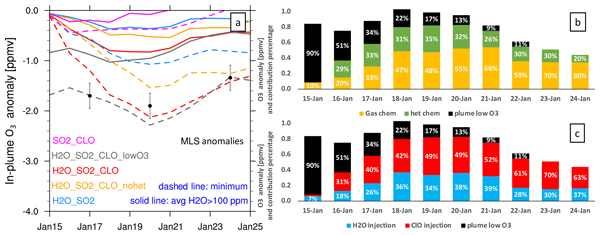
Yunqian Zhu, Robert W. Portmann, Douglas Kinnison, Owen Brian Toon, Luis Millán, Jun Zhang, Holger Vömel, Simone Tilmes, Charles G. Bardeen, Xinyue Wang, Stephanie Evan, William J. Randel, and Karen H. Rosenlof
Atmos. Chem. Phys., 23, 13355–13367, https://doi.org/10.5194/acp-23-13355-2023, https://doi.org/10.5194/acp-23-13355-2023, 2023
Short summary
Short summary
The 2022 Hunga Tonga eruption injected a large amount of water into the stratosphere. Ozone depletion was observed inside the volcanic plume. Chlorine and water vapor injected by this eruption exceeded the normal range, which made the ozone chemistry during this event occur at a higher temperature than polar ozone depletion. Unlike polar ozone chemistry where chlorine nitrate is more important, hypochlorous acid plays a large role in the in-plume chlorine balance and heterogeneous processes.
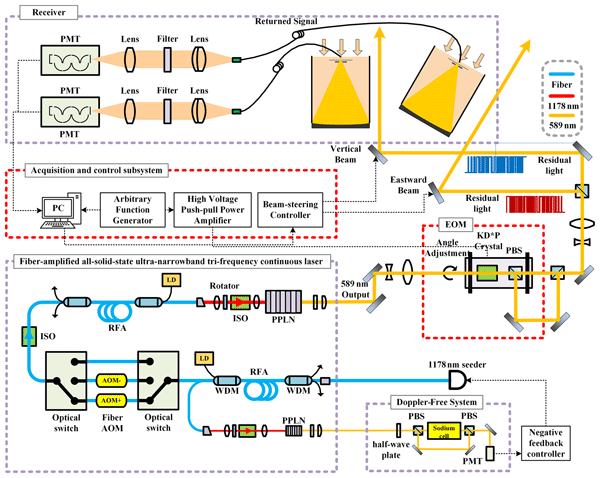
Xin Fang, Feng Li, Lei-lei Sun, and Tao Li
Atmos. Meas. Tech., 16, 2263–2272, https://doi.org/10.5194/amt-16-2263-2023, https://doi.org/10.5194/amt-16-2263-2023, 2023
Short summary
Short summary
We successfully developed the first pseudorandom modulation continuous-wave narrowband sodium lidar (PMCW-NSL) system for simultaneous measurements of the mesopause region's temperature and wind. Based on the innovative decoded technique and algorithm for CW lidar, both the main and residual lights modulated by M-code are used and directed to the atmosphere in the vertical and eastward directions, tilted 20° from the zenith. The PMCW-NSL system can applied to airborne and space-borne purposes.
Wen Yi, Jie Zeng, Xianghui Xue, Iain Reid, Wei Zhong, Jianfei Wu, Tingdi Chen, and Xiankang Dou
Atmos. Meas. Tech. Discuss., https://doi.org/10.5194/amt-2022-254, https://doi.org/10.5194/amt-2022-254, 2022
Revised manuscript not accepted
Short summary
Short summary
In recent years, the concept of multistatic meteor radar systems has attracted the attention of the atmospheric radar community, focusing on the MLT region. In this study, we apply a multistatic meteor radar system consisting of a monostatic meteor radar in Mengcheng (33.36° N, 116.49° E) and a remote receiver in Changfeng (31.98° N, 117.22° E) to estimate the two-dimensional horizontal wind field, and the horizontal divergence and relative vorticity of the wind field.
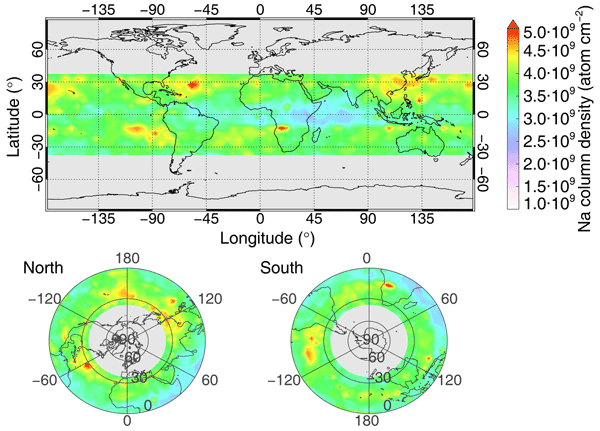
Bingkun Yu, Xianghui Xue, Christopher J. Scott, Mingjiao Jia, Wuhu Feng, John M. C. Plane, Daniel R. Marsh, Jonas Hedin, Jörg Gumbel, and Xiankang Dou
Atmos. Chem. Phys., 22, 11485–11504, https://doi.org/10.5194/acp-22-11485-2022, https://doi.org/10.5194/acp-22-11485-2022, 2022
Short summary
Short summary
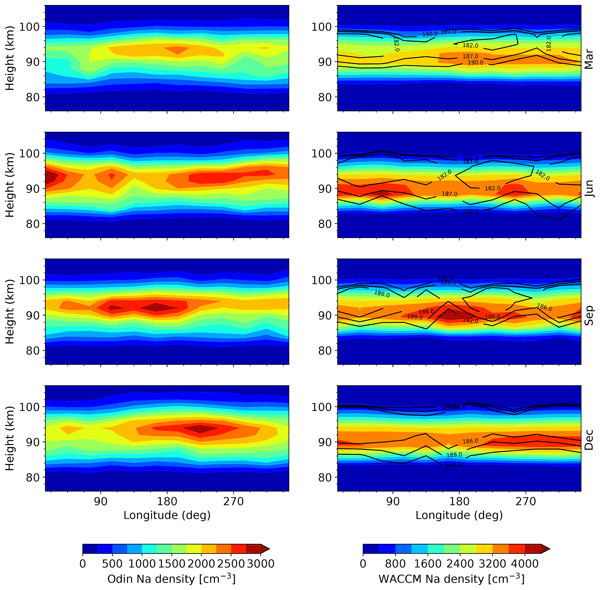
We present a study on the climatology of the metal sodium layer in the upper atmosphere from the ground-based measurements obtained from a lidar network, the Odin satellite measurements, and a global model of meteoric sodium in the atmosphere. Comprehensively, comparisons show good agreement and some discrepancies between ground-based observations, satellite measurements, and global model simulations.
Yetao Cen, Chengyun Yang, Tao Li, James M. Russell III, and Xiankang Dou
Atmos. Chem. Phys., 22, 7861–7874, https://doi.org/10.5194/acp-22-7861-2022, https://doi.org/10.5194/acp-22-7861-2022, 2022
Short summary
Short summary
The MLT DW1 amplitude is suppressed during El Niño winters in both satellite observation and SD-WACCM simulations. The suppressed Hough mode (1, 1) in the tropopause region propagates vertically to the MLT region, leading to decreased DW1 amplitude. The latitudinal zonal wind shear anomalies during El Niño winters would narrow the waveguide and prevent the vertical propagation of DW1. The gravity wave drag excited by ENSO-induced anomalous convection could also modulate the MLT DW1 amplitude.
Shican Qiu, Mengxi Shi, Willie Soon, Mingjiao Jia, Xianghui Xue, Tao Li, Peng Ju, and Xiankang Dou
Atmos. Chem. Phys. Discuss., https://doi.org/10.5194/acp-2021-1085, https://doi.org/10.5194/acp-2021-1085, 2022
Revised manuscript not accepted
Short summary
Short summary
The solitary wave theory is applied for the first time to study the sporadic sodium layers (NaS). We perform soliton fitting processes on the observed data from the Andes Lidar Observatory, and find out that 24/27 NaS events exhibit similar features to a soliton. Time series of the net anomaly reveal the same variation process to the solution of a five-order KdV equation. Our results suggest the NaS phenomenon would be an appropriate tracer for nonlinear wave studies in the atmosphere.

Jianfei Wu, Wuhu Feng, Han-Li Liu, Xianghui Xue, Daniel Robert Marsh, and John Maurice Campbell Plane
Atmos. Chem. Phys., 21, 15619–15630, https://doi.org/10.5194/acp-21-15619-2021, https://doi.org/10.5194/acp-21-15619-2021, 2021
Short summary
Short summary
Metal layers occur in the MLT region (80–120 km) from the ablation of cosmic dust. The latest lidar observations show these metals can reach a height approaching 200 km, which is challenging to explain. We have developed the first global simulation incorporating the full life cycle of metal atoms and ions. The model results compare well with lidar and satellite observations of the seasonal and diurnal variation of the metals and demonstrate the importance of ion mass and ion-neutral coupling.
Cited articles
Andrews, D. G. and McIntyre, M. E.: Planetary Waves in Horizontal and Vertical Shear: The Generalized Eliassen–Palm Relation and the Mean Zonal Acceleration, J. Atmos. Sci., 33, 2031–2048, https://doi.org/10.1175/1520-0469(1976)033<2031:PWIHAV>2.0.CO;2, 1976.
Andrews, D. G., Leovy, C. B., Holton, J. R., Marshall, J., and Plumb, R. A.: Middle Atmosphere Dynamics, Elsevier Science & Technology, Saint Louis, ISBN: 978-0120585762, 1987.
Ashok, K., Guan, Z., and Yamagata, T.: Impact of the Indian Ocean dipole on the relationship between the Indian monsoon rainfall and ENSO, Geophys. Res. Lett., 28, 4499–4502, https://doi.org/10.1029/2001gl013294, 2001.
Baldwin, M. P. and Dunkerton, T. J.: Stratospheric Harbingers of Anomalous Weather Regimes, Science, 294, 581–584, https://doi.org/10.1126/science.1063315, 2001.
Bègue, N., Bencherif, H., Sivakumar, V., Kirgis, G., Mze, N., and Leclair De Bellevue, J.: Temperature variability and trends in the UT-LS over a subtropical site: Reunion (20.8° S, 55.5° E), Atmos. Chem. Phys., 10, 8563–8574, https://doi.org/10.5194/acp-10-8563-2010, 2010.
Behera, S. K., Salvekar, P. S., and Yamagata, T.: Simulation of Interannual SST Variability in the Tropical Indian Ocean, J. Climate, 13, 3487–3499, https://doi.org/10.1175/1520-0442(2000)013<3487:soisvi>2.0.co;2, 2000.
Black, R. X. and McDaniel, B. A.: Interannual Variability in the Southern Hemisphere Circulation Organized by Stratospheric Final Warming Events, J. Atmos. Sci., 64, 2968–2974, https://doi.org/10.1175/jas3979.1, 2007.
Brayshaw, D. J., Hoskins, B., and Blackburn, M.: The Storm-Track Response to Idealized SST Perturbations in an Aquaplanet GCM, J. Atmos. Sci., 65, 2842–2860, https://doi.org/10.1175/2008JAS2657.1, 2008.
Butchart, N., Clough, S. A., Palmer, T. N., and Trevelyan, P. J.: Simulations of an observed stratospheric warming with quasigeostrophic refractive index as a model diagnostic, Q. J. Roy. Meteor. Soc., 108, 475–502, https://doi.org/10.1002/qj.49710845702, 1982.
Charney, J. G. and Drazin, P. G.: Propagation of planetary-scale disturbances from the lower into the upper atmosphere, J. Geophys. Res., 66, 83–109, https://doi.org/10.1029/JZ066i001p00083, 1961.
Domeisen, D. I. V., Garfinkel, C. I., and Butler, A. H.: The Teleconnection of El Niño Southern Oscillation to the Stratosphere, Rev. Geophys., 57, 5–47, https://doi.org/10.1029/2018RG000596, 2019.
Dowdy, A. J., Vincent, R. A., Murphy, D. J., Tsutsumi, M., Riggin, D. M., and Jarvis, M. J.: The large-scale dynamics of the mesosphere–lower thermosphere during the Southern Hemisphere stratospheric warming of 2002, Geophys. Res. Lett., 31, https://doi.org/10.1029/2004gl020282, 2004.
Fletcher, C. G. and Cassou, C.: The Dynamical Influence of Separate Teleconnections from the Pacific and Indian Oceans on the Northern Annular Mode, J. Climate, 28, 7985–8002, https://doi.org/10.1175/jcli-d-14-00839.1, 2015.
Fletcher, C. G. and Kushner, P. J.: The Role of Linear Interference in the Annular Mode Response to Tropical SST Forcing, J. Climate, 24, 778–794, https://doi.org/10.1175/2010JCLI3735.1, 2011.
García-Herrera, R., Calvo, N., Garcia, R. R., and Giorgetta, M. A.: Propagation of ENSO temperature signals into the middle atmosphere: A comparison of two general circulation models and ERA-40 reanalysis data, J. Geophys. Res., 111, https://doi.org/10.1029/2005jd006061, 2006.
Garfinkel, C. I., Hurwitz, M. M., Oman, L. D., and Waugh, D. W.: Contrasting Effects of Central Pacific and Eastern Pacific El Niño on stratospheric water vapor, Geophys. Res. Lett., 40, 4115–4120, https://doi.org/10.1002/grl.50677, 2013.
Garfinkel, C. I., Harari, O., Ziskin Ziv, S., Rao, J., Morgenstern, O., Zeng, G., Tilmes, S., Kinnison, D., O'Connor, F. M., Butchart, N., Deushi, M., Jöckel, P., Pozzer, A., and Davis, S.: Influence of the El Niño–Southern Oscillation on entry stratospheric water vapor in coupled chemistry–ocean CCMI and CMIP6 models, Atmos. Chem. Phys., 21, 3725–3740, https://doi.org/10.5194/acp-21-3725-2021, 2021.
Gettelman, A., Mills, M. J., Kinnison, D. E., Garcia, R. R., Smith, A. K., Marsh, D. R., Tilmes, S., Vitt, F., Bardeen, C. G., McInerny, J., Liu, H.-L., Solomon, S. C., Polvani, L. M., Emmons, L. K., Lamarque, J.-F., Richter, J. H., Glanville, A. S., Bacmeister, J. T., Phillips, A. S., Neale, R. B., Simpson, I. R., DuVivier, A. K., Hodzic, A., and Randel, W. J.: The Whole Atmosphere Community Climate Model Version 6 (WACCM6), J. Geophys. Res.-Atmos., 124, 12380–12403, https://doi.org/10.1029/2019JD030943, 2019.
Guan, Z. and Yamagata, T.: The unusual summer of 1994 in East Asia: IOD teleconnections, Geophys. Res. Lett., 30, https://doi.org/10.1029/2002gl016831, 2003.
Held, I. M., Ting, M., and Wang, H.: Northern Winter Stationary Waves: Theory and Modeling, J. Climate, 15, 2125–2144, https://doi.org/10.1175/1520-0442(2002)015<2125:NWSWTA>2.0.CO;2, 2002.
Hersbach, H., Bell, B., Berrisford, P., Hirahara, S., Horányi, A., Muñoz-Sabater, J., Nicolas, J., Peubey, C., Radu, R., Schepers, D., Simmons, A., Soci, C., Abdalla, S., Abellan, X., Balsamo, G., Bechtold, P., Biavati, G., Bidlot, J., Bonavita, M., De Chiara, G., Dahlgren, P., Dee, D., Diamantakis, M., Dragani, R., Flemming, J., Forbes, R., Fuentes, M., Geer, A., Haimberger, L., Healy, S., Hogan, R. J., Hólm, E., Janisková, M., Keeley, S., Laloyaux, P., Lopez, P., Lupu, C., Radnoti, G., De Rosnay, P., Rozum, I., Vamborg, F., Villaume, S., and Thépaut, J.: The ERA5 global reanalysis, Quart. J. Royal Meteoro. Soc., 146, 1999–2049, https://doi.org/10.1002/qj.3803, 2020.
Joshi, M. M., Charlton, A. J., and Scaife, A. A.: On the influence of stratospheric water vapor changes on the tropospheric circulation, Geophys. Res. Lett., 33, https://doi.org/10.1029/2006gl025983, 2006.
Karlsson, B., Randall, C. E., Shepherd, T. G., Harvey, V. L., Lumpe, J., Nielsen, K., Bailey, S. M., Hervig, M., and Russell, J. M.: On the seasonal onset of polar mesospheric clouds and the breakdown of the stratospheric polar vortex in the Southern Hemisphere, J. Geophys. Res., 116, https://doi.org/10.1029/2011jd015989, 2011.
Li, T., Calvo, N., Yue, J., Dou, X., Russell, J. M., Mlynczak, M. G., She, C.-Y., and Xue, X.: Influence of El Niño–Southern Oscillation in the mesosphere: ENSO in the Mesosphere, Geophys. Res. Lett., 40, 3292–3296, https://doi.org/10.1002/grl.50598, 2013.
Li, T., Calvo, N., Yue, J., Russell, J. M., Smith, A. K., Mlynczak, M. G., Chandran, A., Dou, X., and Liu, A. Z.: Southern Hemisphere Summer Mesopause Responses to El Niño–Southern Oscillation, J. Climate, 29, 6319–6328, https://doi.org/10.1175/JCLI-D-15-0816.1, 2016a.
Li, T., Calvo, N., Yue, J., Russell, J. M., Smith, A. K., Mlynczak, M. G., Chandran, A., Dou, X., and Liu, A. Z.: Southern Hemisphere Summer Mesopause Responses to El Niño–Southern Oscillation, J. Climate, 29, 6319–6328, https://doi.org/10.1175/JCLI-D-15-0816.1, 2016b.
Li, T., Yue, J., Russell, J. M., and Zhang, X.: Long-term trend and solar cycle in the middle atmosphere temperature revealed from merged HALOE and SABER datasets, J. Atmos. Sol.-Terr. Phy., 212, 105506, https://doi.org/10.1016/j.jastp.2020.105506, 2021.
Limpasuvan, V., Hartmann, D. L., Thompson, D. W. J., Jeev, K., and Yung, Y. L.: Stratosphere–troposphere evolution during polar vortex intensification, J. Geophys. Res., 110, 2005JD006302, https://doi.org/10.1029/2005JD006302, 2005.
Lindzen, R. S.: Turbulence and stress owing to gravity wave and tidal breakdown, J. Geophys. Res., 86, 9707, https://doi.org/10.1029/JC086iC10p09707, 1981.
Maycock, A. C., Joshi, M. M., Shine, K. P., and Scaife, A. A.: The Circulation Response to Idealized Changes in Stratospheric Water Vapor, J. Climate, 26, 545–561, https://doi.org/10.1175/jcli-d-12-00155.1, 2013.
Mbatha, N., Sivakumar, V., Malinga, S. B., Bencherif, H., and Pillay, S. R.: Study on the impact of sudden stratosphere warming in the upper mesosphere-lower thermosphere regions using satellite and HF radar measurements, Atmos. Chem. Phys., 10, 3397–3404, https://doi.org/10.5194/acp-10-3397-2010, 2010.
Mitchell, N. J., Middleton, H. R., Beard, A. G., Williams, P. J. S., and Muller, H. G.: The 16-day planetary wave in the mesosphere and lower thermosphere, Ann. Geophys., 17, 1447–1456, https://doi.org/10.1007/s00585-999-1447-9, 1999.
Newman, P. A., Daniel, J. S., Waugh, D. W., and Nash, E. R.: A new formulation of equivalent effective stratospheric chlorine (EESC), Atmos. Chem. Phys., 7, 4537–4552, https://doi.org/10.5194/acp-7-4537-2007, 2007.
Ramsay, H. A., Richman, M. B., and Leslie, L. M.: The Modulating Influence of Indian Ocean Sea Surface Temperatures on Australian Region Seasonal Tropical Cyclone Counts, J. Climate, 30, 4843–4856, https://doi.org/10.1175/jcli-d-16-0631.1, 2017.
Rao, J. and Ren, R.: A decomposition of ENSO's impacts on the northern winter stratosphere: competing effect of SST forcing in the tropical Indian Ocean, Clim. Dynam., 46, 3689–3707, https://doi.org/10.1007/s00382-015-2797-5, 2016.
Rao, J. and Ren, R.: Varying stratospheric responses to tropical Atlantic SST forcing from early to late winter, Clim. Dynam., 51, 2079–2096, https://doi.org/10.1007/s00382-017-3998-x, 2018.
Rao, J. and Ren, R.: Modeling study of the destructive interference between the tropical Indian Ocean and eastern Pacific in their forcing in the southern winter extratropical stratosphere during ENSO, Clim. Dynam., 54, 2249–2266, https://doi.org/10.1007/s00382-019-05111-6, 2020.
Rao, J., Garfinkel, C. I., and White, I. P.: Predicting the Downward and Surface Influence of the February 2018 and January 2019 Sudden Stratospheric Warming Events in Subseasonal to Seasonal (S2S) Models, J. Geophys. Res.-Atmos., 125, https://doi.org/10.1029/2019jd031919, 2020.
Rathore, S., Bindoff, N. L., Phillips, H. E., and Feng, M.: Recent hemispheric asymmetry in global ocean warming induced by climate change and internal variability, Nat. Commun., 11, 2008, https://doi.org/10.1038/s41467-020-15754-3, 2020.
Rayner, N. A., Parker, D. E., Horton, E. B., Folland, C. K., Alexander, L. V., Rowell, D. P., Kent, E. C., and Kaplan, A.: Global analyses of sea surface temperature, sea ice, and night marine air temperature since the late nineteenth century, J. Geophys. Res., 108, 2002JD002670, https://doi.org/10.1029/2002JD002670, 2003.
Risbey, J. S., Pook, M. J., McIntosh, P. C., Wheeler, M. C., and Hendon, H. H.: On the Remote Drivers of Rainfall Variability in Australia, Mon. Weather Rev., 137, 3233–3253, https://doi.org/10.1175/2009MWR2861.1, 2009.
Russell III, J. M., Mlynczak, M. G., Gordley, L. L., Tansock Jr., J. J., and Esplin, R. W.: Overview of the SABER experiment and preliminary calibration results, SPIE's International Symposium on Optical Science, Engineering, and Instrumentation, Denver, CO, USA, 277, https://doi.org/10.1117/12.366382, 1999.
Russell, J. M., Gordley, L. L., Park, J. H., Drayson, S. R., Hesketh, W. D., Cicerone, R. J., Tuck, A. F., Frederick, J. E., Harries, J. E., and Crutzen, P. J.: The Halogen Occultation Experiment, J. Geophys. Res., 98, 10777–10797, https://doi.org/10.1029/93JD00799, 1993.
Ryan, S., Ummenhofer, C. C., Gawarkiewicz, G., Wagner, P., Scheinert, M., Biastoch, A., and Böning, C. W.: Depth Structure of Ningaloo Niño/Niña Events and Associated Drivers, J. Climate, 34, 1767–1788, https://doi.org/10.1175/jcli-d-19-1020.1, 2021.
Saji, N. and Yamagata, T.: Possible impacts of Indian Ocean Dipole mode events on global climate, Clim. Res., 25, 151–169, https://doi.org/10.3354/cr025151, 2003.
Saji, N. H., Goswami, B. N., Vinayachandran, P. N., and Yamagata, T.: A dipole mode in the tropical Indian Ocean, Nature, 401, 360–363, https://doi.org/10.1038/43854, 1999.
Shindell, D. T.: Climate and ozone response to increased stratospheric water vapor, Geophys. Res. Lett., 28, 1551–1554, https://doi.org/10.1029/1999gl011197, 2001.
Smith, W. H. F. and Sandwell, D. T.: Global Sea Floor Topography from Satellite Altimetry and Ship Depth Soundings, Science, 277, 1956–1962, https://doi.org/10.1126/science.277.5334.1956, 1997.
Solomon, S., Rosenlof, K. H., Portmann, R. W., Daniel, J. S., Davis, S. M., Sanford, T. J., and Plattner, G.-K.: Contributions of Stratospheric Water Vapor to Decadal Changes in the Rate of Global Warming, Science, 327, 1219–1223, https://doi.org/10.1126/science.1182488, 2010.
Son, S., Purich, A., Hendon, H. H., Kim, B., and Polvani, L. M.: Improved seasonal forecast using ozone hole variability?, Geophys. Res. Lett., 40, 6231–6235, https://doi.org/10.1002/2013GL057731, 2013.
Sun, S., Fang, Y., Zu, Y., Liu, L., and Li, K.: Increased occurrences of early Indian Ocean Dipole under global warming, Sci. Adv., 8, eadd6025, https://doi.org/10.1126/sciadv.add6025, 2022.
Swadhin, B. K. and Yamagata, T.: Subtropical SST dipole events in the southern Indian Ocean, Geophys. Res. Lett., 28, 327–330, https://doi.org/10.1029/2000gl011451, 2001.
Takaya, K. and Nakamura, H.: A Formulation of a Phase-Independent Wave-Activity Flux for Stationary and Migratory Quasigeostrophic Eddies on a Zonally Varying Basic Flow, J. Atmos. Sci., 58, 608–627, https://doi.org/10.1175/1520-0469(2001)058<0608:AFOAPI>2.0.CO;2, 2001.
Tandon, N. F., Polvani, L. M., and Davis, S. M.: The Response of the Tropospheric Circulation to Water Vapor-Like Forcings in the Stratosphere, J. Climate, 24, 5713–5720, https://doi.org/10.1175/JCLI-D-11-00069.1, 2011.
Tong, B., Zhou, W., and Wang, X.: Rising warm positive Indian Ocean dipole under global warming: Early western Indian Ocean warming as a key predictor, One Earth, 8, 101277, https://doi.org/10.1016/j.oneear.2025.101277, 2025.
Tozuka, T., Endo, S., and Yamagata, T.: Anomalous Walker circulations associated with two flavors of the Indian Ocean Dipole, Geophys. Res. Lett., 43, 5378–5384, https://doi.org/10.1002/2016gl068639, 2016.
van der A, R. J., Allaart, M. A. F., and Eskes, H. J.: Multi sensor reanalysis of total ozone, Atmos. Chem. Phys., 10, 11277–11294, https://doi.org/10.5194/acp-10-11277-2010, 2010.
Xie, F., Zhou, X., Li, J., Chen, Q., Zhang, J., Li, Y., Ding, R., Xue, J., and Ma, X.: Effect of the Indo–Pacific Warm Pool on Lower-Stratospheric Water Vapor and Comparison with the Effect of ENSO, J. Climate, 31, 929–943, https://doi.org/10.1175/JCLI-D-17-0575.1, 2018.
Xie, F., Tian, W., Zhou, X., Zhang, J., Xia, Y., and Lu, J.: Increase in Lower Stratospheric Water Vapor in the Past 100 Years Related to Tropical Atlantic Warming, Geophys. Res. Lett., 47, e2020GL090539, https://doi.org/10.1029/2020GL090539, 2020.
Xie, S.-P., Hu, K., Hafner, J., Tokinaga, H., Du, Y., Huang, G., and Sampe, T.: Indian Ocean Capacitor Effect on Indo–Western Pacific Climate during the Summer following El Niño, J. Climate, 22, 730–747, https://doi.org/10.1175/2008JCLI2544.1, 2009.
Yang, C.: Impact of the Indian Ocean Sea Surface Temperature on the Southern Hemisphere Middle Atmosphere, Zenodo [code], https://doi.org/10.5281/zenodo.17014998, 2025.
Yang, C., Li, T., Dou, X., and Xue, X.: Signal of central Pacific El Niño in the Southern Hemispheric stratosphere during austral spring, J. Geophys. Res.-Atmos., 120, https://doi.org/10.1002/2015JD023486, 2015.
Yang, C., Li, T., Smith, A. K., and Dou, X.: The Response of the Southern Hemisphere Middle Atmosphere to the Madden–Julian Oscillation during Austral Winter Using the Specified-Dynamics Whole Atmosphere Community Climate Model, J. Climate, 30, 8317–8333, https://doi.org/10.1175/JCLI-D-17-0063.1, 2017.
Yang, C., Li, T., Lai, D., Wang, X., Xue, X., and Dou, X.: The Delayed Response of the Troposphere–Stratosphere–Mesosphere Coupling to the 2019 Southern SSW, Geophys. Res. Lett., 49, https://doi.org/10.1029/2022gl101759, 2022.
Short summary
The Indian Ocean strongly influences weather and climate far beyond its region. We found that unusual sea surface warming patterns in the midlatitude Indian Ocean can disrupt winds and temperatures in the middle atmosphere, including the stratosphere and mesosphere, of the Southern Hemisphere. These disturbances alter ozone and air movement and may affect polar climate. Our results highlight the need to include Indian Ocean variability in climate models for better predictions.
The Indian Ocean strongly influences weather and climate far beyond its region. We found that...


Altmetrics
Final-revised paper
Preprint