
Articles | Volume 25, issue 23
https://doi.org/10.5194/acp-25-18093-2025
© Author(s) 2025. This work is distributed under
the Creative Commons Attribution 4.0 License.
the Creative Commons Attribution 4.0 License.
https://doi.org/10.5194/acp-25-18093-2025
© Author(s) 2025. This work is distributed under
the Creative Commons Attribution 4.0 License.
the Creative Commons Attribution 4.0 License.
Research article
| 
10 Dec 2025
Research article |
| 10 Dec 2025
| 10 Dec 2025
Modeling atmospheric sulfate oxidation chemistry via the oxygen isotope anomaly using the Community Multiscale Air Quality Model (CMAQ)
Huan Fang
Department of Chemistry and Biochemistry, University of South Carolina, SC, 631 Sumter Street Columbia, SC 29208, United States

Department of Chemistry and Biochemistry, University of South Carolina, SC, 631 Sumter Street Columbia, SC 29208, United States
Related authors
Huan Fang and Greg Michalski
Geosci. Model Dev., 15, 4239–4258, https://doi.org/10.5194/gmd-15-4239-2022, https://doi.org/10.5194/gmd-15-4239-2022, 2022
Short summary
Short summary
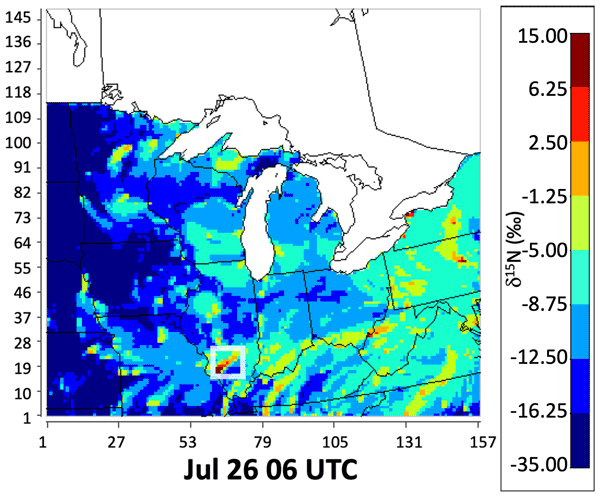
A new emission input dataset that incorporates nitrogen isotopes has been used in the CMAQ (Community Multiscale Air Quality) modeling system simulation to qualitatively analyze the changes in δ15N values, due to the dispersion, mixing, and transport of the atmospheric NOx emitted from different sources. The dispersion, mixing, and transport of the atmospheric NOx were based on the meteorology files generated from the WRF (Weather Research and Forecasting) model.
Wendell W. Walters, Masayuki Takeuchi, Danielle E. Blum, Gamze Eris, David Tanner, Weiqi Xu, Jean Rivera-Rios, Fobang Liu, Tianchang Xu, Greg Huey, Justin B. Min, Rodney Weber, Nga L. Ng, and Meredith G. Hastings
Atmos. Chem. Phys., 25, 10707–10730, https://doi.org/10.5194/acp-25-10707-2025, https://doi.org/10.5194/acp-25-10707-2025, 2025
Short summary
Short summary
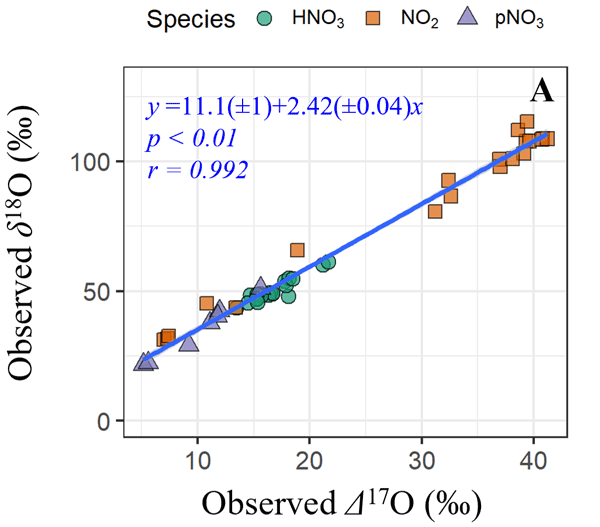
We studied how chemicals released from plants and pollution interact in the atmosphere, affecting air quality and climate. By combining laboratory experiments and chemistry models, we tracked unique chemical fingerprints to understand how nitrogen compounds transform to form particles in the air. Our findings help explain the role of these reactions in pollution and provide tools to improve predictions for cleaner air and better climate policies.
Wendell W. Walters, Masayuki Takeuchi, Nga L. Ng, and Meredith G. Hastings
Geosci. Model Dev., 17, 4673–4687, https://doi.org/10.5194/gmd-17-4673-2024, https://doi.org/10.5194/gmd-17-4673-2024, 2024
Short summary
Short summary
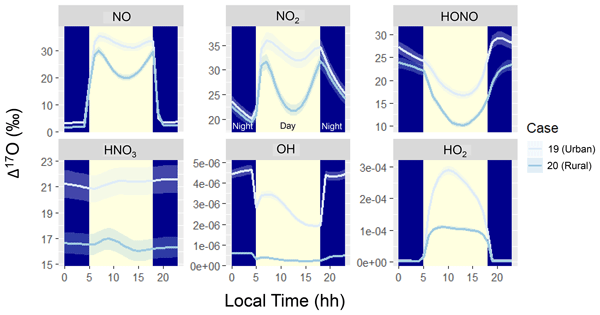
The study introduces a novel chemical mechanism for explicitly tracking oxygen isotope transfer in oxidized reactive nitrogen and odd oxygen using the Regional Atmospheric Chemistry Mechanism, version 2. This model enhances our ability to simulate and compare oxygen isotope compositions of reactive nitrogen, revealing insights into oxidation chemistry. The approach shows promise for improving atmospheric chemistry models and tropospheric oxidation capacity predictions.
Claire Bekker, Wendell W. Walters, Lee T. Murray, and Meredith G. Hastings
Atmos. Chem. Phys., 23, 4185–4201, https://doi.org/10.5194/acp-23-4185-2023, https://doi.org/10.5194/acp-23-4185-2023, 2023
Short summary
Short summary
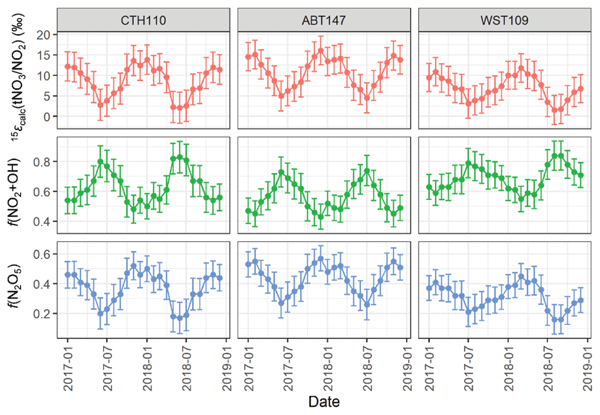
Nitrate is a critical component of the atmosphere that degrades air quality and ecosystem health. We have investigated the nitrogen isotope compositions of nitrate from deposition samples collected across the northeastern United States. Spatiotemporal variability in the nitrogen isotope compositions was found to track with nitrate formation chemistry. Our results highlight that nitrogen isotope compositions may be a robust tool for improving model representation of nitrate chemistry.
Heejeong Kim, Wendell W. Walters, Claire Bekker, Lee T. Murray, and Meredith G. Hastings
Atmos. Chem. Phys., 23, 4203–4219, https://doi.org/10.5194/acp-23-4203-2023, https://doi.org/10.5194/acp-23-4203-2023, 2023
Short summary
Short summary
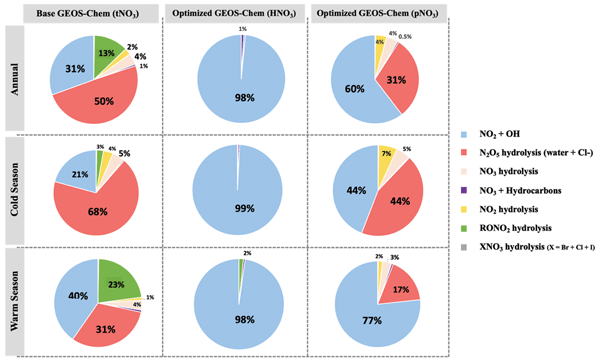
Atmospheric nitrate has an important impact on human and ecosystem health. We evaluated atmospheric nitrate formation pathways in the northeastern US utilizing oxygen isotope compositions, which indicated a significant difference between the phases of nitrate (i.e., gas vs. particle). Comparing the observations with model simulations indicated that N2O5 hydrolysis chemistry was overpredicted. Our study has important implications for improving atmospheric chemistry model representation.
Wendell W. Walters, Madeline Karod, Emma Willcocks, Bok H. Baek, Danielle E. Blum, and Meredith G. Hastings
Atmos. Chem. Phys., 22, 13431–13448, https://doi.org/10.5194/acp-22-13431-2022, https://doi.org/10.5194/acp-22-13431-2022, 2022
Short summary
Short summary
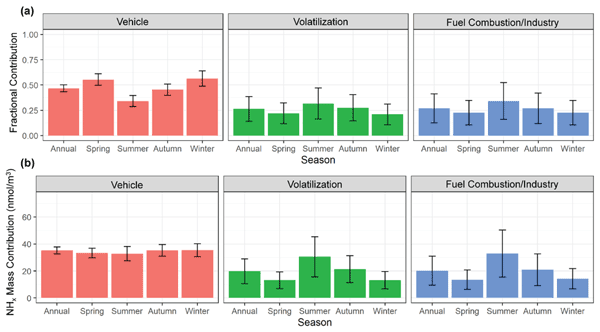
Atmospheric ammonia and its products are a significant source of urban haze and nitrogen deposition. We have investigated the seasonal source contributions to a mid-sized city in the northeastern US megalopolis utilizing geospatial statistical analysis and novel isotopic constraints, which indicate that vehicle emissions were significant components of the urban-reduced nitrogen budget. Reducing vehicle ammonia emissions should be considered to improve ecosystems and human health.
Huan Fang and Greg Michalski
Geosci. Model Dev., 15, 4239–4258, https://doi.org/10.5194/gmd-15-4239-2022, https://doi.org/10.5194/gmd-15-4239-2022, 2022
Short summary
Short summary
A new emission input dataset that incorporates nitrogen isotopes has been used in the CMAQ (Community Multiscale Air Quality) modeling system simulation to qualitatively analyze the changes in δ15N values, due to the dispersion, mixing, and transport of the atmospheric NOx emitted from different sources. The dispersion, mixing, and transport of the atmospheric NOx were based on the meteorology files generated from the WRF (Weather Research and Forecasting) model.
Cited articles
Alexander, B., Savarino, J., Kreutz, K. J., and Thiemens, M. H.: Impact of preindustrial biomass-burning emissions on the oxidation pathways of tropospheric sulfur and nitrogen, Journal of Geophysical Research, 109, D08303, https://doi.org/10.1029/2003JD004218, 2004.
Alexander, B., Park, R. J., Jacob, D. J., Li, Q. B., Yantosca, R. M., Savarino, J., Lee, C. C. W., and Thiemens, M. H.: Sulfate formation in sea-salt aerosols: Constraints from oxygen isotopes, Journal of Geophysical Research, 110, D10307, https://doi.org/10.1029/2004JD005659, 2005.
Alexander, B., Park, R. J., Jacob, D. J., and Gong, S.: Transition metal-catalyzed oxidation of atmospheric sulfur: Global implications for the sulfur budget, Journal of Geophysical Research: Atmospheres, 114, https://doi.org/10.1029/2008JD010486, 2009.
Appel, K. W., Bash, J. O., Fahey, K. M., Foley, K. M., Gilliam, R. C., Hogrefe, C., Hutzell, W. T., Kang, D., Mathur, R., Murphy, B. N., Napelenok, S. L., Nolte, C. G., Pleim, J. E., Pouliot, G. A., Pye, H. O. T., Ran, L., Roselle, S. J., Sarwar, G., Schwede, D. B., Sidi, F. I., Spero, T. L., and Wong, D. C.: The Community Multiscale Air Quality (CMAQ) model versions 5.3 and 5.3.1: system updates and evaluation, Geosci. Model Dev., 14, 2867–2897, https://doi.org/10.5194/gmd-14-2867-2021, 2021.
Arimoto, R., Nottingham, A. S., Webb, J., Schloesslin, C. A., and Davis, D. D.: Non-sea salt sulfate and other aerosol constituents at the South Pole during ISCAT, Geophysical Research Letters, 28, 3645–3648, https://doi.org/10.1029/2000GL012714, 2001.
Barkan, E. and Luz, B.: High-precision measurements of
Benish, S. E., Bash, J. O., Foley, K. M., Appel, K. W., Hogrefe, C., Gilliam, R., and Pouliot, G.: Long-term regional trends of nitrogen and sulfur deposition in the United States from 2002 to 2017, Atmos. Chem. Phys., 22, 12749–12767, https://doi.org/10.5194/acp-22-12749-2022, 2022.
Bianchi, F., Kurtén, T., Riva, M., Mohr, C., Rissanen, M. P., Roldin, P., Berndt, T., Crounse, J. D., Wennberg, P. O., Mentel, Th. F., Wildt, J., Junninen, H., Jokinen, T., Kulmala, M., Worsnop, D. R., Thornton, J. A., Donahue, N., Kjaergaard, H. G., and Ehn, M.: Highly oxygenated organic molecules (HOM) from gas-phase autoxidation involving peroxy radicals: A key contributor to atmospheric aerosol, Chemical Reviews, 119, 3472–3509, https://doi.org/10.1021/acs.chemrev.8b00395, 2019.
Calvo, A. I., Alves, C., Castro, A., Pont, V., Vicente, A. M., and Fraile, R.: Research on aerosol sources and chemical composition: Past, current and emerging issues, Atmospheric Research, 120, 1–28, https://doi.org/10.1016/j.atmosres.2012.09.021, 2013.
Chen, Q., Geng, L., Schmidt, J. A., Xie, Z., Kang, H., Dachs, J., Cole-Dai, J., Schauer, A. J., Camp, M. G., and Alexander, B.: Isotopic constraints on the role of hypohalous acids in sulfate aerosol formation in the remote marine boundary layer, Atmos. Chem. Phys., 16, 11433–11450, https://doi.org/10.5194/acp-16-11433-2016, 2016.
Dominguez, G., Jackson, T., Brothers, L., Barnett, B., Nguyen, B., and Thiemens, M. H.: Discovery and measurement of an isotopically distinct source of sulfate in Earth's atmosphere, Proceedings of the National Academy of Sciences, 105, 12769–12773, https://doi.org/10.1073/pnas.0805255105, 2008.
Fahey, K. M. and Pandis, S. N.: Optimizing model performance: variable size resolution in cloud chemistry modeling, Atmospheric Environment, 35, https://doi.org/10.1016/S1352-2310(01)00224-2 4471–4478, 2001.
Fang, H.: Simulating Δ17O of sulfate aerosol within the contiguous United States to trace the formation processes, Zenodo [data set], https://doi.org/10.5281/zenodo.14954960, 2025.
Foley, K. M., Pouliot, G. A., Eyth, A., Aldridge, M. F., Allen, C., Appel, K. W., Bash, J. O., Beardsley, M., Beidler, J., Choi, D., Farkas, C., Gilliam, R. C., Godfrey, J., Henderson, B. H., Hogrefe, C., Koplitz, S. N., Mason, R., Mathur, R., Misenis, C., Possiel, N., Pye, H. O. T., Reynolds, L., Roark, M., Roberts, S., Schwede, D. B., Seltzer, K. M., Sonntag, D., Talgo, K., Toro, C., Vukovich, J., Xing, J., and Adams, E.: 2002–2017 anthropogenic emissions data for air quality modeling over the United States, Data in Brief, 47, 109022, https://doi.org/10.1016/j.dib.2023.109022, 2023.
Guo, H., Weber, R. J., and Nenes, A.: High levels of ammonia do not raise fine particle pH sufficiently to yield nitrogen oxide-dominated sulfate production, Scientific Reports, 7, 12109, https://doi.org/10.1038/s41598-017-11704-0, 2017.
Hallquist, M., Wenger, J. C., Baltensperger, U., Rudich, Y., Simpson, D., Claeys, M., Dommen, J., Donahue, N. M., George, C., Goldstein, A. H., Hamilton, J. F., Herrmann, H., Hoffmann, T., Iinuma, Y., Jang, M., Jenkin, M. E., Jimenez, J. L., Kiendler-Scharr, A., Maenhaut, W., McFiggans, G., Mentel, Th. F., Monod, A., Prévôt, A. S. H., Seinfeld, J. H., Surratt, J. D., Szmigielski, R., and Wildt, J.: The formation, properties and impact of secondary organic aerosol: current and emerging issues, Atmos. Chem. Phys., 9, 5155–5236, https://doi.org/10.5194/acp-9-5155-2009, 2009.
Harris, E., Sinha, B., Van Pinxteren, D., Tilgner, A., Fomba, K. W., Schneider, J., Roth, A., Gnauk, T., Fahlbusch, B., Mertes, S., Lee, T., Collett, J., Foley, S., Borrmann, S., Hoppe, P., and Herrmann, H.: Enhanced role of transition metal ion catalysis during in-cloud oxidation of SO2, Science, 340, 727–730, https://doi.org/10.1126/science.1230911, 2013.
Hattori, S., Iizuka, Y., Alexander, B., Ishino, S., Fujita, K., Zhai, S., Sherwen, T., Oshima, N., Uemura, R., Yamada, A., Suzuki, N., Matoba, S., Tsuruta, A., Savarino, J., and Yoshida, N.: Isotopic evidence for acidity-driven enhancement of sulfate formation after SO2 emission control, Science Advances, 7, eabd4610, https://doi.org/10.1126/sciadv.abd4610, 2021.
Haywood, J. and Boucher, O.: Estimates of the direct and indirect radiative forcing due to tropospheric aerosols: A review, Reviews of Geophysics, 38, 513–543, https://doi.org/10.1029/1999RG000078, 2000.
Herrmann, H., Schaefer, T., Tilgner, A., Styler, S. A., Weller, C., Teich, M., and Otto, T.: Tropospheric aqueous-phase chemistry: kinetics, mechanisms, and its coupling to a changing gas phase, Chemical Reviews, 115, 4259–4334, 2015.
Ishino, S., Hattori, S., Savarino, J., Jourdain, B., Preunkert, S., Legrand, M., Caillon, N., Barbero, A., Kuribayashi, K., and Yoshida, N.: Seasonal variations of triple oxygen isotopic compositions of atmospheric sulfate, nitrate, and ozone at Dumont d'Urville, coastal Antarctica, Atmos. Chem. Phys., 17, 3713–3727, https://doi.org/10.5194/acp-17-3713-2017, 2017.
Itahashi, S., Hattori, S., Ito, A., Sadanaga, Y., Yoshida, N., and Matsuki, A.: Role of dust and iron solubility in sulfate formation during the long-range transport in East Asia evidenced by 17O-excess signatures, Environmental Science and Technology, 56, 13634–13643, https://doi.org/10.1021/acs.est.2c03574, 2022.
Jenkins, K. A. and Bao, H.: Multiple oxygen and sulfur isotope compositions of atmospheric sulfate in Baton Rouge, LA, USA, Atmospheric Environment, 40, 4528–4537, https://doi.org/10.1016/j.atmosenv.2006.04.010, 2006.
Jones, A. D. L. A., Roberts, D. L., and Slingo, A.: A climate model study of indirect radiative forcing by anthropogenic sulphate aerosols, Nature, 370, 450–453, https://doi.org/10.1038/370450a0, 1994.
Kaiser, J., Röckmann, T., and Brenninkmeijer, C. A.: Contribution of mass-dependent fractionation to the oxygen isotope anomaly of atmospheric nitrous oxide, Journal of Geophysical Research, 109, D033055, https://doi.org/10.1029/2003JD004088, 2004.
Kaufman, Y. J. and Tanré, D.: Effect of variations in super-saturation on the formation of cloud condensation nuclei, Nature, 369, 45–48, https://doi.org/10.1038/369045a0, 1994.
Langner, J., Rodhe, H., Crutzen, P. J., and Zimmermann, P.: Anthropogenic influence on the distribution of tropospheric sulphate aerosol, Nature, 359, 712–716, https://doi.org/10.1038/359712a0, 1992.
Lee, C. C. W. and Thiemens, M. H.: The δ17O and δ18O measurements of atmospheric sulfate from a coastal and high alpine region: A mass independent isotopic anomaly, Journal of Geophysical Research: Atmospheres, 106, 17359–17373, https://doi.org/10.1029/2000JD900805, 2001.
Li, J., Zhang, Y. L., Cao, F., Zhang, W., Fan, M., Lee, X., and Michalski, G.: Stable sulfur isotopes revealed a major role of transition-metal ion-catalyzed SO2 oxidation in haze episodes, Environmental Science and Technology, 54, 2626–2634, https://doi.org/10.1021/acs.est.9b07150, 2020.
Lim, J., Park, H., and Cho, S.: Evaluation of the ammonia emission sensitivity of secondary inorganic aerosol concentrations measured by the national reference method, Atmospheric Environment, 270, 118903, https://doi.org/10.1016/j.atmosenv.2021.118903, 2022.
Lin, Y. C., Zhao, Y., Zhang, Y. L., Hong, Y., Hattori, S., Itahashi, S., Fan, MY., Xie, F., Zhao, Z. Y., Yu, M., Cao, F., Xu, R., Li, J., Kawamura, K., and Thiemens, M. H.: China's SO2 emission reductions enhance atmospheric ozone–driven sulfate aerosol production in East Asia, Proceedings of the National Academy of Sciences, 122, e2414064122, https://doi.org/10.1073/pnas.2414064122, 2025.
Liu, L., Bei, N., Wu, J., Liu, S., Zhou, J., Li, X., Yang, Q., Feng, T., Cao, J., Tie, X., and Li, G.: Effects of stabilized Criegee intermediates (sCIs) on sulfate formation: a sensitivity analysis during summertime in Beijing–Tianjin–Hebei (BTH), China, Atmos. Chem. Phys., 19, 13341–13354, https://doi.org/10.5194/acp-19-13341-2019, 2019.
Lohmann, U. and Feichter, J.: Impact of sulfate aerosols on albedo and lifetime of clouds: A sensitivity study with the ECHAM4 GCM, Journal of Geophysical Research: Atmospheres, 102, 13685–13700, https://doi.org/10.1029/97JD00631, 1997.
Meidan, D., Holloway, J. S., Edwards, P. M., Dube, W. P., Middlebrook, A. M., Liao, J., Welti, A., Graus, M., Warneke, C., Ryerson, T. B., Pollack, I. B., Brown, S. S., and Rudich, Y.: Role of Criegee intermediates in secondary sulfate aerosol formation in nocturnal power plant plumes in the Southeast US, ACS Earth and Space Chemistry, 3, 748–759, https://doi.org/10.1021/acsearthspacechem.8b00215, 2019.
Michalski, G. M., Scott, Z., Kabiling, M., and Thiemens, M. H.: First measurements and modeling of 17O in atmospheric nitrate, Geophys. Res. Lett., 30, 1870, https://doi.org/10.1029/2003GL017015, 2003.
Morin, S., Savarino, J., Bekki, S., Gong, S., and Bottenheim, J. W.: Signature of Arctic surface ozone depletion events in the isotope anomaly (Δ17O) of atmospheric nitrate, Atmos. Chem. Phys., 7, 1451–1469, https://doi.org/10.5194/acp-7-1451-2007, 2007.
Pandis, S. N. and Seinfeld, J. H.: Sensitivity analysis of a chemical mechanism for aqueous-phase atmospheric chemistry, Journal of Geophysical Research, 94, 1105–1126, https://doi.org/10.1029/JD094iD01p01105, 1989.
Peng, Y., Hattori, S., Zuo, P., Ma, H., and Bao, H.: Record of pre-industrial atmospheric sulfate in continental interiors, Nature Geoscience, 16, 619–624, https://doi.org/10.1038/s41561-023-01211-5, 2023.
Pye, H. O. T., Nenes, A., Alexander, B., Ault, A. P., Barth, M. C., Clegg, S. L., Collett Jr., J. L., Fahey, K. M., Hennigan, C. J., Herrmann, H., Kanakidou, M., Kelly, J. T., Ku, I.-T., McNeill, V. F., Riemer, N., Schaefer, T., Shi, G., Tilgner, A., Walker, J. T., Wang, T., Weber, R., Xing, J., Zaveri, R. A., and Zuend, A.: The acidity of atmospheric particles and clouds, Atmos. Chem. Phys., 20, 4809–4888, https://doi.org/10.5194/acp-20-4809-2020, 2020.
Reiss, R., Anderson, E. L., Cross, C. E., Hidy, G., Hoel, D., McClellan, R., and Moolgavkar, S.: Evidence of health impacts of sulfate-and nitrate-containing particles in ambient air, Inhalation Toxicology, 19, 419–449, https://doi.org/10.1080/08958370601174941, 2007.
Sarwar, G., Fahey, K., Kwok, R., Gilliam, R. C., Roselle, S. J., Mathur, R., Xue, J., Yu, J., and Carter, W. P.: Potential impacts of two SO2 oxidation pathways on regional sulfate concentrations: Aqueous-phase oxidation by NO2 and gas-phase oxidation by Stabilized Criegee Intermediates, Atmospheric Environment, 68, 186–197, https://doi.org/10.1016/j.atmosenv.2012.11.036, 2013.
Savarino, J. and Thiemens, M. H.: Mass-independent oxygen isotope (16O, 17O, 18O) fractionation found in Hx, Ox reactions. The Journal of Physical Chemistry A, 103, 9221–9229, https://doi.org/10.1021/jp991221y, 1999.
Savarino, J., Lee, C. C., and Thiemens, M. H.: Laboratory oxygen isotopic study of sulfur (IV) oxidation: Origin of the mass-independent oxygen isotopic anomaly in atmospheric sulfates and sulfate mineral deposits on Earth, Journal of Geophysical Research, 105, 29079–29088, https://doi.org/10.1029/2000JD900456, 2000.
Savarino, J., Bekki, S., ColeDai, J., and Thiemens, M. H.: Evidence from sulfate mass independent oxygen isotopic compositions of dramatic changes in atmospheric oxidation following massive volcanic eruptions, Journal of Geophysical Research, 108, 4671, https://doi.org/10.1029/2003JD003737, 2003.
Savarino, J., Kaiser, J., Morin, S., Sigman, D. M., and Thiemens, M. H.: Nitrogen and oxygen isotopic constraints on the origin of atmospheric nitrate in coastal Antarctica, Atmos. Chem. Phys., 7, 1925–1945, https://doi.org/10.5194/acp-7-1925-2007, 2007.
Seigneur, C. and Saxena, P.: A theoretical investigation of sulfate formation in clouds, Atmospheric Environment, 22, 101–115, https://doi.org/10.1016/0004-6981(88)90303-4, 1988.
Shah, V., Jacob, D. J., Moch, J. M., Wang, X., and Zhai, S.: Global modeling of cloud water acidity, precipitation acidity, and acid inputs to ecosystems, Atmos. Chem. Phys., 20, 12223–12245, https://doi.org/10.5194/acp-20-12223-2020, 2020.
Smith, S. J., van Aardenne, J., Klimont, Z., Andres, R. J., Volke, A., and Delgado Arias, S.: Anthropogenic sulfur dioxide emissions: 1850–2005, Atmos. Chem. Phys., 11, 1101–1116, https://doi.org/10.5194/acp-11-1101-2011, 2011.
Sofen, E. D., Alexander, B., and Kunasek, S. A.: The impact of anthropogenic emissions on atmospheric sulfate production pathways, oxidants, and ice core Δ17O(SO
Tsui, W. G., Woo, J. L., and McNeill, V. F.: Impact of aerosol-cloud cycling on aqueous secondary organic aerosol formation, Atmosphere, 10, 666, https://doi.org/10.3390/atmos10110666, 2019.
U.S. Environmental Protection Agency: CMAQ release notes: Process analysis and sulfur tracking model (STM), in: USEPA/CMAQ Wiki. GitHub [code], https://github.com/USEPA/CMAQ/wiki/CMAQ-Release-Notes:-Process-Analysis-&-Sulfur-Tracking-Model-(STM), last access: 9 October 2025.
U.S. Environmental Protection Agency: CMAQv5.4, in: USEPA/CMAQ Wiki, GitHub [code], https://github.com/USEPA/CMAQ/tree/5.4, last access: 1 March 2025.
Vannucci, P. F., Foley, K., Murphy, B. N., Hogrefe, C., Cohen, R. C., and Pye, H. O.: Temperature-Dependent Composition of Summertime PM2.5 in Observations and Model Predictions across the Eastern US, ACS Earth and Space Chemistry, 8, 381–392, https://doi.org/10.1021/acsearthspacechem.3c00333, 2024.
Vicars, W. C. and Savarino, J.: Quantitative constraints on the O-17-excess (Delta 17O) signature of surface ozone: Ambient measurements from 50° N to 50° S using the nitrite-coated filter technique, Geochimica et Cosmochimica Acta, 135, 270–287, https://doi.org/10.1016/j.gca.2014.03.023, 2014.
Wang, X., Tsimpidi, A. P., Luo, Z., Steil, B., Pozzer, A., Lelieveld, J., and Karydis, V. A.: The influence of ammonia emission inventories on size-resolved global atmospheric aerosol composition and acidity, Atmos. Chem. Phys., 25, 10559–10586, https://doi.org/10.5194/acp-25-10559-2025, 2025.
Walcek, C. J. and Taylor, G. R.: A theoretical method for computing vertical distributions of acidity and sulfate production within cumulus clouds, Journal of Atmospheric Sciences, 43, 339–355, https://doi.org/10.1175/1520-0469(1986)043<0339:ATMFCV>2.0.CO;2 1986.
Walters, W. W., Michalski, G., Böhlke, J. K., Alexander, B., Savarino, J., and Thiemens, M. H.: Assessing the seasonal dynamics of nitrate and sulfate aerosols at the South Pole utilizing stable isotopes, Journal of Geophysical Research: Atmospheres, 124, 8161–8177, https://doi.org/10.1029/2019JD030517, 2019.
Weber, R. J., Guo, H., Russell, A. G., and Nenes, A.: High aerosol acidity despite declining atmospheric sulfate concentrations over the past 15 years, Nature Geoscience, 9, 282–285, https://doi.org/10.1038/ngeo2665, 2016.
Weston Jr., R. E.: When is an isotope effect non-mass dependent, Journal of Nuclear Science and Technology, 43, 295–299, https://doi.org/10.1080/18811248.2006.9711092, 2006.
Yarwood, G., Jung, J., Whitten, G. Z., Heo, G., Mellberg, J., and Estes, M.: Updates to the Carbon Bond mechanism for version 6 (CB6), in: proceedings of the 9th Annual CMAS Conference, Chapel Hill, NC, USA, 11–13 October 2010, 2010.
Zheng, G., Su, H., Andreae, M. O., Pöschl, U., and Cheng, Y.: Multiphase buffering by ammonia sustains sulfate production in atmospheric aerosols, AGU Advances, 5, e2024AV001238, https://doi.org/10.1029/2024AV001238, 2024.
Download
The requested paper has a corresponding corrigendum published. Please read the corrigendum first before downloading the article.
- Article
(12890 KB) - Full-text XML
- Corrigendum
-
Supplement
(22760 KB) - BibTeX
- EndNote
Short summary
The Sulfur Tracking Mechanism (STM) in Community Multiscale Air Quality Model (CMAQ) was used to model the oxygen isotope anomaly (Δ17O) of aerosol sulfate (ASO4) within the contiguous United States over full annual cycles, for the first time at this spatial and temporal coverage. This approach allows for a qualitative analysis of sulfate (SO42-) formation processes and comparison with corresponding measurements.
The Sulfur Tracking Mechanism (STM) in Community Multiscale Air Quality Model (CMAQ) was used to...


Altmetrics
Final-revised paper
Preprint