
Articles | Volume 25, issue 23
https://doi.org/10.5194/acp-25-17319-2025
© Author(s) 2025. This work is distributed under
the Creative Commons Attribution 4.0 License.
the Creative Commons Attribution 4.0 License.
https://doi.org/10.5194/acp-25-17319-2025
© Author(s) 2025. This work is distributed under
the Creative Commons Attribution 4.0 License.
the Creative Commons Attribution 4.0 License.
Research article
| 
02 Dec 2025
Research article |
| 02 Dec 2025
| 02 Dec 2025
Intercomparison of tropopause height climatologies: high-resolution radiosonde measurements versus ERA5 reanalysis
Yu Gou
Hubei Subsurface Multi–scale Imaging Key Laboratory, School of Geophysics and Geomatics, China University of Geosciences, Wuhan 430074, China
Jian Zhang
CORRESPONDING AUTHOR
Hubei Subsurface Multi–scale Imaging Key Laboratory, School of Geophysics and Geomatics, China University of Geosciences, Wuhan 430074, China
Wuke Wang
State Key Laboratory of Severe Weather Meteorological Science and Technology (LaSW), Chinese Academy of Meteorological Sciences (CAMS), Beijing, China
School of environmental studies, China University of Geosciences, Wuhan 430074, China
Kaiming Huang
School of Electronic Information, Wuhan University, Wuhan 430072, China
Shaodong Zhang
School of Electronic Information, Wuhan University, Wuhan 430072, China
Related authors
Yu Gou, Jian Zhang, Wuke Wang, Kaiming Huang, and Shaodong Zhang
EGUsphere, https://doi.org/10.5194/egusphere-2024-4198, https://doi.org/10.5194/egusphere-2024-4198, 2025
Preprint withdrawn
Short summary
Short summary
The most commonly used tropopause height detection algorithm is based on the World Meteorological Organization (WMO) definition from 1957. However, with the increasing vertical resolution of atmospheric data, this definition has been found to fail in high-resolution radiosonde data. Thus, we propose an improved method to address this issue. This method can effectively bypassing thin inversions while preserving the fine–scale structure of the tropopause.
Gang Chen, Peng Tao, Shaodong Zhang, Wanlin Gong, Chunming Huang, Yufang Tian, Yaxian Li, Kai Zhu, Xiaoming Zhou, Min Zhang, and Yimeng Xu
EGUsphere, https://doi.org/10.5194/egusphere-2026-4680, https://doi.org/10.5194/egusphere-2026-4680, 2026
This preprint is open for discussion and under review for Atmospheric Chemistry and Physics (ACP).
Short summary
Short summary
We tracked Typhoon Yagi with radar, satellite, and ground data. The storm created strong waves low down, but only those with roughly two‑hour periods reached the top. Matching signals appeared in the upper atmosphere and ionosphere at the same time, proving upward travel. The atmosphere lets only some waves through. This work reveals how extreme weather links layers and the power of combining tools.
Ke Xu, Shuyun Zhao, Xinyu Ma, Jianchuan Shu, Wuke Wang, Qimin Deng, and Zaheer Ahmad Babar
Earth Syst. Sci. Data, 18, 3165–3175, https://doi.org/10.5194/essd-18-3165-2026, https://doi.org/10.5194/essd-18-3165-2026, 2026
Short summary
Short summary
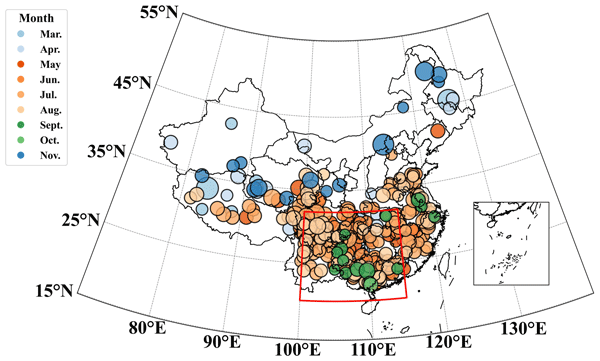
We developed an automated algorithm using cloud-top temperature data from the Fengyun-2G geostationary satellite to create a decade-long dataset of Mesoscale Convective Complexes over China. Results show southwestern China as a primary hotspot and link interannual variability to ENSO-related air–sea interactions. This dataset supports studies of severe convection, weather forecasting, and climate variability.
Gang Chen, Yimeng Xu, Guotao Yang, Wuhu Feng, Jiyao Xu, Shaodong Zhang, Guozhu Li, Hanxian Fang, Lifang Du, Haoran Zheng, Xuewu Cheng, Faquan Li, Yuchang Xun, Kaiming Huang, and Chunxiao Yan
EGUsphere, https://doi.org/10.5194/egusphere-2026-2356, https://doi.org/10.5194/egusphere-2026-2356, 2026
Short summary
Short summary
A new lidar for calcium ion (Ca+) observations has been operated in Yanqing, Beijing, China. Cloud-like Ca+ are observed to occur at altitudes of 120–300 km, and these clouds are composed of striped structures. These Ca+ are found to descend into Es layer and the main metal layer, and increase their ion density. According to the stripe-like structures and their influence on the metal ion layers, we believe that these metal ions observed by the lidar in Beijing come from meteoroids trails
Yun He, Dongzhe Jing, Zhenping Yin, Detlef Müller, Fuchao Liu, Yunpeng Zhang, Yang Yi, Kaiming Huang, and Fan Yi
Atmos. Chem. Phys., 26, 4937–4951, https://doi.org/10.5194/acp-26-4937-2026, https://doi.org/10.5194/acp-26-4937-2026, 2026
Short summary
Short summary
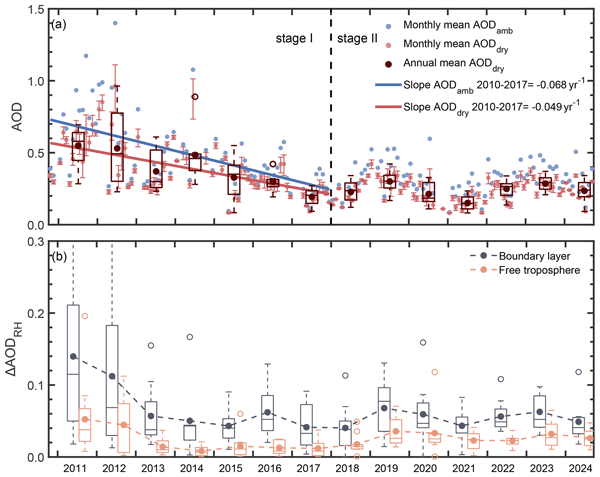
Using polarization lidar observations during 2010–2024, we retrieve the vertical profiles of aerosol backscatter and extinction coefficients of anthropogenic pollution under dry and ambient atmospheric conditions over central China. The year-to-year and seasonal variations in anthropogenic AOD are largely changed after removing hygroscopic growth effect.
Dongzhe Jing, Yun He, Zhenping Yin, Detlef Müller, Kaiming Huang, and Fan Yi
Atmos. Meas. Tech., 19, 389–403, https://doi.org/10.5194/amt-19-389-2026, https://doi.org/10.5194/amt-19-389-2026, 2026
Short summary
Short summary
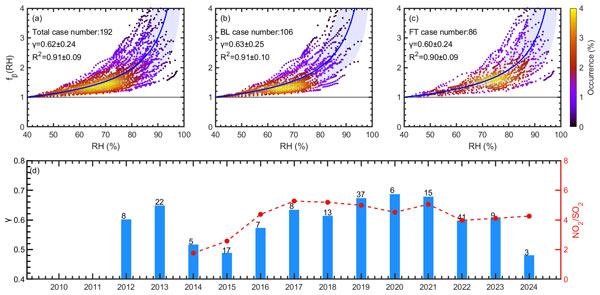
We statistically analyze the hygroscopic growth characteristics of urban anthropogenic aerosols over Wuhan, a megacity over central China, using lidar observations and Hänel parameterization from 2010 to 2024. Aerosol hygroscopic parameter γ increases from 2014 to 2017 and stabilizes at high levels afterwards, aligning with the changes in NO2-to-SO2 concentration ratio. Moreover, no evident differences are found across seasons, as well as between the free troposphere and boundary layer.
Dongzhe Jing, Yun He, Zhenping Yin, Kaiming Huang, Fuchao Liu, and Fan Yi
Atmos. Chem. Phys., 25, 17047–17067, https://doi.org/10.5194/acp-25-17047-2025, https://doi.org/10.5194/acp-25-17047-2025, 2025
Short summary
Short summary
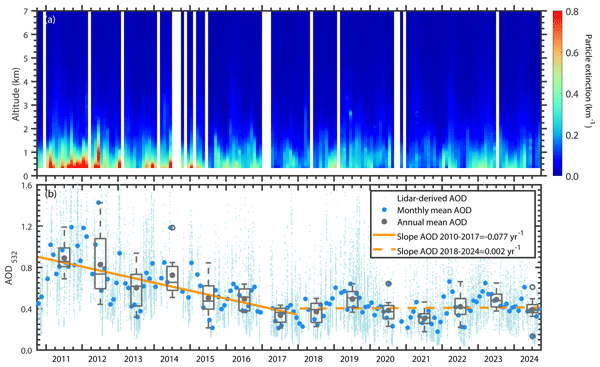
We present the evolution of tropospheric aerosols over Wuhan, central China, from 2010 to 2024. The analysis highlights the long-term aerosol characteristics and separates natural (dust) and anthropogenic (non-dust) contributions. Emission control policies were highly effective during 2010–2017. However, since 2018, lidar-derived aerosol optical depth (AOD) ceased decreasing and fluctuated, and the decline in PM2.5 concentration also became slower, possibly due to atmospheric chemistry factors.
Gang Chen, Yimeng Xu, Guotao Yang, Shaodong Zhang, Zhipeng Ren, Pengfei Hu, Tingting Yu, Fuju Wu, Lifang Du, Haoran Zheng, Xuewu Cheng, Faquan Li, and Min Zhang
Atmos. Chem. Phys., 25, 14763–14775, https://doi.org/10.5194/acp-25-14763-2025, https://doi.org/10.5194/acp-25-14763-2025, 2025
Short summary
Short summary
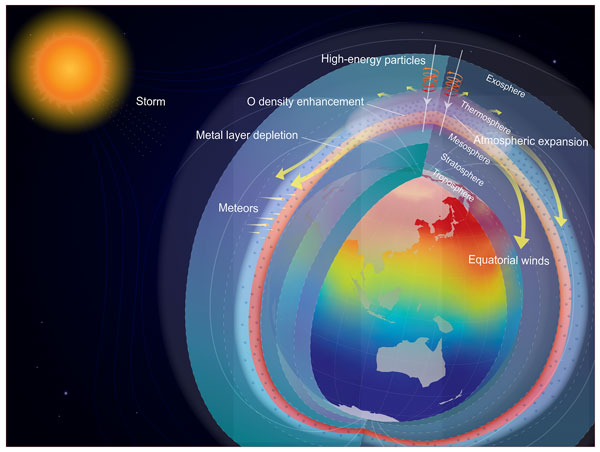
It is the first time to record the impact of a storm on metal atom layer in MLT (Mesosphere and Low Thermosphere) region. During the storm on 4 November 2021, the mesospheric metal layer depletion was recorded by three lidars for different metal components at mid-latitudes. The storm induced oxygen density enhancement is considered to consume more metal atoms in the metal layer. It implies that the effects of storm have reached mesosphere, and the influence of storm on metal layer is achieved through chemical processes.
Zirui Zhang, Kaiming Huang, Fan Yi, Wei Cheng, Fuchao Liu, Jian Zhang, and Yue Jia
Atmos. Chem. Phys., 25, 3347–3361, https://doi.org/10.5194/acp-25-3347-2025, https://doi.org/10.5194/acp-25-3347-2025, 2025
Short summary
Short summary
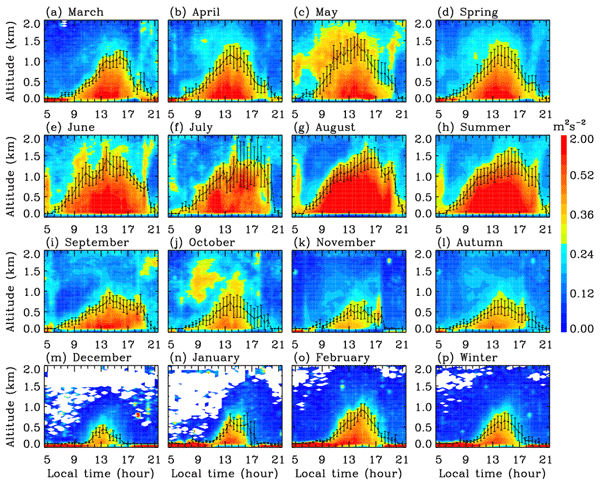
The height of the convective boundary layer (CBLH) is related to our health due to its crucial role in pollutant dispersion. The variance of vertical velocity from millimeter wave cloud radar (MMCR) can accurately capture the diurnal evolution of the CBLH, due to a small blind range and less impact by the residual layer. The CBLH is affected by radiation, humidity, cloud, and precipitation; thus, the MMCR is suitable for monitoring the CBLH, owing to its observation capability in various weather conditions.
Yu Gou, Jian Zhang, Wuke Wang, Kaiming Huang, and Shaodong Zhang
EGUsphere, https://doi.org/10.5194/egusphere-2024-4198, https://doi.org/10.5194/egusphere-2024-4198, 2025
Preprint withdrawn
Short summary
Short summary
The most commonly used tropopause height detection algorithm is based on the World Meteorological Organization (WMO) definition from 1957. However, with the increasing vertical resolution of atmospheric data, this definition has been found to fail in high-resolution radiosonde data. Thus, we propose an improved method to address this issue. This method can effectively bypassing thin inversions while preserving the fine–scale structure of the tropopause.
Jianping Guo, Jian Zhang, Jia Shao, Tianmeng Chen, Kaixu Bai, Yuping Sun, Ning Li, Jingyan Wu, Rui Li, Jian Li, Qiyun Guo, Jason B. Cohen, Panmao Zhai, Xiaofeng Xu, and Fei Hu
Earth Syst. Sci. Data, 16, 1–14, https://doi.org/10.5194/essd-16-1-2024, https://doi.org/10.5194/essd-16-1-2024, 2024
Short summary
Short summary
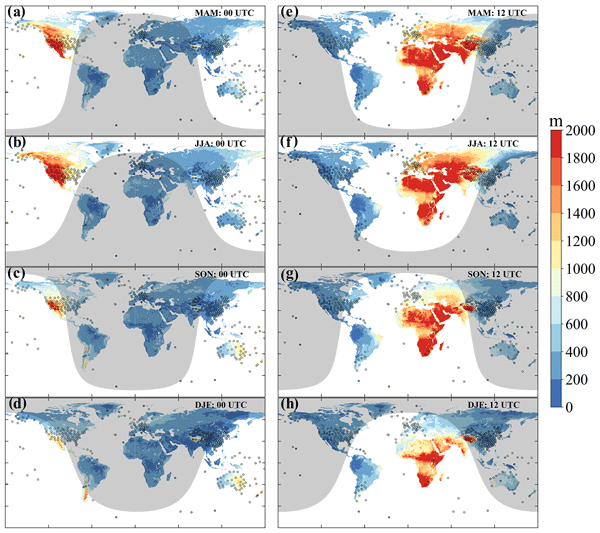
A global continental merged high-resolution (PBLH) dataset with good accuracy compared to radiosonde is generated via machine learning algorithms, covering the period from 2011 to 2021 with 3-hour and 0.25º resolution in space and time. The machine learning model takes parameters derived from the ERA5 reanalysis and GLDAS product as input, with PBLH biases between radiosonde and ERA5 as the learning targets. The merged PBLH is the sum of the predicted PBLH bias and the PBLH from ERA5.
Hui Xu, Jianping Guo, Bing Tong, Jinqiang Zhang, Tianmeng Chen, Xiaoran Guo, Jian Zhang, and Wenqing Chen
Atmos. Chem. Phys., 23, 15011–15038, https://doi.org/10.5194/acp-23-15011-2023, https://doi.org/10.5194/acp-23-15011-2023, 2023
Short summary
Short summary
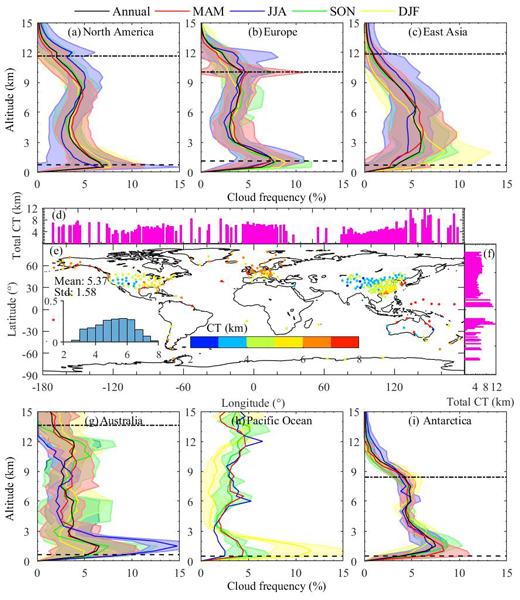
The radiative effect of cloud remains one of the largest uncertain factors in climate change, largely due to the lack of cloud vertical structure (CVS) observations. The study presents the first near-global CVS climatology using high-vertical-resolution soundings. Single-layer cloud mainly occurs over arid regions. As the number of cloud layers increases, clouds tend to have lower bases and thinner layer thicknesses. The occurrence frequency of cloud exhibits a pronounced seasonal diurnal cycle.
Jia Shao, Jian Zhang, Wuke Wang, Shaodong Zhang, Tao Yu, and Wenjun Dong
Atmos. Chem. Phys., 23, 12589–12607, https://doi.org/10.5194/acp-23-12589-2023, https://doi.org/10.5194/acp-23-12589-2023, 2023
Short summary
Short summary
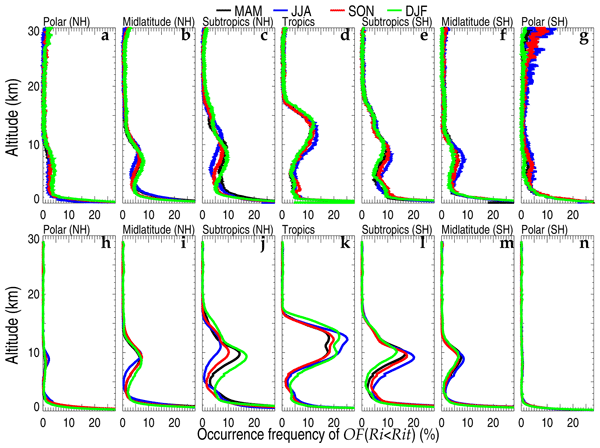
Kelvin–Helmholtz instability (KHI) is indicated by the critical value of the Richardson (Ri) number, which is usually predicted to be 1/4. Compared to high-resolution radiosondes, the threshold value of Ri could be approximated as 1 rather than 1/4 when using ERA5-based Ri as a proxy for KHI. The occurrence frequency of subcritical Ri exhibits significant seasonal cycles over all climate zones and is closely associated with gravity waves and background flows.
Zheng Ma, Yun Gong, Shaodong Zhang, Qiao Xiao, Chunming Huang, and Kaiming Huang
Atmos. Chem. Phys., 22, 13725–13737, https://doi.org/10.5194/acp-22-13725-2022, https://doi.org/10.5194/acp-22-13725-2022, 2022
Short summary
Short summary
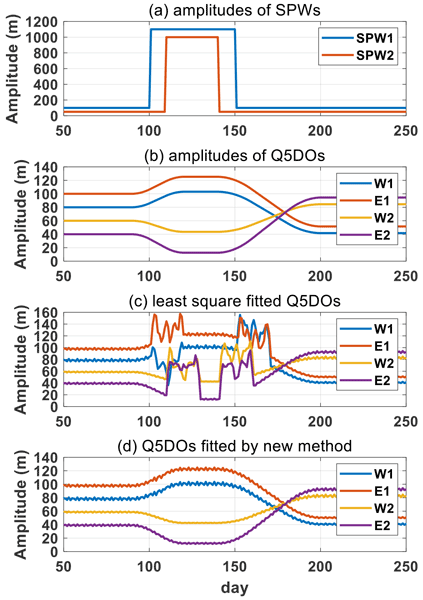
We present a novel method to measure the amplitudes of traveling quasi-5-day oscillations (Q5DOs) in the middle atmosphere during sudden stratospheric warming events based on satellite observations. Simulations and observations demonstrate that the previously reported traveling Q5DOs might be contaminated by stationary planetary waves (SPWs). The new fitting method is developed by inhibiting the effect of a rapid and large change in SPWs.
Wuke Wang, Jin Hong, Ming Shangguan, Hongyue Wang, Wei Jiang, and Shuyun Zhao
Atmos. Chem. Phys., 22, 13695–13711, https://doi.org/10.5194/acp-22-13695-2022, https://doi.org/10.5194/acp-22-13695-2022, 2022
Short summary
Short summary
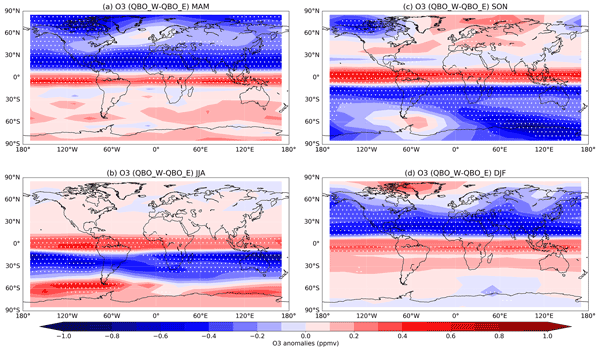
The ozone layer protects the life on the Earth by absorbing the ultraviolet (UV) radiation. Beside the long-term trend, there are strong interannual fluctuations in stratospheric ozone. The quasi-biennial oscillation (QBO) is an important interannual mode in the stratosphere. We show some new zonally asymmetric features of its impacts on stratospheric ozone using satellite data, ERA5 reanalysis, and model simulations, which is helpful for predicting the regional UV radiation at the surface.
Xiansi Huang, Kaiming Huang, Hao Cheng, Shaodong Zhang, Wei Cheng, Chunming Huang, and Yun Gong
Atmos. Chem. Phys. Discuss., https://doi.org/10.5194/acp-2022-407, https://doi.org/10.5194/acp-2022-407, 2022
Revised manuscript not accepted
Short summary
Short summary
Using radar observations and reanalysis data for 9 years, we demonstrate clearly for the first time that resonant interactions between tides and annual and semiannual oscillations do occur in the mesosphere and lower thermosphere. The resonant matching conditions of frequency and wavenumber are exactly satisfied for the interacting triad. At some altitudes, the secondary waves are stronger than the tides, thus in tidal studies, the secondary waves may be mistaken for the tides if no carefully.
Ming Shangguan and Wuke Wang
Atmos. Chem. Phys., 22, 9499–9511, https://doi.org/10.5194/acp-22-9499-2022, https://doi.org/10.5194/acp-22-9499-2022, 2022
Short summary
Short summary
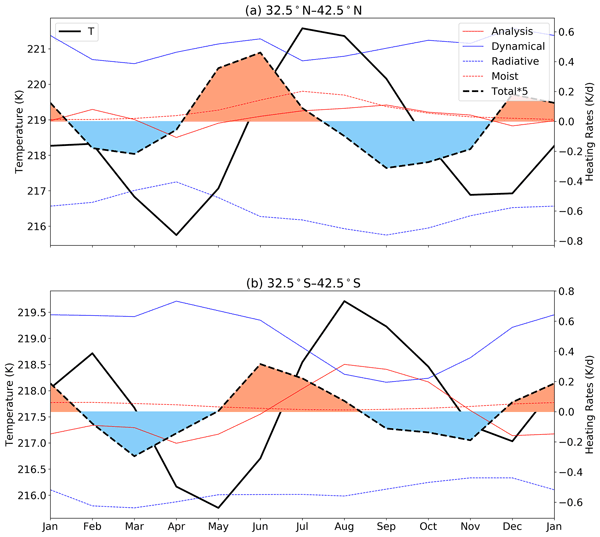
Skilful predictions of weather and climate on subseasonal to seasonal scales are valuable for decision makers. Here we show the global spatiotemporal variation of the temperature SAO in the UTLS with GNSS RO and reanalysis data. The formation of the SAO is explained by an energy budget analysis. The results show that the SAO in the UTLS is partly modified by the SSTs according to model simulations. The results may provide an important source for seasonal predictions of the surface weather.
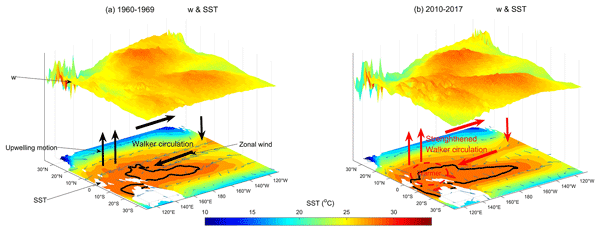
Kai Qie, Wuke Wang, Wenshou Tian, Rui Huang, Mian Xu, Tao Wang, and Yifeng Peng
Atmos. Chem. Phys., 22, 4393–4411, https://doi.org/10.5194/acp-22-4393-2022, https://doi.org/10.5194/acp-22-4393-2022, 2022
Short summary
Short summary
We identify a significantly intensified upward motion over the tropical western Pacific (TWP) and an enhanced tropical upwelling in boreal winter during 1958–2017 due to the warming of global sea surface temperatures (SSTs). Our results suggest that more tropospheric trace gases over the TWP could be elevated to the lower stratosphere, which implies that the emission from the maritime continent plays a more important role in the stratospheric processes and the global climate.

Jianping Guo, Jian Zhang, Kun Yang, Hong Liao, Shaodong Zhang, Kaiming Huang, Yanmin Lv, Jia Shao, Tao Yu, Bing Tong, Jian Li, Tianning Su, Steve H. L. Yim, Ad Stoffelen, Panmao Zhai, and Xiaofeng Xu
Atmos. Chem. Phys., 21, 17079–17097, https://doi.org/10.5194/acp-21-17079-2021, https://doi.org/10.5194/acp-21-17079-2021, 2021
Short summary
Short summary
The planetary boundary layer (PBL) is the lowest part of the troposphere, and boundary layer height (BLH) is the depth of the PBL and is of critical importance to the dispersion of air pollution. The study presents the first near-global BLH climatology by using high-resolution (5-10 m) radiosonde measurements. The variations in BLH exhibit large spatial and temporal dependence, with a peak at 17:00 local solar time. The most promising reanalysis product is ERA-5 in terms of modeling BLH.

Minkang Du, Kaiming Huang, Shaodong Zhang, Chunming Huang, Yun Gong, and Fan Yi
Atmos. Chem. Phys., 21, 13553–13569, https://doi.org/10.5194/acp-21-13553-2021, https://doi.org/10.5194/acp-21-13553-2021, 2021
Short summary
Short summary
El Niño has an important influence on climate systems. There are obviously negative water vapor anomalies from radiosonde observations in the tropical western Pacific during El Niño. The tropical Hadley, Walker, and monsoon circulation variations are revealed to play different roles in the observed water vapor anomaly in different types of El Niños. The Walker (monsoon) circulation anomaly made a major contribution in the 2015/16 (2009/10) strong eastern Pacific (central Pacific) El Niño event.
Cited articles
Añel, J. A., Gimeno, L., de la Torre, L., and Nieto, R.: Changes in tropopause height for the Eurasian region determined from CARDS radiosonde data, Naturwissenschaften, 93, 603–609, https://doi.org/10.1007/s00114-006-0147-5, 2006.
Añel, J. A., Antuña, J. C., de la Torre, L., Castanheira, J. M., and Gimeno, L.: Climatological features of global multiple tropopause events, J. Geophys. Res. Atmos., 113, D00B08, https://doi.org/10.1029/2007JD009697, 2008.
Birner, T.: Fine–scale structure of the extratropical tropopause region, J. Geophys. Res., 111, D04104, https://doi.org/10.1029/2005JD006301, 2006.
CEDA: radiosonde data, https://catalogue.ceda.ac.uk/, last access: 16 June 2025.
CMA: radiosonde data, http://data.cma.cn/en, last access: 16 June 2025.
Durre, I., Vose, R. S., and Wuertz, D. B.: Overview of the Integrated Global Radiosonde Archive, J. Climate, 19, 53–68, https://doi.org/10.1175/JCLI3594.1, 2006.
Dee, D. P., Uppala, S. M., Simmons, A. J., Berrisford, P., Poli, P., Kobayashi, S., Andrae, U., Balmaseda, M. A., Balsamo, G., Bauer, P., Bechtold, P., Beljaars, A. C. M., van de Berg, L., Bidlot, J., Bormann, N., Delsol, C., Dragani, R., Fuentes, M., Geer, A. J., Haimberger, L., Healy, S. B., Hersbach, H., Hólm, E. V., Isaksen, L., Kållberg, P., Köhler, M., Matricardi, M., McNally, A. P., Monge–Sanz, B. M., Morcrette, J.-J., Park, B.-K., Peubey, C., de Rosnay, P., Tavolato, C., Thépaut, J.-N., and Vitart, F.: The ERA–Interim reanalysis: configuration and performance of the data assimilation system, Q. J. R. Meteorol. Soc., 137, 553–597, https://doi.org/10.1002/qj.828, 2011.
Durre, I., Yin, X., Vose, R. S., Applequist, S., and Arnfield, J.: Enhancing the Data Coverage in the Integrated Global Radiosonde Archive, J. Atmos. Oceanic Technol., 35, 1753–1770, https://doi.org/10.1175/JTECH-D-17-0223.1, 2018.
Deutscher Wetterdienst (Climate Data Center): radiosonde data, https://opendata.dwd.de/climate_environment/CDC/observations_germany/radiosondes/high_resolution/historical/, last access: 16 June 2025.
Fueglistaler, S., Dessler, A. E., Dunkerton, T. J., Folkins, I., Fu, Q., and Mote, P. W.: Tropical tropopause layer, Rev. Geophys., 47, https://doi.org/10.1029/2008RG000267, 2009.
Fujiwara, M., Wright, J. S., Manney, G. L., Gray, L. J., Anstey, J., Birner, T., Davis, S., Gerber, E. P., Harvey, V. L., Hegglin, M. I., Homeyer, C. R., Knox, J. A., Krüger, K., Lambert, A., Long, C. S., Martineau, P., Molod, A., Monge-Sanz, B. M., Santee, M. L., Tegtmeier, S., Chabrillat, S., Tan, D. G. H., Jackson, D. R., Polavarapu, S., Compo, G. P., Dragani, R., Ebisuzaki, W., Harada, Y., Kobayashi, C., McCarty, W., Onogi, K., Pawson, S., Simmons, A., Wargan, K., Whitaker, J. S., and Zou, C.-Z.: Introduction to the SPARC Reanalysis Intercomparison Project (S-RIP) and overview of the reanalysis systems, Atmos. Chem. Phys., 17, 1417–1452, https://doi.org/10.5194/acp-17-1417-2017, 2017.
Gelaro, R., McCarty, W., Suárez, M. J., Todling, R., Molod, A., Takacs, L., Randles, C. A., Darmenov, A., Bosilovich, M. G., Reichle, R., Wargan, K., Coy, L., Cullather, R., Draper, C., Akella, S., Buchard, V., Conaty, A., da Silva, A. M., Gu, W., Kim, G.-K., Koster, R., Lucchesi, R., Merkova, D., Nielsen, J. E., Partyka, G., Pawson, S., Putman, W., Rienecker, M., Schubert, S. D., Sienkiewicz, M., and Zhao, B.: The Moder+n-Era Retrospective analysis for research and applications, version 2 (MERRA-2), J. Clim., 30, 5419–5454, https://doi.org/10.1175/JCLI-D-16-0758.1, 2017.
Guo, J., Zhang, J., Yang, K., Liao, H., Zhang, S., Huang, K., Lv, Y., Shao, J., Yu, T., Tong, B., Li, J., Su, T., Yim, S. H. L., Stoffelen, A., Zhai, P., and Xu, X.: Investigation of near-global daytime boundary layer height using high-resolution radiosondes: first results and comparison with ERA5, MERRA-2, JRA-55, and NCEP-2 reanalyses, Atmos. Chem. Phys., 21, 17079–17097, https://doi.org/10.5194/acp-21-17079-2021, 2021.
GRUAN: radiosonde data, https://www.gruan.org/data/file-archive/rs92-gdp2-at-lc/, last access: 16 June 2025.
Hoerling, M. P., Schaack, T. K., and Lenzen, A. J.: Global objective tropopause analysis, Mon. Wea. Rev., 119, 1816–1831, 1991.
Highwood, E. J. and Hoskins, B. J.: The tropical tropopause, Q. J. R. Meteorol. Soc., 124, 1579–1604, 1998.
Hoinka, K. P.: Statistics of the Global Tropopause Pressure, Mon. Wea. Rev., 126, 3303–3325, https://doi.org/10.1175/1520-0493(1998)126<3303:SOTGTP>2.0.CO;2, 1998.
Houchi, K., Stoffelen, A., Marseille, G. J., and De Kloe, J.: Comparison of wind and wind shear climatologies derived from high-resolution radiosondes and the ECMWF model, J. Geophys. Res., 115, D22123, https://doi.org/10.1029/2009JD013196, 2010.
Hersbach, H., Bell, B., Berrisford, P., Hirahara, S., Horányi, A., Muñoz-Sabater, J., Nicolas, J., Peubey, C., Radu, R., Schepers, D., Simmons, A., Soci, C., Abdalla, S., Abellan, X., Balsamo, G., Bechtold, P., Biavati, G., Bidlot, J., Bonavita, M., De Chiara, G., Dahlgren, P., Dee, D., Diamantakis, M., Dragani, R., Flemming, J., Forbes, R., Fuentes, M., Geer, A., Haimberger, L., Healy, S., Hogan, R. J., Hólm, E., Janisková, M., Keeley, S., Laloyaux, P., Lopez, P., Lupu, C., Radnoti, G., de Rosnay, P., Rozum, I., Vamborg, F., Villaume, S., and Thépaut, J.-N.: The ERA5 global reanalysis, Q. J. R. Meteorol. Soc., 146, 1999-2049, https://doi.org/10.1002/qj.3803, 2020.
Hoffmann, L. and Spang, R.: An assessment of tropopause characteristics of the ERA5 and ERA-Interim meteorological reanalyses, Atmos. Chem. Phys., 22, 4019–4046, https://doi.org/10.5194/acp-22-4019-2022, 2022 (data available at: https://datapub.fz-juelich.de/slcs/tropopause/, last access: 16 June 2025).
Ingleby, B., Pauley, P., Kats, A., Ator, J., Keyser, D., Doerenbecher, A., Fucile, E., Hasegawa, J., Toyoda, E., Kleinert, T., Qu, W., James, J. S., Tennant, W., and Weedon, R.: Progress toward High-Resolution, Real-Time Radiosonde Reports, Bull. Amer. Meteor. Soc., 97, 2149–2161, https://doi.org/10.1175/BAMS-D-15-00169.1, 2016.
Ki, M. O. and Chun, H. Y.: Characteristics and sources of inertia–gravity waves revealed in the KEOP–2007 radiosonde data, Asia–Pacific, J. Atmos. Sci., 46, 261–277, https://doi.org/10.1007/s13143-010-1001-4, 2010.
Ko, H. C., Chun, H. Y., Wilson, R., and Geller, M. A.: Characteristics of atmospheric turbulence retrieved from high vertical-resolution radiosonde data in the United States, J. Geophys. Res. Atmos., 124, 7553–7579, https://doi.org/10.1029/2019JD030287, 2019.
Kumar, S.: Balloon–Based Remote Sensing of the Atmosphere, Atmos. Remote. Sens., 211–226, https://doi.org/10.1016/B978-0-323-99262-6.00020-1, 2023.
Manney, G. L. and Hegglin, M. I.: Seasonal and regional variations of long-term changes in upper-tropospheric jets from reanalyses, J. Climate, 31, 423–448, https://doi.org/10.1175/jcli-d-17-0303.1, 2018.
Meng, L., Liu, J., Tarasick, D, W., Randel, W, J., Steiner, A. K., Wilhelmsen, H., Wang, L., and Haimberger, L.: Continuous rise of the tropopause in the Northern Hemisphere over 1980–2020, Sci. Adv., 7, eabi8065, https://doi.org/10.1126/sciadv.abi8065, 2021.
Naujokat, B.: An update of the observed quasi-biennial oscillation of the stratospheric winds over the tropics, J. Atmos. Sci., 43, 1873–1877, 1986.
NOAA: radiosonde data, https://www.aparc-climate.org/data-centre/data-access/us-radiosonde/, last access: 16 June 2025.
Randel, W. and Jensen, E.: Physical processes in the tropical tropopause layer and their roles in a changing climate, Nature Geosci., 6, 169–176, https://doi.org/10.1038/ngeo1733, 2013.
Raman, M. R. and Chen, W.: Trends in Monthly Tropopause Characteristics Observed over Taipei, Taiwan, J. Atmos. Sci., 71, 1323–1338, https://doi.org/10.1175/JAS-D-13-0230.1, 2014.
Raoult, B., Bergeron, C., Alós, A. L., Thépaut, J. N., and Dee, D. P.: Climate service develops user–friendly data store, ECMWF Newsletter, 151, 22–27, https://doi.org/10.21957/p3c285, 2017.
Santer, B. D., Wehner, M. F., Wigley, T. M. L., Sausen, R., Meehl, G. A., Taylor, K. E., Ammann, C., Arblaster, J., Washington, W. M., Boyle, J. S., and Brüggemann, W.: Contributions of Anthropogenic and Natural Forcing to Recent Tropopause Height Changes, Science, 301, 479–483, https://doi.org/10.1126/science.1084123, 2003.
Sausen, R. and Santer, B. D.: Use of changes in tropopause height to detect human influences on climate, Meteorol. Z., 12, 131–136, https://doi.org/10.1127/0941-2948/2003/0012-0131, 2003.
Seidel, D. J. and Randel, W. J.: Variability and trends in the global tropopause estimated from radiosonde data, J. Geophys. Res., 111, D21101, https://doi.org/10.1029/2006JD007363, 2006.
Seidel, D. J., Ao, C. O., and Li, K.: Estimating climatological planetary boundary layer heights from radiosonde observations: Comparison of methods and uncertainty analysis, J. Geophys. Res., 115, D16113, https://doi.org/10.1029/2009JD013680, 2010.
Shao, J., Zhang, J., Wang, W., Zhang, S., Yu, T., and Dong, W.: Occurrence frequency of subcritical Richardson numbers assessed by global high-resolution radiosonde and ERA5 reanalysis, Atmos. Chem. Phys., 23, 12589–12607, https://doi.org/10.5194/acp-23-12589-2023, 2023.
Son, S.-W., Polvani, L. M., Waugh, D. W., Birner, T., Akiyoshi, H., Garcia, R. R., Gettelman, A., Plummer, D. A., and Rozanov, E.: The impact of stratospheric ozone recovery on tropopause height trends, J. Climate, 22, 429–445, https://doi.org/10.1175/2008JCLI2215.1, 2009.
Son, S. W., Tandon, N. F., and Polvani, L. M.: The fine-scale structure of the global tropopause derived from COSMIC GPS radio occultation measurements, J. Geophys. Res., 116, D20113, https://doi.org/10.1029/2011JD016030, 2011.
Sorbjan, Z. and Balsley, B. B.: Microstructure of Turbulence in the Stably Stratified Boundary Layer, Bound. Layer Meteor., 129, 191–210, https://doi.org/10.1007/s10546-008-9310-1, 2008.
Sunilkumar, S. V., Muhsin, M., Ratnam, M. V., Parameswaran, K., Murthy, B. V. K., and Emmanuel, M.: Boundaries of tropical tropopause layer (TTL): A new perspective based on thermal and stability profiles, J. Geophys. Res. Atmos., 122, 741–754, https://doi.org/10.1002/2016JD025217, 2017.
Staten, P. W., Lu, J., Grise, K. M., Davis, S. M., and Birner, T.: Re-examining tropical expansion, Nat. Clim. Change, 8, 1758–6798, https://doi.org/10.1038/s41558-018-0246-2, 2018.
Simmons, A., Soci, C., Nicolas, J., Bell, B., Berrisford, P., Dragani, R., Flemming, J., Haimberger, L., Healy, S., Hersbach, H., Horányi, A., Inness, A., Muñoz-Sabater, J., Radu, R., and Schepers, D.: Global stratospheric temperature bias and other stratospheric aspects of ERA5 and ERA5.1, ECMWF, https://doi.org/10.21957/rcxqfmg0, 2020.
Tegtmeier, S., Anstey, J., Davis, S., Dragani, R., Harada, Y., Ivanciu, I., Pilch Kedzierski, R., Krüger, K., Legras, B., Long, C., Wang, J. S., Wargan, K., and Wright, J. S.: Temperature and tropopause characteristics from reanalyses data in the tropical tropopause layer, Atmos. Chem. Phys., 20, 753–770, https://doi.org/10.5194/acp-20-753-2020, 2020.
Thépaut, J. N., Dee, D. P., Engelen, R. and Pinty, B.: The Copernicus programme and its climate change service, IGARSS 2018–2018 IEEE International Geoscience and Remote Sensing Symposium, 1591–1593, https://doi.org/10.1109/IGARSS.2018.8518067, 2018.
The University of Wyoming: radiosonde data, http://weather.uwyo.edu, last access: 16 June 2025.
Thomason, L. W., Ernest, N., Millán, L., Rieger, L., Bourassa, A., Vernier, J.-P., Manney, G., Luo, B., Arfeuille, F., and Peter, T.: A global space-based stratospheric aerosol climatology: 1979–2016, Earth Syst. Sci. Data, 10, 469–492, https://doi.org/10.5194/essd-10-469-2018, 2018.
Turhal, K., Plöger, F., Clemens, J., Birner, T., Weyland, F., Konopka, P., and Hoor, P.: Variability and trends in the potential vorticity (PV)-gradient dynamical tropopause, Atmos. Chem. Phys., 24, 13653–13679, https://doi.org/10.5194/acp-24-13653-2024, 2024.
Velikou, K., Lazoglou, G., Tolika, K., and Anagnostopoulou, C.: Reliability of the ERA5 in Replicating Mean and Extreme Temperatures across Europe, Water, 14, 543, https://doi.org/10.3390/w14040543, 2022.
WMO: Meteorology A Three–Dimensional Science: Second Session of the Commission for Aerology, WMO Bull., iv, 134–138, 1957.
WMO: Assessment of Our Understanding of the Processes Controlling Its Present Distribution and Change, Atmospheric Ozone, World Meteorological Organization (WMO)/National Aeronautics and Space Administration (NASA), Report No. 16, p. 152, 1985.
Xian, T. and Homeyer, C. R.: Global tropopause altitudes in radiosondes and reanalyses, Atmos. Chem. Phys., 19, 5661–5678, https://doi.org/10.5194/acp-19-5661-2019, 2019.
Yoo, J. H., Choi, T., Chun, H. Y., Kim, Y. H., Song, I. S., and Song, B. G.: Inertia–gravity waves revealed in radiosonde data at Jang Bogo Station, Antarctica (74°37′ S, 164°13′ E): 1. Characteristics, energy, and momentum flux, J. Geophys. Res. Atmos., 123, 305–331, https://doi.org/10.1029/2018JD029164, 2018.
Zurita-Gotor, P. and Vallis, G. K.: Determination of Extratropical Tropopause Height in an Idealized Gray Radiation Model, J. Atmos. Sci., 70, 2272–2292, https://doi.org/10.1175/JAS-D-12-0209.1, 2013.
Zhang, J., Guo, J., Zhang, S., and Shao, J.: Inertia-gravity wave energy and instability drive turbulence: Evidence from a near-global high-resolution radiosonde dataset, Clim. Dynam., 58, 2927–2939, https://doi.org/10.1007/s00382-021-06075-2, 2022.
Zou, L., Hoffmann, L., Müller, R., and Spang, R.: Variability and trends of the tropical tropopause derived from a 1980–2021 multi–reanalysis assessment, Front. Earth Sci., 11, https://doi.org/10.3389/feart.2023.1177502, 2023.
Short summary
Tropopause height is a key climate change indicator, with accurate long-term trends vital for climate research. Radiosonde data, while reliable, has limited coverage. ERA5 (European Centre for Medium–Range Weather Forecasts Reanalysis v5) is a reanalysis dataset that provides global data, enabling comparisons of tropopause height estimates and then analyzed for long-term trends. Results show a 32 m mean difference (radiosonde – ERA5) with trends of +9 m/year (radiosonde) and +7 m/year (ERA5), crucial for characterizing tropopause changes under climate change.
Tropopause height is a key climate change indicator, with accurate long-term trends vital for...


Altmetrics
Final-revised paper
Preprint