
Articles | Volume 26, issue 8
https://doi.org/10.5194/acp-26-5213-2026
© Author(s) 2026. This work is distributed under
the Creative Commons Attribution 4.0 License.
the Creative Commons Attribution 4.0 License.
https://doi.org/10.5194/acp-26-5213-2026
© Author(s) 2026. This work is distributed under
the Creative Commons Attribution 4.0 License.
the Creative Commons Attribution 4.0 License.
Research article
| 
20 Apr 2026
Research article |
| 20 Apr 2026
| 20 Apr 2026
Lagrangian particle–based simulation of aerosol-dependent vertical variation of cloud microphysics in a laboratory convection cloud chamber
Inyeob La
CORRESPONDING AUTHOR

Climate and Environmental Research Institute, Korea Institute of Science and Technology, Seoul, Republic of Korea
present address: Graduate School of Information Science, University of Hyogo, Kobe, Japan
Wojciech W. Grabowski
MMM Laboratory, NSF National Center for Atmospheric Research, Boulder, CO, USA
Yongjoon Kim
Glocal M&S Co., Ltd., Seoul, South Korea
Sanggyeom Kim
Department of Atmospheric Sciences, Yonsei University, Seoul, Republic of Korea
Climate and Environmental Research Institute, Korea Institute of Science and Technology, Seoul, Republic of Korea
Department of Atmospheric Sciences, Yonsei University, Seoul, Republic of Korea
Related authors
Jungmin Lee, Coleman Kendrick, Debojyoti Ghosh, Aaron Lattanzi, Inyeob La, Emily de Jong, Hassan Beydoun, Seong Soo Yum, Shaocheng Xie, and Katie Lundquist
EGUsphere, https://doi.org/10.5194/egusphere-2026-5922, https://doi.org/10.5194/egusphere-2026-5922, 2026
This preprint is open for discussion and under review for Geoscientific Model Development (GMD).
Short summary
Short summary
We improved a computer model to simulate clouds in a laboratory chamber and compared its results with experiments. The model captured key patterns, including smaller droplets and greater competition for water vapor as more airborne particles were added. This tool helps researchers study how particles influence clouds and could support better cloud representation in weather and climate models.
Jungmin Lee, Coleman Kendrick, Debojyoti Ghosh, Aaron Lattanzi, Inyeob La, Emily de Jong, Hassan Beydoun, Seong Soo Yum, Shaocheng Xie, and Katie Lundquist
EGUsphere, https://doi.org/10.5194/egusphere-2026-5922, https://doi.org/10.5194/egusphere-2026-5922, 2026
This preprint is open for discussion and under review for Geoscientific Model Development (GMD).
Short summary
Short summary
We improved a computer model to simulate clouds in a laboratory chamber and compared its results with experiments. The model captured key patterns, including smaller droplets and greater competition for water vapor as more airborne particles were added. This tool helps researchers study how particles influence clouds and could support better cloud representation in weather and climate models.
Chanwoo Ahn, Andrew Loh, Najin Kim, Un Hyuk Yim, Joon Geon An, Kyung Hwan Kim, Donghwi Kim, Do-Hyeon Park, Sun Choi, and Seong Soo Yum
Atmos. Chem. Phys., 26, 9857–9878, https://doi.org/10.5194/acp-26-9857-2026, https://doi.org/10.5194/acp-26-9857-2026, 2026
Short summary
Short summary
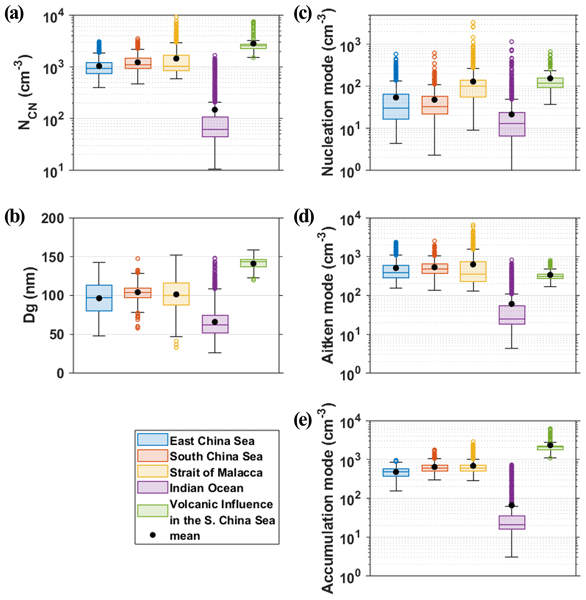
Aerosols are tiny particles in the air, and some of them help form cloud droplets (called cloud condensation nuclei). Most ship measurements focus on only one ocean. To compare aerosols over several oceans, we measured them during a transit voyage of a research ship using the same method. The results show that properties of these particles cannot be represented by a single marine condition. Moreover, they changed widely, depending on where the air came from and the pathway it traveled.
Damian K. Wójcik, Michał Z. Ziemiański, and Wojciech W. Grabowski
Weather Clim. Dynam., 6, 1769–1795, https://doi.org/10.5194/wcd-6-1769-2025, https://doi.org/10.5194/wcd-6-1769-2025, 2025
Short summary
Short summary
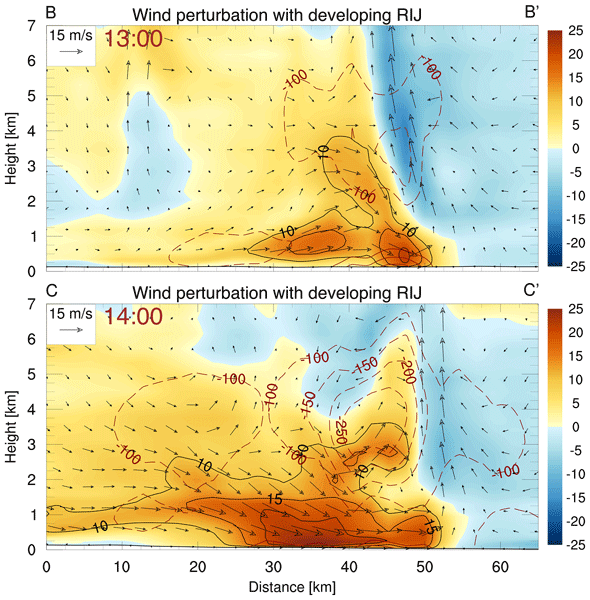
Representation of severe convection is a challenge for numerical weather prediction models. We show that an explicit stochastic convection initiation scheme, mimicking effects of initial convective cells, allows representation of the isolated bow echo, exposing its cold-pool-driven dynamics, formation of the rear inflow jet, and strong surface winds. The reconstruction delays the strongest gusts by almost an hour, and insufficiently represents continuous linear arrangement of convective cells.
Wojciech W. Grabowski and Hanna Pawlowska
Atmos. Chem. Phys., 25, 5273–5285, https://doi.org/10.5194/acp-25-5273-2025, https://doi.org/10.5194/acp-25-5273-2025, 2025
Short summary
Short summary
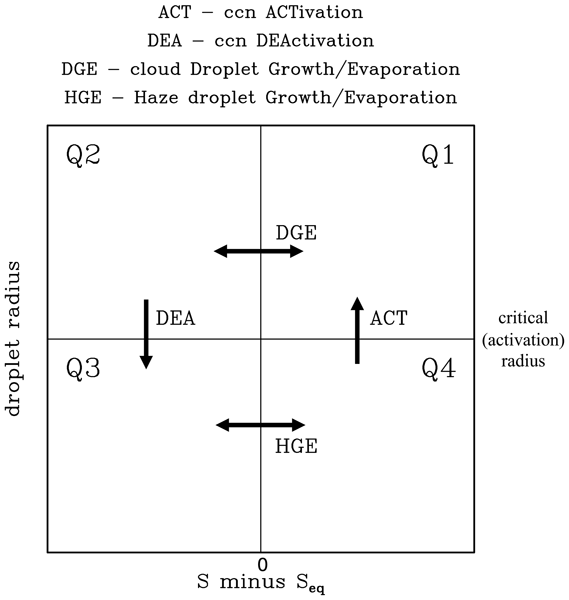
A simple diagram to depict cloud droplets' formation via the activation of cloud condensation nuclei (CCN) as well as their subsequent growth and evaporation is presented.
Adam C. Varble, Adele L. Igel, Hugh Morrison, Wojciech W. Grabowski, and Zachary J. Lebo
Atmos. Chem. Phys., 23, 13791–13808, https://doi.org/10.5194/acp-23-13791-2023, https://doi.org/10.5194/acp-23-13791-2023, 2023
Short summary
Short summary
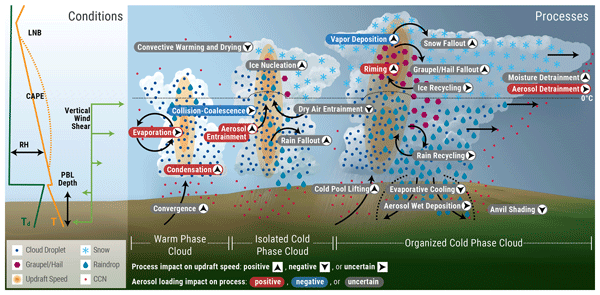
As atmospheric particles called aerosols increase in number, the number of droplets in clouds tends to increase, which has been theorized to increase storm intensity. We critically evaluate the evidence for this theory, showing that flaws and limitations of previous studies coupled with unaddressed cloud process complexities draw it into question. We provide recommendations for future observations and modeling to overcome current uncertainties.
Istvan Geresdi, Lulin Xue, Sisi Chen, Youssef Wehbe, Roelof Bruintjes, Jared A. Lee, Roy M. Rasmussen, Wojciech W. Grabowski, Noemi Sarkadi, and Sarah A. Tessendorf
Atmos. Chem. Phys., 21, 16143–16159, https://doi.org/10.5194/acp-21-16143-2021, https://doi.org/10.5194/acp-21-16143-2021, 2021
Short summary
Short summary
By releasing soluble aerosols into the convective clouds, cloud seeding potentially enhances rainfall. The seeding impacts are hard to quantify with observations only. Numerical models that represent the detailed physics of aerosols, cloud and rain formation are used to investigate the seeding impacts on rain enhancement under different natural aerosol backgrounds and using different seeding materials. Our results indicate that seeding may enhance rainfall under certain conditions.
Cited articles
Abade, G. C., Grabowski, W. W., and Pawlowska, H.: Broadening of cloud droplet spectra through eddy hopping: turbulent entraining parcel simulations, J. Atmos. Sci., 75, 3365–3379, https://doi.org/10.1175/JAS-D-18-0078.1, 2018.
Anderson, J. C., Thomas, S., Prabhakaran, P., Shaw, R. A., and Cantrell, W.: Effects of the large-scale circulation on temperature and water vapor distributions in the Π Chamber, Atmos. Meas. Tech., 14, 5473–5485, https://doi.org/10.5194/amt-14-5473-2021, 2021.
Arabas, S. and Shima, S. I.: Large-eddy simulations of trade wind cumuli using particle-based microphysics with monte Carlo coalescence, J. Atmos. Sci., 70, 2768–2777, https://doi.org/10.1175/JAS-D-12-0295.1, 2013.
Arabas, S., Jaruga, A., Pawlowska, H., and Grabowski, W. W.: libcloudph++ 1.0: a single-moment bulk, double-moment bulk, and particle-based warm-rain microphysics library in C++, Geosci. Model Dev., 8, 1677–1707, https://doi.org/10.5194/gmd-8-1677-2015, 2015.
Carslaw, K. S., Lee, L. A., Reddington, C. L., Pringle, K. J., Rap, A., Forster, P. M., Mann, G. W., Spracklen, D. V., Woodhouse, M. T., Regayre, L. A., and Pierce, J. R.: Large contribution of natural aerosols to uncertainty in indirect forcing, Nature, 503, 67–71, https://doi.org/10.1038/nature12674, 2013.
Chandrakar, K. K., Cantrell, W., Chang, K., Ciochetto, D., Niedermeier, D., Ovchinnikov, M., Shaw, R. A., and Yang, F.: Aerosol indirect effect from turbulence-induced broadening of cloud-droplet size distributions, P. Natl. Acad. Sci. USA, 113, 14243–14248, https://doi.org/10.1073/pnas.1612686113, 2016.
Chandrakar, K. K., Cantrell, W., and Shaw, R. A.: Influence of turbulent fluctuations on cloud droplet size dispersion and aerosol indirect effects, J. Atmos. Sci., 75, 3191–3209, https://doi.org/10.1175/JAS-D-18-0006.1, 2018.
Chandrakar, K. K., Cantrell, W., Krueger, S., Shaw, R. A., and Wunsch, S.: Supersaturation fluctuations in moist turbulent Rayleigh–Bénard convection: a two-scalar transport problem, J. Fluid Mech., 884, A19, https://doi.org/10.1017/jfm.2019.895, 2020.
Chandrakar, K. K., Morrison, H., and Witte, M.: Evolution of Droplet Size Distributions During the Transition of an Ultraclean Stratocumulus Cloud System to Open Cell Structure: An LES Investigation Using Lagrangian Microphysics, Geophys. Res. Lett., 49, 1–10, https://doi.org/10.1029/2022GL100511, 2022.
Dziekan, P., Jensen, J. B., Grabowski, W. W., and Pawlowska, H.: Impact of Giant Sea Salt Aerosol Particles on Precipitation in Marine Cumuli and Stratocumuli: Lagrangian Cloud Model Simulations, J. Atmos. Sci., 78, 4127–4142, https://doi.org/10.1175/JAS-D-21-0041.1, 2021.
Grabowski, W. W.: Comparison of Eulerian bin and Lagrangian particle-based schemes in simulations of PI chamber dynamics and microphysics, J. Atmos. Sci., 77, 1151–1165, https://doi.org/10.1175/JAS-D-19-0216.1, 2020.
Grabowski, W. W. and Pawlowska, H.: Technical note: Phase space depiction of cloud condensation nuclei activation and cloud droplet diffusional growth, Atmos. Chem. Phys., 25, 5273–5285, https://doi.org/10.5194/acp-25-5273-2025, 2025.
Grabowski, W. W. and Smolarkiewicz, P. K.: Monotone finite-difference approximations to the advection-condensation problem, Mon. Weather Rev., 118, 2082–2098, https://doi.org/10.1175/1520-0493(1990)118<2082:MFDATT>2.0.CO;2, 1990.
Grabowski, W. W., Andrejczuk, M., and Wang, L. P.: Droplet growth in a bin warm-rain scheme with Twomey CCN activation, Atmos. Res., 99, 290–301, https://doi.org/10.1016/j.atmosres.2010.10.020, 2011.
Grabowski, W. W., Morrison, H., Shima, S. I., Abade, G. C., Dziekan, P., and Pawlowska, H.: Modeling of cloud microphysics: Can we do better?, B. Am. Meteorol. Soc., 100, 655–672, https://doi.org/10.1175/BAMS-D-18-0005.1, 2019.
Grabowski, W. W., Kim, Y., and Yum, S. S.: CCN Activation and Droplet Growth in Pi Chamber Simulations with Lagrangian Particle–Based Microphysics, J. Atmos. Sci., 81, 1201–1212, https://doi.org/10.1175/JAS-D-24-0004.1, 2024.
Grabowski, W. W., Chandrakar, K. K., and Morrison, H.: Broadening of adiabatic droplet spectra through eddy hopping: Polluted versus pristine environments, J. Atmos. Sci., https://doi.org/10.1175/JAS-D-25-0148.1, 2026.
Hansen, J. E., Kharecha, P., Sato, M., Tselioudis, G., Kelly, J., Bauer, S. E., Ruedy, R., Jeong, E., Jin, Q., Rignot, E., Velicogna, I., Schoeberl, M. R., von Schuckmann, K., Amponsem, J., Cao, J., Keskinen, A., Li, J., and Pokela, A.: Global Warming Has Accelerated: Are the United Nations and the Public Well-Informed?, Environ. Sci. Policy Sustain. Dev., 67, 6–44, https://doi.org/10.1080/00139157.2025.2434494, 2025.
Hoffmann, F. and Feingold, G.: Cloud microphysical implications for marine cloud brightening: The importance of the seeded particle size distribution, J. Atmos. Sci., 78, 3247–3262, https://doi.org/10.1175/JAS-D-21-0077.1, 2021.
Intergovernmental Panel on Climate Change (IPCC): Climate Change 2021 – The Physical Science Basis, Cambridge, United Kingdom, https://doi.org/10.1017/9781009157896, 2021.
Morrison, H., Chandrakar, K. K., Shima, S.-I., Dziekan, P., and Grabowski, W. W.: Impacts of Stochastic Coalescence Variability on Warm Rain Initiation Using Lagrangian Microphysics in Box and Large-Eddy Simulations, J. Atmos. Sci., 81, 1067–1093, https://doi.org/10.1175/jas-d-23-0132.1, 2024.
Park, M., Yum, S. S., Seo, P., Ahn, C., Kim, N., Anderson, B. E., and Thornhill, K. L.: A New CCN Number Concentration Prediction Method Based on Multiple Linear Regression and Non-Negative Matrix Factorization: 2. Application to Obtain CCN Spectra in and Around the Korean Peninsula, J. Geophys. Res.-Atmos., 128, https://doi.org/10.1029/2023JD039234, 2023a.
Park, M., Yum, S. S., Seo, P., Kim, N., and Ahn, C.: A New CCN Number Concentration Prediction Method Based on Multiple Linear Regression and Non-Negative Matrix Factorization: 1. Development, Validation, and Comparison Using the Measurement Data Over the Korean Peninsula, J. Geophys. Res.-Atmos., 128, https://doi.org/10.1029/2023JD039189, 2023b.
Prabhakaran, P., Thomas, S., Cantrell, W., Shaw, R. A., and Yang, F.: Sources of Stochasticity in the Growth of Cloud Droplets: Supersaturation Fluctuations versus Turbulent Transport, J. Atmos. Sci., 79, 3145–3162, https://doi.org/10.1175/JAS-D-22-0051.1, 2022.
Seinfeld, J. H., Bretherton, C., Carslaw, K. S., Coe, H., DeMott, P. J., Dunlea, E. J., Feingold, G., Ghan, S., Guenther, A. B., Kahn, R., Kraucunas, I., Kreidenweis, S. M., Molina, M. J., Nenes, A., Penner, J. E., Prather, K. A., Ramanathan, V., Ramaswamy, V., Rasch, P. J., Ravishankara, A. R., Rosenfeld, D., Stephens, G., and Wood, R.: Improving our fundamental understanding of the role of aerosol-cloud interactions in the climate system, P. Natl. Acad. Sci. USA, 113, 5781–5790, https://doi.org/10.1073/pnas.1514043113, 2016.
Shaw, R. A., Thomas, S., Prabhakaran, P., Cantrell, W., Ovchinnikov, M., and Yang, F.: Fast and slow microphysics regimes in a minimalist model of cloudy Rayleigh–Bénard convection, Phys. Rev. Res., 5, 1–14, https://doi.org/10.1103/PhysRevResearch.5.043018, 2023.
Shima, S., Kusano, K., Kawano, A., Sugiyama, T., and Kawahara, S.: The super-droplet method for the numerical simulation of clouds and precipitation: A particle-based and probabilistic microphysics model coupled with a non-hydrostatic model, Q. J. Roy. Meteor. Soc., 135, 1307–1320, https://doi.org/10.1002/qj.441, 2009.
Thomas, S., Ovchinnikov, M., Yang, F., van der Voort, D., Cantrell, W., Krueger, S. K., and Shaw, R. A.: Scaling of an Atmospheric Model to Simulate Turbulence and Cloud Microphysics in the Pi Chamber, J. Adv. Model. Earth Sy., 11, 1981–1994, https://doi.org/10.1029/2019MS001670, 2019.
Thomas, S., Prabhakaran, P., Yang, F., Cantrell, W. H., and Shaw, R. A.: Dimensionless parameters for cloudy Rayleigh–Bénard convection: Supersaturation, Damköhler, and Nusselt numbers, Phys. Rev. Fluids, 7, 1–15, https://doi.org/10.1103/PhysRevFluids.7.010503, 2022.
Thomas, S., Yang, F., Ovchinnikov, M., Cantrell, W., and Shaw, R. A.: Scaling of Turbulence and Microphysics in a Convection–Cloud Chamber of Varying Height, J. Adv. Model. Earth Sy., 15, https://doi.org/10.1029/2022MS003304, 2023.
Wang, A., Ovchinnikov, M., Yang, F., Cantrell, W., Yeom, J., and Shaw, R. A.: The Dual Nature of Entrainment-Mixing Signatures Revealed through Large-Eddy Simulations of a Convection-Cloud Chamber, J. Atmos. Sci., 81, 2017–2039, https://doi.org/10.1175/JAS-D-24-0043.1, 2024a.
Wang, A., Yang, X. I., and Ovchinnikov, M.: An investigation of LES wall modeling for Rayleigh–Bénard convection via interpretable and physics-aware feedforward neural networks with DNS, J. Atmos. Sci., 81, 435–458, 2024b.
Yang, F., Hoffmann, F., Shaw, R. A., Ovchinnikov, M., and Vogelmann, A. M.: An Intercomparison of Large-Eddy Simulations of a Convection Cloud Chamber Using Haze-Capable Bin and Lagrangian Cloud Microphysics Schemes, J. Adv. Model. Earth Sy., 15, 1–20, https://doi.org/10.1029/2022MS003270, 2023.
Yang, F., Sadi, H. F., Shaw, R. A., Hoffmann, F., Hou, P., Wang, A., and Ovchinnikov, M.: Microphysics regimes due to haze–cloud interactions: cloud oscillation and cloud collapse, Atmos. Chem. Phys., 25, 3785–3806, https://doi.org/10.5194/acp-25-3785-2025, 2025.
Short summary
We ask how the amount of aerosol particles shapes cloud structure. Using computer simulations of a laboratory cloud chamber, we varied aerosol levels and tracked droplet growth. When aerosols are few, cloud water increases with height; when many, it becomes almost uniform because vapor is used up near the bottom. These findings clarify when upward motions matter and guide chamber design and better cloud treatment in weather and climate models.
We ask how the amount of aerosol particles shapes cloud structure. Using computer simulations of...


Altmetrics
Final-revised paper
Preprint